The Camiguin Hanging Parrot(Loriculus camiguinensis) has the plumage mostly green, with the throat, front side of the face and the thighs light blue; the forecrown, the pyleus, the obispillo and the top of the tail red, While the rest of the tail It is also blue. Underwing coverts blue. Band of orange-red in the nape, that varies from bird to bird.
Bill orange. Iris grayish brown.
The males and females they have a similar appearance, the female has less blue on the cheeks.
The youth they are similar to the adult female but with only a slight tinge of blue in the cheeks and red on the forehead minimal or absent. Bill a pale.
In 2006 described as a separate species to the loricles who lived on the island of Camiguin, to the North of Mindanao, Since then it was considered a subspecies of the Philippine loriclein the.
Probably sedentary. Found between the 300 and 1350 meters in montane forests, secondary forests, at the edges of the forest near the settlements, in plantations in the areas planted with shrubs and coconut.
Usually seen individually, in pairs, mixed flocks or small families. Feeds in trees or shrubs; difficult to detect. It´s shy and cautious.
Reproduction:
Breeding season probably between the months of September to November. Nest placed in the hole of a dead arbol-helecho. No other information.
Food:
It is said that they feed on nectar, seeds, especially wild banana (Musa), also soft fruit, berries and flowers.
Distribution:
Endemic in the Philippine island of Camiguin, off the North coast of Mindanao.
Conservation:
This species is threatened by its limited range, the natural habitat destruction and capture for the wild bird trade.
"Camiguin Hanging Parrot" in captivity:
Probably not remain outside the island of Camiguin.
Among 30 and 37 cm.. length and a weight between 99 and 170 g..
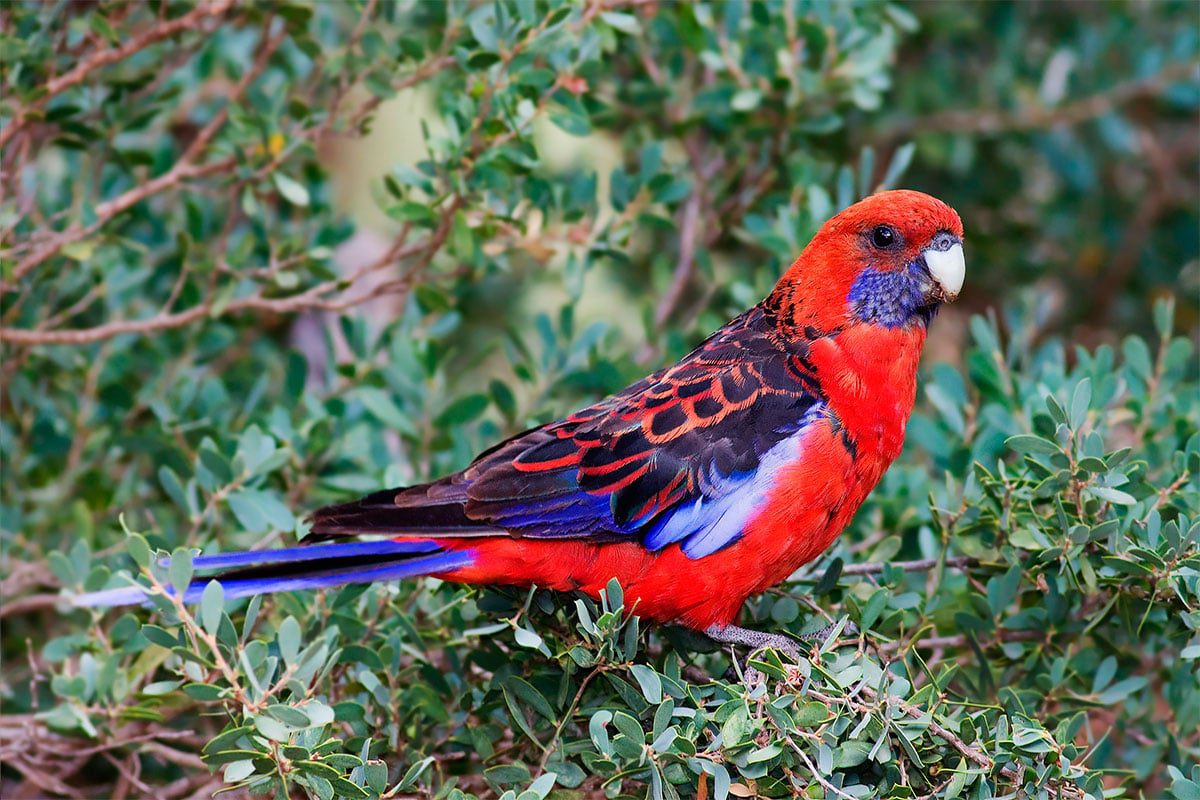
The Crimson Rosella(Platycercus elegans) has a predominantly red plumage.
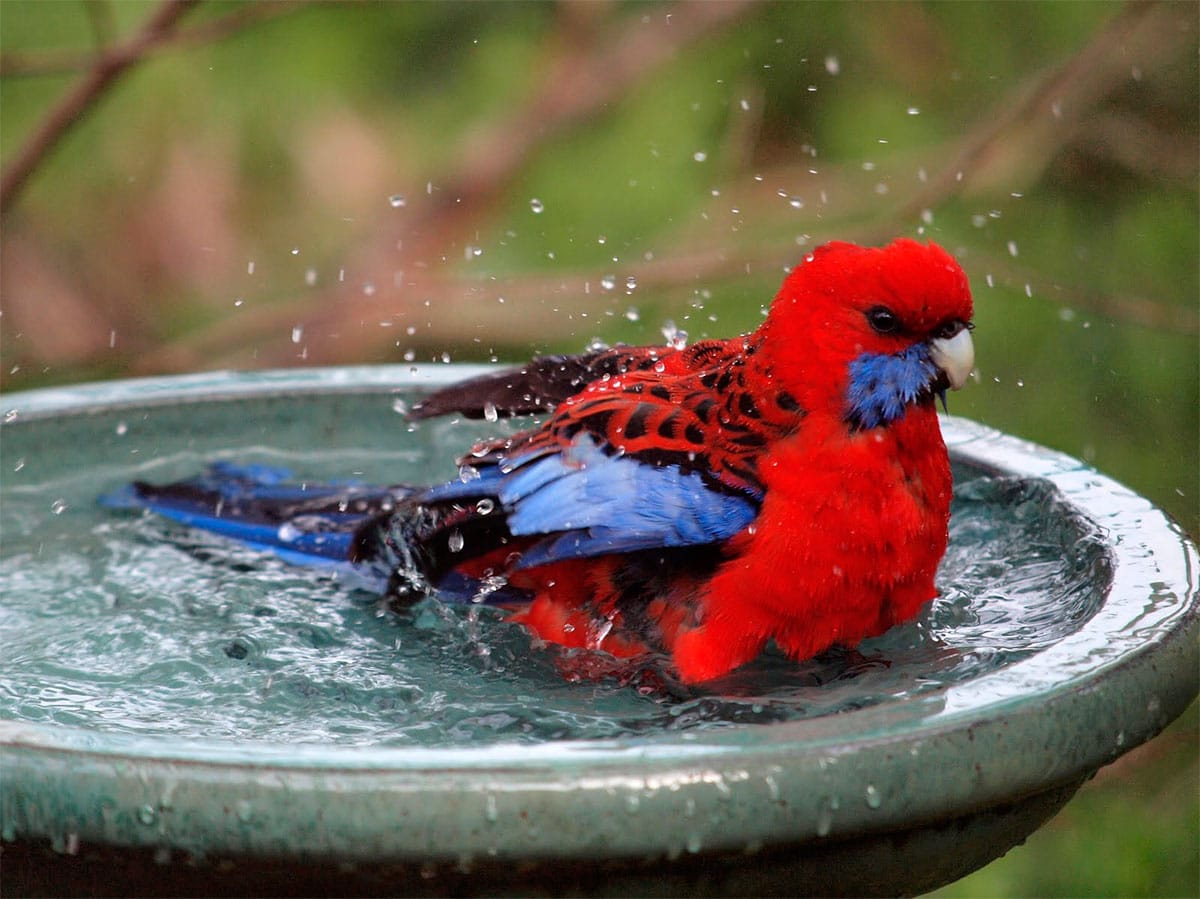
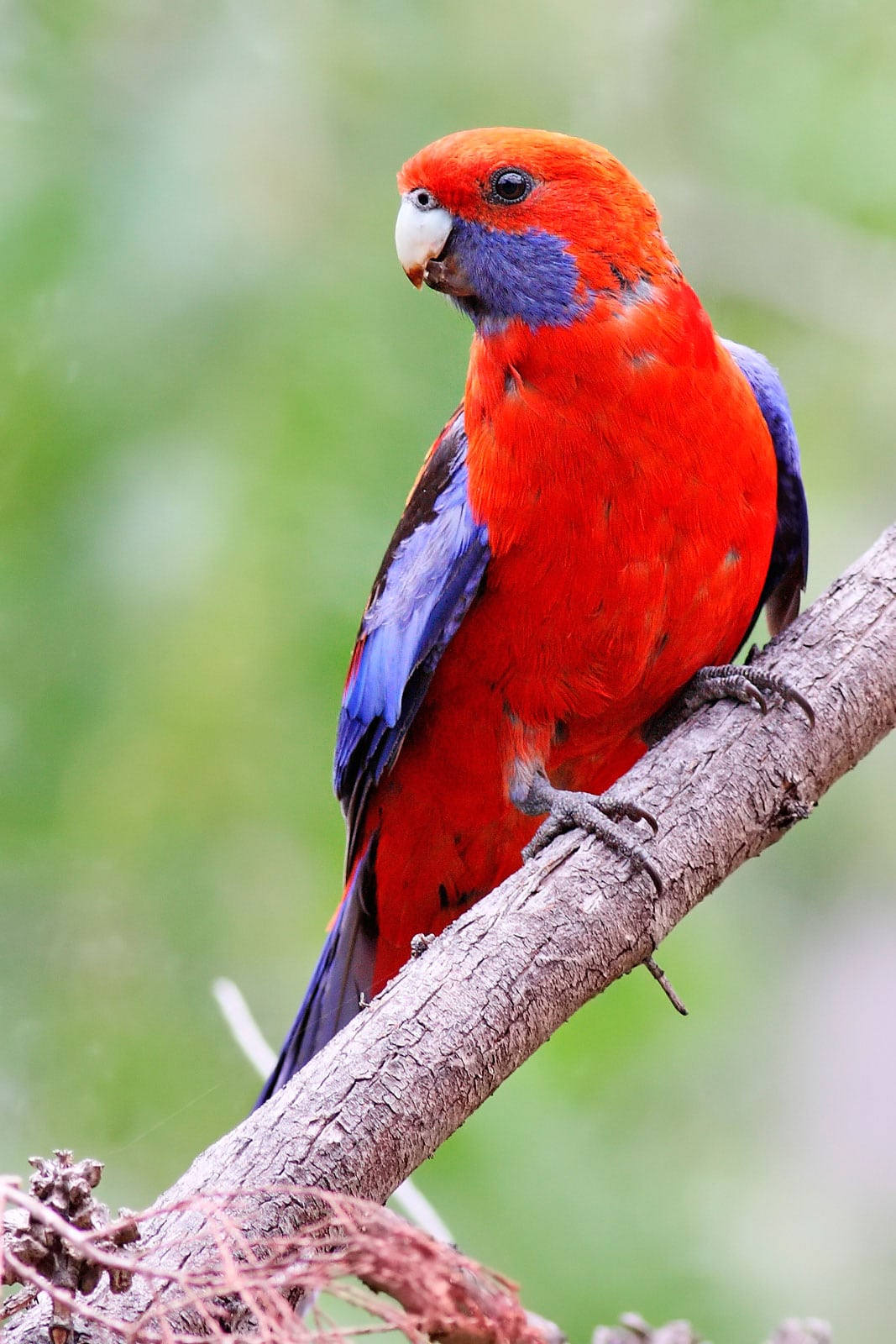
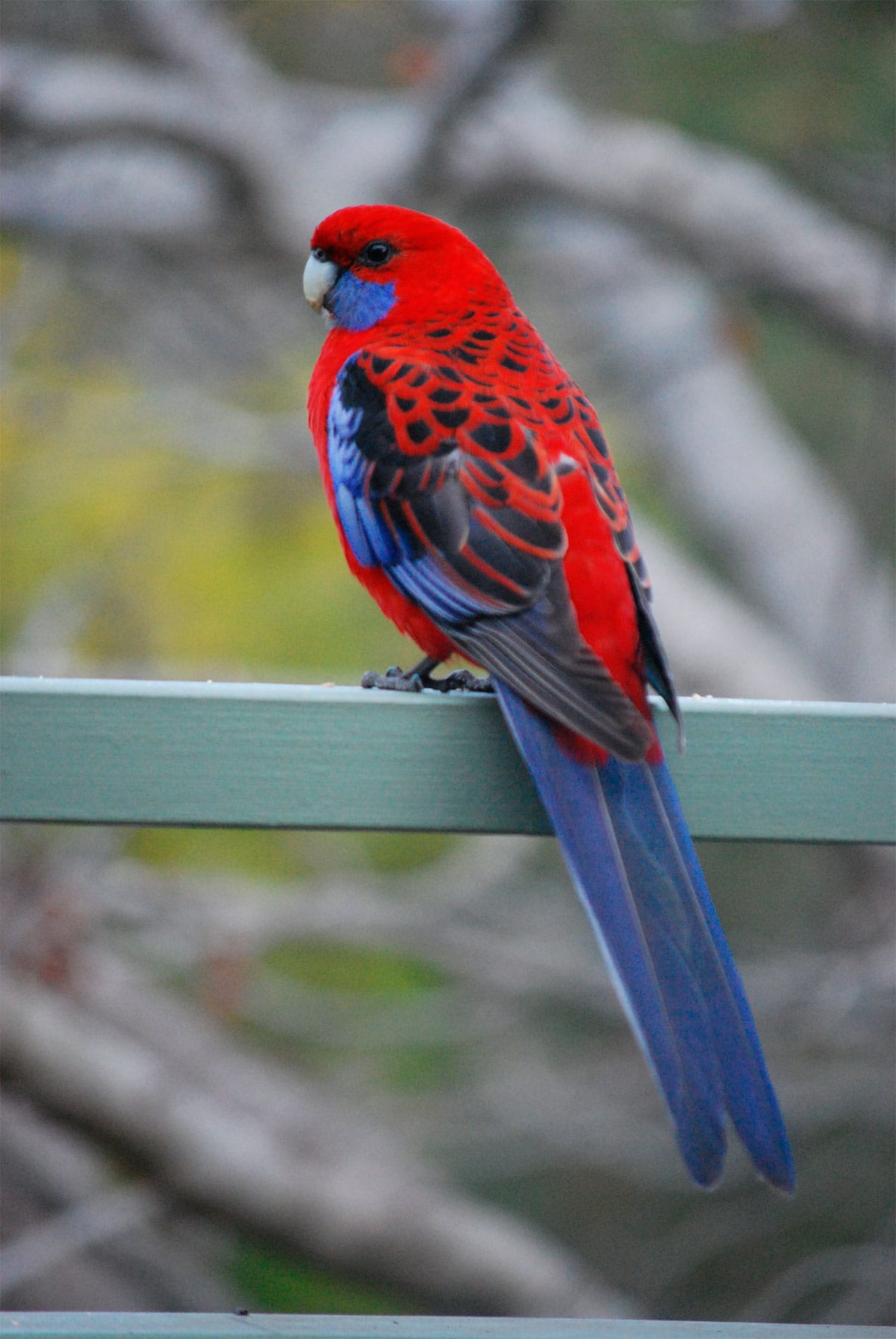
Its head is bright crimson in color with the lower part of the cheeks and the throat of blue color.. Mantle feathers are black with broad crimson margins of variable intensity.; rump and uppertail coverts crimson.
Medium and lower inner wing coverts black; bend of wing, lesser coverts and medium blue color external; external greater coverts bright blue, Black Interior with red edges giving a scaly appearance to this area; primary coverts blue violet; feathers of flying blackish with thin margin foreign white in them more external and blue violet in vane outer; secondary black with vane external blue violet; tertiary black with red borders.
Under, Blackish wings with blue coats. Underparts showy crimson.
Upper, the tail is blue, the center of green-washed, Foreign feathers with vane Blackish internal and vane Violet Blue outer with pale at both ends; undertail, the tail of pale blue edged blackish when closed.
The peak of grayish-white; dark brown irises; greyish Brown legs.
The female It is smaller with narrower peak. It has no stripe under the wings..
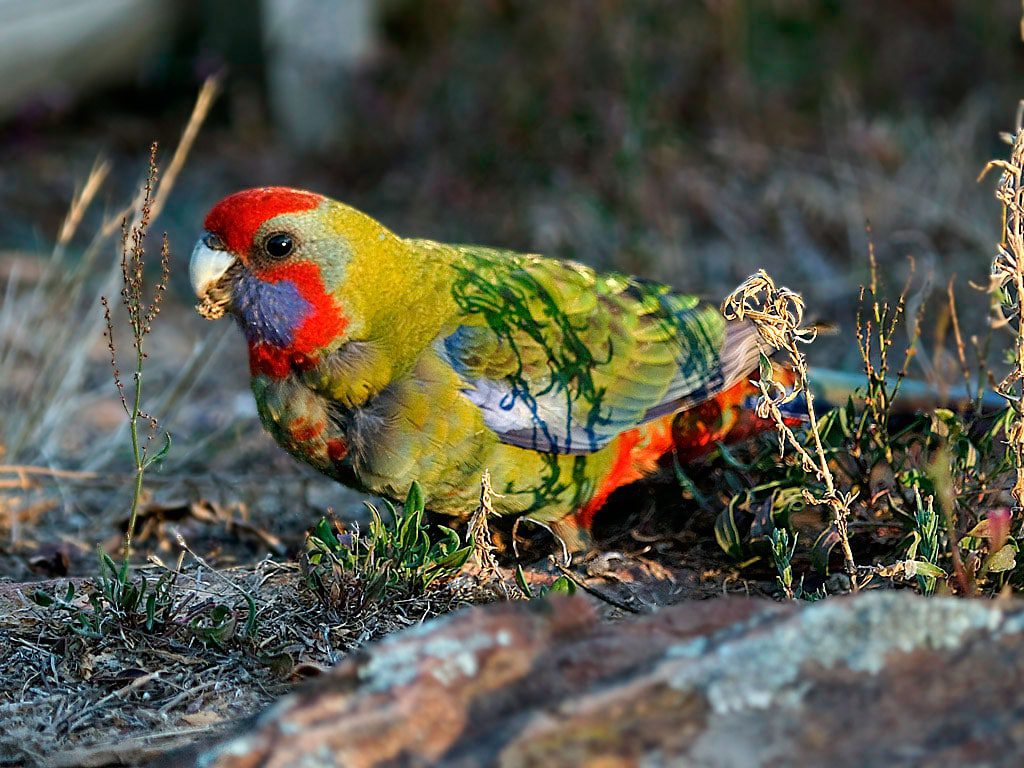
The immature is very different, with upper parts olive green (including the tail at the top), and green underparts greyish.
The centers to the mantle feathers are dark brown, and the black markings of the wings of the adult are replaced by green. Very young birds rump is green Orange. There is a pale stripe on the bottom of the wings (formed by stains pale in vane inner). It shows red feathers on the head, chest, buttocks and subcaudales coverts and move through the first fall.
Adult plumage is reached in a few 15 months. Immatures of the population in the North are mainly red, and there are less green unripe in Norfolk Island than mainland populations.
(Gould, 1837) – With 33 cm.. length, approximately, It is but little that the nominal species, Yellow has no orange hue and there is orange in the neck, chest and abdomen.
Platycercus elegans fleurieuensis
(Ashby, 1917) – IMG – It differs from the species rated as having an intense orange color, Red plumage, the mantle and black gray back, with pale orange-red spots; pale blue medium and secondary wing coverts.
Platycercus elegans melanopterus
(North, 1906) – Of 36 cm.. length, approximately. The bordered red are more narrow, with which the back looks more black. Female as the nominal.
Platycercus elegans nigrescens
(Ramsay,EP, 1888) – With 34 cm.. length, It is smaller than the nominal value and the color red is much more dark. Red feathers are more narrow. Female as the nominal.
Platycercus elegans subadelaidae
(Mathews, 1912) – Approximately from 36 cm.. length. Instead of Red Blend Red, Orange and yellow. Orange red forehead, the Crown and face, they turned to brighter red frontal band. Yellow olive from the low back to the supracaudales coverts
Habitat:
The Crimson Rosella they frequent tropical and humid subtropical forests near the coast and the surroundings of montane forests at altitudes up to 1.900 m.
They are mainly on the edges of jungle, in the secondary zones and in the dense forests of eucalyptus they arrive at a good stage of maturity.
The nominal species has a preference for thick wooded areas, but often goes into open areas and farmland where it is mixed with the Perico conr (Platycercus eximius).
It also tends to visit plots of pine trees.
In the Kangaroo Island, where is the only parakeet present, He lives in all types of forest habitats, they are also adapting to farmland.
The subspecies subadelaidae and fleurieuensis, sometimes grouped under the term Adelaide parakeet, frequent valleys forest, arboreal galleries that border the rivers or trees on the edge of the roads. They are also present in the orchards and farmland.
The Flaveolus subspecies attends the same types of habitat, that is to say, curtains of trees dominated by red rubber trees along the river.
To feed, move away from rivers and raid agricultural land, flooded Plains, or thickets «Mallee«.
Adults are sedentary. Usually, they live in pairs or in small groups. On the other hand, juveniles and subadults form noisy groups and many roam locally when leaving dormitory at sunrise.
Its main activity is carried out in the morning and in the evening. in the middle of the day, they rest in the shady foliage. But, If the sky is overcast and the weather is cool, these birds are active during the day.
The Crimson Rosella they seek food on Earth, in trees and shrubs. They often feed in the company of the Eastern Rosella (Platycercus eximius), But if the joint working group is altered during its activity, the two species are separated in flight and taken opposite directions, each seeking refuge by his side.
The Crimson Rosella they are not very shy and can be approached at a very short distance.
In urban areas, they are particularly friendly.
Reproduction:
The breeding season covers the months of August to February and, sometimes even later.
The elegant parakeet build their nests on a branch or in the cavity of a tree trunk. Usually, Choose a healthy or dead eucalyptus, but sometimes they install their nests in a place as strange as the metal beam of a construction crane.
In all cases, the nest is located high above the ground. Spawning usually includes 4 to 7 white eggs, rarely 8, which are incubated during approximately 19 days.
The female incubates the eggs alone, but the chicks receive equal attention from both parents.
The nesting cycle is quite long and it takes around 5 weeks
Food:
The Crimson Rosella they have a mainly vegetarian mixed diet. Consume the seeds of black Cypress of Australia (Callitris endlicheri), figs, seeds of acacia and eucalyptus.
The vegetable part of its menu is complemented by a wide variety of imported plants such as Rosa rubiginosa, clover or chickweed (Stellaria media).
In the South of its range, they eat the fruits or flowers trees of Melaleuca, banksia and casuarina.
Insects are not forgotten in your menu: Hemiptera, psyllids, termites, aphids and larvae of beetles.
These parrots times behave as true pests in orchards, eating apples, Plums, pears and quinces.
Distribution:
Confined to the coastal area of Eastern Australia where are widely distributed in the wooded areas along and East of the Great dividing range.
There is an isolated population in the North between the surrounding of Atherton, Northeast of Queensland, to the South of the mountain range of Clarke and Eungella (the population in Eungella It can also be isolated).
In Victoria extends from the East to the Grampian and the Edenhope district, where spills into the Southeast end of Australia, coming to Kingston at its western end.
There is also an isolated population in the Kangaroo Island.
The species is found in the wild around Sydney, Brisbane and Melbourne, and leaks from birds have been around Perth. There are records in the North of Tasmania and the islands of the bass strait, probably, also refer to birds Getaways.
It is common in the Norfolk Island where it was introduced in the century 19, but is absent in the vicinity of Nepean and Philip Island; an attempt to introduce the species in Lord Howe Island failed.
Was also introduced in New Zealand, showing in the West suburbs of Wellington, and some birds can also persist in the District of Dunedin of South Island where can hybridize with the introduced Perico conr.
The world's population is above 200.000. Moderate numbers in captivity.
The birds can be eradicated with a permit in States where the destruction of crops occurs.
• Current category of the Red List of the UICN: Least concern
• Population Trend: Decreasing
The size of the world's population has not been quantified, Although it is estimated above 200.000 specimens.
The Crimson Rosella they are infrequent at both ends of its distribution area, but in other places, they are locally abundant and common.
In the North, they are slightly less numerous. In the past recent, they have colonized successfully parks and urban gardens, so now are very widespread in the suburbs of Canberra and Adelaide.
In the Norfolk Island, the import is so successful that they now represent a competition and a significant danger to the Red-crowned parakeet (Cyanoramphus novaezelandiae).
"Crimson Rosella" in captivity:
Moderately loud, very active, they are acclimatized to the owner. It is not usually compatible with other birds.
A sample of the subspecies subadelaidae lived 26,8 years in captivity Rare in captivity.
AnAge: The Animal Ageing and Longevity Database – Anagé Database
Photos:
(1) – An adult Crimson Rosella (Platycercus elegans), Wilsons Promontory National Park, Victoria, Australia By JJ Harrison (jjharrison89@facebook.com) (Own work) [CC BY-SA 3.0], via Wikimedia Commons
(2) – A Crimson Rosella photographed though a window in the Blue Mountains, Australia By John Poulakis from Australia (Crimson RosellaUploaded by Snowmanradio) [CC BY 2.0], via Wikimedia Commons
(3) – Crimson Rosella (Platycercus elegans) photographed taken in Swifts Creek, Victoria, Australia Fir0002 [GFDL, CC-BY-SA-3.0 or GFDL 1.2], via Wikimedia Commons
(4) – A Crimson Rosella in a bird bath Canberra, Australia By Duncan McCaskill (Picasa Web Albums) [CC BY 3.0], via Wikimedia Commons
(5) – Juvenile Crimson Rosella (Platycercus elegans) by David Cook – Flickr
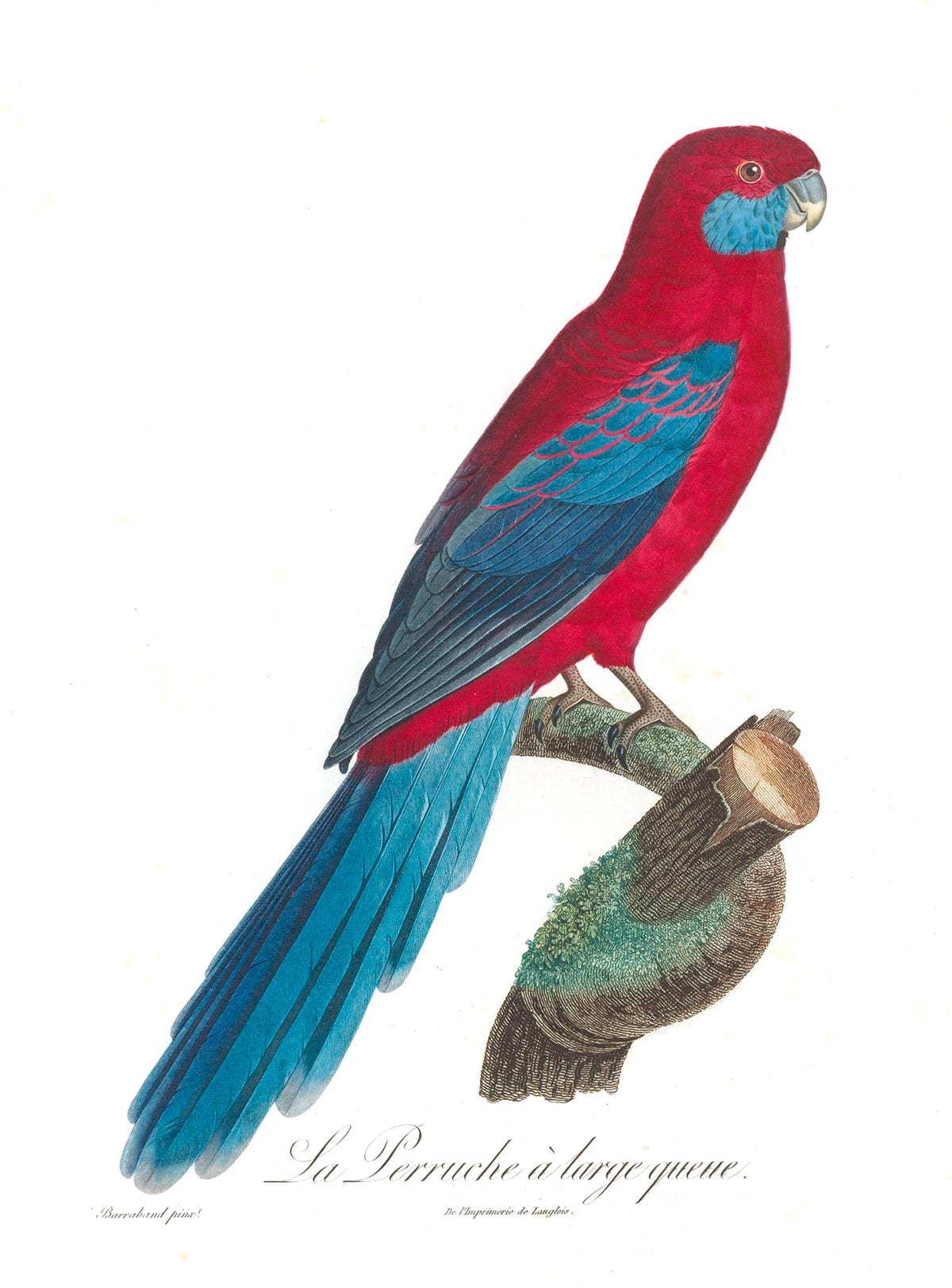
(6) – An adult Crimson Rosella (Platycercus elegans) Jacques Barraband [Public domain], via Wikimedia Commons
32 cm. medium length and a weight between 300 and 400 g..
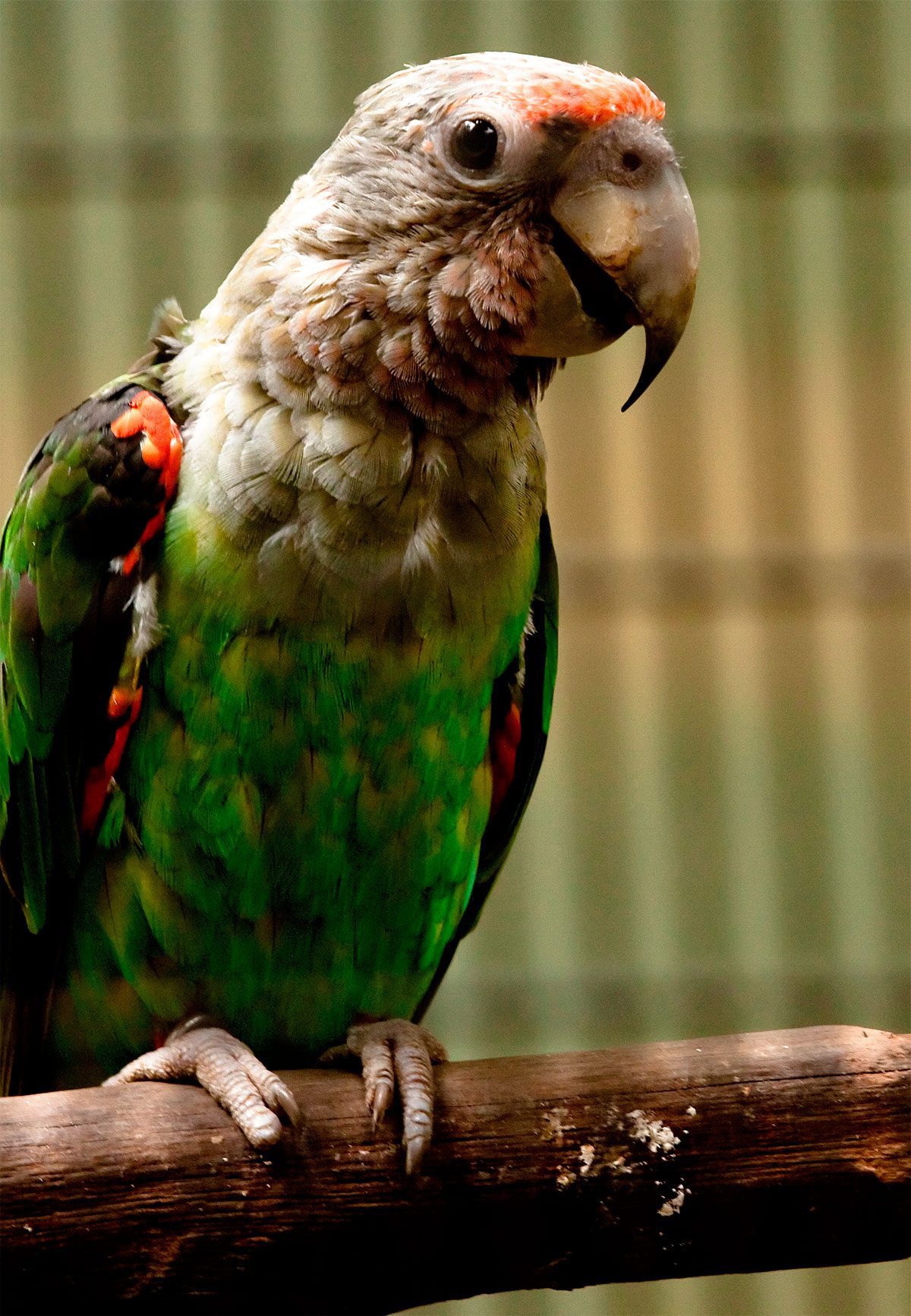
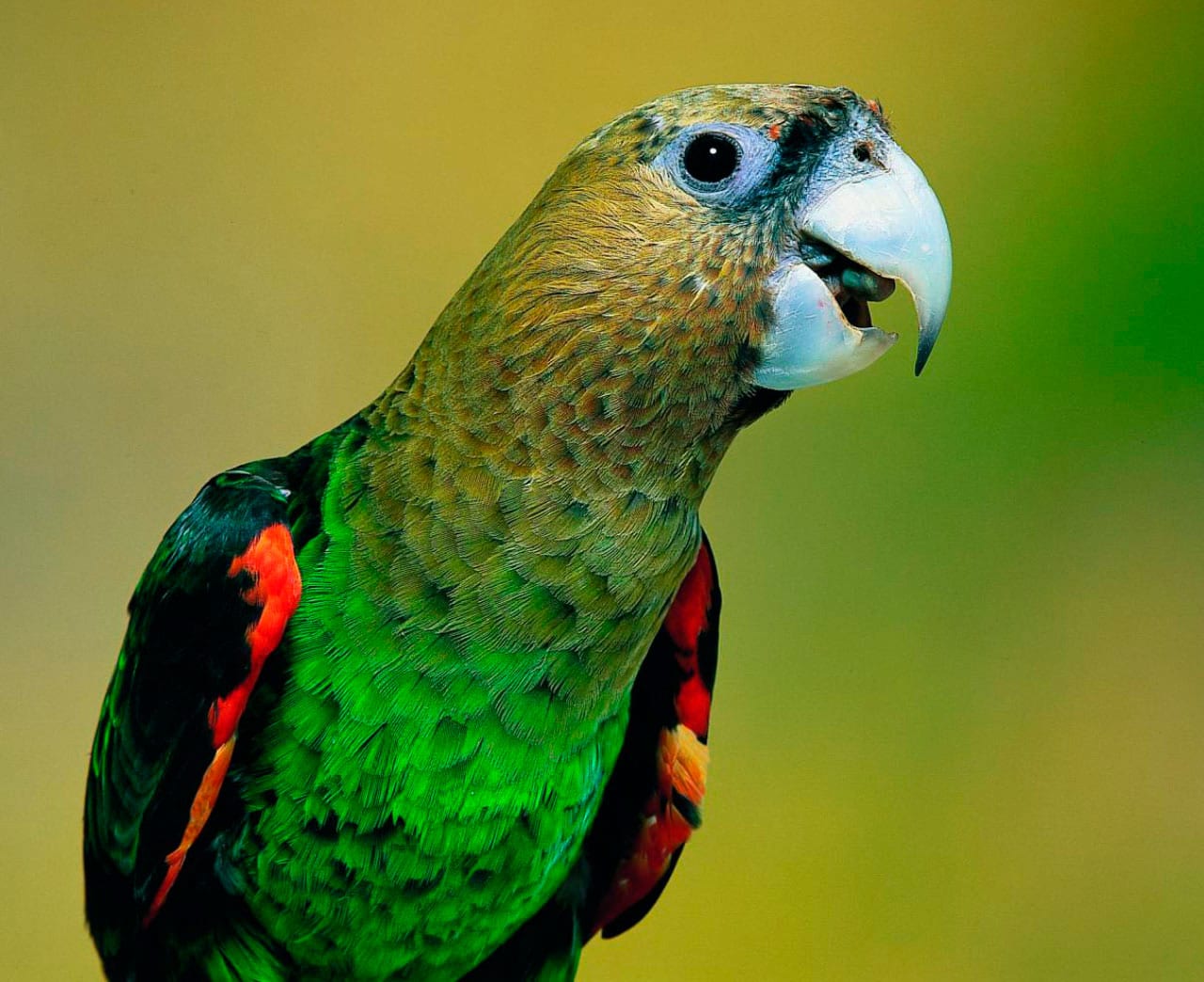
The Cape Parrot(Poicephalus robustus) has the head, neck and throat between olive brown and olive yellow, with darker spots (almost black in some birds), especially in the crown; lores and cheeks blackish; pale red frontal band, is present, occasionally, in males (generally evident in females).
The mantle feathers and scapulars dark green opaque, bright green-edged; rump bright green.
Coverts on the leading edges of the wings, Since the carpal joints at the base of the primaries, bright orange red; upper wing coverts, dark green to black, with lighter green edges; below, the feathers of the wings blackish and green. The primaries and secondaries black top, dark brown below. High area of the chest, stomach and vent, bright green; the thighs orange red glossy. Upper, the tail black; undertail, dark brown.
Some birds (around the 10%) have feathers yellow in the plumage spread.
Bill color horn; irises dark brown to reddish brown; legs bluish grey.
The females, generally (Although not always), they have well defined orange red frontal band.
The youth lack of color marks orange red envelope the wing-coverts and the thighs, but tend to show a bit of red in the forecrown.
In a study initiated in 1992, the taxonomic status of Lorito was revised Robusto (Poicephalus robustus) (Gmelin), and two species were proposed; Poicephalus robustus, restricted to montane forests of southern Africa, Poicephalus fuscicollis suahelicus, with wider distribution in wooded areas, and Poicephalus fuscicollis fuscicollis, similar to the Poicephalus fuscicollis suahelicus ostensibly, but with discontinuous, restricted to a narrow range of forests and West Africa.
(Reichenow, 1898) – Of larger size the species nominal, the male has the head and the neck a silvery gray and lacks the reddish frontal band. The female has orange colouring in the the thighs and in the shoulders and in the cere, while the male not. Blue tint in the rump.
Poicephalus robustus fuscicollis
(Kuhl, 1820) – The smaller subspecies. With more blue tones, especially in rump and bottom of the back.
Habitat:
They live in a variety of forest types, including Red Mangroves (Rhizophora mangle) (for example, in Gambia), riparian forests (for example in Ghana, Zimbabwe), Savanna Woods (for example, Nigeria, Ivory Coast), in montane forests at altitudes of 3,750m (for example, east of Zaire), in lowland forests (for example, South Zaire).
The birds of the Southern Africa they have favoritism by the Acacia mearnsii and Podocarpus forests at altitudes between 1.000 and 1,700 m, separating attitudinally and ecologically in the subspecies suahelicus, It occurs in lowland forests.
The birds of the Southern Africa (also perhaps other species) they form communal roosts before spreading to power remote areas (until 90 km) in small flocks.
Sometimes seen separately but more usually found in groups of up to 20 birds (sometimes 50). It forms mixed flocks with peers.
The season of breeding varies with locality. In Gambia, reportedly, breeding takes place between the months of February and April, While in Zimbabwe It is estimated to be between the months of March to June, and between October and November. In South Africa, breeding takes place in June and between August and October.
The laying tends to be of 3 to 4 eggs.
During the courtship the male feeds the female making exaggerated turns his head and dropping their wings to form a kind of layer around the lower half of your body. The pair shows a strong union ties and they spend much time grooming each other.
Food:
In Zimbabwe, In addition to daily trips in search of food, seasonal movements are performed in search of Uapaca and fruits of Sysygium.
Has been feeding of millet in Zimbabwe and Malawi, of peanuts harvested in Gambia and, occasionally, visiting gardens of Apple trees, but numerous enough to be considered a plague serious nowhere.
The birds of the Southern Africa feed almost exclusively on fruit of the Podocarpus, long as they are available.
Use the peak to climb between the branches when they feed in the trees; They also feed on the ground. The Cape Parrot make daily trips to secret locations for drinking water.
Distribution:
Probably occupy three zones separated, in the West, South-Central and South of Africa.
In West Africa, are from Gambia and South of Senegal to the East of Ghana and Togo.
In the Center-South of Africa, from the southwest of Congo, South and East of Zaire, Southwest of Uganda, Rwanda and from the center of Tanzania to the North of Namibia, North of Botswana, Zambia and Zimbabwe.
Flocks of foraging roam unpredictably and can remain away from traditional sites for weeks. Sometimes they make seasonal movements in relation to the availability of food, for example, in the northern savannas of Ghana.
Local and mostly uncommon across the range, Although more numerous and frequent in Ghana.
(Reichenow, 1898) – Are distributed by the center of Angola; Southeast of the Democratic Republic of the Congo, Rwanda and South of Tanzania until Zimbabwe, North of Mozambique, and far northeast of South Africa; in populations along the lower Congo River the three subspecies can mix.
Poicephalus robustus fuscicollis
(Kuhl, 1820) – Are distributed from the South of the Senegal and Gambia to the North of Ghana
In 1988 included for the first time in the red list of threatened species by the IUCN as least concern species.
The size of its current population is estimated at less than 1.600 birds in their natural habitat.
Why not join this parrot species in critical hazard is due to the subspecies of this they comprise an area of diffusion much greater than that of the nominal species, whereupon, This leads to a growth in the population of subspecies and the decrease of the nominal species. The subspecies occupy all the Central Africa and Western, while the Poicephalus robustus only lives in some provinces of South Africa as they are Eastern Cape, KwaZulu-Natal and Limpopo.
Over time the Poicephalus robustus, they have drastically dropped its population due to the uncontrolled felling of the forests of Sandalwood to manufacture furniture. Thus reaching that there is only two percent of the forest of Sandalwood.
Diffusion area of Poicephalus fuscicollis and Poicephalus robustus
In captive the Cape Parrot it is found in small quantities by several countries of Europe and without many successful breeding advances, so the first objective to preserve the nominal species is to control the logging of forests, Since the Cape Parrot they have to travel many miles to feed, as there is no food have to descend to feed from the crop fields where many die because they are hunted by the owners of the fields. Forests are also needed in the life of the Poicephalus robustus since they nest in cavities of the trees, they feed on.
The legal and illegal trade It is another point to be highlighted in the conservation of this species. Since 1998 the countries with the most legal exports have been Tanzania, Guinea-Bissau, Guinea, Democratic Republic of the Congo and Ivory Coast. What makes think that the nominal species It has been the least affected in the terms of trade while the subspecies they have been the most affected and the most marketed. This can be known by looking at the area of diffusion of the subspecies and the countries with the most exports made..
The diseases they are also a major threat, above all in the nominal species. The disease of PBFD or beak and feather disease (Psittacine Beak and Feather Disease virus) is that more deaths has caused to the Poicephalus robustus.
"Cape Parrot" in captivity:
It is very similar in nature to the Grey Parrot.
Its capacity for imitation is still little known since, for years, has been very difficult to get in poultry farming.
Not advisable to keep mixed aviaries. Son quiet and depending on their way of breeding (natural or by hand) and previous experiences, they can be quite confident and curious, even without being hand reared do not usually take to commit themselves. As pets they are very Welcome to, Smart and affectionate, with a very good character.
Captive breeding of this species may be the last hope of saving it from total extinction.. The number of specimens in captivity is low, but enough, If handled properly to strengthen the species.
In terms of their longevity, according to sources, a Cape Parrot lived 29,7 years in captivity. In captivity, These birds can be raised from the 5 years of age.
Alternative names:
– Cape Parrot, Brown necked Parrot, Brown-necked Parrot, Cape or Brown-necked Parrot, Gray-headed Parrot, Grey-headed Parrot (English).
– Perroquet à cou brun, Perroquet du Cap, Perroquet du Cap ou P. à cou brun, Perroquet robuste (French).
– Graukopfpapage, Kap Papagei, Kappapagei (German).
– Papagaio-de-bico-grosso (Portuguese).
– Lorito Robusto, Loro de El Cabo, Lorito del Cabo (español).
– Avibase
– Parrots of the World – Forshaw Joseph M
– Parrots A Guide to the Parrots of the World – Tony Juniper & Mike Parr
– Birdlife
– Wikipedia
– Loromania
– Mundoexotics
– Photos:
(1) – To Brown-necked Parrot at Jurong Bird Park, Singapore By Peter so [CC BY 2.0], via Wikimedia Commons
(2) – Cape Parrot en Benvie, Karkloof, KwaZulu-Natal, South Africa By Alan Manson [CC BY-SA 2.0], via Wikimedia Commons
(3) – Youth, captive, friendly Poicephalus robustus fuscicollis by Bob Corrigan – Flickr
(4) – Male Cape parrot (Poicephalus robustus). Image credit: Cyril Laubscher – SCI-news.com
(5) – Cape parrot flying low over to wild plum tree. Africa's most endangered parrot like never before... (Rodnick Biljon) – nationalgeographic
(6) – Diffusion area of Poicephalus fuscicollis and Poicephalus robustus By Juan Caparrós (Own work) [GFDL or CC BY-SA 4.0-3.0-2.5-2.0-1.0], via Wikimedia Commons
Origin: Bolivia, Brazil, Colombia, Ecuador, Guyana, French Guiana, Panama, Peru, Suriname, Venezuela
Character: Intelligent and social
Life expectancy: 40 years
Height: 46 cm..
Content
Description:
46 cm.. length and a weight between 285 and 387 g..
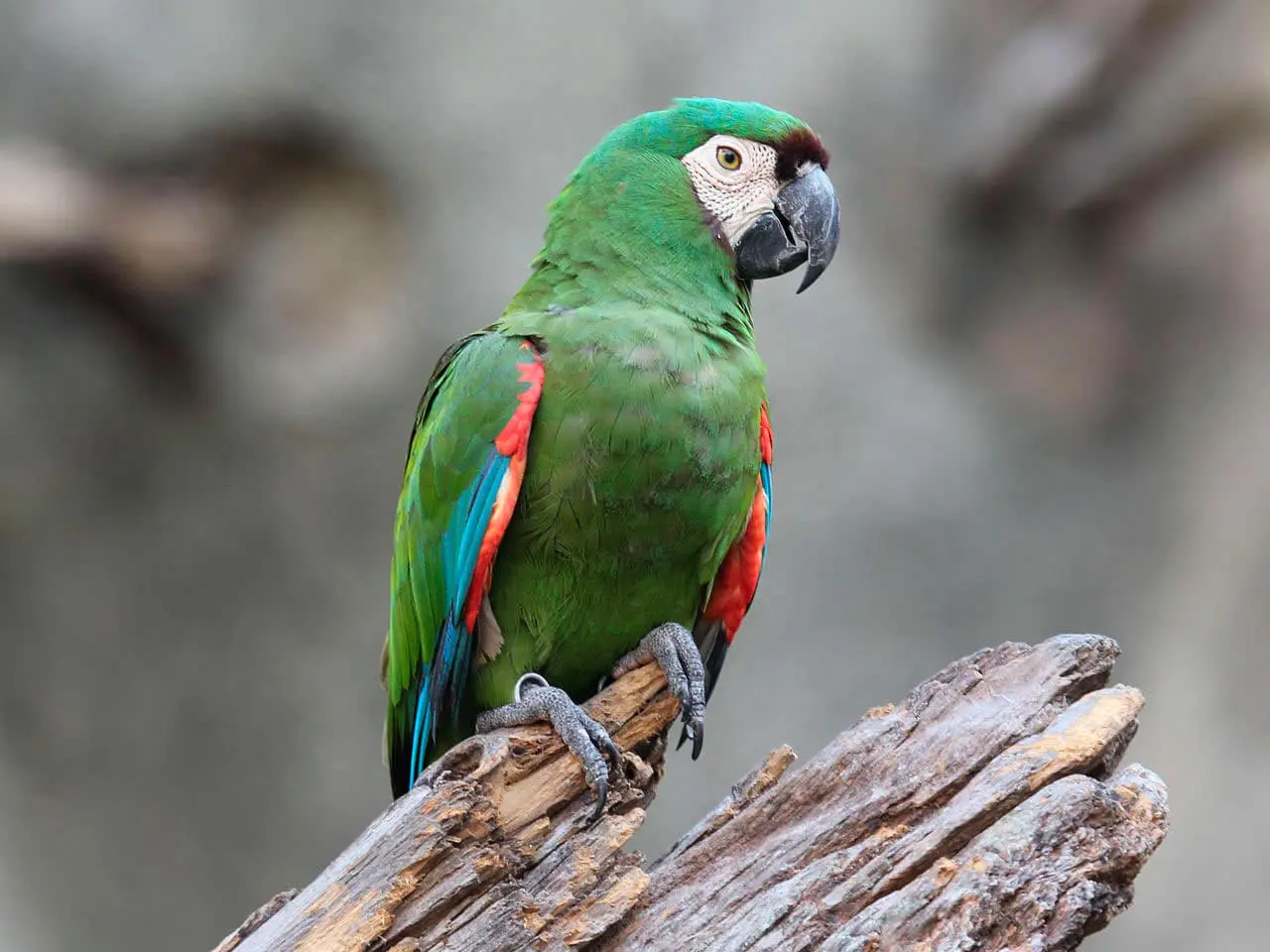
The Chestnut-fronted Macaw(Ara severus) It is a medium-sized Parrot with a plumage predominantly Green.
The male and female are almost identical and juveniles are hardly different from adults.
In the male adult, the feathers of the crown and the neck they are heavily infiltrated blue. The forecrown, chin and the area of the cheeks bordering with the bare skin of the face are brown. The curvature of the wing, carpal edge and small lower coverts are bright red. The bottom of the flight feather shows a dark red-orange color.
The tail is reddish brown with a blue tip. The bill greyish black. The bare skin of the face it is creamy white with fine lines of small black feathers. The irises is yellow, the legs grey.
The youth they are like the of adults, but have the tail shorter and the irises is grey.
The Chestnut-fronted Macaw may be confused with two species: the Blue-winged Macaw, Although this has a frontal band and stain abdominal Red and the Red-bellied Macaw Although it differs by having the facial skin yellow, and the abdomen red. On the other hand, These parrots are smaller and have a yellow color under the wings.
While they are sometimes in clearings or on the edge of this habitat, the Chestnut-fronted Macaw, in general, avoid the great forests never invaded by water. They prefer areas that are periodically flooded, secondary forests, galleries of trees that border the watercourses, oil palm plantations, meadows and pastures where there are still some scattered stands of trees.
It depends on the region, These birds live in very different elevations of up 1000 metres in Colombia, 1500 meters in the South of Ecuador, and only 350 metres in Venezuela.
The Chestnut-fronted Macaw, usually, they live in pairs or in small groups. However they can form large gatherings when dorms are set or when food resources are abundant.
The Chestnut-fronted Macaw, sometimes, they feed in the company of the Red-bellied Macaw (Ara manilata).
During the day, they are essentially arboreal, preferring to remain at the top of the trees and in the canopy, where they remain well hidden in thick foliage. They are best observed at dawn and dusk, as they follow regular routes between their places of rest and feeding sites.
They fly directly, with fast rhythms revealing red underneath his wings stain.
They are birds sedentary. In some mountain areas, However, undertake altitudinal migrations.
Reproduction:
Given the large size of its distribution area and large variation in latitude, nesting takes place at different times depending on the region, from March to may in Colombia, February-March in Panama, and from September to December in Suriname.
These macaws usually They nest in cavities of dead Palm trees, often just above the water, but they can also lay their eggs in a rock crevice.
The spawning usually includes 2 or 3 eggs. There is little information of this bird in the wild, but it is known that in captivity the period of incubation lasts a few 28 days. The reproductive cycle is particularly long, The chicks remain in the nest for a minimum of 9 weeks.
Food:
The Chestnut-fronted Macaw they are exclusively vegetarian. Its diet includes seeds of Hura crepitans, Sapium aureum, Cedrela odorata and Cupania cinerea, the pulp and the seeds of Inga laterifolia, Micropholis melinoneana, Euterpe precatoria and Gulielma, and fruits of Ficus, Cecropia feulla, Caraniana, as well as fruit of different types of fig trees or palms (especially species with small fruits); also flowers of, for example, Ferruleand Erythrina.
The birds are fed into silence in the canopy where they can be difficult to detect.
Distribution:
The Chestnut-fronted Macaw are distributed to the East of Panama and by South America reaching the center of Bolivia.
In East Panama they are in the tropical zone (records in the West to the North of the Canal area they are probably due to leaks), on the slope of the peaceful from the South of the Andes to the South of Ecuador (of Guayas to Pichincha) and in the Northern lowlands of Colombia, South to the upper area of the Valley of Sinu River, extending into the foothills of the Colombian Andes, in the valleys of the Cauca and Magdalena until Antioquia.
To the East of the Andes they occupy the Amazonian lowlands of Colombia, Ecuador, Peru and Bolivia in Peace, Beni, Cochabamba and Santa Cruz, going east of the foothills of the Andes through the West and South of the amazon (Although they are not known in the North of Brazil, for example, in Manaus or along the rivers Negro and Branco).
Propagate through the tropical zone of Venezuela in Zulia and from the West of Apure until Aragua, Northwest of Bolívar and the Amazonas along the Orinoco, reaching the Guianas and Amapá, Brazil.
To the South of the amazon is extended by the Mato Grosso, Brazil. A record to the South of Bahia is not confirmed.
Resident with seasonal movements of altitude in some areas (for example, West of Ecuador and North of Venezuela).
Pretty common throughout much of its range, and while the deterioration of habitat has caused serious decreases in population at the local level (for example, in the Valle del Cauca, Colombia and West of Ecuador), moderate deforestation has resulted in increases in other areas.
Although there are no reports in Guyana Since the beginning of the 19th century, the Chestnut-fronted Macaw they are still common in Suriname, especially in some coastal areas.
The species is kept in captivity, but the demand is not very big.
Conservation:
• Red List category of the UICN current: Least concern
• Population trend: Stable
The Chestnut-fronted Macaw they are quite common throughout much of its range birds. Apparently, they are able to survive to the selective deforestation and even capitalize.
In Venezuela it is a species with high rates of being traded as a pet due to its beauty and sociable behavior. The Ye'kwana on the Caura forest reserve in the State Bolívar, They include this species in his list of game birds, for its power and ornaments, but it is not the most hunted. In the State Carabobo is marketed as a pet according to data from the Regional Directorate for the Ecosocialism and waters-Carabobo.
On the part of the National Government is protected by the wildlife and its regulations protection law. Several of their populations are found in the national parks: Waraira Repano, Henri Pittier,The Caura forest reserve, San Esteban, Canaima. Currently the National office of biological diversity, Ministry of the Popular power for the environment He is working on defining the criteria to develop the official books of endangered species of the Bolivarian Republic of Venezuela.
In Bolivia, international trade in psittacines had caused significant problems for this species in the past, but since the beginning of 1980, their trade is prohibited.
"Chestnut-fronted Macaw" in captivity:
Recently, the Chestnut-fronted Macaw have joined the ranks of other birds kept in captivity. For a time, most of the breeding birds of this species were acquired through the importation of wild specimens. Today this has changed, and most of these macaws today come from generations bred in captivity. Being recent its breeding in captivity, most of These parrots will retain much of their natural behaviors.
These small macaws are popular due to their friendly disposal and most likely will continue to grow in popularity in the future.
While they have not had hundreds of years of selection to tame their personalities, These macaws can be a fantastic pets if they are fed by hand and are well socialized from a young age.
They are creatures very curious, so they need a lot of mental stimulation to be healthy and happy. They should have on hand, games, toys, and daily interaction with your caregiver to make sure that you do not bored.
Most of the Chestnut-fronted Macaw they form links monogamous and they need to live with more birds in order to be able to form a family. Won't these birds well if they are isolated from family and some even become neurotic if their mental needs are not met.
A future buyer of a Chestnut-fronted Macaw You should plan on integrating this beautiful bird in his life to ensure the achievement of all the emotional and cognitive needs.
In general, to most of the Chestnut-fronted Macaw do not like being touched in excess, Although all birds are different and have their own personality. Assess your bird to see what what works best. These birds enjoying caresses next to the back of the neck, along their beaks, or around your eyes. They can be happy on the shoulders of its owner. Jewelry or shiny objects amaze quickly to this curious Parrot. For this reason, All chains, earrings, watches, bracelets , etc … they should stay away from our Macaw, since it could break if the bird decides to play with them.
Although these parrots fall into the category of small macaws, they maintain a high level of noise. It is not an ideal pet for apartments. If you decide to buy one and you live in an apartment, It may be a good reason to argue with your neighbors, Since these birds are noisy. Loud high-pitched sounds can easily be heard a few floors below and are to be expected during the early morning hours., at noon, and before the sunset. This is what they do in their natural habitat.
Yes a Chestnut-fronted Macaw It is continuously shouting for the attention of their owner, These calls should be ignored.. The bird is reacting the only way it knows how to get your attention. The best thing is to give attention during moments of tranquility that is account that this works best.
Unfortunately, many times a homeowner will come to the incessant screams of your Macaw in order to calm the neighbors below; But, This attention usually works in opposite way and the bird will continue to making noise because you know it will work.
Under no circumstances, the owner should be snapping the beak of the bird, spray it with water, or shout it when is making excessive noise. Such tactics only make the problem worse and parrots do not understand this type of punishment. On the other hand, owners should focus on something more positive for the bird and reward it in some way when it is quiet. With the time, the bird will recognize that this positive behavior works much better.
Despite these parrots can be noisy, in general, they are those who speak better of all macaws. One Chestnut-fronted Macaw You can speak with clarity and memorize a lot of words and phrases. They are possessors of some sharp voices that are a delight to listen. It must be said that the purchase of a parrot for his ability to speak is not the best idea, Since some parrots can never learn to talk and its owner can feel extremely disappointed. In its place, the best is to opt for a bird by its adorable and nice personality, If she starts to talk, then it will be an added advantage.
REPRODUCTION:
The breeding of Chestnut-fronted Macaw it's not very hard. While it is true there is time for the union of these birds, not much effort is needed to achieve that they reproduce successfully. It is always recommended do not use domestic birds in a breeding program, since once domesticated, they usually do not reproduce successfully.
The best candidates are those who have been exposed to other severe macaws and have lived within a Aviary.
When approaching the season of reproduction in spring and early summer, a bonded pair will be more vocal. During this time a female will look for a nesting site to raise their future pigeon. In most cases, This is usually a vertical wooden nest box or metal placed in a corner of the cage. Inside the box must have a ladder to be sure that the female can be up and down without damaging their eggs. The bottom of the box should also have some kind of soft base such as wood chips that are non-toxic to the parrot.; But, some female birds choose to remove wood chips. If this occurs, the owner must again enter a handful of chips in the nest box until you put the first egg since this keeps the egg and prevents it from moving around and damage to. The box should also be placed so that the owner has easy access to the eggs and chicks. Most boxes are suspended outside the cage with doors that open on the side of the box or the top..
The egg laying it's every other day until your clutch is complete. On average, a typical clutch will consist of between 2 to 4 white eggs. The female incubates eggs during 27 to 28 days. Just before hatching, the chickens will make a small hole from the inside of the egg in order to be able to breathe. This will alert the mother of arrival. Some mothers eat the shell to help recover the calcium that is lost while it incubated, However, others completely ignore it.
Once the chicks are hatching, the mother is left with the chick for several weeks until they can produce their own body heat and increased demand for food of baby birds. Until then, the male work tirelessly to ensure the young, the female, and himself, food. This moment of hard tension until that all babies are weaned; approximately 70 days.
FEEDING:
In the wild these birds feed on all kinds of food and it is important that we try to imitate their natural diet. This makes it a healthier bird. From time to time, We must provide palm nuts their beaks are designed to eat the fleshy external parts of these fruits. These dried fruits contain oils and enzymes you require our birds. A base diet of Pellet and seeds also must provide.
They have to be powered also with fresh fruit and vegetables on a daily basis. fruits like oranges, Kiwis, handles, apples, grapes, peaches and Plums they are great accessories for the bird. Many of these fruits can be cut into squares and presented as a skewer of a our Macaw, Since he likes to play with fruit and the sampling of all flavors.
The vegetables as the pumpkin, corn, Carrot, Kale, Spinach, celery and are generally a joy to most parrots. These vegetables can be cut during the dinner and were placed in the refrigerator during the future feed. In this way you will save time. Other healthy items are beans and legumes; although, beans and vegetables always must be cooked before feeding your bird. If a severe Macaw is cared for properly, and feeds with a variety of different foods that are healthy, It can live up to the 45 or 50 years.
Alternative names:
– Chestnut-fronted Macaw, Brazilian Green Macaw, Chestnut fronted Macaw, Severa Macaw, Severe Macaw (English).
– Ara vert, Ara à front châtain, Ara sévère (French).
– Rotbugara (German).
– Maracanã-guacu, anacã, ararica, ararinha, ararinha-de-fronte-castanha, maracanã, maracanã-açu, maracanã-guaçu (Portuguese).
– Guacamaya Cariseca, Guacamayo Severo, Maracaná Grande (español).
– Guacamaya cariseca, Cheja cariseca (Colombia).
– Maracaná (Venezuela).
– Loro arara, Guacamayo frenticastaño (Ecuador).
– Tereche grande, Parabachi, maracaná grande (Bolivia).
– Shivaí (Chimane).
– Maracana Guasu (Guarani).
– Avensó (Embera).
– E-ara (Piaroa).
– Avibase
– Parrots of the World – Forshaw Joseph M
– Parrots A Guide to the Parrots of the World – Tony Juniper & Mike Parr
– Birdlife
– Venezuelan of information on biological diversity system – Macaw Maracanã (Ara severus)
– Photos:
(1) – Cheatnut-fronted Macaw (Ara severus) at Jungle Island of Miami By DickDaniels (http://carolinabirds.org /) (Own work) [GFDL or CC BY-SA 4.0-3.0-2.5-2.0-1.0], via Wikimedia Commons
(2) – A Chestnut-fronted Macaw stretching leg and wing By Sandysphotos2009 (20100123_187Uploaded by Snowmanradio) [CC BY 2.0], via Wikimedia Commons
(3) – Chestnut-fronted Macaw or Severe Macaw in south Columbia By anthrotect (originally posted to Flickr as [1]) [CC BY 2.0], via Wikimedia Commons
(4) – A Chestnut-fronted Macaw at Santa Fe Zoo, Medellín, Colombia By Steven (Quueee?Uploaded by Snowmanradio) [CC BY-SA 2.0], via Wikimedia Commons
(5) – A Chestnut-fronted Macaw at World Parrot Refuge, Coombs, British Columbia, Canada By Herb Neufeld (P1120046Uploaded by snowmanradio) [CC BY 2.0], via Wikimedia Commons
(6) – A Chestnut-fronted Macaw at Niabi Zoo, Coal Valley, Illinois, USA By Bill & Vicki Tracey from Rochelle, Illinois, usa (At the ZooUploaded by snowmanradio) [CC BY 2.0], via Wikimedia Commons
(7) – Chestnut-fronted Macaw (also known as Severe Macaw) at at World Parrot Refuge Center, Vancouver Island, British Columbia, Canada By Darlee Byron (Well.. Hello!Uploaded by Snowmanradio) [CC BY 2.0], via Wikimedia Commons
(8) – Chestnut-fronted Macaw | Maracanã (Ara severus) by Fernando Flores – Flickr
(9) – A Chestnut-fronted Macaw in Miami, Florida, USA. It is probably feral By Don Faulkner (Chestnut-fronted MacawUploaded by snowmanradio) [CC BY-SA 2.0], via Wikimedia Commons
(10) – Ilustración Parrots A Guide to the Parrots of the World – Tony Juniper & Mike Parr
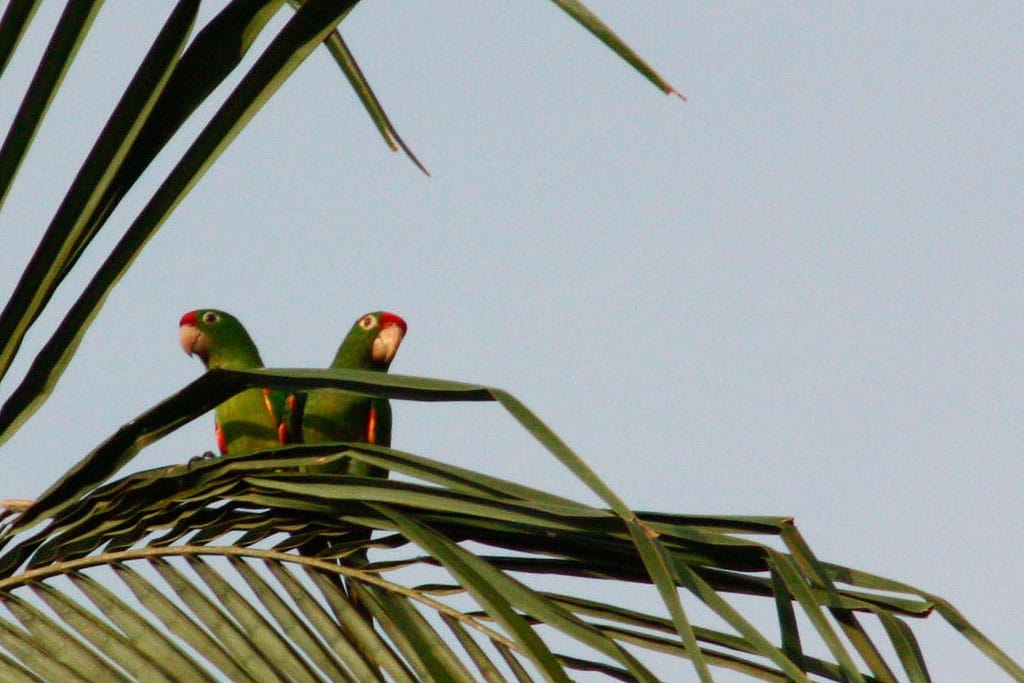
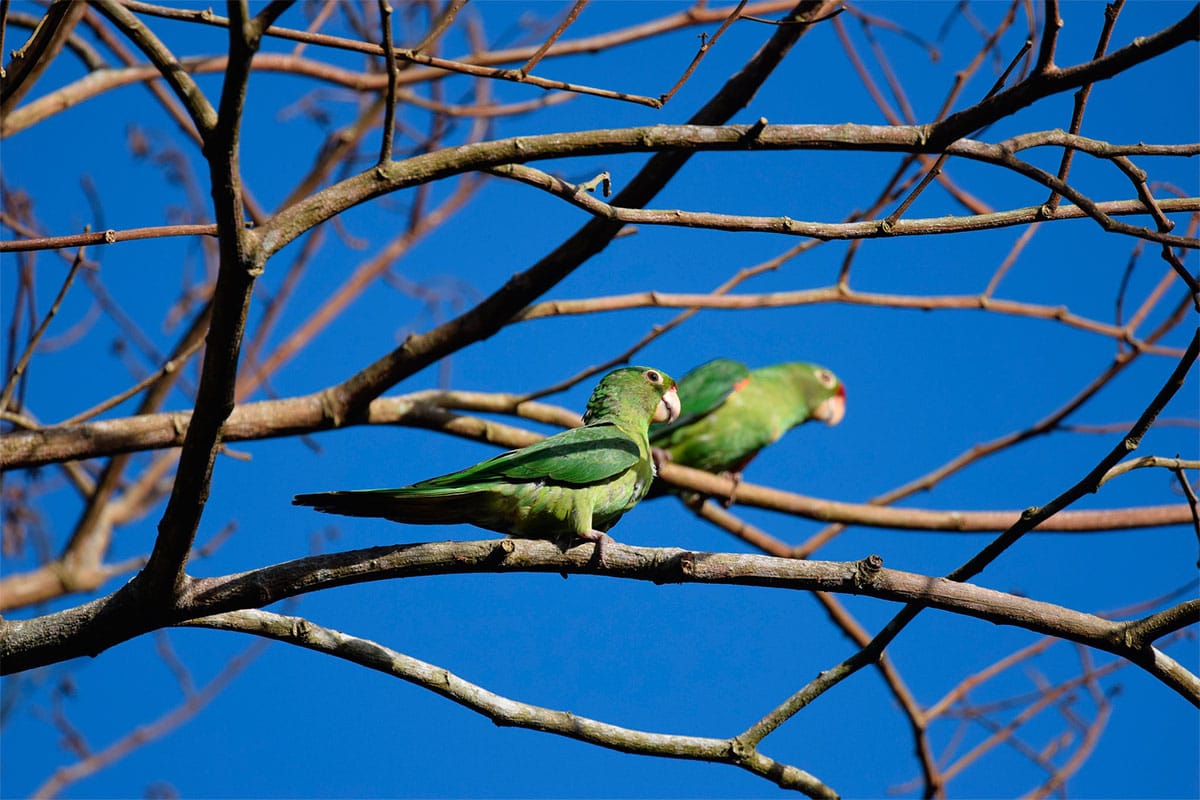
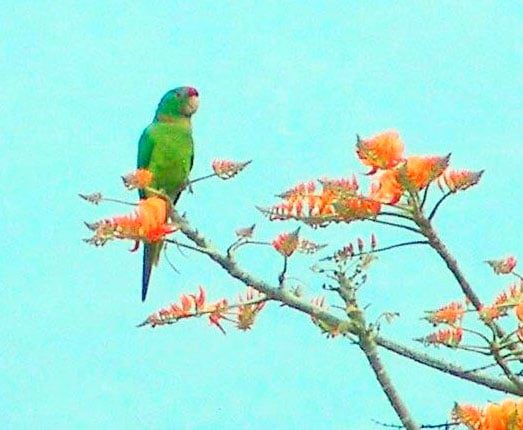
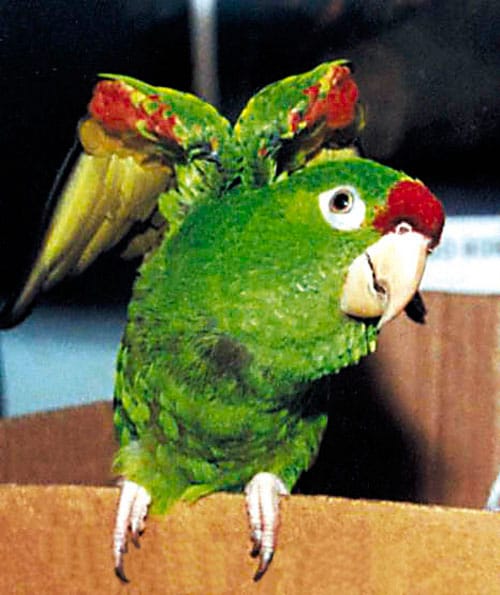
The Crimson-fronted Parakeet(Psittacara finschi) It is the only species of the genus Psittacara tail long with red color below the wing
.
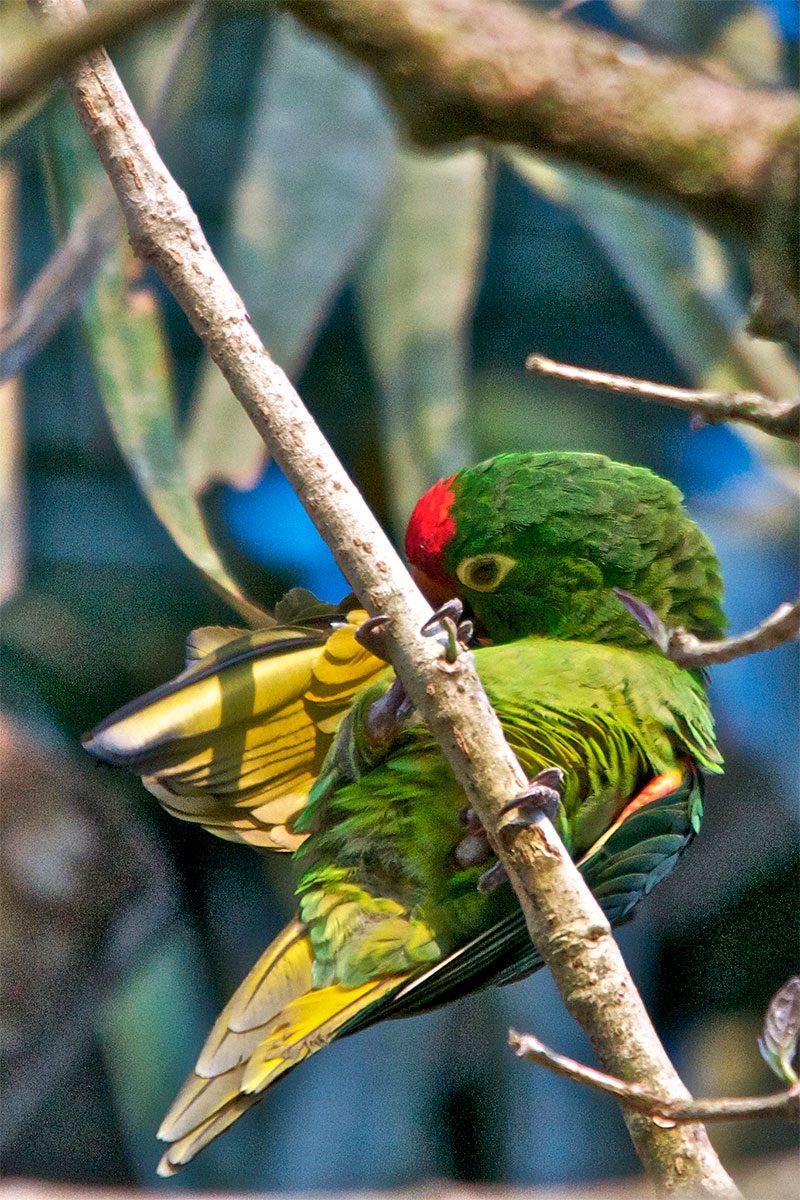
They have forecrown and the former area of the lores bright red; the head and the neck green color with the exception of some scattered red feathers. The upperparts and upperwing-coverts green, with some red feathers on the bend of wing. The flight feather green above, more dark towards the tips with a dye bluish light in them vane inner; then golden brown color. Lesser and medium underwing-coverts red, the largest yellow, other coverts pale green. The underparts pale green, sometimes with red at the bottom of the tibia. Upper, the tail grass-green, by down golden brown.
The irises is orange and the eye ring naked is whitish. The bill exhibits a color gray-tipped Horn and the legs off gray color.
It has no sexual dimorphism.
The immature There are very little or almost no red in the forecrown and lack of red color in the thigh or the neck. The lining of the wings is more Orange.
They inhabit tropical and subtropical envelope 1.400 metres in Costa Rica and 1.600 meters in the West of Panama, in areas with light trees or in fields with scattered trees, in secondary growth forests, edges of the forest, coffee plantations and nearby farmland. Irregular or seasonal in large forested areas.
They are birds gregarious, usually observed in flocks of up to 30 Member, but up to several hundred birds can gather in roosts communal on the tops of the trees or palms. Roosts, at times near the cities.
Reproduction:
They located their nest in holes of various types: natural cavities, old holes of woodpeckers (F. Picidae), stumps of dead Palms. They can dig holes in rotten stumps or in masses of epiphytes.. Sometimes many couples may nest near each other.
The union of the pair of this species is particularly strong. The pairs isolate themselves from the group towards the end of July to nest.. With reproduce during the dry season and the rainy early. The female lays three or four eggs which are incubated during approximately 24 days. The juveniles they leave the nest to the 50 days of life.
Widely distributed in the South of Central America, from Nicaragua until Panama.
The species can be found in the southeast of Nicaragua to the South of the Rio Grande, and in Costa Rica mainly on the slope of the Caribbean, Although there are exemplary residents on the side of the peaceful, on Osa Peninsula, at the South-West end and seasonal visitors in the Guanacaste Cordillera, in the North and the central plateau around San Jose.
In Panama they come to the East, a unos 82°W, but it is probable that only seasonally in the lower Highlands of the Province of chiriqui.
Flocks of birds required extensive territories and the species occurs, apparently, in many areas, if only as a post-breeding visitor.
Very common or locally common with increasing numbers in Costa Rica and Panama, probably due to deforestation.
Maintained in captivity and internationally traded in small quantities.
Conservation:
State of conservation ⓘ
Minor Concern ⓘ(UICN)ⓘ
• Red List category of the UICN current: Least concern
• Population trend: Growing
The size of the world population of the Crimson-fronted Parakeet It has not been quantified, but this species is described as «quite common«.
You can be increasing their geographical range due to deforestation.
abundant on the slope of the Caribbean of Nicaragua. common and widespread in areas deforested over the slope of the Costa Rica Caribbean.
"Crimson-fronted Parakeet" in captivity:
Quite common in United States, less elsewhere.
Socialize easily with human, and can become a committed and loving companion. Es a Intelligent and lively, with easy to imitate the human voice and run different games and exercises. But, We must remember that it is a bird loud and the volume of their calls can get to be very annoying.
Alternative names:
– Crimson-fronted Parakeet, Crimson fronted Parakeet, Crimson-fronted Conure, Finsch’s Conure, Finsch’s Parakeet (English).
– Conure de Finsch, Perriche de Finsch, Perruche de Finsch (French).
– Veraguasittich (German).
– Aratinga-de-finsch (Portuguese).
– Aratinga de Finsch, Perico frentirrojo, Periquito de Pecho Rojo, Perico de Palmera (español).
– Perico frentirrojo (Costa Rica).
– Perico Frentirrojo (Nicaragua).
Parrots A Guide to the Parrots of the World – Tony Juniper & Mike Parr
Birdlife
Photos:
(1) – A Finsch’s Parakeet )also called Finsch’s Conure and Crimson-fronted Parakeet) in San José, Costa Rica By Dominic Sherony [CC BY-SA 2.0], via Wikimedia Commons
(2) – Perico frentirrojo juvenil, approximately 4 months of age, Panama City By Ricaurte (Own work) [Public domain], via Wikimedia Commons
(3) – Crimson-fronted Parakeet, also called Finsch’s Conure By Yazzieyazz (trabjo propioEnglish: own work) [Public domain], via Wikimedia Commons
(4) – Psittacara finschi en el parque nacional Henri Pittier, Venezuela By Roberto Galindo Deshays (Own work) [CC BY-SA 4.0], via Wikimedia Commons
(5) – Crimson-fronted Parakeet Costa Rica 2/15/16 Rancho Naturalistaby Andy Reago & Chrissy McClarren – Flickr
(6) – Crimson-fronted Parakeet by Brian Ralphs – Flickr
(7) – Crimson-fronted Parakeet Costa Rica 2/15/16 Rancho Naturalista by Andy Reago & Chrissy McClarren – Flickr
(8) – Aratinga finschi 06 Apr 2014 Costa Rica, San Lorenzo by Tom Benson – Flickr
(9) – Crimson-fronted parakeet by Charles Sharp – Flickr
(10) – Conurus finschii » = Psittacara finschi (Finsch’s Parakeet) by John Gerrard Keulemans [Public domain], via Wikimedia Commons
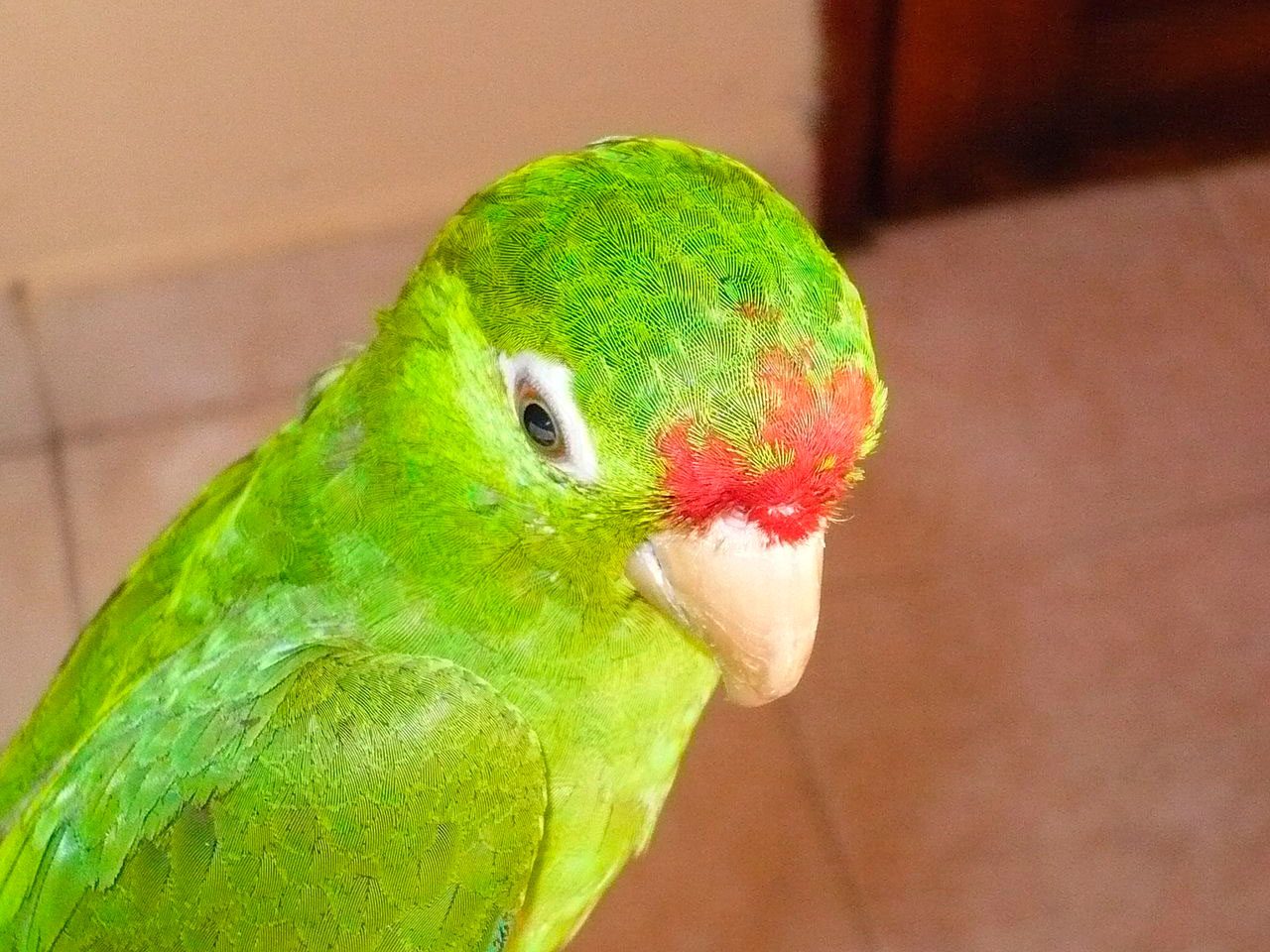
The Cobalt-winged Parakeet(Brotogeris cyanoptera) measured 15-21 cm.. in height and weighs around 67 g. Distinguishable on the fly by the cobalt blue of the the flight feathers; forecrown yellow and crown with blue dye; chin orange.
Has the tail short and acute. Its bill opaque beige es
(Berlepsch, 1889) – Has the forecrown light green, shoulder yellow and only a patch blue in half of the wing
.
Habitat:
Very common. It is found in secondary forest, riparian, edges and savanna, until the 600 m (occasional over of 1000 m). Fly in small flocks of 10 to 20 individuals (rare in couples), feed in the canopy.
Reproduction:
It nests in hollow and termite mounds on tree.
Food:
Its diet probably the same as for most species Brotogeris: fruit nectar, figs, berries and seeds.
Distribution:
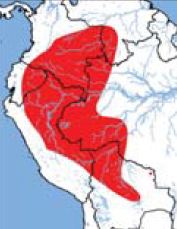
Its population is distributed between the East of Colombia, Southwest of Venezuela to the North of Bolivia and Brazilian Amazon.
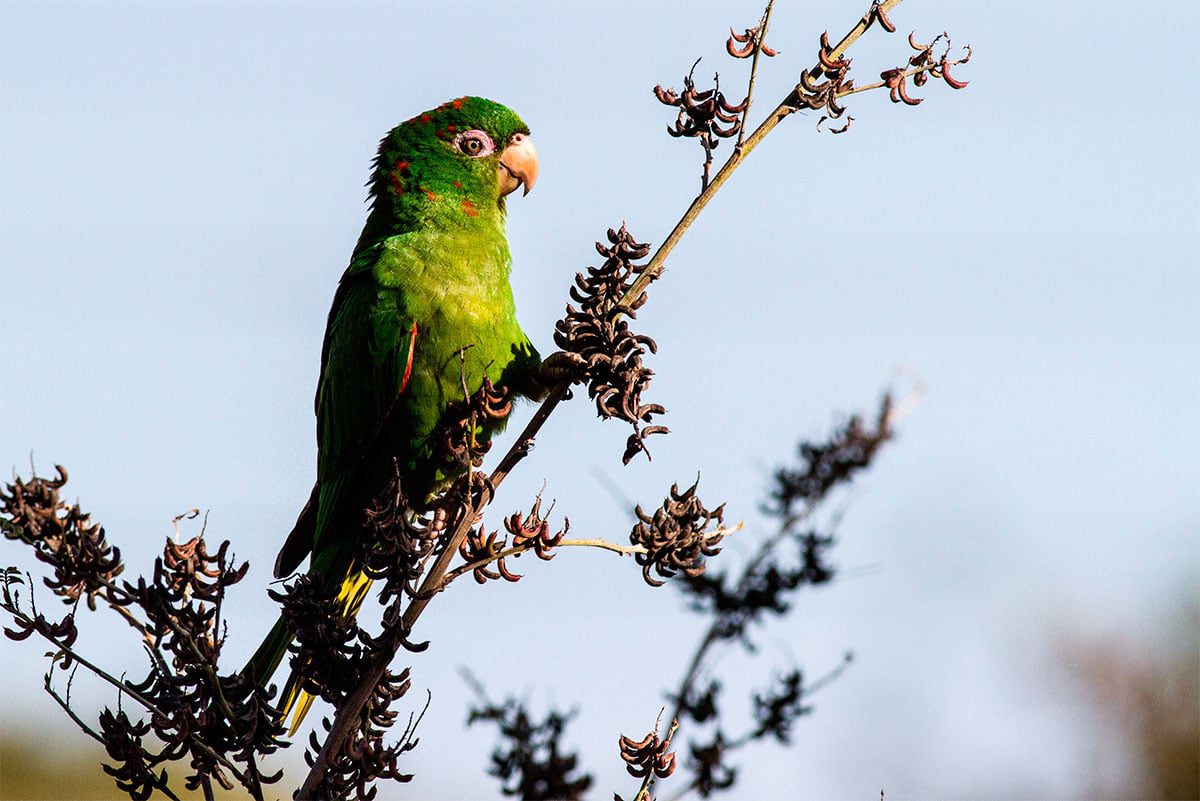
The bill of the Cuban Parakeet(Psittacara euops) is strong and hooked, presenting the capacity of both the upper and the lower mobility, enabling this psittacine to husk and crush seeds, fruits and nuts discarded by many other birds, thus showing another successful feature of this Psittacara.
Their legs they have a magnificent prehensile capacity that allows them to take incredible poses and hold on to extreme places thanks to a "zygodactyly" arrangement of the fingers by moving two fingers forward, the 2 and 3, and two backwards, the 1 and 4.
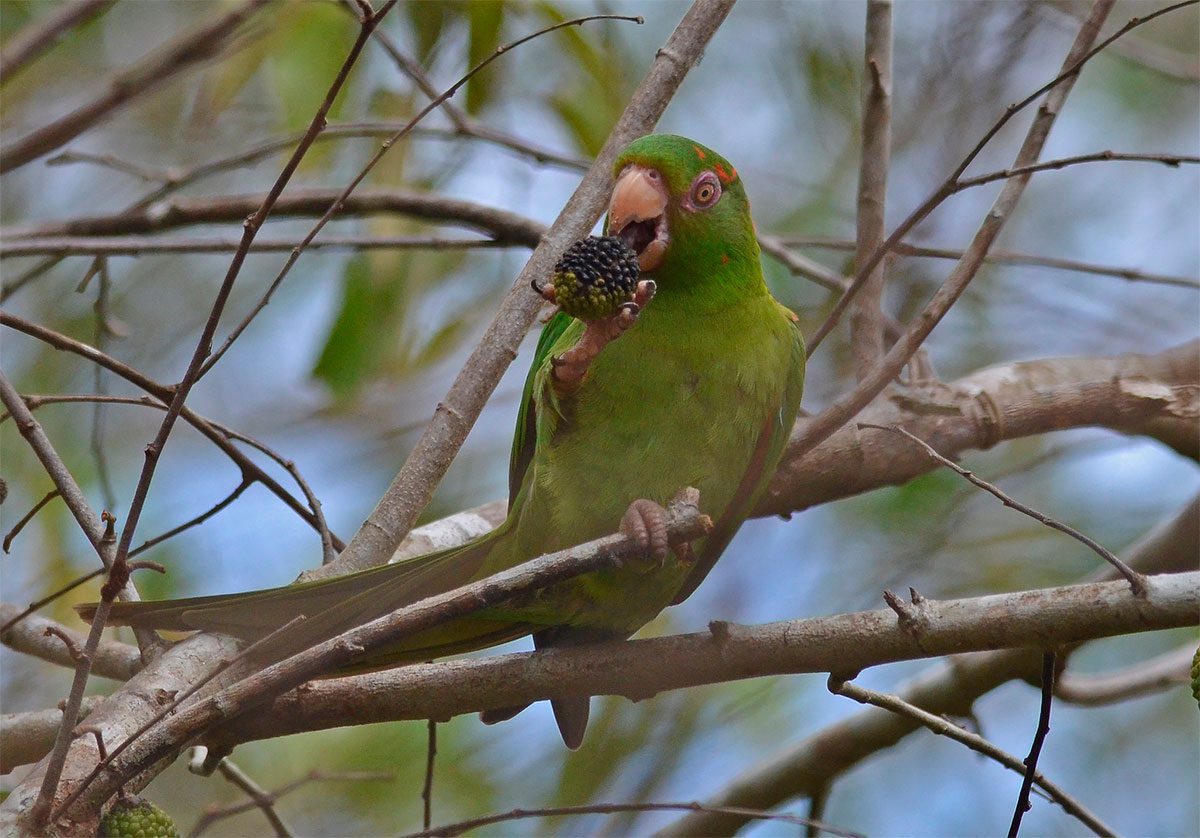
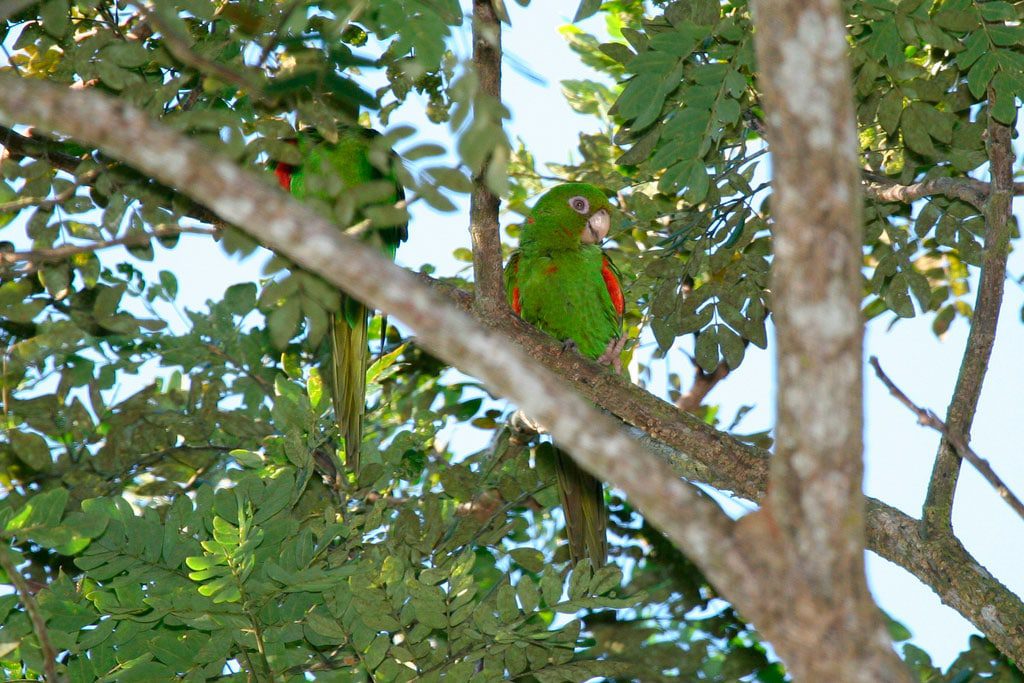
Has the head, sides neck and nape green grass with some red feathers scattered, sometimes forming patches. The upperparts and upperwing-coverts grass-green; primaries and secondaries with margins and dark green tips to vane inner; carpal edge with scattered red feathers and bend of wing red. Underwing-coverts with golden brown in the flight feather, small and medium-sized coverts Red and large coverts Yellow olive. The underparts yellowish green with diffusion of color olive, sometimes with scattered red feathers, especially in the throat and/or the thighs. Upper, the tail dark green color with dye olive; by down yellowish brown. The bill color Horn; bare periophthalmic bluish white; irises yellow; legs distant.
The female has more orange in the wings.
Immature has green and red in underwing-coverts, beige color (not red) in carpal edge, irises Gray with scattered red feathers.
They inhabit on Savannah, especially in areas where there are the PalmasCopernicus and Thrinax, at the edges of forests and Lands planted with trees. Although they have also been very modified habitats, such as eucalyptus forests in open field and fragments of forests of Evergreen in sheets of Palma. The species survives only near large extensions of primary forest.
In general, observed in family groups or small flocks, but sometimes in larger groups, hundreds of birds; the Cuban Parakeet, often, mix with the more common and endemic Cuban Parrot (Amazona leucocephala).
Reproduction:
One of the major problems of this kind in the reproduction, It is competition and the finding by the nesting cavities; This psittacine is a small, so their physical advantage over other birds to displace these from cavities or nests is less and they must show greater aggressiveness to be able to expel woodpeckers and even some small birds of prey These cavities that already occupy.
But, in recent studies, It is suggested that in free-living this species has a high degree of selectivity by the height of the Palma in which anidated or for the depth of the nest, still not evident during the stage of formation of couples and nesting strong signs of gregariousness, But if there could be a tendency to prefer nests with a sufficiently narrow entrance opening to enter the couple and hamper the penetration of predators. It also seems that the species in reproduction is more tolerant of other neighboring couples of the same species, than others parrots, but to some degree of alienation, preferring Palmas in which there is only one cavity to have a certain degree of privacy in the rearing of their chicks.
The breeding season It begins in April and usually ends in July. They sometimes build their nests in cavities excavated, originally, by the Cuban Green Woodpecker (Xiphidiopicus percussus).
The number of eggs in the implementation It, in averaged, between three and five. The incubation both members of the couple is done, as well as feeding the young until they leave the nest. Once abandoned the nest, You can see to the immature flying with parents in small camps before the winter season, forming major sides joining them different families.
Formerly persecuted by provoking large damage to crops Orange, coffee and corn.
Distribution:
Species vulnerable to extinction, from an original distribution throughout Cuba and Isle of youth, isolated populations between Yes.
Formerly one of the most common endemic birds in Cuba and in the Isle of youth, old Isle of pines, but now is limited to various strongholds in remote areas of Cuba, including the Zapata Peninsula, the districts around Cienfuegos and the mountains around the city of Trinidad, to the extent Western Centre of the island, and Sierra Maestra at the end of this.
Resident but some seasonal movements (Perhaps altitude) supposedly by the decline of the birds of the mountains of Trinidadin the months of September and October.
Extinct in the Isle of youth from 1913, mainly due to the strong capture for export as bird cage.
The current population, Although comparatively small, Perhaps stable. A small number of captivity out of Cuba, especially in Eastern Europe. The international trade currently it is small.
Today this species is restricted to 16 populations considering that a total of 2800 individuals released, with a number of individuals per population not exceeding, usually, the 100 copies and is considered of greater size the located in the Zapata Swamp live in where is estimated around 800 these birds. Each of these populations are isolated or insulated semi between if, not exceeding groups or sides that make it up, the 30 individuals, with a general tendency to the disappearance of the species in many of the populations, mainly due to the loss of Habitat and illegal catches.
Conservation:
State of conservation ⓘ
Vulnerable ⓘ(UICN)ⓘ
• Red List category of the UICN current: Vulnerable
• Population trend: Decreasing
There are no new data on the evolution of the population of the Cuban Parakeet; But, the species is suspected of have been declining at a moderate pace, mainly as a result of the habitat degradation.
Rounded, a population estimated between 1,500-7,000 mature individuals.
The persecution as a pest of crops, loss of habitat and, in particular, the capture for trade bird cage, They explain the current shortage of copies of Cuban Parakeet (A. Kirkconnell in litt., 2007).
The capture for trade International is now insignificant, with only 10 birds recorded in trade between 1991 and 1995. Another major threat is the loss of nesting trees (Snyder et to the., 2000) as a result of hurricane damage (as the caused in the Zapata Peninsula by the Hurricane Lili in 1996), and the felling of trees for chicks of the Cuban Parrot (Amazona leucocephala) (A. Mitchell in litt., 1998).
Conservation Actions Underway
• Appendix II of CITES.
• Is legally protected.
• They are distributed within the seven environmental reserves, including the important Ciénaga de Zapata National Park (Snyder et to the., 2000).
• A study of the species and an intense public awareness campaign are intended to help establish a management programme effective (Wiley, 1998).
• The programs of ecotourism they have begun in some areas (Snyder et to the., 2000).
• A provision scheme has been started for nest boxes, the plastic boxes are more durable than the facts of sections of the trunk of the Palm (Waugh 2006), but the parakeets prefer those made of natural materials (Anon., 2010).
• A program of reintroduction from the main island of Cuba to the Isle of youth is being developed from the 2004, but the species is generally difficult to breed (parrots 2000-2004; avianweb.com).
Conservation Actions Proposed
• Carry out more Research to determine the ecological requirements of the species and population (Wiley 1998, Snyder et to the., 2000).
• Conserve additional habitat, especially in the areas of nesting (Snyder et to the., 2000).
• Adapt the environmental awareness and protection of nests in situ to local situations (Snyder et to the., 2000).
• Continue a plan for the re-establishment of the species in the Isle of youth (Wiley 1998, Snyder et to the., 2000) through the development and extension of the programme of captive breeding.
"Cuban Parakeet" in captivity:
In captivity, they are very sleepers and somewhat quarrelsome and restless, needing always to be monitored. Non-communicative the issuance of words but very friendly with the person you choose as partner, which will not get rid of some sympathetic evil, almost always tolerated and even grateful.
Sensitive to the changing conditions of the ecosystem that inhabits.
The requirements and difficulties in the reproduction of this species are considerable.
Own this nice bird as pet, Although on the one hand it can be a satisfaction to the owner, on the other hand means to convict individuals of this species not reproduction and populations to lead them to the risk of the extinction.
Alternative names:
– Cuban Parakeet, Cuban Conure, Cuban Paroquet, Red-speckled Conure (English).
– Conure de Cuba, Perriche de Cuba, Perruche de Cuba (French).
– Kubasittich (German).
– Periquito-cubano (Portuguese).
– Aratinga Cubana, Perico, Periquito, Periquito Cubano (español).
– Catey, Perico, Periquito (Cuba).
(1) – Psittacara euops – Cuban parakeet by Ekaterina Chernetsova (Papchinskaya) – Flickr
(2) – Psittacara euops – Cuban parakeet by Ekaterina Chernetsova (Papchinskaya) – Flickr
(3) – Cuban Parakeet, Conure De Cuba, or Aratinga Cubana (Aratinga euops). Two parrots in a tree By dominic sherony (originally posted to Flickr as Cuban Parakeet) [CC BY-SA 2.0], via Wikimedia Commons
(4) – Cuban Parakeets are a rare sight in Cuba, the only place they live in the world by Hank Davis, DNS Board Member – Delaware nature society
(5) – For the Caribbean Conservation Trust in conjunction with the Massachusets Audubon Society – Winged spur imaging
(6) – Deutsch: Psittacara euops Syn: Evopsitta euops & Psittacara chloropterus Syn: Psittacara chloropter bzw. Psittacara euops St. Domingue By Charles Emile Blanchard (1819–1900) (biodiversitylibrary.org) [Public domain], via Wikimedia Commons
Origin: Colombia, Peru, Brazil, Guyana, Puerto Rico, United States
Character: Affectionate and fun
Life expectancy: 10 to 12 years
Height: 24 to 25 cm.
Content
Description:
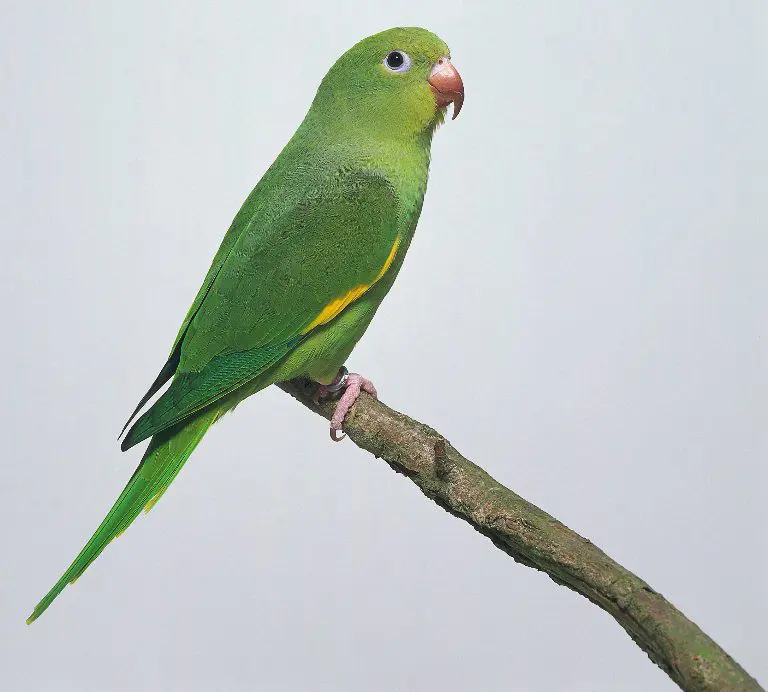
The Canary-winged Parakeet(Brotogeris versicolurus) measured between 24 and 25 height cm. Single parakeet with yellow and white patch and blue tip on the wing
, tail green, long and acute (noticeable in flight).
Of overall green coloration, with belly opaque, front and sides of the head grey. It has no sexual dimorphism.
It is found in variety of habitats, humid forest, riparian, edges, stubble, open and urban areas, until 300 m (in Bolivia comes up to the 2700 m).
Abundant trees in cities and towns. They fly high, in pairs or small flocks to large.
Reproduction:
The breeding season includes the months between January and July in South America. The female places of 4 to 5 white eggs. The incubation hard of 23 to 26 days. Usually, the male can stay in the nest at night, but the incubation is main task of females.
It nests in tree hollows and decaying fruit capsules.
Food:
In their natural habitats, the Canary-winged Parakeet, feeds mainly on worms, flowers, seeds and fruit.
Distribution:
Its population is discontinuous. All the banks of the Amazon River, from the East of Ecuador to the South of the French Guiana.
You can also see them out of these places due to its introduction by release of pet; places such as Lima, California, Florida and Puerto Rico.
Conservation:
State of conservation ⓘ
Minor Concern ⓘ(UICN)ⓘ
It is not considered in any of the threat categories, its trade has decreased in recent decades.
Justification of the population:
The size of the world population Canary-winged Parakeet It has not been quantified, but this species is described as «common» (Stotz et to the. (1996).
Justification trend:
The population suspected to be stable in the absence of evidence of any reduction or substantial threats.
"Canary-winged Parakeet" in captivity:
Years ago it was a very common bird in captivity, at the present time is less.
RECALLS: NEVER COMMAND A PARAKEET IN THE CITY OR IN THE FIELD
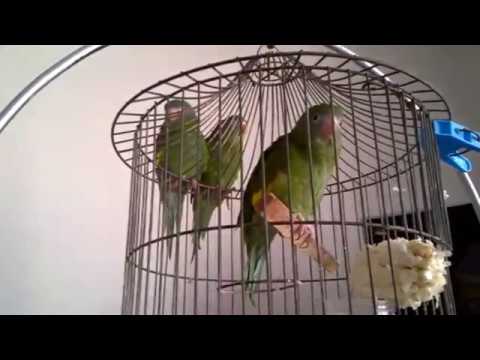
aggressive with other bird species. However, It is possible to keep a group of birds of this species together in a large enough space. Easy of tame If it is manipulated from small. Communicates with their owners, making different sounds, for example, to greet us when we see, When you want food, etc.
They are not usually very noisy. Like to climb by what shall provide elements so you can make this activity. In hot season, supplied with a tray of water so that you can bathe.
Alternative names:
– Canary-winged Parakeet, White-winged Parakeet, Yellow-winged Parakeet (English).
– Toui à ailes variées, Conure à ailes blanches, Perruche à ailes blanches, Perruche à ailes jaunes, Toui à ailes jaunes (French).
– Weissflügelsittich (German).
– Periquito-de-asa-branca, periquito-castanha, periquito-da-asa-amarela, periquito-da-campina, periquito-das-ilhas, periquito-de-asas-amarelas, periquito-estrela (Portuguese).
– Catita Chirirí, Catita de patas amarillas, Catita Versicolor, Periquito Aliamarillo, Periquito Aliblanco, Periquito de Alas Blancas, Periquito Versicolor (español).
– Catita Chirirí, Catita de patas amarillas (Argentina).
– Periqquito aliblanco, Periquito Aliblanco (Colombia).
– Periquito Aliamarillo (Dominican Republic).
– Perico de Ala Amarilla (Peru).



















.jpg)

_-two_in_tree.jpg)
