โ–ท The world of Pets: Dogs, cats, birds, reptiles, amphibians

Coconut Lorikeet (deplanchii)
T. haematodus deplanchii


Coconut Lorikeet (deplanchii)

Content

Description (1)

26 cm.. of length and a weight of 140 gr.

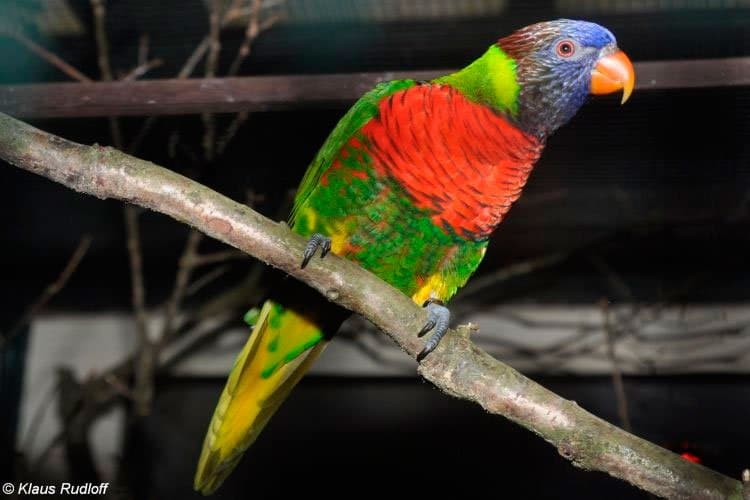
The Coconut Lorikeet (deplanchii) (T. haematodus deplanchii) is a variation of the nominal (Trichoglossus Haematodus)

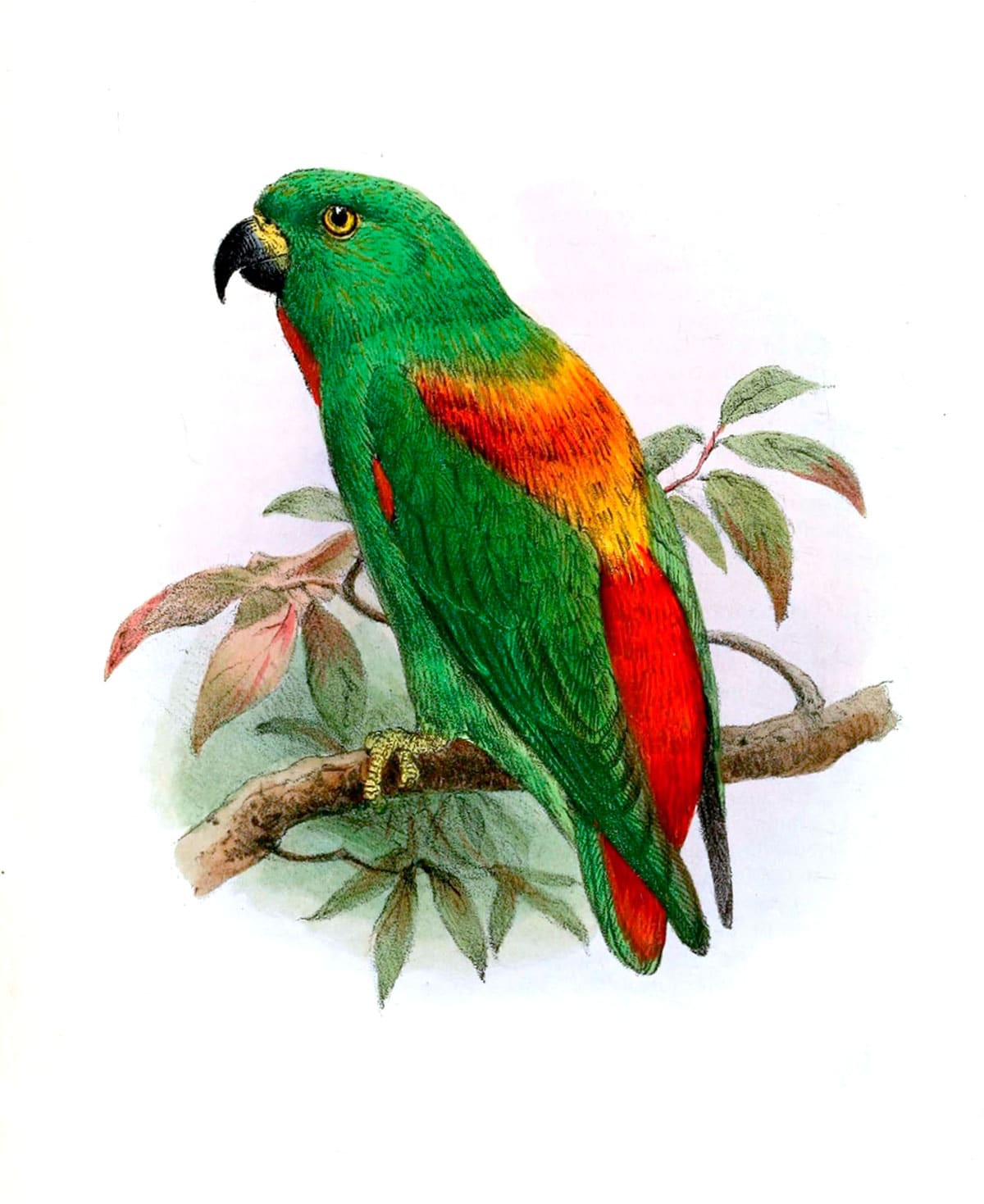
Similar to the nominal Haematodus, but slightly paler plumage. The head has a bright blue. Reddish orange on the chest, similar to the Trichoglossus haematodus massena, only that more alive. The abdomen is yellowish green and extends to the back of the neck. The thighs and the feathers under the yellow tail and tail olive green top.

Distribution:

New Caledonia and Loyalty Islands.

Alternative names:

Coconut Lorikeet (deplanchii) (ingles).
Loriquet ร  tรชte bleue (deplanchii) (French).
Allfarblori Deplanche (German).
Loris Arco Iris Deplanchii (Portuguese).
Lori Deplanche, Lori Arcoiris Deplanche (espaรฑol).

scientific classification:

Order: Psittaciformes
Family: Psittaculidae
Scientific name: Trichoglossus haematodus deplanchii
Genus: Trichoglossus
Citation: Verreaux,J & Des Murs, 1860
Protonimo: Trichoglossus Deplanchii

————————————————————————————————

    (1) – Subspecies Coconut Lorikeet (Trichoglossus haematodus)

————————————————————————————————

ยซLori Arcoiris Deplancheยป (T. haematodus deplanchii)


Sources:

Avibase

Photos: by Klaus Rudloff (kdrudloff@web.de) – biolib.cz

โ–ท The world of Pets: Dogs, cats, birds, reptiles, amphibians

Ultramarine Lorikeet
Vini ultramarina

Ultramarine Lorikeet

Content

Description

The Ultramarine Lorikeet (Vini ultramarina) has a length of 18 cm.. and an approximate weight of 35 g..

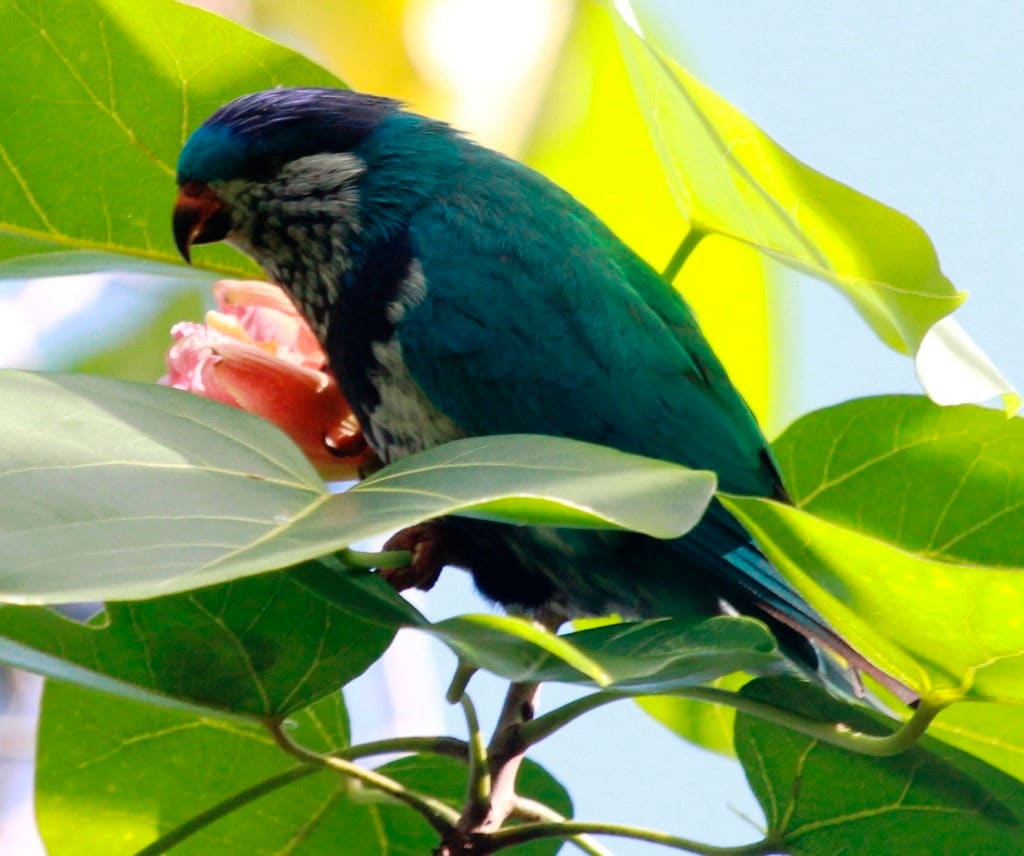
Forehead bright navy blue iridescent; crown and nape Mallow dark blue with streaks of light blue; lores and spots on ear-coverts, white (bases of ear-coverts, purple and blue color). Mantle and covert wing, Navy blue; rump and tail coverts, dark blue light. The flight feather, light blue, blackish internal. Blue off the Underwing coverts. Throat dark blue with white speckles; in the band chest mauve blue with รกrea subterminal pale blue feathers. Belly blank slate bases in feathers, giving a mottled appearance; the thighs dark blue malva; coverts, Turquoise.

The uppertail-coverts, whitish blue with navy blue light diffuse in the outer margins;
undertail coverts whitish merged with navy and some irregular gray markings.

Bill yellow orange, upper jaw, blackish brown at the base; irises brownish yellow; the orange legs.

Both sexes are equal but the female It is slightly smaller.

The immature adult differ by the absence of white on underparts, they are uniformly blackish. Also by bill black, irises Dark Brown and legs orange-brown.

Habitat:

In the Decade of 1970 in Nuku Hiva, these parrots were found only in pristine forests (that they have not been touched and that it is in its original condition) on the 700 m.

There is a similar habitat preferences in UA Pu, where are located mainly in montane forests between 700 and 1.000 m. Populations have also been of Ultramarine Lorikeet in banana plantations, coconut and mango (Mangifera indica), in coastal areas.

The species seems to have a wider range of habitat preferences in UA Pu., being found at altitudes ranging from the coast to wooded crests.

They feed in trees with flowers, especially coconut trees and Erythrina.

Loud and lively; the birds move freely between the canopy and lower floors, allowing the human approach. They usually travel in pairs or groups of up to a dozen of individuals. Most of its flights are made below the level of the trees, but for longer distances they rise spiral up to considerable heights.

Extremely Active, rarely long they stay in a tree and feeds using the peak acrobaticamente support.

Reproduction:

The nesting of these birds is from June to August.

It nests in hollow trees, preferring Artocarpus altilis, Pometia, Pandanus tectorius and Hibiscus tileacus. Sometimes they use the old nest of another species. They lay two white eggs.

A captive breeding record gives the chick eight weeks to become independent.

Food:

It feeds on a great variety of trees in flower, nectar and pollen. Within your preferences are the flowers of the coconut palm, the native tree and banana Hibiscus tileaceus.

It also feeds on fruits, especially mango and insects.

Distribution:

Size of its range (reproduction / resident): 100 km2

The Ultramarine Lorikeet is endemic of the Marquesas Islands, of Nuku Hiva, UA Pu and UA Huka, Although fossil remains show that previously most widely spread.

In UA Pu the population was estimated at 250-300 couples in 1975. But in 1988 had shrunk around the 60%, probably due to the spread of rats Rattus rattus, and a hurricane in 1988, Although its effects on the population of birds are uncertain.

In Nuku Hiva the small population of around of 70 birds that inhabited the high valleys and ridges in the northwestern part of the island, between 700 and 1.000 d., You can that they are now extinct.

The majority of the population, to this day, remains in UA Huka, where the species was introduced in 1940. This population would have grown from 200 to 250 couples in the late 1970s and was considered abundant in 1990 at altitudes environment to the 500 d., with a population estimated between 1.000 and 1.500 birds. The main threat to the species, here, is the potential arrival of rats, and between 1993 and 1994, 14 Ultramarine Lorikeet they were moved to Fatu Hiva in an attempt to keep them safe from rats; But, habitat deterioration by grazing mammals and avian malaria, also they have been and are still potential factors to increase the vulnerability of this species.

Conservation:


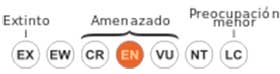
Endangered


โ€ข Current IUCN Red List category: Danger.

โ€ข Population trend: Decreasing.

CITES Appendix I. in danger of extinction.

The entire population is located on an island where the species is stable, in other islands recently has been extinguished. The general trend is suspected to be a slow and continuous decrease. If the black rats come to UA Huka the decrease will be quick and severe.

Other threats included are logging in some sectors of the habitat of the Ultramarine Lorikeet to plant crops, fruit trees, and use the trunks for woodcarvings for tourism.

"Ultramarine Lorikeet" in captivity:

Extremely rare.

Alternative names:

Ultramarine Lorikeet, Marquesas Lorikeet, Ultramarine Lory (ingles).
Lori ultramarin, Lori de Goupil, Lori des Marquises (French).
Ultramarinlori (German).
Loris Vini Ultramarine (Portuguese).
Lori Ultramar, Lori Ultramarino (espaรฑol).

scientific classification:

Order: Psittaciformes
Family: Psittaculidae
Scientific name: Vini ultramarina
Citation: (Kuhl, 1820)
Protonimo: Psittacus ultramarinus

Images ยซOverseas Loryยป:

Videos "Ultramarine Lorikeet"

————————————————————————————————

ยซLori Ultramarยป (Vini ultramarina)


Sources:

Avibase
– Parrots of the World โ€“ Forshaw Joseph M
– Parrots A Guide to the Parrots of the World – Tony Juniper & Mike Parr
– Birdlife

Photos:

1 – Miles to the wild – link
2 – Miles to the wild – link
3 – Miles to the wild – link
4 โ€“ An adult bird perched on a palm tree – Author Josep del Hoyo – IBC.lynxeds.com
5- A juvenile bird feeding in a tree. – Author Josep del Hoyo – IBC.lynxeds.com

Sounds: Mark Todd (Xeno-canto)

โ–ท The world of Pets: Dogs, cats, birds, reptiles, amphibians

Red-throated Lorikeet
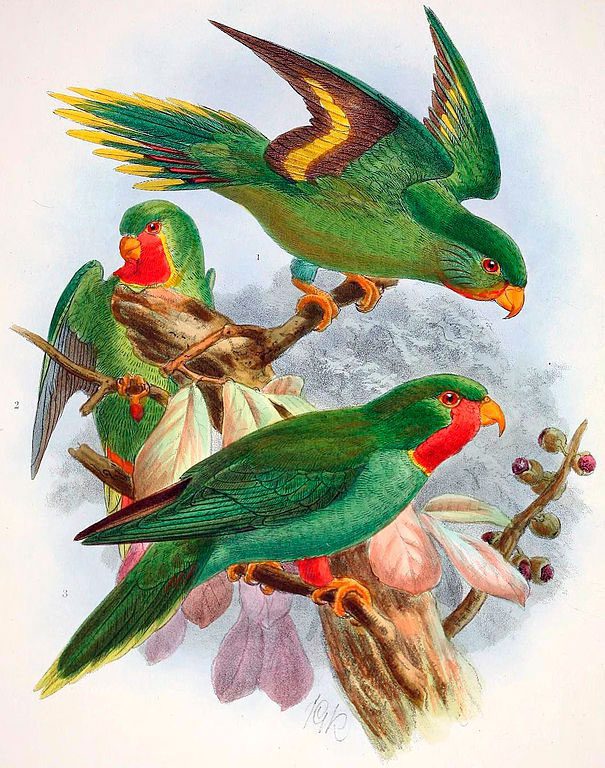
Charmosyna amabilis

Red-throated Lorikeet

Content

Description

18 cm.. length.

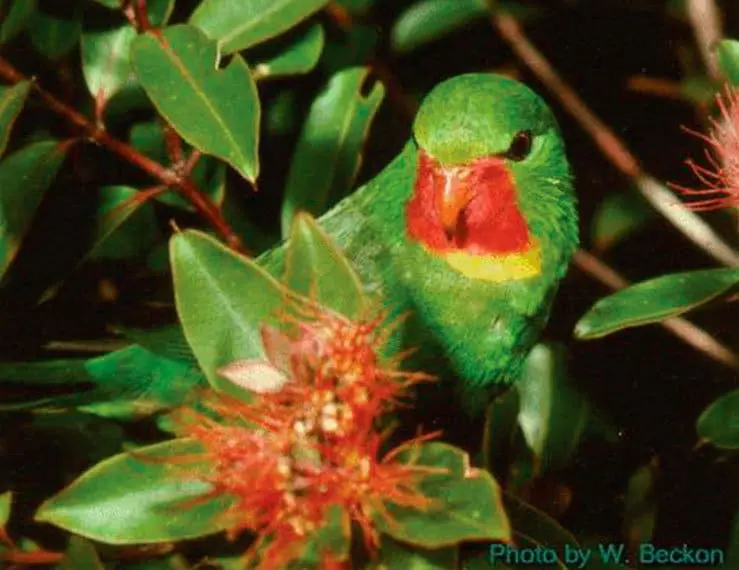
The head of the Red-throated Lorikeet (Charmosyna amabilis) is green with lores and chin red. Upperparts green. Wings internal and ends with green feathers flight feather color black. Throat red, bordered below by a narrow yellow collar; rest of the underparts with a yellowish green that upperparts, particularly in the center of belly; the thighs red. The tail above green a little darker than the rump, with yellow ends; undertail yellow. Bill orange; irises yellow; legs orange-red.

Male and female are equal.

Immature generally duller. The the thighs dull purple. The yellow band throat much weaker than in adults and the red facial and marks throat more restricted.

Habitat:

Move by tropical forests, mainly over the 500 m. Son nomads and fly in pairs or small flocks of 5-8 birds in search of flowering trees, uniting to feed on flowers, nectar and pollen. They prefer to feed in the canopy, and although it is apparently ejected away from the areas of power by the aggressive Collared Lory, Holyoak He found two species feeding on the same tree during his remarks in 1973.

Reproduction:

Breeding and nesting habits unknown.

Food:

They feed actively, to often hung upside down to get to flores.

Distribution:

Size of the area of distribution (reproduction / resident): 37.100 km2

endemic to the Fiji Islands where it is rare and usually only moves above 500 meters and below 1.000 m. Is distributed between in Viti Levu, Ovalau (where it may now be extinct), Vanua Levu and Taveuni. In 1973 Holyoak found at a Red-throated Lorikeet on a wooded Ridge around 250 metres in Viti Levu, species you saw or heard on five different days while exploring Taveuni thinking that the species was widespread in the rainy forests at an altitude between 550 and 1,000 m. The species was also recorded in rainforests between 120 meters and 980 feet by Martyn L. Gorman (1975), but it is said that they are rare. These records are among the few documented sightings of this century. The world's population is believed to be of less than 10.000 specimens. Despite its apparent rarity, This species may be overlooked due to their unobtrusive plumage and behavior.

Conservation:


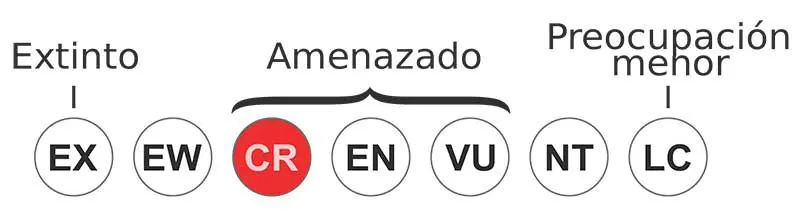
critical hazard


โ€ข Current IUCN Red List category: Critical Hazard

โ€ข Population trend: Decreasing

Threats to the lowlands and hills of the forest is slowly being erased much of Fiji. But, the rarity and assumed decline of this species is probably largely the result of predation by introduced mammals, especially Black Rat (Rattus rattus) , as it is the case with the closely related New Caledonian Lorikeet (Charmosyna diadema).

Increases in course in the logging and the expansion of the road network, especially around the Highlands of Monasavu and Serua in Viti Levu, It is likely that you have caused an increase of the density of these rats (Watling 2000, G. Dutson in litt. 2005). The Indian Brown Mongoose (Herpestes fuscus) introduced, is also present in the areas of distribution of the Red-throated Lorikeet and it can be a threat (V. Masibalavu in litt. 2012).

Agricultural expansion is encroaching on primary forest in Taveuni. Have a distribution in mountains close to the maximum altitude within its distribution area, It also makes this potentially susceptible species to climate change (BirdLife International).

Is species is protected by the laws of Fiji. In Viti Levu, dwells within the Tomaniivi nature reserve, but this is not large enough to maintain a resident population and, Despite the creation of the extension Wabu proposal to make a reservation of adequate size, this would not provide better protection against rats if the reserve is kept unmanaged (D. Watling in litt. 2000)

"Red-throated Lorikeet" in captivity:

Unknown in captivity.

Alternative names:

Red-throated Lorikeet, Red throated Lorikeet (ingles).
Lori ร  gorge rouge (French).
Rothรถschen (German).
Lori de Garganta Roja, Lori Gorgirrojo (espaรฑol).

scientific classification:

Order: Psittaciformes
Family: Psittaculidae
Scientific name: Charmosyna amabilis
Citation: (Ramsay, 1875)
Protonimo: Trichoglossus (Glossopsitta) amabilis

————————————————————————————————

ยซOn Gorgirroยป (Charmosyna amabilis)


Sources:

Avibase
– Parrots of the World โ€“ Forshaw Joseph M
– Parrots A Guide to the Parrots of the World – Tony Juniper & Mike Parr
– Birdlife

Photos:

1 – (Photo by Bill Beckon, 1973)
2 – Charmosyna amabilis By Artwork by John Gerard Keulemans (1842-1912). [Public domain], via Wikimedia Commons

โ–ท The world of Pets: Dogs, cats, birds, reptiles, amphibians

Sula hanging parrot
Loriculus sclateri

Hanging of the Sula

Content


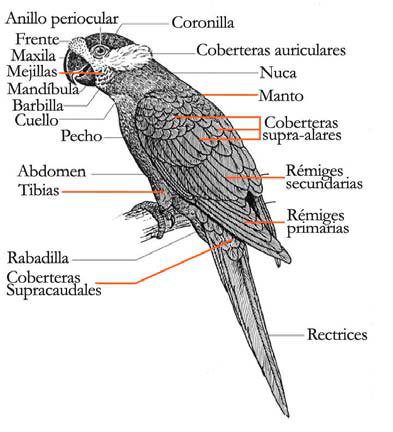
Anatomy-parrots

Description

14 cm.. length.

The plumage of the Sula hanging parrot (Loriculus sclateri) is mostly green.

The chin and throat They are red. There are orange-yellow markings on the mantle and in the back. The coverts, rump and tail upper are crimson, extending to the tip of the tail. Carpal edge red (Wing attack on the "shoulder"). The tail It is green with yellow-green tip. The bill is black.

the female has the irises brown, While the male is pale yellow.

To the Sula hanging parrot Sometimes I have treated as a subspecies of the Moluccan hanging parrot, but the two are treated as separate species based on its clear differences in plumage and size.

Description 2 subspecies

  • Loriculus sclateri ruber

    (Meyer,AB & Wiglesworth, 1896) – Similar to the nominal species but red in the mantle and back.


  • Loriculus sclateri sclateri

    (Wallace, 1863) – Nominal.

Habitat:

They are generally distributed in humid areas of subtropical primary and secondary forests or lowland tropical forests. until 450 meters above sea level – mainly on the edge of the forest. Can also be seen in remaining tall trees in plantations and cultivated areas.

viewed solos, or pairs or small groups.

Reproduction:

The first breeding season begins in January and lasts until April; and if conditions are right, breeding activities can once again be observed from July to September.

Nest trunks of dead trees, favor of the narrow hollow long with small entrance holes. Noticed it a female carrying nesting material, that can include pieces of bark, leaves and feathers for lining of the nest. Sunset You can consist of 2 to 4 white eggs. Single the female incubates the eggs during 20 days, While the male feeds it. Each egg measures of ~ 15 mm to 18,7 mm.

Food:

Its diet natural It consists mainly of red fruits – particularly wild figs, guava and berries, as well as flower buds and flowers. They also feed on nectar and seeds.

Distribution:

Size of the area of distribution (reproduction / resident): 30.800 km2

endemic to the Sula Islands (Taliabu, Mangole and Sanana), as well as of Banggai in Sulawesi (formerly known as Celebes)

Distribution 2 subspecies

Conservation:


minor concern


โ€ข Current IUCN Red List category: Least concern

โ€ข Population trend: Stable

The size of the world population It has not been quantified, but the species is described as common in its range (pit et to the. 1997).

The population is suspected to be stable in the absence of evidence of any reduction or substantial threats.

A possible threat to its existence are the capture for the bird trade and habitat loss.

"Sula hanging parrot" in captivity:

Practically unknown in captivity.

Alternative names:

Sula Hanging-Parrot, Sula Hanging Parrot, Sulu Hanging Parrot (ingles).
Coryllis de Sclater, Coryllis des Sula (French).
Sulapapageichen (German).
Loriculus sclateri (Portuguese).
Lorรญculo de las Sula (espaรฑol).

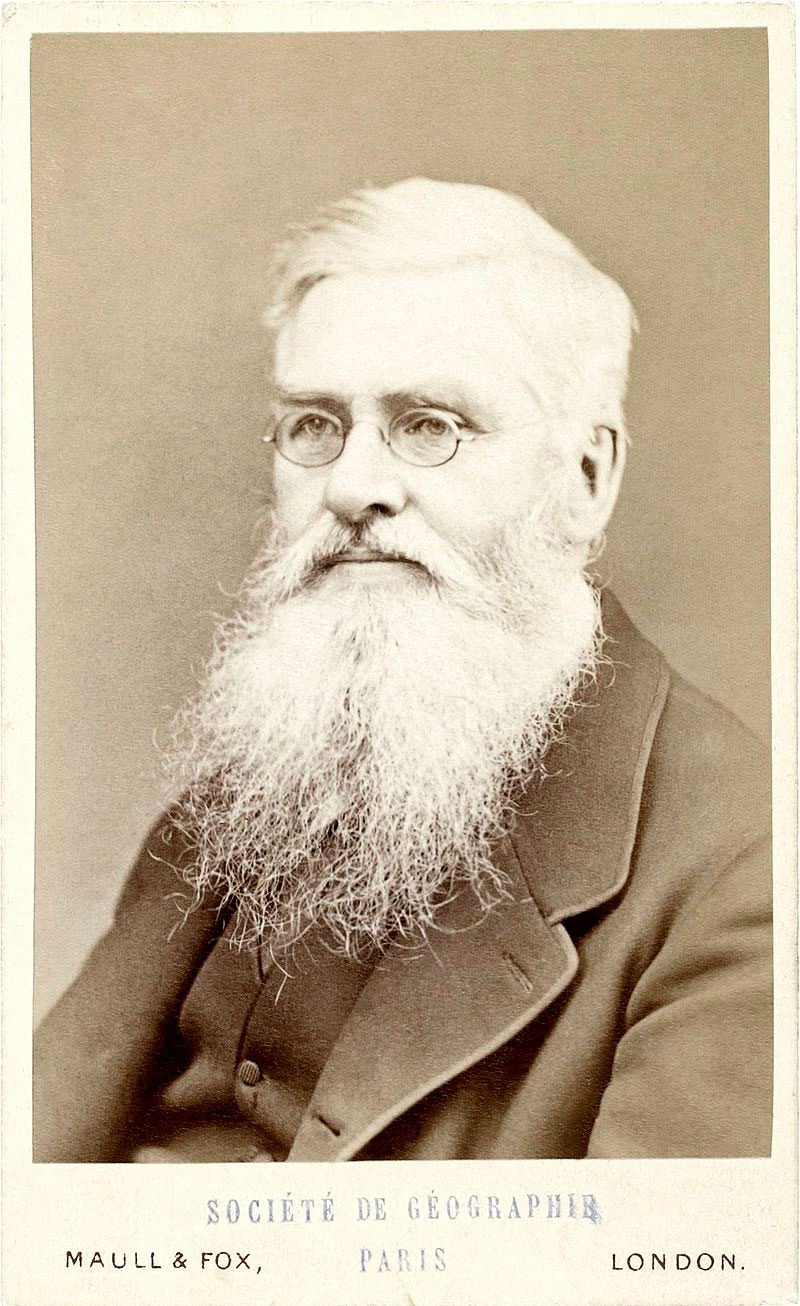
Alfred Russel Wallace

scientific classification:


Order: Psittaciformes
Family: Psittaculidae
Genus: Loriculus
Scientific name: Loriculus sclateri
Citation: Wallace, 1863
Protonimo: Loriculus sclateri


Images "Sula hanging parrot"

Videos "Sula hanging parrot"

————————————————————————————————

"Loricle of the Sula" (Loriculus sclateri)


Sources:

Avibase
– Parrots of the World โ€“ Forshaw Joseph M
– Parrots A Guide to the Parrots of the World – Tony Juniper & Mike Parr
– Birdlife
beautyofbirds

Photos:

(1) – ยซLoriculussclateriwolfยป by Joseph Wolf – Proceedings of the Zoological Society of London 1862 (Web). Licensed under Public Domain via Wikimedia Commons.

Sounds: Peter Wilton (Xeno-canto)

โ–ท The world of Pets: Dogs, cats, birds, reptiles, amphibians

Edwards' Fig-Parrot
Psittaculirostris edwardsii


Edwards' Fig-Parrot

Content

Description

18 cm.. length and weight around 105 g..

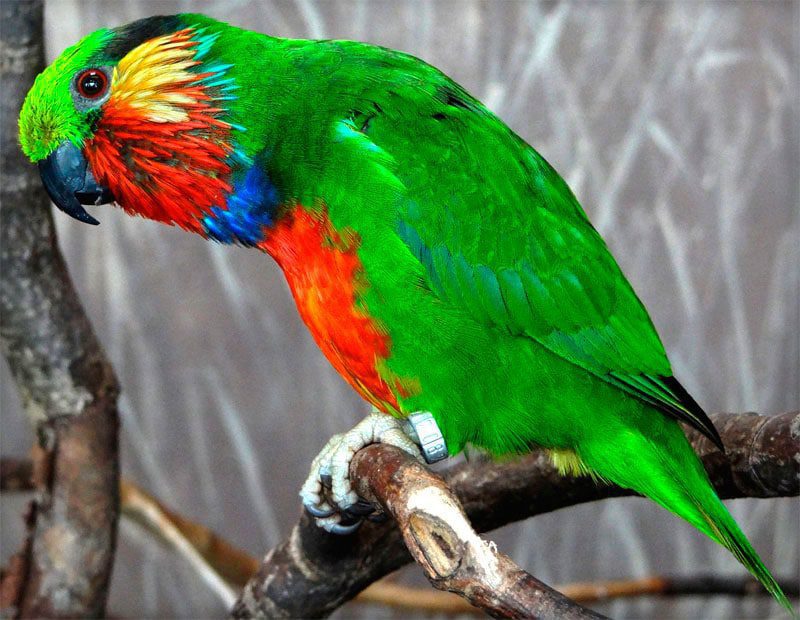
The Edwards' Fig-Parrot (Psittaculirostris edwardsii) you have the front and a bright yellowish-green Crown, with a green stripe on the back; neck greyish-Brown band above the band of gris-negruzco color that extends into the eye; area before and just behind the eyes, green. Elongated lower headset feathers and orange-red fire Gorge, with some green basal feathers interspersed and ends the headphone rear (also elongated) golden yellow with orange.

Dark green back: curve of the wing marked in blue. Black flight feathers marked with green in vane outer (except the primary outer) and with vane internal yellow, forming a set of bars under her wings; marked inner coverts reddish-orange. The wings of blue-green feathers, the longest with yellow tip. Purple-blue ruff with some lighter green feathers; Centre of the breast and upper belly of a showy orange-red; flanks, supracaudales yellowish-green coverts and thighs. Upper, the Green tail; undertail, opaque yellow olive.

the black beak; reddish brown to Brown irises; light grey legs.

The female of the Edwards' Fig-Parrot It lacks the heart of red on the chest and upper abdomen, and has a broader purple-blue band on the chest, inset below with red.

Immatures resemble females, but with the headphones coverts greenish yellow.

Habitat:

The Edwards' Fig-Parrot (Psittaculirostris edwardsii) are distributed among the humid lowland forests, partially cleared areas, wooded edges, as well as near rural areas, up to about 800 meters above sea level.

The birds are usually found in pairs or small noisy flocks, Although groups have been found for up to 400 birds collected in the canopy of fruit trees.

Rapid movements are, and usually they hang you upside down to reach food.
Has been in mixed flocks with the Double-eyed Fig-Parrot.

Reproduction:

Nesting behavior of the Edwards' Fig-Parrot they have been observed since January through may. In October he was seen a male rubbing its peak with the female and hovering above its perch. The nest is in a hole, at the top of a tree in the forest.

Food:

The diet consists of fruit, including the Ficus figs and casuarinas, nectar and probably insects

Distribution:

Endemic to the lowlands of the North of New Guinea in Irian Jaya and Papua New Guinea. It is commonly distributed in the northeast of all Jayapura along the coastal lowlands and inland to around of Pagwi, Chamhri Lake and the jimi river. Observed in the region of the Sepik River, extending eastward to the lowlands of the Huon Peninsula and the markham river. The world's population is believed to be in excess of 100.000.

Conservation:


minor concern


โ€ข Current IUCN Red List category: Least concern

โ€ข Population trend: Stable

The size of the world population Edwards' Fig-Parrot It has not been quantified, It is estimated around the 100,000 specimens. The species according to sources, it is common to very frequent, at the local level (pit et to the. 1997).

The population is suspected to be stable in the absence of evidence of any reduction or substantial threats.

"Edwards' Fig-Parrot" in captivity:

active parrot, need space to exercise. It has nice voice, harmless. Initially shy and nervous, It is customary to the caregiver with the time. You can die suddenly without apparent reason.

It is very rare in poultry.

Alternative names:

Edwards’ Fig-Parrot, Edward’s Fig Parrot, Edwards’ Fig Parrot, Edwards’s Fig Parrot, Edwards’s Fig-Parrot, Scarlet-cheeked Fig Parrot (ingles).
Psittacule d’Edwards (French).
Edwardszwergpapagei, Edwards Zwergpapagei, Edwards-Zwergpapagei (German).
Psittaculirostris edwardsii (Portuguese).
Lorito de Eduardo, Lorito de Edwards (espaรฑol).

scientific classification:

Order: Psittaciformes
Family: Psittaculidae
Scientific name: Psittaculirostris edwardsii
Genus: Psittaculirostris
Citation: (Oustalet, 1885)
Protonimo: Cyclopsittacus Edwardsii

Images "Edwards' Lorito":

————————————————————————————————

ยซEdwards' parrotยป (Psittaculirostris edwardsii)


Sources:

Avibase
– Parrots of the World โ€“ Forshaw Joseph M
– Parrots A Guide to the Parrots of the World – Tony Juniper & Mike Parr
– Birdlife

Photos:

(1) – Indonesia Traveling Guide – by Farelli in Indonesia Bird
(2) – Birds-pet-wallpapers
(3) – ยซPsittaculirostris edwardsiiยป by http://www.birdphotos.com – http://www.birdphotos.com/photos/v/parrots/IMG_3537b.jpg.html. Licensed under CC BY 3.0 via Wikimedia Commons.
(4) – By Michal Pilar – Methodical Portal
(5) – By Katerina Tvardikova – New Guinea Birds

โ–ท The world of Pets: Dogs, cats, birds, reptiles, amphibians

Blue-winged Racquet-tail
Prioniturus verticalis


Blue-winged Racquet-tail

Content

Blue-winged Racquet-tail

Description

27 cm. long, not to mention their racquets, measuring of 5 to 6 cm..

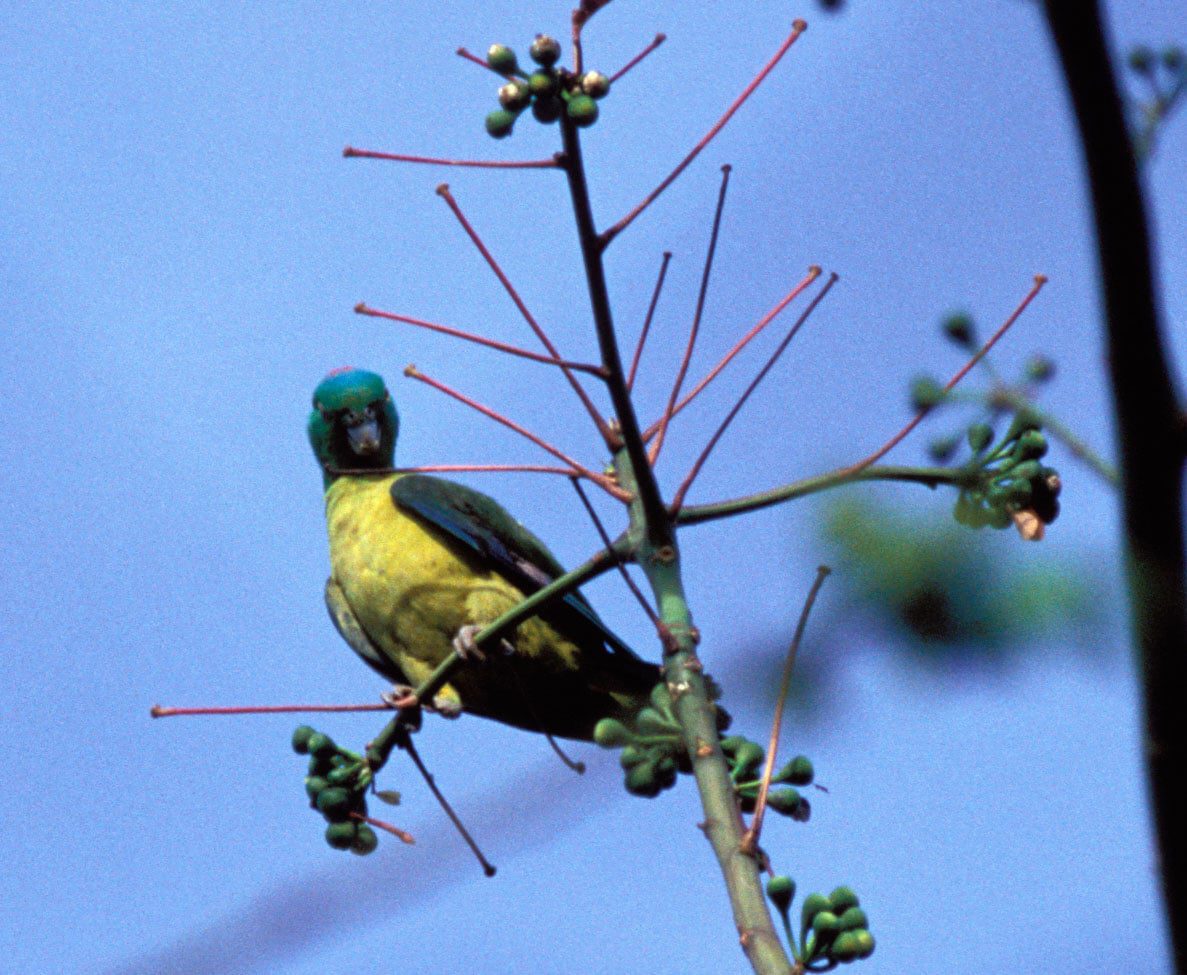
The Blue-winged Racquet-tail (Prioniturus verticalis) It has a bright green head, brighter around the lores and the base of the beak; front of the bright blue Crown with central red dot.

Light yellowish green mantle; back and rump Green. green wings, with a wash of dark blue in both bands of all primaries. green wing feathers. The underparts light yellowish-green, more green on the belly and coverts infracaudales. At the top of the queue, Foreign feathers green with black tips; dark the infracaudales, with blue bathed at the edges of the vane inner; tail blades, blackish

Whitish gray peak; dark brown irises: grey legs.

The female It has a light blue Crown, with the absence of the male Red stain: the areas of green yellow more turned off.

Young without snowshoes.

Habitat:

It lives in the lowlands of humid forests., next to forests, the mangroves, dense remnants of forest fragments and agricultural areas. The birds are seen most frequently in pairs, in quick flights over the top of the dense vegetation. They feed on fruit trees, staying calm and hard to spot.

Reproduction:

A nest was discovered in September 1991 with a female: the nest was in a large Palm tree with a broken lid in a Grove near the forest.
Little else is known about the reproductive ecology of this species..

Food:

It is known that it feeds on fruit trees, little more is known about their eating habits.

Distribution:

Is distributed in the Islands to the South-West of the Sulu archipelago, including Tawi-tawi, Bongao (considered probably extinct), Manuk Manka, Sanga Sanga (probably extinct), Tumindao, (There are no recent records) and Sibutu. Although reports indicated that the species was common in the mangroves of Tawi-tawi during the last century, Today it seems to have suffered a serious decline. Today the world population is estimated to be less than 5.000 and the species is being affected by the capture and the rapid elimination of the last forests on the islands.

The birds are also, apparently, used for shooting practice by the Islanders. In 1991 small numbers were observed near virgin forests. During 1994, in Tawi-tawi, There was a rapid elimination of its remnant forest and only six birds were observed.

Conservation:


critical hazard


โ€ข Current category of the Red List of the UICN: Critical Hazard

โ€ข Population trend: Decreasing

This parrot has been upgraded to the category a Critically Endangered due to observations that suggest that it now has a very small population, with the suspicion of a fast and rapid deterioration due to the continuous logging of forests, as well as his persecution. Conservation actions are hampered by security concerns. Urgent action is required to assess the gravity of the situation of the species, lessen the impact of threats, start your recovery.

The population was previously estimated at less of 1.000 mature individuals (BirdLife International 2001), but the most recent observations indicate that it could currently be less than 250 mature individuals, Therefore the population is now in the band of 50 to 249 mature individuals, probably equivalent to a total population of 75 to 375 individuals.

Military activity and the insurgency are still presenting a serious obstacle to the general conservation activity in the Sulus. There is no formal protected areas in the archipelago. In 1997, began an awareness campaign focused on the conservation of terrestrial biodiversity in Tawi-Tawi. There is a proposal to finance the conservation of Tawi Tawi, Coastal zone Sulu, Although neither the result nor the potential benefits for the species are known. A municipal resolution has been developing, hoping to put an end to the hunting of endemic species (I. Sarenas in litt., 2010).

"Blue-winged Racquet-tail" in captivity:

Unknown in captivity.

Alternative names:

Blue-winged Racquet-tail, Blue winged Racquet tail, Blue-winged Racket-tail, Blue-winged Racket-tailed Parrot, Blue-winged Racquet Tail, Blue-winged Racquet-tailed Parrot, Sulu Racket-tail, Sulu Racket-tailed Parrot, Sulu Racquet-tail, Sulu Racquet-tail Parrot, Sulu Racquet-tailed Parrot (ingles).
Palette des Sulu, Palette ร  ailes bleues, Perroquet ร  raquette des Sulu (French).
Sulu-Spatelschwanzpapagei, Sulu Spatelschwanz-Papapgei, Sulupapagei (German).
Prioniturus verticalis (Portuguese).
Lorito momoto de las Sulu, Lorito Momoto Sulu, Lorito-momoto de las Sulu (espaรฑol).

scientific classification:

Order: Psittaciformes
Family: Psittaculidae
Genus: Prioniturus
Scientific name: Prioniturus verticalis
Citation: Sharpe, 1893
Protonimo: Prioniturus verticalis

————————————————————————————————

โ€œSulu Motmot Parrotโ€ (Prioniturus verticalis)

Sources:

Avibase
– Parrots of the World โ€“ Forshaw Joseph M
– Parrots A Guide to the Parrots of the World – Tony Juniper & Mike Parr
– Birdlife

Photos:

(1) – preening in top of tree by Desmond Allen – Lynx
(2) – ยซPrioniturusverticaliskeulemansยป by {{{Name}}} – Ibis 1894. Licensed under Public Domain via Wikimedia Commons.

Sounds: Desmond Allen (Xeno-canto)

โ–ท The world of Pets: Dogs, cats, birds, reptiles, amphibians

Australian Ringneck
Barnardius zonarius

Australian Ringneck

Content


Anatomy-parrots

Description

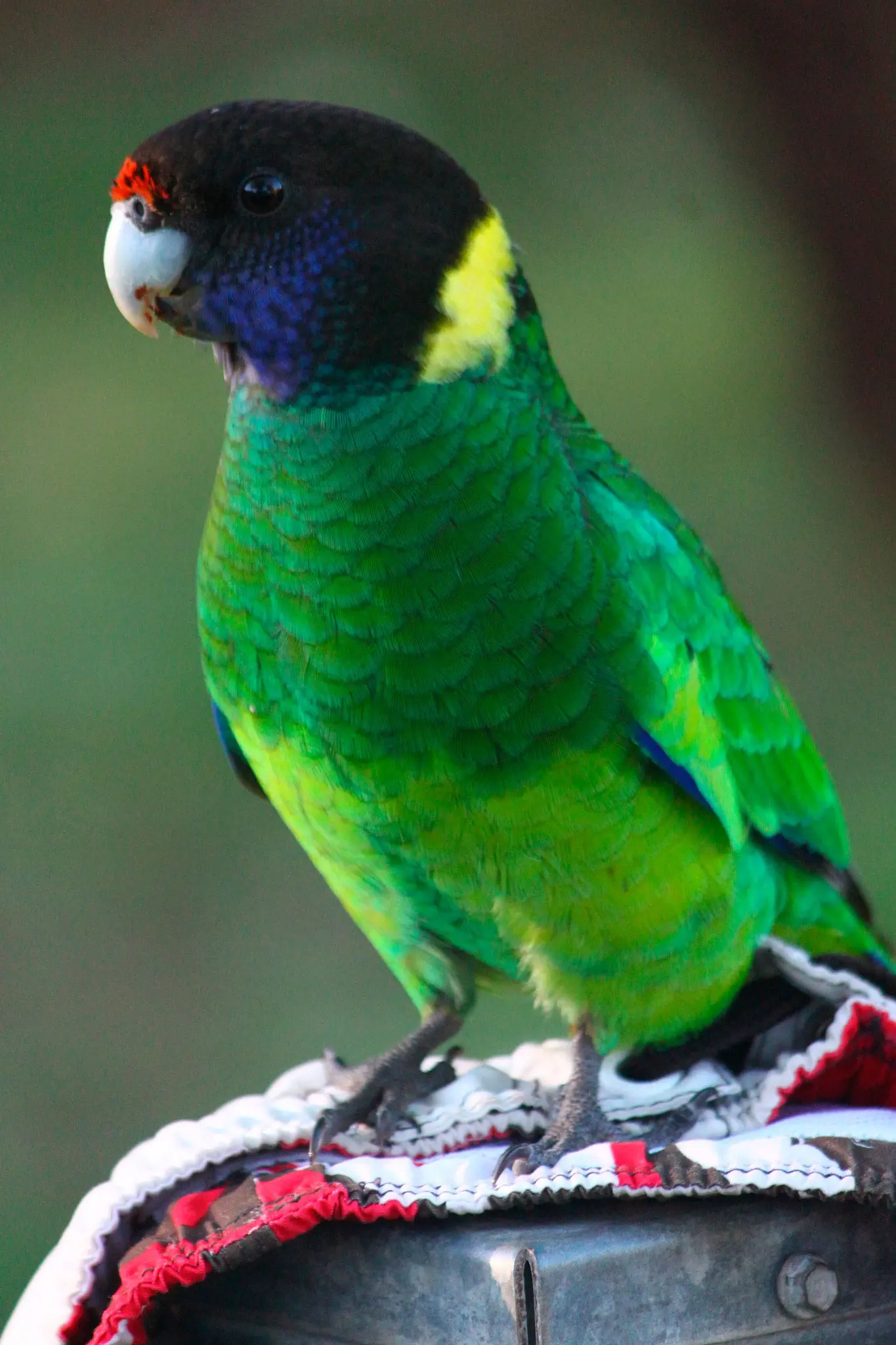
Among 32 to 44 cm.. length and a weight between 121 and 200 g..

Two species were traditionally recognized in the genus Barnardius, Barnardius zonarius and Barnardius barnardi, but both hibridaban in the contact area and are currently considered a single species.
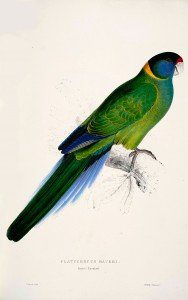
The Australian Ringneck (Barnardius zonarius) It has the head of blackish brown with cheeks, both sides of the throat and underside of the headset coverts densely dotted with dark blue (You can display a few red spots on the front of the Crown); the back of the neck of bright yellow.
Middle of the mantle of dark green with thin dark stripes; slightly more bright green rump; a little more off than the rump supracaudales coverts.

External Middle coverts slightly greenish-yellow color, Green the inner coverts, the large green with blue-green and pale inner margins coverts green outer margins in the outermost feathers; curve of the wing of Turquoise, It extends slightly towards small coverts; primary coverts dark brown with vane dark blue external; blackish flight feathers, strongly marginalized in foreign feathers, showing fusion from the blue color in the vane external to the blue gray of the tips.

Under, with turquoise coverts blackish flight feathers. Dark green chest with fine dark stripes; upper part of the abdomen of bright yellow, Green the lower belly area, slightly impregnated yellow; subcaudales coverts greenish-yellow. Central tail feathers of dark green merging to dark blue, the external of pale blue with dark bases and white tips. Under, pale blue tail.

The greyish white Peak: the Brown irises; legs grey

The female It has peak and smaller head, the slightly Browner head, and you can display a mark in the form of bar at the bottom of the wings.

The immature, they are a brand of pale bar on the wings (disappearing earlier in males than in females); they are more turned off, with a head of Brown and dissemination of greyish-Brown mantle and upper chest area; the tail is green above. Adult plumage is reached between 12 and 15 months.

Subspecies Barnardius zonarius

  • Barnardius zonarius semitorquatus

    (Quoy and Gaimard, 1830) – Of 40 cm.. length approximately. It is more than nominal, but with the red front, abdomen green more off, Pico mas grande. Female plumage more pale and head color more Brown, the Red coloration of the forehead is narrower in some absentee.

  • Barnardius zonarius zonarius

    (Shaw, 1805) – Equal to the Barnardius zonarius collared, but with a yellow abdomen and without the prominent crimson red stripe on the forehead, that if you have the subspecies collared.

  • Barnardius zonarius macgillivrayi

    (North, 1900) – Cloncurry Ringneck – Crown and nape of an intense green color and some reddish tones on the cheeks. Is lighter green shades, No red frontal band, and with a broad band uniform across your abdomen. Not recognized by all experts.

  • Barnardius zonarius barnardi

    (Vigors and Horsfield, 1827) – It has an intense green crown and nape and certain reddish tones on the cheeks.. Their underparts are Turquoise green with an irregular band yellow orange across the abdomen. Your back and mantle are blackish blue and also this subspecies has a red band on the forehead.
    Presumably either the nominal race.
Habitat:

Australian Ringneck

The Australian Ringneck is mainly sedentary, with occasional movements during extreme weather conditions. The species occupies a range of habitats, including eucalyptus red zones (Eucalyptus camaldulensis), along water courses, acacia scrub and mallee (Eucalyptus gracilis), eucalyptus open woodlands, agricultural fields, desert shrubland and suburban areas.

In general has adapted better to the effects produced by settlements that the Mallee Ringneck, and it has been particularly successful in the South-West wheat belt, in where the birds are observed while they eat at road verges. The subspecies collared has a more specific habitat, preferring the high forests of coastal eucalyptus, particularly marri (Eucalyptus calophylla).

The Australian Ringneck form strong pair bonds and, normally, is found in small family parties or groups of up to eight birds. They are usually visible, loud and inquisitive, being more active during the morning and evening. They tend to remain silent while they feed on the ground, but they chatter loudly when feeding in the canopy and when gathering to sleep after drinking, remaining assets after the sunset.

Reproduction:

The time of nesting is from June to February, starting earliest in the North.

The birds are territorial around the nest, and there are many fights at the beginning of the breeding season. In courtship, the male drops his wings, WAGs tail producing a buzzing sound, He chatters loudly and shakes head. Courtship feeding is also common. The nest is built at different heights, usually in the natural hollow of a tree based on decomposition of waste wood inside.

Between four and seven (normally five) white eggs are laid during the implementation, sometimes producing two offspring. The female incubates during 19 days and leaves the nest only to feed herself or be fed by the male. At the beginning, She feeds the chicks alone, but a week after hatching, the male joins food tasks. The young leave the nest about four weeks after. Family groups remain together for some time after the chicks have fled the nest..

Food:

The diet consists of nectar, flowers, seeds, fruit, insects and their larvae (that sometimes stripping the bark of lso trees). The cereal crops and orchards are often attacked by the Australian Ringneck, registering birds digging up onion bulbs (Romulea longifolia).

The more arboreal southwestern subspecies has preference by the ripe fruits of eucalyptus, especially those of marri.

Distribution:

The Australian Ringneck they are in the West, Central and South of Australia. Is distributed from Port Augusta, the Eyre Peninsula and Cordillera Gawler, to the North, through the center of Southern Australia in the Northern Territory, where stretches through of the MacDonnell Ranges and lies to the North of Newcastle Waters and Winnecke Creek.

Birds may also go more towards the East, sometimes up to the border of Queensland, and an off-eastern boundary record comes from Pine Creek in New South Wales.

In Western Australia, the species is increasing in the South West which concentrates around King George Sound, in the South, to murchison river, in the North, reaching inside for Kalgoorlie and Wiluna the east. Further north, is scattered through the Northwest corner, and extends eastward to the upper part of the Grey River system.

There is a small isolated population, probably, at the East end of Western Australia in the Gardiner Range region. Escapes have been recorded in the District of Port Wakefield, about Melbourne, Canberra, Sydney, Darwin and Hobart, in Tasmania.

A population of probable leak in the Lofty Mountains It was destroyed to prevent cross-breeding with the Mallee Ringneck, but there is a zone of hybridization with the Mallee Ringneck in the Montes Flinders. The two species are found and hybridize in other places also.

The world's population is piobablemente well above the current estimate of 100.000 specimens given by Lambert (1993).

A moderate number of captive.

The birds can be low temperatures under permit in some districts to prevent damage in orchards.

Subspecies B distribution. zonarius

Conservation:


minor concern


โ€ข Current category of the Red List of the UICN: Least concern

โ€ข Population trend: Growing
The size of the world's population has not been quantified, It is estimated over 100 000 specimens. The species, according to sources, is the most common species of birds in the wheat belt of Australia (pit et to the. 1997).

The population is suspected that it may be increasing. To mitigate the effects of the degradation of the habitat, new areas of suitable habitat are being created.

In the East, numbers are affected by scrub clearing Mallee and forests for agriculture. The Australian Ringneck they were considered vermin in Western Australia and in the seasons of hunting by be considered pests of orchards. Fugadas birds in aviaries are seen around the urban areas in the East.

"Australian Ringneck" in captivity:

Son aggressive toward other birds, especially during the breeding season, and it is better to accommodate them with a couple by Aviary.

Although friendly, they are not as sociable with people like other parrots. They are formidable chewing and require a heavy duty cage. You can learn to imitate.

Una muestra viviรณ 17,9 years in captivity. According to some sources, these animals can live up to 31,6 years in captivity, but this has not been verified.

Common in Europe, less in the United Kingdom and United States. UU.

Alternative names:

Australian Ringneck, Banded Parakeet, Banded Parrot, Barnard’s Parakeet, Barnard’s Parrot, Bauer’s Parakeet, Buln Buln, Buln-buln Parakeet, Buln-buln Parrot, Cloncurry Buln-buln, Cloncurry Parrot, Eastern Ringneck, Mallee Parrot, Mallee Ringneck, Mallee Ringneck-Parrot, Mrs Morgan’s Parrot, North Parakeet, Northern Buln-buln, North’s Parrot, Port Lincoln Parrot, Port Lincoln Ringneck, Port Lincoln Ringnecked Parrot, Ringneck, Ring-necked Parrot, Scrub Parrot, Twenty-eight Parakeet, Twenty-eight Parrot, Western Banded Parakeet, Western Ringneck, Yellow-banded Parrot, Yellow-collared Parakeet, Yellow-collared Parrot, Yellow-naped Parakeet, Yellow-naped Parrot (ingles).
Perruche ร  collier jaune, Perruche de Bauer, Perruche de Port Lincoln (French).
Ringsittich (German).
Periquito-port-lincoln (Portuguese).
Perico de Port Lincoln (espaรฑol).

scientific classification:

Order: Psittaciformes
Family: Psittaculidae
Genus: Barnardius
Scientific name: Barnardius zonarius
Citation: (Shaw, 1805)
Protonimo: Psittacus zonarius

Images ยซPort Lincoln Parakeetยป:

Videos "Australian Ringneck"

————————————————————————————————

ยซPerico de Port Lincolnยป (Barnardius zonarius)

Sources:

Avibase
– Parrots of the World โ€“ Forshaw Joseph M
– Parrots A Guide to the Parrots of the World – Tony Juniper & Mike Parr
– Parromania
Wikipedia
– AnAge: The Animal Ageing and Longevity Database – Genomics.senescence.info
– Birdlife

Photos:

(1) – An Australian Ringneck in Perth, Western Australia, Australia By Luke Durkin (Img_9967 (3)Uploaded by snowmanradio) [CC BY 2.0], via Wikimedia Commons
(2) – An Australian Ringneck at Gloucester National Park, Western Australia, Australia By Ken & Nyetta (Ring Necked CocatooUploaded by Snowmanradio) [CC BY 2.0], via Wikimedia Commons
(3) – A Australian Ringneck in Karratha, Pilbara, Western Australia, Australia By Jim Benton from Karratha, Australia (ring necked parrot_1Uploaded by snowmanradio) [CC BY-SA 2.0], via Wikimedia Commons
(4) – Twenty Eight Parrot (Barnardius zonarius collared) at Mundaring Weir picnic reserve. It is eating by holding food in is left foot By Casliber (Own work) [CC BY-SA 3.0 or GFDL], via Wikimedia Commons
(5) – ยซBarnardius zonarius macgillivrayi – Buffalo Zooยป by Dave PapeOwn work. Licensed under Public Domain via Wikimedia Commons.
(6) – A painting of an jpg Australian Ringneck (originally captioned ยซPlatycercus baueri. Bauerโ€™s Parrakeet.ยป by Edward Lear 1812-1888. – Edward Lear [Public domain], via Wikimedia Commons

Sounds: Patrik ร…berg (Xeno-canto)
โ–ท The world of Pets: Dogs, cats, birds, reptiles, amphibians

Rock Parrot
Neophema petrophila

Rock Parrot

Content


Anatomy-parrots

Description

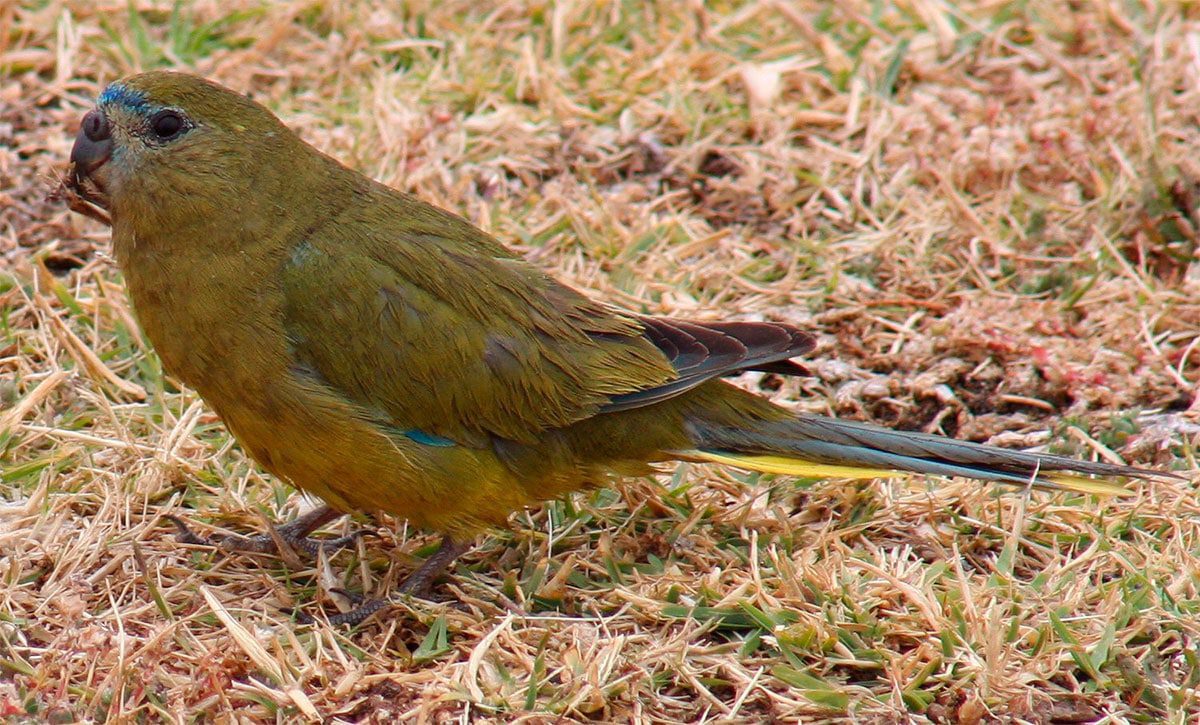
22 cm. height and a weight between 47 and 54 g..

The male of the Rock Parrot (Neophema petrophila) has a band front of color blue dark that is surrounded by a small and striking edge blue marine. The blue becomes even a little bit behind the eye. The area between the eyes and ears, the region of the eye and the anterior part of the cheeks are Navy Blue. The upper part of the crown, the neck, the the mantle, the back, rump and covered wing are olive green. The cheeks, except the front edge, the region of the throat and the chest are olive-gray color. The belly, flanks, the thighs and anal region are opaque yellow.

The curvature of the wing and feathers of the median of the wings are Navy Blue. The flight feather are black with a dark blue marks.

The feathers of the uppertail-coverts are an olive green-brown color and the undertail yellow. The upper part of the feathers of the tail are matte blue streaked olive green. The bottom is dark gray. The irises the eye is dark brown, the bill is dark gray, the cere is brown, legs grayscale and nails dark grey.

The female: is very similar to the male, but its colors are more opaque, especially the blue. The frontal band is a little thinner.

The immature do not have the frontal band blue. The only decoration is a bare periophthalmic characteristic white.

2 subspecies

  • Neophema petrophila petrophila

    (Gould, 1841)


  • Neophema petrophila zietzi

    (Mathews, 1912)

Habitat:

The Rock Parrot they frequent the coastal dunes, mangroves, marshes, agricultural areas, lightly treed savanna, areas of mallee (Eucalytus slender), scrublands abound where the Salt plants (Atriplex). Also visit the coast, where small rivers flow into estuaries. They appreciate the plantations of casuarina and margins of brackish water bordering the coasts and rocky islets where nests are less susceptible to predation. Throughout the year, These birds do not deviate more than several hundred meters from the sea.

Large gatherings of the Rock Parrot, sometimes, There are land, When there is abundance of food. But, like most of Neophema, this parakeet can be hard to spot, and it will only be visible when you take flight due to some danger.

Their plumage is not anti-absorbente and often remains wet, which gives it a darker shade. They tend to use the same Burrows to the Pacific Shearwater (Puffinus pacificus), the 2 species sometimes have the same habits and the same mating rituals.

Reproduction:

The Rock Parrot reproduced from august to december, sometimes in February. Occasionally, There is a second litter.

The nest is placed in the crevice of a low cliff, on a facade or on some rocky ledge. Since relatively recently, they have come to nest on small islands of limestone, the entry hole is often hidden behind a curtain of vegetation.

Sometimes, abandoned Burrows of the Pacific Shearwater (Puffinus pacificus) they are used as a nest by the Rock Parrot. In other cases, These parakeets usurp active nests of the Paรญno Pechialbo (Pelagodroma marina).

Spawning contains 4 or 5 eggs and your incubation lasts a few 18 days. The chicks are altricial and stay in the nest during 30 days.

Food:

The Rock Parrot are, above all, vegetarian. They like to eat cultivated seeds, fruits and a variety of herbs. They also eat young shoots, shrubs and plants that are tolerant of saline environments.

Distribution:

Size of the area of distribution (reproduction / resident): 1.700.000 km2

There are two separate populations by the Great Australian Bight, which does not offer the suitable coastal islands for nesting.

The Eastern population extends from about Robe, Southern Australia, in the East, to Nuyts archipelago, approximately 133 ยฐE in the west (although breeding records in Kangaioo Island, they have not been confirmed).

The Western population extends from Israelite Bay to archipelago of the Recherche.

In Western Australia, to the West around the Cabo Leeuwin and to the North of Shark Bay.

To the North of Perth the species nests in the continent, but in other parts, birds occupy the coastal islands, at least for breeding, also sometimes traveling from the Mainland to settle on the islands of the coast.

The population of the Rottnest Island on the coast of Perth suffered, in the past, illegal capture, but has grown rapidly in recent years.

The Rock Parrot they are considered common and partially nomadic residents throughout its area of distribution; so far, coastal islands have not been subjected to the same pressures of development than continental zones.

Conservation:


minor concern


โ€ข Current category of the Red List of the UICN: Least concern.

โ€ข Population Trend: Decreasing.

In accordance with Handbook of the Birds of the World, This species is not threatened at the global level. His surprising absence from the region of the Great Australian Bight It can be explained by the lack of sites available in which to nest. In these places, rocks are in fact very limited in number, so the nests bad are protected in the absence of rocks and crevices where they serve this species as a refuge against the attacks of predators. The Rock Parrot they prefer to nest on the islets off the coast, Surely in order not to deal with rats, foxes, cats, lizards, monitors and monitor lizards.

Its population is estimated above of the 20,000 individuals.

"Rock Parrot" in captivity:

The Rock Parrot they are extremely rare in captivity and is likely to be more present in the aviaries of Europe.

In Australia they are only in the hands of some fans.

These parrots are extremely slow, within the genus Neophema, is the least active, so these birds tend to the Obesity, which is very damaging for the fertility.

The Rock Parrot they are birds peaceful in the nature, that make noise. They are birds that they spend too much time on the ground and they bathe regularly. The first generations in captivity will be very susceptible to various infections, including, among others, intestinal parasites. These birds also regularly die without apparent reason.

Alternative names:

Rock Parrot, Rock Elegant, Rock Elegant-Parakeet, Rock Grass-Parakeet, Rock Parakeet, Western Rock-Parrot (ingles).
Perruche des rochers, Perruche pรฉtrophile (French).
Klippensittich (German).
Periquito-da-rocha (Portuguese).
Papagayo de las Rocas, Periquito Roquero (espaรฑol).

scientific classification:

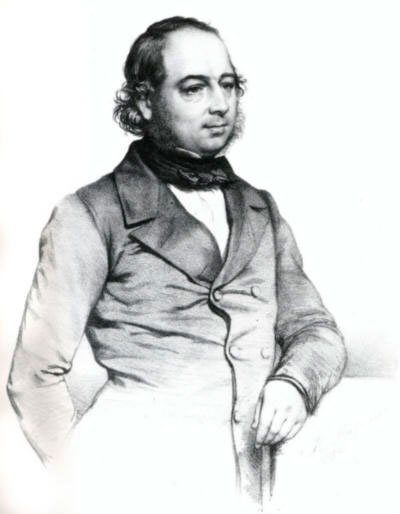
John Gould
John Gould

Order: Psittaciformes
Family: Psittaculidae
Genus: Neophema
Scientific name: Neophema petrophila
Citation: (Gould, 1841)
Protonimo: Euphema petrophila

Images "Rochequet Paraquito":

Videos "Rock Parrot"

————————————————————————————————

"ROQUERO PARQUITO" (Neophema petrophila)


Sources:

Avibase
– Parrots of the World โ€“ Forshaw Joseph M
– Parrots A Guide to the Parrots of the World – Tony Juniper & Mike Parr
Birdlife

Photos:

(1) – A Rock Parrot with grass seed in rain near Cape Leeuwin Lighthouse, Cape Lioness, Western Australia, Australia By Cas Liber (CAs Liber) [Public domain], via Wikimedia Commons
(2) – A Rock Parrot at Greens Pool, Western Australia, Australia By butupa (IMGP8254Uploaded by snowmanradio) [CC BY 2.0], via Wikimedia Commons
(3) – Neophema petrophila rock parrot free wallpaper in free pet category – free-pet-wallpapers
(4) – Neophema petrophila free wallpaper in free pet category – free-pet-wallpapers
(5) – Grass Parrots {Neopherma} – myparrots