▷ The world of Pets: Dogs, cats, birds, reptiles, amphibians

Lord Howe parakeet †
Cyanoramphus subflavescens

Lord Howe Island Parakeet

Content

Lord Howe Island Parakeet

Description:

21-27 cm.. of length and a weight of 80 g..

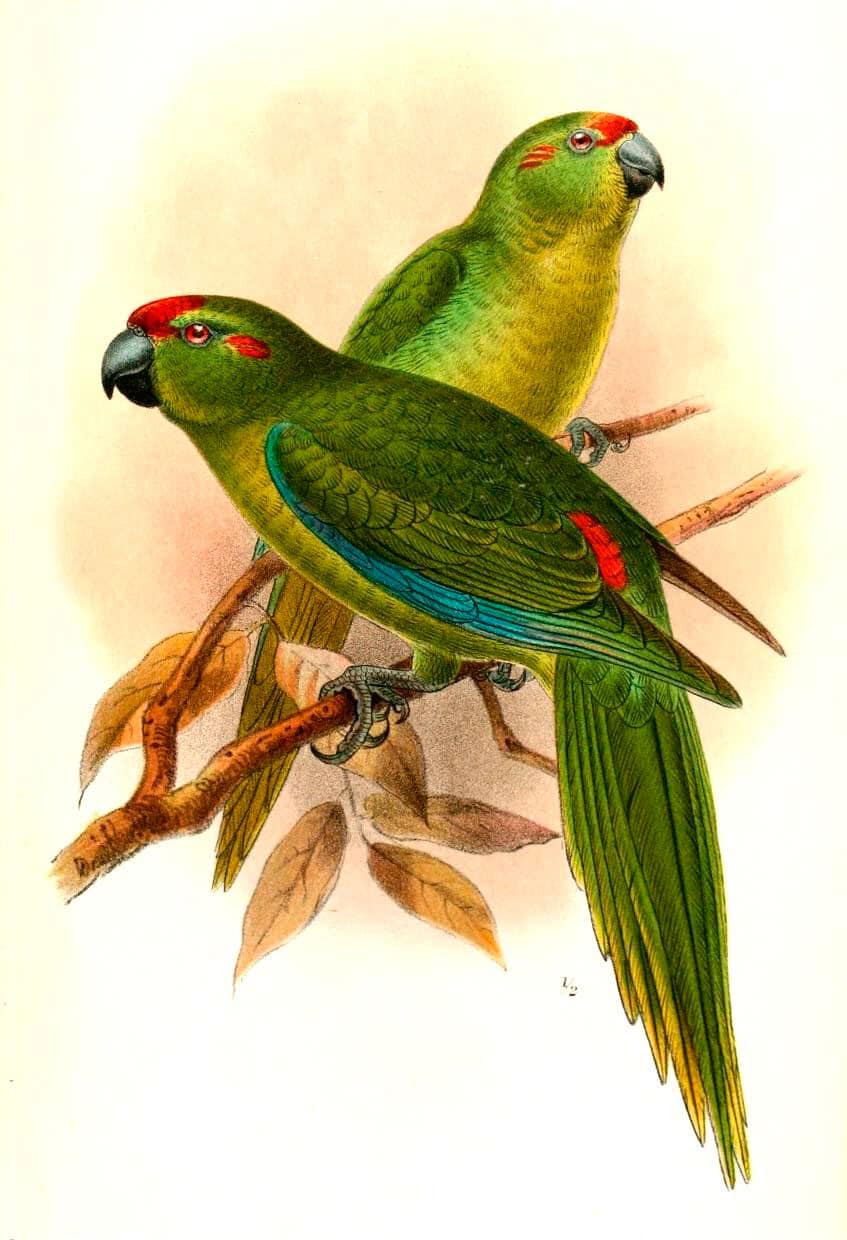
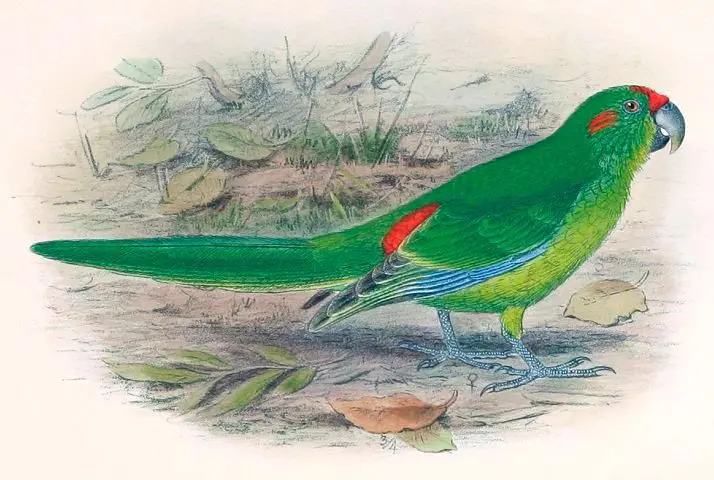
The Lord Howe Island Parakeet (Cyanoramphus subflavescens) was a medium-sized green parrot with a head bright green, the crown crimson red in color and a stripe on the eyes; the eyes were red and bill grey. The upperparts They were bright green with a dark red spot on each side of the rump (usually they are hidden by the wings when resting) and a blue border in wings; the underparts were yellowish green.

Both sexes looked similar, but the female It was smaller.

Taxonomic status:

This taxon is considered a subspecies of Cyanoramphus [novaezelandiae or subflavescens] (sensu lato) by some authors.

In 2012, World Bird List of IOC recognized him as a species [IOC world birdnames Archived 2012-08-06 at the Wayback Machine.].

Habitat:

The Lord Howe Island Parakeet It was occasionally observed in flocks. There is little information on their habitats, They probably lived in inhabited forests and cultivated areas of the Lord Howe Island. No information on the use of different habitats for different activities.

Reproduction:

Nothing is known of sexual maturity, life expectancy and natural mortality of this extinct species. But, It has been estimated that the useful life of the Lord Howe Island Parakeet should be similar to the Norfolk Island Parakeet (Cyanoramphus cookii), About three years. the age of sexual maturity is also known populations of this species, although a juvenile female was seen mating with a male just a week after achieving independence, and captive birds are said to have bred when they were less than a year old.

Little else is known of the breeding of the Lord Howe Island Parakeet, probably reproduced in response to weather conditions and food availability, nesting in tree holes or hollow pipes, in crevices between rocks or cliffs.

Food:

Meal Lord Howe Island Parakeet probably consisted of plant material, as seeds, fruit, buds and leaves of native trees and shrubs. Other extant populations ate mainly seeds, fruits and berries, egg yolks, sprouts and flowers, as well as, occasionally, a small number of invertebrates.

Distribution:

endemic to the isla Lord Howe in the Sea of ​​Tasmania, part of New South Wales, Australia.

Conservation:

• The last record of this species dates from 1869. EXTINCT.

The population declines were mainly due to habitat modification, hunting, poisoning, and the introduction of predators (especially cats and rats).
But, the main threat to the Lord Howe Island Parakeet was the hunting and its capture by settlers. Formerly he abounded in the Lord Howe Island and it was said to be a plague, since it destroyed the crops and orchards of the inhabitants of the island.

There are only two copies of Lord Howe Island Parakeet. From the collection John Gould, taken by John MacGillivray in September of 1853 on tour HMS Herald, and are in the Museum of Natural History [Schodde, R.; & Mason, I.J. (1997). Birds (Columbidae to Coraciidae). In Houston, W.W.K. & Wells, A. (eds) Zoological Catalogue of Australia. Vol. 37.2. CSIRO Publishing: Melbourne. ISBN 0-643-06456-7 p.147.].

Alternative names:

Lord Howe Island Parakeet, Lord Howe Island red-crowned parakeet, Lord Howe Parakeet, Red-Fronted Parakeet (English).
Perruche de Lord Howe (French).
Lord Howe-Laufsittich (German).
Periquito de Lord Howe (Portuguese).
Perico de Lord Howe (español).

scientific classification:
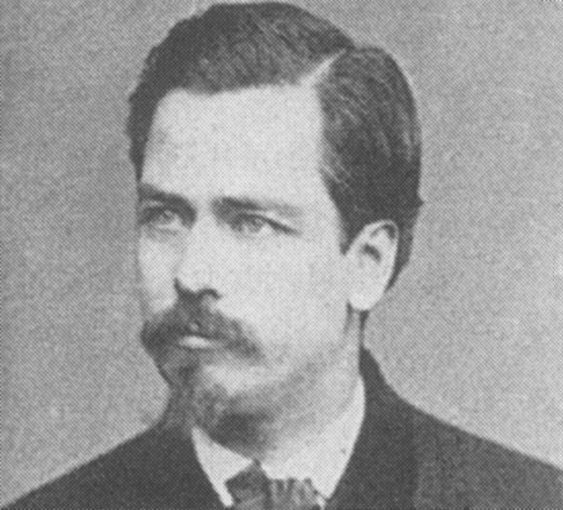
Salvadori-Thomas
Salvadori Tommaso

Order: Psittaciformes
Family: Psittaculidae
Gender: Cyanoramphus
Scientific name: Cyanoramphus subflavescens
Subpoena: Salvadori, 1891
Protonimo: Cyanorhamphus subflavescens

Sources:

Avibase
• Parrots of the World – Forshaw Joseph M
• Parrots A Guide to the Parrots of the World – Tony Juniper & Mike Parr
Red-crowned Parakeet (Lord Howe Is. subsp.) – profile | NSW Environment & Heritage

Photos:

(1) – Cyanorhamphus subflavescens (Catalogue of the Birds in the British Museum. Volume 20) by John Gerrard Keulemans [Public domain] (2) – Hand coloured lithograph (circa 1928) showing (Cyanorhamphus subflavescens) Which is now a synonym of the Lord Howe Island Red-fronted Parakeet (Gray novaezelandiae subflavescens) From The Birds of Australia (1910-28) by Gregory Macalister Mathews (1876-1949) Artwork by Henrik Gronvold (1858–1940) a Danish bird illustrator. by Henrik Grönvold [Public domain]
▷ The world of Pets: Dogs, cats, birds, reptiles, amphibians

Red-faced Parrot
Hapalopsittaca pyrrhops

Red-faced Parrot

Content


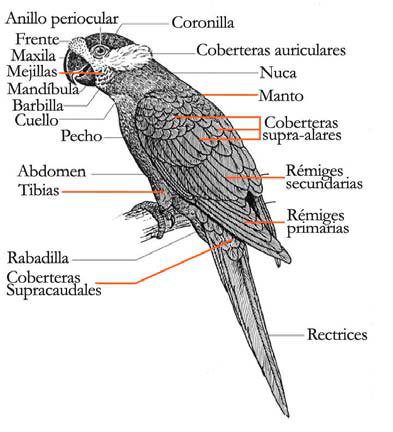
Anatomy-parrots

Description:

23 cm.. height.

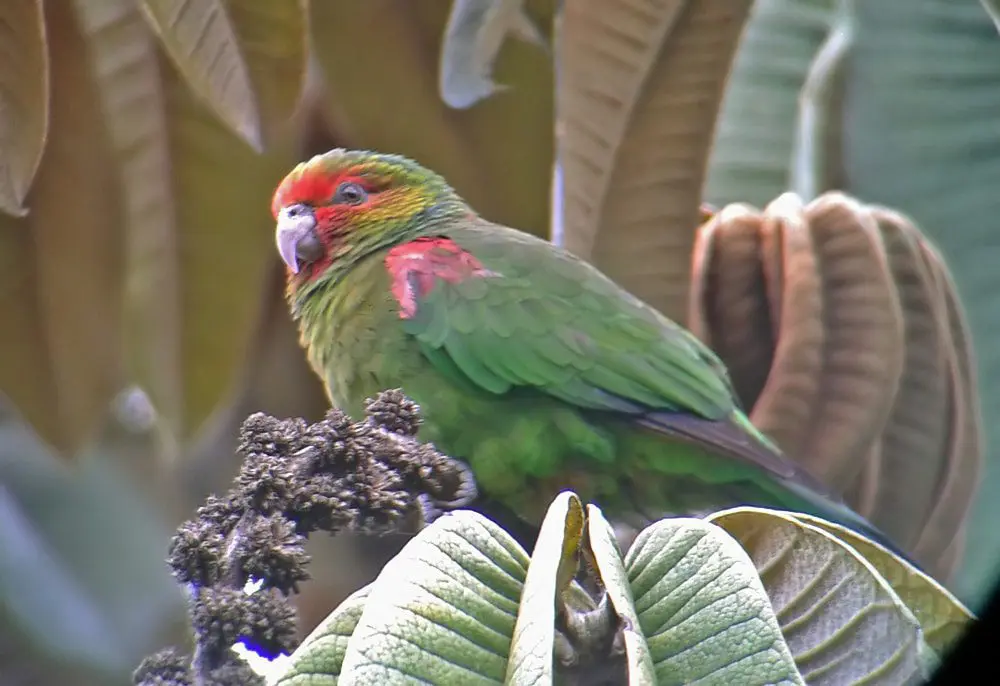
The Red-faced Parrot (Hapalopsittaca pyrrhops) It is distinguishable by the intense red in face and pink magenta in shoulder.

Of bill Of course, yellow feathers on the sides of the neck, crown Green with more bluish back.
Dorsally, wing with blue stain and end blackish; tail with blue border.
In flight, wing with armpit red, Blue-Green rest, tail Red with blue tip.
Youth with the face less red.

Habitat:

Rare. It inhabits in the Woods high Andean, near fells, edges and secondary forests, from the 2400 to 3500 m. They are gregarious, usually in pairs or small flocks of 4 to 6 individuals, rarely more.
They are mostly sedentary. But, can arise some movements seasonal altitudinal.

Reproduction:

Nest in the cavities of trees in October-January; the laying of eggs in late November; the chicks are born in early December, and they leave the nest in late January.

Food:

They feed in the canopy of the forest.
Its diet includes outbreaks, flowers, berries and seeds.

Distribution:

Size of the area of distribution (reproduction / resident): 33.800 km2

Inhabits the southern Andes Ecuador and North end of Peru.

Conservation:


Vulnerable


• Current category of the Red List of the UICN: Vulnerable.

• Population trend: Decreasing.

The population is estimated to be a number of 2.500-9.999 mature individuals.

Threats

Its decline is attributed to the destruction and fragmentation of habitat, largely through the conversion of burning forests to small farms (Jacobs and Walker, 1999).

Severe loss of this species can be expected due to deforestation and degradation of forests, by burning and grazing, on Cordillera de Chilla, Loja of Ecuador, although 1995 there were still extensive forest areas (Toyne and Flanagan 1997, Jacobs and Walker 1999).

"Red-faced Parrot" in captivity:

Unknown in the poultry.

Alternative names:

Red-faced Parrot, Ecuadorian Parrot, Red faced Parrot (English).
Caïque de Salvin, Caïque à face rouge (French).
Salvinpapagei, Salvins Zwergpapagei (German).
Red-faced Parrot (Portuguese).
Lorito Ecuatoriano (español).
Loro de Cara Roja (Peru).


scientific classification:

Salvin Osbert
Salvin Osbert

Order: Psittaciformes
Family: Psittacidae
Genus: Hapalopsittaca
Scientific name: Hapalopsittaca pyrrhops
Citation: (Salvin, 1876)
Protonimo: Pionopsitta pyrrhops

Images "Red-faced Parrot"

Videos "Red-faced Parrot"


"Ecuadorian Lorito" (Hapalopsittaca pyrrhops)


Sources:

  • Avibase
  • Parrots of the World – Forshaw Joseph M
  • Parrots A Guide to the Parrots of the World – Tony Juniper & Mike Parr
  • Birdlife
  • Parrot Book, Parrots and macaws Neotropical

  • Photos:

(1) – Red-faced Parrot (Hapalopsittaca pyrrhops) by Dusan M. Brinkhuizen – IBC

▷ The world of Pets: Dogs, cats, birds, reptiles, amphibians

Black-winged Lory
Eos cyanogenia

Lori Alinegro

Content

Description

30 cm.. height and an approximate weight of 120 gr.

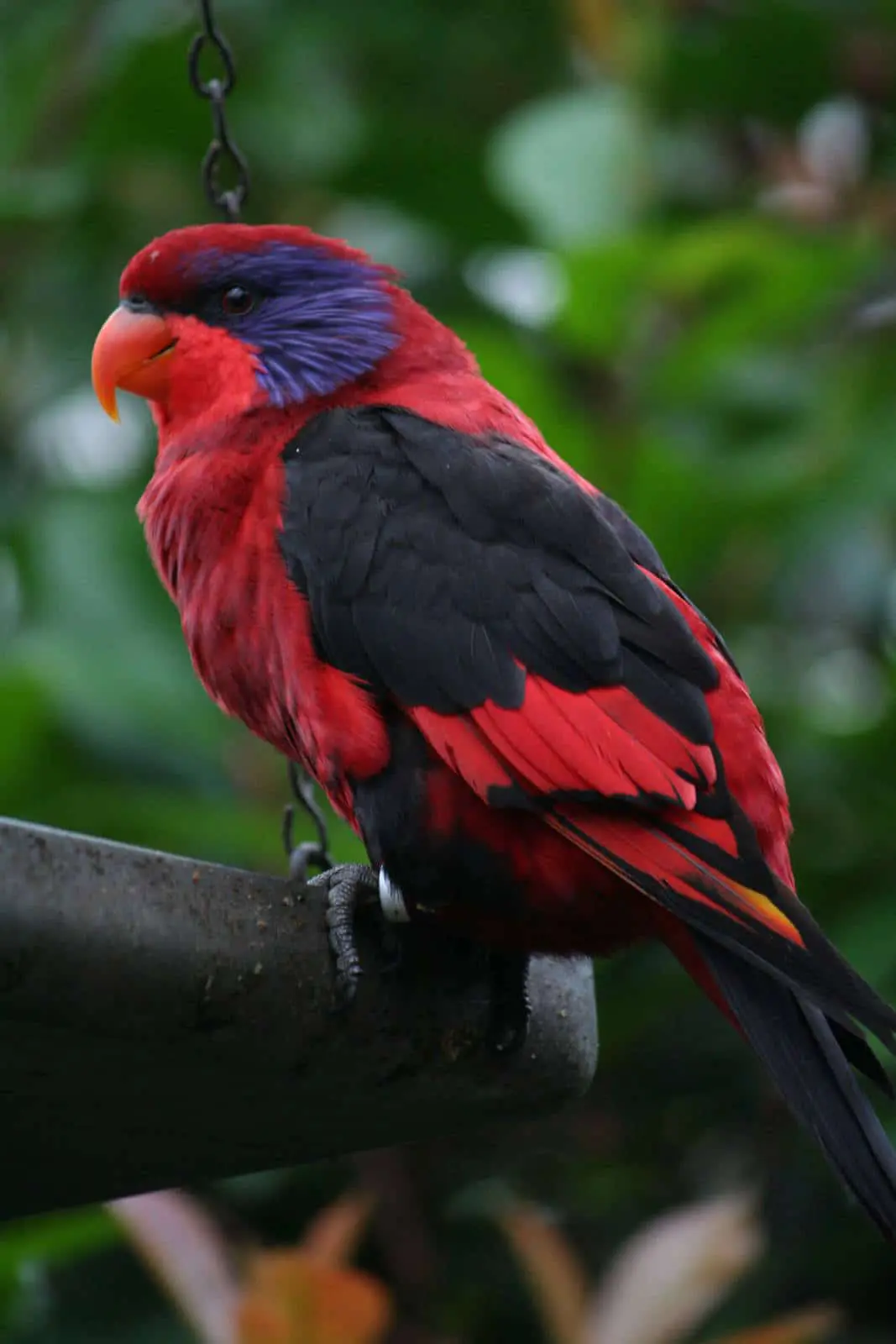
The Black-winged Lory (Eos cyanogenia) has a plumage predominantly red.

Adults have a blue patch surrounding the eyes, cover the tops of the ear and reaches the back of the neck.

Feathers covering the shoulder blade (scapular), small feathers that cover the outside (coverts) and bend of wing are black. The primary and high school they have a black bordered.

The the thighs and flanks they are sprinkled with black. The bottom of the wings shows a wide band Red. The feathers of the tail are black contrasted with red feathers.

The bill is red-orange. The irises they are red, legs grey.

The youth they are more muted than adults. They have blue-black ends in feathers of the head, neck and underparts. The the wing covers are black, with a green light opaque. The bill is of color brown orange, irises brown.

The Black-winged Lory It can be confused with almost all parrots of the genus Eos, but it is the only one of this category that has the covered wing in black color.

Habitat:

The Black-winged Lory they are quite common and widespread in coastal areas, coconut plantations, the forested areas in the process of regeneration, in some large trees scattered in bushes Moors and local gardens.

In some small islands such as Supiori, they are also present in large numbers in inland forests.

Residing in altitudes ranging from sea level to the 460 m.

They live in pairs or in small family groups. They are also often found in flocks of forty individuals or more.

Son noisy birds and easily observable. At the local level are very popular. In the reflection of both, the natives capture them frequently as pet birds.

The Black-winged Lory they have a fly quick and direct. Often you can hear the hum of their wings when they fly over the villages. They are even more recognizable when they often fly low, well below the tops of the trees.

Reproduction:

Little is known of their reproductive ecology., but it was observed the presence of a possible nesting site in a hole in a tall tree in the forest by a couple during the observations in 1982.

The incubation in harsh captivity around 26 days, and as in all loris, the nesting cycle is particularly long and hard between 75 and 89 days.

Food:

They have a regime that differs little from other parrots of the genus Eos. Feed in the trees in flower of nectar of Brugierto and pollen. Your menu will probably be complemented by fruit, berries of the mistletoe and sometimes insects.

Distribution:

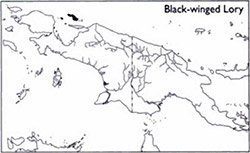
Distribution Lori Alinegro


Being endemic to the islands of the Cenderawasih Bay in the part Indonesia of New Guinea.

They live on most islands (Numfor, Biak, Manim, Pulau Num) but are absent from Yapen, the main island, where are replaced by the Dusky lory (Pseudeos fuscata).


Conservation:


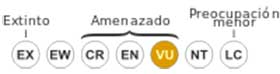
Vulnerable

– Current IUCN Red List category: Vulnerable

– The population trend: Decreasing

The population is estimated at 2,500 to 9,999 mature individuals.

Logging and subsistence agriculture have driven the loss of forests within their range and the hunting pressure remains a threat. Consequently, the species is suspected to be declining at a moderate pace.

Relatively large numbers of birds have been trapped for the national and international trade.

Since December of 1989, the import of the Black-winged Lory It is strictly prohibited in the European Community.

Conservation Actions Proposed:

– Conduct surveys on all the Geelvink Islands to clarify its distribution and current population status.
– Investigation of their ecology and movements to facilitate conservation planning.
– Investigate the species trade and design and implement appropriate controls.
– Estimating the rate of loss of forests within its range.
– Check the register in Supiori and establish a captive breeding program to support future reintroduction and supplementation efforts.

"Black-winged Lory" in captivity:

This species is observed commonly as a pet in Biak (island located in the bahía Paradise, off the north coast of Papua).

Due to its status in danger of extinction, any specimen that can not be returned to their natural habitat (natural range) should preferably be placed in a well-managed breeding program to ensure the survival of the species.

Alternative names:

Black winged Lory, Biak Red Lory, Black-winged Lory (ingles).
Lori à joues bleues (French).
Schwarzschulterlori (German).
Lóris-asa-negra (Portuguese).
Lori Alinegro, Lori de Alas Negras (español).

scientific classification:

Order: Psittaciformes
Family: Psittaculidae
Scientific name: Eos cyanogenia
Citation: Bonaparte, 1850
Protonimo: Eos cyanogenia

«Lori Alinegro» images:

Videos "Black-winged Lory"

————————————————————————————————-

«Lori Alinegro» (Eos cyanogenia)


Sources:
Avibase, Oiseaux.NET, BirdLife.org
– Photos: galleryhip.com, Sheri Hanna
– Sounds: Hans Matheve (Xeno-canto)

▷ The world of Pets: Dogs, cats, birds, reptiles, amphibians

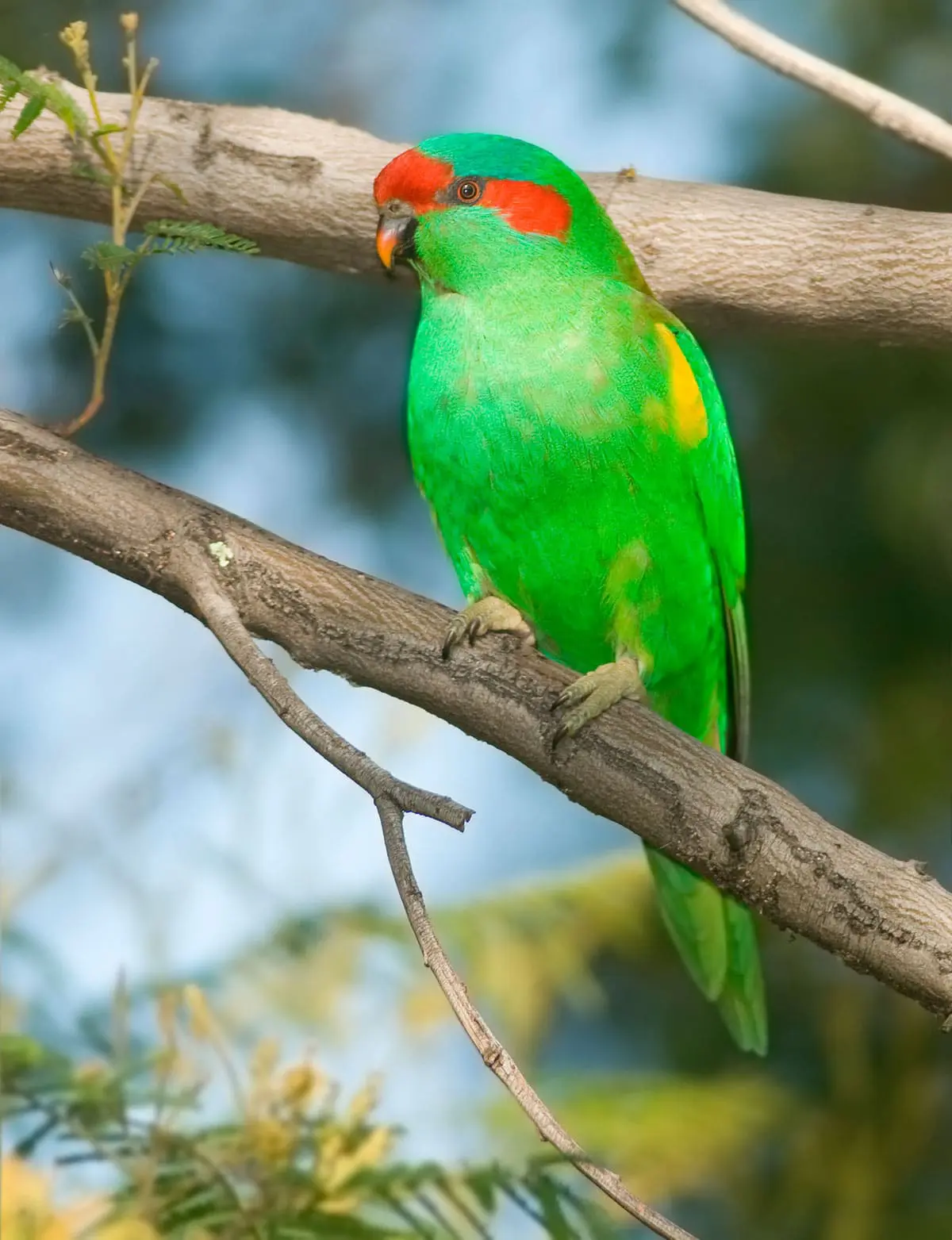
Musk Lorikeet
Glossopsitta concinna

Musk Lorikeet

Content

Description

20 to 23 cm.. length and a weight between 52 and 56 g..

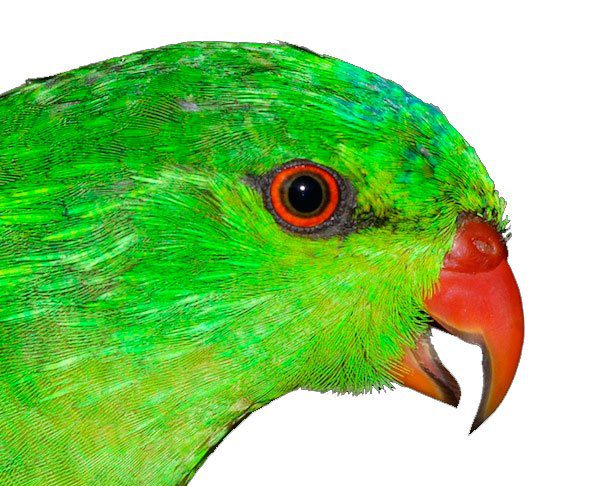
The general plumage of the Musk Lorikeet (Glossopsitta concinna) is green.

The part forward of the crown, lores and coverts headphones are of color Scarlet. Top of the head and cheeks, of color green impregnated of Turquoise under eye. The underparts of color green with a washed Brown olive around the sides of the chest. Green bright it rump. Wing coverts green, flight feather of color gray to black and a band of color yellow in the area of the shoulders. The feathers of the tail with brands reddish orange.
Part back from the neck yellowish green. Beside the edges of the wings colour yellow. Bill black-tipped Red. The irises Orange and the legs greenish Brown.

The blue area in the crown of the female It is smaller and paler which in the male.

The name of the species derives from a musky odor that is said to emit these birds.

Subspecies description:

  • Glossopsitta concinna concinna

    (Shaw, 1791) – Nominal.


  • Glossopsitta concinna didimus

    (Mathews, 1915) – Less blue in the crown, nearly absent in the female.

Habitat:

Seasonally nomadic Depending on the flowering of the eucalyptus, at least at the ends of their range.
Found in many habitats of open forest, agricultural and suburban areas, including forests of eucalyptus, dry forests, dense rainforest (particularly in Tasmania) and riparian forests.

It avoids the high open woods and high altitude. Often found in large flocks of more than one hundred of individuals, where couples who form strong bonds, they often live together. It is extremely trusting when feeds.

Flocks have been seen, frequently, flying at high altitude.

Reproduction:

Season of mating from August to January. The nests they are built in holes of eucalyptus. The two eggs are incubated for about 25 days and the young leave the nest between 6 and 7 weeks after hatching.

Food:

like most others Lori, the diet consists in nectar and pollen, as well as small fruits and some insects. They can RAID orchards, vineyards and crops, forming herds with the Swift Parrot (Lathamus discolor) and other gender lori Glossopsitta.

Distribution:

Size of the area of distribution (reproduction / resident): 664.000 km2

The Musk Lorikeet are located in the East of New South Wales, Victoria, South of Australia and Tasmania.

Subspecies distribution:

  • Glossopsitta concinna concinna

    (Shaw, 1791) – Nominal.


  • Glossopsitta concinna didimus

    (Mathews, 1915) – Tasmania, sometimes King Island. Small population wild in Perth.

Conservation:


minor concern

• Current IUCN Red List category: Least concern

• Population trend: Stable


The world population It has not been quantified, but the species is reported be very common (pit et to the. 1997).

The population suspected to be stable in the absence of evidence of any reduction or substantial threats.


"Musk Lorikeet" in captivity:

Rare out of Australia, small number in the aviaries of United States and United Kingdom.

A delight, playful, more quiet that the Iris Lorikeet; they can imitate sounds; a bit messy due to a diet of nectar.

Alternative names:

Musk Lorikeet (ingles).
Lori à bandeau rouge, Loriquet musqué (French).
Moschuslori (German).
Loris Musk (Portuguese).
Lori Almizclero (español).

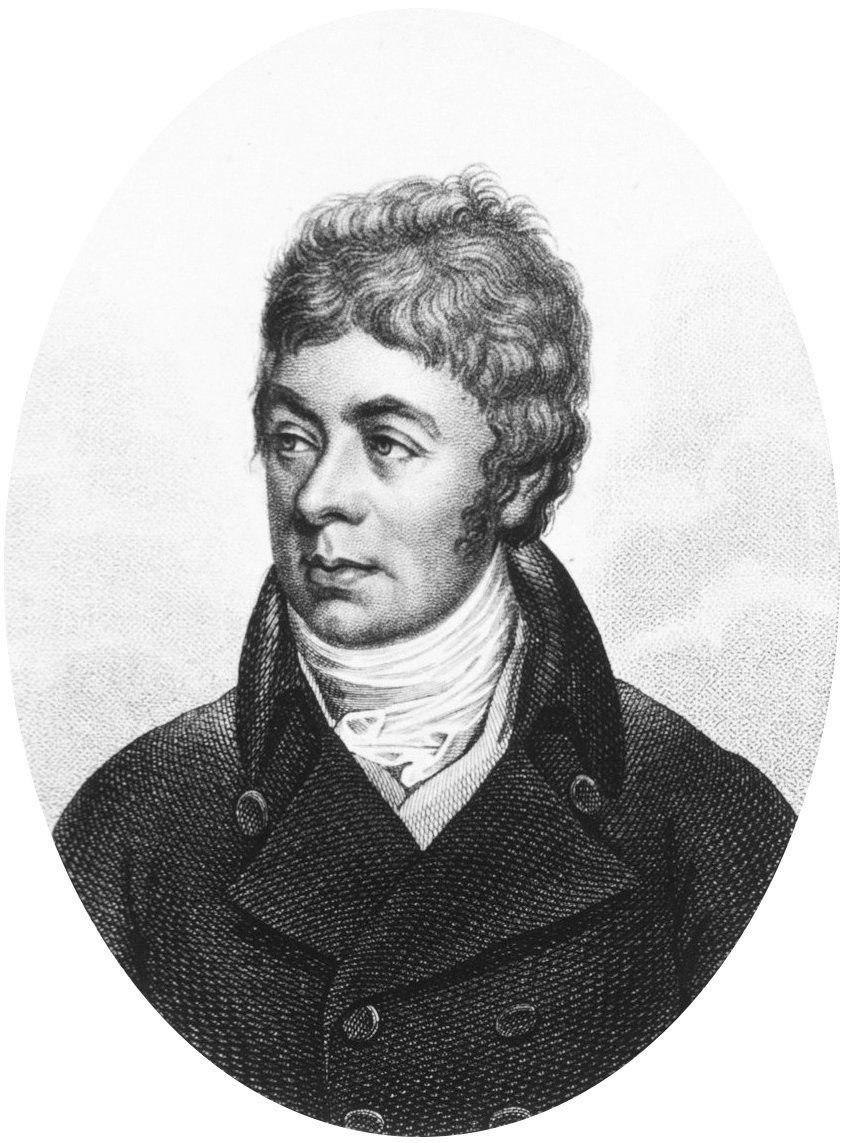
George Shaw
George Shaw

scientific classification:


Order: Psittaciformes
Family: Psittaculidae
Genus: Glossopsitta
Scientific name: Glossopsitta concinna
Citation: (Shaw, 1791)
Protonimo: Annual parrot


Images «Lori AlmizClero»:

Videos "Musk Lorikeet"


«Lori Reader» (Glossopsitta concinna)


Sources:

Avibase
Parrots of the World – Forshaw Joseph M
Parrots A Guide to the Parrots of the World – Tony Juniper & Mike Parr
BirdLife.org

Photos:

1 – By JJ Harrison (jjharrison89@facebook.com) (Own work) [GFDL 1.2 or CC-BY-SA-3.0], via Wikimedia Commons
2 – By Steve (originally posted to Flickr as Musk Lorikeet.) [CC-BY-SA-2.0], via Wikimedia Commons
3 – free-pet-wallpapers.com
4 – «Musk Lorikeet 2" Of JJ Harrison (jjharrison89@facebook.com) – It operates propria. With license CC BY-SA 3.0 Transact Wikimedia Commons.
5 – Image: Steven Kuiter – biodiversitysnapshots.NET.au

Sounds: Marc Anderson (Xeno-canto)

▷ The world of Pets: Dogs, cats, birds, reptiles, amphibians

Meek's Lorikeet
Charmosyna meeki

Content

Description

Of 16 cm.. length and a weight between 23 and 32 g..

Meek's Lorikeet

The head of the Meek's Lorikeet (Charmosyna meeki) is bright green, more yellowish in the Chin and throat, darker on crown and streaked on ear coats; patch of dark green blue above and in front of the eye. Green upper parts with fused olive through the mantle.

The wings of green at the top. Under the yellowish-green wing coverts. The yellowish green underparts, lighter in the back and more yellow from the chest to the belly. Top of tail dark green with yellow tip; the yellow bottom. Orange peak; pale red irises; legs Orange.

Both sexes are equal. Immature with the paler beak with base brown color and shorter tail.

Habitat:

Nomad. It is distributed in the humid hills and montane forests, but they have also found found in lowland coconut palms. Usually found alone or in small flocks of about of 10 to 15 birds flying through or above the forest cover. Larger groups can gather in the blooming of trees to feed on pollen and nectar. It can be associated with other parrots as the Duchess Lorikeet, Finsch's Pygmy-Parrot, Yellow-bibbed Lory and Coconut Lorikeet

Reproduction:

Information is not available.

Food:

Its diet includes pollen and nectar.

Distribution:

Endemic to the mountains of the largest islands in the Group of Solomons: Bougainville, New Georgia, Malaita, Kolombangara, Guadalcanal and in the past Santa Isabel. Moves starting from the 300 m, until the 1.700 m, but reportedly rarely in the lowlands or above 1.200 m. The world's population is believed to be below 50,000 exemplary but probably stable.

Conservation:


Near-threatened

• Current IUCN Red List category: Near threatened
• Population trend: Decreasing

The size of the world's population has not been quantified, It is believed that it is below 50,000 specimens, but the species is described as abundant at the Summit of Kolombangara.

There is still no evidence of a decline in its population, but would be threatened by any future large-scale export trade

"Meek's Lorikeet" in captivity:

They are not known to be in captivity.

Alternative names:

Meek’s Lorikeet (ingles).
Lori de Meek (French).
Salomonenlori (German).
Lori de Meek (español).

scientific classification:

Order: Psittaciformes
Family: Psittaculidae
Scientific name: Charmosyna meeki
Citation: (Rothschild & Hartert, 1901)
Protonimo: Hypocharmosyna meeki

Lori Meek images:

————————————————————————————————

"Lori de Meek" (Charmosyna meeki)


Sources:

Avibase
– Parrots of the World – Forshaw Joseph M
– Parrots A Guide to the Parrots of the World – Tony Juniper & Mike Parr
– Birdlife

Sounds: Mark Todd (Xeno-canto)

▷ The world of Pets: Dogs, cats, birds, reptiles, amphibians

Wallace's hanging parrot
Loriculus flosculus

Wallace's hanging parrot

Content

Description

11 to 12 cm.. length.

The head of the Wallace's hanging parrot (Loriculus flosculus) is green. Upperparts green with faint orange on the back of the neck; rump and uppertail-coverts red.

Wings green above. Chin red; rest of the underparts green, lighter in undertail-coverts. The tail, at the top, green color with a lighter Green Tip; ends of the lateral feathers, orange-red: Under, the tail bluish green. The bill red; Orange the irises; legs yellowish-orange.

Female with red chin reduced or nonexistent.

Immature with the red chin smaller. The color of the bill and legs more off.

Habitat:

Seem to need the humid mountain forests semi-evergreen. Birds have been seen in fruit trees, and outside the breeding season they gather in small flocks of up to 20 birds. Its altitudinal distribution seems to be closely linked to the distribution of fruiting figs.

They easily unnoticed due to its small size and green plumage, and they are most often in flight when they can be identified by the size, strident calls and the buzz of the rapid flapping. They are most frequently, flying above the canopy.

Reproduction:

There are no data from the reproductive process in nature.

Food:

Most sightings in 1993, the Wallace's hanging parrot they were in the fig tree in fruit trees, and dependence or specialization in this food resource is more than likely.
Its diet includes, In addition, nectar, outbreaks, flowers and seeds.

Distribution:

Size of its range (reproduction / resident): 13.400 km2

Endemic to Flowers. Found at semi-annual primary forest at an altitude between 400 and 980 m (more between 850 and 980 meters during the fructification of the Ficus figs) during observations on 1993. These birds were recorded in the area of Tanjung Kerita Mese, about Paku, to the East of Flowers and proposed as protected area.

Conservation:


Endangered


• Current IUCN Red List category: Danger

• Population trend: Decreasing

The habitat destruction through the combined effects of collecting firewood, the logging, timber extraction for construction materials and authorization for Agriculture, together they represent more relevant threats. Loss and fragmentation of forests is already widespread in Flowers, where there are semi-annual forest below 1.000 meters included within officially protected areas. These threats are exacerbated by the expansion of human population, with large volumes of wood necessary for housing construction, and the fact that there is little or no government enforcement of laws. Wet deciduous forest, it is currently being extensively destroyed through land grabbing and the establishment of agricultural areas., a factor that is inevitably shrinking the reach and the population of this species. Forest clearing continues on the coastal strip to make way for crops, and illegal logging continues in protected areas.

The population is estimated at a number of 2,500-9,999 mature individuals based on an assessment of the known records, descriptions of the abundance and range size.

Two recent studies have focused on endemic birds of Flowers. Two sites in which inhabits this species for the establishment as protected areas are proposed: Tanjung Kerita Mese and Egon Iliwuli (in Gunung Egon).

"Wallace's hanging parrot" in captivity:

Very rare in captivity.

Alternative names:

Wallace’s Hanging-Parrot, Flores Hanging-Parrot, Wallace’s Hanging Parrot (ingles).
Coryllis de Wallace (French).
Florespapageichen, Flores Papageichen (German).
Lorículo do Flores (Portuguese).
Lorículo de Flores (español).

scientific classification:

Order: Psittaciformes
Family: Psittaculidae
Genus: Loriculus
Scientific name: Loriculus flosculus
Citation: Wallace, 1864
Protonimo: Loriculus flosculus

Images:

————————————————————————————————

Wallace's hanging parrot (Loriculus flosculus)


Sources:

Avibase
– Parrots of the World – Forshaw Joseph M
– Parrots A Guide to the Parrots of the World – Tony Juniper & Mike Parr
– Birdlife

Photos:

(1) – by © Hanom Bashari – Oriental Bird Club

Sounds: Allen T. Chartier (Xeno-canto)

▷ The world of Pets: Dogs, cats, birds, reptiles, amphibians

Meek's Pygmy-Parrot
Micropsitta meeki

Meek's Pygmy-Parrot

Content


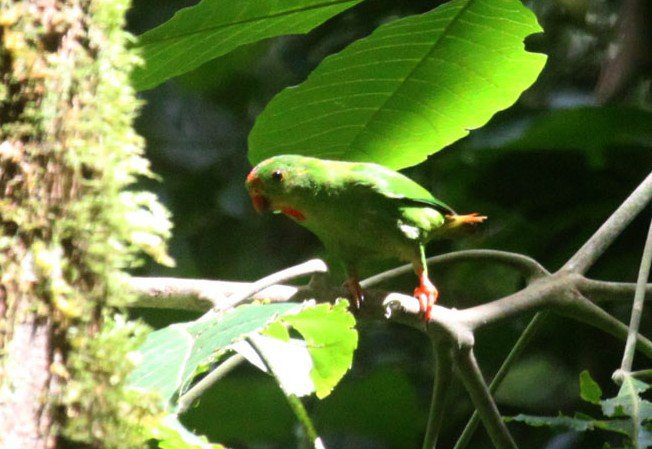
Anatomy-parrots

Description

10 cm. length.

The Meek's Pygmy-Parrot (Micropsitta meeki) has the feathers of the head dark brown, strongly scalloped in color yellow on them ear-coverts and the sides of the throat, and usually with the eyebrows in a vague color yellow; feathers of the crown with fine greyish yellow tips.

Upperparts dark green, darker on the margins and the Center to the Middle coverts black. Feathers primary Black with green trim; secondaries mainly green. Wing feathers more dark with the tips of color yellow; underside of flight feather blackish. Top of the chest and centre of belly, opaque yellow, with brown spots at the tips of the feathers; flanks color green dark; under the tail, coverts yellow. Tail greenish blue in the Center, feathers laterales blackish with stains yellow on the tips or with pointed blue and yellow.

Bill yellow rose pale; irises yellowish brown; legs Pink.

Similar to males females.

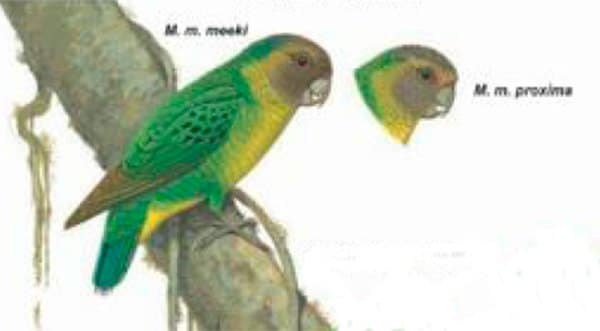
Subspecies

  • Micropsitta meeki meeki

    (Rothschild and Hartert, 1914) – The nominal.


  • Micropsitta meeki proxima

    (Rothschild and Hartert, 1924) – The face is more pale and the grey more beige that the of the nominal species; light diffusion of greenish color instead of the yellow markings of the nominal, and a band front yellow with find in them eyebrows.

Habitat:

Microloro-of-Meek-(2)

Not well known. It occurs in forests, high secondary growth, and even in trees around inhabited areas. The birds are found in small groups. Habits are like those of the Buff-faced Pygmy-Parrot.

Reproduction:

The nest they usually build it on a tree termite mound, Sometimes it can be very close to the ground.

Food:

They feed on lichens and fungi collected from trunks of trees.
They nourish also of seeds, nuts, berries and fallen fruits that they can find, Although they prefer to eat fruits of plants. They also feed on insects and insect larvae.

Distribution:

Size of the area of distribution (reproduction / resident): 2,400 km2

Endemic to the forests of the lowlands, until 700 meters of altitude on the Islands in the Northwest Bismarck Archipelago including Manus, Lou and Rambutyo in the Group of Admiralty and Mussau and Emira in the Saint Matthias group.

Of the two subspecies:

Conservation:


minor concern


• Current IUCN Red List category: Least concern

• Population trend: Stable

The size of the world population It has not been quantified, It is thought that it may be above the 10,000 specimens. According to sources, the species is common both in Manus as Lou (pit et to the. 1997).

The population is suspected to be stable in the absence of evidence of any reduction or substantial threats.

"Meek's Pygmy-Parrot" in captivity:

Not found in captivity.

While attempts have been made to keep Pygmy parrots in captivity, These have not been successful. This may be due to the fact that birds suffer from stress or a lack of understanding of their dietary needs.

Alternative names:

Meek’s Pygmy-Parrot, Citrine Pygmy Parrot, Meek’s Pygmy Parrot, Yellow-breasted Pygmy Parrot, Yellow-breasted Pygmy-parrot (ingles).
Micropsitte de Meek (French).
Meekspechtpapagei, Meek-Papagei (German).
Micropsitta meeki (Portuguese).
Microloro de Meek (español).

scientific classification:

Order: Psittaciformes
Family: Psittaculidae
Genus: Meeki
Scientific name: Micropsitta meeki
Citation: Rothschild & Hartert, 1914
Protonimo: Micropsitta meeki

Images "Meek's Pygmy-Parrot"

————————————————————————————————

«Microloro de Meek» (Micropsitta meeki)


Sources:

Avibase
– Parrots of the World – Forshaw Joseph M
– Parrots A Guide to the Parrots of the World – Tony Juniper & Mike Parr
– Birdlife

Photos:

(1) – Parrots of the World – Forshaw Joseph M
(2) – Meek’s Pygmy-Parrot on Manus – BIRDING AROUND THE WORLD

Sounds: Frank Lambert (Xeno-canto)

▷ The world of Pets: Dogs, cats, birds, reptiles, amphibians

Golden-mantled Racquet-tail
Prioniturus platurus


Golden-mantled Racquet-tail

Content

Golden-mantled Racquet-tail

Description

28 cm.. length and a weight between 200 and 225 g..

The head of the Golden-mantled Racquet-tail (Prioniturus platurus) is light green. The crown Violet gray with a red spot on the front edge; rear of the neck Ocre-Naranja. Mantle light grey, changing to green (marked in grey) on the back; rump and uppertail-coverts green. Wing coverts green, strongly impregnated with pale grey (more green in the coverts more internal); primaries Greens with vane Dark internal; secondary internal green with yellow line in the margins; bend of wing grey violet, carpal edge yellow. Wing feathers green; underside of flight feather marked in blue. Underparts brighter yellowish green, more green in the upper part of the chest, and yellow in the undertail-coverts. Upper, the tail green in the center, dotted in bluish black on the sides; undertail, the tail pale blue; spatulas blackish.

Bill pale grey, with the lower jaw and the tip of the bill darker; irises dark brown; legs grey.

The female lacks the color red and blue marks from the crown and of the collar back orange; underparts washed in less differentiated grey; rackets shorter tail.

Immature without rackets the tail.

Subspecies:

  • Prioniturus platurus platurus

    – The nominal.


  • Prioniturus platurus talautensis

    – (Hartert, E, 1898) Paler in general males; less grey on the mantle and the upper wing coverts; stain clear reddish pink on the back of the Crown with most blue patch.
    The female as the nominal species but green with paler
    Juveniles as the nominal species but also with the Green pale


  • Prioniturus platurus sinerubris

    – (Forshaw, 1971) Males with reddish pink spot away from the back of the Crown; mantle and upper wing coverts, green, slightly washed with grey; curve of wing and lesser coverts bathed in purple; smaller.

Habitat:

The Golden-mantled Racquet-tail inhabits the edges of humid forests, forests, orchards and forests of the lowlands Moss, to 2.000 m (most common above 1.000 m). The birds are seen generally in small noisy groups of 5-10 Member, flying over the forest, or during daily movements between the feeding and rest areas.

Reproduction:

A female in breeding condition was observed in October and the nest was in a hollow tree; nothing more is known about the reproductive behavior of the species.

Food:

Have been seen feeding on fruiting mango (Mangifera indica), and the diet includes fruits, seeds and flowers.

Distribution:

Size of the distribution (reproduction / resident): 186.000 km2

Restricted to Sulawesi and nearby islands, including Talaud, Siau, Lembeh, Togian, Group Banggai, Ambon, Muna and Button. Usually, the species is common and the world population is considered to be above 10.000 exemplary and stable: Nominal race numbers are calculated to be above the 10.000 birds and stable, the subspecies talautensis It is less numerous with a population of about of 5.000 specimens, and the sinerubris It is thought that it may be around 10.000 exemplary and probably stable.

Subspecies distribution:

  • Prioniturus platurus platurus

    – The nominal.


  • Prioniturus platurus talautensis

    – (Hartert, E, 1898) Is distributed in the Talaud Islands.


  • Prioniturus platurus sinerubris

    – (Forshaw, 1971) Is distributed in Taliabu and Mangole in the Sula Islands

One of the places where you can see this bird is the Gunung Ambang nature reserve in Sulawesi.

Conservation:


minor concern


• Current category of the Red List of the UICN: Least concern

• Population trend: Stable


The size of the world population It has not been quantified, Although it is estimated that it may be between 10,000 and 20,000 specimens. The species is described as common (pit et to the. 1997).

The population is suspected to be stable in the absence of evidence of any reduction or substantial threats.


"Golden-mantled Racquet-tail" in captivity:

Susceptible to fungal infections.
Rare in captivity.

Alternative names:

Golden-mantled Racquet-tail, Gold-backed Racquet-tail, Gold-backed Racquet-tailed Parrot, Golden Mantled Racket-tailed Parrot, Golden mantled Racquet tail, Golden-mantled Racket-tail, Golden-mantled Racket-tailed Parrot, Golden-mantled Racquet-tail Parrot, Golden-mantled Racquet-tailed Parrot, Gold-mantled Racket-tail, Gold-mantled Racket-tailed Parrot, Gold-mantled Racquet-tailed Parrot (ingles).
Palette à manteau d’or, Perroquet à raquette à manteau d’or (French).
Goldmantelpapagei (German).
Prioniturus platurus (Portuguese).
Lorito Momoto Dorado, Lorito momoto Dorsidorado, Lorito-momoto Dorsidorado (español).

scientific classification:

Order: Psittaciformes
Family: Psittaculidae
Genus: Prioniturus
Scientific name: Prioniturus platurus
Citation: (Vieillot, 1818)
Protonimo: parrot platurus

Images "Golden-mantled Racquet-tail"

Videos "Golden-mantled Racquet-tail"

————————————————————————————————

«Lorito momoto dorsidorado» (Prioniturus platurus)

Sources:

Avibase
– Parrots of the World – Forshaw Joseph M
– Parrots A Guide to the Parrots of the World – Tony Juniper & Mike Parr
Wikipedia
– Birdlife

Photos:

(1) – Prioniturus platurus golden mantled racquet tail – Parrot-birds
(2) – «Prioniturus platurus» by John Gould – Gould, John, 1804-1881; Sharpe, Richard Bowdler, 1847-1909: Birds of Asia., Volume 6, London, [2]. Licensed under Public Domain via Wikimedia Commons.

Sounds: Frank Lambert (Xeno-canto)