▷ The world of Pets: Dogs, cats, birds, reptiles, amphibians

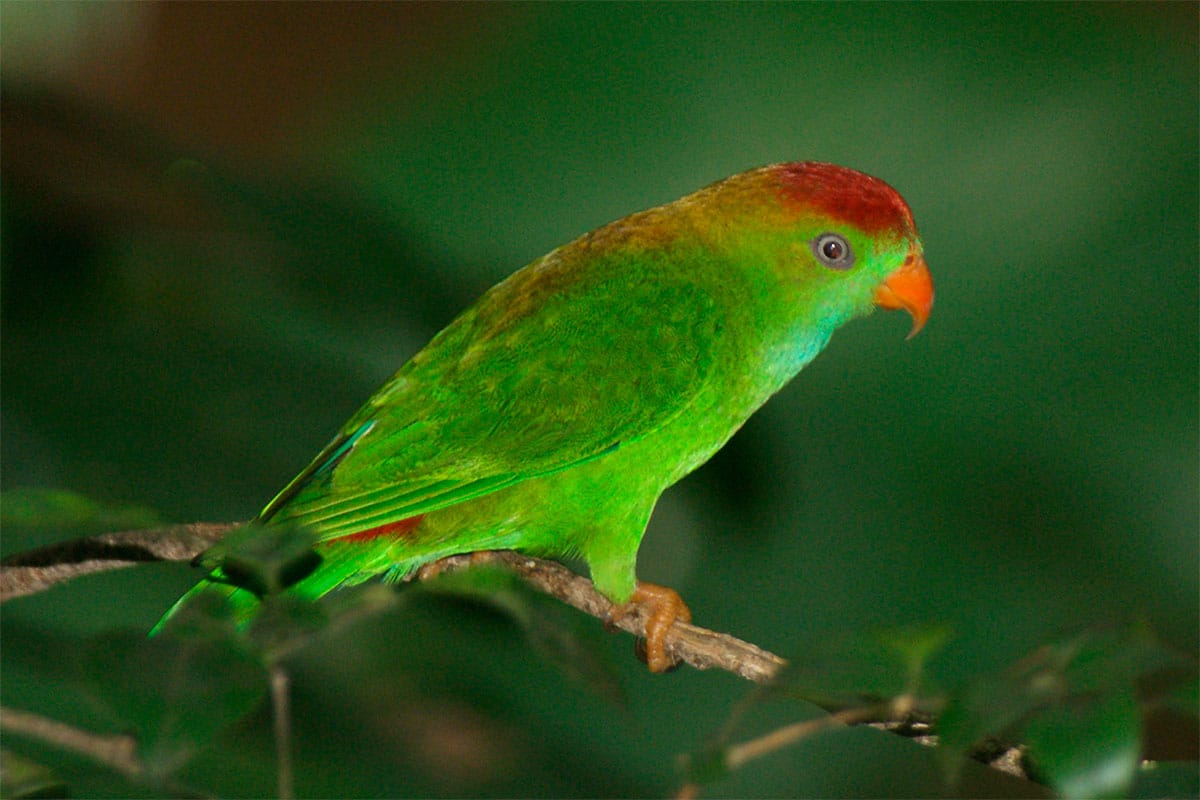
Ceylon Hanging-Parrot
Loriculus beryllinus


Ceylon hanging

Content

Description

13 cm.. length.

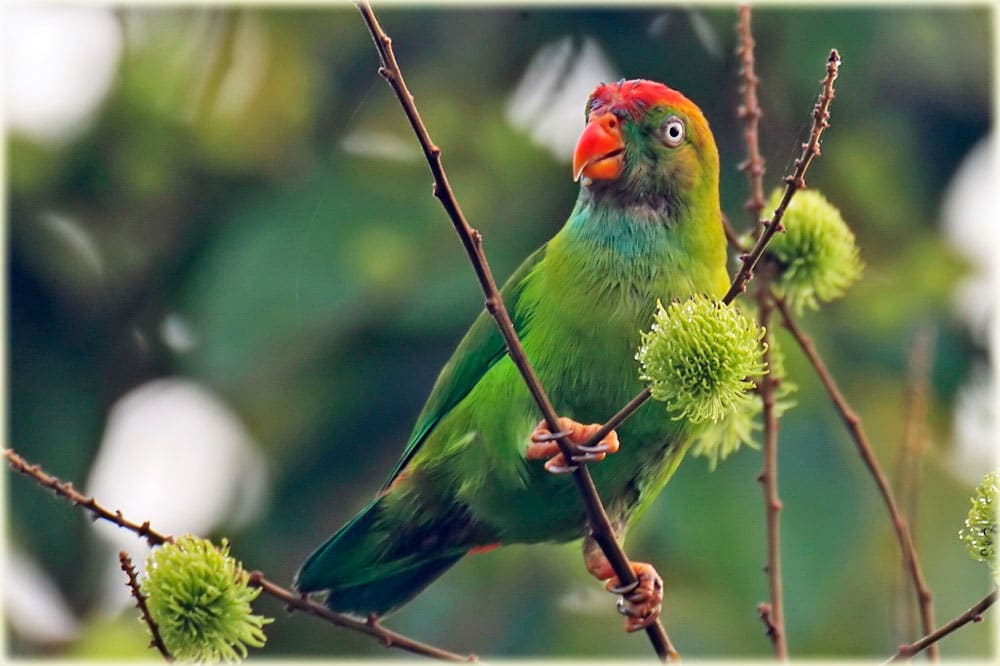
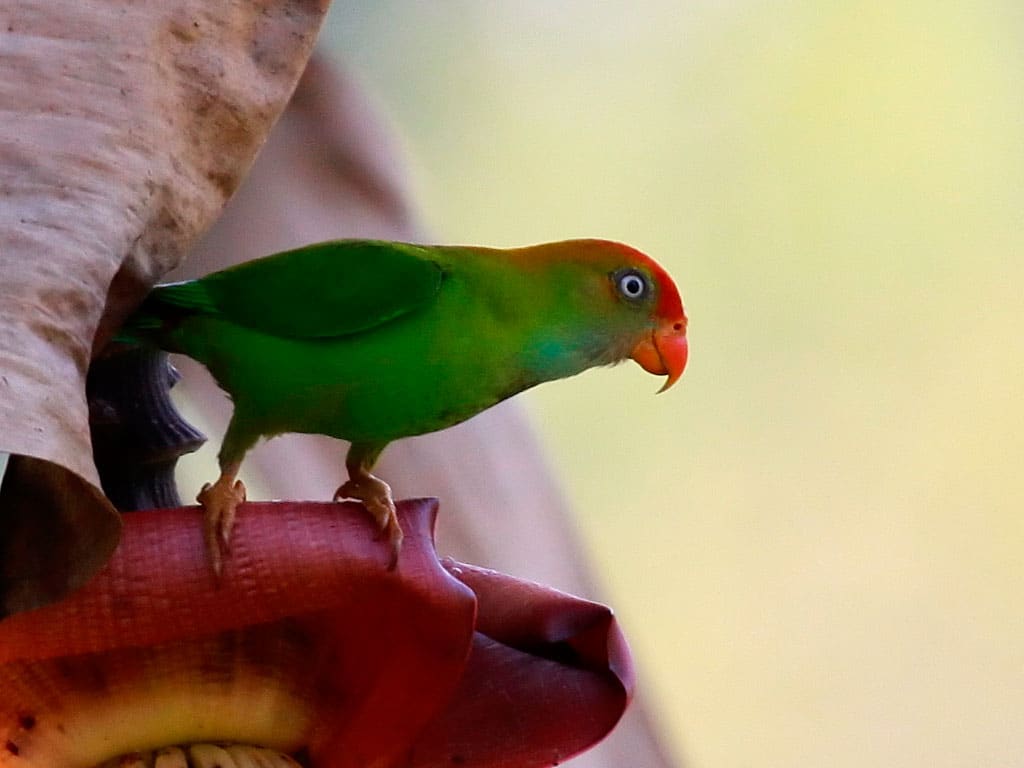
The Ceylon Hanging-Parrot (Loriculus beryllinus) has the crown red, merging into orange-yellow in the area of the nape; eyebrows, lores and the area in front of the eyes light green (lightly bathed in pale blue); sides of the front of the crown red. Mantle green, Bañado de slightly reddish and yellowish orange color in the Center; back green; rump and uppertail-coverts, red. Wings green up, with the exception of vane inner of the blackish flight feathers ; undertail, the wings bright turquoise color with the exception of coats and axillary green. The underparts bright green, paler and more yellowish which the upperparts and light blue marking in the throat. above the tail green color; Turquoise below.

Bill orange red, paler at the tip; irises off-white; legs dark yellow.

Female as the male, but most off and only a trace of blue in the throat.

The young birds they are even duller, the crown reddish-tinged, the patch blue of the throat absent, the rump with some green feathers, the bill paler, the iris and the legs brown; the face nude in the fledglings.

Habitat:

Seen in a range of habitats, from sea level to 1.600 m, reaching the highest areas according to seasonal conditions. The species is found in forests of coconut trees, Evergreen and deciduous forests, semicultivadas areas, open woodland and around the dwellings.

birds are not shy, and is usually found in pairs or family groups, although outside the breeding season larger flocks congregate high up in flowering trees. They are active and acrobatic feeding.

Reproduction:

Observations, they have registered the male approaching his partner upright, with the high peak, swollen throat, extended tail and rump feathers erect, while emitting a screeching chirp. Wiggles head in courtship period have also been observed.

The breeding begins in January and although the main nesting period is between March and May, a second litter is, sometimes, until September. The nest is located in a hollow branch filled with fragments of vegetation that the female carefully cuts with her beak and carries to the nesting sites tucked between her rump feathers.. Only two to four white eggs she incubates, sitting firmly, screeching and creating a 'thumping' sound’ Yes is the annoying. The young Chick has the face exposed, presumably to avoid getting dirty by liquid food.

Food:

Feed on fruits such as Ficus figs and guava (Psidium guajava); berries; flowers, including Erythrina, Salmalia and eucalyptus; seeds, including Casuarina. Poisonings have been reported after drinking Palm wine collected pots attached to the trunks of the trees.

Distribution:

Endemic to Sri Lanka, where most records come from the South, Although there have been North of Trincomalee and should be observed in suitable habitats throughout the country. Records include proximities of Colombo, around Kandy, Yala and National parks Gal Oya, the district Welimada, and to the South of Galle and Hambantota, on the coast.

Conservation:
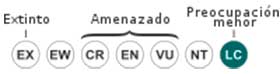

minor concern


• Current IUCN Red List category: Least concern

• Population trend: Stable

The size of the world's population has not been quantified, Although it is estimated at 10.000 specimens. The species is qualified as widespread and abundant in the South-West and almost absent in the North of its distribution area (pit et to the. 1997).

The population is suspected to be stable in the absence of evidence of any reduction or substantial threats, However, the bird trade is judged as a potential threat.

"Ceylon Hanging-Parrot" in captivity:

Rare.

Alternative names:

Ceylon Hanging-Parrot, Ceylon Hanging Parrot, Ceylon Lorikeet, Sri Lanka Hanging Parrot, Sri Lanka Hanging-Parrot, Sri Lankan Hanging Parrot (ingles).
Coryllis de Ceylan, Coryllis du Sri Lanka (French).
Ceylonpapageichen, Ceylon Papageichen (German).
Loriculus beryllinus (Portuguese).
Lorículo de Ceilán, Lorículode Ceilán (español).

scientific classification:

Order: Psittaciformes
Family: Psittaculidae
Scientific name: Loriculus beryllinus
Genus: Loriculus
Citation: (Forster,JR, 1781)
Protonimo: Psittacus beryllinus

«Ceylon loricle» images:

Video of the "Ceylon Hanging-Parrot"

————————————————————————————————

«Ceylon loricle» (Loriculus beryllinus)


Sources:

Avibase
– Parrots of the World – Forshaw Joseph M
– Parrots A Guide to the Parrots of the World – Tony Juniper & Mike Parr
– Birdlife

Photos:

(1) – «Loriculus beryllinus-Sri Lanka-adult-8» by Hafiz Issadeen – originally posted to Flickr as Sri Lanka Hanging Parrot. Licensed under CC BY 2.0 via Wikimedia Commons.
(2) – «Thimindu 2010 03 06 Sinharaja Sri Lanka Hangling Parrot 1» by ThiminduOwn work. Licensed under CC BY-SA 3.0 via Wikimedia Commons.
(3) – Perched in a tree by John A Thompson – lynx
(4) – Birds-pet-wallpapers/Parrot-birds – link
(5) – A fight by Guy Poisson – lynx

Sounds: Tero Linjama (Xeno-canto)

▷ The world of Pets: Dogs, cats, birds, reptiles, amphibians

Blue-collared Parrot
Geoffroyus simplex


Blue-collared Parrot

Content

Description

23-25 cm.. length and around 161 g. of weight.

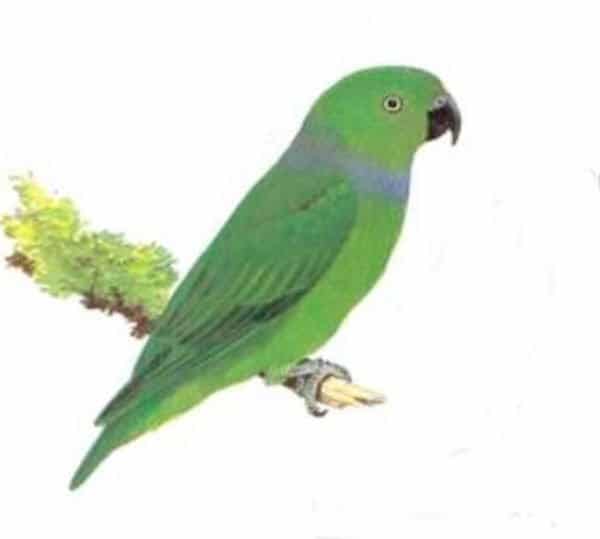
The Blue-collared Parrot (Geoffroyus simplex), they have the head green, more pale and more yellowish in the chin and lower cheeks, with a collar weak but clearly identified blue across the top of the chest and rear of the neck. The upperparts are blackish Green. Curve of the wings yellow; patch Brown in medium-sized inner cover; greater coverts with yellowish green trim; flight feather Black with green in the vane outer; pale line along the inner edge of the tips of the wings closed, formed by yellow tipping in the vane inmates of the flight feather. Underwing coverts and axillary, blue. Ventral pale, more yellowish green than the upper parts. Upper, the tail green; undertail, yellowish.

Bill greyish black; Iris White pale yellowish; legs gray-green.

The females they lack the collar Blue males but have a little blue on the back of the crown.

Subspecies

  • Geoffroyus simplex simplex (Meyer, AB, 1874): The nominal.
  • Geoffroyus simplex buergersi (Neumann, 1922): It measures each 25 cm in length and has purplish blue collar more extensive. Coverts of the wings with Violet Blue. Females have Violet Blue Underwing.

Habitat:

The species is distributed mainly between humid hills and medium-montane forests., along its edges and areas of secondary growth between 500 and 2.500 meters above sea level, being more frequent among the 800 and 1.900 m. Variations in food supply can lead to birds at elevations lower than normal (even at altitudes near sea level).

The Blue-collared Parrot they are shy and hard to spot when perched in trees. Large flocks of birds, of up 200 specimens, can be seen and heard flying above the treetops.

The species tends to form large groups with the Red-checked Parrot, Although sometimes single birds are, in pairs or in small groups.

Reproduction:

Little is known of the breeding ecology. A nest dug with three young was found in mid-January to nine metres in height, close to the top of a stump. The entrance was of 80 mm in diameter, and the gap between 200 mm and 400 mm deep. Nesting is also reported in October.

Food:

The Parrot Acollarado quietly feed in the canopy of seeds, fruit, berries and nectar. They are particularly fond of the seeds of (Castanopis and Oaks Lithocarpus).

Distribution:

New Guinea, Indonesian and Papua New Guinea, with an isolated population in the Doberai Peninsula, from Tamrau to Mountains Parotia. The main population is distributed through the central highlands, absent from the higher central areas, But coming to the Owen Stanley mountain range at the end of this. generally common, but the difficulty of detection makes these less abundant parecezcan birds.

Distribution of the subspecies:

  • Geoffroyus simplex simplex (Meyer, AB, 1874): The nominal.
  • Geoffroyus simplex buergersi (Neumann, 1922): Mountains of New Guinea, except Península Bird's Head.

Conservation:


minor concern


• Current IUCN Red List category: Least concern.

•Population trend: Stable.

The size of the world's population has not been quantified, Although estimated at more of 50.000 specimens. The species, according to sources, is generally rather rare to fairly common (pit et to the. 1997).

The population is suspected to be stable in the absence of evidence of any reduction or substantial threats.

"Blue-collared Parrot" in captivity:

Rare.

Alternative names:

Blue-collared Parrot, Blue collared Parrot, Lilac-Collared Parrot, Simple Parrot (ingles).
Perruche à col bleu, Eclectus à col bleu, Éclectus à col bleu (French).
Blauhalspapagei (German).
Geoffroyus simplex (Portuguese).
Lorito Acollarado, Lorito Acollorado, Lorito de Collar (español).

scientific classification:

Order: Psittaciformes
Family: Psittaculidae
Genus: Geoffroyus
Scientific name: Geoffroyus simplex
Citation: (Meyer,AB, 1874)
Protonimo: Pionias simplex

Images "Blue-collared Parrot"

————————————————————————————————

«Lorito acollado» (Geoffroyus simplex)


Sources:

Avibase
– Parrots of the World – Forshaw Joseph M
– Parrots A Guide to the Parrots of the World – Tony Juniper & Mike Parr
– Birdlife

Sounds: Phil Gregory (Xeno-canto)
▷ The world of Pets: Dogs, cats, birds, reptiles, amphibians

Blue-naped Parrot
Tanygnathus lucionensis


Blue-naped Parrot

Content


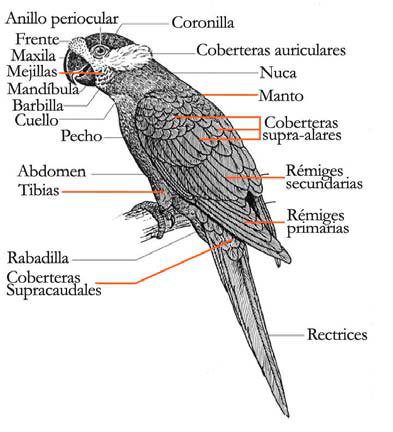
Anatomy-parrots

Description

31 cm.. length between 148 and 231 g. of weight.

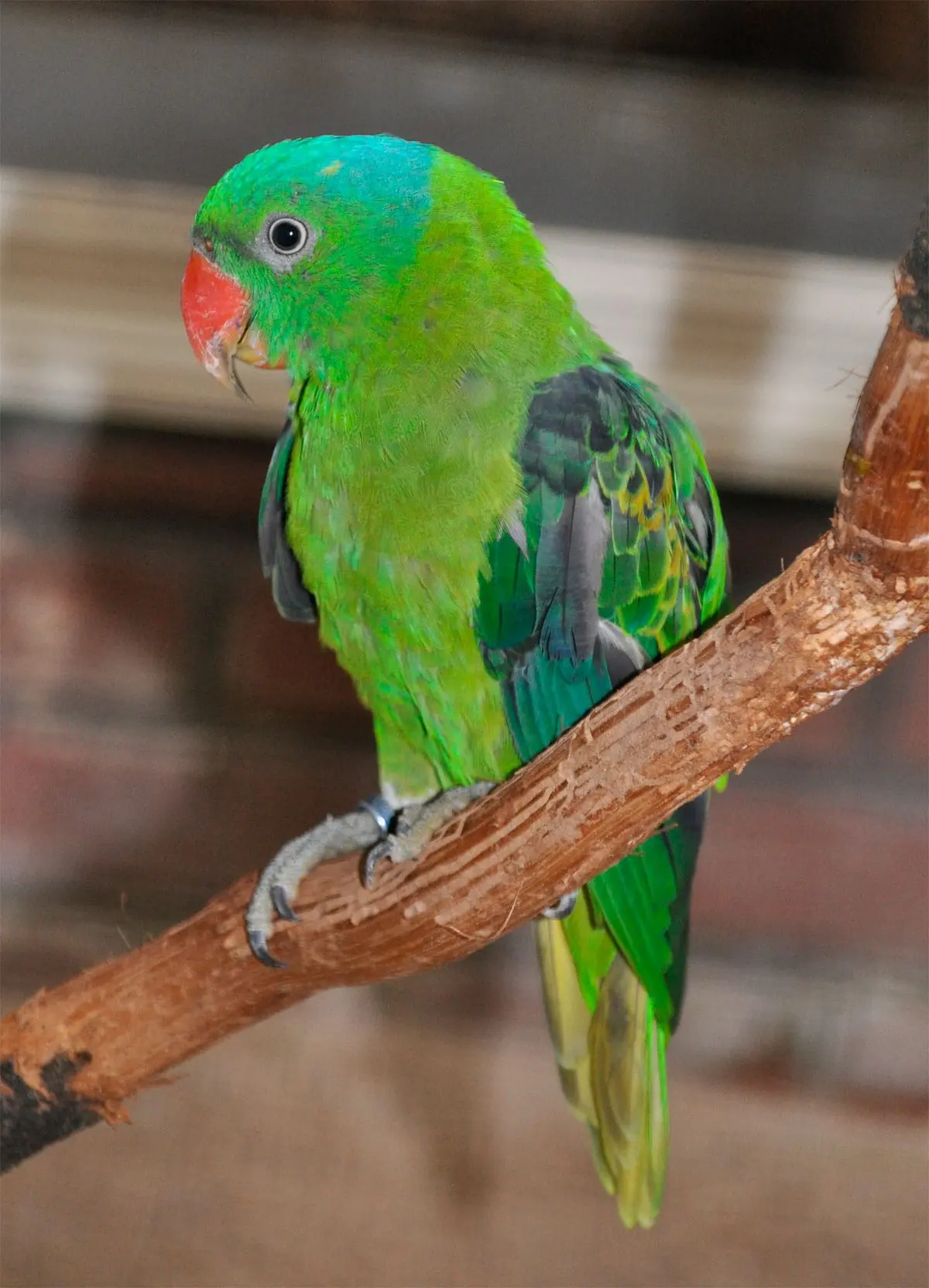
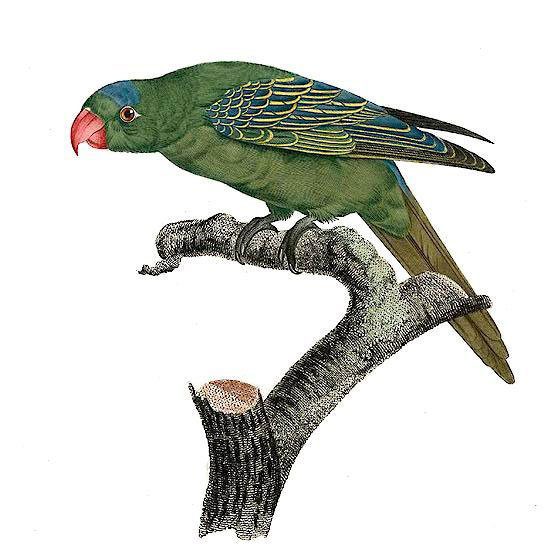
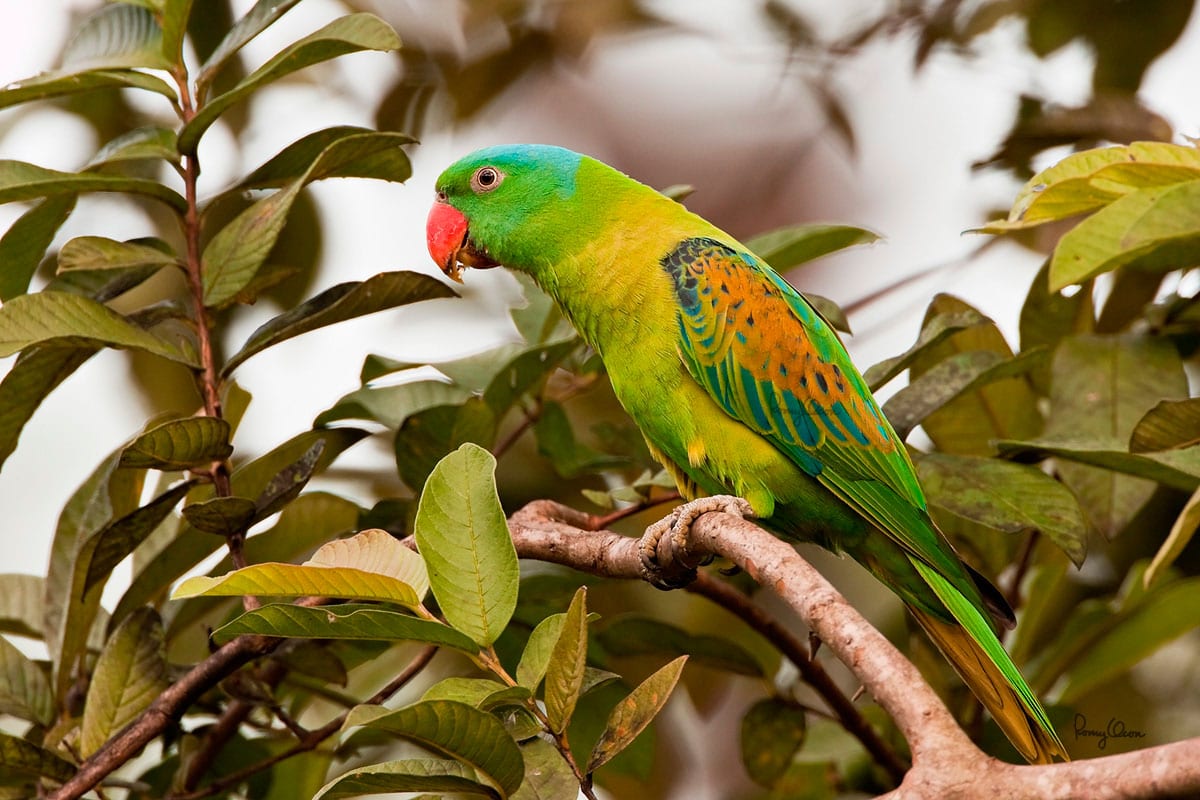
The Blue-naped Parrot (Tanygnathus lucionensis) has the head bright green with a clear bright blue diffusion through the back of the crown and nape.

Upperparts yellowish-green with pale blue illuminated on the back low and the tail; upper tail coverts brighter yellowish green.

Scapulars blue, with green edges; shoulder Black with small coverts Black bordered of blue-green and orange Green; median black and pale blue, large edges of opaque orange brown; greater coverts Blue-Green lined with orange-yellow in the feathers interiors.

Secondary Green with yellow and narrow margins; primaries Greens with vane blackish internal.

Wing feathers green, underside of primaries blackish.

Upper, the tail green, narrow edge and yellowish tip laterally; undertail, the tail yellowish brown opaque.

Bill red, paler at the tip and the lower jaw; irises yellow; legs grey.

Both sexes are equal.

Immature with less blue in the crown and more off the brands of the wings.

Subspecies:

  • Tanygnathus lucionensis lucionensis

    : The nominal.


  • Tanygnathus lucionensis hybridus

    : It has the most extended head blue, with violet tone. Their wings are greener.


  • Tanygnathus lucionensis talautensis

    : No blue in the obispillo and their plumage is less yellowish.


  • Tanygnathus lucionensis [salvadorii u horrisonus]:

Habitat:

Blue-naped Parrot

It is a bird of forests closed and open, including secondary growth, coconut plantations, patches of mangrove and banana to the 1.000 meters above sea level; and not so strongly linked to coastal habitats as the Great-billed Parrot. Is usually found in flocks of up to 12 individuals who sit in community and make regular flights at dawn and in the evening between the feeding and resting areas. Feeds on fruit trees.

Reproduction:

The breeding It has been observed in the months of April to June. Registered a nest the natural cavity or abandoned Woodpecker hole, often a clear. There is no data on the size of the laying.

Food:

Fruits and seeds of forest trees, Palm fruit, young coconuts, the banana and papaya.

Distribution:

The population of the Blue-naped Parrot distributes lengthwise of the Philippines and Talaud Islands, (Indonesian). Specific records found on the islands of Balut, Bantavan, Basilan, Biliran, Bohol, Bongao, Cagayan Islands, Calamian Islands, Caluya, Cebu, Cuimaras, Jolo, Leyte, Luzon, Maestre de Campo, Malanipa, Manuk Manka, Marinduque, Masbate, Mindanao, Mindoro, Blacks, Palawan, Surigao del Sur, Polillo Islands, Romblon, Samar, Sanga Sanga, Sarangani Islands, Samal, Sibay, Sibutu, Sibuyan, Siquijor, Tables, Tawitawi, Ticao, Tumindao and Verde (Philippines); Karakelong and Salibabu (Talaud).

Apparently, small groups of birds in Mantanani Kiss (Northwest Sabah), and SI-Amil (until 100 birds present in 1962) and Maratua off the northeast coast of Borneo; The existence of a wild population was also reported around Kota Kinabalu, (Sabah).

Occasional leaks occur in other parts, including the Sangir Islands.

The species was described as common in Salibabu in the Group of Talaud in 1978 (more numerous there than the Azure-rumped parrot) and they are still regularly seen there and in the nearby Karakelong during observations in 1995 (Numerous in a last record in 1997).

In other areas the species is rare. Recent records in Philippines they come mainly from Mindoro and Palawan, places that seem to be the bastion of the species.

Subspecies:

  • Tanygnathus lucionensis lucionensis

    : The nominal.

  • Tanygnathus lucionensis hybridus

    : (Salomonsen, 1952) – Present in Polillo island, to the North of Philippines.

  • Tanygnathus lucionensis talautensis

    : (AB Meyer & Wiglesworth, 1895) – Talaud Islands (North Moluccas).

  • Tanygnathus lucionensis [salvadorii u horrisonus]:

    (Ogilvie-Grant, 1896) – Philippines, (except North), but it can be rare or extinct on many islands. Also in some small islands off Northwest and northeast of Borneo (If Amil, Mantanani), where it was possibly introduced, especially on this last island.

Conservation:


Near-threatened


• Current category of the Red List of the UICN: Near threatened

• Population trend: Decreasing

The total population is provisionally estimated to be below the 10,000 specimens in 1993 (Lambert et to the. 1993).

The population is suspected to be in decline due to capture for the bird trade and habitat degradation from expansion and logging due to agricultural pressures..

Conservation Actions Proposed Palawan:

– Determine the impact of trade on the population of the species.
– Revise its estimate of the world population.
– Estimate the rates of decline based on the rates of deforestation within its range.
– Protect effectively important extensions of high forest with trees suitable to nest in key places throughout its distribution area, both in the areas of strict protection, such as multi-use areas.

"Blue-naped Parrot" in captivity:

pretty calm.
Occasionally available.

Alternative names:

Blue-naped Parrot, Blue naped Parrot (ingles).
Perruche de Luçon, Perroquet à couronne (French).
Blaunackenpapagei, Blaunacken-Papagei (German).
Papagaio-de-nuca-azul (Portuguese).
Loro de Nuca Azul, Loro Nuquiazul (español).

scientific classification:

Order: Psittaciformes
Family: Psittaculidae
Genus: Tanygnathus
Scientific name: Tanygnathus lucionensis
Citation: (Linnaeus, 1766)
Protonimo: Psittacus lucionensis

“Blue-naped Parrot” images:

Videos "Blue-naped Parrot"

————————————————————————————————

«Loro Nuquiazul» (Tanygnathus lucionensis)

Sources:

Avibase
– Parrots of the World – Forshaw Joseph M
– Parrots A Guide to the Parrots of the World – Tony Juniper & Mike Parr
Wikipedia
– Birdlife

Photos:

(1) – By Quartl (Own work) [CC BY-SA 3.0], via Wikimedia Commons
(2) – By Joelle Rene Hughes (originally posted to Flickr as jr_parrot10) [CC BY 2.0], via Wikimedia Commons
(3) – WILD BIRDS of the PHILIPPINES – Subic rainforest, Bataan, December 5, 2007 by Romy Ocon
(4) – By TJ Lin [CC BY-SA 2.0], via Wikimedia Commons
(5) – «Tanygnathus lucionensis qtl2» by QuartlOwn work. Licensed under CC BY-SA 3.0 via Wikimedia Commons.
(6) – « Tanygnathus lucionensis – Barraband ». Licensed public via domain Wikimedia Commons.

Sounds: Arend Wassink (Xeno-canto)
▷ The world of Pets: Dogs, cats, birds, reptiles, amphibians

Eastern Rosella
Platycercus eximius


Eastern Rosella

Content


Anatomy-parrots

Description

30 cm.. length between 95 and 120 g. of weight.

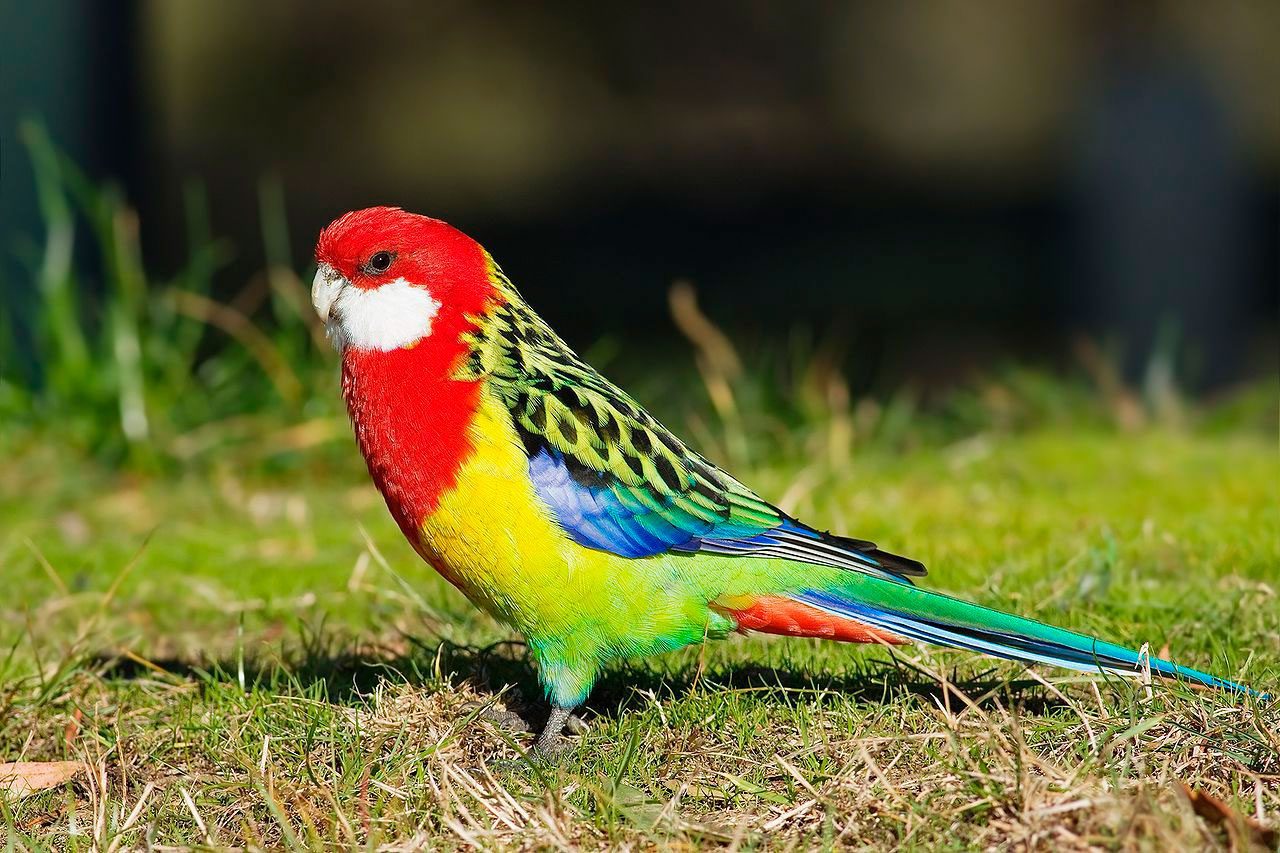
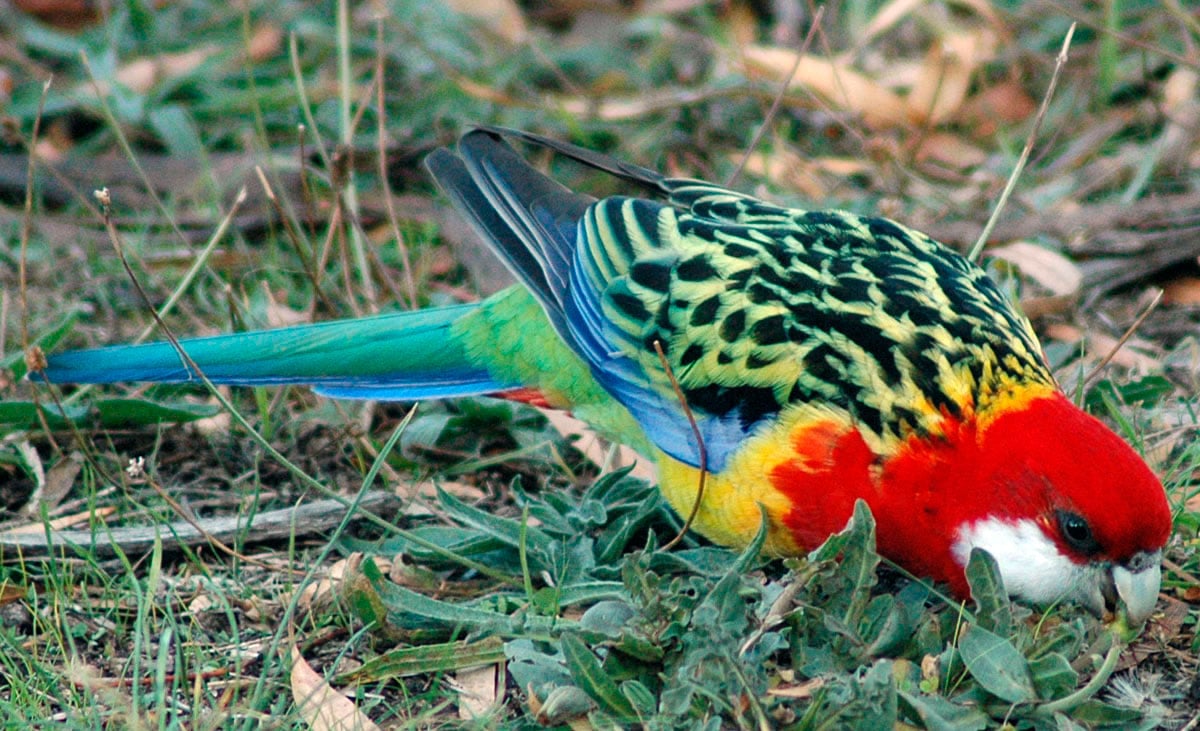
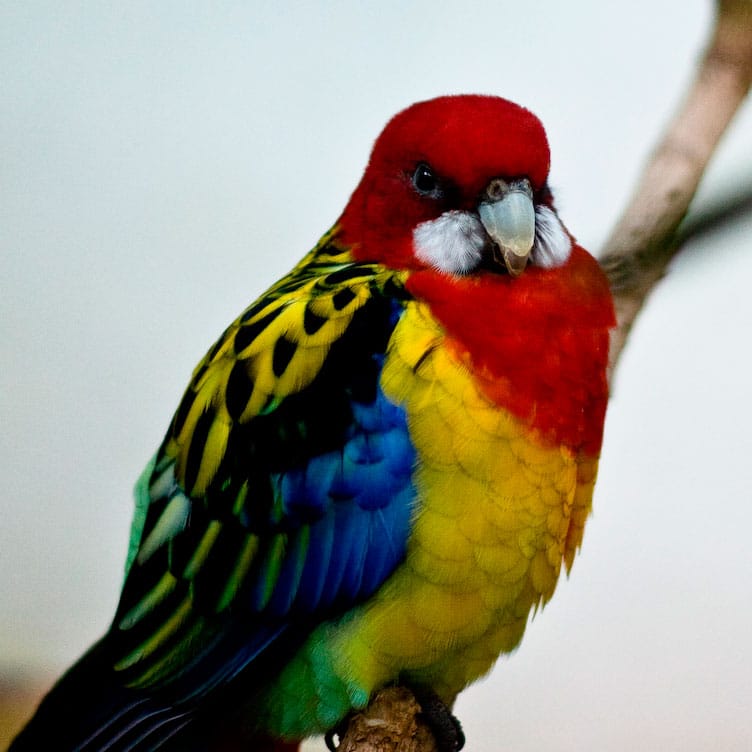
The males of the Eastern Rosella (Platycercus eximius), has bill white. The lower area of the cheeks and chin are white, that contrasts sharply with the rest of the head and the chest that are of color red glossy. Upper abdomen shows a beautiful color yellow that is again gradually of color green pale in its part lower. The coats are of color red. The the mantle feathers, the back and scapulars are of color black with a broad edge yellow, giving these regions a highly scaled appearance. The median are black. The blankets, out of them coverts secondary and flight feather are bluish grey. The rump is bright green. The central feathers of the tail are green bottle, While the outer feathers of the tail are bluish grey with white tips.

The irises They are brown, legs grey.

The female looks like your partner, but the Red of the head and the chest is less bright.

The underparts has a thin white stripe.

The youth they are a copy in Pale tones of the female. They have a little bit of green on the back of the head.

Subspecies description:

  • Platycercus eximius diemenensis

    (North 1911) – Of 30 cm.. length. Head and chest color much more dark and white cheek much more large. Female as the nominal species.


  • Platycercus eximius elecica

    (Schodde & Short 1989) – Of 33 cm.. length. It is something more than the nominal species, the red and the chest and the head is slightly more dark, the black feathers of the neck, back and shoulders have a very broad bright yellow bordered. Area of the rump and coverts bluish-green supracaduales. Female with back and neck with hints. Your obispillo is bluish green


  • Platycercus eximius eximius

    (Shaw 1792) – The nominal.

Habitat:

The Eastern Rosella they tend to be fairly common in all habitats of open forests, including agricultural land, urban parks and gardens. They are usually in little populated wooded areas, rows of trees along streams, shrub and scrub savannahs «Mallee«.

They are common in cultivated areas and can invade orchards where you can cause severe damage.

In many areas, It is the most widespread species of parrot, You can even nest in the trees lining the streets of towns and cities. Wherever possible, they avoid dense forests and mountainous areas, where is replaced by the Crimson Rosella. The habitat of the Eastern Rosella usually less to 1.250 m above sea level.

Breeding pairs are sedentary in their territories, While young and immature form bands of up to 25 birds that roam the area. very commonly, the multicolored parrot can be seen perched on power lines or poles lining the sides of the roads in the outskirts of cities.

On the floor were fed more frequently than other types of rosella Parrot. In flight, they are quite noisy and therefore very easy to detect. But, When they are on the ground, they are not always easy to observe.

They feed on, sometimes, in the company of Red-rumped Parrot (Psephotus haematonotus) but never be with them organized mixed flocks.

Reproduction:

The Eastern Rosella They nest in the months from August to February, but also from time to time in April and may.

Pairs mate for life and is the female which chooses the nest site, usually in a hole or cavity of a eucalyptus branch. Sometimes the place to start may be an old stump, an any fence post, a fallen log, a rabbit hole, the nest of a Rainbow Bee-eater. Optionally, the Eastern Rosella also used the abandoned nest of the Blue-winged Kookaburra, some termite mound, ferns in facades of houses, rock walls, old buildings and an old nest of pomatostome.

The bottom of the nest is filled with sawdust or small wood shavings..

Spawning includes 4-9 eggs (generally 5) which are incubated during 19 days. The female is solely in charge of incubation and her partner is responsible for supplying. The chicks stay lasts a few 35 days.

Food:

The Eastern Rosella has a mainly vegetarian diet. Consumed mainly eucalyptus and acacia seeds, Although also seeds of a variety of greenery bushes. Berries, leaves and sprouts are also part of its menu.

During the summer, eats some insects and their larvae. Take the seeds that are dispersed in fields and roads. It penetrates into the orchards where causes some damage.

Distribution:

The Eastern Rosella lives confined to the southeast of Australia where is spread around Gympie, Bribie Island and the Darling Downs district in the extreme southeast of Queensland, in the South through New South Wales, coming towards the inside of Moree, Parkes, Griffith and There is a, and reaching Victoria where is it absent only in the Northwest region, and West up to Edenhope.

In the southeast of South Australia the species is largely limited to the area between Bordertown and Salt Creek, but a population caused by birds in captivity is also distributed by the Lofty Mountains.

In Tasmania, the species is widespread, Although barely wide and sparsely distributed, and have been faced with the King Island in the bass strait.

There are small introduced populations in the South Island of New Zealand, concentrated around Dunedin (includes some Crimson Rosella mixed with oriental hybrids) and in the Banks Peninsula, and a larger population in the North Island, that extends from the northern end of the island, along the West Coast through Raglan, New Plymouth and the interior of Pirongia and Taupo. They can also be found Eastern Rosella in the districts of Wellington and Lower Hutt, in the Tararua mountains, about Gisborne and along the Coromandel Peninsula, but are rare in the South of Auckland.

The world population is more of 500.000 birds, and stable or increasing.

There is some competition with nesting places with the Common Starling (Sturnus vulgaris) in Tasmania.

Moderate multicolored parrot in captivity.

The species has benefited before the spread of agriculture, and although protected by law, they can be killed under license.

Subspecies distribution:

  • Platycercus eximius diemenensis

    (North 1911) – Own East of Tasmania.


  • Platycercus eximius elecica

    (Schodde & Short 1989) – Present in the northeast of New South Wales and the southeast of Queensland.


  • Platycercus eximius eximius

    (Shaw 1792) – The nominal.

Conservation:


minor concern


• Current category of the Red List of the UICN: Least concern

• Population Trend: Growing

The size of the world's population has not been quantified, Although it is estimated above 500.000 birds.

Throughout its distribution area, except Tasmania, the Eastern Rosella East are very common birds. Unlike in the Crimson Rosella, that like dense forests, the Eastern Rosella they have benefited from deforestation that took place for the establishment of new pastures or areas of cereals.

"Eastern Rosella" in captivity:

Very common in captivity, It is probably the most popular of the Rosellas.

The Eastern Rosella they are coveted because of the beautiful colors of plumage.

They are intelligent birds and can be trained to whistle a large repertoire of melodies., and you can even learn how to pronounce some words.

These parakeets can make good pet birds but require a great deal of care and attention., In addition to devices and toys to keep them mentally stimulated. They are wild birds which are not always adapted to live as a family pet, and even the hand reared parrots are never fully domesticated. They generally do not tolerate caresses or cuddling and tend to react by stinging when you try to handle them like this.. Many breeders believe that the best way to keep this type of bird is in great aviaries where can fly freely, in pairs to meet their social needs and with minimal human interaction. Although they tend to be aggressive with other species Bird by should not be treated so integrate them to mixed aviaries.

Its diet poultry includes seeds, fruits like Apple, PEAR and grape, and vegetables such as lettuce, grass, and silver beet.

A sample of Eastern Rosella lived 27,4 years in captivity. In captivity, these animals have been able to play, approximately, to the 2 years of age..

Alternative names:

Eastern Rosella, White-cheeked Rosella (ingles).
Perruche omnicolore (French).
Rosella, Buntsittich (German).
Rosela-multicolorida (Portuguese).
Perico Multicolor, Rosela Común (español).

scientific classification:

Order: Psittaciformes
Family: Psittaculidae
Genus: Platycercus
Scientific name: Platycercus eximius
Citation: (Shaw, 1792)
Protonimo: Psittacus eximius

Images «Multicolored Parakeet»:

Videos "Eastern Rosella"

————————————————————————————————

«Multicolored Parakeet» (Platycercus eximius)


Sources:

Avibase
– Parrots of the World – Forshaw Joseph M
– Parrots A Guide to the Parrots of the World – Tony Juniper & Mike Parr
Wikipedia
– AnAge: The Animal Ageing and Longevity Database – Anagé entry for Platycercus eximius
– Birdlife

Photos:

(1) – Eastern Rosella (Platycercus eximius), male, Queen’s Domain, Hobart, Tasmania, Australia By JJ Harrison (jjharrison89@facebook.com) (Own work) [CC BY-SA 3.0], via Wikimedia Commons
(2) – Eastern Rosella (Platycercus eximius), female, Queen’s Domain, Hobart, Tasmania, Australia By JJ Harrison (jjharrison89@facebook.com) (Own work) [CC BY-SA 3.0], via Wikimedia Commons
(3) – Eastern Rosella (Platycercus eximius) at Woodland Park Zoo, Seattle, USA By Platycercus_eximius_-Woodland_Park_Zoo-6. jpg: Nickderivative work: Snowmanradio [CC BY 2.0], via Wikimedia Commons
(4) – Eastern Rosella at Hobart Domain, Tasmania (grazing) By KeresH (Own work) [GFDL, CC-BY-SA-3.0 or CC BY-SA 2.5], via Wikimedia Commons
(5) – Eastern Rosella (Platycercus eximius diemenensis), The Queen’s Domain, Hobart, Tasmania, Australia By JJ Harrison (jjharrison89@facebook.com) (Own work) [GFDL 1.2 or CC BY-SA 3.0], via Wikimedia Commons

Sounds: Peter Woodall (Xeno-canto)
▷ The world of Pets: Dogs, cats, birds, reptiles, amphibians

Eastern Ground Parrot
Pezoporus wallicus


Eastern Ground Parrot

Content


Anatomy-parrots

Description

30 cm. length and an approximate weight of 130 g..

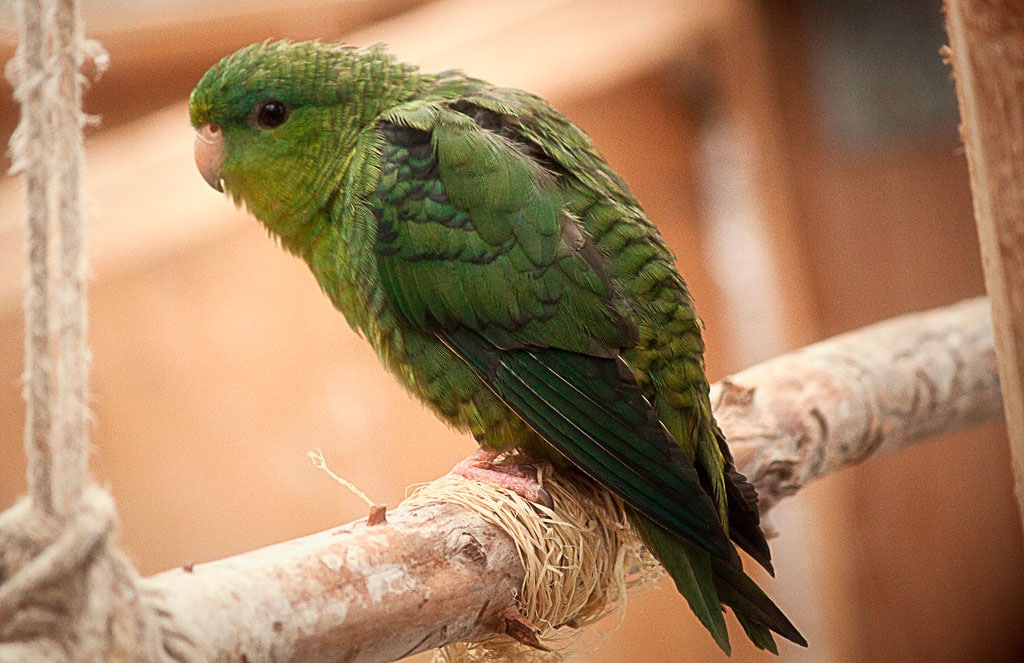
The Eastern Ground Parrot (Pezoporus wallicus) has a medium-sized, It gives the impression of a slender silhouette, feeling is enhanced by the presence of a very long tail terminating beak. The identification is reinforced with rounded wings and for a few fine peaks and sharp.

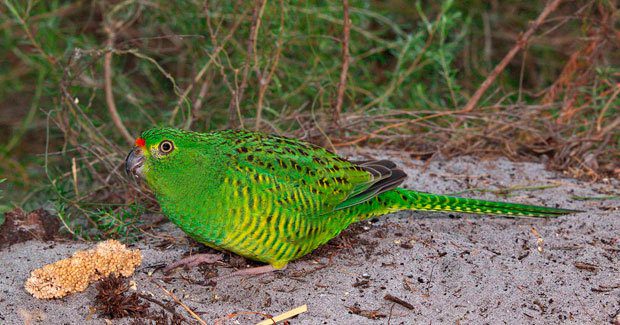
The of adults they have a plumage greenish color with patterns of yellow and black as gallons or points that serve to camouflage itself.

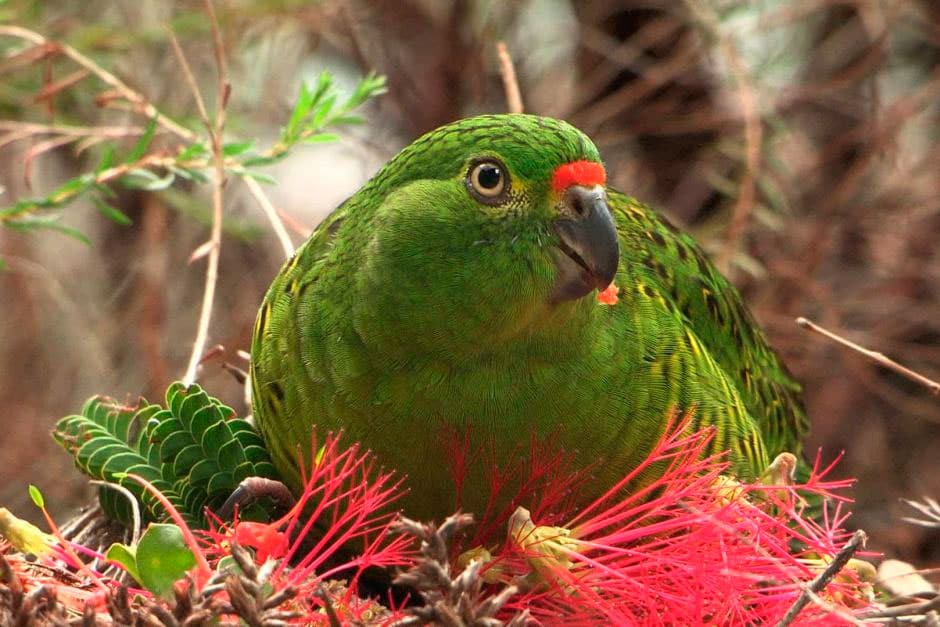
A red band runs around the forecrown. The face and upper part of the chest They show a pretty uniform green colour. The crown Green it is abundantly stained black.

The flanks and abdomen they have yellowish clear black bars. The tail opaque green color shows yellow slots on the outer edges.

Its bill is ochre tones, with the cere rose gray. They present a periocular ring pale grey, the irises eye whitish yellow. Their legs distant have long fingers and their claws they are not curved as in the rest of the parrots.

In the females, You can see a pale yellow stripe at the bottom of the wing .

The immature they have no red frontal band, the face and the chest they have black marks. Its tail is shorter and irises of her eyes are brown.

Subspecies description

  • Pezoporus wallicus wallicus

    (Kerr, 1792) – The nominal

  • Pezoporus wallicus leachi

    (Mathews, 1912) – They have black markings more prominent on the head and thicker, the neck and belly

Habitat:

Eastern Ground Parrot

The Eastern Ground Parrot usually live in lawns along the coast and in the neighbouring moors which rise to the 1.800 meters above sea level. Shrub-dominated moorlands that have suffered from fire in the last decade are generally considered to be their optimum habitat.. As well, moors dominated by reeds and herbs that have suffered some fire between 15 and 18 years ago, they are considered as excellent performance for these parrots. In the interior of the Moors, These birds are concentrated in the driest areas from mid autumn to late spring.

Humid areas they are frequented by the Eastern Ground Parrot, from summer to early autumn, probably in relation to the abundance of seeds at this time of the year. They can also be seen in estuaries, in boggy soils that are full of rods, in the meadows and pastures.

In Tasmania, the Eastern Ground Parrot occupies a rather special habitat consisting of a mixture or a mosaic of Heath, Sedge and weed.

As its common name indicates, These birds are reluctant to take flight. On the rare occasions when they dare to fly, its zigzag in flight seems the of a Small Sandpiper (Actitis hypoleucos) or a Woodcock (Scolopax rusticola) and develops within walking distance (a few 30 m). Once it lands, seek thick cover and can be difficult to relocate.

Contrary to what many people believe, the Eastern Ground Parrot is very active during the day, although, often, are difficult to detect, except when fleeing hastily, hearing the loud vibration of wings just before plunge among the foliage.

Son assets morning and afternoon average. At night, whatever the season, they establish the dormitories in the drylands.

These parakeets are mostly sedentary and live in couples United in a territory which is around of 9 hectares, although the area can sometimes change.

Between February and may, There is a great post-reproductive dispersion in which these birds move away some 120 kilometers from its nesting area.

Reproduction:

The Eastern Ground Parrot usually nest between jJuly and December. A litter was discovered in March. The nest is a fled surface excavated soil from 15 cm and 18 cm in width and between 2 cm and 5 depth cm; It is often full of stems or leaves. It is placed at the base of a mound or a bush above the ground which is accessed through a small tunnel..

The main plants that make up the nest, they are herbs of the genus (empodisma), plants of the genus (Xanthorrhoeoideae) and banksia sheet wide.

Of 20 nests found, 18 located in arid wastelands and 2 only in areas of transition between wetlands and land dry. In all these places there has been a fire for at least four years. The density was low, from January to March a nest each 10 hectares.

The laying includes, usually, 3 or 4 eggs, but in Tasmania (subspecies leachi), were observed 6 eggs in some nests. The incubation lasts around 20 days. Young people are altricial. When leaving the nest, at an age between 20 and 28 days, lie hidden among shrubs, just before fly.

The failure rate in the offspring is quite large, going from the 22 until 31%.

Food:

The Eastern Ground Parrot feeds primarily on seeds of a wide variety of Sedge, herbs, herbaceous plants and shrubs. Occasionally they eat green shoots, leaves, outbreaks, flowers and small fruits.

In the Great Sandy National Park (Cooloola section), the Eastern Ground Parrot feeds primarily on seeds of Sprengelia sprengelioides (Epacridaceae), Schoenus paludosus (Cyperaceae) and Restio complanatus (Restionaceae).

In the Croajingalong National Park, the diet consists, mainly, seeds or fruits of the species Cyperaceae, particularly Schoenus brevifolius and Cassytha (Lauraceae), and also unidentified species of Ericaceae and Fabaceae.

The Eastern Ground Parrot, usually, feeds on Earth, but sometimes forages among the foliage of low shrubs, or on top of clumps of planting of reeds.

The seeds take them from the soil and plants. The parakeet will remain on the stem of a plant to flatten it and throw the seeds of heads down, or it will be the peak along the stem and base of the seeds, with the intention of evicting them and that fall to the ground.

The peak used to cut the seeds and their bases, as well as to handle food. The legs are used only to flatten plant stems.

In the Bundjalung National Park, the Eastern Ground Parrot It was observed feeding on flowers. Occasionally they feed in habitats that have been modified by man, for example, one in cornfield.

They are diurnal, and actively feed throughout the day.

Distribution:

The Eastern Ground Parrot are confined in Australia. The range has contracted in recent times and the species is now only found in isolated pockets of coastal heath and reed-covered land., It extends to the South, from the South of Queensland, where a population of 3.000 birds is dispersed through of the Fraser Island and close to the continent, including Cooloola National Park, Reserve Wide Bay Military, Fraser State Forest and Great Sandy National Park.

It is common locally to around New South Wales, where they are distributed in a number of coastal sites including Evans Head, the Broadwater National Park, Byron Bay, Morton National Park, around the Howe's Cape, Barren Grounds and Nadgee nature reserve.

They come up to Victoria, in the Croajingolong National Park, and they are distributed, provided that the habitat is suitable, along the coast in a series of sites as the Wilson promontory National Park and the Discovery Bay coastal Park in the West.

In the post-breeding period, the dispersal of birds reaches areas of Gippsland and Ninety Mile Beach, Although they can also travel further including the interior Highlands.

The species has become extinct in Southern Australia and on the islands of the bass strait.

In Tasmania it is quite common in the south-west, but small flocks in the central and South-East regions, they are probably now in decline.

Subspecies distribution

  • Pezoporus wallicus wallicus

    (Kerr, 1792) – The nominal

  • Pezoporus wallicus leachi

    (Mathews, 1912) – Tasmania.

Conservation:


minor concern


• Current category of the Red List of the UICN: Least concern

• Population trend: Decreasing

The Eastern Ground Parrot is not threatened globalmente.

Habitat loss mainly due to urban growth and modernization of agriculture, accentuated by the use of improper burning of stubble and restoration techniques of plantations of pine trees along the coast, It can be that they are endangering the species. These signs of decline are seen mostly in the West and the South of Australia.

Although the population of Tasmania probably exceed of the 100.000 specimens, the population in the South-East of the continent It is much more low and does not exceed the 3.000 Member.

"Eastern Ground Parrot" in captivity:

Take it easy, shy, active when feeds, After the sunset, enjoy bath. It is customary to their caregiver, but rarely survive beyond a few weeks.

Not found in captivity outside Australia.

Alternative names:

Eastern Ground Parrot, Ground Parrot (Eastern) (ingles).
Perruche terrestre (French).
Erdsittich (German).
Arara-de-cabeça-azul (Portuguese).
Perico Terrestre, Perico Terrestre Oriental (español).

scientific classification:

Order: Psittaciformes
Family: Psittaculidae
Genus: Pezoporus
Scientific name: Pezoporus wallicus
Citation: (Kerr, 1792)
Protonimo: Psittacus wallicus

«Ground Parakeet» Images:

Videos "Eastern Ground Parrot"

«Terrestrial Perico» (Pezoporus wallicus)

Sources:

  • Avibase
  • Parrots of the World – Forshaw Joseph M
  • Parrots A Guide to the Parrots of the World – Tony Juniper & Mike Parr
  • Birdlife

  • Photos:

(1) – To western ground parrot (Pezoporus wallicus flaviventris), one of eight in captivity. (WA Department of Environment) – australiangeographic
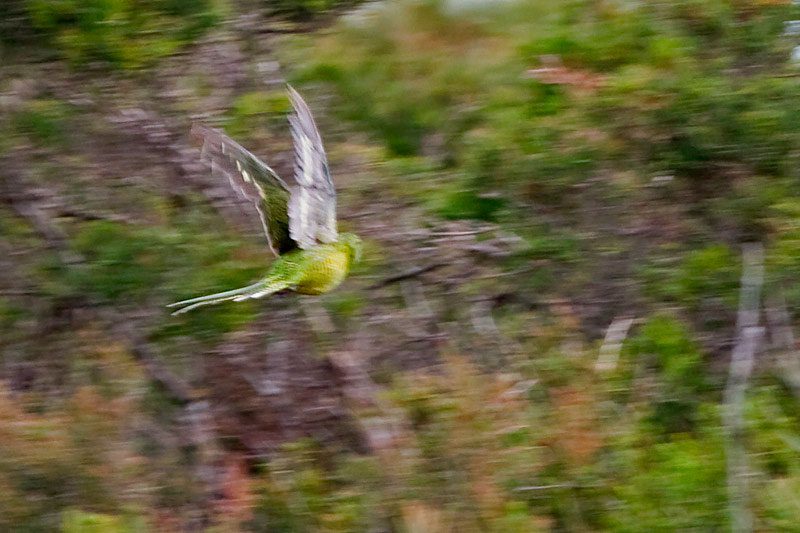
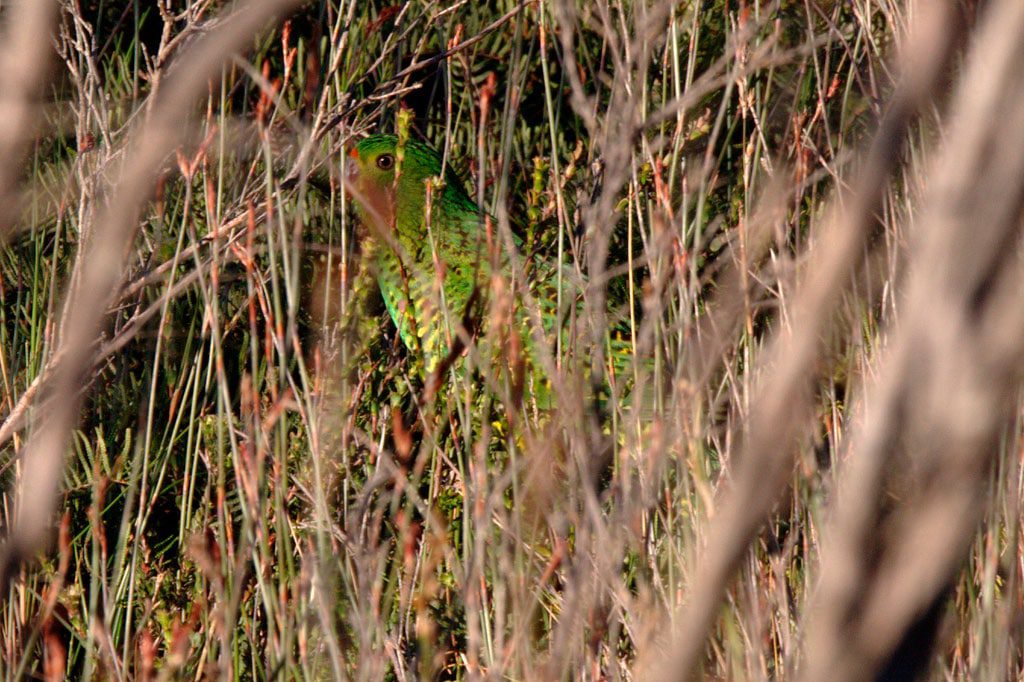
(2) – A Ground Parrot amongst vegetation By Jarrod Amoore [CC BY 2.0], via Wikimedia Commons
(3) – Eastern Ground Parrot – Office of Environment and Heritage
(4) – flight views of bird flushed from heath by Mat Gilfedder – lynx
(5) – By Jennene Riggs – abc
(6) – By James Sowerby (1757 – 1822) (English) (Artist, Details of artist on Google Art Project) [Public domain or Public domain], via Wikimedia Commons

▷ The world of Pets: Dogs, cats, birds, reptiles, amphibians

Niam-Niam Parrot
Poicephalus crassus

Content


Description:

25 cm.. length.

The Niam-Niam Parrot (Poicephalus crassus) has the head and nape Brown olive; the ear-coverts Silver. feathers of the the mantle and tertiary Brown with dark green margin; back, uppertail-coverts and bright green.

Lorito nianiam

Upper, wing-coverts dark green; secondary more internal dark green; rest of the flight feather brown with vane dark green external. Throat and top of the chest Brown olive opaque; bottom of the chest, the belly, the the thighs and undertail- coverts green.

Feathers of the tail dark brown tipped with dark green margins.

Bill yellowish, upper jaw darker than black-tipped; irises yellow; legs blackish.

Both sexes similar.

Hood grayish brown of the immature It shows strong brands of color yellow olive; the the mantle is greener. Underparts paler and more yellowish in adults. Secondary internal lined with yellow. More pale the upper jaw the adults and with grey tip.

It was thought that the Niam-Niam Parrot (Poicephalus crassus) could form a species within the group of the Poicephalus meyeri, Poicephalus rueppellii and Poicephalus cryptoxanthus, and possibly other. In the past, treated as species Poicephalus cryptoxanthus, that is morphologically very close.

Habitat:

Frequents wooded areas of Savannah, forest-savanna mosaic, wet sheets and Syzygium-Adina forests in the savanna to the 1.000 m.

Common in areas near water. Observed in pairs or in small groups. Regular daily movements take place even in the mountainous areas where the Niam-Niam Parrot visit tall trees to feed.

Reproduction:

Few details about reproductive biology, but believes that nest between August-September during the rainy season.

Courtship and implementation not described.

Food:

Its diet It is little known but includes a wide variety of seeds; reported foods include millet, and beans.

Distribution:

Size of the area of distribution (reproduction / resident): 343.000 km2

North of Central Africa to the South of the Sahara. Believed to inhabit also in Cameroon Eastern (where is the status unclear) through the Center and South of the Central African Republic, South-West end of Chad and the north end of the upper area of the Democratic Republic of the Congoto the southwest of Sudan (Bahr-el-Ghazal).

Sedentary with local movements. Little-known state, but think it's generally common, Although most scarce in the southwest of Sudan.

Conservation:


minor concern


• Current Red List of UICN: Least concern

• Population trend: Stable

The size of the world's population has not been quantified. This species is one of the lesser known African parrots, but it is assumed that it is common in its area of distribution.

The population is suspected to be stable in the absence of evidence of any reduction or substantial threats.

"Niam-Niam Parrot" in captivity:

Very rare in captivity.

It is a parrot of middle voice, shy and suspicious. Young birds are more accustomed to the caregiver.
New birds susceptible to the stress or illness.

Is necessary for their well-being a regular supply of fresh wood; susceptible during the acclimatization period; resistant once acclimated.

Alternative names:

Niam-Niam Parrot, Niam niam Parrot (English).
Perroquet des Niam-niams, Perroquet des niam-niam (French).
Niamniampapagei, Niamniam Papagei (German).
Papagaio Crassus (Portuguese).
Lorito Niam niam, Lorito Niam-niam, Lorito nianiam (español).


scientific classification:

Richard Bowdler Sharpe

Order: Psittaciformes
Family: Psittacidae
Genus: Poicephalus
Scientific name: Poicephalus crassus
Citation: (Sharpe, 1884)
Protonimo: Pionias fat

————————————————————————————————

"Lorito naianiam" (Poicephalus crassus)


Sources:

Avibase
– Parrots of the World – Forshaw Joseph M
– Parrots A Guide to the Parrots of the World – Tony Juniper & Mike Parr
– Birdlife

Photos:

(1) – Photography: Caijin Wen – link

▷ The world of Pets: Dogs, cats, birds, reptiles, amphibians

Barred Parakeet
Bolborhynchus lineola

Catita Barrada

Content

Description:


Anatomy-parrots

They measure 17 cm. long and weigh between 47 and 55 g.
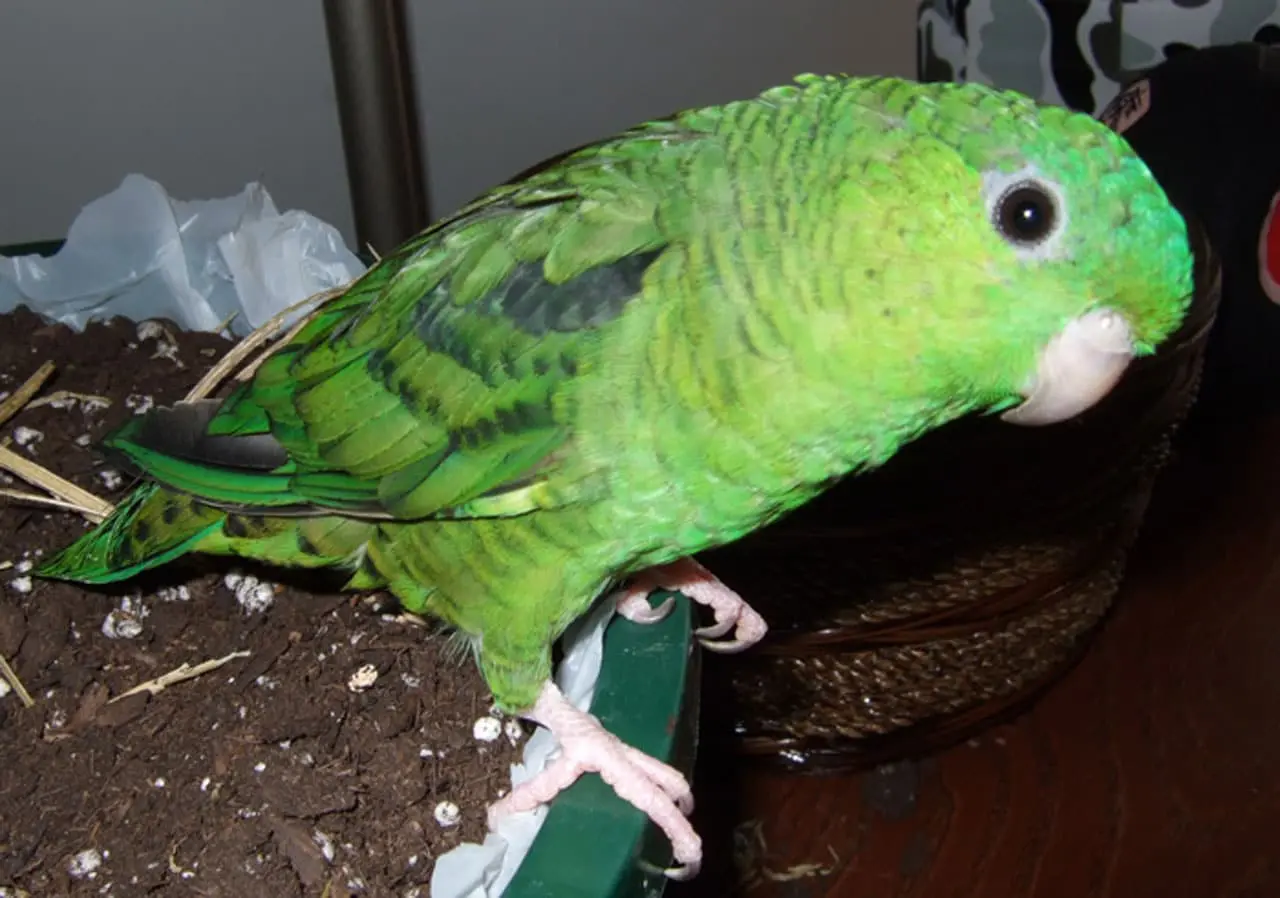
The Barred Parakeet (Bolborhynchus lineola) has a size similar to the of a Sparrow. The tail and wings they are pointed. Slightly different sexes: in males, the eyes they are brown, the eye ring grey, the bill and legs flesh-colored. The head and underparts they are bright green, with a tenuous beaming on the sides and the tail coverts. The wings they have very marked black bars at the shoulder and patch black(not always visible), the upperparts they are green with a beaming widely dispersed black in the nape and back.
The females and juveniles they present a beaming more pardo. A wide black border and dark green bottom; the irises Dark coffee and legs pink (Howell and Webb, 1995).

Subspecies description:

  • Bolborhynchus lineola lineola

    (Cassin, 1853) – The nominal


  • Bolborhynchus lineola tigrinus

    (Souance, 1856) – Dark green, Crown and bright green front and the rough black is more intense.

Habitat:

Rare and unpredictable. It lives in humid forests, subandinos and Andean cloud forests, open areas, from 900 at 2900m. They are nomads, with numerous flocks (150 or more individuals) following the fruition of the “chusque” (This chusquea). In small groups or in pairs during the dry season in Central America.

Reproduced in elevations of 1500 meters or more and, like most parrots, they prefer to raise their chicks in a hollow tree or limb trunk. In the winter after the breeding season, the Barred Parakeet often descends to lowland forests. This season, Many feed on partially cleared areas, areas cultivated and in them sheets.

Registered at altitudes from 900 to 2.400 m. in Mexico; by under 1.500 m. in Honduras, Although below 600 After the playback meters; above 1.500 m especially in the West of Panama, although there are records there and in Costa Rica below the 600 m; between 900 and 1,500 m. in Venezuela, between 1,600 and 2,600 m. in Colombia, and until 2.900 m. in the South of Ecuador.

Little known about the habits of these small wild parrots. Since they are small, they like to live high in the treetops, and they are very well camouflaged in their environment, still very hard to see in nature. It also, they are not as noisy as other parrots, which makes them difficult to detect. Most frequently observed during the flight, because they often emit a chirp while flying, What can attract the attention of an observer of birds.

Reproduction:

It nests colonies, in tree hollows, Although you can to occur in crevices in Rocky escarpments, probably during the dry season in Costa Rica; during the month of December in Panama; July-August in Colombia.

Food:

Reported foods that make up their diet include Myrtis, Heliocarpus and Miconia, catkins of Cecropia and bamboo seeds; they occasionally forage in cultivated areas, where has observed them is consuming corn.

Distribution:

Distributed in South of Mexico to western Panama and separated by the Andes, from Venezuela until Peru.

In Mexico they can be observed on the Atlantic slope, in the Highlands of Veracruz, Oaxaca, Chiapas and possibly (There is only a record) in Warrior, also seen in the South of Guatemala (a record from time to time) and in the Highlands of Honduras, with a single bird observed in Nicaragua, specifically in Saint Mary of Ostuma; also registered in those areas mountain of Costa Rica (not seen in areas of the Northwest, for example in the Cordillera de Guanacaste) and in the West of Panama (apparently absent from Central and Eastern).

Distributed through them Andes, to the Northwest of Venezuela in the Federal District, Táchira and Merida; scattered locations of Colombia, in subtropical areas of the Western Andes, Central and Eastern and in the massif of Santa Marta; Ecuadorian Andes, with records recent in the South; Peruvian Andes, in Huanuco, Ayacucho and Cuzco, with birds, possibly of this species, observed in the North.

Scattered records, e irregular, as well as a strong nomadic tendency (movements perhaps related to bamboo planting) they indicate that their appearances may be continuous.

Apparently, is one local and rare species over much of its range, Although according to reports, is quite common in Honduras and even locally abundant in the Talamanca mountain range in Costa Rica.

Deforestation in parts of its range, Although these birds travel on cleared land and distributed (at least from time to time) in protected areas, which suggests a low risk population at present.

There is a captive specimens outside their countries of origin.

Subspecies distribution:

  • Bolborhynchus lineola lineola

    (Cassin, 1853) – The nominal


  • Bolborhynchus lineola tigrinus

    (Souance, 1856) – Mountains from northwestern Venezuela and Colombia to southern Peru

Conservation:

State of conservation ⓘ


minor concern Minor Concern ⓘ (UICN)ⓘ

• Red List category of the UICN current: Least concern.

• Population trend: Stable.

Partners in Flight estimated the total population of Barred Parakeet in a number ranging from 50,000-499,999 individuals (A. Panjabi in litt., 2008).


The population This species is suspected of being stable in the absence of evidence of any reduction or substantial threats.


"Barred Parakeet" in captivity:

It is of a species that is has adapted well to the life in captivity, tough enough, its reproduction is expanding.

They are perfect apartment birds due to its arrangement and you need only basic things of life. Son kind and happy of being with the people, but they can be kept entertained with toys and swings when there is nobody around.

Is an Ave. moderately long-lived and if is of good health, Food and hygiene can live during 12 or 14 years.

Limited ability for speech.

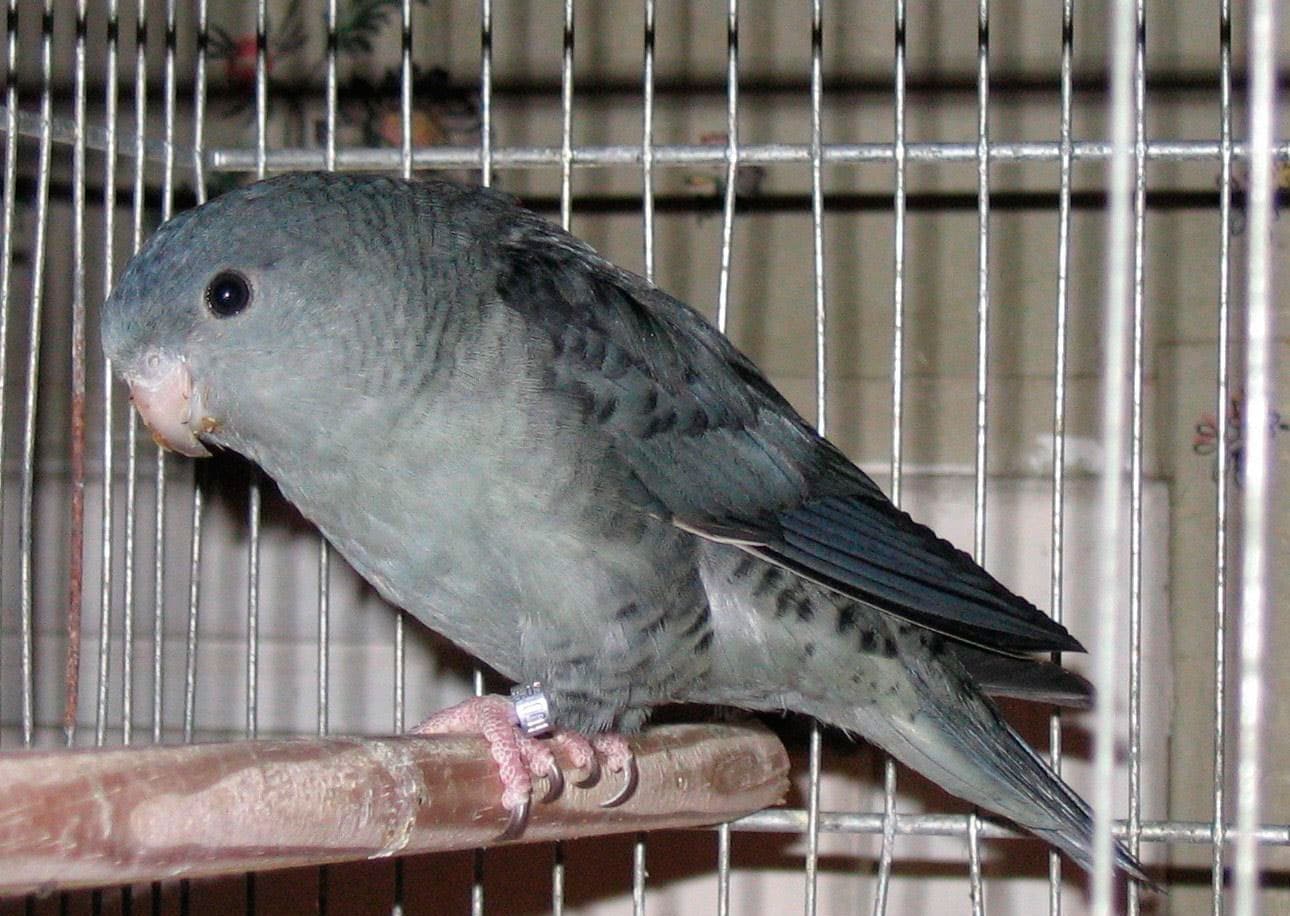
They have developed many and striking mutations of color in poultry, including blue, olive, cobalt, Slate (or mauve), turquoise, lutino (bright yellow with red eyes), cremino, cinnamon, Silver, purple …

Alternative names:

Barred Parakeet, Catherine Parakeet, Lineolated Parakeet (English).
Toui catherine, Perruche catherine, Perruche rayée (French).
Katharinasittich, Katharina Sittich (German).
Periquito-catarina (Portuguese).
Catita Barrada, Catita Manchada, Chocoyo Listado, Perico Barrado, Perico Listado, Perico rayado, Periquito Barrado, Periquito Listado, Periquito saraviado (español).
Periquito Barrado (Colombia).
Perico Listado, Periquito listado (Costa Rica).
Perico rayado (Honduras).
Perico rayado (Mexico).
Chocoyo Listado (Nicaragua).
Perico Barrado (Peru).
Perico Barreteado (Venezuela).

scientific classification:

Order: Psittaciformes
Family: Psittacidae
Genus: Bolborhynchus
Scientific name: Bolborhynchus lineola
Citation: (Cassin, 1853)
Protonimo: Psittacula lineola

Images «Catita Barrada»:

Videos "Barred Parakeet"


Species of the genus Bolborhynchus

Sources:

Avibase
– Parrots of the World – Forshaw Joseph M
– Parrots A Guide to the Parrots of the World – Tony Juniper & Mike Parr
– Birdlife

Photos:

(1) – A Barred Parakeet (also known as Lineolated Parakeet) in captivity By Timo Helgert (originally posted to Flickr as greenguy.) [CC BY 2.0], via Wikimedia Commons
(2) – Two pet Barred Parakeets (also known as Lineolated Parakeet) perching on a parasol By Lisa Lenscap (originally posted to Flickr as sistas) [CC BY-SA 2.0], via Wikimedia Commons
(3) – Barred Parakeet (Bolborhynchus lineola) also known as Lineolated Parakeet or Catherine Parakeet By Lisa Lenscap [CC BY-SA 2.0], via Wikimedia Commons
(4) – Perruche Catherine de couleur mauve By Weena (Own work) [GFDL, CC-BY-SA-3.0 or CC BY-SA 2.5-2.0-1.0], via Wikimedia Commons

Sounds:

▷ The world of Pets: Dogs, cats, birds, reptiles, amphibians

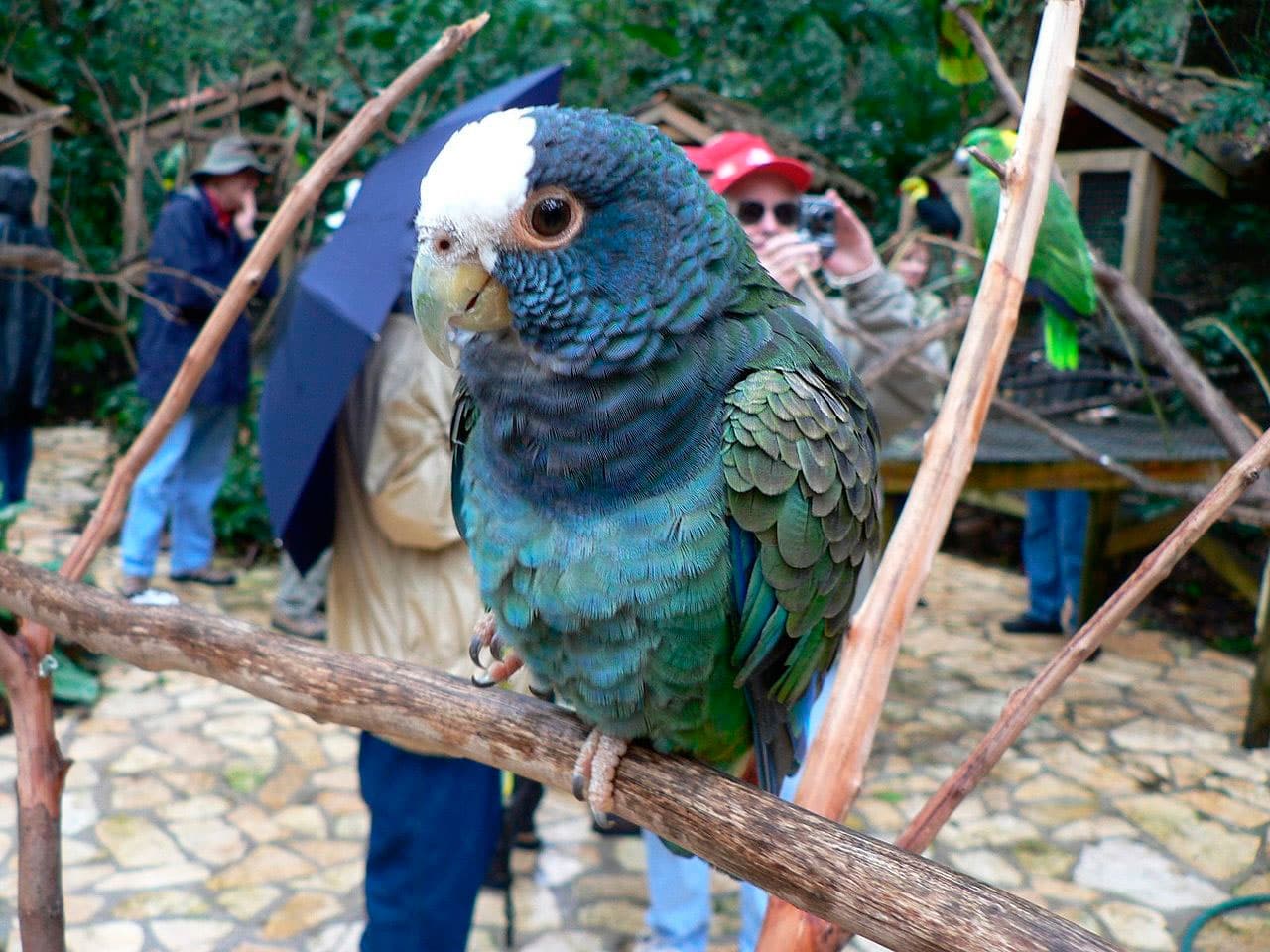
White-crowned Parrot
Pionus senilis

White-crowned Parrot

Content


Anatomy-parrots

Description:

24 cm.. length and a weight between 193-229 g..

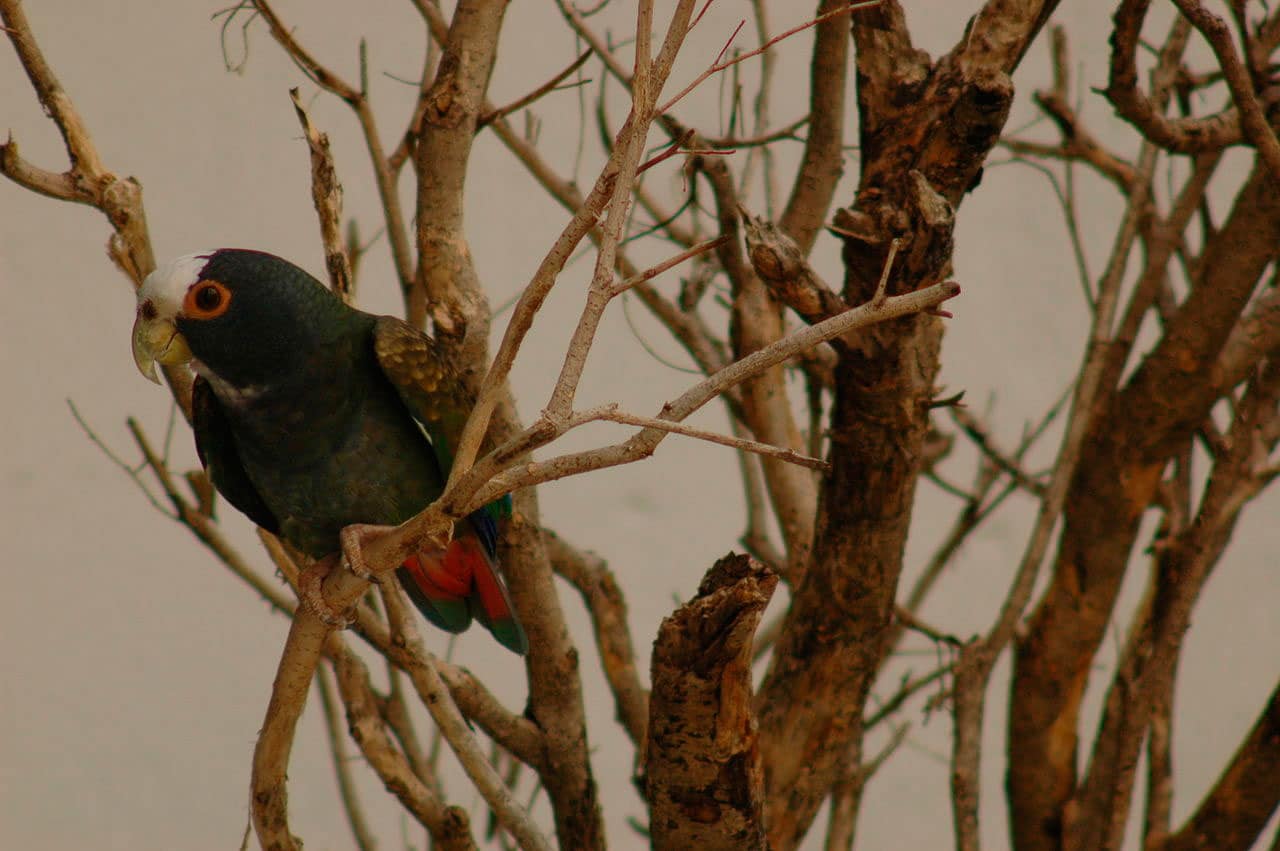
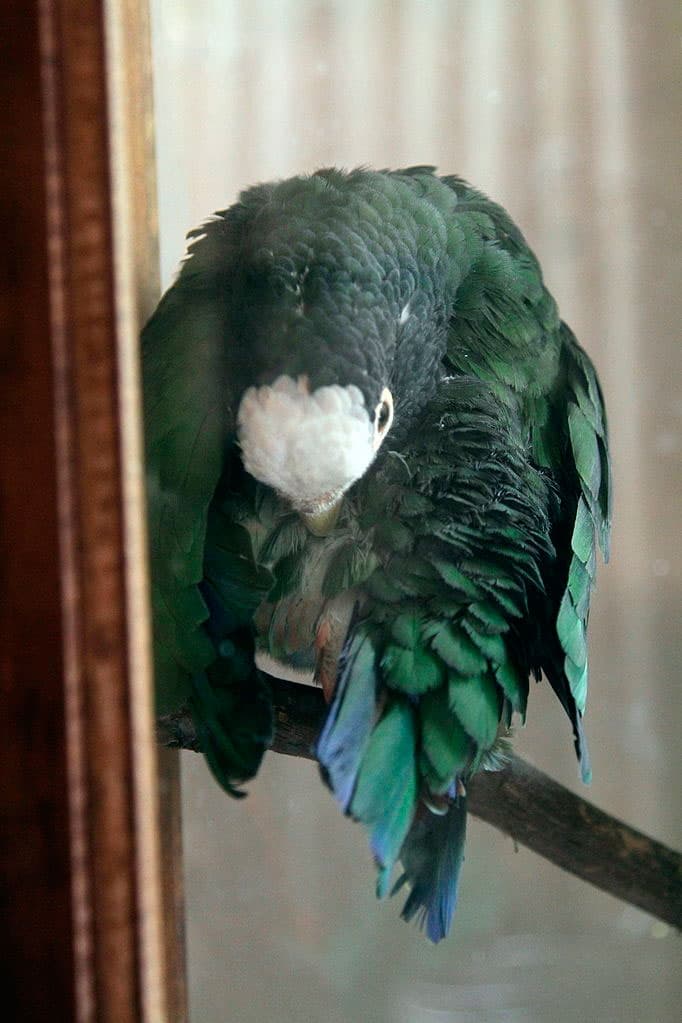
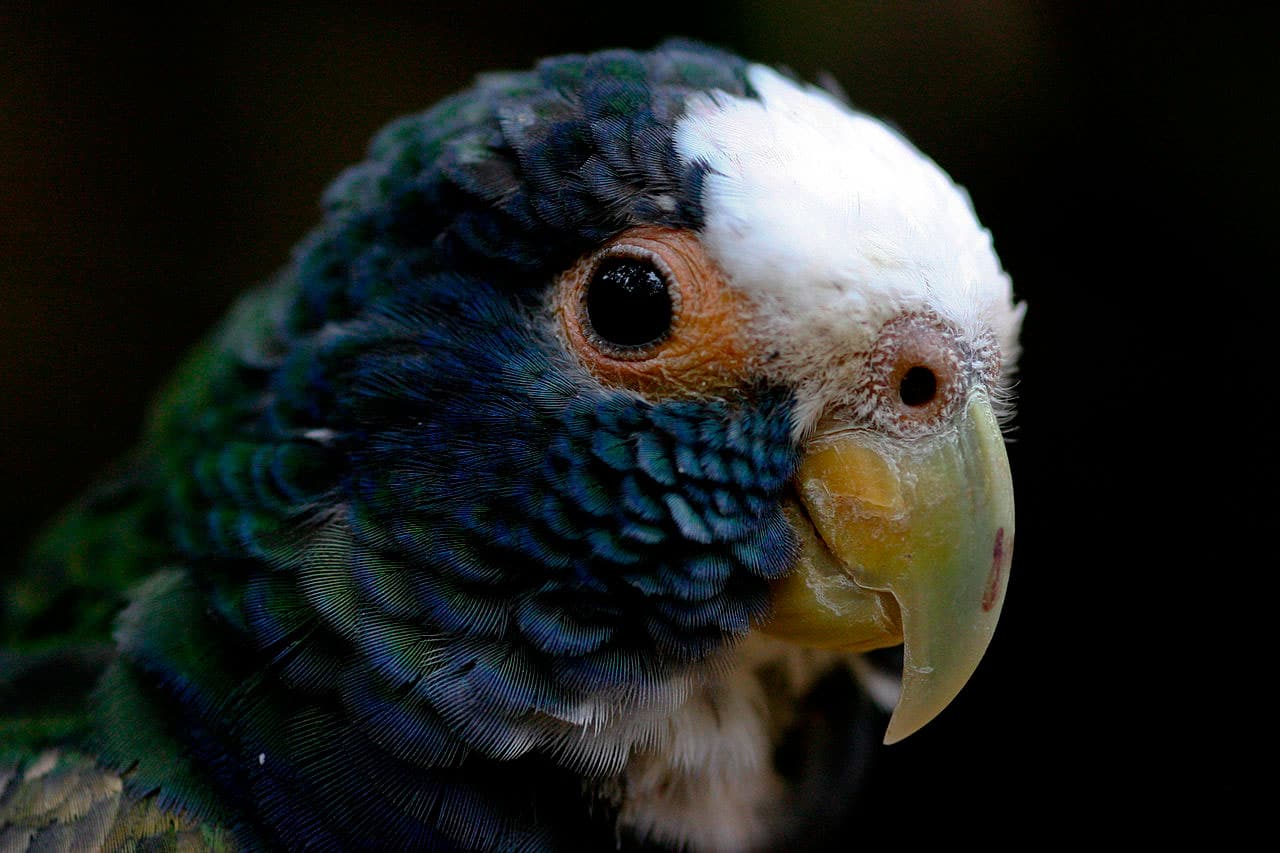
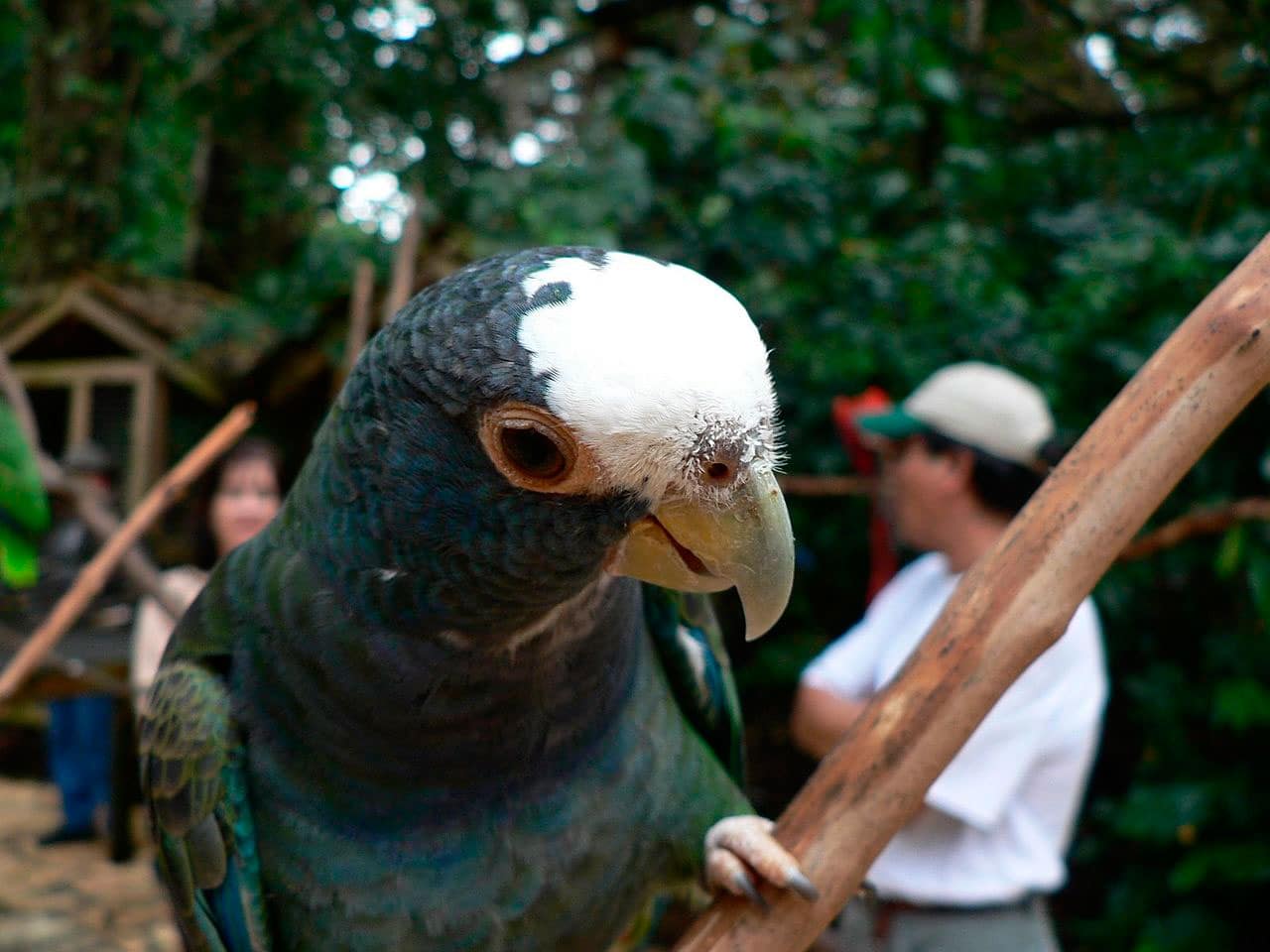
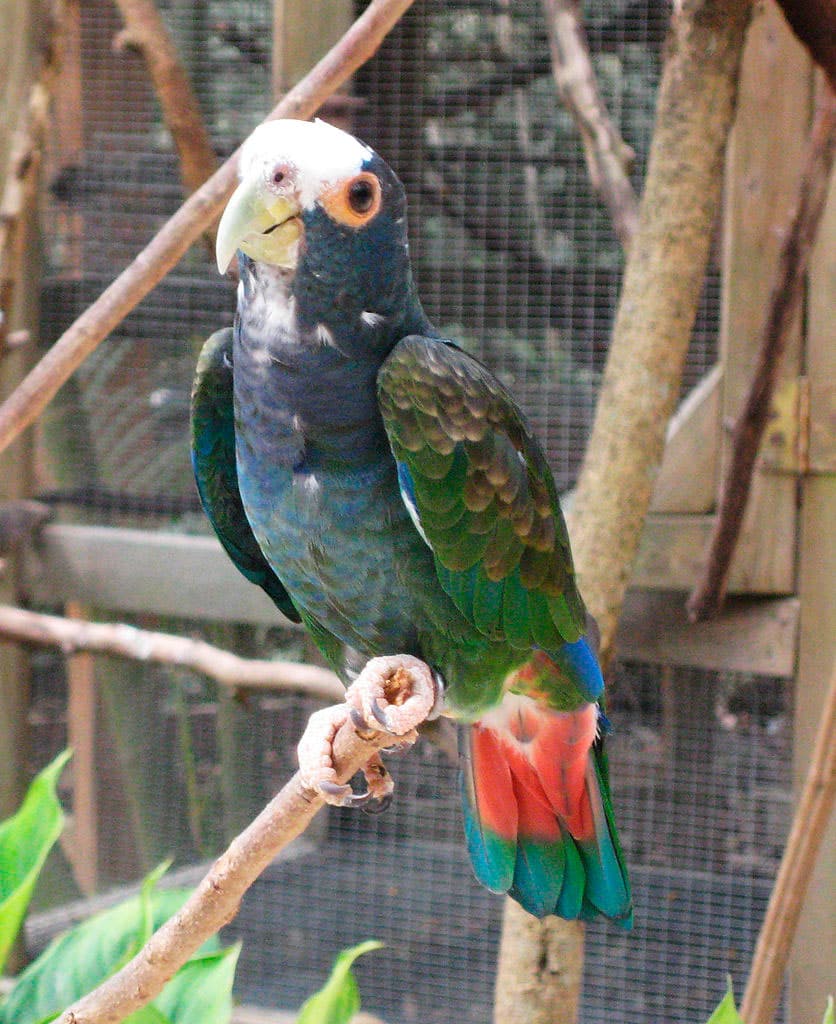
The White-crowned Parrot (Pionus senilis) has the forecrown, crown and lores, white. The feathers of the cheeks, sides head, behind eyes, and rear of the neck, basically pale bluish green with green or blue violet and blue subterminal band darker margins, giving the whole a intricate scaly appearance.

Mantle and back, green with copper plating shine; rump and uppertail-coverts, brighter green; scapulars basically colored green with coppery bronze in the points and outerweb. Lesser coverts and median, bronze with paler tips coppery, giving a mottled appearance; primary coverts, violet blue; greater coverts green. Primaries and secondaries outer, violet blue with green tips to outerweb of the primaries and inner secondary.

Under, the wings pale bluish green. Patch in chin and top of the throat, white; feathers of the chest, green at the base (mostly hidden part) tipped dark blue or violet-blue and blue band paler, giving the whole a scalloped effect; undertail-coverts red. Tail green in the center, outer feathers blue with red at base. Bill pale yellow color with light green tint; eye ring Pink; irises dark brown: legs yellowish gray.

Both sexes are similar. The immature has the head, the back of the neck and the chest, green, pale yellow with margins in the cheeks and crown, giving a pale mottling.

Note:

The subspecies decoloratus, which was distributed from yucatan peninsula to western Panama, previously recognized on the basis of their throat more purple (less blue) and your chest and wings, more blue. But, There is not much geographic variation in the species Pionus senilis and the aforementioned characters are not consistent on the proposed range.

  • Sound of the White-crowned Parrot.

Habitat:

The habitat of the Senile Parrot is mainly the humid forest (including tropical rain forest), but locally it can be found in forests of oak pine, and low mountain forest. Birds have been reported in forest edges, cultivated areas and grassland areas with scattered trees, plantations, secondary forest with emergent trees, woodlands and streams in Costa Rica, on the edge of urban areas.

Lives mainly in lowlands, but they are distributed locally 2.300 meters in Guatemala and near 1.600 meters in Costa Rica 1.800 meters in Panama. gregarious, mostly in pairs or out of breeding season, in small herds; sometimes in larger meetings of up to several hundred birds.

Reproduction:

Build your nests in tree cavities or hollow trunks of palm trees. The reproduction period occurs between February to May; in March in Mexico; in January-April Costa Rica; February to May in Honduras. The incubation comprises of 26-28 days, Followed by 54-68 pup growth days. It has been difficult to breed the species in captivity and there is little information on its reproduction in the wild..

The size of clutch is of 3 to 5 eggs

Food:

It feeds mainly on the tops of the trees seeds mature Inga and Erythrina and fruits Palm; sometimes cultures corn and Sorghum.

Distribution and status:

Size of its range (breeding/resident ): 1.290.000 km2

Endemic to Central America, from Mexico until Panama.

The White-crowned Parrot It is found in the humid tropics of eastern Mexico on the Caribbean side of Tamaulipas and to the East of San Luis Potosi eastward through yucatan peninsula, in Campeche and Quintana Roo, the borders of Belice and the northern lowlands and highlands of eastern Guatemala. It is found throughout the Caribbean slope of Honduras, mainly below 1.100 m (Occasionally highest altitudes) and in Roatan in the Bay islands, and on the Caribbean side of Nicaragua (possibly also on the side of peaceful) until Costa Rica, where it remains mainly in the lowlands and foothills of the Caribbean slope, becoming less and less numerous south of Lemon; also observed in the slope of peaceful in the South of Costa Rica and on both sides West Panama, to the West of Chiriqui and to the West of Bull's mouths.

Some local migrations (also apparently vertical) occur (for example, in parts of Oaxaca, Mexico and parts of Costa Rica). The species is widespread, but abundance varies from rare to very common depending on locality; It is perhaps the largest parrot in Costa Rica.

current distribution: No data where the current distribution of specified White-crowned Parrot. This species of psittacine still has a presence throughout its range, although there are regions where it has been extirpated, as the West's Quintana Roo and Gulf Coast (INE 2000).

Despite being frequently eaten by native peoples (at least once), persecuted as a pest of crops, caught in low numbers for the live bird trade and severely deforesting parts of their range, It has not detected a serious overall decline in population.

Conservation:


minor concern


• Current category of the Red List of the UICN: Least concern.

• Population trend: decreasing.

sheltered Mexico by the Official Mexican Standard (NOM–059–SEMARNAT–2001–2010) under the category of Threatened.

Rationale for the Red List category

This species has a very large range and therefore it is not close to the thresholds for Vulnerable under the criterion of size range (Extension Occurrence <20,000 km2 combinada con un tamaño de rango decreciente o fluctuante, extensión / calidad de hábitat o tamaño de población y un pequeño número De lugares o fragmentación severa). A pesar de que la tendencia de la población parece estar disminuyendo, no se cree que la disminución sea suficientemente rápida para acercarse a los umbrales de Vulnerables bajo el criterio de tendencia poblacional (> 30% decline in ten years or three generations). The population size is very large and, therefore, not approaching the thresholds for vulnerable under the criterion of population size (<10.000 individuos maduros con una disminución continua estimada en> 10% in ten years or three generations or with a specific population structure). For these reasons the species is evaluated as the least concern.

Justification of the population

Partners in Flight estimates the total population of 50.000-499.999 individuals (A. Panjabi in a bit., 2008).

Justification of trend

It is suspected that the population is declining due to continuous habitat destruction.

"White-crowned Parrot" in captivity:

(CITES) It included in the Appendix II (It includes species not necessarily threatened with extinction, but in which trade must be controlled to avoid utilization incompatible with their survival.)

The species ranked first in the 80's among the most traded parrot species in Mexico (Iñigo Elias and Ramos 1992). Currently, there marketing of the species in the national and international market.

Valued as a pet or ornamental bird by its feathers, ability to imitate sounds and its tendency to form bonds with people.

Alternative names:

White-crowned Parrot, White crowned Parrot, White-capped Parrot (English).
Pione à couronne blanche, Pione givrée, Pionus à front blanc, Pionus à front blanche (French).
Glatzenkopfpapagei, Glatzenkopf, Glatzenkopf-Papagei, Weißkappenpapagei (German).
Curica-de-testa-branca (Portuguese).
Lora coroniblanca, Loro Corona Blanca, loro corona-blanca, Loro Coroniblanco, Loro de Corona Blanca, Loro Gorgiblanco, Loro Senil (español).
Loro coroniblanco (Costa Rica).
Lora coroniblanca (Honduras).
loro corona blanca, loro corona-blanca, Loro Coroniblanco (Mexico).
Loro Gorgiblanco (Nicaragua).


scientific classification:

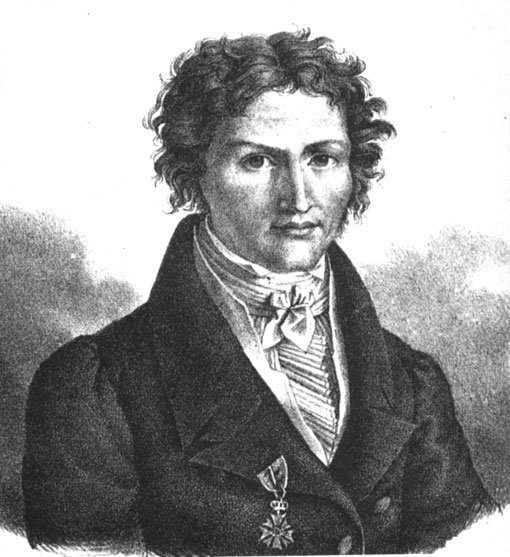
Johann Baptist von Spix

Order: Psittaciformes
Family: Psittacidae
Genus: Pionus
Scientific name: Pionus senilis
Citation: (von Spix, 1824)
Protonimo: Psittacus senilis


Images "Loro Senile":

Videos "White-crowned Parrot"

————————————————————————————————

"Their Senil" (Pionus senilis)


Sources:

Avibase
– Parrots of the World – Forshaw Joseph M
– Parrots A Guide to the Parrots of the World – Tony Juniper & Mike Parr
– Birdlife

Photos:

(1) – A White-crowned Parrot (also known as White-crowned Pionus) at Macaw Mountain Bird Park, Honduras By Pionus_senilis_-Macaw_Mountain_Bird_Park,_Honduras-8a.jpg: Sarah and Jasonderivative work: Snowmanradio [CC BY-SA 2.0], via Wikimedia Commons
(2) – A White-crowned Parrot (also known as White-crowned Pionus) at Macaw Mountain Bird Park, Honduras By nakashi (Flickr: P1100396) [CC BY-SA 2.0], via Wikimedia Commons
(3) – A White-crowned Parrot (also known as White-crowned Pionus) at Macaw Mountain Bird Park, Honduras By nakashi (Flickr: P1100397) [CC BY-SA 2.0], via Wikimedia Commons
(4) – (Pionus Senilis). White-crowned Parrot , Guatemala By Virgilrm at English Wikipedia (Transferred from en.wikipedia to Commons.) [Public domain], via Wikimedia Commons
(5) – A White-crowned Parrot (also known as White-crowned Pionus) at Macaw Mountain Bird Park, Honduras By nakashi (Flickr: P1100398) [CC BY-SA 2.0], via Wikimedia Commons
(6) – White-crowned Parrot (also known as the White-crowned Pionus); close up of upper body By Brian Gratwicke [CC BY 2.0], via Wikimedia Commons
(7) – A White-crowned Parrot at Cape May Zoo, New Jersey, USA By Jim Capaldi (Flickr: Parrot) [CC BY 2.0], via Wikimedia Commons
(8) – (Pionus Senilis) White-crowned Parrot in a tree By Virgilrm at English Wikipedia (Transferred from en.wikipedia to Commons.) [Public domain], via Wikimedia Commons
(9) – White-crowned Parrot (Pionus senilis), also known as White-crowned Pionus, at the aviary Birds of Eden in South Africa By SandyCole (mailto:sandyc@dicksandy.org) (Own work) [CC BY-SA 3.0 or GFDL], via Wikimedia Commons

Sounds: