▷ The world of Pets: Dogs, cats, birds, reptiles, amphibians

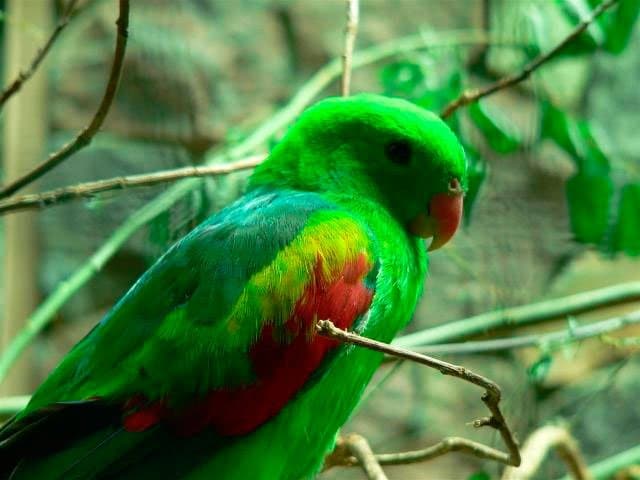
Geelvink Pygmy-Parrot
Micropsitta geelvinkiana


Geelvink Pygmy-Parrot

Content


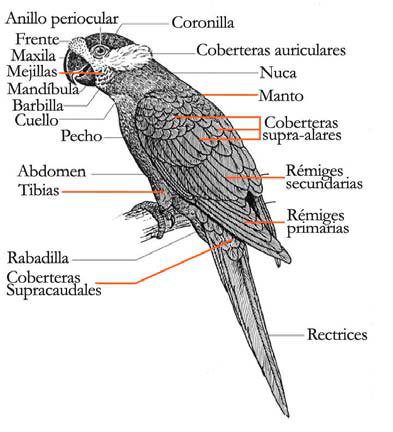
Anatomy-parrots

Description

The Geelvink Pygmy-Parrot (Micropsitta geelvinkiana) has 9 cm.. length between 13 and 17 g. of weight.

The coverts headphones are of color brown with fusion to blue-green in the part rear; crown purple-blue; Upperparts green, Middle coverts with centers of color blackish. The flight feather Black with narrow green borders in vane outer. The underparts Green Center of chest and belly ocher-yellow, more warm towards the part superior of the chest. Uppertail Yellow. Central feathers of the tail blue, Green Tips with yellow spots and black exterior.

The bill grey; irises of color red or brown orange; legs grey.

Female with less blue of the crown and underparts greenish yellow.

Immature with the bill mostly yellow in color and gray tipped.

Subspecies description

  • Micropsitta geelvinkiana geelvinkiana

    : (Schlegel, 1871) – The nominal


  • Micropsitta geelvinkiana misoriensis

    : (Salvadori, 1876) – The male has the head Brown marks on the belly yellow and orange. Female with the crown blue and underparts greenish.

Habitat:

Geelvink Pygmy-Parrot

With distributes in lowland, secondary growth, cultivated areas with isolated trees, and around native gardens, until 300 meters or higher altitudes. The birds are found in groups of 4-5. and is them has seen associate it with other birds in them trees low of berries that accrued in the forest. very shy.

Reproduction:

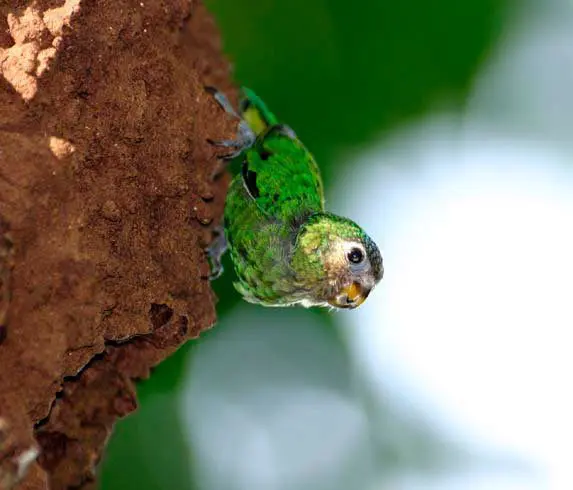
They dig caves in termite tree in which to lay their eggs (also used for rest cavities at night), often close to the ground. The nesting It was observed from mid-June to August. Arndt He found two young in a nest which were visited by the female every two hours. The chamber was filled with dust from the termite mound and contained some broken egg shell and feathers.

Food:

Probably Lichen and fungi from the bark of the trees. As in other Meeki, crushed seeds were found in the stomach of a bird collected.

Distribution:

Size distribution (reproduction / resident): 2,500 km2

Are observed only in Numfor and Biak island, (Indonesian), up to about 300 meters above sea level. In 1991 It was thought that the global population was around of 10.000 and stable, but in 1997 searches for the species over a period of 12 days suggested that it was either rare or easily missed, with observations of a single day, sometimes only with sound contacts.

Subspecies distribution:

  • Micropsitta geelvinkiana geelvinkiana

    : (Schlegel, 1871) – Nominal


  • Micropsitta geelvinkiana misoriensis

    : (Salvadori, 1876) – Present in Biak island.

Conservation:


Near-threatened


• Current IUCN Red List category: Near threatened

• Population trend: Decreasing

The size of the world population It has not been quantified; in 1991 It was estimated in approximately 10,000 specimens. The species is described as well distributed in good numbers in lowland primary and secondary forests. (pit et to the. 1997).

There are no data on population trends, but the species is suspected that it is decreasing at a rate of slow to moderate, due to loss of habitat.

"Geelvink Pygmy-Parrot" in captivity:

Not found in poultry farming.

Alternative names:

Geelvink Pygmy-Parrot, Geelvink Bay Pygmy Parrot, Geelvink Pygmy Parrot (ingles).
Micropsitte de Geelvink (French).
Geelvinkspechtpapagei, Geelvink-Spechtpapagei (German).
Micropsitta geelvinkiana (Portuguese).
Microloro de Geelvink (español).

scientific classification:

Order: Psittaciformes
Family: Psittaculidae
Scientific name: Micropsitta geelvinkiana
Genus: Meeki
Citation: (Schlegel, 1871)
Protonimo: Nasiterna pygmaea Geelvinkiana

Images "Geelvink Pygmy-Parrot"

Videos "Geelvink Pygmy-Parrot"

————————————————————————————————

«Microloro de Geelvink» (Micropsitta geelvinkiana)


Sources:

Avibase
– Parrots of the World – Forshaw Joseph M
– Parrots A Guide to the Parrots of the World – Tony Juniper & Mike Parr
– Birdlife

Photos:

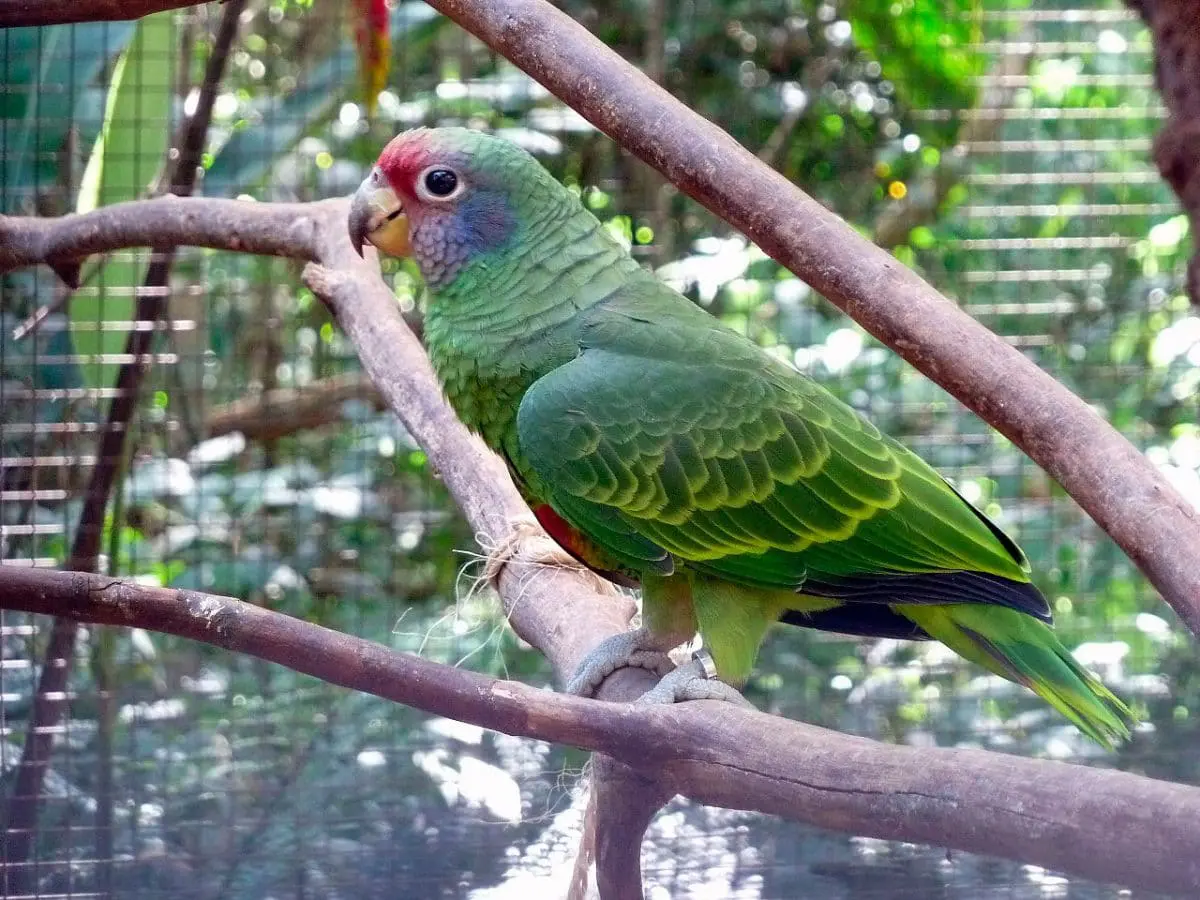
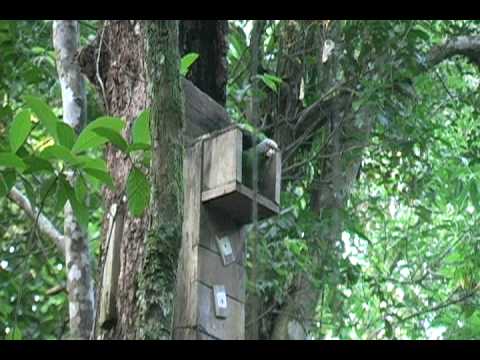
(1) – A juvenile bird on the termite mount (nest). by mehdhalaouate – lynx
(2) – «Nasiternageelvinkianakeulemans» by John Gerrard KeulemansOrnithological Miscellany. Volume 1. Licensed under Public Domain via Wikimedia Commons.

Sounds: George Wagner (Xeno-canto)

▷ The world of Pets: Dogs, cats, birds, reptiles, amphibians

Yellowish-breasted Racquet-tail
Prioniturus flavicans

Yellowish-breasted Racquet-tail

Content

Yellowish-breasted Racquet-tail

Description

37 cm.. length.

The head of the Yellowish-breasted Racquet-tail (Prioniturus flavicans) is bright green, brighter around the lores and the base of the bill.

The front of the crown is green, rest of bright blue with red spot in the center crown. Mantle ocher yellow, well delimited from the blue nape the green of the wings and back; Back and rump green. Wings green, with vane Dark internal to the flight feather and blue to primaries longer. green's Underwing coverts; underside of primaries marked dark blue.

Underparts brighter yellowish green, ocher yellow in the chest. Upper, the outer feathers of the tail green with black and turquoise tips on vane outside of the outer feathers; below, the tail dark colored, bathed in blue at the edges of the vane inner; spatulas blackish.

Bill horn; the dark brown irises; the gray legs.

Female less blue, no red dot on the crown, the underparts and the mantle, greener and rackets (a thin extension of the central tail feathers, almost as hair, It is ending with a more oval-shaped racket) shorter.

Young without rackets.

Habitat:

Found in the primary forest usually below the 1,000 m. But times may vary up to the 1.900 m. They are also observed in trees in cultivated areas.

Reproduction:

Little is known of their reproductive habits.

Food:

The birds they feed on the ground, among the plants of lowland and Hill forests, flocking often in fruit trees. They feed slowly along with other frugivorous birds..

Distribution:

Size of its range (breeding/resident ): 66.700 km2

Are distributed in the North of Sulawesi, Indonesian and on the Islands around, including Bangka, Lembeh and Togian. The species also, possibly, It is distributed in groups of Islands Sangir and Banggai. Although its population may be declining due to habitat loss and trade in birds, It is not considered threatened and is still, relatively, common on reserve Dumoga-Bone. It overlaps, although it is less common, with the Golden-mantled Racquet-tail.

Conservation:


Near-threatened


• Current category of the Red List of the UICN: Near threatened

• Population trend: Decreasing

The population It has been estimated in the order of 45.000 individuals (Walker and Cahill 2000).

It is suspected that this species has diminished recently at a moderately fast pace, due to the continuing loss of forests.

Conservation Actions Proposed:

    – Evaluate the threats to this species. Calculate loss of forests in the lowlands of the North of Sulawesi.
    – Investigate the level of dependency of the forest habitats of the species.
    – Protect effectively important tracts of forest right in key places, both in strict protection areas and in multiple use areas.

"Yellowish-breasted Racquet-tail" in captivity:

Not found in captivity.

Alternative names:

Yellow-breasted Racquet-tail, Yellow-breasted Racket-tail, Red Spotted Racket-tailed Parrot, Red-spotted Racket-tailed Parrot, Red-spotted Racquet-tail, Red-spotted Racquet-tail Parrot, Red-spotted Racquet-tailed Parrot, Yellowish breasted Racquet tail, Yellowish-breasted Racket-tail, Yellowish-breasted Racket-tailed Pa, Yellowish-breasted Racquet Tail, Yellowish-breasted Racquet-tail, Yellowish-breasted Racquet-tailed P (ingles).
Palette de Cassin, Perroquet à raquette de Cassin (French).
Flaggenschwanzpapagei, Flaggen-Schwanzpapagei (German).
Prioniturus flavicans (Portuguese).
Lorito momoto Amarillento, Lorito Momoto Amarillo, Lorito-momoto Amarillento (español).


scientific classification:

John Cassin
John Cassin

Order: Psittaciformes
Family: Psittaculidae
Genus: Prioniturus
Scientific name: Prioniturus flavicans
Citation: Cassin, 1853
Protonimo: Prioniturus flavicans


Images «Lorito Momoto Amarillanto»:

Videos "Yellowish-breasted Racquet-tail"

————————————————————————————————

«Lorito Momoto Amarillanto» (Prioniturus flavicans)

Sources:

Avibase
– Parrots of the World – Forshaw Joseph M
– Parrots A Guide to the Parrots of the World – Tony Juniper & Mike Parr
– Birdlife

Photos:

(1) – By © Simon van der Meulen – Oriental Bird Images
(2) – «Prioniturus flavicans" for John Gould – [1]. Available under the Public Domain license via Wikimedia Commons.

Sounds: Mike Nelson (Xeno-canto)

▷ The world of Pets: Dogs, cats, birds, reptiles, amphibians

Olive-shouldered Parrot
Aprosmictus jonquillaceus

Olive-shouldered Parrot

Content


Anatomy-parrots

Description

35 cm.. length and 130 g. of weight.

The Olive-shouldered Parrot (Aprosmictus jonquillaceus) has the head bright pale green. "Mantle" and back darker green color that the of the head and underparts, showing a blue diffusion; rump bright teal pale. Uppertail brighter yellowish green.

Upper, the wing feathers with small coverts fused in color yellow-green; Blue dark greenish in the curve of the wings; outer median coverts bright Scarlet, feathers interiors lit of color green yellowish with a bit of red in the tips. Large external coverts scarlet, feathers interiors light green, some showing red ends; some feathers turquoise green on the edge of the carpus; primary coverts Green with broadcasting blue at the tips of the vane outer; secondary green medium, primaries medium green with blue diffusion in the coats of the feathers outermost. Wing feathers brighter yellowish green; underside of flight feather black. The underparts light green, more yellowish in them the thighs and undertail-coverts. Upper, the tail of color green dark with edges of color yellow, and with vane yellowish external to the lateral feathers; undertail, the tail of color Brown blackish with tips yellow, and with yellowish diffusion in vane outside of lateral feathers.

Bill orange red, with yellow tip; irises orange: legs blackish gray.

The female lacks of the broadcast Blue in the the mantle, shows less contrast between the head and the the mantle, limb yellowish to them greater coverts red, and have them irises more Brown.

Immature has green, No greenish-yellow, in the wing-coverts and irises of Brown pale.

Subspecies description

  • Aprosmictus jonquillaceus wetterensis

    (Salvadori, 1891) – The male as the nominal but the coverts wing lower and Middle are of color green washed with yellow; the mantle and top of the back pale green, with less blue markings; less red on the outer half and the secondary wings covers; smaller.

    The female is like the female of the nominal species, but the uppertail-coverts darker green; slightly smaller in size.

    The youth as the youth of the nominal species, but with the uppertail-coverts darker green; smaller.


  • Aprosmictus jonquillaceus jonquillaceus

    (Vieillot, 1818) – The nominal

Habitat:

In Timor the species is found in forests, acacia savannas, primary and secondary forest, from sea level to the 2.200 m (2.600 meters altitude extreme). In Wetar, observed in 1990 in recently logged forests, near the coast.

The ecology of the species is probably similar to that of the Red-winged Parrot, but it is not well known; observations of birds that fly involve couples and small flocks. A couple allowed a closer approach, observing her in silence to three meters high in a big tree.

Reproduction:

Their reproductive habits are unknown, probably similar to the of the Red-winged Parrot.

Food:

Probably similar to the of the Red-winged Parrot: seeds, fruit, flowers and insects; in the mangroves, the mistletoe is your favorite food.

Distribution:

Size of the area of distribution (reproduction / resident): 28.500 km2

Endemic and quite common in Timor (for example, about Camplong, Kupang, Lelogama, Mutis and Dili), Wetar and Roti.

The world population is estimated at around 10.000 specimens and it is probably stable, although like most Indonesian parrots the species is vulnerable to capture and habitat loss. A moderate number in captivity.

Subspecies distribution:

Conservation:


Near-threatened


• Current IUCN Red List category: Near threatened

• Population trend: Decreasing

The total population has been estimated at 10,000 individuals (Lambert et to the., 1993), probably including mature individuals 6,700.

The population is suspected that it may be declining due to the continuous destruction of the habitat and unsustainable levels of exploitation.

Ongoing conservation actions

Appendix II of CITES. Quotas were imposed during the Decade zero of 1990 while uncertainty existed about the total population size, but these are not met.

Conservation Actions Proposed

• Review estimates of the population of the species and review the impact of trade on their numbers..
• Determine if declines are still evident.
• Protect areas of suitable habitat.

"Olive-shouldered Parrot" in captivity:

Game, with low noise level, aggressive with other birds. You can require deworming.

Very rare in captivity

Alternative names:

Olive-shouldered Parrot, Jonquil Parrot, Olive shouldered Parrot, Timor Parrot, Timor Red-winged Parrot (ingles).
Perruche jonquille (French).
Timorsittich, Timor Sittich (German).
Periquito-de-asa-vermelha-de-timor (Portuguese).
Papagayo de Timor (español).

scientific classification:

Order: Psittaciformes
Family: Psittaculidae
Genus: Aprosmictus
Scientific name: Aprosmictus jonquillaceus
Citation: (Vieillot, 1818)
Protonimo: Psittacus jonquillaceus

Images "Olive-shouldered Parrot"

————————————————————————————————

«Timor parrot» (Aprosmictus jonquillaceus)


Sources:

Avibase
– Parrots of the World – Forshaw Joseph M
– Parrots A Guide to the Parrots of the World – Tony Juniper & Mike Parr
– Birdlife

Photos:

(1) – Aprosmictus Jonquillaceus – LoroMania

Sounds: Mike Nelson (Xeno-canto)

▷ The world of Pets: Dogs, cats, birds, reptiles, amphibians

Golden-shouldered Parrot
Psephotellus chrysopterygius


Golden-shouldered Parrot

Content


Anatomy-parrots

Description

26 cm. length between 54 and 56 g. of weight.

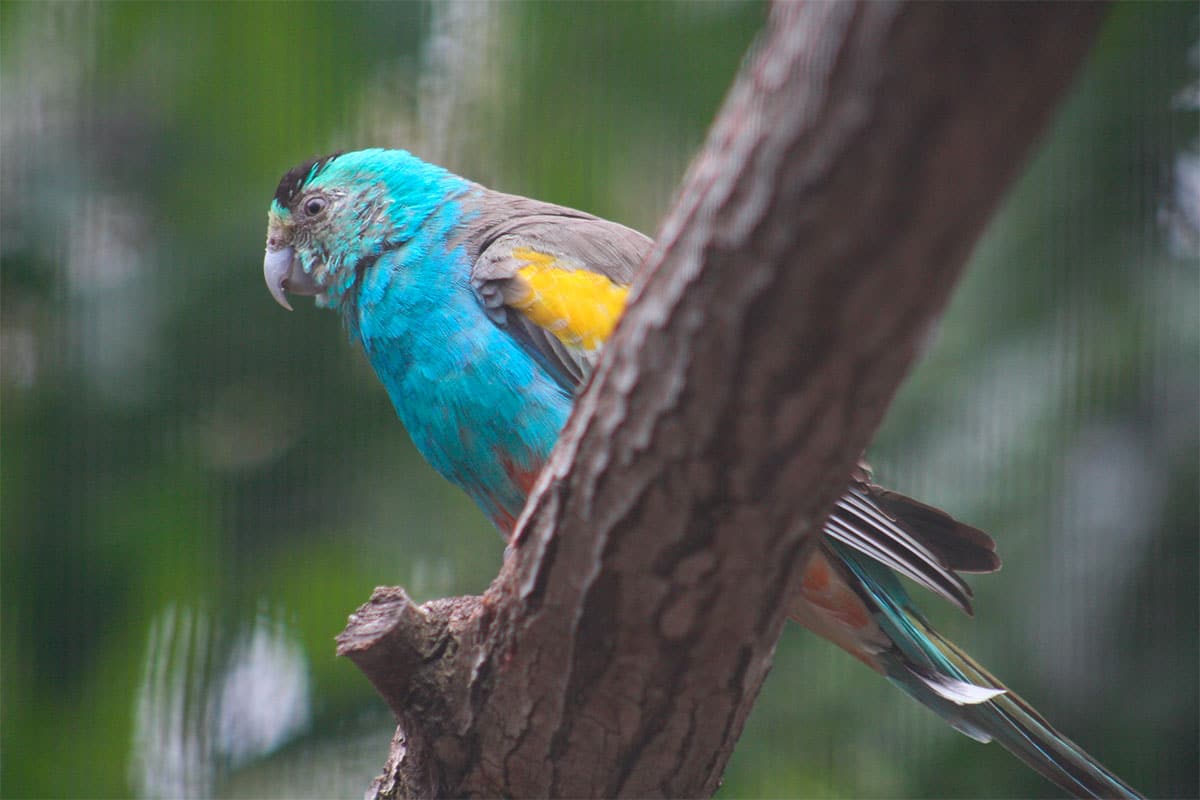
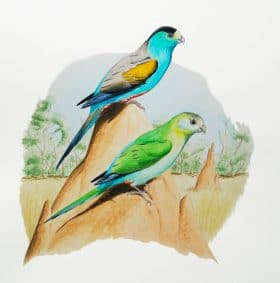
The Golden-shouldered Parrot (Psephotellus chrysopterygius) males have a pileum black, the forecrown, the lores and orbital area yellow, slightly with blue-green tones. The black of the pileum merges gradually with the greyish Brown of the the mantle, with some blue on the back neck pink. The rump shows a beautiful turquesa color that contrasts slightly with the green color of the tail view from above.

The median bright yellow, they form a visible band in the wings. The greater coverts they have a dominant brown-black color with some small patches of Turquoise Blue clear.

The flight feather they are blackish with a turquoise-colored border around the vane outer. The underparts is blue. The lower parts are turquoise blue, except the lower abdomen and the lower part of the tail, that are red with bases and white finishes. The central tail feathers they usually have a bluish-black-tipped bronze color. The lateral tail feathers they are blue-green with white tips. The underside of tail is white with a dark blue finish. The bill is pale-grey. The irises are dark brown, the legs brownish grey.

The females they have a yellowish-grey colour, along with opaque Brown wash on the top. It also, they have the forecrown yellowish. The flanks, bottom of the chest and Hip they are shaded light blue. The belly is whitish grey with red spots. You can see a pale bars on the wings.

The immature are similar to the females, although young male they have a dark CAP and the cheeks more blue. Young people acquire their adult plumage final at the age of 16 months.
Habitat:

Golden-shouldered Parrot

The Golden-shouldered Parrot they are birds sedentary. But, just after the nesting season, they can make short trips that lead to mangroves. At the time of playback, mainly frequent open forests of eucalyptus and logging and whose undergrowth is covered with a thick layer of grass. Within these areas, the Golden-shouldered Parrot nest, mainly, along with small partially invaded by water bowls. In the territory should, mandatory, Haber mounds of earth made by termites, which are essential for the nesting of this species.

The Perico Aligualdor, usually, they live alone, in pairs or small family groups, but they also sometimes gather in flocks of up to 30 individuals. These birds feed and quench your thirst first thing in the morning or in the evening. They rest on the foliage during the hottest times of the day. The Golden-shouldered Parrot they tend to feed on the ground, where venture with confidence. They find refuge in trees if bother them. They walk up to small pools of water where bathing and quench your thirst.

Reproduction:

The time of reproduction extends from April to August. During courtship, the male makes short flights around the female, rising from the front a short feather Crest and waving his chest feathers.

The Golden-shouldered Parrot they dig their nests in a termite mound still damp from recent rains.

There are two types of termite mounds that are usually used by this species:

– built by termites type conical termite mounds Scopulus

– semicircular termite mounds built by termites of the type laurensis.

The first are usually their favorite because the temperature is most constant, while in semicircular termite mounds, they often have the entrance North, which sometimes causes large thermal contrasts. The mound may contain several nesting rooms. The nest entrance is located between 45 and 125 cm above the ground. A long tunnel 15 to 60 cm ends into a round hole in one 25 cm long.

The Golden-shouldered Parrot It lives in symbiosis with a moth:
The Trisyntopa Scatophaga that at the same time it lays its eggs in the nest of the parakeet. The larvae feed on feces and feathers of the juveniles, helping to keep the nest clean waste.

The female lays of 4 to 7 eggs who is responsible for incubating single for almost 20 days. The young man takes around 5 weeks to acquire all their feathers and leaving the nest. A week after hatching, the male joins the female to feed the young. He stands guard at the top of the nest for long periods of the day.. When he brings the food, notifies the female's arrival, emitting loud cries. When it is time to leave the nest, the young are able to fly into the tunnel without landing.. After the trip, continue to be fed by adults for at least 2 weeks. They remain in the family group for quite some time. To the dispersal of family groups, young males are away more of their places of birth than young females.

Food:

outside the breeding season, the Golden-shouldered Parrot they have a diet almost exclusively vegetarian. Subsist on grass seeds Panicum or Eragostris. They often feed on fallen seeds of different plants.. during the rainy season, When these resources become scarcer, It is likely that it depends on the species of plants that can be found throughout the year.

Distribution:

endemic to northeastern Australia, where is distributed only in a small area north of the río Morehead and South of Musgrave, to the North of Queensland. There are currently at least four populations, each with between 30 and 100 birds, so the world's population can be of no more than 500 individuals, or 150 breeding pairs. Other more recent sources estimate the spawning in around 2.500 individuals mature (Garnett et to the., 2011).

A record of 1980 It extended its known range North to the pascoe river, but in general it has contracted markedly in recent 100 years, prior records were situated towards the South, until around Normanton.

They were largely trapped in the past, especially since the mid of 1960 until the beginning of 1970. But, grazing and burning of crop residues, the spread of tea trees Leptospermum, predation by cats and the disruption of nests by tourists, It may have played one major role in the decline of the species.

Despite the fact that is protected, probably some catches continue.
Some individuals in captive.

Conservation:


Endangered


• Current category of the Red List of the UICN: Danger

• Population Trend: Decreasing

The breeding population has been estimated at around 2.500 individuals mature (Garnett et to the., 2011)

Historically, There were three confirmed breeding populations: from Coen to Port Stewart, According to sources taken in the decade of 1920, río Musgrave-Moorhead where the population has shrunk considerably and continues to decline, and to the West of Chillagoe where the population persists, with a stable trend. In general, the population is suspected that it may now be decreasing (Garnett and Crowley 2000), Although the likely rate of decline has not been estimated.

The species has suffered terribly from poaching in the Decade of 1960 and the early 70 Although this bird is protected, such practices still exist.
Today, the Golden-shouldered Parrot faced with new threats: the development of new agricultural land and the destruction of traditional habitats where they were distributed.

"Golden-shouldered Parrot" in captivity:

The Golden-shouldered Parrot It has always been a rare guest of aviaries in the world. But, There are now more birds in captivity than exist in the wild., which demonstrates the difficulties encountered by these birds in their natural habitat.

This species is not recommended for beginners; prices already are high enough to discourage potential buyers, only the true, virtually "professional" fans remain.

A small group composed of one male and seven females of Golden-shouldered Parrot they came to Britain in 1897. These birds were forerunners, but the first known result of successful reproduction dates of 1961. Is inscribed with the name of Alan Lendon an Australian.
The second reproductive success corresponds to a German W. Etterich, This was in 1966. R. Burkard from Zurich achieved it in 1968. It also, in 1954, a so-called Australian breeder Edward Hallstrom got sixteen hybrids after the mating of two males of Golden-shouldered Parrot with females of Hooded Parrot.
Nowadays there are many impure birds in hobby aviaries and that is a shame. These are mostly young hybrid females. These birds do not have the opaque yellow band on the front and, Therefore, one can easily recognize, female purebred if they have the yellow tape and a bronze-colored Crown clear.

The Golden-shouldered Parrot does not resist well a temperate maritime climate; are very sensitive to cold humidity. Apart from that, it is a peaceful and active bird, she is not shy and quickly forges a friendship with her caretaker. His voice is melodious, with what does not bother the neighbors. You spend much time on the ground and like, often, bathing. They are aggressive during breeding with other birds and it is not appropriate to keep them outside with other species.; interactions with other birds are often problematic.

Alternative names:

Golden-shouldered Parrot, Antbed Parrot, Anthill Parrot, Chestnut-crowned Parakeet, Chestnut-crowned Parrot, Golden shouldered Parrot, golden-shouldered parakeet, Golden-shouldered Parrot (chrysopterygius), Golden-winged Parakeet, Golden-winged Parrot (ingles).
Perruche à ailes d’or, Perruche à ailes d’or (chrysopterygius) (francés).
Goldschultersittich (alemán).
Periquito-de-asas-douradas (portugués).
Perico Aligualdo, Perico de Alas Amarillas, Loro Hombroamarillo, Periquito de Espalda Dorada (español).

scientific classification:

Order: Psittaciformes
Family: Psittaculidae
Genus: Psephotellus
Scientific name: Psephotellus chrysopterygius
Citation: Gould, 1857
Protonimo: Psephotus chrysopterygius

Images "Golden-shouldered Parrot"

Videos "Golden-shouldered Parrot"

————————————————————————————————

«Perico Aligualdo» (Psephotellus chrysopterygius)


Sources:

Avibase
– Parrots of the World – Forshaw Joseph M
– Parrots A Guide to the Parrots of the World – Tony Juniper & Mike Parr
– Birdlife

Photos:

(1) – Male Golden-shouldered Parrot at Lone Pine Koala Sanctuary, Brisbane, Queensland, Australia By TheGirlsNY (originally posted to Flickr as Pretty bird) [CC BY-SA 2.0], via Wikimedia Commons
(2) – Golden-shouldered Parakeet (Psephotus chrysopterygius) – watercolor, Romain Risso By Gossipguy (Own work) [CC BY-SA 3.0], via Wikimedia Commons

Sounds: Phil Gregory (Xeno-canto)

▷ The world of Pets: Dogs, cats, birds, reptiles, amphibians

Yellow-crowned parakeet
Cyanoramphus auriceps

Yellow-crowned parakeet

Content


Anatomy-parrots

Description

23 cm.. length and an approximate weight of 95 g..

In the distance, the Yellow-crowned parakeet (Cyanoramphus auriceps) appears as a fully green Parrot, light and bright above that below.

It has a yellow spot in the forecrown, above a red stripe that goes from the bill both eyes. It can be confused with the Red-crowned parakeet (Cyanoramphus novaezelandiae) who lives in the same circles.

The upperparts they are green with a red patch on each side of the rump. Alula, primary covertss and vane outside of the primaries are blue-violet color.

feathers of the wings Green with blue at the edges of the previous; a wing bar at present times.

The underparts more yellowish green, sometimes with yellow marks.

Tail of color green for over, dark grey below.

The bill blue grey at the base, Blackish at tip; irises orange-red; legs greyish brown.

The females they are slightly smaller than males.

The young birdss have the peaks paler, queues shorter and the irises light brown.

Both females as the juveniles They show a drawing in the form of bar under the wings.

Habitat:

Yellow-crowned parakeet

On the Mainland, the Yellow-crowned parakeet, they are mainly distributed among the lush native forests, mainly in the provided ecosystems of Nothofagus and Podocarpus, at an altitude of about 600 m. Although these birds are at much lower altitudes, the species tends to move at altitudes which are the Red-crowned parakeet, especially when their habitats overlap.

The Yellow-crowned parakeet they are more common in closed areas of scrub, less common in open spaces by which moves the Red-crowned parakeet.

It is more common on offshore islands, where predation by introduced mammals is reduced.

Birds are found more often in pairs or small groups, feeding in the middle or upper floor of forest or large shrubs. Although it is, generally, more arboreal than the Red-crowned parakeet, they tend to feed on land in the islands of the coast.

Reproduction:

The breeding habits they are similar to the of the Red-crowned parakeet, but these birds seem to be more territorial around the nest.

The Yellow-crowned parakeet They nest in tree holes.

The implementation is performed between the months of October to December but have been observed nesting in almost every month, presumably in response to food availability. Of five to nine eggs whites make up the implementation, with one incubation between 18 and 20 days. The calf is fed by the female who in turn receives food from the male., the young remain in the nest from five to six weeks.

Food:

The diet consists of plant material including outbreaks, berries, flowers and seeds, as well as invertebrates such as larvae, for example, Heliostibes vibratrix and mealybugs Ultracoelostoma assmile. The insects They seem to be more important in the diet of the Yellow-crowned parakeet that in the of the Red-crowned parakeet.

Distribution:

The Yellow-crowned parakeet they can be found in New Zealand and in some islands of the coast.
They are absent, to a large extent, in the North of Auckland, but they are moderately common in some of the largest forested areas, including Urewera, Montes Raukumara, the area of the motu river, Pirongia, Pureora, Ruahine mountains, Tararua mountains, and in the South Island in the National Park Abel Tasman, the Nelson district, the Paparoa mountain range, Arthur's pass, Districts the Hope River and Canterbury, and in Fiordland about Te Anau and Cascade Creek.

Yes the aclaramineto of their continuous habitat, It might be a threat to the species.

The Yellow-crowned parakeet also you can find in the following islands of the coast: Three Kings, Polla, Big Chicken, Little Barrier, Great Barrier (rare), Kapiti (rare), the Chetwode Islands (absent the Red-crowned parakeet), Stewart Island e satellite islets, Codfish, Solander, Ruapuke and Auckland Islands, including the Adams island.

The species is also found in the chatham islands, where the Chatham Parakeet It has suffered from habitat loss, as well as competition and hybridization with the Red-crowned parakeet: both hybrids together with the Red-crowned parakeet, they survive better in open areas, helped by the improvement of the habitat and hybridisation control, so getting a slow recovery.

Conservation:


Near-threatened


• Current Red List of UICN: Near threatened

• Population trend: Decreasing

In the past the population of the Yellow-crowned parakeet has declined in number and the species is now rare throughout its range. As a result, is suspected to have one moderately low population. The world's population believed that it is inferior to the 5.000 specimens.

It is believed that this species has been adversely affected by the logging of forests, introduced predators, (cats, stoats and rats) and hybridization. Consequently, that you have been moderate declines in population to this day.

In the islands of the coast, the Red-crowned parakeet is usually much more common (Heather and Robertson 1997) and can be replaced by full to the Yellow-crowned parakeet in Solander Island. In Auckland Islands, There is an abnormally high rate of hybridization between the two species.

"Yellow-crowned parakeet" in captivity:

not as common as Red-crowned parakeet.

For its upbringing it is enough to have previous experience in the breeding of any of the smaller Australian parrots..

Reasonably hardy to cold, It has a thick plumage on their underparts which gives them a good insulation against the harsh winters; they withstand a cooler climate than most Australian species.

The sound of their voices is not strong or offensive and consists of pleasant chattering.

In terms of their longevity, according to sources, one specimen was still alive after 9.3 years in captivity

Alternative names:

Yellow-fronted Parakeet, Kakariki, Yellow-crowned Parakeet (English).
Perruche à tête d’or (French).
Springsittich (German).
Kakariki-fronte-amarela (Portuguese).
Perico Maorí Amarillo, Perico Maorí Cabecigualdo (español).

scientific classification:


Order: Psittaciformes
Family: Psittaculidae
Genus: Cyanoramphus
Scientific name: Cyanoramphus auriceps
Citation: (Kuhl, 1820)
Protonimo: Psittacus auricep

«Wild-headed Maori Parakeet» images:

Videos "Yellow-crowned parakeet"

Yellow-crowned parakeet (Cyanoramphus auriceps)

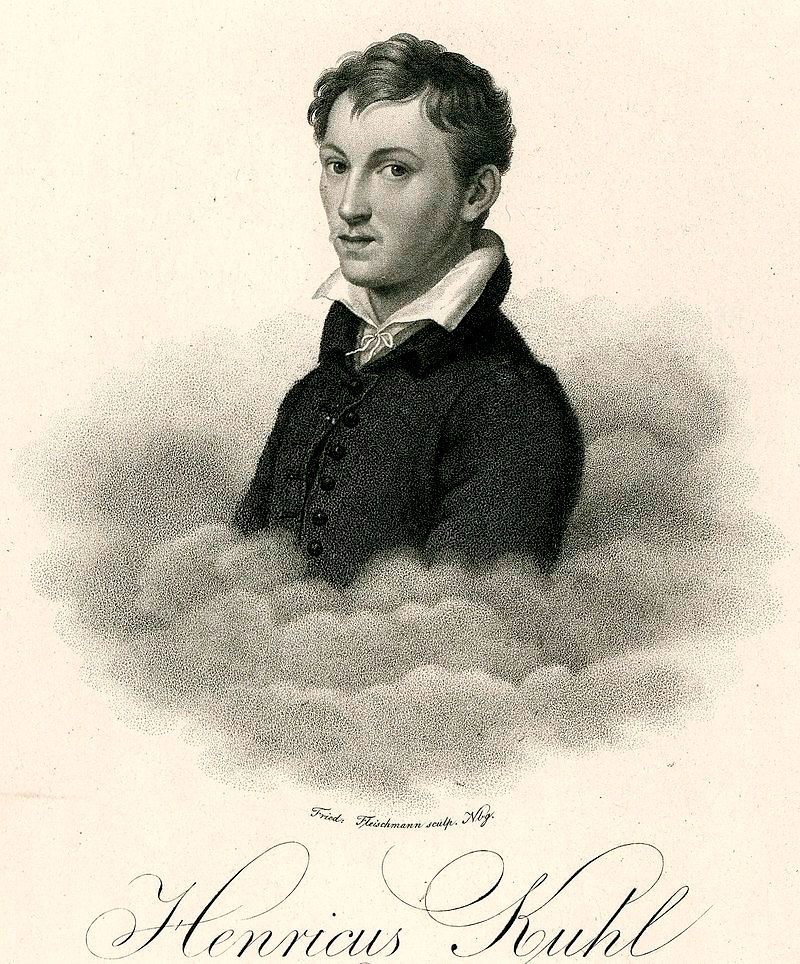
Kuhl, Heinrich
, via Wikimedia Commons
(2) – Yellow-crowned Parakeet, (Cyanoramphus auriceps) Nga Manu, Nr. Wellington, New Zealand. By Phillip Capper [CC BY 2.0], via Wikimedia Commons
(3) – A Yellow-crowned Parakeet in Otorohanga Kiwi House, New Zealand By Takver from Australia [CC BY-SA 2.0], via Wikimedia Commons
(4) – A captive Yellow-crowned Parakeet By Nrg800 (Own work) [CC BY-SA 3.0 or GFDL], via Wikimedia Commons
(5) – Photo of Kakariki (Cyanoramphus auriceps) taken during Routeburn Classic 2012 By Grapeman4 (Own work) [CC BY-SA 3.0], via Wikimedia Commons
(6) – Yellow headed parakeet Cyanoramphus auriceps (1884) By William Thomas Greene (Birds in captivity) [Public domain], via Wikimedia Commons

▷ The world of Pets: Dogs, cats, birds, reptiles, amphibians

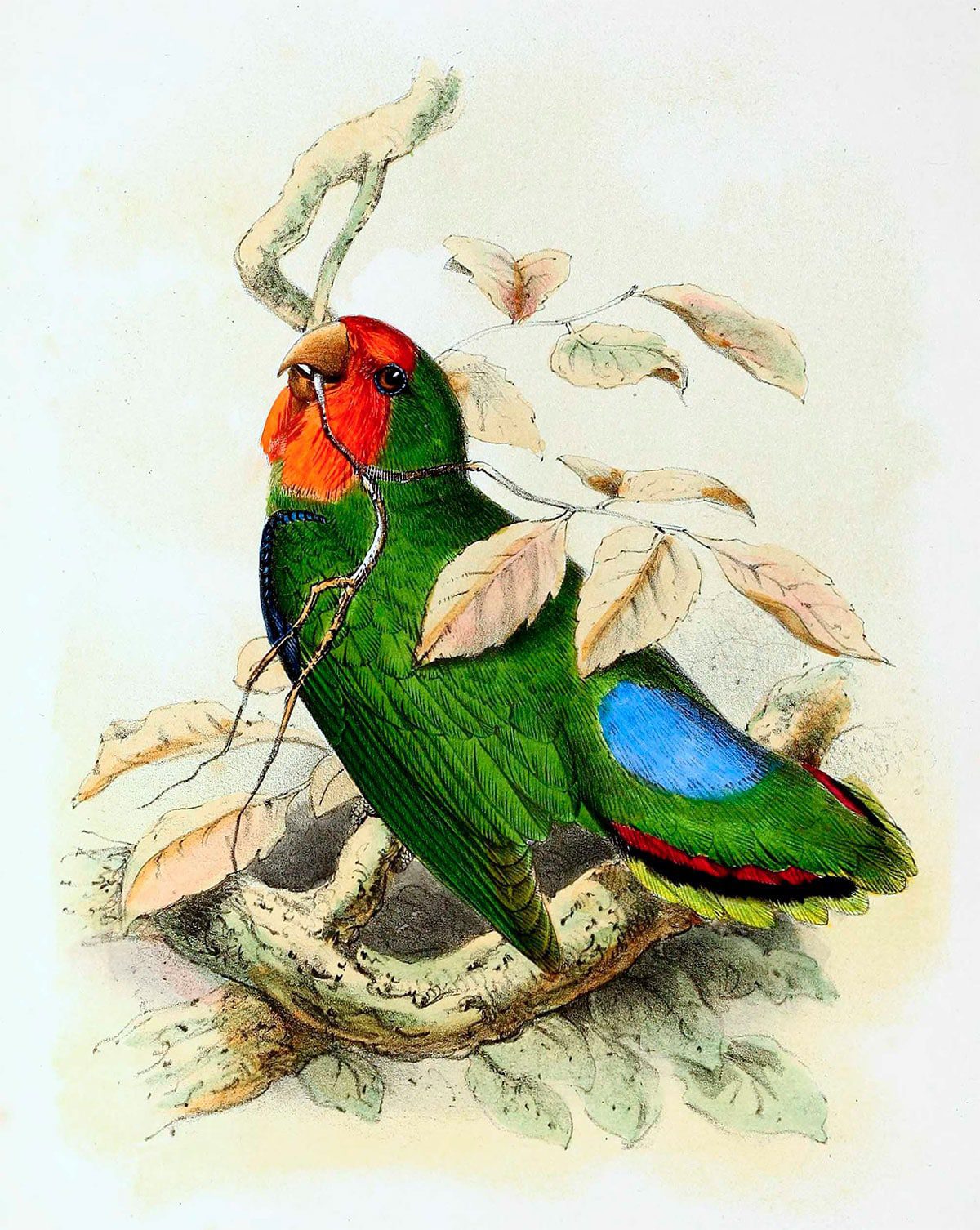
Red-headed Lovebird
Agapornis pullarius


Inseparable Carirrojo

Content

Description «Inseparable Red-faced»:

Ilustración Inseparable Carirrojo

Among 13 and 15 cm in length and a weight between 29 and 50 g..

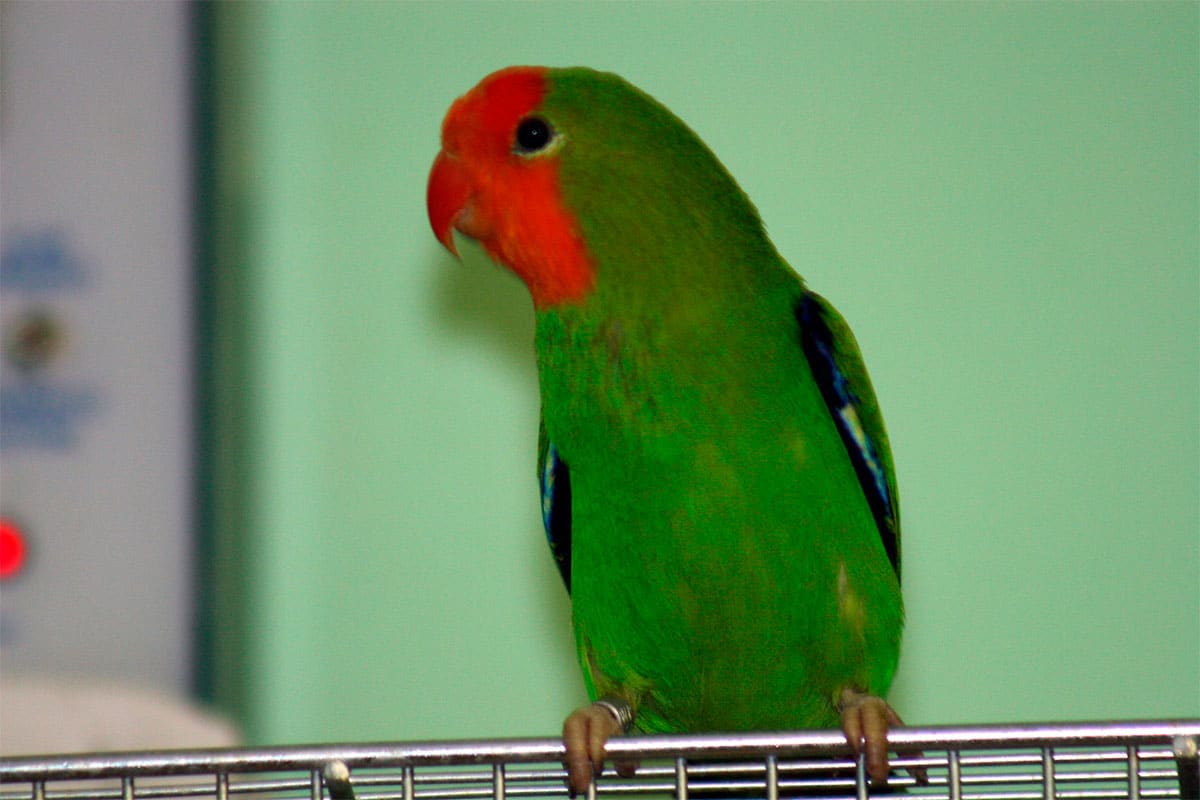
The Red-headed Lovebird (Agapornis pullarius) has the forecrown, the front of the crown and lores bright orange red; the back of the crown, nape, the mantle and scapulars bright green; rump bright light blue; uppertail-coverts They are bright green; undertail They are yellowish green. Upper, the wing-coverts they are bright green and gives the impression of being in relief; small area of ​​clear bright blue in the carpal joints. The primaries and secondaries Green in them vane external and blackish at the internal. Under, the wing-coverts they are black, underside of flight feather blackish. The chin and throat They are bright orange-red; rest of the underparts bright green (paler than the upper region). Central feathers of the tail green, the green side marked red and with a black subterminal band, yellow (or yellowish green) at the tips.

Bill red. The eye ring It is formed by a thin and small band of blue and white feathers; irises dark brown; legs gray or greenish gray.

The female of the Red-headed Lovebird has the head, the chin and throat with yellowish orange edges in the back. Under, the wing-coverts green.

The immature they are like the adult female, but the orange color head and throat It is yellower. Young males shows the black color wing-coverts undertail. The bill is reddish brown.

Description 2 subspecies:

  • Agapornis pullarius pullarius

    (Linnaeus, 1758) – The nominal species


  • Agapornis pullarius ugandae

    (Neumann, 1908) – Possibly you have blue color rump a shade lighter than the nominal species.

Habitat:

The Red-headed Lovebird They inhabit humid lowland savannahs., isolated patches of forests into savannas, Riverine forests, shrublands, and more open habitats, including abandoned plantations, cropland and pasture.

They prefer secondary forests and primary education, only in the vicinity of grassy clearings.

Usually live below 1.500 m altitude, until 2.000 metres in Uganda.

Shapes flocks of up to 30 birds, wandering in search of food and returning at sunset to their communal roost favorite.

In captivity, often they sleep hanging upside down.

Reproduction «Inseparable Red-faced»:

The Red-headed Lovebird are single birds with respect to the breeding. They build their nest in a tree cavity (generally excavated by a Woody Woodpecker), in some hole dug by arboreal ants or occasionally termiteros terrestre.
The nest It is a bed of hulls and shredded leaves, perhaps hardened excrement. The female, apparently, It is responsible for its construction.

The breeding season It covers the rainy season, when grass sowing is done. The laying compose from 3-6 eggs (sometimes more in captivity).

The chicks hatch without down.

“Inseparable Red-faced” Feeding:

The diet Red-headed Lovebird It is mainly composed of grass seeds, including cultivars (millet and sorghum).
They also feed, occasionally, of fruit (Psidium and Ficus).

Considered as plague serious of crops in some areas.

Distribution:

Size of the area of distribution (reproduction / resident): 8.360.000 km2

The Red-headed Lovebird They are widely distributed, but erratically through West Africa and central. There are records Guinea, North of Sierra Leone and North of Ivory Coast in the region of Boundiali and Tingrela; in Ghana, found in the north and east of the country, south and west around Acra. They are also observed in southern Togo and Benin and in parts of central and southern Nigeria, but apparently absent from the coastal regions.

The islands gulf of guinea (in prince island extinct). Irregularly distributed through Cameroon to the South of Cabinda and Northwest of Angola (possibly south to the cuanza river) and of the Central African Republic and southern end of Chad to the South of Sudan and North of Democratic Republic of the Congo; in Uganda and registered at the west end of Kenya, and Northwest of Tanzania.

Burundi and Rwanda. There is a seemingly isolated population in southwest Ethiopia.

Usually sedentary although some local migrations and nomadism have been recorded (for example, Nigeria, Uganda and Tanzania).

Its abundance varies widely: common in some areas (for example, flood plains Niger, Nigeria and Brazzaville, Republic of Congo), but only locally abundant (for example, Ethiopia):. Uncommon in many other areas (e.g Angola, South of Ghana – where apparently it is almost extinct – and West Kenya ). Its population also varies due to nomadic habits., but a true overall decline appears to have occurred in many areas in this century. Caught for the trade in live birds with large numbers in captive outside the range.

Subspecies distribution:

  • Agapornis pullarius pullarius

    (Linnaeus, 1758) – The nominal species


  • Agapornis pullarius ugandae

    (Neumann, 1908) – Ethiopia, Uganda, is of Democratic Republic of the Congo, Rwanda, West of Kenya and Tanzania

Conservation:


minor concern

• Current Red List of UICN: Least concern

• Population trend: Decreasing

The size of the world population It has not been quantified, but the species, according to sources, in general it is quite rare and never reported as abundant, except locally on Ethiopia (pit et to the. 1997).

The population of the Red-headed Lovebird It is suspected that it may be in decline due to ongoing habitat destruction and unsustainable levels of exploitation.

The «Inseparable Red-faced» in captivity:

Quite common to 1960, since then rarely available and difficult to find specimens that are not imported due to the difficulty of breeding them in captivity.

The Red-headed LovebirdLovebirds.

The Red-headed Lovebird they are birds calm and harmless; initially shy and huidizos; They can easily hit when excited; newly imported birds are susceptible; keep in small cages at first and place it in a quiet place; regularly manage complex with vitamina C; are not big chewers; in communal aviaries only species pinzones, because they can not compete with other species Lovebirds; changing diet or the establishment, only when absolutely necessary, to They are not very adaptable; immature susceptible to 10 months, after they are more resistant.

Being a bird with little success in breeding, no mutations are known about him.

With regard to its longevity, according to sources, a specimen lived for 18 years in captivity.

Alternative names:

Red-headed Lovebird, Red headed Lovebird, Red-faced Lovebird (English).
Inséparable à tête rouge, Inséparable à face rouge, Inséparable pullaria (French).
Orangeköpfchen, Unzertrennlicher (German).
Inseparavel de cabeca vermelha, Inseparavel-de-cabeca-vermelha (Portuguese).
Inseparable Carirrojo, Inseparable de Cabeza Roja, Agapornis Pullaria (español).


scientific classification:

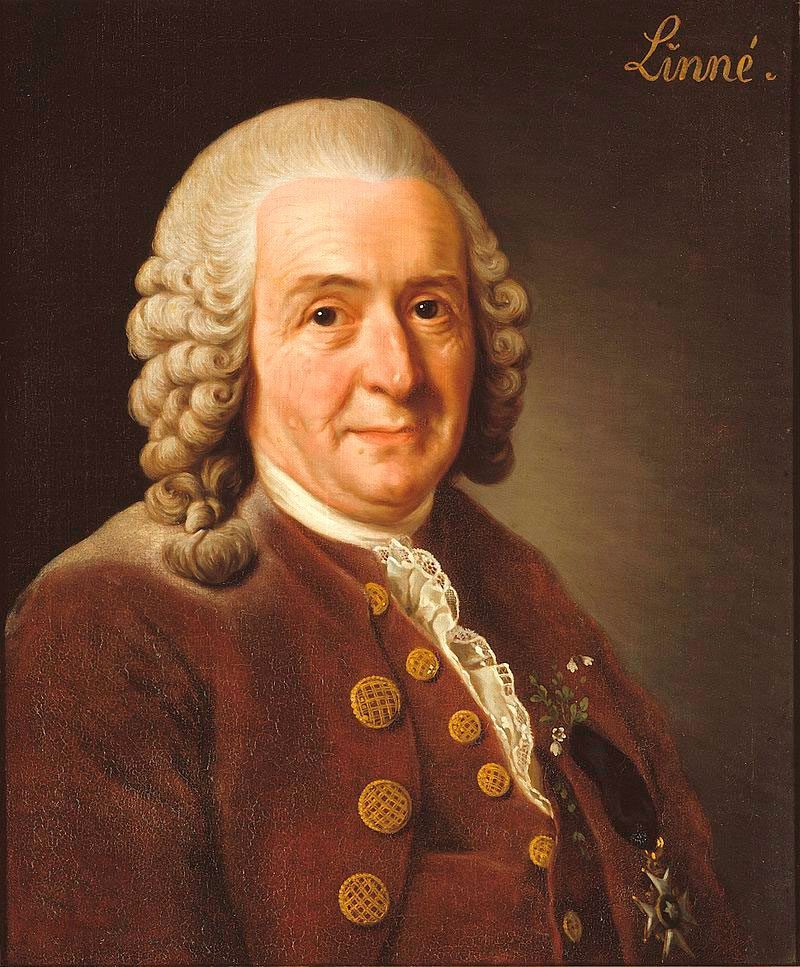
Carl Linnaeus
Carl Linnaeus

Order: Psittaciformes
Family: Psittaculidae
Genus: Lovebirds
Scientific name: Agapornis pullarius
Citation: (Linnaeus, 1758)
Protonimo: Psittacus pullarius

«Inseparable Red-faced» images:

Videos "Red-headed Lovebird"


Species of the genus Agapornis


«Inseparable Carirrojo» (Agapornis pullarius)


Sources:

Avibase
– Parrots of the World – Forshaw Joseph M
– Parrots A Guide to the Parrots of the World – Tony Juniper & Mike Parr
– Birdlife

Photos:

(1) – photo sent by Federico Antonio Herd Misantone – Agapornis.it
(2) – By H.v.d.Hoek. – gosenbenjamins.nl
(3) – 10 four young birds breeding pairs By HvdHoek. – gosenbenjamins.nl
(4) – MiAgapornis
(5) – female by ConservationIsGreat – Lynx
(6) – Agapornis pullarius (Red-headed lovebird) by John Gerrard Keulemans [Public domain], via Wikimedia Commons

Sounds: selvino (Xeno-canto)
▷ The world of Pets: Dogs, cats, birds, reptiles, amphibians

Saffron-headed Parrot
Pyrilia pyrilia

Saffron-headed Parrot

Content

Saffron-headed Parrot

Description:

22,8 to 25,4 cm.. height.

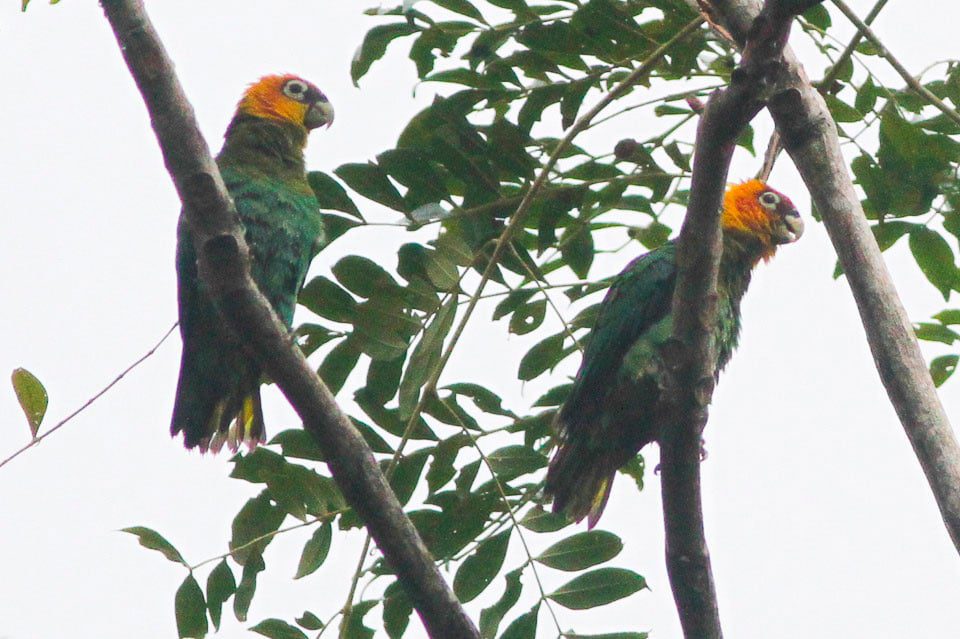
The Saffron-headed Parrot (Pyrilia pyrilia) is characterized by the lores naked; head, rear and both sides of the neck, bright yellow. Upperparts green. The spots of the upperwing-coverts are bright yellow with some red feathers at the base; Red at the front edge of the wing with the external medium upperwing-coverts blue, or green with blue tips. The primary coverts are black, with the coverts remaining of the party top, green, sometimes with blue tips.

Primary and secondary bluish black with narrow green margin to the outerweb; tertiary green. Under the wings and axillary bright red, flight feather of color bluish pale. Breast Yellow olive; belly Green but paler and more yellowish than the top; undertail-coverts green. above the tail with yellow in the innerwebs and blue tips; yellowish below. Bill color pale horn; cere blackish; dark grey skin nude of the lores extends around the eye ring; eye ring whitish; irises dark brown; legs grey.

Both sexes similar. The immature has the crown and shoulders Green with yellow yellowish brown in the face and throat.

Habitat:

Little known throughout its distribution. It inhabits in humid jungles, very wet, high secondary forest and cleared areas, between the 300 to 1700 m. In Venezuela can be seen in tropical and subtropical areas at altitudes of 150-1650 m (perhaps only seasonally to higher altitudes) and 1.000 metres in Colombia. Usually gregarious, seen in groups of up to 10 individuals.

Reproduction:

With reproduce during the first half of the year.
Birds in breeding conditions observed in the months of March-June in Antioquia (Colombia). Immature seen during the month of July in Sierra de Perija (Venezuela and Colombia).

Food:

Just have your feed data, Although it more likely is that your diet is composed of of fruit, berries and seeds.

Distribution:

Size of the area of distribution (reproduction / resident): 577.000 km2

The Saffron-headed Parrot is distributed in the this of the Province of Darien, Panama, to the North of Colombia and Northwest of Venezuela.

There are two records in the Northwest of Ecuador, a wandering pair alleged in the Book ecológica Cotacachi-Cayapas and a flock of about 20 birds in the Pedro Vicente Maldonado Canton, in the Northwest of Pichincha (Ridgely and Greenfield 2001), Although their status is uncertain (JF Freile in litt., 2000, Ridgely and Greenfield 2001).

Today it is rare to see to the Saffron-headed Parrot in accessible areas, Although it is still common Serrania de las Quinchas (Boyacá) and in the Hill of the peace (Santander) (Donegan et to the., 2003), Colombia and is soon likely to have decreased significantly in the Chocó, Colombia, or Darien (GR Angehr in litt., 1999, G. Stiles in litt., 1999).

There are few recent records, but they may still be numerous at the northern base of the Andes, Córdoba, North of Antioquia and Bolívar, and in the Valley of the Magdalena, to the East of Caldas and to the southeast of Antioquia, Colombia (Hilty and Brown 1986, A. Cuervo in litt., 1999).

Seems to have decreased in Venezuela, where recent records are from the area of Merida, the South-East slopes of the Cordillera de Mérida, Barinas (Kirwan and Sharpe 1999, C. Sharpe, J. and F. Rodriguez Rojas-Suarez in litt., 1999) and Sierra de Perija (CJ Sharpe in litt. 2011).

The population total may have fallen below 10.000 individuals (Juniper and Parr 1998, G. Stiles in litt., 1999). In fact, is estimated that the Western population (West of Sinu) is of 2.000 to 4.000 individuals (most habitat intact), the population Center (Serranía de San Lucas) is probably less than 1.000 individuals, the slopes West of the Eastern Cordillera It is estimated at approximately 1.000 individuals and the eastern slope of the Eastern Cordillera and Merida perhaps less than 1.000 individuals (C. Sharpe, J. and F. Rodriguez Rojas-Suarez in litt., 1999).

Conservation:


Near-threatened

• Current category of the Red List of the UICN: Near-threatened.

• Population trend: Decreasing.

Rationale for the Red List category

This species has a population moderately small suspected is declining, and therefore qualifies as near-threatened. It is considered nationally vulnerable in Colombia (Renjifo et to the., 2002) and Venezuela (Sharpe 2008).

Justification of the population

The population is estimated at at least 7.000 copies in total, more or less equivalent to 4.700 mature individuals (PGW Salaman in litt., 2006).

Justification of trend

A slow to moderate and continuous decrease in population is suspected on the basis of the rates of habitat loss: its preferred habitat is severely threatened (T. Donegan in litt 2006.).

"Saffron-headed Parrot" in captivity:

Very difficult acclimating to captivity, susceptible to diseases in captive State.

Alternative names:

Saffron-headed Parrot, Bonaparte’s Parrot, Saffron headed Parrot (English).
Caïque de Bonaparte (French).
Goldkopfpapagei, Goldkopf-Papagei (German).
Saffron-headed Parrot (Portuguese).
Cotorra Cariamarilla, Lorito Cabecigualdo, Lorito de Cabeza Dorada (español).
Cotorra Cariamarilla (Colombia).
Perico Cabecidorado (Venezuela).


scientific classification:

Charles Lucien Bonaparte

Order: Psittaciformes
Family: Psittacidae
Genus: Pyrilia
Scientific name: Pyrilia pyrilia
Citation: (Bonaparte, 1853)
Protonimo: Psittacula pyrilia

Images "Saffron-headed Parrot"

Videos "Saffron-headed Parrot"


“Lorito he head”. (Pyrilia pyrilia)


Sources:

  • Avibase
  • Parrots of the World – Forshaw Joseph M
  • Parrots A Guide to the Parrots of the World – Tony Juniper & Mike Parr
  • Birdlife

  • Photos:

(1) – Saffron-headed Parrot (Pyrilia pyrilia) by Ron KnightFlickr
(2) – Iconographie des perroquets: Paris :P. Bertrand,1857. by Biodiversity Heritage Library – Flickr

  • Sounds:

▷ The world of Pets: Dogs, cats, birds, reptiles, amphibians

Red-tailed Parrot
Amazona brasiliensis

Red-tailed Parrot

Content

Description:

37 cm.. length and 430 g. of weight.

The Red-tailed Parrot (Amazona brasiliensis) has forecrown, front of crown and lores, red; Subsequent red feathers crown with purple tips; cheeks, ear-coverts, sides neck and throat, mauve-blue; back of the crown and nape, green with black tips.

Upperparts green, some feathers rump with yellow points. The median, greater coverts and secondary internal clearly appear yellow; edge front of the wing Red and yellow; primaries grey-black, secondaries green, turning blue towards the tips.


Anatomy-parrots

Under the wings, brighter yellowish green; flight feather of black and blue color on the basis of innerwebs. Underparts brighter yellowish green, paler in undertail-coverts. Tail green with broad greenish-yellow tips, lateral feathers marked basally with purplish-blue on outerweb and tipped yellowish-green with broad subterminal band red.

Red-tailed Parrot

Bill pale horn with dark tip; irises orange; legs pink-gray.

Both sexes are similar. The immature It is less extensive in red head, a plumage darker overall and irises darker.

  • Sound of the Red-tailed Parrot.

taxonomic note:

The molecular study suggests that this species is closest to the Orange-winged Parrot (Amazona amazonica). Previously it thought to form a group with Blue cheeked Parrot (Amazona dufresniana) and Red-browed Parrot (Amazona rhodocorytha), and it has been treated as conspecific with one or both. monotypic.

Habitat:

Video "Red-tailed Parrot"

The Red-tailed Parrot dwells in a restricted area or coastal lowland forest and wetlands with rare species and structural diversity, including moist lowland forests, restinga, freshwater marshes and mangroves. Your preferred coastal habitats have complex channel networks, swamps and wetlands. Trees characteristic of its forest habitat include Luehea and Andira, while the vegetation of the islands, where they sleep and breed, They are dominated by several species Halophyte and formations restinga.

Apparently, some birds are practically living in flooded forests, probably due to increased availability of nests. Sympatric presence and partnership with the Red-spectacled Parrot (Amazona pretrei) in forests Araucaria, probably wrong. Lives in altitudes not exceeding the 300-400 m, Although there are records to 700 metres in Paraná. Forman communal shelters (often in mangroves) during at least part of the year, with more than 750 birds reported at a meeting (1985).

Reproduction:

They nest in the cavity of a living or dead tree, for example, palms Jerivá (Syagrus romanzoffianum) and guanandi (Callophyllum Brasiliense) and occasionally arboreal nests of termites; height generally, but recorded only a nest 1 meter above the floodwater. Usually it played in flooded or swampy areas, including mangroves. breeding season in September to February, in some cases in April. Clutch 5-4 eggs. The eggs are hatch during 27 to 28 days, and the period until nest abandonment is thought to last from 50 to 55 days

Food:

The fruits of Callophyllum Brasiliense They are considered of considerable importance in the diet of the Red-tailed Parrot, with fruits Syagrus romanzoffianum and Psidium cattleyanum also taken in quantity; other registered foods include flowers, fruits of Erythrina speciosa, fruits of Euphorbia and Myrcia and insects in fruit. They feed in pairs or groups up 20 birds.

Distribution and status:

Size of its range (breeding/resident): 10.100 km2

The Amazona Colirroja et is confined to a small area in the southeast coastal of Brazil, in the states of São Paulo and Paraná. In coastal areas São Paulo It extends southwest of Itanhaém, including the isla Long and isla del Cardoso, and virtually all coastal areas of neighboring Paraná, from Guaraquecaba, Antonina and Paianagua, until Guaratuba and several offshore islands adjacent, eg Mel Island.

Possibly they inhabit the extreme northeast Santa Catarina, adjacent to Paraná, but there are no reliable records. An old record Rio Grande do Sul it seems unlikely. possibly some seasonal movements lower in winter (May-August).

The rapid decline in population in the twentieth century it is due in part to the loss of habitat, with most areas densely settled and totally deforested, the remaining threatened are given by urbanization (for example, in isla Long), the felling of trees nesting and feeding, as well as the Palmas for human use (shipbuilding and food) and conversion of wetlands for water buffalo and rice production (birds also face competition from grazing animals for consumption of fruits Erythrina speciosa). But, direct human exploitation of the species is not now a less serious problem, some related to their hunting for food, although most suffer their capture illegal for trade. A recent study 49 showed that nests 41 of them they were illegally stolen their young, while the 1,27% available habitat was lost only in 1993.

Total wild population estimated in 3.600 birds (1995) with rapid decline of several hundreds Predicted. Distribution area probably no more than 6.000 km2, with large parts of this extension susceptible to sea level rise caused by climate change.

protected by national legislation. Live in several areas protected (for example, Isla del Cardoso, Sao Paulo), but in them there is only a very small proportion of birds.

Conservation:

State of conservation ⓘ


Vulnerable Vulnerable (UICN)ⓘ

• Current category of the Red List of the UICN: Vulnerable.

• Population trend: Increasing.

• Population size : 6000-6700.

  • Rationale for the Red List category

The catch for cage bird trade and loss of habitat are the major threats to this species. Despite the heavy pressure to capture the early nineties, It is believed that the range of the species remained essentially the same, and populations have been stable or declined less steeply than feared, According to a recent estimate that suggests a population increase. Due to its small breeding range and highly fragmented habitat, the species qualifies as Vulnerable.

conservation project "Red-tailed Parrot"

Amazona brasiliensis - Puffin of red-tailed - Red Parrot-tailled
  • Justification of the population

The winter counts in 2015 registered 7.464 and individuals in Paraná 1.712 in São Paulo, with both populations continuing to increase (D. Waugh in some ., 2015). The population It is estimated, therefore, between 9.000 and 10.000 individuals, equivalent approximately to 6.000 to 6.700 mature individuals.

  • Justification of trend

It is suspected that the conservation measures long term have contributed to a recent increase in population at a rate unquantified, although habitat fragmentation and poaching remain significant threats (Waugh 2006).

Threats
    In the municipality of Canaanite (a quarter of the distribution of the species) (Freire 1994), has been caught during the breeding period of 1991-1992 for domestic trade and (especially) international with 356 birds. Of 47 controlled nests between 1990 and 1994, six were naturally default and the other 41 stolen by human (Freire 1997). Nest cavities are almost always damaged when the chicks are captured, reducing the number available (Freire 1994). Habitat loss persists for shipbuilding, banana plantations, cattle and buffalo and beach houses (Lalime 1999, Snyder et to the., 2000). They cut the Palmitos for processing in Guaraqueçaba (Lalime 1999). The proposed construction of a bridge to Ilha Comprida increase the pressure of tourism and habitat conversion (Snyder et to the., 2000).
Conservation Actions Underway
    CITES Appendix I and II and protected by Brazilian law. This species is not considered of conservation concern nationwide in Brazil (MMA 2014). They are distributed within 15 protected areas, but these do not apply locally (Freire 1994, Lalime 1999). The Superagui National Park in Paraná, It is a bastion for the protection of the species (R. Bóçon in litt., 2006). The creation of new reserves is hampered by economic interests (Freire 1994). Several programs are increasing local awareness (Freire 1994, Lalime 1999 , Padua et al. 2001). Conservation projects and protected areas created in the area of ​​distribution of species appear to be paying off, although there are still pitfalls. There are herd books and successful captive breeding programs in the European Union and Brazil (Lucker 1998) and the provision of artificial nests and repair of natural nesting cavities is enhancing reproductive success in the wild (Waugh 2006). Conservation Project of the Amazon Redstart is monitoring the population in Paraná (R. Bóçon in litt., 2006).
Conservation Actions Proposed
    Conduct surveys to monitor population trends and support captive breeding programs. Monitoring discount rates for trade. Monitor trade levels. Monitor the rates of loss and degradation of habitat. Apply laws on trafficking, especially in the paths to breeding islands (Lalime 1997, Lalime 1999). effectively protect existing reserves (Lalime 1997, Lalime 1999). formally appoints the Ilha Comprida State Park and Ecological Station Itapanhapina (Snyder et to the., 2000). Expand Superagüi National Park to include Ilha do Pinheiro (Snyder et to the., 2000). Reforest nursery islands (Lalime 1999). Continue and expand awareness efforts (Lalime 1999).

The "Red-tailed Parrot" in captivity:

CITES Appendix I and II and protected by the Brazilian legislation.

Each captive specimen of this species which is capable of reproducing, It is placed in a Program well managed captive breeding and not be sold as a pet, in order to ensure long term survival.

Alternative names:

Blue-cheeked Parrot, Blue-faced Parrot, Brazilian Green Amazon, Brazilian Green Parrot, Red tailed Parrot, Red-tailed Amazon, Red-tailed Parrot (English).
Amazone à joues bleues (French).
Rotschwanzamazone (German).
papagaio, papagaio-de-cara-roxa (Portuguese).
Amazona Brasilera, Amazona Colirroja (español).
Marreco ananai (Brazil)

Carl Linnaeus

scientific classification:


Order: Psittaciformes
Family: Psittacidae
Genus: Amazona
Scientific name: Amazona brasiliensis
Citation: (Linnaeus, 1758)
Protonimo: Psittacus brasiliensis


Images Red-tailed Parrot:


Species of the genus Amazona


Sources:

Avibase
– Parrots of the World – Forshaw Joseph M
– Parrots A Guide to the Parrots of the World – Tony Juniper & Mike Parr
– Birdlife

Photos:

(1) – A Red-tailed Amazon at Parque das Aves, Foz do Iguaçu, Brazil By Kee Yip from Union City, California, USA (IMG_4509_P1040018) [CC BY 2.0], via Wikimedia Commons
(2) – A juvenile Red-tailed Amazon which is grasping something in its right foot, probably to chew or eat it By writhedhornbill (originally posted to Flickr as Red tailed amazon) [CC BY 2.0], via Wikimedia Commons
(3) – Red-tailed Amazon (Amazona brasiliensis) bird Park, Foz do Iguaçu, Brazil By http://www.birdphotos.com (Own work) [GFDL or CC BY 3.0], via Wikimedia Commons
(4) – Red-tailed Amazon at the zoo By Elcio Ferreira [CC BY-SA 2.0], via Wikimedia Commons
(5) – A Red-tailed Amazon at Parque das Aves, Foz do Iguaçu, Brazil By Chad Bordes (Picasa Web Albums) [CC BY 3.0], via Wikimedia Commons
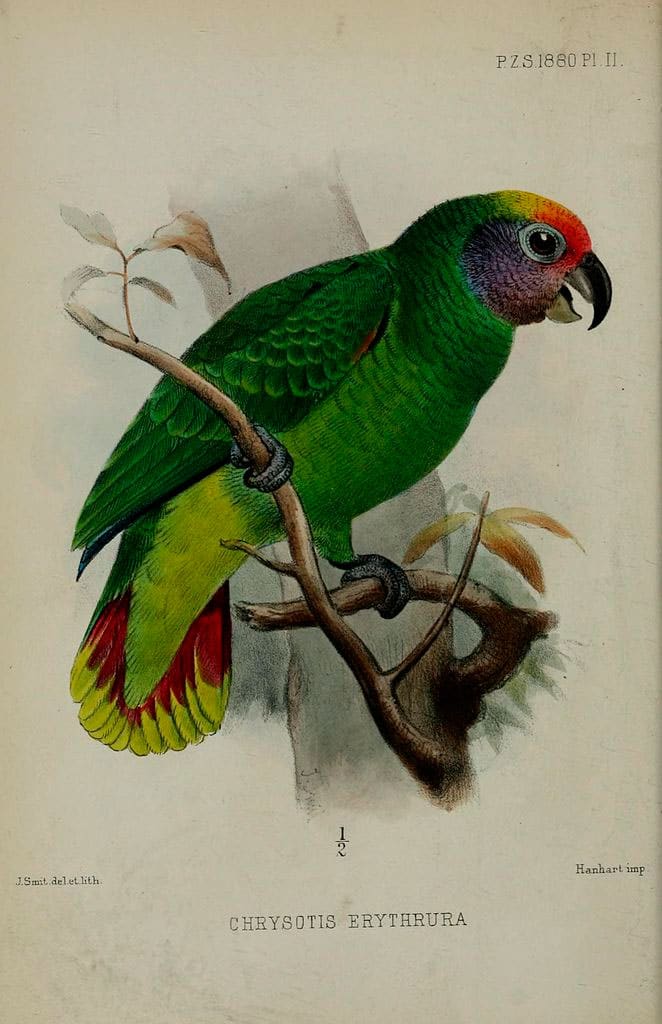
(6) – CHEYSOTIS ERYTHRURA By Zoological Society of London.; Zoological Society of London. [CC BY 2.0 or Public domain], via Wikimedia Commons

Sounds: Antonio Silveira, XC109467. accessible www.xeno-canto.org/109467