▷ The world of Pets: Dogs, cats, birds, reptiles, amphibians

Hooded Parrot
Psephotellus dissimilis

Hooded Parrot

Content


Anatomy-parrots

Description

25,5 to 28 cm.. length and a weight between 50 and 60 g..

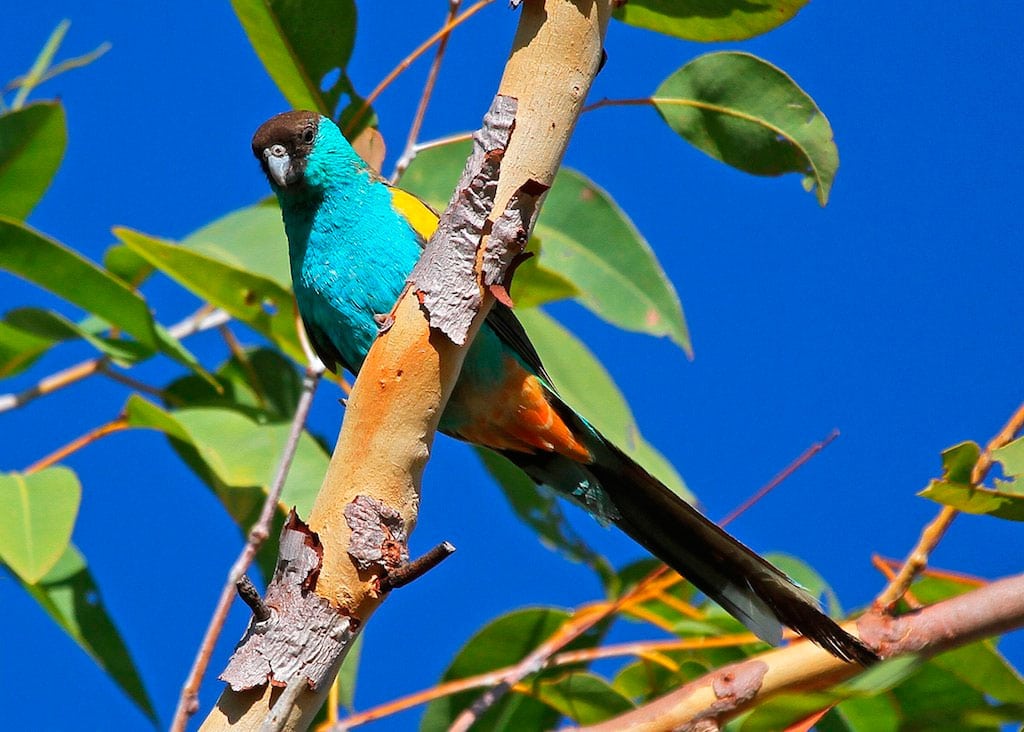
The Hooded Parrot (Psephotellus dissimilis) is a very striking species, restricted to the dry forests of the North of Australia. The male has a pileum black, their underparts are Turquoise with a patch in the shoulders golden yellow.

The females are pale green with a pale turquoise diffusion in the cheeks, abdomen and cadwas.

The Golden-shouldered Parrot, with which it is closely linked, is very similar in appearance, but they are only observed in the Cape York Peninsula, in the North of Queensland, and males differ in their tones slightly. The Hooded Parrot does the yellow colour in the forecrown or in the lores and the yellow markings of the shoulders and reddish of the belly, they are smaller than. The females they are very similar, but the Golden-shouldered Parrot It shows a faint red marks on the area, white, bass belly, has the undertail- coverts Bluish, bluish color of the belly is absent and the undertail- coverts They have a pinkish tone; also has a Brown Suffusion in the crown, a forecrown yellowish and the cheeks they are greener.

The Northern Rosella shares territory with the Hooded Parrot and also has a pileum black, but it lacks of the underparts Turquoise and yellow markings on the wings.

The Hooded Parrot they have an elegant flight, and males they are very bright with a Flash of bright yellow showing in the wings. The flight fast and slightly wavy. Bird perch, times, phone cables, and can make long flights at high altitude.

Providing more detail to its description, the Hooded Parrot has the pileum, lores and the area below and in front of the eyes, black, merging into grey-brown colour in the the mantle (darker uppers than the Golden-shouldered Parrot). The rump is turquoise blue and the uppertail-coverts green. Wing coverts golden yellow (grey dark in vane inner).

Flight feathers Blackish with difusion-verde turquoise at the edge of the vane outer (thin yellow color at the outer edge). feathers of the wings and bend of wing bluish green; underside of flight feather blackish brown. The cheeks, the neck and the chest Turquoise, lightly coated with emerald green; rest of the underparts Turquoise with the exception of undertail- coverts they are orange-red with yellow tips. Uppertail dark bars.

Central feathers of the tail Green bronze with black tips, side green blue with white tips, with a blackish central bar; undertail, the tail apparently light blue with black tips when it is closed. Bill pale grey; irises dark brown; legs light brown.

The female is usually pale, a light yellowish green, with wing-coverts a bright yellowish-green, flight feather blackish, and a turquoise color broadcasting in the rump, from the top of the breast to belly, and vaguely in the cheeks. Subcaudales coverts bathed in Pink salmon; pale marks in the wings.

The immature they are like the females, but males have the head darker and the cheeks bright. Adult plumage they would earn in the second annual moult.

The very young birds they have the peaks yellow.

Habitat:

Sedentary, although some early records of the Melville Island probably related to post-breeding dispersal. Scattered sparsely through the open dry forests, flooded Plains, especially grasslands of Malaleuca-dominated and Spinifex Triodia, grasslands with termite mounds, also in rows of eucalyptus trees along watercourses and the rocky ridges.

Usually, they are in pairs or in small groups, but after the breeding season, from September (end of the dry season) onwards, they may gather in groups of up to 100 birds feeding.

Reproduction:

Egg-laying range from late January until mid-April, at the end of the rainy season, and the nest is a tunnel in a Termite Mound. The direction and height of the entrance of the nest is variable, but nest chamber temperatures are more stable inside larger mounds. A recent study of nesting ecology in the Northern Territory showed a density of 0,45 to 0,70 nests per square kilometer, with a 50% from eggs producing hatchlings. Between two and six eggs make up the clutch, and are incubated for around 20 days for the female. In about five weeks the young leave the nest.. The females., sometimes, they roost far from their nests during the heat of the day.

Food:

The diet is composed, mainly, of pasture seeds seasonal during the dry season and perennial plants during the wet season. Variation in the ability to master feeding techniques for different seed types may explain the apparent early dispersal of immatures in the wet season.. Birds feed quietly on the ground, resting in foliage near water during the heat of the day. When drinking, they often walk into the water along banks of sand. They are sometimes seen feeding on road verges, often in association with the Black-faced Woodswallow (Artamus cinereus).

Distribution:

Endemic to North of Australia where is located in the western part of Arnhem Land, Northern Territory, from the South of the alligator river, to the southwest of Pine Creek and the South-East of Include. The birds also disperse further east and west to the rivers. Roper and upper area of the Daly.

The Hooded Parrot formerly extended eastward to the MacArthur river, but its territory, covering the Kakadu National Park, has recently been hired.

In general, It Rare. Although now it is fully protected. Capture is believed to it has been a problem in the past. Burning and grazing may limit the availability of herbs seeds during the dry season.

Mining also threatens the habitat of the species. There are a moderate number of birds in captivity.

Conservation:

minor concern


• Current category of the Red List of the UICN: Least concern

• Population Trend: Stable

The world population is estimated at 20.000 specimens (Garnett and Crowley 2000).

Population trends have not been quantified, but populations seem to be stable, without descents recent (Garnett and Crowley 2000).

The species remains common in areas under park management. Aboriginal and National, where grazing is minimal and where there are programs that guarantee their survival, or around the Rocky slopes, where is the availability of food in the rainy season relatively assured.

"Hooded Parrot" in captivity:

Although the popularity of the Hooded Parrot has increased considerably in the last decade, this species is still quite unknown in aviculture. The main reason is, probably, that they are not easy to care for and reproduce in captivity, due to its high demands care and difficulty it in terms of its food supply. The Hooded Parrot they are not recommended for a beginner breeder birds.

No one knows exactly when these birds were imported for the first time to Europe, but it was probably at the beginning of the last century. In the autumn of 1912 English Hubert Astley was the one who obtained the first satisfactory breeding result with the Hooded Parrot, got 4 young people from a litter of 5. in the netherlands, the Dr. Polak It also had results before the second world war. Once the pups are born, they were taken along with a couple of Red-rumped Parrot (Psephotus haematonotus) with which they grew up without any problem.

There is a variety of the Hooded Parrot because different crosses with other species such as Mulga Parrot (Psephotellus varius) and the the Golden-shouldered Parrot (Psephotellus chrysopterygius). So, we must pay attention to the characteristics when we are going to buy a pair of future reproducers of this species. If you have doubts about the purity of certain birds, consult with a person who is familiar with this type of parrots.

In terms of the behavior, the Hooded Parrot adapt to the European climate relatively well, although they are sensitive to cold and wet weather. They are quiet birds, enable, not shy and quickly adapt to their caregiver. His voice is not worrying. Love these birds being on the ground, where spend much time. They love to swim and are not rodents of wood. During the breeding season they are aggressive towards other birds.. Even outside the breeding season, It is not advisable to fit them with their peers or keep them with other bird species. Young birds together may stay in a birdhouse. As a basic rule, Ave predict an area of one square meter.

It is not known exactly how these birds can live, according to sources, one specimen was still alive after 18 years in captivity

Alternative names:

Hooded Parrot, Antbed Parrot, Anthill Parrot, Black-hooded Parakeet, Black-hooded Parrot, Golden-shouldered Parrot, Hooded Parakeet (ingles).
Perruche à capuchon noir (French).
Collettsittich, Hooded Sittich (German).
Periquito-encapuzado (Portuguese).
Perico Capirotado, Periquito encapuchado (español).

scientific classification:

Order: Psittaciformes
Family: Psittaculidae
Genus: Psephotellus
Scientific name: Psephotellus dissimilis
Citation: Collett, 1898
Protonimo: Psephotus dissimilis

Images «Capitola Parakeet»:

Videos "Hooded Parrot"

————————————————————————————————

«Perico Capirotado» (Psephotellus dissimilis)


Sources:

Avibase
– Parrots of the World – Forshaw Joseph M
– Parrots A Guide to the Parrots of the World – Tony Juniper & Mike Parr
– Birdlife

Photos:

(1) – A male Hooded Parrot, about 30 km south of Pine Creek, Northern Territory, Australia By birdphotosneill (Hooded ParrotUploaded by snowmanradio) [CC BY 2.0], via Wikimedia Commons
(2) – A pair of Hooded Parrots, about 30 km south of Pine Creek, Northern Territory, Australia By birdphotosneill (Hooded ParrotsUploaded by snowmanradio) [CC BY 2.0], via Wikimedia Commons
(3) – A pair of Hooded Parrots about 30 Km south of Pine Creek, Northern Territory, Australia. The male is in the foreground By birdphotosneill (Hooded ParrotsUploaded by snowmanradio) [CC BY 2.0], via Wikimedia Commons
(4) – By originally posted to Flickr as parkiet xxx and uploaded to commons at Psephotus_dissimilis_(female)_-Burgers_Zoo-8a.jpg: frank woutersderivative work: Snowmanradio (Psephotus_dissimilis_(female)_-Burgers_Zoo-8a.jpg) [CC BY 2.0], via Wikimedia Commons
(5) – Male Hooded Parrot (Psephotus dissimilis) – Sylvan Heights Waterfowl Park in Scotland Neck, North Carolina By SandyCole (Own work) [CC BY-SA 3.0 or GFDL], via Wikimedia Commons
▷ The world of Pets: Dogs, cats, birds, reptiles, amphibians

Malherbe's parakeet
Cyanoramphus malherbi

Malherbe's parakeet

Content


Anatomy-parrots

Description

19 to 22 cm. length and a weight between 40 and 52 grams for males and between 30 and 41 grams for females.

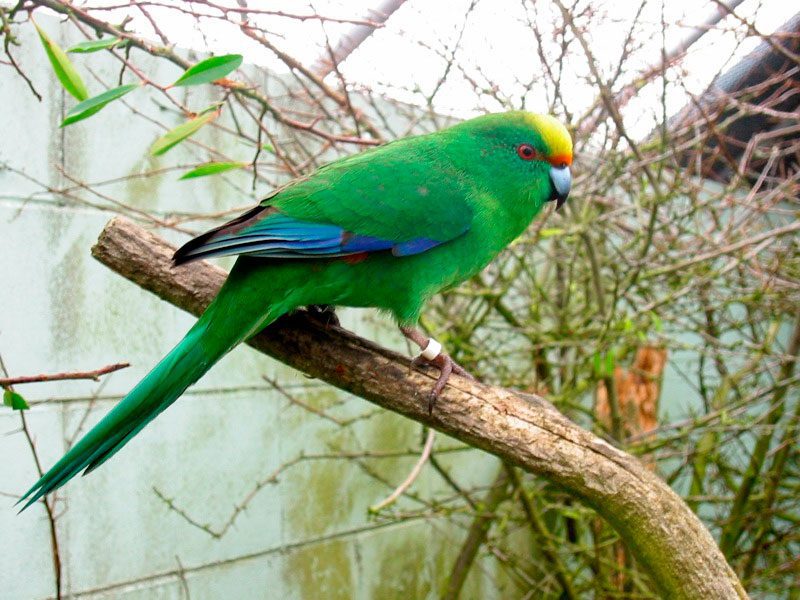
The Malherbe's parakeet (Cyanoramphus malherbi) they are small bright green parakeets, equipped with a long tail and with a bluish green colour wash in belly and chest.

The wings they have the primary coverts and the edges to the primary external of azure-blue. The crown is lemon-yellow colour and the front band, it reaches the eyes, is orange, as well as two patches on each side of the rump.

The bill is bluish grey, with the tip of black. The eyes are red and the legs are brown.

The colors tend to have a brighter tone in the males.

The youth they are more opaque, especially the patch of front band and the crown, which may be absent. The tail It is short for several weeks after feather. The bill is a pale pink color that darkens gradually when the young bird matures. They have darker the eyes, a reddish brown tone.

Habitat:

The Malherbe's parakeet tends to be quiet and hard to see. A brief and loud chatter or a quieter soft contact call can denote its presence, but locating the bird can be extremely difficult. The Malherbe's parakeet often confused with the Yellow-crowned parakeet.

Even though have been recorded in subalpine bushes and thickets of Matagouri open zones (Discaria toumatou), the Malherbe's parakeet they are predominantly in the forest.

They usually feed in the canopy, but also under frequent places with low vegetation and soil.

Reproduction:

The Malherbe's parakeet can reproduce in every month, with a main breeding period between December and April; incubation peak is in January.

Clutch size media is of approximately 7 eggs, but register a wide range (range of 1 to 10). Egg laying is asynchronous with an interval between eggs of 2 days. The incubation lasts from 21 to 26 days, and the period of breeding ranges between 35 and 45 days.

The females They seem to choose the nesting sites, as well as carry out all the preparation, incubation and breeding, the male provides most of the food during incubation.

It is suspected that the female only feeds the chicks during the first 10-14 days, just as they do other species Cyanoramphus. Once past this period, both sexes take care, equally, feeding the pigeons.

There may be second clutches If there is enough food available, for example, during the sowing of beech, or if the first attempt failed. The female may lay a second clutch when first chicks have, approximately, 2 weeks of age. This leaves the male as the sole provider for both the chicks and the incubating female..
Second clutches are not uncommon; When is food plentiful, some couples can reproduce 3 or 4 times on.

The nests are accessed normally through holes in knots of branches and the main trunk of a tree.

They use all species of you have to build the nest, predominantly the Red beech (69% nests monitored in the continent, n = 138) and dead trees (20%).
Nests may have more than one meter of depth. Records placed nests in heights that range between 2,5 and 26 m.

Food:

The Malherbe's parakeet consume seeds, flowers, buds and small invertebrates (mealybugs and caterpillars). In a year of abundance of fruits, the seeds become the dominant element of their diet, and they seem to be the main food for young people.

Invertebrates seem to play an important role in the diet of this species of parakeet which for the Yellow-crowned parakeet.

Distribution:

Size of the area of distribution (reproduction / resident) 360 km2

To the Malherbe's parakeet les is in areas where the South beeches (Nothofagaceae), in forest valleys in the South Island, the valleys Hawdon and Poulter in the Arthur Pass National Park and the South Branch of the Hurunui Valley in Lake Sumner Forest Park. Are unevenly distributed within these valleys; absent in many parts, but in some other places can be quite common.

They have been transferred to four islands: Maud and Blumine in Marlborough Sounds, Chalky Island in Fiordland, and Largest Island / Tuhua on bay of plenty.

Conservation:


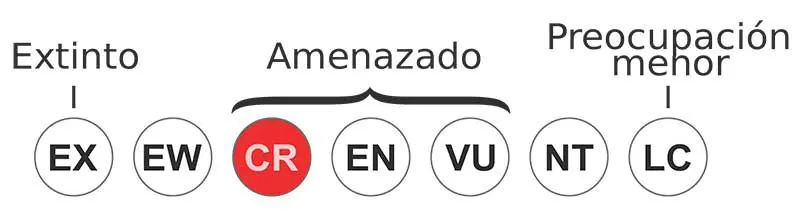
critical hazard


• Current Red List of UICN: critically endangered

• Population trend: Decreasing

This species is the smallest of the class Cyanoramphus along with the Yellow-crowned parakeet.
The Malherbe's parakeet It is the kind of rare parrots of New Zealand. The population was wiped out by rats and stoats introduced by men.

Also the changes in the habitat due to the ungulates and opossums they have affected the species.

Some diseases have been discovered in two of the areas in which live.

It is in progress conservation actions such as the predator control in the three valleys of the continent and the protection of the trees hosting the nests.

The captive breeding programs they have helped to release the birds in 4 Islands cleared of predators. This work is still in progress.
On the Mainland, all populations are monitored closely by the Department of conservation.

The total population It was estimated in 290/690 individuals at the beginning of 2013.
The continent has between 130 and 270 specimens and Islands surrounding between 160 and 420.

"Malherbe's parakeet" in captivity:

Usually they are not in captivity.

A small captive breeding program was established in 2003.

Alternative names:

Malherbe’s Parakeet, Alpine Parakeet, Malherbe’s Parrot, Orange-fronted Parakeet (English).
Perruche de Malherbe, Kakariki de Malherbe (French).
Malherbesittich (German).
Kakariki-fronte-laranja (Portuguese).
Perico Maorí Montañés, Perico Maorí Montano (español).

scientific classification:

Order: Psittaciformes
Family: Psittaculidae
Genus: Cyanoramphus
Scientific name: Cyanoramphus malherbi
Citation: Souancé, 1857
Protonimo: Malherbe's Parakeet

Images «Perico Maorí Montano»:

Videos "Malherbe's parakeet"

«Perico Maorí Montano» (Cyanoramphus malherbi)

Sources:

  • Avibase
  • Parrots of the World – Forshaw Joseph M
  • Parrots A Guide to the Parrots of the World – Tony Juniper & Mike Parr
  • Birdlife

  • Photos Perico Maori Montano:

(1) – This is one of several birds being bred in captivity at Isaac Peacock Springs wildlife refuge.
Christchurch, New Zealand By Jon Sullivan from Christchurch, New Zealand [CC BY 2.0], via Wikimedia Commons
(2) – Orange-fronted parakeet. Adult male in captivity. Isaacs Wildlife Trust, Christchurch. Image © John Kearvell by John Kearvell – nzbirdsonline
(3) – Orange-fronted parakeet. Captive adult female. Isaacs Wildlife Trust, February 2012. Image © Sabine Bernert by Sabine Bernert www.sabinebernert.fr – nzbirdsonline
(4) – Orange-fronted parakeet. Juvenile feeding. Nelson, January 1983. Image © Department of Conservation (image ref: 10028825) by Dave Crouchley, Department of Conservation Courtesy of Department of Conservation – nzbirdsonline
(5) – Orange-fronted parakeet. Adult male (left) and female in captivity. Isaacs Wildlife Trust, Christchurch. Image © John Kearvell by John Kearvell – nzbirdsonline

▷ The world of Pets: Dogs, cats, birds, reptiles, amphibians

Rosy-faced Lovebird
Agapornis roseicollis


Inseparable de Namibia

Content

Description Rosy-faced Lovebird

Inseparable de Namibia

Among 15 and 18 cm in length and a weight between 43 and 63 g..

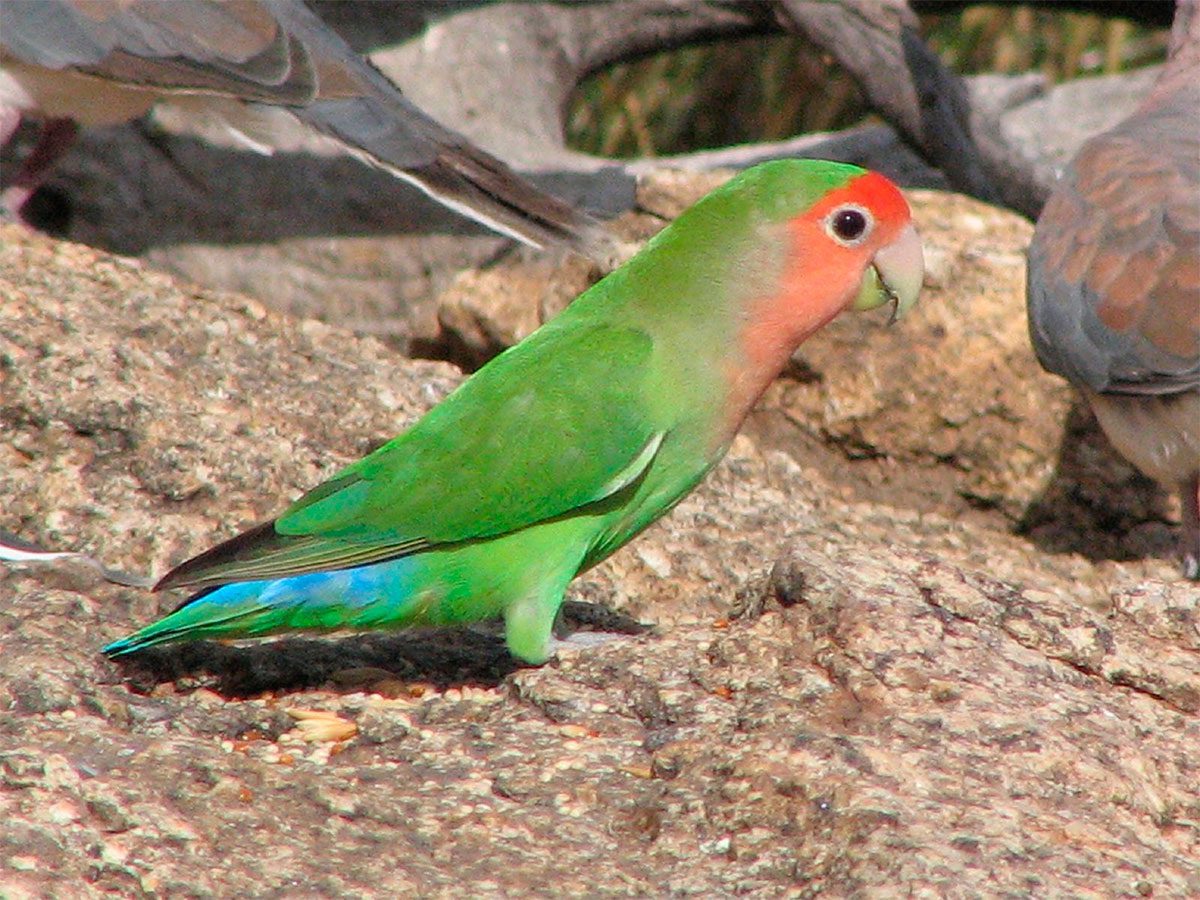
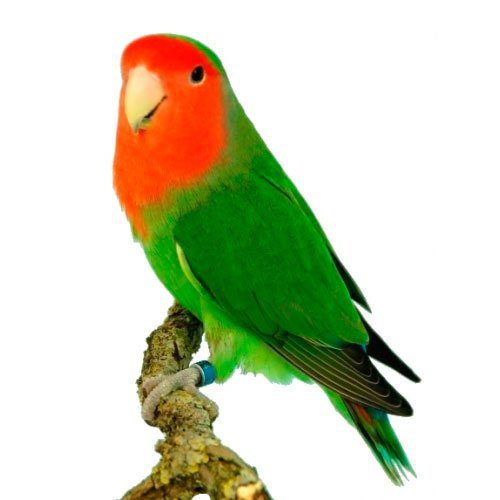
The Rosy-faced Lovebird (Agapornis roseicollis) has the upperparts green, except in the rump and uppertail-coverts they are bright blue. The tail is green, but the side feathers are black base, orange-red edges and subterminal band black. The flight feather They have black tips.

The underparts They are pale green from the bottom of the chest up to the undertail-coverts. The feathers of the tail and flight feather son negruzcas.

The head, the forecrown and the part behind eyes They are red, while the face, the chin, the throat and the top chest They are pink.

The bill It is white with greenish-gray tint. The eyes are dark brown, surrounded by a eye ring white. The legs are grey.

Both sexes are similar.

The youth They are duller with forecrown green tinged with red rose. The face is pale pink to the top chest. The bill It has a black base.

Subspecies description:

  • Agapornis roseicollis catumbella (Hall,BP 1952) – Brighter colors, with the front of the crown a dark red and the cheeks Bright color.

  • Agapornis roseicollis roseicollis (Vieillot, 1818) – The species nominal

Habitat Rosy-faced Lovebird

The Rosy-faced Lovebird frequents dry woodlands fields altitudes up to 1.500 m. Sub-desert steppes observed, wooded savannah with scattered forest cover, forest belts along rivers and farmland; often near standing water.

Usually, in flocks of 5 to 20 birds, although sometimes as many as several hundred may gather in areas where grass seeds ripen or near water sources.

They are very sociable and noisy, but also pretty tame. When resent, They fly to the nearest tree or vegetation, before returning quickly to the food source.

They used as roosts, nests Sociable Weaver (Philetairus socius) and the White-browed Sparrow-Weaver (Plocepasser mahali). Birds huddle in small groups in branches when the weather is rather cool.

Reproduction Rosy-faced Lovebird

The Rosy-faced Lovebird can pair off from two months of age. The male wait until the female accepts him before approaching. She adopts a "ruffled" position when she is ready.. The male It provides food, while balancing the head to get his attention. Also head scratching, especially around peak. When the male tries his approach, gently slides his hand. You can try out the other side if female It is shown aggressive.

The Rosy-faced Lovebird they are monogamous.

Nest in rock crevices, human constructions, bridges or communal nests Sociable Weaver (Philetairus socius) and the White-browed Sparrow-Weaver (Plocepasser mahali). The nest It is made of straw and branches, as well as some other materials such as pieces of bark, leaves and herbs, carried by the female rump feathers. The nest of the weavers carries no additional material added. The nests are communal.

The breeding season It has been recorded in the months Feb-Mar, April and October; most clutches seem to take place in the months of February-May.

The female lays 4-6 eggs. The incubation lasts a few 23 days, What does the female do alone?. It is fed by the male during this period.. The chicks are fed by regurgitation female, but it is the male who carries food. The period in the nest It is close to the 5-6 weeks, during which both parents feed the young. Flying around the age of 43 days.

Food Inseparable de Namibi

The Rosy-faced Lovebird they feed on, mainly, seed, sometimes taken directly from the soil, including grasses, Albizia and Acacia; usually they do visits to gardens to feed on sunflower seeds to cropland for him millet and the corn.

Sean is not considered a serious pest for crops because agriculture is scarce in the inhabited regions. They also eat flowers Albizia and other foliage plants, such as leaves of the genus Euphorbia. You can drink several times a day.

Distribution:

Size of the area of distribution (reproduction / resident): 774.000 km2

The Rosy-faced Lovebird They are endemic areas southwestern africa. In Angola, where the range of Rosy-faced Lovebird It is little known, The species is found in the region Sumba (perhaps further north) to the south, in parallel to the shore area through Namibia north of Cape, South Africa, extending from the east to the north. In Namibia to Lago Me, Botswana, although there are no recent records of the species there.

A sighting 1992 in Victoria Falls, Zimbabwe, suggests little-known eastern limits or nomadic behavior.

The main population Rosy-faced Lovebird It is within 400 km of Atlantic coastline. Records in the ancient province of Transvaal They are considered leaks. There is a wild population in the sector Fish Hoek of the Cape Peninsula, South Africa.

Subspecies description:

  • Agapornis roseicollis catumbella (Hall,BP 1952) – Southwest Angola, with a population in the wild Kissama National Park Northwest of Angola.

  • Agapornis roseicollis roseicollis (Vieillot, 1818) – The species nominal

Conservation Rosy-faced Lovebird


minor concern

• Current Red List of UICN: Least concern

• Population trend: Decreasing

The size of the world population Rosy-faced Lovebird It has not been quantified, but the species is described as locally common or even abundant in the vicinity of areas where water is abundant.

However it is suspected that the population of the Rosy-faced Lovebird can be in decline due to unsustainable levels of exploitation.

There has been a historic decline due to the capture and export of thousands of birds from Angola, This has contributed, to a large extent, a significant reduction in the population Rosy-faced Lovebird in the south of that country.

The Rosy-faced Lovebird in captivity:

The small Rosy-faced Lovebird It is a brilliant bird, joyful, Robust and gregarious. It is one of the most common parrots in captivity, along with the Budgerigar and Cockatiel, because of its ease of maintenance and reproduction.

Birds are considered easy, ideal for people who want to start breeding small parrots. The Rosy-faced Lovebird They can live in a large aviary cage outdoors, including winter. But, they will need to have a frost shelter to shelter in when it gets too cold outside.

Son active birds they like to fly. If they have to live in a cage, this will have to be wide and longer than high (birds are not helicopters). Ideally, the bird should be able to leave its cage for a while in order to be able to fly greater distances..

Contrary to popular belief, the Lovebirds They can perfectly live without a partner. Why do sellers try to sell both?, It is a purely financial maneuver. One Lovebirds only, will not die.

Similarly, when we say that a Lovebirds He will die of sadness when you lose your partner, It is once again a commercial argument. The bird can pass through a period of mourning during which try to call your partner / yy shouts, even more so when the other members of the aviary belong to another species.

All parrots are aves gregarias and they depend on the group to survive. A widow bird accept another partner, previous adaptation before sharing the same cage. It is possible however, two birds never understand (which it is rare, with the Lovebirds).
To end this belief, the "couples" of Lovebirds They not necessarily have to be of the opposite sex. Homosexual couples are common among Lovebirds.

His behavior with birds of their own species is quite good or very good, It is not the same for their behavior with other species: the Rosy-faced Lovebird are restless and vengeful birds. Coexistence with other species is totally discouraged by the vast majority of poultry farmers: the peak of a lovebird can easily cut your finger or injure another bird, smaller and more peaceful.

In general, the Rosy-faced Lovebird they are birds, relatively, easy to educate, provided that taken from young. Son tame birds, loving, playful, sleepers, large pet birds. The bite related to its small peak is still very painful, especially in the soft fingers of children.

It is permissible to say that males are better pet birds than females. The breeding females are often within their hormonal period, making them very territorial. A sweet female domesticated before sexual maturity can be very aggressive to the point of not being manipulated when in hormonal period. Once again, this does not affect all birds, because there are always exceptions.

In general, to the Lovebirds, They are not considered good speakers.

Not recommended for people with incompatible squeals.

No sexual dimorphism in this species. The only way to know the sex of the bird is to carry out a DNA test using a blood or feather sample..

It is not known much about the longevity of the Rosy-faced Lovebird. according to some sources They can live up to 34.1 years in captivity, It is plausible, but it has not been confirmed. Age of sexual maturity of 2 months to almost a year.

Due to the depletion of stocks, in poultry in the early 20th century, It will be started hybridize with other species, but thanks to some breeders are you has been able to preserve in its pure State.

Mutations Agapornis roseicollis
Mutations

Mutations.

There are over 500 mutations or combinations of different colored. Mutations in genes lead to changes in the pigments that give color pens, such as psittacin (red, yellow or orange) or eumelanin (black, brown) or variations on feather structure. They may be sex-linked recessive mutations (They depend on the sex of birds) or autosomal recessive and dominant (irrespective of gender). Among the sex-linked mutations have: ino (known the lutino. There have eumelanin), cinnamon (produce eumelanin brown instead of black), Balls (quantitative reduction of melanin 60 %) andopaline (red psittacine of the mask has spread from the back of the head, the rump is the same color as the body). Also shows some combinations as are the pallidino (Only males, -pallid gene on one X chromosome and ino gene on the other X chromosome) and canela-ino (It is given by crosslinking between cinnamon and ino on the same chromosome and can be male and female). In all these mutations, females never carry the mutation. Years ago, the cinnamon cinnamones were called Americans and Australians palids cinamones or Isabelas.

Consider several crossings (to better understand the sex-linked mutations):

  • Crossing 1: Green x lutino male female = green and lutino male carrying female lutinas
  • Crossing 2: Green male x female = green Lutina carriers lutino males and green females
  • Crossing 3: Green male carrying female green x lutino = green and green lutino male carriers, Green and females lutinas
  • Crossing 4: Green male carrying female lutino Lutina x = green and lutino male carriers lutinos, Green and females lutinas
  • Crossing 5: Lutina x lutino male female = male and female lutinas

As autosomal recessive mutations have:

  • aqua (reducing a yellow psittacine 50 %)
  • turquoise (reducing a yellow psittacine 80-90 %)
  • aquaturquesa (combination thereof)
  • edged dilute (reduction of eumelanin 50 % in the body, in the center of the back and wing feathers eumelanin it is lower than in the edge, it seems that feathers are trimmed)
  • dilute (reduction of eumelanin 80-90 %, having a green veil over the whole body)
  • bronze fallow (It presents grayish brown eumelanin and red eyes)
  • pale fallow (greyish brown eumelanin sparingly, light green eyes and red veil in the abdomen)
  • recessive harlequin (reduction of eumelanin 95 %, smaller mask)
  • orange face (psittacin mask and tail is orange rather than red)

In these mutations, both males and females can be carriers. To be transmitted, or both are carriers or join a carrier with a mutated. Years ago, to dilute edged was called golden cherry and if it was combined with aqua, aquaturquesa or turquoise, silver cherry o plata.

As we autosomal dominant mutations:

  • dominant harlequin (reduction eumelanin and randomly scattered throughout the body)
  • pale headed (psittacine of the mask and the tail is light orange pink. Hay SF,factor simple y DF, double factor, ie more or less mask dark)
  • dark factor (a change occurs in the structure of the pen, in the spongy zone, so they look darker. There SF and DF, naming as a factor D and DD for two)
  • purple (a change occurs in the structure of the pen, in the spongy zone. We have SF and DF. The ideal is to combine a dark factor)

As discussed above, both headed as pale as dark violet factor are dominant incomplete, so we say what the single and double factors. In these mutations is mutated or not is, no carriers and being transmitted need only one parent to the present.

Is a type of harlequin which it is transmitted to different recessive and dominant form, is the progressive harlequin or mottle. The harlequin is increasing as the bird will be more adult, as it is getting older.

The mutation bee does not exist in the A. roseicollis. We have the combination of turquoise with ino, if they go selecting, we can get a completely white bird with red eyes, what would look like albino.

Apart from all these mutations, There is a variety called Long Feathered, of larger size and colors sharper the ancestral. It was obtained through years of selection, according to some or emerged spontaneously in some aviary, according to others and from there they began to work with them. Something similar happened with mandarins (Poephila guttata), Giant calling mandarins. So the variety would call if they have achieved by selection and mutation if they have arisen spontaneously.

Once you view the different mutations must say that several cases can occur, that make possible the multiple existing color combinations. They may have a recessive mutation with a dominant (edged dilute violeta), two or more mutations at the same time (turquesa edged dilute violeta arlequin DD), and it can even happen to have two different mutations and make the other not appreciated (normal and lutino lutino D or DD are exactly the same visually).

Source: The bird aviary

Alternative names:


Rosy-faced Lovebird, Peach-faced Lovebird, Rosy faced Lovebird, Rosyfaced Lovebird (English).
Inséparable rosegorge, Inséparable à face rose, Inséparable roseicollis (French).
Rosenköpfchen, Rosenpapagei (German).
Inseparável-de-faces-rosadas (Portuguese).
Inseparable de Cuello Rojo, Inseparable de Namibia, Agapornis Roseicollis, Inseparable de Cara Melocotón (español).

scientific classification:


Order: Psittaciformes
Family: Psittaculidae
Genus: Lovebirds
Scientific name: Agapornis roseicollis
Citation: (Vieillot, 1818)
Protonimo: Psittacus roseicollis

Images Rosy-faced Lovebird:

Videos "Rosy-faced Lovebird"


Species of the genus Agapornis


Rosy-faced Lovebird (Agapornis roseicollis)


Sources:

Avibase
– Parrots of the World – Forshaw Joseph M
– Parrots A Guide to the Parrots of the World – Tony Juniper & Mike Parr
– Birdlife

Photos:

(1) – Peach-faced Lovebird in Namibia, Africa By Alastair Rae from London, United Kingdom (Rosy-faced Lovebird) [CC BY-SA 2.0], via Wikimedia Commons
(2) – Picture taken in the zoo of Wrocław (Poland) By Nicolas Guérin (messages) (Own work) [GFDL or CC BY-SA 3.0], via Wikimedia Commons
(3) – A pet chick By Toumoto:http://opi.toumoto.net (Self-photographed) [GFDL or CC-BY-SA-3.0], via Wikimedia Commons
(4) – Rosy-faced Lovebirds at Etosha National Park, Namibia By Brian Taylor from U.S.A (Rosy-faced Lovebirds) [CC BY 2.0], via Wikimedia Commons
(5) – Peach-faced Lovebirds (also known as the Rosy-faced Lovebird) eating seeds from a seed-block garden bird feeder in a garden in Scottsdale, Arizona, US By D. Patrick Lewis [CC BY 2.0], via Wikimedia Commons
(6) – Mutation in roseicollis : opaline double dark factor By Roseicollis (Own work) [GFDL or CC BY-SA 3.0], via Wikimedia Commons
(7) – Turquoise mutation By Sergi Bio (Own work) [Public domain], via Wikimedia Commons
(8) – Mutations in Agapornis roseicollis yellow machine-readable By No author provided. Ajit S.~commonswiki assumed (based on copyright claims). [Public domain], via Wikimedia Commons
(9) – Peach-faced Lovebird (Agapornis roseicollis). Pet on a perch. Shows blue rump feathers By Peter Békési (Flickr) [CC BY 2.0], via Wikimedia Commons

Sounds: Andrew Spencer (Xeno-canto)

▷ The world of Pets: Dogs, cats, birds, reptiles, amphibians

Speckle-faced Parrot
Pionus tumultuosus

Speckle-faced Parrot

Content


Anatomy-parrots

Description:

28 to 31 cm.. tall and around 250 g. weight.

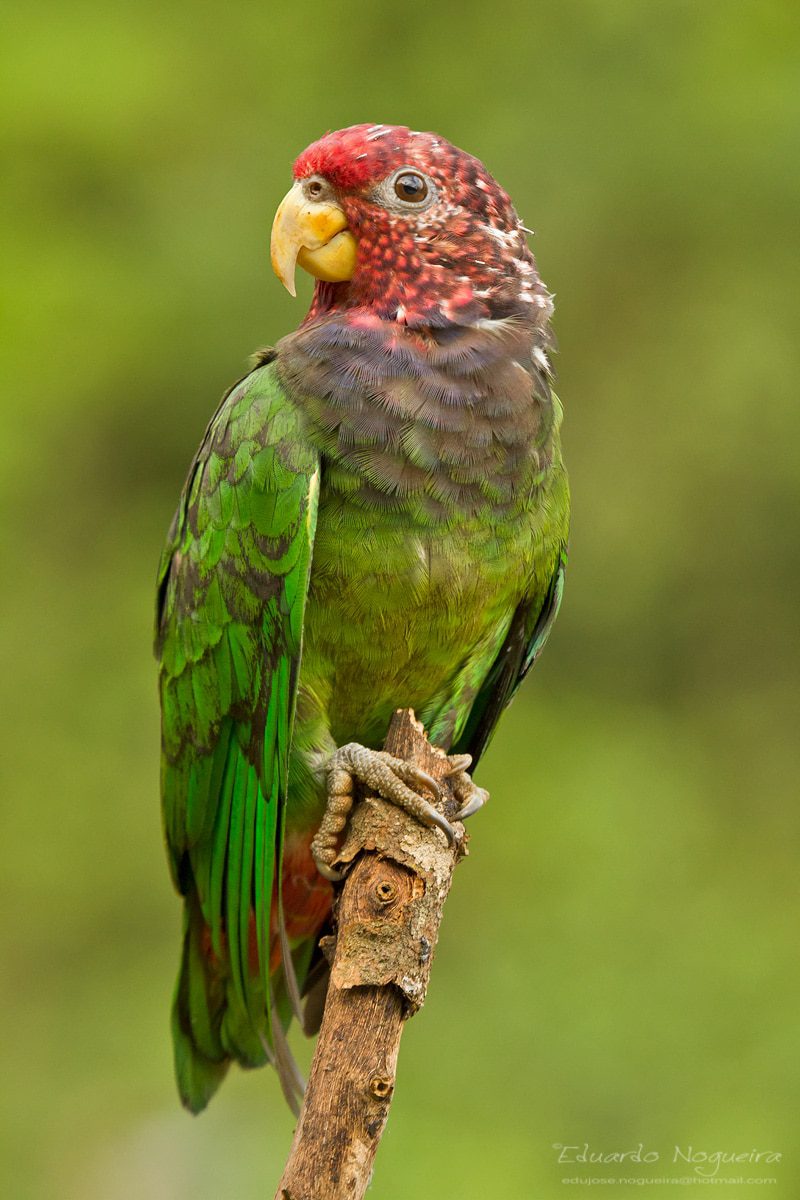
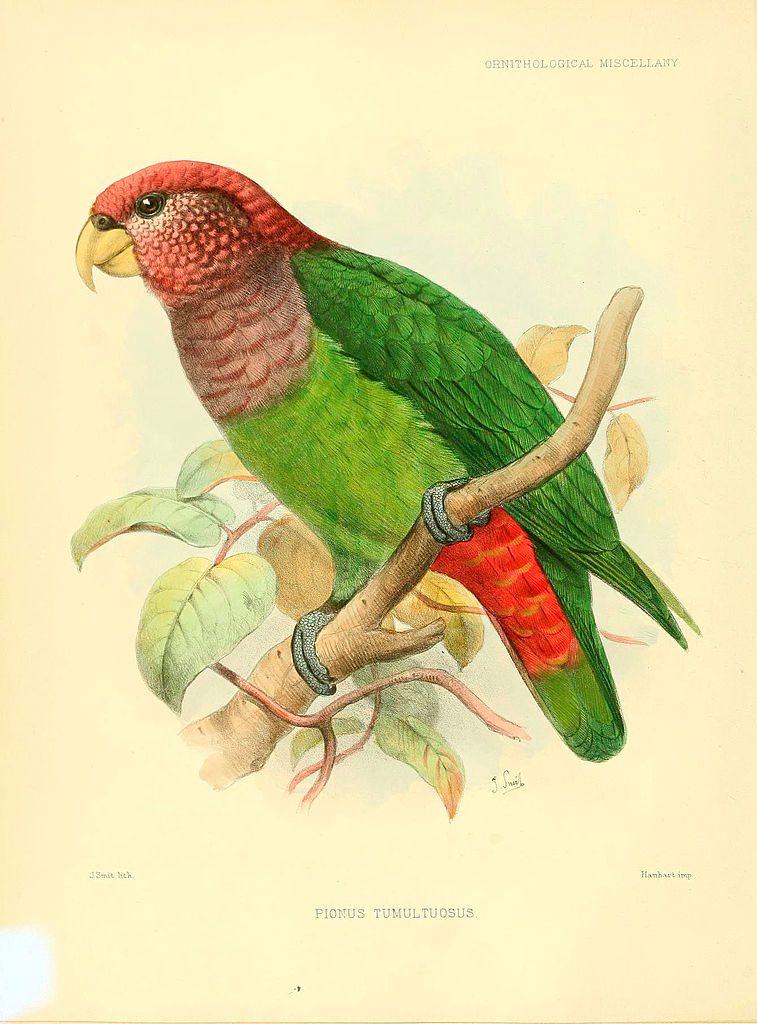
The Speckle-faced Parrot (Pionus tumultuosus) It is distinguishable by color from whitish crown up to the nape; base bill red rose, with forecrown redder. Cheeks whitish with a red and purple tinge towards the neck; purple chest.

Shoulder with thin strip yellow with reddish tint, inside base tail and crissum, red; the rest of the tail is green with blue on the outer feathers; under belly with red feathers with green edge.

ocula ringr greyish

The youth They have almost all head green and the wings, greenish yellow.

Taxonomic note:

The Speckle-faced Parrot It is probably the rarest and most controversial genre Pionus. It is sometimes divided into two species, in which case, the Pionus tumultuosus South is known as Speckle-faced Parrot, while the North, Pionus seniloides, They are known as White-capped Parrot (which leads to easy confusion with Pionus senilis).

Habitat:

Speckle-faced Parrot

It inhabits in Andean and sub-Andean cloud forests and forest edges, between 1600 and 3200 meters above sea level.
It is highly Nomad with temporal variations in terms of the number of individuals that can be registered in a locality.

Reproduction:

With reproduce In September. In captivity puts 4 eggs which incubated about 26 days. No other aspects of its reproductive biology are known..

Food:

It has been registered consuming fruits of Turpinia paniculata and are sometimes seen in large numbers feeding on maize crops in cultivated areas and banana plantations.

Distribution:

Its population is distributed in the southern Andes, from the center of Peru until Bolivia.

Size of the area of distribution (reproduction / resident): 329.000 km2

Conservation:


minor concern


• Current category of the Red List of the UICN: Least concern.

• Population trend: Decreasing.

Justification of the population

The size of the world population It has not been quantified, but this species is described as «quite common, but irregular distribution» (Stotz et to the., 1996).

Justification of trend

It is suspected that the population is in decline due to the continuous habitat destruction.

"Speckle-faced Parrot" in captivity:

This species is virtually nonexistent in poultry farming. There is only a small collection, private property in the United States. The Fundación Loro Parque in Tenerife, Spain, It has some copies.
Most of the Speckle-faced Parrot imported to United States they were the victim of aspergillosis – probably caused by the stress suffered during the import process.

In captivity They were observed as the to intelligent species, inquisitive and sometimes shy and nervous. Will get used to their caregiver over time. You can interact with a person and jealously attacking others. Prone to obesity.

Alternative names:

Speckle-faced Parrot, Plum-crowned Parrot, Speckle-faced Parrot (Plum-crowned) (inglés).
Pione pailletée, Pione pourprée (francés).
Purpurstirnpapagei (alemán).
Curica-de-cara-manchada (portugués).
Cotorra Gorriblanca, Loro Rosado, Loro Tumultuoso (español).


Clasificación científica:

Tschudi Johann Jakob von

Orden: Psittaciformes
Familia: Psittacidae
Genus: Pionus
Nombre científico: Pionus tumultuosus
Citation: (von Tschudi, 1844)
Protónimo: Psittacus tumultuosus


Imágenes «Loro tumultuoso»:

Videos del "Loro tumultuoso"

«Loro tumultuoso» (Pionus tumultuosus)

    Fuentes:

    Avibase
    – Parrots of the World – Forshaw Joseph M
    – Parrots A Guide to the Parrots of the World – Tony Juniper & Mike Par
    Birdlife
    – Libro Loros, Pericos y Guacamayas Neotropicales

    Fotos:

    (1) – Eduardo Nogueira
    (2) – Speckle-faced Parrot at La Merced Zoo By josecajacuri [CC BY-SA 2.0], via Wikimedia Commons
    (3) – Speckle-faced Parrot «Pionus tumultuosus» on the grounds of the Pueblo Hotel, Aguas Calientes by Carol FoilFlickr
    (4) – Speckle-faced Parrot «Pionus tumultuosus» on the grounds of the Pueblo Hotel, Aguas Calientes by Carol FoilFlickr
    (5) – Speckle-faced Parrot «Pionus tumultuosus» on the grounds of the Pueblo Hotel, Aguas Calientes by Carol FoilFlickr
    (6) – PIONUS TUMULTUOSUS By Allen, Edgar W.; Erxleben, J.; Hanhart, Michael; Hanhart, N; Keulemans, J. G.; Mintern Bros.; Rowley, George Dawson; Smith, J.; Walther, T. [CC BY 2.0 or Public domain], via Wikimedia Commons

    Sonidos: Sebastian K. Herzog

▷ The world of Pets: Dogs, cats, birds, reptiles, amphibians

Saint Lucia amazon
Amazona versicolor

Saint Lucia amazon

Content

Description:

43 cm.. length and 700-800 g. of weight.

Saint Lucia amazon

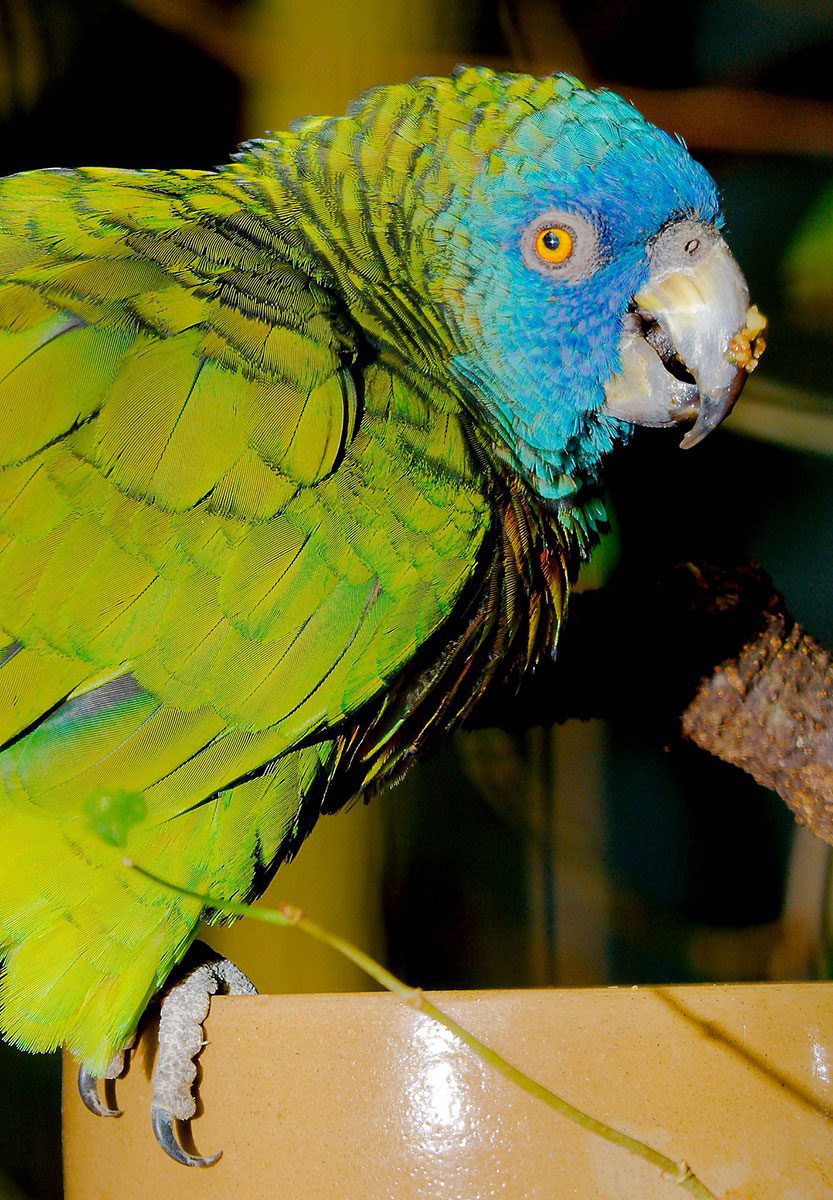
The Saint Lucia amazon (Amazona versicolor) has the lores, cheeks and forecrown, bright blue; crown, ear-coverts and lower cheeks, paler blue with iridescent emerald suffusion from some angles; dark tips to feathers on head.

Hindneck neck, nape and upperparts, yellowish-olive, many feathers with visible black tips, giving the whole a barred effect strong, especially in the upper region. Wing coverts yellowish green olive. Primary coverts dyed blue, rest with black tips to some feathers. Primaries blue; bases of external secondarys forman speculum red, blue tips; secondary internal green and blue at the base to the tips. Underwing, yellowish green with blackish tips to some feathers; flight feather bluish green. Chin and throat, bright blue with blackish tips to feathers; tips of feathers on lower throat and top of the chest, bright red forming a patch distinct red patch or mottled red area; chest and belly rather yellowish-green, blackish tips and brick red in the subterminal area of some feathers, giving scalloped appearance with scattered rusty patches; the thighs and undertail-coverts, green-yellow. Tail bluish green in the center, outer feathers green with large yellowish green tips and hidden red bases. Bill grey; irises orange; legs grey.


Anatomy-parrots

Probably no sexual dimorphism.

Immature has irises brown.

  • Sound of the Saint Lucia amazon.

Habitat:

Video "Saint Lucia amazon"

Mainly they inhabit the canopy montana primary rainforest, but they make inroads into areas of secondary growth to feed. Reported flocks of up 20 birds. living forms community.

Reproduction:

They nest in tree hollows. Nests observed in trees Dacryodes excelsa, Pouleria and Tetracera caribaeum. breeding season in February-August. Clutch usually two eggs, although, usually, only one young per nest thrives.

Food:

Its diet includes flowers and fruits of Clusia, Fruits of Talauma dodecapetala, Acrocomia irenensis, Pouleria, Dacryodes excelsa, Sloanea massoni, Byrsonima martinicensis, Miconia mirabilis, Pterocarpus officinalis and Euterpe globosa; also they have been seen feeding on bananas after the hurricane and presumably due to the depletion of natural food sources. Absence of common areas from August to November possibly linked to the lack of fruitfulness of Clusia.

Distribution and status:

Size of the area of distribution (raising / resident): 230 km2

Confined to St. Lucia in the Lesser Antilles, now in the central and southern mountains, although formerly you were more widespread everywhere where the humid forest grew. The species has suffered a contraction of the range since the nineteenth century and now It occupies an area of ​​only 65-70 km2 from Millet and Mont Lacombe in the North, until Mont Beucop and Calfourc in the East, Piton Pig, St Piton, St Desrache and Big store in the south to Morne Gimie in the west and Mont Houlemon in the Northwest. The results of studies on the species suggest that the southwestern part of this area is the most densely populated of parrots, while relatively few live in the northeast.

Plentiful mid-nineteenth century, but decreasing rapidly to very little in the early twentieth century. Subsequently they recovered, with an estimated population of 1.000 birds in 1950. They declined again sixties, mostly due to hunting; observations in 1977 They estimated that there were more than 100 birds. steady increase since then with an estimated population of 300-350 birds in 1990.

The threats main arise from habitat loss and its hunting for food and pet trade as. Forestry practices that lead to the removal of mature trees (favorite breeding sites) could put additional pressure. They seem to be less susceptible to hurricanes than their counterparts in Dominica, but this may be due to conservation efforts rather than any intrinsic ability to withstand the effects of severe storms.

Can compete for nesting sites with Pearly-eyed Thrasher (Margarops fuscatus), which it has increased considerably since 1950.

Amazona versicolor Conservation:

State of conservation ⓘ


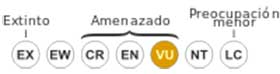
Vulnerable Vulnerable (UICN)ⓘ

• Current category of the Red List of the UICN: Vulnerable.

• Population trend: In increased.

• Population size : 230-330

Rationale for the Red List category

Conservation action may have saved this species from extinction. Numbers are now increasing and there is some evidence of a small range extension.. But, the habitat area apparently adequate (but vacated) It may be waning. If this begins to affect the habitat occupied, the species can be described as danger of extinction. In the news, its small population size and small size on one island are calling it Vulnerable.

Justification of the population

The population is estimated at 350-500 individuals, approximately equal to 230-330 mature individuals.

Justification of trend

No new data on population trends, so it is assumed that the species continues increasing.

Threats

The human population St. Lucia It is growing at a considerable rate, increasing the pressure on the forest and resulting in habitat loss (Copsey 1995). The selective logging of mature trees You can significantly reduce breeding sites (Juniper and Parr 1998), and hurricanes, the hunting and the trade pose new threats. There have been recent efforts to raise the moratorium on hunting within forest reserves, what would seriously threaten this species (J. D. Gilardi in litt., 1999).

Conservation Actions Underway
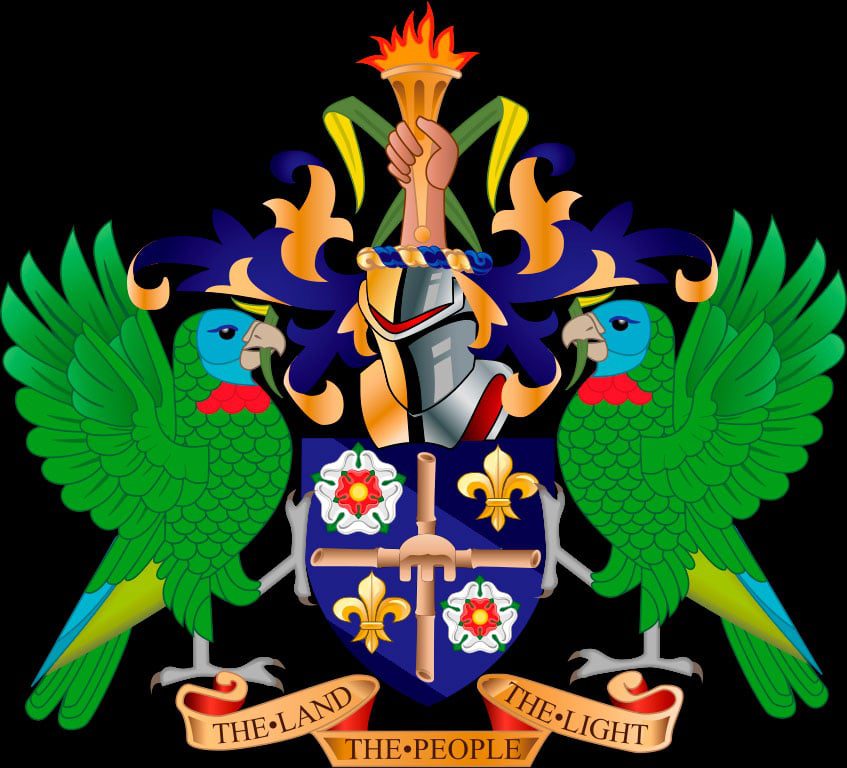
Coat of arms of Saint Lucia

Appendices I and II of CITES. This protected by national legislation (J. D. Gilardi in litt., 1999).

Education programs and awareness have made this bird in a National symbol.

This has eliminated successfully hunting (Juniper and Parr 1998), helped by a moratorium on hunting within forest reserves (J. D. Gilardi in litt., 1999).

In 1975 program was established captive breeding, and in 1995 had developed a total of 19 young birds (Copsey, 1995).

Conservation Actions Proposed

Maintain the moratorium on hunting within all forest reserves. Conduct a studyo Basic feeding and breeding ecology. Designate the remaining habitat protected areas. Reassess the objectives of the program captive breeding.

The Saint Lucian Amazon in captivity:

extremely rare; currently only it found in the Jersey Zoo

Appendices I and II CITES. This protected by national legislation.

Each captive specimen of this species which is capable of reproducing, It is placed in a well-managed program captive breeding and not be sold as a pet, with the objective of ensure their survival long-term.

Alternative names:

Blue-masked Amazon, Blue-masked Parrot, St Lucia Amazon, St Lucia Parrot, St. Lucia Amazon, St. Lucia Parrot, St.Lucia amazon, Versicolored Parrot, Versicoloured Parrot (English).
Amazone de Sainte-Lucie, Amazone versicolore, Amazone versicolore de Sainte-Lucie (French).
Blaumaskenamazone, Blaustirnamazone (German).
Papagaio-de-santa-lúcia (Portuguese).
Amazona de Santa Lucia, Amazona de Sta. Lucia (español).

Scientific classification Amazona versicolor:

Order: Psittaciformes
Family: Psittacidae
Genus: Amazona
Scientific name: Amazona versicolor
Citation: (Statius Müller, 1776)
Protonimo: Psittacus versicolor

Saint Lucia Amazon Images:

Attention: The internal data of table “19” is corrupted!

Species of the genus Amazona


Sources:

  • Avibase
  • Parrots of the World – Forshaw Joseph M
  • Parrots A Guide to the Parrots of the World – Tony Juniper & Mike Parr
  • Birdlife

Photos:

(1) – Saint Lucia Parrot(Amazona versicolor) by Josh MoreFlickr
(2) – Chrysotis bouqueti (a.k.a. Amazona versicolor, the St. Lucia amazon, or the St. Lucia parrot) by Joseph Smit [Public domain], via Wikimedia Commons

Sounds: Allen T. Chartier, XC9438. accessible www.xeno-canto.org/9438

▷ The world of Pets: Dogs, cats, birds, reptiles, amphibians

Chatham Parakeet
Cyanoramphus forbesi

Chatham Parakeet

Content


Anatomy-parrots

Description:

23 cm. length and 95 g. of weight.

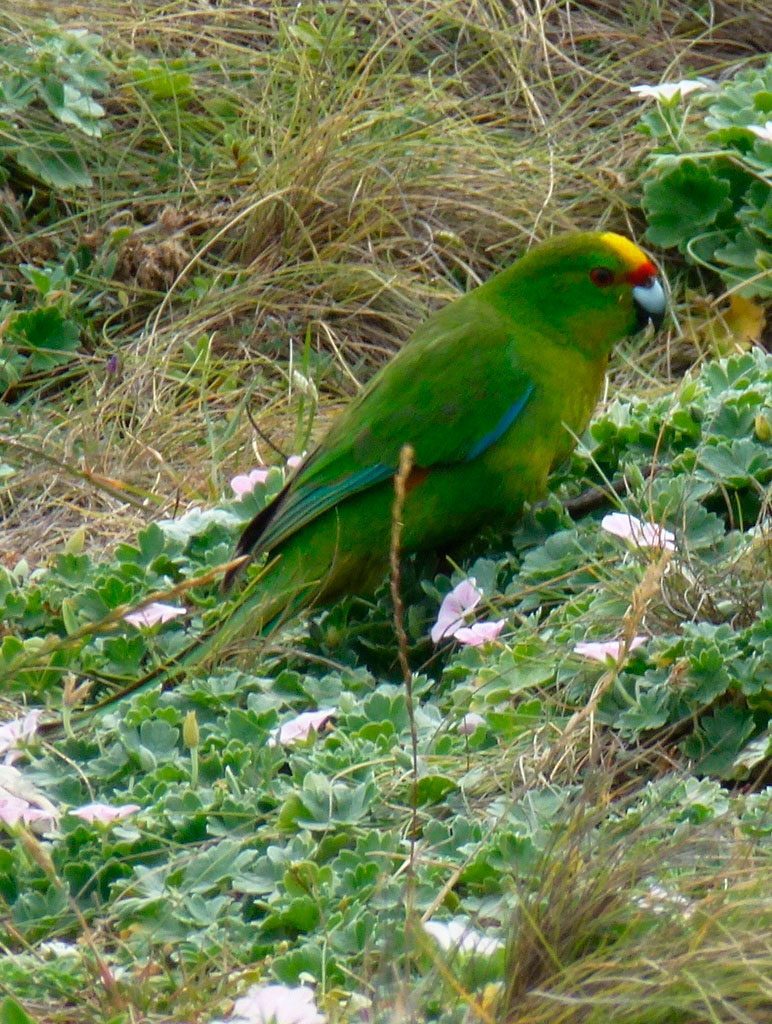
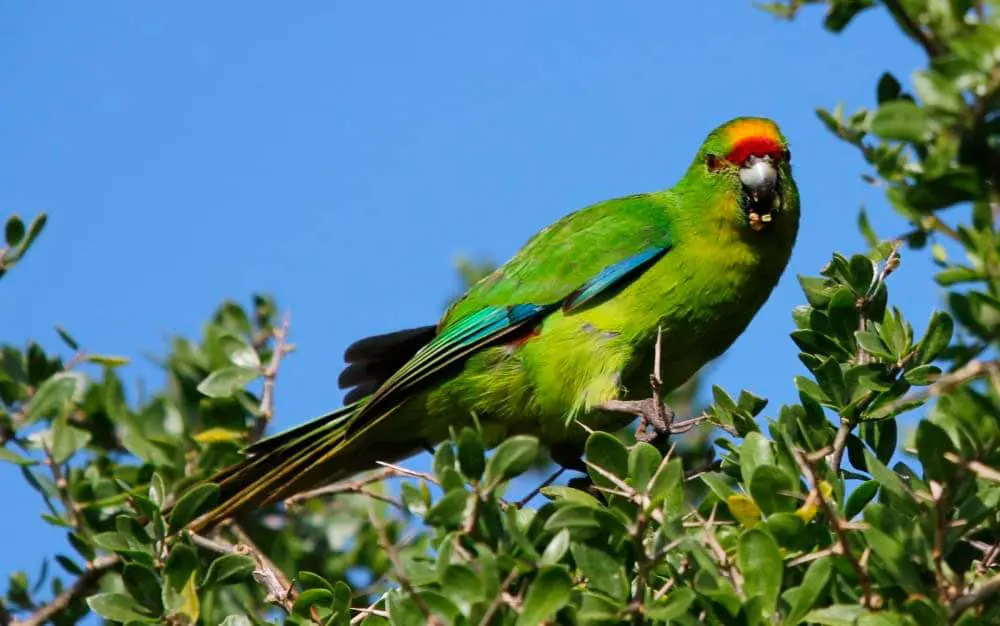
The Chatham Parakeet (Cyanoramphus forbesi) They are one of the two medium bright green parrots of Chatham Islands. Although they look very similar to those Yellow-crowned parakeet (Cyanoramphus auriceps) of New Zealand continental, the color of the crown is not a reliable indicator of taxonomic relationships.

It believes that the Chatham Parakeet descended from an ancient lineage of parrots who reached the Chatham Islands before the division Yellow-crowned parakeet and Red-crowned parakeet happened in New Zealand continental, after which the Red-crowned parakeet (Cyanoramphus novaezelandiae) also they colonized Chatham Islands.

The Chatham Parakeet They are medium-sized parrots, of tail long, with wings wide and rounded and plumage predominantly emerald. have a crown bright yellow front and a crimson front band that does not reach to the eyes, unlike in the Red-crowned parakeet. Males are larger than the females.

taxonomy:

Since 1930 is commonly treated as a subspecies of the Yellow-crowned parakeet (Cyanoramphus auriceps), and clearly the two are closely related; the species differ, However, in size considerably, It is larger species Cyanoramphus forbesi. Currently considered Monotypic.

Habitat:

The Chatham Parakeet They are at higher densities in forests and dense vegetation regenerating areas than in open grassland. Despite its rather erratic flight, They fly hard and move easily between islas Mangere and little Mangere. Occasionally they have been observed Chatham Parakeet individual in the forests of southern Chatham Island (> 20 km from the Mangere Island) and nearby islands Pitt and owner. Their social behavior is similar to other species of parakeets Cyanoramphus. They are strongly territorial around nests, calling loudly and chasing intruders from nearby.

Reproduction:

The Chatham Parakeet have a long breeding season, with eggs laid between October and March. Son nesters cavity, preferring tree holes but also using rock crevices and under dense vegetation. The size medium of laying is of 5 eggs. Like all the other parakeets Cyanoramphus, females are responsible for preparing the nest, incubation, rearing and feeding the chicks until the 10-14 days old. During this period all your food is provided by your partner.. From then on, male and female parrots feed the chicks in the nest until they leave the nest.

The incubation usually begins after the start of the second egg, resulting in chicks within a clutch that vary greatly in age and size. The last chicks to hatch are usually born at a younger age and are less developed than their older brothers.. More than one brood may be attempted if the initial nest fails or if the food supply allows..

Food:

The foods consumed by Chatham Parakeet They are affected by seasonal availability, and include seeds, flowers and leaves of various plants, It is the most important invertebrates in spring. They feed extensively in soil in open areas.

Distribution and status:

Sw extension of its distribution area (reproduction / resident): 3 km2

The Chatham Parakeet It is restricted to of Tapuaenuku ISLA ISLA Pequeña Mangere and Mangere in the Group of chatham islands, New Zealand. In 1930 He quenched in Mangere Island, but in 1973 had recolonized and numbered 40 birds and a small number of hybrids with the subspecies Cyanoramphus novaezelandiae chathamensis (of which there were 12 on the island) (Higgins 1999).

In 1996, two estimates indicated that the population of the Mangere Island It was from 50 to 120 Purebred birds. The population on the small island of little Mangere It is little known because the few visits made (H. Aikman a slightly. 1999). In 1999, it was estimated that the total population was about 120 birds (Aikman et al. 2001), but studies 2003 estimated 900 individuals on Isla Mangere (Aikman y Miskelly 2004, D. Houston y C. Miskelly a slightly. 2008).

A recent study estimated that more than 50% of the population of parakeets in Isla Mangere consisted of individuals hybrids (Chan et al. 2006), but this is expected to decrease due to mating positive range (T. Greene a slightly. 2012); the number of phenotypes forbes It is approaching the threshold management 10% (D. Houston a slightly. 2012) (that is to say, the number above which culling can be resumed as a management tool). There have been birds visiting South isla Chatham, the Pitt island and ISLA ISLA Chief of Sudeste (Taylor 1998, D. Houston y C. Miskelly a slightly. 2008, T. Greene a slightly. 2012).

Conservation:


Vulnerable


• Current category of the Red List of the UICN: Vulnerable.

• Population trend: Stable.

• Population size : 250-999 individuals.
Rationale for the Red List category

This species may still have a small purebred adult population.. Possible removal by hybridization has been avoided thanks to three decades of conservation efforts, which they have seen increasing population size. It is restricted to one place (given the proximity of the small islands that lives and mobility), and its small population size means it still deserves to be listed in a threatened category, but it is likely that their population size has been more than 250 mature for more than 5 years, so it has been transferred to the category of Vulnerable.

Justification of the population

The population of phenotypes similar to those of Forbes It has increased dramatically in the Mangere Island, with the best estimates placing the population between 800 and 1.000 individuals. A survey in 2011 It assessed that the phenotypes of interest are in the 10%, the trigger level for management action (D. Houston a slightly. 2012). It is likely that populations have exceeded 250 mature for more than 5 years, so now it is in the range of 250-999 mature individuals.

Justification trend

The population has shown minor fluctuations in recent years, since the species recolonized the Mangere Island over the years 70 and it has benefited from habitat restoration, while hybridization has also suffered. In general, It is estimated that the population has remained stable for the last ten years, and It is probably increasing (T. Greene a slightly. 2012).

Threats

• Disappeared from Mangere Island due to a combination of deforestation for grazing, decades of burning, the effects of introduced grazing mammals and predation by feral cats (Higgins 1999).

• The greatest current threat is the hybridization with the Cyanoramphus novaezelandiae chathamensis, subspecies Red-crowned parakeet (Cyanoramphus novaezelandiae) What, despite the sacrifice, still it is settling in Mangere Island (J. Kearvell a slightly. 1999).

• It is believed that the rate of hybridization High above is the result of the then low population sizes of the two species (D. Houston y C. Miskelly a slightly. 2008).

• The levels of hybridization They have remained below 10% of the total population of parakeets Mangere Island over the last decade, so no management intervention was not necessary.

Conservation Actions Underway

Appendix I and II of CITES. The Mangere Island It has been substantially replanted (Aikman et al. 2001, D. Houston y C. Miskelly a slightly. 2008).

• An ecological and genetic research program has investigated population dynamics, the hybridization and selection of partners (H. Aikman a slightly. 1999, Chan et al. 2006).

• During 1976-1999, hybrid birds and individuals of the subspecies Cyanoramphus novaezelandiae chathamensis They were sacrificed population (Nixon 1994).

• In 1998, 40 hybrids And six Cyanoramphus novaezelandiae chathamensis were killed, leaving 10 copies between hybrids and Cyanoramphus novaezelandiae chathamensis after the operation (H. Aikman a slightly. 1999).

• Surveys of the relative proportion of hybrids regarding type phenotypes Forbes They are held every two years (D. Houston a slightly. 2012).

• The translocation a fenced area predator proof in Chatham Island It is planned for 2017 (D. Houston a slightly. 2012).

Conservation Actions Proposed

• Complete the investigation ecological, biological and genetic, including analysis and dissemination of results.

Monitor trends in the extent and quality of forest habitats on the island of Mangere.

Restore forest habitats Mangere Island to increase the number and reduce the hybridization.

• Work for the establishment of one or more populations in the Chatham Island (H. Aikman a slightly. 1999).

"Chatham Parakeet" in captivity:

There are no data from Chatham Parakeet in captivity.

In the wild, its lonjevidad is probably similar to that of Yellow-crowned parakeet (Cyanoramphus auriceps): 10 years.

Alternative names:

Chatham Island Yellow-crowned Parakeet, Chatham Islands Parakeet, Chatham Parakeet, Forbes’s Parakeet (English).
Kakariki de Forbes, Kakariki des îles Chatham, Perruche des Chatham, Perruche des îles Chatham (French).
Chathamsittich (German).
Periquito-de-peito-amarelo-da-Ilha-chatham (Portuguese).
Perico de las Chatham (español).

scientific classification:

Lionel Walter Rothschild

Order: Psittaciformes
Family: Psittaculidae
Gender: Cyanoramphus
Scientific name: Cyanoramphus forbesi
Subpoena: Rothschild, 1893
Protonimo: Cyanorhamphus [sic] forbes

"Perico de las Chatham" images:

Perico-de-las-Chatham

Sources:

Avibase
• Parrots of the World – Forshaw Joseph M
• Parrots A Guide to the Parrots of the World – Tony Juniper & Mike Parr
Birdlife
• Greene, T.C. 2013 [updated 2017]. Forbes’ parakeet. In Miskelly, C.M. (ed.) New Zealand Birds Online. www.nzbirdsonline.org.nz

Photos:

(1) – Chatham Islands Parakeet on Mangere Island by Markanderson72 [CC BY-SA 4.0], from Wikimedia Commons
(2) – Andrew Sutherland, IBC1065693. Photo of Chatham Parakeet Cyanoramphus forbesi at Chatham Islands, New Zealand. Accessible at hbw.com/ibc/1065693.

▷ The world of Pets: Dogs, cats, birds, reptiles, amphibians

Violet-necked Lory
Eos squamata

Lori Escamoso

Content

Description

27 cm.. height and an approximate weight of 110 gr.

Along with the Red Lory (Eos Bornea) the "Scaly Lory" (Eos squamata) it is the only lory of the genus Eos it does not have blue marks on the ear-coverts.

Its plumage It has a scarlet general appearance. The neck It is surrounded by a violet blue collar which is well developed in some individuals, but nearly absent in others. The area from the abdomen up to the subcaudales it is dark purple. The scapulars they are dull purple with black tips. The feathers of the greater coverts and flight feather They are red with black tips.
The bottom of the wings and of remiges from below they are red with black spots at the primary level. The tail is purple red.

The irises is orange, the legs grey.

In the immature the feathers of the lower parts, have broad dull blackish purple borders. The irises They are brown.

Description 3 subspecies

  • Eos squamata squamata

    : (Boddaert, 1783) – Something smaller and feathers in the nominal species They are blue violet, in this subspecies are blackish blue.


  • Eos squamata riciniata

    : (Bechstein, 1811) – Smaller and band chest and neck is violet gray.


  • Eos squamata obiensis

    : (Rothschild, 1899) – It is somewhat smaller and with shoulders blacks. the band of neck It is variable and greyish violet. The area of the nape is red.

Habitat:

The Violet-necked Lory they are relatively common in the primeval forests or secondary forests that have large mature trees. Also found in the mountain forests and also, but with lower density in the coconut plantations bordering the coast, in the bushes during regeneration, in the abandoned gardens and mangroves.

Populations that inhabit small islands tend to stay near the coast.
On the larger islands, These birds can run in the forests of the mountains up to a height of 1.220 meters above the sea level.

The Violet-necked Lory they are particularly noisy and easily identifiable when they are in flocks, but they are a much more secretive behavior when in isolated pairs.

They usually gather in large flocks when they find abundant food sources.. This habit makes appearing more or less abundant in different regions. These flocks of birds are usually just above the tops of the trees.

Every day, they make short trips between the different islands. To do this they use a flight quick and direct, It consists of shallow wing beats. When they beat their wings produce a very audible hum.

Reproduction:

There is almost no information on the reproduction in the wild. In captivity, the implementation is of 2 eggs that are incubated during 27 days. As with all loris, the reproductive cycle is particularly long and hard about 80 days.

Food:

Exclusively vegetarian. They feed on sago palm in bloom and consume figs when they are still firm. Also eat nectar from big red flowers of Erythrina family Fabaceae.

Distribution:

Size of its range (reproduction / resident): 189.000 km2

The Violet-necked Lory They are endemic to the islands or archipelagos which are among New Guinea and Las Celebes.

They are mostly found in West Papua and of the Moluccan Islands.

Distribution 3 subspecies

  • Eos squamata squamata

    : (Boddaert, 1783) – Islands West Papua, that is to say Stupid, Waigeo, Batanta and Misool and islas Turtle (Indonesian)


  • Eos squamata riciniata

    : (Bechstein, 1811) – North of Moluccas, from Morotai to Bacan and Damar, also in islas Widi and Mayu islands in the sea of Moluccas (Indonesian).


  • Eos squamata obiensis

    : (Rothschild, 1899) – Only in the Obi Islands in the northern Moluccas.

Conservation:


minor concern


• Current IUCN Red List category: Least concern

• Population trend: Stable

The population size is very large, and therefore not approaching the threshold of Vulnerable under the criterion of population size.
The world population is estimated between 100,000 and 500,000 individuals.

About 3.000 specimens are caught every year for the trade aviaries. The pressure on the species is estimated to be quite reasonable, but it is recommended, by many associations, the establishment of catch quotas for the year.

"Violet-necked Lory" in captivity:

Son loving, curious, extroverts and show some unique behaviors. Some like to wrap yourself in a blanket to sleep. Sometimes, they can even be sleeping on your back. They can learn to mimic sounds and words.

They are capable of aggressive behavior if their territories and possessions is disregarded.

They are demanding in the requirements should be for their care, requiring much attention. Baths or showers daily should be part of your daily habit.

Alternative names:

Violet-necked Lory, Moluccan Red Lory, Violet necked Lory (ingles).
Lori écaillé, Lori à nuque violette, Lori de Wallace (French).
Kapuzenlori (German).
Lóris-de-colar-violeta (Portuguese).
Lori de Collar Violeta, Lori Escamosa, Lori Escamoso (español).

scientific classification:

Order: Psittaciformes
Family: Psittaculidae
Scientific name: Eos squamata
Genus: Eos
Citation: (Boddaert, 1783)
Protonimo: Psittacus Squamatus

“Scaly Lory” Images:

Videos "Violet-necked Lory"

————————————————————————————————–

"Scaly Lory" (Eos squamata)


Sources:
Avibase, BirdLife.org, Oiseaux.NET
– Photos: SALIS- (Flickr), Bernard DUPONT (Flickr), Wikimedia, IBC.lynxeds.com
– Sounds: Frank Lambert (Xeno-canto)

▷ The world of Pets: Dogs, cats, birds, reptiles, amphibians

Little Lorikeet
Parvipsitta petty


Little Lorikeet

Content

Description

16 to 19 cm.. length and an approximate weight of 40 g.. The Little Lorikeet (Parvipsitta petty) is the smallest of the Parrots Australian.

The body is bright green, the area of the nose, the forecrown, the neck, part of the forecrown and cheeks They are red.

The ear-coverts are of color green with stripes of color green light. The neck and back top are brown-green. Under the wings brighter yellowish green. The primary flight feathers they have a very narrow yellowish Board, their underparts is yellowish-green.

The feathers of the tail has reddish orange base, the circle around the eyes is narrow and black, the irises is orange, the legs grayscale and the bill black.

Parvipsitta buttercups

  • Parvipsitta petty
  • Parvipsitta porphyrocephala
  • The immature have more off the Red of the face; the Brown of the upper mantle is minimal. Bill Dark Brown and brown the eye.

    This small Lori is likely to be confused with the Purple-crowned lorikeet (Parvipsitta porphyrocephala).

    Habitat:

    The Little Lorikeet dispatched virtually all areas and at all altitudes with trees. They prefer open areas with flowering or fruit trees and riverbanks.. Found up to one altitude of 1600 m.

    Occasionally seen in orchards and farming areas.

    Son nomads and outside the breeding season they gather in small groups of 4 to 12 birds.

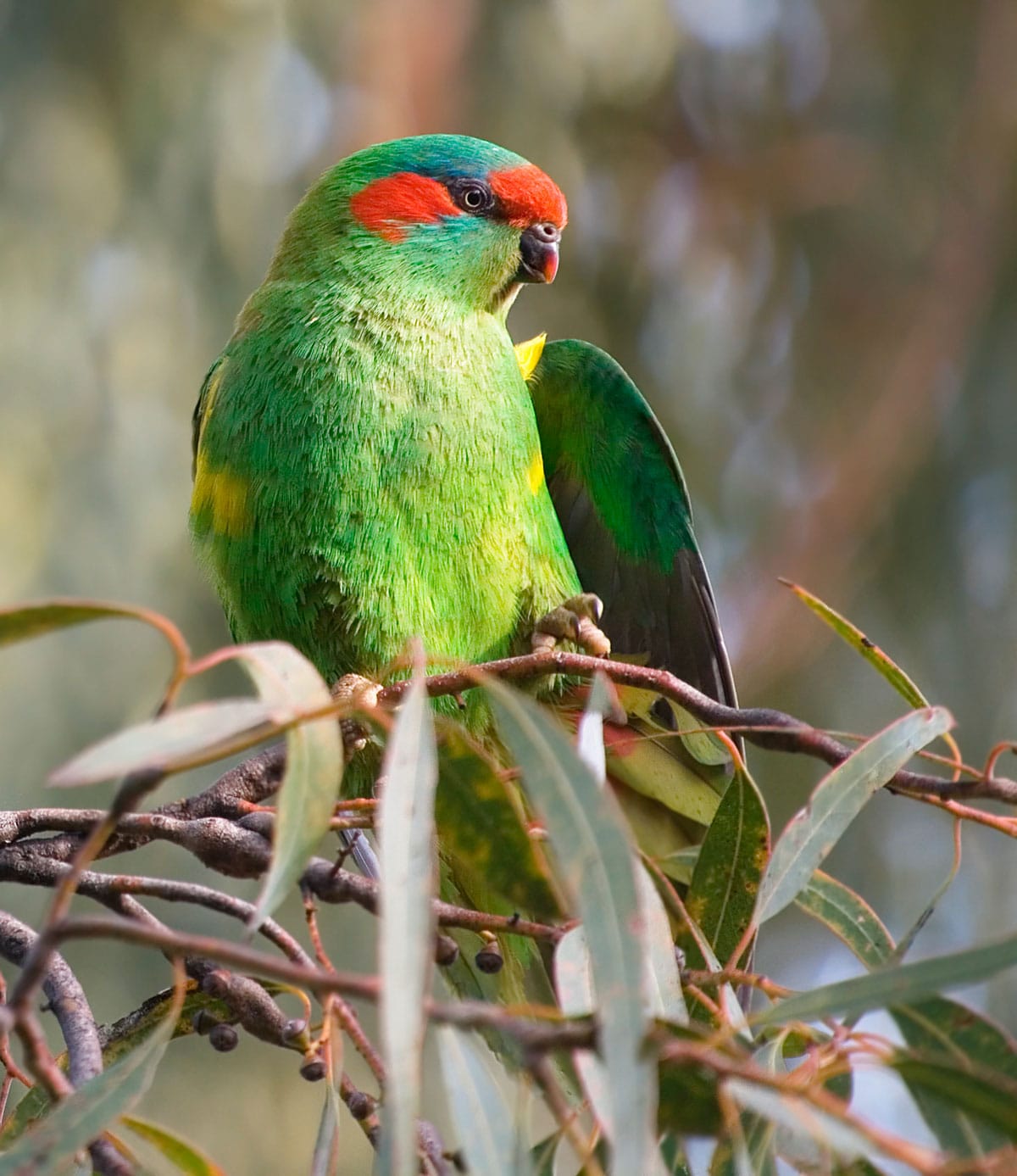
    They prefer tall treetops and are difficult to see due to their small size and green color.. They prefer trees of eucalyptus that they are in bloom and they can attend major meetings when they are feeding, often associated with other lori as the Coconut Lorikeet and the Musk Lorikeet.

    Ruidoso. Their flight is flapping fast and straight, accompanied by shrill calls.

    Reproduction:

    The breeding season It is going may in the North, or August in the South, to December. It nests in the Hollows of trees, where sets of 3 to 5 rounded whitish eggs. The incubation hard ones three weeks.

    Food:

    It feeds mainly from fruits and flowers, including native plants such as those belonging to the genera Xanthorrhoea and (Melaleuca and Loranthus, and introduced plants such as the medlar (Eriobotrya japonica). Occasionally visit orchards.

    Distribution:

    Size of the area of distribution (reproduction / resident): 788.000 km2

    Distribution Lori Carirrojo
    The Little Lorikeet is located in the East and Southeast of Australia, from the vicinity of Cairns to the South by Queensland and New South Wales from the slopes of the Great dividing range until the eastern coasts to most of Victoria and Southeast of Southern Australia. Also located in Tasmania, although there is little abundant.

    Conservation:


    minor concern

    • Current category of the Red List of the UICN: Least concern.

    • Population trend: Stable.

    The main threats to these small parrots are the loss of breeding sites and of those resources food by the clearing of land in course. Most breeding records come from the western slopes, where has been a great loss of habitat trees. The loss of trees nest along the verges of Highway, often associated with roadwork, It is still a constant threat.

    "Little Lorikeet" in captivity:

    Although it was exported to Europe for the first time in 1877, the Little Lorikeet rarely seen outside of Australia. And even in the country of which it is native it is rare in captivity. Has a reputation for being difficult to maintain.

    Alternative names:

    Little Lorikeet, Little Red Lorikeet (ingles).
    Lori à masque rouge, Petit Loriquet (French).
    Zwergmoschuslori (German).
    Loris Pusilla (Portuguese).
    Lori Carirrojo, Lori de Cabeza Roja (español).

    scientific classification:

    Order: Psittaciformes
    Family: Psittaculidae
    Genus: Parvipsitta
    Scientific name: Parvipsitta petty
    Citation: (Shaw, 1790)
    Protonimo: Psittacus Pusillus

    Images «Red-faced Lory»:

    Videos "Little Lorikeet"


    «On Carirrojo» (Parvipsitta petty)


    Sources:

    Avibase
    Parrots of the World – Forshaw Joseph M
    Parrots A Guide to the Parrots of the World – Tony Juniper & Mike Parr
    Wikipedia
    environment.NSW.gov.au

    Photos:

    1 – By JJ Harrison (jjharrison89@facebook.com) (Hand darbas) [CC BY-SA 3.0 or GFDL], via Wikimedia Commons
    2 – By Joxerra Aihartza (à‘ire argazki bilduma / own picture) [FAL], via Wikimedia Commons
    3 – Little Lorikeets by Julian Robinson, on Flickr – Flickr
    4 – Little Lorikeets (Glossopsitta pusilla) by David Cook, on Flickr – Flickr
    5 – Musk Lorikeet [Glossopsitta concinna] again! by Norm Hanson, on Flickr – Flickr

    Sounds: Marc Anderson (Xeno-canto)