โ–ท The world of Pets: Dogs, cats, birds, reptiles, amphibians

Gang-gang cockatoo
Callocephalon fimbriatum


Gang-gang cockatoo

Content

Description

Of approximately 35 cm.. height and an average weight of 257 g.
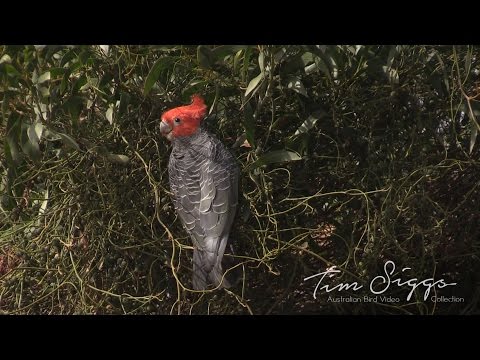
The Gang-gang cockatoo (Callocephalon fimbriatum) it's a little cockatoo, robust, with one crest Dim, large wings wide, and tail short. Son gregarious but relatively calm.
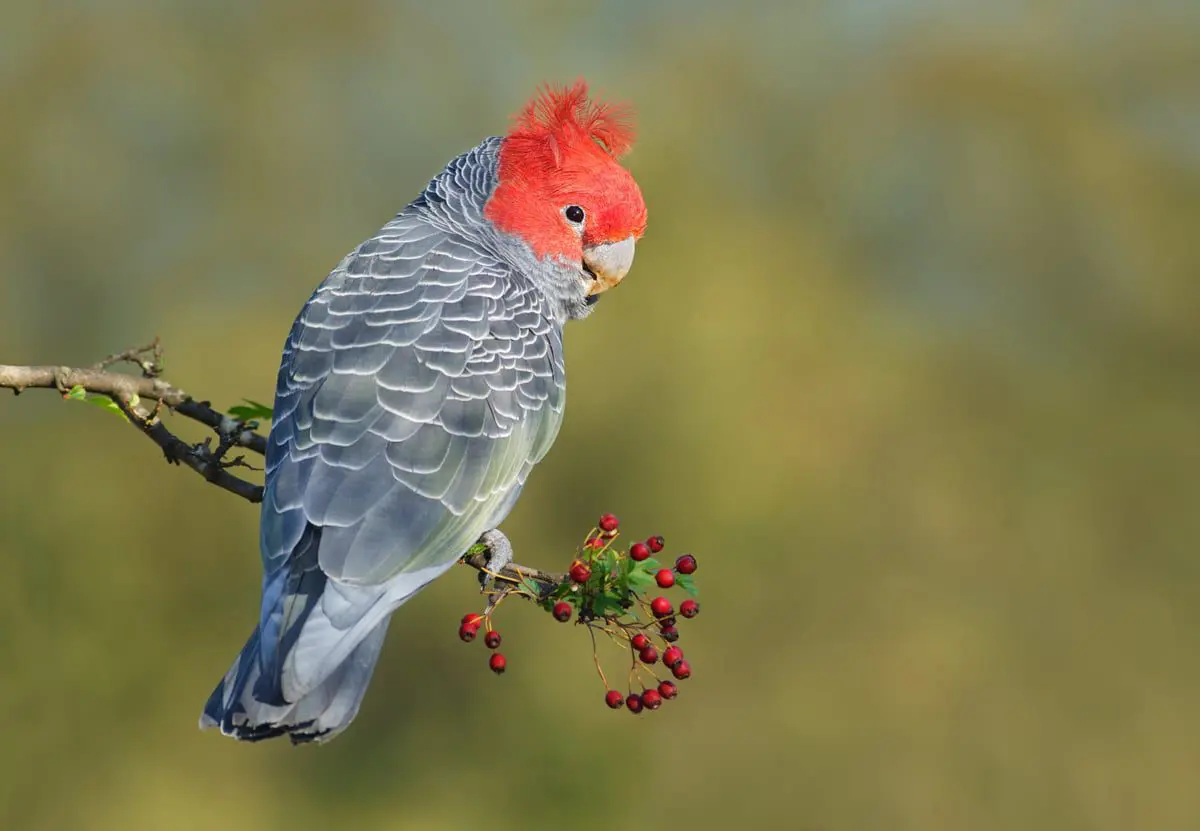
The males of the Gang-gang cockatoo they are immediately recognizable by their head and crest scarlet. The remaining plumage is slate grey.
The females they have the head and crest grey. The feathers of the part inferior of the body are lined with green Orange and yellow, giving a scaly appearance. The tail also has stripes horizontal white. Otherwise, is identical to the male.

The juveniles they are similar to the females, they differ in their top, the head Red and one crest shorter and less twisted.
The Gang-gang cockatoo not can confuse it with other species of parrots. In flight, However, sometimes their shape resembles to the cacatรบa Galah.

Habitat:

Video – "Gang-gang cockatoo" (Callocephalon fimbriatum)

Gang- gang Cockatoo (Callocephalon fimbriatum)

During the summer are found in the forests of mountain and areas with understory of shrubs dense. In Winter they will move to more dry and low altitudes, more open forests. They can often be seen along the roads and in parks and gardens in urban areas. They require high hollow trees for nest.

Reproduction:

Forman couples monogamous. The female chooses a hole in the right tree and both sexes prepare the nest for egg-laying. They line the sides of the hole with sawdust and chewing dust. Both sexes incubate the eggs and care for the young. Parents feed their young for four to six weeks after hatching. Feather.

Family groups are commonly seen feeding together during the breeding season.. In some cases, nurseries will be formed’ where have several couples nested together, their young perch together in the same tree, While their parents seek for food.

Food:

With feed mainly seeds trees and shrubs, native and introduced, with a preference for the eucalyptus, beards and thorns. They also eat berries, fruit, dried fruits, insects and their larvae.

They are mainly arboreal, they perch on the ground only to drink and forage among the fallen fruits or cones.

They feed in flocks of up 60 birds out of breeding season. Feed in pairs or small family groups during the breeding season.

They are able to use exotic plants as food in the urban areas.

Distribution:

Size distribution (reproduction / resident): 333.000 km2

They are endemic to the South-East of Australia. They are widespread in the East of New South Wales, from the Central slopes and plateaus to the South Coast, along the northeastern regions of Victoria to Seymour, with some records in the East of Melbourne, mornington peninsula and Southwest Gippsland.
Have also been introduced in the Kangaroo Island to the South of Australia.

Conservation:

State of conservation โ“˜


minor concern Minor Concern โ“˜ (UICN)โ“˜

โ€ข Current category of the Red List of the UICN: Least concern.

โ€ข Population trend: In increased.

Is come affected negatively by deforestation and the removal of mature trees (potential breeding sites). A population is classified as threatened: in the Valley Cove Lane, New South Wales.

The the rest of the population It is suspected that it may be increasing and now will spend the winter in the suburbs of Canberra.

The world population are estimated at more of 20,000 individuals.

"Gang-gang cockatoo" in captivity:

Itร‚ยดs very rare in poultry and hard to find as a pet.

Son Smart and playful, but they have a great tendency to suffer from software. They are very destructive for what need of abundant toys to not attack against the furniture of the House.

When you get bored, they are often automutilan as a way to fight against boredom.

Its life expectancy You can overcome the 60 years.

Alternative names:

Gang-gang Cockatoo, Cockatoo Corella, Helmeted Cockatoo, Red-crowned Cockatoo, Red-headed Parrot (English).
Cacatoรจs ร  tรชte rouge, Cacatoรจs gang-gang (French).
Helmkakadu, Helm-Kakadu (German).
Cacatua-gang-gang (Portuguese).
Cacatรบa Gang Gang, Cacatรบa Gang-gang (espaรฑol).

scientific classification:

Order: Psittaciformes
Family: Cacatuidae
Scientific name: Callocephalon fimbriatum
Genus: Callocephalon
Citation: (Grant,JB, 1803)
Protonimo: Psittacus fimbriatus

Images Gang-gang Cockatoo:


Sources:
Avibase
infoexoticos
– Birdlife

– Photos: Jan Wegener, Marbiz (Panoramio), papouch.webzdarma.cz, Benjamint444 (commons.wikimedia.org)

– Sounds: (Xeno-canto)

โ–ท The world of Pets: Dogs, cats, birds, reptiles, amphibians

Brown Lory
Chalcopsitta duivenbodei


Lori Pardo

Content

Description

31 cm.. length and a weight between 200 and 230 gr.

The bottom of the wings of the Brown Lory (Chalcopsitta duivenbodei) are bright yellow narcissus.

Two other features of its plumage that powerfully attract attention are, seen head-on , the yellow that completely surrounds the bill and forecrown and also the contrast of color violet or blue deep in it low back, the thighs and feathers of the tail.

The feathers of the chest have pointed yellow, giving a scaly appearance to the area.

The bill is black, as the eye ring and the skin bare at the base of the bill. The irises are orange-red, the legs are grey.

There is no sexual dimorphism, females are identical to males.

The youth they have more muted colors, with less yellow.

To the Brown Lory may be mistaken for it is a very similar species, the Dusky lory (Pseudeos fuscata). The latter, However, can be distinguished by their underparts predominantly orange or yellow, rump white, their bill Orange and its smaller size.

It is a bird of extraordinary beauty.

Subspecies description

  • Chalcopsitta Duivenbodei Syringanuchalis

    (Neumann, 1915) – 31 cm approx.. Brown is more dark by the area of the head and back. Many specimens with dark violet hue.


  • Chalcopsitta Duivenbodei Duivenbodei

    (Dubois, 1884) – The nominal

Habitat:

They frequent the primary and secondary forests with large mature trees.
They seem to especially appreciate the edges of wooded areas. They are also found in the partially open forests. They seem to be able to adapt to areas that have suffered more or less significant damage.

The Brown Lory It is a bird of lowland, It is usually present below the 200 m.

There is little information about the habits of this species. Often live in pairs or in small groups in that often is associated with other species of parrots dining rooms of nectar or near those trees in flower.

They usually seek food the canopy of the forest and vegetation at ground level. Their activity seems to have no end. At night they retire to dormitories in the branches.

When moving, they have a very characteristic flight made with very accentuated flapping at the tips of the wings.
Their flight is much slower than the Coconut Lorikeet (Trichoglossus hamatodus). Yellow-orange color under the wings are very obvious.

Reproduction:

The breeding season is produced in April. In captivity, the females usually lay two eggs, which hatch in approximately 24 days. The total duration of the nesting is very long. 11 weeks from the construction of the nest to the full autonomy of the young. We don't have more information.

Food:

We don't have many details about their menu. One thing is certain, their diet is almost exclusively vegetarian. It feeds on fruits, seeds and sprouts. Given the fact that spends most of its time in shrubs or flowering trees, pollen and nectar should be an essential resource in your diet.

Distribution:

This species has a patchy distribution along the lowlands of the North coast of New Guinea, since the Cenderawasih Bay between papua and West Papua (Indonesian) to the Astrolabe Bay in Papua New Guinea. In general they are rare (Coates 1985, Beehler et to the., 1986), but it is quite common locally in locations such as the southern zone of Vanimo Puwani River and in the area of the wapoga river (A. Mack in lit. . 1999, KD Bishop in litt. 1999, B. Beehler in litt., 2000).

Subspecies distribution

  • Chalcopsitta Duivenbodei Syringanuchalis

    (Neumann, 1915) – Cenderawasih Bay between Papua and West Papua and Astrolabe Bay, in Papua New Guinea.


  • Chalcopsitta Duivenbodei Duivenbodei

    (Dubois, 1884) – The nominal

Conservation:


minor concern


โ€ข Current IUCN Red List category: Least concern.

โ€ข Population trend: Stable.

The species has a population global estimated at more of 50.000 individuals.
Forests throughout its area of distribution is threatened by commercial logging, but the abundance of the species in secondary forest suggests that it is not threatened.

The fact that are able to adapt to them areas forest exploited or degraded, It is an encouraging sign and the mark of the relative health of the species.

"Brown Lory" in captivity:

It is of a bird rare in captivity, but its breeding is easy.

Information in BeautyofBirds

Alternative names:

Brown Lory, Duyvenbode’s Lory (ingles).
Lori de Duyvenbode (French).
Braunlori (German).
Lรณris-castanho (Portuguese).
(espaรฑol).

scientific classification:

Order: Psittaciformes
Family: Psittaculidae
Genus: Chalcopsitta
Scientific name: Chalcopsitta duivenbodei
Citation: (Dubois, 1884)
Protonimo: Chalcopsittacus Duivenbodei

ยซLori Pardoยป images:

Videos "Brown Lory"

—————————————————————————————————

ยซLori Pardoยป (Chalcopsitta duivenbodei)


Sources:
Avibase, Birdlife International, Oiseaux.NET

Photos: bob|P-&-S (Flickr), Wikimedia, J. Brubaker (IBC.lynxeds.com), iggino (IBC.lynxeds.com), animalphotos.me

Sounds: BAS van Balen (Xeno-canto)

โ–ท The world of Pets: Dogs, cats, birds, reptiles, amphibians

Yellow-and-green Lorikeet
Trichoglossus flavoviridis

Yellow-and-green Lorikeet

Content

Yellow-and-green Lorikeet

Description

20 cm.. length and a weight between 80 and 95 gr.

Very similar to the Scaly breasted Lorikeet by appearance scaly on underparts, but differs from it by color low wing and brands that adorn their head.

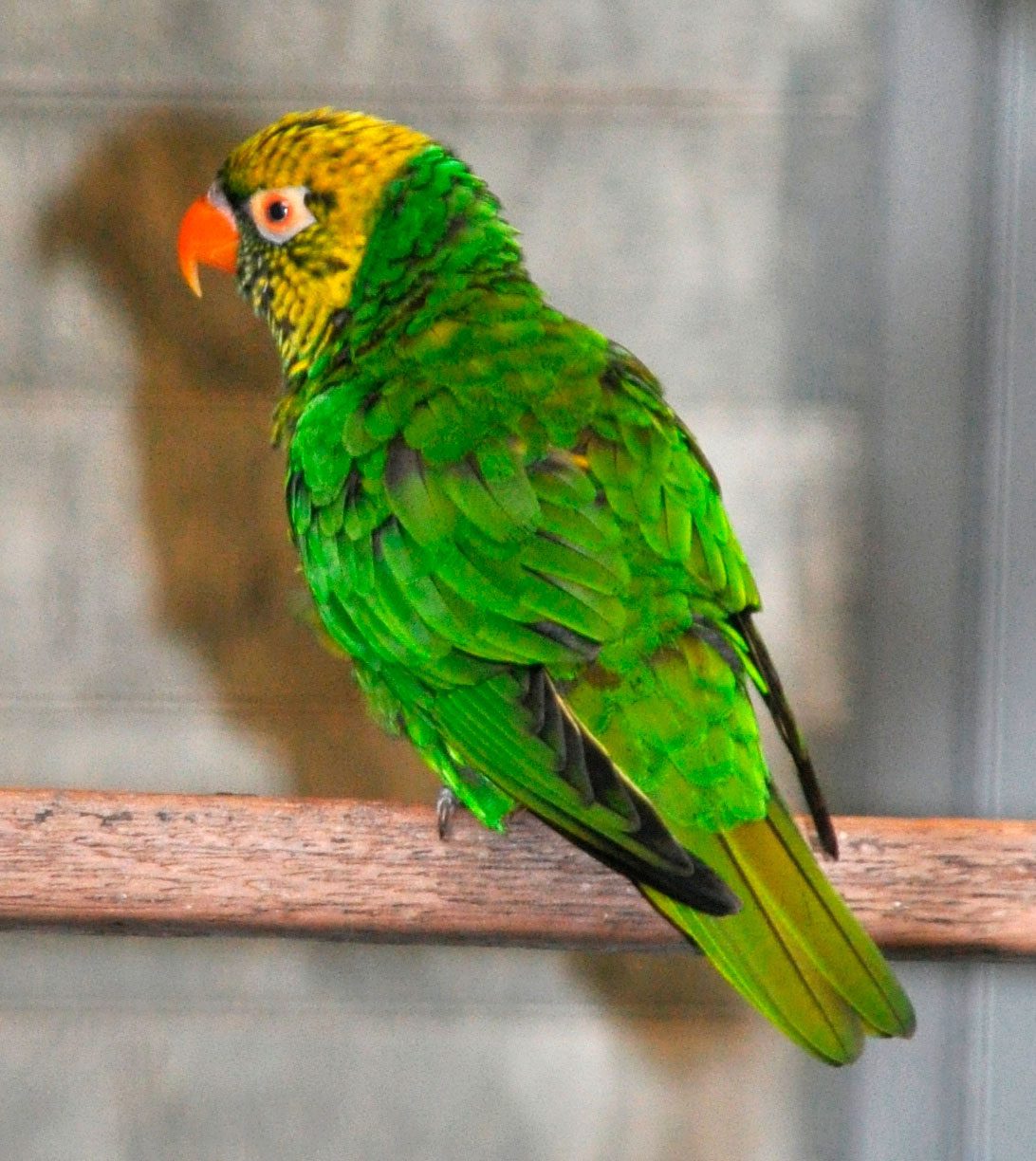
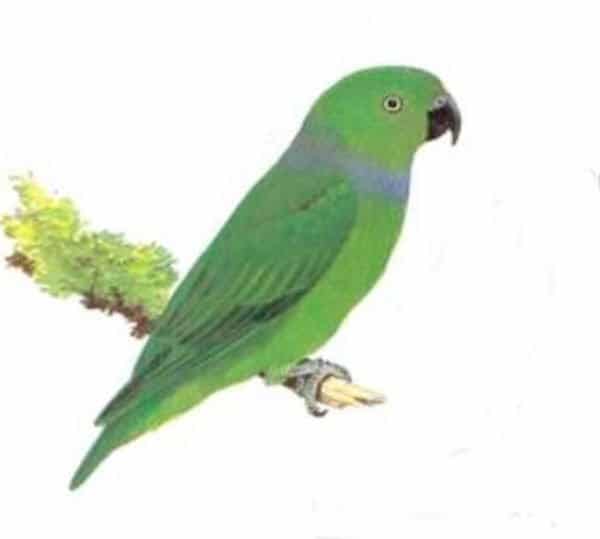
The adults of the Yellow-and-green Lorikeet (Trichoglossus flavoviridis) they have the upperparts plumage of a beautiful green.

The forecrown and top They are are greenish brown. The throat and the chest to abdomen It is yellow with dark green flakes. Area of sides up to the coverts and the bottom of the wings It shows a beautiful yellow-green.

The bill is orange. The irises is orange-yellow, the legs grey.

It has no sexual dimorphism.

In the youth, all the yellow markings are derived more green. The bill is brown, while the bare parts of the face are white. The irises is brown.

Description 2 subspecies

  • Trichoglossus flavoviridis flavoviridis

    (Wallace, 1863) – Nominal. Overall plumage It is olive green. The forecrown and crown yellow. The back of the neck brown. the yellow throat and the chest to abdomen, with the scalloped dark green.


  • Trichoglossus flavoviridis meyeri

    (Walden, 1871) – Shown in upperparts a darker shade of green; the underparts They are less scaly. The back of the top, the occiput and nape are greenish-Brown. The cheeks and throat They are yellow with dark green stripes. This subspecies is much smaller, between 40 and 50 gr.

Habitat:

The Yellow-and-green Lorikeet they are distributed with greater diligence between primary forest and mature secondary forest than their close relatives, the Ornate Lory. But, This does not prevent them from entering the open lands to feed from the ceibos in flower (coral trees).

Throughout its area, these birds are considered fairly common. In Celebes, are common in the mountainous areas where have been supplanted to a large extent to the Ornate Lory. In the Sula Islands, they are common in almost all altitudes.

They live in small flocks of noisy and sometimes mingle with the Ornate Lory When looking for food in the trees in flower at the edge of forests.

These birds are relatively Shy and they tend to stay inside the dense forest foliage, where their cryptic plumage makes them virtually invisible. When they feel threatened, leave the foliage uttering cries penetrating and powerful. They are easier to fly above the treetops on quick flights or the circulating a flight above the trees, just before landing in the branches more high.

Reproduction:

There is little information reproduction in the natural environment. The only one nest we have discovered so far was in a mossy forest, about 2.400 meters above the sea level. It was located high above the ground in a dead tree.

In captivity, the implementation is, usually, two white eggs that incubate for a few parents will be 23 days. As with all the Lori, the reproductive cycle It is particularly long and hard about 65 days.

Food:

The Yellow-and-green Lorikeet is above all vegetarian. Their language is particularly suitable for crop pollen and the nectar from the flowers. It is equipped with long buds that allows you to easily reach their favorite food. They have a predilection for the trees of the genus Euphorbia and Erythrina.

Distribution:

Size of its range (reproduction / resident): 6.300 km2

The Yellow-and-green Lorikeet They are endemic to the islands east of Indonesian. They are exclusively on the Sula Islands (Taliabu, Mangole, Sanana) and especially in the area of Celebes island.

Description 2 subspecies

Conservation:


minor concern


โ€ข IUCN Classification: Least concern.

โ€ข No threats at present.

The species is not threatened. In Taliabu, is very common in altitude zones, but it is also quite common in degraded areas bordering the coast. It is estimated one world population above the 100.000 specimens.

Justification of trend

They suspected that the population is stable in absence of evidence of any decline or threatens substantial.

"Yellow-and-green Lorikeet" in captivity:

Pretty common in captivity.

Take it easy, Nice trill. Sensitive to cold temperatures and somewhat susceptible to disease. He will join his caregiver over time although initially shy.

Alternative names:

Yellow-and-green Lorikeet, Citrine Lorikeet, Yellow & Green Lorikeet, Yellow and Green Lorikeet, Yellow&green lorikeet, Yellow-and- Green Lorikeet, Yellow-green Lorikeet (ingles).
Loriquet jaune et vert (French).
Celebeslori (German).
Lori flavoviridis (Portuguese).
Lori Verdigualdo, Tricogloso Verde y Amarillo (espaรฑol).

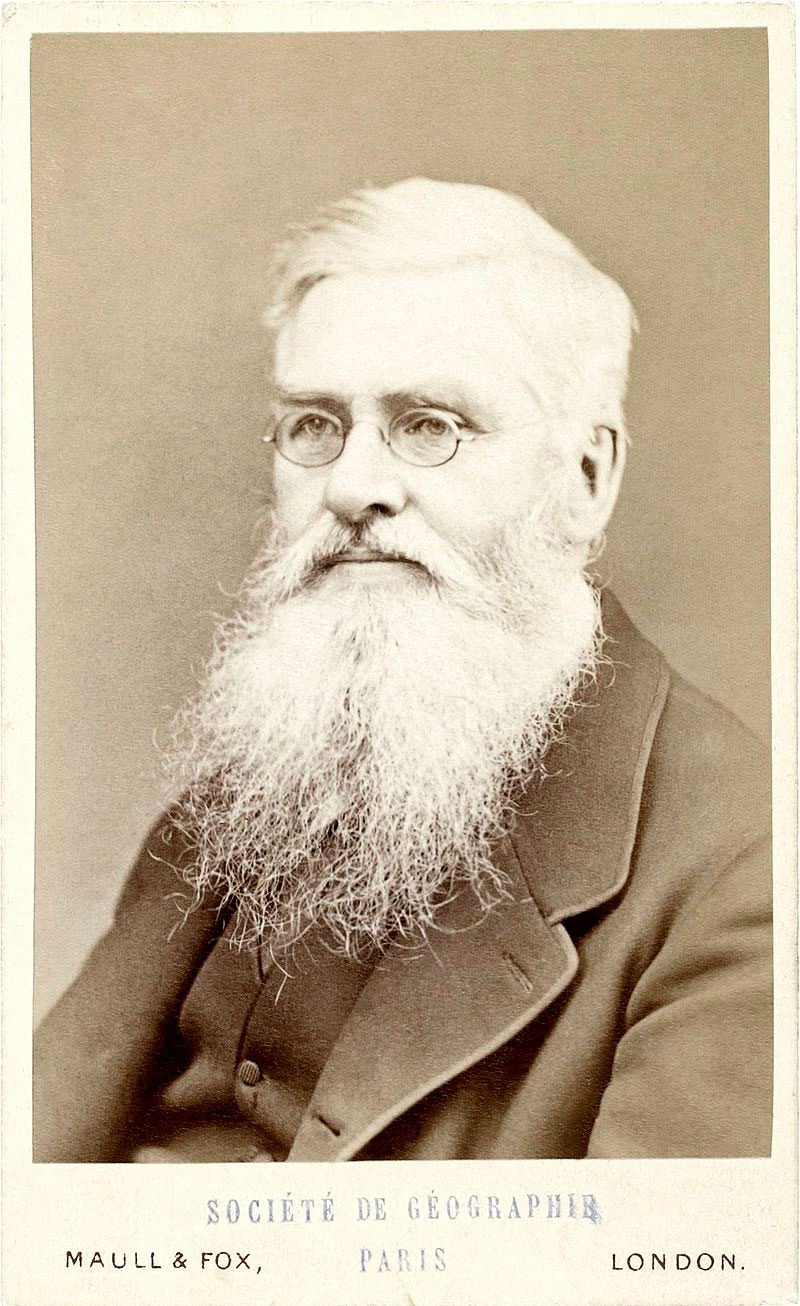
Alfred Russel Wallace

scientific classification:


Order: Psittaciformes
Family: Psittaculidae
Genus: Trichoglossus
Scientific name: Trichoglossus flavoviridis
Citation: Wallace, 1863
Protonimo: Trichoglossus flavoviridis


Images ยซLori Verdigualdoยป:

Videos "Yellow-and-green Lorikeet"

————————————————————————————————

"Lori Verdigualaldo" " (Trichoglossus flavoviridis)


Sources:

Avibase
– Parrots of the World – Joseph Forshaw M
– Parrots-A Guide to the Parrots of the World by Tony Juniper & Mike Parr
Birdlife

Photos:

(1) – Yellow and Green Lorikeet (Trichoglossus flavoviridis) in the Walsrode Bird Park, Germany By Quartl (Own work) [CC BY-SA 3.0], via Wikimedia Commons
(2) – Trichoglossus flavoviridis Proceedings of the Zoological Society of London 1862 by Joseph Wolf [Public domain], via Wikimedia Commons

Sounds: Frank Lambert (Xeno-canto)

โ–ท The world of Pets: Dogs, cats, birds, reptiles, amphibians

Black-capped Lory
Lorius lory

Tricolor loris

Content

Description

The Black-capped Lory (Lorius lory) has an approximate length of 31 cm.. and a weight between 200 and 260 g..

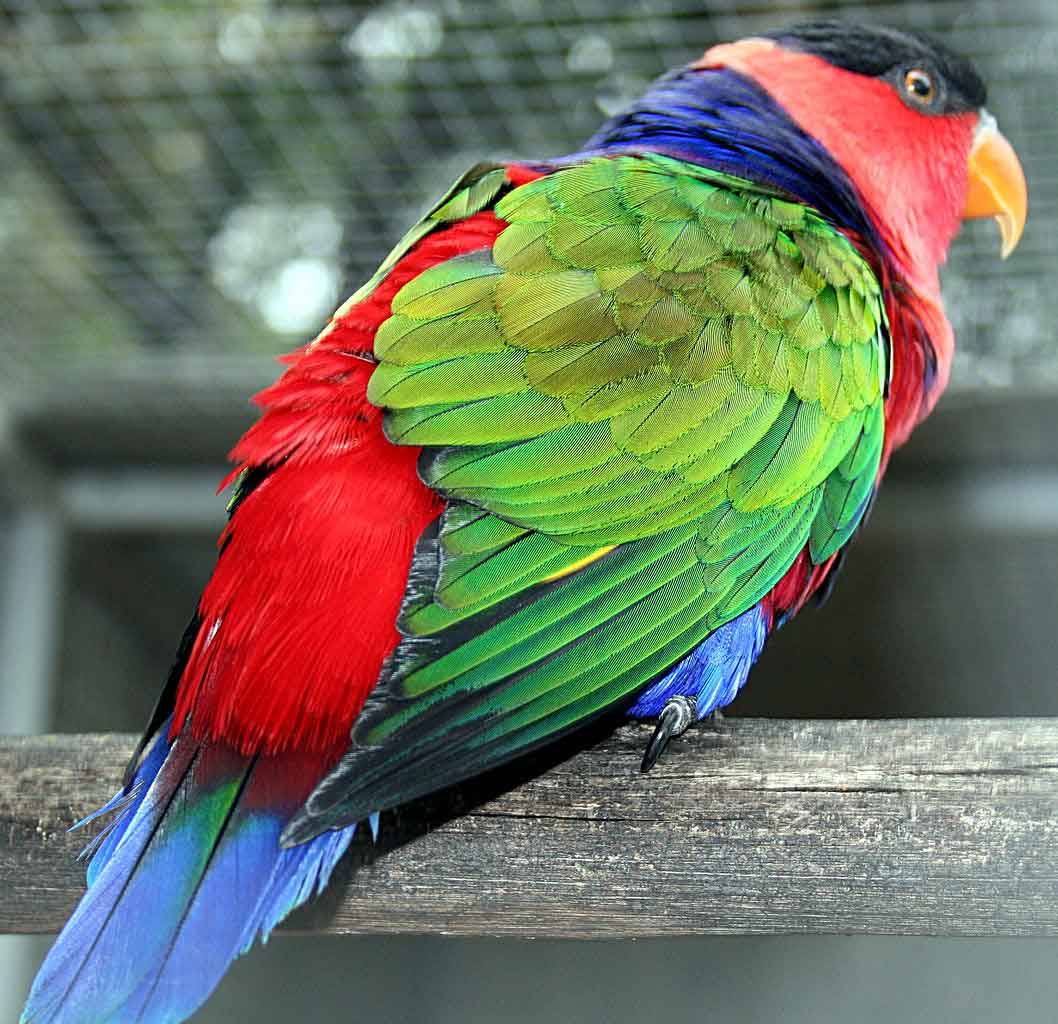
Black hood extends above the peak to the nape of the neck, where a few blue spots appear; rest of the head is bright red. The black hood is separated from the rear mantle red pink (sometimes mottled red), by a fine necklace of dark purple blue; back, the upper coverts bright red tail and rump.

Upper parts of green color with slight shine bronze wing, more visible on the coverts and secondary more internal.

Flight feathers of black on the inside and marked with yellow in the middle part, forming the group a tricolour in the Underwing. Red Wing coverts.

Throat and upper part of the chest of Red; Blue mantle extends around the sides of the chest, dark blue in the abdomen that is slightly brighter in thighs and coverts; flanks with varying amounts of Red ranging upward and around the curve of the wing.

Dark bluish black on the upper tail feathers, Green slightly sieved in the Centre and Red at the base (It shows only dark blue at rest); Yellow undertail dark Olive with red hidden base.

Orange peak; Cere and grey-black periophthalmic ring; orange-yellow IRIS; grey to black legs.

Males and females they are the same. Immature with less extensive blue underparts and the upper part of the chest of color red wine. Fine blue collar around throat. Underwing coverts blue and yellow with a black tip, not red as in adults. Brownish beak.

Subspecies vary considerably in color:

  • Lorius lory lory: It is the nominal
  • Lorius lory erythrothorax: Neck and central area of blue belly. Yellow in the wings. Blue mantle in two bands. Red Underwing coverts.
  • Lorius lory SOMU: Red neck, blue belly.
  • Lorius lory salvadorii: As the erythrothorax but with blue-black Underwing coverts.
  • Lorius lory viridicrissalis: As the salvadorii but the blue darker everywhere.
  • Lorius lory jobiensis: As the salvadorii but top of the paler breast and mantle bands.
  • Lorius lory cyanuchen: Black on the top with blue on the nape of the neck.

Habitat:

The Black-capped Lory he prefers the primary forests and edges of these, They also reported in secondary forests well grown, in some partially cleared areas and swamp forest. It is not known to occur in the monsoon forest, planted forests or plantations of coconut trees. The Black-capped Lory is mainly distributed in the lowlands up to 1.000 m, but there have been examples to 1.750 m.

They are mainly found in pairs and usually smaller than other groups parrots sympatric, but it may happen that they get together in groups of ten or more to feed in trees in flower.

Reproduction:

Little is known of its breeding ecology in the wild., Although there is a history of a couple digging a pit to make the nest in a dead tree. Apparently the nesting occurs from the month of may until October.

In captivity, the setting is two eggs with 26 incubation days; emancipation occurs between 57 and 70 days after hatching.

Food:

The diet includes pollen, nectar, flowers, fruits and insects. The birds prefer to feed in the canopy or half-height where they remain quiet and discrete. Unlike in the Coconut Lorikeet and the Dusky lory, It reached generally similar maximum altitudes, This species has been able to adapt to secondary habitats in high levels in the East of New Guinea.

Distribution:

Widely distributed from the West of Irian Java (Indonesian), including Waigeo, Batanta, Salawati and Misool in the Group of islands west of papua and Yapen, My Num. They are also found in the Biak island on bahรญa de Geelvink, (It is from Papua New Guinea).

It is quite common in the lowlands and foothills.. Top world population to the 100.000 individuals.

Subspecies distribution:

  • Lorius lory lory: It is the nominal.
  • Lorius lory erythrothorax: The South coast of New Guinea east of the peninsula Birdโ€™s Head, and to the southeast of the North Coast.
  • Lorius lory SOMU: Mountain districts in the South of the center of New Guinea.
  • Lorius lory salvadorii: Northwest Coast of Papua New Guinea.
  • Lorius lory viridicrissalis: Northeast coast of Western New Guinea.
  • Lorius lory jobiensis: Islands Yapen and My Num.
  • Lorius lory cyanuchen: Biak Island.

Conservation:


minor concern


โ€ข Current IUCN Red List category: Least concern

โ€ข Population trend: Stable


The world's population has not been quantified, but the species has been observed that it is, usually, common, but not abundant throughout its area of distribution.

Suspected that the population is stable in the absence of evidence of any reduction or substantial threats.


"Black-capped Lory" in captivity:

It has attractive voice and can learn to imitate. Playful and curious; It can be noisy at times.

Common up to the decade of 1960 When exports began to cease.

Alternative names:

Black-capped Lory, Black capped Lory, Tricolored Lory, Tricoloured Lory, Western Black-capped Lory (ingles).
Lori tricolore, Lori ร  calotte noire (French).
Frauenlori (German).
Lรณris-bailarino (Portuguese).
Lori Tricolor, Tricogloso Tricolor (espaรฑol).

scientific classification:

Order: Psittaciformes
Family: Psittaculidae
Scientific name: Lorius lory
Citation: (Linnaeus, 1758)
Protonimo: Psittacus Lory

โ€œTricolor Loryโ€ Images:

Videos "Black-capped Lory"

————————————————————————————————

"Lori Tricolor" (Lorius lory)


Sources:

Avibase
– Parrots of the World โ€“ Forshaw Joseph M
– Parrots A Guide to the Parrots of the World – Tony Juniper & Mike Parr
– Birdlife

Photos:

1 – By Michael Spencer [CC BY 2.0], via Wikimedia Commons
2 – ยซLorius lory – Bird Park, Singapore – upside down-8aยป by Benjamint444Own work. Licensed under GFDL 1.2 via Wikimedia Commons.
3 – ยซLorius lory-20051118ยป by Doug JansonOwn work. Licensed under CC BY-SA 3.0 via Wikimedia Commons.
4 – By Renรฉ Modery (originally posted to Flickr as CIMG6207) [CC BY 2.0], via Wikimedia Commons
5 – VJ Czar World – Black-capped Lory Snapshots

Sounds: Frank Lambert (Xeno-canto(

โ–ท The world of Pets: Dogs, cats, birds, reptiles, amphibians

Duchess Lorikeet
Charmosyna margarethae


Duchess Lorikeet

Content

Duchess Lorikeet

Description

20 cm.. length and a weight between 40 60 g..

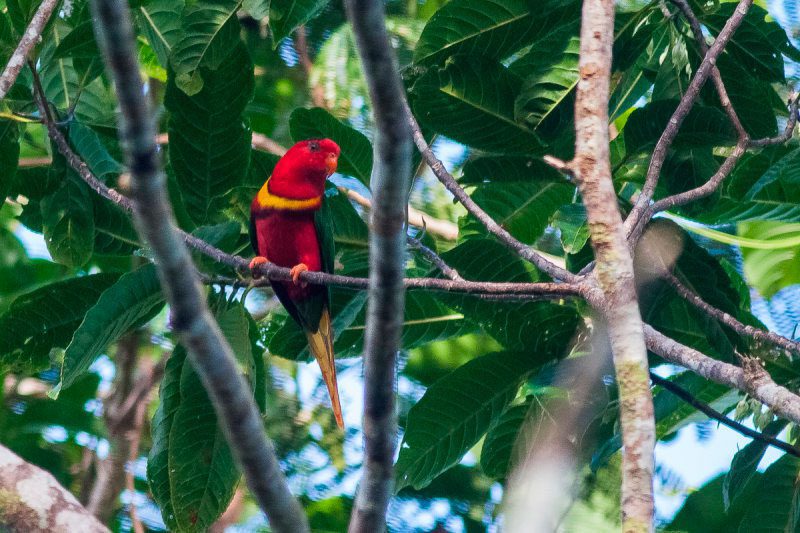
The head of the Duchess Lorikeet (Charmosyna margarethae), is red except for the back of the crown that is black and extends from the top of the eye up to the nape.

Large collar Red on the back of the neck, bordered below by a thin purplish-black line and a broader yellow-orange stripe: the mantle and scapulars green; rump Green with trademark red on the side; tail coverts, view from above, green. The wings green. Under the wing , coverts marginal green, the coats under the wing red, and the bottom of the flight feather Black with a panel of yellow color that goes from the center of the flight feather passing by the secondaries.

The underparts, basically, are red with a yellow stripe on the chest, narrow edged purple-black above, a thin red margin and a broader and more diffuse below purple edge; from below, the tail coats are green. From above, the tail It is red with black borders and the sharp tip of yellow; from below, the tail is yellowish-brown, Yellow-tipped.

The bill is orange; irises yellow to orange; legs oranges.

The male and the female are very similar.

Immature they lack the Black Hat and black and orange margin on the back of the neck. The chest belt is a yellow shutdown. The bill orange, the irises Yellow-grey and the legs gray.

Habitat:

It inhabits in the forests and wooded areas, at the edges of forests and tall secondary growth forests, mostly mountains and hills, Although you can also see in coconut plantations and coastal villages; above all between 100 and 1.350 meters above sea level.

Often feeds in noisy groups of 10 to 40 birds in the trees in flower and epiphytes with others Loris (including (Cardinal Lory). They feed acrobatically, mainly in the forest canopy.

Reproduction:

Nesting and breeding habits unknown, although a male was seen in a breeding attitude during the month of January.

Food:

Apart from pollen and nectar, observed feeding on fruits of Schefflera.

Distribution:

The Duchess Lorikeet is endemic of the Solomon Islands including Bougainville (Papua New Guinea), Gizo, Kolombangara, Guadalcanal, Malaita and San Gristobal. Brian Coates indicates that this species often seen in the city of Kieta, Bougainville.

Conservation:


Near-threatened

โ€ข Current IUCN Red List category: Near threatened.

โ€ข Population trend: Decreasing.

Much of the lowland forests, within the area of distribution of the Duchess Lorikeet, He has been or is scheduled to be connected, but this species is probably safe in the Highlands.

There is an export license fee for 60 birds, the funds will be used to finance conservation programs (JR van Oosten in litt. 1999); However, this species could be threatened by any large-scale trade (T. Leary in litt. 2000). In 2002, 200 birds were imported to Singapore with permissions CITES (UNEP-WCMC CITES Trade Database, January 2005).

The world population It is considered of less than 50.000 birds, but stable.

"Duchess Lorikeet" in captivity:

Very rare in captivity.

Alternative names:

Duchess Lorikeet, Dutchess Lorikeet (ingles).
Lori de Margaret (French).
Margarethenlori, Margaretenlori (German).
Lori de Margarita (espaรฑol).
Duchess Lorikeet (Portuguese).

scientific classification:

Order: Psittaciformes
Family: Psittaculidae
Scientific name: Charmosyna margarethae
Genus: Charmosyna
Citation: Tristram, 1879
Protonimo: Charmosyna margarethae

Images "Duchess Lorikeet"

Videos "Duchess Lorikeet"

————————————————————————————————

"Lori de Margarita" (Charmosyna margarethae)


Sources:

Avibase
– Parrots of the World โ€“ Forshaw Joseph M
– Parrots A Guide to the Parrots of the World – Tony Juniper & Mike Parr
– Birdlife

Photos:

1 – By ยฉ Markus Lagerqvist – PBase
2 – ยซCharmosynamargarethaesmitยป by John Gerrard KeulemansThe Ibis, ser. 4, too.. 3. Licensed under Public Domain via Wikimedia Commons.

Sounds: Niels Krabbe (Xeno-canto)

โ–ท The world of Pets: Dogs, cats, birds, reptiles, amphibians

Blue-crowned hanging parrot
Loriculus galgulus


Hanging Coroniazul

Content

Description

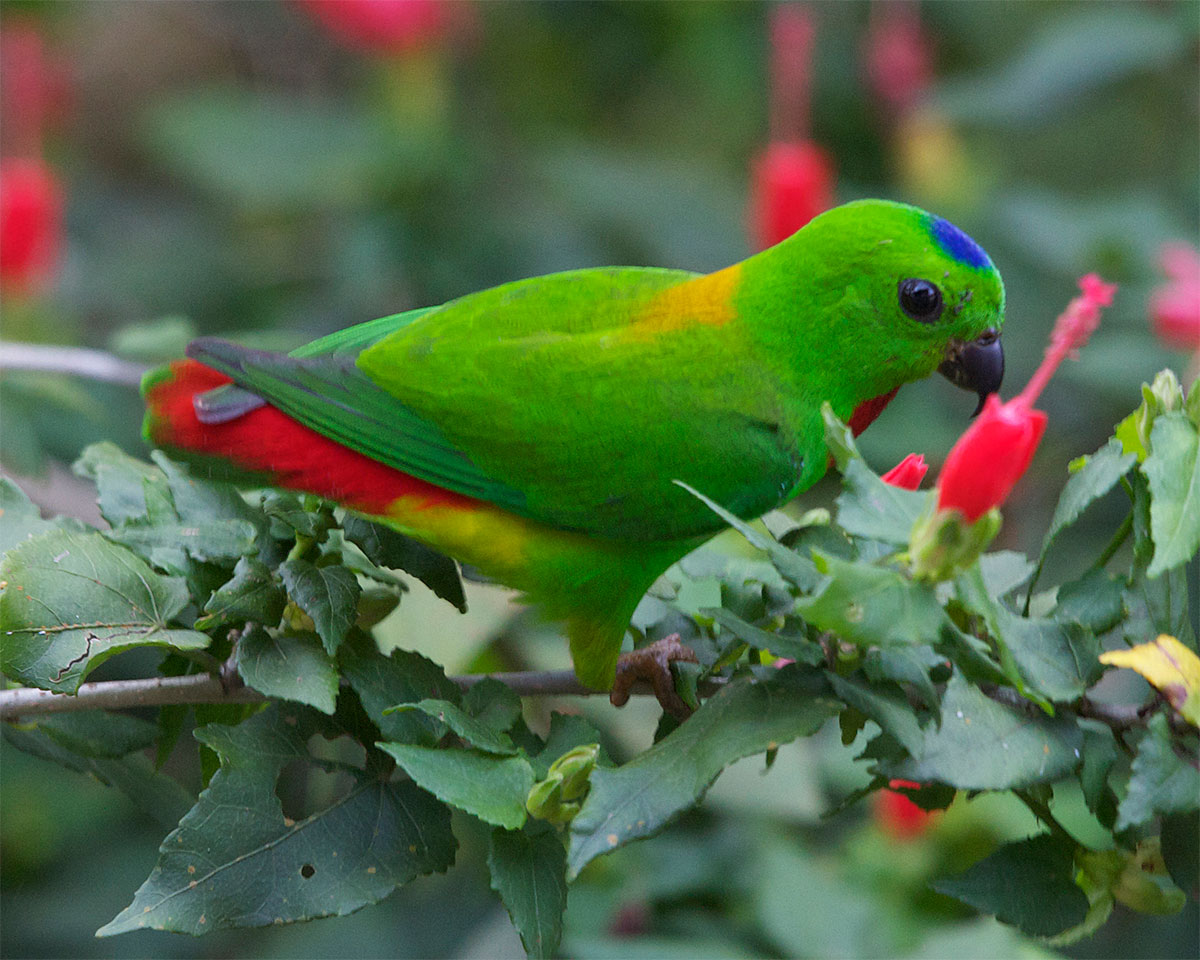
Of 13 cm.. length and 28 g. of weight.

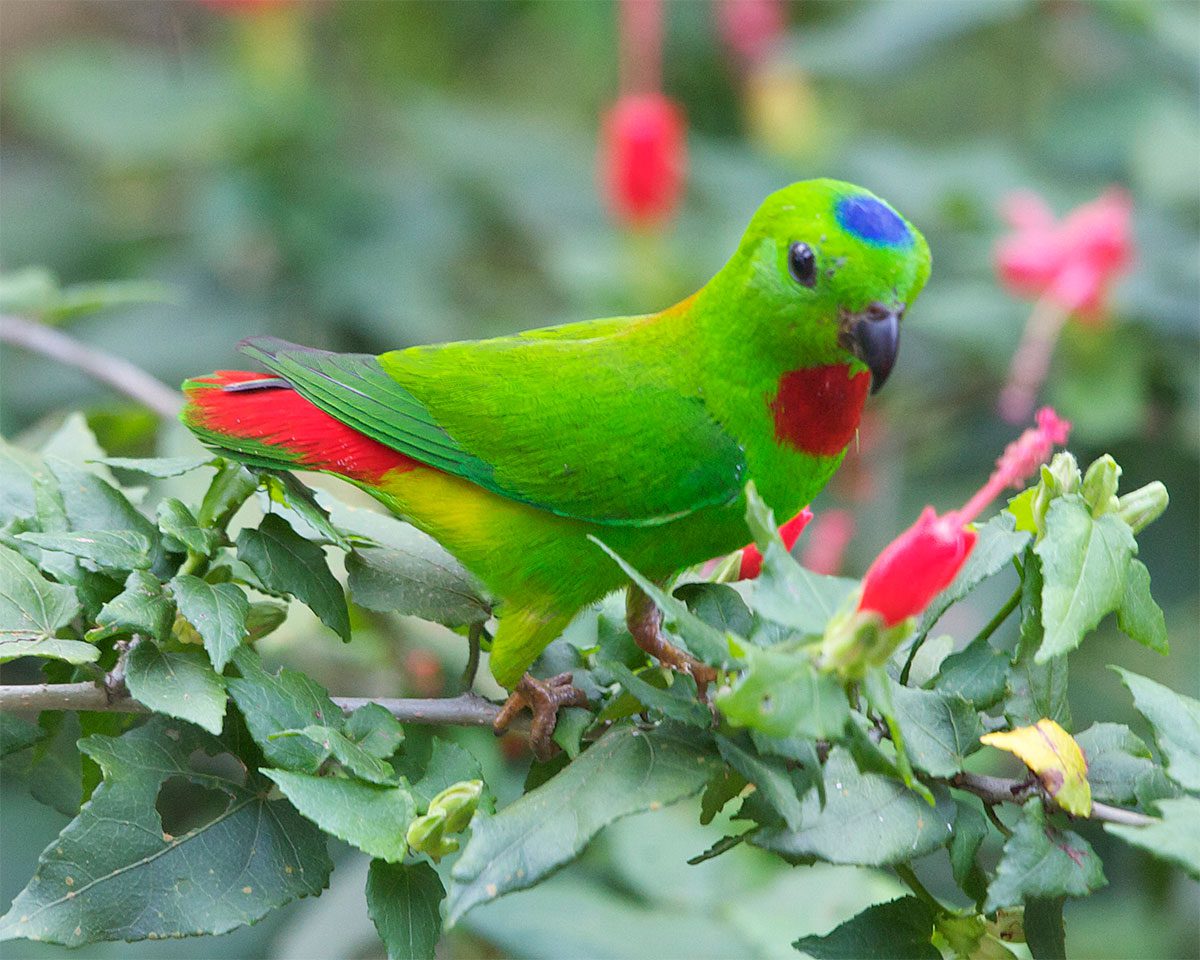
The head of the Blue-crowned hanging parrot (Loriculus galgulus) is bright green with a patch dark blue in the center of the back of the crown. Upperparts Greens with patch orange-brown in the Centre of the the mantle, yellow band at the bottom of the rump and tail coverts scarlet. Wings Greens with vane inner to flight feather darker. Under the wing coats green, with the underside of the flight feather blue. Throat and top of the chest with a patch bright Scarlet, the rest of the underparts slightly of a green pale that the upperparts (and more yellowish on the flanks). Upper, the tail green; Blue below.

Bill black; irises dark brown, legs yellowish brown.

The females lack of the bib red, with the underparts yellowish green. The patch of the crown is much more off, and the the mantle Orange is less marked than in the male.

The young birds lack of the crown blue, they have only an orange wash on the the mantle and bill yellowish. Maturation takes from two to four years in young men, showing the throat Red as the first sign of plumage adult.

Habitat:

Birds have been observed spending the night on the Hill of Fraserโ€™s Hill (Malaysia), which indicates that there is a certain night dispersion. Extralimitales records have also reached coastal islands. The species occurs from the lowlands up to around 1.300 m, lies in the Woods, river banks growing, mangroves, secondary growth, lightly wooded areas, bamboo clumps, orchards, inhabited areas and coconut trees. The birds frequent the canopy and medium height plants, travelling alone, in pairs or. outside the breeding season, in groups of up to 150 birds that invade fruit orchards.

The birds are moving forward with steps balanced through the vegetation with a comical air, using the peak to help upload, and tail as support. Like other hanging parrots, This species sleeping upside down and also uses rain water for bathing in the same position.

Reproduction:

Video "Loricle Coroniazul"

Blue-crowned hanging parrotBlue-crowned hanging parrot

The reproductive behavior you have registered between the months of January and August. When the courtship takes place, the male is shaking his head, cupping their red feathers, extending the tail, with the body upright, and making calls with a soft Twitter.

The nest It is built into the natural cavity in a tree, enlarged by birds, at a height between 5 and 12 meters above the ground.

The Nesting material It is cut by the female and taken to the nest in the contour feathers. The laying is three to four white eggs often dyed Brown. The female incubates the eggs for 20 days and the chicks leave the nest about 33 days after hatching.

Food:

It feeds on flowers, outbreaks, fruit, various seeds and nuts.

Distribution:

Ranges to South, about 10 ยฐ Norte, on the peninsula of Thailand, through Malaysia and Singapore, distributed also in some surrounding islands, including the Anambas Islands, the archipelago of Riau and Batam. The species is widespread through Sumatra and can be seen in the islands of the coast including Tuangku, Nias, Pini, Batu, Siberut, Sipura, Enggano, and to the North of Bangka, Mendanau and Belitung. Is present in a habitat along of Borneo, and the coastal islands Labuan and Maratua. His presence at the end of Java Western, in the area Labuhan, It can be the result of leaks of birds; the population around Jakarta is certainly wild.

Conservation:


minor concern


โ€ข Current IUCN Red List category: Least concern

โ€ข Population trend: Stable

The size of the world's population has not been quantified, but it is thought that it may be superior to 100.000 specimens without registration of captive birds. The species according to information, it is common and widespread in most of its range (pit et to the. 1997).

The population is suspected to be stable in the absence of evidence of any reduction or substantial threats.

"Blue-crowned hanging parrot" in captivity:

These birds are kept in poultry, both in United States as in all Europe. Your dietary needs predispose them to a series of infections if failure to observe stringent hygiene practices, which makes them difficult to keep in captivity. This is the main reason that this species is rare in poultry farming., and even rarer as a pet.

More information at loromania

Alternative names:

Blue-crowned Hanging Parrot, Blue crowned Hanging Parrot, Blue-crowned Hanging-Parrot, Blue-topped Hanging-parrot, Malay Hanging Parrot, Malay Lorikeet, Malaysian Hanging-Parrot (ingles).
Coryllis ร  tรชte bleue, Coryllis ร  calotte bleue, Coryllis de Malacca, Coryllis malais, Loricule ร  tรชte bleue, Loricule de Malacca, Loricule malais (French).
Blaukrรถnchen (German).
Loriculus galgulus (Portuguese).
Lorรญculo Azul, Lorรญculo Coroniazul (espaรฑol).

scientific classification:

Order: Psittaciformes
Family: Psittaculidae
Genus: Loriculus
Scientific name: Loriculus galgulus
Citation: (Linnaeus, 1758)
Protonimo: Psittacus Galgulus

Images ยซLoricle Coroniazulยป:

Videos "Blue-crowned hanging parrot"

————————————————————————————————

"Lorรญculo coroniazulยป (Loriculus galgulus)


Sources:

Avibase
– Parrots of the World โ€“ Forshaw Joseph M
– Parrots A Guide to the Parrots of the World – Tony Juniper & Mike Parr
– Birdlife

Photos:

(1) – By Lip Kee Yap from Singapore, Republic of Singapore [CC BY-SA 2.0], via Wikimedia Commons
(2) – By Quartl (Own work) [CC BY-SA 3.0], via Wikimedia Commons
(3) – By Art Bromage [CC BY-SA 2.0], via Wikimedia Commons
(4) – By Lip Kee Yap from Singapore, Republic of Singapore [CC BY-SA 2.0], via Wikimedia Commons
(5) – By Lip Kee Yap from Singapore, Republic of Singapore [CC BY-SA 2.0], via Wikimedia Commons

Sounds: Marc Anderson (Xeno-canto)

โ–ท The world of Pets: Dogs, cats, birds, reptiles, amphibians

Blue-collared Parrot
Geoffroyus simplex


Blue-collared Parrot

Content

Description

23-25 cm.. length and around 161 g. of weight.

The Blue-collared Parrot (Geoffroyus simplex), they have the head green, more pale and more yellowish in the chin and lower cheeks, with a collar weak but clearly identified blue across the top of the chest and rear of the neck. The upperparts are blackish Green. Curve of the wings yellow; patch Brown in medium-sized inner cover; greater coverts with yellowish green trim; flight feather Black with green in the vane outer; pale line along the inner edge of the tips of the wings closed, formed by yellow tipping in the vane inmates of the flight feather. Underwing coverts and axillary, blue. Ventral pale, more yellowish green than the upper parts. Upper, the tail green; undertail, yellowish.

Bill greyish black; Iris White pale yellowish; legs gray-green.

The females they lack the collar Blue males but have a little blue on the back of the crown.

Subspecies

  • Geoffroyus simplex simplex (Meyer, AB, 1874): The nominal.
  • Geoffroyus simplex buergersi (Neumann, 1922): It measures each 25 cm in length and has purplish blue collar more extensive. Coverts of the wings with Violet Blue. Females have Violet Blue Underwing.

Habitat:

The species is distributed mainly between humid hills and medium-montane forests., along its edges and areas of secondary growth between 500 and 2.500 meters above sea level, being more frequent among the 800 and 1.900 m. Variations in food supply can lead to birds at elevations lower than normal (even at altitudes near sea level).

The Blue-collared Parrot they are shy and hard to spot when perched in trees. Large flocks of birds, of up 200 specimens, can be seen and heard flying above the treetops.

The species tends to form large groups with the Red-checked Parrot, Although sometimes single birds are, in pairs or in small groups.

Reproduction:

Little is known of the breeding ecology. A nest dug with three young was found in mid-January to nine metres in height, close to the top of a stump. The entrance was of 80 mm in diameter, and the gap between 200 mm and 400 mm deep. Nesting is also reported in October.

Food:

The Parrot Acollarado quietly feed in the canopy of seeds, fruit, berries and nectar. They are particularly fond of the seeds of (Castanopis and Oaks Lithocarpus).

Distribution:

New Guinea, Indonesian and Papua New Guinea, with an isolated population in the Doberai Peninsula, from Tamrau to Mountains Parotia. The main population is distributed through the central highlands, absent from the higher central areas, But coming to the Owen Stanley mountain range at the end of this. generally common, but the difficulty of detection makes these less abundant parecezcan birds.

Distribution of the subspecies:

  • Geoffroyus simplex simplex (Meyer, AB, 1874): The nominal.
  • Geoffroyus simplex buergersi (Neumann, 1922): Mountains of New Guinea, except Penรญnsula Bird's Head.

Conservation:


minor concern


โ€ข Current IUCN Red List category: Least concern.

โ€ขPopulation trend: Stable.

The size of the world's population has not been quantified, Although estimated at more of 50.000 specimens. The species, according to sources, is generally rather rare to fairly common (pit et to the. 1997).

The population is suspected to be stable in the absence of evidence of any reduction or substantial threats.

"Blue-collared Parrot" in captivity:

Rare.

Alternative names:

Blue-collared Parrot, Blue collared Parrot, Lilac-Collared Parrot, Simple Parrot (ingles).
Perruche ร  col bleu, Eclectus ร  col bleu, ร‰clectus ร  col bleu (French).
Blauhalspapagei (German).
Geoffroyus simplex (Portuguese).
Lorito Acollarado, Lorito Acollorado, Lorito de Collar (espaรฑol).

scientific classification:

Order: Psittaciformes
Family: Psittaculidae
Genus: Geoffroyus
Scientific name: Geoffroyus simplex
Citation: (Meyer,AB, 1874)
Protonimo: Pionias simplex

Images "Blue-collared Parrot"

————————————————————————————————

ยซLorito acolladoยป (Geoffroyus simplex)


Sources:

Avibase
– Parrots of the World โ€“ Forshaw Joseph M
– Parrots A Guide to the Parrots of the World – Tony Juniper & Mike Parr
– Birdlife

Sounds: Phil Gregory (Xeno-canto)

โ–ท The world of Pets: Dogs, cats, birds, reptiles, amphibians

Blue-naped Parrot
Tanygnathus lucionensis


Blue-naped Parrot

Content


Anatomy-parrots

Description

31 cm.. length between 148 and 231 g. of weight.

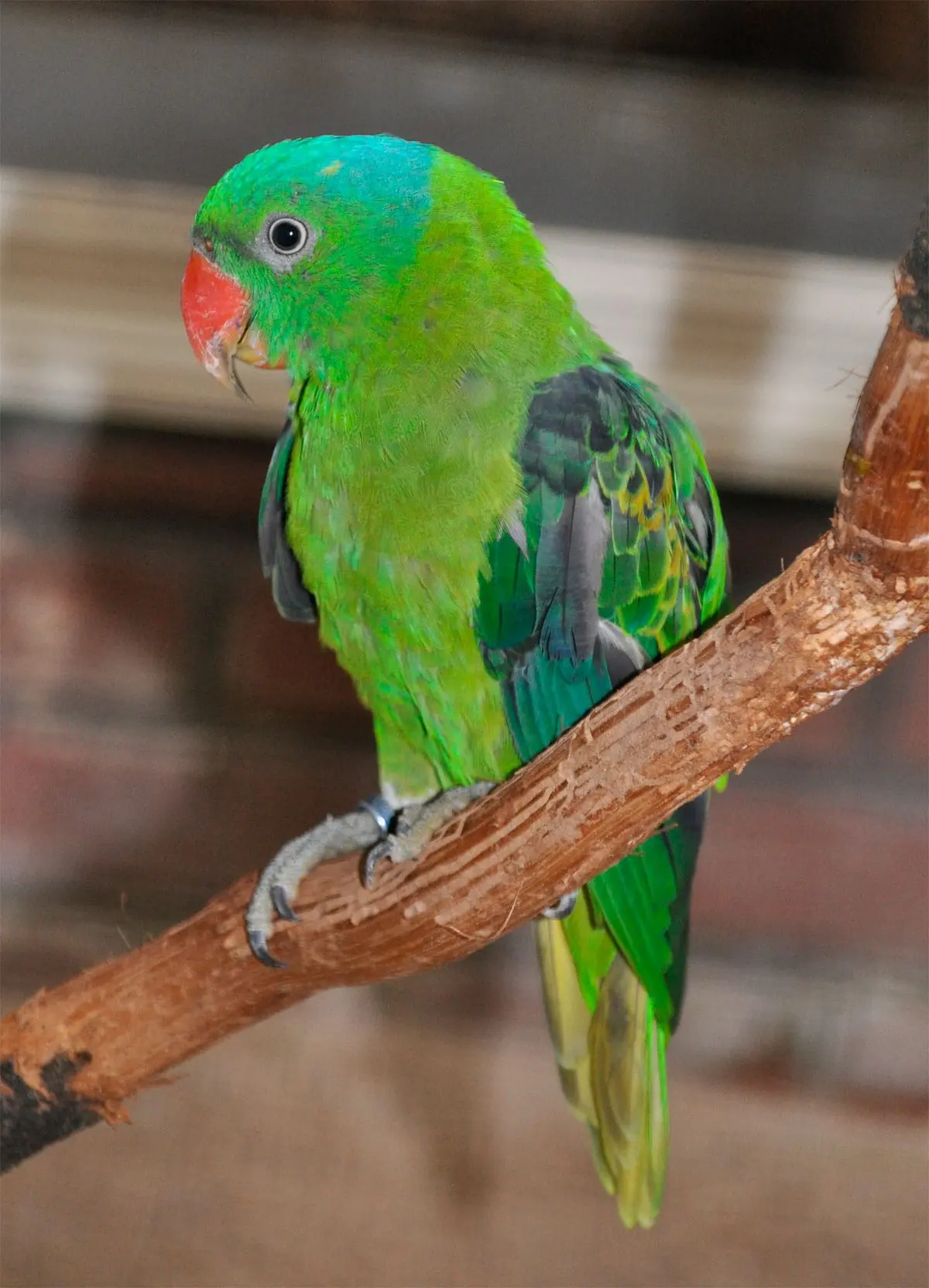
The Blue-naped Parrot (Tanygnathus lucionensis) has the head bright green with a clear bright blue diffusion through the back of the crown and nape.

Upperparts yellowish-green with pale blue illuminated on the back low and the tail; upper tail coverts brighter yellowish green.

Scapulars blue, with green edges; shoulder Black with small coverts Black bordered of blue-green and orange Green; median black and pale blue, large edges of opaque orange brown; greater coverts Blue-Green lined with orange-yellow in the feathers interiors.

Secondary Green with yellow and narrow margins; primaries Greens with vane blackish internal.

Wing feathers green, underside of primaries blackish.

Upper, the tail green, narrow edge and yellowish tip laterally; undertail, the tail yellowish brown opaque.

Bill red, paler at the tip and the lower jaw; irises yellow; legs grey.

Both sexes are equal.

Immature with less blue in the crown and more off the brands of the wings.

Subspecies:

  • Tanygnathus lucionensis lucionensis

    : The nominal.


  • Tanygnathus lucionensis hybridus

    : It has the most extended head blue, with violet tone. Their wings are greener.


  • Tanygnathus lucionensis talautensis

    : No blue in the obispillo and their plumage is less yellowish.


  • Tanygnathus lucionensis [salvadorii u horrisonus]:

Habitat:

Blue-naped Parrot

It is a bird of forests closed and open, including secondary growth, coconut plantations, patches of mangrove and banana to the 1.000 meters above sea level; and not so strongly linked to coastal habitats as the Great-billed Parrot. Is usually found in flocks of up to 12 individuals who sit in community and make regular flights at dawn and in the evening between the feeding and resting areas. Feeds on fruit trees.

Reproduction:

The breeding It has been observed in the months of April to June. Registered a nest the natural cavity or abandoned Woodpecker hole, often a clear. There is no data on the size of the laying.

Food:

Fruits and seeds of forest trees, Palm fruit, young coconuts, the banana and papaya.

Distribution:

The population of the Blue-naped Parrot distributes lengthwise of the Philippines and Talaud Islands, (Indonesian). Specific records found on the islands of Balut, Bantavan, Basilan, Biliran, Bohol, Bongao, Cagayan Islands, Calamian Islands, Caluya, Cebu, Cuimaras, Jolo, Leyte, Luzon, Maestre de Campo, Malanipa, Manuk Manka, Marinduque, Masbate, Mindanao, Mindoro, Blacks, Palawan, Surigao del Sur, Polillo Islands, Romblon, Samar, Sanga Sanga, Sarangani Islands, Samal, Sibay, Sibutu, Sibuyan, Siquijor, Tables, Tawitawi, Ticao, Tumindao and Verde (Philippines); Karakelong and Salibabu (Talaud).

Apparently, small groups of birds in Mantanani Kiss (Northwest Sabah), and SI-Amil (until 100 birds present in 1962) and Maratua off the northeast coast of Borneo; The existence of a wild population was also reported around Kota Kinabalu, (Sabah).

Occasional leaks occur in other parts, including the Sangir Islands.

The species was described as common in Salibabu in the Group of Talaud in 1978 (more numerous there than the Azure-rumped parrot) and they are still regularly seen there and in the nearby Karakelong during observations in 1995 (Numerous in a last record in 1997).

In other areas the species is rare. Recent records in Philippines they come mainly from Mindoro and Palawan, places that seem to be the bastion of the species.

Subspecies:

  • Tanygnathus lucionensis lucionensis

    : The nominal.

  • Tanygnathus lucionensis hybridus

    : (Salomonsen, 1952) – Present in Polillo island, to the North of Philippines.

  • Tanygnathus lucionensis talautensis

    : (AB Meyer & Wiglesworth, 1895) – Talaud Islands (North Moluccas).

  • Tanygnathus lucionensis [salvadorii u horrisonus]:

    (Ogilvie-Grant, 1896) – Philippines, (except North), but it can be rare or extinct on many islands. Also in some small islands off Northwest and northeast of Borneo (If Amil, Mantanani), where it was possibly introduced, especially on this last island.

Conservation:


Near-threatened


โ€ข Current category of the Red List of the UICN: Near threatened

โ€ข Population trend: Decreasing

The total population is provisionally estimated to be below the 10,000 specimens in 1993 (Lambert et to the. 1993).

The population is suspected to be in decline due to capture for the bird trade and habitat degradation from expansion and logging due to agricultural pressures..

Conservation Actions Proposed Palawan:

– Determine the impact of trade on the population of the species.
– Revise its estimate of the world population.
– Estimate the rates of decline based on the rates of deforestation within its range.
– Protect effectively important extensions of high forest with trees suitable to nest in key places throughout its distribution area, both in the areas of strict protection, such as multi-use areas.

"Blue-naped Parrot" in captivity:

pretty calm.
Occasionally available.

Alternative names:

Blue-naped Parrot, Blue naped Parrot (ingles).
Perruche de Luรงon, Perroquet ร  couronne (French).
Blaunackenpapagei, Blaunacken-Papagei (German).
Papagaio-de-nuca-azul (Portuguese).
Loro de Nuca Azul, Loro Nuquiazul (espaรฑol).

scientific classification:

Order: Psittaciformes
Family: Psittaculidae
Genus: Tanygnathus
Scientific name: Tanygnathus lucionensis
Citation: (Linnaeus, 1766)
Protonimo: Psittacus lucionensis

โ€œBlue-naped Parrotโ€ images:

Videos "Blue-naped Parrot"

————————————————————————————————

ยซLoro Nuquiazulยป (Tanygnathus lucionensis)

Sources:

Avibase
– Parrots of the World โ€“ Forshaw Joseph M
– Parrots A Guide to the Parrots of the World – Tony Juniper & Mike Parr
Wikipedia
– Birdlife

Photos:

(1) – By Quartl (Own work) [CC BY-SA 3.0], via Wikimedia Commons
(2) – By Joelle Rene Hughes (originally posted to Flickr as jr_parrot10) [CC BY 2.0], via Wikimedia Commons
(3) – WILD BIRDS of the PHILIPPINES – Subic rainforest, Bataan, December 5, 2007 by Romy Ocon
(4) – By TJ Lin [CC BY-SA 2.0], via Wikimedia Commons
(5) – ยซTanygnathus lucionensis qtl2ยป by QuartlOwn work. Licensed under CC BY-SA 3.0 via Wikimedia Commons.
(6) – ยซโ€ฏTanygnathus lucionensis – Barrabandโ€ฏยป. Licensed public via domain Wikimedia Commons.

Sounds: Arend Wassink (Xeno-canto)