▷ The world of Pets: Dogs, cats, birds, reptiles, amphibians

Western Rosella
Platycercus icterotis

Western Rosella

Content


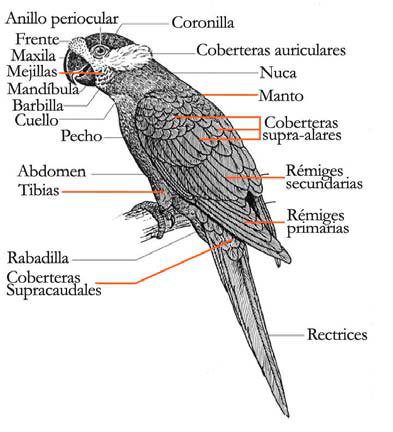
Anatomy-parrots

Description

25 to 26 cm. length and a weight between 52 and 80 g..

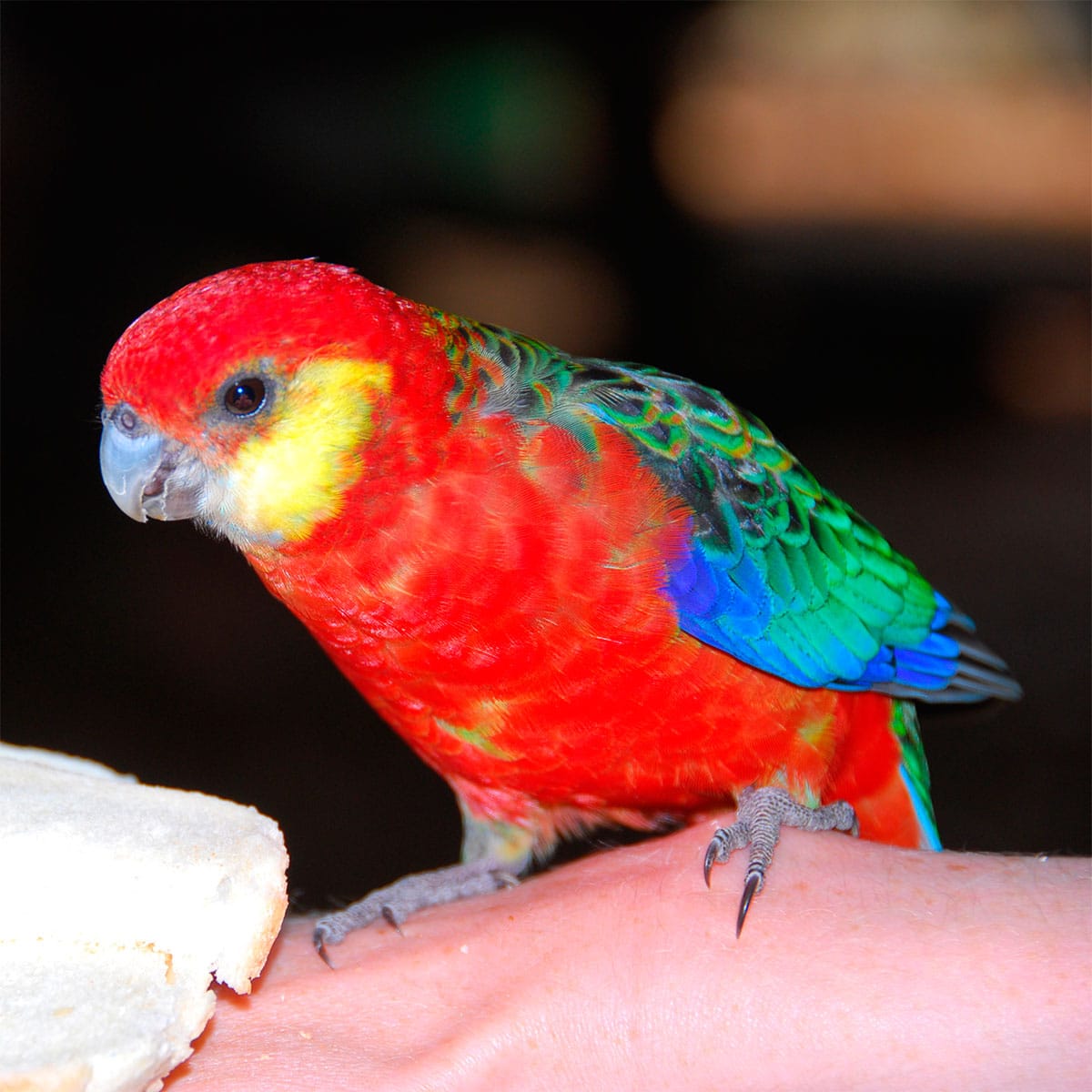
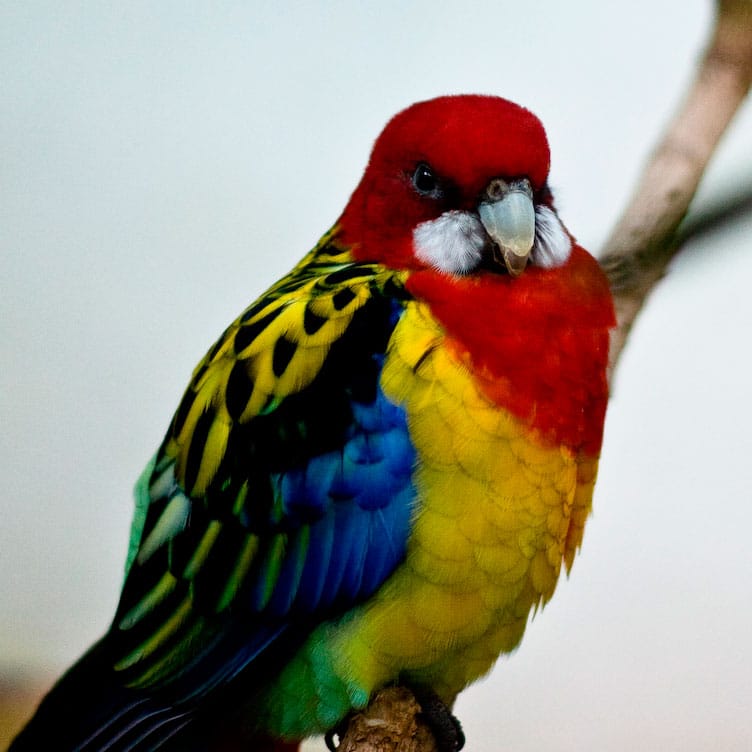
The Western Rosella (Platycercus icterotis) is the smallest of the Platycercus and the only one with big cheeks Yellow.

Adults have a clear dimorphism. The adult male has head and underparts bright red. The the mantle feathers, the back and scapulars They are black with large green edges forming a scalloped effect. The green edges sometimes infiltrated with red. The inner coverts They are dull green, While the external are dark blue. In the Middle, you can see some black on median. The primaries son negruzcas. The rump is dark green. The central tail feathers are dark green, the exteriors are blue with white tips. The underparts It has no stripe.
The bill grey; irises dark brown; legs greyish brown.

The adult female has the forecrown dark red. The crown and the sides of the neck are green. The cheeks are yellow, but duller and less developed than in the male. The underparts They are green with red infiltrations. The under wing wearing a light streak.

The immature are similar to the females. They have head green with a strip of orange red on the front of the forecrown. The cheeks Yellow absent. The underparts is pale green with slight red orange infiltration in young men.
The adult plumage It is reached after a quick complete change to 14 months.

Description 2 subspecies

  • Platycercus icterotis icterotis

    (Temminck & Kuhl 1820) – The nominal.


  • Platycercus icterotis xanthogenys

    (Salvadori 1891) – The cheeks They are paler; black feathers nape; back and shoulders lined with large red brown. Area of the rump and uppertail-coverts, Olive Drab. Female much paler than the nominal.

Habitat and habits:

Western Rosella

The Western Rosella they are not very common. Found in variable densities in stands of eucalyptus and in many types of open forest habitats. They also attend camps with little trees, partly cleared agricultural fields and residual trees lining grain fields or roadsides. They tend to visit the gardens and freshly harvested fields. They occasionally enter the parks, gardens and golf courses.

In areas close to the coast, the Western Rosella, without a doubt, have benefited from the transformation of dense forests into agricultural land. On the other hand, they were driven from the hinterlands by large-scale deforestation programs.

The Western Rosella they suffer the aggressive competition Australian Ringneck (Platycercus zonarius) that shares the same habitat type.

They are birds sedentary. Usually, they live in pairs or in small groups, and it is very rare to find them in flocks. Son quiet and discrete, so very often go unnoticed when they feed in Earth or when they seek refuge in the trees.

Around the houses, the Western Rosella they are very confident, coming into barns and corrals to feed on grain. Unlike other parrots, have a stable flight composed of multiple hits. Move over short distances, preferring to fly from one tree to another, instead of crossing open spaces.

Reproduction:

The nesting season running from August to December.

The nest It is found in the hole of a branch or in the cavity of a tree trunk.. The couple often choose a eucalyptus wandoo the genus eucalyptus salmonophloia. The cavity must be deep enough and the bottom must be lined with a layer of sawdust..

Before mating, the male courts to your partner. It leans forward on its perch uttering very specific cries.. If the female agrees, responds in the same way.

The laying, generally, comprises of 3 to 7 eggs which are incubated during 19 days. The female is responsible for one incubation, but she pauses in the morning and in the afternoon to be resupplied by the male.

The Young people are altricial and do not fly away before reaching the age of 5 weeks.

Food:

They mainly eat seeds of grasses and other plants found in stubble fields.. They also feed on fruits, berries, Jarrah flowers (Eucalyptus marginata) and seeds of the Zamia Palm.

Often in orchards where cause some damage.

Distribution:

Size of its range (reproduction / resident): 308.000 km2

Endemic to Western Australia, where its population is distributed between the vicinity of Dongara, in the North and Israelite Bay, on the South Coast, and reaching the interior in a line that goes more or less through the Lake Dundas, Southern Cross and Moora. Sometimes found in parks in Perth.

The species is common and seems to have benefited from forest clearing and agriculture.. The world's population is of more than 100,000 specimens. A small number of captivity. The birds can be pursued under a permit.

Distribution 2 subspecies

  • Platycercus icterotis icterotis

    (Temminck & Kuhl 1820) – The nominal. Coast and Southwest podrebere Australia.


  • Platycercus icterotis xanthogenys

    (Salvadori 1891) – Southwest Interior Australia.

Conservation:


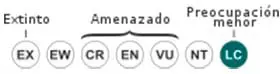
minor concern


• Current category of the Red List of the UICN: Least concern

• Population Trend: Decreasing

The species is relatively common, like most birds that live in open areas, the Western Rosella It has benefited, to some extent, the slimming of the wooded areas. But, its numbers have declined in areas where it faces competition from the aggressive Australian Ringneck. It also, the difficulty to find holes for the construction of nests is a concern in the long run.

The Western Rosella is one protected species, However in some counties, a period was opened to try to regulate or stop the damage caused by this bird in crops.

"Western Rosella" in captivity:

Pretty common in captivity.

Una muestra vivió 13,2 years in captivity. Taking into account the longevity of the similar species, the maximum longevity in these birds could be underestimated. In fact it has been reported that these birds can live up to 31,6 years in captivity, data that can be, but it has not been verified; the same study reported that these animals can reproduce, approximately, to the 2 years of age in captivity.

Alternative names:

– Western Rosella, Earl of Derby’s Parrot, Stanley Parakeet, Stanley Rosella, West Australian Rosella, Yellow-cheeked Parakeet, Yellow-cheeked Parrot, Yellow-cheeked Rosella (ingles).
– Perruche à oreilles jaunes, Perruche de Stanley (French).
– Gelbwangenrosella (German).
– Rosela-do-leste (Portuguese).
– Perico Carigualdo, Rosela Oriental (español).

scientific classification:

– Order: Psittaciformes
– Family: Psittaculidae
– Genus: Platycercus
– Scientific name: Platycercus icterotis
– Citation: (Temminck & Kuhl, 1820)
– Protonimo: Psittacus icterotis

Images «Perico Carigualdo»:

Videos "Western Rosella"

————————————————————————————————

«Perico Carigualdo» (Platycercus icterotis)


Sources:

– Avibase
– Parrots of the World – Forshaw Joseph M
– Parrots A Guide to the Parrots of the World – Tony Juniper & Mike Parr
– AnAge: The Animal Ageing and Longevity Database – Anagé entry for Platycercus icterotis
– Birdlife

– Photos:

(1) – By derivative work: Snowmanradio (talk)Western_Rosella_(Platycercus icterotis)-5.jpg: Robert Young [CC BY 2.0], via Wikimedia Commons
(2) – By Luke Durkin (IMG_0526Uploaded by snowmanradio) [CC BY 2.0], via Wikimedia Commons
(3) – By Hervé (zoo_090912_518.jpgUploaded by snowmanradio) [CC BY-SA 2.0], via Wikimedia Commons
(4) – «Platycercus icterotis1«. Licensed under CC BY 2.0 via Wikimedia Commons.
(5) – By Robert Young (originally posted to Flickr as Mmmm, wet bread) [CC BY 2.0], via Wikimedia Commons
(6) – John Gould [Public domain], via Wikimedia Commons

– Sounds: John Graff (Xeno-canto)

▷ The world of Pets: Dogs, cats, birds, reptiles, amphibians

Eastern Rosella
Platycercus eximius


Eastern Rosella

Content


Anatomy-parrots

Description

30 cm.. length between 95 and 120 g. of weight.

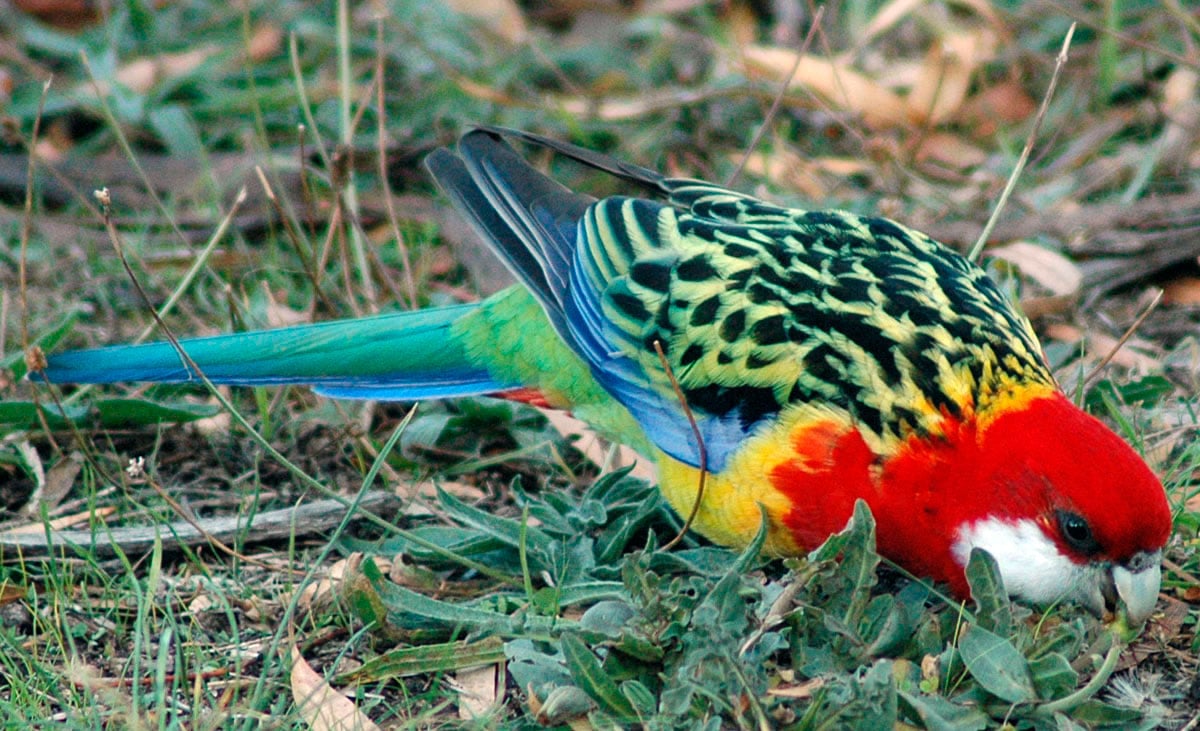
The males of the Eastern Rosella (Platycercus eximius), has bill white. The lower area of the cheeks and chin are white, that contrasts sharply with the rest of the head and the chest that are of color red glossy. Upper abdomen shows a beautiful color yellow that is again gradually of color green pale in its part lower. The coats are of color red. The the mantle feathers, the back and scapulars are of color black with a broad edge yellow, giving these regions a highly scaled appearance. The median are black. The blankets, out of them coverts secondary and flight feather are bluish grey. The rump is bright green. The central feathers of the tail are green bottle, While the outer feathers of the tail are bluish grey with white tips.

The irises They are brown, legs grey.

The female looks like your partner, but the Red of the head and the chest is less bright.

The underparts has a thin white stripe.

The youth they are a copy in Pale tones of the female. They have a little bit of green on the back of the head.

Subspecies description:

  • Platycercus eximius diemenensis

    (North 1911) – Of 30 cm.. length. Head and chest color much more dark and white cheek much more large. Female as the nominal species.


  • Platycercus eximius elecica

    (Schodde & Short 1989) – Of 33 cm.. length. It is something more than the nominal species, the red and the chest and the head is slightly more dark, the black feathers of the neck, back and shoulders have a very broad bright yellow bordered. Area of the rump and coverts bluish-green supracaduales. Female with back and neck with hints. Your obispillo is bluish green


  • Platycercus eximius eximius

    (Shaw 1792) – The nominal.

Habitat:

The Eastern Rosella they tend to be fairly common in all habitats of open forests, including agricultural land, urban parks and gardens. They are usually in little populated wooded areas, rows of trees along streams, shrub and scrub savannahs «Mallee«.

They are common in cultivated areas and can invade orchards where you can cause severe damage.

In many areas, It is the most widespread species of parrot, You can even nest in the trees lining the streets of towns and cities. Wherever possible, they avoid dense forests and mountainous areas, where is replaced by the Crimson Rosella. The habitat of the Eastern Rosella usually less to 1.250 m above sea level.

Breeding pairs are sedentary in their territories, While young and immature form bands of up to 25 birds that roam the area. very commonly, the multicolored parrot can be seen perched on power lines or poles lining the sides of the roads in the outskirts of cities.

On the floor were fed more frequently than other types of rosella Parrot. In flight, they are quite noisy and therefore very easy to detect. But, When they are on the ground, they are not always easy to observe.

They feed on, sometimes, in the company of Red-rumped Parrot (Psephotus haematonotus) but never be with them organized mixed flocks.

Reproduction:

The Eastern Rosella They nest in the months from August to February, but also from time to time in April and may.

Pairs mate for life and is the female which chooses the nest site, usually in a hole or cavity of a eucalyptus branch. Sometimes the place to start may be an old stump, an any fence post, a fallen log, a rabbit hole, the nest of a Rainbow Bee-eater. Optionally, the Eastern Rosella also used the abandoned nest of the Blue-winged Kookaburra, some termite mound, ferns in facades of houses, rock walls, old buildings and an old nest of pomatostome.

The bottom of the nest is filled with sawdust or small wood shavings..

Spawning includes 4-9 eggs (generally 5) which are incubated during 19 days. The female is solely in charge of incubation and her partner is responsible for supplying. The chicks stay lasts a few 35 days.

Food:

The Eastern Rosella has a mainly vegetarian diet. Consumed mainly eucalyptus and acacia seeds, Although also seeds of a variety of greenery bushes. Berries, leaves and sprouts are also part of its menu.

During the summer, eats some insects and their larvae. Take the seeds that are dispersed in fields and roads. It penetrates into the orchards where causes some damage.

Distribution:

The Eastern Rosella lives confined to the southeast of Australia where is spread around Gympie, Bribie Island and the Darling Downs district in the extreme southeast of Queensland, in the South through New South Wales, coming towards the inside of Moree, Parkes, Griffith and There is a, and reaching Victoria where is it absent only in the Northwest region, and West up to Edenhope.

In the southeast of South Australia the species is largely limited to the area between Bordertown and Salt Creek, but a population caused by birds in captivity is also distributed by the Lofty Mountains.

In Tasmania, the species is widespread, Although barely wide and sparsely distributed, and have been faced with the King Island in the bass strait.

There are small introduced populations in the South Island of New Zealand, concentrated around Dunedin (includes some Crimson Rosella mixed with oriental hybrids) and in the Banks Peninsula, and a larger population in the North Island, that extends from the northern end of the island, along the West Coast through Raglan, New Plymouth and the interior of Pirongia and Taupo. They can also be found Eastern Rosella in the districts of Wellington and Lower Hutt, in the Tararua mountains, about Gisborne and along the Coromandel Peninsula, but are rare in the South of Auckland.

The world population is more of 500.000 birds, and stable or increasing.

There is some competition with nesting places with the Common Starling (Sturnus vulgaris) in Tasmania.

Moderate multicolored parrot in captivity.

The species has benefited before the spread of agriculture, and although protected by law, they can be killed under license.

Subspecies distribution:

  • Platycercus eximius diemenensis

    (North 1911) – Own East of Tasmania.


  • Platycercus eximius elecica

    (Schodde & Short 1989) – Present in the northeast of New South Wales and the southeast of Queensland.


  • Platycercus eximius eximius

    (Shaw 1792) – The nominal.

Conservation:


minor concern


• Current category of the Red List of the UICN: Least concern

• Population Trend: Growing

The size of the world's population has not been quantified, Although it is estimated above 500.000 birds.

Throughout its distribution area, except Tasmania, the Eastern Rosella East are very common birds. Unlike in the Crimson Rosella, that like dense forests, the Eastern Rosella they have benefited from deforestation that took place for the establishment of new pastures or areas of cereals.

"Eastern Rosella" in captivity:

Very common in captivity, It is probably the most popular of the Rosellas.

The Eastern Rosella they are coveted because of the beautiful colors of plumage.

They are intelligent birds and can be trained to whistle a large repertoire of melodies., and you can even learn how to pronounce some words.

These parakeets can make good pet birds but require a great deal of care and attention., In addition to devices and toys to keep them mentally stimulated. They are wild birds which are not always adapted to live as a family pet, and even the hand reared parrots are never fully domesticated. They generally do not tolerate caresses or cuddling and tend to react by stinging when you try to handle them like this.. Many breeders believe that the best way to keep this type of bird is in great aviaries where can fly freely, in pairs to meet their social needs and with minimal human interaction. Although they tend to be aggressive with other species Bird by should not be treated so integrate them to mixed aviaries.

Its diet poultry includes seeds, fruits like Apple, PEAR and grape, and vegetables such as lettuce, grass, and silver beet.

A sample of Eastern Rosella lived 27,4 years in captivity. In captivity, these animals have been able to play, approximately, to the 2 years of age..

Alternative names:

– Eastern Rosella, White-cheeked Rosella (ingles).
– Perruche omnicolore (French).
– Rosella, Buntsittich (German).
– Rosela-multicolorida (Portuguese).
– Perico Multicolor, Rosela Común (español).

scientific classification:

– Order: Psittaciformes
– Family: Psittaculidae
– Genus: Platycercus
– Scientific name: Platycercus eximius
– Citation: (Shaw, 1792)
– Protonimo: Psittacus eximius

Images «Multicolored Parakeet»:

Videos "Eastern Rosella"

————————————————————————————————

«Multicolored Parakeet» (Platycercus eximius)


Sources:

– Avibase
– Parrots of the World – Forshaw Joseph M
– Parrots A Guide to the Parrots of the World – Tony Juniper & Mike Parr
– Wikipedia
– AnAge: The Animal Ageing and Longevity Database – Anagé entry for Platycercus eximius
– Birdlife

– Photos:

(1) – Eastern Rosella (Platycercus eximius), male, Queen’s Domain, Hobart, Tasmania, Australia By JJ Harrison (jjharrison89@facebook.com) (Own work) [CC BY-SA 3.0], via Wikimedia Commons
(2) – Eastern Rosella (Platycercus eximius), female, Queen’s Domain, Hobart, Tasmania, Australia By JJ Harrison (jjharrison89@facebook.com) (Own work) [CC BY-SA 3.0], via Wikimedia Commons
(3) – Eastern Rosella (Platycercus eximius) at Woodland Park Zoo, Seattle, USA By Platycercus_eximius_-Woodland_Park_Zoo-6. jpg: Nickderivative work: Snowmanradio [CC BY 2.0], via Wikimedia Commons
(4) – Eastern Rosella at Hobart Domain, Tasmania (grazing) By KeresH (Own work) [GFDL, CC-BY-SA-3.0 or CC BY-SA 2.5], via Wikimedia Commons
(5) – Eastern Rosella (Platycercus eximius diemenensis), The Queen’s Domain, Hobart, Tasmania, Australia By JJ Harrison (jjharrison89@facebook.com) (Own work) [GFDL 1.2 or CC BY-SA 3.0], via Wikimedia Commons

– Sounds: Peter Woodall (Xeno-canto)

▷ The world of Pets: Dogs, cats, birds, reptiles, amphibians

Crimson Rosella
Platycercus elegans

Crimson Rosella

Content


Anatomy-parrots

Description

Among 30 and 37 cm.. length and a weight between 99 and 170 g..

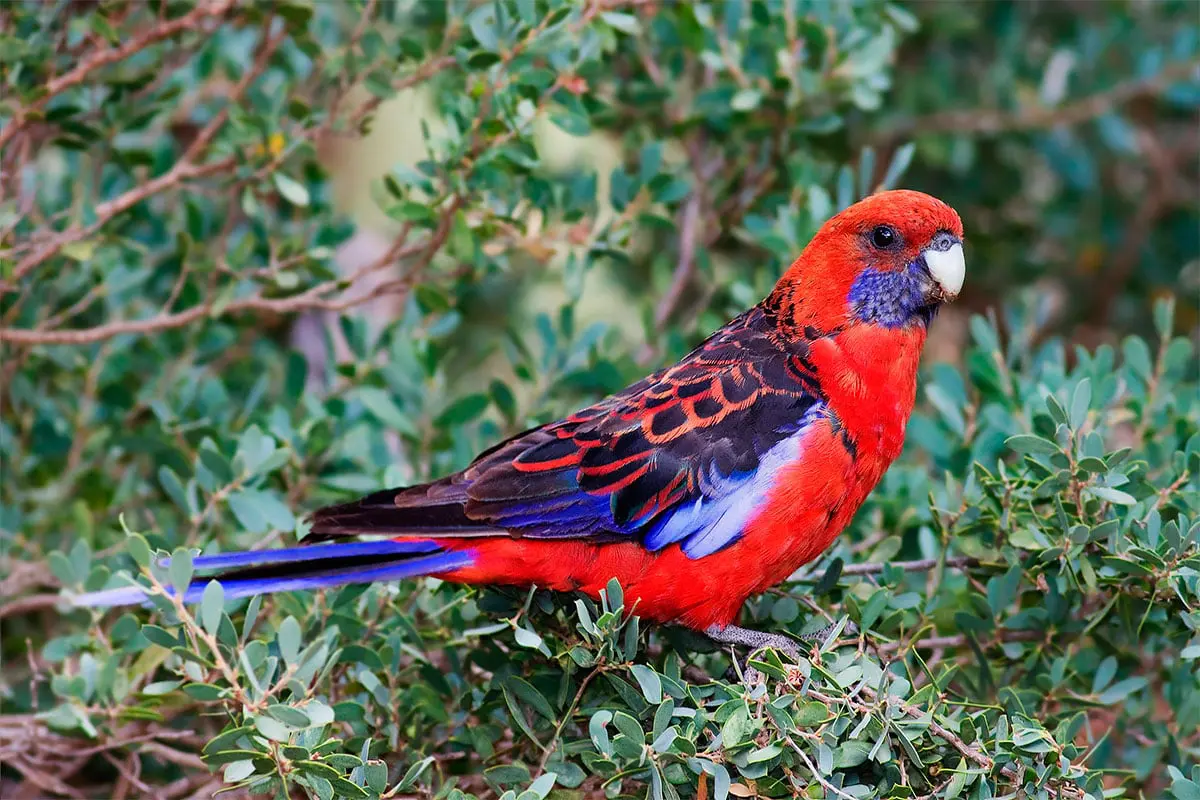
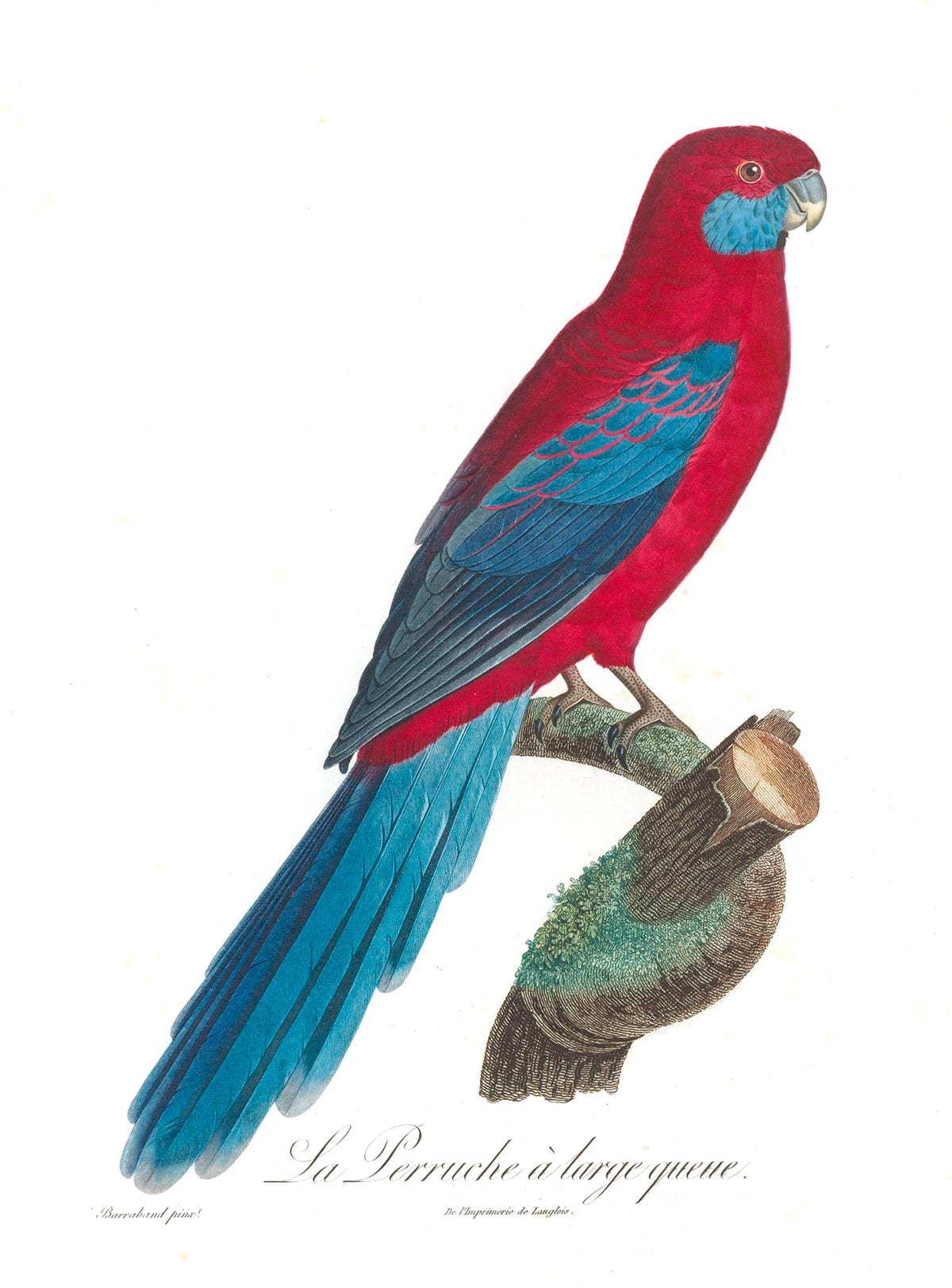
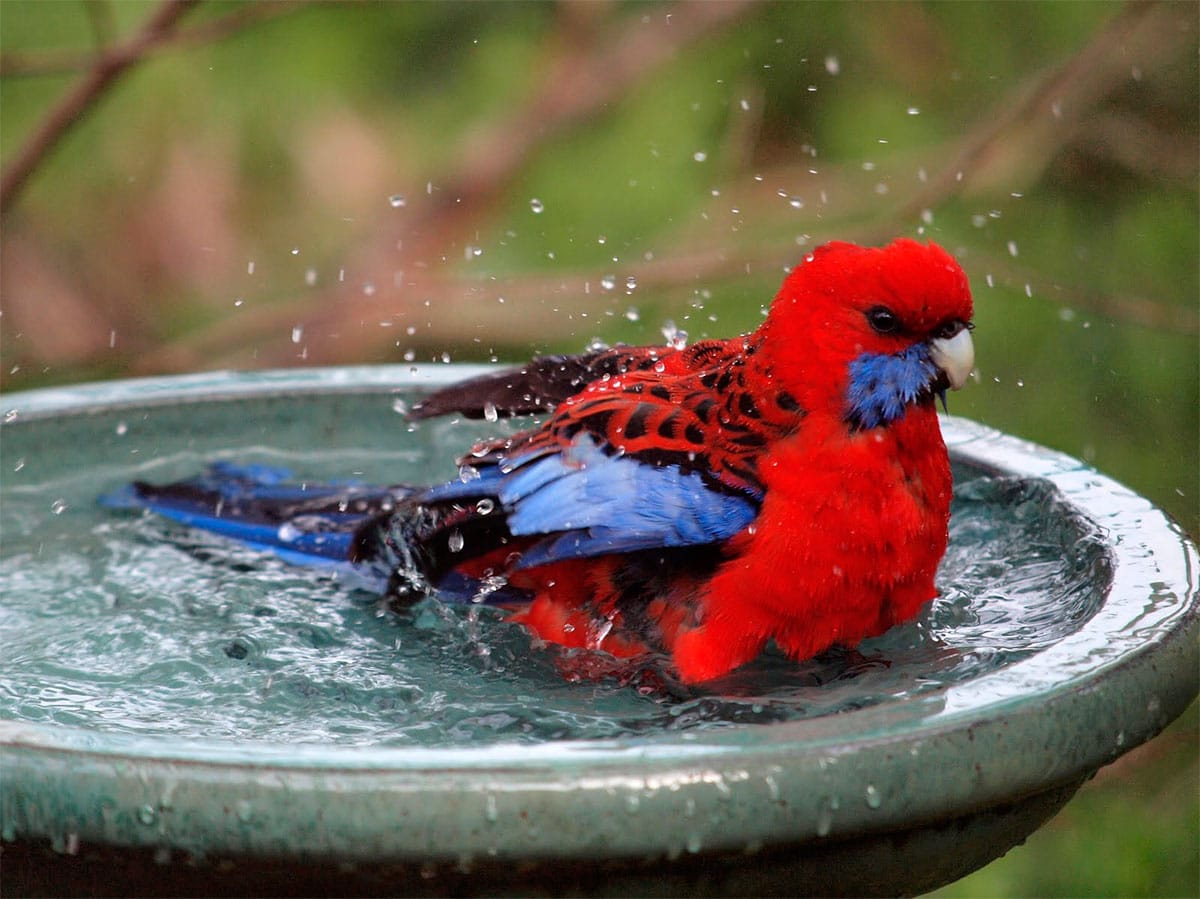
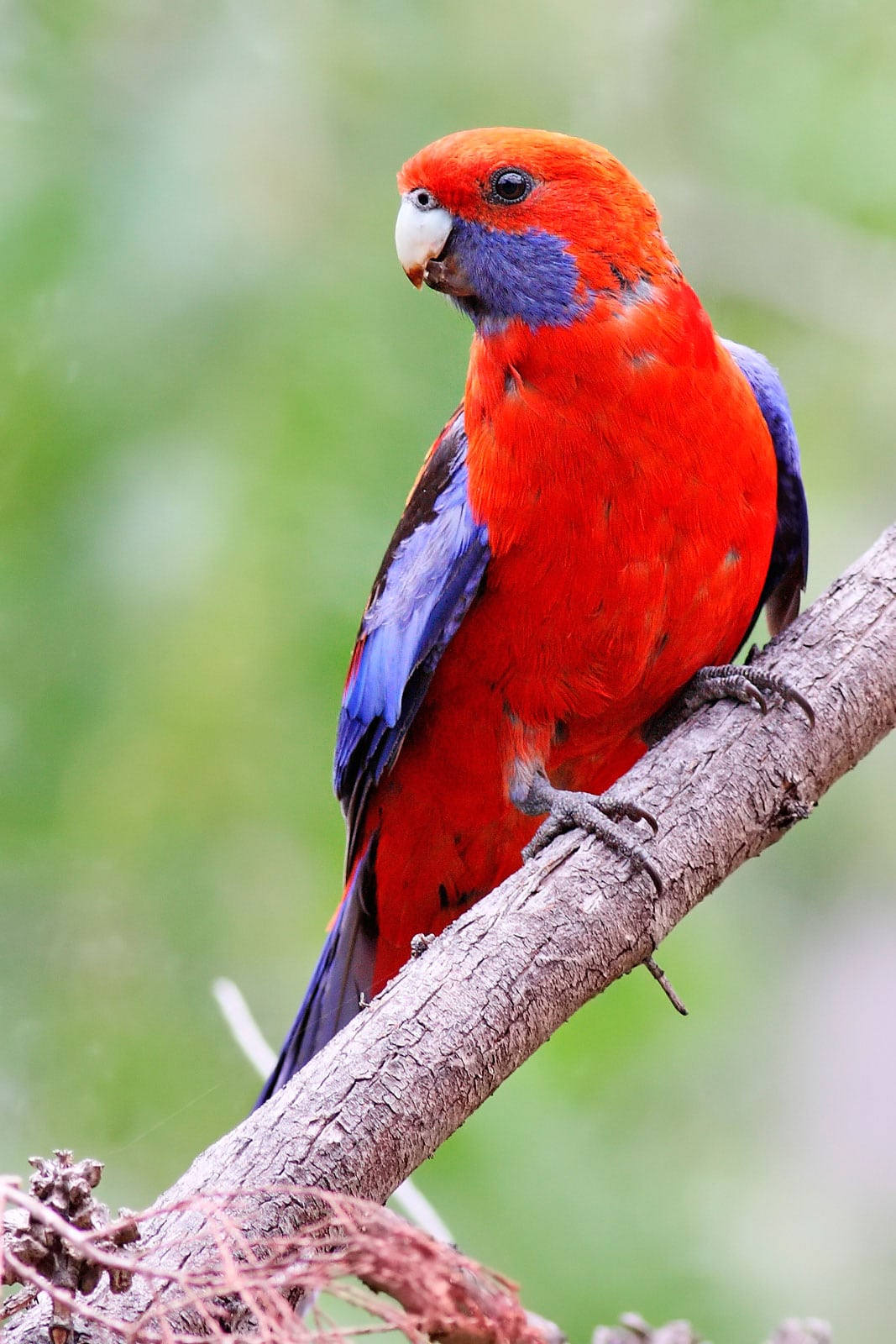
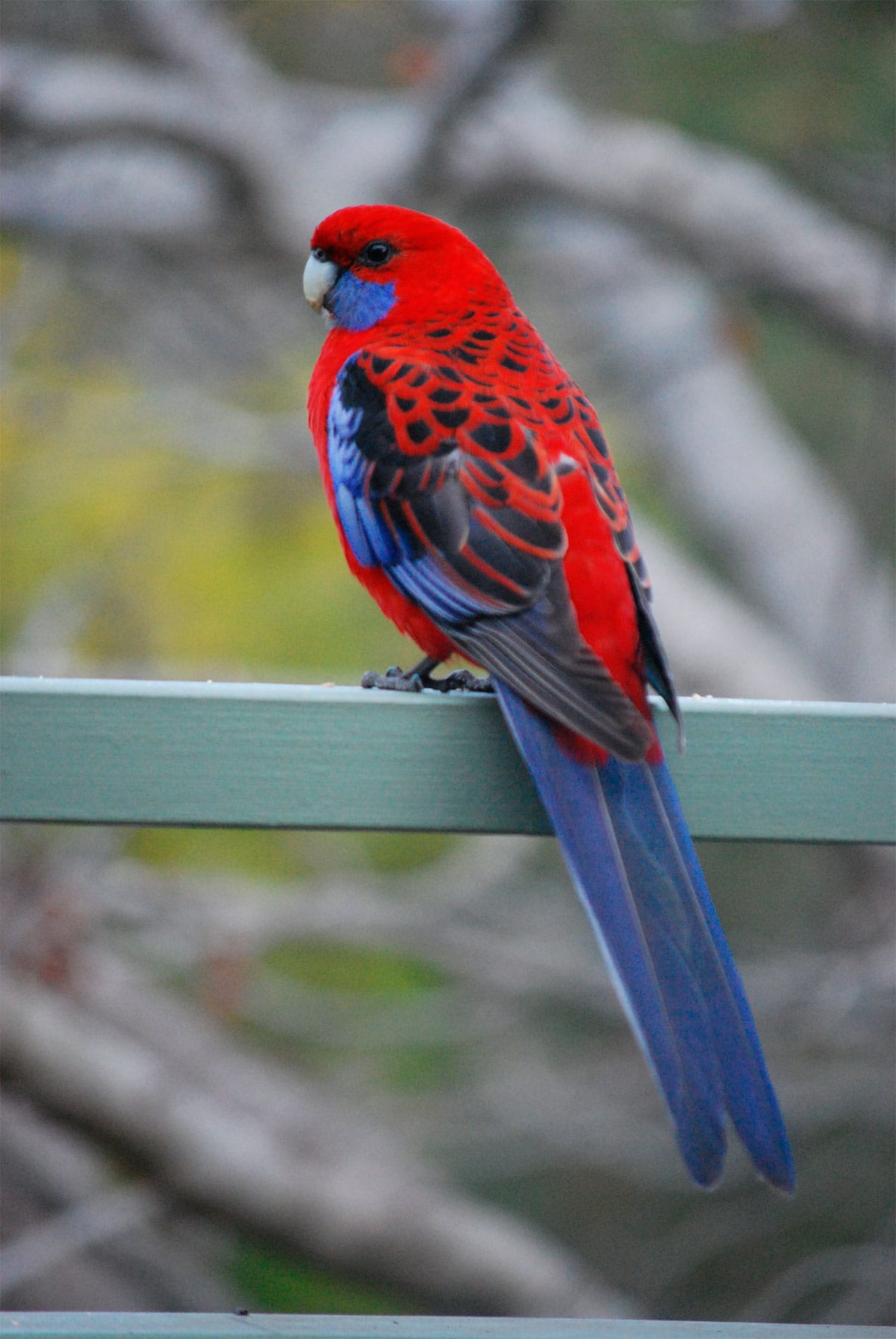
The Crimson Rosella (Platycercus elegans) has a predominantly red plumage.

Its head is bright crimson in color with the lower part of the cheeks and the throat of blue color.. Mantle feathers are black with broad crimson margins of variable intensity.; rump and uppertail coverts crimson.

Medium and lower inner wing coverts black; bend of wing, lesser coverts and medium blue color external; external greater coverts bright blue, Black Interior with red edges giving a scaly appearance to this area; primary coverts blue violet; feathers of flying blackish with thin margin foreign white in them more external and blue violet in vane outer; secondary black with vane external blue violet; tertiary black with red borders.

Under, Blackish wings with blue coats. Underparts showy crimson.

Upper, the tail is blue, the center of green-washed, Foreign feathers with vane Blackish internal and vane Violet Blue outer with pale at both ends; undertail, the tail of pale blue edged blackish when closed.

The peak of grayish-white; dark brown irises; greyish Brown legs.

The female It is smaller with narrower peak. It has no stripe under the wings..

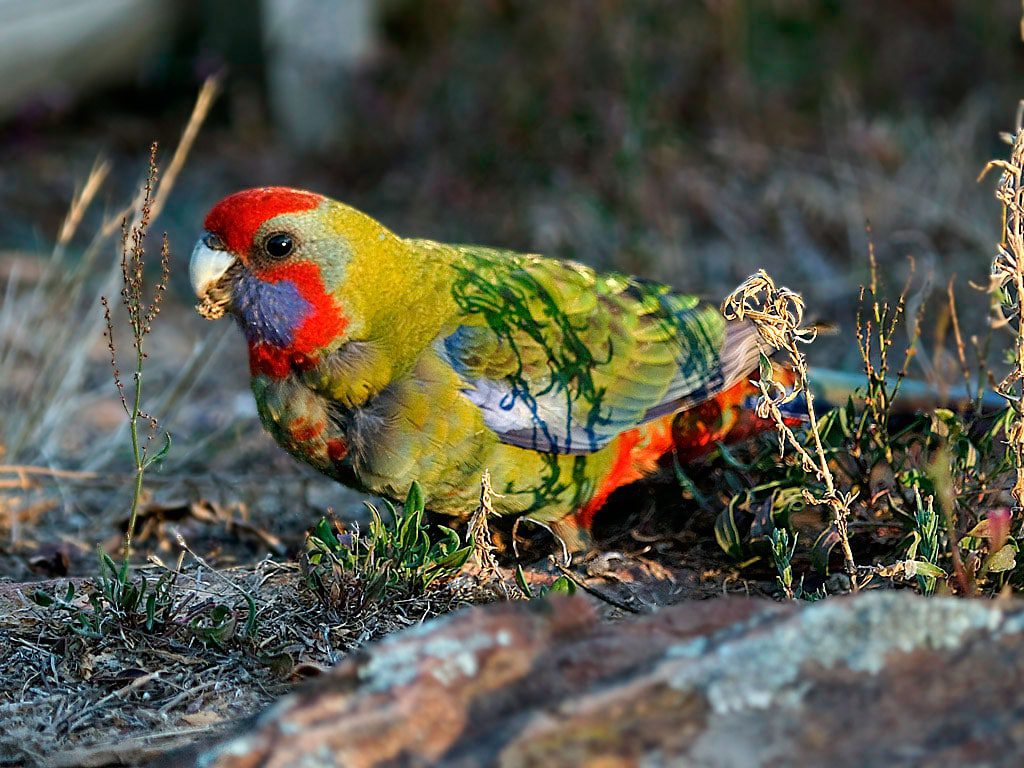
The immature is very different, with upper parts olive green (including the tail at the top), and green underparts greyish.
The centers to the mantle feathers are dark brown, and the black markings of the wings of the adult are replaced by green. Very young birds rump is green Orange. There is a pale stripe on the bottom of the wings (formed by stains pale in vane inner). It shows red feathers on the head, chest, buttocks and subcaudales coverts and move through the first fall.

Adult plumage is reached in a few 15 months. Immatures of the population in the North are mainly red, and there are less green unripe in Norfolk Island than mainland populations.

Subspecies

Description subspecies Platycercus elegans
  • Platycercus elegans elegans

    (Gmelin, 1788) – The nominal species


  • Platycercus elegans flaveolus

    (Gould, 1837) – With 33 cm.. length, approximately, It is but little that the nominal species, Yellow has no orange hue and there is orange in the neck, chest and abdomen.


  • Platycercus elegans fleurieuensis

    (Ashby, 1917) – IMG – It differs from the species rated as having an intense orange color, Red plumage, the mantle and black gray back, with pale orange-red spots; pale blue medium and secondary wing coverts.


  • Platycercus elegans melanopterus

    (North, 1906) – Of 36 cm.. length, approximately. The bordered red are more narrow, with which the back looks more black. Female as the nominal.


  • Platycercus elegans nigrescens

    (Ramsay,EP, 1888) – With 34 cm.. length, It is smaller than the nominal value and the color red is much more dark. Red feathers are more narrow. Female as the nominal.


  • Platycercus elegans subadelaidae

    (Mathews, 1912) – Approximately from 36 cm.. length. Instead of Red Blend Red, Orange and yellow. Orange red forehead, the Crown and face, they turned to brighter red frontal band. Yellow olive from the low back to the supracaudales coverts

Habitat:

Crimson Rosella

The Crimson Rosella they frequent tropical and humid subtropical forests near the coast and the surroundings of montane forests at altitudes up to 1.900 m.

They are mainly on the edges of jungle, in the secondary zones and in the dense forests of eucalyptus they arrive at a good stage of maturity.

To the South of the hunter river in New South Wales, they are distributed at all altitudes.

The nominal species has a preference for thick wooded areas, but often goes into open areas and farmland where it is mixed with the Perico conr (Platycercus eximius).

It also tends to visit plots of pine trees.

In the Kangaroo Island, where is the only parakeet present, He lives in all types of forest habitats, they are also adapting to farmland.

The subspecies subadelaidae and fleurieuensis, sometimes grouped under the term Adelaide parakeet, frequent valleys forest, arboreal galleries that border the rivers or trees on the edge of the roads. They are also present in the orchards and farmland.

The Flaveolus subspecies attends the same types of habitat, that is to say, curtains of trees dominated by red rubber trees along the river.

To feed, move away from rivers and raid agricultural land, flooded Plains, or thickets «Mallee«.

Adults are sedentary. Usually, they live in pairs or in small groups. On the other hand, juveniles and subadults form noisy groups and many roam locally when leaving dormitory at sunrise.

Its main activity is carried out in the morning and in the evening. in the middle of the day, they rest in the shady foliage. But, If the sky is overcast and the weather is cool, these birds are active during the day.

The Crimson Rosella they seek food on Earth, in trees and shrubs. They often feed in the company of the Eastern Rosella (Platycercus eximius), But if the joint working group is altered during its activity, the two species are separated in flight and taken opposite directions, each seeking refuge by his side.

The Crimson Rosella they are not very shy and can be approached at a very short distance.
In urban areas, they are particularly friendly.

Reproduction:

The breeding season covers the months of August to February and, sometimes even later.

The elegant parakeet build their nests on a branch or in the cavity of a tree trunk. Usually, Choose a healthy or dead eucalyptus, but sometimes they install their nests in a place as strange as the metal beam of a construction crane.

In all cases, the nest is located high above the ground. Spawning usually includes 4 to 7 white eggs, rarely 8, which are incubated during approximately 19 days.

The female incubates the eggs alone, but the chicks receive equal attention from both parents.

The nesting cycle is quite long and it takes around 5 weeks

Food:

The Crimson Rosella they have a mainly vegetarian mixed diet. Consume the seeds of black Cypress of Australia (Callitris endlicheri), figs, seeds of acacia and eucalyptus.

The vegetable part of its menu is complemented by a wide variety of imported plants such as Rosa rubiginosa, clover or chickweed (Stellaria media).

In the South of its range, they eat the fruits or flowers trees of Melaleuca, banksia and casuarina.

Insects are not forgotten in your menu: Hemiptera, psyllids, termites, aphids and larvae of beetles.

These parrots times behave as true pests in orchards, eating apples, Plums, pears and quinces.

Distribution:

Confined to the coastal area of Eastern Australia where are widely distributed in the wooded areas along and East of the Great dividing range.

There is an isolated population in the North between the surrounding of Atherton, Northeast of Queensland, to the South of the mountain range of Clarke and Eungella (the population in Eungella It can also be isolated).

The main population is distributed around Gympie, Southeast of Queensland, in the North, across the border with New South Wales, coming up to the Warrumbungle National Park, Bathurst and Wagga Wagga, where are approaching the eastern end where the Yellow Rosella.

In Victoria extends from the East to the Grampian and the Edenhope district, where spills into the Southeast end of Australia, coming to Kingston at its western end.

There is also an isolated population in the Kangaroo Island.

The species is found in the wild around Sydney, Brisbane and Melbourne, and leaks from birds have been around Perth. There are records in the North of Tasmania and the islands of the bass strait, probably, also refer to birds Getaways.

It is common in the Norfolk Island where it was introduced in the century 19, but is absent in the vicinity of Nepean and Philip Island; an attempt to introduce the species in Lord Howe Island failed.

Was also introduced in New Zealand, showing in the West suburbs of Wellington, and some birds can also persist in the District of Dunedin of South Island where can hybridize with the introduced Perico conr.

The world's population is above 200.000. Moderate numbers in captivity.
The birds can be eradicated with a permit in States where the destruction of crops occurs.

Subspecies

Distribution subspecies Platycercus elegans

Conservation:


minor concern


• Current category of the Red List of the UICN: Least concern

• Population Trend: Decreasing

The size of the world's population has not been quantified, Although it is estimated above 200.000 specimens.

The Crimson Rosella they are infrequent at both ends of its distribution area, but in other places, they are locally abundant and common.
In the North, they are slightly less numerous. In the past recent, they have colonized successfully parks and urban gardens, so now are very widespread in the suburbs of Canberra and Adelaide.
In the Norfolk Island, the import is so successful that they now represent a competition and a significant danger to the Red-crowned parakeet (Cyanoramphus novaezelandiae).

"Crimson Rosella" in captivity:

Moderately loud, very active, they are acclimatized to the owner. It is not usually compatible with other birds.
A sample of the subspecies subadelaidae lived 26,8 years in captivity
Rare in captivity.

Alternative names:

– Crimson Rosella, Adelaide Parakeet, Beautiful Lory, Blue-cheeked Rosella, Campbell Parakeet, Crimson Rosella (Crimson), Mountain Lowry, Murray Rosella, Murray Smoker, Murrumbidgee Lowry, Murrumbidgee Rosella, Pennant’s Parakeet, Pennant’s Rosella, Red Lory, Red Lowry, Red Parrot, Swamp Lory, Yellow Parakeet, Yellow Parrot (ingles).
– Perruche de Pennant (French).
– Pennantsittich, Adelaidesittich, Pennant-Sittich (German).
– Rosela-Pennant (Portuguese).
– Perico Elegante, Rosela Roja, Periquito Pennant, Rosella Carmesí (español).

scientific classification:

– Order: Psittaciformes
– Family: Psittaculidae
– Genus: Platycercus
– Scientific name: Platycercus elegans
– Citation: (Gmelin, JF, 1788)
– Protonimo: Psittacus elegans

"Elegant Perico" images:

Videos "Crimson Rosella"

Crimson Rosella (Platycercus elegans)

Sources:

  • Avibase
  • Parrots of the World – Forshaw Joseph M
  • Parrots A Guide to the Parrots of the World – Tony Juniper & Mike Parr
  • Wikipedia
  • Loromania
  • Birdlife
  • AnAge: The Animal Ageing and Longevity Database – Anagé Database

  • Photos:

(1) – An adult Crimson Rosella (Platycercus elegans), Wilsons Promontory National Park, Victoria, Australia By JJ Harrison (jjharrison89@facebook.com) (Own work) [CC BY-SA 3.0], via Wikimedia Commons
(2) – A Crimson Rosella photographed though a window in the Blue Mountains, Australia By John Poulakis from Australia (Crimson RosellaUploaded by Snowmanradio) [CC BY 2.0], via Wikimedia Commons
(3) – Crimson Rosella (Platycercus elegans) photographed taken in Swifts Creek, Victoria, Australia Fir0002 [GFDL, CC-BY-SA-3.0 or GFDL 1.2], via Wikimedia Commons
(4) – A Crimson Rosella in a bird bath Canberra, Australia By Duncan McCaskill (Picasa Web Albums) [CC BY 3.0], via Wikimedia Commons
(5) – Juvenile Crimson Rosella (Platycercus elegans) by David Cook – Flickr
(6) – An adult Crimson Rosella (Platycercus elegans) Jacques Barraband [Public domain], via Wikimedia Commons

▷ The world of Pets: Dogs, cats, birds, reptiles, amphibians

Red-capped Parrot
Purpureicephalus spurius

Red-capped Parrot

Content


Anatomy-parrots

Description

36 cm.. length and a weight between 105 and 156 g..

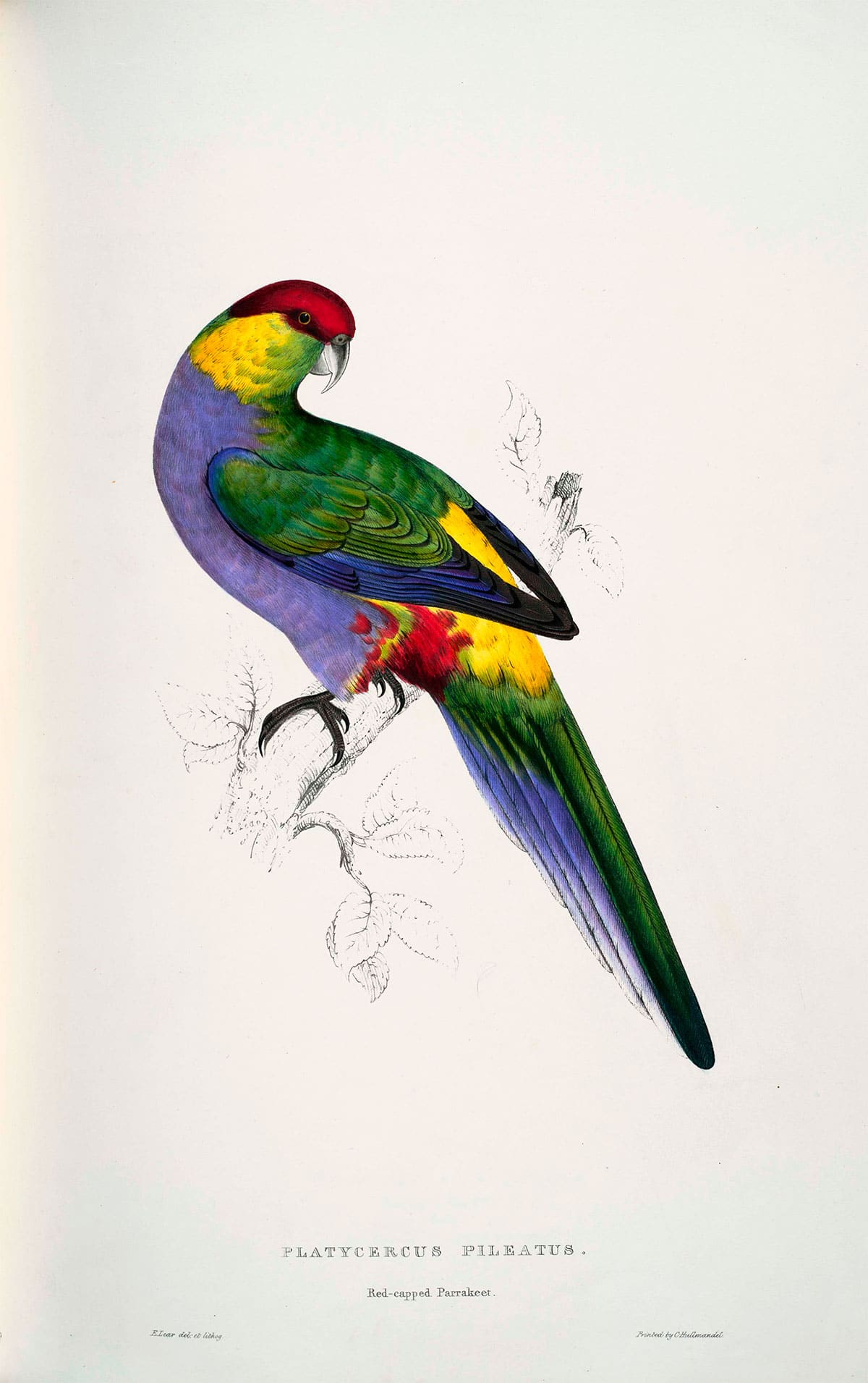
The Red-capped Parrot (Psittacus erithacus) It has the "crown" lid and the nape deep carmine red. The throat and cheeks are yellowish-green, merging slightly yellow on the sides of neck. The the mantle shows a dark green. The rump is bright yellow, which contrasts with the uppertail-coverts green. The wings covers are green, although large coberteras stain blue in the outer feathers.

The flight feather They are blackish with a large dark blue border around the outside edges of the primaries. The underparts is blue, with the exception of the flight feather that are black. The feathers of the chest and the abdomen they are blue-purple, becoming paler in area anal.

The the thighs and lower area of the tail They have a beautiful red. The undersides They have infiltrated some green feathers. Large central feathers tail They are green at the base, and bluish to the tip. side feathers tail They are dark at the base but gradually diluted colors light blue in the middle and then to white at the tips. The bottom of the tail It is pale blue with a white termination.

The bill, formed by a upper jaw more elongated, is bluish grey. The irises is of color Brown dark and the legs brown.

The female is more off than your partner. It has a crown green and chest brown. It shows a clear cross bar at the bottom of the wings, the level of flight feather. This motif is also present in the immature.

The immature they have the upperparts dark green and yellow rump duller than in adults. The the thighs They are less bright red colo. The chest It is browner. The forecrown It is covered with red feathers that are part, in small scattered groups, red feathers crown. The adult plumage It is acquired largely during the first molt and subsequently completed in the first spring.

Habitat:

Red-capped Parrot

Paired adults are sedentary, Although noisy flocks of up to 20 young birds are often seen wandering in search of food.

The Red-capped Parrot they have a preference for the eucalyptus forest and specialized to feed on seeds MARRI since its elongated upper jaw is adapted to eating the large seeds of the plant. The Fruit Marri they are available throughout the year and provide the source of staple food. The Red-capped Parrot they can also be observed in gardens (where sometimes cause serious damage), peoples, wooded pastures and forest of mallee (Eucalyptus Gracilis), feeding also on strips of grass covering the roads.

Couples remain inconspicuous, While quietly feeding in the canopy, during most of the day, Although they sometimes perch on Earth, in the clear, to feed on fallen fruit.

Reproduction:

The nesting season is between between August and December.

During the courtship, the male raises its crest, the tail, It tilts its wings and emits loud calls. The ritual offerings of food are also common, feeding the male to his partner during the incubation period.

The spawning usually includes 5 eggs, but may vary from 3 to 9. These are white. The eggs are deposited on a layer of sawdust that lines the bottom of a natural cavity of a eucalyptus marri, to a great height above the ground.

The incubation lasts a few 20 days. The male does not participate in feeding youngsters until they reach the age of 15 days. The flight of the young occurs approximately 5 weeks after hatching. The young remain in the family group for a short time after leaving the nest.

Food:

Apart from MARRI, These birds also feed on other eucalyptus, for example, Jarrah (Eucalyptus marginata), casuarinas, (Grevillea, Hakea), and they have also been feeding on flowers and insects.

Distribution:

Size of the area of distribution (reproduction / resident): 126.000 km2

Confined to the southwest corner of Western Australia. The species is distributed around the Moore river to the North of Perth (occasionally in Dandaragan), through the leafy South-West corner, usually within 100 km from the coast, reaching the inside of Lake Grace in the East and Esperance on the South Coast. The Red-capped Parrot they are regularly observed in the outskirts of Perth, and are reproduced in the King’s Park in the center of the city. The species is common, especially in the forests of MARRI (eucalyptus calphylla).

The world's population is believed to be above 20.000.

Moderate numbers in captivity. Can be shot like a plague in a small number of areas.

Conservation:


minor concern


• Current category of the Red List of the UICN: Least concern

• Population Trend: Growing

The size of the world population It has not been quantified, Although the world's population is estimated at more of 20 000 specimens.
The species is described as quite common (pit et to the. 1997).

The number of captive birds It seems to be quite modest. In some areas, This bird has no protection and can be shot down if it enters an area of intensive growth. Even so, the population It is suspected that You may be increasing.

As the degradation of the habitat is permanent, new areas of suitable habitat are being created.

"Red-capped Parrot" in captivity:

It is a bird shy and nervous. They should not be housed with aggressive species. They can be noisy especially early, in the morning.
Not common in captivity.

Una muestra vivió 15,3 years in captivity. In captivity, these animals have been able to play to the 2 years of age approximately.

Alternative names:

– Red-capped Parrot, Hookbill, King Parrot, Pileated Parakeet, Pileated Parrot, Purple-crowned Parrot, Red capped Parrot, Red-capped Parakeet, Western Australian King Parrot, Western Gray Parrot, Western Grey Parrot, Western King Parrot (ingles).
– Perruche à tête pourpre (French).
– Kappensittich, Rotkappensittich (German).
– Periquito-cabeça-púrpura (Portuguese).
– Perico Capelo, Periquito de Birrete Rojo (español).

scientific classification:

– Order: Psittaciformes
– Family: Psittaculidae
– Genus: Purpureicephalus
– Scientific name: Purpureicephalus spurius
– Citation: (Kuhl, 1820)
– Protonimo: parrot champion

Images «Perico Capelo»:

Videos "Red-capped Parrot"

————————————————————————————————

«Perico Capelo» (Purpureicephalus spurius)


Sources:

– Avibase
– Parrots of the World – Forshaw Joseph M
– Parrots A Guide to the Parrots of the World – Tony Juniper & Mike Parr
– Birdlife
– AnAge: The Animal Ageing and Longevity Database – Anagé entry for Purpureicephalus spurius

– Photos:

(1) – «Red-Capped-Parrot 0004 flat web«. Licensed under CC BY-SA 2.5 via Wikimedia Commons.
(2) – A juvenile Red-capped Parrot at Earls Golf Club, Perth, Western Australia, Australia By Michael MK Khor [CC BY 2.0], via Wikimedia Commons
(3) – By Bill & Mark Bell – Flickr
(4) – By Bill & Mark Bell – Flickr
(5) – By Ralph Green – Red-capped Parrot juvenile – Flickr
(6) – Edward Lear [Public domain], via Wikimedia Commons

– Sounds: Randy Moore (Xeno-canto)

▷ The world of Pets: Dogs, cats, birds, reptiles, amphibians

Mallee Ringneck
Barnardius barnardi

Mallee Ringneck

Content


Anatomy-parrots

Perico description of Barnard

Of 35 cm.. length between 105 and 143 g. of weight.

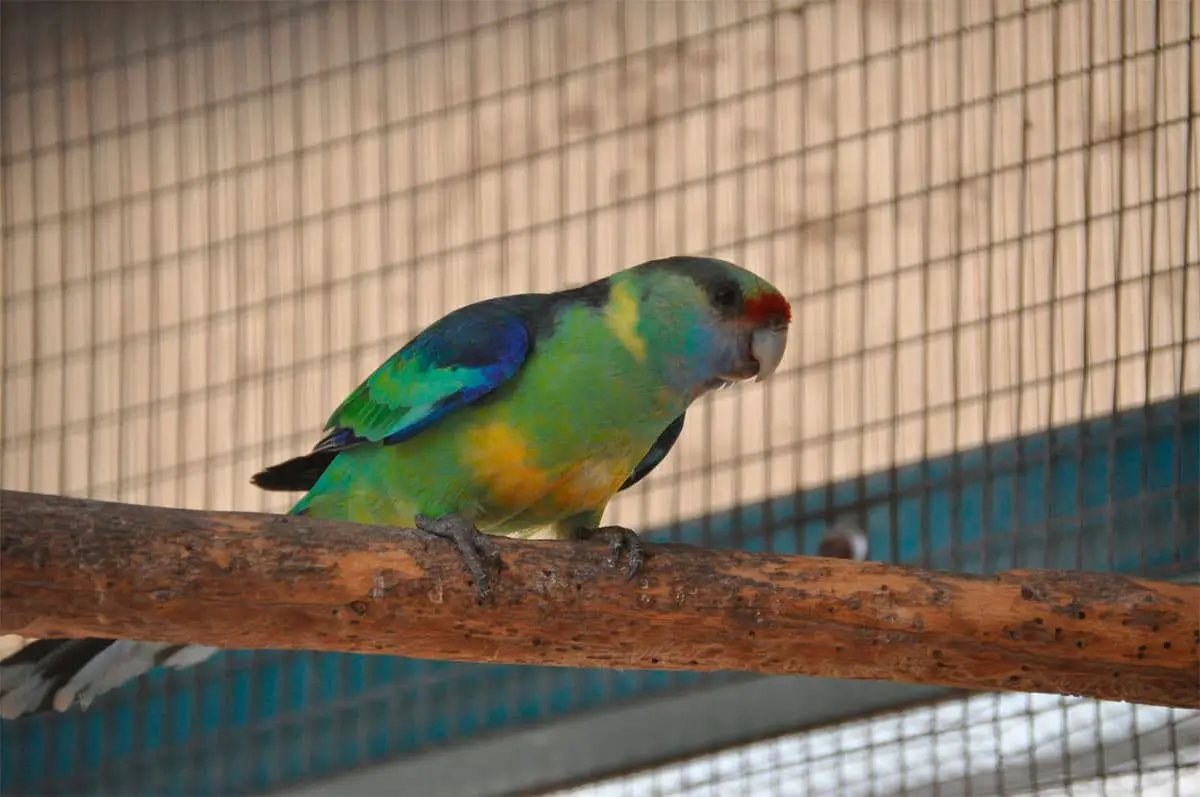
The Mallee Ringneck (Barnardius barnardi) has the plumage predominantly Green, crown and sides of the head bright green, with the cheeks slightly tinged blue and a small red band across the forecrown. The neck It is olive brown with a yellow ring around its back.

The lower area of the back is dark blue. The chest and the abdomen are turquoise blue, separated one from the other by a transverse band of yellow color which is more or less wide. The curvature of the wing It shows a greenish blue that overflows on the mantle.

The greater coverts are yellowish-green. The secondaries They are pale blue, In contrast with the covered and primaries which they are dark blue.

The underparts is blue. The upperparts tail is dark green, their central feathers with blue spikes and outer blue with pale tips.

The bill is whitish grey. The strait bare periophthalmic is solid gray. The irises is of color Brown dark and the legs grey.

The female It has colors more muted than your partner. The back and the lumbar area show a dark greenish gray. The underside is grey, with a more or less visible clear band.

The immature with even duller colors than females. They have the neck and back of the crown brown. The cheeks blues are often more developed. The back and tail are greyish green. The band underwing usually visible.

    Two species were traditionally recognized in the genus Barnardius, Barnardius zonarius and Barnardius barnardi, but both hibridaban in the contact area and are currently considered a single species.

    Taxonomic status:

This taxon is considered a subspecies of Barnardius [zonarius or Barnardi] (sensu lato) by some authors

Subspecies Barnardius barnardi

  • Barnardius barnardi barnardi

    : (Vigors and Horsfield, 1827) The nominal species

  • Barnardius barnardi whitei

    : (Mathews, 1912) Of 35 cm.. length. It has feathers off, especially the chest and abdomen where the turquoise color is absent. Female plumage more clear than the nominal. Is believed to be a hybrid of the Barnardius Zonarius with the Barnardius Barnardi.

  • Barnardius barnardi macgillivrayi

    : (North, 1900) Of 33 cm.. length. More small, more pale, with the greenish-yellow forehead more pale and with clear bright blue hue on the cheeks and below the headphone feathers. Broad band of yellow on the abdomen.

Barnard's Parakeet Habitat:

The Parakeets Barnard They are mainly sedentary, but there may be some moves to small scale in response to climate change.

The species occupies the arid areas of mallee composed almost exclusively of Eucalyptus gracilis. Also found in shrubs of acacia and cypresses and in a wide variety of very similar habitats.

The species living in the areas of the North has a clear preference for the rubber Red (Eucalyptus camaldulensis) It covers temporary streams and shows a more arboreal lifestyle.

Generally less common in populated areas and in more humid regions. Large flocks are more rare to observe; pairs or small groups are the usual social units.

Less bold and curious that the Australian Ringneck, Although the two species share habits, diet and cortejo similar.

The Mallee Ringneck have been recorded feeding in the company of the Crimson Rosella (Platycercus elegans), Pale-headed Rosella (Platycercus adscitus), Red-rumped Parrot (Psephotus haematonotus) and Bluebonnet

Reproduction:

During courtship, the male shrugs, causing the wings to vibrate slightly.
Like most other parrot species, the Mallee Ringneck they have as a practice gnaw and chew wood, whether to put his personal stamp on his favorite tree, or to enlarge the cavity entrance. This activity allows them to keep their beaks in good condition.

The nest is usually in a hollow tree, and usually four to five eggs make up the implementation, deposited on a base of wood decaying waste.

In the North, breeding season tends to be governed by weather, and the nesting coincides with the end of the wet planting season.

In the South, playback starts in July or August and the season can be extended until January with a second litter. Incubation lasts around 20 days and is carried out by the female.

The young birds leave the nest after 5 weeks, but remain in the household with his parents for a while.

Food:

The Mallee Ringneck they are mainly vegetarians, they feed on seeds – Melon seeds (Cucumber myriocarpus), bitter melons (Citrullus lanatus), fruits of the tree of the tobacco (introduced), fruits, nectar and flowers. Its menu is complemented with insects and larvae.

«Barnard's Parakeet» Distribution:

The Mallee Ringneck they are distributed through the interior of the East Australia, to the West of the Great dividing range, with a practically isolated population in the Northwest of Queensland, stretching across the border of the Northern Territory, along the nicholson river, in the North, and reaching Glenormiston, and western part of Queensland, in the South; its eastern limit is about Kynuna.

The the Northern subspecies meets the nominal species in the region of Range Forsythe, and extends to the South, with its eastern boundary running near Barcaldine, Mitchell and Goondiwindi, and in New South Wales.

To the South extends East through Moree, Dubbo and Wagga Wagga to get up to Kerang in Victoria.

In the West, the species is dispersed through of Western Queensland to the region of Cooper Creek of South Australia around Innamincka.

In New South Wales, is located to the West of the basin of the darling river, about Broken Hill.

Distributes lengthwise of the murray river, and in Victoria It extends through the Northwest corner to the South, until around Edenhope.

In the southeast of South Australia ranges through Naracoorte and Mount Lofty Ranges in Port Augusta and Montes Flinders, where is integrated with the Australian Ringneck; the two species are also more North.

Getaways birds have been registered in Brisbane, Melbourne and Sydney.

Subspecies B distribution. barnardi

  • Barnardius barnardi barnardi

    (Vigors and Horsfield, 1827) The nominal species

  • Barnardius barnardi whitei

    (Mathews, 1912) Flinders Ranges, South Australia

  • Barnardius barnardi macgillivrayi

    (North, 1900) This, Territory of the North and Northwest Queensland

Conservation «Barnard's Parakeet»:


minor concern


• Current category of the Red List of the UICN: Least concern

• Population trend: Growing

The species is considered common throughout its range..

The world population is estimated at around 500 000 individuals and it seems stable.

But, seems less able to adapt to the changes that have occurred in the habitat that the Australian Ringneck.

In captivity:

The Mallee Ringneck It is appreciated as a pet, but the birds in captivity are relatively few.

Una muestra vivió 17,9 years in captivity. According to some sources, these animals can live up to 31,6 years in captivity, but this has not been verified.

Most common in Europe and Australia; not so much in the United Kingdom or United States.

Initially it is a timid and nervous bird, Although soon it acclimatizes caregiver. Bonding with a partner to do when both birds are young, as adults they do not usually live in harmony. Aggressive with other parrots.

Alternative names:

– Mallee Ringneck, Mallee Parrot, Mallee Ringneck Parrot, Ringneck Parrot (ingles).
– Perruche de Barnard, Barnardius barnardi, Perruche cloncurry (French).
– Barnardsittich, Barnard Sittich, Barnard-Sittich (German).
– Periquito-de-Barnard (Portuguese).
– Perico de Barnard (español).

scientific classification:

– Order: Psittaciformes
– Family: Psittaculidae
– Genus: Barnardius
– Scientific name: Barnardius barnardi
– Citation: (Vigors & Horsfield, 1827)
– Protonimo: Platycercus theelectronicjumper

Images "Mallee Ringneck"

Videos "Mallee Ringneck"

«Barnard's Perico» (Barnardius barnardi)


    Sources:

    – Avibase
    – Parrots of the World – Forshaw Joseph M
    – Parrots A Guide to the Parrots of the World – Tony Juniper & Mike Parr
    – LoroMania
    AnAge: The Animal Ageing and Longevity Database – Genomics.senescence.info
    – Birdlife

    – Photos:

    (1) – By AlexKant – Israel> Petach Tikva Zoo – ZooChat

    – Sounds: Patrik Åberg (Xeno-canto)
▷ The world of Pets: Dogs, cats, birds, reptiles, amphibians

Red-winged Parrot
Aprosmictus erythropterus

Red-winged Parrot

Content


Anatomy-parrots

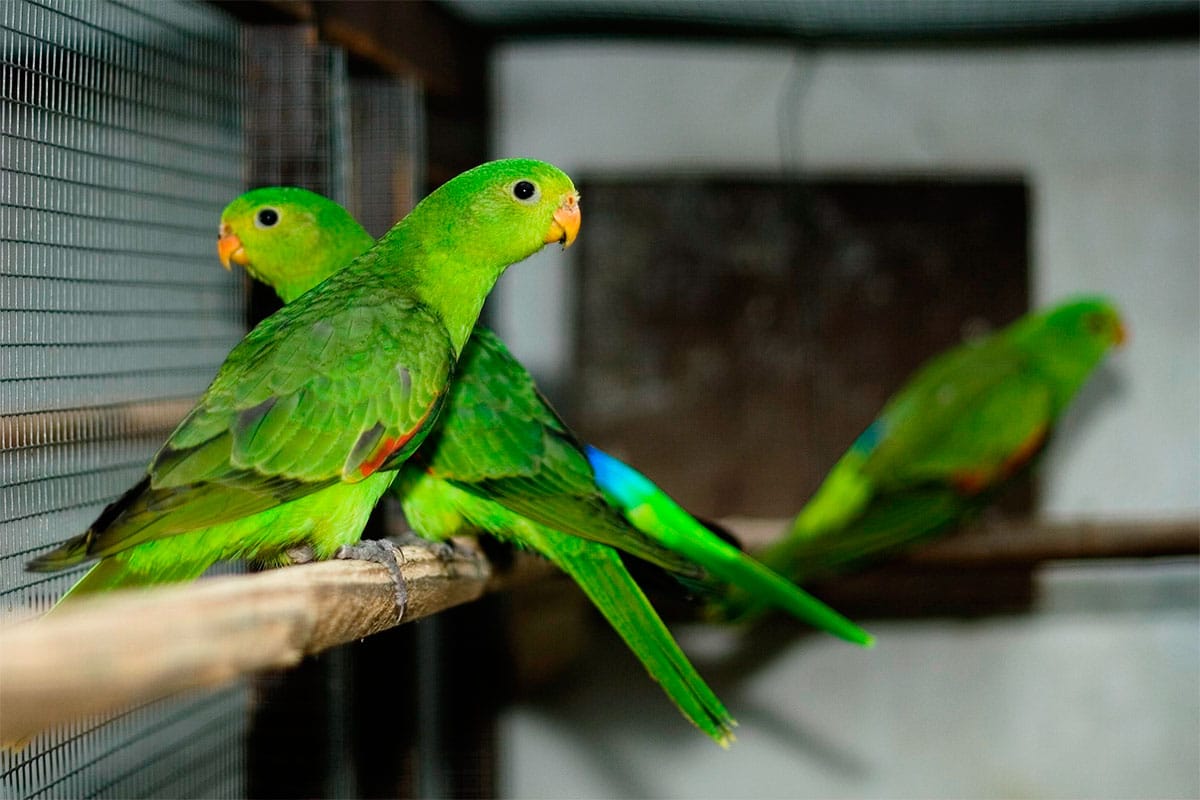
Description

30 to 33 cm.. length between 120 and 210 g. of weight.

The Red-winged Parrot (Aprosmictus erythropterus) has the head of color green bright with brightness blue green in the crown and nape. Mantle, back and scapulars black. Area low of it back and rump brilliant blue, more clear towards the tail; uppertail-coverts of color green yellowish with broadcasting yellowish at the base. Curve of the wing yellow-green light. Carpal edge blackish. Upper, the wing-coverts, bright Scarlet. Tertiary and primaries marked in black on vane inner, green in vane outer; secondaries also bathed in black in vane outer; primary coverts of color green dark bathed in black. Under, the wing-coverts green. The underparts bright, pale and slightly yellowish-green. Upper, the tail Green dark with tips of color yellow and lateral feathers Blackish in vane internal with yellow tips; undertail, the tail Blackish with tips pale.

Bill coral red; irises reddish brown; legs grey-black.

Female It is predominantly green with a small red spot in the wings (only a point apical on coverts major interiors, but the increase in the external; restricted to the outer feathers of the median) that of the male, and it ain't got no black on it the mantle; vane outside of outer secondaries black. The Green is also more off, and a bit more yellowish in them underparts. The rump is of a blue more off, and the glitter blue in it crown and nape of the male, is absent in the female. Under, the tail has tips yellowish and touches of color pink.

The immature they are similar to the females, but with a irises more Brown and bill yellow from the beginning. Young males attain adult plumage in the third annual moult, but black can show the mantle feathers before this.

Description 3 subspecies

  • Aprosmictus erythropterus coccineopterus

    (Gould) 1865 – Male with more blue in it crown and nape. Both sexes slightly paler, and the female also more off the Green that it nominal species.


  • Aprosmictus erythropterus erythropterus

    (Gmelin) 1788 – The nominal.


  • Aprosmictus erythropterus papua

    (Mayr & Rand) 1936

Habitat:

Resident, Although nomads in the edges of the range. Is semiarid and subtropical forests of eucalyptus and casuarina, boedes of the Woods, riparian forests, thickets of acacia, mangroves, agricultural fields, scrub Cypress pine (Callitris), and the lowlands of the Savannah.

On the inside of Australia are mainly linked to the extension of wooded of the systems fluvial.

They are usually found in small groups of up to fifteen birds, rarely reach more of 50 individuals in a single flock. The largest groups are likely to form late in the breeding season when family groups gather at feeding grounds..

The species is common and conspicuous, but not particularly accessible; When resent, birds can fly some distance, often making strong sounds.

Sometimes associated with the Pale-headed Rosella and Mallee Ringneck, and they feed under the trees, Although it is more usual to see them on Earth to drink.

Reproduction:

The nesting You can start early, in the months of April or may in the North, but august to february is the main breeding season in the south. During the courtship, the male perches near the female, exposing your blue rump, and making sounds.

The nest normally found in a eucalyptus, and the eggs are put into a deep hole covered with scrap wood. Three to six white eggs are They incubated for around 20 days by the female, which is fed by the male until the eggs hatch. The young are cared for by both parents and they leave the nest in a five weeks.

Food:

The diet It includes seeds, fruit, flowers and insects; in the mangroves, the mistletoe (Loranthus) is your favorite diet.

Distribution:

Size of the area of distribution (reproduction / resident): 5.230.000 km2

The Red-winged Parrot (Aprosmictus erythropterus) are confined in Australia, in the coastal districts of the southeast of Irian Jaya (Indonesian) and in the Western Province (Papua New Guinea).

In New Guinea, the species is restricted to the region between the rivers Digul and Fly.

In Australia extends from about Broome, in Western Australia (registered West of Anna Plains, and southwest of the Cordillera de Edgar) through the Kimberley region, including some islands on the coast (Buccaneer and Bonaparte archipelago, Islands Osborne and Sir Graham Moore, and Admiralty Gulf Islands) in the Northern Territory, about Nicholson.

Extends northward up to the peninsula of cobourg and to the South, at the turn of the Cordillera Camfield and Dunmarra Roadhouse, reaching some coastal islands, including Melville and Groote Eylandt.

Extends to the East in Queensland, in the nicholson river, are distributed in the Cape York Peninsula, with records by the coast, about Rockhampton (occasional southernmost), and reaching inside, about Dajarra, to the South of Mount Isa and Southeast, through the lower part of the diamond river, Windorah, Quilpie, Mitchell and San Jorge.

On the inside of New South Wales the end points of the range are in Inverell in the East, Gunnedah, Dubbo and Mudgee in the South and There is a, Menindee and Broken Hill, near the southern border of Australia.

They are also in the North, in the basin of the darling river, and have been recorded in the South-East of Australia, around the Lake Eyre and North of Cooper Creek.

Wandering individuals have been recorded in Renmark and Victory Downs, In this last, possibly from an exhaust.

Leaks have also been observed in Sydney and Melbourne.

The species is common in suitable habitats, except at their range limits.

The world's population is above the 100.000individuals and the species is considered secure.

A moderate number of captive.

Protected by law.

Distribution 3 subspecies:

  • Aprosmictus erythropterus coccineopterus

    (Gould) 1865 – South of New Guinea and Western Australia, to the East through the northern territory of the Cape York Peninsula, Queensland


  • Aprosmictus erythropterus erythropterus

    (Gmelin) 1788 – The nominal


  • Aprosmictus erythropterus papua

    (Mayr & Rand) 1936 – South of New Guinea

Conservation:


minor concern


• Current category of the Red List of the UICN: Least concern

• Population trend: Growing

The size of the world population It has not been quantified, Although it is estimated very above the 100.000 specimens.

The species, according to sources, is usually common and locally abundant (pit et to the. 1997).

The population is suspected that it may be in decline due to ongoing habitat destruction.

"Red-winged Parrot" in captivity:

Fairly common in Australia, not so much in other places.

Active, Acrobat; they require a large birdhouse with plenty of hangers. The male can become aggressive with the female.
Quite quiet and shy.

Una muestra vivió 24,4 years in captivity.

Alternative names:

– Red-winged Parrot, Red winged Parrot (ingles).
– Perruche érythroptère, Perruche erythroptère (French).
– Rotflügelsittich, Rotflügel-Sittich (German).
– Periquito-de-encontro-vermelho (Portuguese).
– Papagayo Alirrojo, Papagayo de Alas Rojas (español).


scientific classification:

Gmelin Johann Friedrich

– Order: Psittaciformes
– Family: Psittaculidae
– Genus: Aprosmictus
– Scientific name: Aprosmictus erythropterus
– Citation: (Gmelin, JF, 1788)
– Protonimo: Psittacus erythropterus


Images «Papagayo Alirrojo»:

Videos "Red-winged Parrot"

————————————————————————————————

«Papagayo alirrojo» (Aprosmictus erythropterus)

Sources:

– Avibase
– Parrots of the World – Forshaw Joseph M
– Parrots A Guide to the Parrots of the World – Tony Juniper & Mike Parr
– World Parrot Trust – parrots.org
– Birdlife

– Photos:

(1) – By David Cook Wildlife Photography from Wamboin, NSW, Australia [CC BY 2.0], via Wikimedia Commons
(2) – By Jan Harenburg (Own work) [CC BY 3.0], via Wikimedia Commons
(3) – Aprosmictus erythropterus erythropterus – Orde Psittaciformes – Papegaaiachtigen
(4) – Red-Winged Parrot (Aprosmictus erythropterus) Male – Pine Creek, M. 7. – encimages
(5) – «Aprosmictus erythropterus-Australia-pair-8" Of Kitykat79 – originally posted to Flickr as King Parrots!. With license CC BY 2.0 Transact Wikimedia Commons.
(6) – A painting of two Red-winged Parrots (originally captioned «Platycercus erythropterus. Crimson-winged parraket. 1. Male. 2.Female.») by Edward Lear 1812-1888. The painting shows a female behind young male by Edward Lear [Public domain], via Wikimedia Commons

– Sounds: Peter Woodall (Xeno-canto)

▷ The world of Pets: Dogs, cats, birds, reptiles, amphibians

Papuan king parrot
Alisterus chloropterus

Papuan king parrot

Content


Anatomy-parrots

Description

36 cm.. length between 138 and 190 g. of weight.

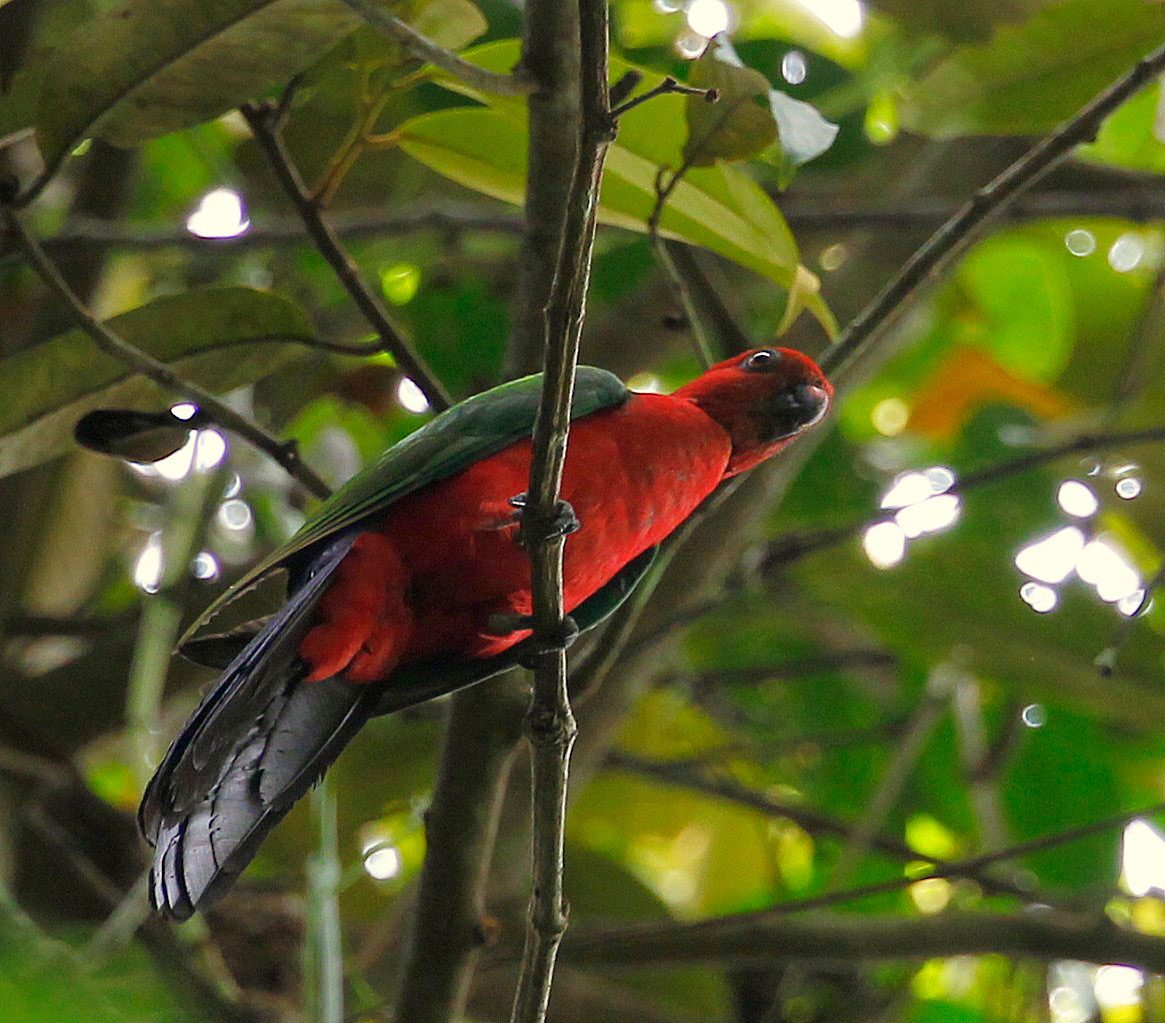
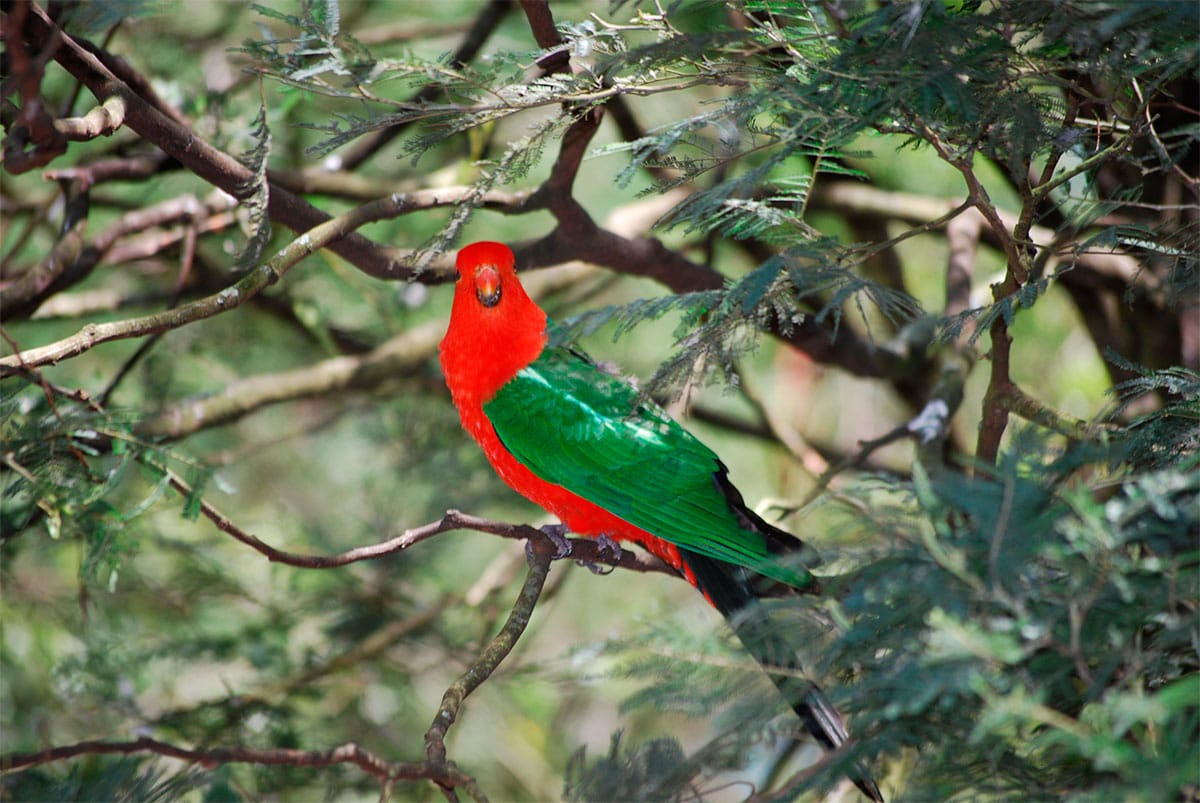
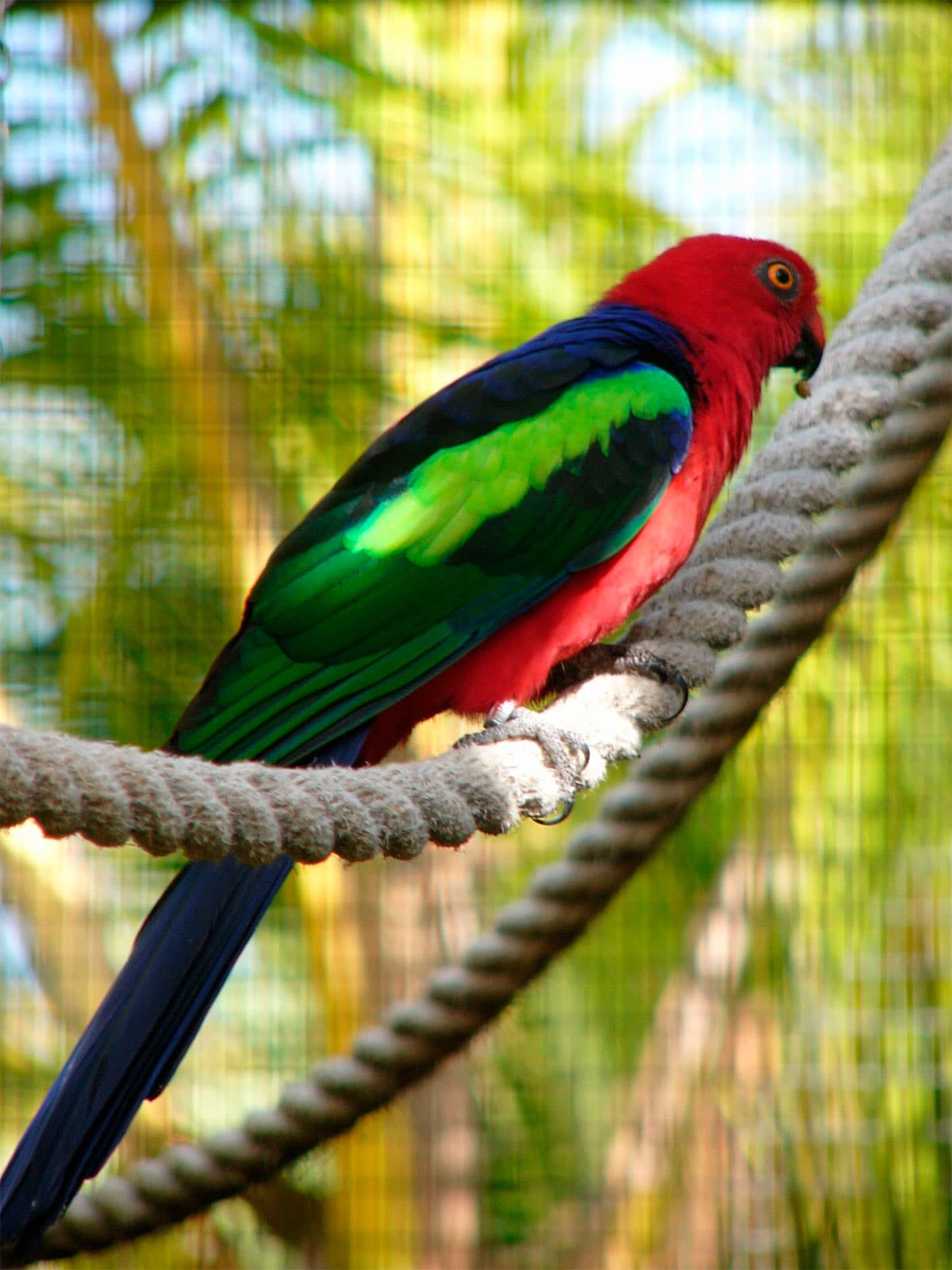
The Papuan king parrot (Alisterus chloropterus) It has a bright red head, wide rear collar of blue stretching at the nape to the back of the Crown and sides of the upper part of the chest. Blackish green mantle, apparently black in the field; lower part of the back, buttocks and supracaudales coverts Dark Violet.

Dark green wings with large patch of yellowish-green through the lower, internal medium and more large inner coverts; Green flight feathers, with vane Dark internal. Under, the wing coverts blue-violet. Bright red bottoms, with hidden dark bases to the coverts infracaudales. Upper, tail bluish black; Black down.

Black bill with red base to upper mandible; Orange iris; feet of color grey blackish.

The female of color green for over, devoid of the pale in wings patch, with a dark blue rump and blackish tail. Head and upper part of the chest of green (reddish mottled), and the rest of of the Red bottoms. Under, the Green wing coverts. Coverts with dark centers infracaudales, but this is less evident in the Australian females. Base with more brown on upper mandible than in males.

Young as females, but with tips to the tail feathers pink, a greener chest, and a peak and iris darker.

Subspecies description

  • Alisterus chloropterus chloropterus

    (Ramsay, EP 1879), the nominal subspecies.


  • Alisterus chloropterus callopterus

    (Albertis & Salvadori 1879) – Male with blue band narrow through the mantle, It does not extend to the rear of the Crown. More green in the mantle.


  • Alisterus chloropterus moszkowskii

    (Reichenow 1911) – Sexes generally similar. Male has no or only shows a blue light in the back of the neck band, and it has the mantle and signs on the sides of the chest of green. Male with violet that extends more down in the back that the nominal species. Both sexes can display tips pink tail feathers. Immature with narrower and more off the wings patch. Green marks on the chest.

Habitat:

They are distributed in the dense forests from close to sea level until the 2.800 m. The birds are also sometimes found in cultivated areas, at higher altitudes, in more open habitats with casuarinas, and in areas of secondary growth. Papagayo Papuans are heard more often than they are seen, and are more frequently asked vislumbrados flying between the trees through breaks in the forest.

Bird alone, couples or groups of up to ten copies, they feed on silently and discreetly in the lower floors and half-height of the forests, and they can be addressed a short distance when they deliberately leave in search of fruits, seeds, berries and nuts; When resent, they usually only fly within walking distance.

Reproduction:

Little-known cycle of reproduction, but nesting, according to sources, begins in the month of March with two or three eggs in the implementation. The period of incubation is of 21 days, and the incipient takes 35 days. Young people reach the independence in 50 days.

Food:

Fruits, seeds, berries and nuts

Distribution:

Size of the area of distribution (reproduction / resident): 324.000 km2

The Papuan king parrot extends from North of Cenderawasih Bay, to the East, about Aitape on the North Coast. Although locally common, the species is probably suffering due to the trade of birds. The world population is estimated at around 70.000 birds.

Subspecies distribution:

Conservation:


minor concern


• Current category of the Red List of the UICN: Least concern

• Population trend: Stable

The size of the world's population has not been quantified, Although it is estimated at around 70,000 specimens.

The species is reported as locally common (pit et to the. 1997).

The population is suspected to be stable in the absence of evidence of any reduction or substantial threats.

"Papuan king parrot" in captivity:

active parrot; need extra space because of the tendency that has to turn into an apathetic or lethargic in a small cage bird. It is not very loud. The dietary changes must occur slowly. It has a tendency to internal parasites.

Very rare in captivity.

Alternative names:

– Papuan King-Parrot, Green-winged King Parrot, Green-winged King-Parrot, Papuan King Parrot (ingles).
– Perruche à ailes vertes, Perruche royale à ailes vertes, Perruche royale de Papouasie (French).
– Papuasittich (German).
– Periquito-rei-de-asa-verde (Portuguese).
– Papagayo Papú, Papagayo Real de Alas Verdes (español).

scientific classification:

– Order: Psittaciformes
– Family: Psittaculidae
– Genus: Alisterus
– Scientific name: Alisterus chloropterus
– Citation: (Ramsay, EP, 1879)
– Protonimo: Aprosmictus chloropterus

“Papuana Parrot” images:

————————————————————————————————

«Papuan Parrot» (Alisterus chloropterus)

Sources:

– Avibase
– Parrots of the World – Forshaw Joseph M
– Parrots A Guide to the Parrots of the World – Tony Juniper & Mike Parr
– Wikipedia
– Birdlife

– Photos:

(1) – «Alisterus chloropterus-Jurong Bird Park-male-8a» by Peter Tan – originally posted to Flickr as Australian King Parrot. Licensed under CC BY 2.0 via Wikimedia Commons.
(2) – «Alisterus chloropterus -Grant’s picnic ground -in tree-8» by Jade Craven – originally posted to Flickr as King Parrot at Grants Picnic Ground. Licensed under CC BY 2.0 via Wikimedia Commons.
(3) – Birds and Birds – Parrocchetto reale aliverdi
(4) – Bottom view of a male perched on a branch by Carmelo López – Lynx
(5) – franz.kulman

– Sounds: Sam Woods (Xeno-canto)

▷ The world of Pets: Dogs, cats, birds, reptiles, amphibians

Eclectus Parrot
Eclectus roratus


Eclectus Parrot

Content

Description


Anatomy-parrots

35 to 42 cm.. length and a weight between 355 and 615 g..

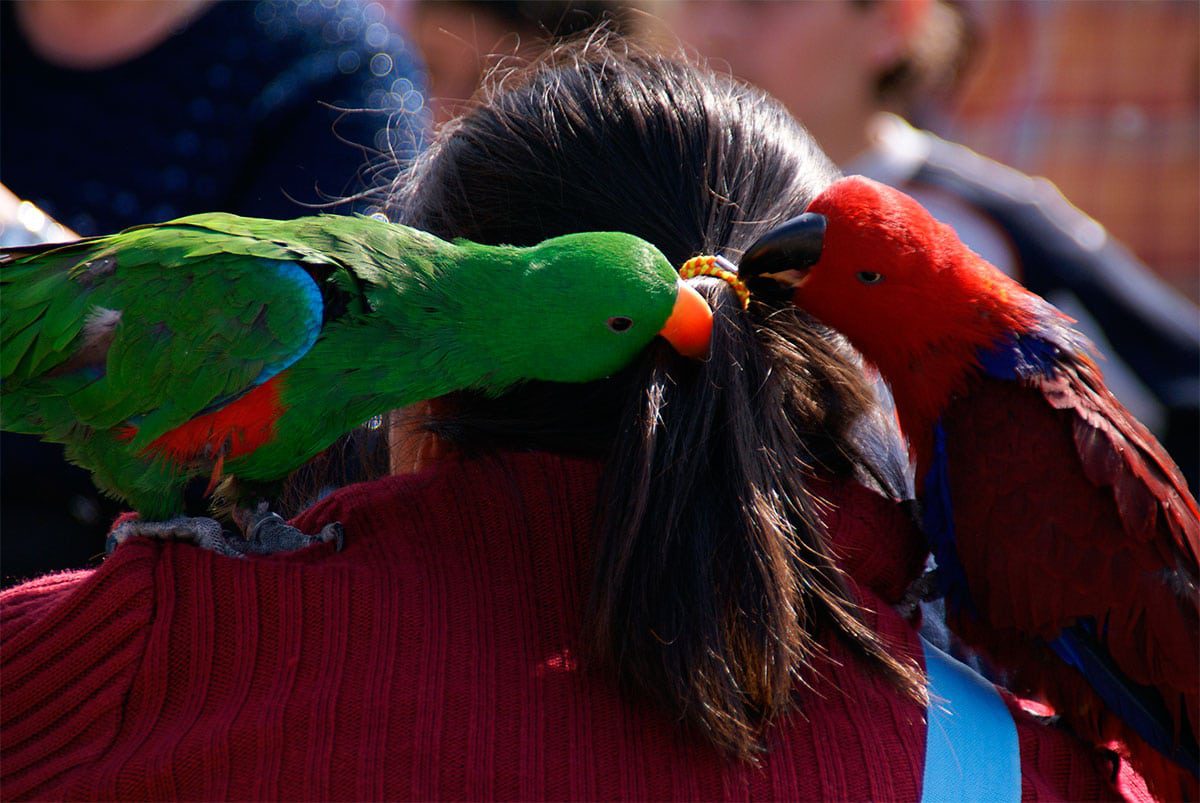
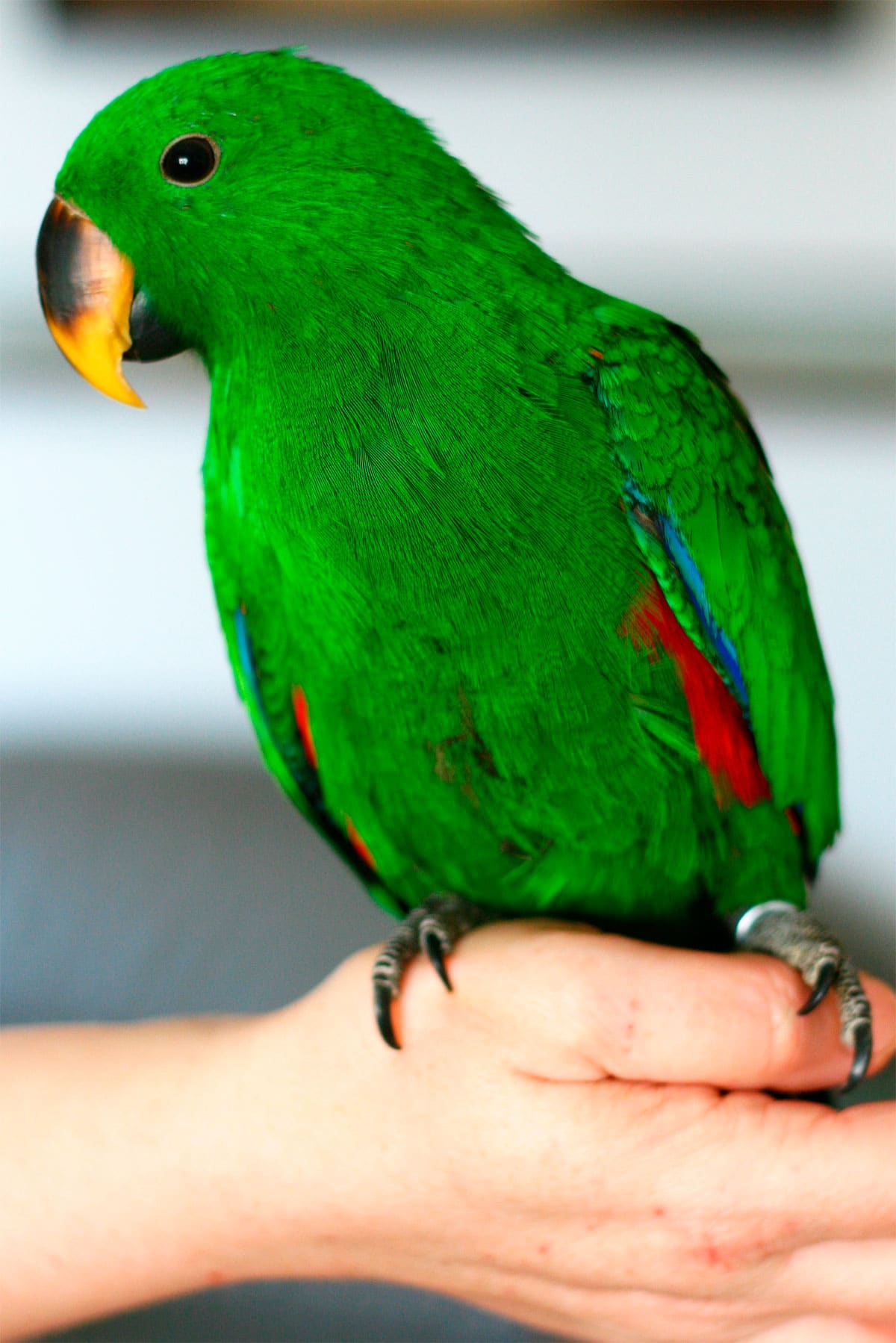
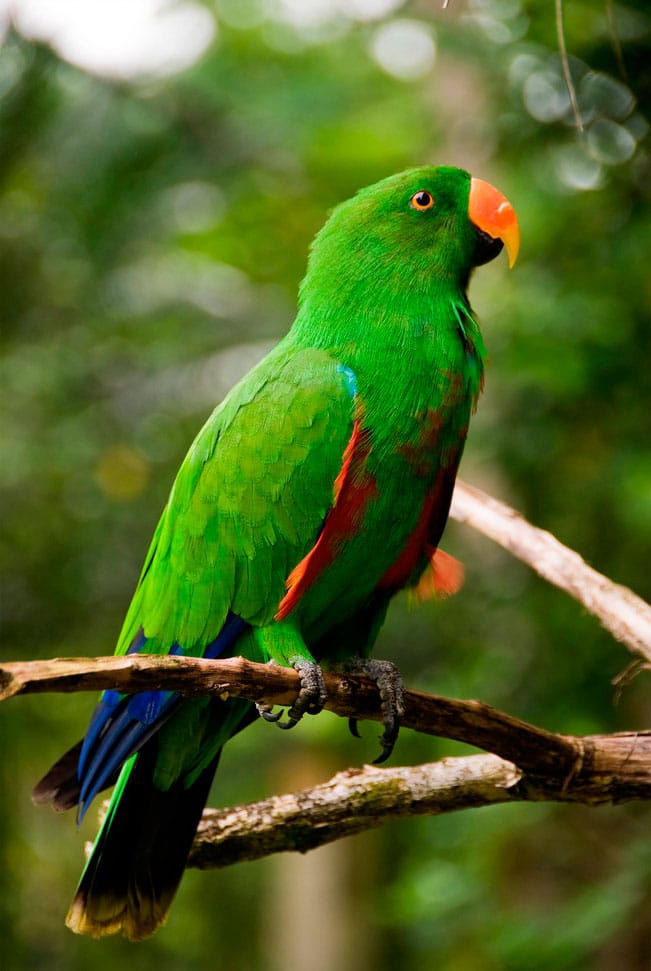
The Eclectus Parrot (Eclectus roratus) It has the head and upper parts of bright green. green wing coverts; curve of the wing and the carpal edge blue; primary coverts dark blue. Feathers of flying with vane very dark blue external, vane internal black on the edge inside. Wing of bright red feathers; bottom of the black flight feathers. Green underparts with flanks and axillary Red. Upper, the Green tail with narrow pale yellow tips, drenched side of blue and yellow-tipped feathers (more external with more blue); undertail, tail black with yellow tips.

Yellow-tipped red Bill, black lower jaw, iris orange, greyish Brown legs.

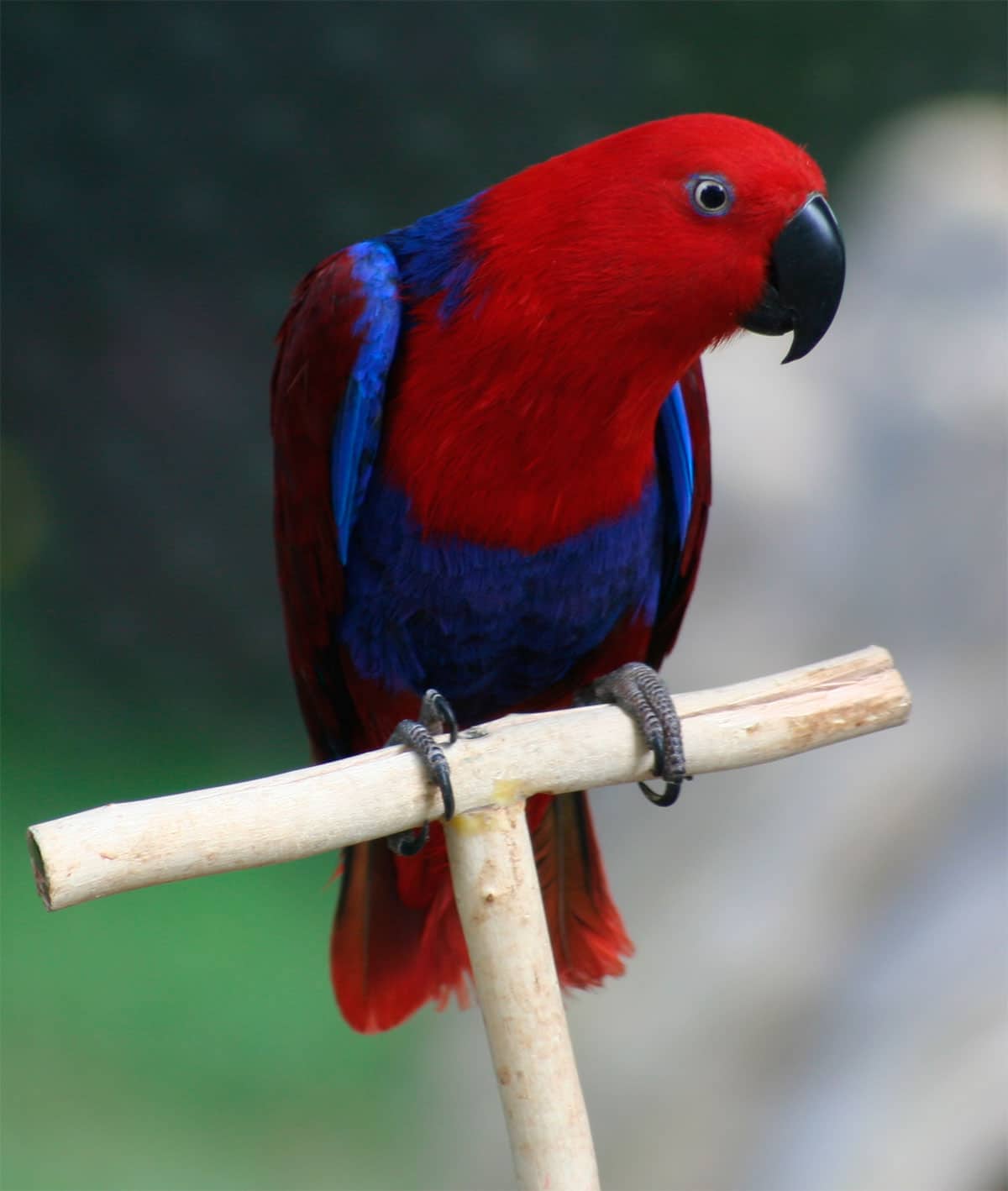
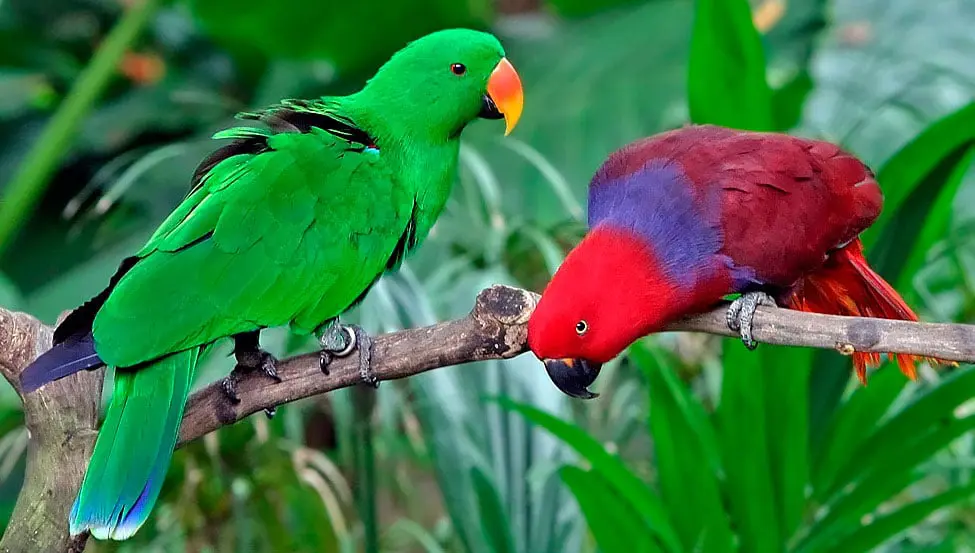
In all the eclectus sexual differences machos-hembras are so large that at the beginning he qualified them as different species. The female of the Eclectus Parrot it is bright red with a purple ruff across the top of the mantle, with bluish black in flight feathers, purple blue wing feathers, purple diffusion over the chest, dull purple-blue on lower chest and belly, coverts yellowish-tipped red infracaudales, and a tail of red with yellow tips (Feather darker bases). The beak is black and the iris is usually yellow (variable).

The young birds they move directly the adult plumage but they have brown peaks.

  • Sound of the Eclectus Parrot.

Subspecies

List of subspecies Eclectus roratus
  • Eclectus roratus vosmaeri

    (Rothschild, 1922) – Larger than the nominal. Male with bright green plumage, more red on the flanks, broader yellow tail ends. Female with the red light, broader yellow tail and yellow in the coverts infracaudales ends.

  • Eclectus roratus roratus

    (Statius Müller, 1776) –

  • Eclectus roratus cornelia

    (Bonaparte, 1850) – Larger than the nominal. Male with more blue in the queue, the upper parts of lighter green color. Female completely red except for the edges of the Carpus, wing feathers and flight feathers, that are blue. Narrow yellow tip to the tail.

  • Eclectus roratus westermani

    (Bonaparte, 1850) – (Known only from a few copies of populations in captivity; the origin is unknown). Smaller than the nominal. The male It has no visible red flanks when wings are closed and shows foreign banks of green to flight feathers. Female with the darker red color with broad yellow tip to tail. The possibility that the few copies are abnormal individuals of the subspecies E. r. flushed It has not ruled out.

  • Eclectus roratus riedeli

    (A.B. Meyer, 1882) – Smaller than the nominal. Male with wide yellow tips on the tail (25 mm). Female as E. r. Cornelia, but it shows bright yellow on the coverts infracaudales.

  • Eclectus roratus aruensis

    (G.R. Gray, 1858) – Males as the subspecies E. r. biaki, with a little more spacious yellow tips to the tail. Female Red clear, especially tail.

  • Eclectus roratus biaki

    (Hartert, 1932)- As the subspecies E. r. tortoiseshell but smaller. The female just like the female of the E. r. tortoiseshell but more bright red underparts and back of neck (dubiously distinct race).

  • Eclectus roratus polychloros

    (Scopoli, 1786) – Larger than the nominal. Male, Yellow tail more yellowish-green tips. Female with red chest and less violet blue in the bottom region restricted to belly, green in vane external primary. Narrow periophthalmic ring blue. Coverts red infracaudales.

  • Eclectus roratus solomonensis

    (Rothschild & Hartert, 1901) – Smaller that the E. Eclectus tortoiseshell and the male more yellowish green. Female Red clear. Size is reduced clinalmente from West to East

  • Eclectus roratus macgillivrayi

    (Mathews, 1913) – As the E. Eclectus tortoiseshell but larger.

Habitat:

The Eclectus Parrot It is distributed in a wide range of habitats, from second growth forests, Savannah, mangrove, coconut plantations and eucalyptus Woods, until 1.900 m.

The species is most common in lowland forests, around growing areas and coastal habitats.

The birds are alone, in pairs or in small groups, often composed of only males (presumably during playback).
They sometimes soar above the forest and draw attention with their shrill calls while flying over the canopy, or they perch on an exposed branch.

They are cautious, groups of foraging usually remain in the treetops, Although birds feeding on low-altitude or even on the ground have also been observed.

The Eclectus Parrot they are most active at dawn and at dusk, When traveling to and from their roosts in noisy groups of up to 80 birds.

Have been recorded roosting in Sumba where the Eclectus Parrot they share space with the Sulphur-crested cockatoo.

The species is considered an agricultural pest in some parts of New Guinea.

Reproduction:

Breeding can apparently occur at any time of the year in Papua New Guinea, While active nests observed in Australia It was between the months of February and July; There has been during the month November in Buru, During August in Seram, and between June and September in the Solomon Islands.

Up to eight birds have been registered by attending a nest. It is not clear if these are brood helpers., young from a previous litter still attached to the family group, or additional hens females.

In courtship, birds become involved with mutual grooming and Wiggles head.

The nest is a hollow in a tall tree, until 30 metres in height, sometimes exposed; The cavity may have around 6 depth meters.

Putting two eggs are deposited on a bed of wood dust, hatching in about 26 days, and taking ahead 12 weeks to breeding.

The female takes care of the incubation, leaving only the nest twice a day to be fed by the male; Also is fed by the male when the first eggs hatch, but then begins to feed if same.

Food:

The diet includes fruits, seeds, flowers, outbreaks, fruits and nectar: they are especially fond of (Pandanus) banana, corn, figs and Papaya.

Distribution:

Sumba in the Small Oriental Sunda Islands, Indonesian and Moluccan Islands including Buru, Seram, Ambon, Haruku, Saparua, the Gorong Islands (apparently introduced), OBI, Damar, Bacan, Halmahera, Mare. Ternate and Morotai, in the West of the papuan islands,including Waigeo, Batanta, Salawati and Misool; thence through the lowlands of New Guinea, and Tanimbar Islands, Kai and islas Aru, to the South of the Islands in the Cenderawasih Bay (Numfor, Biak, Yapen, My Num).

In the East, the Eclectus Parrot are distributed among archipelagos of D'Entrecasteaux and the Luisiadas, Papua New Guinea, including Goodenough and Normanby, and in the Trobriand Islands extending through the Bismarck Archipelago including Umboi, New Britain, the Witu Islands, Lolobau, Uatom, Duke of York, New Ireland, New Hanover, Tabar, Lihir, Thong and FeNi, reaching Manus and Rambutyo in the the Admiralty archipelago and Nissan in the South.

The species is also through of the Solomon Islands, including Buka and Bougainville (Papua New Guinea) to the East of San Cristóbal and its satellites.

There is an isolated population in the North of the Cape York Peninsula, Australia, that goes from the Iron range National Park and the pascoe river, to the South of the McIlwraith range, regularly visiting smaller islands in the Torres Strait, in the continental part of New Guinea.

There is an introduced population of the Eclectus Parrot in Koror and some smaller islands in the archipelago of Palau In the pacific, but likely to be occasional escapes from Hawaii, where apparently cannot have been established. This is one of the parrots most common and most familiar throughout much of their range.

The world's population is estimated over of 300.000 birds. Local entrapments in Ambon, Saparua and Haruku It has apparently made the species becoming extinct in these three islands. The distinctive population in Sumba is in danger.

Subspecies

Distribution subspecies Eclectus roratus

Conservation:


minor concern


• Current category of the Red List of the UICN: Least concern

• Population trend: Decreasing

The size of the world's population has not been quantified, It is estimated over the 300,000 specimens. The species is described as common to rare.. The population in Sumba It is estimated in 1.900 individuals, although Sumba It represents a very small proportion of the global range of the species (pit et to the. 1997).

The population is suspected to be declining due to the destruction of habitat in course and unsustainable levels of exploitation.

"Eclectus Parrot" in captivity:

3 the common subspecies in aviculture: Eclectus roratus flushed, Eclectus roratus vosmaeri and Eclectus roratus tortoiseshell; other rare breeds.

Es a curious and intelligent with an acceptable language ability, they learn without difficulty to say words and phrases.

It happens to be fairly quiet and able to live without too much attention. Males can be somewhat distant while in females it must be emphasized the theme that in the case that have nest can not out of it. On the topic food tends to be accepted that the eclectus have a greater need for vitamin A than other parrots.

When considering the purchase of a new Eclectus, it would be wise to obtain a photo and request a consultation with an authority on Eclectus to verify that you are not purchasing a hybrid.

When to acquire housing for our Eclectus Parrot, one should consider your major and arrange them in a cage as large as possible; reasonable steps would be 4,4 m x 1,5 m x 2 m.

We should keep in mind that our parrots should spend at least one hour each day outside the cage during the game.

DIET:

The Eclectus diet consists mainly of vegetables, fruit, legumes and granulated meal. Given that our Eclectus Parrot do not eat many seeds in the nature, and since they are deficient in nutrients, we must consider that their intake should be the exception and not the rule in our house.

The Eclectus they require a diet high in vegetable protein and beta carotene. Their digestive system is longer than most other species., with a greater proventriculus and longer intestines, so fat intake should be limited to avoid fatty tumors. But this does not mean "fat-free.", especially for young people who are very active. It takes some fat to store fat-soluble vitamins A, E and D. It also, with all species, If the cholesterol is too high, the excess accumulates in the liver and, through the bloodstream, travels to the heart where it accumulates; a problem evidenced by fatigue, lack of breed, secondary nutrient deficiency problems (for example, Candida, hypocalcemia, hypoprotenia, etc.), fatty liver, plumage and discoloration-poor quality, bad state of health in general and the inability of the other nutrients to be used correctly.

Too much oil in the diet can cause black feathers on the male and female. They are easily distinguished from the black marks of stress or liver disease because the pattern is different.. Some diets based on pelleted food are high in sugar and can cause kidney problems or hyperactivity. Some are also high in colorants and flavors and can cause toxicity problems. There are some diets which in the market that are organic; But the lack of condoms can cause growth of unwanted yeast and bacteria if left in the cage for more than one hour.

Reproduction Eclectus Parrot:

The reproduction of the Eclectus Parrot It is not difficult as long as we have a compatible partner, Since a female in heat can be aggressive with the male and pursue him while he nears the trough.

Nesting box can have very different ways. The measures are 30 x 30 x 80 cm and inlet of 10 cm.. Diameter. The Z-shaped nest is highly recommended for breeding the Eclectus Parrot Since it allows the male to stay on the top platform in the event that the female is shown aggressive to protect the nest. Inside the box you can put some kind of material, as pine bark.

The incubation period is 28 to 30 days and can breed throughout the year. A sunset happens to another and is not interrupted even during the time of molt. However often the eggs are not fertile or parents do not feed the chicks. It is best to allow them only two released per year, so the nest will have to be removed or the male will have to be separated for a few days. The only drawback, If we choose to separate the male, It is called the female strident so your partner.

The implementation is usually two eggs, and occasionally three.

Alternative names:

– Eclectus Parrot, Kalanga, King Parrot, Red-sided Eclectus Parrot, Red-sided Parrot (ingles).
– Grand Éclectus, Éclectus, Grand Eclectus (French).
– Edelpapagei, Salomonen Edelpapagei (German).
– Papagaio-eclectus (Portuguese).
– Loro Ecléctico, Loro Eclectus (español).

scientific classification:

– Order: Psittaciformes
– Family: Psittaculidae
– Genus: Eclectus
– Scientific name: Eclectus roratus
– Citation: (Statius Müller, 1776)
– Protonimo: Psittacus roratus

«Eclectic Parrot» Images:

Videos "Eclectus Parrot"

«Eclectic Parrot» (Eclectus roratus)

Sources:

– Avibase
– Parrots of the World – Forshaw Joseph M
– Parrots A Guide to the Parrots of the World – Tony Juniper & Mike Parr
– Birdlife
– mundoexotics
– Birds N Ways

– Photos:

(1) – «Eclectus roratus-20030511» by Doug Janson – Licensed under CC BY-SA 3.0 via Wikimedia Commons.
(2) – «Eclectus roratus-Malagos Garden Resort, Davao City, Philippines-male-8a» by Raymund James Bare – FlickrUploaded by Snowmanradio. Licensed under CC BY 2.0 via Wikimedia Commons.
(3) – «Eclectus Parrot (Eclectus roratus) -6-4c» by derivative work: Snowmanradio (talk)Eclectus_parrot_(Eclectus roratus)_-6. jpg: Bear golden retriever – originally posted to Flickr as Img_4575. JPG and uploaded to commons as Eclectus_parrot_(Eclectus roratus)_-6. jpg. Licensed under CC BY 2.0 via Wikimedia Commons.
(4) – «Eclectus roratus (male) -juvenile pet-ated» by Peter Békési from Budapest, Hungary – Img_0983Uploaded by snowmanradio. Licensed under CC BY-SA 2.0 via Wikimedia Commons.
(5) – By J E Three from houston, usa (parrots eating hairUploaded by snowmanradio) [CC BY 2.0], via Wikimedia Commons
– Sounds: Niels Krabbe (Xeno-canto)