â–· The world of Pets: Dogs, cats, birds, reptiles, amphibians

Amazonian Parrotlet
Nannopsittaca dachilleae

Cotorrita Amazónica

Content

Description:


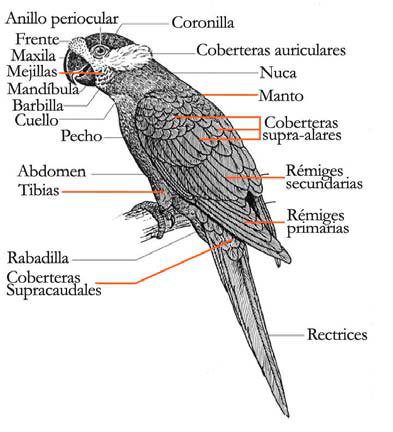
Anatomy-parrots

Very small size, 12 cm.. height.

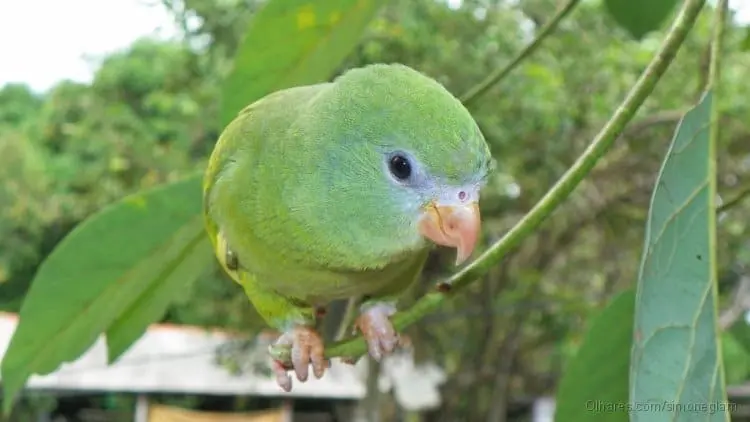
The Amazonian Parrotlet (Nannopsittaca dachilleae) has pointed wings, something square tail. Distinguishable from this species is the forehead and Crown with blue dye, feet and pink Bill, area naked clear around the eye. Usually green body on the back, and more yellowish belly.

Sound of the Amazonian Parrotlet.

Habitat:

Common and abundant in riparian forest, until the 300 m. Possibly associated with the guadua. They fly low over rivers in small, compact flocks of 3 to 12 individuals.

Seen climbing on trees.

They are presumed to nest in clumps of bromeliads or other epiphytes..

Calls are described as acute, they sound very similar to the chicks of birds of farm.

Distribution:

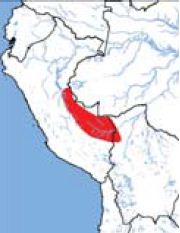
It is found in the western part of the Amazon basin, from southern and southeastern Peru to northwestern Bolivia. Probably West of Brazil.

Cotorrita amazonica

It is a scarce bird that rarely has photographed. The conservation of the rainforest is crucial to their survival. There are many threats to the ecosystem of the Amazonian Parrotlet, harvesting the Guaua bamboo, the Habitat fragmentation and pollution.

Conservation:


Near-threatened


According to the IUCN categories it is considered as Near Threatened. (NT). Deforestation, mainly for colonization, logging and mining, affect their populations.

Alternative names:

– Manu Parrotlet o Amazonian Parrotlet (English)
– Amazonaspapagei, Amazonassittich, Urwaldsittich (Germany)
– Toui de D’Achille, Toui de l’Amazone (France)
– Periquito-da-amazônia (Brazil).
– Periquito-da-Amazônia (Portugal).
– Periquito Amazónico (Peru).


scientific classification:

– Order: Psittaciformes
– Family: Psittacidae
– Genus: Nannopsittaca
– Scientific name: Nannopsittaca dachilleae
– Citation: O’Neill, Munn & Franke, 1991
– Protonimo: Nannopsittaca dachilleae

Images "Amazonian Parrotlet"

Video "Amazonian Parrotlet"


Species of the genus Nannopsittaca

"Amazon Parakeet" (Nannopsittaca dachilleae)


Photo: olhares.uol.com.br
Source: Parrot Book, Parrots and macaws Neotropical

â–· The world of Pets: Dogs, cats, birds, reptiles, amphibians

Bronze winged Parrot
Pionus chalcopterus


Bronze winged Parrot

Content

Description:

28 to 30 cm.. tall and around 210 weight g.

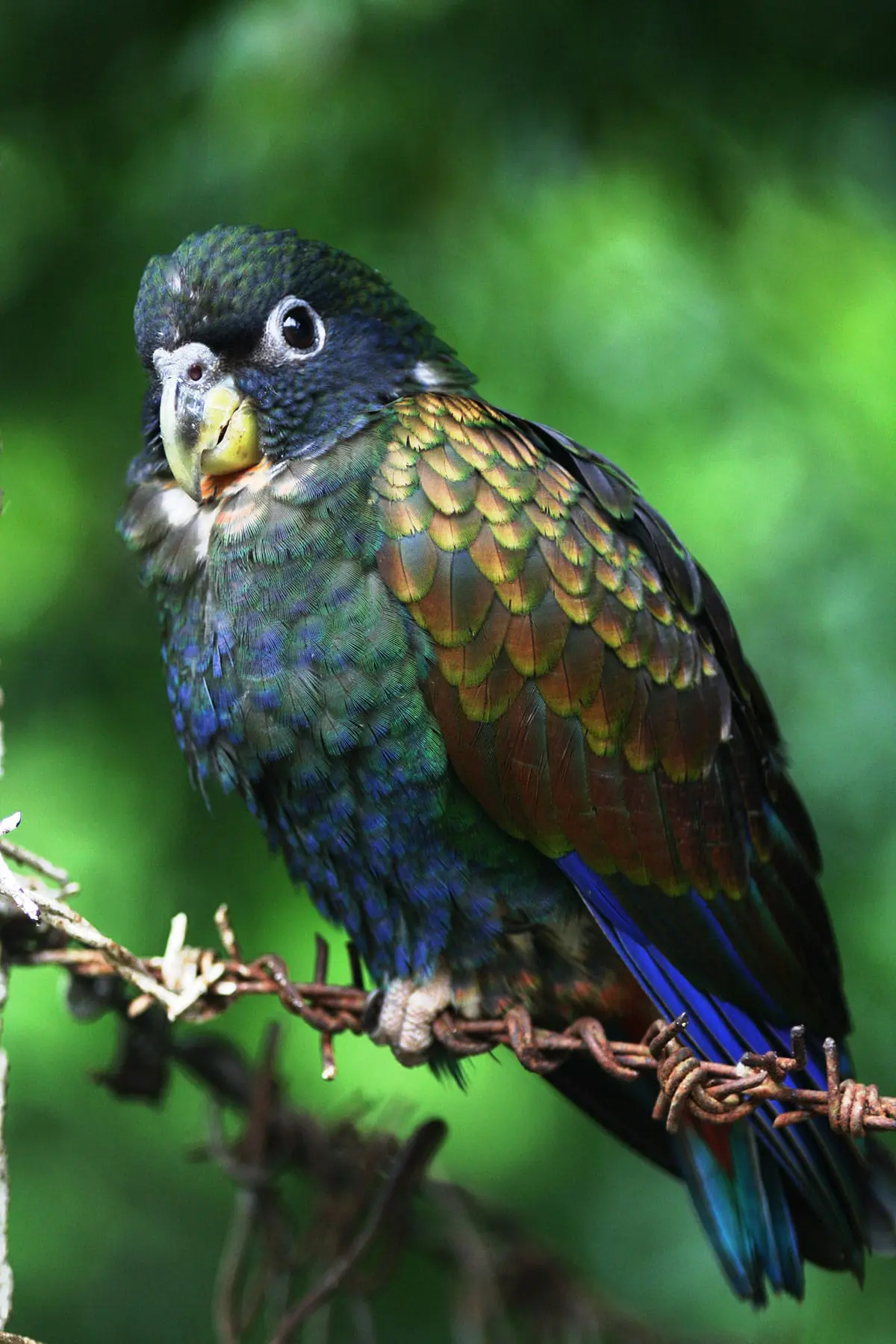
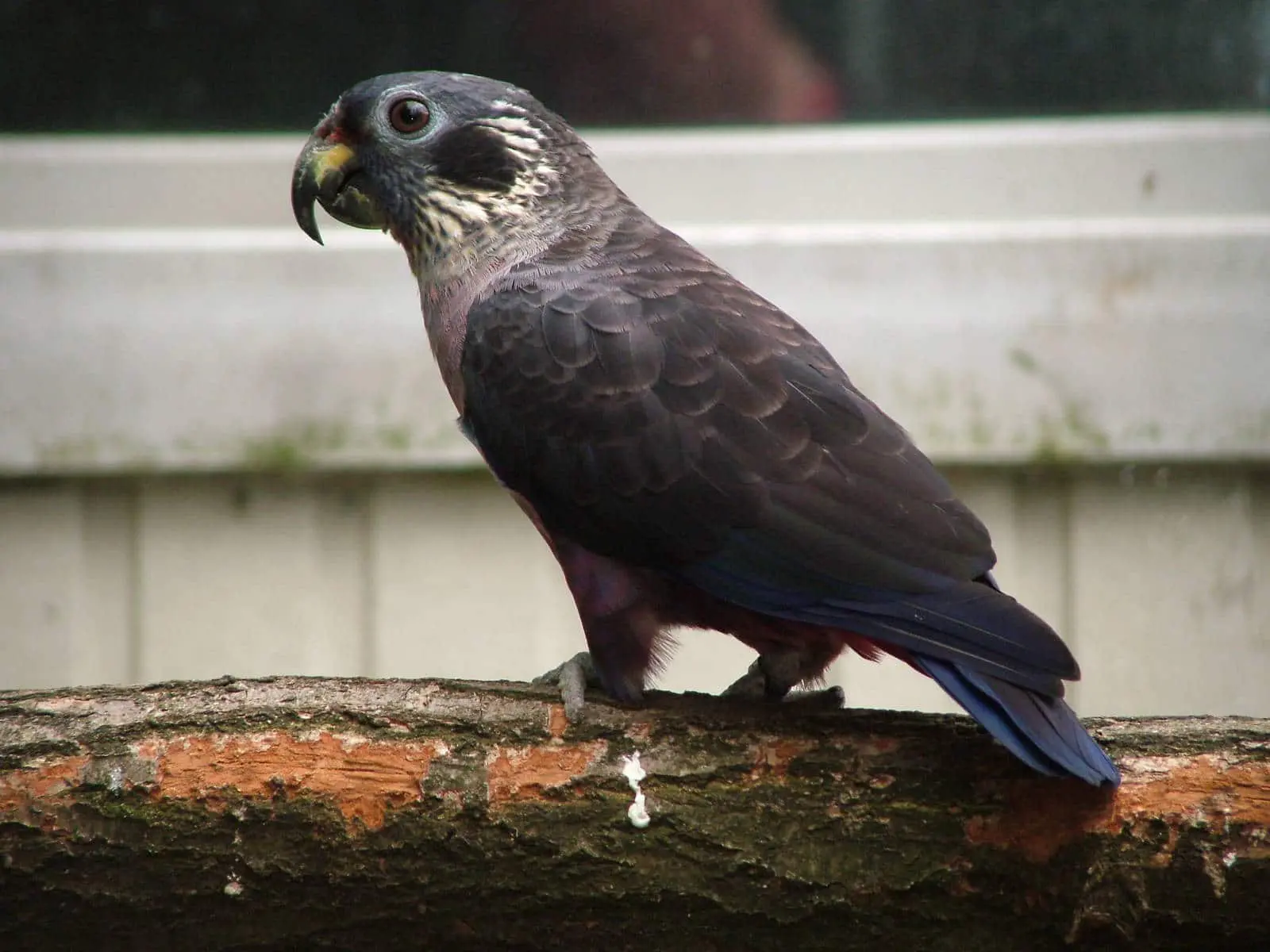
The Bronze winged Parrot (Pionus chalcopterus) has the general Brown, darker in head, neck, chest and flanks, This plumage with blue-violet edge.

The throat whitish and pink; wings bronze green.

Flight is evident violet blue at the top of the wing the Green bottom, that contrasts with the Red of the lower abdomen. Dorsally Violet Blue is notorious in the rump, shoulder and tail. The feathers of the tail are dark blue with a shade of red at the base.

The bill is of color beige, area of naked skin surrounding the eyes of pink. The legs They are pink.

Habitat:

It inhabits in humid jungle, semi-humid, crops and forest edge between 120 and 2800 m.

They are birds gregarious and noisy. Every tomorrow is mobilized in flocks in search of food. Within the flocks are can observe to the couples, that form of life, and who interact with a variety of contact behaviors that reaffirm the marital bond.

Reproduction:

Prefer for their nests broken rods, hollow of logs and palm trees. They nest in the months of October-may. The female often put in two to four eggs they are incubated during three weeks approximately, after which are born them chicks naked or just covered with down. The chicks remain with their parents until the next reproductive shekel.

Food:

Will congregate in cornfields in groups up to of 40 individuals, feeding is of pulp and seeds many fruits and other material ingredients as nectar and flower petals, complementing occasionally its diet with insects.

Distribution:

Its population is distributed by the mountain range of the Andes, from Colombia, Northwest of Venezuela; to the South, by the mountains to the Northwest of Peru.

Conservation:


minor concern


• Red List category of the UICN current: Least concern

• Population trend: Decreasing

The size of the population World of the Bronze winged Parrot It has not been quantified, but this species is described as ‘rare‘ (Stotz et to the., 1996).

The population was suspected of being in decline due to ongoing habitat destruction.

This species is characterized be decreasing in Colombia and West Ecuador, due to the logging of forest subtropical, which has been severe and quick on the slopes of the Andes (Juniper and Parr 1998).

The evident anecdotal, based on the frequency of sightings, suggests that the species has declined in Pineapples, South of Ecuador, in recent years c.15-20 (M. By D Sanchez. Díaz in litt. 2011). Also is says that has been extirpated from areas previously occupied as the slopes of them Andes and valleys of the Cauca and the Magdalena river in Colombia, again due to loss of habitat (Juniper and Parr 1998).

In Venezuela the species is scarce and local, limited, to a large extent, to the slope West of them Andes in Mérida and Sierra de Perija, with occasional records in Táchira (CJ Sharpe in litt. 2011). These areas have experienced rapid deforestation for at least the last few 24 years for cultivation and livestock.

Surveys conducted in the Northwest of Peru in the decade of 1990 they appeared to detect a sharp decrease in population from 1993 (Rosales et to the., 2007), although this species is known to be nomadic and its local numbers can fluctuate.

"Bronze winged Parrot" in captivity:

Rare in captivity, It is not a main target of poachers (CJ Sharpe in litt. 2011, R. Clay in litt. 2011), although it is still present in the illegal trade of Peru (F. Angle in litt. 2011)

Intelligent, playful and curious. You can be nervous, loving with your caregiver and aggressive with other people. It has a tendency to obesity.

It requires a spacious cage unless the bird pass periods of time outside of it. Not must keep is to open air where the temperatures fall below them 5 °C.

With feed a wide variety of seeds, fruits and berries.

It is a relatively healthy bird, While it may be more susceptible to infection aspergillosis that other species.

In captivity they lay two eggs the incubation takes 26 days.

Alternative names:

– Bronze winged Parrot, Bronze-winged Parrot (English).
– Pione noire, Pionus noir (French).
– Glanzflügelpapagei, Glanzflügel-Papagei (German).
– Curica-asa-de-bronze (Portuguese).
– Cotorra Oscura (Colombia).
– Cotorra Negra (Venezuela).
– Cotorra Oscura, Loro Alibronceado, Loro de Alas Bronceadas, Cheja alibronceada (español).

scientific classification:

– Order: Psittaciformes
– Family: Psittacidae
– Genus: Pionus
– Scientific name: Pionus chalcopterus
– Citation: (Fraser, 1841)
– Protonimo: Psittacus chalcopterus

Images "Bronze winged Parrot"

Videos "Bronze winged Parrot"

«Loro Alibronceado» (Pionus chalcopterus)

Sources:

  • Avibase
  • Parrots of the World – Forshaw Joseph M
  • Parrots A Guide to the Parrots of the World – Tony Juniper & Mike Parr
  • Birdlife

  • Photos:

(1) – IBC.lynxeds.com
(2) –
(3) –
(4) –
(5) –

â–· The world of Pets: Dogs, cats, birds, reptiles, amphibians

Orange-winged Parrot
Amazona amazonica

Amazona Alinaranja

Content


Anatomy-parrots

Description Orange-winged Parrot

Of 33 to 36 cm.. height can weigh between 350 gr y 450 gr.
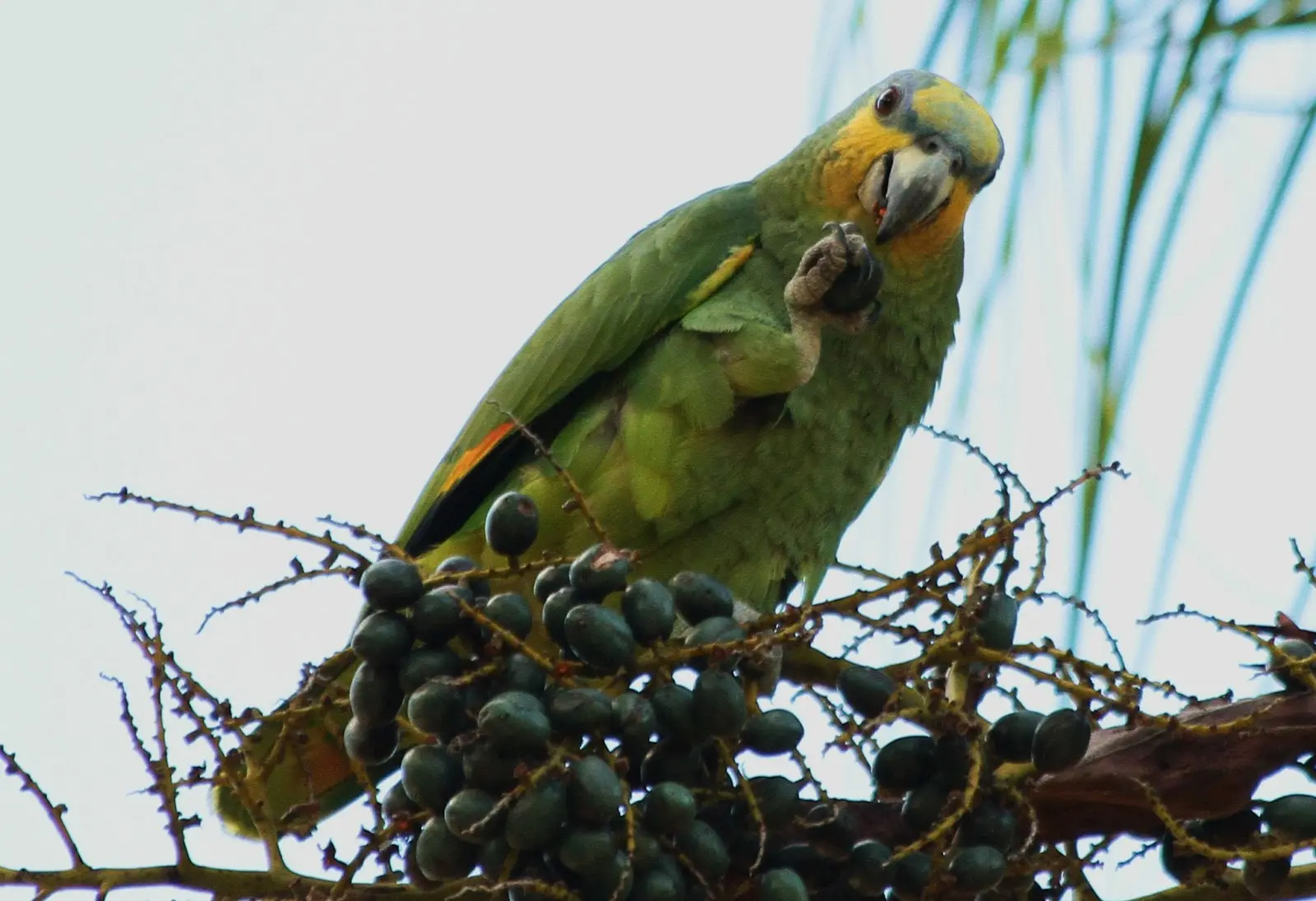
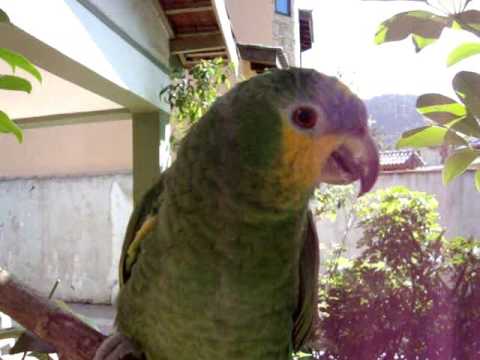
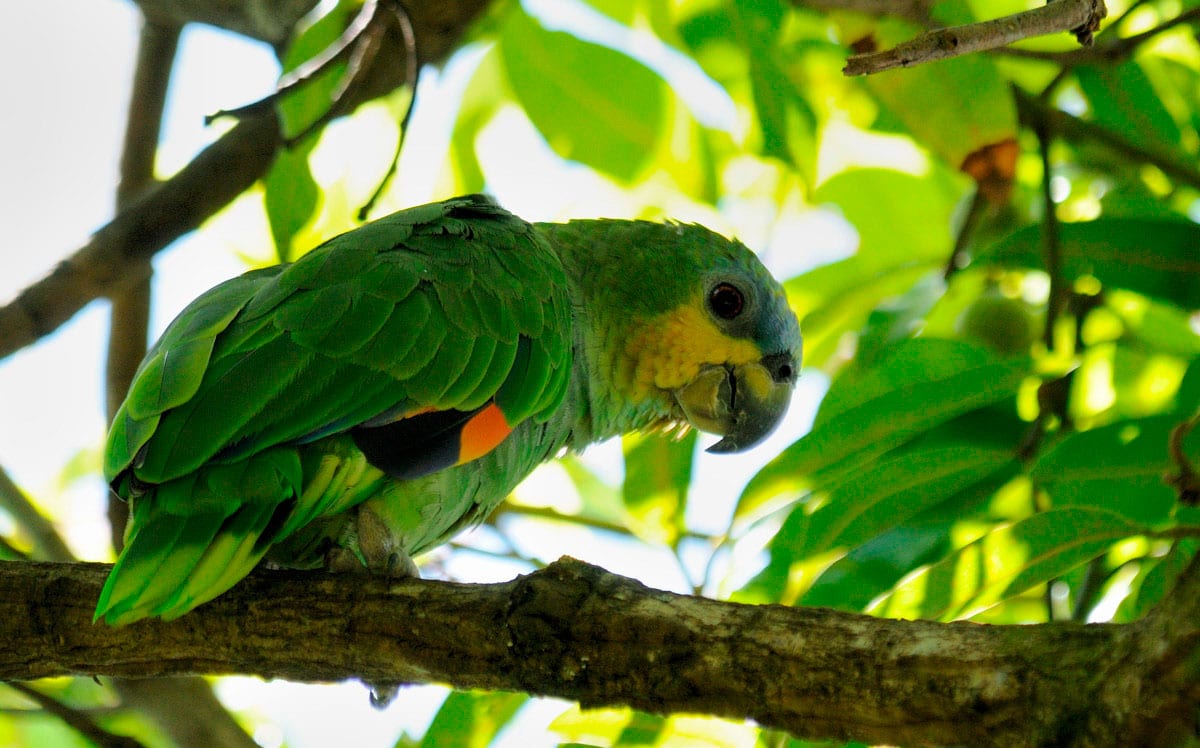
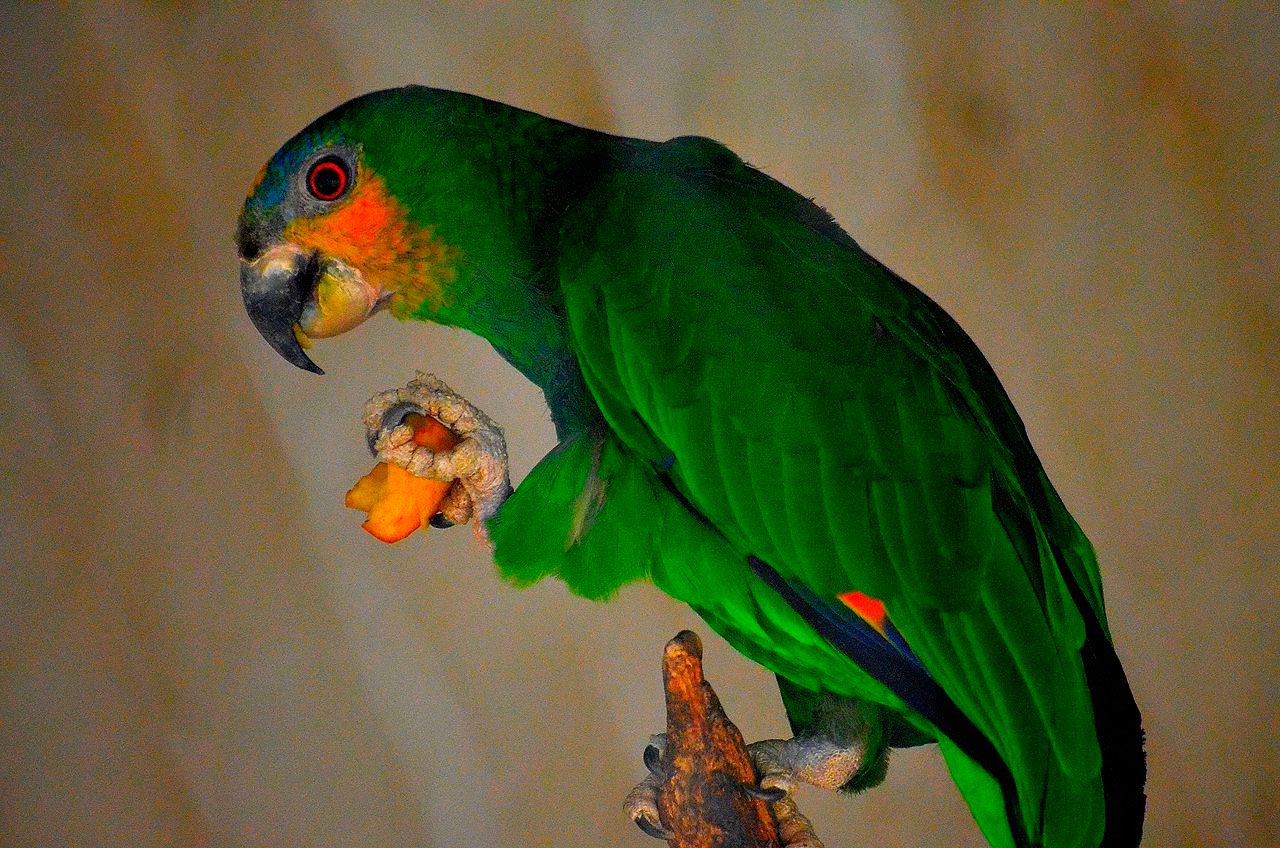
The Orange-winged Parrot (Amazona amazonica) It is distinguishable by having the Centre of the crown and cheeks yellow, separated by the forecrown and sides of the crown pale blue, edge of the wing orange, and inside of the tail Orange with stripe green in the Middle.
The copies juveniles have a color different to it of them adults; the head is green, Blue and pale yellow.
It is not possible to determine the sex of the Amazons in a safe manner by their appearance.

Habitat:

Present in varied habitats (dry forests, morichales, Savanna, stubble, mangroves, etc.) below the 500 m.

Frequently is seen in pairs or in flocks numerous out of it breeding season.

Reproduction:

It is a kind monogamous (the couple stays together for life).

It nests in trunks of Palms killed apparently at the end of the season dry.
The female lays from 3 to 5 eggs and she incubates them for three weeks approximately. the chicks take two months to develop.

Food:

It feeds on various fruits, seeds and sprouts leaves. Including the fruit of Palms (Sloanea, Richeria and Byrsonima) , flowers Erythrina and sometimes cocoa.
You can take oranges and mangoes of the cultivated areas when other food is scarce.

Distribution:


Size of the area of distribution (reproduction / resident): 7.420.000 km2

North and Central South America to the East of Peru, Brazilian Amazon and northeast of Bolivia.

Conservation:

State of conservation ⓘ


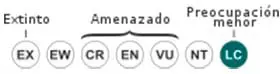
minor concern Minor Concern ⓘ (UICN)ⓘ
  • Current red list category of the UICN: Least concern.
  • The population trend: Decreasing.

  • Trapped for the wild bird trade: they have been 268.510 wild-caught individuals for international trade from 1981.
    In some areas of their range they are hunted for food by the indigenous population.
    The loss of habitat is also a concern.


    "Orange-winged Parrot" in captivity:

    Video – "Orange-winged Parrot"

    Amazona Amazonica

    Popular as a mascot for more than 100 years.
    Loving, playful, with good ability to speak, sociable with people.

    Known for being very friendly, easy to train, very Smart.
    They need constant attention of their owners, they carry out all kinds of fun pranks to get that attention.
    Over time they will form a strong bond with their owner., they can however be quite noisy. They will make noise early in the morning and when the Sun is setting. This usually lasts for a few 10 minutes, to wake up and just before sleep.

    Alternative names:

    – Orange winged Parrot, Common Amazon Parrot, Orange-winged Amazon, Orange-winged Parrot (English).
    – Amazone à ailes orange, Amazone aourou (French).
    – Venezuelaamazone (German).
    – curica, airu-curuca, ajuru-catinga, ajuru-curau, ajuru-curuca, curau, curuçá, Papagaio-do-mangue, papagaio-grego, papagaio-poaieiro (Portuguese).
    – Amazona Alinaranja, Amazona Guaro, Cotorra Alianaranjada, Lora Amazónica, Loro Real, Lora alianaranjada (español).
    – Lora Amazónica (Colombia).
    – Loro Guaro (Venezuela).

    scientific classification:

    – Order: Psittaciformes
    – Family: Psittacidae
    – Genus: Amazona
    – Scientific name: Amazona amazonica
    – Citation: (Linnaeus, 1766)
    – Protonimo: Psittacus amazonicus

    Orange winged Parrot images :


    Species of the genus Amazona


    Sources:

    – Parrot Book, Parrots and macaws Neotropical
    – avibase

    Photos:

    – Our beautiful world
    – An Orange-winged Amazon at Kuala Lumpur Bird Park, Malaysia. It is eating a slice of corn on the cob by Vasenka – Wikimedia
    – by Patrick Ingremeau – IBC.lynxeds.com
    – by Snowmanradio (talk) – Wikimedia
    – by Thore Noernberg – IBC.lynxeds.com

    Sounds: Joao Antonio de B.. Vitto (Xeno-canto)

    â–· The world of Pets: Dogs, cats, birds, reptiles, amphibians

    Dusky Parrot
    Pionus fuscus

    Dusky Parrot

    Content


    Anatomy-parrots

    Description:

    24 to 26 cm.. height and between 179 and 222g. weight.

    The coloration general of the Dusky Parrot (Pionus fuscus) is blue violet dark. Small patch of feathers on the front of the lores; on the basis of the cere, Pink; for the rest, lores, cheeks, forecrown and crown, lavender blue pale with white feather bases in the crown, What gives a faint mottled appearance in some birds; ear-coverts more dark and more grey, forming a distinctive patch; feathers in the throat and the sides of the neck narrow Brown in the Center and tips of pale blue white stripe, forming the joint a collar incomplete.

    feathers in the the mantle and back, of color Brown leaden with those margins pale, giving the scalloped effect; Scapulars, rump and uppertail-coverts, darker grey brown, with very weak pale margins (or absent).

    Coverts smaller and medium-sized, of color Brown leaden with margins pale; coverts primary and higher, as well as the flight feather, cobalt blue; undertail, the wings deep blue. Feathers on the top of the chest, pale pinkish with pale Lavender color tips; area more low in the chest with less dye Lavender, becoming darker and more color came in the belly, reaching, Some birds, the center of the belly of a rich colour came; undertail-coverts crimson.

    Tail of color blue with red at the base. upper jaw Blackish at the tip with patch of color Horn in the base, lower jaw Blackish with the base more clear and more pale visible in some birds; Iris dark brown; Legs grey.

    Both sexes similar.

    In the immature staining is equal to the adult, but with some roofs on the upper wings with green edge; secondary feathers dyed in green and the eye ring naked and white.

    Habitat:

    Dusky Parrot

    They inhabit mainly in lowland rainforests and moist forests in the foothills, in where the birds spend the greater part of the time in the canopy; Mainly in the forest land, occasionally in forests and marshes and less frequently in igapó (permanently flooded forests), Although there have been reports of birds in Savannah (Suriname), coastal gallery forest (French Guiana) and cultivated areas (Although avoiding habitats more open and less seen in clearings or edges of forest to some close relatives, such as the Blue-headed Parrot (Pionus menstruus).

    rare species, flying alone or in small groups on the forest canopy,

    Are you can see in Venezuela from the level of the sea to close them 1.000 m, and in close 1.200-1.800 meters on the side Colombian of the Sierra de Perija.

    gregarious, especially outside the breeding season.

    Reproduction:

    It nests in hollows of old trees, probably during the second quarter of the year, although a nest was observed in the month of November in For, Brazil. The laying is of 3-4 eggs.

    Food:

    It feeds mainly in the canopy but also on the branches of fruiting trees in light areas..

    The diet includes seeds of the gender Eschweilera and Micropholis.

    Distribution:

    Size distribution (reproduction / resident): 1.870.000 km2

    Its population is discontinuous. There is an isolated population in the Sierra de Perija (border between Colombia and Venezuela); regardless of population, The species is found in Venezuela, to the South of the Orinoco in Bolívar, from the Caura River, in the Northwest, up to the Nuria upland, the upper area of the cuyuni river and Sierra de Lema in the areas border with Guyana, in the East, extending through the forested parts of Guyana, Suriname and presumably it French Guiana (There are no known records) until Amapá, the North-East of Brazil, and spreading more broadly to the East of the Brazilian Amazon, from Black river in the North and South, from the Madeira river to the East of For and Maranhão.

    Movements regular seasonal occur in Suriname, with the birds present in the coastal region in the months of July and August.

    In general quite common, Although distributed locally; reports of a moderate and widespread presence in Guyana (although rare in Mountains Kanuku in the Southwest); Common in coastal forests, the savanna and forests inside of Suriname.

    The deforestation severe and rapid in parts of its range (for example, For and Maranhão, Brazil) is, presumably, causing a decline in the population of the Dusky Parrot.

    Very tight in bondage.

    Conservation:


    minor concern


    • Not considered low No category of threat.

    • Not known as a cage bird, but the loss of habitat may be affecting their populations.

    Justification of the population:

    The size of the world population Dusky Parrot It has not been quantified, but this species is described as «Rare» (Stotz et to the., 1996).

    Justification of trend:

    It is suspected that this species has lost the 1,1% of habitat within its distribution over three generations (20 years) on the basis of a model of Amazon deforestation (Soares-Filho et to the., 2006, Bird et to the., 2011).

    Given the susceptibility of the species to hunt or capture, It is suspected that it will fall in <25% durante tres generaciones.

    "Dusky Parrot" in captivity:

    Intelligent, curious, a bit noisy, playful when acclimatizes to the owner.
    Rare in captivity until the Decade of 1970 When in small quantities were imported from Guyana.

    Its longevity is of some 25 years.

    Alternative names:

    – Dusky Parrot, Little Dusky Parrot, Violaceous Parrot, Violet Parrot (English).
    – Pione violette, Pionus violet (French).
    – Veilchenpapagei, Veilchen-Papagei (German).
    – maitaca-roxa, curica, papagainho-roxo, paraná-i (Portuguese).
    – Cotorra de Perijá, Loro Morado (español).
    – Cotorra de Perijá (Colombia).
    – Cotorra Morada (Venezuela).

    scientific classification:

    – Order: Psittaciformes
    – Family: Psittacidae
    – Genus: Pionus
    – Scientific name: Pionus fuscus
    – Citation: (Statius Müller, 1776)
    – Protonimo: Psittacus fuscus

    Images "Dusky Parrot"

    Videos "Dusky Parrot"

    ———————————————————————————————–

    «Purple Parrot» (Pionus fuscus)


    Sources:

    – Avibase
    – Parrots of the World – Forshaw Joseph M
    – Parrots A Guide to the Parrots of the World – Tony Juniper & Mike Parr
    – Birdlife

    – Photos:

    (1) – Veldhoven
    (2) – Dusky Parrot (Pionus fuscus) or Dusky Pionus by Jacques Barraband [Public domain], via Wikimedia Commons

    â–· The world of Pets: Dogs, cats, birds, reptiles, amphibians

    Yellow-faced Parrot
    Alipiopsitta xanthops

    Yellow-faced Parrot

    Content

    Description

    Yellow-faced Parrot

    26 to 27 cm.. tall and about 260g. weight.

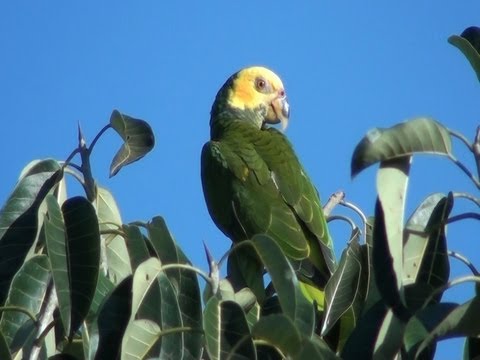
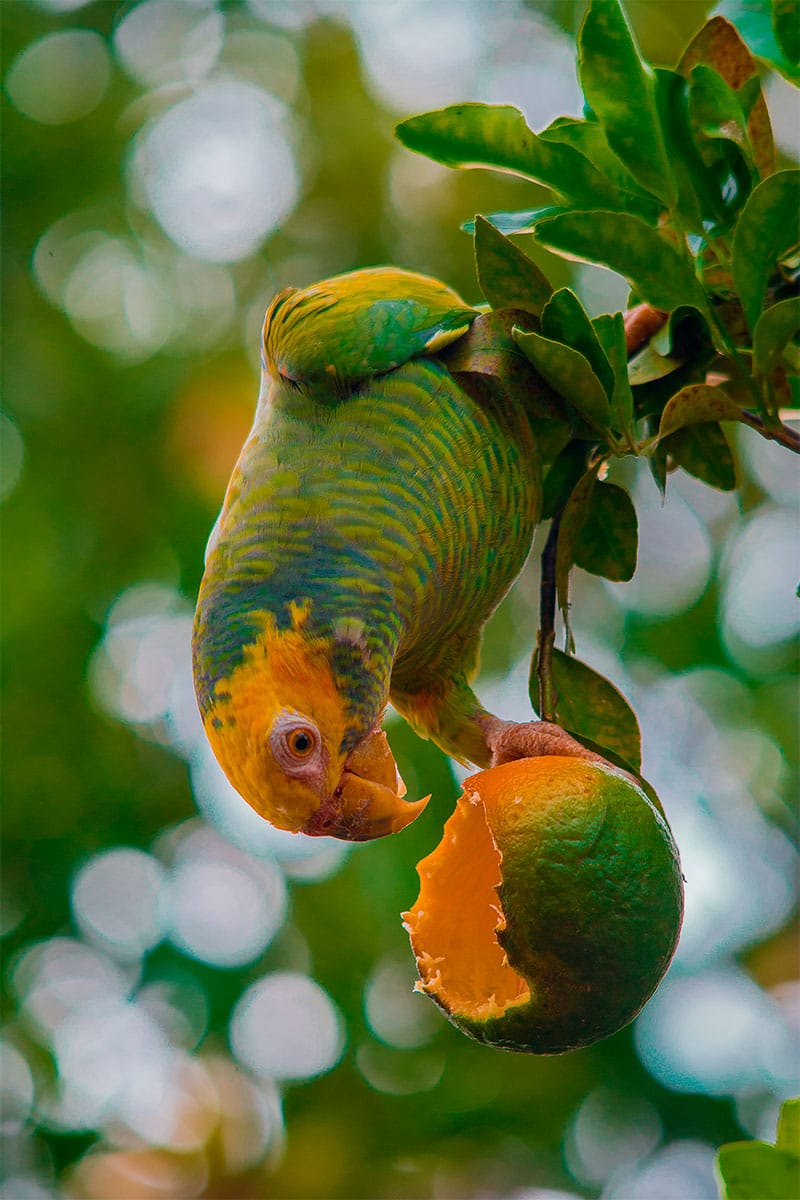
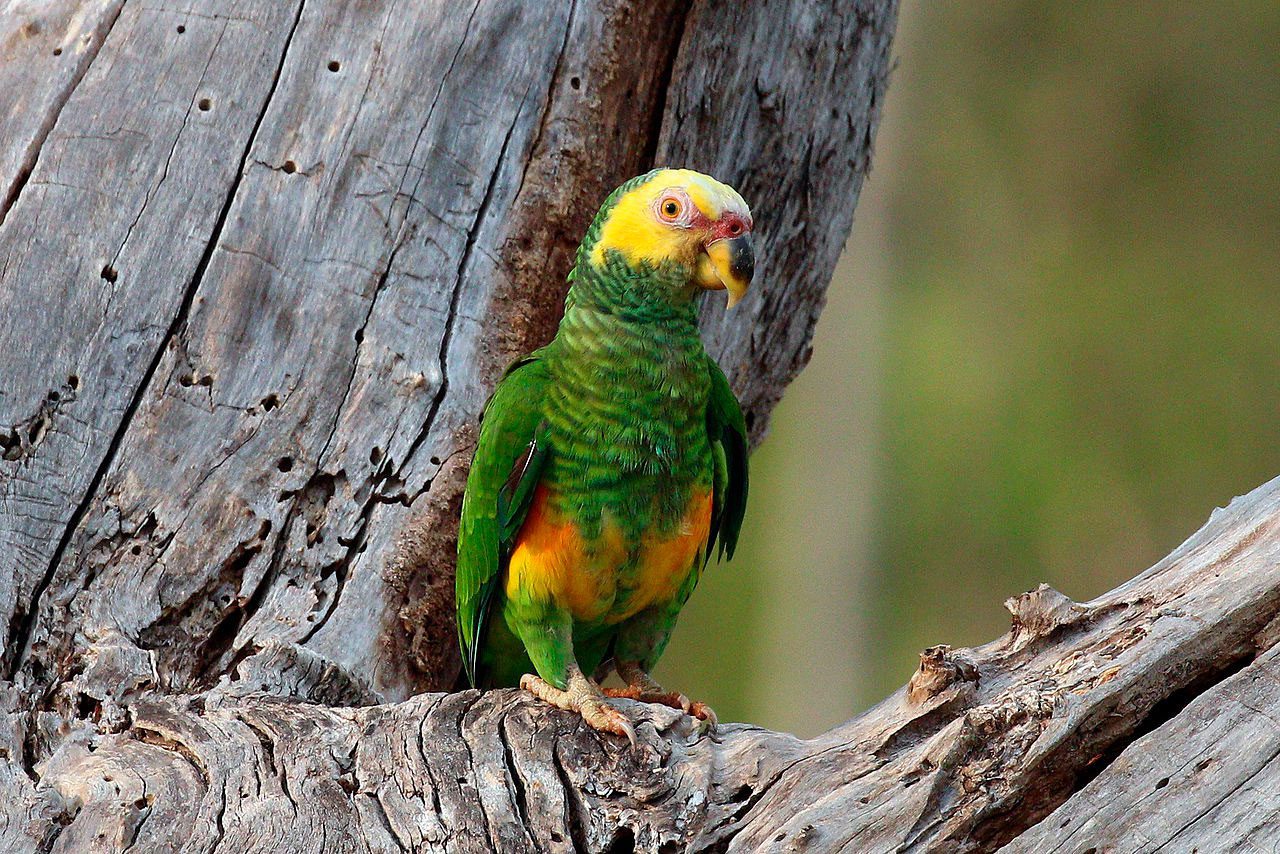
    The Yellow-faced Parrot (Alipiopsitta xanthops) It is distinguished by the large area of ​​yellow in the head, with green tint nape; orange to the sides of body and upper base of the tail; collar yellowish green, belly almost all yellow, the thighs and green inner core tail green; the back it is usually green with yellow tints.

    blackish brown with yellow edges; iris yellow .

    The youth less yellow in body.


    Anatomy-parrots

    Habitat:

    It inhabits in dry forests, also called deciduous forests, in lowlands, with the presence of palmas Mauritia, Although they prefer water courses.
    They can be seen in pairs or flocks of up 50 specimens.

    Reproduction:

    Video – "Yellow-faced Parrot"

    Canto-galego parrot (ALIPIOPSITTA XANTHOPS), YELLOW-FACED PARROT, Curraleiro, CURAU PARROT.

    Although little information regarding this is available, it is known that nest in the hollows of the highest trees closed; the laying usually three eggs and the incubation period is 23-24 days.

    Food:

    It's a species of which there are few studies of their natural habitat. Its main food It consists mainly of fruits and seeds. Very fond of mangoes, usually visit their trees full of fruit.

    Distribution:

    Size of its range (reproduction / resident): 2.700.000 km2

    Inside of Brazil and adjacent area to the east of Bolivia and Horqueta, in the East of Paraguay.

    Conservation Alipiopsitta xanthops:

    State of conservation ⓘ


    Near-threatened Near Threatened ⓘ (UICN)ⓘ

    • Current category of the Red List of the UICN: Near-threatened.

    • Population trend: Decreasing.

    In 1993 two thirds of the Cerrado, This species inhabited, had been moderately or severely altered by agriculture, heavy cattle farming, invasive grasses, the use of pesticides and annual burning.

    Conservation Actions Proposed:

    • Collate sample data and recent records to provide an improved assessment of distribution and status.

    • Estimate the total wild population (Bianchi 2009).

    • Assess the impact of habitat loss (Snyder et to the . 2000).

    • Create a network of large reserves in Bahia, maranhão and Piauí.

    Yellow-faced Parrot in captivity:

    Ave Rare in the world of poultry farming.

    active, curious and playful. Aggressive with other parrots. They can become very noisy. Prone to obesity

    Its reproduction rarely been achieved in captivity. The basic requirement would be to isolate a compatible pair during the breeding season due to increased aggression towards other birds during this period.; also require spacious accommodations and a nest box of 25 x 25 x 60 cm. . with input from 8 cm in diameter.

    They tend to be aggressive toward their caregivers. The breeding season begins in early May. The implementation is of 2 to 4 eggs, which are incubated during 26 days. The young leave the nest when they are near the 8 weeks of age.

    Alternative names:

    – Yellow faced Parrot, Yellow-crowned Amazon, Yellow-crowned Parrot, Yellow-faced Amazon (English).
    – Amazone à face jaune (French).
    – Goldbauchamazone, Schoapapagei (German).
    – Papagaio-galego, chorão, curau, papagaio-acurau, papagaio-curraleiro, papagaio-de-barriga-amarela (Portuguese).
    – Amazona Chica, Amazona del Cerrado, Loro cara amarilla, Lora chica (español).


    Scientific classification Alipiopsitta xanthops:

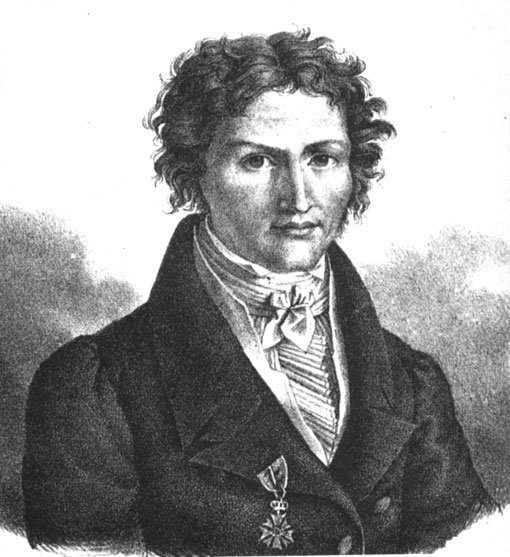
    Johann Baptist von Spix

    – Order: Psittaciformes
    – Family: Psittacidae
    – Genus: Alipiopsitta
    – Scientific name: Alipiopsitta xanthops
    – Citation: (von Spix, 1824)
    – Protonimo: Psittacus xanthops


    Images Yellow-faced Parrot:


    Species of the genus Amazona


    Sources:

    • Parrot Book, Parrots and macaws Neotropical
    • avibase
    • parrots.org
    • Parrots of the World – Forshaw Joseph M
    • Parrots A Guide to the Parrots of the World – Tony Juniper & Mike Parr
    • Birdlife

    Photos:

    (1) – Yellow-faced parrot (Alipiopsitta xanthops) green morph, the Pantanal, Brazil By Charlesjsharp (Own work, from Sharp Photography, sharpphotography) [CC BY-SA 4.0], via Wikimedia Commons
    (2) – Yellow-faced parrot (Alipiopsitta xanthops) yellow morph, the Pantanal, Brazil By Charlesjsharp (Own work, from Sharp Photography, sharpphotography) [CC BY-SA 4.0], via Wikimedia Commons
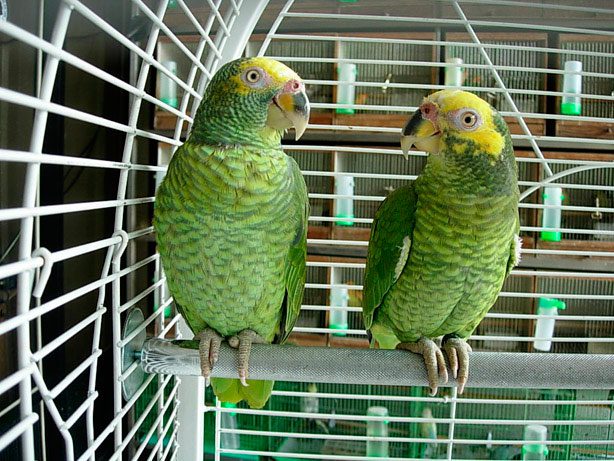
    (3) – Alipiopsitta xanthops, Yellow-faced Parrot; two in a cage By TJ Lin (originally posted to Flickr as yellow-faced amazon) [CC BY-SA 2.0], via Wikimedia Commons
    (4) – Yellow-faced Parrot in Giza Zoo By Hatem Moushir (Own work) [CC BY-SA 3.0], via Wikimedia Commons
    (5) – Record made in the city of Três Lagoas-MS, urban area. A flock landed on a ponca tree to feed By Jairmoreirafotografia (Own work) [CC BY-SA 4.0], via Wikimedia Commons
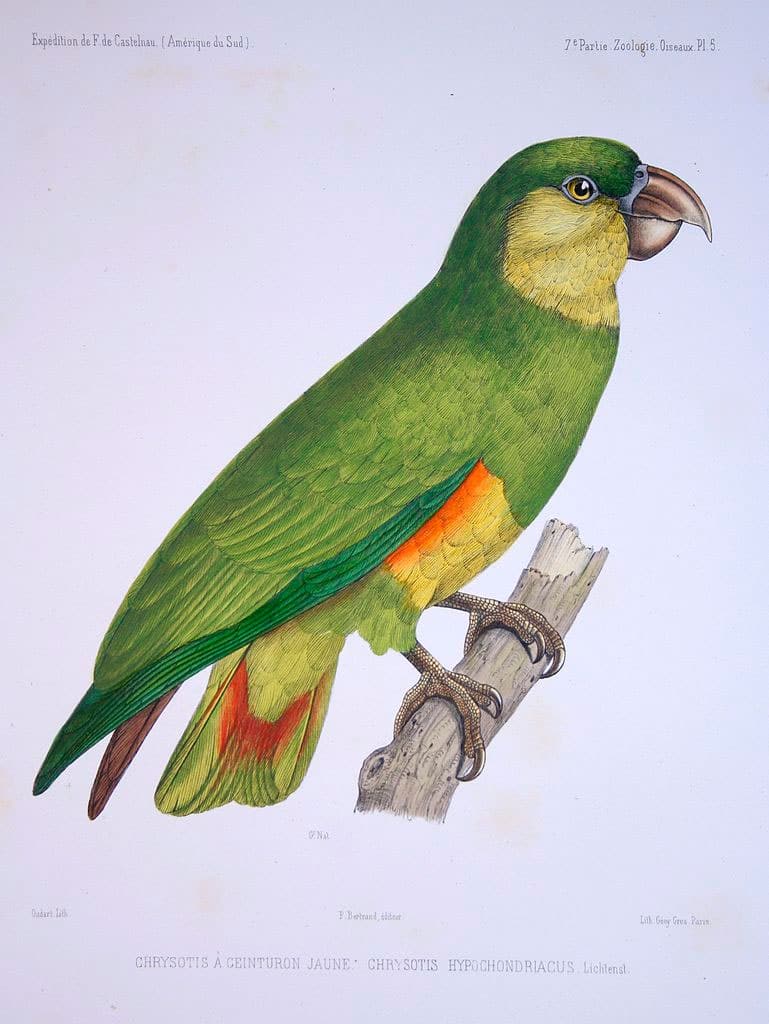
    (6) – Illustration does not look like A. xanthops (Yellow-faced Parrot). Fisch's Papageien monograph discusses this dubious specimen by Francis de Laporte de Castelnau [Public domain], via Wikimedia Commons

    Sounds: Joao Antonio de B.. Vitto

    â–· The world of Pets: Dogs, cats, birds, reptiles, amphibians

    White-cheeked turaco
    Turaco leucotis

    Tauraco leucotis
    Photo: fotosricardo-h

    Content

    Characteristics

    This striking bird is native to Africa (area of Ethiopia) and reaches a size of 42 to 43 cm..

    It has bright green feathers, with a dark crest on the head, may stands at will, the Underwing coverts are blue like the tail, While the primaries are intense red, and in general only be appreciated with the bird in flight. The beak is orange-red, like the ring around the eyes. In front of the eye they have "white cheeks" and two oblique white marks on the neck..

    Has several other anatomical features of interest. First of all, they have strong feet and you can turn your fourth finger of the foot forward or backwards to get a better grip on its perch. In second place, the chickens of this species have claws on their wings, a strange and evocative anatomical feature for a bird that almost seems to be reminiscent of its ancient cousin, the Archaeopteryx. The chicks emerging from these claws at the time of leaving the nest.

    Most of these birds have green plumage and is the result of a combination of structural coloration and pigments.. They are unique since only the Turacos, among all the birds, they produce a Green pigment, turacoverdin, It is the color of their feathers.

    Character and skills

    This beautiful and energetic African bird is a very popular bird in the United States and the United Kingdom., they can even be hand fed by what you become very mansas pets.

    Another curiosity, and one of the things by which this bird strikes is by singing, which, It resembles the squeal of a wild monkey.

    Images "White-cheeked turaco"

    Videos "White-cheeked turaco"

    â–· The world of Pets: Dogs, cats, birds, reptiles, amphibians

    Budgerigar
    Melopsittacus undulatus


    Common Budgie

    Content

    Description

    18 cm. length and a weight between 22 and 32 g..
    Periquito-Comun

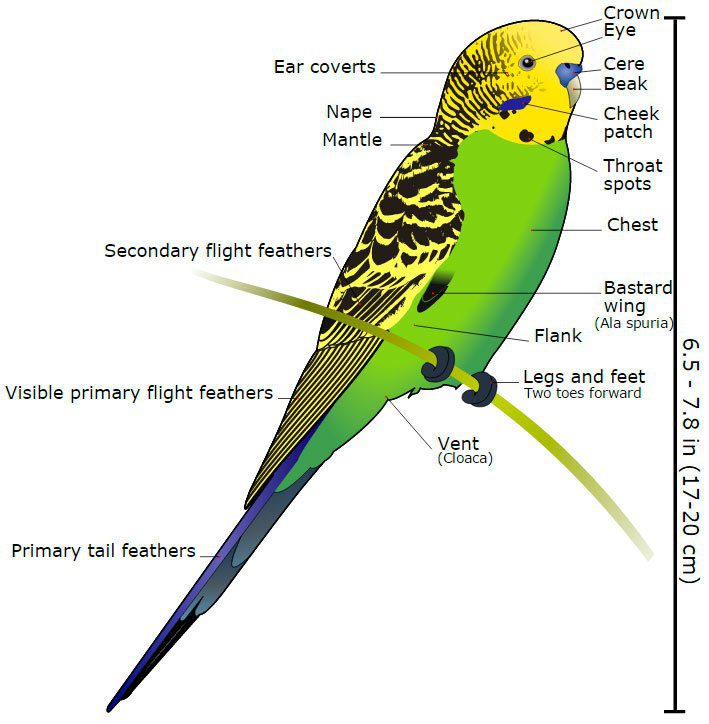
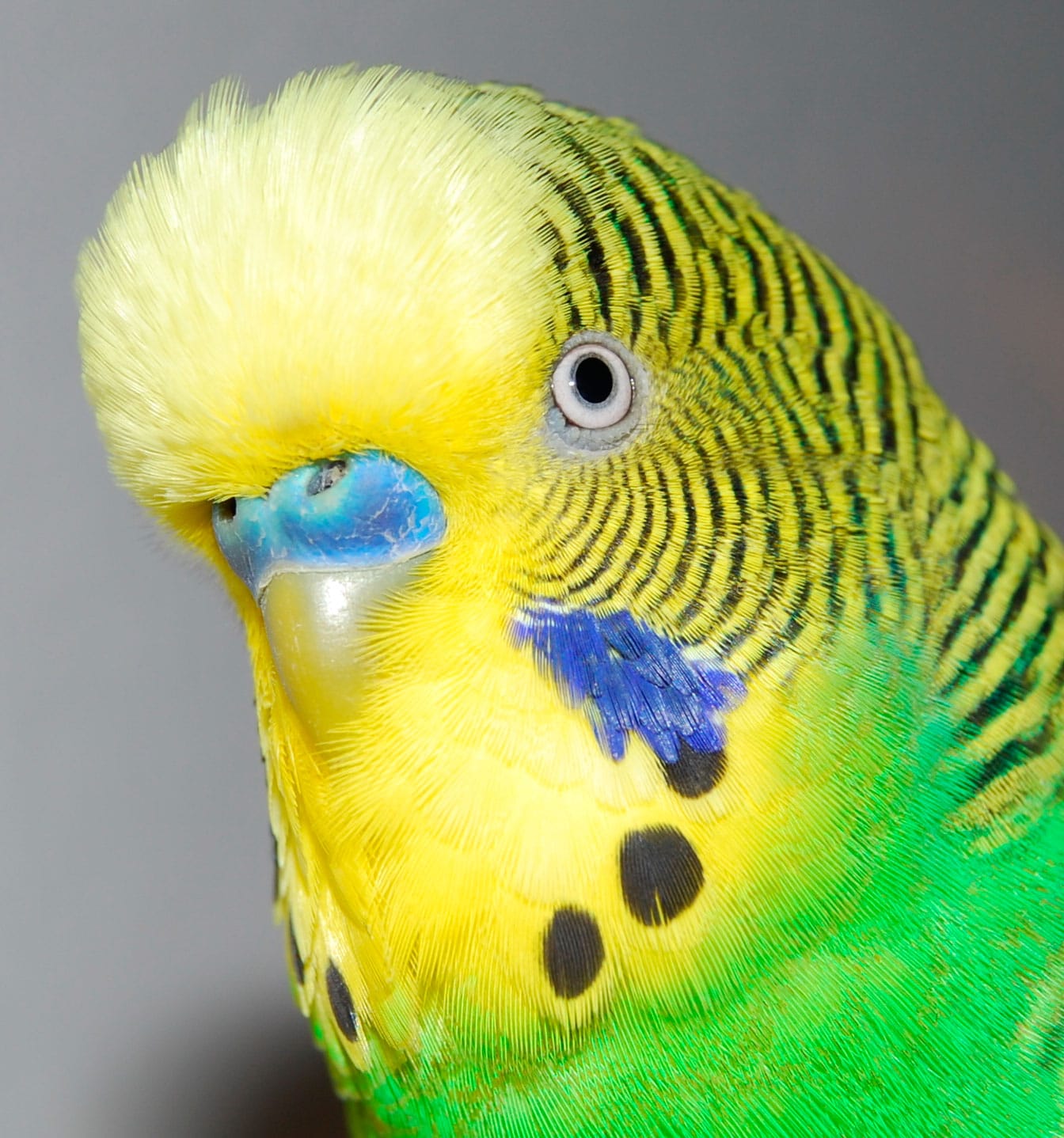
    In the Budgerigar (Melopsittacus undulatus) of adults, the cere Blue contrasts with the frontal zone; the front of the face and throat are pale yellow. The latter is covered by a line of black dots. The area which is located below the cheeks it's purple.

    The central part of the pileum extending from the rear of the eyes to neck It is covered with alternating thin black bands and bands of pale yellow. These bars are expanded on the the mantle and wing-coverts, forming a scaly effect.

    The underparts, the area beneath the wings, the lower part of the back and rump create a beautiful pale green together. The tail is opaque blue tones with a central yellow stripe on the side feathers.

    The female has a Brown wax.

    The immature they are more turned off with bars on the front. The black spots on the throat they are absent.

    Habitat:

    The Budgerigar they are distributed by a wide variety of open habitats, including open forests, lightly wooded grasslands and savannas. Also appreciate the areas of Mallee, farmland, vegetation that grows along rivers, drought-adapted scrub and open plains. They come fitted with desert areas of Mulga (Acacia aneura). Although they are able to survive several days without water, These birds are never far from a water source.

    In areas where fruit production is constant and in others where it is stable for very long periods, the movements of the Budgerigar they are easily predictable.

    In the South end, Pilgrimages exist only in cases of prolonged drought and wandering parakeets return to their territory with the first rains and recolonize when river levels return to normal.

    Reproduction:

    The Budgerigar they build their nests of June to September in the North its area of distribution. They reproduce between August and January in the South. Nests can be installed at any time of the year after the rains fall. They establish a second brood as soon as conditions are favorable.

    These parakeets usually nest in colonial way. The nest is located in a natural cavity in a tree, in a strain, an any fence post, or on a big fallen branch.

    The female lays from 4 to 6 eggs and incubation lasts a few 18 days. The chicks remain in place of birth during 30 days before flying.

    Food:

    The Budgerigar It vegetarian, they eat herbs and seeds of quenopodios. Plants vary in categories and in proportions, according to which regions and times.

    The East inside of Australia, These birds feed exclusively on seeds that are on the ground, While in the middle of the continent, There is more variety of plants to select. In the first case, grain size barely exceeds the 2 mm diameter and the second, more than 40 plant varieties make up the diet of these parakeets.

    From time to time, the Budgerigar, they come in growing areas and take advantage of the ripe fruits.

    Distribution:

    The Budgerigar are distributed widely throughout the Interior of Australia, Although they are rare in the coastal districts of the This and the end South-West (absent of Tasmania, Arnhem Land and Cape York Peninsula).

    The species may be of common to very abundant, but they are nomadic, and may change from year to year areas.

    These parakeets, frequently, they burst from the arid zones to the more humid zones and there are temporary movements towards the south during the summer, but these changes may be affected by annual rainfall patterns.

    We have introduced, without success, in a number of places around the world (or they have escaped from captivity and could not be) including South Africa, United Kingdom, Japan, Hong Kong, Puerto Rico, Brazil, Switzerland, Colombia, the Society Islands, New Zealand and Oman.

    In the EE.UU. the species has managed to colonize Hawai and California (leaks also occur regularly in the city of New York City). In Florida a population was originally registered in the area of St. Petersburg, in the decade of 1950 and now has more of 3.000 individuals; These birds are mobile and have been recorded along the coast This of all the South from Jacksonville to Miami, and in the West everything Hudson to South of Fort Myers, from time to time go towards the North in Gainsville.

    Parakeets, occasionally escaped, they may appear in Tasmania.

    The world population is estimated at around 5.000,000 copies.

    Conservation:


    minor concern


    • Current category of the Red List of the UICN: Least concern

    • Population Trend: Growing

    This species is not threatened at all, even they are abundant, and in some places where resources are good, countless flocks darken the sky, to cause branches to break from 4 centimeters in diameter, When large number of birds used them as support for their breaks.

    Populations fluctuate widely depending on weather conditions.

    Livestock living on farms in central Australia have caused Budgerigar they will benefit from new water supplies. Like this, the number of parakeets are constantly increasing.

    These parakeets are the most well known psittacidas in the world.

    "Budgerigar" in captivity:

    This parakeet was discovered in 1805 and since then it has become the most popular captive bird in the world. While it is considered as domestic fowl, However, is a gregarious and instinctive animal, with the same needs that the parrots who freely roam the lands of Australia.

    The Budgerigar It dynamic, curious, melodious and because of its small size, the beauty of their plumage and their entertaining behaviour, truly charming. This is what makes it a coveted bird. But, It is still a bird that needs to fly, play and socialize with their peers. Like any bird, It is sensitive to the social and environmental context. In fact, their real needs are too often overlooked, many parakeets suffer neglect or even abuse.

    In captivity, the Budgerigar It is larger than its counterpart in nature. Measures of 20 to 25 cm. from head to tail and weighs between 30 and 45 g.. In addition to the colour of your coat, wild type, There are numerous mutations (other coat colors) associated with the increase in crossings and selections in certain genes, that translates into more spontaneous mutations.

    The Budgerigar has two silent by year average, and the first moult occurs between the fourth and sixth month. The molt is complete renovation of the plumage of the bird. Pens fall to others push, includes your tube of keratin that parakeets will open with their beaks to release pen and relieve the irritation that engenders the same thrust. It can be more or less painful and intense. Some plucking is so fast that the bird may experience some difficulties during the flight.

    Check the intensity of the change of the parakeet through black head tubes, tiredness and especially the number of feathers on the ground.

    The feeding of the Budgerigar is based on the millet and the birdseed, Although it must be complemented with other seeds or vegetables (as the lettuce, Spinach, pepper, Carrot, corn). The fruits are also a good dietary supplement for these birds. Occasionally it can provide a little bread or biscuit, but always with caution that not give them anything very sweet. The avocado, the chocolate and the parsley they are deadly toxic for the Australian parakeets.

    The the parakeet cage must be protected from the cold, a temperature between the 20-25 C. It must be of one sufficient size so you have freedom of movement and can exercise. The balusters must be arranged horizontally so that they can climb up them. The cage must be washed at least once a month with a disinfectant, change the water daily and clean the shells of the food. A cat litter tray can be placed to make their needs.
    It is also important to let the parakeet out occasionally and fly freely around the room. Windows must be closed and curtains, because you can hit them.
    Son very sociable birds and it is better to live with other parakeet. The best couple is formed by a male and a female. This will try to kill its companion if it is of the same gender.

    With regard to its longevity, according to sources, these animals can come to live until 21 years in captivity. The same sources indicate that these parakeets suffer from a high incidence with respect to ovarian cancer.

    Alternative names:

    – Budgerigar, Budgerygah, Budgie, Canary Parrot, Grass-Parakeet, Lovebird, Scalloped Parrot, Shell Parakeet, Shell Parrot, Undulated Parrot, Warbling Grass-Parrot, Zebra Parrot (ingles).
    – Perruche ondulée (French).
    – Wellensittich (German).
    – Periquito-australiano (Portuguese).
    – Periquito Australiano, Periquito Común, Cotorra Australiana, Cata Australiana (español).

    scientific classification:

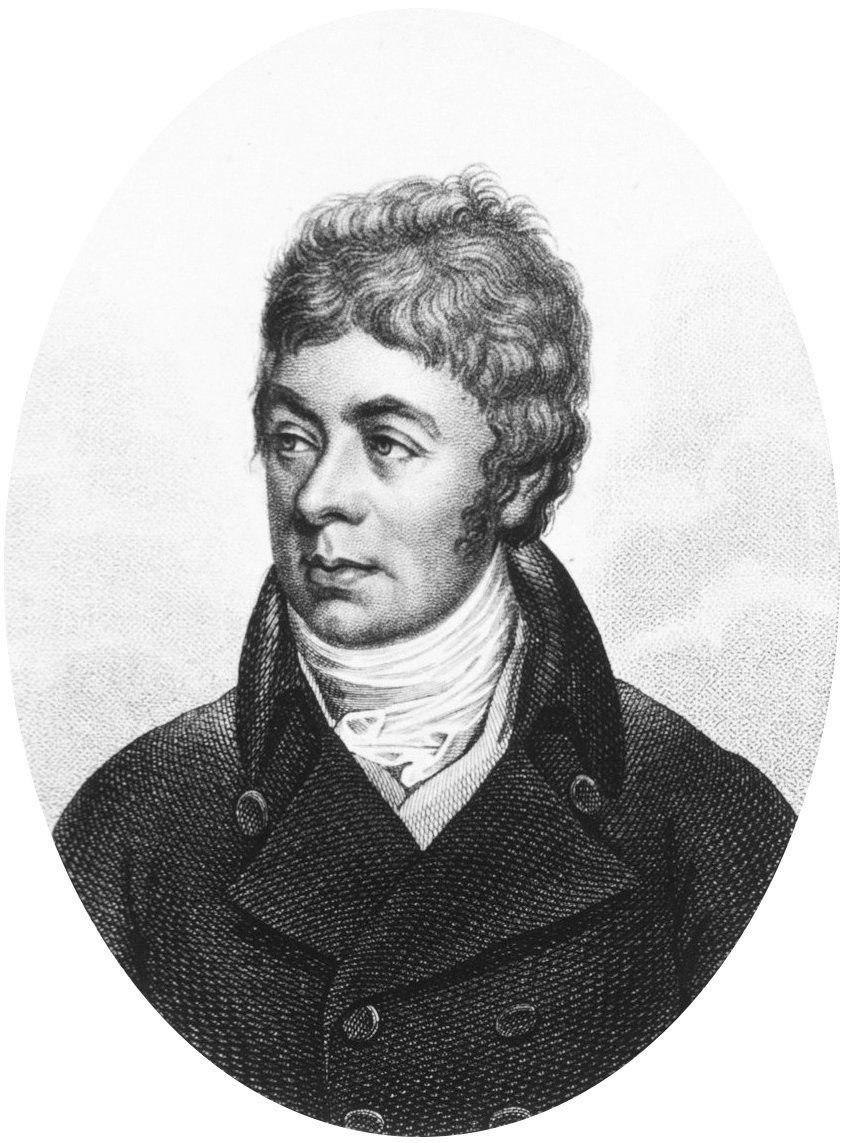
    George Shaw


    – Order: Psittaciformes
    – Family: Psittaculidae
    – Genus: Budgerigar
    – Scientific name: Melopsittacus undulatus
    – Citation: (Shaw, 1805)
    – Protonimo: Psittacus undulatus

    «Common Parakeet» Images:

    Videos "Budgerigar"

    ————————————————————————————————

    «Common Parakeet» (Melopsittacus undulatus)


    Sources:

    – Avibase
    – Parrots of the World – Forshaw Joseph M
    – Parrots A Guide to the Parrots of the World – Tony Juniper & Mike Parr
    – Birdlife

    – Photos:

    (1) – Budgerigar at Zoo Atlanta, USA By TheSussman (Mike) (originally posted to Flickr as Parakeet) [CC BY 2.0], via Wikimedia Commons
    (2) – Two budgerigar at Henry Doorly Zoo, USA By Jeff Coffman (originally posted to Flickr as DSC_1265) [CC BY 2.0], via Wikimedia Commons
    (3) – male budgerigar. taken near Cameron’s Corner, Qld By Benjamint444 (Own work) [GFDL 1.2], via Wikimedia Commons
    (4) – Detail shot of budgerigars head By Kirk (Own work) [CC BY-SA 3.0 or GFDL], via Wikimedia Commons
    (5) – Melopsittacus undulatus flock, Karratha, Pilbara region, Western Australia By Jim Bendon from Karratha, Australia (budgies_4) [CC BY-SA 2.0], via Wikimedia Commons
    (6) – By User Magnus Manske on en.wikipedia [Public domain], via Wikimedia Commons
    (7) – Exterior diagram of a green budgerigar By ZooFari [CC BY-SA 3.0], via Wikimedia Commons

    – Sounds: Marc Anderson (Xeno-canto)

    â–· The world of Pets: Dogs, cats, birds, reptiles, amphibians

    Yellow-tailed black cockatoo
    Calyptorhynchus funereus

    Yellow-tailed black cockatoo

    Content

    Description

    55 to 65 cm.. length and a weight of up to 900 g..
    The Yellow-tailed black cockatoo (Calyptorhynchus funereus) stands out clearly by its plumage mostly black, patch yellow in cheek and yellow panels in tail.

    The body feathers They are lined with yellow giving it a scalloped appearance. It has a crest short and moving on top of her head.
    The female It has a yellow stain on the cheek more defined and larger than the male, Bello to singr pale gray (Pink in males)
    The juveniles has plumage duller overall.
    The bill top of immature male black obscures two years old, While the lower peak black four years.

    Description 3 subspecies

    • Calyptorhynchus funereus funereus

      (Shaw, 1794) – Nominal. Larger and tail longer dark mottled.


    • Calyptorhynchus funereus whiteae

      (Mathews, 1912)


    • Calyptorhynchus funereus xanthanotus

      (Gould, 1838) – Smaller size, tail shorter dark mottled.

    Habitat:

    Variety of types habitats, including forests of eucalyptus, heaths, subalpine areas, pine plantations and occasionally in urban areas.
    They are often seen flying in pairs or trios formed by a pair and their young., although outside the breeding season they can join in more numerous flocks.

    Reproduction:

    have a long breeding season, that varies throughout its range, although Tasmania in general it is from October to February. Both sexes construct the nest in holes of mature trees, high, generally eucalyptus. Fill the hole of wood chips. The same tree can be used for many years.

    One or two eggs form a clutch. Only the female incubates the eggs, While the male supplies the food. Both parents help rear the chicks, Although usually only one chick survives. The chicks leave the nest about three months after hatching and remain in the company of their parents until the next breeding season.

    Food:

    Seeds native trees, terrestrial plants and pine cones. Some insects also part of their diet. Unlike other cockatoos, a significant proportion of the diet up wood borers worms. The bird put his ear against the surface of dead trees to hear the sound of worms. If a worm is detected, the bird will use their powerful beaks to pull pieces of the tree until you get to the meal, often leaving a pile of wood chips at the base of the tree. These scars on dead trees are a common sight in the forests of Tasmania.

    Distribution:

    Size of its range (breeding/resident ): 2.700.000 km2

    It is up to the 2000 meters throughout Southeast Australia, from South Eyre Peninsula to the east-central Queensland.
    Your number is declining in parts of its range due to habitat fragmentation and loss of large trees used for breeding.
    In Tasmania is common and nomadic. They can be seen in many parts of the state and in the larger islands Bass Strait.

    Distribution 3 subspecies

    Conservation:

    State of conservation ⓘ


    minor concern Minor Concern ⓘ (UICN)ⓘ

    • Current category of the Red List of the UICN: Least concern.

    • Population trend: Stable.

    This species has a very large range, and therefore not approaching the threshold of vulnerable. Not threatened worldwide. CITES II. As with most other cockatoos, its long-term existence depends on the continued availability of hollow trees for nesting,

    The population is estimated at at least 25.000 birds.

    The population trend appears to be stable.

    "Yellow-tailed black cockatoo" in captivity:

    In the poultry industry this species is extremely rare and expensive. In Australia It has attained breed in captivity.
    Like all cockatoos, they come to live over 40 years.

    Alternative names:

    – Yellow-tailed Black-Cockatoo, Black Cockatoo, Common Black-Cockatoo, Funeral Cockatoo (English).
    – Cacatoès funèbre, Cacatoès noir à queue jaune (French).
    – Gelbohrkakadu, Gelbschwanz-Rußkakadu, Rußkakadu (German).
    – Cacatua-negra-de-cauda-amarela (Portuguese).
    – Cacatúa Fúnebre Coliamarilla, Cacatúa Fúnebre de Cola Amarilla (español).

    George Shaw
    George Shaw

    scientific classification:


    – Order: Psittaciformes
    – Family: Cacatuidae
    – Genus: Calyptorhynchus
    – Scientific name: Calyptorhynchus funereus
    – Citation: (Shaw, 1794)
    – Protonimo: Psittacus funereus


    Images Cockatoo Fúnebre Coliamarilla:


    Sources:

    – www.parks.tas.gov.au
    – avibase
    – Birdlife

    – Photos: David Cook

    – Sounds: Nigel Jackett