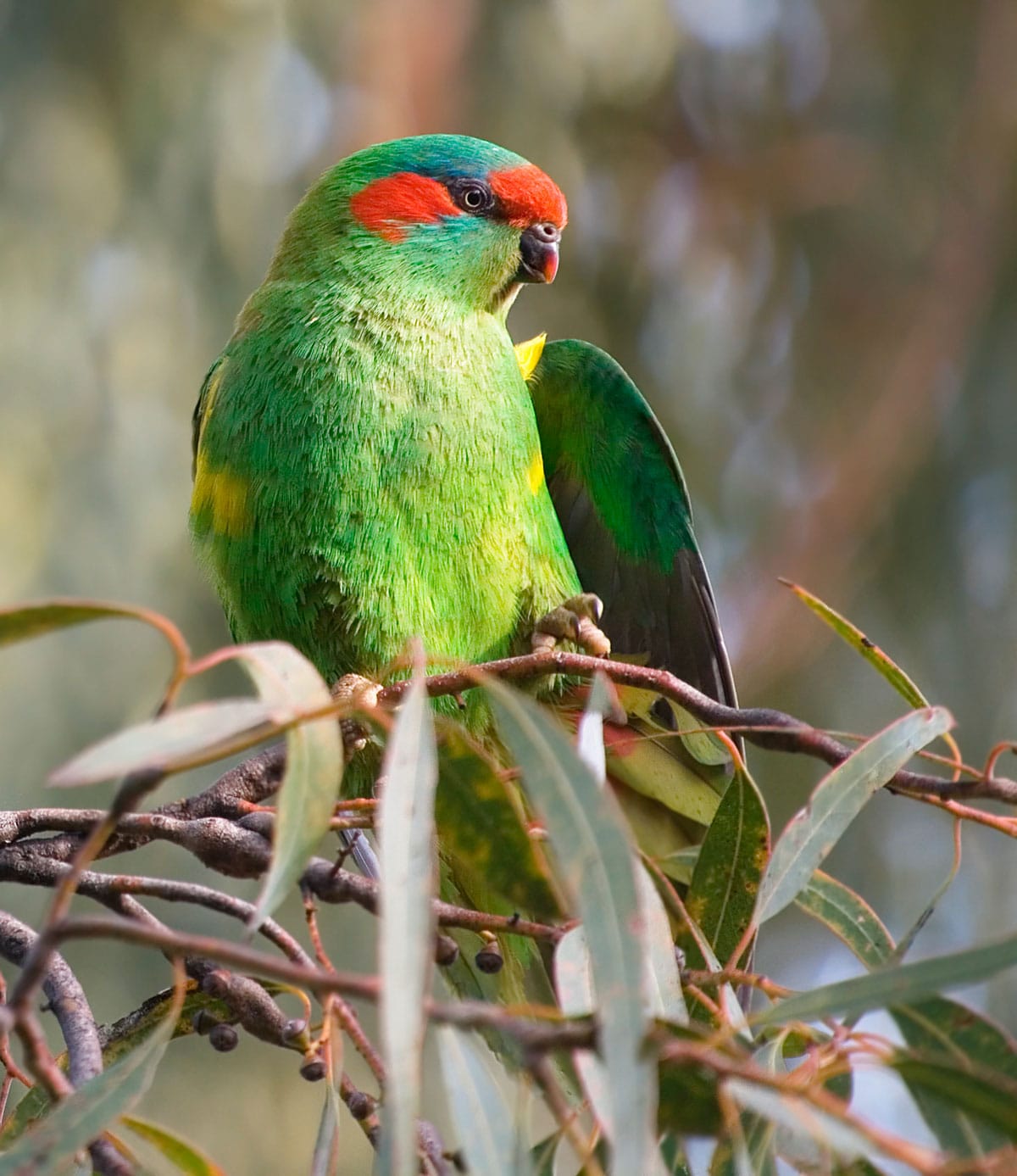
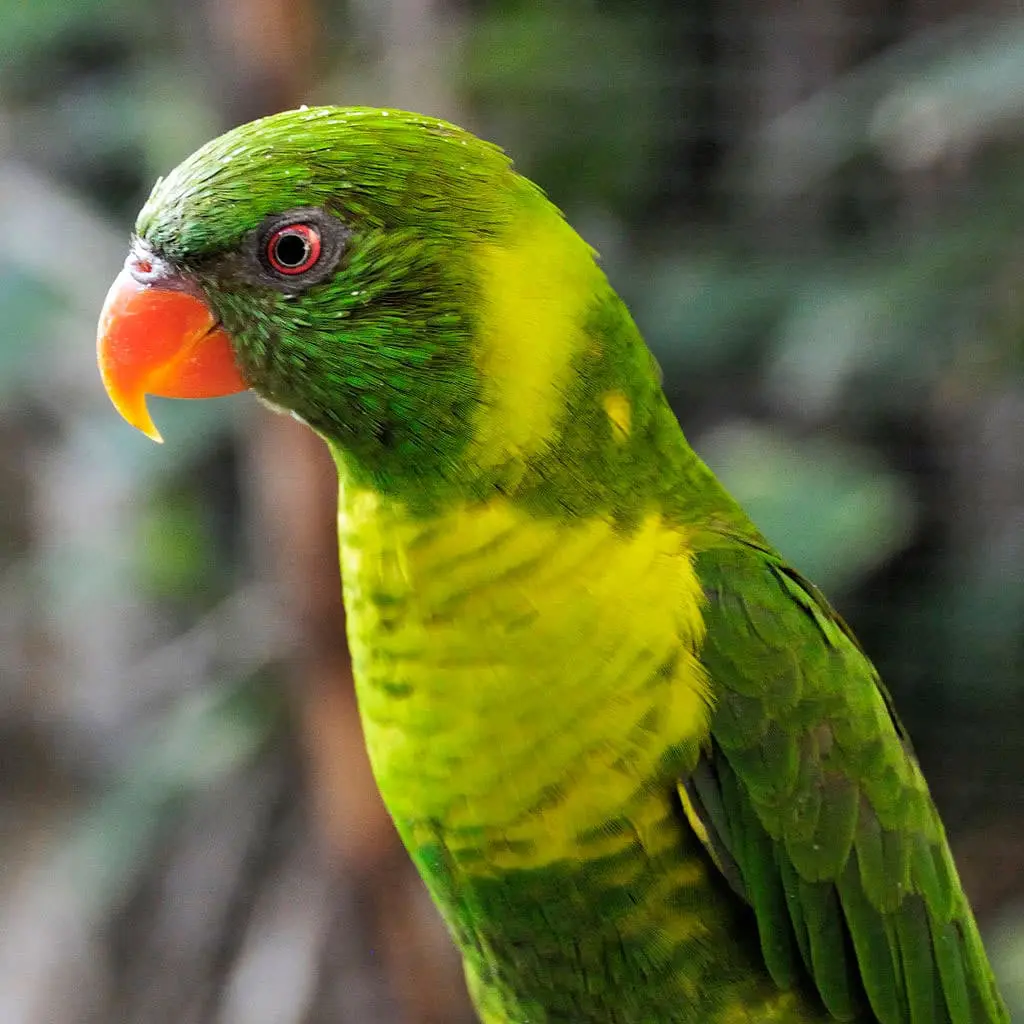
16 to 19 cm.. length and an approximate weight of 40 g.. The Little Lorikeet(Parvipsitta petty) is the smallest of the Parrots Australian.
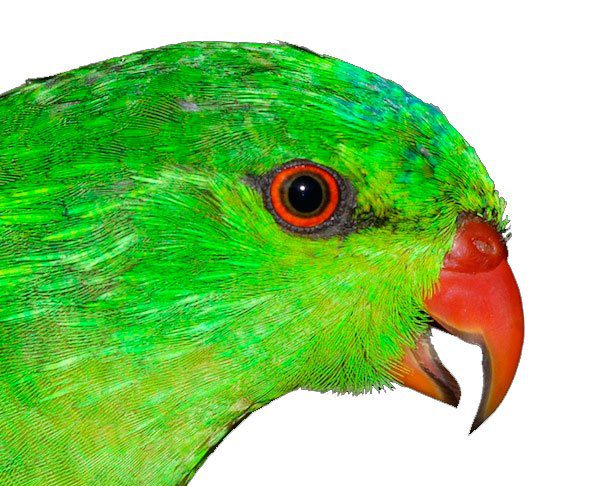
The body is bright green, the area of the nose, the forecrown, the neck, part of the forecrown and cheeks They are red.
The ear-coverts are of color green with stripes of color green light. The neck and back top are brown-green. Under the wings brighter yellowish green. The primary flight feathers they have a very narrow yellowish Board, their underparts is yellowish-green.
The feathers of the tail has reddish orange base, the circle around the eyes is narrow and black, the irises is orange, the legs grayscale and the bill black.
The Little Lorikeet dispatched virtually all areas and at all altitudes with trees. They prefer open areas with flowering or fruit trees and riverbanks.. Found up to one altitude of 1600 m.
Occasionally seen in orchards and farming areas.
Son nomads and outside the breeding season they gather in small groups of 4 to 12 birds.
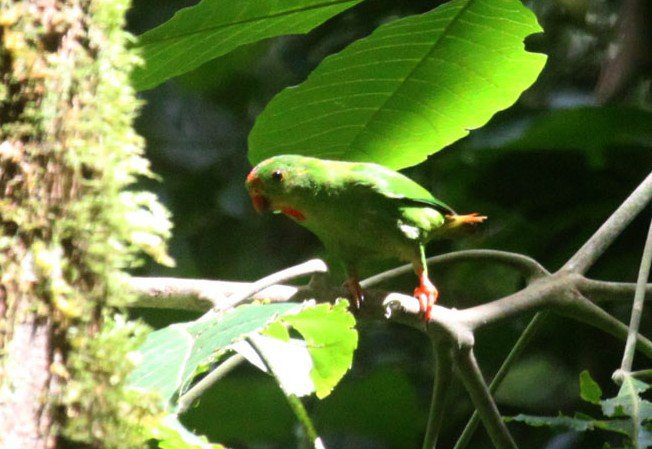
They prefer tall treetops and are difficult to see due to their small size and green color.. They prefer trees of eucalyptus that they are in bloom and they can attend major meetings when they are feeding, often associated with other lori as the Coconut Lorikeet and the Musk Lorikeet.
Ruidoso. Their flight is flapping fast and straight, accompanied by shrill calls.
Reproduction:
The breeding season It is going may in the North, or August in the South, to December. It nests in the Hollows of trees, where sets of 3 to 5 rounded whitish eggs. The incubation hard ones three weeks.
Food:
It feeds mainly from fruits and flowers, including native plants such as those belonging to the genera Xanthorrhoea and (Melaleuca and Loranthus, and introduced plants such as the medlar (Eriobotrya japonica). Occasionally visit orchards.
Distribution:
Size of the area of distribution (reproduction / resident): 788.000 km2
The Little Lorikeet is located in the East and Southeast of Australia, from the vicinity of Cairns to the South by Queensland and New South Wales from the slopes of the Great dividing range until the eastern coasts to most of Victoria and Southeast of Southern Australia. Also located in Tasmania, although there is little abundant.
Conservation:
• Current category of the Red List of the UICN: Least concern.
• Population trend: Stable.
The main threats to these small parrots are the loss of breeding sites and of those resources food by the clearing of land in course. Most breeding records come from the western slopes, where has been a great loss of habitat trees. The loss of trees nest along the verges of Highway, often associated with roadwork, It is still a constant threat.
"Little Lorikeet" in captivity:
Although it was exported to Europe for the first time in 1877, the Little Lorikeet rarely seen outside of Australia. And even in the country of which it is native it is rare in captivity. Has a reputation for being difficult to maintain.
Alternative names:
– Little Lorikeet, Little Red Lorikeet (ingles).
– Lori à masque rouge, Petit Loriquet (French).
– Zwergmoschuslori (German).
– Loris Pusilla (Portuguese).
– Lori Carirrojo, Lori de Cabeza Roja (español).
1 – By JJ Harrison (jjharrison89@facebook.com) (Hand darbas) [CC BY-SA 3.0 or GFDL], via Wikimedia Commons
2 – By Joxerra Aihartza (à‘ire argazki bilduma / own picture) [FAL], via Wikimedia Commons
3 – Little Lorikeets by Julian Robinson, on Flickr – Flickr
4 – Little Lorikeets (Glossopsitta pusilla) by David Cook, on Flickr – Flickr
5 – Musk Lorikeet [Glossopsitta concinna] again! by Norm Hanson, on Flickr – Flickr
Sounds: Marc Anderson (Xeno-canto)
▷ The world of Pets: Dogs, cats, birds, reptiles, amphibians
Of 16 cm.. length and a weight between 23 and 32 g..
The head of the Meek's Lorikeet (Charmosyna meeki) is bright green, more yellowish in the Chin and throat, darker on crown and streaked on ear coats; patch of dark green blue above and in front of the eye. Green upper parts with fused olive through the mantle.
The wings of green at the top. Under the yellowish-green wing coverts. The yellowish green underparts, lighter in the back and more yellow from the chest to the belly. Top of tail dark green with yellow tip; the yellow bottom. Orange peak; pale red irises; legs Orange.
Both sexes are equal. Immature with the paler beak with base brown color and shorter tail.
Nomad. It is distributed in the humid hills and montane forests, but they have also found found in lowland coconut palms. Usually found alone or in small flocks of about of 10 to 15 birds flying through or above the forest cover. Larger groups can gather in the blooming of trees to feed on pollen and nectar. It can be associated with other parrots as the Duchess Lorikeet, Finsch's Pygmy-Parrot, Yellow-bibbed Lory and Coconut Lorikeet
Reproduction:
Information is not available.
Food:
Its diet includes pollen and nectar.
Distribution:
Endemic to the mountains of the largest islands in the Group of Solomons: Bougainville, New Georgia, Malaita, Kolombangara, Guadalcanal and in the past Santa Isabel. Moves starting from the 300 m, until the 1.700 m, but reportedly rarely in the lowlands or above 1.200 m. The world's population is believed to be below 50,000 exemplary but probably stable.
Conservation:
• Current IUCN Red List category: Near threatened
• Population trend: Decreasing
The size of the world's population has not been quantified, It is believed that it is below 50,000 specimens, but the species is described as abundant at the Summit of Kolombangara.
There is still no evidence of a decline in its population, but would be threatened by any future large-scale export trade
"Meek's Lorikeet" in captivity:
They are not known to be in captivity.
Alternative names:
– Meek’s Lorikeet (ingles).
– Lori de Meek (French).
– Salomonenlori (German).
– Lori de Meek (español).
The head of the Wallace's hanging parrot(Loriculus flosculus) is green. Upperparts green with faint orange on the back of the neck; rump and uppertail-coverts red.
Wings green above. Chin red; rest of the underparts green, lighter in undertail-coverts. The tail, at the top, green color with a lighter Green Tip; ends of the lateral feathers, orange-red: Under, the tail bluish green. The bill red; Orange the irises; legs yellowish-orange.
Female with red chin reduced or nonexistent.
Immature with the red chin smaller. The color of the bill and legs more off.
Seem to need the humid mountain forests semi-evergreen. Birds have been seen in fruit trees, and outside the breeding season they gather in small flocks of up to 20 birds. Its altitudinal distribution seems to be closely linked to the distribution of fruiting figs.
They easily unnoticed due to its small size and green plumage, and they are most often in flight when they can be identified by the size, strident calls and the buzz of the rapid flapping. They are most frequently, flying above the canopy.
Reproduction:
There are no data from the reproductive process in nature.
Food:
Most sightings in 1993, the Wallace's hanging parrot they were in the fig tree in fruit trees, and dependence or specialization in this food resource is more than likely.
Its diet includes, In addition, nectar, outbreaks, flowers and seeds.
Distribution:
Size of its range (reproduction / resident): 13.400 km2
Endemic to Flowers. Found at semi-annual primary forest at an altitude between 400 and 980 m (more between 850 and 980 meters during the fructification of the Ficus figs) during observations on 1993. These birds were recorded in the area of Tanjung Kerita Mese, about Paku, to the East of Flowers and proposed as protected area.
Conservation:
• Current IUCN Red List category: Danger
• Population trend: Decreasing
The habitat destruction through the combined effects of collecting firewood, the logging, timber extraction for construction materials and authorization for Agriculture, together they represent more relevant threats. Loss and fragmentation of forests is already widespread in Flowers, where there are semi-annual forest below 1.000 meters included within officially protected areas. These threats are exacerbated by the expansion of human population, with large volumes of wood necessary for housing construction, and the fact that there is little or no government enforcement of laws. Wet deciduous forest, it is currently being extensively destroyed through land grabbing and the establishment of agricultural areas., a factor that is inevitably shrinking the reach and the population of this species. Forest clearing continues on the coastal strip to make way for crops, and illegal logging continues in protected areas.
The population is estimated at a number of 2,500-9,999 mature individuals based on an assessment of the known records, descriptions of the abundance and range size.
Two recent studies have focused on endemic birds of Flowers. Two sites in which inhabits this species for the establishment as protected areas are proposed: Tanjung Kerita Mese and Egon Iliwuli (in Gunung Egon).
"Wallace's hanging parrot" in captivity:
Very rare in captivity.
Alternative names:
– Wallace’s Hanging-Parrot, Flores Hanging-Parrot, Wallace’s Hanging Parrot (ingles).
– Coryllis de Wallace (French).
– Florespapageichen, Flores Papageichen (German).
– Lorículo do Flores (Portuguese).
– Lorículo de Flores (español).
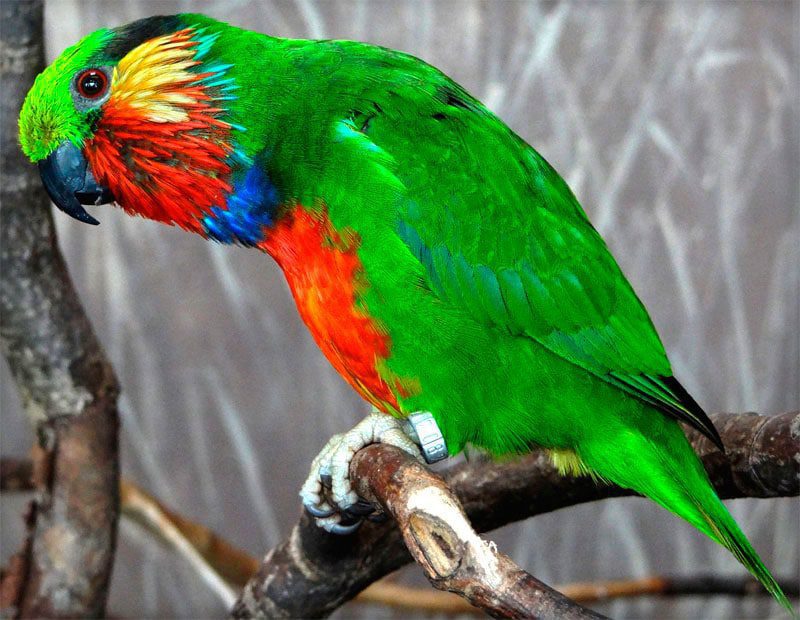
The Edwards' Fig-Parrot(Psittaculirostris edwardsii) you have the front and a bright yellowish-green Crown, with a green stripe on the back; neck greyish-Brown band above the band of gris-negruzco color that extends into the eye; area before and just behind the eyes, green. Elongated lower headset feathers and orange-red fire Gorge, with some green basal feathers interspersed and ends the headphone rear (also elongated) golden yellow with orange.
Dark green back: curve of the wing marked in blue. Black flight feathers marked with green in vane outer (except the primary outer) and with vane internal yellow, forming a set of bars under her wings; marked inner coverts reddish-orange. The wings of blue-green feathers, the longest with yellow tip. Purple-blue ruff with some lighter green feathers; Centre of the breast and upper belly of a showy orange-red; flanks, supracaudales yellowish-green coverts and thighs. Upper, the Green tail; undertail, opaque yellow olive.
the black beak; reddish brown to Brown irises; light grey legs.
The female of the Edwards' Fig-Parrot It lacks the heart of red on the chest and upper abdomen, and has a broader purple-blue band on the chest, inset below with red.
Immatures resemble females, but with the headphones coverts greenish yellow.
Habitat:
The Edwards' Fig-Parrot (Psittaculirostris edwardsii) are distributed among the humid lowland forests, partially cleared areas, wooded edges, as well as near rural areas, up to about 800 meters above sea level.
The birds are usually found in pairs or small noisy flocks, Although groups have been found for up to 400 birds collected in the canopy of fruit trees.
Rapid movements are, and usually they hang you upside down to reach food.
Has been in mixed flocks with the Double-eyed Fig-Parrot.
Reproduction:
Nesting behavior of the Edwards' Fig-Parrot they have been observed since January through may. In October he was seen a male rubbing its peak with the female and hovering above its perch. The nest is in a hole, at the top of a tree in the forest.
Food:
The diet consists of fruit, including the Ficus figs and casuarinas, nectar and probably insects
Distribution:
Endemic to the lowlands of the North of New Guinea in Irian Jaya and Papua New Guinea. It is commonly distributed in the northeast of all Jayapura along the coastal lowlands and inland to around of Pagwi, Chamhri Lake and the jimi river. Observed in the region of the Sepik River, extending eastward to the lowlands of the Huon Peninsula and the markham river. The world's population is believed to be in excess of 100.000.
Conservation:
• Current IUCN Red List category: Least concern
• Population trend: Stable
The size of the world population Edwards' Fig-Parrot It has not been quantified, It is estimated around the 100,000 specimens. The species according to sources, it is common to very frequent, at the local level (pit et to the. 1997).
The population is suspected to be stable in the absence of evidence of any reduction or substantial threats.
"Edwards' Fig-Parrot" in captivity:
active parrot, need space to exercise. It has nice voice, harmless. Initially shy and nervous, It is customary to the caregiver with the time. You can die suddenly without apparent reason.
27 cm. long, not to mention their racquets, measuring of 5 to 6 cm..
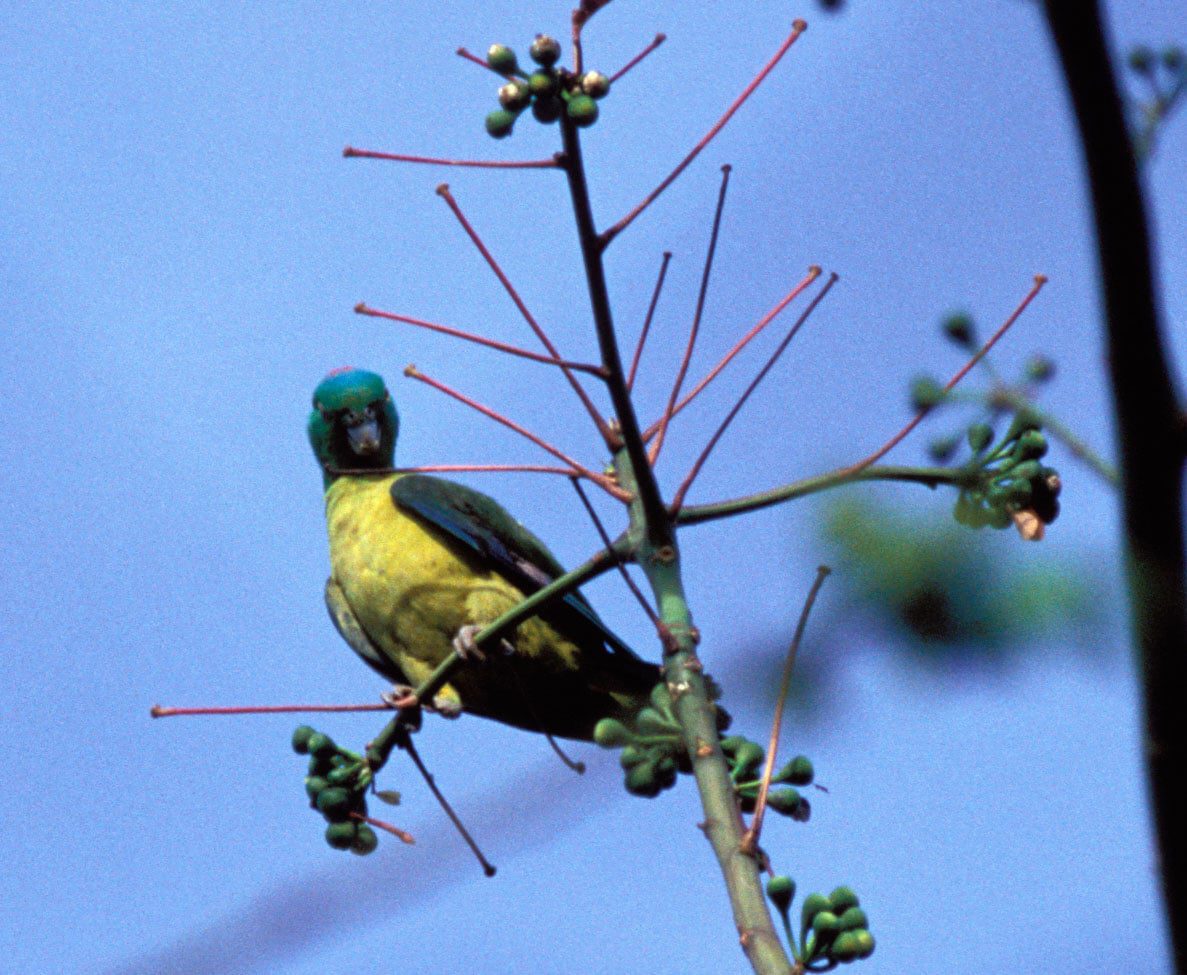
The Blue-winged Racquet-tail(Prioniturus verticalis) It has a bright green head, brighter around the lores and the base of the beak; front of the bright blue Crown with central red dot.
Light yellowish green mantle; back and rump Green. green wings, with a wash of dark blue in both bands of all primaries. green wing feathers. The underparts light yellowish-green, more green on the belly and coverts infracaudales. At the top of the queue, Foreign feathers green with black tips; dark the infracaudales, with blue bathed at the edges of the vane inner; tail blades, blackish
Whitish gray peak; dark brown irises: grey legs.
The female It has a light blue Crown, with the absence of the male Red stain: the areas of green yellow more turned off.
It lives in the lowlands of humid forests., next to forests, the mangroves, dense remnants of forest fragments and agricultural areas. The birds are seen most frequently in pairs, in quick flights over the top of the dense vegetation. They feed on fruit trees, staying calm and hard to spot.
Reproduction:
A nest was discovered in September 1991 with a female: the nest was in a large Palm tree with a broken lid in a Grove near the forest.
Little else is known about the reproductive ecology of this species..
Food:
It is known that it feeds on fruit trees, little more is known about their eating habits.
Distribution:
Is distributed in the Islands to the South-West of the Sulu archipelago, including Tawi-tawi, Bongao (considered probably extinct), Manuk Manka, Sanga Sanga (probably extinct), Tumindao, (There are no recent records) and Sibutu. Although reports indicated that the species was common in the mangroves of Tawi-tawi during the last century, Today it seems to have suffered a serious decline. Today the world population is estimated to be less than 5.000 and the species is being affected by the capture and the rapid elimination of the last forests on the islands.
The birds are also, apparently, used for shooting practice by the Islanders. In 1991 small numbers were observed near virgin forests. During 1994, in Tawi-tawi, There was a rapid elimination of its remnant forest and only six birds were observed.
Conservation:
• Current category of the Red List of the UICN: Critical Hazard
• Population trend: Decreasing
This parrot has been upgraded to the category a Critically Endangered due to observations that suggest that it now has a very small population, with the suspicion of a fast and rapid deterioration due to the continuous logging of forests, as well as his persecution. Conservation actions are hampered by security concerns. Urgent action is required to assess the gravity of the situation of the species, lessen the impact of threats, start your recovery.
The population was previously estimated at less of 1.000 mature individuals (BirdLife International 2001), but the most recent observations indicate that it could currently be less than 250 mature individuals, Therefore the population is now in the band of 50 to 249 mature individuals, probably equivalent to a total population of 75 to 375 individuals.
Military activity and the insurgency are still presenting a serious obstacle to the general conservation activity in the Sulus. There is no formal protected areas in the archipelago. In 1997, began an awareness campaign focused on the conservation of terrestrial biodiversity in Tawi-Tawi. There is a proposal to finance the conservation of Tawi Tawi, Coastal zone Sulu, Although neither the result nor the potential benefits for the species are known. A municipal resolution has been developing, hoping to put an end to the hunting of endemic species (I. Sarenas in litt., 2010).
"Blue-winged Racquet-tail" in captivity:
Unknown in captivity.
Alternative names:
– Blue-winged Racquet-tail, Blue winged Racquet tail, Blue-winged Racket-tail, Blue-winged Racket-tailed Parrot, Blue-winged Racquet Tail, Blue-winged Racquet-tailed Parrot, Sulu Racket-tail, Sulu Racket-tailed Parrot, Sulu Racquet-tail, Sulu Racquet-tail Parrot, Sulu Racquet-tailed Parrot (ingles).
– Palette des Sulu, Palette à ailes bleues, Perroquet à raquette des Sulu (French).
– Sulu-Spatelschwanzpapagei, Sulu Spatelschwanz-Papapgei, Sulupapagei (German).
– Prioniturus verticalis (Portuguese).
– Lorito momoto de las Sulu, Lorito Momoto Sulu, Lorito-momoto de las Sulu (español).
32 cm. medium length and a weight between 300 and 400 g..
The Cape Parrot(Poicephalus robustus) has the head, neck and throat between olive brown and olive yellow, with darker spots (almost black in some birds), especially in the crown; lores and cheeks blackish; pale red frontal band, is present, occasionally, in males (generally evident in females).
The mantle feathers and scapulars dark green opaque, bright green-edged; rump bright green.
Coverts on the leading edges of the wings, Since the carpal joints at the base of the primaries, bright orange red; upper wing coverts, dark green to black, with lighter green edges; below, the feathers of the wings blackish and green. The primaries and secondaries black top, dark brown below. High area of the chest, stomach and vent, bright green; the thighs orange red glossy. Upper, the tail black; undertail, dark brown.
Some birds (around the 10%) have feathers yellow in the plumage spread.
Bill color horn; irises dark brown to reddish brown; legs bluish grey.
The females, generally (Although not always), they have well defined orange red frontal band.
The youth lack of color marks orange red envelope the wing-coverts and the thighs, but tend to show a bit of red in the forecrown.
In a study initiated in 1992, the taxonomic status of Lorito was revised Robusto (Poicephalus robustus) (Gmelin), and two species were proposed; Poicephalus robustus, restricted to montane forests of southern Africa, Poicephalus fuscicollis suahelicus, with wider distribution in wooded areas, and Poicephalus fuscicollis fuscicollis, similar to the Poicephalus fuscicollis suahelicus ostensibly, but with discontinuous, restricted to a narrow range of forests and West Africa.
(Reichenow, 1898) – Of larger size the species nominal, the male has the head and the neck a silvery gray and lacks the reddish frontal band. The female has orange colouring in the the thighs and in the shoulders and in the cere, while the male not. Blue tint in the rump.
Poicephalus robustus fuscicollis
(Kuhl, 1820) – The smaller subspecies. With more blue tones, especially in rump and bottom of the back.
Habitat:
They live in a variety of forest types, including Red Mangroves (Rhizophora mangle) (for example, in Gambia), riparian forests (for example in Ghana, Zimbabwe), Savanna Woods (for example, Nigeria, Ivory Coast), in montane forests at altitudes of 3,750m (for example, east of Zaire), in lowland forests (for example, South Zaire).
The birds of the Southern Africa they have favoritism by the Acacia mearnsii and Podocarpus forests at altitudes between 1.000 and 1,700 m, separating attitudinally and ecologically in the subspecies suahelicus, It occurs in lowland forests.
The birds of the Southern Africa (also perhaps other species) they form communal roosts before spreading to power remote areas (until 90 km) in small flocks.
Sometimes seen separately but more usually found in groups of up to 20 birds (sometimes 50). It forms mixed flocks with peers.
The season of breeding varies with locality. In Gambia, reportedly, breeding takes place between the months of February and April, While in Zimbabwe It is estimated to be between the months of March to June, and between October and November. In South Africa, breeding takes place in June and between August and October.
The laying tends to be of 3 to 4 eggs.
During the courtship the male feeds the female making exaggerated turns his head and dropping their wings to form a kind of layer around the lower half of your body. The pair shows a strong union ties and they spend much time grooming each other.
Food:
In Zimbabwe, In addition to daily trips in search of food, seasonal movements are performed in search of Uapaca and fruits of Sysygium.
Has been feeding of millet in Zimbabwe and Malawi, of peanuts harvested in Gambia and, occasionally, visiting gardens of Apple trees, but numerous enough to be considered a plague serious nowhere.
The birds of the Southern Africa feed almost exclusively on fruit of the Podocarpus, long as they are available.
Use the peak to climb between the branches when they feed in the trees; They also feed on the ground. The Cape Parrot make daily trips to secret locations for drinking water.
Distribution:
Probably occupy three zones separated, in the West, South-Central and South of Africa.
In West Africa, are from Gambia and South of Senegal to the East of Ghana and Togo.
In the Center-South of Africa, from the southwest of Congo, South and East of Zaire, Southwest of Uganda, Rwanda and from the center of Tanzania to the North of Namibia, North of Botswana, Zambia and Zimbabwe.
Flocks of foraging roam unpredictably and can remain away from traditional sites for weeks. Sometimes they make seasonal movements in relation to the availability of food, for example, in the northern savannas of Ghana.
Local and mostly uncommon across the range, Although more numerous and frequent in Ghana.
(Reichenow, 1898) – Are distributed by the center of Angola; Southeast of the Democratic Republic of the Congo, Rwanda and South of Tanzania until Zimbabwe, North of Mozambique, and far northeast of South Africa; in populations along the lower Congo River the three subspecies can mix.
Poicephalus robustus fuscicollis
(Kuhl, 1820) – Are distributed from the South of the Senegal and Gambia to the North of Ghana
In 1988 included for the first time in the red list of threatened species by the IUCN as least concern species.
The size of its current population is estimated at less than 1.600 birds in their natural habitat.
Why not join this parrot species in critical hazard is due to the subspecies of this they comprise an area of diffusion much greater than that of the nominal species, whereupon, This leads to a growth in the population of subspecies and the decrease of the nominal species. The subspecies occupy all the Central Africa and Western, while the Poicephalus robustus only lives in some provinces of South Africa as they are Eastern Cape, KwaZulu-Natal and Limpopo.
Over time the Poicephalus robustus, they have drastically dropped its population due to the uncontrolled felling of the forests of Sandalwood to manufacture furniture. Thus reaching that there is only two percent of the forest of Sandalwood.
Diffusion area of Poicephalus fuscicollis and Poicephalus robustus
In captive the Cape Parrot it is found in small quantities by several countries of Europe and without many successful breeding advances, so the first objective to preserve the nominal species is to control the logging of forests, Since the Cape Parrot they have to travel many miles to feed, as there is no food have to descend to feed from the crop fields where many die because they are hunted by the owners of the fields. Forests are also needed in the life of the Poicephalus robustus since they nest in cavities of the trees, they feed on.
The legal and illegal trade It is another point to be highlighted in the conservation of this species. Since 1998 the countries with the most legal exports have been Tanzania, Guinea-Bissau, Guinea, Democratic Republic of the Congo and Ivory Coast. What makes think that the nominal species It has been the least affected in the terms of trade while the subspecies they have been the most affected and the most marketed. This can be known by looking at the area of diffusion of the subspecies and the countries with the most exports made..
The diseases they are also a major threat, above all in the nominal species. The disease of PBFD or beak and feather disease (Psittacine Beak and Feather Disease virus) is that more deaths has caused to the Poicephalus robustus.
"Cape Parrot" in captivity:
It is very similar in nature to the Grey Parrot.
Its capacity for imitation is still little known since, for years, has been very difficult to get in poultry farming.
Not advisable to keep mixed aviaries. Son quiet and depending on their way of breeding (natural or by hand) and previous experiences, they can be quite confident and curious, even without being hand reared do not usually take to commit themselves. As pets they are very Welcome to, Smart and affectionate, with a very good character.
Captive breeding of this species may be the last hope of saving it from total extinction.. The number of specimens in captivity is low, but enough, If handled properly to strengthen the species.
In terms of their longevity, according to sources, a Cape Parrot lived 29,7 years in captivity. In captivity, These birds can be raised from the 5 years of age.
Alternative names:
– Cape Parrot, Brown necked Parrot, Brown-necked Parrot, Cape or Brown-necked Parrot, Gray-headed Parrot, Grey-headed Parrot (English).
– Perroquet à cou brun, Perroquet du Cap, Perroquet du Cap ou P. à cou brun, Perroquet robuste (French).
– Graukopfpapage, Kap Papagei, Kappapagei (German).
– Papagaio-de-bico-grosso (Portuguese).
– Lorito Robusto, Loro de El Cabo, Lorito del Cabo (español).
– Avibase
– Parrots of the World – Forshaw Joseph M
– Parrots A Guide to the Parrots of the World – Tony Juniper & Mike Parr
– Birdlife
– Wikipedia
– Loromania
– Mundoexotics
– Photos:
(1) – To Brown-necked Parrot at Jurong Bird Park, Singapore By Peter so [CC BY 2.0], via Wikimedia Commons
(2) – Cape Parrot en Benvie, Karkloof, KwaZulu-Natal, South Africa By Alan Manson [CC BY-SA 2.0], via Wikimedia Commons
(3) – Youth, captive, friendly Poicephalus robustus fuscicollis by Bob Corrigan – Flickr
(4) – Male Cape parrot (Poicephalus robustus). Image credit: Cyril Laubscher – SCI-news.com
(5) – Cape parrot flying low over to wild plum tree. Africa's most endangered parrot like never before... (Rodnick Biljon) – nationalgeographic
(6) – Diffusion area of Poicephalus fuscicollis and Poicephalus robustus By Juan Caparrós (Own work) [GFDL or CC BY-SA 4.0-3.0-2.5-2.0-1.0], via Wikimedia Commons
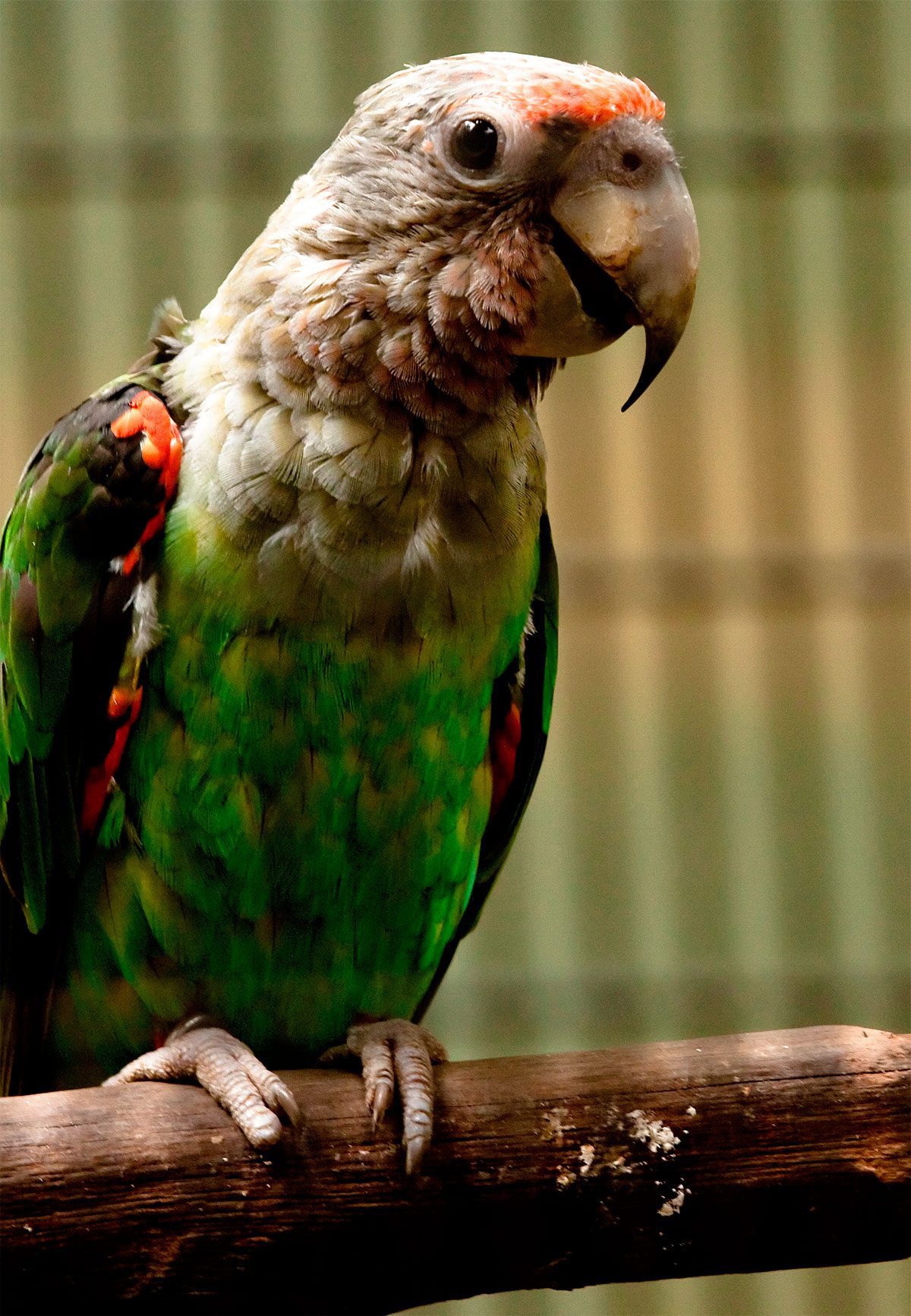
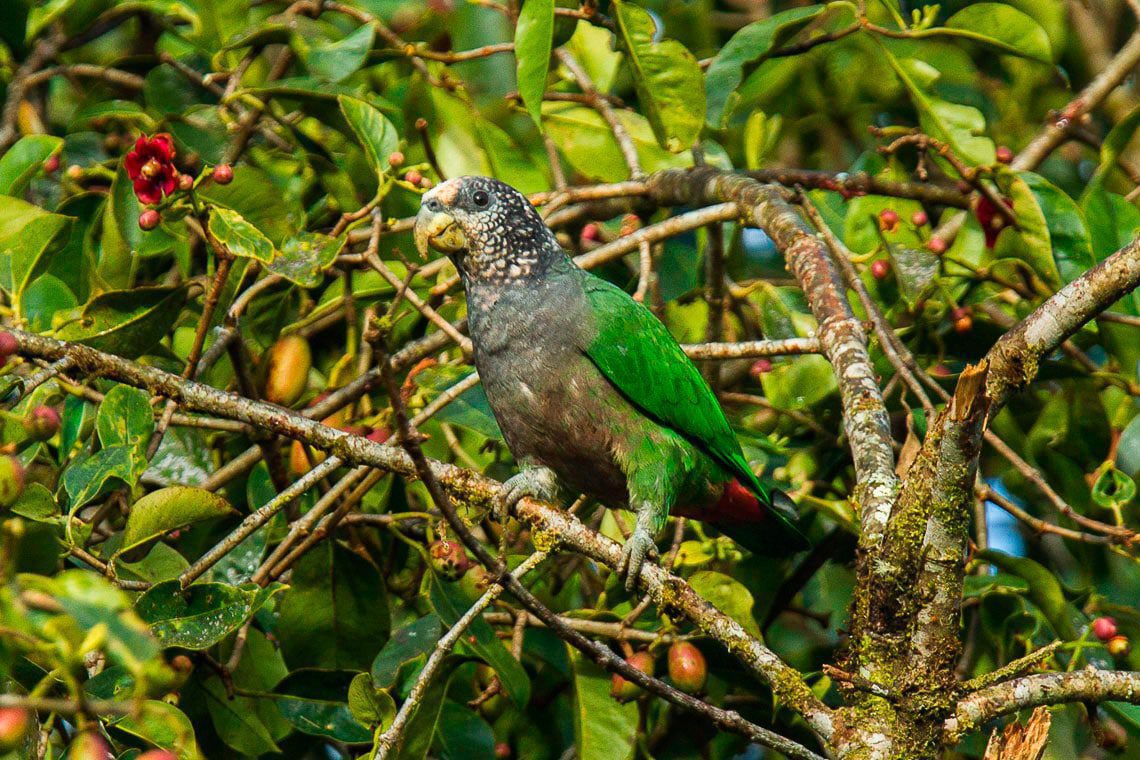
The White-capped Parrot(Pionus seniloides) It is easily identifiable by the "peak" yellow, head usually white, with the crown with reddish speckles, feathers of the nape and sides of the head with dark blue edges and red dyes which gives the appearance of flake.
Breast
with greenish blue edges, under belly and internal base tail red.
Iris of color Brown and legs gray-green.
The youth have crown and chest green, and green spots on the sides of the head and neck.
Note:
Previously he was treated as a subspecies of the species Pionus tumultuosus, that is to say, Pionus tumultuosus seniloides. A midyear 2014 it is considered as own species.
It is a kind Rare. It inhabits in humid jungle and edges, from the 1900 to 3000 m. It is mainly a species of temperate zone, but you can descend to lower elevations.
Like most highland parrots, the White-capped Parrot are rather nomads, widely wandering in search of fruits and seeds (now perhaps more as a result of extensive deforestation). Usually observed in flocks 3-25 birds, sometimes more. More active with grey weather, overcast skies. Difficult to see while feeding or resting in the upper canopy. Its silhouette in flight resembles a Amazona but with the beating of wings deepest.
Reproduction:
It nests in tree hollows.
Food:
Feeds of seeds, fruit of Turpinia paniculata and plants of the family Clusiaceae; sometimes in cornfields, causing damage to their crops.
Distribution:
Size of its range (reproduction / resident): 1.020.000 km2
Live west of Venezuela (from the border Trujillo–Lara) through the East of the Andes of Colombia (rare in the western Andes), and on both sides of the Andes in Ecuador and Northwest of Peru (west to Cajamarca and this, at least until Freedom)
Conservation:
• Current category of the Red List of the UICN: Least concern.
• Population trend: Decreasing.
Justification of the population
The size of the world population It has not been quantified, but this species is described as «quite common«, but irregular distribution (Stotz et to the., 1996).
Justification of trend
They suspected that the population is declining due to the continuous habitat destruction.
"White-capped Parrot" in captivity:
Rare in captivity. In Europe they arrived first at the beginning of the century 20 and then the early 70. In captivity, However, They were raised for the first time in the second half of the 80.
Alternative names:
– White-capped Parrot, Speckle-faced Parrot (White-capped), White-headed Parrot (English).
– Pione givrée (French).
– Greisenkopfpapagei, Glatzenkopfpapagei, Greisenkopf-Papagei (German).
– White-capped Parrot (Portuguese).
– Loro de Cabeza Blanca, Loro seniloide, Loro gorriblanco (español).
– Cotorra Cabeciblanca (Venezuela).
– Avibase
– Parrots of the World – Forshaw Joseph M
– Parrots A Guide to the Parrots of the World – Tony Juniper & Mike Parr
– Birdlife
– Parrot Book, Parrots and macaws Neotropical
– parrots.org
The Flores Lorikeet(Trichoglossus weberi) is generally Green; light green / blue stripes on the forecrown and lores, the rest of the head with brighter green stripes; underwing-coverts yellow / green. The chest and the thighs are yellowish or reddish. The bill It is orange-red and irises orange-red. The legs son grises. Smaller size than other species Trichoglossus.
The youth they are similar to adults.
taxonomy:
Sometimes you think you're closer Olive headed Lorikeet(Trichoglossus euteles). With one exception, so far it has been treated as a subspecies within the complex Coconut Lorikeet(Trichoglossus haematodus), but differs in its chest rather pale green; abdominal patch medium green; head dark green with streaks of bright green; small size (less than a Scarlet-breasted Lorikeet (Trichoglossus forsteni) relatively small). Monotypic.
Sound of the Flores Lorikeet. (1)
(1) Some species are under extreme pressure because of traps and harassment. The open availability of high-quality recordings of these species may make the problems even worse.. For this reason, transmission and download of these recordings is off. Recorders are free to share in xeno-edge, but they will have to approve access to these recordings.
Habitat:
It's more common in the lowlands, but it is up 2400 meters above sea level. Wide variety of areas including settlements, forests, coconut plantations, Savanna, eucalyptus forests and mangroves.
It is found in mixed flocks with other parrots; small and noisy groups. Nomads, since they depend on flowering trees. It perches communally in groups of hundreds of birds.
Reproduction:
Birds have been recorded in conditions reproduction in June and is reported reproduction between February and August (White and Bruce 1986, Reeve y Rabenak 2016).
It will nest on the ground in some of the predator-free islands.
Food:
It feeds mainly from nectar, but also feeds on figs, insects and can be found around artificial feeding stations.
Distribution:
Extension of the distribution (breeding/resident): 25.500 km2
The Lori Flores are endemic to the flower island, Indonesian, where it is described as common(pit et to the. 1997).
Conservation Lori Flores:
1. Current red list category of the UICN: Near-threatened.
2. The population trend: Decreasing.
3. Population size : 10000-19999 individuals.
Rationale for the Red List category
It is believed that this species has recently split a moderately small population (approaching 10.000 mature individuals), forming one subpopulation, inferring that is suffering moderately rapid decreases due to the pressure of capture and loss of habitat. So, It has been classified as Near threatened, but more information on population size, trends and threats can lead to a reassessment of their status.
Justification of the population
It is believed that the population of Flores Lorikeet It is moderately small (that is to say, approaching 10.000 mature individuals).
Justification trend
They suspected that the population is declining due to loss of habitat and unsustainable levels of exploitation.
Threats
The habitat destruction through the combined impacts of firewood collection, commercial logging, timber extraction for construction materials and clearance for agriculture may represent the most relevant threat.
The loss and fragmentation of forests It is already extensive in Flowers, where no semi-permanent forest below the 1.000 meters is included within the protected areas published in the Official Gazette. These threats are exacerbated by the expansion of human population, with large volumes of wood needed for housing construction, and the fact that the application of the laws by the government is little or no.
The moist deciduous forest is being cleared extensively through land grabbing and the establishment of agricultural areas, a factor that is inevitably reducing the range and population of this species. Forest clearing continues in the coastal belt to make way for crops, and illegal logging continues in protected areas.
It is presumed that the capture for trade in wild birds It represents an additional threat, as for other subspecies of the complex (Trichoglossus haemotodus).
Conservation actions and research in progress
Appendix II of the CITES. CMS Appendix II. It has been recorded in the Mbeliling Forest Reserve(Reeve y Rabenak 2016).
Proposed Research and Conservation Actions
1 – Estimate the population and assess population trends and scale of the pressure catch.
2- Conduct a species-specific study to identify important sites, in order to provide protection.
3- Carry out research on their status and habitat use (with special attention to feeding ecology and forest fragmentation) so that long-term management of the species facilitate.
4- Monitor trade to investigate whether this represents a significant threat.
5- Initiate campaigns sensitization to get the support of local people in forest protection.
In captivity:
In captivity it is kind enough rare de lori. He was raised for the first time Great Britain, in 1969, in Germany in 1984.
Because of its endangered status, Any suitable specimen can not be released back into their natural habitat (native range) It should preferably be placed in a breeding program well managed to ensure the continued survival of this species.
Alternative names
– Flores Island rainbow lory, Flores Lorikeet, Leaf Lorikeet, Rainbow Lorikeet (Leaf) (English).
– Loriquet à tête bleue (Weber), Loriquet à tête bleue (weberi), Loriquet de Flores, Loriquet de Weber (French).
– Flores Blauwangenallfarblori, Flores-Allfarblori, Webers Lori (German).
– Periquito-arco-íris (weberi) (Portuguese).
– Lori de Flores, Lori Arcoiris (weberi) (español).
1. Avibase
2. Parrots of the World – Forshaw Joseph M
3. Parrots A Guide to the Parrots of the World – Tony Juniper & Mike Parr
4. Birdlife
Photos:
(1) – Flores Lorikeet, Trichoglossus (haematodus) weberi, at New Port Aquarium, Cincinnati, USA by derivative work: Snowmanradio (talk)Trichoglossus_haematodus_weberi_-New_Port_Aquarium-8.jpg: Serge Melki [CC BY 2.0], via Wikimedia Commons
(2) – Weber’s Lorikeets (Trichoglossus haematodus weberi) at Newport Aquarium by Ltshears [CC BY-SA 3.0 or GFDL], from Wikimedia Commons
(3) – Fig. 1: Flores Lorikeet (Trichoglossus = Psitteuteles Weber Weber)
Fig. 2: Olive-headed Lorikeet (Trichoglossus euteles = Psitteuteles euteles) by A Weber’s lorikeet (Trichoglossus weberi) at the Jerusalem Biblical Zoo by SuperJew [CC BY-SA 4.0], from Wikimedia Commons
(4) – Trichoglossus haematodus weberi Buttikofer, 1894 bt Huub Veldhuijzen van Zanten / Naturalis Biodiversity Center [CC BY-SA 3.0]
(5) – Weber’s lorikeet, Picture taken at Loro Parque in Puerto de la Cruz / Tenerife by Dominik Deobald – Flickr
(6) – Johann Buttikofer [Public domain], via Wikimedia Commons