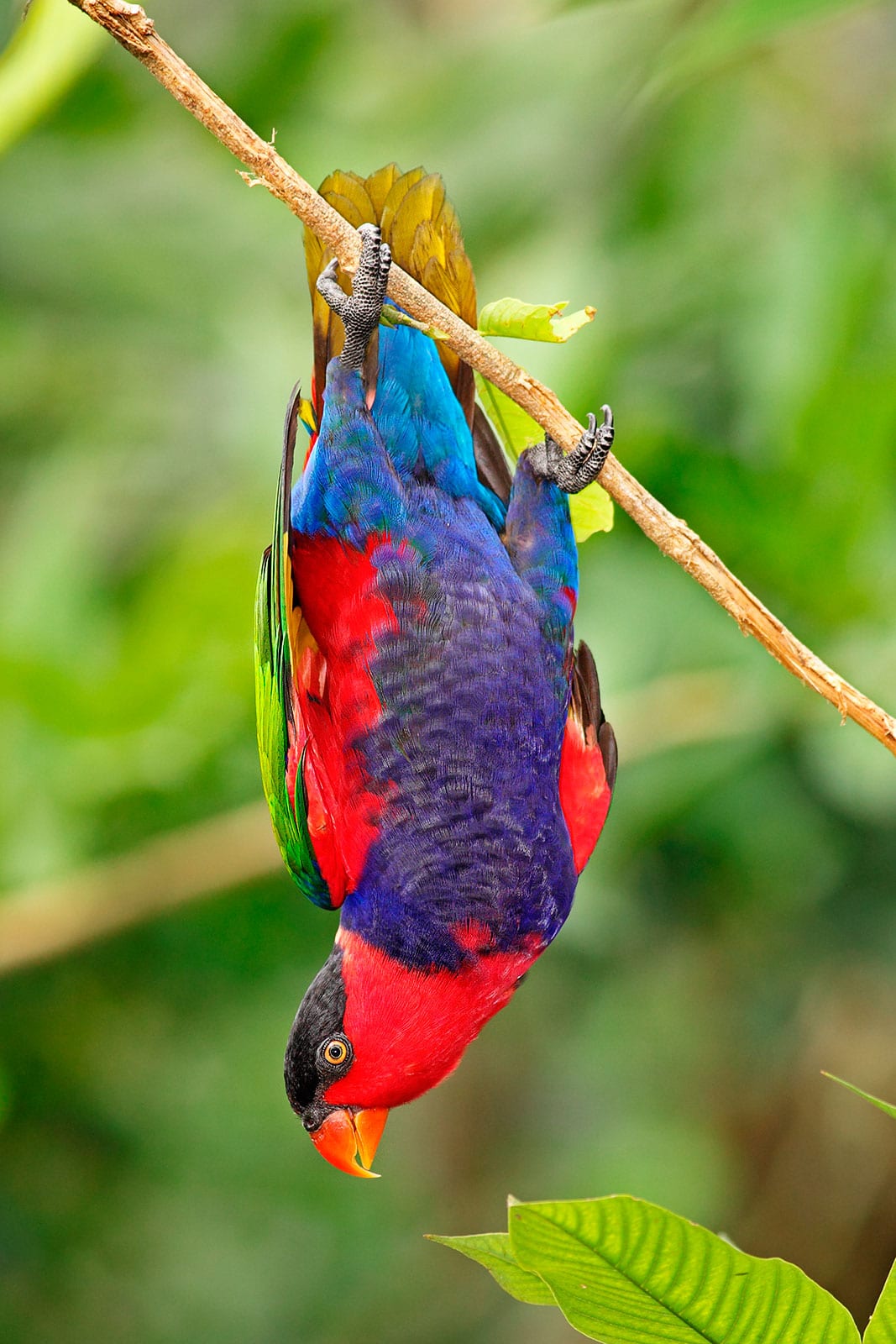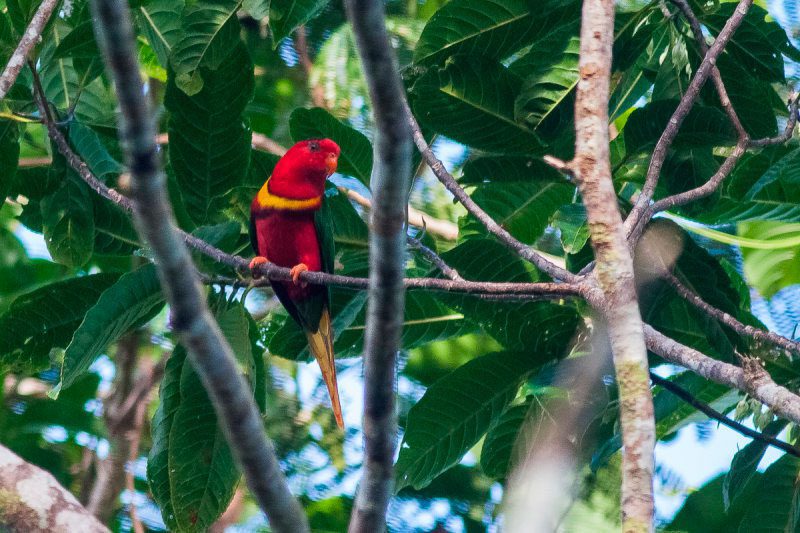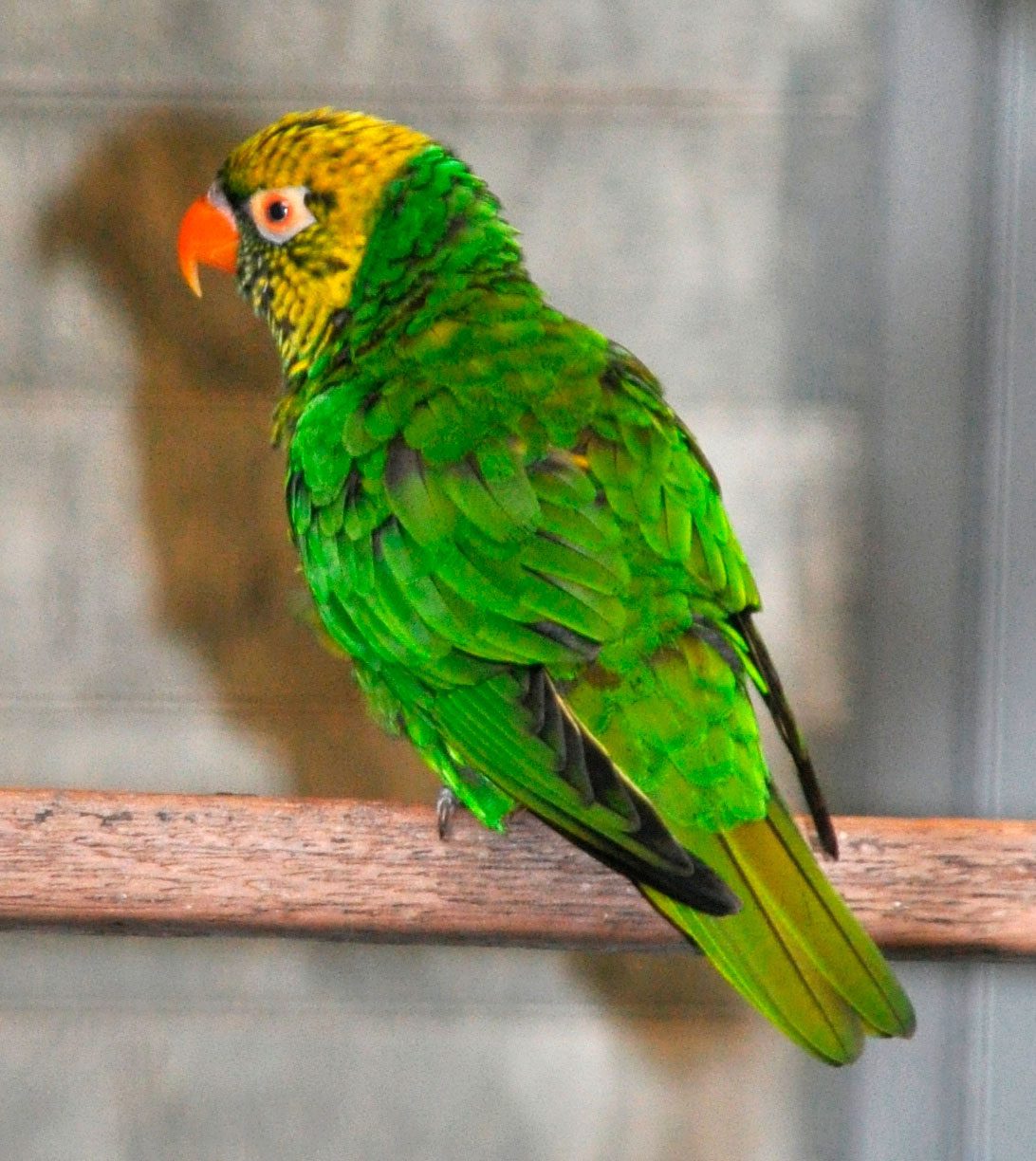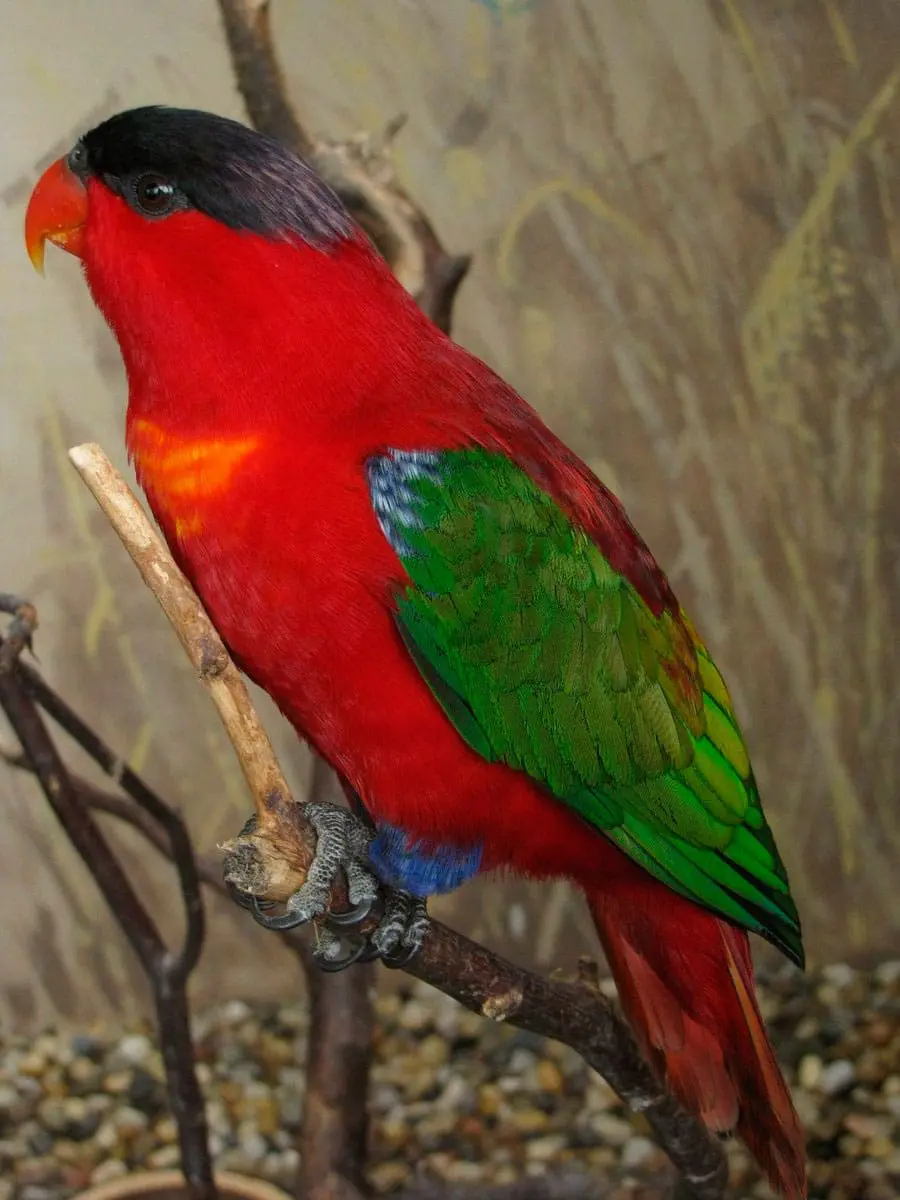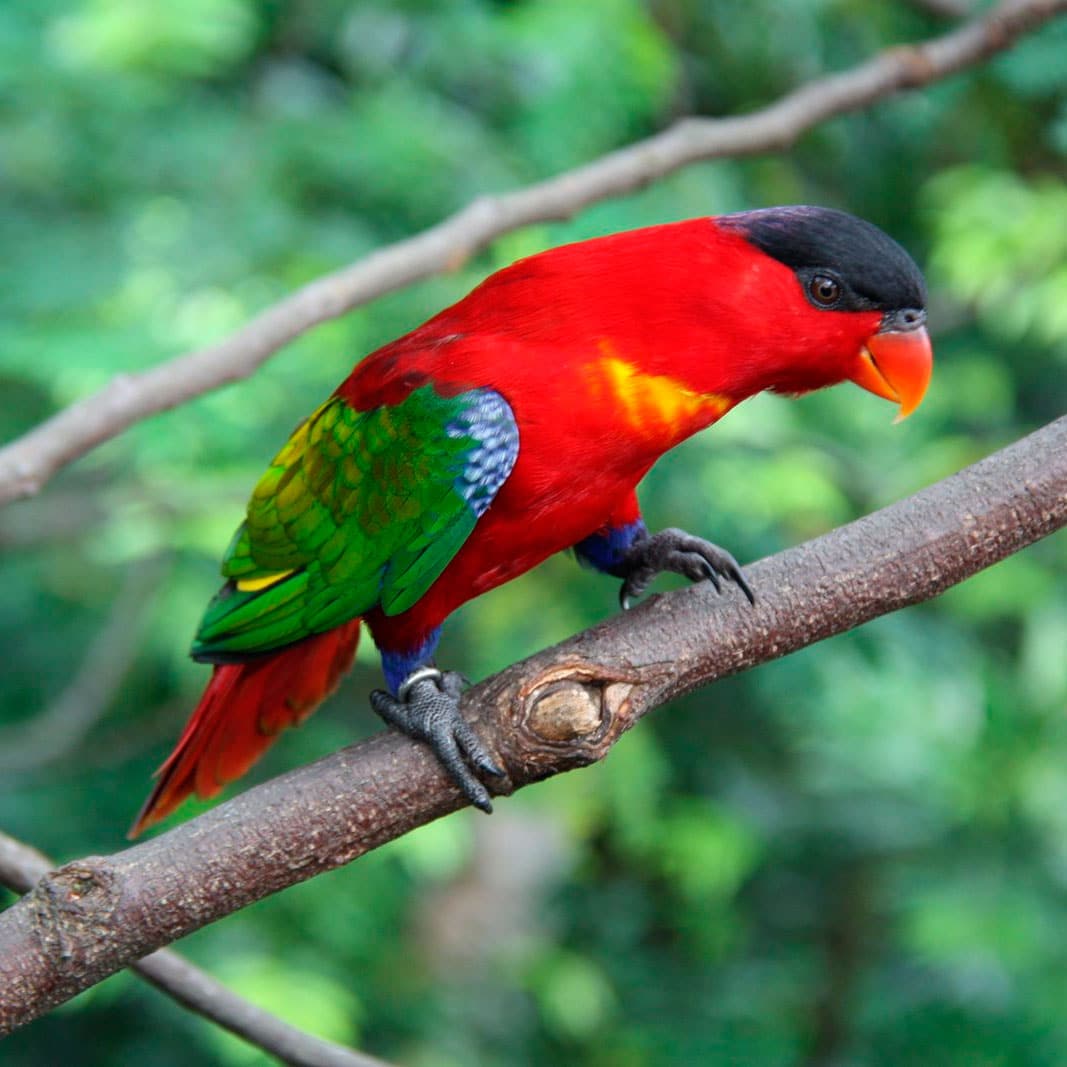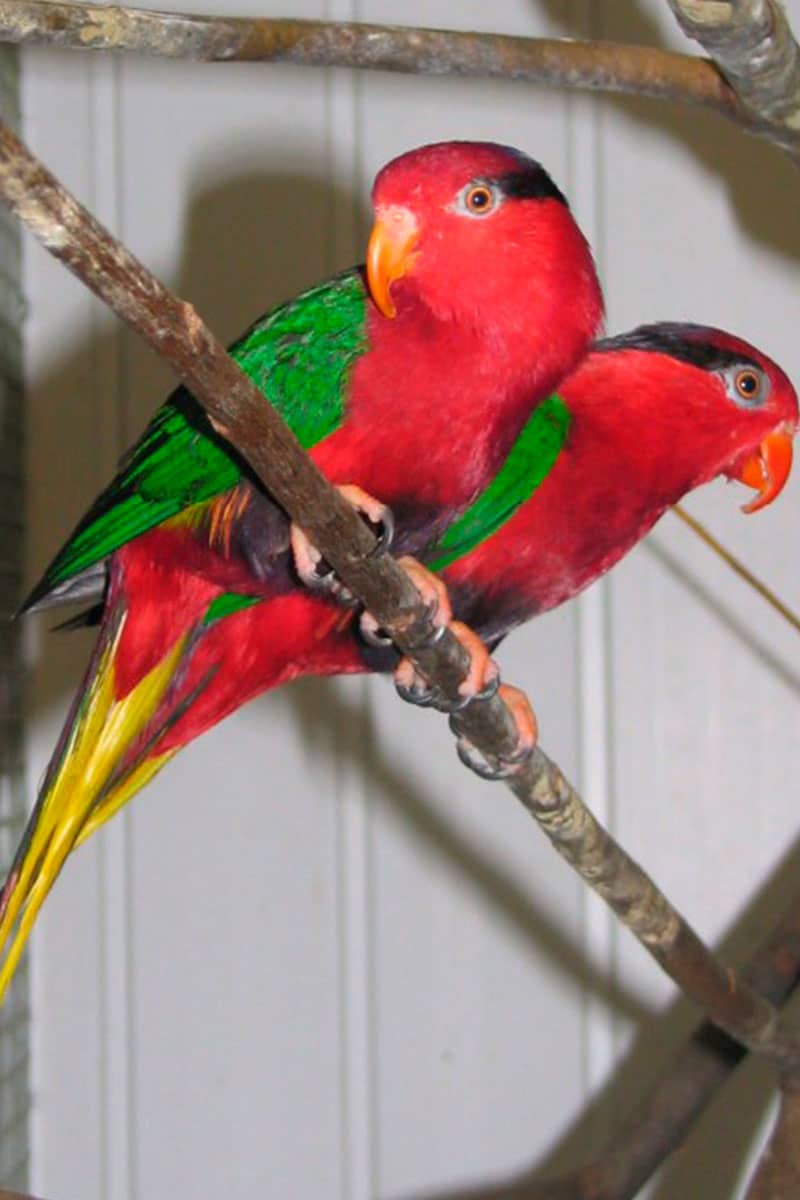
17 cm.. length and an approximate weight of 35 g..
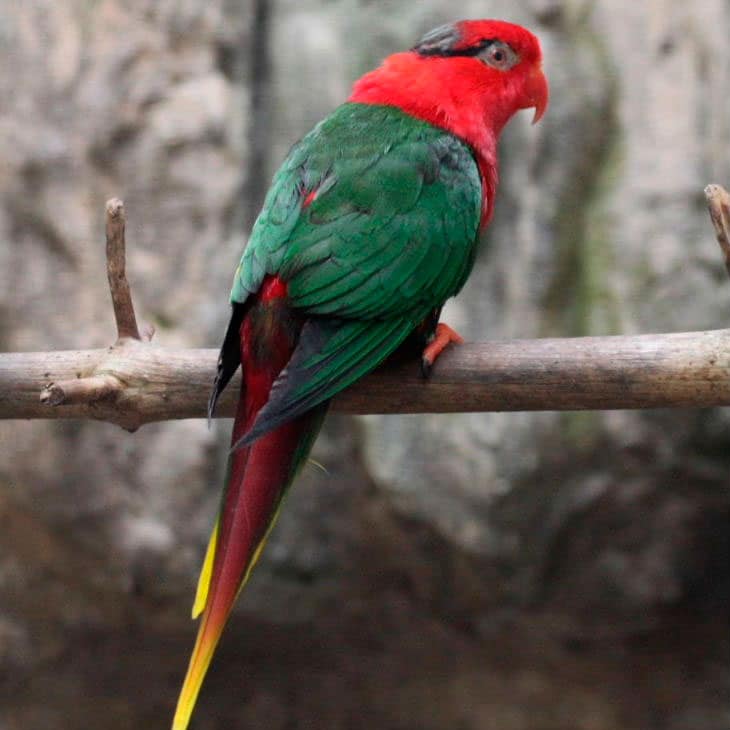
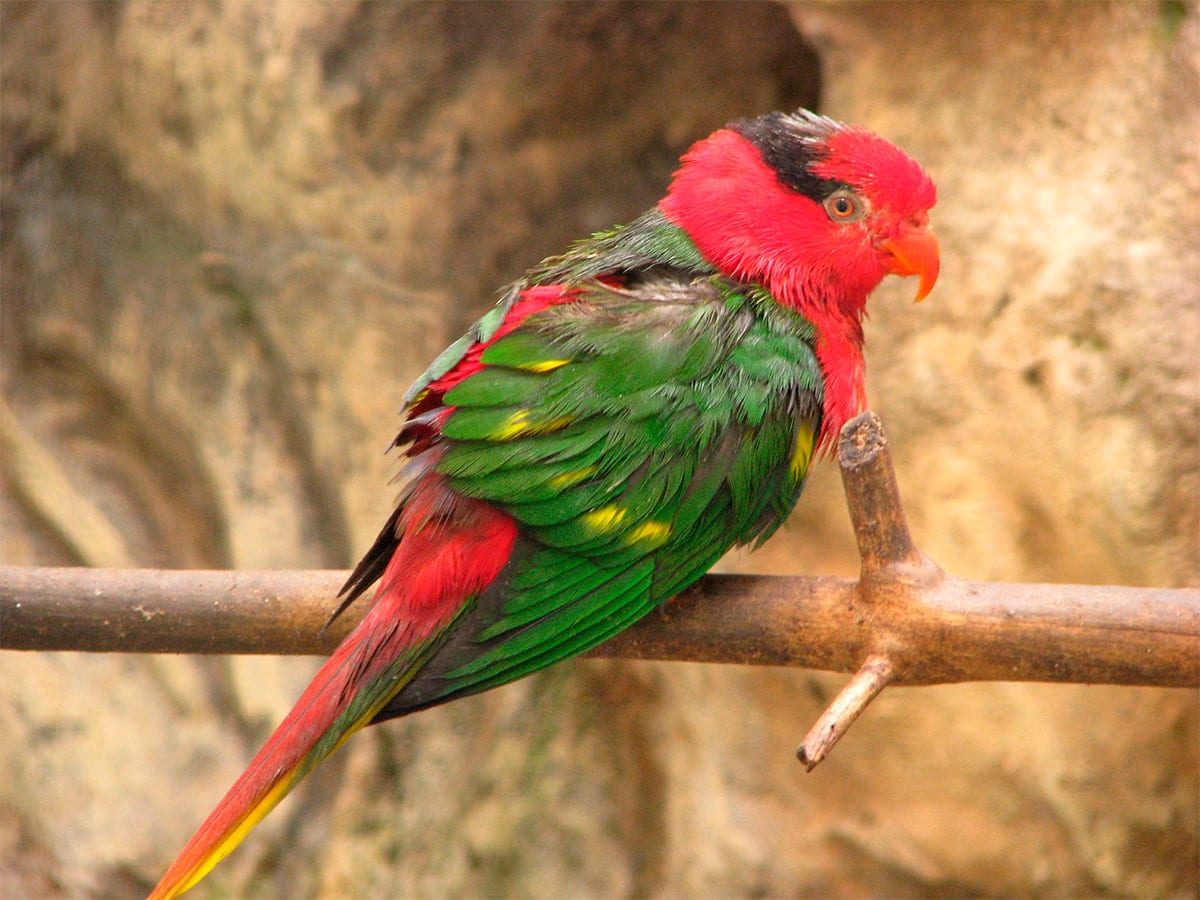
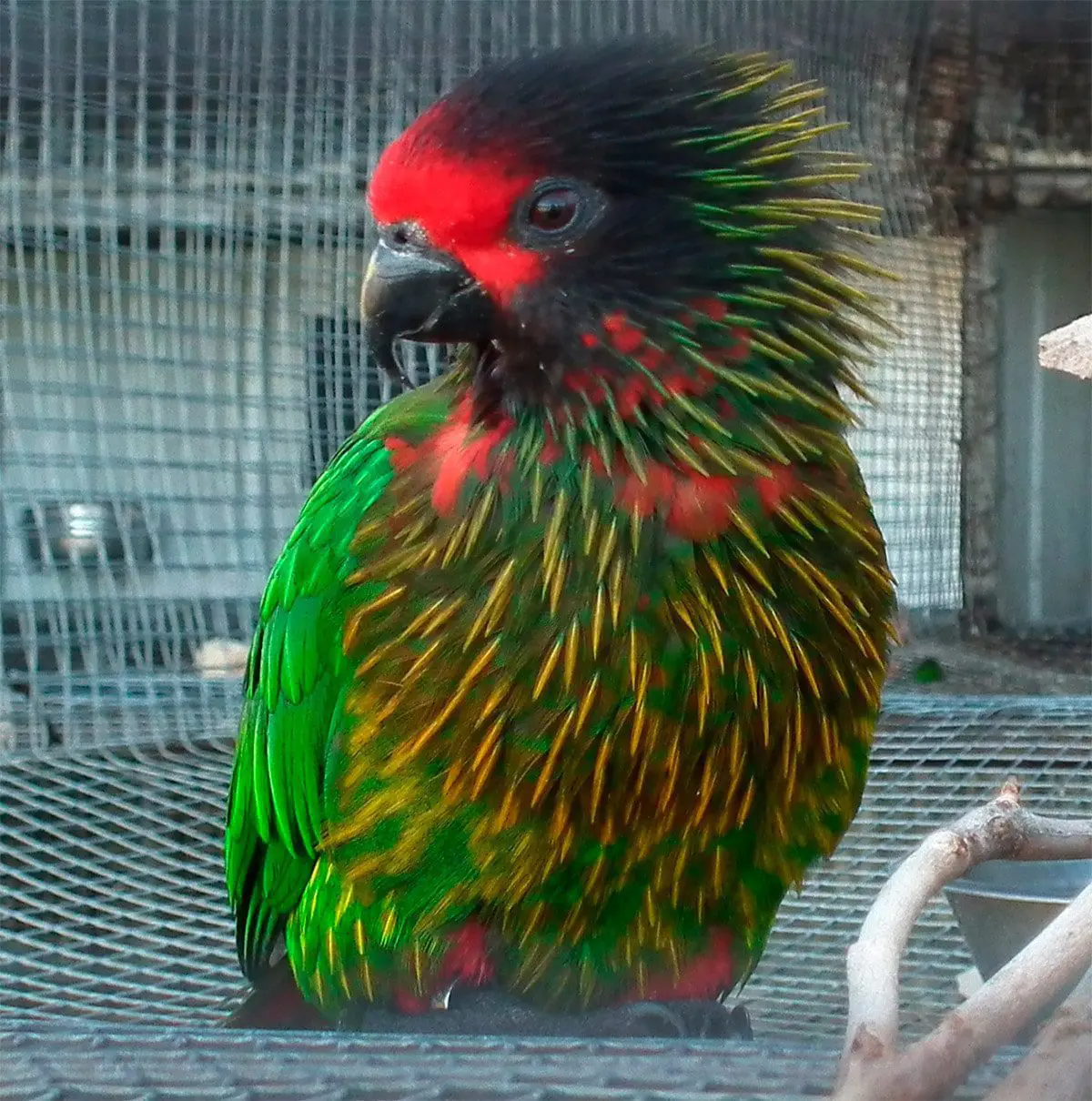
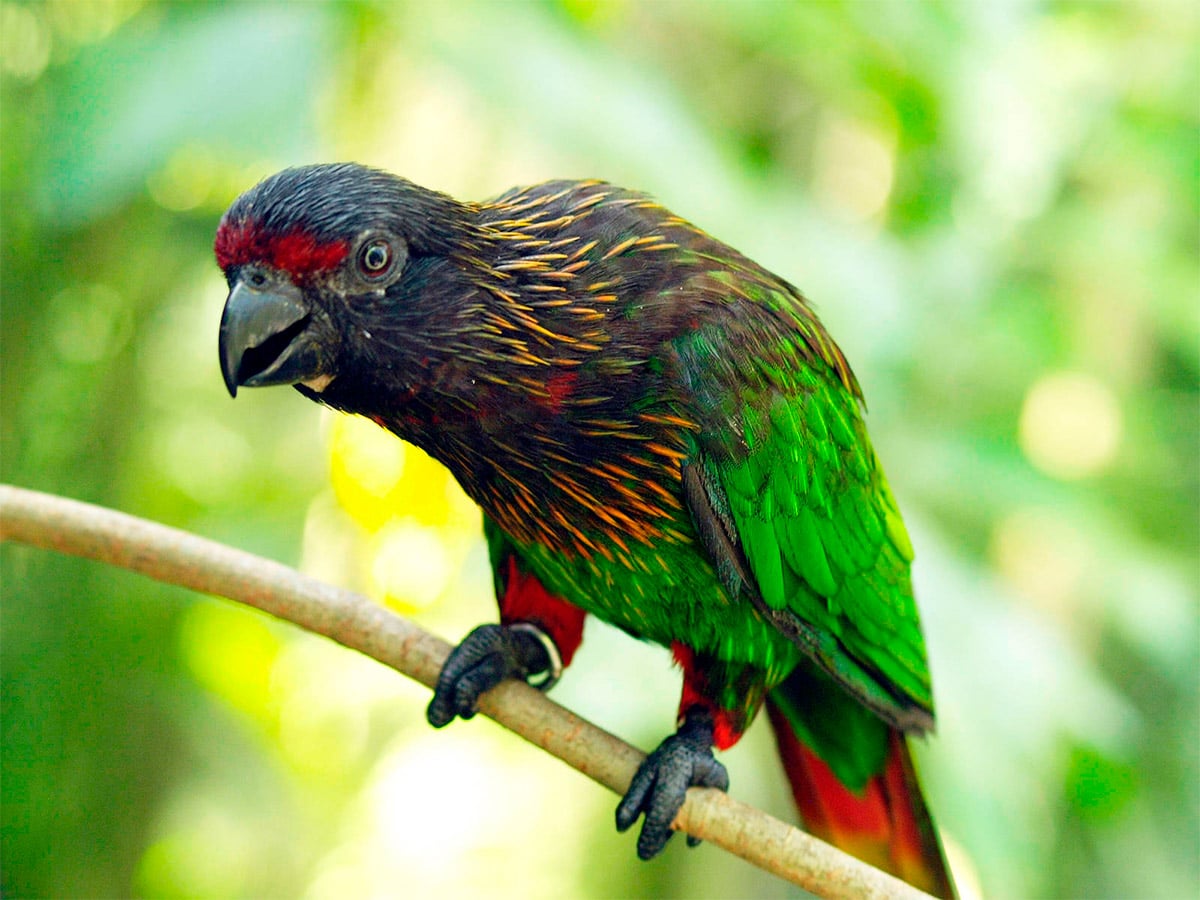
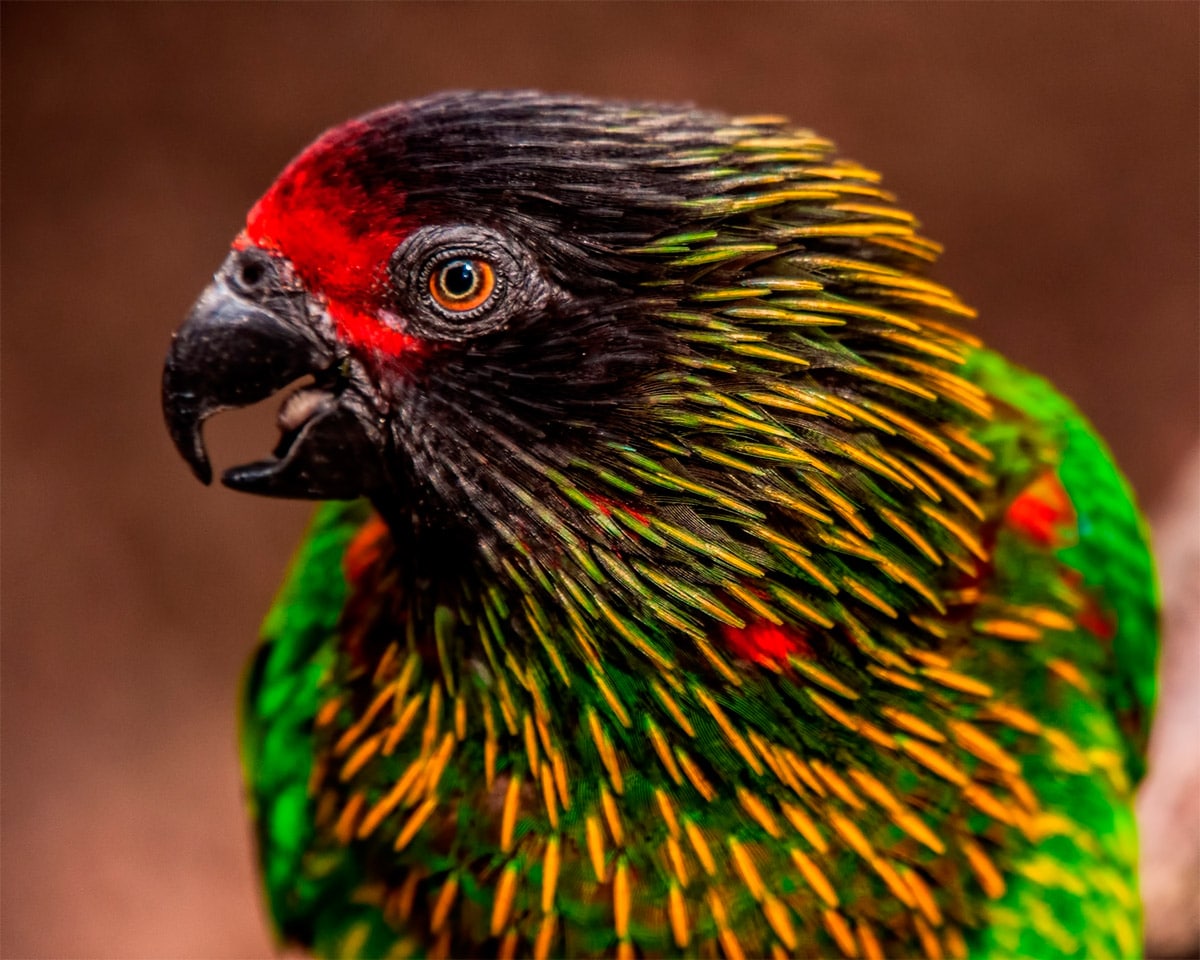
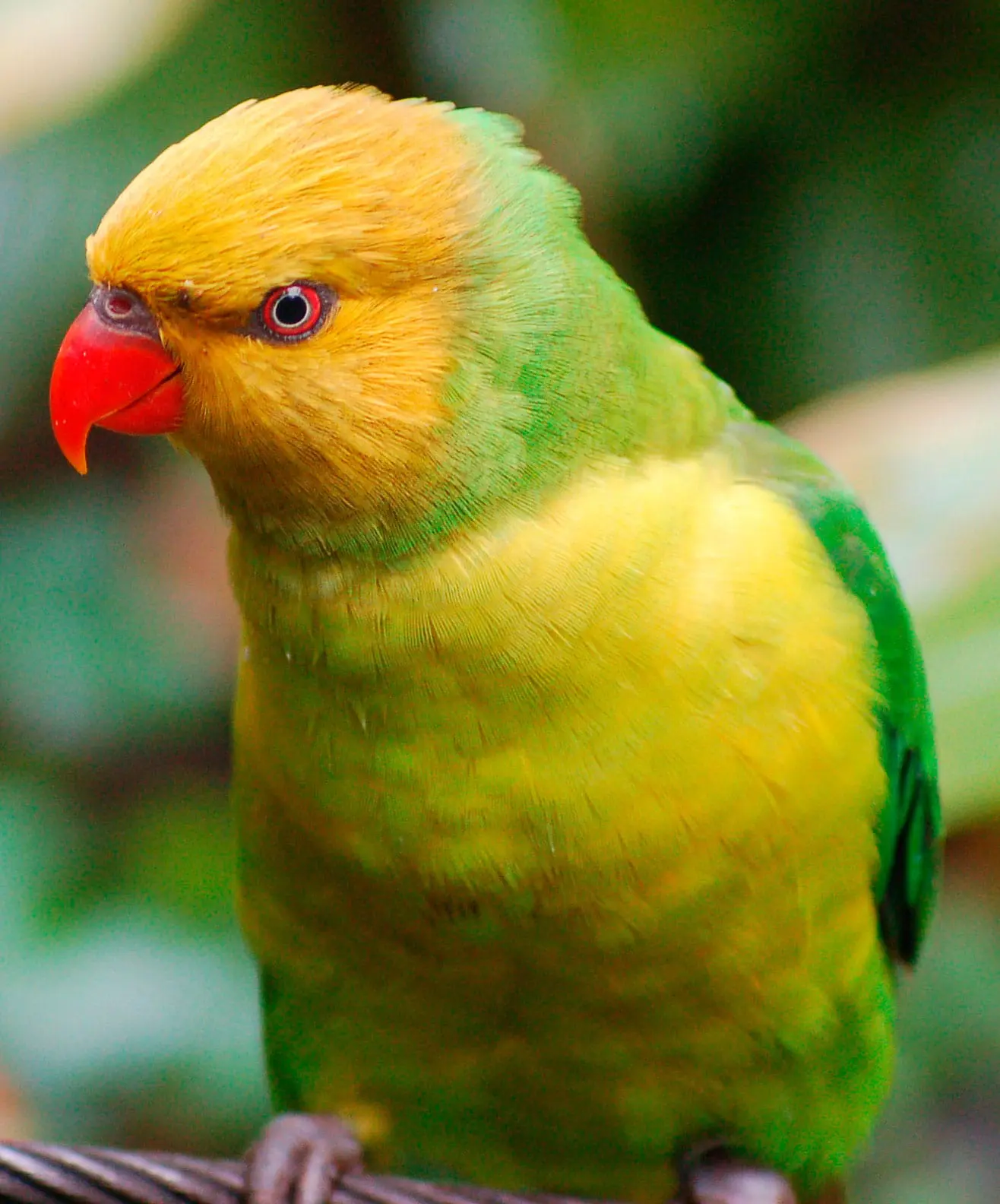
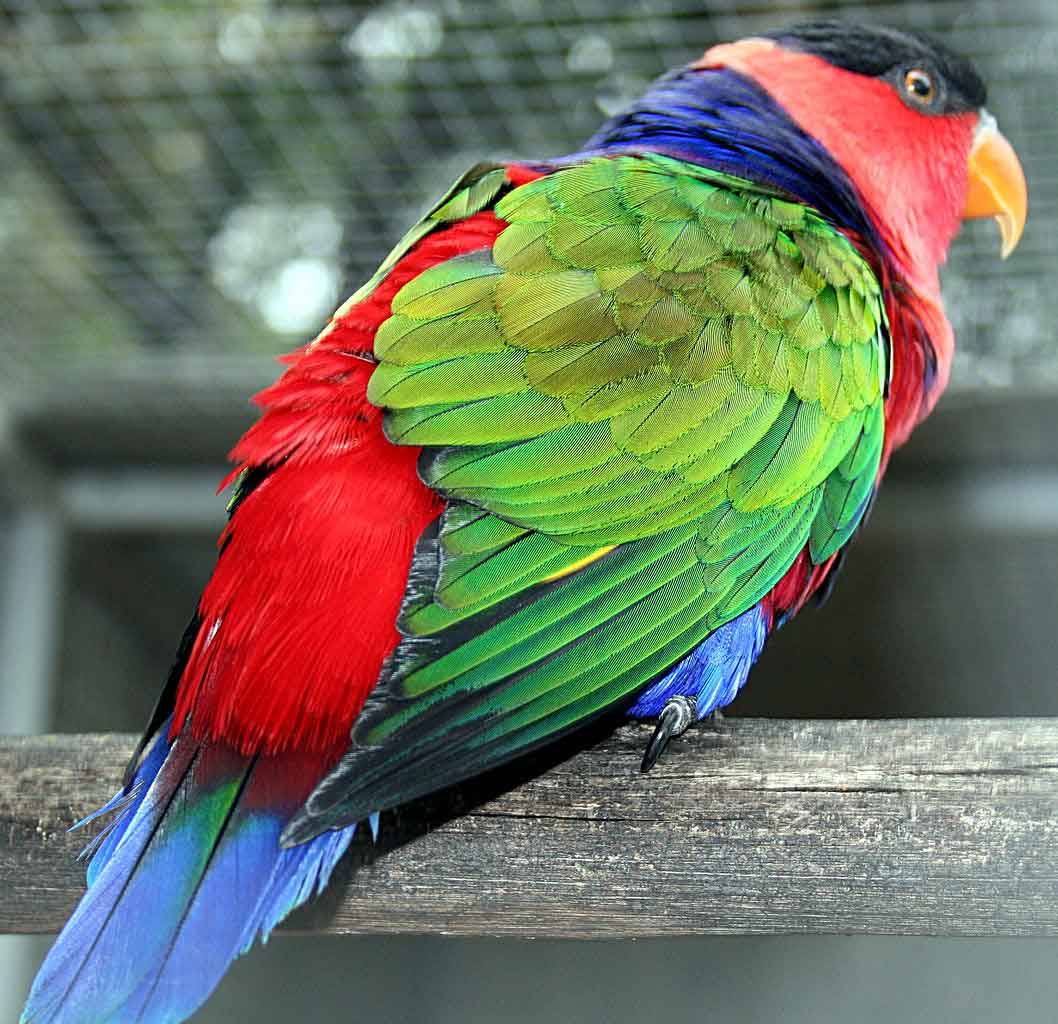
The head of the Palm Lorikeet (Charmosyna palmarum) is bright green, showing some red markings around the base of the bill, lores and the chin. The upperparts are bright green with a light washed olive brown through the mantle.
The wings are green. Under the greenish-gray wing coverts. The lower parts are bright green, more yellowish in the chin, the throat and the center of the belly (males sometimes also with some feathers red in the abdomen and the thighs). Tail Green with yellow in the Center and by the side of the feathers; below the tail is yellow. Bill orange; cere orange; irises yellow; legs yellowish-orange.
In the females, Red in the face is reduced or absent. Immature similar to the female, but in general most off. Iris ochre-coloured. Bill yellowish brown.
Habitat:
The Palm Lorikeet It is distributed in the forests and wooded lands, more common in the foothills than in the lowlands, and mostly uninhabited cloud forests of the larger islands above 1.000 m. He travels a lot between feeding sites and is found in pairs or flocks in the tops of the trees, where its Green plumage blends with the surroundings when it feeds among the flowers.
In flocks, couples have been observed grooming are, indicating that the pair bond is maintained when the birds are in larger groups.
A constant chatter deals the presence of these parrots in their search for food.
Reproduction:
Breeding habits they are little known, but a nest with two chicks in Holy (Vanuatu), It was found, in December of 1961, in a branch of a hollow tree to 6 meters above the ground in the cloud to 1,600 m forests. altitude.
They appear in the lowlands of sporadically, especially when the Erythnna and sago palm they are in flower.
Food:
Feeds in the Palms, lianas, fig trees and shrubs, taking nectar, pollen, fruits and berries, and particularly fond with the sago palm (Cycas circinalis).
Distribution:
Size of the area of distribution (reproduction / resident): 11.300 km2
Distributed by Southwest of Polynesia in Vanuatu, the Duff Islands, Santa Cruz Islands and Banks Islands.
Range seems to expand and contract, and it has been speculated that this may be related to the effect of cyclones, or sporadic colonies as a result of blooms. These may include, in Vanuatu It was noted from fate in 1879 for the first time in 30 years, and was still present there in the decade of 1930, but by the Decade of 1960 had disappeared.
Has also been recorded in Vanuatu from Holy Spirit, Aoba, Maewo, Pentecost, Malakula, Ambrym, Paama, Lopรฉvi, Tongoa, EMAE, Nguna, Eromanga, Tanna and Futuna; in Banks group in Santa Maria. Ureparapara, Vanua Lava Lava and Mere; and in the Group of Tinakula Santa Cruz, Utupua and Vanikoro.
Conservation:
โข Current IUCN Red List category: Vulnerable
โข Population trend: Decreasing
The total size of the population It is estimated that it will fall within the band of 1,000-2,499 mature individuals.
Avian malaria, the cyclones and the natural cycles are suggested causes of the fluctuating range. Lowland forests, especially in small islands with high populations human, It is clearing for agriculture, domestic demand for timber and commercial logging, avoiding this kind of habitat can be regularly used by this species.
"Palm Lorikeet" in captivity:
Very rare poultry.
Alternative names:
– Palm Lorikeet, Green Palm Lorikeet (ingles).
– Lori des palmiers (French).
– Palmenlori (German).
– Lori Palmero (espaรฑol).
Origin: Australia, Indonesian, New Caledonia, Papua New Guinea, Solomon Islands, Timor-Leste, Vanuatu
Character: Active
Life expectancy: 25 years
Height: 26 cm..
Content
Description:
26 cm.. of length and weight 100-157 g.
The Coconut Lorikeet(Trichoglossus haematodus) are colourful birds that find us almost all the colours of the Rainbow in their plumage.
Have the front of the crown, face and throat Dark bluish mauve, with violet stripes on the front of the crown, ear-coverts and part low of them cheeks; the rest of the head is dark blue with the bases of feathers brown-black color, especially around the rear of the crown and throat, and with greenish stripes at the rear of the crown.
The upperparts are of color green brilliant with specks of color reddish in the center of the the mantle (bases of feathers), and collar back brighter yellowish green.
The primaries with the tips blackish; a patch bright yellow in the innerwebs of the flight feather, that tends to orange in the secondaries; outerweb of the primaries and under wing-coverts, green. Underwing-coverts orange-red; the flight feather dark gray in tips.
The Breast
, the upper part of the abdomen and flanks bright reddish orange top, barred dark blue, tending to green at the bottom of the chest; abdomen with brands of color green in the Center, sometimes forming a discrete patch or interspersed with reddish orange; abdomen and the thighs with a beaming green and yellow with bases of color yellow; undertail-coverts of color yellow with tips of color green glossy. Upper, the tail of color green with them innerwebs of the lateral feathers yellowish: undertail, the tail greyish green in the outerweb, yellow in the innerwebs.
The bill orange red: the irises orange-red; legs gray or greenish gray.
Both sexes are very similar.
The immature they are more muted than adults, with the bill and the irises dark brown and tail more pointed.
Sound of the Coconut Lorikeet.
Description of subspecies of Trichoglossus haematodus
Trichoglossus haematodus caeruleiceps
(Albertis & Salvadori, 1879) – The blue of the head is more pale, Red is orange-red with the lined in very narrow and dark blue. Abdomen Blackish and band of the neck yellow.
Trichoglossus haematodus deplanchii
(Verreaux,J & Des Murs, 1860) – 26 cm.. of length and a weight of 140 gr.
The Coconut Lorikeet (deplanchii)(Trichoglossus haematodus deplanchii) is a variation of the nominal (Trichoglossus Haematodus)
Similar to the nominal Haematodus, but plumage slightly paler. The head has a very bright blue. Reddish orange on the chest, similar to the Trichoglossus haematodus massena, only that more alive. The abdomen is of color green beige and is extends to the part back from the neck. The the thighs and the feathers under the tail yellow and the upper part of the tail olive green.
Trichoglossus haematodus flavicans
(Cabanis & Reichenow, 1876) – Something bigger, 27 cm approximately in length. Its plumage varies from green to olive green and yellow opaque. Breast
and neck reddish colour with fine dark edges. Forehead and contour of eyes violet blue.
(Rothschild & Hartert, 1901) – 26 cm approximately in length. The blue of the head extends slightly less. The neck is yellow and the abdomen dark green.
The Coconut Lorikeet (massena) (Trichoglossus haematodus massena) is a variation of the nominal (Trichoglossus Haematodus).
The plumage is similar to the of the Ornate Lory except that it is usually paler. The head is blue, ending at the nape with dark brown feathers interspersed with more Brown clear. The chest is of color reddish with a narrow edging blue dark. In some cases, You can see some areas yellow in the plumage of the chest. The abdomen is green; but there may be some kind of mark on the bottom of the abdomen blue-violet.
The eyes are of color orange in the adult and Brown in the youth. The bill is red orange.
Trichoglossus haematodus micropteryx
(Stresemann, 1922) – Somewhat smaller, 25 cm approximately in length. The plumage is something more pale, the chest reddish orange with narrow edging of dark blue. Abdomen dark green. Band of the neck greenish yellow.
Trichoglossus haematodus nesophilus
(Neumann, 1929) – 26 cm approximately. Very similar to the Trichoglossus Haematodus Flavicans but with feathers underneath of the tail are green.
Trichoglossus haematodus nigrogularis
(Gray,GR, 1858) – Something bigger, 28 cm., approximately, length. Is similar to the Trichoglossus Haematodus Caeruliceps, but the blue of the head It is more dark and often have more red feathers on the neck.
Habitat:
The Coconut Lorikeet they are parrots of the Plains and Highlands. They are distributed by a wide variety of habitats such as mangrove forests, Moors and heathland near the coast, wooded meadows, tree galleries, reforestation during regeneration and rainforests.
In all cases, they need places with abundant flowers.
The Coconut Lorikeet they have also colonized habitats formed by man: coconut plantations, orchards and gardens on the outskirts of cities. They mark a greater preference for edges and clearings inside the dense jungles. Gladly tolerate the areas with degraded vegetation and plantations of small size in the small atolls.
They are birds sedentary, that does not prevent to do short trips looking for trees in flower. Because of these movements, populations appear to vary locally. Very gregarious, they live in pairs or in bands that can vary from a few birds to several hundred, Depending on the availability of food resources.
These birds are very active and noisy, flying a bit randomly above the tops of the trees or climbing up the branches in search of flowers or fruits.
during their search for food, the Coconut Lorikeet they usually share the space with other species of frugivores.
When they are hidden among the leaves, their cries of call reveal their presence.
They adopt a flight very quick and direct.
Son monogamous. During courtship, the couple is side-by-side, swaying, the neck forward and the pupil dilated. They wave irregularly wings to reveal the clear band that crosses its sub-wing.
Reproduction:
The breeding season performed at different times depending on the distribution area.
The species nominal eat your laying between September and December. Both members of the couple set up their nests in a tree cavity, usually a eucalyptus. Several nests, two or three may be in the same tree, but the entrance of the nest will fiercely defend against any intrusion.
In the the Admiralty Islands, the Coconut Lorikeet Sometimes they nest in the ground. The female normally lays 2 eggs on a bed of wood rotting chips. She incubated alone for a few 25 days.
The young chicks are altricial and need to 8 weeks to fend for if same. As soon as they are autonomous, they bind to the bedrooms and common bands.
Food:
The Coconut Lorikeet they have a bill acute equipped with a language composed of some structures similar to hairs tiny called papilla it help excavate the pollen and the nectar from the flowers.
Also eat fruits, berries, seeds, outbreaks and insect larvae.
In Australia, they forage primarily in eucalyptus trees and trees of the genus Banksia, in particular, coastal Banksia(Banksia integrifolia) and river banksia (seminuda), trees that often exceed the 15 metres in height.
They are also found in farmland, since they are particularly cultivated fruits and seeds Milky enthusiasts.
Easily entering gardens to steal fruit and not disdain approaching feeders
Distribution:
Size of its range (breeding/resident ): 5,310,000km 2
Endemics Oceania, at the edge of the Asian continent.
Can be found in Australia, in the East of Indonesian, Papua New Guinea, New Caledonia, the Solomon Islands and Vanuatu.
In Australia, mostly found on the coast, to the North of Queensland in the South of Australia and Tasmania.
Distribution of subspecies Trichoglossus haematodus
โข Red List category of the UICN current: Least concern
โข Population trend: Decreasing
The species has undergone intense trade: from 1981 When it began trading in CITES Appendix II and through the year 2005, 100.388 individuals were captured in the wild and reported in the international trade.
In some places of Australia, It is hunted for food and feathers are later used in ritual ceremonies
– Avibase
– Parrots of the World โ Forshaw Joseph M
– Parrots A Guide to the Parrots of the World – Tony Juniper & Mike Parr
– Birdlife
– Oiseaux.NET
– Photos:
(1) – Rainbow Lorikeet perching on a wooden post at Tanganyika Wildlife Park, Kansas, USA. by Snowmanradio โ Wikipedia
(2) โ A Green-naped Lorikeet, T. h. haematodus, a sub-species of Rainbow Lorikeet, Trichoglossus haematodus at Jurong Bird Park, Singapore. by Benjamint444 โ Wikipedia
(3) โ A Rainbow Lorikeet (Trichoglossus haematodus moluccanus) in Melbourne, Australia. by Alfred Sin โ Wikimedia
(4) โ Lorikeets feeding on the flowering tree, Corymbia โSummer Beautyโ (cultivar). Photographed in suburban Brisbane, Australia. by Tatiana Gerus โ Wikimedia
(5) โ Two birds preening each other. Jervis Bay, New South Wales, Australia by Arnie Hollyman โ ibc.lynxeds.com
About 30 cm.. length and a weight between 140 and 170 gr.
Like all species of the genus Eos, the โTanimbar Loryโ (Eos reticulata), shows a beautiful plumage mainly red. In adults, a great band blue-violet crosses the region of the eye and continues in the patches that cover the ears, at the sides of the neck.
The under neck and the mantle they are covered with long, violet-blue stripes.
The back and tail they are more or less blue red striped.
The pens and large blankets have terminations in black. The primary is almost entirely black. The tail is brownish black above and below a red opaque.
The bottom of the wings they have the edge and dark tips. Thighs and flanks they are completely Red. The bill coral red. Iris orange-red. The legs are grey.
In youth , the feathers the lower parts are aligned blue-black variably. The shield It is covered with blue spots instead of stripes. The bill is brownish Orange. The irises They are brown.
The Blue streaked Lory they live mostly in the most wooded areas, including primary and secondary forests. They are also found in coconut plantations, of sago palms, in the mangroves and the cultivated lands.
It seems that they show a certain attraction for the monsoon forests, relatively open and located in low-lying areas.
They live alone, in pairs or in small groups of up to ten or more individuals. These are rather shy and discreet, but their presence is often betrayed by the screams produced flocks in flight.
They have a direct flight, quite fast and composed of many flapping. Often feed on coconut blossom trees and the sago palms.
Reproduction:
There is little information of the natural environment. The Blue streaked Lory They typically make 2 or 3 eggs that colouring of 24 to 26 days. The chicks leave the nest after 7 to 8 weeks. But, even after feather, they return regularly to rest awhile. The youth they stay in the family throughout the summer and then join the dormitories where they continue their learning.
Food:
They have an exclusively vegetarian diet. They feed on fruits, seeds, buds and immature seeds. His tongue with a brush-shaped end is specialized to collect nectar and pollen.
Distribution:
Is located in Yamdena and Larat, Tanimbar Islands and island of Babar, Indonesian. Introduced in Kai Islands and island of Damar, where has possibly gone.
Conservation:
– Current IUCN Red List category: Near threatened
– The population trend: Decreasing
Habitat loss continues apace in southern Yamdena
The species is suspected that it is decreasing at a rate of slow to moderate, due to the combined forces of habitat loss and capture.
It is estimated a population of 220.000 ยฑ 50.000 birds in Yamdena
Nearly 3000 birds are traded on the international market of birds each year, fact that probably has not caused a decrease in its population. Habitat loss continues however, and this, combined with capture, probably if that will lead to more declines.
Conservation Actions Proposed:
– Regularly monitoring at certain sites throughout its range to determine population trends.
– Investigate the degree of capture and take appropriate measures, including the use of awareness-raising campaigns, to address these issues.
– Protection of the areas significant of forest right in all the Islands where is distributes the species.
"Blue streaked Lory" in captivity:
Lives of 15 to 30 years in the wild; and between 28 and 32 years in captivity.
Fairly common in the s 1970. Nowadays it is not unusual to see them in captivity.
Alternative names:
– Blue streaked Lory, Blue-streaked Lory (ingles).
– Lori rรฉticulรฉ, Lori ร raies bleues, Lori striรฉ bleu (French).
– Strichellori (German).
– Lรณris-de-crista-azul (Portuguese).
– Lori de las Tanimbar, Lori Reticulado (espaรฑol).
20 to 23 cm.. length and a weight between 52 and 56 g..
The general plumage of the Musk Lorikeet(Glossopsitta concinna) is green.
The part forward of the crown, lores and coverts headphones are of color Scarlet. Top of the head and cheeks, of color green impregnated of Turquoise under eye. The underparts of color green with a washed Brown olive around the sides of the chest. Green bright it rump. Wing coverts green, flight feather of color gray to black and a band of color yellow in the area of the shoulders. The feathers of the tail with brands reddish orange.
Part back from the neck yellowish green. Beside the edges of the wings colour yellow. Bill black-tipped Red. The irises Orange and the legs greenish Brown.
The blue area in the crown of the female It is smaller and paler which in the male.
The name of the species derives from a musky odor that is said to emit these birds.
(Mathews, 1915) – Less blue in the crown, nearly absent in the female.
Habitat:
Seasonally nomadic Depending on the flowering of the eucalyptus, at least at the ends of their range.
Found in many habitats of open forest, agricultural and suburban areas, including forests of eucalyptus, dry forests, dense rainforest (particularly in Tasmania) and riparian forests.
It avoids the high open woods and high altitude. Often found in large flocks of more than one hundred of individuals, where couples who form strong bonds, they often live together. It is extremely trusting when feeds.
Flocks have been seen, frequently, flying at high altitude.
Reproduction:
Season of mating from August to January. The nests they are built in holes of eucalyptus. The two eggs are incubated for about 25 days and the young leave the nest between 6 and 7 weeks after hatching.
Food:
like most others Lori, the diet consists in nectar and pollen, as well as small fruits and some insects. They can RAID orchards, vineyards and crops, forming herds with the Swift Parrot(Lathamus discolor) and other gender lori Glossopsitta.
Distribution:
Size of the area of distribution (reproduction / resident): 664.000 km2
The Musk Lorikeet are located in the East of New South Wales, Victoria, South of Australia and Tasmania.
17 to 20 cm.. length between 33 and 40 g. of weight.
The Red-chinned Lory(Charmosyna rubrigularis) has the head green; ear-coverts brilliant emerald green with pale green streaks and showing even paler on the crown; chin, top of the throat and lower lores, surrounded by yellow red. The upperparts, Green olive darker than the underparts. The wings Green with the part internal black and them edges yellow. Yellowish-green below-wing coverts; flight feather grey and black with stripe yellow central.
Underparts brighter yellowish green, clearly more gentle to them upperparts. The tail above it is green with yellow tips, lateral feathers marked in red, black and orange in the bases; by below with broad lateral feathers red, with tips yellow (more or less hidden red rest), central feathers Black with them ends yellow.
Bill orange red; irises orange; legs orange-yellow.
Both sexes are equal.
Immature they are similar to the adult with less red in the chin and throat.
With distributed by the humid forest, mainly in the mountains. Usually found in small flocks of up to ten birds, feeding in the canopy or flying above. Can be seen in the company of others Loris that is feed from nectar, including the much larger Coconut Lorikeet. You can be assured while feeding.
Reproduction:
Unknown breeding habits.
Food:
Feeds of pollen and nectar and it has been noted that they frequent native Palms in the mountains of New Ireland.
Distribution:
Size of the area of distribution (reproduction / resident): 185.000 km2
In Karkar island (off the northeast coast) and the Bismarck Archipelago (New Britain, New Hanover and New Ireland), Papua New Guinea. In Karkar is found from sea level to the top but rarely below 625 m, and more common among 1.150 meters of 1,280 m. common since 450 meters up in New Britain and in New Ireland from 1.500 metres to the Summit of the Hans Meyer Range; Although found as low as a 70 m. It tends to replace Red-flanked Lorikeet at higher altitudes, but it may be sympatric with species in some areas.
Conservation:
โข Current IUCN Red List category: Least concern
โข Population trend: Stable
The population World has not been quantified, but the species according to information is common and abundant (pit et to the. 1997).
Justification of trend
It is suspected that the population is stable in the absence of evidence of any reduction or substantial threats.
"Red-chinned Lory" in captivity:
The species does not arise today as a cage bird.
Alternative names:
– Red-chinned Lory, Red chinned Lorikeet, Red-chinned Lorikeet (ingles).
– Lori ร menton rouge (French).
– Rotkinnlori (German).
– Lori Barbirrojo, Lori de Barba Roja (espaรฑol).
Origin: Indonesian, Papua New Guinea, Solomon Islands
Character: active and curious.
Life expectancy: 10 years.
Height: 15 to 18 cms.
Content
Description:
15 to 18 cms. length and 38 to 48 g. of weight.
The Red-flanked Lorikeet(Charmosyna placentis) has the forecrown and yellowish-green crown; nape green; chin, throat and lores red; ear-coverts dark blue striped strongly light blue. Top green with rump matte blue: uppertail-coverts green. The part superior of the wings It is green with innerwebs and ends the blackish flight feather. Underwing-coverts red; intense yellow band across the innerwebs of the flight feather blackish. Underparts lighter green than yellow upperparts; Strong red marks on the sides of chest and in the flanks below the sides of belly.
The upper part of the tail It is duller green than upperparts, tipped bright yellow, with lateral feathers red in the center of the innerwebs and slightly in outerweb, with a subterminal black mark; lower tail is basal yellow, with black and red marks.
Bill red; irises yellow to orange; legs opaque red.
The female no yellow-green spots on the top of the forecrown, Red in the face, in the chest, in the flanks and at the bottom of the wings (the underwing-coverts are green-yellow). The blue of the ear-coverts It is replaced by a dark patch badly scratched yellow.
Immature as the female, but duller green, and less extensive yellow streaks in ear-coverts (the young male can present a red stain on the face and greenish yellow in forecrown). Iris pale yellow, legs orange-brown.
Sound of the Red-flanked Lorikeet.
Subspecies description
Charmosyna placentis intensior
(Kinnear, 1928) – Greener than the species nominal, including the forecrown. Headphones coverts and patch on the rump duller blue-violet.
Charmosyna placentis ornata
(Mayr, 1940) – Mantle green slightly darker than the species nominal, a patch on rump largest darker blue and crown yellower. The Red throat larger in males.
Charmosyna placentis pallidior
(Rothschild & Hartert, 1905) – As the subspecies subplacens, but with upperparts pale green. Headphones coverts light blue in the male.
(Sclater,PL, 1876) – It differs from the species nominal by having green, nonblue the rump.
Habitat:
The Red-flanked Lorikeet It, mainly, a kind of lowlands found in primary moist forest, in the forest edge, in Savannah, the secondary high growth, in the monsoon forest, in the swamps of forget (when they are in bloom), in the gallery forest, in eucalypts, in the coastal forest and, occasionally, in the mangroves and coconut palms. It is also found in flowering trees in cultivated areas.
Can be Quiet and discreet and, even when feeding active and noisy, can be difficult to see through thick foliage. They are mostly in pairs, but occasionally in groups 25 or more, looking for food with others Loris with flowers and trees epiphytes or flying through or above the tree tops in small compact and noisy flocks.
Reproduction:
In New Guinea, Several observations of couples investigating arboreal termite mounds They indicate that it is likely that they are preferred for nest. The bases of ferns and moss cultures have also been identified as potential sites nesting. Activity on these sites has been observed between February and October, and it was found that specimens found in eastern Papua New Guinea by Diamond in July and August 1965 They were able to play. In the Vit Islandu, Coates He watched a couple with chicks in mid-August and is likely to play occurring during much of the year.
Food:
Feeds of pollen, nectar, flowers and seeds, mainly in the upper canopy.
Distribution and status:
Extension of the distribution (breeding/resident): 2.800.000 km2
originating Indonesia Oriental, New Guinea and the northern Solomon Islands.
Although mostly they found in lowlands, there have been up to 1.600 metres above sea level in Komo, in the highlands of southern Papua New Guinea; They are also common in high altitudes (about 1.150 meters to 1.450 m) in the zone of Karimui, the east, and they do not seem to be anywhere else in the region. reaches 300 metres in New Britain, above which is replaced by the Red-chinned Lory(Charmosyna rubrigularis). In the North of New Guinea It is replaced by the higher altitude Red-fronted Lorikeet(Charmosyna rubronotata).
Widespread and common to locally abundant. It is believed that the world population is at a level of caresses 500.000 individuals and it is stable. small numbers in captivity.
Translation made with the translator www.DeepL.com/Translator
โข Current category of the Red List of the UICN: Least concern
โข Population trend: Stable.
โข Population size : Unknown
Rationale for the Red List category
This species has a very extens distribution areato, and therefore does not approach the thresholds for Vulnerable under the criteria of size range (Scope of the presence <20.000 km2 combined with a decreasing area size or fluctuating distribution, extension / habitat quality, o Population size and a small number of locations o Severe fragmentation).
The population trend appears to be stable, and therefore the species does not approach the thresholds for Vulnerable under the criteria of population trend (decrease> 30% in ten years or three generations). The population size has not been quantified, but it is not believed to approach the thresholds for Vulnerable under the criterion of population size (<10.000 mature individuals with an estimated continuous decrease in> 10% in ten years or three generations, or with a specific population structure). For these reasons, the species is assessed as Least concern.
Justification of the population
Global population size has not been quantified, but it has been reported that the species is generally common and sometimes abundant (pit et to the. 1997). Some sources estimate the current population of this Lori in about half a million individuals.
Justification trend
They suspected that the population is stable the absence of evidence of decline or substantial threats.
"Red-flanked Lorikeet" in captivity:
Rare in captivity.
Alternative names:
– Blue-eared Lorikeet, Lowland Lorikeet, Red flanked Lorikeet, Red-flanked Lorikeet, Yellow-fronted Blue-eared Lorikeet, Yellow-fronted Blue-eared Lory (English).
– Lori coquet, Loriquet ร croupion bleu, Loriquet joli (French).
– Schรถnlori (German).
– Loris Charmosyna Placentis (Portuguese).
– Lori de Dorso Rojo, Lori Flanquirrojo (espaรฑol).
โข Avibase
โข Parrots of the World โ Forshaw Joseph M
โข Parrots A Guide to the Parrots of the World – Tony Juniper & Mike Parr
โข Birdlife
Photos:
(1) – A male Red-flanked Lorikeet at Cincinnati Zoo, USA by Ltshears [CC BY 3.0]
(2) – Female Red-flanked Lorikeet at the Louisville Zoo, USA by Ltshears [CC BY-SA 3.0 or GFDL], from Wikimedia Commons
(3) – A pair of Red-flanked Lorikeets at Jurong Bird Park, Singapore by Peter Tan [CC BY-SA 2.0], via Wikimedia Commons
(4) – The image is free from copyright under Creative Commons CC0
(5) – Red-flanked Lorikeet, Male (Charmosyna placentis) at the Louisville Zoo by Ltshears [CC BY-SA 3.0 or GFDL], from Wikimedia Commons
31 cm.. length and a weight between 150 and 185 gr.
The two main colors of the Red-and-blue Lory(Eos histrio) they are the red and blue.
A broad blue-purple line extends from the eyes through the ears and for the sides of the neck. A broad transverse band blue on the chest. The tail coverts they have blue pink. The feathers of the part superior of the tail they are reddish purple.
The irises is red, the legs grey.
Both sexes are very similar.
In immature, the feathers of the head and the chest they have a dark blue edging. The blue of the crown extends up to the neck and below the eyes. Thighs they are dull purple. The irises They are brown.
(Salvadori, 1891) – The band blue of the chest is of smaller size and mixed with red; the blue band of the eyes does not extend to the the mantle; smaller.
(Meyer,AB & Wiglesworth, 1894) – More black in the corbeteras wing and in the flight feather.
Habitat:
The Red-and-blue Lory they are common in primary forests, and on the hills of the hills. The feed, they made raids in coconut plantations along the coast and in the more open areas.
They make short trips daily. In the Talaud Islands You can see flying from island to island.
Initially, They lived in large flocks and concentrated in large numbers in common dormitories..
Today, in view of its decline, them find in pairs or in small groups. Large gatherings have become extremely rare or virtually non-existent.
In the Karakelong island were seen, However, on two occasions, more groups of 400 birds.
The Red-and-blue Lory they are birds noisy, which makes them quite easy to observe.
Reproduction:
The species nests in holes in tall trees, most belonging to the class canarium family Burseraceae, and the breeding period main seems to be from May to June, Although it is suspected that nesting may include other months.
We find nests, both in the forests and cultivated areas. The spawning usually includes 2 eggs which are incubated for approximately 25 or 26 days. There is no any other information in the natural environment.
Food:
Although they also consume some insect larvae, the Red-and-blue Lory are mostly vegetarian. They feed on coconut plantations, in the fig trees and trees of the genus canarium It produces edible nuts.
Distribution:
Size of the area of distribution (reproduction / resident): 1,000 km2
The Red-and-blue Lory is confined to the Talaud Islands (almost exclusively in Karakelang) front North of Sulawesi, Indonesian
โข Current category of the Red List of the UICN: Endangered.
โข Population trend: Decreasing.
This species has a very small range (It is known only in some places), and it is declining due to habitat loss. It has been a downhill fast in the population, largely as a result of their capture for trade, and this is expected to increase in the future. So, qualified as In danger.
Although it was previously abundant, the species has decreased and the population in KarakelongIt was estimated in 8,230-21,400 birds in 1999 (Riley 2003). The subspecies of the nominal of the Sangihe Islands, is likely that has been extinguished.
The encroachment and logging are driving the loss of forests, aggravated by the threat of illegal trade in the species, contribute to the acceleration in the decrease of the population.
In 1999, the investigation concluded that you the 1.000 and 2.000 birds were being captured in Karakelang each year, the 80% (illegally) for the markets of birds of the Philippines.
Ongoing conservation actions:
Since 1995, the project "Action Sampiriยป has been working for the conservation of biodiversity in Sangihe and Talaud, in the implementation of awareness-raising programmes of field work and the conservation and development of ideas for the future use of the land.
Efforts have been made to promote the local support of the species at Talaud, his last bastion.
It has been reported that the poaching and the trade of this species have decreased drastically after the confiscation of assets by Ranger of the forest Department in 2005 (RT Prayudhi in litt., 2008).
The bird is part of the European Association of Zoos, the program Aquariaโs European Endangered [species] and Parrot Taxon Advisory Group (Wilkinson 2000), where it is being bred in captivity (Sweeney, 1998).
"Red-and-blue Lory" in captivity:
It is currently very rare in captivity.
Due to its status in danger of extinction, any specimen that can not be returned to their natural habitat (natural range) should preferably be placed in a well-managed breeding program to ensure the survival of the species.
Alternative names:
– Red-and-blue Lory, Blue-tailed Lory, Red & Blue Lory, Red and Blue Lory, Red-blue Lory (ingles).
– Lori arlequin, Lori histrion (French).
– Harlekinlori (German).
– Lรณris-arlequin (Portuguese).
– Lori de las Sangihe, Lori Rojo y Azul (espaรฑol).
scientific classification:
– Order: Psittaciformes
– Family: Psittaculidae
– Genus: Eos
– Scientific name: Eos histrio
– Citation: (Statius Mรผller, 1776)
– Protonimo: A player parrot
1 – En Loro Parque (Spain, Tenerife) by Drรคgรผs – Wikimedia
2 – Lori en Loro Parque, Tenerife, Espaรฑa by Drรคgรผs – Wikimedia
3 – En ZooParc de Beauval, France by User:Edhral – Wikimedia
4 – Red-and-blue lory. two in a cage. by TJ Lin – Wikimedia
5 – A Red-and-blue lory in a zoo by jojo nicdao – Wikimedia
6 – The Red and Blue Lory (Eos histrio now Eos histrio histrio) and The Challenger Lory (EOS challengeri now Eos histrio challengeri) Chromolithograph. Plate VII from A monograph of the lories, or brush-tongued parrots, composing the family Loriidae. By St. George Jackson St. Mivart (1827โ1900). Artwork by John Gerard Keulemans (1842-1912). This was published by R. H. Porter (London) in 1896. By John Gerard Keulemans [Public domain], via Wikimedia Commons
16 to 19 cm.. length and an approximate weight of 40 g.. The Little Lorikeet(Parvipsitta petty) is the smallest of the Parrots Australian.
The body is bright green, the area of the nose, the forecrown, the neck, part of the forecrown and cheeks They are red.
The ear-coverts are of color green with stripes of color green light. The neck and back top are brown-green. Under the wings brighter yellowish green. The primary flight feathers they have a very narrow yellowish Board, their underparts is yellowish-green.
The feathers of the tail has reddish orange base, the circle around the eyes is narrow and black, the irises is orange, the legs grayscale and the bill black.
The Little Lorikeet dispatched virtually all areas and at all altitudes with trees. They prefer open areas with flowering or fruit trees and riverbanks.. Found up to one altitude of 1600 m.
Occasionally seen in orchards and farming areas.
Son nomads and outside the breeding season they gather in small groups of 4 to 12 birds.
They prefer tall treetops and are difficult to see due to their small size and green color.. They prefer trees of eucalyptus that they are in bloom and they can attend major meetings when they are feeding, often associated with other lori as the Coconut Lorikeet and the Musk Lorikeet.
Ruidoso. Their flight is flapping fast and straight, accompanied by shrill calls.
Reproduction:
The breeding season It is going may in the North, or August in the South, to December. It nests in the Hollows of trees, where sets of 3 to 5 rounded whitish eggs. The incubation hard ones three weeks.
Food:
It feeds mainly from fruits and flowers, including native plants such as those belonging to the genera Xanthorrhoea and (Melaleuca and Loranthus, and introduced plants such as the medlar (Eriobotrya japonica). Occasionally visit orchards.
Distribution:
Size of the area of distribution (reproduction / resident): 788.000 km2
The Little Lorikeet is located in the East and Southeast of Australia, from the vicinity of Cairns to the South by Queensland and New South Wales from the slopes of the Great dividing range until the eastern coasts to most of Victoria and Southeast of Southern Australia. Also located in Tasmania, although there is little abundant.
Conservation:
โข Current category of the Red List of the UICN: Least concern.
โข Population trend: Stable.
The main threats to these small parrots are the loss of breeding sites and of those resources food by the clearing of land in course. Most breeding records come from the western slopes, where has been a great loss of habitat trees. The loss of trees nest along the verges of Highway, often associated with roadwork, It is still a constant threat.
"Little Lorikeet" in captivity:
Although it was exported to Europe for the first time in 1877, the Little Lorikeet rarely seen outside of Australia. And even in the country of which it is native it is rare in captivity. Has a reputation for being difficult to maintain.
Alternative names:
– Little Lorikeet, Little Red Lorikeet (ingles).
– Lori ร masque rouge, Petit Loriquet (French).
– Zwergmoschuslori (German).
– Loris Pusilla (Portuguese).
– Lori Carirrojo, Lori de Cabeza Roja (espaรฑol).
Avibase
Parrots of the World โ Forshaw Joseph M
Parrots A Guide to the Parrots of the World – Tony Juniper & Mike Parr Wikipedia environment.NSW.gov.au
Photos:
1 – By JJ Harrison (jjharrison89@facebook.com) (Hand darbas) [CC BY-SA 3.0 or GFDL], via Wikimedia Commons
2 – By Joxerra Aihartza (ร โire argazki bilduma / own picture) [FAL], via Wikimedia Commons
3 – Little Lorikeets by Julian Robinson, on Flickr – Flickr
4 โ Little Lorikeets (Glossopsitta pusilla) by David Cook, on Flickr – Flickr
5 – Musk Lorikeet [Glossopsitta concinna] again! by Norm Hanson, on Flickr – Flickr