Origin: Chad, Central African Republic, Sudan, Democratic Republic of the Congo, Congo
Character: Shy, suspicious
Life expectancy: ---
Height: 25 cm..
Content
Description:
25 cm.. length.
The Niam-Niam Parrot(Poicephalus crassus) has the head and nape Brown olive; the ear-coverts Silver. feathers of the the mantle and tertiary Brown with dark green margin; back, uppertail-coverts and bright green.
Upper, wing-coverts dark green; secondary more internal dark green; rest of the flight feather brown with vane dark green external. Throat and top of the chest Brown olive opaque; bottom of the chest, the belly, the the thighs and undertail- coverts green.
Feathers of the tail dark brown tipped with dark green margins.
Bill yellowish, upper jaw darker than black-tipped; irises yellow; legs blackish.
Both sexes similar.
Hood grayish brown of the immature It shows strong brands of color yellow olive; the the mantle is greener. Underparts paler and more yellowish in adults. Secondary internal lined with yellow. More pale the upper jaw the adults and with grey tip.
Frequents wooded areas of Savannah, forest-savanna mosaic, wet sheets and Syzygium-Adina forests in the savanna to the 1.000 m.
Common in areas near water. Observed in pairs or in small groups. Regular daily movements take place even in the mountainous areas where the Niam-Niam Parrot visit tall trees to feed.
Reproduction:
Few details about reproductive biology, but believes that nest between August-September during the rainy season.
Courtship and implementation not described.
Food:
Its diet It is little known but includes a wide variety of seeds; reported foods include millet, and beans.
Distribution:
Size of the area of distribution (reproduction / resident): 343.000 km2
North of Central Africa to the South of the Sahara. Believed to inhabit also in Cameroon Eastern (where is the status unclear) through the Center and South of the Central African Republic, South-West end of Chad and the north end of the upper area of the Democratic Republic of the Congoto the southwest of Sudan (Bahr-el-Ghazal).
Sedentary with local movements. Little-known state, but think it's generally common, Although most scarce in the southwest of Sudan.
The size of the world's population has not been quantified. This species is one of the lesser known African parrots, but it is assumed that it is common in its area of distribution.
The population is suspected to be stable in the absence of evidence of any reduction or substantial threats.
"Niam-Niam Parrot" in captivity:
Very rare in captivity.
It is a parrot of middle voice, shy and suspicious. Young birds are more accustomed to the caregiver.
New birds susceptible to the stress or illness.
Is necessary for their well-being a regular supply of fresh wood; susceptible during the acclimatization period; resistant once acclimated.
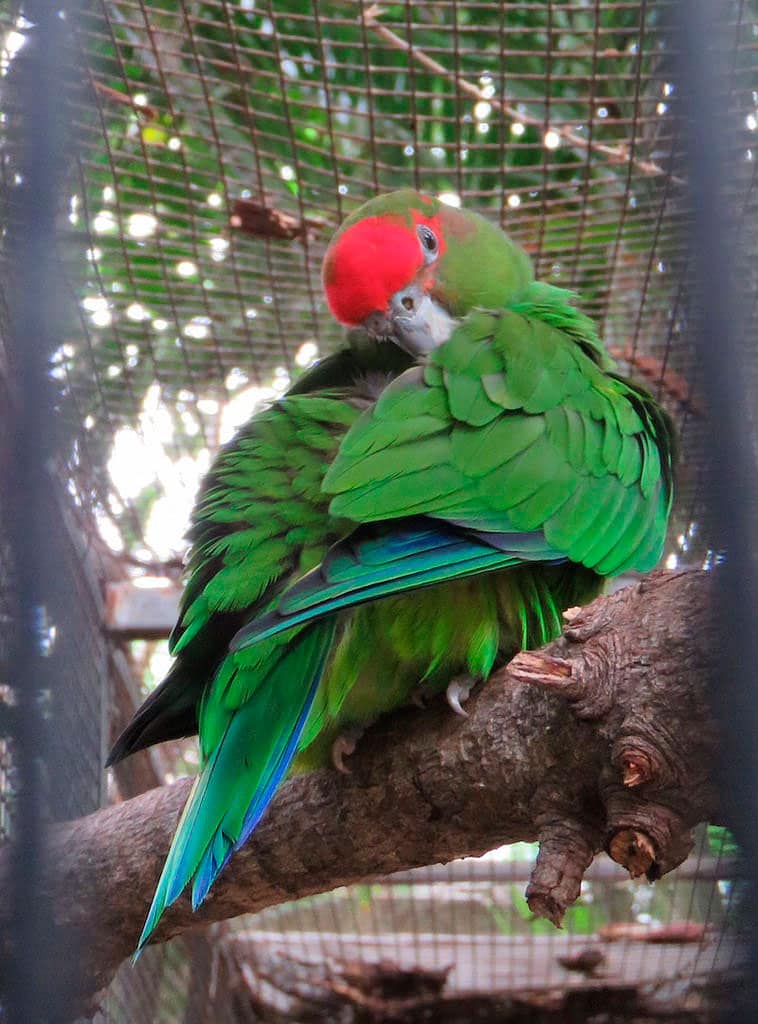
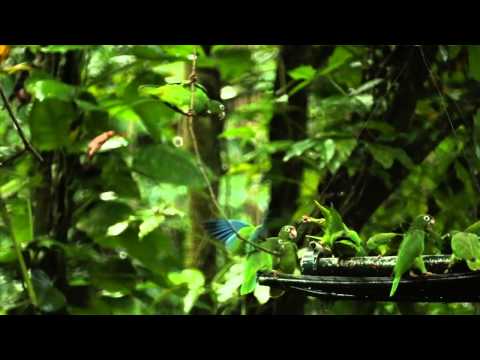
The Pileated Parrot(Pionopsitta pileata) has the forecrown, lores, crown anterior upper cheeks to behind eyes, bright red; patch reddish brown in ear-coverts; the lower cheeks, sides and rear of the neck, green.
The upperparts, green. Primaries and greater coverts, alula and feathers bend of wing, violet blue; other coverts, green. Outerwebs of the primary and secondary, violet blue with blue-green edges. Under, the wings bluish green, coverts with some darker blue feathers. Underparts green with bluish tint in the chest and throat, and with a yellowish tint in the belly and undertail-coverts. Upper, the tail centrally green, laterally violet blue; undertail, bluish green.
Bill dark brown, becoming dark horn distally in both jaws; bare periophthalmic naked, pale grey, irises and legs, grayish brown.
The female has most of its head green but with a pretty pale blue in the forecrown.
Immature as female, but with grayish green or green spots and dark spots on the base bill; young male sometimes with red limited in forecrown with a patch orange behind.
Sound of the Pileated Parrot.
Habitat:
They inhabit in forests, including humid tropical forests and forests dominated by araucarias, mainly in lowlands in the south of the mountain range, although penetrating the coastal mountains Brazil, at altitudes of 300 to 1.500 m; also in areas partially cleared. gregarious in groups of approximately 10 birds; apparently rare in greater numbers.
Reproduction:
They nest in the cavities of trees. probably reproduce mainly in the months of November to January. Clutch 3-4 eggs in captivity.
Size of its range (breeding/resident ): 1.650.000 km2
The Pileated Parrot It is located in southeast Brazil, to the South of Bay, through the belt of the Atlantic forest in Espirito Santo, probably east of Minas Gerais, Brazil, Rio de Janeiro, São Paulo, Paraná and Santa Catarina, until Rio Grande do Sul, extending to the east Paraguay and northeast of Argentina in Missions and possibly in Currents (no recent records); also they have been reported east of Chaco in Argentina, where they can arrive as an irregular visitors.
Some seasonal movements occur Paraná, where birds leave the inland coastal plateau after breeding, and in Paraguay where it is in Amambay in October.
Nomad in the Intervales State Park of São Paulo. Its population is widespread but declining due to the extensive loss of forests by urban growth, agriculture and mining.
Described as uncommon to fairly common in Missions, Argentina. Apparently its population is still not at risk due to habitat loss, since birds are still quite numerous where fragments of forest remain. (for example, east of Paraguay) and travel between them on land without trees. More numerous are more extensive where the remains of forest, It is more common in eastern Paraguay and adjacent Paraná and São Paulo in Brazil.
Conservation:
• Current category of the Red List of the UICN: Least concern.
• Population trend: Stable.
Rationale for the Red List category
This species has a very large range and therefore it is not close to the thresholds for Vulnerable under the criterion of size range (Extension Occurrence <20,000 km2 combinada con un tamaño de rango decreciente o fluctuante, extensión / calidad de hábitat o tamaño de población y un pequeño número de lugares o fragmentación severa). La demographic trend appears to be stable and, therefore, the species does not approach the thresholds Vulnerable under the criteria of population trend (> 30% decline over ten years or three generations). The population size It has not been quantified, but it is not believed to be close to the thresholds for Vulnerable under the criterion of population size (<10.000 individuos maduros con un descenso continuo estimado> 10% in ten years or three generations or a population structure). For these reasons the species is evaluated as the least concern.
Justification of the population
The size of the world's population has not been quantified, but this species is described as «Rare» (Stotz et to the., 1996).
Justification of trend
They suspected that the population is stable in absence of evidence of any decline or threatens substantial.
– Avibase
– Parrots of the World – Forshaw Joseph M
– Parrots A Guide to the Parrots of the World – Tony Juniper & Mike Parr
– Birdlife
– Photos:
(1) – Pileated Parrot Loro Parque – Tenerife (Spain) by Florin Feneru – Flickr
(2) – Pileated Parrot Loro Parque – Tenerife (Spain) by Florin Feneru – Flickr
(3) – Pileated Parrot Loro Parque – Tenerife (Spain) by Florin Feneru – Flickr
(4) – Pionopsitta pileata by Taguató yetapa – Flickr
(5) – Red-capped parrot (Pionopsitta pileata) – «Cuiú-Cuiú» Campina Grande do Sul | The Birds of Brazil by Ben Tavener – Flickr
(6) – Catita Cabeza Roja by Argentavis – Birds of Argentina
▷ The world of Pets: Dogs, cats, birds, reptiles, amphibians
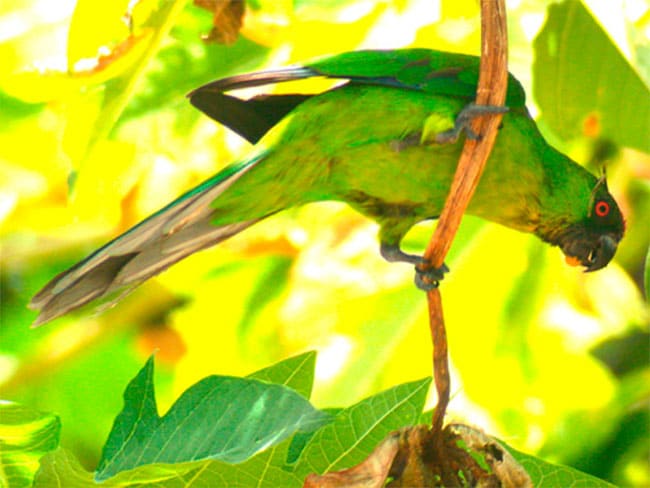
The Ouvea Parakeet(Eunymphicus uvaeensis) is similar to the Horned Parakeet(Eunymphicus cornutus) but with the face and nape green, no yellow, and crest upturned six pens greenish black: the Red of the crown It is limited to the center forecrown.
The Ouvea Parakeet generally bright mid-green. Head green, lighter on ear-coverts with some light shaft-streaks; centre of forecrown red with six wispy blackish-green uperwing feathers forming a small crest; rear-crown darker green; ears and cheeks dark green lower.
The upperparts light green, paler on rump. Wing coverts green; outerweb of primaries greenish-blue with innerwebs black. Underwing-coverts green. Underparts light yellowish-green. Uppertail green with a slight blue suffusion distally and blue edges to lateral feathers; undertail gray.
Bill blue-gray at base, blackish toward tip; irises orange; legs grey.
Both sexes similar.
Taxonomic status:
This taxon is considered a subspecies of Eunymphicus [cornutus or uvaeensis] (sensu lato) by some authors
Sound Uvea Parakeet.
Note:
some species, as in the case of Ouvea Parakeet, They are subject to extreme stress due to traps or harassment. The open availability of high-quality recordings of these species may make the problems even worse.. For this reason, transmission and download of these recordings is off. Recorders are free to share in xeno-edge, but they will have to approve access to these recordings.
We do not take this action lightly, and we wish it wasn't necessary, but we are convinced that the negative impacts of offering easy access to these recordings outweigh the benefits. To access these recordings, You can contact directly with the recorder.
Habitat:
It is restricted to areas of old growth forest with holes for nesting, but the highest numbers occur near papaya plantation areas.
The Ouvea Parakeet They are active in early morning and late afternoon, and usually rest in the trees during the heat of the day.
Reproduction:
An average of 2.9 Eggs are laid in one or two broods per year, of which 1.7 chicks hatch, but only 0.75 chicks survive to 30 days (Robinet et al. 1995, Robinet et al. 1996, Robinet and Salas 1999).
Food:
It feeds in the forests and crops of cultivated land adjacent. The Ouvea Parakeet It depends mainly on mature native forests with pines kauri Agathis australis.
Fruits of Ficus spp., there Canaria, scrub and passion fruit. Also forage for seeds. The cultivated papaya (Carica papaya) It is a favorite.
The species is found in isolated patches of forest now restricted to the coast, mainly in the district St Joseph between Cape Rossel and Cape Steep. Single 15-25 km2 of suitable habitat was considered to remain on the island in 1993, with about 70-90 birds present, although a more thorough study has suggested a total population of 617 individuals. More recent studies is estimated at 1.780 mature individuals in total (Theuerkauf s suffering. 2016)
In the past, the reduction of individuals to extensive conversion of forests for agriculture due, hunting and trade. The delicate political situation in Uvea, while Kanak Liberation Front struggle for independence France, It has hampered the work of conservation of the species.
It is relying on a captive breeding program based on Forest Park, about Noumea, in New Caledonia. Transfers from island to island also be considered feasible.
Conservation:
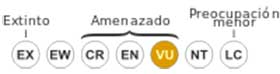
• Current category of the Red List of the UICN: Vulnerable.
• Population trend: Growing.
• Population size : 600-1800 individuals.
Rationale for the Red List category
This species is classified as Vulnerable because it is in one very small island and can be threatened by invasive species, in particular the Black rat, that could bring the species to the category of Critically Endangered or Extinct in no time.
Justification of the population
The population is estimated at 1.780 mature individuals in total (Theuerkauf s suffering. 2016), rounded here to 1.800 mature individuals.
Justification trend
Barré et al (2010) reported that the population has increased in a 29% (of 10 birds / km2 34 birds / km2) between 1993 and 2009, which equates to an increase in population 34% in three generations.
Conservation Actions Underway
1 – Appendix I and II of CITES.
2 – The Association for the Protection of Perico Ouvea (ASPO) It was created in 1993 with members mostly local.
3 – ASPO initiated a long-term study of the biology and ecology of the species as the basis for two recovery plans. (1997-2002 and 2003-2008).
4 – Forest loss is being addressed through awareness programs and community trials to mitigate habitat degradation and improve the quality of forests, particularly in regard to nesting sites.
5 – Ten guides are used, whom, among other tasks, nests located.
6 – Illegal trade is being addressed successfully through increased awareness and enforcement.
7 – A captive breeding program has been discussed, but it hasn't started yet, and the species is found only in small quantities in captivity for a very limited reproductive success (Tap 1996).
8 – In 1998 translocation program began to repopulate southern Ouvea, and the number of birds in the south was 395 individuals in 2011 (Theuerkauf s suffering. 2016).
9 – Black rats were trapped on the island (Theuerkauf s suffering. 2016) and predator control is important.
10 – In 2003 a recovery plan was drawn updated, in which it recommended, among other things, the translocation program was canceled, since the population is considered viable and grow naturally; this Recovery Plan has been accepted by the local indigenous authorities (N. Barré a slightly. 2003, Anon 2004).
11 – Ouvea has been classified as IBA, but a management plan and a protection program involving the communities have not yet been established (Spaggiari et al. 2007).
12 – SCO obtained funding from the British Bird Watching Fair to build and test artificial nests PCV after the failure of trails wooden nest.
13 – ASPO personnel destroyed or removed 187 bee colonies between 2002 and 2008 (L. Verfaille a slightly. 2007, Barré et al. 2010).
14 – The continued presence of local guides is believed to effectively prevent nest poaching. (Barré et al. 2010).
Conservation Actions Proposed
1 – Continue population monitoring (Primotel 2000).
4 – Review and strengthen measures to control predators.
5 – Assess progress and update plans for translocations.
6 – Review and update all aspects of the Action Plan.
7 – Maintaining the momentum of awareness and participation of the community and the island (Robinet and Salas 1997).
8 – Establish a project IBAs in Ouvea and fund a protection program (N. Barré a slightly. 2003).
9 – Start a captive breeding program to support future reintroductions.
10 – Carry out surveillance screening BFDV to guide future efforts biosecurity and conservation, and better understand the risk posed by BFDV (Jackson et al. 2014).
"Ouvea Parakeet" in captivity:
The Ouvea Parakeet they are still captured using a rope inside a fruit Upload papaya, and because the island is a plain, exports through an easily accessible atoll are difficult to control. Birds bought from trappers by 50 dollars can be sold by traders up 1.000 Australian dollars.
There is a captive breeding program, but it hasn't started yet, and the species is found only in small quantities in captivity for a very limited reproductive success (Tap 1996).
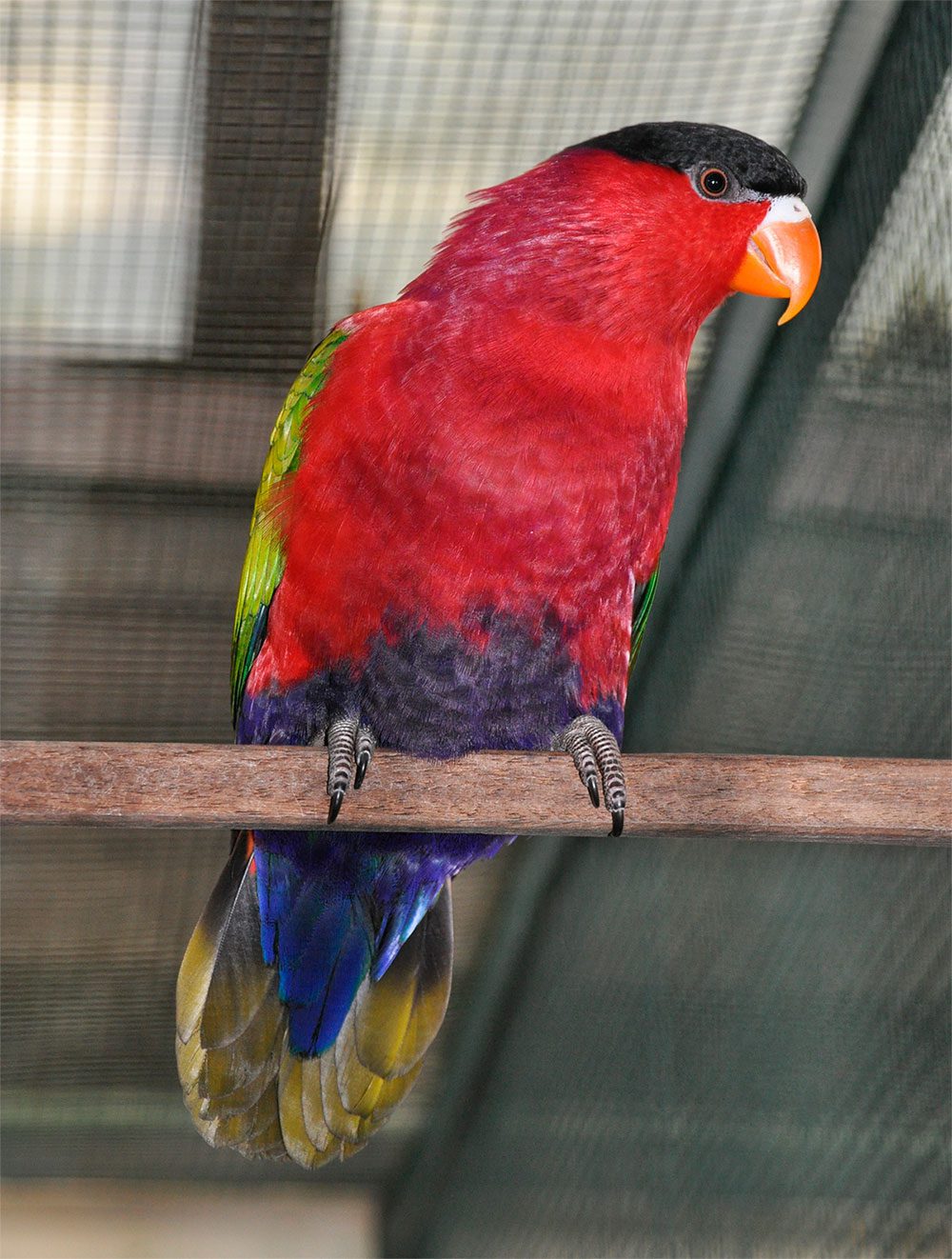
The Purple-bellied Lory(Lorius hypoinochrous) has an approximate length of 26 cm.. with a weight ranging between 200 and 240 g..
Hood black in color with blue purple sheen extending to the rear of the nape; rest of head red. Upperparts completely red with a band dark variable on the the mantle; upper mantle slightly more purple that the rest of them upperparts. Primary coverts Bluish; remaining wing
Green with the internals of the flight feather in black color. Rojas the wing-coverts with black tips. The flight feather show a large patch yellow in the part internal.
Throat and chest, red, getting more purple towards the top belly; part low belly, the thighs and coverts, dark purple-blue. The parties above of the tail basically red, with the final part in dark blue (appears only teal at rest); undertail, opaque yellow with red hidden base.
Bill orange; cere (waxy soft swelling, containing the nostrils, at the base of the upper beak) white; Iris orange; legs black grey.
There is no significant difference between males and females. In general, the male has a bill a little stronger than the female.
The juveniles has belly pale purple color and peaks are more brownish.
(Rothschild & Hartert, 1918) – Difference with the species rated by the fact of that has the chest the same red that the upper part of the abdomen.
Habitat:
Unlike in the Black-capped Lory, often found in coconut, mangroves and coastal vegetation (especially fond of coconut flowers); the Purple-bellied Lory also frequents low forests, the edges of these, high secondary forests, inhabited or partially cleared areas and gardens. Found individually, in pairs or in small groups of up to 10-20 birds. Ruidoso, visible and Active, they often live in trees or just above the canopy.
In the Island of Papua, they are distributed by the lowlands and foothills, in New Britain up to at least 450 m, in New Ireland until 750 m (where is sympathetic with the White-naped Lory) and up 1.600 metres in the Goodenough island.
Virtually nothing is known of the reproductive ecology of this species., Although is has been able to observe to them males in a, apparent, participation in the cortejo, with repetitive stretching of the neck and movements side of the head.
Reproduction:
Due to its extreme rarity, We know little about their reproductive behavior.
It is likely to be very similar to the of the Black-capped Lory(Lorius lory). This means a spawning two eggs and a incubation period of about 26 days.
Food:
The Purple-bellied Lory It feeds mainly in the canopy in noisy groups. Its diet natural consists of pollen, nectar, flowers, fruits, insects and their larvae, and probably seeds.
Usually see, sometimes, feeding is in company of the Sulphur-crested cockatoo and the Eclectus Parrot.
Distribution:
Size of the area of distribution (reproduction / resident): 61.900 km2
The Madarasz's Tiger-Parrot (Psittacella madaraszi) is very similar to the Modest Tiger-Parrot.
Head brown, slightly paler in the cheeks and ear-coverts because of the light streaks; crown strongly mottled in color yellow, the throat It also shows some pale yellow stains. Mantle and back green, with good dark edges to the feathers; rump with alternation of yellow-green and black. Wings green, marked in blue in curve and along the leading edge; flight feather Blackish with vane Green external, showing a thin yellow margin. Wing feathers light green, underside of flight feather with broadcasting yellow in vane inner. Throat and top of the chest grey-brown; rest of the underparts slightly yellowish-green, paler than upper parts, with the exception of uppertail-coverts red. Upper, the tail green, by down blackish.
Bill grey-blue, White at the tip; irises reddish brown; legs grey.
The female has the head green with front of the crown bluish and heavily barred black and orange pink nape. The rest of them upperparts are slightly more barred that in the male, and underparts are of color green uniform, lack of the colour brown of the throat and the top of chest.
The young birds they are similar to females.
Subspecies
Psittacella madaraszi major
(Rothschild, 1936) – Of approximately 15 cm.. length. The only difference is that it is slightly larger.. The same as the nominal species female.
Psittacella madaraszi hallstromi
(Mayr and Gilliard, 1951) – Of approximately 14,5 cm.. length. Usually more dark and yellow paths from the back of the head and neck more narrow. Females with the black Crown and broad green bordered Orange will be making them by the back of the head.
Psittacella madaraszi huonensis
(Mayr and Rand, 1935) – Of 14 cm.. length. It has the Crown of yellowish-brown. Females have the Crown, neck and back green.
Habitat:
The Madarasz's Tiger-Parrot, usually lives below the Modest Tiger-Parrot. The two two species overlap, usually in the Strip between 1.200 and 2.500 m, Although less numerous the of Madarasz.
It inhabits forests, in secondary vegetation and occasionally cleared areas, being particularly fond of the forest of beech Nothofagus.
It is a quiet species, slow and inconspicuous. You are often seen sitting in pairs on the lower floors of forests, making rash calls at sunset.
Reproduction:
Little is known of their reproductive ecology., but they have been observed in breeding conditions in the month of June.
Food:
It feeds on seeds, fruit, tough berries and leaves pulp, eat alone or in pairs at different levels within the forest. Have you noticed them is, feeding, in the company of Painted Tiger-Parrot.
Distribution:
Size of the area of distribution (reproduction / resident): 193.000 km2
New Guinea from the mountains in the center of Irian Jaya, Indonesian, through the central mountains of Papua New Guinea, up to the mountain ranges to the South-East, with an isolated population in the Highlands of the Huon Peninsula. The world's population is considered to be more of 50.000 specimens.
Subspecies distribution:
Psittacella madaraszi major
(Rothschild, 1936) – present in the West of its range mountains;
Psittacella madaraszi hallstromi
(Mayr and Gilliard, 1951) – occupies the central mountains of New Guinea;
Psittacella madaraszi huonensis
(Mayr and Rand, 1935) – is located in the northeast of New Guinea (mountains of the huon peninsula).
Conservation:
• Current category of the Red List of the UICN: Least concern
• Population trend: Stable
The size of the world's population has not been quantified, It is estimated in more than 50.000 specimens. The species, according to sources, It very rare in its area of distribution (pit et to the. 1997).
The population suspected to be stable in the absence of evidence of any reduction or substantial threats.
"Madarasz's Tiger-Parrot" in captivity:
Not found in captivity.
Alternative names:
– Madarasz’s Tiger-Parrot, Madarasz’s Parrot, Madarasz’s Tiger Parrot, Madarász’s Tiger Parrot, Maderasz’s Parrot, Plain-breasted Little Parrot, Plain-breasted Little Tiger-Parrot (ingles).
– Perruche de Madarasz (French).
– Madaraszpapagei, Madarasz Papagei, Maderaszpapagei, Schuppenkopfpapagei (German).
– Psittacella madaraszi (Portuguese).
– Lorito de Madarasz, Lorito tigre de Madarasz, Lorito-tigre de Madarasz (español).
scientific classification:
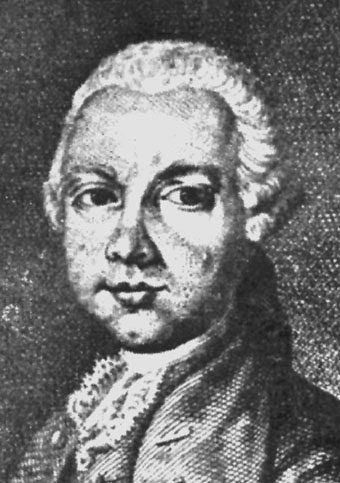
Its scientific and common names commemorate the Hungarian ornithologist Gyula von Madarasz
“Lorito tiger of Madarasz» (Psittacella madaraszi)
Sources:
– Avibase
– Parrots of the World – Forshaw Joseph M
– Parrots A Guide to the Parrots of the World – Tony Juniper & Mike Parr
– Wikipedia
– Birdlife
– Loromania
Origin: Cameroon, Chad, Central African Republic, Sudan, Ethiopia, Uganda, Kenya, Democratic Republic of the Congo, Tanzania, Malawi, Zambia, Angola, Botswana, Mozambique, Namibia, South Africa
Character: Shy
Life expectancy: 35 years
Height: 21 cm..
Content
Description:
21 cm. and a weight of 100-130 g..
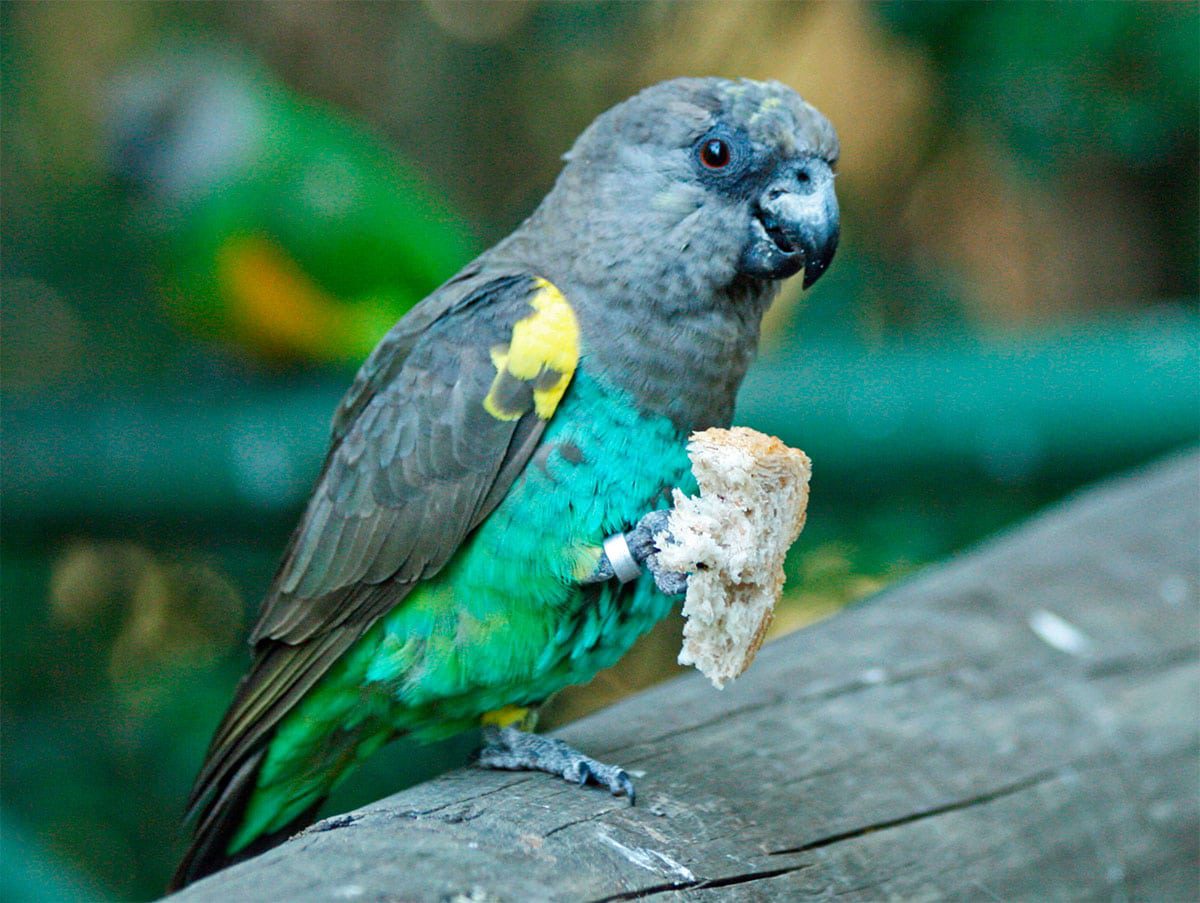
The Meyer's Parrot(Poicephalus meyeri) has the forecrown, lores, cheeks, ear-coverts and ash Brown nape; crown bright yellow. The mantle feathers ash brown edges blue or cyan dye in some birds; scapulars brown ash, some individuals show Tips blue or greenish blue; rump bright turquoise or teal; uppertail-coverts green. Outermost children and wing-coverts above bright yellow, other variables showing green tints, especially towards Tips. The primaries and high schools ash Brown with paler narrow margins to vane outer.
feathers of the wings, undertail, bright yellow in some birds, but grayish-brown in larger in other. The chin, the throat and top of the chest brown ash; remaining chest and belly turquoise or teal; the thighs yellow; undertail- coverts turquoise blue or greenish blue. Tail brown ash.
Bill dark gray or black; cere black; irises orange-red; periophthalmic skin desnuda negruzca; legs blackish.
Both sexes similar.
Youth more generally greenish brown. No yellow in the crown or the the thighs and the yellow area in the wings, at the top, It is lower. Wing coverts, undertail, green and brown with little or no yellow. The underparts más greenish. Iris dark brown.
(Neumann, 1898) – No Yellow crown. Paler than subspecies reichenowi. Intergrades with transvaalensis subspecies in the region of the delta del Okavango, Botswana and with subspecies reichenowi in Angola.
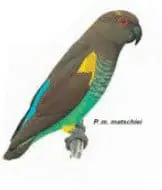
matschiei by Parrots of the World – Forshaw Joseph M
Poicephalus meyeri matschiei
(Neumann, 1898) – Brown is paler than in the subespecie satisfied and cyan dye to the margins of the scapulars less pronounced than in the species nominal. Green colors are blue (especially below). The female spot shows yellow feathers at the base of the lower jaw.
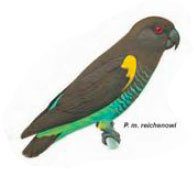
(Neumann, 1898) – Similar to the subespecie matschiei but with the yellow crown generally absent. Paler blue in the rump. Size larger than the subespecie matschiei.
reichenowi by Parrots of the World – Forshaw Joseph M
Poicephalus meyeri saturatus
(Sharpe, 1901) – darker than species nominal (especially the brown parts), rump less blue than the nominal, showing a bit of green in the feathers. The dark centers feathers on the bottom, giving it a mottled appearance. Intergrades with the subspecies matschiei in Tanzania.
Poicephalus meyeri transvaalensis
(Neumann, 1899) – Brown clearer than in the subespecie matschiei, even bluer in the rump and below. Yellow areas in the crown They are often reduced and, sometimes completely lacking (especially in males). It is thought that can hybridize with the Poicephalus cryptoxanthus.
Habitat:
The Meyer's Parrot It is found in a wide variety of forest habitats from dry savannah to gallery forest and second-growth riparian forest around crops.. Observed in forests dominated by Terminalia laxiflora and Doka Isoberlinia, thickets Combretum acacia grasslands; as well Brachystegia and riparian forests Syzygium-Adina.
Avoid lowland rainforests in the basin Congo and other humid forests including areas of the eastern highlands of the district of Zimbabwe and Cork in Malawi.
Show a preference for the tallest trees in the drier savannah habitats – in particular specimens Adansonia. They may be confined to gallery forests in the drier parts of their range and are generally found in close proximity to water..
Where it is sympatric with the Red-bellied Parrot (Poicephalus rufiventris), the Meyer's Parrot It is limited to riparian forests.
In Kenya, which it is largely in areas with higher annual rainfall 500 mm.
Sometimes observed in suburban areas.
In general, in the lowlands at altitudes of 1,250m in Ethiopia, 2.200m in east Africa and 1.500 meters in the highlands of eastern Zimbabwe.
They are distributed in pairs or small groups 3-5 birds (possibly couples); until 50 birds may congregate in areas where there are food sources in breeding season. Roosts in tree cavities. Usually shy and cautious.
Reproduction:
Solitary nesters in tree cavities at a height between 3 and 10 meters above the ground, during the season, dry (for example Mar-June Zimbabwe, from May to September Zambia and Malawi, July Angola and in December or January Sudan).
The pulp of the fruit is less important than the hard seeds and the arbolados share, the Meyer's Parrot is one of the few species consume seeds Brachystegia and other leguminous trees.
They also consume grain and is considered as crop pests in some areas.
Eat some insects, including caterpillars.
May vary widely from area to area in search of food during droughts.
Distribution:
Size of the area of distribution (reproduction / resident): 5.840.000 km2
The Meyer's Parrot They are distributed throughout the central and eastern Africa. From the North-East of Cameroon and South of Chad through the North of the Central African Republic, center Sudan and South and West Ethiopia, to the south through Uganda, Kenya Western, east of Democratic Republic of the Congo and Tanzania, coming to Malawi, Zambia, Angola, Northeast of Botswana, Zimbabwe, western end of Mozambique, Namibia and northeast of Sudafrican republic.
A wild population, possibly, is distributed in the eastern province of Cape Town, Sudafrican republic, even if they are probably extinct.
Nomad in some areas during periods of drought, when they distributed outside the normal range; normally resident with local movements.
Distribution Subspecies
Meyer's Parrot subspecies distribution
Poicephalus meyeri damarensis
(Neumann, 1898) – South of Angola, Northeast of Namibia and North of Botswana.
Poicephalus meyeri matschiei
(Neumann, 1898) – Southeast Kenya through eastern and central Tanzania to Southeast Democratic Republic of the Congo, North of Malawi, Zambia and northeast of Angola.
(Neumann, 1898) – North and Central Angola from Malange and sierra central until Huila, possibly also adjacent parts of the Democratic Republic of the Congo
Poicephalus meyeri saturatus
(Sharpe, 1901) – The Far East Democratic Republic of the Congo, through Burundi, Rwanda and east of Uganda, in West and Central East Kenya towards Meru and Local inside Tanzania to the South of the Parque Nacional Ruaha.
Poicephalus meyeri transvaalensis
(Neumann, 1899) – Areas of northern and central Mozambique to northern Save River across the South of Zambia and central and southern Zimbabwe to northeast Botswana and West of Transvaal
The Meyer's Parrot It, in general, common to very common and is the most abundant parrot in some parts of its range (for example, Zimbabue and Angola), although few in other areas and absent from some apparently suitable habitats.
Its population has declined in some parts (for example Transvaal) where is thought to be a result of habitat destruction. I also persecuted in some locations due to crop damage (for example, in the center of Zambezi because of the damage inflicted to the maturation of the berries Boolean).
"Meyer's Parrot" in captivity:
The Meyer's Parrot, is a bird common in captivity, quiet, tender, easy to carry and with a stable temperament.
They are birds social and they tend to bond with everyone in the family, unlike other species that may prefer one person to another. In general, No es voluble – once you liked someone, the person is a friend for life.
They are not as dependent on humans for entertainment as most parrots and therefore no son tan demanding.
They like being handled and petted on the head and neck. A hand-fed hatchling will develop into a fluffy adult if treated properly, and it is not prone to bite, although it may provide a powerful bite if provoked.
You can learn a few words, although They are not known for their ability to speak. They can learn to whistle, making noises, and occasionally they will offer strong squeals. Fortunately, They are not likely to scream or make loud squawks, making good birds for apartment life. Some individuals learn household noises, as the beep of the microwave.
The Meyer's Parrot they are ready to breed at the age of 3 to 4 years and reproduce easily in captivity.
With regard to its longevity, according to sources, Meyer lived a parrot 34,2 years in captivity.
Alternative names:
– Meyer’s Parrot, Brown Parrot (English).
– Perroquet de Meyer, Perroquet brun, Youyou de Meyer (French).
– Goldbugpapagei, Goldbug-Papagei (German).
– Papagaio de Meyer, Papagaio-de-meyer (Portuguese).
– Lorito de Meyer (español).
– Avibase
– Parrots of the World – Forshaw Joseph M
– Parrots A Guide to the Parrots of the World – Tony Juniper & Mike Parr
– Birdlife
– Photos:
(1) – A Meyer’s Parrot at Birds of Eden, Western Cape, South Africa. It is eating what looks like a piece of bread By SandyCole (mailto:sandyc@dicksandy.org) (Own work) [CC BY-SA 3.0 or GFDL], via Wikimedia Commons
(2) – Two Meyer’s Parrots in Zimbabwe By Oce Eeco (DSC_0108Uploaded by snowmanradio) [CC BY 2.0], via Wikimedia Commons
(3) – Brown parrot also known as Meyer’s Parrot (Poicephalus meyeri) by Papooga – Flickr
(4) – A Meyer’s Parrot near Kwara Camp, North-West District, Botswana By Benjamin Hollis from Seattle, WA, USA (Meyer’s parrotUploaded by snowmanradio) [CC BY 2.0], via Wikimedia Commons
(5) – A Meyer’s Parrot in Akagera National Park, Rwanda By Lip Kee Yap [CC BY-SA 2.0], via Wikimedia Commons
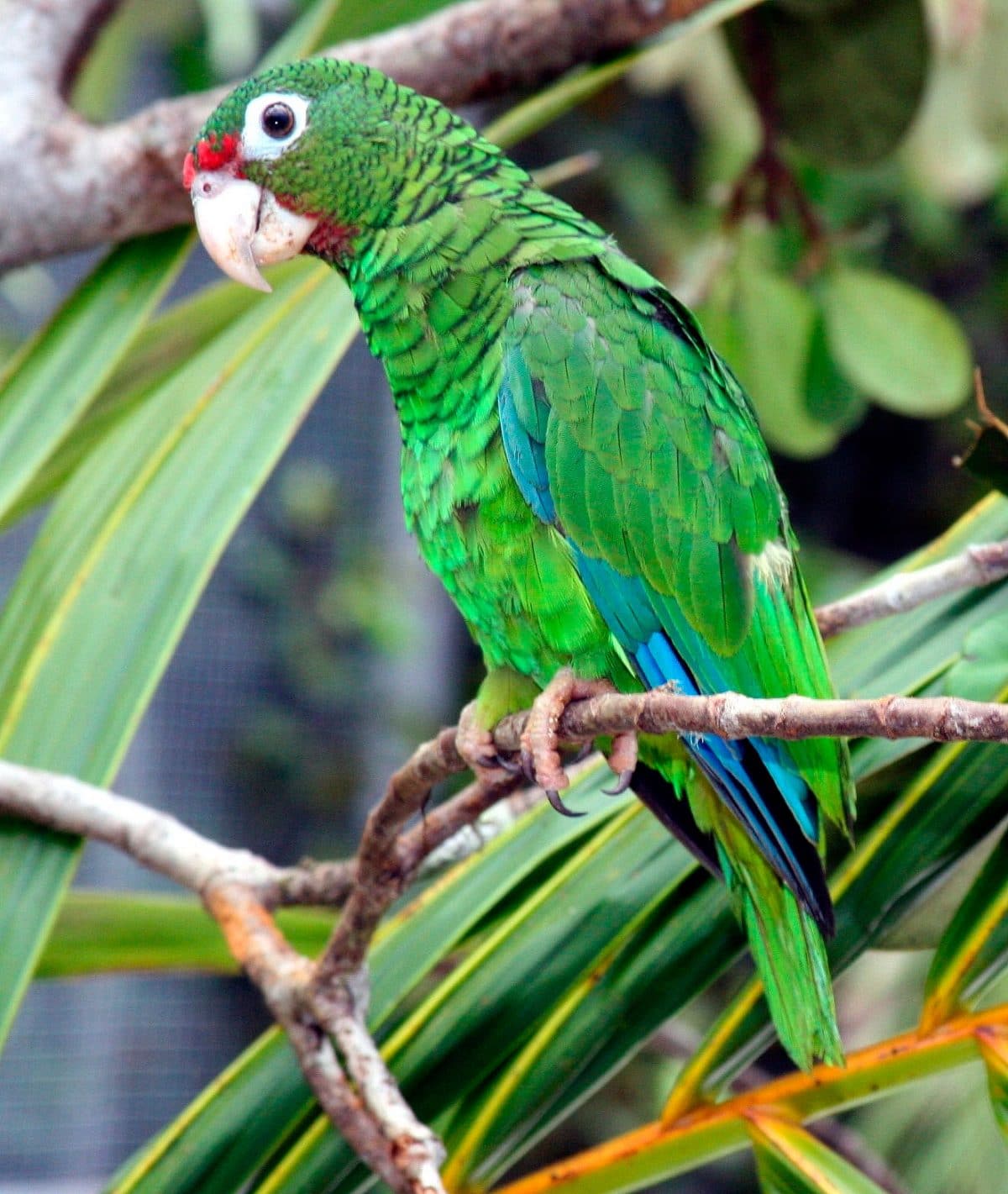
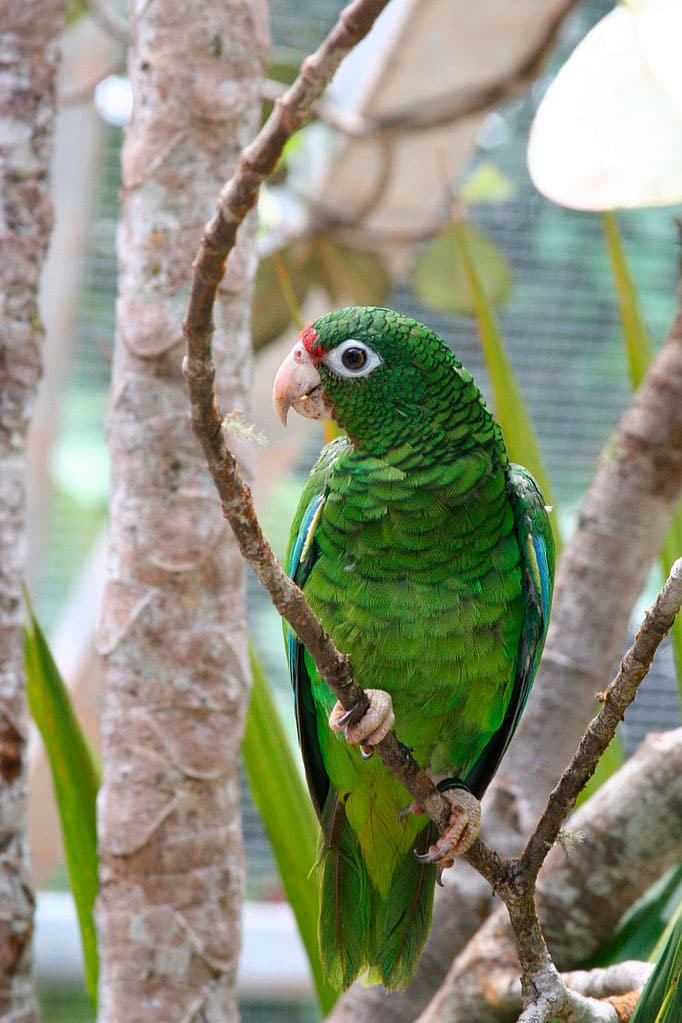
The Puerto Rican Parrot(Amazona vittata) has the forecrown and lores, red; rest of the head and nape, feathery green grass bordered with black color, giving a strong intricate scaly appearance.
feathers of the the mantle grass-green; back and scapulars with less pronounced dark margins; rump and uppertail-coverts, paler, more green-yellow. The large external coverts they are blue; rest of the coverts color green grass. Primaries and outerweb of the outer secondaries, blue; the innerwebs of the external side and secondary internal, green. Under, the wings They are green and flight feather bluish green.
Underparts green stained yellowish; feathers throat and the chest with dark edges. Upper, the tail is green; below is more yellowish, with its end yellow; both with outerweb blue towards outer feathers. Bill color pale horn; brown the irises; legs pale grey.
Both sexes similar. Immature adult-like, but with the bill light yellow with gray on the basis of upper jaw.
Sound of the Puerto Rican Parrot.
Description 2 subspecies:
Amazona vittata gracilipes †
(Ridgway, 1915) – Extinct. Of smaller and with feet smaller and thinner than the species nominal.
The Puerto Rican Parrot formerly he frequented the main types of natural vegetation (various forest habitats, from mangroves to montane forests) in Puerto Rico, with the possible exception of dry forests in the southern coastal regions.
Its Current small population remainder inhabits the mountain rainforest to 200-600 m. In the lower mountain slopes dominated by trees tabonuco of the species Dacryodes excelsa, in swampy forests at higher elevations characterized by the abundance of Cyrilla racemiflora and areas Sierra palmPrestoea montana.
Observed in pairs or (especially when they fed) in small flocks, having formed, formerly, flocks of several hundred.
Reproduction:
The Amazona Puerto Rican nidifican in large and deep cavities of trees; in the past they put their nests in the limestone hollows, in the west of the island. The amazon of Luquillo usually nest in species Cyrilla racemiflora. They defend their territory aggressively in the vicinity of the nest while playing. The egg laying, between February and April, possibly to coincide with the availability of fruit. Clutch 2-4 eggs (usually three).
Since 2001, all nesting known in the wild they have occurred in artificial cavities (White et al ., 2006).
Food:
The diet of the Puerto Rican Parrot It consists of a variety of fruit, seeds, flowers and leaves, among which include fruit of Prestoea montana and Dacryodes excelsa, flowers of Piptocarpha tetrantha and bracts of Marcgravia sintenisii.
Distribution and status:
Size of its range (breeding/resident): 1.000 km2
The Puerto Rican Parrot It is endemic to Puerto Rico and the former neighboring islands Mona and Snake; there are reports of parrots Vieques and St Thomas, probably belonging to this species. Formerly found in all forested regions Puerto Rico (with the possible exception of dry coastal strip south), but from around 1960 their habitat was limited to the Luquillo forest, in the East.
drastic population decline and rank the mid-nineteenth century. The pre-European population was probably hundreds of thousands of birds. There was a dramatic decline, which it reduced its population to about 2.000 copies in 1937 and in 1950 they were only a 200: a search in 1968 only revealed the existence of 24 birds.
The conservation program, initiated in 1968, It includes captive breeding, the provision of nests, detailed investigation ecology and reproductive biology and the control predators and competitors.
In 1992 the wild population was 39-40 birds 58 in captivity (all in Puerto Rico). Its population has declined, to near extinction, mainly by habitat loss (in 1912 only 1% the virgin forests of the island they remained), the hunting and capture as pets. The continuing threats to the tiny remaining population include impact of hurricanes (wild population halved to 21-23 after the passage of birds hurricane Hugo in 1989), competition with introduced bees Apis mellifera by tree cavities, the loss of broods due to parasitic flies Philornis pici, losses caused by predators and competition for nesting cavities with Pearly-eyed Thrasher (Margarops fuscatus). The Puerto Rican Parrot, inhabitants of the Culebra island (dubiously separated as subspecies Amazona vittata gracilipes), extinguished early twentieth century, probably because of persecution due to damage of crops and the impacts of hurricanes. existing population protected inside of the El Yunque National Forest.
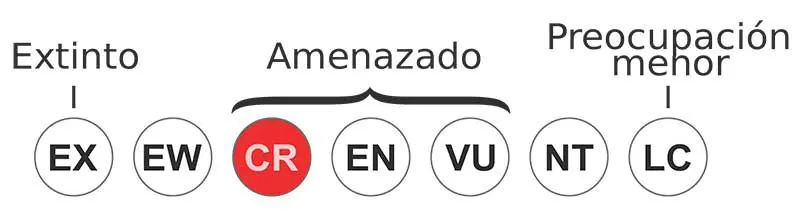
• Current category of the Red List of the UICN: critically endangered.
• Population trend: Increasing.
• Population size: 33-47.
Rationale for the Red List category
Once you have done a count of birds, are only 13 Puerto Rican Parrot in the nature, leaving the species on the verge of extinction. The conservation action the population has increased from 1975, but remains critically endangered because the number of mature individuals is still minuscule. If the released birds breed successfully in nature and the figures remain stable or increase, the species can justify a change of state in the future.
Justification of the population
From 2011, the population was between 50-70 individuals divided into two areas, approximately equivalent to 33-47 mature individuals. In 2013, its population had only increased to 80-100 individuals in the nature (64-84 in Down river and 15-20 in The anvil). But, since the released birds are not counted as mature individuals until they have successfully bred in nature (UICN 2011), and the entire population of Down river It is derived from released birds. The total number of mature individuals is uncertain but may well be less than 50, therefore, estimating 2011 of mature is maintained in this figure.
Justification of trend
It is estimated that increase 1-19% has occurred in the last ten years, based on regular accounts of the total wild population.
Conservation Actions Underway
• CITES Appendix I.
• And Recovery Program the species has involved a partnership between the Fish and Wildlife of the United States, the Forest service of the United States and the World Wide Fund for Nature together with Department of Natural and Environmental Resources of Puerto Rico (White et al. 2012).
• In 1968 an important intervention was initiated to preserve the species, the provision of artificial nests highly successful, the predator control nest and its competitors, and captive breeding and reintroduction.
• The success of the Newborns parrots It monitored using radio telemetry (Meyers 1996).
• All the rest of the habitat is protected in the El Yunque National Forest (above the Caribbean National Forest) (Snyder et to the., 2000) and in the Rio Abajo State Forest (T. White in a little.
• The population is monitored to help inform management decisions.
• The predator control exotic mammals (Entrapment and toxic bait) It has proven to be a highly profitable way to preserve the species (Engeman et al. 2003, 2006, R. M. Engeman in some. 2012).
• Catch data have shown that the Luquillo Forest It has between densities black rat studied highest in the world and optimal strategies have been devised rat bait for application during the nesting.
• Los economic analysis based on empirical costs of production of parrots raised in captivity showed very high cost-benefit ratios for predator management, estimating that preventing a loss of parrot each 4-12 years more than makes up all forms of predator management (for all species) intervention time (Engeman et al., 2003).
• Hay two captive breeding centers, one The anvil which it was established for the first time 1973 with a new facility built in 2007 and one in Down river built in 1989 with the first birds transferred The anvil to Down river in 1993 (White et al 2012).
• About 280 birds are currently in captivity in Down river and The anvil (T. White one bit., 2012).
• Captive birds are being managed to preserve the greater genetic diversity possible.
• A release technique known as precision release was tested with six birds in 2008. This involves the release of a small number of captive-reared subadult parrots into each active nest immediately after chick rearing., and it aims to promote the immediate and close interaction between wild parrots and birds released (T. White in a bit., 2005, 2008).
• Nearly 100 birds have been released the aviary Down river in an attempt to establish a second population, which may be helped by a lower annual precipitation in the site, lower levels of predation and a change in management techniques (T. White in a little. ).
• Although the after release mortality remains high, there has been a successful breeding and the size and range of the flock is increasing (Breining 2009, Valentin 2009, T. White in a little.)
• The newly established population in Down river It is located around the site Aviary of Down river and it is believed that the presence of captive birds encouraged released birds to establish their population close (White et al., 2012).
• Forty specimens were released in The anvil between 2000 and 2004, eight 2008 and six birds in 2010 (Velez-Valentin 2011). In 2013 plans were made to establish a third population on the island in the Maricao State Forest (West of Puerto Rico) (Anonymous 2014).
Conservation Actions Proposed
• Continue to monitor population trends.
• Follow the fate of released birds.
• Maintain the integrated conservation management program.
• Improve synchronization of breeding of wild and captive birds to increase the number of captive-bred chicks that can be fostered by wild parents. (Thompson 2004).
• Integrate control of exotic mammal predators (black rat, small Indian mongoose, wild cats) in the management program and monitor existing conservation predator populations to study the effectiveness of these measures (R. M. Engeman in some. 2012).
The Puerto Rican Parrot in captivity:
According to sources, A copy of Puerto Rican Parrot lived 10,1 years in captivity. But, considering the longevity of similar species, likely maximum longevity is underestimated in this species. In fact, it has been reported that They can live up to 27,2 years in captivity, what it is plausible but has not been confirmed. Taking into account that the Cuban Parrot(Amazona leucocephala), closely related, You can live up 50 years (Wilson, et to the., 1995), an age close to the latter figure may be possible for the Puerto Rican Parrot.
Each captive specimen of this species which is capable of reproducing, must be placed in a well-managed captive breeding program and not sold as a pet, in order to ensure its long-term survival.
Alternative names:
– Puerto Rican Amazon, Puerto Rican Parrot, Red-fronted Amazon, Red-fronted Parrot (English).
– Amazone à queue courte, Amazone de Porto Rico (French).
– Puertoricoamazone, Puerto-Rico-Amazone (German).
– Papagaio-de-porto-rico (Portuguese).
– Amazona Portorriqueña, Amazona Puertorriqueña, Cotorra de Puerto Rico, Cotorra Puertorriqueña (español).
– Avibase
– Parrots of the World – Forshaw Joseph M
– Parrots A Guide to the Parrots of the World – Tony Juniper & Mike Parr
– Birdlife
– Photos:
(1) – Amazona vittata – Photo via Good Free Photos
(2) – A Puerto Rican Amazon By Pablo Torres of U.S. Fish and Wildlife Service Southeast Region (PRParrot_cototrapuertorriqueña byPablo Torres) [Public domain or CC BY 2.0], via Wikimedia Commons
(3) – A Puerto Rican Amazon at Iguaca Aviary, Puerto Rica By Tom MacKenzie ofU.S. Fish and Wildlife Service Southeast Region (Puerto Rican parrot 4) [CC BY 2.0], via Wikimedia Commons
(4) – A Puerto Rican Amazon at Iguaca Aviary, Puerto Rica By Tom MacKenzie of U.S. Fish and Wildlife Service Southeast Region (Puerto Rican parrot 4) [CC BY 2.0], via Wikimedia Commons
(5) – A pair of Puerto Rican Amazons See page for author [Public domain], via Wikimedia Commons
(6) – A Puerto Rican Amazon at Iguaca Aviary, Puerto Rica By Tom MacKenzie of U.S. Fish and Wildlife Service Southeast Region (Puerto Rican Parrot by Tom Mackenzie) [CC BY 2.0], via Wikimedia Commons
(7) – Amazona vittata – Author: Mike Morel, USFWS – pixnio
(8) – Flying Parrot, blue feathers visible By Tom MacKenzie [Public domain], via Wikimedia Commons
(9) – A Puerto Rican Amazon at Iguaca Aviary, Puerto Rica By Tom MacKenzie of U.S. Fish and Wildlife Service Southeast Region (Puerto Rican parrot 1) [CC BY 2.0], via Wikimedia Commons
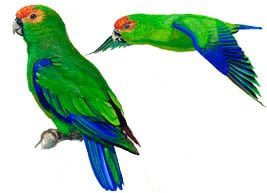
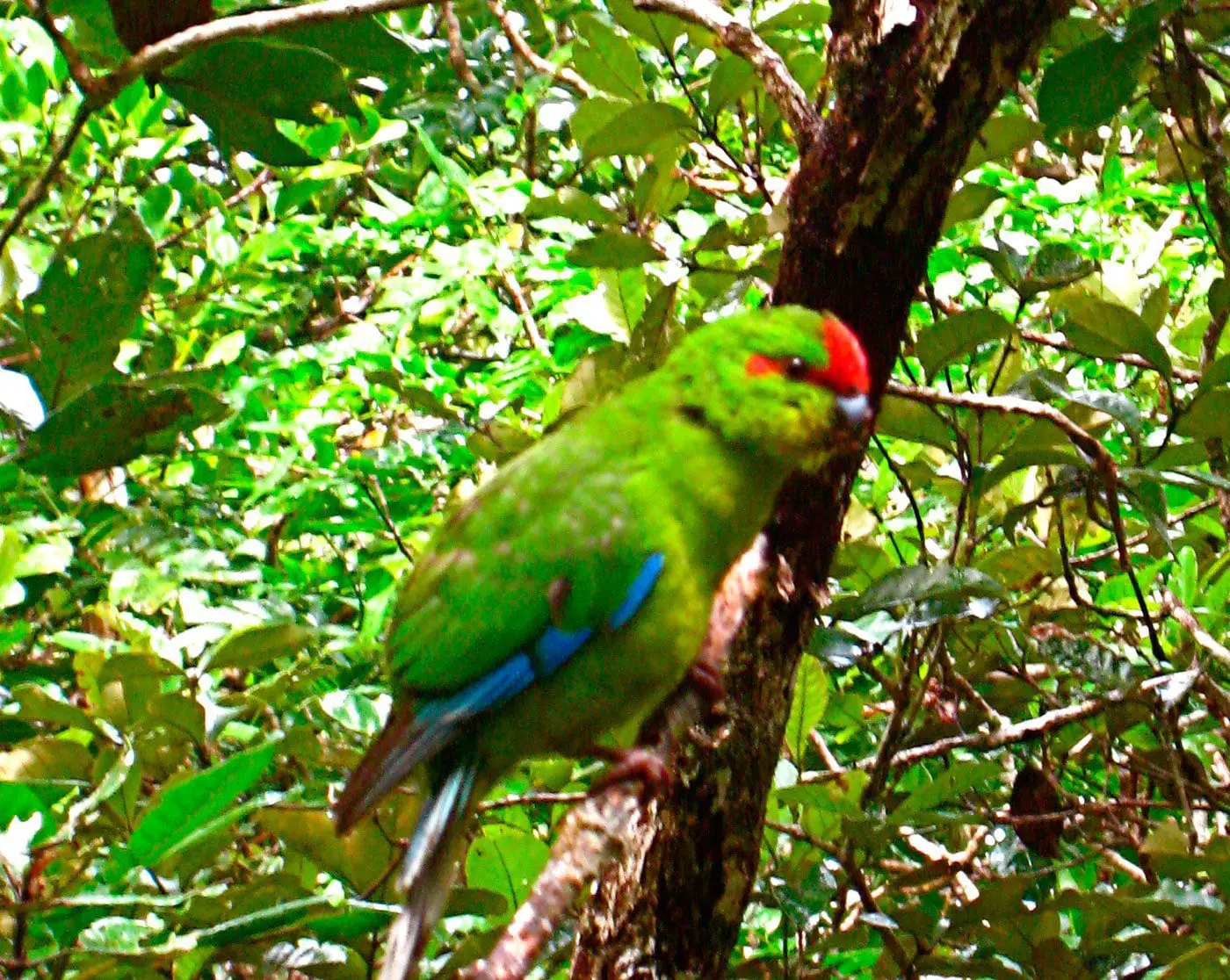
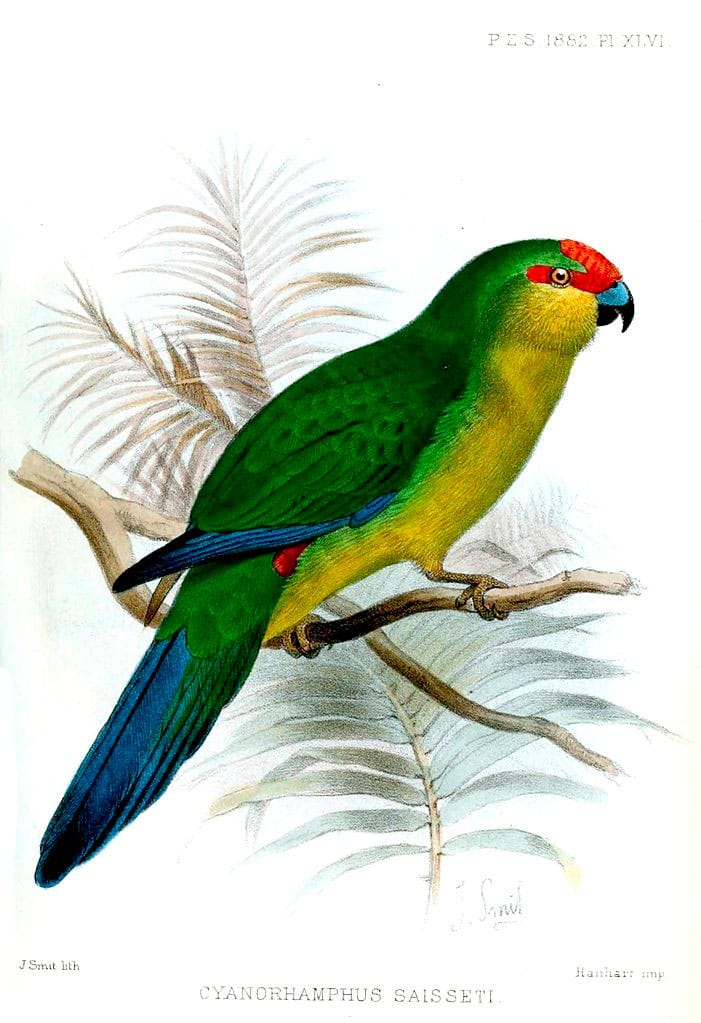
The upperparts of the New Caledonian Parakeet(Cyanoramphus saisseti) they are mostly green, with some bluish green in the tail, violet-blue along the outerweb flight feathers, and red patches on each side of the rump. The underparts are yellowish green, yellower near throat, and gray below tail(Forshaw 1989, Juniper & Parr 1998, Doughty et al. 1999).
A red patch extends from the crown up to the forecrown, and it extends in a narrow band from the forecrown up to the ears(Juniper & Parr 1998).
The bill is leaden gray, with black tips, the irises is red-orange and legs are dark gray. (Layard & Layard 1882b, Juniper & Parr 1998).
The males typically exceed the females in size, although its plumage is similar (Verreaux & walls 1860, Layard & Layard 1882b, Salvadori 1891, Forshaw 1989)
taxonomy:
In the past it was considered to New Caledonian Parakeet conspecific of Red-crowned parakeet(Cyanoramphus novaezelandiae) of New Zealand, but genetic studies have shown that it is a separate species and occupying a basal position on gender Cyanoramphus, which indicates that the genus would have its origin in New Caledonia.
Sound of the New Caledonian Parakeet.
Habitat:
The New Caledonian Parakeet They were primarily fed at low altitudes canopy, and regularly they observed on the edge of the forest, on slopes or in the forest maquis (scrub).
Seem to have small populations and their distributions are expected to shrink as a result of climate change.
They are not particularly shy, although they tend to be rather calm and difficult to observe.
Reproduction:
It has been reported that the nesting It occurs between November and January, and nidadas They consist of two to five eggs, that they are placed in holes in trees (Hannecart & Létocart 1980, Theuerkauf et al. 2009b).
Genetic evidence suggests that the species is polyandrous, and the presence of male food assistants suggests that probably involves mating system poliandria cooperative (Theuerkauf et al., 1999).
Food:
It is usually fed in average heights, low canopy, but it has also been observed that feeds on the floor.
Essentially it is granivore. It feeds mainly on seeds and fruits, besides berries, nuts and other plant parts (outbreaks, flowers and leaves).
Distribution:
The New Caledonian Parakeet It is endemic to the main island of New Caledonia, although there are still uncertainties about the extent of its range and population size (Taylor 1985, Juniper & Parr 1998). The species was considered rare at the time of its introduction (Verreaux & walls 1860). But, in the decade of 1880, Flocks of birds were reported in the West, flying into the valleys Moindou from nearby mountain forests, where it is rumored to have slept in large quantities (Layard & Layard 1882b).
It has the lowest population density of parrots New Caledonia.
Conservation:
• Current category of the Red List of the UICN: Vulnerable.
• Population trend: Decreasing.
• Population size : 2500-10,000 individuals.
The New Caledonian Parakeet They face a variety of threats, and their populations seem to be in decline. But, it is difficult to determine the cause or extent of their declines due to the paucity of ecological data.
classified as Vulnerable because it has a single small population suspected to be declining due to predation by invasive species; his fortress is in an area threatened by nickel mining and may be in rapid decline in the near future.
The humid mountain forest is not threatened, but it is possible that this species in need of other habitats, some of which, particularly semi-deciduous forests lowland, They have almost disappeared from the island. It is possible that introduced diseases (such as avian malaria) or the mammals (especially rats) It has been a cause of decline.
There is no evidence that nest poaching is widespread.
"New Caledonian Parakeet" in captivity:
unregistered.
Alternative names:
– New Caledonian Parakeet, New Caledonian Parrot, New Caledonian Red-crowned Parakeet, Red-crowned Parakeet (inglés).
– Perruche à front rouge, Perruche calédonienne, Perruche de Nouvelle-Calédonie (francés).
– Cyanoramphus saisseti (alemán).
– Periquito-da-nova-caledônia (portugués).
– Perico de Nueva Caledonia (español).
• Avibase
• Parrots of the World – Forshaw Joseph M
• Parrots A Guide to the Parrots of the World – Tony Juniper & Mike Parr
• Birdlife
Photos:
(1) – Cyanoramphus saisseti, blue river park, New Caledonia by Mickaël T. [CC BY 2.0], via Wikimedia Commons
(2) – Cyanoramphus saisseti Proceedings of the Zoological Society of London 1882 (Web) by Joseph Smit [Public domain]
















.jpg)

.jpg)

.jpg)
