Content |
|---|
The "Domestic Cat"
The domestic cat (Felis silvestris catus) It is a carnivorous mammal belonging to the feline family.. It is a domestic animal kept by man for at least a few 9500 years.
It is one of the most popular pets. By breeders and also colloquially, The term "domestic cat" is used restrictively for cats with a wide variety of growth types and coat colors., who live in more or less direct contact with humans and, Therefore, are considered domesticated, but they do not belong to a specific feline breed. Next, are contrasted with purebred cats, that have been produced by several years of intentional and documented breeding. But, in the biological sense, both groups are domestic cats and belong to the species Felis silvestris within the genus of cats (Felis).
Distribution
As a companion or domestic animal, the domestic cat found throughout the world in almost all human-populated areas, but as a wild or feral animal it can only live in warm or temperate climates, regardless of subsidiary human influences. It is considered a cultural successor.
Even in the geographically isolated habitats of Australia and New Zealand, in which it was introduced by humans, was able to adapt relatively quickly, but it influences the unique ecosystems there along with a variety of other neozoic animals. Although science does not yet have usable data on the causalities or the quantitative or qualitative scope of the alleged damages, it must be assumed that the spread of domestic cats feral has caused displacement, threats to the population and probably also the extinction of some of the endemic species.
Physical characteristics
external features
The characteristics of domestic cat vary according to distribution area. In the ways raised, depend on breed standards; in the domestic cats who follow the culture, are subject to the respective selection pressure, which depends on natural environmental conditions.
The domestic cats they have an average of about fifty centimeters in length and four kilos of weight, with a wide range of variation that goes from about 2,5 kg up to about 8 kg. In range areas with cooler climates, cats are usually heavier and larger, in warmer areas they are lighter.
The length of the tail is about 25 to 30 centimeters. An exception is the Manx cat of the Isle of Man and the Cymric cat, who are born without a tail.
The height of the shoulders is 30 to 35 centimeters. Males are slightly larger than females. These may include, the average head-torso length of male house cats found feral in the Macquarie Island is of 52,2 centimeters, the length of the tail 26,9 centimeters and the weight of 4,5 kg. Females measure an average of 47,8 centimeters in length, they have a tail of 25,2 centimeters and weigh 3,3 kg. The National Geographic Society (1981) indicates that the average head and torso length of several popular cat breeds is 46 centimeters and that of the tail of 30 centimeters.
Coat Colors of the «Domestic Cat»
The domestic cat wild-type has M-shaped markings on forehead, Dominant dark color markings and dark horizontal stripes on the sides of the body. The legs and tail also have dark bands. Its color varies between grayish black and warm brown tones.. The typical fur markings of the domestic cat are called tabby. In addition to the wild type described above, called "mackerel", other brands and a variety of coat colors have been developed. In Europe, North America and Australia, predominates tabby pattern, often combined with a partial white coloration. In the Macquarie Island, ninety percent of feral cats are red or spotted, the remaining ten percent are black or tortoiseshell.
The ears of the domestic cat they are erect, broad at the base, triangular in shape and slightly rounded at the tips. Can be rotated in different directions. The eyes are directed forward and thus allow spatial vision.
Support and musculoskeletal system
The skeleton of the domestic cat consists of more than 230 bones. The skull of the cat is short and of robust construction. The eye socket is not completely closed in the bones, the back is closed by a connective tissue ligament. The spine consists of seven cervical vertebrae, 13 thoracic, seven lumbar, three sacras and 20 to 23 flow rates. The clavicle it is simply a bone embedded in the brachiocephalic muscle and is not connected to the rest of the skeleton. At the lower end of the bone of the scapula (spina scapulae), the so-called "acromion", cats have a processus hamatus pointing down and a processus suprahamatus pointing back, typical of cats. The humerus has a hole at its lower end (foramen supracondíleo) for the passage of the brachial artery and the median nerve. The strong hind legs they specialize in jumping rather than sprinting. The cat can jump and sprint very well thanks to its strong muscles. But, as a typical hunter, not a durable runner.
Like all little cats, the domestic cat walk on tiptoe. It has five fingers on the Paws, one of which is not in contact with the ground, and four in the rear. The sharp ones claws curved are used, among other things, to catch and hold prey. When they are at rest, are retracted by elastic bands into a leather pouch. They can "extend" to catch prey, to fuck, to mark territory with scratch marks or to defend yourself.
Digestive system
The permanent dentition of cats has 30 teeth. It has three incisors and one canine or hooked tooth on each half of the jaw.. Three anterior molars are formed in the upper jaw and only two in the lower one. In each half of the jaw there is a single posterior molar..
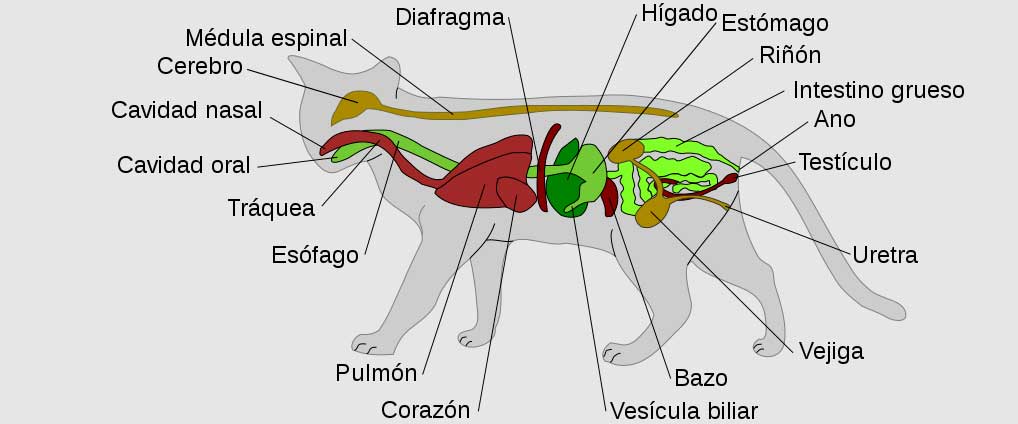
Schematic anatomy of the domestic cat (male) |
||
|---|---|---|
| ||
The milk teeth of cats has 26 teeth. Around six months, tooth change occurs. During this time "double teeth" may appear if the baby teeth do not fall out.. Posterior molars have no predecessors to baby teeth.
Typical of carnivorous predators are their powerful jaw muscles and its sharp teeth. The strongly developed fangs (and its pressure sensors located in the base) can crush meat and small bones. Canines are used primarily to catch prey and to hold and transport it. They are also used in territorial fights and for grooming.. The strongly horny mechanical papillae on the tongue point backwards and are used for both drinking and grooming, as liquids and loose hairs get caught in the bristles.
The gastrointestinal tract is typical of mammals. The stomach it's unicorn. The appendix has a length of 2 to 4 cm.. But, the vermiform appendix is ​​undeveloped. As in humans, the colon has a simple U shape, open from behind, but it does not have ligamentous strips. all the digestive tract is short, what is typical of carnivores.
Metabolism
The domestic cat, like most mammals (including humans), need retinol (or vitamin A1), but it occupies a special position because, unlike almost all other animals, cannot convert β-carotene to retinol. So, naturally dependent on adequate liver intake to provide vitamin A[2].
Life expectancy
Domestic cats that live indoors typically reach an age between 12 and 15 years when cared for by humans. But, according to Desmond Morris, a life expectancy of more than 20 years. As an exception, cites the case of a tabby cat named "Puss" who lived from 1903 until 1939, a period of 36 years.
In the populations of cats in the wild without human or medical attention, the life expectancy of a cat ranges from 1,4 and 3,2 years (males) and between 3,3 and 4,2 years (females). These figures come from studies conducted by Liberg (1980) in a rural area of ​​Sweden and Legay / Pontier (1983) in the French city of Lyon.
Sensory performance
It is assumed that the visual sense of cats is specialized mainly in the perception of movements and performance in the perception of sharpness and details is rather medium. On the effective hunt, the fine sense of ear with directional hearing function helps to locate prey. The sense of smell, on the other hand, is comparatively less developed, but still significantly better than humans.
Eyesight
The big eyes of the domestic cat are frontally aligned, allowing spatial vision and accurate distance estimation. The cat is especially good at perceiving rapid movements and, in the dark, it only takes one sixth the amount of light to receive an image compared to humans. This is made possible by the high density of rods in the retina and a reflective layer at the back of the eye.. The rod / cone ratio of the receptors in the retina is approximately 63:1 (20:1 in humans), but it varies a lot between the center of the retina (10:1) and the periphery (200:1).
Another reason is the tapetum lucidum, a layer of cells located directly behind the retina, reflecting light not absorbed by photopigment molecules in rods and cones and radiating it back to sensory cells. This layer is also the reason why cats' eyes seem to glow in the dark when illuminated.. So, cats still see very well at dusk and at night as long as there is residual light.
But, in a completely dark room, cats are blind too. As the cat can only move its eyes a little to the left or right, you have to move your head to look in another direction. Forward-facing eyes result in strong overlap of visual axes, what a good space vision. The vision angle of the jack is 200° to 220°. To better capture residual light, vertical slit pupils open circularly as brightness decreases, which simultaneously decreases visual acuity.
Due to the constriction of the slit-shaped pupils, visual acuity of domestic cats in terms of brightness it is different for structures and horizontal and vertical movements. They see vertical lines more clearly than horizontal lines and, Therefore, can perceive horizontal movements better than vertical ones, which is one of the reasons for the typical tilted position of the head of cats as soon as they notice certain things.
In addition to the domestic cats see horizontal lines blurrier than humans under the same conditions, their ability to perceive differences in color is also less developed. The reason is that the proportion of color-sensitive cones in the cat's retina is much lower than in humans and the cat's eye., like the dog, it only has two different types of cones (dichromatic), that are sensitive to green and blue, but not red. So, red is a color that neither cats nor dogs can see, and is presumably perceived as a shade of yellow.
In return, cats can perceive their surroundings in shades of blue and green of various intensities and combinations, being the favorite color of cats, to which your eyes are also more sensitive, the blue. This was proven in more than 2000 experiments carried out by the Institute of Zoology of the University of Mainz. In different lighting conditions, cats could choose between yellow and blue to reach their food. The 95% chose the blue color.
At birth, all cats have a light blue iris, whereas adult eye color only develops over the next three months.
Hearing
The ear of the domestic cat it is especially well developed and is one of the best among mammals. It is more sensitive than that of dogs and more powerful than that of humans. The frequency range of the cat's ear is 10,5 octaves. In the lower frequency ranges it is comparable to that of humans, but in the middle frequencies it is much higher.
The upper limit of the frequency (100 kHz) is in the range of the sounds emitted by mice as the most important prey. It is also a range of frequencies in which sound sources can be much better located.. The cat remains motionless and points with its ears, normally large, upright and mobile, in the direction the sound is coming from. When eating from ground level, the cat automatically throws its ears back, so that the inherent noise is not noticeable.
Sense of balance
The domestic cat has a very good sense of balance. Cats do not have vertigo even at great heights.
When falling from a height of two to three meters, can reflexively rotate in the prone position from almost any position and land on the ground with their legs extended downward. As such, the cat angles its entire body in the center and then rotates the front and rear around the two now independent longitudinal axes.
Contrary to what was supposed, tail rotation only plays a minor role, since its mass is too small to provide sufficient angular momentum to the rest of the body. When falling from very great heights (but not medium), this position, legs extremely extended, as well as the loose fur that inflates at the transition from the legs to the belly, They act like a parachute and can greatly reduce the speed of impact and, Therefore, the risk of injury.
Sense of smell and taste
The sense of smell of domestic cat is less developed than hearing or sight. It is weaker than that of the dog, but clearly better than humans. As in all mammals, serves for sensory checking of food and the perception and recognition of congeners and other living beings.
Cats can distinguish between flavors salty, agrios, bitter and umami, but they can't perceive the sweets
Cats recognize each other by body odor, what says something about sex, the genes, hormonal status and territorial claims. Both males and females always mark their territories in the same places, regularly inspected, by scent marks formed by secretions from sweat and sebaceous glands and set by rubbing or clawing or urine spray, distinguished from real urine by a stronger smell. Various causes of odor are possible, for example, the amino acids feline and isovalthene are found in the fluid during urine labeling, in a much higher proportion in male cats than in females. Urine is produced by sweat glands.
The sweat glands are mostly found on the pads of the feet, around the mouth, in Chin, around the nipples and around the anus. The sebaceous glands are concentrated in the upper jaw, tail root and, in men, under the foreskin. Male cats have an additional group of scent glands in a kind of canalized bag next to the anus. All sweat and sebaceous glands serve primarily to communicate through smell through rubbing against objects., congeners and people. When it comes to capturing smells, cats are helped by a special organ located between the pharyngeal and nasal cavities called Jacobson's organ.
In moments of strong emotional excitement, the cat's anal glandular sac may empty and release a strong-smelling brown fluid. Cats can get excited by some smells and will then "beg" with their mouths open with their upper lips raised and their noses wrinkled.. These odors include those of plants, particularly catnip Nepeta cataria (nepetalactona, actinidina), valerian (valepotriato, ácido isovalérico, actinidina), la Actinidia polygama (matatabilactona, actinidina) and the cat's chamomile Teucrium marum (teucrium lactona C), but also the smells of the human being. It also, New odors are often absorbed and stored through the «flehmen«.
Sense of touch
The domestic cats have a highly developed sense of touch. They have touch receptors distributed throughout the body. The long ones tactile whiskers (vibrisas), located mainly on the upper and lower lips and above the eyes, and whose roots are connected to the widely branched network of nerve endings, signal when an opening is too narrow or there is an obstacle in the way. Whiskers can reach considerable length, are mobile and grow back after falling. With your help, recognize objects and animals that cannot see in the dark. The receptors on the front legs are also especially sensitive and detect ground vibrations caused by prey animals..
The presence of the vibrisas already in newborn cats underlines the importance of the sense of touch for the cat.
Behavior
In the countryside, when cats belong to a home but live in it outside of direct human control, usually meet in small groups of related females, her young and adolescent kittens and one or two males. The numerous cats of different colors are usually all descended from a single cat, who was the founder of this community.
While males tend to disperse and seek new territories when they reach sexual maturity, the females stay in the territory of the mother and thus expand the group. They raise the young and chase away foreign intruders, but they are more tolerant of adult males, since these are bigger and more aggressive. Although they share the food that humans provide, they remain lonely when they hunt. Unlike lions, the domestic cats they do not hunt in community. At dusk, they roam the grasslands and forests alone in search of prey. His hunting method, characterizing them as poachers or on the prowl, it is similar to that of its wild relatives: Sneak up on prey and pounce point-blank. The youngest cats, in particular, react to moving objects almost as if they were live prey, which helps them train their hunting skills ("play instinct").
In big cities, where authorities no longer care about placing stray animals in animal shelters and a correspondingly abundant food supply is available, many cats often stay in certain areas. Large colonies can form in urban gardens, cemeteries, excavation sites and also in industrial areas. Within the colonies there is a hierarchy of smaller matriarchal groups.
Communication
The domestic cats communicate through body language, the sounds and smells. Smell signals are used for both direct and long-distance communication.. The sebaceous and sweat glands produce the necessary odors for this, that spread by rubbing, scratching and urinating on objects, plants and people.
Body language
When cats come into closer contact, signal their emotional state through posture and movements of the whole body and tail. The position of the ears and the widening or narrowing of the pupils also influence.
Conchi's cat |
||
|---|---|---|
 | ||
If there tail tip erect is strongly deviated, It can mean a friendly greeting or also the anticipation of what they expect from humans, especially if the tip of the tail trembles slightly. A raised tail with a slightly curved tip can mean joy., placer, anticipation or excitement. If the cat has the raised tail, usually feel comfortable and safe. In a relaxed posture, the tail is usually carried horizontally with a slight downward slant. If there tail is strongly bent down and fluffy, it is usually a sign of threat and aggression. The tail shaking or rapid back and forth movements of the tail mean the cat is probably aggressive or irritated.
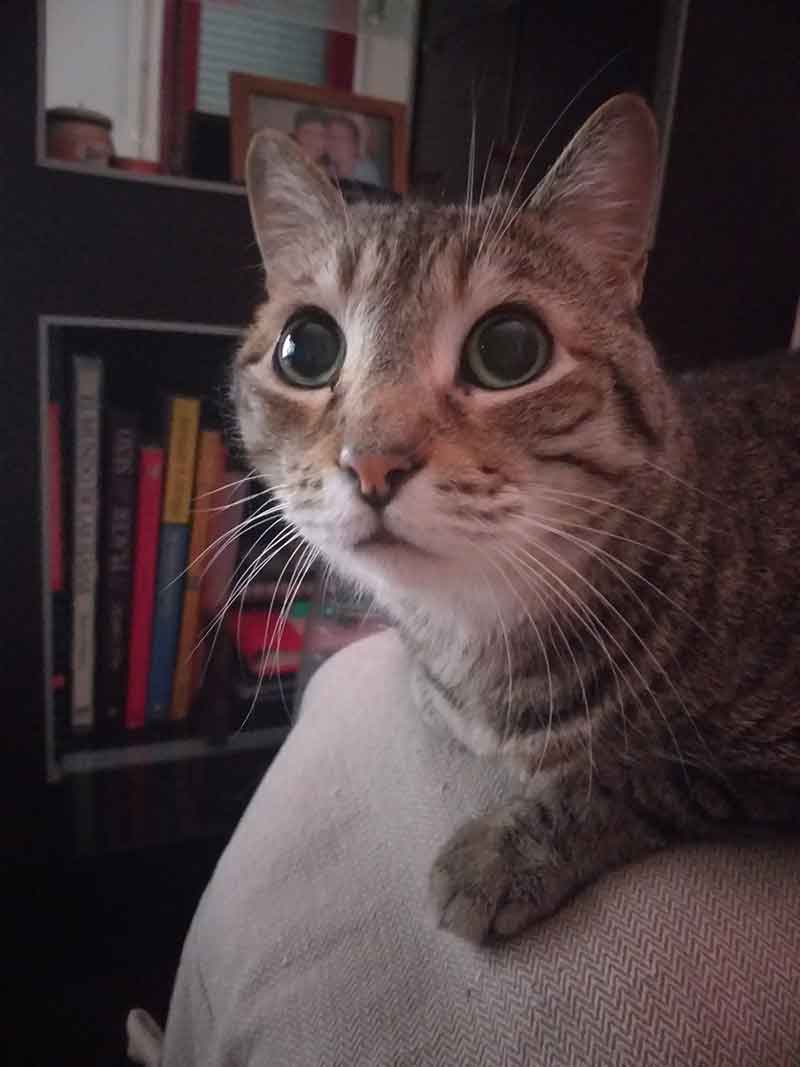
Important signals also come from facial muscles. If the cat fixes its opposite with its eyes, it is often a threat, which is made clear by the narrowing of the pupils until they become slits. At the same time, whiskers point clearly forward, the neck is tucked up and the ears are bent sideways. Yes the pupils are dilated, fear and submission are usually indicated. If the cat is comfortable and relaxed, the eyes are usually kept half closed so that the nictitating membrane is visible. Yes the ears are folded to one side, the cat can be aggressive. If they lie back close to the head, they are usually a sign of fear. Forward-pointing ears can signify curiosity and attention.
Looking at the cat with half-closed eyes is a sign of kindness or affection and can be compared to the human smile. Blink with one eye can also be interpreted similarly. Both are easy for humans to imitate and are often reciprocated by the cat. in addition, a cat may react to a prolonged gaze by yawning and turning its head. This is not a sign of tiredness., but an anti-aggressive gesture.
Before an attack, tends to become larger and more threatening by stooping and positioning itself transversely. Stretch your legs to the end, he lifts his coat and walks slowly towards the adversary. If you discover the teeth, it can be a threatening gesture. But, an insecure cat tends to shrink, bring the legs together under the body and collect the tail. In doing so, often crouches on the ground to immediately drop onto his back if necessary and be able to push back the opponent with his claws and teeth.
|
Conchi's cat
|
||
|---|---|---|
 | ||
The generalized dislike of the cat towards the dog and vice versa is also based on body language. That this is based on hereditary enmity is a mistake. Communication difficulties are the reason. These may include, if the dog barks and runs towards the cat, he may just want to play, but the cat interprets it as an attack. The subsequent flight of the cat in turn awakens the dog's hunting instinct.
Wagging the tail and giving the paw means a happy expectation or a friendly greeting. On the other hand, wagging and whipping of the cat's tail signal latent disgust or aggressiveness, the paw lift says: Until here and no more! Often, the cat lies on its side to defend itself with its claws, what is understood by the dog as a submission or a play request. If, on the other hand, the cat (exceptionally) approaches a dog with its tail raised in a friendly way, the dog interprets it - as he is used to doing when he meets other dogs- Like "Don't get too close to me!"!» and reacts quite aggressively and with barking.
If he dog and cat are ideally used to each other from a young age, difficulties do not usually arise.
Oral language
If the cats have already approached, the acoustic signals are used to reinforce body language affirmations. Grunts are signs of aggression or fear. With a coo similar to that of pigeons, a mother cat calls her young. The whining cries of cats at night serve to prevail over rivals and to woo a female.
The meow It is the most characteristic sound that the cat produces. It can have different meanings and is used in different situations. Domestication has increased the tendency to meow for attention and treats like kittens. Some cats meow when they are afraid. Undomesticated cats largely avoid meowing so as not to attract the attention of other predators (like birds of prey) needlessly.
Another typical sound of cats is the purr, a sound whose origin is still unclear. Already a few days after birth, kittens express their well-being through a constant purr. This sound transmits vibrations during physical contact between the mother or human and the cat.. Timid and insecure animals try to gain or maintain their mate's favor by purring audibly without interruption and at a distance.. It also, cats also purr when they are in pain or sick to show their inferiority and protect themselves from worsening their situation. It also serves to calm down. The purr, the rubbing of the body and the high tail of the cat usually send peaceful and calming signals to reduce aggression. As recent research in the United States has shown, cats produce vibrations in a range of frequencies between 27 and 44 Hz when they purr.
Unlike big cats, the hyoid bone of all other cat species is completely ossified. Due to the special shape of your glottis, only big cats are able to roar.
Surprisingly, domestic cats use differentiated vocalizations to communicate with humans, that adult cats do not use each other.
Sleep behavior
Conchi's cat |
||
|---|---|---|
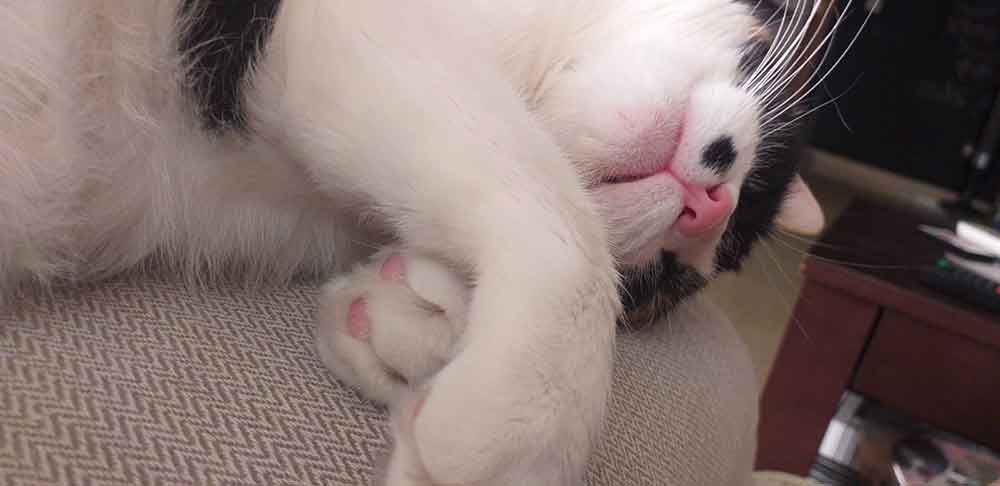 | ||
Cats usually sleep several times during the day. Sleep develops into the phases of shallow sleep and deep sleep. It also, the cat also rests lying with its eyes closed without sleeping.
Since 1955, numerous experiments have been carried out to study this behavior. In the shallow sleep phase, the cat wakes up at the slightest noise. Next, deep sleep occurs with a phase called paradoxical dream, which corresponds to the sleep phase. The muscles are more relaxed and the wake-up threshold is significantly higher. According to EEG measurements, in this phase there is a brain activity comparable to that of the waking phases. Another sign of the sleep phase is rapid eye movements. (REM) under the closed eyelid. Sometimes, the legs, the tail, skin and whiskers twitch. After six or seven minutes of deep sleep, follows a superficial sleep phase for about 20 or 30 minutes. Rest phases follow sleep phases. Then the cat yawns, rises, changes position and falls asleep again.
If the cat perceives an unfamiliar sound during sleep, open one eye. If you still cannot identify the sound, wakes up quickly and is alert. But when he wakes up on his own, first yawns widely and then begins to stretch. In the process, each muscle is stretched through precise and careful movement.
A free cat integrated into the human family does not usually have problems spending the night in the house predominantly asleep. But, you can also spend the night outside and sleep most of the day inside. Here, individual behavior patterns are widely dispersed and also change according to weather and season.
Reproduction
Conchi's cats |
||
|---|---|---|
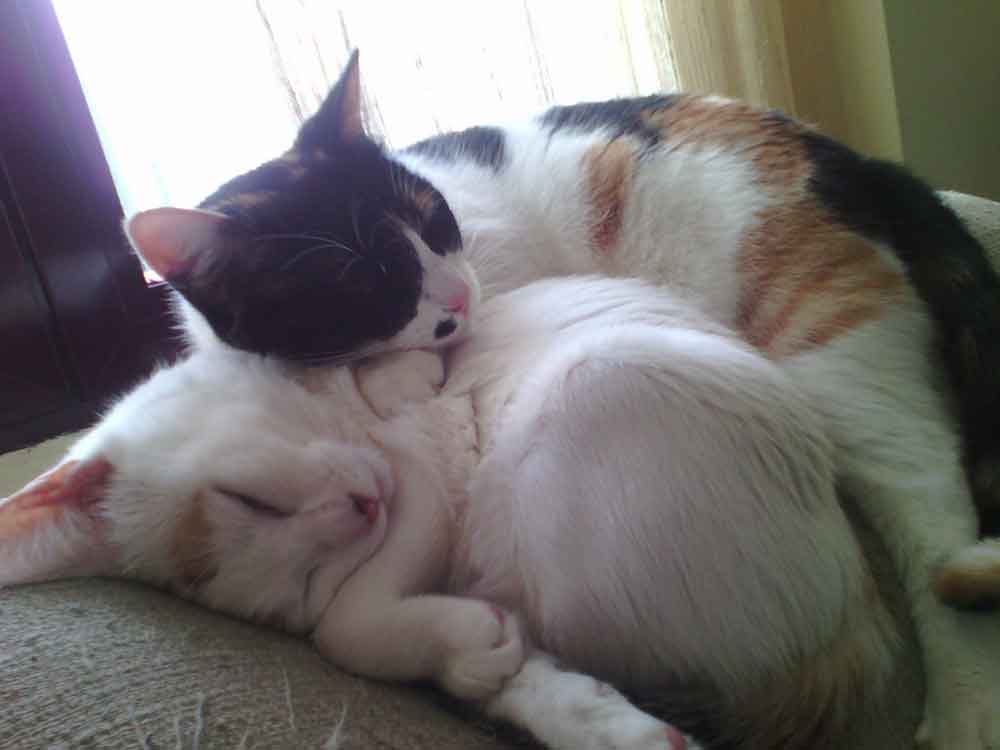 | ||
The cats reach the sexual maturity between the fourth and twelfth month of life and, Therefore, they go into heat for the first time. The onset of sexual maturity is influenced by several factors, like the station, the hours of light, body condition and race. The longhair cats usually do not reach sexual maturity until they are between 11 and 21 months of age. During heat, the cat is receptive for about five or six days, follicle jumping usually occurs only when the cat is mated, but sometimes visual or olfactory stimuli (pheromones) are enough to trigger it. A Cat in zeal constantly rubs against objects, often rolls on the ground and holds its rear end in the air temptingly. If she is not mated by a male, will normally come back into heat after nine days, but there can also be a permanent zeal. If the follicle ruptures, but pregnancy does not occur, the new heat occurs after five to six weeks. The female is not in heat again.
Through the urine odors, that signal the willingness to mate, and the insistent calls, free-living cats often attract multiple suitors. When the males get closer, the cat keeps them at a distance in the first phase by hissing and clawing (experienced males know how to avoid it). The cat retreats to a safe distance while the males exchange blows with warning growls., menacing looks and loud screams. They scrutinize each other and slowly crawl around. If neither of the suitors withdraws during this phase, These encounters can turn into a fierce fight from which the males emerge with scratch and bite wounds.. The uncastrated males have a higher mortality rate than castrates. They travel great distances (often several kilometers) in search of a female in heat or unoccupied territory and are often injured due to the described fights with rivals, are more frequently victims of trafficking or contract viral diseases transmitted by bites.
But, as a last resort, it is the female who decides who will be her mating partner. Only when the female indicates that she is ready and adopts a crouched posture on the ground with her rump stretched out and her tail bent to one side., mating can take place. The act lasts only a few seconds and is accompanied by a characteristic mating cry from the female.. It ends abruptly with the female violently shaking the male and, usually, hitting him. In the male penis there are spikes (penis spines), so the sexual act is painful for the cat. After a successful mating, the female rolls on the ground several times in a stretched position. This characteristic coiling is the origin of the term "curl» for the cat's heat. A female cat in heat can mate with several males. Consequently, siblings in a litter may have different fathers.
The pregnancy
After mating (intercourse), the ovulation occurs after a few 24 hours. Unlike dogs, the ovum is already capable of being fertilized at that time. The fertilization by sperm takes place in the fallopian tube. After nearly two weeks of migration and repeated cell divisions in the fallopian tube and uterus, a blastocyst develops, a multicellular phase of the fertilized egg, that is implanted in the uterine wall. A belt-shaped placenta quickly forms around the fetus, which ensures the "exchange of substances" with the mother..
Heat does not end immediately after mating, but it starts again after a few hours and sometimes lasts for several days, although the zeal weakens.
If the cat meets a male again during the first three weeks of pregnancy (pregnancy, gestation period), a new fertilization is possible through a new mating. Kittens born in these cases tend to have uneven development. Unequal offspring within a litter can also be expected if cohabitation with a male continued for more than a week or continued after a break of several days..
Once the zeal has subsided, the cat becomes visibly lethargic and not infrequently tends to vomit during the second and third weeks. In this first phase, hardly noticeable external changes. But after about three weeks, the bottom (rear) of her four pairs of tits starts to turn pink, and there are already centimeter-long embryos in the amniotic chambers of the uterus, that can be felt by the vet.
As they grow, the initial constrictions between the amniotic sacs, transparent and filled with liquid, that are the size of a chicken egg, they flatten. They can be touched gradually towards the end of gestation.
From the sixth week, approximately, fetus movements can be clearly perceived through the cat's abdominal wall and, sometimes, can also be seen with the naked eye.
It is not until the last three weeks of gestation when the kittens are large enough to make the change in the cat's perimeter visible.. During this time, the mammary glands they also swell and the cat leans to one side when sleeping. On average, the gestation period is 63 to 65 days. In recent days the cat has been nervous and is constantly looking for a safe place as a "nest" for giving birth.. Now he also licks his nipples and anal region more often. The domestic cats they prefer the room of the person in the house with whom they have the most relationship. The nest it can be a half open closet, a box or even the bed. Breeders provide their cats with specially constructed litter boxes for their nest, but these are not always accepted by the cat. The part can last up to a few hours, and the intervals at which kittens are born can vary greatly.
A cat giving birth for the first time usually gives birth to two to three kittens.. With subsequent births, the number of kittens usually increases to seven. But, on rare occasions there may be ten or even more, but in this case often not all kittens survive without human help. Some cats do not want to be disturbed even a few days after birth, others seek the company of humans and feel more comfortable with them. If the litter's camp is not scrupulously cleaned by humans, the mother cat will move with her litter to another camp, because the smell could attract predators. It also, if the cat thinks her kittens are in danger for any reason, lifts each kitten by the crease of the neck and carries it to another location. With this bite, the mother triggers the so-called stiffness in the kitten, which is supposed to keep you from moving too much.
Increase
Immediately after birth, kittens' eyes and ears are still closed. They weigh about 100 g., although the weight can vary between 60 and 140 g.. During the lactation phase, kittens earn a few 100 grams of body weight each week. They use their sense of touch and smell to find their mother's nipples. It gives them immunity through colostrum, the first very fine milk, through the antibodies you have formed due to previous vaccinations and infections. After some days, colostrum production stops and real milk is produced. Massaging the nipples and purring, kittens stimulate milk production. This so-called "milk kick" continues to occur later in cats' lives and is an expression of well-being. at two months, cats hardly drink from their mother's teats, but they already eat solid food. Cats that are very familiar with humans show up when they think their children need food.
Each kitten develops a preference for a particular nipple. Kittens suckle several times a day.. during the first days, the cat rarely leaves her litter. The kittens are mainly busy sleeping and drinking during this time.. But before long they hiss shyly when touched or detect a certain scent., and purr when snuggled against their mother's body. Kittens develop their senses by being stimulated and excited from the first day of life. So they get used to people, you have to take them and caress them. In the first weeks, the mother licks the anal-genital region of the kittens to stimulate the excretion of urine and feces. At the same time, keeps the litter clean this way.
after ten days, kittens open their eyes, straighten their ears and experience new sensory perceptions. Now they weigh a few good ones 200 g.. From the second week, the kittens are dedicated to discovering their own body, that of his siblings and the immediate environment of the nest. They learn to move faster and faster and to handle their siblings, their paws and their mouths in playful fights. They also learn what their peers react to by biting, maullando, running away and whistling.
From the third week, they are already quite good on their feet and also try to sit and climb. But, up to the age of three weeks, the kittens pass the 90% of his time sleeping. Then, the rhythm of the adult animal becomes more and more evident, sleeping some 16 hours a day. With the time, kittens become more active, curious and playful. Their motor skills develop and they become more independent. The mother supports them by moving them to another nest after three or four weeks, where they have more freedom of movement, but they can't stray too far out of the mother's zone of control. This place is usually near the human house or even in the living room.
With a month old, the kittens already weigh about 500 grams and begin to groom and play with objects. Now they learn to eat solid foods. If you have the chance, the mother cat brings her children live prey, then let it run. In this way, gives their children their first instructions for catching prey. With the start of solid food intake, the mother no longer collects feces. Next, kittens leave immediate nest area to relieve themselves. This is the time to accustom the kittens in captivity to the use of the sandbox. At this age the first character traits begin to emerge, as the value, the shyness, containment or adventurism. During this time, the kitten learns to clean itself, following his mother's example.
The most important part of the socialization phase is completed at 7 weeks. Kittens that up to this age have not had any contact with humans, or they have had too little or unpleasant contact, they are usually shy and distrustful.
at two months adulthood begins; in the case of cats that live in the wild, it is usually not until four months. The young follow their mother, who watches them closely and prevents them from straying too far, on all roads. If you have a garden, they are also taught the art of hunting. Now the game becomes the main activity of the kittens.
After two or three months, the kittens climb the curtains and the trees, claws sharpen on objects and jump eagerly. In this way, nerve connections are strengthened, the muscles develop and the movements are more and more precise. Play also encourages and shapes social behavior.
After ten weeks, all kittens become more cautious and prejudiced towards new things.
After three months, the mother cat usually stops nursing the kittens. But, free-living cats continue to bring prey to their kittens at this age. Kittens now feed largely on their own.
In the fifth month lose their baby teeth and begin to mark their territory.
At six months are completely independent of the mother, What, However, tends to continue attacking the bullies of their puppies afterwards.
Puberty
Conchi's cat |
||
|---|---|---|
 | ||
Males and females reach the sexual maturity on average between the sixth and eighth month of life, but physical development is not complete until several months later. In many purebred cats, this stage of life lasts a few more months. With sexual maturity, physical differences between females and males become apparent. Secondary sexual characteristics develop. In males, this maturation period lasts until 3 years. Males are larger and stronger than female cats and have a stronger neck.. Their head appears larger and rounder due to the so-called cheeks of tomcats., fat pads distributed there. Females tend to be thinner and have a narrow, triangular head..
The behavioral differences between males and females are even more pronounced. The males they are more territorial and mark their territory by spraying urine and rubbing in frequented areas. React to intruders with threatening gestures. Unlike females, they tend to roam more and sometimes stay away from home for several days while hunting or searching for a female ready to mate. When they come back from time to time, they seek consolation, food or a quiet place to sleep.
after a few months, fighting games turn into real fights, as males demonstrate that they are capable of competing with other males. Between the 10th and 14th month of life, young males leave the group. Only castrated males they stay with their sisters and join the group.
The territory of an adult male is approximately three times that of a female cat. For them, the size of the territory depends on the food available to them and their young, but for him it is crucial that there are enough females available for mating. As the cat matures, its territory increases. So, the female is, by its nature, more suitable as a pet than the male, as she does not leave her mother's territory even when she is sexually mature and needs less space. But, the cat tends to tolerate changes of location worse than the male and often does not like to travel. On the other hand, not usually as aggressive as the male when playing.
At one and a half years old, most cats are less playful and less active, although there are considerable individual and racial differences. Indoor adult males tend to be more cuddly and calm than more independent and reserved cats with strangers.. The more balanced disposition of male cats has given rise to the term "cuddly cat.". Hormonal fluctuations due to oestrus in unneutered females are believed to be responsible for this gender-specific difference., while in male cats the hormonal state is constant. This difference evens out in the castrated females, which makes living together much more enjoyable for humans and animals.
Intelligence
Cats have a great capacity for learning and memory. Among them, your favorite food, the location of the drinking fountain and litter tray, opening doors with handles, the most comfortable place to sleep and the location of your favorite toy. They also remember what sounds they can use so that their owner responds to their different needs.. They hear his name especially at lunchtime. The animals in freedom remember the journey of their territory, known cats in the territory and dangerous dogs. The associative memory allows cats to compare a problem with what they have already experienced. In this way, can effortlessly establish relationships between various elements and make them work for them.
Although cats have certain abilities at birth, they have to acquire some behaviors with patience. Between them, for example, hunting or litter box use. To accustom their young to hunting, mother cats with access to the outdoors provide them with prey from the third week. At first eat dead animals in front of them, later bring live prey, that kills and feeds them. Finally, leaves live prey to their young. Since cats have hunting instinct, but first they must learn to hunt successfully, kittens without a mother or with a non-hunting mother often fail to hunt prey. To practice, need stuffed mice, spools of thread or crumpled paper, those who stalk, they stalk and finally kill. Bury excrement (urine, feces) also common in free herds, only the highest-ranking animal does not do it and "marks" the terrain with it, so to speak. Given the in domestic cats the owner is generally considered the leader, cats are relatively willing to bury (and, Therefore, to use) a litter tray.
The cats, like all animals, are conditioned by behaviors. They can also be trained to respond to certain signals that disrupt behaviors. In this way, can be deprived of certain activities that humans perceive as naughty. Cats are also capable of hear your name, as long as it's short and concise. To familiarize a cat with its name, it is advantageous to use it as soon as possible and call before each meal; cats respond much better to name calls when hungry.
History of domestication
Ancestry
The first ancestors of the cat, among which is the European wildcat (Felis silvestris), they appeared about nine million years ago.. The European wildcat is of Asian origin and first appeared in the Lower Pleistocene with the species Felis lunensis. Later, various subspecies spread through the Old World.
Due to morphological similarity and close genetic kinship, the origin of domestic cat (Felis catus) it wasn't entirely clear until recently. Science has denied the descent of the manul (Otocolobus manul) or jungle cat (Felis chaus). The view that the domestic cat is a cross between the jungle cat (Felis chaus) and the European wildcat (Felis silvestris) also obsolete today, although there may have been occasional matings of the two species Domestication research was based on the fact that the domestic cat descended from a single wild species, the European wildcat (Felis silvestris), whose habitat stretched from Scotland to Asia, going through africa.
It was considered likely that representatives of the three main groups of the species were involved in the domestication process (european wildcat, African wildcat and the Asiatic wildcat). In this context, the european wildcat (Felis silvestris silvestris) has its natural habitat in Europe, Asia Minor and Iran. It is relatively strong, has short ears and a thick, bushy tail. The African wildcat (Felis silvestris libyca) lives in the bushes and steppes of Africa and Arabia. Has big ears, he is slim and long-legged. The Asiatic wildcat (Felis silvestris ornata) found in the Middle East and Central Asia. He has a more powerful build and is larger than the African wildcat. The genetic characteristics of European wildcat are dominant over those of the domestic cat. The main ancestral form was considered to be the African wildcat; the second strongest influence was attributed to Asiatic wildcat. The european wildcat is a pronounced fugitive from culture and was the least likely ancestor.
In fact, among the different subspecies of Felis silvestris, the ancestor of domestic cat is the African wildcat Felis silvestris libyca, also known as hawk cat. This subspecies is the least aggressive and, Therefore, the most suitable for living with human beings, so it was kept as a pet in ancient Egypt.
A team from the University of Oxford led by geneticist Carlos Driscoll, who examined the genes of almost 1.000 domestic cats from the five continents, showed that the five main genetic lineages found descend only from the Felis silvestris libyca and that domestication probably occurred five times and independently in the so-called Fertile Crescent.
First days
When humans began to settle, the cat joined them, initially living on the outskirts of settlements as scavenger. Presumably, as a result of the resulting mutual advantages, the animals were self-domesticated. Smaller cat bones have been found alongside human bones since ago 9000 years in Mesopotamia, southeastern Anatolia and Jordan. In jericho, Cat skeletons dating from the 6th millennium BC were discovered during excavations. There, the cat was probably considered a prey animal rather than a pet.
In the eighth millennium BC, cats were also domesticated in Cyprus. In 2004, cat specimens were discovered in a local burial that resembled the wild cats, but they had not yet been domesticated. The wild cats they only know the hiss and the growls. According to some researchers, The classic "meow" sounds are a kind of language used by domestic cats to be able to communicate verbally with humans; others, However, think that it is simply a continuation of the language of babies who, for the rest, they only use kittens towards their mothers.
Antiquity
The cat domestication did not start in egypt, how was it supposed to, but in the fertile crescent. From the third millennium B.C., evidence of peaceful coexistence between humans and animals can be found in paintings and drawings. Depiction of a collared cat in a Fifth Dynasty tomb (c. 2600 a.C.) it is proof of the domestication of the wild species. The domesticated cats served their owners both to catch mice and - as has been shown from the beginning Middle Kingdom of Egypt– to hunt waterfowl in the papyrus thickets.
Ancient egyptian culture, dominated by agriculture, attached great importance to the cat, which soon became a cultic veneration of animals. One expression of this is the cat goddess Bastet, which was believed to influence happiness and love, the beauty, femininity, grace and fertility. She was often depicted as a small lion-headed cat or a cat-headed female figure.. in the late period, the cult of cats assumed the greatest proportions; in Bubastis (sometimes also the capital of the empire, often divided), many pilgrims flocked to the cult center and sacrificed thousands of mummified cats (can be read in Herodotus). As research has shown, most of the mummified cats were very young. They were probably bred specifically for mummification. In most cases, their necks were wrung to kill them.
In this age, greeks and romans considered the cat to be a strange pet and preferred to let the ferrets keep their houses free of mice. Later, the divine female figures Artemis in Greece and Diana in Ancient Rome, as well as Freya in Scandinavia, were somehow associated with the cat form. It was associated with the cult of the mother, which in many cultures represents fertility, the phases of the moon, abundance and birth, because the mother cat, who loves to give birth, lovingly cares for and protects your children. She was also considered tolerant and independent. The ability of your pupils to contract or dilate into slits was thought to be related to the phases of the moon.
The export of cats from Egypt was prohibited. The Phoenicians smuggled cats on their boats to Italy, Gaul and Great Britain. Archaeologists have found cat bones in settlements near Amsterdam (that. 2000 a.C.) and in Tofting, in the Eider estuary (that. 100 d.C.). Of greater importance for the dissemination of domestic cats in Europe were the animals brought on trade routes from the Middle East, especially to Greece. Animals first appear in vase paintings from the 5th and 4th centuries BC.. The Phoenicians they were also responsible for its greater diffusion.
In the India, the domestic cat was often an important part of religious ceremonies. From there, came first to China and then to Japan, where he took on similar tasks. In China, Towards the year 1500 a.C., cats protected cocoons from silkworms and in temples ancient manuscripts from rats and mice. This is documented in numerous drawings. The Chinese of the time believed that only man and cat possessed a soul.. The cat represented good luck and a long life. It was a status symbol for the lucky rich. The first evidence of a loving bond between man and cat dates back to the Tang period.: a wanted ad said: «A kitten has escaped from Yü Ta-Po's house. Its color is white. Your calling name: Snow Girl». Hsü Hsüan, other contemporary, described a man's love for his cat, that he loved the animal so much that he did not dare to bury his velvet paw after his death. For days he sat next to the dead animal until the cat's body decomposed.
Middle Ages
The cat had little importance in the High Middle Ages. With the increasing spread of Norwegian rat pests, the house rat and the house mouse -also introduced through maritime trade routes-, it was necessary to fight them, which led to a sharp increase in domestic cats at the end of the Middle Ages.
Despite its undeniable usefulness, were stigmatized by medieval superstition as demonic and unlucky creatures, and they were considered companions of witches and disciples of the devil. According to popular belief, the witches rode huge cats to the coven. For this reason, the black cats in particular they were mercilessly persecuted, sometimes even burned at the stake, locked in baskets. A friendly relationship with an animal, especially this one, it was considered blasphemy. But, cat lovers are found in the poorer social classes as well as in the nobility and clergy. Thanks to the magical properties attributed to it, the cat acquired a high status in folk medicine, since almost everything that came from it was used for healing purposes.
In the X century, cats lived in England as distinguished playmates for the noble ladies of the court. Cats were rare and, Therefore, very valuable. According to the law of the Prince of South Wales of the year 940 d.C., a settlement could only be called a town or village if it had nine buildings, a plow, an oven, a churn, a rooster, a bull, a shepherd and a cat. The price of a cat varied. En el Sachsenspiegel, the code of laws drawn up in 1220-1230, three pence compensation for a cat. It was not little, for a lamb or a cow then cost four pfennigs.
Some findings from siglo XI show that cat fur was used by the Vikings and preferentially marketed in Europe in the Middle Ages. At that time, and even about 100 years, cat fur was used to make gloves, especially in France and England, since it was a particularly flexible material.
In the middle of XV century, Girolamo Visconti wrote about witches who allegedly entered the houses where children slept at night in the form of a cat. At that time, it was a French custom to build a cat on the foundations of a church. The church buried Satan and his evil powers under its great mass, so to speak. This is supposed to symbolize the victory of good over evil. Proverbs, Superstitious sayings and rituals keep reminding these dark times, so that the cat still has ambivalent connotations today.
While the people of the East used to be kinder to cats, in the 13th century Japan they were associated with a demon, as the human-eating witch Neko-Baké, who entered houses disguised as a cat and ate disobedient children.
In the 10th century, the cat was common throughout the European continent and in almost all of Asia. Of the 15th to 18th century, arrives in North America, Australia and New Zealand on the ships of European explorers.
16th century until today
As cities grew in the 16th and 17th centuries and the number of domestic cats increased as a consequence, cat fur lost value. But, spotted wild cat fur remained a sought-after and precious commodity, so the wild relatives of the domestic cat were hunted mercilessly on all continents.
Just with the start of the Industrial Revolution Cats gradually went from being purely farm animals to their current position as «pets«. This was associated with the beginning of cat breeding. Today more than 30 breeds of cats, standardized by international breeding associations. In the 20th century, the cat became one of the most studied domestic animals in terms of medicine, genetics and physiology. In the decade of 1960, early study programs explored the behavior of wild and domestic cats. In the Decade of 1990, the cat had finally become the most economically extended non-utilitarian pet in the world, beating the dog for the first time in its history. But, as the cat continues to be characterized with falsehood and mischief in the western world, an ambivalent attitude has persisted. These may include, many people still believe that it is bad luck that a black cat crosses your path.
In modern times, the cat is highly regarded in Japan. Entirely dedicated to cats is the Go-To-Ku-Ji temple in Tokyo, built in honor of the cat Maneki Neko, raising its right front leg to greet visitors, what is said to bring good luck and wealth. Inside, what is a cat grave, there are numerous paintings and sculptures depicting cats. Cats are also worshiped as deities in China and Thailand to this day..
Despite the long history of domestication, the domestic cats have retained a high degree of independence and are not necessarily tied to humans. In many areas outside of Europe, especially in Australia, New Zealand and on many islands, cats have become so feral that they no longer have any relationship with humans. The wild australian domestic cats show considerable adaptation to their new environment. They have grown larger and more muscular and develop fur colorations that favor camouflage in their particular habitat.. These cats live mainly on introduced rabbits in Australia, but also of native animals.
Attitude
Food
The cats, including the domestic and those of race, are strictly carnivores. In their natural habitats, They feed exclusively on small mammals and, depending on the natural prey available, also to a lesser extent birds, amphibians, reptiles and spiders. So, a purely vegetarian diet is not appropriate for cats and does not meet their needs. Studies have shown that cats don't need plant nutrients, especially carbohydrates and sugar, to meet your nutritional needs. But, there is also no scientific evidence that carbohydrates and sugars in small amounts in cat food are harmful. The assumption, often expressed, that the carbohydrates and the sugar of the commercial foods for cats are the cause of Obesity, feline diabetes and dental disease is refuted by previous studies. But, high carbohydrate content should be rejected in cat food, since with such a food composition the proportion of vital amino acids of animal origin cannot be covered by the meat content in the food and must then be added artificially.
The commercial and industrial food for cats usually contains carbohydrates in the form of cereals to satisfy the cat's need for fiber (wet food), but also to shape food and as cheap stuffing (especially in dry food). A proportion of up to a maximum of 10 %. But, in most dry feed, is significantly higher for production and shelf life reasons.
However, the increasingly widespread feeding of finished products has contributed significantly to increase life expectancy average of animals in recent years, as they are artificially added to certain finished feed essential dietary components (taurine, arginine, lysine, methionine, cysteine, nicotinic acid), that are normally supplied improperly when fed human food scraps. But, Feeding exclusively with ready-made products also carries risks. Studies show that cats fed commercially prepared food have a risk between 2,5 and 5 times greater to develop hyperthyroidism, what is attributed to certain additives such as soy isoflavones or phthalates. It also, the call barf is gaining in popularity.
The so-called Barefoot ("organic raw food adapted to the species"), that is to say, raw meat feeding (beef, poultry), becomes more and more important. Unlike prepared food, this diet also meets the psychological needs of the cat and allows proper use of its teething. But, with this diet, largely species appropriate, also pay attention to a balanced ratio of nutrients. These basic knowledge, as well as the additional effort for the acquisition and preparation of food, make this type of feeding not practicable for all cat owners. An appropriate daily compromise for most cat owners is to supplement the diet with individual meals of raw meat, which can also consist of a single type of meat and do not require any additives.
According to his ancestry african cat as an inhabitant of the steppe and the savannah, the domestic cat it is also able to meet its water needs to a large extent from prey animals when food is available naturally. So, your drinking needs are low. For this reason, the moisture requirement of the feed must correspond to that of the natural prey, what happens to most commercial wet foods. However, there should always be clean drinking water. When fed dry food, cats naturally absorb more water, but often not enough to reach the physiologically necessary amount. The result can be kidney and Urinary tract, which is why it is not advisable to feed only dry food.
The wild cats don't drink where they eat, because in the wild it is unlikely that there is a waterhole right next to the prey they have captured. The domestic cats have retained this behavior and they will only drink from a bowl of water placed next to the one with the food if there is no other option. For this reason, should be placed separately from the food bowl.
The adult cats do not usually tolerate cow's milk. They cannot break down lactose (milk sugar) contained in cow's milk because the production of the enzyme lactase, that is no longer necessary, decreases at the end of the lactation period. This causes digestive disorders and diarrhea.. If the milk is fed without interruption beyond the lactation period, enzyme production is usually maintained. This is why farm cats, where milk feeding is common, tend to tolerate milk better than cats that are not fed it regularly.
Cats without access to the outside
One indoor cat that remains can only suffer from boredom after some time, especially if you don't have enough Human contact, which can lead to undesirable behavior. If you have a partner, can play with it and perform other species-specific behaviors. Unlike in the outdoor cat, the indoor cat does not usually have a varied environment. Live animals to catch are often missing, trees to climb and discovery opportunities. If the cat is kept only indoors, always you have to choose at least two animals. Only in exceptional cases is individual accommodation recommended for older and incompatible cats that have grown up in an apartment-only environment.. A cat that used to have freedom and now (for example, due to a move) you just have to stay in the flat or the house, will hardly get used to reduced living conditions.
The advantages of keeping cats indoors are that they cannot be run over, poisoned by agricultural pesticides, shot by hunters or injured by other animals (like-minded people, dogs, marten). The risk of contagion of one of the diseases of cats, often deadly, It is lower, but it can also occur when cats are only kept indoors, since humans can carry pathogens to the ground through their street shoes. The risk of parasite infestation it is also much lower when cats are kept indoors. For these reasons, an indoor cat has a longer life expectancy than an outdoor cat. The best compromise between outdoor and indoor life is a safe garden.
One Indoor cat swallows more hair during grooming than an outdoor cat, as it has less ability to scrape it off bushes and bushes. So, an indoor cat depends on cat grass supply to be able to regurgitate the swallowed hairs (what triggers the stimulus to vomit). An alternative to oral hairball excretion and removal, which is usually unpleasant for the cat owner, is feeding with food supplements containing malt, that allow hair to clump together in the digestive system and, Therefore, to be expelled rectally.
It is advisable to have several litter boxes, one per cat. If the litter box is not cleaned regularly, there is a risk that the cat will not use it. Pay special attention if there is a change in the stool, for example, diarrhea or the discovery of blood.
One stable scratching post, preferably from floor to ceiling, it is important if you want to prevent the cat from sharpening its claws on the upholstery, wallpaper and furniture. It also, cats love high places because they feel safe in them and they like to climb. A variety of toys, like balls and some cardboard box to hide, offers indoor cats variety and the opportunity to put their play and hunting instincts into practice.
In certain circumstances, indoor cats may be deficient in vitamin D, that must be compensated with food. The reason lies in the production of the vitamin: cholesterol in hair oil that is spread throughout the coat during grooming is converted into vitamin D in sunlight, which is then absorbed by licking. So, in absence of sunlight, little or no vitamin D is produced or absorbed.
Dangers for cats
Many substances whose ingestion is relatively harmless to humans are toxic or at least intolerable to cats, depending on the amount. These include, for example, the acids (vinegar, citric acid), the chocolate, the coffee, the onions, the grapes, the apples, the albaricoques or the paracetamol. Since cats also ingest plant parts to get rid of hair swallowed during grooming, but many common plants are very toxic to cats, it is necessary to keep them out of the house. Among them are the dieffenbachia, ivy, Christmas hawthorn, la poinsettia, amaryllis, cyclamen, begonia and various types of cacti, but also boxwood or oleander. Even offering bowls with cat grass or Cyprus grass often cannot prevent the cat from, curious by nature, feeds on other plants in the house.
The glass containers misplaced can become a special hazard, as a cat can cause the container to fall to the ground and subsequently suffer serious cuts. The plastic bags they also pose a great risk, since the cat gets inside and sometimes does not find the way out; suffocates. Last, do not underestimate the danger posed by open toilet lids, especially for young cats. If they fall into it, often unable to break free from this trap and may drown in it.
When trying to sneak through the crack of a slanted window, cats often get stuck. Attempts to free them cause them to slide lower and lower. The result is severe neurological damage to the hind limbs if the cat remains stuck for a long time. As a late consequence, embolisms may occur. If the animals are not released, they die in agony after hours of trying to free themselves.
Cat toy
All cats have innate hunting instincts. But, the efficient hunting behavior that is vital in nature is only partly instinctive, partly has to be learned. Play instinct serves this purpose in young house cats.. Playing with various objects around the home encourages learning and training of hunting skills. But, The game can also help reduce the «hunting stress» and to satisfy the hunting instinct. Young cats, in particular, they are known to play with balls of wool, some can't resist a piece of string or string.
Neutering and spaying
Usually, except for breeding cats, both males and females are neutered. During the castration, testicles or ovaries are removed. According to the general opinion, castration of free-living cats is an important basis for animal welfare and, especially, for the protection of cats, as it is the only way to avoid the unnecessary suffering caused by a large number of cats without care. It also, sterilization avoids the need to mark males at approximately the 90 % of the cases. In females, prevent them from going into heat. Times, a cat can go into heat after spaying. If she keeps letting the males ride her, then the ectopic ovarian tissue has remained in the abdominal cavity; if the cat does not allow the male to mount her, so there is no hormonal basis for heat.
An alternative to castration, although it is rarely practiced, is the sterilization, in which only the seminal ducts or oviducts are divided. This procedure does not influence the nature of the animal, but it prevents unwanted playback and would be really desirable from a behavioral point of view. But, a cat that has only been spayed requires a maximum degree of species-appropriate husbandry, which can hardly be met with a purely indoor cat. This includes outdoor exercise., tolerant neighbors, little car traffic for several miles around and at least one sterilized partner nearby to avoid dangerous territorial fights in the distance. It also, behaviors associated with sexual activity are still present and hinder harmonious coexistence with humans. For cats that do not have access to the outside, spaying is not an alternative to neutering. When ovulation does not occur due to lack of mating, there is a rubefacción permanent and a cystic degeneration of the ovaries.
Reproductive control with hormones
The progestágenos can be administered parenterally or orally to cats. At the same time, are intended to prevent undesirable behaviors such as urine marking. In the case of oral administration, treatment with medroxyprogesterone acetate is in the foreground, along with the megestrol acetate. The restoration of fertility is also possible after several years of administration..
Diseases
The most common diseases of cats are infectious. Young animals are very susceptible to herpetic infections of the respiratory tract (cat catarrh) and infections by parvovirus (feline epidemic diarrhea). In adult animals, FeLV virus infections, IVF and FIP are a serious problem. The cat has largely lost its role as a carrier of rabies thanks to vaccination.
It also, cats are very susceptible to parasites. Infections are most frequently seen here. endoparásitos like roundworms and tapeworms (→ Worm infections in cats) and ectoparasites like fleas and mites.
Chronic renal failure (IRC): CRF is an irreversible failure of kidney function. Most cats that develop CNI do so due to the aging process (around the 30% of all cats older than 15 years develop CNI). But, CNI also occurs in younger cats, although they are usually affected by this disease for genetic reasons. Infections, as the dental inflammation chronicle, they can also lead to the CNI. The endocrine diseasess that may appear are mainly diabetes mellitus and hyperthyroidism.
The most common tumor disease is malignant lymphoma. The fibrosarcoma can occur primarily as a reaction to vaccination.
The spectrum of feline diseases described is extremely rich and comparable to human diseases in its diversity. The most common feline diseases, in addition to those already mentioned, they are the FORL ("neck injuries"), hyperthyroidism, the FLUTD (feline lower urinary tract disease), hypertrophic/restrictive/dilated cardiomyopathy, asthma and eosinophilic granuloma.
Cats and other feline species have long been known (like tigers) can get the avian flu. Cat-to-cat contagion has also been documented. But, infection of humans by cats has not yet been observed.
The normal body temperature of cats is of 38 °C a 39 °C. From 39,3 °C is referred to as a rise in temperature. The pulse of a cat at rest is 110 to 140 beats per minute, the Breathing frequency is of 20-30 breaths per minute.
Cats as transmitters of disease
Like all domestic animals, cats can transmit a number of diseases (zoonosis) to the humans. The most dangerous diseases are toxoplasmosis and rabies. The latter currently plays no role in Europe.
In addition to other routes of infection, humans can be infected with toxoplasmosis through cat feces if they contain the pathogen Toxoplasma gondii. The pregnant women are at special risk; if the initial infection occurs in the second trimester of pregnancy, the embryo in the uterus may be damaged or die. This pathogen is also suspected of being, at least in part, responsible for the schizophrenia in humans. After infection, immunity is for life; therefore, only an infection that occurs for the first time during pregnancy is dangerous.
The rabies is transmitted to humans through bites, scratches or contact with uninjured mucous membranes. Transmission by bites and scratches occurs with particular ease, since animals that suffer from rabies tend to show very aggressive behavior. Rabies is always deadly in unvaccinated humans and poses a serious danger to cat owners and their environment. In the news, Europe considers itself free of rabies, so the authorities no longer recommend vaccinating cats while they are not traveling abroad. In the case of pure domestic cats, the rabies vaccination has long been discouraged, as infection of the animal is not possible and vaccination can lead to tumor formation in rare cases (the so-called vaccine-induced fibrosarcoma).
Through cat bites and smear infections from open wounds on the skin of infected animals, There is also the possibility of transmission of the so-called «cat pox virus» to human beings. But, it is cowpox virus, that are only dangerous for people with a weakened immune system. Scratches can also transmit cat scratch disease, which is usually harmless.
Some skin diseases (fungal zoonoses) can also be transmitted from cats to humans. Humans become infected through direct contact with an infested animal or its dander. The shear mycosis affects hair, skin and nails.
As with all pets, there is also the risk of parasite transmission, like ankylostomas, roundworms or tapeworms. They are usually transmitted by direct or indirect contact with infected feces.
The cats (just like foxes and dogs) They are the final guest of the fox tapeworm, a parasite that is also dangerous to humans. In areas where the fox tapeworm is widespread, cats that feed on mice as intermediate hosts are often also infected with fox tapeworm and can spread it with their feces. The regular deworming of domestic cats is advisable not only for this reason.
Genetics of coat colors
All the colors of the cat's coat are based on two pigments: Eumelanina (black) and Feomelanina (red). Both pigments are present in the stripe pattern of wild ancestors.
The fur pattern of cats is determined by the gene tabby. All cats are predisposed to one of the typical coat patterns: mackerel, striped, spotted the ticked. Even the solid color cat, as the Chartreux cat (Carthusian), has that predisposition, but it is masked by the non-agouti gene (abbreviation aa).
The black cats have a mutation of locus agouti, whereby pheomelanin is completely displaced by eumelanin, so that the coat pattern is no longer visible. The red cats lack eumelanin. Since the non-agouti gene causes eumelanin to displace pheomelanin throughout the body, has no effect on the coat pattern of red cats, in which the brindle pattern is always visible.
Both colors can be lightened by other genes. These may include, the black color is lightened to chocolate or cinnamon due to a mutation of the brown locus. The Maltese dilution gene (abbreviation dd) turn black to blue (the color of the Carthusian cat), chocolate in lilac (or lavender or frost), the cinnamon in fawn and the red (orange) cream. In 1974 another dilution gene was discovered, the dilution modifier (Dm). Change the colors blue, purple and fawn to caramel and cream to apricot.
The white cats or white in color are due to a lack of pigment-producing cells (melanocytes) on the skin, so they are wholly or partially leucistic. Completely white cats are often deaf, the stained ones no.
One tricolor cat can be recognized at first glance as a cat, since the gene for coat color is located on the X chromosome. The distinction between male and female is based, as in all mammals, in the karyotype of the sex chromosomes, according to which XX is feminine and XY is masculine. So, some female cats may have the gene for black coat color on one X chromosome and the gene for red coat color on the other and, therefore, develop a tricolor coat (codominant inheritance). The white part of the coat color is not controlled by the X chromosome, the series of alleles responsible is inherited autosomal.
Exhibitions
In the 18th century, the social recognition of the cat increased, so the number of cat owners of the nobility and the bourgeoisie could register a strong increase. The breeding and selection of special breeds experienced its first heyday. At the beginning of the 19th century, there were enough cat lovers to hold public meetings and have professional breeders and hobbyists award the most beautiful animals. Harrison Weir, Writer, poet, passionate about cats and member of the Horticultural Society, organized the first public cat show at London's Crystal Palace on 13 in July of 1871. This great feline show marked the beginning of the official history of regular shows. In victorian times, these gatherings became occasions for social gathering for the English upper classes.
With the time, breeders began to use these exhibits to present their new breeds and work on their propagation. In 1887 was founded the National Cat Club (NCC), the first association of cat breeders that registered and cataloged the pedigrees of the breeds. The association was replaced by the Governing Council of the Cat Fancy (GCCF) in 1910. In 1938 was founded the Cat Association of Great Britain (CAGB) as an alternative organization.
In the meantime, interest in purebred cats spread rapidly in Europe and the United States. In March of 1881 the first exhibition of cats in the United States was organized at the Bunnel Museum in Boston. But it was above all the great feline exhibition organized on the English model by James T. Hyde at Madison Square Garden in New York on 5 in May of 1895 the one that increased the popularity of purebred cats. With the time, various organizations were formed in this vast country, among which the Cat Fanciers’ Association (CFA) it was the most important. In each of the countries of Europe national associations were formed and, sometimes, various alternative organizations, generally grouped in the Féderation Internationale Féline (FIFe) as an umbrella organization.
prizes
Cats are divided into classes based on breed, the color, sex and past successes at exhibitions, and the judges judge them according to the rules established for each breed through a specific point system. The total number of points determines whether the animal receives the rating of "good", "very good" or "excellent". Cats rated “excellent” are suitable for breeding without any restrictions and can apply for the title. Certificat d’Aptitude au Championnat (CAC), the candidacy for Champion. If they obtain the CAC in three exposures, they are considered champions.
To go from Champion to International Champion, the cat must win the Certificat d’Aptitude au Championnat International de Beauté (CACIB) in three more exhibitions. As champion, she is now judged by international judges. As a rule, will have to participate in shows abroad. If the title of Certificate of Aptitude is then awarded to the Grand International Beauty Champion (CAGCIB or CAGCI) three times, se considers Grand International Champion.
The International Grand Champion can climb even higher. Next, the candidacy for the title of Certificate of Aptitude at the European Championships (THAT'S). If she becomes European Champion, can become Grand Champion of Europe through the title Certificat d’Aptitude au Grand Championnat d’Europe (SHIT).
House cat screening guidelines
The domestic cats they are in no way inferior to their racial counterparts in beauty pageants. Some of the big umbrella organizations award additional prizes and titles to them. The American organization TICA awards year after year at the end of each show season not only the most beautiful breed cats, but also your best domestic cats (HHP). The GCCF has published an additional standard for domestic cats, and for ACFA and CFA judges there is a guide on how to judge a domestic cat. European associations and clubs even award titles to domestic cats.
GCCF Standard Dot Scale: Domestic pet (HHP)
Total 100 points

.jpg)


