Content |
|---|
Description:
12 to 13 cm.. height.
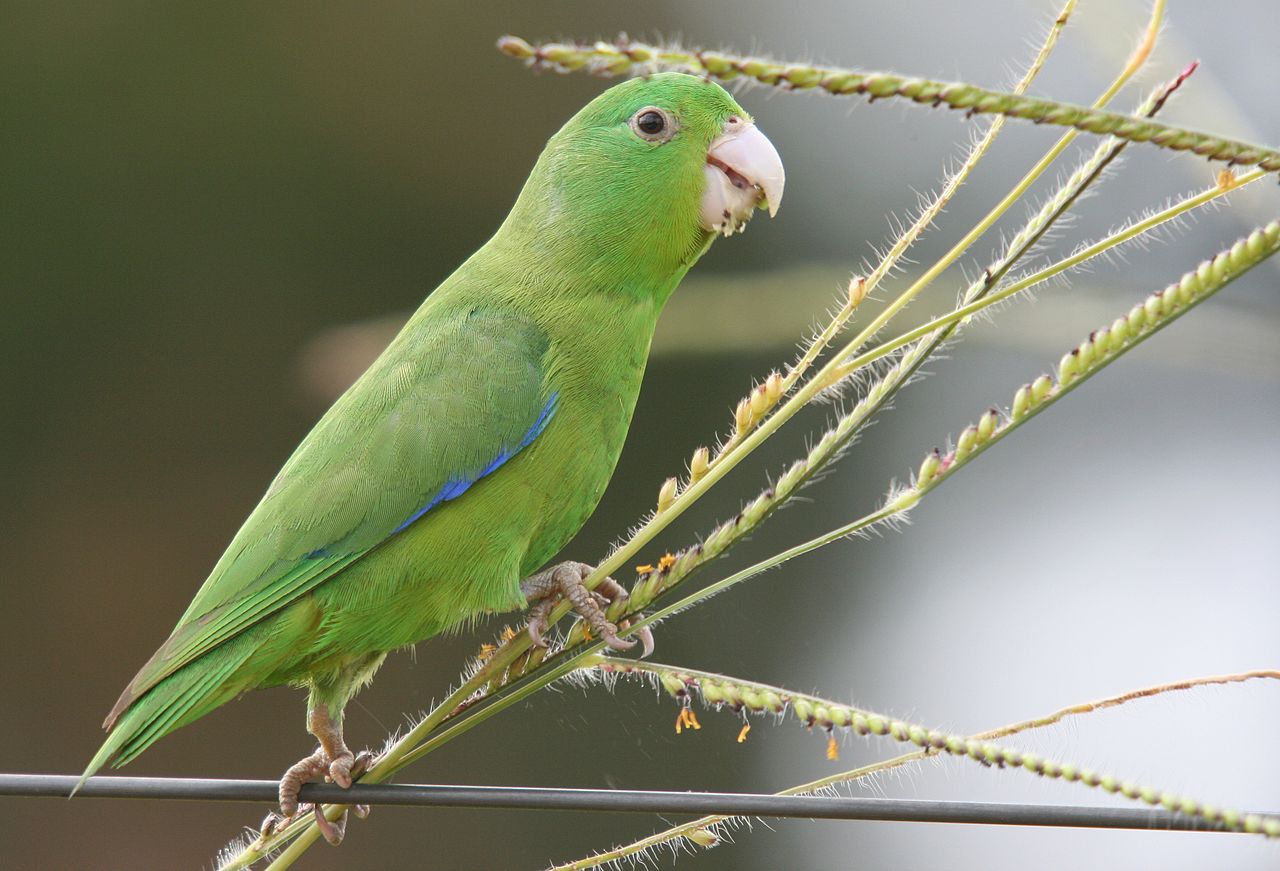
The Blue-winged Parrotlet (Forpus xanthopterygius) has the forecrown, the crown, back of the neck and ear-coverts, green; cheeks, eye area and lores, emerald green. Upperparts and wings, green, except the part inferior of the back, rump, primaries and greater coverts, are cobalt blue and blue color toward the base of the secondaries. Under, the wings with the coverts a rich cobalt blue color; the flight feathers Matte metallic blue. the underparts of color green with shades yellow and with feathers of color red Emerald around the thighs and vent. Upper, the tail green; undertail, pale green.
Bill and cere Pink with gray base up to the upper jaw; bare periophthalmic pale grey: irises dark brown: legs Gris-Rosado pale.
Female all green.
Immature similar to the adult respective but the color blue of them males young mixed with green.
- Sound of the Blue-winged Parrotlet.
Habitat:
Frequent habitats woodlands more dry such as Open forests and riparian, closed and caatinga; at the edge of the range that is located in the Savannah, palm groves, scrub semiarid and pastures. In the western amazon appears to be mainly distributed along rivers in lighter riparian growth. Mainly in the land low, but reported to 1,200 m in the mountains of the southeast of Brazil. Gregaria, in herds of up to 50.
Reproduction:
It nests, mainly, in the cavities of trees, Although also termite tree, posts in fences, nests common hornero (Furnarius rufus), which can be occupied by force and lined with grass stalks, or even nests of the Red-rumped Cacique (Cacique haemorrhous). Clutch 3-7 eggs.
Food:
Its diet includes fruit of Cecropia, seeds of Mikania and Trema micrantha and flowers of Ambrosia and Marcgravia; Forages in open areas, sometimes in land.
Distribution:
Size of the area of distribution (reproduction / resident): 5.780.000 km2
Its distribution is discontinuous in South America, since the Basin Amazon to the North of Argentina with people separated in the North of Colombia. The latter occurs in the lowlands of the Caribbean arid from Cartagena through the valley bottom of the river Magdalena South to North of Bolívar and East to the base of Sierra Nevada de Santa Marta. The species reappears in the end South of Colombia about Leticia and possibly in the Putumayo, and records from the Northeast borders of the Ecuador and from the East of Peru to the East of Bolivia in hand me and Santa Cruz; It extends through the basin of the Western Amazon of Brazil eastward to the East of amazon and in large part of the interior of the this of Brazil towards the Southeast, possibly up to Rio Grande do Sul.
Apparently absent from parts of the East and northeast of brazilian amazon with its northeastern limits in maranhão and Ceará.
They are distributed in the northeast of Argentina, in Missions, Northeast of Currents, Chaco oriental and Formosa Eastern.
Is located in the East of Paraguay and can be observed over the West in the chaco.
Apparently introduced in Jamaica, but the current situation is unknown.
Mainly resident Although migrant altitude in the southeast of Brazil, with seasonal movements in Argentina in relation to food supply. common in the East of the cordillera, sometimes locally abundant (for example, in the northern parts of Bay), less abundant in the West, being uncommon and local (Perhaps reducing) in the Northwest of Colombia and scarce throughout the East of Peru and Bolivia. Perhaps increasing in parts of the western amazon with cleared of forest dense, but probably in decline in Paraguay, where formerly common and now rare.
The Blue-winged Parrotlet have been caught for the trade, with captive birds outside range countries. Is unlikely that the trade has been affected to their abundance in the Middle wild.
Conservation:
State of conservation ⓘ |
||
|---|---|---|
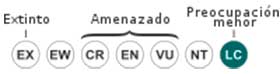 Minor Concern ⓘ
(UICN)ⓘ
Minor Concern ⓘ
(UICN)ⓘ
| ||
• Current category of the Red List of the UICN: Least concern.
• Population trend: Stable.
Justification of the population
The size of the world's population of the Blue-winged Parrotlet It has not been quantified, but this species is described as «common» (Stotz et to the., 1996).
Justification of trend
Suspected that the population is stable in absence of evidence of any decline or threatens substantial.
"Blue-winged Parrotlet" in captivity:
In captivity they are not very frequent. They are birds enable you require a large cage. Quiet and something Shy. Not is easy to accommodate them with other parrots.
Can be prone to it Obesity.
Note:
Among the various species of the Blue-winged Parrotlet (Forpus xanthopterygius), There is, Unfortunately, a very extensive variety of colors mixed due to the crossing in captivity of the nominal species with several of their subspecies, as well as the different crosses between subspecies. So, it is rather doubtful to find yet species and subspecies properly colored, especially in the poultry raising European. Only the subspecies Forpus xanthopterygius flavescens, as pure subspecies, it's still pretty easy to recognize.
Alternative names:
– Blue-winged Parrotlet, Blue winged Parrotlet, Blue-winged, Large-billed or Turquoise-winged Parrotlet, Blue-winget parrotlet (English).
– Toui de Spix, Perruche-moineau à ailes bleues, xT. à gros bec ou T. de Spengel (French).
– Blauflügel-Sperlingspapagei (German).
– Tuim, bate-cu, caturra, coió-coió, cu-cozido, cuiúba, cu-tapado, meudo, periquitinho, periquito, periquito-do-espírito-santo, quilim, tabacu, tapa-cu, tuietê, tuim-de-asa-azul, tuitiri (Portuguese).
– Catita enana, Catita Enana Sudamericana, Cotorrita Aliazul, Periquito Azulejo, Viudita (español).
– Catita enana (Argentina).
– Catita enana (Colombia).
– Periquito de Ala Azul (Peru).
– Viudita (Paraguay).
scientific classification:
– Order: Psittaciformes
– Family: Psittacidae
– Genus: Forpus
– Scientific name: Forpus xanthopterygius
– Citation: (of Spix, 1824)
– Protonimo: Psittaculus xanthopterygius
Images Blue-winged Parrotlet:


Videos of the "Blue-winged Parrotlet"
Blue-winged Parrotlet (The xanthopterygi of Forp)
Sources:
– Avibase
– Parrots of the World – Forshaw Joseph M
– Parrots A Guide to the Parrots of the World – Tony Juniper & Mike Parr
– Birdlife
– Photos:
(1) – A male Blue-winged Parrotlet in Goiânia, Goiás, Brazil By Wagner Machado Carlos Lemes [CC BY 2.0], via Wikimedia Commons
(2) – Blue-winged Parrotlet (Forpus xanthopterygius) Vale do Ribeira, Sao Paulo (state), Brazil By Dario Sanches [CC BY-SA 2.0], via Wikimedia Commons
(3) – A male Blue-winged Parrotlet in Goiânia, Goiás, Brazil By Wagner Machado Carlos Lemes [CC BY 2.0], via Wikimedia Commons
(4) – A male Blue-winged Parrotlet (Forpus xanthopterygius) looking out from a nest in the Vale do Ribeira, Brazil By Dario Sanches [CC BY-SA 2.0], via Wikimedia Commons
(5) – Blue-winged Parrotlet (Forpus xanthopterygius) at Foz do Iguacu, Brazil By Arthur Chapman [CC BY 2.0], via Wikimedia Commons
– Sounds: (Xeno-canto)