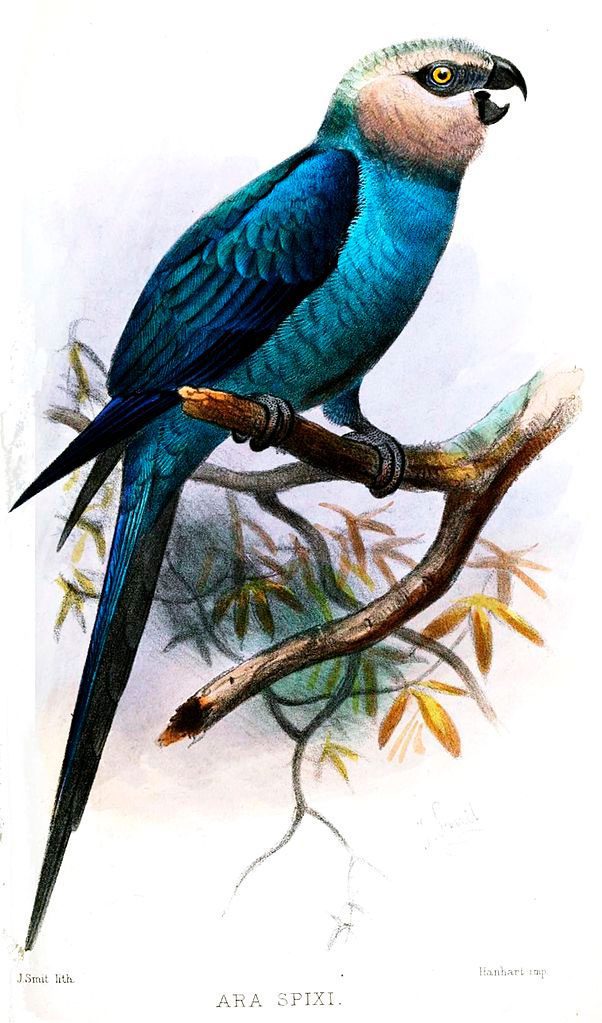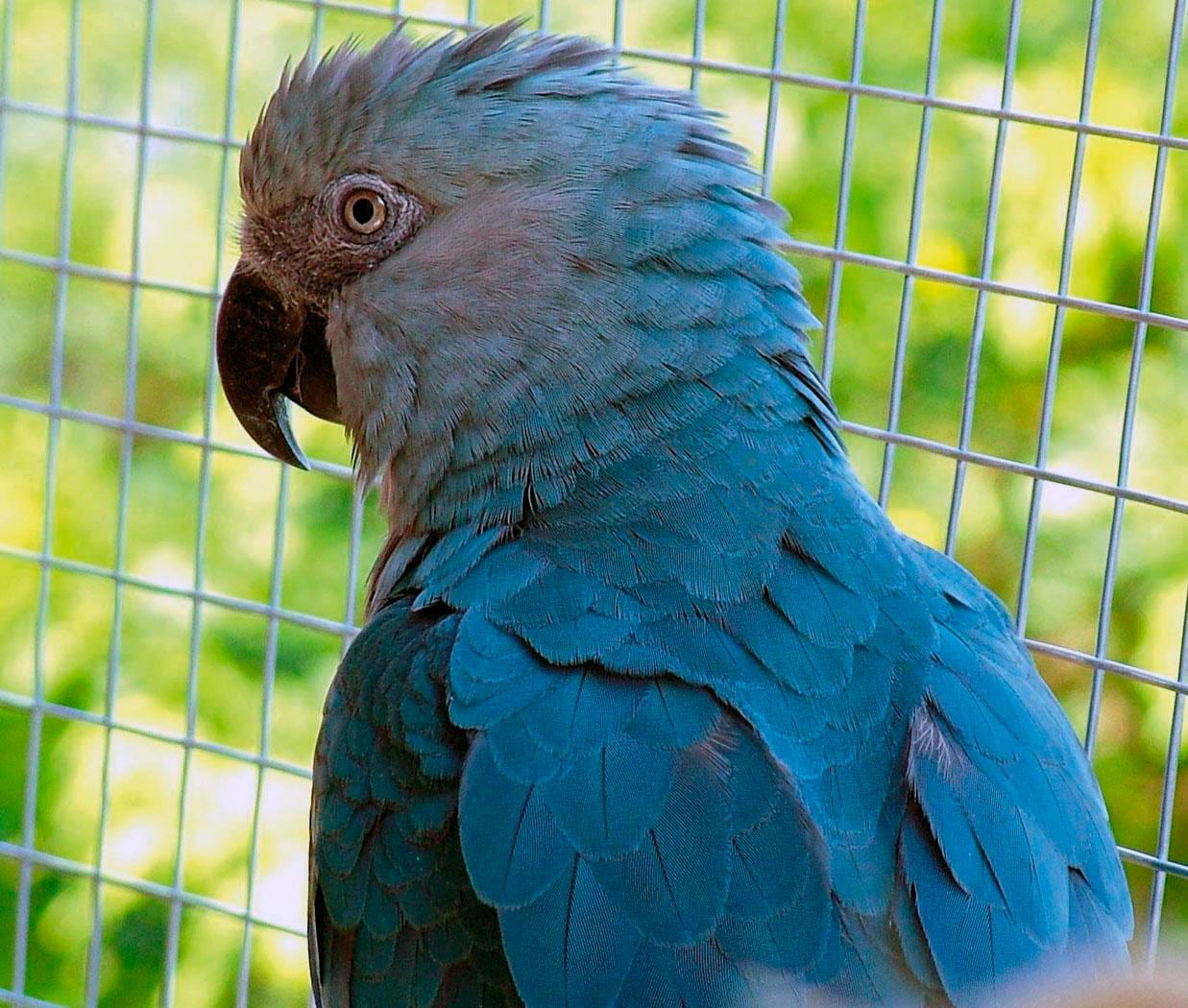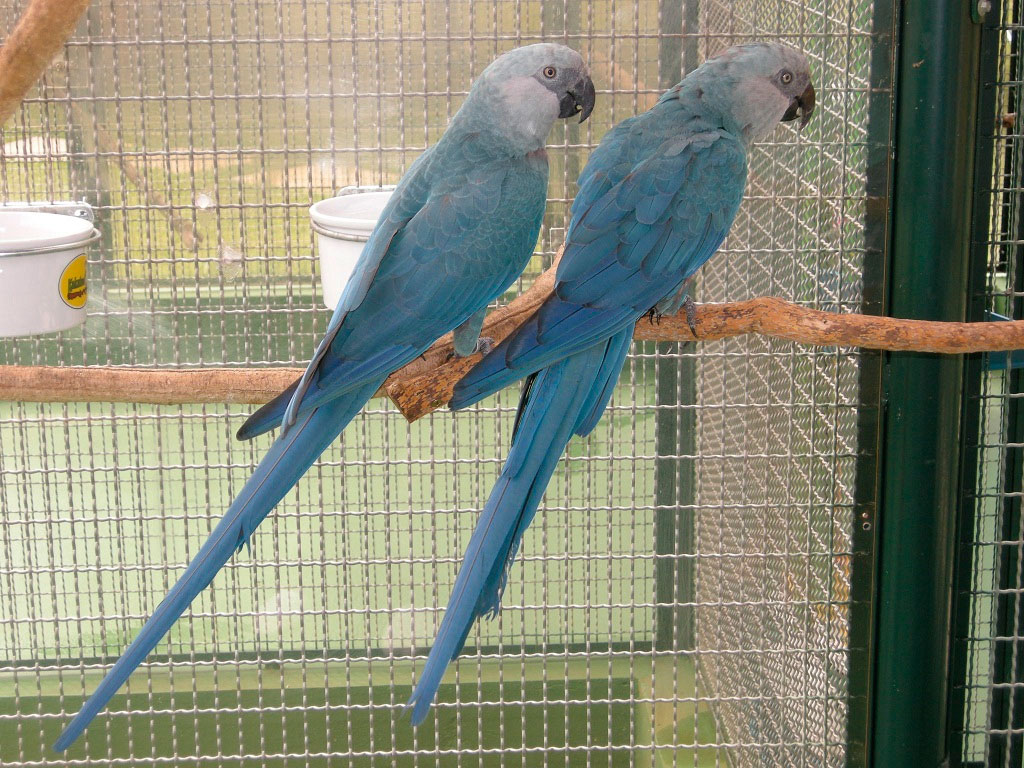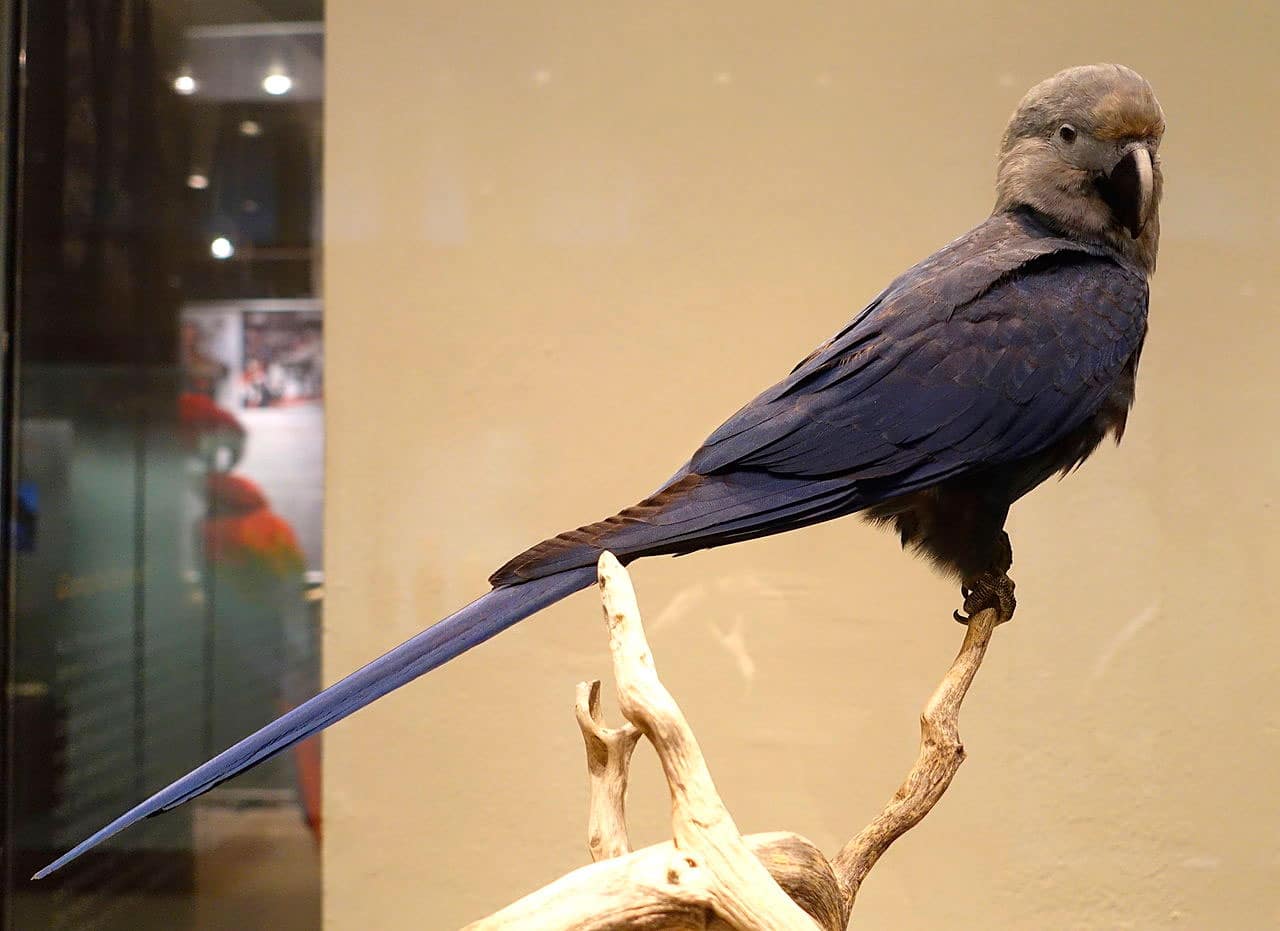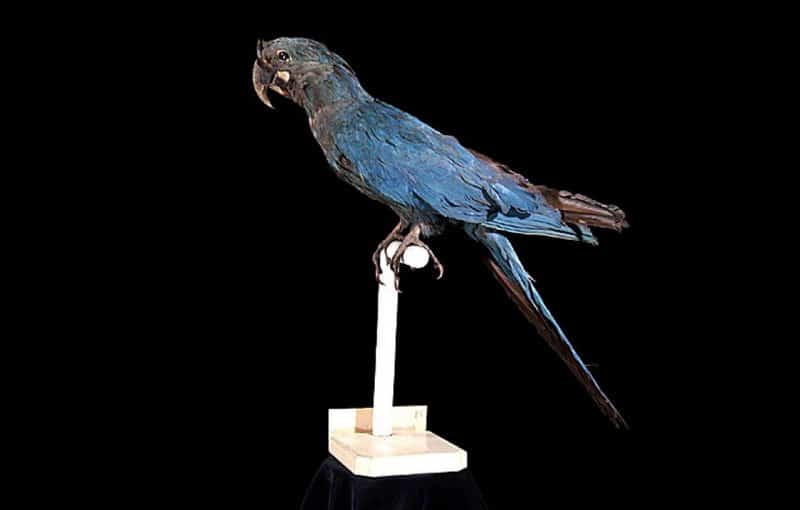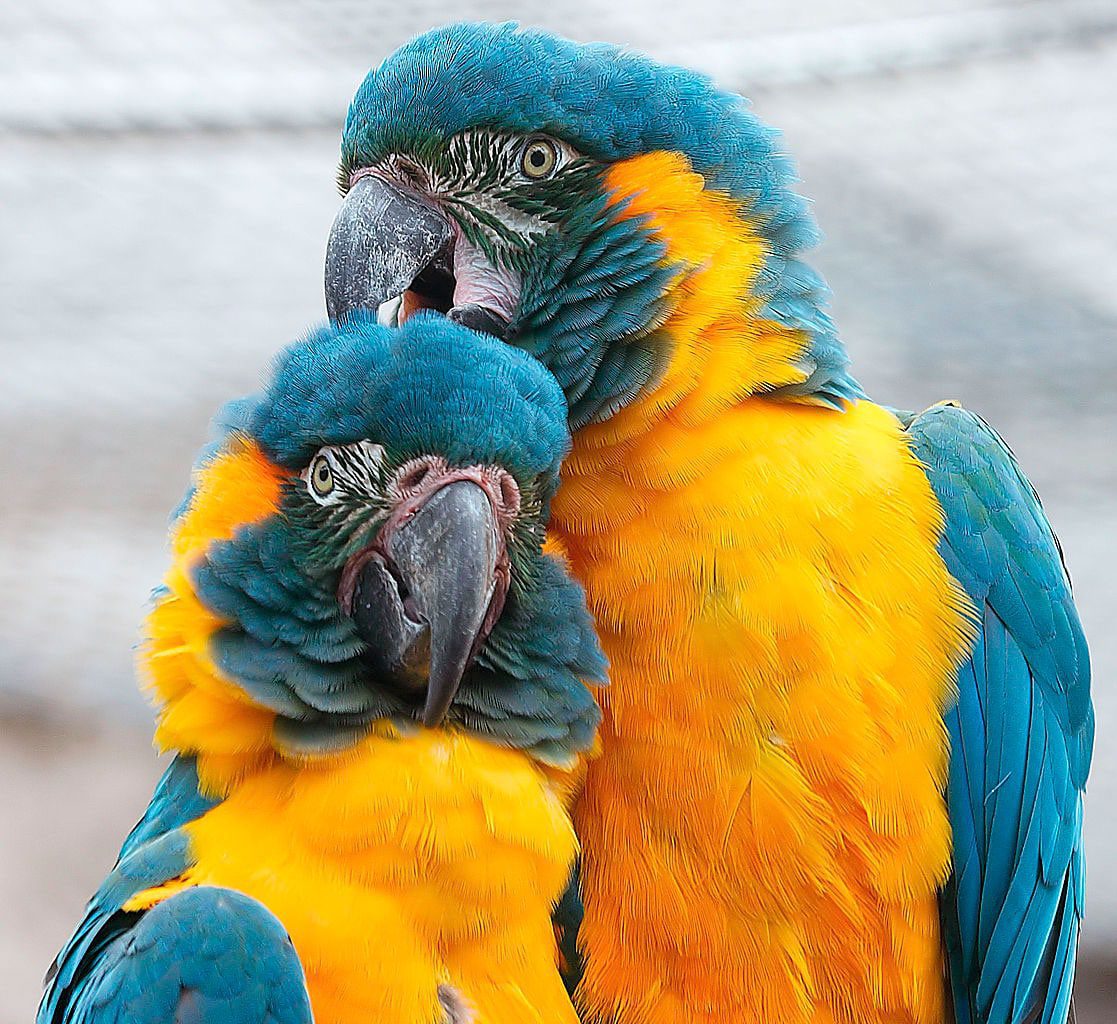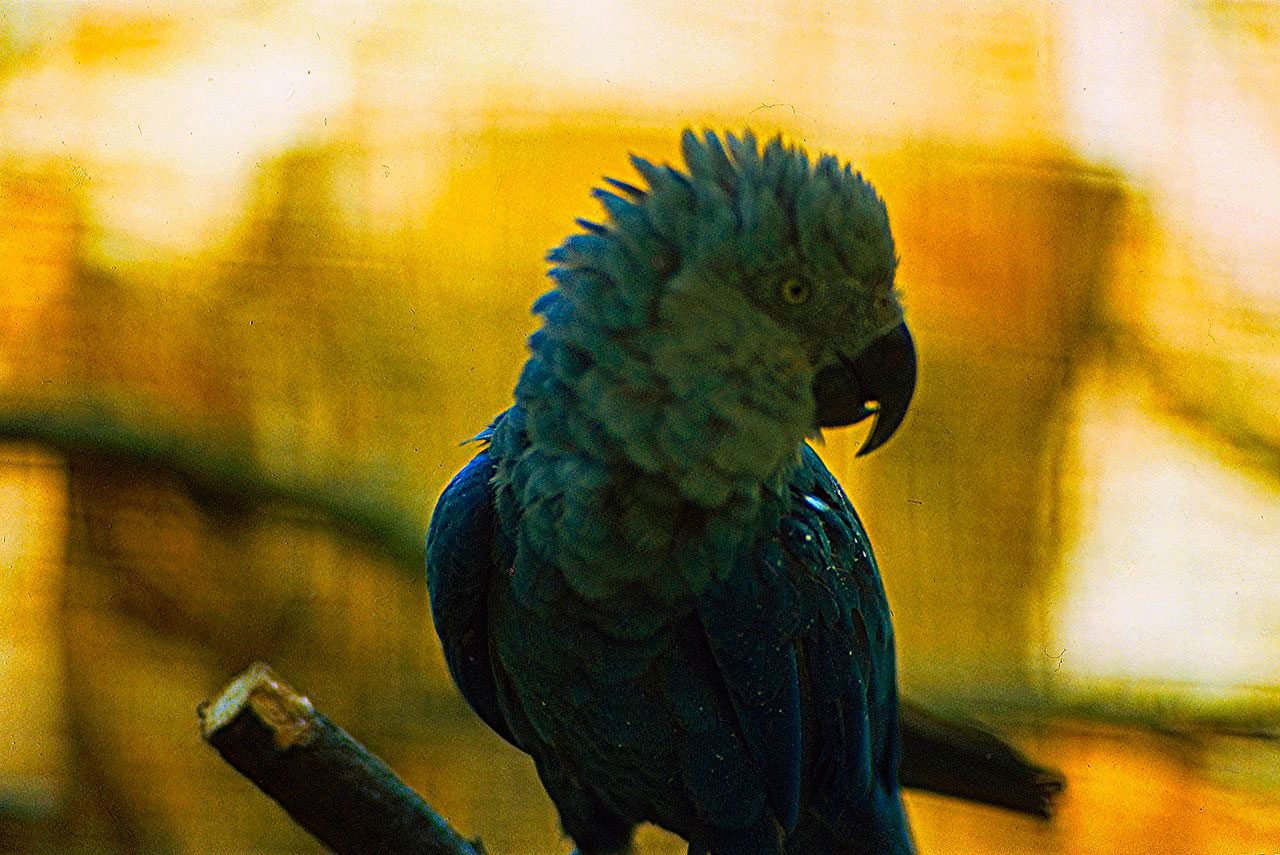
The Spix's Macaw(Cyanopsitta spixii) has various shades of blue. The head is pale-blue, the wings and tail dark blue. The underside of wings and the tail are black. They have a naked skin in the face grey / Black which sometimes fades to white and white when they are underage.
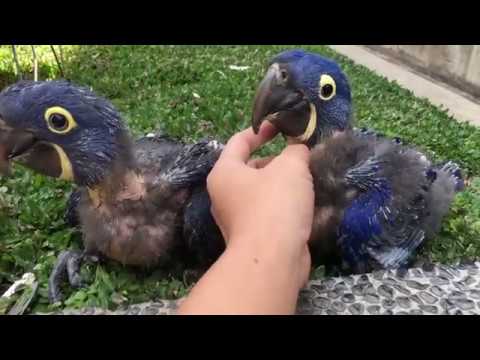
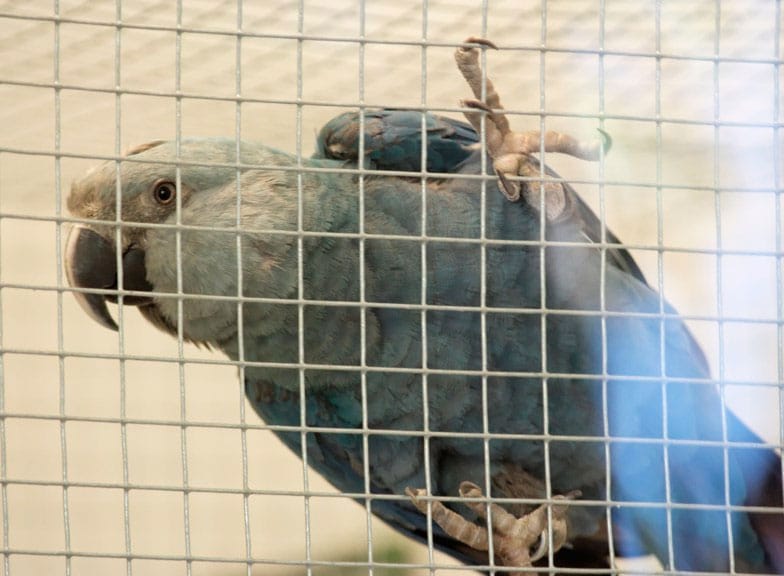
Bill is completely black, except in the youth having a clean white stripe in the center of the bill. The white band of the bill and the white skin of the face of the youth disappears after 6 months.
The legs are pale grey when they are juveniles, being dark grey, almost black when they are of adults.
The eyes they are dark in the youth, but they fade to white when mature birds.
Information on the natural ecology and behavior of these birds is limited., now that research not started until they were nothing more than 3 known birds those that lived in the wild.
But, there are records in which they are associated with gallery forests dominated by Tabebuia seasonal streams to grow along (streams) in the area caatinga (Thorn scrub semiarid community).
There are reports of the Spix's Macaw inhabiting sheets closed or more common in caatinga habitats (that is to say, that they do not have trees Tabebuia caraiba). Opinions that the species is ecologically linked with palms Mauritia flexuosa left without support and, in view of the wide availability of these habitats, seems totally unlikely.
When a few birds were discovered in 1980, These showed a strong herding behavior. These and the remaining birds, showed strong habitual features, using for example, hangers in the bare branches at the top of the tall trees, making particles and daily flight routes to nesting sites (one of those places, according to reports, was used continuously during 50 years), the last Spix's Macaw which data have, they were strongly linked with the Blue-winged Macaw.
According to reports, sometimes, obsrvados sleeping on top of a cactus, for example, of the species Cereus squamosus.
Reproduction:
In the wild, the Spix's Macaw They nest in tree hollows, most frequently in Tabebuia caraiba mature, at least to several meters above the ground.
the brood, in general, is between the months of November-March may vary in relation to the calendar and the intensity of the rains.
The intercourse lasts usually between 2 and 3 minutes and is done with two birds staying together on a perch with one of the legs of the male (usually right) mounted on the rear of the rump of the female.
It is believed that the normal clutch size in the wild had three eggs. But, in captivity the most common clutch size is four and can range from one to seven. An average egg is of 40 mm x 30 mm and weighs some 20 g.. They lay an egg oval-shaped and white.
The incubation period is of 25-28 days and only the female performs incubation tasks. The females are fed by the male, both within the nest, and outside the nest. The chicks hatch mostly naked with a small amount of cover at the bottom. The emplumamiento occurs in approximately 70 days and captive birds, bred by hand, they tend to become independent between the 100 and 130 days.
Size of the area of distribution (reproduction / resident): 50 km2
The Spix's Macaw they were endemic in the northeast of Brazil, mainly in the State of Bay, but also from Pernambuco. There they lived in a large expanse of semi-arid territory known as the Caatinga. Within the Caatinga There are micro-habitats, one of which – the Caraibeira Riparian Woodland, was the home of the Spix's Macaw. This particular habitat area is located near a small, charming town called Curaca, conveniently located along somewhere in the san francisco river. One of the tributaries that feed to the san francisco river is the Melancia Creek and it is through this waterway, where can I find the ancient habitat of the Spix's Macaw.
The Caraibeira (Tabebuia caraiba) It is the dominant tree species occurring along the banks of the Melancia Creek; It was also the most important tree species for the Spix's Macaw, Since it provided nesting hollows, shelter and food for the species.
Possibly previously ranged in one much larger Northeastern area of Brazil, that covers much of the region of the ‘Gerais‘ including the South of maranhรฃo, to the northeast of Goiรกs, Southwest of Piauรญ and North of Bay, but reports from some of these areas are apparently based on finger-pointing and even erroneous information provided by bird hunters.
Conservation:
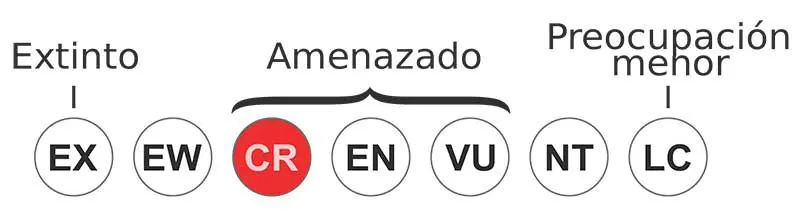
โข Current Red List of UICN: Critical Hazard – Possibly extinct in the wild
โข Population trend: Unknown
The Spix's Macaw It may not be the largest or most colourful species of macaws but is the Parrot with more critically endangered in the world, no known wild specimens(UICN, 2004).
While this species exists captive in various populations, the last known individual in the wild disappeared in late 2000, mainly as a result of the capture for the bird trade Wild addition by the habitat loss. But, cannot yet be presumed extinct in the wild until all potential areas of habitat have been thoroughly reviewed.
Any remaining population is likely to be small, and for these reasons the Spix's Macaw It is treated as a species in critical hazard (possibly extinct in the wild).
– CITES Appendix I, protected by the Brazilian legislation.
– Ten years of protection, the restoration of the habitat and a variety of community-based conservation in course programmes, they will pave the way for future reintroductions (Y. de Melo Barros in litt., 1999, 2000, Caparroz et to the. 2001).
– IBAMA It established the Permanent Committee of the Brazilian Government for the recovery of the Spix's Macaw and cooperation between the holders of birds resulted in annual increments in the captive population.
– This body is succeeded by the Working Group for the recovery of the Spix's macaw (Me and Melo Barros 2006), now supervised by the Chico Mendes biodiversity conservation Institute (ICMBio). This group is responsible for coordinating the captive breeding program, having reintroduction facilities in place later followed by breeding facilities.
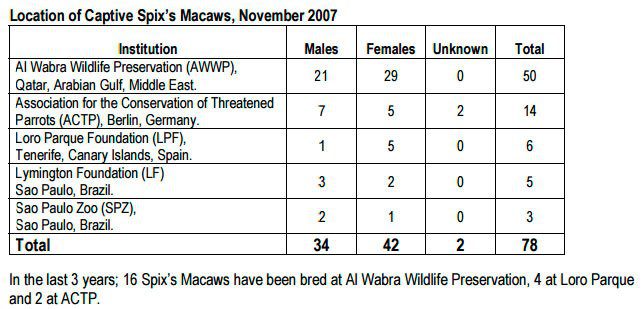
– The official captive population totaled 80 individuals in 2012, currently being these important proportions in the hands of Al - Wabra Wildlife Preservation (AWWP) in Qatar and Fundaciรณn Loro Parque (LPF) in Tenerife, Spain.
– Other official media are found in Brazil and Germany.
– Including the birds that have not been registered by the official program, It is believed that more than 90 Spix's macaw can exist in captivity around the world.
– Breeding success has occurred within some registered facilities, including AWWP and LPF. The latter has maintained the species since 1984 and in 2007 a new breeding center was opened for the Spix's macaws (Anon 2008a).
– AWWP raised successfully five chicks in 2012 and seven in 2013 (Gillespie 2014).
– In 2013 and 2014, females in the captive-breeding population in AWWP they were artificially inseminated, an egg-laying take place successfully (Anon 2015, Tomiska 2015).
– Management and recovery of the species in captivity is in preparation for this species.
– In February of 2009 To the Wabra Wildlife Preservation announced the purchase of the 2.200 acres of the Concord Farm in the State of Bay, Brazil, the site has one of the last recorded sightings of Spix's Macaw Wild, in October of 2000 (To Wabra Wildlife Preservation undated).
– Concord Farm It was also the basis of the field project of the Spix's Macaw, funded largely by the LPF, that operated in whole decade of 1990 until the completion in 2002, and the site for the release of the only prisoner of Spix's Macaw missing by returning to their natural habitat, in 1995.
– Concord Farm borders with the 400 acres of the Gangorra Farm, previously acquired by a consortium of conservation.
– Intended to allow that both farms can return to a more natural state by removing domestic cattle, in order to, long-term, the place can be a valuable habitat for the future restoration of a wild population of Spix's Macaw.
Conservation Actions Proposed:
– Identify a release site suitable for the annual potential release of birds bred in captivity from between 2013 and 2030 based on the success of captive breeding efforts (Me and Melo Barros 2006).
– Continue to develop artificial reproduction techniques to increase the population.
– Protect and enhance the habitat at the site of release identified (Me and Melo Barros 2006).
– Establish a well equipped facility in place of reintroduction in Praia do Forte under property IBAMA (Me and Melo Barros 2006).
– Introduce chicks bred in captivity and ensure its protection of trappers.
– Continue the cooperation between the holders of captive birds.
– Continue ecological studies to assess the need for habitat management (Snyder et to the., 2000).
– Continue the community programs.
"Spix's Macaw" in captivity:
Some suggest that there may be up to 120 These beautiful birds in private collections – the exact number is unknown. But, what is certain is that these last Spix's macaws survivors are among the most valuable and protected birds in the world.
Its longevity is estimated between 20-30 years in the nature and 20-40 years in captivity. Latest Spix's Macaw known wild had at least 20 years of age, at the time of his disappearance. There are two Spix's macaws in captivity who were born in 1976 and these are the Macaws oldest registered species.
Alternative names:
– Spix’s Macaw, Little Blue Macaw (English).
– Ara de Spix (French).
– Spixara, Spix Ara, Spix-Ara (German).
– Ararinha-azul (Portuguese).
– Ararinha-azul (Portuguese (Brazil)).
– Guacamayo de Spix, Maracanรก Azul (espaรฑol).
Parrots A Guide to the Parrots of the World – Tony Juniper & Mike Parr
Birdlife
TO THE WABRA WILDLIFE PRESERVATION
Photos:
(1) – A Spix's Macaw in Vogelpark Walsrode, Walsrode, Germany in about 1980 By Rรผdiger Stehn from Kiel, Deutschland (71 Spix-Ara) [CC BY-SA 2.0], via Wikimedia Commons
(2) – A juvenile in captivity. Note white stripe along top of beak and pale-grey bare facial skin By The original uploader was Robert01 at German Wikipedia(Original text: Robert01) (Self-photographed) [CC BY-SA 2.0 of], via Wikimedia Commons
(3) – Exhibit in Museum of Natural History, Berlin, Germany. Photography was permitted in the museum without restriction By Daderot (Own work) [CC0], via Wikimedia Commons
(4) – guacamayo de Spix (Cyanopsitta spixii) por Lycaon – Fauna extinta recientemente, redescubierta, nuevas especies – ellinceiberico
(5) – Cyanopsitta spixii – Parrot-birds
(6) – An 1878 painting of an adult by Joseph Smit [Public domain], via Wikimedia Commons
Origin: Mexico, Guatemala, Belice, Honduras, El Salvador, Nicaragua, Costa Rica, Panama
Character: Sociable
Life expectancy: 50 years
Height: 38 cm..
Content
Description:
38 cm.. length and 705-766 g. of weight.
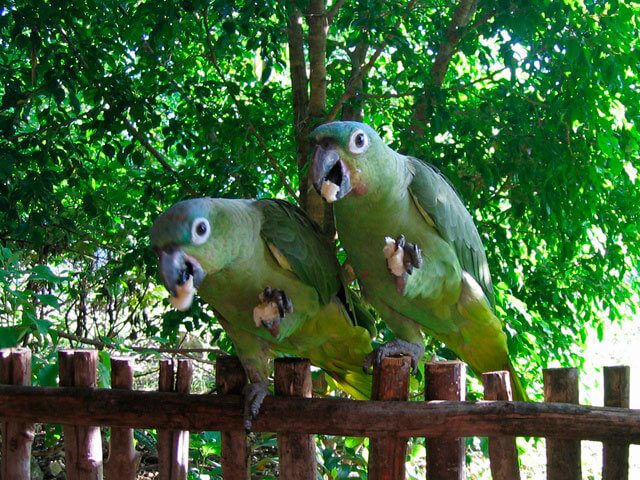
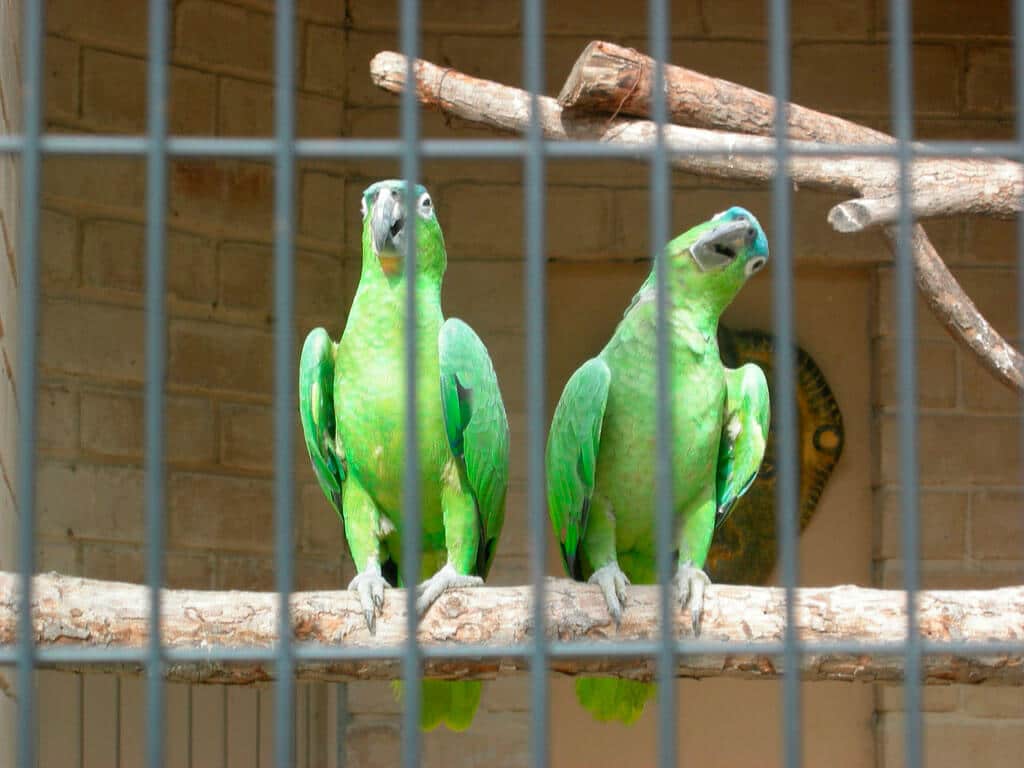
The Northern Mealy Parrot(Amazona guatemalae) is a large parrot, mainly green, with a large bare periophthalmic white; head green, increasingly off toward the area nape.
The youth similar to adults but eyes brown.
taxonomy:
Treated for decades subspecifically within the species Amazona farinosa. Based on a genetic study of the year 2012 They came to be regarded as a full species.
Subspecies description:
Amazona guatemalae guatemalae
(Sclater,PL, 1860) – Mostly green, with the crown, forecrown and lores, blue; carpal edge Green Wing / yellow; Feathers edges wing
, blue; Red in the secondary feathers; feathers of the tail dark green to light green at the tip. Bill dark grey. Eye ring white, irises red.
Amazona guatemalae virenticeps
(Salvadori, 1891) – Mostly green with less blue on the crown that the subspecies Amazona guatemalae guatemalae; yellower shades / green; carpal edge green / yellow, with varying shades of red; crown green; lores and forecrown, green tinted blue. Bill black / horn. Eye ring white, irises red.
Habitat:
Video "Northern Mealy Parrot"
They inhabit in dense humid lowland forests, especially near the gaps and edges; also they extend lower montane forest plantations and frequent, crops, gallery forests and deciduous forests.
They are in pairs or groups up 20 individuals, with larger congregations in feeding areas. Form noisy flocks in communal roosts high up in big trees out of breeding season, sometimes with several hundred birds. Well camouflaged while feeding quietly on the upper floors of the forest canopy.
Reproduction:
Season April-May Guatemala. Nests in tree holes, to 3-30 height m, once observed in the crack of a stone wall in a Mayan temple. The laying usually three eggs.
Size of its range (Standard playback): 919.000 km2
It is present along the slope of Caribbean of Central America, from Veracruz and Oaxaca, Mexico, to the South by Belice, Guatemala, Honduras, Nicaragua and Costa Rica, to western Panama. They are also found in the shed peaceful of Costa Rica and West Panama. Its abundance varies locally, but it is common in many areas.
Subspecies distribution:
Amazona guatemalae guatemalae
(Sclater,PL, 1860) – Caribbean coast from southeast Mexico to the Northwest of Honduras.
โข Current category of the Red List of the UICN: Near-threatened.
โข Population trend: In decrease.
Rationale for the Red List category
He suspected this species is undergoing a rapid decrease in moderately population due to habitat loss and unsustainable levels of hunting and trapping.
Origin: Panama, Venezuela, Guyana, Suriname, Brazil, Ecuador, Peru, Bolivia
Character: Sociable
Life expectancy: 40 years.
Height: 86 cm..
Content
Description:
Of 86 cm.. length and a weight between 995 and 1380 g..
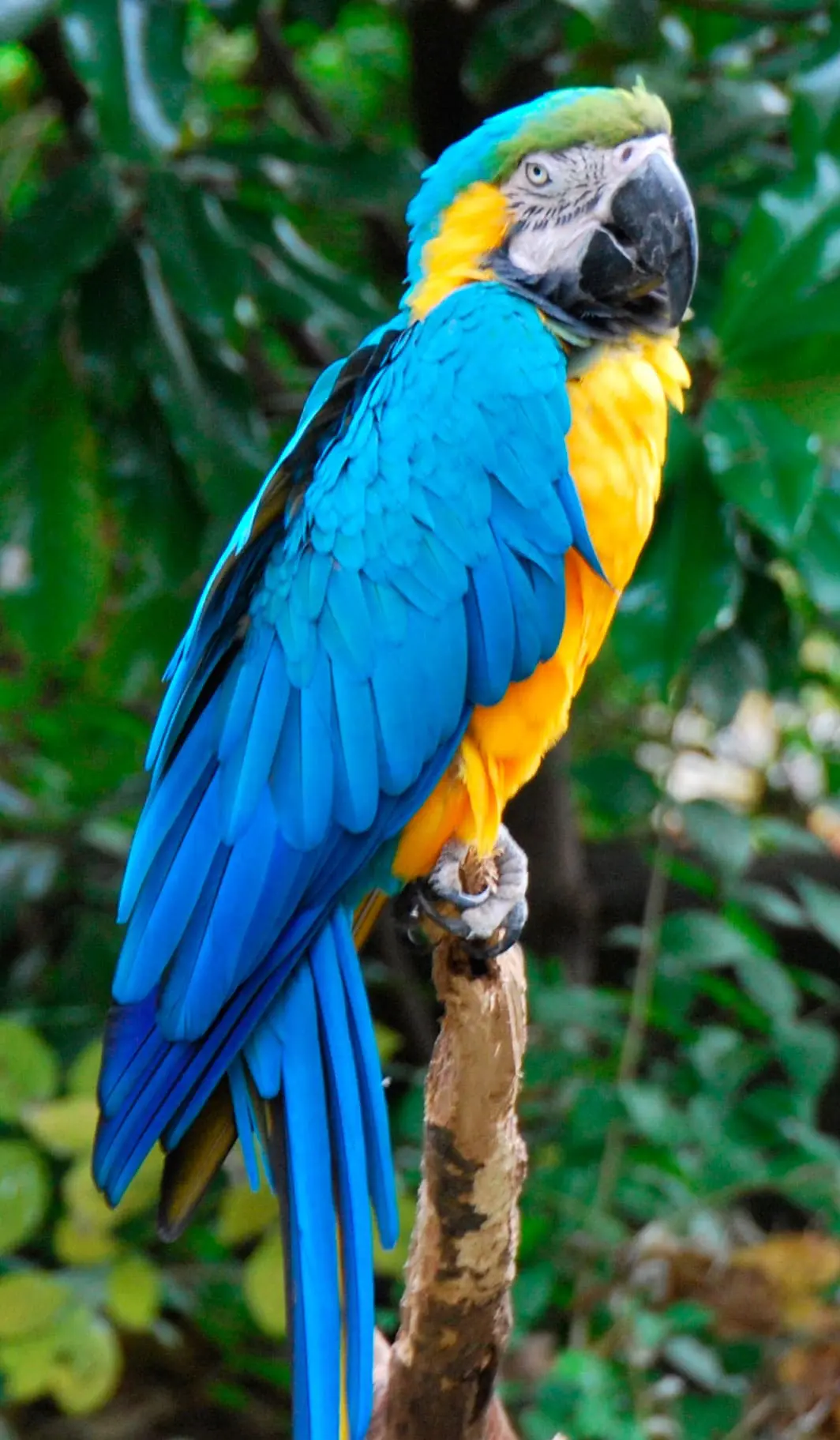
The Blue-and-yellow Macaw(Ara ararauna) has the forecrown and both sides of the head to behind eyes bright green, faded to bright ultramarine blue in the crown and nape.
The upperparts Blue bright overseas. Upper wing coverts Blue bright overseas; flight feather Violet Blue top, Yellow Gold to olive brown down; Depending on the light, the underwing-coverts, yellow.
Large patch yellow on the sides of the neck and ear-coverts edged ahead by a black stripe, to expand to form a black patch in the throat.
Undertail-coverts blue. Uppertail dark purple suffusion overseas; undertail, the tail golden yellow to olive brown depending on the light; Tips new feather of the tail striped wide.
Bill dark grey; cere naked and facial patch (including lores and cheeks to behind eyes) white crossed by narrow lines of feathers Black in knowledge and cheeks top (the skin of the face pink when they are excited); irises pale yellow; legs dark grey.
Both sexes similar.
The youth they have the wings and tail Cafe-grisacea and eyes browns.
They inhabit areas with large trees, often near water, including moist lowland forest edges (mostly forests and marshes, avoiding the lowland forest of tierra firme), gallery forest in the savannah, Savannah with trees and scattered Palms, marshy forests and swampy areas with Palm trees (Mauritia flexuosa). As well bosque deciduous away from the water in Colombia and Panama.
They sometimes feed in more open areas, posing on the floor, for example, for feeding of fruits of Palm.
Gregarious. Usually, observed in pairs, family groups or flocks of up to 25 birds (sometimes many more, especially near the roosts).
The Blue-and-yellow Macaw are observed more often in the morning and afternoon, halfway between the roosts and feeding areas.
Communal roosts in the trees.
Reproduction:
Son monogamous and they usually form a couple throughout their lives.
It nests in a hole in the top of a dead Palm tree (for example, Mauritia flexuosa).
Breeding between the months of February and March in Suriname; Between January and may in Trinidad (formerly); Between December and February in Colombia (birds observed in breeding conditions). Egg laying observed in February in Guyana and between November and January at Peru.
The laying, generally, is two or three eggs, incubated by the female for a few 28 days, the chicks leave the nest to the 90 days after birth.
The Blue-and-yellow Macaw they eat quietly at the top of the canopy, often near clearings. Large flocks may congregate in areas of ribera, often with other species of parrots, to supplement their diet with minerals that are ncuentran in clayey soils.
Distribution:
Its distribution is varied and discontinuous: east of Panama and the tropical lowlands of South America to the South-East of Brazil, Bolivia and Paraguay.
Along the lower tropics (some 500 m) in Colombia; apparently absent from the Valle del Cauca, Nariรฑo, and the moist rain forests of central Choco.
In the eastern lowlands of Ecuador, and perhaps earlier in Guayas, on the slope of the peaceful.
Tropical zone of Venezuela, mainly to the South of the Orinoco, in Monagas only in the north shore (for example in the drainage of the amana river).
extinct in Trinidad from 1970; escapes of captive birds reported since.
Spread sheets and coastal river systems of Guyanas and Suriname.
Widespread in Brazil, but extinct in Bay, South of Rio de Janeiro and in Santa Catarina, during the years 1950 or 1960; they remain in the southeast of Brazil only in the State of Sรฃo Paulo Western, as a wandering bird from populations further to the West in the region of the Pantanal and the lowlands of Bolivia and Peru.
Current situation in the Paraguay (probably Northeast, perhaps earlier in the South) It is not clear.
The records of Argentina remain corroborated.
Resident general, but with some movements of foraging season.
Locally common, but, apparently, decrease in Panama.
Fairly common in less disturbed areas of Colombia.
Scarce, irregular and decreasing to the West of the Andes in Colombia and Ecuador.
Local in Venezuela.
The largest population of the Blue-and-yellow Macaw It is located in the coastal area of Suriname and it appears to be very common in northwestern Guyana, much less numerous in the South; local in the French Guayana due to the persecution. More common in parts of Brazil (especially in the Amazonia), but rarer in Pantanal. Locally common in the Amazon area of Peru but with a drastic drop around the main capture centers (for example, Iquitos and Pucallpa).
Apparently rare Bolivia, in the Northwest area, but common (at least locally) in the East.
In the 15th century and probably until the end of the 19th century its distribution area encompassed virtually all the the Caribbean basin.
The size of the world's population has not been quantified, but this species is described as ‘Rare‘ (Stotz et to the. 1996).
Not regarded as threatened, Although it is appreciated as bird cage, and their populations are declining and several are now extinct, including the of Trinidad.
The species has undergone intense trade: from 1981, When it began trading in the Appendix II of CITES, 55,531 individuals captured in nature have been registered in international trade (UNEP-WCMC CITES Trade Database, January 2005).
An investigation by the UN indicates that removal of chicks of Blue-and-yellow Macaw, in the Amazon, exceeds the 26%, which leads to overexploitation of the species.
โIf a stock is already being overexploited, any rate and type of extraction would have serious effects on its viability and could quickly drive it to extinction. The extraction of adults, even in healthy populations, is even more critical as a rate of 3% already produces population declines, and if they are being subjected simultaneously to extraction of chicks and adults, hunting rates must not exceed the 1% or 2% so that there is no risk of extinctionโ, Esteban Carrillo and Diego Fernando Builes doors explained, authors of research.
The genera Amazon (Loras) and Ara (macaws) they are particularly vulnerable, due to factors such as its low reproductive rates, low survival of chicks, late age of first breeding, large proportion of non-breeding adults and specific requirements for nest building. In addition are the two most desired genera as pets, and whose extraction generates greater economic โprofitsโ for local hunters.
In particular, the Blue-and-yellow Macaw (Ara ararauna), that it is distributed in lowland forests from Panama to Bolivia Centre and the South-East of Brazil, it is common, but decreases according to the human activity and local extinctions have already.
Sensitivity analysis in the adult hunting scenario for crafts shows that this type of extraction can have profound effects.. Through a program of modelling, It was determined that only extract the 3% of adults, the growth rate turns negative, to extract the 8% the adult begins to have chance of extinction, and with extraction rates equal or greater to the 10%, the probability of extinction of the population in the following 100 years ranges between 52% and 100%.
Researchers warn that the only form of sustainable extraction is subsistence hunting, which is carried out in order to obtain animal protein or hunting by-products to meet the needs of human groups linked to rural areas. Likewise, they needed to hunt for chicks rates are decreased below the 10%, in order to not affect population viability.
"The recommendation we make is that protected areas be established that include their important nesting and feeding places such as the salted ones and the cananguchales, as well as including the species in Appendix I of Cites and completely prohibiting its trade until studies and Population Viability Analysis are carried out. (PVA, for its acronym in English), that establish the rates and forms of sustainable extractionโ, conclude the researchers.
Habitat degradation in South America, pollution, development and logging are also affecting the populations of Blue-and-yellow Macaw.
"Blue-and-yellow Macaw" in captivity:
The Blue-and-yellow Macaw they have great popularity as pets. They are beautiful birds with complex behavior, and a good ability to mimic words and sounds. Son social and Smart and they can be great companions of their owners, If managed well. (Juniper, 1998)
With regard to its longevity, There is anecdotal records of animals kept as pets who have lived more than 50 years, but none has been confirmed. If it has been confirmed a specimen that lived 43 captive years. In captivity, these animals have been known that they can be raised from the 8 years of age.
Although these birds are rewarding colleagues, its large size, the complexity of their behavior and its longevity, they do need to have a large space and a big commitment. Their capture in native habitats also often includes the killing of the parents in order to obtain their young., as well as the destruction of important nesting trees.
The results of illegal trade involves much destruction.
Alternative names:
– Blue-and-yellow Macaw, Blue & Yellow Macaw, Blue and yellow Macaw, Blue-yellow Macaw (English).
– Ara bleu, Ara ararauna, Ara bleu et jaune, Ara bleu et or (French).
– Gelbbrustara, Ararauna (German).
– Arara-canindรฉ, arara-amarela, arara-azul, arara-de-barriga-amarela, araraรญ, ararauna, arari, Canindรฉ (Portuguese).
– Guacamaya Azuliamarilla, Guacamayo Azul y Amarillo, Guacamayo Azulamarillo, Guacamayo azuliamarillo, Papagayo amarillo, Paraba azul amarillo (espaรฑol).
– Guacamayo, Guacamaya azul, Papagayo, Guacamaya pechiamarilla (Colombian).
– Guacamaya azuliamarillo, Guacamayo pecho amarillo (Ecuadorian).
– Paraba azul (Bolivian).
– Canindรฉ (Guarayo).
– Ararakรกng (Guarani).
scientific classification:
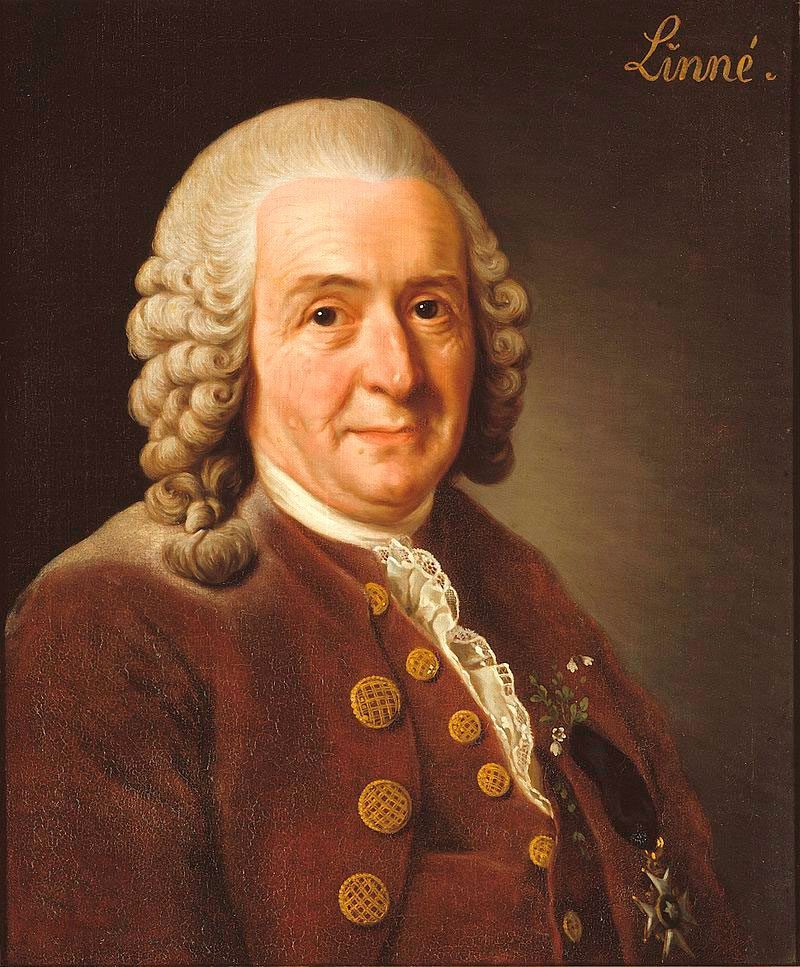
Carl Linnaeus
Order: Psittaciformes Family: Psittacidae Genus: ARA Scientific name: Ara ararauna Citation: (Linnaeus, 1758) Protonimo: Psittacus Ararauna
Avibase
Parrots of the World โ Forshaw Joseph M
Parrots A Guide to the Parrots of the World – Tony Juniper & Mike Parr
Birdlife
Book, Parrots, parrots and macaws.
Photos:
(1) – Blue-and-yellow Macaw at Cincinnati Zoo, USA By Ted (originally posted to Flickr as DSC_0389) [CC BY-SA 2.0], via Wikimedia Commons
(2) – A Blue-and-yellow Macaw (also known as the Blue-and-gold Macaw) at Gramado Zoo, Rio Grande do Sul, Brazil By diegodobelo (Zoo de GramadoUploaded by Snowmanradio) [CC BY-SA 2.0], via Wikimedia Commons
(3) – Guacamayo azul y amarillo by, Luc Viatour [GFDL, CC BY 2.0 or CC BY-SA 3.0], via Wikimedia Commons
(4) – Portrait of a Blue-and-yellow Macaw (Ara ararauna) in the Vogelburg (bird park) Hochtaunus, Weilrod, Germany – Wikipedia
(5) – Ara ararauna ou Arara-canindรฉ By No machine-readable author provided. Observatore assumed (based on copyright claims). [GFDL or CC-BY-SA-3.0], via Wikimedia Commons
(6) – Blue-and-yellow Macaw (Ara ararauna) in Santa Fรฉ do Sul, Sรฃo Paulo State, Brazil By Miguelrangeljr (Own work) [CC BY-SA 3.0], via Wikimedia Commons
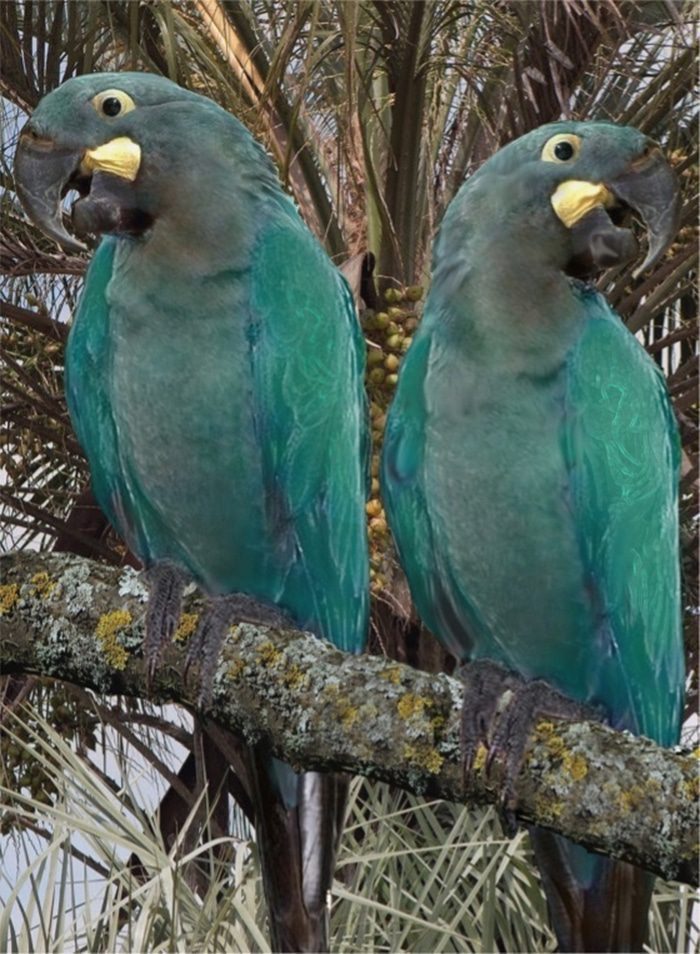
The plumage general of the Glaucous Macaw(Anodorhynchus glaucus) It is light blue, almost turquoise top, with strong grayish hue in head and underparts.
Uppertail greenish blue; undertail gray.
The bill It is dark blackish gray, the naked flames in the base lower jaw they are yellow, but paler than the periophthalmic skin; the irises is dark brown, the periophthalmic skin Nude yellow; the legs They are dark.
Habitat:
probably he occupied subtropical gallery forests with cliffs, but also used lightly wooded savannas and rich in palm trees. The few contemporary records suggest it was naturalists gregarious.
Reproduction:
It has been reported that anidaba on steep slopes or cliffs, or less generally in the cavities of trees and the average size of laying It was probably two eggs
Food:
Its diet It was probably basic nuts palm Butia horizontal (nearest equivalent in rank to size nutsSyagrus used by the Indigo Macaw, It is having the same dimensions peak).
Distribution:
Extending its range (breeding/resident): 1 km2
the Glaucous Macaw They were distributed at the time by the south-eastern South America, where apparently they were recorded in average growth of the main rivers, including Parana River, the Uruguay River and the Paraguay River, with most of the evidence of a prior distribution in the province of Currents, to the North of Argentina; cases were also recorded in western Uruguay and Southeast of Brazil (Rio Grande do Sul and Paranรก), and evidently in the south and east of Paraguay. The records of Bolivia They seem wrong. Almost certainly extinct after a precipitous decline in the early 19th century. Only two records in the twentieth century.
Conservation:
โข Current category of the Red List of the UICN: Critically Endangered.
โข Population trend: Unknown.
โข Population size : 1-49 individuals.
Rationale for the Red List category
This species was last recorded in the 1990s. 1960 and it is likely that its population has declined dramatically as a result of hunt, Besides the degradation and habitat destruction. But, you may still exist, since not all its wide range of data, above wide, It has been adequately studied, and there have been persistent and convincing local reports. Any remaining population is likely to be small., and for these reasons it is treated as in Critically Endangered.
Justification of the population
It is assumed that any remaining population is small (counting less than 50 individuals) due to lack of confirmed records since the early 1960.
Threats
The settlement of the major river basins within its range was allegedly accompanied by the widespread loss of palms, whether by direct cleaning for agriculture or suppression of regeneration by livestock settlers. The palma de Horizontal, of the species probably fed, It was chosen to be cleared by early settlers because it was an indicator of good soil quality (Necklace et to the. 2014). The widespread loss of gallery forests could also have had an impact on the species. (Necklace et to the. 2014). The size and appearance of the bird probably made him a prime target for hunters, and even capture hatchlings as pets could have been important. There is some evidence that were sold, but few to support various claims that there has been recent trade in live specimens.
Any current trade in eggs, skins or live specimens would obviously be extremely damaging.
Conservation actions underway
– Appendix I of CITES and protected by Brazilian law.
– There have been several attempts (so far unsuccessful) to rediscover the species.
– There are proposals for funding under way to try to fund a work program to confirm the presence of this species in the wild.
Conservation Actions Proposed
– Conducting interviews with the local population, especially with parrots and ancient hunters assets, to assess the likelihood of any population remains.
– Getting ready to follow up any positive data from these interviews.
"Glaucous macaw โ " in captivity:
There is some evidence that were sold, but few to support various claims that there has been recent trade in live specimens.
– Avibase
– Parrots of the World โ Forshaw Joseph M
– Parrots A Guide to the Parrots of the World – Tony Juniper & Mike Parr
– Birdlife
– Photos:
(1) – digital recreation of glaucous macaw. The background with Butia yatay is courtesy of http://floradeluruguay.blogspot.com/2010/05/butia-yatay.html , Andrรฉs Gonzรกlez. By Rod6807 (Martin Rodrรญguez Pontes) (Own work) [CC BY-SA 3.0], via Wikimedia Commons
(2) – Anodorhynchus glaucus by Huub Veldhuijzen van Zanten / Naturalis Biodiversity Center [CC BY-SA 3.0], via Wikimedia Commons
(3) – Anodorhynchus glaucus by Huub Veldhuijzen van Zanten / Naturalis Biodiversity Center [CC BY-SA 3.0], via Wikimedia Commons
(4) – Anodorhynchus glaucus By Vieillot, 1816 [CC BY-SA 3.0], via Wikimedia Commons
(5) – Anodorhynchus glaucus by Huub Veldhuijzen van Zanten / Naturalis Biodiversity Center [CC BY-SA 3.0], via Wikimedia Commons
(6) – Early illustration of the Glaucous Macaw illustration from Bourjot Saint-Hilaire, 1837-1838 By Bourjot Saint-Hilaire [Public domain], via Wikimedia Commons
โท The world of Pets: Dogs, cats, birds, reptiles, amphibians
Of 85 cm.. length and a weight between 600 and 1000 g..
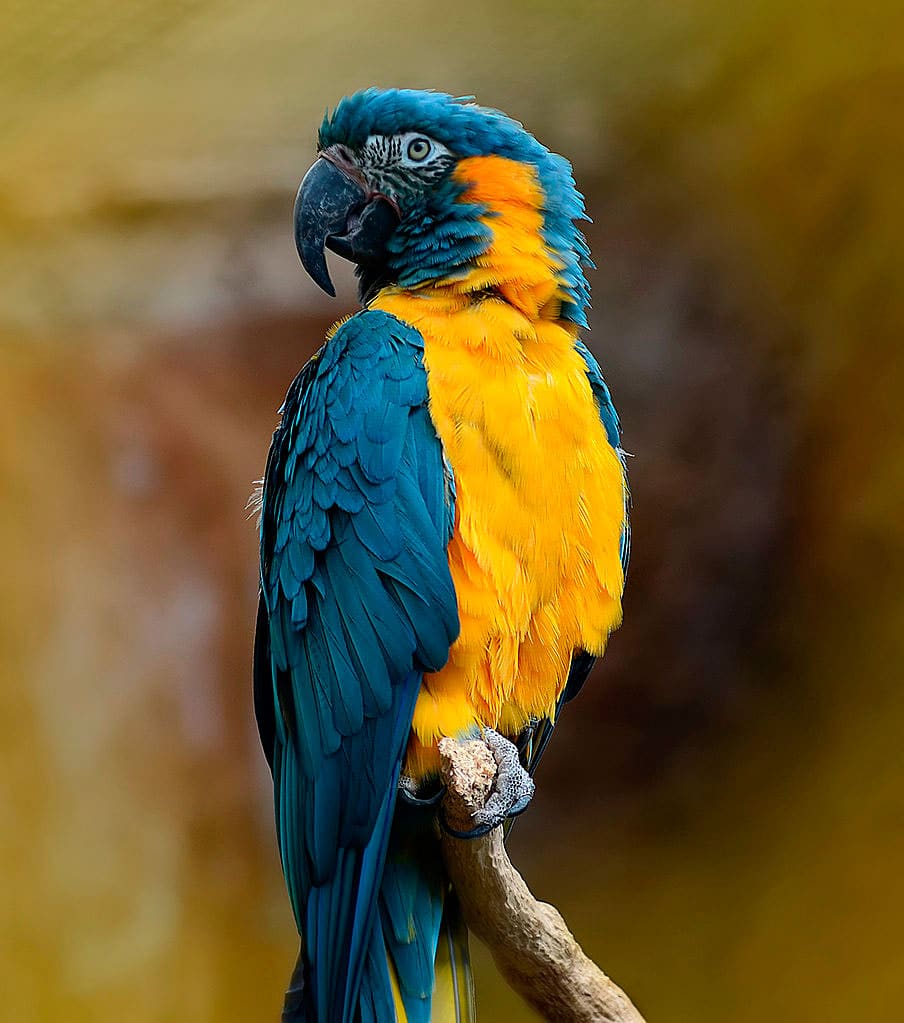
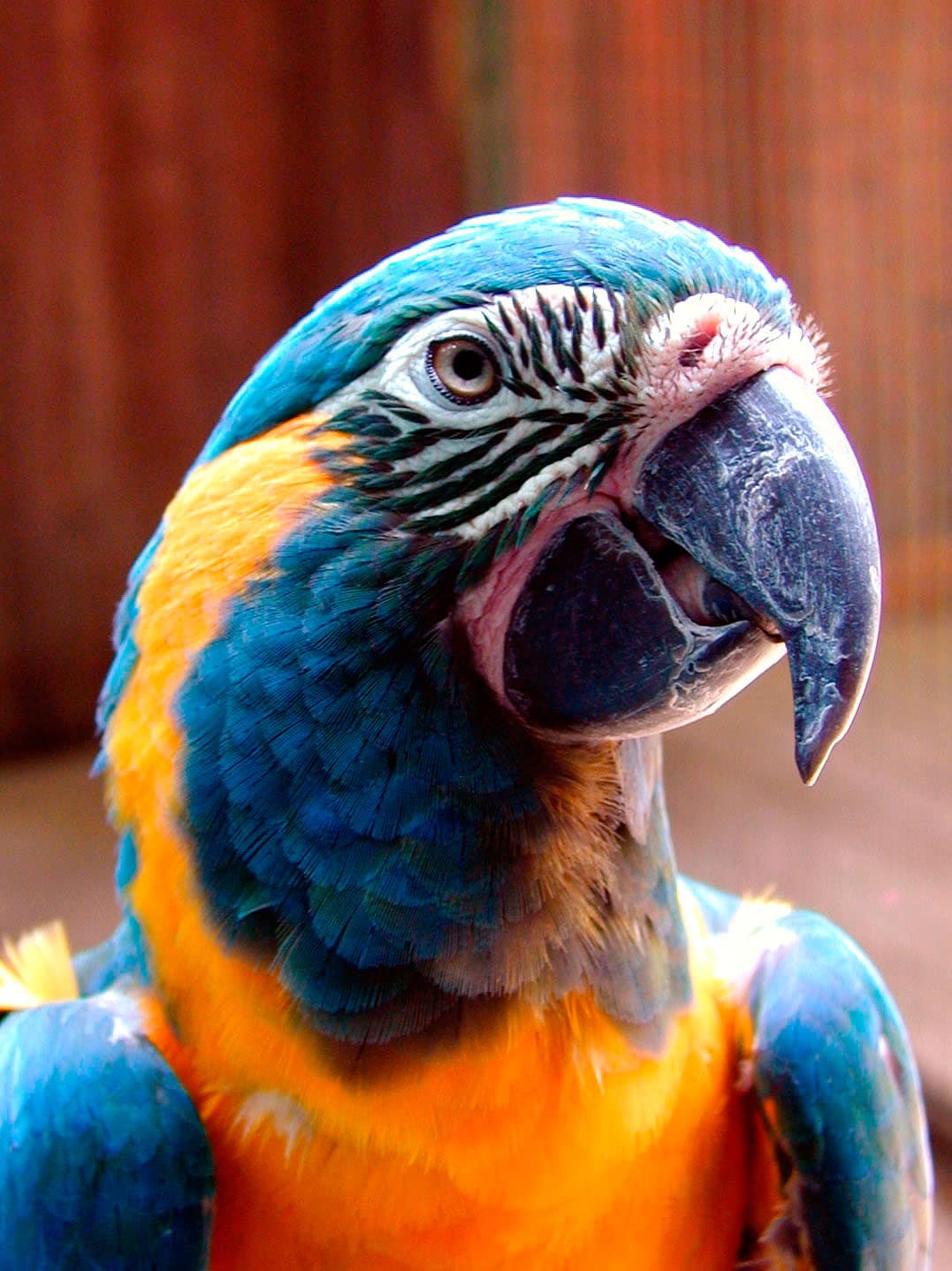
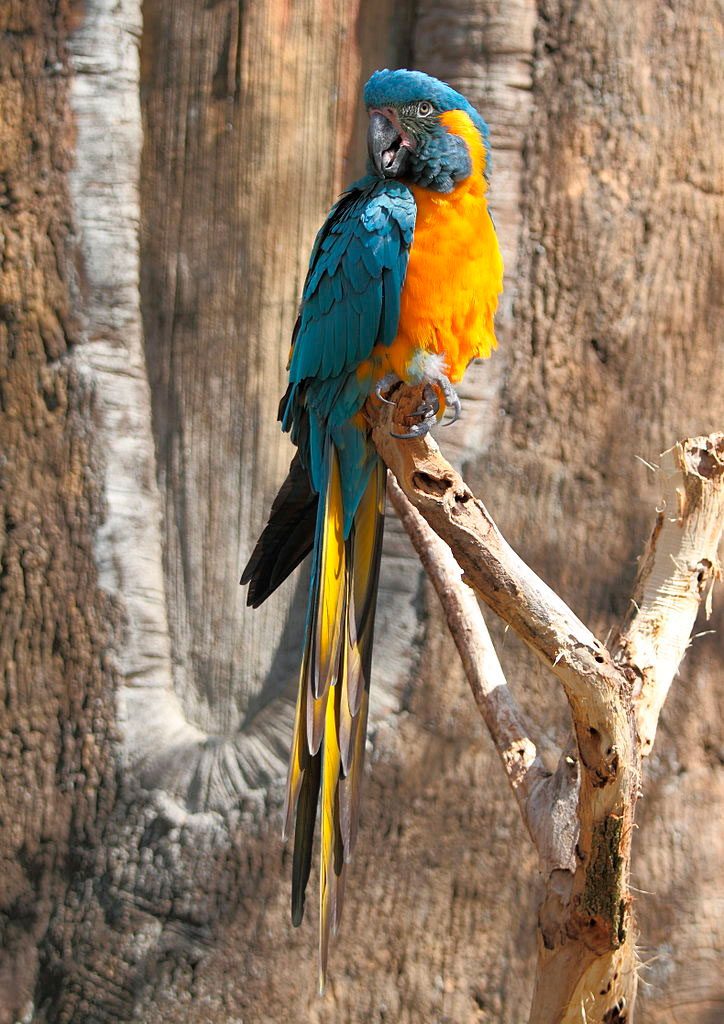
The Blue-throated Macaw(Ara glaucogularis) they have a very vivid coloration. Very similar to the more common Blue-and-yellow Macaw (Ara ararauna), easily differentiated by wide turquoise blue stain that reaches the throat.
These beautiful macaws have bright turquoise blue feathers that cover the throat, crown, the back and the back of your wings and tail. Yellow gold feathers grow in a strip between the crown blue and neck, on the sides of the face and in the ventral part of the body, the wings and tail.
In the face There is a patch sparsely feathered skin near the base of the great bill dark which has 5 or 6 horizontal stripes of blue feathers, unique for each Blue-throated Macaw and that they can be used to individually identify adults. The skin This patch is predominantly white with a tinge of pink around the bill.
The Blue-throated Macaw sample little sexual dimorphism.; However, the males they tend to be a little larger than the females with approximate masses of 600 and 800 g., respectively.
The newborn infants they are completely pink and have no feathers. The gray color of the underparts grows as they age, and is later replaced by colorful feather, fully developed. The irises It also changes color with age. The color of the eyes of a hatchling is initially black and changes to brown shortly after the opening of the eyes.
When is the Macaw one to three years, their eyes Gray become, then white. In the old mature, the irises It turns yellow and will be more golden color to the 10 years, becoming a gold richer with age.
The largest macaws They show a ring dark grey color that surrounds the pupil. This ring can be used to estimate the age of the Macaw.
Very scarce and localised. They inhabit gallery forests and tree islands surrounded by tropical savannah..
Seasonal rains cause floods in October to may and transform the Savannah in a swamp covered with grass that surrounds the high forest islands, permanently dry. The presence of Palms is required Motivate (Attalea phalerata) for the survival of the Blue-throated Macaw Since this species feeds, In addition to using it to build their nests. Also have favoritism by the Acrocomia aculeata.
They are most frequently between the elevations 200 and 300 m. Most of these macaws' habitat is used for cattle ranching.. But, the land is not suitable for cultivation, so there is one alteration of habitat for agriculture.
In general, observed in pairs; apparently less sociable nearby conspecifics than. The young are believed to stay with the parents for only a brief period of time., Perhaps that explains the infrequency in which observed small flocks or family groups. Probably communal roosts, sometimes with the Blue-and-yellow Macaw. They tend to use hangers in tall trees, especially of the species Tabebuia.
Although cattle trample young trees, Palms Motivate mature they are very resilient and resist damage. This Palm is also fire-resistant. As a result, Palms Motivate, often dominate the forest fragments in the Beni savanna (Llanos de Moxos).
Reproduction:
The Blue-throated Macaw are monogamous and they mate for life. It is not known if these macaws are matched with another partner if your original partner, dies. Nothing more is known about systems of mating for this species in the wild.
Usually They nest in cavities of Palm trees, often the species Attalea phalerata, but they will also use other Palm species or trees Tabebuia. You can use the holes previously occupied by other species, for example, woodpeckers.
Dead Palm trees are ideal for nesting, insofar as they are excavated by large larvae after a tree has died.
Some species of macaws, including the Blue-throated Macaw, palm leaves are eaten, causing the death of the tree. The trunk of the Palm will be recessed by larvae, resulting in the creation of a potential nest. It is not yet known if this is a coincidence or if these birds do this intentionally to create nesting sites..
Nesting couples do not remain in a nest consecutive reproductive seasons and generally seek different nesting sites each year.
The reproduction do it once a year if environmental conditions permit; However, If eggs or chicks are lost, the breeding pair can produce a second clutch in the same breeding season.
It has been speculated that the two sub-populations they breed at slightly different times: the population of North from August to November and the population of South from November to March.
The female It puts one to three eggs by laying and incubated during 26 days. The chicks have a mass of about 18 g at hatching; they leave the nest to 13 to 14 weeks and not be completely independent parents for a full year. They will reach their sexual maturity to the 5 years.
Food:
The Blue-throated Macaw do not feed on seeds and nuts to the same extent that other many other species of macaws make it. On the other hand, they eat mainly fruit of large Palm trees, including the of the Attalea phalerata and Acrocomia aculeata.
Birds consume ripe and near-ripe fruit and drink fluids from immature palm fruits. Attalea.
Distribution:
The Blue-throated Macaw only found in the Beni Department, Bolivia (between 200 and 300 meters above the sea level). In total, They inhabit an area of 2508 square kilometers.
There is a two inhabited areas by two subpopulations, to the Northwest of Trinidad (the capital of Beni), and the other to the South of Trinidad. This separation may have occurred because of the indigenous peoples who historically inhabited this area and who hunted the Blue-throated Macaw in order to use their feathers in their ornamental costumes. This separation could also have been caused more recently by the wild bird trade. With the high population of humans, macaws in those areas would have a higher chance of being caught. The formation of large human settlements in this area also resulted in a loss of suitable habitat and fragmentation of the habitat of this species. So, there are not any Blue-throated Macaw in the vicinity of Trinidad.
Reports of birds in Tarija and Chuquisaca they have not been tested. Stock in Paraguay and North of Argentina they are still being corroborated and seem unlikely. Apparently resident. Scarce and highly dispersed.
Conservation:
โข Current Red List of UICN: critically endangered
โข Population trend: Stable
The Blue-throated Macaw is currently classified as in critical hazard on The IUCN Red list and figure in the Appendix I by the CITES. Trapping for this species is illegal because the Blue-throated Macaw they are protected by the national law of Bolivia and Convention on international trade in endangered species of Fauna and Flora Silvestres (CITES) from 1986. (Strem, 2008; ยซBlue-throated Macawยป, 2009)
The capture for the pet trade It is the main reason that the Blue-throated Macaw are in such critical danger. The rarity of this species drove the selling price, What gives as a result an increase in the pressure of capture. As more birds were captured, the rarity of the Blue-throated Macaw was on the rise. This became a vicious cycle that greatly reduced the wild population of these Macaws to the numbers currently observed.. Currently there is an estimated number of 50 to 250 specimens in the nature. (Hesse and Duffield, 2000; Jorยญdan and Munn, 1993; ยซBlue-throated Macawยป, 2009)
Since the Spix's Macaw (Cyanopsitta spixii) became extinct in the 2000, the species Ara glaucogularis It is now the rarest among macaws in the world. With the low estimated wild population, extreme conservation actions are needed.
The World Parrot Trust has many volunteers and employees who work in the conservation of the Blue-throated Macaw. These people watch over nests to protect the chicks from predation. The chicks are also examined periodically to be sure that they are healthy and receive adequate food from their parents. If the female is not doing as well as expected, is then supplemented with formula. New nest boxes have been built and current nesting sites have been improved. The support of local landowners has also been established. (Giยญlardi, et to the., 2005; Kyle, 2006; Kyle, 2007b; Kyle, 2007to)
"Blue-throated Macaw" in captivity:
The Blue-throated Macaw they are relatively easy to breed in captivity, and the captive population is many times greater than the wild population.
This species of Macaw is now more common in captivity in United States and South Africa in its natural habitat. In a recent study of the species of the Appendix I of the CITES, carried out by the Committee CITES of the AF A, This species was the second more documented; only the Scarlet Macaw had been documented in greater numbers in captivity. It also, most owners have had success in breeding, Although it is uncommon to obtain seed of the second generation (only three owners have reported it). Without a doubt, This will change in the near future, When juveniles reach the age and maturity appropriate to reproduce.
With regard to its longevity, according to sources, a specimen lived during 22 years in captivity. It has been reported that these animals can live up to 32,8 years in captivity, but this has not been verified.
As a special, a specific installation of United States produces more than seventy copies of Blue-throated Macaw a year. The price of this species has experienced the most drastic decline of any parrot species; initially, It was not unusual to see couples of Blue-throated Macaw that were sold for even 10.000 $ americans, While it is now possible to find a pair of unrelated young by 3000 $ American or even less.
On the other hand, export made by breeders of United States to those of other countries is difficult to carry out at this time due to the strict restrictions on trade in this species imposed by the CITES. The legal trade in legal birds would certainly alleviate some of the threat hanging over the remaining flocks of wild birds..
Its feathers have also been used for ornamental costume decoration by indigenous groups..
Only breeders of a long experience with the most common species of Ara should consider obtaining these macaws.
– Avibase
– Parrots of the World โ Forshaw Joseph M
– Parrots A Guide to the Parrots of the World – Tony Juniper & Mike Parr
– Birdlife
– Macaws. A Complete Guide by Rick Jordan.
– Photos:
(1) – A Blue-throated Macaw at Chester Zoo, Cheshire, England By Steve Wilson – over 2 million views thank you from Chester, UK (Blue throated MacawUploaded by snowmanradio) [CC BY 2.0], via Wikimedia Commons
(2) – Blue-throated Macaws at Chester Zoo, England. Photograph shows upper bodies of two macaws By David Friel [CC BY 2.0], via Wikimedia Commons
(3) – A Blue-throated Macaw at Cincinnati Zoo, Cincinnati, Ohio, USA By Photo by Greg Hume (Greg5030) (Own work) [CC BY-SA 3.0], via Wikimedia Commons
(4) – Blue-throated Macaw at Cincinnati Zoo, USA By Ted (originally posted to Flickr as DSC_0388) [CC BY-SA 2.0], via Wikimedia Commons
(5) – Blue-throated Macaw; photograph shows upper body of pet parrot By Ruth Rogers (originally posted to Flickr as Candinde Macaw) [CC BY 2.0], via Wikimedia Commons
(6) – A Macaw Ara ararauna at Indira Gandhi Zoological Park in Visakhapatnam, Andhra Prades By Adityamadhav83 (Own work) [CC BY-SA 3.0], via Wikimedia Commons
(7) – The back of a Blue-throated Macaw showing the blue over its back and top of head By Eric Savage from USA [CC BY-SA 2.0], via Wikimedia Commons
(8) – Blue-and-yellow macaw Ara ararauna at Himeji Central Park, Hyogo, Japan – opencage.info
(9) – Blue-throated Macaw at Chester Zoo, England By Matt Sims (originally posted to Flickr as DSC_0236) [CC BY 2.0], via Wikimedia Commons
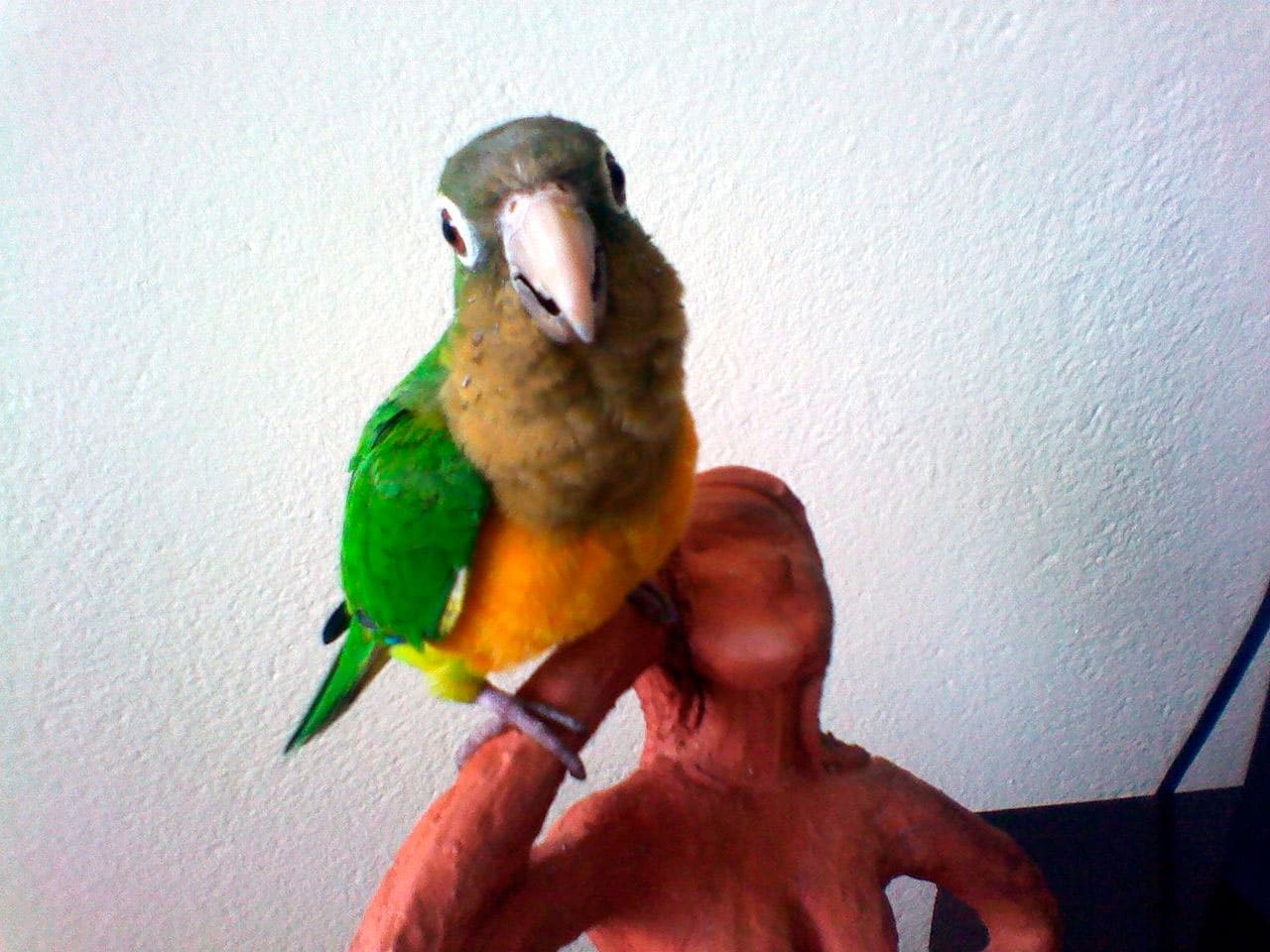
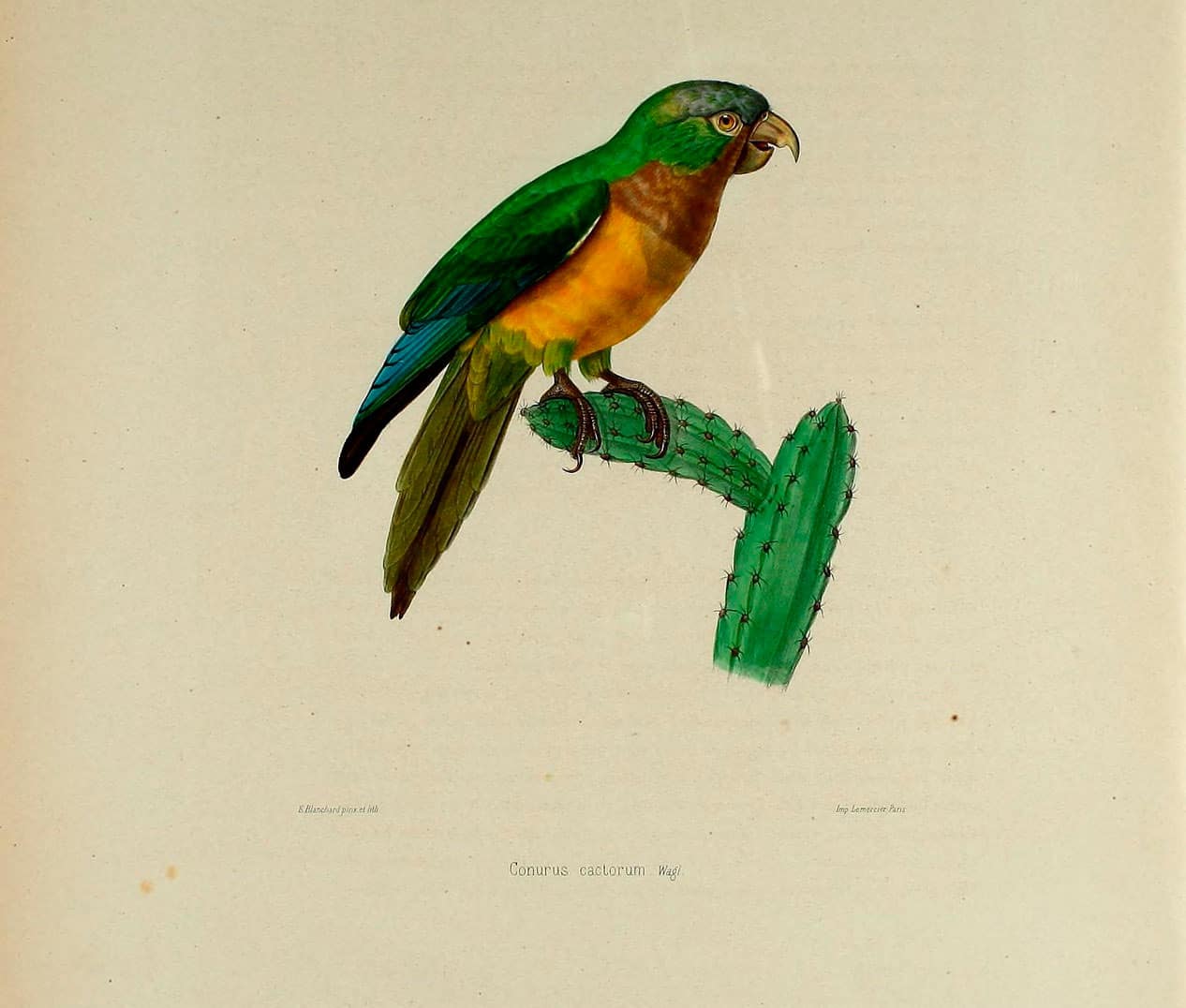
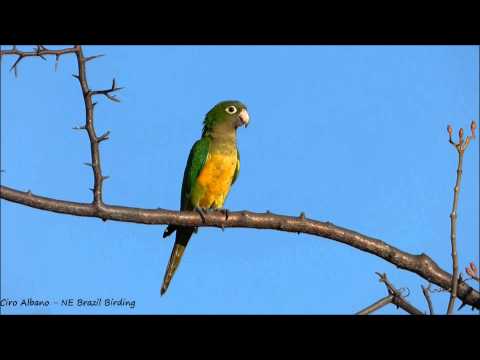
The Cactus Parakeet(Eupsittula cactorum) has the forecrown, lores lower cheeks and brown off; crown with slaty tinge; sides neck, the nape and upperparts up to the rump grass-green.
The primary coverts They are bluish green in the outerweb, the remaining are green grass. Flight feathers (above) green on innerwebs, blue green on outerweb, blue black at the tips (below) gray. Underwing-coverts greenish yellow. Throat and upper breast dull brown; lower breast and belly fairly bright orange-yellow, the thighs and vent greenish-yellow color. Uppertail green, four distal blue central feathers; undertail gray.
upper jaw horn, greyish at base and lower jaw; perioftรกlmico patch naked white; irises brown-orange; gray-gray legs.
Both sexes similar. Immature paler than adult, with crown green, more olive upper chest and throat, and the irises darker.
Its distribution area closely matches the dried vegetation and prickly caatinga Northeast Brazil, but it encompasses higher drier semi-desert areas created by overgrazing and dry forests (caatinga arborea) and seasonal savannah lusher (closed). Usually in pairs or (mainly outside the breeding season) flocks of up to 20 birds, most abundant where food is abundant (as rice crops).
Reproduction:
Crianza undocumented released. Clutch six eggs in captivity.
Food:
The diet includes seeds, fruits (including cactus), berries, dried fruits, flowers and cocoons, taken both trees and shrubs and soil. Sometimes it attacks crops (for example rice, grapes and corn).
Distribution and status:
Population expansion (breeding/resident): 1.220.000 km2
Distributed by the interior Northeast Brazil. The Cactus Parakeet extending from the drier parts of Bay and adjacent northeast Minas Gerais, Brazil north through Piauรญ and Southeast of maranhรฃo, up to Pernambuco and Paraรญba, passing by Rio Grande do Norte and Cearรก. Absent in coastal areas: a record of Bethlehem at the mouth of amazon in For It seems wrong or possibly refers to a leak.
It is usually common (the most common parrot in some localities) with a stable population, although the decline is inevitable in some areas due to massive loss of habitat by agriculture and plantations of exotic trees. Continuing degradation and conversion caatinga by grazing and cultivation they represent a long-term threat. Present in the Serra da Capivara National Park. Any Local persecution due to predation crop. Atrapada to trade small numbers in captivity.
โข Current category of the Red List of the UICN: Least concern.
โข Population trend: Stable.
โข Population size : Unknown.
Rationale for the Red List category
The trend population seems to be stable and, therefore, the species does not approach the thresholds for Vulnerable under the criterion of population trend (> 30% decrease in ten years or three generations). The population size has not been quantified, but it is not believed to approach the thresholds for Vulnerable under the criterion of population size (<10.000 mature individuals with an estimated continuous decrease in> 10% in ten years or three generations, or with a specific population structure). For these reasons, the species is evaluated as Least concern.
Justification of the population
The size of the world's population has not been quantified, but this species is described as ยซquite commonยป (Stotz et to the. (1996).
Justification trend
It is suspected that the population is stable the absence of evidence of any reduction or substantial threat.
Threats
Local persecution because of the invasion of crops. This species is also trapped for pet bird trade.
"Cactus Parakeet" in captivity:
Young birds are removed from their nest before they can fly, and then sold, for example, at the fair in inner cities.
These birds can become very tame, and it is not rare to see a Cactus Parakeet living "freely" in the owner's house, as a member of the family so to speak. It however is seeing a rare bird in captivity outside their range. It is not as common as other more familiar species of aratinga. It also, usually they reach very high prices.
The illegal trade It has greatly reduced the population of these Aratingas in nature, and threatens the survival of the species in many areas. Habitat destruction appears to be a minor problem.
(1) – A pet Caatinga Parakeet in Riachรฃo do Jacuรญpe, Baiano northeast, Brazil By Paulo Marcos from Painted-BA, Brazil (Periquito MartinsUploaded by snowmanradio) [CC BY 2.0], via Wikimedia Commons
(2) – Caatinga Parakeet (also known as Cactus Parakeet) in Brazil By Phillipe (Picasa Web Albums) [CC BY-SA 3.0], via Wikimedia Commons
(3) – Eupsittula cactorum – cactus conure – Cactus conure – conure cactus by Florin Feneru – Flickr
(4) – Parakeet CAATINGA (Eupsittula cactorum) by Cantosdanatureza WITH
(5) – Cactus Parakeet โ aratinga cactacea by Animal Encyclopedia 2
(6) – Cactus parakeet – conographie parrots :.Paris :P. Bertrand,1857.. biodiversitylibrary.org/page/47804387
Origin: Mexico, Guatemala, Honduras, Nicaragua, Costa Rica, Panama, Venezuela, Colombia, Ecuador, Peru, Brazil, Guyana, Suriname
Character: Intelligent and social
Life expectancy: 40 years
Height: 85 to 96 cm..
Content
Description:
Of 85 to 96 cm. length and a weight between 1.060 and 1.123 g..
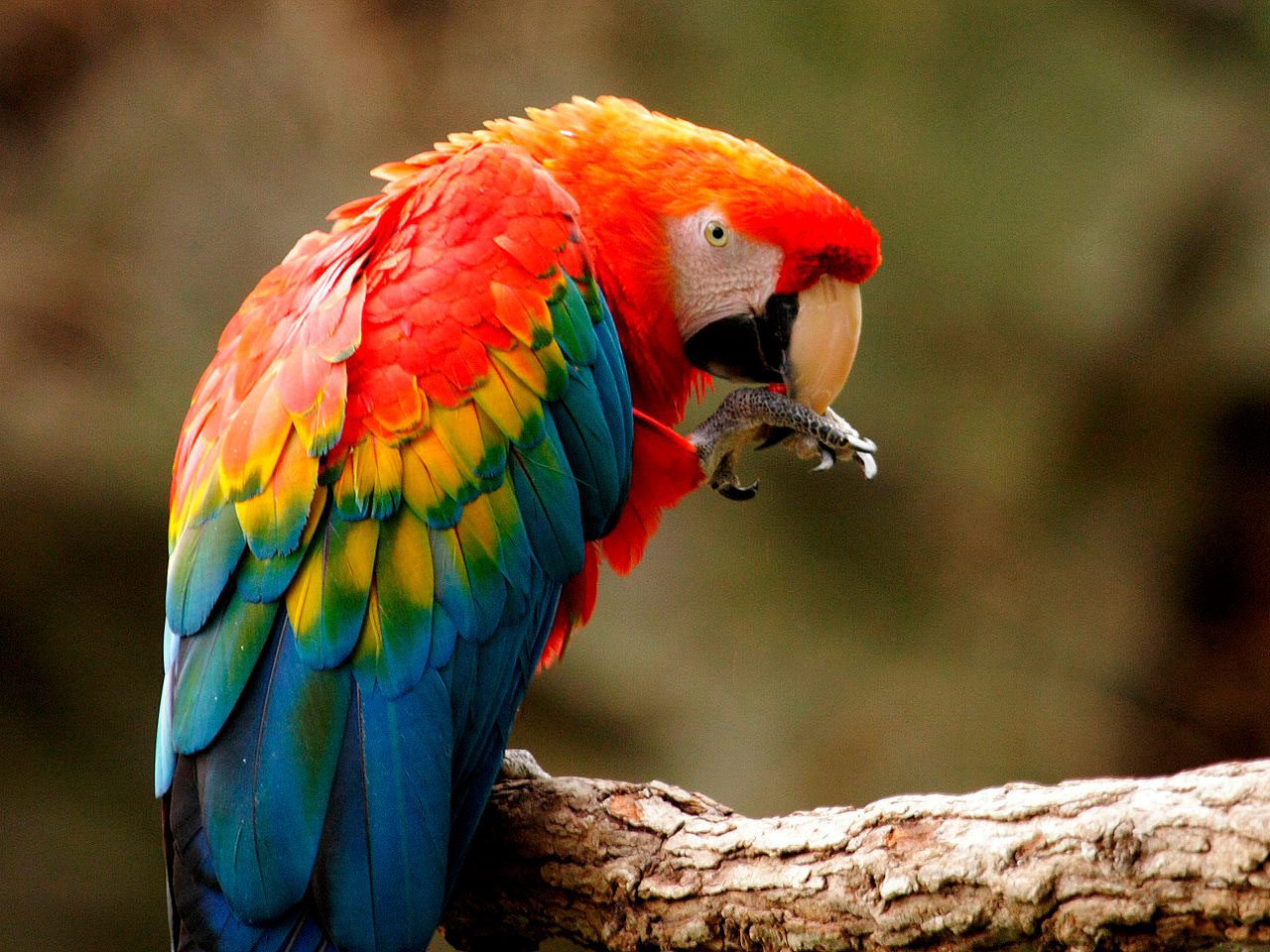
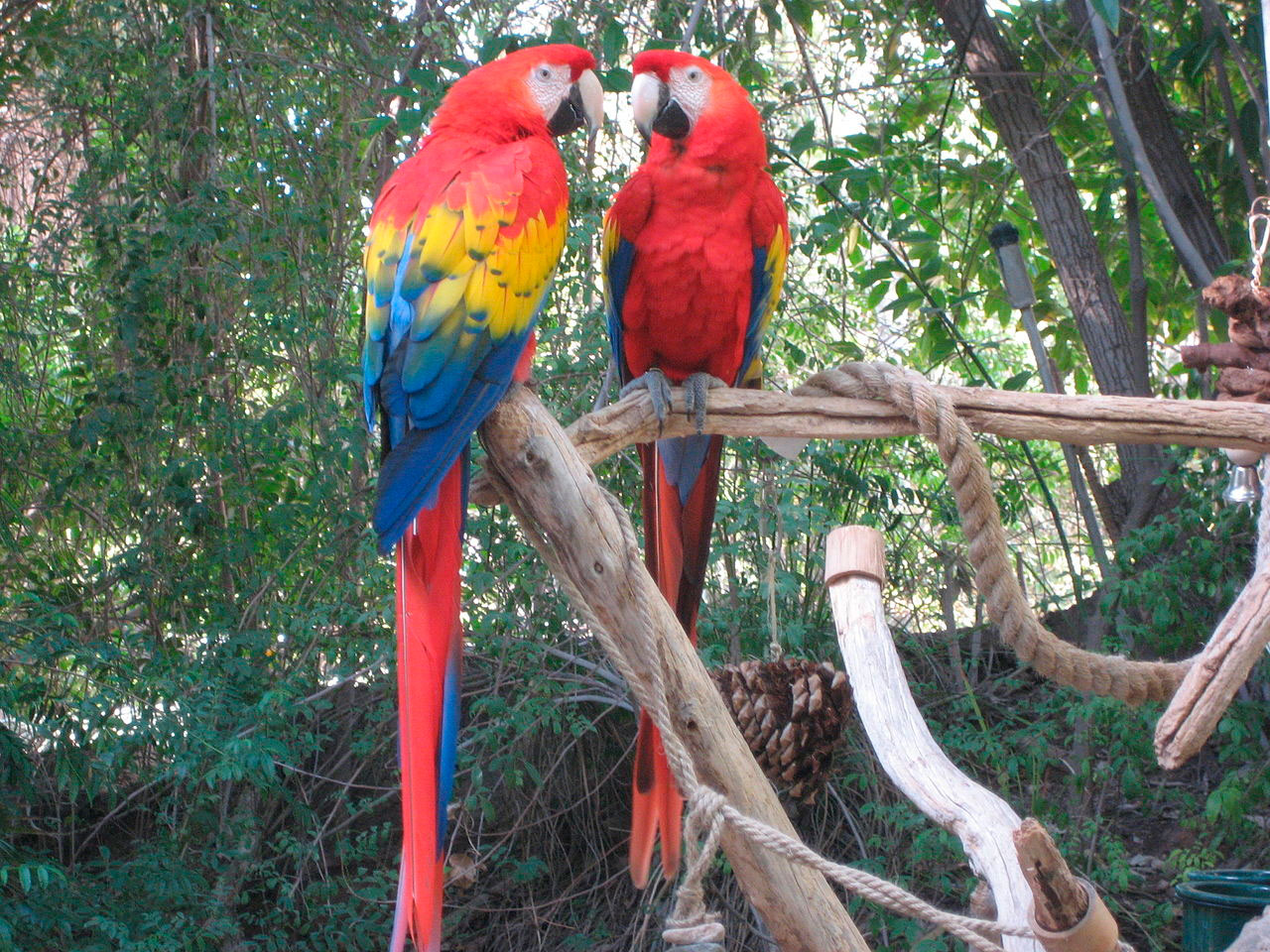
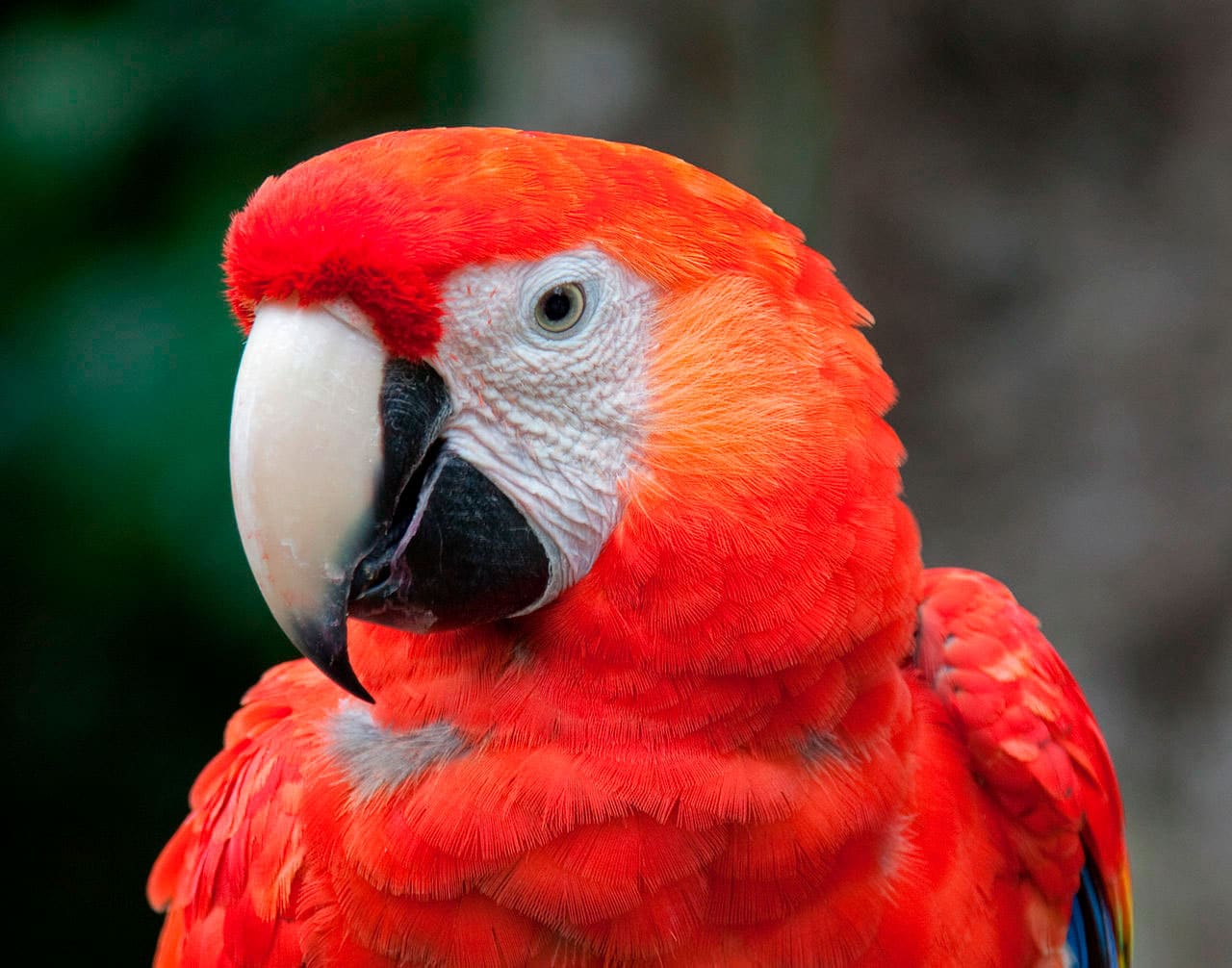
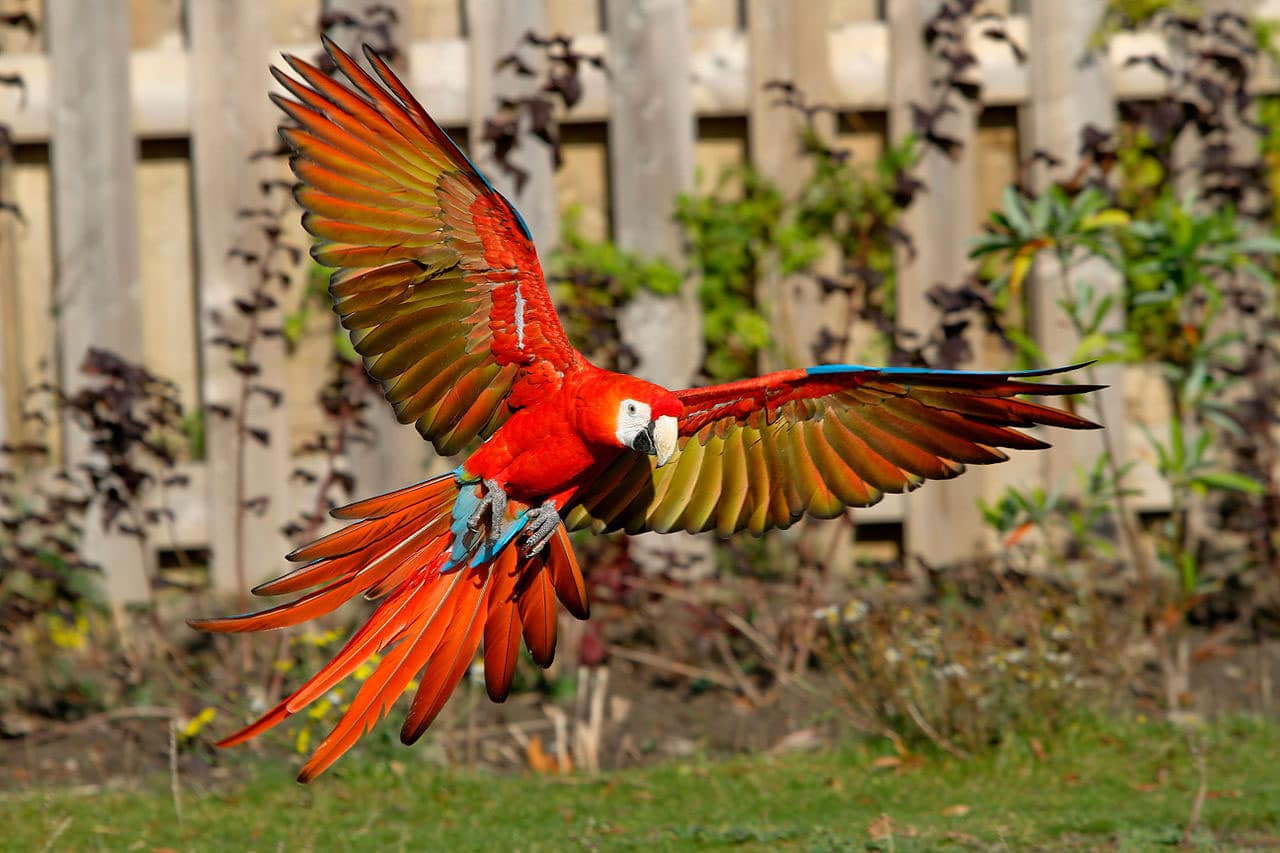
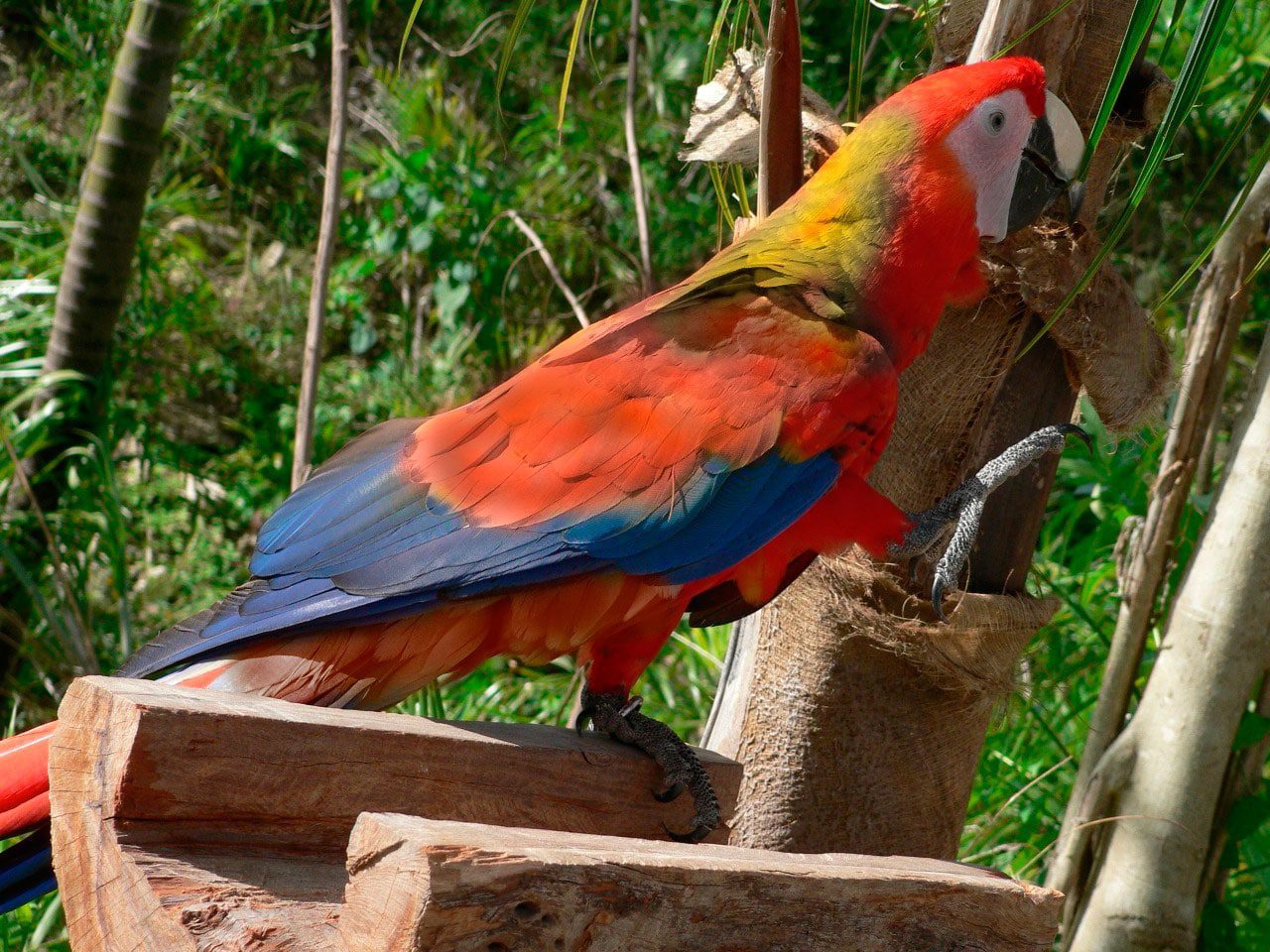
The Scarlet Macaw(Ara macao) has a showy and colorful plumage, predominantly Scarlet red in the head, neck, back, throat, belly, sides and the thighs, as well as in the upper parts of the wings and tail. These pens are a brighter shade of Red, almost Orange, If you are directly exposed to the sunlight.
The feathers greater coverts and stockings of the wings they are yellow, even if the ends of these feathers are green in the subspecies Ara macao macao and blue in Ara macao cyanoptera. The t-shirts, as well as the lower coverts of the obispillo, the of the back and both upper and lower part of the tail they are blue. The internal parts of the tail and of the wings are orange-red, lighter than the predominantly Scarlet plumage.
Its bill is hooked, strong enough to cut objects, dig, help climbing and defend themselves, but light in such a way that it does not affect your flight. It consists of two parts, of which the upper is the largest and is off-white, Sometimes a little pink, Besides that it has a small black marks on each side in the region where it joins with the head. It is also black on the tip and base, forming a triangular figure of this color. At its top are its nostrils, almost imperceptible to the naked eye. The under bill, on the other hand, is completely black, like its fleshy language.
The eyes are positioned laterally in the head, and although the exposed part of the cornea is round and seemingly small, the eyeball is large enough reality, even more than the brain. Its irises is light brown on the young but it becomes yellow when reaching the adult age. around the eyes they have an area of skin between whitish and pink which is apparently nude, although in reality it is partially covered by small, almost imperceptible reddish feathers that form thin sinuous lines.
Their legs they are short but strong, because it has powerful flexor muscles and tendons, allowing you to be upright perching. Their legs ‘zigodactilas‘ they are available in four fingers, two forward and two backwards, and are dark gray.
Morphologically, is very similar to the Red-and-green Macaw (Ara chloropterus), However, differ in that the Scarlet Macaw have yellow spots on their wings While in Red-and-green Macaw, as its name implies, stains are completely Green. The same, in the Red-and-green Macaw the thin red lines on the plucked white part of his head they are much more notorious, while the Scarlet Macaw lacks these lines or they are almost imperceptible. Finally, in the Red-and-green MacawScarlet Macaw Red is vivid tone, lighter, Stressing in particular in the nape and crown, where tends to Orange.
It is a species that has a very light sexual dimorphism, because the females they are smaller and their bill is more curved, short and thick, In addition to the tail of the male is slightly longer. Even so, it is difficult to determine its sex with the naked eye; the only reliable way to know him is through a DNA test collected from his blood or his feathers, technical or more invasive as the laparoscopy and sewer exploration.
(Wiedenfeld, 1995) – Larger than the species nominal. A dark Scarlet red in the plumage of the head and the body, a wide yellow stripe in the wings, where many feathers have blue tip, and the central feathers of the tail extremely long and wide whose tip is light blue.
The Scarlet Macaw they are distributed through the tropical forests of lowlands and savannas.
In Mexico in remote areas of humid forest.
In Honduras, on the arid slopes of the peaceful, birds forage in open areas (including growing areas); sometimes in the forests of pines above the rainforest in the Mosquito Coast.
In Costa Rica in deciduous forests, humid and in more open areas and edges with scattered tall trees.
They inhabit intact and partially cleared lowlands of rainforest and gallery forest in Colombia.
In the rainforest, Savannah and plains in Venezuela.
They prefer dry rainforest land in Suriname and the rainforest and savanna in Guyana.
Often near rivers throughout its range.
Below 240 metres in Oaxaca, Mexico, of 1.100 metres in Honduras, 1.500 metres in Costa Rica, 500 metres in Colombia and 450 metres in Venezuela.
The Scarlet Macaw, generally, they can be observed in pairs, in groups of 3/4 birds or in flocks of up to approximately 30 individuals, up to a maximum of 50, in communal roosts in tall trees (including the mangroves).
They often perch on the top of large trees.
Reproduction:
In Central America, the Scarlet Macaw nest during the months of December to June in the time dry (Forshaw, 1989; Iรฑigo-Elias, 1996; Renton, 1998; Renton et to the., 2003).
The macaws they use large mature trees with the average breast height diameter 129 cm.. (IรฑigoElias, 1996; Carreon-Brook, 2006). Apparently, the macaws Select the highest cavities for nest, taking an average of 19 height m, and with dimensions of average entry 22 cm.. x 32 cm.. (Iรฑigo-Elias 1996; Carreon-Brook, 2006). They prefer soft tree species for the entrance to the nest cavity can be modified.
Usually, the nests of the Scarlet Macaw they are separated by more than 3 km. (Carreonarroyo, 2006), which would reduce strong agonistic interactions between nesting pairs, and may cause the failure of nests (Renton, 2004; Renton and Brightsmith, 2009).
In Central America they put in 1 to 3 eggs (Iรฑigo-Elias, 1996, Renton, 1998; Renton et to the., 2003), even if broods have been recorded of up to 4 eggs in South America (Nycander et to the., 1995). In the Lacandon Jungle of Mexico, recorded an average clutch size of 1.6 eggs/female in 1988-1989 (IรฑigoElias, 1996) and 2.7 eggs/female in 1998- 1999 (Carreon-Brook, 2006).
Hatch on average 1.5 to 2.0 chicks/pair, managing to fly the nest 0.6 to 1.3 young per nesting pair (Iรฑigo-Elias, 1996; Carreon-Brook, 2006; Renton and Brightsmith, 2009).
Feeding in the canopy, usually in silence. May be associated with other parrot species where abundant food.
Distribution:
Size of the area of distribution (reproduction / resident): 10.200.000 km2
The Scarlet Macaw are distributed to a large extent of Central America, from the South of Mexico until Panama and apparently scattered in tropics of South America, from the South to the East of Bolivia.
In Mexico, formerly, were observed in the South of Tamaulipas, South of Veracruz, Oaxaca, Tabasto, Chiapas and Campeche and through the lowlands of Guatemala to the most remote areas of Belize, where the most recent records are from the Macal River.
Formerly widespread in Honduras, EI Salvador and Nicaragua; Costa Rica mainly on the Pacific slope.
In Panama confined to the Coiba island, to the southwest of the azuero peninsula and a Chiriqui, where birds once could have flown from Costa Rica.
In Venezuela, in Apure, Northeast of Monagas, Southwest of Sucre, widely distributed through the Plains and inBolรญvar and amazon.
A sizeable population in Guianas, throughout the Amazon basin of Brazil, to the East of Ecuador and to the East of Peru.
In the North and East of Bolivia, in Santa Cruz, Beni and possibly Pando. Away to the West of Los Andes.
The Scarlet Macaw make seasonal movements in search of fruit and is temporary visitor in some areas. Locally common but obviously in decline range-wide, especially around the centers of development, due to loss of habitat, trade and hunting, both as food and for obtaining their feathers; the population total of Mesoamerica probably not greater than 4.000 individuals.
extinguished the majority of former distribution area in Mexico (not registered in Tamaulipas Since 19th century) and persisting in limited numbers only in the Lacandon Jungle, Chiapas.
Generally rare in Guatemala, although more common in more remote areas, as the West's Petรฉn.
extinct in El Salvador. widespread, Although rare on the Caribbean slope of Honduras; extinct on the slope of the peaceful. Nearly extinct on the Pacific slope of Nicaragua, but persisting in the remote area of the Northeast. Formerly widespread on the slopes of the Caribbean from Costa Rica, now only in the Northeast; few localities on the Pacific slope (for example, the Osa Peninsula). Fairly common in Coiba, Panama. In Venezuela Local. Fairly common in amazon basin and Guianas, especially in the more remote areas. Fewer that the Red-and-green Macaw in Guyana and Venezuela.
Widespread in captivity, but rarely bred. CITES Appendix I.
Subspecies distribution:
Ara macao cyanopterus
(Wiedenfeld, 1995) – They inhabit the area of Mesoamerica between Mexico and Honduras; Currently there are two towns in the southeast of Mexico, one of just 50 individuals in the region of the Chimalapas, Oaxaca (รรฑigo et al 2004; Lazcano-Barrero obs. Pers.) and the other in the Lacandon Jungle in Chiapas, with an estimated population of between 150 and 250 individuals (Iรฑigo Elijah 1996 & Iรฑigo Elias et al. 2004, Garcia Fair).
Since the Scarlet Macaw they have an extraordinarily wide distribution rangeโthe largest among all birds of the genus Araโ,and its population, Despite being apparently shrinking, do not fast enough to consider it vulnerable, the Red list of endangered species of the IUCN considers it to be a kind of least concern. But, This organism caught attention in his ยซConservation action plan and sampling of PsitacidaeยปRegarding the status of subspecies to. m. cyanoptera, since its population had indeed declined rapidly in a span of twenty years. The species also appears from the 1 in August of 1985 in the Appendix I of the Convention on international trade in endangered species of Wild Fauna and Flora (CITES), that prohibits trade in this species within the signatory countries. Originally entered in Appendix III of this organization in 1976, amounted to Appendix II in 1981 and finally it came to Appendix I in before this date.
It is also protected by various laws and decrees national; for example, in Costa Rica, where he spent to deal with around the 80% of the national territory to only the 20% for the year of 1993. Because of its particularly precarious condition within the territory of Mexico, in that country he is considered from 2000 a priority species for conservation. In Panama, also, It is considered to be one of the two most endangered bird species in the country along with the Cotinga. For its part, in Peru is listed as Vulnerable species (VU) according to Supreme Decree No. 034-2004-AG from September of 2004. In Guatemala was enacted in 1989 Decree No. 4-89 of the Protected Areas Law, same with which created the Guatemalan System of Protected Areas, that ensures the protection of species endangered within its territory, including the Scarlet Macaw. In Belice It is sheltered from 1992 by the Environmental Protection Act, that prohibits their trade or possession. Inside Brazil has a similar protection, Since its trade locally or export or possession is not allowed, unless they are breeding or authorized zoos. In Colombia his criterion is "indeterminate" in the List of Colombian Species on the Way to Extinction, so it is not considered endangered within that country, although it does receive the protection of various national laws. In Venezuela it is considered a vulnerable species and is protected by the Protection law to the wildlife.
Among the main factors threatening the survival of this species are the habitat destruction because of deforestation, the oil industry and intentional burning; the fragmentation of populations, the commercial traffic of feathers, eggs and specimens as such for sale as pets, as well as the fact of being an inbred species with low reproductive rates, and the specialization of the diet of some populations. The problem of the illegal trade It affected him greatly in the 20th century, where among 1975 and 1990 It is estimated that they exported around 1500 specimens. Until the mid of 1980, The main exporting countries were those where the Scarlet Macaw reproduces naturally, as Bolivia, Guyana and Suriname. But, by the end of that decade, countries such as United States, Philippines and Canada they were already major exporters, as local bird breeding has developed sufficiently to sustain its own trade. The main destination of the trade of these birds was always United States. In more recent years, the various national laws have banned the trade of this and other species of birds, Although this illegal practice has not completely eradicated. The main change that has occurred is that most of the birds in trade now come from the reproduction in captivity, What is an advantage for buyers since they tend to be healthier and more domesticated birds.
"Scarlet Macaw" in captivity:
Starting at the century XVI, as a result of the Conquest of America, appeared the European interest to catch various species of parrots, including this one. The traffic of this and other species was growing due to their popularity as pets, by Macaw began to disappear from their habitat in some regions since the 19th century. Its value on the black market, that it can be several thousand dollars, It makes often a more profitable activity for local residents that agriculture, logging of precious woods or even drug trafficking. This is one of the main reasons that have contributed to its disappearance. In fact, the popularity of several species of macaws is such that these animals have become more quoted in the pet market, and they have overcome even the cats and primates.
Sources They point out that a female's Scarlet Macaw was still alive after 33 years in captivity, but it rarely flew probably due to its age; He grew up with a male from 32 years of age, during 22 years, until the two you almost 30 years of age. There are several anecdotal reports that indicate that these birds live longer, However, including a report of a Scarlet Macaw of 37,1 years and a live specimen of 64 years of age. In captivity, these animals have been known of raising starting from 8 years of age.
Some factors that make one Macaw very attractive pet they are your sociable behavior, their colorful plumage and their ability to learn to imitate words, Although it should be noted that this is not one of the species of macaws who better to develop this skill. It also, it should be emphasized that when they "speak" they do not really understand the meaning of what they say: at most they relate the sound to some object or event, but never through a process of reasoning. Anyway, in general terms it is a bird very intelligent, with learning ability similar to that of a child aged between five and seven years.
On the other hand, precisely because it is highly social, In addition to that need plenty of space to exercise, It bustling and it has a beak and strong claws which are capable of damaging objects and even hurt people, It is not ideal to live as a pet, although you can do it, preferably in the company of other birds and especially of the same species, in aviaries and zoos right. In fact, is a bird easy to raise even for poultry farmers with little experience, and today it is one of the most common species for captive breeding around the world. As well, due to its curious nature and its excellent ability to learn tricks, It is a bird very common in zoo and amusement park exhibits.
In 1993, the Scarlet Macaw He was nominated to wildlife symbol of Honduras and declared as the national bird of this nation, according to executive decree no. 36-93 issued by the Honduran national Congress. This bird was also chosen as the mascot of the America's Cup 2007 held in Venezuela, which is representative of this country by carrying the three colors of its national flag in its plumage. The name given to said pet was "Guaky", which wore the burgundy shirt of the soccer team of that country, as well as eight stars on its wings, to highlight the allusion to the Venezuelan flag. More recently, the Scarlet Macaw began to be coined in the face of the coins of 200 weights Colombians that began to circulate in that country from 2012.
– Avibase
– Parrots of the World โ Forshaw Joseph M
– Parrots A Guide to the Parrots of the World – Tony Juniper & Mike Parr
– Birdlife
– Wikipedia
– Ara macao cyanoptera (Scarlet Macaw) For: Jesus Gomez Pina and Jose A.. Valero Pรฉrez
– Photos:
(1) – This has the appearance of a Scarlet Macaw, which have a variable amount of green in the wings. The exact pedigree of this zoo parrot may be known by the zoo By Travis Isaacs from Grapevine, TX, USA (zoo355Uploaded by snowmanradio) [CC BY 2.0], via Wikimedia Commons
(2) – Scarlet Macaw (Ara macao). Side view. It is raising one of its legs By Peter (Flickr) [CC BY-SA 2.0], via Wikimedia Commons
(3) – A Scarlet Macaw flying away from the photographe By The original uploader was Robert01 at German Wikipedia [CC BY-SA 3.0 of], via Wikimedia Commons
(4) – Scarlet Macaw at Diergaarde Blijdorp, Rotterdam, Netherlands By Jar0d [CC BY-SA 2.0], via Wikimedia Commons
(5) – Scarlet Macaw in Yucatan, Mexico By Tony Hisgett (originally posted to Flickr as Parrot 2) [CC BY 2.0], via Wikimedia Commons
(6) – Scarlet Macaw at Phoenix Zoo, USA By Khamis Hammoudeh (originally posted to Flickr as <3) [CC BY 2.0], via Wikimedia Commons
(7) – Scarlet Macaws (Ara macao) by Heather Paul – Flickr
(8) – Guacamayo rojo by m.prinke – Flickr
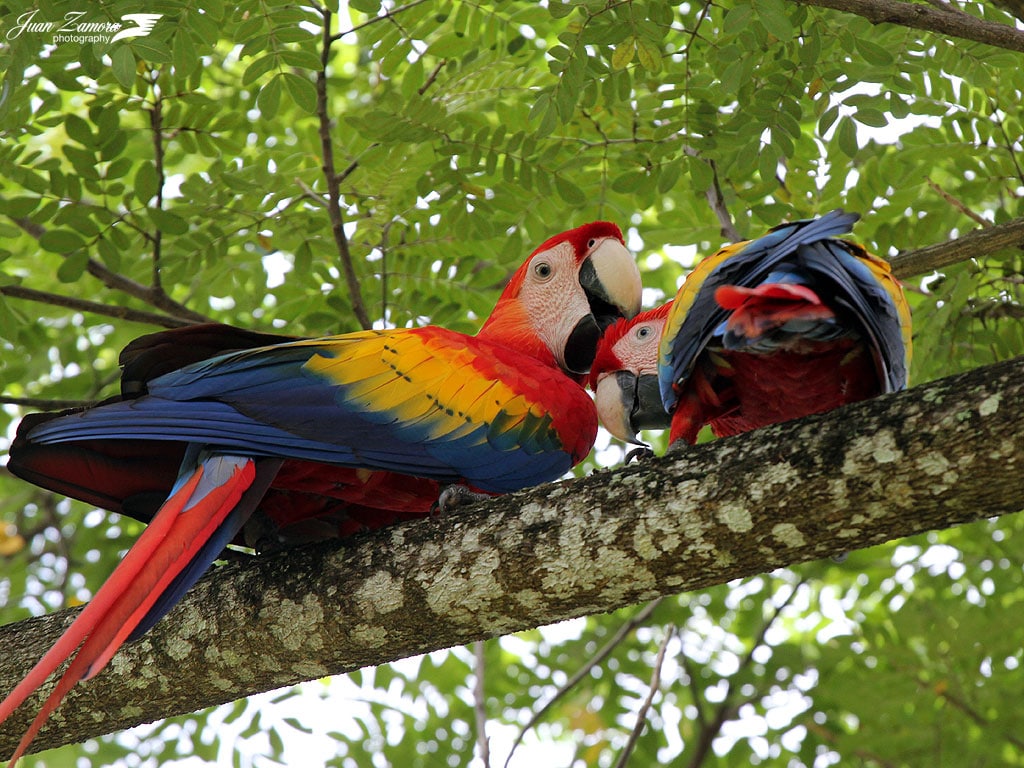
(9) – Ara macao (Scarlet Macaw) Tarcoles, Costa Rica by Juan Zamora – Flickr
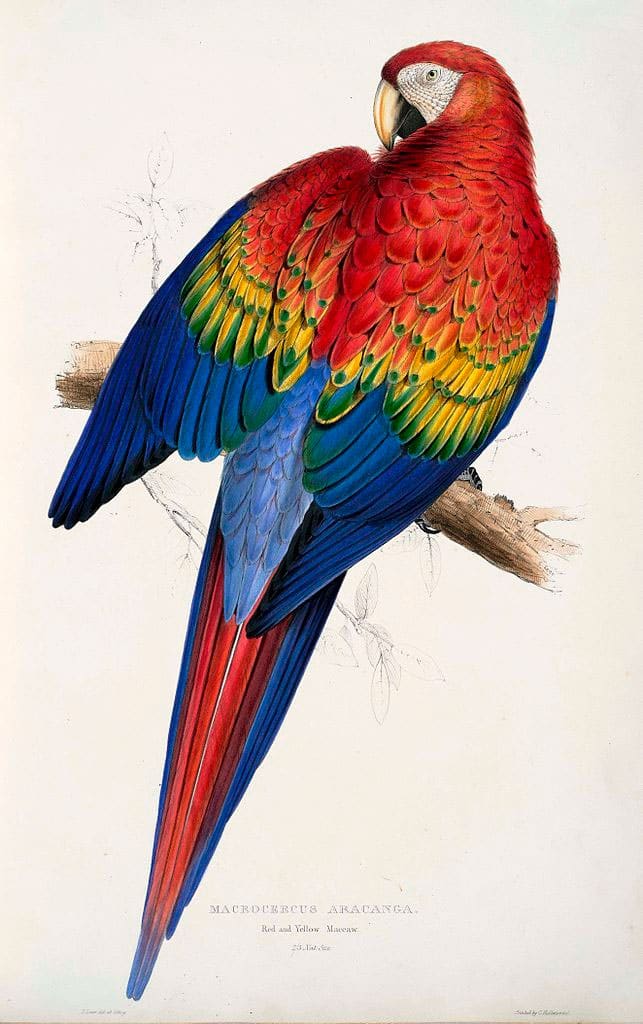
(10) – First edition of Illustrations of the Family of Psittacidae, or Parrots. Originally a painting by Edward Lear [Public domain], via Wikimedia Commons
– Sounds:
โท The world of Pets: Dogs, cats, birds, reptiles, amphibians
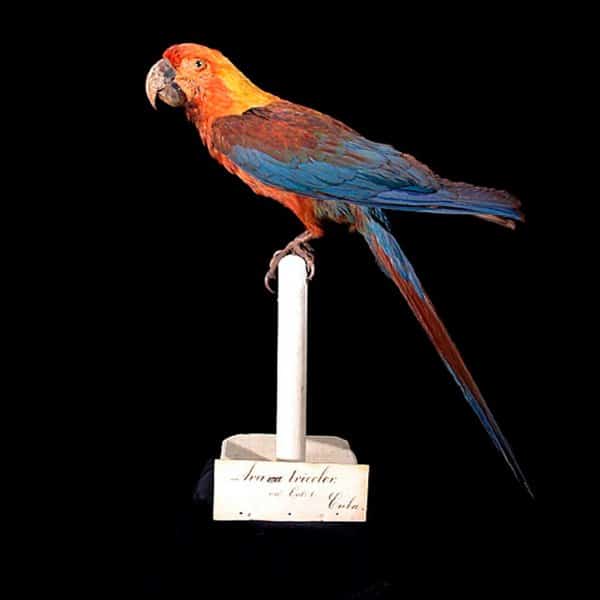
The Cuban Macaw (Ara tricolor) ave a great era, had a length between 45 and 50 centimeters, the "forehead" was reddish and orange and the nape.
around the eyes had white areas devoid of feathers. Cara, abdomen, chest and the thighs They were also orange and legs and the tip of the bill brown. The upper portion was a brownish red with festooned with feathers in green, while feathers below tail, on top of this and the lower back region they were blue. Also of this color combined with purplish red were the wings.
The external appearance of both male and the female It was the same. As for the flight, as described, when taking off it opened and exhibited its splendid tail to its full extent in a truly magnificent spectacle.
Habitat:
Little is known about the habits Cuban Macaw. Local people reported the Cuban naturalist, born in Germany, Juan Gundlach (1876) What anidaba in the holes of the palm trees and lived in pairs and family groups. He noted that it had a strong vocalization similar to that of Central American macaws. (Gundlach 1893).
apparently small populations bred in scattered locations.
Reproduction:
Little is known about the reproduction of this species, except that they nested in the holes of the palm trees and lived in pairs and family groups.
Food:
They ate fruits, Palmas, tree seeds cinnamon (Meliรก azedarach), tender shoots and buds (Wiley & Kirwan 2013).
Olson & Suarez (2008) skull suggest that the tablet back-ventral, in other macaw is an adaptation for a strong muscle attachment, is an indication that this species feeds on palm nuts extremely hard shell, and distribution of birds may have been closely related to the availability of this food source.
Distribution:
Distributed in the past by the island of Cuba, and probably the Isle of youth. It is said that there were large populations in the Zapata Swamp to the South of Matanzas. There is no evidence of the historical existence of this guacamayo or another Hispaniola, where it has hinted at the existence of this species (although possibly they were observed on that island, with the last individuals registered in 1820.
Conservation:
โข Current category of the Red List of the UICN: Extinct.
โข Population trend: extinguished.
Justification of the Red List of the Category
This species was known in the island of Cuba, but hunting led to its population to extinction. The last reports of the species date from 1885.
Its extinction was caused by his hunting as food and the felling of trees for nesting capture young birds and their use as pet (Forshaw and Cooper 1989).
It is said that the last specimen known to have existed was shot down in La Vega, about the Zapata Swamp in 1864. Then testimonies of sightings occurred up 1885 which were not confirmed.
"Cuban macaw โ " in captivity:
It is believed that the Cuban Macaw was quite common in Cuba. First he began to increase his capture in order to give them to the Kings of Spain. As the nineteenth century progressed increased human population and this not only cut down the trees and forests deforested, but he also hunted the bird for food โ despite the fact that its meat tasted bad โ he plundered its nests to take from pets young birds. This is how their habitats were eliminated, until he ended up becoming extinct.
Alternative names:
– Cuban Macaw, Hispaniolan Macaw, Hispaniolan or Cuban Macaw, Hispaniolan, Cuban or Jamaican Macaw (English).
– Ara d’Hispaniola, Ara tricolore, Ara tricolore ou A. de Cuba, Ara tricolore, A. de Cuba ou A. de Gosse (French).
– Dreifarbenara (German).
– arara-vermelha-de-cuba (Portuguese).
– Guacamayo cubano (espaรฑol).
scientific classification:
Johann Matthew Bechstein
– Order: Psittaciformes
– Family: Psittacidae
– Genus: ARA
– Scientific name: Ara tricolor
– Citation: (Bechstein, 1811)
– Protonimo: Ara tricolor
โข Avibase
โข Parrots of the World โ Forshaw Joseph M
โข Parrots A Guide to the Parrots of the World – Tony Juniper & Mike Parr
โข Birdlife
โข cubaconecta
Photos:
(1) – Ara tricolor, recreaciรณn digital By Digitally treated by Rod6807 from the original image of Peter. [CC BY-SA 3.0], via Wikimedia Commons
(2) – Cuban Macaw. Eleven-Thirteenths Natural Sizeโfrom specimen in Liverpool Museum By John Gerrard Keulemans (1842 – 1912) [Public domain], via Wikimedia Commons
(3) – Now tricolor Bechstein, 1811 by Huub Veldhuijzen van Zanten / Naturalis [CC BY-SA 3.0], via Wikimedia Commons
(4) – Now tricolor Bechstein, 1811 Huub Veldhuijzen van Zanten / Naturalis Biodiversity Center [CC BY-SA 3.0], via Wikimedia Commons
(5) – Ara tricolor By Bechstein, 1811 [CC BY-SA 3.0], via Wikimedia Commons
(6) – Watercolour by Jacques Barraband (circa 1800) of a Cuban Red Macaw (Ara tricolor) by Jacques Barraband [Public domain], via Wikimedia Commons