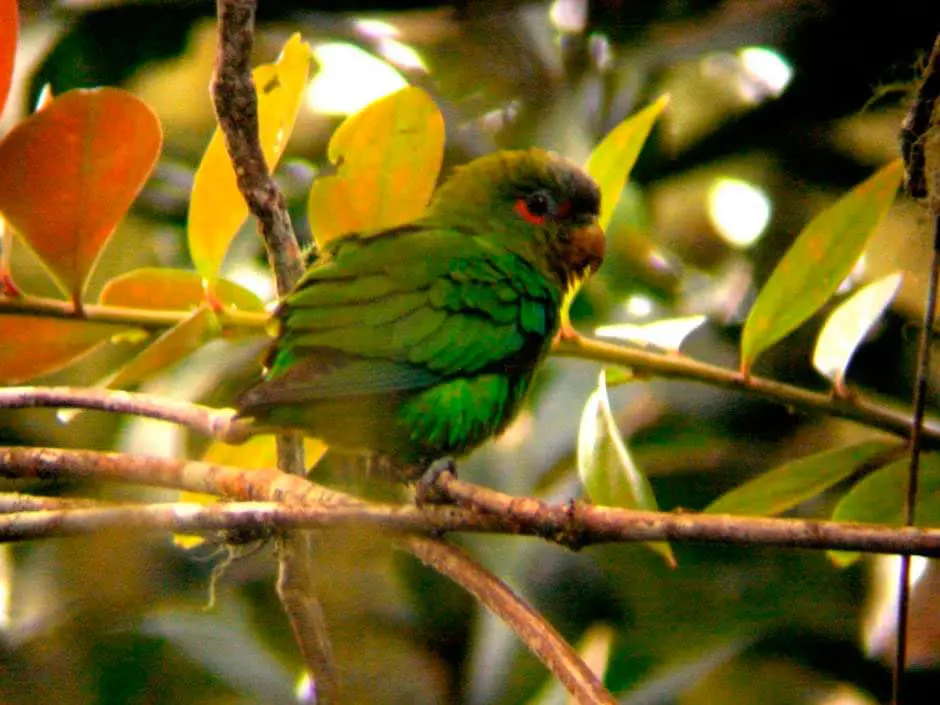
The height of the Blue-fronted Parrotlet(Touit dilectissimus) varies between the 15 and 18 cm.. It is differentiated by the red line that goes from the bill towards the back of the eye and below the eye ring white, and blue bordering the red line from the forecrown up to the back side of. Wings with the part inside red and yellow, evident on the fly, shoulder and external margin of the wings red, crown and nape green.
Tail with black border, Yellow ends and green central part.
The female have the Red of the shoulder reduced or absent.
Uncommon and surly. It lives in humid forest that is often cloudy and has tall stubble., between 700 and 1700 meters above sea level (apparently with migration to the 3000 m). ANDA in pairs or groups of 15 or more, lie quietly in the canopy.
In-flight calls are based on mild or sharp notes repeated several times between pauses. Calls are stronger during the flight.
Reproduction:
It nests in termite mounds on tree.
Food:
It feeds on small seeds, fruits and flowers.
Distribution:
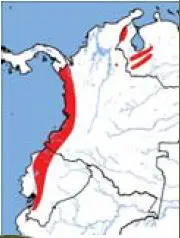
Can be seen in freedom from Panama, Colombian Pacific to the Northwest of Ecuador, and in the northeast of Colombia and Northwest of Venezuela.
Conservation:
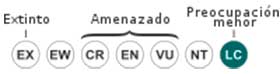
State of conservation ⓘ
Minor Concern ⓘ(UICN)ⓘ
Appreciated a decrease of the species due to deforestation at the local level (in particular in Colombia).
The population size World has not been quantified, but this species is described as «rare» (Stotz et to the. 1996).
The population is suspected to be stable in the absence of evidence of any reduction or substantial threats.
"Blue-fronted Parrotlet" in captivity:
These birds are rare to see them in captivity. Any person possessing one has to know that it can not be put into freedom, It must be part of a well-managed maintenance program to ensure the continued existence of this species.
Alternative names:
– Blue-fronted Parrotlet, Blue fronted Parrotlet, Red-winged Parrotlet (ingles).
– Toui à front bleu (French).
– Kronenpapagei, Kronen-Papagei (German).
– Touit dilectissimus (Portuguese).
– Cotorrita Cariazul, Lorito de Alas Amarillas (español).
– Periquito Alirrojo (Colombia).
– Churiquita (Venezuela).
– Periquito frentiazul (Ecuador).
Of 32 cm. length and a weight between 140 and 170 g..
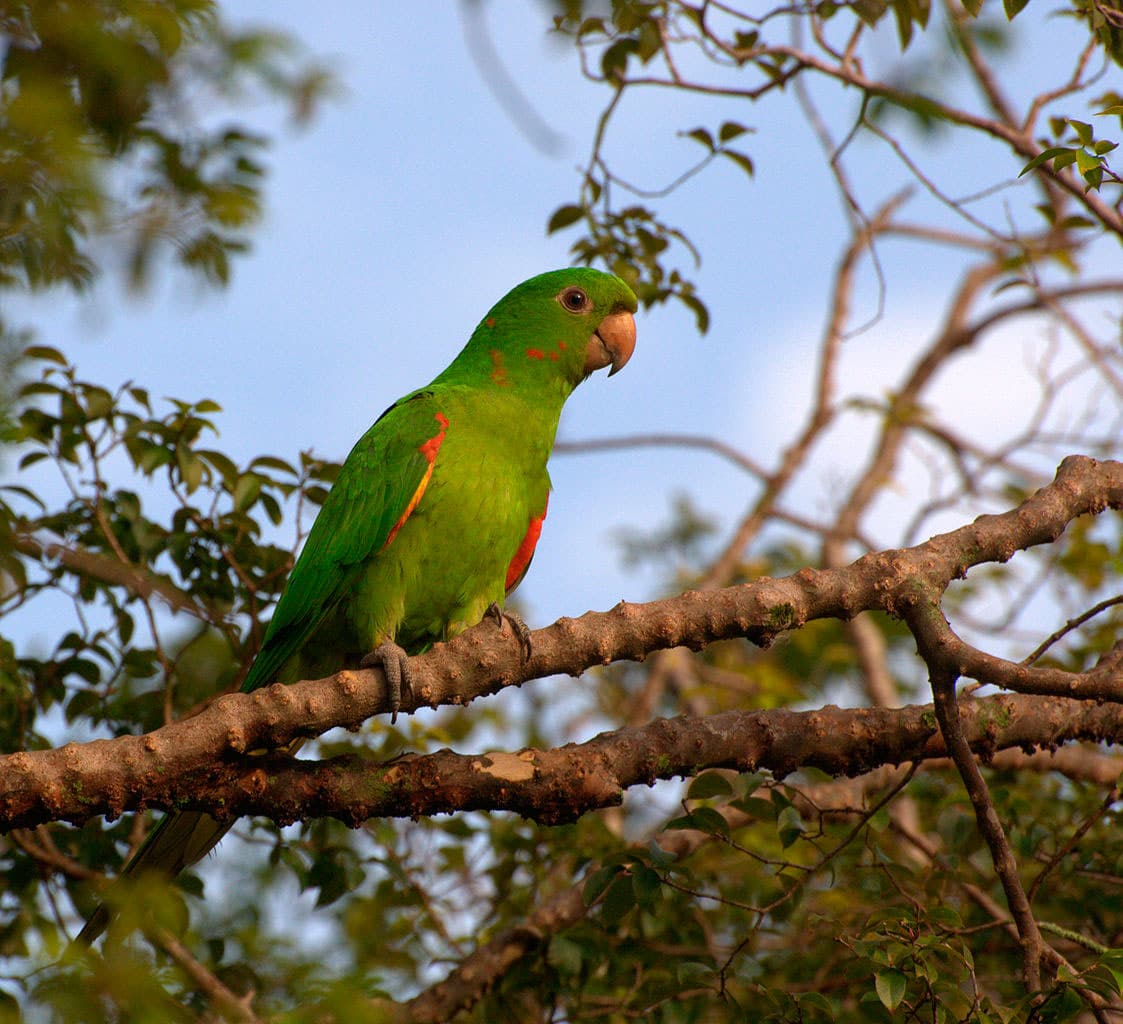
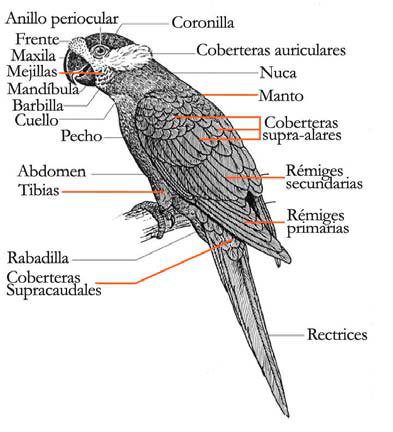
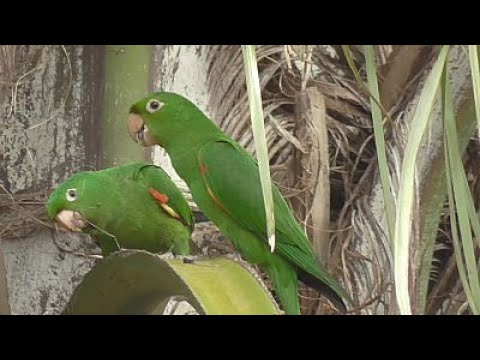
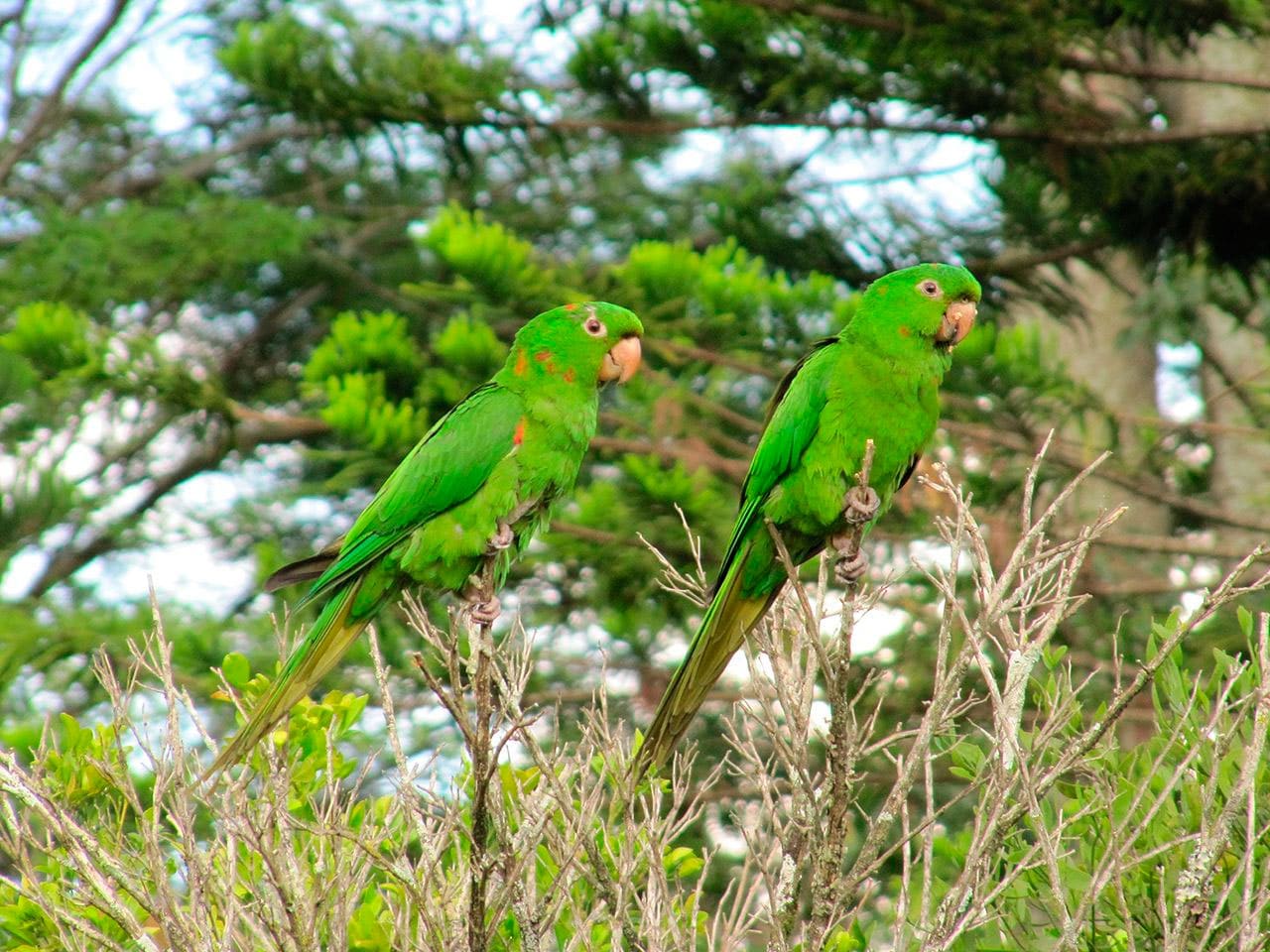
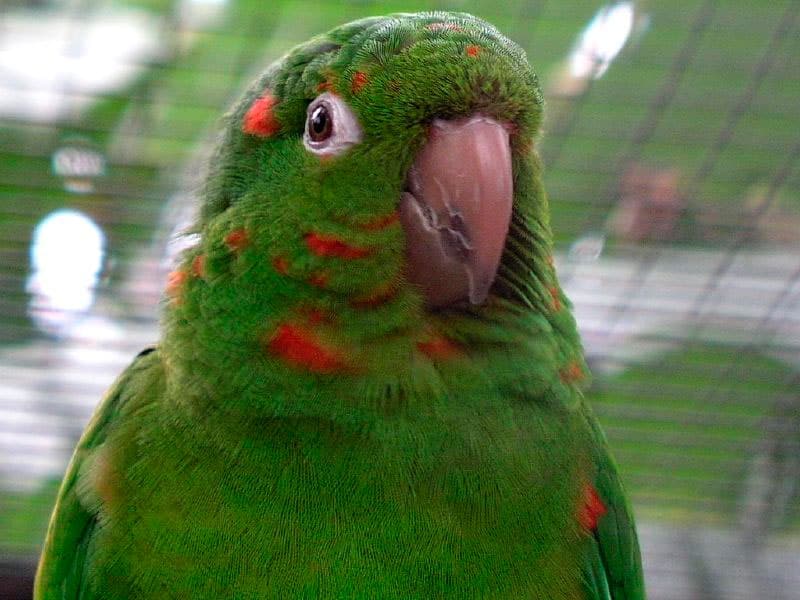
The White-eyed Parakeet(Psittacara leucophthalmus) has the head dark green with small scattered red feathers, especially in the area of the lores, cheeks, sides neck and throat. The head and nape Some birds are almost entirely green, others have solid red spots in the cheeks, with numerous scattered red feathers elsewhere.
The upperparts are dark green, with one or two scattered red feathers. Upper, the wings dark green, with a little red in the curve; undertail, with golden brown flight feathers, the outer red and green small coverts inner; Yellow large coverts external and green internal.
The underparts Green with scattered red feathers on the throat and the chest, sometimes forming irregular patches. Upper, the tail dark green; Brown down.
The bill hooked is color Horn and its gray tip; bare periophthalmic grayish white; irises yellow-orange; legs grey.
The plumage of the male and the female, they are identical.
The immature they have more muted colors; some feathers Red in the head, No red in the bend of wing and olive in the underwing-coverts outermost.
(Salvadori, 1891) – They have head, neck and throat, green grass dark with small feathers red color above the cheeks. The the mantle, the wing-coverts, the tail and primary feathers of the tail are dark green. The lower part of the chest and flanks of the body are green clear. The feathers largest of the wings and secondaries are dark green with a grey reflection at the ends. Smaller feathers of the wings and the area of the wing curvature are bright red; small coverts feathers are red; the feathers of the greater coverts are yellow. The top of the large feathers of the tail are dark green, the underparts is olive green.
The eyes are black with the irises orange-brown. The bare periophthalmic is grayish white. Bill color horn, the sides and the tip of the upper part are dark gray. Legs brownish grey, black nails.
On average largest the species nominal with the bill more robust. Birds in the West have a green dark.
The White-eyed Parakeet It is in a great range of forest habitats and forests, mainly in lowlands, even if they manage to reach altitudes of 1.700 meters in the Ecuador and 2.500 meters in Bolivia.
In the Amazon, they are in tropical rainforests, mostly along the rivers (including the forests and marshes), in scattered areas of woodland and in land grown in wetlands, mangroves, sheets and the forests of Palms in the Guianas, chaco types of forests in the South of its range, gallery forests and alluvial forests in Bolivia.
The White-eyed Parakeet they are highly gregarious, they form flocks, usually, hundreds of birds (usually up to 90), covering large expanses between the roosts and feeding areas.
In the Amazon, in general, birds travel along the banks of rivers, crossing also large tracts of forest to reach the meanders and hidden Marsh.
They form large community groups to sleep in trees, sugar cane fields and caves.
The nest It consists of a natural cavity in a tree, often a palma, but also in limestone caves in Mato Grosso, Brazil. The female usually deposits there 3 white eggs, What incubates alone during 24 or 25 days. During this time, It is fed by the male. At birth the chicks are completely naked, a gray marker appears at the end of the first week. Son fed by parents for approximately 6 weeks, those that leave the nest and get together with the family group. are still dependent parents during 2 to 3 months.
The breeding season It has been reported in the months of November-December, in Argentina; July-August, in the East of Peru; From January to April, Mato Grosso; in Guianas during the month of February.
Food:
The diet of this species depends on the habitat, including a variety of dried fruits, seeds, fruit, berries, flowers and insects.
Size of its range (reproduction / resident): 13200000 km2
The White-eyed Parakeet are widespread in much of the North of South America, to the East of the Andes, to the North of Argentina.
Are distributed from the West of the Guianas (absent from Guyana), through Venezuela, from Anzoátegui and Monagas through the Delta Amacuro, until Bolívar and amazon, and up to the Colombian Amazon, to the North of the Department of the Goal. They live in much of Ecuador and Peru.
Extend through the entire interior of Brazil and possibly reach the coast of São Paulo and Rio Grande do Sul (absent in the arid zones of the Northeast, mountainous areas of the northern basin of the amazon in Brazil and Venezuela, and the basin of the Black river in Brazil and Colombia).
Are also distributed to the East of Bolivia through Paraguay until Argentina, to the South of Santa Fe and Between rivers (possibly in the North of Buenos Aires), including Tucumán and Catamarca (There are no recent reports in Catamarca or Santa Fe, While reports of Santiago del Estero, Córdoba and San Luis they are probably incorrect).
Narosky and Di Giacomo (1993) they consider that the population in the city of Buenos Aires and its surroundings possibly originated from specimens escaped from captivity, i.e. released or escaped pet, owners or traffickers of fauna.
Observed in the highest parts of Uruguay.
In general resident, Although some seasonal movements seem to occur in some areas. The most numerous in the center of the range, the least, at the edges. Locally abundant in the Amazon central and Mato Grosso, Brazil, as well as in the east of Peru. common in Colombia. Quite common in the forests of the coast of Suriname and in the gallery forests of Santa Cruz in Bolivia. Unevenly distributed in the North of Bolivia, where it is described as common to rare. common in Argentina, especially in the North.
The Aratinga Ojiblanca It adapts easily to the degradation and urban areas, long as no sources of food and nesting places (ceilings and other cavities) and this occurs in several cities.
Large captive population with high volume of international trade, in particular from Argentina, where the species, Perhaps, is being threatened due to the capture.
Subspecies distribution:
Psittacara leucophthalmus callogenys
(Salvadori, 1891) – It is from Ecuador, Northeast of Peru and Northwest of Brazil.
(Meyer de Schauensee, 1946) – Its validity is based on a single specimen found in an area around Guaicaramo in the guavio river, Department of the Goal, Colombia.
Conservation:
• Red List category of the UICN current: Least concern
• Population trend: Decreasing
The size of the world population White-eyed Parakeet It has not been quantified, but this species is described as «common» (Stotz et to the., 1996).
The species has undergone intense trade: from 1981, When it was included in the Appendix II, 60.207 individuals have been captured in the wild, registered for the international trade (UNEP-WCMC trade database CITES, January 2005).
"White-eyed Parakeet" in captivity:
The White-eyed Parakeet they are among the best talkers within the family Aratinga. Well socialized they can become a good companions. Rarely are destructive and usually they are not pijas, they often take the choice to imitate human speech in place. Personality always varies from bird to bird, but they are generally known to be very playful and curious.
Imported birds are, mostly, shy and take time to gain confidence with their caregiver.
Alternative names:
– White-eyed Parakeet, White-eyed Conure, Green Conure, White eyed Parakeet (English).
– Conure pavouane, Perriche pavouane, Perruche pavouane (French).
– Pavuasittich (German).
– Aratinga-de-bando, araguaí, araguari, aratinga, arauá-i, aruaí, guira-juba, maracanã, maracanã-malhada, maricatã, periquitão-maracanã (Portuguese).
– Aratinga Ojiblanca, Calacante ala roja, Calancate Ala Roja, Loro Barranquero, Loro de ala roja, Loro Maracaná, Maracaná ala roja, Perico Ojiblanco, Periquito Verde (español).
– Calacante ala roja, Calancate Ala Roja, Loro de ala roja (Argentina).
– Loro ojiblanco, Perico Ojiblanco (Colombia).
– Cotorra de Ojo Blanco (Peru).
– Maracaná ala roja (Paraguay).
– Loro Barranquero, Loro Maracaná (Uruguay).
– Perico Ojo Blanco (Venezuela).
Avibase
Parrots of the World – Forshaw Joseph M
Parrots A Guide to the Parrots of the World – Tony Juniper & Mike Parr
Birdlife
Photos:
(1) – White-eyed Parakeet (also known as the White-eyed Conure) in Piraju, Sao Paulo, Brazil By Dario Sanches [CC BY-SA 2.0], via Wikimedia Commons
(2) – White-eyed Parakeet at the aviary at the Mayaguez Zoo in Mayaguez, Puerto Rico By Kati Fleming (Own work) [CC BY-SA 3.0], via Wikimedia Commons
(3) – A White-eyed Parakeet in Reserva Guainumbi, Sao Luis do Paraitinga, Sao Paulo, Brazil By Dario Sanches from Sao Paulo, Brazil [CC BY-SA 2.0], via Wikimedia Commons
(4) – Barao do Rio Branco square, Serra Negra-SP By Dario Sanches [CC BY-SA 2.0], via Wikimedia Commons
(5) – White-eyed Parakeet (also known as White-eyed Conure) in Goiania, Goiás, Brazil By Wagner Machado Carlos Lemes [CC BY 2.0], via Wikimedia Commons
(6) – White-eyed Conure (Aratinga leucophthalmus) – upper body, neck and face. In captivity in the Parrot’s Garden (Jardim dos Louros), in the Botanical Garden of Funchal, Madeira island, Portugal By jmaximo [CC BY 2.0], via Wikimedia Commons
(7) – White-eyed From The Crossley ID Guide Eastern Birds By Richard Crossley (Richard Crossley) [CC BY-SA 3.0], via Wikimedia Commons
(8) – White-eyed Conure, also called White-eyed Parakeet, in Brazil By Dario Sanches [CC BY-SA 2.0], via Wikimedia Commons
(9) – Couple of white-eyed parakeets (Aratinga elucophthalma). Spotted in Sao Carlos, Brazil By Leoadec (Own work) [CC BY-SA 3.0 or GFDL], via Wikimedia Commons
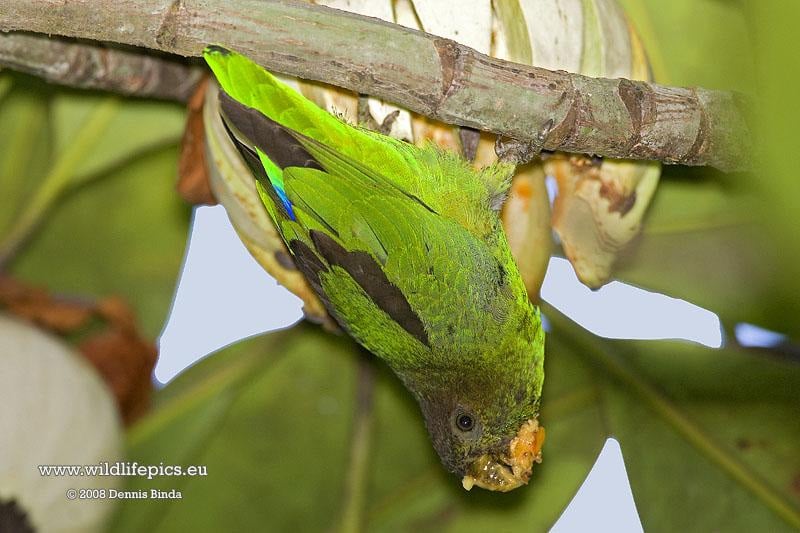
The Sapphire-rumped Parrotlet(Touit purpuratus) has the forecrown, crown, ear-coverts and sides neck, color marron-oliva; lores and cheeks green; rear area of the neck of color green pale with broadcasting brownish. Mantle and top of the back, green; scapulars and tertiary, dark brown; rump blue; uppertail-coverts green.
Feather blue in it bend of wing; primary coverts brown-black, rest of the coverts green. The flight feather Brown by up in innerwebs and tips, Yes no green; pale green blue for below. Underwing-coverts green. The underparts pale, of color green emerald slightly yellowish, with a layer of ochre in the sides of the belly. The tail Le da an appearance unmistakable, with black edge, green in the center and dark crimson on the sides, with black margins to outerwebs.
Bill off-white color pale Horn-tipped up to the upper jaw; irises black; legs grey.
The female has the tail (except central feathers) with the subterminal band green. Immature more yellowish below; the black color in the tail confined to the tips; Green olive from the forecrown up to the nape and ear-coverts lower.
(Chapman, 1929) – As the nominal species but with the forecrown, crown and back neck, green; flanks with less yellowish green and feathery external of the tail showing a purple glow.
Habitat:
Species Rare and hard to see. It inhabits, mainly, in the humid lowland canopy and forests and marshes, also observed in savanna in Suriname. In lower and more open to high altitude forests in Venezuela and in isolated areas cleared forests. Reports in altitudes of 400 metres in Colombia, and 1.200 metres in Mount Duida, Venezuela. gregarious, usually in groups of 12-40 birds.
Reproduction:
Observed the female digging a hole in a tree of forests and marshes in the month of November in Colombia; Birds in a nest in termitario tree in the month of April in Suriname, and males in breeding condition in the month of March in Venezuela. The laying tends to be of 3-5 eggs.
Comes to be local in Suriname and French Guiana. Discrete, often difficult to observe and apparently sparsely populated in most parts of its range. Perhaps more numerous in those sections more low of it amazon basin.
Distribution 2 subspecies:
Touit purpuratus purpuratus
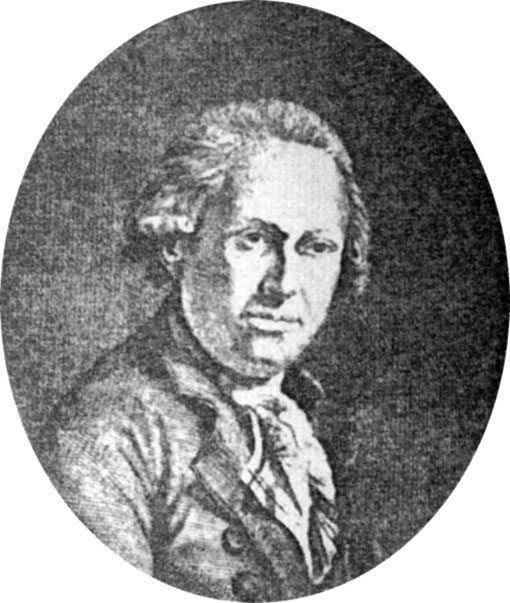
(Gmelin, 1788) – Nominal. Southeast of amazon in Venezuela, up to the Guianas and this from the Basin of the Amazon in Brazil.
Touit purpuratus viridiceps
(Chapman, 1929) – Black river, the Northwestern basin of Brazil, Venezuela West from Mount Duida until Colombia, Ecuador and Peru.
Conservation:
State of conservation ⓘ
Minor Concern ⓘ(UICN)ⓘ
• Current category of the Red List of the UICN: Least concern.
• Population trend: Stable.
Justification of the population
The size of the world's population has not been quantified, but this species is described as «Rare» (Stotz et to the., 1996).
Justification of trend
It is suspected that this species has lost 12,8-15,2% of habitat within its distribution over three generations (15 years) starting from a model of deforestation Amazon (Soares-Filho et to the., 2006, Bird et to the., 2011). Given the susceptibility of the species to hunting and / or capture, It is suspected that it will fall in <25% during three generations.
Of 18 cm.. tall Inconfundible by the ends of the tail, which are dorsally and ventrally purple-red with black border.
Overall green body with Brown Crown and nape, wing with both opaque Brown ends and violet blue rump.
Female with paler brown head and green-streaked tail.
The subspecies T. p. viridiceps has a totally green head.
Uncommon and difficult to observe species.
Lives in humid forests, semi-humid and swampy, until the 400 m. It forms small groups and they are silent when they feed. It nests in hollows of trees or arboreal termiteros at low altitude. The implementation is of 3-5 eggs and breeding season: from November to April
It is found in the wild in the Amazon, South-East of Colombia to the Guyanas, southern Venezuela to northeastern Peru and northern Brazil.
It feeds on fruits, and figs.
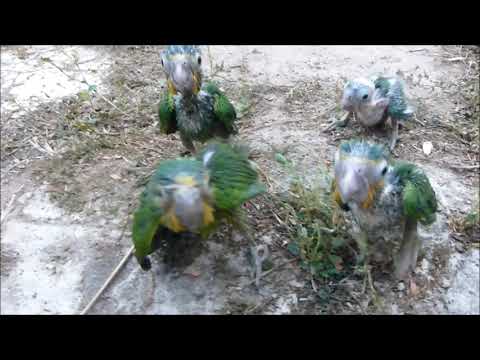
Video: Video 1
Deforestation and loss of Habitat is a threat for this species.
Alternative names:Sapphire-rumped Parrotlet (English), Periquito zafiro (Colombia), Periquito lomizafiro (Ecuador), Purpurschwanz, Purpurschwanzpapagei (Germany), Lorito de Lomo Purpúreo (Spain), Periquito Rabadilla Púrpura (Venezuela), Toui à queue pourprée (France), apuim-de-costa-azul (Brazil)
Origin: Colombia, Venezuela, Mexico, Brazil, Panama, Costa Rica
Character: Sociable
Life expectancy: 10 to 25 years
Height: 17 to 20 cm..
Content
Description:
Of 17 to 20 cm. length between 76 and 102 g. of weight.
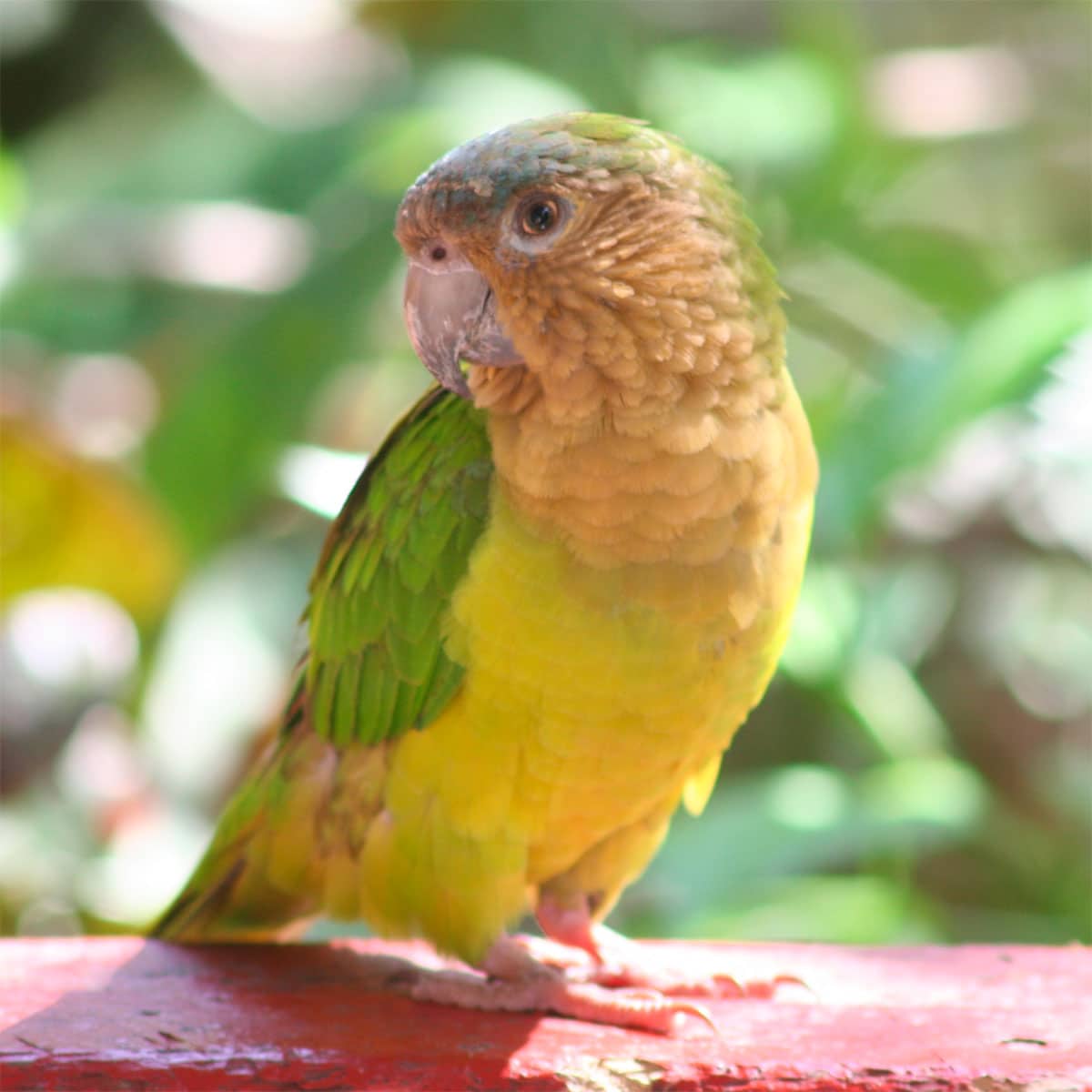
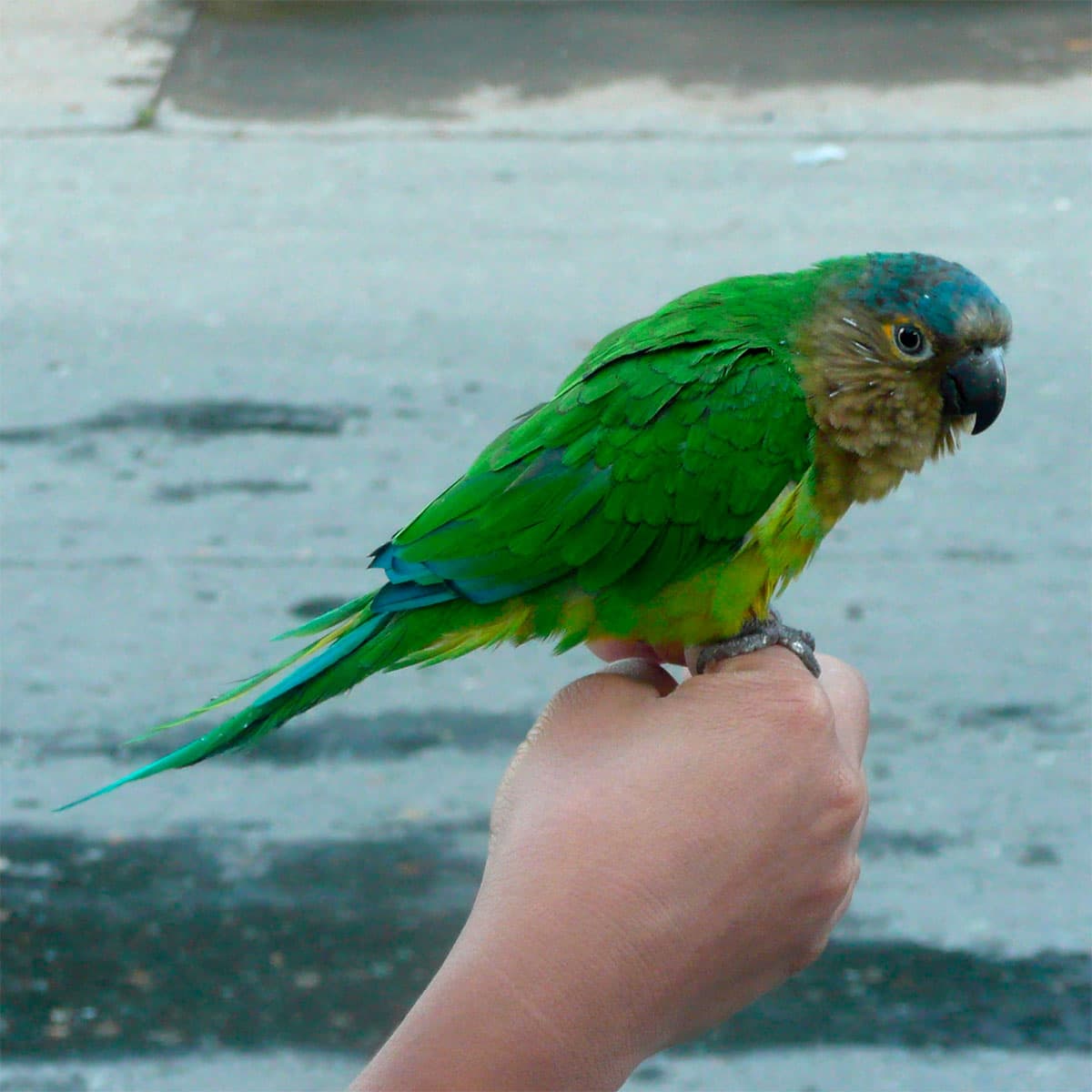
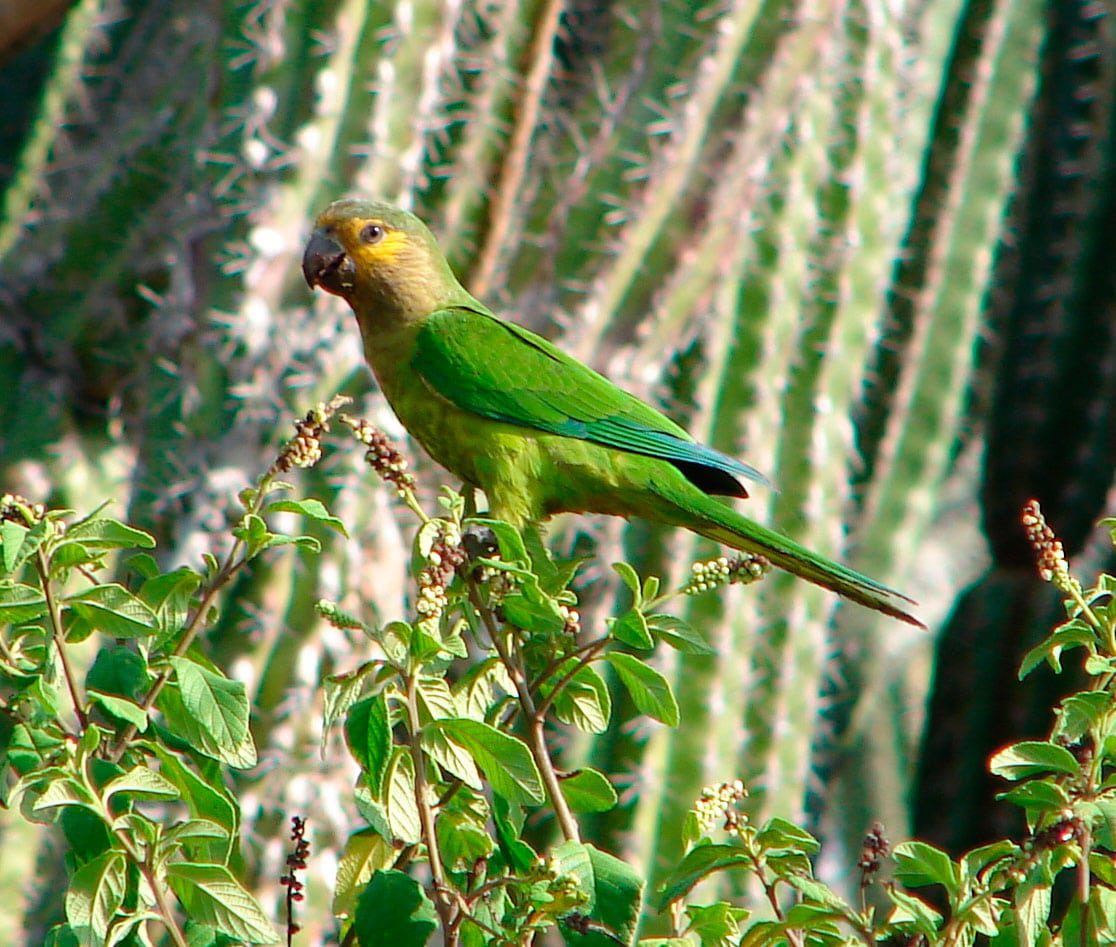
The Brown-throated Parakeet(Eupsittula pertinax) it is a polytypic species. Its fourteen subspecies are distinguished by the mix yellow and Brown on his face and throat.
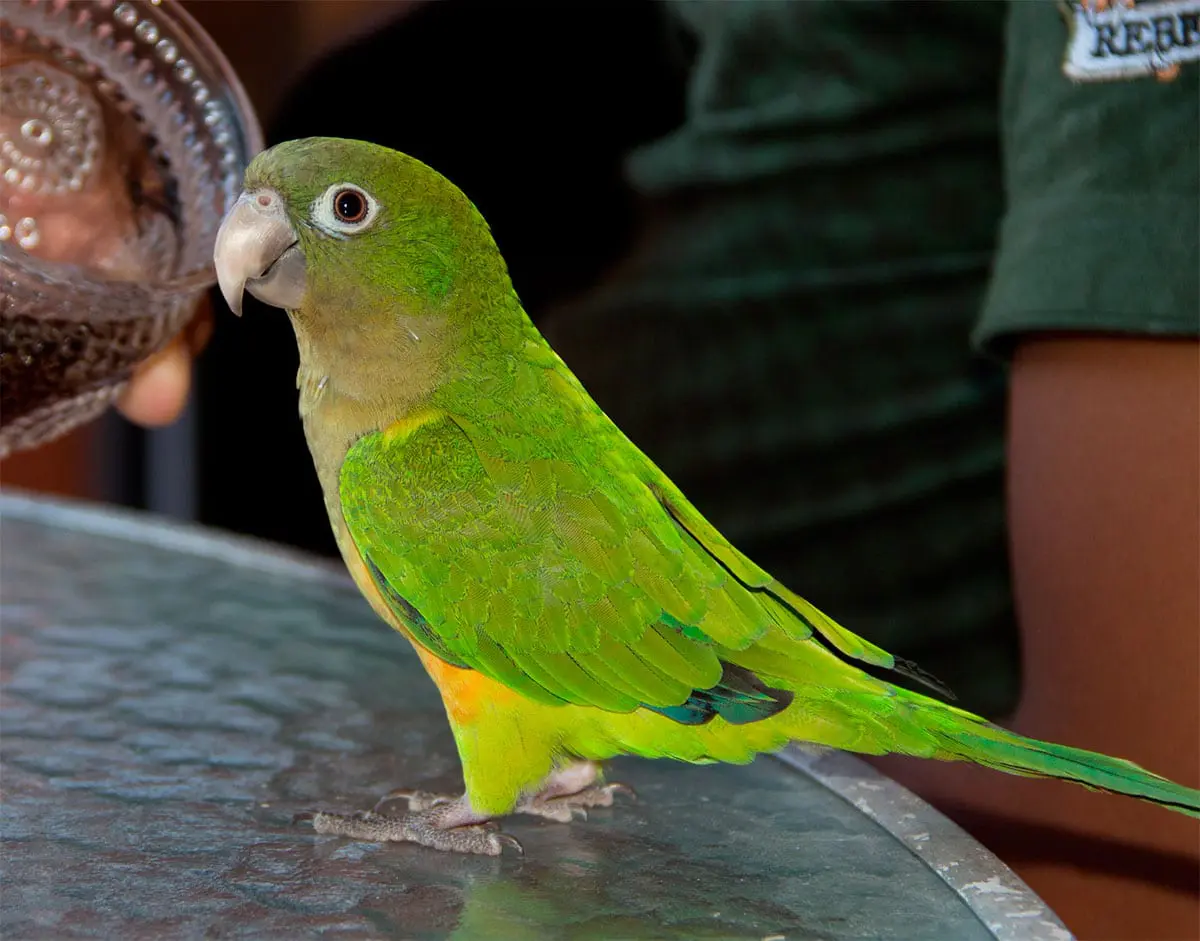
In the case of the Eupsittula pertinax aeruginosa, the lores previous, the frontal area, underside of cheeks, both sides of the neck and ear-coverts, are dark brown; dark stripes visible on the cheeks; the feathers of the ocular region are of color orange-yellow; the crown greenish blue. Upperparts olive green. Lesser and medium coverts green; bluish green the primaries and greater coverts. Primaries and secondaries green up, Blue dark on the tips, Blue them vane outer in the secondaries; by down dark grey. Underwing-coverts brighter yellowish green. The throat and the top chest dark brown; the underparts Matte yellowish green with an orange patch in the central area of the belly. For above, the tail is of color green blue, bluer towards the tip; undertail greyish-yellow.
The bill brownish-grey; bare periophthalmic yellowish white; irises yellow, legs grey.
Both sexes similar, without sexual dimorphism, where males are larger than females.
The youth they tend to lack intense yellow, that is alive in individuals adults. Its forecrown is dark greenish blue. The throat and the chest are greenish, while the belly is green with a bit of orange or yellow.
Eupsittula pertinax arubensis (Hartert) 1892 – Cara and throat color opaque marron-oliva. Narrow yellow line on the eyes. Crown greenish blue.
Eupsittula pertinax chrysogenys (Massena & Souance) 1854 – Similar to the aeruginosa subspecies, but darker.
Eupsittula pertinax chrysophrys (Swainson) 1838 – Similar to the subspecies margaritensis and venezuelae but with the forecrown a pale yellowish brown.
Eupsittula pertinax griseipecta (Meyer de Schauensee) 1950 – Similar to the aeruginosa subspecies, with the cheeks, the throat and top of the chest, Gray-olive, veins in the cheeks absent. The crown Green with little blue.
Eupsittula pertinax lehmanni (Dugand) 1943 – Is similar to the aeruginosa subspecies, but with yellowish feathers around the eye more extensive; the Blue head limited with the forecrown and less blue in the flight feather.
Eupsittula pertinax margaritensisCory 1918 – Forehead whitish, the cheeks and ear-coverts color oliva-marron with forecrown greenish blue.
Eupsittula pertinax ocularis (Sclater,PL & Salvin) 1865 – Patch distinctive yellow below and behind the eyes (absent in the immature). Forehead and crown green color with tint blue in some birds. Throat, top of the chest, the cheeks and lores warm brown; ear-coverts slightly darker.
Eupsittula pertinax paraensis (Sick) 1959 – Similar to the aeruginosa subspecies, but with the irises of color red and the vane outer of primaries and secondaries blue.
Eupsittula pertinax pertinax (Linnaeus) 1758 – The nominal. Extensive but variable amount of yellow color in the forecrown, the cheeks, the throat and lores. It may be more off or more Orange under and behind the eyes. Crown Green with only a few light blue indications.
Eupsittula pertinax surinama (Zimmer & Phelps,WH) 1951 – Similar to the subspecies margaritensis but with narrow frontal band orange-yellow color, orange-yellow colour around the eyes extending towards the cheeks and yellowish-green (not brown) the throat.
Eupsittula pertinax tortugensis (Cory) 1909 – Similar to the aeruginosa subspecies but larger, orange-yellow color on both sides of the head and underwing-coverts more yellowish.
Eupsittula pertinax venezuelae (Zimmer & Phelps,WH) 1951 – Similar to the subspecies margaritensis but more pale and yellow on the underparts.
Eupsittula pertinax xanthogenia (Bonaparte) 1850 – Clearer (almost sallow) the head the species nominal, with yellow tones ranging from a variable on the front of the crown and nape.
Habitat:
Video – "Brown-throated Parakeet" (Eupsittula pertinax)
Brown-throated Parakeet Eupsittula pertinax / dirty face parakeet
The Aratinga Pertinaz occupies all kind of fields wooded open of the Savannah, transparent areas of dry scrubland full of cactus and acacias, forests of mangrove, tropical forests (where is the most abundant parrot species often), gallery and white sand forests, Mangroves of Rhizophora, edges of moist evergreen forests, and agricultural areas with palms and other trees.
Move at altitudes on the 1.200 m or more, Although they tend to stay below the 1.200 m. This Aratinga also lives in artificial clearings such as public parks or gardens..
In general, observed in flocks or pairs, forming larger groups where food is abundant and in communal roosts.
Reproduction:
The Brown-throated Parakeet It monogamous. With plays After the season of rains, in general from February to April. Birds very social, assess potential mates in large communal roosts. Also used strong calls in select to your mate / to.
Its breeding season It begins after the rainy season, and varies geographically between the months of February and September. Between February and April in Goal, Colombia; from February to April in Venezuela and any time of the year in Suriname, Curacao, Aruba and Bonaire.
When the conditions are favorable this species You can reproduce several times a year. Son colonial and have been observed up to seven pairs nesting next to each other.
Nest in the cavities of trees, artificial nesting boxes, or in arboreal termite. There are reports of nests made in cracks in rocks. The nests they are very simple, without any plant covering and the eggs, often, they are placed on the floor of the cavity nude. The number of eggs in a nest varies from two to seven.
The female is the primary incubator, with one incubation which can last thirty-six to thirty-seven days in the wild. The chicks they leave the nest after 50 days. The young join their parents and form small family groups that last until the parents begin a new breeding season..
Sometimes it causes damage to crops (for example, of millet and handle), of corn in Colombia and in fruit plantations of the Netherlands Antilles. Despite being considered pests in some areas, the Brown-throated Parakeet they are not strongly persecuted.
They feed in very vocal groups that often include macaws and amazon parrots.
Distribution:
The Brown-throated Parakeet are distributed to the North of South America, Panama and the islands of the Southern Caribbean.
In Panama are present in the slope of the peaceful, rarely on the side of the Caribbean, even in the canal area. But, they occupy the lowlands of the Northern Caribbean and northeast of Colombia, from the East of the Sinu River up to the Guajira peninsula, including the Center and low Magdalena valley, and observed at elevations more low in the East of the Andes and the lowlands of the South of the Alto Orinoco, to the North of Vaupés.
Probably can be observed in all Venezuela, extending to the Margarita Islands, Turtle (Venezuela), Curacao, Aruba and Bonaire (Netherlands Antilles); introduced in St Thomas, virgin islands, in the 19th century.
Its distribution extends through of the Guianas and the North of Brazil, from Roraima until Amapá, as well as discontinuously in the upper part of the basin of the Tapajos River, For and in the basin of the Black river, amazon.
In spite of his uneven distribution, usually common to abundant, in many places it is the most common parrot (for example in localities of Guyana), locally common in Panama and reportedly very common in black rivers and Branco, Brazil.
Your area of distribution possibly be increasing due to deforestation. In general resident with local seasonal movements (for example, in the region of Santa Maria, Colombia) the availability of food and the dispersion of the areas of reproduction-related.
Distribution subspecies Eupsittula pertinax
Subspecies
Eupsittula pertinax aeruginosa (Linnaeus) 1758 – North of Colombia, Northwest of Venezuela and the upper part of the basin of the Rio Branco, in the Northwest of Brazil
Eupsittula pertinax chrysogenys (Massena & Souance) 1854 – Region of Black river and, possibly, Solimões River, North of Brazil; There are no details about its area of distribution
Eupsittula pertinax chrysophrys (Swainson) 1838 – Southeast of Venezuela, Guyana Interior and North of Roraima, Brazil.
Eupsittula pertinax griseipecta (Meyer de Schauensee) 1950 – Valley of the sinu river, North of Colombia. Range in relation to the aeruginosa subspecies unclear
Eupsittula pertinax lehmanni (Dugand) 1943 – It is from Colombia and possibly Venezuela.
Eupsittula pertinax margaritensisCory 1918 – Islands Margarita and The friars, Venezuela. the birds of the Paria Peninsula in the North of Venezuela, they can be of this subspecies; see the subspecies venezuelae
Eupsittula pertinax surinama (Zimmer & Phelps,WH) 1951 – French Guiana and Suriname through the coast of Guyana to Delta Amacuro, Northeast of Venezuela.
Eupsittula pertinax tortugensis (Cory) 1909 – Turtle Island, Venezuela.
Eupsittula pertinax venezuelae (Zimmer & Phelps,WH) 1951 – North and Central Venezuela. Areas of contact with other little-known Venezuelan subspecies: see aeruginosa, surinama and chrysophrys.
• Red List category of the UICN current: Least concern
• Population trend: Growing
The Eupsittula Pertinax (Pit and neck of 2014) was considered, previously, belonging to the genus Aratinga.
The subspecies Griseipecta, endemic of the sinu valley in Colombia, There have been since 1949 and is likely to be extinct (T. Donegan in litt. 2011).
The size of the population world of this kind not has been quantified, but it is described as "common» (Stotz et to the. (1996). Is considered as the Parrot more abundant in the land low for the Caribbean, Plain in Colombia, Guyana, North of Suriname and the three islands of the Netherlands Antilles.
A density of five to eighty and nine birds by kilometer square is has estimated in the regions of the Northwest of Venezuela.
It is believed that populations on the continent are increasing their range in response to an increase in the conversion of the forest into farmland.
This species is often captured with commercial purposes, but not has been consequences serious, with the exception of the subspecies Aratinga pertinax margaritensis and Aratinga pertinax tortuguensis.
The Aratinga pertinax tortuguensis It is also vulnerable to severe climate changes. (Juniper and Parr, 1998;. Pit, et to the, 1997)
"Brown-throated Parakeet" in captivity:
The Brown-throated Parakeet has a average vinein the nature of about ten years. But, When live in captivity with the proper supervision, they have come to live up to twenty-five years.
common in the industry of the pet because, mainly, to your behavior affective. Captured for the pet trade and occasionally as food.
Pretty noisy, both in the nature as in captivity. With certain skills for repeated whistles and words short.
Alternative names:
– Brown-throated Parakeet, Brown throated Parakeet, Brown-throated Conure, Caribbean Parakeet, Curacao Conure, Curacao Parakeet, St. Thomas’s Conure (English).
– Conure cuivrée, Conure de Saint-Thomas, Perriche cuivrée, Perruche cuivrée (French).
– Braunwangensittich (German).
– Aratinga de-cara-parda, aratinga-de-bochecha-parda, periquito-de-bochecha-parda (Portuguese).
– Aratinga Pertinaz, Perico cara sucia, Perico Carisucio, Perico Gorgicafé, Periquito de Cola Corta, Periquito Gorgimoreno (español).
– Loro carisucio, Perico Carisucio (Colombia).
– Perico Gorgicafé (Costa Rica).
– Perico Cara Sucia (Venezuela).
– Avibase
– Parrots of the World – Forshaw Joseph M
– Parrots A Guide to the Parrots of the World – Tony Juniper & Mike Parr
– Birdlife
– Animal Diversity Web
– Photos:
(1) – Aratinga pertinax By Genes Luna (Flickr: IMG_0309.jpg) [CC BY-SA 2.0], via Wikimedia Commons
(2) – Aratinga pertinax xanthogenia By gailf548 (originally posted to Flickr as Young Parrot) [CC BY 2.0], via Wikimedia Commons
(3) – Eupsittula pertinax arubensis By Alexander Yates (originally posted to Flickr as Aruba Parakeet) [CC BY 2.0], via Wikimedia Commons
(4) – Brown-throated Parakeet (Aratinga pertinax venezuelae) in Cagua, Estado Aragua, Venezuela By Cristóbal Alvarado Minic [CC BY 2.0], via Wikimedia Commons
(5) – Aratinga pertinax aeruginosa By Aratinga_pertinax_-Colombia-8a.jpg: anthrotectderivative work: Snowmanradio [CC BY 2.0], via Wikimedia Commons
(6) – Eupsittula pertinax By Leizelt, Balthasar Friedrich; Wilhelm, Gottlieb Tobias [CC BY 2.0 or Public domain], via Wikimedia Commons
 Minor Concern ⓘ
(UICN)ⓘ
Minor Concern ⓘ
(UICN)ⓘ








_-Jardim_dos_Louros%2C_Madeira.jpg)




.jpg)