17 to 20 cm.. length between 33 and 40 g. of weight.
The Red-chinned Lory(Charmosyna rubrigularis) has the head green; ear-coverts brilliant emerald green with pale green streaks and showing even paler on the crown; chin, top of the throat and lower lores, surrounded by yellow red. The upperparts, Green olive darker than the underparts. The wings Green with the part internal black and them edges yellow. Yellowish-green below-wing coverts; flight feather grey and black with stripe yellow central.
Underparts brighter yellowish green, clearly more gentle to them upperparts. The tail above it is green with yellow tips, lateral feathers marked in red, black and orange in the bases; by below with broad lateral feathers red, with tips yellow (more or less hidden red rest), central feathers Black with them ends yellow.
Bill orange red; irises orange; legs orange-yellow.
Both sexes are equal.
Immature they are similar to the adult with less red in the chin and throat.
With distributed by the humid forest, mainly in the mountains. Usually found in small flocks of up to ten birds, feeding in the canopy or flying above. Can be seen in the company of others Loris that is feed from nectar, including the much larger Coconut Lorikeet. You can be assured while feeding.
Reproduction:
Unknown breeding habits.
Food:
Feeds of pollen and nectar and it has been noted that they frequent native Palms in the mountains of New Ireland.
Distribution:
Size of the area of distribution (reproduction / resident): 185.000 km2
In Karkar island (off the northeast coast) and the Bismarck Archipelago (New Britain, New Hanover and New Ireland), Papua New Guinea. In Karkar is found from sea level to the top but rarely below 625 m, and more common among 1.150 meters of 1,280 m. common since 450 meters up in New Britain and in New Ireland from 1.500 metres to the Summit of the Hans Meyer Range; Although found as low as a 70 m. It tends to replace Red-flanked Lorikeet at higher altitudes, but it may be sympatric with species in some areas.
Conservation:
• Current IUCN Red List category: Least concern
• Population trend: Stable
The population World has not been quantified, but the species according to information is common and abundant (pit et to the. 1997).
Justification of trend
It is suspected that the population is stable in the absence of evidence of any reduction or substantial threats.
"Red-chinned Lory" in captivity:
The species does not arise today as a cage bird.
Alternative names:
– Red-chinned Lory, Red chinned Lorikeet, Red-chinned Lorikeet (ingles).
– Lori à menton rouge (French).
– Rotkinnlori (German).
– Lori Barbirrojo, Lori de Barba Roja (español).
Measured around 10 cm.. length and approximately 12 g. of weight.
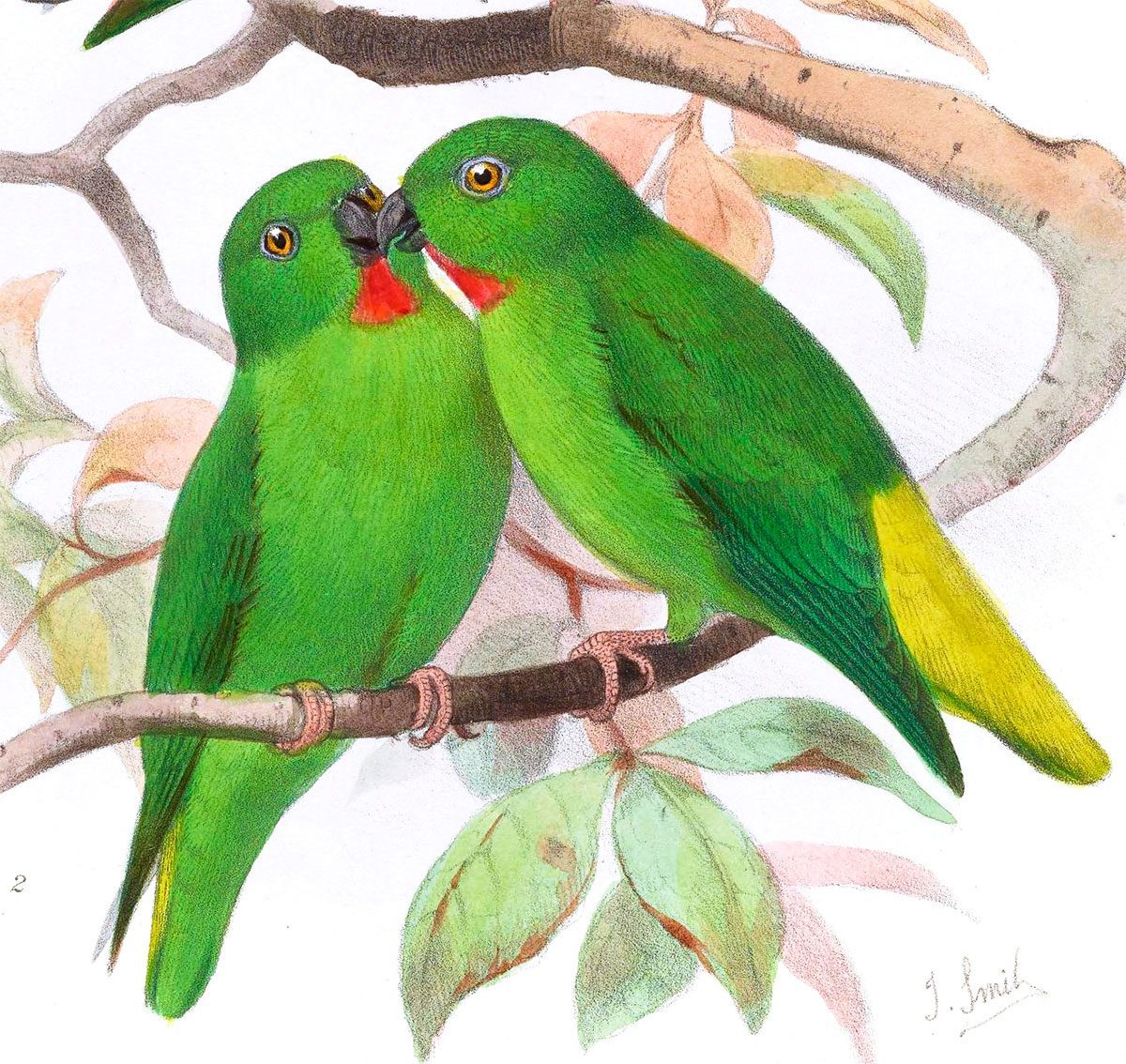
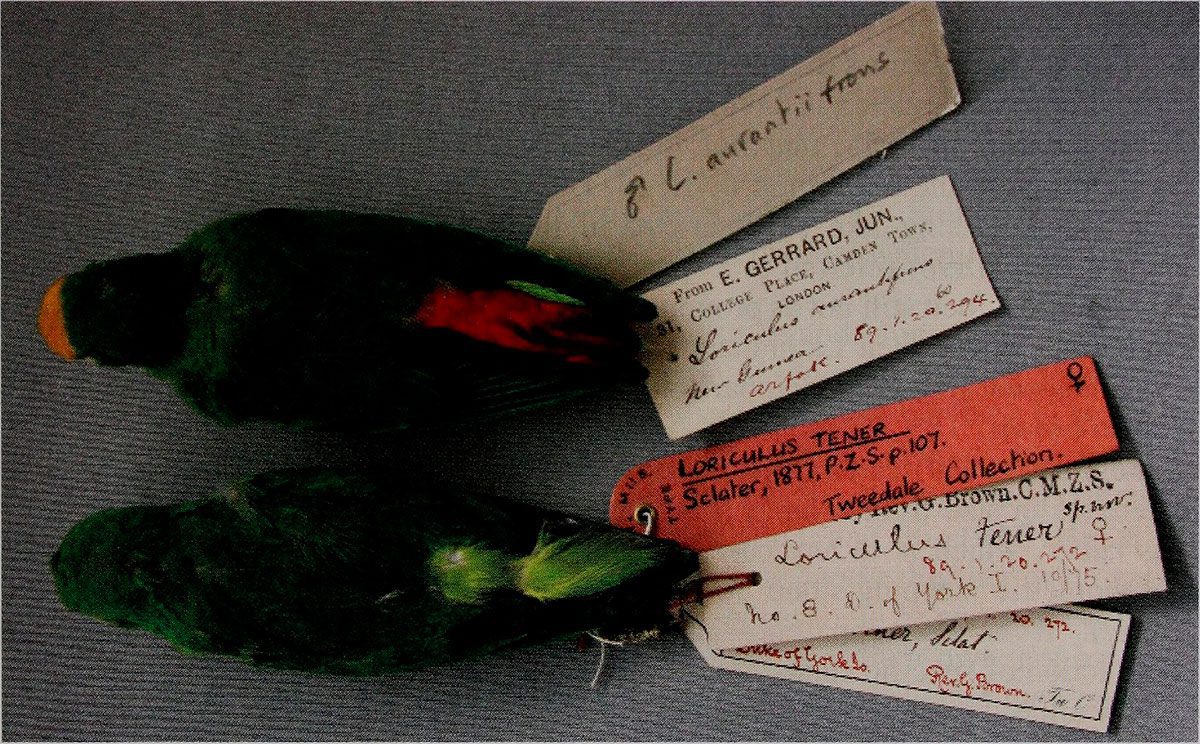
The head of the Bismarck hanging parrot (Loriculus tener)(Loriculus tener) is green. Upperparts Green except for the rump and upper coverts of the tail that are yellowish-green. The wings they are green with vane internal darker towards the flight feather.
Under, the wings blue with Feather coverts green. Chin red orange; rest of the underparts green. Upper, the tail green, pale blue view from below.
The bill black; irises yellowish white; legs yellowish brown.
The female have the front part of the crown and face blue.
The young birds they lack the orange patch of the throat and your bill is pale-brown.
Habitat:
A species very little known. Has been recorded along of the edge of forests and partially cleared from the lowlands up to the low hills areas.
Reproduction:
There is practically no information. Only a nest found, in the stump of one areca palm.
Food:
There is practically no information, but it is suspected that they feed on flowers and small fruit, usually, alone or in pairs, and often hung upside down.
Distribution:
Size of the area of distribution (reproduction / resident): 26.300 km2
This little known species is classified as Near-threatened, Since it is believed that it has a moderately low population that is limited to the lower forests. These areas are developing rapidly in oil palm plantations and therefore the population is undoubtedly decreasing.
In New England, clearing of lowland forests for conversion to oil palm plantations has been intense in recent decades.
The population size is between the 10.000 and 19.999 mature individuals.
"Bismarck hanging parrot" in captivity:
Usually they are not in captivity.
Alternative names:
– Green-fronted Hanging Parrot, Bismarck Hanging Parrot, Bismarck Hanging-parrot, Green fronted Hanging Parrot, Green-fronted Hanging-Parrot (ingles).
– Coryllis des Bismarck, Coryllis à front vert, Coryllis des Bismark (French).
– Bismarckpapageichen, Goldstirnpapageichen, Zartpapageichen (German).
– Lorículo de las Bismarck (español).
– Avibase
– Parrots of the World – Forshaw Joseph M
– Parrots A Guide to the Parrots of the World – Tony Juniper & Mike Parr
– Birdlife
– Photos:
(1) – «Loriculus tener Smit» by Joseph Smit – Ornithological Miscellany. Volume 2. Licensed under Public Domain via Wikimedia Commons – http://Commons.wikimedia.org/wiki/file:Loriculus_tener_smit.jpg#mediaviewer/file:Loriculus_tener_smit.jpg
▷ The world of Pets: Dogs, cats, birds, reptiles, amphibians
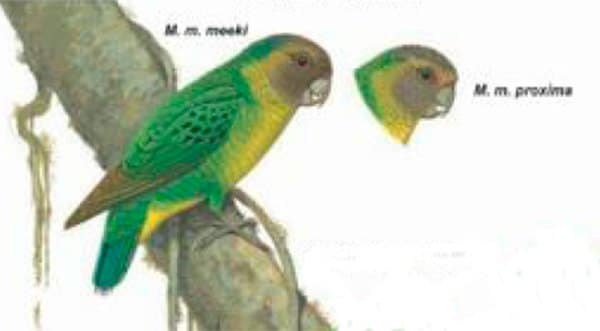
The Meek's Pygmy-Parrot(Micropsitta meeki) has the feathers of the head dark brown, strongly scalloped in color yellow on them ear-coverts and the sides of the throat, and usually with the eyebrows in a vague color yellow; feathers of the crown with fine greyish yellow tips.
Upperparts dark green, darker on the margins and the Center to the Middle coverts black. Feathers primary Black with green trim; secondaries mainly green. Wing feathers more dark with the tips of color yellow; underside of flight feather blackish. Top of the chest and centre of belly, opaque yellow, with brown spots at the tips of the feathers; flanks color green dark; under the tail, coverts yellow. Tail greenish blue in the Center, feathers laterales blackish with stains yellow on the tips or with pointed blue and yellow.
Bill yellow rose pale; irises yellowish brown; legs Pink.
(Rothschild and Hartert, 1924) – The face is more pale and the grey more beige that the of the nominal species; light diffusion of greenish color instead of the yellow markings of the nominal, and a band front yellow with find in them eyebrows.
Habitat:
Not well known. It occurs in forests, high secondary growth, and even in trees around inhabited areas. The birds are found in small groups. Habits are like those of the Buff-faced Pygmy-Parrot.
Reproduction:
The nest they usually build it on a tree termite mound, Sometimes it can be very close to the ground.
Food:
They feed on lichens and fungi collected from trunks of trees.
They nourish also of seeds, nuts, berries and fallen fruits that they can find, Although they prefer to eat fruits of plants. They also feed on insects and insect larvae.
Distribution:
Size of the area of distribution (reproduction / resident): 2,400 km2
The size of the world population It has not been quantified, It is thought that it may be above the 10,000 specimens. According to sources, the species is common both in Manus as Lou (pit et to the. 1997).
The population is suspected to be stable in the absence of evidence of any reduction or substantial threats.
"Meek's Pygmy-Parrot" in captivity:
Not found in captivity.
While attempts have been made to keep Pygmy parrots in captivity, These have not been successful. This may be due to the fact that birds suffer from stress or a lack of understanding of their dietary needs.
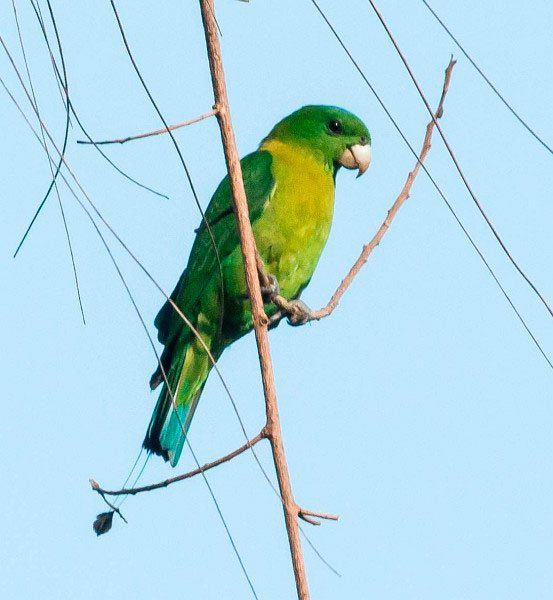
The head of the Yellowish-breasted Racquet-tail(Prioniturus flavicans) is bright green, brighter around the lores and the base of the bill.
The front of the crown is green, rest of bright blue with red spot in the center crown. Mantle ocher yellow, well delimited from the blue nape the green of the wings and back; Back and rump green. Wings green, with vane Dark internal to the flight feather and blue to primaries longer. green's Underwing coverts; underside of primaries marked dark blue.
Underparts brighter yellowish green, ocher yellow in the chest. Upper, the outer feathers of the tail green with black and turquoise tips on vane outside of the outer feathers; below, the tail dark colored, bathed in blue at the edges of the vane inner; spatulas blackish.
Bill horn; the dark brown irises; the gray legs.
Female less blue, no red dot on the crown, the underparts and the mantle, greener and rackets (a thin extension of the central tail feathers, almost as hair, It is ending with a more oval-shaped racket) shorter.
Found in the primary forest usually below the 1,000 m. But times may vary up to the 1.900 m. They are also observed in trees in cultivated areas.
Reproduction:
Little is known of their reproductive habits.
Food:
The birds they feed on the ground, among the plants of lowland and Hill forests, flocking often in fruit trees. They feed slowly along with other frugivorous birds..
Distribution:
Size of its range (breeding/resident ): 66.700 km2
Are distributed in the North of Sulawesi, Indonesian and on the Islands around, including Bangka, Lembeh and Togian. The species also, possibly, It is distributed in groups of Islands Sangir and Banggai. Although its population may be declining due to habitat loss and trade in birds, It is not considered threatened and is still, relatively, common on reserve Dumoga-Bone. It overlaps, although it is less common, with the Golden-mantled Racquet-tail.
Conservation:
• Current category of the Red List of the UICN: Near threatened
• Population trend: Decreasing
The population It has been estimated in the order of 45.000 individuals (Walker and Cahill 2000).
It is suspected that this species has diminished recently at a moderately fast pace, due to the continuing loss of forests.
Conservation Actions Proposed:
– Evaluate the threats to this species. Calculate loss of forests in the lowlands of the North of Sulawesi.
– Investigate the level of dependency of the forest habitats of the species.
– Protect effectively important tracts of forest right in key places, both in strict protection areas and in multiple use areas.
39-43 cm.. length between 195 and 275 g. of weight.
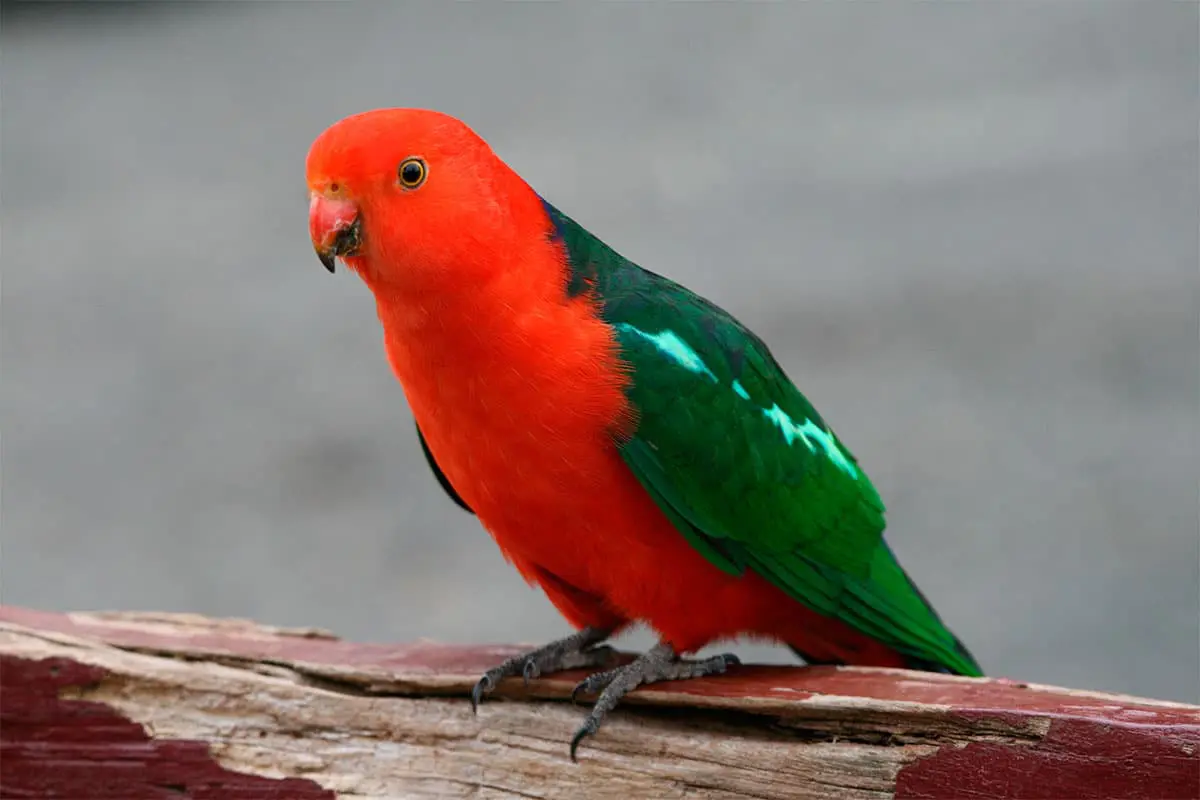
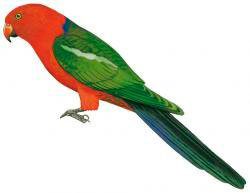
The Australian King-Parrot(Alisterus scapularis) is very similar to the Moluccan King-Parrot, but larger.
It has the head and bright Scarlet underparts, with the exception of the coverts black infracaudales, with large red tips. Narrow rear necklace with mixture of the dark blue to dark green of the mantle (mantle feathers fringed even darker); lower back and rump, dark blue. Pale necklaces, slightly greenish-blue, forming a distinctive 'brace'; green wing coverts, and green flight feathers with vane blackish internal. Under, feathers dark green bathed in blue wing. Upper, Black tail with a light blue bathroom in the vane external side feathers; undertail, black tail.
Bright coral red beak, with black tips; iris yellow ; grey legs.
Strong dimorphism in female, with the Crown and green upper parts (including supracaudales coverts and tail, but not the Croup which is a lighter blue than in males). The face and the chest are coloured green opaque with a reddish spread warm. Females may occasionally show some pale necklaces. The infracaudales coverts are green, very red-tipped. The Central tail feathers are green, the lateral blackish with narrow pink tips.
The peak is a blackish brown dark.
The immature birds are like females, but with a pale beak and dark iris.
Younger females are less red below. Males get the adult plumage during a slow change that starts around of the 16 months, and continue for others 14 to 15 months.
The Australian King-Parrot disperse, regularly, after the breeding season, in wooded areas, reaching altitudes of 1.625 m, Although rarely seen on top of the 1.200 m, from where come down to more open habitats; they have seen other apparently climate-related movements. They can travel moderate distance; a ringed bird was recovered to 270 kilometers from their place of origin.
During the breeding season, they are often found in dense forests (sclerophyllous forest wet), wooded streams and associated habitats, including more open eucalyptus forests and savannahs bordering riparian forests.
Outside the breeding season, they are in a wider variety of habitats, including the cultivated areas, parks, orchards and occasionally suburban gardens.
They are usually in pairs or small groups, although subsequent flocks of immatures may form groups of up to 50 or more birds. The Australian King-Parrot, often, they sit in a visible way on high exposed branches. When feed, However, the birds are still cautious and fairly quiet. They gather to feed early in the morning, sometimes in mixed groups with Rosella parakeets and other parrots. They remain silent during the hottest part of the day, to re-enable the afternoon.
Noisy flocks, often, they might be returning to the roosts at night.
Reproduction:
During courtship, males move head, the wings and inflate their feathers; the female responds with Wiggles head, and asking for food. The breeding season extends from September to February. The nest is a hollow in a tree dead or alive (often a large eucalyptus with hollow tips). The entrance of the nest is usually at a certain height. Between three and six (usually four) eggs are deposited in a deep hollow on a bed of wood dust. The female incubates alone during 20 days, with the male nearby to provide her with food.
The young remain in the nest during 5 weeks, after which they leave the nest and remain with their parents.
Food:
The diet consists of fruit, berries, nuts, seeds, insect larvae, flowers, outbreaks and other vegetable materials. The species is also fond of mistletoe VISCUM album, eucalyptus and acacia trees. It can cause damage in orchards and fields, usually in search of potato, corn and other crops.
When feed, They argue the food with their legs, and extract with its beak. If you bother, These parrots flying quickly to hide, but they can become tame in some inhabited areas.
Distribution:
The Australian King-Parrot is distributed along the East coast of Australia, in the interior of the western slopes of the Great dividing range, extending from Cooktown in the North of Queensland, to the South, the District of Atherton, then through Eungella, Blackall, MooNiE and in New South Wales, where it reaches inside approximately in Bingara, Mudgee and Albury. In Victoria is limited to the South-East, being Portland its southwestern border.
It is common in Canberra, especially during autumn and winter, and birds Getaways, occasionally seen in adelaide, along the murray river and in the West of Victoria.
The species can also be seen in Fraser, Stradbroke and Broughton Islands.
The world's population is considered that it is far superior to 50.000 specimens and stable, although they may have been affected by trade and to some degree habitat loss.
• Current category of the Red List of the UICN: Least concern
• Population trend: Decreasing
The size of the world's population has not been quantified, Although it is estimated above 50,000 specimens.
The species, according to sources, is usually common, but may be declining due to deforestation and the destruction of their habitat in course (pit et to the. 1997).
"Australian King-Parrot" in captivity:
Fairly common in Australia, not so much in other places.
Sweet disposition, tame; will tolerate other species outside of breeding season.
Alternative names:
– Australian King-Parrot, Australian King Parrot, Blood Rosella, King Lory, King Parakeet, King Parrot, King-Red Lory, Queensland King-Parrot, Scarlet-and-Green Parrot, Southern King-Parrot, Spud Parrot (ingles).
– Perruche royale (French).
– Königssittich, Königsittich (German).
– Periquito-rei-australiano (Portuguese).
– Papagayo Australiano, Papagayo Real Australiano (español).
27 to 28 cm. length between 53 and 70 g. of weight.
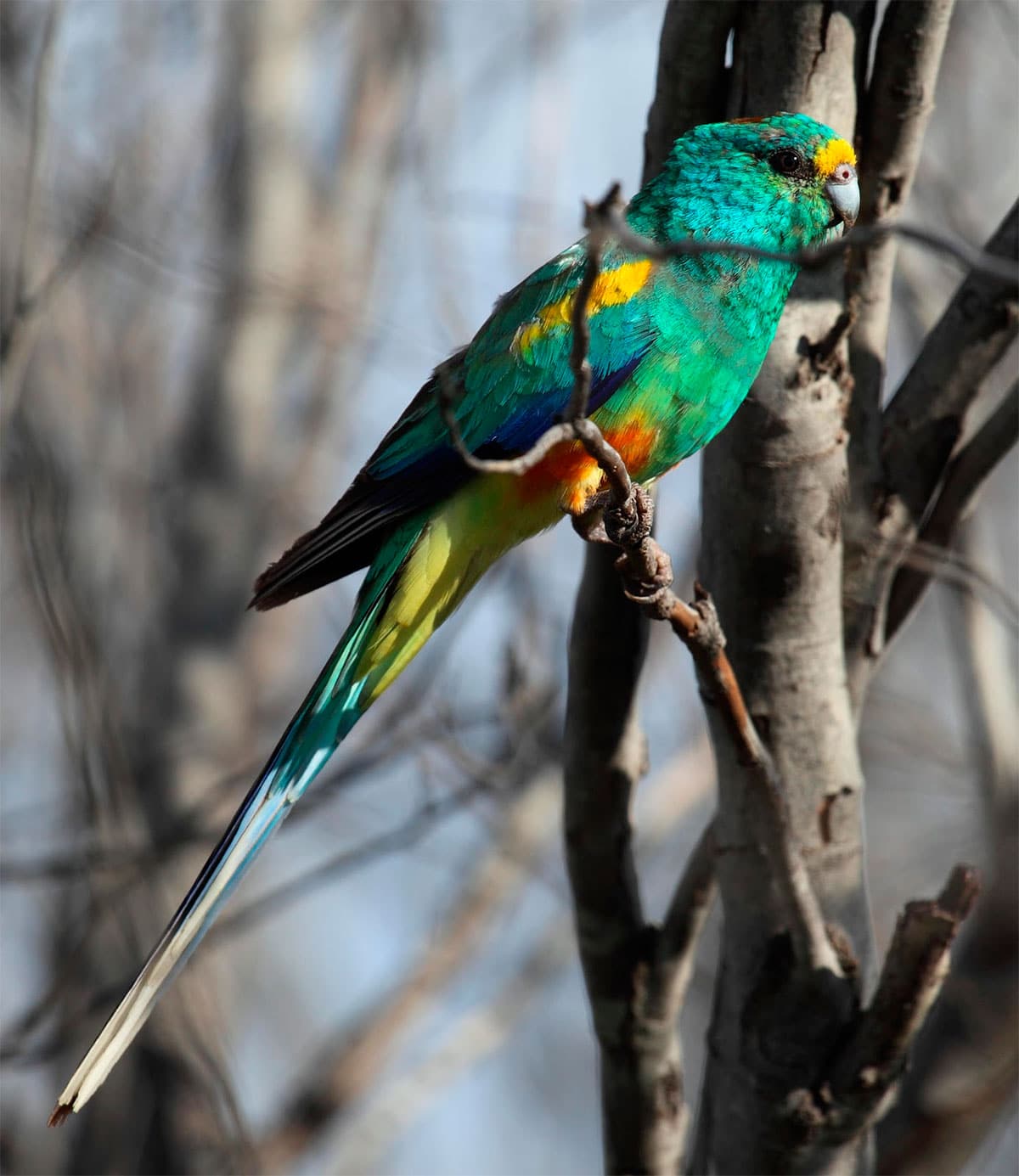
The plumage of the Mulga Parrot(Psephotellus varius) It, in general, color bright green. A yellow band across the front and a variable red spot adorns the back of the crown. The abdomen and the thighs are yellow, more or less stained Red. The uppertail-coverts are bright green, with a reddish blotch at the base of the tail. The lower area of the back has a blue-green band bordered above and below with a dark bluish-green line;. The curvature of the wings are turquoise and the blankets they have a yellow-orange tone forming a patch on the wing. The central feathers of the tail are green bronze, changing to greenish-blue. The outer feathers of the tail are green-blue on the bottom and white on the tip. The bottom of the tail It has a pale blue base and a finish in black. The bill is dark gray. The irises They are brown, legs grey.
In the female, the head, the back and top of the chest a color is brownish olive. The feathers of the lower parts are light green. The headband orange-yellow is barely noticeable and, often dyed red bermejo. The place that adorns the back of the crown is opaque reddish. The patch of the wing
is red, not yellow as in the male.
The youth they are much more muted than their parents. Young females have small blankets green edged with red, giving the latter a scaly appearance. Among young males, the red in the abdomen and the thighs is practically missing.
The Mulga Parrot generally prefers dry open habitats and lightly wooded Plains, where can find a great variety of vegetation. Found in scrubland Mallee and, in plots of acacia, casuarina, and also in the regions where small trees of eucalyptus They punctuate the stretches of sand. They are also present in the rocky hills or rocky cliffs.
They survive in dry areas, but in these cases, often sit near sources or temporary streams. The Mulga Parrot they owe their English name (Mulga Parrot) the fact that his rank often coincides with areas of Mulga, It is the vernacular name of Aboriginal origin, It is used to describe the semi-arid vegetation that covers the largest part the Australian continent. Mulga It appoints to the extension of the ecosystem or landscape in which Acacia are the dominant vegetation type. This does not mean that this species is strictly dependent on this habitat type.
Unlike in the Red-rumped Parrot, the Mulga Parrot is a quiet and reserved bird. This species usually lives in pairs or small family groups, rarely in large flocks. Most of the time, looking for food on the ground, in the shade of the trees at the edge of a road.
They show a great familiarity and usually allow to photograph them at close range. When it manifests some distrust, They walk away a short distance, to a tree and then return to Earth as soon as the intruder has moved away. On the other hand, When it comes to drinking, they are very cautious, as well as when they rest in the treetops, where are trying to keep hidden.
Reproduction:
The nesting period is carried out between the months of July and December, but also at other times of the year, provided that is a rainy month. The processions are very similar to the of the Red-rumped Parrot (Psephotus haematonotus) and includes mutual grooming.
The nest It is often found in a cavity in a tree, However, They also use nests of others parakeets or other openings such as tunnels dug in riverbanks.
The nests of the Mulga Parrot they are often found in small stunted trees, at low altitude above the ground. But, places near rivers provide locations that are at a higher elevation.
The female incubated during 19 days, While the male mounts guard close to stock up your food partner and warn of possible dangers.
The chicks, they leave the nest four weeks after hatching. Immediately after take-off, they join adults to form family groups.
Food:
The Mulga Parrot they feed on grass seeds, acacia seeds, berries, mistletoe and fruits. They complement their menu with different varieties of insects.
Distribution:
Size of the area of distribution (reproduction / resident): 3.330.000 km2
Endemic to the southern part of the Australian continent. Its range covers the entire southern part of Western Australia, except the forest area of ​​south west. It continues throughout the Great Australian Bight, Southern Australia and reaching the state of Victoria. Ends in southeast New South Wales, but does not cross the Great dividing range and it kept at great distance from the coast. Despite the large size of its territory (more than 3 million square kilometers), the species is considered monotypic (no subspecies).
Conservation:
• Current category of the Red List of the UICN: Least concern
• Population Trend: Decreasing
The Mulga Parrot they are widespread and relatively common in appropriate habitats.
Since the European colonization, the species appears to have changed its habitat significantly and is now more common in the grain belt in the desert.
The population, currently estimated at around 100.000 birds, It is slightly decreasing in the South due to the thinning areas of Mallee. In general, is not endangered. Classified by the IUCN as it does not present major problems.
"Mulga Parrot" in captivity:
It is in 1861 that the Mulga Parrot they arrived in Europe. The first specimen was exhibited to the public at the London Zoo. The first case of reproduction of this species dates back in the year 1876 in charge of the SR. Verviers in France. For a long time, These birds were known for being unreliable. That may be true, but the Mulga Parrot who are captives now in Europe support good climate, although they seem a little less solid than the Red-rumped Parrot (Psephotus haematonotus). It is possible that this is one of reasons why have been much less popular in aviaries that the Red-rumped Parrot.
Despite this, It is a parakeet can be advised to novice fans. The varied Perico often show minor differences in color and design. This is not anything unusual, This phenomenon is also known among the birds living in the wild. It is even possible to see the small differences in the same nest, If you look well.
These birds always in motion they are not suitable for being kept captive as pet birds in a small cage.
These are relatively strong birds, they withstand the cold relatively well, although they are sensitive to very low temperatures. They are birds peaceful and assets. Quickly show confidence to their caregiver. The sound of his voice is melodious. It is a bird that likes to raise. Like to be on the ground and, often spend their time grooming are. They also love to bathe. On the other hand, they are large rodents.
During the breeding season they are aggressive when in the company of other birds., even if it can be accommodated with conspecifics and other species of large birds, that will have no trouble, If the space in which birds are kept is large enough.
With regard to its longevity, a sample lived 11,8 years in captivity. In captivity, estas aves se han conocido casos de reproducción con 1 año de edad.
(1) – Mulga Parrot (Psephotus varius), Northern Territory, Australia By Christopher Watson (http://www.comebirdwatching.blogspot.com/) [CC BY-SA 3.0], via Wikimedia Commons
(2) – A male Mulga Parrot at Gluepot Reserve, South Australia, Australia. Male By David Cook Wildlife Photography from Wamboin, NSW, Australia [CC BY 2.0], via Wikimedia Commons
(3) – Mulga Parrot (Psephotus varius) Currawinya NP, SW Queensland, Australia By Aviceda (Own work) [CC BY-SA 3.0], via Wikimedia Commons
(4) – Mulga Parrot (Psephotus varius), Northern Territory, Australia By Christopher Watson (http://www.comebirdwatching.blogspot.com/) [CC BY-SA 3.0], via Wikimedia Commons
(5) – A male Mulga Parrot (also known as the Many-coloured Parrot at Wyperfeld National Park, Victoria, Australia By David Cook Wildlife Photography [CC BY-SA 2.0], via Wikimedia Commons
(6) – Parrots in captivity /. London :George Bell and Sons,1884-1887 [i.e. 1883-1888] – Flickr
Sounds: Marc Anderson (Xeno-canto)
▷ The world of Pets: Dogs, cats, birds, reptiles, amphibians
27 cm.. length and a weight between 50 and 113 g..
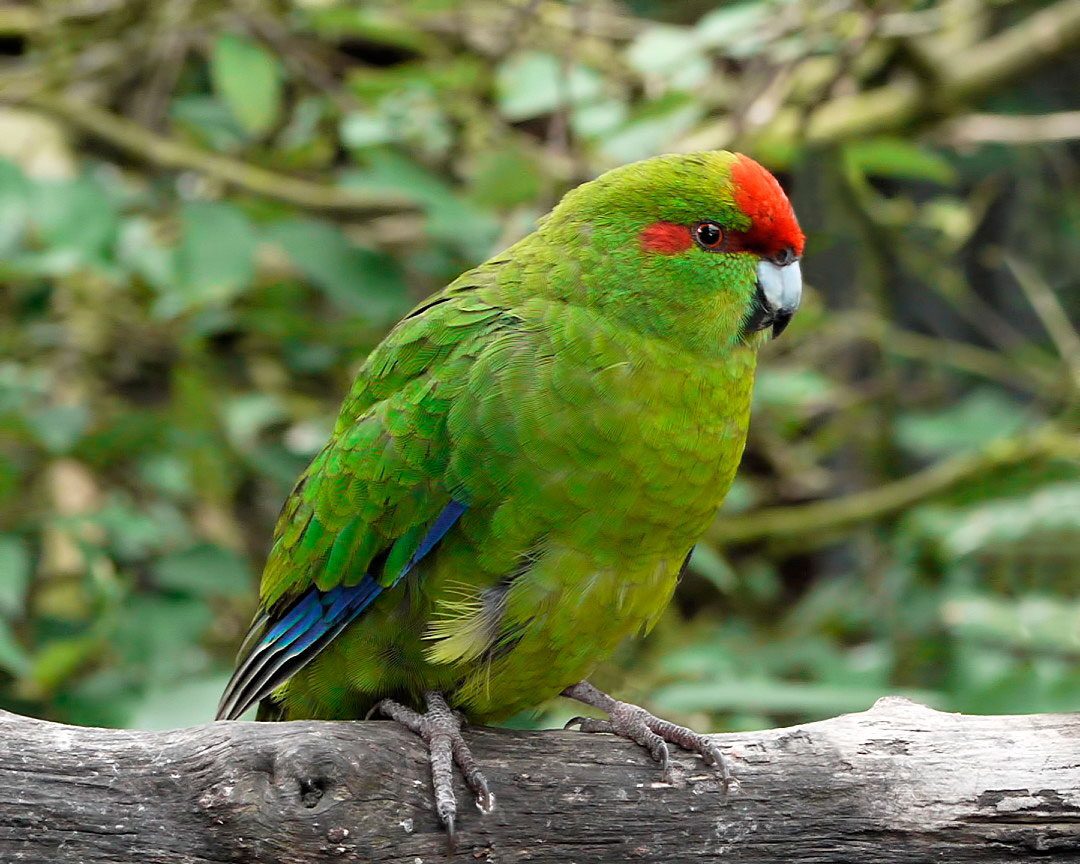
The Red-crowned parakeet(Cyanoramphus novaezelandiae) are, generally, a brilliant green hue (sometimes with some variable yellow marks), with one frontal band crimson, lores and a line through the eye that extends to the ear-coverts; centre of crown crimson, extending back to the top of the eyes, with an area supercilii green.
Upperparts bright green uniform, with a red patch on each side of the rump. Alula, primary coverts and vane outside of the primaries are blue-violet color. Primary emarginadas with thin yellow outer margins: vane outside of the secondaries greener.
Wing feathers green: stain pale in each internal network of secondaries they form a wing bar in some males.
The underparts usually more yellowish, Green clear. Upper, the tail green; undertail, dark grey.
The bill light bluish gray, black-tipped; irises red; legs Marron-grisaceo.
Female slightly smaller.
The young birds have queues shorter, a irises reddish brown clear and less distinctive markings on the head. The younger with a pink base in the bill.
(Oliver 1930) – Of 28 cm approximately. It is something more than the nominal, the green of the face is Emerald, the chest is somewhat more yellowish and the legs are dark gray.
Cyanoramphus novaezelandiae cyanurus
(Salvadori 1891) – Of 29 cm approximately. More than the nominal, the plumage is more yellowish and the flight feather more intense blue.
The habitat of the Red-crowned parakeet includes native forest in the continental part of New Zealand, scrublands in some outlying islands and land with abundant grass in the Antipodes Islands.
The species, generally, most opted for the edges of forests and open areas to the Yellow-crowned parakeet, and the regions where the two species coexist, is, generally, at lower altitudes.
The birds tend to locate their calls when they fly over or through the forest canopy. They are most often in pairs; couples tend to remain together throughout the year. But, large groups gather where food sources are abundant at any time of the year. Where is fresh water scarce, groups of birds also tend to congregate to drink in springs or leaks.
In the Kermadec Islands, flocks are formed for bathing in tidal pools and rest on a branch (probably in other places also).
The Red-crowned parakeet they feed actively on in the early hours of the morning, they rest and groom themselves for much of the day, and is power again during the afternoon.
Reproduction:
The nesting takes place between October and March, with most laying between the months of October and December. Between two and ten (usually between five and nine) white eggs form the implementation. The eggs are deposited in a hollow of tree clad wood shavings, Although you can also have other places of sunset, including cracks in the rocks, burrows in the ground, etc, as well as a variety of nest liners including feathers, MOSS and grass.
The birds are territorial in the vicinity of the nest and can use the same site repeatedly. The incubation is carried out by the female and hard of 18 to 20 days. The pups remain in the nest during 5 to 6 weeks and the male will help with food, either through female or directly, one week after the emplumamiento.
In large litters some less developed pups can be seen. Adults undergo a post-breeding moult..
Food:
They feed on, both the canopy and soil, a wide range of vegetables, fruit, seeds, leaves, outbreaks, berries, flowers and nectar; they have priority for the seeds fallen during the autumn and winter. The species also feeds on invertebrates, honeydew and, in the Kermadec, even, algae and small macaws (Scutellastra kermadecensis).
Distribution:
The Red-crowned parakeet are in New Zealand and in a series of adjacent and outlying island groups.
Before European colonization, the species was extended by continent, but in the Decade of 1890 the population began to decline as a result of the destruction of their habitat and predation by introduced cats and mustelids.
The population is, undoubtedly superior to the 15.000 specimens, although decreasing due to habitat loss and predation.
The hybridization with the Yellow-crowned parakeet (Cyanoramphus auriceps) It is also a problem in some populations.
The subspecies chathamensis is threatened, with a population of less than 1.000 specimens.
The subspecies cyanurus is still relatively common with about 10.000 individuals in Macauley. There are at least 4.000-5.000 birds in the Group of the Antipodes Islands.
captive birds they have been released in areas of Wairarapa and Waitakere. CITES Appendix I.
"Red-crowned parakeet" in captivity:
The Red-crowned parakeet are common in aviculture and is relatively easy to raise.
They can live in community with species of similar characteristics. It is usually outgoing, Active and depending on their way of breeding and previous experiences, You can be a confident Parrot, even being raised by their parents tends to be entrusted.
What pet He could be a good companion because of his way of being joyful and curious.
With regard to its longevity and according sources, one specimen was still alive after 12,4 years in captivity. It has been reported that these animals can live up to 36,5 years in captivity, but this has not been verified; the same study reported that these animals they can be played back to year of age in captivity.
Several color mutations they are available, including, yellow, the cinnamon and the overo.
Parrots A Guide to the Parrots of the World – Tony Juniper & Mike Parr
Birdlife
Parromania
Photos:
(1) – A Red-crowned Parakeet at Nga Manu Nature Reserve, Waikanae, New Zealand By Sid Mosdell from New Zealand (GreenUploaded by Snowmanradio) [CC BY 2.0], via Wikimedia Commons
(2) – A Red-crowned Parakeet on Kapiti Island, New Zealand By Craig Nash from Northern Ireland [CC BY 2.0], via Wikimedia Commons
(3) – Red-crowned Parakeet (Cyanoramphus novaezelandiae) at Queens Park Aviary By tewahipounamu [CC BY-SA 2.0], via Wikimedia Commons
(4) – Red-crowned Parakeet (Cyanoramphus novaezelandiae) in captivity at Auckland, New Zealand. Photographed on 11 November 2002 By Arthur Chapman [CC BY 2.0], via Wikimedia Commons
(5) – Cyanoramphus novaezelandiae (Red-crowned Parakeet, Green) on Tiritiri Matangi Island, New Zealand. These parakeets are often seen foraging on the cabbage trees (Cordyline australis) on the island By Adammarklenny (Own work) [CC BY-SA 3.0 or GFDL], via Wikimedia Commons
(6) – A painting of a Red-crowned Parakeet (originally captioned «Platycercus pacificus. Pacific Parrakeet.») by Edward Lear 1812-1888 Edward Lear [Public domain], via Wikimedia Commons
Origin: Cameroon, Chad, Central African Republic, Sudan, Ethiopia, Uganda, Kenya, Democratic Republic of the Congo, Tanzania, Malawi, Zambia, Angola, Botswana, Mozambique, Namibia, South Africa
Character: Shy
Life expectancy: 35 years
Height: 21 cm..
Content
Description:
21 cm. and a weight of 100-130 g..
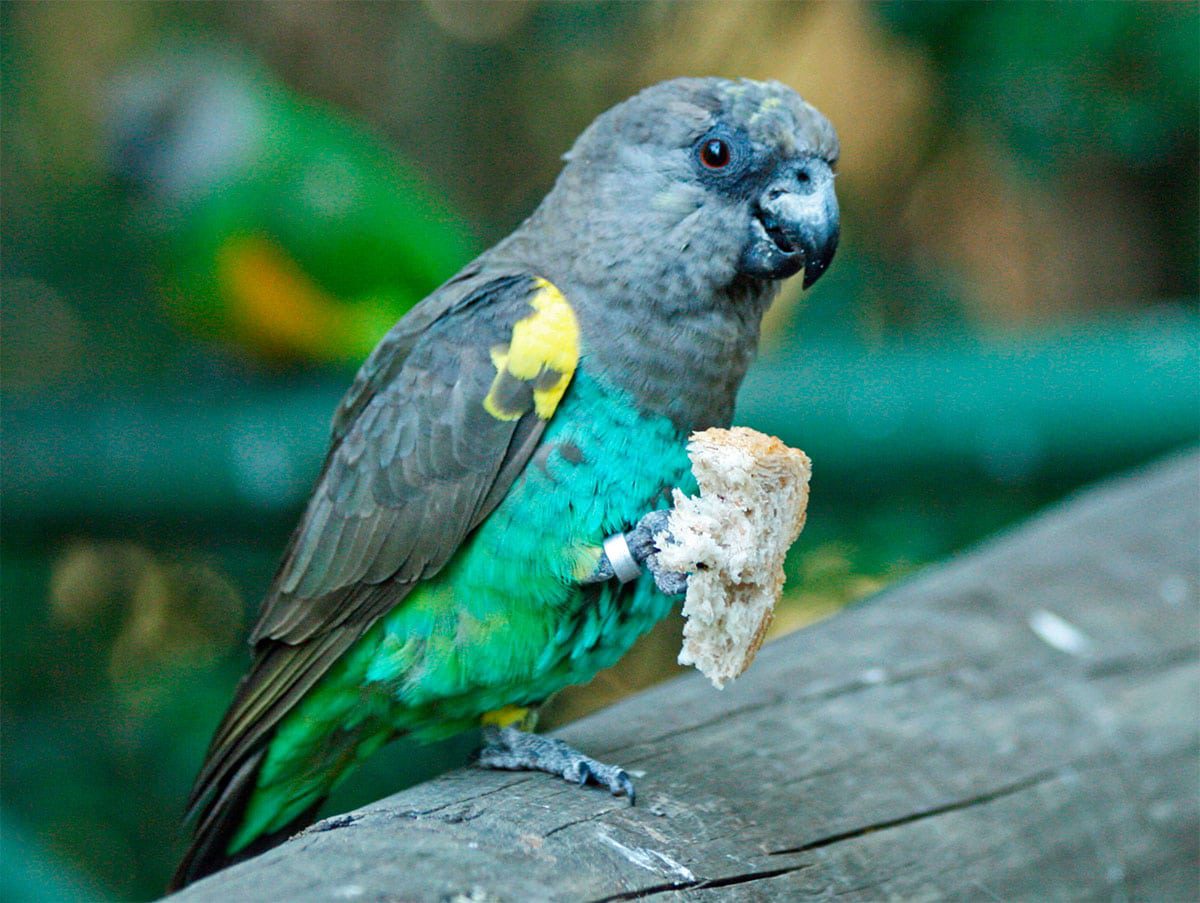
The Meyer's Parrot(Poicephalus meyeri) has the forecrown, lores, cheeks, ear-coverts and ash Brown nape; crown bright yellow. The mantle feathers ash brown edges blue or cyan dye in some birds; scapulars brown ash, some individuals show Tips blue or greenish blue; rump bright turquoise or teal; uppertail-coverts green. Outermost children and wing-coverts above bright yellow, other variables showing green tints, especially towards Tips. The primaries and high schools ash Brown with paler narrow margins to vane outer.
feathers of the wings, undertail, bright yellow in some birds, but grayish-brown in larger in other. The chin, the throat and top of the chest brown ash; remaining chest and belly turquoise or teal; the thighs yellow; undertail- coverts turquoise blue or greenish blue. Tail brown ash.
Bill dark gray or black; cere black; irises orange-red; periophthalmic skin desnuda negruzca; legs blackish.
Both sexes similar.
Youth more generally greenish brown. No yellow in the crown or the the thighs and the yellow area in the wings, at the top, It is lower. Wing coverts, undertail, green and brown with little or no yellow. The underparts más greenish. Iris dark brown.
(Neumann, 1898) – No Yellow crown. Paler than subspecies reichenowi. Intergrades with transvaalensis subspecies in the region of the delta del Okavango, Botswana and with subspecies reichenowi in Angola.
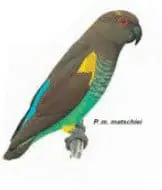
matschiei by Parrots of the World – Forshaw Joseph M
Poicephalus meyeri matschiei
(Neumann, 1898) – Brown is paler than in the subespecie satisfied and cyan dye to the margins of the scapulars less pronounced than in the species nominal. Green colors are blue (especially below). The female spot shows yellow feathers at the base of the lower jaw.
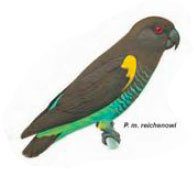
(Neumann, 1898) – Similar to the subespecie matschiei but with the yellow crown generally absent. Paler blue in the rump. Size larger than the subespecie matschiei.
reichenowi by Parrots of the World – Forshaw Joseph M
Poicephalus meyeri saturatus
(Sharpe, 1901) – darker than species nominal (especially the brown parts), rump less blue than the nominal, showing a bit of green in the feathers. The dark centers feathers on the bottom, giving it a mottled appearance. Intergrades with the subspecies matschiei in Tanzania.
Poicephalus meyeri transvaalensis
(Neumann, 1899) – Brown clearer than in the subespecie matschiei, even bluer in the rump and below. Yellow areas in the crown They are often reduced and, sometimes completely lacking (especially in males). It is thought that can hybridize with the Poicephalus cryptoxanthus.
Habitat:
The Meyer's Parrot It is found in a wide variety of forest habitats from dry savannah to gallery forest and second-growth riparian forest around crops.. Observed in forests dominated by Terminalia laxiflora and Doka Isoberlinia, thickets Combretum acacia grasslands; as well Brachystegia and riparian forests Syzygium-Adina.
Avoid lowland rainforests in the basin Congo and other humid forests including areas of the eastern highlands of the district of Zimbabwe and Cork in Malawi.
Show a preference for the tallest trees in the drier savannah habitats – in particular specimens Adansonia. They may be confined to gallery forests in the drier parts of their range and are generally found in close proximity to water..
Where it is sympatric with the Red-bellied Parrot (Poicephalus rufiventris), the Meyer's Parrot It is limited to riparian forests.
In Kenya, which it is largely in areas with higher annual rainfall 500 mm.
Sometimes observed in suburban areas.
In general, in the lowlands at altitudes of 1,250m in Ethiopia, 2.200m in east Africa and 1.500 meters in the highlands of eastern Zimbabwe.
They are distributed in pairs or small groups 3-5 birds (possibly couples); until 50 birds may congregate in areas where there are food sources in breeding season. Roosts in tree cavities. Usually shy and cautious.
Reproduction:
Solitary nesters in tree cavities at a height between 3 and 10 meters above the ground, during the season, dry (for example Mar-June Zimbabwe, from May to September Zambia and Malawi, July Angola and in December or January Sudan).
The pulp of the fruit is less important than the hard seeds and the arbolados share, the Meyer's Parrot is one of the few species consume seeds Brachystegia and other leguminous trees.
They also consume grain and is considered as crop pests in some areas.
Eat some insects, including caterpillars.
May vary widely from area to area in search of food during droughts.
Distribution:
Size of the area of distribution (reproduction / resident): 5.840.000 km2
The Meyer's Parrot They are distributed throughout the central and eastern Africa. From the North-East of Cameroon and South of Chad through the North of the Central African Republic, center Sudan and South and West Ethiopia, to the south through Uganda, Kenya Western, east of Democratic Republic of the Congo and Tanzania, coming to Malawi, Zambia, Angola, Northeast of Botswana, Zimbabwe, western end of Mozambique, Namibia and northeast of Sudafrican republic.
A wild population, possibly, is distributed in the eastern province of Cape Town, Sudafrican republic, even if they are probably extinct.
Nomad in some areas during periods of drought, when they distributed outside the normal range; normally resident with local movements.
Distribution Subspecies
Meyer's Parrot subspecies distribution
Poicephalus meyeri damarensis
(Neumann, 1898) – South of Angola, Northeast of Namibia and North of Botswana.
Poicephalus meyeri matschiei
(Neumann, 1898) – Southeast Kenya through eastern and central Tanzania to Southeast Democratic Republic of the Congo, North of Malawi, Zambia and northeast of Angola.
(Neumann, 1898) – North and Central Angola from Malange and sierra central until Huila, possibly also adjacent parts of the Democratic Republic of the Congo
Poicephalus meyeri saturatus
(Sharpe, 1901) – The Far East Democratic Republic of the Congo, through Burundi, Rwanda and east of Uganda, in West and Central East Kenya towards Meru and Local inside Tanzania to the South of the Parque Nacional Ruaha.
Poicephalus meyeri transvaalensis
(Neumann, 1899) – Areas of northern and central Mozambique to northern Save River across the South of Zambia and central and southern Zimbabwe to northeast Botswana and West of Transvaal
The Meyer's Parrot It, in general, common to very common and is the most abundant parrot in some parts of its range (for example, Zimbabue and Angola), although few in other areas and absent from some apparently suitable habitats.
Its population has declined in some parts (for example Transvaal) where is thought to be a result of habitat destruction. I also persecuted in some locations due to crop damage (for example, in the center of Zambezi because of the damage inflicted to the maturation of the berries Boolean).
"Meyer's Parrot" in captivity:
The Meyer's Parrot, is a bird common in captivity, quiet, tender, easy to carry and with a stable temperament.
They are birds social and they tend to bond with everyone in the family, unlike other species that may prefer one person to another. In general, No es voluble – once you liked someone, the person is a friend for life.
They are not as dependent on humans for entertainment as most parrots and therefore no son tan demanding.
They like being handled and petted on the head and neck. A hand-fed hatchling will develop into a fluffy adult if treated properly, and it is not prone to bite, although it may provide a powerful bite if provoked.
You can learn a few words, although They are not known for their ability to speak. They can learn to whistle, making noises, and occasionally they will offer strong squeals. Fortunately, They are not likely to scream or make loud squawks, making good birds for apartment life. Some individuals learn household noises, as the beep of the microwave.
The Meyer's Parrot they are ready to breed at the age of 3 to 4 years and reproduce easily in captivity.
With regard to its longevity, according to sources, Meyer lived a parrot 34,2 years in captivity.
Alternative names:
– Meyer’s Parrot, Brown Parrot (English).
– Perroquet de Meyer, Perroquet brun, Youyou de Meyer (French).
– Goldbugpapagei, Goldbug-Papagei (German).
– Papagaio de Meyer, Papagaio-de-meyer (Portuguese).
– Lorito de Meyer (español).
– Avibase
– Parrots of the World – Forshaw Joseph M
– Parrots A Guide to the Parrots of the World – Tony Juniper & Mike Parr
– Birdlife
– Photos:
(1) – A Meyer’s Parrot at Birds of Eden, Western Cape, South Africa. It is eating what looks like a piece of bread By SandyCole (mailto:sandyc@dicksandy.org) (Own work) [CC BY-SA 3.0 or GFDL], via Wikimedia Commons
(2) – Two Meyer’s Parrots in Zimbabwe By Oce Eeco (DSC_0108Uploaded by snowmanradio) [CC BY 2.0], via Wikimedia Commons
(3) – Brown parrot also known as Meyer’s Parrot (Poicephalus meyeri) by Papooga – Flickr
(4) – A Meyer’s Parrot near Kwara Camp, North-West District, Botswana By Benjamin Hollis from Seattle, WA, USA (Meyer’s parrotUploaded by snowmanradio) [CC BY 2.0], via Wikimedia Commons
(5) – A Meyer’s Parrot in Akagera National Park, Rwanda By Lip Kee Yap [CC BY-SA 2.0], via Wikimedia Commons














_-Bunya_Mountains-8.jpg#/media/File:Alisterus_scapularis_(male)_-Bunya_Mountains-8.jpg)
_-Australia-8c.jpg)


