โ–ท The world of Pets: Dogs, cats, birds, reptiles, amphibians

Baudin's black cockatoo
Zanda baudinii

Baudin's black cockatoo

Content

Description

50 to 57 cm.. height and weight between 560 and 770 g.
to Baudin's black cockatoo (Zanda baudinii) is almost entirely of black, with whitish margins in the feathers, patches rounded on them ear-coverts (yellowish to white in the female and Brown to grey in the male), white rectangular panels in the tail.
has a powerful bill (with greatly elongated upper jaw), Black in the male and white-gray color with a black color in the female tip.
Iris dark brown surrounded by a eye ring Red in the male and female grey.
Tail rounded, crest Erectile and legs greys. birds youth are like adults in appearance, but the bill of the male juvenile is equal to the of the of the female adult. The bill the juvenile male begins to darken after the second year.

Habitat:

Its natural habitat is the dense forests dominated by the Marris (Corymbia calophylla) in the extreme southwest of Australia.

Gregaria, is often seen in groups of three, a pair of adults with a young, or in small groups. Occasionally they gather in large flocks of up to 300 birds during the non-breeding season, usually in places where food is abundant.

Reproduction:

Very little is known about the reproductive biology This cockatoo, such as their reproduction area, nesting events calendar, the nest tree, Characteristics of holes for nests, implementation size, incubation period, incipient and successful nesting period.

Little is known about their reproductive cycle because nests are extremely difficult to locate.. Most of the characteristics of the biology of the species are inferred from the Short-billed black cockatoo.

They show a strong union of couple and probably is pair of by life. They remain together throughout the year, except when the female is incubating eggs. Probably they begin to breed at the age of four. The species breeds in late winter and spring, from August to November or December. Copulation probably takes place three days before laying. The female lays one or two white eggs and you can lay an egg of replacement if the first since egg fails. The incubation lasts a few 29 days and only the female incubates them. The chicks remain in the nest for a maximum of 16 weeks.

The nests are composed of a layer of wood chips, built in large hollow in the high eucalyptus, 30 to 40 cm. in diameter and more than 30 depth cm.

Food:

Are fed mainly from the seeds of MARRI and Karri. They are also fond of the rending of wood, Apart from pierce the bark of trunks in search of larvae. Apple trees and pear trees are frequently visited to enjoy its fruits.

Distribution:

Confined in the South-West of Western Australia, especially among Perth, Albany and Margaret River.

Distribution Long-billed Black-billed Cockatoo

Small captive populations in the Melbourne Zoo, in the Healesville sanctuary in Victoria, and in the Zoo of Perth. The species is bred in captivity with great difficulty.

Conservation:

State of conservation โ“˜


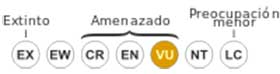
Vulnerable Vulnerable โ“˜ (UICN)โ“˜

In Australia is listed as Vulnerable by the law on protection and conservation of biodiversity for the environment.

The total population of the species is estimated at 12.500 individuals, with one downward trend.
Before the inclusion of the threatened species, the annual reproductive rate was of 0,6 per couple, too low to replace the large number of birds that were killed by horticulturists to protect their crops. It is now illegal to shoot these birds, However is it still done.

In captivity:

Appears in the Appendix II of CITES, what limited international trade in the species. Itร‚ยดs illegal capture These wild birds, a penalty of up to 10,000 $. This cockatoo is protected under the Wildlife Conservation Act of Australia.

Alternative names:

Baudinโ€™s Black Cockatoo, Long-billed Black Cockatoo, White tailed Black Cockatoo (English).
Cacatoรจs de Baudin (French).
Langschnabel-RuรŸkakadu, WeiรŸohr-Rabenkakadu (German).
Cacatua-negra-de-bico-longo (Portuguese).
Cacatรบa Fรบnebre de Pico Largo, Cacatรบa Fรบnebre Piquilarga (espaรฑol).

scientific classification:

Order: Psittaciformes
Family: Cacatuidae
Scientific name: Zanda baudinii
Genus: Zanda
Citation: Lear, 1832
Protonimo: Zanda Baudinii

Images:


Species of the genus Zanda
  • Zanda funerea
  • —- Zanda funeral funeral
  • —- Zanda funerea whiteae
  • —- Zanda funerary xanthanota
  • Zanda baudinii
  • Zanda latirostris

  • Sources:
    Avibase, Australian Government
    Photos: Long-billed Black-cockatoo, Taronga Zoo, Sydney, Wikipedia, Goura (zoochat.com),
    Sounds: Chris Benesh (controles-canto.org)

    โ–ท The world of Pets: Dogs, cats, birds, reptiles, amphibians

    Cockatiel
    Nymphicus hollandicus


    Cacatรบa Ninfa

    Content

    Description

    25-33 cm.. length and a weight between 80 and 100 grams approximately.
    This small cockatoo is no doubt an of the bird's cage more common in the world.
    The Cockatiel (Nymphicus hollandicus) adult has the head and the basis of the crest yellow.
    Stain handset is orange, paler on the back.
    The neck and the long crest feathers are grey.
    The upperparts are of color grey Pearl dark.
    The wings are grey, but exhibit a white color in the covered and sides.
    The underparts are a grey clear.
    The tail varies from medium gray to dark gray, the base of the tail is paler.
    The bill is grey, the irises dark brown.
    The legs are grey-brown.

    The female presents the stain handset duller, the tuft is less developed, In addition instead of the yellow, the head presents a yellowish grey with yellow dirty envelope the forecrown and a vaguely colorless gray general staining and staining is generally less intense.
    The immature are much similar to the females, but have the tail shorter.

    We find Pearl specimens in captivity, White, Gray and lutinos.

    Habitat:

    Video – "Cockatiel" (Nymphicus hollandicus)

    Funny Parrot (Nymphicus Hollandicus)

    The cockatoo Nymph they live in a wide variety of habitats, including open forests, small acacia forests that line the rivers and even stretches of Spinifex (Triodia) they are perennial and grow in semi-arid regions.

    Also found in farmland, in the stubble and the orchards, as well as on the plains and along the roads.

    In dry areas are observed in pairs or in groups of up to 100 individuals.

    When feed, the groups contain an average of 27 Member. But, We have already seen demonstrations of almost 1.000 birds near landfills containing vegetable remainders of the rice milling.

    Near the points of water, the cockatoo Nymph are often associated with the Budgerigar (Melopsittacus undulatus).

    Estas Cockatoos eat twice a day: In the morning, shortly after the Sun, consuming around 2,72 grams of plant material. At night, about an hour and a half before the night, eating around a mass of 4,25 g., It is almost 7 grams for the whole day.

    Son great travellers.
    Outside of the nesting season, they form large gatherings around the planting of cereals.
    As they feed on seeds, these birds need water and in times of drought, sometimes bands come to the coast.

    All these movements are quite unpredictable, since they are related to the weather conditions and the State of the food resources. But, in the South of the continent, migrations are more regular: the birds come to nest during the austral spring and usually go away early in the new year.

    Son gregarious and very social, so they need a wide repertoire of calls to communicate or express their feelings. They have a great power to imitate other birds.

    Reproduction:

    In the North, the reproduction is carried out between April and July, While in the South occurs in general from August to December.
    The nest is located in a tree hollow whose bottom is padded with sawdust shavings. Most of the time, the nesting site is placed near a source of water in which poultry cooled daily.

    The spawning has between 3 and 7 eggs they are incubated alternately by both parents for a few 20 days. 4 eggs are a normal litter. There will be several broods during the season. At birth, the chicks have a thick down comforter yellow. They receive their food mainly in the morning and in the evening.

    Chicks they leave the nest after 3 to 4 weeks, but they remain within the family group, Depending on their parents for 1 month. After this time, they join large flocks that roam in search of food.

    Food:

    Consume a wide variety of small seeds He collected soil, including the cultivated fields of sorghum and sunflower. When they are abundant, local seed varieties are generally preferred to the seeds that come from crops.

    Distribution:

    Distribucion Nymphicus hollandicus
    Endemic to Australia. Its range covers a vast majority of the continent, except wet coastal areas. Also absent from the Cape York Peninsula, districts located more to the South in winter and areas located more to the North in the summer.

    After heavy rainfall, large meetings can be set up in the center of the country where they are, usually, absent.

    Conservation:

    State of conservation โ“˜


    minor concern Minor Concern โ“˜ (UICN)โ“˜

    – Current IUCN Red List category: Least concern.

    – The population trend: Stable

    This bird is very common and extended throughout the area. Probably its population grows, It has benefited from the facilities and artificial reservoirs for the development of agriculture.

    Its population It is estimated in around a million of birds. The birds that sought to be introduced in the United States they have failed in their attempts to establish themselves in the wild.

    In Australia, these small cockatoos are often persecuted for considering them pests for agriculture.

    "Cockatiel" in captivity:

    The Nymphs or Carolinas they are highly prized birds as pets by its docile nature and for being less demanding than the larger parrots. The nymphs they are perfectly suited to life in the home, they are easy to care for and if you homeschool them from small become companions adorable and very affectionate.

    They generally live in pairs or in colonies, that is why it is very common to mate them, to be able to enjoy the birth of the offspring and their development.

    They usually enjoy sharing their time with people and rather stick to their owners, Each bird has its personality, so you don't like all that take them into your hands. Males can sing and learn to mimic a few words, but they are much better to imitating sounds, as melodies, sirens or other birds singing. Females vocalize much less but tend to also be more caring.

    The nymphs are birds Smart, of friendly character and practically does not present problems of behaviour. They are easily adapted to family life and learn to interact and communicate with people who love. If you've decided to adopt one of these cute birds, make sure you dedicate time to your training to get to have a great pet. This will help you create a strong emotional bond between you and you will also keep it entertaining, mentally active, healthy and happy.

    Alternative names:

    Cockatiel, Cockatoo Parrot, Crested Parrot, Quarrion, Weero (ingles).
    Calopsitte รฉlรฉgante, Perruche calopsitte (French).
    Nymphensittich (German).
    Cocatiel (Portuguese).
    Cacatรบa Ninfa, Carolina, Ninfa (espaรฑol).

    scientific classification:

    Order: Psittaciformes
    Family: Cacatuidae
    Scientific name: Nymphicus hollandicus
    Genus: Nymphicus
    Citation: (Kerr, 1792)
    Protonimo: Psittacus hollandicus

    Images Cockatoo Nymph:


    Sources:
    Avibase, elblogdemaskota
    Photos: commons.wikimedia.org, huffingtonpost.com, optusnet.com.au, cockateil.NET, galleryhip.com
    Sounds: Marc Anderson (Xeno-canto)

    โ–ท The world of Pets: Dogs, cats, birds, reptiles, amphibians

    Scaly breasted Lorikeet
    Trichoglossus chlorolepidotus

    Scaly breasted Lorikeet

    Content

    Description

    23 cm.. length and a weight between 75 and 95 gr.

    The plumage of the Scaly breasted Lorikeet (Trichoglossus chlorolepidotus) is usually green.

    The part back from your neck, the throat and the chest has several brands of yellow.
    Under its tail, the the thighs and the sides of the body they are clearly marked with yellow.
    Under its wing , and more specifically by the part inferior of them flight feather, its color is reddish orange.
    The circle around the eyes is narrow and grey. Its irises is yellowish-Orange. The legs are ash and the bill orange.

    The immature are equal to adults, but with less scalloped yellow; the thighs Brown pale and tail shorter. The bill brown. The eye ring White grey.

    Habitat:

    The Scaly breasted Lorikeet they are distributed by many forest habitats, including parks and Gardens located on the outskirts of cities and farmland, where are the flowering trees present.

    They usually found in coastal areas and adjacent plateaus.

    They have a strong preference for agricultural land and coastal scrub that are dominated by trees of the genus Banksia.

    They can also be seen along the rivers, to the West of the Great dividing range. They can live up to 600 m.

    The Scaly breasted Lorikeet they have quite similar patterns to the of the Coconut Lorikeet. It is not uncommon to find them together in mixed flocks where one of the two species generally outnumbers the other..

    Most of the time, the Scaly breasted Lorikeet they live in pairs or in small groups of up to 10 individuals. They are most active at dawn, shortly after the dormitories are scattered.

    They usually roam locally. These short trips are motivated by the search for food.

    During flowering of trees, large groups may intervene if resources are abundant. The dispersion of groups is immediately after flowering.

    In urban districts, are sedentary Since the sources of food are abundant in the gardens during all the year.

    They are particularly friends of cultivated fruit, arriving to cause much damage in the orchards.

    These birds have a flying fast and direct. When they are in the air they are immediately identifiable by its green head and bright orange red wings bass. When flying over the tops of them trees with rhythms fast, their wings produce a buzzing sound which is easily audible.

    Reproduction:

    The nesting season comprises of mayo to February in the North of the area of distribution, probably related to the decrease of rainfall.

    In the southern part of the State of Victoria It takes place between August and January.

    The Scaly breasted Lorikeet They nest in tree cavities, usually at a considerable height from the ground. They cover the bottom of the nest with a layer of sawdust and then lay two or three white eggs., oval in shape.

    The incubation lasts a few 25 days. The male spends most of its time near hollow, but it does not seem to participate in the incubation. Both parents feed the chicks until they leave the nest, of 6 to 8 weeks after hatching.

    Food:

    The Scaly breasted Lorikeet they have a scheme rather similar to the of the Coconut Lorikeet. Both species feed primarily on nectar and pollen from the flowers especially the Niaouli (Melaleuca quinquenervia).

    They feed also on flowers, berries, fruit, seeds, small insects and their larvae. Are big lovers of the fruits cultivated. They also enter sorghum and corn fields because they crave small immature milky grains..

    Distribution:

    Size of the area of distribution (reproduction / resident): 2.310.000 km2

    The Scaly breasted Lorikeet being endemic to the Australian continent.

    Its area of distribution extends from Bamaga in the extreme north of Queensland the District of Illawarra, on the South coast of New South Wales.

    These birds are sedentary and abundant in the North, nomadic and less numerous in the South. They were introduced in the District of Melbourne, in the State of Victoria.

    Conservation:


    minor concern


    โ€ข Current IUCN Red List category: Least concern

    โ€ข Population trend: Stable

    The population World has not been quantified, but is estimated above 100.000 specimens.

    The species is described as common in the center of its area of distribution and more rare toward the areas north and South of their area of distribution.

    It is suspected that the population It stable in the absence of evidence of any reduction or substantial threats.

    "Scaly breasted Lorikeet" in captivity:

    Rare out of Australia; small number in the United States and the United Kingdom.

    Gregarious, playful and loud. A bit messy due to a diet of nectar.
    Its life in captivity ranges between 20 and 25 years.

    Alternative names:

    Scaly breasted Lorikeet, Scalybreasted Lorikeet, Scaly-breasted Lorikeet (ingles).
    Loriquet vert, Loriquet ร  poitrine squameuse, Loriquet รฉcaillรฉ (French).
    Schuppenlori (German).
    Lรณris-verde-de-peito-escamosos (Portuguese).
    Lori Escuamiverde, Tricogloso de Pecho Escamoso (espaรฑol).

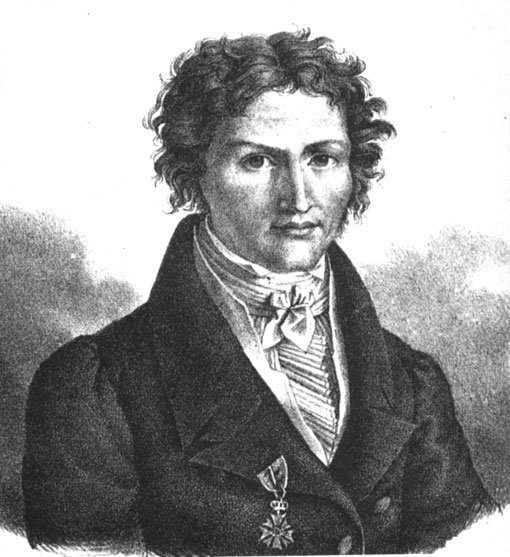
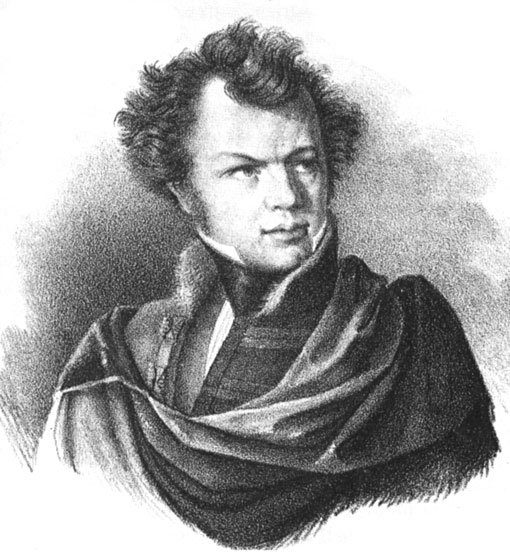
    Kuhl, Heinrich
    Heinrich Kuhl

    scientific classification:


    Order: Psittaciformes
    Family: Psittaculidae
    Genus: Trichoglossus
    Scientific name: Trichoglossus chlorolepidotus
    Citation: (Kuhl, 1820)
    Protonimo: Psittacus chlorolepidotus


    Images ยซGreen-skinned Loryยป:

    Videos "Scaly breasted Lorikeet"

    ——————————————————————————————————-

    ยซGreen-skinned Loryยป (Trichoglossus chlorolepidotus)


    Sources:
    Avibase
    – BirdLife.org
    – Parrots of the World โ€“ Forshaw Joseph M
    – Parrots A Guide to the Parrots of the World – Tony Juniper & Mike Parr

    Photos:

    – Josep de el Hoyo – IBC.lynxeds.com
    – by Tobias Spaltenberger – Two Scaly-breasted Lorikeets at Taronga Zoo, Australia. – Wikimedia
    – by Ken Havard – IBC.lynxeds.com
    – by Aviceda – Wikipedia
    – by Jeremy Eades – Wikipedia

    Sounds: Peter Woodall (Xeno-canto)
    โ–ท The world of Pets: Dogs, cats, birds, reptiles, amphibians

    Blue Lorikeet
    Vini peruviana


    Blue Lorikeet

    Content

    Description

    The Blue Lorikeet (Vini peruviana) has an approximate length of 18 cm.. and a weight ranging between 31 and 34 g..

    Dark blue bright in the crown with paler veins; The feathers of the back of the crown, elongated as in other members of the genus; Lords and ear-coverts white. Upperparts dark blue bright with Plumas-bases blackish. Upper wing bright blue with the internals of the flight feather brownish colour. Underwing coverts dark blue, the rest of Underwing color negro.

    Throat and upper breast white; bright dark blue rest, underparts on the basis of blackish feathers. The tail dark blue, with the slightly elongated central feathers typical of the genus; undertail blackish.

    The bill orange; Iris yellowish brown; Legs orange color.

    Male slightly larger, particularly the head and the bill, with the chin pure white. Legs they can also be a bit darker.

    The immature differs from the adult as having the underparts uniform greyish-black, with the exception of some small white spots on the chin. Black the bill. Dark brown the irises and legs dark brown.

    Habitat:

    It depends largely on coconut palm (Cocoa nuts) for food and nesting, Although other species such as the banana and Hibiscus they are also frequented by the Blue Lorikeet.

    Sometimes they look around the villages and in the gardens. The Blue Lorikeet they are very active, rarely remain long in one place. They are usually seen in small groups of a maximum of seven birds that fly between the coconut trees in flower.

    Reproduction:

    The breeding It is estimated that it is from May to July. Nests in the coconut trees, either in a hollow log or in a rotten coconut palm still attached to the tree, also have seen them are nesting in a stump of Pandanus fallen. The laying is two eggs that incubate for 25 days and the fledgling young leaves the nest in 6-8 weeks.

    Food:

    They feed on nectar, but foraging on the ground and the search for small insects on the underside of the leaves have also been recorded..

    Distribution:

    The Blue Lorikeet It was formerly widespread in the The Society Islands and the Tuatnotu archipelago, but at present is absent from 15 of the 23 Islands where dwelt in the past (some of which can be to come back to enter), including tahiti, Bora-Bora and Moorea, the largest group of the Society Islands (c expiry date. 1900 of tahiti and Moorea; decade of 1920 for Bora-Bora).

    Although the population decline has been linked to a series of threats, including the introduction of the the swamp Harrier (Cirrus approximans) and introduction of a malaria avian provoked by the Culicoides mosquito; predation by rats and cats is the most serious problem facing the species. The distribution currently in the different islands, including population estimated with the dates when they know, shown below (but there are several more islands that have never been visited and that could still be suitable to support the species).

    The Society Islands: Motu One 250 couples; Manuae 300-400 couples in 1974 but in apparent decline following the introduction of cats in 1975.

    Tuamotu archipelago: Tikehau 30 couples in 1984; Rangiroa 100-200 birds before 1972, were kept in 1991 but the numbers are not quantified; Arutua, apparently they were still present 1975 but no current stats; Manihi a bird in 1991; Kaukura last sighting in 1923; No estimate of population; Apataki 1989 survey gave a minimum of 300 birds.

    Islas Cook: Aitutaki probably introduced; until 500 couples present in 1991; Island Hervey possibly introduced in the past, but there is no recent information.

    – The population in Aitutaki seems stable and as the Black Rat (Ratuus ruttus) is not present, This island is thought to be the hope for the survival of the species.

    Conservation:


    Vulnerable


    – Current IUCN Red List category: Vulnerable

    – The population trend: Decreasing

    There are few data on population trends; But, the species has declined gradually in each island, where cats, the black rats of Marsh Harriers have colonized the coast. So, a slow to moderate fall in the population is suspicious.

    The threat of extinction of this species in the Islands, It is more than likely due to their predation by black rats (Rattus rattus) and to a lesser extent, by the Feral cats (Felis catus). Their extinction since Makatea in the Tuamotu archipelago could have been accelerated by a particularly violent hurricane. Its reduction in the scope of the Society Islands correlated with the spread of the marsh harriers (Circus approximans) introduced. The accidental introduction of black rats on islands where the Blue Lorikeet It is a continuous threat to the species.

    "Blue Lorikeet" in captivity:

    There are more than 20 males in captivity, but only about ten females. The species was first raised in captivity in 1937 by Lord Tavistock, but until 1977, When a group of birds seized in the U.S.. He was sent to the poultry farmer Rosemary Low en el Reino Unido, These birds were practically unknown in poultry.

    Also have grown up in the San Diego Zoo, whose success with breeding two females in 1979 He had much international publicity when parents, that had been confiscated from smugglers, escaped destruction by customs officers after a public outcry.

    Alternative names:

    Blue Lorikeet, Pacific Lorikeet, Tahiti Lorikeet, Tahiti Lory, Tahitian Lorikeet, Tahitian Lory, Thaitian lory, Violet Lorikeet (ingles).
    Lori nonnette, Lori de Tahiti, Perruche nonnette (French).
    Saphirlori (German).
    Loris Vini Peruviana (Portuguese).
    Lori Monjita, Lorito Zafiro (espaรฑol).

    scientific classification:

    Order: Psittaciformes
    Family: Psittaculidae
    Genus: Vini
    Scientific name: Vini peruviana
    Citation: (Statius Mรผller, 1776)
    Protonimo: Psittacus peruvianus

    โ€œLori Monjitaโ€ images:

    โ€œLori Monjitaโ€ video:

    ————————————————————————————————

    "Lori Monjita" (Vini peruviana)


    Sources:

    Avibase
    – Parrots of the World โ€“ Forshaw Joseph M
    – Parrots A Guide to the Parrots of the World – Tony Juniper & Mike Parr
    – Birdlife

    Photos:

    1 – free-pet-wallpapers
    2 – Two adults (left) close to a three immature birds perched in a palm tree. – Author Josep del Hoyo – lynxeds
    3 – Miles to the wild – Enlace
    4 โ€“ Miles to the wild – Enlace
    5 – Adult bird preening. Author Tomasz Doron – lynxeds

    Sounds: Matthias Feuersenger (Xeno-canto)

    โ–ท The world of Pets: Dogs, cats, birds, reptiles, amphibians

    Red-fronted Lorikeet
    Charmosyna rubronotata


    Red-fronted Lorikeet

    Content

    Charmosyna rubronotata kordoana

    Description

    17 cm.. length and a weight between 30 and 35 g..

    The front of the crown of the Red-fronted Lorikeet (Charmosyna rubronotata) is red; rest of the crown green; chin, the throat and headphones coverts, yellowish green with a prominent patch purple-blue in the center of the ear coverts. Upperparts green; lower part of the rump and tail coverts, matte red. Wings Green with a bit of yellow in the curve. Under, the wings red; flight feather blackish brown with a yellow stripe in the Center. The underparts yellowish green with prominent red blotch on the upper side of the chest; the thighs green. The tail above blackish brown with green piping; below, the tail Brown with wide yellow tips (except central pair) and Red covered in the base. The bill Red pink; cere pinkish; irises brown; legs Pink.

    females lack of red color in the crown, in the marks of the chest and at the bottom of the wings (that are greenish yellow). ear patch It is replaced by streaks of greenish-yellow.

    Description 2 subspecies

    • Charmosyna rubronotata kordoana

      (Meyer,AB, 1874) – Female is similar to the nominal. The male has the patch of the crown paler, extensive and blue; minus purple blue ear-coverts.


    • Charmosyna rubronotata rubronotata

      (Wallace, 1862) – Nominal.

    Habitat:

    It inhabits in the humid forests, edges of forests and plantations of coconut, Once in a while visit the trees and shrubs in open field. Are from the lowlands up to the 850 m. Usually found in small flocks of up to 10 birds flying over dense forest, or feeding on flowers in the canopy, sometimes with other parrots. Habits are similar to the of the Red-flanked Lorikeet.

    Reproduction:

    Nesting and breeding habits not described.

    Food:

    Feeds of pollen, nectar, flowers and seeds.

    Distribution:

    Size of the area of distribution (reproduction / resident): 417.000 km2

    New Guinea in West Papua New (Indonesian) and Papua New Guinea. The range goes from East of Vogel-kop through Maprik, the lower reaches of the rivers Sepik and Ramu reaching Astrolabe Bay in the East. Also in Salawati in the islands of the West of papua and in Biak. The Red-fronted Lorikeet It is irregularly distributed throughout its area of distribution, but may be locally common in some areas. It seems to be less common than the Red-flanked Lorikeet, He replaced at higher altitudes, where the two species overlap.

    Description 2 subspecies

    Conservation:


    minor concern


    โ€ข Current IUCN Red List category: Least concern.

    โ€ข Population trend: Stable.

    The trend of the population seems to be stable, and therefore, the species does not approach the thresholds for Vulnerable according to the population trend criteria.

    The world population It has not been quantified, It is believed that it is by the 100.000 specimens and stable.

    The species is described as common to local scale.

    "Red-fronted Lorikeet" in captivity:

    There is no data on its breeding in captivity..

    Alternative names:

    Red-fronted Lorikeet, Red fronted Lorikeet, Red-fronted Blue-eared Lorikeet, Red-fronted Blue-eared Lory, Red-spotted Blue-eared Lorikeet, Red-spotted Lorikeet (ingles).
    Lori ร  front rouge, Lori de Wallace, Loriquet ร  croupion rouge (French).
    Rotstirnlori (German).
    Lori de Frente Roja, Lori Frentirrojo (espaรฑol).


    scientific classification:

    Alfred Russel Wallace
    Alfred Russel Wallace

    Order: Psittaciformes
    Family: Psittaculidae
    Scientific name: Charmosyna rubronotata
    Citation: (Wallace, 1862)
    Protonimo: Coriphilus rubronotatus


    Images ยซRed-fronted Loryยป:

    ————————————————————————————————

    ยซLori Frentirrojoยป (Charmosyna rubronotata)


    Sources:

    Avibase
    – Parrots of the World โ€“ Forshaw Joseph M
    – Parrots A Guide to the Parrots of the World – Tony Juniper & Mike Parr
    – Birdlife

    Photos:

    1 – Author iggino – lynx
    2 – Charmosyna rubronotata kordoana by Biodiversity Heritage Library

    Sounds: Katerina Sam (Tvardikova) – (Xeno-canto)
    โ–ท The world of Pets: Dogs, cats, birds, reptiles, amphibians

    Sangihe hanging parrot
    Loriculus catamene

    Sangihe hanging parrot

    Content


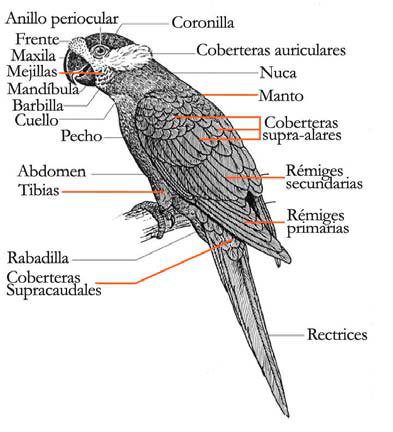
    Anatomy-parrots

    Description

    12 to 13,5 cm.. length.

    The Sangihe hanging parrot (Loriculus catamene) has the head Green with the front of the crown and the bib red. Upperparts Green with light wash of color orange in the the mantle; rump and long tail coverts red. Wings green, slightly dark; carpal edge brighter yellowish green. The flight feather blue with green coverts.

    The underparts Green with the belly Beige and tail coverts of color red marked in green. Upper, the tail of color green with lips Red; Blue below. The bill black; irises brown; legs orange.

    The female not have the Red of the crown; the Red of the bib reduced to a few points, and green the coverts infracaudales.

    The immature with carpal edge yellow, lack of crown red, But if the bib red.

    Habitat:

    Found in pairs or in small groups on them flowers of coconut and shrub in flower, and groups of up to four birds found with greater frequency in plantations mixed. The species is has adapted to habitats side and their main source of food seems to be the nectar of coconut. One roost of 17 birds is the largest group reported.

    Reproduction:

    One nest with two eggs is noted in 1985, little more is known of the habits reproductive of this species.

    Food:

    Their main source of food is the nectar of coconut.

    Distribution:

    Size of the area of distribution (reproduction / resident): 700 km2

    endemic to the Sangir Islands. Most of the original vegetation in Sangir, It has now been replaced by plantations of coconut and nutmeg, and secondary vegetation of the abandoned gardens. Observations during mid of 1980 showed that it is quite common in coconut forests, and two pairs were observed in the steep volcanic slopes covered with trees in 1986. In 1995, the species was recorded of all forest habitats on the island from sea level up to around the 900 m (also be meeting around Tahuna). The birds are observed more frequently in fragments of forest and coconut plantations.

    Conservation:


    Near-threatened


    โ€ข Current IUCN Red List category: Near threatened

    โ€ข Population trend: Decreasing

    There are few data on recent trends, but not there is evidence of a continuous decrease and given your apparent tolerance to different secondary habitats, the declines in their population may have been insignificant.

    The population of the Sangihe hanging parrot It is estimated between 10.000 and 46.000 specimens.

    The original forest in Sangihe It has been almost completely replaced by the crop, but the species appears to be tolerant to degraded habitats and cultivated areas and there is no evidence of a continuous decrease. Other potential threats include the widespread settlement of large trees in the Decade of 1980, the escaped parrots-borne disease and the volcanic activity in the future (Riley 2002).

    "Sangihe hanging parrot" in captivity:

    Is not usual.

    Alternative names:

    Sangihe Hanging-Parrot, Sangihe Hanging Parrot, Sangir Hanging Parrot (ingles).
    Coryllis des Sangi, Coryllis de Sangihe (francรฉs).
    Rotsteisspapageichen (alemรกn).
    Loriculus catamene (portuguรฉs).
    Lorรญculo de la Sangihe, Lorรญculo de Sangihe (espaรฑol).

    scientific classification:

    Order: Psittaciformes
    Family: Psittaculidae
    Genus: Loriculus
    Scientific name: Loriculus catamene
    Citation: Schlegel, 1871
    Protonimo: Loriculus catamene

    Images "Sangihe hanging parrot"

    ————————————————————————————————

    ยซSangihe Loricleยป (Loriculus catamene)


    Sources:

    Avibase
    – Parrots of the World โ€“ Forshaw Joseph M
    – Parrots A Guide to the Parrots of the World – Tony Juniper & Mike Parr
    – Birdlife

    Photos:

    (1) – Photographer: ยฉ Jon Riley – Oriental Bird Images

    Sounds: Hanom Bashari (Xeno-canto)
    โ–ท The world of Pets: Dogs, cats, birds, reptiles, amphibians

    Salvadori's Fig-Parrot
    Psittaculirostris salvadorii

    Salvadori's Fig-Parrot

    Content

    Description

    19 cm.. length and a weight of environment to the 118 g..

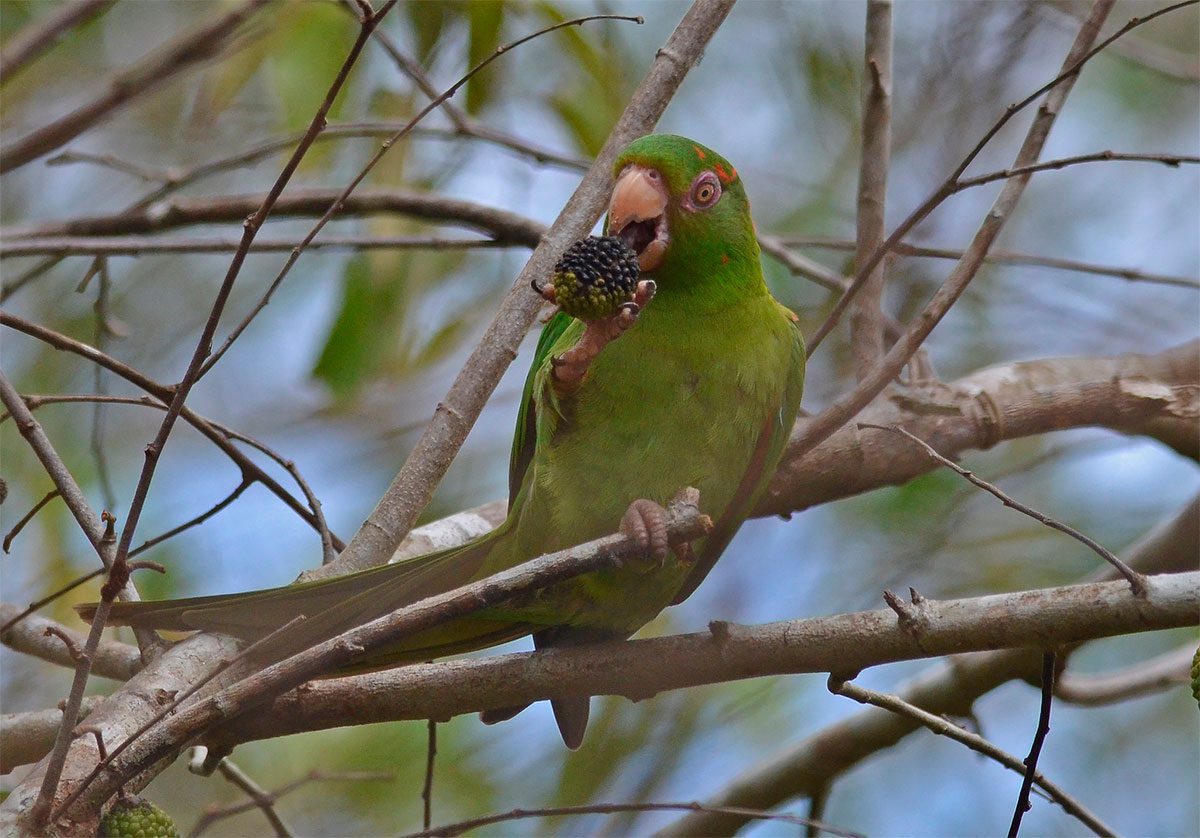
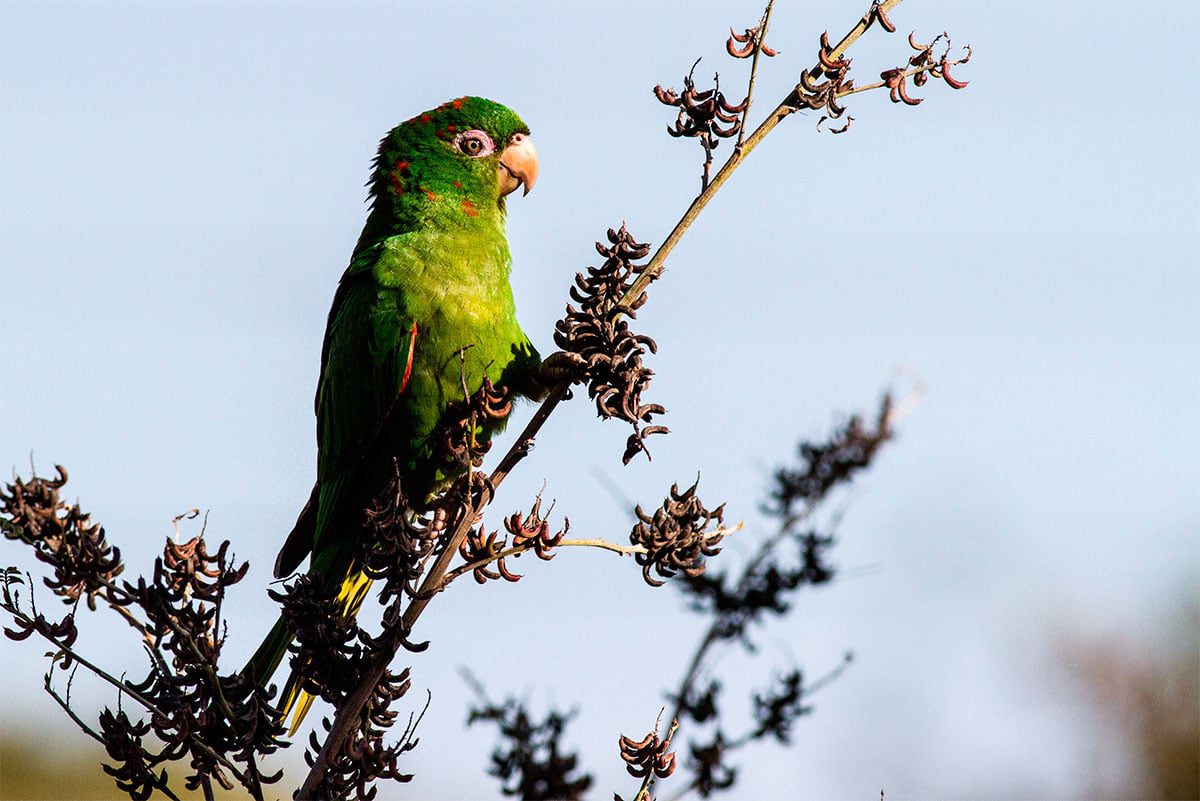
    The forecrown and crown of the Salvadori's Fig-Parrot (Psittaculirostris salvadorii) is bright green with a little blue diffusion; cheeks and ear-coverts elongated yellow gold; area behind the eyes, pale blue: yellow the nape.

    Upperparts green; internal parts of flight feather, orange-red at their ends. Under, the wings opaque green. Top of the chest with bright red band, rest of the underparts bright yellowish green, brighter and clearer than the upperparts. Upper, the tail green; Yellow below.

    Bill black; irises red-brown; legs grey,

    Female lacks the band scarlet chest, evident in the male, which it is substituted by a band It is showing some green opaque red feathers on the sides.

    Youth equal to the adult female but duller overall; band pale blue chest, weak or invisible. Iris reddish brown.

    Habitat:

    The Salvadori's Fig-Parrot is distributed in the forests, along their edges, partially cleared areas and close to human settlements. Birds subsist mainly on the seeds of figs, and groups are fed into the cup of fruit trees, sometimes mixed with other species. Hang it upside down to feed, and they can make brief forays above the canopy. The species is found more often in pairs or in small groups, and nests colonies.

    Reproduction:

    Little is known about its ecology.

    Food:

    Their diet consists mainly of figs and other fruit.

    Distribution:

    Size of the area of distribution (reproduction / resident): 81.500 km2

    THE Salvadori's Fig-Parrot (Psittaculirostris salvadorii) is endemic to the North of Irian Jaya, Indonesian. You can see in the forests of lowlands from the eastern edge of the Cenderawasih Bay to the humboldt bay (approximately 137 ยฐ a 141 it is), reaching inside through the northern slopes of the Van Rees mountains to 700 meters above sea level. Not rare within its small range.

    Conservation:


    minor concern


    โ€ข Current IUCN Red List category: Least concern

    โ€ข Population trend: Decreasing

    This species is suspected of slow to moderate decline due to loss of habitat, limited degradation and some pressure for his capture.

    Its population is estimated around the 10,000 specimens.

    In the past, this species has been caught in relatively large numbers for the cage bird trade, both for the domestic and foreign markets, with a total of 1.582 birds exported from Indonesia between 1985 and 1990 (Beehler 1985, Nash 1990b , KD Bishop in litt., 1996, 1997to collar), and 1.791 between 1990 and 2001, When the species registered trade ceased (UNEP-WCMC 2007). But, the true extent of trade is unknown and is likely to be overlooked by many hunters in the preference of the most coveted and abundant species (B. Beehler in litt. 2012).

    "Salvadori's Fig-Parrot" in captivity:

    Susceptible to stress and disease.

    Very rare in captivity.

    Alternative names:

    Salvadori’s Fig-Parrot, Salvadori’s Fig Parrot, Whiskered Fig-Parrot, Yellow-cheeked Fig Parrot (ingles).
    Psittacule de Salvadori (French).
    Salvadorizwergpapagei, Salvadori Zwergpapagei, Salvadori-Zwergpapagei (German).
    Papagaio-dos-figos-de-salvador (Portuguese).
    Lorito de Salvadori (espaรฑol).

    scientific classification:

    Order: Psittaciformes
    Family: Psittaculidae
    Genus: Psittaculirostris
    Scientific name: Psittaculirostris salvadorii
    Citation: (Oustalet, 1880)
    Protonimo: Cyclopsittacus Salvadorii

    Images "Salvadori's Fig-Parrot"

    Videos "Salvadori's Fig-Parrot"

    ————————————————————————————————

    "Lorito de Salvadori" (Psittaculirostris salvadorii)


    Sources:

    Avibase
    – Parrots of the World โ€“ Forshaw Joseph M
    – Parrots A Guide to the Parrots of the World – Tony Juniper & Mike Parr
    – Birdlife

    Photos:

    (1) – Album parrots – parrots

    Sounds: Hans Matheve (Xeno-canto)
    โ–ท The world of Pets: Dogs, cats, birds, reptiles, amphibians

    Luzon Racquet-tail
    Prioniturus montanus

    Content

    Luzon Racquet-tail

    Description

    23 centimeters long, not to mention their racquets, and a weight between 100 and 140 g..

    The Luzon Racquet-tail (Prioniturus montanus) has the head of color green with a strong diffusion of color blue turquoise in the face; point red in the center of the crown. Upperparts dull green. Wings green, vane outside of the flight feather, green; vane grey internal, Yellow-edged; networks internal of secondary marked in color yellow pale.
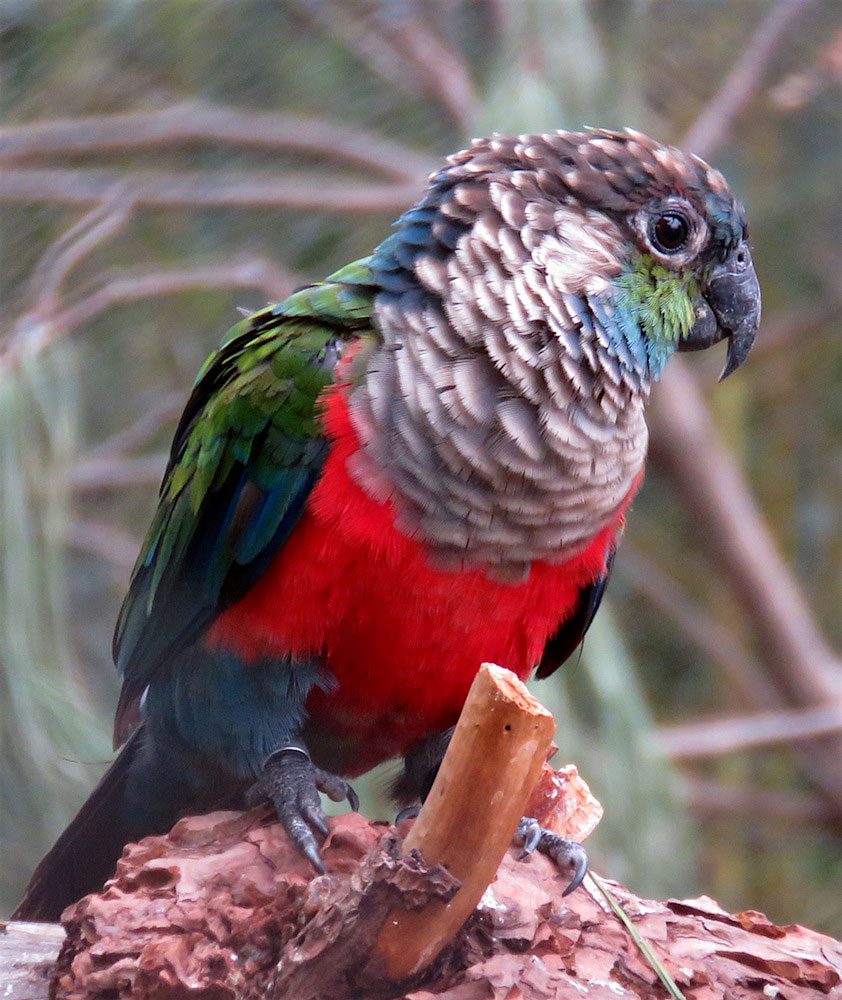
    green wing feathers, bottom of bluish flight feathers; paler in network interiors to secondary internal. The underparts more green beige that the area of the back. Upper, the tail green in the center, black blue at the ends laterally; undertail, dark, blue margin to vane inner; spatulas blackish.

    Bill blue; irises dark brown; legs black blue.

    Female lacks of the point red and has less blue on the crown; rackets also shorter.

    Young have tail Central with extensions of feathers narrow. Pens eventually lost beards to leave spatulas.

    Habitat:

    Little-known. Is distributed in the moist montane forests at altitudes ranging between the 850 and 2.000 m.

    Reproduction:

    The breeding season you have registered in the months of August and September. A nest was observed in the stump of an oak high (Quercus) at a height between 3 and 4 meters above the ground.

    Food:

    The birds feed on seeds, fruit, berries and nuts, and there have also been incursions into fields in the company of the Green Racquet-tail.

    Distribution:

    Size of the area of distribution (reproduction / resident): 10.400 km2

    Endemic to Luzon. Being common in the Cordillera Central (for example, area Mount Pulag) and Sierra Madre, but threatened by the capture and loss of habitat in other places. The population world is inferior to 10.000 specimens.

    Conservation:


    Near-threatened


    โ€ข Current category of the Red List of the UICN: Near threatened

    โ€ข Population trend: Decreasing

    Lambert et to the. (1993) estimated a maximum of 10.000 individuals.

    The population is suspected of being in decline due to destruction of habitat, hunting and capture for the cage bird trade.

    Conservation Actions Proposed:

    Calculate loss of forests within its altitudinal range in Luzon. Estimate the remaining area of suitable habitat and, through surveys, produce an estimate of density to permit calculation of the size of its population. Protect effectively important tracts of forest right in key places, both in the areas of strict protection. as in multi-use areas.

    "Luzon Racquet-tail" in captivity:

    Its breeding in captivity is unknown..

    Alternative names:

    Luzon Racquet-tail, Luzon Montane Racquet-tail, Montane Racket-tail, Montane Racquet-tail, Montane Racquet-tail (nominal form), Montane Racquet-tail (nominate), Mountain Racket-tailed Parrot, Mountain Racquet-tailed Parrot (ingles).
    Palette momot, Palette momot (nominal), Palette momot (nominale), Palette momot (race nominale) (French).
    Motmotpapagei (German).
    Prioniturus montanus (Portuguese).
    Lorito momoto Montano, Lorito-momoto Montano (espaรฑol).

    scientific classification:

    Order: Psittaciformes
    Family: Psittaculidae
    Genus: Prioniturus
    Scientific name: Prioniturus montanus
    Citation: Ogilvie-Grant, 1895
    Protonimo: Prioniturus montanus

    ————————————————————————————————

    ยซLorito Momoto Montanoยป (Prioniturus montanus)

    Sources:

    Avibase
    – Parrots of the World โ€“ Forshaw Joseph M
    – Parrots A Guide to the Parrots of the World – Tony Juniper & Mike Parr
    – Birdlife

    Photos:

    (1) – PetsHome.ro – Prioniturus montanus
    (2) – By Bram Demeulemeester – Flickr

    Sounds: Romeo B. Galang, Jr (Xeno-canto)