▷ The world of Pets: Dogs, cats, birds, reptiles, amphibians

Yellow-shouldered Parrot
Amazona barbadensis

Yellow-shouldered Parrot

Content

Description:

33 to 36 cm.. height and an average weight of 270 g.

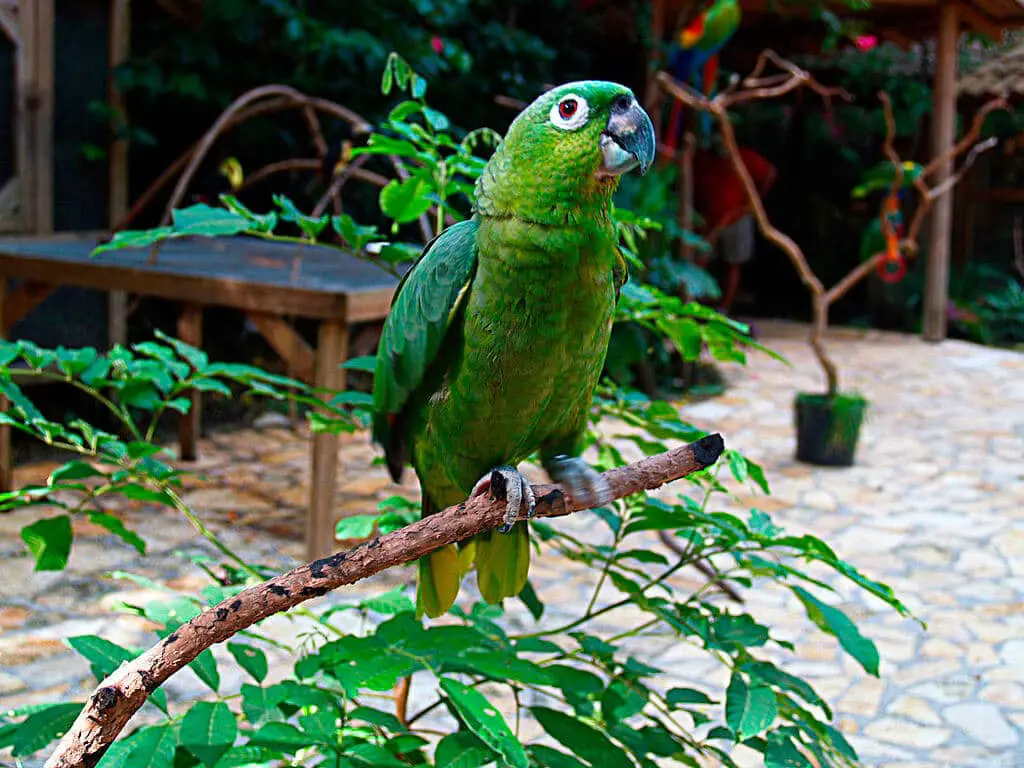
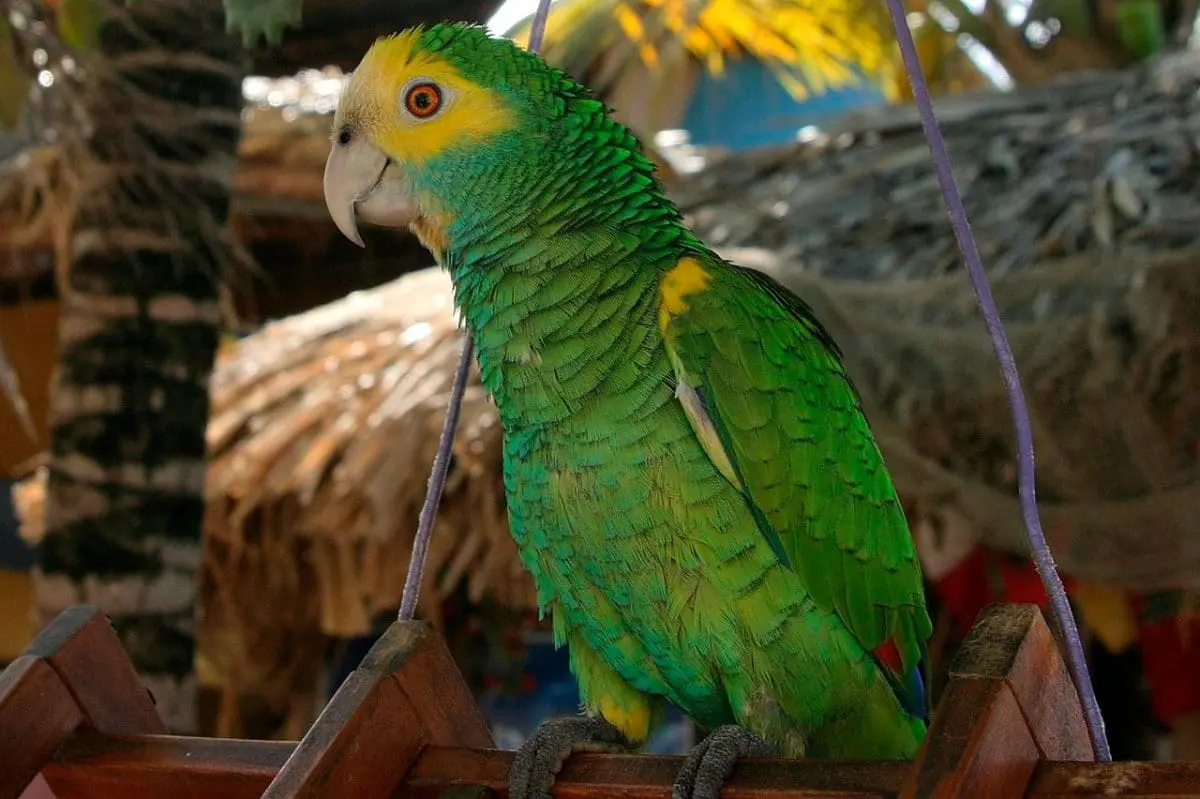
The Yellow-shouldered Parrot (Amazona barbadensis) It has a short tail, head yellow, some with forecrown white.

Its body is usually green, with black feathers edge neck, chest and back; greenish yellow in underparts.

Chin yellow with bluish tint in lower cheeks and around the chin. Shoulder and the thighs yellow.

Speculum red. dark blue tips to the flight feathers. The black edge of their feathers give them a look scaled.
Yellow-shouldered Parrot


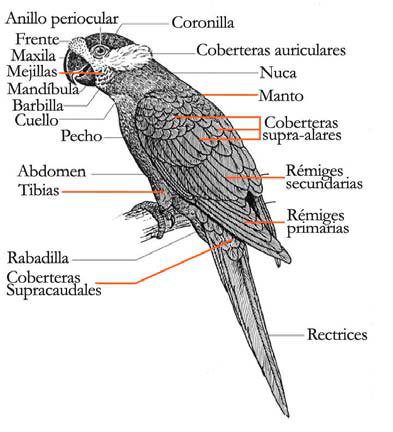
Anatomy-parrots

The irises are red or orange and bill whitish.

The young birds are similar to adults but may distinguish by their irises and the absence darker blue hue in the lower body.

In the most notorious flight apart from the head, is the wing with shoulder yellow, Red patch and blue end.

Habitat:

They live in areas xerophytic vegetation, frequenting desert scrub dominated by cactus, cardón and shrubs or small trees; also frcuentan cultivated areas, until the 450 m. They move in pairs or flocks of up 100 individuals, especially at the time of feed.

Reproduction:

The nesting takes place in tree cavities, cactus or cliffs, in general, between March and August (Sanz and Rodriguez-Ferraro 2006). The average size of clutch is of 3,38 eggs per nest, and most of the eggs survive until the hatching. The incubation lasts a few 26 days and leave the nest 60 days after hatch.

It tends to rest communally in tall trees, with groups of up 700 birds recorded (Juniper and Parr 1998).

Food:

Their diet is composed of Cactus and other fruits. They have been reported in their diet fruits 22 genders. rich flowers nectar, cardón and the urero, which eats fruits, flowers and trunk, fruits and seeds Stenocereus, seeds and flowers guatacaro (Boarreria Sumnensis) and yaque.

Distribution:

Size of its range (reproduction / resident): 11,000 km2

The Yellow-shouldered Parrot It has a disjoint range with seven genetically isolated populations in northern Venezuela (Lara (Cerro Saroche National Park, which)), Falcon (Dabajuro, Casigua), Anzoátegui (about Piritu and Barcelona) and Sucre (Araya Peninsula), as well as the Margarita Islands, the blanquilla, Curacao and Bonaire (Rodriguez-Ferraro 2009).

He is currently extinct on Paraguana Peninsula (Briceño-Linares et. To the. 2011). References to the presence of a population of wild parrots in Curacao They are based on a historical source of the century 18 (AO Debrot in some 1999, 2007.); there have been reports from modern 1988 (The farmer 2008, A. Rodriguez-Ferraro in litt. 2012), although it has been suggested that these birds can be released or escaped cages. (Williams 2012).

It became extinct in Aruba towards 1950 (Rojas-Suarez & Rodríguez 2015).

The numbers on the islands seem to fluctuate, but they have increased in Margarita of 750 birds in 1989 (Sanz y Grajal 1998) until around 2000 in 2015 (Rojas-Suarez & Rodríguez 2015).

The population in Bonaire It was estimated in 400 individuals in 2006 (Williams and Martin 2006) and 650-800 individuals in 2012 (Department of Resources and Planning, Bonaire by R. Martin y S. Williams a slightly. 2012).

The continent's population was considered in decline 2003 (Hilty 2003).

Their habitat continues to be lost in the eastern part of the continental mountain range (V. Sanz in some. 2016) and the population of together (is of Venezuela) it is believed that are declining due to poaching and habitat conversion for agriculture (V. Sanz n bit. 2016), so it is likely that the continental population continues to decline.

Conservation:

State of conservation ⓘ


Vulnerable Vulnerable (UICN)ⓘ

• Current category of the Red List of the UICN: Vulnerable.

• Population trend: Unknown.

The population size: 1700-5600 specimens.

It is classified as a endangered specie, It is the main threats capture their young for pet trade, and habitat destruction of nesting and feeding by the extraction of sand for the construction industry.

The recovery of the population of this bird has been the spearhead of Provita's work in Macanao, since its conservation benefits a large part of the biodiversity of the peninsula, as their habitat covers large areas, it is also a charismatic species, that easily attracts the public to conservation efforts.

Source: PROVITA

"Yellow-shouldered Parrot" in captivity:

Rare but increasing due to the successes of captive breeding.
have a participatory personality, inquisitivas and curious to the point of being "nosy" and her gentle nature only adds to her charm. Mild to moderate its ability to speak.
Always playful, enable They require a cage equipped with toys. They worship a bathroom and displayed chatty while bathing under running warm water.

Alternative names:

Yellow-shouldered Parrot, Yellow shouldered Parrot, Yellow-shouldered Amazon (English).
Amazone à épaulettes jaunes (French).
Gelbflügelamazone, Kleine Gelbkopfamazone (German).
Papagaio-de-cabeça-branca (Portuguese).
Amazona de Cabeza Amarilla, Amazona de hombro gualda, Amazona Hombrogualda, Cotorra margariteña (español).
Cotorra Cabeciamarilla (Venezuela).

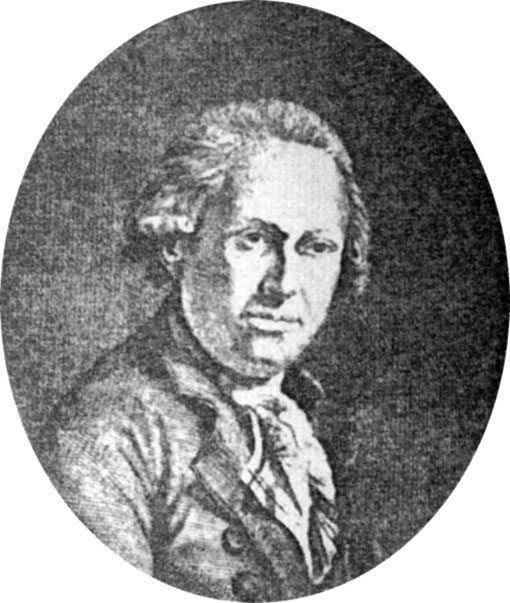
Gmelin Johann Friedrich

scientific classification:


Order: Psittaciformes
Family: Psittacidae
Genus: Amazona
Scientific name: Amazona barbadensis
Citation: (Gmelin, JF, 1788)
Protonimo: Psittacus barbadensis


Images "Yellow-shouldered Parrot":


Species of the genus Amazona


Sources:

  • Avibase
  • Parrots of the World – Forshaw Joseph M
  • Parrots A Guide to the Parrots of the World – Tony Juniper & Mike Parr
  • Birdlife

  • Photos:

(1) – Yellow-shouldered Amazon (Amazona barbadensis) also known as Yellow-shouldered Parrot. Pet in Venezuela perching on the top of a wooden frame. By John Bäckstrand (originally posted to Flickr as IMG_2721) [CC BY 2.0], via Wikimedia Commons
(2) – Yellow-shouldered Amazon in the Walsrode Bird Park, Germany By Quartl (Own work) [CC BY-SA 3.0], via Wikimedia Commons By Quartl (Own work) [CC BY-SA 3.0], via Wikimedia Commons
(3) – Yellow-shouldered Amazon (also known as Yellow-shouldered Parrot). Two in the foreground in a cage By TJ Lin [CC BY-SA 2.0], via Wikimedia Commons
(4) – Yellow-shouldered Amazon (Amazona barbadensis) also known as Yellow-shouldered Parrot. Pet in Venezuela perching on a hand. Shows crown By John Bäckstrand (originally posted to Flickr as IMG_2469) [CC BY 2.0], via Wikimedia Commons
(5) – Yellow-shouldered Amazon (Amazona barbadensis) also known as Yellow-shouldered Parrot. Pet in Venezuela By John Bäckstrand (originally posted to Flickr as IMG_2468) [CC BY 2.0], via Wikimedia Commons
(6) – Amazona barbadensis in the Loro Parque zoo of Tenerife, Spain By Bjoertvedt (Own work) [CC BY-SA 4.0], via Wikimedia Commons
(7) – Amazona barbadensis in the Loro Parque zoo of Tenerife, Spain By Bjoertvedt (Own work) [CC BY-SA 4.0], via Wikimedia Commons
(8) – Yellow-shouldered Amazon (Amazona barbadensis) also known as Yellow-shouldered Parrot. Pet in Venezuela – side view – a little red and blue seen at edge of wing By John Bäckstrand (originally posted to Flickr as IMG_3117) [CC BY 2.0], via Wikimedia Commons
(9) – Yellow-shouldered Amazon (Amazona barbadensis) also known as Yellow-shouldered Parrot. Pet in Venezuela on the top of a wooden climbing frame. Mainly showing its upper body By John Bäckstrand (originally posted to Flickr as IMG_2723) [CC BY 2.0], via Wikimedia Commons
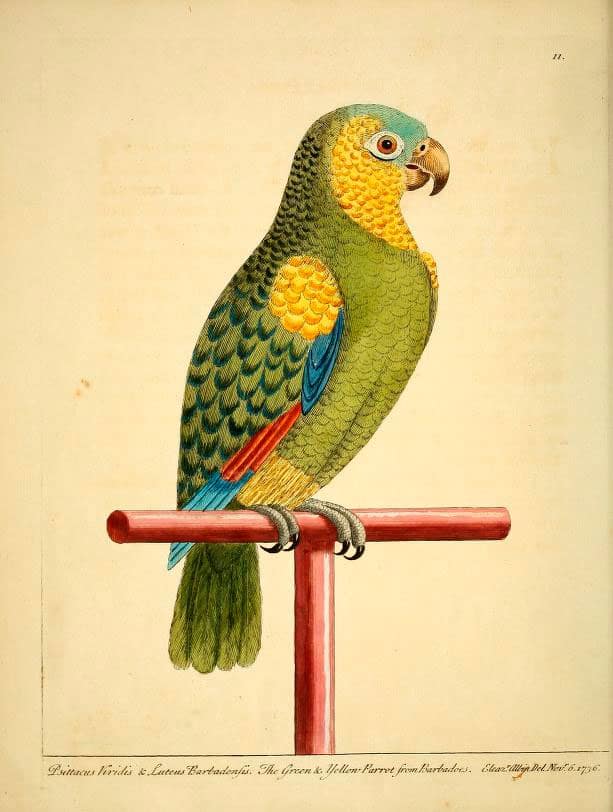
(10) – Original illustration of the «Green & Yellow Parrot from Barbados», currently known as Amazona barbadensis – Wikipedia

  • Sounds: © 2014 Cornell University

▷ The world of Pets: Dogs, cats, birds, reptiles, amphibians

Northern Mealy Parrot
Amazona guatemalae

Northern Mealy Parrot

Content

Description:


Anatomy-parrots

38 cm.. length and 705-766 g. of weight.

The Northern Mealy Parrot (Amazona guatemalae) is a large parrot, mainly green, with a large bare periophthalmic white; head green, increasingly off toward the area nape.

The youth similar to adults but eyes brown.

taxonomy:

Treated for decades subspecifically within the species Amazona farinosa. Based on a genetic study of the year 2012 They came to be regarded as a full species.

Subspecies description:

  • Amazona guatemalae guatemalae

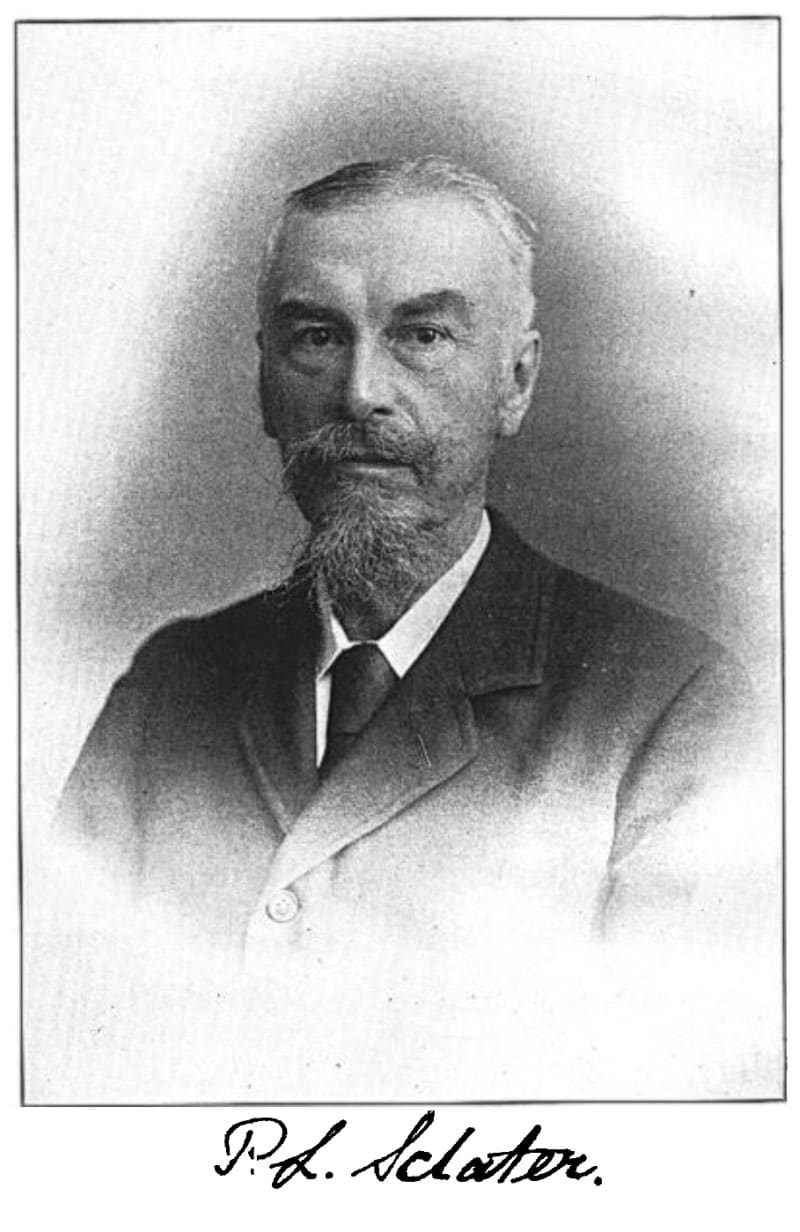
    (Sclater,PL, 1860) – Mostly green, with the crown, forecrown and lores, blue; carpal edge Green Wing / yellow; Feathers edges wing , blue; Red in the secondary feathers; feathers of the tail dark green to light green at the tip. Bill dark grey. Eye ring white, irises red.


  • Amazona guatemalae virenticeps

    (Salvadori, 1891) – Mostly green with less blue on the crown that the subspecies Amazona guatemalae guatemalae; yellower shades / green; carpal edge green / yellow, with varying shades of red; crown green; lores and forecrown, green tinted blue. Bill black / horn. Eye ring white, irises red.

Habitat:

Video "Northern Mealy Parrot"

They inhabit in dense humid lowland forests, especially near the gaps and edges; also they extend lower montane forest plantations and frequent, crops, gallery forests and deciduous forests.

They are in pairs or groups up 20 individuals, with larger congregations in feeding areas. Form noisy flocks in communal roosts high up in big trees out of breeding season, sometimes with several hundred birds. Well camouflaged while feeding quietly on the upper floors of the forest canopy.

Reproduction:

Season April-May Guatemala. Nests in tree holes, to 3-30 height m, once observed in the crack of a stone wall in a Mayan temple. The laying usually three eggs.

Food:

No known differences with Amazona farinosa.

Distribution:

Size of its range (Standard playback): 919.000 km2

It is present along the slope of Caribbean of Central America, from Veracruz and Oaxaca, Mexico, to the South by Belice, Guatemala, Honduras, Nicaragua and Costa Rica, to western Panama. They are also found in the shed peaceful of Costa Rica and West Panama. Its abundance varies locally, but it is common in many areas.

Subspecies distribution:

  • Amazona guatemalae guatemalae

    (Sclater,PL, 1860) – Caribbean coast from southeast Mexico to the Northwest of Honduras.


  • Amazona guatemalae virenticeps

    (Salvadori, 1891) – Since Honduras (Sula Valley) to western Panama.

Conservation:

State of conservation ⓘ


Near-threatened Near Threatened (UICN)ⓘ

• Current category of the Red List of the UICN: Near-threatened.

• Population trend: In decrease.

Rationale for the Red List category

He suspected this species is undergoing a rapid decrease in moderately population due to habitat loss and unsustainable levels of hunting and trapping.

Population size: Unknown

The population trend: In decline.

The Amazona mealy northern captive:

Little known in poultry.

Alternative names:

Mealy Parrot [guatemalae or virenticeps], Northern Mealy Amazon, Northern Mealy Parrot (English).
Amazone guatémaltèque, Amazone poudrée [guatemalae or virenticeps], Amazone poudrée [guatemalae ou virenticeps] (French).
Guatemalaamazone (German).
Northern Mealy Parrot (Portuguese).
Amazona harinosa norteña (español).


scientific classification:

Philip Sclater
Philip Sclater

Order: Psittaciformes
Family: Psittacidae
Genus: Amazona
Scientific name: Amazona guatemalae
Citation: (Sclater, PL, 1860)
Protonimo: Chrysotis guatemalae

Images Northern Mealy Parrot:


Species of the genus Amazona


Sources:

Avibase
Parrots of the World – Forshaw Joseph M
Parrots A Guide to the Parrots of the World – Tony Juniper & Mike Parr
Birdlife

Photos:

(1) – Amazona farinosa guatemalae By Adalberto Hernandez Vega from Copan Ruinas, Honduras (Macaw Mountain Bird Park – Copan Ruinas, Honduras) [CC BY 2.0], via Wikimedia Commons
(2) – Guatemalaamazone Amazona farinosa guatemalae By Martingloor (Own work) [CC BY-SA 4.0], via Wikimedia Commons
(3) – Amazona farinosa guatemalae by Ulises MuñizFlickr
(4) – Amazona farinosa guatemalae By Katrin Lorenzen (IMG_4685) [CC BY-SA 2.0], via Wikimedia Commons
(5) –
Amazona farinosa guatemalae By Adalberto Hernandez Vega from Copan Ruinas, Honduras (Macaw Mountain Bird Park – Copan Ruinas, Honduras) [CC BY 2.0], via Wikimedia Commons

▷ The world of Pets: Dogs, cats, birds, reptiles, amphibians

Macquarie parakeet †
Cyanoramphus erythrotis

Macquarie Parakeet - Cyanoramphus erythrotis

Content

Description Perico Macquarie:

27 cm.. length

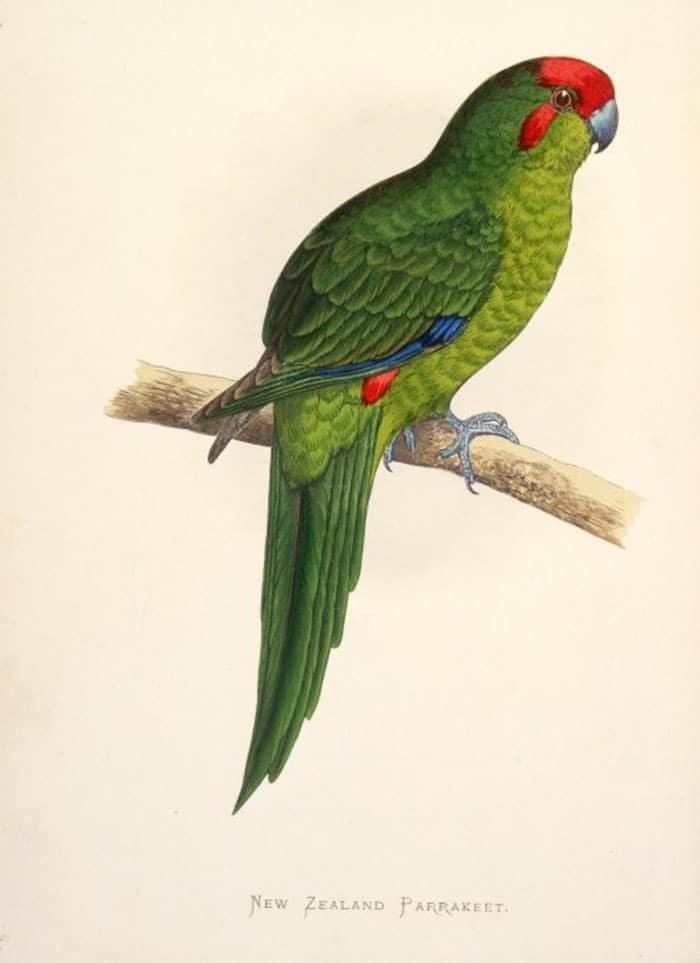
The extinct Macquarie Parakeet (Cyanoramphus erythrotis) was a medium-sized green parrot. The head was bright green with pileum and a line in the eyes crimson red. The upperparts They were bright yellow-green to dark green with a scarlet stain on either side of the rump (usually they are hidden by the wings when resting), and a greenish-blue leading edge to the wings. The eyes They were yellow or red, and the bill It was black with a base Pearly. Both sexes looked similar, but the female It was smaller (Forshaw & Cooper 1981; Higgins 1999; Oliver 1955)

Taxonomic status:

This taxon is considered a subspecies of Cyanoramphus [novaezelandiae, erythrotis, subflavescens] (sensu lato) by some authors

Lives in "Perico de Macquarie":

The Macquarie Parakeet inhabited coastal grasslands tussock in the subantarctic Isla Macquarie (Forshaw & Cooper 1981; Taylor 1979).

Reproduction:

It is known nesting in grasslands without trees.

Food «Perico de Macquarie»:

Little is known about the diet of the Macquarie Parakeet, but it is said that feed on crustaceans and other small invertebrates (Oliver 1955; Taylor 1979).

It was Earth (Forshaw & Cooper 1981) and it is said to have been foraged on the seashore, taking invertebrates fused cell algae on the beach (Oliver 1955; Taylor 1979).

Distribution «Perico de Macquarie»:

The Macquarie Parakeet It was an endemic parrot Isla Macquarie, one sub-Antarctic island in the Antartic Ocean which is politically part of Tasmania Australia. The island and this species were discovered in 1810, time when this parakeet was still very common. The last sighting of the Perico de la Isla Macquarie was in 1891.

Conservation Cyanoramphus erythrotis:

• Current category of the Red List of the UICN: EXTINCT.

Although hard Macquarie Parakeet They were adjusted well to inhospitable terrestrial environment Macquarie Island, They did not survive the predatory introduced species.

The extinction of the Macquarie Parakeet It was caused by the introduction of exotic predators, like cats, rabbits, mice and rats boat. He was also prey to rascón weka or the rascón of Lord Howe (Gallirallus australis). This robust flightless bird from New Zealand It was introduced on the island in the mid-nineteenth century as food for sealers, the same hunters killed large numbers of Macquarie's Parakeets (Macquarie Island) to feed. Unfortunately, the wekas They have caused considerable damage to endangered species, as they feed on small birds, Native insects and lizards.

The last sighting of live parrots occurred in 1891

Threat Reduction and Recovery

Translocation program may be suitable for the reintroduction of Norfolk Island Parakeet (Cyanoramphus cookii) on Isla Macquarie. Although programs have been tested for translocation failed Norfolk Island Parakeet (Garnett & Crowley 2000; Hermes et al. 1986), Similar programs have been successful for this parakeet in New Zealand. These programs have been successful with only 15 birds, Bottlenecks causing genetic programs with less than 150 birds. The low success of the pups in the breeding program New Zealand It may be the result of inbreeding depression or poor design of nests (Oritz-Cathedral & Brunton 2008).

The programs of eradication They are underway in Isla Macquarie. The cats were eradicated in 2002, the Keep (Gallirallus australis) in 1988 and is ongoing eradication program rats, rabbits and mice (Mouse muscle) (it. PWS 2009).

Alternative names:

Macquarie Island Parakeet, Macquarie Parakeet (English).
Perruche de Macquarie (French).
Macquarie-Laufsittich, Macquarie-Ziegensittich (German).
Periquito de Macquarie (Portuguese).
Perico de Macquarie (español).

scientific classification:

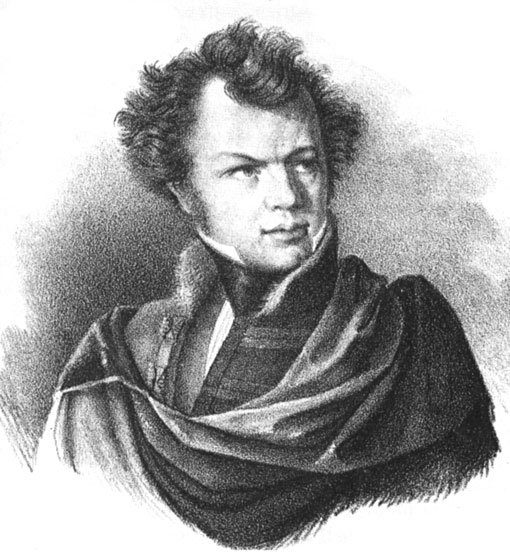
Johann Georg Wagler
Johann Georg Wagler

Order: Psittaciformes
Family: Psittaculidae
Gender: Cyanoramphus
Scientific name: Cyanoramphus erythrotis
Subpoena: (Wagler, 1832)
Protonimo: Psittacus erythrotis

Sources:

Avibase
• Parrots of the World – Forshaw Joseph M
• Parrots A Guide to the Parrots of the World – Tony Juniper & Mike Parr
• Department of the Environment (2018). Cyanoramphus novaezelandiae erythrotis in Species Profile and Threats Database, Department of the Environment, Canberra. Available from: http://www.environment.gov.au/sprat

▷ The world of Pets: Dogs, cats, birds, reptiles, amphibians

Blue-headed Parrot
Pionus menstruus


Blue-headed Parrot

Content


Anatomy-parrots

Description "Loro Cabeciazul":

28 to 30 cm.. height and between 234 and 295g. weight.

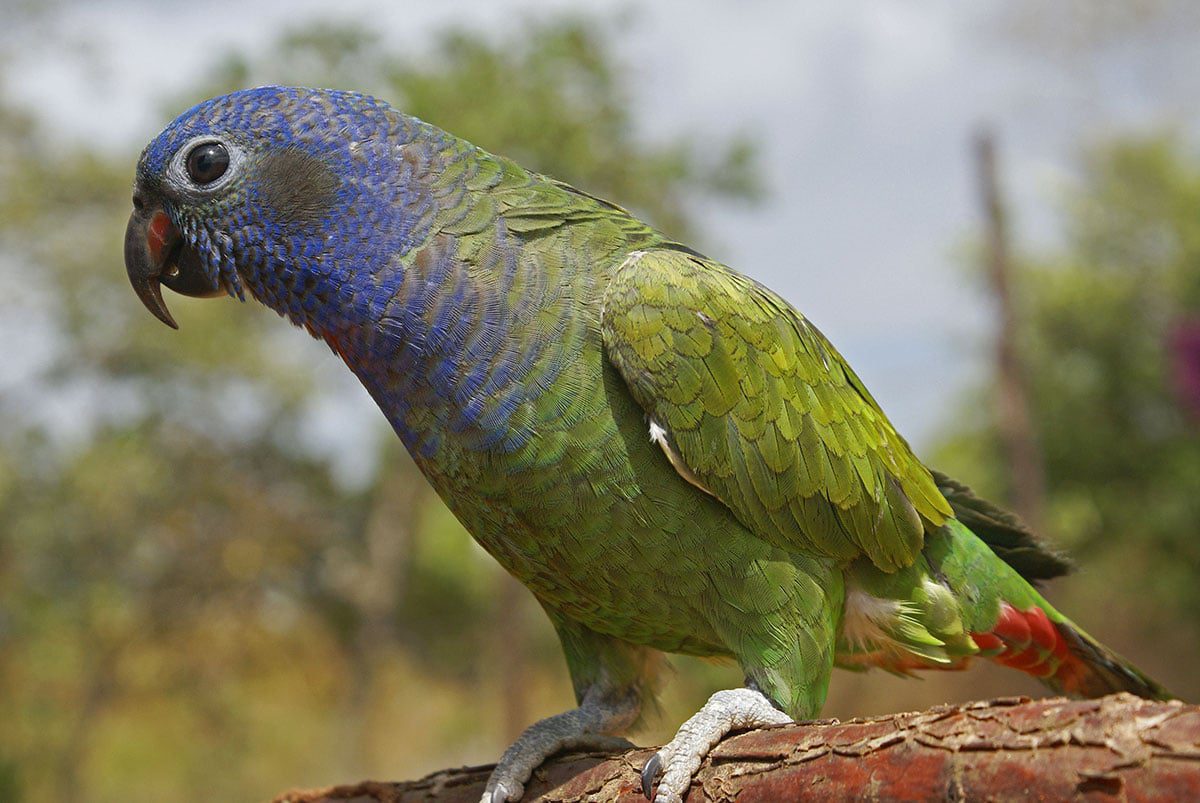
The Blue-headed Parrot (Pionus menstruus) is distinguishable by having the head, neck and chest blue; Red in the rump and in the Base ventral of the tail (very visible on the fly), basis of the bill and neck dotted with pink.

Shoulder and end of the wing olive green with yellow border, tail green with blue tip.

Subspecies description:

  • Pionus menstruus menstruus

    (Linnaeus, 1766) – The nominal

  • Pionus menstruus reichenowi

    (Heine, 1884) – Blue head, the neck and darker throat; lower underparts washed with blue green color; coverts red infracaudales with blue ends.

  • Pionus menstruus rubrigularis

    (Cabanis, 1881) – Smaller, head pale blue, neck more extensive and clear Red.

Habitat:

Species very common, lives in humid forests, semi-wet, from gallery, stubble, crop areas until the 1500 m.

Reproduction:

It feeds on various seeds, fruits and flowers.

Food:

It nests in hollows of trees and palms in dry season.

Loro distribution-headed:

They live in freedom from the South of Costa Rica, North of South America to the West of Ecuador. To the East of the Andes, comes to Peru, part of Brazil to the North of Bolivia.

Subspecies description:

  • Pionus menstruus menstruus

    (Linnaeus, 1766) – The nominal

  • Pionus menstruus reichenowi

    (Heine, 1884) – Coastal areas of the northeast of Brazil (Alagoas until Holy Spirit)

  • Pionus menstruus rubrigularis

    (Cabanis, 1881) – Tropical North of Costa Rica to western Colombia and West of Ecuador.

Conservation-headed Parrot:


minor concern


• Red List category of the UICN current: Least concern

• Population trend: Decreasing

The size of the world population of the Blue-headed Parrot It has not been quantified, but this species is described as «common» (Stotz et to the., 1996).

This species is suspected that it may lose 18,5-23% of habitat within its distribution over three generations (20 years) based on a deforestation model of the Amazon (Soares-Filho et to the., 2006, Bird et to the. 2011). So, they suspected that can decrease in <25% in three generations.

In captivity:

Pretty common in captivity. Intelligent, inquisitive although sometimes shy. Active by nature, they can become overweight if you don't have a wide space where exercise your flight. Mature birds usually match throughout his life with his partner, you will defend with aggression of any intruder.

Its diet in captivity is wide. fruits such as: Apple, pear, orange, banana, granada, cactus fruits, Kiwi, they form around the 30 percent of the diet; vegetables such as: Carrot, celery, green beans and peas in pods; fresh corn; Greens such as: chard, lettuce, Kale, dandelion, healer, chickweed; mixture of small seeds, such as: millet, birdseed, and small amounts of buckwheat, oats, safflower and hemp; soaked and sprouted sunflower; beans, cooked legumes and boiled corn.

Alternative names

Blue-headed Parrot, Cobalt Parrot (English).
Schwarzohrpapagei, Schwarzohr-Papagei (German).
Cotorra Cabeciazul, Loro Cabeciazul, Loro de Cabeza Azul (español).
Pione à tête bleue, Pionus à tête bleue (French).
baitaca, curica, maitaca, maitaca-de-barriga-azulada, maitaca-de-cabeça-azul, sijá, Sôia, Suia (potugués).
Pappagallo testablu (Italian).


scientific classification:

Carl Linnaeus
Carl Linnaeus

Order: Psittaciformes
Family: Psittacidae
Genus: Pionus
Scientific name: Pionus menstruus
Citation: (Linnaeus, 1766)
Protonimo: Psittacus menstruus

Images "Blue-headed Parrot"

Videos "Blue-headed Parrot"

«Loro Cabeciazul» (Pionus menstruus)


▷ The world of Pets: Dogs, cats, birds, reptiles, amphibians

Red-and-blue Lory
Eos histrio

Eos histrio

Content

Lori-of-them-sangihe-6

Description

31 cm.. length and a weight between 150 and 185 gr.

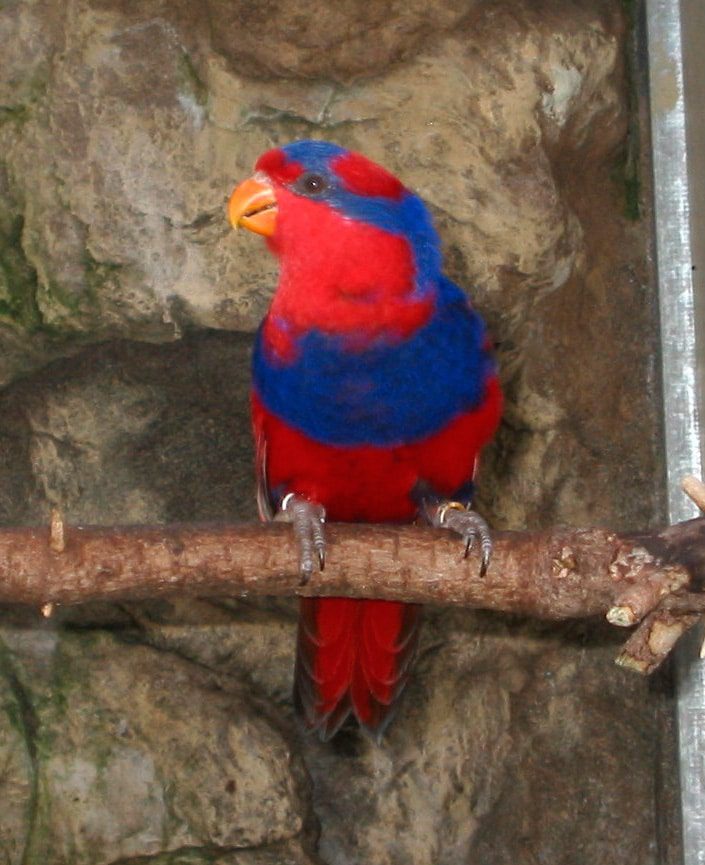
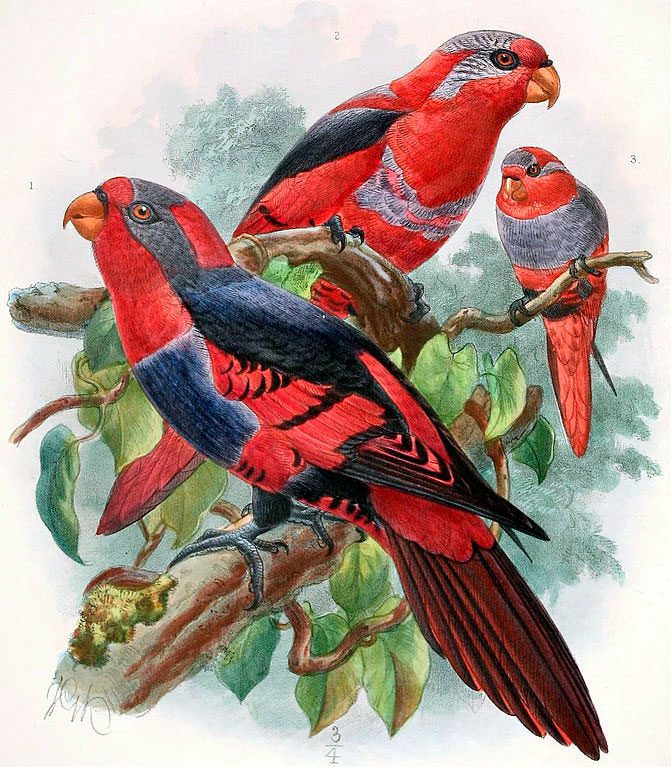
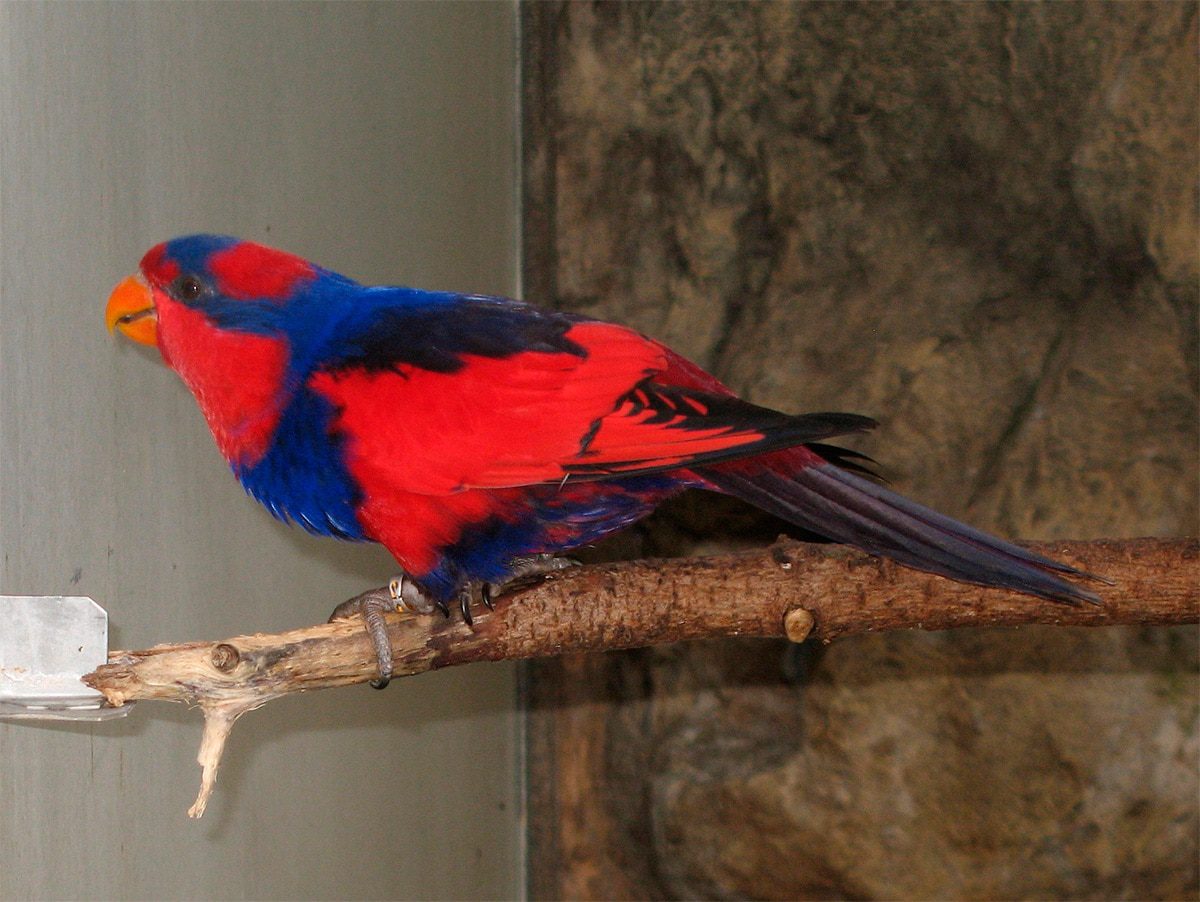
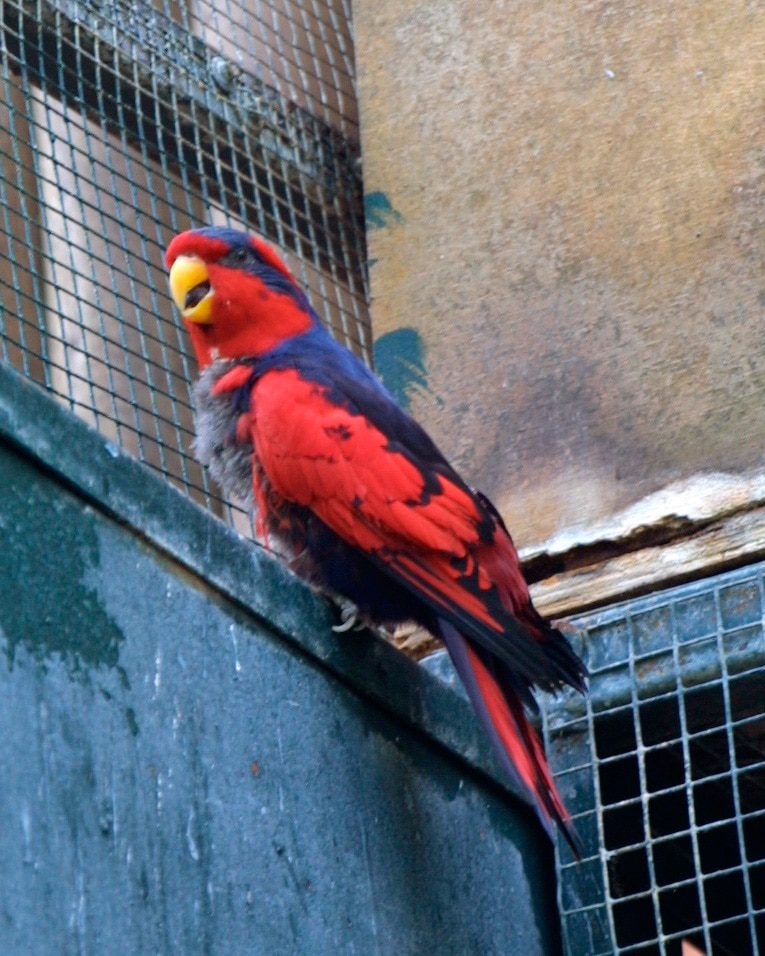
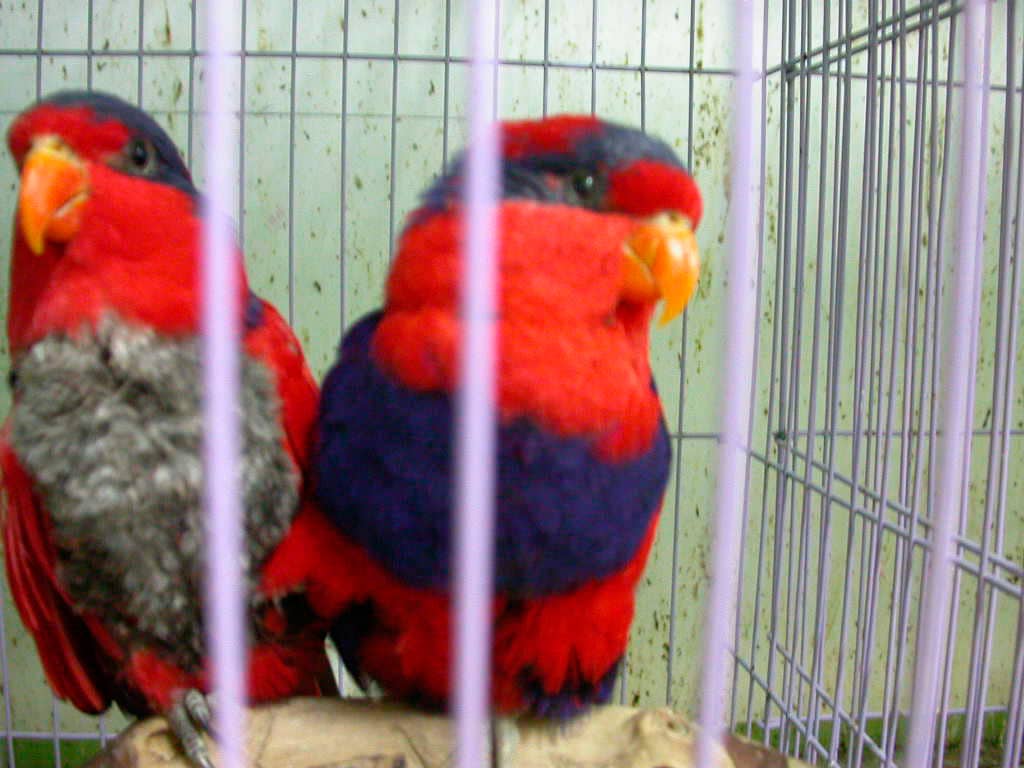
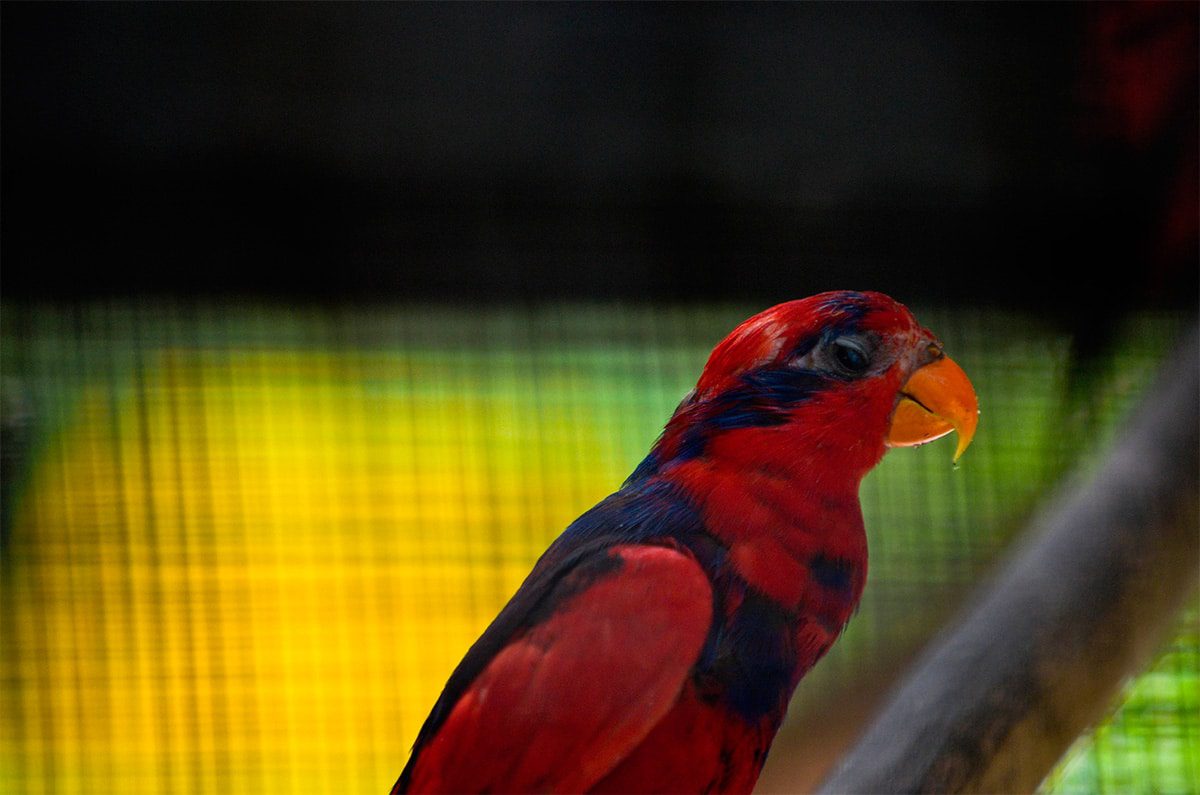
The two main colors of the Red-and-blue Lory (Eos histrio) they are the red and blue.

A broad blue-purple line extends from the eyes through the ears and for the sides of the neck. A broad transverse band blue on the chest. The tail coverts they have blue pink. The feathers of the part superior of the tail they are reddish purple.

The irises is red, the legs grey.

Both sexes are very similar.

In immature, the feathers of the head and the chest they have a dark blue edging. The blue of the crown extends up to the neck and below the eyes. Thighs they are dull purple. The irises They are brown.

Description 3 subspecies

  • Eos histrio challengeri

    (Salvadori, 1891) – The band blue of the chest is of smaller size and mixed with red; the blue band of the eyes does not extend to the the mantle; smaller.


  • Eos histrio histrio

    (Statius Müller, 1776) – Nominal.


  • Eos histrio talautensis

    (Meyer,AB & Wiglesworth, 1894) – More black in the corbeteras wing and in the flight feather.

Habitat:

The Red-and-blue Lory they are common in primary forests, and on the hills of the hills. The feed, they made raids in coconut plantations along the coast and in the more open areas.

They make short trips daily. In the Talaud Islands You can see flying from island to island.

Initially, They lived in large flocks and concentrated in large numbers in common dormitories..

Today, in view of its decline, them find in pairs or in small groups. Large gatherings have become extremely rare or virtually non-existent.

In the Karakelong island were seen, However, on two occasions, more groups of 400 birds.

The Red-and-blue Lory they are birds noisy, which makes them quite easy to observe.

Reproduction:

The species nests in holes in tall trees, most belonging to the class canarium family Burseraceae, and the breeding period main seems to be from May to June, Although it is suspected that nesting may include other months.

We find nests, both in the forests and cultivated areas. The spawning usually includes 2 eggs which are incubated for approximately 25 or 26 days. There is no any other information in the natural environment.

Food:

Although they also consume some insect larvae, the Red-and-blue Lory are mostly vegetarian. They feed on coconut plantations, in the fig trees and trees of the genus canarium It produces edible nuts.

Distribution:

Size of the area of distribution (reproduction / resident): 1,000 km2

The Red-and-blue Lory is confined to the Talaud Islands (almost exclusively in Karakelang) front North of Sulawesi, Indonesian

Description 3 subspecies

Conservation:


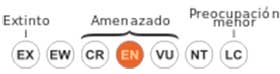
Endangered

• Current category of the Red List of the UICN: Endangered.

• Population trend: Decreasing.

This species has a very small range (It is known only in some places), and it is declining due to habitat loss. It has been a downhill fast in the population, largely as a result of their capture for trade, and this is expected to increase in the future. So, qualified as In danger.

Although it was previously abundant, the species has decreased and the population in KarakelongIt was estimated in 8,230-21,400 birds in 1999 (Riley 2003). The subspecies of the nominal of the Sangihe Islands, is likely that has been extinguished.

The encroachment and logging are driving the loss of forests, aggravated by the threat of illegal trade in the species, contribute to the acceleration in the decrease of the population.

In 1999, the investigation concluded that you the 1.000 and 2.000 birds were being captured in Karakelang each year, the 80% (illegally) for the markets of birds of the Philippines.

Ongoing conservation actions:

Since 1995, the project "Action Sampiri» has been working for the conservation of biodiversity in Sangihe and Talaud, in the implementation of awareness-raising programmes of field work and the conservation and development of ideas for the future use of the land.

Efforts have been made to promote the local support of the species at Talaud, his last bastion.

It has been reported that the poaching and the trade of this species have decreased drastically after the confiscation of assets by Ranger of the forest Department in 2005 (RT Prayudhi in litt., 2008).

The bird is part of the European Association of Zoos, the program Aquaria’s European Endangered [species] and Parrot Taxon Advisory Group (Wilkinson 2000), where it is being bred in captivity (Sweeney, 1998).

"Red-and-blue Lory" in captivity:

It is currently very rare in captivity.

Due to its status in danger of extinction, any specimen that can not be returned to their natural habitat (natural range) should preferably be placed in a well-managed breeding program to ensure the survival of the species.

Alternative names:

Red-and-blue Lory, Blue-tailed Lory, Red & Blue Lory, Red and Blue Lory, Red-blue Lory (ingles).
Lori arlequin, Lori histrion (French).
Harlekinlori (German).
Lóris-arlequin (Portuguese).
Lori de las Sangihe, Lori Rojo y Azul (español).

scientific classification:

Order: Psittaciformes
Family: Psittaculidae
Genus: Eos
Scientific name: Eos histrio
Citation: (Statius Müller, 1776)
Protonimo: A player parrot

“Sangihe Lory” images:

——————————————————————————————————-

«Lori de las Sangihe» (Eos histrio)


Sources:

Avibase, BirdLife.org

Photos:

1 – En Loro Parque (Spain, Tenerife) by Drägüs – Wikimedia
2 – Lori en Loro Parque, Tenerife, España by Drägüs – Wikimedia
3 – En ZooParc de Beauval, France by User:Edhral – Wikimedia
4 – Red-and-blue lory. two in a cage. by TJ Lin – Wikimedia
5 – A Red-and-blue lory in a zoo by jojo nicdao – Wikimedia
6 – The Red and Blue Lory (Eos histrio now Eos histrio histrio) and The Challenger Lory (EOS challengeri now Eos histrio challengeri) Chromolithograph. Plate VII from A monograph of the lories, or brush-tongued parrots, composing the family Loriidae. By St. George Jackson St. Mivart (1827–1900). Artwork by John Gerard Keulemans (1842-1912). This was published by R. H. Porter (London) in 1896. By John Gerard Keulemans [Public domain], via Wikimedia Commons

Sounds: Frank Lambert (Xeno-canto)

▷ The world of Pets: Dogs, cats, birds, reptiles, amphibians

Swift Parrot
Lathamus discolor

Swift Parrot

Content


Anatomy-parrots

Description

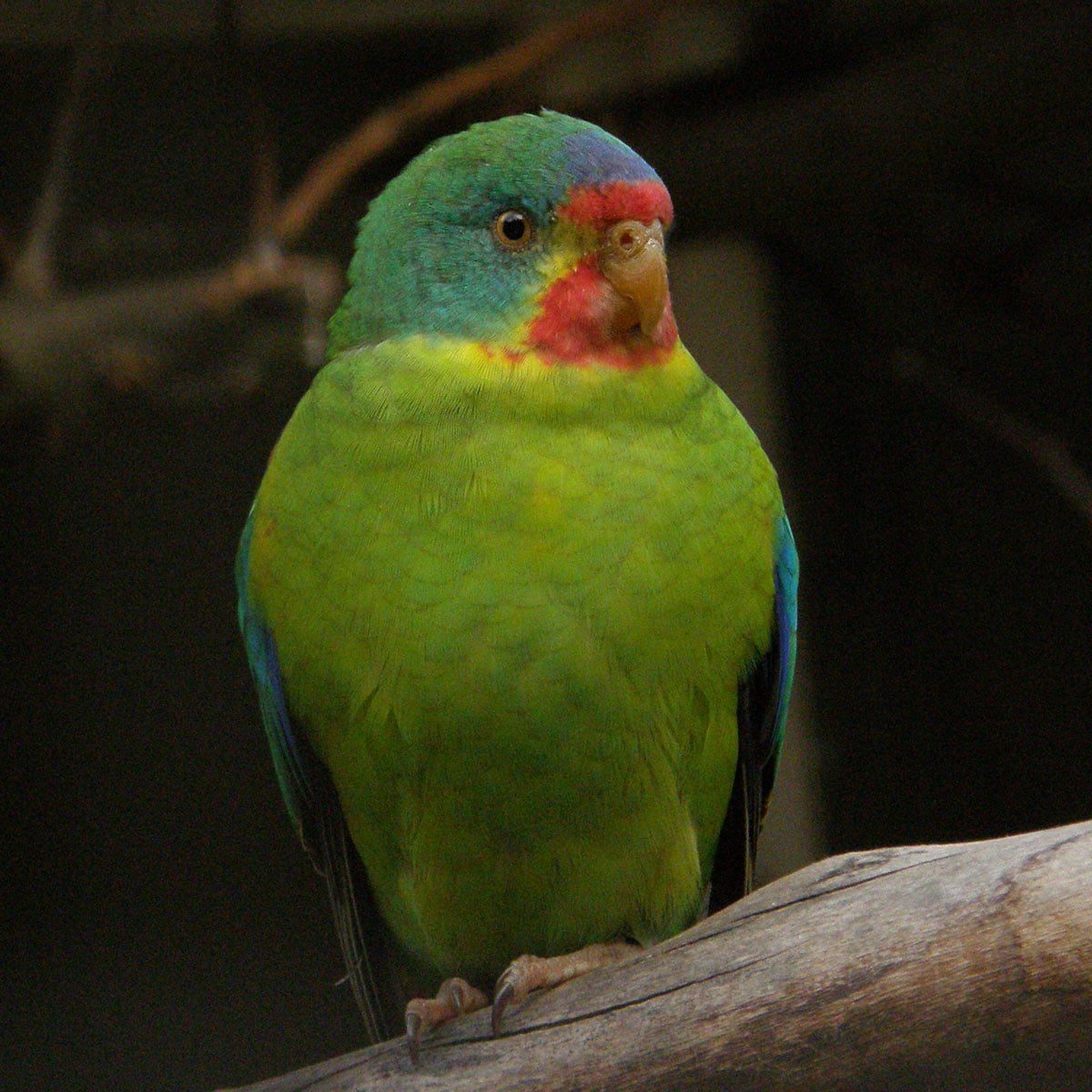
The Swift Parrot (Lathamus discolor) has a length of 23 to 28 cm.. and weighs approximately 65 g..

It is a slim Parrot, medium sized wings angular and pointed tail sharpened.
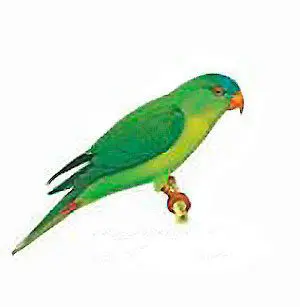
The head is bright emerald green. The forecrown, the chin and center of throat, red; lores bright yellow; centre of crown blue.

The upperparts (rump), bright green. The wing-coverts and feathers under wing They are red. The feathers under the tail They are red with green scales effect. The chest and feathers belly are yellowish green.

The bill Horn is color and irises yellow.

The female is paler and extent of mask Red lower than that of males. The color of the bottom of the tail just have red.

Habitat and behavior:

To the Swift Parrot It is usually seen in small groups of up 30 birds, sometimes in larger flocks (hundreds of birds) around the abundant food sources. There has also been some extraordinary reports in the enumeration of the flocks of more of 1.000 birds.

Son migratory birds. Are reproduced in Tasmania and then move to Australia continental, in autumn, for the non-reproductive season. Most of the population spends the winter in Victoria and New South Wales, before returning to Tasmania in spring. Usually they are gregarious in raising.

The playback area It is always within the 8 km from the coast, largely restricted to an area of less of 500 km² along the eastern coastal strip between Santa Helena and the Lune River, including offshore islands, as Mary Island and Bruny island.

The higher densities They occur between the After Bernier and Orford and Wellington Ridge about Hobart. A smaller breeding population is located in the North of Tasmania between Launceston and Smithton.

Reproduction:

Reproductive success is strongly related to the intensity and scope of the flowering of the Eucalyptus globulus (Tasmanian Blue Gum). In years of bad bloom, it seems that there is little breeding.

The breeding season It is mid-September to late January. Birds begin to return to Tasmania from your area of wintering on the continent at the beginning of August. Most of the population comes in mid-September. Unpaired birds upon arrival to Tasmania they cannot start breeding until November after finding mates.

The De l'Tmño Nidada is three to five eggs. The female makes the incubation. in cautiverior incubation lasts about 25 days. Young people will fly in around 6 weeks. The presence of juveniles, recently fledged at the end of January and early February suggests double broods may occur. Second hatchlings depend on food availability.

A recent study has shown that the nests of the Swift Parrot often found in close proximity to each other. Nest trees may be to only 10-15 m from, and can support up to four active nests each.

Food:

The Swift Parrot It feeds mainly on nectar, mainly of eucalyptus, but also feeds on insects psyllids and lerps, seeds and fruits.

It is a tree Harvester, forages mainly in the eucalyptus, but from time to time low to the ground to feed on seeds, fallen flowers, fruit and Lerp. During the breeding season, the nectar from the flowers of the Eucalyptus globulus (Tasmanian Blue Gum) is the main source of food.

Sometimes they voraciously consume nectar in areas very accessible and this makes them reluctant to fly making them vulnerable to attack by cats, especially when forage among low foliage. His agility and alertness in flight can also be affected by the consumption of large quantities of nectar, possibly increasing the risk of collisions with artificial or hard-to-see objects.

Distribution:

Size of the area of distribution (reproduction / resident): 21.500 km2

The Swift Parrot, as its name suggests, migrates through the bass strait, between Tasmania and the Australian continent. Comes to Tasmania in September and returned to the southeast of Australia between March and April.

You can get to be as far north as the South-East of Queensland and get up to adelaide from the West, Although the most recent sightings are restricted to the southeastern part of the State.

Conservation:

They estimated that the current population probably contains about 2.000 mature individuals and is declining.

The population of this species is suspected to be declining in line with habitat loss and degradation..
The sugar gliders they are the main predators of the broods of the Swift Parrot on the island of Tasmania, being the cause of the 85% of deaths, but they are not present on the Islands Bruny and Maria


Endangered


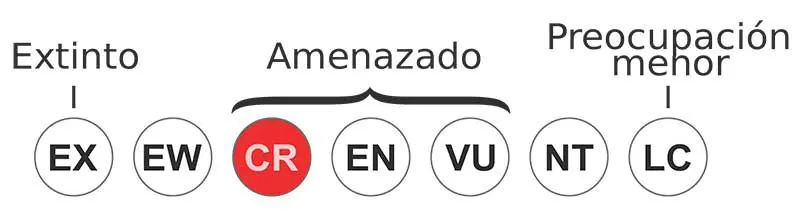
• Current IUCN Red List category: Danger

• Population trend: Decreasing

The logging of a particular species is also responsible for the decline of population, eucalyptus, which constitute the 90% your diet.

– The Swift Parrot is classified as a species in danger of extinction in the law of conservation of biodiversity and protection of the environment of 1999 of Australia.

– The Migratory Perico It is listed as a threatened species under the Victorian Wildlife Guarantee Act. (1988). According to this law, a state action must be carried out for the recovery and future management of this species.. In addition the Migrator parakeet is classified as endangered on the list of advisory on threatened vertebrate fauna of Victoria of 2007.

"Swift Parrot" in captivity:

There are no populations in captivity, they are being handled or propagated actively by reintroducing. But, the Swift Parrot is easily propagated in captivity, and many of them are housed in private collections.

Alternative names:

Swift Parrot (ingles).
Perruche de Latham (French).
Schwalbensittich, Schwalbenlori (German).
Periquito-andorinha (Portuguese).
Periquito Migrado (español).

scientific classification:

Order: Psittaciformes
Family: Psittaculidae
Scientific name: Lathamus discolor
Citation: (Shaw, 1790)
Protonimo: Psittacus Discolor

«Migratory Parakeet» Images:

Videos "Swift Parrot"

————————————————————————————————

"Migratory Parakeet" (Lathamus discolor)


Sources:

Avibase
– Parrots of the World – Forshaw Joseph M
– Parrots A Guide to the Parrots of the World – Tony Juniper & Mike Parr
– BirdLife.org
Wikipedia
– mundoexotics.com
environment.gov.au

Photos:

1 – By original photograph by frank woutersderivitive work Snowmanradio (talk) 18:52, 4 October 2008 (UTC) [CC BY 2.0], via Wikimedia Commons
2 – «Lathamus discolor-captive-8-ec» by Lathamus_discolor_-captive-8. jpg: Ernst Viknederivative work: Snowmanradio (talk) – originally posted to flickr at IMG_4454.JPG and uploaded to commons at Lathamus_discolor_-captive-8. jpg. Licensed under CC BY-SA 2.0 via Wikimedia Commons.
3 – «Lathamus discolor Bruny 1» by JJ Harrison (jjharrison89@facebook.com) – Own work. Licensed under CC BY-SA 3.0 via Wikimedia Commons.
4 – bonapartemadar.hu
5 – Swift Parrot, Lathamus discolor. Photograph Geoffrey Dabb 27.04.2005 at Mount Majura nature reserve – majura.org

Sounds: Vicki Powys (Xeno-canto)

▷ The world of Pets: Dogs, cats, birds, reptiles, amphibians

Blue-fronted Lorikeet
Charmosyna toxopei

Content


Anatomy-parrots

Description

16 cm.. length.

Blue-fronted Lorikeet

The forecrown of the Blue-fronted Lorikeet (Charmosyna toxopei) is bright green, the front of the crown, above the eyes is bright blue; rest of the head green. Upperparts green, bright in the rump. Wings Green with blackish inner feathers. The underwing-coverts green; flight feather Blackish with yellow band in the whole lower part of the secondaries. The underparts brighter yellowish green. Tail green, with red bases and blackish stain. The bill orange; the irises yellow orange; legs orange-red.

Habitat:

If recent observations were in fact of the Blue-fronted Lorikeet, species can be nomadic, moving from high to low altitude on the basis of the availability of food (like some other small parrots). This could explain the paucity of records, especially for a species already by itself it is distributed sparsely. The other possibility is that the birds are distributed only in the forested hills.

Interviews with local residents suggest that the species moved to the lowlands during the two annual seasons of heat, in March-April and August-November.

Reproduction:

There is no data.

Food:

The locals who live in the plateau frog They reported that the bird feeds on nectar and pollen from the trees in flower.

Distribution:

Endemic to Buru, Indonesian. Obviously, is a rare species, and virtually nothing is known of its State. The original specimens were collected in the wooded hills between 850 m and 1.000 m.

In 1980 the species was reported to be quite common in plantations, secondary and primary forest, but this record has been suggested as a reference to the Red-flanked Lorikeet (Charmosyna placentis) (the record of this species from Buru It is in fact wrong). In 1989 two flocks of five to six birds, supposedly this species, they were seen during a selective felling of forests to 600 meters on the Teluk Bara. There is also a report of 1993 of four small unidentified parakeets seen in the same area as the observations of 1.980. The species are now considered endangered by Birdlife International, although a thorough search must be carried out before its status can be fully determined. VULNERABLE.

Conservation:


critical hazard

• Current IUCN Red List category: Critical Hazard

• Population trend: Decreasing

• Population size: 50-249 mature individuals

Although there are few records (confirmed or unconfirmed) of the species, It is suspected that it is declining due to loss of forests in the lowlands.

Most of the forests in the coastal lowlands of Buru have they been clarified, and much of the forest in the northern part of the island has been connected shape selective or degraded and fragmented by migratory agriculture, in such a way that only a few small patches of lowland primary forest remain. But, the island's gardens still contain many indigenous tree species. In 2010, There was at least one search operation on a large scale above Buru, located in the lowlands. But, extensive forests of mountain of the island remain largely without being scanned. The topography of the mountain range Kaplamandan is the hope that almost all of the montane forest is inaccessible to loggers (A. Gray in litt. 2010).

All of the original specimens were captured alive using lime, However, the species is not kept as a pet, does not seem to be listed. Have a distribution of mountain which is close to the maximum altitude within its distribution area, does this species is potentially susceptible to climate change (BirdLife International data not publ.).

"Blue-fronted Lorikeet" in captivity:

Not found in captivity.

Alternative names:

Blue-fronted Lorikeet, Blue fronted Lorikeet, Buru Lorikeet (ingles).
Lori de Buru (French).
Burolori, Burulori (German).
Lori de Buru (español).

scientific classification:

Order: Psittaciformes
Family: Psittaculidae
Genus: Charmosyna
Scientific name: Charmosyna toxopei
Citation: (Siebers, 1930)
Protonimo: Hypocharmosyna toxopei

Images "Blue-fronted Lorikeet"

————————————————————————————————

«Lori de Buru» (Charmosyna toxopei)


Sources:

Avibase
– Parrots of the World – Forshaw Joseph M
– Parrots A Guide to the Parrots of the World – Tony Juniper & Mike Parr
– Birdlife

▷ The world of Pets: Dogs, cats, birds, reptiles, amphibians

Pygmy hanging parrot
Loriculus exilis

Pygmy hanging parrot

Content


Anatomy-parrots

Description

10 to 11 cm.. length.

Pygmy hanging parrot

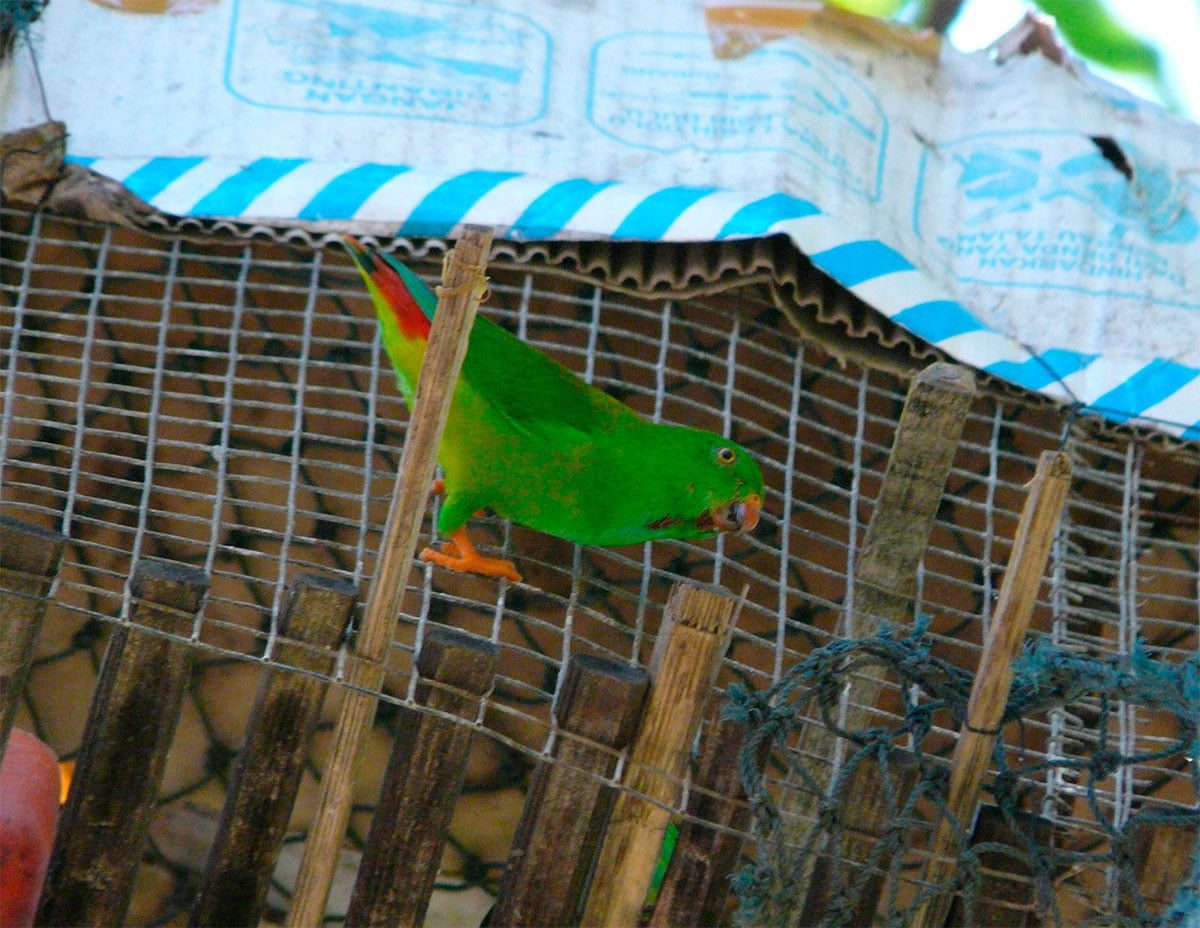
The head of the Pygmy hanging parrot (Loriculus exilis) is green, brighter around the base of the bill and bathed in bluish green at the chin, the throat, the cheeks and the part front of it crown.

The underparts is green, with the rump and uppertail-coverts dark red (very extended below the tail); the sides and the base of the rump are greenish-yellow. Wings green. Under, the wings Turquoise with coverts green. Throat of color red bordered of blue pale and extending is about part superior of the chest; rest of the underparts green, slightly more clear that the upperparts. The tail, at the top, Green with yellowish tips; undertail, the tail is of a pale color green blue.

The bill coral red; irises yellow; legs oranges.

The females lack of the bib red (or have very small bib). Also have a reduced blue diffusion in the chest and irises brown.

The young birds they have a bib Red small, a bill yellowish brown, and a pale brown iris.

Habitat:

Usually little-known. It is distributed by forests, coastal mangroves, around the villages and in the open field, from the lowlands to the wooded hills to some 1.000 m, altitudes and in similar habitats to the of the Great hanging parrot.

The birds are found in groups of up to five copies, feeding in the canopy of figs or the trees in flower nectar; their power moves have been compared with the movements of crawling in the Pygmy Parrot Micropsitta. Larger flocks have been found in the mangroves during may, Although the species can reproduce twice a year, in February and August; it is not known if these represent post-breeding concentrations or nomadic groups.

Reproduction:

A hole in a dead palm tree is the only known record of a zone of nesting.

Food:

Feeds of figs or nectar.

Distribution:

Size of the area of distribution (reproduction / resident): 103.000 km2

Endemic to Sulawesi, where is located from the North, on Minahassa Peninsula, to the South.

Conservation:


Near-threatened


• Current IUCN Red List category: Near threatened

• Population trend: Decreasing

The size of the world population It has not been quantified, Although it is estimated at more than 10.000 specimens. The species is described as uncommon and rare.

There are no data on trends in the population, but the species is suspected to be decreasing at a moderately fast pace, due to degradation of the habitat.

"Pygmy hanging parrot" in captivity:

Very rare in captivity.

Alternative names:

Red-billed Hanging-Parrot, Celebes Lilliput Hanging-Parrot, Green Hanging Parrot, Green Hanging-Parrot, Lilliput Hanging-Parrot, Pygmy Hanging Parrot, Pygmy Hanging-Parrot, Red billed Hanging Parrot, Red-billed Hanging Parrot, Talabula Hanging-Parrot (ingles).
Coryllis vert (French).
Däumlingspapageichen, Däumlings-Papageichen (German).
Lorículo Exiguo (Portuguese).
Lorículo Exiguo (español).

scientific classification:

Order: Psittaciformes
Family: Psittaculidae
Genus: Loriculus
Scientific name: Loriculus exilis
Citation: Schlegel, 1866
Protonimo: Loriculus exilis

Videos "Pygmy hanging parrot"

Videos "Pygmy hanging parrot"

————————————————————————————————

"Meager Parrot" (Loriculus exilis)


Sources:

Avibase
– Parrots of the World – Forshaw Joseph M
– Parrots A Guide to the Parrots of the World – Tony Juniper & Mike Parr
– Birdlife

Photos:

(1) – By Peter Waanders – Caged female has attracted wild male. lynx
(2) – Loriculus exilis by John Gerrard Keulemans [Public domain], via Wikimedia Commons

Sounds: Mike Nelson (Xeno-canto)