โ–ท The world of Pets: Dogs, cats, birds, reptiles, amphibians

Blue-bellied Parrot
Triclaria malachitacea

Blue-bellied Parrot

Content


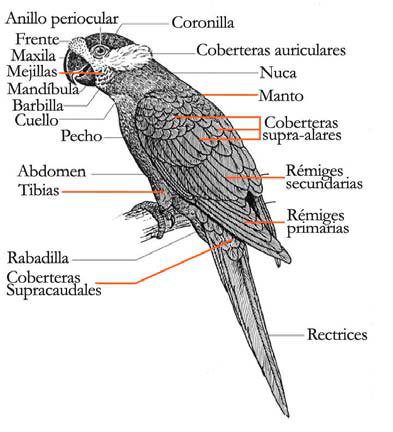
Anatomy-parrots

Description:

28 cm.. length between 110-155 g. of weight.

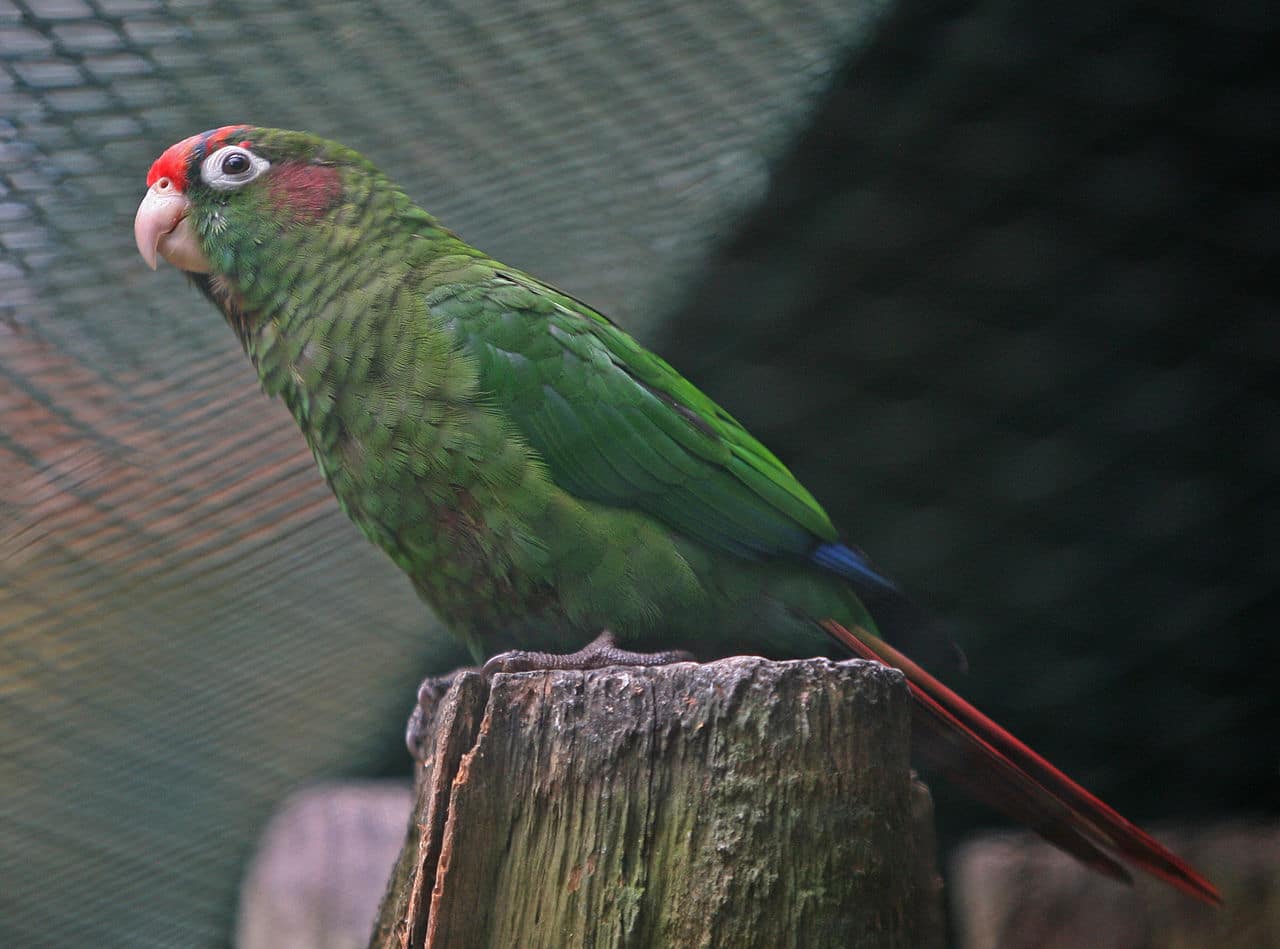
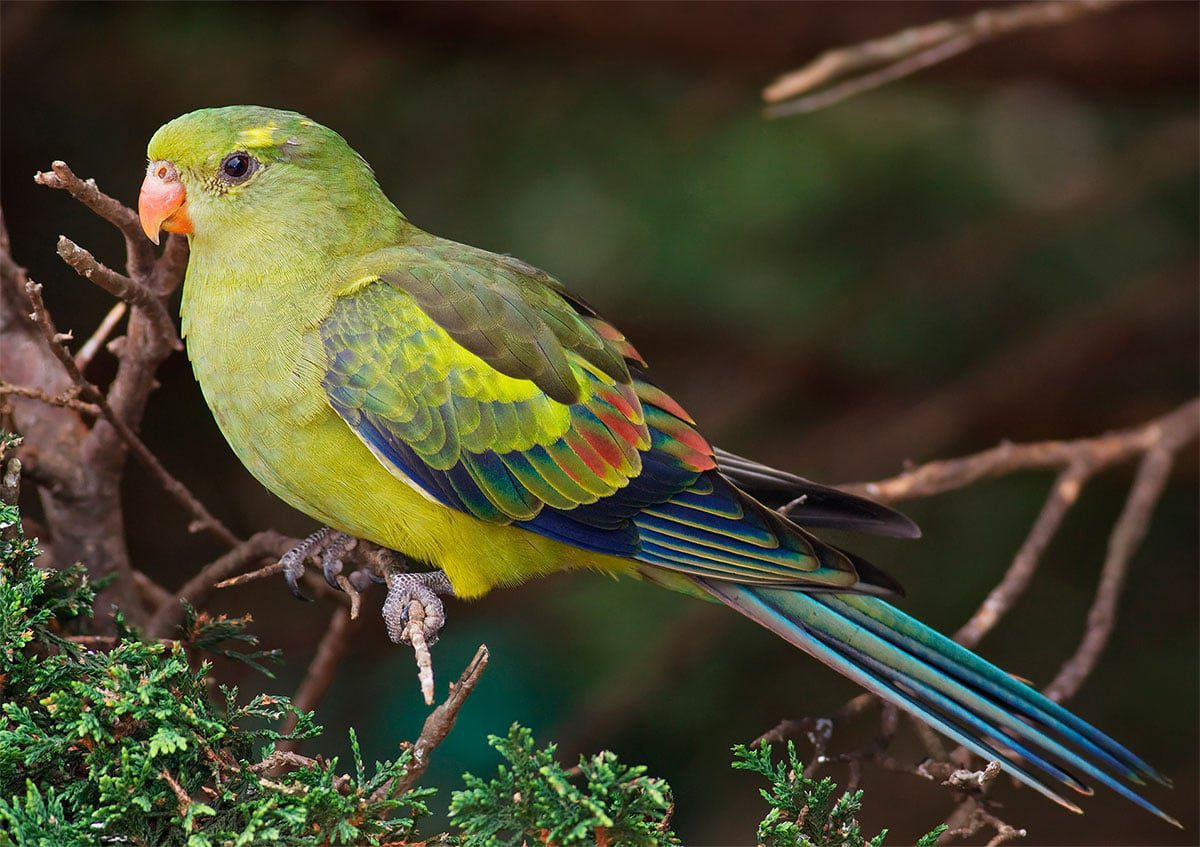
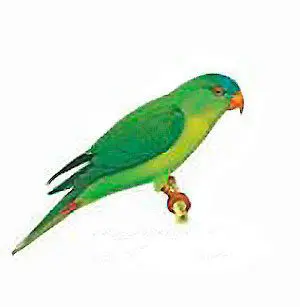
The Blue-bellied Parrot (Triclaria malachitacea) has the head, neck and all the "upper parts" and wing-coverts, grass-green.

Flight feathers grass-green with narrow blue tips to primaries, except the outermost, with a narrow pale blue margin to outerweb. Under, the wings with coverts green, and flight feather, bluish green. The underparts mainly green with large purplish-blue patch on centre of chest and the belly. Upper, the tail It is green with blue tips to central feathers; undertail, bluish green. Bill pink white: cere Pink; brown the irises; legs grey.

The female lacks the patch in the belly blue violet. The immature is as the adult but the respective young male has less blue purple in the underparts.

  • Sound of the Blue-bellied Parrot.

Its singing It is similar to a Thrush (Molothrus).

Habitat:

Blue-bellied Parrot

The Blue-bellied Parrot They live in the humid forests of the low mountains., generally preferring the canopy and the upper floors of tall forest, rich in bromeliads, along watercourses in the valleys. Visit cultivated areas with orchards and plantations and sometimes wooded suburban areas (for example in Sรฃo Paulo).

Mainly observed at altitudes of 300-700 m, perhaps 1,000 meters in some places, but also they inhabit lowlands at sea level. The sporadic nature of reports, with apparent absence of apparently suitable areas, suggests some critical aspects of its little-understood ecology.

Reproduction:

Observed nests in cavities of large trees or stumps of palm. Strongly territorial, at least during breeding, with separation until nests 2 km. The breeding season It covers the months of September to January, maybe a little earlier or later.

Food:

Its diet it's formed, mainly, by fruit, seeds, outbreaks and nectar, some insects and their larvae (looking birds seen flying insects); specific foods include Pachystroma, Actinostemon, Sebastian, Eugenia, Campomanesia and Euterpe edulis, also occasionally Cortex, and citrus plantations.

Distribution and status:

Size of its range (breeding/resident): 361.000 km2

This rare species is endemic Atlantic forests of Southeast Brazil, mainly in Rio de Janeiro, Sao Paulo and Rio Grande do Sul, in the southeast of Brazil. There are additional records South Bahia (none since 1833), Minas Gerais, Brazil (some dubious records), Holy Spirit (four or five sites), Paranรก (three modern records) and Santa Catarina (Mesorregion of the Itajaรญ Valley, Valle de Tijucas and the region of Serra do Mar, in upstate [Rosario 1996, G. Kohler in some. 2011]).

The species is quite common in large forest fragments in the Itajai Valley (G. Kohler in some ., 2011). Due to changes in habitat in the lowlands Santa Catarina, the most recent records in that state come from montane forests (G. Kohler in some ., 2011). Two records in Missions, Argentina, require confirmation. The population was estimated previously less than 5.000 individuals (Lambert et to the ., 1993), But Bencke (1996) suggested that there may be 10.000 in Rio Grande do Sul and significant numbers on the eastern slope of the Serra do Mar; But, the apparent rarity of the species suggests that these figures may be an overestimation (J. Gilardi in litt., 2010). In general, it is suspected that the population is declining, although in the State Park Tres Picos, Rio de Janeiro, It seems to have been stable since 2003 (A. Foster in a bit).

Population little known due to camouflage habits. Perhaps more numerous in the many facing slopes east of the Serra do Mar in Rio de Janeiro and Sรฃo Paulo; habitat loss on a large scale has certainly caused a serious decline in its population, as well as the fragmentation of its distribution area. Although humid upland forests remain in substantial quantities in Serra do Mar, replacement of forests in valleys and on lower slopes with banana plantations could lead to further declines.

Captured for local LBMs and traded in small numbers internationally. There are records of several protected areas, but most of them may be insufficient to support populations of this species due to their low density.

Conservation:


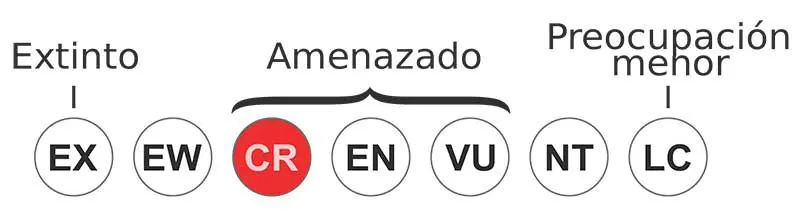
Near-threatened


โ€ข Current category of the Red List of the UICN: Near-threatened.

โ€ข Population trend: decreasing.

Rationale for the Red List category

This species is classified as near threatened because they suspect is in a moderately rapid decline due to loss of habitat and, perhaps to a lesser extent, to the capture for trade bird cage.

Justification of the population

The size of the world's population has not been quantified, but this species is generally described as "rareยป (Stotz et to the ., 1996), although it is locally common in some places.

Justification of trend

Se sospecha una decrease moderate and continuous of the population depending on rates of habitat loss and perhaps, to a lesser extent, capture for the bird trade. The decline is not thought to be faster because the species occurs in montane areas where deforestation is typically less severe., It seems to tolerate mature secondary forests and anecdotal observations suggest that is locally stable, for example in the State Park Tres Picos, Rio de Janeiro. (A. Foster in a bit ., 2013).

The ecology and conservation of the Blue-bellied Parrot in remaining forest fragments in Rio Grande do Sul

This project aims to collect basic information on population, the distribution and ecology of the Blue-bellied Parrot in the center of Rio Grande do Sul, where a large population of the species is rapidly declining due to habitat fragmentation. The use of the radiotelemetry technique will make it possible to determine the area of โ€‹โ€‹use of the species and to evaluate their dispersal capacities.. Biology studies of this species is the objective to determine the elements that make up its diet and collect information on behavior and reproduction.. Through this information, It is intended to outline a regional plan for conservation Blue-bellied Parrot and their habitat, together with local actors. (AU)

Conservation status:

UICN: Vulnerable (with + 2c, d, Cl, Q2a). Previously in danger of extinction (Q2a: see Collar et al., 1994). CITES: Appendix II.

State of national protection: Protected by federal law and included in the list IBAMA of Brazilian species threatened with extinction (Bernardes et al 1990).

"Blue-bellied Parrot" in captivity:

unknown in captivity.

Alternative names:

Blue-bellied Parrot, Blue bellied Parrot, Purple-bellied Parrot (English).
Crick ร  ventre bleu, Caรฏque ร  ventre bleu (French).
Blaubauchpapagei, Blaubauch, Blaubauch-Papagei (German).
Papagaio-de-peito-roxo, araรงoiaba, araรงuaiava, cica, sabiรก-ci, sabiรก-cica (Portuguese).
Loro de vientre azul, Loro Sabiรก-cicรก, Loro Ventriazul (espaรฑol).
araรงoiaba, araรงuaiava, cica, sabiรก-ci, Sabiรก-cica (Brazil).


scientific classification:

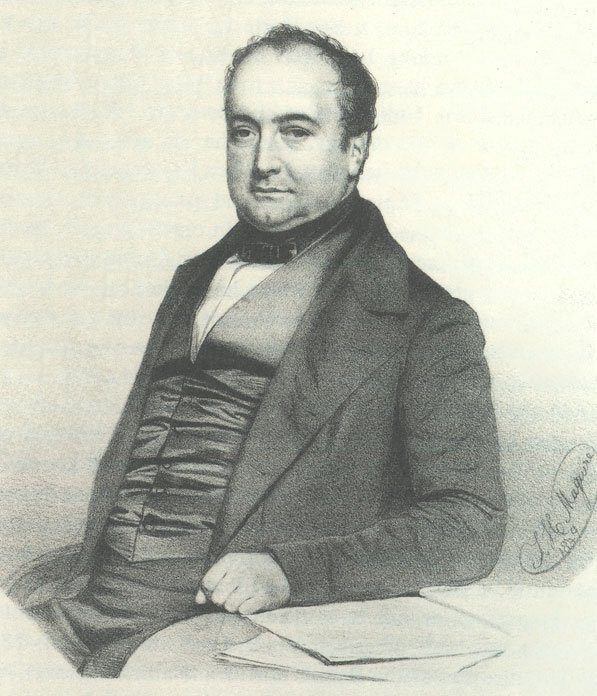
Johann Baptist von Spix

Order: Psittaciformes
Family: Psittacidae
Genus: Triclaria
Scientific name: Triclaria malachitacea
Citation: (von Spix, 1824)
Protonimo: Psittacus malachitaceus


Images ยซBlue-bellied Parrotยป:

Videos "Blue-bellied Parrot"

————————————————————————————————

ยซThem Ventriazulยป (Triclaria malachitacea)


Sources:

Avibase
– Parrots of the World โ€“ Forshaw Joseph M
– Parrots A Guide to the Parrots of the World – Tony Juniper & Mike Parr
– Birdlife

Photos:

(1) – Triclaria malachitacea – Paranapiacaba – Santo Andrรฉ by Carlos HenriqueFlickr
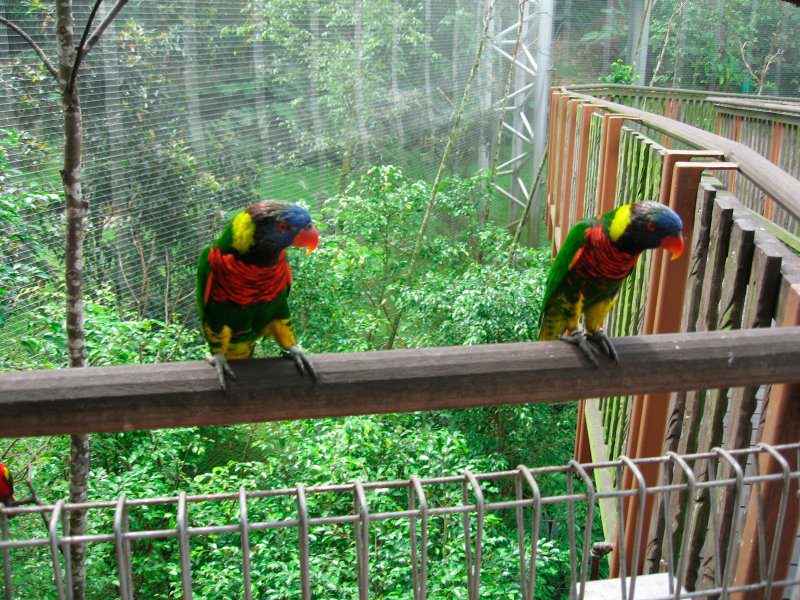
(2) – Blue-bellied Parrot (also known as the Purple-bellied Parrot); two in a cage with a nestbox By TJ Lin [CC BY-SA 2.0], via Wikimedia Commons
(3) – A female Blue-bellied Parrot (also known as Purple-bellied Parrot) at Walsrode Bird Park, Germany By ipfreaks [CC BY-SA 2.0], via Wikimedia Commons
(4) – Rufous-conic (Triclaria malachitacea) – female by Clรกudio Dias TimmFlickr
(5) – Rufous-CICA (Blue-berried Parrot) – Guide to Birds in ePUB by Mรกrcio DuarteFlickr
(6) – Psittacus cyanogaster or Blue-Bellied Parrakeet by Biodiversity Heritage LibraryFlickr

โ–ท The world of Pets: Dogs, cats, birds, reptiles, amphibians

Blue fronted Parrot
Amazona aestiva


Blue fronted Parrot

Content

Description

33-39 cm.. height and weight around the 450 and 550 g..

The Blue fronted Parrot (Amazona aestiva) is distinguished by yellow head, with blue-green forehead and cheek, Dark nostrils, Red shoulders outlined with yellow, wing with red patch and dark blue ends. Rest of the usually green body, more clear towards the belly and tail.

  • The subspecies Amazona aestiva xanthopteryx of Bolivia, has more extensive yellow face and the shoulder is mostly yellow with a small red patch.

  • The subspecies A. to. xanthopteryx (Yellow wing Amazon): Wing coverts of the shoulder area almost exclusively yellow and, in general, creating a stain of greater extension. – From the southwest of Mato Grosso, Brazil, North and East of Bolivia, Paraguay and northern Argentina


Anatomy-parrots

In young coloration is generally more off. The blue and yellow practically do not exist and the iris is dark

Habitat:

Video – "Blue fronted Parrot"

AVES - The Amazon Aestiva, one of the most popular and talkative parrots

Lives in humid forests, Savanna, gallery forest, areas planted with trees and forest with palms, up to 1600m.

Common in pairs or flocks, they have many individuals community roosts.
In this species the sex of the specimens is not distinguished at a glance.

Reproduction:

It nests in holes in large trees.

Breeds between October and March.

The implementation is usually of 3 eggs, and incubation lasts approximately 25 days. Chicks leave the nest to the 60 days.

Food:

Its food consists of fruit, berries, nuts, leaves and seeds.

Distribution:

Amazon Frentiazul location

Interior of South America, from the North-East of Brazil, East of Bolivia, Paraguay, to the North of Argentina.

Conservation:

Not considered under any threat category globally.

State of conservation โ“˜


minor concern Minor Concern โ“˜ (UICN)โ“˜

Protected by the Convention CITES, consisting in annex II (species that may be threatened by a trade out of control).
It is a fairly widespread species in their area of distribution and is considered to have a stable population. However, numbers are declining rapidly in some areas due to capture for trade (both legal and illegal), and to other problems such as the destruction of their habitat and human pressure. Another problem affecting the species is that the average age of populations that exist in freedom is not known.

Blue fronted Parrot in captivity:

He is very smart, curious and loving. They are very sociable and gets along very well with children.

It is one of the best imitators that exist within the group psittacine after grays.
With its strong beak, as any Parrot, She likes chewing everything that gets you ahead. So, newcomer to our home, It is necessary to pay close attention.

It has a social behaviour so it is important to look for a partner. A large aviary and the possibility of going out every day are necessary.
If it feels threatened, It opens its wings between loud cries and wild-eyed.
Water love it. Released, When it rains, enjoy, in the rain, with open wings. The ideal humidity for a Blue fronted Parrot is of the 60-70%, which is impossible in an apartment during the winters in the heat of radiators. It is therefore necessary the use of humidifiers.

The staple food is made up of different types of nuts, sunflower seeds, pumpkin seeds, corn, wheat, etc. Important for a healthy diet are fruits and vegetables. These must be offered fresh every day.
Just before the breeding season, our birds must be provided with foods rich in calcium and protein, for example egg cooked.
Multivitamin supplements complete proper nutrition.

The female lays two to five eggs that incubate for an approximate period of 25 to 28 days.

Alternative names:

Blue fronted Parrot, Blue-fronted Amazon, Blue-fronted Parrot, Turquoise-fronted Amazon, Turquoise-fronted Parrot (English).
Amazone ร  front bleu (French).
Blaustirnamazone, Rotbugamazone (German).
Papagaio-verdadeiro, papagaio-colareiro, papagaio-comum, papagaio-curau (Portuguese).
Amazona Frentiazul, Amazona Sudamericana, Loro hablador, Lora frente azul (espaรฑol).

scientific classification:

Order: Psittaciformes
Family: Psittacidae
Genus: Amazona
Scientific name: Amazona aestiva
Citation: (Linnaeus, 1758)
Protonimo: Psittacus aestivus


Species of the genus Amazona


Sources:
– Parrot Book, Parrots and macaws Neotropical
avibase
– SEO.org
– Photo: birdnest
– Sounds: Diego Caiafa

โ–ท The world of Pets: Dogs, cats, birds, reptiles, amphibians

Orange-breasted Fig-Parrot
Cyclopsitta gulielmitertii

Orange-breasted Fig-Parrot

Content


Anatomy-parrots

Description

11 to 13 cm.. length and a weight between 27 and 34 g..

The forecrown of the Orange-breasted Fig-Parrot (Cyclopsitta gulielmitertii), back of the crown and area behind the eyes are a deep blue; pale yellow the lores, throat and both sides of the head; black spot on the back of the cheek; Orange the top part of the abdomen; the interior of the wing-coverts Yellow-edged; wide bands of pale yellow under the wings. Bill blackish gray. The eyes dark brown.

The female similar to the male, but pale yellow on the front of the cheeks black and white on the back. Frontal of the cheeks bordered below green with blue stripe; the ear-coverts on both sides of neck, orange; underparts green.

The immature as females, but orange, Since the ear-coverts and sides neck to the area below, faced with the cheeks; chest male washed with orange-brown.

Subspecies description

Description of the 7 subspecies
  • Cyclopsitta gulielmitertii gulielmitertii

    (Schlegel, 1866) – The nominal


  • Cyclopsitta gulielmitertii nigrifrons

    (Reichenow, 1891) – 13 cm.. length. Area of the forecrown, crown and behind the eye, black. Female without chest Neither abdomen orange, cheeks white-yellowish color bordered by a blackish band. back of the cheeks and headphones feathers bright orange. Under black band greenish blue. The youth they are equal to adults.


  • Cyclopsitta gulielmitertii ramuensis

    (Neumann, 1915) – It is more small, of about 11 cm.., with the area of the forecrown, crown and behind the eye Black interspersed with dark blue, cheeks and headphones feathers whitish in colour. Breast and abdomen cream color. females as males but behind the eye and cheeks with a broad black patch interspersed with dark blue. Breast whitish interspersed with orange feathers. Abdomen brighter yellowish green. The youth equal to adults.


  • Cyclopsitta gulielmitertii amabilis

    (Reichenow, 1891) – It is more small, a few 11 cm.. Forehead, crown and rear of the eye matte black. Cheeks Black interspersed with dark blue. females similar to the males but with the patch from behind the eye Black interspersed with dark blue matte. Headphones feathers whitish. The juveniles as in adult females but with the upper part of the chest greener


  • Cyclopsitta gulielmitertii suavissima

    (Salvadori, 1876) – Smaller, a few 11 cm.., area of the forecrown, crown and behind the eye blue color, great patch on cheek black. Headphones feathers and cheeks white-yellowish color and chest and top of the abdomen reddish orange. The female It has a hue of different reddish orange and black spot of the cheek is Matt and interspersed with dark blue color. The youth adult females are, but marks of the head they are more off.


  • Cyclopsitta gulielmitertii fuscifrons

    (Salvadori, 1876) – As the diophthalma gulielmitertii suavissima but the area of the forecrown, crown and back of the eye, blackish brown. The females similar to the Cyclopsitta gulielmitertii suavissima but back of the cheeks, front and behind the eyes blackish brown. The youth as adult females.


  • Cyclopsitta gulielmitertii melanogenia

    (Rosenberg,HKB, 1866) – Of 11 cm.. length. The male is as the diophthalma gulielmitertii suavissima, the female also with the fused in light green Orange tones in the abdomen. The youth are like adults.

Habitat:

It is distributed in the rainforest, swamp forest, forest of Melaleuca , dense sheets and partially cleared areas from sea level to a 300 meters above sea level, rarely recorded in higher altitudes to the 800 m, the largest known altitude is 1.100 m.

They are usually in small groups assets of 6 to 10 individuals, whether it is flying above the treetops, or congregate where can feed on figs and other fruits in the canopy or plants at lower levels.

Bird feeding can be hard to spot, since they climb around the silent tree trunks, although they can pivot upside down as they feed, sometimes dropping food.

Reproduction:

The nests of the Orange-breasted Fig-Parrot found in arboreal termite, at the top of the trees of the forest. Up to three holes can be dug., and nesting they can be community. The nests also found at the base of a complex of epiphytes. There is little information available upon the breeding season, activity in apparent nests have been observed between the months of September and June. These sites can, However also, have been used to settle, and a record in January of a male regurgitating food near an entrance hole probably indicates breeding during that month at least..

Food:

The diet includes seeds of figs and other fruits, as well as small whole figs, nectar flower e insects occasional.

Distribution:

Widely distributed, abundant and easily observable in the lowland tropical rainforest, throughout much of New Guinea. The Orange-breasted Fig-Parrot most Western they are isolated, only seen in Salawati in the West of the islands of papua, and in the lowlands of theDoberai Peninsula, West Papua.

In other parts of New Guinea the range is continuous through the lowlands of the North of the eastern edge of Yellowfinch Bay around the memberamo river, throughout the region of the Sepik River and the lowlands of the Huon Peninsula, to Milne Bay, at the eastern end.

The range continues west through the southern lowlands of New Guinea through the Purari and Fly River regions to the southeastern lowlands of West Papua, on the 138 ยฐ E; also in the islas Aru.

The Orange-breasted Fig-Parrot seems to be more common in southern New Guinea in the North.

Subspecies distribution

Distribution of the 7 subspecies
  • Cyclopsitta gulielmitertii gulielmitertii

    : The nominal


  • Cyclopsitta gulielmitertii nigrifrons

    : North of New Guinea between Mamberamo and Sepik Rivers.


  • Cyclopsitta gulielmitertii ramuensis

    : District Ramu River, North of Papua New Guinea; It is thought that it may be a cross between the nigrifrons and the amabilis, therefore, probably not a valid subspecies.


  • Cyclopsitta gulielmitertii amabilis

    : Northwest of Papua New Guinea from peninsula Huon to Milne Bay.


  • Cyclopsitta gulielmitertii suavissima

    : Southwest of Papua New Guinea West of Gulf of Papua.


  • Cyclopsitta gulielmitertii fuscifrons

    : South of New Guinea between Mimika and Fly Rivers.


  • Cyclopsitta gulielmitertii melanogenia

    : Aru Islands, Indonesian.

Conservation:


minor concern


โ€ข Current IUCN Red List category: Least concern

โ€ข Population trend: Stable


The size of the world population It has not been quantified, due to the recent taxonomic divisions, Although it is estimated above 100,000 specimens.

The population suspected to be stable in the absence of evidence of any reduction or substantial threats.


"Orange-breasted Fig-Parrot" in captivity:

Rare in captivity.

Alternative names:

Orange-breasted Fig-Parrot, Blue-fronted Fig-parrot, Orange-breasted Fig Parrot, Orange-breasted Fig-Parrot (nominate), Orange-breasted Fig-Parrot (Orange-breasted) (ingles).
Psittacule ร  poitrine orange, Psittacule ร  poitrine orange (nominal), Psittacule ร  poitrine orange (nominale), Psittacule ร  poitrine orange (race nominale) (French).
Orangebrust-Zwergpapgei (German).
Cyclopsitta gulielmitertii (Portuguese).
Lorito de Pecho Naranja, Lorito Pechinaranja (espaรฑol).

scientific classification:

Order: Psittaciformes
Family: Psittaculidae
Scientific name: Cyclopsitta gulielmitertii
Citation: (Schlegel, 1866)
Protonimo: Psittacula gulielmi III

Images ยซOrange Breasted Parrotยป:

Videos "Orange-breasted Fig-Parrot"

————————————————————————————————

ยซOrange Breasted Parrotยป (Cyclopsitta gulielmitertii)


Sources:

Avibase
– Parrots of the World โ€“ Forshaw Joseph M
– Parrots A Guide to the Parrots of the World – Tony Juniper & Mike Parr
– Birdlife
– Loromania

Photos:

(1) – animalphotos
(2) – A female Orange-breasted Fig-parrot in the Walsrode Bird Park, Germany By Quartl (Own work) [CC BY-SA 3.0], via Wikimedia Commons
(3) – A male Orange-breasted Fig-parrot in the Walsrode Bird Park, Germany – ยซCyclopsitta gulielmitertii qtl1ยป by QuartlOwn work. Licensed under CC BY-SA 3.0 via Wikimedia Commons.
(4) – Birds-pet-wallpapers
(5) – animalphotos

Sounds: Frank Lambert (Xeno-canto)

โ–ท The world of Pets: Dogs, cats, birds, reptiles, amphibians

Bourke's Parrot
Neopsephotus bourkii


Bourke's Parrot

Content


Anatomy-parrots

Description

19 cm. length and an approximate weight of 39 g..

The Bourke's Parrot (Neopsephotus bourkii) has frontal area white. The chin, lores and contour of the eyes they are also white and form a kind of orbital ring clear when seen from a distance.

The ear-coverts and upper cheeks they are dark brown with pink dots and specks. The pileum and the neck are greenish-Brown, with darker edges.

The upperparts are brown-grey color with pale edges on scapulars.

The rump and the top of the tail has darker tones, with some pale blue on the sides. The curvature of the wing is blue.

The small coverts are blue, the median they have light blue, the greater coverts they have a dark tint with yellow-white and blue pink.

The flight feather primaries and secondaries are mostly blue.

The underparts is blue.

The breast feathers are brown with pink ends, giving an appearance of general pinkish brown.

The abdomen is bright pink.

Thighs, lower flanks, side of the rump, under belly and lower area of the tail they have a light blue color. The upper part of the tail infiltrates with bluish-grey.

The bill is greyish black, no hook in upper jaw. The irises They are brown, legs grey-brown.

The female in General, the colors are off and the blue coloration is very little visible or is absent.

The youth they are equal to the female adult but more muted, with a pale band under the wings which is less pronounced in the male juvenile

For a long time, the Bourke's Parrot It was classified in the genus Neophema. A number of ornithologists, more and more, is of the opinion that this parakeet does not belong to this genus and species have been classified in a separate genus called Neopsephotus.

Habitat:

The Bourke's Parrot they are distributed among the driest inland areas.
They mark a strong preference for scattered areas of mulga (Acacia aneura) but does not disdain the plantations of eucalyptus. Can also be observed in plots along streams and afforestation of Callitris which are conifers belonging to the family of cypress.

Son nomads and slightly Twilight. These birds establish themselves in a territory and remain there for several years before disappearing completely.. The Bourke's Parrot they can be very sociable. During periods of drought, You can meet thousands around the water wells and springs.

During the months of summer, We can see them in the morning and in the evening around the ponds.

In Winter, these parakeets come to drink during the day in the company of species of doves such as the common bronze pigeon (Phaps chalcoptera). In places close to the drinking fountains, the Bourke's Parrot They fly in Group emitting loud cries and making whistling wings. But, These parakeets sometimes go unnoticed, they are able to rest or to eat ground in pairs or in small groups. They remain in silence on the floor or hide in the dead wood that serves as camouflage. There are more assets during the sunset.

Reproduction:

The Bourke's Parrot they usually reproduce in August to december, but the season can vary depending on rainfall. The courtship of this bird are similar to those of other species of Parrot Neophema. Males approach the female in upright position with outspread wings and tail.

The nest is located in one a tree cavity, between 1 and 3 meters above the ground. The laying is formed by between 3 and 6 eggs they are incubated during at least 18 days. There are often two broods in the season. The female leaves the nest only once a day in order to be replenished by the male.. The male is also in charge of mounted guard, patrolling and emitting calls in the vicinity of the nest, with the intention to deter intruders.

At birth, the chicks have a white marker, are altricial and remain in the nest for at least 4 weeks. They remain dependent on their parents during a week after feather.

Food:

The Bourke's Parrot they are almost exclusively vegetarian: they eat grass seeds, especially those that are dispersed by the wind. They also eat herbs collected in the soil and in the bushes. These parakeets also appreciate the fresh young shoots and seeds of Acacia or of Bassia, which are small shrubs belonging to the category of Chenopodium album.

Distribution:

Scattered through the interior of Australia, where are nomads but locally common.

The species ranges from the West coast of Western Australia around the inside of Geraldton to rรญo Ashburton and South, through Leonora, and through Gibson and the Great Victoria desert in the South of the Northern Territory, about 20 ยฐS.

Extends from the Northwest of Southern Australia, South-East through Woomera until Port Augusta, that also extends to the North through Oodnadatta and the regions of the Lake Eyre and the Lake Frome.

The birds, to the This of the Montes Flinders You can isolate, since there are no records between 139ยบ and 140 ยฐE.

Apparently, the species has declined in the center of New South Wales due to overgrazing by cattle and rabbits, and is now mainly in the West, from the surroundings of Broken Hill, to paroo river; nomads, However, There have been more towards the This, in the surroundings of Narrandera in the South and the Lightning Ridge in the North.

In the South of Queensland, the Bourke's Parrot are distributed to the This, about Dirranbandi and Cunnamulla. and in the North until Windorah.

Escapes There have been around Brisbane.

The world population is considered to be more of 50.000 specimens.

The species is probably increasing in the west due to agricultural expansion including the provision of artificial irrigation sites..

Conservation:


minor concern


โ€ข Current category of the Red List of the UICN: Least concern

โ€ข Population Trend: Growing

It is estimated one population superior to the 50 000 individuals.

In the western part of its range, the numbers are growing, probably due to the development of agriculture and the installation of new irrigation areas. The reason for its development can also be found in the reduction of sheep farming and the replacement of saline areas with grass..

"Bourke's Parrot" in captivity:

The Bourke's Parrot they are very good birds for beginners amateurs, easy-to-play.

It is a bird peaceful, silent and that it is active only in the first and last hours of the day. Son calm and confident by nature and easy to maintain. It has almost no cravings for crack and your bathroom need depends on the individual. A dry climate supports well, but it is sensitive to cold and wet fog.

Les gusta estar en tierra firme y son susceptibles a la infecciรณn por gusanos, tambiรฉn son susceptibles a infecciones oculares.

With regard to its longevity, according to sources, a sample lived 12,6 years in captivity. In captivity, estos animales pueden criar, approximately, to the 2 years of age.

Alternative names:

Bourke’s Parrot, Blue-vented Parakeet, Blue-vented Parrot, Bourke Grass-Parakeet, Bourke Parakeet, Bourke Parrot, Bourke’s Grass-Parakeet, Night Parrot, Pink-bellied Parakeet, Pink-bellied Parrot, Sundown Parrot (ingles).
Perruche de Bourke (French).
Bourkesittich, Bourke-Sittich (German).
Periquito-rosa (Portuguese).
Papagayo de Bourke, Periquito Rosado (espaรฑol).

scientific classification:

John Gould
John Gould

Order: Psittaciformes
Family: Psittaculidae
Genus: Neopsephotus
Scientific name: Neopsephotus bourkii
Citation: (Gould, 1841)
Protonimo: Euphema Bourkii

Images "Pink Periquito":

Videos "Bourke's Parrot"

————————————————————————————————

"Pink Periquito" (Neopsephotus bourkii)


Sources:

Avibase
– Parrots of the World โ€“ Forshaw Joseph M
– Parrots A Guide to the Parrots of the World – Tony Juniper & Mike Parr
– Birdlife

Photos:

(1) – Bourkeโ€™s parrot (Neopsephotus bourkii) By Flickr user Jan Tik (Flickr) [CC BY 2.0], via Wikimedia Commons
(2) – Bourkeโ€™s Parrot – Neopsephotus bourkii taken at the Cincinnati Zoo and Botanical Gardens By Greg5030 (Own work) [CC BY-SA 3.0], via Wikimedia Commons
(3) – Bourkeโ€™s Parrot Neopsephotus bourkii. Wild pair at Bowra Station, near Cunamulla, Queensland, Australia By Bruce Kendall (Own work) [CC BY-SA 3.0 or GFDL], via Wikimedia Commons
(4) – A male Bourkeโ€™s Parrot at the Flying High Bird Sanctuary, Apple Tree Creek, Queensland, Australia By paulgear (Picasa Web Albums) [CC BY-SA 3.0], via Wikimedia Commons
(5) – Neopsephotus bourkii (formally placed in genus Neophema) By Jan Tik (originally posted to Flickr as Hitchhiker) [CC BY 2.0], via Wikimedia Commons
(6) – By T.H. Maguire (1821โ€“1895) (http://www.birdresearch.dk/dk/jgould.htm) [Public domain], via Wikimedia Commons

Sounds: Tom Tarrant (Xeno-canto)

โ–ท The world of Pets: Dogs, cats, birds, reptiles, amphibians

Lilac-crowned Parrot
Amazona finschi

Lilac-crowned Parrot

Content

Description:


Anatomy-parrots

33 cm. head to tail and weighs on average 310 g..

The Lilac-crowned Parrot (Amazona finschi) has the forecrown and the higher lords, red off; the lower lores, the cheeks and ear-coverts, pale lime green; crown, sides neck and nape, lilac or pale blue with some feathers crown showing narrow black margins.

Mantle green with broad black edges giving distinct scalloped effect; back and scapulars weak green with black borders to some feathers; rump and uppertail-coverts, green, slightly brighter than the back. Wing coverts green. Primaries blue toward the tip, green at the base; the base outerweb the first five secondaries, red with subterminal band yellow and blue tips, secondaries, otherwise, green, becoming blue at tips. Under the wings, brighter yellowish green; flight feather dull green.

Lilac-crowned Parrot

Throat yellowish green with bluish tint to some feathers; remaining underparts, yellowish-green with black margins to some feathers (especially in the chest), giving scalloped effect. Tail green tip yellowish green, lateral feathers blue margin to the base of the outerweb. Bill color horn; irises orange red; legs grey.

Both sexes are similar. Immature has the irises dark brown (rather than red).

  • Sound of the Lilac-crowned Parrot.

Habitat:

"Lilac-crowned Parrot"

Lilac Crowned Amazons (Amazona Finschi)

The Lilac-crowned Parrot Living mainly in wooded hills and mountains, from the tropical zone in the lower levels of the deciduous forests, to the forests of oak and pine-oak forest in the highlands, preferably through the valleys with lush vegetation along streams that run on the basis of cannons; often also in areas of arid or semi-arid vegetation, or clear forest edge, coming into cultivated areas and orchards adjacent to the forest.

mainly in altitudes of 600 to 2.000 m, but recorded at sea level Sinaloa and from sea level to the temperate forest Colima. observed between 360-1.700 metres in Sonora and 880-1.480 metres in Oaxaca. Usually in pairs or small groups, although larger groups are formed in the dry season (500 birds reported) and in communal roosts (more than 1,000 birds reported in the same place Nayarit).

Reproduction:

They nest in tree hollows (for example, Ficus), including old nests woodpeckers (for example, Phloeoceastes) or arboreal termite mounds.

The breeding season It comprises from February to June, nesting with a cycle consisting of 28 incubation days eggs, followed by two months of growth of chickens in the nest (Forshaw 1989, Renton 1998, 2002).

Food:

Eating habits are poorly documented: It has been observed a particular preference for figs. During the dry season the diet consists mainly of Astronium graveolens, Brosimum alicastrum, Celaenodendron mexicanum, Comocladia engleriana and Ficus insipida. during the rains The diet consists of species such as Caesalpinia pulcherrima, Celaenodendron mexicanum, Esenbeckia nesiotica, Jatropha spp and Sciadodendron excelsum (Renton 1998, 2001)

cause some crop damage corn and banana.

They have been observed wild species groups, feeding with the Red-crowned Parrot (Amazona viridigenalis) in Los Angeles, California.

Distribution:

Size of its range (breeding/resident): 372.000 km2

The Lilac-crowned Parrot inhabits Pacific coast of Mexico, from the southeast end of Sonora and Southwest Chihuahua, to the South by Sinaloa, Durango Western, Nayarit, Jalisco, Colima, Michoacรกn and Warrior, until Oaxaca, west of Isthmus of Tehuantepec.

It is mostly residents, but outside the breeding season, visit during autumn, lowlands, for example in Oaxaca. generally common. Described as fairly common locally in southeastern Sonora. abundant in Colima. Very rare in the highlands of Oaxaca. Several wild populations reported in several locations in the United States.

Conservation:

State of conservation โ“˜


Endangered Endangered โ“˜ (UICN)โ“˜

โ€ข Current category of the Red List of the UICN: In danger of extinction.

โ€ข Population trend: Decreasing.

โ€ข Population size : 4700-6700.

Rationale for the Red List category

    This species has been selected in danger of extinction because it is suspected that is decreasing very quickly as a function of contractions recorded ranges and due to the unsustainable exploitation and loss of habitat.

Justification of the population

    Renton and Elias (2003) estimate the world population between 7.000 and 10.000 individuals, based on surveys covering most of the global range of the species. This equates to approximately 4.700-6.700 mature individuals. An estimate that 5.400 individuals each year are caught illegally in Mexico (Cantu et al ., 2007), implies that the estimation of population Renton and Elias (2003) could be an understatement, but it remains in this evaluation to best data available.

Justification of trend

    It is suspected that the population of this species is in decline very fast, based on a study of Marin-Togo et al . (2012), who estimated the current distribution of this species along the Pacific coast of Mexico and he showed a reduction 72.6% its estimated original distribution.
Threats

โ€ข The Capture for national and international trade It is the greatest threat to wild populations.

โ€ข It is highly valued in trade (Cantu et al., 2007) and it was the kind of Amazon parrot most caught in the early eighties (Inigo-Elias y Ramos 1991).

โ€ข The illicit trade is intense and widespread, and Lilac-crowned Parrot It is one of the most frequently confiscated Mexican parrots (K. Renton in litt., 2005).

โ€ข During the period 1981-2001, were registered 4.061 individuals in international trade, of which 79% It was exported directly from Mexico and the 64% it took Nature (CITES 2004a).

โ€ข Remains one of the five species of Mexican parrots most caught, with an estimated 5.400 individuals / year caught illegally Mexico (Cantu et al ., 2007).

โ€ข Los Adults and young people are easily trapped in large numbers due to their habit of congregating at communal shelter sites in the late afternoon (Renton 2005, K. Renton in some 2005).

โ€ข Chicks are commonly poached from nests (K. Renton in litt., 2005).

โ€ข During interviews with local people throughout the range of the species, the 75% reported poaching in your area (K. Renton in litt., 2005).

โ€ข Also, it is said that this species requires semi-deciduous forest with tall mature trees for nesting and can not adapt to the changed areas nesting (Marin-worm Togo et al ., 2012).

โ€ข Habitat loss and degradation, mainly for conversion to small and large crops and pastures (K. Renton in some . 2007, A. Salinas in some . 2007, Ortega-Rodriguez and Monterrubio-Rico 2008), are serious threats, with the semi-deciduous forest along the Pacific coast lost at a higher rate than any other type of forest in Mexico (Masera et al ., 1996, K. Renton in litt., 2005), It is resulting in the destruction of nesting sites and reducing the extent of this crucial critical habitat (Renton 2005).

โ€ข In Michoacรกn, nesting areas potentially more accessible, as plains or hills, have been converted to livestock or agricultural farms (Ortega-Rodriguez and Monterrubio-Rico 2008).

โ€ข Large development projects, such as dams, also they resulted in loss of breeding habitat for the species (K. Renton in some ., 2007).

โ€ข The semi-deciduous forest now covers only 5.106 km2 within the range of the species (Renton and Elias 2003, K. Renton in litt., 2005).

โ€ข The decrease in rainfall that could result from the global climate change would lead to a decrease in the reproductive potential of wild populations in tropical dry forests (K. Renton in some ., 2007).

โ€ข Despite the various pressures on habitats, by showing that the species has disappeared from more than 70% of its former range, Marin-Togo et al. (2012), has reinforced the view that the capture pressure is the predominant threat to the species.

Conservation Actions Underway

โ€ข In 1999, the Mexican government established a Conservation Plan, Protection and Recovery Psitรกcinos in Mexico, in which the Lilac-crowned Parrot It is considered a priority species (Macias Caballero et al ., 2000).

โ€ข In 2004, the species was updated to Appendix 1 of CITES and in 2007 It approved a proposal to change its state species conservation 2008 of "threatenedยป a ยซin dangerยป under the Mexican wildlife law (K. Renton in some.)

โ€ข In Mexico, They have made considerable efforts to combat illegal domestic trade, with at least 52 seizures during 1997-2003 (CITES 2004b).

โ€ข Inspections carried out in Mexico They resulted in the seizure of 266 live individuals of the species that were offered illegally in the pet trade between 1995 and 2003 (CITES 2004b).

โ€ข The species It is in three biosphere reserves; Sierra de รlamos-Rรญo Cuchujaqui flora and fauna protection area in Sonora meridional, and Reserva de la biosfera Chamela-Cuixmala and Biosphere Reserve Sierra de Manantlรกn, in Jalisco, and according to sources, It is distributed in seven other important bird areas; However, some of them lack official protection or conservation programs (CITES 2004a)

Conservation Actions Proposed

โ€ข Monitor the demographic trends through regular surveys.

โ€ข Monitor levels of destruction and degradation of habitat.

โ€ข Implement trade regulation strategies in the plan 1999.

โ€ข Carry out extension work and environmental education as described in the plan 1999.

โ€ข Perform the habitat conservation and recovery of wild populations as it recommended in the Plan 1999.

โ€ข Monitor the success of the strategies of the plan of 1999.

โ€ข Protect the rest of the tropical forest supports in areas where the slope is greater than 6 ยฐ: ideally all areas on steep slopes should be restored to forest, to provide habitat for all native wildlife (including the Lilac-crowned Parrot)

โ€ข Prevent soil erosion AND promote alternative economic activities in rugged coastal areas such as recreation and tourism. (Ortega-Rodriguez and Monterrubio-Rico 2008).

The Lilac-crowned Parrot in captivity:

Very popular as a pet throughout its area of distribution; It has cultural value as a pet or ornamental bird by its feathers; ability to imitate sounds and its tendency to form bonds with people; widespread in captivity internationally.

Currently protected by the Appendix 1 of CITES.

Each copy captive of this species which is capable of reproducing, should be placed in a well-managed breeding program in captivity and not be sold as a pet, with the objective of ensure their survival long-term.

Alternative names:

Finsch’s Parrot, Lilac crowned Parrot, Lilac-crowned Amazon, Lilac-crowned Parrot, Pacific Amazon, Pacific Parrot (English).
Amazone ร  couronne lilas, Amazone de Finsch, Amazone verte de Finsch (French).
Blaukappenamazone (German).
Papagaio-de-finsch (Portuguese).
Amazona de Corona Violeta, Amazona Guayabera, Loro Corona Lila, loro corona-lila, Loro Corona-violeta (espaรฑol).


scientific classification:

Philip Sclater
Philip Sclater

Order: Psittaciformes
Family: Psittacidae
Genus: Amazona
Scientific name: Amazona finschi
Citation: (Sclater, PL, 1864)
Protonimo: Chrysotis finschi


Images Lilac-crowned Parrot:


Species of the genus Amazona


Sources:

Avibase
Parrots of the World โ€“ Forshaw Joseph M
Parrots A Guide to the Parrots of the World – Tony Juniper & Mike Parr
Birdlife
Naturalist

Photos:

(1) – Lilac-crowned Parrot by Tom BensonFlickr
(2) – Lilac-crowned Amazon perching on a branch By Amazona_finschi_-perching_on_branch-8.jpg: Cรฉdric Allierderivative work: Snowmanradio [CC BY 2.0], via Wikimedia Commons
(3) – Lilac-crowned Amazon (Amazona finschi) by Emilie ChenFlickr
(4) – Lilac-crowned Parrot by wplynnFlickr
(5) – A pet Lilac-crowned Amazon; head and neck By Gary Denness (originally posted to Flickr as Pretty Boy) [CC BY 2.0], via Wikimedia Commons
(6) – Lilac-crowned Amazon; two in a cage By TJ Lin (originally posted to Flickr as DSCN0549) [CC BY-SA 2.0], via Wikimedia Commons
(7) – Lilac-crowned Amazon (Amazona finschi) By CDest [Public domain], via Wikimedia Commons
(8) – Lilac-crowned Amazon at the Arizona-Sonora Desert Museum, Tucson, Arizona, USA By DrStarbuck from Madison, WI, USA (Arizona-Sonora Desert Museum 18) [CC BY 2.0], via Wikimedia Commons
(9) – A Lilac-crowned Amazon at Arizona-Sonora Desert Museum, USA By Dave Bezaire & Susi Havens-Bezaire [CC BY-SA 2.0], via Wikimedia Commons
(10) – Amazona finschi Uploaded by Francisco_aviarioPhotobucket

Sounds: Richard E. Webster, XC353198. accessible www.xeno-canto.org/353198

โ–ท The world of Pets: Dogs, cats, birds, reptiles, amphibians

Palm cockatoo
Probosciger aterrimus

Content

Description

51 to 64 cm. height and a weight between 910 and 1200 g.
The Palm cockatoo (Probosciger aterrimus) it is one of the largest cockatoo species. Unmistakable with a Erectile Crest of 15 cm.. Mainly arboreal.

Both sexes differ in size. Immatures are differentiated by the pale yellow at the bottom and the tip of the bill and the eye ring in color white.
Usually black with a bare area around the cheeks and eyes red. The feathers of the crest they are long and thin, black streaks.
The bill is dark gray, smaller in the female. The legs son grises. The language is black and Red.
The cheek skin changes color according to its health or stress level, a pink / beige to a yellow when it is excited.

Description 4 supespecies

  • Probosciger aterrimus aterrimus

    (Gmelin, 1788) – Nominal.


  • Probosciger aterrimus goliath

    (Kuhl, 1820) – Larger than the subspecies macgillivrayi.


  • Probosciger aterrimus macgillivrayi

    (Mathews, 1912) – Larger than the species nominal.


  • Probosciger aterrimus stenolophus

    (Oort Cloud, 1911) – As the subspecies goliat, but with feathers crest closer.

Habitat:

The presence of this cockatoo is documented from sea level to 1350 metres in height.

In New Guinea they are in tropical rainforests, including gallery forests, edges of forests and monsoon forests. In Australia they live in forests of eucalyptus, forest of Melaleuca, partially cleared areas and sheets.

You are travelling individually, in pairs or in groups of five or six. About an hour after sunrise they gather in the treetops.

Reproduction:

The nesting occurs between August and February.
Nest in the cavities of trees which tend to be of approximately 1 m depth and 25 to 60 cm in diameter. These are full of branches broken at the bottom on which rests the egg. The site is often used year after year.
Reproduce every two years. They put a single egg and both parents the hatch for a period of 28 to 31 days, at around 3 to 4 more days to hatch. The squab was born completely naked and does not develop marker, unlike other Cockatoo chicks. They are taken from 100 to 110 days to leave the nest, the longest period among all parrot species. After leaving the nest, the young bird depends on the parents at least others 6 weeks because of its inability to fly.

Food:

Seeds, dried fruits, fruit, berries, sprouts leaves and insect larvae.
They feed mainly in the forest canopy, but can also feed on the ground on fallen fruits and seeds.

Distribution:

Size of the area of distribution (reproduction / resident): 716.000 km2

New Guinea and adjacent islands, North of Queensland, Australia.

Distribution 4 subspecies:

Conservation:

State of conservation โ“˜


minor concern Minor Concern โ“˜ (UICN)โ“˜

โ€ข Least concern according to IUCN classification.

โ€ข Population trend: Decrease

This species has a very large range, and therefore not approaching the threshold of vulnerability. While the trend of the population seems to be decreasing, the decline is not believed to be fast enough to approach vulnerable bird thresholds based on population trend criteria.

In some parts of its area of distribution, the forest habitat in which occur the hollow trees is being invaded by the rainforest.

"Palm cockatoo" in captivity:

Rare bird cage, Although they have a great demand for the market of pet due to its unusual appearance.
They can live more than 55 years of age in captivity.

They may develop compulsive behaviors, as the pecking of feathers. They can also mimic sounds and human language.

Aggressiveness within pairs is taken into account for captive breeding., Sometimes the male usually kill the female. As such, There are more different management methods, from bringing both cockatoos together only during the breeding period and quickly removing the male, cut the male that the female escape flying, or create complex installations that are carried out next to a cutout of the male, so that the female always has an escape route in the face of aggression.

There are currently laws that prohibit the export of any Palm cockatoo without a permit.

Alternative names:

Palm Cockatoo, Black Macaw, Goliath Aratoo, Goliath Cockatoo, Great Black Cockatoo, Great Palm Cockatoo (English).
Cacatoรจs noir, Microglosse noir (French).
Arakakadu (German).
Cacatua-das-palmeiras (Portuguese).
Cacatรบa de las Palmas, Cacatรบa Enlutada (espaรฑol).

scientific classification:

Order: Psittaciformes
Family: Cacatuidae
Genus: Palm
Scientific name: Probosciger aterrimus
Citation: (Gmelin, JF, 1788)
Protonimo: Psittacus aterrimus

Images of the Black Cockatoo:


Sources:
avibase
infoexoticos
– Parrots of the World โ€“ Forshaw Joseph M
– Parrots A Guide to the Parrots of the World – Tony Juniper & Mike Parr
– Birdlife

– Photos: avianzoo, papageien.org, avianzoo, Wikimedia.org

– Sound: Frank Lambert

โ–ท The world of Pets: Dogs, cats, birds, reptiles, amphibians

Large Fig Parrot
Psittaculirostris desmarestii


Large Fig Parrot

Content

Description

18 cm.. length and a weight between 108 and 126 g..

The Large Fig Parrot (Psittaculirostris desmarestii) is a small Parrot, Chunky, of head large, with one tail short of tip, can only be confused with the Double-eyed Fig-Parrot.

The Large Fig Parrot have the front of the crown burning Orange, paler towards the nape; lores orange red; area above and below the eye, clear turquoise and bright blue-violet; cheeks and elongated headphones feathers bottom of color green pale bright, diffuse orange in the Center. Stripe blue in the part back from the neck.

Upperparts green, with a wash light color olive on the part lumbar and Hip; coverts of the wings green, with orange spots at the tip of the greater coverts more internal; vane outside of the flight feather more blue-green that the coverts and with margin yellow on the tips; vane blackish brown internal; bend of wing light blue. Wing feathers Turquoise Green (the longest yellow); below, the wings, with yellow band in vane inner, with the exception of the primaries outermost.

The underparts of a green more light, broken by a close and continuous band of pale blue at the top of the chest, bordered below by a reddish-brown band.

Upper, the tail green; below greyish green.

The bill black; irises dark brown; legs gray-green.

The females the males are, except in the lowlands of the South where lack of yellow in the back of the neck, present in males (in this species, young birds are like the female).

The immature they have a crown dirty yellowish in most subspecies, although immature of the Southeast they have the crown green. In Misool, the juveniles they have a blue dot in the eye that is lost with the plumage of the adult.

Subspecies description

Subspecies description
  • Psittaculirostris Psittaculirostris desmarestii

    : (Desmarest, 1826) – The nominal.


  • Psittaculirostris desmarestii blythii

    : (Wallace, 1864) – Males and females are similar to the occidentalis, but with cheeks bright orange-yellow; the blue color under the eyes, absent.

    The youth, similar to adults, but with blue under the eye.


  • Psittaculirostris desmarestii occidentalis

    : (Salvadori, 1876) – Both the male and the female with the cheeks and throat golden yellow, becoming yellow bright in the elongated ear-coverts; Blue pale and greenish below the eyes; absent the blue color of the neck.

    The youth, equal to adults.


  • Psittaculirostris desmarestii intermedius

    : (Victoria, 1909) – Both adults similar to the nominal species, but much deeper orange color of the crown and nape; cheeks green and ear-coverts Yellowish orange to some feather-tipped; the nuchal collar blue, absent the least.

    The youth, equal to adults


  • Psittaculirostris desmarestii godmani

    : (Ogilvie-Grant, 1911) – In the male, the blue color in the occiput and under the eye, is absent; orange-red in the crown and nape with a yellow stripe on the back of the neck; cheeks and headphones coverts bright; the band light blue above the chest is more extensive, but the red-orange band below is absent or minimal. The female is green on the back side of the neck, absent yellow band.

    The youth, equal to adults.


  • Psittaculirostris desmarestii cervicalis

    : (Salvadori & Dโ€™Albertis, 1875) – Male and females are similar to the subspecies godmani, but with the nape and back neck , are blue; darker blue chest band; Orange the part low of the chest and the abdomen.

    The youth with the crown and nape green.

Habitat:

The Large Fig Parrot are found in the land low and forests in the hills, riparian forests, edge forest and occasionally in sheets, usually below 1.100 m, at the local level to the 1,650 m.

Very active, are released from branch to branch and quickly fly in groups of 2 to 6 birds through the trees in search of food, make calls constantly.

Reproduction:

Its breeding season It has registered in various moments of the year, with reproductive behaviors observed in July and September. Little is known of their breeding habits but they have been observed to use the nests communally, in groups of up to three couples, also it has observed them in noisy groups in the vicinity of alleged nests high in the trees.

During the courtship, mutual grooming is common, and during copulation the male places one foot on the back of the female and one on its perch.

Food:

The diet is made up mainly of figs and their seeds, nectar, and probably insects.

The birds gather in small groups to feed at the top of the fruiting fig trees. Cut the fruit with their sharp beaks to expose seeds.

Distribution:

Size area (reproduction / resident): 82.400 km2

West and South of Irian Jaya, Indonesia New Guinea, Since the papuan islands (West Batanta, Salawati and Misool), through the peninsulas of Vogelkop to Bomberai and Onin in the South, and in the north of the Peninsula Wandamen, in the South and East of the lowlands and hills (in the area of Karimui) 137 ยฐ E, reaching around of Popondetta on the north coast of the southeastern peninsula. The species is unique and locally common, with a stable world population estimated at more of 150.000 specimens. The subspecies Psittaculirostris desmarestii occidentalis they are declining, probably because the bird trade and habitat loss.

Subspecies distribution

Subspecies distribution
  • Psittaculirostris desmarestii desmarestii

    : The nominal – West of New Guinea (East of regions of peninsula Vogelkop)


  • Psittaculirostris desmarestii blythii

    : Islands of Misool (West of papua islands)


  • Psittaculirostris desmarestii occidentalis

    : West of peninsula Vogelkop, Salawati and Batanta Islands


  • Psittaculirostris desmarestii intermedius

    : West of New Guinea (peninsula Onin)


  • Psittaculirostris desmarestii godmani

    : South of New Guinea (from the southeast of Irian Jaya to Fly River)


  • Psittaculirostris desmarestii cervicalis

    : Southeast of New Guinea (from Fly River at the East end of Papua New Guinea)

Conservation:


minor concern


โ€ข Current IUCN Red List category: Least concern

โ€ข Population trend: Decreasing

The size of the world population Although not it has quantified, It is thought that it may be above the 150,000 specimens. The species, according to sources, is usually Rare and local (pit et to the. 1997).

The population is suspected that it may be in decline due to the destruction of habitat and fragmentation underway, and perhaps also by the captures for the bird trade.

"Large Fig Parrot" in captivity:

Rare in captivity.

The Large Fig Parrot It Active and playful. Pretty quiet; only makes noise when shaken. It is customary to caregiver quite easily. You can stay in the colony only in a large aviary.

Alternative names:

Large Fig Parrot, Demarest’s Fig Parrot, Desmarest’s Fig Parrot, Desmarest’s Fig-Parrot, Flame-headed Fig Parrot, Large Fig-Parrot (ingles).
Psittacule de Desmarest (French).
Buntbrust-Zwergpapagei, Buntbrust-Zwergpapgei (German).
Lรณris-da-cabeรงa-dourada-de-desmarest (Portuguese).
Lorito de Desmarest (espaรฑol).

scientific classification:

Order: Psittaciformes
Family: Psittaculidae
Genus: c
Scientific name: Psittaculirostris desmarestii
Citation: (Desmarest, 1826)
Protonimo: Psittacus Desmarestii

Images "Lorito de Desmarest":

Videos "Large Fig Parrot"

————————————————————————————————

"Lorito of Desmarest" (Psittaculirostris desmarestii)


Sources:

Avibase
– Parrots of the World โ€“ Forshaw Joseph M
– Parrots A Guide to the Parrots of the World – Tony Juniper & Mike Parr
– Birdlife
parrots.org

Photos:

(1) – By Zdenek ChalupaBiolib
(2) – By Vladimir MotyฤkaBiolib
(3) – Would Janmad (Own work) [GFDL or CC BY 3.0], via Wikimedia Commons
(4) – animalphotos
(5) – ยซBuntbrust-Feigenpapagei desmarestrii Psittaculirostris 090501 We 228ยซ. Licensed under CC BY-SA 3.0 via Wikimedia Commons.

Sounds: BAS van Balen (Xeno-canto)

โ–ท The world of Pets: Dogs, cats, birds, reptiles, amphibians

Brown-headed Parrot
Poicephalus cryptoxanthus


Lorito Cabecipardo

Content

Description:

Of 22 cm.. length and a weight between 120 and 156 g..

The Brown-headed Parrot (Poicephalus cryptoxanthus) has the head, including the nape, the chin and throat brown; ear-coverts paler. Mantle brown, but more to the tail; scapulars dark green-edged Brown; rump and uppertail-coverts bright green. Upper, the wing-coverts green, sometimes with a small yellow spot on the curve of the wing folded; wing feathers yellow. Primaries brown with vane Blue-Green external; the secondaries brown.

The feathers in the upper area of the chest brown with a narrow green edge at the bottom; the rest of the underparts green, but darker bases of the feathers, giving a mottled look.

Tail dark brown with green washing and dark green tip.

The upper jaw and cere grey-black (darker towards tip), lower pale, almost white; irises yellow-green light; periophthalmic ring and legs dark grey to black.

Both sexes similar.

Immature generally more muted than adults and with the irises brown.

Subspecies description:

  • Poicephalus cryptoxanthus cryptoxanthus (Peters,W, 1854) – Nominal species

  • Poicephalus cryptoxanthus tanganyikae (Bowen, 1930) – As the nominal but more pale species; more green and less Brown. Green mantle and underparts brighter. Bib of brown feathers on the throat and upper of the much smaller chest than in the nominal species; the head more color olive brown.

Habitat:

Is located in almost all the forests: riparian forests, in the interior of the savannah forests and in the dry forests of southeastern Africa, but it seems to avoid the miombo woodland and prefers areas with baobabs.

Registered in coconut plantations, riparian forest, the edges of small farms and mangroves.

Confined in lowlands (below the 1.200 metres above sea level in Tanzania and 1.000 metres in Malawi).

Gregarious; usually seen them is in small flocks of about 12 birds, but can meet up to 50 in places of power. Sometimes it is associated with the Cape Parrot and also observed feeding in the company of the Madagascar Green-Pigeon.

Reproduction:

Normally nest in hollows of old trees of woodpeckers, between 4 and 10 meters above the ground. Often has to compete with the Cape Parrot, Meyer's Parrot, squirrels and Crowned Hornbill the nesting sites.

Season of laying egg is April-May in the South of its range.

The laying is of 2 to 4 eggs, which are incubated solely by the female during 26-30 days, While the male feeds her on the nest.

The chicks they remain in the nest during 50-54 days Before leaving for the "breeding area", which is usually an area of โ€‹โ€‹dense broadleaf trees with a nearby water supply. During this time the chicks are silent and largely immobile, becoming fully independent a few 28 days later.

Food:

Diet includes figs, berries cultivation of cassava Manihot esculenta, seeds of Adansonia, coconut palm flowers, new shoots of trees, fruits of Pseudocadia zambesica, pods of Acacia nigrescens and Albizia gummifera, immature seeds of Erythrina and nectar from flowers of Aloe and African Kigelia; also takes millet and corn and in some areas considered a pest.

They forage, with slow and deliberate movements, climbing and often holding the food between the claws. They drink daily, around midday.

Distribution:

The Brown-headed Parrot are distributed by the southeast of Africa. From the North-East of South Africa (Swaziland, Zululand and Transvaal) through the southeast of Zimbabwe, Mozambique and South of Malawi to the East of Tanzania (including the island of Pemba and southern end of Zanzibar) and southeastern edge of Kenya.

There are also in Wasini island.

Apparently sedentary. In some places, the Brown-headed Parrot, are a species common, especially close to the coast and in the South of its range, but in some other areas are scarce or rather local; in Zanzibar possibly extinct.

Distribution Subspecies:

  • Poicephalus cryptoxanthus cryptoxanthus (Peters,W, 1854) – Nominal species

  • Poicephalus cryptoxanthus tanganyikae (Bowen, 1930) – Mozambique, to the North of the Save River across the South of Malawi and this from Tanzania to the coastal part of Kenya.

Conservation:


minor concern


โ€ข Current Red List of UICN: Least concern

โ€ข Population trend: Stable

It is not threatened, although its distribution has contracted since 1990, to a large extent due to the capture illegal for the industry of cage birds.

More and more vulnerable due to the loss and fragmentation of their habitat.

Largely confined to protected areas in Zululand and East of Transvaal.

"Brown-headed Parrot" in captivity:

The only data we have on this bird, according to sources, is that one specimen was still alive after 32,1 years in captivity.

Alternative names:

Brown-headed Parrot, Brown headed Parrot, Brownheaded Parrot (English).
Perroquet ร  tรชte brune (French).
Braunkopfpapagei, Braunkopf-Papagei (German).
Papagaio-de-cabeรงa-castanha (Portuguese).
Lorito Cabecipardo, Lorito de Cabeza Parda (espaรฑol).


scientific classification:

Peters Wilhelm
Peters Wilhelm

Order: Psittaciformes
Family: Psittacidae
Genus: Poicephalus
Scientific name: Poicephalus cryptoxanthus
Citation: (Peters, W, 1854)
Protonimo: Psittacus (Poiocephalus) [sic] cryptoxanthus

Images "Lorito Caecipardoยป:

Videos "Brown-headed Parrot"

————————————————————————————————

โ€œLorito Caecipardoยป (Poicephalus cryptoxanthus)


Sources:

Avibase
– Parrots of the World โ€“ Forshaw Joseph M
– Parrots A Guide to the Parrots of the World – Tony Juniper & Mike Parr
– Birdlife

Photos:

(1) – A Brown-headed Parrot at Kruger National Park, South Africa Henry Flower at en.Wikipedia [CC BY-SA 3.0 or GFDL], from Wikimedia Commons
(2) – Bungalow Nยฐ51, Mopani Camp, Kruger NP, SOUTH AFRICA By Bernard DUPONT from FRANCE (Brown-headed Parrot (Poicephalus cryptoxanthus)) [CC BY-SA 2.0], via Wikimedia Commons
(3) – A Brown-headed Parrot in KwaZulu-Natal, South Africa By New Jersey Birds (Brown-headed ParrotUploaded by snowmanradio) [CC BY-SA 2.0], via Wikimedia Commons
(4) – Bungalow Nยฐ51, Mopani Camp, Kruger NP, SOUTH AFRICA By Bernard DUPONT from FRANCE (Brown-headed Parrot (Poicephalus cryptoxanthus)) [CC BY-SA 2.0], via Wikimedia Commons
(5) – Lower Sabie Camp, Kruger NP, SOUTH AFRICA By Bernard DUPONT from FRANCE (Brown-headed Parrot (Poicephalus cryptoxanthus)) [CC BY-SA 2.0], via Wikimedia Commons

Sounds: Peter Boesman (Xeno-canto)