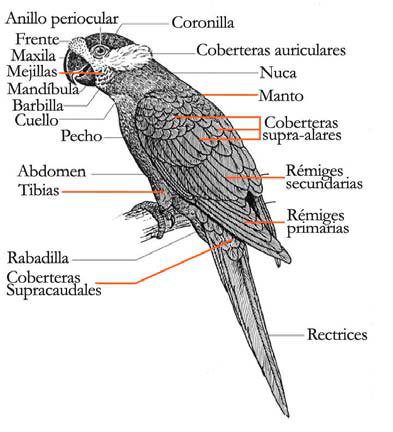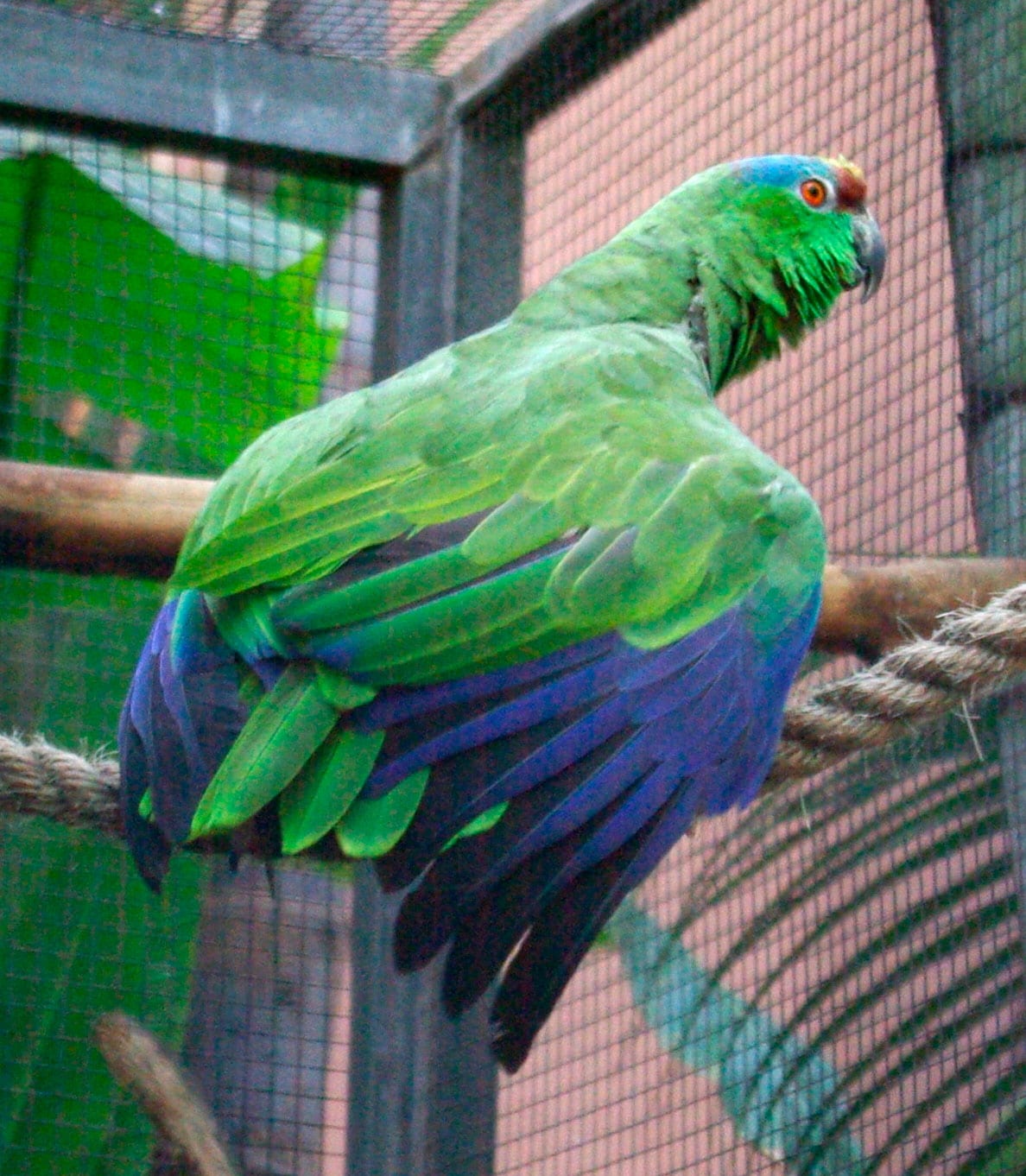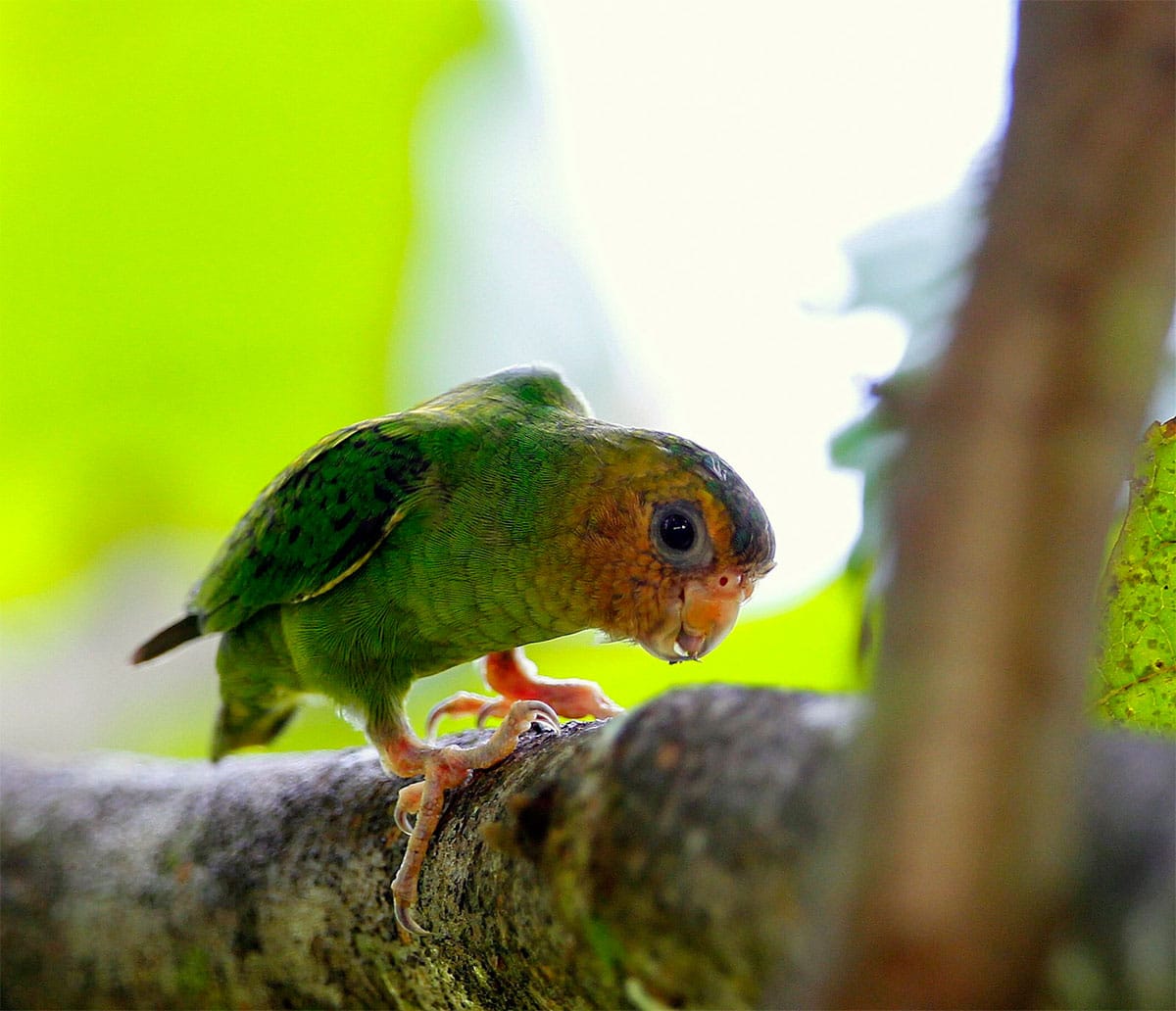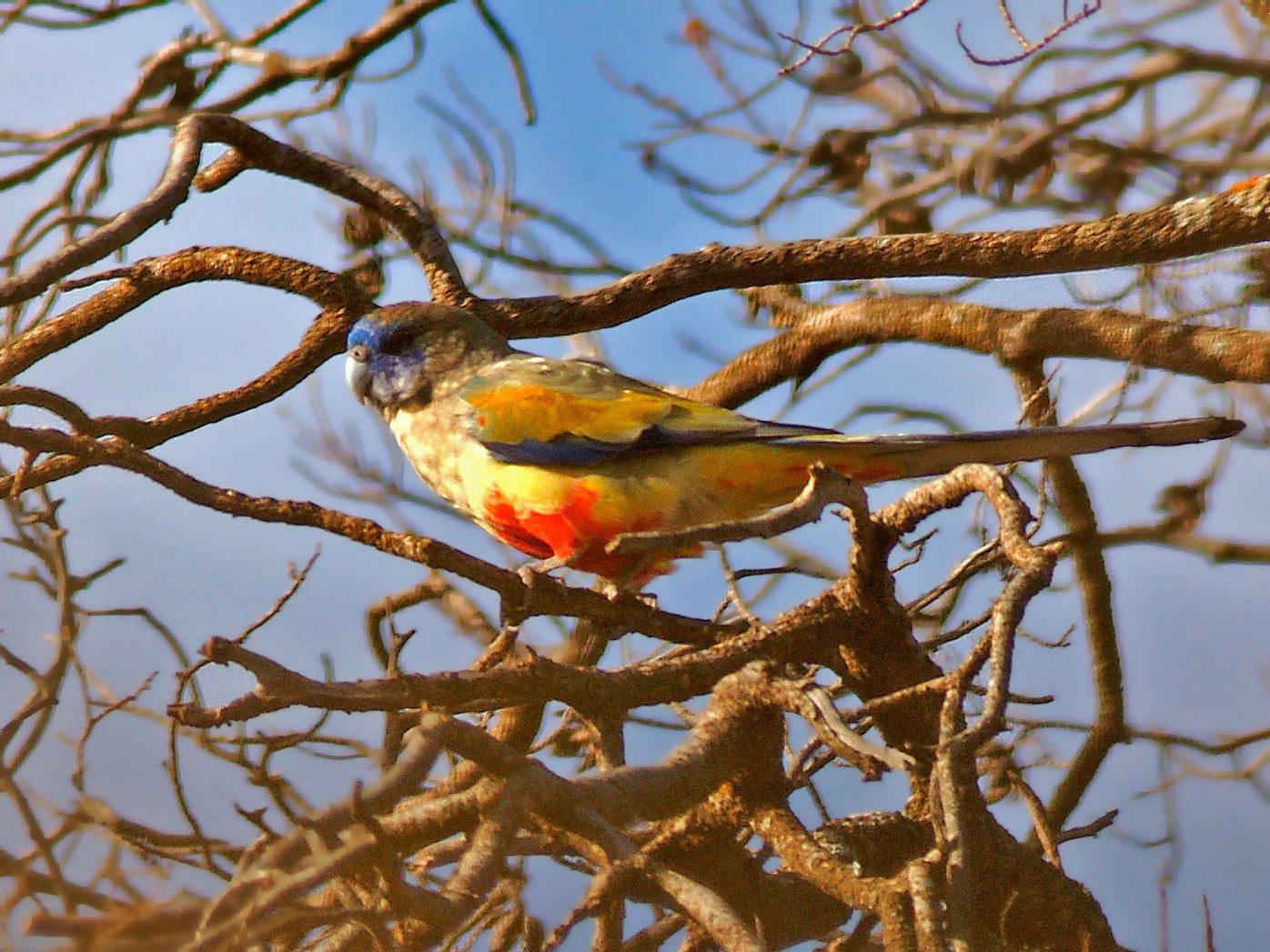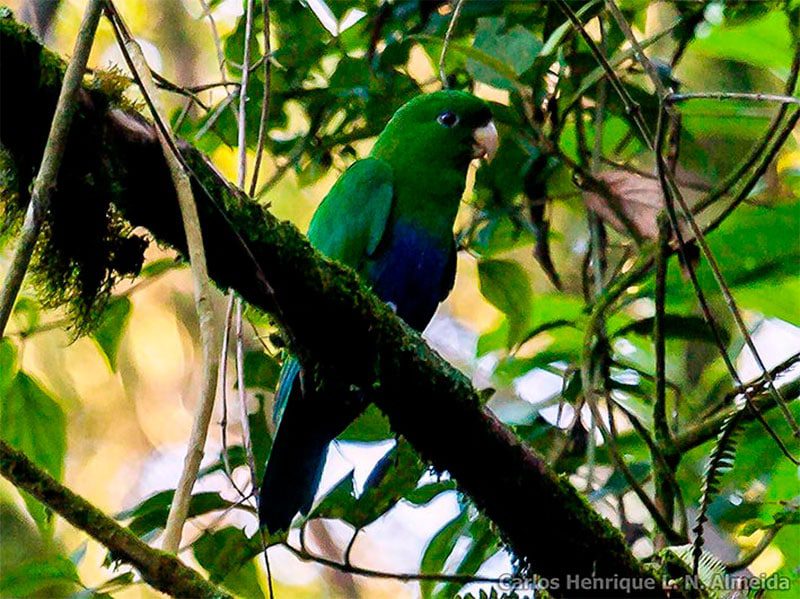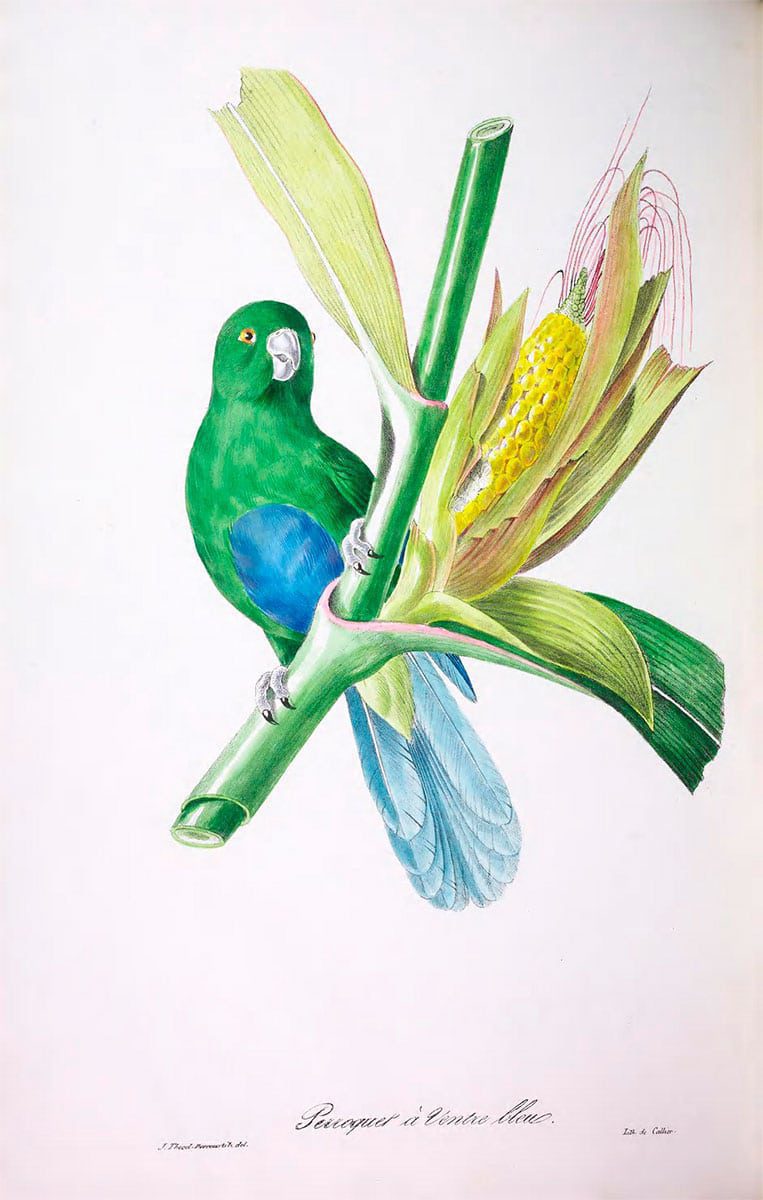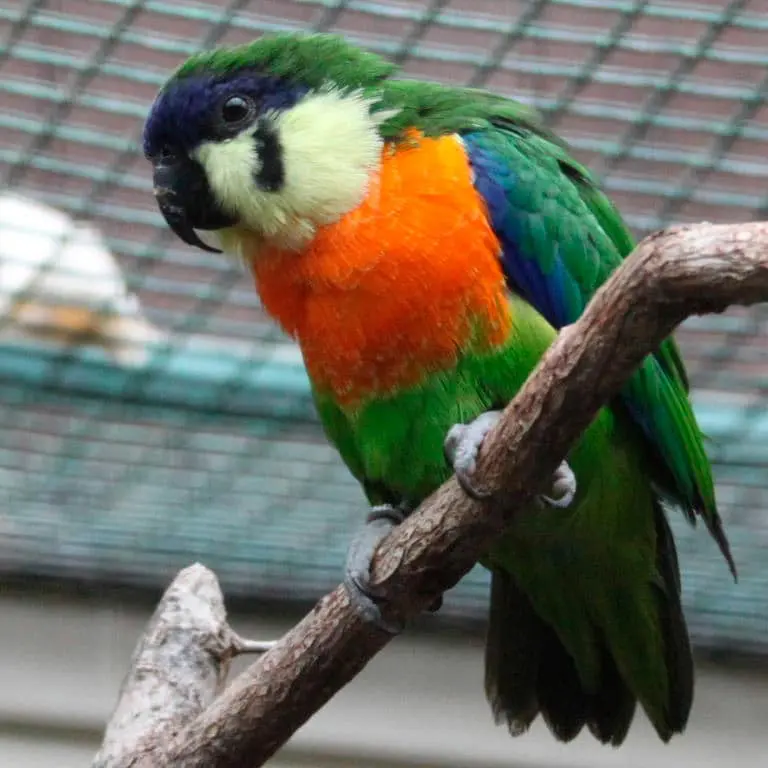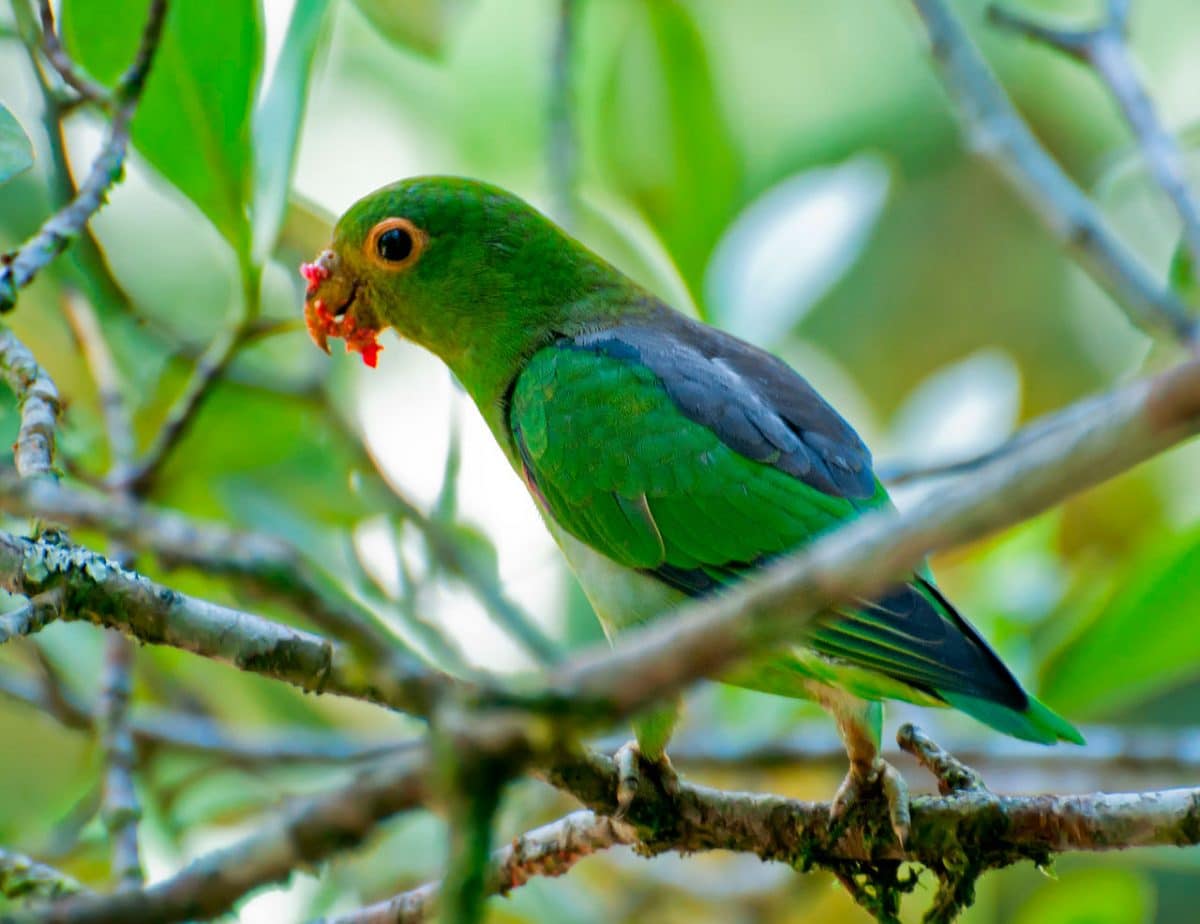
The Brown-breasted Parakeet(Pyrrhura calliptera) is easily recognized by the Wing mirror yellow in flight. In general it is green, with a red spot on the ear; chest brown reddish and sides of the neck characteristic dark brown.
Shoulder mostly yellow up to half of the wing
and the end of the same pardo-olivaceo.
The primary feathers are blue and their covert wing external and internal yellow, usually with orange blend.
The tail reddish brown. Its bill pale yellowish; irises yellow; eye ring white.
It inhabits in Misty jungles Andean and sub-andinas with canopy 15 to 25 m, secondary forests and Paramo, from 1700 to 3400 m. They fly at dawn and at dusk flocks, usually small of 6 to 12 individuals on the canopy of the forest.
Reproduction:
It nests in, generally, in cavities of trees located in wooded pastures or pasture surrounded by secondary forest fragments, bedrooms for both nests. breeding conditions they have been observed in August and October, as well as between November and January in Fusagasugรก, Farallon de Medina and Soatรก (Cortes-Herrera et to the., 2007) and from September to February in the Chingaza National Park (Arenas-Mosquera 2011).
The size average of the laying is of 5-6 eggs of color whitish. The chicks take of 60 to 70 days to complete its development.
Food:
Diet Brown-breasted Parakeet consists in fruit (including plants of the Ericaceae, Lauraceae, Melastomataceae and Clusiaceae (Cortes-Herrera et to the., 2007), seeds and cultivated corn, Although flocks larger were observed in areas open to eating leaves and seeds (O. Courteous in litt., 2012).
Distribution:
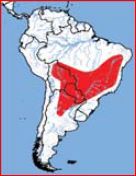
Size distribution (reproduction / resident): 1,000 km2
The population total has been estimated at 5.000-10.000 individuals.
Conservation:
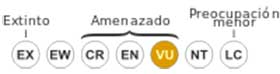
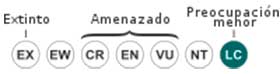
State of conservation โ
Vulnerable โ(UICN)โ
โข Current category of the Red List of the UICN: Vulnerable.
โข Population trend: Decreasing.
This species has a range very small and a small population, known in less than ten places in what is rapidly declining due to the loss of habitat and persecution as as plague by including cultivated corn in their diet.
These declines in population range are expected to continue.. So, qualified as vulnerable.
It is estimated that its population amounts to between 5.000 and 10.000 individuals, equivalent approximately to 3.300-6.700 mature individuals.
– Avibase
– Parrots of the World โ Forshaw Joseph M
– Parrots A Guide to the Parrots of the World – Tony Juniper & Mike Parr
– Birdlife
– Wiki Aves de Colombia
– Photos:
(1) – Flame-winged Parakeet (Pyrrhura calliptera) By Ron Knight from Seaford, East Sussex, United Kingdom (Flame-winged Parakeet (Pyrrhura calliptera)) [CC BY 2.0], via Wikimedia Commons
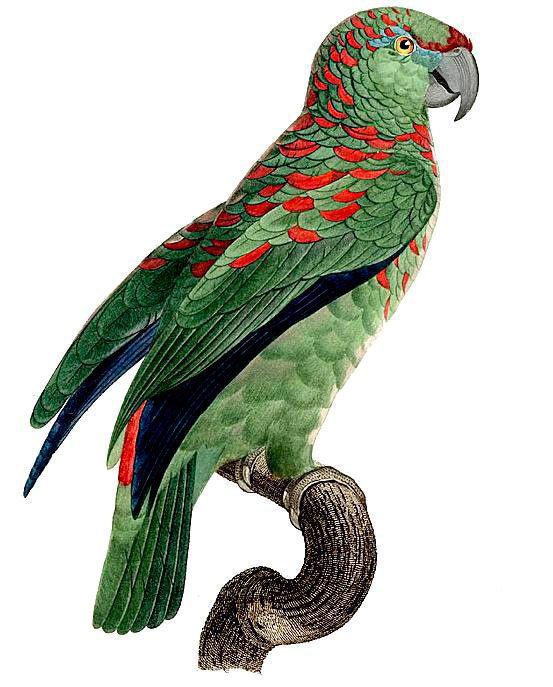
(2) – Pyrrhura calliptera By J. Davernes (biodiversitylibrary.org) [Public domain], via Wikimedia Commons
The Purple-crowned lorikeet(Parvipsitta porphyrocephala) has a length of 16 cm.. and a weight between 40 and 50 g..
The part forward of the crown is orange, merging is in red in the lores. Above and in front of the eyes, orange-yellow. Crown dark purple color, merging into green at the nape, also showing a few feathers of orange-red.
The ear-coverts, yellowish-orange, Red Centre. Chin and throat, of color turquoise light. Upperparts, of color green with washed Brown in the the mantle and rump more bright, slightly greenish-blue.
The upperwing green color, bright blue marked in the curve and on the edge of the carpal area.
The interior of the flight feather color black; fine yellow margins in primaries. Coverts interiors, red. Breast
, neck and upperparts, of color green with a wash light blue turquoise; sides chest top with slight brownish wash; Center of belly washed turquoise with flanks and coverts, of color color green; yellowish stains on the bottom sides of the chest hidden with the wing folded. Green the upper part of the tail and yellow on the inside.
Its small bill curved is black, their legs grayscale and the irises her Brown eyes.
The female is similar but has the irises darker, the ear-coverts lighter and lacks crimson spots.
The immature are more muted tones and lack of purple coloration of the head.
It is a nomadic local that often are found in the forests dried sclerophyllous, especially when the eucalyptus Bloom.
Nomadic flocks may also travel far, Sometimes the inside of the Australian continent.
The flowering of the eucalyptus is mainly responsible of its movements unpredictable, Although in some areas, the birds may be present throughout the year.
Found in diverse areas forming large flocks of hundreds of individuals, often with groups mixed from others Lori including the Musk Lorikeet.
Found commonly in Woods and forests, but also visitors are urban areas, where feed on ornamental flowers.
Casual visitors during the winter of banksias in habitats of Heath.
The Purple-crowned lorikeet is characteristic of drier areas, lightly lined, especially eucalyptus Woods.
Can convert it in a plague to the orchards.
Roosts in large groups, sometimes very far from the feeding areas. Manso and discreet While feeds, except the constant calls. Usually feed on low branches and shrubs.
Reproduction:
The breeding season It includes the months of August to December. The nests are located in holes in trees, preferably a eucalyptus near the water. Several couples often occupy neighboring holes in the same tree.
The cycle of of reproduction in captivity gives a period of incubation of around 22 days, with the young people of 6 to 7 weeks weaned high is after the hatching.
Food:
Feed primarily of nectar and pollen of the flowering of the eucalyptus, but they can also attack the orchards to feed on ripe fruit.
Distribution:
Size of the area of distribution (reproduction / resident): 938.000 km2
The Purple-crowned lorikeet are located in two areas separate from Australia to the Southwest and Southeast of the continent. Separate ranges, but racial differences are not recognized, and it is possible that the birds can travel from time to time between the two areas of distribution. Also located in the Kangaroo Island, Although not found in Tasmania.
Conservation:
โข Current IUCN Red List category: Least concern
โข Population trend: Decreasing
The world population It is believed that it is superior to 50.000 individuals.
This species has a very large range, and therefore not approaching the thresholds for Vulnerable according to the range size criterion.
While the trend of the population seems to be decreasing, the descent do not believe that it is sufficiently fast for approaching the thresholds of Vulnerable according to the criterion of population trend.
For these reasons, the species is evaluated as Least concern.
"Purple-crowned lorikeet" in captivity:
It is a bird noisy, sociable and always in motion.
Very rare in captivity out of Australia.
Alternative names:
– Purple crowned Lorikeet, Purple-crowned Lorikeet (ingles).
– Lori ร couronne pourpre (French).
– Blauscheitellori (German).
– Lorikeet Roxo-coroado (Portuguese).
– Lori Coronipรบrpura, Lori de Corona Pรบrpura (espaรฑol).
35 to 40 cm.. length between 145 and 163 g. of weight.
The Moluccan King-Parrot (Alisterus amboinensis) has a head, neck, the nape of the neck and the upper mantle of bright red, with strong demarcation to dark blue-violet in the lower mantle, back, buttocks and supracaudales coverts. Green wings with the exception of the blue in the small inner coverts and carpal edge. Under, black wings with blue-violet coverts. Bright red bottoms, with mauve bases to coverts infracaudales, sometimes visible; flanks with a little blue. Upper, the very dark blue colal; below black grey color wide-margin rose to the side feathers.
Bill with an orange-red base on the upper mandible, Blackish lower; Orange iris; black grey legs.
The two sexes, somatic sexual dimorphism is not presented..
Immature with more green in the back; Brown-Black beaks; pale eye-ring and darker than the adults of iris. Dotted pink on the outer tail feathers. Mature in one year.
(Salvadori, 1876) – As the subspecies sulaensis but with more feathers in the tail with pink edges. Blackish grey peak in both sexes
Alisterus amboinensis dorsalis
(Quoy & Gaimard, 1830) – As the nominal but the rose of the absent tail feathers; Red slightly darker on the head and underparts.
Alisterus amboinensis hypophonius
(S. Muller, 1843) – As the nominal, but the wings and the deep blue wing coverts; the rose in the absent tail feathers
Alisterus amboinensis sulaensis
(Reichenow, 1881) – As the nominal, but with a green stripe across the upper mantle; No rim with pink in the tail feathers.
Alisterus amboinensis versicolor
(Neumann, 1939) – Unlike the subspecies sulaensis by having a uniform blue mantle; smaller in size than the nominal.
Habitat:
The Moluccan Parrot is distributed through the dense primary and secondary humid forests, and from time to time in the adjacent plantations, farmland and gardens, from the lowlands up to around the 2.100 meters above sea level.
The birds are usually found in pairs or in small groups, and they are very calm while feeding and shy at all times, hiding in the thick foliage and flying amid shrill calls at the first sign of an intruder.
Reproduction:
Just nothing is known of the cycle of reproduction in the wild, although according to sources, nesting takes place between the months of February and April.
Two young birds nests have been found on two occasions in hollow trees.
One instance of captive breeding gave data for incubation of 19 days, with the emerging young in nine weeks.
The courtship was observed during feeding, and two eggs were deposited.
Food:
The diet includes acorns Lithocarpus, as well as hard fruits, outbreaks and other forest tree berries.
Distribution:
Size of the area of distribution (reproduction / resident): 149.000 km2
โข Current category of the Red List of the UICN: Least concern
โข Population trend: Decreasing
The size of the world's population has not been quantified, but the species is described as generally common, Although rare in Halmahera.
The nominal subspecies population is estimated at 70.000 specimens (pit et to the. 1997).
The population is suspected to be declining due to the destruction of habitat in course.
"Moluccan King-Parrot" in captivity:
Occasionally available.
Nervous, is a bird a pet bird.
In captivity will have failed to reproduce.
In the Zoological Garden of Loro Parque, Tenerife, on Canary Islands, biologists Dr. Burkard and Dr. Gerlach they have made so large colonies, but since 1972 they have succeeded until now non.
More information on loromania
Alternative names:
– Moluccan King-Parrot, Amboina King Parrot, Amboina King-Parrot, Ambon King-Parrot, Moluccan King Parrot (ingles).
– Perruche tricolore, Perruche royale d’Amboine (French).
– Amboinasittich (German).
– Periquito-rei-amboina (Portuguese).
– Papagayo Moluqueรฑo, Papagayo Real de Amboina (espaรฑol).
– Avibase
– Parrots of the World โ Forshaw Joseph M
– Parrots A Guide to the Parrots of the World – Tony Juniper & Mike Parr
– Birdlife
– World Parrot Trust – parrots.org
Origin: Colombia, Venezuela, Mexico, Brazil, Panama, Costa Rica
Character: Sociable
Life expectancy: 10 to 25 years
Height: 17 to 20 cm..
Content
Description:
Of 17 to 20 cm. length between 76 and 102 g. of weight.
The Brown-throated Parakeet(Eupsittula pertinax) it is a polytypic species. Its fourteen subspecies are distinguished by the mix yellow and Brown on his face and throat.
In the case of the Eupsittula pertinax aeruginosa, the lores previous, the frontal area, underside of cheeks, both sides of the neck and ear-coverts, are dark brown; dark stripes visible on the cheeks; the feathers of the ocular region are of color orange-yellow; the crown greenish blue. Upperparts olive green. Lesser and medium coverts green; bluish green the primaries and greater coverts. Primaries and secondaries green up, Blue dark on the tips, Blue them vane outer in the secondaries; by down dark grey. Underwing-coverts brighter yellowish green. The throat and the top chest dark brown; the underparts Matte yellowish green with an orange patch in the central area of the belly. For above, the tail is of color green blue, bluer towards the tip; undertail greyish-yellow.
The bill brownish-grey; bare periophthalmic yellowish white; irises yellow, legs grey.
Both sexes similar, without sexual dimorphism, where males are larger than females.
The youth they tend to lack intense yellow, that is alive in individuals adults. Its forecrown is dark greenish blue. The throat and the chest are greenish, while the belly is green with a bit of orange or yellow.
Eupsittula pertinax arubensis (Hartert) 1892 – Cara and throat color opaque marron-oliva. Narrow yellow line on the eyes. Crown greenish blue.
Eupsittula pertinax chrysogenys (Massena & Souance) 1854 – Similar to the aeruginosa subspecies, but darker.
Eupsittula pertinax chrysophrys (Swainson) 1838 – Similar to the subspecies margaritensis and venezuelae but with the forecrown a pale yellowish brown.
Eupsittula pertinax griseipecta (Meyer de Schauensee) 1950 – Similar to the aeruginosa subspecies, with the cheeks, the throat and top of the chest, Gray-olive, veins in the cheeks absent. The crown Green with little blue.
Eupsittula pertinax lehmanni (Dugand) 1943 – Is similar to the aeruginosa subspecies, but with yellowish feathers around the eye more extensive; the Blue head limited with the forecrown and less blue in the flight feather.
Eupsittula pertinax margaritensisCory 1918 – Forehead whitish, the cheeks and ear-coverts color oliva-marron with forecrown greenish blue.
Eupsittula pertinax ocularis (Sclater,PL & Salvin) 1865 – Patch distinctive yellow below and behind the eyes (absent in the immature). Forehead and crown green color with tint blue in some birds. Throat, top of the chest, the cheeks and lores warm brown; ear-coverts slightly darker.
Eupsittula pertinax paraensis (Sick) 1959 – Similar to the aeruginosa subspecies, but with the irises of color red and the vane outer of primaries and secondaries blue.
Eupsittula pertinax pertinax (Linnaeus) 1758 – The nominal. Extensive but variable amount of yellow color in the forecrown, the cheeks, the throat and lores. It may be more off or more Orange under and behind the eyes. Crown Green with only a few light blue indications.
Eupsittula pertinax surinama (Zimmer & Phelps,WH) 1951 – Similar to the subspecies margaritensis but with narrow frontal band orange-yellow color, orange-yellow colour around the eyes extending towards the cheeks and yellowish-green (not brown) the throat.
Eupsittula pertinax tortugensis (Cory) 1909 – Similar to the aeruginosa subspecies but larger, orange-yellow color on both sides of the head and underwing-coverts more yellowish.
Eupsittula pertinax venezuelae (Zimmer & Phelps,WH) 1951 – Similar to the subspecies margaritensis but more pale and yellow on the underparts.
Eupsittula pertinax xanthogenia (Bonaparte) 1850 – Clearer (almost sallow) the head the species nominal, with yellow tones ranging from a variable on the front of the crown and nape.
Habitat:
Video – "Brown-throated Parakeet" (Eupsittula pertinax)
Brown-throated Parakeet Eupsittula pertinax / dirty face parakeet
The Aratinga Pertinaz occupies all kind of fields wooded open of the Savannah, transparent areas of dry scrubland full of cactus and acacias, forests of mangrove, tropical forests (where is the most abundant parrot species often), gallery and white sand forests, Mangroves of Rhizophora, edges of moist evergreen forests, and agricultural areas with palms and other trees.
Move at altitudes on the 1.200 m or more, Although they tend to stay below the 1.200 m. This Aratinga also lives in artificial clearings such as public parks or gardens..
In general, observed in flocks or pairs, forming larger groups where food is abundant and in communal roosts.
Reproduction:
The Brown-throated Parakeet It monogamous. With plays After the season of rains, in general from February to April. Birds very social, assess potential mates in large communal roosts. Also used strong calls in select to your mate / to.
Its breeding season It begins after the rainy season, and varies geographically between the months of February and September. Between February and April in Goal, Colombia; from February to April in Venezuela and any time of the year in Suriname, Curacao, Aruba and Bonaire.
When the conditions are favorable this species You can reproduce several times a year. Son colonial and have been observed up to seven pairs nesting next to each other.
Nest in the cavities of trees, artificial nesting boxes, or in arboreal termite. There are reports of nests made in cracks in rocks. The nests they are very simple, without any plant covering and the eggs, often, they are placed on the floor of the cavity nude. The number of eggs in a nest varies from two to seven.
The female is the primary incubator, with one incubation which can last thirty-six to thirty-seven days in the wild. The chicks they leave the nest after 50 days. The young join their parents and form small family groups that last until the parents begin a new breeding season..
Sometimes it causes damage to crops (for example, of millet and handle), of corn in Colombia and in fruit plantations of the Netherlands Antilles. Despite being considered pests in some areas, the Brown-throated Parakeet they are not strongly persecuted.
They feed in very vocal groups that often include macaws and amazon parrots.
Distribution:
The Brown-throated Parakeet are distributed to the North of South America, Panama and the islands of the Southern Caribbean.
In Panama are present in the slope of the peaceful, rarely on the side of the Caribbean, even in the canal area. But, they occupy the lowlands of the Northern Caribbean and northeast of Colombia, from the East of the Sinu River up to the Guajira peninsula, including the Center and low Magdalena valley, and observed at elevations more low in the East of the Andes and the lowlands of the South of the Alto Orinoco, to the North of Vaupรฉs.
Probably can be observed in all Venezuela, extending to the Margarita Islands, Turtle (Venezuela), Curacao, Aruba and Bonaire (Netherlands Antilles); introduced in St Thomas, virgin islands, in the 19th century.
Its distribution extends through of the Guianas and the North of Brazil, from Roraima until Amapรก, as well as discontinuously in the upper part of the basin of the Tapajos River, For and in the basin of the Black river, amazon.
In spite of his uneven distribution, usually common to abundant, in many places it is the most common parrot (for example in localities of Guyana), locally common in Panama and reportedly very common in black rivers and Branco, Brazil.
Your area of distribution possibly be increasing due to deforestation. In general resident with local seasonal movements (for example, in the region of Santa Maria, Colombia) the availability of food and the dispersion of the areas of reproduction-related.
Distribution subspecies Eupsittula pertinax
Subspecies
Eupsittula pertinax aeruginosa (Linnaeus) 1758 – North of Colombia, Northwest of Venezuela and the upper part of the basin of the Rio Branco, in the Northwest of Brazil
Eupsittula pertinax chrysogenys (Massena & Souance) 1854 – Region of Black river and, possibly, Solimรตes River, North of Brazil; There are no details about its area of distribution
Eupsittula pertinax chrysophrys (Swainson) 1838 – Southeast of Venezuela, Guyana Interior and North of Roraima, Brazil.
Eupsittula pertinax griseipecta (Meyer de Schauensee) 1950 – Valley of the sinu river, North of Colombia. Range in relation to the aeruginosa subspecies unclear
Eupsittula pertinax lehmanni (Dugand) 1943 – It is from Colombia and possibly Venezuela.
Eupsittula pertinax margaritensisCory 1918 – Islands Margarita and The friars, Venezuela. the birds of the Paria Peninsula in the North of Venezuela, they can be of this subspecies; see the subspecies venezuelae
Eupsittula pertinax surinama (Zimmer & Phelps,WH) 1951 – French Guiana and Suriname through the coast of Guyana to Delta Amacuro, Northeast of Venezuela.
Eupsittula pertinax tortugensis (Cory) 1909 – Turtle Island, Venezuela.
Eupsittula pertinax venezuelae (Zimmer & Phelps,WH) 1951 – North and Central Venezuela. Areas of contact with other little-known Venezuelan subspecies: see aeruginosa, surinama and chrysophrys.
โข Red List category of the UICN current: Least concern
โข Population trend: Growing
The Eupsittula Pertinax (Pit and neck of 2014) was considered, previously, belonging to the genus Aratinga.
The subspecies Griseipecta, endemic of the sinu valley in Colombia, There have been since 1949 and is likely to be extinct (T. Donegan in litt. 2011).
The size of the population world of this kind not has been quantified, but it is described as "commonยป (Stotz et to the. (1996). Is considered as the Parrot more abundant in the land low for the Caribbean, Plain in Colombia, Guyana, North of Suriname and the three islands of the Netherlands Antilles.
A density of five to eighty and nine birds by kilometer square is has estimated in the regions of the Northwest of Venezuela.
It is believed that populations on the continent are increasing their range in response to an increase in the conversion of the forest into farmland.
This species is often captured with commercial purposes, but not has been consequences serious, with the exception of the subspecies Aratinga pertinax margaritensis and Aratinga pertinax tortuguensis.
The Aratinga pertinax tortuguensis It is also vulnerable to severe climate changes. (Juniper and Parr, 1998;. Pit, et to the, 1997)
"Brown-throated Parakeet" in captivity:
The Brown-throated Parakeet has a average vinein the nature of about ten years. But, When live in captivity with the proper supervision, they have come to live up to twenty-five years.
common in the industry of the pet because, mainly, to your behavior affective. Captured for the pet trade and occasionally as food.
Pretty noisy, both in the nature as in captivity. With certain skills for repeated whistles and words short.
Alternative names:
– Brown-throated Parakeet, Brown throated Parakeet, Brown-throated Conure, Caribbean Parakeet, Curacao Conure, Curacao Parakeet, St. Thomas’s Conure (English).
– Conure cuivrรฉe, Conure de Saint-Thomas, Perriche cuivrรฉe, Perruche cuivrรฉe (French).
– Braunwangensittich (German).
– Aratinga de-cara-parda, aratinga-de-bochecha-parda, periquito-de-bochecha-parda (Portuguese).
– Aratinga Pertinaz, Perico cara sucia, Perico Carisucio, Perico Gorgicafรฉ, Periquito de Cola Corta, Periquito Gorgimoreno (espaรฑol).
– Loro carisucio, Perico Carisucio (Colombia).
– Perico Gorgicafรฉ (Costa Rica).
– Perico Cara Sucia (Venezuela).
– Avibase
– Parrots of the World โ Forshaw Joseph M
– Parrots A Guide to the Parrots of the World – Tony Juniper & Mike Parr
– Birdlife
– Animal Diversity Web
– Photos:
(1) – Aratinga pertinax By Genes Luna (Flickr: IMG_0309.jpg) [CC BY-SA 2.0], via Wikimedia Commons
(2) – Aratinga pertinax xanthogenia By gailf548 (originally posted to Flickr as Young Parrot) [CC BY 2.0], via Wikimedia Commons
(3) – Eupsittula pertinax arubensis By Alexander Yates (originally posted to Flickr as Aruba Parakeet) [CC BY 2.0], via Wikimedia Commons
(4) – Brown-throated Parakeet (Aratinga pertinax venezuelae) in Cagua, Estado Aragua, Venezuela By Cristรณbal Alvarado Minic [CC BY 2.0], via Wikimedia Commons
(5) – Aratinga pertinax aeruginosa By Aratinga_pertinax_-Colombia-8a.jpg: anthrotectderivative work: Snowmanradio [CC BY 2.0], via Wikimedia Commons
(6) – Eupsittula pertinax By Leizelt, Balthasar Friedrich; Wilhelm, Gottlieb Tobias [CC BY 2.0 or Public domain], via Wikimedia Commons
25 to 30 centimeters length and 100-157 g. of weight.
The distinctive and colorful Scarlet-breasted Lorikeet(Trichoglossus forsteni) has the head dark blue, neck pale green, chest smooth red, and belly dark blue. The remaining plumage It is a bright pale green, and the bill typical is red.
In flight the species shows a flash of bright yellow on the inside of all flight feather, and coverts bright red at the bottom of the wings.
Sound of the Scarlet-breasted Lorikeet.
taxonomy:
This taxon is considered a subspecies of Trichoglossus [haematodus, rosenbergii, moluccana, forsteni, capistratus, weberi] (sensu lato) by some authors.
(Gray,GR 1859) – Both adults have head black / brown with gray / green streaks in crown up to the cheeks; red / brown in occiput; chest red with minimal or no barring; neck yellow green; purple/black belly; smaller.
Trichoglossus forsteni stresemanni
(Meise 1929) – As the species nominal but with paler chest orange / red; green washing occiput; feathers the mantle yellow / orange basis.
Habitat:
The Scarlet-breasted Lorikeet is located in lowlands and lower montane forests, including secondary growth and plantations, tending to be observed at the edges and around perturbed vegetation instead of inside the closed canopy forest (pit et to the. 1997). In Sumbawa the Trichoglossus forsteni varies from sea level to 800-1200 meters and up 2150 metres in Lombok(pit et to the. 1997); at least in Sumbawa, the variation in altitudinal range is attributed to the movements in monitoring trees in bloom in a large area (White y Bruce 1986).
Reproduction:
Birds have been reported in breeding conditions in May Sumbawa(White y Bruce 1986). It nests in a deep hole in a large tree (pit et to the. 1997).
Food:
No specific data, but presumably similar to Coconut Lorikeet(Trichoglossus haematodus)
Distribution:
Extension of the distribution (breeding/resident): 101.000 km2
The Scarlet-breasted Lorikeet (incorporating subspecies mitchelli, djampeanus and stresemanni) It is located on the islands of Bali, Lombok, Sumbawa, Tanahjampea and Kalaotowa, Indonesian.
An assessment of the state of the taxa that make up the species indicates that the species may no longer be present in Bali, It is extinct in Tanahjampea after capture, mainly before 1990, and it is not clear if he persists in kalatom(Eaton et al. 2015). In Lombok the species is still present, with a recent observation of a flock of 18 individuals above 1.500 metres in 2015 (F. Rheindt per Eaton et al. 2015), although given the lack of other records for many decades, it can be assumed that the population is likely to be small. Sumbawa now it may be the stronghold of the species, and it was suggested that the species is "secureยป (Eaton et al. 2015), and there is a large area of รขโฌโนรขโฌโนpotentially suitable habitat remaining on the island.
โข Current category of the Red List of the UICN: Vulnerable.
โข Population trend: Decreasing.
โข Population size : 1600-7000 individuals.
Rationale for the Red List category
It is estimated that this newly divided species has a small population that is experiencing suspected moderately rapid population decline due to the pressure of the traps for wild bird trade. So, is classified as Vulnerable.
Justification of the population
It is estimated that the population size is lower to 10.000 mature individuals, based on a provisional assessment of locations where any numbers of the species are likely to be retained. It also, it is considered possible that the population supposedly higher in Sumbawa does not exceed 1.000 mature individuals.
Justification trend
It is suspected that the population is experiencing descent moderately fast because of unsustainable levels of exploitation.
Conservation actions and research in progress
Appendix II of the CITES, where they include species that are not necessarily threatened with extinction, but in which trade must be controlled in order to avoid utilization incompatible with their survival. CMS Appendix II (Convention on the Conservation of Migratory Species of Wild Animals).
Proposed Research and Conservation Actions
– Estimate the population and assess population trends and scale of capture pressure.
– Carry out a species-specific survey to identify important sites, in order to provide protection.
– Conduct research on their status and habitat use (with particular attention to food ecology and forest fragmentation).
– Initiate awareness campaigns to enlist the support of local people in protecting forests and preventing illegal trade.
"Scarlet-breasted Lorikeet" in captivity:
Rare in captivity. Each captive specimen of this species which is capable of reproducing, must be placed in a well-managed captive breeding program and not sold as a pet, in order to ensure its long-term survival. However it copies sold from the Loroparque Foundation at a price of around 400 EUR.
In captivity, It appeared in the late nineteenth and early twentieth century, for example, in 1896 It was imported by the London Zoo. The first offspring of the world recorded in 1990 on India.
The Scarlet-breasted Lorikeet It has a longevity 20 years in nature, 15-25 years in captivity.
Alternative names:
– Rainbow Lorikeet (Sunset), Scarlet-breasted Lorikeet, Scarley-breasted Lorikeet, Sunset Lorikeet (English).
– Loriquet ร face bleue, Loriquet ร tรชte bleue (de Forsten), Loriquet ร tรชte bleue [forsteni], Loriquet de Forsten (French).
– Bali-Allfarblori, Forstenlori (German).
– Lรณris-de-forstein (Portuguese).
– Lori de Puesta del Sol, Lori pechiescarlata (espaรฑol).
โข Avibase
โข Parrots of the World โ Forshaw Joseph M
โข Parrots A Guide to the Parrots of the World – Tony Juniper & Mike Parr
โข Birdlife
Photos:
(1) – Sunset Lorikeet (also known as the Scarlet-breasted Lorikeet and Forstenโs Lorikeet) at Cincinnati Zoo, USA by Ted [CC BY-SA 2.0], via Wikimedia Commons
(2) – A Sunset Lorikeet (also known as the Scarlet-breasted Lorikeet and Forstenโs Lorikeet) at Cincinnati Zoo, Ohio, USA by Ted [CC BY-SA 2.0], via Wikimedia Commons
(3) – Two Rainbow Lorikeets at Newport Aquarium. This subspecies of the Rainbow Lorikeet is also called Forstenโs Lorikeet by Trichoglossus_haematodus_-Newport_Aquarium-8a.jpg: Jeff Kubinaderivative work: Snowmanradio [CC BY-SA 2.0], via Wikimedia Commons
(4) – Two Rainbow Lorikeets at Newport Aquarium. This subspecies of the Rainbow Lorikeet is also called Forstenโs Lorikeet
Date 22 April 2009, 15:31 (UTC)_haematodus_-Newport_Aquarium-8a.jpg: Jeff Kubinaderivative work: Snowmanradio [CC BY-SA 2.0], via Wikimedia Commons
(5) – Lories at the Jurong BirdPark, Singapore. Taken by Terence Ong in November 2006. Trichoglossus haematodus forsteni by rk, Singapore. Taken by Terence Ong in November 2006. Trichoglossus haematodus forsteniNo machine-readable author provided. Terence assumed (based on copyright claims). [GFDL, CC-BY-SA-3.0 or CC BY 2.5], via Wikimedia Commons
The Red-eared Parakeet(Pyrrhura hoematotis) It is distinguishable by the Brown of the forecrown with edges bluish to them feathers; cheeks green; crown and feathers of nape Green with tips more pale and yellowish. The upperparts green. Primary coverts and maybe some feathers in the area of the carpus, blue; other coverts green. Primaries Blue with black tips. Under wings with the lesser coverts green, the others coverts black. Throat and chest Brown olive with tones dark; margins to some feathers create a pattern squamous; sides neck also with effect squamous; belly and undertail-coverts Green with a patch Brown mal-definido in the center of the belly. Upper, the tail of color brown with tips from color olive; undertail, of color copper. Bill of color bone pink; Iris and legs brown.
Both of them sexes are similar. Immature not described.
(Zimmer & Phelps, 1944) – It has a narrow red line above the bill. What nominal but chest and sides of neck more green and with a pickling less obvious. Not there are tips yellowish in the feathers of the crown and nape.
Habitat:
They inhabit in montane and cloud forests with open areas and trees of low dispersion, often at the edge or in clear, mainly in altitudes of 1.000-2.000 m, Although there are report of the species at altitudes between 600 and 2.400 m. It is estimated that he performs altitudinal migrations. Gregaria, mainly seen in groups of 3-12 outside the breeding season, rarely in flocks of up to 100 individuals.
Reproduction:
Probably it breeding season be in the month of August (rainy season).
Food:
Poorly documented diet and breeding: the food known include guava (Psidium) and petioles some leafy trees, possibly to extract larvae of insects.
Distribution:
Size of the area of distribution (reproduction / resident): 14.300 km2
To the Red-eared Parakeet is known only in the coastal mountains north of Venezuela, with the westernmost record observed in Cubiro, Lara, the eastern-most in Miranda. But, Most of the records are from Aragua in Miranda; Cubiro is in fact the only known site in Lara and the population there is apparently discontinuous (subspecies Pyrrhura hoematotis immarginata). Diurnal movements occur from the mountains of the Highlands until the lowest feeding areas; also apparently some local seasonal movements guided by the availability of food.
Fairly common in most of its more restricted range and especially numerous in the Henri Pittier National Park; its status in Lara It is unknown. Much habitat right remains within the range outside the areas protected, and there is a rate of deforestation relatively low, but with constant habitat loss around Cubiro.
(1) – Venezuelan endemic Red-eared Parakeet (Pyrrhura hoematotis) photographed in captivity in Mรฉrida, Venezuela By http://www.birdphotos.com (Own work) [CC BY 3.0], via Wikimedia Commons
(2) – Perico tail Red [Blood-eared Parakeet] (Pyrrhura hoematotis hoematotis) Place: The deer, Park national the Avila by barloventomagico – Flickr
(3) – Bando of parrots parakeet place: The deer, Park national Guaraira Repano by barloventomagico – Flickr
(4) – Pyrrhura hoematotis by Diana register – Flickr
(5) – Pyrrhura hoematotis by Diana register – Flickr
(6) – Iconographie des perroquets: Paris :P. Bertrand,1857 by Biodiversity Heritage Library – Flickr
The Blue-crowned Lorikeet(Vini australis) has a plumage mostly green. The upper part of the head is dark blue with light blue streaks. The region of the windows of the nose, the cheeks, the ear-coverts, the neck and the abdomen They are red. the lower part of abdomen and the thighs they are purple blue. The back is green, the interior of the tail is yellowish-green. The irises is reddish brown. The legs are of color red and the bill is orange.
The youth are equal to adults, but with less red in the face and throat, little or none abdominal patch, stripes blue shorter in the crown, no purpura on the thighs, brown the eyes.
It is found in forests, coconut palms or any habitat where flowering trees; coastal mountains, gardens and agricultural areas. Nomad, sometimes traveling between the Islands.
Daily movements in search of food. Aggressive but gregarious, they often move in flocks of up to 12 individuals, except during the breeding season they live with their partners.
In Samoa it is common around villages and plantations and less common in moist forests, higher elevations in the rain forest and secondary growth.
Reproduction:
Nests in holes or hollows of trees, It has also been reported that they dig burrows in the banks of Earth, Although it has not confirmed. The laying is one or two white eggs. Breeding registered in June and August. In captivity the incubation It has been calculated in 23 days.
Food:
It feeds on nectar, pollen and red fruits. It particularly prefers Erythrina, Wild hibiscus and coconut.
Distribution:
Extends over the archipelagos of Samoa, Tonga and LAU, distributed by Islands: Love, Futuha'a, Fulago, Futuna, Ha'afeva, You're young, Moce, Niue, Ofu, Olosega, Samoa, Salt, Tafahi, Say, Tofua, Tungua, Fire, It's cool, Varoa, I'm sorry and Voleva. In the past was also in ‘USA, Tongatapu and Mata-Utu but there it is extinct.
Conservation:
– Current IUCN Red List category: Least concern.
– The population trend: Decreasing.
The world population It has not been quantified, but the species is informed that it is common in much of its restricted area of distribution.
The population is suspected to be in decline due to the predation by species invasive.
Still fairly common throughout its range, but it has become extinct on many islands and it is decreasing in Tonga (probably because of the rats).
"Blue-crowned Lorikeet" in captivity:
Like the others Vini lories, the Blue-crowned Lorikeet still quite rare in poultry farming, probably as a result of the protection they receive in their native South Pacific countries.
Alternative names:
– Blue-crowned Lorikeet, Blue crowned Lorikeet, Blue-crowned Lory (ingles).
– Lori fringillaire (French).
– Blaukรคppchen (German).
– Loris Vini Australis (Portuguese).
– Lori de Samoa (espaรฑol).
The Regent Parrot(Polytelis anthopeplus) has the yellow head, tending to yellow olive in it crown and nape. Green olive the the mantle; scapulars of color Brown olive dark; floor area of the back and tail showy yellow, tending to yellow olive in uppertail-coverts. Smalls and medium corbeteras, Yellow; greater coverts of color black blue in them pens external, Red with yellow tips on the innermost feathers; tertiary black grey in vane inner; reddish pink, with yellow tip in the vane outer; primary coverts bluish-black; primaries and secondaries bluish-black, with black inner tubes. Wing feathers yellow; underside of flight feather brown, almost black. The underparts Yellow, more off the yellow olive in undertail-coverts with some brands Orange indistinct around it area anal.
The tail is of color black with infiltrations of color blue dark in the part superior of their feathers Central and of the threads internal of their feathers side.
The bill is pinkish-Red. The irises are of color brown orange; legs grey.
The female has the underparts grey and of color green it top. Lords and ear-coverts are of colour more greenish. The strip of color blue dark of the feathers is more broad and it extends to the under wing-coverts that are more than color yellow-green that in the male. The rump is green olive opaque, not yellow. The red dot of the wing
is less developed and has less brightness. Tail of color green blue by over. It has a pink tip below.
The youth they resemble females, However, young males have more yellow in the head.
: (Schodde 1993) – The male has much more brightness that it nominal species, particularly, the yellow of the underparts.
Habitat and habits:
The Regent Parrot they reside mainly in the East, although the birds disperse after the breeding season.
More regular movements have been recorded in the Western population, with spread towards the South during the summer, and a concentration below 32ยฐ S in the fall.
The birds move to the northeast in winter; movements of up to 320 km have been recorded. Oriental birds are linked to the banks of the rivers, where is the red rubber (Eucalyptus camaldulensis) trees with mallee Shrublands partners (Eucalyptus gracilis). They are also distributed in forests of eucalyptus, areas with thin Cypress pine (Callitris preissii), orchards and vineyards.
In the West, the species is less dependent from the Mallee and they reside in mixed plots of acacia and eucalyptus (wandoo, salmonophloia) and within agricultural land.
The Regent Parrot they are not in the forests of the South-western area, Although there have been in the forest clearings.
outside the breeding season, the birds can be found in noisy flocks of a hundred or more individuals, being in general cautious. They feed primarily on Earth.
Reproduction:
The nesting season takes place between January and August. These birds nest either in single pairs or in small colonies composed of a maximum of 18 couples. Before the mating, There are ritual offerings of food.
The site selected for reproduction is usually a great tree of the gum dead or dying, to 20 metres above the ground and near a permanent water course. These nests are often reused.
The spawning includes of 3 to 6 white eggs You settle on a layer of decaying wood shavings. The female incubates alone during 21 days. His companion, who deserted the nest tree and joined an all-male group, it comes to collaborate with food tasks. The chicks have white down. Usually, leave the nest after 5 to 6 weeks, but after feather, remain in the family group for a few weeks yet.
Food:
The diet usually comprises seeds of grasses, herbs, fruit, berries, sprouts and flowers. They also take crops of cereals and dried fruits from orchards, as well as grain spilled on highways.
Size of the area of distribution (reproduction / resident): 1.520.000 km2
Confined to Australia, where in two very distant populations. In Western Australia are distributed mainly in the wheat belt, extending north to Ajana, on the inside of Laverton and Karonie, and down in Israelite Bay, on the South Coast; is also located to the South of Perth, but they have not fully colonized the wooded area Southwest.
In the southeast of Australia the range has shrunk in recent years. In the South of Australia, the species occurs along of the murray river, around Morgan at the border of New South Wales, Victoria (seven colonies).
There is some post-breeding dispersal, but the birds is unlikely it lies to the northeast of Balranald or to the South of Castenaso, except perhaps during periods of drought.
Locally common in areas of riparian forest and Mallee (Eucalyptus gracilis).
The world's population is believed to be superior to the 15.000 individuals, but the subspecies of the East is by far the smaller of the two.
Completely protected by law in all but a few regions of the South-West.
A moderate number of captive.
Distribution 2 subspecies:
Polytelis anthopeplus anthopeplus
: (Lear 1831) – The nominal. Southwest of Australia.
Polytelis anthopeplus monarchoides
: (Schodde 1993) – Interior West of the part of Southeast of Australia (Southeast of the South of Australia, Southwest of New South Wales and Northwest of Victoria).
Conservation:
โข Current category of the Red List of the UICN: Least concern
โข Population trend: Decreasing
The species has an estimated world population in 21.500 individuals (Garnett and Crowley 2000).
The population of the subspecies anthopeplusis It is estimated in 20.000 individuals.
The population of the subspecies monarchoides It is estimated in 1.500 individuals (Garnett and Crowley 2000).
The population of the subspecies anthopeplusis is probably stable as a whole, While the subspecies monarchoides could be declining (Garnett and Crowley 2000).
degradation areas Mallee (eucalyptus), accidents on the road, occupation natural cavities of swarms of bees and persecution due to farmers, they are the threats more recurrent. Despite its original development in areas of the southwest through the development of agriculture, even in these areas, It is considered a slight decline. The hope comes from the fact that can go to colonizing New Territories in forest areas in the South-western end. By now, the species is considered not presenting no major problem. But, in nearly all regions, except in areas of intensive agriculture, benefits from the protection.
"Regent Parrot" in captivity:
It is a bird very quiet. It is customary to his carer quickly enough. Friendly, It will also tolerate other non-aggressive species. Very active in the morning and afternoon. They may be prone to infections in the eyes and feet.
One sample was still alive after 13,8 years in captivity. It has been reported that these animals can live up to 27,5 years in captivity but it has not been able to be verified; the same study reported that these animals can reproduce from around the first year of age in captivity.
– Avibase
– Parrots of the World โ Forshaw Joseph M
– Parrots A Guide to the Parrots of the World – Tony Juniper & Mike Parr
– Birdlife
– AnAge: The Animal Ageing and Longevity Database – Anage entry for Polytelis anthopeplus
– Photos:
(1) – A juvenile Regent Parrot (Polytelis anthopeplus) at the Bird Walk (Walk-in Aviary), Canberra, Australian National Territory, Australia By Polytelis_anthopeplus_2. jpg: JJ Harrison (jjharrison89@facebook.com)derivative work: Diliff (Polytelis_anthopeplus_2. jpg) [CC BY-SA 3.0], via Wikimedia Commons
(2) – An adult male perched by Josep del Hoyo – Lynx
(3) – A juvenile Regent Parrot (Polytelis anthopeplus) also known as the Rock Pebbler, Black-tailed Parakeet, Smoker, Marlock Parakeet and sometimes Regent Parakeet By Rainey06au at en.wikipedia [Public domain], from Wikimedia Commons
(4) – Two Regent Parrots in an aviary in Australia. It is also known as the Rock Pebbler, Black-tailed Parakeet, Smoker, Marlock Parakeet and sometimes Regent Parakeet By Kristina (originally posted to Flickr as Parrots) [CC BY 2.0], via Wikimedia Commons
(5) – A Regent Parrot in Flying High Bird Sanctuary, Australia. The parrot is feeding on seeds from the left hand of small boyโs outstretched arm By paulgear (Picasa Web Albums) [CC BY-SA 3.0], via Wikimedia Commons
(6) – The Cape Parrot (Polytelis anthopeplus) Started by Dallas – Gros-becs.net