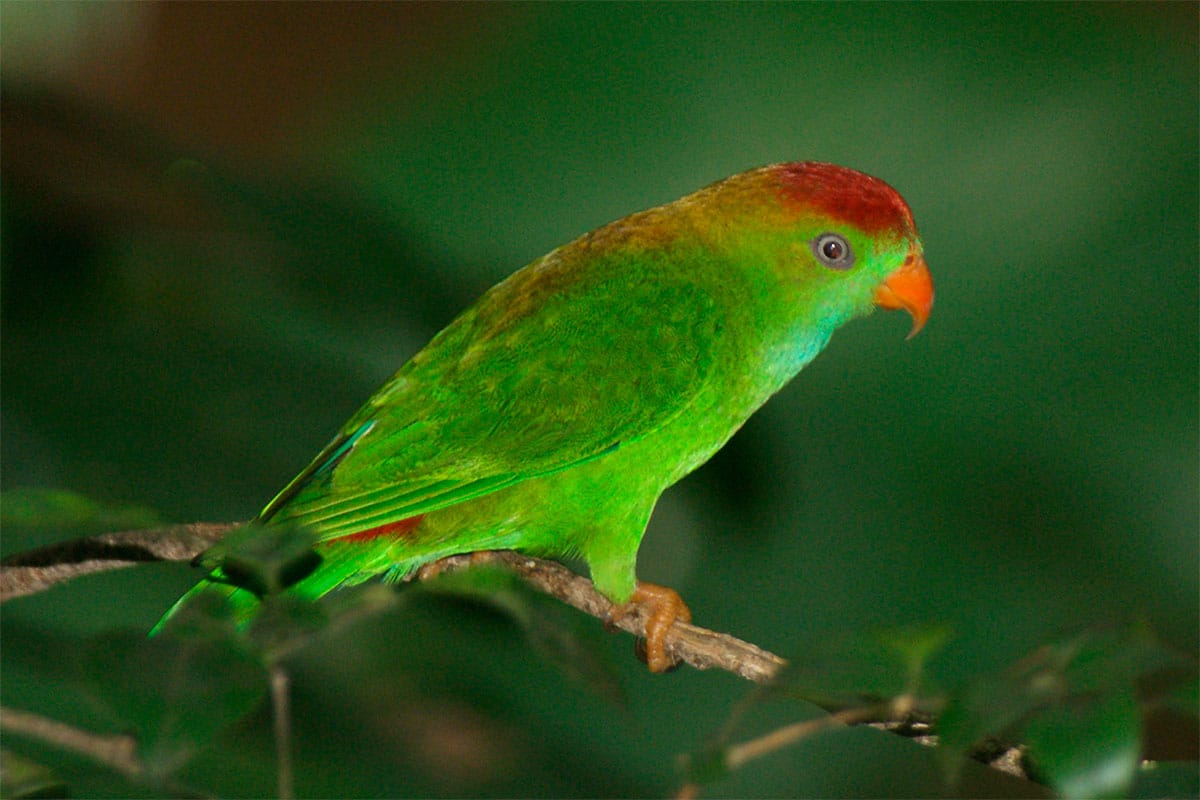
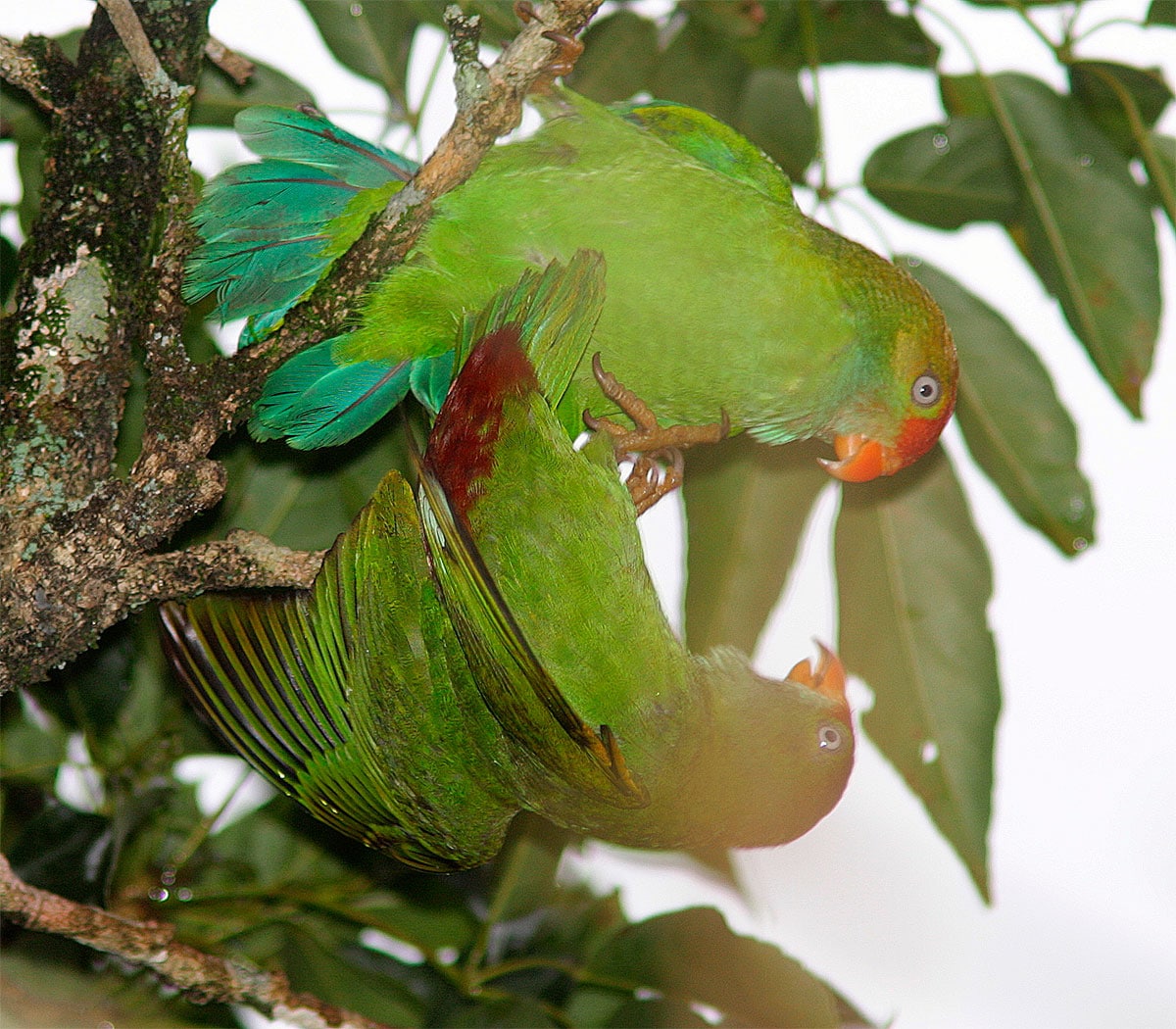
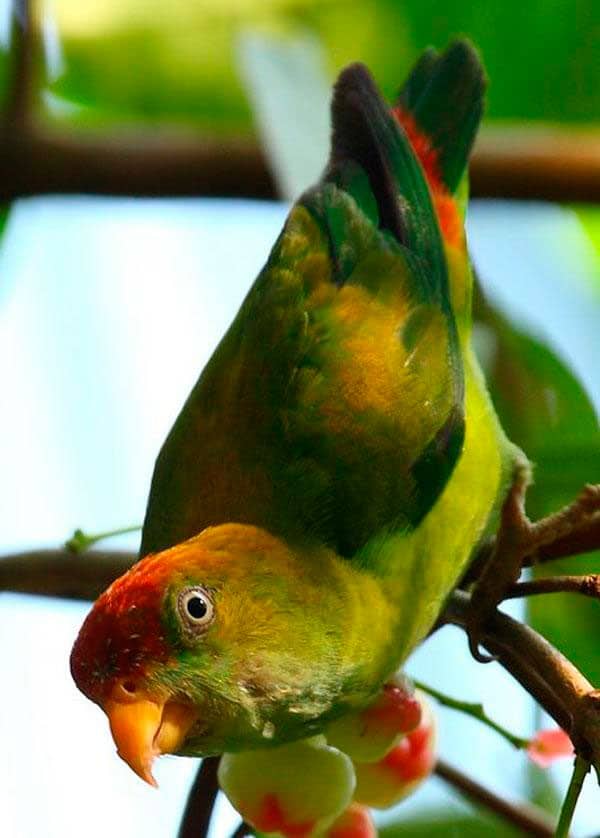
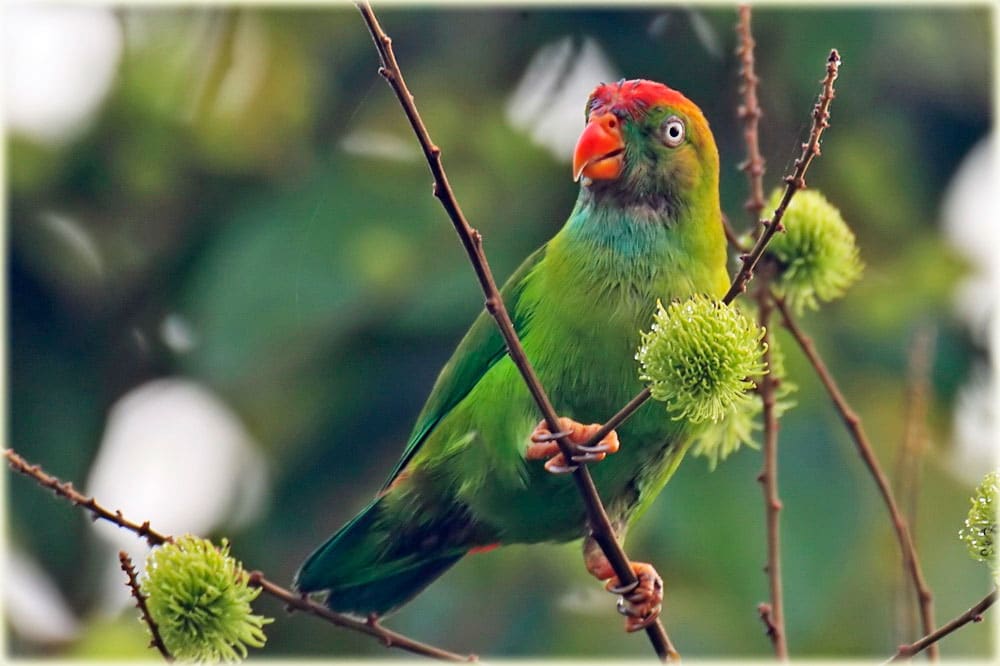
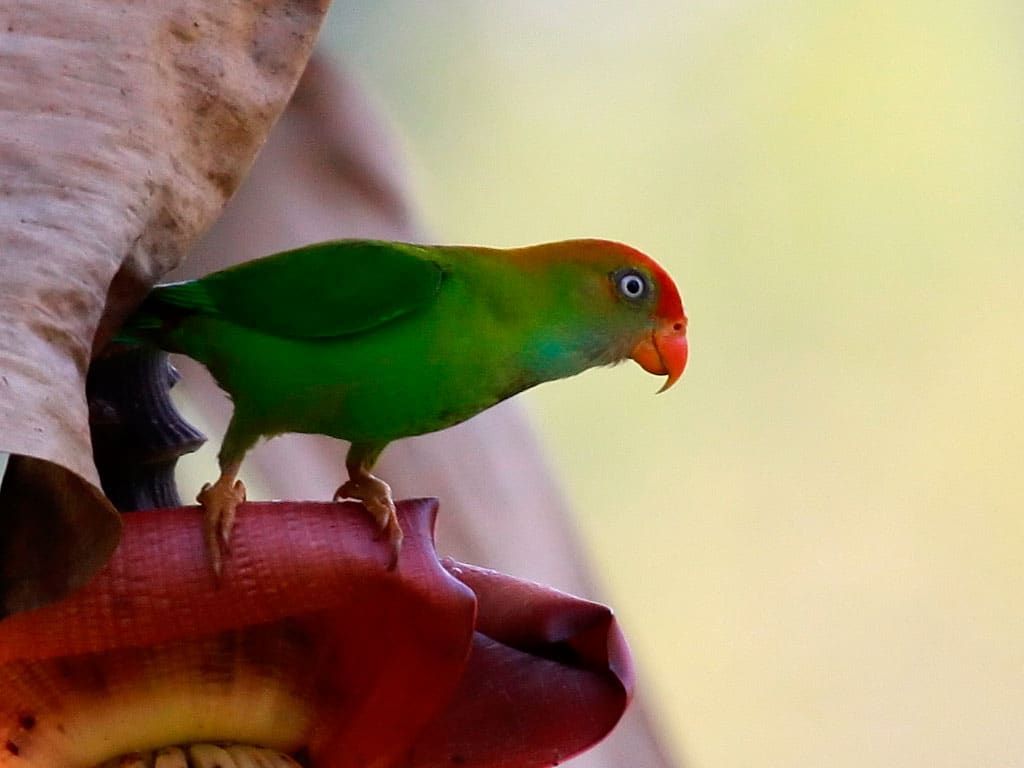
The Ceylon Hanging-Parrot(Loriculus beryllinus) has the crown red, merging into orange-yellow in the area of the nape; eyebrows, lores and the area in front of the eyes light green (lightly bathed in pale blue); sides of the front of the crown red. Mantle green, Bañado de slightly reddish and yellowish orange color in the Center; back green; rump and uppertail-coverts, red. Wings green up, with the exception of vane inner of the blackish flight feathers ; undertail, the wings bright turquoise color with the exception of coats and axillary green. The underparts bright green, paler and more yellowish which the upperparts and light blue marking in the throat. above the tail green color; Turquoise below.
Bill orange red, paler at the tip; irises off-white; legs dark yellow.
Female as the male, but most off and only a trace of blue in the throat.
The young birds they are even duller, the crown reddish-tinged, the patch blue of the throat absent, the rump with some green feathers, the bill paler, the iris and the legs brown; the face nude in the fledglings.
Seen in a range of habitats, from sea level to 1.600 m, reaching the highest areas according to seasonal conditions. The species is found in forests of coconut trees, Evergreen and deciduous forests, semicultivadas areas, open woodland and around the dwellings.
birds are not shy, and is usually found in pairs or family groups, although outside the breeding season larger flocks congregate high up in flowering trees. They are active and acrobatic feeding.
Reproduction:
Observations, they have registered the male approaching his partner upright, with the high peak, swollen throat, extended tail and rump feathers erect, while emitting a screeching chirp. Wiggles head in courtship period have also been observed.
The breeding begins in January and although the main nesting period is between March and May, a second litter is, sometimes, until September. The nest is located in a hollow branch filled with fragments of vegetation that the female carefully cuts with her beak and carries to the nesting sites tucked between her rump feathers.. Only two to four white eggs she incubates, sitting firmly, screeching and creating a 'thumping' sound’ Yes is the annoying. The young Chick has the face exposed, presumably to avoid getting dirty by liquid food.
Food:
Feed on fruits such as Ficus figs and guava (Psidium guajava); berries; flowers, including Erythrina, Salmalia and eucalyptus; seeds, including Casuarina. Poisonings have been reported after drinking Palm wine collected pots attached to the trunks of the trees.
Distribution:
Endemic to Sri Lanka, where most records come from the South, Although there have been North of Trincomalee and should be observed in suitable habitats throughout the country. Records include proximities of Colombo, around Kandy, Yala and National parks Gal Oya, the district Welimada, and to the South of Galle and Hambantota, on the coast.
Conservation:
• Current IUCN Red List category: Least concern
• Population trend: Stable
The size of the world's population has not been quantified, Although it is estimated at 10.000 specimens. The species is qualified as widespread and abundant in the South-West and almost absent in the North of its distribution area (pit et to the. 1997).
The population is suspected to be stable in the absence of evidence of any reduction or substantial threats, However, the bird trade is judged as a potential threat.
"Ceylon Hanging-Parrot" in captivity:
Rare.
Alternative names:
– Ceylon Hanging-Parrot, Ceylon Hanging Parrot, Ceylon Lorikeet, Sri Lanka Hanging Parrot, Sri Lanka Hanging-Parrot, Sri Lankan Hanging Parrot (ingles).
– Coryllis de Ceylan, Coryllis du Sri Lanka (French).
– Ceylonpapageichen, Ceylon Papageichen (German).
– Loriculus beryllinus (Portuguese).
– Lorículo de Ceilán, Lorículode Ceilán (español).
21 to 27 cm. length and a weight between 130 and 180 g..
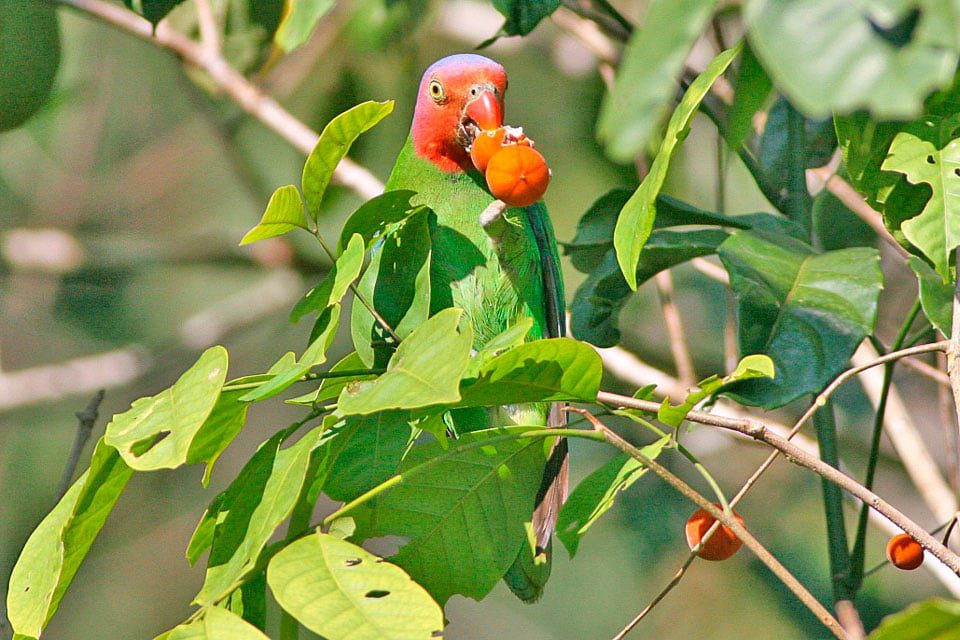
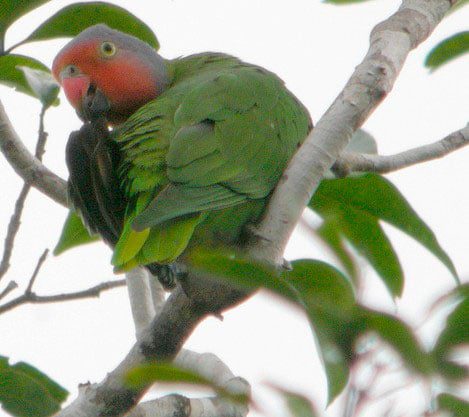
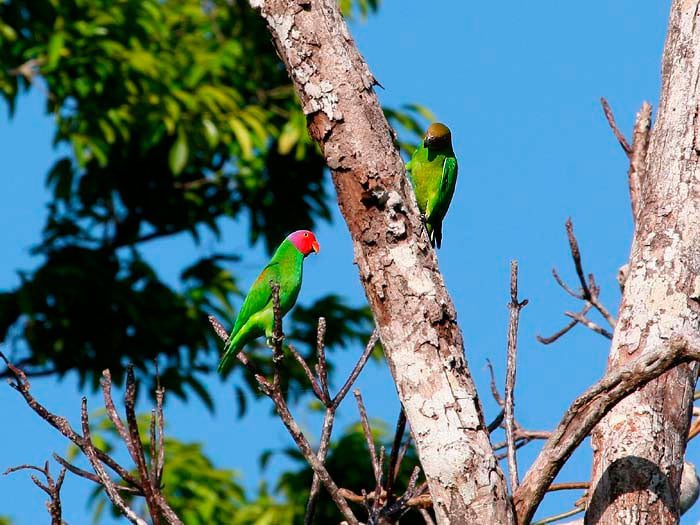
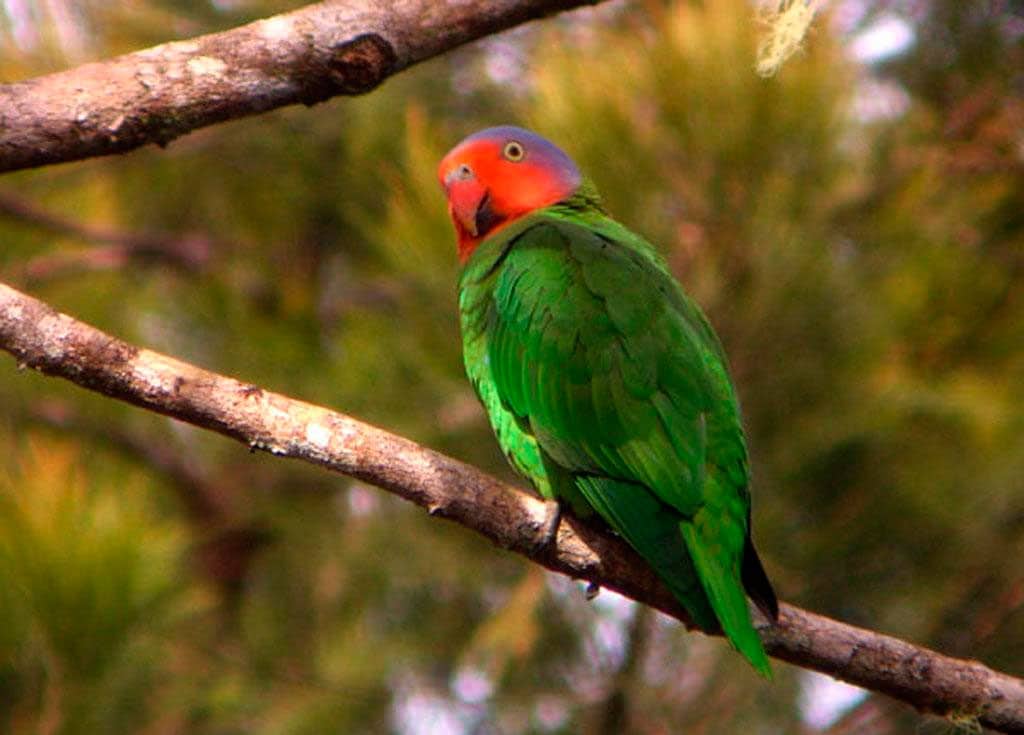
The face of the Red-checked Parrot(Geoffroyus geoffroyi) is of color rojo-rosaceo up to just above the eyes, more pink in the ear-coverts; front of the crown of color rojo-rosaceo. Half of the crown to the nape mauve-blue. Upperparts green. Wings with patch red in them Middle coverts interiors.
Flight feathers with vane Dark internal and external Green. Edge of yellow to vane internal of greater coverts and secondaries. Wing feathers and axillary, bright blue; below, the rest of the wings, blackish. The underparts green, more yellowish in them lower flanks. Upper, the feathers of the tail of color green, drenched sides of yellow; below, brighter yellowish green.
The bill red orange in upper jaw, the lower jaw in color black; irises yellow; legs grey.
Female with head Brown and upper jaw black.
Youth they have the head green, irises dark and bill pale. The male juveniles go through a plumage «female stage» before they begin to acquire masculine characters (bird takes over one year to mature). The birds young also lack of the brand red on them small coverts.
(Müller, 1841) – The darker male in general that the nominal; purple blue crown comes to the part back from the neck; neck light blue; Marron-bronce washing variable on the mantle and top of the back; Green bluish in the part superior of the chest and zone inferior of the abdomen ; brown reddish of them coats internal of the wings absent; Blue more dark in them Underwing coverts. Larger in size.
The female with the head more dark that the nominal; purple diffusion in the crown; nape blue, reaching the neck with color blue light.
Geoffroyus geoffroyi obiensis
(Finsch, 1868) – Adults as the subspecies cyanicollis but collar Blue in the part back from the neck more comprehensive, reaching almost up to the eyes; blue-purple in the male or brown in the female does not reach the lower part of the occiput; reddish brown in the bottom of the back to rear.
Geoffroyus geoffroyi rhodops
(Schlegel), 1864) – Similar to the subspecies males floresianus, but darker in general; marks of the coats internal of the wings of color brown reddish dark; crown Blue separate with red in the face; Underwing coverts Blue more dark. Larger in size.
The female with the crown castano-oscuro color.
Geoffroyus geoffroyi explorator
(Hartert, 1901) – Synonymous with Geoffroyus geoffroyi rhodops
Geoffroyus geoffroyi keyensis
(Finsch, 1868) – The male resembles the subspecies floresianus, but in general more greenish-yellow, in particular in the tail; cheeks Pink and ear-coverts washed with Blue Lilac; Yellow greenish pale in the neck through the part back from the neck and a strip Green, darker, in the early part of the neck; Underwing coverts pale blue. Larger in size.
The female chestnut brown on the head.
Geoffroyus geoffroyi floresianus
(Salvadori, 1891) – The male is like the nominal, but darker in general; the purple blue of the crown It's darker and reached to the nape; coats internal of the wings dark reddish brown; Blue more dark them Underwing coverts. Larger in size. Largest peak. Female with the crown darker brown, coming up to the nape.
(Meyer, 1884) – The subspecies resemble adults Kei, but smaller.
Geoffroyus geoffroyi pucherani
(Souancé, 1856) – Adults and juveniles with bronze-colored marking of the parts internal of the wings, minimal or absent; the mantle have less marron-bronce washing; Brown more pale in the part low of it back; the buttocks with less red; coats dark blue low the wings.
Geoffroyus geoffroyi minor
(Neumann, 1922) – Male adults are as the subspecies aruensis, but with reddish brown under the back to rear; face darker red; washing Marron-bronce in the the mantle; brands in the coats internal of the wings minimal or absent.
The female as the subspecies aruensis, but with the head of brown slightly more dark.
Geoffroyus geoffroyi jobiensis
(Meyer, 1874) – Adults and juveniles but with Underwing coverts pale blue; bright red in the lower part of the back to the rear; in males, the red in the forecrown back to the front of the crown.
Geoffroyus geoffroyi mysoriensis
(Meyer, 1874) – Males as juveniles, but with the crown blue-purple, down on the back of the neck, and red in the face, coming up to the throat; washing marron-bronce absent in the the mantle; extensive reddish brown marks in inner median coverts; Underwing coverts dark blue; dark brown in the bottom of the back to rear.
The female as juveniles, but the color brown in the crown comes to the part back from the neck.
Geoffroyus geoffroyi orientalis
(Meyer, 1891) – Hardly differs from the subspecies aruensis; Crown of the male is slightly more pale.
Geoffroyus geoffroyi sudestiensis
(Estimate, 1890) – The adult male is similar to the subspecies aruensis, but with the underparts darker; the trademark brown reddish of them coats internal, absent.
The crown and nape of the female, is dark green.
Geoffroyus geoffroyi cyanicarpus
(Hartert, 1899) – The adult male is similar to the subspecies aruensis, but with azul-lila wash in them cheeks and ear-coverts; bend of wing has edge blue.
The female is as the subspecies aruensis, but the crown and nape They are brown, with light green dye; edge blue in the part outside of the wing
as in the male.
Geoffroyus geoffroyi aruensis
(Gray, 1858) – Similar to the species males nominal, but darker purple blue from the crown up to the nape; inner coverts a reddish brown marked darker; Blue more dark in them Underwing coverts.
The female Brown darker from the crown even the nape.
Geoffroyus geoffroyi maclennani
(W. D. K. Macgillivray, 1913) – The male is similar to the subspecies aruensis, but darker in general; the Red of the face is darker and more uniform; Underwing coverts paler blue. Female similar to the female of subspecies aruensis, but darker in general; head dark brown; Underwing coverts paler blue.
* The varieties sumbavensis and tjindanae proposed as subspecies are synonymous of floresianus; rhodops stresemanni; explorator It is also synonymous of rhodops.
Habitat:
Distributed by primary and secondary forests, tree savannas, plantations, Open forests, mangrove forests and farmland, a altitude of 1.400 m. Usually replaced by the Blue-collared Parrot at higher altitudes. Exclusive tropical jungle in the North of Australia. View the birds, generally, flying high above the trees, making calls to cries.
Groups of birds in the North of Australia, many still in family units, they have been observed leaving their roosts early, to feed into the dense jungle; in their flights to areas of foraging, We have seen some of these birds perched in the upper branches of the trees, by calling aloud for a few minutes and dithered wings before continuing. The reason for this unknown behavior can be a way of requesting food due to early maturation.
During the day the birds are less visible, they can draw attention by discarded food falling from their food trees.
They are usually in couples, in small groups or assembled in groups in fruit trees.
Reproduction:
The nest It is a hole that the birds excavate in a rotten limb of a tree from the forest, sometimes also in a knot in the trunk; probably only the female excavates. The entrance to the nest is of 80 to 90 mm. wide, and the tunnel, that it can twist in order to hide the eggs, You can have a length of 42 cm.. Includes the implementation of 2 to 4 eggs. The female alone incubates and is fed by the male during this time. In the West, the breeding season It takes place between April and September at least, month in which a live nest was found in Seram.
In New Guinea, the nesting is been registered during several months more, including February in the North and between the months of April to December in other places.
In Australia, in where the season seems to extend is from August to December, little information about the cycle reproductive is available.
It is known that the species It has never been raised successfully in captivity.
Food:
The diet It includes seeds, fruits and flowers. The birds tend to hang acrobaticamente to reach their food.
Distribution:
Size of the area of distribution (reproduction / resident): 793.000 km2
Generalized from the West of Lombok, through the Moluccas, the lowlands of New Guinea, and observed in the groups of associated Islands, to the East of Rossel in the Louisiade archipelago.
The species can also be observed in the northeast of the Cape York Peninsula, Australia, at its southern end, and North ranges up to Morotai in the North of the Moluccas. In many areas, throughout its distribution area, is the most abundant Parrot (rarer over the 800 meters above sea level), even around inhabited areas. Despite this, It may be extinct in Ambon.
The size of the world population It has not been quantified, Although it is estimated above 1.000.000 of copies. The species according to sources, is of common to abundant much of its area of distribution (pit et to the. 1997).
The population suspected to be stable in the absence of evidence of any reduction or substantial threats, Although you can that its population is affected by the capture in various parts of its area of distribution.
"Red-checked Parrot" in captivity:
Very rare or impossible to see in poultry.
Passive Parrot. Extremely susceptible to stress and disease; they may die suddenly without apparent reason. Few times you live long in captivity
Alternative names:
– Red-checked Parrot, Red cheeked Parrot, Red-cheeked Parrot (ingles).
– Perruche de Geoffroy, Eclectus de Geoffroy, Éclectus de Geoffroy (francés).
– Rotkopfpapagei (alemán).
– Papagaio de bochechas vermelhas (portugués).
– Lorito Carirrojo, Lorito de Mejillas Rojas (español).
– Avibase
– Parrots of the World – Forshaw Joseph M
– Parrots A Guide to the Parrots of the World – Tony Juniper & Mike Parr
– Wikipedia
– Birdlife
– parrots.org
– Photos:
(1) – By Ron Knight (Flickr: Red-cheeked Parrot) [CC BY 2.0], via Wikimedia Commons
(2) – By Nick Athanas/Tropical Birding – Birds-pet-wallpapers
(3) – A male perched in a tree by Josep del Hoyo – Lynx
(4) – A male and a female looking for a suitable nest by mehdhalaouate – Lynx
(5) – By markharper1 [CC BY-SA 2.0], via Wikimedia Commons
33 to 43 cm.. length and an approximate weight of 260 g..
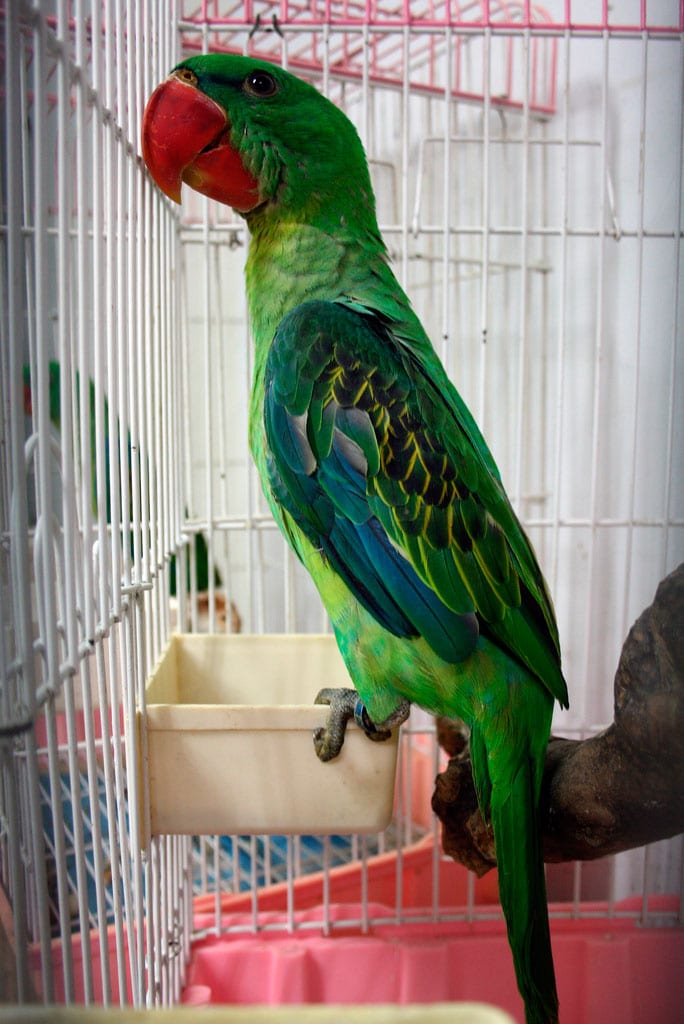
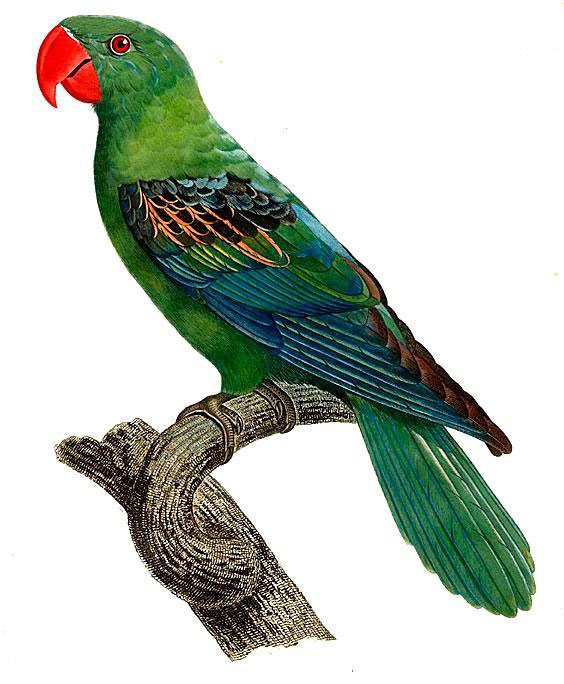
The Great-billed Parrot(Tanygnathus megalorynchos) It has a bright green head. Green mantle with narrow blue stripes to the feathers of the back; pale blue rump; coverts underwings light green.
Scapulars black bordered of blue-green; less black on the inner wing coverts, the blue-green external; medium black coverts, with yellow margins in both bands: large blue-green coverts with yellow margins.
Secondary green with thin yellow margins; primary heavily drenched blue in vane external with a gradient through the greenish or blackish blue in the vane inner. The wings and bright yellow axillary feathers; lower part of flight feathers black gray, the inner most dyed yellow.
The underparts, greenish yellow, greener-tinged in the belly, the coverts and thighs undertail. Upper, green tail with yellow tips; at the bottom I light brown with orange tips.
(Wallace, 1863) – The head with light bluish hue and chest and abdomen much more green, bend of the blue wing. More green in general.
Tanygnathus Megalorynchos Djampeae
(Hartert, 1924) – Chest and abdomen pale green, the secondary feathers of the coverts bluish green with bordered Straits.
Tanygnathus Megalorynchos Floris
(Hartert, 1924) – Chest and abdomen pale green, the lower part of the back blue is more dark.
Tanygnathus Megalorynchos Hellmayri
(Mayr, 1944) – It is more small, more green by the chest and abdomen while the head is yellowish-green. Practically has tones of blue and on the wings has little black color. In females it just black coloration in the wings.
Tanygnathus Megalorynchos Subaffinis
(PL Sclater, 1883) – Face with slight bluish hue, more green in general and below the back and rump area, light blue-green hue.
Tanygnathus Megalorynchos Sumbensis
(AB Meyer, 1882) – It is more large, with much more blue and blue more dark in the lower area of the back.
Tanygnathus Megalorync Viridipennis
(Hartert, 1903) – The primary feathers of green wings, and in some cases also the secondary.
Habitat:
The Great-billed Parrot is distributed mainly primary lowland forests, as well as in secondary and coastal forests, mangroves, cultivated areas, gardens and plantations up to 1.000 meters above sea level. The birds regularly travel between the smaller islands and make daily flights between roosts and areas of foraging, calling the attention with its loud cries in flight as a time to settle to rest.
They normally gather in small groups of up to a dozen individuals in search of food., usually fruits and nuts, and commonly throw the remains of from the trees where they feed, since they discard unwanted elements.
Reproduction:
Nesting has been recorded between August and December, Noting a nest in the hollow of a mature tree in the forest at a height of some 30 m.
Widely but unevenly distributed across Nusa Tenggara, the Moluccas and Islands to the West of papua. The range includes the following Islands: Sumba, Timor (West end) and adjacent Semau , Flowers, Madu, Kalaotowa, Kalao, Tanahjampea, the Group Tukangbesi to the southwest of Sulawesi, Damar, Babar, the Group Tanimbar, Seram, Haruku, Buru, OBI, Bacan, Kayoa, Halmahera, Makian, Moti, Ternate, Ternate, Morotai, Mayu, islets to the North of Sulawesi and the Group Togian to the East of Sulawesi, Sangir and groups Talaud, Widi, Muor, give, Waigeo, Batanta, Salawati and Misool. The nominal race seems to have been introduced in Balut at the southern end of Mindanao, Philippines. Occasional records in Java and Bali they are probably leaks, but the birds on the Mainland of New Guinea they may be wandering genuine, probably from the small islands of the West Group of papua. The species is quite common, but you might be getting some local decreases as a result of trade and habitat loss. The world population is estimated at more of 100.000 birds.
Subspecies
Distribution of subspecies Tanygnathus megalorynchos
• Current category of the Red List of the UICN: Least concern
• Population trend: Decreasing
The world population is estimated at more of 100.000 birds.
This species has a very large range, and therefore not approaching the thresholds for Vulnerable according to the range size criterion.
The population is suspected to be declining due to the destruction of habitat in course and unsustainable levels of exploitation.
"Great-billed Parrot" in captivity:
Quiet, little shrill, don't like to be touched.
Rare in captivity.
Alternative names:
– Great-billed Parrot, Great billed Parrot, Island Parrot, Large-billed Parrot, Moluccan Parrot (ingles).
– Perruche à bec de sang, Perruche à gros bec (French).
– Schwarzschulterpapagei, Schwarzschulter-Papagei (German).
– Tanygnathus megalorynchos (Portuguese).
– Loro de Pico Grueso, Loro Picogordo, Loro Picogoro (español).
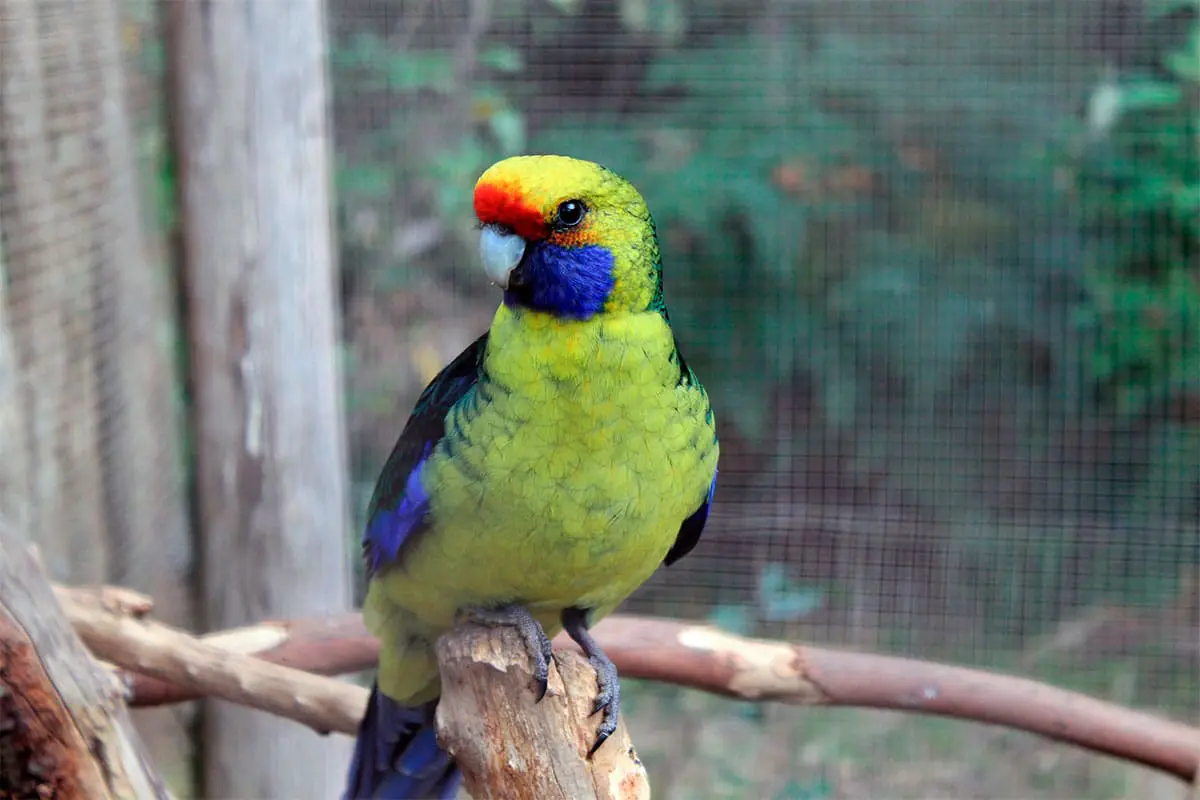
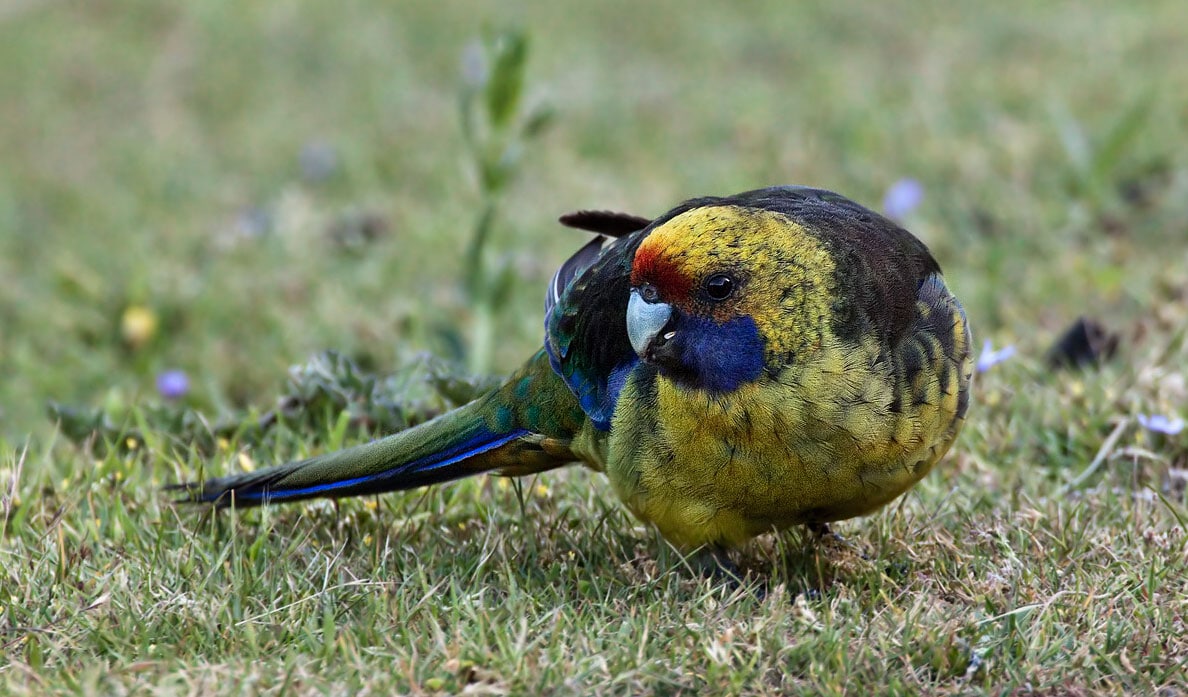
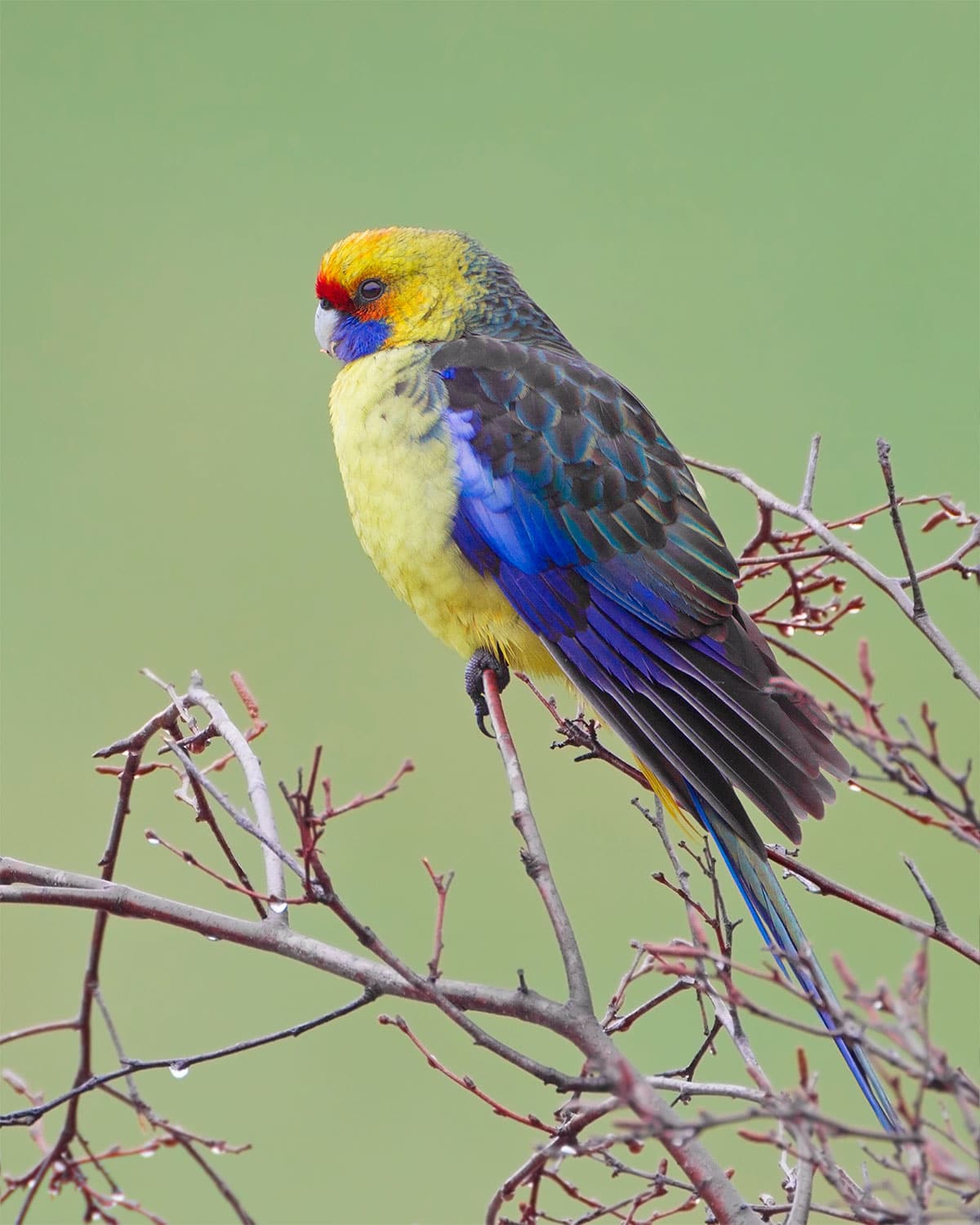
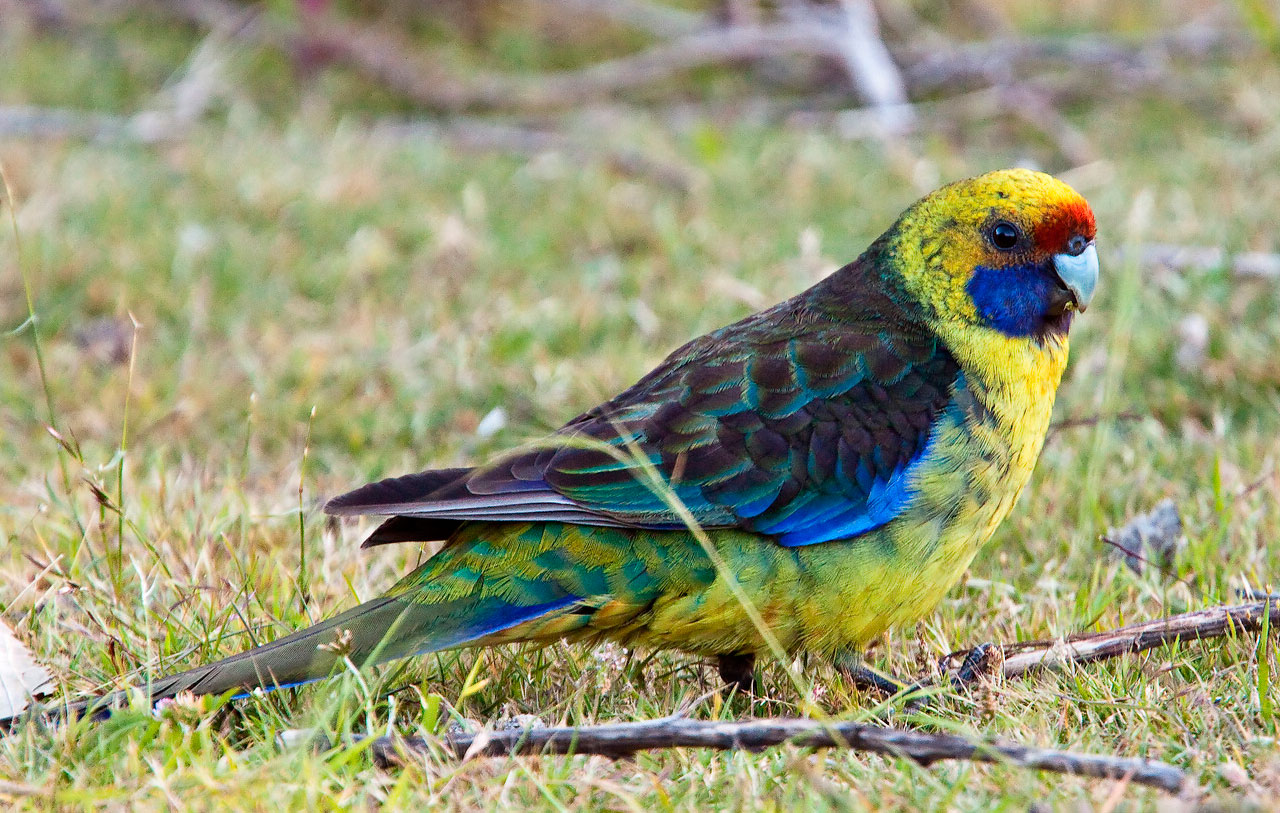
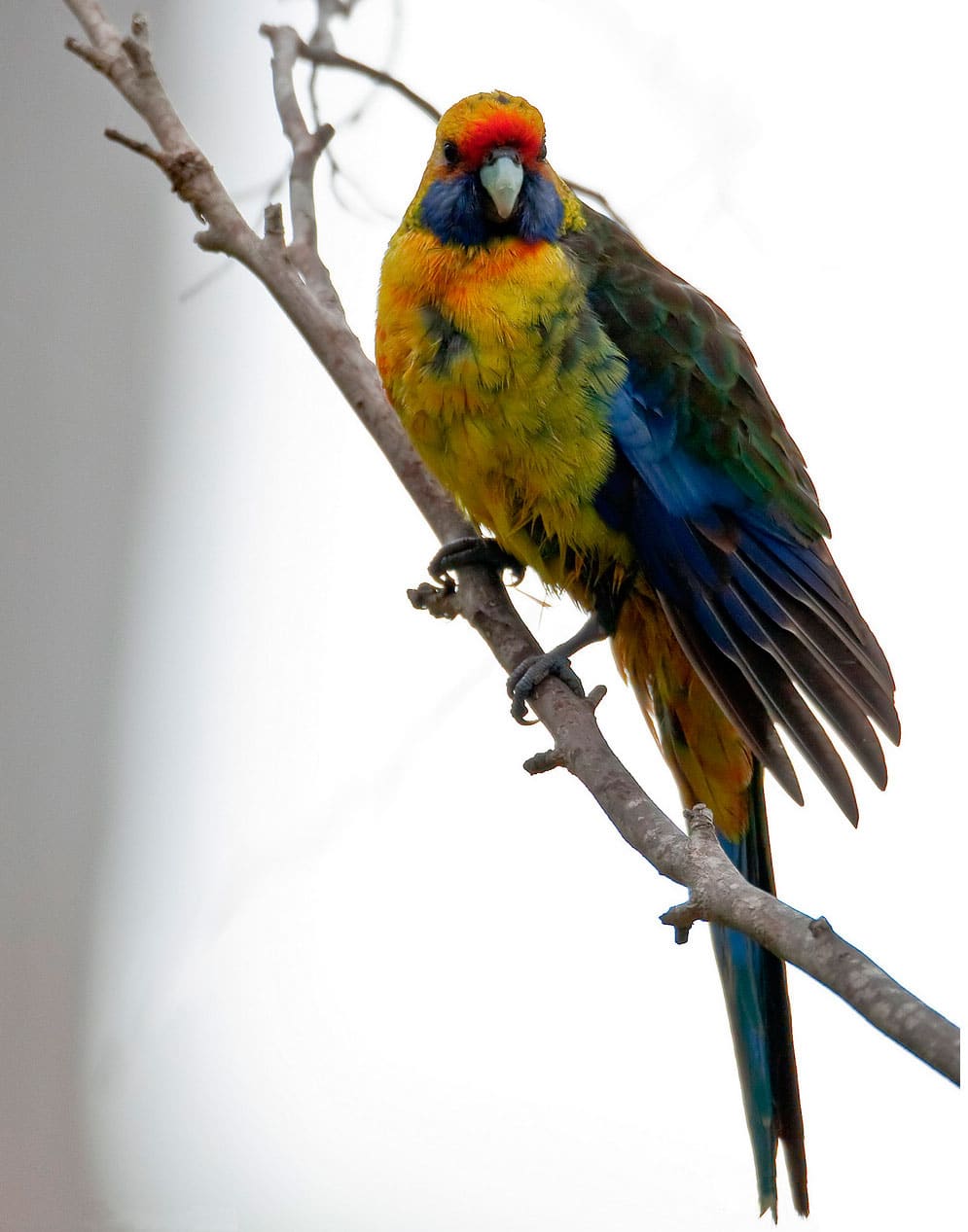
The Green Rosella(Platycercus caledonicus) has the forecrown and lores bright red; a crown of a showy color yellow, marked in red and dotted with of Brown olive dark towards the part rear; area low of them cheeks and throat of color blue cake; ear-coverts a bright yellow, with the edges more dark. Strong contrast between the yellow and the dark area of the crown; Brown olive uniform in the the mantle, with fine dark green stripes on their feathers; feathers of the rump and uppertail-coverts have a diffusion of color yellow orange.
Curve of the wing blue; lesser coverts black; corbeteras internal Middle, black, lined in green dark, the light blue external; greater coverts Blue with feathers Interior black finished off with edges of color green; secondaries Blackish with vane blue externals (innermost with green edge); primaries Brown dark with vane external and dark blue margins; tertiary Brown dark with stripes Green.
Under, the wings blackish, with coverts and axillary blue.
The underparts is of color yellow with a tone clear of Orange and with small spots of color orange on the periphery of the area anal. Upper, the tail olive-green tipped off blue, lateral feathers of color blue pale with them tips white; undertail, the tail of color blue pale with them tips white.
Bill White grey; irises dark brown; legs grey.
The female It is smaller than the male and has the bill smaller; also shows more often a wash of orange-red in the upper part of the chest.
The immature they are more muted than adults, show more green in wing-coverts and have them upperparts of color grey olive and yellow olive in them underparts. Plumage adult is reached after the first comprehensive molt, in a few 15 months.
(Kuhl, 1820) – Too little differentiated with the species nominal, according to some experts, to justify the recognition as subspecies.
Habitat:
The Green Rosella they are in all types of forest habitats in the territory in which they reside. But, more and more often, they come in orchards and gardens in urban areas, finding favorable conditions in those places to nest and feed themselves. But, its main habitat are still sclerophyllous forests and thickets. Apparently, on Hunter island, they have a strong preference for small ravines filled with piles of rocks.
Like most of the island birds that live in a small area, to the Green Rosella It is cataloged as sedentary. But, the specimens that live in altitudes of up to 1500 meters in the Alpine regions, they make altitudinal movements and approaching at low altitude towards the coastal regions in winter season. At the end of the nesting season, young birds roam in small flocks which do not exceed more of 4 or 5 individuals. The Green Rosella be associated at times with them Eastern Rosella (Platycercus eximius). Although they are not shy, These parrots take precautions and are very cautious When venturing to Earth to find their food. They prefer to stay in the foliage for this activity. Like most of the parrots, the female is attached to your partner by strong ties conjugal it last for many years. They maintain and strengthen these links practicing processions which are very similar to the one of other parrots.
Reproduction:
The Green Rosella nest during the period from September to February. The nest It is usually placed in a cavity of any branch or hollow tree trunk, normally a eucalyptus. They also occupy, exceptionally, the walls of old buildings. They use abandoned nests of sparrows into disuse.
The spawning usually contains between 4 and 6 eggs and your incubation takes a few 19 days. The chicks are altricial and leave the nest only after 3 weeks after hatching. No additional information on the care and development of the offspring.
These parakeets also eat many types of seeds of grasses and shrubs, some of which are at higher altitudes.
Do not disdain the berries of coprosma and the Hawthorn, they represent an important part of their diet in winter. The menu is sometimes supplemented with psyllids they are small homoptera and insect larvae .
Distribution:
Size of the area of distribution (reproduction / resident): 68.100 km2
The Green Rosella they are endemic in Tasmania. Also found in the larger islands of the Bass Strait, that is to say, on isla King and Flinders island. Has also been recorded in the Maatsuyker island, front South of Tasmania.
Birds coming from leaks can be found around Sydney.
The species is common and widespread within its range, with a stable world population of more than 50.000 specimens.
One small number in captivity.
The Green Rosella is protected, but it can be killed with a permit when they cause damage to crops.
The population living in the North of Tasmania It is sometimes differentiated under the name brownii, but this so-called subspecies differences are not as marked enough to consider it as such.
• Current category of the Red List of the UICN: Least concern
• Population Trend: Decreasing
The size of the world population It has not been quantified, Although estimated at more of 50.000 specimens. The species according to sources, it is common throughout its small range (pit et to the. 1997).
The population is suspected that it may be declining due to the habitat destruction in course of King Island (pit et to the. 1997).
The Green Rosella It may cause damage to the apple orchards and, Although protected, It can be controlled under a system of licensing.
"Green Rosella" in captivity:
It is not a popular Aviary bird, possibly due to its lack of color and its aggressive reputation.
Alternative names:
– Green Rosella, Caledonia Parrot, Green Parrot, Mountain Parrot, Tasmanian Rosella, Yellow-bellied Parakeet, Yellow-bellied Parrot, Yellow-breasted Parakeet, Yellow-breasted Parrot (ingles).
– Perruche à ventre jaune (French).
– Gelbbauchsittich (German).
– Rosela-da-caledônia (Portuguese).
– Perico de Tasmania, Rosela Verde (español).
– Avibase
– Parrots of the World – Forshaw Joseph M
– Parrots A Guide to the Parrots of the World – Tony Juniper & Mike Parr
– Birdlife
– Photos:
(1) – A Green Rosella at Tasmanian Devil Conservation Park, Tarana, Tasmania By rockmasterp (Beautiful ParrotUploaded by snowmanradio) [CC BY-SA 2.0], via Wikimedia Commons
(2) – Green Rosella (also known as Tasmanian Rosella) in Tasmania, Australia By Sammy Sam (Picasa Web Albums) [CC BY-SA 3.0], via Wikimedia Commons
(3) – Green Rosella (also known as Tasmanian Rosella) in Tasmania, Australia By Sammy Sam (Picasa Web Albums) [CC BY-SA 3.0], via Wikimedia Commons
(4) – Green Rosella (Platycercus caledonicus), Collinsvale, Tasmania, Australia By JJ Harrison (jjharrison89@facebook.com) (Own work) [CC BY-SA 3.0], via Wikimedia Commons
(5) – Green Rosella (also known as Tasmanian Rosella) in Tasmania, Australia By Sammy Sam (Picasa Web Albums) [CC BY-SA 3.0], via Wikimedia Commons
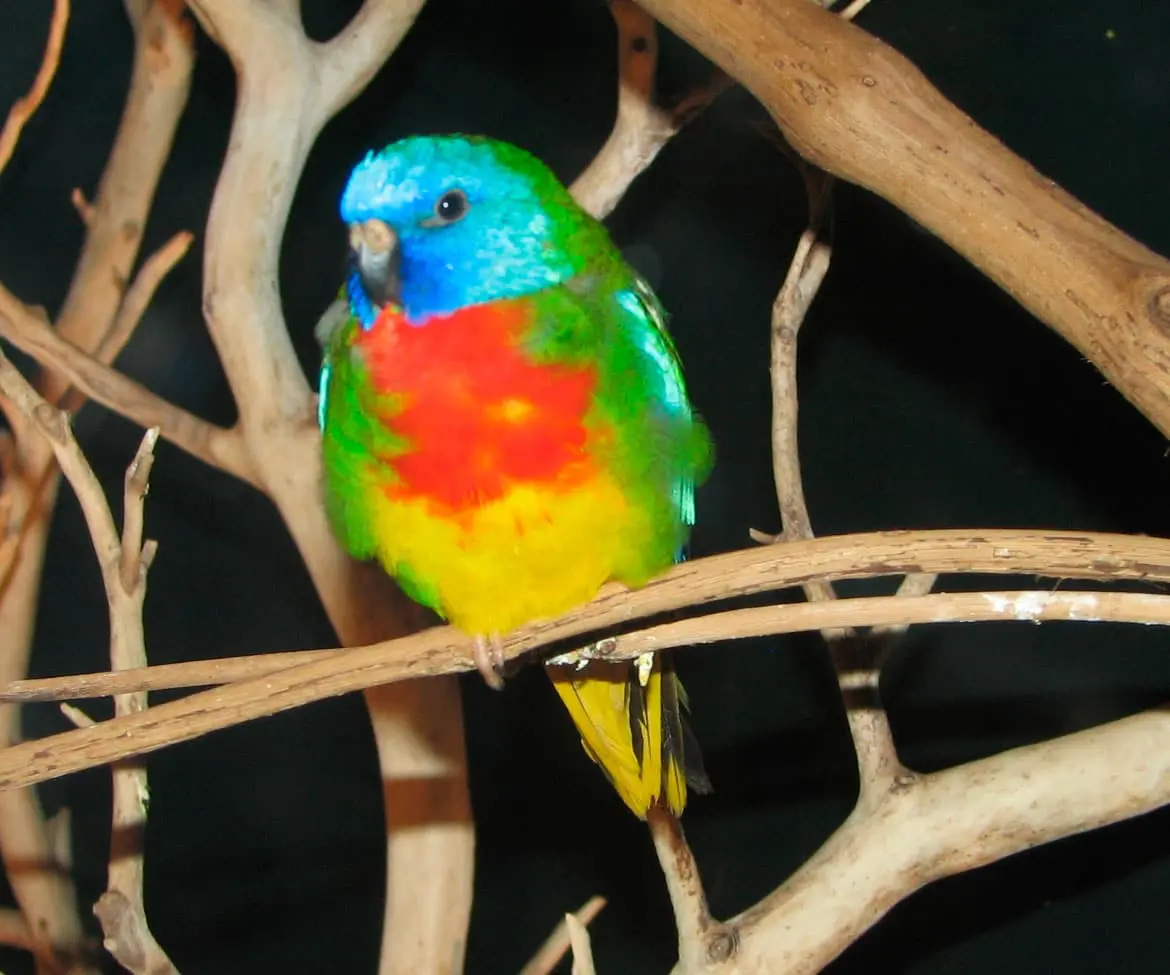
The Scarlet-chested Parrot(Neophema splendida) It is particularly colorful. It has the "face" and the forecrown are bright turquoise blue, darker in the throat and chin.
The upperparts are green. The curvature of the wings is dark blue, wing-coverts are the same blue tone to the face. Primary coverts dark blue-violet. The primaries Black has light blue brainwashed in the foreign bands. The outer edge of the secondaries has a tone blue-green that is mixed with the green of them vane inner and tertiary.
The underparts is dark blue. The chest is bright Scarlet, which is an important recognition feature. The sides of the top of the chest and flanks are green. The rest of the underparts is bright yellow. The bottom of the tail is green, but the tips of the outer tail feathers they are dyed yellow.
The bill is black, irises dark brown. The legs are gray-Brown.
The female is duller than its companion, with the belly and the chest green. The blue color of the face is restricted.
The females and juveniles they often show Wing bars.
The young male need four months to purchase your mature plumage, and retain a youthful glow until the age of 2 years.
Habitat:
The Scarlet-chested Parrot they are usually distributed in arid scrublands that are composed mainly of acacias and eucalyptus. They appreciate, particularly, plants of Mallee (Eucalyptus gracilis) and Mulga (Acacia aneura).
Also live in wooded areas dominated by casuarinas, as well as areas where the soil is covered by Spinifex or large clumps of grass type Triodia.
The Scarlet-chested Parrot do not despise the crests of hills that are equipped with a large number of plants, like the covered Plains of Sea sandwort or Salt grass (Honckenya peploides), What are plants which grow in saline environments.
They tend to find their food on Earth and form relatively consistent flocks outside of the nesting season.
During the breeding season, These birds are not very gregarious, but couples establish their nests in trees not very far from the other.
As with the Turquoise Parrot, the division of labor is well established and the females are responsible for the collection of green leaves that adorn the interior of the nest.
There is no description of the various courtship.
Reproduction:
The season of nesting of the Scarlet-chested Parrot, usually, is carried out between January and August, but these dates can change as the reproduction is influenced, significantly, by climatic conditions, especially the rains.
The nest It is placed in a tree cavity, above all a eucalyptus, between 2,5 and 8 meters above the ground.
The Scarlet-chested Parrot they are very loose colonies.
The spawning includes of 3 to 5 eggs and your incubation lasts a few 18 days. The most numerous litters, sometimes, provide 6 eggs.
The chicks are altricial, they take flight to leave his place of birth 30 days after hatching.
Food:
The Scarlet-chested Parrot they have a diet almost exclusively granivore.
These birds acquire most of the moisture you need eating Succulents as Calandrinia. If this practice is not enough, These parrots are like other species of arid lands, that is to say, that they are going to supply themselves with liquid directly to the sources and water points.
• Current category of the Red List of the UICN: Least concern
• Population Trend: Stable
The inroads among 1939 and 1996 They show that these birds are able to form very rapidly large gatherings.
Disturbances affecting the natural environment had a negative impact on the evolution of the active population. The use of aquatic resources for the livestock and competition in this field with the Bourke's Parrot they have also caused damage.
Poaching and marketing of this bird have also had devastating consequences: more than 25.000 Scarlet-chested Parrot they are in captivity in Australia.
Its population in freedom is estimated at around 10,000 specimens.
"Scarlet-chested Parrot" in captivity:
The Scarlet-chested Parrot is a species peaceful and silent. This beautiful parakeet ends up gaining confidence with your caregiver, It is only a matter of time. It is also easy to maintain and almost do not eat wood. It is resistant to cold (light Frost), but it is very sensitive to humidity, fog, and air currents.
The Scarlet-chested Parrot they feed on the ground; It is convenient to use of vermicides, deworming them regularly. They are also susceptible to ocular infections and vulnerable to infections of Candida.
The tastes for the bathroom vary from one individual to another.
In terms of their longevity, according to sources, a sample lived during 14 years in captivity. The same sources report that these parakeets can live up to 25,4 years in captivity, but this has not been verified; the same study also ensures that the Scarlet-chested Parrot You can play from around 1 year of age in captivity.
– Avibase
– Parrots of the World – Forshaw Joseph M
– Parrots A Guide to the Parrots of the World – Tony Juniper & Mike Parr
– Birdlife
– Photos:
(1) – Adult male at Cincinnati zoo, USA By Ltshears (Own work) [Public domain], via Wikimedia Commons
(2) – Taken at the Cincinnati Zoo By Greg Hume (Own work) [CC BY-SA 3.0], via Wikimedia Commons
(3) – Immature male on the left and an immature female on the right at Gluepot Reserve, South Australia By David Cook Wildlife Photography from Wamboin, NSW, Australia [CC BY 2.0], via Wikimedia Commons
(4) – Immature male on the left and an immature female on the right at Gluepot Reserve, South Australia By David Cook Wildlife Photography from Wamboin, NSW, Australia [CC BY 2.0], via Wikimedia Commons
(5) – Scarlet-chested Parrot «Neophema splendida» at Cincinnati Zoo By Ltshears (Own work) [CC BY-SA 3.0], via Wikimedia Commons
(6) – By T.H. Maguire (1821–1895) (http://www.birdresearch.dk/dk/jgould.htm) [Public domain], via Wikimedia Commons
▷ The world of Pets: Dogs, cats, birds, reptiles, amphibians
Of 33 cm.. length and an average weight of 475 g..
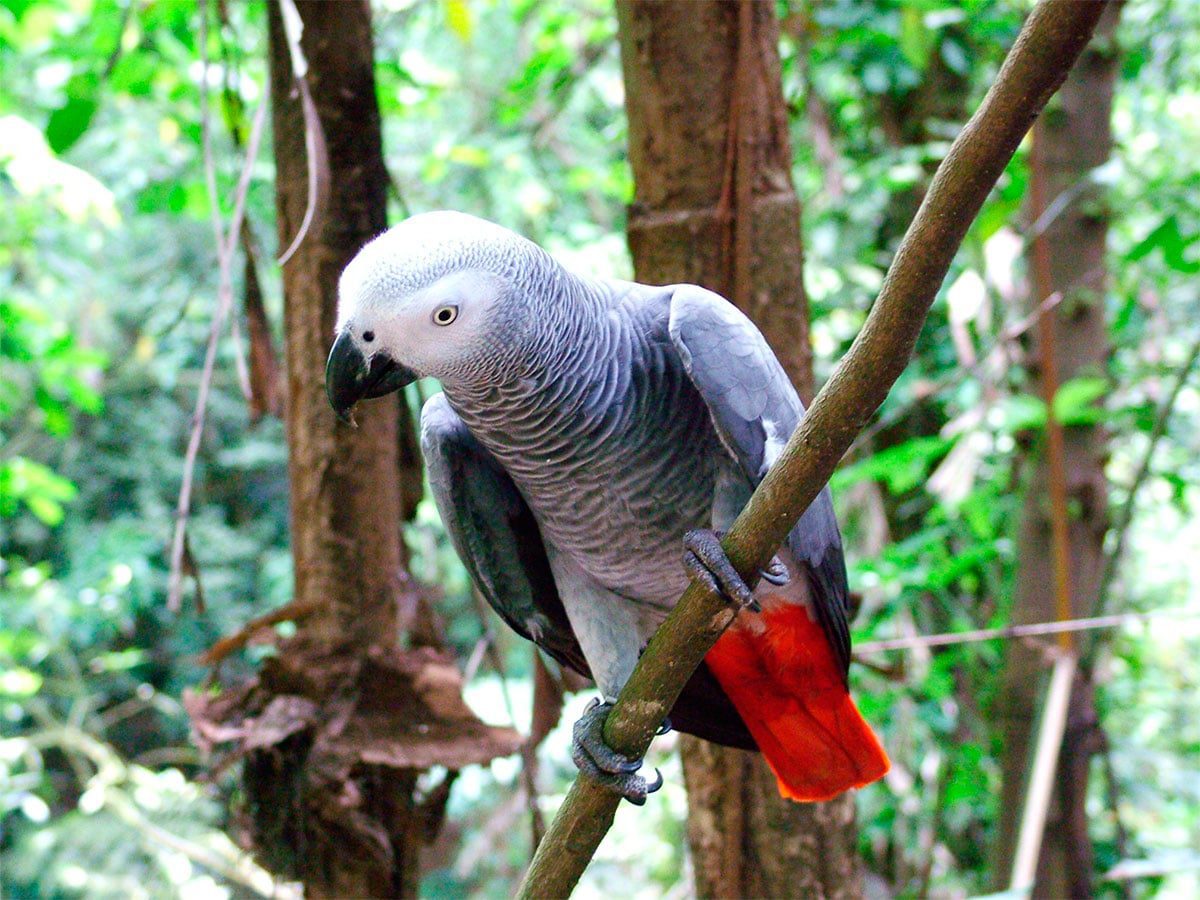
The Grey Parrot(Psittacus erithacus) is famous for its intelligence and ability to mimic sounds and human speech, so it is one of the most popular of all pets avian. It is one of the largest parrots in Africa.
They have the feathers of the lores, the cheeks, the frenyou and the crown silver grey, more clear tips. The of the the mantle and lower area of the back darker, slate gray with light margins, giving a scaly appearance; the lower area of the back and tail are silver grey. Upper wing coverts, secondaries and scapulars slaty-grey. Primaries grey dark (almost black), more clear below that top.
Wing feathers light grey, with the exception of the greater coverts that are of a dark grey tone.
feathers of the chest slate gray with pale gray margins fused with much lighter silver feathers on the belly; flanks and the thighs clear silver grey color.
Tail and their coverts, bright Scarlet.
Older birds they can show scattered red feathers between the plumage gray, especially in the the thighs and the belly.
The bill black; irises yellow; naked facial area with some fine white hairs; legs dark grey.
Without sexual dimorphism in the plumage.
Immature they have the tail darker red towards the tip, Grey dye in undertail- coverts and the irises grey.
(Alexander, 1909) – Very similar to the nominal, except that they are a little smaller. Some bird breeders argue that the Princeps is a regional type of Psittacus erithacus erithacus, instead of separate subspecies.
Habitat:
The Grey Parrot They inhabit the tropical jungle primary and secondary, the forest edges and clearings, gallery forest and mangroves; wooded Savannah, haunting, often, land cultivation and even gardens.
Partially confined in the lowlands, Although in the East of its range have been recorded at altitudes of 2.200 m.
They reach the highest densities in primary lowland forests, intermediate in the primary montane and lower density in plantation of coconut.
gregarious, they form large communal roosts of up to 10.000 individuals, often at some distance from the feeding areas.
Preferred places of shelter are trees or palm trees on the water, also islands in the rivers.
Are dispersed into smaller groups (until 30) to feed.
Reproduction:
The reproduction of the Grey Parrot takes place in loose colonies, in which each pair occupies its own tree. Individuals select their partners carefully and have a monogamous union of lifelong It begins at sexual maturity, between three and five years of age.
Few details are known about the courtship in nature, but have been observed and recorded flights of visualization around the nest cavities. The males feed their mates (power dating) and both sing soft monotonous notes. At this time the female goes to sleep to the nest cavity, While the male takes care of it.
In captivity, the Grey Parrot fed males to females after copulation events and both sexes participate in a mating dance in tipping its wings.
The nest they build it in the cavities of some tree (for example, Terminalia, Ceiba or Distemonathus), between 10 and 30 meters above the ground.
Sometimes breeds in colonies of up to several hundred couples loose (in Prince for example), but in most places they nest alone.
Breeding season varies with locality. In East africa, breeding has been recorded in the months of January-February and June-July, both in dry periods.
Young chicks have been released for sale from March onwards in Ghana. Other records suggest as a rule from the breeder, the dry season.
The females lay from three to five eggs, that you are in charge of incubate while they are powered entirely by the male. The incubation lasts approximately thirty days and the young man emerges from the nest at twelve weeks of age.
Food Loro Yaco:
Their diet consists of a variety of seeds, nuts, fruits and berries.
The fruit of the Palm oil (Elaeis guineensis) is her favourite in some areas, coming to bear its fruit over long distances before being consumed.
In Bioko, they prefer the berries of Tragacantha tail (Fam. Malvaceae).
They can be a pest, causing considerable damage to corn crops in some areas.
Loro distribution Yaco:
Size of the area of distribution (reproduction / resident): 2.760.000 km2
The Grey Parrot are distributed between the West and centre of Africa, of Guinea-Bissau and this from Sierra Leone, across the South of Mali, Ivory Coast, Ghana and Nigeria, until Cameroon, extending to Bioko and Islands Sao Tome and Principe in the gulf of guinea; from Gabon and the Congo through Zaire, Uganda and Western Kenya, the Southwest and East - Central of Zaire and Northwest of Tanzania.
Usually sedentary. Common where large extensions of forest persist and still abundant in some localities, especially in the tropical jungles of the Congo basin. But, due to the extensive loss of forests in some parts of the range (for example, of Nigeria to Sierra Leone) and the catch on a massive scale (the second best-selling parrot in the world in the Decade of 1980) There have been dramatic declines in some places (for example, in Liberia, Ghana, Kenya and around Kinshasa, Zaire, and other cities of the Congo basin).
The Grey Parrot They are protected by the convention CITES, consisting in annex II (species that may be threatened by a trade out of control).
If it is considered not threatened globally, the fact of being one of the species of the family Psittacidae (parrots and parakeets) most sold in the world makes its distribution is shrinking dramatically in certain places, its disappearance may be close in many of these areas according to the organization The World Parrot Trust [4].
The following data are quite illustrative in this respect:
1. In the period 1982-1989 It was the second psittacida then suffered more trade of Agapornis fischeri, with averages of more of 47.000 specimens exported from Africa annually [1].
2. The export quotas under the CITES agreement for psittacines are often not adjusted to scientific criteria due to the lack of detailed population studies and the annual renewal rates of the populations. [2].
3. Too often these quotas are widely exceeded by exporting countries.. These may include Cameroon exported 23.000 grays in 1996, When I had a share of 12.000! [2]. Although these facts to do that Cameroon could not legally exported in 1997, the current quota of 12.000 grays is exceeded with more of 15.000 all the years [5]. Another example, is the Republic of Congo, with an annual fee of 10.000 grays, that has also been sanctioned by the impossibility of exporting them in 2001 and 2002 by the large number of existing fraudulent export [6].
4. In the year 1999, the European Union imported (legally under the Convention CITES) from Africa 33.341 greys parrots, number only surpassed in this family by parrots of the genus Lovebirds (71.588 of Agapornis roseicollis, 63.867 of Agapornis fischeri and 33.720 of Agapornis personatus). Spain It was the second destination of these parrots grays, after Netherlands, imported 6.216 specimens [7].
5. There are specific areas Africa It supported much of the pressure from hunters of parrots for their trade. One of them is the area of Lobeke, in the southeast of Cameroon, where they hunt every year more than 15.000 grays, most of them die by mishandling in the capture and transport [5].
The aforementioned illegal trade is no stranger to our country, where was recently dismantled an international network of illegal import of this species from the Republic of Congo, who had brought to Spain at least 3.982 specimens from the year 1998 [7].
On the other hand, in some countries these birds are raised industrially for sale. This favours on the one hand the fact that decreases the importation of birds hunted in the wild [2], and on the other increases the number of birds on the market, and with it the chance of leaks or intentional releases, that they can get to colonize areas outside its area of distribution. An example of a Spanish company of these characteristics, among the many that are, It has more than 300 breeding pairs, can be found in [8].
References:
[1] NECKLACE, N.J.. 1997. Family Psittacidae (Parrots). In: Handbook of the Birds of the World. Vol. 4. Sandgrouse to Cuckoos (Ed: J. pit, A. Elliot, J. Sargatal). Lynx Edicions, Barcelona. pp. 280-477.
[2] MAY, D.L.. 2001. Grey Parrots of the Congo Basin Forest. PsittaScene 13-2(47): 8-10.
[3] AALANGDONG, O.I., AUGUSTINE, S. 1999. Langyintuo. Crop damage by wildlife in Northern Ghana. Abstracts of the 2nd International Wildlife Management Congress, Gödöllö, Hungary.
[4] The WPT 12. The World Parrot Trust. African Grey Parrot. www.worldparrottrust.org
[5] NGENYI, A. 2002. African Grey Parrot trade in Cameroon. PsittaScene 14-2(51): 2-3.
[6] El Periódico de Catalunya. Dismantled a network of trafficking in protected species in Barcelona. 11-11-2004.
[7] Report of Animal Aid. 2002. From Rainforest to Retail. Leading DIY chain and the horror of the wild bird trade.
[8] Psittacus Catalonia, SL. Information available in: www.psittacus.com
«Loro Yaco» in captivity:
The ancient Egyptians already kept these birds as pets.. Later the Greeks and the Romans did the same.
While the Grey Parrot they can be good pets, If you have children in your home, buying a Grey Parrot It would be a bad idea, by both the Parrot and the children that can be easily damaged with its claws and beak.
The Grey Parrot can also be difficult for some people to maintain, This is probably due, Unlike other pets, because these are always active and should be checked several times a day. These parrots can be unordered, for example, When they are eating the seeds or other foods it is likely that they end up throwing debris out of the cage and even against the walls.
More Intelligent any dog, calls attention to the 24 hours of the day. His extreme intelligence and sensitivity takes you easily to the depression if it is unrequited.
It is a bird very long-lived, There are those who say that these animals can live 73 and up 93 years. More longevity record reliable, However, is a specimen that was still alive after 49,7 years. In captivity, these animals they tend to breed to the 5 years of age.
Their cages they must also be cleaned daily, due to their feces, they are totally inconsistent and appear in their feeders, toys, or anywhere else in the cage. Because of this, you have to wash the cages thoroughly to remove any odor and bacteria.
To the Grey Parrot like biting everything, and when I say everything, I say this seriously. They mostly enjoy chewing on pieces of wood, probably because they do in nature, However, be aware that they will chew everything at your fingertips, clothing, curtains, the skin of our sofas, etc. If you have many objects in the House, make sure they are in a safe place when you let your birds out of the cage.
Note: In the European Community and the United States this prohibited the marketing of these parrots if they have been captured in wild environments.
Alternative names «Loro Yaco»:
– Grey or Timneh Parrot, African Gray Parrot, African Grey Parrot, Gray Parrot, Grey Parrot (English).
– Perroquet jaco ou P. de Timneh, Jacko, Perroquet gris, Perroquet gris du Gabon, Perroquet jaco (French).
– Graupapagei (German).
– papagaio-do-congo, Papagayo Cinzento, Jacco (Portuguese).
– Cotorra Africana, Loro Yaco, Loro Gris Africano, Loro Gris, Loro Gris de Cola Roja, Yaco (español).
– Avibase
– Parrots of the World – Forshaw Joseph M
– Parrots A Guide to the Parrots of the World – Tony Juniper & Mike Parr
– Birdlife
– Spanish Society of Ornithology / BirdLife – SEO
Photos:
(1) – Congo African Grey Parrot (Psittacus erithacus erithacus) at a bird park in Singapore By Michael Gwyther-Jones (originally posted to Flickr as Singapore) [CC BY 2.0], via Wikimedia Commons
(2) – Loro gris do Congo. Photo taken na Illa de Arousa, Galiza By L.Miguel Sánchez Bugallo (http://commons.wikimedia.org/wiki/User:Lmbuga) [GFDL or CC-BY-SA-3.0], via Wikimedia Commons
(3) – Congo African Grey Parrot (Psittacus erithacus erithacus). Pet parrot held on a hand. By Eli Duke [CC BY-SA 2.0], via Wikimedia Commons
(4) – Young African Grey Parrot (Psittacus erithacus erithacus) at Weltvogelpark Walsrode (Walsrode Bird Park, Germany) OLAF Oliviero Riemer [CC BY-SA 3.0], via Wikimedia Commons
(5) – Loro gris do Congo. Photo taken na Illa de Arousa, Galiza By L.Miguel Sánchez Bugallo (http://commons.wikimedia.org/wiki/User:Lmbuga) [GFDL or CC-BY-SA-3.0], via Wikimedia Commons
(6) – A Congo African Grey Parrot eating a piece of apple. It is perching on an open cage door and there is another parrot in the cage in the background By Peter F. (originally posted to Flickr as thanksgiving) [CC BY 2.0], via Wikimedia Commons
(7) – A pet Congo African Grey Parrot on held back By Sonny SideUp (originally posted to Flickr as Bird Tossing) [CC BY 2.0], via Wikimedia Commons
(8) – By Hans – pixabay
Of 12,7 to 15 cm in length and a weight between 42 and 58 g..
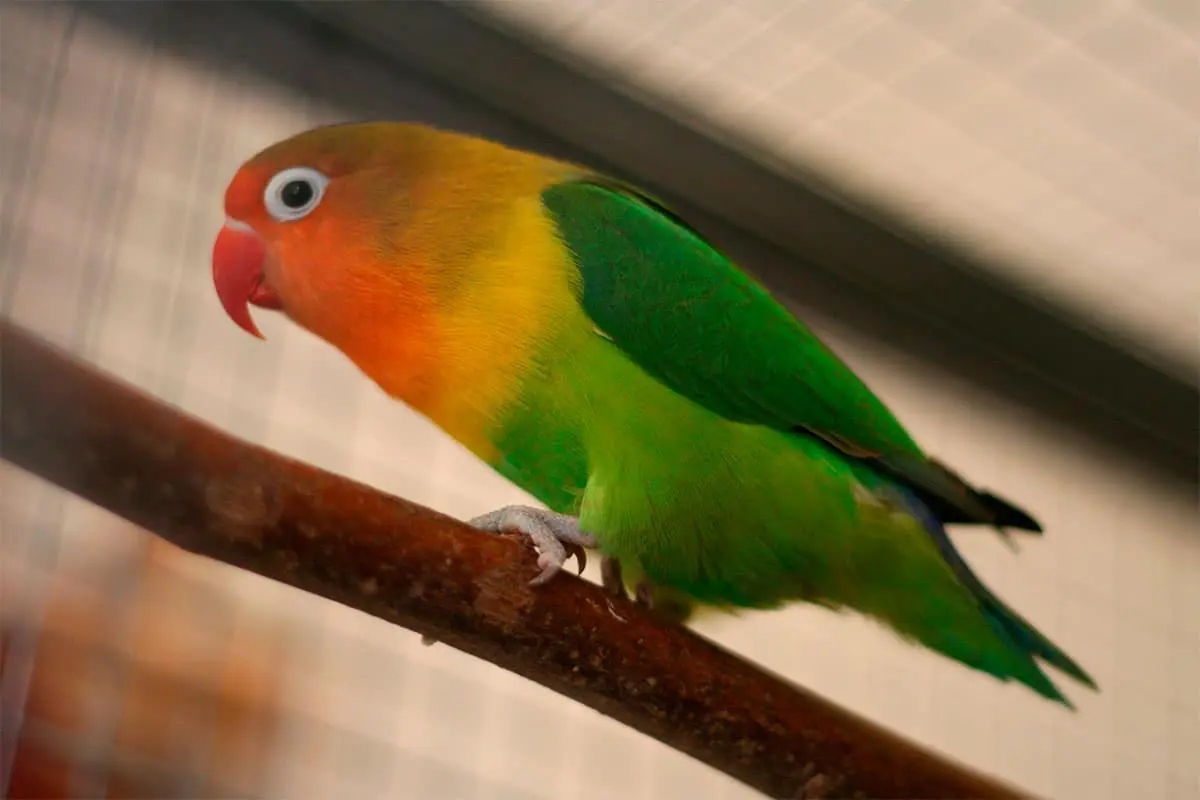
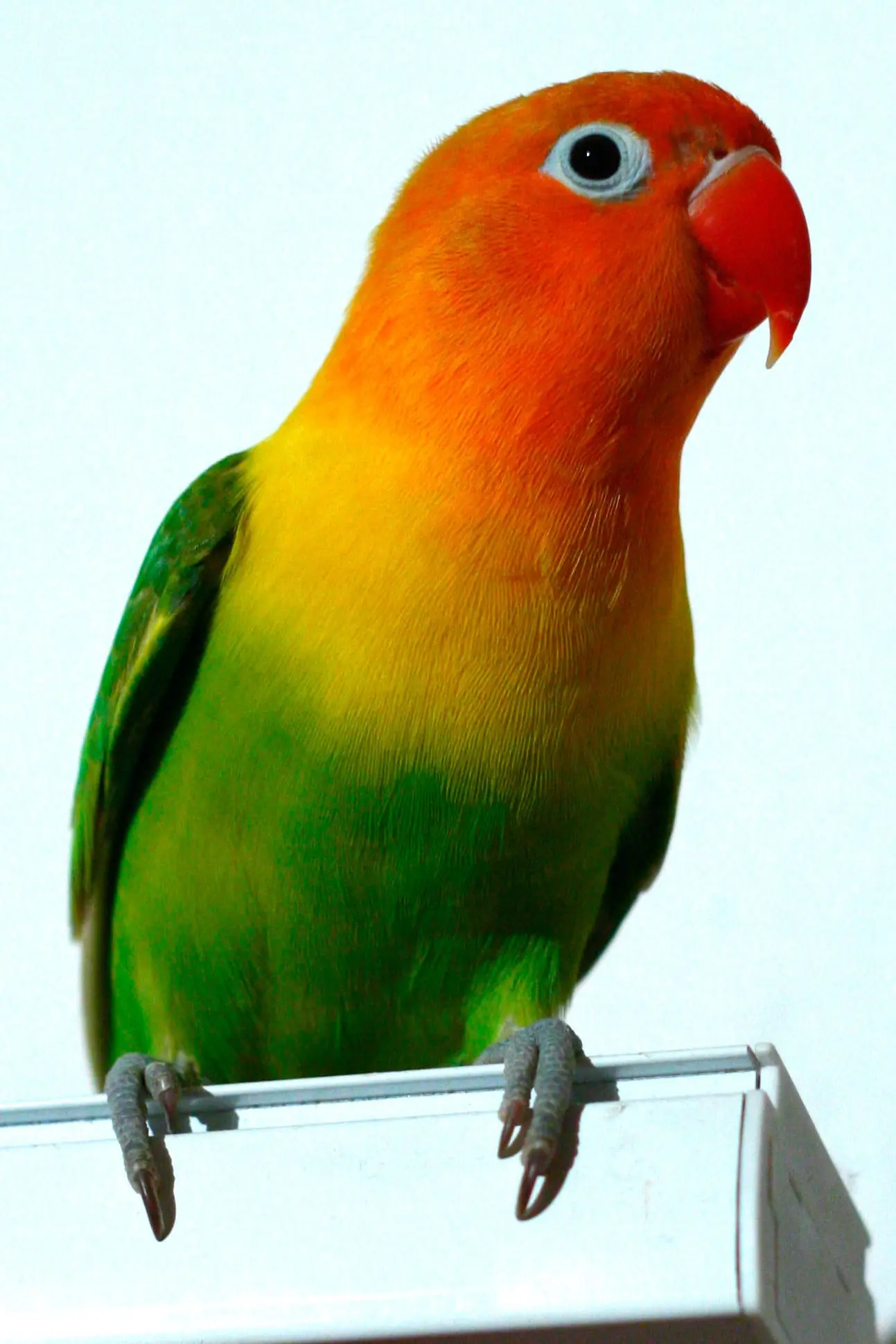
The Fischer's Lovebird(Agapornis fischeri) has a frontal band, the lores and cheeks bright red with an orange shaded in red chin and throat. Upper chest is orange-yellow; crown and nape They are brown. Width collar adjacent yellowish brown and yellowish orange band at the top of chest.
The the mantle, scapulars and front of the rump, are green; the back of the rump and uppertail-coverts dark blue. Upper, the wing-coverts green; primaries and secondaries blackish brown with green edges to the vane outer. Under, the wing-coverts green; underside of flight feather grey-black. The low area chest up to the undertail- coverts pale yellowish green.
Tail bluish green, tipped yellow and bordered by a black line.
The bill is red, whitish towards the base of the upper jaw; cere white; irises brown; periophthalmic ring white of a 2 mm; legs pale grey.
Both sexes similar, indeed there no sexual dimorphism Between both.
One method that is very effective in distinguishing the sex of our Fischer's Lovebird It is the bone of the pelvis, being more open in females than in males.
The immature They have reduced the blue in the uppertail-coverts and they are both duller than adults, particularly on neck, the head and the chest; black markings, sometimes at the base of the upper jaw.
The Fischer's Lovebird They inhabit wooded grasslands with acacias, Commiphora; especially in the west, also in more open grasslands with Adansonia and cultivated areas. More common in sheets with different types of acacias and trees of the genus Egyptian balanites; also in terrestrial flora zones including Penisetum, Digitaria, Themeda and pastures Eustachys.
In the south of its range They are present in the forest with palm trees Borassus aethiopum.
usually in altitude between 1,100-2.000 m. Often near water, especially in hot weather.
Gregarious, at least outside the breeding season , and generally in small flocks. Sometimes more important meetings form, for example, where abundant food.
In Tanzania They meet roosting nests leveraging Rufous-tailed Weaver (Histurgops ruficauda).
The main known predators Fischer's Lovebird they are the Borni Falcon (Falco biarmicus).
Reproduction Fischer's Lovebird:
The Fischer's Lovebird They breed in colonies.
The breeding It takes place from January to April and in June and July, coinciding with the dry season; the exact timing depends on the locality.
Most of the nests They are located 2.15 meters above the ground, at the base of leaves overhead palm, in the holes and cracks of dead trees or dead branches and live trees, sometimes nest on cliffs.
The nest It comprises grass stalks and peel strips carried by the female in his beak.
The Clutch size in captivity is three to eight eggs, with a period of incubation of 23 days and period incipient of 38 days.
Food Fischer's Lovebird:
The diet of the Fischer's Lovebird is mainly granivorous. It feeds on seeds such as Pennisetum mezianum, also it feeds millet and corn, although the species does not come to be considered a serious pest for crops; Also they take seeds Acacia directly from trees, grass Achyranths asper, fallen berries and fruit Ficus, Rhus shaggy and Commiphora.
They need to drink daily.
Distribution:
The Fischer's Lovebird They are endemic to the north and northwest Tanzania from Kondoa in the South-East, Serengeti National Park, in the north and the Lago Manyara in the East; possibly closer to the border Kenya in some areas.
In Rwanda and Burundi the species is either a recent natural settler, or I asilvestrado from 1970, or an irruptive visitor in response to drought.
Probably some Local movements in the dry season with irruptions in drought years. Within its tiny range, is a common bird, with large flocks in some areas, scarce and seemingly in decline, especially outside protected areas where low density is attributed to the capture for trade.
There is a self-sustaining wild population derived from escapes from captivity in Southeast France, where Yellow-collared Lovebird (Agapornis personatus) also they escaped, along with hybrids also observed.
The population of the Fischer's Lovebird release has been estimated to range between 290.205 and 1.002.210 birds.
There has been a significant population decline Since the Decade of 1970, mainly because of widespread trapping for the wild bird trade.
The Fischer's Lovebird wild bird was the most traded in the world 1987 and was the most popular wild parrot imported into the then European economic community, representing about 80% exports of parrots in Tanzania (RSPB 1991).
The legal collection for export has been stopped, but the population remains much lower than it was, and trade could start again (Moyer 1995).
The species hybridized with the Yellow-collared Lovebird (Agapornis personatus) in the nature, but not within the natural range of the species (there is a range of overlap but the Fischer's Lovebird It appears to be a non-breeding visitor habitat Yellow-collared Lovebird [N. Baker a slightly. 1999, Morton y Bhatia 1992]) so this is unlikely to pose a threat.
Conservation Actions Proposed
– Conduct surveys to obtain an estimate of the population-date.
– Monitor population trends through regular surveys.
– It prevent capture for export to start again. Investigate the extent of hybridization with the Yellow-collared Lovebird (Agapornis personatus).
The Fischer's Lovebird in captivity
The Fischer's Lovebird They have been kept as pets from, approximately, mid-sixteenth century. They became part of the trade in live birds 1926. The first successful captive breeding of Agapornis fischeri It was documented 11 in January of 1928. For the year 1931, the berlin zoo (Germany) they had raised 68 copies successfully in captivity. Today they are bred and sold as pets, mainly in the United States and Europe. In 1987 was the most traded bird species in the world.
The Fischer's Lovebird they are difficult birds to keep healthy in captivity. Son active birds they need a lot of space. When you are confined in a cage, health tends to deteriorate. Instead of being active and vocal, often they sit on the floor of the cage in a corner. physical problems such as negative young and the overweight also they shortened their longevity.
Being very active birds and require wide cage (a minimum of 50 x 50 x 75 cm. to a bird and 65 x 65 x 75 cm for a couple.). It is appropriate to give a little spot inside the cage to hide in when they feel insecure.
Surprisingly, they don't seem to have much trouble acclimatizing to cold weather even though their original habitat is tropical. If they kept away from drafts, they can withstand the long winters on other continents.
If allowed out of his cage must be very careful not to have utensils close that they can damage or may damage, they are avid chewers, they have strong beaks and can quickly cause damage.
They are very vocal birds and their shrill noise can be a nuisance.
.
Of all species of Lovebirds, the Fischer's Lovebird He is known to be the most acrobatic.
With regard to its longevity, a demographic study suggested that these birds are aging rapidly with maximum longevity 7,7 years. An exemplary, as indicated sources, lived 12.6 years in captivity. Maximum longevity could be underestimated; More studies are needed. It has also been informed by other sources that these animals can live up 32,2 years in captivity, but this has not been verified.
– Avibase
– Parrots of the World – Forshaw Joseph M
– Parrots A Guide to the Parrots of the World – Tony Juniper & Mike Parr
– Birdlife
– Photos:
(1) – Fischer’s Lovebird, (Agapornis fischeri); side view of a pet on a perch By Peter Békési (Flickr) [CC BY 2.0], via Wikimedia Commons
(2) – Two Fischer’s Lovebirds, (Agapornis fischeri). Pets on a perch By Peter Békési from Budapest, Hungary (IMG_2303) [CC BY 2.0], via Wikimedia Commons
(3) – Three Fischer’s Lovebirds at Ueno Zoo, Japan By Agapornis_fischeri_-Ueno_Zoo,_Japan_-three-8a.jpg: Takashi Hososhima from Tokyo, Japanderivative work: Snowmanradio [CC BY-SA 2.0], via Wikimedia Commons
(4) – Fischer’s Lovebirds, Agapornis fischeri, social grooming By Peter Békési (originally posted to Flickr as IMG_0692) [CC BY-SA 2.0], via Wikimedia Commons
(5) – Fischer’s Lovebird perching on a branch in captivity By Françoise Walthéry from Bruxelles, Belgium (8_Buiten_reeks_8) [CC BY-SA 2.0], via Wikimedia Commons
(6) – Fischer’s Lovebirds at World of Birds Wildlife Sanctuary and Monkey Park in Cape Town, South Africa By Mara 1 (originally posted to Flickr as I Love You !) [CC BY 2.0], via Wikimedia Commons
(7) – Fischer’s Lovebird (Agapornis fischeri). Two on a branch By Lucia Smit (originally posted to Flickr as Sonny & Cher) [CC BY 2.0], via Wikimedia Commons
(8) – Fischer’s Lovebirds, Agapornis fischeri By Peter Békési (originally posted to Flickr as IMG_0736) [CC BY-SA 2.0], via Wikimedia Commons
(9) – A group of Fischer’s Lovebirds feeding at Ueno Zoo, Japan By kanegen (originally posted to Flickr as Ueno Zoo) [CC BY 2.0], via Wikimedia Commons
(10) – Fischer’s Lovebird, (Agapornis fischeri) perching on a box By Peter Békési (Flickr) [CC BY-SA 2.0], via Wikimedia Commons
Origin: Thailand, Malaysia, Singapore, Indonesian, Brunei
Character: shy and docile.
Life expectancy: 10 years.
Height: 18 cm..
Content
Description:
Of 18 cm.. of length and a weight of 85 g..
The Blue-rumped Parrot(Psittinus cyanurus) is a small Parrot, robust and with a tail very short.
Since the crown up to the nape is a bluish grey, glossy on the front of the crown; the lower cheeks and chin grayish brown; the nape sharply demarcated from the the mantle black, with a strongly mottled grey; the low back and rump Blue light violet, brighter than the blue of the head. The patch in the shoulders reddish brown; upperwing-coverts medium Green, the edges of yellowish-green, especially in internal and great stockings coverts; primary coverts blue; flight feather green, with the primaries finely lined with yellow along the inner edges; carpal edge Blue and yellow. Lower parts of the wings dark, with bright red feathers on the underwing-coverts and axillary.
Underparts grayish brown, becoming a blue-green shutdown, with yellow marks in the vent. Uppertail greenish blue in the Center, inner featherss of yellow light withvane outer greener; undertail-coverts yellow
A long bill with red notches in the upper jaw, lower jaw duller; irises yellowish white; legs bluish grey.
The female has the head and upper jaw brown; lacks black on the back and shows just a little blue in the rump; the underparts are light green, Gray as in the male Brown not.
The youth are like females, but with the head green.
(Richmond, 1902) – Males with green spread at the front of the crown, the back of neck black, Green mantle and the rump green (marked with turquoise), the underparts greenish. Female with the head green. Larger than the subspecies Psittinus cyanurus pontius.
(Oberholser, 1912) – As well as the species nominal but larger.
Habitat:
There is some evidence of possible regular movements in the North of its distribution area, with a view to passing birds above Fraser Hill in Malaysia, 1,300 m.
The Blue-rumped Parrot is also seasonal in parts of the South visitor of Burma.
They are distributed in lowland forests (usually below 700 m) and related habitats, including open forests, secondary growth, huertas, mangroves, dry forests, swamp forest, cultivated areas, including oil palm plantations (Elaeis guineensis), near forests (where post-breeding concentrations are considered pests in some areas), dense thickets and groves of coconut (Cocoa nuts).
The Blue-rumped Parrot they are not shy, and can be found in groups of up to 20 birds, whether eating in silence at the canopy level, quickly flying above the forest, or above the tops of the trees hacuendo calls continuously.
Reproduction:
The breeding season of the Blue-rumped Parrot extends from February to may in Malaysia, and from June to September in Borneo, Although some birds have been seen inspecting possible nesting cavities at other times of the year.
During the courtship grooming each other is common; the male jumps by placing both feet on the back of the female during mating. The implementation is up to three eggs, which are deposited in a hole in the top of a tree, little more is known about the reproductive cycle.
Food:
The diet of the Blue-rumped Parrot is composed of seeds, fruits and flowers.
The size of the world population Blue-rumped Parrot He has not formally quantified, but it is believed that they are more than 100.000 individuals (Juniper and Parr 1998), and the species is described as common in primary habitats and uncommon in secondary habitats and plantations (pit et to the. 1997).
In general, the loss of the forest cover between 2000 and 2010 It has been estimated in 23,7% in the case of Sumatra, the 12,0% in Borneo and the 8,2% for Peninsular Malaysia (Miettinen et to the. 2011).
In Sumatra, It has been estimated that you close to of the 36% primary forest cover in 1990, lost in 2010 (including degraded primary forest) (Margono et to the. 2012).
Descents are compounded by the pressure of the capture; But, the Blue-rumped Parrot uses of forest fragments, forest exploitation, secondary vegetation, other modified habitats and habitats at elevations, What has prevented a faster decrease in its population. But, many lowland forests have been logged.. So, suspected of may be suffering a decrease in the moderately rapid population.
The Blue-rumped Parrot It is not a bird which like to interact with humans, nor is it a particularly playful bird. Are described as docile who love to sing on rainy days. Due to its melodic voice, they are often alone as songbirds. But, not all of them are born as birds cantadoras, in fact, Some are dumb.
It is recommended to buy the younger, since they are more likely to sing. But, in general it's parrots very quiet with occasional whistles and high-pitched vocation, that it can be irritating when held captive in an apartment.
They have very limited ability to speak. Some of them learn to speak – but most never do.
Unfortunately, they are easy to catch, since they remain immobile when frightened. Hunters have only to shoot into the air or make some noise on turning the birds when they are resting so that they can be easily caught. This has led to its State endangered extincion ..
With regard to its longevity, according to sources, a Blue-backed Parrot was still alive after 10,2 years in captivity. Taking into account the longevity of the similar species, maximum longevity is probably underestimated in this species.
The Blue-rumped Parrot It is a beautiful bird when it is in its natural habitat, its potential as a pet it is said that it is limited. Usually do better in an environment of Aviary, with plenty of space so that you can explore the surrounding area. Better yet is protect their natural habitat and let them enjoy freedom.
Alternative names:
– Blue-rumped Parrot, Blue rumped Parrot (English).
– Perruche à croupion bleu, Perroquet à croupion bleu (French).
– Rotachselpapagei, Rotachsel-Papagei (German).
– Papagaio-de-rabadilha-azul (Portuguese).
– Lorito de Lomo Azul, Lorito Dorsiazul (español).
Avibase
Parrots of the World – Forshaw Joseph M
Parrots A Guide to the Parrots of the World – Tony Juniper & Mike Parr
Birdlife
Photos:
(1) – Blue-rumped Parrot Psittinus cyanurus. Bird Park Kuala Lumpur by Bernard DUPONT – Flickr
(2) – Bird Park Kuala Lumpur By Bernard DUPONT from FRANCE (Blue-rumped Parrots Psittinus cyanurus) [CC BY-SA 2.0], via Wikimedia Commons
(3) – Blue-rumped Parrot in a cage By TJ Lin (originally posted to Flickr as DSC01255) [CC BY-SA 2.0], via Wikimedia Commons
(4) – Male blue-rumped parrot (Psittinus cyanurus) by Chlidonias – zoochat
(5) – Female blue-rumped parrot (Psittinus cyanurus) by Chlidonias – zoochat
(6) – Psittacus Malaccensis. (Latham, not Gmellin) Blue-rumped Parrot By William Swainson, F.R.S., F.L.S. (Zoological Illustrations, Volume III.) [Public domain], via Wikimedia Commons















_-held_on_hand.jpg)
_-_Weltvogelpark_Walsrode_2011.jpg)


%3B_side_view_of_pet_IMG_2309.jpg)


_perching_on_a_box.jpg)
.jpg)

