โ–ท The world of Pets: Dogs, cats, birds, reptiles, amphibians

Cliff Parakeet
Myiopsitta luchsi

Cliff Parakeet

Content

Description:

Cliff Parakeet

26-28 cm.. length and a weight between 120 and 140 g..
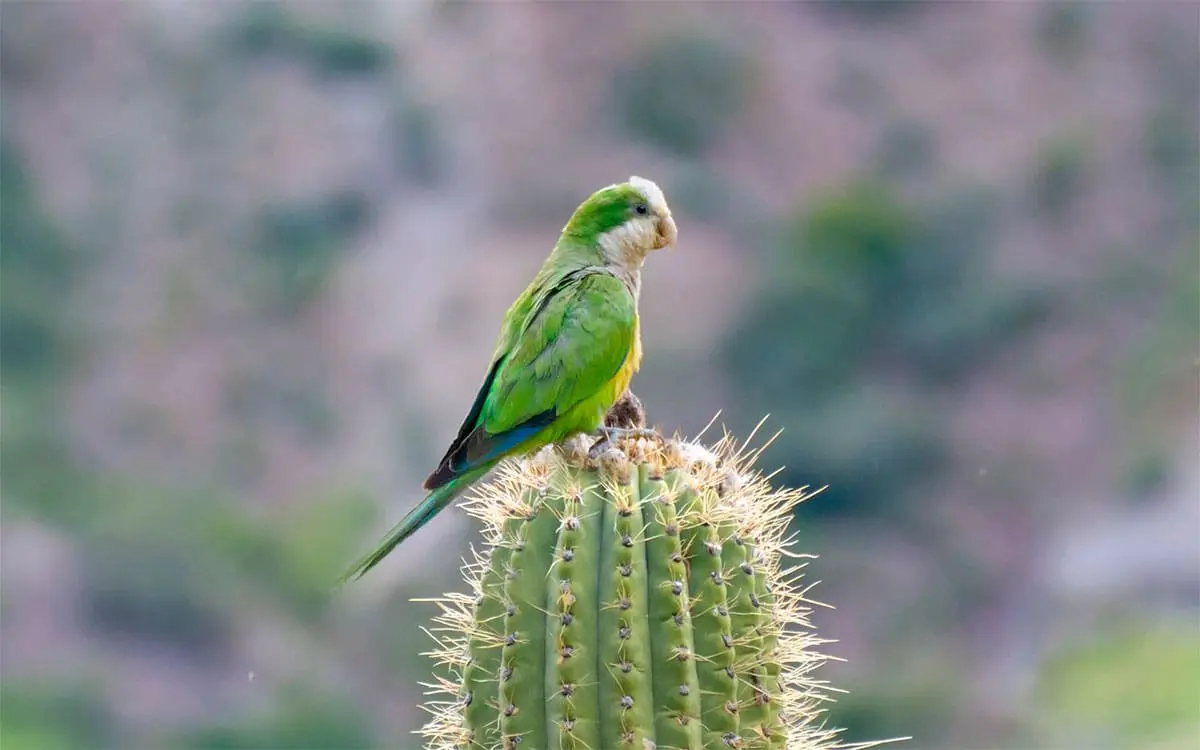
The Cliff Parakeet (Myiopsitta luchsi) It has a medium size and is mainly green; the front of the crown, lower face and the chest, They are whitish, becoming bright yellow on the lower chest and the belly; the primaries and tail (medium-sized long), They are bright metallic blue.
Similar Monk Parakeet has less extensive white color crown, pale yellow instead of bright yellow in the belly and the pale gray chest It has a scaling effect that give centers feathers dark.

Bill color horn.

The immature They are similar to adults but with forecrown gray tinged with green.


Taxonomic note:

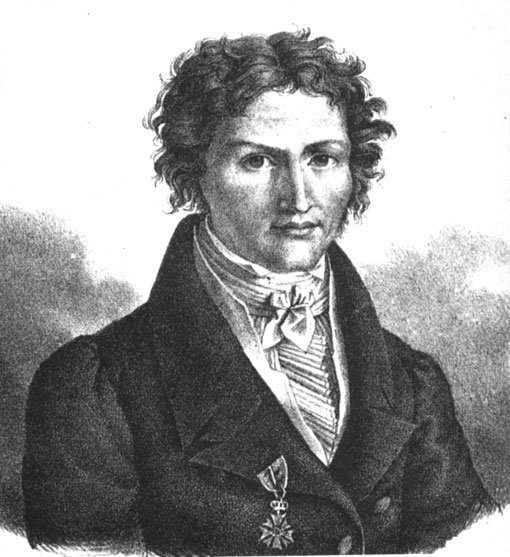
      This species was described in 1868 by Finsch as Bolborhynchus luchsi, with specimens from Bolivia. Later, the species was transferred to the genus Myiopsitta and the name Myiopsitta luchsi It was used apparently to 1918 by Cory. From 1943, Bond & de Schauensee and they treat it as a subspecies of monachus (Myiopsitta monachus luchsi), approach that has been followed by all modern authors, but Necklace (1997) finally he considers that the morphological characters and their way of nesting are sufficient to raise again species level.

Habitat:

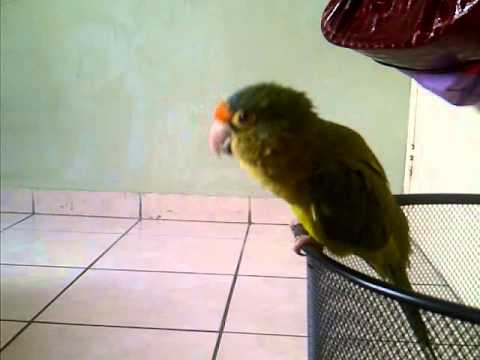
Video – "Cliff Parakeet" (Myiopsitta luchsi)

It shares the same habitat with another endemic parrot, the Red-fronted Macaw (Ara rubrogenys), although both species do not compete because they feed on different plants.

They found in dry woodland or open fields including fields with trees gallery woods, isolated groups of trees, Palm trees, forests, savannah and scrubland thorny cactus. It is also found in cultivated areas. Visitors from some urban areas. Until 3000 m.

Reproduction:

The breeding season occurs between December and March in crevices in cliffs, constructing a bulky nest branches. Unlike Monk Parakeet (Myiopsitta monachus), the Cliff Parakeet does not nest commonly, but often the nests are placed immediately adjacent to each other. The female is in charge of making this nest, as well as its maintenance.
Couples are for life. The laying is of 5 to 8 eggs per clutch, and incubation lasts a few 26 days. At six weeks old chicks can now leave their nest.

Food:

It feeds on seeds of various fruits, including those of fruits cactus Neocardenasia herzogiana and seeds of the Acacia furcatispina; It is also known to feed on cultivated corn.

Distribution:

Size of its range (breeding/resident): 148.000 km2

Restricted to xerophytic vegetation, near cliffs in intermountain valleys of eastern Andes of Bolivia, from the southeast of Peace, South of Cochabamba and West Santa Cruz, to the North of Chuquisaca and possibly other areas.

Its range is very similar to the Red-fronted Macaw (Ara rubrogenys).

Conservation:

State of conservation โ“˜


minor concern Minor Concern โ“˜ (UICN)โ“˜

โ€ข Current category of the Red List of the UICN: Least concern.

โ€ข Population trend: Unknown.

Justification of the population

The size of the population has not been estimated, but the species has been described as ยซquite commonยป (pit et to the., 1997) and "possibly quite rare" (Juniper and Parr 1998).

Justification of trend

Population trends are difficult to determine due to uncertainty about the extent and severity of threats to the species..
However, like many parrots, They face the traffic of wildlife and wild captivity. Also they suffer direct and immediate consequences of the destruction of their habitat by deforestation and the advance of the agricultural frontier.

Conservation Actions Underway

The species is listed on Appendix II of CITES.

"Cliff Parakeet" in captivity:

Quite common. Very sociable, but shy with the human being.
It is able to vocalize or imitate words, although this quality is far from possessing the capabilities of some genera of the same family.

Alternative names:

Cliff Parakeet, Bolivean monk parakeet, monk parakeet, Monk Parakeet (Cliff) (English).
Perriche des falaises, Conure de Luchs, Conure des falaises, Conure des rochers (French).
Luchssittich, Bolivien Mรถnchsittich, Bolivien-Mรถnchsittich (German).
Cliff Parakeet (Portuguese).
Cotorra Boliviana (espaรฑol).

Friedrich Hermann Otto Finsch

scientific classification:


Order: Psittaciformes
Family: Psittacidae
Genus: Myiopsitta
Scientific name: Myiopsitta luchsi
Citation: (Finsch, 1868)
Protonimo: Luchs Bolborrhynchus


Images ยซBolivian Parrotยป:

Videos ยซBolivian Parrotยป:


Species of the genus Myiopsitta

Sources:

Avibase
– Parrots of the World โ€“ Forshaw Joseph M
– Parrots A Guide to the Parrots of the World – Tony Juniper & Mike Parr
– Birdlife
– FAUNA – Psittacidae

Photos:

(1) – Bolivian Parrot, Bolivia, Sud Chichas, Churquipampa by giorgetta.ch
(2) – Bolivian Parrot, Bolivia, Sud Chichas, Cerro Elefante by giorgetta.ch
(3) – Bolivian Parrot, Bolivia, Sud Chichas, Churquipampa by giorgetta.ch
(4) – A couple of Bolivian parrots in their nest located in the chalky wall of Churquipampa where its waters fall almost freely 330 meters to the creek. The female is arranging the main entrance of the nest while the male takes delight in watching her work by giorgetta.ch
(5) – Bolivian Parrot, Bolivia, Sud Chichas, Churquipampa by giorgetta.ch
(6) – Myopsittacus luchsi = Myiopsitta (monachus) luchsi, Cliff Parakeet, sometimes treated as a subspecies of the Monk Parakeet by John Gerrard Keulemans [Public domain], via Wikimedia Commons

Sounds: Andrew Spencer (Xeno-canto)
โ–ท The world of Pets: Dogs, cats, birds, reptiles, amphibians

Lilac-crowned Parrot
Amazona finschi

Lilac-crowned Parrot

Content

Description:


Anatomy-parrots

33 cm. head to tail and weighs on average 310 g..

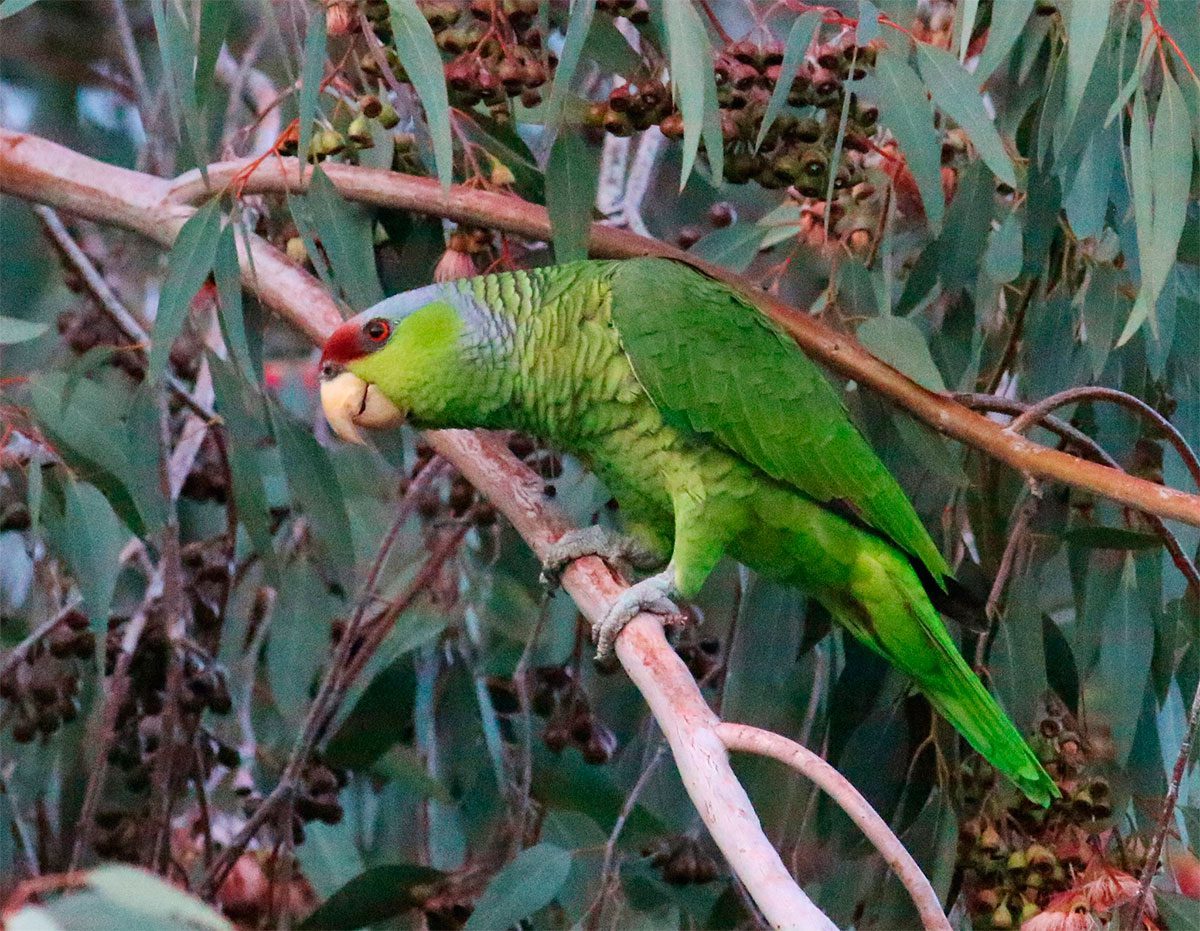
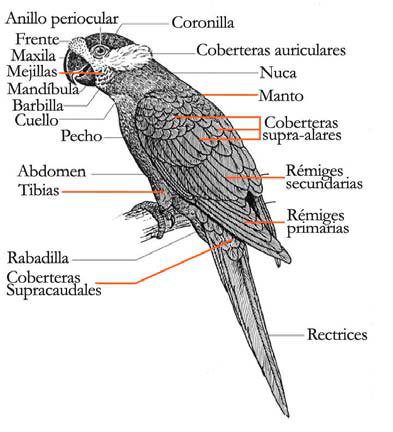
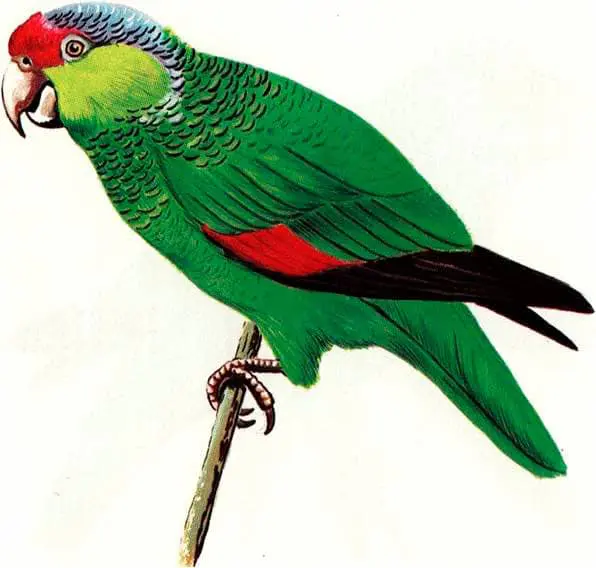
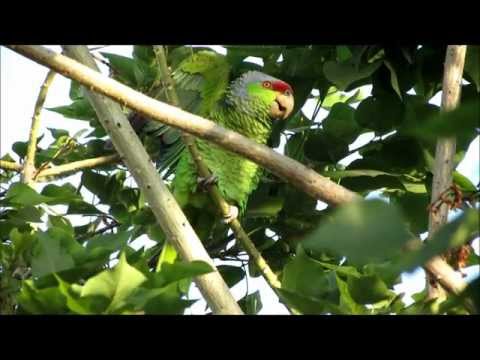
The Lilac-crowned Parrot (Amazona finschi) has the forecrown and the higher lords, red off; the lower lores, the cheeks and ear-coverts, pale lime green; crown, sides neck and nape, lilac or pale blue with some feathers crown showing narrow black margins.

Mantle green with broad black edges giving distinct scalloped effect; back and scapulars weak green with black borders to some feathers; rump and uppertail-coverts, green, slightly brighter than the back. Wing coverts green. Primaries blue toward the tip, green at the base; the base outerweb the first five secondaries, red with subterminal band yellow and blue tips, secondaries, otherwise, green, becoming blue at tips. Under the wings, brighter yellowish green; flight feather dull green.

Lilac-crowned Parrot

Throat yellowish green with bluish tint to some feathers; remaining underparts, yellowish-green with black margins to some feathers (especially in the chest), giving scalloped effect. Tail green tip yellowish green, lateral feathers blue margin to the base of the outerweb. Bill color horn; irises orange red; legs grey.

Both sexes are similar. Immature has the irises dark brown (rather than red).

  • Sound of the Lilac-crowned Parrot.

Habitat:

"Lilac-crowned Parrot"

Lilac Crowned Amazons (Amazona Finschi)

The Lilac-crowned Parrot Living mainly in wooded hills and mountains, from the tropical zone in the lower levels of the deciduous forests, to the forests of oak and pine-oak forest in the highlands, preferably through the valleys with lush vegetation along streams that run on the basis of cannons; often also in areas of arid or semi-arid vegetation, or clear forest edge, coming into cultivated areas and orchards adjacent to the forest.

mainly in altitudes of 600 to 2.000 m, but recorded at sea level Sinaloa and from sea level to the temperate forest Colima. observed between 360-1.700 metres in Sonora and 880-1.480 metres in Oaxaca. Usually in pairs or small groups, although larger groups are formed in the dry season (500 birds reported) and in communal roosts (more than 1,000 birds reported in the same place Nayarit).

Reproduction:

They nest in tree hollows (for example, Ficus), including old nests woodpeckers (for example, Phloeoceastes) or arboreal termite mounds.

The breeding season It comprises from February to June, nesting with a cycle consisting of 28 incubation days eggs, followed by two months of growth of chickens in the nest (Forshaw 1989, Renton 1998, 2002).

Food:

Eating habits are poorly documented: It has been observed a particular preference for figs. During the dry season the diet consists mainly of Astronium graveolens, Brosimum alicastrum, Celaenodendron mexicanum, Comocladia engleriana and Ficus insipida. during the rains The diet consists of species such as Caesalpinia pulcherrima, Celaenodendron mexicanum, Esenbeckia nesiotica, Jatropha spp and Sciadodendron excelsum (Renton 1998, 2001)

cause some crop damage corn and banana.

They have been observed wild species groups, feeding with the Red-crowned Parrot (Amazona viridigenalis) in Los Angeles, California.

Distribution:

Size of its range (breeding/resident): 372.000 km2

The Lilac-crowned Parrot inhabits Pacific coast of Mexico, from the southeast end of Sonora and Southwest Chihuahua, to the South by Sinaloa, Durango Western, Nayarit, Jalisco, Colima, Michoacรกn and Warrior, until Oaxaca, west of Isthmus of Tehuantepec.

It is mostly residents, but outside the breeding season, visit during autumn, lowlands, for example in Oaxaca. generally common. Described as fairly common locally in southeastern Sonora. abundant in Colima. Very rare in the highlands of Oaxaca. Several wild populations reported in several locations in the United States.

Conservation:

State of conservation โ“˜


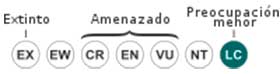
Endangered Endangered โ“˜ (UICN)โ“˜

โ€ข Current category of the Red List of the UICN: In danger of extinction.

โ€ข Population trend: Decreasing.

โ€ข Population size : 4700-6700.

Rationale for the Red List category

    This species has been selected in danger of extinction because it is suspected that is decreasing very quickly as a function of contractions recorded ranges and due to the unsustainable exploitation and loss of habitat.

Justification of the population

    Renton and Elias (2003) estimate the world population between 7.000 and 10.000 individuals, based on surveys covering most of the global range of the species. This equates to approximately 4.700-6.700 mature individuals. An estimate that 5.400 individuals each year are caught illegally in Mexico (Cantu et al ., 2007), implies that the estimation of population Renton and Elias (2003) could be an understatement, but it remains in this evaluation to best data available.

Justification of trend

    It is suspected that the population of this species is in decline very fast, based on a study of Marin-Togo et al . (2012), who estimated the current distribution of this species along the Pacific coast of Mexico and he showed a reduction 72.6% its estimated original distribution.
Threats

โ€ข The Capture for national and international trade It is the greatest threat to wild populations.

โ€ข It is highly valued in trade (Cantu et al., 2007) and it was the kind of Amazon parrot most caught in the early eighties (Inigo-Elias y Ramos 1991).

โ€ข The illicit trade is intense and widespread, and Lilac-crowned Parrot It is one of the most frequently confiscated Mexican parrots (K. Renton in litt., 2005).

โ€ข During the period 1981-2001, were registered 4.061 individuals in international trade, of which 79% It was exported directly from Mexico and the 64% it took Nature (CITES 2004a).

โ€ข Remains one of the five species of Mexican parrots most caught, with an estimated 5.400 individuals / year caught illegally Mexico (Cantu et al ., 2007).

โ€ข Los Adults and young people are easily trapped in large numbers due to their habit of congregating at communal shelter sites in the late afternoon (Renton 2005, K. Renton in some 2005).

โ€ข Chicks are commonly poached from nests (K. Renton in litt., 2005).

โ€ข During interviews with local people throughout the range of the species, the 75% reported poaching in your area (K. Renton in litt., 2005).

โ€ข Also, it is said that this species requires semi-deciduous forest with tall mature trees for nesting and can not adapt to the changed areas nesting (Marin-worm Togo et al ., 2012).

โ€ข Habitat loss and degradation, mainly for conversion to small and large crops and pastures (K. Renton in some . 2007, A. Salinas in some . 2007, Ortega-Rodriguez and Monterrubio-Rico 2008), are serious threats, with the semi-deciduous forest along the Pacific coast lost at a higher rate than any other type of forest in Mexico (Masera et al ., 1996, K. Renton in litt., 2005), It is resulting in the destruction of nesting sites and reducing the extent of this crucial critical habitat (Renton 2005).

โ€ข In Michoacรกn, nesting areas potentially more accessible, as plains or hills, have been converted to livestock or agricultural farms (Ortega-Rodriguez and Monterrubio-Rico 2008).

โ€ข Large development projects, such as dams, also they resulted in loss of breeding habitat for the species (K. Renton in some ., 2007).

โ€ข The semi-deciduous forest now covers only 5.106 km2 within the range of the species (Renton and Elias 2003, K. Renton in litt., 2005).

โ€ข The decrease in rainfall that could result from the global climate change would lead to a decrease in the reproductive potential of wild populations in tropical dry forests (K. Renton in some ., 2007).

โ€ข Despite the various pressures on habitats, by showing that the species has disappeared from more than 70% of its former range, Marin-Togo et al. (2012), has reinforced the view that the capture pressure is the predominant threat to the species.

Conservation Actions Underway

โ€ข In 1999, the Mexican government established a Conservation Plan, Protection and Recovery Psitรกcinos in Mexico, in which the Lilac-crowned Parrot It is considered a priority species (Macias Caballero et al ., 2000).

โ€ข In 2004, the species was updated to Appendix 1 of CITES and in 2007 It approved a proposal to change its state species conservation 2008 of "threatenedยป a ยซin dangerยป under the Mexican wildlife law (K. Renton in some.)

โ€ข In Mexico, They have made considerable efforts to combat illegal domestic trade, with at least 52 seizures during 1997-2003 (CITES 2004b).

โ€ข Inspections carried out in Mexico They resulted in the seizure of 266 live individuals of the species that were offered illegally in the pet trade between 1995 and 2003 (CITES 2004b).

โ€ข The species It is in three biosphere reserves; Sierra de รlamos-Rรญo Cuchujaqui flora and fauna protection area in Sonora meridional, and Reserva de la biosfera Chamela-Cuixmala and Biosphere Reserve Sierra de Manantlรกn, in Jalisco, and according to sources, It is distributed in seven other important bird areas; However, some of them lack official protection or conservation programs (CITES 2004a)

Conservation Actions Proposed

โ€ข Monitor the demographic trends through regular surveys.

โ€ข Monitor levels of destruction and degradation of habitat.

โ€ข Implement trade regulation strategies in the plan 1999.

โ€ข Carry out extension work and environmental education as described in the plan 1999.

โ€ข Perform the habitat conservation and recovery of wild populations as it recommended in the Plan 1999.

โ€ข Monitor the success of the strategies of the plan of 1999.

โ€ข Protect the rest of the tropical forest supports in areas where the slope is greater than 6 ยฐ: ideally all areas on steep slopes should be restored to forest, to provide habitat for all native wildlife (including the Lilac-crowned Parrot)

โ€ข Prevent soil erosion AND promote alternative economic activities in rugged coastal areas such as recreation and tourism. (Ortega-Rodriguez and Monterrubio-Rico 2008).

The Lilac-crowned Parrot in captivity:

Very popular as a pet throughout its area of distribution; It has cultural value as a pet or ornamental bird by its feathers; ability to imitate sounds and its tendency to form bonds with people; widespread in captivity internationally.

Currently protected by the Appendix 1 of CITES.

Each copy captive of this species which is capable of reproducing, should be placed in a well-managed breeding program in captivity and not be sold as a pet, with the objective of ensure their survival long-term.

Alternative names:

Finsch’s Parrot, Lilac crowned Parrot, Lilac-crowned Amazon, Lilac-crowned Parrot, Pacific Amazon, Pacific Parrot (English).
Amazone ร  couronne lilas, Amazone de Finsch, Amazone verte de Finsch (French).
Blaukappenamazone (German).
Papagaio-de-finsch (Portuguese).
Amazona de Corona Violeta, Amazona Guayabera, Loro Corona Lila, loro corona-lila, Loro Corona-violeta (espaรฑol).


scientific classification:

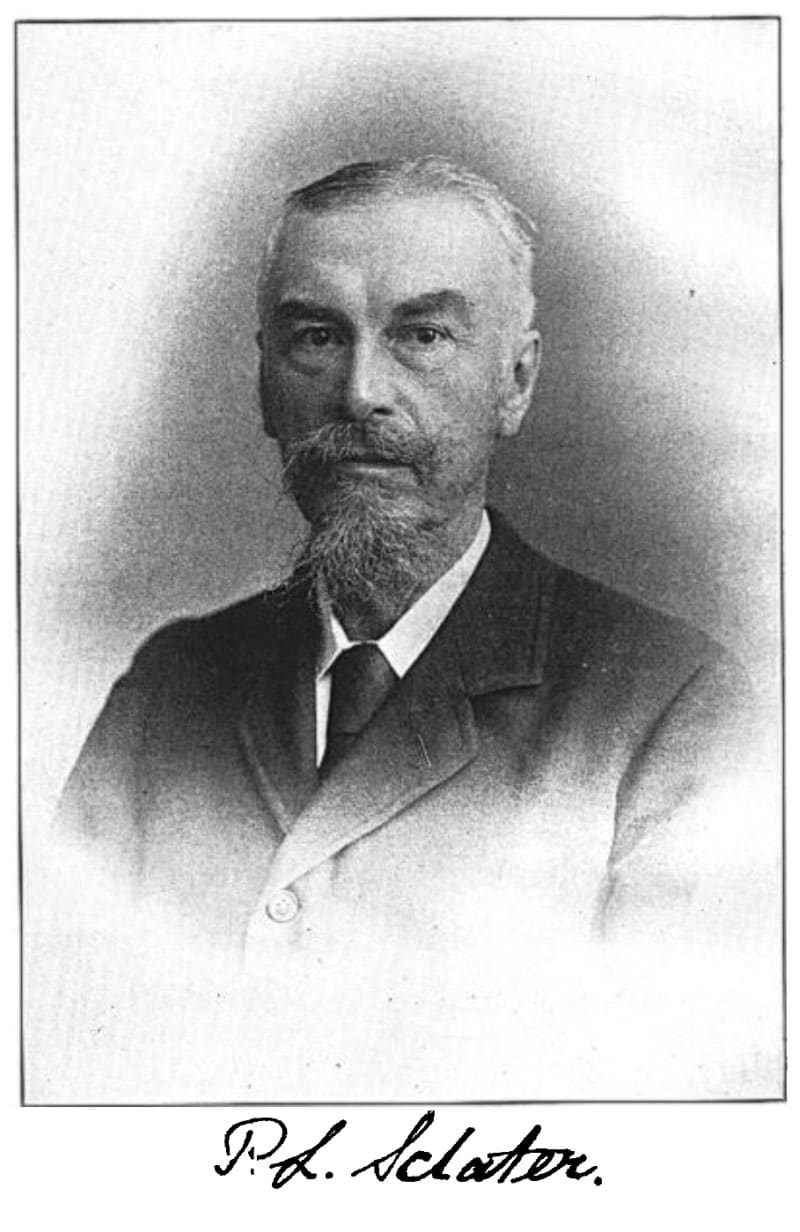
Philip Sclater
Philip Sclater

Order: Psittaciformes
Family: Psittacidae
Genus: Amazona
Scientific name: Amazona finschi
Citation: (Sclater, PL, 1864)
Protonimo: Chrysotis finschi


Images Lilac-crowned Parrot:


Species of the genus Amazona


Sources:

Avibase
Parrots of the World โ€“ Forshaw Joseph M
Parrots A Guide to the Parrots of the World – Tony Juniper & Mike Parr
Birdlife
Naturalist

Photos:

(1) – Lilac-crowned Parrot by Tom BensonFlickr
(2) – Lilac-crowned Amazon perching on a branch By Amazona_finschi_-perching_on_branch-8.jpg: Cรฉdric Allierderivative work: Snowmanradio [CC BY 2.0], via Wikimedia Commons
(3) – Lilac-crowned Amazon (Amazona finschi) by Emilie ChenFlickr
(4) – Lilac-crowned Parrot by wplynnFlickr
(5) – A pet Lilac-crowned Amazon; head and neck By Gary Denness (originally posted to Flickr as Pretty Boy) [CC BY 2.0], via Wikimedia Commons
(6) – Lilac-crowned Amazon; two in a cage By TJ Lin (originally posted to Flickr as DSCN0549) [CC BY-SA 2.0], via Wikimedia Commons
(7) – Lilac-crowned Amazon (Amazona finschi) By CDest [Public domain], via Wikimedia Commons
(8) – Lilac-crowned Amazon at the Arizona-Sonora Desert Museum, Tucson, Arizona, USA By DrStarbuck from Madison, WI, USA (Arizona-Sonora Desert Museum 18) [CC BY 2.0], via Wikimedia Commons
(9) – A Lilac-crowned Amazon at Arizona-Sonora Desert Museum, USA By Dave Bezaire & Susi Havens-Bezaire [CC BY-SA 2.0], via Wikimedia Commons
(10) – Amazona finschi Uploaded by Francisco_aviarioPhotobucket

Sounds: Richard E. Webster, XC353198. accessible www.xeno-canto.org/353198

โ–ท The world of Pets: Dogs, cats, birds, reptiles, amphibians

Orange-fronted Parakeet
Eupsittula canicularis

Orange-fronted Parakeet

Content

Description:


Anatomy-parrots

20,5 cm. length and 80 g. of weight
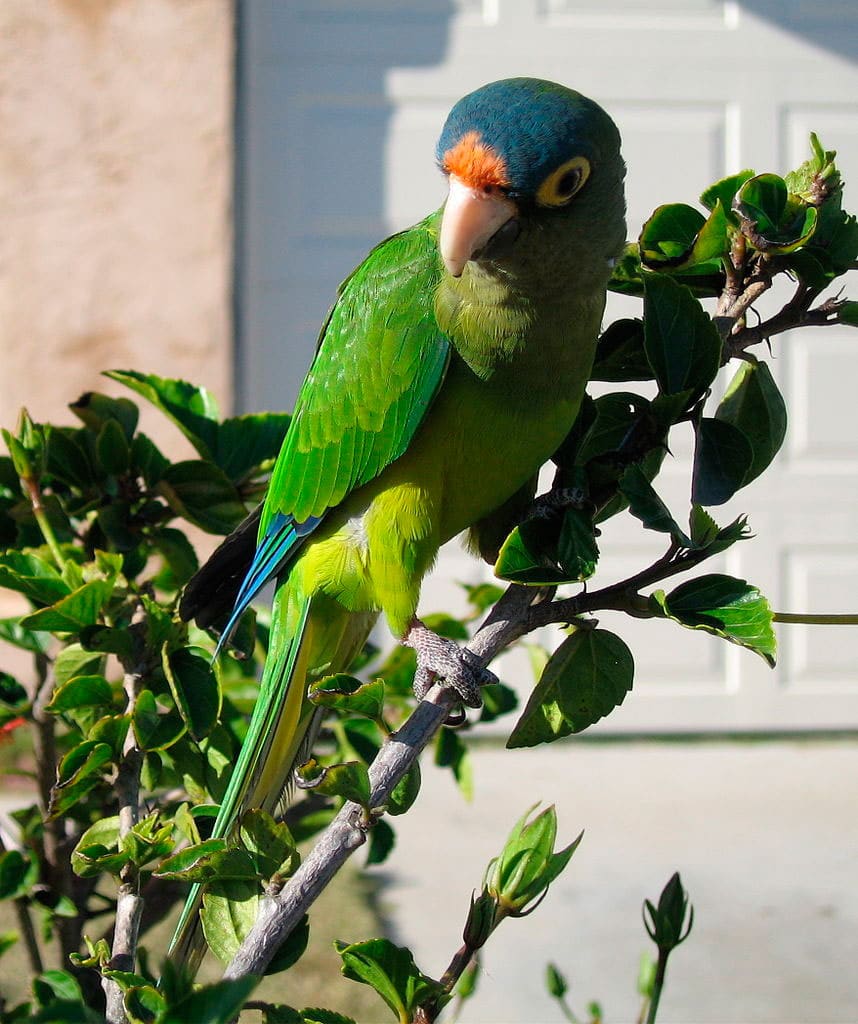
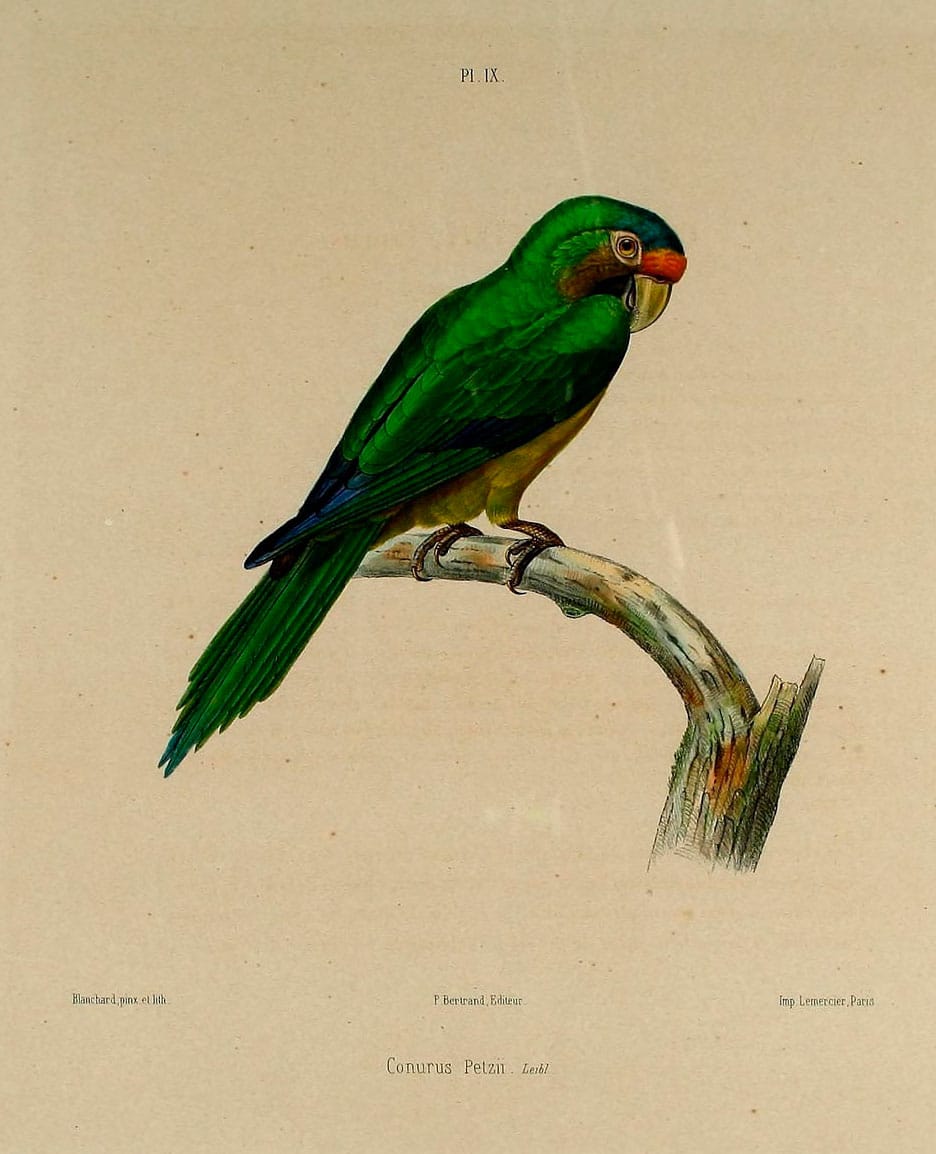
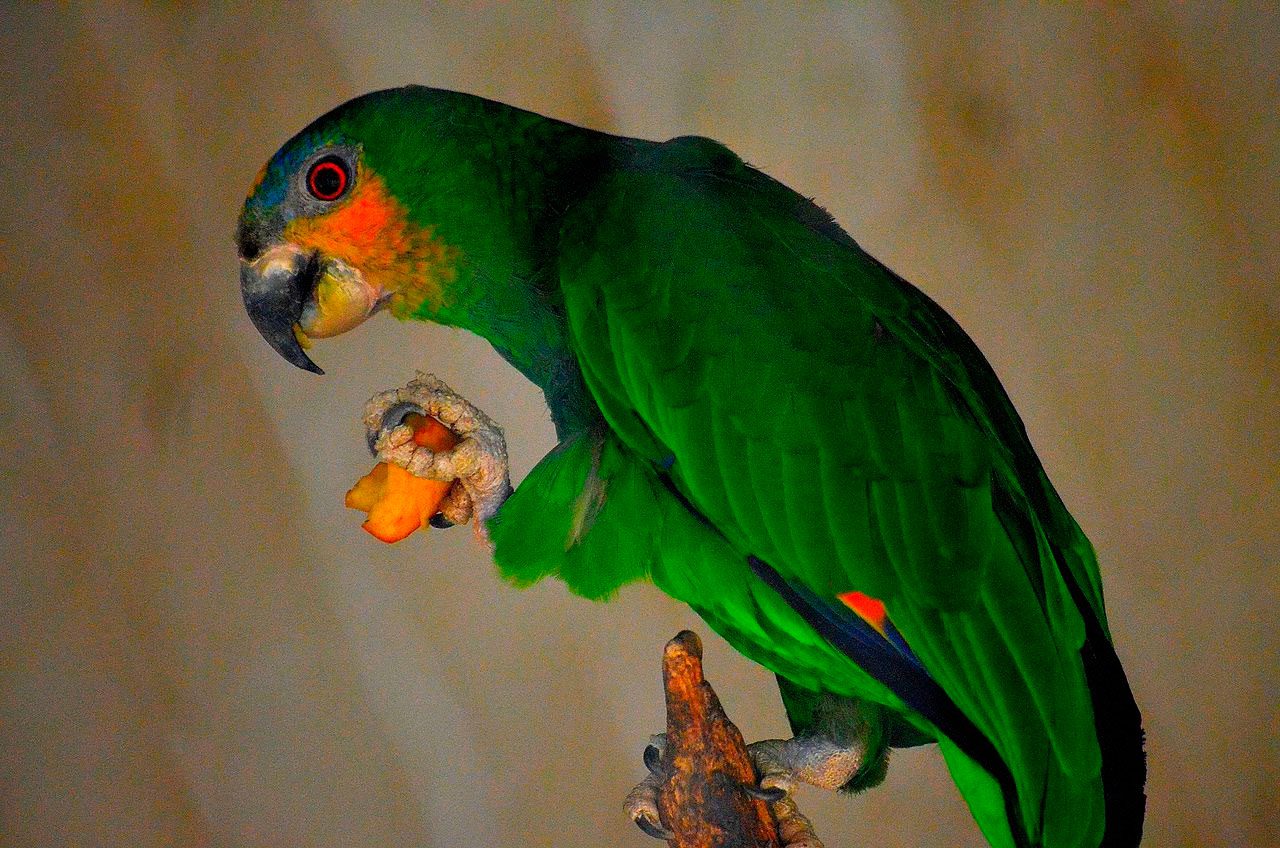
The Orange-fronted Parakeet (Eupsittula canicularis) It has in forecrown a wide band orange-red which extends over the lores and the part front of it crown; the rest of the crown is blue, fading from nape up to the upperparts in a shade of green grass.

Upperwing-coverts green. Flight feathers, at the top, blue on the outerweb; spiked green and black borders innerwebs; undertail, grey. Underwing-coverts brighter yellowish green. Throat, the sides of neck and the chest a shading pale yellow and pale olive olivรกceo in belly and in the undertail-coverts. Upper, the tail green with blue tip; undertail, pale yellow olive.

Bill color pale horn; cere whitish; bare periophthalmic whitish: irises pale yellow; legs grey-brown.
Both sexes are similar. The immature has a front patch Orange much smaller and irises brown.

  • Sound of the Orange-fronted Parakeet.

Description 3 subspecies:

Orange-fronted Parakeet

  • Eupsittula canicularis canicularis

    (Linnaeus, 1758) – Subspecies nominal.


  • Eupsittula canicularis clarae

    (Moore,RT, 1937) – Similar to the species nominal but with the frontal band Orange smaller, lores Blue and sides of the lower jaw dark gray.


  • Eupsittula canicularis eburnirostrum

    (Lesson,PA, 1842) – Similar to the species nominal but the sides of the lower jaw They are gray and belly It is yellower.

Habitat:

Video – "Orange-fronted Parakeet" (Eupsittula canicularis)

orange fronted parakeet / aratinga canicularis

They inhabit in fields slightly woody or open areas with scattered trees lowland ASAL, including thorny deciduous forests and tropical forests; the Orange-fronted Parakeet They are more abundant below 600 m, even they reach 1.500 meters in the high arid lands of central Honduras after breeding, forming flocks near the 50 birds, sometimes many more.

The Orange-fronted Parakeet They are well adapted to partially clear habitats, reposing in plantations Palma and handle, often near cities. Communal roosts have been observed in the company of the White-fronted Parrot
(Amazona albifrons) in riparian forests Guatemala. Usually arboreal.

Reproduction:

An active termitero, usually Nasutitermes nigriceps, It is the preferred place to nest construction of Orange-fronted Parakeet; Several couples sometimes dig holes next few other; also they use tree cavities (for example, hole made by woodpeckers).

Reproduction March to May in Oaxaca, Mexico; January-may in El Salvador; during the dry season in Costa Rica.
The laying is of 3 to 5 eggs). Only the female incubates. The incubation lasts around 30 days. The chicks leave the nest to 6 weeks.

Food:

In its natural habitat the the diet of the Orange-fronted Parakeet includes seeds of Ceiba and Inga, fruits of Ficus, Bursera and Brosimum, and flowers of Gliricidia and Combretum. Sometimes they invade causing farmland damage in maturation corn and the banana.

Distribution and status:

Size of its range (reproduction / resident): 1.490.000 km2

They live in the shed peaceful of Central America, from northwest Mexico to the Northwest of Costa Rica. The Frentinaranja Aratinga can be seen from Sinaloa and West Durango, south along the lowlands of Mexican Pacific until Chiapas and Guatemala, El Salvador, Honduras and Nicaragua, until Costa Rica, lthough there is a recent contraction of their distribution in the northwest.

Habitat in the mountains of Caribbean It is limited to Comayagua Valley in the Honduran central highlands. Resident very common; Partially nomadic after breeding when birds can move to higher altitudes.

What introduced species They are located around the city of Miami (Florida), around town New York City and in the South of Texas, around town Santa Ana (United States).
They can also be seen in City of Mexico.

The capture for trade in live birds apparently led to a decrease in their number, as well as the contraction of the scope of its population in Costa Rica and possibly elsewhere; however the volume for international trade bird cage is small.

Distribution 3 subspecies:

  • Eupsittula canicularis canicularis

    (Linnaeus, 1758) – Subspecies nominal. shed peaceful Southwestern Mexico, from the Tehuantepec isthmus and Chiapas through the west region Central America to the Northwest of Costa Rica.


  • Eupsittula canicularis clarae

    (Moore,RT, 1937) – Sinaloa and West of Durango ell towards south to Michoacรกn, Mexico.


  • Eupsittula canicularis eburnirostrum

    (Lesson,PA, 1842) – lowlands peaceful South of Mexico, from the east Michoacรกn until Oaxaca. The range in relation to the Eupsittula canicularis canicularis, is uncertain

Conservation:

State of conservation โ“˜


minor concern Minor Concern โ“˜ (UICN)โ“˜

โ€ข Current category of the Red List of the UICN: Least concern.

โ€ข Population trend: Stable.

Justification of the Red List of the Category

This species has a very large range, and therefore does not approach the thresholds for Vulnerable under the range size criterion (extent of occurrence <20.000 kilรณmetros2 combinado con un tamaรฑo gama disminuciรณn o fluctuante, hรกbitat medida / calidad, o tamaรฑo de la poblaciรณn y un pequeรฑo nรบmero de localidades o fragmentaciรณn severa). The trend of the population appears to be stable, and therefore the species does not approach the thresholds for Vulnerable according to the population trend criterion. (> 30% decrease of more than ten years or three generations). The size of the population is very large, and therefore does not approach the thresholds for Vulnerable under the criterion of population size (<10.000 individuos maduros con una disminuciรณn continua estimada en> 10% in ten years or three generations, or a specified population structure). For these reasons, the species is evaluated as Least concern.

Justification population

Partners in Flight estimate the total population in 500,000-4,999,999 individuals (A. they Panjabi in a little. 2008).

Justification trend

The population is suspected to be stable in the absence of evidence of any reduction or substantial threats.

"Orange-fronted Parakeet" in captivity:

Becoming less common. Its population has declined in many areas because of its capture for the illegal pet trade.
Protected by the Appendix II of CITES.

Alternative names:

Half-Moon Conure, Half-Moon Parakeet, Orange fronted Parakeet, Orange-fronted Conure, Orange-fronted Parakeet, Petz’s Conure (English).
Conure ร  front orange, Conure ร  front rouge, Conure de Petz , Perriche ร  front rouge, Perruche ร  front orange, Perruche ร  front rouge, Perruche de Petz (French).
Elfenbeinsittich (German).
Periquito-de-testa-laranja (Portuguese).
Aratinga Frentinaranja, Conuro Frente Anaranjada, Perico de Frente Anaranjada, Perico Frente Naranja, perico frente-naranja, Perico Frentinaranja, Periquito Centroamericano, Periquito naranjera (espaรฑol).
Perico frentinaranja (Costa Rica).
Periquito naranjera (Honduras).
perico frente naranja, perico frente-naranja, Perico Frentinaranja (Mexico).
Perico Frentinaranja (Nicaragua).


scientific classification:

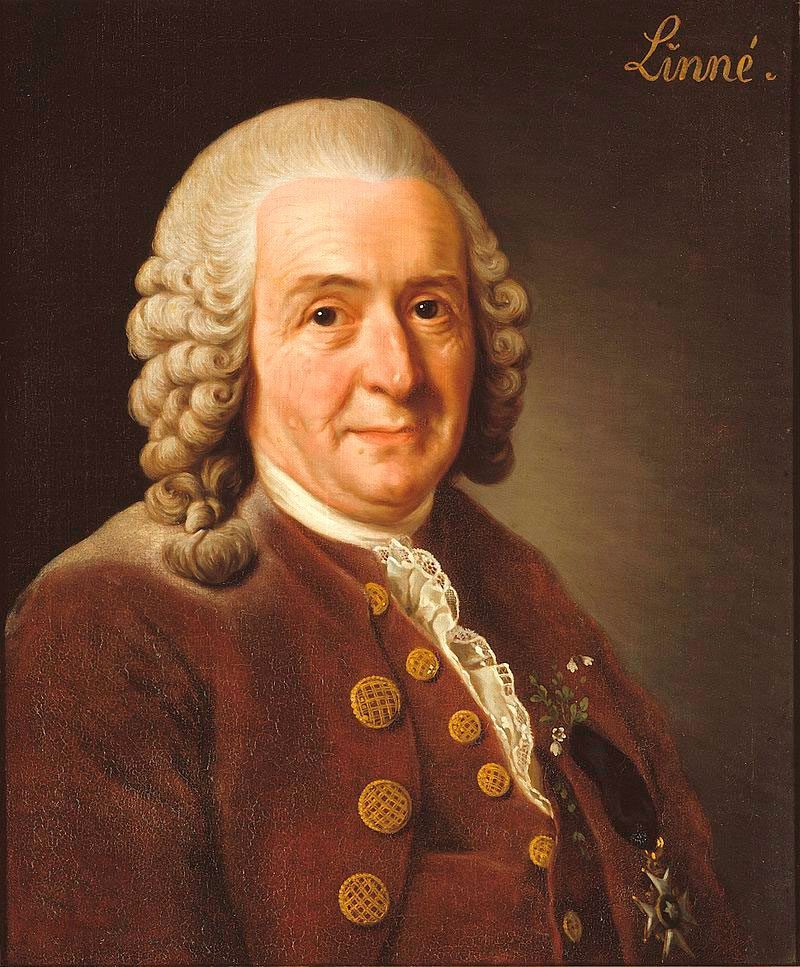
Carlos-Linnaeus
Carl Linnaeus

Order: Psittaciformes
Family: Psittacidae
Genus: Eupsittula
Scientific name: Eupsittula canicularis
Citation: (Linnaeus, 1758)
Protonimo: Psittacus canicularis

Images Orange-fronted Parakeet:


Especies del gรฉnero Eupsittula
  • Eupsittula nana
  • —- Eupsittula nana astec
  • —- Eupsittula nana nana
  • —- Eupsittula nana vicinalis
  • Eupsittula canicularis
  • —- Eupsittula canicularis canicularis
  • —- Eupsittula canicularis clarae
  • —- Eupsittula canicularis eburnirostrum
  • Eupsittula aurea
  • Eupsittula pertinax
  • —- Eupsittula pertinax aeruginosa
  • —- Eupsittula pertinax arubensis
  • —- Eupsittula pertinax chrysogenys
  • —- Eupsittula pertinax chrysophrys
  • —- Eupsittula pertinax griseipecta
  • —- Eupsittula pertinax lehmanni
  • —- Eupsittula pertinax margaritensis
  • —- Eupsittula pertinax ocularis
  • —- Eupsittula pertinax paraensis
  • —- Eupsittula pertinax pertinax
  • —- Eupsittula pertinax surinama
  • —- Eupsittula pertinax tortugensis
  • —- Eupsittula pertinax venezuelae
  • —- Eupsittula pertinax xanthogenia
  • Eupsittula cactorum
  • —- Eupsittula cactorum cactorum
  • —- Eupsittula cactorum caixana

  • Sources:

    Avibase
    – Parrots of the World โ€“ Forshaw Joseph M
    – Parrots A Guide to the Parrots of the World – Tony Juniper & Mike Parr
    – Birdlife

    Photos:

    (1) – Orange-fronted Parakeet or Orange-fronted Conure (Aratinga canicularis) also known as the Half-moon Conure. Photo taken in a front garden, San Diego, USA By derivative work: Snowmanradio (talk)Aratinga_canicularis_-pet-4.jpg: awnisALAN [CC BY 2.0], via Wikimedia Commons
    (2) – A wild Orange-fronted parakeet (Aratinga canicularis) along the beach of the Gulf of Papagayo (Papagallo), Costa Rica. The parakeet was seen in a group of 3 birds feeding on seeds of this tree By Cwood1 Charlene Wood (Own work) [CC BY-SA 3.0], via Wikimedia Commons
    (3) – Orange-fronted Parakeet or Orange-fronted Conure (Aratinga canicularis) also known as the Half-moon Conure. Photo taken in a front garden, San Diego, USA By awnisALAN (originally posted to Flickr as [1]) [CC BY 2.0], via Wikimedia Commons
    (4) – Two Orange-fronted Parakeets in Costa Rica By Don Faulkner (Orange-fronted ParakeetUploaded by snowmanradio) [CC BY-SA 2.0], via Wikimedia Commons
    (5) – A pair of Orange-fronted Parakeets in Rincรณn de la Vieja Volcano National Park, Costa Rica By Brian Ralphs from Berkhamsted, Hertfordshire, UK (Orange-fronted ParakeetsUploaded by snowmanradio) [CC BY 2.0], via Wikimedia Commons
    (6) – Iconographie des perroquets :.Paris :P. Bertrand,1857.. by Biodiversity Heritage LibraryFlickr

    Sounds: Bernhard Kroeger, XC67365. accessible www.xeno-canto.org/67365

    โ–ท The world of Pets: Dogs, cats, birds, reptiles, amphibians

    Olive-throated Parakeet
    Eupsittula nana

    Olive-throated Parakeet

    Content

    Description:


    Anatomy-parrots

    20 to 26 cm. in length and 72โ€“85 grams in weight. It is one of the smallest Aratingas.

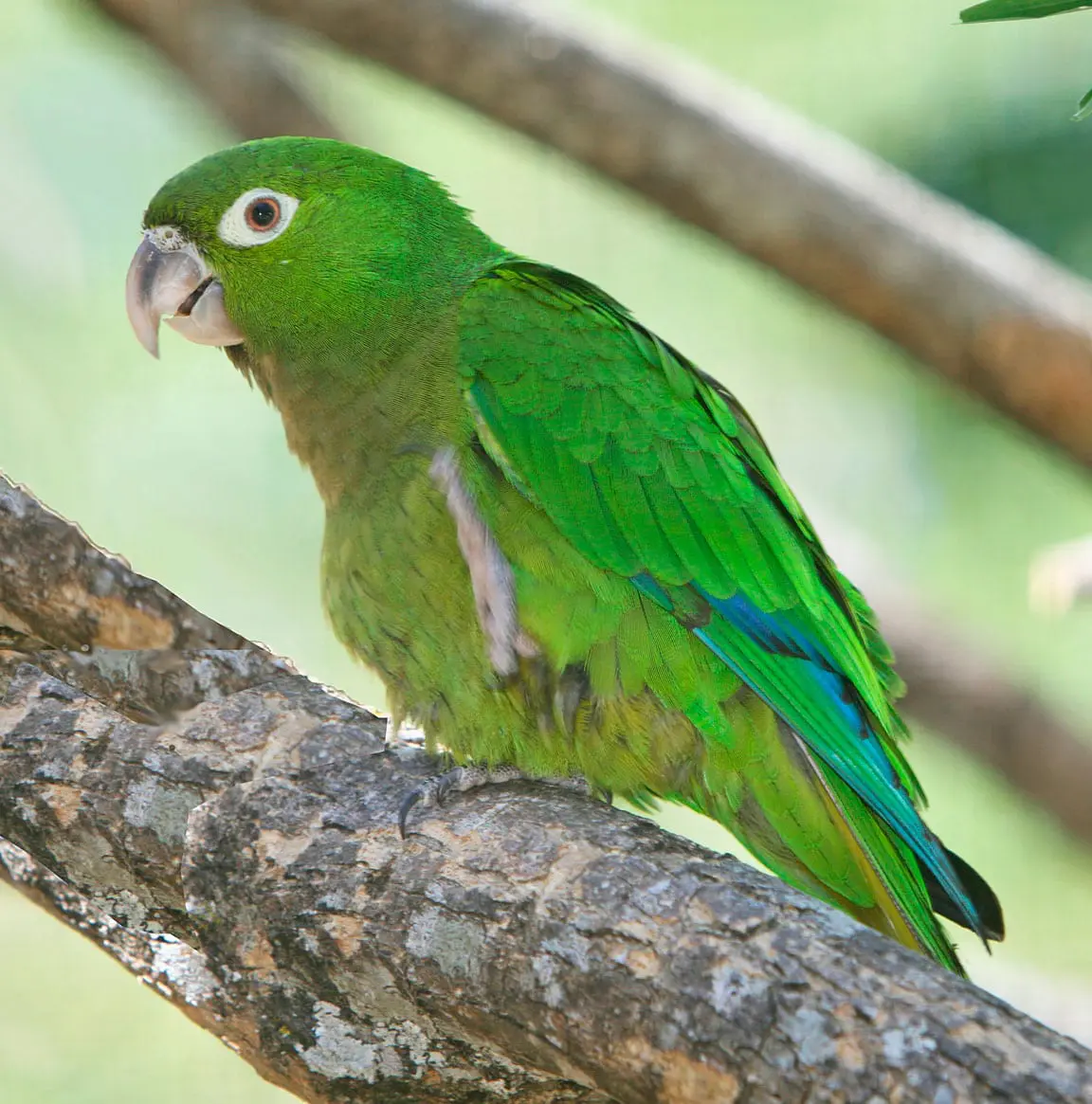
    The Olive-throated Parakeet (Eupsittula nana) has the head and upperparts dark green; feathered area of cere yellow to orange-red.

    Upperwing-coverts dark green, outer more emerald. The Outer secondaries and inner primaries deep dark blue tipped black above; the outer primary blue only towards tips. The greater underwing-coverts and underside of the flight feather dull slate or brownish-grey; the remaining coberteras are light green. Chin, throat and sides neck chocolate-brown they are merging with brownish olive on top of chest which turns yellow at the bottom and the belly; undertail-coverts light green. Uppertail dark green with blue diffusion, especially towards the tip; undertail metallized yellow-olive. Bill brown with the tip paler; irises yellow to orange; legs blackish-gray.

    Olive-throated Parakeet

    All plumages are similar but immature has irises brown.

    • Sound of the Olive-throated Parakeet.

    Subspecies description:

    three subspecies Panamanian and Honduran birds previously bore the respective names outmost and melloni, but light regional variations in Central America (p. e.g.. birds in southern paler and those of Tabasco, Mexico and Honduras They are darker) not justify more separations as described below.

    • Eupsittula nana astec

      (Souance, 1857) – Similar to the nominal but the throat and (especially the underparts) more pale brown, the bill perhaps smaller average.

    • Eupsittula nana nana

      (Vigors, 1830) – Nominal.


    • Eupsittula nana vicinalis

      (Bangs & Penard,TO, 1919) – Slightly larger than the subspecies Eupsittula nana astec, up brighter and greener down

    NOTE The continental population is sometimes treated as a full species under the name A. astec, although the differences with Jamaican birds are minimal.

    Habitat:

    Video – "Olive-throated Parakeet" (Eupsittula nana)

    Information on the Eupsittula nana

    They live mainly in forests and forest edges (especially adjacent lowland) in wet areas (to 1.100 m in Honduras, to 700 m in Costa Rica and a 300 m in southern Mexico), It is less frequent in large tracts of rainforest; reported in arid areas (Veracruz) and pine forests (Honduras), open country with scattered trees (including acreages) and plantations. More common in Jamaica in mid-level humid limestone forests. Usually it remains below the canopy. larger groups can be formed (c. 30) after breeding or when food is abundant. mixed flocks with Crimson-fronted Parakeet reported in Costa Rica.

    Reproduction:

    Arboreal termitarium prefer to lay their nests, where birds excavate the cavity; also used treeholes. Often nests at the edge of a river or forest. Breeding season March, Jamaica; April May, Belize and Guatemala. The implementation is of 3-4 eggs that hatch in 26-27 days. After hatching, it takes about 50 days until chicks are ready for independence.

    Note: In most birds, male/female bonds occur only during the breeding season and function solely in coordinating parental care. La monogamy perenne, or linking partner throughout the year, It occurs in at least a dozen families of birds, including cockatoos and other parrots.

    Food:

    Registered foods include higos ficus, Psidium, Inga, Hura, fruit of Hieronyma and guilt of tamarindo unripened. attacking crops, especially corn, and it is considered highly destructive in some areas.

    Distribution:

    Extending its range (breeding/resident): 1,373,500 km2

    distributed by the Gulf and the Caribbean slope of Central America and Jamaica; a population in Hispaniola (Sierra de Bahoruco, Dominican Republic) It comes from a recent introduction from Jamaica. In Mexico, the Olive-throated Parakeet It extends from eastern San Luis Potosi and South of Tamaulipas, through South Veracruz until Oaxaca, North of Chiapas and Yucatan; then through the humid north of Guatemala and the Caribbean slope of Honduras, Nicaragua and Costa Rica to western Panama. It is located along Jamaica except in the high mountains and the humid mountain range of John Crow in the East.

    Resident and locally common to abundant (commonly the most abundant parrot in some localities) although it is likely to be decreased in some areas (p. and. Jamaica and Costa Rica) due to the loss of habitat. Less common in southern Costa Rica and uncommon in Panama, where possibly a seasonal visitor Southern Lemon.

    Caught for live bird market, but rare in international trade.

    Subspecies description:

    • Eupsittula nana astec

      (Souance, 1857) – Veracruz, Mexico, to Panama


    • Eupsittula nana nana

      (Vigors, 1830) – Nominal. Jamaica, apparently in most areas except the high mountains and the humid Cordillera de John Crow


    • Eupsittula nana vicinalis

      (Bangs & Penard,TO, 1919) – East of Mexico south of Veracruz, zone of contact with the last unknown species

    Conservation:

    โ€ข Current category of the Red List of the UICN: Least concern.

    โ€ข Population trend: Decreasing.

    โ€ข Population size : 500,000-4,999,999 individuals.

    Rationale for the Red List category

    Although the demographic trend appears to be declining, the decline is not believed to be rapid enough to approach the Vulnerable thresholds based on demographic trend criteria (> 30% decrease in ten years or three generations). The population size is very large, and therefore does not approach the thresholds for Vulnerable under the criterion of population size (<10.000 individuos maduros con un descenso continuo estimado en >10% in ten years or three generations, or with a specific population structure). For these reasons, the species is evaluated as Least concern.

    The subspecies Eupsittula nana nana It is endemic to Jamaica, where still widespread but probably has a moderately small population (approximately 10.000 mature individuals), all in one subpopulation, inferring that is in continuous decline due to a variety of threats including loss and degradation of the habitat, pursuit and capture for trade. So, It has been classified as Near-threatened.

    Justification of the population

    Partners in Flight They estimate that the total population is 500,000-4,999,999 individuals (A. Panjabi a slightly. 2008).

    Justification trend

    They suspected that the population is declining due to continuing habitat destruction and unsustainable levels of exploitation.

    "Olive-throated Parakeet" in captivity:

    Uncommon in international trade. Their life expectancy is over 15 years.

    It is included in the appendix ll of the Convention on International Trade in Endangered Species of Wild Fauna and Flora Silvestre (CITES).

    The Olive-throated Parakeet It is important to attract tourists with hotel advantages in the Caribbean and tropical areas that offer free bird tour with reservations. It is one of the reasons why this beautiful bird should remain free..

    Alternative names:

    Dwarf Conure, Dwarf Parakeet, Jamaican Conure, Jamaican Parakeet, Olive-throated Parakeet, Olive-throated Parakeet (Jamaican) (English).
    Conure aztรจque , Conure naine, Conure naine (nominal), Conure naine (nominale), Conure naine (race nominale) (French).
    Aztekensittich, Jamaikasittich (German).
    Periquito-da-jamaica (Portuguese).
    Aratinga jamaicana, Aratinga Pechisucia, Perico Amargo, Perico azteco, Perico Pechiolivo, Perico Pechisucio, perico pecho sucio, perico pecho-sucio, Periquito pechisucio (espaรฑol).
    Perico azteco (Costa Rica).
    Perico Amargo (Dominican Rep.).
    Periquito pechisucio (Honduras).
    Perico Pechisucio, perico pecho sucio, perico pecho-sucio (Mexico).
    Perico Pechiolivo (Nicaragua).

    scientific classification:

    Order: Psittaciformes
    Family: Psittacidae
    Genus: Eupsittula
    Scientific name: Eupsittula nana
    Citation: (Vigors, 1830)
    Protonimo: Psittacara nana

    Images Olive-throated Parakeet:


    Especies del gรฉnero Eupsittula
  • Eupsittula nana
  • —- Eupsittula nana astec
  • —- Eupsittula nana nana
  • —- Eupsittula nana vicinalis
  • Eupsittula canicularis
  • —- Eupsittula canicularis canicularis
  • —- Eupsittula canicularis clarae
  • —- Eupsittula canicularis eburnirostrum
  • Eupsittula aurea
  • Eupsittula pertinax
  • —- Eupsittula pertinax aeruginosa
  • —- Eupsittula pertinax arubensis
  • —- Eupsittula pertinax chrysogenys
  • —- Eupsittula pertinax chrysophrys
  • —- Eupsittula pertinax griseipecta
  • —- Eupsittula pertinax lehmanni
  • —- Eupsittula pertinax margaritensis
  • —- Eupsittula pertinax ocularis
  • —- Eupsittula pertinax paraensis
  • —- Eupsittula pertinax pertinax
  • —- Eupsittula pertinax surinama
  • —- Eupsittula pertinax tortugensis
  • —- Eupsittula pertinax venezuelae
  • —- Eupsittula pertinax xanthogenia
  • Eupsittula cactorum
  • —- Eupsittula cactorum cactorum
  • —- Eupsittula cactorum caixana

  • Sources:

    Avibase
    – Parrots of the World โ€“ Forshaw Joseph M
    – Parrots A Guide to the Parrots of the World – Tony Juniper & Mike Parr
    Birdlife

    Photos:

    (1) – Jamaican Parakeet (aka Olive-throated Parakeet or Aztec Parakeet) in captivity in Costa Rica By http://www.birdphotos.com (Own work) [CC BY 3.0], via Wikimedia Commons
    (2) – Aratinga nana astec in Belize By Dominic Sherony [CC BY-SA 2.0], via Wikimedia Commons
    (3) – Aratinga (nana) astec in Tikal, Guatemala By Aztec_Parakeet_(Aratinga_astec)_-Guatemala-8.jpg: Walter Rodriguez from Berlin, Germanyderivative work: Snowmanradio [CC BY 2.0], via Wikimedia Commons
    (4) – Aratinga (nana) astec in Tikal, Guatemala By Walter Rodriguez from Berlin, Germany (parakeetUploaded by Snowmanradio) [CC BY 2.0], via Wikimedia Commons
    (5) – Eupsittula nana. Celestรบn Biosphere Reserve, Yucatan, Mรฉxico By Katja Schulz from Washington, D. C., USA (Olive-throated Parakeet) [CC BY 2.0], via Wikimedia Commons
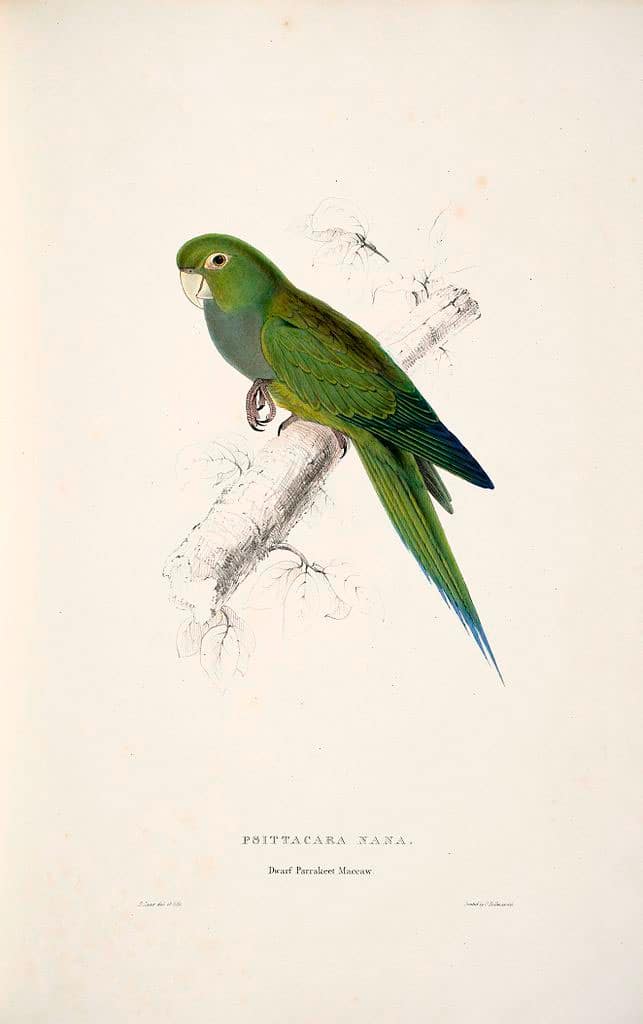
    (6) – A painting of an Olive-throated Parakeet, also known as the Olive-throated Conure, (originally captioned ยซPsittacara nana. Dwarf Parakeet Maccaw.ยป) by Edward Lear 1812-1888 [Public domain], via Wikimedia Commons

    Sounds: Guy Kirwan, XC284214. accessible www.xeno-canto.org/284214
    [contact-form][contact-field label=ยปNombreยป type=ยปnameยป required=ยปtrueยป /][contact-field label=ยปEmailยป type=ยปemailยป required=ยปtrueยป /][contact-field label=ยปWebยป type=ยปurlยป /][contact-field label=ยปMensajeยป type=ยปtextareaยป /][/contact-form]

    โ–ท The world of Pets: Dogs, cats, birds, reptiles, amphibians

    New Caledonian Parakeet
    Cyanoramphus saisseti

    New Caledonian Parakeet

    Content


    Anatomy-parrots

    Description:

    26 cm.. length and 100 g. of weight.

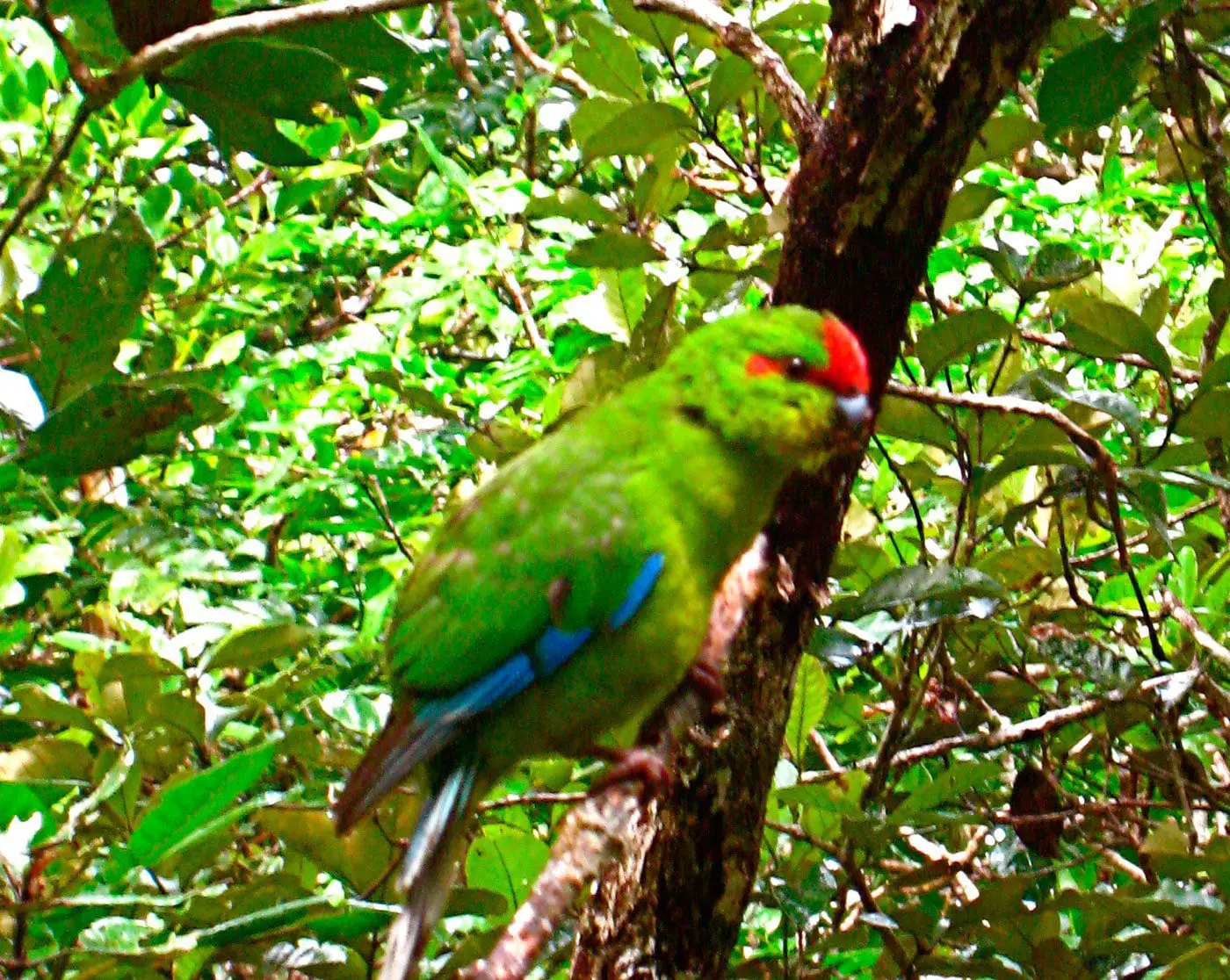
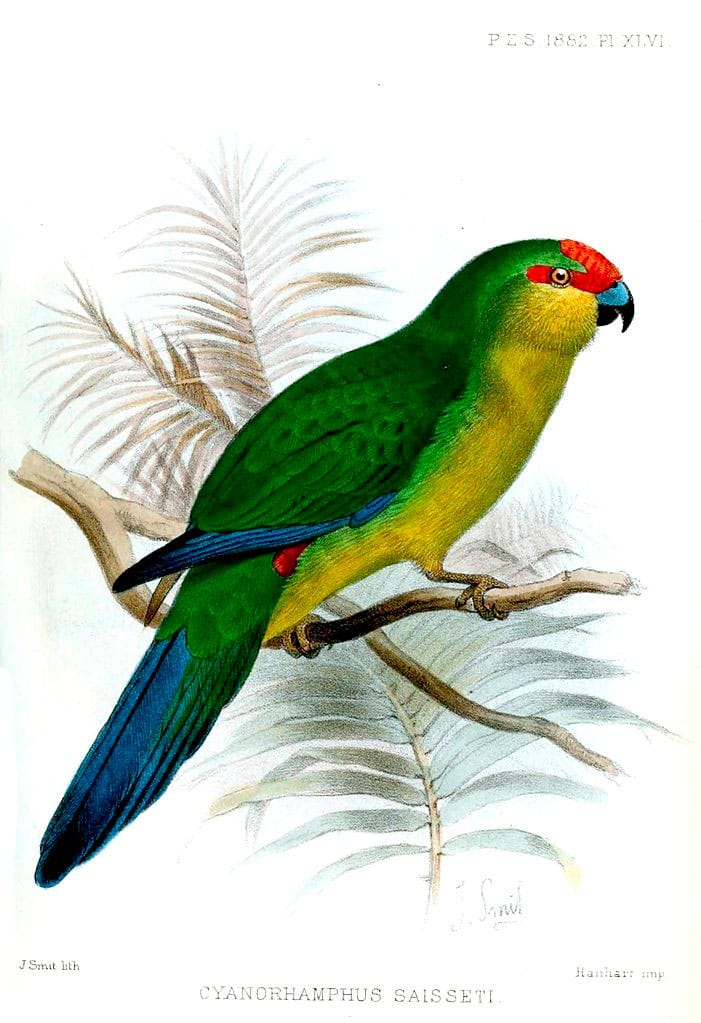
    The upperparts of the New Caledonian Parakeet (Cyanoramphus saisseti) they are mostly green, with some bluish green in the tail, violet-blue along the outerweb flight feathers, and red patches on each side of the rump. The underparts are yellowish green, yellower near throat, and gray below tail (Forshaw 1989, Juniper & Parr 1998, Doughty et al. 1999).

    A red patch extends from the crown up to the forecrown, and it extends in a narrow band from the forecrown up to the ears (Juniper & Parr 1998).
    The bill is leaden gray, with black tips, the irises is red-orange and legs are dark gray. (Layard & Layard 1882b, Juniper & Parr 1998).

    The males typically exceed the females in size, although its plumage is similar (Verreaux & walls 1860, Layard & Layard 1882b, Salvadori 1891, Forshaw 1989)

    taxonomy:

    In the past it was considered to New Caledonian Parakeet conspecific of Red-crowned parakeet (Cyanoramphus novaezelandiae) of New Zealand, but genetic studies have shown that it is a separate species and occupying a basal position on gender Cyanoramphus, which indicates that the genus would have its origin in New Caledonia.

    • Sound of the New Caledonian Parakeet.

    Habitat:

    New Caledonian Parakeet

    The New Caledonian Parakeet They were primarily fed at low altitudes canopy, and regularly they observed on the edge of the forest, on slopes or in the forest maquis (scrub).

    Seem to have small populations and their distributions are expected to shrink as a result of climate change.
    They are not particularly shy, although they tend to be rather calm and difficult to observe.

    Reproduction:

    It has been reported that the nesting It occurs between November and January, and nidadas They consist of two to five eggs, that they are placed in holes in trees (Hannecart & Lรฉtocart 1980, Theuerkauf et al. 2009b).
    Genetic evidence suggests that the species is polyandrous, and the presence of male food assistants suggests that probably involves mating system poliandria cooperative (Theuerkauf et al., 1999).

    Food:

    It is usually fed in average heights, low canopy, but it has also been observed that feeds on the floor.
    Essentially it is granivore. It feeds mainly on seeds and fruits, besides berries, nuts and other plant parts (outbreaks, flowers and leaves).

    Distribution:

    The New Caledonian Parakeet It is endemic to the main island of New Caledonia, although there are still uncertainties about the extent of its range and population size (Taylor 1985, Juniper & Parr 1998). The species was considered rare at the time of its introduction (Verreaux & walls 1860). But, in the decade of 1880, Flocks of birds were reported in the West, flying into the valleys Moindou from nearby mountain forests, where it is rumored to have slept in large quantities (Layard & Layard 1882b).

    It has the lowest population density of parrots New Caledonia.

    Conservation:


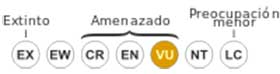
    Vulnerable


    โ€ข Current category of the Red List of the UICN: Vulnerable.

    โ€ข Population trend: Decreasing.

    โ€ข Population size : 2500-10,000 individuals.

    The New Caledonian Parakeet They face a variety of threats, and their populations seem to be in decline. But, it is difficult to determine the cause or extent of their declines due to the paucity of ecological data.

    classified as Vulnerable because it has a single small population suspected to be declining due to predation by invasive species; his fortress is in an area threatened by nickel mining and may be in rapid decline in the near future.
    The humid mountain forest is not threatened, but it is possible that this species in need of other habitats, some of which, particularly semi-deciduous forests lowland, They have almost disappeared from the island. It is possible that introduced diseases (such as avian malaria) or the mammals (especially rats) It has been a cause of decline.

    There is no evidence that nest poaching is widespread.

    "New Caledonian Parakeet" in captivity:

    unregistered.

    Alternative names:

    New Caledonian Parakeet, New Caledonian Parrot, New Caledonian Red-crowned Parakeet, Red-crowned Parakeet (inglรฉs).
    Perruche ร  front rouge, Perruche calรฉdonienne, Perruche de Nouvelle-Calรฉdonie (francรฉs).
    Cyanoramphus saisseti (alemรกn).
    Periquito-da-nova-caledรดnia (portuguรฉs).
    Perico de Nueva Caledonia (espaรฑol).

    scientific classification:

    Jules Verreaux

    Order: Psittaciformes
    Family: Psittaculidae
    Gender: Cyanoramphus
    Scientific name: Cyanoramphus saisseti
    Subpoena: Verreaux & Des Murs, 1860
    Protonimo: New Caledonian Parakeet

    Images "New Caledonian Parakeet"

    Videos "New Caledonian Parakeet"

    Sources:

    โ€ข Avibase
    โ€ข Parrots of the World โ€“ Forshaw Joseph M
    โ€ข Parrots A Guide to the Parrots of the World – Tony Juniper & Mike Parr
    โ€ข Birdlife

    Photos:

    (1) – Cyanoramphus saisseti, blue river park, New Caledonia by Mickaรซl T. [CC BY 2.0], via Wikimedia Commons
    (2) – Cyanoramphus saisseti Proceedings of the Zoological Society of London 1882 (Web) by Joseph Smit [Public domain]

    โ–ท The world of Pets: Dogs, cats, birds, reptiles, amphibians

    Yellow-crested cockatoo
    Cacatua sulphurea

    Yellow-crested cockatoo

    Content

    Description

    Medium-sized, 35 cm.. long.

    Yellow-crested cockatoo

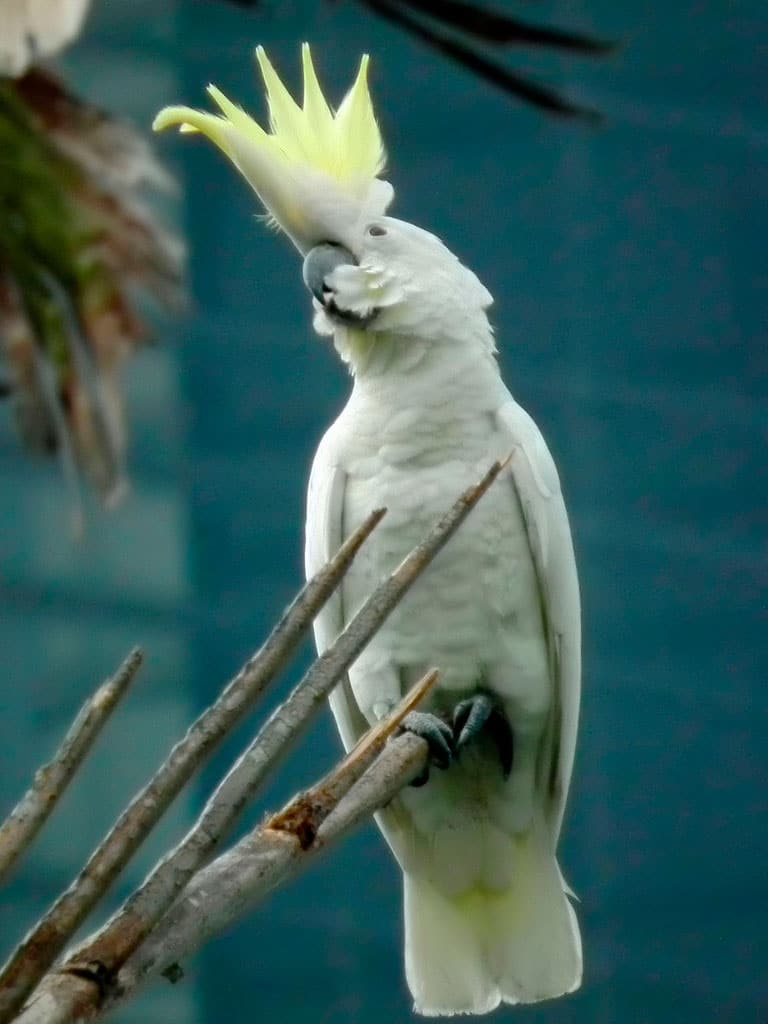
    The Yellow-crested cockatoo (Cacatua sulphurea) It is distinguished by its long, thin yellow erectile crest, that curves forward, and extending upward, above the nape, when it folded. The front of his crown and main feathers crest, are white. The rest of your plumage It is also white, except in yellow suffusion ear-coverts, under the wings and in the innerwebs of the undertail-coverts. The bases of the hackles and underparts, They are yellowed; some birds show a slight yellow tone, particularly on chest and the belly. The bill It is black; eye ring pale bluish; irises dark brown; legs grey. The female is similar to the male but with the irises reddish and slightly smaller.

    The young birds They show both sexes irises dark taupe, although females They begin to acquire the red coloration in the first year. The bill and legs immature are also lighter.

    Description 4 subspecies
    • Cacatua sulphurea abbotti

      (Oberholser, 1917) – Similar to the parvula, but largest.

    • Cacatua sulphurea citrinocristata
    • Cacatua sulphurea citrinocristata

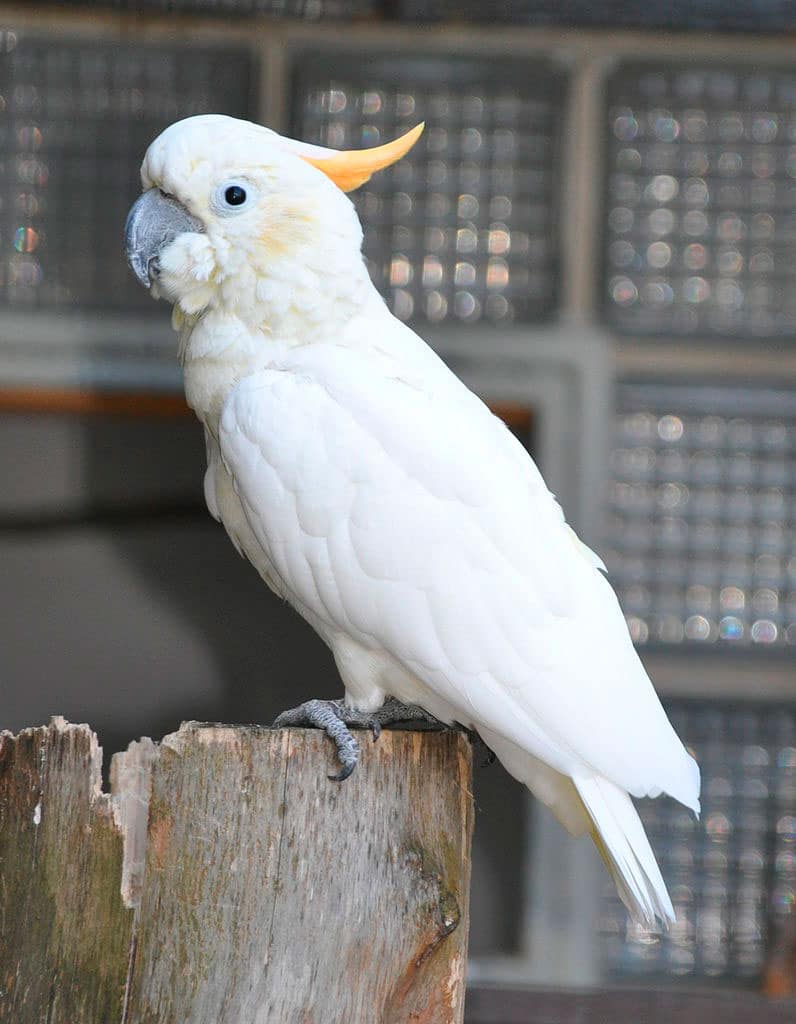
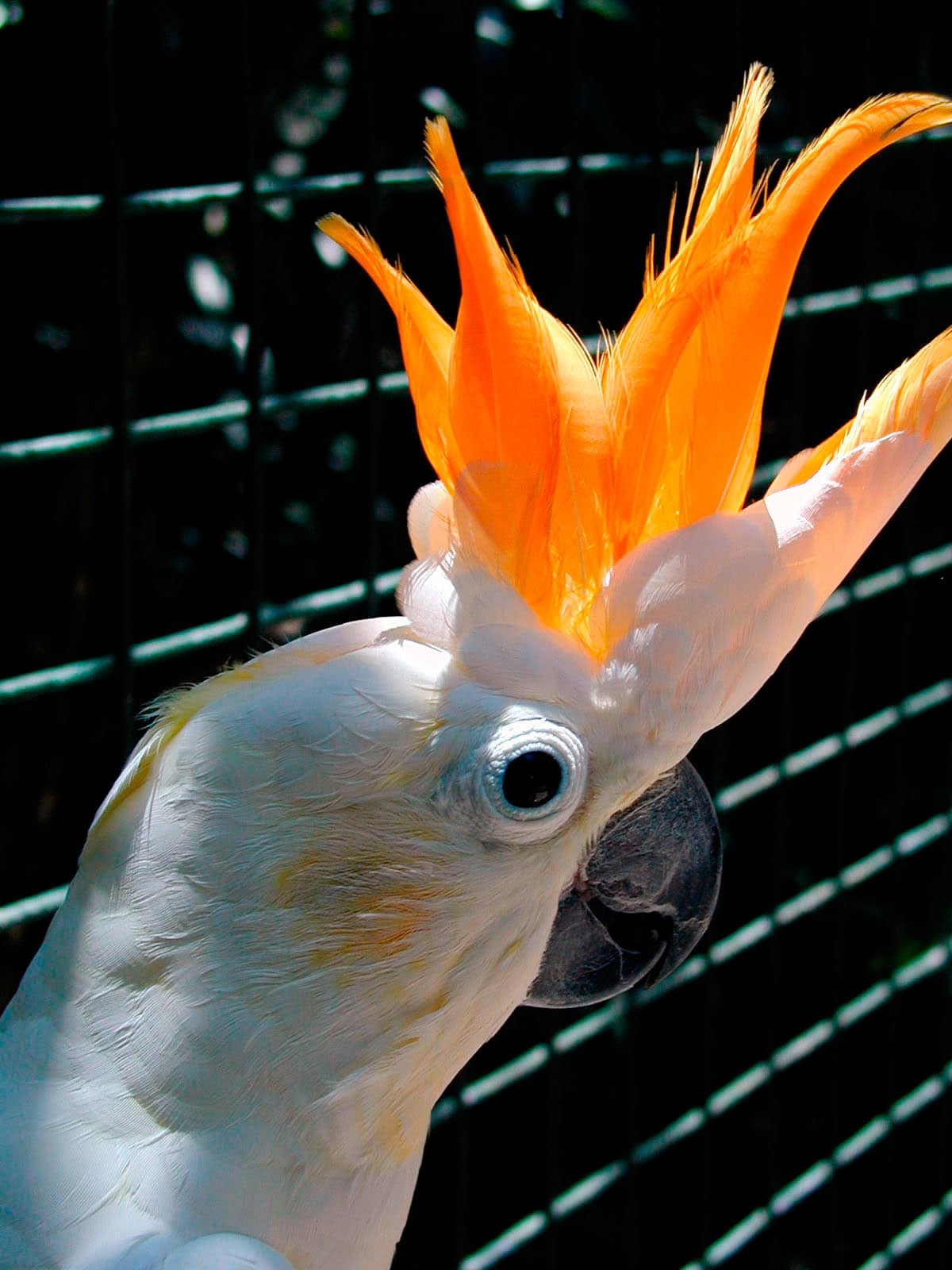
      (Fraser, 1844) – Slightly larger than the nominal, with one crest orange & ear-coverts orange yellow. Additional research may provide a basis for improving this subspecies to a specific status..

    • Cacatua sulphurea parvula

      (Bonaparte, 1850) – Similar to the nominal species, but with the ear-coverts paler and less yellow on yellow feathers underparts. the size of the bill in this subspecies it increases clinically towards the west.

    • Cacatua sulphurea sulphurea

      (Gmelin, 1788) – Nominal.

    Habitat:

    Video – "Yellow-crested cockatoo" (Cacatua sulphurea)

    SULPHURE COCKATUA

    They inhabit at the edges of the forest, wooded areas, farmland, cocoteros, semi-arid areas and forests until the 800 m (locally 1.200 m).

    The Yellow-crested cockatoo usually they found in pairs or small groups of up to ten individuals, although they may meet in larger flocks to feed on fruit trees. They can form flocks with Eclectus Parrot (Eclectus roratus).

    They tend to be noisy and visible, but can be difficult to spot when moving silently in the canopy, and they are more often in flight. The groups who leave their resting places in the montane forest areas frequently displace forage at lower altitudes including cultivated fields. Pairs may hover conspicuously above the forest canopy searching for fruitful trees, allowing a reasonably close approach when resting on a branch.

    The crest It is generally stands when landing, or when an individual is making calls from a perch. Like most of the Cockatoos They enjoy a bath in the rain.

    Reproduction:

    Specimens of Yellow-crested cockatoo on the island of button in State reproductive during the months of September and October, although Nusa Tenggara the breeding It occurs in the months of April and May. The female It lays two or three white eggs in the hollow of a tree, and incubation lasts around 28 days with both parents participating. Chicks they leave the nest to 10 weeks and are dependent parent for about two months.

    Food:

    They feed in trees and soil. Its diet It includes seeds, corn (Zea mays) of cultivated fields, fruit, berries, egg yolks, flowers and nuts (including large coconuts (cocos nucifera)).

    Distribution and status:

    Size of its range (breeding/resident ): 1.360.000 km2

    The Yellow-crested cockatoo They are confined Indonesian, where they can be seen in the lowlands Isla Celebes (virtually extinct in the north), islands in the Flores sea, in Nusa Tenggara and isolated islands Masalembu in the Java Sea.

    introduced in Singapore and Hong Kong. The species is found in both wooded areas and cultivated and is scarce throughout its range. It is estimated that the world population total is less than 40.000 birds and is decreasing. Although populations of the nominal subspecies and of the subspecies parvula may still be close to 10.000 specimens, the citrinocristata subspecies It has an estimated population between 800 and 7.200 only individuals, having declined by 80% between the years 1986 and 1989, while the distinctive subspecies abbotti It is now represented by only nine individuals in nature.

    Although habitat loss is clearly a factor in Sumba, where distribution appears to be linked to the extent of primary forest (is only about 15% the original forest), trade is the main threat to the species as a whole. Trade data show that exported almost 100.000 birds in years 1980-1992. The export citrinocristata subspecies It was banned in 1992 by local authorities, and 26 birds were confiscated in September of that year. There are probably at least 50 individuals of each subspecies in public collections and more than 2.000 in private aviculture, although the numbers for the subspecies abbotti They are unknown.

    Distribution 4 subspecies

    Conservation:

    State of conservation โ“˜


    critical hazard critically endangered โ“˜ (UICN)โ“˜

    โ€ข Current category of the Red List of the UICN: critically endangered.

    โ€ข Population trend: Decreasing.

    Its crashing fall It is almost entirely attributable to the unsustainable exploitation for domestic and international trade. Logging to the conversion of forests for agriculture as well as the use of pesticides for land and large-scale.

    Justification of the population

    Based on recent surveys in various parts of the range of the species, C. Trainor in some (2007) It has been estimated the world population in less than 7.000 individuals: 3.200-5.000 en Sumba (though perhaps only 562 in 2012, Burung Indonesia en preparaciรณn), 500 en Komodo, 200-300 en Timor Leste, 200-300 en Sulawesi, 20-50 in West Timor, 40-70 Flores, 50-100 en Sumbawa, 100 in Rinca and other 700 birds in total. The best data is located in the band 2.500-9.999 individuals, equivalent to 1.667-6.666 mature individuals, rounded here to 1.500-7.000 mature individuals.

    Conservation actions and research in progress

    CITES Appendix I (2005). It has developed and adopted a recovery plan cooperative and has prepared an update 2012 (D. Mulyawati in some. 2012). The populations are found in various protected areas, It is the most important Rawa Aopa Watumohai (55 copies in 2011 [Waugh 2013]) and National Parks Caraente (en Sulawesi), supporting up 100 individuals (transgressed 2006) , Reserva Natural de Wildlife en Pulau Moyo, Komodo National Park and two national parks in Sumba: Manupeu-Tanadaru y Laiwangi-Wanggameti. Nini Konis Santana National Park declared in Timor has a 100 estimated birds (Trainor et al., Without date) . In Rawa Aopa Watumohai nests they have been protected from predators by removing vegetation pendant necklaces and installation of plastic around the tree trunks nesting (Waugh 2013). Moratoriums on international trade are in effect, although it is likely that a large proportion of trade is a national. Several subpopulations of Sulphur-crested Cockatoo have increased in Sumba between 1992 and 2002, due to conservation efforts (including local education, ecotourism and law enforcement), although densities remained below those typical for other cockatoo species (Cahill et al ., 2006) . Capture for trade has declined dramatically in Sumba through a variety of awareness and protection measures of the community (D. Mulyawati in some. 2012).

    Following the surveys of 2008 and 2009, the Indonesia Parrot Project and Konservasi Kakatua Indonesia have started meetings with community leaders and villagers in Masakambing and Masalembu, as well as with the military and local police, to raise awareness and gain support for Sulphur-crested Cockatoo conservation (Metz et al. Al., 2009) . A conservation program-awareness-pride has also begun to involve adults and school Archipelago Masalembu (Metz et al. , 2009, Translating et al., 2009) And in Southeast Sulawesi (Anon., 2012). A "village regulation" was written to catch, possess or transport the species and initiate measures to reduce habitat destruction and employ a former village chief to guard and protect nests and study Sulphur-crested Cockatoos (Translating et al., 2009) . Moronone community in Rawa Aopa Watumohai NP, where four members of the village have been hired as Forest Wardens (Anon., 2012), have established similar community-based regulations. The guards protect the species against poachers and perform monitoring activities (Waugh 2013). The pest status of the species can be addressed by planting crops to compensate for losses and to act as a "sacrifice culture", for example, sunflower fields are used to attract the species out of other crops (Waugh 2013). Mangrove restoration is also being used to increase nesting habitat available (Waugh 2013). a repeat of the population census is planned abbotti , together with studies on its biological history and ecology (Metz et al., 2009) .

    Proposed Research and Conservation Actions

    Carry out further studies (including Roti, but also more studies on Alor and Pantar) to identify the most appropriate action for conservation areas and to periodically monitor key population surveys repeating ago 8-10 years. Provide relevant support for protected areas and conservation initiatives within its range and protect nests when possible. Strengthen the protection of forest Poronumbu, Sumba, declaring Nature Reserve (Translating y Agustina 2012). Strengthen control, the enforcement and monitoring of trade and establishing greater management of captive populations. Improve law enforcement in designated protected areas and other key areas for trade, including ports, markets, etc. Promote widespread community conservation initiatives. These may include, en la isla de Pasoso, Sulawesi Central, work to protect the Sulphur-crested Cockatoo should involve all five families living on the island and introduce community involvement programs for children and adults on several other islands where the species occurs (Translating y Agustina 2012). The recommendations formulated specifically for the protection of the species in the Komodo National Park consisted of carrying out an annual monitoring, maintain regular patrols, sensitize local communities and studying human activities and impacts within the park (Imansyah et al ., 2005, Benstead 2006) . Conduct ecological research to clarify options for management and conservation. Other objectives should be to study the abundance and distribution of nest holes and water sources.. The provision of artificial sources of water near the nesting sites, that is to say, water ponds, It is essential for the species on the island of Komodo and may also be necessary to protect the nests of young Komodo dragons in Komodo (Translating y Agustina, 2012).

    "Yellow-crested cockatoo" in captivity:

    The male Yellow-crested cockatoo It is especially aggressive with the female, sometimes to kill her. This phenomenon is known in many cockatoo species..

    among the white cockatoos, this is somewhat difficult to breed in captivity. As a pet can be a formidable partner provided it has been raised for that purpose and to provide much attention.

    It is very difficult for them to disconnect in the presence of their owners and entertain themselves without seeking continuous interaction.
    Great ability to imitate human sound within the world of cockatoos.

    Note: Because of its status, CRITICALLY ENDANGERED, only controlled captive breeding is recommended in an attempt to recover this species in the wild.

    Alternative names:

    Yellow-crested Cockatoo, Lesser sulphur-crested cackatoo, Sulphur-crested Cockatoo (ingles).
    Cacatoรจs soufrรฉ, Petit Cacatoรจs ร  huppe jaune (French).
    Gelbwangenkakadu, Orangehaubenkakadu (German).
    Cacatua-de-crista-amarela (Portuguese).
    Cacatรบa de Moรฑo Naranja, Cacatรบa Sulfรบrea (espaรฑol).

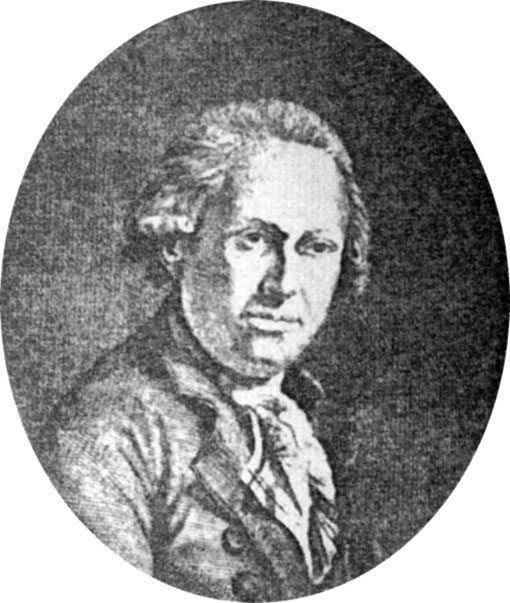
    Gmelin Johann Friedrich
    Gmelin Johann Friedrich

    scientific classification:


    Order: Psittaciformes
    Family: Cacatuidae
    Genus: Cockatoo
    Scientific name: Cacatua sulphurea
    Citation: (Gmelin, JF, 1788)
    Protonimo: Psittacus sulphureus


    Images Sulphur-crested Cockatoo:


    Species of the genus Cacatua
  • Cacatua tenuirostris
  • Cacatua pastinator
  • —- Cacatua pastinator derbyi
  • —- Cacatua pastinator pastinator
  • Cacatua sanguinea
  • —- Cacatua sanguinea gymnopis
  • —- Cacatua sanguinea normantoni
  • —- Cacatua sanguinea sanguinea
  • —- Cacatua sanguinea transfreta
  • —- Cacatua sanguinea westralensis
  • Cacatua goffiniana
  • Cacatua ducorpsii
  • Cacatua haematuropygia
  • Cacatua galerita
  • —- Cacatua galerita eleonora
  • —- Cacatua galerita fitzroyi
  • —- Cacatua galerita galerita
  • —- Cacatua galerita triton
  • Cacatua ophthalmica
  • Cacatua sulphurea
  • —- Cacatua sulphurea abbotti
  • —- Cacatua sulphurea citrinocristata
  • —- Cacatua sulphurea parvula
  • —- Cacatua sulphurea sulphurea
  • Cacatua moluccensis
  • Cacatua alba

  • Sources:

    Avibase
    – Parrots of the World โ€“ Forshaw Joseph M
    – Parrots A Guide to the Parrots of the World – Tony Juniper & Mike Parr
    – Birdlife

    Photos:

    (1) – Cacatua sulphurea by Charles LamFlickr
    (2) – Citron-crested Cockatoo(Cacatua sulphurea citrinocristata) in the Walsrode Bird Park, Germany By Quartl (Own work) [CC BY-SA 3.0], via Wikimedia Commons
    (3) – A Yellow-crested Cockatoo at Auckland Zoo, New Zealand By Ashleigh Thompson (originally posted to Flickr as Captain) [CC BY 2.0], via Wikimedia Commons
    (4) – Cacatua sulphurea citrinocristata, Citron-crested Cockatoo. Photograph of upper body and crest By Ruth Rogers (originally posted to Flickr as Citron Cockatoo) [CC BY 2.0], via Wikimedia Commons
    (5) – Citron-crested Cockatoo (Cacatua sulphurea citrinocristata). The glass between the camera and this parrot makes the picture just a little bit blurry By Alexander Tundakov (originally posted to Flickr as White Parrot) [CC BY 2.0], via Wikimedia Commons
    (6) – Photo of Lesser Sulphur-crested Cockatoo (wings clipped) By Snowmanradio, with permission from Tropical Birdland, Leicestershire, England. (Own work) [GFDL or CC BY-SA 3.0], via Wikimedia Commons
    (7) – Yellow-crested Cockatoo (Cacatua sulphurea) at the KOBE Oji Zoo by opencage.info
    (8) – Lesser Sulphur-crested Cockatoo (wings clipped) By Snowmanradio, with permission from Tropical Birdland, Leicestershire, England. (Own work) [GFDL or CC BY-SA 3.0], via Wikimedia Commons
    (9) – Yellow-crested Cockatoo (Cacatua sulphurea) by Darren – Flickr
    (10) – Yellow-Crested Cockatoo, Cacatua sulphurea by Sek Keung LoFlickr
    (11) – Cacatua sulphurea by Charles LamFlickr
    (12) – Cacatua sulphurea by Charles LamFlickr
    (13) – Cacatua sulphurea by Pichon Charles LamFlickr
    (14) – A painting of a Yellow-crested Cockatoo, also known as the Lesser Sulphur-crested Cockatoo, (originally captioned ยซPlyctolophus sulphureus. Lesser Sulphur-crested Cockatooยป) by Edward Lear 1812-1888. [Public domain], via Wikimedia Commons

    Sounds: (Xeno-canto)

    โ–ท The world of Pets: Dogs, cats, birds, reptiles, amphibians

    Sapphire-rumped Parrotlet
    Touit purpurata

    Cotorrita Purpurada

    Content

    Description:

    Sapphire-rumped Parrotlet

    18 cm.. height

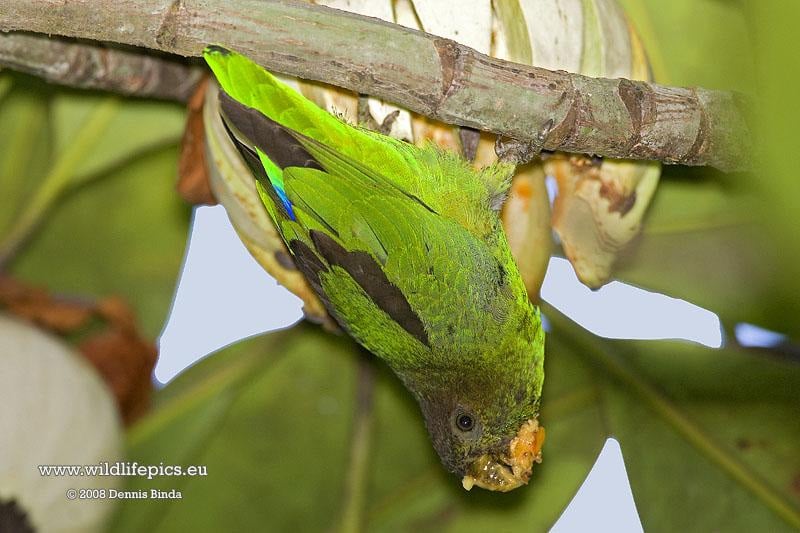
    The Sapphire-rumped Parrotlet (Touit purpuratus) has the forecrown, crown, ear-coverts and sides neck, color marron-oliva; lores and cheeks green; rear area of the neck of color green pale with broadcasting brownish. Mantle and top of the back, green; scapulars and tertiary, dark brown; rump blue; uppertail-coverts green.
    Feather blue in it bend of wing; primary coverts brown-black, rest of the coverts green. The flight feather Brown by up in innerwebs and tips, Yes no green; pale green blue for below. Underwing-coverts green. The underparts pale, of color green emerald slightly yellowish, with a layer of ochre in the sides of the belly. The tail Le da an appearance unmistakable, with black edge, green in the center and dark crimson on the sides, with black margins to outerwebs.

    Bill off-white color pale Horn-tipped up to the upper jaw; irises black; legs grey.

    The female has the tail (except central feathers) with the subterminal band green. Immature more yellowish below; the black color in the tail confined to the tips; Green olive from the forecrown up to the nape and ear-coverts lower.

    Description 2 subspecies:

    • Touit purpuratus purpuratus

      (Gmelin, 1788) – Nominal.


    • Touit purpuratus viridiceps

      (Chapman, 1929) – As the nominal species but with the forecrown, crown and back neck, green; flanks with less yellowish green and feathery external of the tail showing a purple glow.

    Habitat:

    Species Rare and hard to see.
    It inhabits, mainly, in the humid lowland canopy and forests and marshes, also observed in savanna in Suriname. In lower and more open to high altitude forests in Venezuela and in isolated areas cleared forests. Reports in altitudes of 400 metres in Colombia, and 1.200 metres in Mount Duida, Venezuela. gregarious, usually in groups of 12-40 birds.

    Reproduction:

    Observed the female digging a hole in a tree of forests and marshes in the month of November in Colombia; Birds in a nest in termitario tree in the month of April in Suriname, and males in breeding condition in the month of March in Venezuela. The laying tends to be of 3-5 eggs.

    Food:

    Observed eating fruit of Clusia grandiflora, Pouroma guianensis and Ficus figs and feeding on trees of Sapotaceae and Myrtaceae. Mainly forage in the canopy, Although also observed in low bushes and occasionally Earth.

    Distribution:

    Size of the area of distribution (reproduction / resident): 4.550.000 km2

    It inhabits in the North of South America, mainly in the Basin Amazon, from the north end of Peru, east of Ecuador (Pastaza) and Colombia to the East of the Andes in West Caquetรก (for example, Three corners) and the southeastern tip of Guainia (along the Black river) to the South of the Brazilian Amazon until For and North of maranhรฃo, to the North of the Amazon and along the Vaupes River and the icana river through the basin of the Black river until Manaus; then through the South of Venezuela from amazon along the Orinoco to the South from the Ventauri River, in the Cerro Yapacana National Park and Mount Duida and from the South of Bolรญvar in the Tepuyes of the Gran Sabana and Caura River, in Guyana, Barima, rivers Mazaruni and Chamber and to the South up to Bartica.

    Comes to be local in Suriname and French Guiana. Discrete, often difficult to observe and apparently sparsely populated in most parts of its range. Perhaps more numerous in those sections more low of it amazon basin.

    Distribution 2 subspecies:

    • Touit purpuratus purpuratus

      (Gmelin, 1788) – Nominal. Southeast of amazon in Venezuela, up to the Guianas and this from the Basin of the Amazon in Brazil.


    • Touit purpuratus viridiceps

      (Chapman, 1929) – Black river, the Northwestern basin of Brazil, Venezuela West from Mount Duida until Colombia, Ecuador and Peru.

    Conservation:

    State of conservation โ“˜


    minor concern Minor Concern โ“˜ (UICN)โ“˜

    โ€ข Current category of the Red List of the UICN: Least concern.
    โ€ข Population trend: Stable.

    Justification of the population

    The size of the world's population has not been quantified, but this species is described as ยซRareยป (Stotz et to the., 1996).

    Justification of trend

    It is suspected that this species has lost 12,8-15,2% of habitat within its distribution over three generations (15 years) starting from a model of deforestation Amazon (Soares-Filho et to the., 2006, Bird et to the., 2011). Given the susceptibility of the species to hunting and / or capture, It is suspected that it will fall in <25% during three generations.

    In captivity:

    Very rare in captivity.

    Alternative names:

    Sapphire-rumped Parrotlet, Purple Guiana Parrotlet, Sapphire rumped Parrotlet (English).
    Toui ร  queue pourprรฉe (French).
    Purpurschwanzpapagei, Purpurschwanz, Purpurschwanz-Papagei (German).
    Apuim-de-costas-azuis, apuim-de-costa-azul, periquitinho (Portuguese).
    Cotorrita Purpurada, Lorito de Lomo Purpรบreo, Periquito Zafiro (espaรฑol).
    Periquito Zafiro (Colombia).
    Periquito de Lomo Zafiro (Peru).
    Periquito Rabadilla Pรบrpura (Venezuela).
    Periquito lomizafiro (Ecuador)


    scientific classification:

    Gmelin Johann Friedrich
    Gmelin Johann Friedrich

    Order: Psittaciformes
    Family: Psittacidae
    Genus: Touit
    Scientific name: Touit purpuratus
    Citation: (Gmelin, JF, 1788)
    Protonimo: Psittacus purpuratus


    Images Sapphire-rumped Parrotlet:

    Videos of the "Sapphire-rumped Parrotlet"

    Sapphire-rumped Parrotlet (Touit purpuratus)


    Species of the genus Touit


    Sources:

    • Avibase
    • Parrots of the World โ€“ Forshaw Joseph M
    • Parrots A Guide to the Parrots of the World – Tony Juniper & Mike Parr
    • Birdlife

    • Photos:

    (1) – wildlifepics.eu ยฉ 2008 Dennis Binda
    (2) – Touit purpuratus By P. Bertrand [Public domain], via Wikimedia Commons

    Of 18 cm.. tall Inconfundible by the ends of the tail, which are dorsally and ventrally purple-red with black border.
    Overall green body with Brown Crown and nape, wing with both opaque Brown ends and violet blue rump.
    Female with paler brown head and green-streaked tail.
    The subspecies T. p. viridiceps has a totally green head.

    Uncommon and difficult to observe species.
    Lives in humid forests, semi-humid and swampy, until the 400 m. It forms small groups and they are silent when they feed. It nests in hollows of trees or arboreal termiteros at low altitude. The implementation is of 3-5 eggs and breeding season: from November to April

    It is found in the wild in the Amazon, South-East of Colombia to the Guyanas, southern Venezuela to northeastern Peru and northern Brazil.
    It feeds on fruits, and figs.

    Video: Video 1

    Deforestation and loss of Habitat is a threat for this species.

    Alternative names: Sapphire-rumped Parrotlet (English), Periquito zafiro (Colombia), Periquito lomizafiro (Ecuador), Purpurschwanz, Purpurschwanzpapagei (Germany), Lorito de Lomo Purpรบreo (Spain), Periquito Rabadilla Pรบrpura (Venezuela), Toui ร  queue pourprรฉe (France), apuim-de-costa-azul (Brazil)

    Source: Parrots, Parrots and macaws Neotropical
    Photo: wildlifepics.eu ยฉ 2008 Dennis Binda

    โ–ท The world of Pets: Dogs, cats, birds, reptiles, amphibians

    Yellow-faced Parrot
    Alipiopsitta xanthops

    Yellow-faced Parrot

    Content

    Description

    Yellow-faced Parrot

    26 to 27 cm.. tall and about 260g. weight.

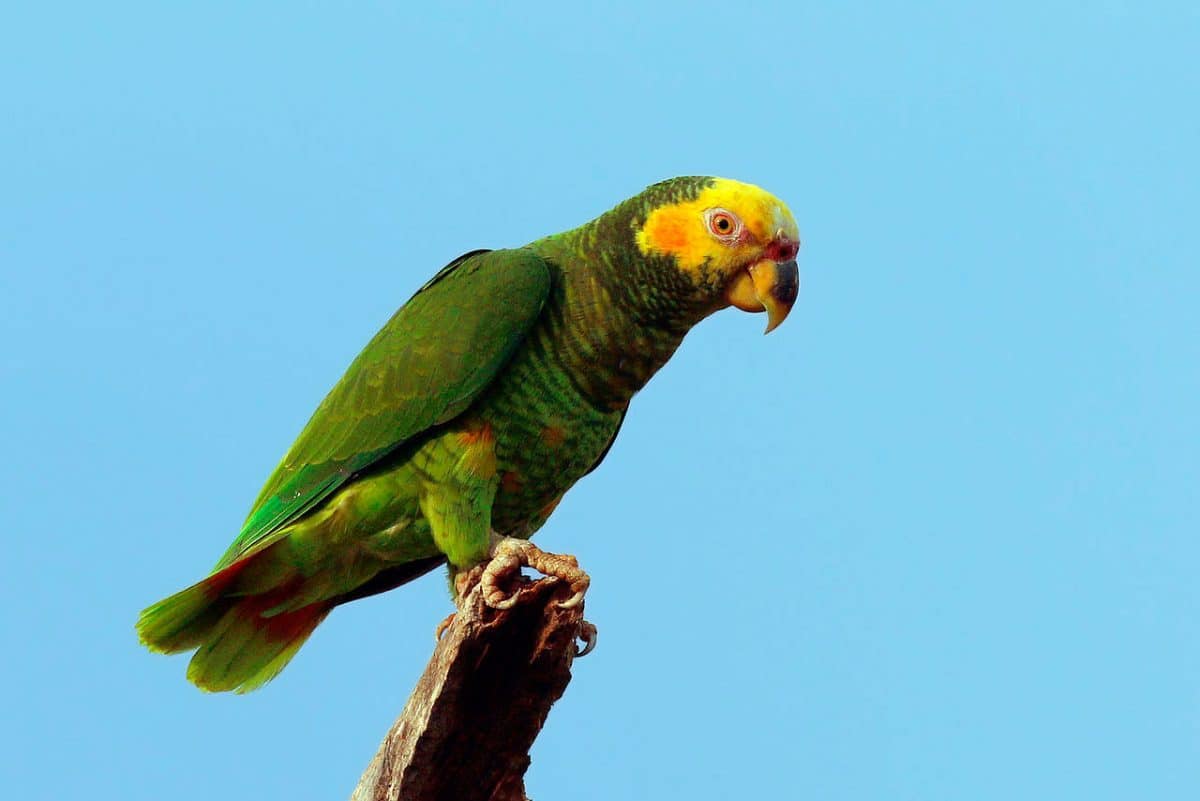
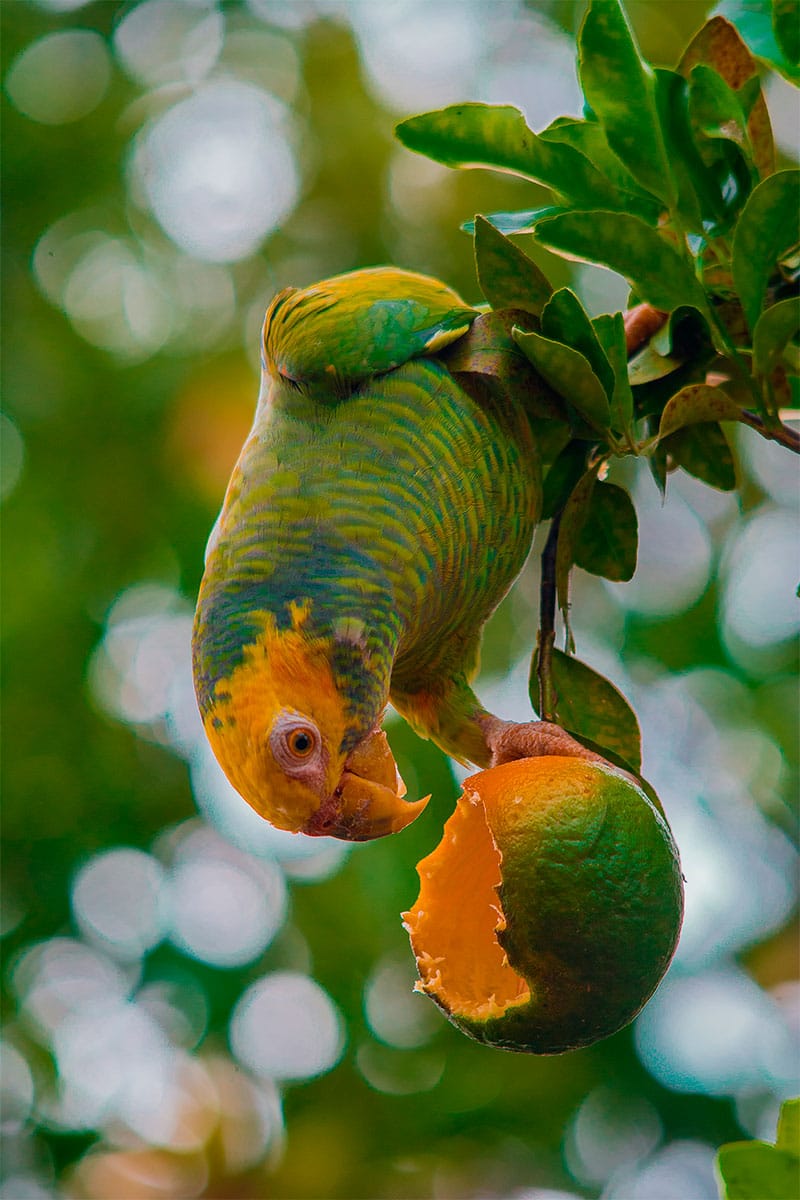
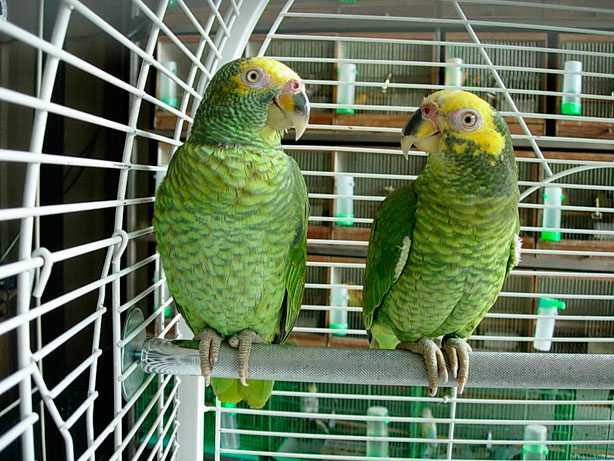
    The Yellow-faced Parrot (Alipiopsitta xanthops) It is distinguished by the large area of รขโ‚ฌโ€นรขโ‚ฌโ€นyellow in the head, with green tint nape; orange to the sides of body and upper base of the tail; collar yellowish green, belly almost all yellow, the thighs and green inner core tail green; the back it is usually green with yellow tints.

    blackish brown with yellow edges; iris yellow .

    The youth less yellow in body.


    Anatomy-parrots

    Habitat:

    It inhabits in dry forests, also called deciduous forests, in lowlands, with the presence of palmas Mauritia, Although they prefer water courses.
    They can be seen in pairs or flocks of up 50 specimens.

    Reproduction:

    Video – "Yellow-faced Parrot"

    Canto-galego parrot (ALIPIOPSITTA XANTHOPS), YELLOW-FACED PARROT, Curraleiro, CURAU PARROT.

    Although little information regarding this is available, it is known that nest in the hollows of the highest trees closed; the laying usually three eggs and the incubation period is 23-24 days.

    Food:

    It's a species of which there are few studies of their natural habitat. Its main food It consists mainly of fruits and seeds. Very fond of mangoes, usually visit their trees full of fruit.

    Distribution:

    Size of its range (reproduction / resident): 2.700.000 km2

    Inside of Brazil and adjacent area to the east of Bolivia and Horqueta, in the East of Paraguay.

    Conservation Alipiopsitta xanthops:

    State of conservation โ“˜


    Near-threatened Near Threatened โ“˜ (UICN)โ“˜

    โ€ข Current category of the Red List of the UICN: Near-threatened.

    โ€ข Population trend: Decreasing.

    In 1993 two thirds of the Cerrado, This species inhabited, had been moderately or severely altered by agriculture, heavy cattle farming, invasive grasses, the use of pesticides and annual burning.

    Conservation Actions Proposed:

    โ€ข Collate sample data and recent records to provide an improved assessment of distribution and status.

    โ€ข Estimate the total wild population (Bianchi 2009).

    โ€ข Assess the impact of habitat loss (Snyder et to the . 2000).

    โ€ข Create a network of large reserves in Bahia, maranhรฃo and Piauรญ.

    Yellow-faced Parrot in captivity:

    Ave Rare in the world of poultry farming.

    active, curious and playful. Aggressive with other parrots. They can become very noisy. Prone to obesity

    Its reproduction rarely been achieved in captivity. The basic requirement would be to isolate a compatible pair during the breeding season due to increased aggression towards other birds during this period.; also require spacious accommodations and a nest box of 25 x 25 x 60 cm. . with input from 8 cm in diameter.

    They tend to be aggressive toward their caregivers. The breeding season begins in early May. The implementation is of 2 to 4 eggs, which are incubated during 26 days. The young leave the nest when they are near the 8 weeks of age.

    Alternative names:

    Yellow faced Parrot, Yellow-crowned Amazon, Yellow-crowned Parrot, Yellow-faced Amazon (English).
    Amazone ร  face jaune (French).
    Goldbauchamazone, Schoapapagei (German).
    Papagaio-galego, chorรฃo, curau, papagaio-acurau, papagaio-curraleiro, papagaio-de-barriga-amarela (Portuguese).
    Amazona Chica, Amazona del Cerrado, Loro cara amarilla, Lora chica (espaรฑol).


    Scientific classification Alipiopsitta xanthops:

    Johann Baptist von Spix

    Order: Psittaciformes
    Family: Psittacidae
    Genus: Alipiopsitta
    Scientific name: Alipiopsitta xanthops
    Citation: (von Spix, 1824)
    Protonimo: Psittacus xanthops


    Images Yellow-faced Parrot:


    Species of the genus Amazona


    Sources:

    • Parrot Book, Parrots and macaws Neotropical
    • avibase
    • parrots.org
    • Parrots of the World โ€“ Forshaw Joseph M
    • Parrots A Guide to the Parrots of the World – Tony Juniper & Mike Parr
    • Birdlife

    Photos:

    (1) – Yellow-faced parrot (Alipiopsitta xanthops) green morph, the Pantanal, Brazil By Charlesjsharp (Own work, from Sharp Photography, sharpphotography) [CC BY-SA 4.0], via Wikimedia Commons
    (2) – Yellow-faced parrot (Alipiopsitta xanthops) yellow morph, the Pantanal, Brazil By Charlesjsharp (Own work, from Sharp Photography, sharpphotography) [CC BY-SA 4.0], via Wikimedia Commons
    (3) – Alipiopsitta xanthops, Yellow-faced Parrot; two in a cage By TJ Lin (originally posted to Flickr as yellow-faced amazon) [CC BY-SA 2.0], via Wikimedia Commons
    (4) – Yellow-faced Parrot in Giza Zoo By Hatem Moushir (Own work) [CC BY-SA 3.0], via Wikimedia Commons
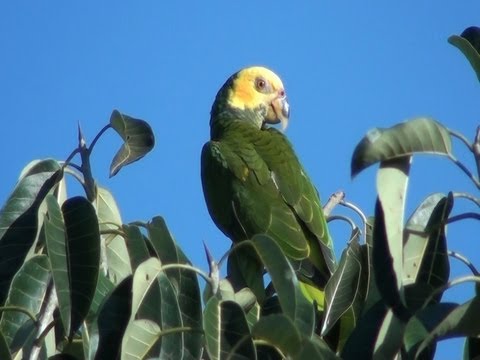
    (5) – Record made in the city of Trรชs Lagoas-MS, urban area. A flock landed on a ponca tree to feed By Jairmoreirafotografia (Own work) [CC BY-SA 4.0], via Wikimedia Commons
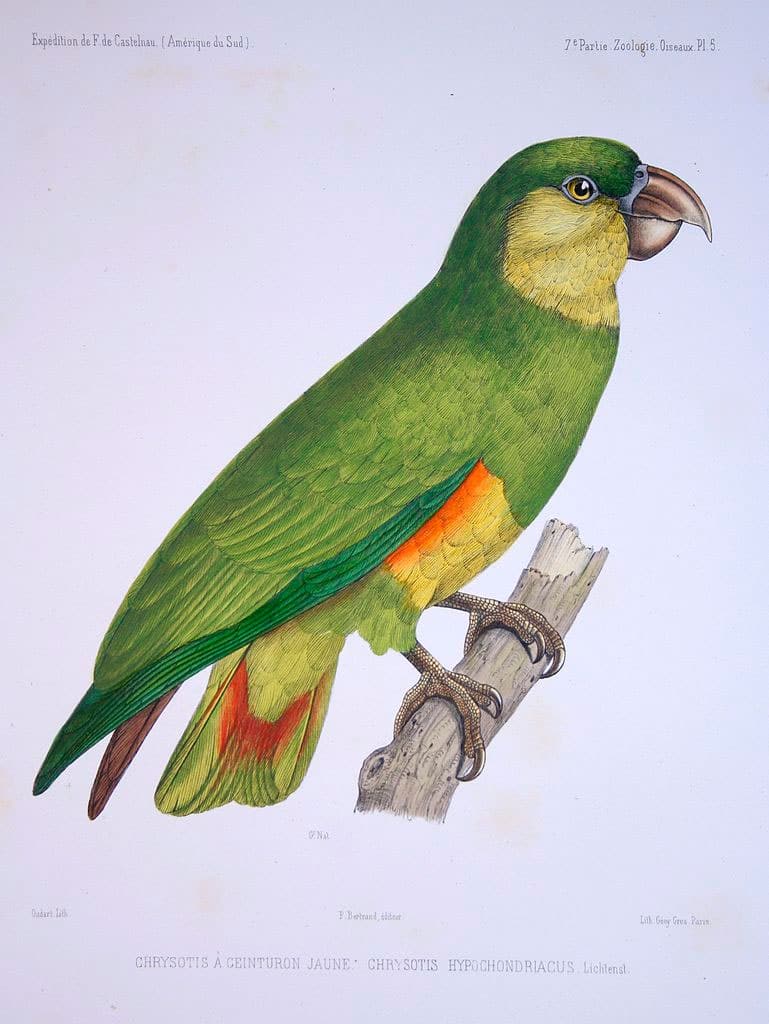
    (6) – Illustration does not look like A. xanthops (Yellow-faced Parrot). Fisch's Papageien monograph discusses this dubious specimen by Francis de Laporte de Castelnau [Public domain], via Wikimedia Commons

    Sounds: Joao Antonio de B.. Vitto