▷ The world of Pets: Dogs, cats, birds, reptiles, amphibians

Meek's Lorikeet
Charmosyna meeki

Content

Description

Of 16 cm.. length and a weight between 23 and 32 g..

Meek's Lorikeet

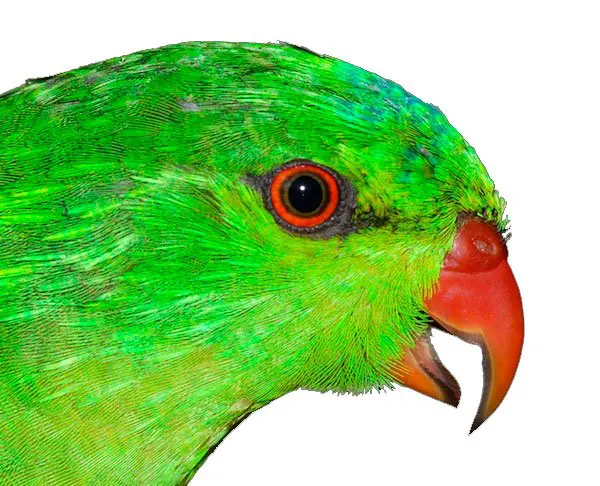
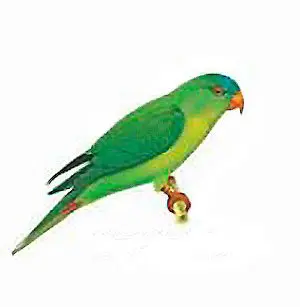
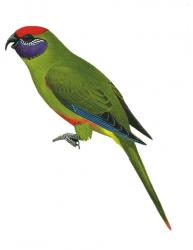
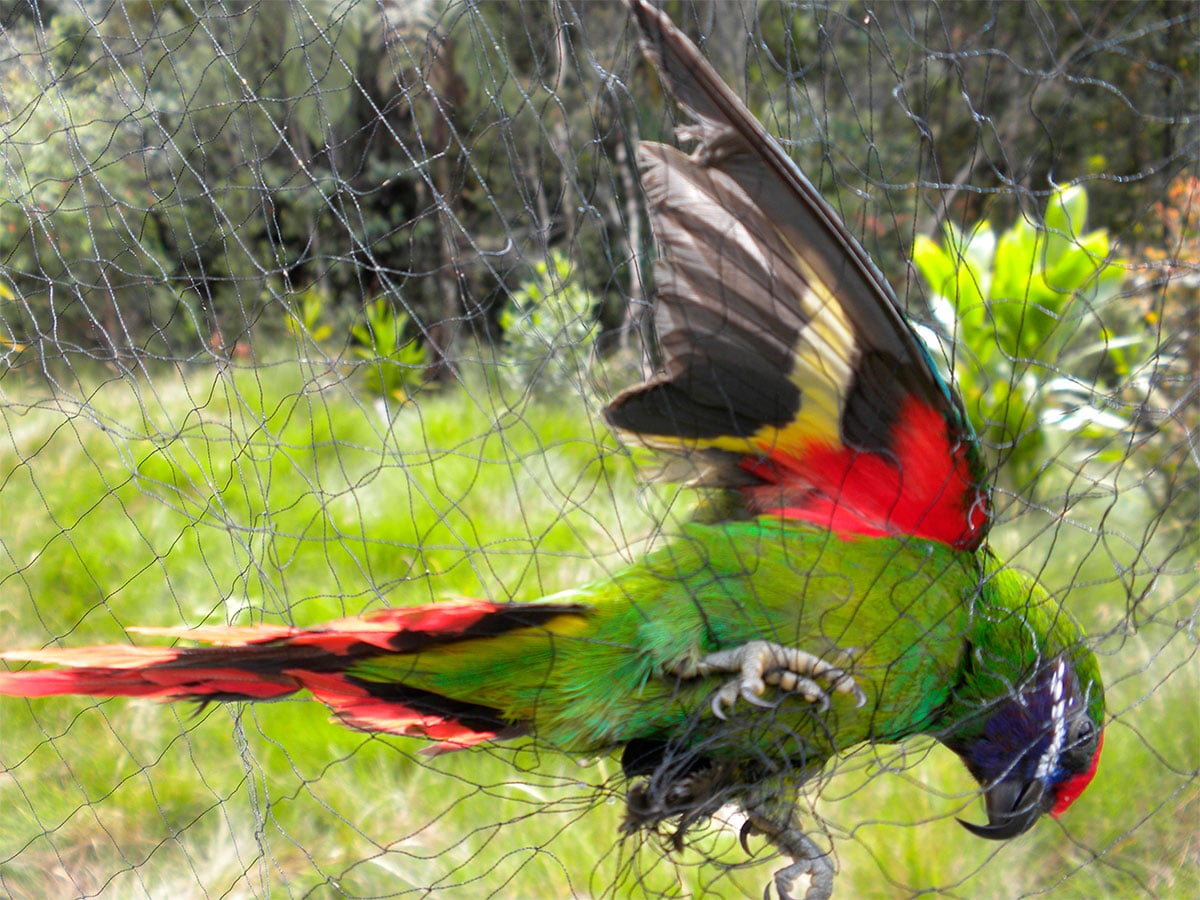
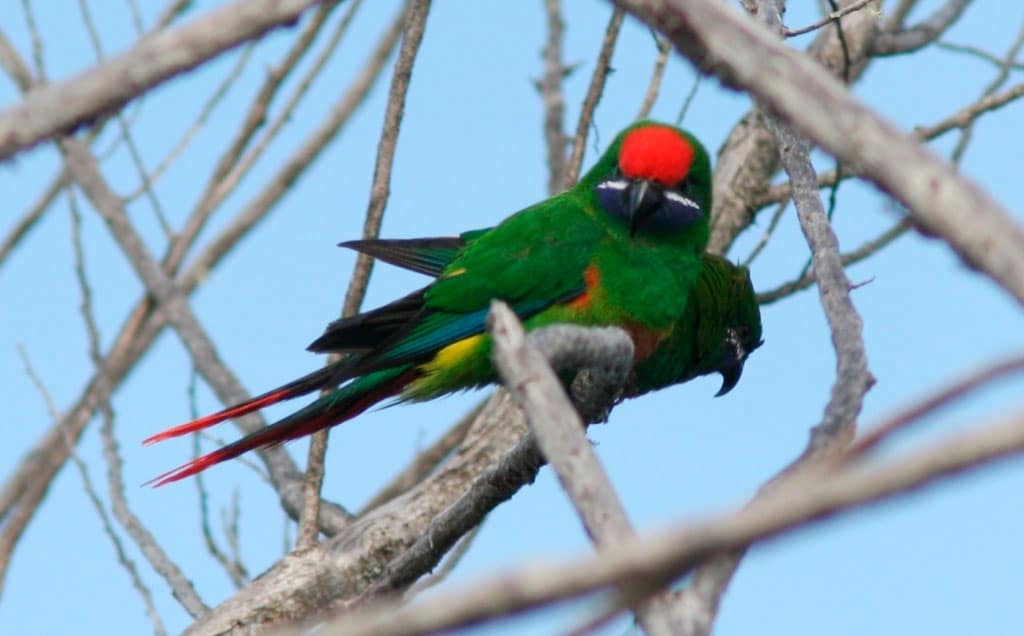
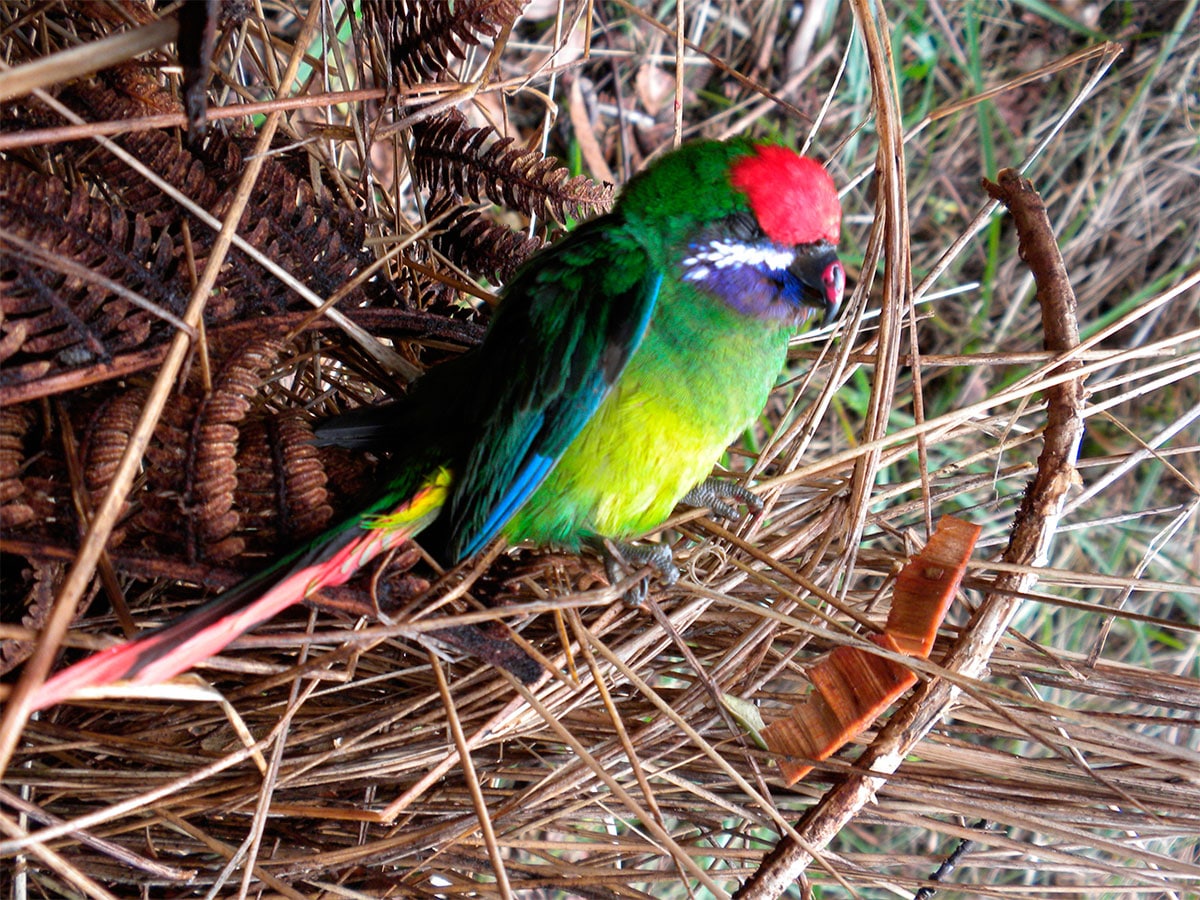
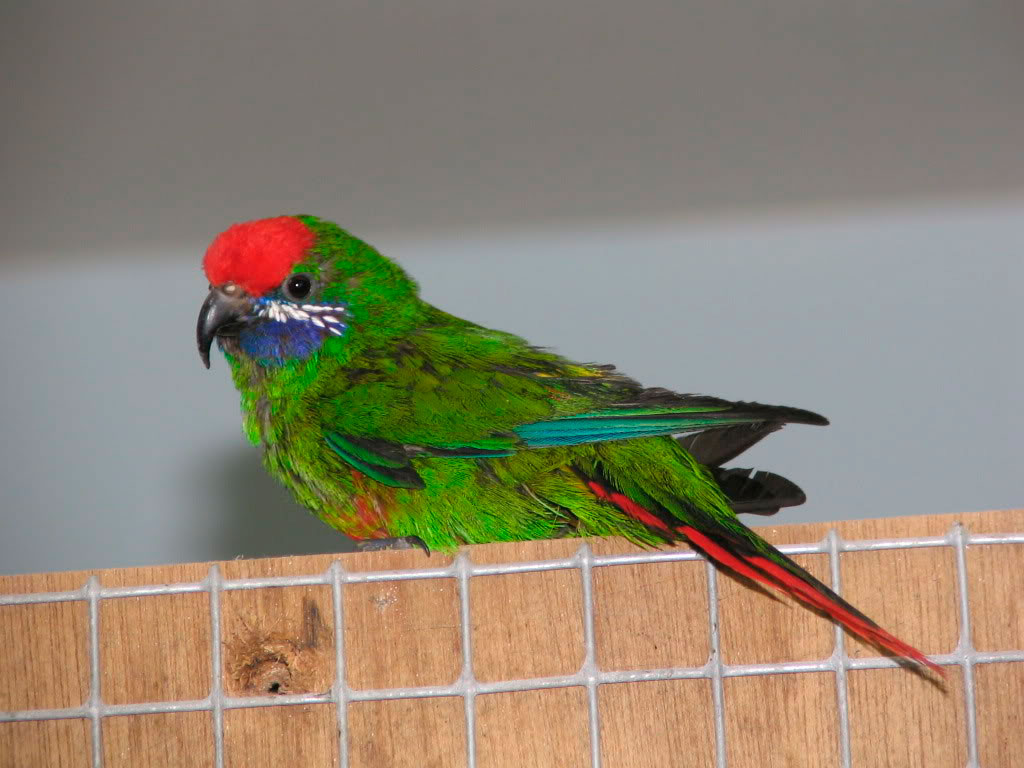
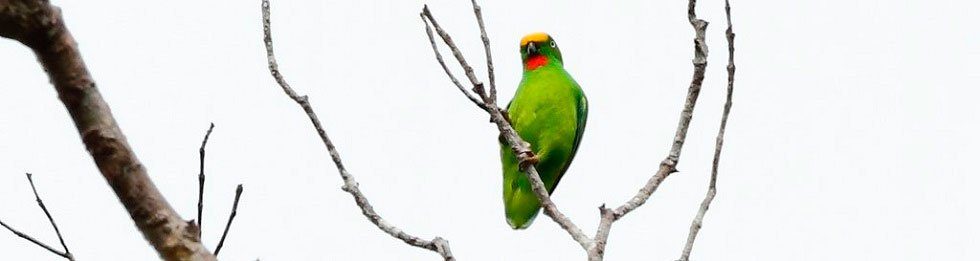
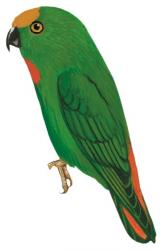
The head of the Meek's Lorikeet (Charmosyna meeki) is bright green, more yellowish in the Chin and throat, darker on crown and streaked on ear coats; patch of dark green blue above and in front of the eye. Green upper parts with fused olive through the mantle.

The wings of green at the top. Under the yellowish-green wing coverts. The yellowish green underparts, lighter in the back and more yellow from the chest to the belly. Top of tail dark green with yellow tip; the yellow bottom. Orange peak; pale red irises; legs Orange.

Both sexes are equal. Immature with the paler beak with base brown color and shorter tail.

Habitat:

Nomad. It is distributed in the humid hills and montane forests, but they have also found found in lowland coconut palms. Usually found alone or in small flocks of about of 10 to 15 birds flying through or above the forest cover. Larger groups can gather in the blooming of trees to feed on pollen and nectar. It can be associated with other parrots as the Duchess Lorikeet, Finsch's Pygmy-Parrot, Yellow-bibbed Lory and Coconut Lorikeet

Reproduction:

Information is not available.

Food:

Its diet includes pollen and nectar.

Distribution:

Endemic to the mountains of the largest islands in the Group of Solomons: Bougainville, New Georgia, Malaita, Kolombangara, Guadalcanal and in the past Santa Isabel. Moves starting from the 300 m, until the 1.700 m, but reportedly rarely in the lowlands or above 1.200 m. The world's population is believed to be below 50,000 exemplary but probably stable.

Conservation:


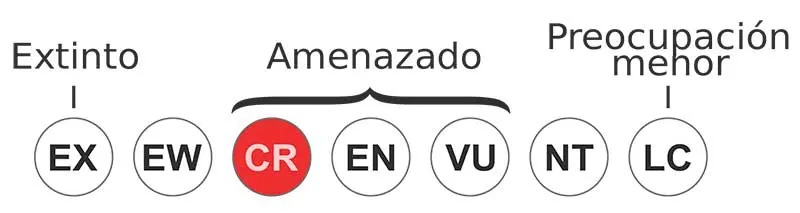
Near-threatened

• Current IUCN Red List category: Near threatened
• Population trend: Decreasing

The size of the world's population has not been quantified, It is believed that it is below 50,000 specimens, but the species is described as abundant at the Summit of Kolombangara.

There is still no evidence of a decline in its population, but would be threatened by any future large-scale export trade

"Meek's Lorikeet" in captivity:

They are not known to be in captivity.

Alternative names:

– Meek’s Lorikeet (ingles).
– Lori de Meek (French).
– Salomonenlori (German).
– Lori de Meek (español).

scientific classification:

– Order: Psittaciformes
– Family: Psittaculidae
– Scientific name: Charmosyna meeki
– Citation: (Rothschild & Hartert, 1901)
– Protonimo: Hypocharmosyna meeki

Lori Meek images:

————————————————————————————————

"Lori de Meek" (Charmosyna meeki)


Sources:

– Avibase
– Parrots of the World – Forshaw Joseph M
– Parrots A Guide to the Parrots of the World – Tony Juniper & Mike Parr
– Birdlife

– Sounds: Mark Todd (Xeno-canto)

▷ The world of Pets: Dogs, cats, birds, reptiles, amphibians

New Caledonian Lorikeet
Charmosyna diadema

New Caledonian Lorikeet

Content


Anatomy-parrots

Description

18 to 19 cm.. length.

The females of the New Caledonian Lorikeet (Charmosyna diadema) are green in general, with the crown Violet Blue intense and the thighs Blue dark, a face Beige and it bottom side and anal region red. The tail It is green above and yellowish olive below, with the four lateral feathers with red basal markings followed by a band of black, with yellow tip on the bottom. The bill is red-orange, the irises dark orange, probably, similar to the legs.

The males they have not been registered. On the basis of similar species, they probably have a more red coloration, probably including the face, the bottom of the primaries and the sides of the rump; and it is likely to be slightly larger than. The immature should look like females but paler.

Habitat:

This bird is difficult to track because it is Nomad and is relatively little visible. The species is believed to be able to live in moist montane forests but (seasonally). Flying in and out of the lowland forests of Melaleuca. Most reports come from such lowland forests, but this probably reflected only a better accessibility for observation. Mt. Ignambi It is believed that it is an ideal habitat for the species. The report Yacht Lake was an area of low scrub.

Reproduction:

Data playback of the New Caledonian Lorikeet (Charmosyna diadema) are only available the of the Red-flanked Lorikeet (Charmosyna placentis) and the Red-fronted Lorikeet (Charmosyna rubronotata). The breeding season, probably, is from July to December, and possibly until February, or even all year round. They dig in the arboreal nests of termites or in epiphytic ferns. Link gives as a result the implementation of two (sometimes three?) White rounded eggs; the incubation period likely to be similar to other species of Loris.

Food:

The bird apparently is fed into the tops of the trees.
Related species eat nectar, pollen, flowers and sometimes delicate fruits, in pairs or small groups feeding (usually less than 10). The Erythrina is specifically mentioned as plants on which this species feeds.

Distribution:

Size of the area of distribution (reproduction / resident): 1 km2

Possibly extinct. Endemic to New Caledonia and known from two female specimens collected in 1859. The species also could have been observed in the forests of the North of the island in the year 1900. and it was identified by the Islanders with the reference of a picture (at Delacour 1966) of Anthony Stokes in December of 1976. One Islander claimed to see a single individual in the Decade of 1920, and another had observed two the 3 in June of 1976 to the West of Monte Panie. This last observation was made by an experienced observer who noticed the birds by their call, and said it was different to Coconut Lorikeet. The authors are in agreement with Necklace et to the. (1994) in the extension of remaining forests in New Caledonia and the size of the island indicate that this species may well still exist and that observations and studies should be within suitable habitat including the Monte Panie, Mount Humboldt and other forest areas of the Highlands. IN DANGER.

Conservation:


critical hazard


• Current IUCN Red List category: Critical Hazard

• Population trend: Unknown

The population It is estimated between 1 and 49 individuals mature.

This species has not been recorded with certainty since 1913, despite specific searches in 1998, and it may have decreased as a result of a number of different threats. But, cannot be assumed that they have become extinct, because there were local reports in the Decade of 1950 and in 1976, and lorites of this genus are notoriously difficult to detect, being discreet and nomadic, more studies are needed. Any remaining population is likely to be small, and for these reasons it is in Critical Hazard.

The montane moist forest is not under threat, but it is possible that this species has a requirement for other habitats, some of which, forests semi-deciduous in particular, the lowlands, they have almost disappeared from the island (Ekstrom et to the. 2000, Ekstrom et to the . 2002). Several Lori headband have suffered severe population decreases and fluctuations by unknown causes (Forshaw 1989). The introduction of any disease is possible (such as malaria, avian) or more likely mammals (especially rats) they may have been one of the causes of the decline of this species.(Bregulla 1992, Ekstrom et to the. 2000, Ekstrom et to the ., 2002).

"New Caledonian Lorikeet" in captivity:

Not found in captivity.

Alternative names:

– New Caledonian Lorikeet, New Caledonia lorikeet (ingles).
– Lori à diadème, Loriquet à diadème (French).
– Diademlori (German).
– Lori Diadema (español).

scientific classification:

– Order: Psittaciformes
– Family: Psittaculidae
– Genus: Charmosyna
– Scientific name: Charmosyna diadema
– Citation: (Verreaux,J & Des Murs, 1860)
– Protonimo: Psitteuteles diadem


«Lori Diadema» (Charmosyna diadema)


Sources:

  • Avibase
  • Parrots of the World – Forshaw Joseph M
  • Parrots A Guide to the Parrots of the World – Tony Juniper & Mike Parr
  • Birdlife

  • Photos:

1 – Birds-pet-wallpapers – link

  • Sounds:

▷ The world of Pets: Dogs, cats, birds, reptiles, amphibians

Blue-fronted Lorikeet
Charmosyna toxopei

Content


Anatomy-parrots

Description

16 cm.. length.

Blue-fronted Lorikeet

The forecrown of the Blue-fronted Lorikeet (Charmosyna toxopei) is bright green, the front of the crown, above the eyes is bright blue; rest of the head green. Upperparts green, bright in the rump. Wings Green with blackish inner feathers. The underwing-coverts green; flight feather Blackish with yellow band in the whole lower part of the secondaries. The underparts brighter yellowish green. Tail green, with red bases and blackish stain. The bill orange; the irises yellow orange; legs orange-red.

Habitat:

If recent observations were in fact of the Blue-fronted Lorikeet, species can be nomadic, moving from high to low altitude on the basis of the availability of food (like some other small parrots). This could explain the paucity of records, especially for a species already by itself it is distributed sparsely. The other possibility is that the birds are distributed only in the forested hills.

Interviews with local residents suggest that the species moved to the lowlands during the two annual seasons of heat, in March-April and August-November.

Reproduction:

There is no data.

Food:

The locals who live in the plateau frog They reported that the bird feeds on nectar and pollen from the trees in flower.

Distribution:

Endemic to Buru, Indonesian. Obviously, is a rare species, and virtually nothing is known of its State. The original specimens were collected in the wooded hills between 850 m and 1.000 m.

In 1980 the species was reported to be quite common in plantations, secondary and primary forest, but this record has been suggested as a reference to the Red-flanked Lorikeet (Charmosyna placentis) (the record of this species from Buru It is in fact wrong). In 1989 two flocks of five to six birds, supposedly this species, they were seen during a selective felling of forests to 600 meters on the Teluk Bara. There is also a report of 1993 of four small unidentified parakeets seen in the same area as the observations of 1.980. The species are now considered endangered by Birdlife International, although a thorough search must be carried out before its status can be fully determined. VULNERABLE.

Conservation:


critical hazard

• Current IUCN Red List category: Critical Hazard

• Population trend: Decreasing

• Population size: 50-249 mature individuals

Although there are few records (confirmed or unconfirmed) of the species, It is suspected that it is declining due to loss of forests in the lowlands.

Most of the forests in the coastal lowlands of Buru have they been clarified, and much of the forest in the northern part of the island has been connected shape selective or degraded and fragmented by migratory agriculture, in such a way that only a few small patches of lowland primary forest remain. But, the island's gardens still contain many indigenous tree species. In 2010, There was at least one search operation on a large scale above Buru, located in the lowlands. But, extensive forests of mountain of the island remain largely without being scanned. The topography of the mountain range Kaplamandan is the hope that almost all of the montane forest is inaccessible to loggers (A. Gray in litt. 2010).

All of the original specimens were captured alive using lime, However, the species is not kept as a pet, does not seem to be listed. Have a distribution of mountain which is close to the maximum altitude within its distribution area, does this species is potentially susceptible to climate change (BirdLife International data not publ.).

"Blue-fronted Lorikeet" in captivity:

Not found in captivity.

Alternative names:

– Blue-fronted Lorikeet, Blue fronted Lorikeet, Buru Lorikeet (ingles).
– Lori de Buru (French).
– Burolori, Burulori (German).
– Lori de Buru (español).

scientific classification:

– Order: Psittaciformes
– Family: Psittaculidae
– Genus: Charmosyna
– Scientific name: Charmosyna toxopei
– Citation: (Siebers, 1930)
– Protonimo: Hypocharmosyna toxopei

Images "Blue-fronted Lorikeet"

————————————————————————————————

«Lori de Buru» (Charmosyna toxopei)


Sources:

– Avibase
– Parrots of the World – Forshaw Joseph M
– Parrots A Guide to the Parrots of the World – Tony Juniper & Mike Parr
– Birdlife

▷ The world of Pets: Dogs, cats, birds, reptiles, amphibians

Pygmy Lorikeet
Charmosyna wilhelminae

Pygmy Lorikeet

Content


Anatomy-parrots

Description

The Pygmy Lorikeet (Charmosyna wilhelminae) has an approximate length of 13 cm.. and a weight of 20 g..

The head is green; the forecrown brighter yellowish green; crown dark purple, with broadcast Blue in them tips and color turquoise bright in the feathers of the nape; rear of the nape with wash of olive. Mantle green; low back and tail reddish color; at the top, the tail purple blue. The wings, by up green with parts internal of the flight feather Blackish and blackish the primary coverts. The wings below rosa-salmon; Tips from the flight feather blackish. The underparts Green yellowish with prominent veins on the chest. Upper, the tail green, Red at the base (normally hidden in the field); olive brown below with red and yellow tips on the base. The bill reddish orange-tipped yellow; cere color red pink; Grey the ring perioftalmico; irises yellow to orange-red; legs light grey.

Female lack of red on it rump and in the wings view in flight.
Immature generally more muted and upperparts slightly more Brown. Lacks blue at the tips of the feathers of the nape. Yellow stripes on the top of the chest less distinct or absent. The bill and the irises brown.

Habitat:

Mainly inhabits in humid forests and on the edge of forests, but also by forest savanna and established secondary vegetation. It is usually between the 1.000 meters of altitude and the 2.200 m, but in the South and around Port Moresby It is occasionally much closer to sea level, in the forests of lowlands. It forages in couples and small flocks of up to 20 birds in the trees in flower, often in the company of Goldie's Lorikeet and Fairy Lorikeet. Very Active When it feeds and, often difficult to identify due to its size and predominantly green plumage. It is not uncommon, but easily overlooked. and has been found in groups of up to 200 individuals. It has often been seen flying in mixed flocks above the canopy, where they can hardly be identified due to their small size.

Reproduction:

Breeding and nesting habits unknown.

Food:

Feeds of nectar and pollen.

Distribution:

Size of the area of distribution (reproduction / resident): 290.000 km2

North of New Guinea in Irian Java (Indonesian) and Papua New Guinea. The range of the Mountains Parotia on doberai peninsula, in the West of the island of New Guinea, through the cordillera central, the Huon Peninsula, and South-East of the mountain range of Owen Stanley. In the immediate vicinity of Port Moresby (for example, area Sogeri) There is little (but possibly regular between May and November).

The population world will think that is of less than 50.000 specimens and is considered to be stable. There are few in captivity.

Conservation:


minor concern


• Current IUCN Red List category: Least concern.

• Population trend: Stable.


The size of the world population It has not been quantified, but the species according to sources is generally very rare.

The population suspected to be stable in the absence of evidence of any reduction or substantial threats.


"Pygmy Lorikeet" in captivity:

Rare.

Alternative names:

– Pygmy Lorikeet, Pygmy Streaked Lorikeet, Pygmy Streaked Lory, Wilhelmina’s Lorikeet, Wilhemina’s Lorikeet (ingles).
– Lori de Wilhelmina (French).
– Elfenlori (German).
– Lori Pigmeo (español).

scientific classification:

– Order: Psittaciformes
– Family: Psittaculidae
– Genus: Charmosyna
– Scientific name: Charmosyna wilhelminae
– Citation: (Meyer,AB, 1874)
– Protonimo: Trichoglossus Wilhelminae

Images "Pygmy Lorikeet"

————————————————————————————————

«Lori Pygmy» (Charmosyna wilhelminae)


Sources:

– Avibase
– Parrots of the World – Forshaw Joseph M
– Parrots A Guide to the Parrots of the World – Tony Juniper & Mike Parr
– Birdlife

– Photos:

1 – loromania

▷ The world of Pets: Dogs, cats, birds, reptiles, amphibians

Black-capped Lory
Lorius lory

Tricolor loris

Content

Description

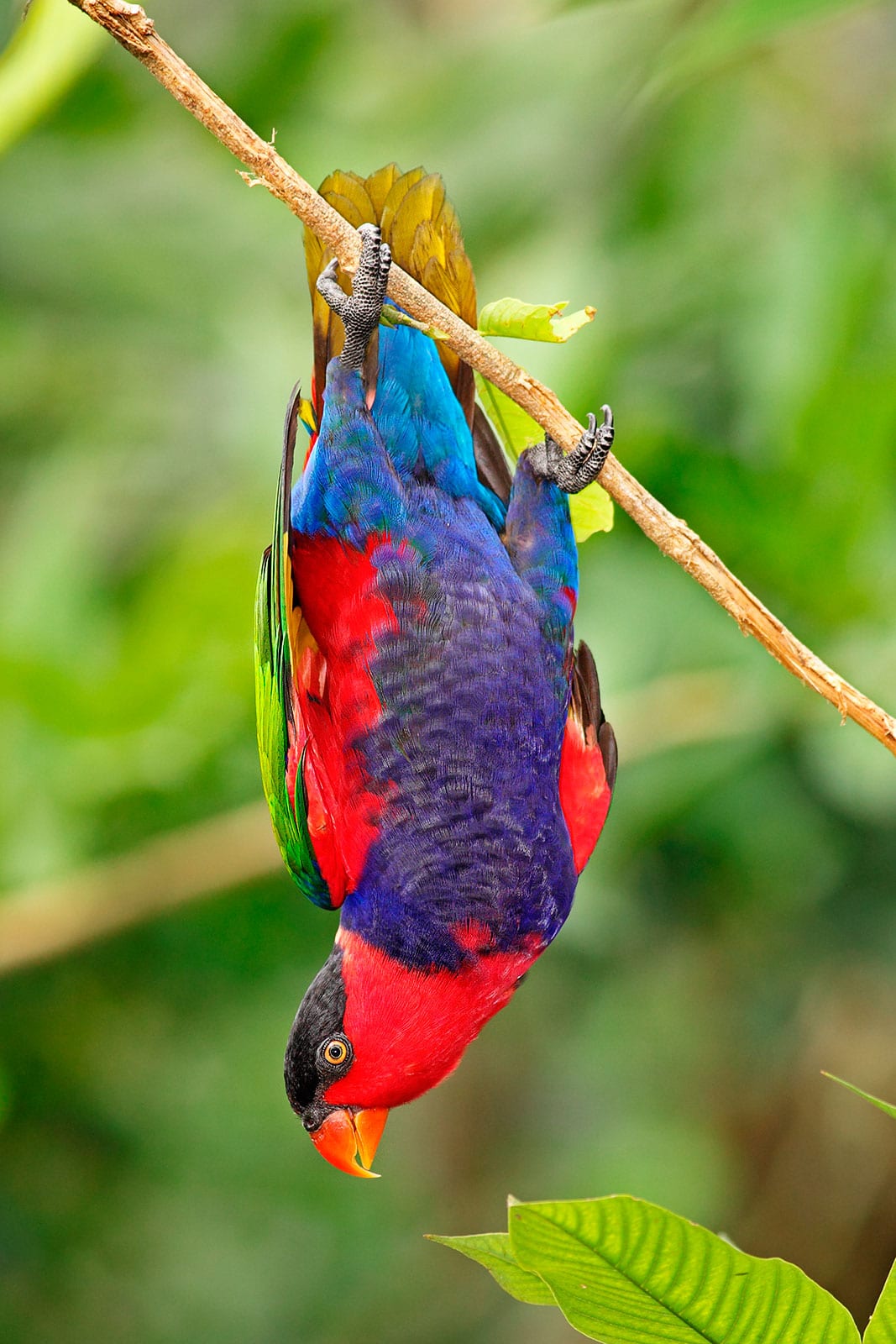
The Black-capped Lory (Lorius lory) has an approximate length of 31 cm.. and a weight between 200 and 260 g..

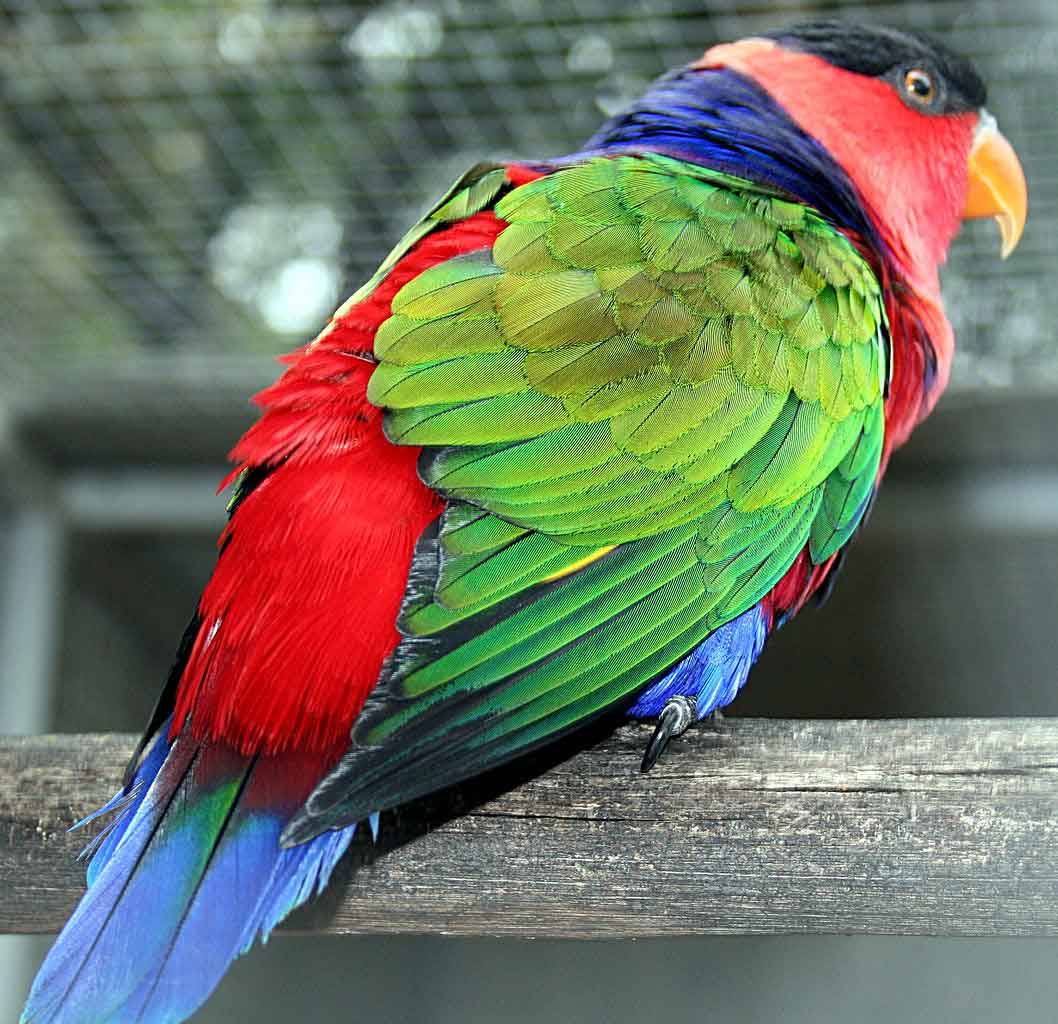
Black hood extends above the peak to the nape of the neck, where a few blue spots appear; rest of the head is bright red. The black hood is separated from the rear mantle red pink (sometimes mottled red), by a fine necklace of dark purple blue; back, the upper coverts bright red tail and rump.

Upper parts of green color with slight shine bronze wing, more visible on the coverts and secondary more internal.

Flight feathers of black on the inside and marked with yellow in the middle part, forming the group a tricolour in the Underwing. Red Wing coverts.

Throat and upper part of the chest of Red; Blue mantle extends around the sides of the chest, dark blue in the abdomen that is slightly brighter in thighs and coverts; flanks with varying amounts of Red ranging upward and around the curve of the wing.

Dark bluish black on the upper tail feathers, Green slightly sieved in the Centre and Red at the base (It shows only dark blue at rest); Yellow undertail dark Olive with red hidden base.

Orange peak; Cere and grey-black periophthalmic ring; orange-yellow IRIS; grey to black legs.

Males and females they are the same. Immature with less extensive blue underparts and the upper part of the chest of color red wine. Fine blue collar around throat. Underwing coverts blue and yellow with a black tip, not red as in adults. Brownish beak.

Subspecies vary considerably in color:

  • Lorius lory lory: It is the nominal
  • Lorius lory erythrothorax: Neck and central area of blue belly. Yellow in the wings. Blue mantle in two bands. Red Underwing coverts.
  • Lorius lory SOMU: Red neck, blue belly.
  • Lorius lory salvadorii: As the erythrothorax but with blue-black Underwing coverts.
  • Lorius lory viridicrissalis: As the salvadorii but the blue darker everywhere.
  • Lorius lory jobiensis: As the salvadorii but top of the paler breast and mantle bands.
  • Lorius lory cyanuchen: Black on the top with blue on the nape of the neck.

Habitat:

The Black-capped Lory he prefers the primary forests and edges of these, They also reported in secondary forests well grown, in some partially cleared areas and swamp forest. It is not known to occur in the monsoon forest, planted forests or plantations of coconut trees. The Black-capped Lory is mainly distributed in the lowlands up to 1.000 m, but there have been examples to 1.750 m.

They are mainly found in pairs and usually smaller than other groups parrots sympatric, but it may happen that they get together in groups of ten or more to feed in trees in flower.

Reproduction:

Little is known of its breeding ecology in the wild., Although there is a history of a couple digging a pit to make the nest in a dead tree. Apparently the nesting occurs from the month of may until October.

In captivity, the setting is two eggs with 26 incubation days; emancipation occurs between 57 and 70 days after hatching.

Food:

The diet includes pollen, nectar, flowers, fruits and insects. The birds prefer to feed in the canopy or half-height where they remain quiet and discrete. Unlike in the Coconut Lorikeet and the Dusky lory, It reached generally similar maximum altitudes, This species has been able to adapt to secondary habitats in high levels in the East of New Guinea.

Distribution:

Widely distributed from the West of Irian Java (Indonesian), including Waigeo, Batanta, Salawati and Misool in the Group of islands west of papua and Yapen, My Num. They are also found in the Biak island on bahía de Geelvink, (It is from Papua New Guinea).

It is quite common in the lowlands and foothills.. Top world population to the 100.000 individuals.

Subspecies distribution:

  • Lorius lory lory: It is the nominal.
  • Lorius lory erythrothorax: The South coast of New Guinea east of the peninsula Bird’s Head, and to the southeast of the North Coast.
  • Lorius lory SOMU: Mountain districts in the South of the center of New Guinea.
  • Lorius lory salvadorii: Northwest Coast of Papua New Guinea.
  • Lorius lory viridicrissalis: Northeast coast of Western New Guinea.
  • Lorius lory jobiensis: Islands Yapen and My Num.
  • Lorius lory cyanuchen: Biak Island.

Conservation:


minor concern


• Current IUCN Red List category: Least concern

• Population trend: Stable


The world's population has not been quantified, but the species has been observed that it is, usually, common, but not abundant throughout its area of distribution.

Suspected that the population is stable in the absence of evidence of any reduction or substantial threats.


"Black-capped Lory" in captivity:

It has attractive voice and can learn to imitate. Playful and curious; It can be noisy at times.

Common up to the decade of 1960 When exports began to cease.

Alternative names:

– Black-capped Lory, Black capped Lory, Tricolored Lory, Tricoloured Lory, Western Black-capped Lory (ingles).
– Lori tricolore, Lori à calotte noire (French).
– Frauenlori (German).
– Lóris-bailarino (Portuguese).
– Lori Tricolor, Tricogloso Tricolor (español).

scientific classification:

– Order: Psittaciformes
– Family: Psittaculidae
– Scientific name: Lorius lory
– Citation: (Linnaeus, 1758)
– Protonimo: Psittacus Lory

“Tricolor Lory” Images:

Videos "Black-capped Lory"

————————————————————————————————

"Lori Tricolor" (Lorius lory)


Sources:

– Avibase
– Parrots of the World – Forshaw Joseph M
– Parrots A Guide to the Parrots of the World – Tony Juniper & Mike Parr
– Birdlife

– Photos:

1 – By Michael Spencer [CC BY 2.0], via Wikimedia Commons
2 – «Lorius lory – Bird Park, Singapore – upside down-8a» by Benjamint444 – Own work. Licensed under GFDL 1.2 via Wikimedia Commons.
3 – «Lorius lory-20051118» by Doug Janson – Own work. Licensed under CC BY-SA 3.0 via Wikimedia Commons.
4 – By René Modery (originally posted to Flickr as CIMG6207) [CC BY 2.0], via Wikimedia Commons
5 – VJ Czar World – Black-capped Lory Snapshots

– Sounds: Frank Lambert (Xeno-canto(

▷ The world of Pets: Dogs, cats, birds, reptiles, amphibians

Fairy Lorikeet
Charmosyna pulchella


Fairy Lorikeet

Content

Description

18 cm.. length and a weight between 24 and 34 g..

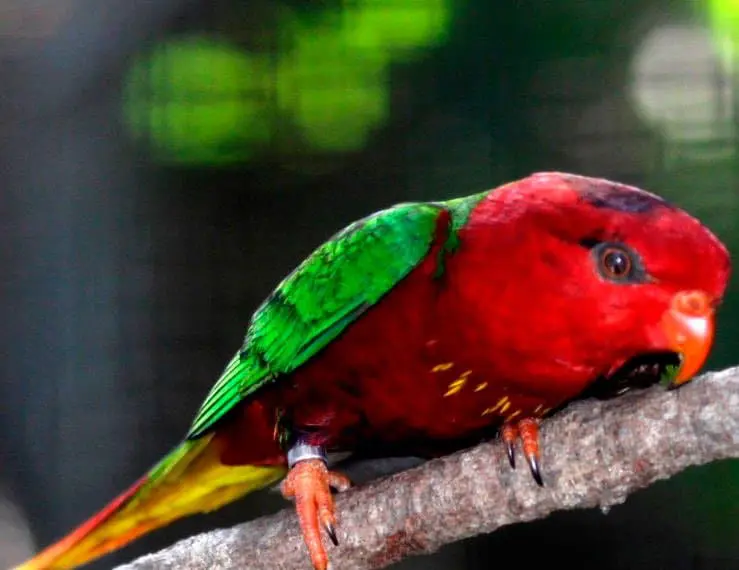
The head of the Fairy Lorikeet (Charmosyna pulchella) is dark red with the back of the crown Black extending from above and behind the eyes up to the nape. Mantle Green with a black area below the nape and collar of color red dark at the height of the shoulders; under the back It shows a patch of dark violet interspersed with some green feathers on the ends; rump and tail coverts view from above of color green.

Wings Green with extremes of color black in them flight feather and in the internal parts of the coats. below the wings Red with coverts marginal green; flight feather blackish.

The underparts Red with stripes of pale yellow in the center of the chest, the thighs purple with yellow stripes. The tail view from the top of green at the top with a black shaft in the Center and the rest of red and yellow at the tip; view from below, the tail is yellow, bathed in red and green ends.

The bill is orange with gray tip; irises yellow red; legs oranges.

The female shows a color green beige, not red, on the sides and a yellow patch in the flanks that extends to the sides of the rump.

The female of the subspecies Rothschildi also shows more green in the underparts males and a green mottling on the upper part of the chest.

The Immature They show the yellow patch of the flanks more defined than the females. The lower part of the back, mainly green with some blue-violet. Top of the chest Green mottled without clearly defined yellow stripes adult. Crown Red with black patch restricted to the nape and mixed with the green of the upper mantle. Lack of the Red of the part back from neck clearly defined in adults. Yellow area at the bottom of the flight feather. Iris brown. Beak and feet grayish brown.

Subspecies description

There are two subspecies including the nominal. A third, Charmosyna pulchella beautiful, described by Devis (1900), is considered here as Charmosyna pulchella pulchella.

  • Charmosyna pulchella pulchella

    : (Gray,GR, 1859) – The nominal


  • Charmosyna pulchella rothschildi

    : (Hartert, 1930) – The patch of the crown descends to find is with them eye; Green fusion behind the yellow lines of the chest, and green fusion in the flanks and the thighs (that can also show some yellow stripes); without the Red of the neck and much less defined the violet patch in the lower part of the back.

Habitat:

Nomads. They are mainly distributed in montane forests, at the edges of forests and secondary growth forests. Its preferred habitat are the mountains between 500 and 1.800 m, but also found in lowlands up to the level of the sea and in the mountains up to 2.300 m.

Found in pairs or flocks of 15 or more members, uniting in the tops of trees in flower with others Charmosyna lorikeets, including the Josephine's Lorikeet.

Reproduction:

In captivity it nests continuously, with incubation of 25 days shared by both parents. Usually, It lays two eggs in a hole in the base of one epiphyte. In nature it is intended that nests between January and April (Pratt picked up breeding males in March).

Food:

It feeds on pollen and nectar.

Distribution:

The Fairy Lorikeet is distributed between New Guinea in Irian Java (Indonesian) and Papua New Guinea, from the East of Vogelkop to the peninsula of Huon. Owen Stanley mountains and southeastern intervals.

Subspecies distribution:

  • Charmosyna pulchella pulchella

    : The nominal


  • Charmosyna pulchella rothschildi

    : The mountains Cyclops and the slope North of the mountains on the idenburg river (Irian Java).

Conservation:


minor concern


• Current IUCN Red List category: Least concern.

• Population trend: Stable.

The world's population has not been quantified, It is thought that it surpasses the 500.000 birds. the species, according to information, is abundant in some areas, but few in others due to the trade (pit et to the., 1997). Suspected that the population is stable in the absence of evidence of any reduction or substantial threats.

"Fairy Lorikeet" in captivity:

A small number of captivity.

Alternative names:

– Fairy Lorikeet, Little Red Lorikeet, Little Red Lory (ingles).
– Lori féérique, Lori à croupion noir, Lori féerique, Loriquet à croupion noir (French).
– Goldstrichellori (German).
– Lori Lindo (español).

scientific classification:

– Order: Psittaciformes
– Family: Psittaculidae
– Scientific name: Charmosyna pulchella
– Citation: Gray,GR, 1859
– Protonimo: Charmosyna pulchella

«Cute Lori» Images:

————————————————————————————————

«Lori Lindo» (Charmosyna pulchella)


Sources:

– Avibase
– Parrots of the World – Forshaw Joseph M
– Parrots A Guide to the Parrots of the World – Tony Juniper & Mike Parr
– Birdlife

– Photos:

1 – animalphotos.me
2 – by W. Voit – koppiekrauw
3 – animalphotos.me
4 – Author iggino in Vogelpark Walsrode, Walsrode, Lower Saxony, Germany – lynx
5 – in Neues vom Loro-Parque – koelle-zoo

▷ The world of Pets: Dogs, cats, birds, reptiles, amphibians

Plum-faced Lorikeet
Oreopsittacus arfaki

Plum-faced Lorikeet

Content

Description

15 cm.. length between 16 and 23 g. of weight.
Plum-faced Lorikeet

The hood of the Plum-faced Lorikeet (Oreopsittacus arfaki), from the top of bill up to the crown rear, is Scarlet Red ; chin and Spada color plum (with bluish Sheen), broken by two rows of thin stripes.

Upperparts of color green uniform with a light spread of olive in the the mantle. Wings, views from the top are green; vane internal to the flight feather, blackish in color and vane external to the primaries outermost, bluish green. Underwing-coverts and axillary, red (Outer secondaries slightly marked with yellow); flight feather Blackish with yellow central band. The mauve of it chin be extended slightly in the throat; top of the chest green, center of chest and belly bathed in orange-red; under belly green; undertail-coverts green, lightly bathed in yellow on sides. Uppertail green, merging to blackish and ending in pinkish-Red, in the tip lighter fusion: below, the tail is red with marked with black side feathers.

The bill black; irises blackish brown; legs grey.

Female lack of top red (but you can show a bit of red on the part rear of the Crown).

Immature male with only red on the back of the crown. The young birds have a slightly 'scaly' appearance; also off the tip of orange-yellow color of the tail.

Description 3 subspecies

  • Oreopsittacus arfaki arfaki

    (Meyer,AB, 1874) – The nominal.


  • Oreopsittacus arfaki grandis

    : (Ogilvie-Grant, 1895) – Greater than the nominal. Lack of the flanks redorange and markings of the belly of the other two subspecies.


  • Oreopsittacus arfaki major

    : (Ogilvie-Grant, 1914) – Larger that the nominal and more red-tipped in the tail.

Habitat:

The distribution of the Plum-faced Lorikeet is more or less continuous in the extension of the moss forests; the species is mainly found among the 2.000 and 3,750 m, but can observe is to 1.000 m occasionally. Be found with greater frequency in pairs or small flocks very vocal. They feed acrobatically in the canopy; They also feed on plants, especially in the flowers of epiphytes, often in the company of other flower aficionados such as the lories of the genus Neopsittacus.

Reproduction:

Habits of nesting unknown, birds in reproductive attitudes they have been observed in August and October. The display of marks under the wings have been observed in pairs and can be linked to courtship, as well as by the male head rolling.

Food:

It feeds on pollen, nectar, possibly, flowers, fruit (especially Schefflera) and berries.

Distribution:

Size of the area of distribution (reproduction / resident): 108.000 km2

New Guinea in Irian Java (Indonesian) and Papua New Guinea, ranging from the East ofVogelkop to the Huon Peninsula and ranges from the Southeast. A small number of captivity

Distribution 3 subspecies:

  • Oreopsittacus arfaki arfaki

    (Meyer,AB, 1874) – The nominal.


  • Oreopsittacus arfaki grandis

    : (Ogilvie-Grant, 1895) – Mountains of the Central and East of Papua New Guineto, including, those in the southeast of the region of the Huon Peninsula and Sepik, extending to the West of Victor Emanuel Range


  • Oreopsittacus arfaki major

    : (Ogilvie-Grant, 1914) – Snow Mountains (Papua New Guinea)

Conservation:


minor concern

• Current IUCN Red List category: Least concern

• Population trend: Stable

The world population It has not been quantified, Although it is thought of more than 300.000 specimens. The species is reported to be quite common (pit et to the. 1997).

The population suspected to be stable in the absence of evidence of any reduction or substantial threats.

"Plum-faced Lorikeet" in captivity:

The Plum-faced Lorikeet is a bird quiet and at times active. Young birds are susceptible to stress and disease during the acclimatization; can die suddenly without apparent cause. They become much more resistant and less timid after acclimatization.. You can be accommodated with members of their own species in a system of colony.

It is very rare in captivity.

Alternative names:

– Plum-faced Lorikeet, Plum faced Lorikeet, Plum-faced Mountain Lory, Plum-faced Mountain-Lory, Whiskered Lorikeet (ingles).
– Lori bridé (French).
– Arfaklori, Arfakalori (German).
– Lori Bigotudo, Lori de Bigotes (español).

scientific classification:

– Order: Psittaciformes
– Family: Psittaculidae
– Genus: Oreopsittacus
– Scientific name: Oreopsittacus arfaki
– Citation: (Meyer,AB, 1874)
– Protonimo: Trichoglossus (Charmosyna) Arfaki

«Whiskered Lory» Images:

Videos "Plum-faced Lorikeet"

————————————————————————————————

«On Bigotry» (Oreopsittacus arfaki)


Sources:

– Avibase
– Parrots of the World – Forshaw Joseph M
– Parrots A Guide to the Parrots of the World – Tony Juniper & Mike Parr
– Birdlife

– Photos:

(1) – Dansk Lori Klub
(2) – arfak lori man oreopsittacus arfaki – photobucket
(3) – By Katerina Tvardikova – pngbirds.myspecies.info
(4) – By Guy Dutson – lynx
(5) – By Katerina Tvardikova – pngbirds.myspecies.info
(6) – Illustration – HBW.com

– Sounds: Patrik Åberg (Xeno-canto(

▷ The world of Pets: Dogs, cats, birds, reptiles, amphibians

Orange-fronted hanging parrot
Loriculus aurantiifrons

Loriculo Bean

Content


Anatomy-parrots

Description

It measures each 11 cm.. length and a weight between 13 and 16 g..

Hanging-Papu

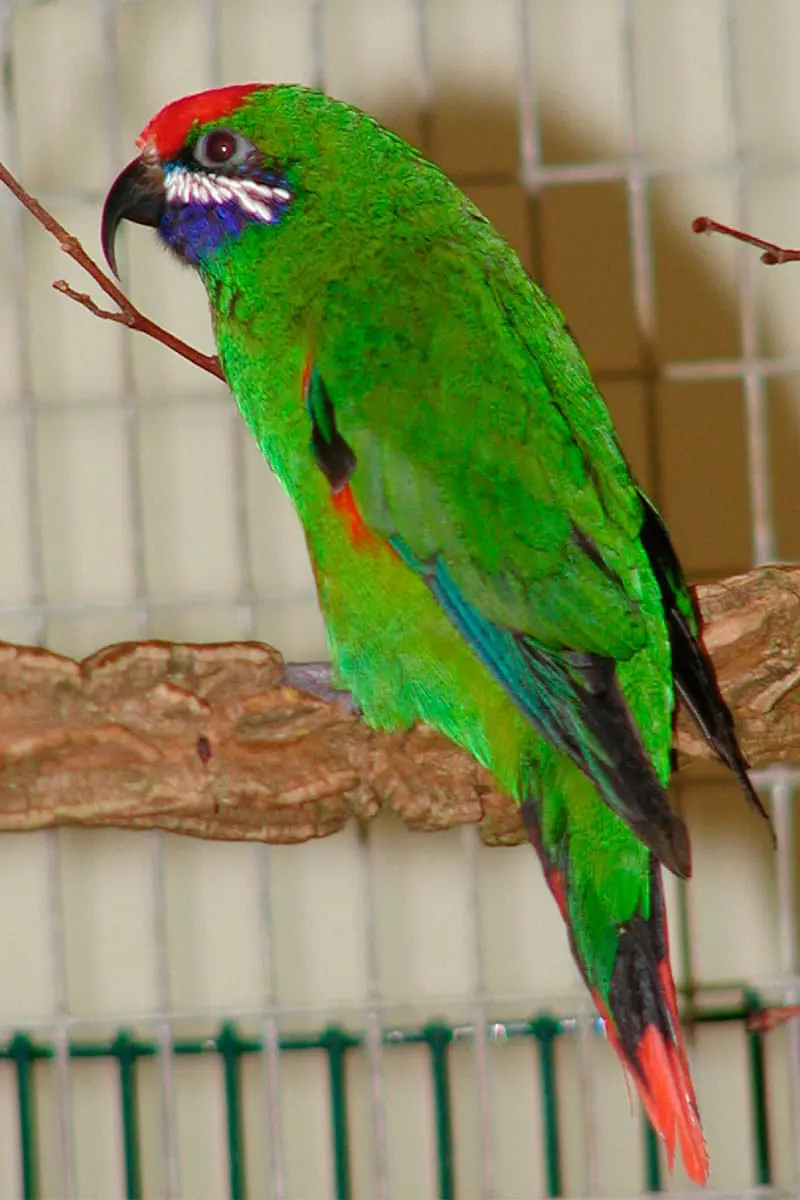
The head of the Orange-fronted hanging parrot (Loriculus aurantiifrons) is green, with the front of the crown yellow (sharp demarcation of the green in the crown rear). Upperparts green, with rump and uppertail-coverts bright red; sides rump with yellow marks. Wings Greens with vane internal to the flight feather blackish. Blue with green Underwing coverts. Chin red, rest of the underparts are slightly more yellowish than upperparts (especially coverts). Timoneras pens Green with tips yellow; undertail bluish.

Bill black; Iris whitish; legs brownish black.

Female has the face and the part front of it crown Green with red and pale blue feathers. Spada Red more small that it's the male. Iris brown.

The young birds lack of the crown and throat red. Bill brown.

Description 3 subspecies

  • Loriculus aurantiifrons aurantiifrons

    (Schlegel, 1871) – Nominal


  • Loriculus aurantiifrons batavorum

    (Stresemann, 1913) – Male with less yellow in forecrown. Female similar to nominal.


  • Loriculus aurantiifrons meeki

    (Hartert, 1895) – The male as of the subspecies batavorum but slightly larger. Female also similar to nominal but larger and bases of feathers on the front of the crown, yellow-brown color.

Habitat:

The Orange-fronted hanging parrot they are distributed in the low jungle to a altitude approximate of 1.200 m (from time to time to 1.000 m), along the edges of forests, in palm plantations, areas of secondary growth, casuarinas, pines, gardens and partially cleared areas.

The species is inconspicuous and usually difficult to detect, except when they are called among them, Since it flies above the canopy. It is usually found in groups of two to four members, foraging at various levels in the forest.

Birds perch on occasions in a branch and sing (possibly part of their courtship behavior).

Reproduction:

Guidelines of nesting you have registered between July and October, and it is said that on one occasion a bird was found incubating four eggs in a hole to 12 meters above the ground. The birds have also been observed visiting holes in arboreal termite, perhaps to rest.

Food:

Is them has observed entering their peak next to the needles of casuarinas, probably in search of Lerp insects. The diet also includes outbreaks, fruits and flowers.

Distribution:

Size of the area of distribution (reproduction / resident): 576.000 km2

Widely distributed, Although not particularly continuously, through much of the lowlands of New Guinea, in both Irian Java, Indonesian, and Papua New Guinea, Although it can be absent from most of the Center-South of the big island.

Its small size, coloration and habits make difficult his observation. Field work are running that the species is continuing in the North and South of New Guinea with the clinal variation in size. The range includes the following islands of the coast: Misool, Waigeo, Karkar, Fergusson and Goodenough.

Distribution 3 subspecies:

  • Loriculus aurantiifrons aurantiifrons

    Nominal.


  • Loriculus aurantiifrons batavorum

    Waigeu, West of the papua islands, and Northwest of New Guinea, East Coast region North of Sepik River, North of Papua New Guinea, and the South coast of Setekwa River, Irian Jaya.


  • Loriculus aurantiifrons meeki

    Fergusson, Goodenough, Karkar Islands (Papua New Guinea), and this from New Guinea, from the coast north to the West of the region of Sepik River, and in the South West area of lowland up to the region of Fly River, and possibly in the vicinity of Irian Jaya.

Conservation:


minor concern


• Current IUCN Red List category: Least concern.

• Population trend: Stable.

The world population of the Orange-fronted hanging parrot It has not been quantified, Although it is suspected that it may be most of 100.000 specimens and are considered stable and locally common (pit et to the. 1997).

The population is suspected to be stable in the absence of evidence of any reduction or substantial threats.


"Orange-fronted hanging parrot" in captivity:

extremely rare.

Alternative names:

– Orange-fronted Hanging-Parrot, Bat Lorikeet, Golden-fronted Hanging-Parrot, Misool Hanging-Parrot, Orange fronted Hanging Parrot, Orange-fronted Hanging Parrot, Papuan Hanging Parrot, Papuan Hanging-Parrot (ingles).
– Coryllis à front orange (French).
– Goldstirnpapageichen, Grünstirnpapag (German).
– Lorículo Papú (español).


scientific classification:

Hermann Schlegel
Hermann Schlegel

– Order: Psittaciformes
– Family: Psittaculidae
– Genus: Loriculus
– Scientific name: Loriculus aurantiifrons
– Citation: Schlegel, 1871
– Protonimo: Loriculus aurantiifrons

Images "Orange-fronted hanging parrot"

«Papú Loricle» (Loriculus aurantiifrons)


Sources:

Avibase
Parrots of the World – Forshaw Joseph M
Parrots A Guide to the Parrots of the World – Tony Juniper & Mike Parr
Birdlife

Photos:

(1) – Rockjumper
(2) – hbw