▷ The world of Pets: Dogs, cats, birds, reptiles, amphibians

Malherbe's parakeet
Cyanoramphus malherbi

Malherbe's parakeet

Content


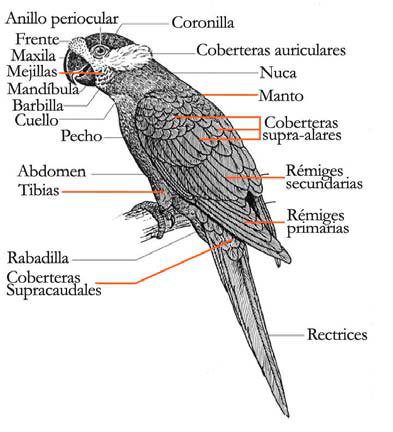
Anatomy-parrots

Description

19 to 22 cm. length and a weight between 40 and 52 grams for males and between 30 and 41 grams for females.

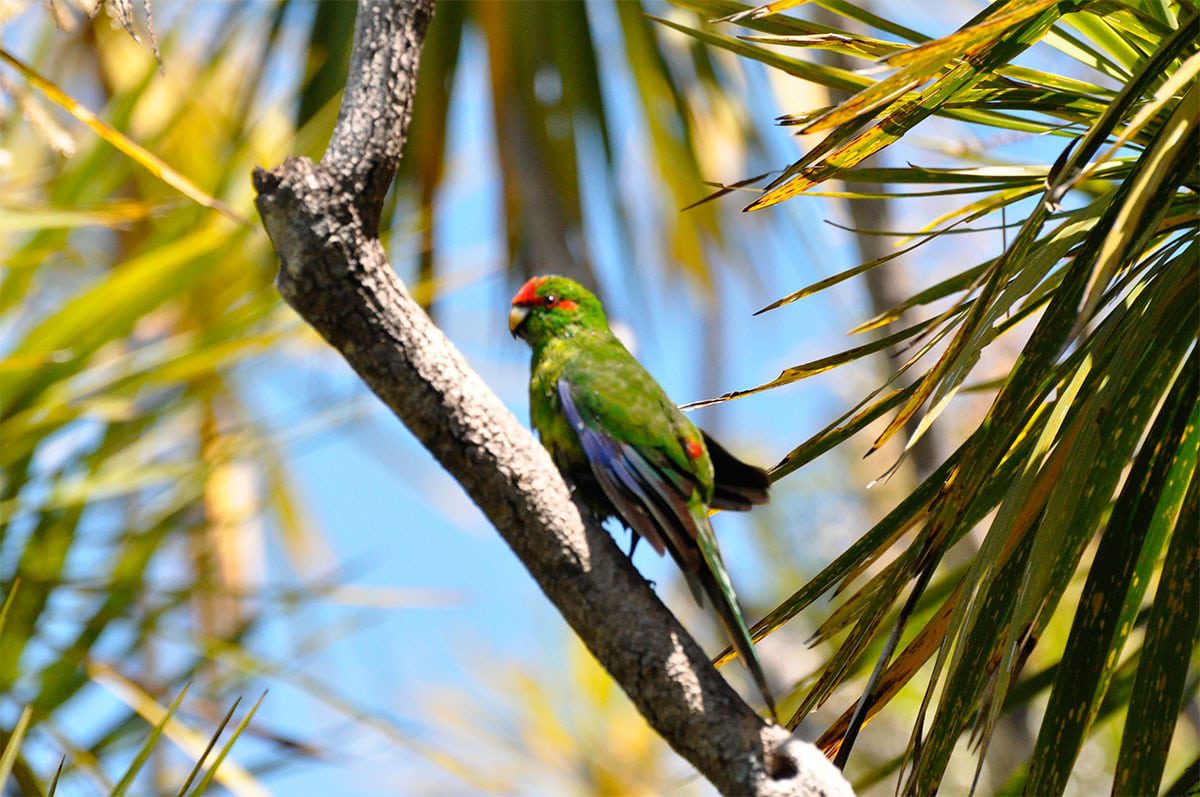
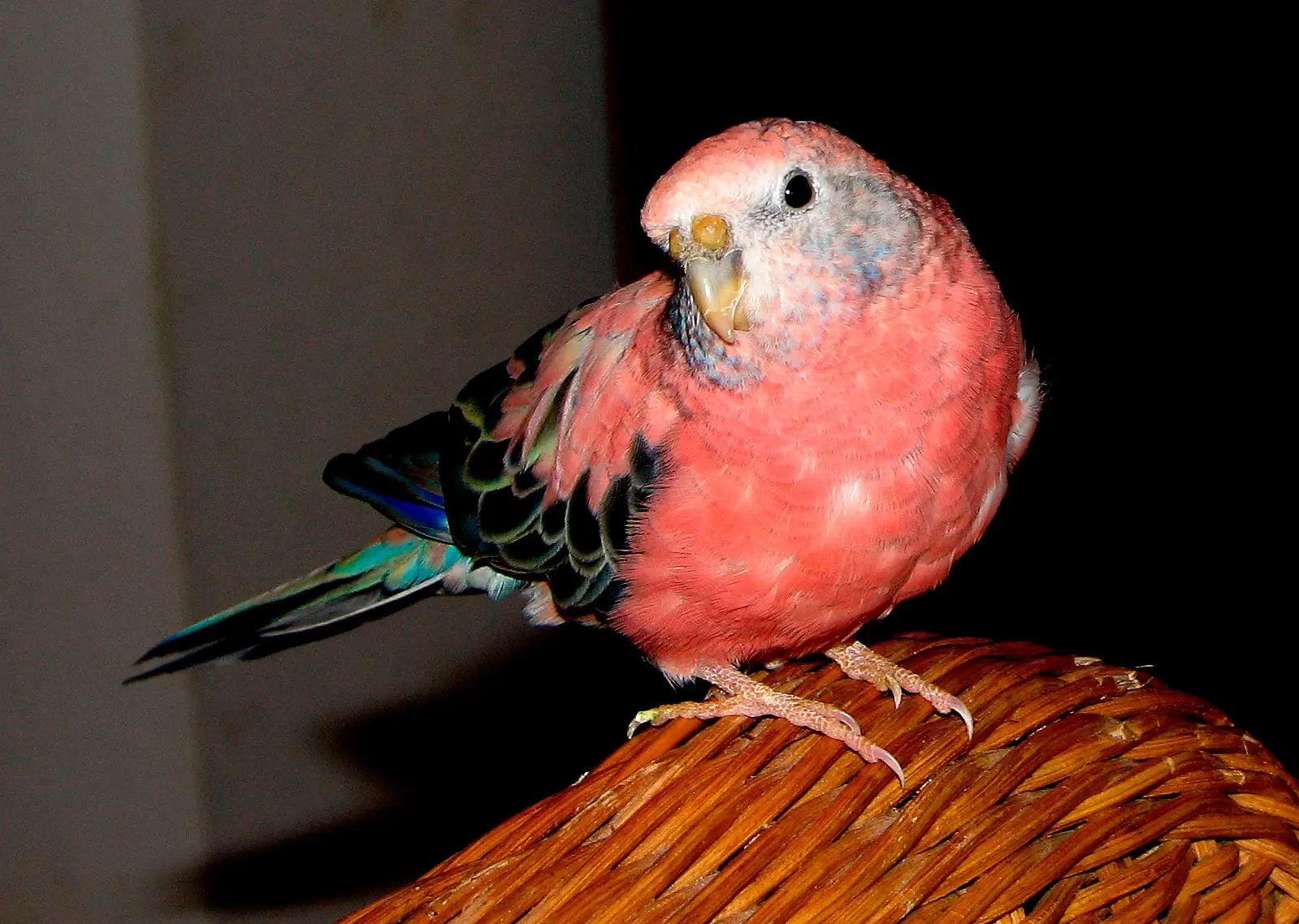
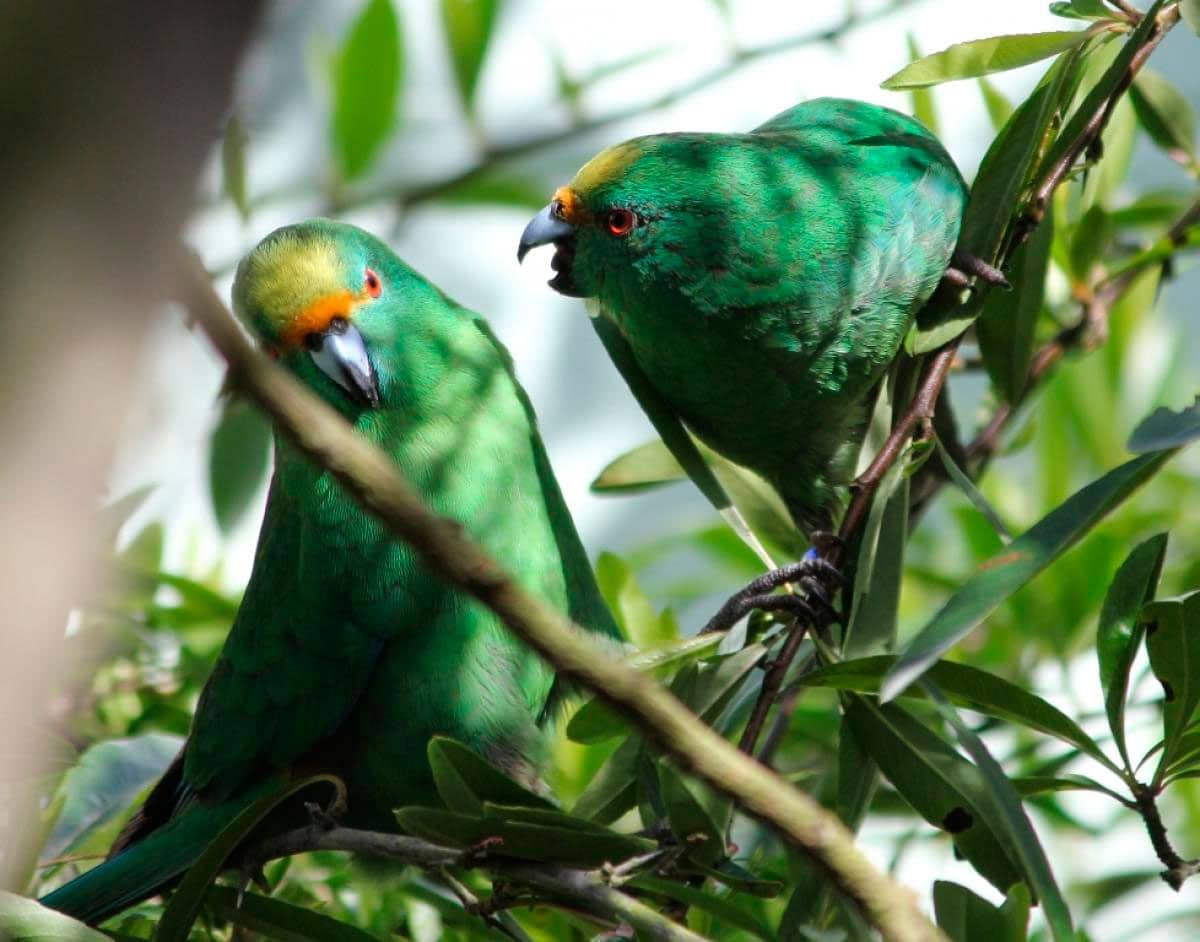
The Malherbe's parakeet (Cyanoramphus malherbi) they are small bright green parakeets, equipped with a long tail and with a bluish green colour wash in belly and chest.

The wings they have the primary coverts and the edges to the primary external of azure-blue. The crown is lemon-yellow colour and the front band, it reaches the eyes, is orange, as well as two patches on each side of the rump.

The bill is bluish grey, with the tip of black. The eyes are red and the legs are brown.

The colors tend to have a brighter tone in the males.

The youth they are more opaque, especially the patch of front band and the crown, which may be absent. The tail It is short for several weeks after feather. The bill is a pale pink color that darkens gradually when the young bird matures. They have darker the eyes, a reddish brown tone.

Habitat:

The Malherbe's parakeet tends to be quiet and hard to see. A brief and loud chatter or a quieter soft contact call can denote its presence, but locating the bird can be extremely difficult. The Malherbe's parakeet often confused with the Yellow-crowned parakeet.

Even though have been recorded in subalpine bushes and thickets of Matagouri open zones (Discaria toumatou), the Malherbe's parakeet they are predominantly in the forest.

They usually feed in the canopy, but also under frequent places with low vegetation and soil.

Reproduction:

The Malherbe's parakeet can reproduce in every month, with a main breeding period between December and April; incubation peak is in January.

Clutch size media is of approximately 7 eggs, but register a wide range (range of 1 to 10). Egg laying is asynchronous with an interval between eggs of 2 days. The incubation lasts from 21 to 26 days, and the period of breeding ranges between 35 and 45 days.

The females They seem to choose the nesting sites, as well as carry out all the preparation, incubation and breeding, the male provides most of the food during incubation.

It is suspected that the female only feeds the chicks during the first 10-14 days, just as they do other species Cyanoramphus. Once past this period, both sexes take care, equally, feeding the pigeons.

There may be second clutches If there is enough food available, for example, during the sowing of beech, or if the first attempt failed. The female may lay a second clutch when first chicks have, approximately, 2 weeks of age. This leaves the male as the sole provider for both the chicks and the incubating female..
Second clutches are not uncommon; When is food plentiful, some couples can reproduce 3 or 4 times on.

The nests are accessed normally through holes in knots of branches and the main trunk of a tree.

They use all species of you have to build the nest, predominantly the Red beech (69% nests monitored in the continent, n = 138) and dead trees (20%).
Nests may have more than one meter of depth. Records placed nests in heights that range between 2,5 and 26 m.

Food:

The Malherbe's parakeet consume seeds, flowers, buds and small invertebrates (mealybugs and caterpillars). In a year of abundance of fruits, the seeds become the dominant element of their diet, and they seem to be the main food for young people.

Invertebrates seem to play an important role in the diet of this species of parakeet which for the Yellow-crowned parakeet.

Distribution:

Size of the area of distribution (reproduction / resident) 360 km2

To the Malherbe's parakeet les is in areas where the South beeches (Nothofagaceae), in forest valleys in the South Island, the valleys Hawdon and Poulter in the Arthur Pass National Park and the South Branch of the Hurunui Valley in Lake Sumner Forest Park. Are unevenly distributed within these valleys; absent in many parts, but in some other places can be quite common.

They have been transferred to four islands: Maud and Blumine in Marlborough Sounds, Chalky Island in Fiordland, and Largest Island / Tuhua on bay of plenty.

Conservation:
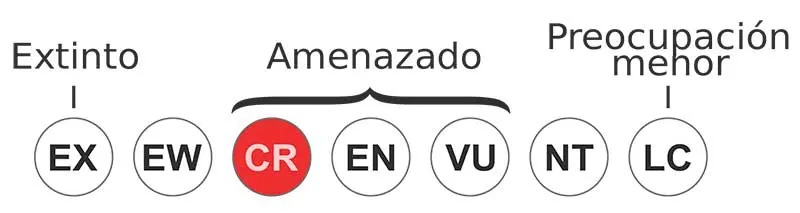

critical hazard


• Current Red List of UICN: critically endangered

• Population trend: Decreasing

This species is the smallest of the class Cyanoramphus along with the Yellow-crowned parakeet.
The Malherbe's parakeet It is the kind of rare parrots of New Zealand. The population was wiped out by rats and stoats introduced by men.

Also the changes in the habitat due to the ungulates and opossums they have affected the species.

Some diseases have been discovered in two of the areas in which live.

It is in progress conservation actions such as the predator control in the three valleys of the continent and the protection of the trees hosting the nests.

The captive breeding programs they have helped to release the birds in 4 Islands cleared of predators. This work is still in progress.
On the Mainland, all populations are monitored closely by the Department of conservation.

The total population It was estimated in 290/690 individuals at the beginning of 2013.
The continent has between 130 and 270 specimens and Islands surrounding between 160 and 420.

"Malherbe's parakeet" in captivity:

Usually they are not in captivity.

A small captive breeding program was established in 2003.

Alternative names:

– Malherbe’s Parakeet, Alpine Parakeet, Malherbe’s Parrot, Orange-fronted Parakeet (English).
– Perruche de Malherbe, Kakariki de Malherbe (French).
– Malherbesittich (German).
– Kakariki-fronte-laranja (Portuguese).
– Perico Maorí Montañés, Perico Maorí Montano (español).

scientific classification:

– Order: Psittaciformes
– Family: Psittaculidae
– Genus: Cyanoramphus
– Scientific name: Cyanoramphus malherbi
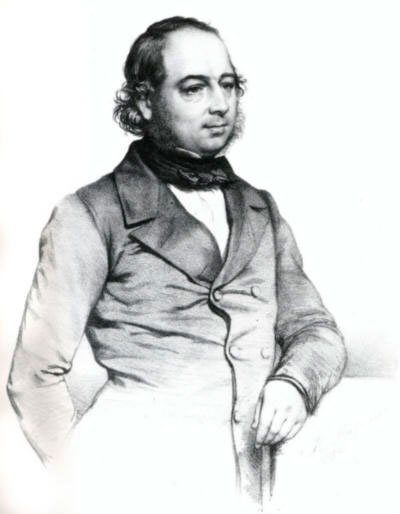
– Citation: Souancé, 1857
– Protonimo: Malherbe's Parakeet

Images «Perico Maorí Montano»:
Videos "Malherbe's parakeet"

«Perico Maorí Montano» (Cyanoramphus malherbi)

Sources:

  • Avibase
  • Parrots of the World – Forshaw Joseph M
  • Parrots A Guide to the Parrots of the World – Tony Juniper & Mike Parr
  • Birdlife

  • Photos Perico Maori Montano:

(1) – This is one of several birds being bred in captivity at Isaac Peacock Springs wildlife refuge.
Christchurch, New Zealand By Jon Sullivan from Christchurch, New Zealand [CC BY 2.0], via Wikimedia Commons
(2) – Orange-fronted parakeet. Adult male in captivity. Isaacs Wildlife Trust, Christchurch. Image © John Kearvell by John Kearvell – nzbirdsonline
(3) – Orange-fronted parakeet. Captive adult female. Isaacs Wildlife Trust, February 2012. Image © Sabine Bernert by Sabine Bernert www.sabinebernert.fr – nzbirdsonline
(4) – Orange-fronted parakeet. Juvenile feeding. Nelson, January 1983. Image © Department of Conservation (image ref: 10028825) by Dave Crouchley, Department of Conservation Courtesy of Department of Conservation – nzbirdsonline
(5) – Orange-fronted parakeet. Adult male (left) and female in captivity. Isaacs Wildlife Trust, Christchurch. Image © John Kearvell by John Kearvell – nzbirdsonline

▷ The world of Pets: Dogs, cats, birds, reptiles, amphibians

Black-headed Parrot
Pionites melanocephalus

Cotorra pechiblanca

Content

Description:

Black-headed Parrot

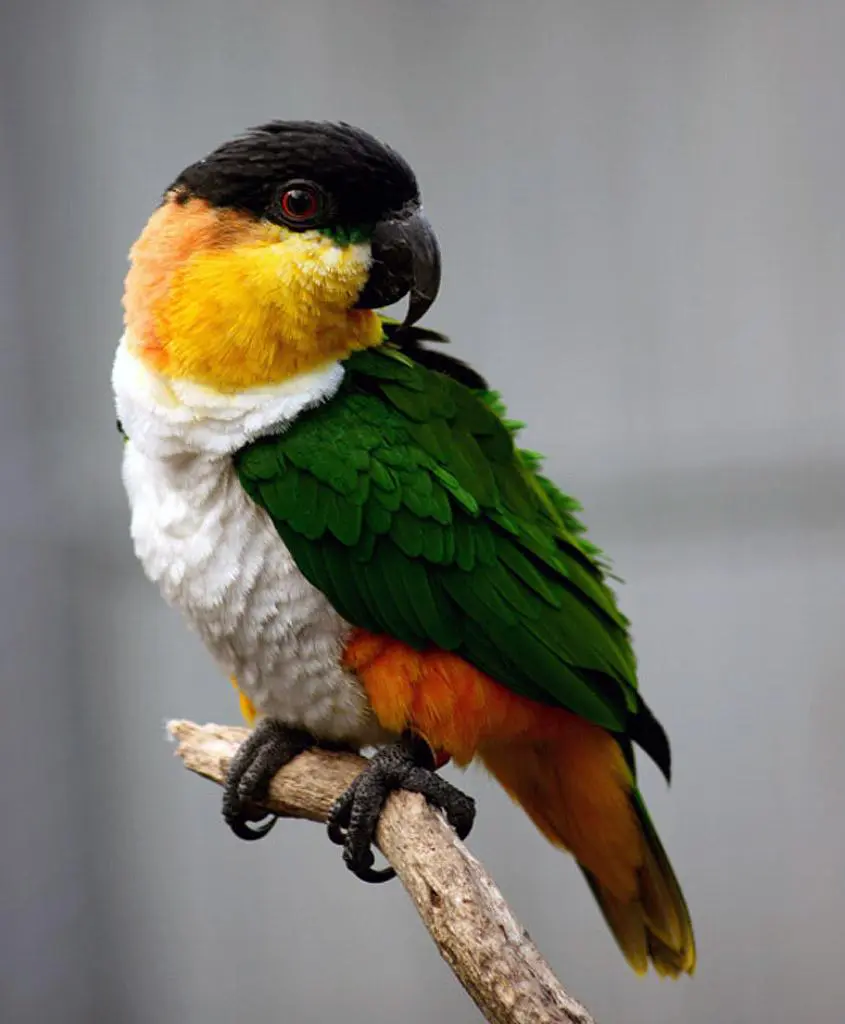
The Black-headed Parrot (Pionites melanocephalus) measures of 21 to 23 cm.. height.

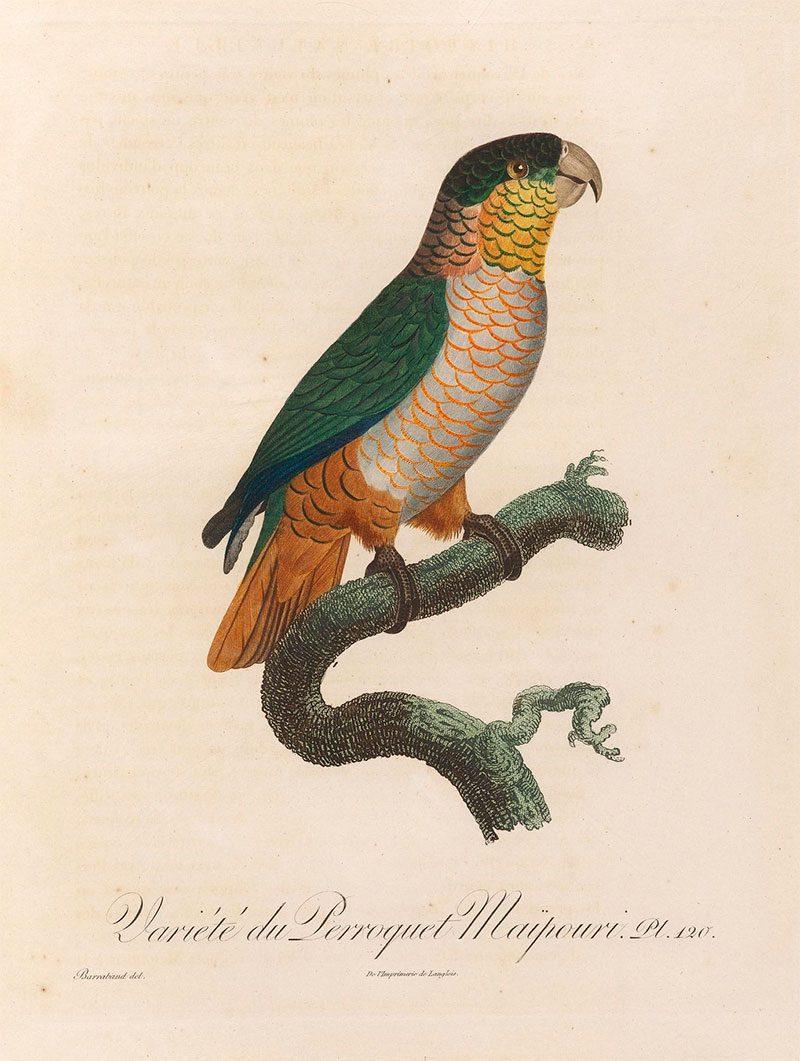
Unmistakable by crown black, chest and belly white, the latter with yellow sides (very visible on the fly). Breast bright yellow, nape orange acanelada, back and rump green. Tip pens of wings They are blue and dark go the closer they get to the body.

Legs and bill dark gray.

The youth They have bluish green spots on the nape, with chest and belly yellowish.

There is no sexual dimorphism in this species. The identification of genus must be performed by DNA testing or a surgical probe.

Description 2 subspecies:

  • Pionites melanocephalus melanocephalus

    (Linnaeus,1758) – The subspecies nominal.


  • Pionites melanocephalus pallidus

    (Berlepsch, 1890) – It has bright yellow in the throat, the thighs and tail.

Habitat:

It inhabits humid jungles, semi-wet, swampy, gallery woods, stubble and crop to the 1000 m. Walks in small flocks between 3 to 10 individuals, feed in the canopy, very rare in stratum low forest.

Reproduction:

Its laying is of 2 to 4 eggs and the breeding season It is from December to February in French Guiana, april in Venezuela, April to May Colombia, October to November Suriname.

Food:

Feeds of seeds several species of plants cellulose, plants, flowers and leaves. There is also evidence of some insects in your diet.

Distribution:

She can be seen in the wild along the Amazonia, from the North of the Amazon River, bordering south to northeastern Peru, also in the Guyanas.

Distribution 2 subspecies:

  • Pionites melanocephalus melanocephalus

    (Linnaeus,1758) – The subspecies nominal.


  • Pionites melanocephalus pallidus

    (Berlepsch, 1890) – South of Colombia to the East of Ecuador and northeast of Peru.

Conservation:

State of conservation ⓘ


minor concern Minor Concern ⓘ (UICN)ⓘ

Although not in danger of extinction Its population has declined significantly. The illegal marketing is the main theory against its appearance and adaptation in an environment foreign to its natural environment. Poaching of pigeons and felling of trees are common in the south of the country.

"Black-headed Parrot" in captivity:

Popular poultry farming. They adapt easily to the bird or Aviary cages. You need a degree quite high commitment and attention by the owner. The like to interact with other birds and people. The love to play with toys and can be quite noisy. An interesting feature of the Black-headed Parrot It is their habit of rolling on his back and play with toys help of their paws.
He manages to replace their jungle habitats in parks or green areas of large cities.
Its price is quite high compared to other species due to its striking plumage and friendliness..

Alternative names:

– Black headed Parrot, Black-crowned Parrot, Black-headed Caique, Black-headed Parrot(English)
– Cotorra pechiblanca, Loro cacique o Loro mocho (Colombia)
– Perico calzoncito (Venezuela)
– Loro coroninegro (Ecuador)
– Chirricles cabeza negra (Peru)
– Grünzügelpapagei, Grünzügel-Papagei (Germany)
– Lorito Chirlecrés, Lorito Chirlicrés, Lorito Gordo de Cabeza Negra (Spain)
– Caïque à tête noire, Caïque maïpouri (France)
– cabeça-preta, maipuré, marianinha-da-cabeça-preta, Marianinha-de-cabeça-preta (Brazil)

scientific classification:

  • Order: Psittaciformes
  • Family: Psittacidae
  • Genus: Pionites
  • Scientific name: Pionites melanocephalus
  • Citation: (Linnaeus, 1758)
  • Protonimo: Psittacus melanocephalus

Images "Black-headed Parrot"

Videos "Black-headed Parrot"


Species of the genus Pionites
  • Pionites melanocephalus
  • —- Pionites melanocephalus melanocephalus
  • —- Pionites melanocephalus pallidus
  • Pionites leucogaster
  • —- Pionites leucogaster leucogaster
  • —- Pionites leucogaster xanthomerius
  • —- Pionites leucogaster xanthurus


Black-headed Parrot (Pionites melanocephalus)


Sources:

  • Avibase
  • Parrots of the World – Forshaw Joseph M
  • Parrots A Guide to the Parrots of the World – Tony Juniper & Mike Parr
  • Parrots, Parrots and macaws Neotropical
  • Baywood
  • caiqueparrots

  • Photos: Natural history of parrots /.A Paris :chez Levrault … ;an IX (1801)-an XIII (1805).. biodiversitylibrary.org/page/40064546

  • Sounds: controles-canto.org – Patrick INGREMEAU

▷ The world of Pets: Dogs, cats, birds, reptiles, amphibians

Dusky Parrot
Pionus fuscus

Dusky Parrot

Content


Anatomy-parrots

Description:

24 to 26 cm.. height and between 179 and 222g. weight.

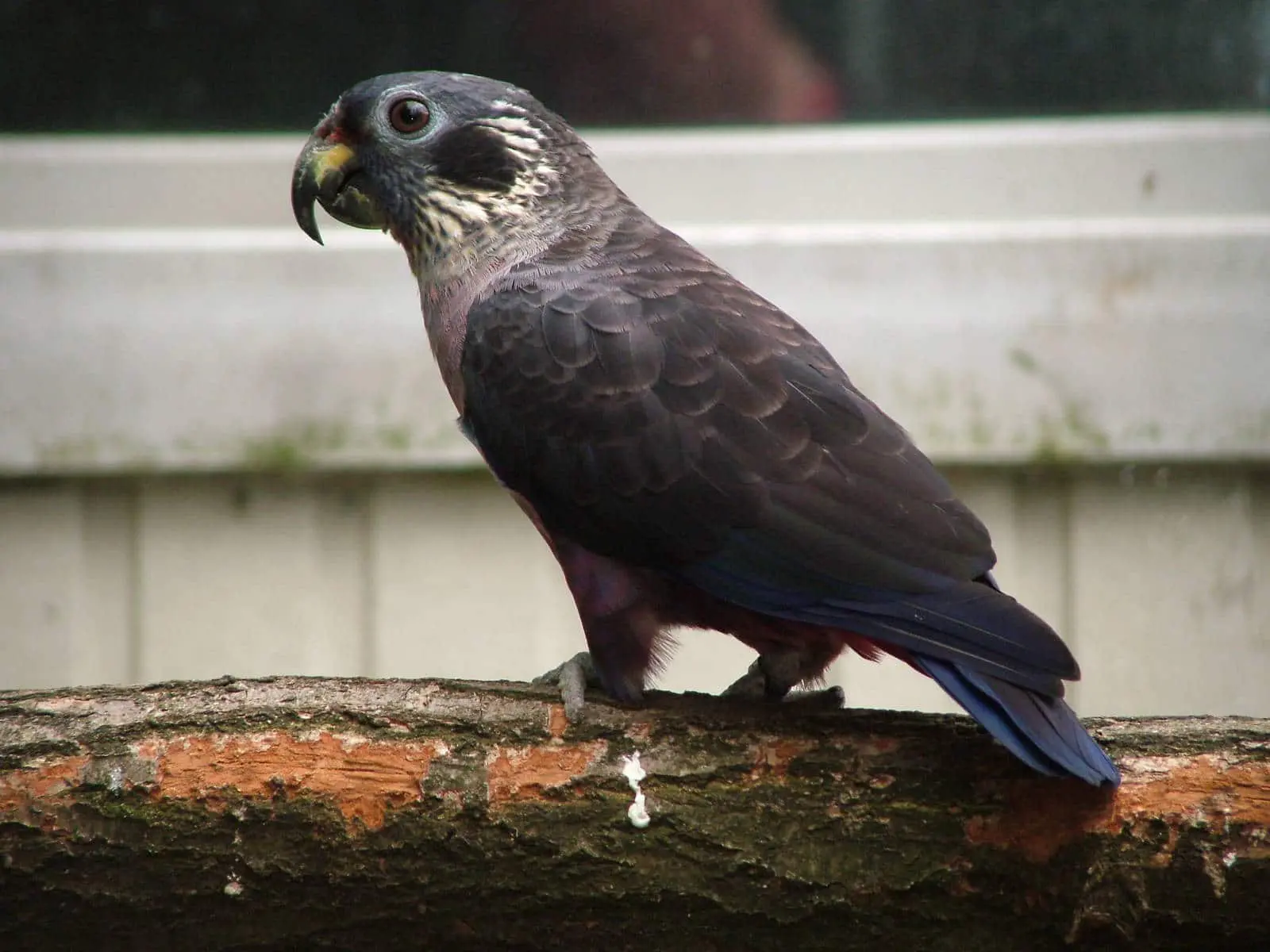
The coloration general of the Dusky Parrot (Pionus fuscus) is blue violet dark. Small patch of feathers on the front of the lores; on the basis of the cere, Pink; for the rest, lores, cheeks, forecrown and crown, lavender blue pale with white feather bases in the crown, What gives a faint mottled appearance in some birds; ear-coverts more dark and more grey, forming a distinctive patch; feathers in the throat and the sides of the neck narrow Brown in the Center and tips of pale blue white stripe, forming the joint a collar incomplete.

feathers in the the mantle and back, of color Brown leaden with those margins pale, giving the scalloped effect; Scapulars, rump and uppertail-coverts, darker grey brown, with very weak pale margins (or absent).

Coverts smaller and medium-sized, of color Brown leaden with margins pale; coverts primary and higher, as well as the flight feather, cobalt blue; undertail, the wings deep blue. Feathers on the top of the chest, pale pinkish with pale Lavender color tips; area more low in the chest with less dye Lavender, becoming darker and more color came in the belly, reaching, Some birds, the center of the belly of a rich colour came; undertail-coverts crimson.

Tail of color blue with red at the base. upper jaw Blackish at the tip with patch of color Horn in the base, lower jaw Blackish with the base more clear and more pale visible in some birds; Iris dark brown; Legs grey.

Both sexes similar.

In the immature staining is equal to the adult, but with some roofs on the upper wings with green edge; secondary feathers dyed in green and the eye ring naked and white.

Habitat:

Dusky Parrot

They inhabit mainly in lowland rainforests and moist forests in the foothills, in where the birds spend the greater part of the time in the canopy; Mainly in the forest land, occasionally in forests and marshes and less frequently in igapó (permanently flooded forests), Although there have been reports of birds in Savannah (Suriname), coastal gallery forest (French Guiana) and cultivated areas (Although avoiding habitats more open and less seen in clearings or edges of forest to some close relatives, such as the Blue-headed Parrot (Pionus menstruus).

rare species, flying alone or in small groups on the forest canopy,

Are you can see in Venezuela from the level of the sea to close them 1.000 m, and in close 1.200-1.800 meters on the side Colombian of the Sierra de Perija.

gregarious, especially outside the breeding season.

Reproduction:

It nests in hollows of old trees, probably during the second quarter of the year, although a nest was observed in the month of November in For, Brazil. The laying is of 3-4 eggs.

Food:

It feeds mainly in the canopy but also on the branches of fruiting trees in light areas..

The diet includes seeds of the gender Eschweilera and Micropholis.

Distribution:

Size distribution (reproduction / resident): 1.870.000 km2

Its population is discontinuous. There is an isolated population in the Sierra de Perija (border between Colombia and Venezuela); regardless of population, The species is found in Venezuela, to the South of the Orinoco in Bolívar, from the Caura River, in the Northwest, up to the Nuria upland, the upper area of the cuyuni river and Sierra de Lema in the areas border with Guyana, in the East, extending through the forested parts of Guyana, Suriname and presumably it French Guiana (There are no known records) until Amapá, the North-East of Brazil, and spreading more broadly to the East of the Brazilian Amazon, from Black river in the North and South, from the Madeira river to the East of For and Maranhão.

Movements regular seasonal occur in Suriname, with the birds present in the coastal region in the months of July and August.

In general quite common, Although distributed locally; reports of a moderate and widespread presence in Guyana (although rare in Mountains Kanuku in the Southwest); Common in coastal forests, the savanna and forests inside of Suriname.

The deforestation severe and rapid in parts of its range (for example, For and Maranhão, Brazil) is, presumably, causing a decline in the population of the Dusky Parrot.

Very tight in bondage.

Conservation:


minor concern


• Not considered low No category of threat.

• Not known as a cage bird, but the loss of habitat may be affecting their populations.

Justification of the population:

The size of the world population Dusky Parrot It has not been quantified, but this species is described as «Rare» (Stotz et to the., 1996).

Justification of trend:

It is suspected that this species has lost the 1,1% of habitat within its distribution over three generations (20 years) on the basis of a model of Amazon deforestation (Soares-Filho et to the., 2006, Bird et to the., 2011).

Given the susceptibility of the species to hunt or capture, It is suspected that it will fall in <25% durante tres generaciones.

"Dusky Parrot" in captivity:

Intelligent, curious, a bit noisy, playful when acclimatizes to the owner.
Rare in captivity until the Decade of 1970 When in small quantities were imported from Guyana.

Its longevity is of some 25 years.

Alternative names:

– Dusky Parrot, Little Dusky Parrot, Violaceous Parrot, Violet Parrot (English).
– Pione violette, Pionus violet (French).
– Veilchenpapagei, Veilchen-Papagei (German).
– maitaca-roxa, curica, papagainho-roxo, paraná-i (Portuguese).
– Cotorra de Perijá, Loro Morado (español).
– Cotorra de Perijá (Colombia).
– Cotorra Morada (Venezuela).

scientific classification:

– Order: Psittaciformes
– Family: Psittacidae
– Genus: Pionus
– Scientific name: Pionus fuscus
– Citation: (Statius Müller, 1776)
– Protonimo: Psittacus fuscus

Images "Dusky Parrot"

Videos "Dusky Parrot"

———————————————————————————————–

«Purple Parrot» (Pionus fuscus)


Sources:

– Avibase
– Parrots of the World – Forshaw Joseph M
– Parrots A Guide to the Parrots of the World – Tony Juniper & Mike Parr
– Birdlife

– Photos:

(1) – Veldhoven
(2) – Dusky Parrot (Pionus fuscus) or Dusky Pionus by Jacques Barraband [Public domain], via Wikimedia Commons

▷ The world of Pets: Dogs, cats, birds, reptiles, amphibians

Red-crowned parakeet
Cyanoramphus novaezelandiae


Maori red parakeet

Content


Anatomy-parrots

Description

27 cm.. length and a weight between 50 and 113 g..

The Red-crowned parakeet (Cyanoramphus novaezelandiae) are, generally, a brilliant green hue (sometimes with some variable yellow marks), with one frontal band crimson, lores and a line through the eye that extends to the ear-coverts; centre of crown crimson, extending back to the top of the eyes, with an area supercilii green.

Upperparts bright green uniform, with a red patch on each side of the rump. Alula, primary coverts and vane outside of the primaries are blue-violet color. Primary emarginadas with thin yellow outer margins: vane outside of the secondaries greener.

Wing feathers green: stain pale in each internal network of secondaries they form a wing bar in some males.

The underparts usually more yellowish, Green clear. Upper, the tail green; undertail, dark grey.

The bill light bluish gray, black-tipped; irises red; legs Marron-grisaceo.

Female slightly smaller.

The young birds have queues shorter, a irises reddish brown clear and less distinctive markings on the head. The younger with a pink base in the bill.

Description 3 subspecies

  • Cyanoramphus novaezelandiae chathamensis

    (Oliver 1930) – Of 28 cm approximately. It is something more than the nominal, the green of the face is Emerald, the chest is somewhat more yellowish and the legs are dark gray.

  • Cyanoramphus novaezelandiae cyanurus

    (Salvadori 1891) – Of 29 cm approximately. More than the nominal, the plumage is more yellowish and the flight feather more intense blue.

  • Cyanoramphus novaezelandiae novaezelandiae

    (Sparrman 1787) – The nominal

Habitat:

Red-crowned parakeet

The habitat of the Red-crowned parakeet includes native forest in the continental part of New Zealand, scrublands in some outlying islands and land with abundant grass in the Antipodes Islands.

The species, generally, most opted for the edges of forests and open areas to the Yellow-crowned parakeet, and the regions where the two species coexist, is, generally, at lower altitudes.

The birds tend to locate their calls when they fly over or through the forest canopy. They are most often in pairs; couples tend to remain together throughout the year. But, large groups gather where food sources are abundant at any time of the year. Where is fresh water scarce, groups of birds also tend to congregate to drink in springs or leaks.

In the Kermadec Islands, flocks are formed for bathing in tidal pools and rest on a branch (probably in other places also).

The Red-crowned parakeet they feed actively on in the early hours of the morning, they rest and groom themselves for much of the day, and is power again during the afternoon.

Reproduction:

The nesting takes place between October and March, with most laying between the months of October and December. Between two and ten (usually between five and nine) white eggs form the implementation. The eggs are deposited in a hollow of tree clad wood shavings, Although you can also have other places of sunset, including cracks in the rocks, burrows in the ground, etc, as well as a variety of nest liners including feathers, MOSS and grass.

The birds are territorial in the vicinity of the nest and can use the same site repeatedly. The incubation is carried out by the female and hard of 18 to 20 days. The pups remain in the nest during 5 to 6 weeks and the male will help with food, either through female or directly, one week after the emplumamiento.

In large litters some less developed pups can be seen. Adults undergo a post-breeding moult..

Food:

They feed on, both the canopy and soil, a wide range of vegetables, fruit, seeds, leaves, outbreaks, berries, flowers and nectar; they have priority for the seeds fallen during the autumn and winter. The species also feeds on invertebrates, honeydew and, in the Kermadec, even, algae and small macaws (Scutellastra kermadecensis).

Distribution:

The Red-crowned parakeet are in New Zealand and in a series of adjacent and outlying island groups.

Before European colonization, the species was extended by continent, but in the Decade of 1890 the population began to decline as a result of the destruction of their habitat and predation by introduced cats and mustelids.

Today the species is scarce on the continent, and they found only in larger blocks of forest, from Northland to the Coromandel Peninsula. Since Pirongia, Pureora and Hauhungaroa in the Centre of the North of the island, to Urewera, Montes Raukumara and Huiarau in the East and South of the mountains Ruahine and Tararua.

In the South of the island, the species is found around Nelson, in the Arthur's pass National Park, in the District of Dunedin and in the Fiordland National Park. Also found in a number of islands off the coast of New Zealand, where are usually more numerous than in the continent, including: Three Kings, Poor Knights (not Yellow-crowned parakeet here). Polla and Chickens, Tiritiri Matangi (introduced). Little Barrier (common), Great barrier island (scarce). Mercury, Charter, Kapiti, Stewart (and surrounding islets) and Auckland Islands (Enderby, Rose, Ewing and Adams).

The Red-crowned parakeet also found in the Group of Kermadec (Macauley, Meyer, Napier, Dayrell and Chanters, with the lagging Curtis and Raoul), Chatham Islands (rare) in Chatham and Pitt, abundant in the island's Southeast, and controlled in Mangere and Little Mangere in order to avoid crossing with the Chatham Parakeet – Cyanoramphus forbesi), and in the antipodes islands (Antipodes, Bollans, Leeward, Archway and Windward Islands).

Distribution 3 subspecies

Conservation:


Near-threatened


• Current Red List of UICN: Near threatened

• Population trend: Decreasing

The population is, undoubtedly superior to the 15.000 specimens, although decreasing due to habitat loss and predation.

The hybridization with the Yellow-crowned parakeet (Cyanoramphus auriceps) It is also a problem in some populations.

The subspecies chathamensis is threatened, with a population of less than 1.000 specimens.

The subspecies cyanurus is still relatively common with about 10.000 individuals in Macauley. There are at least 4.000-5.000 birds in the Group of the Antipodes Islands.

captive birds they have been released in areas of Wairarapa and Waitakere. CITES Appendix I.

"Red-crowned parakeet" in captivity:

The Red-crowned parakeet are common in aviculture and is relatively easy to raise.

They can live in community with species of similar characteristics. It is usually outgoing, Active and depending on their way of breeding and previous experiences, You can be a confident Parrot, even being raised by their parents tends to be entrusted.

What pet He could be a good companion because of his way of being joyful and curious.

With regard to its longevity and according sources, one specimen was still alive after 12,4 years in captivity. It has been reported that these animals can live up to 36,5 years in captivity, but this has not been verified; the same study reported that these animals they can be played back to year of age in captivity.

Several color mutations they are available, including, yellow, the cinnamon and the overo.

Alternative names:

– Red-fronted Parakeet, Red-crowned Parakeet (English).
– Perruche de Sparrman (French).
– Ziegensittich (German).
– Periquito Fronteou-Vermelho (Portuguese).
– Perico Maorí Rojo (español)

scientific classification:

Anders Sparrman
Anders Sparrman

– Order: Psittaciformes
– Family: Psittaculidae
– Genus: Cyanoramphus
– Scientific name: Cyanoramphus novaezelandiae
– Citation: (Sparrman, 1787)
– Protonimo: New Zealand parrot

Images «Red Maori Parakeet»:

Videos "Red-crowned parakeet"

«Red Maori Parakeet» (Cyanoramphus novaezelandiae)

Sources:

  • Avibase
  • Parrots of the World – Forshaw Joseph M
  • Parrots A Guide to the Parrots of the World – Tony Juniper & Mike Parr
  • Birdlife
  • Parromania

  • Photos:

(1) – A Red-crowned Parakeet at Nga Manu Nature Reserve, Waikanae, New Zealand By Sid Mosdell from New Zealand (GreenUploaded by Snowmanradio) [CC BY 2.0], via Wikimedia Commons
(2) – A Red-crowned Parakeet on Kapiti Island, New Zealand By Craig Nash from Northern Ireland [CC BY 2.0], via Wikimedia Commons
(3) – Red-crowned Parakeet (Cyanoramphus novaezelandiae) at Queens Park Aviary By tewahipounamu [CC BY-SA 2.0], via Wikimedia Commons
(4) – Red-crowned Parakeet (Cyanoramphus novaezelandiae) in captivity at Auckland, New Zealand. Photographed on 11 November 2002 By Arthur Chapman [CC BY 2.0], via Wikimedia Commons
(5) – Cyanoramphus novaezelandiae (Red-crowned Parakeet, Green) on Tiritiri Matangi Island, New Zealand. These parakeets are often seen foraging on the cabbage trees (Cordyline australis) on the island By Adammarklenny (Own work) [CC BY-SA 3.0 or GFDL], via Wikimedia Commons
(6) – A painting of a Red-crowned Parakeet (originally captioned «Platycercus pacificus. Pacific Parrakeet.») by Edward Lear 1812-1888 Edward Lear [Public domain], via Wikimedia Commons

▷ The world of Pets: Dogs, cats, birds, reptiles, amphibians

Red Shining-Parrot
Prosopeia tabuensis

Red Shining-Parrot

Content


Anatomy-parrots

Description

45 cm. of length and weight approximate of 280 g..

The Red Shining-Parrot (Prosopeia tabuensis) It is the most distinctive of the colorful parrots of Fiji. It is a large parrot.

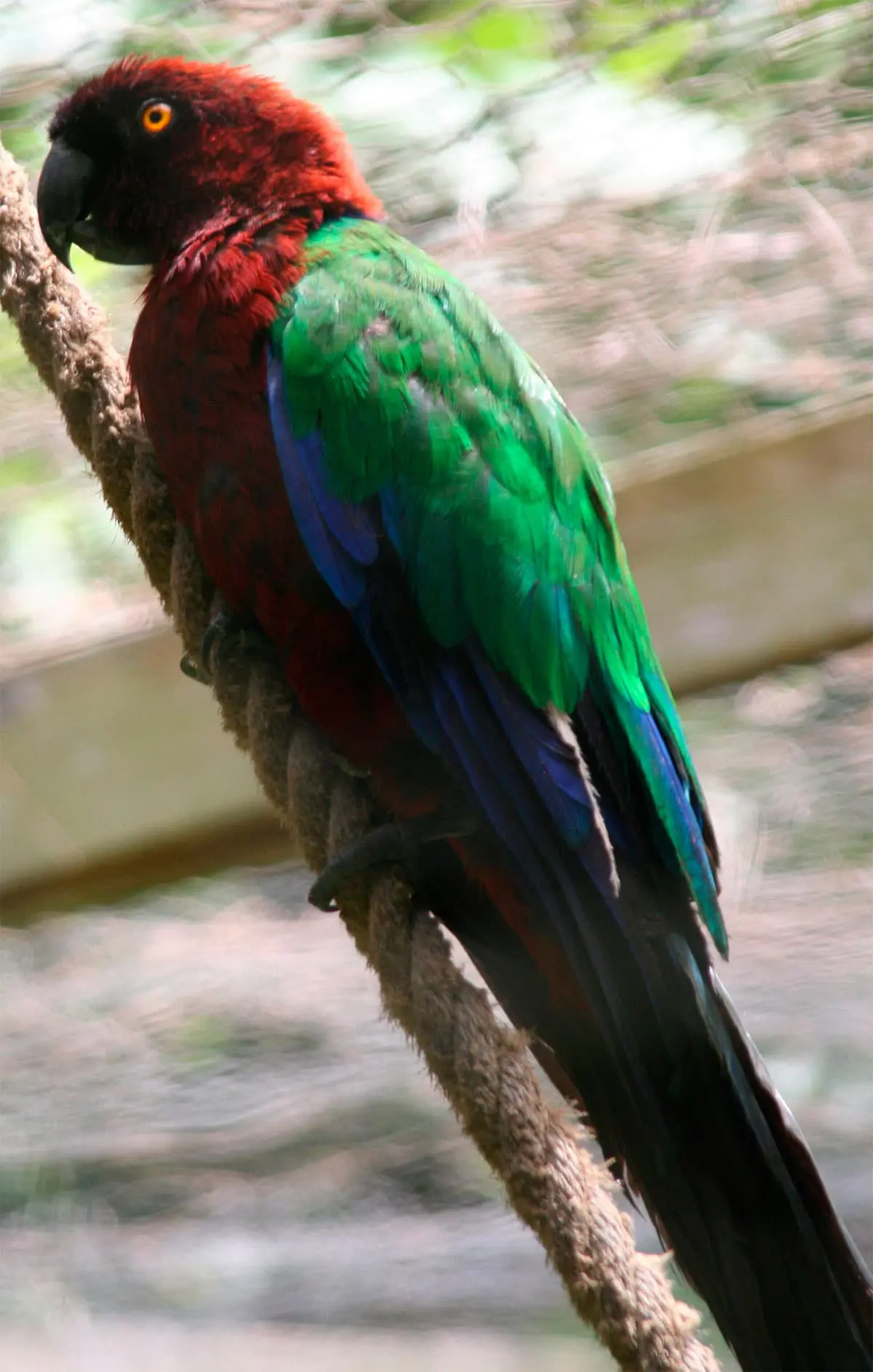
Their coloration are distinguished from the other two species. Its head, neck and underparts a brilliant scarlet hues with a blue collar extending behind the neck; the back and tail are a bright green. The flight feather and tail they are green, strongly impregnated with blue.

The bill and legs are black, and irises are orange.

The males and females they are similar, However, the bill the male is larger and the head It has a more square than the females form.

Description 2 subspecies:

  • Prosopeia tabuensis tabuensis

    (Gmelin) 1788 – The species nominal


  • Prosopeia tabuensis taviunensis

    (Layard,THE) 1876 – 40 cm.. length approximately; more small that it nominal species, without the band blue on the nape, the feathers of the abdomen with a tone more blue and with the face less blackish.

Habitat:

Red Shining-Parrot

The Red Shining-Parrot are distributed in the mature forests and through a variety of associated habitats, including the of secondary growth, wooded ravines (nest), coconut plantations, Gardens of villages, agricultural fields, mangroves and scrub.

There has been starting from the 100 meters of altitude until the 1.750, but they are most common between the 400 and 1.000 m.

The Red Shining-Parrot they are suspicious, curious and You can see them individually, in pairs or in flocks of up to 40 individuals outside the breeding season. they are not shy, and loud groups tend to meet in their favotitos places to eat.

They tend to rest on the tops of the trees.

Reproduction:

The Red Shining-Parrot perch upright and turn head rhythmically back and forth, probably showing a form of courtship.

The breeding is in the months from July to October, in trees dead or broken, the female feeds the young.

Of 2-3 eggs that is hatch during 23-24 days.

The juveniles they can fly to the 8 weeks.

Food:

Feeding of the fruits and seeds a variety of trees, for example, Myristica hypargyraea, that is of particular importance in 'USA. They also feed on Mango Mangifera indica, papaya Carica papaya, guava Psidium guajava and bananas. Son agile climbers and move in search of food using their beaks to rely on small branches. Sujentan foods with their claws, since they bite with its powerful beak, and they chew the wood to remove insect larvae.

They feed mainly in the upper canopy, but sometimes also attack the cornfields.

Distribution:

Size of the area of distribution (reproduction / resident): 6.200 km2

The Red Shining-Parrot they are distributed in a natural way in the islands of the Group Fiji including Vanua Levu, KIOA, Taveuni, Qamea, Laucala, Koro and Gau (probably introduced). In Tonga, the species was introduced in Tongatapu prior to contact with the European and where it has already extinct due to habitat loss, and in 'USA where it is still quite common, especially in the forests of the East, North and South-West (with a population estimated between 700- 1.000 birds in 1988).

The species benefits, in part, Thanks to agriculture, but they depend largely on its nest in mature trees of the forest, trees that are being cleared in most of its extension. The species is also threatened by trade, and it is also hunted for its feathers and as food.

Many juveniles are caught to be raised locally as pets, Since they learn to talk easily.

Its population is believed that it may be above the 20.000 specimens, but of the subspecies prosopeia remaining, probably, less than 5.000 birds and its status is of concern.

There has been a sharp decline in the population of the Red Shining-Parrot in some areas due to habitat loss, although the species remains locally common at lower elevations on most of its islands.

Distribution 2 subspecies:

  • Prosopeia tabuensis tabuensis

    (Gmelin) 1788 – The nominal species


  • Prosopeia tabuensis taviunensis

    (Layard,THE) 1876 – Taveuni, Ngamea (Qamea) and Laucala, in the North of Fiji.

Conservation:


minor concern


• Current Red List of UICN: Least concern.

• Population trend: Decreasing.

The size of the world population It has not been quantified, but the species is described as common and visible throughout its area of distribution (Watling 2001).

The population It is suspected that it may be in decline due to ongoing habitat destruction.

"Red Shining-Parrot" in captivity:

Very rare in captivity.

According to sources, one specimen was still alive after 6,8 years in captivity. Taking into account the longevity of the similar species, the maximum longevity in these animals could be underestimated. Es un hecho que estos animales pueden vivir hasta 23.7 years in captivity, aunque en esta especie no ha sido verificado.

Alternative names:

– Red Shining-Parrot, Maroon Shining Parrot, Maroon Shining-parrot, Red Shining Parrot, Red-breasted Musk Parrot, Red-breasted Musk-Parrot, Red-breasted Shining-Parrot (ingles).
– Perruche pompadour, Perruche masquée pompadour (French).
– Pompadoursittich, Pompadour Sittich (German).
– Prosopeia tabuensis (Portuguese).
– Papagayo Carmín, Papagayo Granate (español).

scientific classification:

Gmelin Johann Friedrich

– Order: Psittaciformes
– Family: Psittaculidae
– Genus: Prosopeia
– Scientific name: Prosopeia tabuensis
– Citation: (Gmelin, JF, 1788)
– Protonimo: Psittacus tabuensis

«Maroon Parrot» Images:

Videos "Red Shining-Parrot"

«Maroon Parrot» (Prosopeia tabuensis)

    Sources:

    – Avibase
    – Parrots of the World – Forshaw Joseph M
    – Parrots A Guide to the Parrots of the World – Tony Juniper & Mike Parr
    – Birdlife

    – Photos:

    (1) – Red Shining-parrot Prosopeia tabuensis in captivity, Fafa Island, Tonga By Duncan Wright (Own work) [GFDL or CC BY-SA 3.0], via Wikimedia Commons
    (2) – A painting of a Maroon Shining Parrot by Edward Lear 1812-1888 Edward Lear [Public domain], via Wikimedia Commons
    (3) – Red Shining-parrot (Prosopeia tabuensis) De Voeux Peak, Taveuni, Fiji Islands By Aviceda (Own work) [CC BY-SA 3.0], via Wikimedia Commons
    (4) – Maroon Shining Parrot Prosopeia tabuensis Kula Eco Park – Viti Levu, Fiji © 2007 Sarah P. Otto – The Online Zoo
    (5) – A bird foraging on the ground by Josep del Hoyo – Lynx
    (6) – A bird perched in a tree by Josep del Hoyo – Lynx

    – Sounds: Matthias Feuersenger (Xeno-canto)

▷ The world of Pets: Dogs, cats, birds, reptiles, amphibians

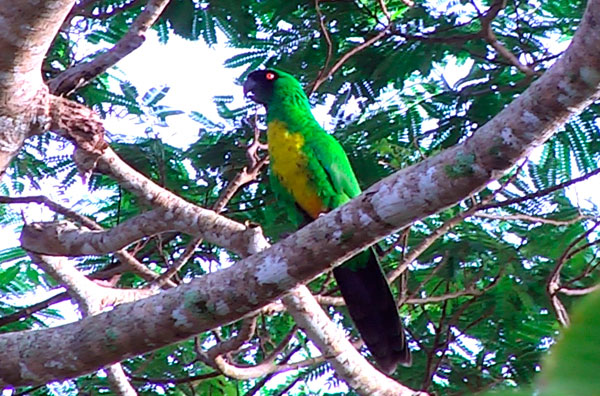
Masked Shining-Parrot
Prosopeia personata

Masked Shining-Parrot

Content


Anatomy-parrots

Description

47 cm of length and weight approximate of 322 g..

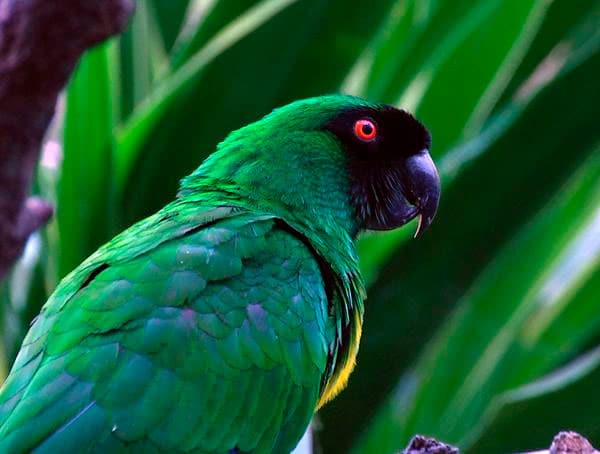
The colorful Masked Shining-Parrot (Prosopeia personata), has a plumage green over most of its body, the front of the crown, lores, cheeks and chin, are black.

The upperparts are bright pale green (with a brighter sheen on the Crown and nape). Large external coverts, primary coverts and primaries are blue with vane inner dark. Wing feathers green. Throat, top of the chest, flanks, and undertail- coverts green; center of chest and the belly bright yellow, a few feathers with the Green Tip, yellow shading in the Orange patch It is located in the lower part of the belly. Upper, the tail green; black for the part below.

The bill black; irises orange-red; legs blackish gray.

The male has the head and the bill larger that the female. The young birds have, peaks paler, less black in the face and irises brown.

El Papagayo Enmascarado (Prosopeia personata) is a large parrot, long tail which is only on an island, in Fiji.

Habitat:

Masked Shining-Parrot

They are distributed Since the sea level, until the 1.200 m altitude, in the forest reacor and secondary growth of the Windward areas and intermediate vegetation, You can also find them in orchards of villages, agricultural fields and mangroves; Often observed along forest edges near agricultural land and in trees bordering forest watercourses.

The Masked Shining-Parrot they are usually sociable and finds them alone, in pairs, or outside the breeding season in herds up to 40 birds.

Birds are sometimes interviews flying rapidly through the forest or wandering above the canopy. Son noisy birds and they are often heard before to be seen; similar to the Red Shining-Parrot, often make calls at the first sign of a human intruder, and they are generally shy and difficult to approach when they are perched on a branch.

Reproduction:

The breeding season occurs between July and September. The nest It is a hole or crack in a tree, or a cavity at the top of a stump. Two or more eggs White deposited inside a hollow form the implementation; the hole is expanded by making use of its powerful beak. Birds emit a strong odor.

Food:

The Masked Shining-Parrot they tend to rest the high parts of the trees, but descend to lower floors to feed on berries, and pick up the fruits of the soil; they can also attack fields.

The diet includes mainly fruit, for example, Mango (Mangifera indica), guava (Psidium guajava), Ficus figs and bananas, Although they can also be powered from flowers, insects, seeds and berries, as well as the cultivated grain.

When feed, They manipulate food with their legs using their beaks to catch small branches. They are powerful and it has been flying with a Mango between its claws.

Distribution:

Size of the area of distribution (reproduction / resident): 10,500 km2

The Masked Shining-Parrot they are endemic in Fiji, distributed only on the island of Viti Levu (Although the species also has been recorded in the nearby island of Ovalau in the past). In Viti Levu, It is not uncommon to see them on the inside of forests, including the surroundings of Nadarivatu and in the North of the Mount Tomanivi. In the center of Nadrau and to the East of the district Vunidawa.

The world population considered that it may be on the 5.000 specimens, but in decline due to habitat loss.

Required large trees for nesting are being felled., and tracts of mature forest are fragmented now in many areas.

The possible detrimental effect of inter-specific competition of the introduced Crimson Shining-Parrot remains study.

Conservation:


Near-threatened


• Current Red List of UICN: Near threatened

• Population trend: Decreasing

The most serious threat affecting the Masked Shining-Parrot It is the decline of forests in which inhabits, with less than the 50 per cent of the forests of Viti Levu remaining. This deforestation has led to the fragmentation of remaining forest areas. The huge trees felled during the deforestation are required by the Masked Shining-Parrot nest.

Other potential threats to this species include potential competition with the introduced Crimson Shining-Parrot (Prosopeia splendens). The Masked Shining-Parrot It can also be trafficked for the pet trade, Although the related species, as the Crimson Shining-Parrot It is believed that they are most popular).

Conservation of the “Masked Parrot”.

The Masked Shining-Parrot is protected by the law of Fiji. But, current legislation for the capture of wild parrots is difficult to enforce. This Parrot also appears in the Appendix II of the Convention on international trade in endangered species (CITES), which means that international trade in the species must be carefully monitored.

The Masked Shining-Parrot It lives in several reserves and parks, where can you get some protection against deforestation. It has been proposed that community forest reserves must be encouraged in Viti Levu, to prevent further deforestation, and that the population figures of the Masked Shining-Parrot in these protected areas should be monitored. But, None of these measures has been put into action

"Masked Shining-Parrot" in captivity:

Rarely found in captivity.

According to sources, It is known that one as a specimen of this species lived 11,8 years in captivity.

Alternative names:

– Masked Shining-Parrot, Masked Parrot, Masked Shining Parrot, Yellow-breasted Musk Parrot, Yellow-breasted Shining-Parrot (ingles).
– Perruche masquée, Perruche masquée masquée (French).
– Maskensittich, Masken-Sittich (German).
– Prosopeia personata (Portuguese).
– Papagayo Enmascarado (español).

scientific classification:

– Order: Psittaciformes
– Family: Psittaculidae
– Genus: Prosopeia
– Scientific name: Prosopeia personata
– Citation: (Gray, GR, 1848)
– Protonimo: Coracopsis ? personata

Images «Masked Parrot»:

Videos "Masked Shining-Parrot"

————————————————————————————————

«Masked Parrot» (Prosopeia personata)


Sources:

– Avibase
– Parrots of the World – Forshaw Joseph M
– Parrots A Guide to the Parrots of the World – Tony Juniper & Mike Parr
– Birdlife
– ARKive.org

– Photos:

(1) – Masked Shining Parrot , Birds Gallery, Natural History Museum, London By John Cummings (Own work) [CC BY-SA 3.0], via Wikimedia Commons
(2) – By Benjamin Waterhouse Hawkins [Public domain], via Wikimedia Commons
(3) – Masked Shining Parrot Prosopeia personata Kula Eco Park – Viti Levu, Fiji © 2007 Sarah – The Online Zoo
(4) – Masked Shining Parrot Prosopeia personata Kula Eco Park – Viti Levu, Fiji © 2007 Sarah – The Online Zoo
(5) – A bird resting in a tree by Josep del Hoyo – Lynx
(6) – A close-up of the head of one bird by Josep del Hoyo – Lynx

– Sounds: Matthias Feuersenger (Xeno-canto)
▷ The world of Pets: Dogs, cats, birds, reptiles, amphibians

Eastern Ground Parrot
Pezoporus wallicus


Eastern Ground Parrot

Content


Anatomy-parrots

Description

30 cm. length and an approximate weight of 130 g..

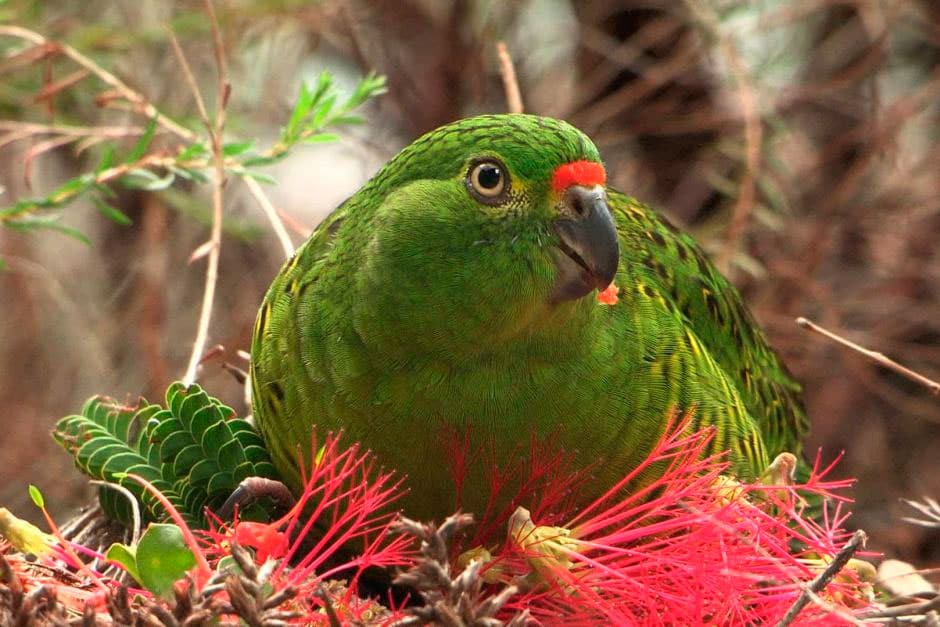
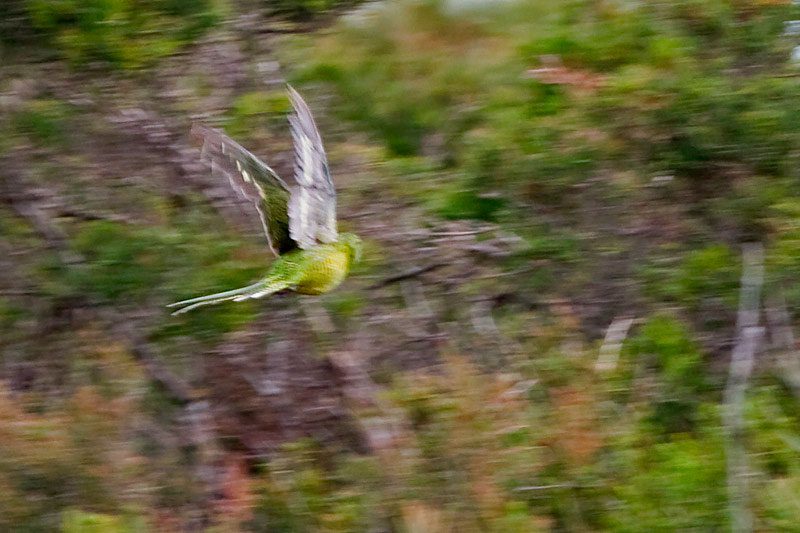
The Eastern Ground Parrot (Pezoporus wallicus) has a medium-sized, It gives the impression of a slender silhouette, feeling is enhanced by the presence of a very long tail terminating beak. The identification is reinforced with rounded wings and for a few fine peaks and sharp.

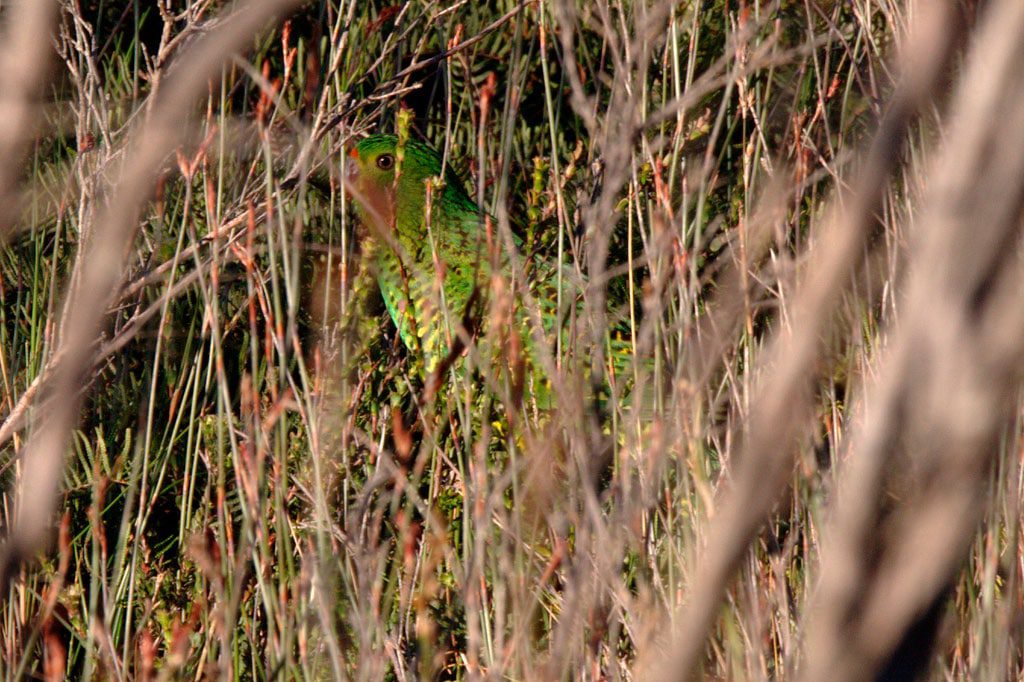
The of adults they have a plumage greenish color with patterns of yellow and black as gallons or points that serve to camouflage itself.

A red band runs around the forecrown. The face and upper part of the chest They show a pretty uniform green colour. The crown Green it is abundantly stained black.

The flanks and abdomen they have yellowish clear black bars. The tail opaque green color shows yellow slots on the outer edges.

Its bill is ochre tones, with the cere rose gray. They present a periocular ring pale grey, the irises eye whitish yellow. Their legs distant have long fingers and their claws they are not curved as in the rest of the parrots.

In the females, You can see a pale yellow stripe at the bottom of the wing .

The immature they have no red frontal band, the face and the chest they have black marks. Its tail is shorter and irises of her eyes are brown.

Subspecies description

  • Pezoporus wallicus wallicus

    (Kerr, 1792) – The nominal

  • Pezoporus wallicus leachi

    (Mathews, 1912) – They have black markings more prominent on the head and thicker, the neck and belly

Habitat:

Eastern Ground Parrot

The Eastern Ground Parrot usually live in lawns along the coast and in the neighbouring moors which rise to the 1.800 meters above sea level. Shrub-dominated moorlands that have suffered from fire in the last decade are generally considered to be their optimum habitat.. As well, moors dominated by reeds and herbs that have suffered some fire between 15 and 18 years ago, they are considered as excellent performance for these parrots. In the interior of the Moors, These birds are concentrated in the driest areas from mid autumn to late spring.

Humid areas they are frequented by the Eastern Ground Parrot, from summer to early autumn, probably in relation to the abundance of seeds at this time of the year. They can also be seen in estuaries, in boggy soils that are full of rods, in the meadows and pastures.

In Tasmania, the Eastern Ground Parrot occupies a rather special habitat consisting of a mixture or a mosaic of Heath, Sedge and weed.

As its common name indicates, These birds are reluctant to take flight. On the rare occasions when they dare to fly, its zigzag in flight seems the of a Small Sandpiper (Actitis hypoleucos) or a Woodcock (Scolopax rusticola) and develops within walking distance (a few 30 m). Once it lands, seek thick cover and can be difficult to relocate.

Contrary to what many people believe, the Eastern Ground Parrot is very active during the day, although, often, are difficult to detect, except when fleeing hastily, hearing the loud vibration of wings just before plunge among the foliage.

Son assets morning and afternoon average. At night, whatever the season, they establish the dormitories in the drylands.

These parakeets are mostly sedentary and live in couples United in a territory which is around of 9 hectares, although the area can sometimes change.

Between February and may, There is a great post-reproductive dispersion in which these birds move away some 120 kilometers from its nesting area.

Reproduction:

The Eastern Ground Parrot usually nest between jJuly and December. A litter was discovered in March. The nest is a fled surface excavated soil from 15 cm and 18 cm in width and between 2 cm and 5 depth cm; It is often full of stems or leaves. It is placed at the base of a mound or a bush above the ground which is accessed through a small tunnel..

The main plants that make up the nest, they are herbs of the genus (empodisma), plants of the genus (Xanthorrhoeoideae) and banksia sheet wide.

Of 20 nests found, 18 located in arid wastelands and 2 only in areas of transition between wetlands and land dry. In all these places there has been a fire for at least four years. The density was low, from January to March a nest each 10 hectares.

The laying includes, usually, 3 or 4 eggs, but in Tasmania (subspecies leachi), were observed 6 eggs in some nests. The incubation lasts around 20 days. Young people are altricial. When leaving the nest, at an age between 20 and 28 days, lie hidden among shrubs, just before fly.

The failure rate in the offspring is quite large, going from the 22 until 31%.

Food:

The Eastern Ground Parrot feeds primarily on seeds of a wide variety of Sedge, herbs, herbaceous plants and shrubs. Occasionally they eat green shoots, leaves, outbreaks, flowers and small fruits.

In the Great Sandy National Park (Cooloola section), the Eastern Ground Parrot feeds primarily on seeds of Sprengelia sprengelioides (Epacridaceae), Schoenus paludosus (Cyperaceae) and Restio complanatus (Restionaceae).

In the Croajingalong National Park, the diet consists, mainly, seeds or fruits of the species Cyperaceae, particularly Schoenus brevifolius and Cassytha (Lauraceae), and also unidentified species of Ericaceae and Fabaceae.

The Eastern Ground Parrot, usually, feeds on Earth, but sometimes forages among the foliage of low shrubs, or on top of clumps of planting of reeds.

The seeds take them from the soil and plants. The parakeet will remain on the stem of a plant to flatten it and throw the seeds of heads down, or it will be the peak along the stem and base of the seeds, with the intention of evicting them and that fall to the ground.

The peak used to cut the seeds and their bases, as well as to handle food. The legs are used only to flatten plant stems.

In the Bundjalung National Park, the Eastern Ground Parrot It was observed feeding on flowers. Occasionally they feed in habitats that have been modified by man, for example, one in cornfield.

They are diurnal, and actively feed throughout the day.

Distribution:

The Eastern Ground Parrot are confined in Australia. The range has contracted in recent times and the species is now only found in isolated pockets of coastal heath and reed-covered land., It extends to the South, from the South of Queensland, where a population of 3.000 birds is dispersed through of the Fraser Island and close to the continent, including Cooloola National Park, Reserve Wide Bay Military, Fraser State Forest and Great Sandy National Park.

It is common locally to around New South Wales, where they are distributed in a number of coastal sites including Evans Head, the Broadwater National Park, Byron Bay, Morton National Park, around the Howe's Cape, Barren Grounds and Nadgee nature reserve.

They come up to Victoria, in the Croajingolong National Park, and they are distributed, provided that the habitat is suitable, along the coast in a series of sites as the Wilson promontory National Park and the Discovery Bay coastal Park in the West.

In the post-breeding period, the dispersal of birds reaches areas of Gippsland and Ninety Mile Beach, Although they can also travel further including the interior Highlands.

The species has become extinct in Southern Australia and on the islands of the bass strait.

In Tasmania it is quite common in the south-west, but small flocks in the central and South-East regions, they are probably now in decline.

Subspecies distribution

  • Pezoporus wallicus wallicus

    (Kerr, 1792) – The nominal

  • Pezoporus wallicus leachi

    (Mathews, 1912) – Tasmania.

Conservation:


minor concern


• Current category of the Red List of the UICN: Least concern

• Population trend: Decreasing

The Eastern Ground Parrot is not threatened globalmente.

Habitat loss mainly due to urban growth and modernization of agriculture, accentuated by the use of improper burning of stubble and restoration techniques of plantations of pine trees along the coast, It can be that they are endangering the species. These signs of decline are seen mostly in the West and the South of Australia.

Although the population of Tasmania probably exceed of the 100.000 specimens, the population in the South-East of the continent It is much more low and does not exceed the 3.000 Member.

"Eastern Ground Parrot" in captivity:

Take it easy, shy, active when feeds, After the sunset, enjoy bath. It is customary to their caregiver, but rarely survive beyond a few weeks.

Not found in captivity outside Australia.

Alternative names:

– Eastern Ground Parrot, Ground Parrot (Eastern) (ingles).
– Perruche terrestre (French).
– Erdsittich (German).
– Arara-de-cabeça-azul (Portuguese).
– Perico Terrestre, Perico Terrestre Oriental (español).

scientific classification:

– Order: Psittaciformes
– Family: Psittaculidae
– Genus: Pezoporus
– Scientific name: Pezoporus wallicus
– Citation: (Kerr, 1792)
– Protonimo: Psittacus wallicus

«Ground Parakeet» Images:

Videos "Eastern Ground Parrot"

«Terrestrial Perico» (Pezoporus wallicus)

Sources:

  • Avibase
  • Parrots of the World – Forshaw Joseph M
  • Parrots A Guide to the Parrots of the World – Tony Juniper & Mike Parr
  • Birdlife

  • Photos:

(1) – To western ground parrot (Pezoporus wallicus flaviventris), one of eight in captivity. (WA Department of Environment) – australiangeographic
(2) – A Ground Parrot amongst vegetation By Jarrod Amoore [CC BY 2.0], via Wikimedia Commons
(3) – Eastern Ground Parrot – Office of Environment and Heritage
(4) – flight views of bird flushed from heath by Mat Gilfedder – lynx
(5) – By Jennene Riggs – abc
(6) – By James Sowerby (1757 – 1822) (English) (Artist, Details of artist on Google Art Project) [Public domain or Public domain], via Wikimedia Commons

▷ The world of Pets: Dogs, cats, birds, reptiles, amphibians

Bourke's Parrot
Neopsephotus bourkii


Bourke's Parrot

Content


Anatomy-parrots

Description

19 cm. length and an approximate weight of 39 g..

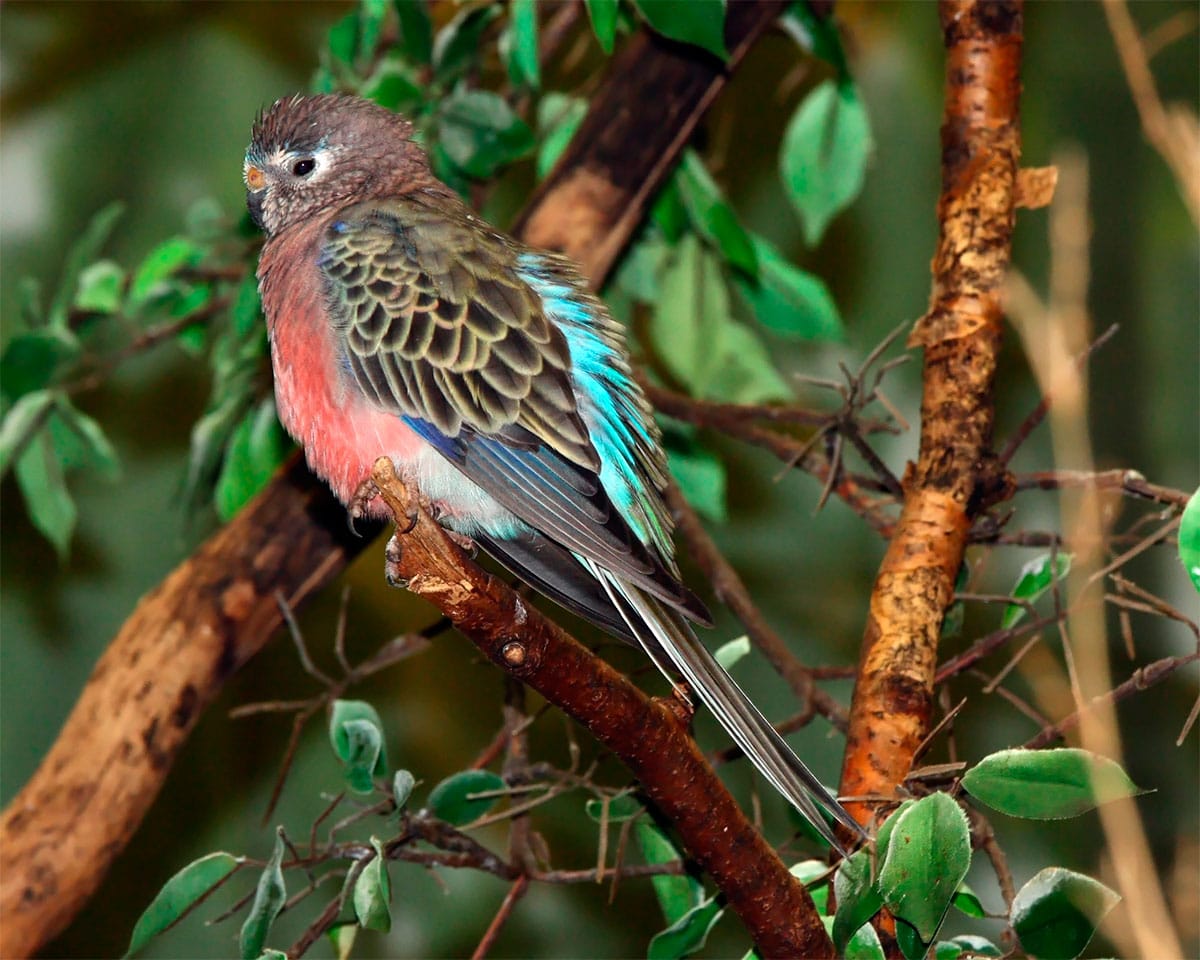
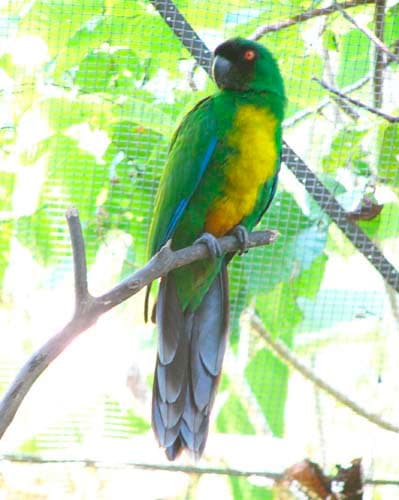
The Bourke's Parrot (Neopsephotus bourkii) has frontal area white. The chin, lores and contour of the eyes they are also white and form a kind of orbital ring clear when seen from a distance.

The ear-coverts and upper cheeks they are dark brown with pink dots and specks. The pileum and the neck are greenish-Brown, with darker edges.

The upperparts are brown-grey color with pale edges on scapulars.

The rump and the top of the tail has darker tones, with some pale blue on the sides. The curvature of the wing is blue.

The small coverts are blue, the median they have light blue, the greater coverts they have a dark tint with yellow-white and blue pink.

The flight feather primaries and secondaries are mostly blue.

The underparts is blue.

The breast feathers are brown with pink ends, giving an appearance of general pinkish brown.

The abdomen is bright pink.

Thighs, lower flanks, side of the rump, under belly and lower area of the tail they have a light blue color. The upper part of the tail infiltrates with bluish-grey.

The bill is greyish black, no hook in upper jaw. The irises They are brown, legs grey-brown.

The female in General, the colors are off and the blue coloration is very little visible or is absent.

The youth they are equal to the female adult but more muted, with a pale band under the wings which is less pronounced in the male juvenile

For a long time, the Bourke's Parrot It was classified in the genus Neophema. A number of ornithologists, more and more, is of the opinion that this parakeet does not belong to this genus and species have been classified in a separate genus called Neopsephotus.

Habitat:

The Bourke's Parrot they are distributed among the driest inland areas.
They mark a strong preference for scattered areas of mulga (Acacia aneura) but does not disdain the plantations of eucalyptus. Can also be observed in plots along streams and afforestation of Callitris which are conifers belonging to the family of cypress.

Son nomads and slightly Twilight. These birds establish themselves in a territory and remain there for several years before disappearing completely.. The Bourke's Parrot they can be very sociable. During periods of drought, You can meet thousands around the water wells and springs.

During the months of summer, We can see them in the morning and in the evening around the ponds.

In Winter, these parakeets come to drink during the day in the company of species of doves such as the common bronze pigeon (Phaps chalcoptera). In places close to the drinking fountains, the Bourke's Parrot They fly in Group emitting loud cries and making whistling wings. But, These parakeets sometimes go unnoticed, they are able to rest or to eat ground in pairs or in small groups. They remain in silence on the floor or hide in the dead wood that serves as camouflage. There are more assets during the sunset.

Reproduction:

The Bourke's Parrot they usually reproduce in August to december, but the season can vary depending on rainfall. The courtship of this bird are similar to those of other species of Parrot Neophema. Males approach the female in upright position with outspread wings and tail.

The nest is located in one a tree cavity, between 1 and 3 meters above the ground. The laying is formed by between 3 and 6 eggs they are incubated during at least 18 days. There are often two broods in the season. The female leaves the nest only once a day in order to be replenished by the male.. The male is also in charge of mounted guard, patrolling and emitting calls in the vicinity of the nest, with the intention to deter intruders.

At birth, the chicks have a white marker, are altricial and remain in the nest for at least 4 weeks. They remain dependent on their parents during a week after feather.

Food:

The Bourke's Parrot they are almost exclusively vegetarian: they eat grass seeds, especially those that are dispersed by the wind. They also eat herbs collected in the soil and in the bushes. These parakeets also appreciate the fresh young shoots and seeds of Acacia or of Bassia, which are small shrubs belonging to the category of Chenopodium album.

Distribution:

Scattered through the interior of Australia, where are nomads but locally common.

The species ranges from the West coast of Western Australia around the inside of Geraldton to río Ashburton and South, through Leonora, and through Gibson and the Great Victoria desert in the South of the Northern Territory, about 20 °S.

Extends from the Northwest of Southern Australia, South-East through Woomera until Port Augusta, that also extends to the North through Oodnadatta and the regions of the Lake Eyre and the Lake Frome.

The birds, to the This of the Montes Flinders You can isolate, since there are no records between 139º and 140 °E.

Apparently, the species has declined in the center of New South Wales due to overgrazing by cattle and rabbits, and is now mainly in the West, from the surroundings of Broken Hill, to paroo river; nomads, However, There have been more towards the This, in the surroundings of Narrandera in the South and the Lightning Ridge in the North.

In the South of Queensland, the Bourke's Parrot are distributed to the This, about Dirranbandi and Cunnamulla. and in the North until Windorah.

Escapes There have been around Brisbane.

The world population is considered to be more of 50.000 specimens.

The species is probably increasing in the west due to agricultural expansion including the provision of artificial irrigation sites..

Conservation:


minor concern


• Current category of the Red List of the UICN: Least concern

• Population Trend: Growing

It is estimated one population superior to the 50 000 individuals.

In the western part of its range, the numbers are growing, probably due to the development of agriculture and the installation of new irrigation areas. The reason for its development can also be found in the reduction of sheep farming and the replacement of saline areas with grass..

"Bourke's Parrot" in captivity:

The Bourke's Parrot they are very good birds for beginners amateurs, easy-to-play.

It is a bird peaceful, silent and that it is active only in the first and last hours of the day. Son calm and confident by nature and easy to maintain. It has almost no cravings for crack and your bathroom need depends on the individual. A dry climate supports well, but it is sensitive to cold and wet fog.

Les gusta estar en tierra firme y son susceptibles a la infección por gusanos, también son susceptibles a infecciones oculares.

With regard to its longevity, according to sources, a sample lived 12,6 years in captivity. In captivity, estos animales pueden criar, approximately, to the 2 years of age.

Alternative names:

– Bourke’s Parrot, Blue-vented Parakeet, Blue-vented Parrot, Bourke Grass-Parakeet, Bourke Parakeet, Bourke Parrot, Bourke’s Grass-Parakeet, Night Parrot, Pink-bellied Parakeet, Pink-bellied Parrot, Sundown Parrot (ingles).
– Perruche de Bourke (French).
– Bourkesittich, Bourke-Sittich (German).
– Periquito-rosa (Portuguese).
– Papagayo de Bourke, Periquito Rosado (español).

scientific classification:

John Gould
John Gould

– Order: Psittaciformes
– Family: Psittaculidae
– Genus: Neopsephotus
– Scientific name: Neopsephotus bourkii
– Citation: (Gould, 1841)
– Protonimo: Euphema Bourkii

Images "Pink Periquito":

Videos "Bourke's Parrot"

————————————————————————————————

"Pink Periquito" (Neopsephotus bourkii)


Sources:

– Avibase
– Parrots of the World – Forshaw Joseph M
– Parrots A Guide to the Parrots of the World – Tony Juniper & Mike Parr
– Birdlife

– Photos:

(1) – Bourke’s parrot (Neopsephotus bourkii) By Flickr user Jan Tik (Flickr) [CC BY 2.0], via Wikimedia Commons
(2) – Bourke’s Parrot – Neopsephotus bourkii taken at the Cincinnati Zoo and Botanical Gardens By Greg5030 (Own work) [CC BY-SA 3.0], via Wikimedia Commons
(3) – Bourke’s Parrot Neopsephotus bourkii. Wild pair at Bowra Station, near Cunamulla, Queensland, Australia By Bruce Kendall (Own work) [CC BY-SA 3.0 or GFDL], via Wikimedia Commons
(4) – A male Bourke’s Parrot at the Flying High Bird Sanctuary, Apple Tree Creek, Queensland, Australia By paulgear (Picasa Web Albums) [CC BY-SA 3.0], via Wikimedia Commons
(5) – Neopsephotus bourkii (formally placed in genus Neophema) By Jan Tik (originally posted to Flickr as Hitchhiker) [CC BY 2.0], via Wikimedia Commons
(6) – By T.H. Maguire (1821–1895) (http://www.birdresearch.dk/dk/jgould.htm) [Public domain], via Wikimedia Commons

– Sounds: Tom Tarrant (Xeno-canto)