
Content
|
|---|
All breeds and species.
 Pets
Pets
Content
|
|---|
39-52 cm. length between 260 and 280 g. of weight.
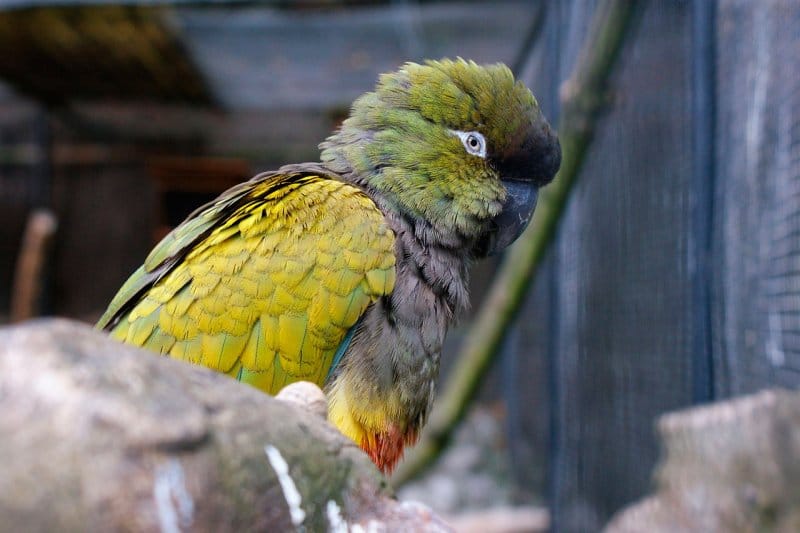
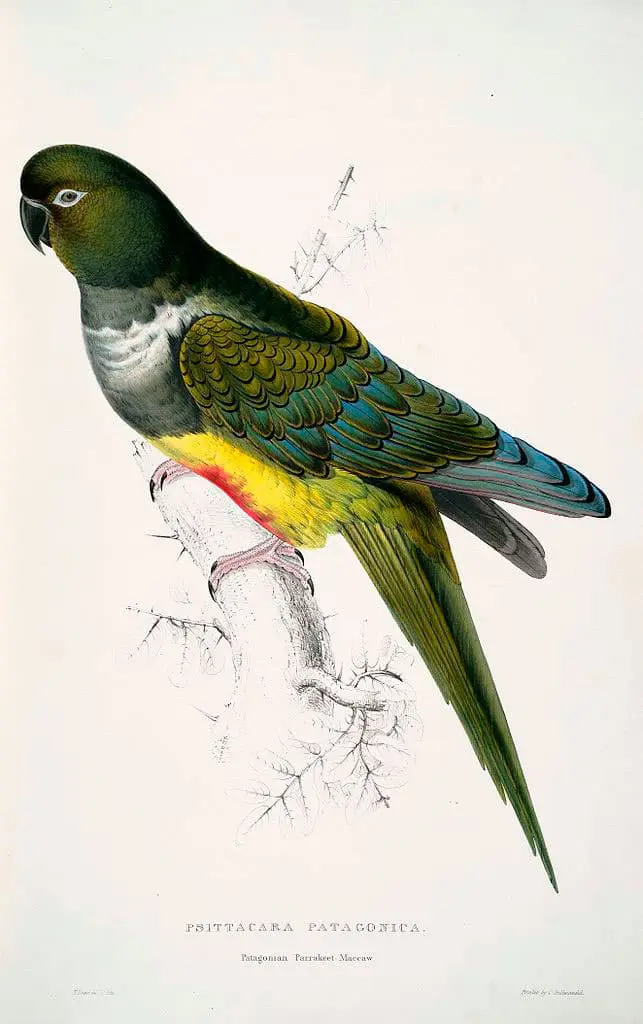
The Burrowing Parakeet (Cyanoliseus patagonus) has the forecrown, crown, lores, cheeks and nape olive brown with slight yellowish tinge; sides of neck, the mantle and back Brown olive; rump and uppertail-coverts bright canary yellow.
Blades brown, some slightly blue; covered primary blue, other yellowish olive brown. Primaries and Outer secondaries dark blue with edges innerwebs distal; inner secondary bluish brown. Underwing-coverts Yellow olive; underside of flight feather brown. Breast olive brown with white-cream area at the top of chest; rest of the underparts yellow-orange red patch through central belly. Uppertail brown tinted blue, especially next to the tips; undertail brown.
The bill It is grayish-black; the periophthalmic skin skin whitish; the irises is pale yellow; the legs They are pale yellowish brown.
Both sexes similar. Immature has horn upper mandible and the irises brown.
The species usually inhabit areas open pastures, although it has also been reported in Savanna, wooded valleys cliffs and farmland some 2.000 m. Usually in a fairly arid land, although often it found near elevations or streams. Gregarious, forming large flocks, sometimes exceeding 1.000 birds, with common roosts trees, on wiring (sometimes in villages) and in tunnels dug to nest.
It reproduces colonially in warrens carved into cliffs (usually limestone or sandstone Chile) often with stunning views. In San Luis, Argentina, reproduction is reported in the wet season (November–April), the birds return to nest in the cliffs lay eggs in September and November to December in San Luis, spreading of bird breeding sites in April; apparently earlier in Chile. Clutch 2-4 eggs. The male takes care of feeding the female during the incubation period.. The young leave the nest at 2 months of age, However, They continue to be fed by their parents until 6 months of age.
The diet of the Burrowing Parakeet It consists mainly of seeds and fruits predominance of fruit in the summer months (November to February). Food reported include berries of buckthorn joke and Discaria, fruit of Geoffroea decorticans, Prosopis caldenia, P. chilensis and P. flexuosa and seeds of Carduus mariana. Sometimes damaged grain crops; often it feeds on the floor or around.
Extending its range (breeding/resident): 1.590.000 km2
The Burrowing Parakeet They are distributed by the South South America, extending from northern Santa Cruz and Chubut in Argentina, passing by Black river and Pampa, up to Buenos Aires, San Luis and Córdoba, San Juan, La Rioja, Catamarca, Tucumán and Salta, reaching westward across southern Uruguay.
They were recorded in the early 1920 from the center of Formosa, Argentina, away from Andes mountains, and above the center Chile from the North of The lakes to north of Atacama, but now they are confined to a few localities in the foothills of the Andes, for example in Bio Bio.
Will produce some seasonal movements, including the northward migration of birds south in the Argentine winter and shifts down Chile.
In Argentina is locally common or abundant, although in some places (p. e.g.. in Córdoba and Buenos Aires Eastern) They are rare or occasional. Few and far between in Uruguay. drastic decline during the twentieth century Chile, so that the subspecies Cyanoliseus patagonus bloxami It is considered at risk, with an estimated population of less than 3.000 individuals at the end of the decade 1980. The decrease in parts of the Argentina It is attributed to the catch for the trade, the hunting for food, converting grassland and arable land persecution as crop pest. Probably continues to decline overall.
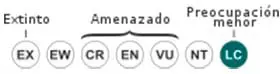
• Current category of the Red List of the UICN: Least concern.
• Population trend: Decreasing.
• Population size : 95000 individuals.
Rationale for the Red List category
Even though the demographic trend It appears to be declining, the decline is not believed to be rapid enough to approach the Vulnerable thresholds based on demographic trend criteria (> 30% decrease in ten years or three generations). The population size is very large, and therefore does not approach the thresholds for Vulnerable under the criterion of population size (<10.000 individuos maduros con un descenso continuo estimado en >10% in ten years or three generations, or with a specific population structure). For these reasons, the species is evaluated as Least concern.
Justification of the population
The species is still common in many parts of its range in Argentina, with only small contractions reported in range Córdoba (R. M. Fraga a slightly. 2003). The population size of four subspecies was estimated as follows by MASELLO et al. (2011): Cyanoliseus patagonus patagonus 43.330 nests, Cyanoliseus patagonus conlara 1.700 individuals, Cyanoliseus patagonus andinus 2.000 nests, Cyanoliseus patagonus bloxami 5.000-6.000 individuals. Based on these figures, the population Total overall can be about 95.000 mature individuals.
Justification trend
They suspected that the population is declining due to continuing habitat destruction and unsustainable levels of exploitation.
Threats
The species has been the subject of a intense trade: from 1981, year it was included in the Appendix II of the CITES, they have been 122.914 individuals caught in international trade (UNEP-WCMC CITES CITES Trade Database, January 2005).
Conservation actions underway
The species is included in the Appendix II of the CITES.
The average life expectancy is of 15-20 years in captivity. Protected by Appendix II of the CITES.
To help conservation Burrowing Parakeet, You can report your hunt, sale, trade and illegal possession, thus, We will be cooperating with the conservation of this species and not be complicit in the decline of their populations and their future extinction of wild.
– Burrowing Conure, Burrowing Parakeet, Burrowing Parrot, Patagonian Burrowing Parrot, Patagonian Conure, Patagonian Parrot (English).
– Conure de Patagonie, Perriche de Patagonie, Perruche de Patagonie (French).
– Felsensittich, Felsen-Sittich (German).
– Periquito-das-barreiras (Portuguese).
– Loro Barranquero, Loro de la Patagonia, Loro Patagonico, Tricahue (español).
– Loro barranquero (Argentina).
– Tricahue (Chile).
– Loro barranquero, Loro Patagonico (Uruguay).
– Perico Barranquero (Mexico).
– Order: Psittaciformes
– Family: Psittacidae
– Genus: cyanoliseus
– Scientific name: Cyanoliseus patagonus
– Citation: (Vieillot, 1818)
– Protonimo: Psittacus patagonus



————————————————————————————————
Sources:
– Avibase
– Parrots of the World – Forshaw Joseph M
– Parrots A Guide to the Parrots of the World – Tony Juniper & Mike Parr
– Birdlife
– Photos:
(1) – A Burrowing Parrot captive in Madeira By Rakkhi Samarasekera from London, United Kingdom (P6122982Uploaded by Snowmanradio) [CC BY 2.0], via Wikimedia Commons
(2) – Two Burrowing Parrots in Limari Province, Chile By Gerzo Gallardo (Flickr: Parrots) [CC BY 2.0], via Wikimedia Commons
(3) – Pair of cockles Cyanoliseus patagonus in the RN Cypress River By BioVipah (Own work) [CC BY-SA 4.0], via Wikimedia Commons
(4) – Burrowing Parrot (also known as the Patagonian Conure) to Lille Zoo, France By Olivier Duquesne (originally posted to Flickr as Perroquet) [CC BY-SA 2.0], via Wikimedia Commons
(5) – A Burrowing Parrot at Birds of Eden, an aviary in Western Cape, South Africa By Dick Daniels (http://carolinabirds.org /) (Own work) [CC BY-SA 3.0 or GFDL], via Wikimedia Commons
(6) – A painting of a Burrowing Parrot, also known as Patagonian Conure, (originally captioned «Psittacara patagonica. Patagonian Parrakeet-Maccaw») by Edward Lear 1812-1888 – Wikipedia
– Sounds: Cristian Pinto, XC380836. accessible www.xeno-canto.org/380836.
Content |
|---|
20 to 26 cm. in length and 72–85 grams in weight. It is one of the smallest Aratingas.
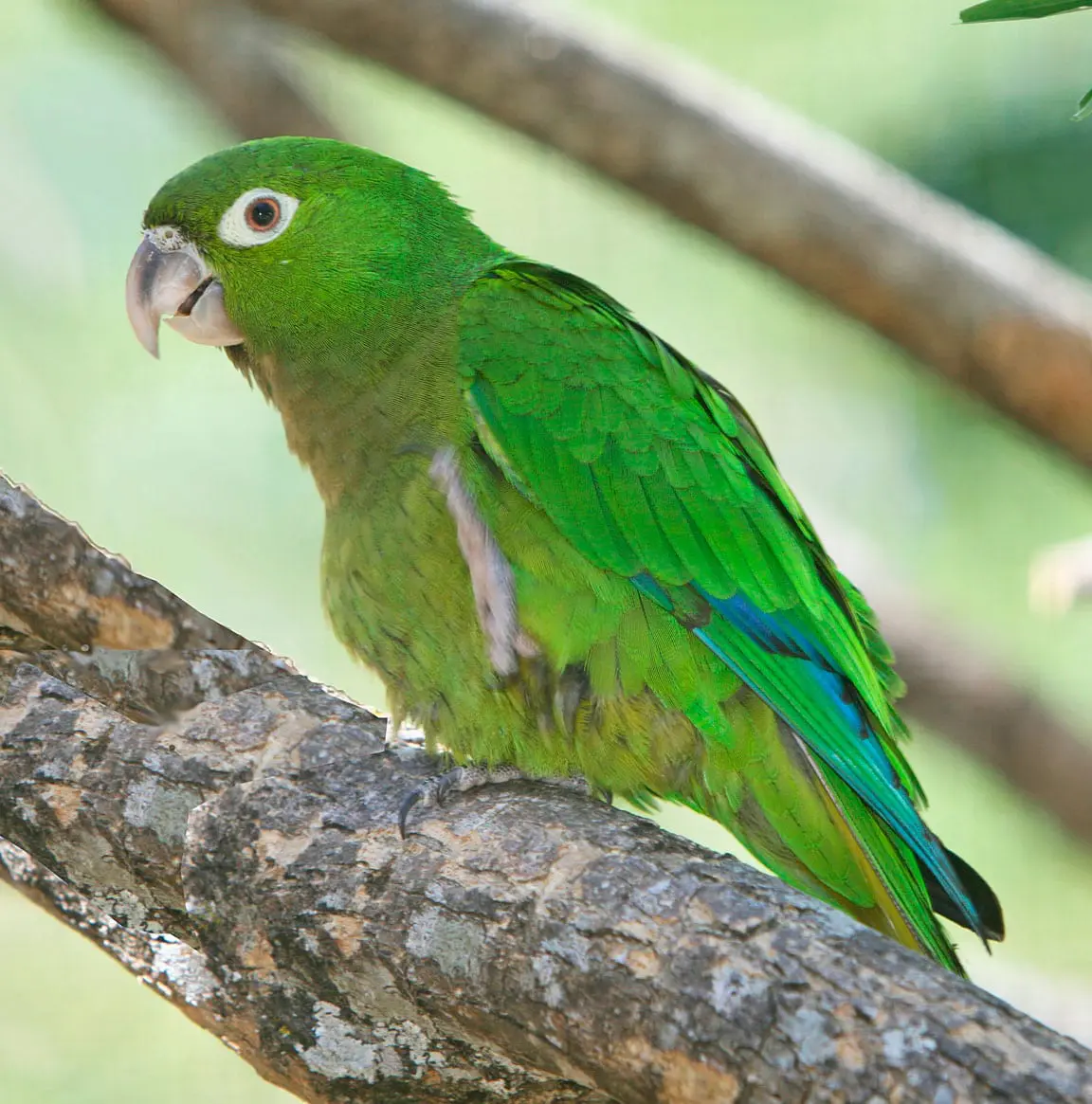
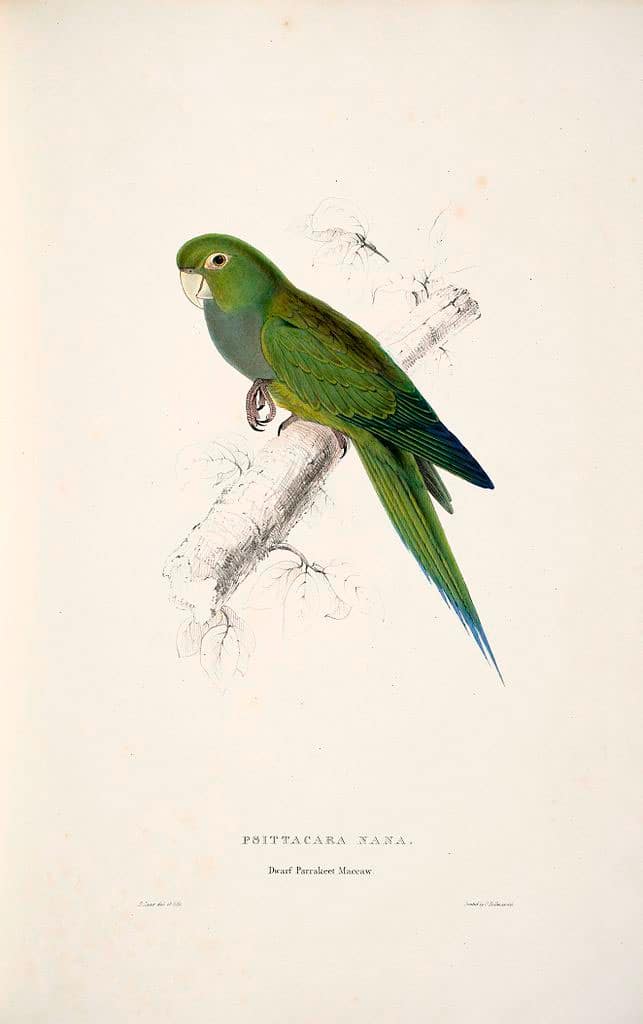
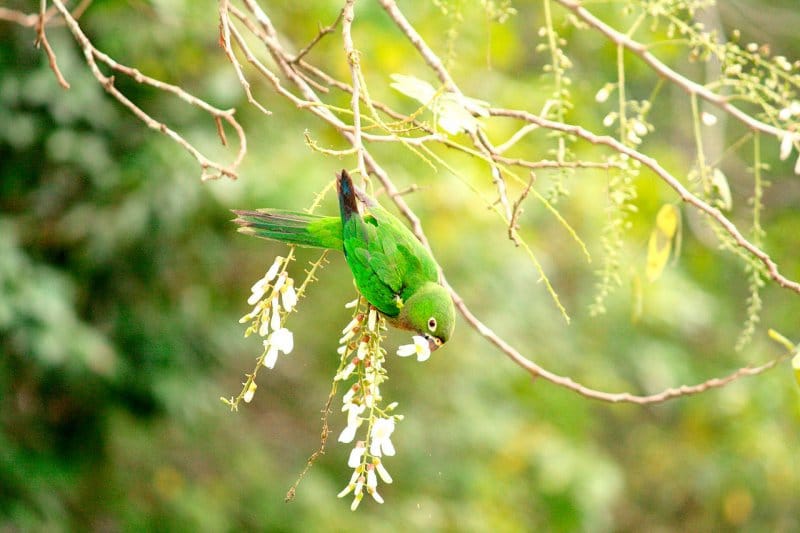
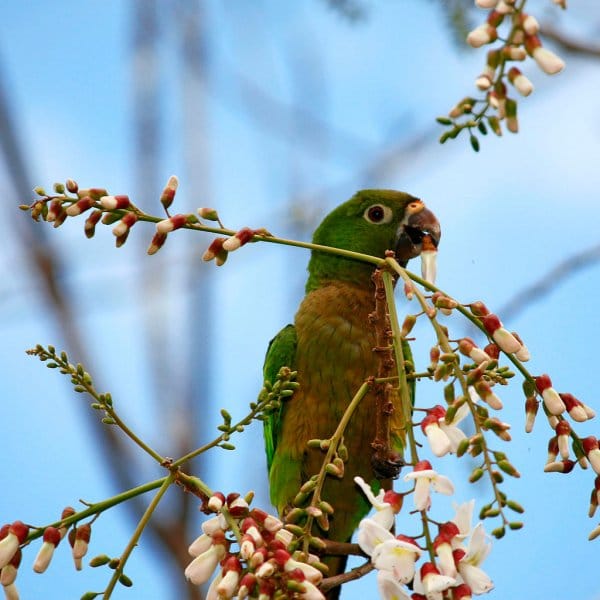
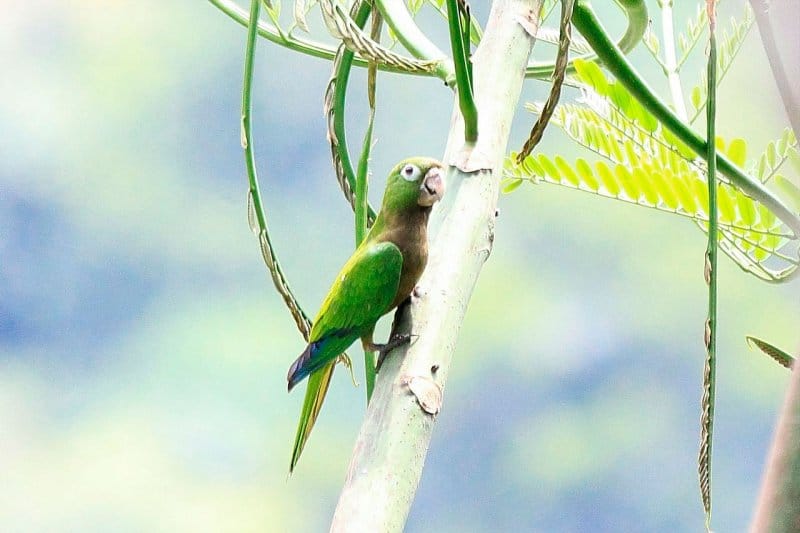
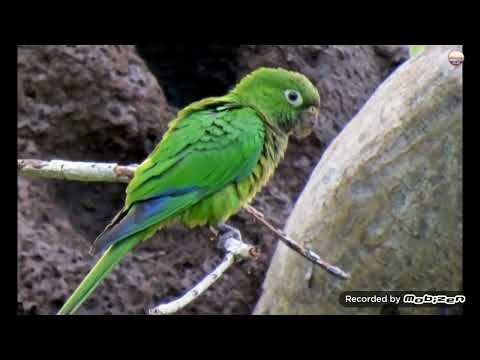
The Olive-throated Parakeet (Eupsittula nana) has the head and upperparts dark green; feathered area of cere yellow to orange-red.
Upperwing-coverts dark green, outer more emerald. The Outer secondaries and inner primaries deep dark blue tipped black above; the outer primary blue only towards tips. The greater underwing-coverts and underside of the flight feather dull slate or brownish-grey; the remaining coberteras are light green. Chin, throat and sides neck chocolate-brown they are merging with brownish olive on top of chest which turns yellow at the bottom and the belly; undertail-coverts light green. Uppertail dark green with blue diffusion, especially towards the tip; undertail metallized yellow-olive. Bill brown with the tip paler; irises yellow to orange; legs blackish-gray.
All plumages are similar but immature has irises brown.
three subspecies Panamanian and Honduran birds previously bore the respective names outmost and melloni, but light regional variations in Central America (p. e.g.. birds in southern paler and those of Tabasco, Mexico and Honduras They are darker) not justify more separations as described below.
(Souance, 1857) – Similar to the nominal but the throat and (especially the underparts) more pale brown, the bill perhaps smaller average.
(Vigors, 1830) – Nominal.
(Bangs & Penard,TO, 1919) – Slightly larger than the subspecies Eupsittula nana astec, up brighter and greener down
NOTE The continental population is sometimes treated as a full species under the name A. astec, although the differences with Jamaican birds are minimal.
Video – "Olive-throated Parakeet" (Eupsittula nana) |
|---|
They live mainly in forests and forest edges (especially adjacent lowland) in wet areas (to 1.100 m in Honduras, to 700 m in Costa Rica and a 300 m in southern Mexico), It is less frequent in large tracts of rainforest; reported in arid areas (Veracruz) and pine forests (Honduras), open country with scattered trees (including acreages) and plantations. More common in Jamaica in mid-level humid limestone forests. Usually it remains below the canopy. larger groups can be formed (c. 30) after breeding or when food is abundant. mixed flocks with Crimson-fronted Parakeet reported in Costa Rica.
Arboreal termitarium prefer to lay their nests, where birds excavate the cavity; also used treeholes. Often nests at the edge of a river or forest. Breeding season March, Jamaica; April May, Belize and Guatemala. The implementation is of 3-4 eggs that hatch in 26-27 days. After hatching, it takes about 50 days until chicks are ready for independence.
Note: In most birds, male/female bonds occur only during the breeding season and function solely in coordinating parental care. La monogamy perenne, or linking partner throughout the year, It occurs in at least a dozen families of birds, including cockatoos and other parrots.
Registered foods include higos ficus, Psidium, Inga, Hura, fruit of Hieronyma and guilt of tamarindo unripened. attacking crops, especially corn, and it is considered highly destructive in some areas.
Extending its range (breeding/resident): 1,373,500 km2
distributed by the Gulf and the Caribbean slope of Central America and Jamaica; a population in Hispaniola (Sierra de Bahoruco, Dominican Republic) It comes from a recent introduction from Jamaica. In Mexico, the Olive-throated Parakeet It extends from eastern San Luis Potosi and South of Tamaulipas, through South Veracruz until Oaxaca, North of Chiapas and Yucatan; then through the humid north of Guatemala and the Caribbean slope of Honduras, Nicaragua and Costa Rica to western Panama. It is located along Jamaica except in the high mountains and the humid mountain range of John Crow in the East.
Resident and locally common to abundant (commonly the most abundant parrot in some localities) although it is likely to be decreased in some areas (p. and. Jamaica and Costa Rica) due to the loss of habitat. Less common in southern Costa Rica and uncommon in Panama, where possibly a seasonal visitor Southern Lemon.
Caught for live bird market, but rare in international trade.
(Vigors, 1830) – Nominal. Jamaica, apparently in most areas except the high mountains and the humid Cordillera de John Crow
(Bangs & Penard,TO, 1919) – East of Mexico south of Veracruz, zone of contact with the last unknown species
• Current category of the Red List of the UICN: Least concern.
• Population trend: Decreasing.
• Population size : 500,000-4,999,999 individuals.
Rationale for the Red List category
Although the demographic trend appears to be declining, the decline is not believed to be rapid enough to approach the Vulnerable thresholds based on demographic trend criteria (> 30% decrease in ten years or three generations). The population size is very large, and therefore does not approach the thresholds for Vulnerable under the criterion of population size (<10.000 individuos maduros con un descenso continuo estimado en >10% in ten years or three generations, or with a specific population structure). For these reasons, the species is evaluated as Least concern.
The subspecies Eupsittula nana nana It is endemic to Jamaica, where still widespread but probably has a moderately small population (approximately 10.000 mature individuals), all in one subpopulation, inferring that is in continuous decline due to a variety of threats including loss and degradation of the habitat, pursuit and capture for trade. So, It has been classified as Near-threatened.
Justification of the population
Partners in Flight They estimate that the total population is 500,000-4,999,999 individuals (A. Panjabi a slightly. 2008).
Justification trend
They suspected that the population is declining due to continuing habitat destruction and unsustainable levels of exploitation.
Uncommon in international trade. Their life expectancy is over 15 years.
It is included in the appendix ll of the Convention on International Trade in Endangered Species of Wild Fauna and Flora Silvestre (CITES).
The Olive-throated Parakeet It is important to attract tourists with hotel advantages in the Caribbean and tropical areas that offer free bird tour with reservations. It is one of the reasons why this beautiful bird should remain free..
– Dwarf Conure, Dwarf Parakeet, Jamaican Conure, Jamaican Parakeet, Olive-throated Parakeet, Olive-throated Parakeet (Jamaican) (English).
– Conure aztèque , Conure naine, Conure naine (nominal), Conure naine (nominale), Conure naine (race nominale) (French).
– Aztekensittich, Jamaikasittich (German).
– Periquito-da-jamaica (Portuguese).
– Aratinga jamaicana, Aratinga Pechisucia, Perico Amargo, Perico azteco, Perico Pechiolivo, Perico Pechisucio, perico pecho sucio, perico pecho-sucio, Periquito pechisucio (español).
– Perico azteco (Costa Rica).
– Perico Amargo (Dominican Rep.).
– Periquito pechisucio (Honduras).
– Perico Pechisucio, perico pecho sucio, perico pecho-sucio (Mexico).
– Perico Pechiolivo (Nicaragua).
– Order: Psittaciformes
– Family: Psittacidae
– Genus: Eupsittula
– Scientific name: Eupsittula nana
– Citation: (Vigors, 1830)
– Protonimo: Psittacara nana

Sources:
– Avibase
– Parrots of the World – Forshaw Joseph M
– Parrots A Guide to the Parrots of the World – Tony Juniper & Mike Parr
– Birdlife
– Photos:
(1) – Jamaican Parakeet (aka Olive-throated Parakeet or Aztec Parakeet) in captivity in Costa Rica By http://www.birdphotos.com (Own work) [CC BY 3.0], via Wikimedia Commons
(2) – Aratinga nana astec in Belize By Dominic Sherony [CC BY-SA 2.0], via Wikimedia Commons
(3) – Aratinga (nana) astec in Tikal, Guatemala By Aztec_Parakeet_(Aratinga_astec)_-Guatemala-8.jpg: Walter Rodriguez from Berlin, Germanyderivative work: Snowmanradio [CC BY 2.0], via Wikimedia Commons
(4) – Aratinga (nana) astec in Tikal, Guatemala By Walter Rodriguez from Berlin, Germany (parakeetUploaded by Snowmanradio) [CC BY 2.0], via Wikimedia Commons
(5) – Eupsittula nana. Celestún Biosphere Reserve, Yucatan, México By Katja Schulz from Washington, D. C., USA (Olive-throated Parakeet) [CC BY 2.0], via Wikimedia Commons
(6) – A painting of an Olive-throated Parakeet, also known as the Olive-throated Conure, (originally captioned «Psittacara nana. Dwarf Parakeet Maccaw.») by Edward Lear 1812-1888 [Public domain], via Wikimedia Commons
– Sounds: Guy Kirwan, XC284214. accessible www.xeno-canto.org/284214
[contact-form][contact-field label=»Nombre» type=»name» required=»true» /][contact-field label=»Email» type=»email» required=»true» /][contact-field label=»Web» type=»url» /][contact-field label=»Mensaje» type=»textarea» /][/contact-form]
Content |
|---|
Of 12,7 to 15 cm in length and a weight between 42 and 58 g..
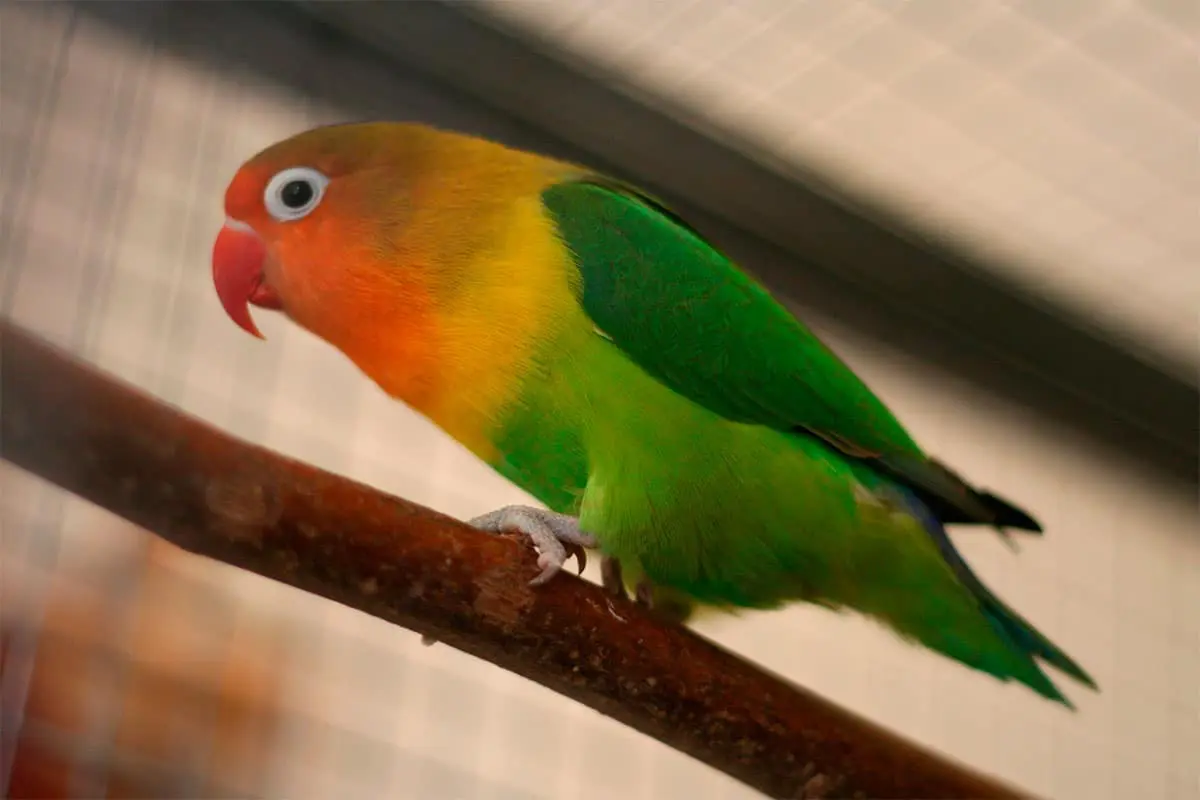
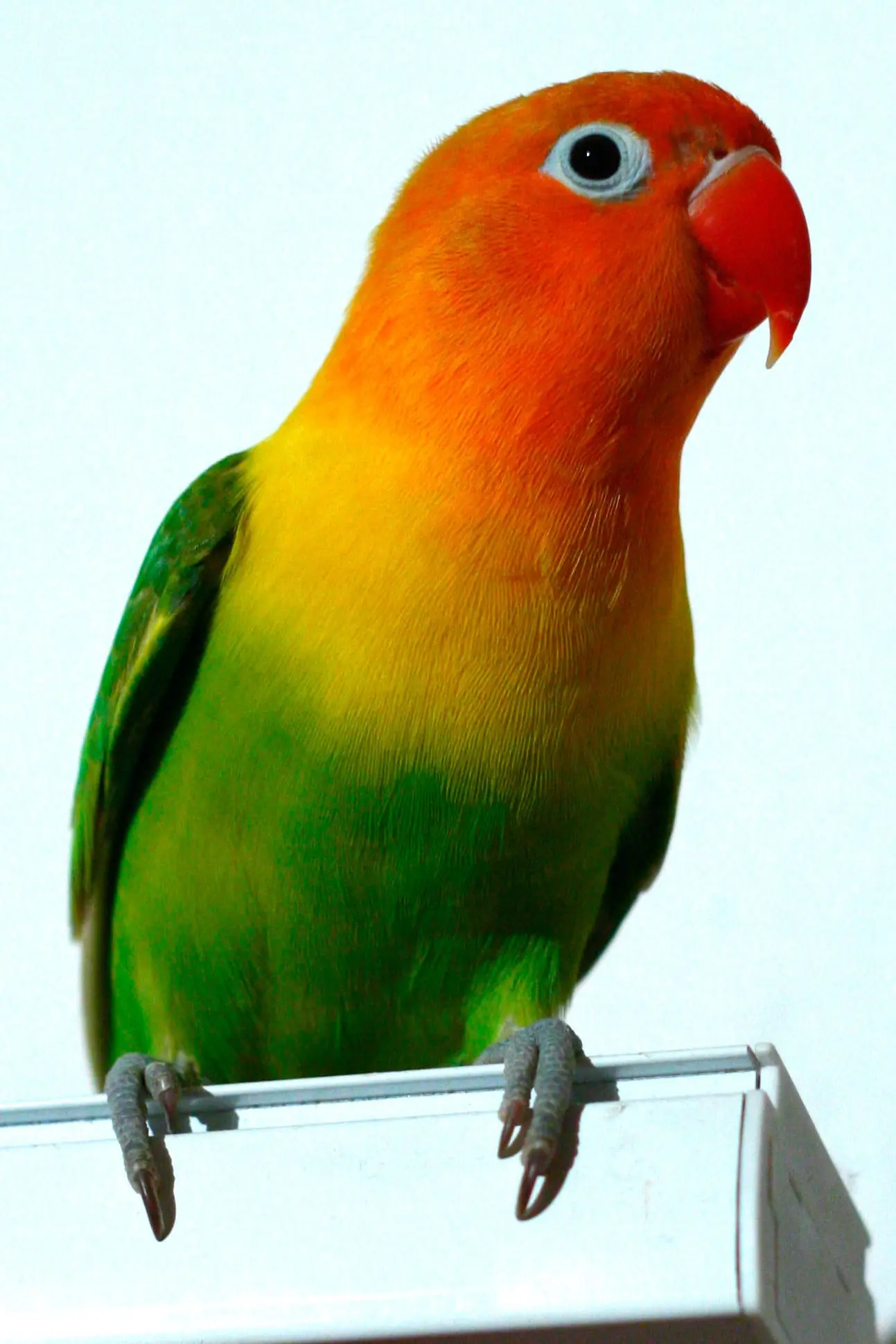
The Fischer's Lovebird (Agapornis fischeri) has a frontal band, the lores and cheeks bright red with an orange shaded in red chin and throat. Upper chest is orange-yellow; crown and nape They are brown. Width collar adjacent yellowish brown and yellowish orange band at the top of chest.
The the mantle, scapulars and front of the rump, are green; the back of the rump and uppertail-coverts dark blue. Upper, the wing-coverts green; primaries and secondaries blackish brown with green edges to the vane outer. Under, the wing-coverts green; underside of flight feather grey-black. The low area chest up to the undertail- coverts pale yellowish green.
Tail bluish green, tipped yellow and bordered by a black line.
The bill is red, whitish towards the base of the upper jaw; cere white; irises brown; periophthalmic ring white of a 2 mm; legs pale grey.
Both sexes similar, indeed there no sexual dimorphism Between both.
One method that is very effective in distinguishing the sex of our Fischer's Lovebird It is the bone of the pelvis, being more open in females than in males.
The immature They have reduced the blue in the uppertail-coverts and they are both duller than adults, particularly on neck, the head and the chest; black markings, sometimes at the base of the upper jaw.
The Fischer's Lovebird They inhabit wooded grasslands with acacias, Commiphora; especially in the west, also in more open grasslands with Adansonia and cultivated areas. More common in sheets with different types of acacias and trees of the genus Egyptian balanites; also in terrestrial flora zones including Penisetum, Digitaria, Themeda and pastures Eustachys.
In the south of its range They are present in the forest with palm trees Borassus aethiopum.
When the season is dry, They can also be seen in areas of riverine forests Ficus, Boolean, Tamarindus, Aphania, Garcinia and Eckberg.
Avoid wooded savannah type miombo.
usually in altitude between 1,100-2.000 m. Often near water, especially in hot weather.
Gregarious, at least outside the breeding season , and generally in small flocks. Sometimes more important meetings form, for example, where abundant food.
In Tanzania They meet roosting nests leveraging Rufous-tailed Weaver (Histurgops ruficauda).
The main known predators Fischer's Lovebird they are the Borni Falcon (Falco biarmicus).
The Fischer's Lovebird They breed in colonies.
The breeding It takes place from January to April and in June and July, coinciding with the dry season; the exact timing depends on the locality.
Most of the nests They are located 2.15 meters above the ground, at the base of leaves overhead palm, in the holes and cracks of dead trees or dead branches and live trees, sometimes nest on cliffs.
The nest It comprises grass stalks and peel strips carried by the female in his beak.
The Clutch size in captivity is three to eight eggs, with a period of incubation of 23 days and period incipient of 38 days.
The diet of the Fischer's Lovebird is mainly granivorous. It feeds on seeds such as Pennisetum mezianum, also it feeds millet and corn, although the species does not come to be considered a serious pest for crops; Also they take seeds Acacia directly from trees, grass Achyranths asper, fallen berries and fruit Ficus, Rhus shaggy and Commiphora.
They need to drink daily.
The Fischer's Lovebird They are endemic to the north and northwest Tanzania from Kondoa in the South-East, Serengeti National Park, in the north and the Lago Manyara in the East; possibly closer to the border Kenya in some areas.
In Rwanda and Burundi the species is either a recent natural settler, or I asilvestrado from 1970, or an irruptive visitor in response to drought.
Observed on the islands Ukerewe and KNIT in southern Lago Victoria.
Wild populations established in the region Dar es Salaam and Thong in Tanzania, and around Mombasa, Nairobi, Naivasha and Isiolo, in Kenya.
Probably some Local movements in the dry season with irruptions in drought years. Within its tiny range, is a common bird, with large flocks in some areas, scarce and seemingly in decline, especially outside protected areas where low density is attributed to the capture for trade.
There is a self-sustaining wild population derived from escapes from captivity in Southeast France, where Yellow-collared Lovebird (Agapornis personatus) also they escaped, along with hybrids also observed.
A big number of Fischer's Lovebird in captivity.

• Current Red List of UICN: Near threatened
• Population trend: Decreasing
The population of the Fischer's Lovebird release has been estimated to range between 290.205 and 1.002.210 birds.
There has been a significant population decline Since the Decade of 1970, mainly because of widespread trapping for the wild bird trade.
The Fischer's Lovebird wild bird was the most traded in the world 1987 and was the most popular wild parrot imported into the then European economic community, representing about 80% exports of parrots in Tanzania (RSPB 1991).
The legal collection for export has been stopped, but the population remains much lower than it was, and trade could start again (Moyer 1995).
The species hybridized with the Yellow-collared Lovebird (Agapornis personatus) in the nature, but not within the natural range of the species (there is a range of overlap but the Fischer's Lovebird It appears to be a non-breeding visitor habitat Yellow-collared Lovebird [N. Baker a slightly. 1999, Morton y Bhatia 1992]) so this is unlikely to pose a threat.
Conservation Actions Proposed
– Conduct surveys to obtain an estimate of the population-date.
– Monitor population trends through regular surveys.
– It prevent capture for export to start again. Investigate the extent of hybridization with the Yellow-collared Lovebird (Agapornis personatus).
The Fischer's Lovebird They have been kept as pets from, approximately, mid-sixteenth century. They became part of the trade in live birds 1926. The first successful captive breeding of Agapornis fischeri It was documented 11 in January of 1928. For the year 1931, the berlin zoo (Germany) they had raised 68 copies successfully in captivity. Today they are bred and sold as pets, mainly in the United States and Europe. In 1987 was the most traded bird species in the world.
The Fischer's Lovebird they are difficult birds to keep healthy in captivity. Son active birds they need a lot of space. When you are confined in a cage, health tends to deteriorate. Instead of being active and vocal, often they sit on the floor of the cage in a corner. physical problems such as negative young and the overweight also they shortened their longevity.
Being very active birds and require wide cage (a minimum of 50 x 50 x 75 cm. to a bird and 65 x 65 x 75 cm for a couple.). It is appropriate to give a little spot inside the cage to hide in when they feel insecure.
Surprisingly, they don't seem to have much trouble acclimatizing to cold weather even though their original habitat is tropical. If they kept away from drafts, they can withstand the long winters on other continents.
If allowed out of his cage must be very careful not to have utensils close that they can damage or may damage, they are avid chewers, they have strong beaks and can quickly cause damage.
They are very vocal birds and their shrill noise can be a nuisance.
.
Of all species of Lovebirds, the Fischer's Lovebird He is known to be the most acrobatic.
With regard to its longevity, a demographic study suggested that these birds are aging rapidly with maximum longevity 7,7 years. An exemplary, as indicated sources, lived 12.6 years in captivity. Maximum longevity could be underestimated; More studies are needed. It has also been informed by other sources that these animals can live up 32,2 years in captivity, but this has not been verified.
– Fischer’s Lovebird (English).
– Inséparable de Fischer (French).
– Pfirsichköpfchen (German).
– Inseparável-de-fisher (Portuguese).
– Inseparable de Fischer, Agapornis Fischer (español).

– Order: Psittaciformes
– Family: Psittaculidae
– Genus: Lovebirds
– Scientific name: Agapornis fischeri
– Citation: Reichenow, 1887
– Protonimo: Agapornis Fischeri


Sources:
– Avibase
– Parrots of the World – Forshaw Joseph M
– Parrots A Guide to the Parrots of the World – Tony Juniper & Mike Parr
– Birdlife
– Photos:
(1) – Fischer’s Lovebird, (Agapornis fischeri); side view of a pet on a perch By Peter Békési (Flickr) [CC BY 2.0], via Wikimedia Commons
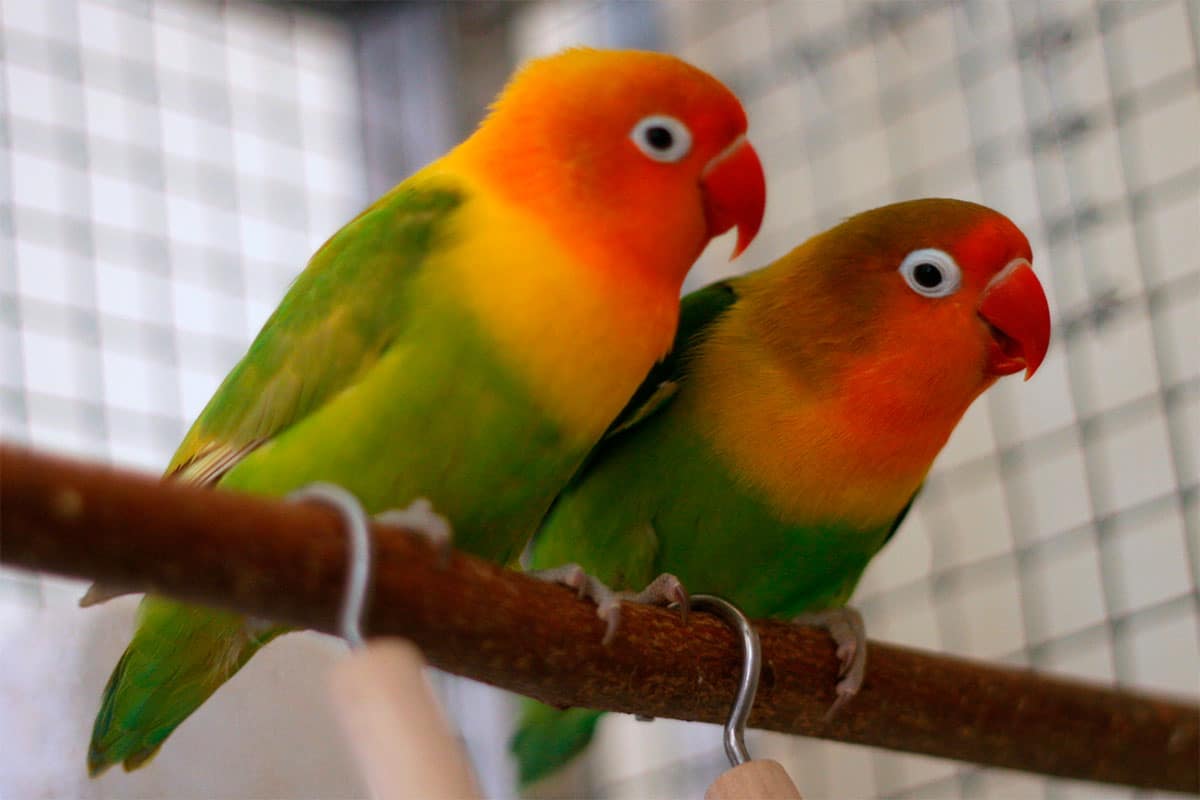
(2) – Two Fischer’s Lovebirds, (Agapornis fischeri). Pets on a perch By Peter Békési from Budapest, Hungary (IMG_2303) [CC BY 2.0], via Wikimedia Commons
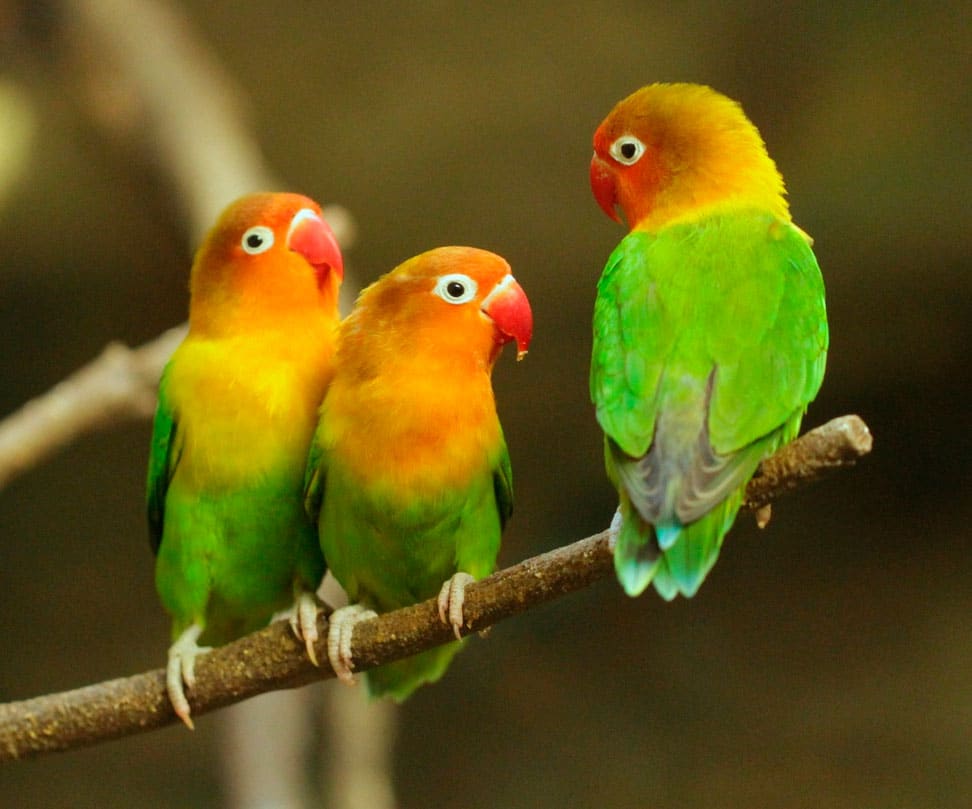
(3) – Three Fischer’s Lovebirds at Ueno Zoo, Japan By Agapornis_fischeri_-Ueno_Zoo,_Japan_-three-8a.jpg: Takashi Hososhima from Tokyo, Japanderivative work: Snowmanradio [CC BY-SA 2.0], via Wikimedia Commons
(4) – Fischer’s Lovebirds, Agapornis fischeri, social grooming By Peter Békési (originally posted to Flickr as IMG_0692) [CC BY-SA 2.0], via Wikimedia Commons
(5) – Fischer’s Lovebird perching on a branch in captivity By Françoise Walthéry from Bruxelles, Belgium (8_Buiten_reeks_8) [CC BY-SA 2.0], via Wikimedia Commons
(6) – Fischer’s Lovebirds at World of Birds Wildlife Sanctuary and Monkey Park in Cape Town, South Africa By Mara 1 (originally posted to Flickr as I Love You !) [CC BY 2.0], via Wikimedia Commons
(7) – Fischer’s Lovebird (Agapornis fischeri). Two on a branch By Lucia Smit (originally posted to Flickr as Sonny & Cher) [CC BY 2.0], via Wikimedia Commons
(8) – Fischer’s Lovebirds, Agapornis fischeri By Peter Békési (originally posted to Flickr as IMG_0736) [CC BY-SA 2.0], via Wikimedia Commons
(9) – A group of Fischer’s Lovebirds feeding at Ueno Zoo, Japan By kanegen (originally posted to Flickr as Ueno Zoo) [CC BY 2.0], via Wikimedia Commons
(10) – Fischer’s Lovebird, (Agapornis fischeri) perching on a box By Peter Békési (Flickr) [CC BY-SA 2.0], via Wikimedia Commons
– Sounds: Rory Nefdt (Xeno-canto)

Content |
|---|
30 cm. length and 110 g. of weight.
The Sulphur-breasted parakeet (Aratinga maculata) is pale orange, with the head and back of the neck pale yellow
. The throat and the chest are pale yellow, the the thighs are greenish; flanks pale orange, undertail-coverts greenish, the mantle pale greenish yellow; rump pale yellow orange, tail blue-green, wings green-yellow, underwing-coverts pale yellow. Close orange stripe on the front of the crown, in the lores and around eyes. Orbital ring pale grey. Iris dark gray / brown. Bill almost black.
The immature presumably as of adults, but with cheeks and top of the chest Yellow olive. (Observed one specimen).
taxonomy:
described in 2005 under the name of Aratinga pintoi, but later it was shown that the current name, It considered invalid for a long time, indeed it applies to this form, and therefore takes precedence; of holotype of Aratinga pintoi It has now been designated as neotype of Psittacus maculatus, which formally stabilizes synonymity. The species was misidentified as a juvenile of the Sun Parakeet (Aratinga solstitialis) or a hybrid between the latter and the Jandaya Parakeet (Aratinga jandaya); now generally recognized as a separate taxon, differing greatly reduced due to the orange-red in the face (where it forms an irregular mask), Breast and belly.
The species inhabits areas with large tracts of forest and Savannah adjacent (O’ Shea 2005, Mittermeier et to the. 2010). performs movements nomads.
It is similar in behavior and general ecology to the species of the group of the Aratinga solstitialis. Are in groups of 2-10 birds and they are relatively Meek, feeding along roads and orchards.
Not much is known about their breeding habits. One nest observed with an egg of unknown size.
Breeding season: August October
Feeds of fruit and seeds of Guateria sp., Dalechampia sp., Byrsonima sp. and Myrcia sp.
Extending its range (breeding/resident): 159.000 km2
The Sulphur-breasted parakeet (Aratinga maculata) (formerly pintoi; see Nemésio y Rasmussen 2009) It has a fragmented range in For and Amapá in Brazil, and at the southern end of Suriname (p. e.g.. Silveira et al. 2005, Mittermeier et to the. 2010, Vieira da Costa et al. 2011). After a three-day survey conducted in 2003, Silveira et al. (2005) They claim that Sulphur-breasted parakeet was quite common in Monte Alegre, For. in addition, in Suriname the species has been characterized as uncommon to fairly common (O’ Shea 2005, Mittermeier et to the. 2010).
• Current category of the Red List of the UICN: Least concern.
• Population trend: Growing.
• Population size : unknown.
Rationale for the Red List category
The trend of the population It seems to be increase, and therefore the species does not approach the thresholds for Vulnerable under the criteria of population trend (> 30% decrease in ten years or three generations). The population size has not been quantified, but it is not believed to approach the thresholds for Vulnerable under the criterion of population size (<10.000 individuos maduros con un descenso continuo estimado en >10% in ten years or three generations, or with a specific population structure). For these reasons, the species is evaluated as Least concern
Threats
The distribution area this species is affected by the deforestation, mainly driven by the expansion of agriculture as they build new roads; However, deforestation Brazil You may be benefiting this species and facilitating their spread to new areas (Vieira da Costa et al. 2011). Long-term, deforestation may become so rapid and extensive that the balance of extensive forest tracts and savannas required by the species will be exceeded and the species may begin to decline. Silveira et al. (2005) They claim that Monte Alegre, For, no obvious signs of a strong pressure entrapment. in addition, Mittermeier et to the. (2010) state that no hunting or capture of the species by Amerindians in the savannah was reported Sipaliwini of Suriname meridional.
virtually unknown; maintained by local people and zoos Brazil. It can live up 30 years in captivity.
– Sulfur-breasted Parakeet, Sulphur-breasted Parakeet (English).
– Conure de Pinto, Conure à poitrine soufrée (French).
– Schwefelbrustsittich (German).
– cacaué (Portuguese).
– Aratinga Pechisulfúrea (español).
– Order: Psittaciformes
– Family: Psittacidae
– Genus: Aratinga
– Scientific name: Aratinga maculata
– Citation: (Statius Müller, 1776)
Sources:
– Avibase
– Parrots of the World – Forshaw Joseph M
– Parrots A Guide to the Parrots of the World – Tony Juniper & Mike Parr
– Birdlife
– World Parrot Trust
– Photos:
(1) – Aratinga maculata by Sidnei Dantas – Flickr
(2) – alexanderlees, IBC1058449. Accessible at hbw.com/ibc/1058449
– Sounds: Thiago V. V. Costa, XC57522. accessible www.xeno-canto.org/57522

Content
|
|---|
Of 35 cm.. height and a weight between 400 and 500 g..
The Mascarene parrot † (Mascarinus mascarin) It was a bird dark grayish brown on top, lighter at the bottom; the the tail feathers They were brown with white bases; head lavender gray; lores and area around the bill black. had the bill bright red. The legs They were reddish brown and eyes red.
taxonomy:
A genetic study of 2011 He placed the Mascarene Parrot of Meeting between subspecies of Black Parrot (Coracopsis nigra) of Madagascar and nearby islands, and therefore would not be related to the parrots of Psittacula as believed. It was found that the lineage of Mascarene Parrot It separated made between 4,6 and 9 millions of years, before the formation of the isla Meeting, indicating that it must have happened somewhere else
Nothing is known, although it is likely to be distributed in uninhabited forests where feed on fruits and nuts.
No data.
Probably fruits and nuts.
The Mascarene Parrot It was described by many early travelers to Reunion Island (in France), with several captive birds sent to France at the end of the 18th century.
The last accounts of wild birds were from the 1980s. 1770, and the birds were not mentioned by Bory a 1804, so the species may well have been extinct in the wild by then. captive birds in Paris they would also have died at that time, but one bird survived in the collection of birds king Bavaria at least 1834 (checks 1987). Two specimens survive today (Forshaw and Cooper 1989)
• Current category of the Red List of the UICN: Extinct.
• Population size : There are none.
Rationale for the Red List category
This species was known from the Réunion, but it has been extinguished by the hunting pressure. The last record of wild birds dates from 1775, and none was observed on a visit in 1804.
Justification of the population
There are none.
Threats
It is likely to have been hunted to extinction.
Several captive birds sent to France at the end of the 18th century.
– Mascarene Parrot, Mascarine Parrot (English).
– Mascarin de la Réunion, Mascarin malgache (French).
– Maskarenenpapagei, Maskarenen-Papagei (German).
– Papagaio-das-mascarenas (Portuguese).
– Loro de las Mascareñas, Loro Mascarín (español).
– Order: Psittaciformes
– Family: Psittaculidae
– Genus: Mascarinus
– Scientific name: Mascarinus mascarin
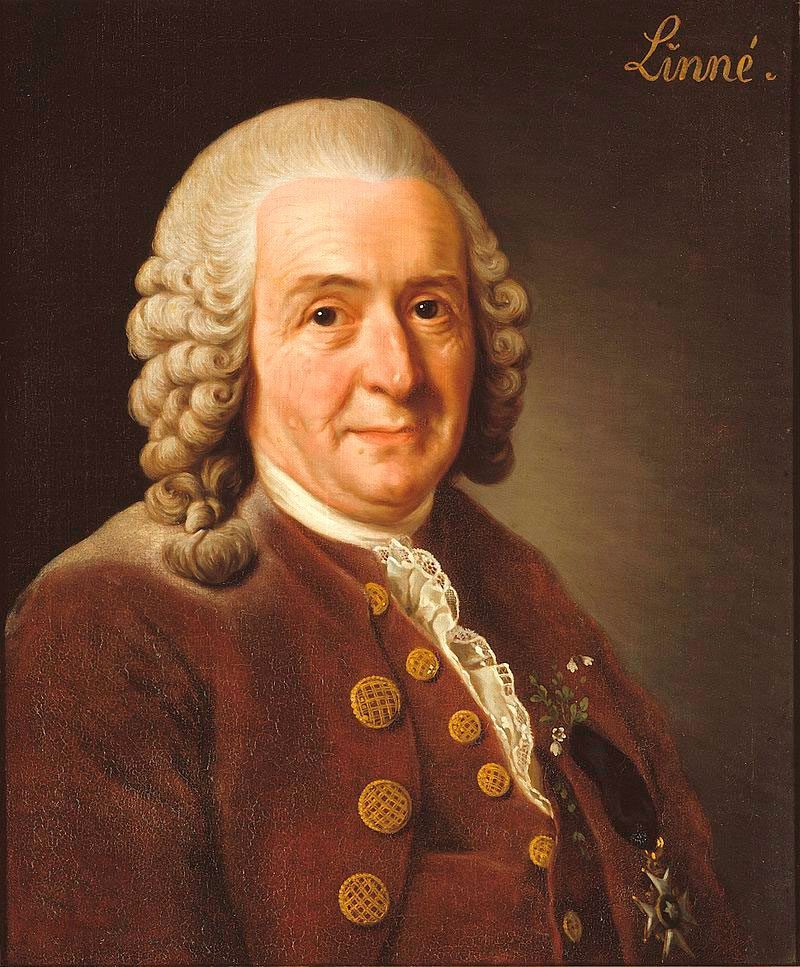
– Citation: (Linnaeus, 1771)
– Protonimo: Psittacus mascarin.
Sources:
Avibase
Parrots of the World – Forshaw Joseph M
Parrots A Guide to the Parrots of the World – Tony Juniper & Mike Parr
Birdlife
Wikipedia
Photos:
(1) – The Mascarene Parrot (Mascarinus mascarinus) by John Gerrard Keulemans [Public domain], via Wikimedia Commons

Content
|
|---|
35-40 cm. length and 132-153 g. of weight.
The Seychelles Black Parrot (Coracopsis barklyi) They have a pale brown, less black than the plumage Black Parrot (Coracopsis nigra), but gray / blue reflections in the outer layers of the primary feathers; pale brown patches with slight pale streaks on the crown.
The tone becomes slightly paler in uppertail-coverts.
The underparts They are pale grayish brown. We can see some short lines in throat, while the chest and the belly show a diffuse pale obstruction. The tail is pale-grey.
The bill dark gray becomes paler during the breeding season. The eyes are dark brown, surrounded by a naked orbital gray area. Legs and feet are dark gray to bluish gray.
Both sexes are very similar.
Youth colorization:
Immature paler than adults with a yellowish tinge bill and tips of the feathers tail with pale gray.
Taxonomic status:
Formerly a subspecies of Black Parrot (Coracopsis nigra), originating from Madagascar. Parrots Gender Coracopsis only found in the Western Indian Ocean.
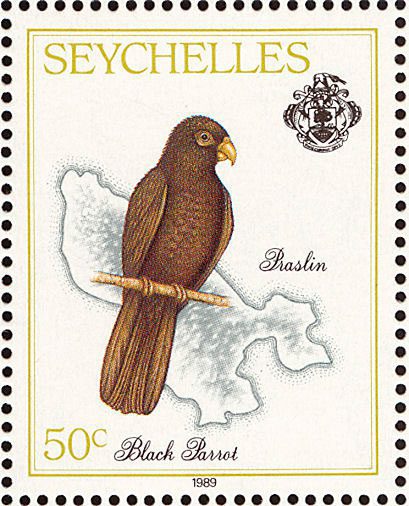
The Seychelles Black Parrot (Coracopsis barklyi) inhabits native and mixed woodland in Praslin, (Rocamora and Laboudallon 2013, A. Reuleaux y N. Bunbury a slightly. 2016). It is also found in cultivated areas and residential areas with gardens, habitats that are suitable feed (A. Reuleaux y N. Bunbury a slightly. 2016). They are usually seen alone or in pairs.
Their main breeding areas They are in a forest dominated by endemic palms coco de mer (Lodoicea maldivica). The tree species nests in cavities primarily in mer coconut dead, but also registered that nests in cavities and other palms living trees broadleaf (Reuleaux et al. 2014to), with reproductive activity October to March (Rocamora and Laboudallon 2013, Reuleaux et al. 2014to). Preferred deep cavities of hollow logs of L. maldivica with a dense cover canopy over the entrance (Reuleaux et al. 2014to). The reproductive activity fluctuates widely between years (A. Reuleaux y N. Bunbury a slightly. 2016). In a study, the 53% of nests they were successful in 36 nesting attempts, with a 57% incipient year survival (Reuleaux et al. 2014to).
The Seychelles Black Parrot It feeds on a variety of plant species, most of which are endemic and native (Reuleaux et al. 2014b), mainly from the fruit pulp, seeds and buds, with occasional observations feeding on leaves, flowers, crusts and scale insects (Reuleaux et al. 2014b).
Extending its range (breeding/resident): 70 km2
The Seychelles Black Parrot (Coracopsis barklyi) reside in Praslin, with occasional records in Curieuse (to 1 km to the North of Praslin), Seychelles (Reuleaux et al. 2013).
No individual was detected in curious during spot counts over four days and during supplementary fieldwork, so it is assumed that there is no resident population there (Reuleaux et al. 2013).
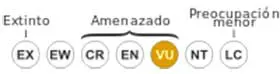
• Current category of the Red List of the UICN: Vulnerable.
• Population trend: Stable.
• Population size : 340-600 individuals.
Rationale for the Red List category
This newly divided species is listed as Vulnerable because, but it appears to be stable or possibly increasing, their population is still very small, and therefore it is at risk of stochastic events and human impacts.
Justification of the population
Count surveys conducted in Praslin points in 2010 and 2011 They found a density of 0.14-0.24 individuals / ha, as resultadi giving an estimate of the Total population 520-900 individuals (confidence intervals 95%) obtained through the distance sampling methodology (Reuleaux et al. 2013). After reviewing recent survey results, Rocamora and Laboudallon (2013) estimated total breeding population less than 200 couples, suggesting that there might be less than 400 mature individuals. Based on these data, it is assumed that there 340-600 mature individuals in the population.
Justification trend
They suspected that the population is stable the absence of evidence of any reduction or immediate threat. It is believed that the species has increased at least until the beginning of the century, but it is not clear if it is still increasing (Reuleaux et al. 2013, Rocamora and Laboudallon 2013).
This species is protected by law from 1966. No copy of Seychelles Black Parrot should be kept in captivity, unless it was under a controlled breeding program in order to reintroduce birds of this species to their habitat.
– Seychelles Black Parrot, Seychelles Lesser Vasa Parrot, Seychelles Parrot (English).
– Vasa des Seychelles, Vaza des Seychelles (French).
– Seychellenpapagei (German).
– Seychelles Black Parrot (Portuguese).
– Loro de Seychelles (español).
– Order: Psittaciformes
– Family: Psittaculidae
– Genus: Coracopsis
– Scientific name: Coracopsis barklyi
– Citation: Newton, E, 1867
– Protonimo: Coracopsis barklyi
Sources:
Avibase
Parrots of the World – Forshaw Joseph M
Parrots A Guide to the Parrots of the World – Tony Juniper & Mike Parr
Birdlife
Photos:
(1) – Coracopsis barklyi (=Coracopsis nigra barklyi) by Joseph Wolf [Public domain], via Wikimedia Commons
(2) – Coracopsis barklyi By Post of Seychelles ([1]) [Public domain], via Wikimedia Commons

Content |
|---|
Approximately from 36 cm.. of length and a weight of 150 g.
The Golden-plumed Parakeet (Leptosittaca branickii) has the crown, most of the forecrown, the cheeks, the sides of neck and ear-coverts grass-green; close frontal band on bottom of the forecrown orange, extending towards the upper lores; a feature yellowish stripe at the lower lores extending below the eyes to then join in a loop of yellow the part located behind the eyeball.
Upperparts green. above the wings green. Underwing-coverts greenish yellow; underside of feathers opaque yellow flight.

The underparts green, slightly more yellow than the upper, with a large yellow and orange patch at the bottom of the chest.
Upper, the tail of color green with red off on them vane inner; below its long and acute tail opaque reddish.
The bill color horn; cere grey; bare orbital skin pale whitish-grey; Orange the irises; legs grey.
Both sexes similar. The immature not described.
NOTE: Some authors include the species within the genus Aratinga. But, the facial feathers they are distinctive and monotypic, so the gender Leptosittaca is justified for this species.
Video – "Golden-plumed Parakeet" (Leptosittaca branickii) |
|---|
These birds are found in high altitude formations, between 2,400 and 3.400 m, Sometimes you can see them at altitudes lower, about 1.400 m. With distributed in temperate zones, stunted forests, cloud and tree growth limits. Sometimes they cross cleared areas to visit residual plots.
Its distribution is possibly linked to the trees Podocarpus, at least in the Azuay province and parts of Colombia, Although more studies are needed to confirm this.
The Golden-plumed Parakeet make altitudinal movements day towards the Moors, returning to the lower forests for sleep; in the Puracé national natural park This pattern is reversed, and birds perch on community in paramo areas (above 3.000 m), descending to feed during the day.
In general, in flocks (at least outside of breeding season) of up 20 birds (sometimes more).
The Golden-plumed Parakeet nests on trunks of Palm wax (Ceroxylon quinduense) and encenillo (Weinmania sp.). Played during the first half of the year. Birds in breeding conditions during the month of February, Colombia, and birds mating in August, Ecuador.
The female lays 2-3 eggs they are incubated both during 28 to 32 days. Only the female incubates during the day., while at night, both dealt with the work. The chicks leave the nest 64-68 days after birth and are fed by both parents, While they are in the nest.
They feed on coniferous seeds, especially of cones of Podocarpus, as well as the seeds and fruits of some plants, among them included the Rosacea, Elaeocarpaceae, Lauraceae, Brunelliaceae, Loranthaceae, Moraceae, Croton, Styrax subargentea, otodectes nitida, Ficus and the corn cultivated. Sometimes it can be powered from leaves.
It forages generally in the canopy (birds frequently moving among the trees), sometimes in the layer of shrubs and fields.
The natural habitat of the Golden-plumed Parakeet It is discontinuous and runs from the North of the Andes from Colombia to the South of Peru.
The species is known in three areas of the Colombian Andes:
In West Cerro Munchique and at the borders of Tolima, Risaralda, Quindio and Caldas; in the Center from the North of Caldas until Cauca, including the Volcano Puracé; in the East, to the East of Nariño.
It has been reported from six or seven areas in Ecuador, including the province of Imbaburato in the North and the mountains of Chilla on The Oro Province, high mountains in the Azuay province and Morona Santiago province, as well as various locations in the Loja province in the South.
In Peru are distributed from the Amazonas Department and South of Departments of Cajamarca through Department of San Martin, Freedom, Department of Huánuco and Junin Department until Guzco.
Seasonal and nomadic, unusual and very local, especially in Colombia, in where the drastic decrease of birds is due to the deforestation; in Ecuador It scarce, possibly more common in the southeast, but absent in apparently suitable habitats in the Eastern Andes. In Peru, where is deforestation less severe, It may be more widespread. Your local observation is unpredictable and may be linked to the fructification of your favorite plants.
They are observed (Although perhaps non-resident) in many protected areas, including the Puracé national natural park in the center of the Andes of Colombia, the Podocarpus national park in the South of Ecuador and the Manu National Park, Peru.
VULNERABLE.
State of conservation ⓘ |
||
|---|---|---|
|
Vulnerable ⓘ (UICN)ⓘ
| ||
• Red List category of the UICN current: Vulnerable
•Population trend: Decreasing
You suspect a rapid descent and ongoing in the population of the Aratinga of brushes based on the destruction, degradation and fragmentation of their habitat to large scale.
Currently its population It is estimated within a range between 1.500 and 7.000 mature individuals.
The habitat loss and fragmentation It has been significant throughout its range, with between the 90% and the 93% lost mountain forests in Colombia. In the Peru the loss of habitat is less (Salaman et to the. 1999b, PGW Salaman in litt., 1999).
Logging of the Quindio wax Palm for the services of the Palm Sunday It is a serious problem in some parts of Ecuador. (1999b Salaman et to the.).
The road construction is continuous through many areas of dwarf and humid forests in Peru, causing a severe loss of habitat in areas such as Málaga (H. Lloyd in litt., 2007).
In Colombia, are persecuted as corn pests and as pet birds (1999b Salaman et to the.).
Many protected areas they are affected by the burning and grazing Moor, settlements, cleared for agriculture, logging, Narcotics and the extraction of gold (Wege and Long 1995, Salaman et to the., 1999b).
Very rare in captivity, Some examples in Colombia.
– Golden-plumed Parakeet, Branicki’s Conure, Golden Plumed Conure, Golden plumed Parakeet, Golden-plumed Conure, Golden-plumed Parrot (English).
– Conure à pinceaux d’or, Perriche à pinceaux d’or, Perruche à pinceaux d’or (French).
– Pinselsittich, Pinsel-Sittich (German).
– Papagaio-de-bochechas-douradas (Portuguese).
– Aratinga de Pinceles, Cotorra Moteada, Perico Paramuno, Catanica de páramo (español).
– Loro paramuno, Perico Paramuno (Colombia).
– Perico de Mejilla Dorada (Peru).
– Perico cachetidorado, Cotorra moteada o Loro de mejillas doradas (Ecuador).

– Order: Psittaciformes
– Family: Psittacidae
– Genus: Leptosittaca
– Scientific name: Leptosittaca branickii
– Citation: von Berlepsch & Stolzmann, 1894
– Protonimo: Leptosittaca branickii


Sources:
– Avibase
– Parrots of the World – Forshaw Joseph M
– Parrots A Guide to the Parrots of the World – Tony Juniper & Mike Parr
– Birdlife
– Parrot Book, Parrots and macaws
– Photos:
(1) – Golden-plumed Parakeet in Tapichalaca Reserve, Ecuador By markaharper1 [CC BY-SA 2.0], via Wikimedia Commons
(2) – Leptosittaca branickii – Golden-plumed Parakeet by ProAves Colombia – Flickr
(3) – GOLDEN-PLUMED PARAKEET by Bryant Olsen – Flickr
(4) – GOLDEN-PLUMED PARAKEET by Bryant Olsen – Flickr
(5) – Leptosittaca branickii – Golden-plumed Parakeet by © Carl Downing – NeotropicalBirds
(6) – Leptopsittaca branickii via Wikimedia Commons
– Sounds: (Xeno-canto)
Content |
|---|
Of a length between 32-37 cm.. and a weight between 120-141 g..
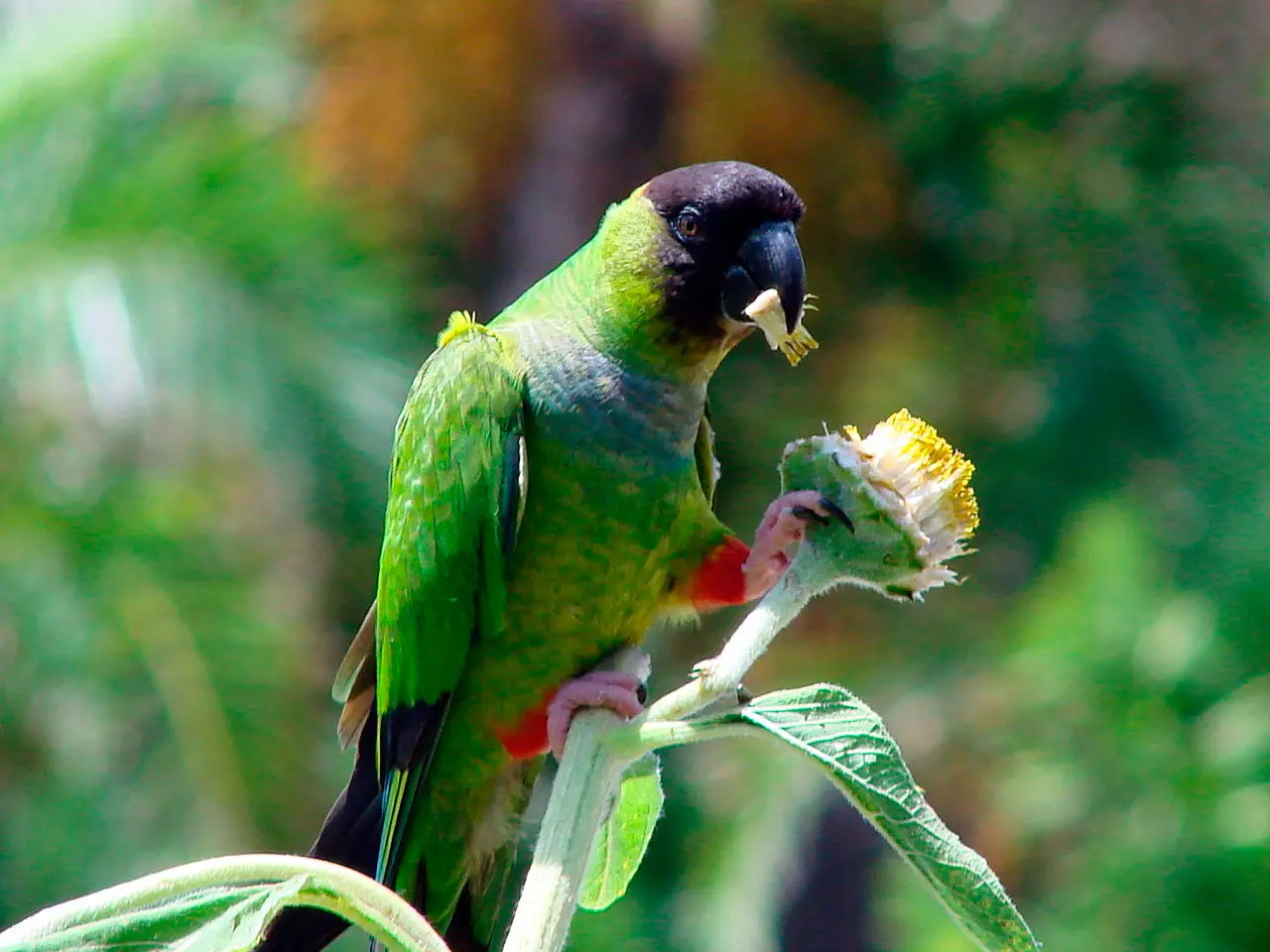
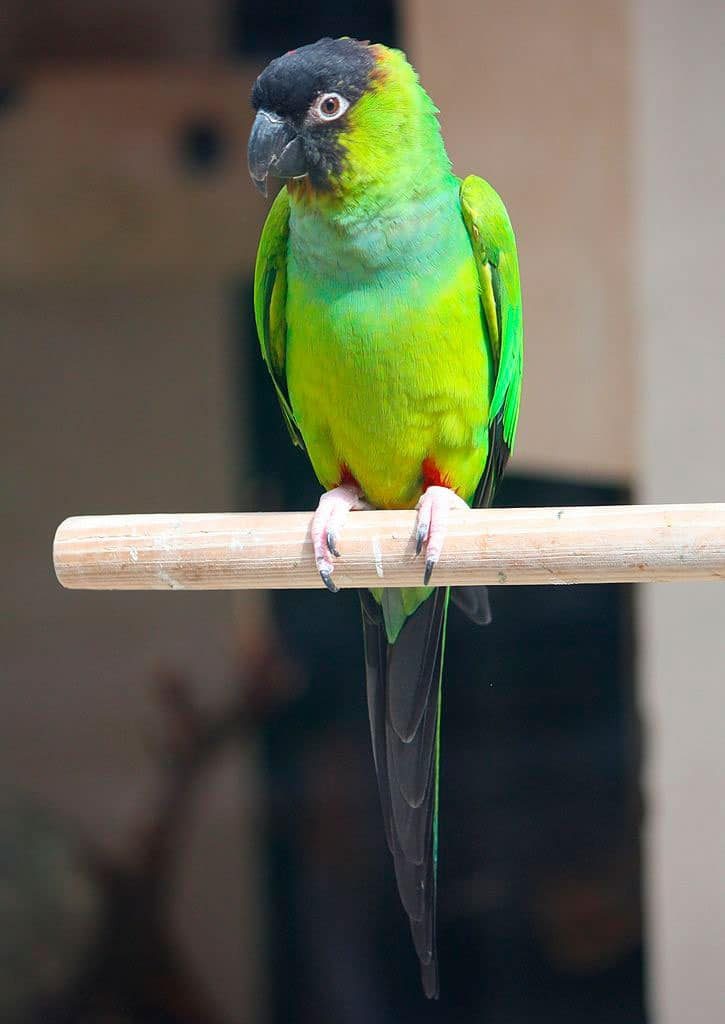
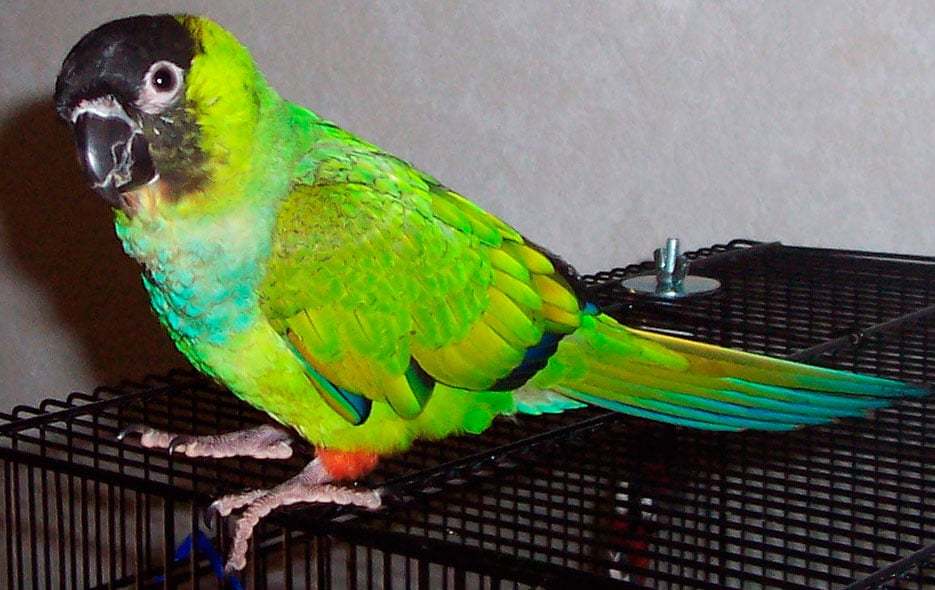
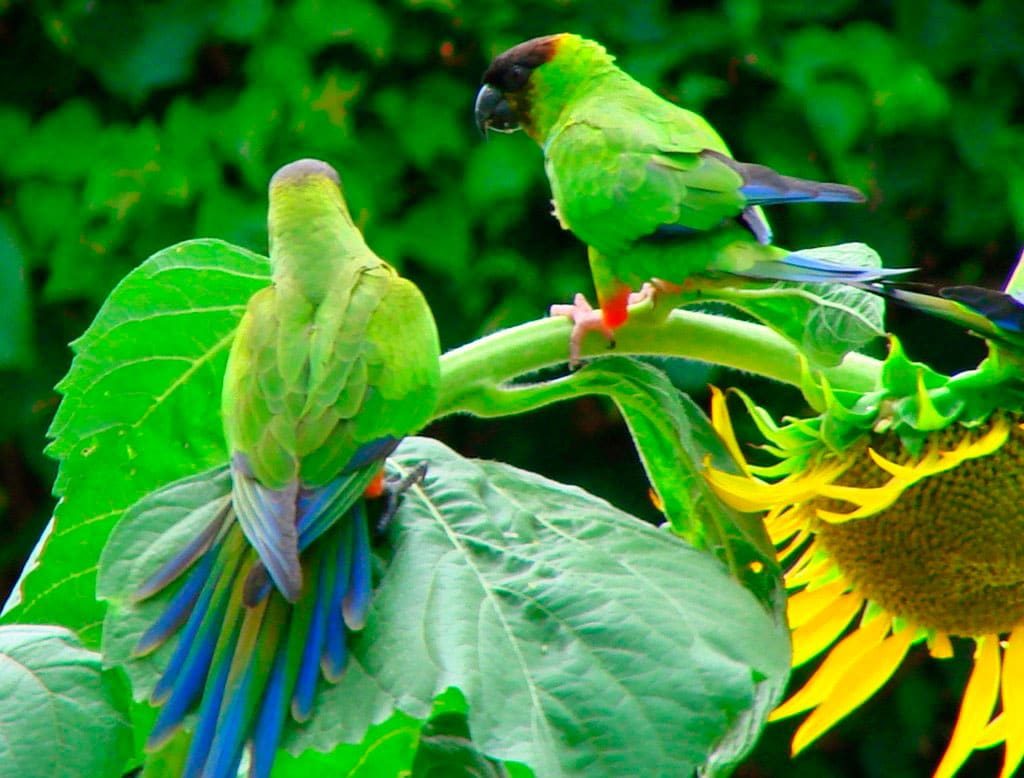
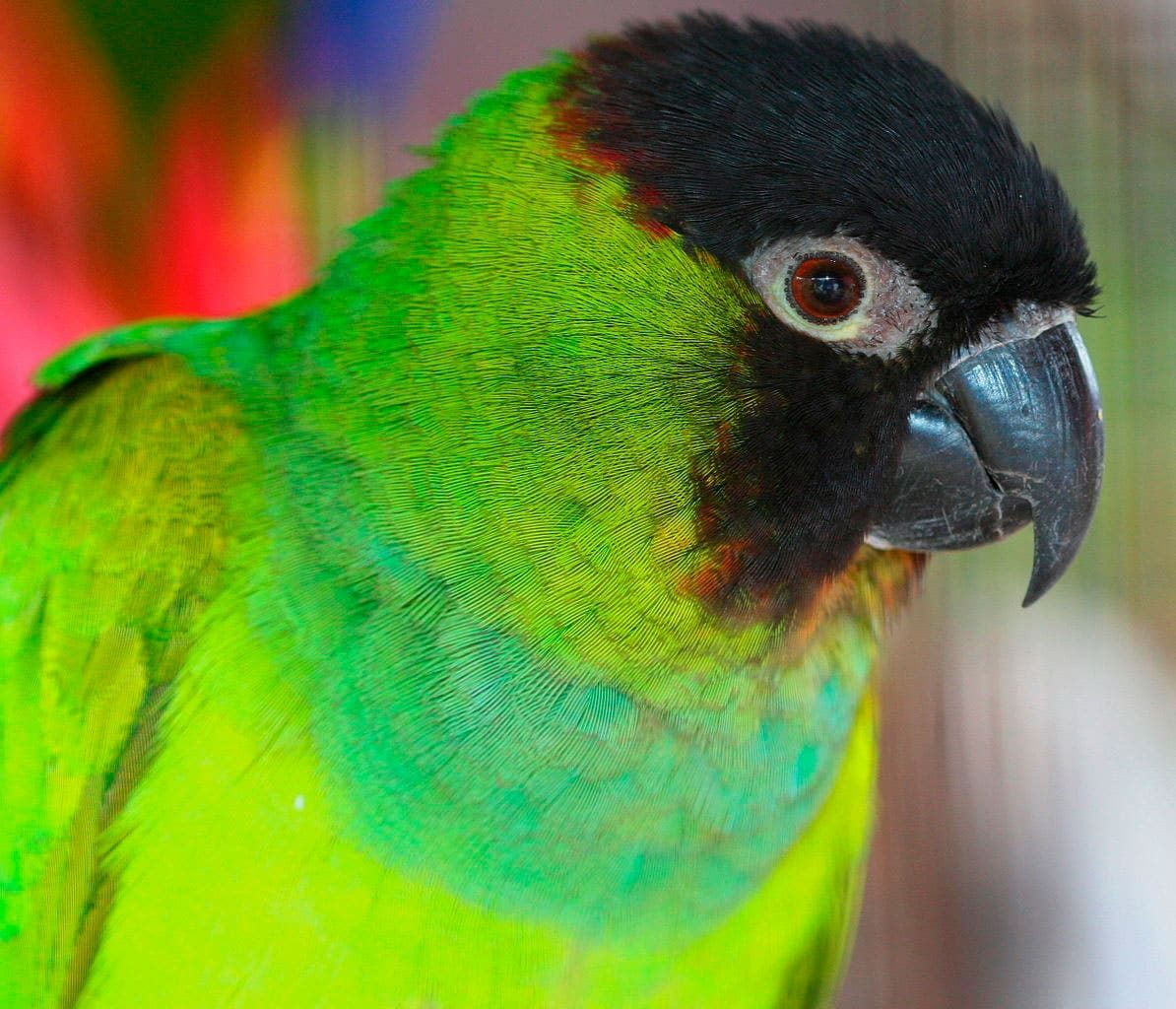
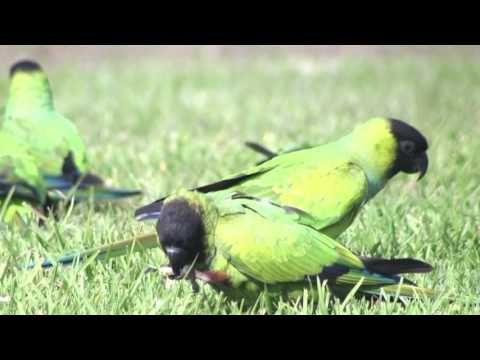
The Nanday parakeet (Aratinga nenday) has the forecrown, crown, lores previous and most of the cheeks tiznadas black: both sides of the neck and ear-coverts pale yellowish green; some feathers Brown or reddish in the margins of the pileum black; the nape grass-green. Mantle and back pale green faded yellowish-green in the rump and uppertail-coverts.
Scapulars mostly green, Although some medium-sized pens are dark blue in the vane inner; under wing-coverts mostly green, with the exception of the primary coverts that are blue. The flight feather dark blue above with vane outer paler in some primaries; then color between Brown and pale black.

Most of the underwing-coverts pale yellowish green. Throat pale yellowish green with shades of pale blue at the top of the chest; underparts remaining of pale yellowish green color, except the the thighs Red and some blue feathers in undertail-coverts.
Upper, the tail reddish brown, distal blue; undertail, dull brown.
The bill black; bare periophthalmic pale grey: the irises reddish brown; legs Pink.
Both sexes similar.
The immature It has less blue on the top of the chest and throat.
Video – "Nanday parakeet" (Aratinga nenday) |
|---|
The Nanday parakeet they live in open lowland some 800 m, including the Humid or Eastern Chaco (a report on the dry Chaco in Bolivia), wetlands and livestock areas with palms. In the Humid or Eastern Chaco and lower basin of the the Paraguay River they prefer areas with fan palm trees – Copernicia, growing in the seasonal flood plains with xerophytic vegetation drought related, and observed in areas of swamps with Palm trees in the Santa Cruz Department, Bolivia.
Gregaria, with flocks of up to a dozen birds during the breeding season; often several hundred birds congregate at roosts.
Nest in holes of Palmas, trees or fence posts, for example, of cattle pens.
The breeding season in November in Mato Grosso. The laying is of 3-4 eggs. after breeding to their young, all birds build large communal roosts until the next breeding season.
Diet Nanday parakeet includes the Palm fruits Copernicia, sometimes taken in the ground.
They can cause damage to the crops, for example, corn.
Often seen in water wells.
Size of the area of distribution (reproduction / resident): 260.000 km2
This species is native from South America from the southeast of Bolivia to the southwest of Brazil, the center of Paraguay and North of Argentina, of the region known as the Pantanal.
The species is found in a band of approximately 200 km from East to West, focusing on the wetlands of the upper basin of the Paraguay River, in the East of the Santa Cruz Department, Southeast Bolivia, South-West of Mato Grosso and West Mato Grosso from the South in Brazil, to the South, by the middle of Paraguay up to the Chaco province, Formosa province and North of Province of Santa Fe in Argentina (occasional in Province of Misiones and Province of Corrientes). A report of the Province of Santiago del Estero is probably wrong.
There are several wild populations in Buenos Aires and California. You can wander, outside the breeding season, the area inside of Central Chaco.
In general locally abundant and common, especially in areas where their favorite plants concentrate. In Argentina they are more numerous in the Formosa province, and is the most common parrot in some parts of Mato Grosso.
Trapped for the bird trade, with more than 114.000 individuals exported from Argentina in the years between 1985-1990, Although many of these birds is probably came from Paraguay.
Note:
Copies released observed in the Canary Islands (Spain), in particular in the South of Tenerife and Fuerteventura, sometimes confused with the Rose-ringed Parakeet. It transpires that the species has been reproduced, In addition, in Andalusia, Catalonia. It has also been observed in points of Madrid, Basque Country and Valencia (Spain).
You escape to the South of Portugal.
Copies also introduced at different points of North America and in Asia.
• Red List category of the UICN current: Least concern
• Population trend: Growing
Global population size has not been quantified, but this species is described as «quite common» (Stotz et to the., 1996).
The species has undergone intense trade: from 1981, When it was included in the Appendix II, 267,246 individuals caught in the wild were recorded in international trade (UNEP-WCMC trade database CITES, January 2005).
Thousands are legally exported from Argentina.
Very common in captivity.
In captivity they are wonderful pets if care and properly socialized. They all have distinct personalities and appreciate the toys that are provided with. They like to be out of their cage for at least six hours a day..
These birds are escape artists, extremely intelligent and skilful. Some of them speak, others do not, Depending on your personality. They are characterized by having a very strong call and they are not suitable for apartments.
They are birds they reproduce quite easily in spacious accommodations and Cologne. Son, usually, good parents.
There are places, as Puerto Rico, that its possession is illegal.
They can live between 35 and 45 years.
– Nanday Parakeet, Black-headed Parakeet, Black-hooded Conure, Black-hooded Parakeet, Black-masked Parakeet, Nanday Conure (English).
– Conure nanday, Perriche nanday, Perruche à tête noire, Perruche nanday (French).
– Nandaysittich, Nanday Sittich (German).
– jandaia-de-cabeça-negra, maracanã, nendai, periquito-de-cabeça-preta, Periquito-de-cabeça-preta / Periquito-nandaí, Principe-negro, príncipe-negro (Portuguese).
– Aratinga Nanday, Aratinga Ñanday, Cotorra de Cabeza Negra, Loro Cabeza Negra, Nanday, Ñanday, Ñenday (español).
– Ñanday, Ñenday (Argentina).
– Ñanday (Guarani).
– Order: Psittaciformes
– Family: Psittacidae
– Genus: Aratinga
– Scientific name: Aratinga nenday
– Citation: (Vieillot, 1823)
– Protonimo: Psittacus nenday
Sources:
– Avibase
– Parrots of the World – Forshaw Joseph M
– Parrots A Guide to the Parrots of the World – Tony Juniper & Mike Parr
– Birdlife
– Parrot Book, Parrots and macaws
– Photos:
(1) – Feral Nanday Parakeet (also known as the Black-hooded Parakeet or Nanday Conure) eating sunflower seeds in a garden in Sarasota, Florida, USA By Apix (Picasa Web Albums) [CC BY-SA 3.0], via Wikimedia Commons
(2) – Feral Nanday Parakeets (also known as the Black-hooded Parakeet or Nanday Conure) eating sunflower seeds in a garden in Sarasota, Florida, USA By Apix (Picasa Web Albums) [CC BY-SA 3.0], via Wikimedia Commons
(3) – Nanday Parakeet By J. Patrick Fischer (Own work) [GFDL or CC BY 3.0], via Wikimedia Commons
(4) – A pet Black-hooded Parakeet (also known as the Nanday Parakeet and Nanday Conure) By MAULI (originally posted to Flickr as Little Big Mouth) [CC BY-SA 2.0], via Wikimedia Commons
(5) – A pet Nanday Conure, named Jack By Mceder at English Wikipedia (Transferred from en.wikipedia to Commons.) [Public domain], via Wikimedia Commons
(6) – digital illustration /digital illustration – dibuixosnatura
– Sounds: (Xeno-canto)



_-Guatemala-8-2c.jpg)
_-Guatemala-8b.jpg)


%3B_side_view_of_pet_IMG_2309.jpg)


_perching_on_a_box.jpg)


