The extinct parakeet of paradise(Psephotus pulcherrimus) was a small parrot (27-30 cm long) and rather distinctive, with scapulars red and long tail.
The male had one forecrown of bright red and a crown black; eye rings yellowish; ear-coverts and throat emerald green. The nape black merged with the dark brown on the neck and then into paler, earthy brown the mantle and back. The scapulars were bright red; the rump was turquoise; and tail top green-bronze and blue, merging into bluish-black. The under body comprised an chest and upper abdomen emerald green, merging into turquoise on the sides of neck and in the part inferior of the abdomen; the belly, the vent and flanks were bright red; and the under tail was bluish white. The upperwing was earthy brown, concolorous with the mantle and back; and the underwing was deep blue.
The female was less colorful, differing from the male by forecrown and face yellowish; a crown duller blackish-brown; throat and chest with brownish-orange suffusion; belly pale blue and coverts the lower abdomen, vent and under tail red on the fringes of some feathers. In both sexes bill was grayish; the eyes brown; and legs and feet were grayish brown.
The juveniles they looked like females.
taxonomy:
This taxon is considered a subspecies of Psephotellus [pulcherrimus or dissimilis] (sensu lato) by some authors
Habitat:
The parakeet of paradise lived mainly in rolling river valleys were lightly wooded with eucalyptus forests, or open forests often dominated by ironbarks and bloodwoods, with an understory of annual and perennial native grasses; these areas were often dotted with termite mounds.
Reproduction:
the details of the distribution areas or territories unknown parakeet of paradise, although it is believed that adults have remained in the same places nesting for many years.
Little is known of sexual maturity or life expectancy of this species. The reproduction It was recorded between September and March. Sunsets are placed three to five white eggs, with a pink tinge, in a nest chamber at the end of a tunnel dug into termite mounds.
Food:
There is little information on diet parakeet of paradise, however it was known to feed on the seeds of native grasses.
Distribution:
The parakeet of paradise He was present in eastern Australia, only he reported with certainty from southeast Queensland. Is likely to records in upstate been wrong. The species is also often said to have been found in New South Wales, but there has been no confirmed records (Olsen 2007). Era locally common although generally scarce in the nineteenth century (Forshaw and Cooper 1989), but then it declined rapidly and was thought to have become extinct as a result of the drought of 1902 until it was rediscovered in 1918 (Chisholm 1922). The last observation was confirmed in 1928. Some credible reports continued into the years 30 and 40 (Olsen 2007), but although Kiernan (1993) He claims to have seen five birds 1990, the species is now considered extinct(Necklace et to the. 1994).
Conservation:
• Current category of the Red List of the UICN: Extinct.
Its extinction was probably marked by reduced food supply due to drought and overgrazing (Olsen 2007). Also contributed frequency altered fires and propagation tunas (Joseph 1988), the disease, the trampeo and harvest of eggs (Garnett 1992), the predation of nests by introduced and native species (Chisholm 1922) and removal of eucalyptus by ringbarking (Kiernan 1993). After a significant reduction in the size of the population of the species, It seems that endogamia inhibited fertility of birds (Gerrard 2008).
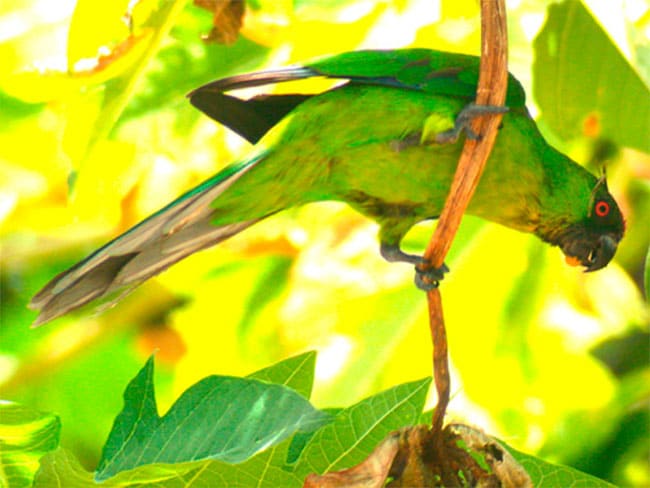
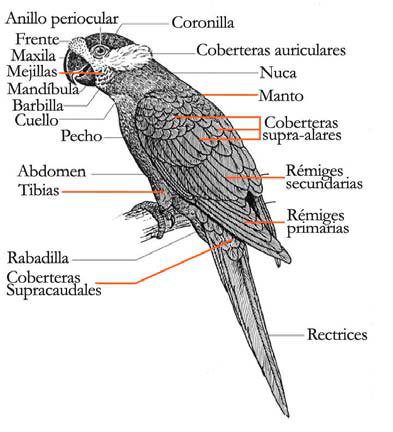
The Ouvea Parakeet(Eunymphicus uvaeensis) is similar to the Horned Parakeet(Eunymphicus cornutus) but with the face and nape green, no yellow, and crest upturned six pens greenish black: the Red of the crown It is limited to the center forecrown.
The Ouvea Parakeet generally bright mid-green. Head green, lighter on ear-coverts with some light shaft-streaks; centre of forecrown red with six wispy blackish-green uperwing feathers forming a small crest; rear-crown darker green; ears and cheeks dark green lower.
The upperparts light green, paler on rump. Wing coverts green; outerweb of primaries greenish-blue with innerwebs black. Underwing-coverts green. Underparts light yellowish-green. Uppertail green with a slight blue suffusion distally and blue edges to lateral feathers; undertail gray.
Bill blue-gray at base, blackish toward tip; irises orange; legs grey.
Both sexes similar.
Taxonomic status:
This taxon is considered a subspecies of Eunymphicus [cornutus or uvaeensis] (sensu lato) by some authors
Sound Uvea Parakeet.
Note:
some species, as in the case of Ouvea Parakeet, They are subject to extreme stress due to traps or harassment. The open availability of high-quality recordings of these species may make the problems even worse.. For this reason, transmission and download of these recordings is off. Recorders are free to share in xeno-edge, but they will have to approve access to these recordings.
We do not take this action lightly, and we wish it wasn't necessary, but we are convinced that the negative impacts of offering easy access to these recordings outweigh the benefits. To access these recordings, You can contact directly with the recorder.
Habitat:
It is restricted to areas of old growth forest with holes for nesting, but the highest numbers occur near papaya plantation areas.
The Ouvea Parakeet They are active in early morning and late afternoon, and usually rest in the trees during the heat of the day.
Reproduction:
An average of 2.9 Eggs are laid in one or two broods per year, of which 1.7 chicks hatch, but only 0.75 chicks survive to 30 days (Robinet et al. 1995, Robinet et al. 1996, Robinet and Salas 1999).
Food:
It feeds in the forests and crops of cultivated land adjacent. The Ouvea Parakeet It depends mainly on mature native forests with pines kauri Agathis australis.
Fruits of Ficus spp., there Canaria, scrub and passion fruit. Also forage for seeds. The cultivated papaya (Carica papaya) It is a favorite.
The species is found in isolated patches of forest now restricted to the coast, mainly in the district St Joseph between Cape Rossel and Cape Steep. Single 15-25 km2 of suitable habitat was considered to remain on the island in 1993, with about 70-90 birds present, although a more thorough study has suggested a total population of 617 individuals. More recent studies is estimated at 1.780 mature individuals in total (Theuerkauf s suffering. 2016)
In the past, the reduction of individuals to extensive conversion of forests for agriculture due, hunting and trade. The delicate political situation in Uvea, while Kanak Liberation Front struggle for independence France, It has hampered the work of conservation of the species.
It is relying on a captive breeding program based on Forest Park, about Noumea, in New Caledonia. Transfers from island to island also be considered feasible.
Conservation:
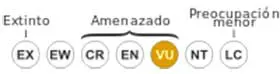
• Current category of the Red List of the UICN: Vulnerable.
• Population trend: Growing.
• Population size : 600-1800 individuals.
Rationale for the Red List category
This species is classified as Vulnerable because it is in one very small island and can be threatened by invasive species, in particular the Black rat, that could bring the species to the category of Critically Endangered or Extinct in no time.
Justification of the population
The population is estimated at 1.780 mature individuals in total (Theuerkauf s suffering. 2016), rounded here to 1.800 mature individuals.
Justification trend
Barré et al (2010) reported that the population has increased in a 29% (of 10 birds / km2 34 birds / km2) between 1993 and 2009, which equates to an increase in population 34% in three generations.
Conservation Actions Underway
1 – Appendix I and II of CITES.
2 – The Association for the Protection of Perico Ouvea (ASPO) It was created in 1993 with members mostly local.
3 – ASPO initiated a long-term study of the biology and ecology of the species as the basis for two recovery plans. (1997-2002 and 2003-2008).
4 – Forest loss is being addressed through awareness programs and community trials to mitigate habitat degradation and improve the quality of forests, particularly in regard to nesting sites.
5 – Ten guides are used, whom, among other tasks, nests located.
6 – Illegal trade is being addressed successfully through increased awareness and enforcement.
7 – A captive breeding program has been discussed, but it hasn't started yet, and the species is found only in small quantities in captivity for a very limited reproductive success (Tap 1996).
8 – In 1998 translocation program began to repopulate southern Ouvea, and the number of birds in the south was 395 individuals in 2011 (Theuerkauf s suffering. 2016).
9 – Black rats were trapped on the island (Theuerkauf s suffering. 2016) and predator control is important.
10 – In 2003 a recovery plan was drawn updated, in which it recommended, among other things, the translocation program was canceled, since the population is considered viable and grow naturally; this Recovery Plan has been accepted by the local indigenous authorities (N. Barré a slightly. 2003, Anon 2004).
11 – Ouvea has been classified as IBA, but a management plan and a protection program involving the communities have not yet been established (Spaggiari et al. 2007).
12 – SCO obtained funding from the British Bird Watching Fair to build and test artificial nests PCV after the failure of trails wooden nest.
13 – ASPO personnel destroyed or removed 187 bee colonies between 2002 and 2008 (L. Verfaille a slightly. 2007, Barré et al. 2010).
14 – The continued presence of local guides is believed to effectively prevent nest poaching. (Barré et al. 2010).
Conservation Actions Proposed
1 – Continue population monitoring (Primotel 2000).
4 – Review and strengthen measures to control predators.
5 – Assess progress and update plans for translocations.
6 – Review and update all aspects of the Action Plan.
7 – Maintaining the momentum of awareness and participation of the community and the island (Robinet and Salas 1997).
8 – Establish a project IBAs in Ouvea and fund a protection program (N. Barré a slightly. 2003).
9 – Start a captive breeding program to support future reintroductions.
10 – Carry out surveillance screening BFDV to guide future efforts biosecurity and conservation, and better understand the risk posed by BFDV (Jackson et al. 2014).
"Ouvea Parakeet" in captivity:
The Ouvea Parakeet they are still captured using a rope inside a fruit Upload papaya, and because the island is a plain, exports through an easily accessible atoll are difficult to control. Birds bought from trappers by 50 dollars can be sold by traders up 1.000 Australian dollars.
There is a captive breeding program, but it hasn't started yet, and the species is found only in small quantities in captivity for a very limited reproductive success (Tap 1996).
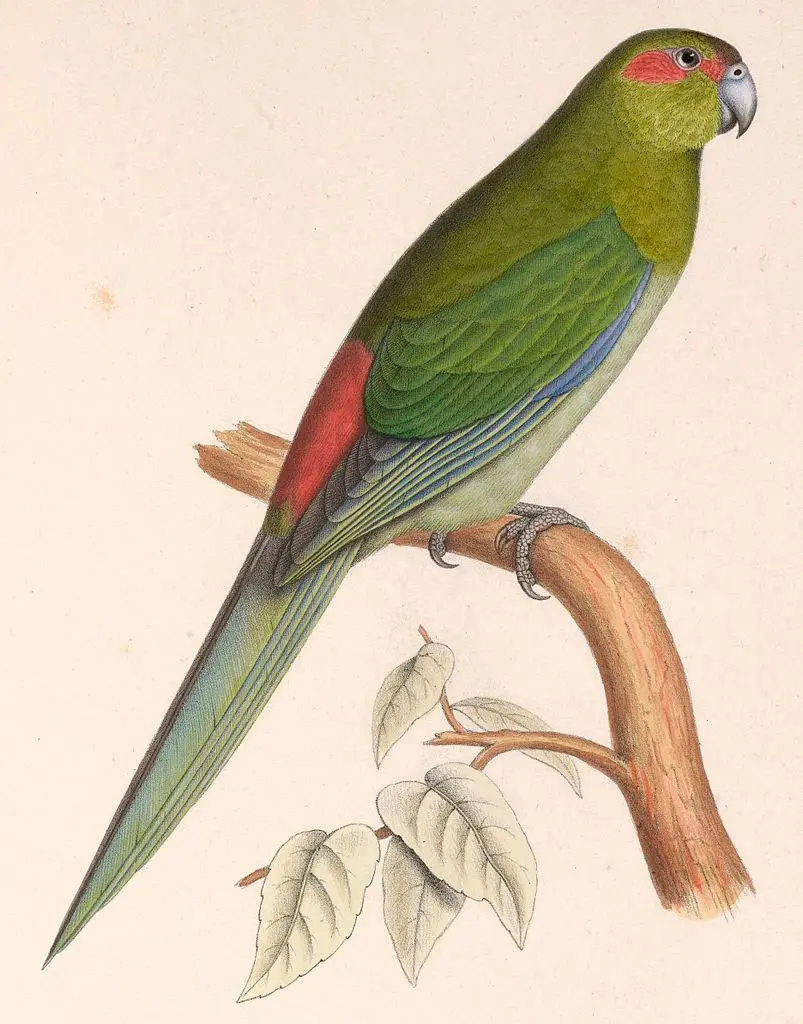
The Black-fronted Parakeet(Cyanoramphus zealandicus) They seemed to be very similar to the rest of the species of Cyanoramphus; They were olive green; the forecrown It was black; the lores (the regions between the eyes and the peak on the sides of the head of a bird) and stretches along the eyes They were red; the lower part of the back It was red; the uppertail-coverts red. the outerweb of the flight feather They were blue violet. The eye rings They were light blue. The adults probably had irises orange, while young birds had eyes dark or brown.
The legs They were brown and gray bill It was pale bluish gray with a blackish tip.
Habitat:
According to Des Murs (1845, 1849), Lt. M. J. Marolles shot three birds tahiti in 1844, in Port Phaeton, in the isthmus Taravao. The bird was rare at that time, and only he was in the isthmus and the mountains Tahiti-iti. Marolles saw only four or five individuals in total, and the locals told him that the parrots lived in large trees on inaccessible escarpments and deep valleys. It is not known nothing about it.
Reproduction:
No data
Food:
No data
Distribution:
The Black-fronted Parakeet they were from tahiti, on french polynesia. Three known specimens collected (two of which are now in Liverpool and one in Tring) collected on the trip Cook in 1773, a fourth collected by Amadis in 1842, now in Perpignan and a fifth collected by the Marolles in 1844, now in Paris(Voisin et al. 1995).
No specimen has been recorded since 1844.
Conservation:
• Current category of the Red List of the UICN: Extinct.
• Population trend: Extinct.
• Population size : There is no individual left.
Rationale for the Red List category
The frentinegro Perico were known tahiti, (french polynesia), but it has not been seen since 1844 and it is now regarded as a kindextinct. Possible causes include deforestation, the hunting and predation introduced species.
Hume y Walters suggest that because the Tahitians highly prized the green and red parrot feathers brought from Tonga, it is possible that excessive hunting in the past has been, at least in part, responsible for the disappearance of Black-fronted Parakeet.
Alternative names:
– Black fronted Parakeet, Black-fronted Parakeet, Black-Fronted Parrot, Tahiti Parakeet (English).
– Kakariki de Tahiti, Perruche de Tahiti (French).
– Schwarzstirnsittich, Tahiti-Laufsittich (German).
– Periquito-do-tahiti (Portuguese).
– Perico de Frente Negra, Perico frentinegro (español).
• Avibase
• Parrots of the World – Forshaw Joseph M
• Parrots A Guide to the Parrots of the World – Tony Juniper & Mike Parr
• Birdlife
Photos:
(1) – Iconographie ornithologique by Marc Athanase Perfect Carnation Walls (1804-1878) [Public domain], via Wikimedia Commons
(2) – Watercolour painting by George Forster annotated ‘Psittacus pacificus’. Made during Captain James Cook’s second voyage to explore the southern continent (1772-75). George Forster [Public domain], via Wikimedia Commons
▷ The world of Pets: Dogs, cats, birds, reptiles, amphibians
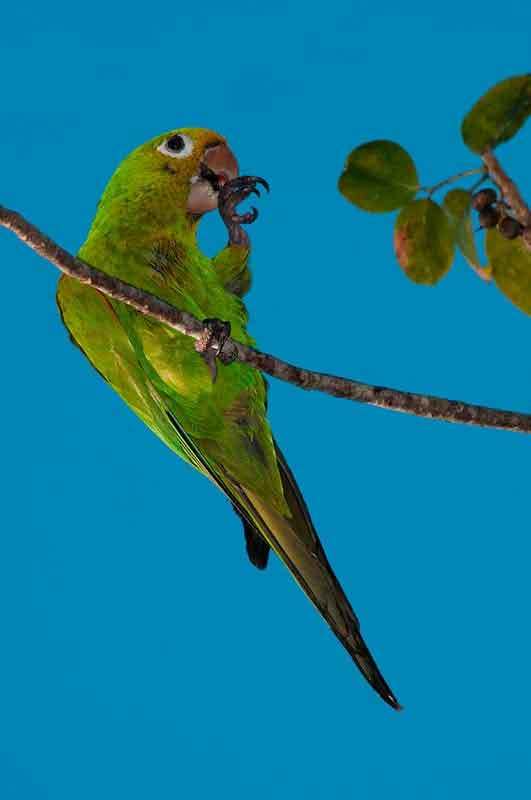
The bill of the Cuban Parakeet(Psittacara euops) is strong and hooked, presenting the capacity of both the upper and the lower mobility, enabling this psittacine to husk and crush seeds, fruits and nuts discarded by many other birds, thus showing another successful feature of this Psittacara.
Their legs they have a magnificent prehensile capacity that allows them to take incredible poses and hold on to extreme places thanks to a "zygodactyly" arrangement of the fingers by moving two fingers forward, the 2 and 3, and two backwards, the 1 and 4.
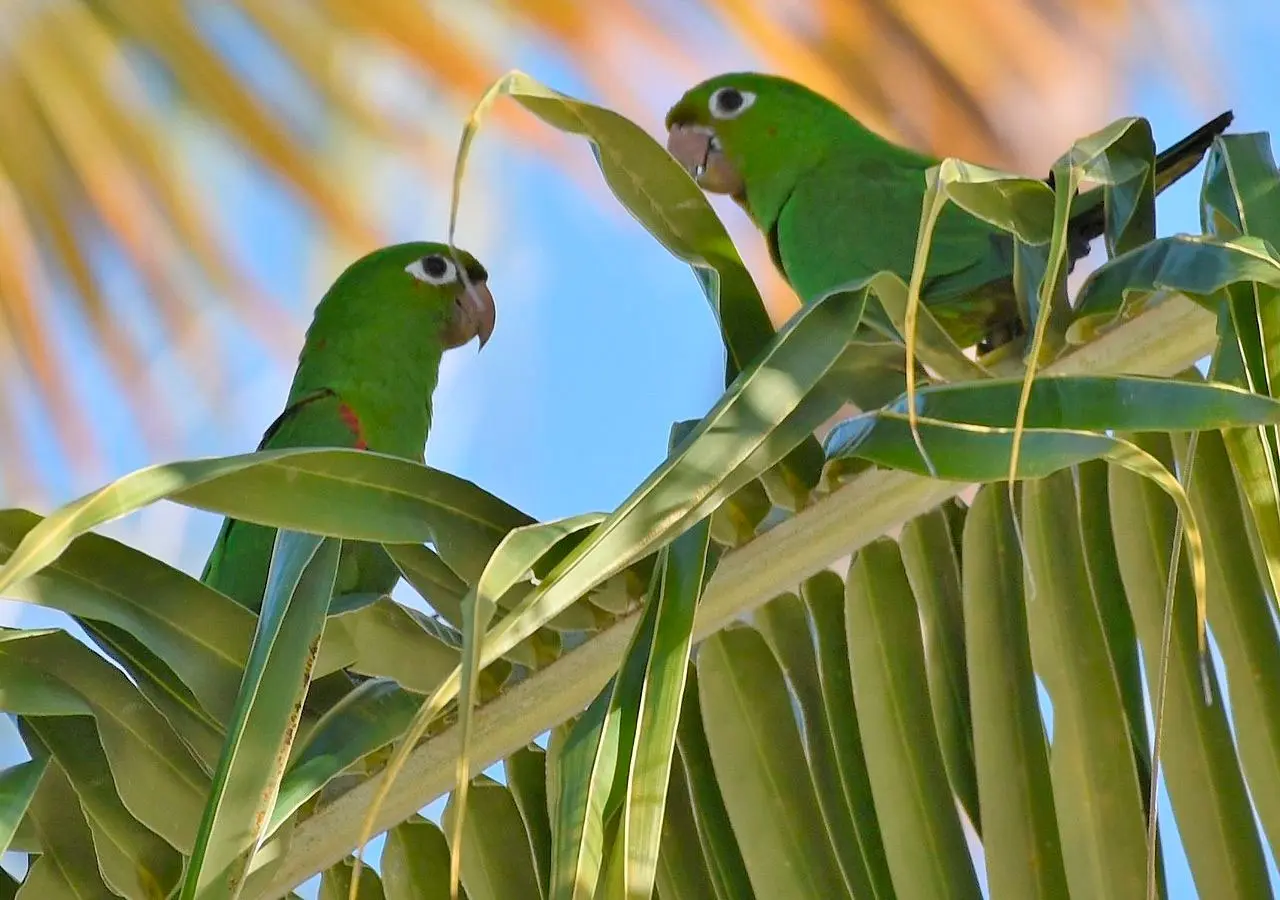
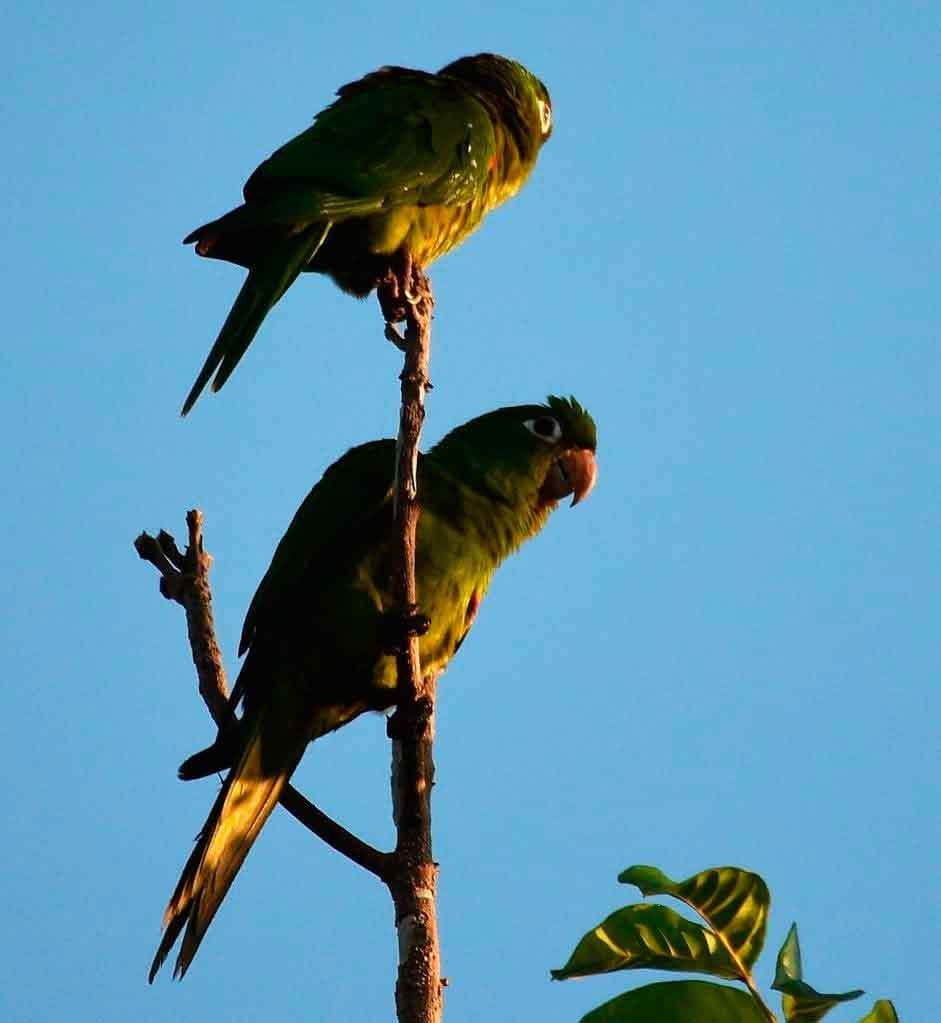
Has the head, sides neck and nape green grass with some red feathers scattered, sometimes forming patches. The upperparts and upperwing-coverts grass-green; primaries and secondaries with margins and dark green tips to vane inner; carpal edge with scattered red feathers and bend of wing red. Underwing-coverts with golden brown in the flight feather, small and medium-sized coverts Red and large coverts Yellow olive. The underparts yellowish green with diffusion of color olive, sometimes with scattered red feathers, especially in the throat and/or the thighs. Upper, the tail dark green color with dye olive; by down yellowish brown. The bill color Horn; bare periophthalmic bluish white; irises yellow; legs distant.
The female has more orange in the wings.
Immature has green and red in underwing-coverts, beige color (not red) in carpal edge, irises Gray with scattered red feathers.
They inhabit on Savannah, especially in areas where there are the PalmasCopernicus and Thrinax, at the edges of forests and Lands planted with trees. Although they have also been very modified habitats, such as eucalyptus forests in open field and fragments of forests of Evergreen in sheets of Palma. The species survives only near large extensions of primary forest.
In general, observed in family groups or small flocks, but sometimes in larger groups, hundreds of birds; the Cuban Parakeet, often, mix with the more common and endemic Cuban Parrot (Amazona leucocephala).
Reproduction:
One of the major problems of this kind in the reproduction, It is competition and the finding by the nesting cavities; This psittacine is a small, so their physical advantage over other birds to displace these from cavities or nests is less and they must show greater aggressiveness to be able to expel woodpeckers and even some small birds of prey These cavities that already occupy.
But, in recent studies, It is suggested that in free-living this species has a high degree of selectivity by the height of the Palma in which anidated or for the depth of the nest, still not evident during the stage of formation of couples and nesting strong signs of gregariousness, But if there could be a tendency to prefer nests with a sufficiently narrow entrance opening to enter the couple and hamper the penetration of predators. It also seems that the species in reproduction is more tolerant of other neighboring couples of the same species, than others parrots, but to some degree of alienation, preferring Palmas in which there is only one cavity to have a certain degree of privacy in the rearing of their chicks.
The breeding season It begins in April and usually ends in July. They sometimes build their nests in cavities excavated, originally, by the Cuban Green Woodpecker (Xiphidiopicus percussus).
The number of eggs in the implementation It, in averaged, between three and five. The incubation both members of the couple is done, as well as feeding the young until they leave the nest. Once abandoned the nest, You can see to the immature flying with parents in small camps before the winter season, forming major sides joining them different families.
Formerly persecuted by provoking large damage to crops Orange, coffee and corn.
Distribution:
Species vulnerable to extinction, from an original distribution throughout Cuba and Isle of youth, isolated populations between Yes.
Formerly one of the most common endemic birds in Cuba and in the Isle of youth, old Isle of pines, but now is limited to various strongholds in remote areas of Cuba, including the Zapata Peninsula, the districts around Cienfuegos and the mountains around the city of Trinidad, to the extent Western Centre of the island, and Sierra Maestra at the end of this.
Resident but some seasonal movements (Perhaps altitude) supposedly by the decline of the birds of the mountains of Trinidadin the months of September and October.
Extinct in the Isle of youth from 1913, mainly due to the strong capture for export as bird cage.
The current population, Although comparatively small, Perhaps stable. A small number of captivity out of Cuba, especially in Eastern Europe. The international trade currently it is small.
Today this species is restricted to 16 populations considering that a total of 2800 individuals released, with a number of individuals per population not exceeding, usually, the 100 copies and is considered of greater size the located in the Zapata Swamp live in where is estimated around 800 these birds. Each of these populations are isolated or insulated semi between if, not exceeding groups or sides that make it up, the 30 individuals, with a general tendency to the disappearance of the species in many of the populations, mainly due to the loss of Habitat and illegal catches.
Conservation:
State of conservation ⓘ
Vulnerable ⓘ(UICN)ⓘ
• Red List category of the UICN current: Vulnerable
• Population trend: Decreasing
There are no new data on the evolution of the population of the Cuban Parakeet; But, the species is suspected of have been declining at a moderate pace, mainly as a result of the habitat degradation.
Rounded, a population estimated between 1,500-7,000 mature individuals.
The persecution as a pest of crops, loss of habitat and, in particular, the capture for trade bird cage, They explain the current shortage of copies of Cuban Parakeet (A. Kirkconnell in litt., 2007).
The capture for trade International is now insignificant, with only 10 birds recorded in trade between 1991 and 1995. Another major threat is the loss of nesting trees (Snyder et to the., 2000) as a result of hurricane damage (as the caused in the Zapata Peninsula by the Hurricane Lili in 1996), and the felling of trees for chicks of the Cuban Parrot (Amazona leucocephala) (A. Mitchell in litt., 1998).
Conservation Actions Underway
• Appendix II of CITES.
• Is legally protected.
• They are distributed within the seven environmental reserves, including the important Ciénaga de Zapata National Park (Snyder et to the., 2000).
• A study of the species and an intense public awareness campaign are intended to help establish a management programme effective (Wiley, 1998).
• The programs of ecotourism they have begun in some areas (Snyder et to the., 2000).
• A provision scheme has been started for nest boxes, the plastic boxes are more durable than the facts of sections of the trunk of the Palm (Waugh 2006), but the parakeets prefer those made of natural materials (Anon., 2010).
• A program of reintroduction from the main island of Cuba to the Isle of youth is being developed from the 2004, but the species is generally difficult to breed (parrots 2000-2004; avianweb.com).
Conservation Actions Proposed
• Carry out more Research to determine the ecological requirements of the species and population (Wiley 1998, Snyder et to the., 2000).
• Conserve additional habitat, especially in the areas of nesting (Snyder et to the., 2000).
• Adapt the environmental awareness and protection of nests in situ to local situations (Snyder et to the., 2000).
• Continue a plan for the re-establishment of the species in the Isle of youth (Wiley 1998, Snyder et to the., 2000) through the development and extension of the programme of captive breeding.
"Cuban Parakeet" in captivity:
In captivity, they are very sleepers and somewhat quarrelsome and restless, needing always to be monitored. Non-communicative the issuance of words but very friendly with the person you choose as partner, which will not get rid of some sympathetic evil, almost always tolerated and even grateful.
Sensitive to the changing conditions of the ecosystem that inhabits.
The requirements and difficulties in the reproduction of this species are considerable.
Own this nice bird as pet, Although on the one hand it can be a satisfaction to the owner, on the other hand means to convict individuals of this species not reproduction and populations to lead them to the risk of the extinction.
Alternative names:
– Cuban Parakeet, Cuban Conure, Cuban Paroquet, Red-speckled Conure (English).
– Conure de Cuba, Perriche de Cuba, Perruche de Cuba (French).
– Kubasittich (German).
– Periquito-cubano (Portuguese).
– Aratinga Cubana, Perico, Periquito, Periquito Cubano (español).
– Catey, Perico, Periquito (Cuba).
(1) – Psittacara euops – Cuban parakeet by Ekaterina Chernetsova (Papchinskaya) – Flickr
(2) – Psittacara euops – Cuban parakeet by Ekaterina Chernetsova (Papchinskaya) – Flickr
(3) – Cuban Parakeet, Conure De Cuba, or Aratinga Cubana (Aratinga euops). Two parrots in a tree By dominic sherony (originally posted to Flickr as Cuban Parakeet) [CC BY-SA 2.0], via Wikimedia Commons
(4) – Cuban Parakeets are a rare sight in Cuba, the only place they live in the world by Hank Davis, DNS Board Member – Delaware nature society
(5) – For the Caribbean Conservation Trust in conjunction with the Massachusets Audubon Society – Winged spur imaging
(6) – Deutsch: Psittacara euops Syn: Evopsitta euops & Psittacara chloropterus Syn: Psittacara chloropter bzw. Psittacara euops St. Domingue By Charles Emile Blanchard (1819–1900) (biodiversitylibrary.org) [Public domain], via Wikimedia Commons
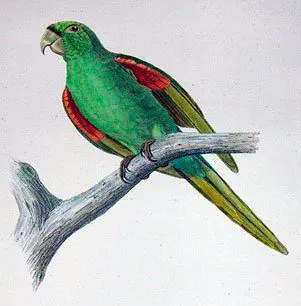
The Hispaniolan Parakeet(Psittacara chloropterus) has the head whole and both sides of the neck green grass with some scattered red feathers; the upperparts and upperwing-coverts Green with external ends of the Middle coverts red. Primary and secondary dark green with bluish-green tips on margins vane inner. The underwing-coverts yellowish brown in the flight feather, more grayish towards the tip; coverts Green except smaller and medium-sized external coverts, they are red and the primarys which are green and Red.
The underparts brighter yellowish green, usually with scattered red feathers.
Upper, the tail dark green and below, grayish brown.
The bill color horn; bare periophthalmic whitish: irises yellowish; legs grayish brown.
Both sexes similar.
The immature has less red and more green in underwing-coverts, No red on the upper surface of the bend of wing and grey at the base of the bill and on the cutting edge.
This species covers all types of natural habitats from arid lowland forests, to sheets of palmas, but obviously prefers upland forest (including the dominated by Pinus), to 3.000 meters above sea level, scarce, Perhaps because of the persecution, in the adjacent cultivated areas.
In general, observed in pairs or in small flocks, but sometimes in meetings of more than one hundred, at least in the past, When were most abundant. Discernible couples even within large flocks.
Reproduction:
They build their nests in tree cavities, including old holes made by woodpeckers, as well as in arboreal termite mounds.
The laying compose it between 3 and 5 eggs, exceptionally 7.
Food:
There are few details about the diet of the Hispaniolan Parakeet, but it is apparently similar to the fellow and and depends on local availability of fruits, seeds, nuts, outbreaks, flowers and beads; Some reported foods include Ficus figs and corn.
Distribution:
confined in Haiti and Dominican Republic, la Española, Greater Antilles. Previously in the Mona Island (Psittacara chloropterus maugei), extinct between 1892 and 1901, probably as a result of the pressure due to the hunting and, possibly, the perturbations by the explosions in the guano mine; possibly, also distributed in Puerto Rico, and its, probably, at the end of the century 19, due to loss of habitat and hunting.
In Hispaniola It is subject to a significant and continuous decrease, due to destruction of habitat, trade and persecution, especially in Haiti, where possibly is extinct.
In Dominican Republic still distributed in a few upland areas, for example, Cordillera Central.
Possibly small wild populations in Puerto Rico and Florida. A small number in captivity; the international trade small volume, probably, keep going.
(Souance, 1856) – Formerly distributed by the Mona Island and, possibly, Puerto Rico, but the last recorded specimen was in 1892. Currently extinct.
Conservation:
State of conservation ⓘ
Vulnerable ⓘ(UICN)ⓘ
• Red List category of the UICN current: Vulnerable
• Population trend: Decreasing
There is no new data on the evolution of the population; But, the species is suspected that it may be in decline, slow to moderate due to the hunting, capture and habitat loss.
Habitat loss and persecution as crop pest they are the greatest threats to this species. Is exploited for the local and international trade, Although only reported 12 individuals for international trade between 1991 and 1995 (Snyder et to the., 2000).
The number of copies of Hispaniolan Parakeet ranges between 1500 and 7000.
Conservation Actions Underway
• Appendix II of CITES.
• In the Dominican Republic, is legally protected against the hunt, but this legislation is not applied properly (Snyder et to the., 2000).
• A education strategy with community participation has been launched for the protection of this species (Vasquez et to the., 1995).
• Las interactions between this species and the Olive-throated Parakeet (Eupsittula nana), due to the recent increase in the number of the latter in the Sierra de Bahoruco [S. Latta in litt., 1998] ), they are being investigated (Anon. 2007).
• A group of volunteers for the protection of the parrot will work reforming the damaged nests. (Anon. 2007)
Conservation Actions Proposed.
• Clarify the status of the species in Haiti.
• Study ecology and reproductive success to determine the natural limiting factors.
• Comply with current legislation in the Dominican Republic.
The Hispaniolan Parakeet in captivity:
Rare in captivity and legally protected in Dominican Republic against the hunt and capture.
Alternative names:
– Hispaniolan Parakeet, Haitian Paroquet, Hispaniolan Conure, San Domingo Conure (inglés).
– Conure maîtresse, Perruche maîtresse (francés).
– Haitisittich (alemán).
– Periquito-de-hispaniola (portugués).
– Aratinga de la Española, Perico , Periquito Antillano, Periquito de la Española (español).
– Perico, Xaxavi (República Dominicana).
Avibase
Parrots of the World – Forshaw Joseph M
Parrots A Guide to the Parrots of the World – Tony Juniper & Mike Parr
Birdlife
Photos:
(1) – Haitisittich Psittacara chloropterus Aufnahme in La Romana By Martingloor (Own work) [CC BY-SA 4.0], via Wikimedia Commons
(2) – Haitisittich Psittacara chloropterus By Martingloor (Own work) [CC BY-SA 4.0], via Wikimedia Commons
(3) – Haitisittich Psittacara chloropterus Aufnahme in La Romana By Martingloor (Own work) [CC BY-SA 4.0], via Wikimedia Commons
(4) – Perico de la Hispaniola / Aratinga chloroptera by Carlos De Soto Molinari – Flickr
(5) – Perico de la Hispaniola / Aratinga chloroptera by Carlos De Soto Molinari – Flickr
(6) – Evopsitta maugei. Illustrations from Iconographie des perroquets non figurs dans les publications de Levaillante et de M. Bourjot Evopsitta maugei = Aratinga chloroptera maugei == Psittacara chloropterus maugei By 48 hand-coloured lithographic plates by E. Blanchard and J. Daverne (pl. I-XV) or Juliot of Tours (XVI-XLVII, 79). [Public domain], via Wikimedia Commons
(7) – Psittacara euops Syn: Evopsitta euops & Psittacara chloropterus Syn: Psittacara chloropter bzw. Psittacara euops St. Domingue By Charles Emile Blanchard (1819–1900) (biodiversitylibrary.org) [Public domain], via Wikimedia Commons
Of 31 to 38 cm.. length and a weight between 219 and 275 g.
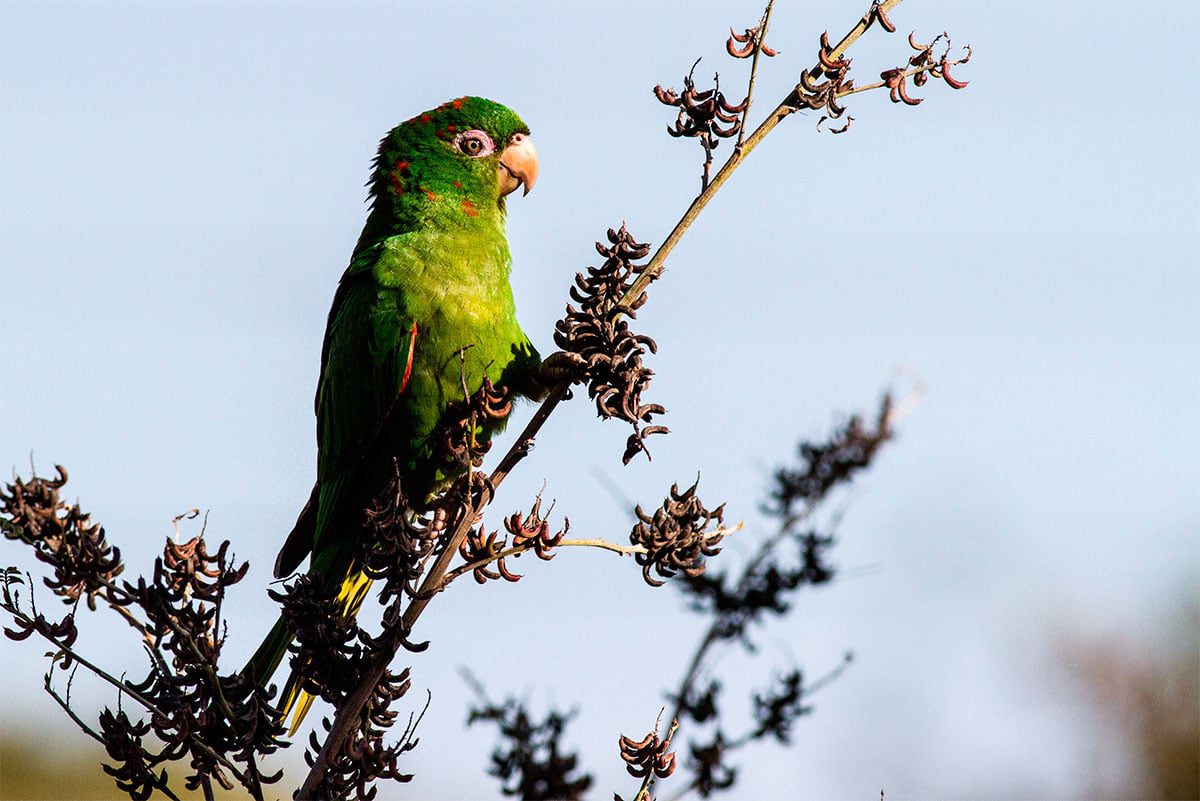
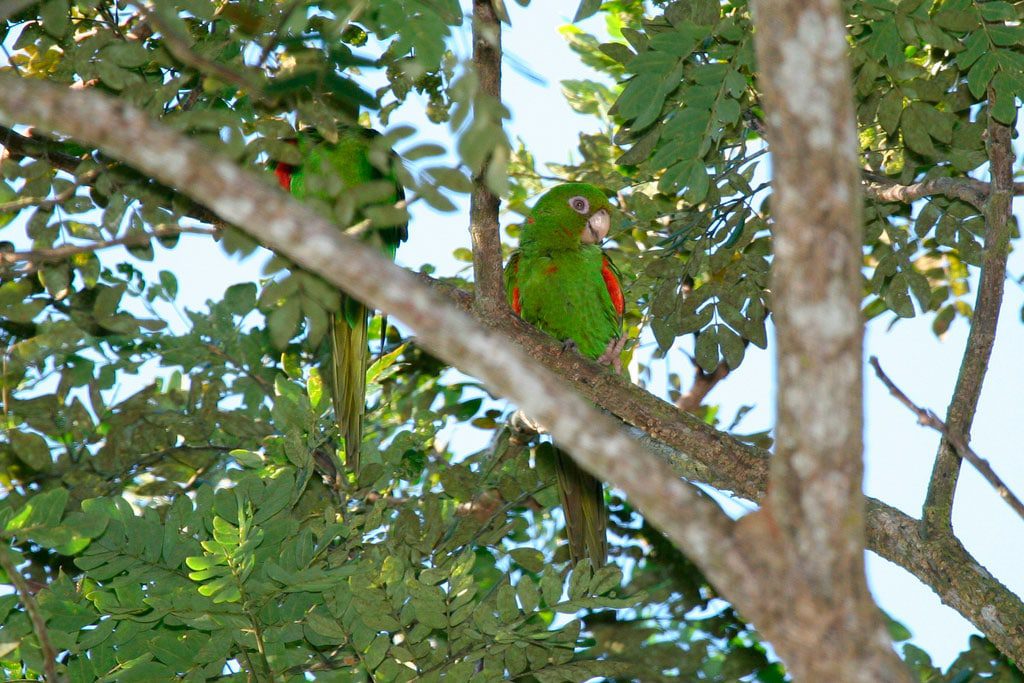
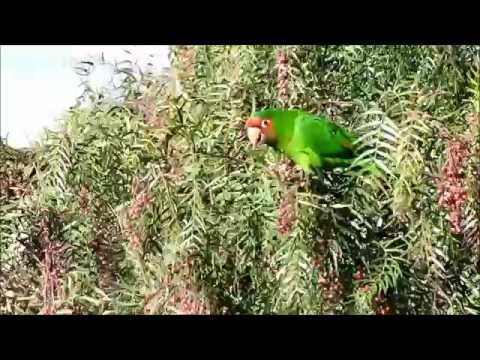
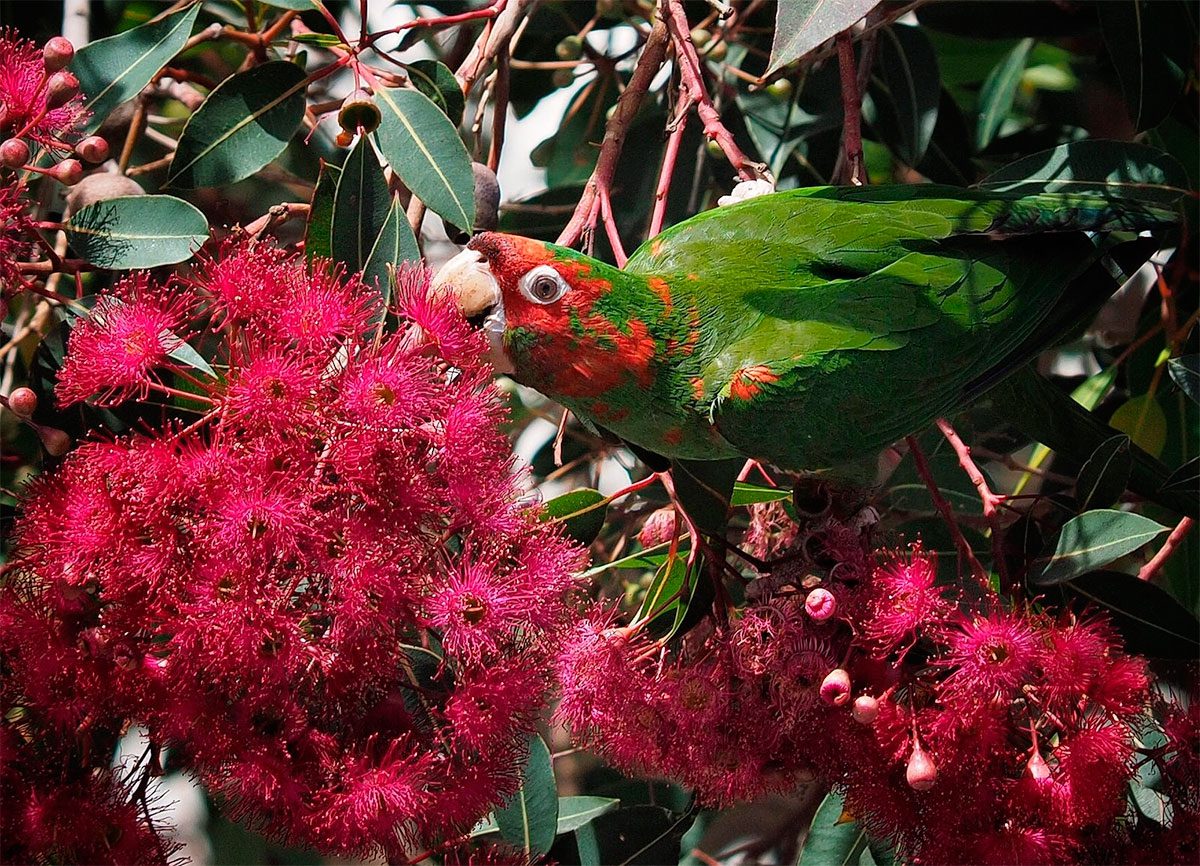
The Mitred Parakeet(Psittacara mitratus) It has a reddish-brown forehead with a bright red fusion on the front of the crown; the lores and cheeks to the rear of the eyes, bright red; the sides of neck dark green with scattered red feathers. The upperparts from the back of the crown up to the uppertail-coverts, dark green with some scattered red feathers (especially in the nape).
Upperwing-coverts and flight feather, at the top, green, sometimes with one or two dark red feathers on the bend of wing; flight feather color marron-oliva below. Underwing-coverts opaque green. The underparts, dull, Green pale with dye olive, usually with scattered red marks, especially in the the thighs. Upper, the tail dark green with Brown tips; Brown down.
The bill off-white; bare periophthalmic creamy white; irises beige color; legs distant.
Both sexes similar.
The Immature with fewer red feathers on the head, in special, in the cheeks and Brown, not Orange, the irises.
(Arndt, 2006) – Front band Red that extends to the lores and Strait, e incomplete bare periophthalmic; upper zone of the cheeks and ear-coverts, green.
They usually inhabit in areas of dry subtropical vegetation, There are also records in temperate zones: montane deciduous forest, cloud forests drier, cultivated areas, hills covered with tall grass, areas populated with scattered trees and fields, as well as sheets of legumes dry grasslands with patches of forests of Prosopis.
Often can be seen near high and steep rock walls. Usually, at altitudes of 1.000 to 2.500 Metros in Argentina, Although there are records to 4.000 metres in the Peru. Rarely, or never, descends to the lowlands. Commonly seen in groups of 2 to 3 birds, but until 100 individuals outside the breeding period.
Reproduction:
They nest in cliffs or hollow trees. There has been a egg laying in Oran, Argentina. Probably the clutch is between 2 and 3 eggs.
Food:
It usually feeds in areas of Virgin forest, but also full of grain crops in populated areas. This and other parrots migrate to the Lerma Valley in the Northwest of Argentina for feeding of the berries in maturity during the month of October.
Distribution:
The Mitred Parakeet are distributed in the southwest of South America, from the South of Peru through the Center-West of Bolivia, to the North of Argentina. Observed in the great valleys of the center of the Peru, from Huanuco until Cuzco. Disintegrated in the valleys of the Eastern Andes in the Centre-West of Bolivia, where there are records in Peace, Santa Cruz, Cochabamba, Oruro, Padilla and South of Sucre, to the Northwest of Argentina in Jujuy, Salta, Tucumán and South of Catamarca, until La Rioja and Córdoba.
In general residents, Although some with seasonal movements in the North of Argentina and Bolivia.
Locally distributed within its range, Although most widespread in the South of Cochabamba, Bolivia. In Argentina, generally common, abundant in some locations (apparently more numerous in Catamarca and Salta), but perhaps decreasing.
Maintained in captivity and sold in large quantities at the international level (mainly from Bolivia) at the end of 1980.
Subspecies distribution:
Psittacara mitratus chlorogenys
(Arndt, 2006) – Its habitat ranges from the North and centre of Peru, in the Valley of the Utcubamba River and surrounding Highlands in amazon and North of Cajamarca, as well as in the eastern valleys of the Andes, in Huanuco and Junin..
• Red List category of the UICN current: Least concern
• Population trend: Stable
The size of the world population Mitred Parakeet It has not been quantified, but this species is described as «common» but of irregular distribution (Stotz et to the., 1996).
The population suspected to be stable in the absence of evidence of any reduction or substantial threats, Although it has been the subject of intense trade: from 1981 When it was included in the Appendix II, 158,149 individuals were captured in the wild and reported in the international trade (UNEP-WCMC trade database CITES, January 2005).
"Mitred Parakeet" in captivity:
This bird is usually available in pet stores or breeders.
They are known to be very attached to their owners. Very playful, they can also become good conversadoras and are considered the more strong and lively group of Aratinga parrots. The Mitred Parakeet It is good for owners who want a large bird and is easy to care for and handle. Can entertain herself if you give it a lot of toys, but they also enjoy interacting and playing with his human flock.
Parrots A Guide to the Parrots of the World – Tony Juniper & Mike Parr
Birdlife
Photos:
(1) – A feral Mitred Parakeet in Fort Lauderdale, Florida By http://www.birdphotos.com (Own work) [CC BY 3.0], via Wikimedia Commons
(2) – Mitred Parakeet (Aratinga mitrata), Inka Trail to Machu Picchu, Peru By D. Gordon E. Robertson (Own work) [CC BY-SA 3.0 or GFDL], via Wikimedia Commons
(3) – Mitred Parakeet by vil.sandi – Flickr
(4) – Mitred Parakeet (Psittacara mitrata) by Gregory "Slobirdr" Smith – Flickr
(5) – Member of an escaped flock roughly 35-50 strong in Sunnyvale, CA By Shravans14 (Own work) [CC BY-SA 4.0], via Wikimedia Commons
(6) – A pair of parakeets in the escaped flock in Sunnyvale, AU. This flock has been around for at least 20 years By Shravans14 (Own work) [CC BY-SA 4.0], via Wikimedia Commons
(7) – Wild parrot (Mitred Parakeet) in Redondo Beach. (Aratinga mitrata) by Ingrid Taylar – Flickr
(8) – A pet Mitred Parakeet (also known as the Mitred Conure) By Lee (originally posted to Flickr as Gaspar4) [CC BY-SA 2.0], via Wikimedia Commons
(9) – A wild SoCal parrot (Mitred Parakeet) eating Bottlebrush in Redondo Beach. This bird is part of a local flock that frequents the neighborhood by Ingrid Taylar – Flickr
Measured around 35 centimeters and between 240 and 330 g. weight.
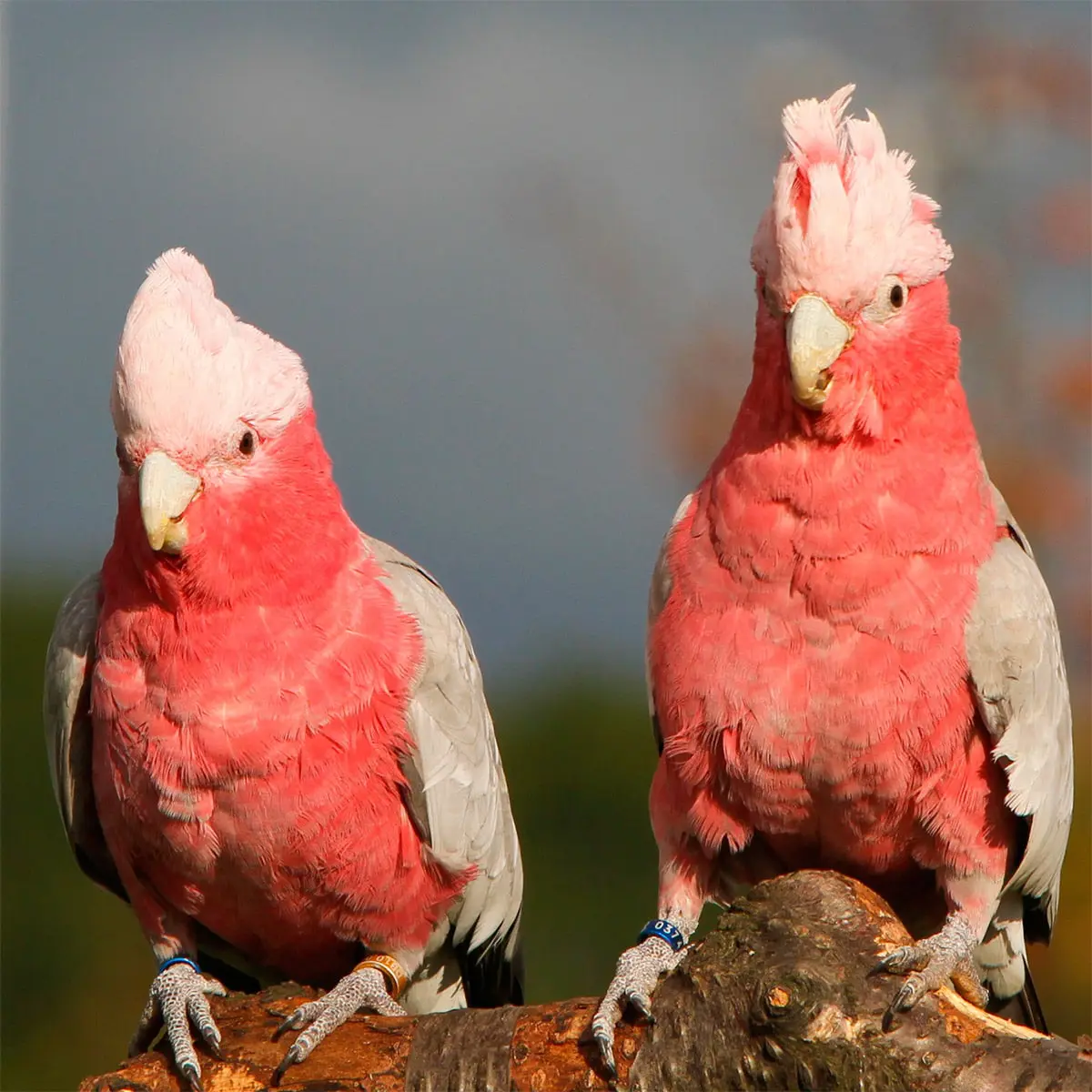
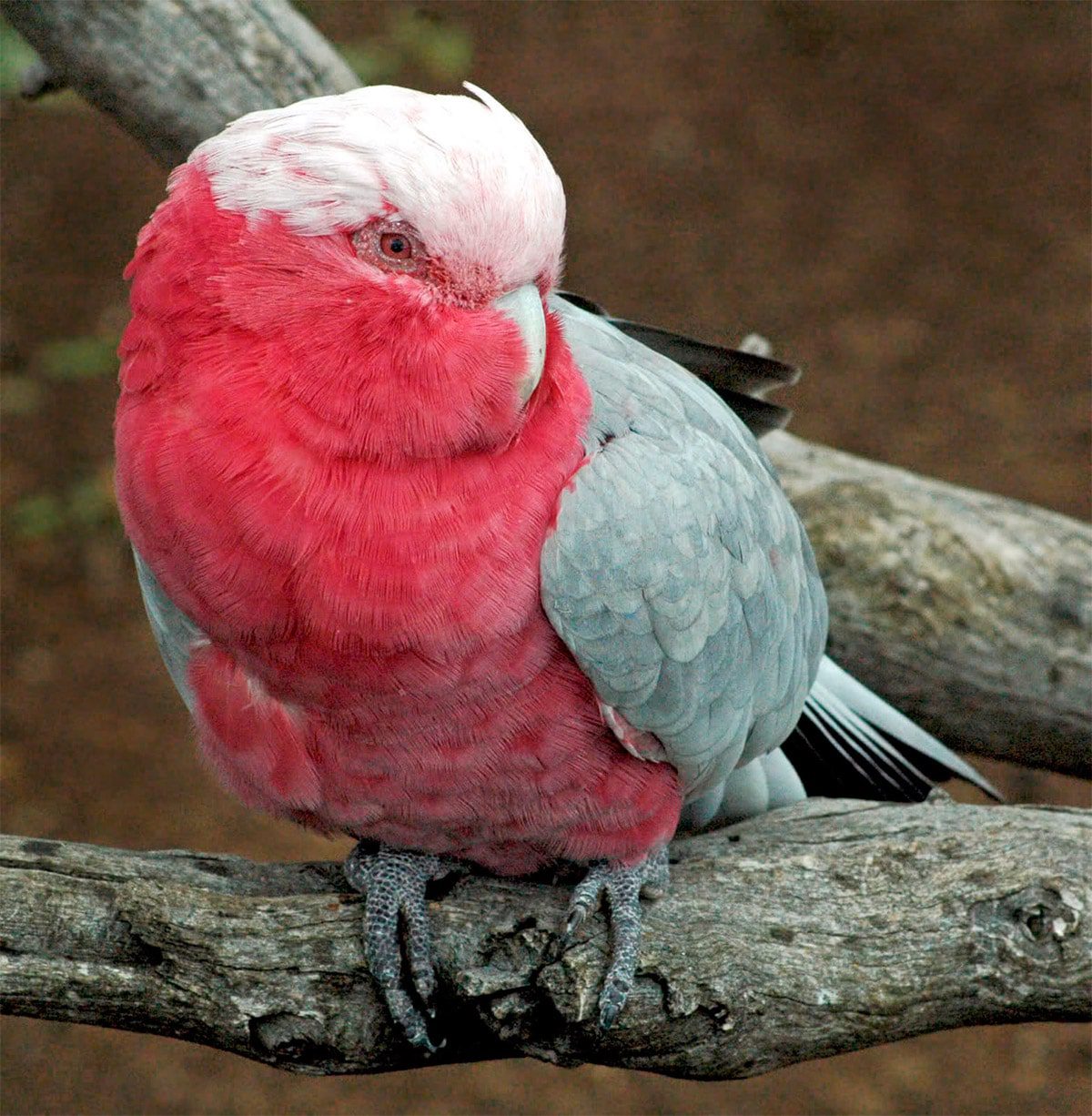
In the Galah(Eolophus roseicapilla) adult, the front, the hoopoe and the cap they form a joint undercover pale pink in white which contrasts slightly with the back of the neck darker. The face, neck and underparts they are deep pink.
The bottom of the flanks, the the thighs and mantas subcaudales are grey clear. The upperparts They show a grey pigeon which is slightly paler on the rump and in their flow rates. Tertiary they are grey and dark grey and medium the flight feather.
The upper part of the tail It is pale grey with a darker terminal tips. The bottom of the tail is uniformly Brown.
The bill is horn. The bare periophthalmic is greyish Red. The irises shows a dark brown hue. The legs are grey.
The female is similar to fellow, outside of the irises red.
The youth can distinguish is from the adults by their underparts grey infiltrated.
In the North of its distribution area, the Galah frequent mountain forests, While much further South, most tend to live in the temperate forests of the lowlands.
During the summer season, It is more common in high altitude forested areas., staying mainly in small cool and shady ravines, always near a river.
In Winter, He moved to arid forests in more moderate altitudes. At this time of the year, also visit the parks and urban gardens.
The Galah It is a bird of open areas, always avoiding the dense forests.
During the nesting season they live in pairs or in small family groups, but the rest of the year, gather in large flocks where food resources are important. Sometimes can gather up to 1.000 birds in the pastures where they feed.
They are sentinels responsible to give the alarm in case of danger.
The power stations are separated by many miles of the rest areas.
In the evening devoted to drinking and perform aerial stunts before joining the residence. Occasionally it can be active and noisy at night.
Reproduction:
In the North, the reproduction has place between February and June.
During the courtship, the male Struts before his partner making bows, shaking his head, producing low notes and showing a repertoire of stunts.
Most of the time, the nest is a natural cavity in a eucalyptus, between 2 and 20 meters above the ground.
The cacatúa Galah You strum the bark of the trunk around the hole which is the entrance of the nest. This practice is sometimes so excessive that they cause the death of the tree. Cliffs can also be used as a place of nesting.
The same couples usually are mate during all their life and are loyal to the same nesting sites for several consecutive years.
The spawning includes 2-6 eggs. The female lays an egg every one or two days and the incubation period is about 25 days. Both parents incubate at the same time, and they provide assistance to young people. They feed their young every 3 hours, sounding his beak to regurgitate the food. The young remain in the nest during 7 u 8 weeks.
While they are able to fly quickly when they come out of the nest, their survival rate is small. The first days after the flight, they return to the nest for the night. Shortly after, large nurseries are formed in which the parents continue to feed their young.
From time to time, the Galah It has a second litter in a season.
Food:
Consume a wide variety of plants, such as oats or wheat seed or the other many herbaceous plants. In addition to that, They also eat insects and their larvae, berries, outbreaks, flowers and seeds of eucalyptus.
They feed almost exclusively on Earth.
Distribution:
Size distribution (reproduction / resident): 14400000 km2
endemic to Australia where it occupies the entire continent. Most of its population lives in the south-east of New Welsh of the South and in the State of Victoria. In other places, is less abundant.
Subspecies distribution:
Eolophus roseicapilla roseicapilla:
(Western Australia, South of the great desert of sand and probably in the Simpson Desert in the southern part of the territory of the North)
Eolophus roseicapilla albiceps:
(Tasmania and Southeast of Australia, heading north to the 20 degrees latitude South and East)
• Current category of the Red List of the UICN: Least concern.
• Population trend: In increased.
Although it has a beneficial action stopping the spread of some weeds, the Galah have a considerable potential of destruction and is considered a pest in most of Australia.
Crops, especially cereals, they suffer great losses each year. They often cause the destruction of the trees where they nest or establish their residences. The world population It is estimated in more than 5 millions of individuals and the number is constantly growing.
This remarkable species not is protected in all the regions and can be killed if it causes too much agricultural loss.
"Galah" in captivity:
It´s very common in poultry around the world, for being one of the easiest cockatoos both to raise and to care for and for being highly demanded as a pet both for its physical appearance and for its more manageable character than that of other cockatoos. Her offspring should take into account the different subspecies, Therefore we will avoid possible hybridization between them.
Son parrots extroverts, friendly, playful and affectionate. However, they are still cacatuidos, They therefore require more attention than other psittacine species to be happy animals. Its speaking ability is fairly high within the group of cockatoos, with males that better mimic. It is considered that it might also noisy, especially if you are bored or if it has been poorly educated or poorly maid, so you will have to always buy weaned and well socialized specimens. When they are young and still take porridge his voice is very unpleasant.
They possess a behavior that is similar to the of the small Cockatiel. Males are more talkers and possess a strong character. The females., on the other hand, they are silent and less dominant. They are most appropriate, Therefore, to be adopted as pets.
The males they may become aggressive in mating season.
They have a high tendency to obesity, thing very significantly decreases their hope and quality of life, by what control seriously its diet, providing low number of fats and allowing to do much exercise.
Its life expectancy formerly was around the 15-18 years, probably due to a bad diet popular ignorance of your requirements. Today there is talk of animals up to 40 years of life.
If we opt for a cockatoo for the home, a pink may be the best alternative: less demanding than her sisters, slightly less noisy and, If we chose a female, We have the gentleness and docility secured.
Of 25-30 cm.. length and a weight between 95-115 g.
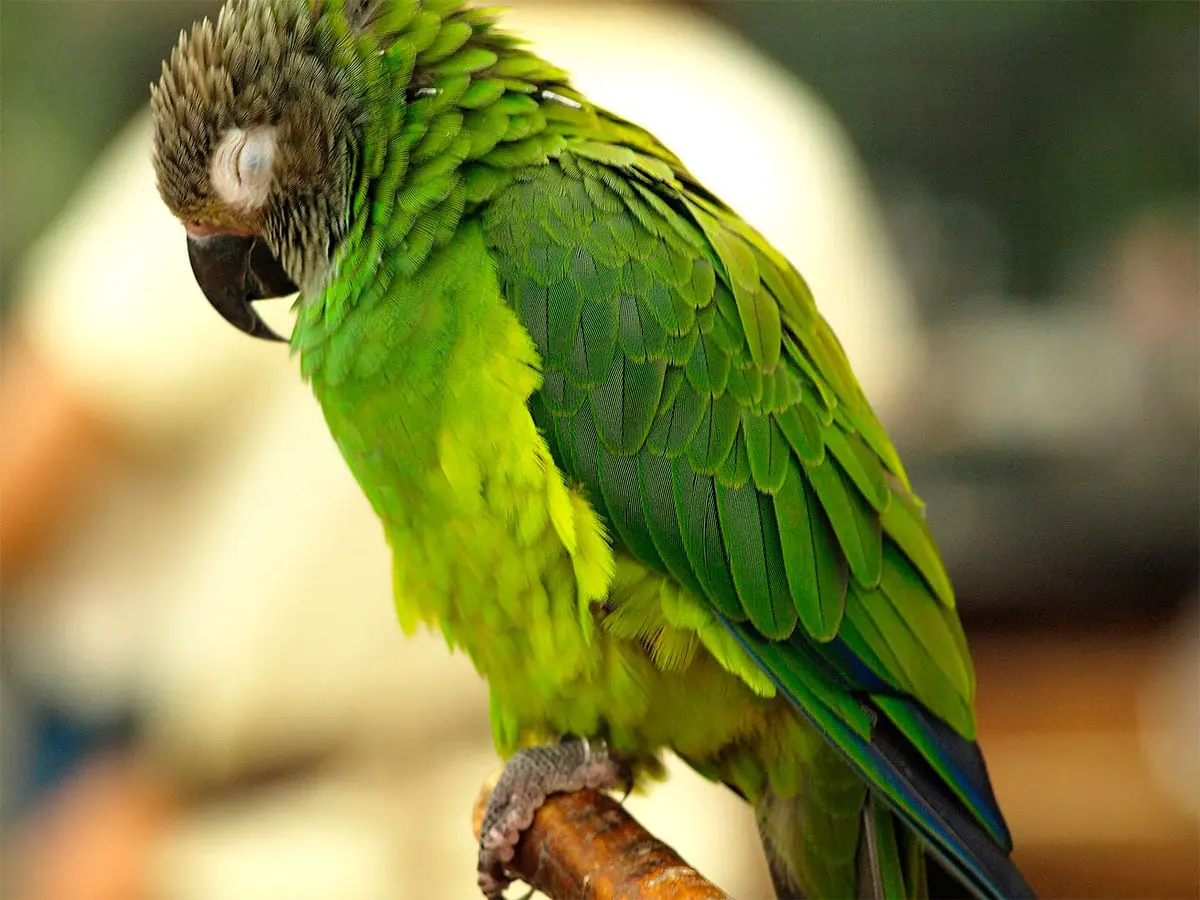
The head of the Dusky-headed Parakeet(Aratinga weddellii) is greyish Brown, with off blue stripes that give it a scaly appearance. The upperparts are green, the feathers of the nape they have yellowish margins (some banks in the mantle), the back and Hip with Brown centers, giving an appearance of Brown altogether. The scapulars with varying between Brown and green edges; the minor, large and medium-sized inner coverts green grass with paler green margins; the outer and the primary coverts are dark blue. Primary and secondary mostly blue with vane outer Green or green margins toward the vane external in the primaries; very dark (almost black) the Tips. Underwing-coverts green: underside of the flight feather opaque gray. Top of the chest pale green with turquoise suffusion; belly and undertail-coverts pale yellowish green, greener on the flanks. Upper, the tail green, Blue towards the tip: undertail, opaque gray.
The bill shiny black; cere pinkish grey; wide area orbital off-white; irises yellowish white; legs dark gray.
Both sexes similar.
The immature are like adults but with the irises darker.
They inhabit in humid jungle, semi-wet, swamps, involved swamp forest and stubble, until 500 metres in Colombia and exceptionally 750 metres in Bolivia. Its preferred habitats are the forests and marshes and flooded forests in swampy areas. Also in the remnants of forest in humid savannah and cleared areas with patches of remnant forest. Also observed in coffee and sugarcane plantations; apparently rarely fly over the dense forest. Usually, in pairs or in small groups, but flocks of up to 75 reported individuals where food is plentiful.
Reproduction:
It nests in trees and palms of marshy or riparian areas, between June and August. They also used the cups of dead Palm trees and termite nests.
Four nests observed in Leticia, Colombia, between 4 and 15 metres in height. Birds incubating in the month of February in Colombia. Bird in reproductive condition in the month of August in Bolivia. Observed breeding from June to September in Loreto, eastern peru; from April to July in the Mato Grosso.
A normal start is of 3 to 5 eggs and both parents feed the chicks.
Food:
Its diet consists of seeds, fruit, flowers, berries, as well as insects and their larvae found in decaying trees and stumps.
Distribution:
Its distribution ranges from the southeast of Colombia, east of Ecuador and Peru to the East of Bolivia and West of Brazil.
Apparently Nomad in some parts of the distribution. In general common, even in partially deforested areas, and perhaps increase due to clearing and fragmentation of dense forest.
Conservation:
State of conservation ⓘ
Minor Concern ⓘ(UICN)ⓘ
• Red List category of the UICN current: Least concern
• Population trend: Growing
The size of the world population Dusky-headed Parakeet It has not been quantified, but this species is described as common(Stotz et to the. (1996)).
This species is suspected that it has been lost between the 15 and the 17,7% of its suitable habitat within its range over three generations (21 years) based on a model of deforestation of the Amazon(Soares-Filho et to the., 2006, Bird et to the. 2011). Given the susceptibility of this species to the hunting or trapping, It is suspected that its population may decrease in around the 25% in three generations.
"Dusky-headed Parakeet" in captivity:
Not common in captivity, but in the past was part of the international trade. They are common in cultivation areas, for this reason they are common in homes of peasants.
The Dusky-headed Parakeet is not known for its ability to mimic the speak human, but they are nevertheless birds very fun, kind and loving – provided that they have been hand reared and socialized properly. They are not as active and noisy as other species of parrots, they only emit sounds, not too high, when excited.
wonderful pets. His charming personality makes them good pets for children. They are not demanding, they spend happy hours playing with their favorite toys but still enjoy human company very much.
They are relatively easy to raise. They may have several broods per year; But, good husbandry practice stipulates that they should not be allowed to have more than two or three clutches to allow for their rest. The size of Sunset is of 3 to 4 eggs, they are incubated for a few 23 days. Both parents take care of the young.. The chicks leave the nest after a few 50 days.
In the wild, according to sources, females have been estimated can live up to 25 years. Its longevity in captivity It has not been studied in detail. It has been observed a muscle aging in wild animals.
Alternative names:
– Dusky-headed Parakeet, Dusky Conure, Dusky headed Parakeet, Dusky Parakeet, Dusky-headed Conure, Weddell’s Conure (English).
– Conure de Weddell, Conure à tête sombre, Perriche de Weddell, Perruche de Weddell (French).
– Weddellsittich, Weddell-Sittich (German).
– Aratinga-de-cabeca-escura, aratinga-de-cabeça-suja, jandaia-de-cabeça-azulada, jandaia-de-cara-suja, periquito-de-cabeça-suja (Portuguese).
– Aratinga Cabecifusca, Perico Canoso, Periquito de Cabeza Gris, Perico cabezagris(español).
– Loro canoso, Perico Canoso, Cotorra cabecigris, Cotorra cabeciparda (Colombia).
– Cotorra de Cabeza Oscura, San Pedrito, Lorito cabeza gris (Peru).
– Perico cabecioscuro (Ecuador).
– Tarechi (Bolivia).
– Ipií (Chimane).
– Bambaorito (I ingano).
– Sacara (Cofán.).
– Butuquiria (Macuna).





















_-two_in_tree.jpg)


_in_captivity.jpg)

9_pet.jpg)
