▷ The world of Pets: Dogs, cats, birds, reptiles, amphibians

Blue-throated Parakeet
Pyrrhura cruentata

Blue-throated Parakeet

Content

Description:

Blue-throated Parakeet
30 cm.. length and 90 g. of weight.

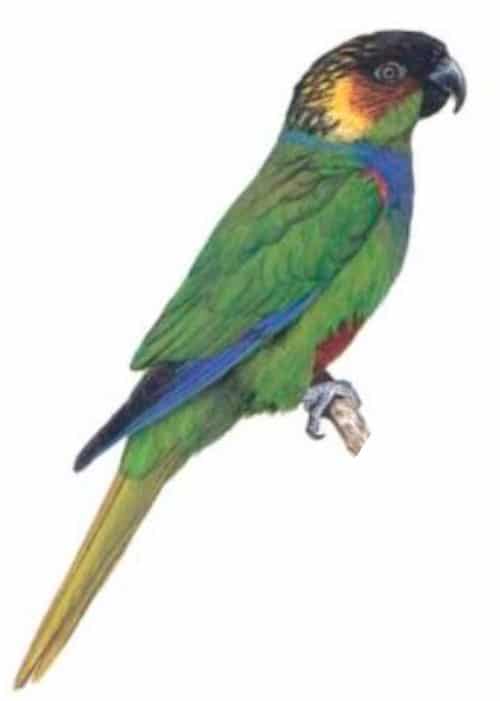
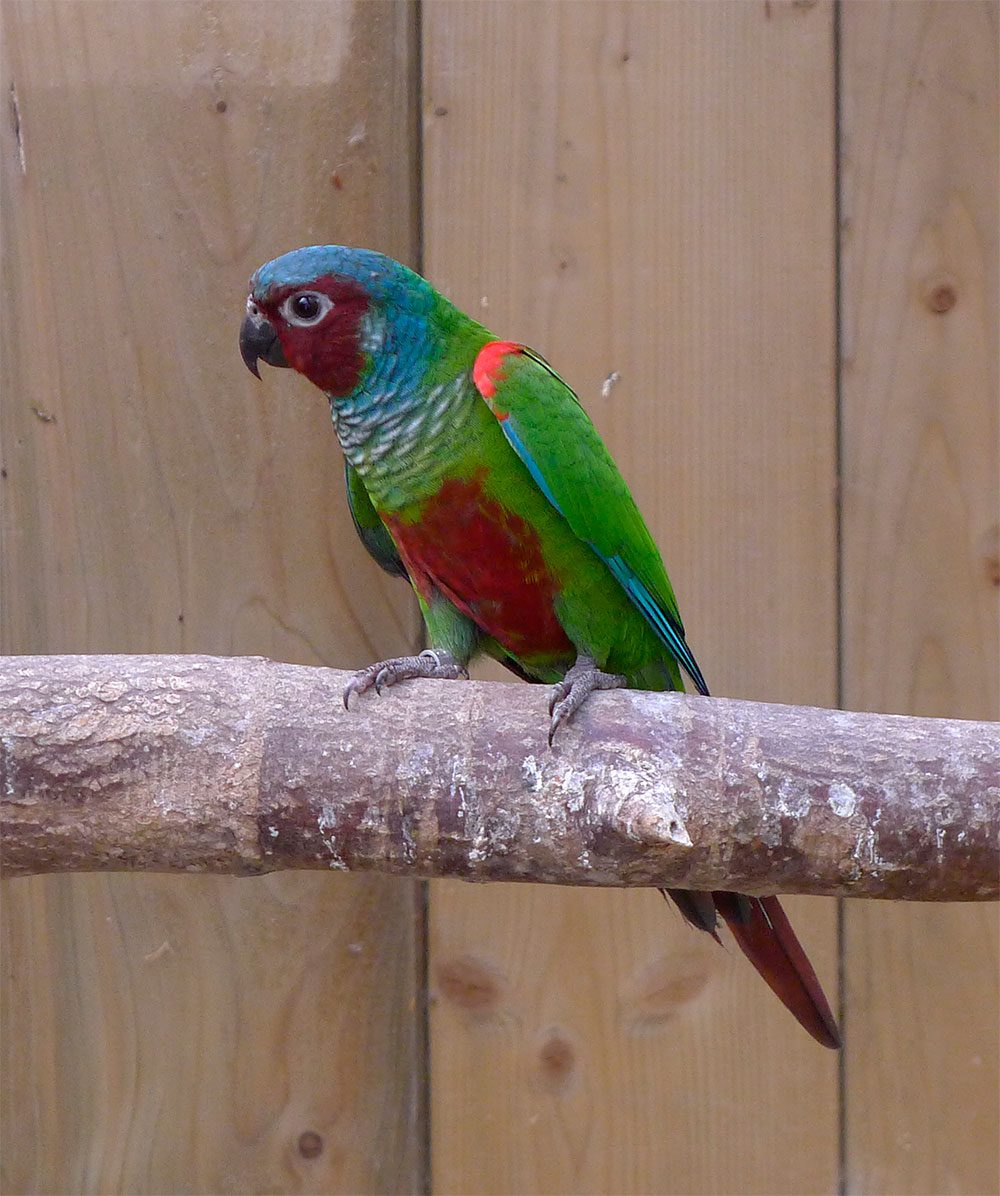
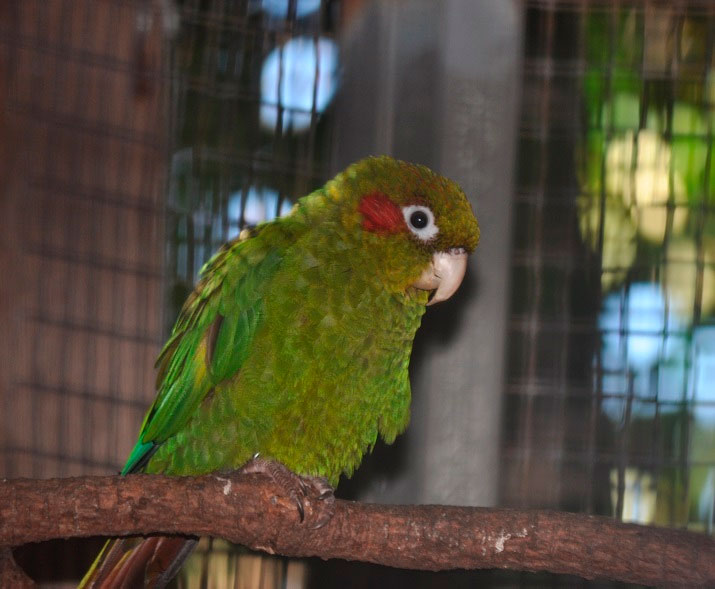
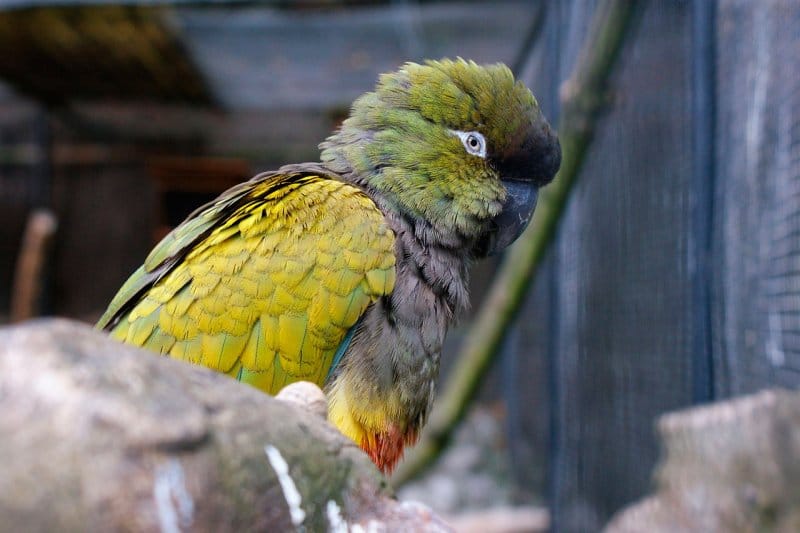
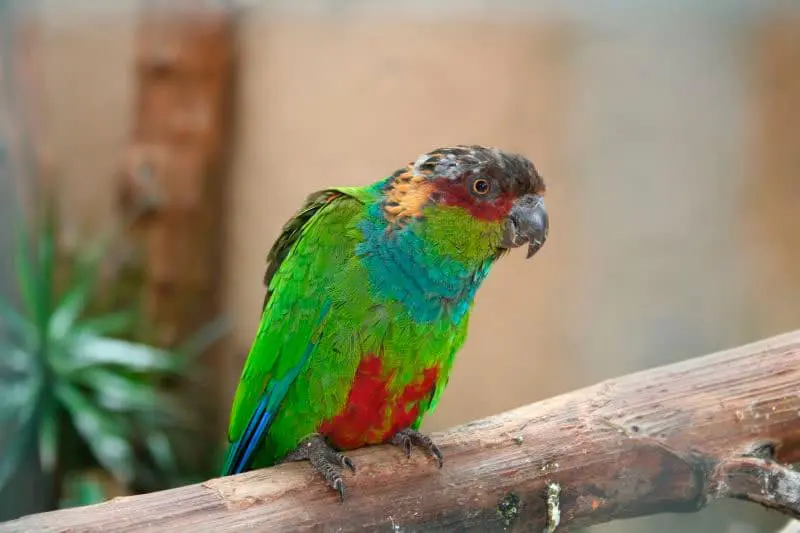
The Blue-throated Parakeet (Pyrrhura cruentata) It is a very colorful bird; has the forecrown, crown and rear of the neck, dark brown with pale orange sides and with some feathers (especially posteriorly) giving speckled appearance; lores, cheeks top, supercilii area and ear-coverts, dull red, merging on sides of neck with yellowish patch bordered behind by blue band running across nape; bottom of the cheeks, green.

Mantle, back and scapulars, green; broad crimson patch on lower back and rump; uppertail-coverts green. Bend of wing bright red; upperwing-coverts green. Outerwebs of the primaries, blue, green on the innerwebs; secondaries green on outerweb, Gray on innerwebs; flight feather with dark tips; infra-wing coverts minor, olive green, the gray greater coverts; underside of flight feather, olive gray wash. Chin green; the throat and the top chest, blue with some dark tips; underparts green with a patch of variable size of crimson color on the belly. Upper, the tail It is golden in color with green tint; brown below. Bill grey; bare periophthalmic grey; irises yellow orange; legs grey.

Both sexes similar, but the irises perhaps brighter in the male. Immature more off, with less red at bend of wing.

  • Sound of the Blue-throated Parakeet.

Habitat:

The Blue-throated Parakeet inhabit, mainly, in primary forests of the Atlantic forest or on the edges of forests and, sometimes, in slightly modified natural forests, penetrate into agricultural areas where tall forest trees shade cocoa crops. Unknown seasonal and dry forests. (Usually in lowlands below 400 m, but 960 metres in Minas Gerais, Brazil, usually in flocks of 6-20 birds(mainly 8-12), at least where they are locally common.

Reproduction:

Nests in tree hollows. The breeding, apparently, It occurs in the austral spring, from June to October. Clutch 2-4.

Food:

The diet of the Blue-throated Parakeet includes plants of Talisia esculenta, Alchornea iricurana, Mabea fistulifera, Trema micrantha and Cecropia. The fruits of Miconia hypoleuca can be important in times of scarcity. Birds feeding in the canopy and the lower edge vegetation, never out of the woods; Once he observed feeding on the Golden-capped Parakeet (Aratinga auricapillus).

Distribution and status:

Size of its range (breeding/resident): 281.000 km2

endemic to eastern Brazil, from Bahia until Rio de Janeiro. They were formerly known from Jequié and islanders, Bay, but the latest reports are North Jequitinhonha River, south of which, reports come from remaining patches of forest (including the Monte Pascoal National Park) to the border Holy Spirit.

The birds continue in the few wooded areas of eastern Minas Gerais, Brazil as the Rio Doce State Park, the Book Caratinga (about Raúl Soares) and about Mantena and several locations in northern Espirito Santo, including Biological reserves Great stream and Sooretama and neighboring Linhares Sooretama reserve. It is apparently absent from the southern state but survives near Desengano State Park in the State of Rio de Janeiro, the southernmost site which have been observed recently.

Resident. Common and widespread at the end of the 19th century, but decreased dramatically with massive deforestation within its range due to agriculture, speak, mining, roads and urban development. The final bastion (the only place where birds remain common) It is complex reserve Sooretama / Linhares; much smaller numbers exist in other forest remnants (protected but widely separated). Habitat loss continues in Bay with some sites (for example Monte Pascoal) under intense pressure.

Rare in captivity, but trapping for illegal trade is an additional threat. Listed in Appendix I of the CITES and protected by Brazilian law.

Conservation:

State of conservation ⓘ


Vulnerable Vulnerable ⓘ (UICN)ⓘ

• Current category of the Red List of the UICN: Vulnerable.

• Population trend: Decreasing.

• Population size : 2500-9999 individuals.

Rationale for the Red List category

This species survives in scattered fragments of Atlantic Forest, where the extent of suitable habitat continues to decline rapidly. The remaining populations are small, severely fragmented into isolated reserves, where protection is largely inadequate and are suspected to be declining rapidly. So, qualifies as Vulnerable.

Justification of the population

The population is calculated in the number 2.500-9.999 mature individuals based on an evaluation of known records, descriptions of abundance and size range. This is consistent with estimates of population density recorded for congeners or close relatives with similar body size, and the fact that only a proportion of its distribution area is occupied. This estimate is equivalent to 3.750-14.999 individuals, rounded here to 3.500-15.000 individuals.

Justification of trend

continued rapid population decline is suspected because rates loss of habitat.

Threats

The extensive and continuous clearing of the forest You are responsible for its current fragmented distribution. Their apparent tolerance to shade cocoa plantations provides little hope because shading techniques since the early 1980 They have involved the use of banana trees and Erythrina, rather than stand, and unstable prices have led to conversion to pasture. Many remaining populations are affected by site-specific threats, as conflicts between habitat conservation and the rights of local communities in the Monte Pascoal National Park. The capture for the cage bird trade It is a relatively new phenomenon, Although the species is rare in domestic and international markets.

Conservation Actions Underway

CITES Appendix I. It is considered nationally Vulnerable in Brazil (Silveira y Straube 2008, MMA 2014), and is protected by Brazilian law. It is in the National Parks of Chapada da Diamantina and Monte Pascoal, on Experimental Station Barrolândia, on Linhares Forest Reserve, on Book Caratinga, in sweet River and probably in the Desengano State Parks, and in the Biological Reserves Great Stream, Deer Stream and Sooretama (Wege and Long 1995).

Conservation Actions Proposed

Survey to locate additional populations and protect undetected (Snyder et to the., 2000), especially in southern Bay and northeast of Minas Gerais, Brazil. Ensure protection de facto key reserves, especially Sooretama, Linhares and Vera Cruz Station. Confiscation of birds of trade and well-planned release of these birds in areas of the previous range of species to improve recovery and connectivity of disjunct populations (J. Gilardi in little).

"Blue-throated Parakeet" in captivity:

Protected by CITES Appendix I.

Rara in national and international markets. Each captive specimen of this species which is capable of reproducing, must be placed in a well-managed captive breeding program and not sold as a pet, in order to ensure its long-term survival.

Alternative names:

– Black-tailed Parakeet, Blue throated Conure, Blue throated Parakeet, Blue-chested Parakeet, Blue-throated Conure, Blue-throated Parakeet, Ochre Marked Conure, Ochre-marked Parakeet, Red-eared Parakeet, Red-rumped Parakeet (English).
– Conure tiriba, Perriche tiriba, Perruche tiriba (French).
– Blaulatzsittich, Blaulatz-Sittich (German).
– cara-suja, fura-mato, tiriba, tiriba-fura-mato, Tiriba-grande, tiriva (Portuguese).
– Cotorra Tiriba, Perico Grande (español).


scientific classification:

Prince Maximilian of Wied-Neuwied

– Order: Psittaciformes
– Family: Psittacidae
– Genus: Pyrrhura
– Scientific name: Pyrrhura cruentata
– Citation: (Wied-Neuwied, 1820)
– Protonimo: bloody parrot


Images Blue-throated Parakeet:


Especies del género Pyrrhura

Blue-throated Parakeet (Pyrrhura cruentata)


Sources:

– Avibase
– Parrots of the World – Forshaw Joseph M
– Parrots A Guide to the Parrots of the World – Tony Juniper & Mike Parr
– Birdlife

– Photos:

(1) – Ochre-marked Parakeet (also known as Blue-chested Parakeet, Blue-throated Parakeet, or Blue-throated Conure) at Palmitos Park, Gran Canaria, one of the Canary islands, Spain By ipfreaks (originally posted to Flickr as Papagei) [CC BY-SA 2.0], via Wikimedia Commons
(2) – Blue-chested Parakeet, (Pyrrhura cruentata) also known as Blue-throated Parakeet or Blue-throated Conure. Pet parrot By ➨ Redvers (originally posted to Flickr as Hector and toy 8) [CC BY 2.0], via Wikimedia Commons
(3) – Blue-chested Parakeet (Pyrrhura cruentata) also known as Blue-throated Parakeet or Blue-throated Conure at Central Park Zoo, New York, USA By Claire Houck [CC BY-SA 2.0], via Wikimedia Commons
(4) – Blue-chested Parakeet (Pyrrhura cruentata) also known as Blue-throated Parakeet or Blue-throated Conure. Pet with yellow toy By ➨ Redvers (originally posted to Flickr as Hector and toy 4) [CC BY 2.0], via Wikimedia Commons
(5) – Blue-chested Parakeet (also known as Blue-throated Parakeet or Blue-throated Conure); two on a perch By TJ Lin [CC BY-SA 2.0], via Wikimedia Commons
(6) – Parrots A Guide to the Parrots of the World – Tony Juniper & Mike Parr

– Sounds: Jeremy Recall, XC85365. accessible www.xeno-canto.org/85365
▷ The world of Pets: Dogs, cats, birds, reptiles, amphibians

Maroon-bellied Parakeet
Pyrrhura frontalis

Maroon-bellied Parakeet

Content

Description:

24-28 cm.. length and 72-94 g. of weight.

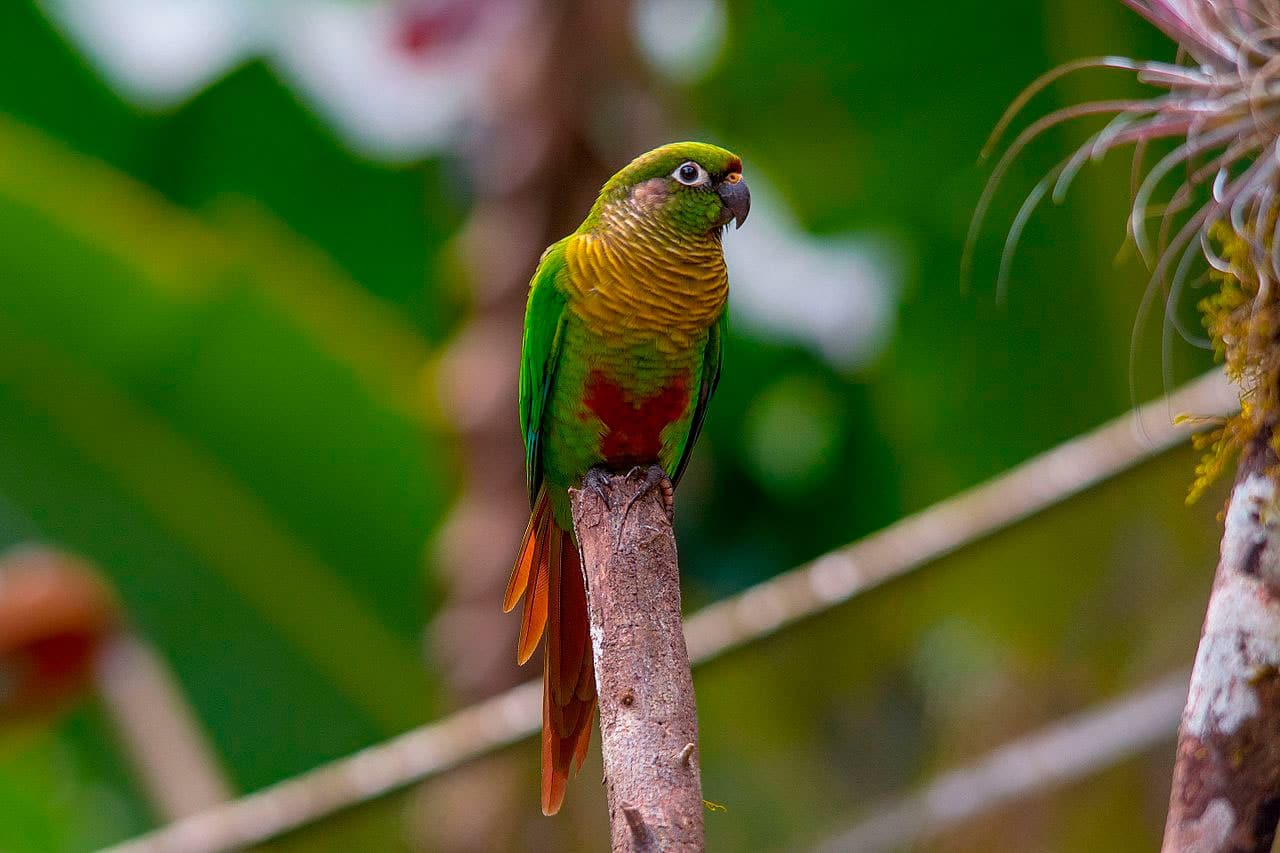
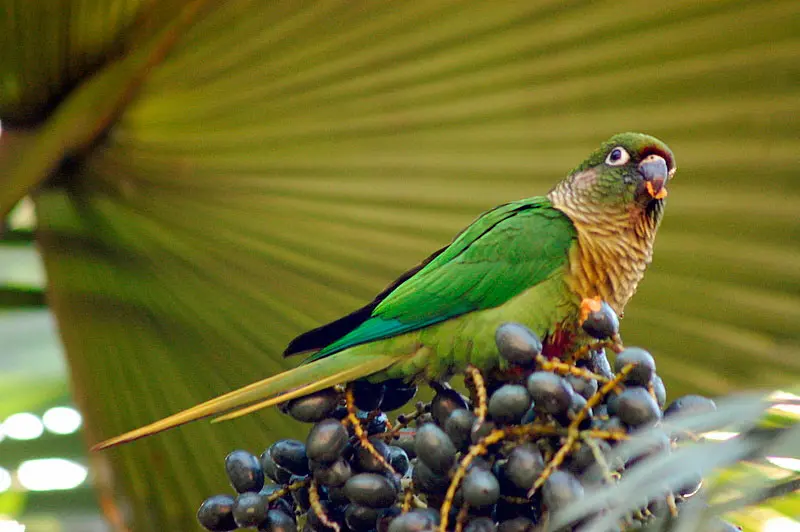
The Maroon-bellied Parakeet (Pyrrhura frontalis) has a frontal band matte red close with a few more bright red feathers behind cere; lores blackish; feathery cheeks and crown, greyish green blackish tips; ear-coverts olive green.

The upperparts They are green grass with a small area reddish at the bottom of the back. Primary coverts bluish green; wing-coverts grass-green, some feathers sometimes with olive tint. Primaries blue in the outerweb. green in the innerwebs, with dark tips; secondaries, mainly green. Sides of neck, throat and chest, brown oliváceo, feathers subterminally brown and black black tips, giving the whole a scalloped effect; lower breast green with a patch brown in the center of belly; flanks, the thighs and undertail-coverts, green. Upper, green tail in basal half, Shaded bronze to reddish tones on the tips; below, the tail is opaque brown.

Maroon-bellied Parakeet

Bill grey, sometimes paler in base mandible; yellow cere; bare periophthalmic whitish grey; irises dark brown; legs dark gray.

Both sexes are similar. The incipient brown lacks the belly. Immature paler than adult with irises darker.

Taxonomic note:

Closely related to Blaze-winged Parakeet (Pyrrhura devillei), with which it can be conspecific (populations or races that belong to the same species). It has been suggested that the species may also be conspecific with Green-cheeked Parakeet (Pyrrhura molinae).

  • Sound of the Maroon-bellied Parakeet.

Description 2 subspecies:

  • Pyrrhura frontalis chiripepe

    (Vieillot, 1818) – As the nominal, but the upper surface of the tail It is completely green olive. Some orange-red markings on the bend of wing in some birds.


  • Pyrrhura frontalis frontalis

    (Vieillot, 1818) – Subspecies nominal.

Habitat:

Video – "Maroon-bellied Parakeet" (Pyrrhura frontalis)

Pyrrhura frontalis / red forehead snipe / Marron bellied Parakeet

The Maroon-bellied Parakeet They extend through several forest habitats, forests, margins and marshy habitats, including the remaining patches Araucaria (for example, in Rio Grande do Sul). In the Paraguayan Chaco They seem almost confined to coastal areas of growth over the Paraguay River and its main tributaries. In Southeast Brazil They are mainly distributed in the highlands, to 1.400 meters above sea level; in other parts of the lowlands up near 1.000 m, where they are generally tolerant to disturbance, even reaching visit urban parks in the city of Assumption, Rio de Janeiro and São Paulo, and feeding in gardens (Rio Grande do Sul). gregarious, usually in flocks of 6-12 birds (until 40).

Reproduction:

They nest in the cavity of the trees. The breeding season It covers the months from October to December. Clutch 5-6 eggs.
The female incubated one for almost 30 days. The young leave the nest after about 45 days, after which they continue to be fed for some time by the two members of the couple.
Food:

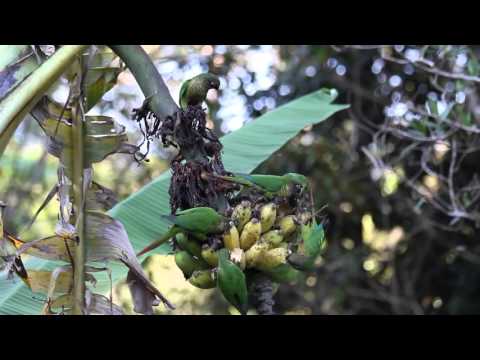
In Southeast Brazil, Their diet includes pulp of Euterpe edulis, seeds of Schinus, Xylopia, Cecropia, Croton, Miconia, ficus, Psidium and Pinus; flowers of Ambrosia and Vernonia and aryl of Protium; elsewhere, the Araucaria It is a very important food source, for example in southern Brazil; also they feed dried fruits and fruits of Campomanesia xanthocarpa and Podocarpus lambertii; homoptera sheets Persea pyrifolia and fly larvae. The orange and corn crops sometimes they suffer from their visits, but depredations were lower compared to the damage caused by the Parrot Argentina (Myiopsitta monachus) in cornfields.

Distribution and status:

Size of its range (reproductive / residents): 2.690.000 km2

The Maroon-bellied Parakeet It is endemic in Southeast South America, from the southeast of Brazil to the North of Argentina.

In Brazil They can be observed from south Bay ,through coastal states, until Rio Grande do Sul, and west, in the southeast of Minas Gerais, Brazil and South of Mato Grosso, through Paraguay (extension of records suggests its presence throughout the west end), North of Uruguay and North of Argentina, in Missions, Currents, Formosa, Chaco and sporadically in the past, in the North of Santa Fe (a population in Buenos Aires probably descended from leaks), and southeastern Bolivia.

Resident. Locally common to very common (for example, in Missions) but rare elsewhere (for example Currents) and extinguished in places due to conversion of forests for agriculture.

With He commercialized in large quantities with substantial late eighties exports averaging over 5.000 birds per year. There is a large captive population.

Distribution 2 subspecies:

  • Pyrrhura frontalis chiripepe

    (Vieillot, 1818) – Central and southern Paraguay, northern Uruguay and northern Argentina.


  • Pyrrhura frontalis frontalis

    (Vieillot, 1818) – Subspecies nominal. Southeastern Brazil from southern Bahia to Rio Grande do Sul including southeastern Minas Gerais and south and southeast of Mato Grosso.

Conservation:

State of conservation ⓘ


minor concern Minor Concern ⓘ (UICN)ⓘ

• Red List Category: Least concern

• Population trend: Stable.

Rationale for the Red List category

This species has a extremely large range and, therefore, it does not approach the thresholds for Vulnerable at the discretion of the distribution area size (Extension <20,000 km2 combinada con un tamaño de rango decreciente o fluctuante, extensión o calidad del hábitat o tamaño de población y un pequeño número de lugares o fragmentación severa). La tendencia de la población parece ser estable, por lo que la especie no se aproxima a los umbrales de Vulnerables bajo el criterio de tendencia poblacional (> 30% decline over ten years or three generations). The population size has not been quantified, but it is not believed to be close to the thresholds for Vulnerable under the criterion of population size (<10.000 individuos maduros con un declive continuo estimado> 10% in ten years or three generations or a population structure). For these reasons, the species is evaluated as least concern.

Justification of the population

The size of the world's population has not been quantified, but this species is described as «common» (Stotz et to the., 1996).

Justification of trend

They suspected that the population is stable in absence of evidence of any decline or threatens substantial.

Threats

The species has been marketed strongly: from 1981, when it was included in Appendix II of CITES, 52.523 individuals captured in the wild have been recorded in international trade (Trade database of UNEP-WCMC CITES, January 2005).

"Maroon-bellied Parakeet" in captivity:

The species is listed in Appendix II of the CITES.

There is a large captive population. They are intelligent birds, friendly and active. Readily they adapt to human contact and are easy to train. They are among the quietest cotorras, but its powerful high-pitched voices can become very annoying. Like other parakeets, They tend to express emotion with a series of loud cries, chillidos.

Alternative names:

– Maroon bellied Parakeet, Maroon Parakeet, Maroon-bellied Conure, Maroon-bellied Parakeet, Reddish-bellied Parakeet, Scaly-breasted Parakeet (English).
– Conure de Vieillot, Conure ou, Perriche de Vieillot, Perruche à oreillons bruns, Perruche d’Azara, Perruche de Vieillot (French).
– Braunohrsittich, Braunohr-Sittich (German).
– cara-suja, periquito, tiriba, Tiriba-de-testa-vermelha, tiriva (Portuguese).
– Chiripepe, Chiripepé, Chiripepé cabeza verde, Chiripepé de cabeza verde, Cotorra Chiripepé, Perico de Vientre Rojo (español).


scientific classification:

Vieillot, Jean Pierre Louis

– Order: Psittaciformes
– Family: Psittacidae
– Genus: Pyrrhura
– Scientific name: Pyrrhura frontalis
– Citation: (Vieillot, 1818)
– Protonimo: Psittacus frontalis

Images Maroon-bellied Parakeet:


Especies del género Pyrrhura

Sources:

– Avibase
– Parrots of the World – Forshaw Joseph M
– Parrots A Guide to the Parrots of the World – Tony Juniper & Mike Parr
– Birdlife

– Photos:

(1) – RED-BROWN TIRIBA Botanical Garden of São Paulo By Dario Sanches [CC BY-SA 2.0], via Wikimedia Commons
(2) – Maroon-bellied Conure (Pyrrhura frontalis) on a wooden stump. Botanical Garden of São Paulo By Dario Sanches [CC BY-SA 2.0], via Wikimedia Commons
(3) – Pyrrhura frontalis Ilhabela-SP By Dario Sanches from São Paulo, Brazil (Maroon-bellied parakeet ( Pyrrhura frontalis)) [CC BY-SA 2.0], via Wikimedia Commons
(4) – Maroon-bellied Conure (Pyrrhura frontalis) – São Paulo Forest Garden By Dario Sanches [CC BY-SA 2.0], via Wikimedia Commons
(5) – Pyrrhura frontalis – Track dos Tucanos – Tapirai-SP IBA: Paranapiacaba Forest Massif By Jairmoreirafotografia (Own work) [CC BY-SA 4.0], via Wikimedia Commons
(6) – Parrots A Guide to the Parrots of the World – Tony Juniper & Mike Parr

– Sounds: Gustavo Luz, XC344423. accessible www.xeno-canto.org/344423

▷ The world of Pets: Dogs, cats, birds, reptiles, amphibians

Pfrimer's Parakeet
Pyrrhura pfrimeri

Pfrimer's Parakeet

Content

Description:

Pfrimer's Parakeet

22 to 23 cm.. length and an approximate weight of 80 g..

The Pfrimer's Parakeet (Pyrrhura pfrimeri) is a small psittacine of tail Long endemic Brazil very similar to Maroon-faced Parakeet (Pyrrhura leucotis), of which has recently been separated.

Its main color is green with bluish hues in primary rémiges and reddish tones in the back, the belly and retrizes penas. The bend of wing They are reddish.
The neck It has clear blue feathers with lighter edges, giving the whole a scaled aspect. The sides of the face They are red while the crown and nape They are bluish. The bill It is black and tail red-blue color at the tips

It has no sexual dimorphism.

Taxonomic status:

It has often been considered a subspecies of the Maroon-faced Parakeet (Pyrrhura leucotis) – Pyrrhura leucotis pfrimeri. The separation was made based on their distribution and the differences in habitat and plumage, I was the only member of the complex P. leucotis in which the light spot on ear-coverts It was very small. Recent mitochondrial DNA studies have confirmed this separate species status.

  • Sound of the Pfrimer's Parakeet.

Habitat:

Its distribution is restricted to the forests dry deciduous or semi-evergreen growing on limestone outcrops in the calcareous. This habitat type caatinga is an isolated island within the surrounding savannah closed. The forest caatinga typically has a closed canopy and dense understory with lianas and some cacti, particularly in disturbed areas. The species has been seen recently fragmented woodlots (Olmos et al., 1998), but according to reports they do not live far from the edge of the forest.

Social, usually they are seen in flocks of up 10 birds. Noisy and conspicuous when they fly above the canopy. Difficult to see while feeding or resting in foliage.

Reproduction:

We know very little about their reproductive habits.


Food:

They fly in flocks in search of fruits, seeds, flowers and larvae insects (wasps Family Agaonidae).


Distribution and status:

Size of its range (Widgets / Resident): 20.300 km2

It is located in the Brazilian states of Goiás, Tocantins and the northwestern tip of Minas Gerais, Brazil.

Conservation:

State of conservation ⓘ


Endangered Endangered ⓘ (UICN)ⓘ

• Current category of the Red List of the UICN: In danger of extinction.

• Population trend: Decreasing.

• Population: 20,000-50,000.

Justification of the Red List of the Category

This species has a range very small highly fragmented and where habitat loss and degradation continue. For these reasons, It is classified as endangered.

Justification of the population

The total population is estimated to lie within the band 20,000-49,999 individuals (CA Bianchi in a little. 2006, 2007). The population density of the species has been estimated 11,7 individuals / km2 .

Justification trend

Given the rapid pace of deforestation within restricted range species, and its strong dependence on forest habitats suspected its population is declining rapidly (F. Olmos in some ., 2004).

Threats:

The main threat to this species is the deforestation driven selective logging, fires and conversion of habitat to pasture (Olmos et al . 1998). Dry wood Goiás He declined to be covering 15,8% of the region 1990 only the 5,8% in 1999, and less than 1% of the remaining fragments they were larger than 100 has (F. Olmos a slightly. 2007). There has been a reduction 66% habitat available in the last 31 years, with a current annual deforestation rate 2,1% (Bianchi 2010). Rapid deforestation is occurring within the range of the species to create pastures with widespread burning to improve poor pastures destroying the habitat of dry forest. It is mainly directed to logging forests durable normally used to make fence posts, and cement are starting to target areas of limestone outcroppings (CA Bianchi in a little . 2006, 2007). The species is rare while they recorded in the trade waves collections of exotic birds; This poses a potential threat (Olmos et al ., 1998). Population pressures increase as their range is close to the capital, Brasilia (Olmos et al ., 1998).

Conservation Actions Underway

In Brazil, previously considered vulnerable (Silveira y Straube 2008), but now legally designated as endangered national (MMA 2014) and protected by the Brazilian legislation. They are distributed within the proposal Terra Ronca State Park, but this has not yet been fully implemented. (CA Bianchi in a little . 2006, 2007). Downs Terra Ronca State Park now they appear to have been deforested, leaving only forest fragments outcrops of limestone karst (Willis in a little .). Other parts of the range are not protected. The species appears in the Brazil Red List as vulnerable and the IBAMA (Federal Environment Agency Brazil) is about to create a conservation group Small parrots understand all the Pyrrhura spp, and establishes conservation efforts. Brasilia zoological garden started a program of captive breeding in 2001 with 10 individuals, but none survived after six years (CA Bianchi in a little . 2006, 2007). There are very few known private poultry farmers who maintain the species in captivity (CA Bianchi in a little . 2006, 2007).

Conservation Actions Proposed

Determine the extent of habitat and current rates of deforestation remaining. Closely monitor the species in trade if demand increases.

"Pfrimer's Parakeet" in captivity:

Very rare.

It's a bird in danger of extinction; each captive specimen of this species that is capable of reproducing, must be placed in a well-managed captive breeding program and not sold as a pet, in order to ensure its long-term survival.

Alternative names:

– Goias Parakeet, Pfrimer’s Conure, Pfrimer’s Parakeet (English).
– Conure de Pfrimer (French).
– Goiasittich, Pfrimers Sittich (German).
– tiriba de Pfrimer, Tiriba-de-pfrimer, Tiriba-do-paranã , ciganinha, barreirinha, chiriri e periquito-do-morro (Portuguese).
– Cotorra de Goiás (español).


scientific classification:

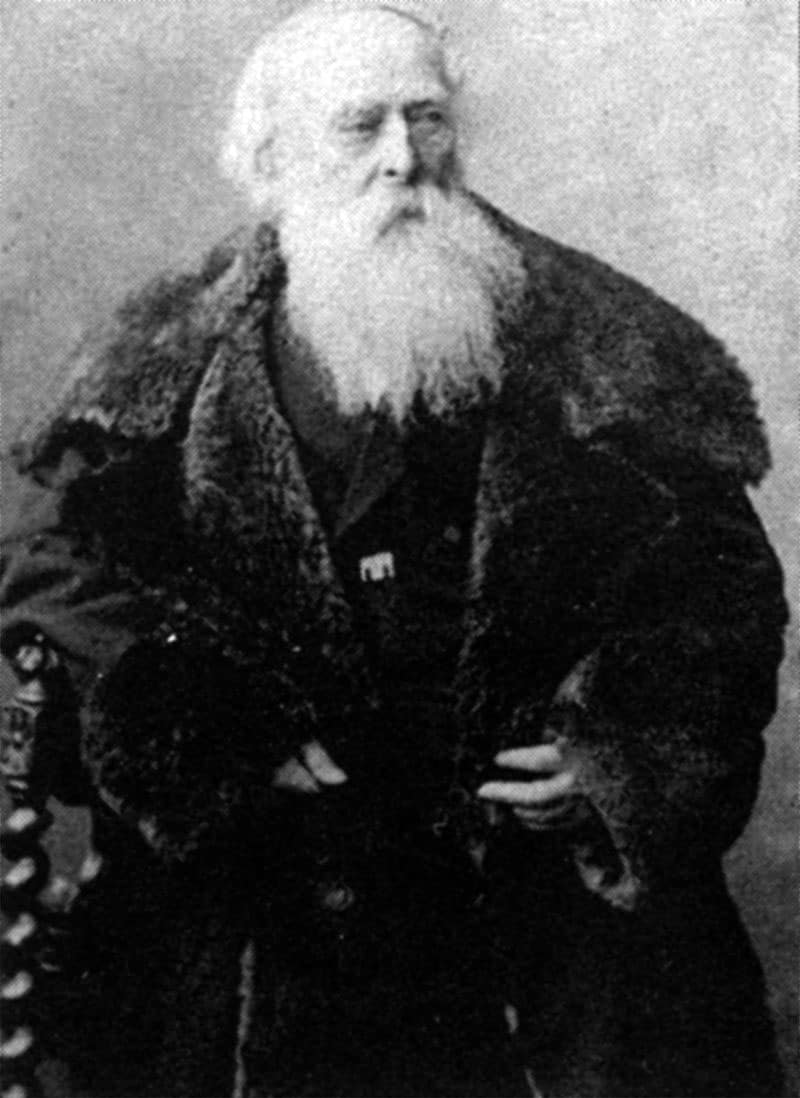
Alipio Ribeiro de Miranda, brazilian natural scientist

– Order: Psittaciformes
– Family: Psittacidae
– Genus: Pyrrhura
– Scientific name: Pyrrhura pfrimeri
– Citation: Miranda-Ribeiro, 1920
– Protonimo: Pyrrhura pfrimeri


Images Pfrimer's Parakeet:

Videos Cotorra de Goiás:

Pyrrhura pfrimeri by pyaf.net

Pfrimer's Parakeet (Pyrrhura pfrimeri)


Especies del género Pyrrhura

Sources:

  • Avibase
  • Parrots of the World – Forshaw Joseph M
  • Parrots A Guide to the Parrots of the World – Tony Juniper & Mike Parr
  • Birdlife

Photos:

(1) – Pyrrhura pfrimeri by Lander Van Nieuwenhuyse – Flickr
(2) – Pyrrhura pfrimeri by Lander Van Nieuwenhuyse – Flickr
(3) – Pyrrhura pfrimeri by Lander Van Nieuwenhuyse – Flickr
(4) – Pyrrhura pfrimeri by pyaf.net
(5) – Tiriba-de-Pfrimer, «Pyrrhura pfrimeri» – Pfrimer's Parakeet by Cláudia Brasileiro Martins
Brazilian Claudia Martins
(6) – Photo of Alipio de Miranda Ribeiro, brazilian natural scientist By File created by Flávio de Miranda Ribeiro (Picture taken by family) [CC BY-SA 3.0 or GFDL], via Wikimedia Commons
(7) – Parrots A Guide to the Parrots of the World – Tony Juniper & Mike Parr

▷ The world of Pets: Dogs, cats, birds, reptiles, amphibians

Grey-breasted parakeet
Pyrrhura griseipectus

Grey-breasted parakeet

Content

Description:

23 cm.. length and 70 g. of weight.

Grey-breasted parakeet

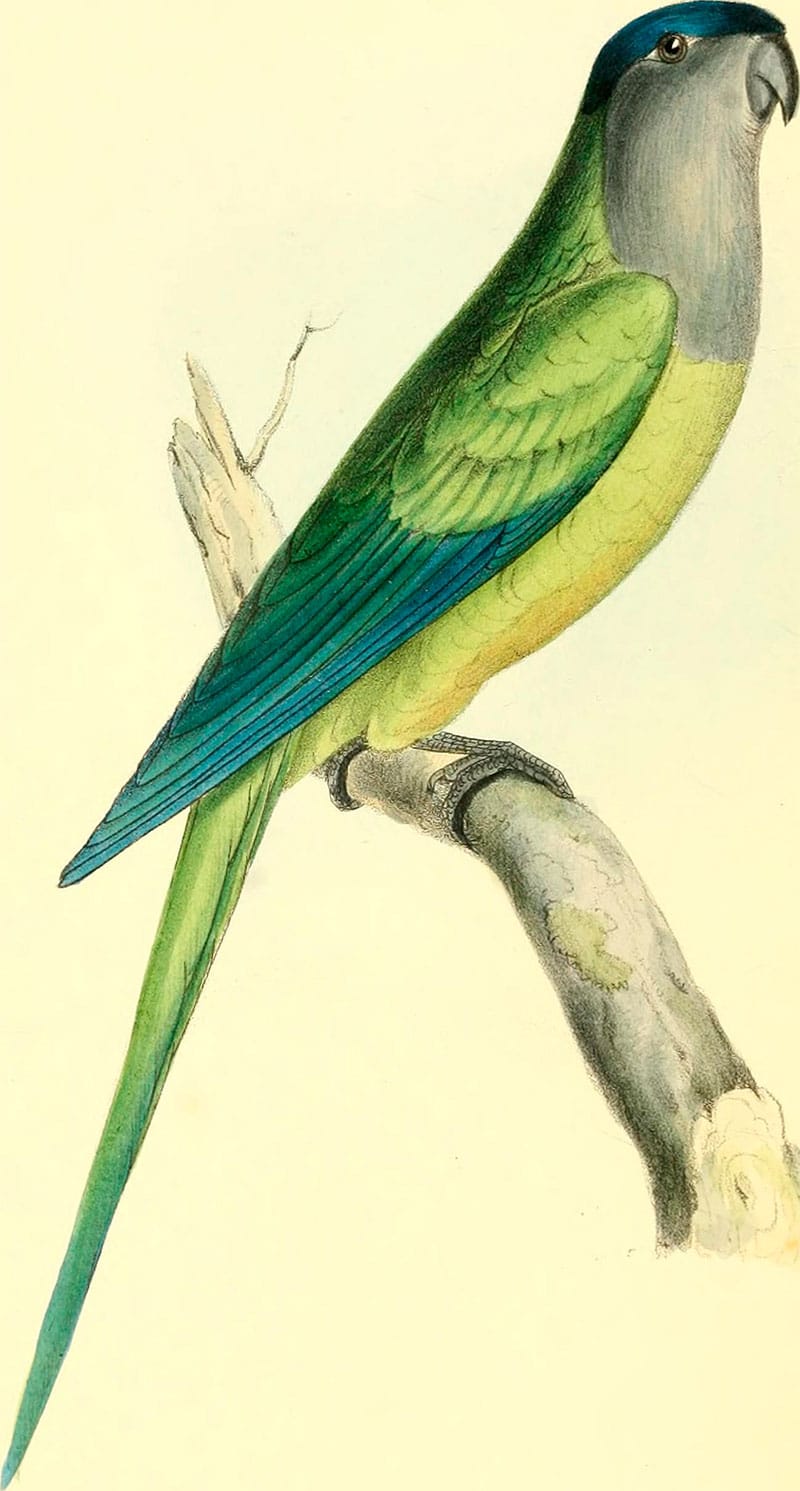
The Grey-breasted parakeet (Pyrrhura griseipectus) is a bird marked by a mask in reddish face, interrupted by a surrounding white coloration in the regions orbitals and ear-coverts.

The feathers of the neck to the upper region chest They have a gray coloration with light streaks interspersed, giving the region a striped appearance or escamado. The species has a characteristic patch reddish in belly, highlighting green coloration, its predominant body. The region forecrown up to the nape, It is dark brown with white or lighter brown spots that vary from bird to bird.. rear area neck green blue border with a width. They have a patch reddish brown in the bottom of the back which leads to the crown. The tail It is long and maroon. Bill gray-black; eye ring white gray; irises brown-orange.

It has no sexual dimorphism. The immature they are more muted than adults; You have scattered green feathers in the abdomen; the cere and the bare periophthalmic is white, less gray tone.

Taxonomic status:

This species is considered to be a subspecies of Pyrrhura [leucotis, emma or griseipectus] by some authors

  • Sound of the Grey-breasted parakeet.

Habitat:

It is in the rainforests, often located in Serranas regions, where orographic rains favor the occurrence of enclaves Atlantic Forest and Mata dry amid caatinga.

Reproduction:

The breeding season It occurs during the rainy season. The laying It is five to eight eggs in holes dug by woodpeckers since they are not able to dig their own nests; They use these holes to sleep.

When the pups are born, the couple divides the task of feeding. Sometimes they have help from even a third member of the flock to successfully raise all the young..

Food:

Probably it feeds on fruits, flowers, seeds and algae.

Distribution and status:

Size of its range (players / residents): 830 km2

This species was formerly known in 15 Locations (. Anon 2014) within Brazil. At present it is in only three areas in the state of Ceará, the Serra de Baturité and Quixadá (C. Albano in a little . 2006, Waugh et al 2010.) and most recently observed in a rocky mountain Ceará, where five birds were recorded in March 2014 (Anon. 2014).

In Serra do Baturité appears to be very rare and seems to have been extinct from several areas, but recent records of groups in the Environmental Protection Area mountains Baturité; surveys 2007 half of the remaining habitat in this site revealed near 80 individuals (C. Albano in a little. 2007, 2008) and the population here is now estimated to be about 250 birds (Waugh et al . 2010).

Forests of Baturite mountains They have been greatly reduced to make way for coffee plantations and only 13% of the jungle remained in 1996. The discovery in 2010 a population of about 50 birds in Quixadá (Waugh et al ., 2010) It raises the known world population of this species in about 300 birds.

The Grey-breasted parakeet It was previously known two other areas: the eastern slope of the Saw Ibiapaba in Ceará, and small Serra Negra, in Pernambuco, where it was very common in 1974, with flocks of 4-6 individuals regularly seen in the early 1980, although there are no recent records. There are also unconfirmed reports 1991 in organic station Murici Alagoas in which possibly it refers to individuals released; Recent fieldwork was unable to locate the species.

Its known range is very small, and the species has declined dramatically in the past, a trend that may be permanent.

Conservation:

  • Justification of the Red List of the Category

Recent surveys indicate that this species has a extremely small population, which continues to decline after dramatic historical declines. For these reasons it qualifies as Critically Endangered.

  • Justification of the population

State of conservation ⓘ


critical hazard critically endangered ⓘ (UICN)ⓘ

• Current category of the Red List of the UICN: critically endangered.

• Population trend: Decreasing.

• Population size : 200 individuals.

The population in the Area of Baturité Mountains Environmental Protection It is estimated at about 250 birds, and discovery in 2010 a population of about 50 birds in Quixadá raises the known world population of about 300 birds (Waugh et al ., 2010). This equates to approximately 200 mature individuals.

  • Justification trend

This species is suspected to be decreasing quickly because of their capture and habitat loss in progress within its range.

  • Threats

The habitat destruction He has played a role in the decline of the species with the original forest cover now reduced to only 13%.

The coffee plantations (especially where coffee is grown in the sun instead of shade coffee) They are impacting the habitat of the species.

The main threat, However, It is believed to come from the capture illegal underway for local and national trade (C. Albano a slightly 2006, Anon 2009..) and captive breeding (Fernandes-Ferreira et al 2012.); the Grey-breasted parakeet They can be easily purchased through Internet (Girão and Albano 2008).

It is easily found in the international trade in bird cage.

The lack of natural nesting sites also it believed to are limiting reproductive success of the species (Campos et al . 2014).

Conservation Actions Underway

Appendix II of CITES.

In Brazil, It was considered above in critical hazard (Silveira y Straube 2008), but it has now been legally designated as endangered national (MMA 2014), and protected Brazilian law.

Dwelleth within Baturité Mountains Environmental Protection Area, but this area has been designated for sustainable use and traditionally has not been achieved for conservation.

Management of land by a private owner in the area has led to an increase in a small town known (C. Albano a slightly . 2006).

Since 2007, NGO AQUASIS Brazil has been conducting two research projects: one sponsored by the Brazilian Foundation O Boticário for the Protection of Nature, the topography of the Baturite mountains to monitor their condition and research their biology; and another sponsored Fundación Loro Parque, for additional populations (C. Albano in a little. 2007, 2008).

The surveys carried out in the historical sites and areas of potential habitat in the period 2007-2008 They have not been able to locate members of this species, although there are strong indications of individuals that may still be inhabiting the degraded Serra do Estevão, municipality Jaw, state Ceará (C. Albano in a little. 2007 2008, Anon 2007), where it was actually rediscovered in the 2010 (Waugh et al ., 2010).

A team of AQUASIS, funded by an award Leadership Program for Conservation in 2012, conducted searches for the species on an isolated mountain in Ceará and he found a small population of five individuals in March 2014 (Anon. 2014).

You can also persist in Serra Negra Biological Reserve, state Pernambuco, although a combination of marijuana crops and hostile local culture makes research work in this latter area difficult (C. Albano in a little. 2007, 2008).


At least 11 private reserves (RPPN) They are in the process of being created in the Serra de Baturité (C. Albano in a little. 2007, 2008) and AQUASIS They are now engaged in the process of developing a nature reserve in the Baturite mountains (Campos et al . 2014).

AQUASIS has strengthened ties with government agencies in order to influence policy decisions (Campos et al . 2014).

Scheme nest box sponsored by Loro Parque It has been carried out with nest boxes installed in different places with the consent of the landowners. (Anon, 2009).

AQUASIS also they provided nest boxes Insecticide treated to reduce infestations of bee and wasp (Campos et al . 2014). These measures have proved effective, with 16 boxes occupied in 2012 give place to 97 eggs and 71 chicks hatched successfully.

A education and awareness campaign large scale was carried out in the Serra de Baturité in 2008 (C. Albano in a little. 2007, 2008) and continues today, with many schools currently participating in education programs AQUASIS (Campos et al . 2014).

A main objective of AQUASIS is to promote the Cotorra pechigris as a flagship species, the work being supported by commercial NGOs and ecotourism WATER Trails of the Park (Anonymous 2009).

AQUASIS also it aims to develop the ability to bird watching and a development process of consciousness creating alternative livelihoods (Anonymous 2009). A visitor center has recently been established (Campos et al . 2014).

It breeds well in captivity and stocks are held in Brazil and abroad. Always captive breeding is well managed and coordinated, could be used for reintroduction into the wild.

They are being conducted studies on factors influencing the survival rate of chicks, population's genetics (in future DNA techniques can be used as a deterrent against illegal collection of wild birds); both adults and juveniles have been banded (Campos et al . 2014).

Conservation Actions Proposed

Conduct more studies in areas similar to the mountains Baturité in the northeast of Brazil, such as Sierras de Aratanha, Maranguape and Machado, by the presence of additional existing populations.

continue population monitoring known in Serra de Baturité.

improve conservation management practiced in the Guaramiranga Ecological Park.

Provide incentives for landowners to increase the network of private reserves Baturite mountains.

Monitor and control trade locally, National and international.

Investigate the feasibility of using giant bamboo (Dendrocalamus giganteus) as sites for constructing artificial nests (Campos et al . 2014).

continue making awareness campaigns to promote the Grey-breasted parakeet as a symbol for the conservation of humid forests and associated biodiversity in the Baturite mountains.

Investigate in situ conservation measures.

"Grey-breasted parakeet" in captivity:

Its continuous capture, both for domestic and international trade, They have taken this beautiful bird to a critical situation, there are only 200 specimens in the nature. There are probably more animals captivity in its natural habitat

Protected by the Appendix II of CITES, each captive specimen of this species that is capable of reproducing, must be placed in a well-managed captive breeding program and not sold as a pet, in order to ensure long term survival.

Alternative names:

– Gray-breasted Conure, Gray-breasted Parakeet, Grey-breasted Conure, Grey-breasted Parakeet, Maroon-faced Parakeet (Gray-breasted) (English).
– Conure à poitrine grise (French).
– Graubrustsittich, Salvadori-Weißohrsittich (German).
– Tiriba-de-orelha-branca, tiriba-de-peito-cinza, periquito cara-suja (Portuguese).
– Cotorra pechigrís, Periquito sujo, Cotorra de pecho gris (español).


scientific classification:

Salvadori-Thomas
Salvadori Tommaso

– Order: Psittaciformes
– Family: Psittacidae
– Genus: Pyrrhura
– Scientific name: Pyrrhura griseipectus
– Citation: Salvadori, 1900
– Protonimo: Pyrrhura griseipectus


Images Grey-breasted Parakeet:

Videos "Grey-breasted parakeet"


Especies del género Pyrrhura

Grey-breasted parakeet (Pyrrhura griseipectus)


Sources:

– Avibase
– Parrots of the World – Forshaw Joseph M
– Parrots A Guide to the Parrots of the World – Tony Juniper & Mike Parr
– Birdlife

– Photos:

(1) – Grey-breasted Parakeet By writhedhornbill [CC BY 2.0], via Wikimedia Commons
(6) – Grey-breasted Parakeet by Internet Archive Book Images – Flickr

– Sounds: Ciro Albano, XC7948. accessible www.xeno-canto.org/7948

▷ The world of Pets: Dogs, cats, birds, reptiles, amphibians

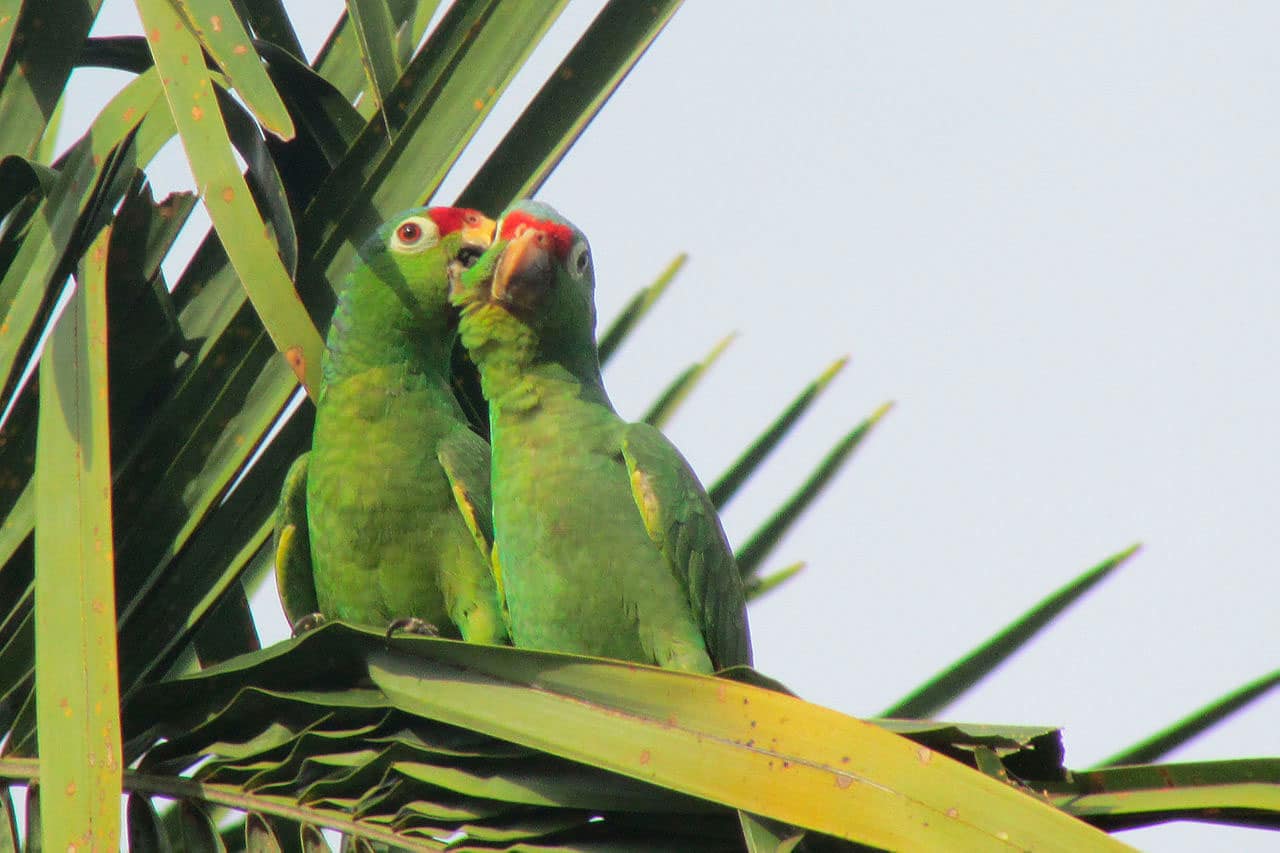
Red-lored Amazon
Amazona autumnalis

Red-lored Amazon


Anatomy-parrots

Content

Description:

35,5 to 38,1 cm.. height and between 314 and 485g. weight.

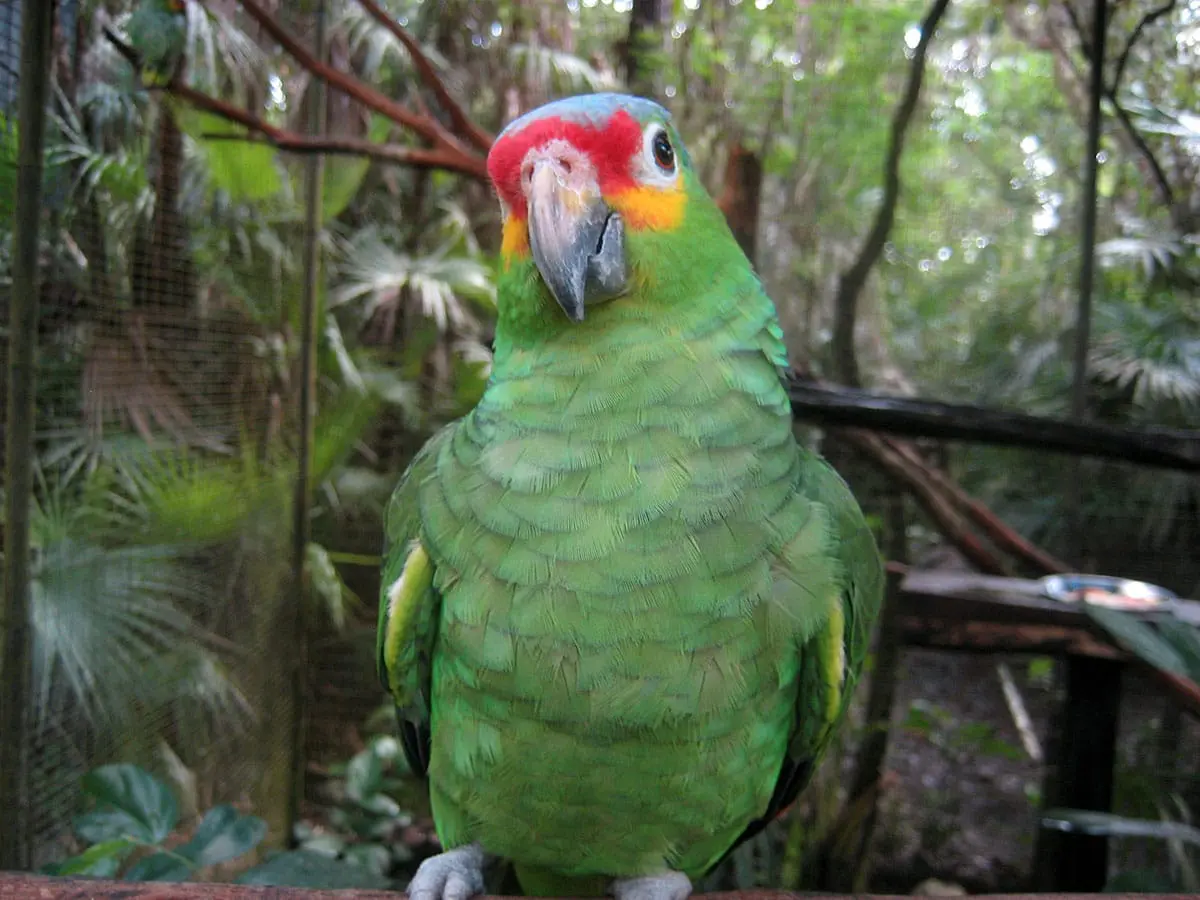
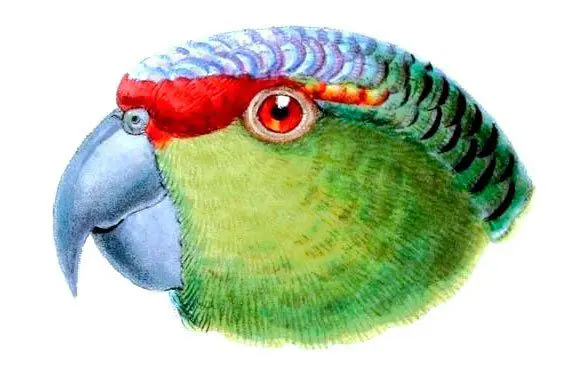
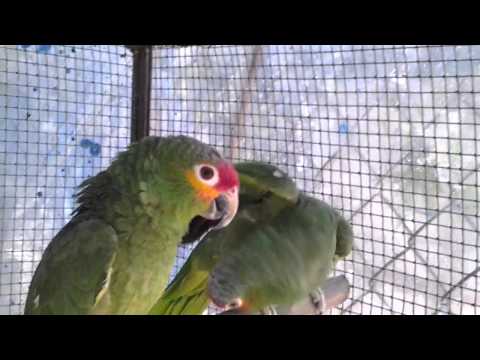
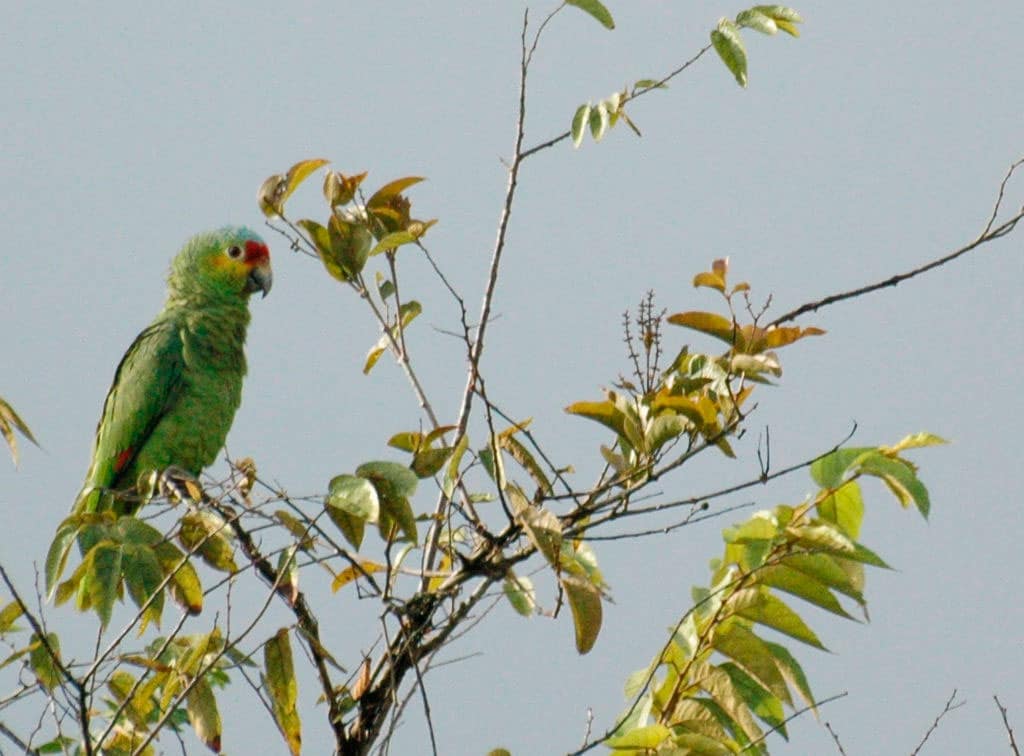
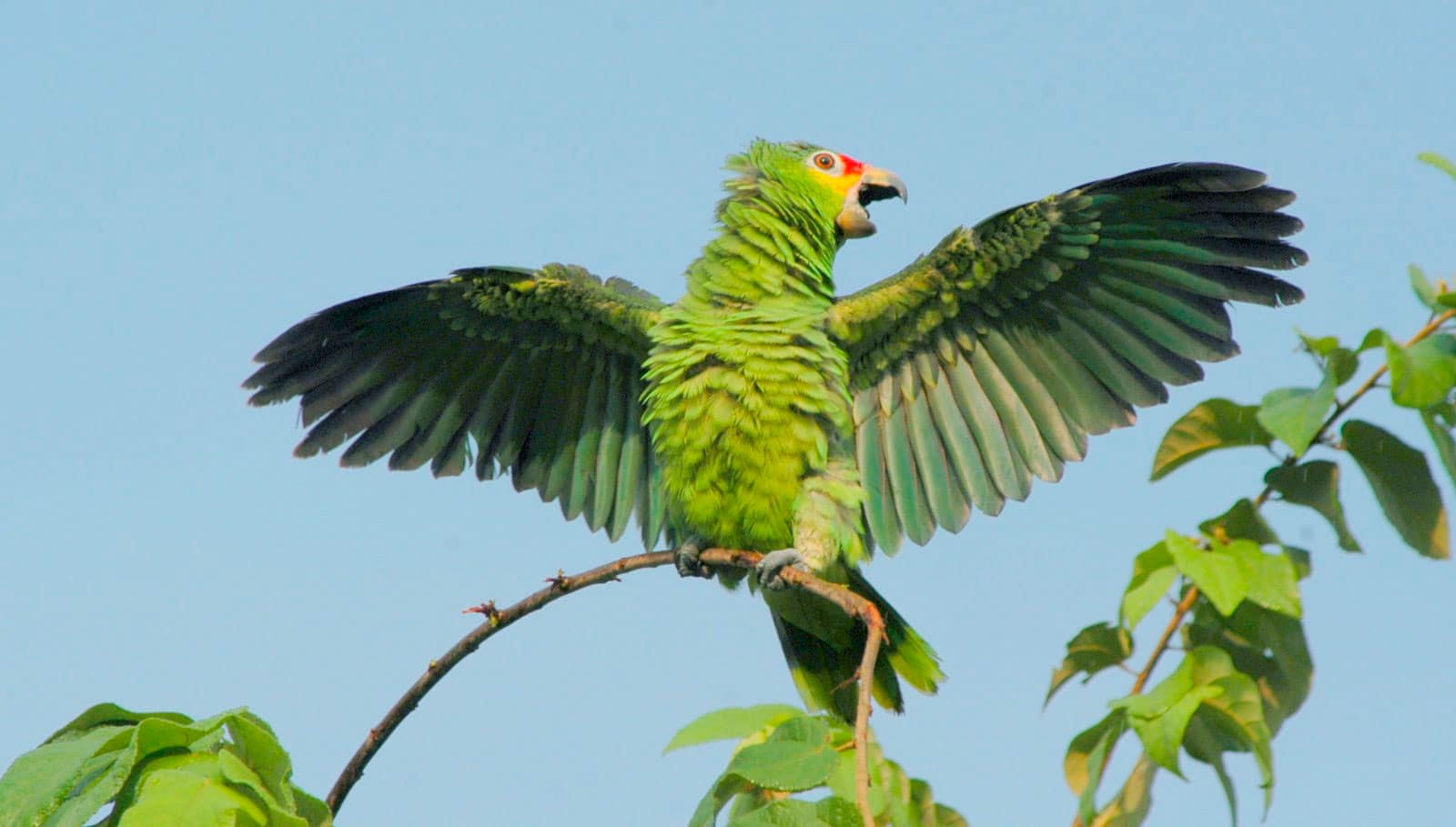
The Red-lored Amazon (Amazona autumnalis) is distinguished by its red front; Green with edge lilac it nape ; crown lilac; stain red in the wing , and tail blue margin.
The bill is grey with the upper jaw yellowish-horn. The irises his eye is orange. The legs are of color gray greenish.
They do not possess sexual dimorphism, that is to say, there is no physical difference between the male and the female.

Description 3 subspecies:

Amazona autumnalis lilacina Lesson, 1844
  • Amazona autumnalis autumnalis

    (Linnaeus, 1758) – Nominal.


  • Amazona autumnalis lilacina

    (Lesson, 1844) – It has a red band in the forecrown that it extends over them eyes; the cheeks Yellow.


  • Amazona autumnalis salvini

    (Salvadori, 1891) – It has cheeks and ear-coverts green; the basis of the tail by under Red.

Habitat:

Video – "Red-lored Amazon"

Amazonas autumnalis

This amazon frequents a wide range of habitats wooded and open with trees, including rainforest, tropical deciduous forest, pine forests, mangroves, forest swamps, gallery woods, areas cultivated with trees high and plantations; also forest dry in the South of Ecuador.

The Red-lored Amazon move from the rainforest (breeding season) to a habitat more open in winter in the Yucatan Peninsula, Mexico. The altitudes that inhabit range from sea level to the 320 metres in Oaxaca, 1.100 metres in Honduras, 800 metres in the Caribbean, 1.000 meters on the slopes of the peaceful of Costa Rica, and 1.000 metres in Colombia.
The birds tend to be in pairs or in flocks loose, being more gregarious When feed (occasionally macaws) and when resting. outside the breeding season, birds take refuge in tall trees in gallery forests or mangroves.

Reproduction:

They nest during the seasonal dry in hollow of trees (usually dead, for example, Tabebuia or Ceiba) or on the stump of a Palm tree. Birds in State reproductive in April, Oaxaca; February-March, Belice; March, Guatemala; January-February, Colombia. Reproduce between February-April, Panama; March-may, Belice and January-March, Ecuador. Clutch 3-4 eggs.

The incubation varies from 25 to 26 days. The chicks remain in the nest 70 days.

Food:

In the wild these birds feed on figs Ficus, orange, Mango, fruits of Palm (including the of Cordia lutea and Spondias purpurea), coffee beans (Coffea arabica), seeds of Ferrule, Casearia and Protium. Mainly are feeds in the tops of trees high.

Distribution:

Size of the area of distribution (reproduction / resident): 2.570.000 km2

The Red-lored Amazon It extends from the South of Mexico north of South America with a population disjunct in the amazon.
You can find in them lands low of the this of Mexico, in the South of Tamaulipas, in the East of San Luis Potosi, Puebla, Oaxaca, Chiapas, Tabasco, Campeche and Quintana Roo. Records from other parts of the country (for example, City of Mexico) probably you refer to leak.
You can see in Belice and in the lowlands of the Caribbean of Guatemala and Honduras (including Roatan and Guanaja in Bay islands and probably soon in Utila), until Nicaragua and Costa Rica, where they are present in humid areas of the tropics on both slopes (absent from the dry Northwest ), also in Panama and on the islands of Coiba and Escudo de Veraguas and in the Archipelago of pearls (absent from the driest areas of the Azuero Peninsula).

In the Northwest of Colombia appear on the Pacific slope of the Western Andes from the Panamanian border to the South up to the Serrania del Baudo and from the southwest of Cauca south to Ecuador in the Gulf of Guayaquil. Also it extends to the North of the Andes in Colombia to Magdalena Medio and to the East in the Northwest of Venezuela in Zulia (Sierra de Perija).

In the Northwestern basin of the brazilian amazon a disjunct population exists between Black river and Solimões River.

Usually resident with some local seasonal habitat preferences (for example, in Yucatan Peninsula, Mexico). Is usually the most common parrot and more numerous in some parts of the range (for example, in parts of Central America) but now is a species very rare to the West of them Andes in Ecuador and Colombia with a population of the subspecies Amazona autumnalis lilacina estimated in 400-600 specimens.

Population decreased drastically in the island of Roatan (Honduras) where he captured it is massively for export, and maybe missing in Utila for the same reason.

Capture combined with the loss of habitat also has caused declines in some other parts of its area of distribution (for example, east of Mexico and Ecuador). common in captivity in some areas, and marketed internationally.

Distribution 3 subspecies:

  • Amazona autumnalis autumnalis

    (Linnaeus, 1758) – Nominal. Coast of the Caribbean from the East of Mexico South to North of Nicaragua.


  • Amazona autumnalis lilacina

    (Lesson, 1844) – West of Ecuador.


  • Amazona autumnalis salvini

    (Salvadori, 1891) – North of Nicaragua south to Colombia and Venezuela.

Conservation:

State of conservation ⓘ


minor concern Minor Concern ⓘ (UICN)ⓘ

• Current category of the Red List of the UICN: Least concern.

• Population trend: Decreasing.

This species has a very large range and, Therefore, is not approaching the thresholds of Vulnerability at the discretion of the distribution area size.

The population size is very large and, therefore, not approaching the thresholds for vulnerable under the criterion of population size (<10.000 mature individuals with an estimated continuous decrease in> 10% in ten years or three generations or with a specific population structure). For these reasons, the species is evaluated as least concern.

Justification of trend

It is suspected that the population is in decline due to the continuous destruction of the habitat and to levels of exploitation unsustainable.

The Amazona lored in captivity:

Is of vital importance that the diet is complete and balanced in all directions, as this prevents, along with other factors, the appearance of bone problems or the known software that affects numerous parrots. To ensure the balance of this, prepared feed very well supply the nutritional needs of each animal, However, they should not miss plant, fruits and vegetables, as well as diversity of seeds that come in mixture.

As for accommodation, If they are not removed from cage constantly, it should be spacious enough to exercise the muscles of the wings and legs, and the plumage of the bird is preserved in perfect condition.

The Red-lored Amazon enjoy, like all parrots, tearing apart and finding out things, so they must have the occasional toy or we may end up having problems with the furniture. Them feet of parrot are very suitable if your stay is in the outside of the cage. Of course, they must not be exposed to draughts or sudden changes in temperature. The water must be clean at your fingertips, because the existence of fungi causes serious breathing problems.

In terms of coexistence to have it in the neighborhood area, in comparison with other species in Amazon, are relatively quiet, so in general do not cause many problems.

In captivity, can get to live up to 80 years.

BREEDING AND REPRODUCTION:

Its captive breeding started for the first time in United States, after their importation from the place of origin, South America in the 1950's.

Those individuals acquire their sexual maturity on the 4 years of age, and if you have a good breeding pair in the right conditions, they can perform two annual broods, Although the main thing if you want to raise, patience. Many pairs need several years until the first calf, so it is very important to be patient and wait for the right moment.

The female lays in the nest (No fill) of 2 to 6 eggs incubated without the help of the male usually. This is dedicated to feeding the female itself and that of the chicks after their birth at the 28 days until independence after twelve weeks.

Alternative names:

– Red-lored Parrot, Red-lored Amazon, Yellow-Cheeked Amazon (English).
– Amazone à lores rouges, Amazone diadème (French).
– Rotstirnamazone (German).
– Papagaio-diadema, Papagaio-diadema (Papagaio cavacué) (Portuguese).
– Amazona Frentirroja, Lora Frentirroja, Loro Frentirrojo (español).
– Lora cariamarilla (Honduras).
– loro cachete-amarillo (Mexico).


scientific classification:

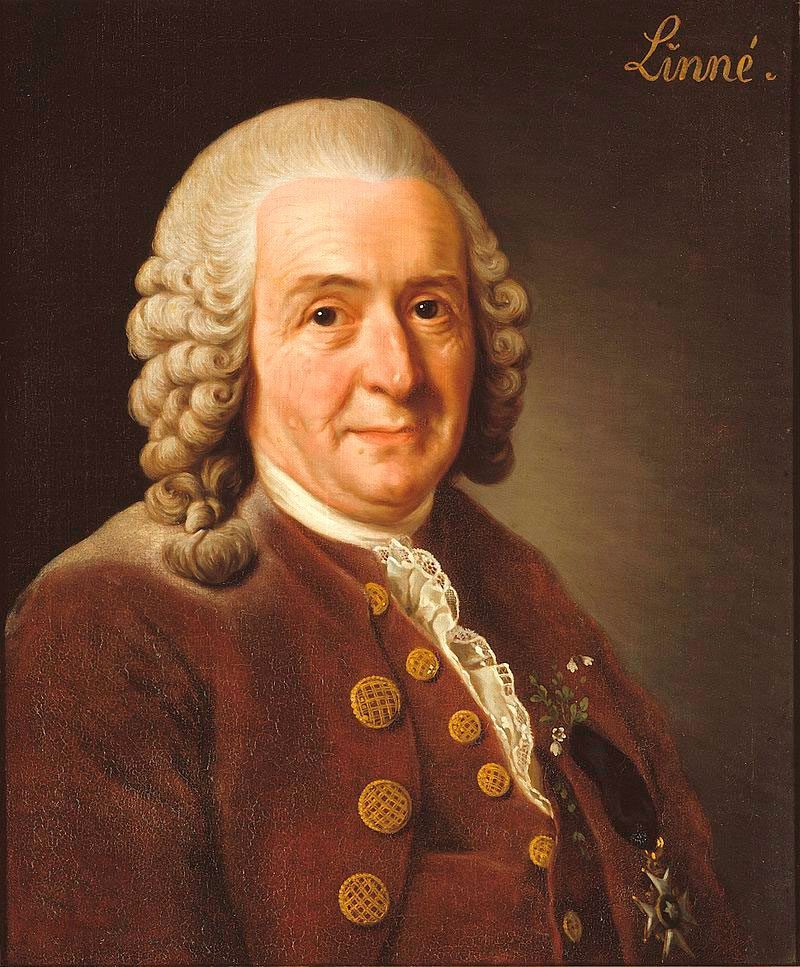
Carl Linnaeus

– Order: Psittaciformes
– Family: Psittacidae
– Genus: Amazona
– Scientific name: Amazona autumnalis
– Citation: (Linnaeus, 1758)
– Protonimo: Psittacus autumnalis


Red-lored Amazon images:


Species of the genus Amazona


Sources:

  • Avibase
  • Parrots of the World – Forshaw Joseph M
  • Parrots A Guide to the Parrots of the World – Tony Juniper & Mike Parr
  • Birdlife
  • Parrot Book, Parrots and macaws Neotropical
  • Grupohypermarkup

Photos:

(1) – Wikimedia.org
(2) – Red-lored Amazon or Red-lored Parrot; two captive parrots By Brian Gratwicke (originally posted to Flickr as Red-lored Amazon) [CC BY 2.0], via Wikimedia Commons
(3) – A Red-lored Amazon in Panama By Nelson de Witt from USA (Hello!) [CC BY-SA 2.0], via Wikimedia Commons
(4) – To pet Red-lored Amazon By Richard (originally posted to Flickr as Looming….) [CC BY 2.0], via Wikimedia Commons
(5) – Red-lored parrots (Amazona autumnalis), OSA Peninsula, Costa Rica By Charlesjsharp (Own work) [CC BY-SA 3.0], via Wikimedia Commons
(6) – A Red-lored Amazon at Rock Farm, Belize. It has a feather problem By Rigrat [CC BY-SA 3.0], via Wikimedia Commons
(7) – This is the image of a parrot originating of the jungle of Chiapas in Mexico By Joe Quick [CC BY 2.0], via Wikimedia Commons
(8) – Red-lored Amazon perching on a branch with wings open near Belmopan, Belize By Rigrat (Picasa Web Albums) [CC BY-SA 3.0], via Wikimedia Commons
(9) – A strange sight to me to see parrots flying in the wild. This Red-lored Amazon (Amazona autumnalis) was spotted with a group along the roadside in the Cayo distict of Belize By The Lilac Breasted Roller (originally posted to Flickr as Red Lored Parrot) [CC BY 2.0], via Wikimedia Commons
(10) – Lilacine Amazon, head from lateral by John Gerrard Keulemans [Public domain], via Wikimedia Commons

Sounds: Walter Rivera

▷ The world of Pets: Dogs, cats, birds, reptiles, amphibians

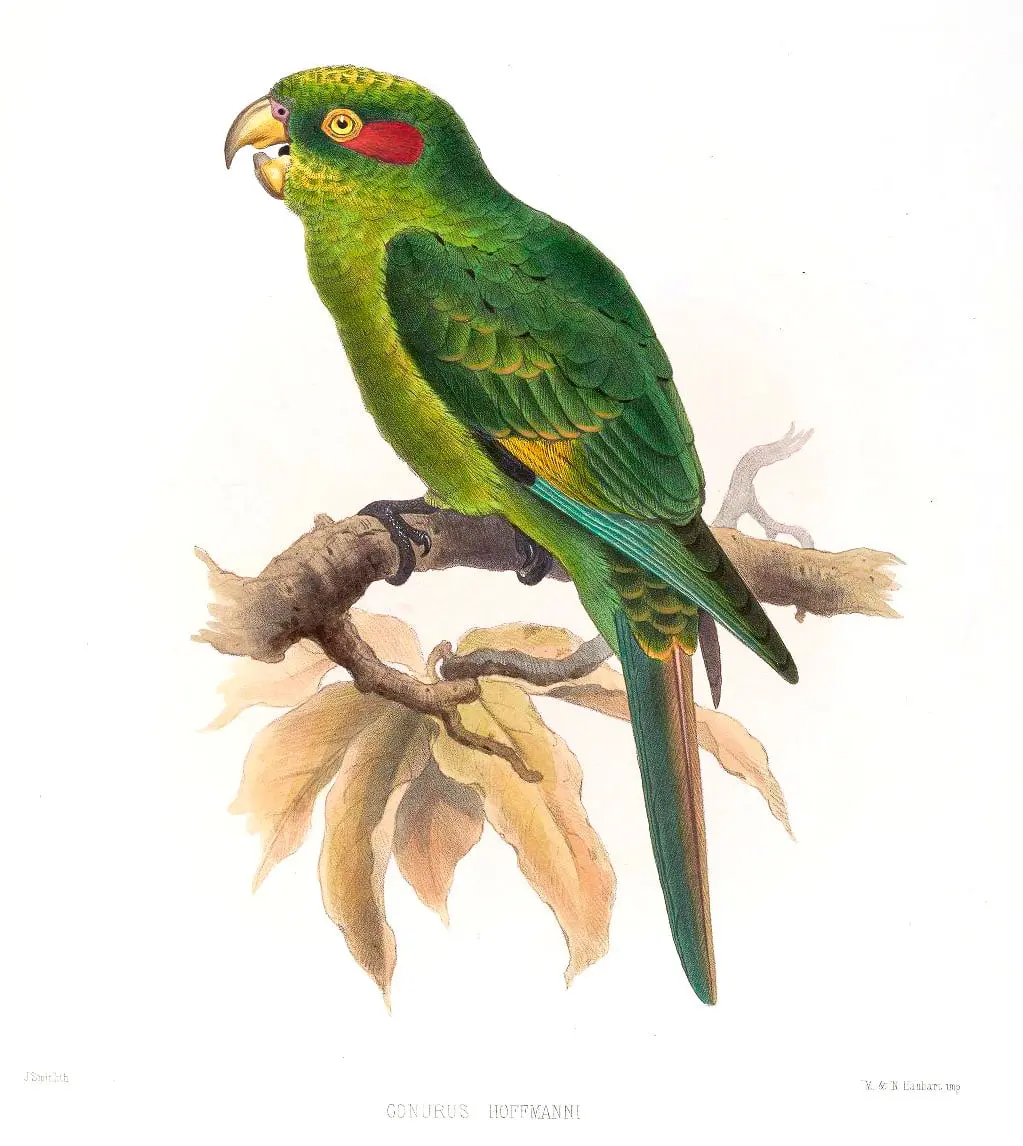
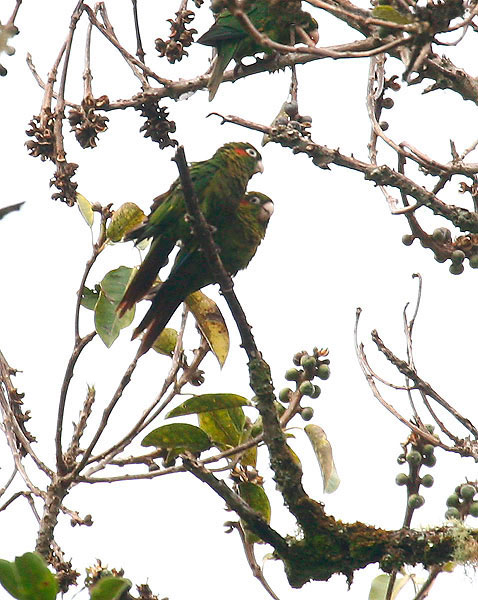
Sulphur-winged Parakeet
Pyrrhura hoffmanni

Sulphur-winged Parakeet

Content

Description:

23 cms. length and 84 g. of weight.
The Sulphur-winged Parakeet (Pyrrhura hoffmanni) It, mostly, green with some individual variations in plumage.

It has a distinctive tail long and round about ear-coverts crimson red. Yellow at the top of the wings, largely hidden when the bird is at rest, but perfectly visible in flight.

The feathers of the forecrown, crown, cheeks and nape, They are green with yellow centers (the proportion of the yellow color is higher in the forecrown, lower in the back of the crown). Above predominantly green, It is the leading edges of the wings, sometimes, yellow. The lesser coverts and median are, generally, green, sometimes with some yellow in outer median coverts and feathers alula.

Yellow at the base of the outerweb of the greater coverts. Outerwebs of primaries, to a great extent, blue; primaries and secondaries with bright yellow patch, especially on the basis of innerwebs; flight feather with black tips. Under, the wings with the lesser coverts green, the majors, greenish yellow; a central portion flight feather yellowed with greyish tips.

Sulphur-winged Parakeet

Chin reddish; throat, sides neck and the top chest, green with yellow tips on feathers, which gives an overall light effect Scaled. The belly, the flanks and undertail-coverts, are green. Upper, the tail is green, below, reddish.

The bill and cere They are pink colored horn; bare periophthalmic white or yellowish white; the irises brown; legs pale grey.

Both sexes are similar, but the male player has yellow stripes on pens crown.
The Immature It has less yellow in head, the chest and wings.

  • Sound of the Sulphur-winged Parakeet.

Subspecies description:

  • Pyrrhura hoffmanni gaudens

    (Bangs, 1906) – Very similar to nominal, although feathers crown and nape They have yellower, with their ends red or red and orange (in some birds, red ends of the feathers may extend over the back, the throat and the chest). Underparts slightly darker.


  • Pyrrhura hoffmanni hoffmanni

    (Cabanis, 1861) – Nominal.

Habitat:

Video – "Sulphur-winged Parakeet" (Pyrrhura hoffmanni)

Sulphur-winged Parakeet (Pyrrhura hoffmanni)

Observed, mainly, in mountainous areas, preferring montane forests in the subtropical zone, mainly 1.000 to 2.400 meters above sea level, although views 550 meters in the region Admiral's Bay, Panama and a 3.000 metres in Costa Rica.

They appear to tolerate a considerable disturbance of habitat, including managed forests, areas and the second growth partially cleared, forests and wooded pasture shrubs. Usually seen in pairs or small flocks of 5-15 birds. You can perform altitudinal movements daily to feed, returning to the mountains to rest. Forage occurs in the canopy or smaller trees and bushes near the edge of the woods.

Reproduction:

They nest in tree hollows, including old nests woodpeckers, to 8-20 meters of land. With reproduce dry season (January June). Clutch six eggs in captivity.

Food:

Its diet includes fruit of Ficus, Croton, Leandra, Myrtus and Miconia.

Distribution and status:

Extending its range (players / residents): 18.400 km2

Confined south of Costa Rica and western Panama.

The species is found in the highlands of the southern half of Costa Rica, including the slopes of Caribbean, the mountains of the central plateau south and the two sides of the Cordillera de Talamanca, sometimes the region Cartago and Paradise and the Irazu volcano.

In western Panama They are mainly distributed in the west and center chiriqui and areas adjacent in Bull's mouths, in the highest mountains (including the chiriqui volcano and the high ridges on Boquette) and at lower elevations around, for example, of the Chiríqui Lagoon and Admiral Bay.

The easternmost Panamanian registry was found east of the central mountain range in 1868.

Some altitudinal movements (higher in the dry season). Birds are perhaps only sporadic in the extremities of their range. Apparently, It is common in the middle to high elevations of the Cordillera de Talamanca and in isolated areas, and it is believed to be quite numerous throughout the main range.

Its habitat It is now highly fragmented, though still apparently numerous, even in areas where the forest is partly cloudy. Rare in captivity.

Subspecies distribution:

  • Pyrrhura hoffmanni gaudens

    (Bangs, 1906) – West of Panama and Caribbean slope of Bull's mouths.


  • Pyrrhura hoffmanni hoffmanni

    (Cabanis, 1861) – Nominal. South of Costa Rica.

Conservation:

State of conservation ⓘ


minor concern Minor Concern ⓘ (UICN)ⓘ

• Current category of the Red List of the UICN: Least concern.

• Population trend: Stable.

• Population size : Unknown.

Rationale for the Red List category

Although this species may have a small range, it is not believed that approximates the thresholds for Vulnerable under the criteria of size range (Extension <20,000 km2 combinada con un tamaño de rango decreciente o fluctuante, extensión / calidad del hábitat o tamaño de la población y un pequeño número de lugares o fragmentación severa). La trend of the population It appears to be stable, so that the species does not approach the thresholds for Vulnerable under the criteria of population trend (> 30% decline over ten years or three generations). The population size It has not been quantified, but it is not believed to be close to the thresholds for Vulnerable under the criterion of population size (<10.000 individuos maduros con un declive continuo estimado> 10% in ten years or three generations or a population structure). For these reasons, the species is evaluated as Least Concern.

Justification of the population

The size of the world's population has not been quantified, but this species is described as «quite common» (Stotz et to the., 1996).

Justification of trend

They suspected that the population of Catana Cotorra is stable in absence of evidence of any decline or threatens substantial.

"Sulphur-winged Parakeet" in captivity:

Rare in captivity. Quieter than other parakeets. In Panama the export of these birds is prohibited from 1980.

Alternative names:

– Hoffmann’s Conure, Hoffmann’s Parakeet, Hoffman’s Conure, Hofman’s Conure, Sulfur-winged Parakeet, Sulphur winged Parakeet, Sulphur-winged Conure, Sulphur-winged Parakeet (English).
– Conure de Hoffmann, Perriche de Hoffmann, Perruche de Hoffmann (French).
– Hoffmann Sittich, Hoffmannsittich, Hoffmann-Sittich (German).
– Tiriba-de-asa-amarelada (Portuguese).
– Cotorra Catana, Perico aliazufrado, Perico de Hofman (español).
– Perico aliazufrado (Costa Rica).


scientific classification:

Jean Louis Cabanis
Jean Louis Cabanis

Its name refers to the German naturalist Karl Hoffman.

– Order: Psittaciformes
– Family: Psittacidae
– Genus: Pyrrhura
– Scientific name: Pyrrhura hoffmanni
– Citation: (Cabanis, 1861)
– Protonimo: Conurus hoffmanni

Sulphur-winged Parakeet Images:


Especies del género Pyrrhura

Sources:

– Avibase
– Parrots of the World – Forshaw Joseph M
– Parrots A Guide to the Parrots of the World – Tony Juniper & Mike Parr
– Birdlife

– Photos:

(1) – Sulphur-winged Parakeet (Pyrrhura hoffmanni). Photographed at Savegre, in Costa Rica By Dominic Sherony [CC BY-SA 2.0], via Wikimedia Commons
(2) – Parakeet HOFFMAN (Pyrrhura hoffmanni) Loro Parque, Tenerife by ZOOTOGRAFIANDO
(3) – A Sulphur-winged Parakeet at Savegre, Costa Rica By Dominic Sherony [CC BY-SA 2.0], via Wikimedia Commons
(4) – Sulphur-winged Parakeet (Pyrrhura hoffmanni) at Savegre Lodge, near San Gerardo, Costa Rica By Michael Woodruff [CC BY-SA 2.0], via Wikimedia Commons
(5) – Sulphur-winged Parakeet or Hoffmann’s Conure (Pyrrhura hoffmanni) by elite-pets
(6) – Conurus hoffmanni = Pyrrhura hoffmanni by Joseph Smit [Public domain], via Wikimedia Commons

– Sounds: Mike Nelson, XC107214. accessible www.xeno-canto.org/107214

▷ The world of Pets: Dogs, cats, birds, reptiles, amphibians

Slender-billed Parakeet
Enicognathus leptorhynchus

Slender-billed Parakeet

Content

Description:

40 to 42 cms. length and 200 to 250 g. of weight.
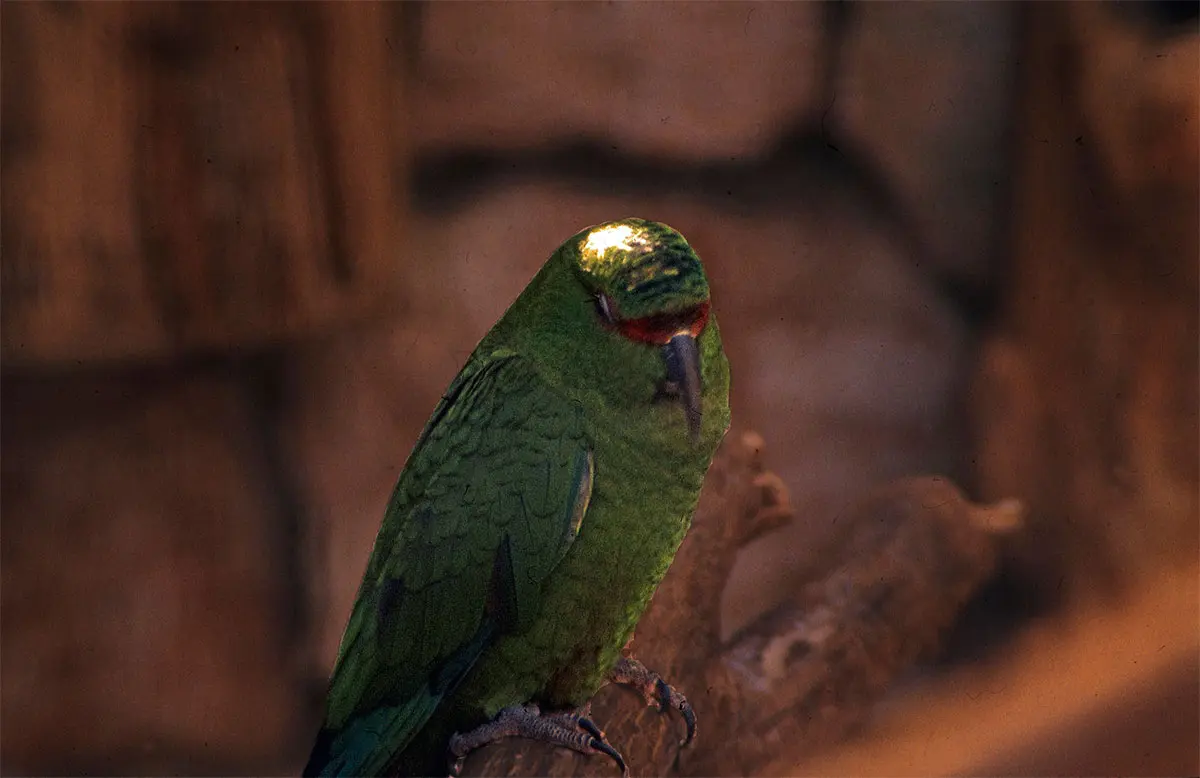
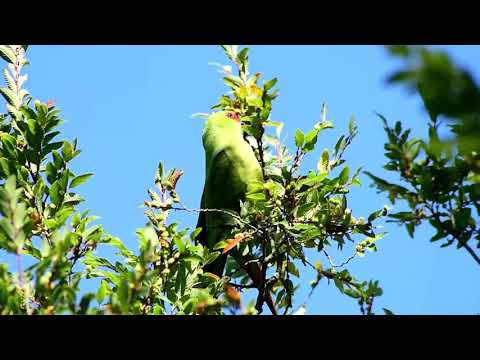
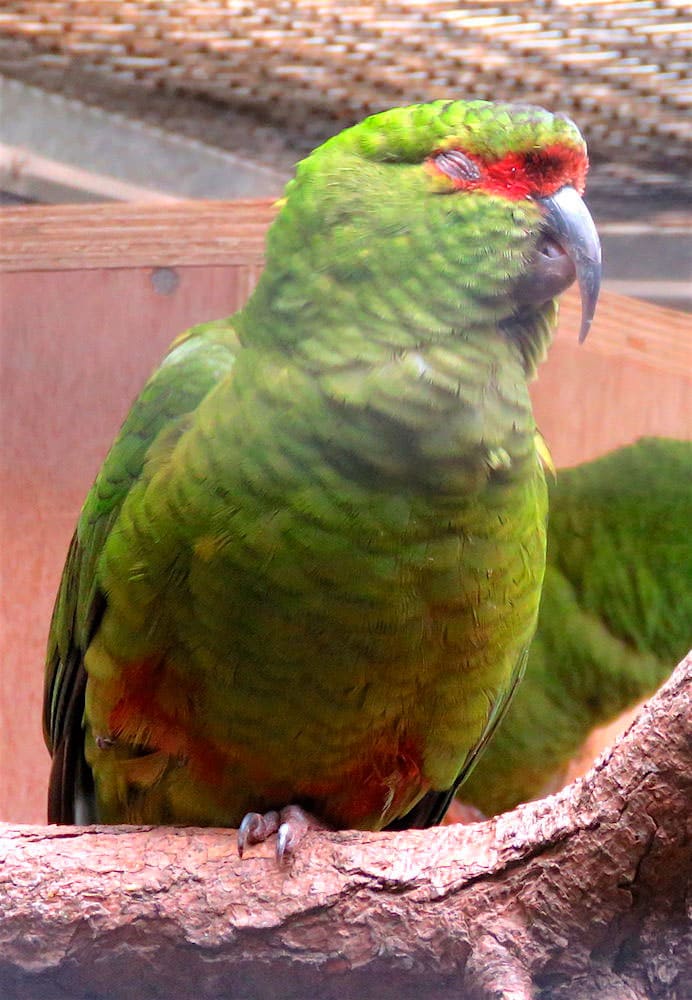
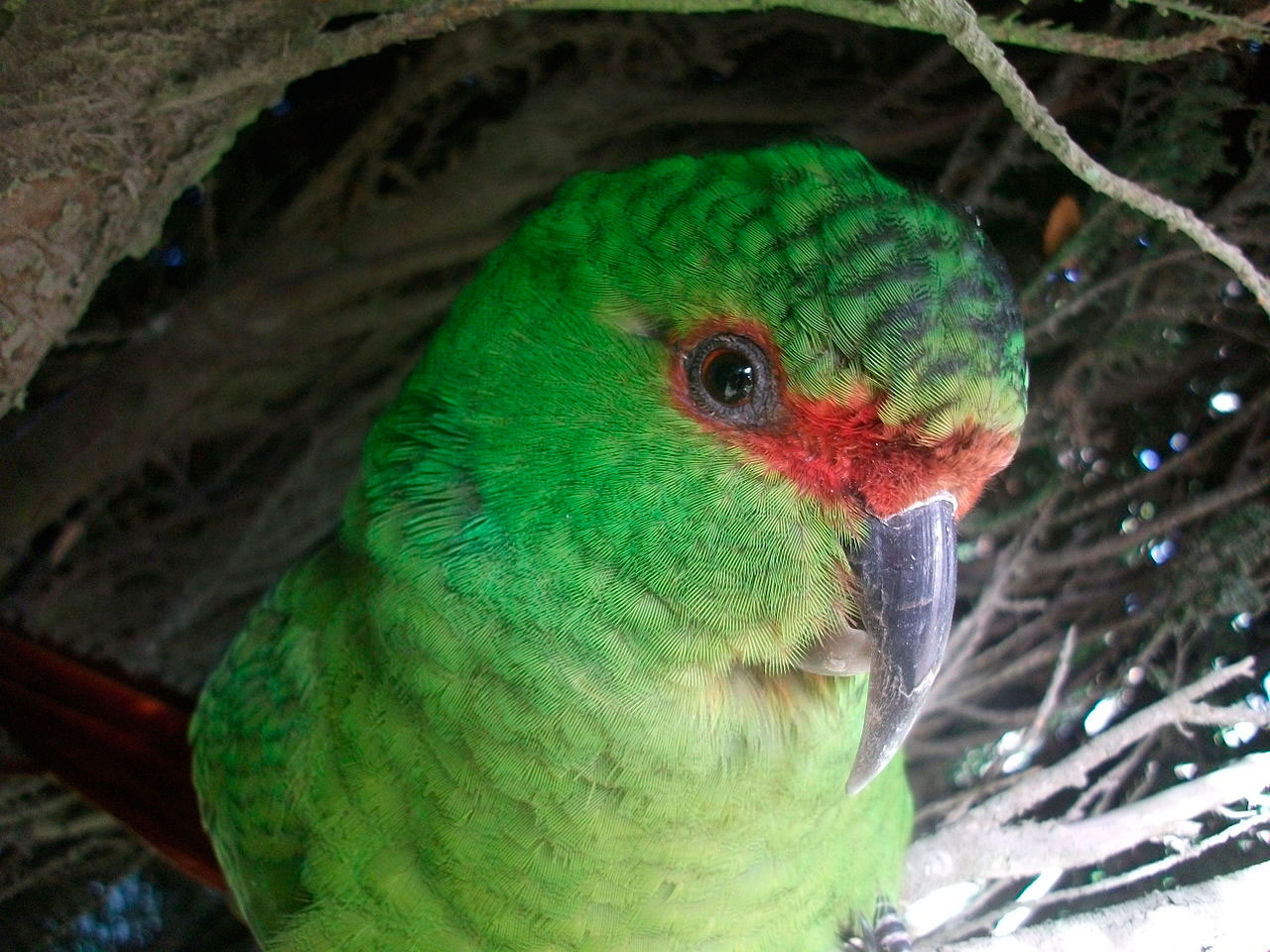
The Slender-billed Parakeet (Enicognathus leptorhynchus) has the lores, forecrown and a narrow ring feathers around the eyes bright crimson red; cheeks and sides neck, green; feathers of the crown, the nape, the the mantle and back, with dark green margins producing a scalloped effect (more pronounced in the crown, where the feathers are brighter and more emerald).

Scapulars, rump and uppertail-coverts They are green. Primary coverts green with blue suffusion; other coverts green. Flight feathers green-blue above with dark margins in innerwebs near the tips; light gray below. Underwing-coverts brighter yellowish green. Underparts yellowish green with patch dull red in centre of belly. Upper, the long tail red is off; greenish toward the tip; undertail, dull red suffused greyish.

Slender-billed Parakeet

The upper jaw It is dark gray with colored tip horn, the lower jaw is horn; Strait bare periophthalmic grey; irises orange-red; legs grey.

Both sexes are similar.

Immature darker, with the upper jaw shorter, less red in the face little or no red on belly.

  • Sound of the Slender-billed Parakeet.

Habitat:

Video – "Slender-billed Parakeet" (Enicognathus leptorhynchus)

CHOROY PARROT EATING

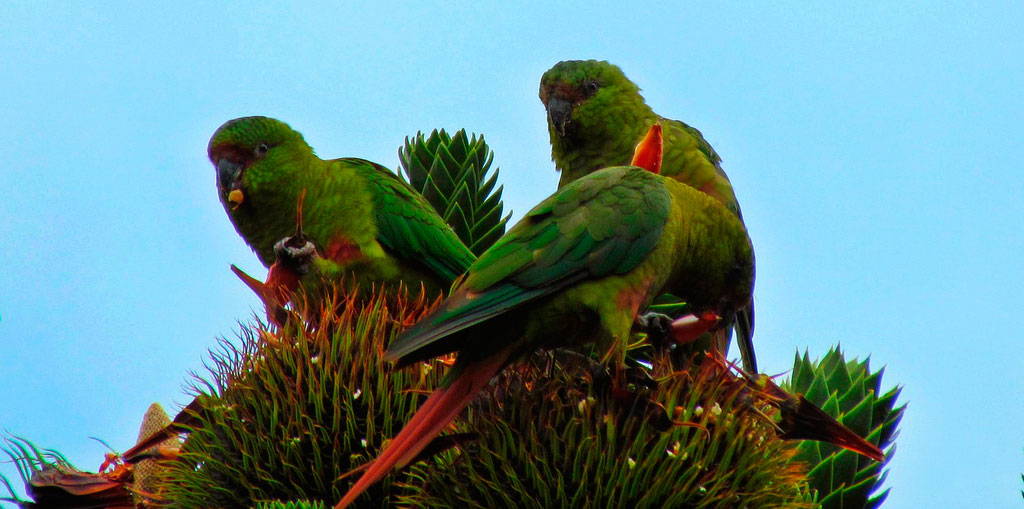
The Slender-billed Parakeet dwells in wooded areas, mainly Nothofagus and Araucaria, although they can be seen in more open cultivated fields or pastures, especially in winter. Its range is from sea level in winter to 2.000 meters in summer. Usually in flocks, of a few individuals to several hundred, even in breeding season; large communal concentrations sometimes composed of several thousand birds.

Reproduction:

Nests generally treeholes, often at a certain height and several couples using the same tree; very deep holes fill them with twigs to raise the base level. Occasionally nidifican in rock crevices, building the nest with twigs (for example, bamboo thicket This chusquea) if there is no tree cavities available. breeding season in November-December. Clutch 5-6 eggs.

Food:

Its diet It consists of seeds of wild and cultivated plants (They are sometimes considered a pest), including grains and thistles, seed cones araucaria (March April) open with its elongated peaks, acorns, seeds of Nothofagus and bulbous roots. generally place vigilantes while the rest of the birds feed.

Distribution and status:

Distribution area (breeding / resident): 195.000 km2

The Slender-billed Parakeet It is confined to the center Chile, from the South of Santiago through coastal lowlands and valleys on the slopes of hills peaceful, south to the Chiloe Island and maybe Palena River in the North of Aysen; They can also be seen in Isla Mocha off the southwest coast bio bio.

made some movements altitudinal seasonal, with moving from coastal lowlands to the foothills of the hills between spring and autumn bird (September-May).

Quite common, although in recent decades its population has suffered a decline due to, fundamentally, deforestation, his capture and the Newcastle disease.

Less frequent and perhaps only sporadic in the northern and southern ends of its range.

Caught locally as pets, although quite rare in captivity outside Chile.

Conservation:

State of conservation ⓘ


minor concern Minor Concern ⓘ (UICN)ⓘ
  1. Current red list category of the UICN: Least concern.
  2. The population trend: Stable.
  3. Population size : Unknown.

(classified in Appendix II of CITES)

Justification of the Red List of the Category

This species has a range very large, and as a result does not approach the thresholds for Vulnerable under the range size criterion (extent of occurrence <20.000 km2). La tendencia de la population seems to be stable, and therefore the species does not approach the thresholds for Vulnerable according to the population trend criterion. (> 30% decrease of more than ten years or three generations). The population size It has not been quantified, but are not believed to approach the thresholds for Vulnerable based on population size criteria (<10.000 individuos maduros con una disminución continua estima en> 10% in ten years or three generations, or in a particular population structure). For these reasons, the species is evaluated as Least concern.

Justification of the population

The world population It has not been quantified, but the species according to sources is locally common (pit et to the., 1997).

Justification trend

The population suspected to be stable in the absence of evidence of any reduction or substantial threats.

"Slender-billed Parakeet" in captivity:

Virtually unknown until 1976.

It is a nice and noisy bird, whose docility and cunning behavior have meant it to be hunted down and captured to commercialize as pets, very common but absolutely illegal practice, because they are removed from their natural means of inhabitancy in South Chile, which they can not be replaced in urban areas and in captivity. People who do sell through a network of illegal trafficking. However, it is a rare bird watching in captivity outside Chile.

In captivity, according to sources, a specimen lived 15,3 years.

Alternative names:

– Chilean Parakeet, Long-billed Conure, Long-billed Parakeet, Slender billed Parakeet, Slender-billed Conure, Slender-billed Parakeet, Slight-billed Conure, Slight-billed Parakeet (English).
– Conure à long bec, Perriche à long bec, Perruche à long bec (French).
– Langschnabelsittich, Langschnabel-Sittich (German).
– Periquito Delgado-faturado (Portuguese).
– Choroy, Cotorra Choroy (español).


scientific classification:

Admiral Phillip Parker King

Order: Psittaciformes
Family: Psittacidae
Genus: Enicognathus
Scientific name: Enicognathus leptorhynchus
Citation: (King, PP, 1831)
Protonimo: Psittacara leptorhyncha

Images Slender-billed Parakeet:


Species of the genus Enicognathus

Sources:

  • Avibase
  • Parrots of the World – Forshaw Joseph M
  • Parrots A Guide to the Parrots of the World – Tony Juniper & Mike Parr
  • Birdlife
  • surmagico

– Photos:

  • (1) Enicognathus leptorhynchus (Slender-billed parakeet), Vogelpark Walsrode Taken sometime during 1985 by Rüdiger Stehn – Flickr
  • (2) Enicognathus leptorhynchus Paso Mamuil by Malal xerofito – Flickr
  • (3) they choroy, recovering after being stoned Austral By Blizzard (Own work) [CC BY-SA 4.0], via Wikimedia Commons
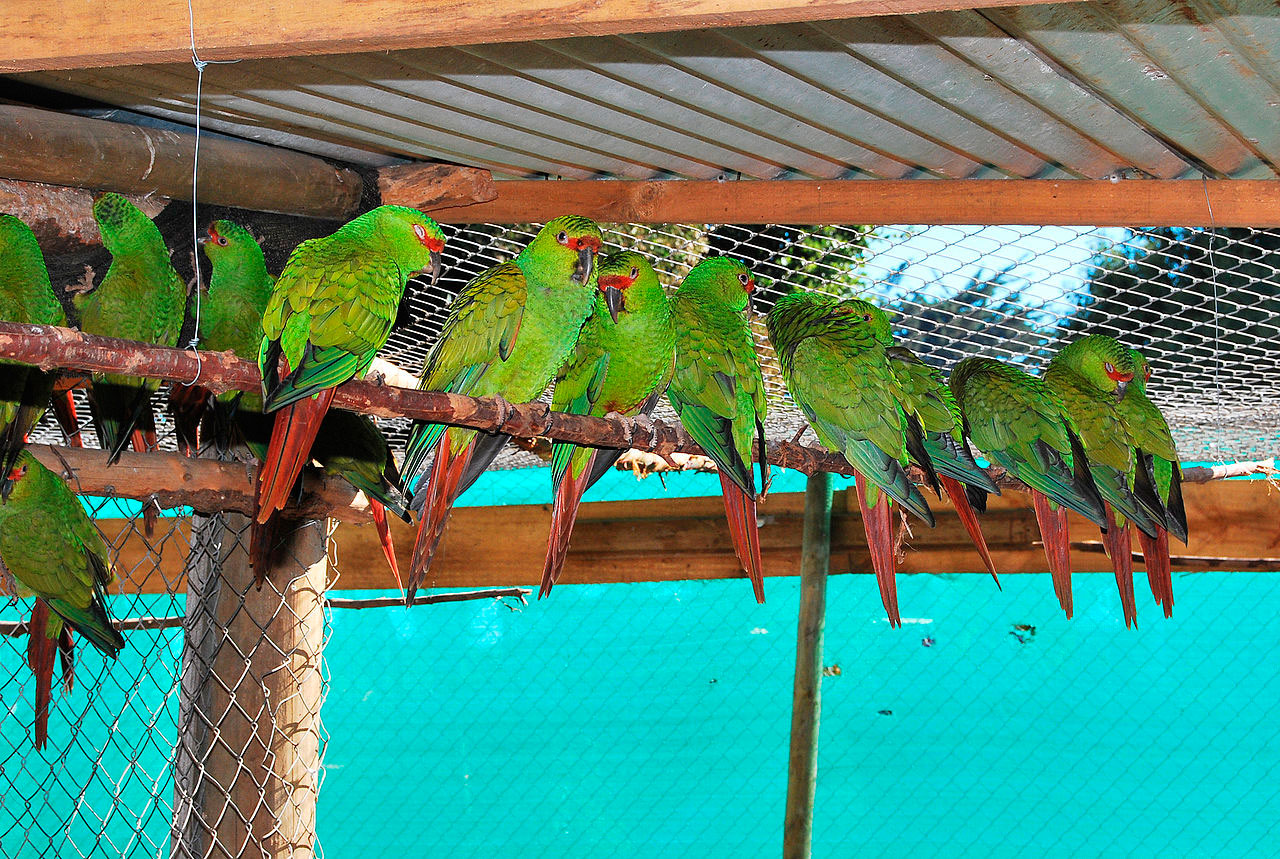
  • (4) Slender-billed Parakeets rehabilitating in a Parque Tumbes in a large aviary, Talcahuano, Bio Bio Region, Chile. In January 2012, about a 100 parrots were rescued from a pet shop in La Granja, Santiago Province, Chile. They were rehabilitated for about three months before being released to the wild. By Municipality of Talcahuano [CC BY-SA 2.0], via Wikimedia Commons
  • (5) Enicognathus leptorhynchus – thin-beaked conure – Slender-billed conure – long-billed conure Florin Feneru – Flickr
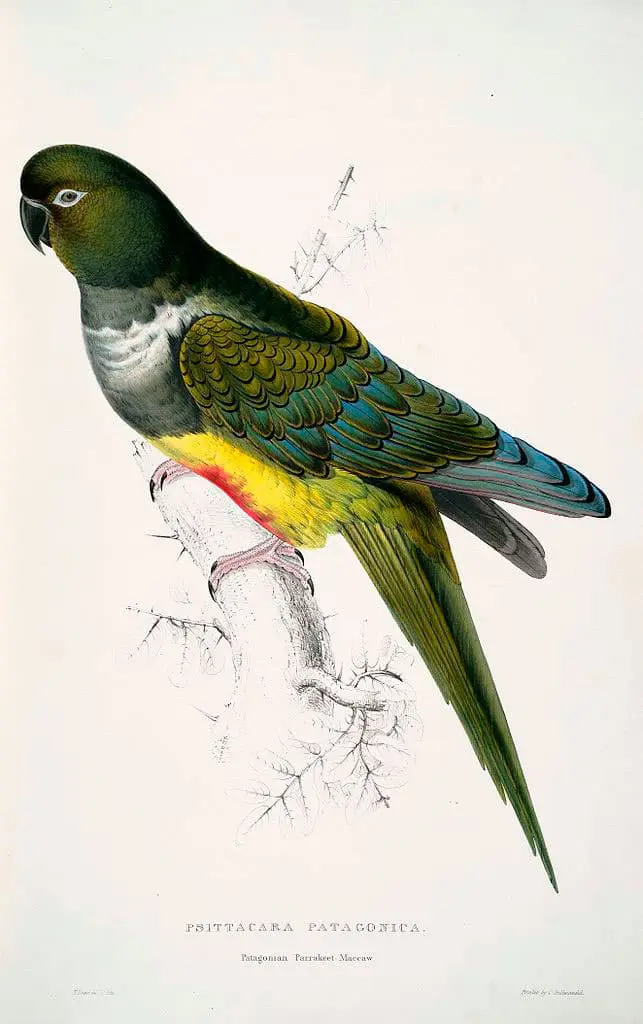
  • (6) A painting of a Slender-billed Parakeet (originally captioned «Psittacara leptorhyncha Long-billed. Parrakeet-Maccaw.») by Edward Lear 1812-1888 [Public domain], via Wikimedia Commons

– Sounds: Ross Gallardy, XC296142. accessible www.xeno-canto.org/296142

▷ The world of Pets: Dogs, cats, birds, reptiles, amphibians

Burrowing Parakeet
Cyanoliseus patagonus

Burrowing Parakeet

Content

Burrowing Parakeet

Description:

39-52 cm. length between 260 and 280 g. of weight.

The Burrowing Parakeet (Cyanoliseus patagonus) has the forecrown, crown, lores, cheeks and nape olive brown with slight yellowish tinge; sides of neck, the mantle and back Brown olive; rump and uppertail-coverts bright canary yellow.

Blades brown, some slightly blue; covered primary blue, other yellowish olive brown. Primaries and Outer secondaries dark blue with edges innerwebs distal; inner secondary bluish brown. Underwing-coverts Yellow olive; underside of flight feather brown. Breast olive brown with white-cream area at the top of chest; rest of the underparts yellow-orange red patch through central belly. Uppertail brown tinted blue, especially next to the tips; undertail brown.

The bill It is grayish-black; the periophthalmic skin skin whitish; the irises is pale yellow; the legs They are pale yellowish brown.

Both sexes similar. Immature has horn upper mandible and the irises brown.

  • Sound of the Burrowing Parakeet.

Description Burrowing Parakeet subspecies
  • Cyanoliseus patagonus andinus

    (Dabbene & Lillo, 1913) – Similar to the species nominal but it lacks the bright yellow belly with pale areas on the sides of chest and rump olive colored duller. This and subspecies Cyanoliseus patagonus conlara they have the upperwing-coverts more brown than the nominal species.


  • Cyanoliseus patagonus bloxami

    (Olson, 1995) – Size larger than the nominal species (wings 250-263), upperparts, throat lower chest and dark brown; bill larger and heavier and patches creamy most extensive on the sides of chest (in some birds merge to form a band breast pale).


  • Cyanoliseus patagonus conlara

    (nores & Yzurieta, 1983) – Breast darker than the other Argentine subspecies.


  • Cyanoliseus patagonus patagonus

    (Vieillot, 1818) – Nominal.

Habitat:

The species usually inhabit areas open pastures, although it has also been reported in Savanna, wooded valleys cliffs and farmland some 2.000 m. Usually in a fairly arid land, although often it found near elevations or streams. Gregarious, forming large flocks, sometimes exceeding 1.000 birds, with common roosts trees, on wiring (sometimes in villages) and in tunnels dug to nest.

Reproduction:

It reproduces colonially in warrens carved into cliffs (usually limestone or sandstone Chile) often with stunning views. In San Luis, Argentina, reproduction is reported in the wet season (November–April), the birds return to nest in the cliffs lay eggs in September and November to December in San Luis, spreading of bird breeding sites in April; apparently earlier in Chile. Clutch 2-4 eggs. The male takes care of feeding the female during the incubation period.. The young leave the nest at 2 months of age, However, They continue to be fed by their parents until 6 months of age.

Food:

The diet of the Burrowing Parakeet It consists mainly of seeds and fruits predominance of fruit in the summer months (November to February). Food reported include berries of buckthorn joke and Discaria, fruit of Geoffroea decorticans, Prosopis caldenia, P. chilensis and P. flexuosa and seeds of Carduus mariana. Sometimes damaged grain crops; often it feeds on the floor or around.

Distribution:

Extending its range (breeding/resident): 1.590.000 km2

The Burrowing Parakeet They are distributed by the South South America, extending from northern Santa Cruz and Chubut in Argentina, passing by Black river and Pampa, up to Buenos Aires, San Luis and Córdoba, San Juan, La Rioja, Catamarca, Tucumán and Salta, reaching westward across southern Uruguay.

They were recorded in the early 1920 from the center of Formosa, Argentina, away from Andes mountains, and above the center Chile from the North of The lakes to north of Atacama, but now they are confined to a few localities in the foothills of the Andes, for example in Bio Bio.

Will produce some seasonal movements, including the northward migration of birds south in the Argentine winter and shifts down Chile.

In Argentina is locally common or abundant, although in some places (p. e.g.. in Córdoba and Buenos Aires Eastern) They are rare or occasional. Few and far between in Uruguay. drastic decline during the twentieth century Chile, so that the subspecies Cyanoliseus patagonus bloxami It is considered at risk, with an estimated population of less than 3.000 individuals at the end of the decade 1980. The decrease in parts of the Argentina It is attributed to the catch for the trade, the hunting for food, converting grassland and arable land persecution as crop pest. Probably continues to decline overall.

Burrowing Parakeet subspecies distribution

Conservation:


minor concern


• Current category of the Red List of the UICN: Least concern.

• Population trend: Decreasing.

• Population size : 95000 individuals.

Rationale for the Red List category

Even though the demographic trend It appears to be declining, the decline is not believed to be rapid enough to approach the Vulnerable thresholds based on demographic trend criteria (> 30% decrease in ten years or three generations). The population size is very large, and therefore does not approach the thresholds for Vulnerable under the criterion of population size (<10.000 individuos maduros con un descenso continuo estimado en >10% in ten years or three generations, or with a specific population structure). For these reasons, the species is evaluated as Least concern.

Justification of the population

The species is still common in many parts of its range in Argentina, with only small contractions reported in range Córdoba (R. M. Fraga a slightly. 2003). The population size of four subspecies was estimated as follows by MASELLO et al. (2011): Cyanoliseus patagonus patagonus 43.330 nests, Cyanoliseus patagonus conlara 1.700 individuals, Cyanoliseus patagonus andinus 2.000 nests, Cyanoliseus patagonus bloxami 5.000-6.000 individuals. Based on these figures, the population Total overall can be about 95.000 mature individuals.

Justification trend

They suspected that the population is declining due to continuing habitat destruction and unsustainable levels of exploitation.

Threats

The species has been the subject of a intense trade: from 1981, year it was included in the Appendix II of the CITES, they have been 122.914 individuals caught in international trade (UNEP-WCMC CITES CITES Trade Database, January 2005).

Conservation actions underway

The species is included in the Appendix II of the CITES.

"Burrowing Parakeet" in captivity:

The average life expectancy is of 15-20 years in captivity. Protected by Appendix II of the CITES.

To help conservation Burrowing Parakeet, You can report your hunt, sale, trade and illegal possession, thus, We will be cooperating with the conservation of this species and not be complicit in the decline of their populations and their future extinction of wild.

Alternative names:

– Burrowing Conure, Burrowing Parakeet, Burrowing Parrot, Patagonian Burrowing Parrot, Patagonian Conure, Patagonian Parrot (English).
– Conure de Patagonie, Perriche de Patagonie, Perruche de Patagonie (French).
– Felsensittich, Felsen-Sittich (German).
– Periquito-das-barreiras (Portuguese).
– Loro Barranquero, Loro de la Patagonia, Loro Patagonico, Tricahue (español).
– Loro barranquero (Argentina).
– Tricahue (Chile).
– Loro barranquero, Loro Patagonico (Uruguay).
– Perico Barranquero (Mexico).

scientific classification:

– Order: Psittaciformes
– Family: Psittacidae
– Genus: cyanoliseus
– Scientific name: Cyanoliseus patagonus
– Citation: (Vieillot, 1818)
– Protonimo: Psittacus patagonus

Images "Barranquero Loro":

Videos "Burrowing Parakeet"

————————————————————————————————

"Their barranche" (Cyanoliseus patagonus)


Sources:

– Avibase
– Parrots of the World – Forshaw Joseph M
– Parrots A Guide to the Parrots of the World – Tony Juniper & Mike Parr
– Birdlife

– Photos:

(1) – A Burrowing Parrot captive in Madeira By Rakkhi Samarasekera from London, United Kingdom (P6122982Uploaded by Snowmanradio) [CC BY 2.0], via Wikimedia Commons
(2) – Two Burrowing Parrots in Limari Province, Chile By Gerzo Gallardo (Flickr: Parrots) [CC BY 2.0], via Wikimedia Commons
(3) – Pair of cockles Cyanoliseus patagonus in the RN Cypress River By BioVipah (Own work) [CC BY-SA 4.0], via Wikimedia Commons
(4) – Burrowing Parrot (also known as the Patagonian Conure) to Lille Zoo, France By Olivier Duquesne (originally posted to Flickr as Perroquet) [CC BY-SA 2.0], via Wikimedia Commons
(5) – A Burrowing Parrot at Birds of Eden, an aviary in Western Cape, South Africa By Dick Daniels (http://carolinabirds.org /) (Own work) [CC BY-SA 3.0 or GFDL], via Wikimedia Commons
(6) – A painting of a Burrowing Parrot, also known as Patagonian Conure, (originally captioned «Psittacara patagonica. Patagonian Parrakeet-Maccaw») by Edward Lear 1812-1888 – Wikipedia

– Sounds: Cristian Pinto, XC380836. accessible www.xeno-canto.org/380836.