โ–ท The world of Pets: Dogs, cats, birds, reptiles, amphibians

Ouvea Parakeet
Eunymphicus uvaeensis

Ouvea Parakeet

Content


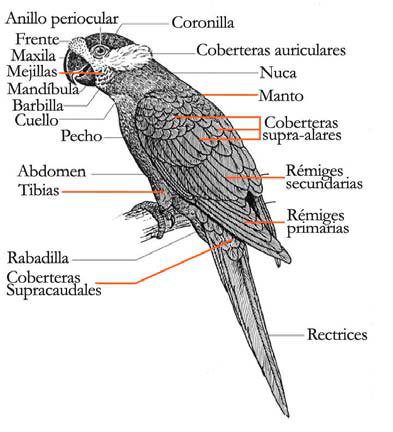
Anatomy-parrots

Description:

Of 32cm.. length and 117 g. of weight.

The Ouvea Parakeet (Eunymphicus uvaeensis) is similar to the Horned Parakeet (Eunymphicus cornutus) but with the face and nape green, no yellow, and crest upturned six pens greenish black: the Red of the crown It is limited to the center forecrown.

The Ouvea Parakeet generally bright mid-green. Head green, lighter on ear-coverts with some light shaft-streaks; centre of forecrown red with six wispy blackish-green uperwing feathers forming a small crest; rear-crown darker green; ears and cheeks dark green lower.

The upperparts light green, paler on rump. Wing coverts green; outerweb of primaries greenish-blue with innerwebs black. Underwing-coverts green. Underparts light yellowish-green. Uppertail green with a slight blue suffusion distally and blue edges to lateral feathers; undertail gray.

Bill blue-gray at base, blackish toward tip; irises orange; legs grey.

Both sexes similar.

Taxonomic status:

This taxon is considered a subspecies of Eunymphicus [cornutus or uvaeensis] (sensu lato) by some authors

  • Sound Uvea Parakeet.

Note:

some species, as in the case of Ouvea Parakeet, They are subject to extreme stress due to traps or harassment. The open availability of high-quality recordings of these species may make the problems even worse.. For this reason, transmission and download of these recordings is off. Recorders are free to share in xeno-edge, but they will have to approve access to these recordings.

We do not take this action lightly, and we wish it wasn't necessary, but we are convinced that the negative impacts of offering easy access to these recordings outweigh the benefits. To access these recordings, You can contact directly with the recorder.

Habitat:

It is restricted to areas of old growth forest with holes for nesting, but the highest numbers occur near papaya plantation areas.

The Ouvea Parakeet They are active in early morning and late afternoon, and usually rest in the trees during the heat of the day.

Reproduction:

An average of 2.9 Eggs are laid in one or two broods per year, of which 1.7 chicks hatch, but only 0.75 chicks survive to 30 days (Robinet et al. 1995, Robinet et al. 1996, Robinet and Salas 1999).

Food:

It feeds in the forests and crops of cultivated land adjacent. The Ouvea Parakeet It depends mainly on mature native forests with pines kauri Agathis australis.

Fruits of Ficus spp., there Canaria, scrub and passion fruit. Also forage for seeds. The cultivated papaya (Carica papaya) It is a favorite.

Distribution and status:

Population expansion (breeding/resident): 640 km2

Los Pericos Uvea are confined to 110 km2 in Ouvea island, Loyalty Islands. Introduced unsuccessfully in the nearby Lifou.

The species is found in isolated patches of forest now restricted to the coast, mainly in the district St Joseph between Cape Rossel and Cape Steep. Single 15-25 km2 of suitable habitat was considered to remain on the island in 1993, with about 70-90 birds present, although a more thorough study has suggested a total population of 617 individuals. More recent studies is estimated at 1.780 mature individuals in total (Theuerkauf s suffering. 2016)
In the past, the reduction of individuals to extensive conversion of forests for agriculture due, hunting and trade. The delicate political situation in Uvea, while Kanak Liberation Front struggle for independence France, It has hampered the work of conservation of the species.

It is relying on a captive breeding program based on Forest Park, about Noumea, in New Caledonia. Transfers from island to island also be considered feasible.

Conservation:
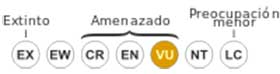

Vulnerable


โ€ข Current category of the Red List of the UICN: Vulnerable.

โ€ข Population trend: Growing.

โ€ข Population size : 600-1800 individuals.

Rationale for the Red List category

This species is classified as Vulnerable because it is in one very small island and can be threatened by invasive species, in particular the Black rat, that could bring the species to the category of Critically Endangered or Extinct in no time.

Justification of the population

The population is estimated at 1.780 mature individuals in total (Theuerkauf s suffering. 2016), rounded here to 1.800 mature individuals.

Justification trend

Barrรฉ et al (2010) reported that the population has increased in a 29% (of 10 birds / km2 34 birds / km2) between 1993 and 2009, which equates to an increase in population 34% in three generations.

Conservation Actions Underway

1 – Appendix I and II of CITES.

2 – The Association for the Protection of Perico Ouvea (ASPO) It was created in 1993 with members mostly local.

3 – ASPO initiated a long-term study of the biology and ecology of the species as the basis for two recovery plans. (1997-2002 and 2003-2008).

4 – Forest loss is being addressed through awareness programs and community trials to mitigate habitat degradation and improve the quality of forests, particularly in regard to nesting sites.

5 – Ten guides are used, whom, among other tasks, nests located.

6 – Illegal trade is being addressed successfully through increased awareness and enforcement.

7 – A captive breeding program has been discussed, but it hasn't started yet, and the species is found only in small quantities in captivity for a very limited reproductive success (Tap 1996).

8 – In 1998 translocation program began to repopulate southern Ouvea, and the number of birds in the south was 395 individuals in 2011 (Theuerkauf s suffering. 2016).

9 – Black rats were trapped on the island (Theuerkauf s suffering. 2016) and predator control is important.

10 – In 2003 a recovery plan was drawn updated, in which it recommended, among other things, the translocation program was canceled, since the population is considered viable and grow naturally; this Recovery Plan has been accepted by the local indigenous authorities (N. Barrรฉ a slightly. 2003, Anon 2004).

11 – Ouvea has been classified as IBA, but a management plan and a protection program involving the communities have not yet been established (Spaggiari et al. 2007).

12 – SCO obtained funding from the British Bird Watching Fair to build and test artificial nests PCV after the failure of trails wooden nest.

13 – ASPO personnel destroyed or removed 187 bee colonies between 2002 and 2008 (L. Verfaille a slightly. 2007, Barrรฉ et al. 2010).

14 – The continued presence of local guides is believed to effectively prevent nest poaching. (Barrรฉ et al. 2010).

Conservation Actions Proposed

1 – Continue population monitoring (Primotel 2000).

2 – Research interactions with Trichoglossus haematodus.

3 – Investigate the non-use of artificial nests.

4 – Review and strengthen measures to control predators.

5 – Assess progress and update plans for translocations.

6 – Review and update all aspects of the Action Plan.

7 – Maintaining the momentum of awareness and participation of the community and the island (Robinet and Salas 1997).

8 – Establish a project IBAs in Ouvea and fund a protection program (N. Barrรฉ a slightly. 2003).

9 – Start a captive breeding program to support future reintroductions.

10 – Carry out surveillance screening BFDV to guide future efforts biosecurity and conservation, and better understand the risk posed by BFDV (Jackson et al. 2014).

"Ouvea Parakeet" in captivity:

The Ouvea Parakeet they are still captured using a rope inside a fruit Upload papaya, and because the island is a plain, exports through an easily accessible atoll are difficult to control. Birds bought from trappers by 50 dollars can be sold by traders up 1.000 Australian dollars.

There is a captive breeding program, but it hasn't started yet, and the species is found only in small quantities in captivity for a very limited reproductive success (Tap 1996).

Alternative names:

Horned Parakeet (Ouvea), Ouvea Parakeet, Short-horned Parrot, Uvea Parakeet (English).
Nymphique d’Ouvรฉa, Perruche cornue (Ouvรฉa), Perruche dโ€™Ouvรฉa, Perruche d’Ouvรฉa (French).
Ouvรฉahornsittich, Uveasittich (German).
Periquito-de-uvea (Portuguese).
Perico de Uvea (espaรฑol).

scientific classification:

Edgar Leopold Layard

Order: Psittaciformes
Family: Psittaculidae
Gender: Eunymphicus
Scientific name: Eunymphicus uvaeensis
Subpoena: (Layard, THE & Layard, ELC, 1882)
Protonimo: Nymphicus uvaeensis

Images:

Videos "Ouvea Parakeet"

Sources:

โ€ข Avibase
โ€ข Parrots of the World โ€“ Forshaw Joseph M
โ€ข Parrots A Guide to the Parrots of the World – Tony Juniper & Mike Parr
โ€ข Birdlife

Photos:

(1) – This Uvea Parakeet was photographed feeding on a papaya at the edge of forest by Tunpin.ong [CC BY-SA 3.0], from Wikimedia Commons

โ–ท The world of Pets: Dogs, cats, birds, reptiles, amphibians

Swift Parrot
Lathamus discolor

Swift Parrot

Content


Anatomy-parrots

Description

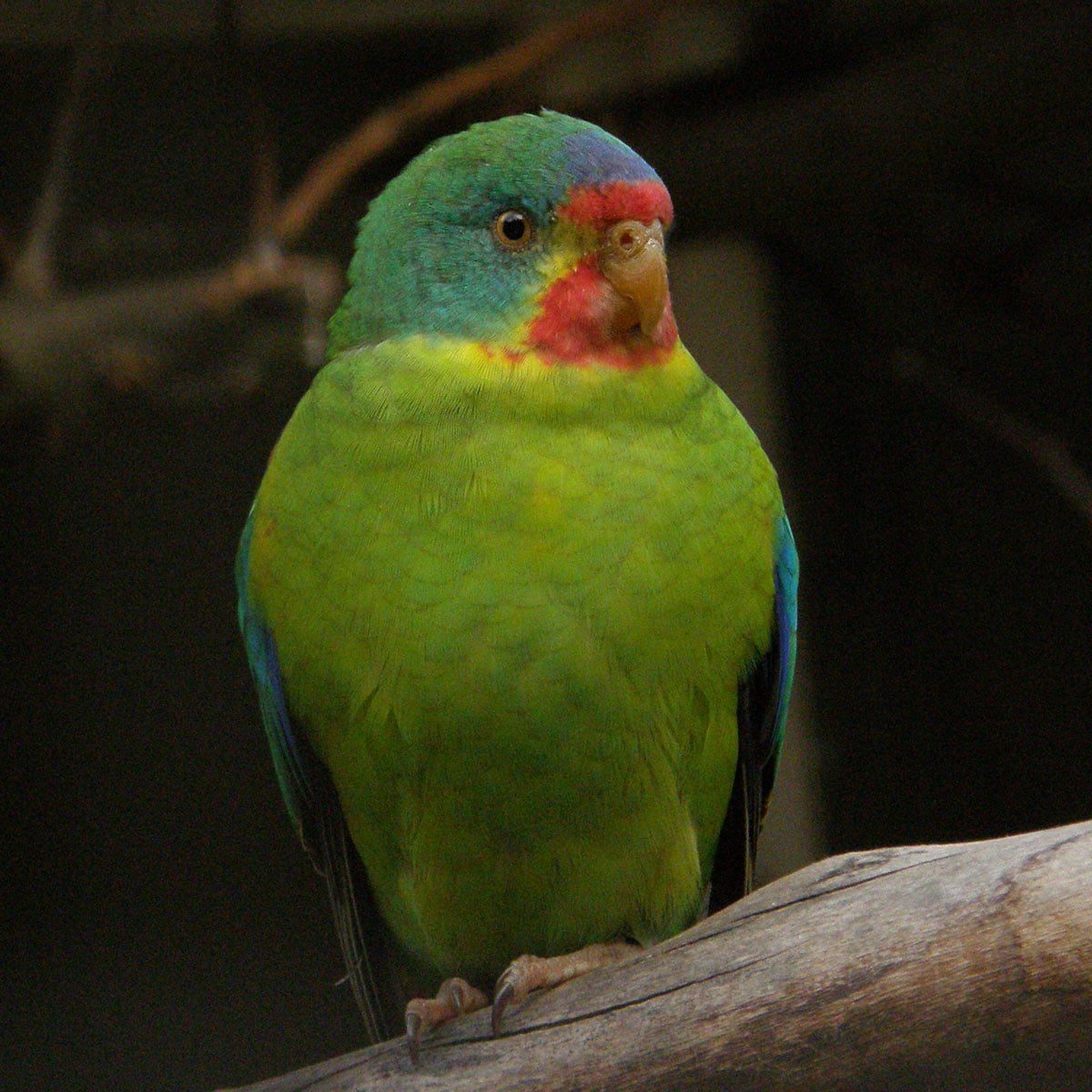
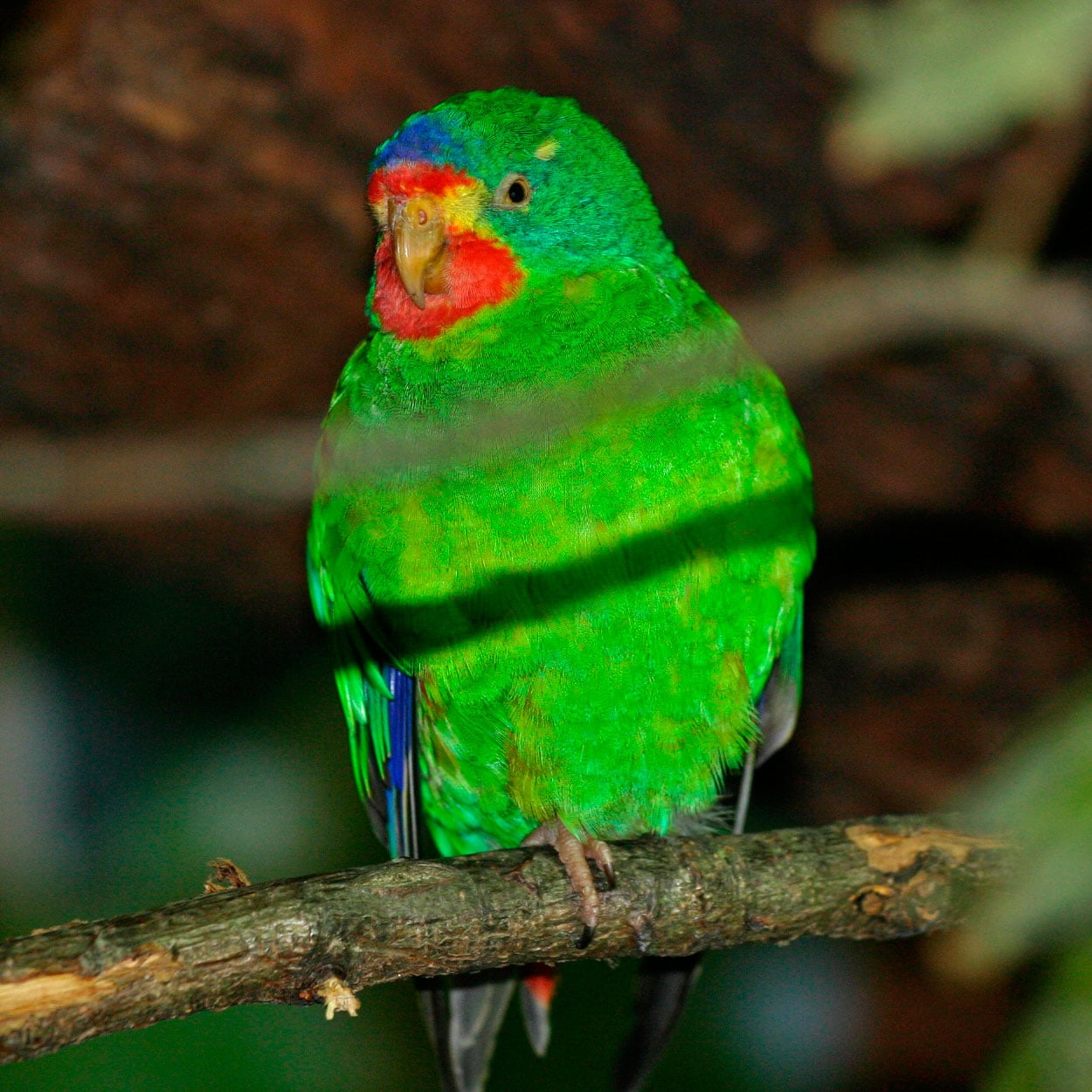
The Swift Parrot (Lathamus discolor) has a length of 23 to 28 cm.. and weighs approximately 65 g..

It is a slim Parrot, medium sized wings angular and pointed tail sharpened.
The head is bright emerald green. The forecrown, the chin and center of throat, red; lores bright yellow; centre of crown blue.

The upperparts (rump), bright green. The wing-coverts and feathers under wing They are red. The feathers under the tail They are red with green scales effect. The chest and feathers belly are yellowish green.

The bill Horn is color and irises yellow.

The female is paler and extent of mask Red lower than that of males. The color of the bottom of the tail just have red.

Habitat and behavior:

To the Swift Parrot It is usually seen in small groups of up 30 birds, sometimes in larger flocks (hundreds of birds) around the abundant food sources. There has also been some extraordinary reports in the enumeration of the flocks of more of 1.000 birds.

Son migratory birds. Are reproduced in Tasmania and then move to Australia continental, in autumn, for the non-reproductive season. Most of the population spends the winter in Victoria and New South Wales, before returning to Tasmania in spring. Usually they are gregarious in raising.

The playback area It is always within the 8 km from the coast, largely restricted to an area of less of 500 kmยฒ along the eastern coastal strip between Santa Helena and the Lune River, including offshore islands, as Mary Island and Bruny island.

The higher densities They occur between the After Bernier and Orford and Wellington Ridge about Hobart. A smaller breeding population is located in the North of Tasmania between Launceston and Smithton.

Reproduction:

Reproductive success is strongly related to the intensity and scope of the flowering of the Eucalyptus globulus (Tasmanian Blue Gum). In years of bad bloom, it seems that there is little breeding.

The breeding season It is mid-September to late January. Birds begin to return to Tasmania from your area of wintering on the continent at the beginning of August. Most of the population comes in mid-September. Unpaired birds upon arrival to Tasmania they cannot start breeding until November after finding mates.

The De l'Tmรฑo Nidada is three to five eggs. The female makes the incubation. in cautiverior incubation lasts about 25 days. Young people will fly in around 6 weeks. The presence of juveniles, recently fledged at the end of January and early February suggests double broods may occur. Second hatchlings depend on food availability.

A recent study has shown that the nests of the Swift Parrot often found in close proximity to each other. Nest trees may be to only 10-15 m from, and can support up to four active nests each.

Food:

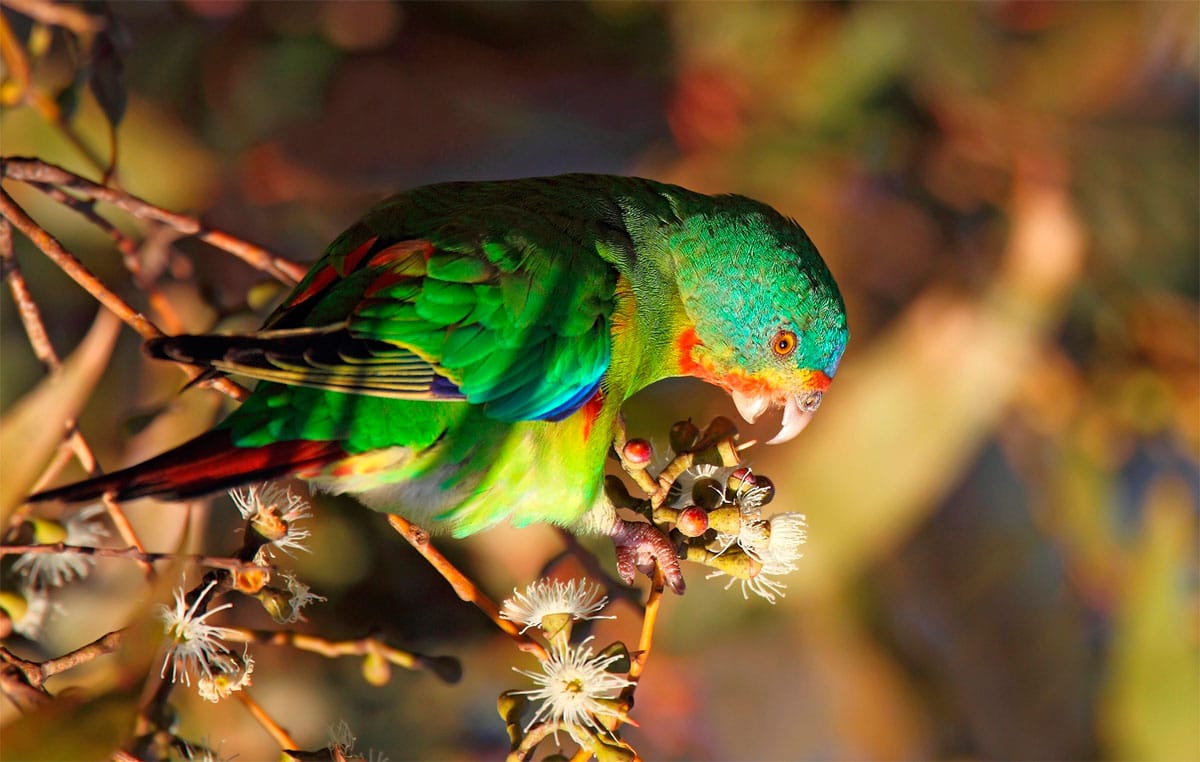
The Swift Parrot It feeds mainly on nectar, mainly of eucalyptus, but also feeds on insects psyllids and lerps, seeds and fruits.

It is a tree Harvester, forages mainly in the eucalyptus, but from time to time low to the ground to feed on seeds, fallen flowers, fruit and Lerp. During the breeding season, the nectar from the flowers of the Eucalyptus globulus (Tasmanian Blue Gum) is the main source of food.

Sometimes they voraciously consume nectar in areas very accessible and this makes them reluctant to fly making them vulnerable to attack by cats, especially when forage among low foliage. His agility and alertness in flight can also be affected by the consumption of large quantities of nectar, possibly increasing the risk of collisions with artificial or hard-to-see objects.

Distribution:

Size of the area of distribution (reproduction / resident): 21.500 km2

The Swift Parrot, as its name suggests, migrates through the bass strait, between Tasmania and the Australian continent. Comes to Tasmania in September and returned to the southeast of Australia between March and April.

You can get to be as far north as the South-East of Queensland and get up to adelaide from the West, Although the most recent sightings are restricted to the southeastern part of the State.

Conservation:

They estimated that the current population probably contains about 2.000 mature individuals and is declining.

The population of this species is suspected to be declining in line with habitat loss and degradation..
The sugar gliders they are the main predators of the broods of the Swift Parrot on the island of Tasmania, being the cause of the 85% of deaths, but they are not present on the Islands Bruny and Maria


Endangered


โ€ข Current IUCN Red List category: Danger

โ€ข Population trend: Decreasing

The logging of a particular species is also responsible for the decline of population, eucalyptus, which constitute the 90% your diet.

– The Swift Parrot is classified as a species in danger of extinction in the law of conservation of biodiversity and protection of the environment of 1999 of Australia.

– The Migratory Perico It is listed as a threatened species under the Victorian Wildlife Guarantee Act. (1988). According to this law, a state action must be carried out for the recovery and future management of this species.. In addition the Migrator parakeet is classified as endangered on the list of advisory on threatened vertebrate fauna of Victoria of 2007.

"Swift Parrot" in captivity:

There are no populations in captivity, they are being handled or propagated actively by reintroducing. But, the Swift Parrot is easily propagated in captivity, and many of them are housed in private collections.

Alternative names:

Swift Parrot (ingles).
Perruche de Latham (French).
Schwalbensittich, Schwalbenlori (German).
Periquito-andorinha (Portuguese).
Periquito Migrado (espaรฑol).

scientific classification:

Order: Psittaciformes
Family: Psittaculidae
Scientific name: Lathamus discolor
Citation: (Shaw, 1790)
Protonimo: Psittacus Discolor

ยซMigratory Parakeetยป Images:

Videos "Swift Parrot"

————————————————————————————————

"Migratory Parakeet" (Lathamus discolor)


Sources:

Avibase
– Parrots of the World โ€“ Forshaw Joseph M
– Parrots A Guide to the Parrots of the World – Tony Juniper & Mike Parr
– BirdLife.org
Wikipedia
– mundoexotics.com
environment.gov.au

Photos:

1 – By original photograph by frank woutersderivitive work Snowmanradio (talk) 18:52, 4 October 2008 (UTC) [CC BY 2.0], via Wikimedia Commons
2 – ยซLathamus discolor-captive-8-ecยป by Lathamus_discolor_-captive-8. jpg: Ernst Viknederivative work: Snowmanradio (talk) – originally posted to flickr at IMG_4454.JPG and uploaded to commons at Lathamus_discolor_-captive-8. jpg. Licensed under CC BY-SA 2.0 via Wikimedia Commons.
3 – ยซLathamus discolor Bruny 1ยป by JJ Harrison (jjharrison89@facebook.com) – Own work. Licensed under CC BY-SA 3.0 via Wikimedia Commons.
4 โ€“ bonapartemadar.hu
5 – Swift Parrot, Lathamus discolor. Photograph Geoffrey Dabb 27.04.2005 at Mount Majura nature reserve – majura.org

Sounds: Vicki Powys (Xeno-canto)

โ–ท The world of Pets: Dogs, cats, birds, reptiles, amphibians

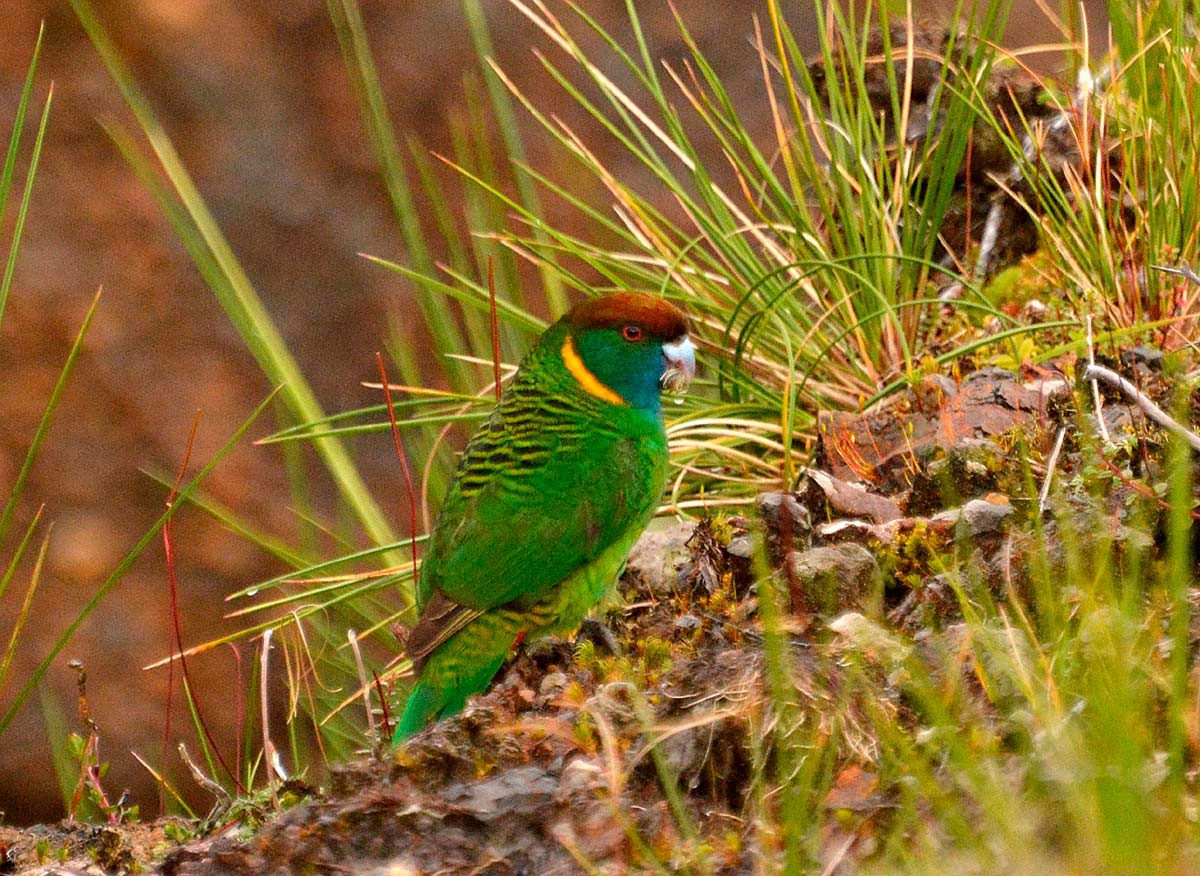
Painted Tiger-Parrot
Psittacella picta

Painted Tiger-Parrot

Content

Description

19 cm.. length and a weight between 48 and 60 g..

In adults of the Painted Tiger-Parrot (Psittacus erithacus), the head is predominantly Brown, but the colors of the top they are bright and warm, While the cheeks they are more off and more grey. One collar Yellow Strait decorates the neck. The plumage is green with black stripes. Rump and uppertail-coverts red. The wings They show a green with yellow stripes on the external threads and the flight feather. The underparts is yellowish-green.

The chin is brown, the upper part of the chest It has a central patch of blue. The coverts are orange-red. The rest of them underparts are a green medium, slightly clearer that the upperparts. The upper part of the tail is dark green. The bottom of the tail is blackish grey.

The bill is light grey and blue color with a white tip. The irises are reddish orange, the legs dark gray.

The collar Yellow is absent in the female. The cheeks they are dyed blue. The chest black and yellow colors absent. In the upperparts abounds over the scratched.

The immature they are similar to females.

Distribution 3 subspecies

  • Psittacella picta picta

    (Rothschild, 1896) – Nominal.


  • Psittacella picta lorentzi

    – (Victoria, 1910) Adults as the nominal species but the crown and the surroundings are color marron-oliva; cheeks teal, with a green darker in ear-coverts; rump and uppertail-coverts greenish yellow striped with black.


  • Psittacella picta excelsa

    – (Mayr & Gilliard, 1951) Males as the nominal, but the Crown is colored bright marron-oliva. The female is like the female of the nominal species but with the head color glossy marron-oliva; the throat and cheeks heavily washed in blue.

Habitat:

The Painted Tiger-Parrot they live in the mountains, in forest areas where can be seen especially at edges and clearings. They are also found in the moss-covered forests, the secondary forest, and in the thickets of Alpine and subalpine areas. These birds can be downloaded at 1.370 m. In the southeast of its distribution area, they tend to be distributed at lower altitudes than in other places. But, their preferred Habitat is between the 2.400 and 4.000 m, just above the Brehm's Tiger-Parrot (Psittacella brehmii).

The birds are generally quiet, but not shy, and move individually, in pairs or in groups of up to six members; It has been observed feeding on groups, mixed with the Madarasz's Tiger-Parrot. They often feed in low bushes or on the ground.

Reproduction:

Little is known about the ecology of the species and the only information on reproductive behavior is that birds in breeding conditions have been observed in the months of June and August..

Food:

The diet It includes seeds, berries and the fruit of conifers Dacrydium.

Distribution:

Endemic to the central band of the mountain of New Guinea. Restricted to the high montane forests, from the West of the Maoke through the central mountains, including the Tari region, about Kandep, Mount Hagen, Monte, Kubor up to the Owen Stanley mountain range in the Southeast. The world's population is believed to be superior to the 100.000 specimens.

Distribution 3 subspecies:

  • Psittacella picta picta

    (Rothschild, 1896) – Nominal.


  • Psittacella picta lorentzi

    – It is located on the westernmost stretch (Sudirman mountains).


  • Psittacella picta excelsa

    – Occupied the mountains Central of Papua New Guinea.

Conservation:

โ€ข Current IUCN Red List category: Unrecognized

According to "The World Parrot Trustยซ, in accordance with Tony Juniper, the world's population is superior to 100 000 individuals.

According to the Manual, This species, Although relatively dispersed, may be locally common. Despite its small extension, It is classified as ยซleast concernยปFor the different ornithological organizations.

"Painted Tiger-Parrot" in captivity:

Not found in poultry.

Alternative names:

Painted Tiger-Parrot, Painted Parrot, Painted Tiger Parrot, Timberline Parrot, Timberline Tiger-Parrot (ingles).
Perruche peinte (French).
Braunscheitelpapagei, Braunscheitel-Papagei (German).
Psittacella picta (Portuguese).
Lorito Pintado, Lorito tigre Pintado, Lorito-tigre Pintado (espaรฑol).

scientific classification:

Order: Psittaciformes
Family: Psittaculidae
Genus: Psittacella
Scientific name: Psittacella picta
Citation: Rothschild, 1896
Protonimo: Psittacella picta

Images "Painted Tiger-Parrot"

Videos "Painted Tiger-Parrot"

————————————————————————————————

ยซLorito-tigre paintedยป (Psittacella picta)

Sources:

Avibase
– Parrots of the World โ€“ Forshaw Joseph M
– Parrots A Guide to the Parrots of the World – Tony Juniper & Mike Parr
Wikipedia

Photos:

(1) – Psittacella picta near Lake Habbema – BIRDING AROUND THE WORLD

Sounds: Hans Matheve (Xeno-canto)

โ–ท The world of Pets: Dogs, cats, birds, reptiles, amphibians

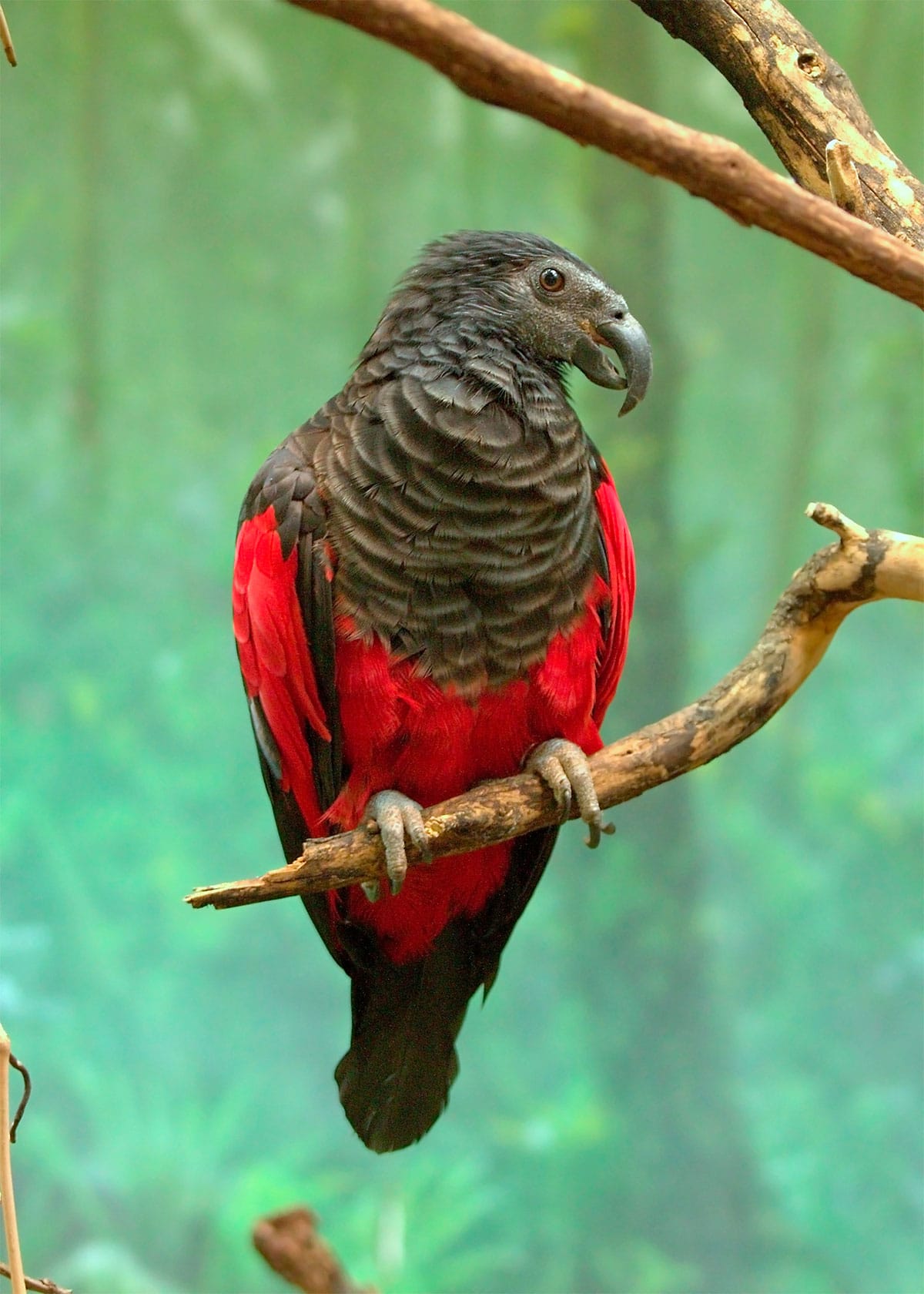
Pesquet's Parrot
Psittrichas fulgidus

aquiline parrot

Content

Description

46 cm. length and a weight between 680 and 800 g..

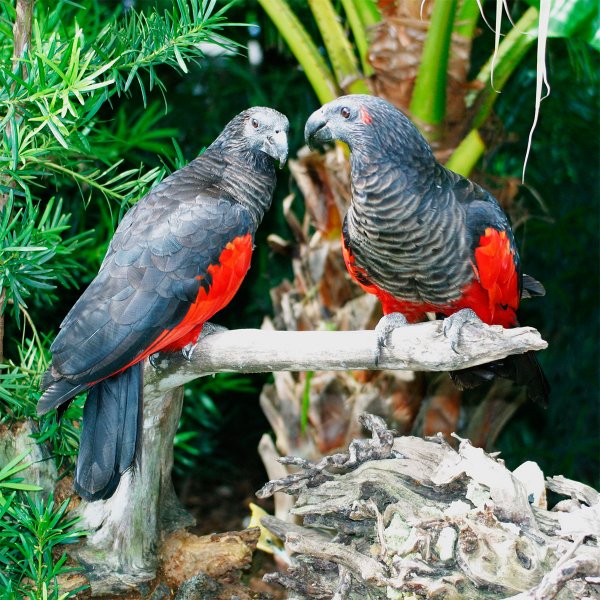
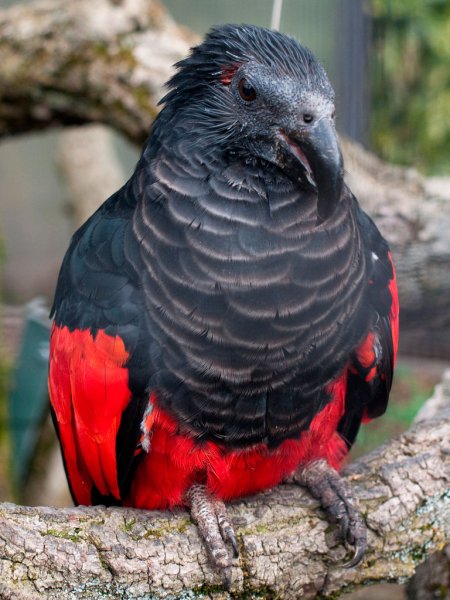
The head of the Pesquet's Parrot (Psittrichas fulgidus) is black, front without feathers, may be covered with small ruffled black feathers with a patch of stiff red feathers on the front of the legs ear-coverts. Nape, the mantle, back and tail blackish brown with fine pale edges.

Uppertail Red with black bases. Upper, black flight feathers, with large and medium-sized external coverts (except the innermost) and vane external Central flight feathers, red; Black primary coverts. Under, Black tail with red in the lower and medium coverts. More Brown on the top breast than in the rest, with a wavy effect to pale fringes to the feathers; belly, flanks and coverts red infracaudales. Upper, the black tail.

black beak; black skin of the face; dark brown irises; Blackish grey legs.

The female It lacks the red patch on the side of the head and is slightly smaller on average.

In birds immature the red marks are more off.

Habitat:

The Pesquet's Parrot are found mainly in the primary and secondary montane rain forest at an altitude between 600 and 1.200 m. However there are to the 2.000 m, and are occasional at altitudes as low as 50 m.

The species is thought, generally, they have a low density of population, finding the highest concentrations in forest areas relatively calm, where the birds are free from persecution.

These large and showy parrots, They are commonly found in pairs or in groups of up to 20 individuals, perched, usually, at the top of the exposed trees, or loud flying through or above the canopy.

Jump nervously around the Bush with quick flapping, and they can stay in the tops of emergent trees during a rain. It has been flying to settle on a solitary tree in the midst of the darkness.

Reproduction:

Reproductive habits in nature are unknown, but birds in breeding conditions have been observed in the months of February to May. In captivity a pair was observed to courting; There was a two-egg-laying, which were incubated by the female during 31 days, and the only chick, yellowish white, was fed by both parents.

Food:

The Pesquet's Parrot mainly feed on the soft pulp of fruits such as Ficus figs, handles (Mangifera indica) and Freycinetia cumingiana.

During their feeding, the base of the beak can become covered with fruit pulp, and it is likely that extension of the exposed facial skin has evolved to avoid that feathers absorb from food scraps.

Distribution:

Size of the area of distribution (reproduction / resident): 278.000 km2

confined in West Papua New, Indonesian and Papua New Guinea. It goes from the Mountains Tamrau, Vogelkop, West Papua, to the East by the mountains of snow and Cordillera Central (including the upper part of the fly river, Lake Kutubu and Karimui district), on Owen Stanley mountain range and Huon Peninsula, in the East of Papua New Guinea.

The species is unevenly distributed in montane forests, and is considered uncommon in most areas. World population is thought to be in decline, mainly due to hunting for food and feathers (that are more appreciated even than the feathers of the bird of paradise Paradisaeidae).

The introduction of weapons has significantly increased the pressure of the species in more densely populated areas. Live bird trade and habitat loss, It is also thought that they represent potential threats. There are a small number in captivity.

Conservation:


Vulnerable


โ€ข Current category of the Red List of the UICN: Vulnerable

โ€ข Population trend: Decreasing

It is estimated that their population may be setting to the 42,000 birds.

This species is under severe pressure from the hunt for obtaining their colorful feathers, and to one degree lower for trade and meat. Hunting for feathers has increased with population growth and the increasing number of tourists. As a whole, These factors are suspected of being leading to a rapid and continuous reduction of the population of this species.

Conservation Actions Proposed:

– Conduct surveys to improve the accuracy of the estimate of the population.
– Investigation of the basic ecology of the species, especially any of their food.
– Investigate the trade in feathers.
– Monitor numbers at surveyed sites, as the crater of the mountain and Kikori.
– Numbers of monitors marketed domestically and internationally.
– Transport Control of threatened species in domestic flights.
– Run an education program to discourage tourists from buying feathers and artifacts.
– Investigate adequacy of a program to replace artificial or dyed feathers (Mack and Wright 1998) .

"Pesquet's Parrot" in captivity:

extremely rare.

Birds, even bred hand, may be difficult and aggressive with their caregiver; they can be a bit uncomfortable mainly due to their diet of fruit.

Alternative names:

Pesquet’s Parrot, Vulturine Parrot (ingles).
Psittrichas de Pesquet, Perroquet de Pesquet (French).
Borstenkopf (German).
Papagaio-de-pesquet (Portuguese).
Loro Aguileรฑo (espaรฑol).

scientific classification:

Order: Psittaciformes
Family: Psittaculidae
Genus: Psittrichas
Scientific name: Psittrichas fulgidus
Citation: (Lesson, 1830)
Protonimo: Banksianus fulgidus

Images ยซAguileรฑo Loroยป:

————————————————————————————————

"Aguileรฑo Loro" (Psittrichas fulgidus)

Sources:

Avibase
– Parrots of the World โ€“ Forshaw Joseph M
– Parrots A Guide to the Parrots of the World – Tony Juniper & Mike Parr
– Birdlife

Photos:

(1) – ยซPesquetsparrot03ยป by Greg HumeOwn work. Licensed under CC BY-SA 3.0 via Wikimedia Commons.
(2) – ยซPsittrichas fulgidus-Jurong Bird Park-8aยป by Peter TanPesquetโ€™s ParrotUploaded by Snowmanradio. Licensed under CC BY-SA 2.0 via Wikimedia Commons.
(3) – ยซPsittrichas fulgidus-Miami Zoo, USA-8-tocยป by Psittrichas fulgidus-Miami Zoo,_Usa-8. jpg: bognietsderivative work: Snowmanradio (talk) – originally posted to Flickr as Pesquetโ€™s Parrot and uploaded to commons as Psittrichas fulgidus-Miami Zoo,_Usa-8. jpg. Licensed under CC BY 2.0 via Wikimedia Commons.
(4) – Greg HumeThe uploader's own work: "Pesquetsparrot03โ€. Engedely: CC BY-SA 3.0, Forrรกs: Wikimedia Commons
(5) – By Matthias Wicke – Flickr

Sounds: Phil Gregory (Xeno-canto)

โ–ท The world of Pets: Dogs, cats, birds, reptiles, amphibians

Western Rosella
Platycercus icterotis

Western Rosella

Content


Anatomy-parrots

Description

25 to 26 cm. length and a weight between 52 and 80 g..

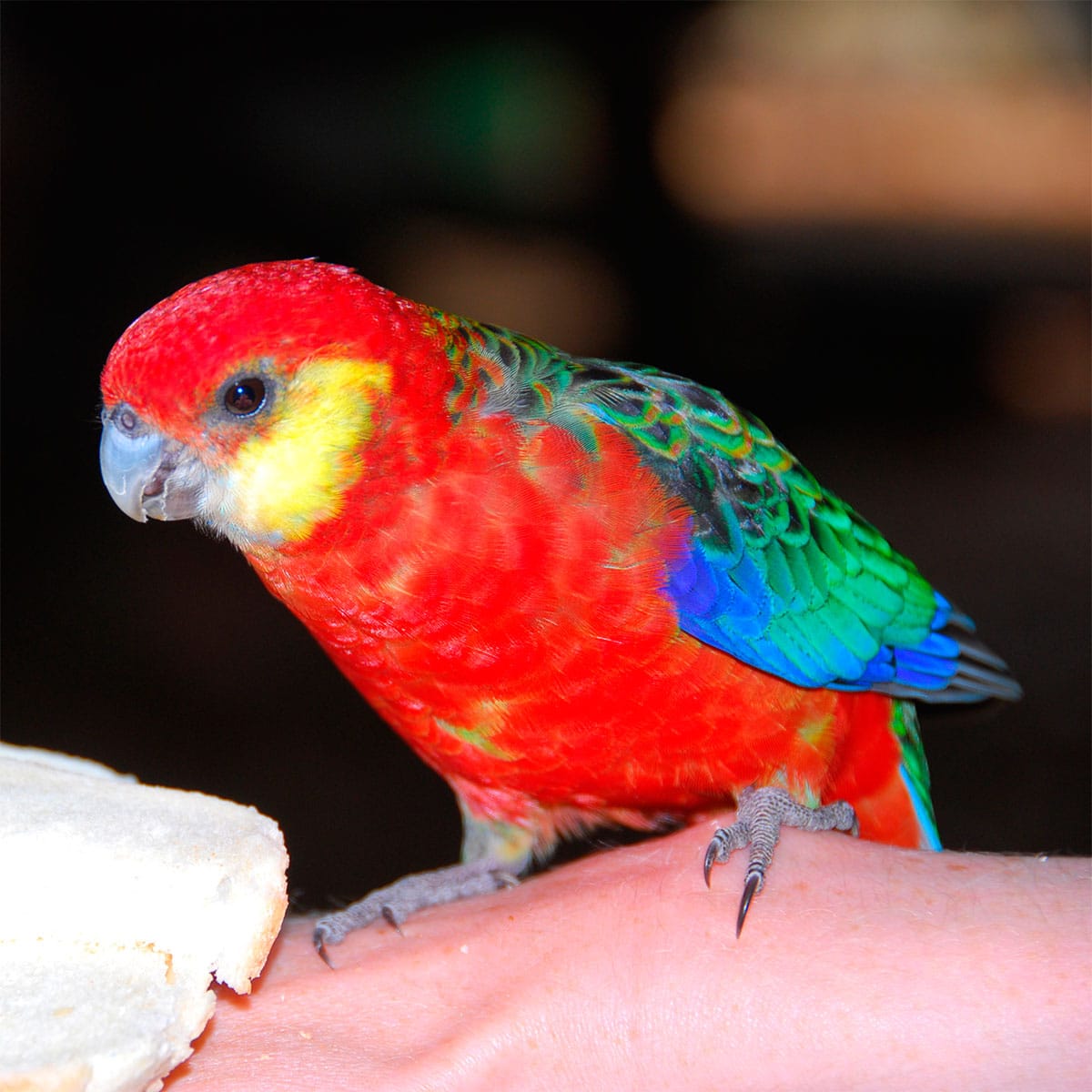
The Western Rosella (Platycercus icterotis) is the smallest of the Platycercus and the only one with big cheeks Yellow.

Adults have a clear dimorphism. The adult male has head and underparts bright red. The the mantle feathers, the back and scapulars They are black with large green edges forming a scalloped effect. The green edges sometimes infiltrated with red. The inner coverts They are dull green, While the external are dark blue. In the Middle, you can see some black on median. The primaries son negruzcas. The rump is dark green. The central tail feathers are dark green, the exteriors are blue with white tips. The underparts It has no stripe.
The bill grey; irises dark brown; legs greyish brown.

The adult female has the forecrown dark red. The crown and the sides of the neck are green. The cheeks are yellow, but duller and less developed than in the male. The underparts They are green with red infiltrations. The under wing wearing a light streak.

The immature are similar to the females. They have head green with a strip of orange red on the front of the forecrown. The cheeks Yellow absent. The underparts is pale green with slight red orange infiltration in young men.
The adult plumage It is reached after a quick complete change to 14 months.

Description 2 subspecies

  • Platycercus icterotis icterotis

    (Temminck & Kuhl 1820) – The nominal.


  • Platycercus icterotis xanthogenys

    (Salvadori 1891) – The cheeks They are paler; black feathers nape; back and shoulders lined with large red brown. Area of the rump and uppertail-coverts, Olive Drab. Female much paler than the nominal.

Habitat and habits:

Western Rosella

The Western Rosella they are not very common. Found in variable densities in stands of eucalyptus and in many types of open forest habitats. They also attend camps with little trees, partly cleared agricultural fields and residual trees lining grain fields or roadsides. They tend to visit the gardens and freshly harvested fields. They occasionally enter the parks, gardens and golf courses.

In areas close to the coast, the Western Rosella, without a doubt, have benefited from the transformation of dense forests into agricultural land. On the other hand, they were driven from the hinterlands by large-scale deforestation programs.

The Western Rosella they suffer the aggressive competition Australian Ringneck (Platycercus zonarius) that shares the same habitat type.

They are birds sedentary. Usually, they live in pairs or in small groups, and it is very rare to find them in flocks. Son quiet and discrete, so very often go unnoticed when they feed in Earth or when they seek refuge in the trees.

Around the houses, the Western Rosella they are very confident, coming into barns and corrals to feed on grain. Unlike other parrots, have a stable flight composed of multiple hits. Move over short distances, preferring to fly from one tree to another, instead of crossing open spaces.

Reproduction:

The nesting season running from August to December.

The nest It is found in the hole of a branch or in the cavity of a tree trunk.. The couple often choose a eucalyptus wandoo the genus eucalyptus salmonophloia. The cavity must be deep enough and the bottom must be lined with a layer of sawdust..

Before mating, the male courts to your partner. It leans forward on its perch uttering very specific cries.. If the female agrees, responds in the same way.

The laying, generally, comprises of 3 to 7 eggs which are incubated during 19 days. The female is responsible for one incubation, but she pauses in the morning and in the afternoon to be resupplied by the male.

The Young people are altricial and do not fly away before reaching the age of 5 weeks.

Food:

They mainly eat seeds of grasses and other plants found in stubble fields.. They also feed on fruits, berries, Jarrah flowers (Eucalyptus marginata) and seeds of the Zamia Palm.

Often in orchards where cause some damage.

Distribution:

Size of its range (reproduction / resident): 308.000 km2

Endemic to Western Australia, where its population is distributed between the vicinity of Dongara, in the North and Israelite Bay, on the South Coast, and reaching the interior in a line that goes more or less through the Lake Dundas, Southern Cross and Moora. Sometimes found in parks in Perth.

The species is common and seems to have benefited from forest clearing and agriculture.. The world's population is of more than 100,000 specimens. A small number of captivity. The birds can be pursued under a permit.

Distribution 2 subspecies

  • Platycercus icterotis icterotis

    (Temminck & Kuhl 1820) – The nominal. Coast and Southwest podrebere Australia.


  • Platycercus icterotis xanthogenys

    (Salvadori 1891) – Southwest Interior Australia.

Conservation:


minor concern


โ€ข Current category of the Red List of the UICN: Least concern

โ€ข Population Trend: Decreasing

The species is relatively common, like most birds that live in open areas, the Western Rosella It has benefited, to some extent, the slimming of the wooded areas. But, its numbers have declined in areas where it faces competition from the aggressive Australian Ringneck. It also, the difficulty to find holes for the construction of nests is a concern in the long run.

The Western Rosella is one protected species, However in some counties, a period was opened to try to regulate or stop the damage caused by this bird in crops.

"Western Rosella" in captivity:

Pretty common in captivity.

Una muestra viviรณ 13,2 years in captivity. Taking into account the longevity of the similar species, the maximum longevity in these birds could be underestimated. In fact it has been reported that these birds can live up to 31,6 years in captivity, data that can be, but it has not been verified; the same study reported that these animals can reproduce, approximately, to the 2 years of age in captivity.

Alternative names:

Western Rosella, Earl of Derby’s Parrot, Stanley Parakeet, Stanley Rosella, West Australian Rosella, Yellow-cheeked Parakeet, Yellow-cheeked Parrot, Yellow-cheeked Rosella (ingles).
Perruche ร  oreilles jaunes, Perruche de Stanley (French).
Gelbwangenrosella (German).
Rosela-do-leste (Portuguese).
Perico Carigualdo, Rosela Oriental (espaรฑol).

scientific classification:

Order: Psittaciformes
Family: Psittaculidae
Genus: Platycercus
Scientific name: Platycercus icterotis
Citation: (Temminck & Kuhl, 1820)
Protonimo: Psittacus icterotis

Images ยซPerico Carigualdoยป:

Videos "Western Rosella"

————————————————————————————————

ยซPerico Carigualdoยป (Platycercus icterotis)


Sources:

Avibase
– Parrots of the World โ€“ Forshaw Joseph M
– Parrots A Guide to the Parrots of the World – Tony Juniper & Mike Parr
– AnAge: The Animal Ageing and Longevity Database – Anagรฉ entry for Platycercus icterotis
– Birdlife

Photos:

(1) – By derivative work: Snowmanradio (talk)Western_Rosella_(Platycercus icterotis)-5.jpg: Robert Young [CC BY 2.0], via Wikimedia Commons
(2) – By Luke Durkin (IMG_0526Uploaded by snowmanradio) [CC BY 2.0], via Wikimedia Commons
(3) – By Hervรฉ (zoo_090912_518.jpgUploaded by snowmanradio) [CC BY-SA 2.0], via Wikimedia Commons
(4) – ยซPlatycercus icterotis1ยซ. Licensed under CC BY 2.0 via Wikimedia Commons.
(5) – By Robert Young (originally posted to Flickr as Mmmm, wet bread) [CC BY 2.0], via Wikimedia Commons
(6) – John Gould [Public domain], via Wikimedia Commons

Sounds: John Graff (Xeno-canto)

โ–ท The world of Pets: Dogs, cats, birds, reptiles, amphibians

Masked Shining-Parrot
Prosopeia personata

Masked Shining-Parrot

Content


Anatomy-parrots

Description

47 cm of length and weight approximate of 322 g..

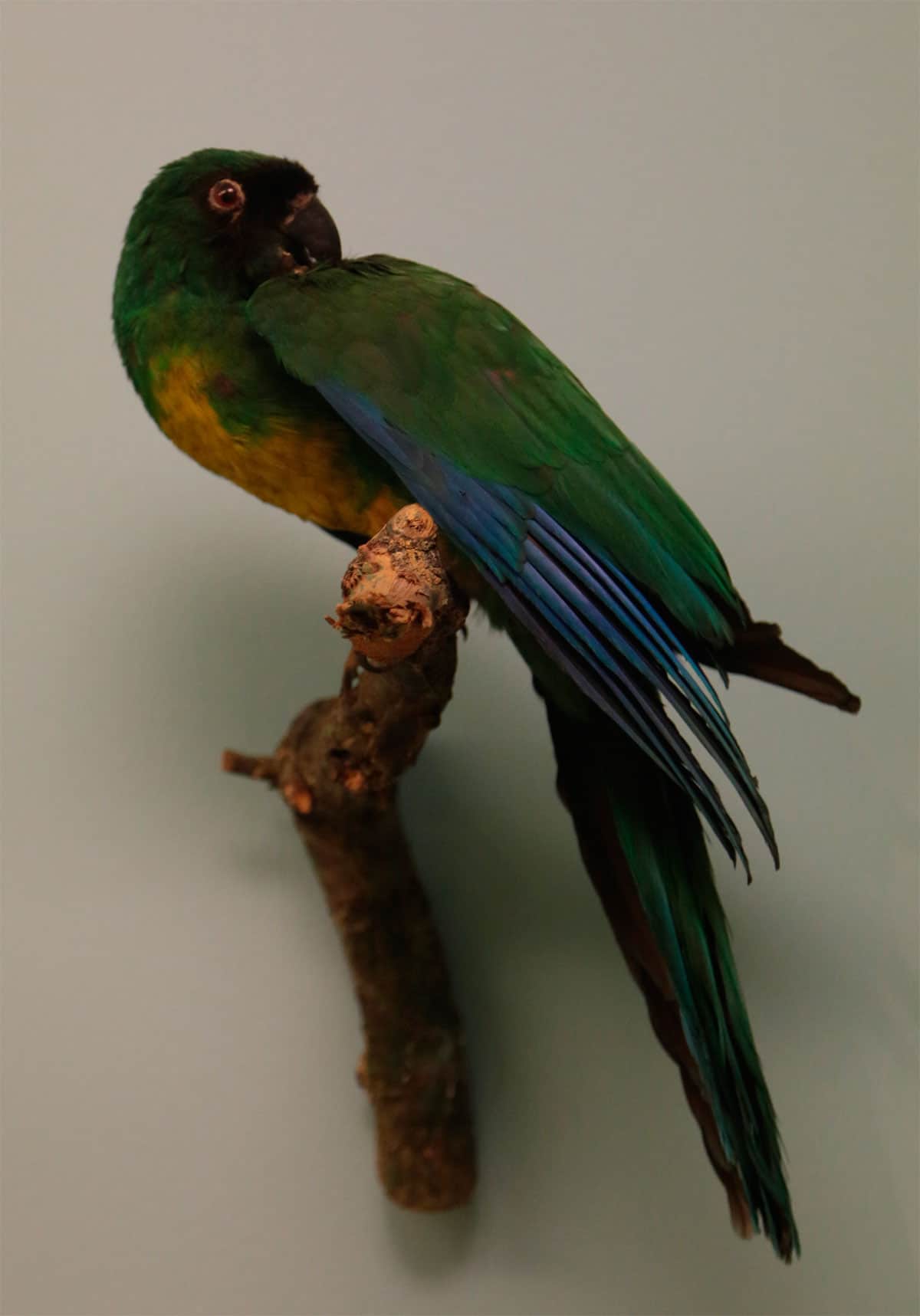
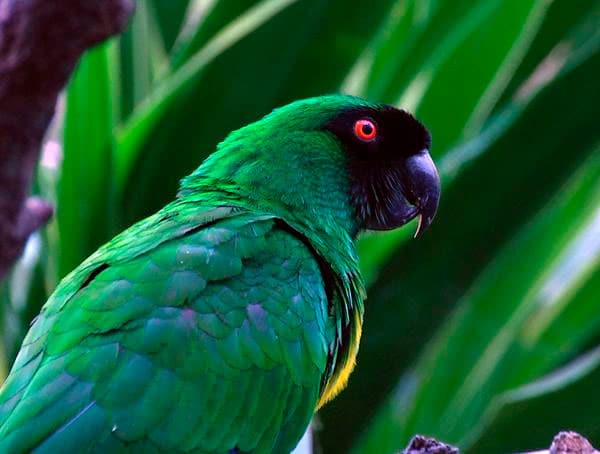
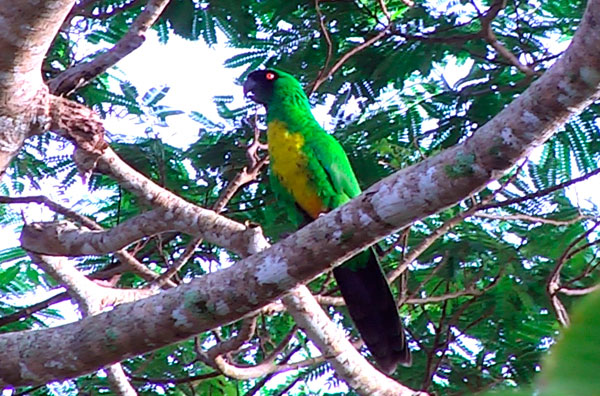
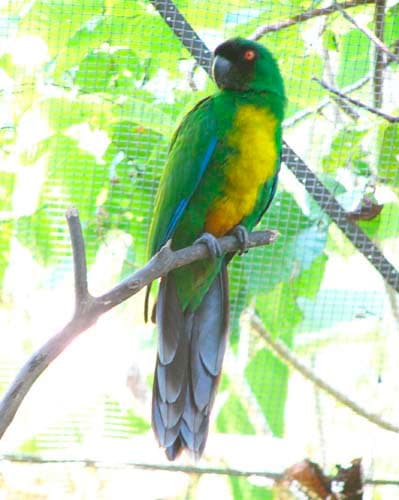
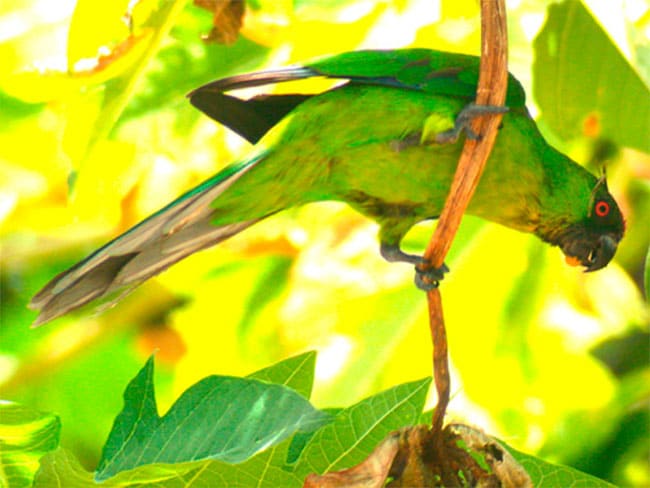
The colorful Masked Shining-Parrot (Prosopeia personata), has a plumage green over most of its body, the front of the crown, lores, cheeks and chin, are black.

The upperparts are bright pale green (with a brighter sheen on the Crown and nape). Large external coverts, primary coverts and primaries are blue with vane inner dark. Wing feathers green. Throat, top of the chest, flanks, and undertail- coverts green; center of chest and the belly bright yellow, a few feathers with the Green Tip, yellow shading in the Orange patch It is located in the lower part of the belly. Upper, the tail green; black for the part below.

The bill black; irises orange-red; legs blackish gray.

The male has the head and the bill larger that the female. The young birds have, peaks paler, less black in the face and irises brown.

El Papagayo Enmascarado (Prosopeia personata) is a large parrot, long tail which is only on an island, in Fiji.

Habitat:

Masked Shining-Parrot

They are distributed Since the sea level, until the 1.200 m altitude, in the forest reacor and secondary growth of the Windward areas and intermediate vegetation, You can also find them in orchards of villages, agricultural fields and mangroves; Often observed along forest edges near agricultural land and in trees bordering forest watercourses.

The Masked Shining-Parrot they are usually sociable and finds them alone, in pairs, or outside the breeding season in herds up to 40 birds.

Birds are sometimes interviews flying rapidly through the forest or wandering above the canopy. Son noisy birds and they are often heard before to be seen; similar to the Red Shining-Parrot, often make calls at the first sign of a human intruder, and they are generally shy and difficult to approach when they are perched on a branch.

Reproduction:

The breeding season occurs between July and September. The nest It is a hole or crack in a tree, or a cavity at the top of a stump. Two or more eggs White deposited inside a hollow form the implementation; the hole is expanded by making use of its powerful beak. Birds emit a strong odor.

Food:

The Masked Shining-Parrot they tend to rest the high parts of the trees, but descend to lower floors to feed on berries, and pick up the fruits of the soil; they can also attack fields.

The diet includes mainly fruit, for example, Mango (Mangifera indica), guava (Psidium guajava), Ficus figs and bananas, Although they can also be powered from flowers, insects, seeds and berries, as well as the cultivated grain.

When feed, They manipulate food with their legs using their beaks to catch small branches. They are powerful and it has been flying with a Mango between its claws.

Distribution:

Size of the area of distribution (reproduction / resident): 10,500 km2

The Masked Shining-Parrot they are endemic in Fiji, distributed only on the island of Viti Levu (Although the species also has been recorded in the nearby island of Ovalau in the past). In Viti Levu, It is not uncommon to see them on the inside of forests, including the surroundings of Nadarivatu and in the North of the Mount Tomanivi. In the center of Nadrau and to the East of the district Vunidawa.

The world population considered that it may be on the 5.000 specimens, but in decline due to habitat loss.

Required large trees for nesting are being felled., and tracts of mature forest are fragmented now in many areas.

The possible detrimental effect of inter-specific competition of the introduced Crimson Shining-Parrot remains study.

Conservation:


Near-threatened


โ€ข Current Red List of UICN: Near threatened

โ€ข Population trend: Decreasing

The most serious threat affecting the Masked Shining-Parrot It is the decline of forests in which inhabits, with less than the 50 per cent of the forests of Viti Levu remaining. This deforestation has led to the fragmentation of remaining forest areas. The huge trees felled during the deforestation are required by the Masked Shining-Parrot nest.

Other potential threats to this species include potential competition with the introduced Crimson Shining-Parrot (Prosopeia splendens). The Masked Shining-Parrot It can also be trafficked for the pet trade, Although the related species, as the Crimson Shining-Parrot It is believed that they are most popular).

Conservation of the โ€œMasked Parrotโ€.

The Masked Shining-Parrot is protected by the law of Fiji. But, current legislation for the capture of wild parrots is difficult to enforce. This Parrot also appears in the Appendix II of the Convention on international trade in endangered species (CITES), which means that international trade in the species must be carefully monitored.

The Masked Shining-Parrot It lives in several reserves and parks, where can you get some protection against deforestation. It has been proposed that community forest reserves must be encouraged in Viti Levu, to prevent further deforestation, and that the population figures of the Masked Shining-Parrot in these protected areas should be monitored. But, None of these measures has been put into action

"Masked Shining-Parrot" in captivity:

Rarely found in captivity.

According to sources, It is known that one as a specimen of this species lived 11,8 years in captivity.

Alternative names:

Masked Shining-Parrot, Masked Parrot, Masked Shining Parrot, Yellow-breasted Musk Parrot, Yellow-breasted Shining-Parrot (ingles).
Perruche masquรฉe, Perruche masquรฉe masquรฉe (French).
Maskensittich, Masken-Sittich (German).
Prosopeia personata (Portuguese).
Papagayo Enmascarado (espaรฑol).

scientific classification:

Order: Psittaciformes
Family: Psittaculidae
Genus: Prosopeia
Scientific name: Prosopeia personata
Citation: (Gray, GR, 1848)
Protonimo: Coracopsis ? personata

Images ยซMasked Parrotยป:

Videos "Masked Shining-Parrot"

————————————————————————————————

ยซMasked Parrotยป (Prosopeia personata)


Sources:

Avibase
– Parrots of the World โ€“ Forshaw Joseph M
– Parrots A Guide to the Parrots of the World – Tony Juniper & Mike Parr
– Birdlife
– ARKive.org

Photos:

(1) – Masked Shining Parrot , Birds Gallery, Natural History Museum, London By John Cummings (Own work) [CC BY-SA 3.0], via Wikimedia Commons
(2) – By Benjamin Waterhouse Hawkins [Public domain], via Wikimedia Commons
(3) – Masked Shining Parrot Prosopeia personata Kula Eco Park – Viti Levu, Fiji ยฉ 2007 Sarah – The Online Zoo
(4) – Masked Shining Parrot Prosopeia personata Kula Eco Park – Viti Levu, Fiji ยฉ 2007 Sarah – The Online Zoo
(5) – A bird resting in a tree by Josep del Hoyo – Lynx
(6) – A close-up of the head of one bird by Josep del Hoyo – Lynx

Sounds: Matthias Feuersenger (Xeno-canto)

โ–ท The world of Pets: Dogs, cats, birds, reptiles, amphibians

Meyer's Parrot
Poicephalus meyeri


Lorito de Meyer

Content


Description:

21 cm. and a weight of 100-130 g..

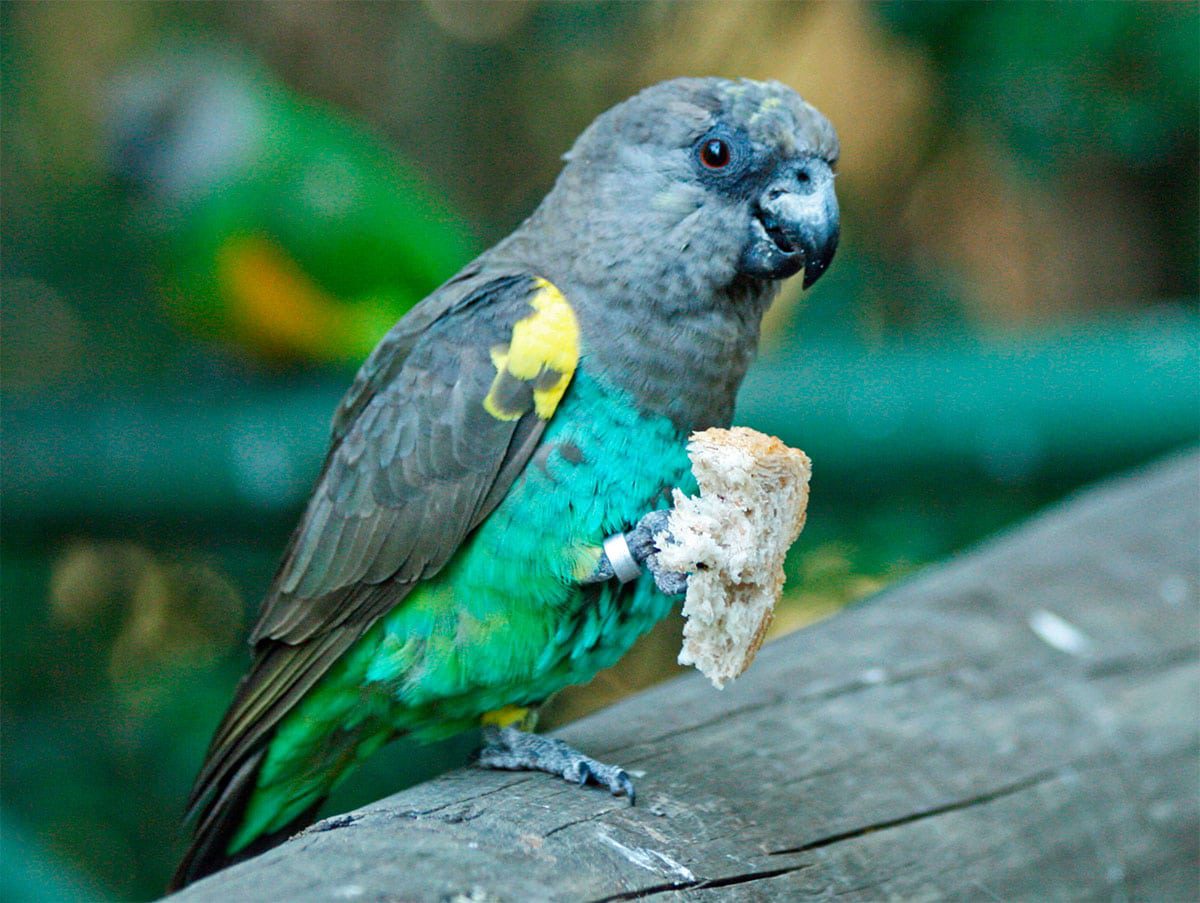
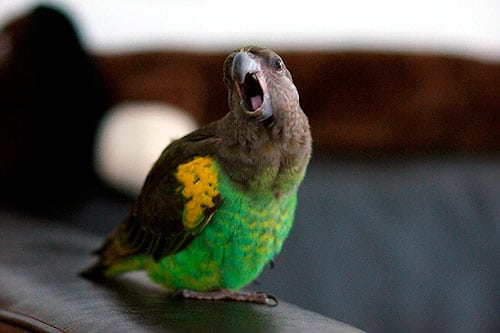
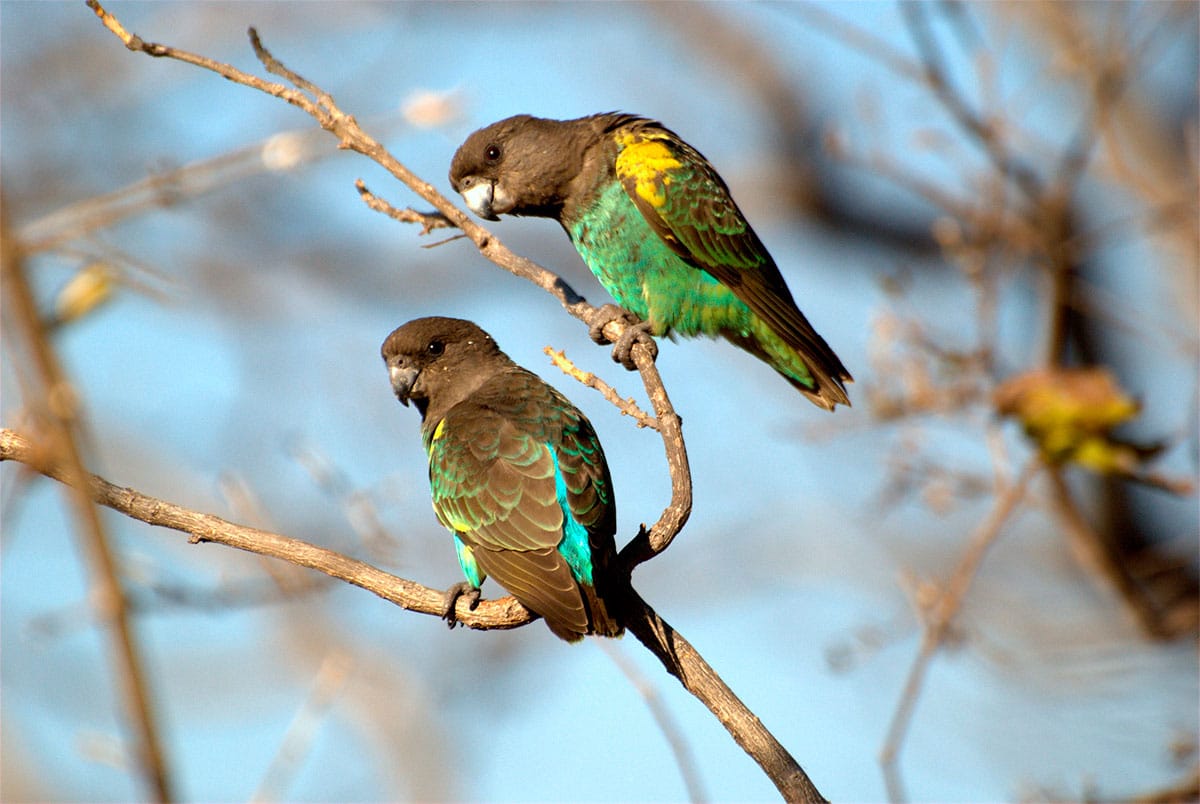
The Meyer's Parrot (Poicephalus meyeri) has the forecrown, lores, cheeks, ear-coverts and ash Brown nape; crown bright yellow. The mantle feathers ash brown edges blue or cyan dye in some birds; scapulars brown ash, some individuals show Tips blue or greenish blue; rump bright turquoise or teal; uppertail-coverts green. Outermost children and wing-coverts above bright yellow, other variables showing green tints, especially towards Tips. The primaries and high schools ash Brown with paler narrow margins to vane outer.

feathers of the wings, undertail, bright yellow in some birds, but grayish-brown in larger in other. The chin, the throat and top of the chest brown ash; remaining chest and belly turquoise or teal; the thighs yellow; undertail- coverts turquoise blue or greenish blue. Tail brown ash.

Bill dark gray or black; cere black; irises orange-red; periophthalmic skin desnuda negruzca; legs blackish.

Both sexes similar.

Youth more generally greenish brown. No yellow in the crown or the the thighs and the yellow area in the wings, at the top, It is lower. Wing coverts, undertail, green and brown with little or no yellow. The underparts mรกs greenish. Iris dark brown.

Subspecies description

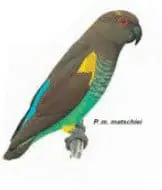
Description Meyer's Parrot subspecies
  • Poicephalus meyeri damarensis

    (Neumann, 1898) – No Yellow crown. Paler than subspecies reichenowi. Intergrades with transvaalensis subspecies in the region of the delta del Okavango, Botswana and with subspecies reichenowi in Angola.


  • Poicephalus meyeri matschiei
    matschiei by Parrots of the World โ€“ Forshaw Joseph M
  • Poicephalus meyeri matschiei

    (Neumann, 1898) – Brown is paler than in the subespecie satisfied and cyan dye to the margins of the scapulars less pronounced than in the species nominal. Green colors are blue (especially below). The female spot shows yellow feathers at the base of the lower jaw.


  • Poicephalus meyeri meyeri

    (Cretzschmar, 1827) – Species nominal


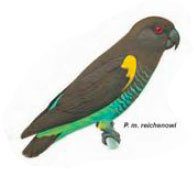
  • Poicephalus meyeri reichenowi

    (Neumann, 1898) – Similar to the subespecie matschiei but with the yellow crown generally absent. Paler blue in the rump. Size larger than the subespecie matschiei.


  • reichenowi by Parrots of the World โ€“ Forshaw Joseph M
    reichenowi by Parrots of the World โ€“ Forshaw Joseph M
  • Poicephalus meyeri saturatus

    (Sharpe, 1901) – darker than species nominal (especially the brown parts), rump less blue than the nominal, showing a bit of green in the feathers. The dark centers feathers on the bottom, giving it a mottled appearance. Intergrades with the subspecies matschiei in Tanzania.


  • Poicephalus meyeri transvaalensis

    (Neumann, 1899) – Brown clearer than in the subespecie matschiei, even bluer in the rump and below. Yellow areas in the crown They are often reduced and, sometimes completely lacking (especially in males). It is thought that can hybridize with the Poicephalus cryptoxanthus.

Habitat:

The Meyer's Parrot It is found in a wide variety of forest habitats from dry savannah to gallery forest and second-growth riparian forest around crops.. Observed in forests dominated by Terminalia laxiflora and Doka Isoberlinia, thickets Combretum acacia grasslands; as well Brachystegia and riparian forests Syzygium-Adina.

Avoid lowland rainforests in the basin Congo and other humid forests including areas of the eastern highlands of the district of Zimbabwe and Cork in Malawi.

Show a preference for the tallest trees in the drier savannah habitats – in particular specimens Adansonia. They may be confined to gallery forests in the drier parts of their range and are generally found in close proximity to water..

Where it is sympatric with the Red-bellied Parrot (Poicephalus rufiventris), the Meyer's Parrot It is limited to riparian forests.

In Kenya, which it is largely in areas with higher annual rainfall 500 mm.

Sometimes observed in suburban areas.

In general, in the lowlands at altitudes of 1,250m in Ethiopia, 2.200m in east Africa and 1.500 meters in the highlands of eastern Zimbabwe.

They are distributed in pairs or small groups 3-5 birds (possibly couples); until 50 birds may congregate in areas where there are food sources in breeding season. Roosts in tree cavities. Usually shy and cautious.

Reproduction:

Solitary nesters in tree cavities at a height between 3 and 10 meters above the ground, during the season, dry (for example Mar-June Zimbabwe, from May to September Zambia and Malawi, July Angola and in December or January Sudan).

The implementation is of 2 to 4 eggs.

Food:

The diet of the Meyer's Parrot fruit is, nuts and seeds, including Ficus, Sound abyssinica, Uapaca nitidula, Monotes glaber, Combretum, Grewia, Sclerocarya, Pseudolachnostylis, fruit of the great growth and riparian trees afzelia quanzensis and Melia volkensii, grown oranges and flowers Schotia brachypetala.

The pulp of the fruit is less important than the hard seeds and the arbolados share, the Meyer's Parrot is one of the few species consume seeds Brachystegia and other leguminous trees.

They also consume grain and is considered as crop pests in some areas.

Eat some insects, including caterpillars.

May vary widely from area to area in search of food during droughts.

Distribution:

Size of the area of distribution (reproduction / resident): 5.840.000 km2

The Meyer's Parrot They are distributed throughout the central and eastern Africa. From the North-East of Cameroon and South of Chad through the North of the Central African Republic, center Sudan and South and West Ethiopia, to the south through Uganda, Kenya Western, east of Democratic Republic of the Congo and Tanzania, coming to Malawi, Zambia, Angola, Northeast of Botswana, Zimbabwe, western end of Mozambique, Namibia and northeast of Sudafrican republic.

A wild population, possibly, is distributed in the eastern province of Cape Town, Sudafrican republic, even if they are probably extinct.

Nomad in some areas during periods of drought, when they distributed outside the normal range; normally resident with local movements.

Distribution Subspecies

Meyer's Parrot subspecies distribution
  • Poicephalus meyeri damarensis

    (Neumann, 1898) – South of Angola, Northeast of Namibia and North of Botswana.


  • Poicephalus meyeri matschiei

    (Neumann, 1898) – Southeast Kenya through eastern and central Tanzania to Southeast Democratic Republic of the Congo, North of Malawi, Zambia and northeast of Angola.


  • Poicephalus meyeri meyeri

    (Cretzschmar, 1827) – Species nominal


  • Poicephalus meyeri reichenowi

    (Neumann, 1898) – North and Central Angola from Malange and sierra central until Huila, possibly also adjacent parts of the Democratic Republic of the Congo


  • Poicephalus meyeri saturatus

    (Sharpe, 1901) – The Far East Democratic Republic of the Congo, through Burundi, Rwanda and east of Uganda, in West and Central East Kenya towards Meru and Local inside Tanzania to the South of the Parque Nacional Ruaha.


  • Poicephalus meyeri transvaalensis

    (Neumann, 1899) – Areas of northern and central Mozambique to northern Save River across the South of Zambia and central and southern Zimbabwe to northeast Botswana and West of Transvaal

Conservation:


minor concern


โ€ข Current Red List of UICN: Least concern

โ€ข Population trend: Stable

The Meyer's Parrot It, in general, common to very common and is the most abundant parrot in some parts of its range (for example, Zimbabue and Angola), although few in other areas and absent from some apparently suitable habitats.

Its population has declined in some parts (for example Transvaal) where is thought to be a result of habitat destruction. I also persecuted in some locations due to crop damage (for example, in the center of Zambezi because of the damage inflicted to the maturation of the berries Boolean).

"Meyer's Parrot" in captivity:

The Meyer's Parrot, is a bird common in captivity, quiet, tender, easy to carry and with a stable temperament.

They are birds social and they tend to bond with everyone in the family, unlike other species that may prefer one person to another. In general, No es voluble – once you liked someone, the person is a friend for life.

They are not as dependent on humans for entertainment as most parrots and therefore no son tan demanding.

They like being handled and petted on the head and neck. A hand-fed hatchling will develop into a fluffy adult if treated properly, and it is not prone to bite, although it may provide a powerful bite if provoked.

You can learn a few words, although They are not known for their ability to speak. They can learn to whistle, making noises, and occasionally they will offer strong squeals. Fortunately, They are not likely to scream or make loud squawks, making good birds for apartment life. Some individuals learn household noises, as the beep of the microwave.

The Meyer's Parrot they are ready to breed at the age of 3 to 4 years and reproduce easily in captivity.

With regard to its longevity, according to sources, Meyer lived a parrot 34,2 years in captivity.

Alternative names:

Meyer’s Parrot, Brown Parrot (English).
Perroquet de Meyer, Perroquet brun, Youyou de Meyer (French).
Goldbugpapagei, Goldbug-Papagei (German).
Papagaio de Meyer, Papagaio-de-meyer (Portuguese).
Lorito de Meyer (espaรฑol).


scientific classification:

Philipp Jacob Cretzschmar

Order: Psittaciformes
Family: Psittacidae
Genus: Poicephalus
Scientific name: Poicephalus meyeri
Citation: (Cretzschmar, 1827)
Protonimo: Psittacus Meyeri


Images "Lorito de Meyer":

Videos "Meyer's Parrot"

————————————————————————————————

"Lorito de Meyer" (Poicephalus meyeri)


Sources:

Avibase
– Parrots of the World โ€“ Forshaw Joseph M
– Parrots A Guide to the Parrots of the World – Tony Juniper & Mike Parr
– Birdlife

Photos:

(1) – A Meyerโ€™s Parrot at Birds of Eden, Western Cape, South Africa. It is eating what looks like a piece of bread By SandyCole (mailto:sandyc@dicksandy.org) (Own work) [CC BY-SA 3.0 or GFDL], via Wikimedia Commons
(2) – Two Meyerโ€™s Parrots in Zimbabwe By Oce Eeco (DSC_0108Uploaded by snowmanradio) [CC BY 2.0], via Wikimedia Commons
(3) – Brown parrot also known as Meyerโ€™s Parrot (Poicephalus meyeri) by Papooga – Flickr
(4) – A Meyerโ€™s Parrot near Kwara Camp, North-West District, Botswana By Benjamin Hollis from Seattle, WA, USA (Meyerโ€™s parrotUploaded by snowmanradio) [CC BY 2.0], via Wikimedia Commons
(5) – A Meyerโ€™s Parrot in Akagera National Park, Rwanda By Lip Kee Yap [CC BY-SA 2.0], via Wikimedia Commons

Sounds: Derek Solomon (Xeno-canto)

โ–ท The world of Pets: Dogs, cats, birds, reptiles, amphibians

Long-tailed Parakeet
Psittacula longicauda


Cotorra Colilarga

Content

Description:

Of 40 to 48 cm.. length and 168 to 196 g. of weight.

The Long-tailed Parakeet (Psittacula longicauda) has the plumage, in general, green. The throat, the chest and the abdomen are greenish-yellow; and lores (the regions between the eyes and the beak, on both sides of the head) are bluish-black. The crown is a green dark, and the sides of the head and nape are pinkish Red. They have a black stripe in the cheeks.

The upperparts is yellowish wash of blue-grey. The lower part of the back is pale-blue. The upperwing-coverts are yellowish. The supracaudales-coverts and infracaudales, as well as the the thighs are pale green. The central feathers of the tail are blue with pale tips and outer feathers are green.

The bill top is red and the lower beak is brown-black color. The irises they are amarillos-blanquecinos, and legs are grey.

The females they have the nape green. The band to their cheeks is dark green, and cheeks superiors are an orange-red live. Their feathers of the tail they are much shorter, and the bill top and bottom are brown-black color.

Ilustraciรณn Cotorra Colilarga

The young birds they have the head variable green interspersed with orange-red. The feathers of the tail they are shorter, and both the bill top and bottom are brown.

The young male they have a tint blue in the lower part of the back and some birds can have a reddish tint in the bill top.

Immature birds reach your adult plumage When they are near the 30 months of age.

The lutino and other colorations, It is believed that they are mutations observed both in the wild and in captivity.

Subspecies description:
Subspecies
  • Psittacula longicauda defontainei

    (Chasen, 1935) – Of an average length of 42 cm.. As the species nominal but but the pinkish red from the sides of the head It is deep orange-red-streaked.


  • Psittacula longicauda longicauda

    (Boddaert, 1783) – The species nominal


  • Psittacula longicauda modesta

    (Fraser, 1845) – Of 48 cm.. Plumage as of the species nominal, but the crown It has a reddish-brown core and a green at the end of feather edging, becoming pink on the back of the head and nape, thus causing in the crown more Brown than green appears in many birds . The black stripe in the lores is more clearly defined, continuing in some birds to form a narrow band in the forecrown. The upper cheeks they have a deep pinkish-Red, orange-red stripes.


  • Psittacula longicauda nicobarica

    (Gould, 1857) – Of 48 cm.. As the species nominal, but the back of the head, the nape and back are greenish-yellow and slightly washed with pale blue. The ear-coverts and cheeks are deep red. The lower part of the back is green.


  • Psittacula longicauda tytleri

    (Hume, 1874) – Of 44 cm.. length. As the species nominal but the back of the head, the nape and back are yellowish green washed with grisaceo-malva. The throat, the chest and the top chest they have a pale bluish tint. The lower part of the back is green.

Habitat:

Video – "Long-tailed Parakeet" (Psittacula longicauda)

eating Starfruit... Long-tailed Parakeet, parakeets, parakeets, Psittacula longicauda, Long-tailed Parakeet, MALAY BAYAN

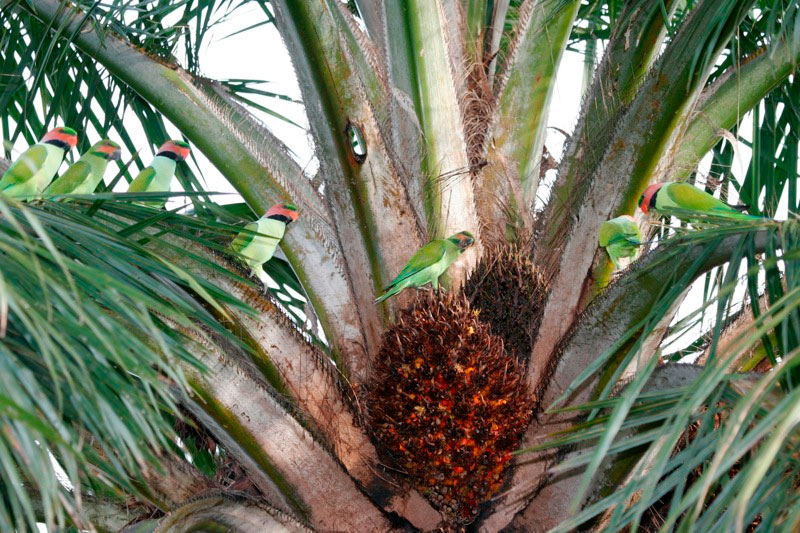
The Long-tailed Parakeet distributed over all types of lowland (below 300 metres in Sumatra), Evergreen from mangrove forests, swamps, tropical forests, to plantations of oil palm plantations (Elaeis) and coconut trees. It prefers the edges of high forest, especially with large dead trees, including close cultivated areas.

Visit parks and gardens on the Islands Nicobar Islands.

gregarious.

Flocks of thousands of birds reported in the Islands Andaman and Borneo but smaller groups (minor's 20) they are typically, especially during breeding. They form mixed flocks with the Blue-rumped Parrot (Psittinus cyanurus) in Kalimantan.

The Long-tailed Parakeet It is a restless bird that are constantly in motion. They fly quickly around branches, moving quickly from a tree to another. Although they are usually well camouflaged in green foliage, its continuous chirp betrays its position. They tend to feed shortly after sunrise and resume foraging around sunset..

Reproduction:

The Long-tailed Parakeet nests in tree cavities, usually dead, often to a considerable height (for example, reported nest in a tree of the species Koompassia in Sumatra to 45 meters above sea level); in the andaman islands commonly nest in trees of the species Pterocarpus marsupium; in the Nicobar Islands sometimes in Pandanus, some 4 meters above ground and in larger trees to 10 metres in height.
Breeds in colonies.

The nest It is full of pieces of bark and chewed wood. In the natural habitat, the average clutch consists of 2 to 3 eggs, each one measures 30,6 x 24,7 mm.

During the courtship, the male bows before the female, by spitting up, circular motions with his head and gently touching its beak.

The breeding It is between the months of December-February, Although pigeons have been observed in July in the Malacca Peninsula; Feb-Mar in the Nicobar Islands and Andaman. Reports of eggs in July sunsets in Sumatra.

Food:

The nominal species diet includes plants from Borneo camphor (Dryobalanops sumatrensis) and fruit of the Dillenia; the subspecies nicobarica largely feeds on fruits as the papaya (Carica papaya) and Pandanus; occasionally feed on the outer cover of the betel nuts (Areca catechu). On the other hand, They assail orchards and fruit plantations to feed, for example, of the oil palm plantations Elaeis, grains and seeds, and they can have an important impact in the fields of ripening rice (for example in the Islas Andaman) and fruit of the oil palm plantations (for example in the Malay Peninsula).

Insects and their larvae can also be part of your daily diet; If these parrots seek them actively unknown, but they may be ingested ,probably, While they feed on fruits and flowers.

Distribution:

Size of the area of distribution (reproduction / resident): 877.000 km2

The Long-tailed Parakeet distributed by the islands of the bay of bengal until Borneo. The range goes from the Coco Islands and andaman islands and Nicobar Islands (India) through Sumatra (including the Enggano Islands, Nias, Bangka and Belitung), South of Malay Peninsula from Sungei Patani (approximately 6ยฐN) to Singapore, Riau archipelago and Bintan, to the East, through the Anambas Islands and up Borneo including Natuna and Karimata Islands.

Resident and common in andaman islands and Coconut.

On the Islands Nicobar Islands described in the century 19 as 'excessively abundant', but with few details today.

Resident on Malay Peninsula, but possibly passage migrant in Singapore.

You can display migratory movements in Sumatra, where probably is the decrease due to the loss in the lowlands of the primary tropical forest.

Unevenly distributed in Borneo, and in Kalimantan numbers fluctuate through little-known seasonal movements.

Resident local in Sabah. More common in the coastal districts of Sumatra and Borneo.

Usually unpredictable appearances, being abundant in a locality for a period and against, absent for years.

Subspecies distribution:
Subspecies

Conservation:

State of conservation โ“˜


Near-threatened Near Threatened โ“˜ (UICN)โ“˜

โ€ข Current Red List of UICN: Near-threatened

โ€ข Population trend: Decreasing

The size of the world population Long-tailed Parakeet It has not been quantified, but the species is described as very common and widespread in southern Borneo, locally common in Sumatra and Peninsular Malaysia and common in Brunei, the andaman islands and Nicobar Islands (pit et to the. 1997).

The destruction of forests in the lowlands of Sundaland in Indonesian, as well as in Thailand and Malaysia It has been wide (Kalimantan almost lost the 25% its perennial forest during 1985 to 1.997, and Sumatra almost lost the 30% your coverage 1985), still, the species is still numerous in a number of areas, due to its ability to forage away from forested areas and nest communally. So, the decrease is estimated to have been of the order of 20 to 30% in the last ten years.
Conservation Actions Underway:

    – CITES Appendix II.

Conservation Actions Proposed:

    – Monitor the species in trade.

    – Monitor habitat trends and rates of deforestation in the lowlands of Sundaland using satellite imagery and remote sensing.

    – The investigation of the ecology of the species to improve the understanding of the movements it makes.

    – Effectively protect significant areas of habitat at key sites, both in strictly protected areas and in multiple use areas.

"Long-tailed Parakeet" in captivity:

Rare in captivity, their mortality is high and breeding successes are rare.

It is a bird very noisy. It is a principle very shy and slow to get your confidence. They don't bathe often, Although they occasionally sit in the rain. They enjoy gnawing fresh branches. The main problems for captive breeding are the difficulty of matching compatible pairs; the Long-tailed Parakeet they usually do not accept a mate that they have not chosen themselves and even if they are breeding pairs, it is very difficult to keep the chicks alive. Sudden deaths no apparent cause they have been reported – possibly as a result of stress.

Some birds may refuse to eat. Have been observed Occasional attacks of females to males, coming to Peck them on the penis, causing them serious injury. It also, these delicate parrots are difficult to acclimatize. Newly imported birds are susceptible to cold, wet conditions. During the acclimatization period, should not be exposed to temperatures below to 24 ยฐC and at no time below 10 ยฐ C.

Given that these parrots are so rare, experts prefer well managed breeding programs the possibility of keeping them captive in private hands.

The size of the clutch average consists of 2 – 4 eggs laid at daily intervals, with an incubation which lasts approximately 23 days. The young leave the nest 7 weeks after hatching and are independent 2 weeks later.

The Long-tailed Parakeet, in any case, you will need a large aviary which is a very active bird and will need plenty of room to move.
It is important to place the bird in a quiet and protected, as well as provide a rest box (22 x 22 x 60 cm.) at all times.

Alternative names:

Long-tailed Parakeet, Long tailed Parakeet, Malaccan Red-cheeked Parakeet, Malayan Red-cheeked Parakeet, Pink-cheeked Parakeet, Red-cheeked Parakeet (English).
Perruche ร  longs brins, Perruche de Malacca (French).
Langschwanzsittich (German).
Periquito-mustache-cauda-longa (Portuguese).
Cotorra Colilarga, Cotorra de Cola Larga (espaรฑol).

scientific classification:

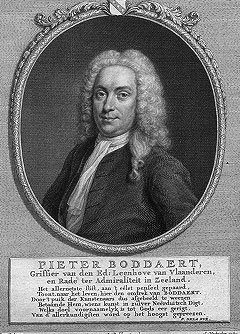
Pieter Boddaert
Pieter Boddaert

Order: Psittaciformes
Family: Psittaculidae
Genus: Psittacula
Scientific name: Psittacula longicauda
Citation: (Boddaert, 1783)
Protonimo: Psittacus longicauda

Long-tailed Parakeet Images:


Especies del gรฉnero Psittacula

Sources:

Avibase
– Parrots of the World โ€“ Forshaw Joseph M
– Parrots A Guide to the Parrots of the World – Tony Juniper & Mike Parr
– Birdlife

Photos:

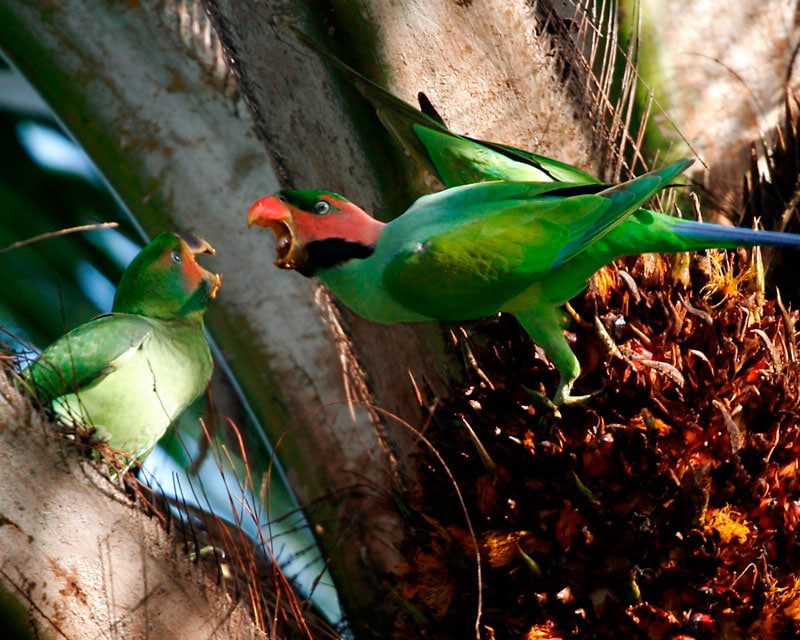
(1) – A male warning juvenile to keep away from the food while he is there in Queenstown, Singapore By Lip Kee Yap [CC BY-SA 2.0], via Wikimedia Commons
(2) – A female in Queenstown, Central Singapore on 2 December 2005 By Lip Kee Yap [CC BY-SA 2.0], via Wikimedia Commons
(3) – feeding in Queenstown, Singapore on 2 December 2005 By Lip Kee Yap [CC BY-SA 2.0], via Wikimedia Commons
(4) – A juvenile in Queenstown, Central Singapore on 2 December 2005 By Lip Kee Yap [CC BY-SA 2.0], via Wikimedia Commons
(5) – Long-tailed Parakeets at the Botanic Gardens, Singapore By Lip Kee Yap [CC BY-SA 2.0], via Wikimedia Commons
(6) – Long-tailed Parakeet, adult male Joseph Wolf [Public domain], via Wikimedia Commons

Sounds: Mathias Ritschard (Xeno-canto)