โ–ท The world of Pets: Dogs, cats, birds, reptiles, amphibians

Gray-headed Parakeet
Psittacula finschii


Cotorra de Finsch

Content

Description:

Of 36 to 40 cm.. length and 120 g. of weight.
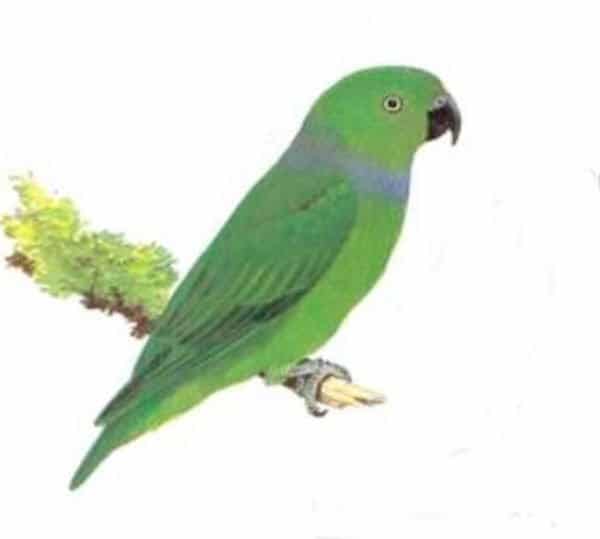
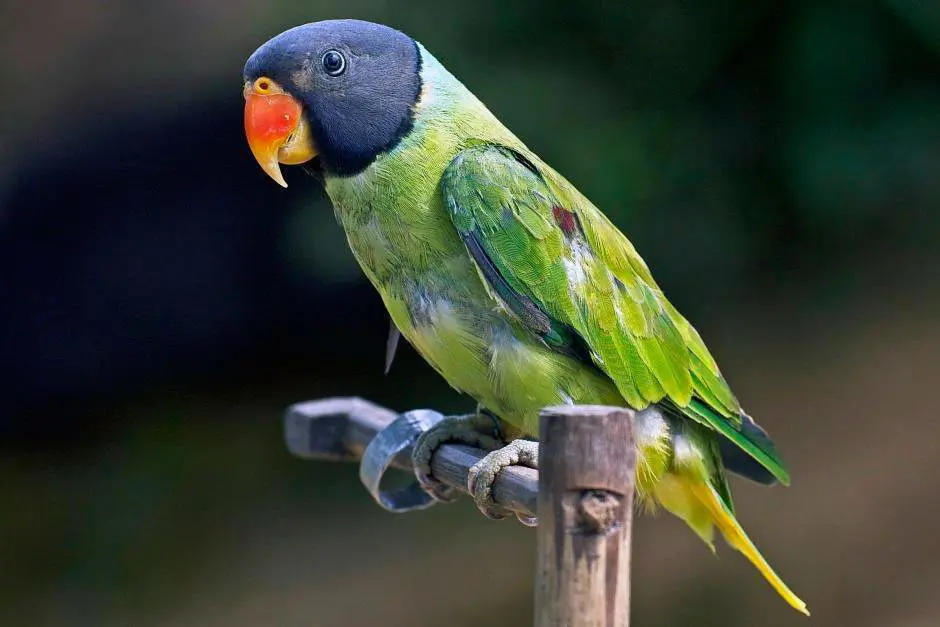
The Gray-headed Parakeet (Psittacula finschii) It is very similar to Slaty-headed Parakeet but smaller, with feathers tail longer, the head slightly paler, upperparts and more yellowish underwing-coverts darker blue-green.

The Gray-headed Parakeet (Psittacula finschii) has the forecrown, crown, lores and ear-coverts Grey Slate-blue; the chin and the lower part of the cheeks, black, It forming a narrow collar which marks a clear boundary between the head dark and a bright ring greenish blue on the back of the neck.

Nape brighter yellowish green, duller green fading in the rest of the upper region.

Upperwing-coverts green except for the brown of the inner coverts, that makes the effect of a distinctive patch on the shoulder; primaries Green with a narrow yellow margin on the vane outer; secondaries green.
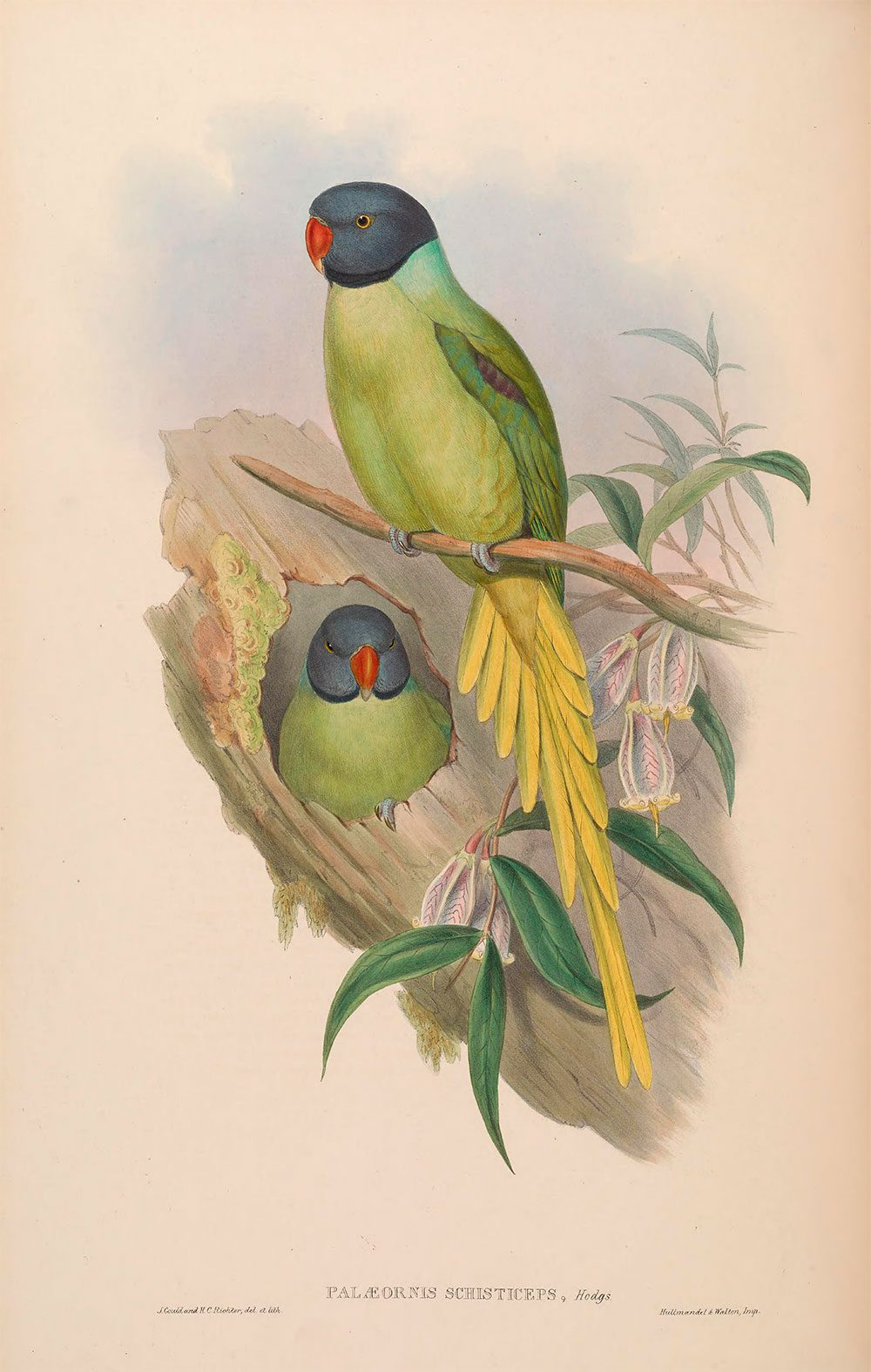
Ilustraciรณn Cotorra de Finsch

Underwing-coverts dark bluish green. Underparts bright pale green. Uppertail lilac blue with pale yellow tips, outer feathers Greens with vane internal and yellow tips; undertail-coverts ochre-coloured.

upper jaw coral red to vermilion with yellow tip, lower jaw yellow; cere whitish; irises creamy white to yellow; legs greenish.

The females and immature as the Slaty-headed Parakeet.

NOTE:

    Sometimes considered the same species as the Slaty-headed Parakeet, but the lack of intergradation in a possible area of overlap in Bhutan and the northeast of the India (Arunachal Pradesh) suggests appropriate treatment as allospecies.

Habitat:

Similar to the Slaty-headed Parakeet. Frequents forests of oak, teak, cedar and pine, wooded hills and open farmland with tall trees. Move altitude between 650 and 3.800 m (in Yunnan, China), rarely drop below 250 m, usually at or near the mountainous terrain.

Mainly distributed in the forest Viet Nam, but, according to sources, laz away from growing areas and tolerant of lower and more open habitats.

In general, obsevadas in flocks or or small family groups, but also it is seen in larger numbers than in Burma.

Reproduction:

The breeding season in the central and southern Burma It covers the months January, February and March.

One nest four eggs was observed 12 meter high tree species Xylio dolabiformis.

Food:

Diet Gray-headed Parakeet It is thought to resemble that of the Slaty-headed Parakeet; reported items include leaf buds, seeds of Dendrocalamus longispathus, fruit of wild cherries Prunus and flowers.

Distribution:

The Gray-headed Parakeet It is distributed in the east of the Himalayas towards Indochina. They range from east to Bhutan towards Arunachal Pradesh and south through Nagaland, Assam (to the South of the rio Brahmaputra). Manipur, Mizoram and Bangladesh oriental (Sylhet and area of Chittagong). Through Burma (South of Tenasserim), al sur-oeste de China (center Sichuan and North of Yunnan), the mountainous districts of northern and southwestern Thailand, South of Laos, Kampuchea and Viet Nam, especially the western slopes of the central mountains.

Usually common and resident (in some places very common), but lacking in some areas and subject to local fluctuations and irregular appearances.

Recent decline in Thailand, where it is now rare in more accessible areas. Uncommon in China. Some seasonal altitudinal movements in some parts of the range. Very popular cage bird in some parts of the home territory.

Conservation:

State of conservation โ“˜


Near-threatened Near Threatened โ“˜ (UICN)โ“˜

โ€ข Current Red List of UICN: Near-threatened

โ€ข Population trend: Decreasing

The size of the world population Gray-headed Parakeet It has not been quantified, but the species, according to sources, is rare in China, Variable and elsewhere (pit et to the. 1997).

The population is suspected rapid decline because of continued habitat loss and trapping. Observations of local trends in some parts, within its range, support this suspicion, for example in Cambodia, at least since the early 1990 (F. Goes in some. 2013, T. Gray in litt. 2013, RJ Timmins in litt. 2013).

The Gray-headed Parakeet is being widely taken for the cage bird trade and is kept locally as a companion animal, for example, in Laos and China (JW Duckworth in litt. 2013, M. Zhang in some. 2013).

In China, poaching and illegal trade in this species continues: it was reported that in one village, each family has an individual of this species as a pet (M. Zhang in some. 2013).

The pressure at which it is subjected for his capture may also be contributing to the observed decrease in Cambodia (F. Goes in some. 2013).

Lowland forests Indochina They are under intense pressure, above all in Cambodia, because of the authorization for large-scale industrial agriculture. This particularly affects areas with evergreen or semi-evergreen forest, rather than forest deciduous, because the best conditions for growing (S. Mahood in some. 2013).

This species is dependent areas and forests with evergreens, whereby the effects of logging can seriously affect, especially since it is likely to depend on large trees for nesting. Habitats where large trees are scarce, as forests and hill areas with mixed forest deciduous, patches of evergreen forest and semi-evergreen forest, They are under particular pressure from logging, even for local use (S. Mahood in some. 2013).

It is expected that the loss of habitat Cambodia bring a devastating impact on this species over the next decade, although there may be a delay before the actual effects were observed in the population (H. Rainey in some. 2013).

Conservation Actions Underway:

    The species is known to occur in some protected areas across its range, as in the Mondulkiri Protected Forest, Cambodia (T. Gray in litt. 2013).

"Gray-headed Parakeet" in captivity:

Cotorra de Finsch

– Uncommon in captivity outside its range.

It is unclear how much spread among breeders, as often it was considered a subspecies of the more common Slaty-headed Parakeet. It is a very mountain bird resistant, at low temperatures is not a problem for them, However, must be protected facilities available to avoid sudden changes in temperature and drafts.

How other Psittacula, the Gray-headed Parakeet You need to nibble fresh branches, although it is not a destructive bird that could demolish a wooden aviary.

Alternative names:

Gray-headed Parakeet, Eastern Slaty-headed Parakeet, Finsch’s Parakeet, Finsch’s Slaty-headed Parakeet, Gray headed Parakeet, Grey headed Parakeet, Grey-headed Parakeet, Slaty-headed parakeet (English).
Perruche de Finsch, Perruche ร  tรชte grise (French).
Finschsittich, Burma-Schwarzkopfedelsittich, Finschs Edelsittich, Finsch-Sittich, Himalayasittich, Himalayasittich-finschii, Veraguasittich (German).
Periquito-de-cabeรงa-cinza (Portuguese).
Cotorra de Finsch (espaรฑol).


scientific classification:

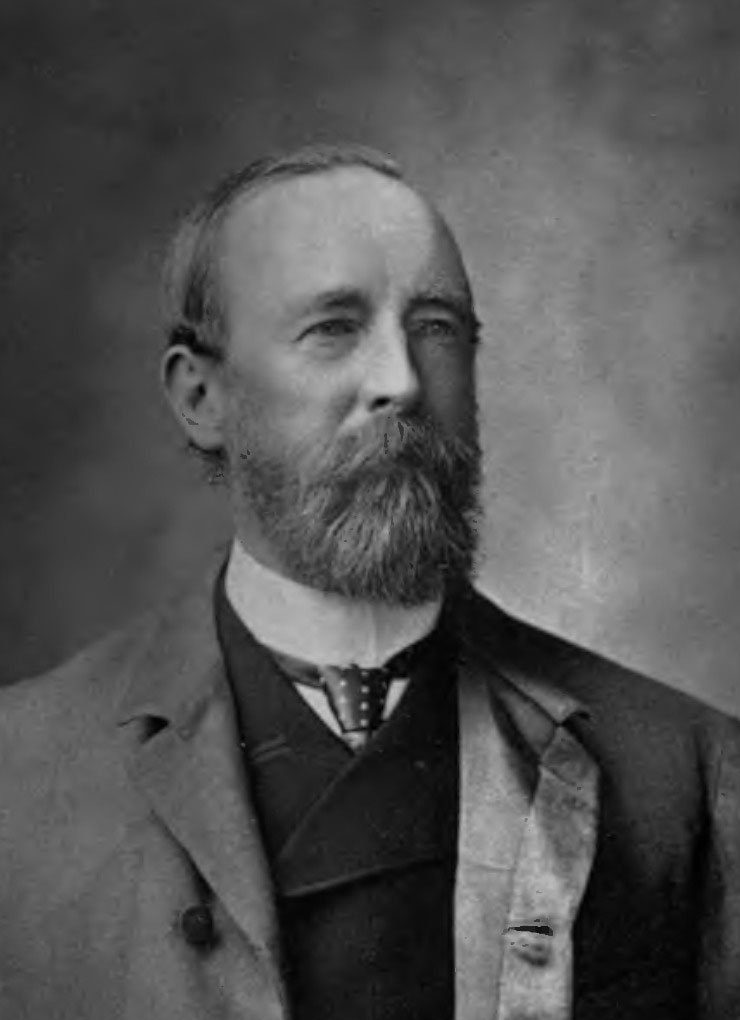
Allan Octavian Hume
Allan Octavian Hume

Order: Psittaciformes
Family: Psittaculidae
Genus: Psittacula
Scientific name: Psittacula finschii
Citation: (Hume, 1874)
Protonimo: Palaeornis Finschii

Images "Gray-headed Parakeet"

Videos "Gray-headed Parakeet"


Especies del gรฉnero Psittacula

Gray-headed Parakeet (Psittacula finschii)


Sources:

Avibase
– Parrots of the World โ€“ Forshaw Joseph M
– Parrots A Guide to the Parrots of the World – Tony Juniper & Mike Parr
– Birdlife

Photos:

(1) – Bird perched on a home made perch. Part of the tail appears to be missing by Vijay Anand Ismavel – Lynx
(2) – Gould, John, 1804-1881; Sharpe, Richard Bowdler, 1847-1909: Birds of Asia by John Gould [Public domain], via Wikimedia Commons
(3) – Finschโ€™s Parakeet Psittacula finschii by Raju Kasambe. Photo taken in Imphal Zoo, Manipur, India By Dr. Raju Kasambe (Own work) [CC BY-SA 4.0], via Wikimedia Commons

Sounds: Pritam Baruah (Xeno-canto)
โ–ท The world of Pets: Dogs, cats, birds, reptiles, amphibians

Naretha Bluebonnet
Northiella narethae

Content


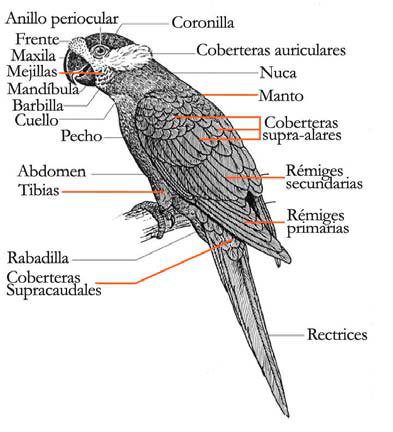
Anatomy-parrots

Description:

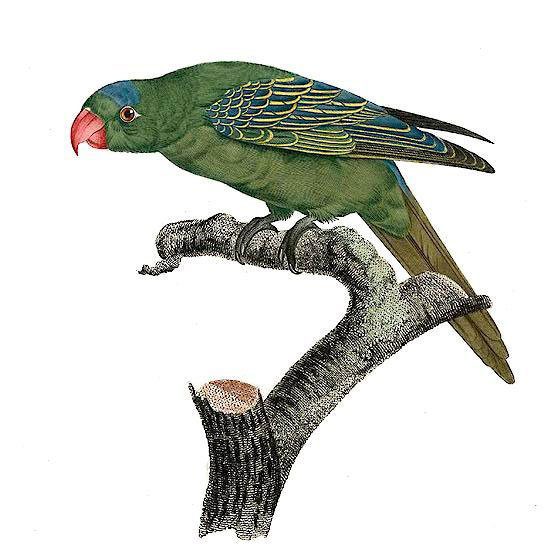
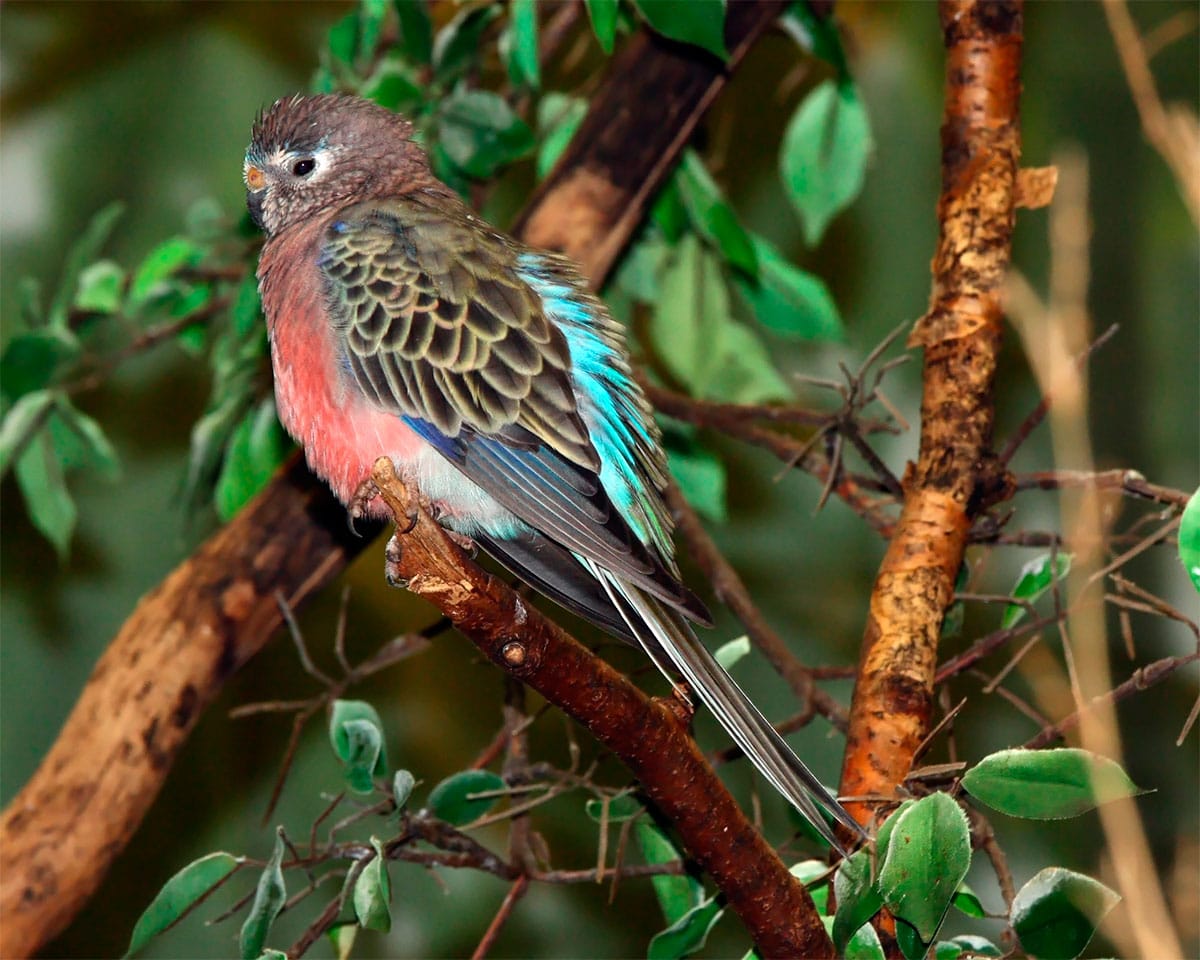
The Naretha Bluebonnet (Northiella narethae) It is smaller than Bluebonnet (Northiella haematogaster), of about 28 cm. long.

The legs and feet are dark gray, and the irises is dark brown.

The adult male has a two tonal facial pattern forecrown lighter green-blue, the ears and the area above the eye in contrast to the rest of the face which is purple-blue. The head, the neck forward and breast are marked with pale steaks and diffuse spots.. The back It is olive gray. The belly, the area of the vent and the thighs are uniform yellow, while red is limited to the area of รขโ‚ฌโ€นรขโ‚ฌโ€นthe undertail-coverts. The lesser wing coverts are blue and outer median wing coverts red, while the inner median and greater wing coverts, and inner secondary a yellow-olive colour. The central feathers of the tail are tinged with pale blue..

The female adult has a duller blue color in forecrown, and a reduced color on wings and tail, and with no tint of orange on the belly. It is smaller overall, at around 26 cm length.

The chicks they have a bill yellow and gain their adult plumage in the first post moves to bloom (three to four months old).

taxonomy:

the species Northiella narethae It was formerly classified as a subspecies (Northiella haematogaster narethe) of the Northiella haematogaster. A molecular study published in 2015 by Gaynor Dolman and Leo Joseph He confirmed the genetic isolation Naretha Bluebonnet (Northiella narethae) and recommended that it was restored as a separate species.

Habitat:

Arid and semiarid scrub and farmland, thickets mulga, weeds and dry forests open.

Reproduction:

It is heavily influenced by rainfall and food availability, but usually peaks between August and January.

The usual site nesting It is a very small cavity tree, particularly attracted to she-oaks providing appropriate holes for nesting, often near the ground, coated shavings and wood dust rotten. The female incubates the eggs but is cared for by the male who also contributes to raising the young..

Four to seven white eggs round (23mm x 19mm). Time of incubation: 22 days. The young usually leave the nest around the 30 days.

Food:

Seeds of various grasses and herbaceous plants (autochthonous), also nectar, flowers and various fruits.

Distribution:

Reports indicate that Naretha Bluebonnet They have been common in the arid region Nullarbor, and they have become more rare in the twentieth century. It is believed that localized individuals range makes the species highly endemic in an area on the border between Western Australia and Southern Australia.

Conservation:

We know the conservation status of this species, although probably in risk status.

"Naretha Bluebonnet" in captivity:

No data.

Alternative names:

Bluebonnet (Naretha), Little Bluebonnet, Naretha Bluebonnet (English).
Perruche ร  bonnet bleu (narethae), Perruche de Nareth, Perruche petite (French).
(German).
(Portuguese).
Perico Cariazul Naretha (espaรฑol).

Images "Naretha Bluebonnet"

scientific classification:

Order: Psittaciformes
Family: Psittaculidae
Gender: Northiella
Scientific name: Northiella narethae
Subpoena: (White, HL, 1921
Protonimo: Psephotus narethae

Sources:

โ€ข Avibase
โ€ข Parrots of the World โ€“ Forshaw Joseph M
โ€ข Parrots A Guide to the Parrots of the World – Tony Juniper & Mike Parr
โ€ข Birdlife

Photos:

(1) – Penochka Birds: Parrots (Psittacidae) – Source

โ–ท The world of Pets: Dogs, cats, birds, reptiles, amphibians

Bronze winged Parrot
Pionus chalcopterus


Bronze winged Parrot

Content

Description:

28 to 30 cm.. tall and around 210 weight g.

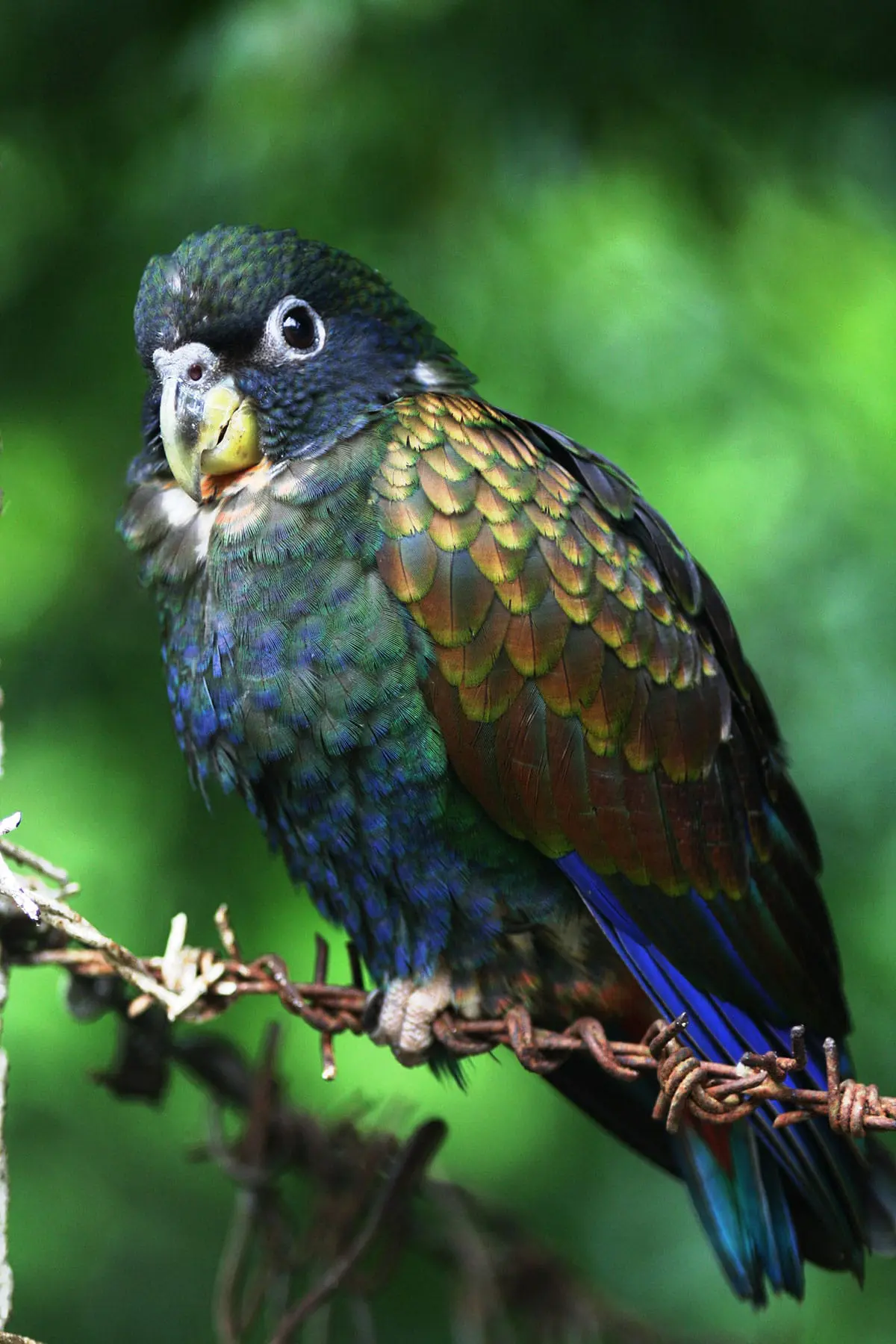
The Bronze winged Parrot (Pionus chalcopterus) has the general Brown, darker in head, neck, chest and flanks, This plumage with blue-violet edge.

The throat whitish and pink; wings bronze green.

Flight is evident violet blue at the top of the wing the Green bottom, that contrasts with the Red of the lower abdomen. Dorsally Violet Blue is notorious in the rump, shoulder and tail. The feathers of the tail are dark blue with a shade of red at the base.

The bill is of color beige, area of naked skin surrounding the eyes of pink. The legs They are pink.

Habitat:

It inhabits in humid jungle, semi-humid, crops and forest edge between 120 and 2800 m.

They are birds gregarious and noisy. Every tomorrow is mobilized in flocks in search of food. Within the flocks are can observe to the couples, that form of life, and who interact with a variety of contact behaviors that reaffirm the marital bond.

Reproduction:

Prefer for their nests broken rods, hollow of logs and palm trees. They nest in the months of October-may. The female often put in two to four eggs they are incubated during three weeks approximately, after which are born them chicks naked or just covered with down. The chicks remain with their parents until the next reproductive shekel.

Food:

Will congregate in cornfields in groups up to of 40 individuals, feeding is of pulp and seeds many fruits and other material ingredients as nectar and flower petals, complementing occasionally its diet with insects.

Distribution:

Its population is distributed by the mountain range of the Andes, from Colombia, Northwest of Venezuela; to the South, by the mountains to the Northwest of Peru.

Conservation:


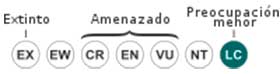
minor concern


โ€ข Red List category of the UICN current: Least concern

โ€ข Population trend: Decreasing

The size of the population World of the Bronze winged Parrot It has not been quantified, but this species is described as ‘rare‘ (Stotz et to the., 1996).

The population was suspected of being in decline due to ongoing habitat destruction.

This species is characterized be decreasing in Colombia and West Ecuador, due to the logging of forest subtropical, which has been severe and quick on the slopes of the Andes (Juniper and Parr 1998).

The evident anecdotal, based on the frequency of sightings, suggests that the species has declined in Pineapples, South of Ecuador, in recent years c.15-20 (M. By D Sanchez. Dรญaz in litt. 2011). Also is says that has been extirpated from areas previously occupied as the slopes of them Andes and valleys of the Cauca and the Magdalena river in Colombia, again due to loss of habitat (Juniper and Parr 1998).

In Venezuela the species is scarce and local, limited, to a large extent, to the slope West of them Andes in Mรฉrida and Sierra de Perija, with occasional records in Tรกchira (CJ Sharpe in litt. 2011). These areas have experienced rapid deforestation for at least the last few 24 years for cultivation and livestock.

Surveys conducted in the Northwest of Peru in the decade of 1990 they appeared to detect a sharp decrease in population from 1993 (Rosales et to the., 2007), although this species is known to be nomadic and its local numbers can fluctuate.

"Bronze winged Parrot" in captivity:

Rare in captivity, It is not a main target of poachers (CJ Sharpe in litt. 2011, R. Clay in litt. 2011), although it is still present in the illegal trade of Peru (F. Angle in litt. 2011)

Intelligent, playful and curious. You can be nervous, loving with your caregiver and aggressive with other people. It has a tendency to obesity.

It requires a spacious cage unless the bird pass periods of time outside of it. Not must keep is to open air where the temperatures fall below them 5 ยฐC.

With feed a wide variety of seeds, fruits and berries.

It is a relatively healthy bird, While it may be more susceptible to infection aspergillosis that other species.

In captivity they lay two eggs the incubation takes 26 days.

Alternative names:

Bronze winged Parrot, Bronze-winged Parrot (English).
Pione noire, Pionus noir (French).
Glanzflรผgelpapagei, Glanzflรผgel-Papagei (German).
Curica-asa-de-bronze (Portuguese).
Cotorra Oscura (Colombia).
Cotorra Negra (Venezuela).
Cotorra Oscura, Loro Alibronceado, Loro de Alas Bronceadas, Cheja alibronceada (espaรฑol).

scientific classification:

Order: Psittaciformes
Family: Psittacidae
Genus: Pionus
Scientific name: Pionus chalcopterus
Citation: (Fraser, 1841)
Protonimo: Psittacus chalcopterus

Images "Bronze winged Parrot"

Videos "Bronze winged Parrot"

ยซLoro Alibronceadoยป (Pionus chalcopterus)

Sources:

  • Avibase
  • Parrots of the World โ€“ Forshaw Joseph M
  • Parrots A Guide to the Parrots of the World – Tony Juniper & Mike Parr
  • Birdlife

  • Photos:

(1) – IBC.lynxeds.com
(2) –
(3) –
(4) –
(5) –

โ–ท The world of Pets: Dogs, cats, birds, reptiles, amphibians

Blue-collared Parrot
Geoffroyus simplex


Blue-collared Parrot

Content

Description

23-25 cm.. length and around 161 g. of weight.

The Blue-collared Parrot (Geoffroyus simplex), they have the head green, more pale and more yellowish in the chin and lower cheeks, with a collar weak but clearly identified blue across the top of the chest and rear of the neck. The upperparts are blackish Green. Curve of the wings yellow; patch Brown in medium-sized inner cover; greater coverts with yellowish green trim; flight feather Black with green in the vane outer; pale line along the inner edge of the tips of the wings closed, formed by yellow tipping in the vane inmates of the flight feather. Underwing coverts and axillary, blue. Ventral pale, more yellowish green than the upper parts. Upper, the tail green; undertail, yellowish.

Bill greyish black; Iris White pale yellowish; legs gray-green.

The females they lack the collar Blue males but have a little blue on the back of the crown.

Subspecies

  • Geoffroyus simplex simplex (Meyer, AB, 1874): The nominal.
  • Geoffroyus simplex buergersi (Neumann, 1922): It measures each 25 cm in length and has purplish blue collar more extensive. Coverts of the wings with Violet Blue. Females have Violet Blue Underwing.

Habitat:

The species is distributed mainly between humid hills and medium-montane forests., along its edges and areas of secondary growth between 500 and 2.500 meters above sea level, being more frequent among the 800 and 1.900 m. Variations in food supply can lead to birds at elevations lower than normal (even at altitudes near sea level).

The Blue-collared Parrot they are shy and hard to spot when perched in trees. Large flocks of birds, of up 200 specimens, can be seen and heard flying above the treetops.

The species tends to form large groups with the Red-checked Parrot, Although sometimes single birds are, in pairs or in small groups.

Reproduction:

Little is known of the breeding ecology. A nest dug with three young was found in mid-January to nine metres in height, close to the top of a stump. The entrance was of 80 mm in diameter, and the gap between 200 mm and 400 mm deep. Nesting is also reported in October.

Food:

The Parrot Acollarado quietly feed in the canopy of seeds, fruit, berries and nectar. They are particularly fond of the seeds of (Castanopis and Oaks Lithocarpus).

Distribution:

New Guinea, Indonesian and Papua New Guinea, with an isolated population in the Doberai Peninsula, from Tamrau to Mountains Parotia. The main population is distributed through the central highlands, absent from the higher central areas, But coming to the Owen Stanley mountain range at the end of this. generally common, but the difficulty of detection makes these less abundant parecezcan birds.

Distribution of the subspecies:

  • Geoffroyus simplex simplex (Meyer, AB, 1874): The nominal.
  • Geoffroyus simplex buergersi (Neumann, 1922): Mountains of New Guinea, except Penรญnsula Bird's Head.

Conservation:


minor concern


โ€ข Current IUCN Red List category: Least concern.

โ€ขPopulation trend: Stable.

The size of the world's population has not been quantified, Although estimated at more of 50.000 specimens. The species, according to sources, is generally rather rare to fairly common (pit et to the. 1997).

The population is suspected to be stable in the absence of evidence of any reduction or substantial threats.

"Blue-collared Parrot" in captivity:

Rare.

Alternative names:

Blue-collared Parrot, Blue collared Parrot, Lilac-Collared Parrot, Simple Parrot (ingles).
Perruche ร  col bleu, Eclectus ร  col bleu, ร‰clectus ร  col bleu (French).
Blauhalspapagei (German).
Geoffroyus simplex (Portuguese).
Lorito Acollarado, Lorito Acollorado, Lorito de Collar (espaรฑol).

scientific classification:

Order: Psittaciformes
Family: Psittaculidae
Genus: Geoffroyus
Scientific name: Geoffroyus simplex
Citation: (Meyer,AB, 1874)
Protonimo: Pionias simplex

Images "Blue-collared Parrot"

————————————————————————————————

ยซLorito acolladoยป (Geoffroyus simplex)


Sources:

Avibase
– Parrots of the World โ€“ Forshaw Joseph M
– Parrots A Guide to the Parrots of the World – Tony Juniper & Mike Parr
– Birdlife

Sounds: Phil Gregory (Xeno-canto)
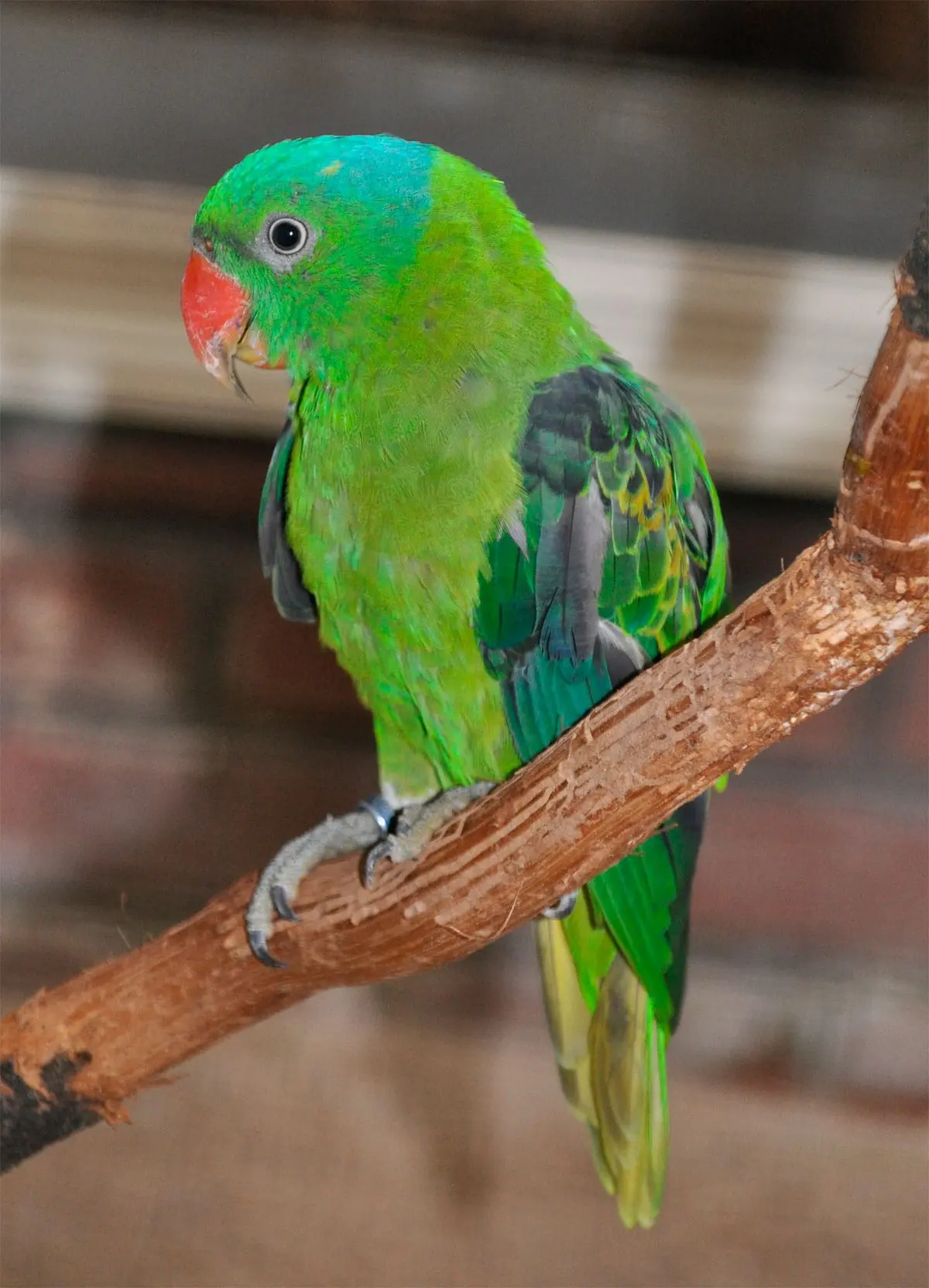
โ–ท The world of Pets: Dogs, cats, birds, reptiles, amphibians

Blue-naped Parrot
Tanygnathus lucionensis


Blue-naped Parrot

Content


Anatomy-parrots

Description

31 cm.. length between 148 and 231 g. of weight.

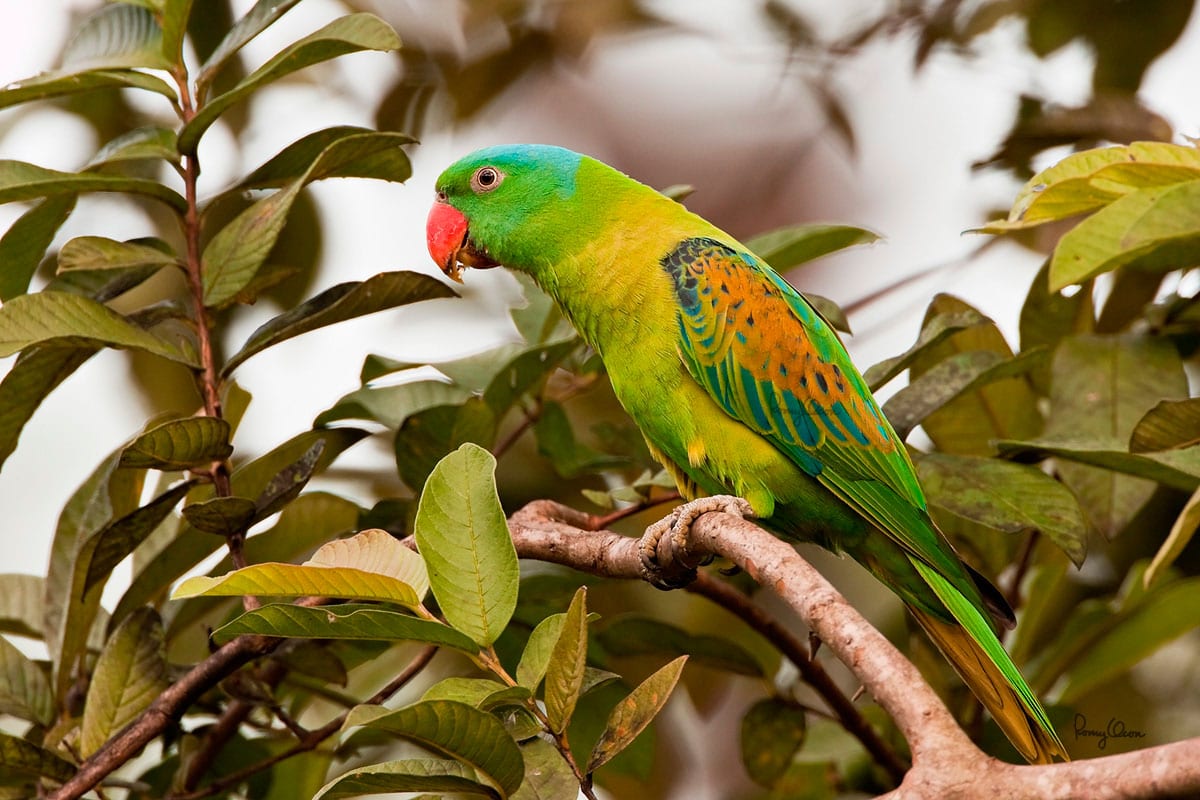
The Blue-naped Parrot (Tanygnathus lucionensis) has the head bright green with a clear bright blue diffusion through the back of the crown and nape.

Upperparts yellowish-green with pale blue illuminated on the back low and the tail; upper tail coverts brighter yellowish green.

Scapulars blue, with green edges; shoulder Black with small coverts Black bordered of blue-green and orange Green; median black and pale blue, large edges of opaque orange brown; greater coverts Blue-Green lined with orange-yellow in the feathers interiors.

Secondary Green with yellow and narrow margins; primaries Greens with vane blackish internal.

Wing feathers green, underside of primaries blackish.

Upper, the tail green, narrow edge and yellowish tip laterally; undertail, the tail yellowish brown opaque.

Bill red, paler at the tip and the lower jaw; irises yellow; legs grey.

Both sexes are equal.

Immature with less blue in the crown and more off the brands of the wings.

Subspecies:

  • Tanygnathus lucionensis lucionensis

    : The nominal.


  • Tanygnathus lucionensis hybridus

    : It has the most extended head blue, with violet tone. Their wings are greener.


  • Tanygnathus lucionensis talautensis

    : No blue in the obispillo and their plumage is less yellowish.


  • Tanygnathus lucionensis [salvadorii u horrisonus]:

Habitat:

Blue-naped Parrot

It is a bird of forests closed and open, including secondary growth, coconut plantations, patches of mangrove and banana to the 1.000 meters above sea level; and not so strongly linked to coastal habitats as the Great-billed Parrot. Is usually found in flocks of up to 12 individuals who sit in community and make regular flights at dawn and in the evening between the feeding and resting areas. Feeds on fruit trees.

Reproduction:

The breeding It has been observed in the months of April to June. Registered a nest the natural cavity or abandoned Woodpecker hole, often a clear. There is no data on the size of the laying.

Food:

Fruits and seeds of forest trees, Palm fruit, young coconuts, the banana and papaya.

Distribution:

The population of the Blue-naped Parrot distributes lengthwise of the Philippines and Talaud Islands, (Indonesian). Specific records found on the islands of Balut, Bantavan, Basilan, Biliran, Bohol, Bongao, Cagayan Islands, Calamian Islands, Caluya, Cebu, Cuimaras, Jolo, Leyte, Luzon, Maestre de Campo, Malanipa, Manuk Manka, Marinduque, Masbate, Mindanao, Mindoro, Blacks, Palawan, Surigao del Sur, Polillo Islands, Romblon, Samar, Sanga Sanga, Sarangani Islands, Samal, Sibay, Sibutu, Sibuyan, Siquijor, Tables, Tawitawi, Ticao, Tumindao and Verde (Philippines); Karakelong and Salibabu (Talaud).

Apparently, small groups of birds in Mantanani Kiss (Northwest Sabah), and SI-Amil (until 100 birds present in 1962) and Maratua off the northeast coast of Borneo; The existence of a wild population was also reported around Kota Kinabalu, (Sabah).

Occasional leaks occur in other parts, including the Sangir Islands.

The species was described as common in Salibabu in the Group of Talaud in 1978 (more numerous there than the Azure-rumped parrot) and they are still regularly seen there and in the nearby Karakelong during observations in 1995 (Numerous in a last record in 1997).

In other areas the species is rare. Recent records in Philippines they come mainly from Mindoro and Palawan, places that seem to be the bastion of the species.

Subspecies:

  • Tanygnathus lucionensis lucionensis

    : The nominal.

  • Tanygnathus lucionensis hybridus

    : (Salomonsen, 1952) – Present in Polillo island, to the North of Philippines.

  • Tanygnathus lucionensis talautensis

    : (AB Meyer & Wiglesworth, 1895) – Talaud Islands (North Moluccas).

  • Tanygnathus lucionensis [salvadorii u horrisonus]:

    (Ogilvie-Grant, 1896) – Philippines, (except North), but it can be rare or extinct on many islands. Also in some small islands off Northwest and northeast of Borneo (If Amil, Mantanani), where it was possibly introduced, especially on this last island.

Conservation:


Near-threatened


โ€ข Current category of the Red List of the UICN: Near threatened

โ€ข Population trend: Decreasing

The total population is provisionally estimated to be below the 10,000 specimens in 1993 (Lambert et to the. 1993).

The population is suspected to be in decline due to capture for the bird trade and habitat degradation from expansion and logging due to agricultural pressures..

Conservation Actions Proposed Palawan:

– Determine the impact of trade on the population of the species.
– Revise its estimate of the world population.
– Estimate the rates of decline based on the rates of deforestation within its range.
– Protect effectively important extensions of high forest with trees suitable to nest in key places throughout its distribution area, both in the areas of strict protection, such as multi-use areas.

"Blue-naped Parrot" in captivity:

pretty calm.
Occasionally available.

Alternative names:

Blue-naped Parrot, Blue naped Parrot (ingles).
Perruche de Luรงon, Perroquet ร  couronne (French).
Blaunackenpapagei, Blaunacken-Papagei (German).
Papagaio-de-nuca-azul (Portuguese).
Loro de Nuca Azul, Loro Nuquiazul (espaรฑol).

scientific classification:

Order: Psittaciformes
Family: Psittaculidae
Genus: Tanygnathus
Scientific name: Tanygnathus lucionensis
Citation: (Linnaeus, 1766)
Protonimo: Psittacus lucionensis

โ€œBlue-naped Parrotโ€ images:

Videos "Blue-naped Parrot"

————————————————————————————————

ยซLoro Nuquiazulยป (Tanygnathus lucionensis)

Sources:

Avibase
– Parrots of the World โ€“ Forshaw Joseph M
– Parrots A Guide to the Parrots of the World – Tony Juniper & Mike Parr
Wikipedia
– Birdlife

Photos:

(1) – By Quartl (Own work) [CC BY-SA 3.0], via Wikimedia Commons
(2) – By Joelle Rene Hughes (originally posted to Flickr as jr_parrot10) [CC BY 2.0], via Wikimedia Commons
(3) – WILD BIRDS of the PHILIPPINES – Subic rainforest, Bataan, December 5, 2007 by Romy Ocon
(4) – By TJ Lin [CC BY-SA 2.0], via Wikimedia Commons
(5) – ยซTanygnathus lucionensis qtl2ยป by QuartlOwn work. Licensed under CC BY-SA 3.0 via Wikimedia Commons.
(6) – ยซโ€ฏTanygnathus lucionensis – Barrabandโ€ฏยป. Licensed public via domain Wikimedia Commons.

Sounds: Arend Wassink (Xeno-canto)
โ–ท The world of Pets: Dogs, cats, birds, reptiles, amphibians

Crimson Rosella
Platycercus elegans

Crimson Rosella

Content


Anatomy-parrots

Description

Among 30 and 37 cm.. length and a weight between 99 and 170 g..

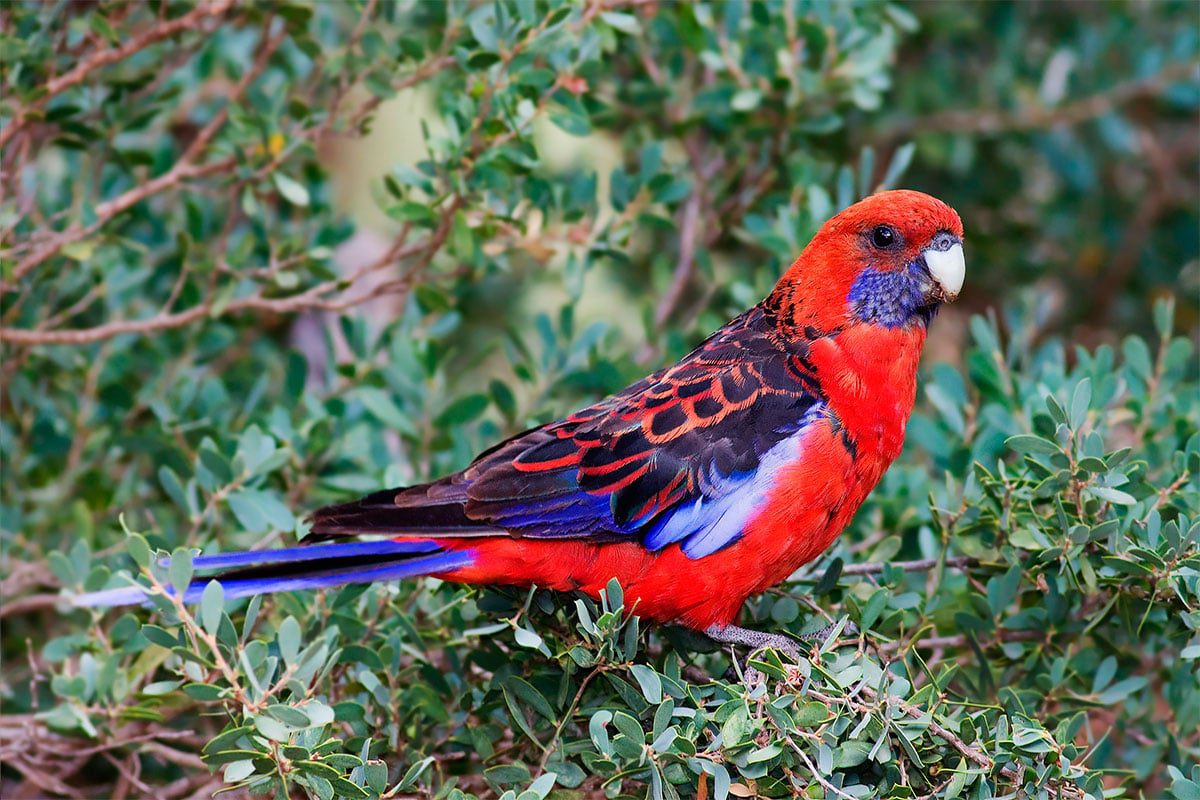
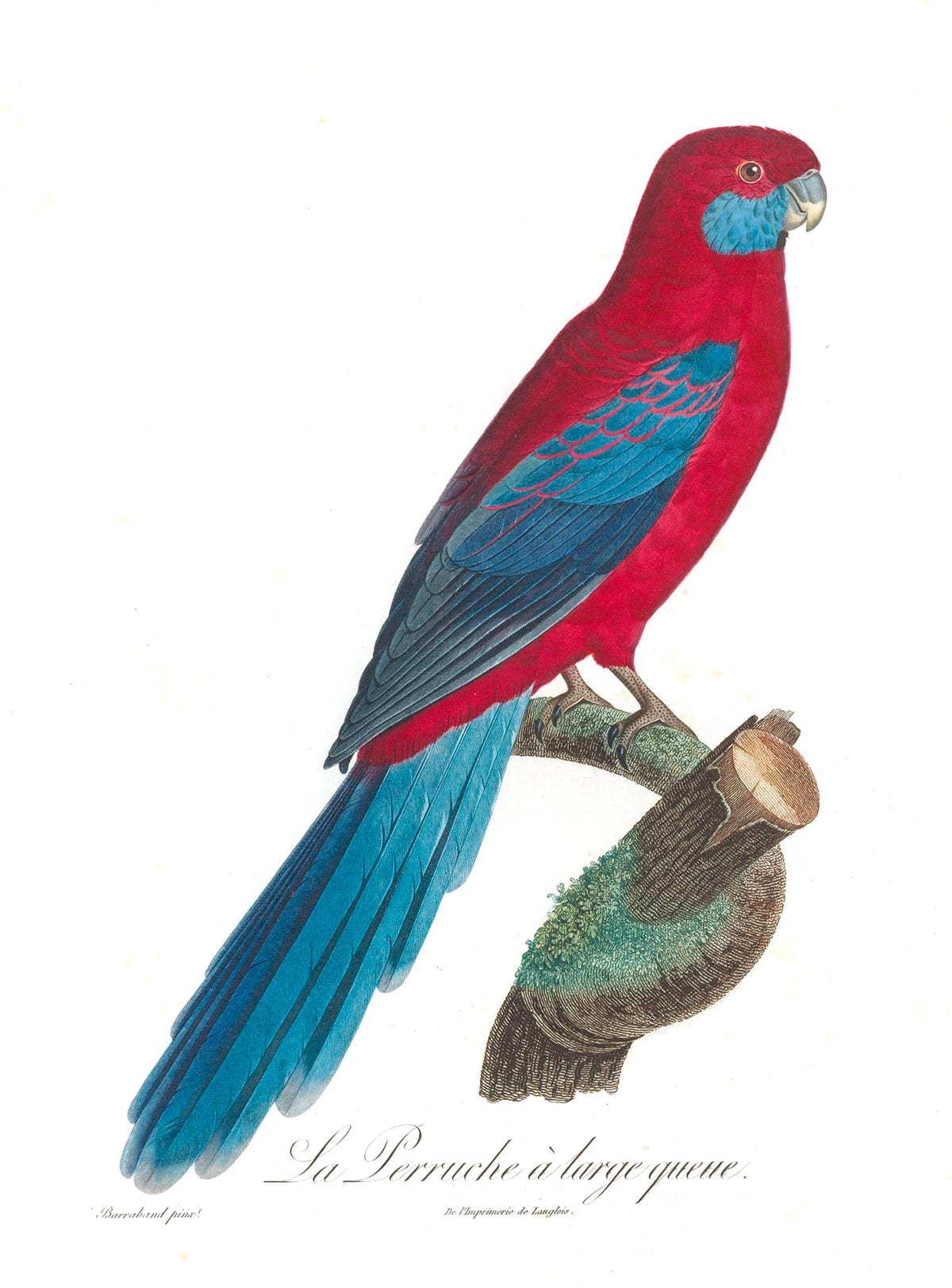
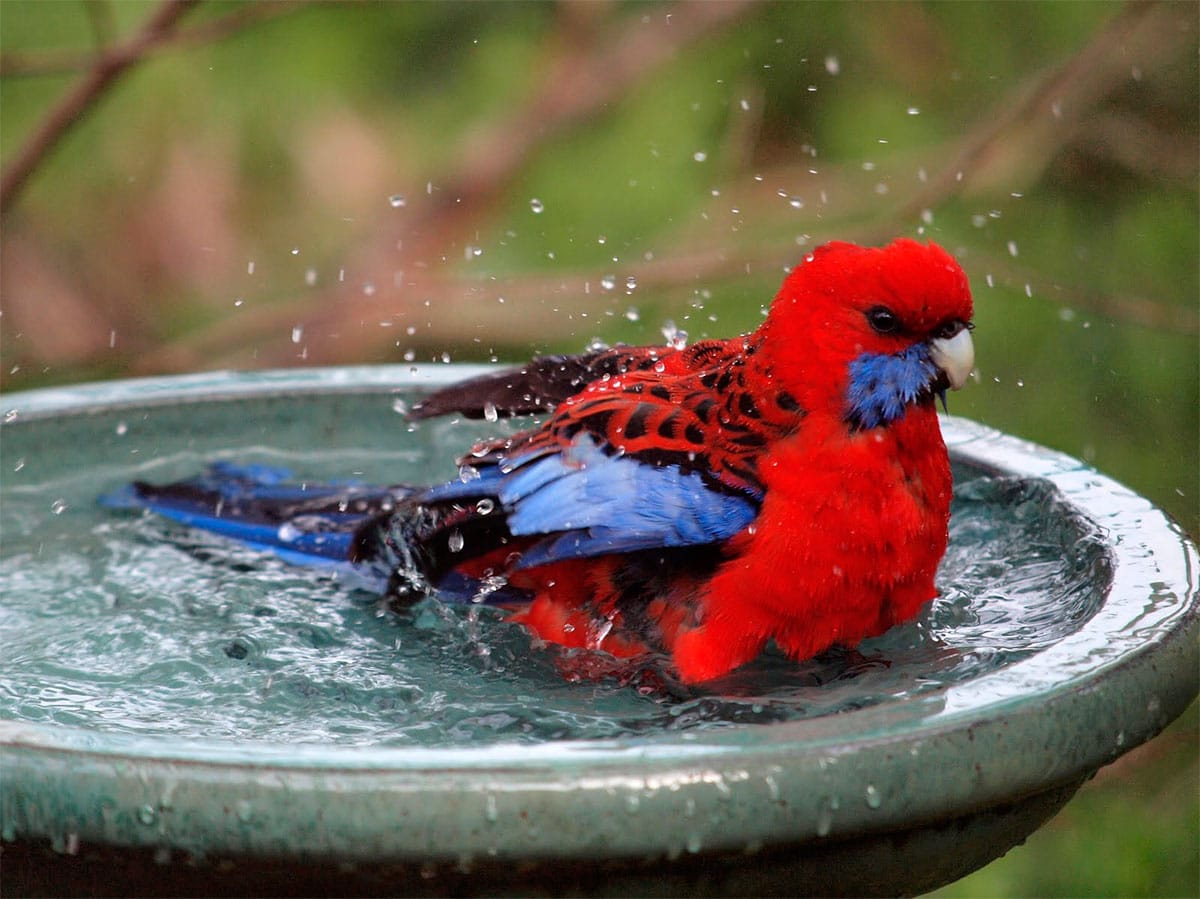
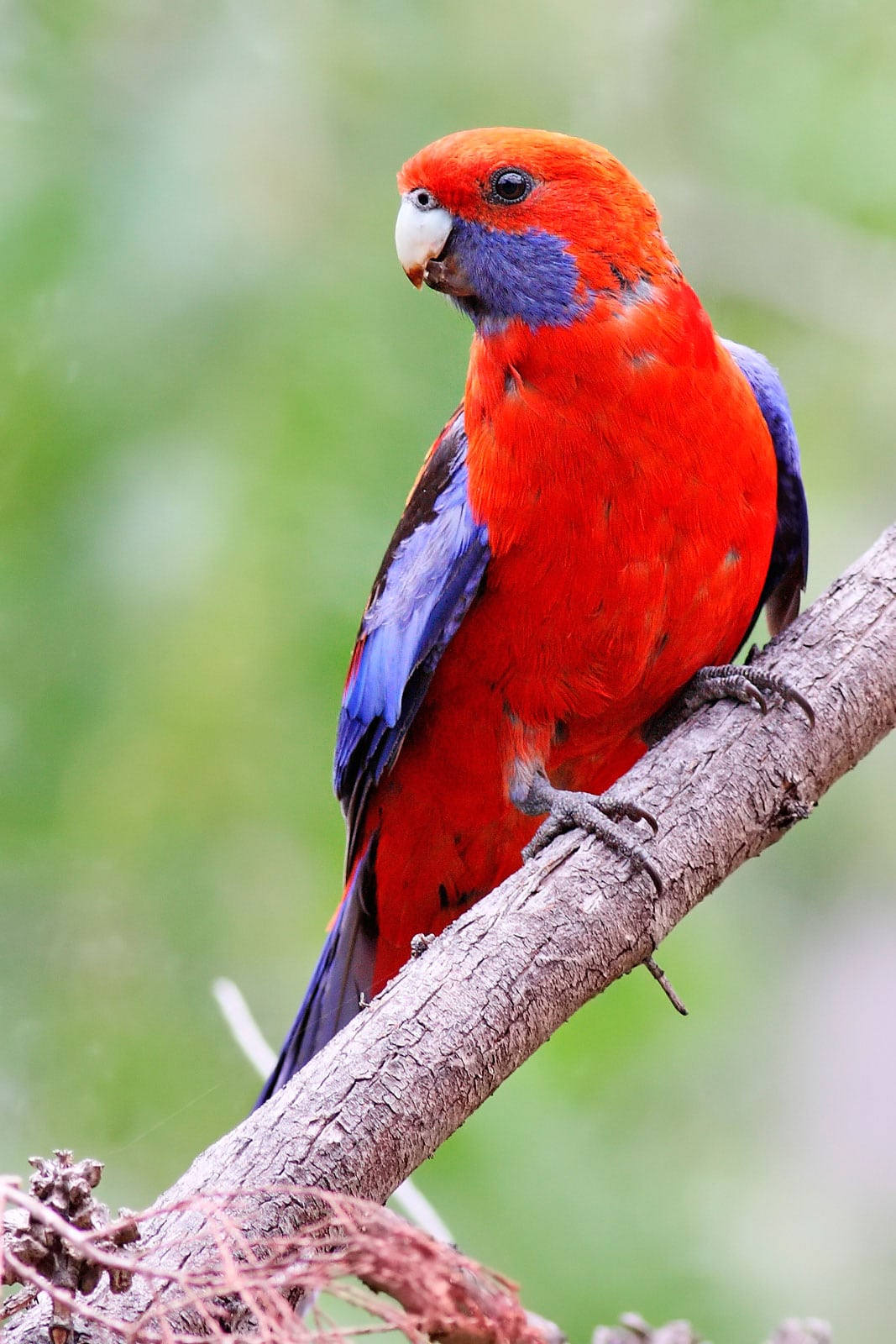
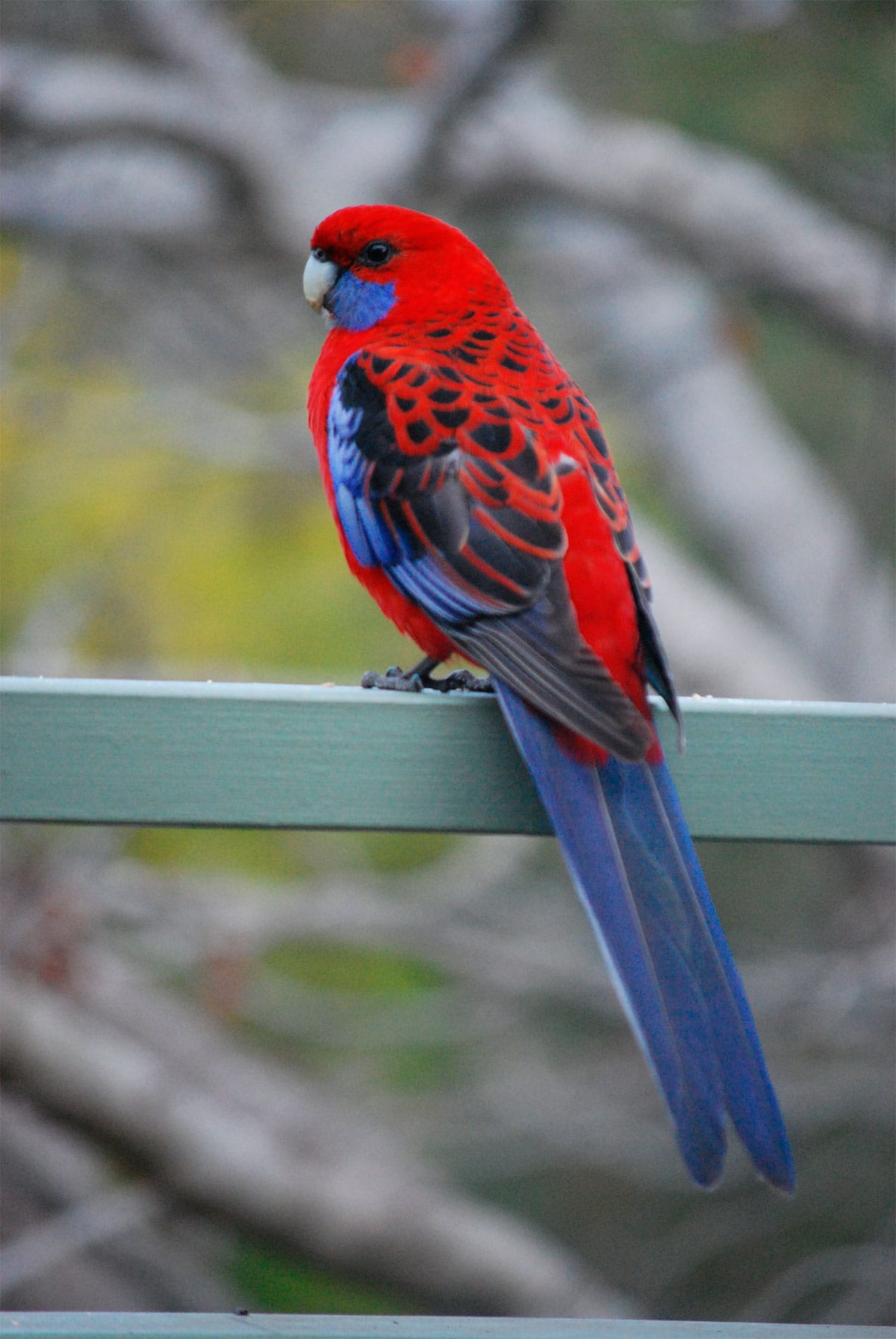
The Crimson Rosella (Platycercus elegans) has a predominantly red plumage.

Its head is bright crimson in color with the lower part of the cheeks and the throat of blue color.. Mantle feathers are black with broad crimson margins of variable intensity.; rump and uppertail coverts crimson.

Medium and lower inner wing coverts black; bend of wing, lesser coverts and medium blue color external; external greater coverts bright blue, Black Interior with red edges giving a scaly appearance to this area; primary coverts blue violet; feathers of flying blackish with thin margin foreign white in them more external and blue violet in vane outer; secondary black with vane external blue violet; tertiary black with red borders.

Under, Blackish wings with blue coats. Underparts showy crimson.

Upper, the tail is blue, the center of green-washed, Foreign feathers with vane Blackish internal and vane Violet Blue outer with pale at both ends; undertail, the tail of pale blue edged blackish when closed.

The peak of grayish-white; dark brown irises; greyish Brown legs.

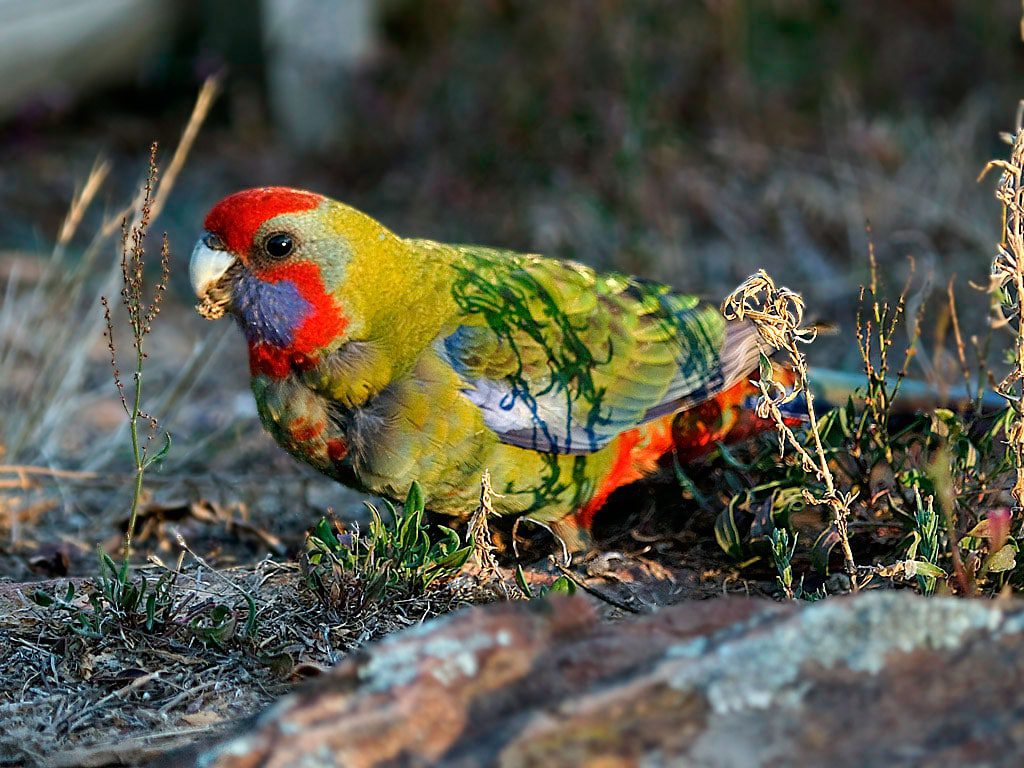
The female It is smaller with narrower peak. It has no stripe under the wings..

The immature is very different, with upper parts olive green (including the tail at the top), and green underparts greyish.
The centers to the mantle feathers are dark brown, and the black markings of the wings of the adult are replaced by green. Very young birds rump is green Orange. There is a pale stripe on the bottom of the wings (formed by stains pale in vane inner). It shows red feathers on the head, chest, buttocks and subcaudales coverts and move through the first fall.

Adult plumage is reached in a few 15 months. Immatures of the population in the North are mainly red, and there are less green unripe in Norfolk Island than mainland populations.

Subspecies

Description subspecies Platycercus elegans
  • Platycercus elegans elegans

    (Gmelin, 1788) – The nominal species


  • Platycercus elegans flaveolus

    (Gould, 1837) – With 33 cm.. length, approximately, It is but little that the nominal species, Yellow has no orange hue and there is orange in the neck, chest and abdomen.


  • Platycercus elegans fleurieuensis

    (Ashby, 1917) – IMG – It differs from the species rated as having an intense orange color, Red plumage, the mantle and black gray back, with pale orange-red spots; pale blue medium and secondary wing coverts.


  • Platycercus elegans melanopterus

    (North, 1906) – Of 36 cm.. length, approximately. The bordered red are more narrow, with which the back looks more black. Female as the nominal.


  • Platycercus elegans nigrescens

    (Ramsay,EP, 1888) – With 34 cm.. length, It is smaller than the nominal value and the color red is much more dark. Red feathers are more narrow. Female as the nominal.


  • Platycercus elegans subadelaidae

    (Mathews, 1912) – Approximately from 36 cm.. length. Instead of Red Blend Red, Orange and yellow. Orange red forehead, the Crown and face, they turned to brighter red frontal band. Yellow olive from the low back to the supracaudales coverts

Habitat:

Crimson Rosella

The Crimson Rosella they frequent tropical and humid subtropical forests near the coast and the surroundings of montane forests at altitudes up to 1.900 m.

They are mainly on the edges of jungle, in the secondary zones and in the dense forests of eucalyptus they arrive at a good stage of maturity.

To the South of the hunter river in New South Wales, they are distributed at all altitudes.

The nominal species has a preference for thick wooded areas, but often goes into open areas and farmland where it is mixed with the Perico conr (Platycercus eximius).

It also tends to visit plots of pine trees.

In the Kangaroo Island, where is the only parakeet present, He lives in all types of forest habitats, they are also adapting to farmland.

The subspecies subadelaidae and fleurieuensis, sometimes grouped under the term Adelaide parakeet, frequent valleys forest, arboreal galleries that border the rivers or trees on the edge of the roads. They are also present in the orchards and farmland.

The Flaveolus subspecies attends the same types of habitat, that is to say, curtains of trees dominated by red rubber trees along the river.

To feed, move away from rivers and raid agricultural land, flooded Plains, or thickets ยซMalleeยซ.

Adults are sedentary. Usually, they live in pairs or in small groups. On the other hand, juveniles and subadults form noisy groups and many roam locally when leaving dormitory at sunrise.

Its main activity is carried out in the morning and in the evening. in the middle of the day, they rest in the shady foliage. But, If the sky is overcast and the weather is cool, these birds are active during the day.

The Crimson Rosella they seek food on Earth, in trees and shrubs. They often feed in the company of the Eastern Rosella (Platycercus eximius), But if the joint working group is altered during its activity, the two species are separated in flight and taken opposite directions, each seeking refuge by his side.

The Crimson Rosella they are not very shy and can be approached at a very short distance.
In urban areas, they are particularly friendly.

Reproduction:

The breeding season covers the months of August to February and, sometimes even later.

The elegant parakeet build their nests on a branch or in the cavity of a tree trunk. Usually, Choose a healthy or dead eucalyptus, but sometimes they install their nests in a place as strange as the metal beam of a construction crane.

In all cases, the nest is located high above the ground. Spawning usually includes 4 to 7 white eggs, rarely 8, which are incubated during approximately 19 days.

The female incubates the eggs alone, but the chicks receive equal attention from both parents.

The nesting cycle is quite long and it takes around 5 weeks

Food:

The Crimson Rosella they have a mainly vegetarian mixed diet. Consume the seeds of black Cypress of Australia (Callitris endlicheri), figs, seeds of acacia and eucalyptus.

The vegetable part of its menu is complemented by a wide variety of imported plants such as Rosa rubiginosa, clover or chickweed (Stellaria media).

In the South of its range, they eat the fruits or flowers trees of Melaleuca, banksia and casuarina.

Insects are not forgotten in your menu: Hemiptera, psyllids, termites, aphids and larvae of beetles.

These parrots times behave as true pests in orchards, eating apples, Plums, pears and quinces.

Distribution:

Confined to the coastal area of Eastern Australia where are widely distributed in the wooded areas along and East of the Great dividing range.

There is an isolated population in the North between the surrounding of Atherton, Northeast of Queensland, to the South of the mountain range of Clarke and Eungella (the population in Eungella It can also be isolated).

The main population is distributed around Gympie, Southeast of Queensland, in the North, across the border with New South Wales, coming up to the Warrumbungle National Park, Bathurst and Wagga Wagga, where are approaching the eastern end where the Yellow Rosella.

In Victoria extends from the East to the Grampian and the Edenhope district, where spills into the Southeast end of Australia, coming to Kingston at its western end.

There is also an isolated population in the Kangaroo Island.

The species is found in the wild around Sydney, Brisbane and Melbourne, and leaks from birds have been around Perth. There are records in the North of Tasmania and the islands of the bass strait, probably, also refer to birds Getaways.

It is common in the Norfolk Island where it was introduced in the century 19, but is absent in the vicinity of Nepean and Philip Island; an attempt to introduce the species in Lord Howe Island failed.

Was also introduced in New Zealand, showing in the West suburbs of Wellington, and some birds can also persist in the District of Dunedin of South Island where can hybridize with the introduced Perico conr.

The world's population is above 200.000. Moderate numbers in captivity.
The birds can be eradicated with a permit in States where the destruction of crops occurs.

Subspecies

Distribution subspecies Platycercus elegans

Conservation:


minor concern


โ€ข Current category of the Red List of the UICN: Least concern

โ€ข Population Trend: Decreasing

The size of the world's population has not been quantified, Although it is estimated above 200.000 specimens.

The Crimson Rosella they are infrequent at both ends of its distribution area, but in other places, they are locally abundant and common.
In the North, they are slightly less numerous. In the past recent, they have colonized successfully parks and urban gardens, so now are very widespread in the suburbs of Canberra and Adelaide.
In the Norfolk Island, the import is so successful that they now represent a competition and a significant danger to the Red-crowned parakeet (Cyanoramphus novaezelandiae).

"Crimson Rosella" in captivity:

Moderately loud, very active, they are acclimatized to the owner. It is not usually compatible with other birds.
A sample of the subspecies subadelaidae lived 26,8 years in captivity
Rare in captivity.

Alternative names:

Crimson Rosella, Adelaide Parakeet, Beautiful Lory, Blue-cheeked Rosella, Campbell Parakeet, Crimson Rosella (Crimson), Mountain Lowry, Murray Rosella, Murray Smoker, Murrumbidgee Lowry, Murrumbidgee Rosella, Pennant’s Parakeet, Pennant’s Rosella, Red Lory, Red Lowry, Red Parrot, Swamp Lory, Yellow Parakeet, Yellow Parrot (ingles).
Perruche de Pennant (French).
Pennantsittich, Adelaidesittich, Pennant-Sittich (German).
Rosela-Pennant (Portuguese).
Perico Elegante, Rosela Roja, Periquito Pennant, Rosella Carmesรญ (espaรฑol).

scientific classification:

Order: Psittaciformes
Family: Psittaculidae
Genus: Platycercus
Scientific name: Platycercus elegans
Citation: (Gmelin, JF, 1788)
Protonimo: Psittacus elegans

"Elegant Perico" images:

Videos "Crimson Rosella"

Crimson Rosella (Platycercus elegans)

Sources:

  • Avibase
  • Parrots of the World โ€“ Forshaw Joseph M
  • Parrots A Guide to the Parrots of the World – Tony Juniper & Mike Parr
  • Wikipedia
  • Loromania
  • Birdlife
  • AnAge: The Animal Ageing and Longevity Database – Anagรฉ Database

  • Photos:

(1) – An adult Crimson Rosella (Platycercus elegans), Wilsons Promontory National Park, Victoria, Australia By JJ Harrison (jjharrison89@facebook.com) (Own work) [CC BY-SA 3.0], via Wikimedia Commons
(2) – A Crimson Rosella photographed though a window in the Blue Mountains, Australia By John Poulakis from Australia (Crimson RosellaUploaded by Snowmanradio) [CC BY 2.0], via Wikimedia Commons
(3) – Crimson Rosella (Platycercus elegans) photographed taken in Swifts Creek, Victoria, Australia Fir0002 [GFDL, CC-BY-SA-3.0 or GFDL 1.2], via Wikimedia Commons
(4) – A Crimson Rosella in a bird bath Canberra, Australia By Duncan McCaskill (Picasa Web Albums) [CC BY 3.0], via Wikimedia Commons
(5) – Juvenile Crimson Rosella (Platycercus elegans) by David CookFlickr
(6) – An adult Crimson Rosella (Platycercus elegans) Jacques Barraband [Public domain], via Wikimedia Commons

โ–ท The world of Pets: Dogs, cats, birds, reptiles, amphibians

Bourke's Parrot
Neopsephotus bourkii


Bourke's Parrot

Content


Anatomy-parrots

Description

19 cm. length and an approximate weight of 39 g..

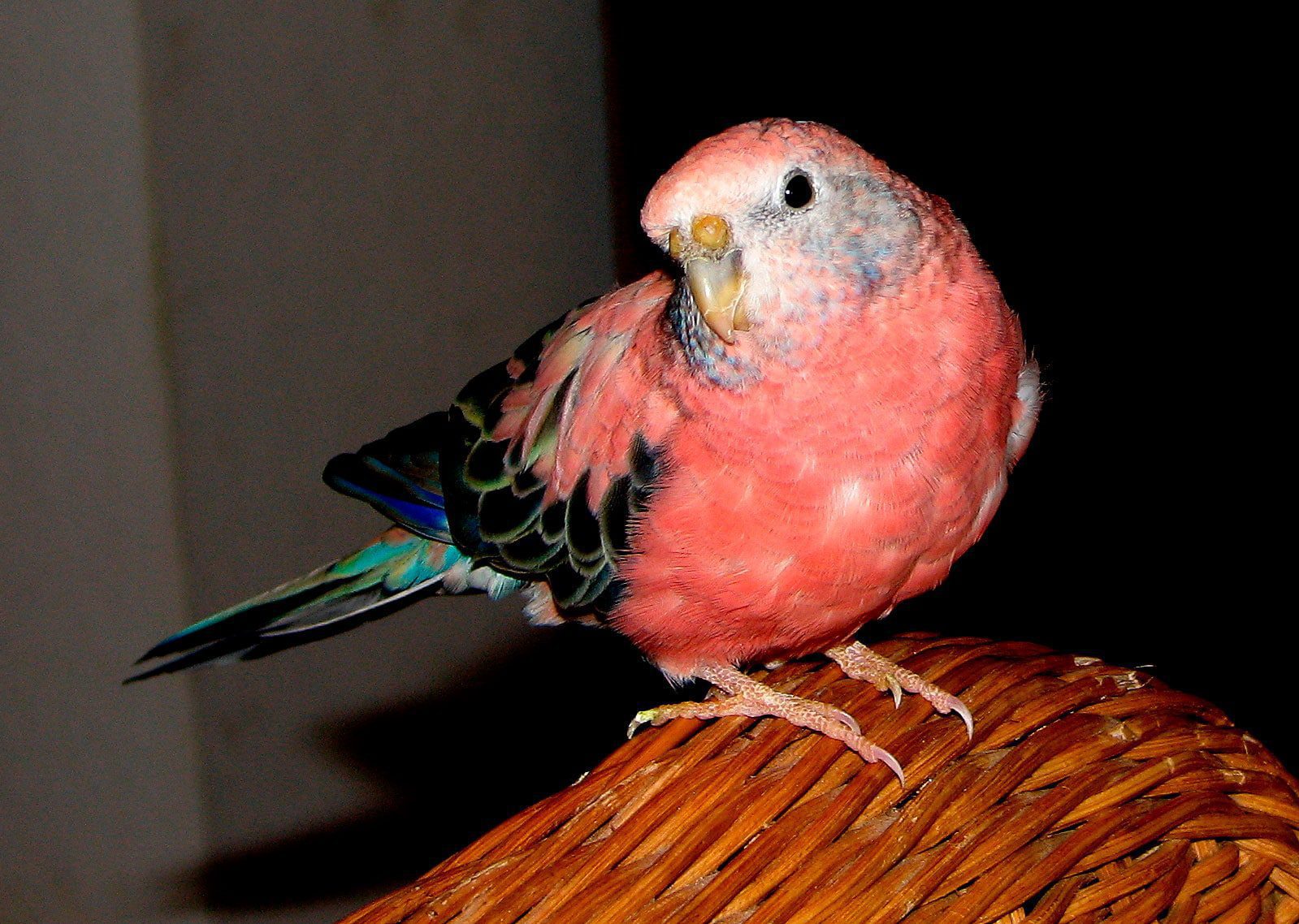
The Bourke's Parrot (Neopsephotus bourkii) has frontal area white. The chin, lores and contour of the eyes they are also white and form a kind of orbital ring clear when seen from a distance.

The ear-coverts and upper cheeks they are dark brown with pink dots and specks. The pileum and the neck are greenish-Brown, with darker edges.

The upperparts are brown-grey color with pale edges on scapulars.

The rump and the top of the tail has darker tones, with some pale blue on the sides. The curvature of the wing is blue.

The small coverts are blue, the median they have light blue, the greater coverts they have a dark tint with yellow-white and blue pink.

The flight feather primaries and secondaries are mostly blue.

The underparts is blue.

The breast feathers are brown with pink ends, giving an appearance of general pinkish brown.

The abdomen is bright pink.

Thighs, lower flanks, side of the rump, under belly and lower area of the tail they have a light blue color. The upper part of the tail infiltrates with bluish-grey.

The bill is greyish black, no hook in upper jaw. The irises They are brown, legs grey-brown.

The female in General, the colors are off and the blue coloration is very little visible or is absent.

The youth they are equal to the female adult but more muted, with a pale band under the wings which is less pronounced in the male juvenile

For a long time, the Bourke's Parrot It was classified in the genus Neophema. A number of ornithologists, more and more, is of the opinion that this parakeet does not belong to this genus and species have been classified in a separate genus called Neopsephotus.

Habitat:

The Bourke's Parrot they are distributed among the driest inland areas.
They mark a strong preference for scattered areas of mulga (Acacia aneura) but does not disdain the plantations of eucalyptus. Can also be observed in plots along streams and afforestation of Callitris which are conifers belonging to the family of cypress.

Son nomads and slightly Twilight. These birds establish themselves in a territory and remain there for several years before disappearing completely.. The Bourke's Parrot they can be very sociable. During periods of drought, You can meet thousands around the water wells and springs.

During the months of summer, We can see them in the morning and in the evening around the ponds.

In Winter, these parakeets come to drink during the day in the company of species of doves such as the common bronze pigeon (Phaps chalcoptera). In places close to the drinking fountains, the Bourke's Parrot They fly in Group emitting loud cries and making whistling wings. But, These parakeets sometimes go unnoticed, they are able to rest or to eat ground in pairs or in small groups. They remain in silence on the floor or hide in the dead wood that serves as camouflage. There are more assets during the sunset.

Reproduction:

The Bourke's Parrot they usually reproduce in August to december, but the season can vary depending on rainfall. The courtship of this bird are similar to those of other species of Parrot Neophema. Males approach the female in upright position with outspread wings and tail.

The nest is located in one a tree cavity, between 1 and 3 meters above the ground. The laying is formed by between 3 and 6 eggs they are incubated during at least 18 days. There are often two broods in the season. The female leaves the nest only once a day in order to be replenished by the male.. The male is also in charge of mounted guard, patrolling and emitting calls in the vicinity of the nest, with the intention to deter intruders.

At birth, the chicks have a white marker, are altricial and remain in the nest for at least 4 weeks. They remain dependent on their parents during a week after feather.

Food:

The Bourke's Parrot they are almost exclusively vegetarian: they eat grass seeds, especially those that are dispersed by the wind. They also eat herbs collected in the soil and in the bushes. These parakeets also appreciate the fresh young shoots and seeds of Acacia or of Bassia, which are small shrubs belonging to the category of Chenopodium album.

Distribution:

Scattered through the interior of Australia, where are nomads but locally common.

The species ranges from the West coast of Western Australia around the inside of Geraldton to rรญo Ashburton and South, through Leonora, and through Gibson and the Great Victoria desert in the South of the Northern Territory, about 20 ยฐS.

Extends from the Northwest of Southern Australia, South-East through Woomera until Port Augusta, that also extends to the North through Oodnadatta and the regions of the Lake Eyre and the Lake Frome.

The birds, to the This of the Montes Flinders You can isolate, since there are no records between 139ยบ and 140 ยฐE.

Apparently, the species has declined in the center of New South Wales due to overgrazing by cattle and rabbits, and is now mainly in the West, from the surroundings of Broken Hill, to paroo river; nomads, However, There have been more towards the This, in the surroundings of Narrandera in the South and the Lightning Ridge in the North.

In the South of Queensland, the Bourke's Parrot are distributed to the This, about Dirranbandi and Cunnamulla. and in the North until Windorah.

Escapes There have been around Brisbane.

The world population is considered to be more of 50.000 specimens.

The species is probably increasing in the west due to agricultural expansion including the provision of artificial irrigation sites..

Conservation:


minor concern


โ€ข Current category of the Red List of the UICN: Least concern

โ€ข Population Trend: Growing

It is estimated one population superior to the 50 000 individuals.

In the western part of its range, the numbers are growing, probably due to the development of agriculture and the installation of new irrigation areas. The reason for its development can also be found in the reduction of sheep farming and the replacement of saline areas with grass..

"Bourke's Parrot" in captivity:

The Bourke's Parrot they are very good birds for beginners amateurs, easy-to-play.

It is a bird peaceful, silent and that it is active only in the first and last hours of the day. Son calm and confident by nature and easy to maintain. It has almost no cravings for crack and your bathroom need depends on the individual. A dry climate supports well, but it is sensitive to cold and wet fog.

Les gusta estar en tierra firme y son susceptibles a la infecciรณn por gusanos, tambiรฉn son susceptibles a infecciones oculares.

With regard to its longevity, according to sources, a sample lived 12,6 years in captivity. In captivity, estos animales pueden criar, approximately, to the 2 years of age.

Alternative names:

Bourke’s Parrot, Blue-vented Parakeet, Blue-vented Parrot, Bourke Grass-Parakeet, Bourke Parakeet, Bourke Parrot, Bourke’s Grass-Parakeet, Night Parrot, Pink-bellied Parakeet, Pink-bellied Parrot, Sundown Parrot (ingles).
Perruche de Bourke (French).
Bourkesittich, Bourke-Sittich (German).
Periquito-rosa (Portuguese).
Papagayo de Bourke, Periquito Rosado (espaรฑol).

scientific classification:

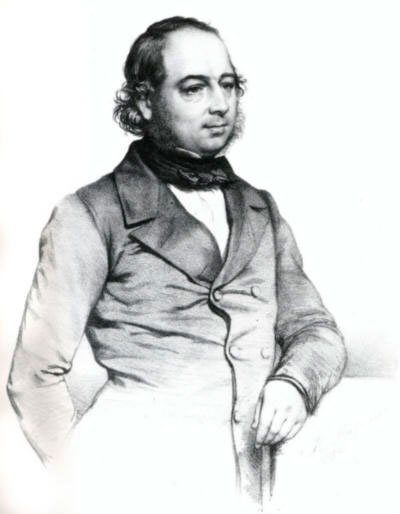
John Gould
John Gould

Order: Psittaciformes
Family: Psittaculidae
Genus: Neopsephotus
Scientific name: Neopsephotus bourkii
Citation: (Gould, 1841)
Protonimo: Euphema Bourkii

Images "Pink Periquito":

Videos "Bourke's Parrot"

————————————————————————————————

"Pink Periquito" (Neopsephotus bourkii)


Sources:

Avibase
– Parrots of the World โ€“ Forshaw Joseph M
– Parrots A Guide to the Parrots of the World – Tony Juniper & Mike Parr
– Birdlife

Photos:

(1) – Bourkeโ€™s parrot (Neopsephotus bourkii) By Flickr user Jan Tik (Flickr) [CC BY 2.0], via Wikimedia Commons
(2) – Bourkeโ€™s Parrot – Neopsephotus bourkii taken at the Cincinnati Zoo and Botanical Gardens By Greg5030 (Own work) [CC BY-SA 3.0], via Wikimedia Commons
(3) – Bourkeโ€™s Parrot Neopsephotus bourkii. Wild pair at Bowra Station, near Cunamulla, Queensland, Australia By Bruce Kendall (Own work) [CC BY-SA 3.0 or GFDL], via Wikimedia Commons
(4) – A male Bourkeโ€™s Parrot at the Flying High Bird Sanctuary, Apple Tree Creek, Queensland, Australia By paulgear (Picasa Web Albums) [CC BY-SA 3.0], via Wikimedia Commons
(5) – Neopsephotus bourkii (formally placed in genus Neophema) By Jan Tik (originally posted to Flickr as Hitchhiker) [CC BY 2.0], via Wikimedia Commons
(6) – By T.H. Maguire (1821โ€“1895) (http://www.birdresearch.dk/dk/jgould.htm) [Public domain], via Wikimedia Commons

Sounds: Tom Tarrant (Xeno-canto)

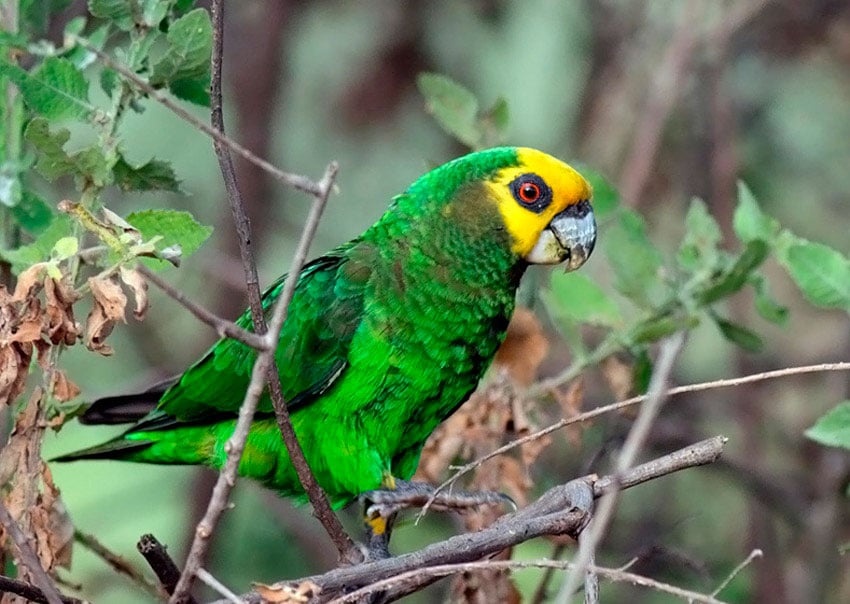
โ–ท The world of Pets: Dogs, cats, birds, reptiles, amphibians

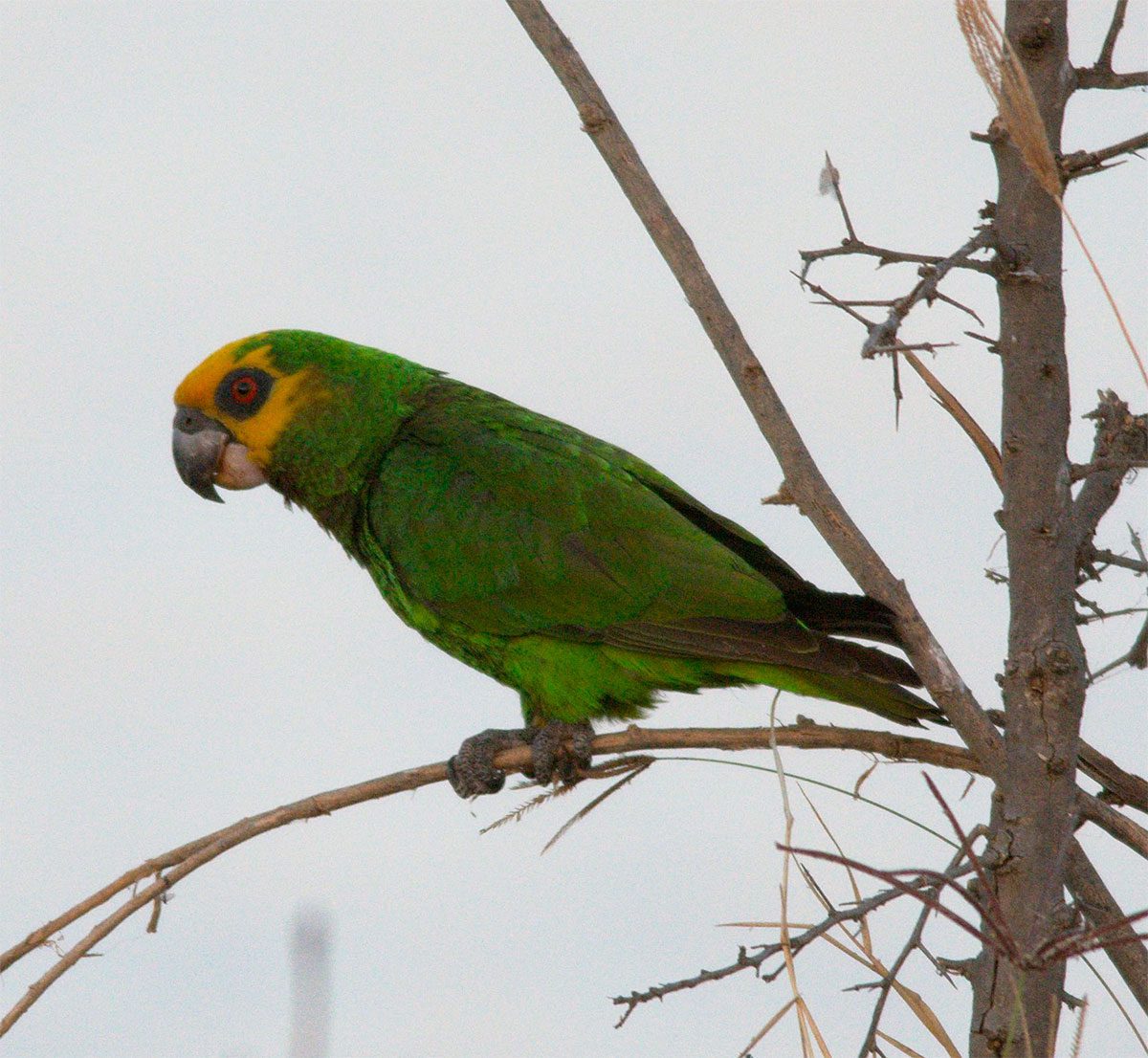
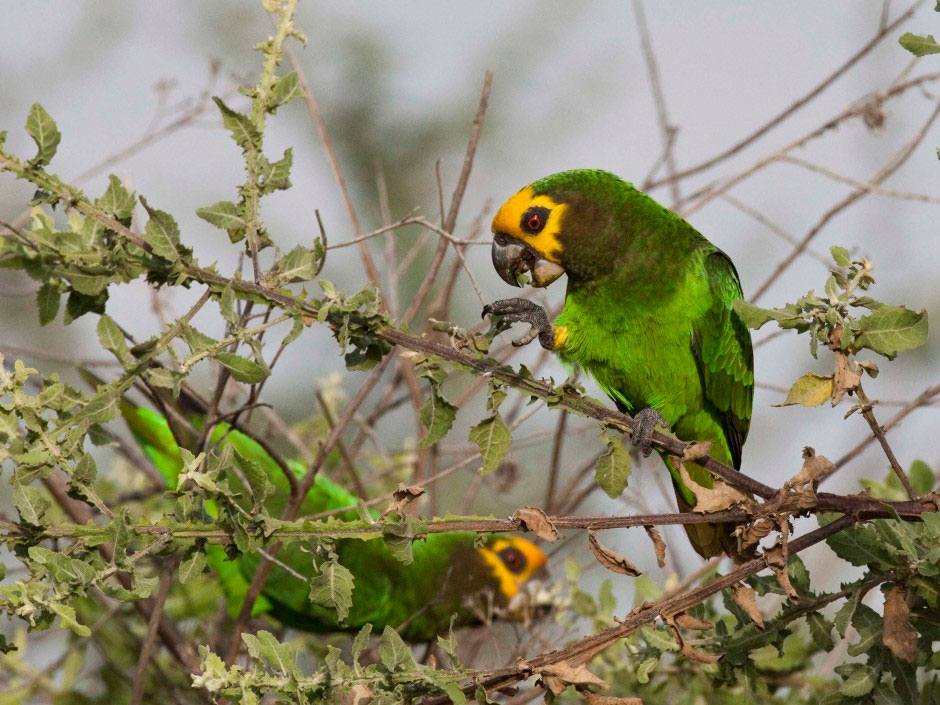
Yellow-fronted Parrot
Poicephalus flavifrons


Lorito Carigualdo

Content

Description:

28 cm.. length and a weight between 140 and 205 g..

The Yellow-fronted Parrot (Poicephalus flavifrons) has the forecrown, crown, lores, the cheeks and ear-coverts bright yellow, often with an orange colour wash; small area with yellow feathers around the cheek, often with a tinge of Brown-grey color.

The feathers of the nape, the mantle and scapulars dark green with paler areas and most brilliant green margins; rump and uppertail-coverts clearer and more brilliant green as the rest of upper parts.

Upper, the coverts dark green green with light green margins, sometimes with yellow at the edge of the wing and at the base of the primary coverts most important.

The primaries and secondaries brown in color with narrow paler margins on the vane outer. Chin and the thighs sometimes sprinkled with yellow; lower parts of bright green uniform.

Tail blackish brown.

upper jaw blackish gray, lower whitish; irises orange-red; legs brownish-grey.

The mask of the females they lack the Orange wash.

Immature as adults, but the mask is olive green, not yellow.

Habitat:

The Yellow-fronted Parrot, generally, they live in the forests of Juniperus and Podocarpus, at altitudes between 1,800 and 2,900 m, mainly in trees of the genus Hagenia, that are above the 2.900 m. Also found in forest clearings, with Ficus trees intermingled in areas of cultivated plateau and in gallery forests of Acacia savanna. Also in riparian forests of acacias and Ficus, a partir de los 800 m.

Occasionally visit urban areas, for example, gardens and parks in Addis Ababa.
Usually seen in pairs, small groups of relatives or in flocks of up to 20 birds; often in mixed flocks with the Black-winged Lovebird (Agapornis taranta).

The Yellow-fronted Parrot, probably, they use the same products trees every night.

Reproduction:

Breeding habits largely unknown, but it is suspected that nest usually in tree cavities.

The time of incubation is of 28 days. The birds fly from the nest after a few 80 days after the hatching. Even then, by generating it,l feed on the parents until its full independence.

Food:

Your diet, is created that it consists of grains, seeds and fruits. They have also been seen consuming ripe fruits of Dovyalis abyssinica.

Considered a crop pest in some areas, Although of little importance.

Distribution:

Size of its range (breeding/resident): 395.000 km2

Endemic to the Highlands of the West of Ethiopia, Although its exact range is unclear.

Common in wooded areas; more common in the upper parts, to the North of its distribution area.

Probably sedentary Although there have been some periodic movements in Addis Ababa.

Conservation:


minor concern


โ€ข Current Red List of UICN: Least concern

โ€ข Population trend: Stable

The size of the world's population has not been quantified, but the species is reported from frequent to common. It is considered more common in northern parts of its range. (pit et to the. 1997).

The population is suspected to be stable in the absence of evidence of any reduction or substantial threats.

"Yellow-fronted Parrot" in captivity:

It is a kind rare in captivity outside Ethiopia. No hay datos de su reproducciรณn.
Las hembras son prรกcticamente imposibles de conseguir.

Alternative names:

Yellow-faced Parrot, African Yellow-faced Parrot, Yellow fronted Parrot, Yellow-fronted Parrot (English).
Perroquet ร  face jaune (French).
Schoapapagei, Schoa Papagei (German).
Papagaio-de-cara-amarela (Portuguese).
Lorito Carigualdo, Lorito de Cara Amarilla (espaรฑol).

scientific classification:

Order: Psittaciformes
Family: Psittacidae
Genus: Poicephalus
Scientific name: Poicephalus flavifrons
Citation: (Rรผppell, 1842)
Protonimo: Pionus flavifrons

Images "Lorito Carigualdo":

Videos "Yellow-fronted Parrot"

————————————————————————————————

ยซParquet-facedยป (Poicephalus flavifrons)


Sources:

Avibase
– Parrots of the World โ€“ Forshaw Joseph M
– Parrots A Guide to the Parrots of the World – Tony Juniper & Mike Parr
– Birdlife

Photos:

(1) – An adult Yellow-headed Parrot near Bishangari Lodge, Ethiopia By Peter Wilton (Yellow-fronted Parrot) [CC BY 2.0], via Wikimedia Commons
(2) – exploriada.com
(3) – Merenkurkun Lintutieteellinen Yhdistys r.y
(4) – Yellow-fronted Parrot. Photo by Hakan Pohlstrand – Birds of the Bale Mountains National Park
(5) – PET FORO DE VIETNAM

Sounds: Andrew Spencer (Xeno-canto)