28 cm.. length and a weight between 200 and 225 g..
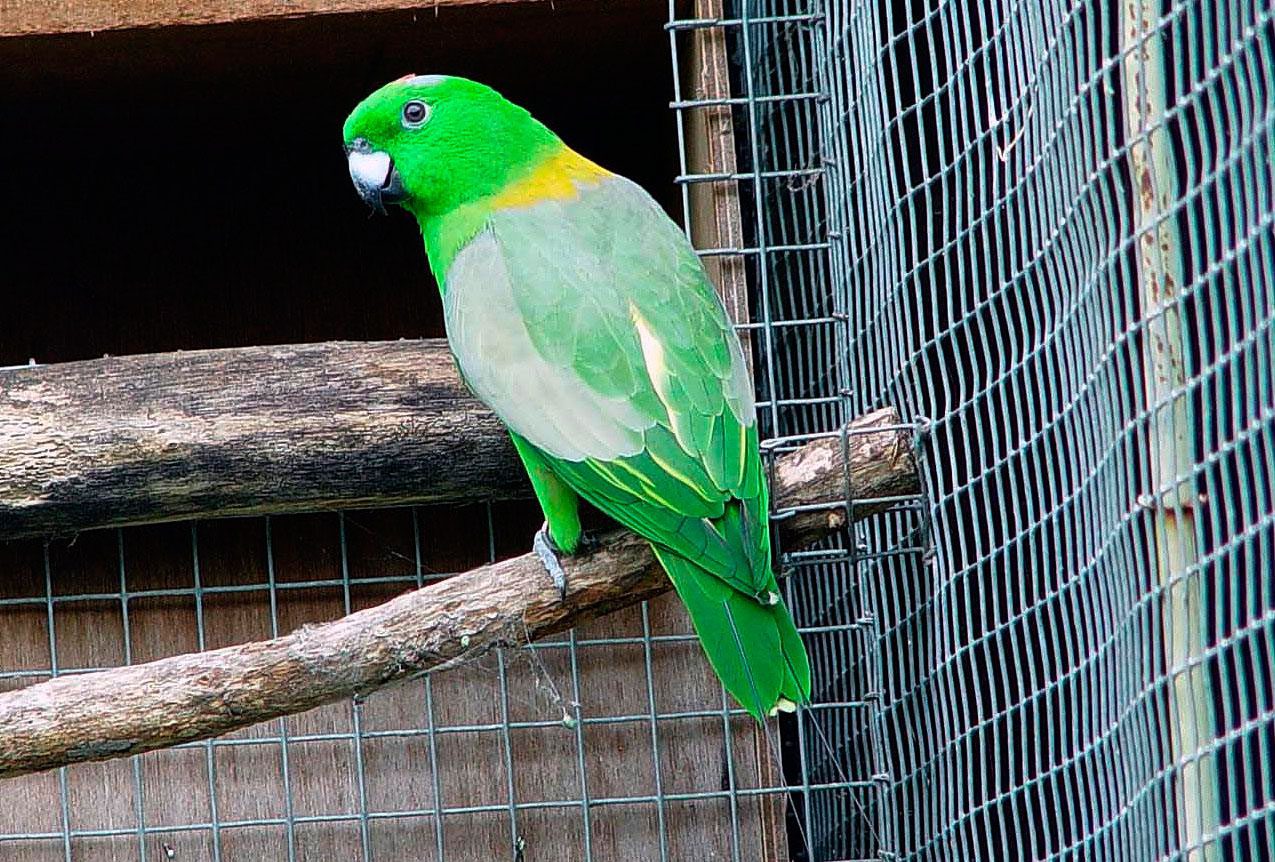
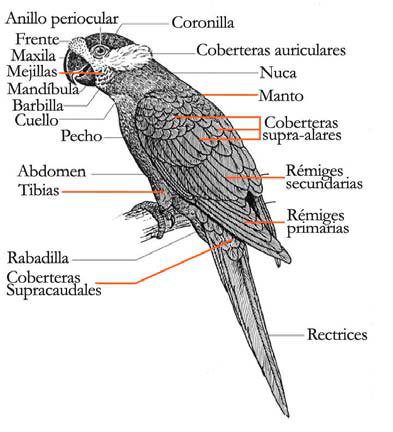
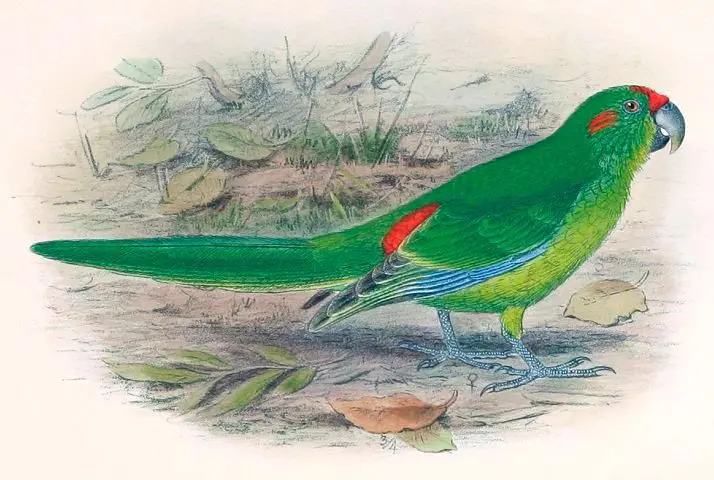
The head of the Golden-mantled Racquet-tail(Prioniturus platurus) is light green. The crown Violet gray with a red spot on the front edge; rear of the neck Ocre-Naranja. Mantle light grey, changing to green (marked in grey) on the back; rump and uppertail-coverts green. Wing coverts green, strongly impregnated with pale grey (more green in the coverts more internal); primaries Greens with vane Dark internal; secondary internal green with yellow line in the margins; bend of wing grey violet, carpal edge yellow. Wing feathers green; underside of flight feather marked in blue. Underparts brighter yellowish green, more green in the upper part of the chest, and yellow in the undertail-coverts. Upper, the tail green in the center, dotted in bluish black on the sides; undertail, the tail pale blue; spatulas blackish.
Bill pale grey, with the lower jaw and the tip of the bill darker; irises dark brown; legs grey.
The female lacks the color red and blue marks from the crown and of the collar back orange; underparts washed in less differentiated grey; rackets shorter tail.
– (Hartert, E, 1898) Paler in general males; less grey on the mantle and the upper wing coverts; stain clear reddish pink on the back of the Crown with most blue patch.
The female as the nominal species but green with paler
Juveniles as the nominal species but also with the Green pale
Prioniturus platurus sinerubris
– (Forshaw, 1971) Males with reddish pink spot away from the back of the Crown; mantle and upper wing coverts, green, slightly washed with grey; curve of wing and lesser coverts bathed in purple; smaller.
Habitat:
The Golden-mantled Racquet-tail inhabits the edges of humid forests, forests, orchards and forests of the lowlands Moss, to 2.000 m (most common above 1.000 m). The birds are seen generally in small noisy groups of 5-10 Member, flying over the forest, or during daily movements between the feeding and rest areas.
Reproduction:
A female in breeding condition was observed in October and the nest was in a hollow tree; nothing more is known about the reproductive behavior of the species.
Food:
Have been seen feeding on fruiting mango (Mangifera indica), and the diet includes fruits, seeds and flowers.
Distribution:
Size of the distribution (reproduction / resident): 186.000 km2
Restricted to Sulawesi and nearby islands, including Talaud, Siau, Lembeh, Togian, Group Banggai, Ambon, Muna and Button. Usually, the species is common and the world population is considered to be above 10.000 exemplary and stable: Nominal race numbers are calculated to be above the 10.000 birds and stable, the subspecies talautensis It is less numerous with a population of about of 5.000 specimens, and the sinerubris It is thought that it may be around 10.000 exemplary and probably stable.
Subspecies distribution:
Prioniturus platurus platurus
– The nominal.
Prioniturus platurus talautensis
– (Hartert, E, 1898) Is distributed in the Talaud Islands.
• Current category of the Red List of the UICN: Least concern
• Population trend: Stable
The size of the world population It has not been quantified, Although it is estimated that it may be between 10,000 and 20,000 specimens. The species is described as common (pit et to the. 1997).
The population is suspected to be stable in the absence of evidence of any reduction or substantial threats.
"Golden-mantled Racquet-tail" in captivity:
Susceptible to fungal infections. Rare in captivity.
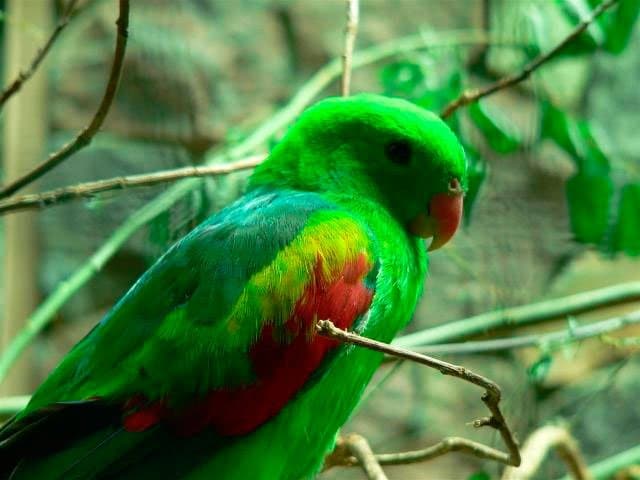
The Olive-shouldered Parrot(Aprosmictus jonquillaceus) has the head bright pale green. "Mantle" and back darker green color that the of the head and underparts, showing a blue diffusion; rump bright teal pale. Uppertail brighter yellowish green.
Upper, the wing feathers with small coverts fused in color yellow-green; Blue dark greenish in the curve of the wings; outer median coverts bright Scarlet, feathers interiors lit of color green yellowish with a bit of red in the tips. Large external coverts scarlet, feathers interiors light green, some showing red ends; some feathers turquoise green on the edge of the carpus; primary coverts Green with broadcasting blue at the tips of the vane outer; secondary green medium, primaries medium green with blue diffusion in the coats of the feathers outermost. Wing feathers brighter yellowish green; underside of flight feather black. The underparts light green, more yellowish in them the thighs and undertail-coverts. Upper, the tail of color green dark with edges of color yellow, and with vane yellowish external to the lateral feathers; undertail, the tail of color Brown blackish with tips yellow, and with yellowish diffusion in vane outside of lateral feathers.
Bill orange red, with yellow tip; irises orange: legs blackish gray.
The female lacks of the broadcast Blue in the the mantle, shows less contrast between the head and the the mantle, limb yellowish to them greater coverts red, and have them irises more Brown.
Immature has green, No greenish-yellow, in the wing-coverts and irises of Brown pale.
(Salvadori, 1891) – The male as the nominal but the coverts wing lower and Middle are of color green washed with yellow; the mantle and top of the back pale green, with less blue markings; less red on the outer half and the secondary wings covers; smaller.
The female is like the female of the nominal species, but the uppertail-coverts darker green; slightly smaller in size.
The youth as the youth of the nominal species, but with the uppertail-coverts darker green; smaller.
In Timor the species is found in forests, acacia savannas, primary and secondary forest, from sea level to the 2.200 m (2.600 meters altitude extreme). In Wetar, observed in 1990 in recently logged forests, near the coast.
The ecology of the species is probably similar to that of the Red-winged Parrot, but it is not well known; observations of birds that fly involve couples and small flocks. A couple allowed a closer approach, observing her in silence to three meters high in a big tree.
Reproduction:
Their reproductive habits are unknown, probably similar to the of the Red-winged Parrot.
Food:
Probably similar to the of the Red-winged Parrot: seeds, fruit, flowers and insects; in the mangroves, the mistletoe is your favorite food.
Distribution:
Size of the area of distribution (reproduction / resident): 28.500 km2
The world population is estimated at around 10.000 specimens and it is probably stable, although like most Indonesian parrots the species is vulnerable to capture and habitat loss. A moderate number in captivity.
The total population has been estimated at 10,000 individuals (Lambert et to the., 1993), probably including mature individuals 6,700.
The population is suspected that it may be declining due to the continuous destruction of the habitat and unsustainable levels of exploitation.
Ongoing conservation actions
Appendix II of CITES. Quotas were imposed during the Decade zero of 1990 while uncertainty existed about the total population size, but these are not met.
Conservation Actions Proposed
• Review estimates of the population of the species and review the impact of trade on their numbers..
• Determine if declines are still evident.
• Protect areas of suitable habitat.
"Olive-shouldered Parrot" in captivity:
Game, with low noise level, aggressive with other birds. You can require deworming.
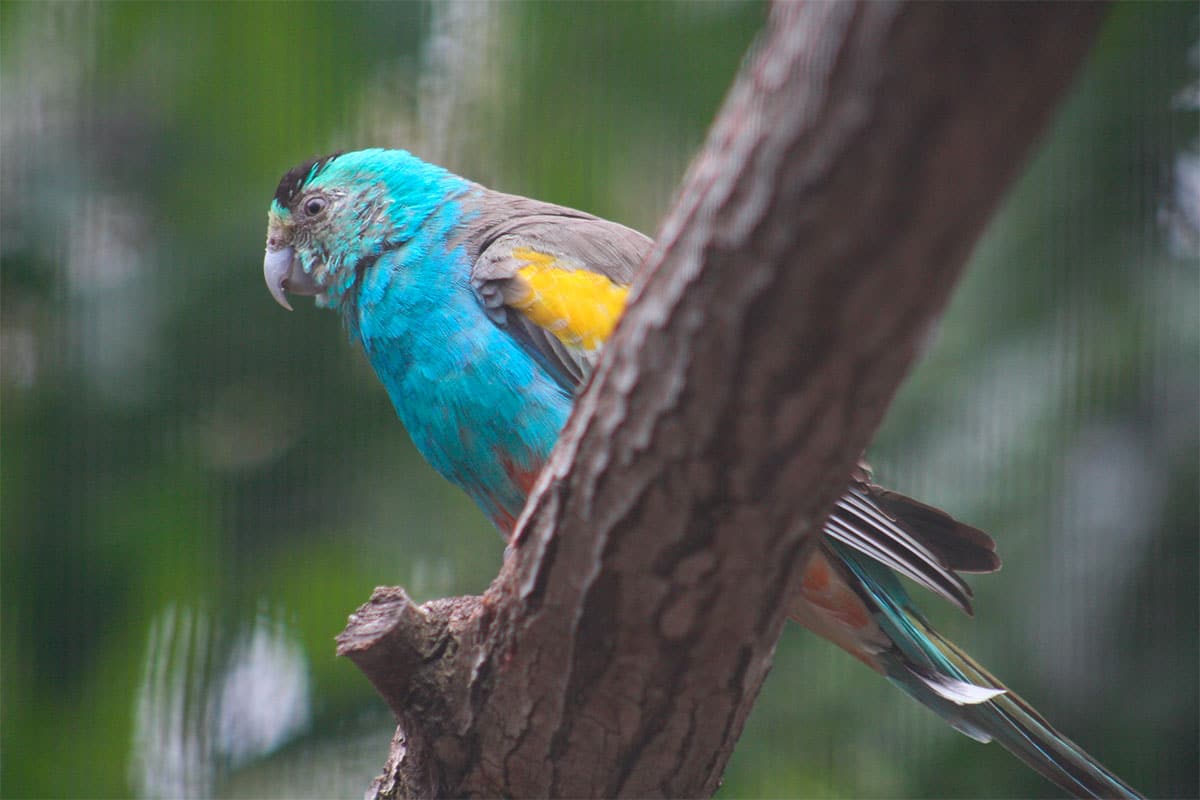
The Golden-shouldered Parrot (Psephotellus chrysopterygius) males have a pileum black, the forecrown, the lores and orbital area yellow, slightly with blue-green tones. The black of the pileum merges gradually with the greyish Brown of the the mantle, with some blue on the back neck pink. The rump shows a beautiful turquesa color that contrasts slightly with the green color of the tail view from above.
The median bright yellow, they form a visible band in the wings. The greater coverts they have a dominant brown-black color with some small patches of Turquoise Blue clear.
The flight feather they are blackish with a turquoise-colored border around the vane outer. The underparts is blue. The lower parts are turquoise blue, except the lower abdomen and the lower part of the tail, that are red with bases and white finishes. The central tail feathers they usually have a bluish-black-tipped bronze color. The lateral tail feathers they are blue-green with white tips. The underside of tail is white with a dark blue finish. The bill is pale-grey. The irises are dark brown, the legs brownish grey.
The females they have a yellowish-grey colour, along with opaque Brown wash on the top. It also, they have the forecrown yellowish. The flanks, bottom of the chest and Hip they are shaded light blue. The belly is whitish grey with red spots. You can see a pale bars on the wings.
The immature are similar to the females, although young male they have a dark CAP and the cheeks more blue. Young people acquire their adult plumage final at the age of 16 months.
The Golden-shouldered Parrot they are birds sedentary. But, just after the nesting season, they can make short trips that lead to mangroves. At the time of playback, mainly frequent open forests of eucalyptus and logging and whose undergrowth is covered with a thick layer of grass. Within these areas, the Golden-shouldered Parrot nest, mainly, along with small partially invaded by water bowls. In the territory should, mandatory, Haber mounds of earth made by termites, which are essential for the nesting of this species.
The Perico Aligualdor, usually, they live alone, in pairs or small family groups, but they also sometimes gather in flocks of up to 30 individuals. These birds feed and quench your thirst first thing in the morning or in the evening. They rest on the foliage during the hottest times of the day. The Golden-shouldered Parrot they tend to feed on the ground, where venture with confidence. They find refuge in trees if bother them. They walk up to small pools of water where bathing and quench your thirst.
Reproduction:
The time of reproduction extends from April to August. During courtship, the male makes short flights around the female, rising from the front a short feather Crest and waving his chest feathers.
The Golden-shouldered Parrot they dig their nests in a termite mound still damp from recent rains.
There are two types of termite mounds that are usually used by this species:
– built by termites type conical termite mounds Scopulus
– semicircular termite mounds built by termites of the type laurensis.
The first are usually their favorite because the temperature is most constant, while in semicircular termite mounds, they often have the entrance North, which sometimes causes large thermal contrasts. The mound may contain several nesting rooms. The nest entrance is located between 45 and 125 cm above the ground. A long tunnel 15 to 60 cm ends into a round hole in one 25 cm long.
The Golden-shouldered Parrot It lives in symbiosis with a moth:
The Trisyntopa Scatophaga that at the same time it lays its eggs in the nest of the parakeet. The larvae feed on feces and feathers of the juveniles, helping to keep the nest clean waste.
The female lays of 4 to 7 eggs who is responsible for incubating single for almost 20 days. The young man takes around 5 weeks to acquire all their feathers and leaving the nest. A week after hatching, the male joins the female to feed the young. He stands guard at the top of the nest for long periods of the day.. When he brings the food, notifies the female's arrival, emitting loud cries. When it is time to leave the nest, the young are able to fly into the tunnel without landing.. After the trip, continue to be fed by adults for at least 2 weeks. They remain in the family group for quite some time. To the dispersal of family groups, young males are away more of their places of birth than young females.
Food:
outside the breeding season, the Golden-shouldered Parrot they have a diet almost exclusively vegetarian. Subsist on grass seeds Panicum or Eragostris. They often feed on fallen seeds of different plants.. during the rainy season, When these resources become scarcer, It is likely that it depends on the species of plants that can be found throughout the year.
Distribution:
endemic to northeastern Australia, where is distributed only in a small area north of the río Morehead and South of Musgrave, to the North of Queensland. There are currently at least four populations, each with between 30 and 100 birds, so the world's population can be of no more than 500 individuals, or 150 breeding pairs. Other more recent sources estimate the spawning in around 2.500 individuals mature (Garnett et to the., 2011).
A record of 1980 It extended its known range North to the pascoe river, but in general it has contracted markedly in recent 100 years, prior records were situated towards the South, until around Normanton.
They were largely trapped in the past, especially since the mid of 1960 until the beginning of 1970. But, grazing and burning of crop residues, the spread of tea trees Leptospermum, predation by cats and the disruption of nests by tourists, It may have played one major role in the decline of the species.
Despite the fact that is protected, probably some catches continue.
Some individuals in captive.
Conservation:
• Current category of the Red List of the UICN: Danger
• Population Trend: Decreasing
The breeding population has been estimated at around 2.500 individuals mature (Garnett et to the., 2011)
Historically, There were three confirmed breeding populations: from Coen to Port Stewart, According to sources taken in the decade of 1920, río Musgrave-Moorhead where the population has shrunk considerably and continues to decline, and to the West of Chillagoe where the population persists, with a stable trend. In general, the population is suspected that it may now be decreasing (Garnett and Crowley 2000), Although the likely rate of decline has not been estimated.
The species has suffered terribly from poaching in the Decade of 1960 and the early 70 Although this bird is protected, such practices still exist.
Today, the Golden-shouldered Parrot faced with new threats: the development of new agricultural land and the destruction of traditional habitats where they were distributed.
"Golden-shouldered Parrot" in captivity:
The Golden-shouldered Parrot It has always been a rare guest of aviaries in the world. But, There are now more birds in captivity than exist in the wild., which demonstrates the difficulties encountered by these birds in their natural habitat.
This species is not recommended for beginners; prices already are high enough to discourage potential buyers, only the true, virtually "professional" fans remain.
A small group composed of one male and seven females of Golden-shouldered Parrot they came to Britain in 1897. These birds were forerunners, but the first known result of successful reproduction dates of 1961. Is inscribed with the name of Alan Lendon an Australian.
The second reproductive success corresponds to a German W. Etterich, This was in 1966. R. Burkard from Zurich achieved it in 1968. It also, in 1954, a so-called Australian breeder Edward Hallstrom got sixteen hybrids after the mating of two males of Golden-shouldered Parrot with females of Hooded Parrot.
Nowadays there are many impure birds in hobby aviaries and that is a shame. These are mostly young hybrid females. These birds do not have the opaque yellow band on the front and, Therefore, one can easily recognize, female purebred if they have the yellow tape and a bronze-colored Crown clear.
The Golden-shouldered Parrot does not resist well a temperate maritime climate; are very sensitive to cold humidity. Apart from that, it is a peaceful and active bird, she is not shy and quickly forges a friendship with her caretaker. His voice is melodious, with what does not bother the neighbors. You spend much time on the ground and like, often, bathing. They are aggressive during breeding with other birds and it is not appropriate to keep them outside with other species.; interactions with other birds are often problematic.
Alternative names:
– Golden-shouldered Parrot, Antbed Parrot, Anthill Parrot, Chestnut-crowned Parakeet, Chestnut-crowned Parrot, Golden shouldered Parrot, golden-shouldered parakeet, Golden-shouldered Parrot (chrysopterygius), Golden-winged Parakeet, Golden-winged Parrot (ingles).
– Perruche à ailes d’or, Perruche à ailes d’or (chrysopterygius) (francés).
– Goldschultersittich (alemán).
– Periquito-de-asas-douradas (portugués).
– Perico Aligualdo, Perico de Alas Amarillas, Loro Hombroamarillo, Periquito de Espalda Dorada (español).
– Avibase
– Parrots of the World – Forshaw Joseph M
– Parrots A Guide to the Parrots of the World – Tony Juniper & Mike Parr
– Birdlife
– Photos:
(1) – Male Golden-shouldered Parrot at Lone Pine Koala Sanctuary, Brisbane, Queensland, Australia By TheGirlsNY (originally posted to Flickr as Pretty bird) [CC BY-SA 2.0], via Wikimedia Commons
(2) – Golden-shouldered Parakeet (Psephotus chrysopterygius) – watercolor, Romain Risso By Gossipguy (Own work) [CC BY-SA 3.0], via Wikimedia Commons
23 cm.. length and an approximate weight of 95 g..
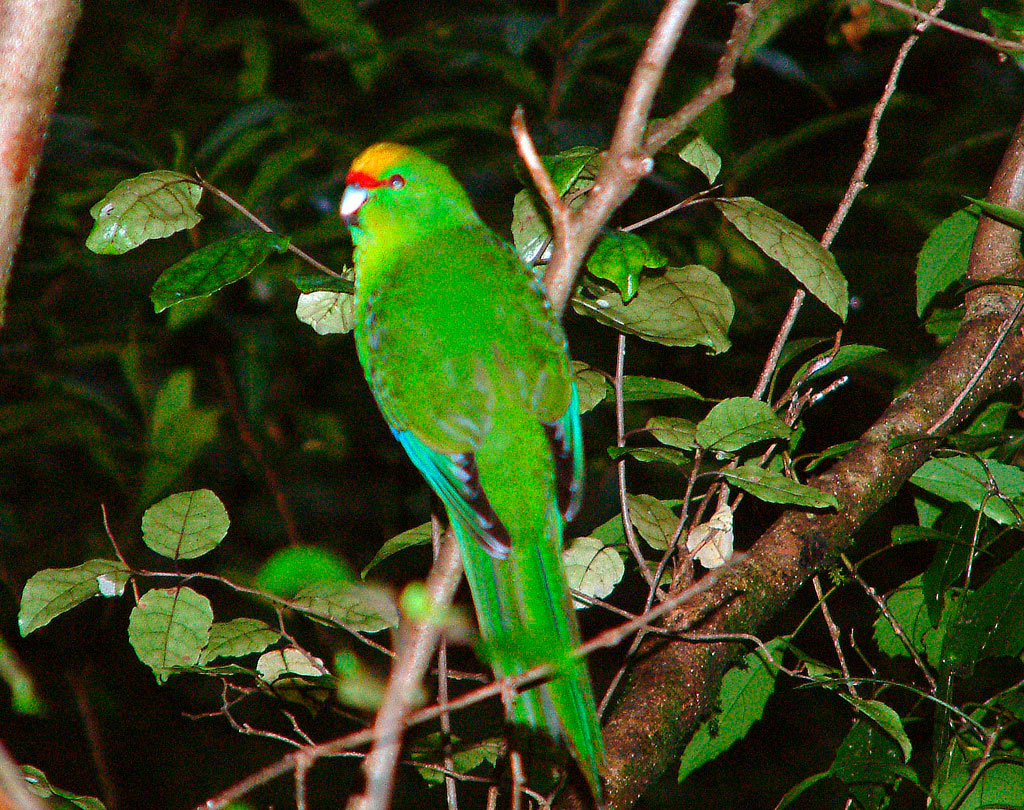
In the distance, the Yellow-crowned parakeet(Cyanoramphus auriceps) appears as a fully green Parrot, light and bright above that below.
It has a yellow spot in the forecrown, above a red stripe that goes from the bill both eyes. It can be confused with the Red-crowned parakeet (Cyanoramphus novaezelandiae) who lives in the same circles.
The upperparts they are green with a red patch on each side of the rump. Alula, primary covertss and vane outside of the primaries are blue-violet color.
feathers of the wings Green with blue at the edges of the previous; a wing bar at present times.
The underparts more yellowish green, sometimes with yellow marks.
Tail of color green for over, dark grey below.
The bill blue grey at the base, Blackish at tip; irises orange-red; legs greyish brown.
The females they are slightly smaller than males.
The young birdss have the peaks paler, queues shorter and the irises light brown.
Both females as the juveniles They show a drawing in the form of bar under the wings.
On the Mainland, the Yellow-crowned parakeet, they are mainly distributed among the lush native forests, mainly in the provided ecosystems of Nothofagus and Podocarpus, at an altitude of about 600 m. Although these birds are at much lower altitudes, the species tends to move at altitudes which are the Red-crowned parakeet, especially when their habitats overlap.
The Yellow-crowned parakeet they are more common in closed areas of scrub, less common in open spaces by which moves the Red-crowned parakeet.
It is more common on offshore islands, where predation by introduced mammals is reduced.
Birds are found more often in pairs or small groups, feeding in the middle or upper floor of forest or large shrubs. Although it is, generally, more arboreal than the Red-crowned parakeet, they tend to feed on land in the islands of the coast.
Reproduction:
The breeding habits they are similar to the of the Red-crowned parakeet, but these birds seem to be more territorial around the nest.
The Yellow-crowned parakeet They nest in tree holes.
The implementation is performed between the months of October to December but have been observed nesting in almost every month, presumably in response to food availability. Of five to nine eggs whites make up the implementation, with one incubation between 18 and 20 days. The calf is fed by the female who in turn receives food from the male., the young remain in the nest from five to six weeks.
Food:
The diet consists of plant material including outbreaks, berries, flowers and seeds, as well as invertebrates such as larvae, for example, Heliostibes vibratrix and mealybugs Ultracoelostoma assmile. The insects They seem to be more important in the diet of the Yellow-crowned parakeet that in the of the Red-crowned parakeet.
The species is also found in the chatham islands, where the Chatham Parakeet It has suffered from habitat loss, as well as competition and hybridization with the Red-crowned parakeet: both hybrids together with the Red-crowned parakeet, they survive better in open areas, helped by the improvement of the habitat and hybridisation control, so getting a slow recovery.
In the past the population of the Yellow-crowned parakeet has declined in number and the species is now rare throughout its range. As a result, is suspected to have one moderately low population. The world's population believed that it is inferior to the 5.000 specimens.
It is believed that this species has been adversely affected by the logging of forests, introduced predators, (cats, stoats and rats) and hybridization. Consequently, that you have been moderate declines in population to this day.
In the islands of the coast, the Red-crowned parakeet is usually much more common (Heather and Robertson 1997) and can be replaced by full to the Yellow-crowned parakeet in Solander Island. In Auckland Islands, There is an abnormally high rate of hybridization between the two species.
For its upbringing it is enough to have previous experience in the breeding of any of the smaller Australian parrots..
Reasonably hardy to cold, It has a thick plumage on their underparts which gives them a good insulation against the harsh winters; they withstand a cooler climate than most Australian species.
The sound of their voices is not strong or offensive and consists of pleasant chattering.
In terms of their longevity, according to sources, one specimen was still alive after 9.3 years in captivity
Of 40 cm., length and a weight between 116 and 140 g..
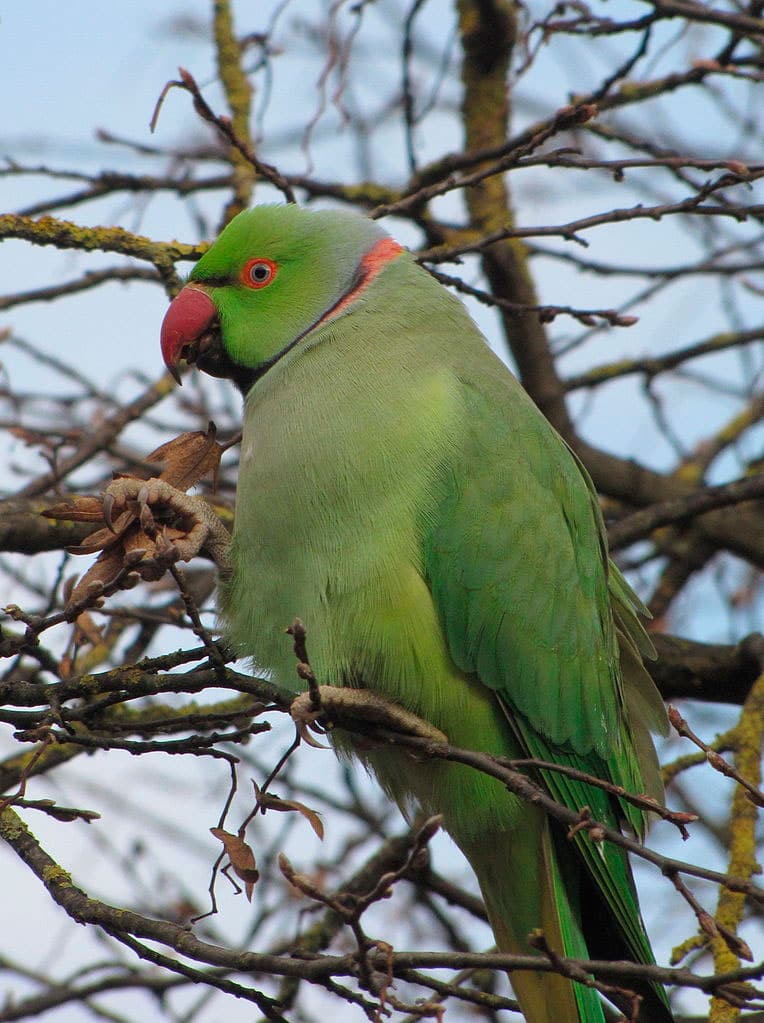
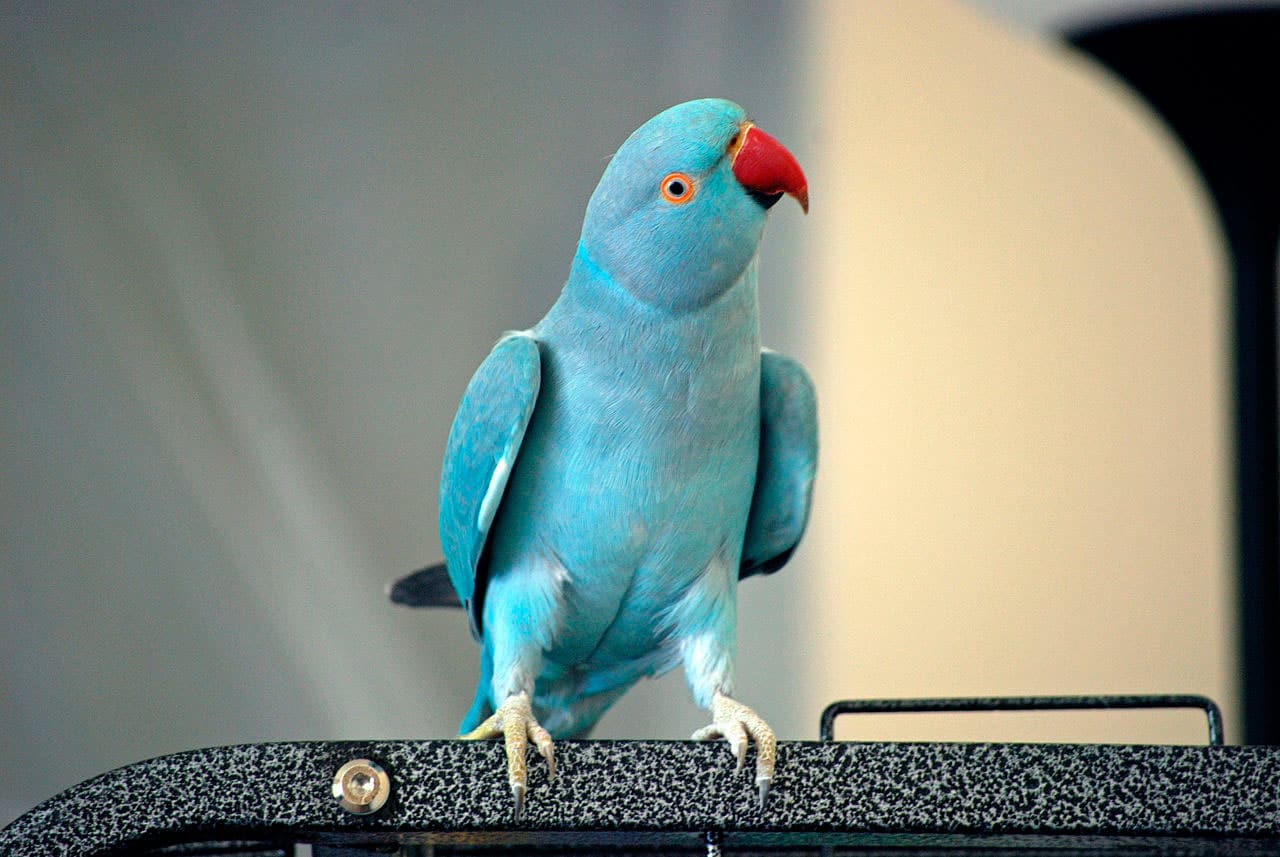
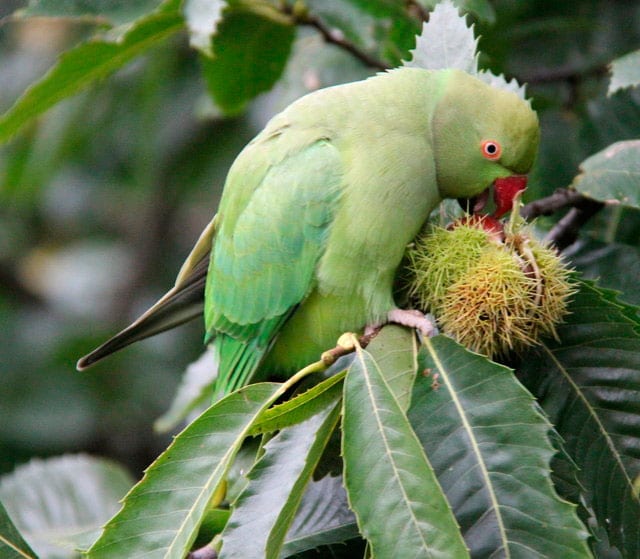
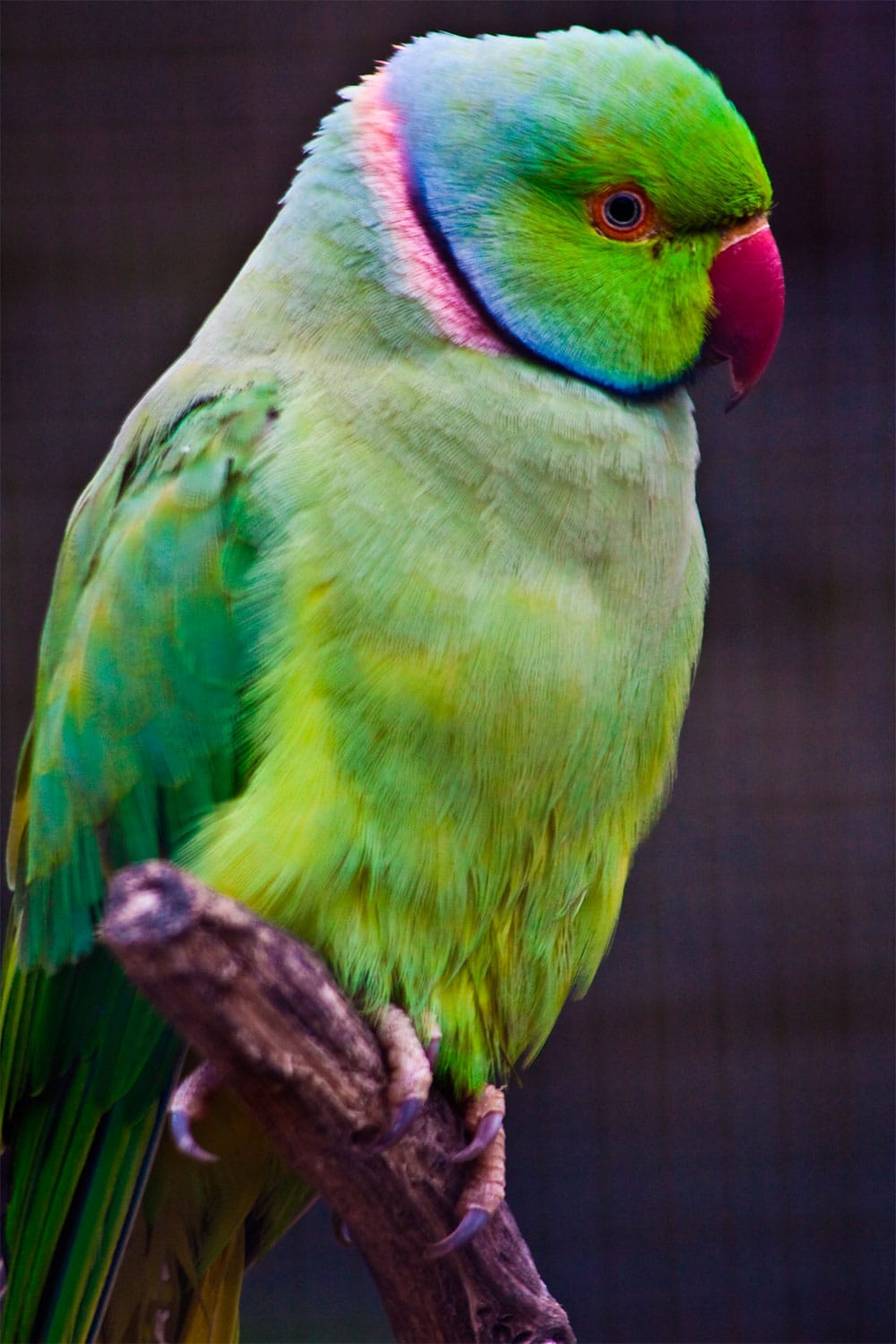
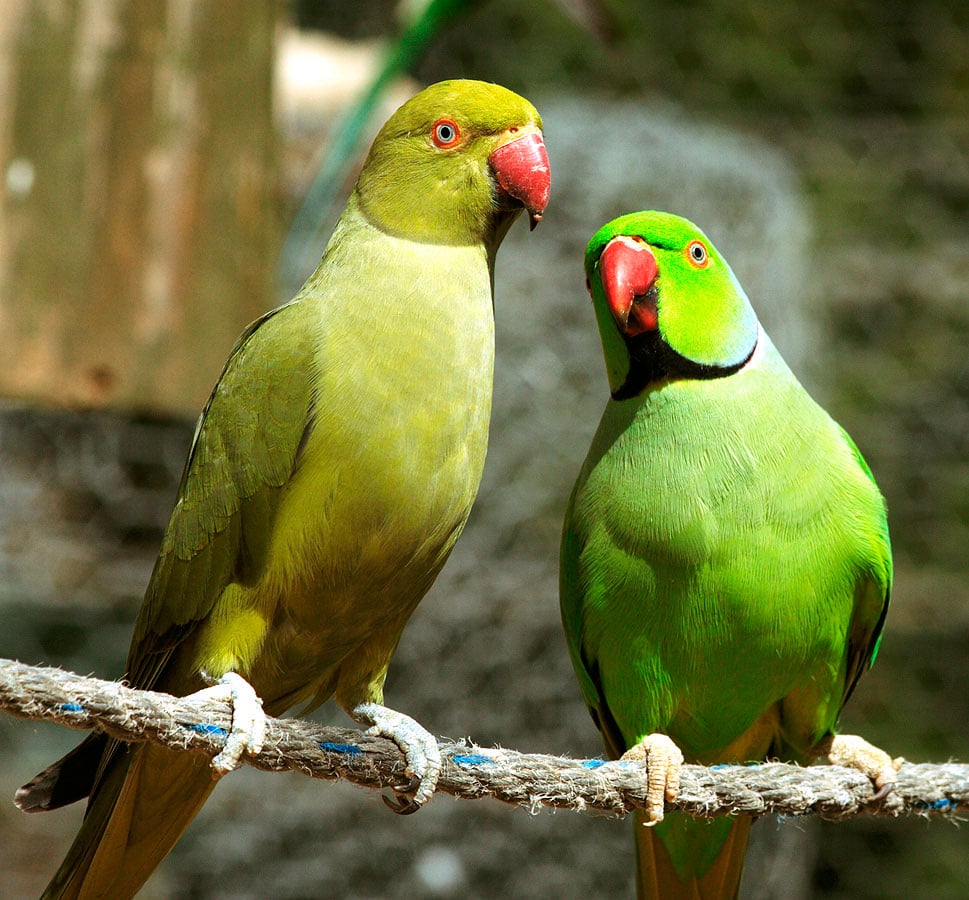
The Rose-ringed Parakeet(Psittacula krameri) has the forecrown, fore crown, the cheeks and lores bright yellowish green; narrow dark line between cere and the eye ring; the back of the crown, the nape and the sides of the neck, pale lavender gray, broken on the sides of neck with narrow black stripes; contiguous black markings with wide black stripes on the bottom of the cheeks merging the chin a solid black.
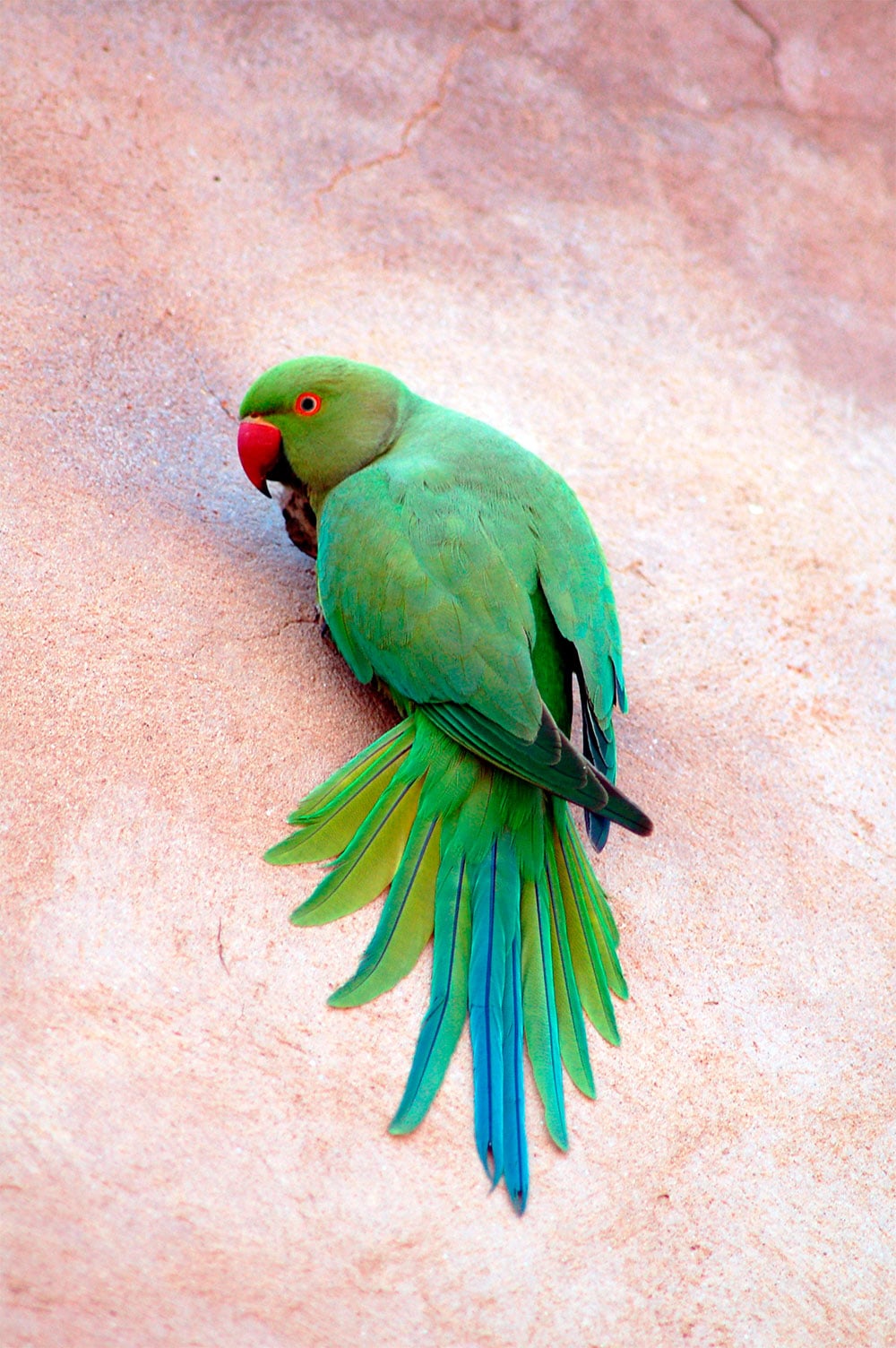
Pink collar in the back of the neck, the mantle and back light green tinged with olive; rump and uppertail-coverts slightly brighter. Lesser and medium upperwing-coverts light green (darker than the body); large coverts dark green; primaries and secondaries dark green with darker (almost black) margin to the vane inner. bottom of the feathers flight gray; underwing-coverts brighter yellowish green. Underparts brighter yellowish green. Upper, the tail centrally blue with yellowish tips, green side; undertail, the tail centralmente negruzca, yellow-olive laterally.
Crimson in the upper jaw tipped in black, the lower jaw of color stream blackish; cere whitish: irises yellowish white; legs pink, with 4 fingers ending in nails strong in black, two of these fingers are directed forward and two backward so called zigodactilia, which it allows them to easily climb.
The female lacks the neck black, brands in the chin and the cheekbone, of the collar pink and blue suffusion of neck; It has shorter central feathers tail.
The They are similar to immature females but with the bill a little paler, irises greyish; the males acquire the characteristic Pink collar in the third year.
Psittacula krameri borealis (Neumann, 1915) – Larger than the species nominal, with upper jaw all red and black marks on the lower jaw. Bluish suffusion in neck, behind ear-coverts; more than grayish bottoms species nominal.
Psittacula krameri krameri (Scopoli, 1769) – The species nominal
Psittacula krameri manillensis (Bechstein, 1800) – Larger than other subspecies, slightly paler and more yellow than the subspecies borealis. Different facial markings that species nominal. Under the mandible black.
Psittacula krameri parvirostris (Souance, 1856) – Of head and cheeks yellowish least the species nominal. Bill small upper jaw brighter red, less blackish towards the tip. The birds living in eastern Sudan They are intermediate between subspecies appearance parvirostris and species nominal.
Habitat:
The Rose-ringed Parakeet It is a very adaptable bird. It is located in a variety of forest types Forest, from secondary forests, wet, riparian forests, mangroves, open farmland with scattered trees, to parks and gardens in urban areas.
They can live at altitudes 1.600 metres in Asia and 2.000 metres in Africa.
gregarious, especially out of breeding season, coming to form large noisy flocks sometimes several thousand birds. Communal roosts, often with Crows, Mynas or other parrots.
Reproduction:
The Rose-ringed Parakeet It is not a territorial bird and, sometimes vaguely colonial while breeding.
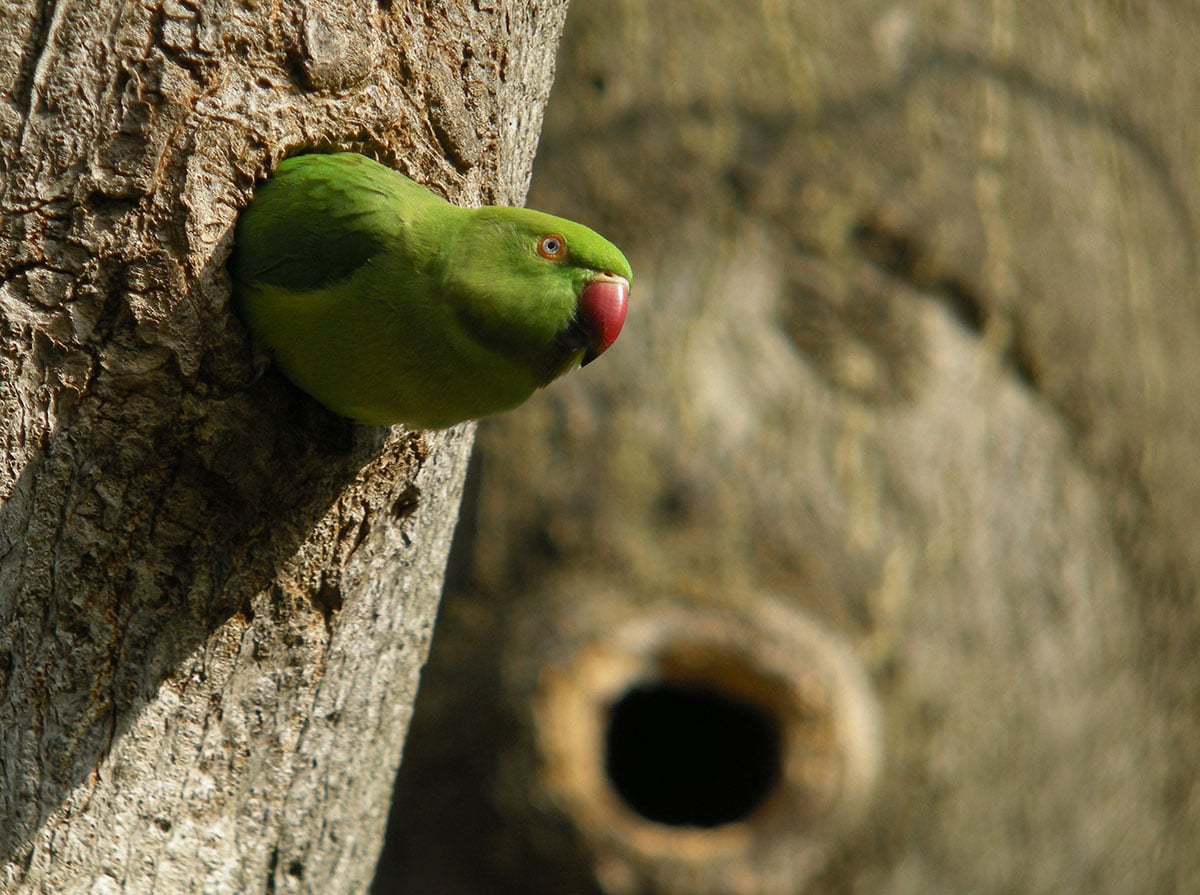
It nests in natural tree cavities or holes extended, in cracks in rocks or walls built; in Africa, always nest atop a tree.
The breeding season, mainly, It covers the months from January to April, although offspring have been recorded in the month of July.
typical setting 3 to 4 eggs, although they have been registered you put six eggs.
23 days of incubation and 45 days of stay in the nest of the hatchlings.
Food:
Diet Rose-ringed Parakeet It includes a variety of cereals, herbs, seeds, vegetables, fruits, flowers and nectar, wild and cultivated; feeding varies seasonally,for example, in the Indian state of Punyab, They feed on weed seeds from April to June and sorghum between the months of August and January.
Inflingen crop damage, especially citrus, sunflower and corn.
Size of the area of distribution (reproduction / resident): 27800000 km2
The Rose-ringed Parakeet they are the parrots more widely distributed around the Old world. They are native to tropical africa, north of the humid forest zone, and much of Asia meridional.
In West Africa (Mauritania, Senegal, Gambia, Guinea-Bissau), the east, through Mali, South of Niger, North of Ivory Coast, North of Ghana, Burkina Faso, Togo and Benin to the North of Nigeria and Cameroon, South of Chad, North of the Central African Republic, from southern Sudan to the North of Uganda and Ethiopia, Djibouti and Northwest of Somalia.
In Asia, from the West of Pakistan, South of Nepal through the India, Bangladesh and Sri Lanka to downtown Burma.
Many introduced populations are distributed by EE.UU., England, Germany, Netherlands, North of Egypt, Kenya, coastal area Ivory Coast (possibly wild relict), South Africa (Natal and Zululandia), Mauritius, Arabian Peninsula, Singapore, Macao and China, in the surroundings of Hong Kong.
Mainly sedentary, but apparently with some seasonal movements in most parts of the African range (for example, temporary visitors during the rainy season in southern areas Mauritania).
Common to abundant in Africa and part of Asia; quite common in Burma.
Residents and especially sedentary. Widely bred in captivity.
Subspecies distribution
Subspecies
Psittacula krameri borealis (Neumann, 1915) – distributed by Pakistan, through North India, around of 20 ° norte, Nepal and Bangladesh until Burma. He also believed to belong to this subspecies distributed parts of birds Middle East, Mauritius, Macao and parts of Southeast China.
Psittacula krameri krameri (Scopoli, 1769) – The species nominal
Psittacula krameri manillensis (Bechstein, 1800) – Distributed by South India, about 20 ° north and Sri Lanka. Observed in wild populations England, elsewhere Europe, EE.UU. and Singapore, They seem to belong to this subspecies.
Psittacula krameri parvirostris (Souance, 1856) – Distributed by this Sudan through North Ethiopia until Djibouti and North of Somalia
The size of the world's population has not been quantified, but the species, according to sources, It common to abundant throughout their natural range (pit et to the. 1997), while the population Japan it has been estimated between 100 and 10,000 introduced breeding pairs ( Brazil 2009).
Its population It increased in the twentieth century, in relation to the expansion of agriculture.
Nest protection and brood handling has helped the Rose-ringed Parakeet recover.
Invasiveness in Spain
Because of its colonizing potential and constitute a serious threat to native species, habitats or ecosystems, This species has been cataloged in the Spanish Catalog of Invasive Exotic Species, approved by Royal Decree 1628/2011, of 14 November, It is banned in Spain its introduction into the wild, possession, transport, trade and commerce.
"Rose-ringed Parakeet" in captivity:
The Rose-ringed Parakeet is a bird with character that raised since childhood can become a docile pet, although its tendency is to be a fearful and aggressive bird. Form unstable pairs, something that affects their behavior. It is unlikely that this species has an affectionate behavior with their caregiver, with few exceptions.
To enjoy it Patience is needed and above all to have knowledge about this species, not to be disappointed if things are not progressing as expected.
The Rose-ringed Parakeet It is a bird that must be handled daily and this, throughout his life, with the aim of being able to achieve an “optimal” dressage. In fact, Naturally that tends to become suspicious if the time is not paid regularly. We have to "fight" against this tendency to touch it, manipularla, caress, etc … He does not like human contact, other interaction need not destroy your confidence.
It is a bird that is in great need of occupation. She is active and loves to be stimulated. Learns tricks easily and is always ready to learn, which makes it a bird very interactive with his master, despite being reluctant to hugs.
The Rose-ringed Parakeet she is also a bird that will tend to trust only the person who takes care of her every day.
If we do not put enough games available in your area, it can be very destructive, He likes to chew and grind objects with their powerful beak, which would cause us a serious problem … it is also important to periodically renew the games to avoid boredom.
They have a powerful screech and are quite noisy.
Still not much of a conversationalist, You can learn to say a few words.
It could eventually transmit diseases such as psitacosis.
With regard to its longevity, according to sources, a Rose-ringed Parakeet lived during 34 years in captivity. In captivity, these birds are known to breed, approximately, to the 2 years of age.
Alternative names:
– Rose-ringed Parakeet, Green Long-tailed Parakeet, Long-tailed Parakeet, Ring-necked Parakeet, Rose Ringed Parakeet, Roseringed Parakeet, Senegal Long-tailed Parakeet (English).
– Perruche à collier, Perruche de Kramer, Perruche verte à collier (French).
– Halsbandsittich, Kleiner Alexandersittich (German).
– Periquito-de-colar, Periquito-rabijunco (Portuguese).
– Cotorra de Kramer, Cotorra Verde de Collar, Periquito de Collar, Periquito de Kramer, Alejandrino común, Cotorra de Collar, Cotorra de Collar Verde, Cotorra de la India, Periquito de Collar (español).
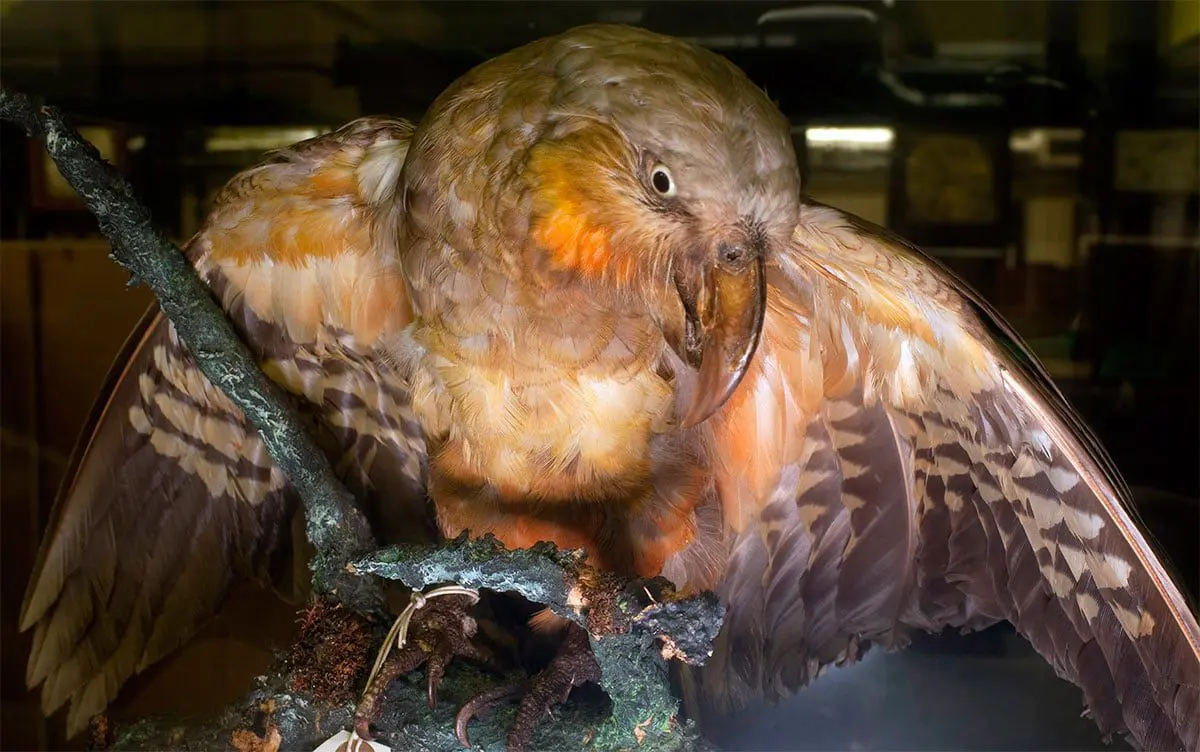
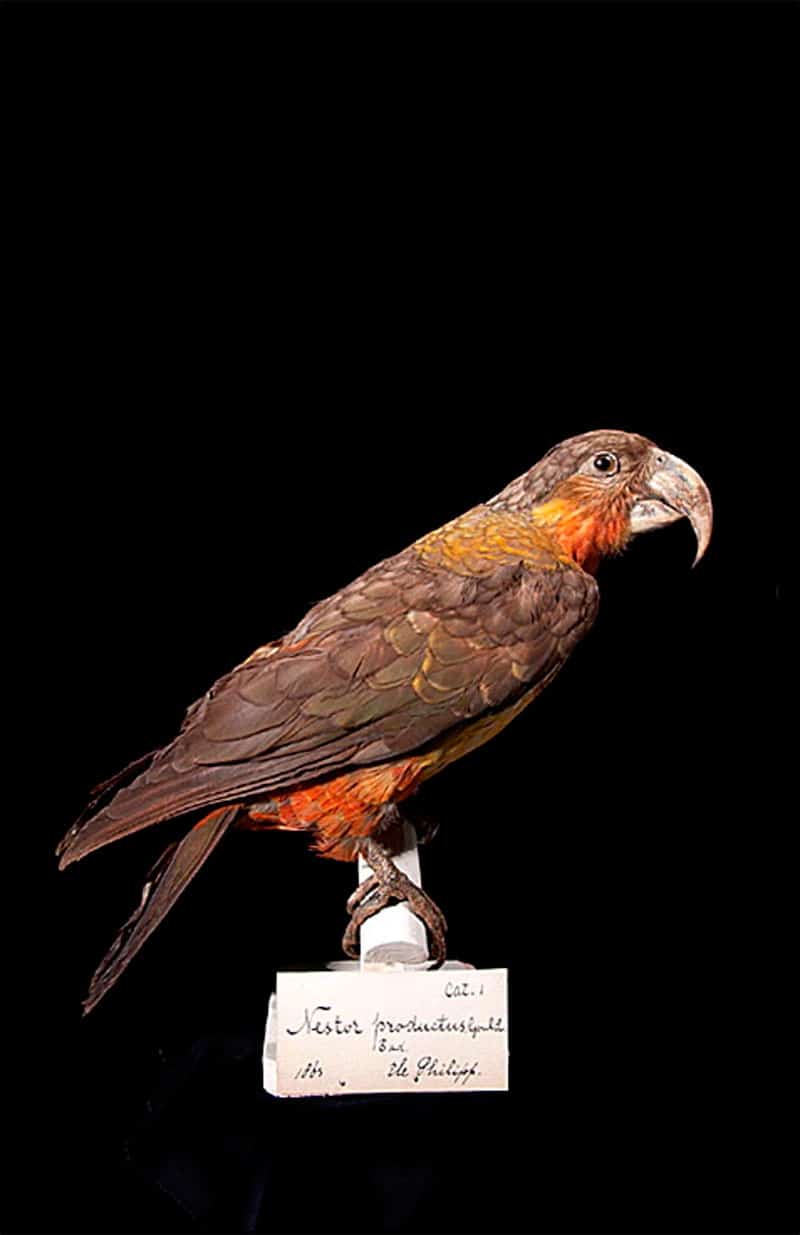
The Norfolk Island Kaka(Nestor productus) was their large with a bill, wings short and wide, and with legs and feet large.
I had 38 centimeters long. The top of his head era gris pardusca, while its face varied from yellow to orange, sometimes with a reddish tint. It was said that his Hip It was greenish yellow, and upperparts, including the wings, they were mostly greyish-brown in color, slightly darker than the top of the head, with the bottom of the back and rump orange or dark red and the tail brown. Upper chest It was brown and gray bottom bright yellow, with the belly and sides reddish orange (Forshaw & Cooper 1981, 2002; Greenway 1958).
Its social structure and dispersion are not registered, but the Norfolk Island Kaka of New Zealand, he watched alone or in small groups of up 10 individuals (Higgins 1999).
Habitat:
Habit in the native forest in the Norfolk Island and about Phillip Island (Greenway 1958). The species could be observed both in the canopy of tall trees, and soil, the rocks (Gould, 1865, Greenway 1958).
Given its endemism in the Norfolk Island, the Norfolk Island Kaka It was presumably sedentary.
Reproduction:
Little is known of reproductive cycle of the Norfolk Island Kaka; just put on record of four eggs in tree holes (Gould 1865).
Food:
It is known that he fed on nectar Flowers tree white wood (Lagunaria) (Gould 1865). Definitely should be more varied. The captive birds they ate lettuce and the leaves of other vegetables, as well as dairy meals and fruit juice (Gould 1865). Presumably he foraged in both the soil and the canopy (Gould, 1865).
The species is believed to have had a very limited ability to move between islands., and probably he spent his whole life on the island of his birth (Gould, 1865).
In the Norfolk Island Kaka occasionally kept in captivity, as the birds were gentle and easy to capture alive (Gould 1865). The species He survived in captivity until after it had become extinct in the wild (Greenway 1958). There are no known captive populations and none has been reintroduced into the wild. The last known living bird was in captivity in London in 1851 (Garnett et to the., 2011).
No made extensive studies for this species. But, there have been a series of ornithological studies in the Norfolk Island since the species disappeared from the island (p.ej. Bell 1990, Robinson 1988, Schodde et al., 1983, Smithers y Disney 1969), no signs have been found of the species.
Conservation:
• Current category of the Red List of the UICN: extinct.
Rationale for the Red List category
This species was known in the Norfolk Island, but it was Extinguished to mid 1800. It is believed that the elimination of habitat and hunting have been the main drivers.
According to reports, was tame and, Therefore, hunted strongly convicts and early settlers and easily trapped as a pet.
No information is available on the population size before its decline.
"Norfolk Island Kaka" in captivity:
They were captured by his meekness and they were common in the Norfolk Island
Alternative names:
– Norfolk Island Kaka, Norfolk Island Kea, Norfolk Island Parrot, Norfolk Kaka (English).
– Nestor de Norfolk (French).
– Dünnschnabelnestor, Norfolkkaka, Norfolk-Kaka (German).
– Kākā-de-norfolk (Portuguese).
– Kaka de Norfolk (español).
– Avibase
– Parrots of the World – Forshaw Joseph M
– Parrots A Guide to the Parrots of the World – Tony Juniper & Mike Parr
– Birdlife
– Australian Government – Department of the Environment and Energy (Nest produced - Norfolk Island Kaka)
– Photos:
(1) – Natural Science Curatorial Trainee – Birmingham’s Norfolk kaka
(2) – Nestor productus Gould, 1836 by Huub Veldhuijzen van Zanten / Naturalis [CC BY-SA 3.0], via Wikimedia Commons
(3) – Nestor productus By Gould, 1836 [CC BY-SA 3.0], via Wikimedia Commons
(4) – Norfolk Island in Kaka (Nestor productus). The last bird in captivity died in London in 1851. Specimen from the Zoological Museum in Firenze, Italy by Thomas Wesener – Flickr
(5) – Nestor productus By Gould, 1836 [CC BY-SA 3.0], via Wikimedia Commons
(6) – The Norfolk Island in Kaka (Nestor productus) from the plate in the Bulletin of the Liverpool Museum. From the specimen in the Tring Museum by John Gerrard Keulemans [Public domain], via Wikimedia Commons
▷ The world of Pets: Dogs, cats, birds, reptiles, amphibians
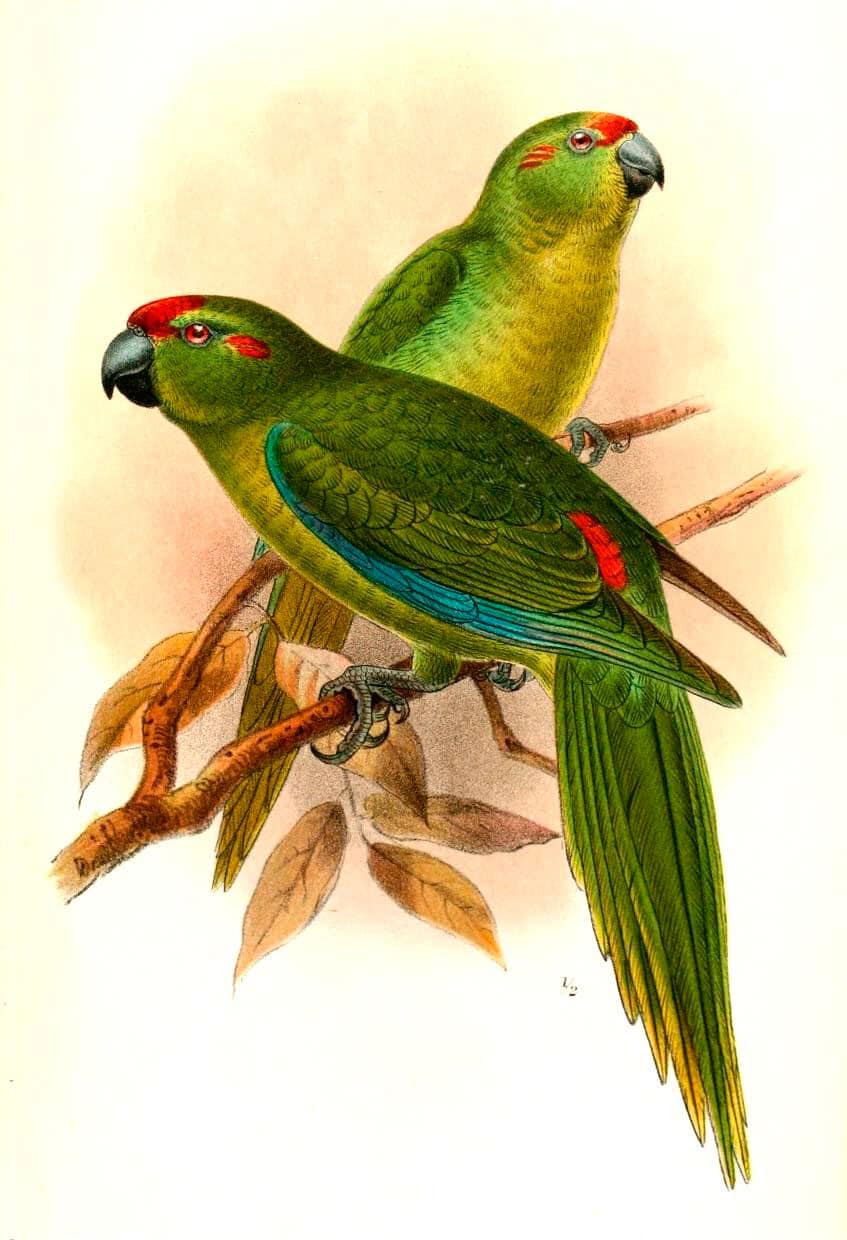
The Lord Howe Island Parakeet(Cyanoramphus subflavescens) was a medium-sized green parrot with a head bright green, the crown crimson red in color and a stripe on the eyes; the eyes were red and bill grey. The upperparts They were bright green with a dark red spot on each side of the rump (usually they are hidden by the wings when resting) and a blue border in wings; the underparts were yellowish green.
Both sexes looked similar, but the female It was smaller.
Taxonomic status:
This taxon is considered a subspecies of Cyanoramphus [novaezelandiae or subflavescens] (sensu lato) by some authors.
In 2012, World Bird List of IOC recognized him as a species [IOC world birdnames Archived 2012-08-06 at the Wayback Machine.].
Habitat:
The Lord Howe Island Parakeet It was occasionally observed in flocks. There is little information on their habitats, They probably lived in inhabited forests and cultivated areas of the Lord Howe Island. No information on the use of different habitats for different activities.
Reproduction:
Nothing is known of sexual maturity, life expectancy and natural mortality of this extinct species. But, It has been estimated that the useful life of the Lord Howe Island Parakeet should be similar to the Norfolk Island Parakeet(Cyanoramphus cookii), About three years. the age of sexual maturity is also known populations of this species, although a juvenile female was seen mating with a male just a week after achieving independence, and captive birds are said to have bred when they were less than a year old.
Little else is known of the breeding of the Lord Howe Island Parakeet, probably reproduced in response to weather conditions and food availability, nesting in tree holes or hollow pipes, in crevices between rocks or cliffs.
Food:
Meal Lord Howe Island Parakeet probably consisted of plant material, as seeds, fruit, buds and leaves of native trees and shrubs. Other extant populations ate mainly seeds, fruits and berries, egg yolks, sprouts and flowers, as well as, occasionally, a small number of invertebrates.
• The last record of this species dates from 1869. EXTINCT.
The population declines were mainly due to habitat modification, hunting, poisoning, and the introduction of predators (especially cats and rats).
But, the main threat to the Lord Howe Island Parakeet was the hunting and its capture by settlers. Formerly he abounded in the Lord Howe Island and it was said to be a plague, since it destroyed the crops and orchards of the inhabitants of the island.
There are only two copies of Lord Howe Island Parakeet. From the collection John Gould, taken by John MacGillivray in September of 1853 on tour HMS Herald, and are in the Museum of Natural History [Schodde, R.; & Mason, I.J. (1997). Birds (Columbidae to Coraciidae). In Houston, W.W.K. & Wells, A. (eds) Zoological Catalogue of Australia. Vol. 37.2. CSIRO Publishing: Melbourne. ISBN 0-643-06456-7 p.147.].
Alternative names:
– Lord Howe Island Parakeet, Lord Howe Island red-crowned parakeet, Lord Howe Parakeet, Red-Fronted Parakeet (English).
– Perruche de Lord Howe (French).
– Lord Howe-Laufsittich (German).
– Periquito de Lord Howe (Portuguese).
– Perico de Lord Howe (español).
• Avibase
• Parrots of the World – Forshaw Joseph M
• Parrots A Guide to the Parrots of the World – Tony Juniper & Mike Parr
• Red-crowned Parakeet (Lord Howe Is. subsp.) – profile | NSW Environment & Heritage
Photos:
(1) – Cyanorhamphus subflavescens (Catalogue of the Birds in the British Museum. Volume 20) by John Gerrard Keulemans [Public domain]
(2) – Hand coloured lithograph (circa 1928) showing (Cyanorhamphus subflavescens) Which is now a synonym of the Lord Howe Island Red-fronted Parakeet (Gray novaezelandiae subflavescens) From The Birds of Australia (1910-28) by Gregory Macalister Mathews (1876-1949) Artwork by Henrik Gronvold (1858–1940) a Danish bird illustrator. by Henrik Grönvold [Public domain]
▷ The world of Pets: Dogs, cats, birds, reptiles, amphibians
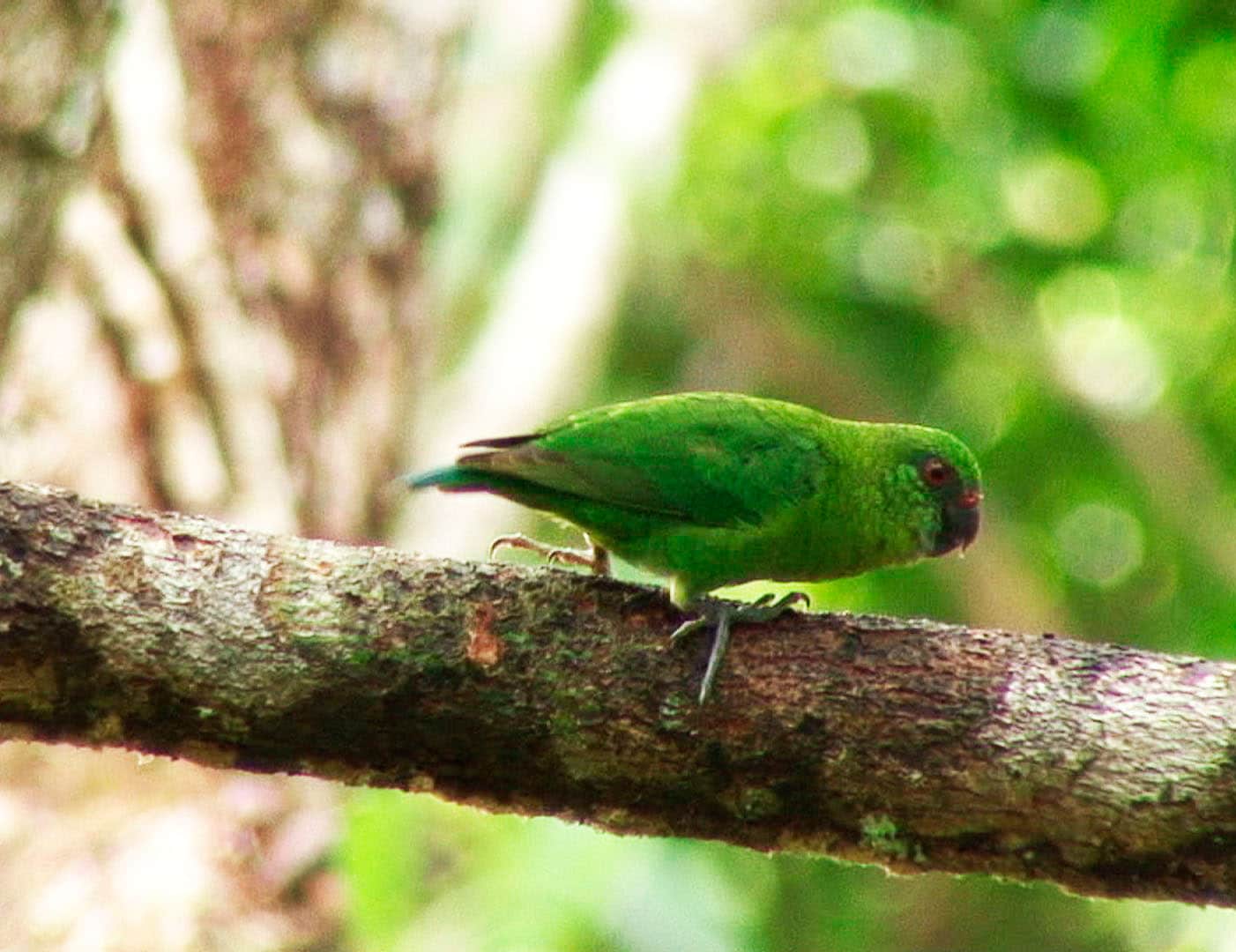
The head of the Finsch's Pygmy-Parrot(Micropsitta finschii) is bright green, slightly yellowish, dotted with pale blue in the chin and throat. Upperparts bright green, with fine darker stripes. The flight feather they are black with fine green edges; wing feathers greenish yellow. The underparts pale yellowish green with fine darker stripes and feather in the center of the belly orange-red; uppertail-coverts yellow, the longest with bluish-green tips. Upper, the tail is off blue, Black in the Center and sides with blue and yellow tips; below, the tail is black with yellow tips.
Bill blackish; cere Pink ; irises orange red; legs grey.
Cere rose in the male, grey in the female. The females they lack the red marks in the underparts and they have pink feathers, not blue, on chin.
Immature with bill grayish and reddish brown, not orange-red, the irises.
In the juvenile birds the cere is greyish in both sexes. Males immature of the species nominal lack of the chin Blue and red markings in the abdomen.
(Tristram, 1891) – The adults have a stain blue in the part superior of the crown.
Micropsitta finschii viridifrons
(Rothschild & ECTION Hartert, 1899) – Adults have a large blue spot at the top of the crown and blue tones to the sides of the face.
Micropsitta finschii tristami
(Rothschild & ECTION Hartert, 1902) – Adults do not have blue spots and orange
Micropsitta finschii aolae
(Ogilvie-Grant, 1888) – adults have the upperparts darker and have a blue spot on the top of the crown.
Habitat:
Most common in lowland primary forest at mid-altitude, are observed to the 900 meters above sea level (lower boundary of cloud forests where they are replaced by the Red-breasted Pygmy-Parrot, but they are distributed in a variety of habitats, including weed gardens, casuarinas, secondary growth, areas of open scrubland and occasionally coconut (Cocoa nuts). It's a vociferous and active species, difficult to observe. They are alone, in pairs or in groups of 3 to 6 birds. They feed on acrobatic form, down with your head upside down and using their tails as support on the bark of the trees.
Reproduction:
One to two eggs are deposited by the female in an excavated cavity over a period of several weeks in an active tree termite nest. (that is also used for the rest). Adults were observed with young in January 1995 in the South of New Ireland. The breeding period It speculates that may be between March and Mayo.
Food:
Peck the trunks and branches of the tree tops and medium height plants to glean lichens and fungi, also noticed them is feeding of seeds of casuarina.
The size of the world population It has not been quantified, supposedly above 100.000 specimens. The species according to sources, It is abundant within its range (pit et to the. 1997).
The population is suspected to be stable in the absence of evidence of any reduction or substantial threats.
In captivity:
Not found in captivity.
This species has only been kept alive for short periods in captivity.; new birds may refuse foods completely.
Alternative names:
– Finsch’s Pygmy-Parrot, Emerald Pygmy Parrot, Finsch’s Pygmy Parrot, Green Pygmy Parrot, Green Pygmy-Parrot (ingles).
– Micropsitte de Finsch (francés).
– Salomonenspechtpapagei, Salomonen-Spechtpapagei (alemán).
– Micropsitta finschii (portugués).
– Microloro de Finsch (español).

















-6.jpg)


_-blue_mutation2.jpg)

_at_nest_in_Narshapur%2C_AP_W_IMG_0737.jpg)
-_During_Foreplay_at_Hodal_I_Picture_0034.jpg)


