โ–ท The world of Pets: Dogs, cats, birds, reptiles, amphibians

Ceylon Hanging-Parrot
Loriculus beryllinus


Ceylon hanging

Content

Description

13 cm.. length.

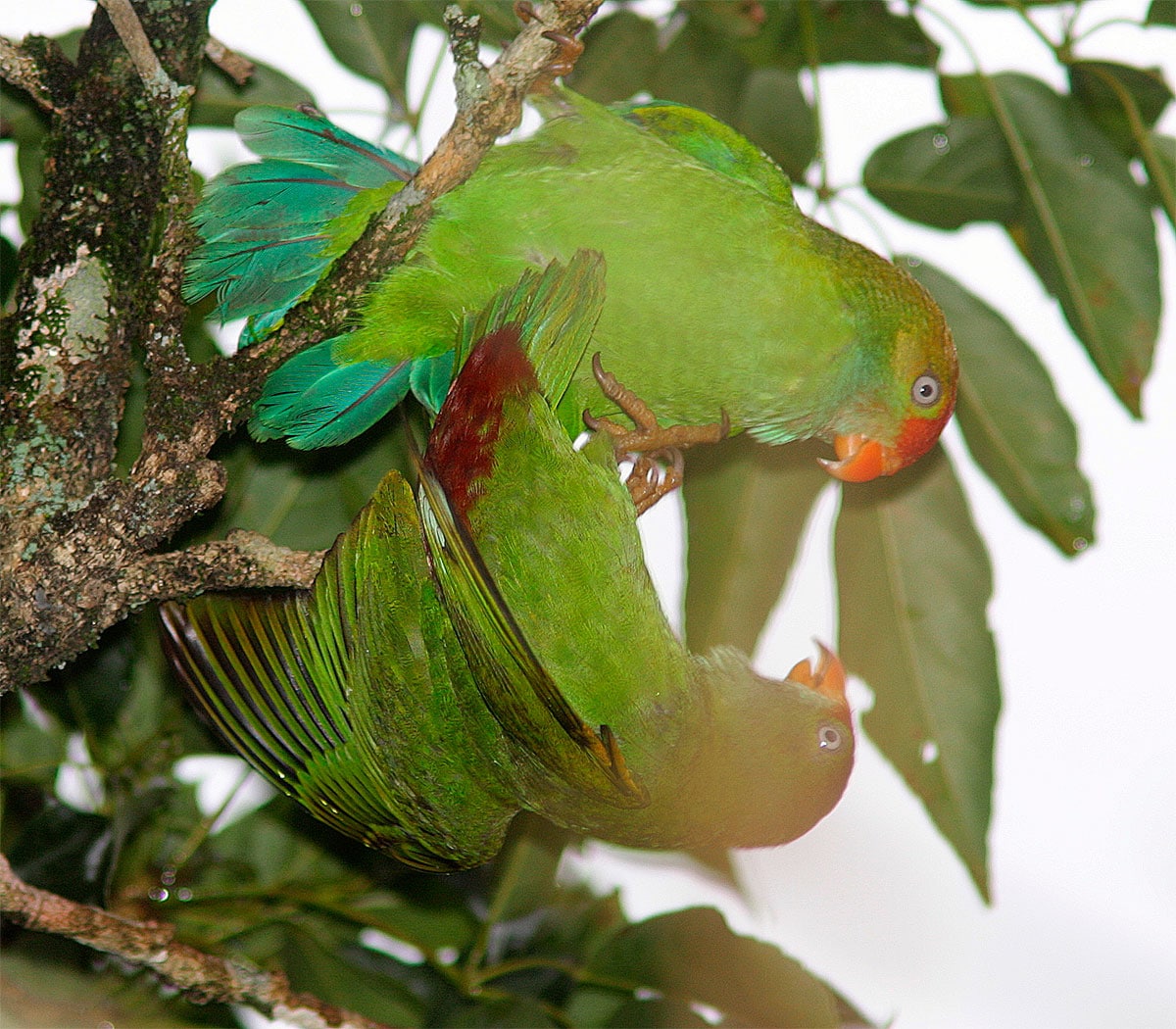
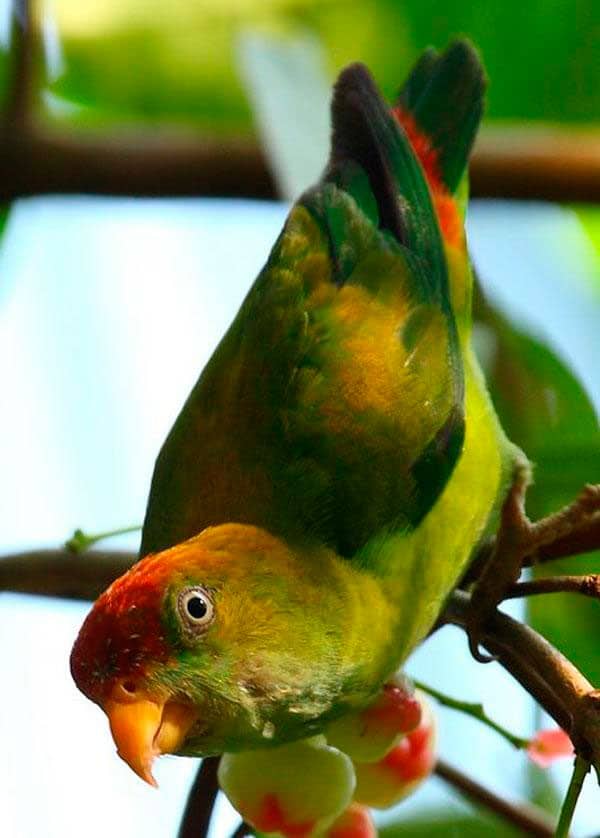
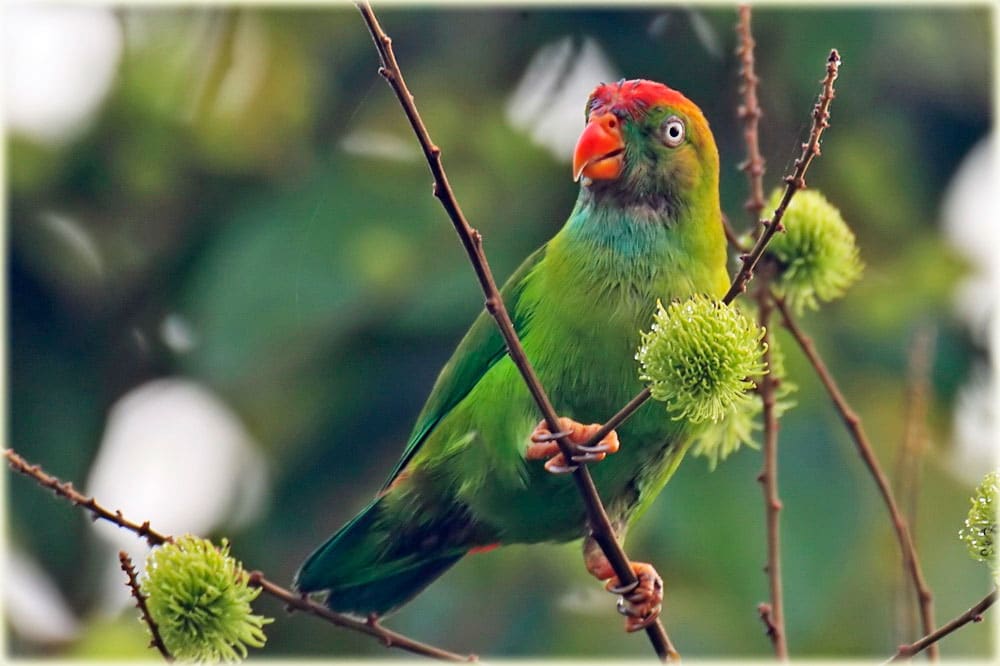
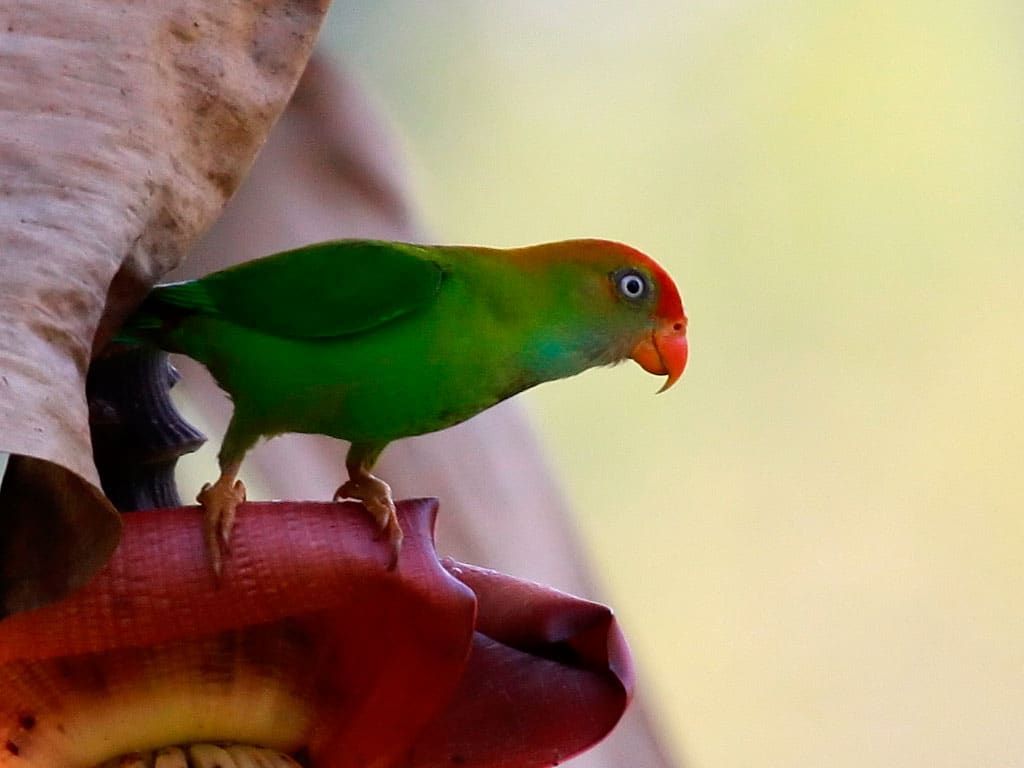
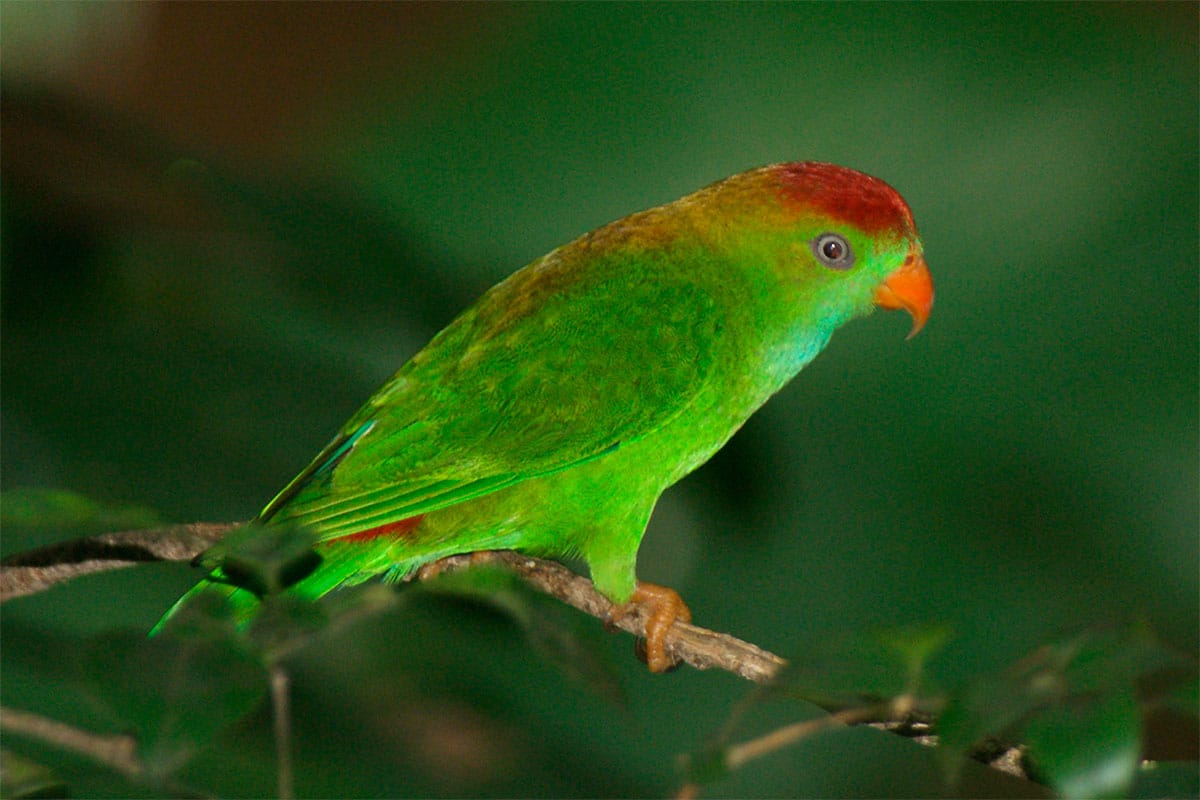
The Ceylon Hanging-Parrot (Loriculus beryllinus) has the crown red, merging into orange-yellow in the area of the nape; eyebrows, lores and the area in front of the eyes light green (lightly bathed in pale blue); sides of the front of the crown red. Mantle green, Baรฑado de slightly reddish and yellowish orange color in the Center; back green; rump and uppertail-coverts, red. Wings green up, with the exception of vane inner of the blackish flight feathers ; undertail, the wings bright turquoise color with the exception of coats and axillary green. The underparts bright green, paler and more yellowish which the upperparts and light blue marking in the throat. above the tail green color; Turquoise below.

Bill orange red, paler at the tip; irises off-white; legs dark yellow.

Female as the male, but most off and only a trace of blue in the throat.

The young birds they are even duller, the crown reddish-tinged, the patch blue of the throat absent, the rump with some green feathers, the bill paler, the iris and the legs brown; the face nude in the fledglings.

Habitat:

Seen in a range of habitats, from sea level to 1.600 m, reaching the highest areas according to seasonal conditions. The species is found in forests of coconut trees, Evergreen and deciduous forests, semicultivadas areas, open woodland and around the dwellings.

birds are not shy, and is usually found in pairs or family groups, although outside the breeding season larger flocks congregate high up in flowering trees. They are active and acrobatic feeding.

Reproduction:

Observations, they have registered the male approaching his partner upright, with the high peak, swollen throat, extended tail and rump feathers erect, while emitting a screeching chirp. Wiggles head in courtship period have also been observed.

The breeding begins in January and although the main nesting period is between March and May, a second litter is, sometimes, until September. The nest is located in a hollow branch filled with fragments of vegetation that the female carefully cuts with her beak and carries to the nesting sites tucked between her rump feathers.. Only two to four white eggs she incubates, sitting firmly, screeching and creating a 'thumping' sound’ Yes is the annoying. The young Chick has the face exposed, presumably to avoid getting dirty by liquid food.

Food:

Feed on fruits such as Ficus figs and guava (Psidium guajava); berries; flowers, including Erythrina, Salmalia and eucalyptus; seeds, including Casuarina. Poisonings have been reported after drinking Palm wine collected pots attached to the trunks of the trees.

Distribution:

Endemic to Sri Lanka, where most records come from the South, Although there have been North of Trincomalee and should be observed in suitable habitats throughout the country. Records include proximities of Colombo, around Kandy, Yala and National parks Gal Oya, the district Welimada, and to the South of Galle and Hambantota, on the coast.

Conservation:
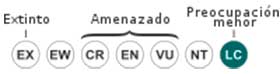

minor concern


โ€ข Current IUCN Red List category: Least concern

โ€ข Population trend: Stable

The size of the world's population has not been quantified, Although it is estimated at 10.000 specimens. The species is qualified as widespread and abundant in the South-West and almost absent in the North of its distribution area (pit et to the. 1997).

The population is suspected to be stable in the absence of evidence of any reduction or substantial threats, However, the bird trade is judged as a potential threat.

"Ceylon Hanging-Parrot" in captivity:

Rare.

Alternative names:

Ceylon Hanging-Parrot, Ceylon Hanging Parrot, Ceylon Lorikeet, Sri Lanka Hanging Parrot, Sri Lanka Hanging-Parrot, Sri Lankan Hanging Parrot (ingles).
Coryllis de Ceylan, Coryllis du Sri Lanka (French).
Ceylonpapageichen, Ceylon Papageichen (German).
Loriculus beryllinus (Portuguese).
Lorรญculo de Ceilรกn, Lorรญculode Ceilรกn (espaรฑol).

scientific classification:

Order: Psittaciformes
Family: Psittaculidae
Scientific name: Loriculus beryllinus
Genus: Loriculus
Citation: (Forster,JR, 1781)
Protonimo: Psittacus beryllinus

ยซCeylon loricleยป images:

Video of the "Ceylon Hanging-Parrot"

————————————————————————————————

ยซCeylon loricleยป (Loriculus beryllinus)


Sources:

Avibase
– Parrots of the World โ€“ Forshaw Joseph M
– Parrots A Guide to the Parrots of the World – Tony Juniper & Mike Parr
– Birdlife

Photos:

(1) – ยซLoriculus beryllinus-Sri Lanka-adult-8ยป by Hafiz Issadeen – originally posted to Flickr as Sri Lanka Hanging Parrot. Licensed under CC BY 2.0 via Wikimedia Commons.
(2) – ยซThimindu 2010 03 06 Sinharaja Sri Lanka Hangling Parrot 1ยป by ThiminduOwn work. Licensed under CC BY-SA 3.0 via Wikimedia Commons.
(3) – Perched in a tree by John A Thompson – lynx
(4) – Birds-pet-wallpapers/Parrot-birds – link
(5) – A fight by Guy Poisson – lynx

Sounds: Tero Linjama (Xeno-canto)
โ–ท The world of Pets: Dogs, cats, birds, reptiles, amphibians

Mindoro Racquet-tail
Prioniturus mindorensis

Mindoro Racquet-tail

Content

Mindoro Racquet-tail

Description:

27 cms length.

The Mindoro Racquet-tail (Prioniturus mindorensis) They are closely related to the Blue-crowned Racquet-tail but it is distinguished by the patch crown in the mindorensis it is blue with a slight violet tinge and stands out sharply against the forecrown green; the bill is larger and the rackets are never as long as in adult specimens of the discurus.

-similar female to female Blue-crowned Racquet-tail, but often with violet traces in the patch crown.

Formerly considered conspecific (belonging to the same species) with the Blue-crowned Racquet-tail (Prioniturus discurus).

Habitat:

They can be found in humid lowland forests, most recently being observed records, in groups of birds visiting the IBA Siburan.

Reproduction:

No information about their reproductive behavior.

Food:

Surely it feeds their congeners fruits, berries, nuts and seeds.

Distribution:

Extending its range (breeding/resident): 12.100 km2

endemic to the Mindoro Island in Philippines.

Conservation:


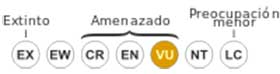
Vulnerable


Rationale for the Red List category: Vulnerable.

Population size: 2500-9999 specimens.

The population trend: In decline.

Rationale for the Red List category

This newly divided species is listed as Vulnerable it is believed to have a small town, which infers that is in decline due to the continuous pressure of capture and loss of habitat.

Justification of the population

The population size of this species has not been formally quantified, but it is estimated preliminarily that has less than 10.000 mature individuals. So, placed in the band 2.500-9.999 mature individuals, which it is supposed equivalent to a total population of 3.750-14.999 individuals, rounded here to 3.500-15.000 approximately. It is presumed that all mature individuals form a single subpopulation.

Justification trend

It is inferred that the population of the species is continuous decrease due to the constant pressure capture and habitat loss (Juniper and Parr 1998).

Threats

Little information is available about threats to this species, but it is believed that the continuous capture for pet trade and the continuous loss of habitat through agricultural expansion, timber harvesting and development are causing a negative population trend.

conservation actions

Conservation actions underway

No specific conservation actions are known for this species., although suitable habitat is officially protected.

Conservation Actions Proposed

Surveys to quantify the population.
Study the habitat needs of the species.
Assess the level of threat of capture pressure.
Using remote sensing techniques to track the change in land use in Mindoro.
Carry out awareness activities to reduce trapping activities.

"Mindoro Racquet-tail" in captivity:

Not found in captivity.

Alternative names:

Blue-crowned Racquet-tail (mindorensis), Mindoro Racket-tail, Mindoro Racquet-tail (English).
Palette ร  couronne bleue (mindorensis), Palette de Mindoro (French).
Mindoro-Spatelschwanzpapagei (German).
Prioniturus mindorensis (Portuguese).
Lorito momoto de Mindoro (espaรฑol).


scientific classification:

Joseph Beal Steere
Joseph Beal Steere

Order: Psittaciformes
Family: Psittaculidae
Genus: Prioniturus
Scientific name: Prioniturus mindorensis
Citation: Steere, 1890
Protonimo: Prioniturus mindorensis

Images "Mindoro Racquet-tail"

ยซLorito Momoto de Mindoroยป (Prioniturus mindorensis)

Sources:

Avibase
Parrots of the World โ€“ Forshaw Joseph M
Parrots A Guide to the Parrots of the World – Tony Juniper & Mike Parr
Birdlife

Photos:

(1) – Mindoro Racquet-tail Prioniturus mindorensis (Young bird with no racquets) in Mounts Iglit-Baco National Park, Mindoro, Philippines by Djop Tabaranza Accessible at hbw.com/ibc/1405853.
(2) – Mindoro Racquet-tail (Prioniturus mindorensis) – https://www.hbw.com/species/mindoro-racquet-tail-prioniturus-mindorensis

Sounds: Desmond Allen, XC79225. accessible www.xeno-canto.org/79225.

โ–ท The world of Pets: Dogs, cats, birds, reptiles, amphibians

Ornate Lory
Trichoglossus ornatus

Lori Adornado

Content

Description

Of 25 cm.. length and 100 to 120 gr. weight.

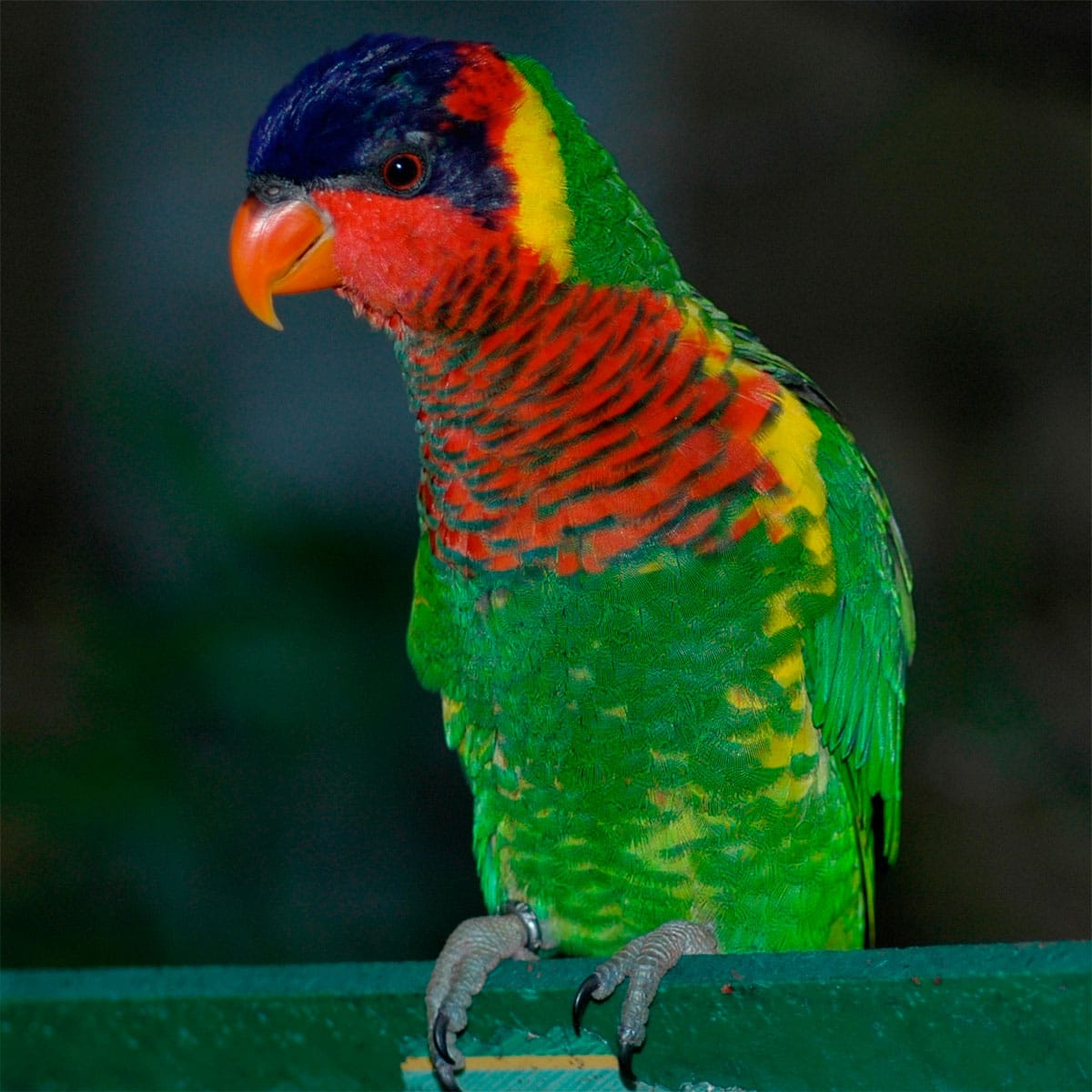
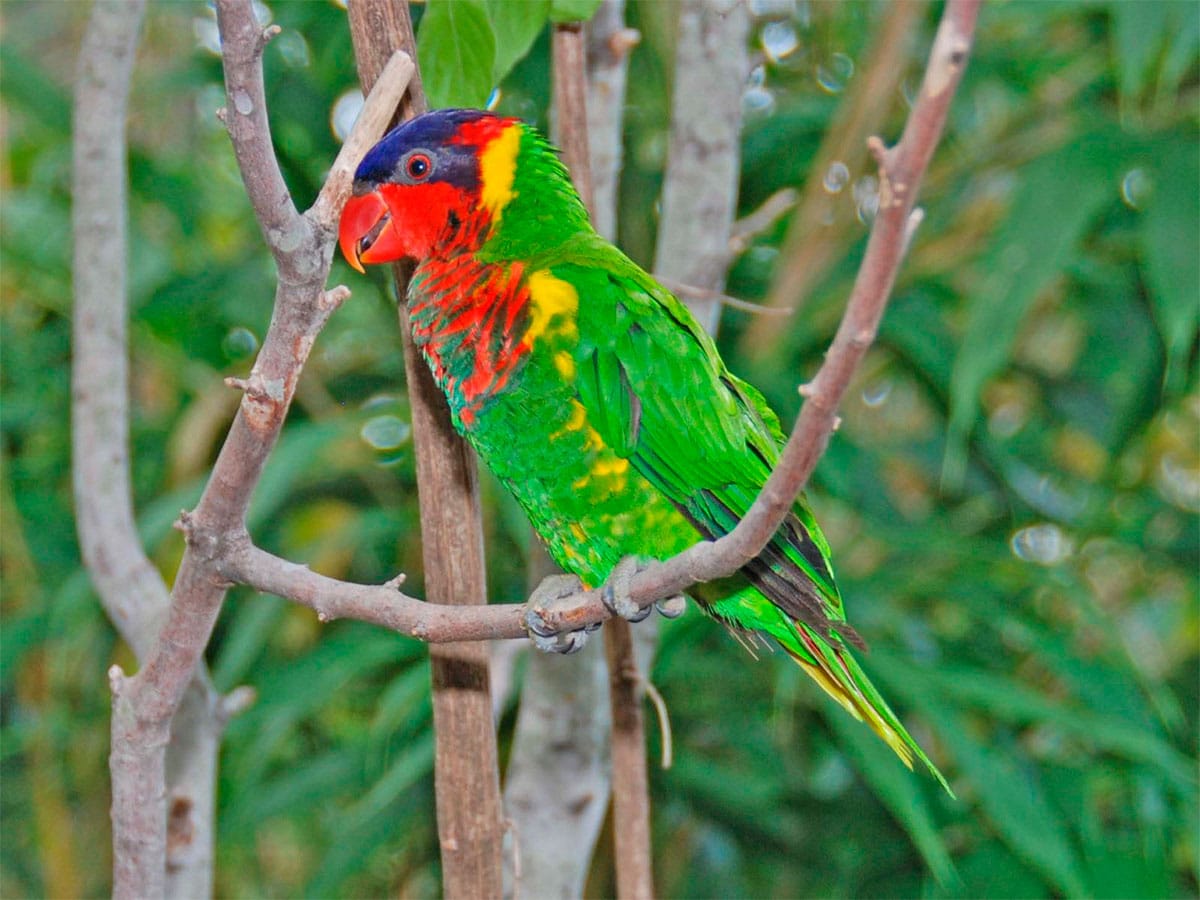
The general plumage of the Ornate Lory (Trichoglossus ornatus) is green. The front, the head and feathers that cover the ears are blue. It has a small red stripe that goes from the upper right corner of the eye to the nape of the neck, It also has a yellow stripe on the sides of the neck. The throat and chest are orange-red and in each pen has a bluish-black wide table. Underwing feathers are yellow.

The rest of the bottom is green with yellowish scales.
Belly pale green with dark green bars. Green-yellow under the tail is bright green ends. The upper part of the tail is dark green with yellow edges in outer feathers. The base of the outer tail feathers is pink.

The circle around the eyes is narrow and dark gray. The iris is red, the legs are grey and orange beaks.

Habitat:

The Ornate Lory they usually visit the swamps and marshy woodlands where there is fresh water. They are also found in the forest, the plots during the regeneration near the edges, scattered shrubs in cropland, including coconut plantations.

Usually, They appreciate the open areas and do not venture far from the primary forests.

In the North and center of the main island, These birds live from sea level up to the 1.000 meters above the sea level, While in the South, You can climb up to the 1.500 m. Its preferred habitat is between 300 and 500 m.

The Ornate Lory They mainly live in pairs or in small groups. Sometimes, when feeding in fruit trees or at the edges of the forest, are associated with the Yellow-and-green Lorikeet (Trichoglossus flavoviridis).

Benefiting from stable climate, These birds are probably sedentary.

Reproduction:

We really know very little about the reproductive habits of this species in the wild.

Most of the birds are able to breed in the months of September and October. There is no information on the construction and composition of the nest.

Spawning usually consists of 3 eggs that are incubated during 27 days. The chicks are nidicolous and depend on their parents during 80 days after hatching.

Food:

The Ornate Lory they are vegetarian birds, most of its menu is made up of nectar, pollen and fruit. When feed, these birds may concentrate in large numbers on flowering trees. The seeds of the trees of the genus Tectona and Casuarina they are also part of their diet.

Distribution:

Distribution Lori adorned
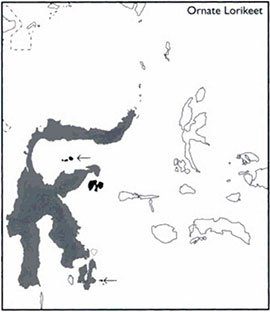
This species is endemic to Indonesia , where is widespread in Sulawesi and surrounds the coast islands including Togian, Peleng, Banggai and the archipelago Tukang Besi. It has been reported that it is no longer common in parts of northern and central Sulawesi, but still seems to be common on the islands Togian and in the lowland forest in Torout (Bogani Nani NP) and to a lesser extent in Tangkoko.

Conservation:


minor concern

– Current IUCN Red List category: Least concern

– The population trend: Decreasing

It has been described as common and locally very common., with a total population of over of 50.000 specimens.

The trend has not been quantified, but slow descents can be seen due to some pressure from capture, and although it does not require primary forest it is more common in the lowlands and therefore may be affected by habitat loss.

It seems that the Ornate Lory is trapped in national parks as Tangkoko and Lore Lindu, and they are commonly seen in bird markets.

"Ornate Lory" in captivity:

Due to its state of decline in its population, any specimen that can not be returned to their natural habitat (natural range) should preferably be placed in a well-managed breeding program to ensure the survival of the species.

Alternative names:

Ornate Lorikeet, Ornate Lory (ingles).
Loriquet ornรฉ (French).
Schmucklori (German).
Lรณris-ornado (Portuguese).
Lori Adornado, Tricogloso Adornado (espaรฑol).

scientific classification:

Order: Psittaciformes
familia: Psittaculidae
Scientific name: Trichoglossus ornatus
Citation: (Linnaeus, 1758)
Protonimo: parrot furniture

Images "Lori adorned":

—————————————————————————————————

ยซLori adornedยป ยป (Trichoglossus ornatus)


Sources:

Avibase
Oiseaux.NET

Photos:

– Ornate Lorikeet at San Antonio Zoo, Texas, USA. by George Coller – Wikimedia
– by ยฉ 2004 Jeff Whitlock – Jacksonville Zoo
– by iggino – IBC.lynxeds.com
– Trichoglossus ornatus parrot eating banana – free-pet-wallpapers.com

Sounds: Mike Nelson (Xeno-canto)

โ–ท The world of Pets: Dogs, cats, birds, reptiles, amphibians

Stephen's Lorikeet
Vini stepheni

Stephen's Lorikeet

Content

Description

19 cm.. length and a weight between 42 and 55 g..

The plumage of the Stephen's Lorikeet (Vini stepheni), in general is green.

The upper part of the head is light green. The region of the windows of the nose, the cheeks, the ear-coverts, the neck, the chest and the abdomen They are red. It has a belt Variable greenish purple size chest. Thighs and bottom of the abdomen They are purple. The Hip is yellowish-green. The feathers wing-coverts They are red and green; the primaries, longer, are black. The upper part of the tail It is yellowish green and the bottom darker yellow with green.

The irises It is reddish brown, the legs and the bill are orange.

The immature they have the underparts green with purple and red marks on the throat and the abdomen. Tail dark green. The bill and eyes They are brown.

Habitat:

Its usual habitat are dense shrubs and trees, Palm trees, handles, coconut and banana plantations.

They make daily trips from the forest into the coastal strips to feed in coconut palms.

They live in pairs or small groups outside of the breeding season.. They are very active and hard to see in dense vegetation; the easiest way to see them is in flight, they are easy to distinguish by their bright red plumage. Its flight is fast with a characteristic buzz of the wings.. They are not shy and allow you to see them up close, are especially when eating.

Reproduction:

There are no data about its reproduction in the wild.

Food:

The Stephen's Lorikeet is omnivore, consumes nectar, pollen and fruits of a wide variety of plants. The flowers of the plants Scaevola sericea and Timonius polygamus They provide the main sources of nectar. Arthropods are part of the diet, including lepidopteran larvae found in the sporangia fern Phymatosorus

Distribution:

Stephen distribution of Lori


The Stephen's Lorikeet is limited to Henderson island in the Pitcairn Islands, a small island uninhabited and surrounded of coral limestone cliffs, in the south-central zone of the Pacific Ocean.

The Pitcairn Islands, Henderson, Ducie and Oeno There are four volcanic islands in the southern pacific ocean. These islands are a British overseas territory (formerly a British colony), the last one left in the peaceful.

In 1987, the total population It was estimated between 720 and 1.820 specimens.


Conservation:


Vulnerable


โ€ข Current IUCN Red List category: Vulnerable

โ€ข Population trend: Stable

This species may be the only member of its genus whose habitat and population size have been little affected by adverse changes in its environment.. But, is qualified as vulnerable, Since it is only on a small island.

It seems to have adapted to the presence of the only introduced predator., the pacific rat (Rattus exulans). In August of 2011, a rat eradication operation was carried out in the Henderson island to eradicate R. exulans of the island. But, the accidental introduction of a more aggressive predator, as other species Rattus, could be devastating. Diseases such as malaria avian and smallpox are another potential threat. The introduction of exotic plant species could have serious consequences for native vegetation and, Therefore, for this species.

– Rat eradication could save seabirds on Henderson Island

Averted a potentially serious threat in 1983 When an American millionaire sought to make a home in the Henderson island. The request was rejected by the Government of the United Kingdom. Henderson is now a world heritage site.

"Stephen's Lorikeet" in captivity:

There are currently no known Stephen's Lorikeet in captivity. VULNERABLE.

Due to its endangered status, any specimen that can not be returned to their natural habitat (natural range) should preferably be placed in a well-managed breeding program to ensure the survival of the species.

Alternative names:

Stephen’s Lorikeet, Henderson Island Lorikeet, Henderson Island Lory, Henderson Lorikeet, Henderson Lory, Stephen’s Lory, Stephens’s Lory (ingles).
Lori de Stephen (French).
Hendersonlori, Henderson Lori (German).
Stephen Lori (Portuguese).
Lori de Stephen (espaรฑol).

scientific classification:

Order: Psittaciformes
Family: Psittaculidae
Genus: Vini
Scientific name: Vini stepheni
Citation: (North, 1908)
Protonimo: Calliptilus ? stepheni

Stephen Lori "Images":

Videos "Stephen's Lorikeet"

————————————————————————————————

ยซLori de Stephenยป (Vini stepheni)


Sources:

Avibase
– Parrots of the World โ€“ Forshaw Joseph M
– Parrots A Guide to the Parrots of the World – Tony Juniper & Mike Parr
– Birdlife

Photos:

1 – by ยฉ Pawl Warren – UK OVERSEAS TERRITORIES CONSERVATION FORUM
2 – By Peter Fitzgerald, Andrew J.Kurbiko, Hansbaer, Openstreetmap (File:Pitcairn Islands map.svg) [CC BY-SA 3.0], via Wikimedia Commons

Sounds: Mark Todd (Xeno-canto)

โ–ท The world of Pets: Dogs, cats, birds, reptiles, amphibians

Red-throated Lorikeet
Charmosyna amabilis

Red-throated Lorikeet

Content

Description

18 cm.. length.

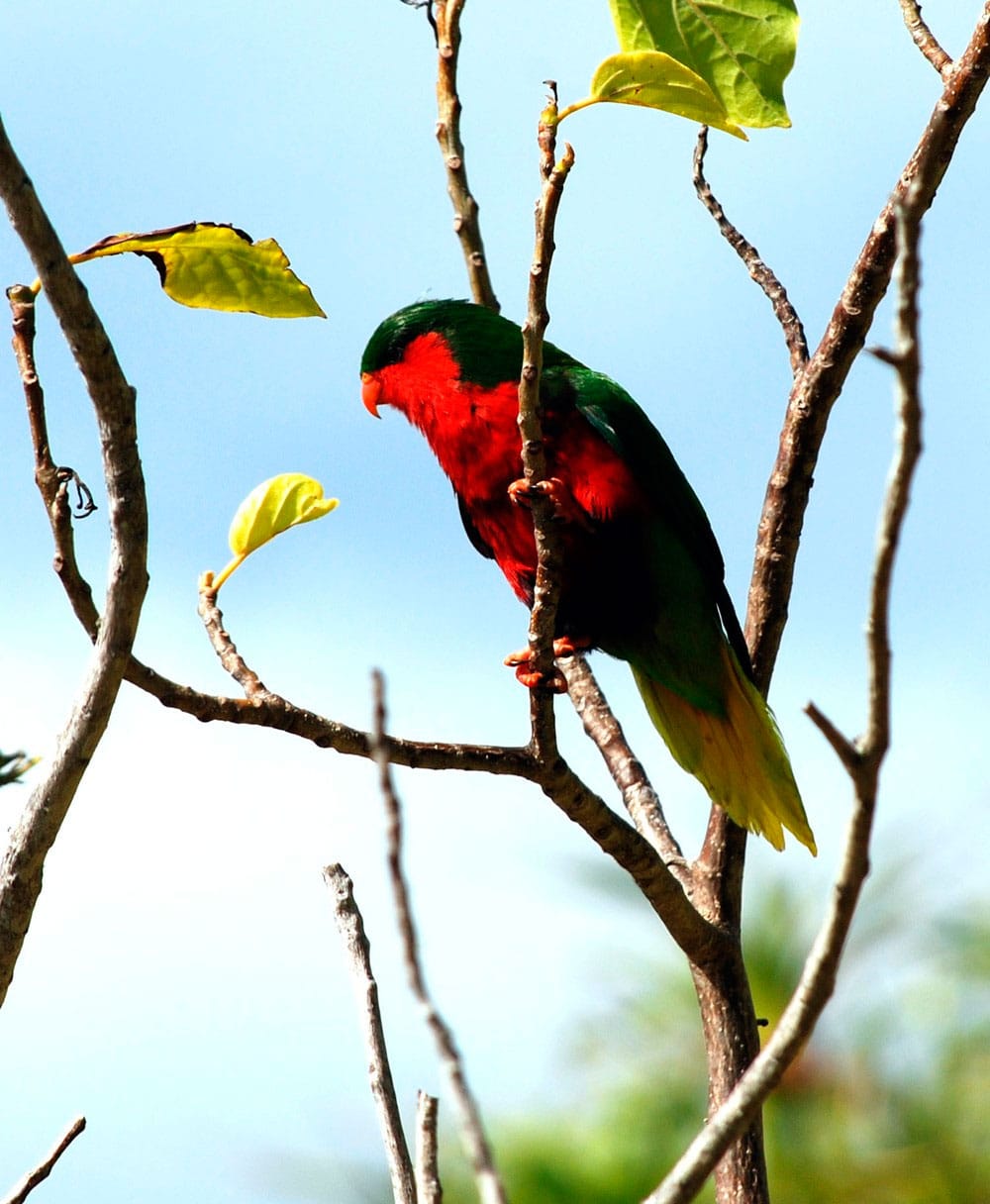
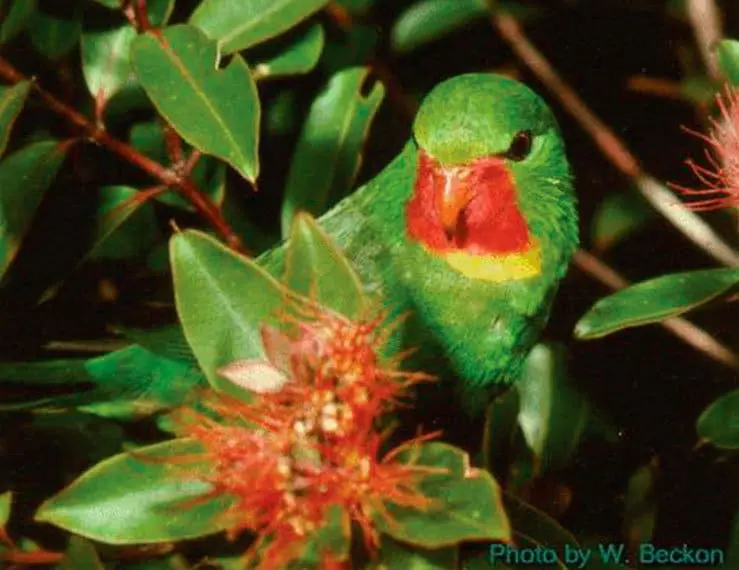
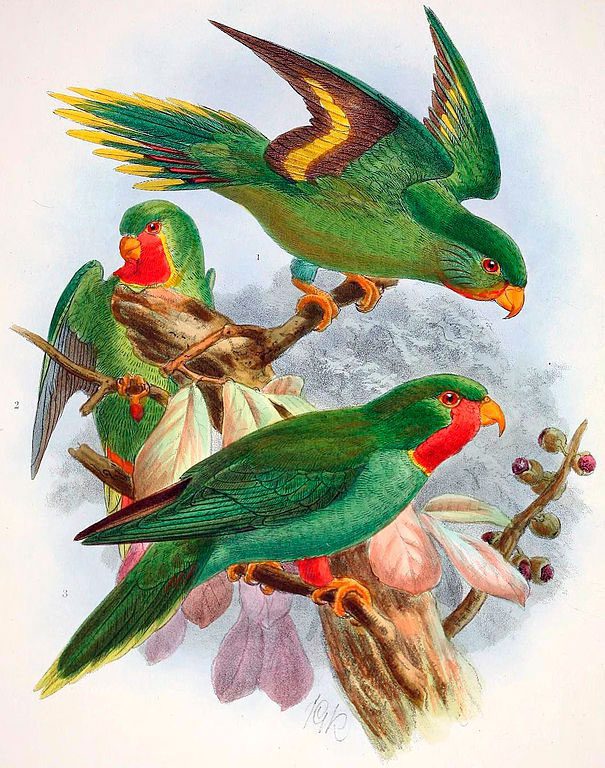
The head of the Red-throated Lorikeet (Charmosyna amabilis) is green with lores and chin red. Upperparts green. Wings internal and ends with green feathers flight feather color black. Throat red, bordered below by a narrow yellow collar; rest of the underparts with a yellowish green that upperparts, particularly in the center of belly; the thighs red. The tail above green a little darker than the rump, with yellow ends; undertail yellow. Bill orange; irises yellow; legs orange-red.

Male and female are equal.

Immature generally duller. The the thighs dull purple. The yellow band throat much weaker than in adults and the red facial and marks throat more restricted.

Habitat:

Move by tropical forests, mainly over the 500 m. Son nomads and fly in pairs or small flocks of 5-8 birds in search of flowering trees, uniting to feed on flowers, nectar and pollen. They prefer to feed in the canopy, and although it is apparently ejected away from the areas of power by the aggressive Collared Lory, Holyoak He found two species feeding on the same tree during his remarks in 1973.

Reproduction:

Breeding and nesting habits unknown.

Food:

They feed actively, to often hung upside down to get to flores.

Distribution:

Size of the area of distribution (reproduction / resident): 37.100 km2

endemic to the Fiji Islands where it is rare and usually only moves above 500 meters and below 1.000 m. Is distributed between in Viti Levu, Ovalau (where it may now be extinct), Vanua Levu and Taveuni. In 1973 Holyoak found at a Red-throated Lorikeet on a wooded Ridge around 250 metres in Viti Levu, species you saw or heard on five different days while exploring Taveuni thinking that the species was widespread in the rainy forests at an altitude between 550 and 1,000 m. The species was also recorded in rainforests between 120 meters and 980 feet by Martyn L. Gorman (1975), but it is said that they are rare. These records are among the few documented sightings of this century. The world's population is believed to be of less than 10.000 specimens. Despite its apparent rarity, This species may be overlooked due to their unobtrusive plumage and behavior.

Conservation:


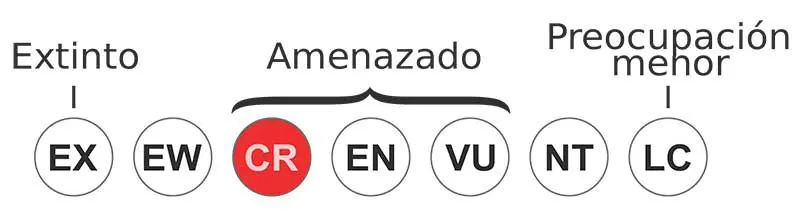
critical hazard


โ€ข Current IUCN Red List category: Critical Hazard

โ€ข Population trend: Decreasing

Threats to the lowlands and hills of the forest is slowly being erased much of Fiji. But, the rarity and assumed decline of this species is probably largely the result of predation by introduced mammals, especially Black Rat (Rattus rattus) , as it is the case with the closely related New Caledonian Lorikeet (Charmosyna diadema).

Increases in course in the logging and the expansion of the road network, especially around the Highlands of Monasavu and Serua in Viti Levu, It is likely that you have caused an increase of the density of these rats (Watling 2000, G. Dutson in litt. 2005). The Indian Brown Mongoose (Herpestes fuscus) introduced, is also present in the areas of distribution of the Red-throated Lorikeet and it can be a threat (V. Masibalavu in litt. 2012).

Agricultural expansion is encroaching on primary forest in Taveuni. Have a distribution in mountains close to the maximum altitude within its distribution area, It also makes this potentially susceptible species to climate change (BirdLife International).

Is species is protected by the laws of Fiji. In Viti Levu, dwells within the Tomaniivi nature reserve, but this is not large enough to maintain a resident population and, Despite the creation of the extension Wabu proposal to make a reservation of adequate size, this would not provide better protection against rats if the reserve is kept unmanaged (D. Watling in litt. 2000)

"Red-throated Lorikeet" in captivity:

Unknown in captivity.

Alternative names:

Red-throated Lorikeet, Red throated Lorikeet (ingles).
Lori ร  gorge rouge (French).
Rothรถschen (German).
Lori de Garganta Roja, Lori Gorgirrojo (espaรฑol).

scientific classification:

Order: Psittaciformes
Family: Psittaculidae
Scientific name: Charmosyna amabilis
Citation: (Ramsay, 1875)
Protonimo: Trichoglossus (Glossopsitta) amabilis

————————————————————————————————

ยซOn Gorgirroยป (Charmosyna amabilis)


Sources:

Avibase
– Parrots of the World โ€“ Forshaw Joseph M
– Parrots A Guide to the Parrots of the World – Tony Juniper & Mike Parr
– Birdlife

Photos:

1 – (Photo by Bill Beckon, 1973)
2 – Charmosyna amabilis By Artwork by John Gerard Keulemans (1842-1912). [Public domain], via Wikimedia Commons

โ–ท The world of Pets: Dogs, cats, birds, reptiles, amphibians

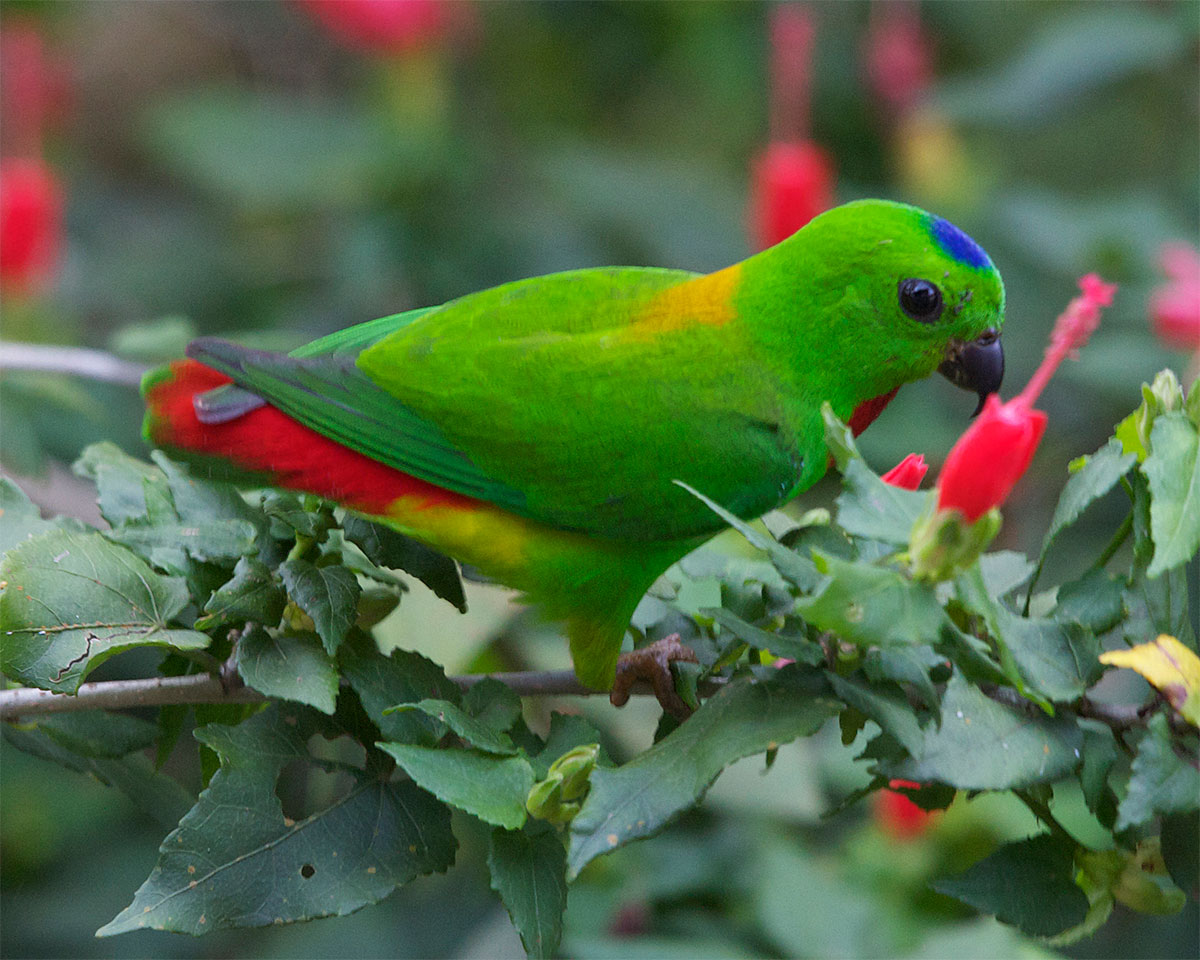
Blue-crowned hanging parrot
Loriculus galgulus


Hanging Coroniazul

Content

Description

Of 13 cm.. length and 28 g. of weight.

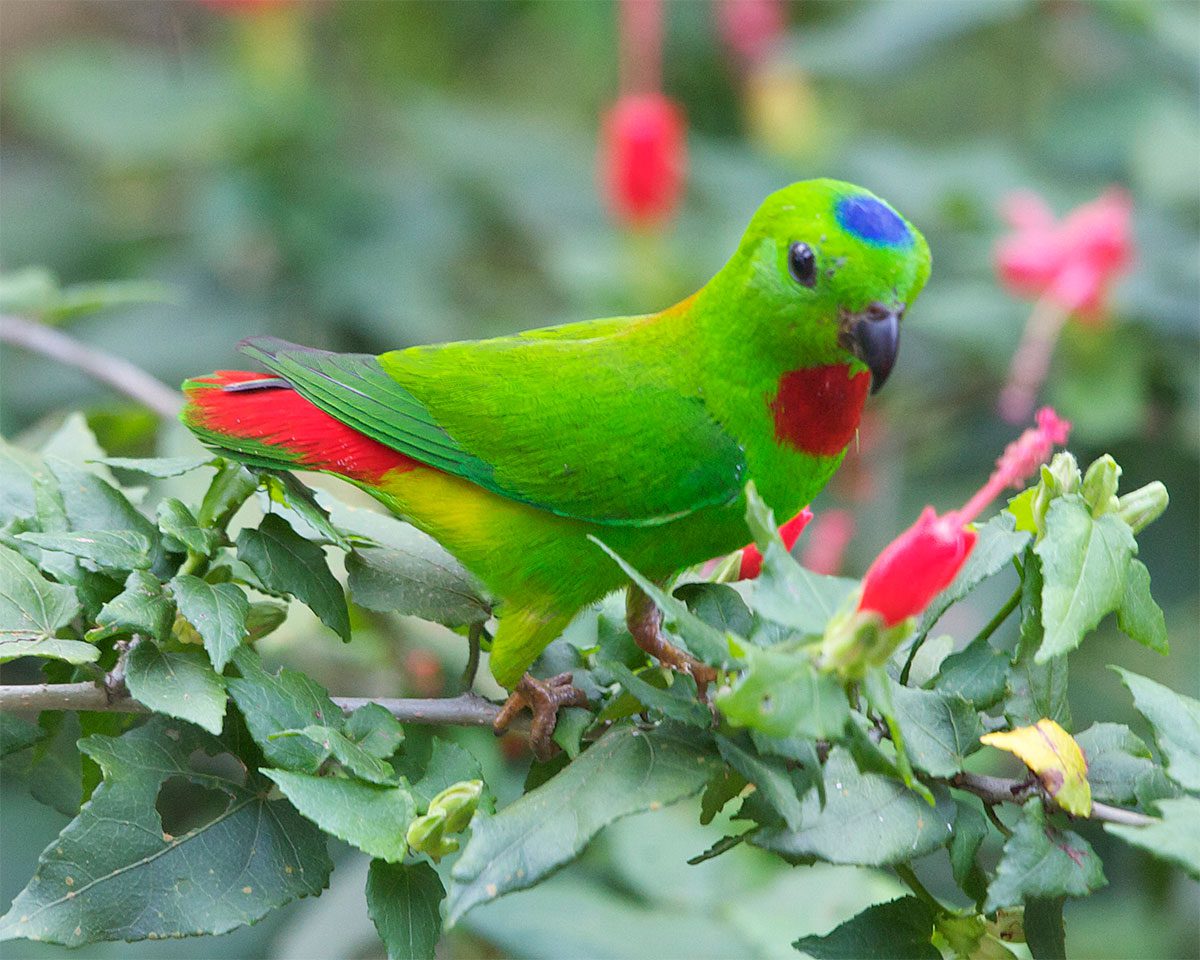
The head of the Blue-crowned hanging parrot (Loriculus galgulus) is bright green with a patch dark blue in the center of the back of the crown. Upperparts Greens with patch orange-brown in the Centre of the the mantle, yellow band at the bottom of the rump and tail coverts scarlet. Wings Greens with vane inner to flight feather darker. Under the wing coats green, with the underside of the flight feather blue. Throat and top of the chest with a patch bright Scarlet, the rest of the underparts slightly of a green pale that the upperparts (and more yellowish on the flanks). Upper, the tail green; Blue below.
Bill black; irises dark brown, legs yellowish brown.

The females lack of the bib red, with the underparts yellowish green. The patch of the crown is much more off, and the the mantle Orange is less marked than in the male.

The young birds lack of the crown blue, they have only an orange wash on the the mantle and bill yellowish. Maturation takes from two to four years in young men, showing the throat Red as the first sign of plumage adult.

Habitat:

Birds have been observed spending the night on the Hill of Fraserโ€™s Hill (Malaysia), which indicates that there is a certain night dispersion. Extralimitales records have also reached coastal islands. The species occurs from the lowlands up to around 1.300 m, lies in the Woods, river banks growing, mangroves, secondary growth, lightly wooded areas, bamboo clumps, orchards, inhabited areas and coconut trees. The birds frequent the canopy and medium height plants, travelling alone, in pairs or. outside the breeding season, in groups of up to 150 birds that invade fruit orchards.

The birds are moving forward with steps balanced through the vegetation with a comical air, using the peak to help upload, and tail as support. Like other hanging parrots, This species sleeping upside down and also uses rain water for bathing in the same position.

Reproduction:

Video "Loricle Coroniazul"

Blue-crowned hanging parrotBlue-crowned hanging parrot

The reproductive behavior you have registered between the months of January and August. When the courtship takes place, the male is shaking his head, cupping their red feathers, extending the tail, with the body upright, and making calls with a soft Twitter.

The nest It is built into the natural cavity in a tree, enlarged by birds, at a height between 5 and 12 meters above the ground.

The Nesting material It is cut by the female and taken to the nest in the contour feathers. The laying is three to four white eggs often dyed Brown. The female incubates the eggs for 20 days and the chicks leave the nest about 33 days after hatching.

Food:

It feeds on flowers, outbreaks, fruit, various seeds and nuts.

Distribution:

Ranges to South, about 10 ยฐ Norte, on the peninsula of Thailand, through Malaysia and Singapore, distributed also in some surrounding islands, including the Anambas Islands, the archipelago of Riau and Batam. The species is widespread through Sumatra and can be seen in the islands of the coast including Tuangku, Nias, Pini, Batu, Siberut, Sipura, Enggano, and to the North of Bangka, Mendanau and Belitung. Is present in a habitat along of Borneo, and the coastal islands Labuan and Maratua. His presence at the end of Java Western, in the area Labuhan, It can be the result of leaks of birds; the population around Jakarta is certainly wild.

Conservation:


minor concern


โ€ข Current IUCN Red List category: Least concern

โ€ข Population trend: Stable

The size of the world's population has not been quantified, but it is thought that it may be superior to 100.000 specimens without registration of captive birds. The species according to information, it is common and widespread in most of its range (pit et to the. 1997).

The population is suspected to be stable in the absence of evidence of any reduction or substantial threats.

"Blue-crowned hanging parrot" in captivity:

These birds are kept in poultry, both in United States as in all Europe. Your dietary needs predispose them to a series of infections if failure to observe stringent hygiene practices, which makes them difficult to keep in captivity. This is the main reason that this species is rare in poultry farming., and even rarer as a pet.

More information at loromania

Alternative names:

Blue-crowned Hanging Parrot, Blue crowned Hanging Parrot, Blue-crowned Hanging-Parrot, Blue-topped Hanging-parrot, Malay Hanging Parrot, Malay Lorikeet, Malaysian Hanging-Parrot (ingles).
Coryllis ร  tรชte bleue, Coryllis ร  calotte bleue, Coryllis de Malacca, Coryllis malais, Loricule ร  tรชte bleue, Loricule de Malacca, Loricule malais (French).
Blaukrรถnchen (German).
Loriculus galgulus (Portuguese).
Lorรญculo Azul, Lorรญculo Coroniazul (espaรฑol).

scientific classification:

Order: Psittaciformes
Family: Psittaculidae
Genus: Loriculus
Scientific name: Loriculus galgulus
Citation: (Linnaeus, 1758)
Protonimo: Psittacus Galgulus

Images ยซLoricle Coroniazulยป:

Videos "Blue-crowned hanging parrot"

————————————————————————————————

"Lorรญculo coroniazulยป (Loriculus galgulus)


Sources:

Avibase
– Parrots of the World โ€“ Forshaw Joseph M
– Parrots A Guide to the Parrots of the World – Tony Juniper & Mike Parr
– Birdlife

Photos:

(1) – By Lip Kee Yap from Singapore, Republic of Singapore [CC BY-SA 2.0], via Wikimedia Commons
(2) – By Quartl (Own work) [CC BY-SA 3.0], via Wikimedia Commons
(3) – By Art Bromage [CC BY-SA 2.0], via Wikimedia Commons
(4) – By Lip Kee Yap from Singapore, Republic of Singapore [CC BY-SA 2.0], via Wikimedia Commons
(5) – By Lip Kee Yap from Singapore, Republic of Singapore [CC BY-SA 2.0], via Wikimedia Commons

Sounds: Marc Anderson (Xeno-canto)

โ–ท The world of Pets: Dogs, cats, birds, reptiles, amphibians

Red-flanked Lorikeet
Charmosyna placentis

Red-flanked Lorikeet

Content

Description:

15 to 18 cms. length and 38 to 48 g. of weight.

The Red-flanked Lorikeet (Charmosyna placentis) has the forecrown and yellowish-green crown; nape green; chin, throat and lores red; ear-coverts dark blue striped strongly light blue. Top green with rump matte blue: uppertail-coverts green. The part superior of the wings It is green with innerwebs and ends the blackish flight feather. Underwing-coverts red; intense yellow band across the innerwebs of the flight feather blackish. Underparts lighter green than yellow upperparts; Strong red marks on the sides of chest and in the flanks below the sides of belly.

The upper part of the tail It is duller green than upperparts, tipped bright yellow, with lateral feathers red in the center of the innerwebs and slightly in outerweb, with a subterminal black mark; lower tail is basal yellow, with black and red marks.

Bill red; irises yellow to orange; legs opaque red.

The female no yellow-green spots on the top of the forecrown, Red in the face, in the chest, in the flanks and at the bottom of the wings (the underwing-coverts are green-yellow). The blue of the ear-coverts It is replaced by a dark patch badly scratched yellow.

Immature as the female, but duller green, and less extensive yellow streaks in ear-coverts (the young male can present a red stain on the face and greenish yellow in forecrown). Iris pale yellow, legs orange-brown.

  • Sound of the Red-flanked Lorikeet.

Subspecies description
  • Charmosyna placentis intensior

    (Kinnear, 1928) – Greener than the species nominal, including the forecrown. Headphones coverts and patch on the rump duller blue-violet.

  • Charmosyna placentis ornata

    (Mayr, 1940) – Mantle green slightly darker than the species nominal, a patch on rump largest darker blue and crown yellower. The Red throat larger in males.

  • Charmosyna placentis pallidior

    (Rothschild & Hartert, 1905) – As the subspecies subplacens, but with upperparts pale green. Headphones coverts light blue in the male.

  • Charmosyna placentis placentis

    (Temminck, 1835) – Nominal.

  • Charmosyna placentis subplacens

    (Sclater,PL, 1876) – It differs from the species nominal by having green, nonblue the rump.

Habitat:

The Red-flanked Lorikeet It, mainly, a kind of lowlands found in primary moist forest, in the forest edge, in Savannah, the secondary high growth, in the monsoon forest, in the swamps of forget (when they are in bloom), in the gallery forest, in eucalypts, in the coastal forest and, occasionally, in the mangroves and coconut palms. It is also found in flowering trees in cultivated areas.

Can be Quiet and discreet and, even when feeding active and noisy, can be difficult to see through thick foliage. They are mostly in pairs, but occasionally in groups 25 or more, looking for food with others Loris with flowers and trees epiphytes or flying through or above the tree tops in small compact and noisy flocks.

Reproduction:

In New Guinea, Several observations of couples investigating arboreal termite mounds They indicate that it is likely that they are preferred for nest. The bases of ferns and moss cultures have also been identified as potential sites nesting. Activity on these sites has been observed between February and October, and it was found that specimens found in eastern Papua New Guinea by Diamond in July and August 1965 They were able to play. In the Vit Islandu, Coates He watched a couple with chicks in mid-August and is likely to play occurring during much of the year.

Food:

Feeds of pollen, nectar, flowers and seeds, mainly in the upper canopy.

Distribution and status:

Extension of the distribution (breeding/resident): 2.800.000 km2

originating Indonesia Oriental, New Guinea and the northern Solomon Islands.

They can be observed from the Moluccan Islands and West Papua New, through lowland West Papua New and Papua New Guinea to Bismarck Archipelago and Bougainville.

Although mostly they found in lowlands, there have been up to 1.600 metres above sea level in Komo, in the highlands of southern Papua New Guinea; They are also common in high altitudes (about 1.150 meters to 1.450 m) in the zone of Karimui, the east, and they do not seem to be anywhere else in the region. reaches 300 metres in New Britain, above which is replaced by the Red-chinned Lory (Charmosyna rubrigularis). In the North of New Guinea It is replaced by the higher altitude Red-fronted Lorikeet (Charmosyna rubronotata).

Widespread and common to locally abundant. It is believed that the world population is at a level of caresses 500.000 individuals and it is stable. small numbers in captivity.

Translation made with the translator www.DeepL.com/Translator

Subspecies distribution

Conservation:


minor concern


โ€ข Current category of the Red List of the UICN: Least concern

โ€ข Population trend: Stable.

โ€ข Population size : Unknown

Rationale for the Red List category

This species has a very extens distribution areato, and therefore does not approach the thresholds for Vulnerable under the criteria of size range (Scope of the presence <20.000 km2 combined with a decreasing area size or fluctuating distribution, extension / habitat quality, o Population size and a small number of locations o Severe fragmentation).

The population trend appears to be stable, and therefore the species does not approach the thresholds for Vulnerable under the criteria of population trend (decrease> 30% in ten years or three generations). The population size has not been quantified, but it is not believed to approach the thresholds for Vulnerable under the criterion of population size (<10.000 mature individuals with an estimated continuous decrease in> 10% in ten years or three generations, or with a specific population structure). For these reasons, the species is assessed as Least concern.

Justification of the population

Global population size has not been quantified, but it has been reported that the species is generally common and sometimes abundant (pit et to the. 1997). Some sources estimate the current population of this Lori in about half a million individuals.

Justification trend

They suspected that the population is stable the absence of evidence of decline or substantial threats.

"Red-flanked Lorikeet" in captivity:

Rare in captivity.

Alternative names:

Blue-eared Lorikeet, Lowland Lorikeet, Red flanked Lorikeet, Red-flanked Lorikeet, Yellow-fronted Blue-eared Lorikeet, Yellow-fronted Blue-eared Lory (English).
Lori coquet, Loriquet ร  croupion bleu, Loriquet joli (French).
Schรถnlori (German).
Loris Charmosyna Placentis (Portuguese).
Lori de Dorso Rojo, Lori Flanquirrojo (espaรฑol).


Temminck Coenraad Jacob

Order: Psittaciformes
Family: Psittaculidae
Gender: Charmosyna
Scientific name: Charmosyna placentis
Subpoena: (Temminck, 1835)
Protonimo: Psittacus placentis

Red-flanked Lorikeet images:

Videos "Red-flanked Lorikeet"


Sources:

โ€ข Avibase
โ€ข Parrots of the World โ€“ Forshaw Joseph M
โ€ข Parrots A Guide to the Parrots of the World – Tony Juniper & Mike Parr
โ€ข Birdlife

Photos:

(1) – A male Red-flanked Lorikeet at Cincinnati Zoo, USA by Ltshears [CC BY 3.0]

(2) – Female Red-flanked Lorikeet at the Louisville Zoo, USA by Ltshears [CC BY-SA 3.0 or GFDL], from Wikimedia Commons
(3) – A pair of Red-flanked Lorikeets at Jurong Bird Park, Singapore by Peter Tan [CC BY-SA 2.0], via Wikimedia Commons
(4) – The image is free from copyright under Creative Commons CC0
(5) – Red-flanked Lorikeet, Male (Charmosyna placentis) at the Louisville Zoo by Ltshears [CC BY-SA 3.0 or GFDL], from Wikimedia Commons

Sounds: Ross Gallardy, XC410521. accessible www.xeno-canto.org/410521.

โ–ท The world of Pets: Dogs, cats, birds, reptiles, amphibians

Shawl-collared Lorikeet
Trichoglossus rosenbergii

Shawl-collared Lorikeet

Content


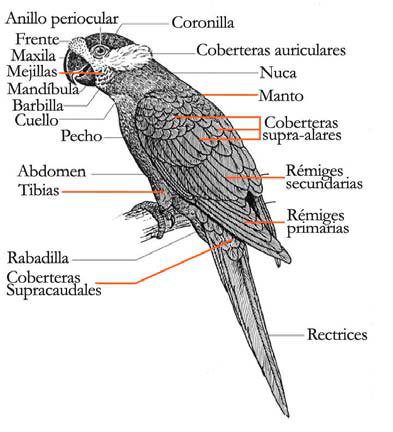
Anatomy-parrots

Description (1)

26 cm.. length and a weight between 132 and 150 gr.

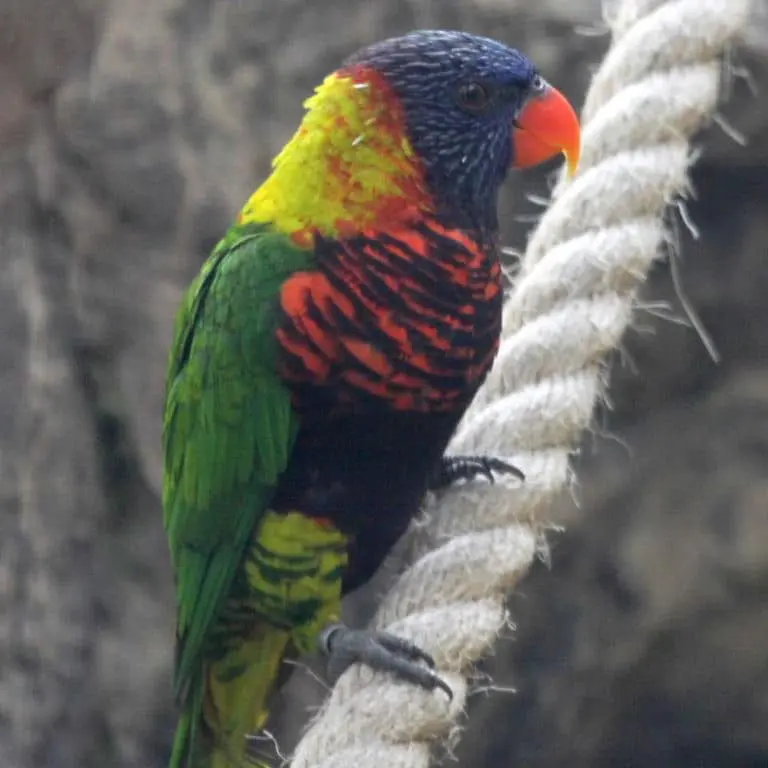
The Shawl-collared Lorikeet (Trichoglossus rosenbergii) is very similar to the Trichoglossus haematodus, but with a stronger blue in the head.

The edges of the breast feathers they are much wider, It has a broad yellow stripe on the neck, ending at the highest point with a red band narrow, their abdomen Violet is blue also has a wide orange stripe inside the flight feather.

The bill is red-orange. The irises They are orange-red and legs grey.

Variation of the nominal (Trichoglossus Haematodus).

Habitat:

They are in a wide range of habitats, including settlements in forests, coconut plantations, savannahs and mangroves.

In their natural habitats, They form small groups noisy that feed on the upper canopy. Often they are seen in mixed flocks with other species of parrots. At night, Community are hundreds of birds.

Son pollinators important species coconut.

Reproduction:

Within its natural range, usually they begin breeding between September and October – although breeding has been recorded in most months.

The average clutch it consists of 2 to 3 eggs. The female incubated eggs for about 24 to 27 days and the young become independent when they are about 80 days old.

Food:

Its diet natural It consists mainly nectar and pollen, but also it includes fruits like figs, citrus, papaya and mangoes open fruit bats. They may also feed on moth pupae and insects.

Distribution:

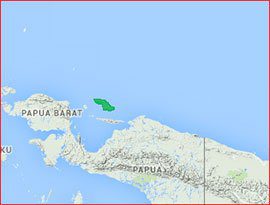
Distribucion-Lori-de-Biak
The reflection of both in the province of Papua, Indonesian.

Conservation:


Vulnerable

The Shawl-collared Lorikeet has a single small population, that can be seen to be decreasing as a result of the loss and degradation of forests, by agriculture and logging subsistence and perhaps also for the capture for trade. So, is qualified as Vulnerable.

The bird population is assumed that can range from 3000-4000 birds.

Alternative names:

Shawl-collared Lorikeet, Biak Lorikeet, Rainbow Lorikeet (Biak) (ingles).
Loriquet de Biak (French).
Biaklori (German).
Loris Arco-รris Rosenbergii (Portuguese).
Lori de Biak (espaรฑol).

scientific classification:

Order: Psittaciformes
Family: Psittaculidae
Scientific name: Trichoglossus rosenbergii
Citation: Schlegel, 1871
Protonimo: Trichoglossus Rosenbergii

Images "Shawl-collared Lorikeet"

————————————————————————————————

    (1) – Subspecies Coconut Lorikeet (Trichoglossus haematodus)

————————————————————————————————

"Both Lori" (Trichoglossus rosenbergii)


Sources:

Avibase
– BirdLife.org

Photos: Rosenbergโ€™s Lorikeet – animalphotos.me