▷ The world of Pets: Dogs, cats, birds, reptiles, amphibians

Mindanao Racquet-tail
Prioniturus waterstradti

Content

Description

Mindanao Racquet-tail

27 cm.. length between 120 and 160 g. of weight.

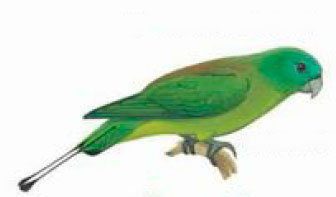
The Mindanao Racquet-tail (Prioniturus waterstradti) has the head bright green, with broadcasting slightly more blue-green in the cheeks, the lores and front of the crown. Duller green mantle; olive rump with different shades. The Green wings, with vane Dark internal to the flight feather, narrow marginalized yellow on the edges Interior; carpal edge yellow, wing feathers green; underside of primaries with blue dye.

The underparts brighter yellowish green, more yellow in undertail-coverts. Upper, the tail green, with side feathers blackish tip; undertail, the tail bluish; Blackish spatulas

Bill light grey; Brown irises; legs blackish gray.

females with extensions of tail more short.

Subspecies:

  • Prioniturus waterstradti malindangensis

    (Mearns, 1909) – Both adults, the color blue in the forecrown and the area under the eyes, paler; less Brown at the back.


  • Prioniturus waterstradti waterstradti

    (Rothschild, 1904) – The nominal

Habitat:

It is distributed in the humid montane forest, mainly between 850 and 2000 m, but have been recorded at altitudes of 450 m. Little is known about the habits of this species, that until recently was considered the same species as the Luzon Racquet-tail. Most of the observations refer to small flocks of between two and ten birds.. Apparently lower than other members of its genus is distributed in densities.

Reproduction:

There are no data on its reproductive ecology.

Food:

Without data

Distribution:

Size of the area of distribution (reproduction / resident): 11.300 km2

Endemic to the Highlands of Mindanao, Philippines. The records come from the Mount Apo, the Mount Malindang, Mount Kitanglad, Mount Mayon, Mount Matutum, Mt. Lebo, Anakan, Civolig, the Mount McKinley, Lake Faggamb and Baracatan, But even though the total population is estimated at 5.000 specimens, currently only limited to five mountains.

Subspecies distribution:

  • Prioniturus waterstradti malindangensis

    (Mearns, 1909) – Southeast of the mountains of Mindanao (Southeast of Philippines).


  • Prioniturus waterstradti waterstradti

    (Rothschild, 1904) – The nominal

Conservation:


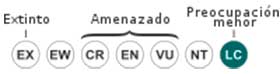
Near-threatened


• Current IUCN Red List category: Near threatened

• Population trend: Decreasing

In 1993, the population was estimated at 5,000 individuals (Lambert et to the. 1993)

The population is suspected that it may be declining due to the continuous degradation of the forests and the capture for the cage bird trade.

Conservation Actions Proposed:

– Collect data on the impacts of the international and domestic trade.
– Review the estimate of the population.
– Calculate loss of forests within their geographic range and altitude using satellite and remote sensing images.
– Protect effectively important tracts of forest right in key places, both in the areas of strict protection, such as multi-use areas.

"Mindanao Racquet-tail" in captivity:

Not found in captivity.

Alternative names:

Mindanao Racquet-tail, Crimson-spotted Racket-tailed Parrot, Crimson-spotted Racquet-tailed Parr, Minadnao racket-tailed parrot, Mindanao Montane Racquet-tail, Mindanao Racket-Tail, Mindanao Racket-tailed Parrot, Mindanao Racquet tail, Mindanao Racquet-tailed Parrot (ingles).
Palette de Mindanao, Palette de Waterstradt, Perroquet à raquette de Mindanao (French).
Mindanao-Spatelschwanzpapagei, Mindanao Spatelschwanz-Papagei, Mindanaopapagei, Mindano-Spatelschwanzpapagei (German).
Prioniturus waterstradti (Portuguese).
Lorito Momoto de Mindanao, Lorito-momoto de Mindanao (español).

scientific classification:

Order: Psittaciformes
Family: Psittaculidae
Genus: Prioniturus
Scientific name: Prioniturus waterstradti
Citation: Rothschild, 1904
Protonimo: Prioniturus waterstradti

Images "Mindanao Racquet-tail"

Video of the "Mindanao Racquet-tail"

————————————————————————————————

«Lorito momo de Mindanao» (Prioniturus waterstradti)


Sources:

Avibase
– Parrots of the World – Forshaw Joseph M
– Parrots A Guide to the Parrots of the World – Tony Juniper & Mike Parr
– Birdlife

Sounds: Desmond Allen (Xeno-canto)

▷ The world of Pets: Dogs, cats, birds, reptiles, amphibians

Green Rosella
Platycercus caledonicus


Green Rosella

Content


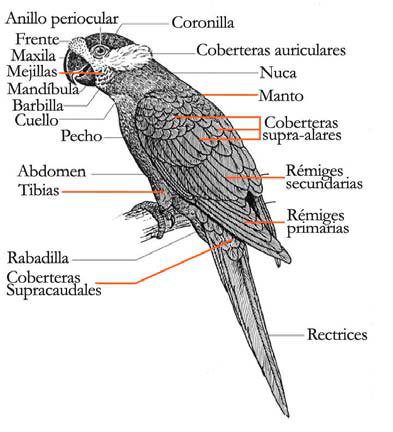
Anatomy-parrots

Description

37 cm.. length between 127 and 142 g. of weight.

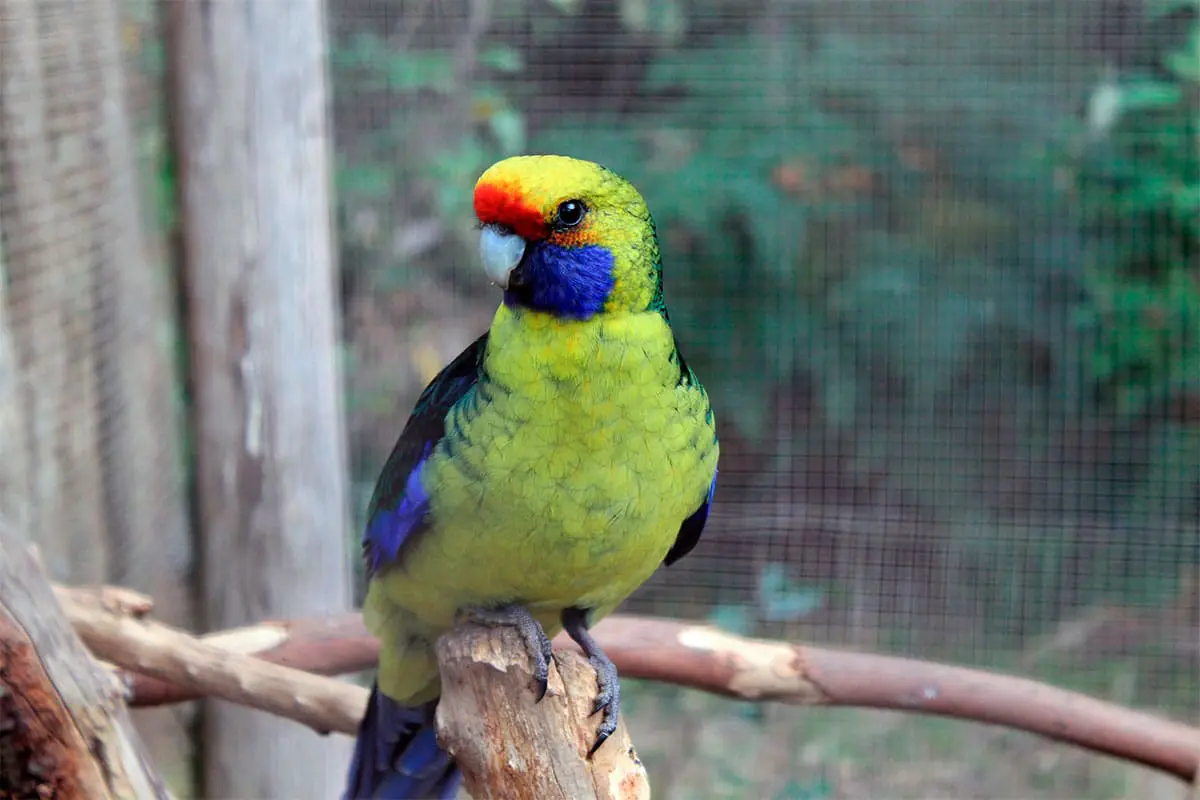
The Green Rosella (Platycercus caledonicus) has the forecrown and lores bright red; a crown of a showy color yellow, marked in red and dotted with of Brown olive dark towards the part rear; area low of them cheeks and throat of color blue cake; ear-coverts a bright yellow, with the edges more dark. Strong contrast between the yellow and the dark area of the crown; Brown olive uniform in the the mantle, with fine dark green stripes on their feathers; feathers of the rump and uppertail-coverts have a diffusion of color yellow orange.

Curve of the wing blue; lesser coverts black; corbeteras internal Middle, black, lined in green dark, the light blue external; greater coverts Blue with feathers Interior black finished off with edges of color green; secondaries Blackish with vane blue externals (innermost with green edge); primaries Brown dark with vane external and dark blue margins; tertiary Brown dark with stripes Green.
Under, the wings blackish, with coverts and axillary blue.

The underparts is of color yellow with a tone clear of Orange and with small spots of color orange on the periphery of the area anal. Upper, the tail olive-green tipped off blue, lateral feathers of color blue pale with them tips white; undertail, the tail of color blue pale with them tips white.

Bill White grey; irises dark brown; legs grey.

The female It is smaller than the male and has the bill smaller; also shows more often a wash of orange-red in the upper part of the chest.

The immature they are more muted than adults, show more green in wing-coverts and have them upperparts of color grey olive and yellow olive in them underparts. Plumage adult is reached after the first comprehensive molt, in a few 15 months.

Subspecies description:

  • Platycercus caledonicus caledonicus

    (Gmelin, JF, 1788) – The species nominal


  • Platycercus caledonicus brownii

    (Kuhl, 1820) – Too little differentiated with the species nominal, according to some experts, to justify the recognition as subspecies.

Habitat:

The Green Rosella they are in all types of forest habitats in the territory in which they reside. But, more and more often, they come in orchards and gardens in urban areas, finding favorable conditions in those places to nest and feed themselves. But, its main habitat are still sclerophyllous forests and thickets. Apparently, on Hunter island, they have a strong preference for small ravines filled with piles of rocks.

Like most of the island birds that live in a small area, to the Green Rosella It is cataloged as sedentary. But, the specimens that live in altitudes of up to 1500 meters in the Alpine regions, they make altitudinal movements and approaching at low altitude towards the coastal regions in winter season. At the end of the nesting season, young birds roam in small flocks which do not exceed more of 4 or 5 individuals. The Green Rosella be associated at times with them Eastern Rosella (Platycercus eximius). Although they are not shy, These parrots take precautions and are very cautious When venturing to Earth to find their food. They prefer to stay in the foliage for this activity. Like most of the parrots, the female is attached to your partner by strong ties conjugal it last for many years. They maintain and strengthen these links practicing processions which are very similar to the one of other parrots.

Reproduction:

The Green Rosella nest during the period from September to February. The nest It is usually placed in a cavity of any branch or hollow tree trunk, normally a eucalyptus. They also occupy, exceptionally, the walls of old buildings. They use abandoned nests of sparrows into disuse.

The spawning usually contains between 4 and 6 eggs and your incubation takes a few 19 days. The chicks are altricial and leave the nest only after 3 weeks after hatching. No additional information on the care and development of the offspring.

Food:

The Green Rosella they eat mainly eucalyptus seeds, Mirto, acacia, ragwort large aromatic flowers, canaigre, Solanaceae (Solanum) and pimelea. Most flowers are toxic to pets.

These parakeets also eat many types of seeds of grasses and shrubs, some of which are at higher altitudes.

Do not disdain the berries of coprosma and the Hawthorn, they represent an important part of their diet in winter. The menu is sometimes supplemented with psyllids they are small homoptera and insect larvae .

Distribution:

Size of the area of distribution (reproduction / resident): 68.100 km2

The Green Rosella they are endemic in Tasmania. Also found in the larger islands of the Bass Strait, that is to say, on isla King and Flinders island. Has also been recorded in the Maatsuyker island, front South of Tasmania.

Birds coming from leaks can be found around Sydney.

The species is common and widespread within its range, with a stable world population of more than 50.000 specimens.

One small number in captivity.

The Green Rosella is protected, but it can be killed with a permit when they cause damage to crops.

The population living in the North of Tasmania It is sometimes differentiated under the name brownii, but this so-called subspecies differences are not as marked enough to consider it as such.

Destribución subespecies:

  • Platycercus caledonicus caledonicus

    (Gmelin, JF, 1788) – The nominal species

  • Platycercus caledonicus brownii

    (Kuhl, 1820) – isla King.

Conservation:


minor concern


• Current category of the Red List of the UICN: Least concern

• Population Trend: Decreasing

The size of the world population It has not been quantified, Although estimated at more of 50.000 specimens. The species according to sources, it is common throughout its small range (pit et to the. 1997).

The population is suspected that it may be declining due to the habitat destruction in course of King Island (pit et to the. 1997).

The Green Rosella It may cause damage to the apple orchards and, Although protected, It can be controlled under a system of licensing.

"Green Rosella" in captivity:

It is not a popular Aviary bird, possibly due to its lack of color and its aggressive reputation.

Alternative names:

Green Rosella, Caledonia Parrot, Green Parrot, Mountain Parrot, Tasmanian Rosella, Yellow-bellied Parakeet, Yellow-bellied Parrot, Yellow-breasted Parakeet, Yellow-breasted Parrot (ingles).
Perruche à ventre jaune (French).
Gelbbauchsittich (German).
Rosela-da-caledônia (Portuguese).
Perico de Tasmania, Rosela Verde (español).

scientific classification:

Order: Psittaciformes
Family: Psittaculidae
Genus: Platycercus
Scientific name: Platycercus caledonicus
Citation: (Gmelin, JF, 1788)
Protonimo: Psittacus caledonicus

«Tasmanian parakeet» images:

Videos "Green Rosella"

————————————————————————————————

"Tasmanian parakeet" (Platycercus caledonicus)


Sources:

Avibase
– Parrots of the World – Forshaw Joseph M
– Parrots A Guide to the Parrots of the World – Tony Juniper & Mike Parr
– Birdlife

Photos:

(1) – A Green Rosella at Tasmanian Devil Conservation Park, Tarana, Tasmania By rockmasterp (Beautiful ParrotUploaded by snowmanradio) [CC BY-SA 2.0], via Wikimedia Commons
(2) – Green Rosella (also known as Tasmanian Rosella) in Tasmania, Australia By Sammy Sam (Picasa Web Albums) [CC BY-SA 3.0], via Wikimedia Commons
(3) – Green Rosella (also known as Tasmanian Rosella) in Tasmania, Australia By Sammy Sam (Picasa Web Albums) [CC BY-SA 3.0], via Wikimedia Commons
(4) – Green Rosella (Platycercus caledonicus), Collinsvale, Tasmania, Australia By JJ Harrison (jjharrison89@facebook.com) (Own work) [CC BY-SA 3.0], via Wikimedia Commons
(5) – Green Rosella (also known as Tasmanian Rosella) in Tasmania, Australia By Sammy Sam (Picasa Web Albums) [CC BY-SA 3.0], via Wikimedia Commons

Sounds: Marc Anderson (Xeno-canto)

▷ The world of Pets: Dogs, cats, birds, reptiles, amphibians

Scarlet-chested Parrot
Neophema splendida

Scarlet-chested Parrot

Content


Anatomy-parrots

Description

19 cm. length and a weight between 36 and 44 g..

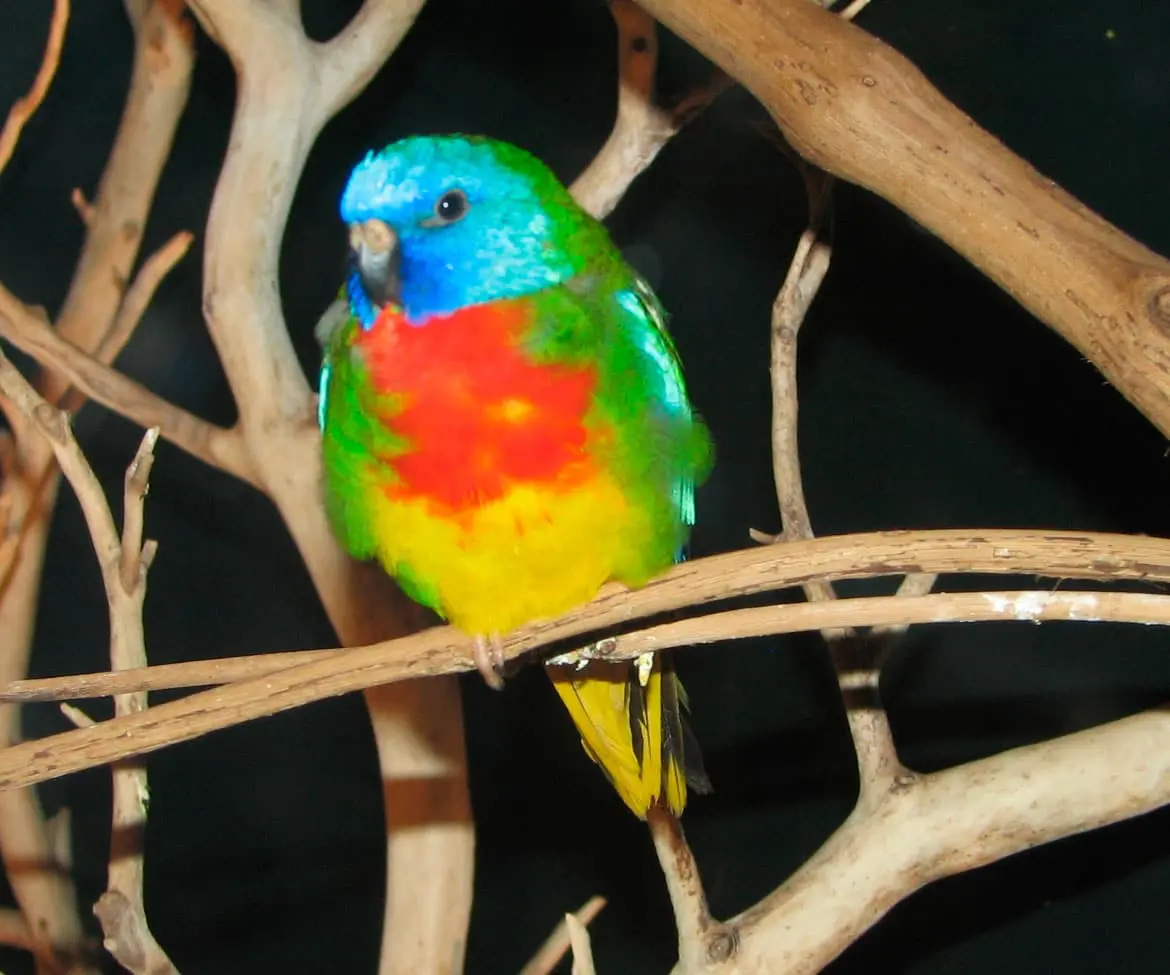
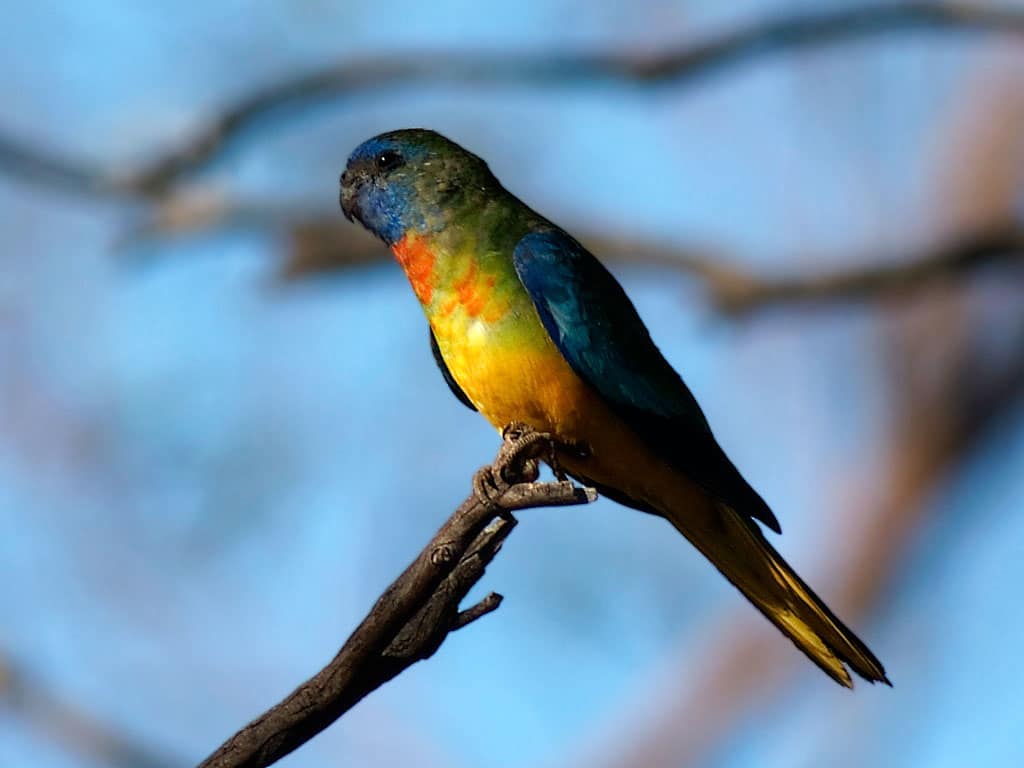
The Scarlet-chested Parrot (Neophema splendida) It is particularly colorful. It has the "face" and the forecrown are bright turquoise blue, darker in the throat and chin.

The upperparts are green. The curvature of the wings is dark blue, wing-coverts are the same blue tone to the face. Primary coverts dark blue-violet. The primaries Black has light blue brainwashed in the foreign bands. The outer edge of the secondaries has a tone blue-green that is mixed with the green of them vane inner and tertiary.

The underparts is dark blue. The chest is bright Scarlet, which is an important recognition feature. The sides of the top of the chest and flanks are green. The rest of the underparts is bright yellow. The bottom of the tail is green, but the tips of the outer tail feathers they are dyed yellow.

The bill is black, irises dark brown. The legs are gray-Brown.

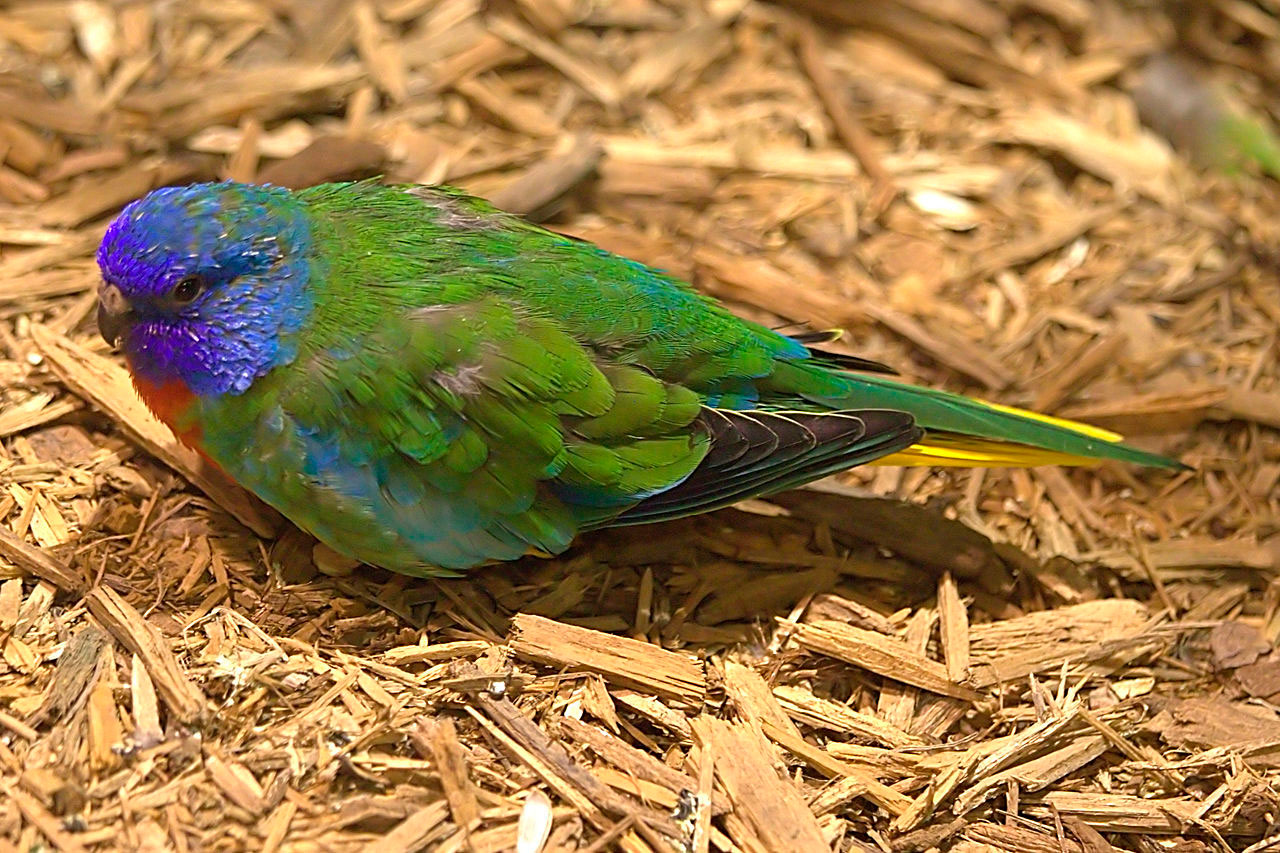
The female is duller than its companion, with the belly and the chest green. The blue color of the face is restricted.

The females and juveniles they often show Wing bars.

The young male need four months to purchase your mature plumage, and retain a youthful glow until the age of 2 years.

Habitat:

The Scarlet-chested Parrot they are usually distributed in arid scrublands that are composed mainly of acacias and eucalyptus. They appreciate, particularly, plants of Mallee (Eucalyptus gracilis) and Mulga (Acacia aneura).

Also live in wooded areas dominated by casuarinas, as well as areas where the soil is covered by Spinifex or large clumps of grass type Triodia.

The Scarlet-chested Parrot do not despise the crests of hills that are equipped with a large number of plants, like the covered Plains of Sea sandwort or Salt grass (Honckenya peploides), What are plants which grow in saline environments.

They tend to find their food on Earth and form relatively consistent flocks outside of the nesting season.

During the breeding season, These birds are not very gregarious, but couples establish their nests in trees not very far from the other.

As with the Turquoise Parrot, the division of labor is well established and the females are responsible for the collection of green leaves that adorn the interior of the nest.

There is no description of the various courtship.

Reproduction:

The season of nesting of the Scarlet-chested Parrot, usually, is carried out between January and August, but these dates can change as the reproduction is influenced, significantly, by climatic conditions, especially the rains.

The nest It is placed in a tree cavity, above all a eucalyptus, between 2,5 and 8 meters above the ground.

The Scarlet-chested Parrot they are very loose colonies.

The spawning includes of 3 to 5 eggs and your incubation lasts a few 18 days. The most numerous litters, sometimes, provide 6 eggs.

The chicks are altricial, they take flight to leave his place of birth 30 days after hatching.

Food:

The Scarlet-chested Parrot they have a diet almost exclusively granivore.

These birds acquire most of the moisture you need eating Succulents as Calandrinia. If this practice is not enough, These parrots are like other species of arid lands, that is to say, that they are going to supply themselves with liquid directly to the sources and water points.

Menu details are poorly known, but it is known that most feed on seeds of plants such as Triodia, Newcastelia, haloragis, Acacia and Stipa.

Distribution:

Size of the area of distribution (reproduction / resident): 1.280.000 km2

This rare Nomad has a wide area of historical distribution, but it is probable that now concentrate on parts with more vegetation of the Great Victoria desert, with records from Kalgoorlie, Western Australia, the East, through the North of the Nullarbor plain in Southern Australia, North of the Eyre Peninsula, about Port Augusta and in areas of Mallee to the North of the murray river, to the Northwest of Victoria, West of New South Wales, Southwest of Queensland and MacDonnell Ranges of the Northern Territory.

A flock of 240 bird was recently recorded in the Great Victoria desert.

Conservation:


minor concern


• Current category of the Red List of the UICN: Least concern

• Population Trend: Stable

The inroads among 1939 and 1996 They show that these birds are able to form very rapidly large gatherings.

Disturbances affecting the natural environment had a negative impact on the evolution of the active population. The use of aquatic resources for the livestock and competition in this field with the Bourke's Parrot they have also caused damage.

Poaching and marketing of this bird have also had devastating consequences: more than 25.000 Scarlet-chested Parrot they are in captivity in Australia.

Its population in freedom is estimated at around 10,000 specimens.

"Scarlet-chested Parrot" in captivity:

The Scarlet-chested Parrot is a species peaceful and silent. This beautiful parakeet ends up gaining confidence with your caregiver, It is only a matter of time. It is also easy to maintain and almost do not eat wood. It is resistant to cold (light Frost), but it is very sensitive to humidity, fog, and air currents.

The Scarlet-chested Parrot they feed on the ground; It is convenient to use of vermicides, deworming them regularly. They are also susceptible to ocular infections and vulnerable to infections of Candida.

The tastes for the bathroom vary from one individual to another.

In terms of their longevity, according to sources, a sample lived during 14 years in captivity. The same sources report that these parakeets can live up to 25,4 years in captivity, but this has not been verified; the same study also ensures that the Scarlet-chested Parrot You can play from around 1 year of age in captivity.

The mutations:

    Aqua: autosomal recessive
    Turquoise: autosomal recessive
    Blue: autosomal recessive
    Pastel: autosomal recessive (not in Europe)
    Cinnamon: recessive sex-linked
    Pale: recessive sex-linked
    Mixed: autosomal dominant
    Misty: autosomal co-dominant (PAS en Europe)
    Gris: autosomal dominant
    Mixed: autosomal recessive
    Fallow (bronze fallow): autosomal recessive
    INO: recessive sex-linked
    Platinum: recessive sex-linked
    Violet: co-dominante autosomique
    Dark factor: co-autosomal dominant

Alternative names:

Scarlet-chested Parrot, Scarlet chested Parrot, Scarlet-breasted Parrot, Scarlet-chested Parakeet, splendid parakeet (ingles).
Perruche splendide, Euphème resplendissante, Perruche resplendissante (French).
Glanzsittich (German).
Periquito-esplêndido (Portuguese).
Papagayo Espléndido, Periquito Espléndido (español).

scientific classification:

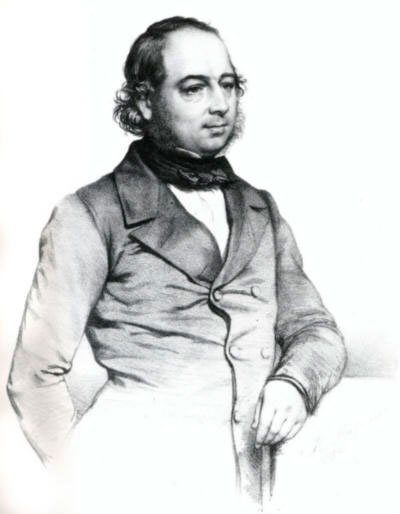
John Gould
John Gould

Order: Psittaciformes
Family: Psittaculidae
Genus: Neophema
Scientific name: Neophema splendida
Citation: (Gould, 1841)
Protonimo: E uphema splendida

«Splendid Parakeet» Images:

Videos "Scarlet-chested Parrot"

————————————————————————————————

«Splendid Parakeet» (Neophema splendida)


Sources:

Avibase
– Parrots of the World – Forshaw Joseph M
– Parrots A Guide to the Parrots of the World – Tony Juniper & Mike Parr
– Birdlife

Photos:

(1) – Adult male at Cincinnati zoo, USA By Ltshears (Own work) [Public domain], via Wikimedia Commons
(2) – Taken at the Cincinnati Zoo By Greg Hume (Own work) [CC BY-SA 3.0], via Wikimedia Commons
(3) – Immature male on the left and an immature female on the right at Gluepot Reserve, South Australia By David Cook Wildlife Photography from Wamboin, NSW, Australia [CC BY 2.0], via Wikimedia Commons
(4) – Immature male on the left and an immature female on the right at Gluepot Reserve, South Australia By David Cook Wildlife Photography from Wamboin, NSW, Australia [CC BY 2.0], via Wikimedia Commons
(5) – Scarlet-chested Parrot «Neophema splendida» at Cincinnati Zoo By Ltshears (Own work) [CC BY-SA 3.0], via Wikimedia Commons
(6) – By T.H. Maguire (1821–1895) (http://www.birdresearch.dk/dk/jgould.htm) [Public domain], via Wikimedia Commons

▷ The world of Pets: Dogs, cats, birds, reptiles, amphibians

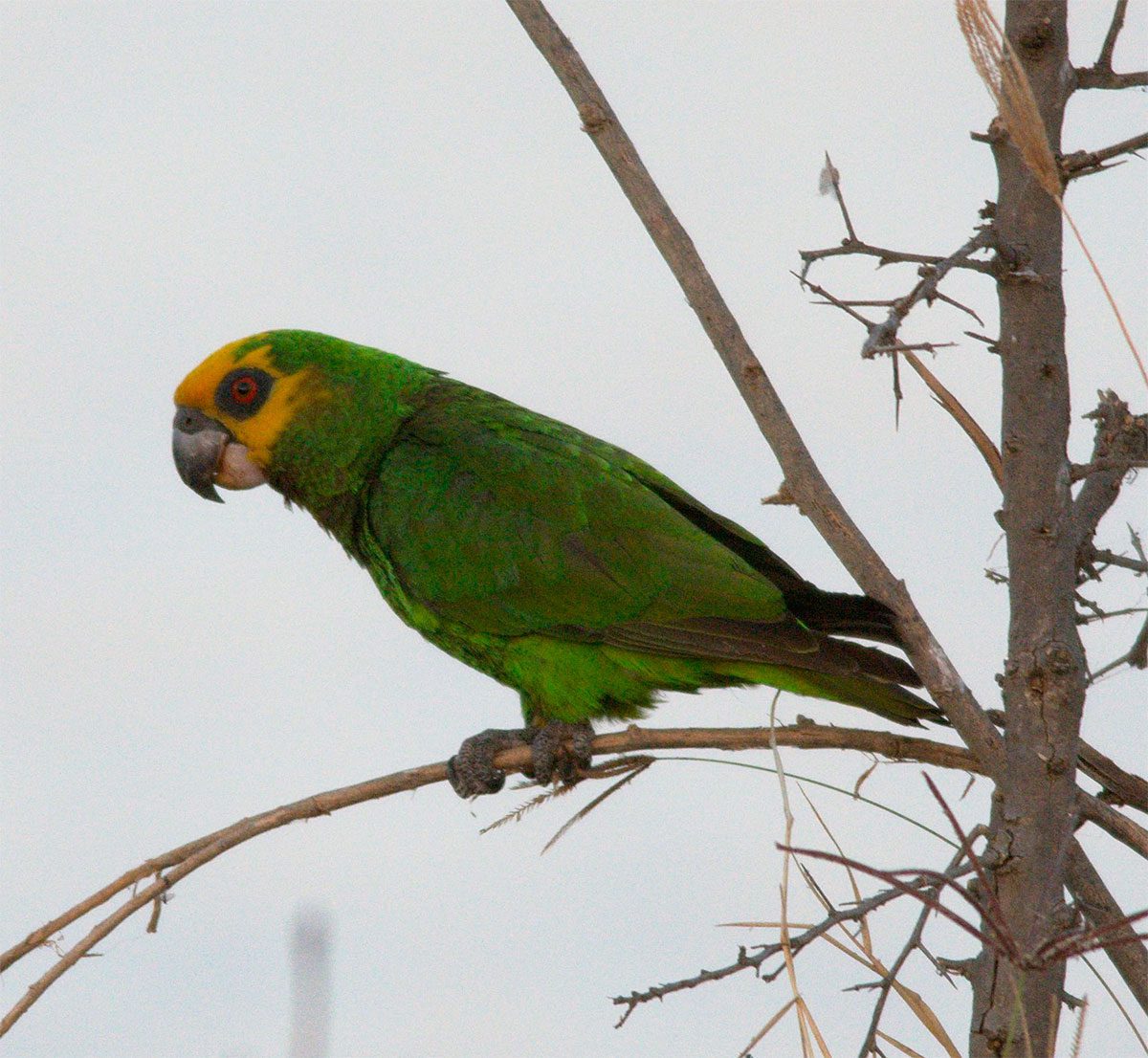
Yellow-fronted Parrot
Poicephalus flavifrons


Lorito Carigualdo

Content

Description:

28 cm.. length and a weight between 140 and 205 g..

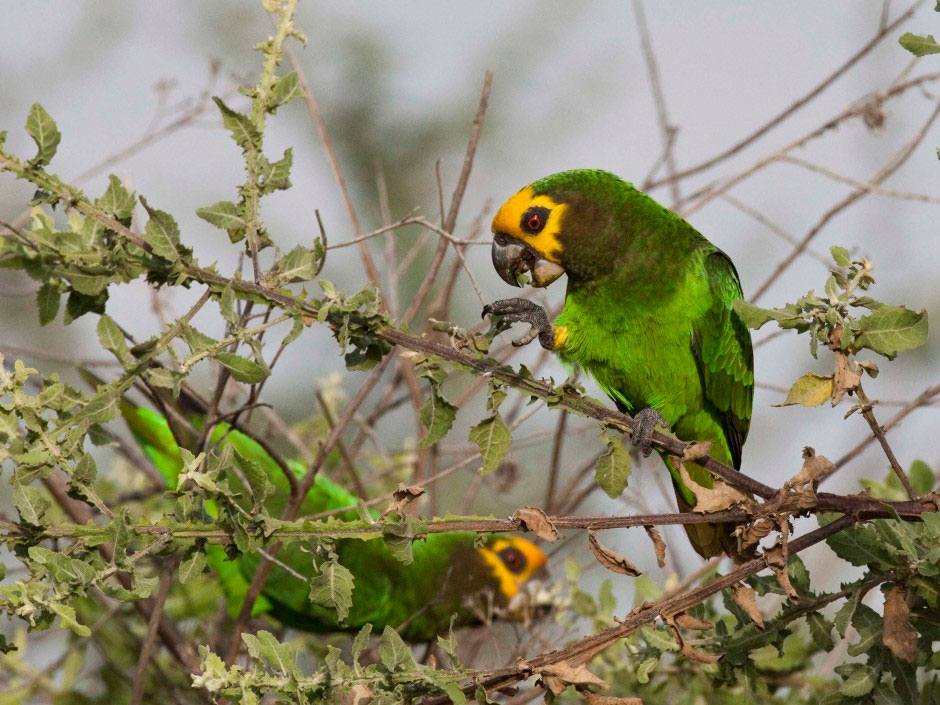
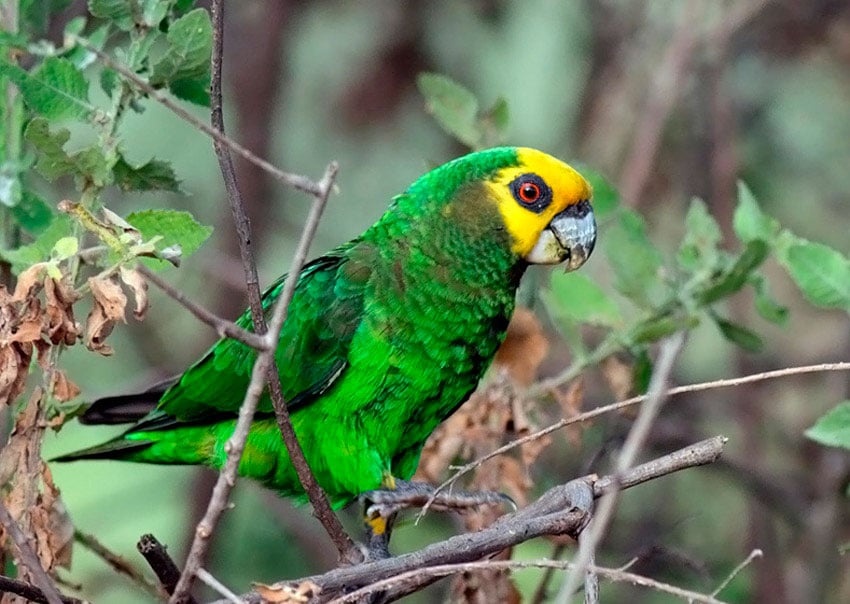
The Yellow-fronted Parrot (Poicephalus flavifrons) has the forecrown, crown, lores, the cheeks and ear-coverts bright yellow, often with an orange colour wash; small area with yellow feathers around the cheek, often with a tinge of Brown-grey color.

The feathers of the nape, the mantle and scapulars dark green with paler areas and most brilliant green margins; rump and uppertail-coverts clearer and more brilliant green as the rest of upper parts.

Upper, the coverts dark green green with light green margins, sometimes with yellow at the edge of the wing and at the base of the primary coverts most important.

The primaries and secondaries brown in color with narrow paler margins on the vane outer. Chin and the thighs sometimes sprinkled with yellow; lower parts of bright green uniform.

Tail blackish brown.

upper jaw blackish gray, lower whitish; irises orange-red; legs brownish-grey.

The mask of the females they lack the Orange wash.

Immature as adults, but the mask is olive green, not yellow.

Habitat:

The Yellow-fronted Parrot, generally, they live in the forests of Juniperus and Podocarpus, at altitudes between 1,800 and 2,900 m, mainly in trees of the genus Hagenia, that are above the 2.900 m. Also found in forest clearings, with Ficus trees intermingled in areas of cultivated plateau and in gallery forests of Acacia savanna. Also in riparian forests of acacias and Ficus, a partir de los 800 m.

Occasionally visit urban areas, for example, gardens and parks in Addis Ababa.
Usually seen in pairs, small groups of relatives or in flocks of up to 20 birds; often in mixed flocks with the Black-winged Lovebird (Agapornis taranta).

The Yellow-fronted Parrot, probably, they use the same products trees every night.

Reproduction:

Breeding habits largely unknown, but it is suspected that nest usually in tree cavities.

The time of incubation is of 28 days. The birds fly from the nest after a few 80 days after the hatching. Even then, by generating it,l feed on the parents until its full independence.

Food:

Your diet, is created that it consists of grains, seeds and fruits. They have also been seen consuming ripe fruits of Dovyalis abyssinica.

Considered a crop pest in some areas, Although of little importance.

Distribution:

Size of its range (breeding/resident): 395.000 km2

Endemic to the Highlands of the West of Ethiopia, Although its exact range is unclear.

Common in wooded areas; more common in the upper parts, to the North of its distribution area.

Probably sedentary Although there have been some periodic movements in Addis Ababa.

Conservation:


minor concern


• Current Red List of UICN: Least concern

• Population trend: Stable

The size of the world's population has not been quantified, but the species is reported from frequent to common. It is considered more common in northern parts of its range. (pit et to the. 1997).

The population is suspected to be stable in the absence of evidence of any reduction or substantial threats.

"Yellow-fronted Parrot" in captivity:

It is a kind rare in captivity outside Ethiopia. No hay datos de su reproducción.
Las hembras son prácticamente imposibles de conseguir.

Alternative names:

Yellow-faced Parrot, African Yellow-faced Parrot, Yellow fronted Parrot, Yellow-fronted Parrot (English).
Perroquet à face jaune (French).
Schoapapagei, Schoa Papagei (German).
Papagaio-de-cara-amarela (Portuguese).
Lorito Carigualdo, Lorito de Cara Amarilla (español).

scientific classification:

Order: Psittaciformes
Family: Psittacidae
Genus: Poicephalus
Scientific name: Poicephalus flavifrons
Citation: (Rüppell, 1842)
Protonimo: Pionus flavifrons

Images "Lorito Carigualdo":

Videos "Yellow-fronted Parrot"

————————————————————————————————

«Parquet-faced» (Poicephalus flavifrons)


Sources:

Avibase
– Parrots of the World – Forshaw Joseph M
– Parrots A Guide to the Parrots of the World – Tony Juniper & Mike Parr
– Birdlife

Photos:

(1) – An adult Yellow-headed Parrot near Bishangari Lodge, Ethiopia By Peter Wilton (Yellow-fronted Parrot) [CC BY 2.0], via Wikimedia Commons
(2) – exploriada.com
(3) – Merenkurkun Lintutieteellinen Yhdistys r.y
(4) – Yellow-fronted Parrot. Photo by Hakan Pohlstrand – Birds of the Bale Mountains National Park
(5) – PET FORO DE VIETNAM

Sounds: Andrew Spencer (Xeno-canto)
▷ The world of Pets: Dogs, cats, birds, reptiles, amphibians

Pacific parakeet
Psittacara strenuus


Periquito Pacífico

Content


Anatomy-parrots

Description «Pacific Parakeet»:

Of 33 cm.. length.

The Pacific parakeet (Psittacara strenuus) has most of its plumage bright green. The underparts are yellowish. Some birds may have some feathers Orange at neck and throat in variable patterns. blue dye in primary coverts and vane outer of the flight feather. Underwing-coverts off yellowish green. The lower feathers of the wings they are yellowish metal.

The bill color horn. Eye ring bare greyish Brown. Iris orange. The legs greyish pale.

The immature they are similar to the adults but with the irises brown.

Note:

The Pacific parakeet (Psittacara strenuus) for a long time it was considered a subspecies of Psittacara holochlorus

Habitat of the “Pacific Parakeet”:

The Pacific parakeet It is in a wide variety of forest types, including wetlands, semi-Bosque, open scrub forests, plantations and farmland with scattered groves.

In Mexico, they live in semi-deciduous forests, riparian vegetation and in the form of patches of semi-deciduous medium and perennial trees of Manilkara zapota, Ceiba petandra, Cedrela odorata, Enterolobyum ciclocarpum, Cordia allidora, Bursera simaruba, Brosimum alicastrum.

Sedentary, but it probably makes local movements in response to food availability.

Outside the breeding season can be seen in large flocks noisy, often in groups of up to 200 birds or more, especially where is food abundant.

In El Salvador, occupy the suburbs of La Sultana, Antiguo Cuscatlán, which it provided an opportunity to estimate the population in the roost, to assess seasonal variations and changes over one year (October 2003 – September 2004). the resting places were also observed in this area and found that these places are used by other parrots as Brotogeris jugularis, Psittacara rubritorquis and other species that probably escaped from captivity.

Reproduction:

Nest in tree cavities, on the walls of rocky cliffs or in termite colonies. Other details about their reproductive behavior remain unknown. The size of the implementation tends to be of 4 eggs.

A colony of the Pacific parakeet (Psittacara strenuus) was studied in the Masaya Volcano National Park in Nicaragua from 1993 until 1994.

The parakeets nested in two craters of the Nindirí volcano. They dug their nests in the soft Earth of the wall of the volcano and began to settle on the volcano at the end of the dry season. They nested Once a year, in the rainy season, and they gradually abandoned the volcano toward the end of that season, when their young could fend for themselves. All parakeets left the volcano during the morning and it was a count in the course of the afternoon, When they return from their feeding grounds.

Food:

Little is known about of its diet. They feed on fruits and seeds, they sometimes attack cereal crops.

Distribution of the «Pacific Parakeet»:

Endemic to the Pacific slope of the Isthmus of Central America, of Oaxaca up to the middle of Nicaragua, mountainous areas of Guatemala to 2.100 meters and El Salvador, where it is a common permanent resident inhabiting forested or semi-forested regions at altitudes of 1.350 m.

Distribution in Mexico: Pacific slope from the east of Oaxaca until Chiapas. In areas in Chiapas and Oaxaca they have disappeared from tropical forests

Conservation:

The Pacific parakeet is not threatened globally. It is considered one threatened species in Mexican legislation. Threatened on NAME-059-ECOL-2001. CITES Appendix II. This species should be classified as in Danger of extinction by their reduced distribution, deforestation of its Habitat and illegal trafficking.

However,They show a high adaptability to changes in natural ecosystems caused by the human.

There are no programs for the conservation of the species.

The "Pacific Parakeet" in captivity:

Rare in captivity.

Its marketing is prohibited in Mexico.

The illegal trade in parrots and macaws is held thanks to demand from consumers. If the demand for these wild species is reduced, then the offer would be reduced and therefore the illegal capture.

If you create an international demand of these captive-bred parrots, there will be unscrupulous traffickers who will try to meet the demand with illegally captured specimens, which will only serve to undermine more wild populations.

Alternative names:

Pacific Parakeet, Pacific Conure (English).
Conure de Ridgway, Perruche du Pacifique (French).
Mexikosittich, Mexicosittich (German).
Periquito-do-pacífico (Portuguese).
Aratinga del Pacífico, Perico Centroamericano, Perico Gorgirrojo, Perico Verde Centroamericano, Periquito del Pacífico, Periquito Pacífico, Perico Chocoyo, Barranqueño (español).
Periquito del Pacífico (Honduras).
perico centroamericano, Perico Verde Centroamericano, Periquito pacífico (Mexico).
Perico Gorgirrojo (Nicaragua).

scientific classification:

Robert Ridgway
Robert Ridgway

Order: Psittaciformes
Family: Psittacidae
Genus: Psittacara
Scientific name: Psittacara strenuus
Citation: (Ridgway, 1915)
Protonimo: Conurus vigorous holochlorus

Images "Pacific parakeet"

Videos "Pacific parakeet"

————————————————————————————————

Sources:

Avibase
– Parrots of the World – Forshaw Joseph M
– Parrots A Guide to the Parrots of the World – Tony Juniper & Mike Parr
– Colony breeding of the Pacific Parakeet Aratinga strenua Ridgway 1915 in the Masaya Volcano National Park, Nicaragua – researchgate
– pericosmexico
academia.edu

Photos:

(1) – Psittacara strenuus (Chocoyo) on the cruise, Nicaragua By SergioTorresC (Own work) [CC BY-SA 4.0], via Wikimedia Commons

Sounds: Frank Lambert (Xeno-canto)
▷ The world of Pets: Dogs, cats, birds, reptiles, amphibians

Bald Parrot
Pyrilia aurantiocephala

Bald Parrot

Content

Description:

23 cm.. length.

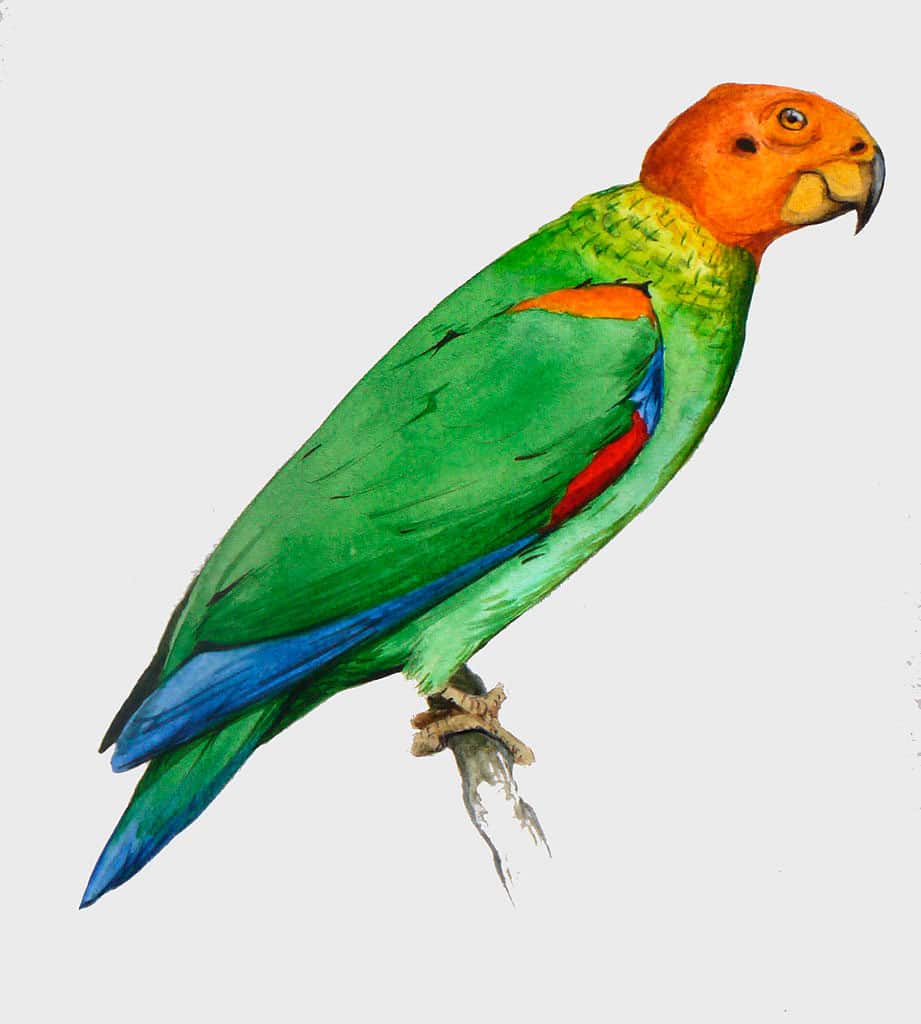
The Bald Parrot (Pyrilia aurantiocephala) has the mandible and the upper maxilla, black with a large orange dot in the base; head naked orange chrome; lores, forecrown, pileum, nape, face and chin no true feathers; coverts only black bristles and some white bristles in lores; true feathers beginning in dorsal area neck, spectrum yellow in proximal half and yellow-green in distal half with black apex, passing rapidly to parrot green as basic color the mantle, back, uropigium, and of the uppertail-coverts; feathers in bend of wing and scapulars, yellowish orange with base scarlet; lesser wing coverts green, except scarlet carpal edge; median and greater wing coverts, with large suffusion of ultramarine blue.

The upper surface of the of remiges black with outerweb shaded with indigo blue; undersurface of remiges black color with a a shamrock greenish on the innerwebs; the outerweb and the apex of the upper surfaces of the rectrices, indigo blue, shaded to varying degrees with green; the base innerwebs of the rectrices, yellow; feathers of the chest with greenish yellow base and apex, forming a large banda pectoral; lower breast, abdomen and crissum, emerald green sprinkled with cyan; underwing-coverts scarlet; the thighs yellow; feet feet orange yellow with suffusion of ochre; irises orange.

The immature with the bare lores to the area around the eyes, orange, the rest of the head feathered dull green; upper breast greenish yellow. Bill yellow in very young birds.

Note:

This parrot was initially believed to be an immature of the species Vulturine Parrot (Pyrilia vulturina) due to the orange color head calva. But, when it was discovered that individuals were sexually mature, He described as a new species. In fact, the youth of both species have feathers head greenish, unlike adults.

Formerly, It was included in the genus Pionopsitta.

  • Sound of the Bald Parrot.

Habitat:

Seen in gallery forest and in forest ‘campinarana‘ (on white sand soils). This region is threatened by logging (Gaban-Lima et al., 2002).

viewed individually, in pairs or small flocks of up to 10 birds. It is most active during the early morning that other parrots, and before going to sleep. It stays in the upper canopy where it is well camouflaged.

Reproduction:

The breeding season possibly either during September; little is known about their breeding habits.

Food:

Feeds of seeds, fruits and possibly larvae of gall wasps (Cynipidae).

Distribution:

Size of its range (breeding/resident): 407.000 km2

The Bald Parrot They are known only in some locations covering the lower basin of Madeira river and the upper basin of Tapajos River in the Brazil Amazon, more specifically in the São Benedito river (Field observations) and Cururu-acu River, both tributaries on the right bank of the river Teles Pires, himself a tributary of Tapajós.
There are several recent records of this new species from the micro-region of Madeira in the vicinity of Borba.

Since the species is currently known only from Two types of habitat and a relatively small area, it is unlikely that the population is much higher 10.000 individuals, so it is considered that it is near-threatened. It is likely to occur more records now that has been formally recognized as a species, and this may clarify its exact state.

Conservation:


Near-threatened


• Current category of the Red List of the UICN: Near-threatened.

• Population trend: Decreasing.

Population size: 6.700 specimens.

Rationale for the Red List category

This species has recently described a moderately small population is declining due to loss of habitat. So, it is classified as near threatened.

Justification of the population

The population is preliminarily estimated with a number of at least 10.000 individuals, approximately equivalent to 6.700 mature individuals. This requires confirmation.

Justification of trend

It is suspected that this species has lost 8,8-13,1% of habitat within its distribution over three generations (21 years) starting from a model of deforestation Amazon (Soares-Filho et to the., 2006, Bird et to the., 2011). So, you suspect your decrease in population <25% durante tres generaciones.

"Bald Parrot" in captivity:

unknown in captivity.

Alternative names:

Bald Parrot, Orange-Headed ParrotT (English).
Caïque chauve (French).
Orangekopfpapagei, Langkopfpapagei (German).
Papagaio-de-cabeça-laranja (Portuguese).
Lorito Calvo (español).

scientific classification:

Order: Psittaciformes
Family: Psittacidae
Genus: Pyrilia
Scientific name: Pyrilia aurantiocephala
Citation: Gaban-Lima, Raposo & Höfling, 2002

Images "Bald Parrot"

————————————————————————————————

«Bald Parrot» (Pyrilia aurantiocephala)


Sources:

Avibase
– Parrots of the World – Forshaw Joseph M
– Parrots A Guide to the Parrots of the World – Tony Juniper & Mike Parr
Birdlife
– Department of Zoology, Bioscience Institute, University of Sao Paulo, Rua do Matao, dish 14, not. 101, POCKET 05508-900, Sa˜o Paulo, SP, Brazil – Notes

Photos:

(1) – Bald Parrot (Pyrilia aurantiocephala) – Watercolor, Romain Risso. By Gossipguy (Own work) [CC BY-SA 3.0], via Wikimedia Commons

▷ The world of Pets: Dogs, cats, birds, reptiles, amphibians

Seychelles Black Parrot
Coracopsis barklyi

Seychelles Black Parrot

Content


Anatomy-parrots

Description:

35-40 cm. length and 132-153 g. of weight.

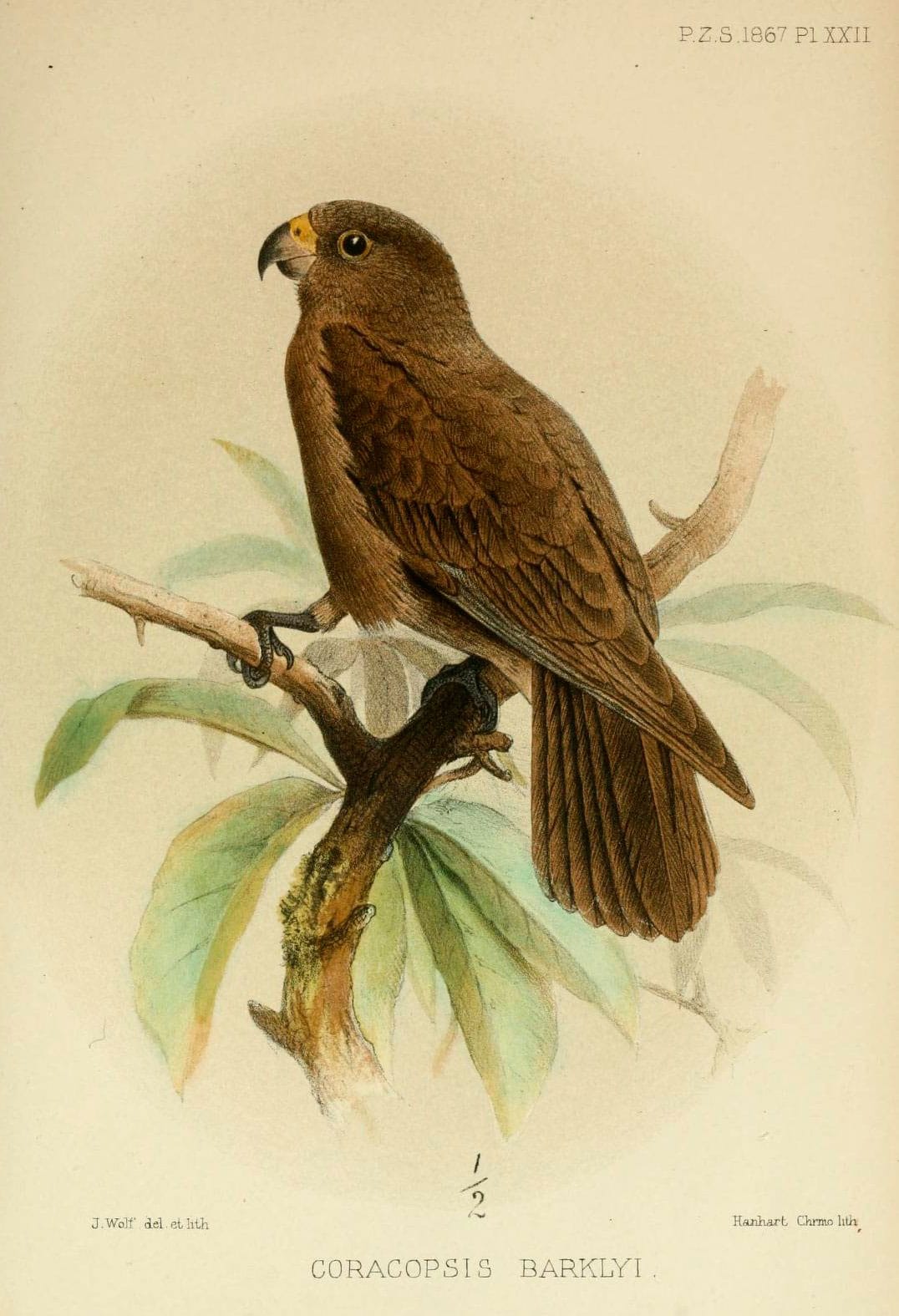
The Seychelles Black Parrot (Coracopsis barklyi) They have a pale brown, less black than the plumage Black Parrot (Coracopsis nigra), but gray / blue reflections in the outer layers of the primary feathers; pale brown patches with slight pale streaks on the crown.

The tone becomes slightly paler in uppertail-coverts.

The underparts They are pale grayish brown. We can see some short lines in throat, while the chest and the belly show a diffuse pale obstruction. The tail is pale-grey.
The bill dark gray becomes paler during the breeding season. The eyes are dark brown, surrounded by a naked orbital gray area. Legs and feet are dark gray to bluish gray.

Both sexes are very similar.

Youth colorization:

Immature paler than adults with a yellowish tinge bill and tips of the feathers tail with pale gray.

Taxonomic status:

Formerly a subspecies of Black Parrot (Coracopsis nigra), originating from Madagascar. Parrots Gender Coracopsis only found in the Western Indian Ocean.

Habitat:

Seychelles Black Parrot

The Seychelles Black Parrot (Coracopsis barklyi) inhabits native and mixed woodland in Praslin, (Rocamora and Laboudallon 2013, A. Reuleaux y N. Bunbury a slightly. 2016). It is also found in cultivated areas and residential areas with gardens, habitats that are suitable feed (A. Reuleaux y N. Bunbury a slightly. 2016). They are usually seen alone or in pairs.

Reproduction:

Their main breeding areas They are in a forest dominated by endemic palms coco de mer (Lodoicea maldivica). The tree species nests in cavities primarily in mer coconut dead, but also registered that nests in cavities and other palms living trees broadleaf (Reuleaux et al. 2014to), with reproductive activity October to March (Rocamora and Laboudallon 2013, Reuleaux et al. 2014to). Preferred deep cavities of hollow logs of L. maldivica with a dense cover canopy over the entrance (Reuleaux et al. 2014to). The reproductive activity fluctuates widely between years (A. Reuleaux y N. Bunbury a slightly. 2016). In a study, the 53% of nests they were successful in 36 nesting attempts, with a 57% incipient year survival (Reuleaux et al. 2014to).

Food:

The Seychelles Black Parrot It feeds on a variety of plant species, most of which are endemic and native (Reuleaux et al. 2014b), mainly from the fruit pulp, seeds and buds, with occasional observations feeding on leaves, flowers, crusts and scale insects (Reuleaux et al. 2014b).

Distribution:

Extending its range (breeding/resident): 70 km2

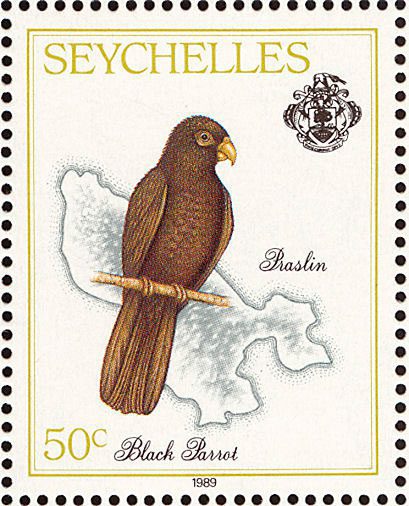
The Seychelles Black Parrot (Coracopsis barklyi) reside in Praslin, with occasional records in Curieuse (to 1 km to the North of Praslin), Seychelles (Reuleaux et al. 2013).

No individual was detected in curious during spot counts over four days and during supplementary fieldwork, so it is assumed that there is no resident population there (Reuleaux et al. 2013).

Conservation:


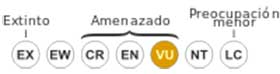
Vulnerable


• Current category of the Red List of the UICN: Vulnerable.

• Population trend: Stable.

• Population size : 340-600 individuals.

Rationale for the Red List category

This newly divided species is listed as Vulnerable because, but it appears to be stable or possibly increasing, their population is still very small, and therefore it is at risk of stochastic events and human impacts.

Justification of the population

Count surveys conducted in Praslin points in 2010 and 2011 They found a density of 0.14-0.24 individuals / ha, as resultadi giving an estimate of the Total population 520-900 individuals (confidence intervals 95%) obtained through the distance sampling methodology (Reuleaux et al. 2013). After reviewing recent survey results, Rocamora and Laboudallon (2013) estimated total breeding population less than 200 couples, suggesting that there might be less than 400 mature individuals. Based on these data, it is assumed that there 340-600 mature individuals in the population.

Justification trend

They suspected that the population is stable the absence of evidence of any reduction or immediate threat. It is believed that the species has increased at least until the beginning of the century, but it is not clear if it is still increasing (Reuleaux et al. 2013, Rocamora and Laboudallon 2013).

Threats

It is believed that the decline of Seychelles Black Parrot before age 60 It was mainly due to predation by introduced rats and hunting conducted by settlers and farmers (Rocamora and Laboudallon 2013). Other causes of increased mortality include capture as pets and trade, and bycatch when targeting other species.

The most serious current threats for the species include diseases such as disease Beak and feather, continuous nest predation by rats and cats, competition from introduced species of birds for food and nesting sites, poaching of their main nesting tree (coco de mer), and habitat destruction caused by fires, with potential threats including persecution, pesticides, bats and kinship networks (Rocamora and Laboudallon 2013, Seychelles Islands Foundation in litt. 2014).

The forest fires They may represent the most serious threat to the species, with records since the beginning of the decade 1980 showing that approximately every 10 years a major fire occurs (The Seychelles Islands Foundation in litt. 2014). The availability of nesting cavities can be a limiting factor in years of very active reproduction, some females occupying suboptimal cavities.

Collection sea ​​coconuts probably reduce the area of ​​palm forest long term.

The presence of the Rose-ringed Parakeet (Psittacula krameri) in Mahe, one of which is registered Praslin, increases the risk of disease.

The impacts of introduced species causing nest predation and competition for nesting sites can not be serious enough to limit the population; However, mice are increasing in Praslin.

The crazy ants or zanconas ants (anoplolepis gracilipes) not appear to have impacted the species so far, probably because they use dead palms, where the appropriate cavities Seychelles Black Parrot.

Chicks predation by cats and dogs is probably limited, and post-harvest mortality is not currently a major concern. The persecution of the species by farmers is considered a minor threat.

Other risk factors for the species include their low genetic diversity and unexplained large fluctuations in reproductive activity of one station to another (Seychelles Islands Foundation in litt. 2014).

conservation actions

Conservation actions underway

The species is protected by law from 1966 (Rocamora and Laboudallon 2013). Endemic palms have been protected from 1991, and the restoration of native palm forest on Praslin and Curieuse is underway. The species is found in the Praslin National Park, created in 1979, and Vallée de Mai It was declared a World Heritage Site in 1983. The Background islas Ferdinand curious y They are administered as nature reserves, but no official protection. Among 1983 and 2005 boxes were provided artificial nesting (Rocamora and Laboudallon 2013, A. Reuleaux y N. Bunbury a slightly. 2016).

In Vallée de Mai there is a firebreak around the brood nucleus, but it is not guaranteed to work in the event of a large fire that can not be contained quickly (The Seychelles Islands Foundation in litt. 2014), However, It has only proved partially effective when a fire destroyed several hectares of breeding habitat high quality 2010 (A. Reuleaux y N. Bunbury a slightly. 2016). Poaching coco de mer nuts it being countered with increased security and a program regeneration, and they have carried out awareness activities to reduce the persecution by farmers. Measures are being taken to eradicate the presence of the Rose-ringed Parakeet (Psittacula krameri) and also they are conducting tests for the virus Psittacine Beak and Feather Disease Virus (The Seychelles Islands Foundation in litt. 2014).

In 2009 a national plan of action was drawn up for the species, It is including plans to introduce the species Silhouette, along with captive breeding in Frigate y North Island, if you can carry out a proper restoration and habitat management (reviewed by Rocamora and Laboudallon 2013). Other conservation identified for this species include control of introduced, the renovation and improvement of nests, population monitoring and public awareness campaigns (reviewed by Rocamora and Laboudallon 2013). Analysis using statistical models is intended to 2014, after annual counts have been made for three years without interruption, and conclusions on the trend of the species will be published from 1982 (G. Rocamora in litt. 2014). Repeating the remote sampling survey is scheduled at intervals 5-10 years (A. REuleaux y N. Bunbury a slightly. 2016).

Conservation Actions Proposed

Carry out further surveys to get a more accurate estimate population size and to monitor the demographic trend. Conduct research on the impacts of potential threats. Protect additional areas of native forest of palms. Suitable restore native habitats. Continue awareness activities to eliminate any residual persecution.

"Seychelles Black Parrot" in captivity:

This species is protected by law from 1966. No copy of Seychelles Black Parrot should be kept in captivity, unless it was under a controlled breeding program in order to reintroduce birds of this species to their habitat.

Alternative names:

Seychelles Black Parrot, Seychelles Lesser Vasa Parrot, Seychelles Parrot (English).
Vasa des Seychelles, Vaza des Seychelles (French).
Seychellenpapagei (German).
Seychelles Black Parrot (Portuguese).
Loro de Seychelles (español).


scientific classification:

Newton Edward
Newton Edward

Order: Psittaciformes
Family: Psittaculidae
Genus: Coracopsis
Scientific name: Coracopsis barklyi
Citation: Newton, E, 1867
Protonimo: Coracopsis barklyi

«Seychelles parrot» images:

Videos "Seychelles Black Parrot"

Seychelles Black Parrot (Coracopsis barklyi)

Sources:

Avibase
Parrots of the World – Forshaw Joseph M
Parrots A Guide to the Parrots of the World – Tony Juniper & Mike Parr
Birdlife

Photos:

(1) – Coracopsis barklyi (=Coracopsis nigra barklyi) by Joseph Wolf [Public domain], via Wikimedia Commons
(2) – Coracopsis barklyi By Post of Seychelles ([1]) [Public domain], via Wikimedia Commons

▷ The world of Pets: Dogs, cats, birds, reptiles, amphibians

Cobalt-winged Parakeet
Brotogeris cyanoptera


Periquito Aliazul

Content

Description:

The Cobalt-winged Parakeet (Brotogeris cyanoptera) measured 15-21 cm.. in height and weighs around 67 g. Distinguishable on the fly by the cobalt blue of the the flight feathers; forecrown yellow and crown with blue dye; chin orange.

Has the tail short and acute. Its bill opaque beige es

Subspecies description:

  • Brotogeris cyanoptera beniensis

    (Gyldenstolpe, 1941) – It has lighter green in all the body and yellow plumage edges in the wing .


  • Brotogeris cyanoptera cyanoptera

    (Pelzeln, 1870) – The nominal


  • Brotogeris cyanoptera gustavi

    (Berlepsch, 1889) – Has the forecrown light green, shoulder yellow and only a patch blue in half of the wing .

Habitat:

Very common. It is found in secondary forest, riparian, edges and savanna, until the 600 m (occasional over of 1000 m). Fly in small flocks of 10 to 20 individuals (rare in couples), feed in the canopy.

Reproduction:

It nests in hollow and termite mounds on tree.

Food:

Its diet probably the same as for most species Brotogeris: fruit nectar, figs, berries and seeds.

Distribution:

Periquito Aliazul

Its population is distributed between the East of Colombia, Southwest of Venezuela to the North of Bolivia and Brazilian Amazon.

Subspecies distribution:

  • Brotogeris cyanoptera beniensis

    (Gyldenstolpe, 1941) – Bolivia.


  • Brotogeris cyanoptera cyanoptera

    (Pelzeln, 1870) – The nominal


  • Brotogeris cyanoptera gustavi

    (Berlepsch, 1889) – Peru.

Conservation:


minor concern


  • Its population has been estimated at more of one million copies
  • .

  • Not considered in any of the threat categories.

"Cobalt-winged Parakeet" in captivity:

Rare in captivity, due to the limited success in reproduction.

Alternative names:

Cobalt-winged Parakeet, Blue-winged Parakeet, Cobalt winged Parakeet (English).
Toui de Deville, Perruche à ailes de cobalt (French).
Kobaltflügelsittich (German).
Periquito-de-asa-azul, Periquito-de-asa-azul, tuipara-de-asa-azul (Portuguese).
Catita Aliazul, Periquito Aliazul, Periquito de Alas Azules (español).

scientific classification:

Order: Psittaciformes
Family: Psittacidae
Genus: Brotogeris
Scientific name: Brotogeris cyanoptera
Citation: (of Pelzeln, 1870)
Protonimo: Sittace cyanoptera

Images "Cobalt-winged Parakeet"

Videos "Cobalt-winged Parakeet"

————————————————————————————————

Cobalt-winged Parakeet (Brotogeris cyanoptera)


Sources:

Avibase
– Parrots of the World – Forshaw Joseph M
– Parrots A Guide to the Parrots of the World – Tony Juniper & Mike Parr
– Birdlife