▷ The world of Pets: Dogs, cats, birds, reptiles, amphibians

Flores Lorikeet
Trichoglossus weberi

Flores Lorikeet

Content

 Flores Lorikeet

Description Lori Flores:

25 cm. length and 100-150 g. of weight.

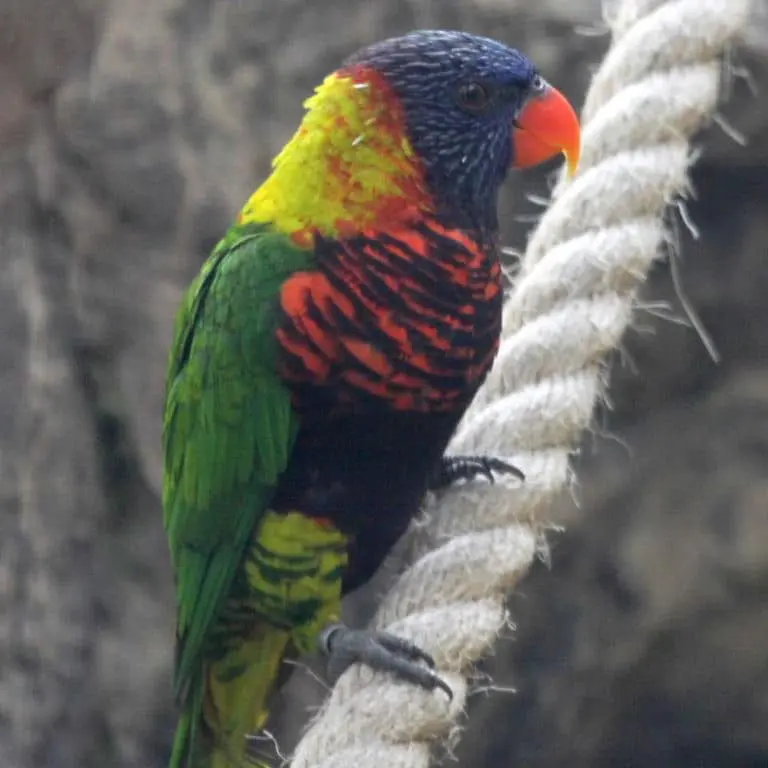
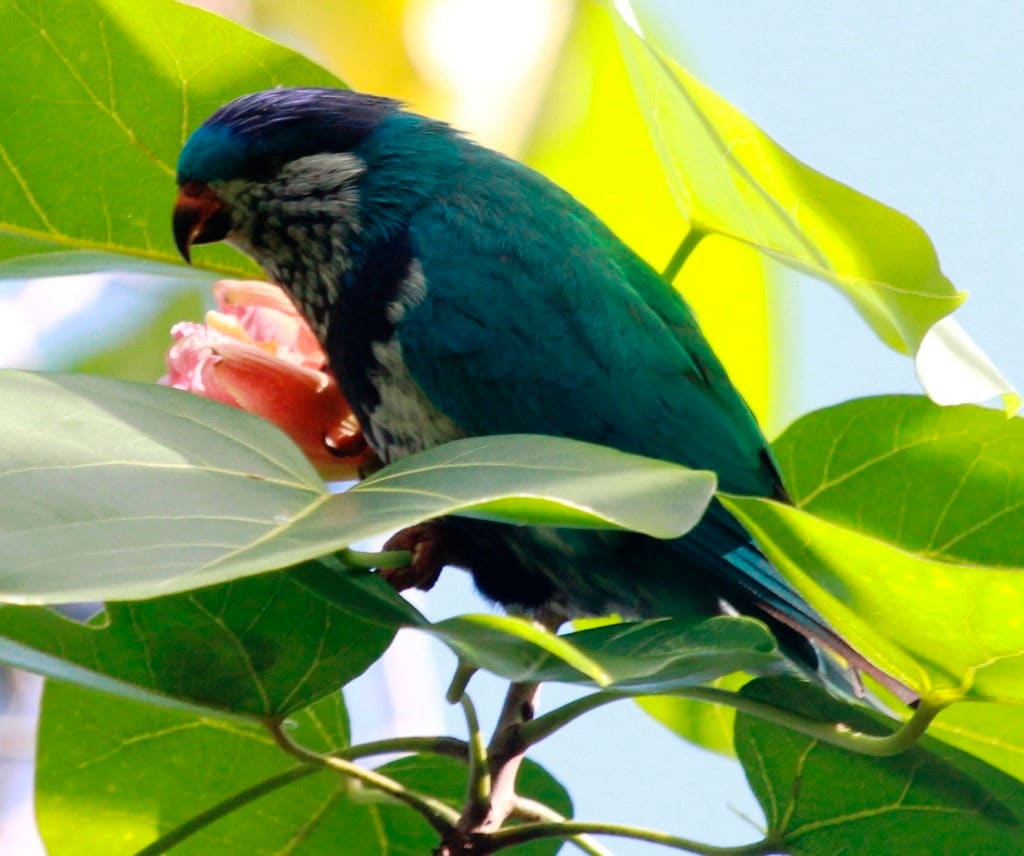
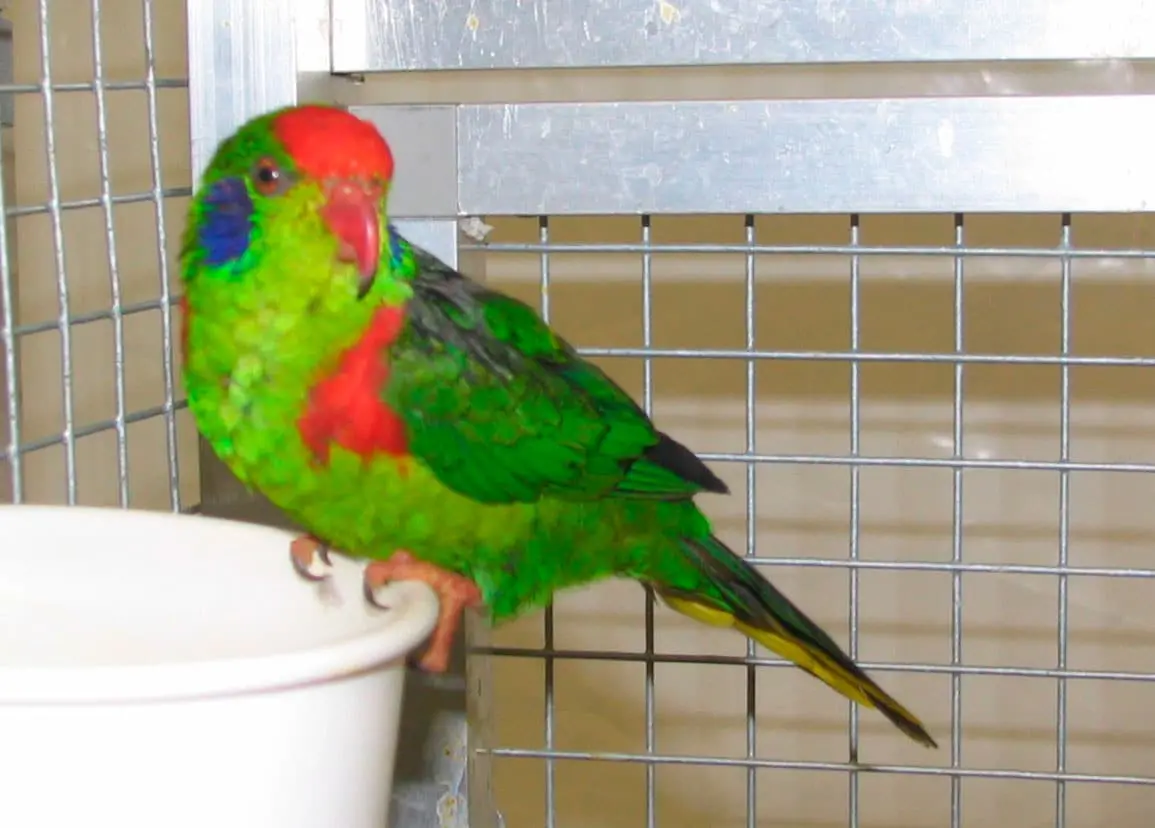
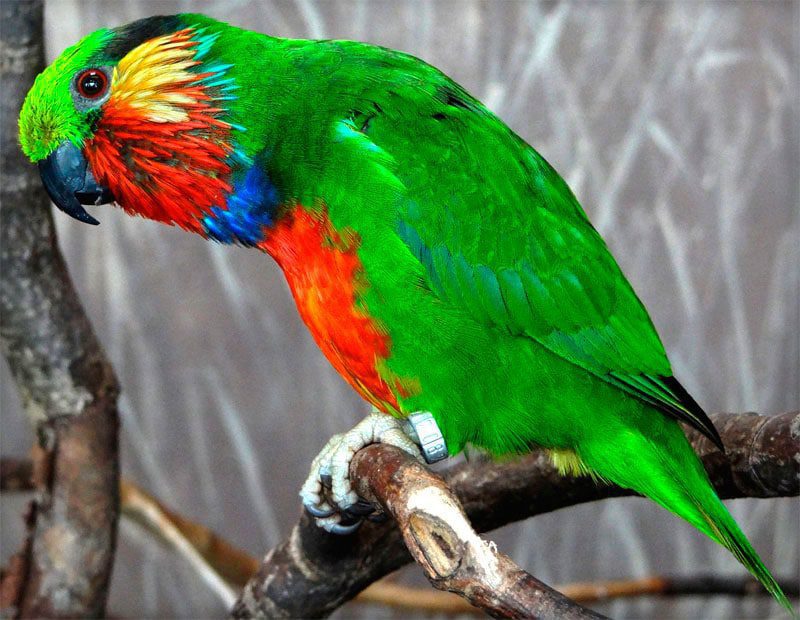
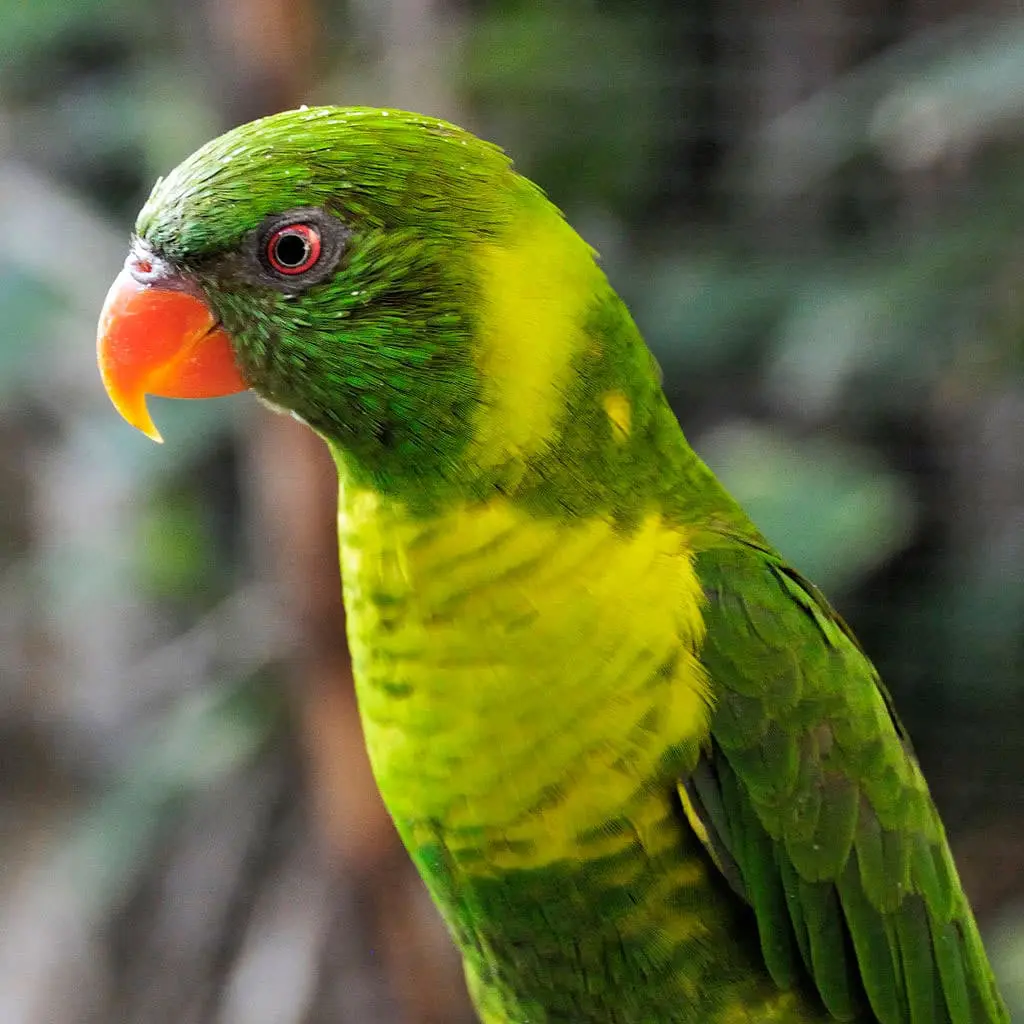
The Flores Lorikeet (Trichoglossus weberi) is generally Green; light green / blue stripes on the forecrown and lores, the rest of the head with brighter green stripes; underwing-coverts yellow / green. The chest and the thighs are yellowish or reddish. The bill It is orange-red and irises orange-red. The legs son grises. Smaller size than other species Trichoglossus.

The youth they are similar to adults.

    taxonomy:

Sometimes you think you're closer Olive headed Lorikeet (Trichoglossus euteles). With one exception, so far it has been treated as a subspecies within the complex Coconut Lorikeet (Trichoglossus haematodus), but differs in its chest rather pale green; abdominal patch medium green; head dark green with streaks of bright green; small size (less than a Scarlet-breasted Lorikeet (Trichoglossus forsteni) relatively small). Monotypic.

  • Sound of the Flores Lorikeet. (1)

(1) Some species are under extreme pressure because of traps and harassment. The open availability of high-quality recordings of these species may make the problems even worse.. For this reason, transmission and download of these recordings is off. Recorders are free to share in xeno-edge, but they will have to approve access to these recordings.

Habitat:

It's more common in the lowlands, but it is up 2400 meters above sea level. Wide variety of areas including settlements, forests, coconut plantations, Savanna, eucalyptus forests and mangroves.

It is found in mixed flocks with other parrots; small and noisy groups. Nomads, since they depend on flowering trees. It perches communally in groups of hundreds of birds.

Reproduction:

Birds have been recorded in conditions reproduction in June and is reported reproduction between February and August (White and Bruce 1986, Reeve y Rabenak 2016).

It will nest on the ground in some of the predator-free islands.

Food:

It feeds mainly from nectar, but also feeds on figs, insects and can be found around artificial feeding stations.

Distribution:

Extension of the distribution (breeding/resident): 25.500 km2

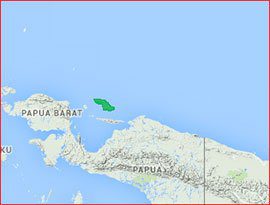
The Lori Flores are endemic to the flower island, Indonesian, where it is described as common (pit et to the. 1997).

Conservation Lori Flores:


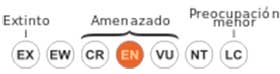
Near-threatened

1. Current red list category of the UICN: Near-threatened.

2. The population trend: Decreasing.

3. Population size : 10000-19999 individuals.

    Rationale for the Red List category

It is believed that this species has recently split a moderately small population (approaching 10.000 mature individuals), forming one subpopulation, inferring that is suffering moderately rapid decreases due to the pressure of capture and loss of habitat. So, It has been classified as Near threatened, but more information on population size, trends and threats can lead to a reassessment of their status.

    Justification of the population

It is believed that the population of Flores Lorikeet It is moderately small (that is to say, approaching 10.000 mature individuals).

    Justification trend

They suspected that the population is declining due to loss of habitat and unsustainable levels of exploitation.

    Threats

The habitat destruction through the combined impacts of firewood collection, commercial logging, timber extraction for construction materials and clearance for agriculture may represent the most relevant threat.

The loss and fragmentation of forests It is already extensive in Flowers, where no semi-permanent forest below the 1.000 meters is included within the protected areas published in the Official Gazette. These threats are exacerbated by the expansion of human population, with large volumes of wood needed for housing construction, and the fact that the application of the laws by the government is little or no.

The moist deciduous forest is being cleared extensively through land grabbing and the establishment of agricultural areas, a factor that is inevitably reducing the range and population of this species. Forest clearing continues in the coastal belt to make way for crops, and illegal logging continues in protected areas.

It is presumed that the capture for trade in wild birds It represents an additional threat, as for other subspecies of the complex (Trichoglossus haemotodus).

Conservation actions and research in progress

Appendix II of the CITES. CMS Appendix II. It has been recorded in the Mbeliling Forest Reserve (Reeve y Rabenak 2016).

Proposed Research and Conservation Actions

1 – Estimate the population and assess population trends and scale of the pressure catch.

2- Conduct a species-specific study to identify important sites, in order to provide protection.

3- Carry out research on their status and habitat use (with special attention to feeding ecology and forest fragmentation) so that long-term management of the species facilitate.

4- Monitor trade to investigate whether this represents a significant threat.

5- Initiate campaigns sensitization to get the support of local people in forest protection.

In captivity:

In captivity it is kind enough rare de lori. He was raised for the first time Great Britain, in 1969, in Germany in 1984.

Because of its endangered status, Any suitable specimen can not be released back into their natural habitat (native range) It should preferably be placed in a breeding program well managed to ensure the continued survival of this species.

Alternative names

Flores Island rainbow lory, Flores Lorikeet, Leaf Lorikeet, Rainbow Lorikeet (Leaf) (English).
Loriquet à tête bleue (Weber), Loriquet à tête bleue (weberi), Loriquet de Flores, Loriquet de Weber (French).
Flores Blauwangenallfarblori, Flores-Allfarblori, Webers Lori (German).
Periquito-arco-íris (weberi) (Portuguese).
Lori de Flores, Lori Arcoiris (weberi) (español).

scientific classification:

Order: Psittaciformes
Family: Psittaculidae
Gender: Trichoglossus
Scientific name: Trichoglossus weberi
Subpoena: (Buttikofer, 1894)
Protonimo: Psitteuteles weber

"Lori de Flores" images:

Videos "Flores Lorikeet"


«Lori de Flores» (Trichoglossus weberi)


    Sources:

    1. Avibase
    2. Parrots of the World – Forshaw Joseph M
    3. Parrots A Guide to the Parrots of the World – Tony Juniper & Mike Parr
    4. Birdlife

    Photos:

    (1) – Flores Lorikeet, Trichoglossus (haematodus) weberi, at New Port Aquarium, Cincinnati, USA by derivative work: Snowmanradio (talk)Trichoglossus_haematodus_weberi_-New_Port_Aquarium-8.jpg: Serge Melki [CC BY 2.0], via Wikimedia Commons
    (2) – Weber’s Lorikeets (Trichoglossus haematodus weberi) at Newport Aquarium by Ltshears [CC BY-SA 3.0 or GFDL], from Wikimedia Commons
    (3) – Fig. 1: Flores Lorikeet (Trichoglossus = Psitteuteles Weber Weber)
    Fig. 2: Olive-headed Lorikeet (Trichoglossus euteles = Psitteuteles euteles) by A Weber’s lorikeet (Trichoglossus weberi) at the Jerusalem Biblical Zoo by SuperJew [CC BY-SA 4.0], from Wikimedia Commons
    (4) – Trichoglossus haematodus weberi Buttikofer, 1894 bt Huub Veldhuijzen van Zanten / Naturalis Biodiversity Center [CC BY-SA 3.0]

    (5) – Weber’s lorikeet, Picture taken at Loro Parque in Puerto de la Cruz / Tenerife by Dominik DeobaldFlickr
    (6) – Johann Buttikofer [Public domain], via Wikimedia Commons

    Sounds: Raf Floats, XC350575. accessible www.xeno-canto.org/350575
▷ The world of Pets: Dogs, cats, birds, reptiles, amphibians

Yellow-faced Parrotlet
Forpus xanthops

Content

Description:


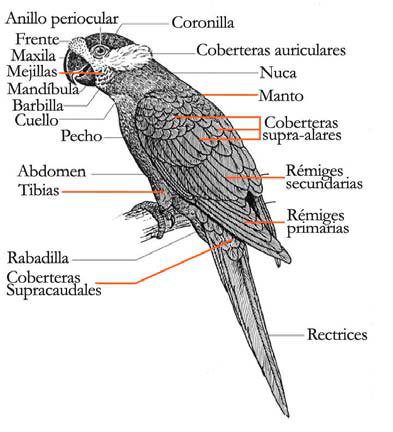
Anatomy-parrots

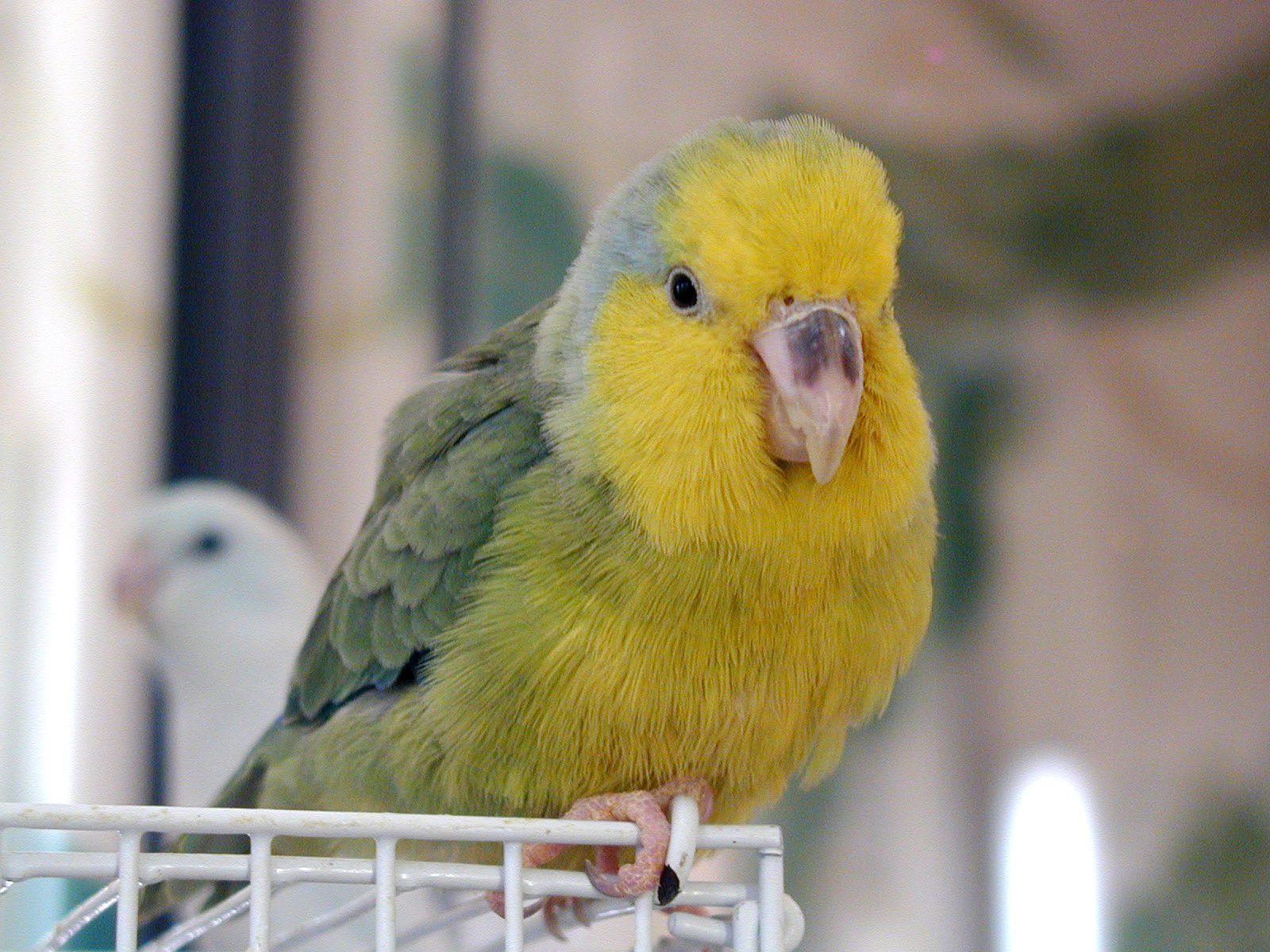
14 cm.. height. Plump appearance and short tail terminated tip. Distinguishable by the Crown, face, Yellow chest and belly, with strong wing blue patch, Flying Blue occupies almost half of the wing. Dorsally gray cafesoso, with the blue rump. The female has the blue patch on the rump and wings paler and smaller.

Sound of the Yellow-faced Parrotlet.

Habitat:

Video – "Yellow-faced Parrotlet" (Forpus xanthops)

Forpus xanthops - Yellow-faced Parrotlet - Yellow Faced Parakeet.

The Yellow-faced Parrotlet He lives in varied habitats, usually arid, forest riparian in the tropical and subtropical area, between 1000 to 1600 m, Although it has been reported to 2745 m. It is gregarious. Their diet includes cactus, In addition to fruit trees and other things. They nest in communal area, using tree hollows or sand. The breeding season is from March to April..

Distribution:

They are found in northwestern Peru., in the upper valley of the Marañón river, from the east of La Libertad to the southeast of Cajamarca and the south of Amazonas.

Conservation:

State of conservation ⓘ


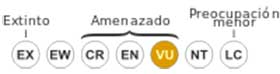
Vulnerable Vulnerable (UICN)ⓘ

According to the IUCN categories it is considered as Vulnerable (VU). Habitat degradation and trade are adversely affecting the population.

The ban on the capture and trade has improved the status of this species. The rate of decline was very rapid in the Decade of 1980, Although at present has been reduced and even stabilized. But, the population is still very small, with records in very few places, and as a result, according to the IUCN categories, qualified as vulnerable.

"Yellow-faced Parrotlet" in captivity

Captured for the trade of wild birds, It is estimated that 17.000 birds were captured between 1981 and 1994. The rate of mortality during capture is estimated between the 40% and the 100%. Rare and unknown in captivity until 1979-1980.

Images "Yellow-faced Parrotlet"

Alternative names:

1. Yellow-faced parrotlet (English).
2. Toui à tête jaune, Perruche-moineau à tête jaune (French).
3. Gelbmasken-Sperlingspapagei, Gelbmaskenpapagei (German).
4. Tuim-de-cabeça-amarela, Tuim, Periquito-de-cabeça-amarela (Portuguese).
5. "Catita enana de cara amarilla", Cotorrita carigualda, Periquito de Cara Amarilla (español).


Species of the genus Forpus

Sources: Parrot Book, Parrots and macaws Neotropical
Photo: Wilkipedia

▷ The world of Pets: Dogs, cats, birds, reptiles, amphibians

Red-lored Amazon
Amazona autumnalis

Red-lored Amazon


Anatomy-parrots

Content

Description:

35,5 to 38,1 cm.. height and between 314 and 485g. weight.

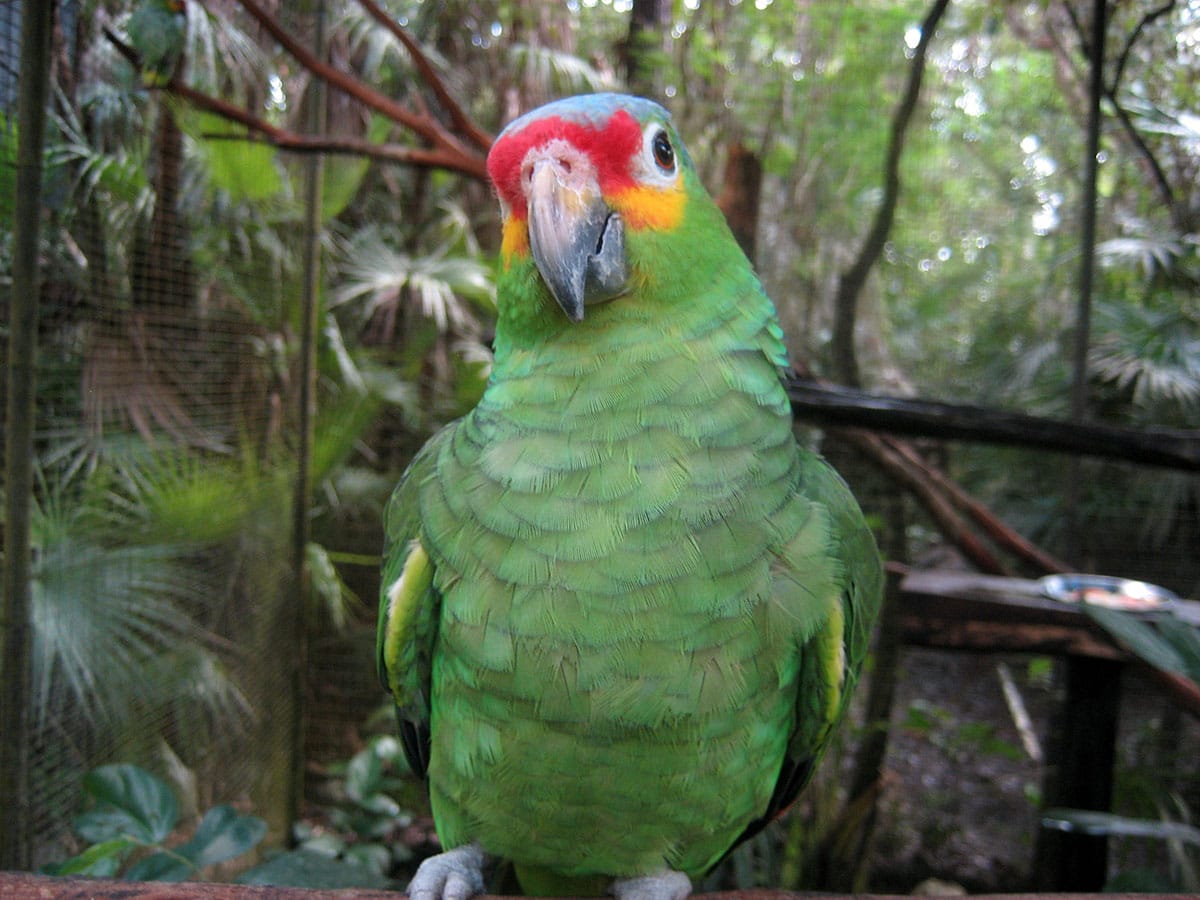
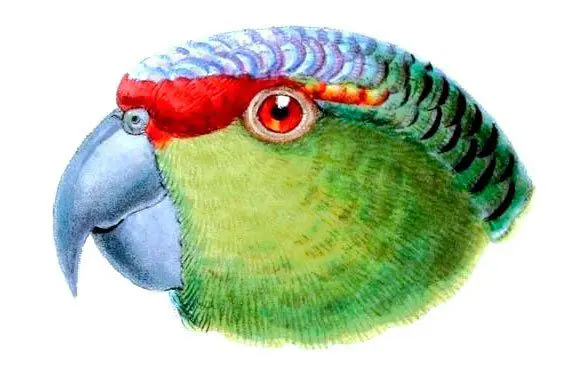
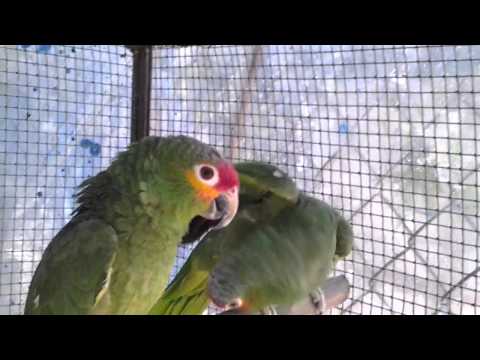
The Red-lored Amazon (Amazona autumnalis) is distinguished by its red front; Green with edge lilac it nape ; crown lilac; stain red in the wing , and tail blue margin.
The bill is grey with the upper jaw yellowish-horn. The irises his eye is orange. The legs are of color gray greenish.
They do not possess sexual dimorphism, that is to say, there is no physical difference between the male and the female.

Description 3 subspecies:

Amazona autumnalis lilacina Lesson, 1844
  • Amazona autumnalis autumnalis

    (Linnaeus, 1758) – Nominal.


  • Amazona autumnalis lilacina

    (Lesson, 1844) – It has a red band in the forecrown that it extends over them eyes; the cheeks Yellow.


  • Amazona autumnalis salvini

    (Salvadori, 1891) – It has cheeks and ear-coverts green; the basis of the tail by under Red.

Habitat:

Video – "Red-lored Amazon"

Amazonas autumnalis

This amazon frequents a wide range of habitats wooded and open with trees, including rainforest, tropical deciduous forest, pine forests, mangroves, forest swamps, gallery woods, areas cultivated with trees high and plantations; also forest dry in the South of Ecuador.

The Red-lored Amazon move from the rainforest (breeding season) to a habitat more open in winter in the Yucatan Peninsula, Mexico. The altitudes that inhabit range from sea level to the 320 metres in Oaxaca, 1.100 metres in Honduras, 800 metres in the Caribbean, 1.000 meters on the slopes of the peaceful of Costa Rica, and 1.000 metres in Colombia.
The birds tend to be in pairs or in flocks loose, being more gregarious When feed (occasionally macaws) and when resting. outside the breeding season, birds take refuge in tall trees in gallery forests or mangroves.

Reproduction:

They nest during the seasonal dry in hollow of trees (usually dead, for example, Tabebuia or Ceiba) or on the stump of a Palm tree. Birds in State reproductive in April, Oaxaca; February-March, Belice; March, Guatemala; January-February, Colombia. Reproduce between February-April, Panama; March-may, Belice and January-March, Ecuador. Clutch 3-4 eggs.

The incubation varies from 25 to 26 days. The chicks remain in the nest 70 days.

Food:

In the wild these birds feed on figs Ficus, orange, Mango, fruits of Palm (including the of Cordia lutea and Spondias purpurea), coffee beans (Coffea arabica), seeds of Ferrule, Casearia and Protium. Mainly are feeds in the tops of trees high.

Distribution:

Size of the area of distribution (reproduction / resident): 2.570.000 km2

The Red-lored Amazon It extends from the South of Mexico north of South America with a population disjunct in the amazon.
You can find in them lands low of the this of Mexico, in the South of Tamaulipas, in the East of San Luis Potosi, Puebla, Oaxaca, Chiapas, Tabasco, Campeche and Quintana Roo. Records from other parts of the country (for example, City of Mexico) probably you refer to leak.
You can see in Belice and in the lowlands of the Caribbean of Guatemala and Honduras (including Roatan and Guanaja in Bay islands and probably soon in Utila), until Nicaragua and Costa Rica, where they are present in humid areas of the tropics on both slopes (absent from the dry Northwest ), also in Panama and on the islands of Coiba and Escudo de Veraguas and in the Archipelago of pearls (absent from the driest areas of the Azuero Peninsula).

In the Northwest of Colombia appear on the Pacific slope of the Western Andes from the Panamanian border to the South up to the Serrania del Baudo and from the southwest of Cauca south to Ecuador in the Gulf of Guayaquil. Also it extends to the North of the Andes in Colombia to Magdalena Medio and to the East in the Northwest of Venezuela in Zulia (Sierra de Perija).

In the Northwestern basin of the brazilian amazon a disjunct population exists between Black river and Solimões River.

Usually resident with some local seasonal habitat preferences (for example, in Yucatan Peninsula, Mexico). Is usually the most common parrot and more numerous in some parts of the range (for example, in parts of Central America) but now is a species very rare to the West of them Andes in Ecuador and Colombia with a population of the subspecies Amazona autumnalis lilacina estimated in 400-600 specimens.

Population decreased drastically in the island of Roatan (Honduras) where he captured it is massively for export, and maybe missing in Utila for the same reason.

Capture combined with the loss of habitat also has caused declines in some other parts of its area of distribution (for example, east of Mexico and Ecuador). common in captivity in some areas, and marketed internationally.

Distribution 3 subspecies:

  • Amazona autumnalis autumnalis

    (Linnaeus, 1758) – Nominal. Coast of the Caribbean from the East of Mexico South to North of Nicaragua.


  • Amazona autumnalis lilacina

    (Lesson, 1844) – West of Ecuador.


  • Amazona autumnalis salvini

    (Salvadori, 1891) – North of Nicaragua south to Colombia and Venezuela.

Conservation:

State of conservation ⓘ


minor concern Minor Concern ⓘ (UICN)ⓘ

• Current category of the Red List of the UICN: Least concern.

• Population trend: Decreasing.

This species has a very large range and, Therefore, is not approaching the thresholds of Vulnerability at the discretion of the distribution area size.

The population size is very large and, therefore, not approaching the thresholds for vulnerable under the criterion of population size (<10.000 mature individuals with an estimated continuous decrease in> 10% in ten years or three generations or with a specific population structure). For these reasons, the species is evaluated as least concern.

Justification of trend

It is suspected that the population is in decline due to the continuous destruction of the habitat and to levels of exploitation unsustainable.

The Amazona lored in captivity:

Is of vital importance that the diet is complete and balanced in all directions, as this prevents, along with other factors, the appearance of bone problems or the known software that affects numerous parrots. To ensure the balance of this, prepared feed very well supply the nutritional needs of each animal, However, they should not miss plant, fruits and vegetables, as well as diversity of seeds that come in mixture.

As for accommodation, If they are not removed from cage constantly, it should be spacious enough to exercise the muscles of the wings and legs, and the plumage of the bird is preserved in perfect condition.

The Red-lored Amazon enjoy, like all parrots, tearing apart and finding out things, so they must have the occasional toy or we may end up having problems with the furniture. Them feet of parrot are very suitable if your stay is in the outside of the cage. Of course, they must not be exposed to draughts or sudden changes in temperature. The water must be clean at your fingertips, because the existence of fungi causes serious breathing problems.

In terms of coexistence to have it in the neighborhood area, in comparison with other species in Amazon, are relatively quiet, so in general do not cause many problems.

In captivity, can get to live up to 80 years.

BREEDING AND REPRODUCTION:

Its captive breeding started for the first time in United States, after their importation from the place of origin, South America in the 1950's.

Those individuals acquire their sexual maturity on the 4 years of age, and if you have a good breeding pair in the right conditions, they can perform two annual broods, Although the main thing if you want to raise, patience. Many pairs need several years until the first calf, so it is very important to be patient and wait for the right moment.

The female lays in the nest (No fill) of 2 to 6 eggs incubated without the help of the male usually. This is dedicated to feeding the female itself and that of the chicks after their birth at the 28 days until independence after twelve weeks.

Alternative names:

Red-lored Parrot, Red-lored Amazon, Yellow-Cheeked Amazon (English).
Amazone à lores rouges, Amazone diadème (French).
Rotstirnamazone (German).
Papagaio-diadema, Papagaio-diadema (Papagaio cavacué) (Portuguese).
Amazona Frentirroja, Lora Frentirroja, Loro Frentirrojo (español).
Lora cariamarilla (Honduras).
loro cachete-amarillo (Mexico).


scientific classification:

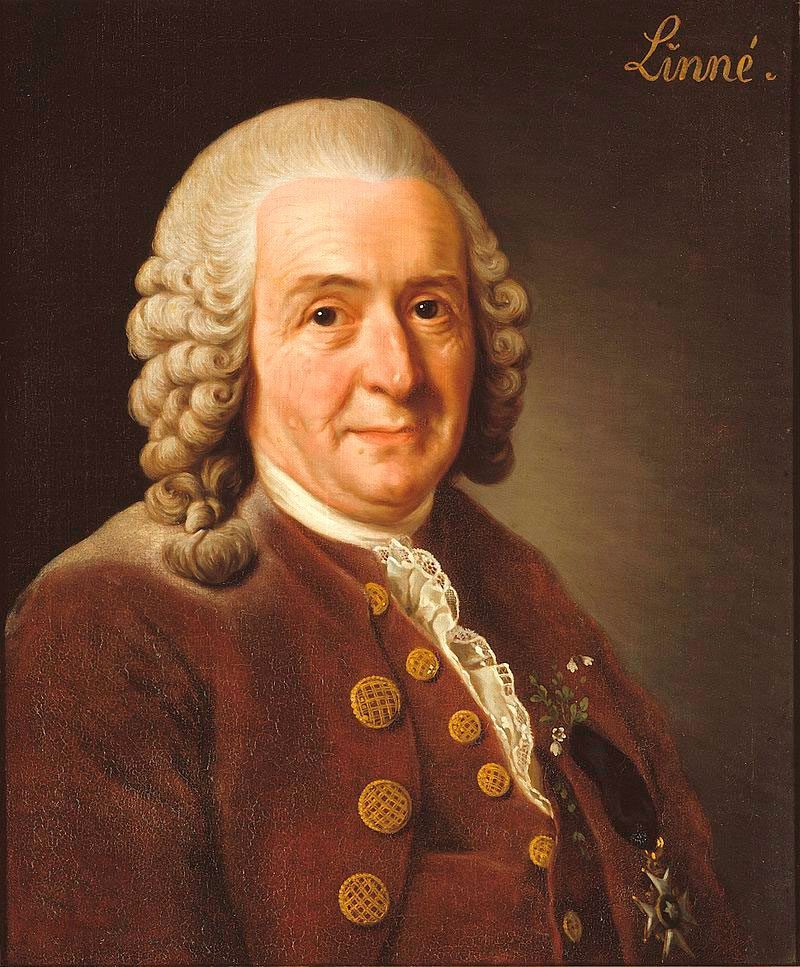
Carl Linnaeus

Order: Psittaciformes
Family: Psittacidae
Genus: Amazona
Scientific name: Amazona autumnalis
Citation: (Linnaeus, 1758)
Protonimo: Psittacus autumnalis


Red-lored Amazon images:


Species of the genus Amazona


Sources:

  • Avibase
  • Parrots of the World – Forshaw Joseph M
  • Parrots A Guide to the Parrots of the World – Tony Juniper & Mike Parr
  • Birdlife
  • Parrot Book, Parrots and macaws Neotropical
  • Grupohypermarkup

Photos:

(1) – Wikimedia.org
(2) – Red-lored Amazon or Red-lored Parrot; two captive parrots By Brian Gratwicke (originally posted to Flickr as Red-lored Amazon) [CC BY 2.0], via Wikimedia Commons
(3) – A Red-lored Amazon in Panama By Nelson de Witt from USA (Hello!) [CC BY-SA 2.0], via Wikimedia Commons
(4) – To pet Red-lored Amazon By Richard (originally posted to Flickr as Looming….) [CC BY 2.0], via Wikimedia Commons
(5) – Red-lored parrots (Amazona autumnalis), OSA Peninsula, Costa Rica By Charlesjsharp (Own work) [CC BY-SA 3.0], via Wikimedia Commons
(6) – A Red-lored Amazon at Rock Farm, Belize. It has a feather problem By Rigrat [CC BY-SA 3.0], via Wikimedia Commons
(7) – This is the image of a parrot originating of the jungle of Chiapas in Mexico By Joe Quick [CC BY 2.0], via Wikimedia Commons
(8) – Red-lored Amazon perching on a branch with wings open near Belmopan, Belize By Rigrat (Picasa Web Albums) [CC BY-SA 3.0], via Wikimedia Commons
(9) – A strange sight to me to see parrots flying in the wild. This Red-lored Amazon (Amazona autumnalis) was spotted with a group along the roadside in the Cayo distict of Belize By The Lilac Breasted Roller (originally posted to Flickr as Red Lored Parrot) [CC BY 2.0], via Wikimedia Commons
(10) – Lilacine Amazon, head from lateral by John Gerrard Keulemans [Public domain], via Wikimedia Commons

Sounds: Walter Rivera

▷ The world of Pets: Dogs, cats, birds, reptiles, amphibians

Shawl-collared Lorikeet
Trichoglossus rosenbergii

Shawl-collared Lorikeet

Content


Anatomy-parrots

Description (1)

26 cm.. length and a weight between 132 and 150 gr.

The Shawl-collared Lorikeet (Trichoglossus rosenbergii) is very similar to the Trichoglossus haematodus, but with a stronger blue in the head.

The edges of the breast feathers they are much wider, It has a broad yellow stripe on the neck, ending at the highest point with a red band narrow, their abdomen Violet is blue also has a wide orange stripe inside the flight feather.

The bill is red-orange. The irises They are orange-red and legs grey.

Variation of the nominal (Trichoglossus Haematodus).

Habitat:

They are in a wide range of habitats, including settlements in forests, coconut plantations, savannahs and mangroves.

In their natural habitats, They form small groups noisy that feed on the upper canopy. Often they are seen in mixed flocks with other species of parrots. At night, Community are hundreds of birds.

Son pollinators important species coconut.

Reproduction:

Within its natural range, usually they begin breeding between September and October – although breeding has been recorded in most months.

The average clutch it consists of 2 to 3 eggs. The female incubated eggs for about 24 to 27 days and the young become independent when they are about 80 days old.

Food:

Its diet natural It consists mainly nectar and pollen, but also it includes fruits like figs, citrus, papaya and mangoes open fruit bats. They may also feed on moth pupae and insects.

Distribution:

Distribucion-Lori-de-Biak
The reflection of both in the province of Papua, Indonesian.

Conservation:


Vulnerable

The Shawl-collared Lorikeet has a single small population, that can be seen to be decreasing as a result of the loss and degradation of forests, by agriculture and logging subsistence and perhaps also for the capture for trade. So, is qualified as Vulnerable.

The bird population is assumed that can range from 3000-4000 birds.

Alternative names:

Shawl-collared Lorikeet, Biak Lorikeet, Rainbow Lorikeet (Biak) (ingles).
Loriquet de Biak (French).
Biaklori (German).
Loris Arco-Íris Rosenbergii (Portuguese).
Lori de Biak (español).

scientific classification:

Order: Psittaciformes
Family: Psittaculidae
Scientific name: Trichoglossus rosenbergii
Citation: Schlegel, 1871
Protonimo: Trichoglossus Rosenbergii

Images "Shawl-collared Lorikeet"

————————————————————————————————

    (1) – Subspecies Coconut Lorikeet (Trichoglossus haematodus)

————————————————————————————————

"Both Lori" (Trichoglossus rosenbergii)


Sources:

Avibase
– BirdLife.org

Photos: Rosenberg’s Lorikeet – animalphotos.me

▷ The world of Pets: Dogs, cats, birds, reptiles, amphibians

Ultramarine Lorikeet
Vini ultramarina

Ultramarine Lorikeet

Content

Description

The Ultramarine Lorikeet (Vini ultramarina) has a length of 18 cm.. and an approximate weight of 35 g..

Forehead bright navy blue iridescent; crown and nape Mallow dark blue with streaks of light blue; lores and spots on ear-coverts, white (bases of ear-coverts, purple and blue color). Mantle and covert wing, Navy blue; rump and tail coverts, dark blue light. The flight feather, light blue, blackish internal. Blue off the Underwing coverts. Throat dark blue with white speckles; in the band chest mauve blue with área subterminal pale blue feathers. Belly blank slate bases in feathers, giving a mottled appearance; the thighs dark blue malva; coverts, Turquoise.

The uppertail-coverts, whitish blue with navy blue light diffuse in the outer margins;
undertail coverts whitish merged with navy and some irregular gray markings.

Bill yellow orange, upper jaw, blackish brown at the base; irises brownish yellow; the orange legs.

Both sexes are equal but the female It is slightly smaller.

The immature adult differ by the absence of white on underparts, they are uniformly blackish. Also by bill black, irises Dark Brown and legs orange-brown.

Habitat:

In the Decade of 1970 in Nuku Hiva, these parrots were found only in pristine forests (that they have not been touched and that it is in its original condition) on the 700 m.

There is a similar habitat preferences in UA Pu, where are located mainly in montane forests between 700 and 1.000 m. Populations have also been of Ultramarine Lorikeet in banana plantations, coconut and mango (Mangifera indica), in coastal areas.

The species seems to have a wider range of habitat preferences in UA Pu., being found at altitudes ranging from the coast to wooded crests.

They feed in trees with flowers, especially coconut trees and Erythrina.

Loud and lively; the birds move freely between the canopy and lower floors, allowing the human approach. They usually travel in pairs or groups of up to a dozen of individuals. Most of its flights are made below the level of the trees, but for longer distances they rise spiral up to considerable heights.

Extremely Active, rarely long they stay in a tree and feeds using the peak acrobaticamente support.

Reproduction:

The nesting of these birds is from June to August.

It nests in hollow trees, preferring Artocarpus altilis, Pometia, Pandanus tectorius and Hibiscus tileacus. Sometimes they use the old nest of another species. They lay two white eggs.

A captive breeding record gives the chick eight weeks to become independent.

Food:

It feeds on a great variety of trees in flower, nectar and pollen. Within your preferences are the flowers of the coconut palm, the native tree and banana Hibiscus tileaceus.

It also feeds on fruits, especially mango and insects.

Distribution:

Size of its range (reproduction / resident): 100 km2

The Ultramarine Lorikeet is endemic of the Marquesas Islands, of Nuku Hiva, UA Pu and UA Huka, Although fossil remains show that previously most widely spread.

In UA Pu the population was estimated at 250-300 couples in 1975. But in 1988 had shrunk around the 60%, probably due to the spread of rats Rattus rattus, and a hurricane in 1988, Although its effects on the population of birds are uncertain.

In Nuku Hiva the small population of around of 70 birds that inhabited the high valleys and ridges in the northwestern part of the island, between 700 and 1.000 d., You can that they are now extinct.

The majority of the population, to this day, remains in UA Huka, where the species was introduced in 1940. This population would have grown from 200 to 250 couples in the late 1970s and was considered abundant in 1990 at altitudes environment to the 500 d., with a population estimated between 1.000 and 1.500 birds. The main threat to the species, here, is the potential arrival of rats, and between 1993 and 1994, 14 Ultramarine Lorikeet they were moved to Fatu Hiva in an attempt to keep them safe from rats; But, habitat deterioration by grazing mammals and avian malaria, also they have been and are still potential factors to increase the vulnerability of this species.

Conservation:


Endangered


• Current IUCN Red List category: Danger.

• Population trend: Decreasing.

CITES Appendix I. in danger of extinction.

The entire population is located on an island where the species is stable, in other islands recently has been extinguished. The general trend is suspected to be a slow and continuous decrease. If the black rats come to UA Huka the decrease will be quick and severe.

Other threats included are logging in some sectors of the habitat of the Ultramarine Lorikeet to plant crops, fruit trees, and use the trunks for woodcarvings for tourism.

"Ultramarine Lorikeet" in captivity:

Extremely rare.

Alternative names:

Ultramarine Lorikeet, Marquesas Lorikeet, Ultramarine Lory (ingles).
Lori ultramarin, Lori de Goupil, Lori des Marquises (French).
Ultramarinlori (German).
Loris Vini Ultramarine (Portuguese).
Lori Ultramar, Lori Ultramarino (español).

scientific classification:

Order: Psittaciformes
Family: Psittaculidae
Scientific name: Vini ultramarina
Citation: (Kuhl, 1820)
Protonimo: Psittacus ultramarinus

Images «Overseas Lory»:

Videos "Ultramarine Lorikeet"

————————————————————————————————

«Lori Ultramar» (Vini ultramarina)


Sources:

Avibase
– Parrots of the World – Forshaw Joseph M
– Parrots A Guide to the Parrots of the World – Tony Juniper & Mike Parr
– Birdlife

Photos:

1 – Miles to the wild – link
2 – Miles to the wild – link
3 – Miles to the wild – link
4 – An adult bird perched on a palm tree – Author Josep del Hoyo – IBC.lynxeds.com
5- A juvenile bird feeding in a tree. – Author Josep del Hoyo – IBC.lynxeds.com

Sounds: Mark Todd (Xeno-canto)

▷ The world of Pets: Dogs, cats, birds, reptiles, amphibians

Red-fronted Lorikeet
Charmosyna rubronotata


Red-fronted Lorikeet

Content

Charmosyna rubronotata kordoana

Description

17 cm.. length and a weight between 30 and 35 g..

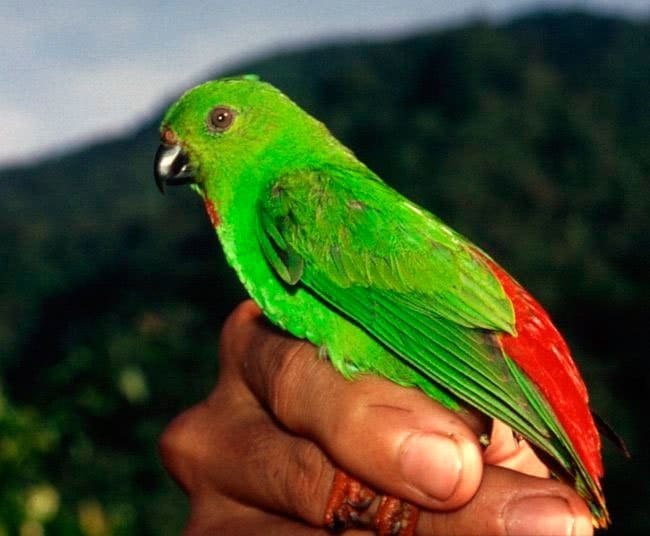
The front of the crown of the Red-fronted Lorikeet (Charmosyna rubronotata) is red; rest of the crown green; chin, the throat and headphones coverts, yellowish green with a prominent patch purple-blue in the center of the ear coverts. Upperparts green; lower part of the rump and tail coverts, matte red. Wings Green with a bit of yellow in the curve. Under, the wings red; flight feather blackish brown with a yellow stripe in the Center. The underparts yellowish green with prominent red blotch on the upper side of the chest; the thighs green. The tail above blackish brown with green piping; below, the tail Brown with wide yellow tips (except central pair) and Red covered in the base. The bill Red pink; cere pinkish; irises brown; legs Pink.

females lack of red color in the crown, in the marks of the chest and at the bottom of the wings (that are greenish yellow). ear patch It is replaced by streaks of greenish-yellow.

Description 2 subspecies

  • Charmosyna rubronotata kordoana

    (Meyer,AB, 1874) – Female is similar to the nominal. The male has the patch of the crown paler, extensive and blue; minus purple blue ear-coverts.


  • Charmosyna rubronotata rubronotata

    (Wallace, 1862) – Nominal.

Habitat:

It inhabits in the humid forests, edges of forests and plantations of coconut, Once in a while visit the trees and shrubs in open field. Are from the lowlands up to the 850 m. Usually found in small flocks of up to 10 birds flying over dense forest, or feeding on flowers in the canopy, sometimes with other parrots. Habits are similar to the of the Red-flanked Lorikeet.

Reproduction:

Nesting and breeding habits not described.

Food:

Feeds of pollen, nectar, flowers and seeds.

Distribution:

Size of the area of distribution (reproduction / resident): 417.000 km2

New Guinea in West Papua New (Indonesian) and Papua New Guinea. The range goes from East of Vogel-kop through Maprik, the lower reaches of the rivers Sepik and Ramu reaching Astrolabe Bay in the East. Also in Salawati in the islands of the West of papua and in Biak. The Red-fronted Lorikeet It is irregularly distributed throughout its area of distribution, but may be locally common in some areas. It seems to be less common than the Red-flanked Lorikeet, He replaced at higher altitudes, where the two species overlap.

Description 2 subspecies

Conservation:


minor concern


• Current IUCN Red List category: Least concern.

• Population trend: Stable.

The trend of the population seems to be stable, and therefore, the species does not approach the thresholds for Vulnerable according to the population trend criteria.

The world population It has not been quantified, It is believed that it is by the 100.000 specimens and stable.

The species is described as common to local scale.

"Red-fronted Lorikeet" in captivity:

There is no data on its breeding in captivity..

Alternative names:

Red-fronted Lorikeet, Red fronted Lorikeet, Red-fronted Blue-eared Lorikeet, Red-fronted Blue-eared Lory, Red-spotted Blue-eared Lorikeet, Red-spotted Lorikeet (ingles).
Lori à front rouge, Lori de Wallace, Loriquet à croupion rouge (French).
Rotstirnlori (German).
Lori de Frente Roja, Lori Frentirrojo (español).


scientific classification:

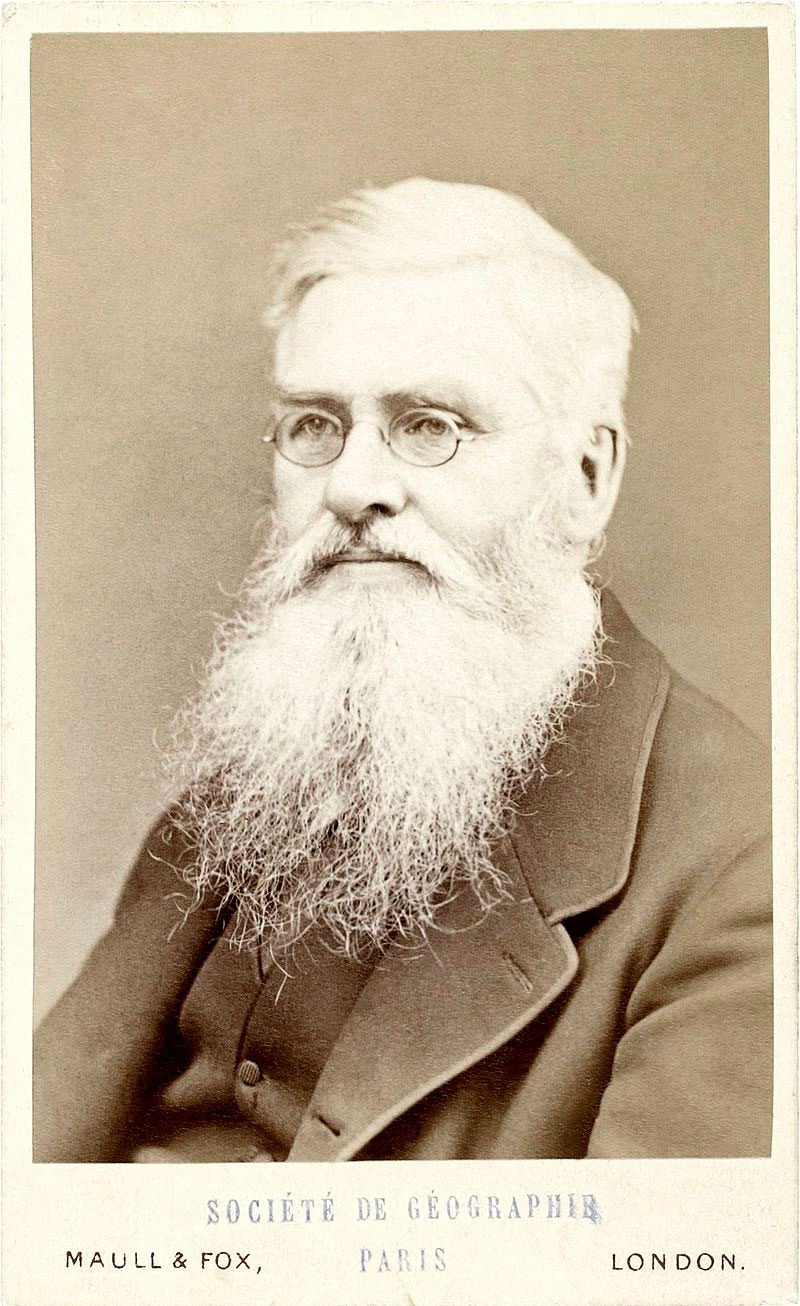
Alfred Russel Wallace

Order: Psittaciformes
Family: Psittaculidae
Scientific name: Charmosyna rubronotata
Citation: (Wallace, 1862)
Protonimo: Coriphilus rubronotatus


Images «Red-fronted Lory»:

————————————————————————————————

«Lori Frentirrojo» (Charmosyna rubronotata)


Sources:

Avibase
– Parrots of the World – Forshaw Joseph M
– Parrots A Guide to the Parrots of the World – Tony Juniper & Mike Parr
– Birdlife

Photos:

1 – Author iggino – lynx
2 – Charmosyna rubronotata kordoana by Biodiversity Heritage Library

Sounds: Katerina Sam (Tvardikova) – (Xeno-canto)

▷ The world of Pets: Dogs, cats, birds, reptiles, amphibians

Sangihe hanging parrot
Loriculus catamene

Sangihe hanging parrot

Content


Anatomy-parrots

Description

12 to 13,5 cm.. length.

The Sangihe hanging parrot (Loriculus catamene) has the head Green with the front of the crown and the bib red. Upperparts Green with light wash of color orange in the the mantle; rump and long tail coverts red. Wings green, slightly dark; carpal edge brighter yellowish green. The flight feather blue with green coverts.

The underparts Green with the belly Beige and tail coverts of color red marked in green. Upper, the tail of color green with lips Red; Blue below. The bill black; irises brown; legs orange.

The female not have the Red of the crown; the Red of the bib reduced to a few points, and green the coverts infracaudales.

The immature with carpal edge yellow, lack of crown red, But if the bib red.

Habitat:

Found in pairs or in small groups on them flowers of coconut and shrub in flower, and groups of up to four birds found with greater frequency in plantations mixed. The species is has adapted to habitats side and their main source of food seems to be the nectar of coconut. One roost of 17 birds is the largest group reported.

Reproduction:

One nest with two eggs is noted in 1985, little more is known of the habits reproductive of this species.

Food:

Their main source of food is the nectar of coconut.

Distribution:

Size of the area of distribution (reproduction / resident): 700 km2

endemic to the Sangir Islands. Most of the original vegetation in Sangir, It has now been replaced by plantations of coconut and nutmeg, and secondary vegetation of the abandoned gardens. Observations during mid of 1980 showed that it is quite common in coconut forests, and two pairs were observed in the steep volcanic slopes covered with trees in 1986. In 1995, the species was recorded of all forest habitats on the island from sea level up to around the 900 m (also be meeting around Tahuna). The birds are observed more frequently in fragments of forest and coconut plantations.

Conservation:


Near-threatened


• Current IUCN Red List category: Near threatened

• Population trend: Decreasing

There are few data on recent trends, but not there is evidence of a continuous decrease and given your apparent tolerance to different secondary habitats, the declines in their population may have been insignificant.

The population of the Sangihe hanging parrot It is estimated between 10.000 and 46.000 specimens.

The original forest in Sangihe It has been almost completely replaced by the crop, but the species appears to be tolerant to degraded habitats and cultivated areas and there is no evidence of a continuous decrease. Other potential threats include the widespread settlement of large trees in the Decade of 1980, the escaped parrots-borne disease and the volcanic activity in the future (Riley 2002).

"Sangihe hanging parrot" in captivity:

Is not usual.

Alternative names:

Sangihe Hanging-Parrot, Sangihe Hanging Parrot, Sangir Hanging Parrot (ingles).
Coryllis des Sangi, Coryllis de Sangihe (francés).
Rotsteisspapageichen (alemán).
Loriculus catamene (portugués).
Lorículo de la Sangihe, Lorículo de Sangihe (español).

scientific classification:

Order: Psittaciformes
Family: Psittaculidae
Genus: Loriculus
Scientific name: Loriculus catamene
Citation: Schlegel, 1871
Protonimo: Loriculus catamene

Images "Sangihe hanging parrot"

————————————————————————————————

«Sangihe Loricle» (Loriculus catamene)


Sources:

Avibase
– Parrots of the World – Forshaw Joseph M
– Parrots A Guide to the Parrots of the World – Tony Juniper & Mike Parr
– Birdlife

Photos:

(1) – Photographer: © Jon Riley – Oriental Bird Images

Sounds: Hanom Bashari (Xeno-canto)

▷ The world of Pets: Dogs, cats, birds, reptiles, amphibians

Edwards' Fig-Parrot
Psittaculirostris edwardsii


Edwards' Fig-Parrot

Content

Description

18 cm.. length and weight around 105 g..

The Edwards' Fig-Parrot (Psittaculirostris edwardsii) you have the front and a bright yellowish-green Crown, with a green stripe on the back; neck greyish-Brown band above the band of gris-negruzco color that extends into the eye; area before and just behind the eyes, green. Elongated lower headset feathers and orange-red fire Gorge, with some green basal feathers interspersed and ends the headphone rear (also elongated) golden yellow with orange.

Dark green back: curve of the wing marked in blue. Black flight feathers marked with green in vane outer (except the primary outer) and with vane internal yellow, forming a set of bars under her wings; marked inner coverts reddish-orange. The wings of blue-green feathers, the longest with yellow tip. Purple-blue ruff with some lighter green feathers; Centre of the breast and upper belly of a showy orange-red; flanks, supracaudales yellowish-green coverts and thighs. Upper, the Green tail; undertail, opaque yellow olive.

the black beak; reddish brown to Brown irises; light grey legs.

The female of the Edwards' Fig-Parrot It lacks the heart of red on the chest and upper abdomen, and has a broader purple-blue band on the chest, inset below with red.

Immatures resemble females, but with the headphones coverts greenish yellow.

Habitat:

The Edwards' Fig-Parrot (Psittaculirostris edwardsii) are distributed among the humid lowland forests, partially cleared areas, wooded edges, as well as near rural areas, up to about 800 meters above sea level.

The birds are usually found in pairs or small noisy flocks, Although groups have been found for up to 400 birds collected in the canopy of fruit trees.

Rapid movements are, and usually they hang you upside down to reach food.
Has been in mixed flocks with the Double-eyed Fig-Parrot.

Reproduction:

Nesting behavior of the Edwards' Fig-Parrot they have been observed since January through may. In October he was seen a male rubbing its peak with the female and hovering above its perch. The nest is in a hole, at the top of a tree in the forest.

Food:

The diet consists of fruit, including the Ficus figs and casuarinas, nectar and probably insects

Distribution:

Endemic to the lowlands of the North of New Guinea in Irian Jaya and Papua New Guinea. It is commonly distributed in the northeast of all Jayapura along the coastal lowlands and inland to around of Pagwi, Chamhri Lake and the jimi river. Observed in the region of the Sepik River, extending eastward to the lowlands of the Huon Peninsula and the markham river. The world's population is believed to be in excess of 100.000.

Conservation:


minor concern


• Current IUCN Red List category: Least concern

• Population trend: Stable

The size of the world population Edwards' Fig-Parrot It has not been quantified, It is estimated around the 100,000 specimens. The species according to sources, it is common to very frequent, at the local level (pit et to the. 1997).

The population is suspected to be stable in the absence of evidence of any reduction or substantial threats.

"Edwards' Fig-Parrot" in captivity:

active parrot, need space to exercise. It has nice voice, harmless. Initially shy and nervous, It is customary to the caregiver with the time. You can die suddenly without apparent reason.

It is very rare in poultry.

Alternative names:

Edwards’ Fig-Parrot, Edward’s Fig Parrot, Edwards’ Fig Parrot, Edwards’s Fig Parrot, Edwards’s Fig-Parrot, Scarlet-cheeked Fig Parrot (ingles).
Psittacule d’Edwards (French).
Edwardszwergpapagei, Edwards Zwergpapagei, Edwards-Zwergpapagei (German).
Psittaculirostris edwardsii (Portuguese).
Lorito de Eduardo, Lorito de Edwards (español).

scientific classification:

Order: Psittaciformes
Family: Psittaculidae
Scientific name: Psittaculirostris edwardsii
Genus: Psittaculirostris
Citation: (Oustalet, 1885)
Protonimo: Cyclopsittacus Edwardsii

Images "Edwards' Lorito":

————————————————————————————————

«Edwards' parrot» (Psittaculirostris edwardsii)


Sources:

Avibase
– Parrots of the World – Forshaw Joseph M
– Parrots A Guide to the Parrots of the World – Tony Juniper & Mike Parr
– Birdlife

Photos:

(1) – Indonesia Traveling Guide – by Farelli in Indonesia Bird
(2) – Birds-pet-wallpapers
(3) – «Psittaculirostris edwardsii» by http://www.birdphotos.com – http://www.birdphotos.com/photos/v/parrots/IMG_3537b.jpg.html. Licensed under CC BY 3.0 via Wikimedia Commons.
(4) – By Michal Pilar – Methodical Portal
(5) – By Katerina Tvardikova – New Guinea Birds