▷ The world of Pets: Dogs, cats, birds, reptiles, amphibians

Finsch's Pygmy-Parrot
Micropsitta finschii

Finsch's Pygmy-Parrot

Content


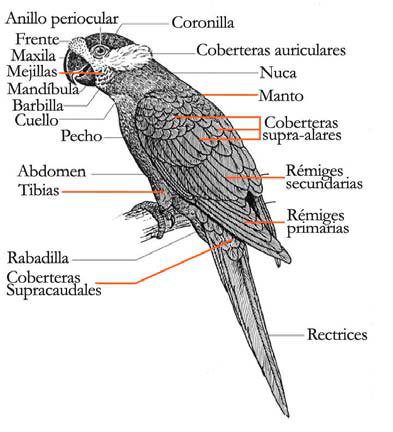
Anatomy-parrots

Description

9,5 cm. length between 12 and 18 g. of weight.

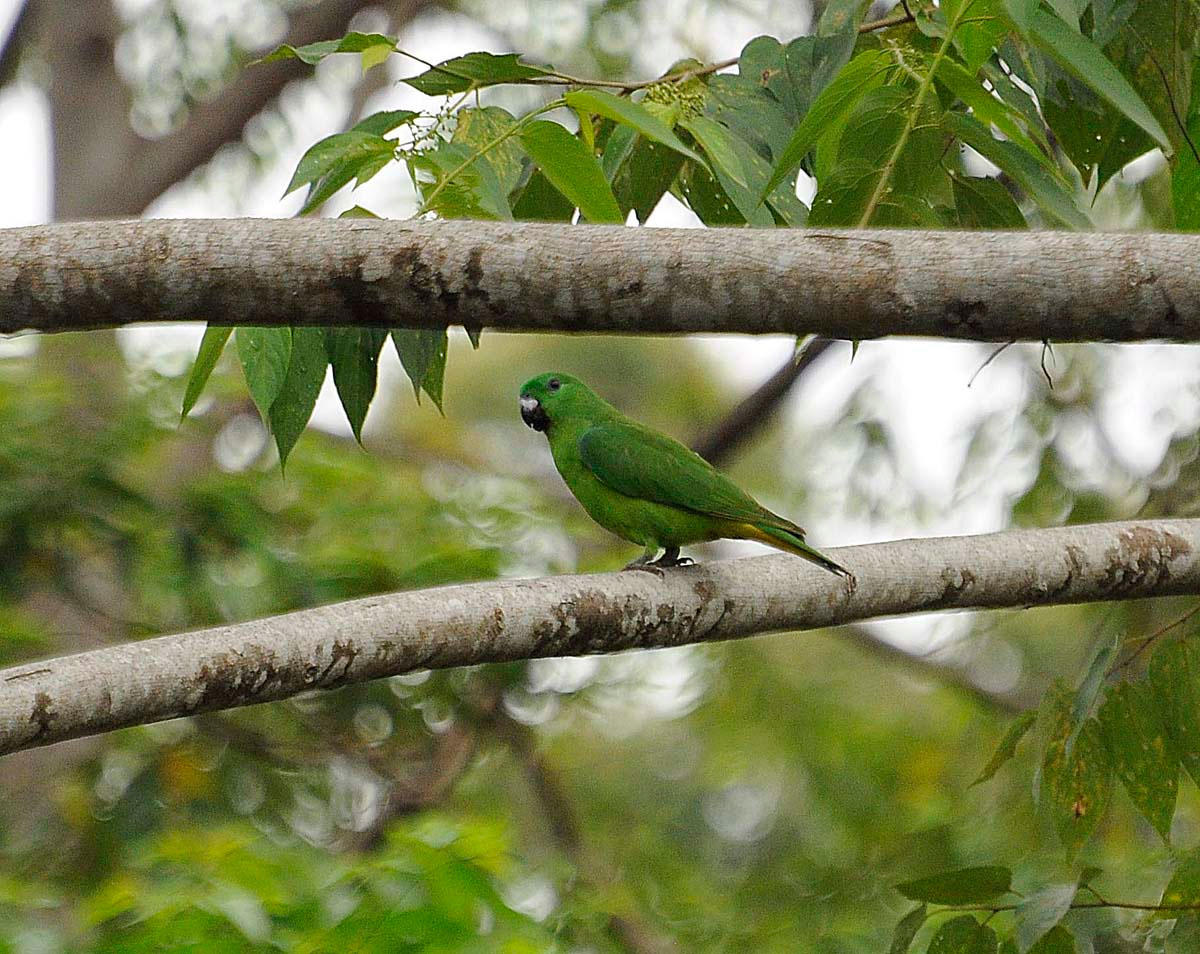
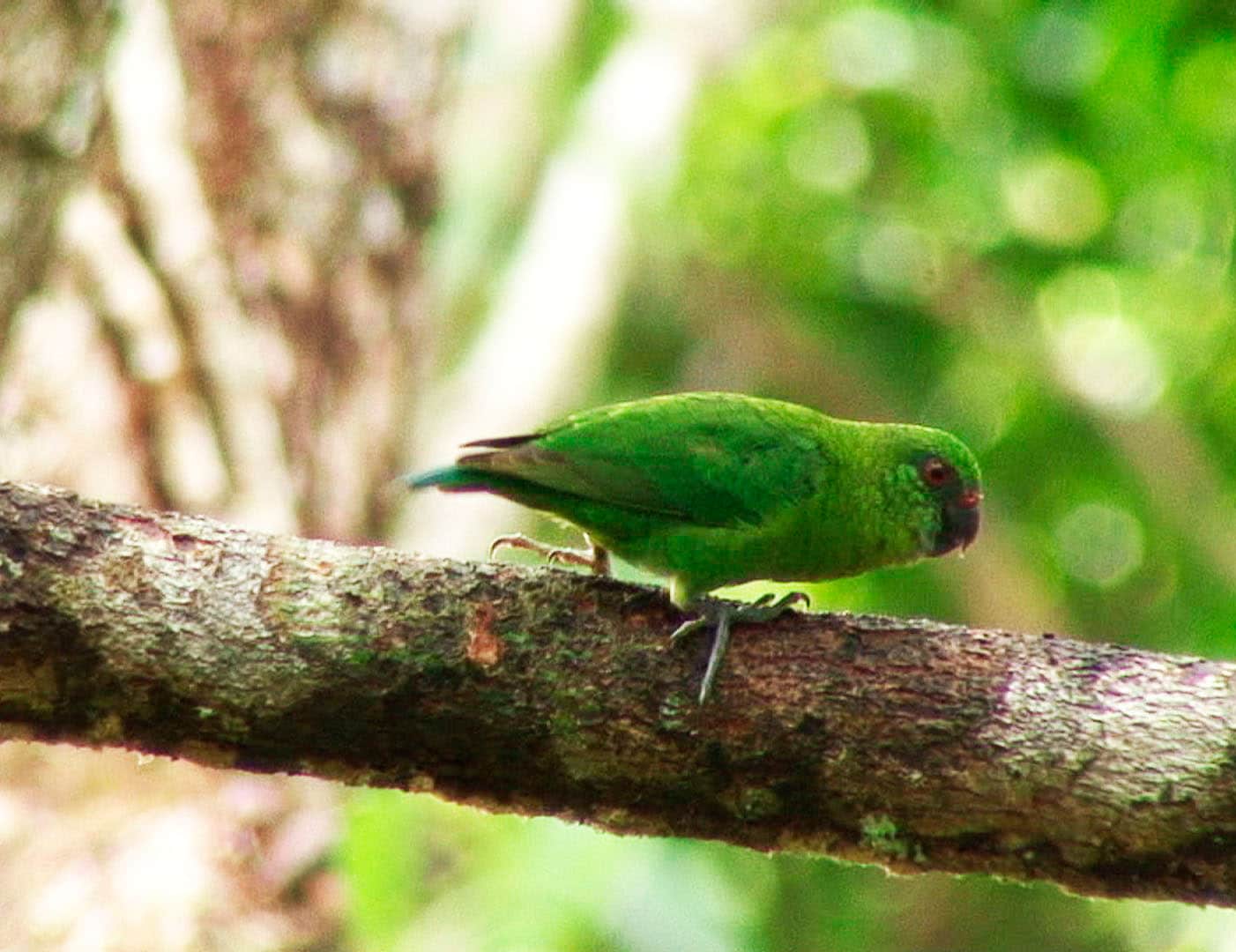
The head of the Finsch's Pygmy-Parrot (Micropsitta finschii) is bright green, slightly yellowish, dotted with pale blue in the chin and throat. Upperparts bright green, with fine darker stripes. The flight feather they are black with fine green edges; wing feathers greenish yellow. The underparts pale yellowish green with fine darker stripes and feather in the center of the belly orange-red; uppertail-coverts yellow, the longest with bluish-green tips. Upper, the tail is off blue, Black in the Center and sides with blue and yellow tips; below, the tail is black with yellow tips.

Bill blackish; cere Pink ; irises orange red; legs grey.

Cere rose in the male, grey in the female. The females they lack the red marks in the underparts and they have pink feathers, not blue, on chin.

Immature with bill grayish and reddish brown, not orange-red, the irises.

In the juvenile birds the cere is greyish in both sexes. Males immature of the species nominal lack of the chin Blue and red markings in the abdomen.

Subspecies description

Description 5 subspecies
  • Micropsitta finschii finschii

    (EP Ramsay, 1881) – The nominal.


  • Micropsitta finschii nanina

    (Tristram, 1891) – The adults have a stain blue in the part superior of the crown.


  • Micropsitta finschii viridifrons

    (Rothschild & ECTION Hartert, 1899) – Adults have a large blue spot at the top of the crown and blue tones to the sides of the face.


  • Micropsitta finschii tristami

    (Rothschild & ECTION Hartert, 1902) – Adults do not have blue spots and orange


  • Micropsitta finschii aolae

    (Ogilvie-Grant, 1888) – adults have the upperparts darker and have a blue spot on the top of the crown.

Habitat:

Finsch's Pygmy-Parrot

Most common in lowland primary forest at mid-altitude, are observed to the 900 meters above sea level (lower boundary of cloud forests where they are replaced by the Red-breasted Pygmy-Parrot, but they are distributed in a variety of habitats, including weed gardens, casuarinas, secondary growth, areas of open scrubland and occasionally coconut (Cocoa nuts). It's a vociferous and active species, difficult to observe. They are alone, in pairs or in groups of 3 to 6 birds. They feed on acrobatic form, down with your head upside down and using their tails as support on the bark of the trees.

Reproduction:

One to two eggs are deposited by the female in an excavated cavity over a period of several weeks in an active tree termite nest. (that is also used for the rest). Adults were observed with young in January 1995 in the South of New Ireland. The breeding period It speculates that may be between March and Mayo.

Food:

Peck the trunks and branches of the tree tops and medium height plants to glean lichens and fungi, also noticed them is feeding of seeds of casuarina.

Distribution:

Are found in the Bismarck Archipelago including New Hanover, Tabar, Lihir and New Ireland, through Bougainville in the Solomon Islands in Choiseul, Santa Isabel, Malaita, Vella Lavella, Gizo, Kolombangara, New Georgia, Rendova, the Russell Islands, the Islands of Florida, Nggela Sule, Guadalcanal, Uki and San Cristóbal.

Subspecies distribution:

Distribution 5 subspecies

Conservation:


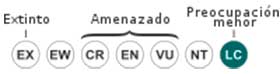
minor concern


• Current IUCN Red List category: Least concern

• Population trend: Stable

The size of the world population It has not been quantified, supposedly above 100.000 specimens. The species according to sources, It is abundant within its range (pit et to the. 1997).

The population is suspected to be stable in the absence of evidence of any reduction or substantial threats.


In captivity:

Not found in captivity.
This species has only been kept alive for short periods in captivity.; new birds may refuse foods completely.

Alternative names:

Finsch’s Pygmy-Parrot, Emerald Pygmy Parrot, Finsch’s Pygmy Parrot, Green Pygmy Parrot, Green Pygmy-Parrot (ingles).
Micropsitte de Finsch (francés).
Salomonenspechtpapagei, Salomonen-Spechtpapagei (alemán).
Micropsitta finschii (portugués).
Microloro de Finsch (español).

scientific classification:

Order: Psittaciformes
Family: Psittaculidae
Scientific name: Micropsitta finschii
Genus: Meeki
Citation: (Ramsay,EP, 1881)
Protonimo: Nasiterna Finschii

Images "Finsch's Pygmy-Parrot"

Videos "Finsch's Pygmy-Parrot"

————————————————————————————————

«Finsch microlore» (Micropsitta finschii)


Sources:

Avibase
– Parrots of the World – Forshaw Joseph M
– Parrots A Guide to the Parrots of the World – Tony Juniper & Mike Parr
– Birdlife
Wikipedia

Photos:

(1) – A bird foraging on a trunk by Josep del Hoyo – lynx
(2) – Parrots of the World – Forshaw Joseph M

Sounds: Mark Todd (Xeno-canto)

▷ The world of Pets: Dogs, cats, birds, reptiles, amphibians

Buru Racket-tail
Prioniturus mada


Buru Racket-tail

Content

Buru Racket-tail

Description

32 cm.. length.

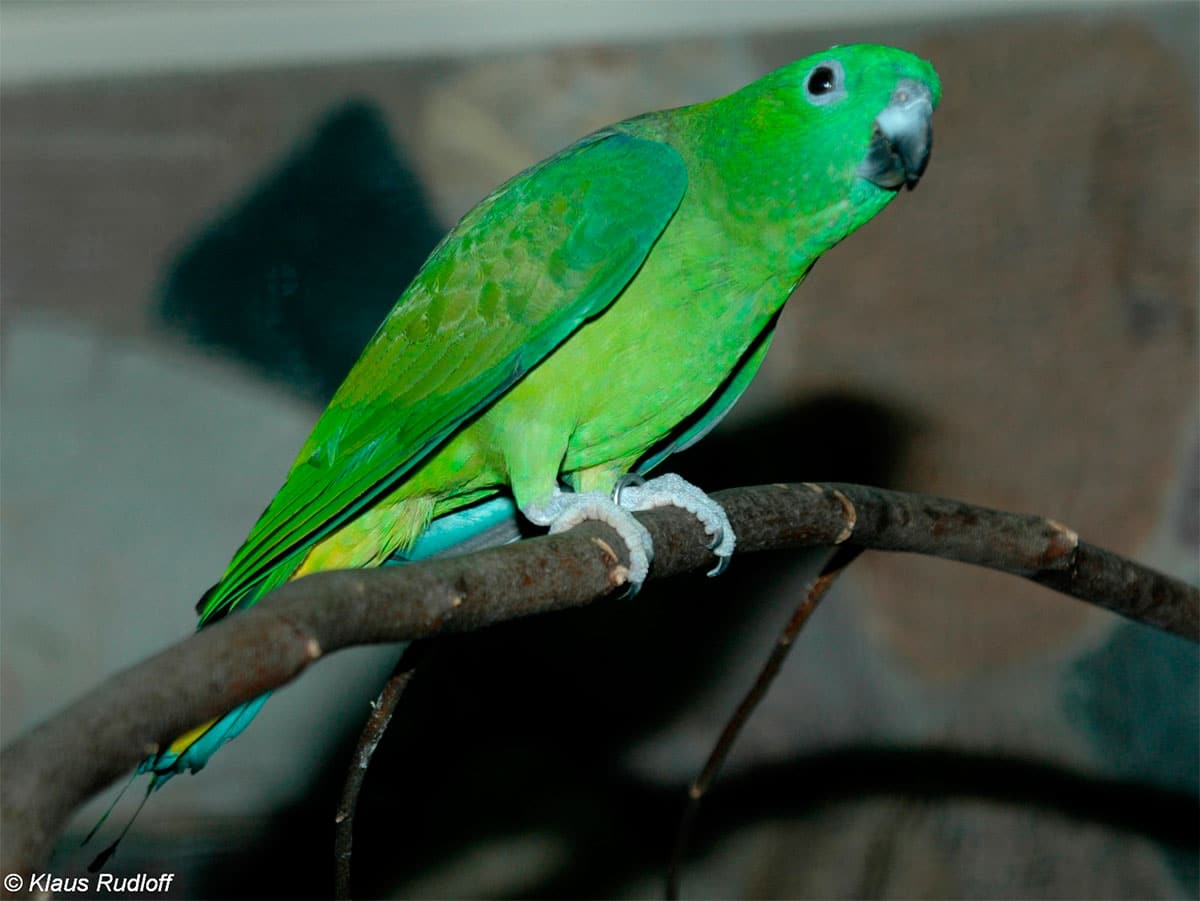
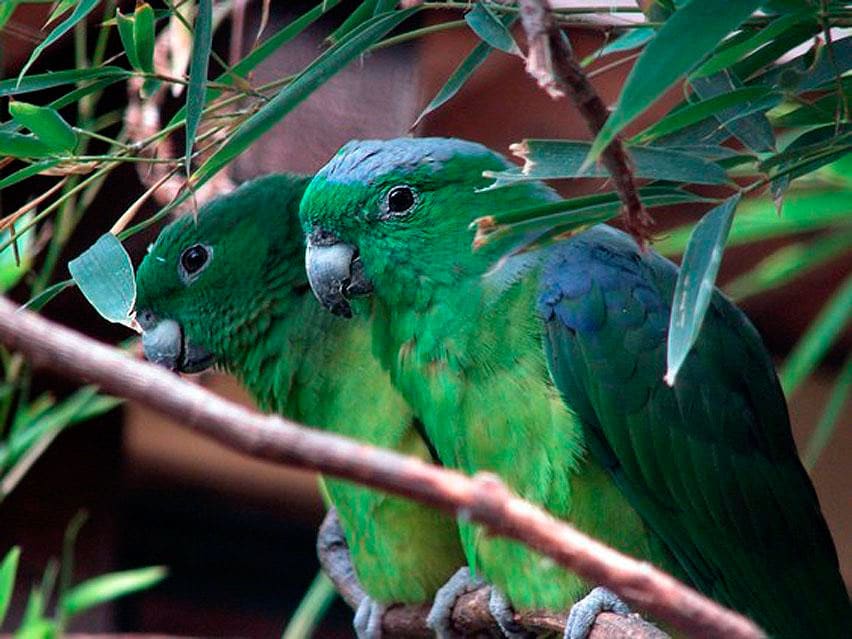
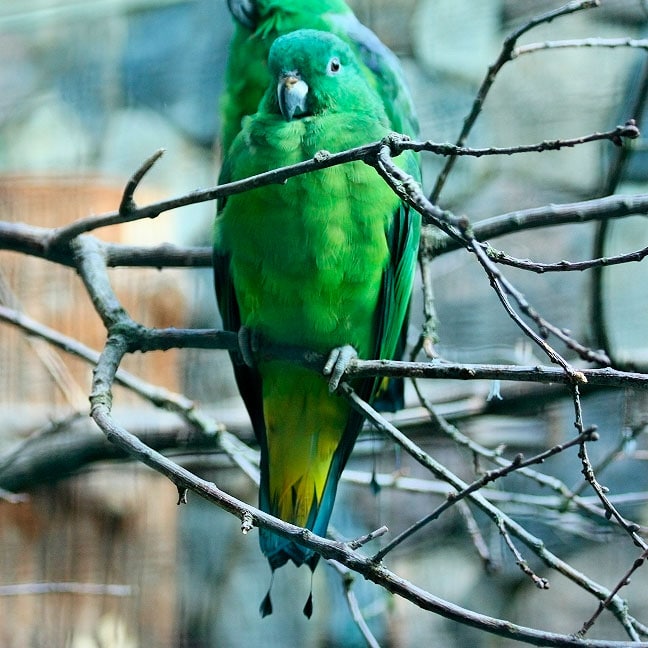
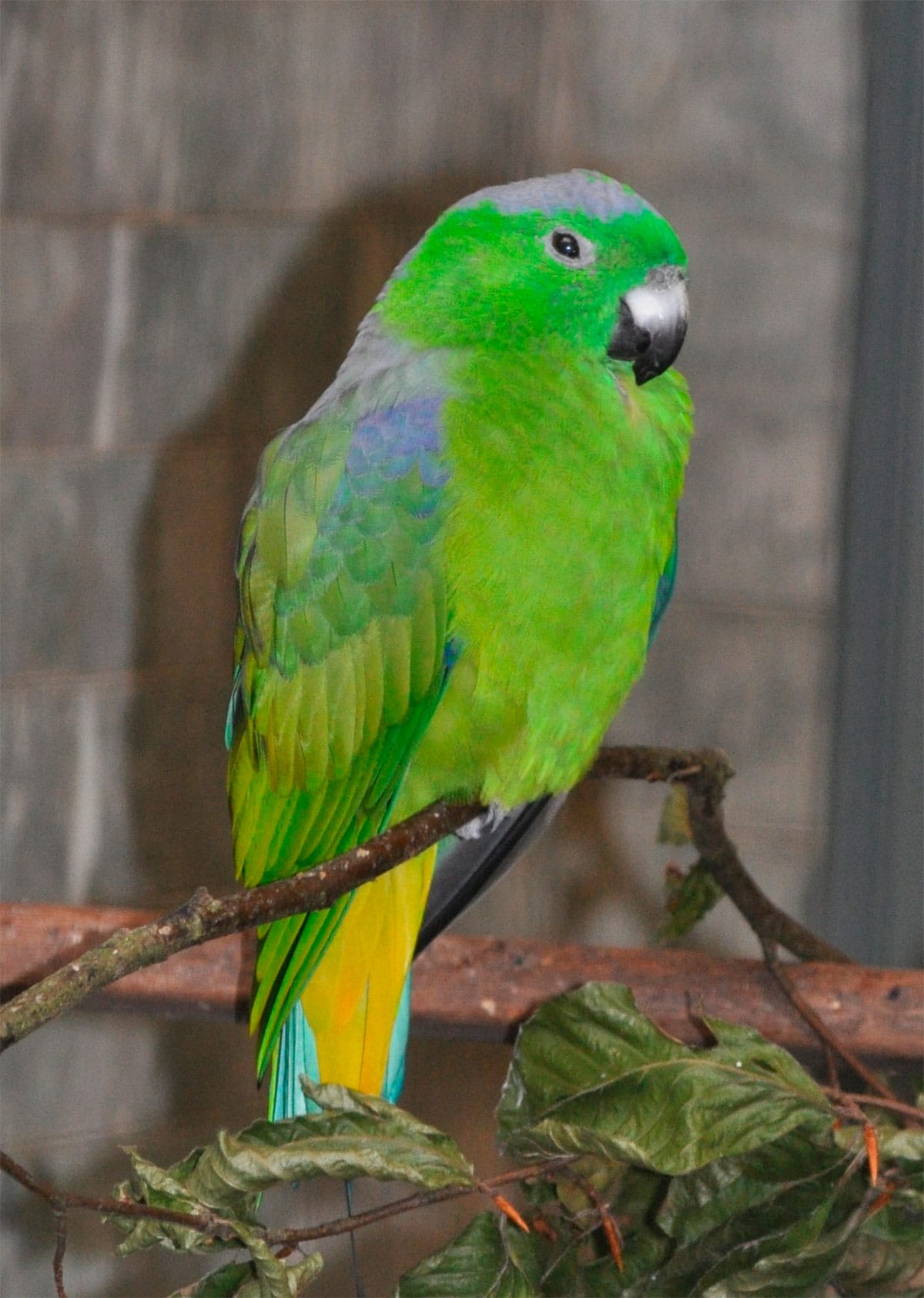
The head of the Buru Racket-tail (Prioniturus mada) is bright green, marked in blue-gray dark in the crown and in the nape. The upperparts are green, marked in grisaceo-azul dark in the upper mantle; Uppertail green. Wings green with lesser coverts and bend of wing Dark greyish-blue. Wing feathers green; underside of flight feather. Bluish.

The underparts are yellowish-green, more yellow in undertail-coverts. Upper, the tail green, outer feathers tipped dark blue; light blue, the tail down.

Bill grey; irises dark brown; legs grey.

Female lacks the blue color in the crown, nape and the the mantle; the blue in the bend of wing is smaller; rackets of the tail shorter.

Young without rackets on tail; males with blue in the nape.

Habitat:

Found until the 1600 meters above sea level, in all types of forest habitat, including selective exploitation and secondary high growth areas; also found in cultivated areas remaining trees; most common around 600 m. You often see them in small groups of up to ten birds. Tends to substitute to the Red-checked Parrot at higher elevations.

Reproduction:

breeding season from December to February. Up to five young can be raised in a nest.

Food:

It feeds on fruits, flowers, berries and seeds.

Distribution:

endemic to the island of Buru, Indonesian. The inclusion of the species as Near-threatened is based on the assumption of a very restricted range above the 1.000 m, but newly published evidence shows that it is common throughout the island with an estimated world population between 189.000-48S.000 birds.

Conservation:


minor concern


• Current category of the Red List of the UICN: Least concern

• Population trend: Stable

The size of the world population It has not been quantified, It is estimated between 189,000 and 483,000 individuals.

The species is described as common and widespread (pit et to the. 1997).

The population is suspected to be stable in the absence of evidence of any reduction or substantial threats.

"Buru Racket-tail" in captivity:

Not found in captivity.

Alternative names:

Buru Racket-tail, Buru Racket-tailed Parrot, Buru Racquet tail, Buru Racquet-tail, Buru Racquet-tail Parrot, Buru Racquet-tailed Parrot (ingles).
Palette de Buru, Perroquet à raquette de Buru (French).
Madapapagei (German).
Prioniturus mada (Portuguese).
Lorito Momoto de Buru, Lorito-momoto de Buru (español).

scientific classification:

Order: Psittaciformes
Family: Psittaculidae
Genus: Prioniturus
Scientific name: Prioniturus mada
Citation: Hartert, E, 1900
Protonimo: Prioniturus mada

Images "Lorito momoto de Buru":

Videos "Buru Racket-tail"

————————————————————————————————

«Lorito Momoto de Buru» (Prioniturus mada)

Sources:

Avibase
– Parrots of the World – Forshaw Joseph M
– Parrots A Guide to the Parrots of the World – Tony Juniper & Mike Parr
– Birdlife

Photos:

(1) – By Klaus Rudloff (kdrudloff@web.de) – Germany , Weltvogelpark / World Bird Park – Walsrode – biolib
(2) – «Prioniturus mada qtl1» by QuartlOwn work. Licensed under CC BY-SA 3.0 via Wikimedia Commons.
(3) – «Prioniturus mada-captive-8a-toc» by Prioniturus_mada_-captive-8a.jpg: Robert01.Original uploader was Robert01 at de.wikipediaderivative work: Snowmanradio (talk) – Transferred from de.wikipedia; transferred to Commons by User:Snowmanradio using Commonshelper.(Original text: selbst fotografiert) to Prioniturus_mada_-captive-8a.jpg. Licensed under CC BY-SA 3.0 of via Wikimedia Commons.
(4) – by jon hornbuckle – BIRDING AROUND THE WORLD
(5) – Prioniturus mada buru racquet tail – link

Sounds: Frank Lambert (Xeno-canto)

▷ The world of Pets: Dogs, cats, birds, reptiles, amphibians

Superb parrot
Polytelis swainsonii

Superb parrot

Content


Anatomy-parrots

Description

40 cm.. length between 132 and 157 g. of weight.

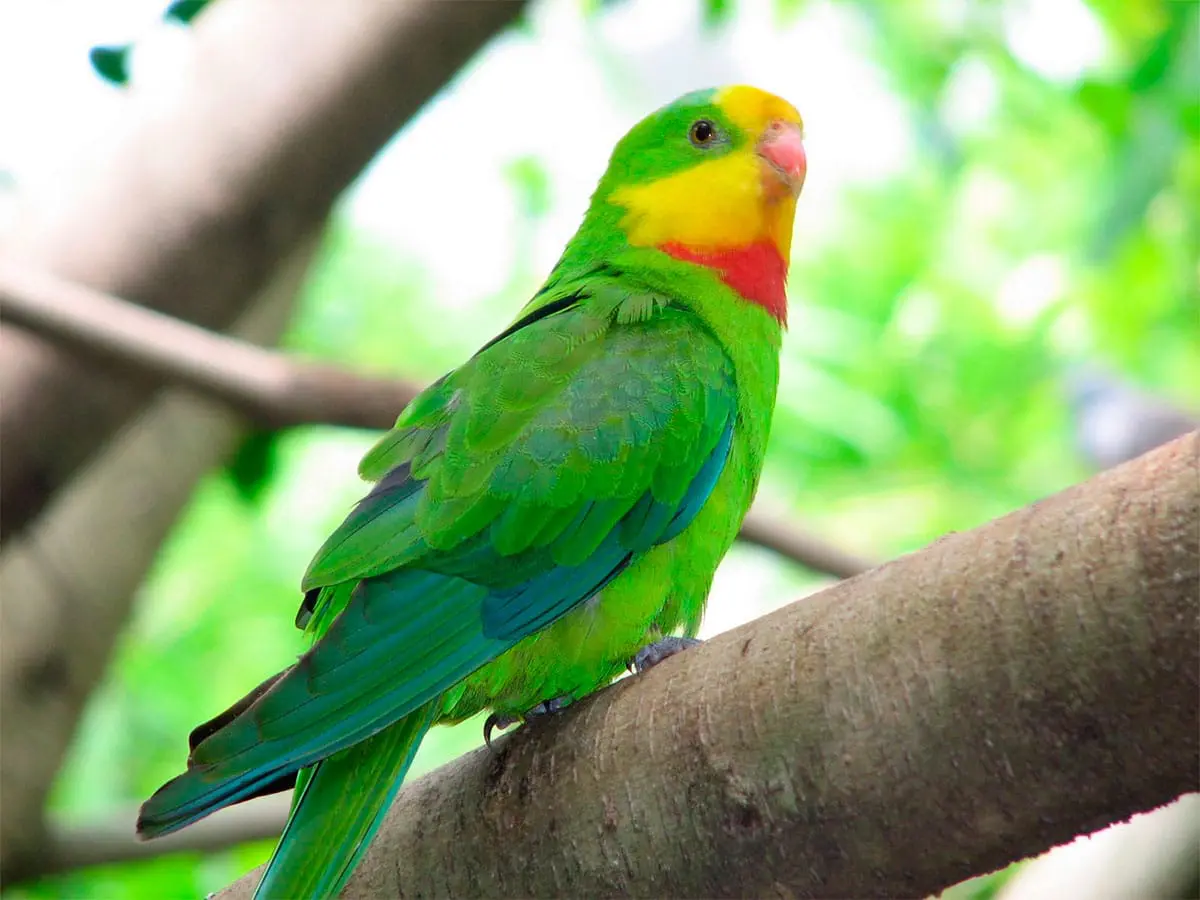
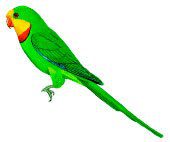
The Superb parrot (Polytelis swainsonii) has the front, crown, Chin and throat of bright yellow; back of the bright green Crown with turquoise blue wash: headphones coverts and Lords, green. Bright green upper parts. Upper, the wings, bright green, with dark diffusion in the inner margins of the vane internal and blue diffusion in vane outer (fine yellow rear margin for flight feathers); bluish carpal edge: light blue primary coverts; primary elongated.

Wing of bright green feathers; bottom of blackish brown flight feathers. Underparts pale bright green, with thin bright red Ruff between throat yellow and green at the top of the chest. Upper, bright green tail, with dark elongated Central feathers Slightly bulbous tips. outer feathers with bluish edges vane outer. The lower part of the tail is black.

Bill, coral red; yellow-orange irises; Blackish legs.

The female is completely Green, with a bath pink Brown throat and with the headphones cinnamon and the Crown of blue-grey. The mantle is more off, more greenish Brown, contrasting with the Green rump and dark flight feathers. The underparts are paler, orange-red legs. She also has distinctive pink trim and pink tips to yellow vane internal bottom of the queue.

Yellow IRIS.

Immature as females but with Brown iris. Males attain adult plumage in about 12 months.

Habitat:

Superb parrot

A part of the population of the Superb parrot is migratory, wintering in the North of the breeding areas.

Habitat preferences of breeding populations vary slightly from east to west within the slopes of the Great dividing range and open areas in forests of eucalyptus, It is the dominant vegetation type. Here the species nests far from watercourses, and it uses a variety of tree species.
In the region of Riverina, to the West, birds breed almost exclusively on the banks of rivers, in forests of Eucalyptus camaldulensis, feeding on nearby forests of Eucalyptus bicolor, Eucalyptus melliodora and White Pino-CIPRES (Callitris columellaris).

They sometimes also found in farmland and villages.

The size of the flocks are usually small, but groups of up to 100 individuals have been recorded after the breeding season.

The superb Parrot feed in the trees, in the understory, and also in land, where can be accessible, feeding on spilled grain on the roadsides and keeping the company of the Yellow Rosella and Cockatoos.

Reproduction:

The breeding season of the Superb parrot is from September to November.
Male parade making small greetings and nodding his head. Both members of the couple make ritual exchanges of food.

The nest is usually a hollow, full of scrap wood, at the top of a tree dead or alive and a considerable height that is usually between 11 and 51 meters above the ground. The individual sites tend to be reused.

The Superb parrot, they often nest in colonies ranging up to six couples. Spawning contains 4 or 6 eggs which are incubated for at least 20 days. The chicks are altricial and leave the nest after 30 days.

Food:

The diet includes fruits and flowers of Acacia and eucalyptus, fruit shrubs (for example Exocarpos); seeds of crops, pastures, weeds and grasses

Distribution:

Size of the area of distribution (reproduction / resident): 95.300 km2

The Superb parrot they are endemic in Australia, where are distributed only in New South Wales and the north end of Victoria.

The species are concentrated in two main areas: on the South-West slope of the Great dividing range (regions of Cowra, Boorowa, Cootamundra and Yass), and in the area of Riverina, New Wales of the itsr. In the latter the range extends along the murrumbidgee river, from There is a to Darlington Point, Narrandera and Wagga Wagga.

Also found in the North of Goolgowi and the river lachlan, and in South, in the rivers Edward and Murray (Barham. Deniliquin, Tocumwal, Cobram, Getafe and Albury).

In the North of Victoria, concentrated along the rivers Goulburn and Ovens, and in the area of Barmah Forest.

Wandering birds occasionally appear more to the West, along the border of Victoria and New South Wales.

The Superb parrot, do not normally breed above 33° S, but at least part of the population disperses north to 33° S at the end of the breeding season.

These birds are found from April to August in the northeast of New South Wales from Gunnedah to Narrabri, Gilgandra and Coonamble, and between river systems to the West (Barwon, Namoi, Macquarie, Castlereagh, Marthaguy Creek).

Occasionally, alleged migratory birds, They fly to the West, about Tottenham and Hermidale.

Escapes have been recorded around Sydney and Melbourne.

A moderate number of captive.

Protected by law.

Conservation:


minor concern


• Current category of the Red List of the UICN: Least concern

• Population trend: Stable

Its population, apparently, fell in 1920 as an accidental effect of a poisoning by the crop protection.

A panel of experts considered that it was very likely that the population in 2010 exceeds the 10.000 mature individuals. The current estimate ranges in the Strip between 10.000 and 20.000 specimens.

The general trend of the population of the Superb parrot (Polytelis swainsonii) is uncertain, but there is no evidence of a continuous decline.

In Australia is also classified as vulnerable species the law of protection of the environment and conservation of the biodiversidadad of 1999. In addition, its conservation status varies between states., for example in the law of Victoria (1988) is considered to be threatened species.

"Superb parrot" in captivity:

Take it easy, relatively little aggressive with other birds, and very social.

Una muestra vivió 15,1 years in captivity. According to sources, these animals can live up to 24,2 years in captivity, It is possible to, but the source is not verified; the same study reported that these animals can reproduce in approximately 2 years of age in captivity.

Pretty common in captivity, above all in Australia.

Alternative names:

Superb Parrot, Barraband, Barraband Parakeet, Barraband Parrot, Green Leek, Scarlet-breasted Parrot (ingles).
Perruche de Barraband, Perruche Barraband, Perruche superbe (French).
Schildsittich (German).
Periquito-soberbo (Portuguese).
Perico Soberbio, Periquito de Barraband (español).

scientific classification:

Order: Psittaciformes
Family: Psittaculidae
Genus: Polytelis
Scientific name: Polytelis swainsonii
Citation: (Desmarest, 1826)
Protonimo: Psittacus Swainsonii

Images «Superb Parakeet»:

Videos "Superb parrot"

————————————————————————————————

«Superb Parakeet» (Polytelis swainsonii)


Sources:

Avibase
– Parrots of the World – Forshaw Joseph M
– Parrots A Guide to the Parrots of the World – Tony Juniper & Mike Parr
– Birdlife
– The Animal Ageing and Longevity Database – Polytelis swainsonii

Photos:

(1) – By paulgear (Picasa Web Albums) [CC BY-SA 3.0], via Wikimedia Commons
(2) – Image Credit: Stuart Harris – Canberra Birds
(3) – Image Credit: Julian Robinson – Canberra Birds
(4) – Image Credit: Stuart Harris – Canberra Birds
(5) – Image Credit: Julian Robinson – Canberra Birds

Sounds: Ding Li Yong (Xeno-canto)

▷ The world of Pets: Dogs, cats, birds, reptiles, amphibians

Bluebonnet
Northiella haematogaster


Bluebonnet

Content


Anatomy-parrots

Description

28 cm. length and a weight between 74 and 105 g..

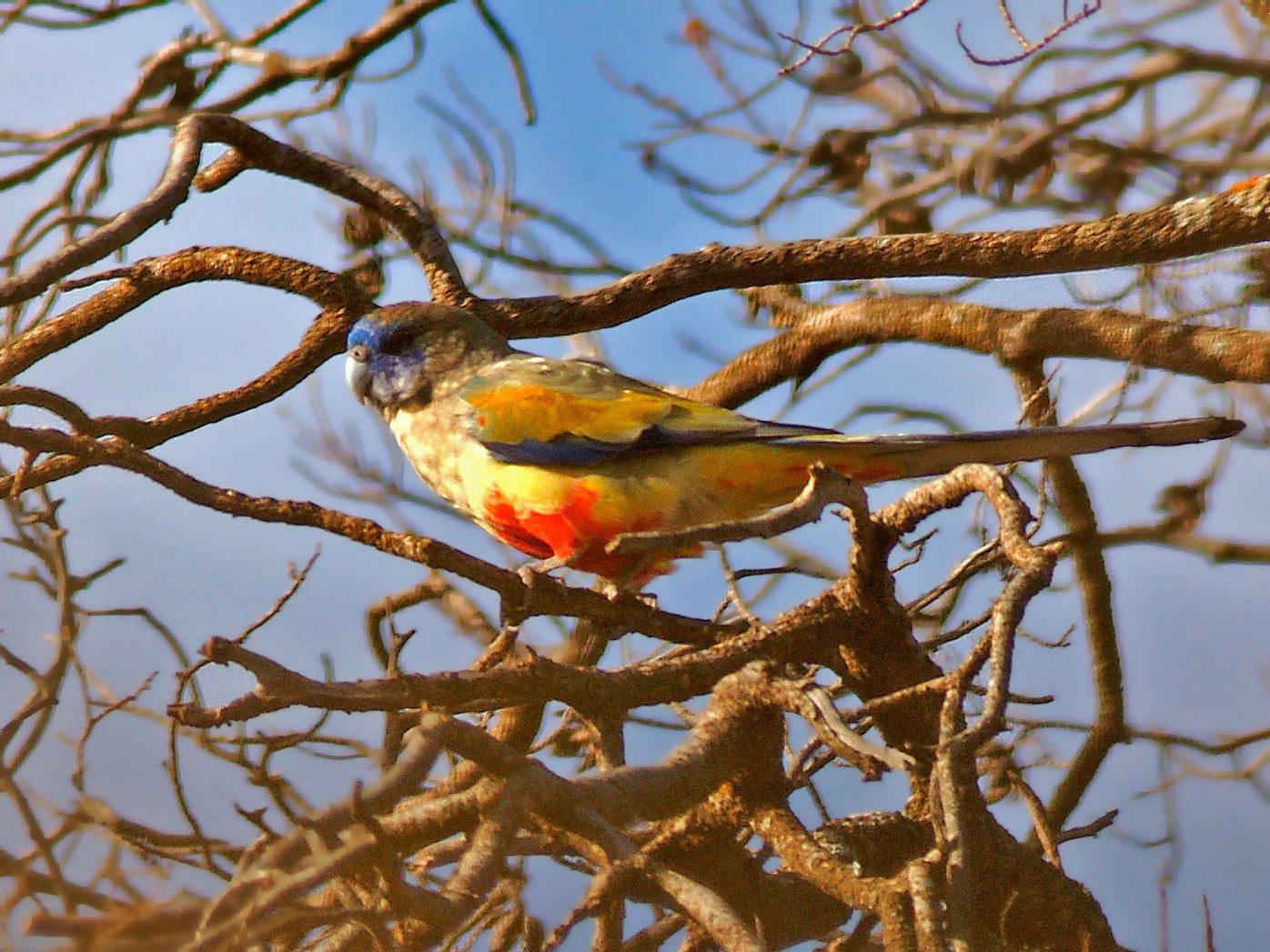
The Bluebonnet (Northiella haematogaster) they have the forecrown, lores and face, blue-violet color. The rest of the head, the chest, the layer, the back and rump It has a beautiful ochre mixed with yellow belly. The abdominal area It is covered by a large red spot.

The curvature of the wings is blue, most of the coverts are a key olive. The outermost feathers are purplish blue. The the wing lower and flight feather they are also blue-purple. The tail color is greenish bronze but the outer feathers they are blue-purple with white tips.
The bill grayish white is; the irises pale grey; legs grey.

The females they are more off, with less blue in the face and a pale bar on the wing .

The immature they resemble females, but the stain abdominal Red is more discrete. The immature plumage is lost after few months. The chicks have the bill yellow.

Subspecies description

  • Northiella haematogaster haematogaster

    (Gould 1838) – The nominal.


  • Northiella haematogaster haematorrhoa

    (Bonaparte 1856) – The curvature of the wing is turquoise blue and the blankets they are redheads. The underparts is red


  • Northiella haematogaster pallescens

    (Salvadori 1891) – The plumage It is similar to the nominal, but the underparts they are paler.


  • *

    Northiella haematogaster narethae

    (White,HL 1921) – The forecrown is blue, and has spots on the chest. The upperparts color is olive, the underparts is yellow with reddish color underneath the tail. Small outer covers red.

  • * A molecular study published in 2015 by Gaynor Dolman and Leo Joseph He confirmed the genetic isolation of the subspecies Northiella haematogaster narethae and recommended that it was restored as a separate species, the Naretha Bluebonnet (Northiella narethae)

Habitat:

The Bluebonnet frequent arid and semi-arid forests dominated by trees of the genus Myoporum, which are perennial shrubs and resistant to salt and drought.

They also appreciate the conifer and the casuarinas that you are home to colonies of caterpillars. They have a certain affection for the acacias and eucalyptus, especially if the weed is made up of small quenopodios.

The Bluebonnet they often visit the grassy plains, dry brush and trees lining the river. Sometimes they come to buildings, farms or small ponds.

In the South of its range, the removal of waste bags of Mallee, located on agricultural land, It seems to have had a very important influence.

The Bluebonnet they live in pairs or in small groups. When resent, loud disperse, but they remain on the ground a short distance from the trees. In the event of alarm, they raise the feathers of her eyebrows.

These birds are very enable, especially early in the morning when the boisterous groups are formed, just before his departure to feed. They are able to run very fast and have a very characteristic straight posture.. They are less active during the heat of the day, staying on the ground in silence.

The Western populations They seem to form larger groups, showing more sociability than the Eastern. They tend to get together with other species of parrots, such as the Mulga Parrot, Pale-headed Rosella and Mallee Ringneck.

During the spawning, the Bluebonnet carried out parades such as greetings with head, movements of the tail and eating ritual exchanges. They also have a ceremonial flight consisting of small flapping.

Reproduction:

The season of nesting extends from July to December, with some variations depending on the rains. The nest is located in a cavity in a tree, except in the subspecies narethae to use scrubby trees, being their favorite nesting place a nest on the ground in a crack in the base of a trunk. This subspecies usually gives preference to a tree of the genus acacia (Acacia papyrocarpa) family Fabaceae.

The spawning contains 4-7 eggs with one incubation lasts a few 19 days. The young chicks are born without feathers and remain in place of birth at least during 30 days.

Food:

The Bluebonnet consume mainly herbaceous seeds, of Atriplex hortensis, of coquia (Kochia scoparia), of bassia and some grown as garden plants.

Sometimes consume fruit, berries and acacia flowers, the mistletoe and the larvae of Lepidoptera that are attracted to the trunks of casuarinas.

When are juveniles, its menu consists mainly of seeds composed of helipterum, that you belong to the same family as sunflowers.

Distribution:

Endemic to Australia, where there are four populations, one of which is isolated in the southeast of Western Australia, from the West of the Nullarbor plain up close Kalgoorlie.

Birds belonging to this western race are also found in western Southern Australia, about Ooldea and Colon, but they are probably coming from exhausts. further east, the range of the species varies through the east of Southern Australia, from the West of Bordertown through Salt Creek, Adelaide, the northern parts of the Cape York Peninsula and Eyre, to the North across the basin of the Lake Eyre to the Simpson Desert, about Commonwealth Hill station (but largely absent from the Montes Flinders).

From the North of Southern Australia, extends to the South of Queensland to the West of the Great dividing range, reaching around to East of Windorah, Charleville, Mitchell and Goondiwindi.

In New South Wales found to the West of the Cordillera Central, and coming east of a line, More or less, that crosses Warialda, Orange and Wagga Wagga (record out of bounds east of Gunning).

In Victoria, from time to time, they arrive as far East as Rochester and Southeast of Bendigo and Beaufort.

The species is common within a suitable habitat.

The world population is probably superior to the 100.000 individuals, although the Western subspecies Nanthae You can have less than 5.000 specimens, having suffered for their catch in the past.

A small number of captivity.

Fully protected by law.

Subspecies distribution

Conservation:


minor concern


• Current category of the Red List of the UICN: Least concern

• Population Trend: Decreasing

In accordance with the Manual of the birds of the world (Handbook of the Birds of the World, HBW), the Bluebonnet they are not globally threatened. Son fairly common, except at the extremes of its range. But, the elucidation of native plants must be stopped if we want to preserve the food resources and nesting places.

The spread of the Common Starling (Sturnus vulgaris) It is a real danger in some areas. The subspecies Narethae is prized by poachers and the lots of beautiful feathers.

The proliferation of rabbits and Lagomorphs threatens the equilibrium of the habitat.

"Bluebonnet" in captivity:

The Bluebonnet they were classified for more than one hundred years within the genus Psephotus. On the basis of some essential differences with the species Psephotus, they are currently classified within the independent genre Northiella.

The parakeet more required by lovers of Australian parakeets, are likely to be the Bluebonnet, Although the subspecies Naretha is very rare and scarce. The Bluebonnet pure breed, they are virtually non-existent in Europe.

There are many Bluebonnet non-purebred, since they often interbreed with the of red-bellied (Northiella haematogaster haematorrhoa). The birds that have tones rojas in the coverts infracaudales non-purebred. Be very careful when making their acquisitions.

The first breeding success of the nominal species dates back to the year 1878, in France. With the subspecies of red-bellied (Northiella haematogaster haematorrhoa) also data from 1878, but this time in Belgium.

The first breeding results with the subspecies Northiella narethae they date from 1941 in Australia.

Are capricious in nature. The big problem is that of aggression since they are probably the most aggressive of all the Australian parakeets. Males, above all, they are the protagonists of this bad reputation. Therefore other birds not can be joined with the Bluebonnet, even larger birds.

The aggressiveness of the male reaches their own partner, the Aviary must take into account this, the female should be able to take refuge in case of attack. On the other hand, they are very animated and jugetones.

You spend much time on the ground looking for food, they are moderate rodents and are lovers of bath.

According to sources, a sample lived 15,3 years in captivity. In captivity, these animals have been known that they be reproduced in approximately 2 years of age.

Alternative names:

Bluebonnet, Blue Bonnet, Blue-Bonnet, Bluebonnet Parakeet, Bulloak Parrot, Common Bluebonnet, Common Bluebonnet Parrot, Crimson-bellied Parakeet, Crimson-bellied Parrot, Eastern or Western Bluebonnet, Little Bluebonnet, Naretha Bluebonnet, Naretha Parrot, Oak Parrot, Pallid Parrot, Red-bellied Bluebonnet, Red-vented Bluebonnet, Yellow-vented Bluebonnet, Yellow-vented Parrot (ingles).
Perruche à bonnet bleu, Bonnet bleu, Perruche à bonnet bleu ou P. de Nareth (French).
Blutbauchsittich (German).
Periquito-de-bluebonnet (Portuguese).
Perico Azul, Perico Cariazul (español).

scientific classification:

Order: Psittaciformes
Family: Psittaculidae
Genus: Northiella
Scientific name: Northiella haematogaster
Citation: (Gould, 1838)
Protonimo: Platycercus haematogaster

“Blue-faced Parakeet” images:

Videos "Bluebonnet"

«Blue-faced Parakeet» (Northiella haematogaster)

Sources:

  • Avibase
  • Parrots of the World – Forshaw Joseph M
  • Parrots A Guide to the Parrots of the World – Tony Juniper & Mike Parr
  • Birdlife

Photos:

(1) – To Blue Bonnett in the Cocoparra National Park (near Griffith), NSW, Australia By David Cook Wildlife Photography [CC BY-SA 2.0], via Wikimedia Commons
(2) – Bluebonnet (Northiella haematogaster) Birdsville Track, South AustraliaBy by Ron Knight – Flickr
(3) – Northiella haematogaster, Photo by Benjamint444 – Animalia Etymology of animal name
(4) – Bluebonnet/Blue Bonnet/Crimson-bellied Parrot – animalphotos
(5) – Blue Bonnet Fact Sheet 26 May 2011, Windorah. QLD – travelling-australia.info

Sounds: Frank Lambert (Xeno-canto)
▷ The world of Pets: Dogs, cats, birds, reptiles, amphibians

Antipodes parakeet
Cyanoramphus unicolor

Antipodes parakeet

Content


Anatomy-parrots

Description

32 cm.. of length and a weight of 130 g..

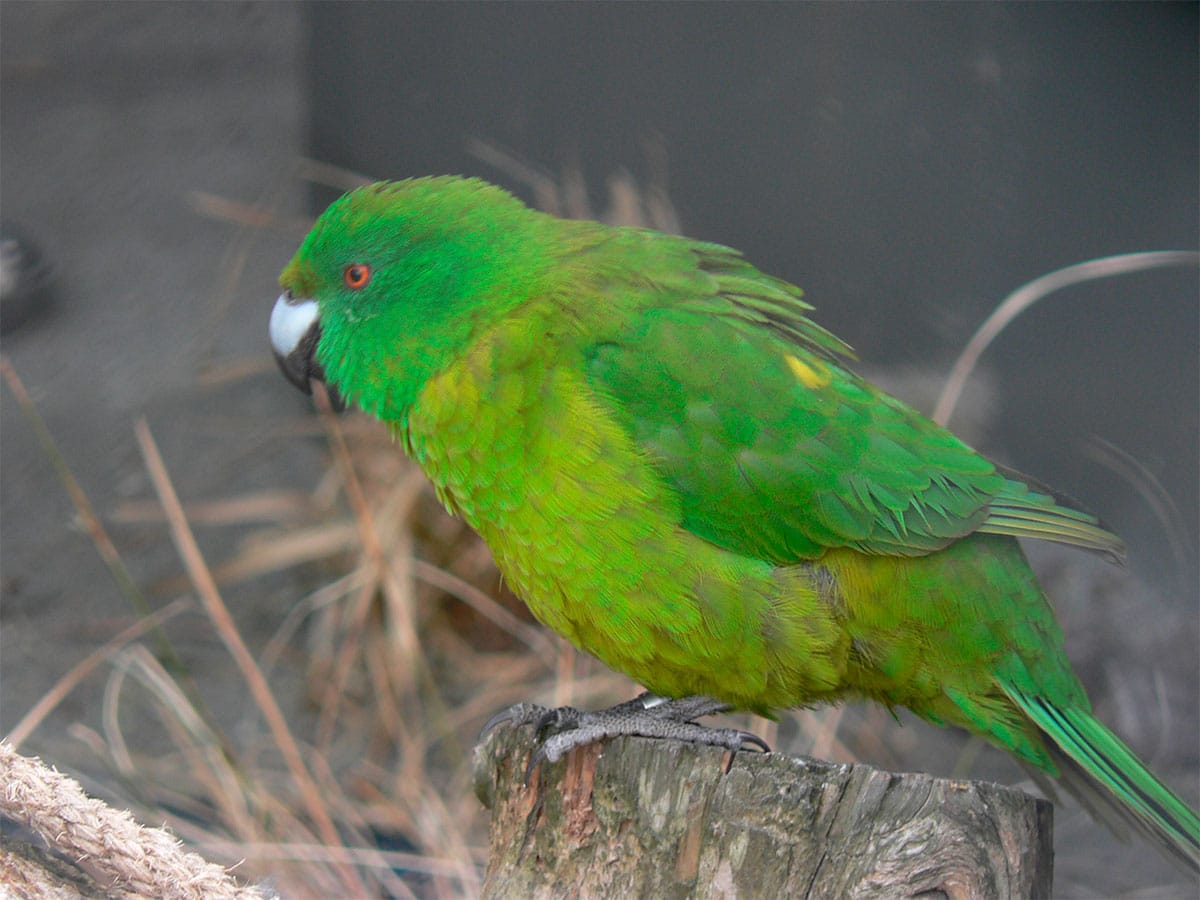
The Antipodes parakeet (Cyanoramphus unicolor) has a plumage brighter yellowish green, more yellowish on the hand down and sometimes with irregular yellow markings at the top. It is the only species that does not have color markings on head and tail. It is the largest of its kind.

The face and top are bright emerald green, and the contrast with the neck and the chest is more off.

At the top of the wings, the outer bands of the flight feather are blue, While the long tail It is green with fine yellow piping.

The great bill is silver-grey with dark end. The eyes are orange-red. The legs and feet are greyish.

Both sexes are identical. The female is slightly smaller than the male.

The young birds they are of tail shorter. The young people have the bill Pink White and the eyes light brown.

Habitat:

Antipodes parakeet

The Antipodes parakeet, usually, they prefer areas with tall grass (POA littorosa), areas of open scrub and sedges (Carex). Can also be seen in areas where thorny ferns grow (Polystichum vestitum) and the bushes (Coprosma antipode).

The birds are most common on steeper slopes and near water courses, alone or in small groups; They walk on the floor and climb among the branches as they seek food, normally during the morning and before nightfall.

These birds are very Meek and curious. When frightened, they disappear among the dense vegetation, keeping silent or giving a short alarm call. More than half of the day is spent sunbathing and grooming in protected areas. They bathe in small ponds and rest in burrows.

Reproduction:

The season of reproduction takes place between October and March. The Antipodes parakeet nest in soils with good drainage, a length of at least one meter. The nests is carved in fibrous peat, under the thick base of the tall grass vegetation. The nesting Chamber It is full of rootlets or fern scales.

The spawning occurs between November and January. The female lays 2-3 white eggs (5-6 in captivity). She carries out most of the duties of nesting, and incubates the eggs for a few 26 days. She cares for and feeds the chicks for nearly two weeks. The male contributes to breeding, feeding the female during this period, as well as feeding the young until their independence, at least two weeks after leaving the nest.

Food:

The diet main consists of leaves; an amount of crushed leaves, still attached to the plant, they are a distinctive sign of the power of the Antipodes parakeet. Also consume seeds, berries, the remains of penguins and petrels dead. They often enter into colonies of the Rockhopper Penguin (Eudyptes chrysocome) and of the Sclater's Penguin (Eudyptes sclateri) between the months of October and may, to feed on their eggs or dead young. It also feeds on the eggs and sometimes on the newborns of the same species.. (The sympatrico Red-crowned parakeet prevents competition by taking advantage of the niche that provide seeds, flowers, berries and small invertebrates.)

Distribution:

Endemic to the main island Antipodes, In addition to Bollons, Leeward, Inner Windward and Islands Archway.

Conservation:


Vulnerable


• Current Red List of UICN: Vulnerable

• Population trend: Stable

The world's population of the Antipodes parakeet It is estimated between 2.000 and 3,000 specimens. Although common and stable within its range, the species is permanently at risk due to accidental introduction of predators, problem that could be fixed in no time.

Some birds are kept in captivity in New Zealand.

VULNERABLE.

"Antipodes parakeet" in captivity:

This stocky parakeet can live in community with species with similar characteristics.. It is usually outgoing, Active and depending on their way of breeding (natural or hand) and earlier experiences, It may be a trusted Parrot (hand raised or treated early), even being raised by their parents tends to be entrusted.

As a pet it could be good pet by his way of being cheerful and curious.

It is a rather nice parrot as vocalizations. It is not just loud. He likes to climb, There is no great need to crack and loves to be on the floor. enjoy the baths.

However, due to their vulnerability, is very rare poultry.

Alternative names:

Antipodes Parakeet, Antipodes Green Parakeet, Antipodes Green Parrot, Antipodes Island Parakeet, Antipodes Island Parrot (English).
Perruche des Antipodes, Kakariki des Antipodes, Perruche d’Antipodes (French).
Einfarbsittich (German).
Kakariki dos Antípodas (Portuguese).
Perico de Antípodas, Perico de las Antípodas (español).

scientific classification:

Edward Lear
Edward Lear

Order: Psittaciformes
Family: Psittaculidae
Genus: Cyanoramphus
Scientific name: Cyanoramphus unicolor
Citation: (Lear, 1831)
Protonimo: Platycercus unicolor

«Antipodean Parakeet» Images:

Videos "Antipodes parakeet"

«Antipodean Parakeet» (Cyanoramphus unicolor)

Sources:

  • Avibase
  • Parrots of the World – Forshaw Joseph M
  • Parrots A Guide to the Parrots of the World – Tony Juniper & Mike Parr
  • Birdlife
  • Loromania

  • Photos Antipodean Parakeet:

(1) – Cyanoramphus unicolor at Wellington Zoo, Wellington, New Zealand by Peter Halasz. (User:Pengo) – Wikimedia
(2) – Cyanoramphus unicolor at Wellington Zoo, Wellington, New Zealand by Peter Halasz. (User:Pengo) – Wikimedia
(3) – Antipodes Island Parakeet, Auckland Zoo by russellstreet – Flickr
(4) – Antipodes Island parakeet (Cyanoramphus unicolor) by Chlidonias – zoochat
(5) – Antipodes Island parakeet (Cyanoramphus unicolor) by Chlidonias – zoochat
(6) – A painting of Antipodes Parakeet, also known as Antipodes Island Parakeet, (originally captioned «Platycercus unicolor Uniform Parrakeet») by Edward Lear 1812-1888 [Public domain], via Wikimedia Commons

▷ The world of Pets: Dogs, cats, birds, reptiles, amphibians

Yellow-collared Lovebird
Agapornis personatus


Inseparable Cabecinegro

Content

Description "Inseparable Cabecinegro":

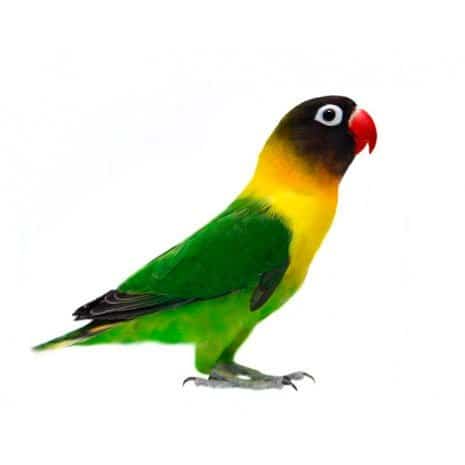
Among 13 and 15 cm.. length and a weight between 43 and 47 g., the Yellow-collared Lovebird (Agapornis personatus) They are surprisingly beautiful.

Inseparable Cabecinegro

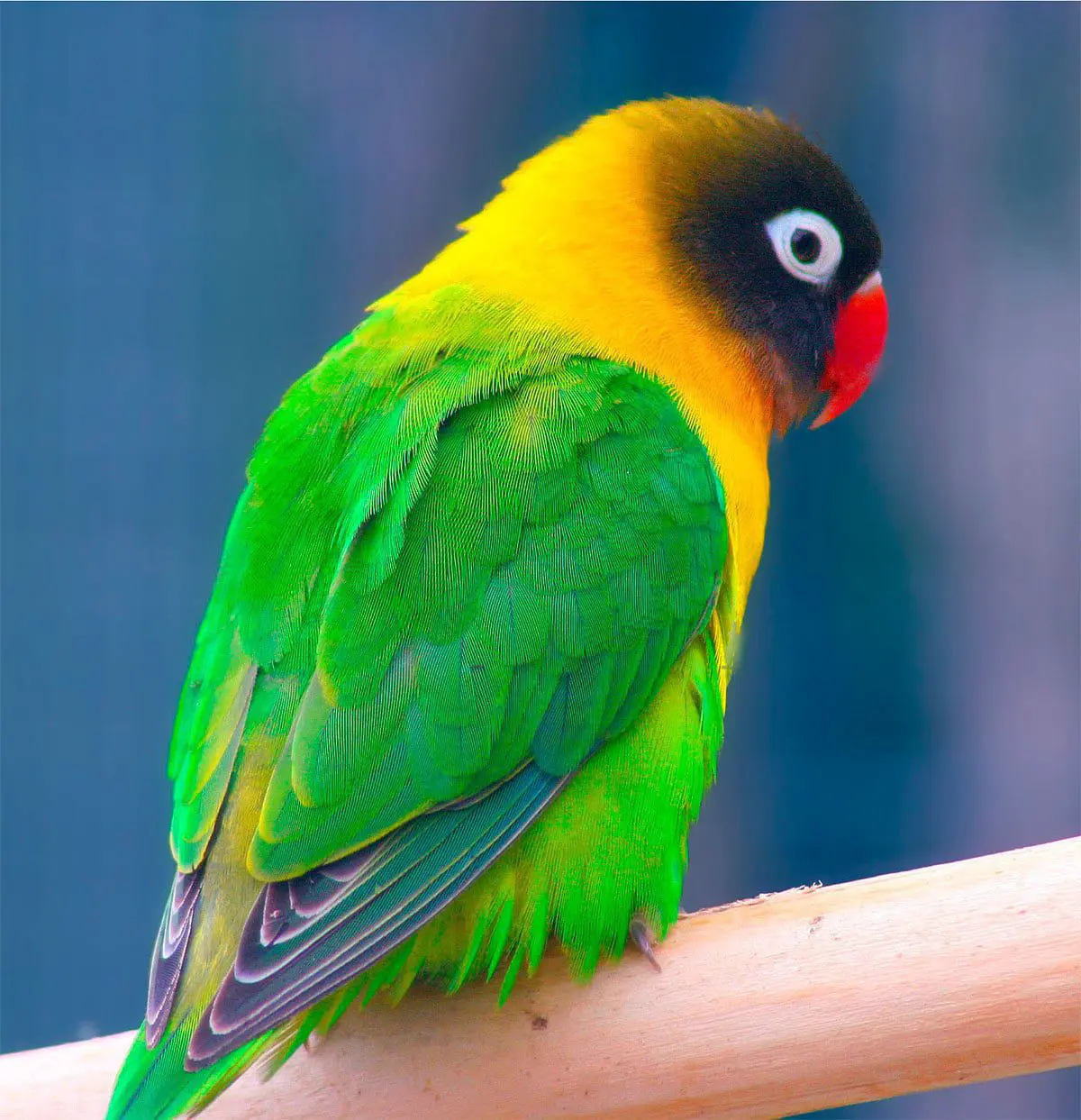
They have head, the throat and the top of the nape blackish brown, merging into yellow at the bottom of the nape and top of the the mantle, forming a distintivo collar. The remaining the mantle, scapulars and rump, are green; uppertail-coverts blue. Upper, the wing-coverts green; primaries green, darker in vane inner; vane outside of secondaries green, the vane internal black.

Under, wing-coverts green; underside of flight feather grey-black. Top of the chest bright lemon yellow; belly and undertail- coverts pale green. Tail mostly green, but all feathers, except the central pair, labeled orange opaque; subterminal band negruzca.

Bill coral red, white at the base of the upper jaw; cere white; irises brown; eye ring white (2mm wide); legs pale grey.

Both sexes are similar.

Immature and adults, but the head it is less dark and bright; neck yellow duller; black markings, sometimes at the base of the upper jaw.

Habitat "Inseparable Cabecinegro":

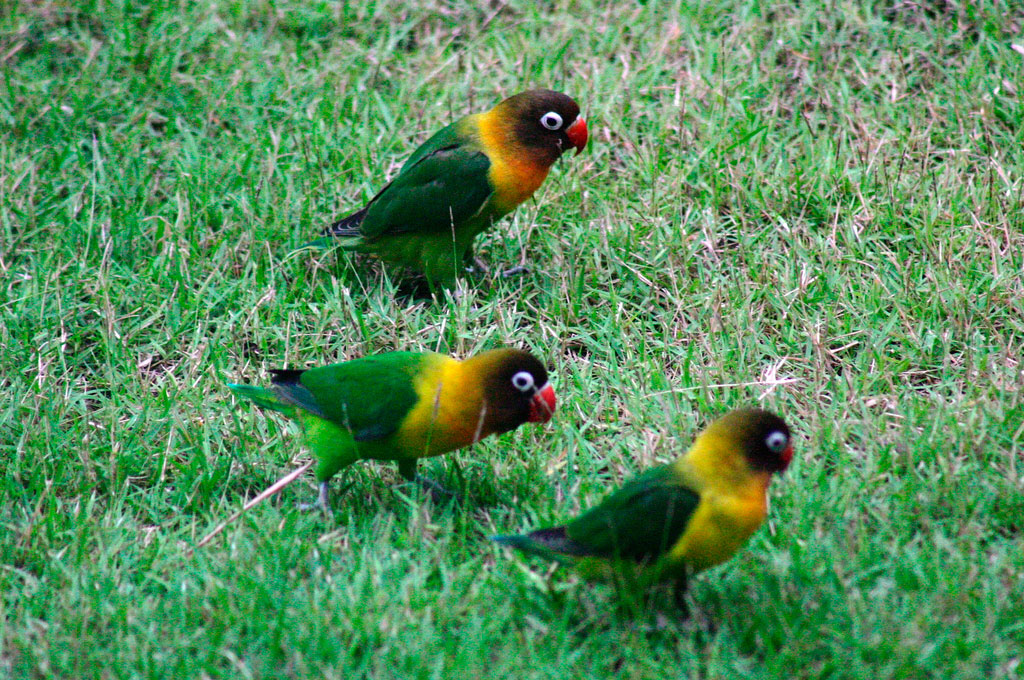
The Yellow-collared Lovebird They are distributed in well wooded pastures, including the cultivated areas, with Acacia, Commiphora and, above all, Adansonia, at altitudes between 1,100-1,800 m. Avoid miombo woodland.

Usually observed in small flocks of 4-5 birds but sometimes they can meet up to a hundred.

Reproduction "Inseparable Cabecinegro":

The nests of the Yellow-collared Lovebird they find, normally, in tree cavities, with a strong preference for Adansonia. They can also use free domed nests of other species. In Dar-es-Salaam, the nest, sometimes, They build it in the cavity of a building or in a free nest Little Swift (Apus ajffinis).

The nest is a complex domed structure built from long stems and strips of bark, carried by the female at the peak. The Eggs are laid in the dry season (March-April and June-July). The laying is of 3-8 in captivity. The egg incubation hard 23 days. During the first six weeks after hatching, the females they feed the young. Then, Once the young birds leave the nest, the males They take care of feeding pigeons During two weeks, or until young birds achieve independence.

"Inseparable head":

The Yellow-collared Lovebird feed of grass seeds, the millet and the sorghum, Also seed Cassia. They require regular access to water and can drink several times a day.

Distribution:

Size of its range (breeding/resident): 224.000 km2

Except track in southwest Kenya (in Taveta), the Yellow-collared Lovebird appear to be limited to the plateau in eastern and southern Tanzania, from northern, Mount Meru south to Morogoro and west on Región de Rukwa and Mbeya Region.

In Kenya, there are considerable feral populations in Naivasha, Nairobi and Mombasa; smaller in some highlands and the coastal towns (6.000 birds in 1.986.); in Tanzania, in Dar-es-Salaam and Thong.

Sedentary, in general, common and sometimes abundant. Wild population probably in decline due to the large scale capture for the bird trade. One large number in captivity.

Conservation:


minor concern

• Current Red List of UICN: Least concern

• Population trend: Stable

Until this year (2007) It was included in Appendix II (o anexo B) convention C.I.T.E.S.. Not globally threatened, but still vulnerable by presenting a reduced distribution area. Importation is no longer necessary to be a sufficient number in captivity.

The population size World has not been quantified, but the species according to sources is locally quite common.

The "inseparable head" in captivity:

The Yellow-collared Lovebird It, next to the Rosy-faced Lovebird and the Fischer's Lovebird, one of the most Lovebird bred in captivity.

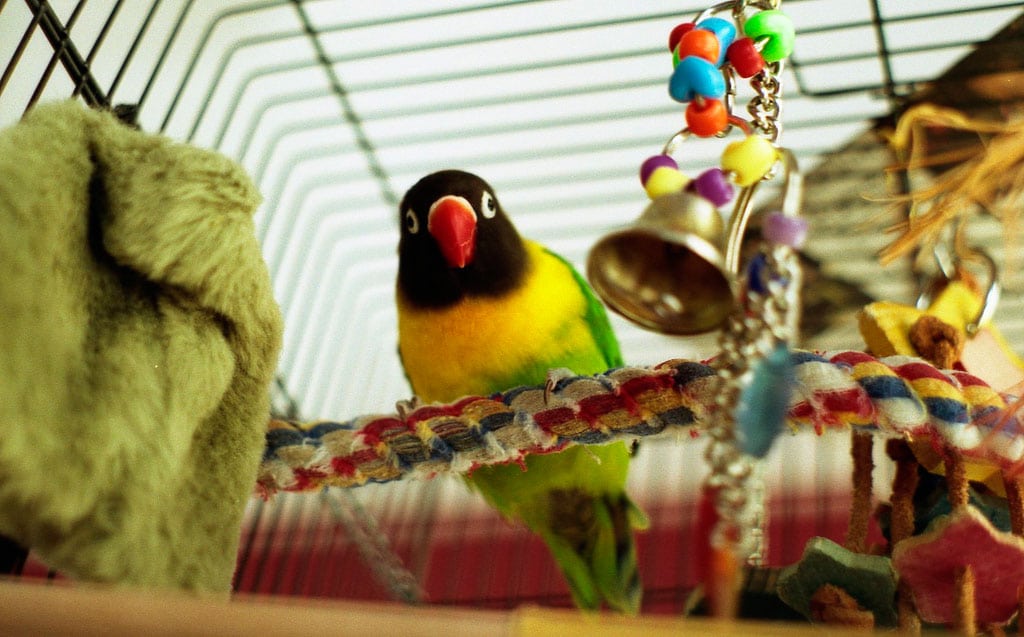
The Yellow-collared Lovebird (Agapornis personatus) It is a bird very sociable with his kind and can live in a group.

Its aggressiveness does not reach the limit of being able to kill a fellow, as if they would Rosy-faced Lovebird.

Very common, available in all pet stores. A bit less noisy some other Lovebirds, their cry is less annoying. Like all Lovebirds, the Yellow-collared Lovebird they are very agile, Dynamic, good climbers and skilled in all kinds of acrobatics. After the breeding period, Some couples prefer to be alone if they spent this time with other couples of their species.

The Lovebirds rarely talk, but there is the possibility that learn to imitate human speech if they are taught since very young. It is important to remember that you should never have the expectation that a bird can speak.

With regard to its feeding, We provide our Yellow-collared Lovebird a set of seeds, such as millet, mixture of canary, sunflower and hemp. Alternatively, we can provide insect, ears of corn and an abundance of fruit, vegetables.

Give them opportunity to bathe and change the water regularly.

The Yellow-collared Lovebird are very easy to play, at humidity 70%. Three nidadas by year. The female tends to lead twigs on his rump to decorate your nest.

A cage of 80 x 40 x 40 cm.. It is suitable for these Lovebirds. The nest It must be a horizontal box height 25cm, 18cm wide and 18cm deep. The laying is of 3 to 6 eggs. The time of incubation of these eggs is 23 days and the chicks leave the nest 4 to 5 weeks after hatching.

Mutations Agapornis personatus

No sex-linked mutations present, All are autosomal. They can be recessive, dominant and incomplete dominant. They are recessive: blue, pastel, ino, albino, recessive harlequin, DEC, dilute, bronze fallow y pale fallow. The only dominant as such they are dominant harlequin and slaty. Incomplete dominant They are dark factor, purple, misty y edged.

One type of harlequin which it is transmitted to different recessive and dominant form, is the progressive harlequin o mottle. The harlequin is increasing as the bird will be more adult, as it is getting older.

This species has been used to "pass" its mutations to other species such as A. fischeri and A. nigrigenis. This step is called transmutation (type hybridization). In fact, personatus lutino comes from the transmutations with A. lilianae, species which came first. This whole process is possible to be fertile birds resulting from joining any of these 4 species including. With the A. roseicollis sterile individuals out. For all that we have seen, Finding Agapornis Persatus "pure" is a difficult task.

Source: The Bird Aviary

Alternative names:

Yellow-collared Lovebird, Black-masked Lovebird, Masked Lovebird, Yellow collared Lovebird (English).
Inséparable masqué, Inséparable personata (French).
Schwarzköpfchen (German).
Inseparável-mascarado (Portuguese).
Inseparable Cabecinegro, Inseparable de Mascara, inseparable enmascarado (español).


scientific classification:

Anton Reichenow
Anton Reichenow

Order: Psittaciformes
Family: Psittaculidae
Genus: Lovebirds
Scientific name: Agapornis personatus
Citation: Reichenow, 1887
Protonimo: Agapornis personata


Images "Inseparable Cabecinegro":

Videos "Yellow-collared Lovebird"


Species of the genus Agapornis


"Black-neck lovebird" (Agapornis personatus)


Sources:

Avibase
Parrots of the World – Forshaw Joseph M
Parrots A Guide to the Parrots of the World – Tony Juniper & Mike Parr
Birdlife
Wikipedia

Photos:

(1) – Masked Lovebird (Agapornis personata) at Auckland Zoo By Chris Gin (originally posted to Flickr as Masked Lovebird 2) [CC BY 2.0], via Wikimedia Commons
(2) – A Yellow-collared Lovebird in Serengeti, Tanzania By Demetrius John Kessy from Arusha, Tanzania (Serengeti(Fisher Love Bird)) [CC BY 2.0], via Wikimedia Commons
(3) – The blue colour mutant of the Masked Lovebird, at Častolovice Castle, Czech Republic By Mistvan (Own work) [CC BY-SA 3.0 or GFDL], via Wikimedia Commons
(4) – Several Yellow-collared Lovebirds at Kansas City Zoo, Missouri, USA By KCZooFan from Olathe, KS, U.S.A (Black-masked Lovebirds) [CC BY-SA 2.0], via Wikimedia Commons
(5) – A Yellow-collared Lovebird at Pukekura Park, New Plymouth, Taranaki, New Zealand By Virginia McMillan from Wellington, New Zealand (yellow breasted bird) [CC BY 2.0], via Wikimedia Commons
(6) – A Yellow-collared Lovebird at Honolulu Zoo, Hawaii, USA. It is perching by the entrance to a nestbox By Daniel Ramirez from Oakland, USA (Masked Love Bird) [CC BY 2.0], via Wikimedia Commons
(7) – A pet Yellow-collared Lovebird in a cage with toys By Mike Fernwood from Santa Cruz, California, United States (Laura’s prisoner) [CC BY-SA 2.0], via Wikimedia Commons
(8) – Lovebird hybrids (Fischer’s Lovebird x Masked Lovebird) in a back garden near Bangkok, Thailand By krisprachant [CC BY 2.0], via Wikimedia Commons
(9) – The blue mutant of the Masked Lovebird Agapornis personata. This variety is called blue Masked Lovebird By Autor: norasuered [CC BY-SA 2.0], via Wikimedia Commons

Sounds: Stein Ø. Nilsen (Xeno-canto)

▷ The world of Pets: Dogs, cats, birds, reptiles, amphibians

Yellow-shouldered Parrot
Amazona barbadensis

Yellow-shouldered Parrot

Content

Description:

33 to 36 cm.. height and an average weight of 270 g.

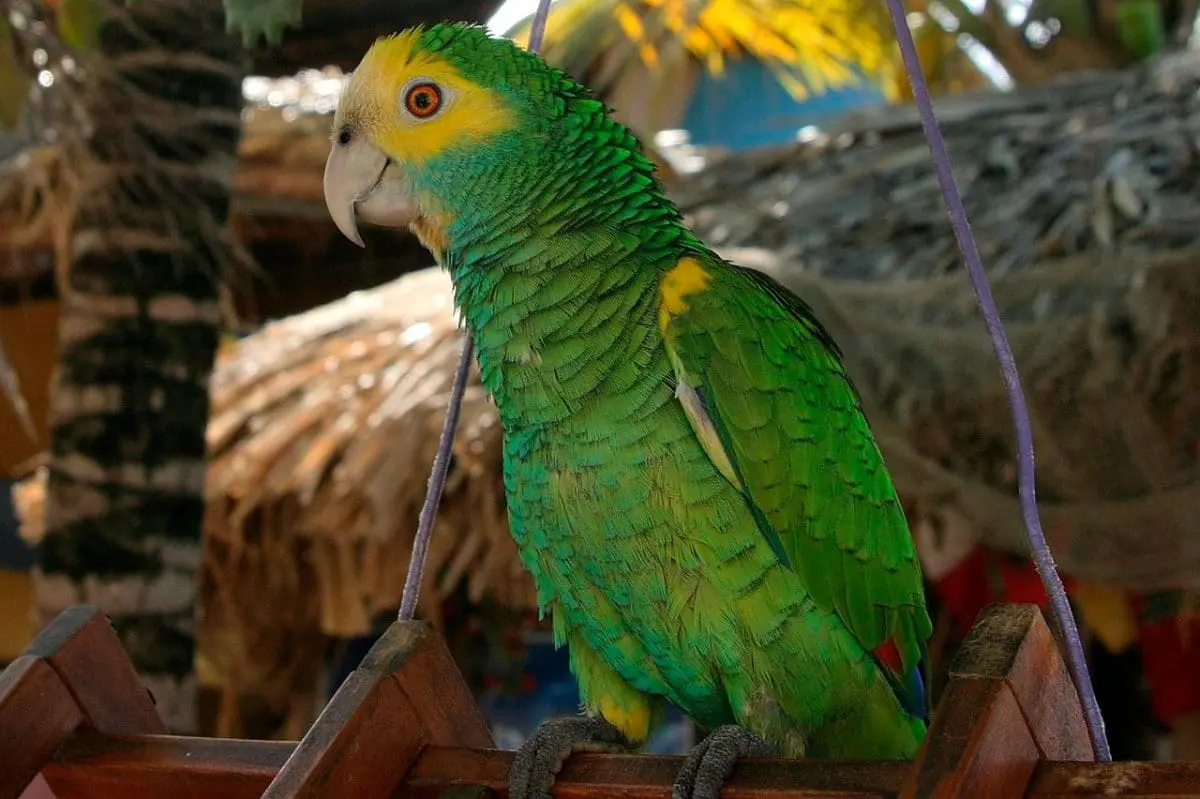
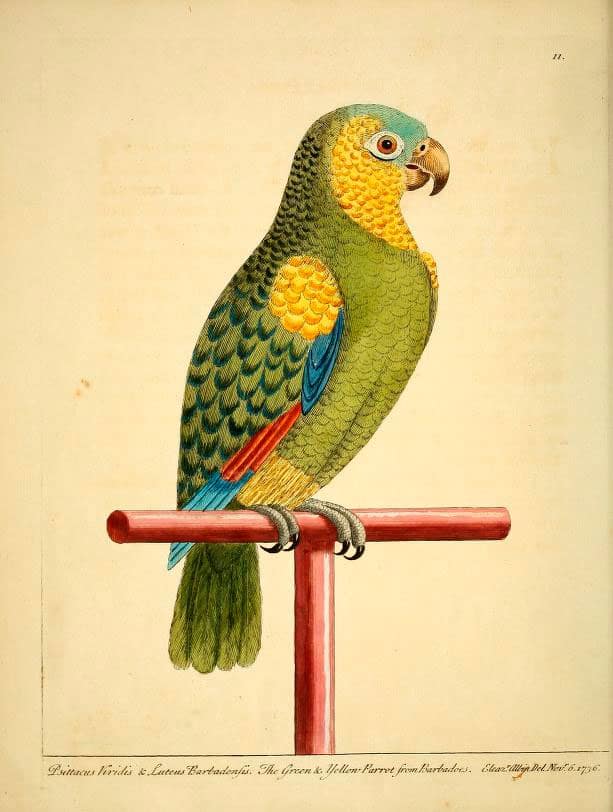
The Yellow-shouldered Parrot (Amazona barbadensis) It has a short tail, head yellow, some with forecrown white.

Its body is usually green, with black feathers edge neck, chest and back; greenish yellow in underparts.

Chin yellow with bluish tint in lower cheeks and around the chin. Shoulder and the thighs yellow.

Speculum red. dark blue tips to the flight feathers. The black edge of their feathers give them a look scaled.


Yellow-shouldered Parrot


Anatomy-parrots

The irises are red or orange and bill whitish.

The young birds are similar to adults but may distinguish by their irises and the absence darker blue hue in the lower body.

In the most notorious flight apart from the head, is the wing with shoulder yellow, Red patch and blue end.

Habitat:

They live in areas xerophytic vegetation, frequenting desert scrub dominated by cactus, cardón and shrubs or small trees; also frcuentan cultivated areas, until the 450 m. They move in pairs or flocks of up 100 individuals, especially at the time of feed.

Reproduction:

The nesting takes place in tree cavities, cactus or cliffs, in general, between March and August (Sanz and Rodriguez-Ferraro 2006). The average size of clutch is of 3,38 eggs per nest, and most of the eggs survive until the hatching. The incubation lasts a few 26 days and leave the nest 60 days after hatch.

It tends to rest communally in tall trees, with groups of up 700 birds recorded (Juniper and Parr 1998).

Food:

Their diet is composed of Cactus and other fruits. They have been reported in their diet fruits 22 genders. rich flowers nectar, cardón and the urero, which eats fruits, flowers and trunk, fruits and seeds Stenocereus, seeds and flowers guatacaro (Boarreria Sumnensis) and yaque.

Distribution:

Size of its range (reproduction / resident): 11,000 km2

The Yellow-shouldered Parrot It has a disjoint range with seven genetically isolated populations in northern Venezuela (Lara (Cerro Saroche National Park, which)), Falcon (Dabajuro, Casigua), Anzoátegui (about Piritu and Barcelona) and Sucre (Araya Peninsula), as well as the Margarita Islands, the blanquilla, Curacao and Bonaire (Rodriguez-Ferraro 2009).

He is currently extinct on Paraguana Peninsula (Briceño-Linares et. To the. 2011). References to the presence of a population of wild parrots in Curacao They are based on a historical source of the century 18 (AO Debrot in some 1999, 2007.); there have been reports from modern 1988 (The farmer 2008, A. Rodriguez-Ferraro in litt. 2012), although it has been suggested that these birds can be released or escaped cages. (Williams 2012).

It became extinct in Aruba towards 1950 (Rojas-Suarez & Rodríguez 2015).

The numbers on the islands seem to fluctuate, but they have increased in Margarita of 750 birds in 1989 (Sanz y Grajal 1998) until around 2000 in 2015 (Rojas-Suarez & Rodríguez 2015).

The population in Bonaire It was estimated in 400 individuals in 2006 (Williams and Martin 2006) and 650-800 individuals in 2012 (Department of Resources and Planning, Bonaire by R. Martin y S. Williams a slightly. 2012).

The continent's population was considered in decline 2003 (Hilty 2003).

Their habitat continues to be lost in the eastern part of the continental mountain range (V. Sanz in some. 2016) and the population of together (is of Venezuela) it is believed that are declining due to poaching and habitat conversion for agriculture (V. Sanz n bit. 2016), so it is likely that the continental population continues to decline.

Conservation:

State of conservation ⓘ


Vulnerable Vulnerable (UICN)ⓘ

• Current category of the Red List of the UICN: Vulnerable.

• Population trend: Unknown.

The population size: 1700-5600 specimens.

It is classified as a endangered specie, It is the main threats capture their young for pet trade, and habitat destruction of nesting and feeding by the extraction of sand for the construction industry.

The recovery of the population of this bird has been the spearhead of Provita's work in Macanao, since its conservation benefits a large part of the biodiversity of the peninsula, as their habitat covers large areas, it is also a charismatic species, that easily attracts the public to conservation efforts.

Source: PROVITA

"Yellow-shouldered Parrot" in captivity:

Rare but increasing due to the successes of captive breeding.
have a participatory personality, inquisitivas and curious to the point of being "nosy" and her gentle nature only adds to her charm. Mild to moderate its ability to speak.
Always playful, enable They require a cage equipped with toys. They worship a bathroom and displayed chatty while bathing under running warm water.

Alternative names:

Yellow-shouldered Parrot, Yellow shouldered Parrot, Yellow-shouldered Amazon (English).
Amazone à épaulettes jaunes (French).
Gelbflügelamazone, Kleine Gelbkopfamazone (German).
Papagaio-de-cabeça-branca (Portuguese).
Amazona de Cabeza Amarilla, Amazona de hombro gualda, Amazona Hombrogualda, Cotorra margariteña (español).
Cotorra Cabeciamarilla (Venezuela).

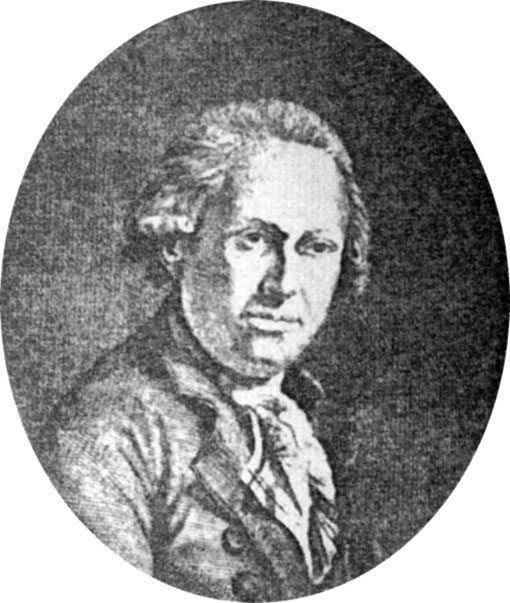
Gmelin Johann Friedrich

scientific classification:


Order: Psittaciformes
Family: Psittacidae
Genus: Amazona
Scientific name: Amazona barbadensis
Citation: (Gmelin, JF, 1788)
Protonimo: Psittacus barbadensis


Images "Yellow-shouldered Parrot":


Species of the genus Amazona


Sources:

  • Avibase
  • Parrots of the World – Forshaw Joseph M
  • Parrots A Guide to the Parrots of the World – Tony Juniper & Mike Parr
  • Birdlife

  • Photos:

(1) – Yellow-shouldered Amazon (Amazona barbadensis) also known as Yellow-shouldered Parrot. Pet in Venezuela perching on the top of a wooden frame. By John Bäckstrand (originally posted to Flickr as IMG_2721) [CC BY 2.0], via Wikimedia Commons
(2) – Yellow-shouldered Amazon in the Walsrode Bird Park, Germany By Quartl (Own work) [CC BY-SA 3.0], via Wikimedia Commons By Quartl (Own work) [CC BY-SA 3.0], via Wikimedia Commons
(3) – Yellow-shouldered Amazon (also known as Yellow-shouldered Parrot). Two in the foreground in a cage By TJ Lin [CC BY-SA 2.0], via Wikimedia Commons
(4) – Yellow-shouldered Amazon (Amazona barbadensis) also known as Yellow-shouldered Parrot. Pet in Venezuela perching on a hand. Shows crown By John Bäckstrand (originally posted to Flickr as IMG_2469) [CC BY 2.0], via Wikimedia Commons
(5) – Yellow-shouldered Amazon (Amazona barbadensis) also known as Yellow-shouldered Parrot. Pet in Venezuela By John Bäckstrand (originally posted to Flickr as IMG_2468) [CC BY 2.0], via Wikimedia Commons
(6) – Amazona barbadensis in the Loro Parque zoo of Tenerife, Spain By Bjoertvedt (Own work) [CC BY-SA 4.0], via Wikimedia Commons
(7) – Amazona barbadensis in the Loro Parque zoo of Tenerife, Spain By Bjoertvedt (Own work) [CC BY-SA 4.0], via Wikimedia Commons
(8) – Yellow-shouldered Amazon (Amazona barbadensis) also known as Yellow-shouldered Parrot. Pet in Venezuela – side view – a little red and blue seen at edge of wing By John Bäckstrand (originally posted to Flickr as IMG_3117) [CC BY 2.0], via Wikimedia Commons
(9) – Yellow-shouldered Amazon (Amazona barbadensis) also known as Yellow-shouldered Parrot. Pet in Venezuela on the top of a wooden climbing frame. Mainly showing its upper body By John Bäckstrand (originally posted to Flickr as IMG_2723) [CC BY 2.0], via Wikimedia Commons
(10) – Original illustration of the «Green & Yellow Parrot from Barbados», currently known as Amazona barbadensis – Wikipedia

  • Sounds: © 2014 Cornell University

▷ The world of Pets: Dogs, cats, birds, reptiles, amphibians

Northern Mealy Parrot
Amazona guatemalae

Northern Mealy Parrot

Content

Description:


Anatomy-parrots

38 cm.. length and 705-766 g. of weight.

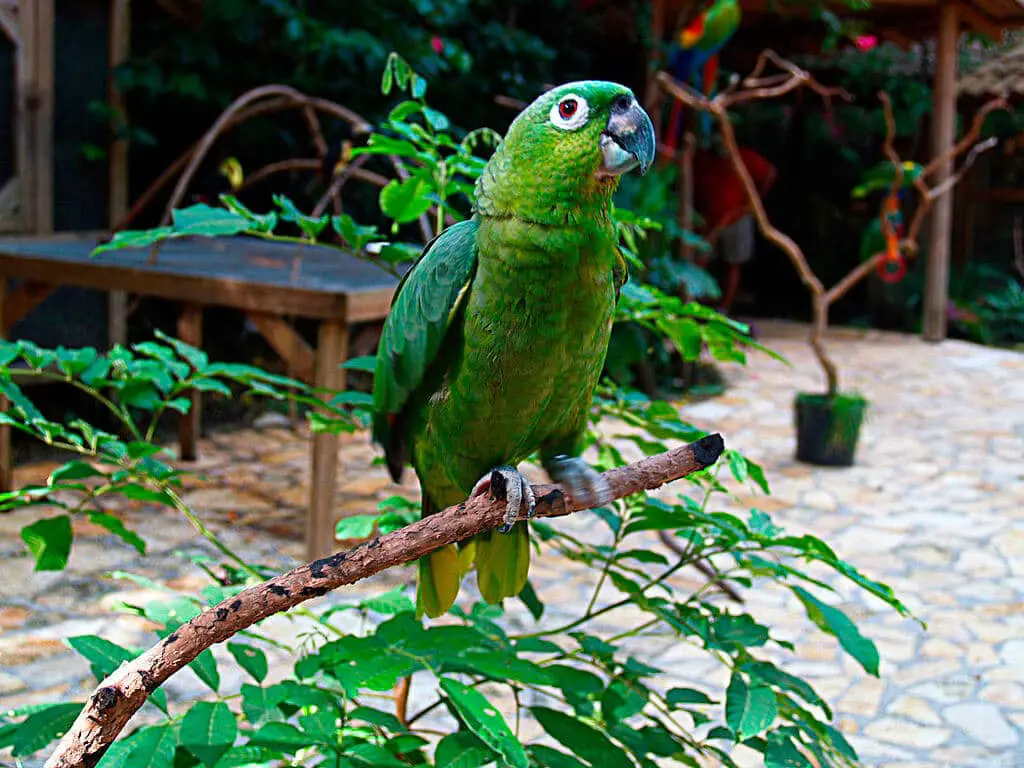
The Northern Mealy Parrot (Amazona guatemalae) is a large parrot, mainly green, with a large bare periophthalmic white; head green, increasingly off toward the area nape.

The youth similar to adults but eyes brown.

taxonomy:

Treated for decades subspecifically within the species Amazona farinosa. Based on a genetic study of the year 2012 They came to be regarded as a full species.

Subspecies description:

  • Amazona guatemalae guatemalae

    (Sclater,PL, 1860) – Mostly green, with the crown, forecrown and lores, blue; carpal edge Green Wing / yellow; Feathers edges wing , blue; Red in the secondary feathers; feathers of the tail dark green to light green at the tip. Bill dark grey. Eye ring white, irises red.


  • Amazona guatemalae virenticeps

    (Salvadori, 1891) – Mostly green with less blue on the crown that the subspecies Amazona guatemalae guatemalae; yellower shades / green; carpal edge green / yellow, with varying shades of red; crown green; lores and forecrown, green tinted blue. Bill black / horn. Eye ring white, irises red.

Habitat:

Video "Northern Mealy Parrot"

They inhabit in dense humid lowland forests, especially near the gaps and edges; also they extend lower montane forest plantations and frequent, crops, gallery forests and deciduous forests.

They are in pairs or groups up 20 individuals, with larger congregations in feeding areas. Form noisy flocks in communal roosts high up in big trees out of breeding season, sometimes with several hundred birds. Well camouflaged while feeding quietly on the upper floors of the forest canopy.

Reproduction:

Season April-May Guatemala. Nests in tree holes, to 3-30 height m, once observed in the crack of a stone wall in a Mayan temple. The laying usually three eggs.

Food:

No known differences with Amazona farinosa.

Distribution:

Size of its range (Standard playback): 919.000 km2

It is present along the slope of Caribbean of Central America, from Veracruz and Oaxaca, Mexico, to the South by Belice, Guatemala, Honduras, Nicaragua and Costa Rica, to western Panama. They are also found in the shed peaceful of Costa Rica and West Panama. Its abundance varies locally, but it is common in many areas.

Subspecies distribution:

  • Amazona guatemalae guatemalae

    (Sclater,PL, 1860) – Caribbean coast from southeast Mexico to the Northwest of Honduras.


  • Amazona guatemalae virenticeps

    (Salvadori, 1891) – Since Honduras (Sula Valley) to western Panama.

Conservation:

State of conservation ⓘ


Near-threatened Near Threatened (UICN)ⓘ

• Current category of the Red List of the UICN: Near-threatened.

• Population trend: In decrease.

Rationale for the Red List category

He suspected this species is undergoing a rapid decrease in moderately population due to habitat loss and unsustainable levels of hunting and trapping.

Population size: Unknown

The population trend: In decline.

The Amazona mealy northern captive:

Little known in poultry.

Alternative names:

Mealy Parrot [guatemalae or virenticeps], Northern Mealy Amazon, Northern Mealy Parrot (English).
Amazone guatémaltèque, Amazone poudrée [guatemalae or virenticeps], Amazone poudrée [guatemalae ou virenticeps] (French).
Guatemalaamazone (German).
Northern Mealy Parrot (Portuguese).
Amazona harinosa norteña (español).


scientific classification:

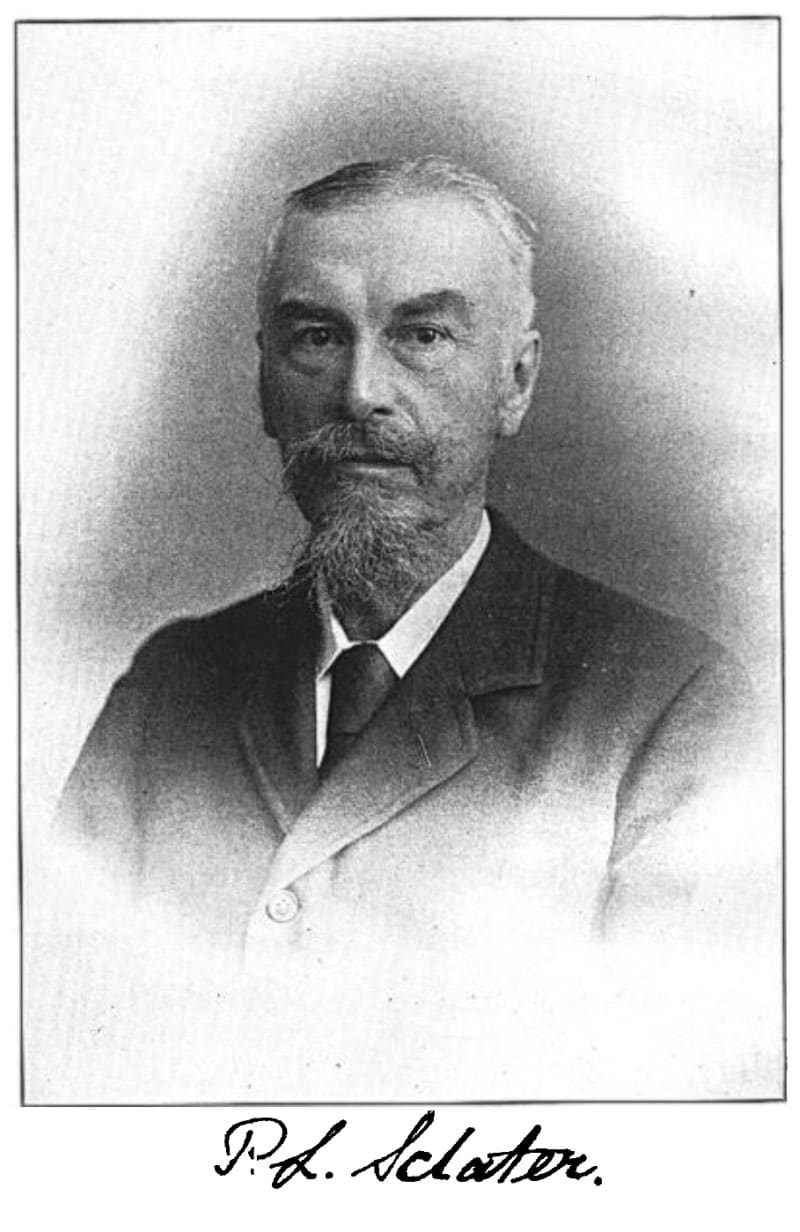
Philip Sclater
Philip Sclater

Order: Psittaciformes
Family: Psittacidae
Genus: Amazona
Scientific name: Amazona guatemalae
Citation: (Sclater, PL, 1860)
Protonimo: Chrysotis guatemalae

Images Northern Mealy Parrot:


Species of the genus Amazona


Sources:

Avibase
Parrots of the World – Forshaw Joseph M
Parrots A Guide to the Parrots of the World – Tony Juniper & Mike Parr
Birdlife

Photos:

(1) – Amazona farinosa guatemalae By Adalberto Hernandez Vega from Copan Ruinas, Honduras (Macaw Mountain Bird Park – Copan Ruinas, Honduras) [CC BY 2.0], via Wikimedia Commons
(2) – Guatemalaamazone Amazona farinosa guatemalae By Martingloor (Own work) [CC BY-SA 4.0], via Wikimedia Commons
(3) – Amazona farinosa guatemalae by Ulises MuñizFlickr
(4) – Amazona farinosa guatemalae By Katrin Lorenzen (IMG_4685) [CC BY-SA 2.0], via Wikimedia Commons
(5) –
Amazona farinosa guatemalae By Adalberto Hernandez Vega from Copan Ruinas, Honduras (Macaw Mountain Bird Park – Copan Ruinas, Honduras) [CC BY 2.0], via Wikimedia Commons