▷ The world of Pets: Dogs, cats, birds, reptiles, amphibians

Red-flanked Lorikeet
Charmosyna placentis

Red-flanked Lorikeet

Content

Description:

15 to 18 cms. length and 38 to 48 g. of weight.

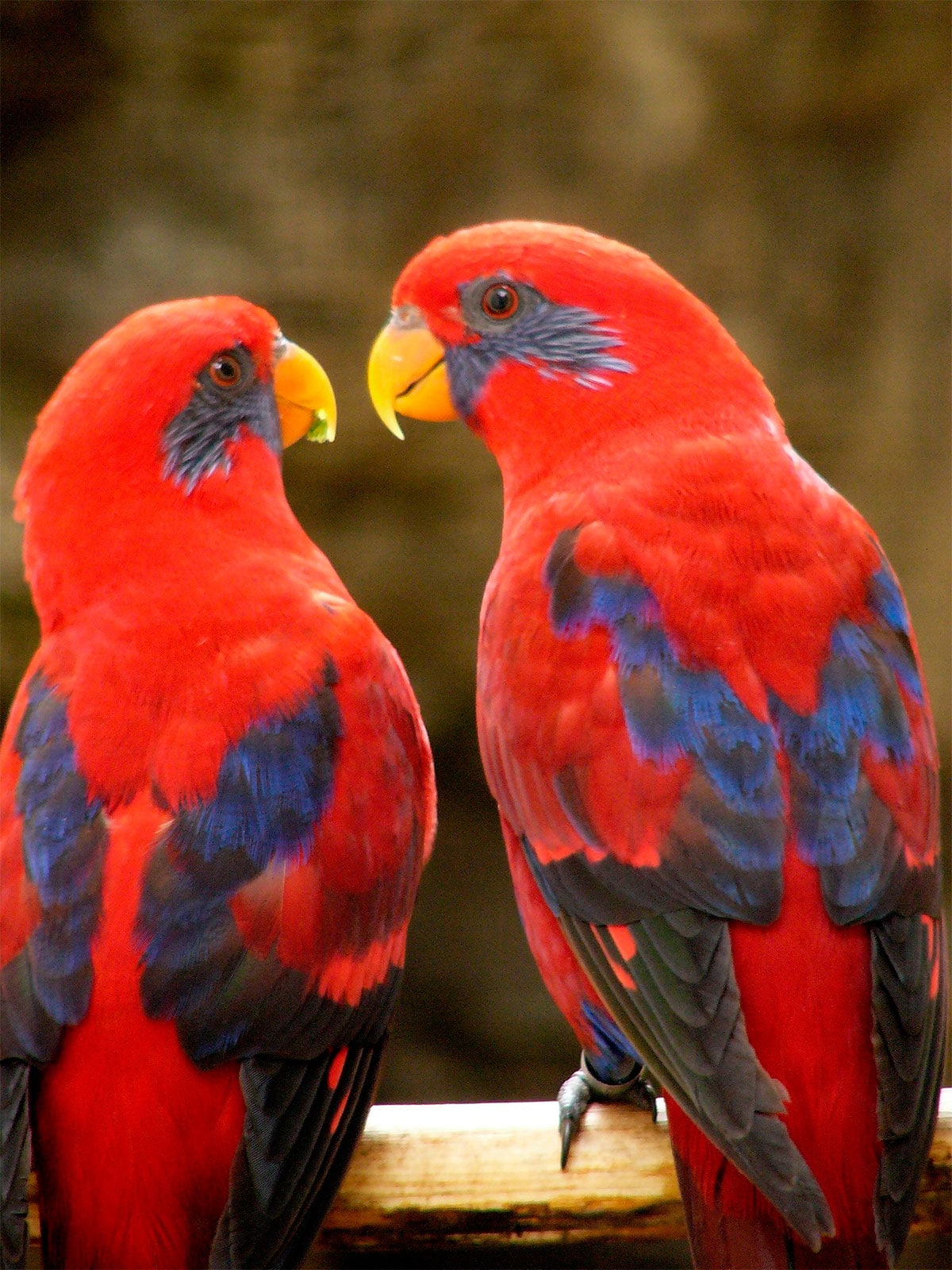
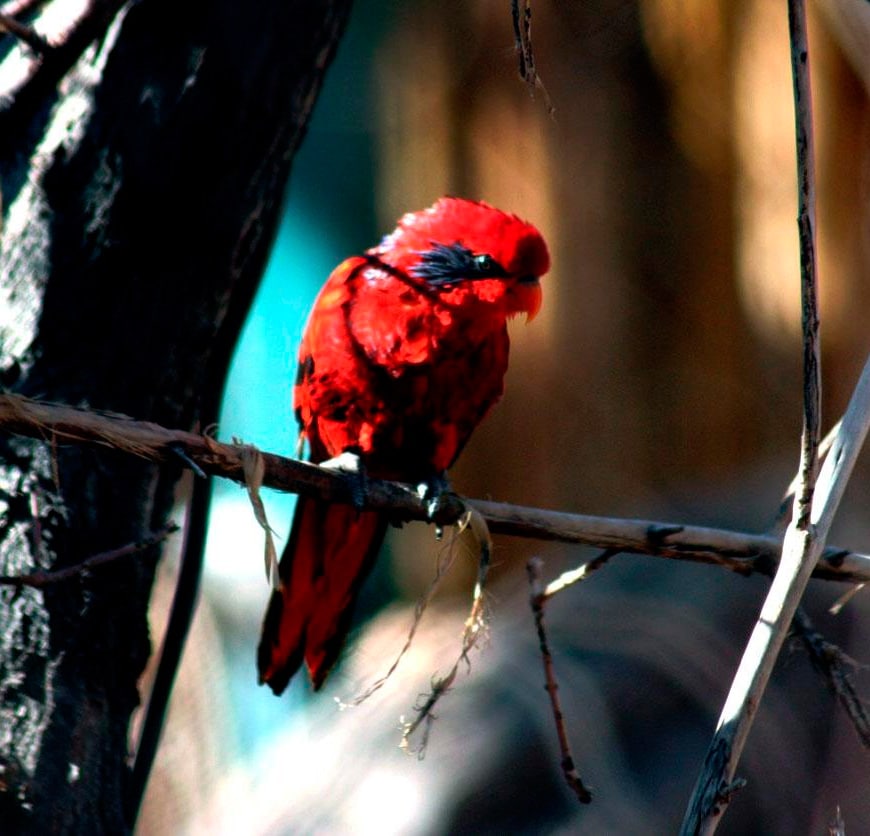
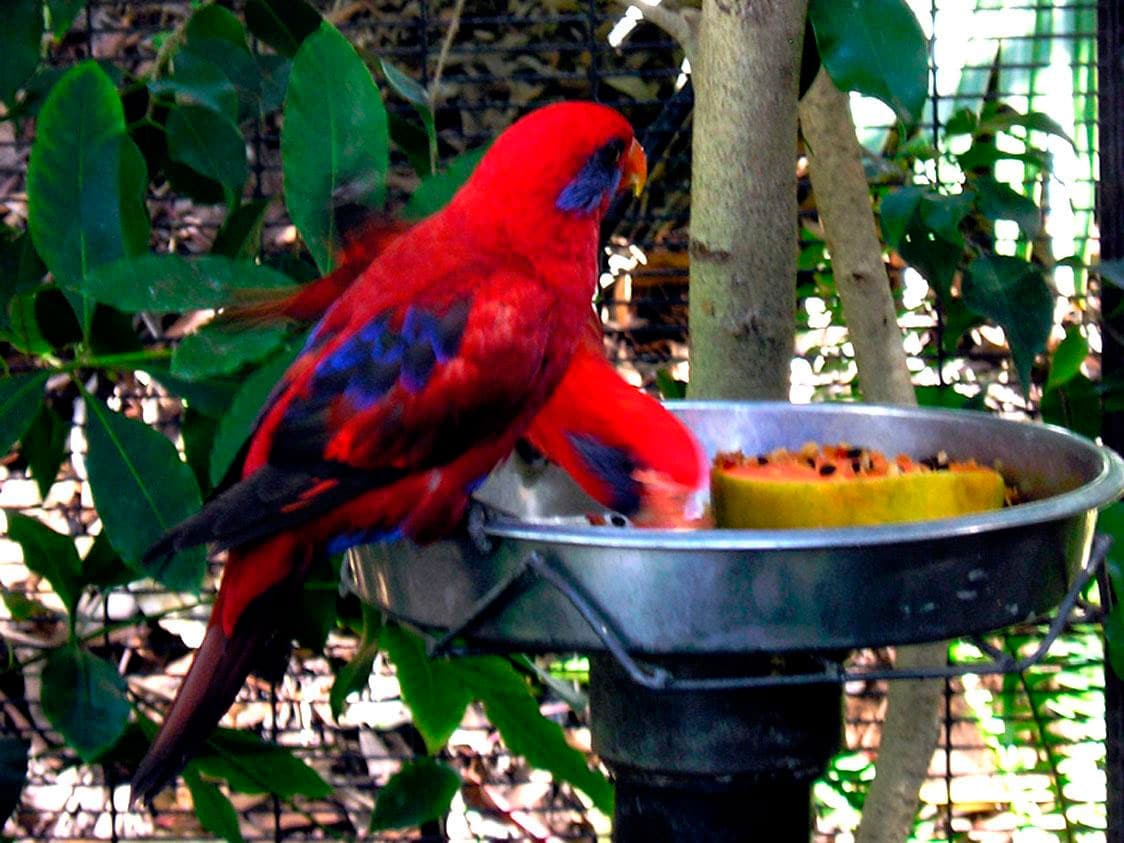
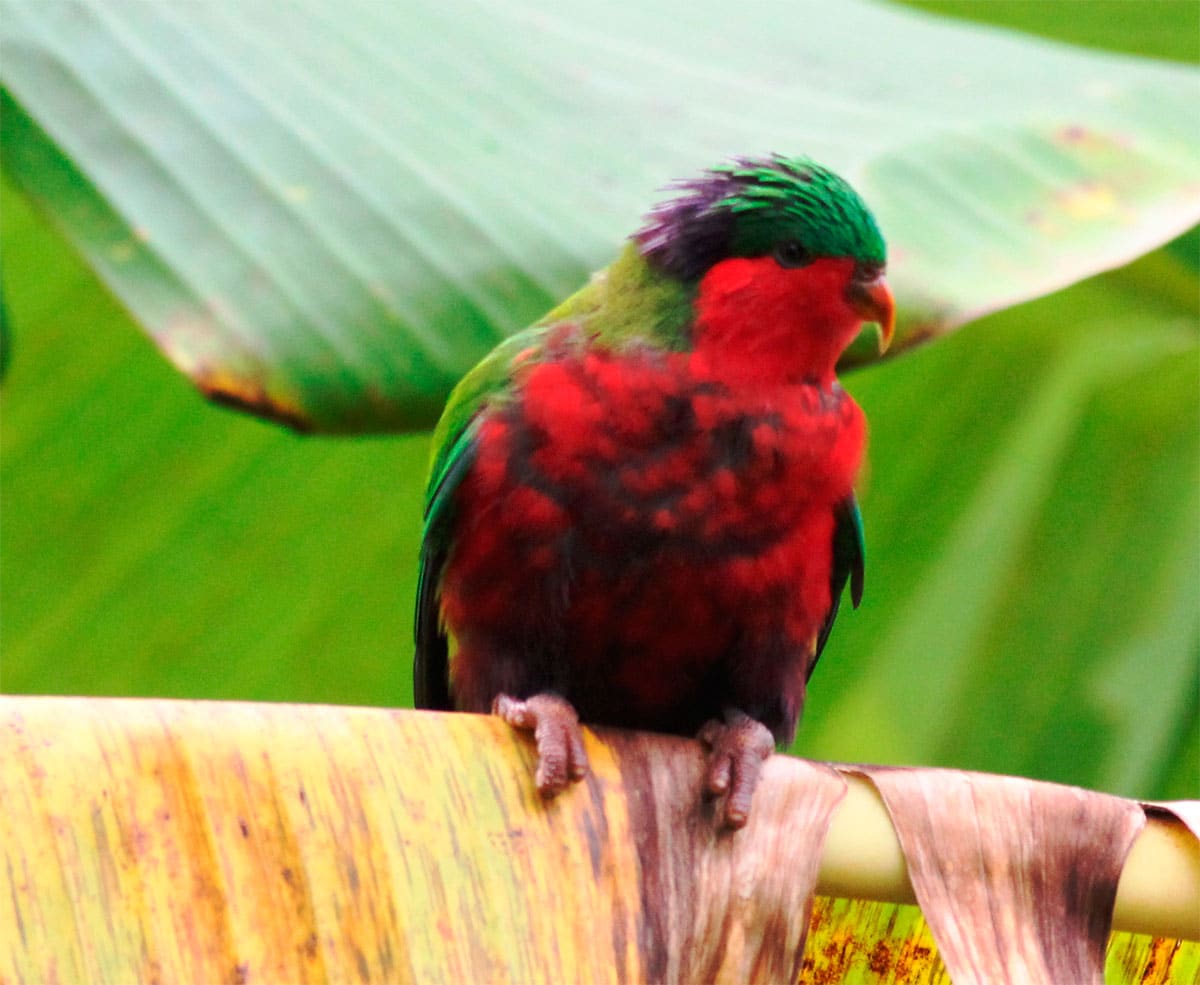
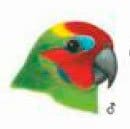
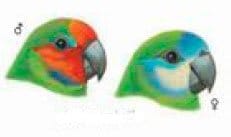
The Red-flanked Lorikeet (Charmosyna placentis) has the forecrown and yellowish-green crown; nape green; chin, throat and lores red; ear-coverts dark blue striped strongly light blue. Top green with rump matte blue: uppertail-coverts green. The part superior of the wings It is green with innerwebs and ends the blackish flight feather. Underwing-coverts red; intense yellow band across the innerwebs of the flight feather blackish. Underparts lighter green than yellow upperparts; Strong red marks on the sides of chest and in the flanks below the sides of belly.

The upper part of the tail It is duller green than upperparts, tipped bright yellow, with lateral feathers red in the center of the innerwebs and slightly in outerweb, with a subterminal black mark; lower tail is basal yellow, with black and red marks.

Bill red; irises yellow to orange; legs opaque red.

The female no yellow-green spots on the top of the forecrown, Red in the face, in the chest, in the flanks and at the bottom of the wings (the underwing-coverts are green-yellow). The blue of the ear-coverts It is replaced by a dark patch badly scratched yellow.

Immature as the female, but duller green, and less extensive yellow streaks in ear-coverts (the young male can present a red stain on the face and greenish yellow in forecrown). Iris pale yellow, legs orange-brown.

  • Sound of the Red-flanked Lorikeet.

Subspecies description
  • Charmosyna placentis intensior

    (Kinnear, 1928) – Greener than the species nominal, including the forecrown. Headphones coverts and patch on the rump duller blue-violet.

  • Charmosyna placentis ornata

    (Mayr, 1940) – Mantle green slightly darker than the species nominal, a patch on rump largest darker blue and crown yellower. The Red throat larger in males.

  • Charmosyna placentis pallidior

    (Rothschild & Hartert, 1905) – As the subspecies subplacens, but with upperparts pale green. Headphones coverts light blue in the male.

  • Charmosyna placentis placentis

    (Temminck, 1835) – Nominal.

  • Charmosyna placentis subplacens

    (Sclater,PL, 1876) – It differs from the species nominal by having green, nonblue the rump.

Habitat:

The Red-flanked Lorikeet It, mainly, a kind of lowlands found in primary moist forest, in the forest edge, in Savannah, the secondary high growth, in the monsoon forest, in the swamps of forget (when they are in bloom), in the gallery forest, in eucalypts, in the coastal forest and, occasionally, in the mangroves and coconut palms. It is also found in flowering trees in cultivated areas.

Can be Quiet and discreet and, even when feeding active and noisy, can be difficult to see through thick foliage. They are mostly in pairs, but occasionally in groups 25 or more, looking for food with others Loris with flowers and trees epiphytes or flying through or above the tree tops in small compact and noisy flocks.

Reproduction:

In New Guinea, Several observations of couples investigating arboreal termite mounds They indicate that it is likely that they are preferred for nest. The bases of ferns and moss cultures have also been identified as potential sites nesting. Activity on these sites has been observed between February and October, and it was found that specimens found in eastern Papua New Guinea by Diamond in July and August 1965 They were able to play. In the Vit Islandu, Coates He watched a couple with chicks in mid-August and is likely to play occurring during much of the year.

Food:

Feeds of pollen, nectar, flowers and seeds, mainly in the upper canopy.

Distribution and status:

Extension of the distribution (breeding/resident): 2.800.000 km2

originating Indonesia Oriental, New Guinea and the northern Solomon Islands.

They can be observed from the Moluccan Islands and West Papua New, through lowland West Papua New and Papua New Guinea to Bismarck Archipelago and Bougainville.

Although mostly they found in lowlands, there have been up to 1.600 metres above sea level in Komo, in the highlands of southern Papua New Guinea; They are also common in high altitudes (about 1.150 meters to 1.450 m) in the zone of Karimui, the east, and they do not seem to be anywhere else in the region. reaches 300 metres in New Britain, above which is replaced by the Red-chinned Lory (Charmosyna rubrigularis). In the North of New Guinea It is replaced by the higher altitude Red-fronted Lorikeet (Charmosyna rubronotata).

Widespread and common to locally abundant. It is believed that the world population is at a level of caresses 500.000 individuals and it is stable. small numbers in captivity.

Translation made with the translator www.DeepL.com/Translator

Subspecies distribution

Conservation:


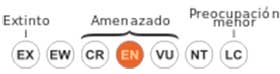
minor concern


• Current category of the Red List of the UICN: Least concern

• Population trend: Stable.

• Population size : Unknown

Rationale for the Red List category

This species has a very extens distribution areato, and therefore does not approach the thresholds for Vulnerable under the criteria of size range (Scope of the presence <20.000 km2 combined with a decreasing area size or fluctuating distribution, extension / habitat quality, o Population size and a small number of locations o Severe fragmentation).

The population trend appears to be stable, and therefore the species does not approach the thresholds for Vulnerable under the criteria of population trend (decrease> 30% in ten years or three generations). The population size has not been quantified, but it is not believed to approach the thresholds for Vulnerable under the criterion of population size (<10.000 mature individuals with an estimated continuous decrease in> 10% in ten years or three generations, or with a specific population structure). For these reasons, the species is assessed as Least concern.

Justification of the population

Global population size has not been quantified, but it has been reported that the species is generally common and sometimes abundant (pit et to the. 1997). Some sources estimate the current population of this Lori in about half a million individuals.

Justification trend

They suspected that the population is stable the absence of evidence of decline or substantial threats.

"Red-flanked Lorikeet" in captivity:

Rare in captivity.

Alternative names:

Blue-eared Lorikeet, Lowland Lorikeet, Red flanked Lorikeet, Red-flanked Lorikeet, Yellow-fronted Blue-eared Lorikeet, Yellow-fronted Blue-eared Lory (English).
Lori coquet, Loriquet à croupion bleu, Loriquet joli (French).
Schönlori (German).
Loris Charmosyna Placentis (Portuguese).
Lori de Dorso Rojo, Lori Flanquirrojo (español).


Temminck Coenraad Jacob

Order: Psittaciformes
Family: Psittaculidae
Gender: Charmosyna
Scientific name: Charmosyna placentis
Subpoena: (Temminck, 1835)
Protonimo: Psittacus placentis

Red-flanked Lorikeet images:

Videos "Red-flanked Lorikeet"


Sources:

Avibase
• Parrots of the World – Forshaw Joseph M
• Parrots A Guide to the Parrots of the World – Tony Juniper & Mike Parr
Birdlife

Photos:

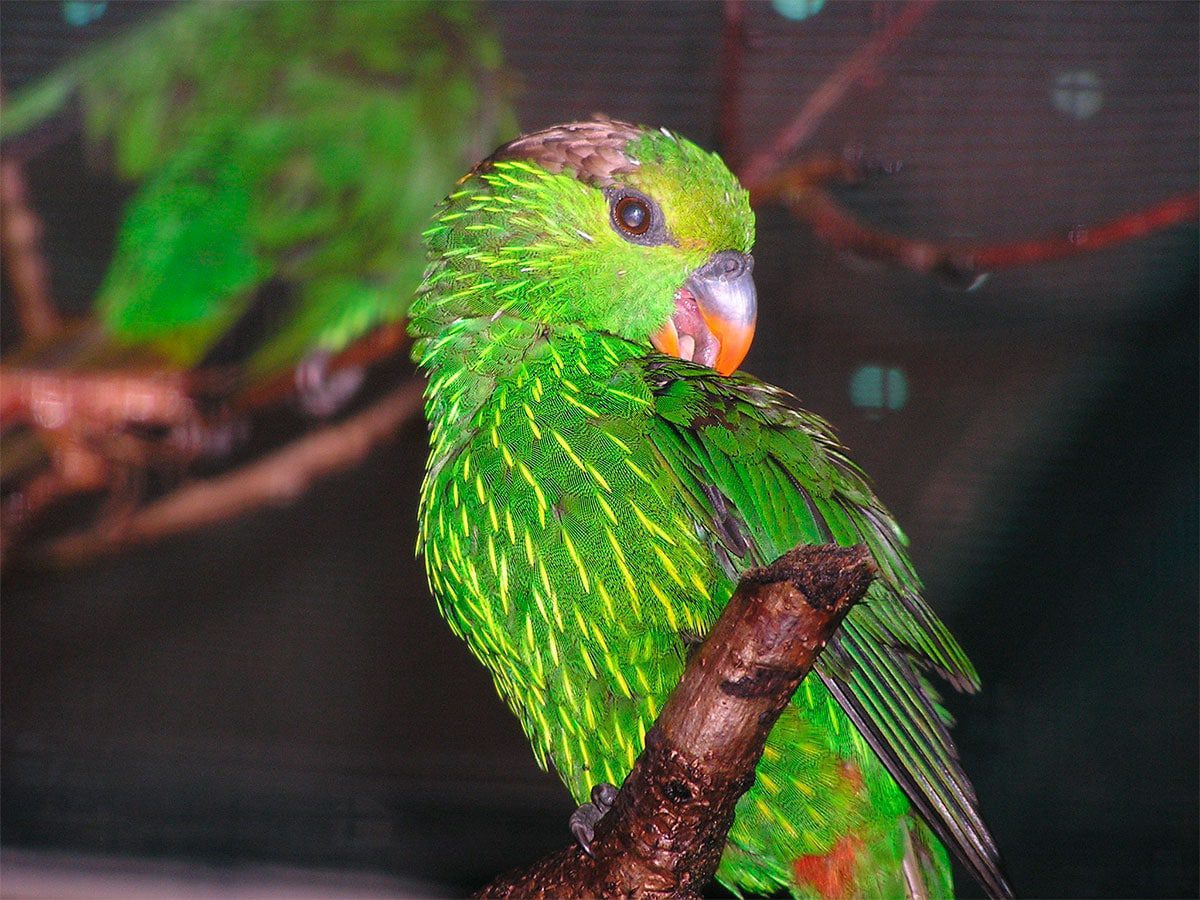
(1) – A male Red-flanked Lorikeet at Cincinnati Zoo, USA by Ltshears [CC BY 3.0]

(2) – Female Red-flanked Lorikeet at the Louisville Zoo, USA by Ltshears [CC BY-SA 3.0 or GFDL], from Wikimedia Commons
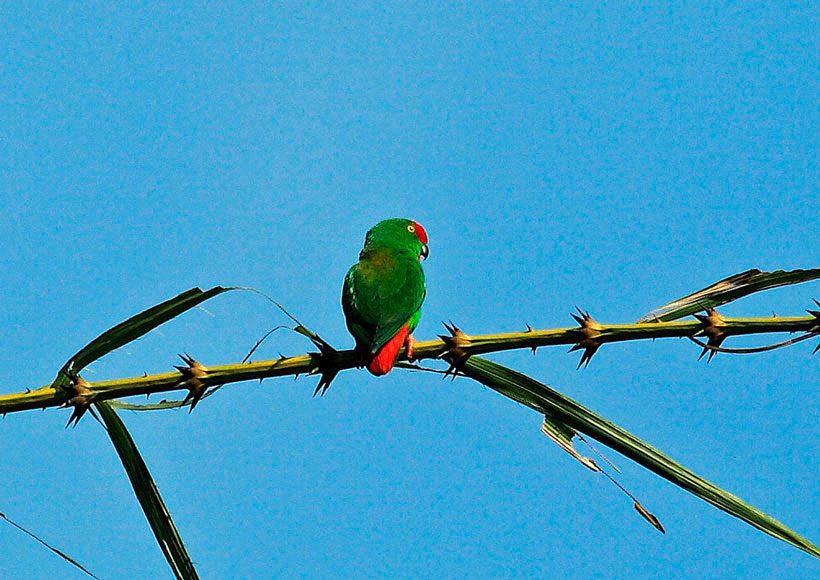
(3) – A pair of Red-flanked Lorikeets at Jurong Bird Park, Singapore by Peter Tan [CC BY-SA 2.0], via Wikimedia Commons
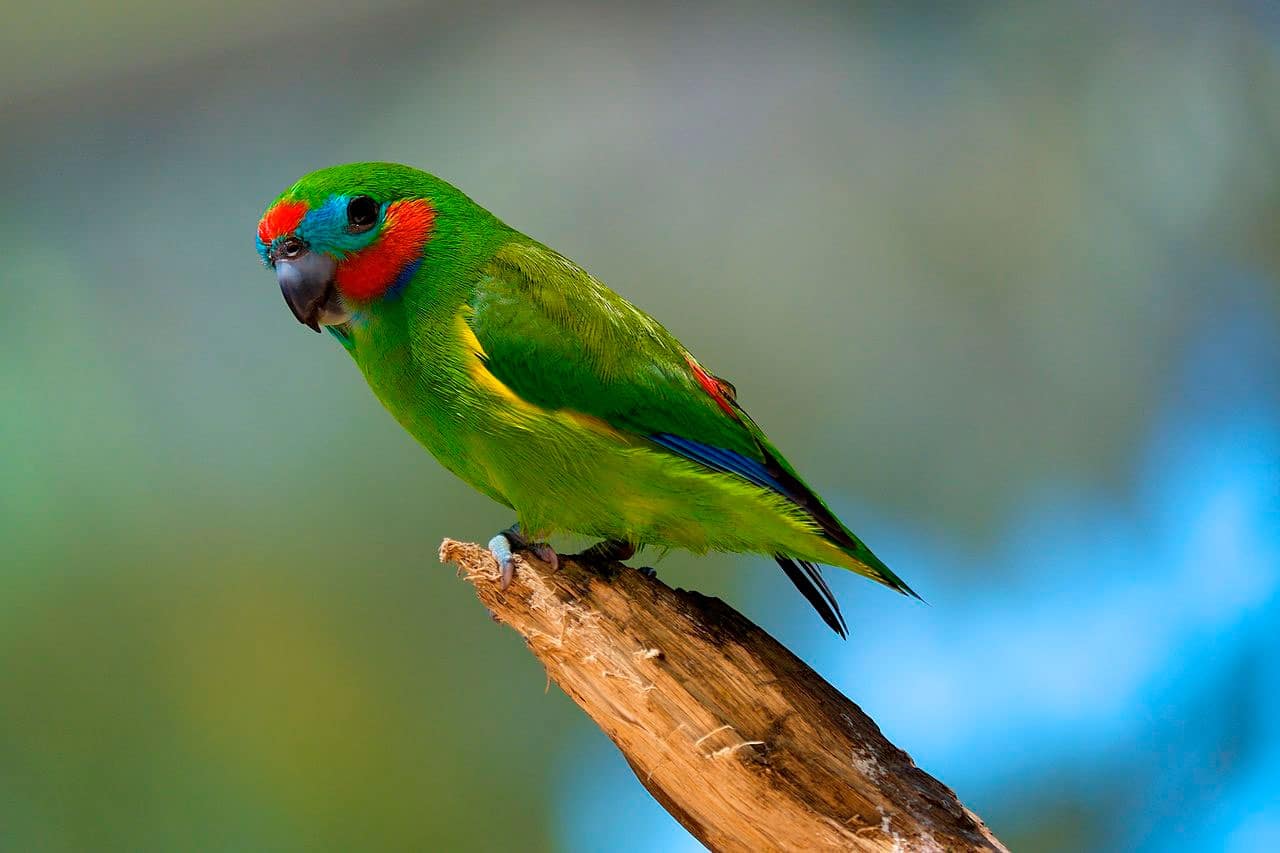
(4) – The image is free from copyright under Creative Commons CC0
(5) – Red-flanked Lorikeet, Male (Charmosyna placentis) at the Louisville Zoo by Ltshears [CC BY-SA 3.0 or GFDL], from Wikimedia Commons

Sounds: Ross Gallardy, XC410521. accessible www.xeno-canto.org/410521.
▷ The world of Pets: Dogs, cats, birds, reptiles, amphibians

Red-eared Parakeet
Pyrrhura hoematotis

Cotorra Colirroja

Content

Red-eared Parakeet

Description:

25 cm.. height.

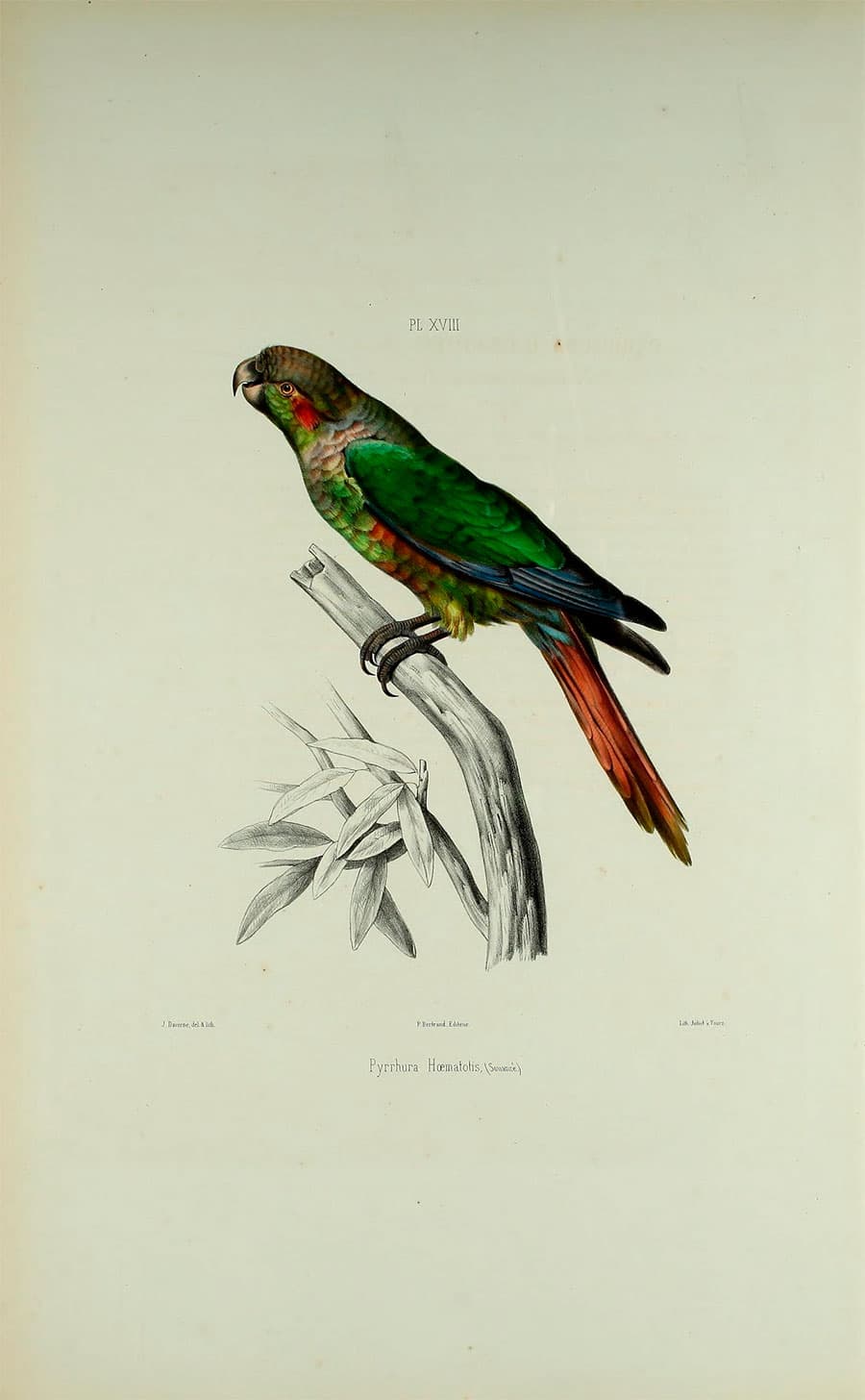
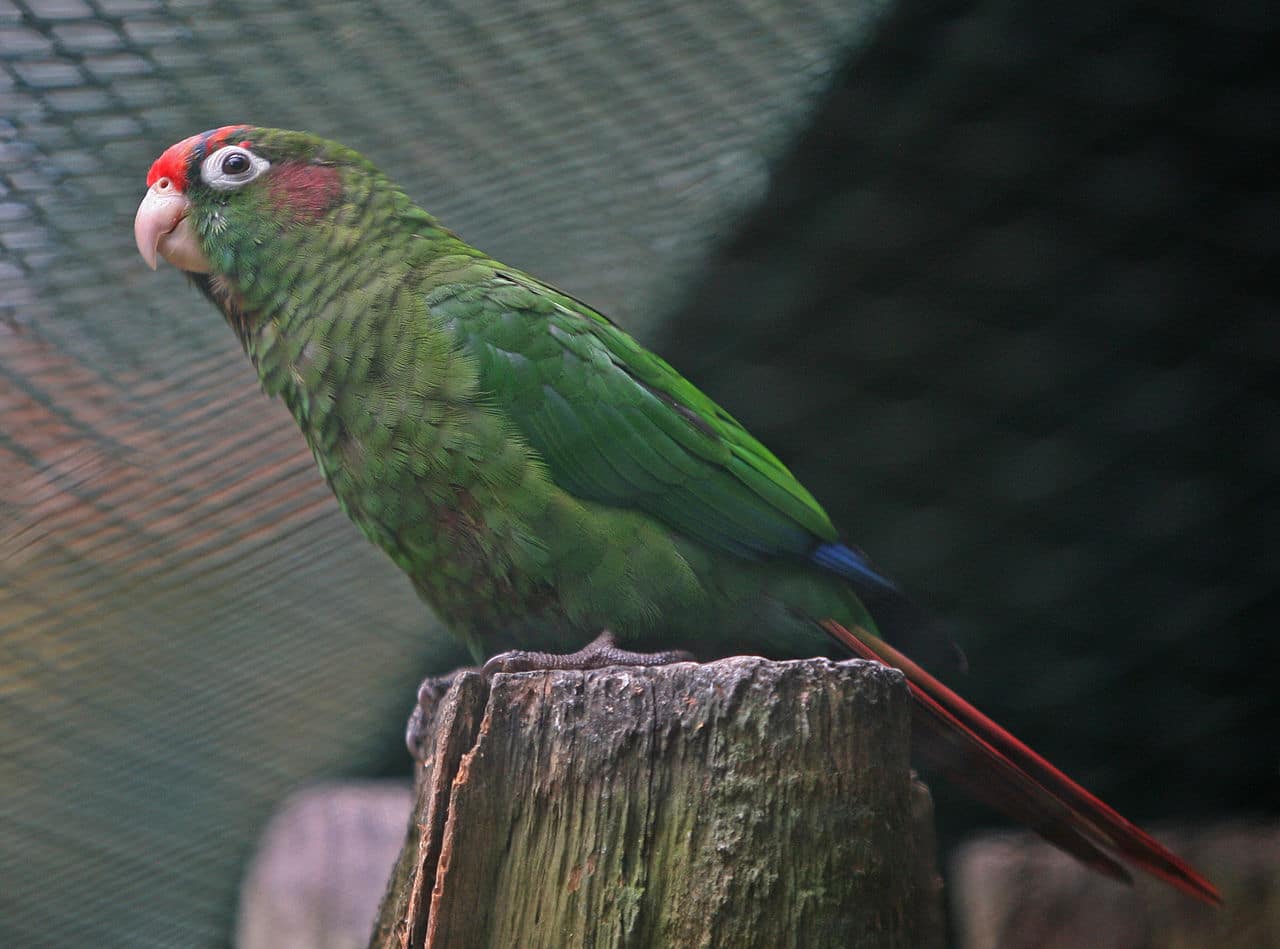
The Red-eared Parakeet (Pyrrhura hoematotis) It is distinguishable by the Brown of the forecrown with edges bluish to them feathers; cheeks green; crown and feathers of nape Green with tips more pale and yellowish. The upperparts green. Primary coverts and maybe some feathers in the area of the carpus, blue; other coverts green. Primaries Blue with black tips. Under wings with the lesser coverts green, the others coverts black. Throat and chest Brown olive with tones dark; margins to some feathers create a pattern squamous; sides neck also with effect squamous; belly and undertail-coverts Green with a patch Brown mal-definido in the center of the belly. Upper, the tail of color brown with tips from color olive; undertail, of color copper. Bill of color bone pink; Iris and legs brown.

Both of them sexes are similar. Immature not described.

Description 2 subspecies:

  • Pyrrhura hoematotis hoematotis

    (Souance, 1857) – Nominal.


  • Pyrrhura hoematotis immarginata

    (Zimmer & Phelps, 1944) – It has a narrow red line above the bill. What nominal but chest and sides of neck more green and with a pickling less obvious. Not there are tips yellowish in the feathers of the crown and nape.

Habitat:

They inhabit in montane and cloud forests with open areas and trees of low dispersion, often at the edge or in clear, mainly in altitudes of 1.000-2.000 m, Although there are report of the species at altitudes between 600 and 2.400 m. It is estimated that he performs altitudinal migrations. Gregaria, mainly seen in groups of 3-12 outside the breeding season, rarely in flocks of up to 100 individuals.

Reproduction:

Probably it breeding season be in the month of August (rainy season).

Food:

Poorly documented diet and breeding: the food known include guava (Psidium) and petioles some leafy trees, possibly to extract larvae of insects.

Distribution:

Size of the area of distribution (reproduction / resident): 14.300 km2

To the Red-eared Parakeet is known only in the coastal mountains north of Venezuela, with the westernmost record observed in Cubiro, Lara, the eastern-most in Miranda. But, Most of the records are from Aragua in Miranda; Cubiro is in fact the only known site in Lara and the population there is apparently discontinuous (subspecies Pyrrhura hoematotis immarginata). Diurnal movements occur from the mountains of the Highlands until the lowest feeding areas; also apparently some local seasonal movements guided by the availability of food.

Fairly common in most of its more restricted range and especially numerous in the Henri Pittier National Park; its status in Lara It is unknown. Much habitat right remains within the range outside the areas protected, and there is a rate of deforestation relatively low, but with constant habitat loss around Cubiro.

Absent or very rare in captivity.

Distribution 2 subspecies:

Conservation:

• Current category of the Red List of the UICN: Least concern.

• Population trend: Decreasing.

Justification of the population

The size of the world population It has not been quantified, but this species is described as «quite common» (Stotz et to the., 1996).

Justification of trend

It is suspected that the population is in decline due to ongoing habitat destruction.

"Red-eared Parakeet" in captivity:

Absent or very rare in captivity.

Alternative names:

Red-eared Parakeet, Blood-eared Conure, Blood-eared Parakeet, Red eared Parakeet, Red-eared Conure (English).
Conure à oreillons, Perriche à oreillons, Perruche à oreillons rouges (French).
Blutohrsittich, Blutohr-Sittich (German).
Tiriba-de-orelha-vermelha (Portuguese).
Cotorra Colirroja, Perico de Cuello Rojo (español).
Perico Cola Roja (Venezuela).

scientific classification:

Order: Psittaciformes
Family: Psittacidae
Genus: Pyrrhura
Scientific name: Pyrrhura hoematotis
Citation: Souancé, 1857
Protonimo: Pyrrhura hoematotis

Red-eared Parakeet images:


Red-eared Parakeet (Pyrrhura hoematotis)


Sources:

  • Avibase
  • Parrots of the World – Forshaw Joseph M
  • Parrots A Guide to the Parrots of the World – Tony Juniper & Mike Parr
  • Birdlife
  • Parrot Book, Parrots and macaws Neotropical

  • Photos:

(1) – Venezuelan endemic Red-eared Parakeet (Pyrrhura hoematotis) photographed in captivity in Mérida, Venezuela By http://www.birdphotos.com (Own work) [CC BY 3.0], via Wikimedia Commons
(2) – Perico tail Red [Blood-eared Parakeet] (Pyrrhura hoematotis hoematotis) Place: The deer, Park national the Avila by barloventomagicoFlickr
(3) – Bando of parrots parakeet place: The deer, Park national Guaraira Repano by barloventomagicoFlickr
(4) – Pyrrhura hoematotis by Diana registerFlickr
(5) – Pyrrhura hoematotis by Diana registerFlickr
(6) – Iconographie des perroquets: Paris :P. Bertrand,1857 by Biodiversity Heritage LibraryFlickr

▷ The world of Pets: Dogs, cats, birds, reptiles, amphibians

Bronze winged Parrot
Pionus chalcopterus


Bronze winged Parrot

Content

Description:

28 to 30 cm.. tall and around 210 weight g.

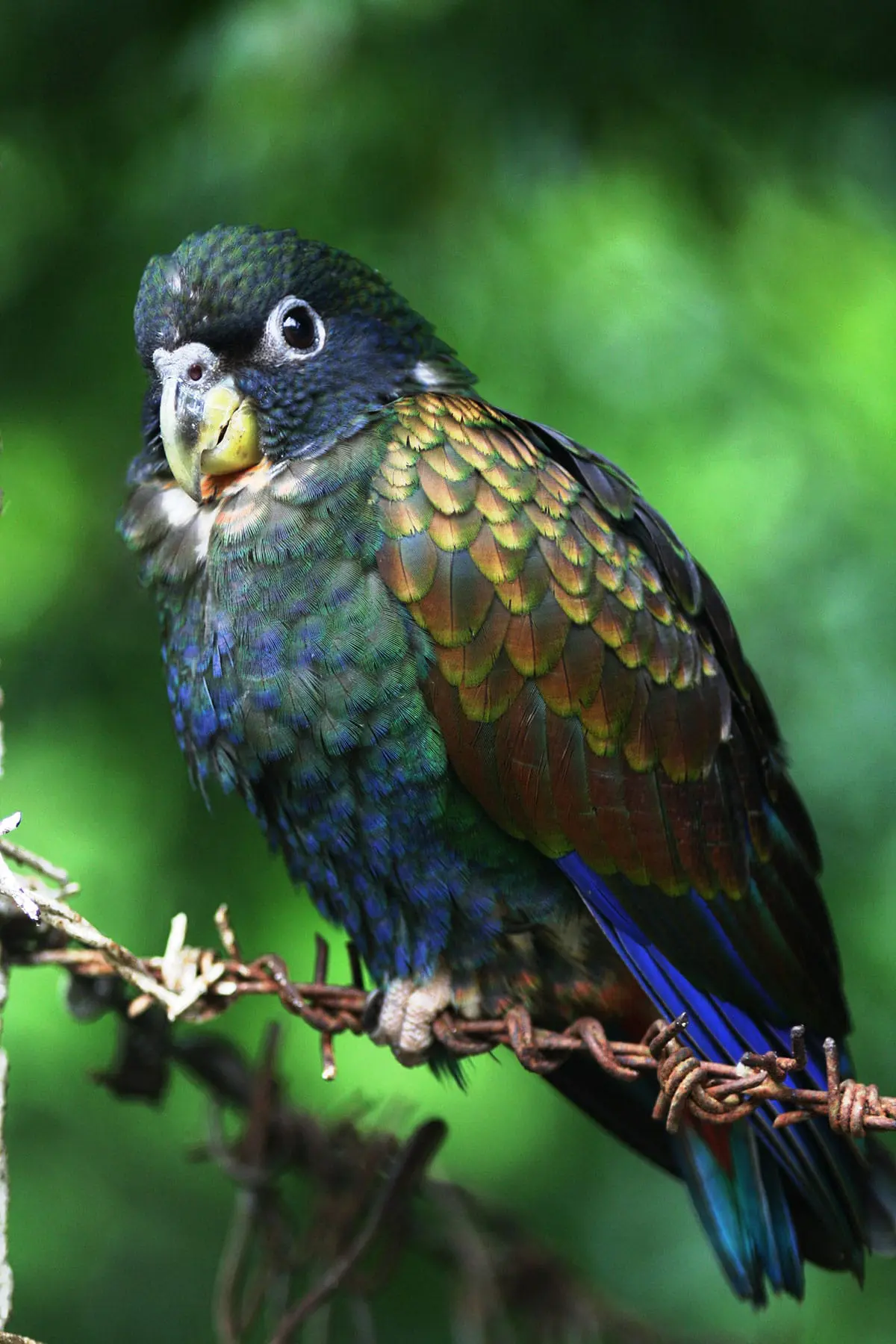
The Bronze winged Parrot (Pionus chalcopterus) has the general Brown, darker in head, neck, chest and flanks, This plumage with blue-violet edge.

The throat whitish and pink; wings bronze green.

Flight is evident violet blue at the top of the wing the Green bottom, that contrasts with the Red of the lower abdomen. Dorsally Violet Blue is notorious in the rump, shoulder and tail. The feathers of the tail are dark blue with a shade of red at the base.

The bill is of color beige, area of naked skin surrounding the eyes of pink. The legs They are pink.

Habitat:

It inhabits in humid jungle, semi-humid, crops and forest edge between 120 and 2800 m.

They are birds gregarious and noisy. Every tomorrow is mobilized in flocks in search of food. Within the flocks are can observe to the couples, that form of life, and who interact with a variety of contact behaviors that reaffirm the marital bond.

Reproduction:

Prefer for their nests broken rods, hollow of logs and palm trees. They nest in the months of October-may. The female often put in two to four eggs they are incubated during three weeks approximately, after which are born them chicks naked or just covered with down. The chicks remain with their parents until the next reproductive shekel.

Food:

Will congregate in cornfields in groups up to of 40 individuals, feeding is of pulp and seeds many fruits and other material ingredients as nectar and flower petals, complementing occasionally its diet with insects.

Distribution:

Its population is distributed by the mountain range of the Andes, from Colombia, Northwest of Venezuela; to the South, by the mountains to the Northwest of Peru.

Conservation:


minor concern


• Red List category of the UICN current: Least concern

• Population trend: Decreasing

The size of the population World of the Bronze winged Parrot It has not been quantified, but this species is described as ‘rare‘ (Stotz et to the., 1996).

The population was suspected of being in decline due to ongoing habitat destruction.

This species is characterized be decreasing in Colombia and West Ecuador, due to the logging of forest subtropical, which has been severe and quick on the slopes of the Andes (Juniper and Parr 1998).

The evident anecdotal, based on the frequency of sightings, suggests that the species has declined in Pineapples, South of Ecuador, in recent years c.15-20 (M. By D Sanchez. Díaz in litt. 2011). Also is says that has been extirpated from areas previously occupied as the slopes of them Andes and valleys of the Cauca and the Magdalena river in Colombia, again due to loss of habitat (Juniper and Parr 1998).

In Venezuela the species is scarce and local, limited, to a large extent, to the slope West of them Andes in Mérida and Sierra de Perija, with occasional records in Táchira (CJ Sharpe in litt. 2011). These areas have experienced rapid deforestation for at least the last few 24 years for cultivation and livestock.

Surveys conducted in the Northwest of Peru in the decade of 1990 they appeared to detect a sharp decrease in population from 1993 (Rosales et to the., 2007), although this species is known to be nomadic and its local numbers can fluctuate.

"Bronze winged Parrot" in captivity:

Rare in captivity, It is not a main target of poachers (CJ Sharpe in litt. 2011, R. Clay in litt. 2011), although it is still present in the illegal trade of Peru (F. Angle in litt. 2011)

Intelligent, playful and curious. You can be nervous, loving with your caregiver and aggressive with other people. It has a tendency to obesity.

It requires a spacious cage unless the bird pass periods of time outside of it. Not must keep is to open air where the temperatures fall below them 5 °C.

With feed a wide variety of seeds, fruits and berries.

It is a relatively healthy bird, While it may be more susceptible to infection aspergillosis that other species.

In captivity they lay two eggs the incubation takes 26 days.

Alternative names:

Bronze winged Parrot, Bronze-winged Parrot (English).
Pione noire, Pionus noir (French).
Glanzflügelpapagei, Glanzflügel-Papagei (German).
Curica-asa-de-bronze (Portuguese).
Cotorra Oscura (Colombia).
Cotorra Negra (Venezuela).
Cotorra Oscura, Loro Alibronceado, Loro de Alas Bronceadas, Cheja alibronceada (español).

scientific classification:

Order: Psittaciformes
Family: Psittacidae
Genus: Pionus
Scientific name: Pionus chalcopterus
Citation: (Fraser, 1841)
Protonimo: Psittacus chalcopterus

Images "Bronze winged Parrot"

Videos "Bronze winged Parrot"

«Loro Alibronceado» (Pionus chalcopterus)

Sources:

  • Avibase
  • Parrots of the World – Forshaw Joseph M
  • Parrots A Guide to the Parrots of the World – Tony Juniper & Mike Parr
  • Birdlife

  • Photos:

(1) – IBC.lynxeds.com
(2) –
(3) –
(4) –
(5) –

▷ The world of Pets: Dogs, cats, birds, reptiles, amphibians

Blue-eared Lory
Eos semilarvata


Lori de Seram

Content

Description

Is the more small of the gender Eos, with only 24 cm.. length and an approximate weight of 170 gr.

The plumage of the Blue-eared Lory x(Psittacus erithacus) is bright red.

The upperparts of the cheeks and ear-coverts form a band blue violet.

The feathers of abdomen and under the tail are blue, the primaries are black and red color on the inside, the secondaries has black spots, the feathers largest of the shoulder are blue, the back is red-brown, the underparts bright red, their irises are reddish brown, the legs grey and orange red the bill.

The plumage of the youth usually appears paler and duller Red. The mask boils down to a simple pale blue dot under the eye and the mumps. The scapulars are brownish grey with light blue striped uniform. The feathers of abdomen are red with some blue touches. The irises reddish color.

The Blue-eared Lory EOS can be mistaken for other species of the genus, but in its area of distribution, only the Red Lory (Eos Bornea) shows similarity of characters. But, does not display a blue stain in the face or at the bottom of the abdomen.

Habitat:

Frequently not only in primary forests, but also in the Highlands bordering the bare mountain peaks.

This bird usually lives above the 1.200 meters above sea level, area to which the Red Lory (Eos Bornea) fails. But, from time to time is reduced to 800 m, so sometimes they interfere in the same area two species.

The Blue-eared Lory they live alone, in pairs or small family groups.

They feed in the foreign branches of trees in flower.

They are noisy birds in flight, but they are relatively quiet and discrete When feed. When they move they tend to fly at low altitude.

Reproduction:

There is not much information of their reproduction habits in the natural environment. But, It can be assumed that the Red Lory It takes a form of very similar to that of other nesting Loris. These are cavemen, that is to say, you install their nests in tree cavities.

The season of spawning It estimated that the months of September to March.
Usually, they lay two eggs per clutch and its incubation lasts a few 26 days.

Young people are often taken up to 10 weeks before you fly.

Food:

They feed mainly on nectar in the trees in flower in lower altitudes and Heath (Heather, gorse, broom) at higher altitudes.

Distribution:

Lori distribution of Seram
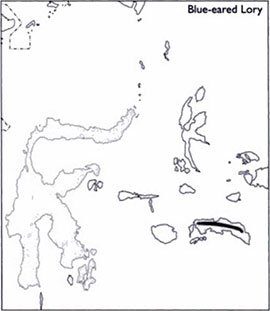
The Blue-eared Lory is endemic of the Seram island in the Moluccas (Indonesian).

Conservation:


minor concern

– Current IUCN Red List category: Least concern

– The population trend: Decreasing

The world population It has not been quantified, but the species is estimated that it can range from common to abundant at the local level (pit et to the. 1997). However, justified the population trend, It is suspected to be in decline due to unsustainable levels of exploitation.
The population range is between 5,000 and 50,000 birds released.

Probably the Blue-eared Lory It will always remain a rare specimen in the world of birds.

In March of 1995 the Government of Indonesian stopped the export of these birds.

Its hunting for local trade has become especially intense.. Fortunately, There is no reason to keep to the Blue-eared Lory as a pet on the part of the indigenous population.

"Blue-eared Lory" in captivity:

Since its population is decreasing, any specimen that can not be returned to their natural habitat (natural range) should preferably be placed in a well-managed breeding program to ensure the survival of the species.

Alternative names:

Blue-eared Lory, Ceram Lory, Blue eared Lory, Seram Lory (ingles).
Lori masqué, Lori à oreilles bleues (French).
Halbmaskenlori (German).
Loris Semilarvata (Portuguese).
Lori de Orejas Azul, Lori de Seram (español).

scientific classification:

Order: Psittaciformes
Family: Psittaculidae
Genus: Eos
Scientific name: Eos semilarvata
Citation: Bonaparte, 1850
Protonimo: Eos semilarvata

Images «Lory of Seram»:

Videos "Blue-eared Lory"

————————————————————————————————–

«Lori de Seram» – (Eos semilarvata)


Sources:

Avibase
– BirdLife.org
Oiseaux.NET

Photos:

– Blue-eared Lory in the Walsrode Bird Park, Germany by Quartl – Wikimedia
papageien.org
– Blue-eared Lory (Eos semilarvata) at the San Diego Zoo by Leon Mitchell – Wikipedia
– free-pet-wallpapers.com
kanaria1898tuttlingen.de

Sounds: Mark Todd (Xeno-canto)

▷ The world of Pets: Dogs, cats, birds, reptiles, amphibians

Kuhl's Lorikeet
Vini kuhlii


Kuhl's Lorikeet

Content

Description

18 cm.. long and an approximate weight of 55 g..

Males and females of the Kuhl's Lorikeet (Vini kuhlii) they are identical in appearance. Adult birds have cheeks, the chest and the part forward of the belly bright red.

The upperparts the body has different shades of green with the exception of a few Feather erection of color blue dark in the neck.

Its tail is multicolored, the Central feathers are red and purple sides, with the Green terminal part.
A zone blue-violet in the belly around the the thighs. The bill and legs are orange, the tail is short.

The birds youth they have the underparts opaque red.

Habitat:

The natural habitat of the Kuhl's Lorikeet are the tropical humid forests. On the Islands desforestadas also is in coconut plantations. It is a nectarivorous that feeds sucking nectar with his rough tongue.

Reproduction:

Observed in the month of March, April and August.
Nest in the trunks of coconut trees or FARA (Pandanus tectorius) dead or in cavities of hotu. Sometimes one or two rectangular holes mark the entrance of these nests. Only a litter has been found with two chicks.

Food:

Nectar and pollen from banana flowers (Musa sp.), Kapok (Ceiba pentandra), pacayers (Inga edulis), Mango (Mangifera indica), avocado (It persea americana), the coconut (Cocoa nuts), the Cordyline (fructicosa Cordyline) , the NASE (Barringtonia asiatica), the tafano (Guettarda speciosa), the Pomeroy (Syzygium jambos) and ATAE (Erythrina variegata).

The small seeds of purau (Hibiscus tiliaceus) and Aito (Casuarina equisetifolia). Axillary buds and young shoots of hotu, purau and falcata (Paraserianthes falcataria).

They lick the surface of the leaves of banana. Make sudden movements in the leaves of certain trees without flowers or fruit (including dead Palm trees), also tends to dig small holes – clearly too superficial to serve as a nest -, This we do think that also can be insectivores.

Distribution:

Size of the area of distribution (reproduction / resident) 510 km2

endemic to Rimatara in the Tubuai Islands, south-central Pacific (France), where the population is estimated at 905 birds. It has also been introduced in Kiribati including Teraina (Washington Island) and Tabueran (Fanning island), both before 1798, and Kiritimati (Isla Christmas), where six specimens were transferred in 1957.

Occasional appearances in the Thbuai island about Rimatara they are probably elopements pets.

Although the species is relatively common in Rimatara. the recent introduction of rats is cause for concern.
The population of Tabueran (c. 200 birds) It is also vulnerable because of predation of nests by rats.

In Teraina There are a few 1.000 birds and with no confirmed threat. It is possible that one or two individuals may still survive in Kiritimati. IN DANGER OF EXTINCTION.

Conservation:


Endangered

• Current IUCN Red List category: Danger

• Population trend Decreasing

Although populations are believed to be stable in Rimatara and Teraina and grow in Atiu where it was recently introduced, invading predators are probably causing a decrease in Tabuaeran and Kiritimati, Therefore, the general trend is suspected to be a moderate and continuous descent is its population.

Excessive exploitation of its red feathers is the most likely reason for the extinction of the Kuhl's Lorikeet in the Islas Cook.

A serious threat to all hatchlings in the Pacific islands, It is the depredation caused by rats in the nests, especially on the part of the Black Rat (Rattus rattus). In Rimatara, There was a wide shot of black rats (Rattus rattus), to leave the island away from them in the year 2000. However the rats of the Pacific (R. exulans) they were still very abundant.

In Teraina, There is no evidence of the presence of the (R. Rattus), although the Pacific rat (R. exulans) is abundant, While in Tabuaeran and Mitiaro, still having black rats (R. Rattus). Cats can be a threat in Kiritimati. The common mine (Acridotheres tristis) It is a threat to the introduced population in Atiu, Since it competes for nesting sites and usually attacking young people Kuhl's Lorikeet.

Ongoing conservation actions:

Appendix II of CITES.
– In Kiribati, the species is fully protected.
– In the french polynesia the species is protected by national laws and regulations from 1996.
– In Rimatara It has been protected by a traditional tapu (taboo) from 1900.

– 27 birds were reintroduced in Atiu from Rimatara in May of the 2007, after which organized a community contest to find the first young birds, with a reward given to the winner.
– Monthly count of birds in Atiu carried out to evaluate the success of the effort of introduction.
– A control program of the common mine started in Atiu in May of 2009, including harassment and capture, with a bounty for each dead bird.
– For October of the 2009, the population of the birds Mine had been reduced by 60% and this program is permanent.
– In Rimatara, 21 bait stations were established in the main Pier in September of 2009 to prevent black rats invading the island and raising awareness is taking place among children about the importance of protecting the avifauna of the island.

"Kuhl's Lorikeet" in captivity:

It is not in captivity.

Due to its State, in danger of extinction, any specimen that can not be returned to their natural habitat (natural range) should preferably be placed in a well-managed breeding program to ensure the survival of the species.

Alternative names:

Kuhl’s Lorikeet, Kuhl’s Lory, Kühl’s lory, Rimatara Lorikeet, Rimitara Lorikeet, Ruby Lorikeet, Scarlet-breasted Lorikeet (ingles).
Lori de Kuhl (French).
Rubinlori (German).
Lóris-de-kuhl (Portuguese).
Lori de Rimatara (español).

scientific classification:

Order: Psittaciformes
Family: Psittaculidae
Genus: Vini
Scientific name: Vini kuhlii
Citation: (Vigors, 1824)
Protonimo: Psittacula kuhlii

Images "Lori de Rimatara":

Videos "Kuhl's Lorikeet"

————————————————————————————————

«Lori de Rimatara» (Vini kuhlii)


Sources:

Avibase
– Parrots of the World – Forshaw Joseph M
– Parrots A Guide to the Parrots of the World – Tony Juniper & Mike Parr
– BirdLife.org

Photos:

1 – Miles to the wild – link
2 – Miles to the wild – link
3 – Miles to the wild – link
4 – Miles to the wild – link
5 – Duncan WrightThe uploader's own work: "Vini australis”. Engedely: GFDL, Forrás: Wikimedia Commons

Sounds: Matthias Feuersenger (Xeno-canto)

▷ The world of Pets: Dogs, cats, birds, reptiles, amphibians

Striated Lorikeet
Charmosyna multistriata

Striated Lorikeet

Content

Description

They weigh around 40 to 50 g. and length of 18 cm..

The plumage of the Striated Lorikeet (Charmosyna multistriata) It is predominantly green with yellow stripes on the belly and in the chest.

The throat, the forecrown and sides of the head They are slightly more yellow. The neck and the back of the head They are brown with some orange yellow stripes. The tail is olive green on top and having a tip dark yellow. The bottom of the tail It is greenish yellow with some red feathers around the vent. The most characteristic feature of Striated Lorikeet is the bill two colors. Upper bill is blue-gray with a touch of red orange, While the bottom is completely reddish-orange. Only one other Lori with a peak of two colors and that is the Musk Lorikeet. The irises It is red and legs They are gray with black nails.

Both sexes are the same color, the male is slightly larger and has a bill longer. They are also a little colored in the head.
The immature They have the same colors as adults, only the bill it is more black and darker stripes.

Habitat:

It inhabits in the mountains and hills and forest edges. Mainly found between 180 and 1.800 m, but they have been at much lower altitude, about 80 m. Found in pairs or in small groups of up 20 birds, sometimes fellowship with the Red-flanked Lorikeet and the Fairy Lorikeet (observed in mid-February in mixed flocks with these species). similar to the behavior Red-flanked Lorikeet, the consorts, but although they have observed flocks Striated Lorikeet fly with the Red-flanked Lorikeet, they usually form discrete individual groups.

Reproduction:

Habits of nesting and breeding unknown.

Food:

Prefer treetops in bloom where it feeds on pollen and nectar, but they may also feed on epiphytes.

Distribution:

Size of the area of distribution (reproduction / resident) 170,000 km2

Endemic to the montane forests of the center of West Papua New and Papua New Guinea, South of the cordillera central. The world population It is believed to be of less than 10.000 specimens, but it is probably stable. A small number in captivity.

Conservation:


Near-threatened


• Current IUCN Red List category: Near threatened

• Population trend: Decreasing

Its habitat is locally threatened by logging and clearing for agriculture. Reports of the species in Ok Tedi They show that the population of the Striated Lorikeet has fallen dramatically after the severe drought in 1997-1998 (P. Gregory in litt., 2010).

The species may be threatened by the presence of a large copper and gold open pit mine in Ok Tedi, but the impacts of this mine are currently unknown. It is likely to be tolerant of uneven and degraded forests and although it may have a small population in general, do not believe that it is declining very rapidly.

"Striated Lorikeet" in captivity:

In aviculture the Striated Lorikeet It has become one of the rarest species. These birds have not been imported in large quantities, and many of the birds that survived the journey later died due to infections by fungi and other diseases. Few breeders were able to raise them on a regular basis.

Alternative names:

Striated Lorikeet, Streaked Lorikeet, Yellow Streaked Lory, Yellow-streaked Lorikeet (ingles).
Lori strié (French).
Streifenlori (German).
Lori Estriado (español).

scientific classification:

Order: Psittaciformes
Family: Psittaculidae
Genus: Charmosyna
Scientific name: Charmosyna multistriata
Citation: (Rothschild, 1911)
Protonimo: Charmosynopsis multistriata

"Lori striated" images:

————————————————————————————————

«Lori striated» (Charmosyna multistriata)


Sources:

Avibase
– Parrots of the World – Forshaw Joseph M
– Parrots A Guide to the Parrots of the World – Tony Juniper & Mike Parr
– Birdlife
– loryclub

Photos:

1 – Author: Jaroslav Chloupekbiolib.cz
2 – by DavyVanthuyne’s Bucket
3 – Birds-pet-wallpapers – link
4 – Author iggino – lynx
5 – tierportraet.ch – link

▷ The world of Pets: Dogs, cats, birds, reptiles, amphibians

Moluccan hanging parrot
Loriculus amabilis

 Moluccan hanging parrot

Content

Description

11 cm.. length between 25 and 38 g. of weight.

The Moluccan hanging parrot (Loriculus amabilis)(Loriculus amabilis) has the head of color green with the front of the crown red. The the mantle slightly tinted Orange; rump and uppertail-coverts dark red. The latter extends almost to the tip of the tail. Wings green; Red and yellow mark in the carpus. Under, the wings blue with coverts greenish blue. Chin red; rest of the underparts more green yellowish to them upperparts, especially the coverts at the bottom of the tail. The tail, at the top, green, by down Bluestone with fine yellowish tips.

The bill black; irises yellowish white; legs oranges.

Female with the crown green, red dots on the forecrown and throat. Iris brown.

The young birds with trademark yellow around the bib, and at the edge of the carpus. Iris pale brown.

Habitat:

It is distributed by primary and secondary forests, in the lowlands until 800 m, along the edges of forests, in the mangroves and the casuarinas coastal, on the edges of agricultural land, around the villages and occasionally in forests of coconut trees.

The species is observed more frequently in solitary, in pairs or in small groups in the vicinity of the trees in flower.

Reproduction:

Little is known of the habits of nesting, only periods of courtship have been recorded.

Food:

Their natural diet consists of nectar, fruit, outbreaks, flowers and seeds.

Distribution:

Size of the area of distribution (reproduction / resident) 23.000 km2

Endemic to Indonesian, where are distributed by the islands off the northeast of Sulawesi including the archipelagos of the Banggai (Peleng. Labobo) and Sula (Seho, Taliabu, Mangole, Sulabesi), and in the North of Moluccas in Kasiruta, Bacan, Halmahera and Morotai.

In the Sula Islands It is rare, its population is probably around of 5.000 birds due to habitat loss. The status of the species in Banggai and Peleng It is insufficiently known.

Conservation:


minor concern


• Current IUCN Red List category: Least concern

• Population trend: Stable

The size of the world population It has not been quantified, Although it is believed that it is superior to the 20.000. specimens. The species is described as moderately common, although rarer in primary forest and common in secondary forest (pit et to the. 1997).

The population is suspected to be stable in the absence of evidence of any reduction or substantial threats, Although slightly affected by trade.

"Moluccan hanging parrot" in captivity:

Unknown.

Alternative names:

Moluccan Hanging-Parrot, Halmahera Hanging-Parrot, Moluccan Hanging Parrot, Wallace’s Hanging-Parrot (ingles).
Coryllis des Moluques, Coryllis des Moluques (nominal), Coryllis des Moluques (nominale), Coryllis des Moluques (race nominale) (French).
Zierpapageichen (German).
Loriculus amabilis (Portuguese).
Lorículo Amable (español).

scientific classification:

Order: Psittaciformes
Family: Psittaculidae
Scientific name: Loriculus amabilis
Citation: Wallace, 1862
Protonimo: Loriculus amabilis

images of "Moluccan hanging parrot"

Videos "Moluccan hanging parrot"

————————————————————————————————

Moluccan hanging parrot (Loriculus amabilis)


Sources:

Avibase
– Parrots of the World – Forshaw Joseph M
– Parrots A Guide to the Parrots of the World – Tony Juniper & Mike Parr
– Birdlife

Photos:

(1) – Single bird on a branch by nvoaden – lynx

Sounds: Mike Nelson (Xeno-canto)

▷ The world of Pets: Dogs, cats, birds, reptiles, amphibians

Double-eyed Fig-Parrot
Cyclopsitta Diophthalma


Double-eyed Fig-Parrot

Content

Description

13 to 16 cm.. length and a weight between 25 and 56 g..

The Double-eyed Fig-Parrot (Cyclopsitta Diophthalma) half of the crown, lores, cheeks and headphones feathers bright Scarlet color with some slightly elongated feathers; bright turquoise brand above and in front of the eyes, that it extends slightly backwards above and below; green line above and behind the eyes; brand violet-blue light under the red on the back of the headphones feathers that extends to the throat; narrow yellowish Orange behind the red band of the crown, Fusion to the green in the part back from the crown.

Upperparts with indistinct diffusion of color bright green olive on the the mantle. Wing coverts, bright green; primary coverts blue; primaries with vane external of color blue turquoise pale and vane blackish internals; flight feather (except the primary outer) with band of yellowish white color visible from below; inner coverts marked in red, wing feathers bordered with yellow green.

The underparts paler; Green over yellow that the upperparts, with a strong Flash of yellow along the flank, about the bend of wing. Upper, the tail green; grey below.

Robust bill, notched grey lead and a blackish tip; cere dark grey; irises dark brown; legs Green grey.

The female has the cheeks brown, not red.

Immature as the females. The young male acquire the plumage adult in 14 months.

Subspecies description

Subspecies description
  • Cyclopsitta diophthalma diophthalma

    : (Hombron and Jacquinot, 1841) – The nominal

  • Diophthalma diophthalma aruensis - male

  • Cyclopsitta diophthalma aruensis

    : (Schlegel, 1874) – Of 14 cm.. length. The plumage is greenish-yellow, the blue area on the eyes has greenish hue , Blue cheeks are lined with mauve colouration and extends to the bottom of the peak.

    Female similar to the male but all the red marks are replaced by a pale blue.

  • Diophthalma diophthalma coccineifrons

  • Cyclopsitta diophthalma coccineifrons

    : (Sharpe, 1882) – Of 14 cm.. length.

    It is usually something more dark. The Crown is red bordered with a broad yellow band.

    The female has less yellowish white.

  • Diophthalma diophthalma virago - male

  • Cyclopsitta diophthalma virago

    : (ECTION Hartert, 1895) – Of 14 cm.. length.

    Green is more pale, the red zones of the face are less extensive and more pale.
    Yellow edge of the very weak Crown.

    Juveniles as adult females

  • Diophthalma diophthalma inseparabilis

  • Cyclopsitta diophthalma inseparabilis

    : (ECTION Hartert, 1898) – Of 14 cm.. length.

    The Red coloration is reduced to a small spot on the forehead, the rest of the forehead is bluish.

    Similar to males females.

    Juveniles as adult females.

  • Diophthalma diophthalma macleayana

  • Cyclopsitta diophthalma macleayana

    : (EP Ramsay, 1874) – Of 14 cm.. length.

    The Red is reduced to a red spot in the front area and lower cheeks. The yellow border in the area of the Crown is absent, sides of the forehead and eyes blue with green. The azul-violaceos edges of the cheek extends to below the peak.

    Females more yellowish and the bottom of the cheeks is white Brown.

    Equal to the adult female juveniles.

  • Diophthalma diophthalma marshalli

  • Cyclopsitta diophthalma marshalli

    : (Iredale, 1946) – Of 14 cm.. length.

    Green is more beige and the azul-malva coloration extends to the area under the peak.

    Females have pale blue color where the male has red and blackish brown cheek bottom area.

    Juveniles as adult females.

  • Diophthalma diophthalma coxeni

  • Cyclopsitta diophthalma coxeni

    : (Gould, 1867) – It's a bit more large, of about 15 cm.. approximately, No red forehead and face with some reddish feathers, the cheeks and orange headphones feathers. Blue front clear and without yellow stripe. The area of the eyes is absent blue. Blue edges of the bottom of the cheeks is variable.

    The females are more yellowish with less or absent red in the face.

    Equal to the adult female juveniles.

Habitat:

The Double-eyed Fig-Parrot are sedentary, with some dispersion after the breeding season. It is in a range of habitats from low to medium altitude, including jungle, secondary vegetation, on the edge of the Woods, riparian forest and occasionally dry forests and open forests of eucalyptus.

In Australia There are also birds in parks, Gardens, scrub, cultivated areas and mangroves; the Diophthalma diophthalma coxeni, probably, concentrated in the alluvial forest, but it was also visible in the forests of dry lowlands and hills of rainforest.

The species is highly dependent of the Ficus figs in all habitats.

The birds are usually found in pairs or in small groups, calling the attention with their constant calls acute while flying above the canopy.

They feed in silence, moving quietly through the foliage, often giving away their presence only by falling debris, Since break the shell of the fruit to reach its seeds.
outside the breeding season, groups of up to 200 birds can be nested together, dissolving into smaller groups to feed themselves during the morning and afternoon.

When alarmed, they move their wings in an agitated manner.

during the rains, the bath is carried out with wet foliage, and mutual grooming is common.

Reproduction:

The breeding season of the Double-eyed Fig-Parrot, probably begins in New Guinea during the month of March, in Australia the main season runs from August to November.

When the birds are played are divided into pairs, territorial around their food trees. The nest It is a cavity that is expanded in a trunk at a height between 8 and 20 meters above the ground. Most of the nest preparation is carried out by the female., that takes refuge in the hole and spends a large part of the day there during its excavation. She can experiment with more than one nest.

Courtship feeding is common. The entrance hole is about 4 cm in diameter, and putting two white eggs are deposited, at intervals of 48 hours, in one camera, some 20 centimetres below the entry hole.

The incubation hard 18 days and the young will leave the nest in 7-8 weeks, After having been fed during the first 3 to 4 weeks, only for the female. They return to settle in the hollow for a short period of time after having left the nest.

Food:

The fig seeds they are their main food, birds often return to the same ripe fruits ending all their seeds. The diet also includes whole fruits small, nectar, insect larvae and fungi or lichens collected from the barks. Birds may feed in groups with others Fig parrots and, in Australia, with Rosella parakeets and other species of parrots.

Distribution:

The Double-eyed Fig-Parrot is distributed throughout much of New Guinea and parts of the northeast of Australia. At the West end is located in Waigeo, Salawati, Misool and Rafiau in the West Papua islands, Indonesian.

Is widespread but distributed unevenly through the continental part of New Guinea, absent only in the center of the Doberai Peninsula and the central belt of mountains above the 1.600 m, Although there have previously been to 1.800 meters at the local level.

You can see in the islas Aru and Fergusson, in the Islands Goodenough in the D'Entrecasteaux Group, and in Tagula in the Louisiade group.

In Australia, the most northerly of the three isolated populations, is the tip of the Cape York Peninsula, from Jardine River in the northwest of the country, to the South, around East of Lockhart River, sometimes in the South to the extreme north of the Princess Charlotte Bay; the population Centre occupies the coastal district of everything Cooktown in the North through Cairns and the District Atherton, about South of Townsville; the southern-most population, now very reduced, with less than 50 records in the last century, formerly extended from Gympie, Queensland, to the South, about Richmond River, New South Wales, arriving inland up to the Bunya mountains (in 1976 two birds were about the Koreelah National Park, in February and two close Lamington National Park in December).

The estimate of the world population is above the 100.000 individuals and stable, but the State two of its subspecies is less secure:

– Cyclopsitta Diophthalma macleayana: has a population of 5.000 individuals and may be in decline, Although multiply in parks and gardens around Cairns.
– Cyclopsitta Diophthalma coxeni: just left 200 birds, After having reduced its population as a result of the destruction of the forests of lowlands along its limited distribution area.
– The third Australian subspecies, Cyclopsitta Diophthalma marshalli it's still pretty common.

In New Guinea, the species dispersed, and is considered to be rare in the Doberai Peninsula and absent from many parts of the lowlands of the South, is mainly distributed in the Highlands of the South basin. The Orange-breasted Fig-Parrot It probably replaces this species in much of this area. It is likely that the species has not been recorded accurately due to its small size and discreet habits. Protected by law in Australia. The Diophthalma diophthalma coxeni appears in the Appendix I of the CITES

Subspecies distribution

Subspecies distribution

Conservation:


minor concern


• Current IUCN Red List category: Least concern

• Population trend: Stable

The size of the world population Double-eyed Fig-Parrot It has not been quantified, Although it is estimated at more than 100,000 specimens. But, the Diophthalma diophthalma coxeni is in critical hazard, with a population between 50 and 200 individuals; the Diophthalma diophthalma macleayana with a population of some 5.000 individuals and the Diophthalma diophthalma marshalli generally uncommon

The population, of the nominal species, is suspected to be stable in the absence of evidence of any reduction or substantial threats.

"Double-eyed Fig-Parrot" in captivity:

Rare in captivity.
Not social with people. Welcome in the distance.

Alternative names:

Double-eyed Fig-Parrot, Double eyed Fig Parrot, Double-eyed Fig Parrot, Two-eyed Fig Parrot (ingles).
Psittacule double-oeil (French).
Rotwangen-Zwergpapagei (German).
Papagaio-do-figo-de-cara-azul (Portuguese).
Lorito de Cuatro Ojos, Lorito Dobleojo, Lorito de la higuera de doble ojo (español).

scientific classification:

Order: Psittaciformes
Family: Psittaculidae
Scientific name: Cyclopsitta Diophthalma
Genus: Cyclopsitta
Citation: (Hombron & Jacquinot, 1841)
Protonimo: Psittacula diophthalma

Images "Lorito double":

Videos "Double-eyed Fig-Parrot"

————————————————————————————————

«Lorito Doublerojo» (Cyclopsitta Diophthalma)


Sources:

– Avibase
– Parrots of the World – Forshaw Joseph M
– Parrots A Guide to the Parrots of the World – Tony Juniper & Mike Parr
– Loromania

Photos:

(1) – «Cyclopsitta diophthalma-Birdworld Kuranda, Queensland, Australia-male-8a» by ShotophotoDouble Eyed Fig ParrotUploaded by snowmanradio. Licensed under CC BY-SA 2.0 via Wikimedia Commons.
(2) – John Gerrard Keulemans [Public domain], via Wikimedia Commons
(3) – «Cyclopsitta diophthalma-Mossman Gorge, Daintree National Park, Queensland, Australia-male-8» by James Island from Brisbane, Australia – Double-Eyed Fig-ParrotUploaded by snowmanradio. Licensed under CC BY 2.0 via Wikimedia Commons.
(4) – «Cyclopsitta Diophthalma (female) -Cairns-8» by David Cook Wildlife Photography – originally posted to Flickr as Double-eyed Fig-Parrot (Cyclopsitta Diophthalma). Licensed under CC BY-SA 2.0 via Wikimedia Commons.
(5) – Birds-pet-wallpapers
(6) – By tamandua – PBase

Sounds: Andrew Spencer (Xeno-canto)