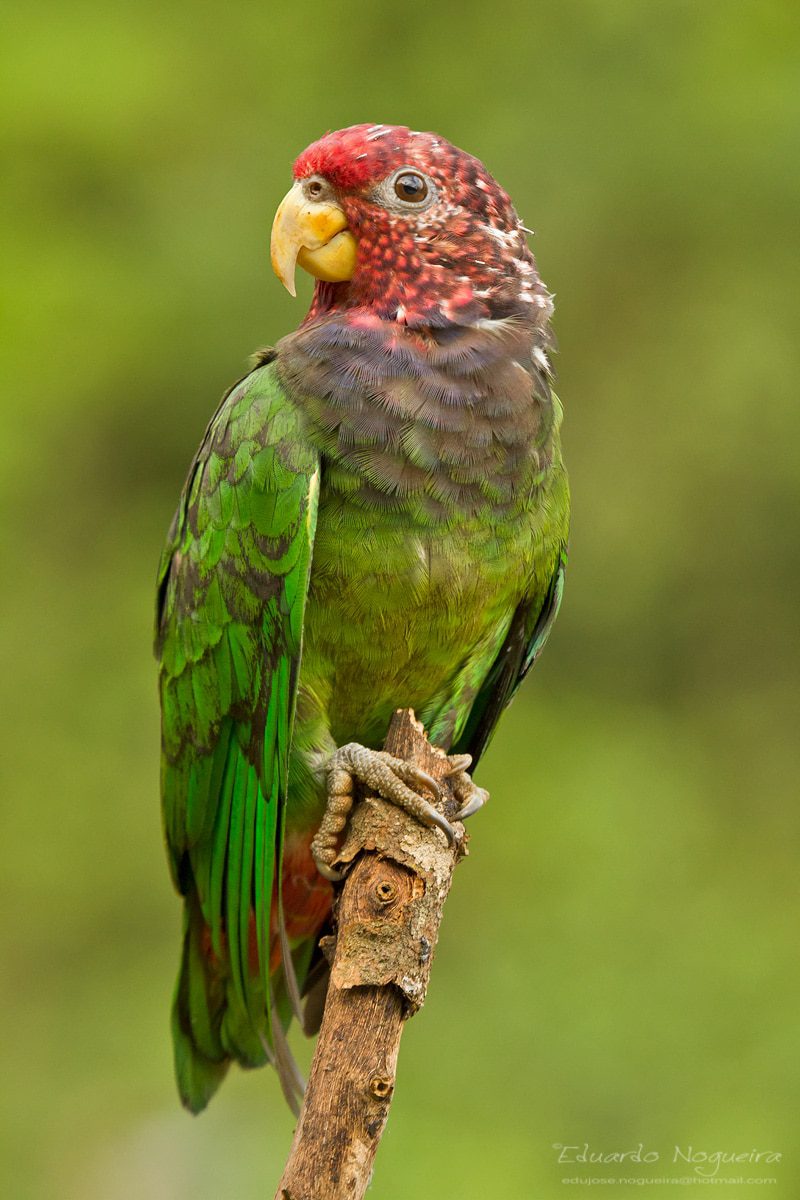
The Maroon-tailed Parakeet(Pyrrhura melanura) is distinguishable mainly by the tail and wings blackish (visible in flight); has the lores, the forecrown, the crown and the rear area of the neck, brownish, with paler reddish brown tips on the crown, forming altogether a speckled pattern; cheeks, ear-coverts and area behind the eyes, green; Brown in the shadows at the back of the crown Green in the nape.
Upperparts Green with tinge of olive in some feathers. Primary coverts Red with yellow tips; Front edge of the wing
, red; upperwing-coverts of color green with dye olive. Primaries Dark greenish blue with dark tips. Underwing-coverts green; underside of flight feather blackish. Throat and feathers of the upper part of the chest, Green or greyish green with pale margins, giving a scaly striking effect; pale edges that become less clear on the sides of the neck; the belly and undertail-coverts Green with dye olive dark. Upper, the tail dark brown with green outer feathers; undertail, the tail shiny black.
Bill pale grey; bare periophthalmic naked, whitish: irises dark brown; legs grey.
Both sexes similar. The immature has less red (greener) in the primary coverts.
(Salvadori, 1891) – Similar to the Pyrrhura melanura souancei, but with even broader and paler margins on the breast feathers (Some birds of Ecuador with almost entirely white breasts), less red on the front edge of the wing
and more pronounced brown patch in the belly. Cheeks dyed with color olive, Red uniform at the edge of the carpus; abdomen more uniform brown/red color.
Pyrrhura melanura chapmani
(Bond & Meyer de Schauensee, 1940) – With suspiciously in the chest more width, No yellow in the wing
; yellowish in the area of the ear and the green of the tail darker.
(Chapman, 1915) – More dark, No yellow in the wing
, grey around the eye, tail more short and reddish.
Pyrrhura melanura souancei
(Verreaux,J, 1858) – With the edge top of the wing
Red and not yellow; Green in the base of the tail more extensive and chest with scaled a little more width.
Habitat:
The Maroon-tailed Parakeet It occupies the temperate tropical formations, including forests of várzea, forests of land low and pre-montanos rainforests and forests cloud, often in areas partially cleared and edges of secondary forests; 150 - 300m in Venezuela (nominal), to 3,200 m in the slopes Andean Eastern (souancei), 1.600-2.800m on the slope of the Andes central (chapmani), at 1,700 m in Nariño (Pacifica), at 1500m (berlepschi). Usually in flocks of 6-12 individuals, staying in them cups of them trees to rest but moving is toward the branches more low for forage.
Reproduction:
Little information about breeding, observed during the months of April-June, headers of the Napo River, Ecuador. Copulation observed in January (Colombia). Clutch four eggs in captivity.
Food:
Few details about the diet, with foods known, including fruits of Miconia tkeaezans (Top of the Magdalena valley). Fagara tachuelo and tree bark (Amazonia).
Distribution:
Size of the area of distribution (reproduction / resident): 1.510.000 km2
The distribution of the Maroon-tailed Parakeet is discontinuous. Northwest of South America in the Western Amazon basin, southern portion of the the Orinoco basin and slope of the peaceful of the Andes, in the southwest of Colombia and West Ecuador.
In Venezuela the species is found in the Centre of the South of Bolívar along the upper Western Amazon basin of Brazil between the riversNegro and Solimões. They are also distributed in Andes Central of Colombia, at the top of the Magdalena valley, from the South of Tolimauntil Huilaand separated to the East from the Andes (in lowlands and up to 500 m in foothills) Since the Macarena mountains, southward through eastern lowlands Ecuador and Northeast and East of Peru.
A separate population is distributed to the West of the Andes, in the Northwest of the South of Ecuador, to the North of The rivers, with a single log in nose, to the southwest of Colombia.
Mainly resident Although the apparent absence during some seasons in some parts of Colombia suggests regular movements.
Unevenly distributed, in some areas very common, being the Parrot more numerous in some parts of the range such as high Magdalena valley and perhaps parts of Esmeraldas in the Northwest of Ecuador.
Alleged decrease in some areas (for example, Pacific slope of Ecuador) due to loss of habitat. Little known in the East of Peru. Not a locally popular cage bird if it has been traded internationally in significant numbers in late 1980 and fairly well known in captivity outside of its area of distribution.
Subspecies distribution
Pyrrhura melanura berlepschi
(Salvadori, 1891) – Valley of Huallaga, is of Peru and Southeast of Ecuador on Cutucú mountain range. A specimen with characteristics of this species was observed at the head of the Magdalena valley suggesting their distribution in Colombia.
(Chapman, 1915) – Northwest of Ecuador and southwest of Colombia.
Pyrrhura melanura souancei
(Verreaux,J, 1858) – It is from Colombia since the Sierra de la Macarena Southwest, until Putumayo through the East of Ecuador, possibly up to the north end of Peru. Probably bordered on the eastern slopes of the Andes and mostly replaced by the nominal species in lowlands.
Conservation:
• Current category of the Red List of the UICN: Least concern.
• Population trend: Decreasing.
Justification of the population
The population size world has not been quantified, but this species is described as «quite common» (Stotz et to the., 1996).
Justification of trend
This species is suspected that he has been able to lose 6,95 to 7,1% of a habitat within its distribution over three generations (18 years) based on a deforestation model of the Amazon (Soares-Filho et to the., 2006, Bird et to the. 2011). Given the susceptibility of the species to the cazay and/or the capture, It is suspected that will decrease in <25% durante tres generaciones.
"Maroon-tailed Parakeet" in captivity:
Ave shy and quiet, get used to people over time. Colonies in large birdcages are possible.
Alternative names:
– Maroon-tailed Parakeet, Magdalena Parakeet, Maroon tailed Parakeet, Maroon-tailed Conure, Black-tailed Conure (English).
– Conure de Souancé, Perriche de Souancé, Perruche de Souancé (French).
– Braunschwanzsittich, Braunschwanz-Sittich (German).
– tiriba-fura-mata (Portuguese).
– Cotorra Colinegra, Perico de Cola Negra, Periquito Colirrojo (español).
– Periquito Colirrojo (Colombia).
– Periquito Colirrojo (Peru).
– Perico Cola Negra (Venezuela).
Origin: Mexico, Guatemala, Belice, El Salvador, Honduras, Costa Rica, Nicaragua
Character: active
Life expectancy: 60 years.
Height: 22 to 26 cm..
Content
Description:
22 to 26 cm.. length.
The White-fronted Parrot(Amazona albifrons) has the forecrown white; lores, upper cheeks and ring of feathers around eyes, red; the crown pale blue mingles with the green nape; the feathers with dark margins; sides neck green with narrow black margins. Mantle, back and scapulars, grass-green, sometimes with olive tint; the mantle with indistinct black tips; rump green, perhaps more emerald colors than the rest of the upperparts.
big blankets and alula, red, other coverts green. The outerweb of the primaries, green, They turn blue at the tips; outerweb of the secondaries, blue; innerwebs of the flight feather, blackish. Under, the wings bluish green. Underparts green with weak blackish edges to feathers on throat and the chest. Upper, the tail It is yellow in the center, outer feathers red at the base, blue in the outerweb. Bill light colored horn, darker at the tip; bare periophthalmic pale grey; irises pale yellow; legs pale grey.
It presents an undistinguished sexual dimorphism. The female It differs from the male in the red face It is limited to the region eye ring and it lacks the red hue in wing coverts. The immature male It looks like female but with red on the primary coverts.
(Miller,W, 1905) – smaller the species nominal. Little differentiated from nominal but the green plumage It is perhaps paler, yellower. Some individuals Coast peaceful show some red on the throat.
Amazona albifrons saltuensis
(Nelson, 1899) – Similar to the nominal but the plumage It is heavily steeped in blue. The blue of the crown It extends to the nape.
Habitat:
This adaptable Amazona uses all kinds of wooded habitats and open field with trees, including seasonally moist semi-evergreen semi-evergreen forest (especially at the edge), pine forests, gallery forest, agricultural land with open woods, savannah and tropical arid scrub with cactus, tending to more frequent open areas in the caribbean side.
Usually they prefer drier forests, but where it is simpátrica with Yellow-lored Parrot(Amazona xantholora), tends to prefer more humid and closed vegetation.
In Yucatan the White-fronted Parrot inhabit coastal coconut plantations while breeding. In altitudes of 900 m (Oaxaca), 1.800 m (Honduras) and 1.500 m (Sonora meridional: register only known outside the tropics).
In pairs during the breeding season but usually gregarious, distributed primarily in small groups, with occasional concentrations of hundreds of birds and some communal roosts (for example, mangroves) with several thousand birds.
The White-fronted Parrot nest in trees, cavities of the palm tree termitarium, sometimes in the cavity dug by some woodpecker. species trees Bursera simaruba and Caesalpinia gaumeri are among the favorites to nest in Yucatan. Breeding January July, depending on the location.
A clutch contains 3-5 eggs. Only the female incubates. The incubation lasts around 24 days.
Size of its range (breeding/resident ): 2.330.000 km2
The White-fronted Parrot They extend Mexico, from the South of Sonora (north to about 28 ° N) along the Sinaloa and West Durango south through the Pacific region to Oaxaca and north through Tehuantepec isthmus the Atlantic coast in southern Veracruz and to the East by Tabasco the entire Yucatan Peninsula, including northern Guatemala and Belice.
They are present in southern Chiapas and in the lowlands of the Guatemalan Pacific and, reportedly, in West El Salvador, extending through the lowlands of peaceful, arid and Caribbean lowlands Honduras to the Pacific Northwest Costa Rica and Nicaragua (where distribution is not detailed).
Mainly seasonal residents but visitors in some parts of the range (for example, Yucatan, El Salvador western and eastern mountains Guatemala).
Introduced in urban areas Cozumel Island, in the State of Quintana Roo (Mexico). Their presence only in urban areas of the island, the ability of the species to live successfully in urban areas, the abundance of fruit trees and use as a pet by the islanders allows us to suggest that registered individuals are the result of leakage or were released by their owners.
Usually common and together with the Orange-fronted Parakeet(Eupsittula canicularis), It is the largest parrot in the Pacific slope of Central America; although obviously scarce in some areas. The deforestation It is possibly promoting increases in population Caribbean slope of Central America. Captured for the pet trade and hunted as food, for example in Yucatan, where recently there has been a population decline due to the persecution of parrots that feed on fruit after loss of wild foods cultivated by Hurricane Gilbert. Its capture It is authorized only during the months of October to February in the states of Warrior, Jalisco, Michoacán, Oaxaca, Sinaloa and Tabasco and from September to January in Veracruz.
Distribution 3 subspecies:
Amazona albifrons albifrons
(Sparrman, 1788) – Nominal. Pacific Coast of Mexico from Nayarit to Oaxaca and South of Chiapas in the lowlands Guatemalan Pacific. Birds in the northern Guatemalan lowlands and the arid interior, they can refer to the subspecies Amazona albifrons nana.
• Current category of the Red List of the UICN: Least concern.
• Population trend: Increasing.
Rationale for the Red List category
• This species has a very large range and therefore it is not close to the thresholds for Vulnerable under the criterion of size range (Extent of occurrence below 20,000 km2 combined with a size decreasing or fluctuating range, extension / habitat quality or population size and a small number of sites or severe fragmentation).
• The trend of population appears to be increasing and, therefore, the species does not approach the thresholds Vulnerable under the criteria of population trend (Wholesale 30% decrease in ten years or three generations).
• The population size is very large and, therefore, not approaching the thresholds for vulnerable under the criterion of population size (less than 10.000 mature individuals with continuing decline estimated a higher percentage of 10% in ten years or three generations or with a specific population structure).
• For these reasons the species is evaluated as the least concern.
Justification of the population
• Partners in Flight estimated that the total population of 500.000-4.999.999 individuals (A. Panjabi in a bit., 2008).
Justification of trend
• The population is suspected to be increasing as habitat degradation is creating new areas of suitable habitat.
The White-fronted Parrot in captivity:
Due to the decline of these birds in the wild, especially in the Mexican populations, the White-fronted Parrot is now, unlike other times, offered for sale only rarely. It also, among birds received by importers, the males generally far outweigh the females so it's hard to find a partner.
According to many observations, the White-fronted Parrot captured still quite shy and unsociable, especially if they were mature when they were trapped. The birds immature, which can be stained by the yellowing of his crown, relatively well sympathize with their caregivers and are easily adapted to a life in a cage or aviary. It is said to have some talent to imitate.
According to sources, the first hatchlings in captivity They were born in 1949 in the United States by I.D. Putman; the second in 1977 on German Federal Republic by H. Müller (Walsrode) and a third set in Switzerland in 1979; Since then several European poultry farmers have reported breeding successes.. The latest report came in 1985 from the bird park Metelen Heide in Muen-sterland (Western Germany). there a clutch five eggs produced four hatchlings in mid-June 1984 after an incubation period of 28 days. The young left the nest after about 70 days, but they were still actively cared for and fed, mainly by the parent, for a few weeks more.
Its price in the European market round 1000 EUR. generally silent the Amazons largest. It can be noisy just before and during the breeding season.
These birds can become aggressive in breeding season and can attack the caregiver. The nest boxes are better positioned to nest inspection can be performed from outside the aviary. The inspection of the nest is best when adult birds are out of the nest, however captive breeding has rarely been achieved between individuals.
Susceptible to intestinal infections during the acclimatization period.
Their life expectancy can overcome the 50 years.
Alternative names:
– White-fronted Parrot, Spectacled Amazon, Spectacled Parrot, White fronted Parrot, White-browed Amazon, White-browed Parrot, White-fronted Amazon (English).
– Amazone à front blanc, Amazone à lunettes (French).
– Weißstirnamazone (German).
– Papagaio-de-testa-branca (Portuguese).
– Amazona de Frente Blanca, Amazona Frentialba, Cotorra Frentiblanca, Lora frentiblanca, Loro Frente Blanca, loro frente-blanca, Loro Frentiblanco, Cotorra Guayabera (español).
– Cabeza de Manta, Loro Manglero, Cocha, Cocho, Cucha (Mexico).
Parrots A Guide to the Parrots of the World – Tony Juniper & Mike Parr
Birdlife
The New Parrot Handbook by Werner Lantermann,Matthew M. Vriends
Photos:
(1) – White-fronted Amazon By David Oliva (originally posted to Flickr as Cotorro 007) [CC BY 2.0], via Wikimedia Commons
(2) – White-fronted Amazons in Schönbrunn Zoo By spacebirdy(also known as geimfyglið (:> )=| made with Sternenlaus-spirit) (Own work) [CC BY-SA 3.0 or FAL], via Wikimedia Commons
(3) – white-fronted amazon (Amazona albifrons) By Christoph Anton Mitterer (Flickr: P8155550) [CC BY-SA 2.0], via Wikimedia Commons
(4) – White-fronted Amazon Amazona albifrons pair perching in a tree at Guanacaste, Costa Rica By Steve Jurvetson (originally posted to Flickr as love birds) [CC BY 2.0], via Wikimedia Commons
(5) – White-fronted Amazon, (Amazona albifrons). A pet parrot on a perch. Red feathers on this parrots shoulders indicate that it is a male By ➨ Redvers (Flickr) [CC BY 2.0], via Wikimedia Commons
(6) – White-fronted Amazons in Schönbrunn Zoo By spacebirdy(also known as geimfyglið (:> )=| made with Sternenlaus-spirit) (Own work) [CC BY-SA 3.0 or FAL], via Wikimedia Commons
(7) – A captive White-fronted Amazon in Copán Ruinas, Copán, Honduras By Troy from Charlottesville, USA (Flickr) [CC BY-SA 2.0], via Wikimedia Commons
(8) – A White-fronted Amazon – upper body by sumba [CC BY 2.0 of], via Wikimedia Commons
(9) – A pet juvenile White-fronted Amazon in Poole, Dorset, England By Kyle Payne from England (Odd Looking Seagull) [CC BY-SA 2.0], via Wikimedia Commons
(10) – White-fronted Amazon, Amazona albifrons, Remove alone B. Planet Earth – Flickr
The Black-fronted Parakeet(Cyanoramphus zealandicus) They seemed to be very similar to the rest of the species of Cyanoramphus; They were olive green; the forecrown It was black; the lores (the regions between the eyes and the peak on the sides of the head of a bird) and stretches along the eyes They were red; the lower part of the back It was red; the uppertail-coverts red. the outerweb of the flight feather They were blue violet. The eye rings They were light blue. The adults probably had irises orange, while young birds had eyes dark or brown.
The legs They were brown and gray bill It was pale bluish gray with a blackish tip.
Habitat:
According to Des Murs (1845, 1849), Lt. M. J. Marolles shot three birds tahiti in 1844, in Port Phaeton, in the isthmus Taravao. The bird was rare at that time, and only he was in the isthmus and the mountains Tahiti-iti. Marolles saw only four or five individuals in total, and the locals told him that the parrots lived in large trees on inaccessible escarpments and deep valleys. It is not known nothing about it.
Reproduction:
No data
Food:
No data
Distribution:
The Black-fronted Parakeet they were from tahiti, on french polynesia. Three known specimens collected (two of which are now in Liverpool and one in Tring) collected on the trip Cook in 1773, a fourth collected by Amadis in 1842, now in Perpignan and a fifth collected by the Marolles in 1844, now in Paris(Voisin et al. 1995).
No specimen has been recorded since 1844.
Conservation:
• Current category of the Red List of the UICN: Extinct.
• Population trend: Extinct.
• Population size : There is no individual left.
Rationale for the Red List category
The frentinegro Perico were known tahiti, (french polynesia), but it has not been seen since 1844 and it is now regarded as a kindextinct. Possible causes include deforestation, the hunting and predation introduced species.
Hume y Walters suggest that because the Tahitians highly prized the green and red parrot feathers brought from Tonga, it is possible that excessive hunting in the past has been, at least in part, responsible for the disappearance of Black-fronted Parakeet.
Alternative names:
– Black fronted Parakeet, Black-fronted Parakeet, Black-Fronted Parrot, Tahiti Parakeet (English).
– Kakariki de Tahiti, Perruche de Tahiti (French).
– Schwarzstirnsittich, Tahiti-Laufsittich (German).
– Periquito-do-tahiti (Portuguese).
– Perico de Frente Negra, Perico frentinegro (español).
• Avibase
• Parrots of the World – Forshaw Joseph M
• Parrots A Guide to the Parrots of the World – Tony Juniper & Mike Parr
• Birdlife
Photos:
(1) – Iconographie ornithologique by Marc Athanase Perfect Carnation Walls (1804-1878) [Public domain], via Wikimedia Commons
(2) – Watercolour painting by George Forster annotated ‘Psittacus pacificus’. Made during Captain James Cook’s second voyage to explore the southern continent (1772-75). George Forster [Public domain], via Wikimedia Commons
▷ The world of Pets: Dogs, cats, birds, reptiles, amphibians
Origin: Mexico, Belice, Guatemala, Honduras, Nicaragua, Costa Rica, Panama, Colombia
Character: quiet and shy
Life expectancy: ----
Height: 21 cm..
Content
Description:
21 cm.. height and weight around 165 g.
It more distinguishable from the Brown-hooded Parrot(Pyrilia haematotis) is your head, with forecrown White and the eye ring naked white also; ear with red feathers or oranges, crown grayish coffee, chest and nape Green yellowish.
The rest of the body usually green with it armpit red (easily view on the fly), contrasting with the blue-green of the wings and the green of the tail. The latter with light blue at the tip of the central feathers.
The bill is pale brown with yellow tinge. The irises they are red and the legs grayish brown.
The immature they are similar to adults, but more pale, off and without the color red in the head. Their irises is dark.
(Lawrence, 1862) – With red marks on the bottom of the rear of the neck and in the part superior of the chest, often forming a band in the male, more weakly in the females.
It inhabits mainly in the canopy of humid forests with a deciduous tendency, until the 1500 m. Their flocks are not numerous and are quiet at the time of feeding.
In Colombia is considered species very rare.
Reproduction:
It nests in hollow of trees and seems to share them with Blue-headed Parrot(Pionus menstruus).
Breeding season in February in Yucatan; May-July in Guatemala; August in Panama.
Food:
Feeds of fruits and seeds of trees in areas forested, as well as plants epiphytes and leaves green of some types of mistletoe.
Distribution:
Are you can observe in freedom from the Centre-South of Mexico to northwest of Colombia.
You can socialize with other parrots and toucans.
Subspecies distribution:
Pyrilia haematotis coccinicollaris
(Lawrence, 1862) – It is from Panama and Northwest of Colombia.
• Red List category of the UICN current: Least concern
• Population trend: Stable
Justification of the population:
Partners in Flight estimates the population at fewer than 50.000 individuals (A. Panjabi in litt., 2008), by what is placed in the band 20,000-49,999 individuals here.
Justification trend:
The population of the Parrot Encapuchad suspected to be stable in the absence of evidence of any reduction or substantial threats.
"Brown-hooded Parrot" in captivity:
Extremely susceptible to stress and diseases during the acclimatization, sudden deaths occur without warning. These are reasons why the they are seldom seen in captivity.
Alternative names:
– Brown hooded Parrot, Brown-hooded Parrot, Red-eared Parrot (English).
– Caïque à capuchon (French).
– Grauwangenpapagei, Grauwangen-Papagei (German).
– Brown-hooded Parrot (Portuguese).
– Cotorra Cabeciparda, Lora cabeciparda, Lorito Abigarrada, Lorito Encapuchado, Loro Cabecipardo, Loro Cabeza Oscura, loro cabeza-oscura, Loro Orejirrojo (español).
– Cotorra Cabeciparda (Colombia).
– Loro cabecipardo (Costa Rica).
– Lora cabeciparda (Honduras).
– loro cabeza oscura, loro cabeza-oscura, Loro Orejirrojo (Mexico).
– Loro Cabecipardo (Nicaragua).
32 cm.. height and a weight between 230 and 260 gr.
The Black Lory(Chalcopsitta atra) It is the least colorful member of an otherwise very colorful genre. It´s, in poultry, therefore, the least popular. This is unfortunate because it is equally as interesting as the other members of the genus.
Black in color with a purplish sheen to the plumage that is highly evident in sunlight, which gives it a superficial appearance of a crow. Even their bare parts, as the nose , the skin around the eyes and at the base of the jaws, eyes and claws, they are equally dark. Rump displays a violet blue.
The underside of the tail feathers are color olivaceous with light infusions of red at the base.
The iris is orange-red, the grey legs.
The youth differ little from adults but have an eye-ring and a skin at the base of the peak which are whitish. It is grey.
There is a 3 subspecies, that differ little between if:
Chalcopsitta atra atra: Both adults, usually black. The bluish violet rump. The feathers of the bottom of tail olive/yellow washed in red. Naked eye-ring black , black skin at the base of the peak. Orange-red eyes.
Chalcopsitta atra bernsteini: Red marks / purple on the forehead and thighs, less evident in females; Blue darker in the rump.
Chalcopsitta atra insignis: Head striped gray/blue. The front, the face, the thighs and the underside of the wings are red. The feathers of the throat and underparts with red trim. The rump is dull blue. The lower part of the tail is greyish blue. It is one of the most beautiful parrots that exist. It will be necessary to see any parrot in the light of the Sun to be able to appreciate its beauty.
It is also said that there are other subspecies, the calcopsitta atra spectabilis, resident of the Mamberiok Peninsula, but the data given are running that it was only a hybridization of the Chalcopsitta Atra and the Chalcopsitta Sintillata.
They are nomadic outside of the breeding season., and, they are sometimes found in large groups, associated with the Blackbirds, feeding together on trees in flower.
The Black Lory live in the Plains, rarely above the 200 m. They are very abundant in relatively open habitats, as the mangroves near the coast, swamp forest, coconut plantations, scattered eucalyptus in the Middle areas of meadows and scrub land. From time to time come to the edge of the Woods primary or forest growth. The Black Lory is endemic to New Guinea.
Reproduction:
Most of the information has been obtained from captive birds. In the wild, most of these birds breed between December and February. In captivity, the female lays two white eggs which are incubated for about 25 days. The entire reproductive period is particularly long, lasting approximately 75 days.
The male incubates not, but sometimes it remains in the nest with the female. After birth the chicks remain in the nest approximately one 10 weeks.
Food:
The Black Lory is vegetarian. Primarily feeds on nectar and fruits. Constantly migrates in search of seasonal food. Green corn sprouts and seeds are also in their diet.. Enjoy the Schefflera shrubs.
Distribution:
This species is distributed in the westernmost part of West Papua, the Indonesian portion of New Guinea. In particular, they are in the Western Vogelkop, also on the islands of Misool (provinces of Maluku), Batanta (papua province), the Onin and Bomberai and Salawati peninsulas (West Papua), off the coast.
Between the 3 [+] Subspecies:
Chalcopsitta atra atra: Distribution. West New Guinea
Chalcopsitta atra bernsteini: Distribution. Confined to the island of Misool (Indonesian) in the West of New Guinea.
Chalcopsitta atra insignis: Distribution. The Vogelkop, Island Amberpon, Onin, bomberai peninsulas, Northeast of New Guinea.
This lory is evaluated as least concern on the red list of threatened species. Is included in Appendix II of CITES.
The world population is estimated at 50.000 birds.
This number is probably stable, but data are lacking to say it with certainty.
The commercial import of this species in EC was banned in 1991.
"Black Lory" in captivity:
The Black Lory It is said is among the parrots with the sweetest character. They are easy to tame. Its obvious disadvantage is acute cries that often emit. Not everyone can tolerate them. It is however unusual in captivity.
The subspecies insignis is rare, and the subspecies bernsteini practically non-existent.
Alternative names:
– Black Lory, Rajah Lory, Red-quilled Lory (ingles).
– Lori noir (francés).
– Schwarzlori (alemán).
– Lóris-negro (portugués).
– Lori Negro (español).
Very similar to the Scaly breasted Lorikeet by appearance scaly on underparts, but differs from it by color low wing and brands that adorn their head.
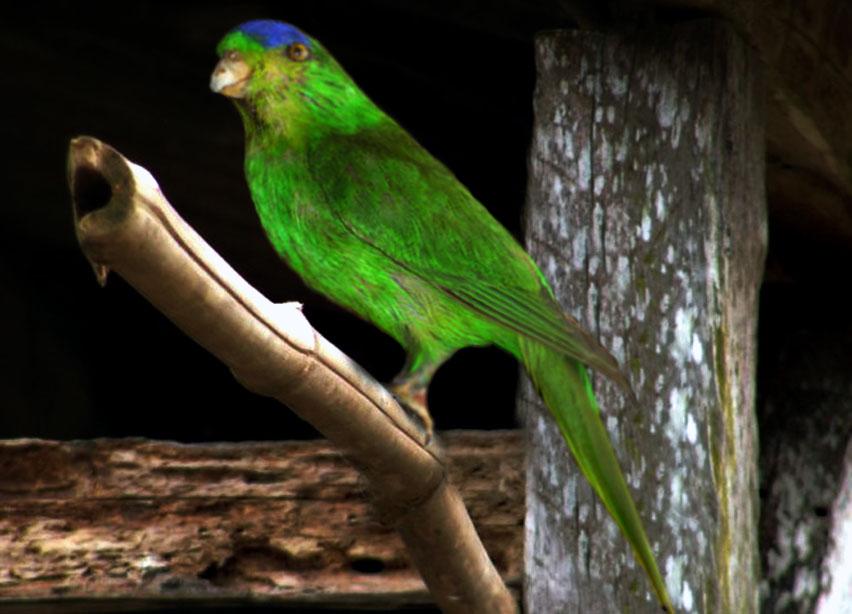
The adults of the Yellow-and-green Lorikeet(Trichoglossus flavoviridis) they have the upperparts plumage of a beautiful green.
The forecrown and top They are are greenish brown. The throat and the chest to abdomen It is yellow with dark green flakes. Area of sides up to the coverts and the bottom of the wings It shows a beautiful yellow-green.
The bill is orange. The irises is orange-yellow, the legs grey.
It has no sexual dimorphism.
In the youth, all the yellow markings are derived more green. The bill is brown, while the bare parts of the face are white. The irises is brown.
(Wallace, 1863) – Nominal. Overall plumage It is olive green. The forecrown and crown yellow. The back of the neck brown. the yellow throat and the chest to abdomen, with the scalloped dark green.
Trichoglossus flavoviridis meyeri
(Walden, 1871) – Shown in upperparts a darker shade of green; the underparts They are less scaly. The back of the top, the occiput and nape are greenish-Brown. The cheeks and throat They are yellow with dark green stripes. This subspecies is much smaller, between 40 and 50 gr.
Habitat:
The Yellow-and-green Lorikeet they are distributed with greater diligence between primary forest and mature secondary forest than their close relatives, the Ornate Lory. But, This does not prevent them from entering the open lands to feed from the ceibos in flower (coral trees).
Throughout its area, these birds are considered fairly common. In Celebes, are common in the mountainous areas where have been supplanted to a large extent to the Ornate Lory. In the Sula Islands, they are common in almost all altitudes.
They live in small flocks of noisy and sometimes mingle with the Ornate Lory When looking for food in the trees in flower at the edge of forests.
These birds are relatively Shy and they tend to stay inside the dense forest foliage, where their cryptic plumage makes them virtually invisible. When they feel threatened, leave the foliage uttering cries penetrating and powerful. They are easier to fly above the treetops on quick flights or the circulating a flight above the trees, just before landing in the branches more high.
Reproduction:
There is little information reproduction in the natural environment. The only one nest we have discovered so far was in a mossy forest, about 2.400 meters above the sea level. It was located high above the ground in a dead tree.
In captivity, the implementation is, usually, two white eggs that incubate for a few parents will be 23 days. As with all the Lori, the reproductive cycle It is particularly long and hard about 65 days.
Food:
The Yellow-and-green Lorikeet is above all vegetarian. Their language is particularly suitable for crop pollen and the nectar from the flowers. It is equipped with long buds that allows you to easily reach their favorite food. They have a predilection for the trees of the genus Euphorbiaand Erythrina.
Distribution:
Size of its range (reproduction / resident): 6.300 km2
The Yellow-and-green Lorikeet They are endemic to the islands east of Indonesian. They are exclusively on the Sula Islands (Taliabu, Mangole, Sanana) and especially in the area of Celebes island.
The species is not threatened. In Taliabu, is very common in altitude zones, but it is also quite common in degraded areas bordering the coast. It is estimated one world population above the 100.000 specimens.
Justification of trend
They suspected that the population is stable in absence of evidence of any decline or threatens substantial.
"Yellow-and-green Lorikeet" in captivity:
Pretty common in captivity.
Take it easy, Nice trill. Sensitive to cold temperatures and somewhat susceptible to disease. He will join his caregiver over time although initially shy.
Alternative names:
– Yellow-and-green Lorikeet, Citrine Lorikeet, Yellow & Green Lorikeet, Yellow and Green Lorikeet, Yellow&green lorikeet, Yellow-and- Green Lorikeet, Yellow-green Lorikeet (ingles).
– Loriquet jaune et vert (French).
– Celebeslori (German).
– Lori flavoviridis (Portuguese).
– Lori Verdigualdo, Tricogloso Verde y Amarillo (español).
– Avibase
– Parrots of the World – Joseph Forshaw M
– Parrots-A Guide to the Parrots of the World by Tony Juniper & Mike Parr
– Birdlife
– Photos:
(1) – Yellow and Green Lorikeet (Trichoglossus flavoviridis) in the Walsrode Bird Park, Germany By Quartl (Own work) [CC BY-SA 3.0], via Wikimedia Commons
(2) – Trichoglossus flavoviridis Proceedings of the Zoological Society of London 1862 by Joseph Wolf [Public domain], via Wikimedia Commons
– Sounds: Frank Lambert (Xeno-canto)
▷ The world of Pets: Dogs, cats, birds, reptiles, amphibians
28 cm.. length and an approximate weight of 200 g..
The Yellow-bibbed Lory(Lorius chlorocercus) is the only member of the genus Lorius It found in the Solomon Islands Orientales. In flight it has a robust construction, with a distinctive tail short.
It has a hood black running from the top of the bill up to the nape; the rest of the head is bright red with a prominent patch black, Crescent-shaped, on one side of neck. The upperparts They are red; center of the mantle, dark red. The wings green with yellow light bronze glow, in particular coverts and tertiary.
internals flight feather and greater coverts, black; bend of wing with a white spot and sometimes showing blue below wing-coverts; the coverts are blue, black tip, with a reddish pink broadband in the Central, on the undersides of the primaries. axillary purple blue.
The underparts They are red with a prominent yellow necklace; the thighs blue. Top, of the tail, red with green tips; lower tail, red with yellow opaque tip.
The bill It is orange with dark base to lower jaw; Orange the irises; legs dark gray.
The immature They have yellow band chest and marks on the sides and virtually absent bill is brown.
The cap black, wings green and underparts red with a band in the chest yellow, you are distinguished from other sympatric species of similar size as the Cardinal Lory and the Coconut Lorikeet.
Found in the canopy of the forest and secondary growth at all altitudes up to 1.000 m. In Guadalcanal it is more common in foothills than in lowlands and more common in low cloud forest. Other islands also occasionally observed around coconut plantations. Usually moves individually, in pairs or in groups of up to ten birds. Ecology generally little known although presumably typical of the genus.
Reproduction:
Little is known of its reproduction in the wild.
In captive, the setting is two eggs and incubation lasts and 25 days. The young remain in the nest during 8 to 10 weeks.
Food:
Its diet pollen compose, nectar, flowers and seeds.
Distribution:
Size of its range (reproduction / resident): 78.200 km2
Least concern – in the news quite common in the natural and abundant across most of its range.
Many species of birds in the Solomon Islands are vulnerable simply because of their small natural ranges, and the felling of forests for agriculture is a constant threat.
"Yellow-bibbed Lory" in captivity:
Before the Decade of 1990, the Yellow-bibbed Lory(Lorius chlorocercus) it was almost unknown in the United States and poultry farming, even then, a handful of birds were imported from the Solomon Islands. In 1998, a captive breeding consortium, call Solomon Island Parrot Consortium (SIPC), It was formed and received permission from the Government of the Solomon Islands and permissions of USFWS to import 30 pairs of each of the six species of parrots that are found in the Solomon Islands.
These 60 Yellow-bibbed Lory they were the first species imported under this permit. From these original 60 birds, now there are enough birds that are starting to appear as pets from time to time. They were first bred in United States in 1989, in the aviaries of Seattle by Jan van Oosteen, who is considered the force behind the obtaining of this group of 30 couples.
More information on –> birdchannel
Alternative names:
– Yellow-bibbed Lory, Yellow bibbed Lory (ingles).
– Lori à collier jaune (French).
– Grünschwanzlori (German).
– Lóris-de-colar-amarelo (Portuguese).
– Lori Acollarado, Tricogloso de Collar (español).
The head of the Yellow-billed Lorikeet(Neopsittacus musschenbroekii) is green, strongly impregnated with olive brown, veined in ear-coverts and showing a shaft of yellow stripes on the crown; darker line in the lores, above the bill; forecrown green.
Upperparts green intermediate. The wings green above with vane blackish internal to the coverts and black on the tips of the flight feather. Rojas the Underwing coverts. Flight feathers blackish with wide red central band. Throat greenish yellow yielding to red chest to the top of the the thighs. Flanks yellowish green to the sides of chest, with a central area in the bottom area chest and belly, red; coverts more yellowish than the rest of the underparts.
Cover top of queue, green, yellow tips, Brown shafts with red bases on the side of the feathers; undertail yellow-orange, showing red bases in lateral feathers when they deployed.
Bill pale yellow; irises red; gray of the legs.
Sexes alike.
Immature duller than adults with brands head less clear and red on the underparts restricted to spots in the center of belly and in the chest. Bill brownish-orange, irises yellow brown or orange. Young birds also show feathers tail pointy, which they are rounded as adults.
(Neumann, 1924) – Slightly larger than the nominal and paler in upperparts.
Habitat:
It inhabits in montane forests, edges of forests, partially cleared areas of secondary growth, mainly between 1.400 and 2.500 m, even if you are also registered at altitudes as low as 1.100 meters and as high as 3,000 m. It is also common in altered areas or in groves of Casuarina or eucalyptus in garden areas.
It seems that they have adapted well to the impacts of the man. But it is absent from the places where the forest has been removed completely over large areas.
Visible and noisy, they are in pairs, small flocks and in larger congregations of up to 50 birds in flowering trees. Over most of New Guinea, This species is replaced at higher altitudes by the smaller Orange-billed Lorikeet, commonly found in the company with the latter in the upper band of its altitudinal range (except Vogelkop).
Most frequently found in flowering trees, often in the company of other species such as the Papuan Lorikeet, also in the fructification of the Schefflera and feeding is sometimes lower levels even on the weeds at ground level.
Reproduction:
Observed to be moving like a rodent along branches. The laying It is two eggs in a hole in the trunk of a tree. Period unknown but an immature nesting was observed in the Province of West Papua in late August and a fledgling in the same area in the middle of November.
Food:
Feeds of pollen, nectar, small fruits and berries. It is also thought that feed on seeds as part regular your diet, while the Orange-billed Lorikeet is limited to nectar only. As other parrots can eat insects and their larvae, deliberately or accidentally.
Distribution:
Size of its range (reproduction / resident): 587.000 km2
New Guinea in Irian Java (Indonesian) and Papua New Guineto. Is distributed from East of Vogelkop up to the Huon Peninsula and scattered areas in the Southeast. In Vogelkop, Despite the absence of the Orange-billed Lorikeet, the population of the Yellow-billed Lorikeet is relatively low. A small amount in captivity.