Origin: Guatemala, Honduras, El Salvador, Nicaragua
Character: shy
Life expectancy: 35 to 40 years.
Height: 28 cm..
Content
Description:
28 cm.. length and 130 g. of weight.
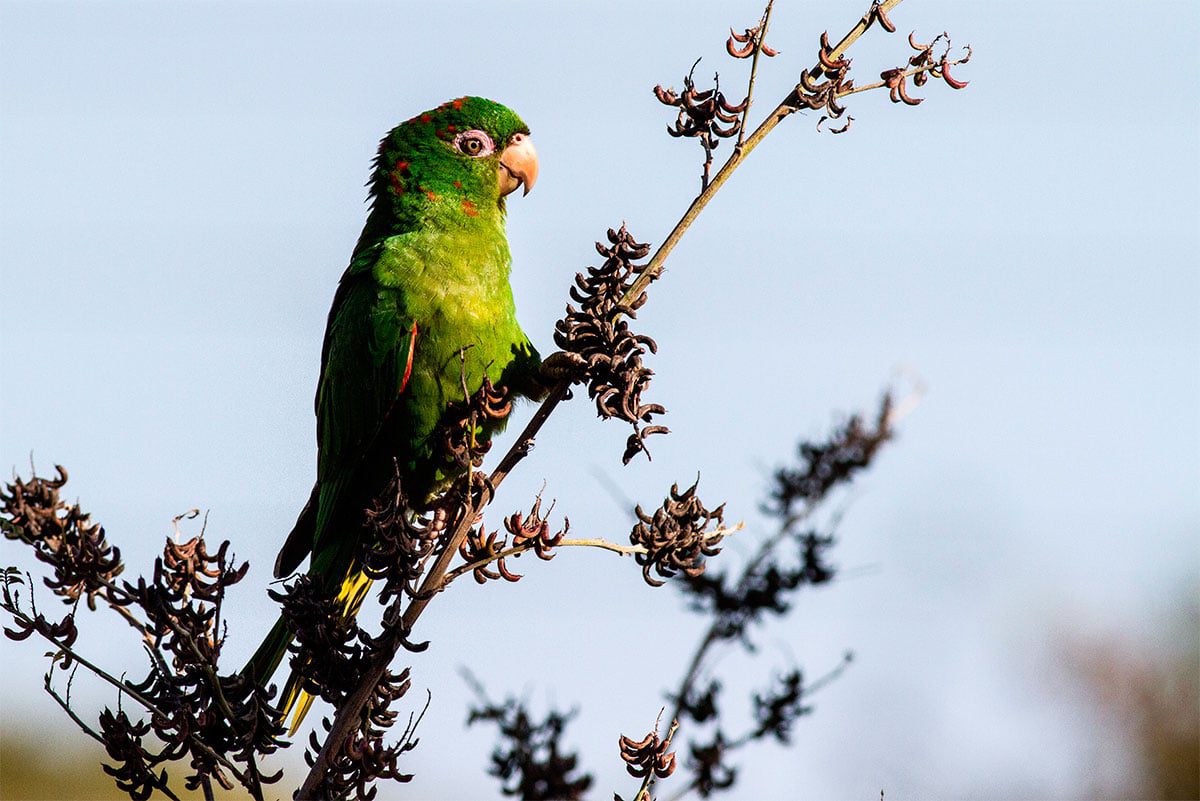
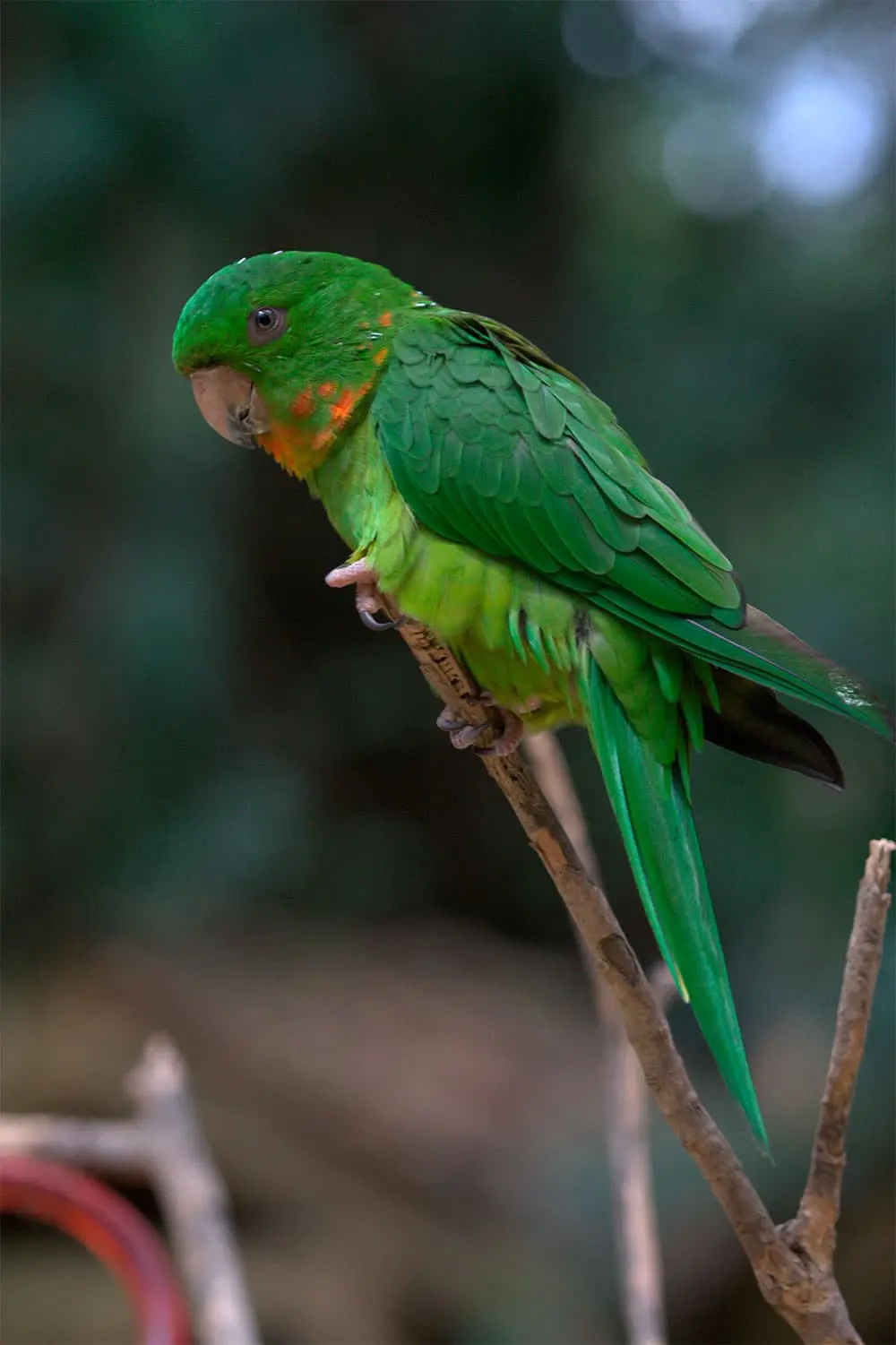
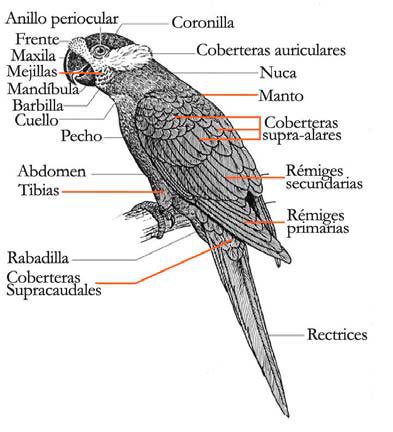
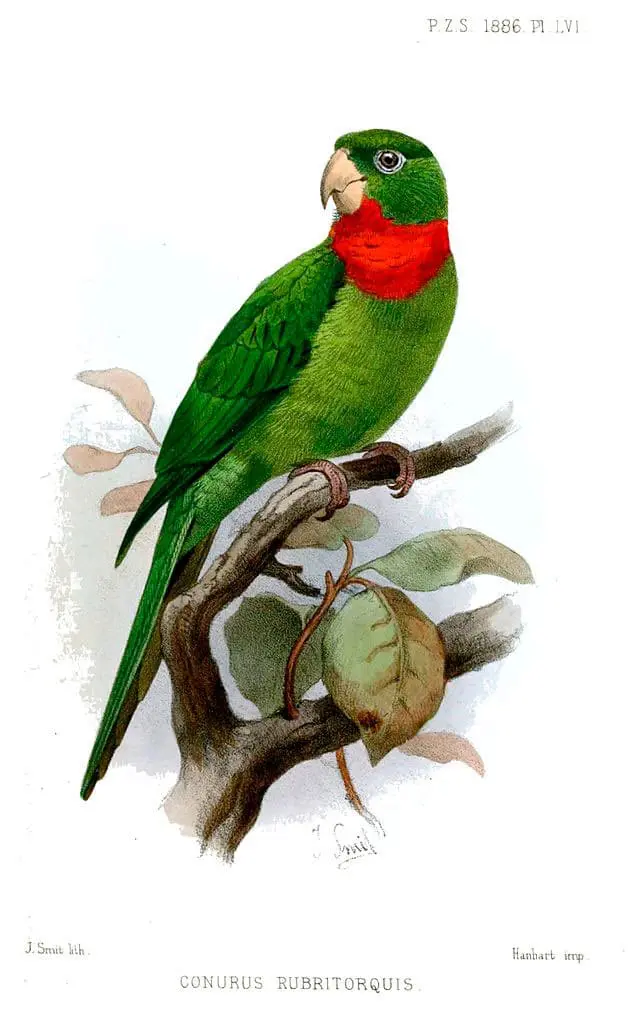
The Red-throated Parakeet(Psittacara rubritorquis) they have a plumage, in general, green, with yellow tones in the underparts; orange-red in the throat and on the front of the neck, with yellow-orange feathers scattered; variety of pens of color red orange scattered in the part low of them cheeks and both sides of the neck; blue tint on primary coverts and vane outer of the flight feather; underwing-coverts brighter yellowish green; below, the flight feather yellow color without brightness.
The bill color horn. Bare area of the eye ring grayish brown. The irises orange.
The male and female are similar.
The immature with the throat red, absent in the cheeks and both sides of the neck. The irises brown.
The Red-throated Parakeet is located in altitudes that range between the 600 and 1.800 m, in a variety of wooded areas, Save the rainforest.
They can be observed in humid forests, Open with weeds and growing areas areas in Guatemala; forests of Pinus sp in Nicaragua.
Is in flocks outside the breeding season, and couples during courtship and nesting season. Larger congregations are produced when food is abundant.
Reproduction:
The nesting takes place in tree cavities, cracks in rocks, holes from woodpeckers, holes in buildings or in tree termite mounds.
The breeding season is between the months of January and August and the laying tends to be of 3-4 eggs.
Food:
With feeds seed, nuts, berries and fruits. It can also feed on cultivated seeds and corn..
Sometimes, considered a pest to crops.
Distribution:
Size of the area of distribution (reproduction / resident): 139.000 km2
Distributed by the Eastern Highlands of Guatemala and El Salvador (apparently only a record) to the South by Honduras to the North of Nicaragua.
Conservation:
State of conservation ⓘ
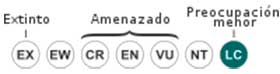
Minor Concern ⓘ(UICN)ⓘ
• Red List category of the UICN current: Least concern
• Population trend: Stable
The size of the world population It has not been quantified, but this species is described as «quite common» (Stotz et to the. 1996).
The population of Red-throated Parakeet suspected to be stable in the absence of evidence of any reduction or substantial threats.
– Avibase
– Parrots of the World – Forshaw Joseph M
– Parrots A Guide to the Parrots of the World – Tony Juniper & Mike Parr
– Birdlife
– Photos:
(1) – Red-throated Parakeet (Aratinga rubritorquis) also called Red-throated Conure at Macaw Mountain Bird Park and Nature Reserve, Copan, Honduras By Lauri Väin [CC BY 2.0], via Wikimedia Commons
(2) – A Red-throated Parakeet (also called Red-throated Conure) at Macaw Mountain Bird Park, Copan Ruinas, Honduras By Sarah and Jason (originally posted to Flickr as IMG_6987) [CC BY-SA 2.0], via Wikimedia Commons
(3) – Two Red-throated Parakeets at Kakegawa Kacho-en, Kakegawa, Shizuoka, Japan By Takashi Hososhima from Tokyo, Japan (Green with envyUploaded by snowmanradio) [CC BY-SA 2.0], via Wikimedia Commons
(4) – Psittacara rubritorquis by Psittaciformes .NL – pinterest
(5) – Psittacara rubritorquis by Bellas Aves de El Salvador
(6) – Conurus rubritorquis by Joseph Smit [Public domain], via Wikimedia Commons
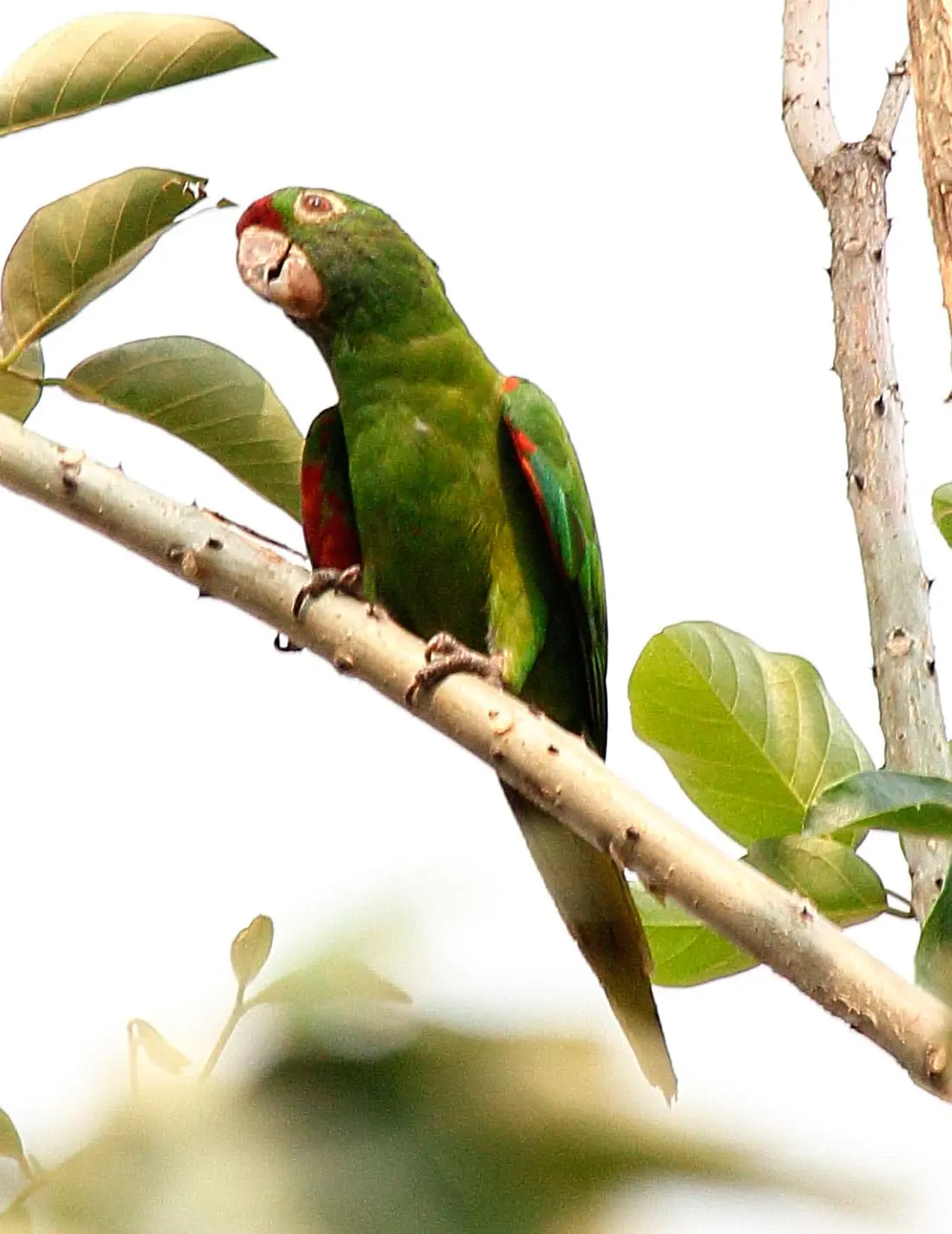
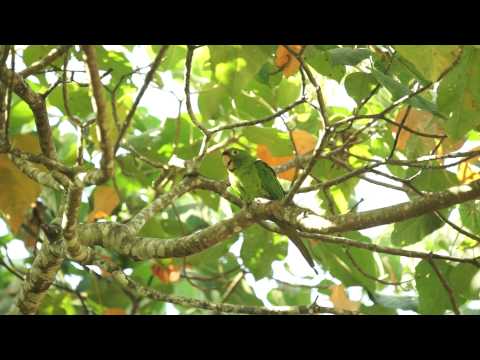
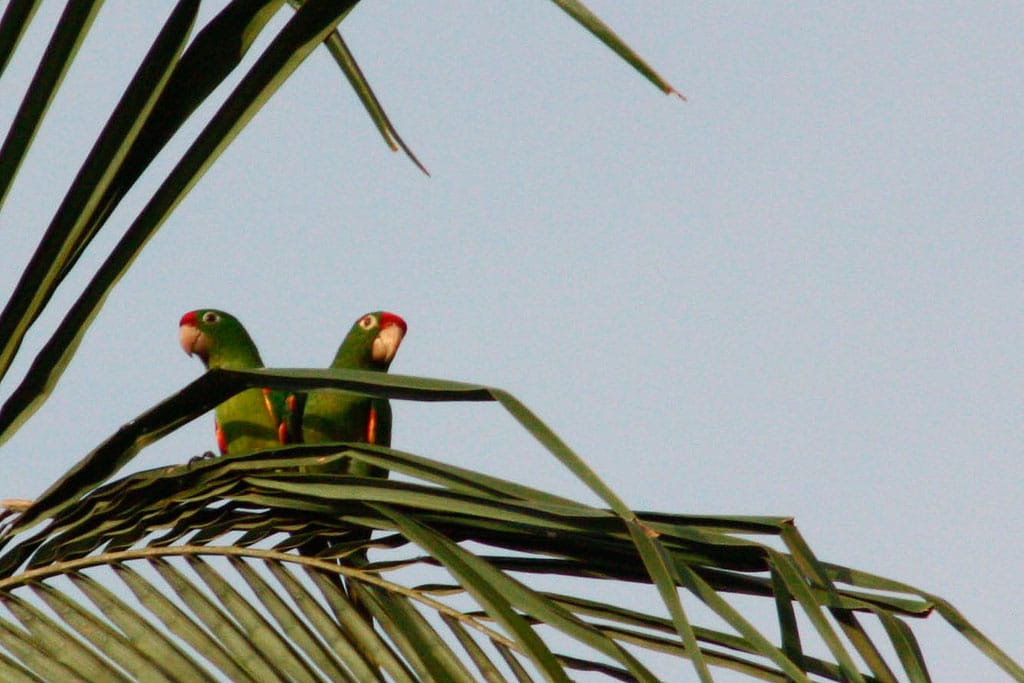
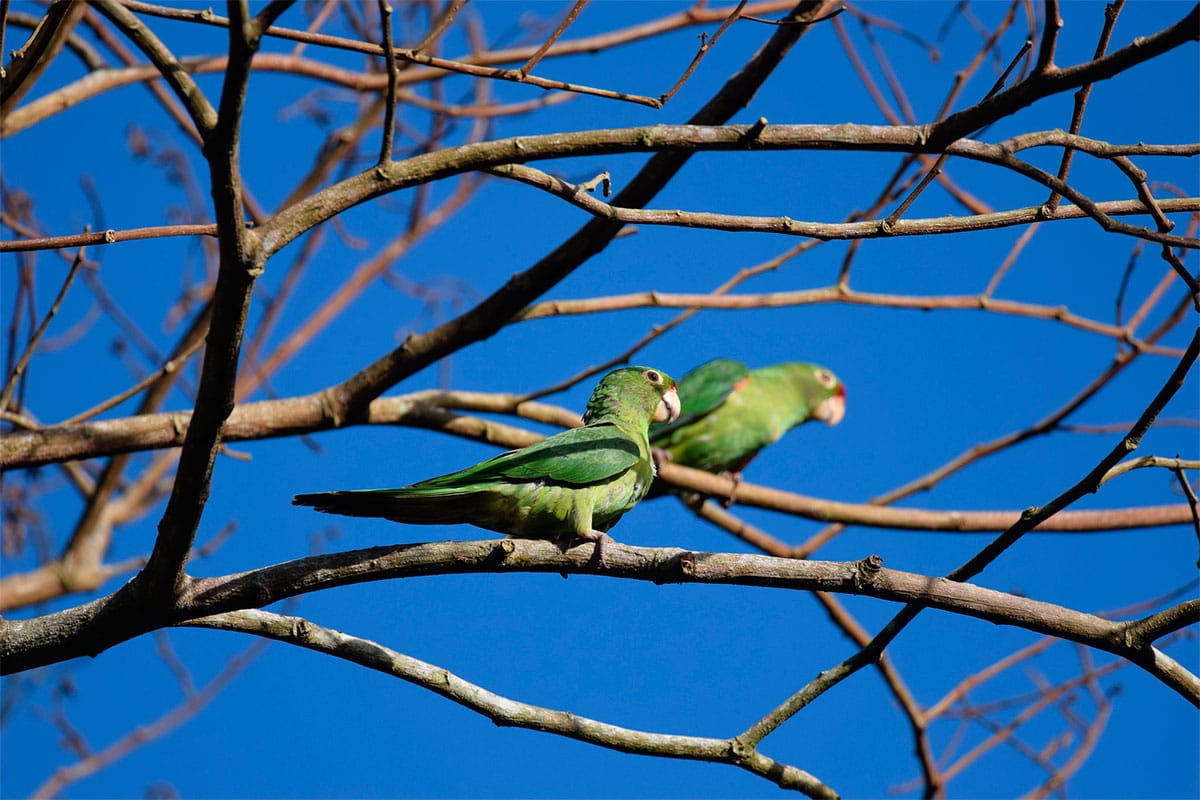
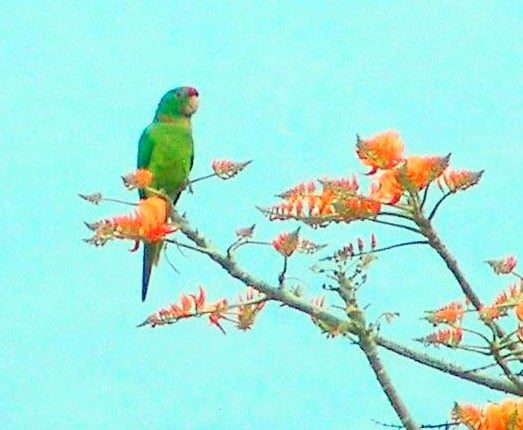
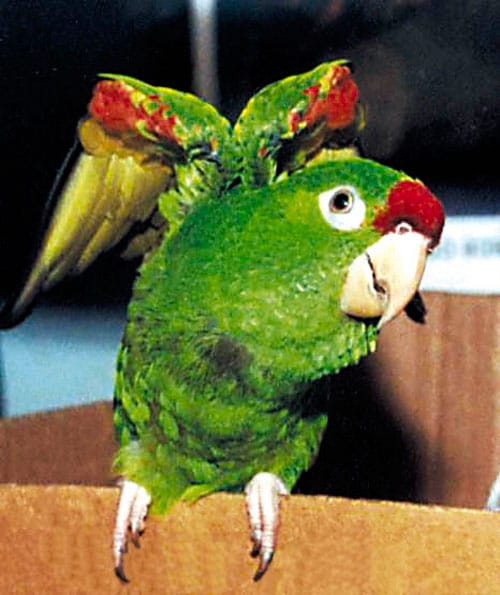
The Crimson-fronted Parakeet(Psittacara finschi) It is the only species of the genus Psittacara tail long with red color below the wing
.
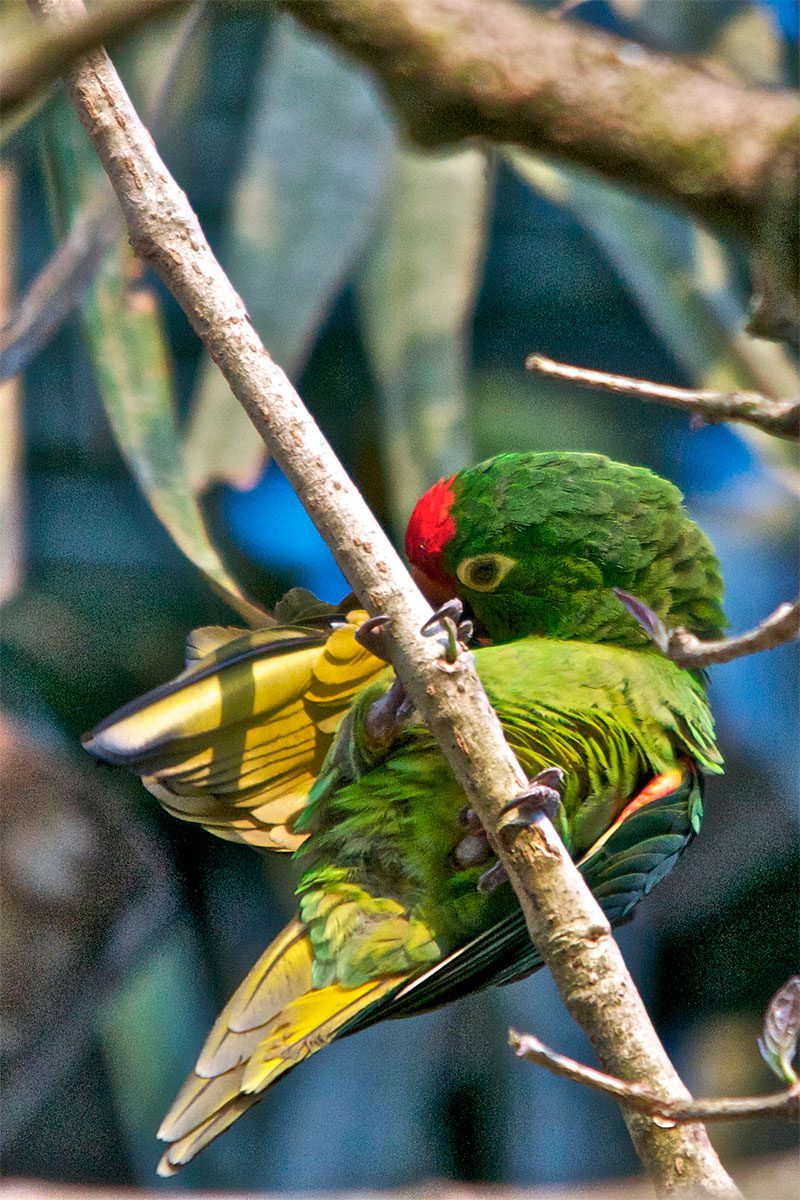
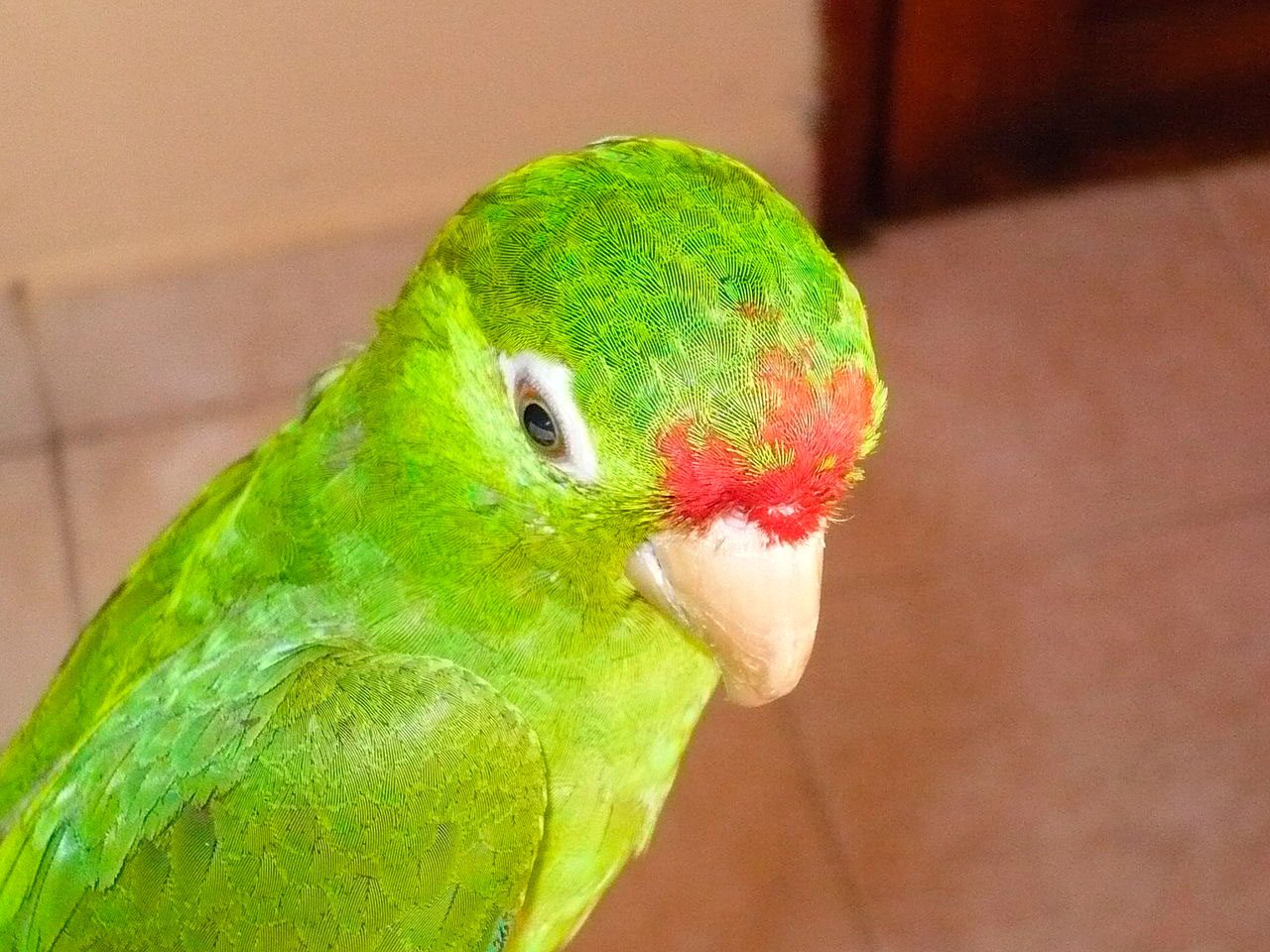
They have forecrown and the former area of the lores bright red; the head and the neck green color with the exception of some scattered red feathers. The upperparts and upperwing-coverts green, with some red feathers on the bend of wing. The flight feather green above, more dark towards the tips with a dye bluish light in them vane inner; then golden brown color. Lesser and medium underwing-coverts red, the largest yellow, other coverts pale green. The underparts pale green, sometimes with red at the bottom of the tibia. Upper, the tail grass-green, by down golden brown.
The irises is orange and the eye ring naked is whitish. The bill exhibits a color gray-tipped Horn and the legs off gray color.
It has no sexual dimorphism.
The immature There are very little or almost no red in the forecrown and lack of red color in the thigh or the neck. The lining of the wings is more Orange.
They inhabit tropical and subtropical envelope 1.400 metres in Costa Rica and 1.600 meters in the West of Panama, in areas with light trees or in fields with scattered trees, in secondary growth forests, edges of the forest, coffee plantations and nearby farmland. Irregular or seasonal in large forested areas.
They are birds gregarious, usually observed in flocks of up to 30 Member, but up to several hundred birds can gather in roosts communal on the tops of the trees or palms. Roosts, at times near the cities.
Reproduction:
They located their nest in holes of various types: natural cavities, old holes of woodpeckers (F. Picidae), stumps of dead Palms. They can dig holes in rotten stumps or in masses of epiphytes.. Sometimes many couples may nest near each other.
The union of the pair of this species is particularly strong. The pairs isolate themselves from the group towards the end of July to nest.. With reproduce during the dry season and the rainy early. The female lays three or four eggs which are incubated during approximately 24 days. The juveniles they leave the nest to the 50 days of life.
Widely distributed in the South of Central America, from Nicaragua until Panama.
The species can be found in the southeast of Nicaragua to the South of the Rio Grande, and in Costa Rica mainly on the slope of the Caribbean, Although there are exemplary residents on the side of the peaceful, on Osa Peninsula, at the South-West end and seasonal visitors in the Guanacaste Cordillera, in the North and the central plateau around San Jose.
In Panama they come to the East, a unos 82°W, but it is probable that only seasonally in the lower Highlands of the Province of chiriqui.
Flocks of birds required extensive territories and the species occurs, apparently, in many areas, if only as a post-breeding visitor.
Very common or locally common with increasing numbers in Costa Rica and Panama, probably due to deforestation.
Maintained in captivity and internationally traded in small quantities.
Conservation:
State of conservation ⓘ
Minor Concern ⓘ(UICN)ⓘ
• Red List category of the UICN current: Least concern
• Population trend: Growing
The size of the world population of the Crimson-fronted Parakeet It has not been quantified, but this species is described as «quite common«.
You can be increasing their geographical range due to deforestation.
abundant on the slope of the Caribbean of Nicaragua. common and widespread in areas deforested over the slope of the Costa Rica Caribbean.
"Crimson-fronted Parakeet" in captivity:
Quite common in United States, less elsewhere.
Socialize easily with human, and can become a committed and loving companion. Es a Intelligent and lively, with easy to imitate the human voice and run different games and exercises. But, We must remember that it is a bird loud and the volume of their calls can get to be very annoying.
Alternative names:
– Crimson-fronted Parakeet, Crimson fronted Parakeet, Crimson-fronted Conure, Finsch’s Conure, Finsch’s Parakeet (English).
– Conure de Finsch, Perriche de Finsch, Perruche de Finsch (French).
– Veraguasittich (German).
– Aratinga-de-finsch (Portuguese).
– Aratinga de Finsch, Perico frentirrojo, Periquito de Pecho Rojo, Perico de Palmera (español).
– Perico frentirrojo (Costa Rica).
– Perico Frentirrojo (Nicaragua).
Parrots A Guide to the Parrots of the World – Tony Juniper & Mike Parr
Birdlife
Photos:
(1) – A Finsch’s Parakeet )also called Finsch’s Conure and Crimson-fronted Parakeet) in San José, Costa Rica By Dominic Sherony [CC BY-SA 2.0], via Wikimedia Commons
(2) – Perico frentirrojo juvenil, approximately 4 months of age, Panama City By Ricaurte (Own work) [Public domain], via Wikimedia Commons
(3) – Crimson-fronted Parakeet, also called Finsch’s Conure By Yazzieyazz (trabjo propioEnglish: own work) [Public domain], via Wikimedia Commons
(4) – Psittacara finschi en el parque nacional Henri Pittier, Venezuela By Roberto Galindo Deshays (Own work) [CC BY-SA 4.0], via Wikimedia Commons
(5) – Crimson-fronted Parakeet Costa Rica 2/15/16 Rancho Naturalistaby Andy Reago & Chrissy McClarren – Flickr
(6) – Crimson-fronted Parakeet by Brian Ralphs – Flickr
(7) – Crimson-fronted Parakeet Costa Rica 2/15/16 Rancho Naturalista by Andy Reago & Chrissy McClarren – Flickr
(8) – Aratinga finschi 06 Apr 2014 Costa Rica, San Lorenzo by Tom Benson – Flickr
(9) – Crimson-fronted parakeet by Charles Sharp – Flickr
(10) – Conurus finschii » = Psittacara finschi (Finsch’s Parakeet) by John Gerrard Keulemans [Public domain], via Wikimedia Commons
The bill of the Cuban Parakeet(Psittacara euops) is strong and hooked, presenting the capacity of both the upper and the lower mobility, enabling this psittacine to husk and crush seeds, fruits and nuts discarded by many other birds, thus showing another successful feature of this Psittacara.
Their legs they have a magnificent prehensile capacity that allows them to take incredible poses and hold on to extreme places thanks to a "zygodactyly" arrangement of the fingers by moving two fingers forward, the 2 and 3, and two backwards, the 1 and 4.
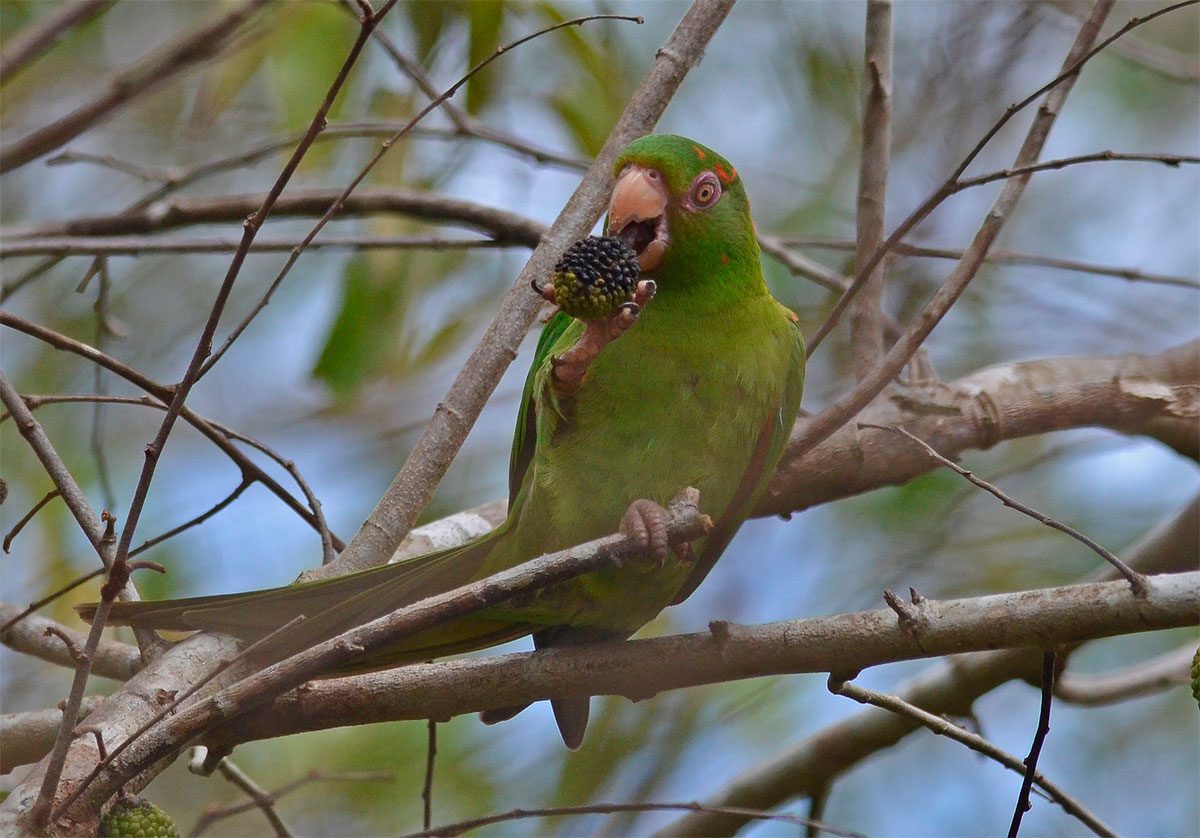
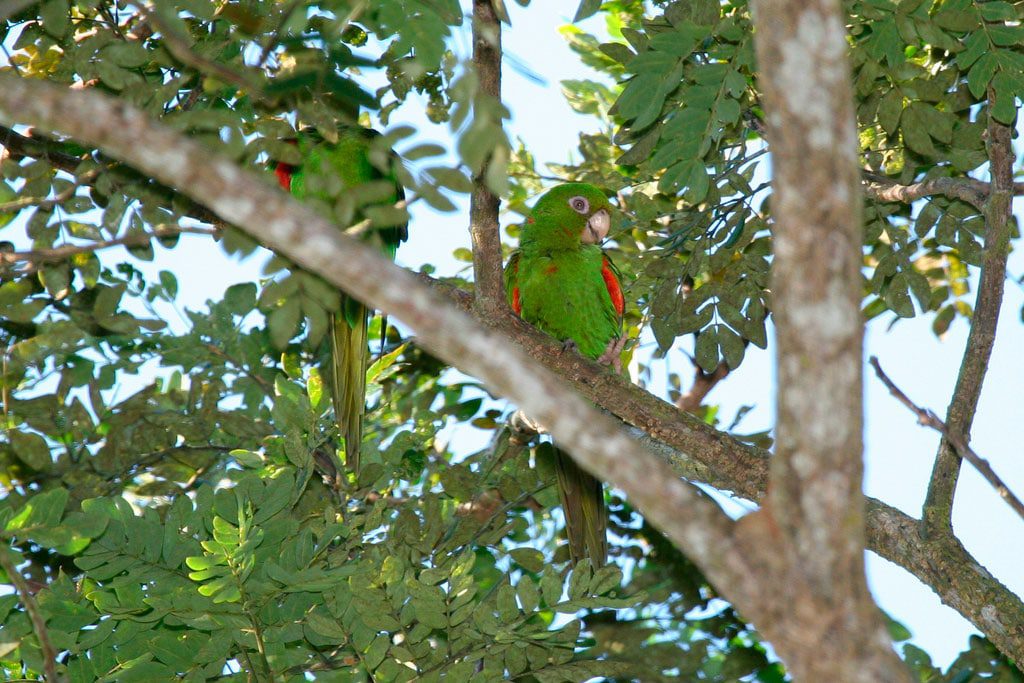
Has the head, sides neck and nape green grass with some red feathers scattered, sometimes forming patches. The upperparts and upperwing-coverts grass-green; primaries and secondaries with margins and dark green tips to vane inner; carpal edge with scattered red feathers and bend of wing red. Underwing-coverts with golden brown in the flight feather, small and medium-sized coverts Red and large coverts Yellow olive. The underparts yellowish green with diffusion of color olive, sometimes with scattered red feathers, especially in the throat and/or the thighs. Upper, the tail dark green color with dye olive; by down yellowish brown. The bill color Horn; bare periophthalmic bluish white; irises yellow; legs distant.
The female has more orange in the wings.
Immature has green and red in underwing-coverts, beige color (not red) in carpal edge, irises Gray with scattered red feathers.
They inhabit on Savannah, especially in areas where there are the PalmasCopernicus and Thrinax, at the edges of forests and Lands planted with trees. Although they have also been very modified habitats, such as eucalyptus forests in open field and fragments of forests of Evergreen in sheets of Palma. The species survives only near large extensions of primary forest.
In general, observed in family groups or small flocks, but sometimes in larger groups, hundreds of birds; the Cuban Parakeet, often, mix with the more common and endemic Cuban Parrot (Amazona leucocephala).
Reproduction:
One of the major problems of this kind in the reproduction, It is competition and the finding by the nesting cavities; This psittacine is a small, so their physical advantage over other birds to displace these from cavities or nests is less and they must show greater aggressiveness to be able to expel woodpeckers and even some small birds of prey These cavities that already occupy.
But, in recent studies, It is suggested that in free-living this species has a high degree of selectivity by the height of the Palma in which anidated or for the depth of the nest, still not evident during the stage of formation of couples and nesting strong signs of gregariousness, But if there could be a tendency to prefer nests with a sufficiently narrow entrance opening to enter the couple and hamper the penetration of predators. It also seems that the species in reproduction is more tolerant of other neighboring couples of the same species, than others parrots, but to some degree of alienation, preferring Palmas in which there is only one cavity to have a certain degree of privacy in the rearing of their chicks.
The breeding season It begins in April and usually ends in July. They sometimes build their nests in cavities excavated, originally, by the Cuban Green Woodpecker (Xiphidiopicus percussus).
The number of eggs in the implementation It, in averaged, between three and five. The incubation both members of the couple is done, as well as feeding the young until they leave the nest. Once abandoned the nest, You can see to the immature flying with parents in small camps before the winter season, forming major sides joining them different families.
Formerly persecuted by provoking large damage to crops Orange, coffee and corn.
Distribution:
Species vulnerable to extinction, from an original distribution throughout Cuba and Isle of youth, isolated populations between Yes.
Formerly one of the most common endemic birds in Cuba and in the Isle of youth, old Isle of pines, but now is limited to various strongholds in remote areas of Cuba, including the Zapata Peninsula, the districts around Cienfuegos and the mountains around the city of Trinidad, to the extent Western Centre of the island, and Sierra Maestra at the end of this.
Resident but some seasonal movements (Perhaps altitude) supposedly by the decline of the birds of the mountains of Trinidadin the months of September and October.
Extinct in the Isle of youth from 1913, mainly due to the strong capture for export as bird cage.
The current population, Although comparatively small, Perhaps stable. A small number of captivity out of Cuba, especially in Eastern Europe. The international trade currently it is small.
Today this species is restricted to 16 populations considering that a total of 2800 individuals released, with a number of individuals per population not exceeding, usually, the 100 copies and is considered of greater size the located in the Zapata Swamp live in where is estimated around 800 these birds. Each of these populations are isolated or insulated semi between if, not exceeding groups or sides that make it up, the 30 individuals, with a general tendency to the disappearance of the species in many of the populations, mainly due to the loss of Habitat and illegal catches.
Conservation:
State of conservation ⓘ
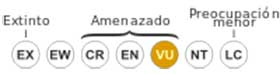
Vulnerable ⓘ(UICN)ⓘ
• Red List category of the UICN current: Vulnerable
• Population trend: Decreasing
There are no new data on the evolution of the population of the Cuban Parakeet; But, the species is suspected of have been declining at a moderate pace, mainly as a result of the habitat degradation.
Rounded, a population estimated between 1,500-7,000 mature individuals.
The persecution as a pest of crops, loss of habitat and, in particular, the capture for trade bird cage, They explain the current shortage of copies of Cuban Parakeet (A. Kirkconnell in litt., 2007).
The capture for trade International is now insignificant, with only 10 birds recorded in trade between 1991 and 1995. Another major threat is the loss of nesting trees (Snyder et to the., 2000) as a result of hurricane damage (as the caused in the Zapata Peninsula by the Hurricane Lili in 1996), and the felling of trees for chicks of the Cuban Parrot (Amazona leucocephala) (A. Mitchell in litt., 1998).
Conservation Actions Underway
• Appendix II of CITES.
• Is legally protected.
• They are distributed within the seven environmental reserves, including the important Ciénaga de Zapata National Park (Snyder et to the., 2000).
• A study of the species and an intense public awareness campaign are intended to help establish a management programme effective (Wiley, 1998).
• The programs of ecotourism they have begun in some areas (Snyder et to the., 2000).
• A provision scheme has been started for nest boxes, the plastic boxes are more durable than the facts of sections of the trunk of the Palm (Waugh 2006), but the parakeets prefer those made of natural materials (Anon., 2010).
• A program of reintroduction from the main island of Cuba to the Isle of youth is being developed from the 2004, but the species is generally difficult to breed (parrots 2000-2004; avianweb.com).
Conservation Actions Proposed
• Carry out more Research to determine the ecological requirements of the species and population (Wiley 1998, Snyder et to the., 2000).
• Conserve additional habitat, especially in the areas of nesting (Snyder et to the., 2000).
• Adapt the environmental awareness and protection of nests in situ to local situations (Snyder et to the., 2000).
• Continue a plan for the re-establishment of the species in the Isle of youth (Wiley 1998, Snyder et to the., 2000) through the development and extension of the programme of captive breeding.
"Cuban Parakeet" in captivity:
In captivity, they are very sleepers and somewhat quarrelsome and restless, needing always to be monitored. Non-communicative the issuance of words but very friendly with the person you choose as partner, which will not get rid of some sympathetic evil, almost always tolerated and even grateful.
Sensitive to the changing conditions of the ecosystem that inhabits.
The requirements and difficulties in the reproduction of this species are considerable.
Own this nice bird as pet, Although on the one hand it can be a satisfaction to the owner, on the other hand means to convict individuals of this species not reproduction and populations to lead them to the risk of the extinction.
Alternative names:
– Cuban Parakeet, Cuban Conure, Cuban Paroquet, Red-speckled Conure (English).
– Conure de Cuba, Perriche de Cuba, Perruche de Cuba (French).
– Kubasittich (German).
– Periquito-cubano (Portuguese).
– Aratinga Cubana, Perico, Periquito, Periquito Cubano (español).
– Catey, Perico, Periquito (Cuba).
(1) – Psittacara euops – Cuban parakeet by Ekaterina Chernetsova (Papchinskaya) – Flickr
(2) – Psittacara euops – Cuban parakeet by Ekaterina Chernetsova (Papchinskaya) – Flickr
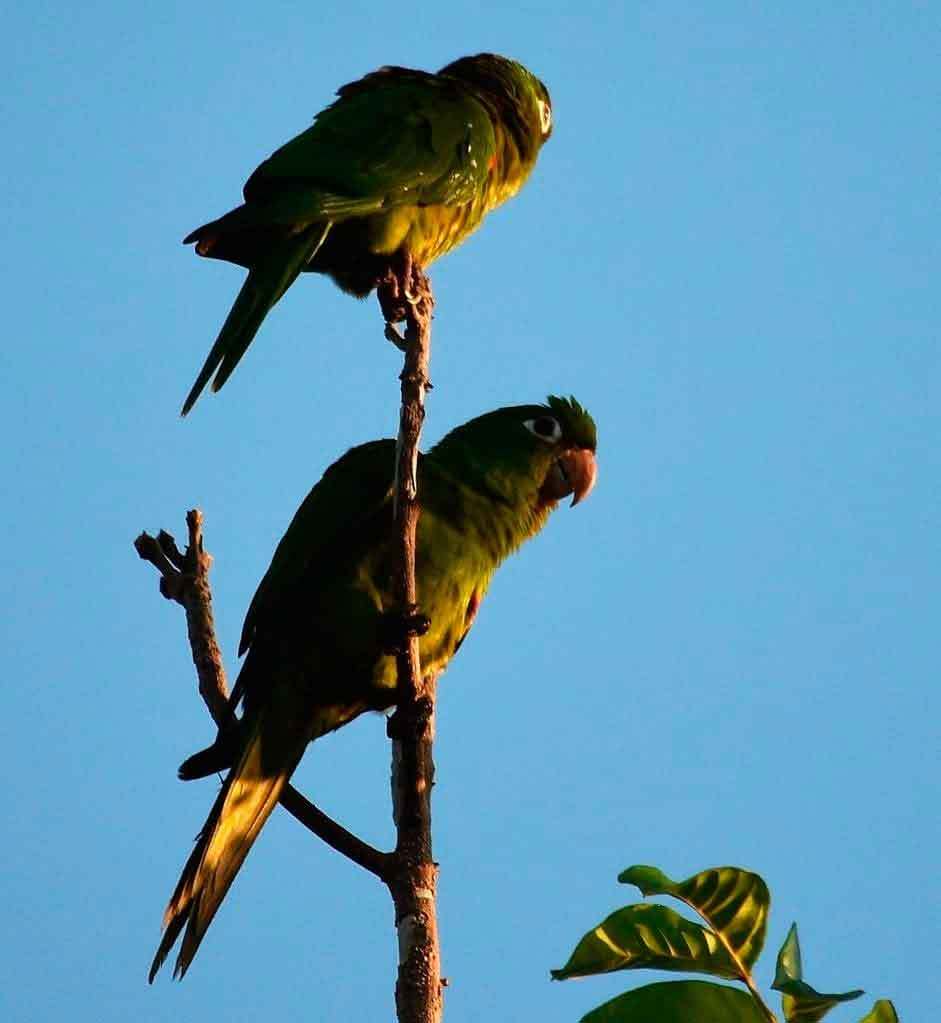
(3) – Cuban Parakeet, Conure De Cuba, or Aratinga Cubana (Aratinga euops). Two parrots in a tree By dominic sherony (originally posted to Flickr as Cuban Parakeet) [CC BY-SA 2.0], via Wikimedia Commons
(4) – Cuban Parakeets are a rare sight in Cuba, the only place they live in the world by Hank Davis, DNS Board Member – Delaware nature society
(5) – For the Caribbean Conservation Trust in conjunction with the Massachusets Audubon Society – Winged spur imaging
(6) – Deutsch: Psittacara euops Syn: Evopsitta euops & Psittacara chloropterus Syn: Psittacara chloropter bzw. Psittacara euops St. Domingue By Charles Emile Blanchard (1819–1900) (biodiversitylibrary.org) [Public domain], via Wikimedia Commons
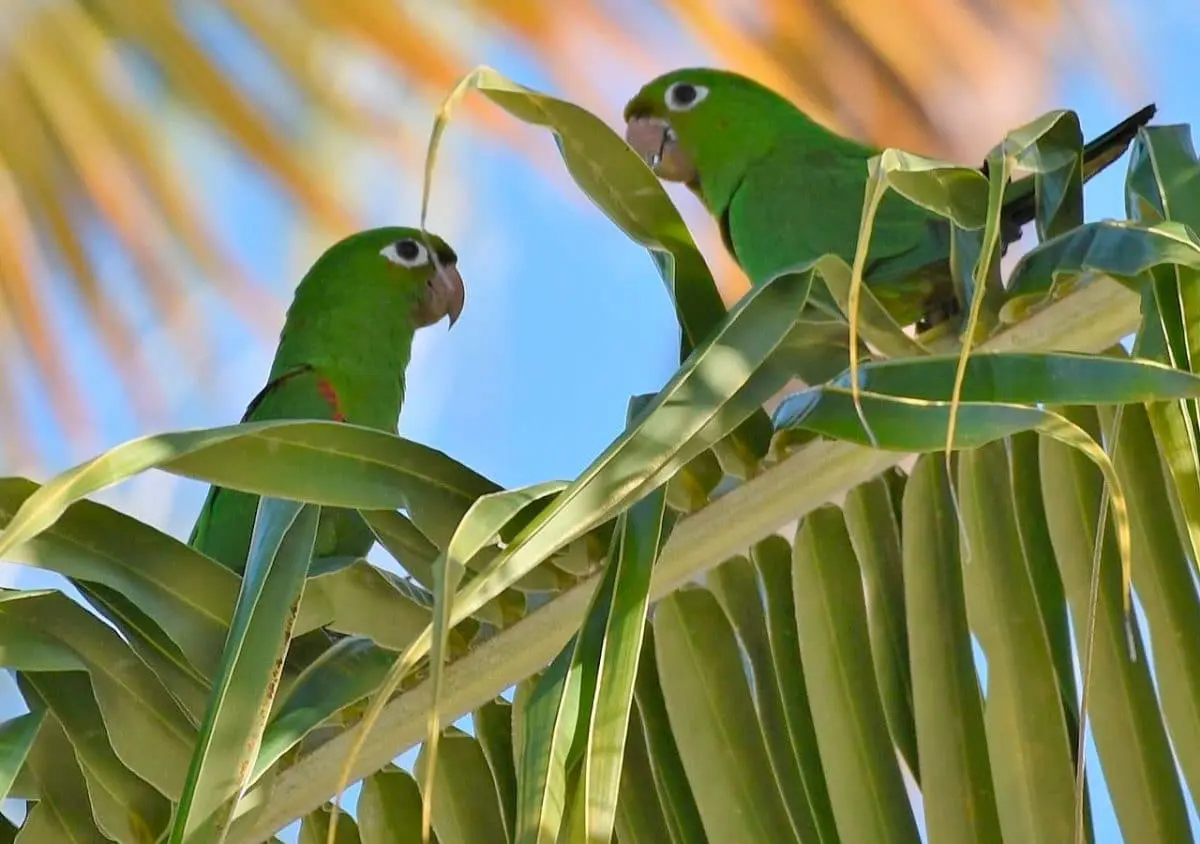
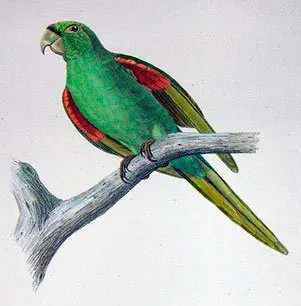
The Hispaniolan Parakeet(Psittacara chloropterus) has the head whole and both sides of the neck green grass with some scattered red feathers; the upperparts and upperwing-coverts Green with external ends of the Middle coverts red. Primary and secondary dark green with bluish-green tips on margins vane inner. The underwing-coverts yellowish brown in the flight feather, more grayish towards the tip; coverts Green except smaller and medium-sized external coverts, they are red and the primarys which are green and Red.
The underparts brighter yellowish green, usually with scattered red feathers.
Upper, the tail dark green and below, grayish brown.
The bill color horn; bare periophthalmic whitish: irises yellowish; legs grayish brown.
Both sexes similar.
The immature has less red and more green in underwing-coverts, No red on the upper surface of the bend of wing and grey at the base of the bill and on the cutting edge.
This species covers all types of natural habitats from arid lowland forests, to sheets of palmas, but obviously prefers upland forest (including the dominated by Pinus), to 3.000 meters above sea level, scarce, Perhaps because of the persecution, in the adjacent cultivated areas.
In general, observed in pairs or in small flocks, but sometimes in meetings of more than one hundred, at least in the past, When were most abundant. Discernible couples even within large flocks.
Reproduction:
They build their nests in tree cavities, including old holes made by woodpeckers, as well as in arboreal termite mounds.
The laying compose it between 3 and 5 eggs, exceptionally 7.
Food:
There are few details about the diet of the Hispaniolan Parakeet, but it is apparently similar to the fellow and and depends on local availability of fruits, seeds, nuts, outbreaks, flowers and beads; Some reported foods include Ficus figs and corn.
Distribution:
confined in Haiti and Dominican Republic, la Española, Greater Antilles. Previously in the Mona Island (Psittacara chloropterus maugei), extinct between 1892 and 1901, probably as a result of the pressure due to the hunting and, possibly, the perturbations by the explosions in the guano mine; possibly, also distributed in Puerto Rico, and its, probably, at the end of the century 19, due to loss of habitat and hunting.
In Hispaniola It is subject to a significant and continuous decrease, due to destruction of habitat, trade and persecution, especially in Haiti, where possibly is extinct.
In Dominican Republic still distributed in a few upland areas, for example, Cordillera Central.
Possibly small wild populations in Puerto Rico and Florida. A small number in captivity; the international trade small volume, probably, keep going.
(Souance, 1856) – Formerly distributed by the Mona Island and, possibly, Puerto Rico, but the last recorded specimen was in 1892. Currently extinct.
Conservation:
State of conservation ⓘ
Vulnerable ⓘ(UICN)ⓘ
• Red List category of the UICN current: Vulnerable
• Population trend: Decreasing
There is no new data on the evolution of the population; But, the species is suspected that it may be in decline, slow to moderate due to the hunting, capture and habitat loss.
Habitat loss and persecution as crop pest they are the greatest threats to this species. Is exploited for the local and international trade, Although only reported 12 individuals for international trade between 1991 and 1995 (Snyder et to the., 2000).
The number of copies of Hispaniolan Parakeet ranges between 1500 and 7000.
Conservation Actions Underway
• Appendix II of CITES.
• In the Dominican Republic, is legally protected against the hunt, but this legislation is not applied properly (Snyder et to the., 2000).
• A education strategy with community participation has been launched for the protection of this species (Vasquez et to the., 1995).
• Las interactions between this species and the Olive-throated Parakeet (Eupsittula nana), due to the recent increase in the number of the latter in the Sierra de Bahoruco [S. Latta in litt., 1998] ), they are being investigated (Anon. 2007).
• A group of volunteers for the protection of the parrot will work reforming the damaged nests. (Anon. 2007)
Conservation Actions Proposed.
• Clarify the status of the species in Haiti.
• Study ecology and reproductive success to determine the natural limiting factors.
• Comply with current legislation in the Dominican Republic.
The Hispaniolan Parakeet in captivity:
Rare in captivity and legally protected in Dominican Republic against the hunt and capture.
Alternative names:
– Hispaniolan Parakeet, Haitian Paroquet, Hispaniolan Conure, San Domingo Conure (inglés).
– Conure maîtresse, Perruche maîtresse (francés).
– Haitisittich (alemán).
– Periquito-de-hispaniola (portugués).
– Aratinga de la Española, Perico , Periquito Antillano, Periquito de la Española (español).
– Perico, Xaxavi (República Dominicana).
Avibase
Parrots of the World – Forshaw Joseph M
Parrots A Guide to the Parrots of the World – Tony Juniper & Mike Parr
Birdlife
Photos:
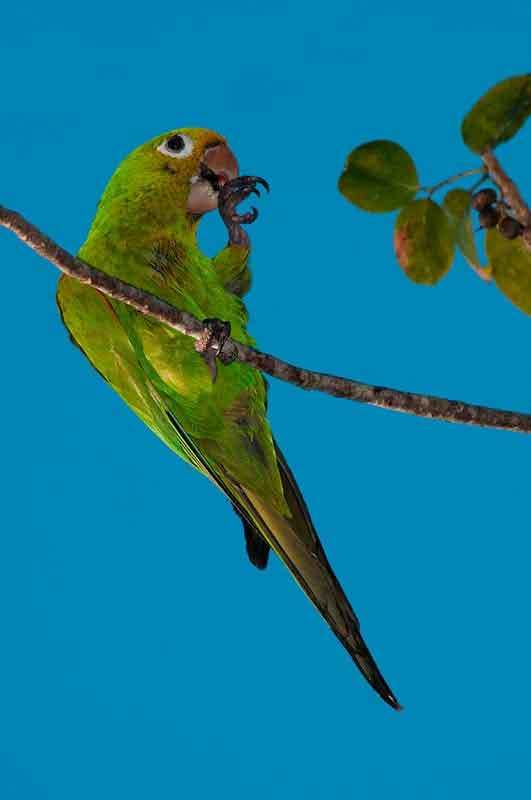
(1) – Haitisittich Psittacara chloropterus Aufnahme in La Romana By Martingloor (Own work) [CC BY-SA 4.0], via Wikimedia Commons
(2) – Haitisittich Psittacara chloropterus By Martingloor (Own work) [CC BY-SA 4.0], via Wikimedia Commons
(3) – Haitisittich Psittacara chloropterus Aufnahme in La Romana By Martingloor (Own work) [CC BY-SA 4.0], via Wikimedia Commons
(4) – Perico de la Hispaniola / Aratinga chloroptera by Carlos De Soto Molinari – Flickr
(5) – Perico de la Hispaniola / Aratinga chloroptera by Carlos De Soto Molinari – Flickr
(6) – Evopsitta maugei. Illustrations from Iconographie des perroquets non figurs dans les publications de Levaillante et de M. Bourjot Evopsitta maugei = Aratinga chloroptera maugei == Psittacara chloropterus maugei By 48 hand-coloured lithographic plates by E. Blanchard and J. Daverne (pl. I-XV) or Juliot of Tours (XVI-XLVII, 79). [Public domain], via Wikimedia Commons
(7) – Psittacara euops Syn: Evopsitta euops & Psittacara chloropterus Syn: Psittacara chloropter bzw. Psittacara euops St. Domingue By Charles Emile Blanchard (1819–1900) (biodiversitylibrary.org) [Public domain], via Wikimedia Commons
 Minor Concern ⓘ
(UICN)ⓘ