โ–ท The world of Pets: Dogs, cats, birds, reptiles, amphibians

Palm Lorikeet
Charmosyna palmarum

Content

Description

17 cm.. length and an approximate weight of 35 g..
Palm Lorikeet

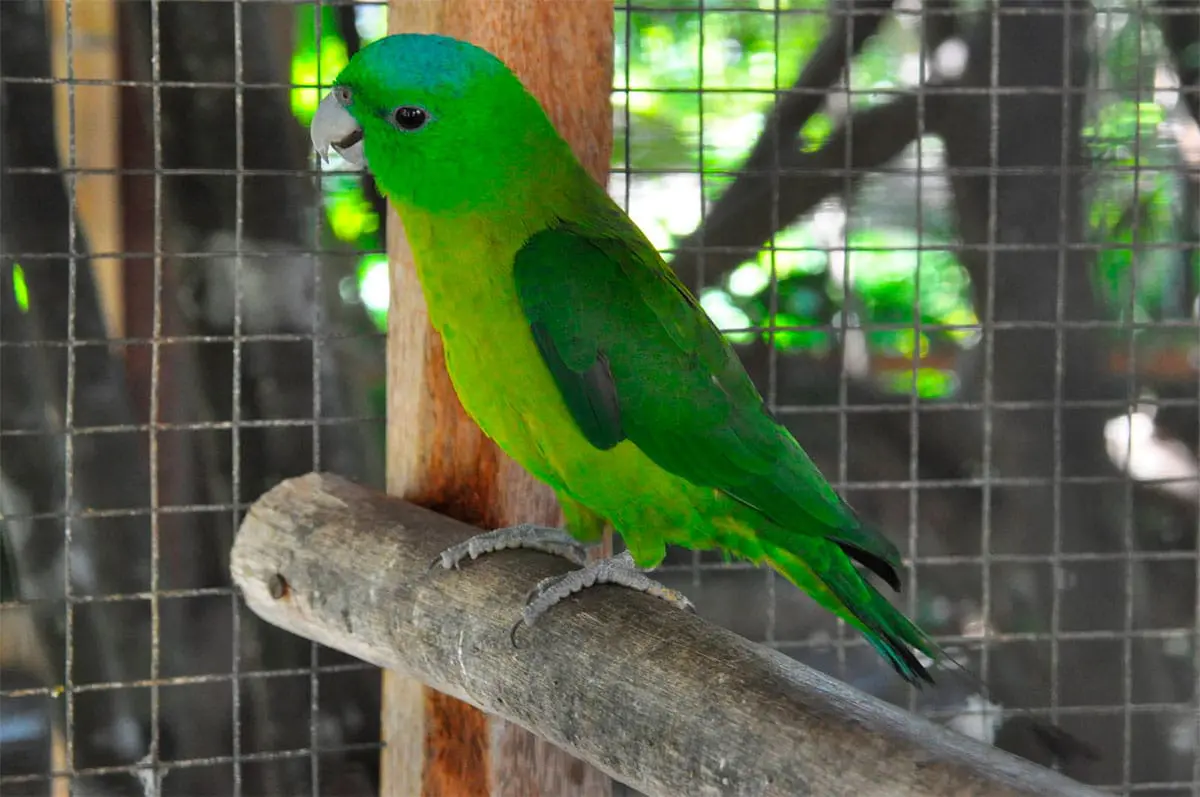
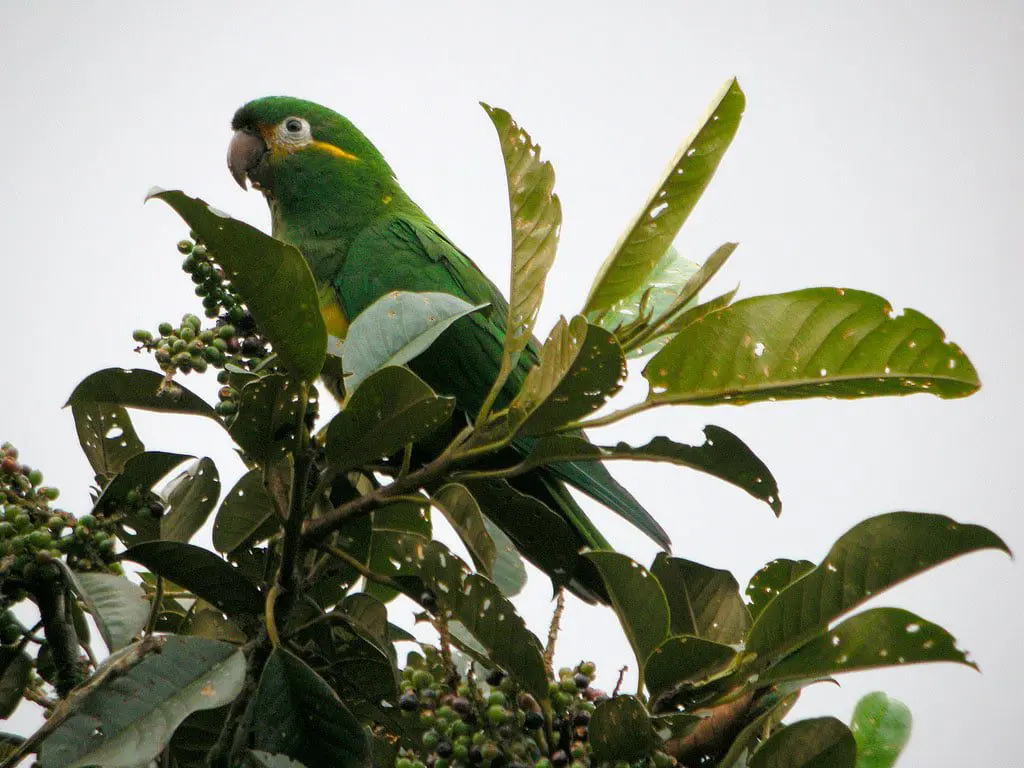
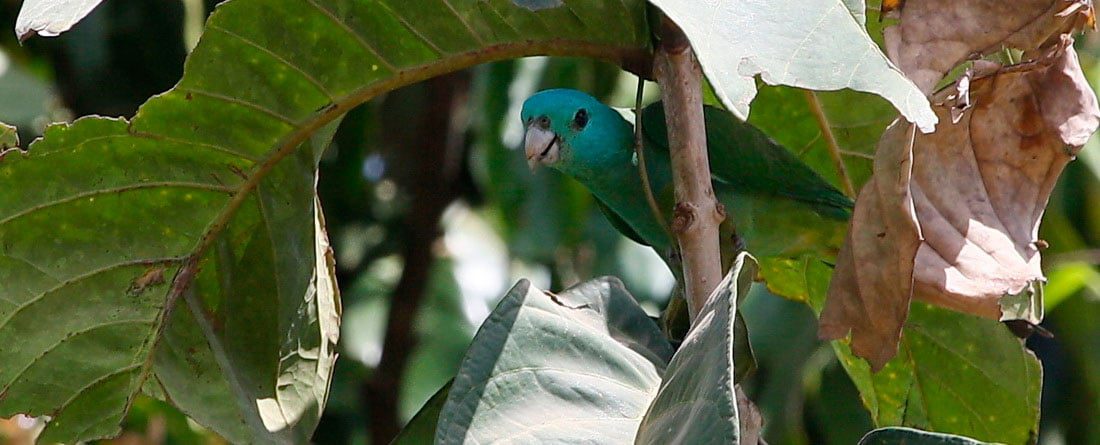
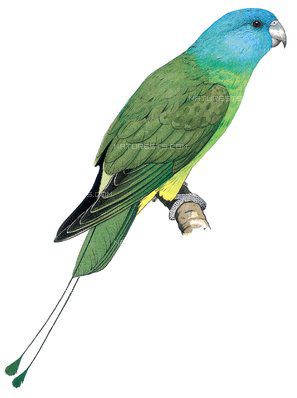
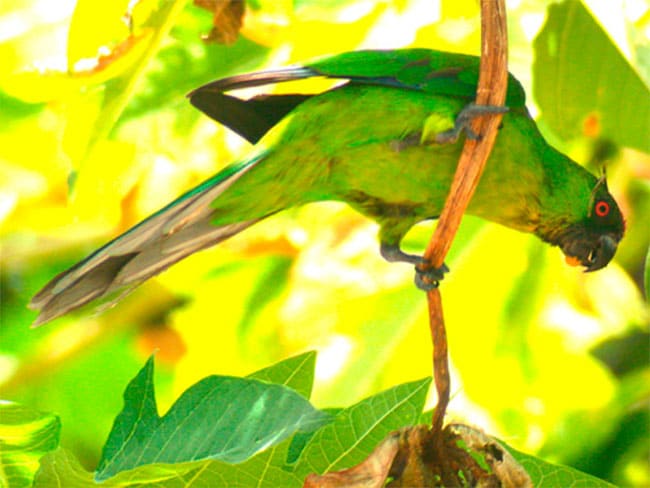
The head of the Palm Lorikeet (Charmosyna palmarum) is bright green, showing some red markings around the base of the bill, lores and the chin. The upperparts are bright green with a light washed olive brown through the mantle.

The wings are green. Under the greenish-gray wing coverts. The lower parts are bright green, more yellowish in the chin, the throat and the center of the belly (males sometimes also with some feathers red in the abdomen and the thighs). Tail Green with yellow in the Center and by the side of the feathers; below the tail is yellow.
Bill orange; cere orange; irises yellow; legs yellowish-orange.

In the females, Red in the face is reduced or absent. Immature similar to the female, but in general most off. Iris ochre-coloured. Bill yellowish brown.

Habitat:

The Palm Lorikeet It is distributed in the forests and wooded lands, more common in the foothills than in the lowlands, and mostly uninhabited cloud forests of the larger islands above 1.000 m. He travels a lot between feeding sites and is found in pairs or flocks in the tops of the trees, where its Green plumage blends with the surroundings when it feeds among the flowers.
In flocks, couples have been observed grooming are, indicating that the pair bond is maintained when the birds are in larger groups.

A constant chatter deals the presence of these parrots in their search for food.

Reproduction:

Breeding habits they are little known, but a nest with two chicks in Holy (Vanuatu), It was found, in December of 1961, in a branch of a hollow tree to 6 meters above the ground in the cloud to 1,600 m forests. altitude.
They appear in the lowlands of sporadically, especially when the Erythnna and sago palm they are in flower.

Food:

Feeds in the Palms, lianas, fig trees and shrubs, taking nectar, pollen, fruits and berries, and particularly fond with the sago palm (Cycas circinalis).

Distribution:

Size of the area of distribution (reproduction / resident): 11.300 km2

Distributed by Southwest of Polynesia in Vanuatu, the Duff Islands, Santa Cruz Islands and Banks Islands.
Range seems to expand and contract, and it has been speculated that this may be related to the effect of cyclones, or sporadic colonies as a result of blooms. These may include, in Vanuatu It was noted from fate in 1879 for the first time in 30 years, and was still present there in the decade of 1930, but by the Decade of 1960 had disappeared.

Has also been recorded in Vanuatu from Holy Spirit, Aoba, Maewo, Pentecost, Malakula, Ambrym, Paama, Lopรฉvi, Tongoa, EMAE, Nguna, Eromanga, Tanna and Futuna; in Banks group in Santa Maria. Ureparapara, Vanua Lava Lava and Mere; and in the Group of Tinakula Santa Cruz, Utupua and Vanikoro.

Conservation:


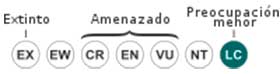
Vulnerable


โ€ข Current IUCN Red List category: Vulnerable

โ€ข Population trend: Decreasing

The total size of the population It is estimated that it will fall within the band of 1,000-2,499 mature individuals.

Avian malaria, the cyclones and the natural cycles are suggested causes of the fluctuating range. Lowland forests, especially in small islands with high populations human, It is clearing for agriculture, domestic demand for timber and commercial logging, avoiding this kind of habitat can be regularly used by this species.

"Palm Lorikeet" in captivity:

Very rare poultry.

Alternative names:

Palm Lorikeet, Green Palm Lorikeet (ingles).
Lori des palmiers (French).
Palmenlori (German).
Lori Palmero (espaรฑol).

scientific classification:

Order: Psittaciformes
Family: Psittaculidae
Genus: Charmosyna
Scientific name: Charmosyna palmarum
Citation: (Gmelin, 1788)
Protonimo: parrot trees

Images "Palm Lorikeet"

————————————————————————————————

"Lori Palmer" (Charmosyna palmarum)


Sources:

Avibase
– Parrots of the World โ€“ Forshaw Joseph M
– Parrots A Guide to the Parrots of the World – Tony Juniper & Mike Parr
– Birdlife

Photos:

1 – taenos

โ–ท The world of Pets: Dogs, cats, birds, reptiles, amphibians

Red Shining-Parrot
Prosopeia tabuensis

Red Shining-Parrot

Content


Anatomy-parrots

Description

45 cm. of length and weight approximate of 280 g..

The Red Shining-Parrot (Prosopeia tabuensis) It is the most distinctive of the colorful parrots of Fiji. It is a large parrot.

Their coloration are distinguished from the other two species. Its head, neck and underparts a brilliant scarlet hues with a blue collar extending behind the neck; the back and tail are a bright green. The flight feather and tail they are green, strongly impregnated with blue.

The bill and legs are black, and irises are orange.

The males and females they are similar, However, the bill the male is larger and the head It has a more square than the females form.

Description 2 subspecies:

  • Prosopeia tabuensis tabuensis

    (Gmelin) 1788 – The species nominal


  • Prosopeia tabuensis taviunensis

    (Layard,THE) 1876 – 40 cm.. length approximately; more small that it nominal species, without the band blue on the nape, the feathers of the abdomen with a tone more blue and with the face less blackish.

Habitat:

Red Shining-Parrot

The Red Shining-Parrot are distributed in the mature forests and through a variety of associated habitats, including the of secondary growth, wooded ravines (nest), coconut plantations, Gardens of villages, agricultural fields, mangroves and scrub.

There has been starting from the 100 meters of altitude until the 1.750, but they are most common between the 400 and 1.000 m.

The Red Shining-Parrot they are suspicious, curious and You can see them individually, in pairs or in flocks of up to 40 individuals outside the breeding season. they are not shy, and loud groups tend to meet in their favotitos places to eat.

They tend to rest on the tops of the trees.

Reproduction:

The Red Shining-Parrot perch upright and turn head rhythmically back and forth, probably showing a form of courtship.

The breeding is in the months from July to October, in trees dead or broken, the female feeds the young.

Of 2-3 eggs that is hatch during 23-24 days.

The juveniles they can fly to the 8 weeks.

Food:

Feeding of the fruits and seeds a variety of trees, for example, Myristica hypargyraea, that is of particular importance in 'USA. They also feed on Mango Mangifera indica, papaya Carica papaya, guava Psidium guajava and bananas. Son agile climbers and move in search of food using their beaks to rely on small branches. Sujentan foods with their claws, since they bite with its powerful beak, and they chew the wood to remove insect larvae.

They feed mainly in the upper canopy, but sometimes also attack the cornfields.

Distribution:

Size of the area of distribution (reproduction / resident): 6.200 km2

The Red Shining-Parrot they are distributed in a natural way in the islands of the Group Fiji including Vanua Levu, KIOA, Taveuni, Qamea, Laucala, Koro and Gau (probably introduced). In Tonga, the species was introduced in Tongatapu prior to contact with the European and where it has already extinct due to habitat loss, and in 'USA where it is still quite common, especially in the forests of the East, North and South-West (with a population estimated between 700- 1.000 birds in 1988).

The species benefits, in part, Thanks to agriculture, but they depend largely on its nest in mature trees of the forest, trees that are being cleared in most of its extension. The species is also threatened by trade, and it is also hunted for its feathers and as food.

Many juveniles are caught to be raised locally as pets, Since they learn to talk easily.

Its population is believed that it may be above the 20.000 specimens, but of the subspecies prosopeia remaining, probably, less than 5.000 birds and its status is of concern.

There has been a sharp decline in the population of the Red Shining-Parrot in some areas due to habitat loss, although the species remains locally common at lower elevations on most of its islands.

Distribution 2 subspecies:

  • Prosopeia tabuensis tabuensis

    (Gmelin) 1788 – The nominal species


  • Prosopeia tabuensis taviunensis

    (Layard,THE) 1876 – Taveuni, Ngamea (Qamea) and Laucala, in the North of Fiji.

Conservation:


minor concern


โ€ข Current Red List of UICN: Least concern.

โ€ข Population trend: Decreasing.

The size of the world population It has not been quantified, but the species is described as common and visible throughout its area of distribution (Watling 2001).

The population It is suspected that it may be in decline due to ongoing habitat destruction.

"Red Shining-Parrot" in captivity:

Very rare in captivity.

According to sources, one specimen was still alive after 6,8 years in captivity. Taking into account the longevity of the similar species, the maximum longevity in these animals could be underestimated. Es un hecho que estos animales pueden vivir hasta 23.7 years in captivity, aunque en esta especie no ha sido verificado.

Alternative names:

Red Shining-Parrot, Maroon Shining Parrot, Maroon Shining-parrot, Red Shining Parrot, Red-breasted Musk Parrot, Red-breasted Musk-Parrot, Red-breasted Shining-Parrot (ingles).
Perruche pompadour, Perruche masquรฉe pompadour (French).
Pompadoursittich, Pompadour Sittich (German).
Prosopeia tabuensis (Portuguese).
Papagayo Carmรญn, Papagayo Granate (espaรฑol).

scientific classification:

Gmelin Johann Friedrich

Order: Psittaciformes
Family: Psittaculidae
Genus: Prosopeia
Scientific name: Prosopeia tabuensis
Citation: (Gmelin, JF, 1788)
Protonimo: Psittacus tabuensis

ยซMaroon Parrotยป Images:

Videos "Red Shining-Parrot"

ยซMaroon Parrotยป (Prosopeia tabuensis)

    Sources:

    Avibase
    – Parrots of the World โ€“ Forshaw Joseph M
    – Parrots A Guide to the Parrots of the World – Tony Juniper & Mike Parr
    – Birdlife

    Photos:

    (1) – Red Shining-parrot Prosopeia tabuensis in captivity, Fafa Island, Tonga By Duncan Wright (Own work) [GFDL or CC BY-SA 3.0], via Wikimedia Commons
    (2) – A painting of a Maroon Shining Parrot by Edward Lear 1812-1888 Edward Lear [Public domain], via Wikimedia Commons
    (3) – Red Shining-parrot (Prosopeia tabuensis) De Voeux Peak, Taveuni, Fiji Islands By Aviceda (Own work) [CC BY-SA 3.0], via Wikimedia Commons
    (4) – Maroon Shining Parrot Prosopeia tabuensis Kula Eco Park – Viti Levu, Fiji ยฉ 2007 Sarah P. Otto – The Online Zoo
    (5) – A bird foraging on the ground by Josep del Hoyo – Lynx
    (6) – A bird perched in a tree by Josep del Hoyo – Lynx

    Sounds: Matthias Feuersenger (Xeno-canto)

โ–ท The world of Pets: Dogs, cats, birds, reptiles, amphibians

Speckle-faced Parrot
Pionus tumultuosus

Speckle-faced Parrot

Content


Anatomy-parrots

Description:

28 to 31 cm.. tall and around 250 g. weight.

The Speckle-faced Parrot (Pionus tumultuosus) It is distinguishable by color from whitish crown up to the nape; base bill red rose, with forecrown redder. Cheeks whitish with a red and purple tinge towards the neck; purple chest.

Shoulder with thin strip yellow with reddish tint, inside base tail and crissum, red; the rest of the tail is green with blue on the outer feathers; under belly with red feathers with green edge.

ocula ringr greyish

The youth They have almost all head green and the wings, greenish yellow.

Taxonomic note:

The Speckle-faced Parrot It is probably the rarest and most controversial genre Pionus. It is sometimes divided into two species, in which case, the Pionus tumultuosus South is known as Speckle-faced Parrot, while the North, Pionus seniloides, They are known as White-capped Parrot (which leads to easy confusion with Pionus senilis).

Habitat:

Speckle-faced Parrot

It inhabits in Andean and sub-Andean cloud forests and forest edges, between 1600 and 3200 meters above sea level.
It is highly Nomad with temporal variations in terms of the number of individuals that can be registered in a locality.

Reproduction:

With reproduce In September. In captivity puts 4 eggs which incubated about 26 days. No other aspects of its reproductive biology are known..

Food:

It has been registered consuming fruits of Turpinia paniculata and are sometimes seen in large numbers feeding on maize crops in cultivated areas and banana plantations.

Distribution:

Its population is distributed in the southern Andes, from the center of Peru until Bolivia.

Size of the area of distribution (reproduction / resident): 329.000 km2

Conservation:


minor concern


โ€ข Current category of the Red List of the UICN: Least concern.

โ€ข Population trend: Decreasing.

Justification of the population

The size of the world population It has not been quantified, but this species is described as ยซquite common, but irregular distributionยป (Stotz et to the., 1996).

Justification of trend

It is suspected that the population is in decline due to the continuous habitat destruction.

"Speckle-faced Parrot" in captivity:

This species is virtually nonexistent in poultry farming. There is only a small collection, private property in the United States. The Fundaciรณn Loro Parque in Tenerife, Spain, It has some copies.
Most of the Speckle-faced Parrot imported to United States they were the victim of aspergillosis โ€“ probably caused by the stress suffered during the import process.

In captivity They were observed as the to intelligent species, inquisitive and sometimes shy and nervous. Will get used to their caregiver over time. You can interact with a person and jealously attacking others. Prone to obesity.

Alternative names:

Speckle-faced Parrot, Plum-crowned Parrot, Speckle-faced Parrot (Plum-crowned) (inglรฉs).
Pione pailletรฉe, Pione pourprรฉe (francรฉs).
Purpurstirnpapagei (alemรกn).
Curica-de-cara-manchada (portuguรฉs).
Cotorra Gorriblanca, Loro Rosado, Loro Tumultuoso (espaรฑol).


Clasificaciรณn cientรญfica:

Tschudi Johann Jakob von

Orden: Psittaciformes
Familia: Psittacidae
Genus: Pionus
Nombre cientรญfico: Pionus tumultuosus
Citation: (von Tschudi, 1844)
Protรณnimo: Psittacus tumultuosus


Imรกgenes ยซLoro tumultuosoยป:

Videos del "Loro tumultuoso"

ยซLoro tumultuosoยป (Pionus tumultuosus)

    Fuentes:

    Avibase
    – Parrots of the World โ€“ Forshaw Joseph M
    – Parrots A Guide to the Parrots of the World – Tony Juniper & Mike Par
    Birdlife
    – Libro Loros, Pericos y Guacamayas Neotropicales

    Fotos:

    (1) – Eduardo Nogueira
    (2) – Speckle-faced Parrot at La Merced Zoo By josecajacuri [CC BY-SA 2.0], via Wikimedia Commons
    (3) – Speckle-faced Parrot ยซPionus tumultuosusยป on the grounds of the Pueblo Hotel, Aguas Calientes by Carol FoilFlickr
    (4) – Speckle-faced Parrot ยซPionus tumultuosusยป on the grounds of the Pueblo Hotel, Aguas Calientes by Carol FoilFlickr
    (5) – Speckle-faced Parrot ยซPionus tumultuosusยป on the grounds of the Pueblo Hotel, Aguas Calientes by Carol FoilFlickr
    (6) – PIONUS TUMULTUOSUS By Allen, Edgar W.; Erxleben, J.; Hanhart, Michael; Hanhart, N; Keulemans, J. G.; Mintern Bros.; Rowley, George Dawson; Smith, J.; Walther, T. [CC BY 2.0 or Public domain], via Wikimedia Commons

    Sonidos: Sebastian K. Herzog

โ–ท The world of Pets: Dogs, cats, birds, reptiles, amphibians

Duchess Lorikeet
Charmosyna margarethae


Duchess Lorikeet

Content

Duchess Lorikeet

Description

20 cm.. length and a weight between 40 60 g..

The head of the Duchess Lorikeet (Charmosyna margarethae), is red except for the back of the crown that is black and extends from the top of the eye up to the nape.

Large collar Red on the back of the neck, bordered below by a thin purplish-black line and a broader yellow-orange stripe: the mantle and scapulars green; rump Green with trademark red on the side; tail coverts, view from above, green. The wings green. Under the wing , coverts marginal green, the coats under the wing red, and the bottom of the flight feather Black with a panel of yellow color that goes from the center of the flight feather passing by the secondaries.

The underparts, basically, are red with a yellow stripe on the chest, narrow edged purple-black above, a thin red margin and a broader and more diffuse below purple edge; from below, the tail coats are green. From above, the tail It is red with black borders and the sharp tip of yellow; from below, the tail is yellowish-brown, Yellow-tipped.

The bill is orange; irises yellow to orange; legs oranges.

The male and the female are very similar.

Immature they lack the Black Hat and black and orange margin on the back of the neck. The chest belt is a yellow shutdown. The bill orange, the irises Yellow-grey and the legs gray.

Habitat:

It inhabits in the forests and wooded areas, at the edges of forests and tall secondary growth forests, mostly mountains and hills, Although you can also see in coconut plantations and coastal villages; above all between 100 and 1.350 meters above sea level.

Often feeds in noisy groups of 10 to 40 birds in the trees in flower and epiphytes with others Loris (including (Cardinal Lory). They feed acrobatically, mainly in the forest canopy.

Reproduction:

Nesting and breeding habits unknown, although a male was seen in a breeding attitude during the month of January.

Food:

Apart from pollen and nectar, observed feeding on fruits of Schefflera.

Distribution:

The Duchess Lorikeet is endemic of the Solomon Islands including Bougainville (Papua New Guinea), Gizo, Kolombangara, Guadalcanal, Malaita and San Gristobal. Brian Coates indicates that this species often seen in the city of Kieta, Bougainville.

Conservation:


Near-threatened

โ€ข Current IUCN Red List category: Near threatened.

โ€ข Population trend: Decreasing.

Much of the lowland forests, within the area of distribution of the Duchess Lorikeet, He has been or is scheduled to be connected, but this species is probably safe in the Highlands.

There is an export license fee for 60 birds, the funds will be used to finance conservation programs (JR van Oosten in litt. 1999); However, this species could be threatened by any large-scale trade (T. Leary in litt. 2000). In 2002, 200 birds were imported to Singapore with permissions CITES (UNEP-WCMC CITES Trade Database, January 2005).

The world population It is considered of less than 50.000 birds, but stable.

"Duchess Lorikeet" in captivity:

Very rare in captivity.

Alternative names:

Duchess Lorikeet, Dutchess Lorikeet (ingles).
Lori de Margaret (French).
Margarethenlori, Margaretenlori (German).
Lori de Margarita (espaรฑol).
Duchess Lorikeet (Portuguese).

scientific classification:

Order: Psittaciformes
Family: Psittaculidae
Scientific name: Charmosyna margarethae
Genus: Charmosyna
Citation: Tristram, 1879
Protonimo: Charmosyna margarethae

Images "Duchess Lorikeet"

Videos "Duchess Lorikeet"

————————————————————————————————

"Lori de Margarita" (Charmosyna margarethae)


Sources:

Avibase
– Parrots of the World โ€“ Forshaw Joseph M
– Parrots A Guide to the Parrots of the World – Tony Juniper & Mike Parr
– Birdlife

Photos:

1 – By ยฉ Markus Lagerqvist – PBase
2 – ยซCharmosynamargarethaesmitยป by John Gerrard KeulemansThe Ibis, ser. 4, too.. 3. Licensed under Public Domain via Wikimedia Commons.

Sounds: Niels Krabbe (Xeno-canto)

โ–ท The world of Pets: Dogs, cats, birds, reptiles, amphibians

Malherbe's parakeet
Cyanoramphus malherbi

Malherbe's parakeet

Content


Anatomy-parrots

Description

19 to 22 cm. length and a weight between 40 and 52 grams for males and between 30 and 41 grams for females.

The Malherbe's parakeet (Cyanoramphus malherbi) they are small bright green parakeets, equipped with a long tail and with a bluish green colour wash in belly and chest.

The wings they have the primary coverts and the edges to the primary external of azure-blue. The crown is lemon-yellow colour and the front band, it reaches the eyes, is orange, as well as two patches on each side of the rump.

The bill is bluish grey, with the tip of black. The eyes are red and the legs are brown.

The colors tend to have a brighter tone in the males.

The youth they are more opaque, especially the patch of front band and the crown, which may be absent. The tail It is short for several weeks after feather. The bill is a pale pink color that darkens gradually when the young bird matures. They have darker the eyes, a reddish brown tone.

Habitat:

The Malherbe's parakeet tends to be quiet and hard to see. A brief and loud chatter or a quieter soft contact call can denote its presence, but locating the bird can be extremely difficult. The Malherbe's parakeet often confused with the Yellow-crowned parakeet.

Even though have been recorded in subalpine bushes and thickets of Matagouri open zones (Discaria toumatou), the Malherbe's parakeet they are predominantly in the forest.

They usually feed in the canopy, but also under frequent places with low vegetation and soil.

Reproduction:

The Malherbe's parakeet can reproduce in every month, with a main breeding period between December and April; incubation peak is in January.

Clutch size media is of approximately 7 eggs, but register a wide range (range of 1 to 10). Egg laying is asynchronous with an interval between eggs of 2 days. The incubation lasts from 21 to 26 days, and the period of breeding ranges between 35 and 45 days.

The females They seem to choose the nesting sites, as well as carry out all the preparation, incubation and breeding, the male provides most of the food during incubation.

It is suspected that the female only feeds the chicks during the first 10-14 days, just as they do other species Cyanoramphus. Once past this period, both sexes take care, equally, feeding the pigeons.

There may be second clutches If there is enough food available, for example, during the sowing of beech, or if the first attempt failed. The female may lay a second clutch when first chicks have, approximately, 2 weeks of age. This leaves the male as the sole provider for both the chicks and the incubating female..
Second clutches are not uncommon; When is food plentiful, some couples can reproduce 3 or 4 times on.

The nests are accessed normally through holes in knots of branches and the main trunk of a tree.

They use all species of you have to build the nest, predominantly the Red beech (69% nests monitored in the continent, n = 138) and dead trees (20%).
Nests may have more than one meter of depth. Records placed nests in heights that range between 2,5 and 26 m.

Food:

The Malherbe's parakeet consume seeds, flowers, buds and small invertebrates (mealybugs and caterpillars). In a year of abundance of fruits, the seeds become the dominant element of their diet, and they seem to be the main food for young people.

Invertebrates seem to play an important role in the diet of this species of parakeet which for the Yellow-crowned parakeet.

Distribution:

Size of the area of distribution (reproduction / resident) 360 km2

To the Malherbe's parakeet les is in areas where the South beeches (Nothofagaceae), in forest valleys in the South Island, the valleys Hawdon and Poulter in the Arthur Pass National Park and the South Branch of the Hurunui Valley in Lake Sumner Forest Park. Are unevenly distributed within these valleys; absent in many parts, but in some other places can be quite common.

They have been transferred to four islands: Maud and Blumine in Marlborough Sounds, Chalky Island in Fiordland, and Largest Island / Tuhua on bay of plenty.

Conservation:


critical hazard


โ€ข Current Red List of UICN: critically endangered

โ€ข Population trend: Decreasing

This species is the smallest of the class Cyanoramphus along with the Yellow-crowned parakeet.
The Malherbe's parakeet It is the kind of rare parrots of New Zealand. The population was wiped out by rats and stoats introduced by men.

Also the changes in the habitat due to the ungulates and opossums they have affected the species.

Some diseases have been discovered in two of the areas in which live.

It is in progress conservation actions such as the predator control in the three valleys of the continent and the protection of the trees hosting the nests.

The captive breeding programs they have helped to release the birds in 4 Islands cleared of predators. This work is still in progress.
On the Mainland, all populations are monitored closely by the Department of conservation.

The total population It was estimated in 290/690 individuals at the beginning of 2013.
The continent has between 130 and 270 specimens and Islands surrounding between 160 and 420.

"Malherbe's parakeet" in captivity:

Usually they are not in captivity.

A small captive breeding program was established in 2003.

Alternative names:

Malherbe’s Parakeet, Alpine Parakeet, Malherbe’s Parrot, Orange-fronted Parakeet (English).
Perruche de Malherbe, Kakariki de Malherbe (French).
Malherbesittich (German).
Kakariki-fronte-laranja (Portuguese).
Perico Maorรญ Montaรฑรฉs, Perico Maorรญ Montano (espaรฑol).

scientific classification:

Order: Psittaciformes
Family: Psittaculidae
Genus: Cyanoramphus
Scientific name: Cyanoramphus malherbi
Citation: Souancรฉ, 1857
Protonimo: Malherbe's Parakeet

Images ยซPerico Maorรญ Montanoยป:

Videos "Malherbe's parakeet"

ยซPerico Maorรญ Montanoยป (Cyanoramphus malherbi)

Sources:

  • Avibase
  • Parrots of the World โ€“ Forshaw Joseph M
  • Parrots A Guide to the Parrots of the World – Tony Juniper & Mike Parr
  • Birdlife

  • Photos Perico Maori Montano:

(1) – This is one of several birds being bred in captivity at Isaac Peacock Springs wildlife refuge.
Christchurch, New Zealand By Jon Sullivan from Christchurch, New Zealand [CC BY 2.0], via Wikimedia Commons
(2) – Orange-fronted parakeet. Adult male in captivity. Isaacs Wildlife Trust, Christchurch. Image ยฉ John Kearvell by John Kearvell – nzbirdsonline
(3) – Orange-fronted parakeet. Captive adult female. Isaacs Wildlife Trust, February 2012. Image ยฉ Sabine Bernert by Sabine Bernert www.sabinebernert.fr – nzbirdsonline
(4) – Orange-fronted parakeet. Juvenile feeding. Nelson, January 1983. Image ยฉ Department of Conservation (image ref: 10028825) by Dave Crouchley, Department of Conservation Courtesy of Department of Conservation – nzbirdsonline
(5) – Orange-fronted parakeet. Adult male (left) and female in captivity. Isaacs Wildlife Trust, Christchurch. Image ยฉ John Kearvell by John Kearvell – nzbirdsonline

โ–ท The world of Pets: Dogs, cats, birds, reptiles, amphibians

Bald Parrot
Pyrilia aurantiocephala

Bald Parrot

Content

Description:

23 cm.. length.

The Bald Parrot (Pyrilia aurantiocephala) has the mandible and the upper maxilla, black with a large orange dot in the base; head naked orange chrome; lores, forecrown, pileum, nape, face and chin no true feathers; coverts only black bristles and some white bristles in lores; true feathers beginning in dorsal area neck, spectrum yellow in proximal half and yellow-green in distal half with black apex, passing rapidly to parrot green as basic color the mantle, back, uropigium, and of the uppertail-coverts; feathers in bend of wing and scapulars, yellowish orange with base scarlet; lesser wing coverts green, except scarlet carpal edge; median and greater wing coverts, with large suffusion of ultramarine blue.

The upper surface of the of remiges black with outerweb shaded with indigo blue; undersurface of remiges black color with a a shamrock greenish on the innerwebs; the outerweb and the apex of the upper surfaces of the rectrices, indigo blue, shaded to varying degrees with green; the base innerwebs of the rectrices, yellow; feathers of the chest with greenish yellow base and apex, forming a large banda pectoral; lower breast, abdomen and crissum, emerald green sprinkled with cyan; underwing-coverts scarlet; the thighs yellow; feet feet orange yellow with suffusion of ochre; irises orange.

The immature with the bare lores to the area around the eyes, orange, the rest of the head feathered dull green; upper breast greenish yellow. Bill yellow in very young birds.

Note:

This parrot was initially believed to be an immature of the species Vulturine Parrot (Pyrilia vulturina) due to the orange color head calva. But, when it was discovered that individuals were sexually mature, He described as a new species. In fact, the youth of both species have feathers head greenish, unlike adults.

Formerly, It was included in the genus Pionopsitta.

  • Sound of the Bald Parrot.

Habitat:

Seen in gallery forest and in forest ‘campinarana‘ (on white sand soils). This region is threatened by logging (Gaban-Lima et al., 2002).

viewed individually, in pairs or small flocks of up to 10 birds. It is most active during the early morning that other parrots, and before going to sleep. It stays in the upper canopy where it is well camouflaged.

Reproduction:

The breeding season possibly either during September; little is known about their breeding habits.

Food:

Feeds of seeds, fruits and possibly larvae of gall wasps (Cynipidae).

Distribution:

Size of its range (breeding/resident): 407.000 km2

The Bald Parrot They are known only in some locations covering the lower basin of Madeira river and the upper basin of Tapajos River in the Brazil Amazon, more specifically in the Sรฃo Benedito river (Field observations) and Cururu-acu River, both tributaries on the right bank of the river Teles Pires, himself a tributary of Tapajรณs.
There are several recent records of this new species from the micro-region of Madeira in the vicinity of Borba.

Since the species is currently known only from Two types of habitat and a relatively small area, it is unlikely that the population is much higher 10.000 individuals, so it is considered that it is near-threatened. It is likely to occur more records now that has been formally recognized as a species, and this may clarify its exact state.

Conservation:


Near-threatened


โ€ข Current category of the Red List of the UICN: Near-threatened.

โ€ข Population trend: Decreasing.

Population size: 6.700 specimens.

Rationale for the Red List category

This species has recently described a moderately small population is declining due to loss of habitat. So, it is classified as near threatened.

Justification of the population

The population is preliminarily estimated with a number of at least 10.000 individuals, approximately equivalent to 6.700 mature individuals. This requires confirmation.

Justification of trend

It is suspected that this species has lost 8,8-13,1% of habitat within its distribution over three generations (21 years) starting from a model of deforestation Amazon (Soares-Filho et to the., 2006, Bird et to the., 2011). So, you suspect your decrease in population <25% durante tres generaciones.

"Bald Parrot" in captivity:

unknown in captivity.

Alternative names:

Bald Parrot, Orange-Headed ParrotT (English).
Caรฏque chauve (French).
Orangekopfpapagei, Langkopfpapagei (German).
Papagaio-de-cabeรงa-laranja (Portuguese).
Lorito Calvo (espaรฑol).

scientific classification:

Order: Psittaciformes
Family: Psittacidae
Genus: Pyrilia
Scientific name: Pyrilia aurantiocephala
Citation: Gaban-Lima, Raposo & Hรถfling, 2002

Images "Bald Parrot"

————————————————————————————————

ยซBald Parrotยป (Pyrilia aurantiocephala)


Sources:

Avibase
– Parrots of the World โ€“ Forshaw Joseph M
– Parrots A Guide to the Parrots of the World – Tony Juniper & Mike Parr
Birdlife
– Department of Zoology, Bioscience Institute, University of Sao Paulo, Rua do Matao, dish 14, not. 101, POCKET 05508-900, Saหœo Paulo, SP, Brazil – Notes

Photos:

(1) – Bald Parrot (Pyrilia aurantiocephala) – Watercolor, Romain Risso. By Gossipguy (Own work) [CC BY-SA 3.0], via Wikimedia Commons

โ–ท The world of Pets: Dogs, cats, birds, reptiles, amphibians

Papuan Lorikeet
Charmosyna papou

Papuan Lorikeet

Content

Papuan Lorikeet

Description

25 cm.. length and a weight between 90 and 115 g..

The head of the Papuan Lorikeet (Charmosyna papou) It is red with a black patch on the back of the crown and a crescent-shaped mark on the nape; patch in the crown with mottled blue extends to the top of the eyes.

Under the nape a red uniform coat; centre of back Dark emerald green; under the back bright red; rump light blue. Wings Emerald green with vane internal black; undertail, the flight feather grey with coats red; coverts marginal green. Throat red, darker than the upper part of the chest and a little more off: lower chest Red clear with a variable black patch in the center of the belly, Sometimes it extends over them the thighs; the sides of chest and flanks with two obvious yellow stripe sets; bottom of the belly and coverts of the tail, red. View from the top, the tail is green and yellow is your long tip, the axis of the Central feathers is of dark brown; below, the tail is yellow, finished in Orange at its end.

The bill orange; Orange the irises; Orange and the legs.

In the nominal species, both sexes are equal.

Immature more turned off than adults. A band yellow variables at the bottom of the secondaries; rump with mottled Green; Naranja-Pardo the bill and legs; irises pale yellow.

Description 4 subspecies

  • Charmosyna papou papou

    (Scopoli, 1786) The nominal.


  • Charmosyna papou goliathina

    (Rothschild & Hartert, 1911) With sexual dimorphism and two different colors. The normal morph is similar to the subspecies Stellae, but differentiated by the yellow at the tip of the tail (non-fusion Orange to yellow). The coverts of the tail they are longer, in color purple blue, not red as in the stellae. As in the subspecies stellae, This subspecies has melanism, the upperparts is green, and underparts blue-black in their entirety. Head and the mantle, only broken by the blue of the stripes in the nape; Red in the coverts of the back and bottom of the tail. The wings are green. The tail seen from below it is more yellow-green in color than in normal morphology, and streamers they are fused opaque to verdoso-amarillo down Green.


  • Charmosyna papou wahnesi

    (Rothschild, 1906) Similar to the subspecies goliathina, but the Red of the part superior of the chest It is bordered below with a narrow yellow band. Does not have a green-washing in the flanks and abdomen top. The belly Central and tail coverts are red.


  • Charmosyna papou stellae

    (Meyer,AB, 1886) This species has sexual dimorphism and also has a melanism (excess of dark pigmentation). In comparison with the nominal, the black patch has much more extensive of the nape, blue-violet striped; This black patch replaces the two areas of black in the crown and in the nape of the speciesnominal. The streamers of the tail They also differ, merging from green to orange red (instead of green to Orange) and finally to yellow on the tips. The subspecies stellae also lacks of the chest yellow and stripes on the flanks that if you have the Papou, as well as his black patch on the belly that extends to the flanks.

    The females They show a visible patch of yellow on the lower of the back Green-tipped on the longest feathers, and coverts of the tail red (male shows red with blue on the patch of the rump). The Red of the part superior of the chest seems more uniform. In the metamorphosis by melanism the Red is largely replaced by black (see goliathina).

    The young birds with dark and thin stripes on the underparts.

Habitat:

Have been recorded at an approximate height of 1.200 meters above a row of trees and also to the 3.500 m, although the most common is to see them above the 2.000 meters and rare to see them below the 1.500 m; found by Forshaw in the forest of Nothofagus and Podocarpus to 2.800 m.

A species active and agile you are often found in pairs or in small groups. The birds move through the trees with jerky movements, often waving his serpentine tail, However, It can be very discreet between the tops of the trees.

Observed in Scheffleras, often in the company of other species, with the same food taste, as the Yellow-billed Lorikeet (Neopsittacus musschenbroekii). Seen often making passes above the trees or half-height, among the plants through the clear.

Reproduction:

The nesting in nature it is not described, but Pratt observed an adult tracing branches above and below a large group of epiphytes , Perhaps in search of a nesting site. A pair in breeding conditions was also observed in late August., and young people have been in nature during October and November. In captivity, the implementation has been two eggs, lasting about three weeks of incubation and the young remain in the nest for about two months.

Food:

Feeds on flowering trees or flowers of the epiphytes, nectar, pollen, fruits and small seeds. Larvae of insects occasionally.

Distribution:

Intervals in the center of New Guinea in Irian Java (Indonesian) and Papua New Guinea, in where are distributed from the southeast of Vogelkop towards the Adelbert range, Huon Peninsula and intervals in the Southeast.

Distribution 4 subspecies:

Conservation:


minor concern


โ€ข Current IUCN Red List category: Least concern.

โ€ข Population trend: Stable.

The world population It has not been quantified, Although that it is more thought of 500.000 specimens. The species appears to be quite common throughout its area of distribution (pit et to the ., 1997).

The hunting of this species for the use of their feathers as tribal headdresses and capture for the bird trade do not believe today that can affect the size of the population.

It is suspected that the population is stable in the absence of evidence of any reduction or other substantial threat.

"Papuan Lorikeet" in captivity:

Coupled pairs will defend their territory vigorously. Individual birds active and playful; they require a cage as big as possible. May be a bit uncomfortable due to liquid diet.

Son rare in captivity.

Alternative names:

Papuan Lorikeet, Fairy Lorikeet, Fairy Lory, Papuan Lory, Stella’s Lorikeet (ingles).
Lori papou, Lori de Stella (French).
Papualori (German).
Lori de Cola Larga, Lori Rabilargo (espaรฑol).

scientific classification:

Order: Psittaciformes
Family: Psittaculidae
Genus: Charmosyna
Scientific name: Charmosyna papou
Citation: (Scopoli, 1786)
Protonimo: Psittacus Papou

Images ยซLori Long-tailedยป:

Videos "Papuan Lorikeet"

————————————————————————————————

"Lori Rabilargo" (Charmosyna papou)


Sources:

Avibase
– Parrots of the World โ€“ Forshaw Joseph M
– Parrots A Guide to the Parrots of the World – Tony Juniper & Mike Parr
– Birdlife

Photos:

1 – (1) ยซCharmosyna papou goliathina1ยป by dragusOwn work. Licensed under Public Domain via Wikimedia Commons.
2 – (2) ยซStellas Lory 2ยป by LtshearsOwn work. Licensed under CC BY-SA 3.0 via Wikimedia Commons.
3 – (3) ยซCharmosyna papou-Fort Worth Zoo-8" for Philip Shoffner – originally posted to Flickr as Dsc_0120. Licenciado sob CC BY 2.0 via Wikimedia Commons.
4 – (4) Charmosyna papou goliathina by Zdenek Chalupabiolib.cz
5 – (5) Charmosyna papou goliathina – Birds-pet-wallpapers
6 – (6) Charmosyna papou goliathina By Elaine Radford (ilustraciรณn) – rightpet.com

Sounds: Andrew Spencer (Xeno-canto)

โ–ท The world of Pets: Dogs, cats, birds, reptiles, amphibians

Niam-Niam Parrot
Poicephalus crassus

Content


Description:

25 cm.. length.

The Niam-Niam Parrot (Poicephalus crassus) has the head and nape Brown olive; the ear-coverts Silver. feathers of the the mantle and tertiary Brown with dark green margin; back, uppertail-coverts and bright green.

Lorito nianiam

Upper, wing-coverts dark green; secondary more internal dark green; rest of the flight feather brown with vane dark green external. Throat and top of the chest Brown olive opaque; bottom of the chest, the belly, the the thighs and undertail- coverts green.

Feathers of the tail dark brown tipped with dark green margins.

Bill yellowish, upper jaw darker than black-tipped; irises yellow; legs blackish.

Both sexes similar.

Hood grayish brown of the immature It shows strong brands of color yellow olive; the the mantle is greener. Underparts paler and more yellowish in adults. Secondary internal lined with yellow. More pale the upper jaw the adults and with grey tip.

It was thought that the Niam-Niam Parrot (Poicephalus crassus) could form a species within the group of the Poicephalus meyeri, Poicephalus rueppellii and Poicephalus cryptoxanthus, and possibly other. In the past, treated as species Poicephalus cryptoxanthus, that is morphologically very close.

Habitat:

Frequents wooded areas of Savannah, forest-savanna mosaic, wet sheets and Syzygium-Adina forests in the savanna to the 1.000 m.

Common in areas near water. Observed in pairs or in small groups. Regular daily movements take place even in the mountainous areas where the Niam-Niam Parrot visit tall trees to feed.

Reproduction:

Few details about reproductive biology, but believes that nest between August-September during the rainy season.

Courtship and implementation not described.

Food:

Its diet It is little known but includes a wide variety of seeds; reported foods include millet, and beans.

Distribution:

Size of the area of distribution (reproduction / resident): 343.000 km2

North of Central Africa to the South of the Sahara. Believed to inhabit also in Cameroon Eastern (where is the status unclear) through the Center and South of the Central African Republic, South-West end of Chad and the north end of the upper area of the Democratic Republic of the Congoto the southwest of Sudan (Bahr-el-Ghazal).

Sedentary with local movements. Little-known state, but think it's generally common, Although most scarce in the southwest of Sudan.

Conservation:


minor concern


โ€ข Current Red List of UICN: Least concern

โ€ข Population trend: Stable

The size of the world's population has not been quantified. This species is one of the lesser known African parrots, but it is assumed that it is common in its area of distribution.

The population is suspected to be stable in the absence of evidence of any reduction or substantial threats.

"Niam-Niam Parrot" in captivity:

Very rare in captivity.

It is a parrot of middle voice, shy and suspicious. Young birds are more accustomed to the caregiver.
New birds susceptible to the stress or illness.

Is necessary for their well-being a regular supply of fresh wood; susceptible during the acclimatization period; resistant once acclimated.

Alternative names:

Niam-Niam Parrot, Niam niam Parrot (English).
Perroquet des Niam-niams, Perroquet des niam-niam (French).
Niamniampapagei, Niamniam Papagei (German).
Papagaio Crassus (Portuguese).
Lorito Niam niam, Lorito Niam-niam, Lorito nianiam (espaรฑol).


scientific classification:

Richard Bowdler Sharpe

Order: Psittaciformes
Family: Psittacidae
Genus: Poicephalus
Scientific name: Poicephalus crassus
Citation: (Sharpe, 1884)
Protonimo: Pionias fat

————————————————————————————————

"Lorito naianiam" (Poicephalus crassus)


Sources:

Avibase
– Parrots of the World โ€“ Forshaw Joseph M
– Parrots A Guide to the Parrots of the World – Tony Juniper & Mike Parr
– Birdlife

Photos:

(1) – Photography: Caijin Wen – link