â–· The world of Pets: Dogs, cats, birds, reptiles, amphibians

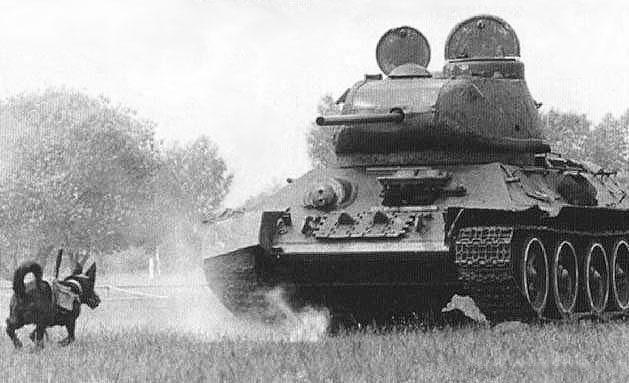
The Soviet perro-bomba during the second world war

perro bomba soviético

Dogs have been used in war since ancient times., and the Soviet Union had approved its use for the military during a series of less destructive tasks since 1924. Was not up 1930, However, that the idea of use to the dogs as mobile mines gained interest, and with it the explosive devices adapted to our four-legged friends. In 1935, the Red Army unveiled its first anti-tank division formed by dogs.

The dogs were trained to carry boxes or bags of explosives subject by means of a harness on his back. Were initially instructed them to pursue a static goal, The idea was to pull a rope, with the help of his teeth, in order to rid the lethal cargo. The explosive charge was triggered by a timer, so the dog's life depended on the ability and speed it had to pull the cord in time..

Read more

â–· The world of Pets: Dogs, cats, birds, reptiles, amphibians

The special relationship between a sick boy and his dog

La relación especial entre un niño enfermo y su perro

The special relationship between a sick child and his dog Juno. Anyone who has taken a dog or a cat from a shelter can testify that there is something special about a rescued pet, It is as if animals feel that it has been given a second chance in life. This is certainly the case of Juno, a Belgian Malinois who was rescued from a shelter just a few days before his sacrifice. But from the day he came to live with his family in Alcoa, Tennessee, Juno has assumed the role of Savior of Lucas Hembree, a four-year-old boy.

Lucas suffers from Sanfilippo syndrome, an inherited disorder of metabolism, which causes the body to be unable to properly break down long chains of sugar molecules called glycosaminoglycans.. As the disease progresses, children lose the ability to speak, walking and eating. The disease also causes a severe neurological damage that leads to aggressive behavior, hyperactivity and convulsions.

Read more

â–· The world of Pets: Dogs, cats, birds, reptiles, amphibians

Uncle Chichi dies, Perhaps it was the oldest dog in the world

uncle chichi

Uncle Chichi, a poodle dog whose unusual longevity led to fame and an appearance on the show Good Morning America, He died on Tuesday after a long battle with cancer. I had 26 years. O 24. Perhaps 25.

The vagueness about his exact age led to debates about whether Chichi, or Cheech, as it was also sometimes known, He was the oldest dog in the world.

Chichi was really old; something they agreed veterinary, their owners and the Agency of animals in Charleston, South Carolina, He gave it up for adoption for more than 20 years.

However in the 2010, when their owners considered to find a place for him in the Guinness Book of records after he almost dies, it turned out that the required evidence — such as puppy pictures and vet papers — had been lost over the years.

Chichi began to show symptoms of old age more than a decade ago and suffered from cataracts., glaucoma and corneal ulcer. After several treatments in the Hospital for animals in Manhattan's Upper East Side, He returned to his usual walks by the Morton Street in the West Village, where he lived. Chichi continued to attract attention - although she could no longer see or hear - and even attended her owners' wedding in Croatia in October 2019. 2010.

Read more

â–· The world of Pets: Dogs, cats, birds, reptiles, amphibians

Make 10 years his dog guided by 71 floors to escape the twin towers

Omar Rivera and his labrador dog

The 11 in September of 2001, like every day the Colombian engineer Omar Rivera arrived at the Tower 1 the Word Trade Center complex. His Office on the floor 71 was in order and was pretty. As each day did not come alone, his dog labrador Salty accompanied him, engineer Rivera is blind.

Suddenly; The hit!!! The Tower shook, immediately Salty altered, came some strange sounds like cries of people mixed with metals are departing for an amoledor. "Salty"… ran from side to side, cried… then he took the leash and asked his owner to put it on him he was telling him let's get out of here now!!!

Engineer Rivera as many found a place to theirs in the United States.UU, in New York City where you can be moved by his dog and if your dog does not does not enter the.

Read more

â–· The world of Pets: Dogs, cats, birds, reptiles, amphibians

Pearl of the Moon (Czech Republic)

â–· The world of Pets: Dogs, cats, birds, reptiles, amphibians

greyhound racing, a declining industry.

Greyhound racing

Content

The greyhounds that are still bred for racing spend most of their time in boxes, pens or fenced enclosures without the love of a family. We can eliminate greyhound racing through education, compassion and action.

Greyhounds are disadvantaged even before birth. Thousands are raised annually, many more than those needed for racing, in an attempt to create the fastest dogs. Often cruel methods are used to get rid of unwanted dogs and dogs that survive in the industry are forced to live in overcrowded conditions. These social creatures are forced to spend most of their time alone, confined in cages for 20-23 hours a day and are denied the opportunity to walk or play. Many dogs are injured while running races and are slaughtered.

What's wrong with greyhound racing?

Greyhound racing is cruel and inhumane and no place for them in the modern era.

When they first emerged at end of the XIX century, supporters did not know that hundreds of thousands of dogs would suffer and die.

Since then, our society has evolved and dog racing are not synchronized with the values ​​of society towards animals.

Today, this type of unnecessary and wasteful suffering is rejected as a form of gambling or entertainment. According to government records now available, common injuries in racing include broken necks and backs, dislocations, torn muscles and paralysis. There have also been electrocutions when dogs come into contact with the lure of high-voltage track. Some dogs die on the track while others are euthanized because of the severity of their injuries or simply because of their value decreased as brokers.

Aren't well-groomed greyhounds used for racing??

Racing greyhounds endure lives of confinement, They are subject to standard practices that are cruel and suffer injuries and even death. Greyhounds used for racing are kept in cages, just large enough so they can stop or turn around, until 23 hours per day. Shredded paper or carpet remnants are used as bed.

Does Greyhound Racing Contribute to Dog Overpopulation??

Yes. From the Platform Not the Chase (NAC) estimate that in Spain there are 'left over' annually about 50.000 greyhounds. The racing industry exacerbates an overproduction of dogs, that simply displaces other homeless animals and diverts resources needed to address other animal welfare challenges.

racing greyhound

In the State of Florida (USA), the court will decide whether to vote an amendment to ban racing, declining in the US.

In Argentina, greyhound racing are prohibited. The law prohibits dog racing throughout its territory, any race. Seeks to end a practice that in many cases, according to protectionists, It is accompanied by a cruel treatment to animals. The goal is to sustain economic activity. It does not take into account that the useful life of the animal, raised in extreme conditions, is of 5 years. After that, some try to sell galgueros, often for hunting, where they suffer injuries; otherwise they abandon or kill.

Meanwhile in Portugal, Bill No. 1095/XIII/4th determines the prohibition of the Dog Races best known for greyhound racing. The prohibition extends to the entire national territory, regardless of the race of the dog.

In uruguay, The 20 in December of 2018, The Presidency of the Republic sent to the National Assembly a Draft Law that establishes the prohibition of dog racing throughout the national territory.

In Spain, originally, FEG regulated three modes, Canódromo, Liebre open field and Mechanics, of which currently only the last two exist.

Is greyhound racing inhumane?
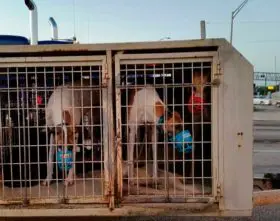
Cages greyhounds

Yes. In the United States, thousands of dogs in this industry are kept in enclosures kennels. These enclosures consist of long, narrow buildings with pens for dogs: Fenced dirt tracks where dogs are "taken out" and allowed to relieve themselves. In these areas, dogs are kept in kennels style warehouse in rows of cages stacked metal.

In the dog tracks of the different states, Greyhounds often suffer serious injuries. Since January 2008 until April 2018, They have documented a total of 15.273 injuries greyhound. The most commonly reported injury was a broken leg. Other injuries included head trauma, Electrocution fractures and back.

Read more

â–· The world of Pets: Dogs, cats, birds, reptiles, amphibians

More than one 85% Spaniards prefer the car to travel with your pet

But, not all owners carry yours with the correct restraint systems

The Andalusian, Madrid and Valencia, the most traveling with your pet

On the occasion of Easter are many travelers who carry with your pet for her also enjoy the holidays. In this situation the comparator Acierto.com He wanted to analyze. Yes, because, what is the preferred means of transport? Do we carry them correctly in the car? The latest report of the entity answers these and other questions.

Like this, analysis reveals that more than one 85% Spaniards prefer the car to travel with your pet against other means of transport such as train or plane, whose followers are reduced to 11,4% and to the 3% . A point in which the ignorance of the users and the restrictions of the transport companies themselves take on special relevance. In fact, Renfe own limited service pets less than 10 kg. In the case of long distance trains, In addition, you need to buy a ticket for them.

The limitations established by the airlines are similar, although they vary enormously according to the entity. However, Obtaining documents and permits in accordance with the legislation of the country of destination can condition the trip. For buses, most limit their transfer to the trunk.

Andalusians, Basques and Madrileños, the most traveling with your pet

Regarding those who travel the most with their pet, analysis shows differences between geographical areas. In particular, Andalusians are those who do more often, in a 74% occasions. They are followed by the Basques and Madrileños, with a 73%. On the opposite side we find the pet owners of Galicia and Castilla y León, that only they carry with them the 51% of the times. The Catalans do in the 55% travel.

The 32% of pets, loose

Unfortunately, The report also reveals that Hit 1 of each 4 drivers have been distracted by their pet behind the wheel. Specifically are males aged 18 and 24 years who suffer most from these distractions. The blame, of course, it is not our animals: to 32% of those who have a pet let it loose inside the passenger compartment.

Something that poses a serious danger to the safety of the members of the vehicle and the animal itself. Now well, only 4% supports always do, while the 28% remaining point to it only acting this way occasionally. As for sex, Men wear loose their pets more often; in particular, a 23% more than women.

The figures take on even more importance if we take into account that more than half of these drivers -specifically, 59.4%– have children. Unfortunately, the combination of a child and a loose animal in the rear seats could increase the risk of being neglected while driving and, Therefore, of being immersed in an accident.

«The most advisable way to transport our pet by car is to do it in the back seat, combining the transport with the dividing grid », remember Carlos Brueggeman, cofounder of Acierto.com. "Nevertheless, the current General Circulation Regulations do not explicitly include how pets should travel, but indicates that both objects and transported animals must be placed properly so as not to interfere with the driver », impacts.

It also, we can not forget that, If a frontal collision occurs, deceleration causes the weight of this (in this case, our mascot), multiply sign 20 or 30. "That is to say, in a crash of this type 50 kilometres per hour, a dog of 10 kilos would mean a collision mass of about 200 or 300 kg. Something that could cause more serious damage to what a priori could think », explica Bruggeman.

The expert also points to possible injuries of animals as, as a rule, Insurers do not consider them as "vehicle occupants". But, There are specific policies to cover the expenses of the veterinarian and that even contemplate compensation for accident or death.

â–· The world of Pets: Dogs, cats, birds, reptiles, amphibians

Tashi-Gong Tibetan Spaniels (Finland)