 FCI 285 . Short-haired Sighthounds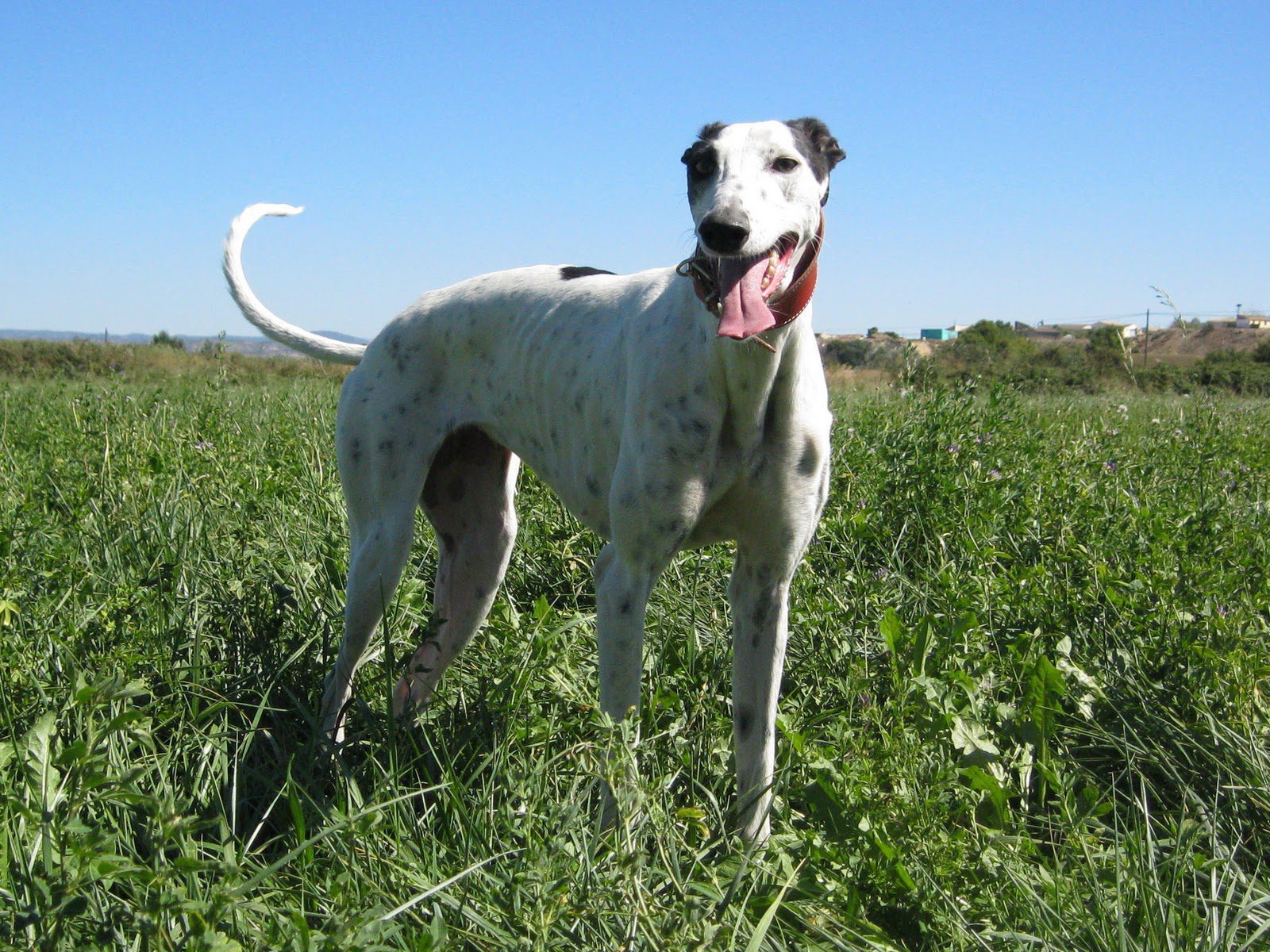
Content |
|---|
History
The Spanish greyhound it is an ancient breed of hunting dog. His specialty is hunting hares and other small game in difficult terrain.. The Spanish greyhound They are persistent and fast sight hunters. Type dogs Greyhound already described in the first reports of antiquity. They represent one of the oldest types of dog and have not changed their basic design for thousands of years. Its resemblance to the ancient Egyptian hunting dog Tesem, one of the oldest and also fairly well documented dog breeds of all, it's amazing.
Of 1930 to 1935, the wealthy landowners of southern Spain imported Greyhounds from England and raised here with the Greyhounds original. As the races of Greyhounds had become popular on English racecourses, saw an advantage in the crossing of the fast racing greyhounds. But, It was overlooked that these extremely high speeds of a greyhound occurred on flat tracks. In the changing, uneven and stony hunting grounds of a Spanish greyhound they are rather a disadvantage. Like a sports car off the road. But, This wave of imports meant that the real Spanish greyhound in the sense of purity and original function. It also, in his homeland little attention was traditionally paid to purity in the modern upbringing sense. Mixtures with Warren hound, for example, are standard. Plus, a large part of the population lives relatively self-determined anyway. All this is not a disadvantage for the quality and well-being of the dogs, not even for the race. And rather it favors the old Greyhound almost finds himself again and the influences of the Greyhound.
In the past, most dogs were bred according to this almost classical principle of selection for suitability, around the world. Mainly performance for the purpose counted. So, the breed can also be considered healthy in essence, healthier than many of the "high breeders" of pure race. The FCI, the world dog breeding association, officially recognized the breed Spanish greyhound in 1971. In 1982 a revised standard was written. It describes an anatomy that does justice to the special use of a hunting whippet in sight for persistent hare hunting in the field.
Popular mixes
There are many more mixes of Spanish greyhound which pure breeds according to the specifications of the dog breeding. Many of the stray dogs in the Iberian Peninsula descend from the Spanish greyhound, that -like the Warren hound– they are simply abandoned after being used by hunters. These dogs have developed a marked aptitude and cunning, that they used especially in their constant search for food.
Physical characteristics
The Spanish greyhounds show the typical appearance of a European greyhound. In Spain they are ubiquitous, but above all as street dogs and according to the pedigree breeding criteria above all mixes. This does not have to be a disadvantage with these dogs.. Along the centuries, have established themselves very well and have developed their type. But, the greyhounds they also have an official standard as purebred dogs for a long time 50 years. The official standard describes them like this:
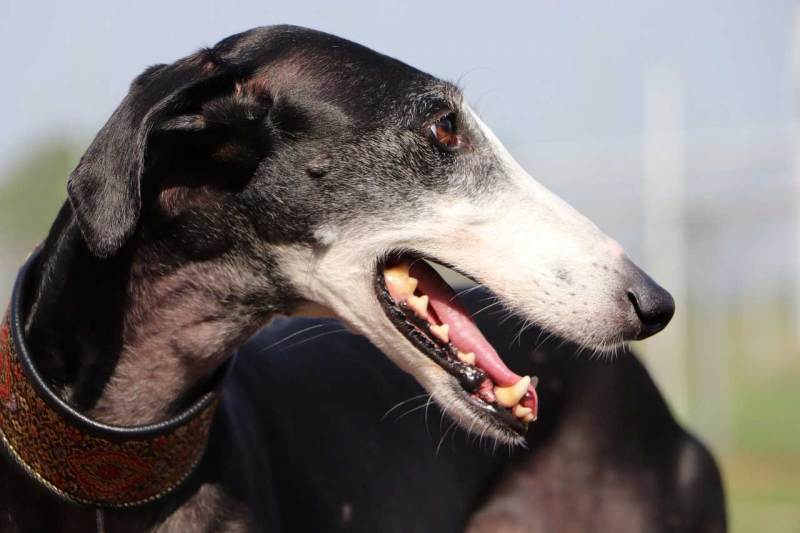
The Spanish greyhound is of considerable size, medium format, slightly convex profile, elongated, with elongated skull. compact skeleton, long narrow head, spacious chest, belly very tucked up and very long tail. Clearly vertical and muscular hindquarters.
He wears thin and short hair or -very rarely- semi-long and rough. The Spanish greyhound they do not have undercoat, what can be a problem in the harsh winters of northern Europe. All colors are permitted. The ears should form a wide, triangular-shaped base. When you are alert, the ears are half prick in the first third with the folded ends pointing to the sides. When they are at rest (relaxed) form a rose ear near the head.
What is the size of a "Spanish greyhound"?
No weight is prescribed, but yes the desired size. The Spanish greyhound must have a height at the cross of 62 to 70 centimeters for males and 60 to 68 centimeters for females.
How old is a "Spanish greyhound"?
There are no exact figures on the life expectancy of Spanish greyhounds. But, life expectancy can be considered very high, specifically of 12 to 15 years or more, provided there is no inbreeding.
Character and skills
The Spanish greyhound they are hunting dogs and greyhounds at the same time. They are very agile and alert. Almost nothing escapes your keen senses. Especially when they are young dogs, nervously yearn for exercise and experiences, ideally of a hunting nature and above all with the option of being able to run freely. As they tend to have a strong hunting instinct, this need so ingrained in the dogs of our latitudes can rarely be satisfied in nature.
It is an experience to see the greyhounds run in freedom. They can sprint quickly, even on difficult terrain, and they can make amazing hooks.
The Spanish greyhound they are very intelligent and docile. They quickly know what is allowed and what is taboo. They are kind and open with people. They have a good-natured character and can be charmingly cuddly.. They seek a close bond with their owners and are loyal to them. But they also go their own ways. Due to the harsh performance-oriented selection in their home country, they are very hard and resistant. In the specimens that were socialized as street dogs and then taken to other countries, a drive for freedom is often observed that should not be underestimated. The belt, which on the other hand gives the dogs a feeling of security, perceived as a threat and a constriction.
Many of these dogs find life in densely populated cities stressful., more than the usual struggle for survival in their home country. This also applies to restrictions on dogs. They can become so fearful and shy, who are under constant stress. They are challenges for the dog, and the owners, but in many cases they can be solved well with canine sense and a little affection. But, we cannot recommend them as a beginner dog.
What care does a "Spanish greyhound" need?
The Spanish greyhound he is extremely frugal. It is enough to brush the coat with a spiked glove from time to time.
Are there typical diseases of the "Spanish greyhound" race?
Against the background of performance-oriented selection in its country of origin and fluid genetic boundaries there with corresponding unknown inbreeding, his health is extremely robust and exemplary. This can be different sometimes with show dogs bred in other countries. The Spanish greyhound they do not have undercoat. They need professional clothing when it is very cold.
What food is better for a "Spanish greyhound"?
The Spanish greyhound has no special dietary requirements. It is a true omnivore. Of course, high quality food is good for your health and you like it too. The Spanish greyhound It is also suitable for "professional barfing".
Activities with the "Spanish greyhound"
How much exercise does a Spanish Greyhound need??
The Spanish greyhound it is a real hunting dog and sighthound. The Sighthound Association offers the opportunity to participate in sighthound races or coursing events with Spanish greyhound to keep the dog busy and physically active. Other dog sports, like agility, are also suitable. Due to his strong motivation for hunting, training requires a lot of patience and empathy.
Considerations before adopting a "Spanish greyhound"
Where can a "Spanish greyhound" be adopted?
If you want to share your life with a Spanish greyhound, you should look up a breeder or local animal shelters well before you buy one and make contacts here. The breeder must be trusted. Please, do not buy a Greyhound online, as there is a high risk that the puppy comes from a dog vendor disguised as an animal welfare organization. You can easily find greyhound-type dogs at a trusted animal shelter near you..
Characteristics "Spanish greyhound"
Coexistence is important that you have with your new friend. Before considering the acquisition of a dog of the breed "Spanish greyhound" you know certain factors. Not all breeds of dogs are apt to live in an apartment, you must take into account his character, their need for exercise, their interaction with other pets, their care and if you have small children, their level of tolerance towards them.
Adaptation ⓘ3,0 of 5 stars (based on 1 review)
|
friendly dog ⓘ2,0 of 5 stars (based on 1 review)
|
hair loss ⓘ3,0 of 5 stars (based on 1 review)
|
|---|---|---|
Affection level ⓘ5,0 of 5 stars (based on 1 review)
|
Need for exercise ⓘ5,0 of 5 stars (based on 1 review)
|
Social need ⓘ3,0 of 5 stars (based on 1 review)
|
Home ⓘ2,0 of 5 stars (based on 1 review)
|
Toilet ⓘ1,0 of 5 stars (based on 1 review)
|
Friendly with strangers ⓘ2,0 of 5 stars (based on 1 review)
|
barking ⓘ1,0 of 5 stars (based on 1 review)
|
Health ⓘ4,0 of 5 stars (based on 1 review)
|
Territorial ⓘ2,0 of 5 stars (based on 1 review)
|
Cat friendly ⓘ2,0 of 5 stars (based on 1 review)
|
Intelligence ⓘ3,0 of 5 stars (based on 1 review)
|
Versatility ⓘ3,0 of 5 stars (based on 1 review)
|
Child friendly ⓘ4,0 of 5 stars (based on 1 review)
|
Surveillance ⓘ2,0 of 5 stars (based on 1 review)
|
joy ⓘ3,0 of 5 stars (based on 1 review)
|
Images "Spanish greyhound"
 1
1
 2
2
 3
3
 4
4
 5
5
 6
6
Photos:
1 – "Spanish greyhound" by https://pixabay.com/es/photos/galgo-español-rápido-perros-3799630/
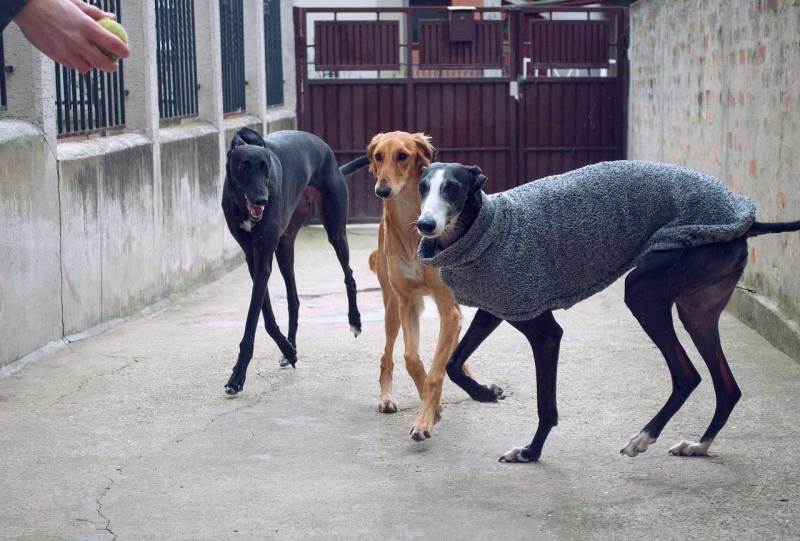
2 – "Spanish greyhound" by https://pixabay.com/es/photos/perros-jugando-galgo-español-saluki-3799600/
3 – «Spanish greyhound» by Netspy, CC BY-SA 3.0, via Wikimedia Commons
4 – "Spanish greyhound" by https://pixabay.com/es/photos/greyhound-galgos-4890924/
5 – «Spanish greyhound» by https://www.pxfuel.com/es/free-photo-xeivz
6 – "Spanish greyhound" by https://pixabay.com/es/photos/perro-galgo-mascotas-3765523/
Videos "Spanish greyhound"
 the standard Spanish greyhound and its characteristic
 Spanish Greyhound – Breed of dog
 Hare hunting with Spanish Greyhound
 Spanish Greyhound
Type and recognitions:
- FCI CLASSIFICATION: 285
- Group 10: Sighthounds
- Section 3: Short-haired Sighthounds. Without working trial..
Federations:
- FCI – Group 10: Section 3: Short-haired Sighthounds ⓘ
- RSCFRCE ⓘ
FCI breed standard "Spanish greyhound"
Use:
Hare hunting dog on the run, in quick pursuit and guiding into sight. It has also been used and can harass other hair pieces such as rabbits, foxes and even wild boars; but the main use of the breed has been and is hunting hares on the run.
General appearance:
Good-sized Greyhound, eumétrico, subconvexo, sublonguilíneo and dolicocéfalo. Compact skeleton, long narrow head, large capacity thorax, Very retracted belly, and very long tail. Well poised and muscular rear train. Fine and short or hard and semi-long hair.
- IMPORTANT PROPORTIONS : Sublonguilinear structure; longitudinal diameter slightly greater than elevation at the withers. Proportionality and functional harmony should be sought, both in static and in motion.
Serious and withdrawn; Sometimes although in hunting a great energy and vivacity.
Head:
Provided with the rest of the body, long, lean and dry. The skull-muzzle relationship is 5/6 : skull length 5, muzzle length 6. Divergent skull-facial lines. The skull-muzzle assembly seen from above must be very elongated and uniform; with long snout, Strait.- Skull: Small width and sub-convex profile. The width of the skull will not reach the measurement of its length. The skull is crossed by a well-marked central groove in its first two thirds; the frontal sinuses and occipital crest are simply marked.
- Depression links (Stop): Soft, very little accentuated.
facial region:
- Truffle: Small, Wet and black mucous membranes.
- Snout: Long, sub-convex profile, with slight brushing of the upper edge towards the nose. Narrow muzzle.
- Lips: Very lean. The upper one will just cover the lower one. The lower one will not present a marked lip corner. Fine, tense and dark mucous membranes.
- Jaws/Teeth: Strong teeth, white and healthy. Scissor bite. Highly developed canines. All premolars exist.
- Eyes: Small, oblique, macaroons; preferably dark, Hazelnut coloured. Quietly, sweet and reserved.
- Eyelids: Thin-skinned and dark mucous membranes. Very attached to the eyeball.
- Ears: Wide base, triangular, fleshy in its first third and thinner and finer towards the end that will be in a round tip. High implementation. At attention semi erect in the first third with the tips bent to the sides. At rest in pink, glued to the skull. By exerting traction, they will reach very close to the corner of both lips.
- Palate: The color of the mucous membranes with very marked ridges.
Neck:
Long, oval section, plane, slender, strong and flexible. Narrow in the head part, continuing with slight widening towards the trunk. Slightly concave top edge. Nearly straight lower edge with slight central convexity.Body:
- Seen as a whole: Rectangular, strong and flexible, giving a feeling of strength, agility and endurance. Widely developed chest, belly very collected.
- top line: With slight concavity on the back and convexity on the spine. No sudden interruptions and no oscillations during movement, giving a feeling of great elasticity.
- Cross: Simply marked.
- Back: Straight, long and well defined.
- Pork loin: Long, strong, not very wide and arched upper edge with compact and long musculature, giving a feeling of elasticity and strength. The height of the spine in its central part may exceed the height at the withers.
- Rump: Long, powerful and on a desk. Its inclination is greater than 45 ° with respect to the horizontal line.
- Breast : Powerful, although not very wide; deep without reaching the elbow and very long to the floating ribs. Tip of the sternum marked.
- Ribs: Ribs with wide and flattened intercostal spaces. The ribs must be well visible and marked. The chest perimeter will be slightly superior to the lodging to the cross.
- Belly and flanks: Belly sharply drawn from the sternum; whippety. Short and dry sides; well developed flanks.
Tail:
Strong-born and low-set, It runs glued between the legs, gradually refining until it ends in a very fine point.
Flexible and very long; far beyond the hock joint. At rest in the form of a hoz with a very accused and laterally inclined final hook. Tucked between legs with final hook that almost brushes the ground in front of the hindquarters; it is one of the postures that confer more typicality to the breed.
Tips
PREVIOUS MEMBERS
- Seen as a whole: Perfectly Plumb, fine, straight and parallel; short and thin pasterns; hare feet.
- Back: Dry, cut and slanted. The scapula must be significantly shorter than the arm.
- Arm: Long, longer than the scapula, very muscled, with free elbows but close to the trunk.
- Forearm: Very long; straight and parallel, well defined bones, with well marked tendons. Highly developed carpal pads.
- Metacarpus: Slightly inclined, thin and short.
- Previous feet: Of hare. High and tight fingers. Strong and long phalanges. Well-developed, hard tubers and pads. Moderate webbing and well developed nails.
- Angles: Scapulo-Humeral angle : 110°. Humer-radial angle : 130°.
LATER MEMBERS
- Seen as a whole: Powerful, well defined bones, muscular with long and well developed muscles. Perfectly plumb and with correct angulations. Well marked hocks; metatarsals short and perpendicular to the ground; hare feet with high toes.
- The rear members give a sensation of power and agility in the impulse.
- Thighs: Very strong, long, muscular and tense. The femur as perpendicular as possible. Seen from behind they will present a very marked musculature to the naked eye; long, flat and powerful, its length is 3/4 of the leg.
- Leg: Very long, of marked and fine bone. Muscled on your part
- top; less in the lower zone, with clear appreciation of veins and tendons.
- Hocks: Well marked with clear appreciation of the tendon that will be very developed.
- Metatarsus: Up, short and perpendicular to the ground.
- Hind feet: Of hare, as in the previous members.
- Angles: Lame-femoral angle : 110°. Femoral-tibial angle : 130°. Hock angle : higher than 140 °
Movement:
The typical movement is naturally gallop. The trot must be long, flush to ground, elastic and powerful. Without tendency to laterality and without ambling.Mantle
SKIN: Very close to the body in all its areas, strong and flexible; Pink. The mucous membranes must be dark.
HAIR: Bushy, very delicate, short, smooth; distributed throughout the body to the interdigital spaces. Slightly longer at the back of the thighs. The semi-long wire-haired variety has greater roughness and hair length, which can be variable; although always evenly distributed throughout the body, it comes to present a beard and mustaches on the face, over eyebrows and toupee on the head.
COLOR: Indeterminate. The following are considered as typical and in order of preference:
- Barcinos and brindle more or less dark and with good pigmentation.
- Blacks.
- Dark and light wafers.
- Toasted.
- Canelas.
- Yellow.
- Red.
- Whites.
- Pronghorn and pios.
Size and weight:
Height at the withers :
- Males of 62 to 70 cm.
- females of 60 to 68 cm.
A margin of 2 cm for specimens of excellent proportions.
Fouls:
Any deviation from the Any deviation from the aforementioned criteria is considered as faulty and the seriousness of it is considered to the degree of the deviation to the standard and its consequences on the health and well-being of the dog..
MINOR FAULTS:
- Slightly broad or slightly chiseled head.
- Straight muzzle profile, pointed snout.
- Accused parietals.
- Absence of some premolar.
- Bitefork clamp.
- Slightly short tail, poorly overhanging the hock.
- Scars, wounds and decorations during hunting season.
SERIOUS FAULTS:
- Big head.
- Excessively broad skull and pointed muzzle.
- Very marked nasal-frontal depression.
- Parallel craniofacial axes.
- Belfos and marked dewlap.
- Moderate upper prognathism.
- Absence of canines not due to trauma.
- light eyes, round, prominent heels.
- Ectropión, entropion.
- Short ears, Oh raised pequeñas.
- Short round neck.
- Saddled dorso-lumbar line.
- Kidney lift lower than withers lift.
- Short croup, round or slightly sloping.
- Scarce chest perimeter.
- Barrel ribs.
- Short flanks.
- Very globular muscles, round and slightly elongated.
- Wrong limbs, fingers apart, cow hocks.
- Weak pads.
- Tail and ears docked.
- Strong line appearance, heavy or inflexible.
- Unbalanced character.
MISS PLAYOFFS:
- Aggressive or fearful dog
- Lack of typicality.
- Split nose.
- Pronounced upper prognathism or lower prognathism.
- Very wide back-lumbar line, flat and straight.
- Chest that widely exceeds the elbow.
- Any other typicity sign that you remember or indicate
- miscegenation.
- albinism
Any dog showing clear signs of physical or behavior abnormalities must be disqualified.
The aforementioned criteria is considered as a fault and its severity is considered to the degree of the deviation to the standard and its consequences on the health and well-being of the dog.
Males should have two normal-appearing testicles fully descended into the scrotum..
Source: F.C.I - International Cynological FederationAlternative names:
1. Spanish Galgo, Galgo (English).
2. Galgo espagnol (French).
3. Galgo, Galgo español (German).
4. Galgo español (Portuguese).
5. Lebrel español, Galgo (español).