Origin: Australia, Indonesian, New Caledonia, Papua New Guinea, Solomon Islands, Timor-Leste, Vanuatu
Character: Active
Life expectancy: 25 years
Height: 26 cm..
Content
Description:
26 cm.. of length and weight 100-157 g.
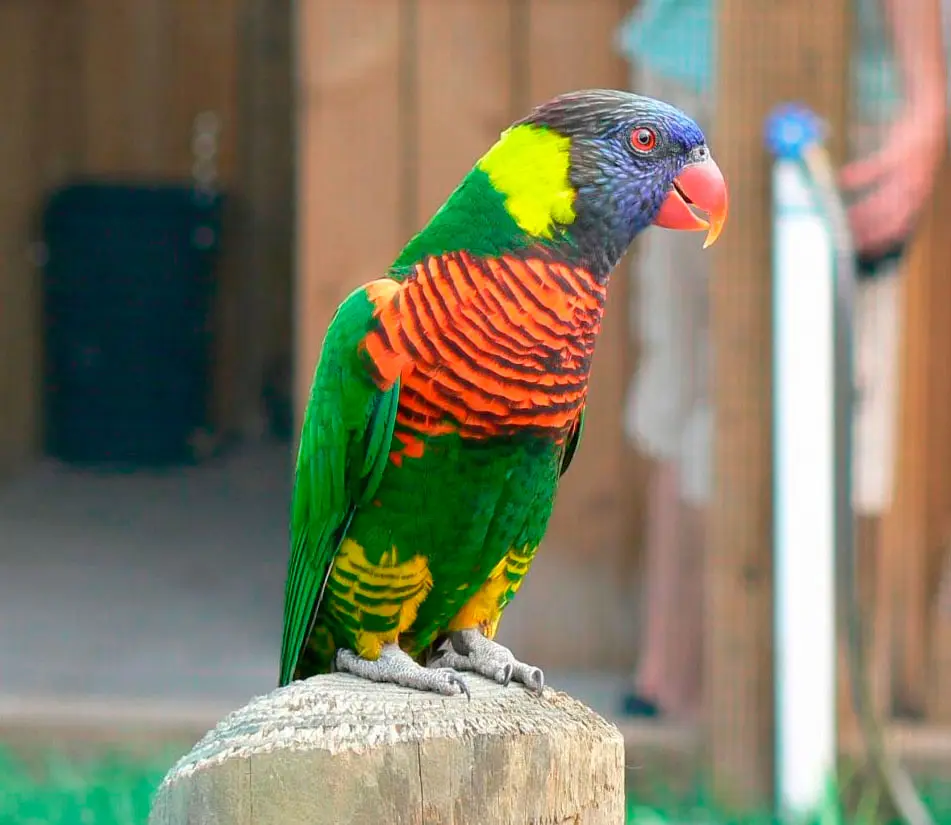
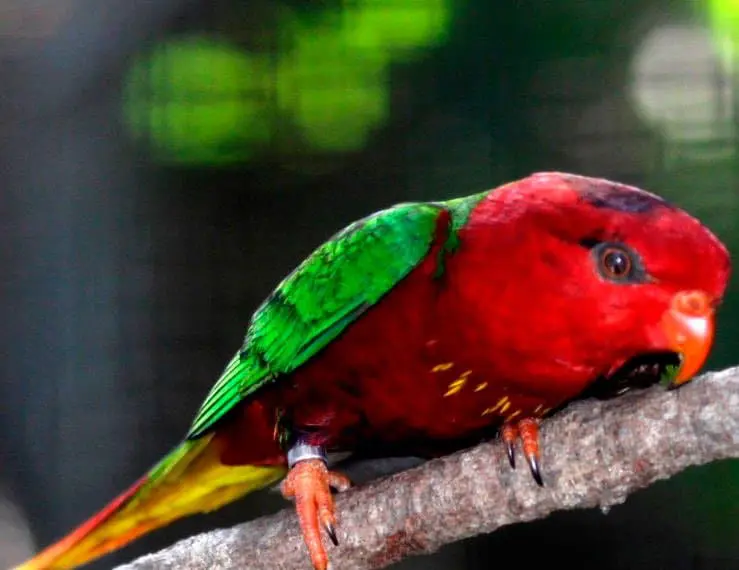
The Coconut Lorikeet(Trichoglossus haematodus) are colourful birds that find us almost all the colours of the Rainbow in their plumage.
Have the front of the crown, face and throat Dark bluish mauve, with violet stripes on the front of the crown, ear-coverts and part low of them cheeks; the rest of the head is dark blue with the bases of feathers brown-black color, especially around the rear of the crown and throat, and with greenish stripes at the rear of the crown.
The upperparts are of color green brilliant with specks of color reddish in the center of the the mantle (bases of feathers), and collar back brighter yellowish green.
The primaries with the tips blackish; a patch bright yellow in the innerwebs of the flight feather, that tends to orange in the secondaries; outerweb of the primaries and under wing-coverts, green. Underwing-coverts orange-red; the flight feather dark gray in tips.
The Breast
, the upper part of the abdomen and flanks bright reddish orange top, barred dark blue, tending to green at the bottom of the chest; abdomen with brands of color green in the Center, sometimes forming a discrete patch or interspersed with reddish orange; abdomen and the thighs with a beaming green and yellow with bases of color yellow; undertail-coverts of color yellow with tips of color green glossy. Upper, the tail of color green with them innerwebs of the lateral feathers yellowish: undertail, the tail greyish green in the outerweb, yellow in the innerwebs.
The bill orange red: the irises orange-red; legs gray or greenish gray.
Both sexes are very similar.
The immature they are more muted than adults, with the bill and the irises dark brown and tail more pointed.
Sound of the Coconut Lorikeet.
Description of subspecies of Trichoglossus haematodus
Trichoglossus haematodus caeruleiceps
(Albertis & Salvadori, 1879) – The blue of the head is more pale, Red is orange-red with the lined in very narrow and dark blue. Abdomen Blackish and band of the neck yellow.
Trichoglossus haematodus deplanchii
(Verreaux,J & Des Murs, 1860) – 26 cm.. of length and a weight of 140 gr.
The Coconut Lorikeet (deplanchii)(Trichoglossus haematodus deplanchii) is a variation of the nominal (Trichoglossus Haematodus)
Similar to the nominal Haematodus, but plumage slightly paler. The head has a very bright blue. Reddish orange on the chest, similar to the Trichoglossus haematodus massena, only that more alive. The abdomen is of color green beige and is extends to the part back from the neck. The the thighs and the feathers under the tail yellow and the upper part of the tail olive green.
Trichoglossus haematodus flavicans
(Cabanis & Reichenow, 1876) – Something bigger, 27 cm approximately in length. Its plumage varies from green to olive green and yellow opaque. Breast
and neck reddish colour with fine dark edges. Forehead and contour of eyes violet blue.
(Rothschild & Hartert, 1901) – 26 cm approximately in length. The blue of the head extends slightly less. The neck is yellow and the abdomen dark green.
The Coconut Lorikeet (massena) (Trichoglossus haematodus massena) is a variation of the nominal (Trichoglossus Haematodus).
The plumage is similar to the of the Ornate Lory except that it is usually paler. The head is blue, ending at the nape with dark brown feathers interspersed with more Brown clear. The chest is of color reddish with a narrow edging blue dark. In some cases, You can see some areas yellow in the plumage of the chest. The abdomen is green; but there may be some kind of mark on the bottom of the abdomen blue-violet.
The eyes are of color orange in the adult and Brown in the youth. The bill is red orange.
Trichoglossus haematodus micropteryx
(Stresemann, 1922) – Somewhat smaller, 25 cm approximately in length. The plumage is something more pale, the chest reddish orange with narrow edging of dark blue. Abdomen dark green. Band of the neck greenish yellow.
Trichoglossus haematodus nesophilus
(Neumann, 1929) – 26 cm approximately. Very similar to the Trichoglossus Haematodus Flavicans but with feathers underneath of the tail are green.
Trichoglossus haematodus nigrogularis
(Gray,GR, 1858) – Something bigger, 28 cm., approximately, length. Is similar to the Trichoglossus Haematodus Caeruliceps, but the blue of the head It is more dark and often have more red feathers on the neck.
Habitat:
The Coconut Lorikeet they are parrots of the Plains and Highlands. They are distributed by a wide variety of habitats such as mangrove forests, Moors and heathland near the coast, wooded meadows, tree galleries, reforestation during regeneration and rainforests.
In all cases, they need places with abundant flowers.
The Coconut Lorikeet they have also colonized habitats formed by man: coconut plantations, orchards and gardens on the outskirts of cities. They mark a greater preference for edges and clearings inside the dense jungles. Gladly tolerate the areas with degraded vegetation and plantations of small size in the small atolls.
They are birds sedentary, that does not prevent to do short trips looking for trees in flower. Because of these movements, populations appear to vary locally. Very gregarious, they live in pairs or in bands that can vary from a few birds to several hundred, Depending on the availability of food resources.
These birds are very active and noisy, flying a bit randomly above the tops of the trees or climbing up the branches in search of flowers or fruits.
during their search for food, the Coconut Lorikeet they usually share the space with other species of frugivores.
When they are hidden among the leaves, their cries of call reveal their presence.
They adopt a flight very quick and direct.
Son monogamous. During courtship, the couple is side-by-side, swaying, the neck forward and the pupil dilated. They wave irregularly wings to reveal the clear band that crosses its sub-wing.
Reproduction:
The breeding season performed at different times depending on the distribution area.
The species nominal eat your laying between September and December. Both members of the couple set up their nests in a tree cavity, usually a eucalyptus. Several nests, two or three may be in the same tree, but the entrance of the nest will fiercely defend against any intrusion.
In the the Admiralty Islands, the Coconut Lorikeet Sometimes they nest in the ground. The female normally lays 2 eggs on a bed of wood rotting chips. She incubated alone for a few 25 days.
The young chicks are altricial and need to 8 weeks to fend for if same. As soon as they are autonomous, they bind to the bedrooms and common bands.
Food:
The Coconut Lorikeet they have a bill acute equipped with a language composed of some structures similar to hairs tiny called papilla it help excavate the pollen and the nectar from the flowers.
Also eat fruits, berries, seeds, outbreaks and insect larvae.
In Australia, they forage primarily in eucalyptus trees and trees of the genus Banksia, in particular, coastal Banksia(Banksia integrifolia) and river banksia (seminuda), trees that often exceed the 15 metres in height.
They are also found in farmland, since they are particularly cultivated fruits and seeds Milky enthusiasts.
Easily entering gardens to steal fruit and not disdain approaching feeders
Distribution:
Size of its range (breeding/resident ): 5,310,000km 2
Endemics Oceania, at the edge of the Asian continent.
Can be found in Australia, in the East of Indonesian, Papua New Guinea, New Caledonia, the Solomon Islands and Vanuatu.
In Australia, mostly found on the coast, to the North of Queensland in the South of Australia and Tasmania.
Distribution of subspecies Trichoglossus haematodus
• Red List category of the UICN current: Least concern
• Population trend: Decreasing
The species has undergone intense trade: from 1981 When it began trading in CITES Appendix II and through the year 2005, 100.388 individuals were captured in the wild and reported in the international trade.
In some places of Australia, It is hunted for food and feathers are later used in ritual ceremonies
– Coconut Lorikeet, Rainbow Lorikeet (Coconut) (English).
– Loriquet à tête bleue (French).
– Allfarblori (German).
– Lóris-arco-íris (Portuguese).
– Lori Arcoiris, Lori de cocotero, Tricogloso de Pecho Rojo (español).
– Avibase
– Parrots of the World – Forshaw Joseph M
– Parrots A Guide to the Parrots of the World – Tony Juniper & Mike Parr
– Birdlife
– Oiseaux.NET
– Photos:
(1) – Rainbow Lorikeet perching on a wooden post at Tanganyika Wildlife Park, Kansas, USA. by Snowmanradio – Wikipedia
(2) – A Green-naped Lorikeet, T. h. haematodus, a sub-species of Rainbow Lorikeet, Trichoglossus haematodus at Jurong Bird Park, Singapore. by Benjamint444 – Wikipedia
(3) – A Rainbow Lorikeet (Trichoglossus haematodus moluccanus) in Melbourne, Australia. by Alfred Sin – Wikimedia
(4) – Lorikeets feeding on the flowering tree, Corymbia ‘Summer Beauty’ (cultivar). Photographed in suburban Brisbane, Australia. by Tatiana Gerus – Wikimedia
(5) – Two birds preening each other. Jervis Bay, New South Wales, Australia by Arnie Hollyman – ibc.lynxeds.com
Origin: Colombia, Venezuela, Mexico, Brazil, Panama, Costa Rica
Character: Sociable
Life expectancy: 10 to 25 years
Height: 17 to 20 cm..
Content
Description:
Of 17 to 20 cm. length between 76 and 102 g. of weight.
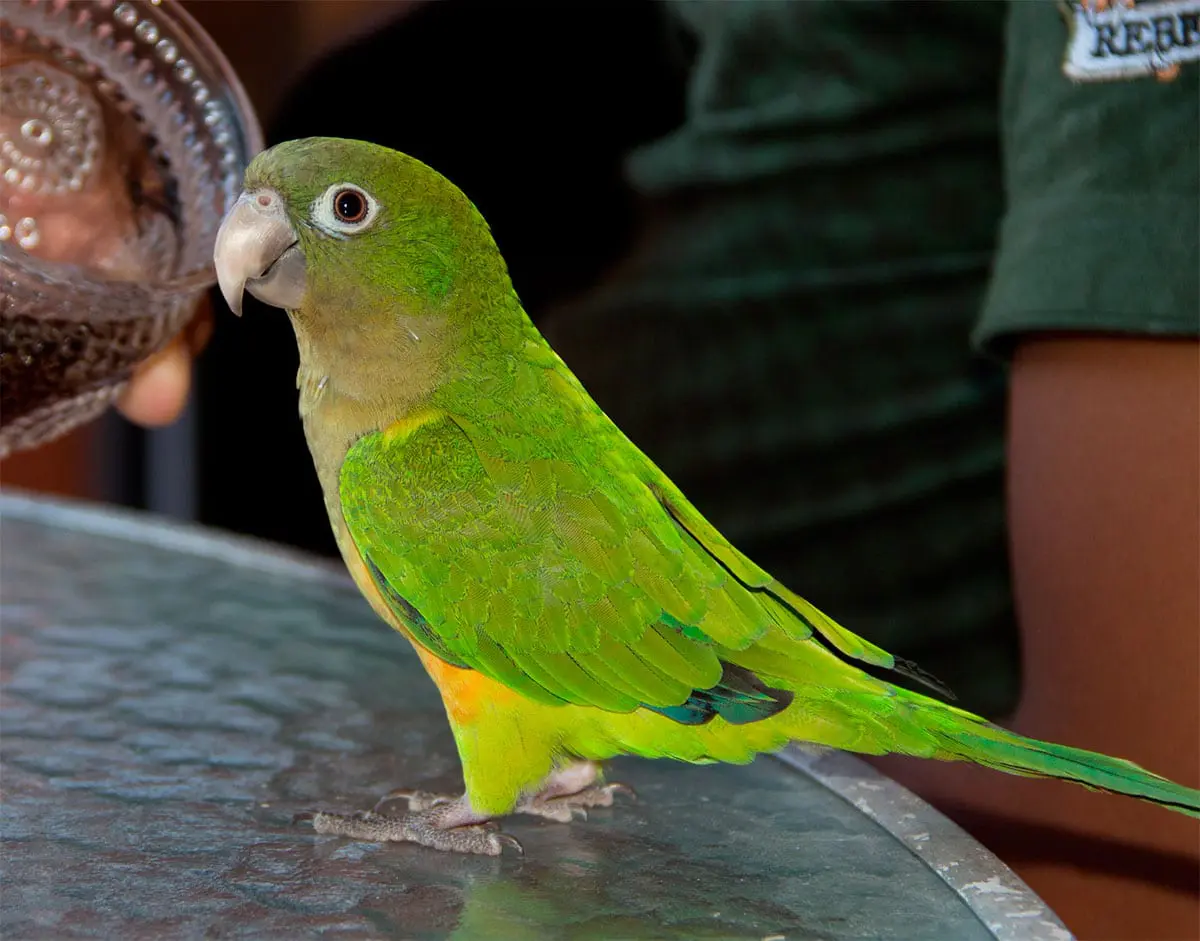
The Brown-throated Parakeet(Eupsittula pertinax) it is a polytypic species. Its fourteen subspecies are distinguished by the mix yellow and Brown on his face and throat.
In the case of the Eupsittula pertinax aeruginosa, the lores previous, the frontal area, underside of cheeks, both sides of the neck and ear-coverts, are dark brown; dark stripes visible on the cheeks; the feathers of the ocular region are of color orange-yellow; the crown greenish blue. Upperparts olive green. Lesser and medium coverts green; bluish green the primaries and greater coverts. Primaries and secondaries green up, Blue dark on the tips, Blue them vane outer in the secondaries; by down dark grey. Underwing-coverts brighter yellowish green. The throat and the top chest dark brown; the underparts Matte yellowish green with an orange patch in the central area of the belly. For above, the tail is of color green blue, bluer towards the tip; undertail greyish-yellow.
The bill brownish-grey; bare periophthalmic yellowish white; irises yellow, legs grey.
Both sexes similar, without sexual dimorphism, where males are larger than females.
The youth they tend to lack intense yellow, that is alive in individuals adults. Its forecrown is dark greenish blue. The throat and the chest are greenish, while the belly is green with a bit of orange or yellow.
Eupsittula pertinax arubensis (Hartert) 1892 – Cara and throat color opaque marron-oliva. Narrow yellow line on the eyes. Crown greenish blue.
Eupsittula pertinax chrysogenys (Massena & Souance) 1854 – Similar to the aeruginosa subspecies, but darker.
Eupsittula pertinax chrysophrys (Swainson) 1838 – Similar to the subspecies margaritensis and venezuelae but with the forecrown a pale yellowish brown.
Eupsittula pertinax griseipecta (Meyer de Schauensee) 1950 – Similar to the aeruginosa subspecies, with the cheeks, the throat and top of the chest, Gray-olive, veins in the cheeks absent. The crown Green with little blue.
Eupsittula pertinax lehmanni (Dugand) 1943 – Is similar to the aeruginosa subspecies, but with yellowish feathers around the eye more extensive; the Blue head limited with the forecrown and less blue in the flight feather.
Eupsittula pertinax margaritensisCory 1918 – Forehead whitish, the cheeks and ear-coverts color oliva-marron with forecrown greenish blue.
Eupsittula pertinax ocularis (Sclater,PL & Salvin) 1865 – Patch distinctive yellow below and behind the eyes (absent in the immature). Forehead and crown green color with tint blue in some birds. Throat, top of the chest, the cheeks and lores warm brown; ear-coverts slightly darker.
Eupsittula pertinax paraensis (Sick) 1959 – Similar to the aeruginosa subspecies, but with the irises of color red and the vane outer of primaries and secondaries blue.
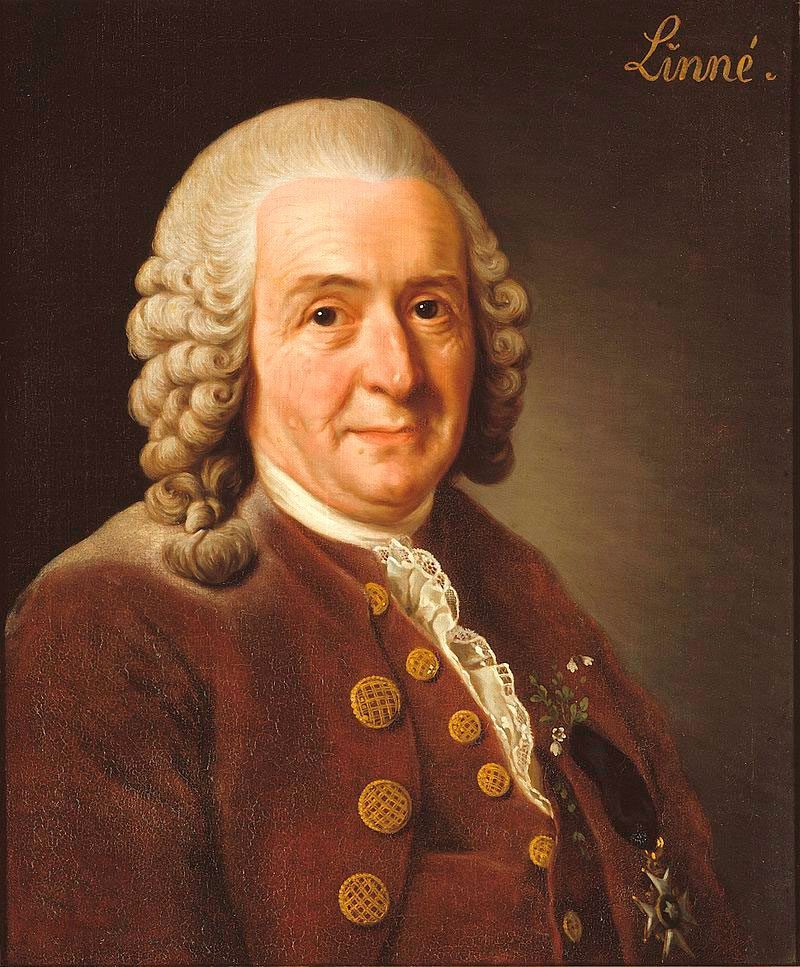
Eupsittula pertinax pertinax (Linnaeus) 1758 – The nominal. Extensive but variable amount of yellow color in the forecrown, the cheeks, the throat and lores. It may be more off or more Orange under and behind the eyes. Crown Green with only a few light blue indications.
Eupsittula pertinax surinama (Zimmer & Phelps,WH) 1951 – Similar to the subspecies margaritensis but with narrow frontal band orange-yellow color, orange-yellow colour around the eyes extending towards the cheeks and yellowish-green (not brown) the throat.
Eupsittula pertinax tortugensis (Cory) 1909 – Similar to the aeruginosa subspecies but larger, orange-yellow color on both sides of the head and underwing-coverts more yellowish.
Eupsittula pertinax venezuelae (Zimmer & Phelps,WH) 1951 – Similar to the subspecies margaritensis but more pale and yellow on the underparts.
Eupsittula pertinax xanthogenia (Bonaparte) 1850 – Clearer (almost sallow) the head the species nominal, with yellow tones ranging from a variable on the front of the crown and nape.
Habitat:
Video – "Brown-throated Parakeet" (Eupsittula pertinax)
Brown-throated Parakeet Eupsittula pertinax / dirty face parakeet
The Aratinga Pertinaz occupies all kind of fields wooded open of the Savannah, transparent areas of dry scrubland full of cactus and acacias, forests of mangrove, tropical forests (where is the most abundant parrot species often), gallery and white sand forests, Mangroves of Rhizophora, edges of moist evergreen forests, and agricultural areas with palms and other trees.
Move at altitudes on the 1.200 m or more, Although they tend to stay below the 1.200 m. This Aratinga also lives in artificial clearings such as public parks or gardens..
In general, observed in flocks or pairs, forming larger groups where food is abundant and in communal roosts.
Reproduction:
The Brown-throated Parakeet It monogamous. With plays After the season of rains, in general from February to April. Birds very social, assess potential mates in large communal roosts. Also used strong calls in select to your mate / to.
Its breeding season It begins after the rainy season, and varies geographically between the months of February and September. Between February and April in Goal, Colombia; from February to April in Venezuela and any time of the year in Suriname, Curacao, Aruba and Bonaire.
When the conditions are favorable this species You can reproduce several times a year. Son colonial and have been observed up to seven pairs nesting next to each other.
Nest in the cavities of trees, artificial nesting boxes, or in arboreal termite. There are reports of nests made in cracks in rocks. The nests they are very simple, without any plant covering and the eggs, often, they are placed on the floor of the cavity nude. The number of eggs in a nest varies from two to seven.
The female is the primary incubator, with one incubation which can last thirty-six to thirty-seven days in the wild. The chicks they leave the nest after 50 days. The young join their parents and form small family groups that last until the parents begin a new breeding season..
Sometimes it causes damage to crops (for example, of millet and handle), of corn in Colombia and in fruit plantations of the Netherlands Antilles. Despite being considered pests in some areas, the Brown-throated Parakeet they are not strongly persecuted.
They feed in very vocal groups that often include macaws and amazon parrots.
Distribution:
The Brown-throated Parakeet are distributed to the North of South America, Panama and the islands of the Southern Caribbean.
In Panama are present in the slope of the peaceful, rarely on the side of the Caribbean, even in the canal area. But, they occupy the lowlands of the Northern Caribbean and northeast of Colombia, from the East of the Sinu River up to the Guajira peninsula, including the Center and low Magdalena valley, and observed at elevations more low in the East of the Andes and the lowlands of the South of the Alto Orinoco, to the North of Vaupés.
Probably can be observed in all Venezuela, extending to the Margarita Islands, Turtle (Venezuela), Curacao, Aruba and Bonaire (Netherlands Antilles); introduced in St Thomas, virgin islands, in the 19th century.
Its distribution extends through of the Guianas and the North of Brazil, from Roraima until Amapá, as well as discontinuously in the upper part of the basin of the Tapajos River, For and in the basin of the Black river, amazon.
In spite of his uneven distribution, usually common to abundant, in many places it is the most common parrot (for example in localities of Guyana), locally common in Panama and reportedly very common in black rivers and Branco, Brazil.
Your area of distribution possibly be increasing due to deforestation. In general resident with local seasonal movements (for example, in the region of Santa Maria, Colombia) the availability of food and the dispersion of the areas of reproduction-related.
Distribution subspecies Eupsittula pertinax
Subspecies
Eupsittula pertinax aeruginosa (Linnaeus) 1758 – North of Colombia, Northwest of Venezuela and the upper part of the basin of the Rio Branco, in the Northwest of Brazil
Eupsittula pertinax chrysogenys (Massena & Souance) 1854 – Region of Black river and, possibly, Solimões River, North of Brazil; There are no details about its area of distribution
Eupsittula pertinax chrysophrys (Swainson) 1838 – Southeast of Venezuela, Guyana Interior and North of Roraima, Brazil.
Eupsittula pertinax griseipecta (Meyer de Schauensee) 1950 – Valley of the sinu river, North of Colombia. Range in relation to the aeruginosa subspecies unclear
Eupsittula pertinax lehmanni (Dugand) 1943 – It is from Colombia and possibly Venezuela.
Eupsittula pertinax margaritensisCory 1918 – Islands Margarita and The friars, Venezuela. the birds of the Paria Peninsula in the North of Venezuela, they can be of this subspecies; see the subspecies venezuelae
Eupsittula pertinax surinama (Zimmer & Phelps,WH) 1951 – French Guiana and Suriname through the coast of Guyana to Delta Amacuro, Northeast of Venezuela.
Eupsittula pertinax tortugensis (Cory) 1909 – Turtle Island, Venezuela.
Eupsittula pertinax venezuelae (Zimmer & Phelps,WH) 1951 – North and Central Venezuela. Areas of contact with other little-known Venezuelan subspecies: see aeruginosa, surinama and chrysophrys.
• Red List category of the UICN current: Least concern
• Population trend: Growing
The Eupsittula Pertinax (Pit and neck of 2014) was considered, previously, belonging to the genus Aratinga.
The subspecies Griseipecta, endemic of the sinu valley in Colombia, There have been since 1949 and is likely to be extinct (T. Donegan in litt. 2011).
The size of the population world of this kind not has been quantified, but it is described as "common» (Stotz et to the. (1996). Is considered as the Parrot more abundant in the land low for the Caribbean, Plain in Colombia, Guyana, North of Suriname and the three islands of the Netherlands Antilles.
A density of five to eighty and nine birds by kilometer square is has estimated in the regions of the Northwest of Venezuela.
It is believed that populations on the continent are increasing their range in response to an increase in the conversion of the forest into farmland.
This species is often captured with commercial purposes, but not has been consequences serious, with the exception of the subspecies Aratinga pertinax margaritensis and Aratinga pertinax tortuguensis.
The Aratinga pertinax tortuguensis It is also vulnerable to severe climate changes. (Juniper and Parr, 1998;. Pit, et to the, 1997)
"Brown-throated Parakeet" in captivity:
The Brown-throated Parakeet has a average vinein the nature of about ten years. But, When live in captivity with the proper supervision, they have come to live up to twenty-five years.
common in the industry of the pet because, mainly, to your behavior affective. Captured for the pet trade and occasionally as food.
Pretty noisy, both in the nature as in captivity. With certain skills for repeated whistles and words short.
Alternative names:
– Brown-throated Parakeet, Brown throated Parakeet, Brown-throated Conure, Caribbean Parakeet, Curacao Conure, Curacao Parakeet, St. Thomas’s Conure (English).
– Conure cuivrée, Conure de Saint-Thomas, Perriche cuivrée, Perruche cuivrée (French).
– Braunwangensittich (German).
– Aratinga de-cara-parda, aratinga-de-bochecha-parda, periquito-de-bochecha-parda (Portuguese).
– Aratinga Pertinaz, Perico cara sucia, Perico Carisucio, Perico Gorgicafé, Periquito de Cola Corta, Periquito Gorgimoreno (español).
– Loro carisucio, Perico Carisucio (Colombia).
– Perico Gorgicafé (Costa Rica).
– Perico Cara Sucia (Venezuela).
– Avibase
– Parrots of the World – Forshaw Joseph M
– Parrots A Guide to the Parrots of the World – Tony Juniper & Mike Parr
– Birdlife
– Animal Diversity Web
– Photos:
(1) – Aratinga pertinax By Genes Luna (Flickr: IMG_0309.jpg) [CC BY-SA 2.0], via Wikimedia Commons
(2) – Aratinga pertinax xanthogenia By gailf548 (originally posted to Flickr as Young Parrot) [CC BY 2.0], via Wikimedia Commons
(3) – Eupsittula pertinax arubensis By Alexander Yates (originally posted to Flickr as Aruba Parakeet) [CC BY 2.0], via Wikimedia Commons
(4) – Brown-throated Parakeet (Aratinga pertinax venezuelae) in Cagua, Estado Aragua, Venezuela By Cristóbal Alvarado Minic [CC BY 2.0], via Wikimedia Commons
(5) – Aratinga pertinax aeruginosa By Aratinga_pertinax_-Colombia-8a.jpg: anthrotectderivative work: Snowmanradio [CC BY 2.0], via Wikimedia Commons
(6) – Eupsittula pertinax By Leizelt, Balthasar Friedrich; Wilhelm, Gottlieb Tobias [CC BY 2.0 or Public domain], via Wikimedia Commons
Origin: Venezuela, Guyana, Suriname, French Guiana, Brazil
Character: Sociable
Life expectancy: 30 years.
Height: 30 cm..
Content
Description:
Of 30 cm.. length and a weight between 120 and 130 g.
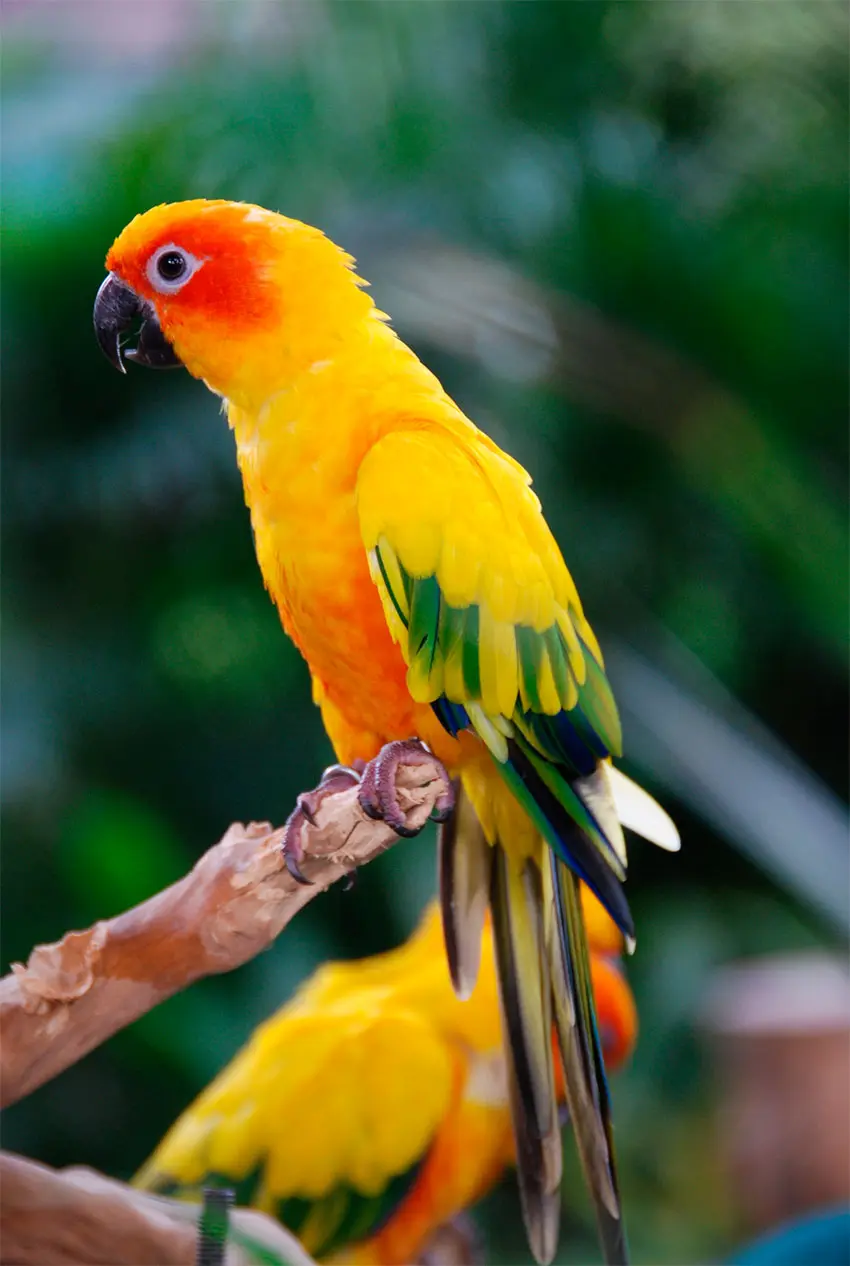
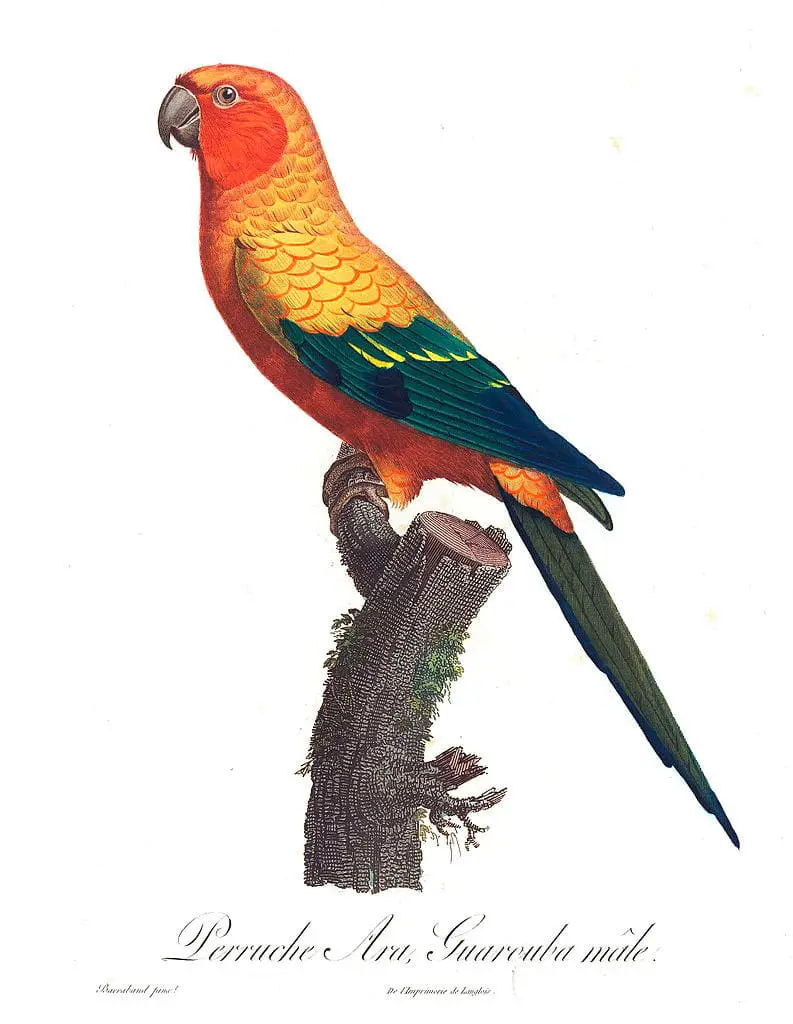
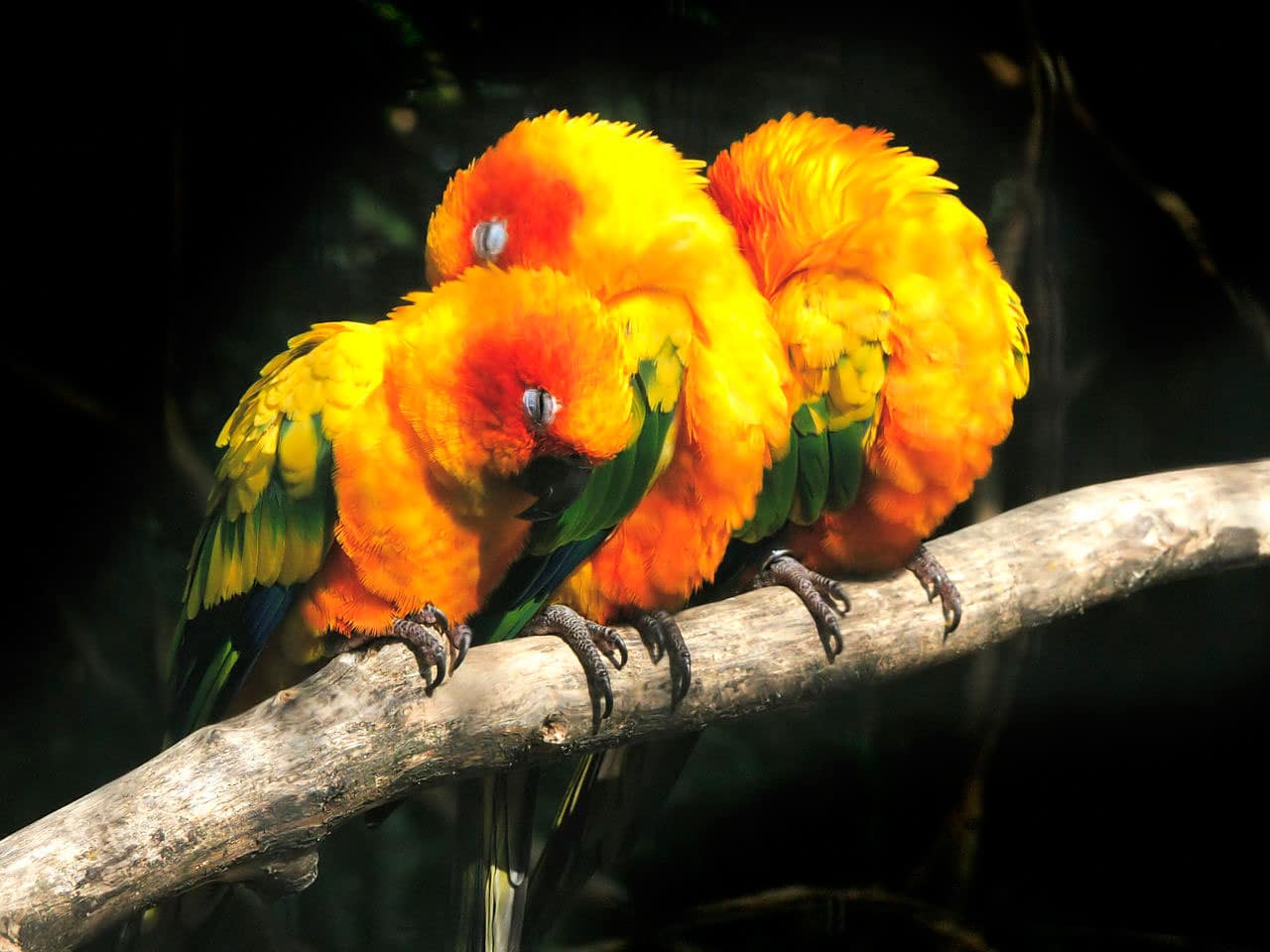
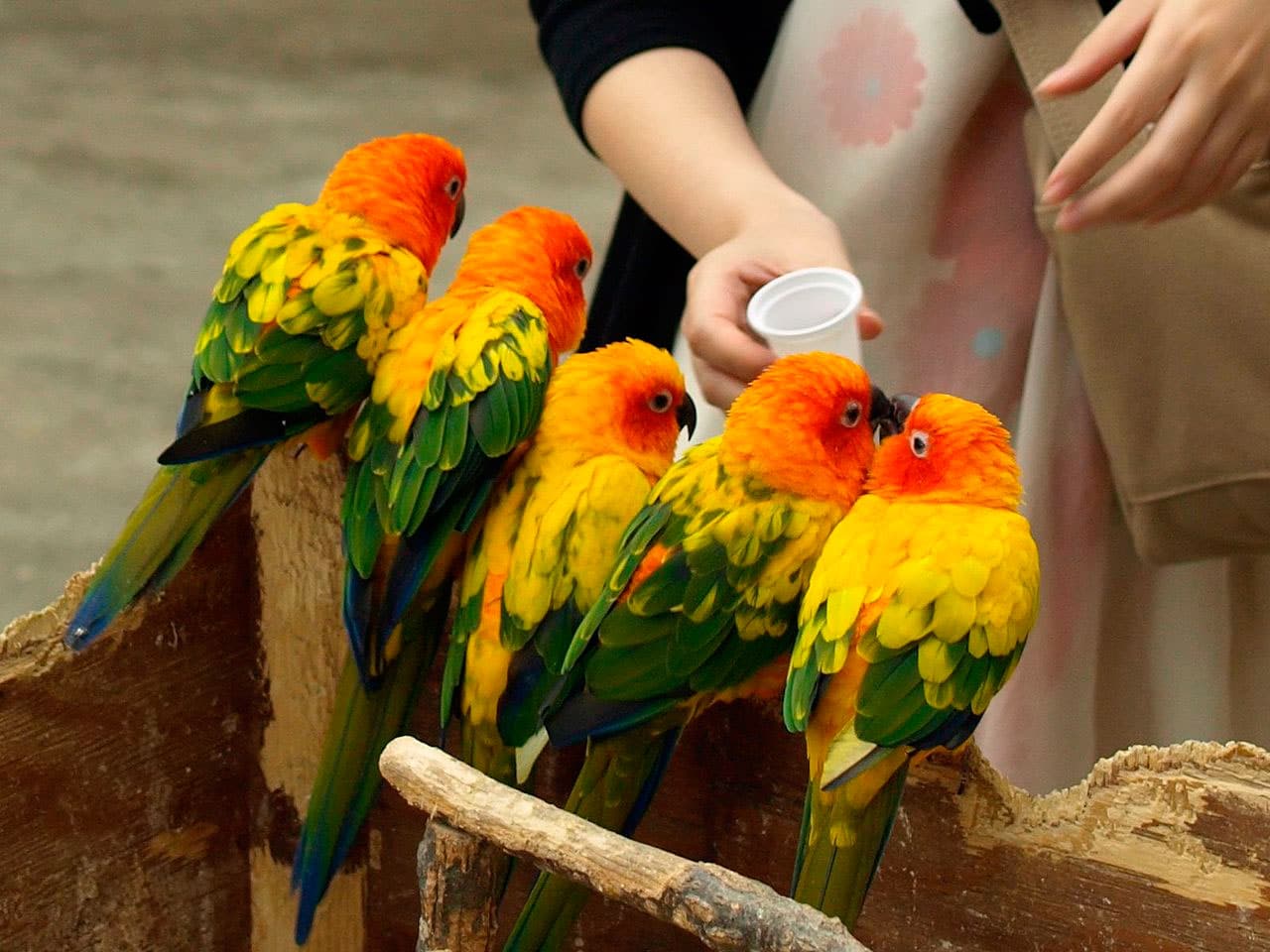
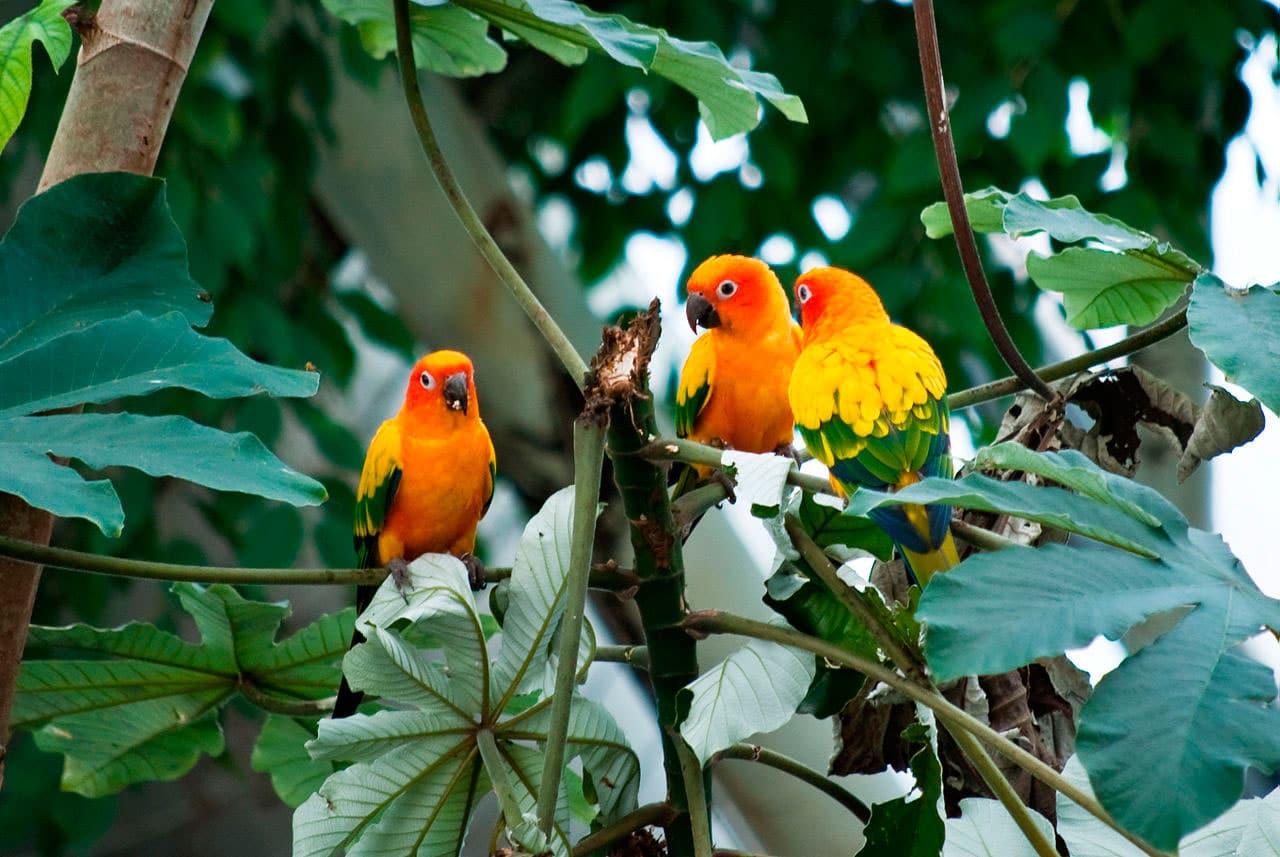
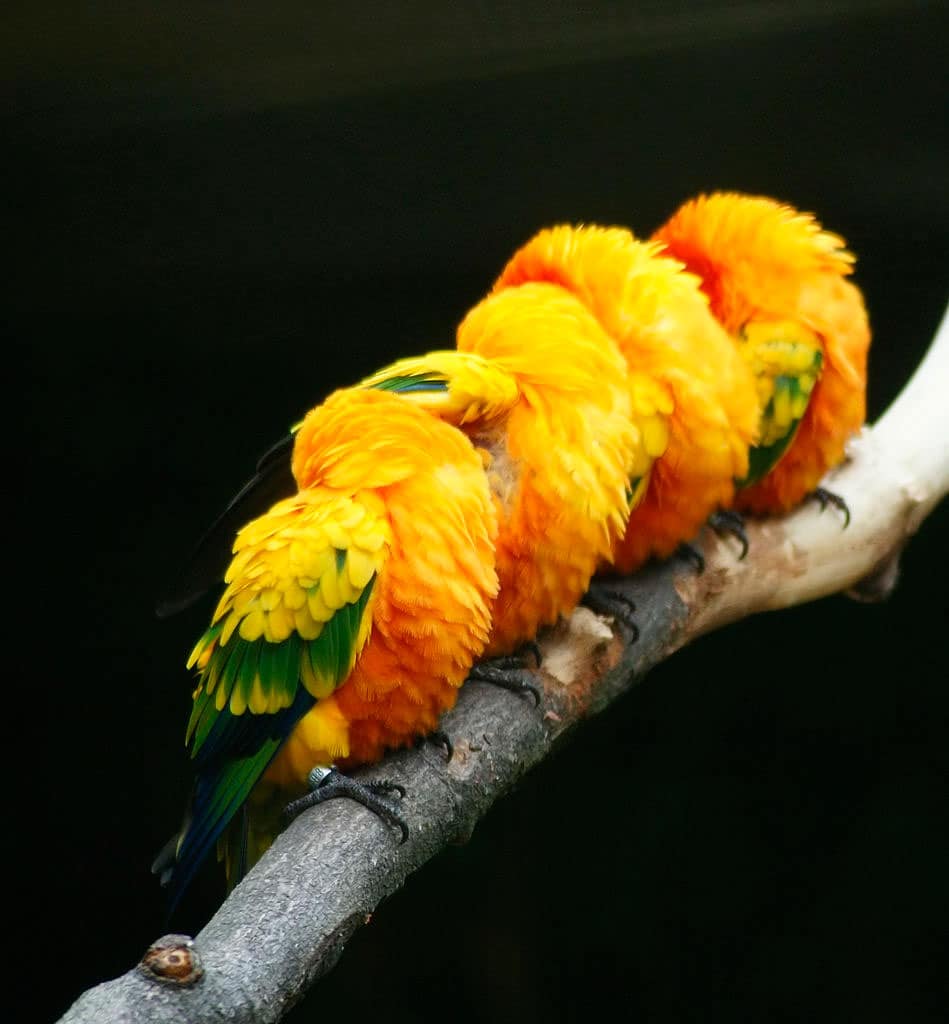
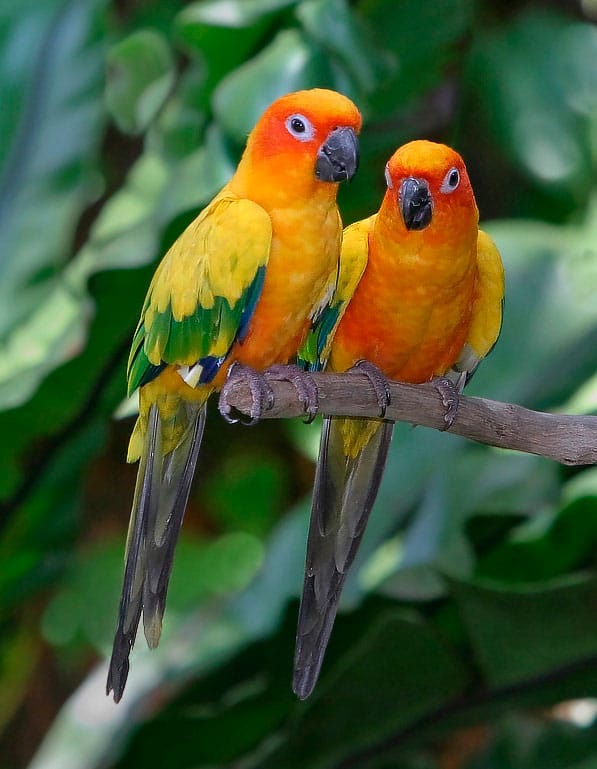
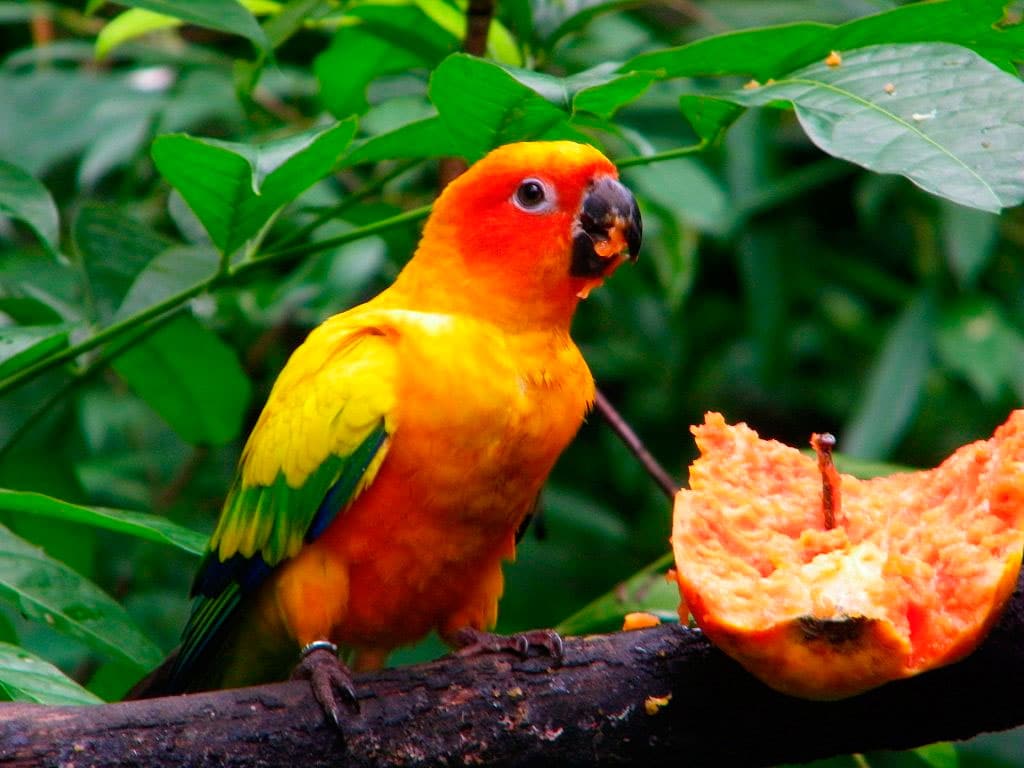
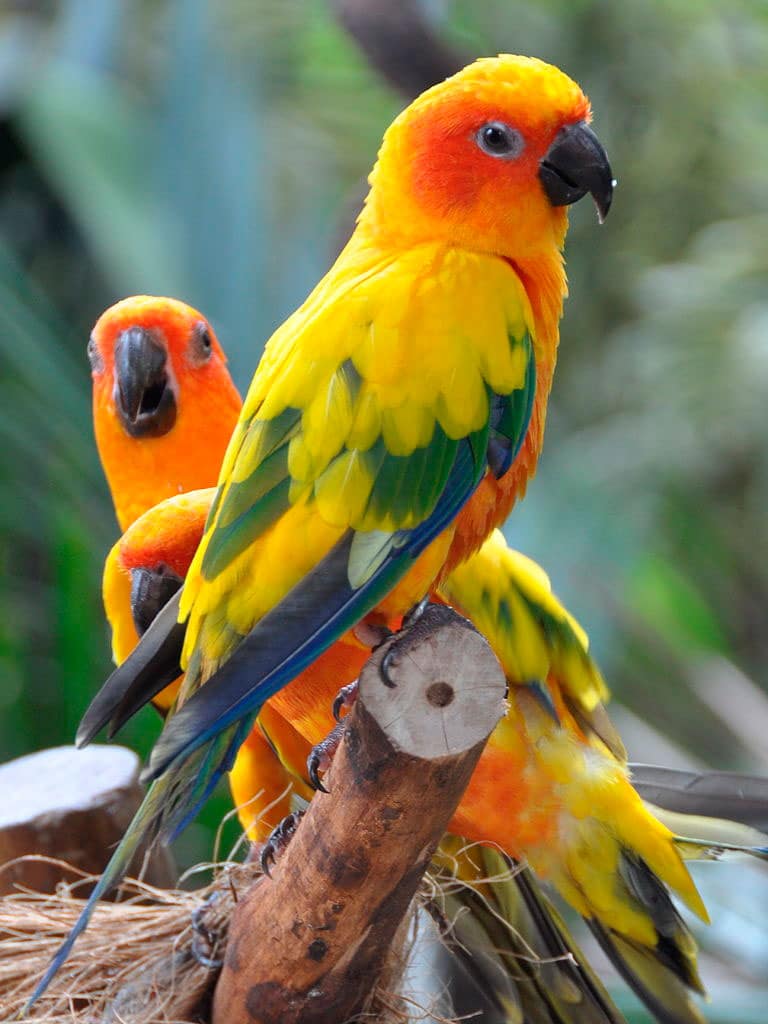
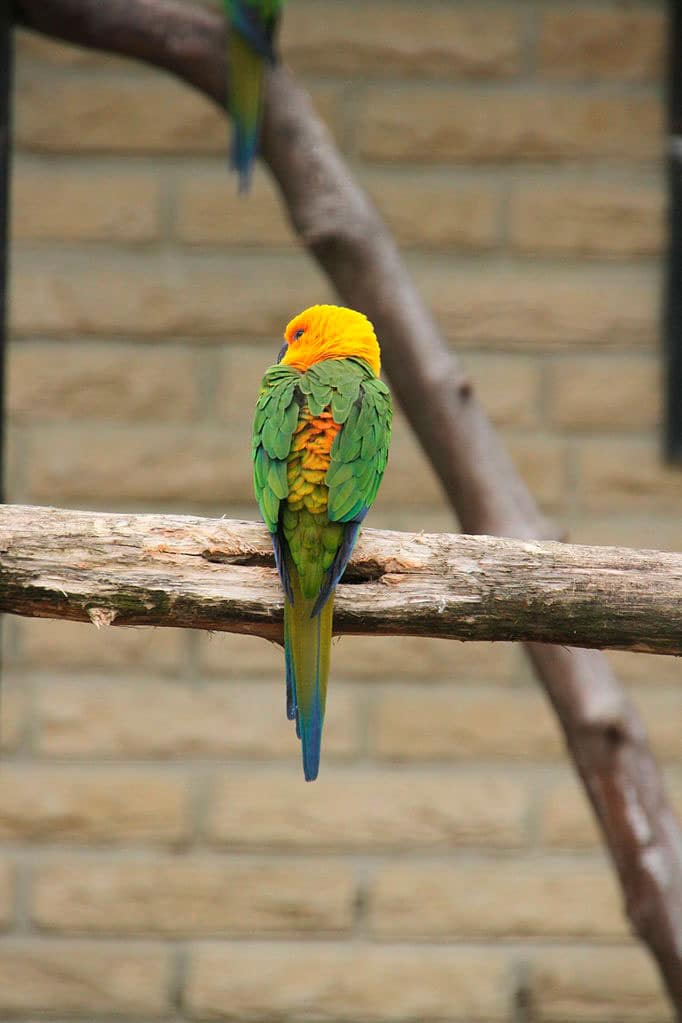
Of great beauty, the Sun Parakeet(Aratinga solstitialis) has the lores, ocular region and ear-coverts golden yellow, changing to shades red orange glossy; the forecrown, crown and nape are of a rich color yellow brilliant with color orange.
Bright yellow in the the mantle, the back and rump; uppertail-coverts of color yellow with exotic feathers of color blue. Scapulars Green Tips and the vane inner blue; the coverts smaller and medium, of color yellow with variable staining Green; greater coverts with tips of color green beige, primary coverts, blue. Flight feathers, green above, primaries with tips and vane inner blue; grayish brown then. Undertail-coverts yellow (or orange / yellow). The throat Orange with yellow shading at the top of the chest; lower chest and the belly orange; Flanks and area of the vent yellow.
Upper, the tail mainly of color green yellowish with tips of color blue; undertail, of color grey with dye beige.
The bill of color Brown dark to black; the irises dark brown; legs distant.
Both sexes similar.
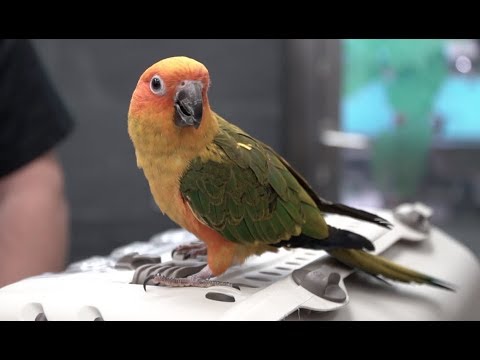
Immature usually with more muted than adults with the yellow colors of the head and the body replaced by an orange-Green. Lesser and medium uppertail-coverts green.
In general, live in Savanna, in dry forests with Palm trees and some times in flooded areas, until 1200 m. Cross the habitats more open only when traveling between the patches of forest. Son Bird social, usually observed in flocks of 30 or more individuals, with aggregations over large in tree fruit.
Reproduction:
It nests in hollow of trees or palms (for example, Mauritia).
Nest with a chick only in the month of February in Suriname. The size medium of laying is of 3 to 4 eggs. These eggs are hatch during 23 to 27 days, that is almost the forty percent more that it from other birds, in comparison with the mass of egg.
Food:
Their diet is poorly documented, Although it probably consists of locally available food, such as different fruits, berries, nuts, sprouts and flowers. Some foods known including pods of legumes, small fruits of the family Melastomataceae, fruits Red's Cactus and possibly berries of the genus Malpighia.
Distribution:
Size of the area of distribution (reproduction / resident): 96.600 km2
The Sun Parakeet are distributed in the northeast of South America, from the Monte Roraima in the extreme north of Brazil (a single record in 1848 previously attributed to Venezuela), areas adjacent of it Pacaraima mountains in Venezuela and North of Guyana, to pomeroon river, eastward through Suriname (apparently unknown in the North) and French Guayana until Brazil in Amapá.
Observed also in For and Eastern Amazonas (bounded on the west about Rio Branco and locally to the South of the Amazon, from Santarém to the region of the Canuma River).
Although in general can be considered is usual, records sporadic suggest appearances local of the Sun Parakeet in an extended range of its distribution area.
Maintained locally as domestic fowl and trapped for the bird trade Vivas.
Conservation:
• Red List category of the UICN current: In danger of extinction
• Population trend: Decreasing
A well known in the South flock of Guyana has been registered with a maximum number of 200 individuals (Bergman 2009), with other recent records in Roraima (Laranjeiras et to the. 2011). The population is estimated therefore between 1,000-2,499 mature individuals, based on recent records. This is equivalent to 1,500-3,749 birds in total, rounded in 1.500-4.000 individuals.
The population of the Sun Parakeet It is thought that can be in continuous descent, because, probably, continuous pressure which is subjected due to hunting.
THREATS:
Due to the high demand for this species in the pet market, its population has declined dramatically over the last twenty years (J. Gilardi in litt., 2007).
Have been exported largely from Guyana during this time, which has led to its virtual extinction in that country. Trappers of Guyana and French Guiana have traveled to the border with Brazil to buy these birds for export (T. Arndt in litt. 2007, L. Silveira in litt., 2007).
A fit annual of export of 600 bird was established in Guyana in the years 1980 and it is believed that more than 2.200 they were imported into the United States between 1981 and 1985 (J. Gilardi in litt., 2007).
Its trade is in course, and because of the ease with which these birds can be attracted to the bait (for example corn) and the long distances that will be traveling, It is easy to catch all individuals in a given area(J. Gilardi in litt., 2007).
Conservation Actions Underway:
• It is very common in captivity, but it is not known what percentage of this population are hybrids between the Aratinga solstitialis and the Aratinga maculata (Silveira et to the., 2005, LF Silveira in litt. 2012).
Conservation Actions Proposed:
• Consider listing the species in Appendix I.
• Stop cross-border trade immediately CITES.
• Work with the indigenous inhabitants of the Raposa Serra do Sol Indian Land and the Amerindian Community in Karasabai to avoid entrapment and protect suitable habitat.
• Survey to locate additional important subpopulations.
• Establish captive breeding lines of purebred birds..
"Sun Parakeet" in captivity:
The Sun Parakeet is known for its quacking very strong in comparison with its size relatively small. It is capable of imitating human beings, but not as well as some larger parrots.
Son popular as pets, due to their bright coloration while they have a very limited ability to speak.
Due to its inquisitive temperament, demand much attention from their owners, and sometimes they can be very noisy.
– Avibase
– Parrots of the World – Forshaw Joseph M
– Parrots A Guide to the Parrots of the World – Tony Juniper & Mike Parr
– Birdlife
– Cover photo:
(1) – Sun Conure or Sun Parakeet (Aratinga solstitialis) at a bird park in Singapore By Michael Gwyther-Jones (originally posted to Flickr as Singapore) [CC BY 2.0], via Wikimedia Commons
– Image gallery:
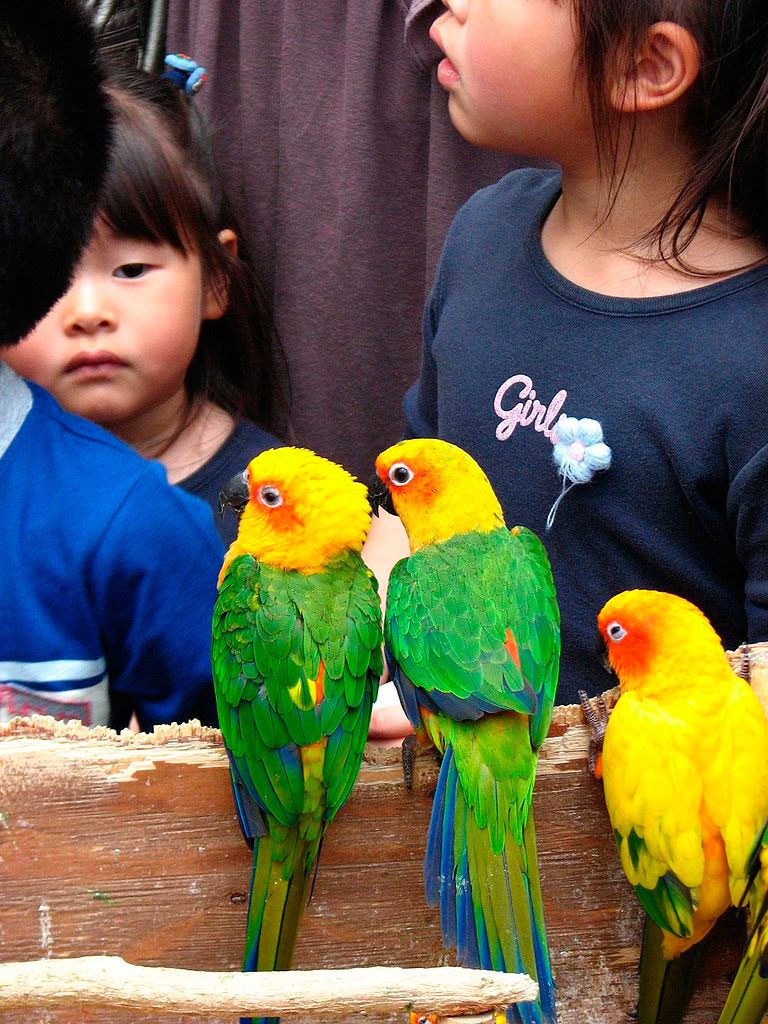
(2) – Three Sun Parakeets (also known as Sun Conure) at Jurong Bird Park, Singapore. The bird in the middle of the photograph has been wing clipped By Michael Gwyther-Jones from UK (FlickrUploaded by snowmanradio) [CC BY 2.0], via Wikimedia Commons
(3) – Sun Parakeets (also known as Sun Conures) at Jurong Bird Park, Singapore By Michael Spencer (originally posted to Flickr as Jurong Bird Park) [CC BY 2.0], via Wikimedia Commons
(4) – Sun Parakeet (also known as Sun Conure) at Jurong Bird Park, Singapore By Michael Spencer (originally posted to Flickr as Jurong Bird Park) [CC BY 2.0], via Wikimedia Commons
(5) – Sun Conures at Jurong Bird Park, Singapore. Wing clipped By Doug Janson (Own work) [CC BY-SA 3.0 or GFDL], via Wikimedia Commons
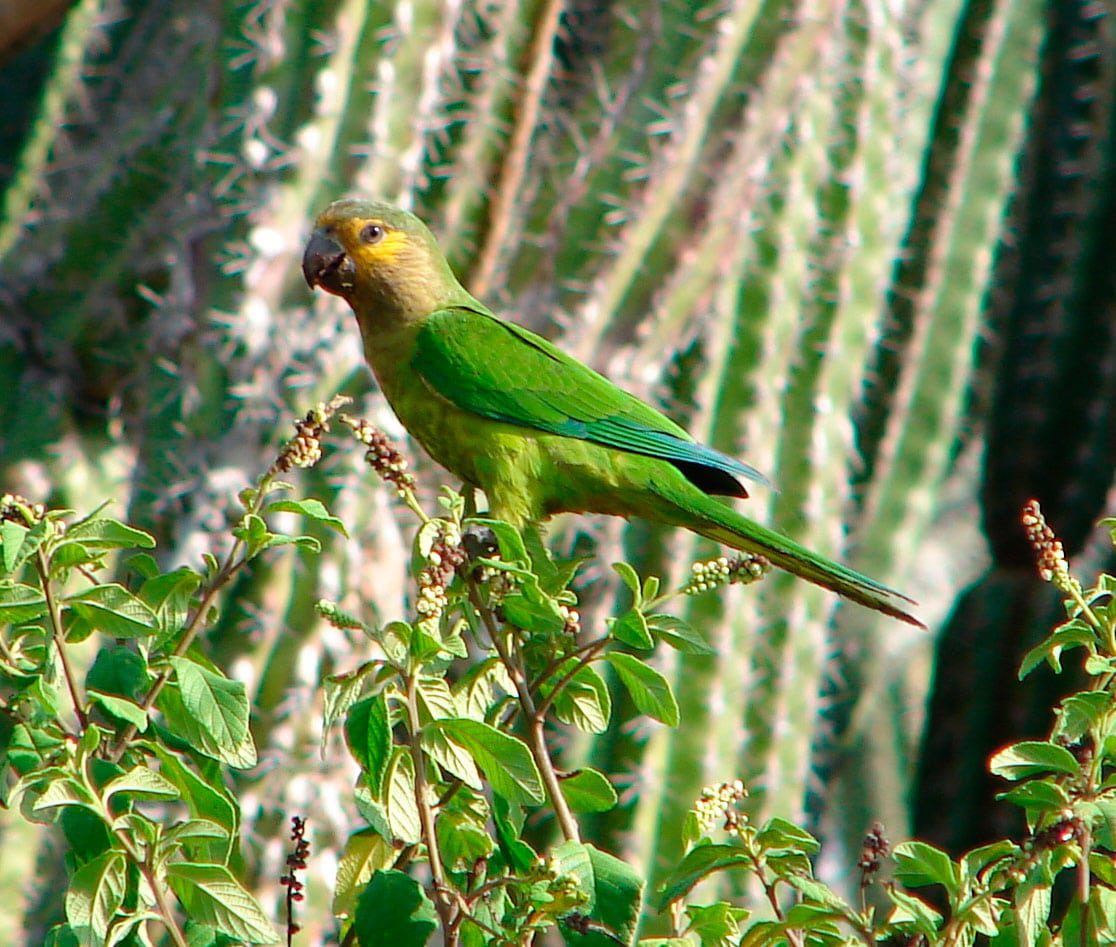
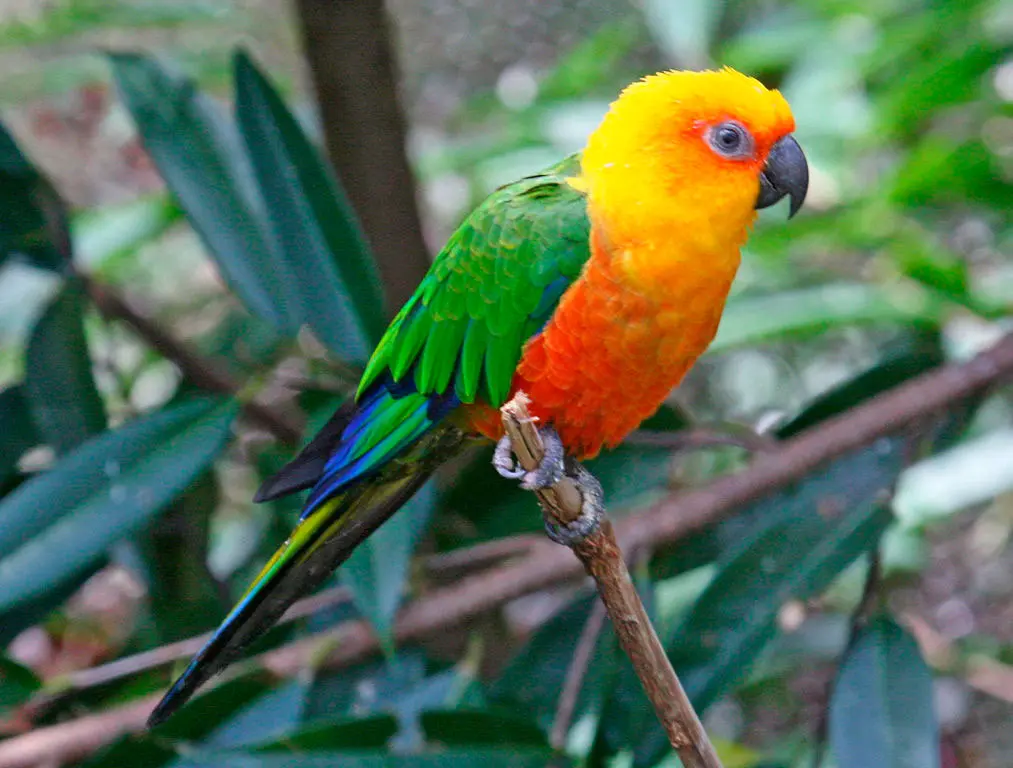
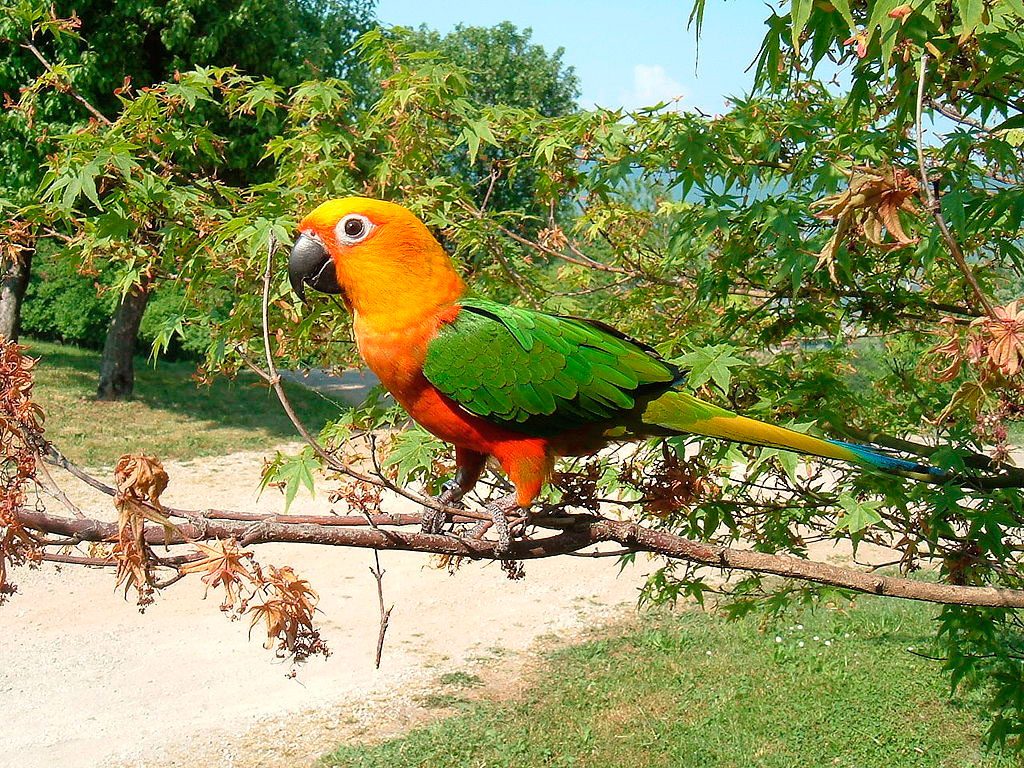
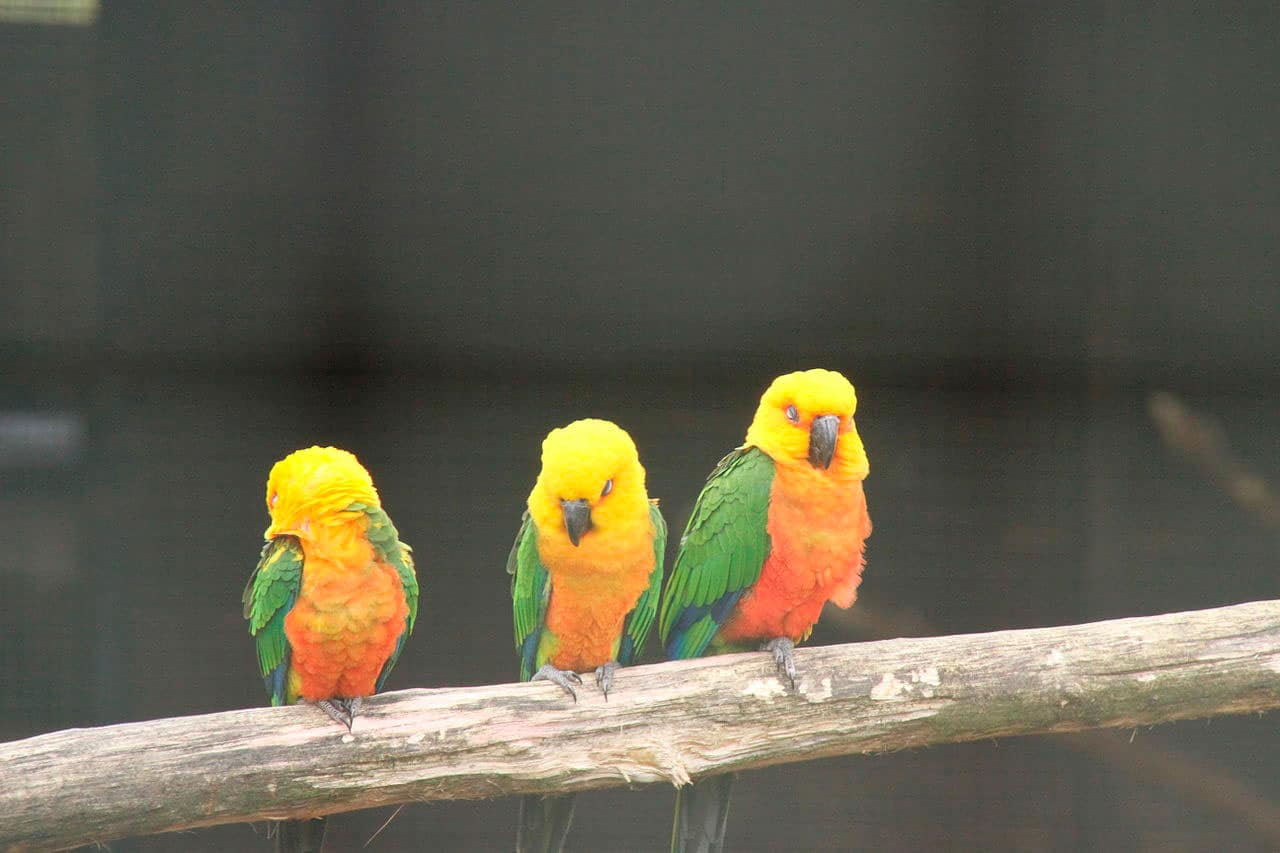
The Jandaya parakeet(Aratinga jandaya) they have both sides of the neck, cheeks, lores, ear-coverts and forecrown orange, deeper in the ear-coverts, around the eyes and in the lores; the crown and nape are yellowish-Orange (Some birds with paler yellow tones in the head).
Mantle and scapulars olive green; back and top of the rump, Green with orange-red horizontal bars; lower rump and uppertail-coverts olive green. Main feathers of the wings blue, the others feathers, green (brightest that in the the mantle). The flight feather blue color above, on the vane outer, Blackish towards the tip and grey below. Underwing-coverts orange-red. The underparts orange-red, slightly paler in the upper part of the chest and in the throat; undertail-coverts green.
Upper, the tail of olive with blue tips; undertail, charcoal grey.
Bill grey-black; bare periophthalmic pale grey; irises brown; legs grey.
Both sexes similar.
The immature has the head yellow and the neck with green markings; Dim Orange below.
Habitat:
The Jandaya parakeet move between deciduous woodlands, closed, thickets and clear areas of humid forest. Sporadically at the edge of the humid forest and in the caatinga. In palm groves of coconut on the coast of Pernambuco. Also frequent croplands and pastures. (Usually in flocks of approximately 12 birds, but sometimes in pairs or individually.
Reproduction:
Nests in tree cavities, at least a 15 metres in height. Observed young in the December nest in Maranhão; eggs hatch between August-December, in the area of Belem. Clutch, probably composed of three eggs.
Locally common, While perhaps decreasing in some areas. It is possible that its range is usually expanding through the colonization of cleared areas of high humid forest., especially in For and Maranhão.
Their status in the East its area of distribution is unknown.
Maintained in captivity with consequences serious, Perhaps derived from the illegal trade internal in Brazil and, possibly, by smuggling towards Asia South-East.
Conservation:
State of conservation ⓘ
Minor Concern ⓘ(UICN)ⓘ
• Red List category of the UICN current: Least concern
• Population trend: Stable
This species has a range very large, and therefore not approaching the thresholds for vulnerable under the criterion of size range
The size of the world population of Jandaya Parakeet It has not been quantified, but this species has been described as «rare» (Stotz et to the., 1996).
Its population is suspected to be stable in the absence of evidence of any reduction or substantial threats.
"Jandaya parakeet" in captivity:
Pretty common in captivity and easy to raise.
Like all the Parakeets, This species is not characterized by their ability to speak, still, can get to say some words with crystal clarity.
Its feeding is made up of different fruits, vegetables, soaked legumes and specific feed for parrots. There are species Meek and intelligent to which are the trains very well and are playful, What makes them good pet to maintain in a House. Being aves gregarias, is convenient to provide them a companion, Since solo can be quite noisy.
Enjoy the bathrooms, and is advisable to keep them in an Aviary or in cage of good proportions; It is also convenient to let the small flights out of its enclosure.
Its longevity often haunt them 20 years in captivity, being able to get to the 30 years, Depending on your care.
– Avibase
– Parrots of the World – Forshaw Joseph M
– Parrots A Guide to the Parrots of the World – Tony Juniper & Mike Parr
– Birdlife
– Photos:
(1) – Jandaya Parakeet (Aratinga jandaya) aka Janday Conure. Photographed in Puerto Rico at the Mayaquez Zoo By Dick Daniels (http://carolinabirds.org /) (Own work) [CC BY-SA 3.0 or GFDL], via Wikimedia Commons
(2) – Jandaya Parakeet (also known as Jenday Conure) in Beale Park, Reading, Berkshire, England By David Long from London, United Kingdom (IMG_4798Uploaded by Snowmanradio) [CC BY 2.0], via Wikimedia Commons
(3) – Jenday Conure or Jandaya Parakeet in a tree. By GIANNIZZZERO at English Wikipedia [Public domain], via Wikimedia Commons
(4) – Jenday Conure or Jandaya Parakeet (Aratinga jandaya) at Iguaçu Bird Park, Foz do Iguaçu, Brazil. Photographed on 23 April 2003 By Arthur Chapman [CC BY 2.0], via Wikimedia Commons
(6) – Aratinga jandaya and Aratinga solstitialis at Kobe Kachoen (Kobe Flowers and Birds Garden) in Kobe, Hyogo prefecture, Japan By Chris Gladis from Kyoto, Japan (Jandaya Parakeet) [CC BY 2.0], via Wikimedia Commons
(7) – Jendayasittiche (Aratinga jandaya) im Karl-Foerster-Garten des Tierparks Berlin-Friedrichsfelde By Lotse (Own work) [GFDL or CC BY-SA 3.0], via Wikimedia Commons
(8) – A Jandaya Parakeet (also known as Jenday Conure) at Beale Park, Lower Basildon, Reading, Berkshire, England By David Long (originally posted to Flickr as IMG_4800) [CC BY 2.0], via Wikimedia Commons
(9) – Jandaya Parakeet (also known as Jenday Conure) in Beale Park, Reading, Berkshire, England By David Long from London, United Kingdom (IMG_4802Uploaded by Snowmanradio) [CC BY 2.0], via Wikimedia Commons
46 to 51 cm.. height and between 400 and 500 g. of weight.
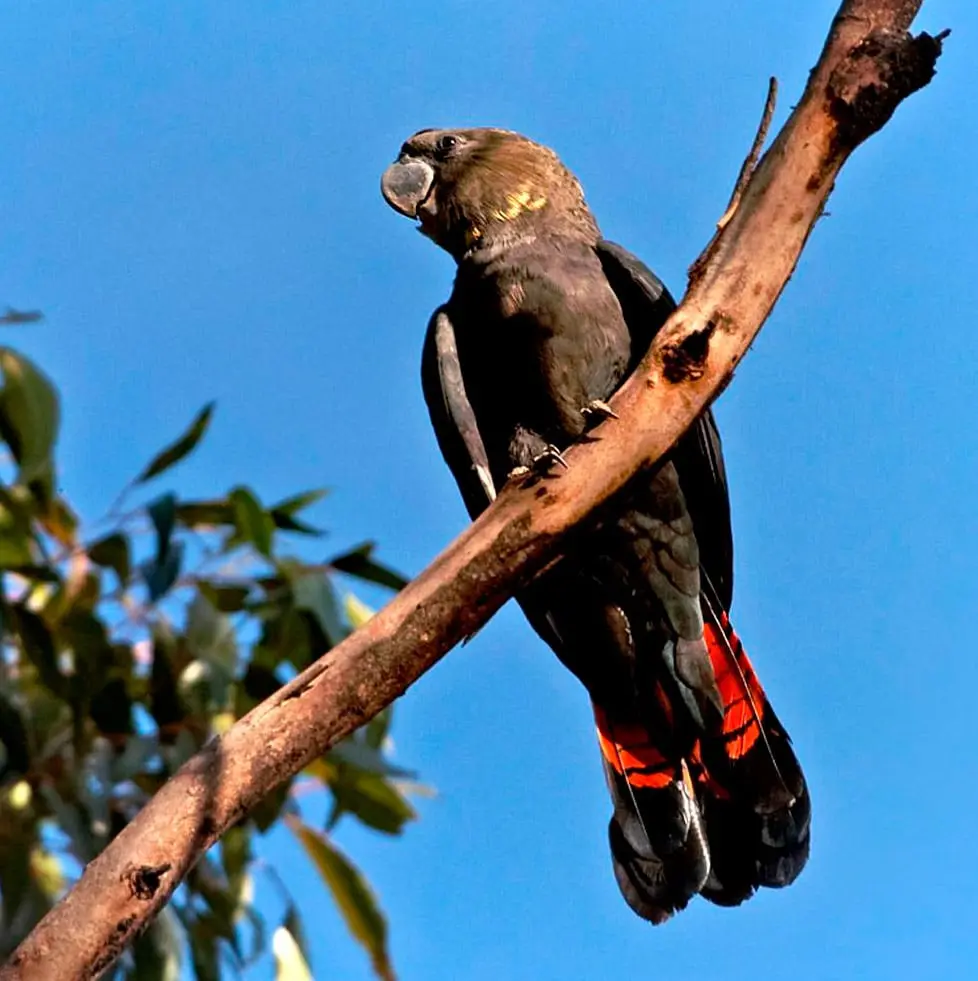
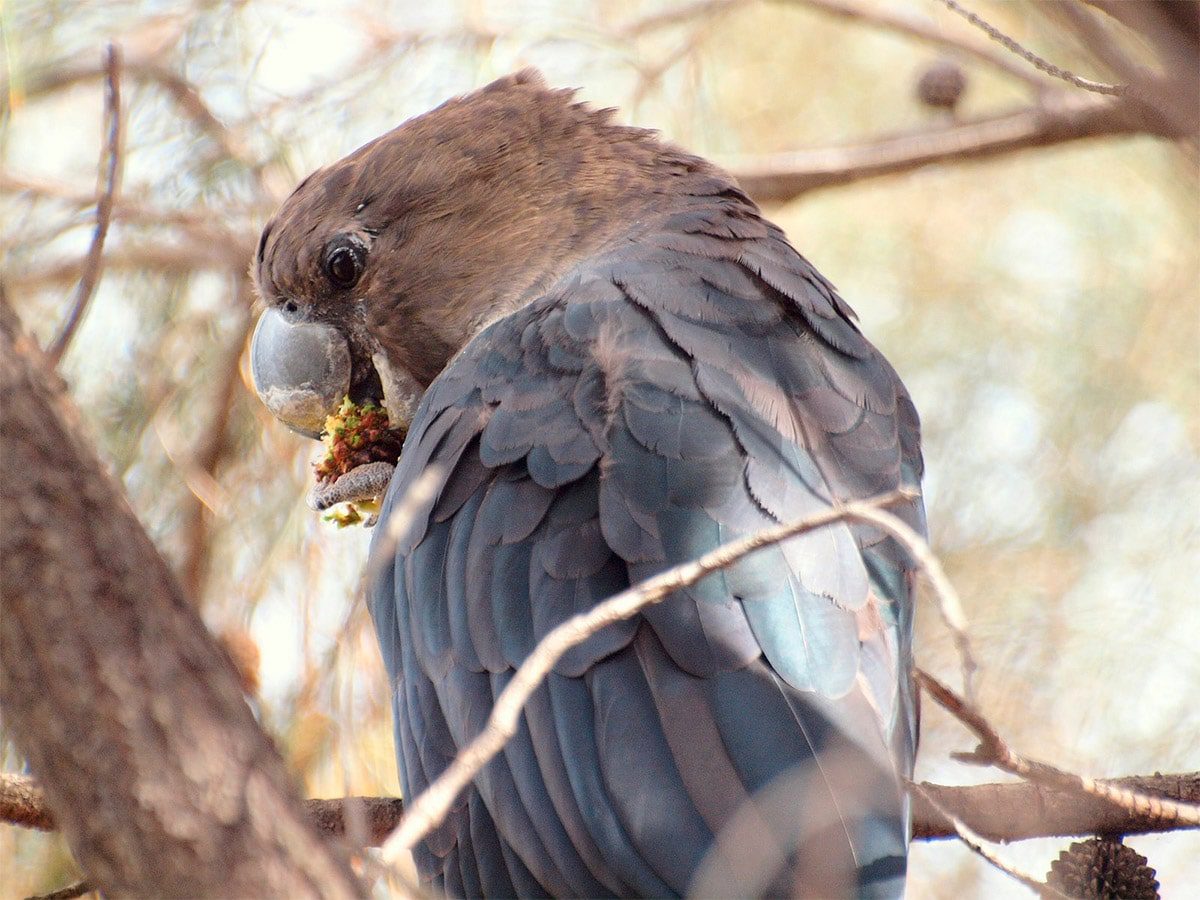
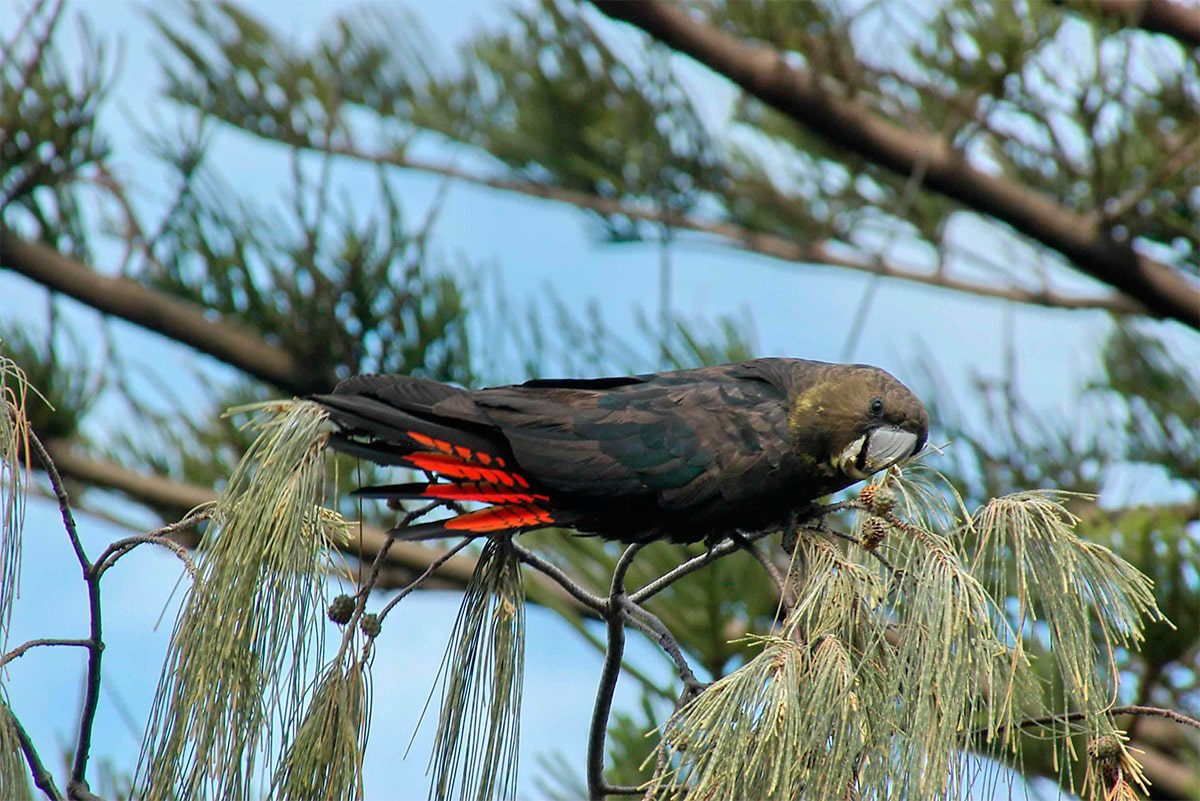
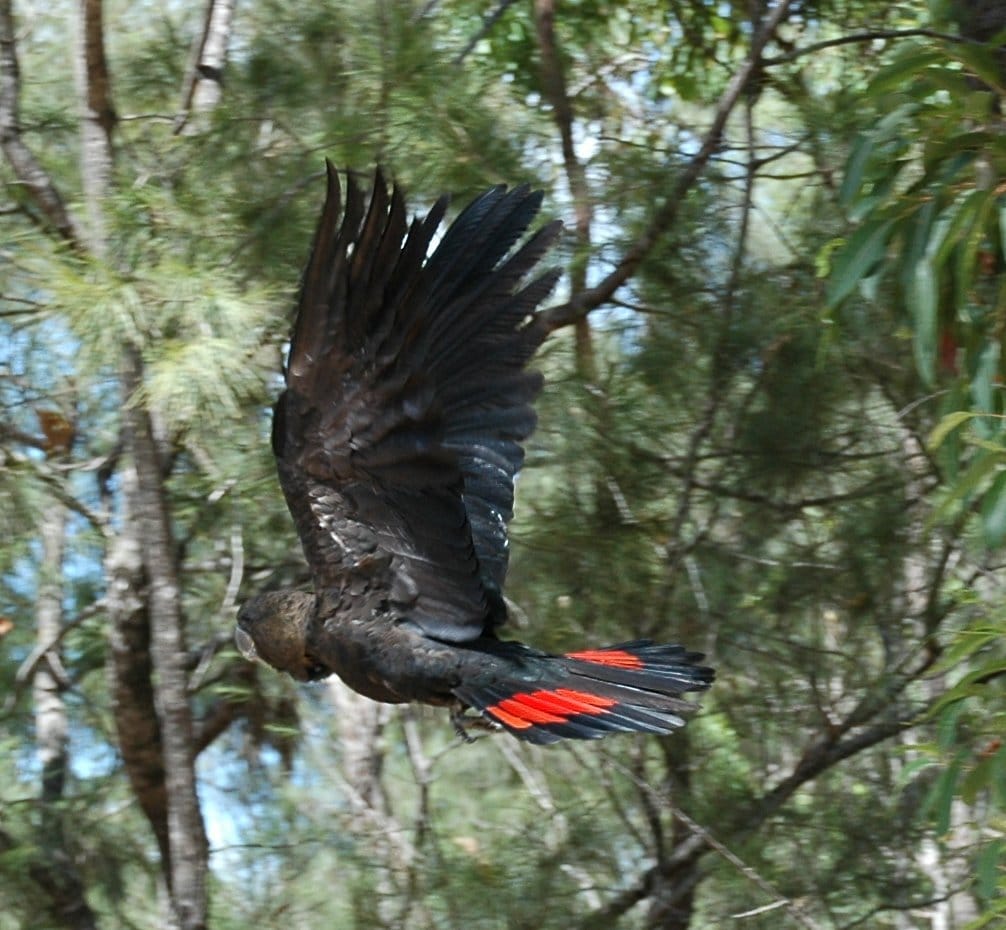
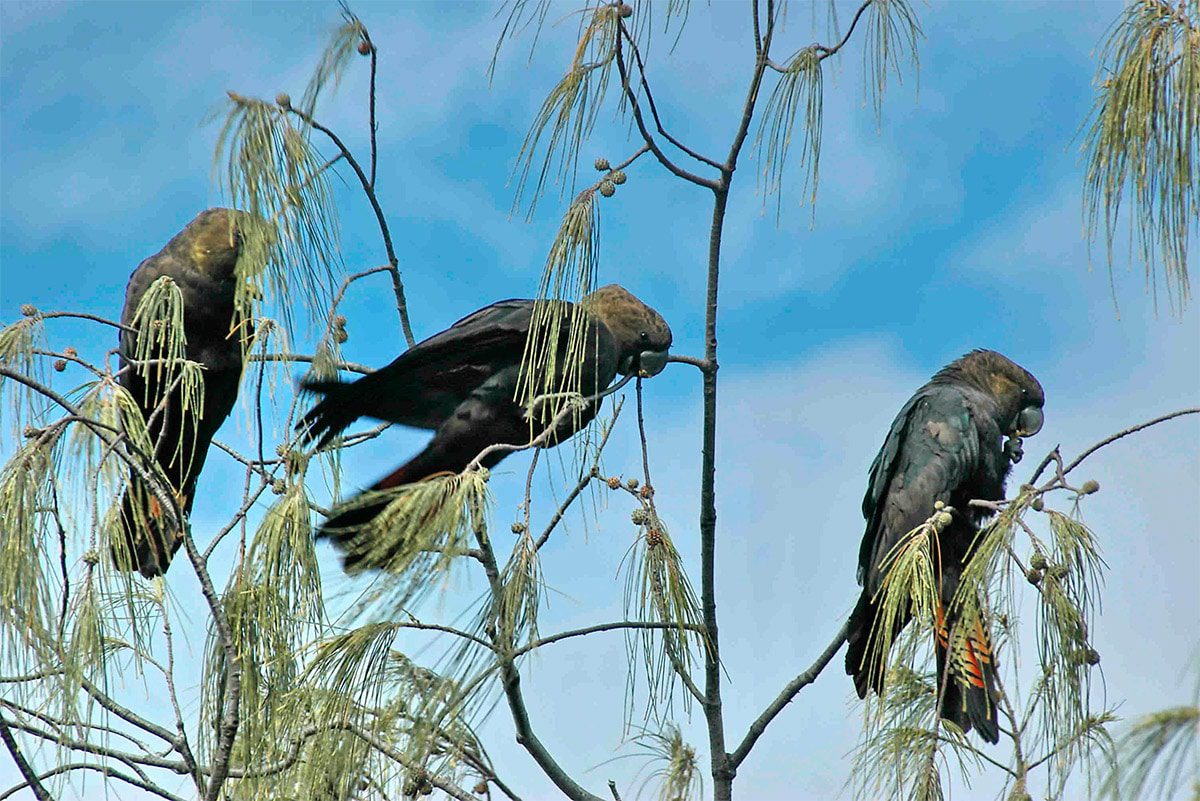
The Glossy black cockatoo(Calyptorhynchus lathami) is the smallest of the 5 black cockatoos and is restricted to the East coast of Australia (a population isolated also is reproduced in the Islands Kangaroo).
The male is brown-black color with a small crest rounded and bright Scarlet spots in the tail. The female shows spots irregular in color yellow in it head, The Scarlet patches in the tail they are permeated by narrow black bars and edges of pale yellow on the underparts of the wings.
The immature they are similar to the females, but they lack the yellow markings on the head and show different yellowish tones in the feathers, the chest and in the belly.
(Mathews, 1912) – Medium-size ones 48 cm. length and 510 to 515 weight g, with a wing
of approximately 90 cm.. The of adults they are mainly black, dark brown in the head, the neck and the bottom of the body, and Red panels (in males) or orange-red with bars Black (in females) on tail. The female adult is also conspicuous in the head. These patches are absent from most males., Although they can be expressed faintly in a few individuals (Higgins 1999).
The immature are similar in appearance to the male adult, but have small stains yellow in it head; spots or bars yellow in the chest, belly and flanks; yellow or orange spots on the wing
(mainly on the bottom); Red or orange-yellow panels with black bars at the tail; One bill pale grey (instead of dark); And a ring of skin around the eye pale grey (instead of grey dark) (Higgins 1999, L. Pedler 2007, com. Pers.).
Calyptorhynchus lathami erebus
(Schodde & Mason,IJ, 1993) – The only difference with the nominal species resides in that has the bill shorter.
Habitat:
Video – "Glossy black cockatoo" (Calyptorhynchus lathami)
Glossy-black Cockatoo (Calyptorhynchus lathami ) HD Video clip 1/3
Areas forested frequently dominated by casuarinas of which are highly dependent for its food. These are small shrubs commonly known as the Sheoaks, wood for beef (Beefwood) or Australian pine. These shrubs are widespread in tropical and subtropical regions.
They are also distributed in open humid forests, difficult terrain where deforestation has not been too great. They have an imperative for natural tree cavities to nest.
Reproduction:
Forman couple during all the life. The couple has relationships throughout the year. This type of family of them parrots prefers to nest in cavities natural of the eucalyptus, whether dead or in full vitality. The nest usually placed at an altitude that ranges between the 3 and 30 meters above the ground. The cavity is filled with leaves and branches. Sometimes, together with other breeding pairs, they share the same tree year after year.
In New South Wales the season extends from March to August. The spawning It consists of a single egg white. It is the female that takes charge of most of the tasks.: It prepares the nest and incubates herself. Never leave the nest until the small is reached the age of one week. In most cases, the male provides the female with food and assistance until the young can fend for itself, normally four months which remains with them until the next breeding season.
Food:
It feeds almost exclusively on the seeds several species of She-oak (Casuarina and Allocasuarina). You can also sometimes eat larvae of wood-boring. They feed in threes, less frequently in pairs, small groups or flocks of up to 60 birds. They can be detected by the snapping of their beaks and the remains of the casuarina cones and twigs that fall.
Distribution:
Size distribution (reproduction / resident): 770.000 km2
The species is Rare Although widespread in suitable forests of the central coast and forest habitats of Queensland and in the interior of the southern plateaus and Plains of the Midwest's New South Wales, with a small population in the Riverina. There is an isolated population in the Kangaroo Island, South of Australia.
(Schodde & Mason,IJ, 1993) – It is from Australia (the central eastern coastal area of Queensland)
Conservation:
State of conservation ⓘ
Minor Concern ⓘ(UICN)ⓘ
• Current category of the Red List of the UICN: Least concern.
• Population trend: Decreasing.
Like most parrot species, the Glossy black cockatoo is protected by the Convention on international trade in endangered species of Fauna and Flora Silvestres ( CITES ), with its inclusion in the list of the Appendix II of vulnerable species, What makes the import, the export and trade of animals captured in the wild is illegal.
Justification of the population
Garnett and Crowley (2000) estimated the size of the population in the following way: 12.000 individuals of the subspecies lathami, 70 breeding pairs of the subspecies halmaturinus (equivalent to 140 individuals) and 5.000 individuals of the subspecies erebus giving a total of 17.140 individuals.
Justification of trend
They suspected that the population is declining in general Since the largest subpopulation, lathami, It is slowly decreasing throughout its range. However it is believed that the subspecies Erebus is increasing and the subspecies halmaturinus It is increasing as a result of conservation efforts in the Island Ganguro (Garnett and Crowley 2000).
"Glossy black cockatoo" in captivity:
Like the other black cockatoos, the Glossy black cockatoo(Calyptorhynchus lathami) is extremely rare in the poultry. In Australia It has attained breed in captivity.
25 cm.. length and a weight between 90 and 115 g..
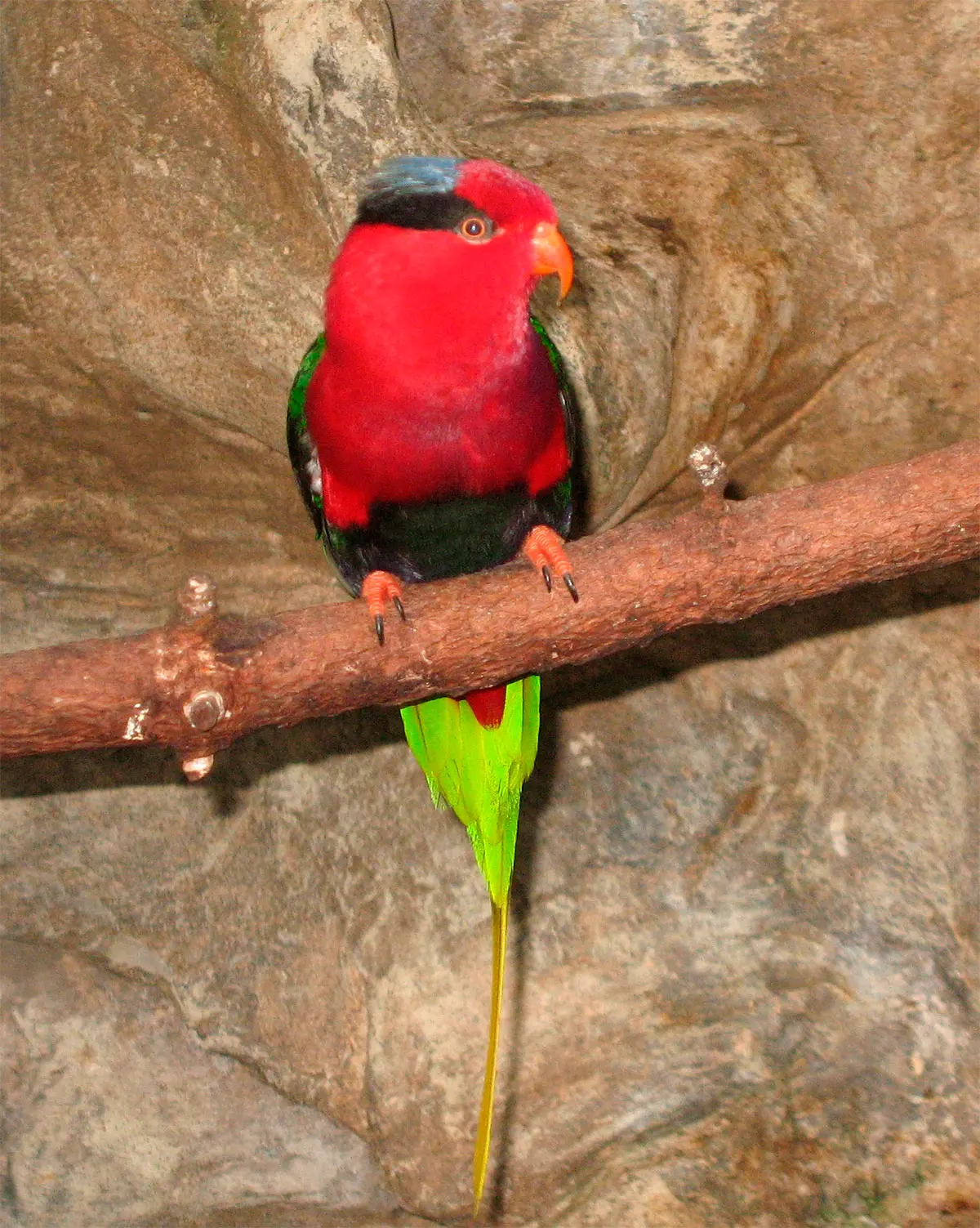
The head of the Papuan Lorikeet(Charmosyna papou) It is red with a black patch on the back of the crown and a crescent-shaped mark on the nape; patch in the crown with mottled blue extends to the top of the eyes.
Under the nape a red uniform coat; centre of back Dark emerald green; under the back bright red; rump light blue. Wings Emerald green with vane internal black; undertail, the flight feather grey with coats red; coverts marginal green. Throat red, darker than the upper part of the chest and a little more off: lower chest Red clear with a variable black patch in the center of the belly, Sometimes it extends over them the thighs; the sides of chest and flanks with two obvious yellow stripe sets; bottom of the belly and coverts of the tail, red. View from the top, the tail is green and yellow is your long tip, the axis of the Central feathers is of dark brown; below, the tail is yellow, finished in Orange at its end.
The bill orange; Orange the irises; Orange and the legs.
In the nominal species, both sexes are equal.
Immature more turned off than adults. A band yellow variables at the bottom of the secondaries; rump with mottled Green; Naranja-Pardo the bill and legs; irises pale yellow.
(Rothschild & Hartert, 1911) With sexual dimorphism and two different colors. The normal morph is similar to the subspecies Stellae, but differentiated by the yellow at the tip of the tail (non-fusion Orange to yellow). The coverts of the tail they are longer, in color purple blue, not red as in the stellae. As in the subspecies stellae, This subspecies has melanism, the upperparts is green, and underparts blue-black in their entirety. Head and the mantle, only broken by the blue of the stripes in the nape; Red in the coverts of the back and bottom of the tail. The wings are green. The tail seen from below it is more yellow-green in color than in normal morphology, and streamers they are fused opaque to verdoso-amarillo down Green.
Charmosyna papou wahnesi
(Rothschild, 1906) Similar to the subspecies goliathina, but the Red of the part superior of the chest It is bordered below with a narrow yellow band. Does not have a green-washing in the flanks and abdomen top. The belly Central and tail coverts are red.
Charmosyna papou stellae
(Meyer,AB, 1886) This species has sexual dimorphism and also has a melanism (excess of dark pigmentation). In comparison with the nominal, the black patch has much more extensive of the nape, blue-violet striped; This black patch replaces the two areas of black in the crown and in the nape of the speciesnominal. The streamers of the tail They also differ, merging from green to orange red (instead of green to Orange) and finally to yellow on the tips. The subspecies stellae also lacks of the chest yellow and stripes on the flanks that if you have the Papou, as well as his black patch on the belly that extends to the flanks.
The females They show a visible patch of yellow on the lower of the back Green-tipped on the longest feathers, and coverts of the tail red (male shows red with blue on the patch of the rump). The Red of the part superior of the chest seems more uniform. In the metamorphosis by melanism the Red is largely replaced by black (see goliathina).
The young birds with dark and thin stripes on the underparts.
Habitat:
Have been recorded at an approximate height of 1.200 meters above a row of trees and also to the 3.500 m, although the most common is to see them above the 2.000 meters and rare to see them below the 1.500 m; found by Forshaw in the forest of Nothofagus and Podocarpus to 2.800 m.
A species active and agile you are often found in pairs or in small groups. The birds move through the trees with jerky movements, often waving his serpentine tail, However, It can be very discreet between the tops of the trees.
Observed in Scheffleras, often in the company of other species, with the same food taste, as the Yellow-billed Lorikeet(Neopsittacus musschenbroekii). Seen often making passes above the trees or half-height, among the plants through the clear.
Reproduction:
The nesting in nature it is not described, but Pratt observed an adult tracing branches above and below a large group of epiphytes , Perhaps in search of a nesting site. A pair in breeding conditions was also observed in late August., and young people have been in nature during October and November. In captivity, the implementation has been two eggs, lasting about three weeks of incubation and the young remain in the nest for about two months.
Food:
Feeds on flowering trees or flowers of the epiphytes, nectar, pollen, fruits and small seeds. Larvae of insects occasionally.
Distribution:
Intervals in the center of New Guinea in Irian Java (Indonesian) and Papua New Guinea, in where are distributed from the southeast of Vogelkop towards the Adelbert range, Huon Peninsula and intervals in the Southeast.
The world population It has not been quantified, Although that it is more thought of 500.000 specimens. The species appears to be quite common throughout its area of distribution (pit et to the ., 1997).
The hunting of this species for the use of their feathers as tribal headdresses and capture for the bird trade do not believe today that can affect the size of the population.
It is suspected that the population is stable in the absence of evidence of any reduction or other substantial threat.
"Papuan Lorikeet" in captivity:
Coupled pairs will defend their territory vigorously. Individual birds active and playful; they require a cage as big as possible. May be a bit uncomfortable due to liquid diet.
Son rare in captivity.
Alternative names:
– Papuan Lorikeet, Fairy Lorikeet, Fairy Lory, Papuan Lory, Stella’s Lorikeet (ingles).
– Lori papou, Lori de Stella (French).
– Papualori (German).
– Lori de Cola Larga, Lori Rabilargo (español).
55 to 60 cm.. length between 570 and 870 weight g.
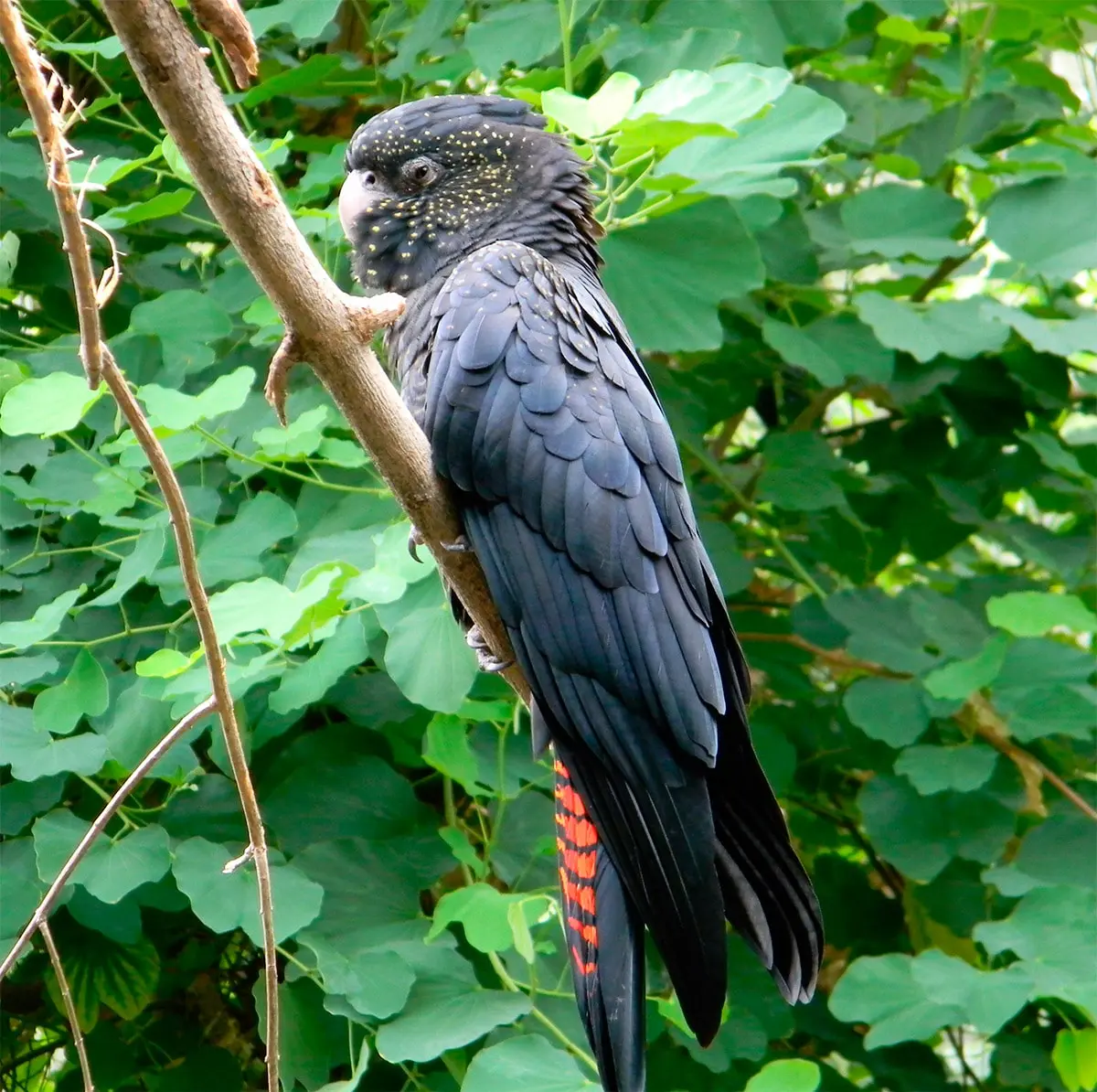
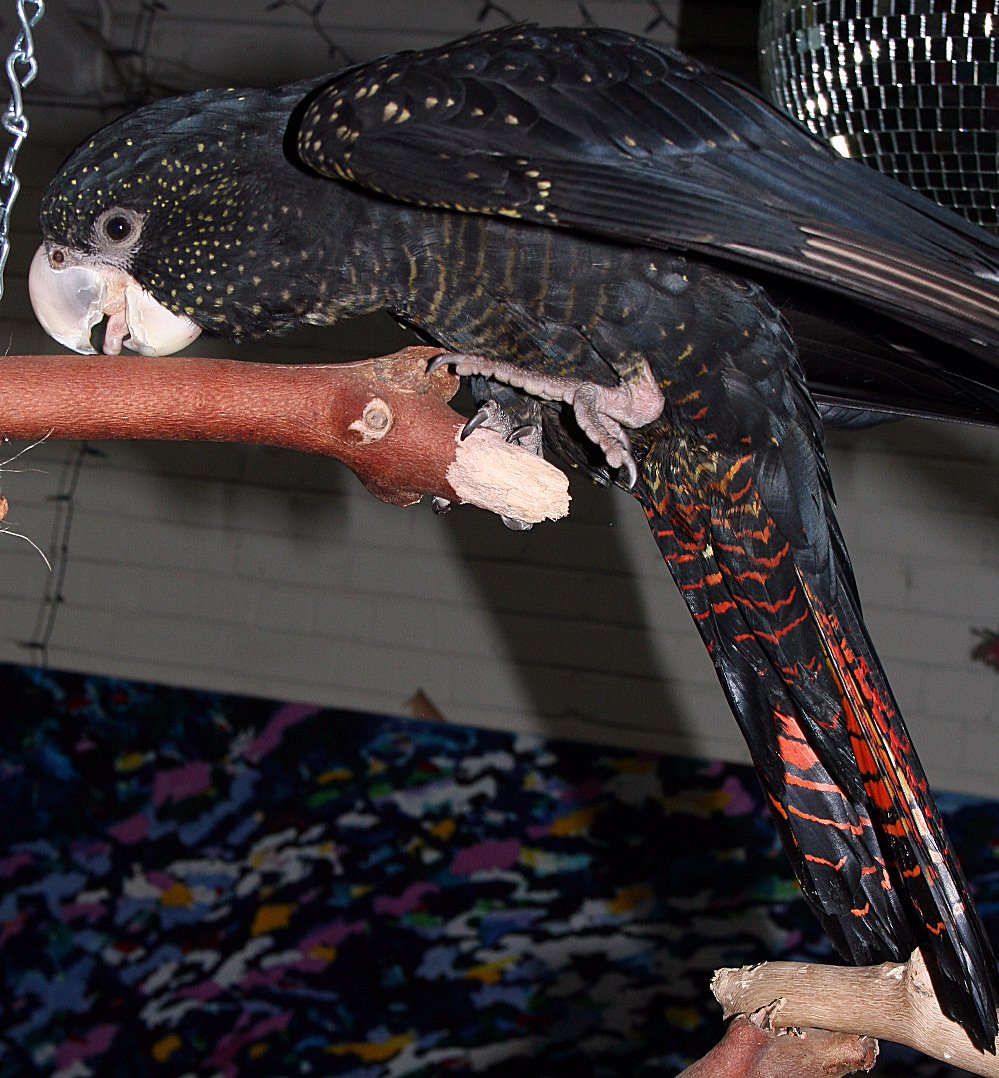
The adults of the Red-tailed black cockatoo(Calyptorhynchus banksii) present sexual dimorphism. The male is entirely black, with the exception of the sides of the tail that are of color red glossy. The upper part of the head It is a long Ridge which starts from the front and goes up to the nape. The bill is grey dark.
The females they are slightly smaller. Show a plumage blackish brown with yellow-orange stripes on the tail and the chest. The cheeks and wings they are covered with small yellow spots. The bill is of color bone pale. Lower parts to the tail coverts they are finely excluded in beige.
The youth are similar to the females until they reach the maturity sexual, around the 4 years. Gradually, as they approach this age, YM will acquire their feathers red which gradually replaced their initial feathers in yellow.
Wide variety of habitats. Grasslands and scrub, from the dense rainforests to the forests of acacia and eucalyptus.
Nestbox, These birds are generally dependent on the old eucalyptus, although according to which regions regions, the variety of trees for nesting, could be different.
To feed, flocks of these cockatoos, they penetrate in agricultural lands and orchards, becoming a real plague.
In all parts of the Australian mainland, have been observed seasonal movements.
In the North, most cockatoos flee from high humidity areas during the rainy season.
In other parts of the continent, We are seeing movements directly related to food.
In South Australia, the movements are carried out in the South-North direction and are not necessarily linked to the stations.
Reproduction:
It nests in the hollow of the following trees: MARRI, Jarrah, Wandoo, Karri and Bullich. Eggs are laid on the bottom of a hollow log, up dry branches, between March and December. The cavity can have a depth of one to two meters. The diameter of the entry may vary from 25 to 50 centimeters.
The laying is of an only egg (In rare cases two). The incubation runs by features of the female and lasts between 29 and 31 days.
At birth the chicks are covered by a little and yellow plumage. Most of the time, the second calf is abandoned and eventually dies from lack of food. The surviving offspring is fed by both parents..
Food:
It feeds mainly from seeds, in particular those of Eucalyptus Marri (E. calophylla). Chew small branches, grabs clusters with its legs and “chews” them to extract the seeds. Strip the remains to the soil, at the foot of the tree. It is a great vegetarian, also eats berries, fruit, some insects and larvae. Occasionally it feeds on plants or varieties introduced as the radish wild, turnips or melons.
Distribution:
Size of the area of distribution (reproduction / resident): 8.680.000 km2
endemic to Australia, where in drier areas.
They are especially prevalent in the northern part of the country. In the South, they are less abundant and more dispersed.
The WPT (World Parrot Trust) contributed funds to a project in the South of Australia for help to save to these birds.
Distribution 5 subspecies
They differ from each other mainly by the size of their beak.
• Current category of the Red List of the UICN: Least concern.
• Population trend: Decreasing.
In the past it was common, but now it has become rare, It is distributed unevenly in areas that have been significantly reduced.
The decrease is caused by the deforestation, the competition for the nesting with species native and exotic, as well as the fires.
It is believed that the world's population exceeds the 100.000 individuals.
the subspecies graptogyne was estimated to be in less of 1.000 individuals in 1989.
Only the subspecies of the Southwest, Calyptorhynchus banksii naso, is listed as "Vulnerable".
The subspecies Calyptorhynchus banksii banksii is not classified as threatened in all regions.
"Red-tailed black cockatoo" in captivity:
Excellent with a very devoted owner. It can be quite noisy. It has a moderate ability to imitate human sound.
There has been an increase in captive birds in Australia. It is very rare as bird cage.
They can live in 50 to 100 years in captivity. The variety Calyptorhynchus banksii naso, of 25 to 50 years.
Alternative names:
– Red-tailed Black-Cockatoo, Banksian Cockatoo, Banks’s Black Cockatoo, Black Cockatoo (English).
– Cacatoès banksien, Cacatoès de Banks (French).
– Rabenkakadu (German).
– Cacatua-negra-de-cauda-vermelha (Portuguese).
– Cacatúa Colirroja, Cacatúa Fúnebre de Cola Roja (español).
The head of the Fairy Lorikeet(Charmosyna pulchella) is dark red with the back of the crown Black extending from above and behind the eyes up to the nape. Mantle Green with a black area below the nape and collar of color red dark at the height of the shoulders; under the back It shows a patch of dark violet interspersed with some green feathers on the ends; rump and tail coverts view from above of color green.
Wings Green with extremes of color black in them flight feather and in the internal parts of the coats. below the wings Red with coverts marginal green; flight feather blackish.
The underparts Red with stripes of pale yellow in the center of the chest, the thighs purple with yellow stripes. The tail view from the top of green at the top with a black shaft in the Center and the rest of red and yellow at the tip; view from below, the tail is yellow, bathed in red and green ends.
The bill is orange with gray tip; irises yellow red; legs oranges.
The female shows a color green beige, not red, on the sides and a yellow patch in the flanks that extends to the sides of the rump.
The female of the subspecies Rothschildi also shows more green in the underparts males and a green mottling on the upper part of the chest.
The Immature They show the yellow patch of the flanks more defined than the females. The lower part of the back, mainly green with some blue-violet. Top of the chest Green mottled without clearly defined yellow stripes adult. Crown Red with black patch restricted to the nape and mixed with the green of the upper mantle. Lack of the Red of the part back from neck clearly defined in adults. Yellow area at the bottom of the flight feather. Iris brown. Beak and feet grayish brown.
Subspecies description
There are two subspecies including the nominal. A third, Charmosyna pulchella beautiful, described by Devis (1900), is considered here as Charmosyna pulchella pulchella.
: (Hartert, 1930) – The patch of the crown descends to find is with them eye; Green fusion behind the yellow lines of the chest, and green fusion in the flanks and the thighs (that can also show some yellow stripes); without the Red of the neck and much less defined the violet patch in the lower part of the back.
Habitat:
Nomads. They are mainly distributed in montane forests, at the edges of forests and secondary growth forests. Its preferred habitat are the mountains between 500 and 1.800 m, but also found in lowlands up to the level of the sea and in the mountains up to 2.300 m.
Found in pairs or flocks of 15 or more members, uniting in the tops of trees in flower with others Charmosyna lorikeets, including the Josephine's Lorikeet.
Reproduction:
In captivity it nests continuously, with incubation of 25 days shared by both parents. Usually, It lays two eggs in a hole in the base of one epiphyte. In nature it is intended that nests between January and April (Pratt picked up breeding males in March).
Food:
It feeds on pollen and nectar.
Distribution:
The Fairy Lorikeet is distributed between New Guinea in Irian Java (Indonesian) and Papua New Guinea, from the East of Vogelkop to the peninsula of Huon. Owen Stanley mountains and southeastern intervals.
Subspecies distribution:
Charmosyna pulchella pulchella
: The nominal
Charmosyna pulchella rothschildi
: The mountains Cyclops and the slope North of the mountains on the idenburg river (Irian Java).
Conservation:
• Current IUCN Red List category: Least concern.
• Population trend: Stable.
The world's population has not been quantified, It is thought that it surpasses the 500.000 birds. the species, according to information, is abundant in some areas, but few in others due to the trade (pit et to the., 1997). Suspected that the population is stable in the absence of evidence of any reduction or substantial threats.
"Fairy Lorikeet" in captivity:
A small number of captivity.
Alternative names:
– Fairy Lorikeet, Little Red Lorikeet, Little Red Lory (ingles).
– Lori féérique, Lori à croupion noir, Lori féerique, Loriquet à croupion noir (French).
– Goldstrichellori (German).
– Lori Lindo (español).
























.jpg)

.jpg)


.jpg)

_RWD2.jpg)


_-_1019-901-(118).jpg)


