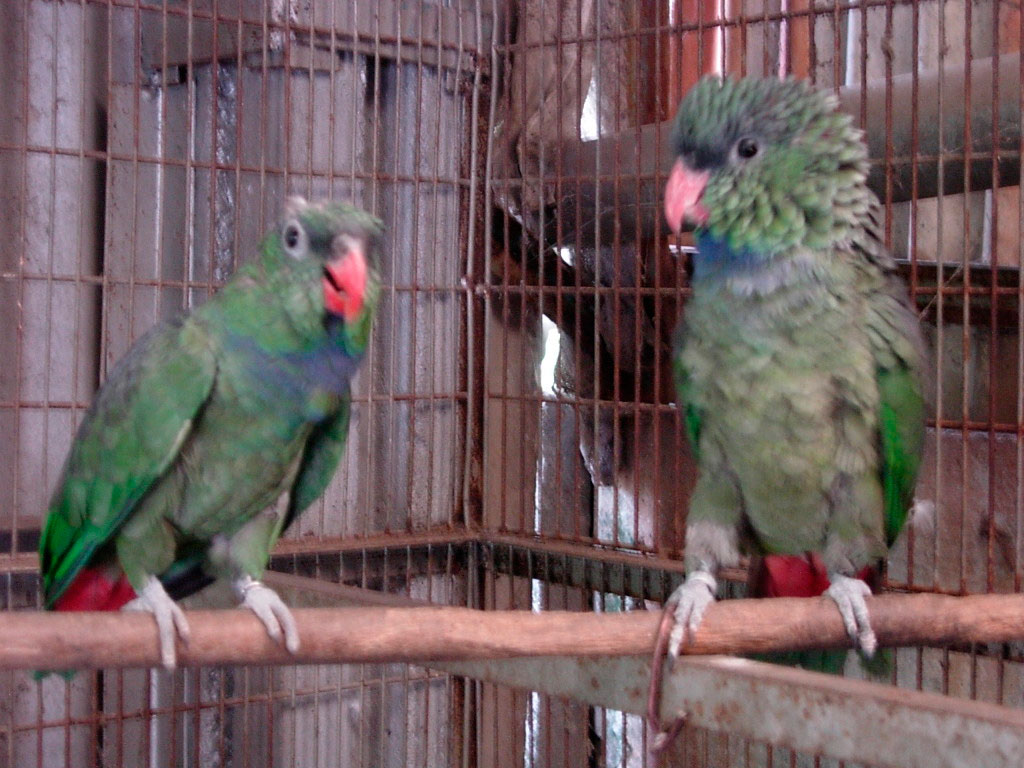
â–· The world of Pets: Dogs, cats, birds, reptiles, amphibians

Cuban Parakeet
Psittacara euops

Aratinga Cubana

Content

Morphology – "Cuban Parakeet"


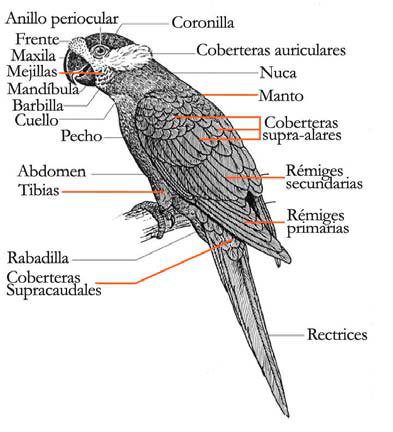
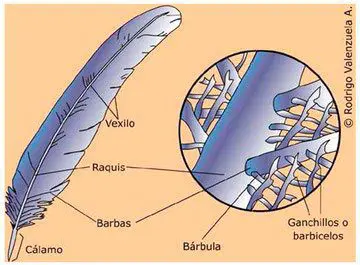
Anatomy-parrots

Description:

26 cm. length and a weight between 78 and 96 g..

The bill of the Cuban Parakeet (Psittacara euops) is strong and hooked, presenting the capacity of both the upper and the lower mobility, enabling this psittacine to husk and crush seeds, fruits and nuts discarded by many other birds, thus showing another successful feature of this Psittacara.

Their legs they have a magnificent prehensile capacity that allows them to take incredible poses and hold on to extreme places thanks to a "zygodactyly" arrangement of the fingers by moving two fingers forward, the 2 and 3, and two backwards, the 1 and 4.

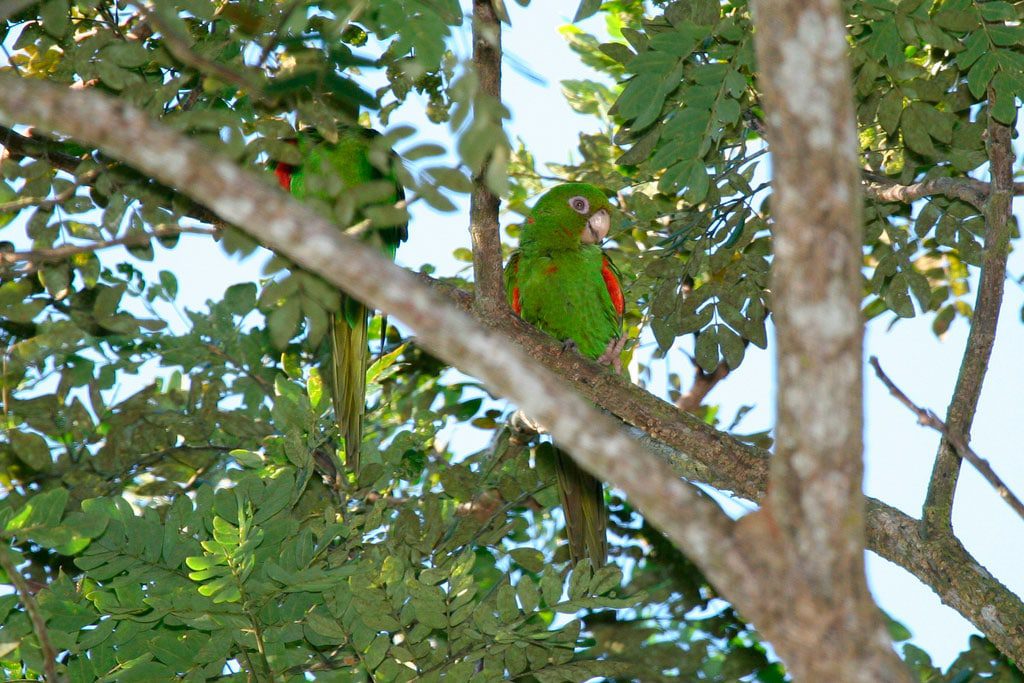
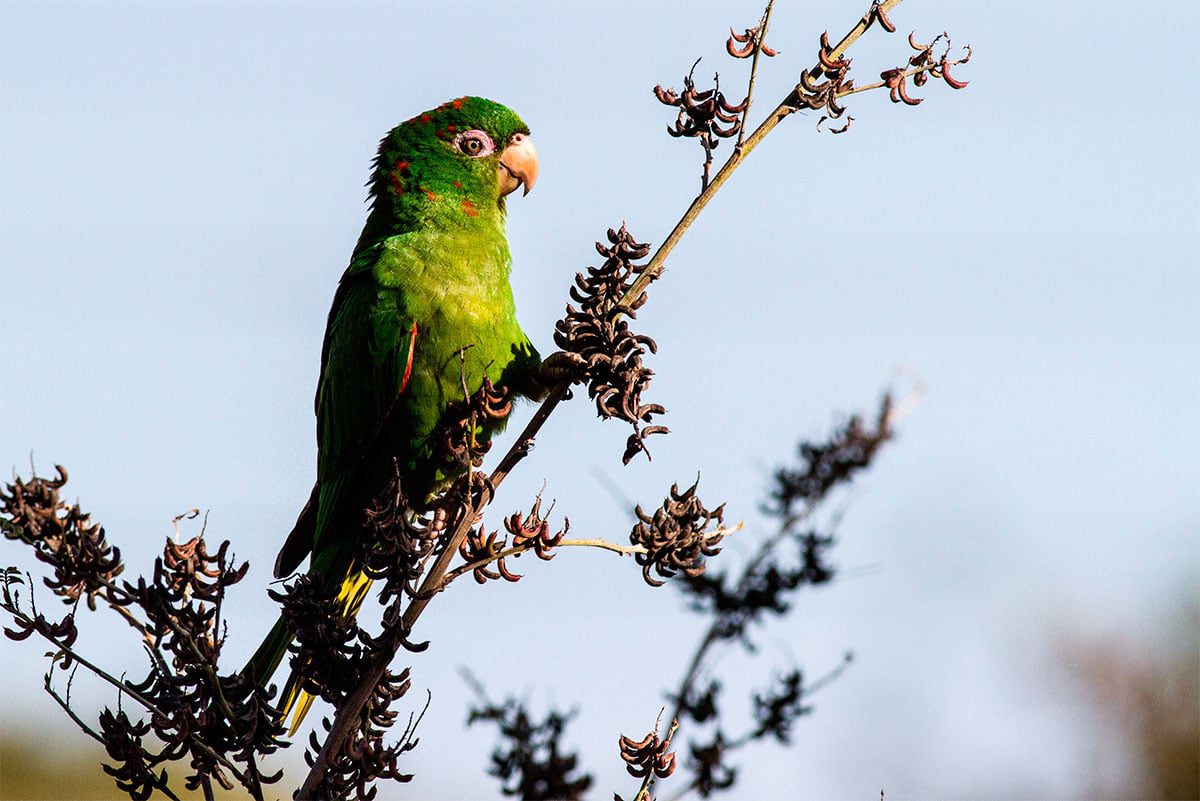
Has the head, sides neck and nape green grass with some red feathers scattered, sometimes forming patches. The upperparts and upperwing-coverts grass-green; primaries and secondaries with margins and dark green tips to vane inner; carpal edge with scattered red feathers and bend of wing red. Underwing-coverts with golden brown in the flight feather, small and medium-sized coverts Red and large coverts Yellow olive. The underparts yellowish green with diffusion of color olive, sometimes with scattered red feathers, especially in the throat and/or the thighs. Upper, the tail dark green color with dye olive; by down yellowish brown. The bill color Horn; bare periophthalmic bluish white; irises yellow; legs distant.

Ilustración Aratinga Cubana

The female has more orange in the wings.

Immature has green and red in underwing-coverts, beige color (not red) in carpal edge, irises Gray with scattered red feathers.

Habitat:

Video "Cuban Parakeet"

They inhabit on Savannah, especially in areas where there are the Palmas Copernicus and Thrinax, at the edges of forests and Lands planted with trees. Although they have also been very modified habitats, such as eucalyptus forests in open field and fragments of forests of Evergreen in sheets of Palma. The species survives only near large extensions of primary forest.

In general, observed in family groups or small flocks, but sometimes in larger groups, hundreds of birds; the Cuban Parakeet, often, mix with the more common and endemic Cuban Parrot (Amazona leucocephala).

Reproduction:

One of the major problems of this kind in the reproduction, It is competition and the finding by the nesting cavities; This psittacine is a small, so their physical advantage over other birds to displace these from cavities or nests is less and they must show greater aggressiveness to be able to expel woodpeckers and even some small birds of prey These cavities that already occupy.

But, in recent studies, It is suggested that in free-living this species has a high degree of selectivity by the height of the Palma in which anidated or for the depth of the nest, still not evident during the stage of formation of couples and nesting strong signs of gregariousness, But if there could be a tendency to prefer nests with a sufficiently narrow entrance opening to enter the couple and hamper the penetration of predators. It also seems that the species in reproduction is more tolerant of other neighboring couples of the same species, than others parrots, but to some degree of alienation, preferring Palmas in which there is only one cavity to have a certain degree of privacy in the rearing of their chicks.

The breeding season It begins in April and usually ends in July. They sometimes build their nests in cavities excavated, originally, by the Cuban Green Woodpecker (Xiphidiopicus percussus).

The number of eggs in the implementation It, in averaged, between three and five. The incubation both members of the couple is done, as well as feeding the young until they leave the nest. Once abandoned the nest, You can see to the immature flying with parents in small camps before the winter season, forming major sides joining them different families.

Food:

Diet Cuban Parakeet consists in fruits Mango, papaya, guava, Roystonea Palms, Melicoccus bijogatus and Spondias mombin, as well as seeds of Inga vera, outbreaks, Millet and berries.

Formerly persecuted by provoking large damage to crops Orange, coffee and corn.

Distribution:

Species vulnerable to extinction, from an original distribution throughout Cuba and Isle of youth, isolated populations between Yes.

Formerly one of the most common endemic birds in Cuba and in the Isle of youth, old Isle of pines, but now is limited to various strongholds in remote areas of Cuba, including the Zapata Peninsula, the districts around Cienfuegos and the mountains around the city of Trinidad, to the extent Western Centre of the island, and Sierra Maestra at the end of this.

Resident but some seasonal movements (Perhaps altitude) supposedly by the decline of the birds of the mountains of Trinidad in the months of September and October.

Extinct in the Isle of youth from 1913, mainly due to the strong capture for export as bird cage.

The current population, Although comparatively small, Perhaps stable. A small number of captivity out of Cuba, especially in Eastern Europe. The international trade currently it is small.

Today this species is restricted to 16 populations considering that a total of 2800 individuals released, with a number of individuals per population not exceeding, usually, the 100 copies and is considered of greater size the located in the Zapata Swamp live in where is estimated around 800 these birds. Each of these populations are isolated or insulated semi between if, not exceeding groups or sides that make it up, the 30 individuals, with a general tendency to the disappearance of the species in many of the populations, mainly due to the loss of Habitat and illegal catches.

Conservation:

State of conservation ⓘ


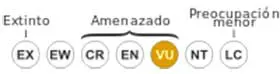
Vulnerable Vulnerable ⓘ (UICN)ⓘ

• Red List category of the UICN current: Vulnerable

• Population trend: Decreasing

There are no new data on the evolution of the population of the Cuban Parakeet; But, the species is suspected of have been declining at a moderate pace, mainly as a result of the habitat degradation.

Rounded, a population estimated between 1,500-7,000 mature individuals.

The persecution as a pest of crops, loss of habitat and, in particular, the capture for trade bird cage, They explain the current shortage of copies of Cuban Parakeet (A. Kirkconnell in litt., 2007).

The capture for trade International is now insignificant, with only 10 birds recorded in trade between 1991 and 1995. Another major threat is the loss of nesting trees (Snyder et to the., 2000) as a result of hurricane damage (as the caused in the Zapata Peninsula by the Hurricane Lili in 1996), and the felling of trees for chicks of the Cuban Parrot (Amazona leucocephala) (A. Mitchell in litt., 1998).

Conservation Actions Underway

• Appendix II of CITES.

• Is legally protected.

• They are distributed within the seven environmental reserves, including the important Ciénaga de Zapata National Park (Snyder et to the., 2000).

• A study of the species and an intense public awareness campaign are intended to help establish a management programme effective (Wiley, 1998).

• The programs of ecotourism they have begun in some areas (Snyder et to the., 2000).

• A provision scheme has been started for nest boxes, the plastic boxes are more durable than the facts of sections of the trunk of the Palm (Waugh 2006), but the parakeets prefer those made of natural materials (Anon., 2010).

• A program of reintroduction from the main island of Cuba to the Isle of youth is being developed from the 2004, but the species is generally difficult to breed (parrots 2000-2004; avianweb.com).

Conservation Actions Proposed

• Carry out more Research to determine the ecological requirements of the species and population (Wiley 1998, Snyder et to the., 2000).

• Conserve additional habitat, especially in the areas of nesting (Snyder et to the., 2000).

• Adapt the environmental awareness and protection of nests in situ to local situations (Snyder et to the., 2000).

• Continue a plan for the re-establishment of the species in the Isle of youth (Wiley 1998, Snyder et to the., 2000) through the development and extension of the programme of captive breeding.

"Cuban Parakeet" in captivity:

In captivity, they are very sleepers and somewhat quarrelsome and restless, needing always to be monitored. Non-communicative the issuance of words but very friendly with the person you choose as partner, which will not get rid of some sympathetic evil, almost always tolerated and even grateful.

Sensitive to the changing conditions of the ecosystem that inhabits.

The requirements and difficulties in the reproduction of this species are considerable.

Own this nice bird as pet, Although on the one hand it can be a satisfaction to the owner, on the other hand means to convict individuals of this species not reproduction and populations to lead them to the risk of the extinction.

Alternative names:

– Cuban Parakeet, Cuban Conure, Cuban Paroquet, Red-speckled Conure (English).
– Conure de Cuba, Perriche de Cuba, Perruche de Cuba (French).
– Kubasittich (German).
– Periquito-cubano (Portuguese).
– Aratinga Cubana, Perico, Periquito, Periquito Cubano (español).
– Catey, Perico, Periquito (Cuba).


scientific classification:
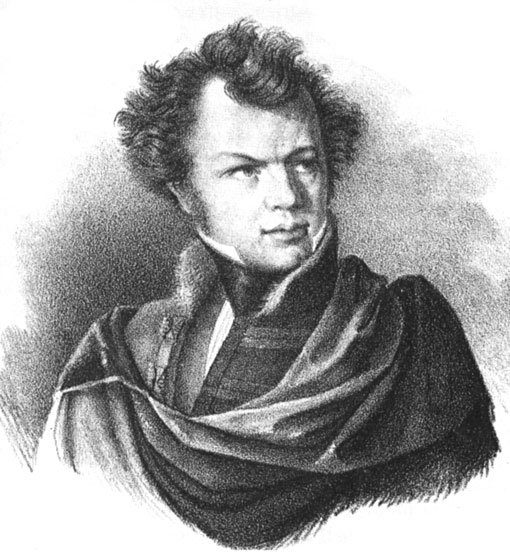
Johann Georg Wagler
Johann Georg Wagler

– Order: Psittaciformes
– Family: Psittacidae
– Genus: Psittacara
– Scientific name: Psittacara euops
– Citation: (Wagler, 1832)
– Protonimo: Sittace euops


Cuban Parakeet pictures:

Species of the genus Psittacara

Sources:

  • Avibase
  • Parrots of the World – Forshaw Joseph M
  • Parrots A Guide to the Parrots of the World – Tony Juniper & Mike Parr
  • Birdlife
  • Veterinaria.org®
  • REDVET®

  • Photos:

(1) – Psittacara euops – Cuban parakeet by Ekaterina Chernetsova (Papchinskaya) – Flickr
(2) – Psittacara euops – Cuban parakeet by Ekaterina Chernetsova (Papchinskaya) – Flickr
(3) – Cuban Parakeet, Conure De Cuba, or Aratinga Cubana (Aratinga euops). Two parrots in a tree By dominic sherony (originally posted to Flickr as Cuban Parakeet) [CC BY-SA 2.0], via Wikimedia Commons
(4) – Cuban Parakeets are a rare sight in Cuba, the only place they live in the world by Hank Davis, DNS Board Member – Delaware nature society
(5) – For the Caribbean Conservation Trust in conjunction with the Massachusets Audubon Society – Winged spur imaging
(6) – Deutsch: Psittacara euops Syn: Evopsitta euops & Psittacara chloropterus Syn: Psittacara chloropter bzw. Psittacara euops St. Domingue By Charles Emile Blanchard (1819–1900) (biodiversitylibrary.org) [Public domain], via Wikimedia Commons

â–· The world of Pets: Dogs, cats, birds, reptiles, amphibians

Yellow-faced Parrot
Alipiopsitta xanthops

Yellow-faced Parrot

Content

Description

Yellow-faced Parrot

26 to 27 cm.. tall and about 260g. weight.

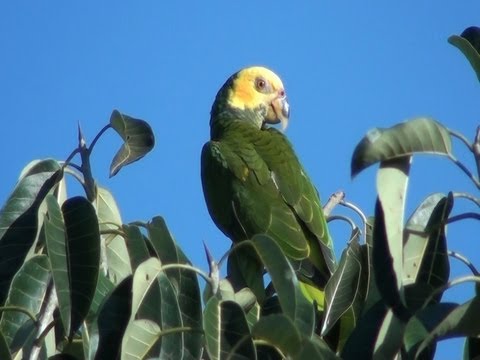
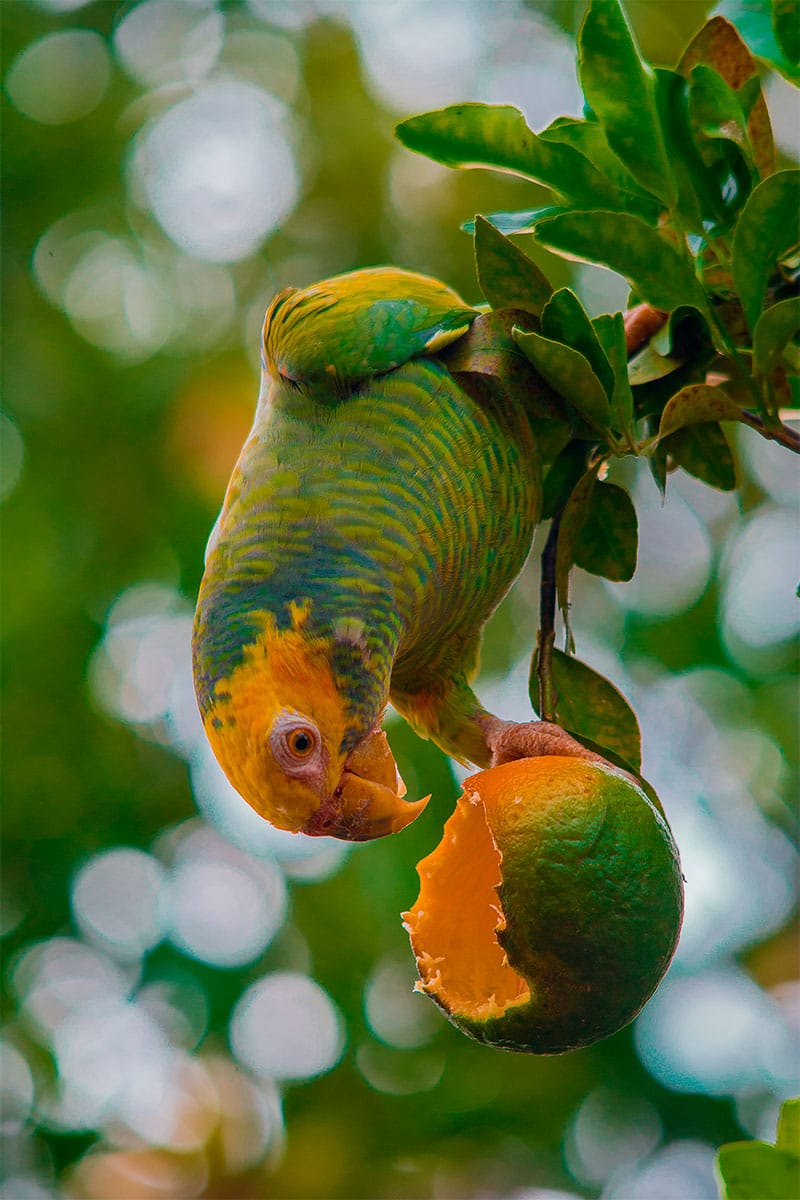
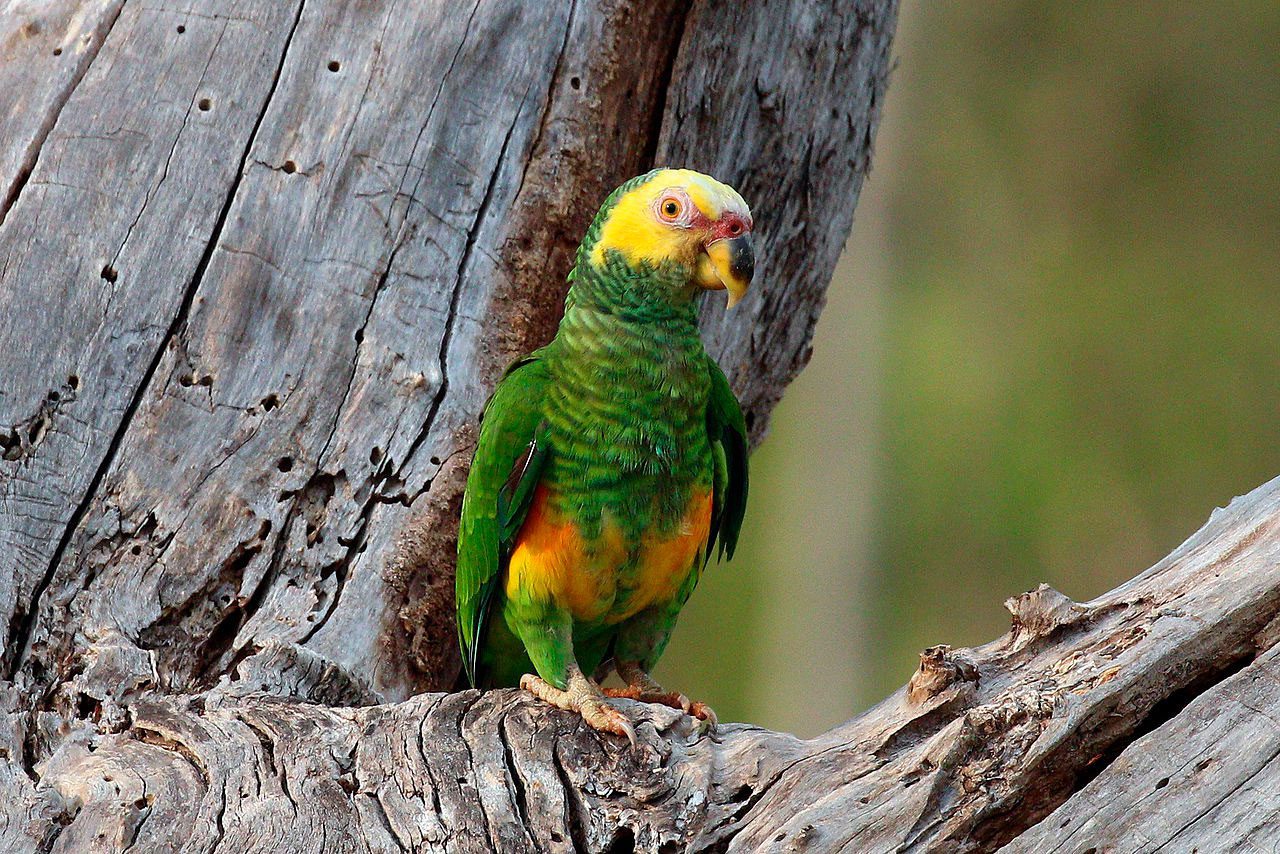
The Yellow-faced Parrot (Alipiopsitta xanthops) It is distinguished by the large area of ​​yellow in the head, with green tint nape; orange to the sides of body and upper base of the tail; collar yellowish green, belly almost all yellow, the thighs and green inner core tail green; the back it is usually green with yellow tints.

blackish brown with yellow edges; iris yellow .

The youth less yellow in body.


Anatomy-parrots

Habitat:

It inhabits in dry forests, also called deciduous forests, in lowlands, with the presence of palmas Mauritia, Although they prefer water courses.
They can be seen in pairs or flocks of up 50 specimens.

Reproduction:

Video – "Yellow-faced Parrot"

Canto-galego parrot (ALIPIOPSITTA XANTHOPS), YELLOW-FACED PARROT, Curraleiro, CURAU PARROT.

Although little information regarding this is available, it is known that nest in the hollows of the highest trees closed; the laying usually three eggs and the incubation period is 23-24 days.

Food:

It's a species of which there are few studies of their natural habitat. Its main food It consists mainly of fruits and seeds. Very fond of mangoes, usually visit their trees full of fruit.

Distribution:

Size of its range (reproduction / resident): 2.700.000 km2

Inside of Brazil and adjacent area to the east of Bolivia and Horqueta, in the East of Paraguay.

Conservation Alipiopsitta xanthops:

State of conservation ⓘ


Near-threatened Near Threatened ⓘ (UICN)ⓘ

• Current category of the Red List of the UICN: Near-threatened.

• Population trend: Decreasing.

In 1993 two thirds of the Cerrado, This species inhabited, had been moderately or severely altered by agriculture, heavy cattle farming, invasive grasses, the use of pesticides and annual burning.

Conservation Actions Proposed:

• Collate sample data and recent records to provide an improved assessment of distribution and status.

• Estimate the total wild population (Bianchi 2009).

• Assess the impact of habitat loss (Snyder et to the . 2000).

• Create a network of large reserves in Bahia, maranhão and Piauí.

Yellow-faced Parrot in captivity:

Ave Rare in the world of poultry farming.

active, curious and playful. Aggressive with other parrots. They can become very noisy. Prone to obesity

Its reproduction rarely been achieved in captivity. The basic requirement would be to isolate a compatible pair during the breeding season due to increased aggression towards other birds during this period.; also require spacious accommodations and a nest box of 25 x 25 x 60 cm. . with input from 8 cm in diameter.

They tend to be aggressive toward their caregivers. The breeding season begins in early May. The implementation is of 2 to 4 eggs, which are incubated during 26 days. The young leave the nest when they are near the 8 weeks of age.

Alternative names:

– Yellow faced Parrot, Yellow-crowned Amazon, Yellow-crowned Parrot, Yellow-faced Amazon (English).
– Amazone à face jaune (French).
– Goldbauchamazone, Schoapapagei (German).
– Papagaio-galego, chorão, curau, papagaio-acurau, papagaio-curraleiro, papagaio-de-barriga-amarela (Portuguese).
– Amazona Chica, Amazona del Cerrado, Loro cara amarilla, Lora chica (español).


Scientific classification Alipiopsitta xanthops:

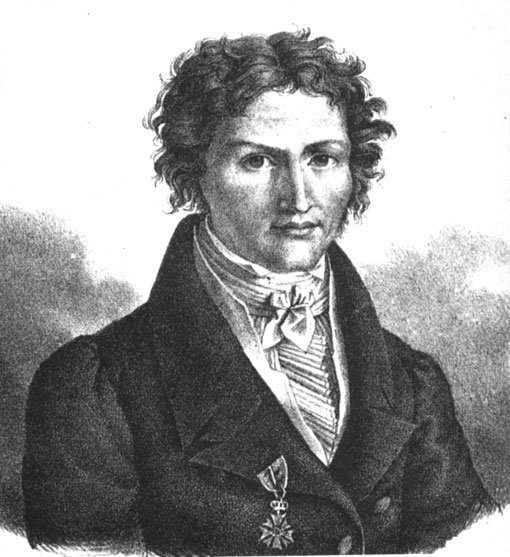
Johann Baptist von Spix

– Order: Psittaciformes
– Family: Psittacidae
– Genus: Alipiopsitta
– Scientific name: Alipiopsitta xanthops
– Citation: (von Spix, 1824)
– Protonimo: Psittacus xanthops


Images Yellow-faced Parrot:


Species of the genus Amazona


Sources:

  • Parrot Book, Parrots and macaws Neotropical
  • avibase
  • parrots.org
  • Parrots of the World – Forshaw Joseph M
  • Parrots A Guide to the Parrots of the World – Tony Juniper & Mike Parr
  • Birdlife

Photos:

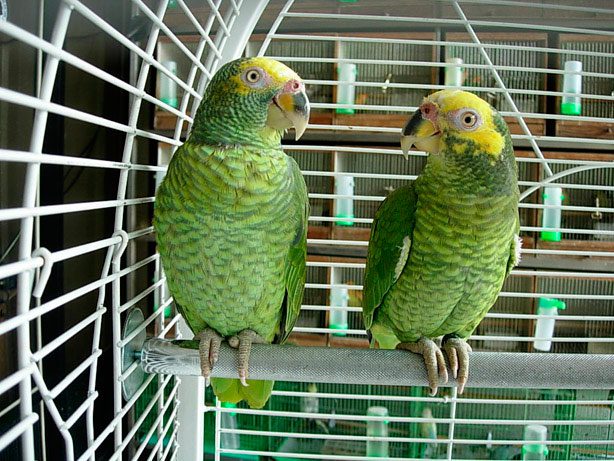
(1) – Yellow-faced parrot (Alipiopsitta xanthops) green morph, the Pantanal, Brazil By Charlesjsharp (Own work, from Sharp Photography, sharpphotography) [CC BY-SA 4.0], via Wikimedia Commons
(2) – Yellow-faced parrot (Alipiopsitta xanthops) yellow morph, the Pantanal, Brazil By Charlesjsharp (Own work, from Sharp Photography, sharpphotography) [CC BY-SA 4.0], via Wikimedia Commons
(3) – Alipiopsitta xanthops, Yellow-faced Parrot; two in a cage By TJ Lin (originally posted to Flickr as yellow-faced amazon) [CC BY-SA 2.0], via Wikimedia Commons
(4) – Yellow-faced Parrot in Giza Zoo By Hatem Moushir (Own work) [CC BY-SA 3.0], via Wikimedia Commons
(5) – Record made in the city of Três Lagoas-MS, urban area. A flock landed on a ponca tree to feed By Jairmoreirafotografia (Own work) [CC BY-SA 4.0], via Wikimedia Commons
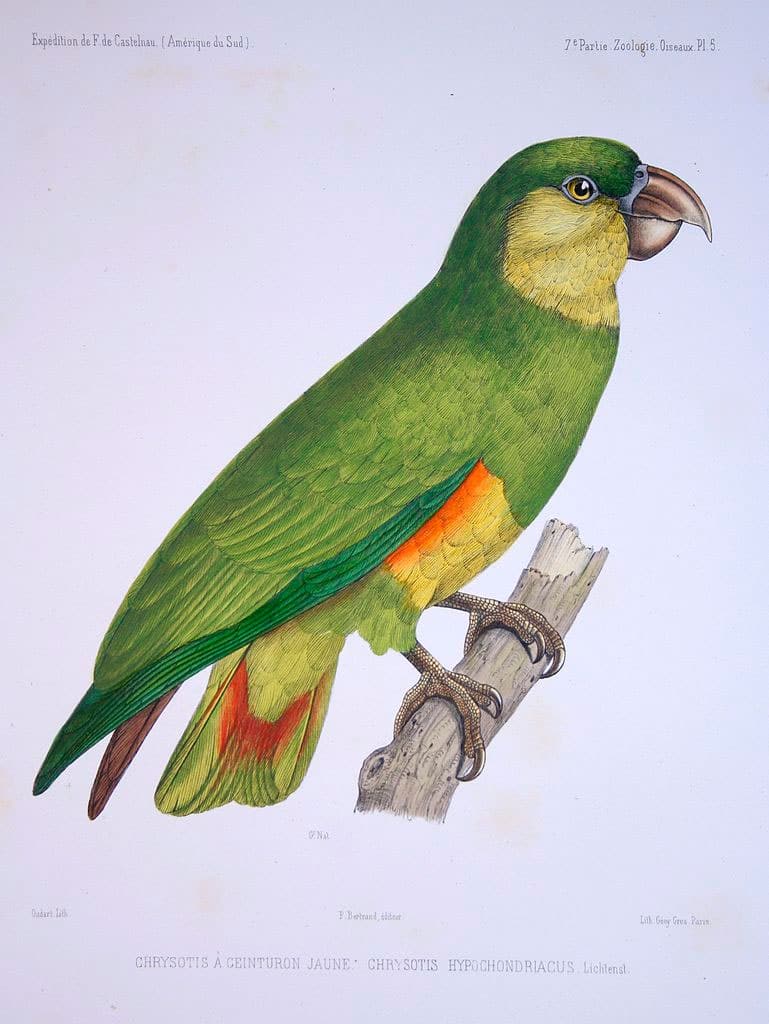
(6) – Illustration does not look like A. xanthops (Yellow-faced Parrot). Fisch's Papageien monograph discusses this dubious specimen by Francis de Laporte de Castelnau [Public domain], via Wikimedia Commons

Sounds: Joao Antonio de B.. Vitto

â–· The world of Pets: Dogs, cats, birds, reptiles, amphibians

Blue cheeked Parrot
Amazona dufresniana

Blue cheeked Parrot

Content

Physical characteristics


Anatomy-parrots

34 to 37 cm.. height and between 480 and 600g. weight.

The Blue cheeked Parrot (Amazona dufresniana) It is easily identifiable by the orange yellow wing patch, much more noticeable in flight.

Head with orangeade narrow stripe on the forehead; Yellow Crown, cheeks, base of the beak, sides of the neck to almost light blue Crown.

End of the wing dark, tail with yellow border, rest of green body.

Young birds with orange-yellow feathers on the front of the head and a violet color in the bottom of the cheeks.

The binomial name of this species is in honor to the French zoologist Louis Dufresne.

Video "Blue cheeked Parrot"

Blue cheeked Parrot habitat:

It lives in humid forest, of gallery and sheets, up to 1700m.

It can also be seen sporadically in coastal areas, possibly in response to food availability.

Reproduction Blue cheeked Parrot:

They walk in pairs or small groups of no more of 4 to 8 individuals.

Reproduction and feeding, there is little information.

In the wild, the breeding season occurs in March in Guyana. In captivity, the female lays 3 eggs that we do not know exactly the incubation period.

Food Blue cheeked Parrot:

We don't know the details of your menu, but it is assumed that they eat almost exclusively seeds, and berries.

Distribution Blue cheeked Parrot:

Amazon-fronted Parrotlet location

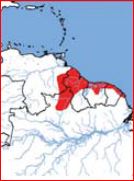
The Amazona dufresniana It is located in southeast Venezuela (Bolívar, with a record isolated on Amazon), Northern Guyana (north of 5°N), Northeast Suriname and French Guiana northeast (Y way Collar 1991).

There are reports of Para and Amapa, Brazil, where its occurrence seems likely, but there is no conclusive records (Y way Collar 1991, Collar 1995). The scarcity of records from frequently surveyed areas suggests that it is a low-density and rare species., at the least in parts of its range (Y way Collar 1991).

a Guyana, Healthy populations are known in the area in northwestern Aruka Guyana, between the Aruka and Amakuru rivers, the Kaieteur National Park and the Kuribong River, and the Iwokrama Forest Reserve (A. Narine a slightly. 2010)

Conservation:

State of conservation ⓘ


Near-threatened Near Threatened ⓘ (UICN)ⓘ

It is in the category of near threatened. (NT), due to habitat loss and illegal trade.

Classified as near-threatened (NT) on the IUCN Red list (1) listed in Appendix II of the CITES (4).

Conservation in March CITES Appendix II actions. Banded from Canaima National Park (Venezuela), Iwokrama forest reserve (Guyana) and the Brownsberg nature park (Suriname).

Blue cheeked Parrot in captivity:

Rare in captivity.
Placid temperament, seems less active than many Amazon.

Alternative names:

– Blue cheeked Parrot, Blue-checked Parrot, Blue-cheeked Amazon, Blue-cheeked Parrot, Dufresne’s Amazon, Dufresne’s Parrot (English).
– Amazone de Dufresne (French).
– Goldmaskenamazone, Granada Amazone (German).
– Papagaio-de-bochecha-azul (Portuguese).
– Loro de cachetes azules, Amazona Cariazul, Amazona de Cara Azul, Loro cariazul (español).

scientific classification:

– Order: Psittaciformes
– Family: Psittacidae
– Scientific name: Amazona dufresniana
– Citation: (Shaw, 1812)
– Protonimo: Psittacus dufresnianus

Blue cheeked Parrot images:


Species of the genus Amazona


Sources:

– Parrot Book, Parrots and macaws Neotropical

Photo:

1 – papageien.org
2- by Matthieu Sontag[GFDL or CC BY-SA 4.0-3.0-2.5-2.0-1.0], via Wikimedia Commons
3 – By Bjoertvedt (Own work) [CC BY-SA 3.0 or GFDL], via Wikimedia Commons
4 – papageien.org
5 – by ©Michel Clement – gepog.org

Sound: Olivier Claessens

â–· The world of Pets: Dogs, cats, birds, reptiles, amphibians

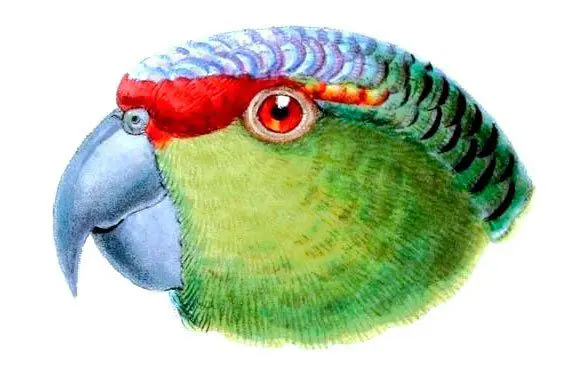
Red-lored Amazon
Amazona autumnalis

Red-lored Amazon


Anatomy-parrots

Content

Description:

35,5 to 38,1 cm.. height and between 314 and 485g. weight.

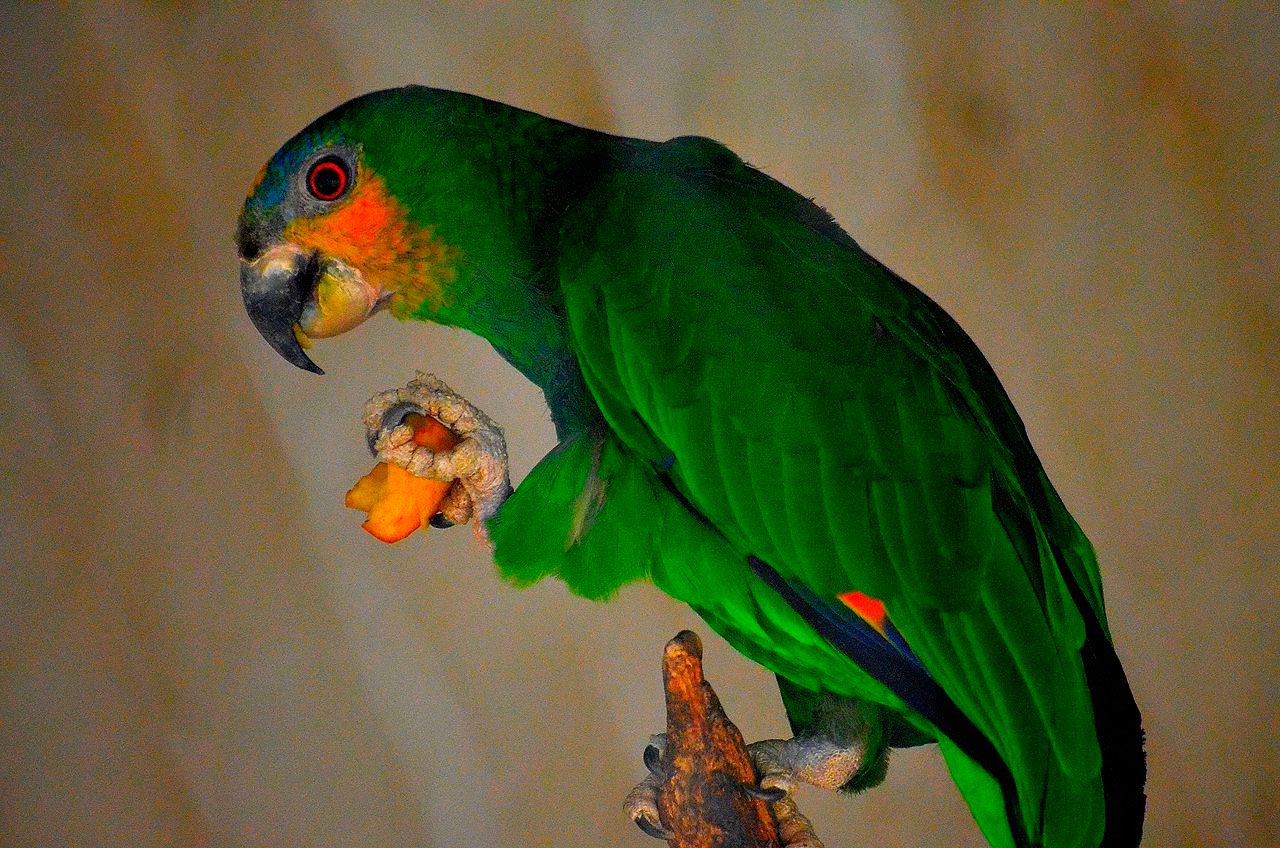
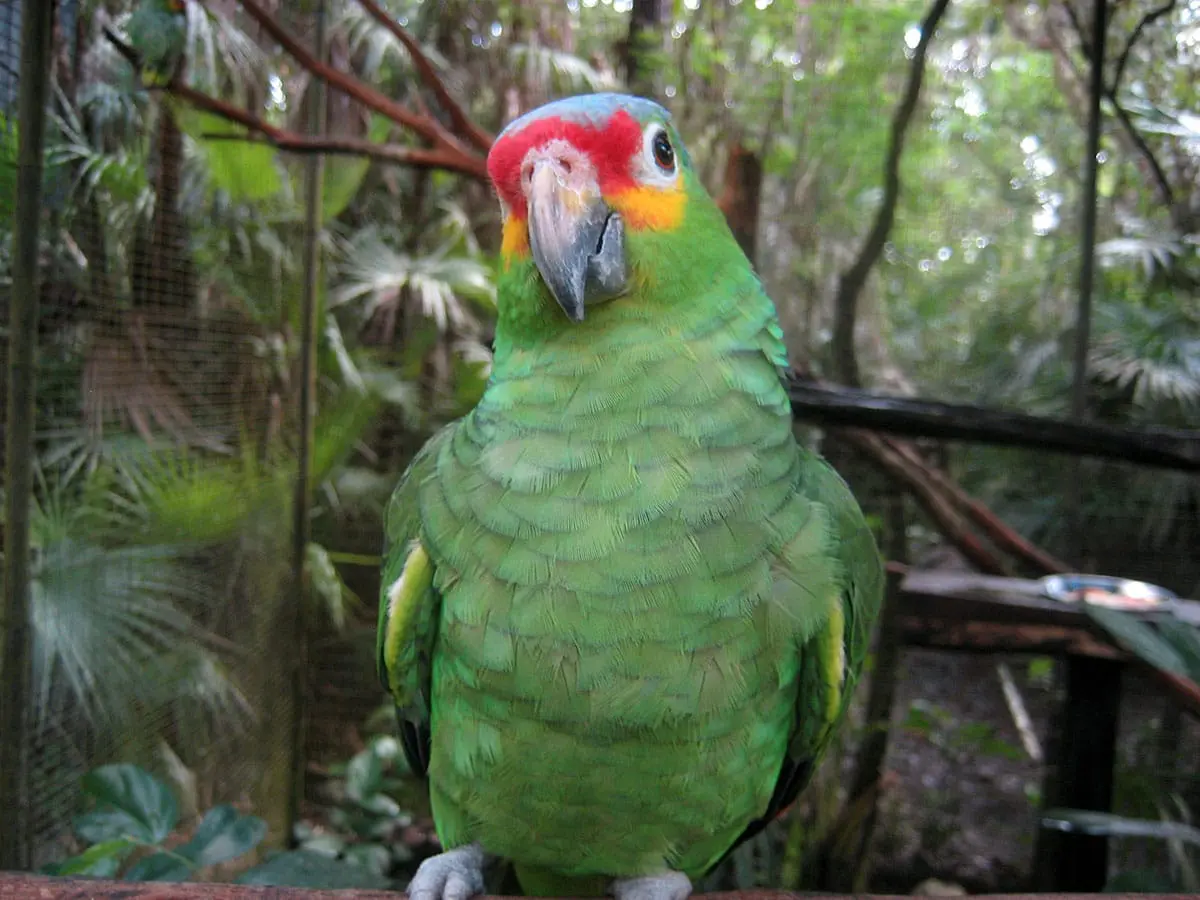
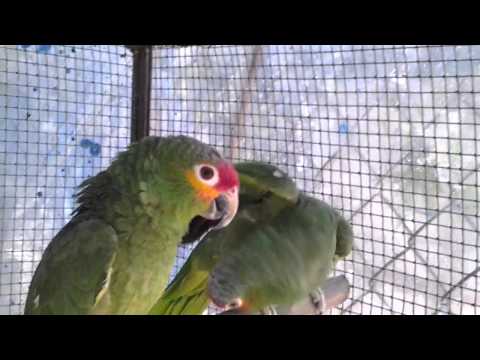
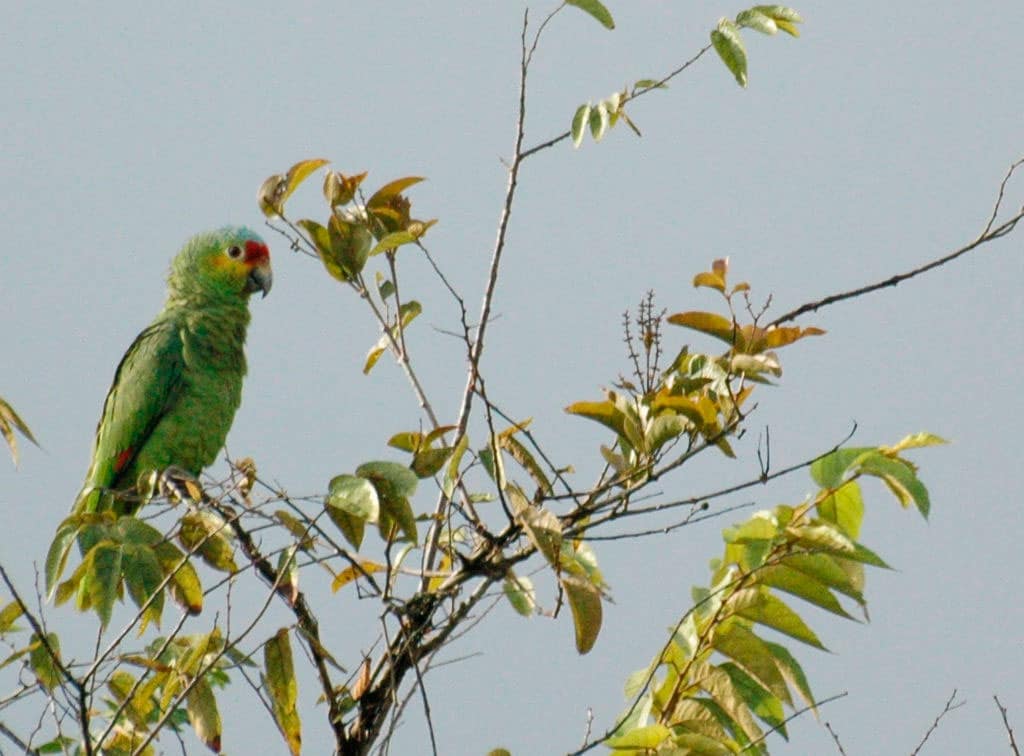
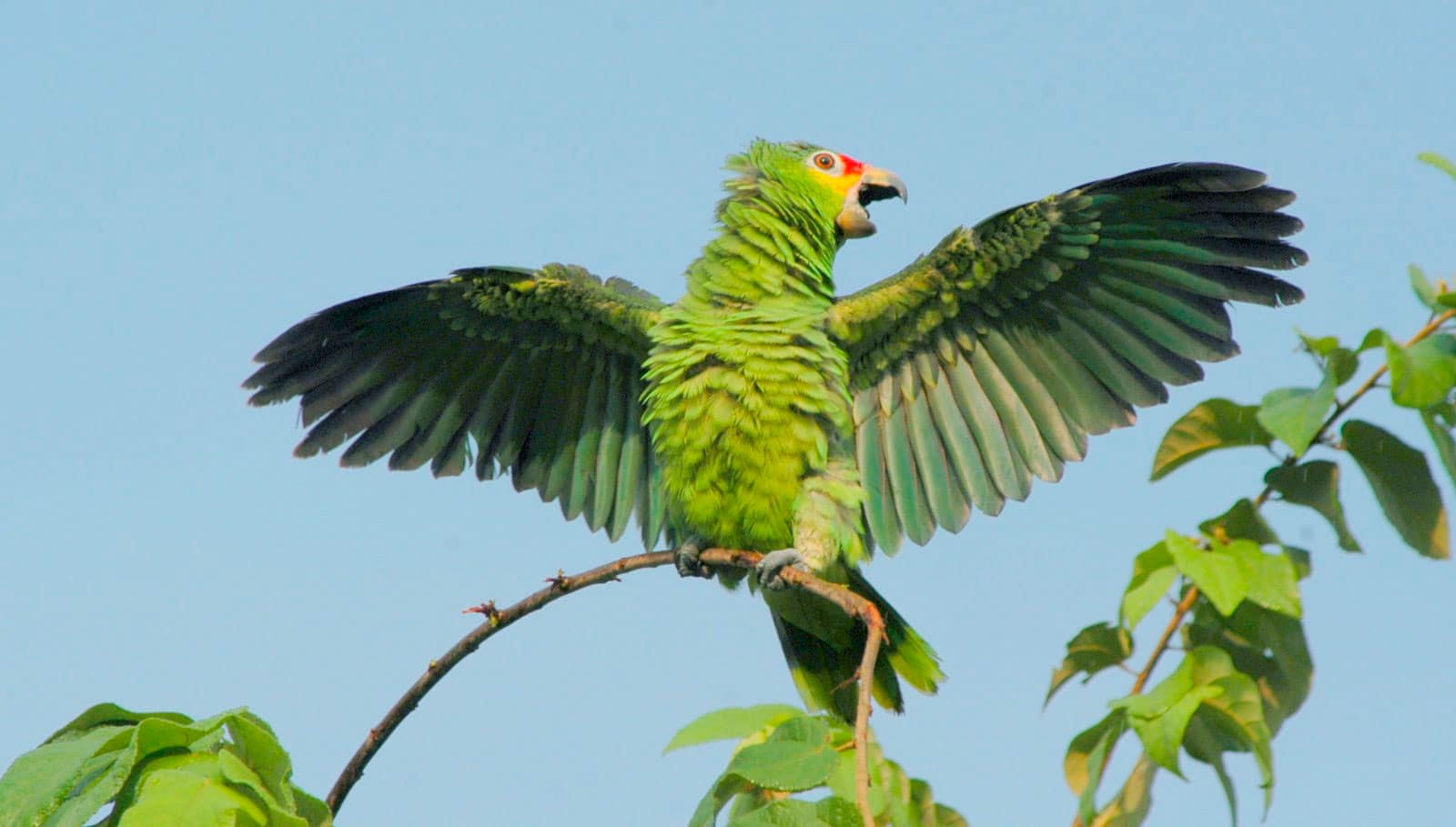
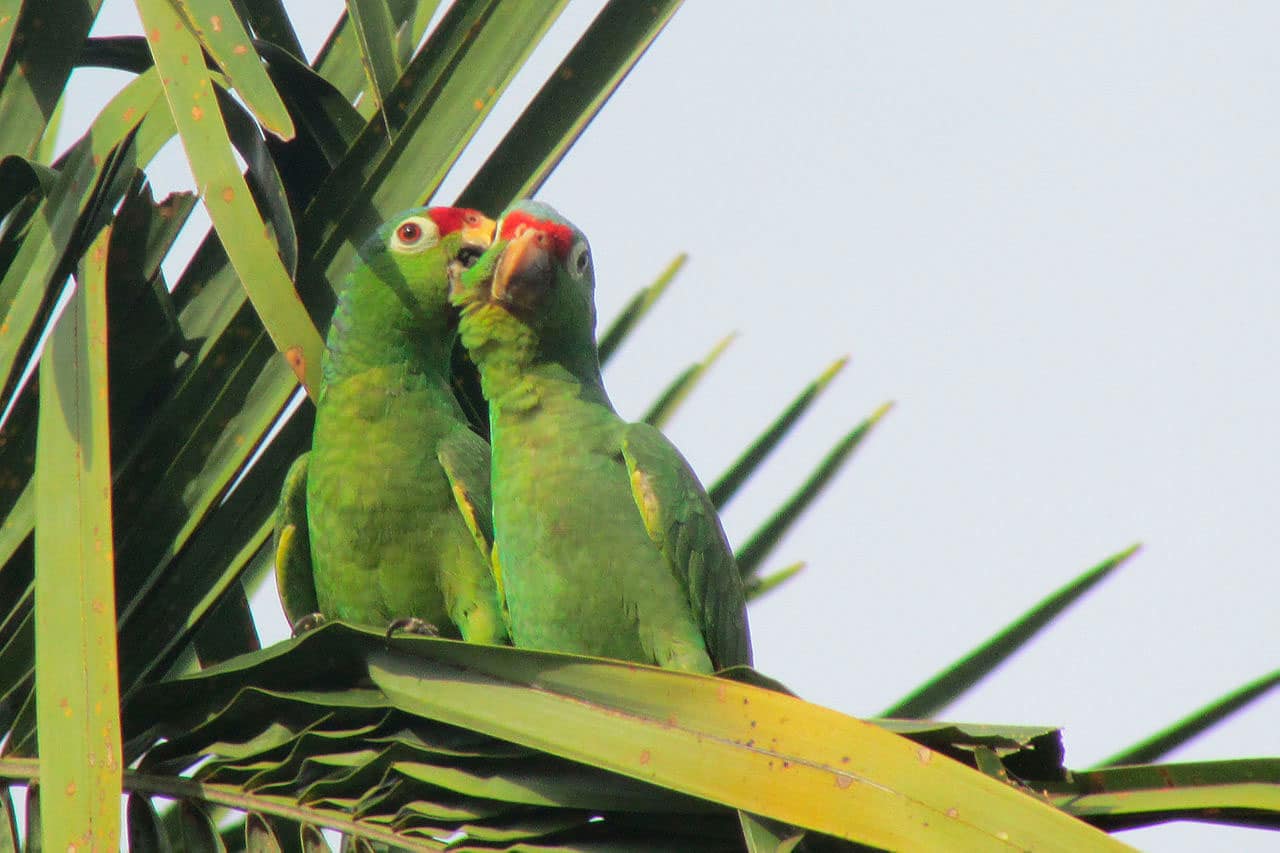
The Red-lored Amazon (Amazona autumnalis) is distinguished by its red front; Green with edge lilac it nape ; crown lilac; stain red in the wing , and tail blue margin.
The bill is grey with the upper jaw yellowish-horn. The irises his eye is orange. The legs are of color gray greenish.
They do not possess sexual dimorphism, that is to say, there is no physical difference between the male and the female.

Description 3 subspecies:

Amazona autumnalis lilacina Lesson, 1844
  • Amazona autumnalis autumnalis

    (Linnaeus, 1758) – Nominal.


  • Amazona autumnalis lilacina

    (Lesson, 1844) – It has a red band in the forecrown that it extends over them eyes; the cheeks Yellow.


  • Amazona autumnalis salvini

    (Salvadori, 1891) – It has cheeks and ear-coverts green; the basis of the tail by under Red.

Habitat:

Video – "Red-lored Amazon"

Amazonas autumnalis

This amazon frequents a wide range of habitats wooded and open with trees, including rainforest, tropical deciduous forest, pine forests, mangroves, forest swamps, gallery woods, areas cultivated with trees high and plantations; also forest dry in the South of Ecuador.

The Red-lored Amazon move from the rainforest (breeding season) to a habitat more open in winter in the Yucatan Peninsula, Mexico. The altitudes that inhabit range from sea level to the 320 metres in Oaxaca, 1.100 metres in Honduras, 800 metres in the Caribbean, 1.000 meters on the slopes of the peaceful of Costa Rica, and 1.000 metres in Colombia.
The birds tend to be in pairs or in flocks loose, being more gregarious When feed (occasionally macaws) and when resting. outside the breeding season, birds take refuge in tall trees in gallery forests or mangroves.

Reproduction:

They nest during the seasonal dry in hollow of trees (usually dead, for example, Tabebuia or Ceiba) or on the stump of a Palm tree. Birds in State reproductive in April, Oaxaca; February-March, Belice; March, Guatemala; January-February, Colombia. Reproduce between February-April, Panama; March-may, Belice and January-March, Ecuador. Clutch 3-4 eggs.

The incubation varies from 25 to 26 days. The chicks remain in the nest 70 days.

Food:

In the wild these birds feed on figs Ficus, orange, Mango, fruits of Palm (including the of Cordia lutea and Spondias purpurea), coffee beans (Coffea arabica), seeds of Ferrule, Casearia and Protium. Mainly are feeds in the tops of trees high.

Distribution:

Size of the area of distribution (reproduction / resident): 2.570.000 km2

The Red-lored Amazon It extends from the South of Mexico north of South America with a population disjunct in the amazon.
You can find in them lands low of the this of Mexico, in the South of Tamaulipas, in the East of San Luis Potosi, Puebla, Oaxaca, Chiapas, Tabasco, Campeche and Quintana Roo. Records from other parts of the country (for example, City of Mexico) probably you refer to leak.
You can see in Belice and in the lowlands of the Caribbean of Guatemala and Honduras (including Roatan and Guanaja in Bay islands and probably soon in Utila), until Nicaragua and Costa Rica, where they are present in humid areas of the tropics on both slopes (absent from the dry Northwest ), also in Panama and on the islands of Coiba and Escudo de Veraguas and in the Archipelago of pearls (absent from the driest areas of the Azuero Peninsula).

In the Northwest of Colombia appear on the Pacific slope of the Western Andes from the Panamanian border to the South up to the Serrania del Baudo and from the southwest of Cauca south to Ecuador in the Gulf of Guayaquil. Also it extends to the North of the Andes in Colombia to Magdalena Medio and to the East in the Northwest of Venezuela in Zulia (Sierra de Perija).

In the Northwestern basin of the brazilian amazon a disjunct population exists between Black river and Solimões River.

Usually resident with some local seasonal habitat preferences (for example, in Yucatan Peninsula, Mexico). Is usually the most common parrot and more numerous in some parts of the range (for example, in parts of Central America) but now is a species very rare to the West of them Andes in Ecuador and Colombia with a population of the subspecies Amazona autumnalis lilacina estimated in 400-600 specimens.
Population decreased drastically in the island of Roatan (Honduras) where he captured it is massively for export, and maybe missing in Utila for the same reason.

Capture combined with the loss of habitat also has caused declines in some other parts of its area of distribution (for example, east of Mexico and Ecuador). common in captivity in some areas, and marketed internationally.

Distribution 3 subspecies:

  • Amazona autumnalis autumnalis

    (Linnaeus, 1758) – Nominal. Coast of the Caribbean from the East of Mexico South to North of Nicaragua.


  • Amazona autumnalis lilacina

    (Lesson, 1844) – West of Ecuador.


  • Amazona autumnalis salvini

    (Salvadori, 1891) – North of Nicaragua south to Colombia and Venezuela.

Conservation:

State of conservation ⓘ


minor concern Minor Concern ⓘ (UICN)ⓘ

• Current category of the Red List of the UICN: Least concern.

• Population trend: Decreasing.

This species has a very large range and, Therefore, is not approaching the thresholds of Vulnerability at the discretion of the distribution area size.

The population size is very large and, therefore, not approaching the thresholds for vulnerable under the criterion of population size (<10.000 mature individuals with an estimated continuous decrease in> 10% in ten years or three generations or with a specific population structure). For these reasons, the species is evaluated as least concern.

Justification of trend

It is suspected that the population is in decline due to the continuous destruction of the habitat and to levels of exploitation unsustainable.

The Amazona lored in captivity:

Is of vital importance that the diet is complete and balanced in all directions, as this prevents, along with other factors, the appearance of bone problems or the known software that affects numerous parrots. To ensure the balance of this, prepared feed very well supply the nutritional needs of each animal, However, they should not miss plant, fruits and vegetables, as well as diversity of seeds that come in mixture.

As for accommodation, If they are not removed from cage constantly, it should be spacious enough to exercise the muscles of the wings and legs, and the plumage of the bird is preserved in perfect condition.

The Red-lored Amazon enjoy, like all parrots, tearing apart and finding out things, so they must have the occasional toy or we may end up having problems with the furniture. Them feet of parrot are very suitable if your stay is in the outside of the cage. Of course, they must not be exposed to draughts or sudden changes in temperature. The water must be clean at your fingertips, because the existence of fungi causes serious breathing problems.

In terms of coexistence to have it in the neighborhood area, in comparison with other species in Amazon, are relatively quiet, so in general do not cause many problems.

In captivity, can get to live up to 80 years.

BREEDING AND REPRODUCTION:

Its captive breeding started for the first time in United States, after their importation from the place of origin, South America in the 1950's.

Those individuals acquire their sexual maturity on the 4 years of age, and if you have a good breeding pair in the right conditions, they can perform two annual broods, Although the main thing if you want to raise, patience. Many pairs need several years until the first calf, so it is very important to be patient and wait for the right moment.

The female lays in the nest (No fill) of 2 to 6 eggs incubated without the help of the male usually. This is dedicated to feeding the female itself and that of the chicks after their birth at the 28 days until independence after twelve weeks.

Alternative names:

– Red-lored Parrot, Red-lored Amazon, Yellow-Cheeked Amazon (English).
– Amazone à lores rouges, Amazone diadème (French).
– Rotstirnamazone (German).
– Papagaio-diadema, Papagaio-diadema (Papagaio cavacué) (Portuguese).
– Amazona Frentirroja, Lora Frentirroja, Loro Frentirrojo (español).
– Lora cariamarilla (Honduras).
– loro cachete-amarillo (Mexico).


scientific classification:

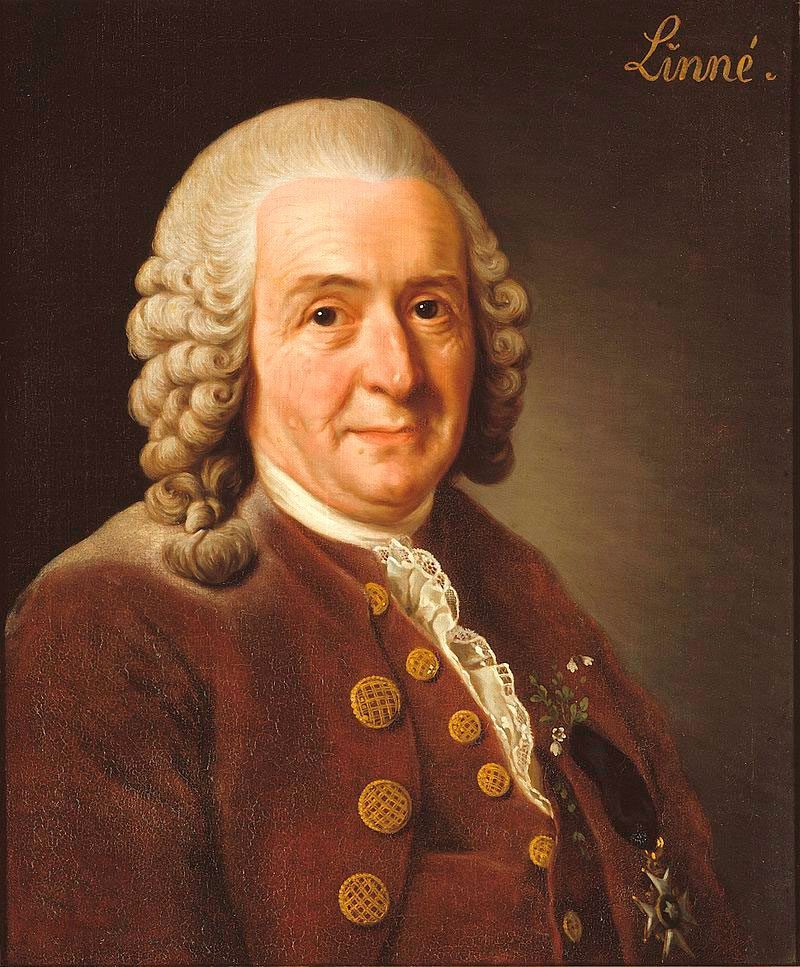
Carl Linnaeus

– Order: Psittaciformes
– Family: Psittacidae
– Genus: Amazona
– Scientific name: Amazona autumnalis
– Citation: (Linnaeus, 1758)
– Protonimo: Psittacus autumnalis


Red-lored Amazon images:


Species of the genus Amazona


Sources:

  • Avibase
  • Parrots of the World – Forshaw Joseph M
  • Parrots A Guide to the Parrots of the World – Tony Juniper & Mike Parr
  • Birdlife
  • Parrot Book, Parrots and macaws Neotropical
  • Grupohypermarkup

Photos:

(1) – Wikimedia.org
(2) – Red-lored Amazon or Red-lored Parrot; two captive parrots By Brian Gratwicke (originally posted to Flickr as Red-lored Amazon) [CC BY 2.0], via Wikimedia Commons
(3) – A Red-lored Amazon in Panama By Nelson de Witt from USA (Hello!) [CC BY-SA 2.0], via Wikimedia Commons
(4) – To pet Red-lored Amazon By Richard (originally posted to Flickr as Looming….) [CC BY 2.0], via Wikimedia Commons
(5) – Red-lored parrots (Amazona autumnalis), OSA Peninsula, Costa Rica By Charlesjsharp (Own work) [CC BY-SA 3.0], via Wikimedia Commons
(6) – A Red-lored Amazon at Rock Farm, Belize. It has a feather problem By Rigrat [CC BY-SA 3.0], via Wikimedia Commons
(7) – This is the image of a parrot originating of the jungle of Chiapas in Mexico By Joe Quick [CC BY 2.0], via Wikimedia Commons
(8) – Red-lored Amazon perching on a branch with wings open near Belmopan, Belize By Rigrat (Picasa Web Albums) [CC BY-SA 3.0], via Wikimedia Commons
(9) – A strange sight to me to see parrots flying in the wild. This Red-lored Amazon (Amazona autumnalis) was spotted with a group along the roadside in the Cayo distict of Belize By The Lilac Breasted Roller (originally posted to Flickr as Red Lored Parrot) [CC BY 2.0], via Wikimedia Commons
(10) – Lilacine Amazon, head from lateral by John Gerrard Keulemans [Public domain], via Wikimedia Commons

Sounds: Walter Rivera

â–· The world of Pets: Dogs, cats, birds, reptiles, amphibians

Dusky Parrot
Pionus fuscus

Dusky Parrot

Content


Anatomy-parrots

Description:

24 to 26 cm.. height and between 179 and 222g. weight.

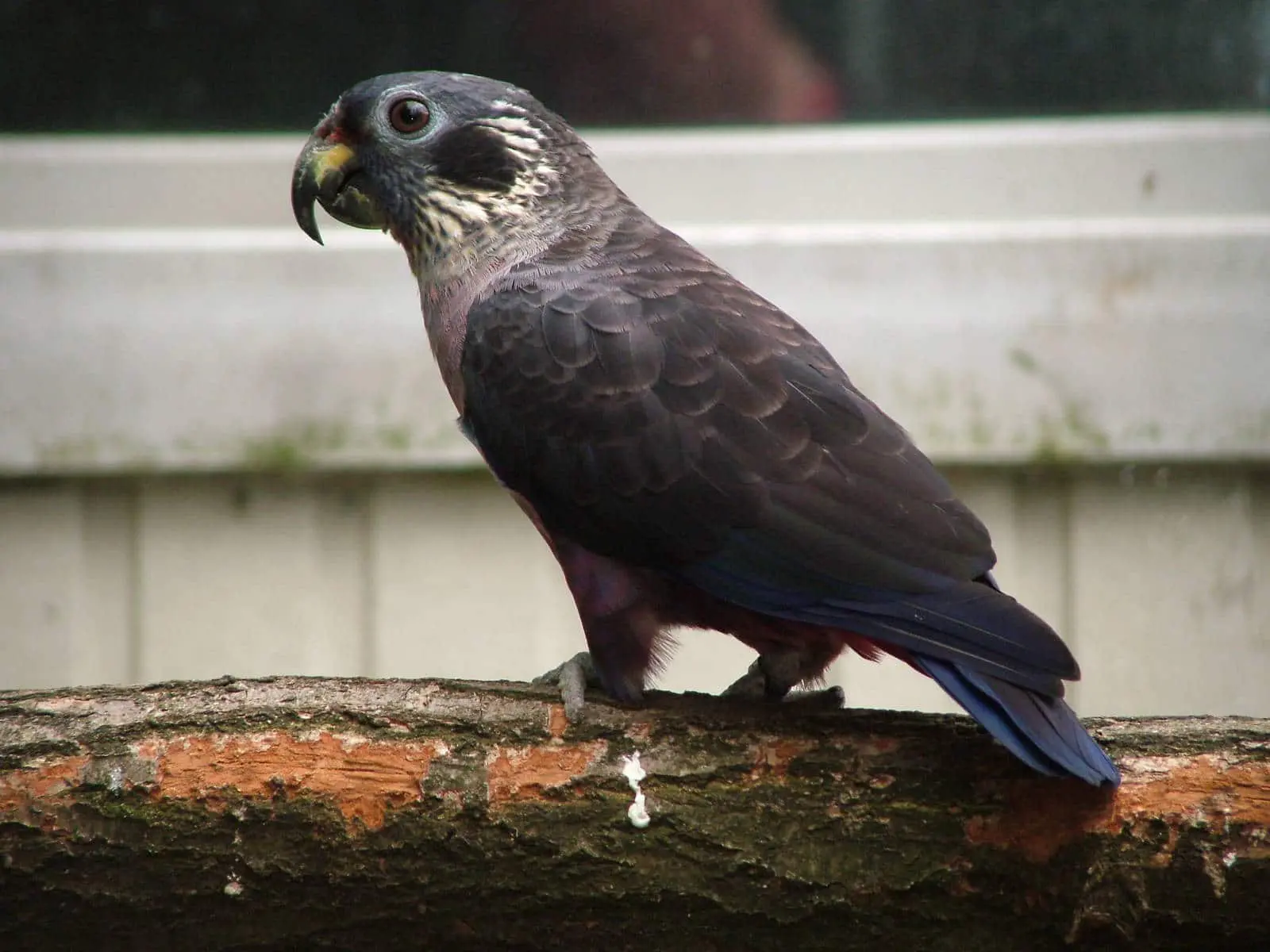
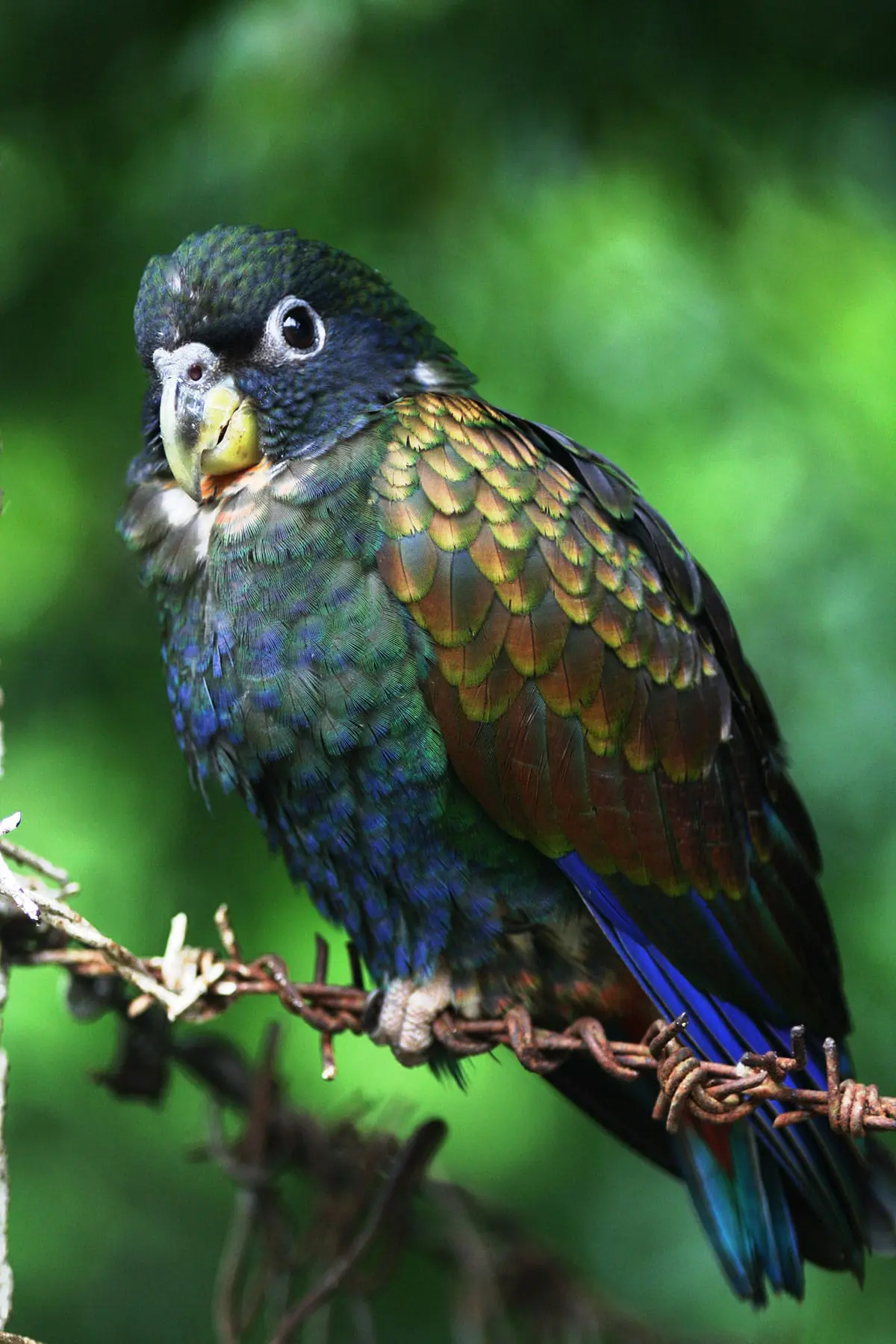
The coloration general of the Dusky Parrot (Pionus fuscus) is blue violet dark. Small patch of feathers on the front of the lores; on the basis of the cere, Pink; for the rest, lores, cheeks, forecrown and crown, lavender blue pale with white feather bases in the crown, What gives a faint mottled appearance in some birds; ear-coverts more dark and more grey, forming a distinctive patch; feathers in the throat and the sides of the neck narrow Brown in the Center and tips of pale blue white stripe, forming the joint a collar incomplete.

feathers in the the mantle and back, of color Brown leaden with those margins pale, giving the scalloped effect; Scapulars, rump and uppertail-coverts, darker grey brown, with very weak pale margins (or absent).

Coverts smaller and medium-sized, of color Brown leaden with margins pale; coverts primary and higher, as well as the flight feather, cobalt blue; undertail, the wings deep blue. Feathers on the top of the chest, pale pinkish with pale Lavender color tips; area more low in the chest with less dye Lavender, becoming darker and more color came in the belly, reaching, Some birds, the center of the belly of a rich colour came; undertail-coverts crimson.

Tail of color blue with red at the base. upper jaw Blackish at the tip with patch of color Horn in the base, lower jaw Blackish with the base more clear and more pale visible in some birds; Iris dark brown; Legs grey.

Both sexes similar.

In the immature staining is equal to the adult, but with some roofs on the upper wings with green edge; secondary feathers dyed in green and the eye ring naked and white.

Habitat:

Dusky Parrot

They inhabit mainly in lowland rainforests and moist forests in the foothills, in where the birds spend the greater part of the time in the canopy; Mainly in the forest land, occasionally in forests and marshes and less frequently in igapó (permanently flooded forests), Although there have been reports of birds in Savannah (Suriname), coastal gallery forest (French Guiana) and cultivated areas (Although avoiding habitats more open and less seen in clearings or edges of forest to some close relatives, such as the Blue-headed Parrot (Pionus menstruus).

rare species, flying alone or in small groups on the forest canopy,

Are you can see in Venezuela from the level of the sea to close them 1.000 m, and in close 1.200-1.800 meters on the side Colombian of the Sierra de Perija.

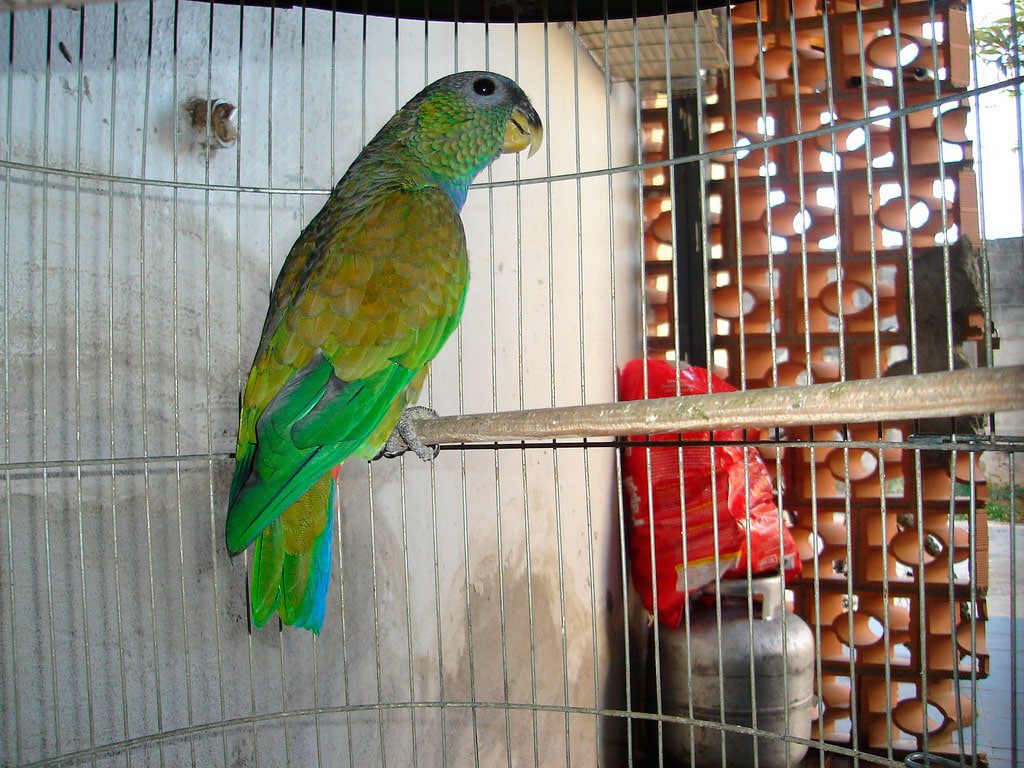
gregarious, especially outside the breeding season.

Reproduction:

It nests in hollows of old trees, probably during the second quarter of the year, although a nest was observed in the month of November in For, Brazil. The laying is of 3-4 eggs.

Food:

It feeds mainly in the canopy but also on the branches of fruiting trees in light areas..

The diet includes seeds of the gender Eschweilera and Micropholis.

Distribution:

Size distribution (reproduction / resident): 1.870.000 km2

Its population is discontinuous. There is an isolated population in the Sierra de Perija (border between Colombia and Venezuela); regardless of population, The species is found in Venezuela, to the South of the Orinoco in Bolívar, from the Caura River, in the Northwest, up to the Nuria upland, the upper area of the cuyuni river and Sierra de Lema in the areas border with Guyana, in the East, extending through the forested parts of Guyana, Suriname and presumably it French Guiana (There are no known records) until Amapá, the North-East of Brazil, and spreading more broadly to the East of the Brazilian Amazon, from Black river in the North and South, from the Madeira river to the East of For and Maranhão.

Movements regular seasonal occur in Suriname, with the birds present in the coastal region in the months of July and August.

In general quite common, Although distributed locally; reports of a moderate and widespread presence in Guyana (although rare in Mountains Kanuku in the Southwest); Common in coastal forests, the savanna and forests inside of Suriname.

The deforestation severe and rapid in parts of its range (for example, For and Maranhão, Brazil) is, presumably, causing a decline in the population of the Dusky Parrot.

Very tight in bondage.

Conservation:


minor concern


• Not considered low No category of threat.

• Not known as a cage bird, but the loss of habitat may be affecting their populations.

Justification of the population:

The size of the world population Dusky Parrot It has not been quantified, but this species is described as «Rare» (Stotz et to the., 1996).

Justification of trend:

It is suspected that this species has lost the 1,1% of habitat within its distribution over three generations (20 years) on the basis of a model of Amazon deforestation (Soares-Filho et to the., 2006, Bird et to the., 2011).

Given the susceptibility of the species to hunt or capture, It is suspected that it will fall in <25% durante tres generaciones.

"Dusky Parrot" in captivity:

Intelligent, curious, a bit noisy, playful when acclimatizes to the owner.
Rare in captivity until the Decade of 1970 When in small quantities were imported from Guyana.

Its longevity is of some 25 years.

Alternative names:

– Dusky Parrot, Little Dusky Parrot, Violaceous Parrot, Violet Parrot (English).
– Pione violette, Pionus violet (French).
– Veilchenpapagei, Veilchen-Papagei (German).
– maitaca-roxa, curica, papagainho-roxo, paraná-i (Portuguese).
– Cotorra de Perijá, Loro Morado (español).
– Cotorra de Perijá (Colombia).
– Cotorra Morada (Venezuela).

scientific classification:

– Order: Psittaciformes
– Family: Psittacidae
– Genus: Pionus
– Scientific name: Pionus fuscus
– Citation: (Statius Müller, 1776)
– Protonimo: Psittacus fuscus

Images "Dusky Parrot"

Videos "Dusky Parrot"

———————————————————————————————–

«Purple Parrot» (Pionus fuscus)


Sources:

– Avibase
– Parrots of the World – Forshaw Joseph M
– Parrots A Guide to the Parrots of the World – Tony Juniper & Mike Parr
– Birdlife

– Photos:

(1) – Veldhoven
(2) – Dusky Parrot (Pionus fuscus) or Dusky Pionus by Jacques Barraband [Public domain], via Wikimedia Commons

â–· The world of Pets: Dogs, cats, birds, reptiles, amphibians

Bronze winged Parrot
Pionus chalcopterus


Bronze winged Parrot

Content

Description:

28 to 30 cm.. tall and around 210 weight g.

The Bronze winged Parrot (Pionus chalcopterus) has the general Brown, darker in head, neck, chest and flanks, This plumage with blue-violet edge.

The throat whitish and pink; wings bronze green.

Flight is evident violet blue at the top of the wing the Green bottom, that contrasts with the Red of the lower abdomen. Dorsally Violet Blue is notorious in the rump, shoulder and tail. The feathers of the tail are dark blue with a shade of red at the base.

The bill is of color beige, area of naked skin surrounding the eyes of pink. The legs They are pink.

Habitat:

It inhabits in humid jungle, semi-humid, crops and forest edge between 120 and 2800 m.

They are birds gregarious and noisy. Every tomorrow is mobilized in flocks in search of food. Within the flocks are can observe to the couples, that form of life, and who interact with a variety of contact behaviors that reaffirm the marital bond.

Reproduction:

Prefer for their nests broken rods, hollow of logs and palm trees. They nest in the months of October-may. The female often put in two to four eggs they are incubated during three weeks approximately, after which are born them chicks naked or just covered with down. The chicks remain with their parents until the next reproductive shekel.

Food:

Will congregate in cornfields in groups up to of 40 individuals, feeding is of pulp and seeds many fruits and other material ingredients as nectar and flower petals, complementing occasionally its diet with insects.

Distribution:

Its population is distributed by the mountain range of the Andes, from Colombia, Northwest of Venezuela; to the South, by the mountains to the Northwest of Peru.

Conservation:


minor concern


• Red List category of the UICN current: Least concern

• Population trend: Decreasing

The size of the population World of the Bronze winged Parrot It has not been quantified, but this species is described as ‘rare‘ (Stotz et to the., 1996).

The population was suspected of being in decline due to ongoing habitat destruction.

This species is characterized be decreasing in Colombia and West Ecuador, due to the logging of forest subtropical, which has been severe and quick on the slopes of the Andes (Juniper and Parr 1998).

The evident anecdotal, based on the frequency of sightings, suggests that the species has declined in Pineapples, South of Ecuador, in recent years c.15-20 (M. By D Sanchez. Díaz in litt. 2011). Also is says that has been extirpated from areas previously occupied as the slopes of them Andes and valleys of the Cauca and the Magdalena river in Colombia, again due to loss of habitat (Juniper and Parr 1998).

In Venezuela the species is scarce and local, limited, to a large extent, to the slope West of them Andes in Mérida and Sierra de Perija, with occasional records in Táchira (CJ Sharpe in litt. 2011). These areas have experienced rapid deforestation for at least the last few 24 years for cultivation and livestock.

Surveys conducted in the Northwest of Peru in the decade of 1990 they appeared to detect a sharp decrease in population from 1993 (Rosales et to the., 2007), although this species is known to be nomadic and its local numbers can fluctuate.

"Bronze winged Parrot" in captivity:

Rare in captivity, It is not a main target of poachers (CJ Sharpe in litt. 2011, R. Clay in litt. 2011), although it is still present in the illegal trade of Peru (F. Angle in litt. 2011)

Intelligent, playful and curious. You can be nervous, loving with your caregiver and aggressive with other people. It has a tendency to obesity.

It requires a spacious cage unless the bird pass periods of time outside of it. Not must keep is to open air where the temperatures fall below them 5 °C.

With feed a wide variety of seeds, fruits and berries.

It is a relatively healthy bird, While it may be more susceptible to infection aspergillosis that other species.

In captivity they lay two eggs the incubation takes 26 days.

Alternative names:

– Bronze winged Parrot, Bronze-winged Parrot (English).
– Pione noire, Pionus noir (French).
– Glanzflügelpapagei, Glanzflügel-Papagei (German).
– Curica-asa-de-bronze (Portuguese).
– Cotorra Oscura (Colombia).
– Cotorra Negra (Venezuela).
– Cotorra Oscura, Loro Alibronceado, Loro de Alas Bronceadas, Cheja alibronceada (español).

scientific classification:

– Order: Psittaciformes
– Family: Psittacidae
– Genus: Pionus
– Scientific name: Pionus chalcopterus
– Citation: (Fraser, 1841)
– Protonimo: Psittacus chalcopterus

Images "Bronze winged Parrot"

Videos "Bronze winged Parrot"

«Loro Alibronceado» (Pionus chalcopterus)

Sources:

  • Avibase
  • Parrots of the World – Forshaw Joseph M
  • Parrots A Guide to the Parrots of the World – Tony Juniper & Mike Parr
  • Birdlife

  • Photos:

(1) – IBC.lynxeds.com
(2) –
(3) –
(4) –
(5) –

â–· The world of Pets: Dogs, cats, birds, reptiles, amphibians

Scaly-headed Parrot
Pionus maximiliani

Scaly-headed Parrot

Content


Anatomy-parrots

Description:

27 to 29 cm.. height and between 233 and 293 g. of weight.

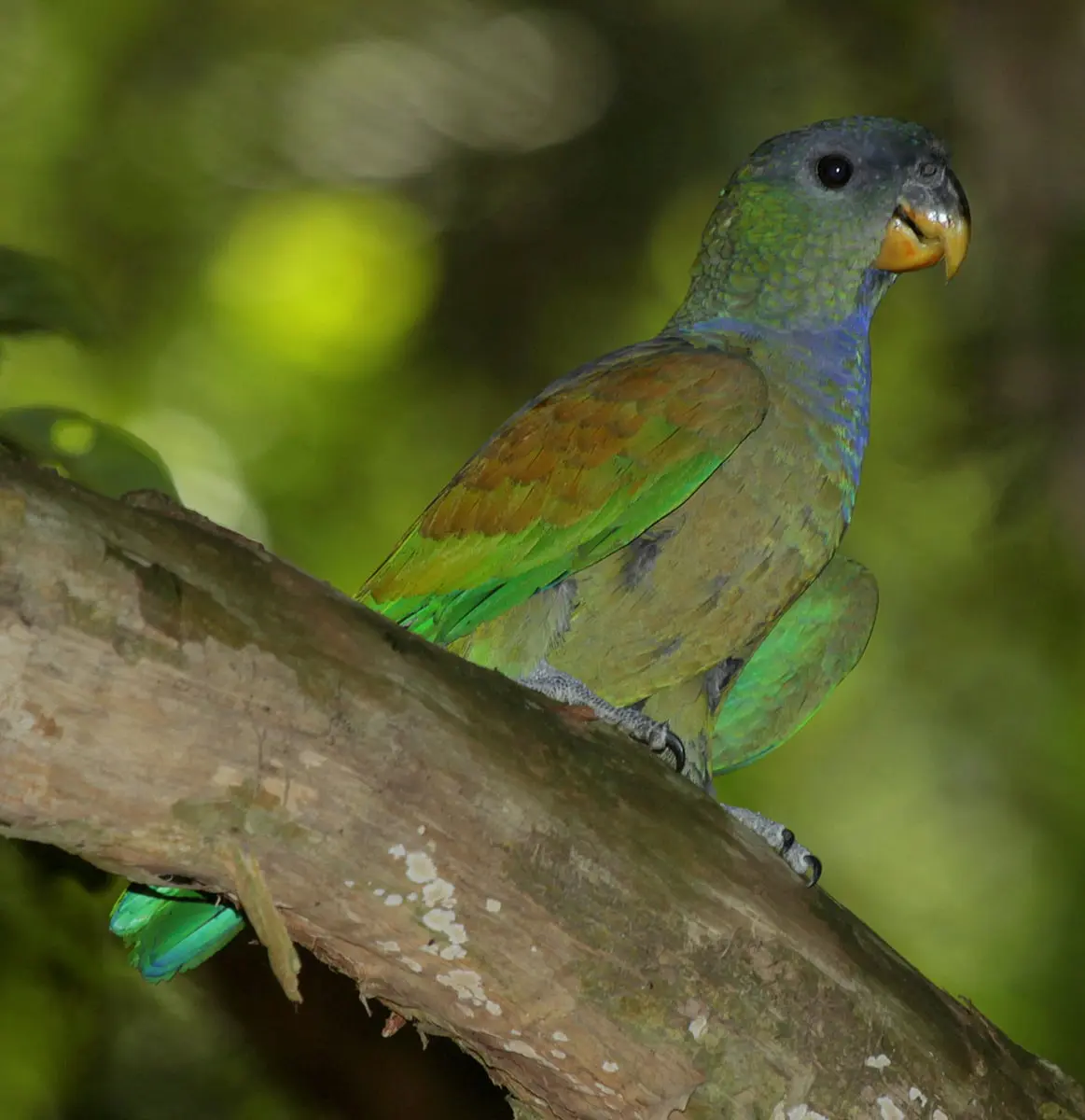
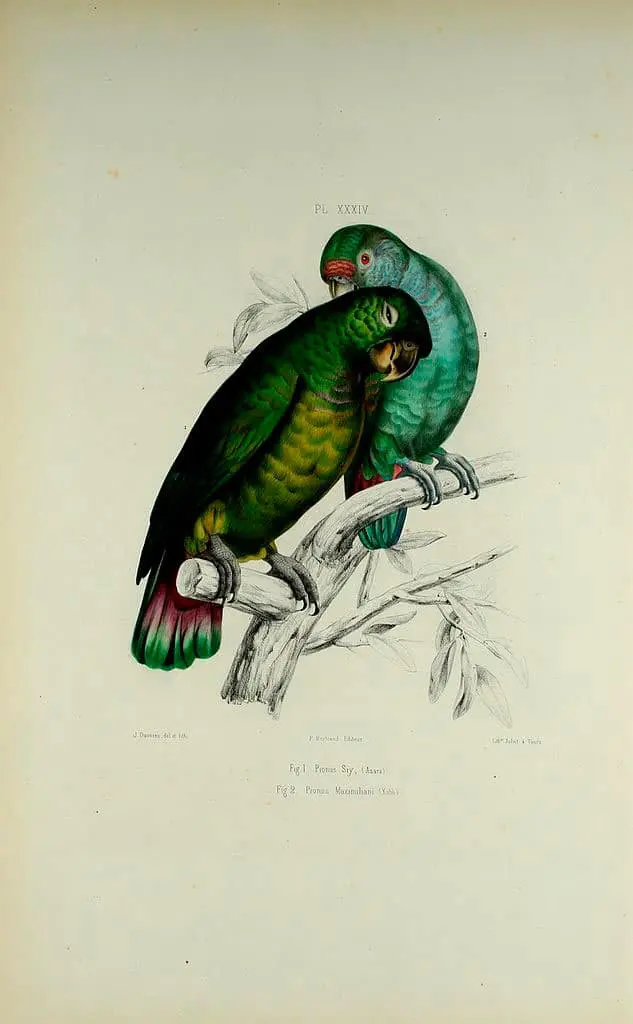
The Scaly-headed Parrot (Pionus maximiliani) It is medium in size and tail very short; has the lores, the forecrown and the eye area opaque dark bronze; the feathers on crown, the cheeks, the chin and the sides of the neck, basal green with wide enough margins bronze that give the appearance of flake; ear-coverts with dark green margins but brighter than other pens head.

The back of the neck and green the mantle become more brown and olive green upper lower parts, where some feathers have quite indistinct darker tips. Coverts smaller and medium-sized green olive brown with indistinct dark tips; alula, primary and greater coverts and flight feathers, brighter green, contrasting with the upperparts brown, duller.

Under the wings, opaque green. The throat and the top chest blue violet off that fade in brownish olive green in the bottom of the chest and most of the belly, but they are become brighter and greener in flanks and the thighs; undertail-coverts crimson. Upper, the tail green in the center, outer feathers mainly blue and red at the base; undertail, the tail, bluish green duller. Bill black with yellow edges on the upper jaw and the bottom tip; orbital skin pale grey; irises dark brown; legs grey.
Scaly-headed Parrot
Both sexes are similar. Immature It has less intense the blue throat; feathers head more green with less distinct margins.

Description 4 subspecies:

  • Pionus maximiliani lacerus

    (Heine, 1884) – Similar to the subspecies Pionus maximiliani siy but with a bill stronger, the chest more purple and perhaps larger on average.


  • Pionus maximiliani maximiliani

    (Kuhl, 1820) – Nominal.


  • Pionus maximiliani melanoblepharus

    (Ribeiro, 1920) – Blue darker in throat and darker above. Larger.


  • Pionus maximiliani siy

    (Souance , 1856) – Much like the nominal species but darker below, more purple and less blue in the chest, yellower in back and Blue throat lighter.

Habitat:

It inhabits in a wide range of forested habitats, but mostly in dry forests lowland ranging from caatinga very dry, inside the northeast of Brazil, through the savannas Cerrado seasonal, to chaco; also in wetter forests, including gallery forests and forests of araucarias, especially in southeast Brazil. They can also be seen in subtropical forests in Eastern Andean slopes some 2.000 meters in the Northwest of Argentina and some 1.500 meters in the mountains of the South of Brazil.

Tolerant to human alteration of forest habitats and sometimes cultivated areas. Usually gregarious, arriving to form flocks numerous in places in where the food is abundant probably is hiding in small groups in them cups of them trees.

Reproduction:

They nest in tree hollows. Birds in terms of breeding in the month of October in Paraguay; November in São Paulo; laying 3-5 eggs.

Food:

The plants food include Erythrina, Inga, Piptadenia, Copaifera, Croton, Pachystroma, Plathymenia reticulata, Ficus and Araucaria.

Distribution:

Size of the area of distribution (reproduction / resident): 6.650.000 km2

The species is found in the Center, South and East of Brazil, from maranhão and Ceará in the Northeast, to the South by Piauí, Bay, Goiás, Minas Gerais, Brazil and the eastern coastal States up to Rio Grande do Sul and to the South of Mato Grosso (region pantanal), extending to the southeast of Bolivia, from Santa Cruz to the South in the Eastern Andes and to the North of Argentina in Salta, Tucumán and Catamarca in the East and North of Santa Fe in the West.

Mainly resident, although it may not grow in the drier parts of the Argentine Chaco. Apparently more numerous in the center of its area of distribution, where its abundance is only surpassed by the Maroon-bellied Parakeet (Pyrrhura frontalis); progressively more scarce toward the periphery.

Locally quite common the common in Bolivia and locally common in the North of Argentina, where it is most abundant in the South of Salta, Tucumán and areas adjacent in Catamarca. Moderately common in Rio Grande do Sul and common in the pantanal; densities Brazilian more high in São Paulo.

The decrease apparent, in some parts of the range, (for example, North of the Argentina) is attributable to the trade, but in other places (for example, the southeast of Brazil) is undoubtedly its decline due to the loss of forests.

Distribution 4 subspecies:

  • Pionus maximiliani lacerus

    (Heine, 1884) – Northwest of Argentina.


  • Pionus maximiliani maximiliani

    (Kuhl, 1820) – Nominal. Northeast of Brazil.


  • Pionus maximiliani melanoblepharus

    (Ribeiro, 1920) – It is from Paraguay, Brazil and northeast of Argentina (Missions)


  • Pionus maximiliani siy

    (Souance , 1856) – Southeast of Bolivia until Paraguay, West of Brazil (Mato Grosso), North of Argentina.

Conservation:


minor concern


• Current category of the Red List of the UICN: Least concern.

• Population trend: Decreasing.

Justification of the population

The size of the world population It has not been quantified, but this species is described as «quite common» (Stotz et to the., 1996).

Justification of trend

It is suspected that the population is in decline due to the continuous habitat destruction and to levels of exploitation unsustainable.

Threats

The species has been object of strong exchanges: from 1981, When is included in the Appendix II of the CITES, they have been 93.234 individuals captured in the wild in the international trade (database CITES from the UNEP-WCMC, January 2005).

"Scaly-headed Parrot" in captivity:

Curious, very intelligent and social. Quiet and relatively little aggressive. Prone to obesity. You can learn to imitate.
Pretty common in captivity. Life expectancy: 20 years.

Housing: Enclosure suspended at least 2 metres in height.

Diet: fruit as: Apple, pear, orange, banana, granada, cactus fruits, they form approximately the 30 percent of the diet; vegetables as: Carrot, celery, green beans, pea in the pod; corn fresh; green leaves such as: chard, lettuce, dandelion, Aviary grass; millet; mix of seeds small e.g.: millet, and small amounts of buckwheat, oats, safflower and hemp; soaked and sprouted from seeds of sunflower; beans, cooked legumes and boiled corn.

It needs regular exercise it is necessary to provide you with an Aviary as large as possible. Provide shallow bowls of water for bathing. Also provide stairs, swings, strings, different sizes of hooks and assorted toys.

Alternative names:

– Scaly-headed Parrot, Maximilian’s Parrot, Scaly headed Parrot (English).
– Pione de Maximilien, Pionus de Maximilien (French).
– Maximilianpapagei (German).
– Maitaca, baitaca, maitaca-bronzeada, maitaca-de-Maximiliano, maitaca-suia, maitaca-verde, suia, umaitá (Portuguese).
– Loro Bronceado, Loro choclero, Loro maitaca (español).


scientific classification:

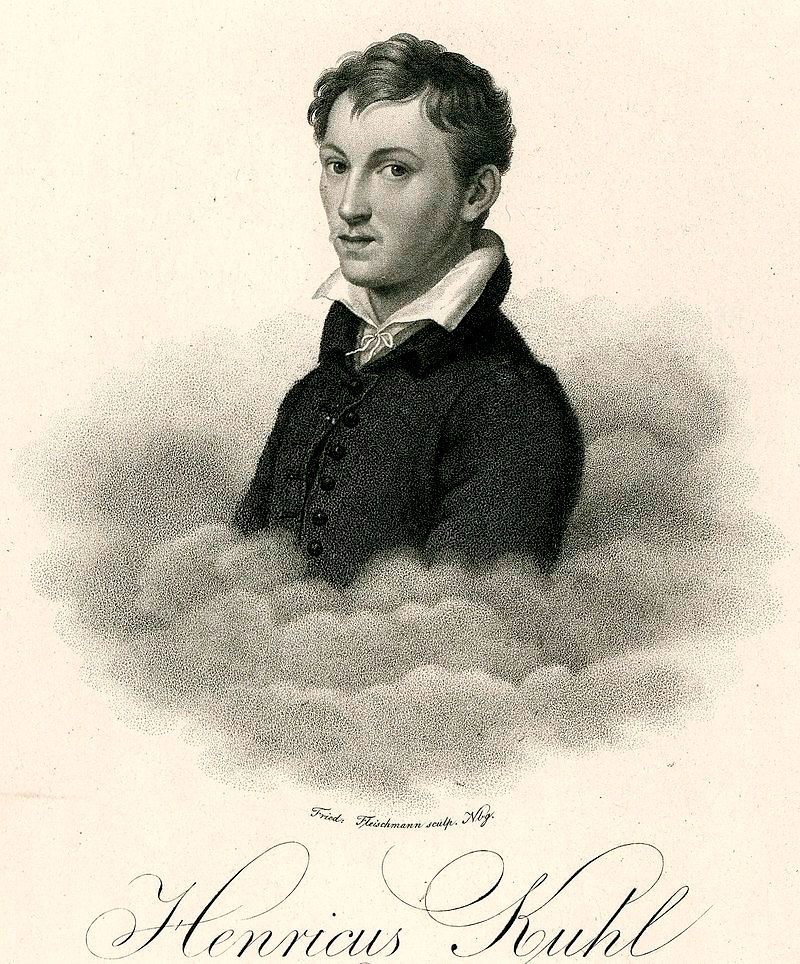
Kuhl, Heinrich
Heinrich Kuhl

– Order: Psittaciformes
– Family: Psittacidae
– Genus: Pionus
– Scientific name: Pionus maximiliani
– Citation: (Kuhl, 1820)
– Protonimo: Maximilian parrot

«Choclero Parrot» Images:

Videos "Scaly-headed Parrot"

pichu - My Maximilian Pionus

Scaly-headed Parrot (Pionus maximiliani)


Sources:

  • Avibase
  • Parrots of the World – Forshaw Joseph M
  • Parrots A Guide to the Parrots of the World – Tony Juniper & Mike Parr
  • Birdlife
  • Parrot Book, Parrots and macaws Neotropical
  • parrots.org

  • Photos:

(1) – IBC.lynxeds.com
(2) – A Scaly-headed Parrot (also called a Scaly-headed Pionus, Maximilian’s Pionus, amd Maximilian’s Parrot) in a cage By Alex Knowles [CC BY 2.0], via Wikimedia Commons
(3) – A pet male Scaly-headed Parrot (also called Maximilian Pionus, Maximilian Parrot, Maximilian’s Pionus, or Maximilian’s Parrot) By Snowmanradio (Own work) [CC BY-SA 3.0 or GFDL], via Wikimedia Commons
(4) – Scaly-headed Pionus (also called Maximilian Pionus, Maximilian Parrot, Maximilian’s Pionus, or Maximilian’s Parrot) at Zoológico de Americana, Sao Paulo, Brazil By Moe Oliveira [CC BY 2.0], via Wikimedia Commons
(5) – Loro Choclero By Danbrazil (Own work) [CC BY-SA 4.0], via Wikimedia Commons
(6) – Iconographie des perroquets : non figurés dans les publications de Levaillant et de M. Bourjot Saint-Hilaire By Blanchard, Emile; Bonaparte, Charles Lucian; Bourjot Saint-Hilaire, Alexandre; Le Vaillant, François; Souancé, Charles de. [CC BY 2.0 or Public domain], via Wikimedia Commons

â–· The world of Pets: Dogs, cats, birds, reptiles, amphibians

Red billed Parrot
Pionus sordidus

Tropicbird Parrot

Content


Anatomy-parrots

Description:

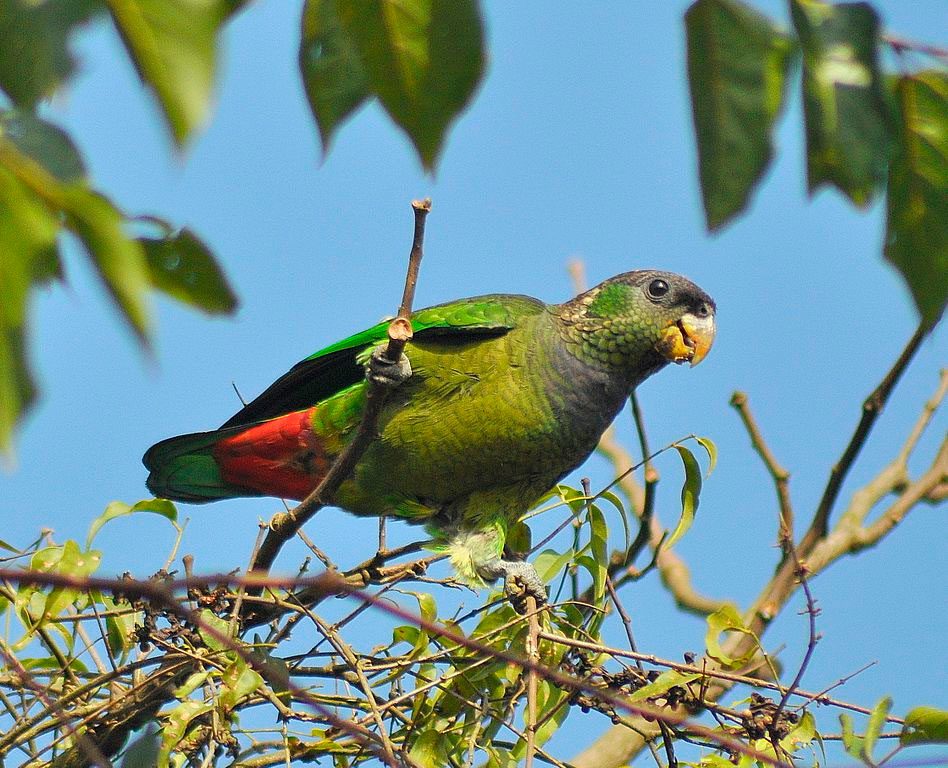
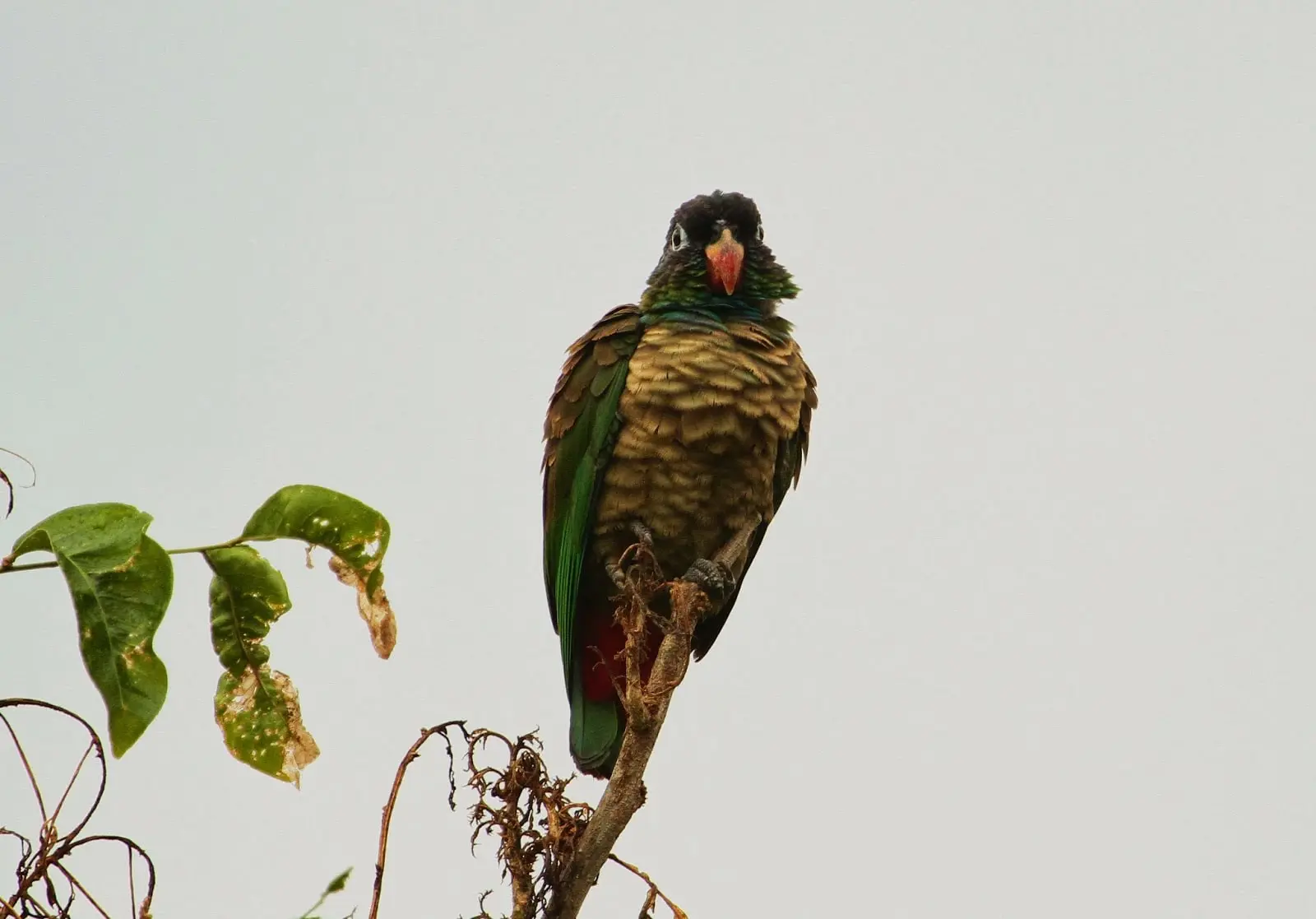
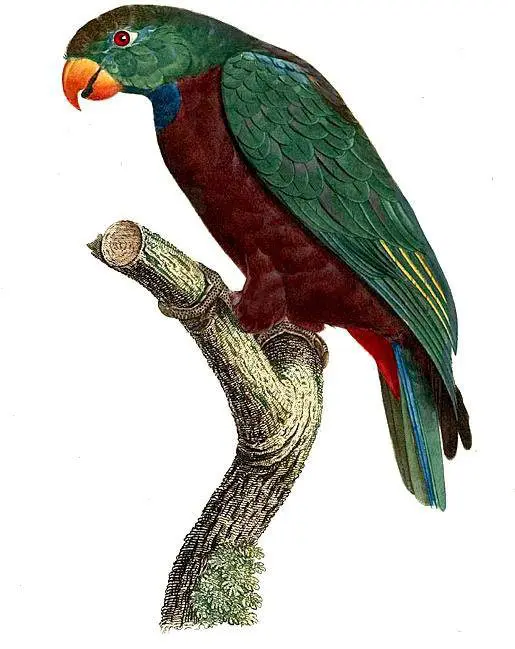
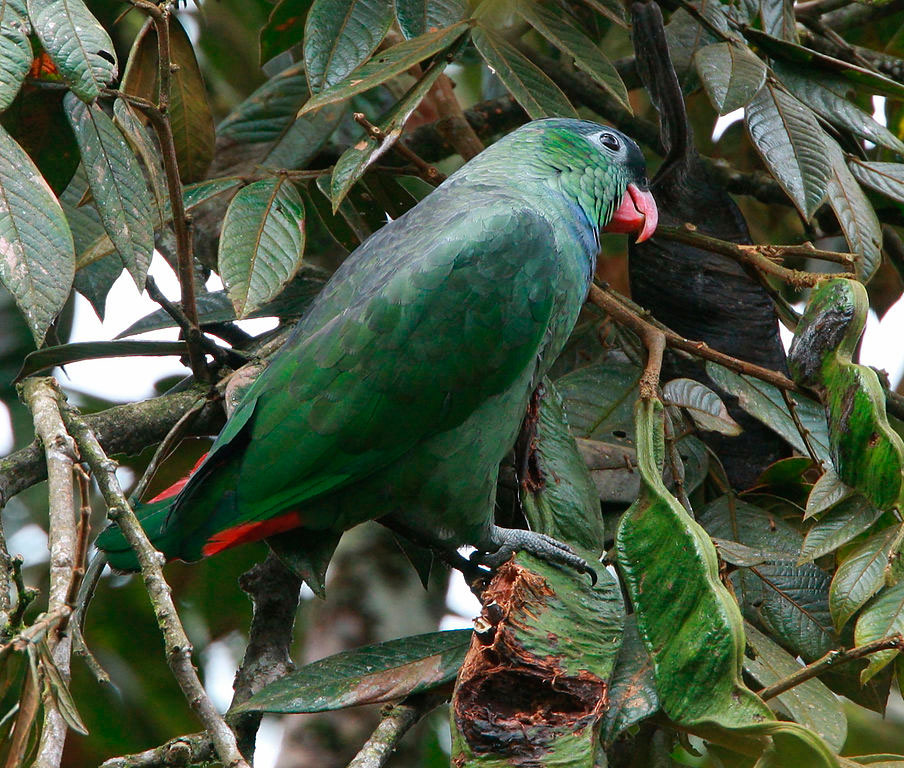
The Red billed Parrot (Pionus sordidus), of looking scruffy, has a length of 28 to 31 cm. and a weight between 255 and 275 g..

The subspecies Pionus sordidus corallinus, the most widespread, has the feathers of the forecrown, lores and behind the eyes, Green at the base and with blue edges widths; the cheeks, ear-coverts and the sides of the neck, mainly green with some blue narrow tips; the crown and rear of the neck, Green with edges blue narrow. Mantle and back pretty dull green with paler blue margins; rump and uppertail-coverts, of color green basally, more Brown olive distally. Coverts medium and small with wide olive green tips; the front edge of the wing ; coverts primary and higher and flight feather brightest which the parts superiores and others wing-coverts.

Under, the wings green; chin green; throat and upper breast with band broadband of color blue violet; belly green, Some birds with gray Suffusion; undertail-coverts crimson. Tail Green by the Center, Blue side; Red at the base.

Bill coral red, pale at the base of the upper jaw; cere dark grey; bare periophthalmic pale grey; Iris dark brown; legs pale grey.

Both sexes are similar. Immature sample undertail-coverts yellowish-green with some red marks; head green.

Subspecies description

Description 6 subspecies
  • Pionus sordidus antelius

    (Todd, 1947) – Similar to the nominal species but the feathers of the throat lack of edges blue and the center of the chest is in color pink.

  • Pionus sordidus corallinus

    (Bonaparte, 1854) – Described above.

  • Pionus sordidus mindoensis

    (Chapman, 1925) – Is as the subspecies Pionus sordidus corallinus, but of color green more beige, those edges blue of the feathers of the head are more narrow and the under wing-coverts not have them edges dark.

  • Pionus sordidus ponsi

    (Aveledo & Gines, 1950) – Throat of color blue violet almost solid. The chest and upperparts they are darker and greener that the of the nominal species, they lack clear margins to the feathers of the back and of the wing-coverts.

  • Pionus sordidus saturatus

    (Todd, 1915) – More dark and more green that it nominal species with the feathers of the upperparts lack of margins of color green olive. Less green in the throat and cheeks.

  • Pionus sordidus sordidus

    (Linnaeus, 1758) – Nominal. Much more Brown that the subspecies Pionus sordidus corallinus, with blue (turquoise) more reduced in the throat. Feathers in them upperparts with most distinctive pale margins.

Habitat:

Red billed Parrot

It is a very rare species. It inhabits in mountains of humid and semi-humid cloudy forests, edges of forest and partially deforested areas, between 200-2850 m, Although they are more frequent at altitudes of 500-1.500 m. They use areas of secondary growth, partially deforested with tall trees scattered and sometimes light forests on coffee plantations, being less frequent in dry areas.

Gregarious outside of breeding season; formations in flocks of up to 50 birds, sometimes more where the food is abundant. Children sleep in community.

Reproduction:

They nest in the cavity of the trees, sometimes in very degraded habitats. Birds in breeding attitude during the months of February-April in Colombia; It breeds in the months of April-June in Venezuela, January-may in Ecuador; Nest occupied in October in Bolivia. Laying three eggs in captivity.

Food:

Feeds of fruit, berries and seeds.

Distribution:

Size of the area of distribution (reproduction / resident): 169.000 km2

This species has a distribution batch through them land high in the North and West of South America, from Venezuela to the North of Bolivia. You can find in the North of Venezuela, in the mountains of Anzoátegui, Sucre, North of Monagas and apparently, of way to discontinuous, in the Highlands of the Federal District through the mountains coastal, to the West, until Lara and Falcon, then in the Sierra de Perija, Zulia and parts adjacent in Colombia, West to the foothills of Santa Marta in Magdalena, also locally in the Eastern Andes of Boyacá and Huila. Extends over the Western side of the Andes in Ecuador, from Pichincha until Gold and for all the East side to the northeast of Peru.

Although there are no records in the Eastern Andean slope, in the central and southern Peru, the range includes the Yungas North of Bolivia in Santa Cruz and Cochabamba.

common locally; apparently less numerous in the West of Ecuador and North of Bolivia, and probably in decline locally due to the deforestation (for example, in the Ecuador Western, North of Venezuela and Andes of Colombia).

A recent study not localized to the subspecies Pionus sordidus antelius in its area of distribution widely cleared, Although the subspecies can dwell in forests moderately disturbed.

Kept as pets locally although generally scarce in captivity.

Subspecies distribution

Distribution 6 subspecies

Conservation:


minor concern


• Current category of the Red List of the UICN: Least concern.

• Population trend: Decreasing.

Justification of the population

The size of the world population It has not been quantified, but this species is described as «quite common» (Stotz et to the., 1996).

Justification of trend

It is suspected that the population is in decline due to ongoing habitat destruction.

"Red billed Parrot" in captivity:

Very rare in captivity. In general, they are not so nervous in temperament as other parrots. They can learn to imitate.

Its diet in captivity It varied: fruits such as: Apple, orange, banana, granada, Cactus, they form approximately the 30 percent of the diet; vegetables such as: Carrot, celery, green beans, pea in the pod, fresh corn; Greens such as: chard, lettuce, dandelion, Aviary grass; millet; mixture of small seeds, such as: millet, birdseed, and small amounts of oats, buckwheat, safflower and hemp; soaked and sprouted sunflower seeds; beans, cooked legumes and boiled corn; hard cheese.

Alternative names:

– Red-billed Parrot, Dusky parrot, Red billed Parrot, Sordid parrot (English).
– Pione à bec rouge, Perroquet sordide (French).
– Dunenkopfpapagei, Dunenkopf, Dunenkopf-Papagei (German).
– Curica-de-bico-vermelho (Portuguese).
– Cotorra Piquirroja, Loro de Pico Rojo, Loro Piquirrojo (español).
– Cotorra piquiroja, Cotorra Piquirroja (Colombia).
– Loro de Pico Rojo (Peru).
– Perico Pico Rojo (Venezuela).

scientific classification:

Carl Linnaeus
Carl Linnaeus

– Order: Psittaciformes
– Family: Psittacidae
– Genus: Pionus
– Scientific name: Pionus sordidus
– Citation: (Linnaeus, 1758)
– Protonimo: Psittacus sordidus


Images «Loro Piquirrojo»:

Videos "Red billed Parrot"

«Loro Piquirrojo» (Pionus sordidus)

Sources:

  • Avibase
  • Parrots of the World – Forshaw Joseph M
  • Parrots A Guide to the Parrots of the World – Tony Juniper & Mike Parr
  • Birdlife
  • Parrot Book, Parrots and macaws Neotropical

  • Photos:

(1) – Red-billed Parrot, Pionus s. sordidus, Perico Pico Rojo – Our beautiful world
(2) – Red-billed Parrot, Pionus s. sordidus, Perico Pico Rojo – Our beautiful world
(3) – Red-billed Parrot, Pionus s. sordidus, Perico Pico Rojo – Our beautiful world
(4) – Red-billed Parrot (also known ans the Red-billed Pionus); two captive By TJ Lin (originally posted to Flickr as coral-billed pionus) [CC BY-SA 2.0], via Wikimedia Commons
(5) – Red-billed-Parrot (Pionus sordidus), Pajaro Jumbo Reserve, NW Ecuador By Nomdeploom (Own work) [CC BY-SA 4.0], via Wikimedia Commons
(6) – BARRABAND, Jacques (1767/8-1809) Le Perroquet brun [Red-billed Parrot (Pionus sordidus)] – Wikimedia

  • Sounds: Sebastian K. Herzog