▷ The world of Pets: Dogs, cats, birds, reptiles, amphibians

Cardinal Lory
Pseudeos cardinalis


Lori Cardenal

Content

Description

31 cm.. height and weight of 175 to 215 gr.

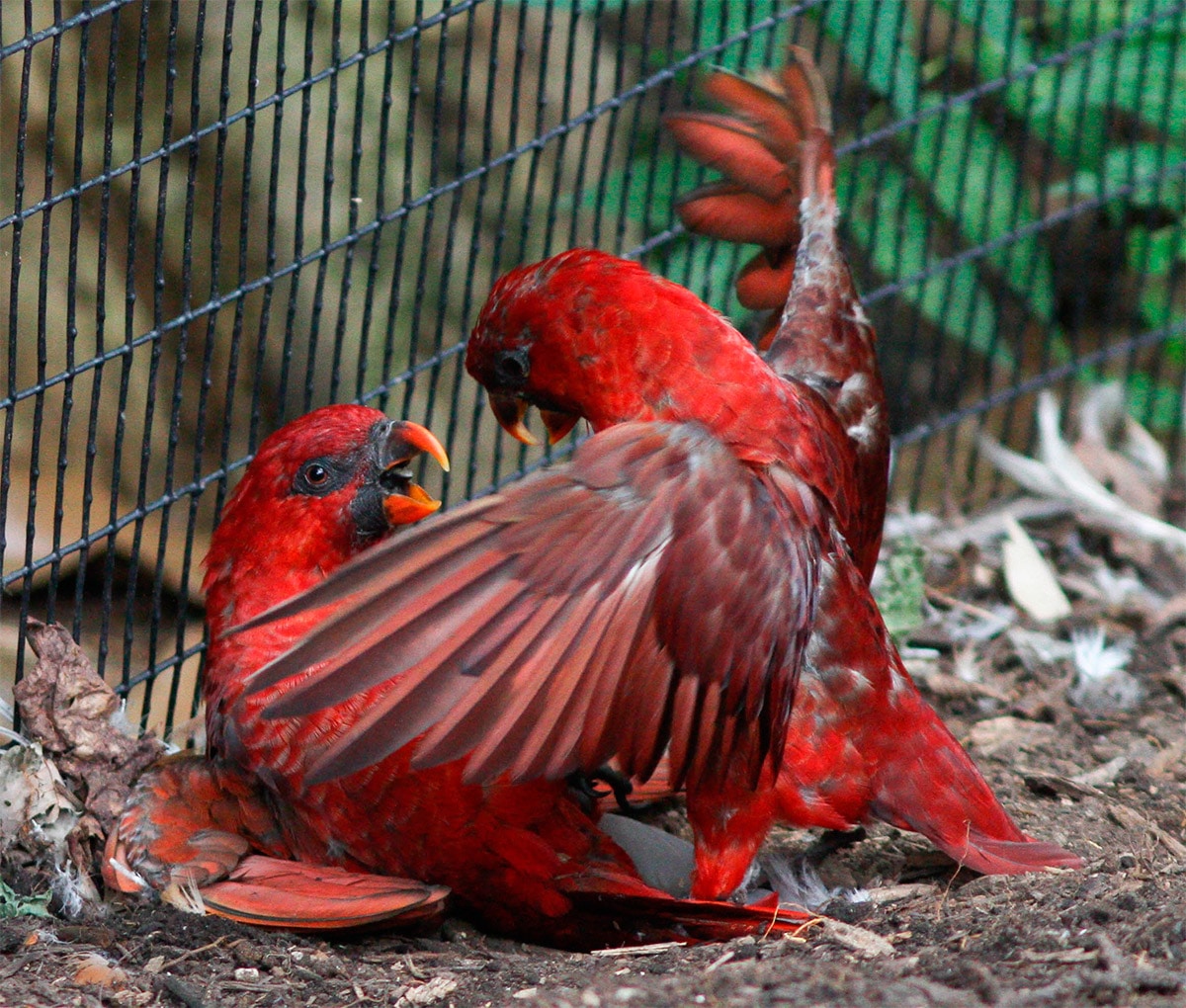
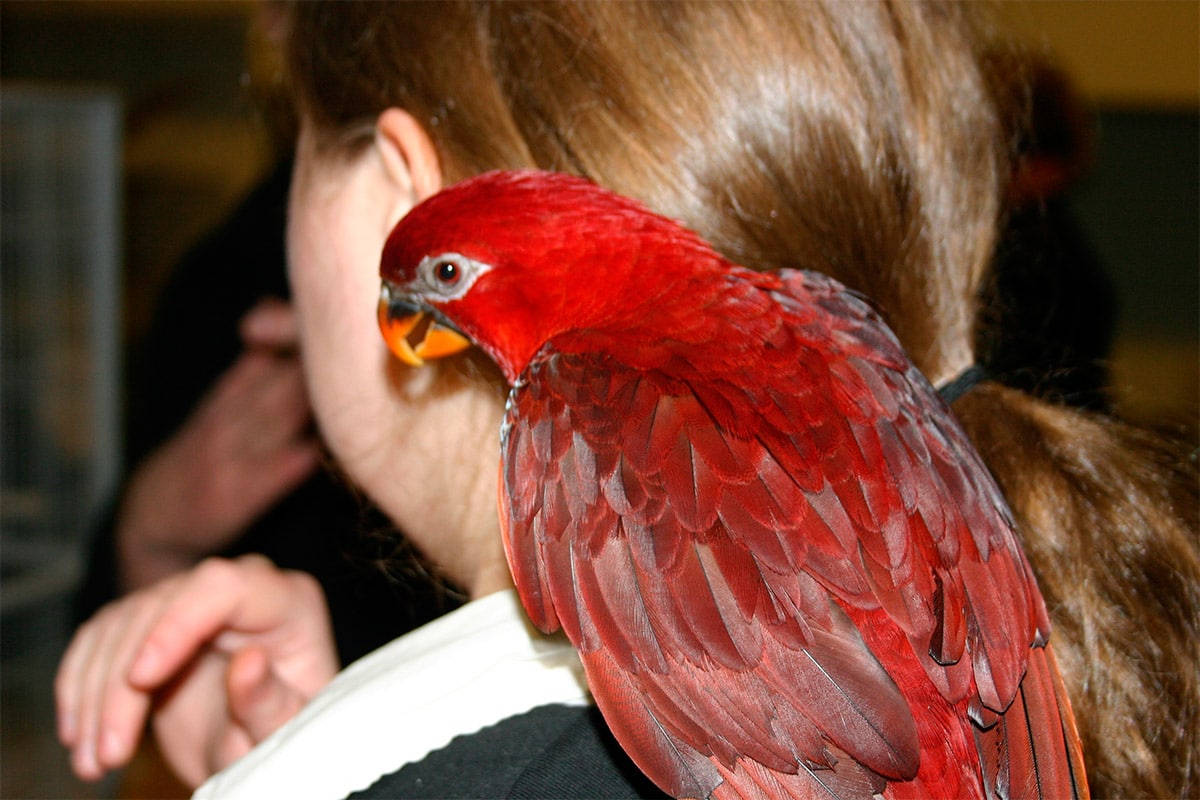
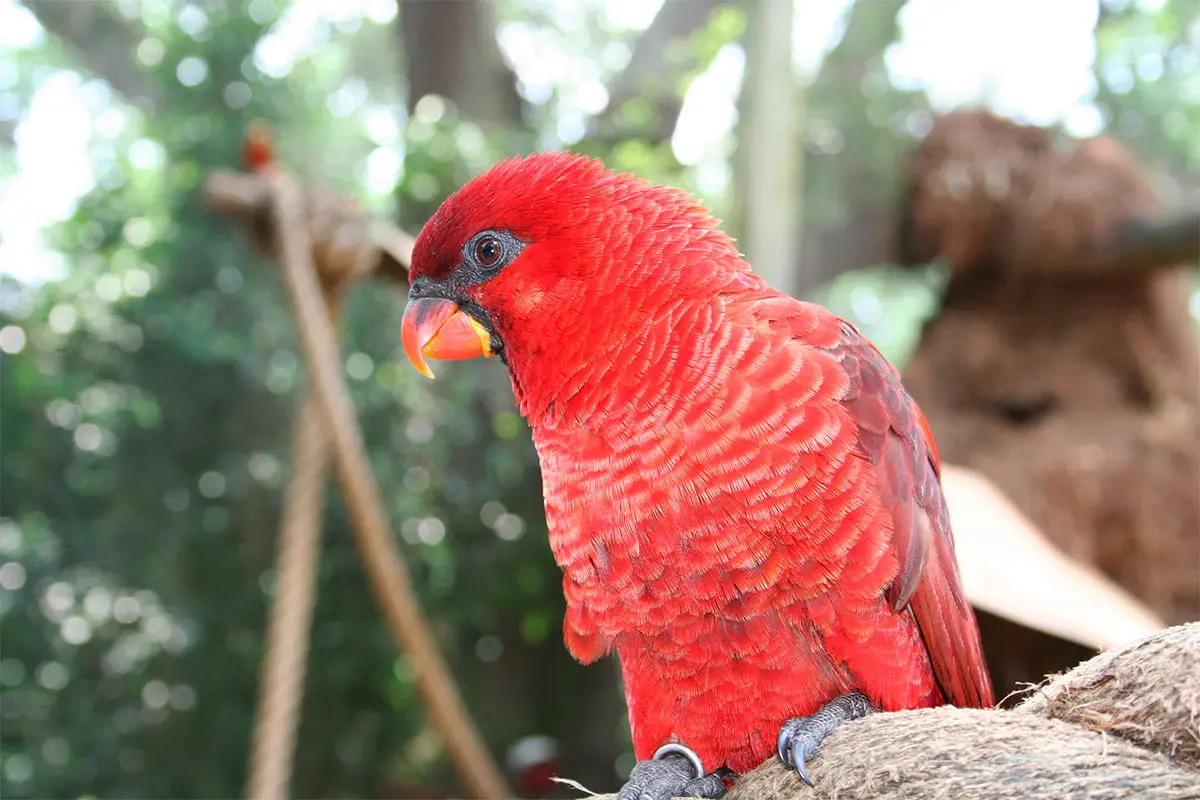
The Cardinal Lory (Pseudeos cardinalis) has a characteristic shape due to its relatively long tail.

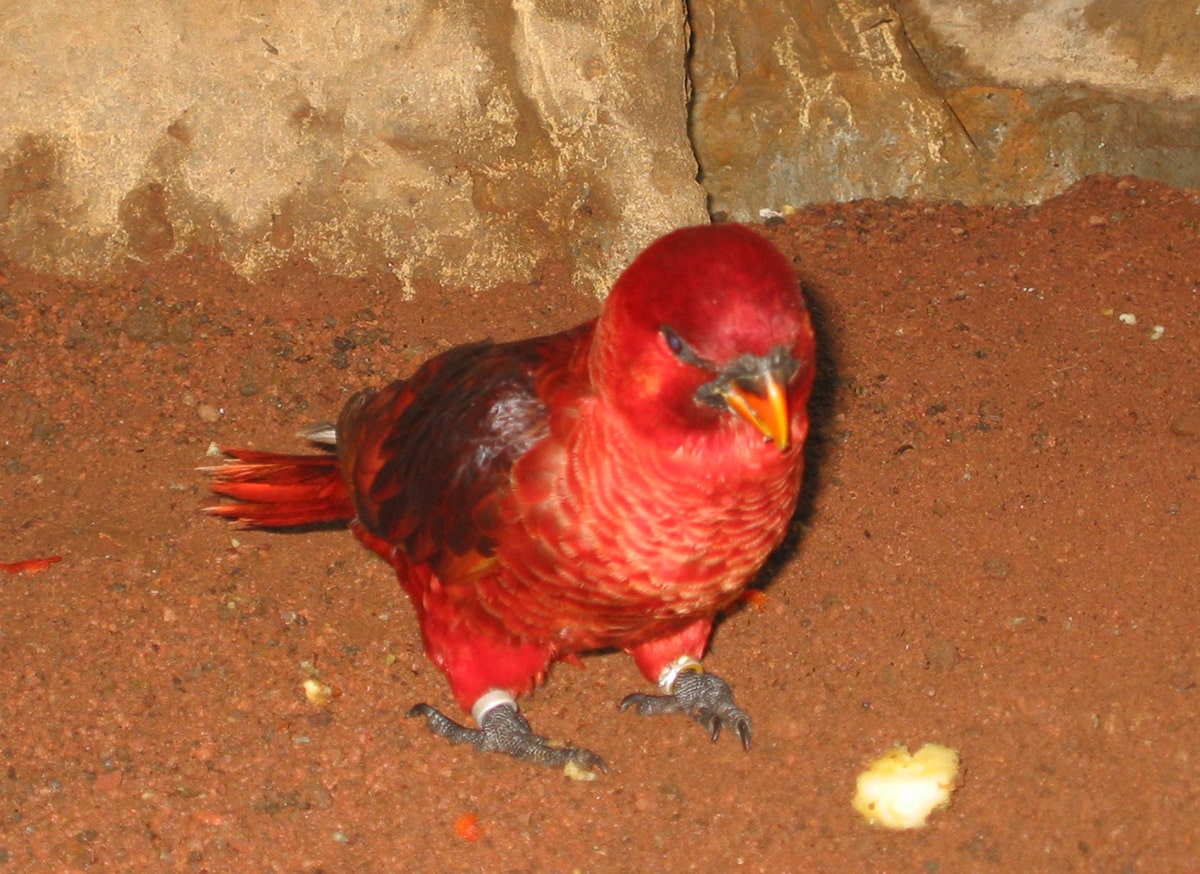
Among adults, There is no sexual dimorphism, the plumage is completely brilliant red, but the upperparts and wings They seem to be darker.

The bill is orange-red with a black color in the base area.
The bare orbital skin is black.

The feathers the lower parts have small yellowish features, What gives a vaguely scaly appearance.
The legs are grey.

The irises is red-orange.

The immature has the back and blankets of Red Wings clear. Its bill It is pale orange with small black marks. Its orbital skin is whitish grey. Their irises are pale yellow.

Habitat:

It is a kind forest. It is very widespread and is locally abundant in primary and secondary forests. It is also in the forests in regeneration in coconut plantations and mangroves where there are trees in flower.

Can rise to 1.200 m above sea level, Although in the Bougainville Island (Papua New Guinea), does not exceed of the 800 m.

It is a bird loud that does not happen easily unnoticed.

It is usually in small flocks of up to 20 birds flying high above the canopy. Also gets into branches higher trees in flower which is notable for its continuous shrieks and its beautiful bright colors.

It is often found in the company of the Coconut Lorikeet (Trichoglossus haematodus) and they particularly appreciate red flowers.

This bird moves constantly in the day, flying from one island to another.

Reproduction:

The breeding season probably starts in June. There are reports of links in August and stops extending to September.

To date, We have found a nest in a high tree cavity, at low altitude above the ground. This is the only information we have about the natural environment.

In captivity, the Cardinal Lory puts two white eggs. Both parents incubate and care for young people.
The incubation period is 24 days.

When out of the shell, chicks weigh in 6 to 7 g.. They are covered with a white quilt, long and dense.

As with all the Loris type Chalcopsitta y Pseudeos the nest is especially long and hard between 65 and 80 days.

Food:

The Cardinal Lory is exclusively vegetarian. Feeds in the canopy and fruit Palms, small berries, flowers, outbreaks, also pollen and nectar.

This Parrot seems to mark a clear preference for the flowers and red fruits.

Distribution:
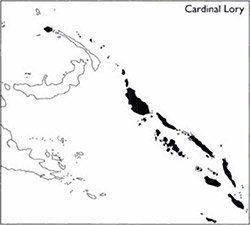
Distribucion Chalcopsitta cardinalis

The Cardinal Lory It is endemic to the Islands to the East of New Guinea. Its area of distribution covers New Hanover and the islands surrounding (Tabar, Lihir, Thong, FeNi and Nissan). Extends to Buka and Bougainville. In the Solomon Islands occupies a territory that extends to the South of San Cristóbal.

Conservation:
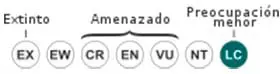

minor concern

– Current IUCN Red List category: Least concern

– The population trend: Stable

The world population It has not been quantified, but the species is described as abundant (pit et to the. 1997). Sources estimate that the total population in nature exceeds the 100 thousand copies.
The population is suspected to be stable in the absence of evidence of any reduction or substantial threats.

But, is classified by the UICN as a species "in restricted area", which means that it has a territory whose surface is less to 50 000 km, therefore, potential danger.

"Cardinal Lory" in captivity:

Very rare.

In 1989, the Solomon Island allowed that a few Cardinal Lory were exported to the EE.UU.. But, because of the Law on the conservation of wild birds in 1992 The export of the Lori of Solomon Islands to the United States. UU. they banned except that is for authorized reproduction.

Alternative names:

– Cardinal Lory (ingles).
– Lori cardinal (French).
– Kardinallori (German).
– Lóris-cardinal (Portuguese).
– Lori Cardenal (español).

scientific classification:

– Order: Psittaciformes
– Family: Psittaculidae
– Scientific name: Pseudeos cardinalis
– Genus: Dusky
– Citation: (Gray,GR, 1849)
– Protonimo: cardinal lorius

«Lori Cardenal» images:
Videos "Cardinal Lory"


«Lori Cardenal» (Pseudeos cardinalis)


Sources:

Avibase, BirdLife.org, Oiseaux.NET

Photos: Wikipedia, Chalcopsitta cardinalis - Cincinnati Zoo (Wikipedia), Ethan Ograngy (IBC.lynxeds.com), Minppu (IBC.lynxeds.com)

Sounds: Niels Krabbe (Xeno-canto)

▷ The world of Pets: Dogs, cats, birds, reptiles, amphibians

Grey-hooded Parakeet
Psilopsiagon aymara

Grey-hooded Parakeet

Content

Description:

Grey-hooded Parakeet

19-20 cm.. height.
The Grey-hooded Parakeet (Psilopsiagon aymara) has the body mostly green, elongated and with a very long and pointed tail; the forecrown and lores, until the area back from the neck (including the ear-coverts), grayish brown, forming a kind of CAP that comes, slightly, to below the eyes.
Mantle green, lightly olive dyeing; Back and scapulars green; rump and uppertail-coverts, green, slightly brighter; upperwing-coverts green; flight feather green with blackish tips; underwing-coverts of color greenish-yellow. Chin and throat pale-whitish grey; chest grey silver pale, sometimes with dye bluish on the feathers on both sides of the chest; flanks of color yellow pale greenish; the belly and undertail-coverts, green, with faint bluish tint.

Upper, the tail green; undertail, gray. The bill pale flesh-colored; irises dark brown; legs grey-brown.

Both sexes similar, though the male may have brighter grey in the chest.

Immature they have the tail shorter.

NOTE This species was treated as Bolborhynchus aymara.

Habitat:

Video – "Grey-hooded Parakeet" (Psilopsiagon aymara)

You prefer arid habitats shrubs or Woody hills and ravines, dense scrub and trees around settlements and in agricultural areas, also distributed in high Andean steppes and sometimes in the Highlands, at altitudes of 1.800 to 3.400 m, sometimes more low (1,200 m in winter) and supposedly until the 4.000 m in Tucumán, Argentina.

The Grey-hooded Parakeet is a bird gregarious, usually seen in small flocks, at least outside the breeding season; large gatherings near areas with water.

Reproduction:

Nest sometimes in colonies, in holes dug in sand banks or in hollows and cactus in desert area. Egg laying in the month of November in Tucumán. Clutch 4-5 eggs. Up to seven in captivity.

Food:

The Grey-hooded Parakeet they tend to consume berries and other fruit, In addition to seeds herbaceous and grasses (by example Viguera and other compounds); they usually descend to the ground to collect fallen fruits and seeds from the grass.

Distribution:

Size of the area of distribution (reproduction / resident): 383.000 km2

Is it can be found in the Andes from the South of Bolivia until Argentina and possibly North of Chile.

In West Bolivia It is known from Peace and Cochabamba to the South of Tarija and potosi, and in the Northwest of Argentina on the slopes Andean of Jujuy to the South of Mendoza and to the hills of the South East of Córdoba. In the North of Chile (for example, Tarapacá) is reported as resident, visitor or absent.

Some movements at altitude seasonal; the Grey-hooded Parakeet move higher in summer. Usually common and apparently without pressure; Small numbers are caught and exported as cage birds.

Conservation:

State of conservation ⓘ


minor concern Minor Concern ⓘ (UICN)ⓘ

• Current category of the Red List of the UICN: Least concern.

• Population trend: Stable.

Justification of the population

The size of the world population It has not been quantified, but this species is described as «quite common» (Stotz et to the., 1996).

Justification of trend

It is suspected that the population is stable in absence of evidence of any decline or threatens substantial, Although it is exported as bird cage in small quantities.

"Grey-hooded Parakeet" in captivity:

Rare in poultry.

Alternative names:

– Gray-hooded Parakeet, Andean Parakeet, Aymara Parakeet, Gray hooded Parakeet, Gray-headed Parakeet, Grey hooded Parakeet, Grey-headed Parakeet, Grey-hooded Parakeet, Sierra Parakeet (English).
– Toui aymara, Perruche d’Aymara (French).
– Aymarasittich, Aymara Sittich (German).
– Periquito-da-serra (Portuguese).
– Periquito-da-serra, Catita Serrana Grande (español).
– Periquito-da-serra (Argentina).
– Periquito-da-serra (Bolivia).

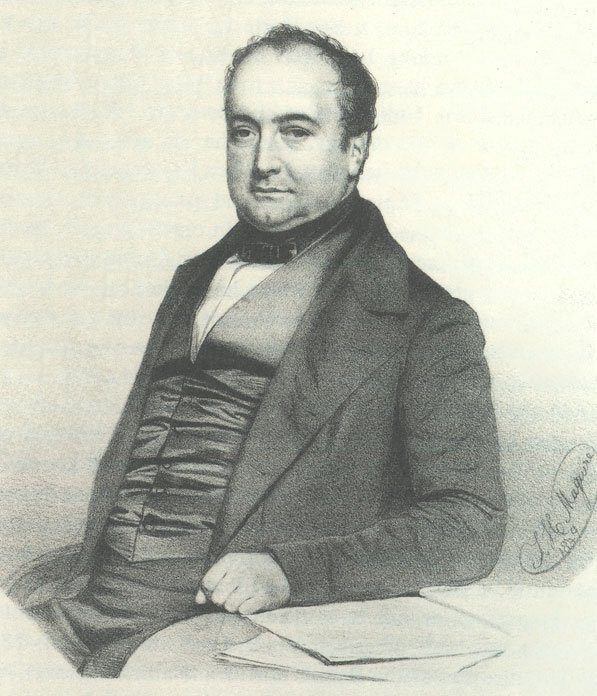
Alcide Dessalines d'Orbigny

scientific classification:


– Order: Psittaciformes
– Family: Psittacidae
– Genus: Psilopsiagon
– Scientific name: Psilopsiagon aymara
– Citation: (d’Orbigny, 1839)
– Protonimo: Arara aymara

Images Galah Cockatoo"Grey-hooded Parakeet":


Species of the genus Psilopsiagon

Sources:

– Avibase
– Parrots of the World – Forshaw Joseph M
– Parrots A Guide to the Parrots of the World – Tony Juniper & Mike Parr
– Birdlife
– Parrot Book, Parrots and macaws Neotropical

– Photos:

(1) – Grey-hooded Parakeets (also known as the Aymara Parakeet and the Sierra Parakeet) in Capilla del Monte, Córdoba, Argentina By Nes (originally posted to Flickr as Periquitos) [CC BY 2.0], via Wikimedia Commons
(2) -Psilopsiagon aymara by John Gerrard Keulemans [Public domain], via Wikimedia Commons

– Sounds: (Xeno-canto)
▷ The world of Pets: Dogs, cats, birds, reptiles, amphibians

Southern Mealy Parrot
Amazona farinosa

Southern Mealy Parrot

Content

Description:


Anatomy-parrots

38 to 45 cm.. from head to tail and 535 to 766 weight g.

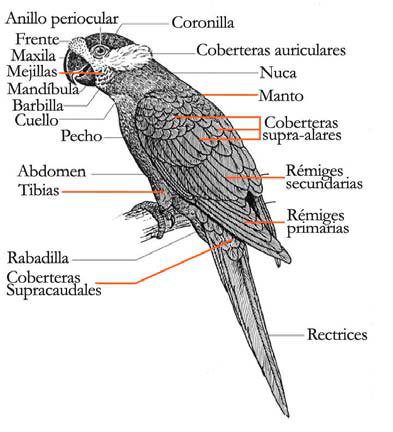
The Southern Mealy Parrot (Amazona farinosa) It is the fifth in size among the amazon parrots of the Americas, and is the Parrot largest in Mexico. The plumage its body is green with a slight yellow tone. Presents some yellow feathers on the crown, Although may not be very well defined.

Is characterized by its crown light blue color that continues to the side of the nape . Their wings are of round shape, and tail is short and square. The primary feathers and secondaries they have the blue-violet end, with a band red in them 4 – 5 Outer secondaries. The feathers of the tail they have a broad band of yellowish-green tip. The irises the eye is red with eye ring white, and the bill horn.

It has no sexual dimorphism and youth they are similar to adults, but with the irises dark brown .

Two more for South America subspecies have been proposed, Chapmani and Inornata but lack of character distinctive clear.

Habitat:

They inhabit in dense, humid tropical forests near clearings, Although also can inhabit in areas forested of the sheets.
You can see in altitudes of 290 to 1,200 m.

The Southern Mealy Parrot are birds very social, often seen flying in pairs or small flocks of up to 20 individuals. Also form groups more large, hundreds of birds, close to breeding season. Very enable, is the view often interacting with other species of parrots, such as macaws (ARA).

Is an of the species of parrot more noisy of the amazon, so they are easier to observe than other species.

Reproduction:

The mating It takes place once a year and usually starts in the spring. Once they mature sexually, the Southern Mealy Parrot they will choose a partner for life.

The breeding It normally varies between the months of November to March. The nesting has place in the cavity of a tree. The laying by year tends to be of three eggs. The eggs are hatch for approximately four weeks, after the hatching the males help females in the upbringing of young people, regurgitating food in the crop of the female. The offspring are ready to leave the nest after a period of about eight weeks..

Food:

It feeds on fruits of various species, some of them are: Euterpe SP.., Brosimum sp., Inga sp., Dussia sp., Eschweilera SP.., Pithecellobium SP.., Tetragastris sp., Dialium guianensis, Peritassa compta, Sloanea grandiflora and It corima macrocarpa. Also consumes flowers, arils of Cassearia sp. and nectar of Tabebuia insignis.

Distribution:

Size of the area of distribution (reproduction / resident): 6.790.000 km2

Are in Mexico, Central America and South America, occupying a wide range from the South of Mexico to the North of Bolivia and South of Brazil. They are more common in Costa Rica and Panama, particularly in the costa Caribbean. Observed in the Middle Magdalena River Valley and to the East of them Andes on San Jacinto Mountain Range, Western base of the Perijá Mountain Range and the Department of Sucre, in Colombia.

Conservation:

State of conservation ⓘ


Near-threatened Near Threatened ⓘ (UICN)ⓘ

• Current category of the Red List of the UICN: Near-threatened.

• Population trend: Decreasing.

Not are currently identified as a species in crisis. Not comply with the criteria for a decrease of the population, that means a loss of thirty per cent of the population in ten years or three generations, as defined in the Red list of the UICN.

Are considered a least concern species. This, However, It does not suggest that the species is completely free from danger.

The important trade of trade in live birds of this species, and loss of habitat caused by deforestation have a significant impact on the decrease of the population of the Southern Mealy Parrot in certain areas.

The Southern Mealy Parrot in captivity:

Of special interest to the international trade in exotic birds; common in captivity. In some areas, they are also hunted for food, due to its relatively large size. With regard to its ability to speak, It seems that can be good talkative, but is true that there are birds that do not come to make it never.

Alternative names:

– Southern Mealy Parrot, Mealy Parrot, Mealy Parrot (nominate), Southern Mealy Amazon (English).
– Amazone poudrée, Amazone poudrée (nominal), Amazone poudrée (nominale), Amazone poudrée (race nominale) (French).
– Mülleramazone (German).
– papagaio-moleiro (Portuguese).
– Amazona harinosa sureña, Amazona Burrona (español).
– Lora Real (Colombia).
– Loro verde (Costa Rica).
– Lora coroniazul (Honduras).
– Loro corona-azul (Mexico).
– Loro Harinoso (Peru).
– Loro Burrón (Venezuela).


scientific classification:

Pieter Boddaert
Pieter Boddaert

– Order: Psittaciformes
– Family: Psittacidae
– Genus: Amazona
– Scientific name: Amazona farinosa
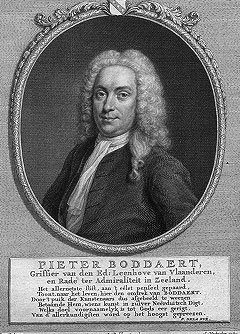
– Citation: (Boddaert, 1783)
– Protonimo: Psittacus farinosus


Southern Mealy Parrot images:


Species of the genus Amazona


Sources:

– Avibase
– Parrots of the World – Forshaw Joseph M
– Parrots A Guide to the Parrots of the World – Tony Juniper & Mike Parr
– Birdlife

– Photos:

(1) – Mealy Amazon at Elmwood Park Zoo. Photograph shows upper body By Art G. from Willow Grove, PA, USA (African Parrot) [CC BY 2.0], via Wikimedia Commons
(2) – Mealy Parrot (Amazona farinosa), Tambopata Lodge, Peru By D. Gordon E. Robertson (Own work) [CC BY-SA 3.0 or GFDL], via Wikimedia Commons
(3) – Two Mealy Amazons at South Lakes Wild Animal Park, Broughton Road, Dalton in Furness, Cumbria, England By Glen Bowman (originally posted to Flickr as 18:02:2009 14:33:08) [CC BY 2.0], via Wikimedia Commons
(4) – A Mealy Amazon at Kobe Oji Zoo, Kobe, Japan By Jun Y (originally posted to Flickr as Poll Parrot) [CC BY-SA 2.0], via Wikimedia Commons
(5) – Mealy Parrot or Mealy Amazon (Amazona farinosa) of the blue crowned variety. Note the characteristic flour-like surface texture of the feathers on shoulder area By Eightball38 at English Wikipedia [Public domain], via Wikimedia Commons

– Sounds: Diego Caiafa (Xeno-canto)
▷ The world of Pets: Dogs, cats, birds, reptiles, amphibians

Orange-cheeked Parrot
Pyrilia barrabandi


Orange-cheeked Parrot

Content

Parrot-carinaranja-6

Description:

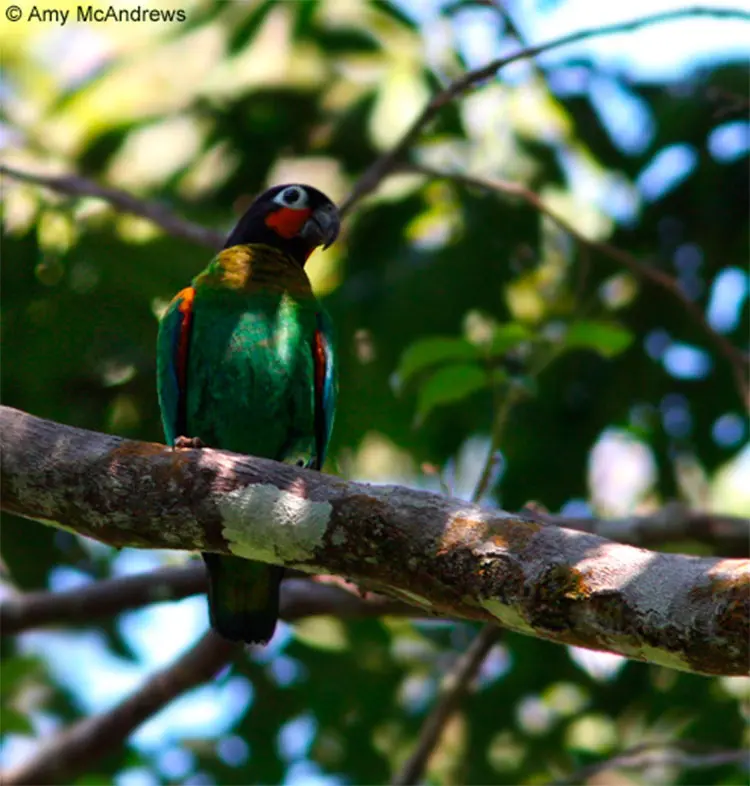
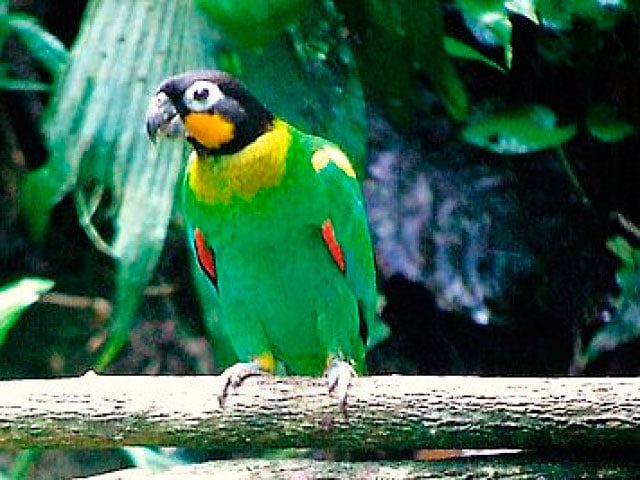
The Orange-cheeked Parrot (Pyrilia barrabandi) measured, approximately, 25 cm., has the head and throat black, except for the bright colored area amarillento-naranja that goes from the base of the bill up to the lower cheek well behind the eyes.

Upperparts green, lesser coverts, yellow-orange; edge front of the wing red; primary coverts blue-black; greater coverts bluish green; other coverts, green. Primary, dark blue at the base and in outerweb, If not black; underwing-coverts, bright red, flight feather opaque green. Upper zone of the chest dorado, its bottom and belly, bright blue green, the thighs with orange-yellow feathers. Tail green with blue tip, with yellow bases to the innerwebs of outer feathers.

Bill grey; brown the irises; legs grey.

Both sexes are similar.

The immature has the head Brown golden colour with yellowish brown in cheeks inferiores. Younger birds also has less yellow in the bend of wing, some green feathers in the underwing-coverts and yellow on the tips of the primaries.

Description 2 subspecies:

  • Pyrilia barrabandi aurantiigena

    (Gyldenstolpe, 1951) – Lesser coverts, curve of the wing and the thighs intense Orange instead of yellow-orange.

  • Pyrilia barrabandi barrabandi

    (Kuhl, 1820) – Nominal.

Habitat:

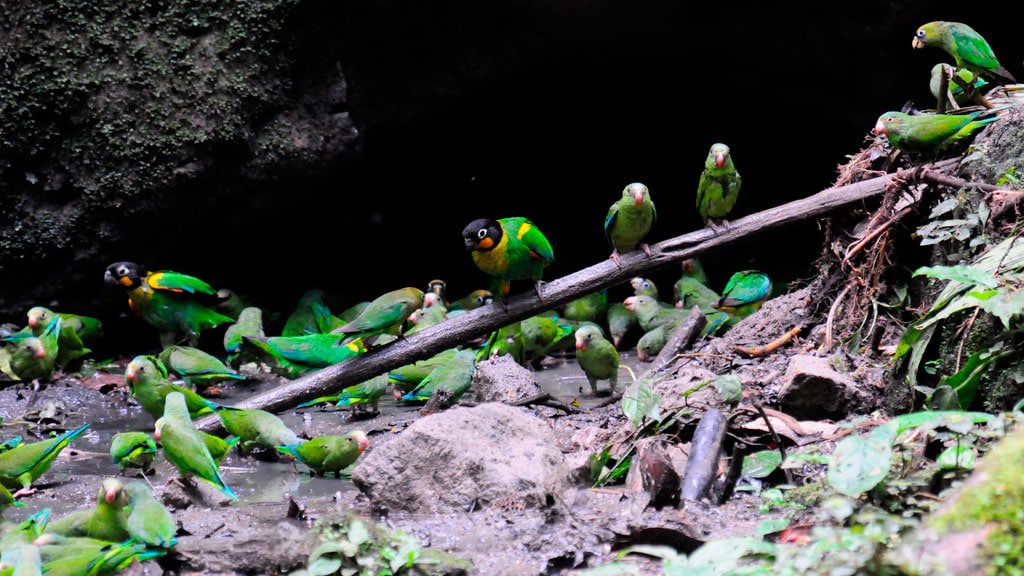
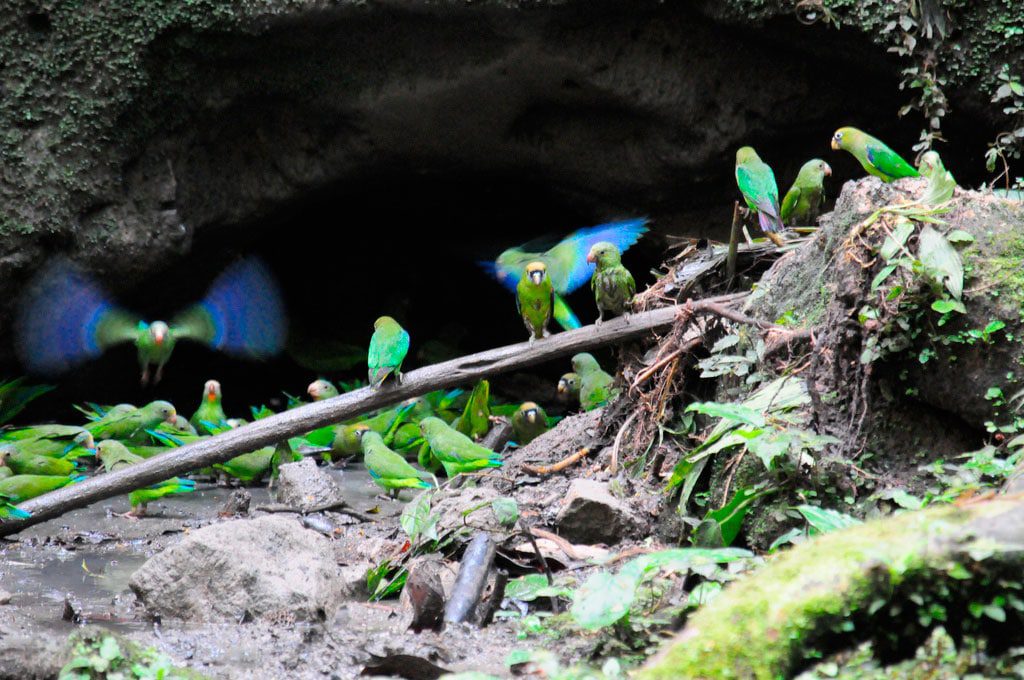
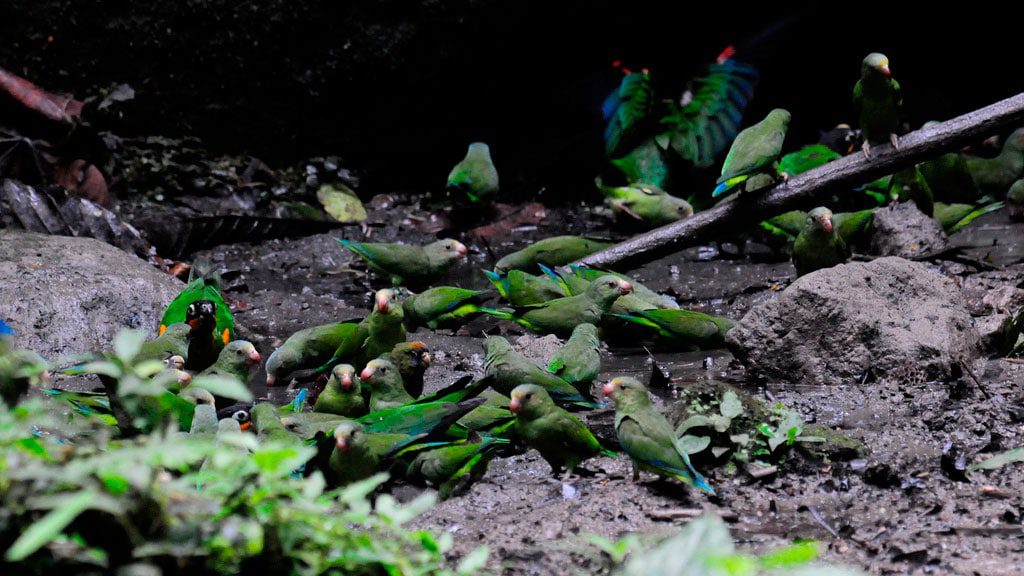
They inhabit mainly in lowland forests, apparently less frequently in forests and marshes. They are distributed at the edge of forests and partially disturbed forest, occasionally in small groves in deforested areas. Observed in altitudes of 150-300 metres in Venezuela and 500 meters in the southeast of Colombia. Seen individually, in pairs and in small groups of up to 10 individuals (sometimes more in banks of land rich in minerals). Are activated more early, In the morning, than other parrots and will rest later.

Reproduction:

There is no information about the nesting, but that suggests the registration of immature birds in February and March breeding season It can be between the months of September/October until the end of year.

Food:

Observed taking seeds or fruits of Ficus sphenophylla, Pourouma, Pseudolmedia, Mimosa, Pithecellobium and Heisteria and possibly larvae of the gall wasps. Usually, they feed in the canopy of the trees, or just below them; less frequently in low branches. Regularly visit areas with mineral-rich soil in the company of other species of parrots.

Distribution:

Size of the area of distribution(reproduction / resident): 3.470.000 km2

This is a kind of basin of the Western Amazon and the Alto Orinoco. Its length extends from the southeast of Colombia, from the Caquetá Western and bass inirida river, Guainia, until Venezuela in amazon and the Center and South of Bolívar and in Brazil in the upper part of the Amazon to the West, from the rivers Negro and Madeira through the rivers Juruá and Purus and to the South towards Mato Grosso, through the East of Ecuador and East of Peru and to the Northwest of Bolivia, in hand me.

They are generally considered rare throughout its distribution area, Although they are fairly common in the Northwest of Bolivia and many in the sandy Woods of bass Inirida River, to the southeast of Colombia. Its population has fallen locally due to deforestation, Although large tracts of primary forest remain in all range States. Live in several areas protected.

Distribution 2 subspecies:

  • Pyrilia barrabandi aurantiigena

    (Gyldenstolpe, 1951) – Is located in the East of Ecuador and to the East of Peru, where is this in the Manu National Park. In the North of Bolivia is it described as frequent to numerous. The extension also comes to Brazil: is limited by the Amazon in the North and Rio Madeira from the East (pit et to the., 1997).

  • Pyrilia barrabandi barrabandi

    (Kuhl, 1820) – Nominal.

Conservation:


Near-threatened


• Current category of the Red List of the UICN: Almost threatened.

• Population trend: Stable.

Justification of the population

The size of the world population It has not been quantified, but this species is described as «Rare» (Stotz et to the., 1996).

Justification of trend

It is suspected that this species has lost 12.1-15% of habitat within its distribution over three generations (21 years) based on a model of Amazon deforestation (Soares-Filho et to the., 2006, Bird et to the., 2011). Given the susceptibility of the species to the fragmentation and degradation of forest and potentially your hunting and/or trapping, It is suspected that its population will decrease at a rate close to the 30% during three generations.

Threats

The main threat This species is the acceleration of the deforestation on amazon basin with large tracts of land used for livestock and soybean production; It is highly susceptible to degradation and fragmentation due to its dependence of primary forests (Soares-Filho et to the. 2006, Bird et to the. 2011, A. Lees in litt. 2011). It can also be vulnerable to the hunt (A. Lees in litt. 2011). The changes proposed by the Forest code of Brazil reduce the percentage of land that a private owner is legally required to maintain as forest and include an amnesty for owners who deforested before July 2008 (who would later be acquitted of the need to reforest illegally cleared land) (Bird et to the. 2011).

"Orange-cheeked Parrot" in captivity:

It is very rare see you in captivity outside of Brazil.

Alternative names:

– Orange-cheeked Parrot, Barraband’s Parrot, Orange cheeked Parrot (English).
– Caïque de Barraband (French).
– Goldwangenpapagei, Goldwangen-Papagei (German).
– curica-de-bochecha-laranja, curica, curuca (Portuguese).
– Cotorra Cabecinegra, Lorito Carinaranja, Lorito de Mejillas Amarillas (español).
– Cotorra Cabecinegra (Colombia).
– Loro de Mejilla Naranja (Peru).
– Perico Cachete Amarillo (Venezuela).


scientific classification:

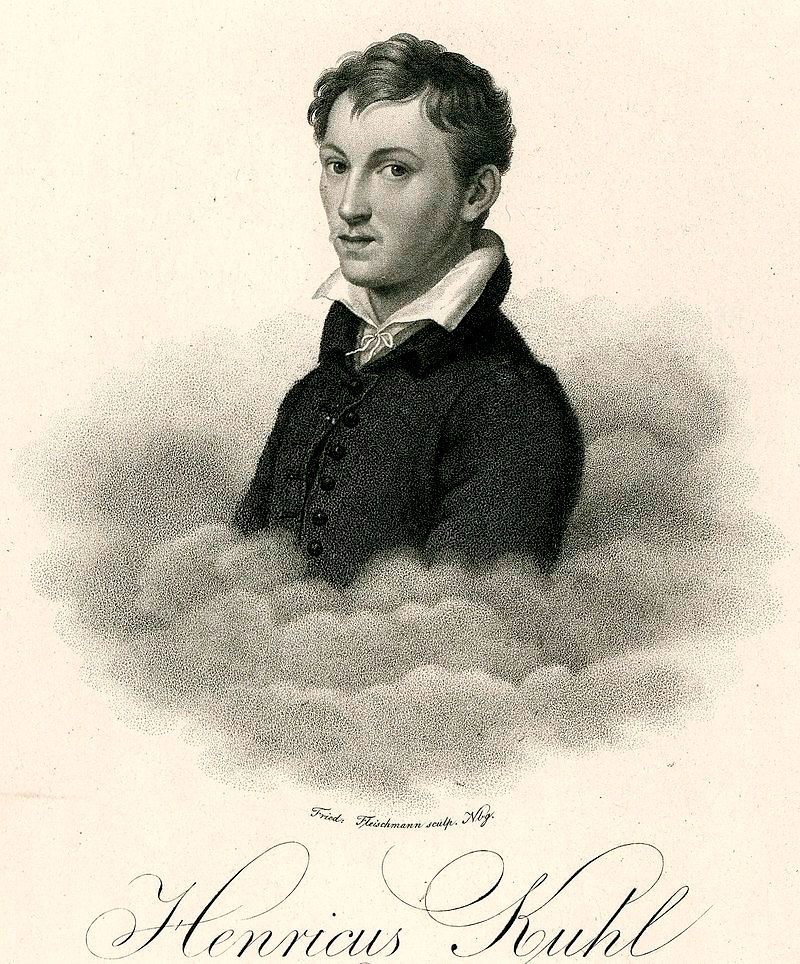
Kuhl, Heinrich
Heinrich Kuhl

– Order: Psittaciformes
– Family: Psittacidae
– Genus: Pyrilia
– Scientific name: Pyrilia barrabandi
– Citation: (Kuhl, 1820)
– Protonimo: Psittacus Barrabandi


Images "Lorito Carinanja":

Videos "Orange-cheeked Parrot"

————————————————————————————————

"Lorito Carinanja" (Pyrilia barrabandi)


Sources:

– Avibase
– Parrots of the World – Forshaw Joseph M
– Parrots A Guide to the Parrots of the World – Tony Juniper & Mike Parr
– Birdlife

– Photos:

(1) – Orange-cheeked Parrot (Pyrilia barrabandi) Cristalino Jungle Lodge, Mato Grosso, Brazil by Amy McAndrews – Flickr
(2) – Orange-cheeked Parrot at Napo Wildlife Reserve, Ecuador by ocelot123 – Flickr
(3) – Cobalt Winged Parakeet , Scarlet Shouldered Parrotlet and Orange Cheeked Parrot at 3rd lick by Vince Smith – Flickr
(4) – Cobalt Winged Parakeet , Scarlet Shouldered Parrotlet and Orange Cheeked Parrot at 3rd lick by Vince Smith – Flickr
(5) – Cobalt Winged Parakeet , Scarlet Shouldered Parrotlet and Orange Cheeked Parrot at 3rd lick by Vince Smith – Flickr
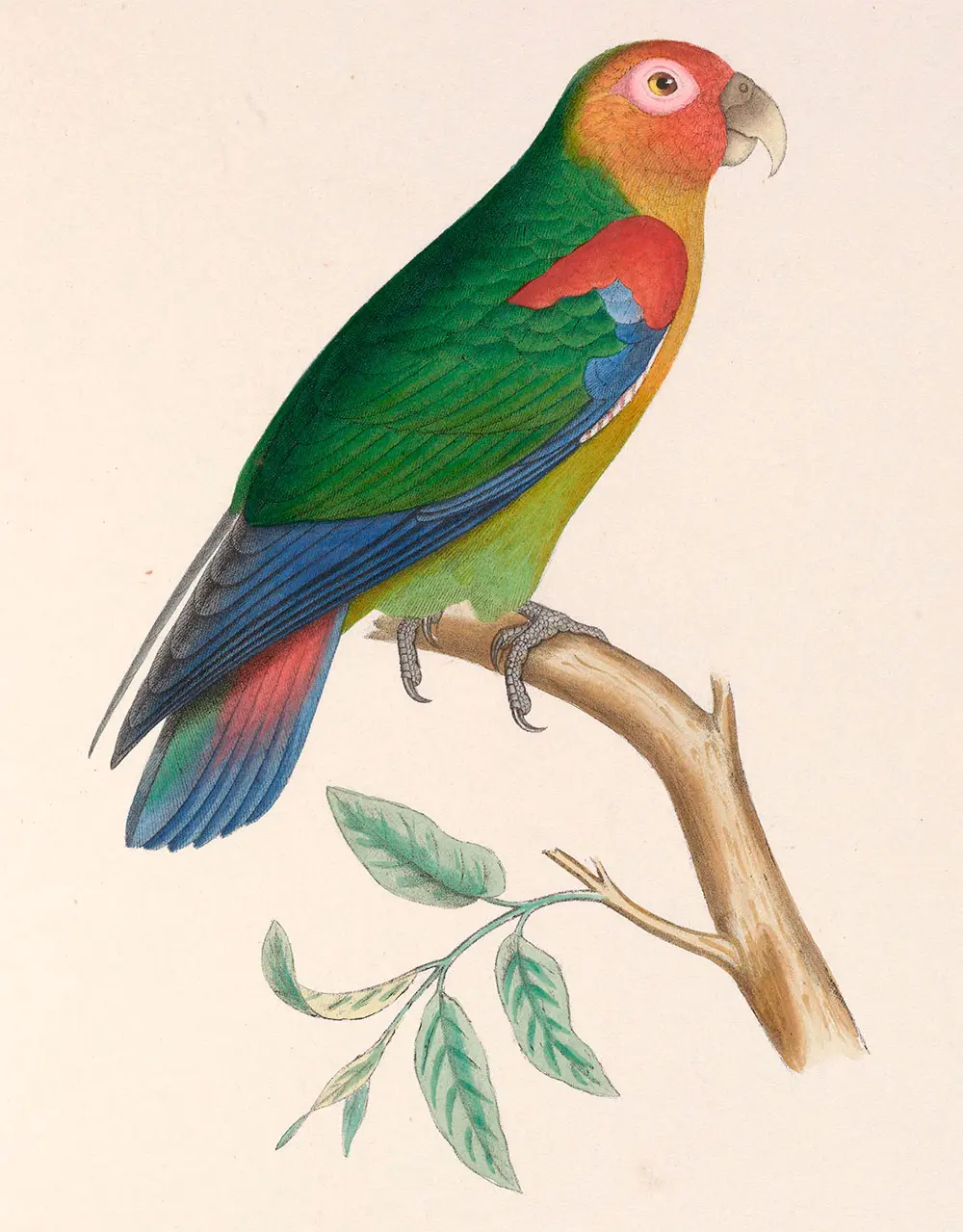
(6) – Oiseaux brillans du Brésil.. Paris,1834.. biodiversitylibrary.org/page/47697228

– Sounds: controles-canto.org

▷ The world of Pets: Dogs, cats, birds, reptiles, amphibians

Rusty-faced Parrot
Hapalopsittaca amazonina

Rusty-faced Parrot

Content


Anatomy-parrots

Description:

23 cm.. height and a weight between 97 and 115g.

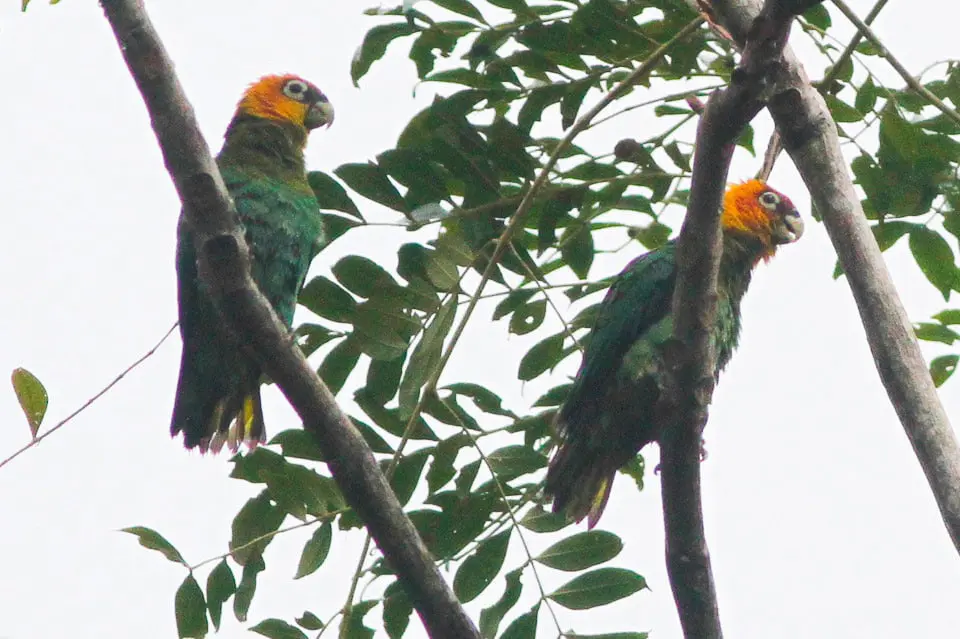
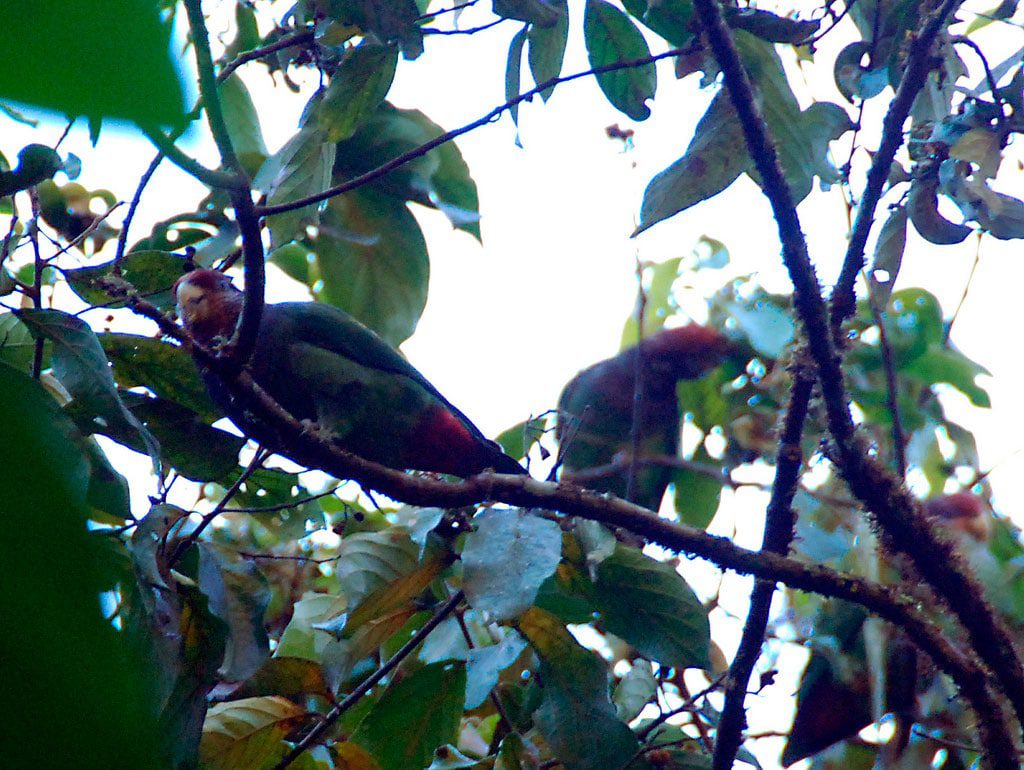
The Rusty-faced Parrot or Parrot mountain (Hapalopsittaca amazonina) It is distinguishable by the dirty red of his face and crown. Its bill is pale with to the base of the lower jaw and the chin of color red orange. Headphones coverts reddish brown with yellow lines that extend behind the nape and the neck. The rest of upperparts they are green. Its chest This is olive green, with red spots in the shoulders similar to their Wing coverts internal minors. The rest of your wing-coverts they are blue-green and the remiges bluish-black. Its tail It is mainly dull red with wide blue apexes.

It has no sexual dimorphism. The youth are green-yellow color, with the face pale red and the secondaries grey.

Description 3 subspecies:

  • Hapalopsittaca amazonina amazonina

    (Des Murs, 1845) – Nominal.


  • Hapalopsittaca amazonina theresae

    (Hellmayr, 1915) – The plumage with more olive tones and the face dark red.


  • Hapalopsittaca amazonina velezi

    (Serious,GR & Restrepo, 1989) – With part of the crown and nape, brighter yellowish green; forecrown red; list fine near to the ear; below and behind the eye, green. More information.

Habitat:

It inhabits in mountains with semi-humid and cloud forests, between the 2000 to 3600 m, with the presence of Oak (Quercus humboldtii) and Alder (Alnus acuminata).
Fly high in the forest canopy, in groups of 5-30 individuals. Presents aggregation behaviors for the night, establishing communal bedrooms in groups of between 2-35 individuals.

Reproduction:

Many aspects of the reproductive biology of the Rusty-faced Parrot. Probably nests in tree hollows of Oak dead.

Food:

Consumes fruits of the "matapalo«, flowers and seeds, including the of Clusia sp. and some GUIs of which is fed with high frequency.

Distribution:

Size of the breeding range / resident): 234.000 km2

Is located in Colombia and Venezuela and Peru. In Colombia lives between 2000 and 2700 m above the sea level in the Cordillera Oriental and in the The upper Magdalena valley (South of the Department of the Huila). Among 3100 and 3600 m of height in the cordillera Central in Caldas (where it is considered Bird emblem), in the basin of the White River in the municipality of Manizales. In the Cordillera Oriental is known only in Norte de Santander and the southwest of Bogotá. Has also been recorded in the departments of Risaralda, Tolima, Huila (Cave of the Guacharos, Meremberg nature reserve) and Cauca (Puracé National Park).

Distribution 3 subspecies:

  • Hapalopsittaca amazonina amazonina

    (Des Murs, 1845) – Nominal. East of the Colombian Andes.


  • Hapalopsittaca amazonina theresae

    (Hellmayr, 1915) – Eastern edge of the Andes of Colombia and Northwest of Venezuela.


  • Hapalopsittaca amazonina velezi

    (Serious,GR & Restrepo, 1989) – Center of the Colombian Andes. More information.

Conservation:


Vulnerable


• Current category of the Red List of the UICN: Vulnerable.

• Population trend: Decreasing.

From makes several years appears in the book red of species threatened by fault of the destruction of their habitat, including, the Palm of wax (Ceroxylon quindiuense).

Rationale for the Red List category

This species is classified as Vulnerable Since its small population consists of subpopulations very small and scattered that probably will be experiencing declines continuous due to the loss widespread of habitat.

Justification of the population

Renjifo et to the. (2002) estimated that in Colombia the population can count 2,500-10,000 individuals, based on a hypothetical C.1 density of individuals / km2, and the 25% occupation of the approximately 13.890 km2 of habitat suitable. This may be an overestimate and the population could be right around the few thousand mark in Colombia (P. Salaman in litt., 2005). There are also much smaller populations in Venezuela. Its location in the Ecuador is uncertain. Be placed better in the band 2.500-9.999 mature in general individuals, which is equivalent to 3.750-14.999 individuals, rounded here to 3.500-15.000 individuals.

Justification of trend

Se sospecha una lenta y continua disminución de la población del Rusty-faced Parrot sobre la base de la continua destrucción y fragmentación del hábitat.

"Rusty-faced Parrot" in captivity:

No encontrado en avicultura.

Alternative names:

– Rusty-faced Parrot, Bogota Parrot, Little Amazonian Parrot, Rusty faced Parrot (English).
– Caïque à face rousse, Caïque à face rouge (French).
– Caïque à face rousse (German).
– Rusty-faced Parrot (Portuguese).
– Cotorra Montañera, Lorito Amazonino, Lorito Multicolor, Loro fantasma (español).
– Cotorra Montañera, Lora montañera (Colombia).
– Perico Multicolor (Venezuela).


scientific classification:

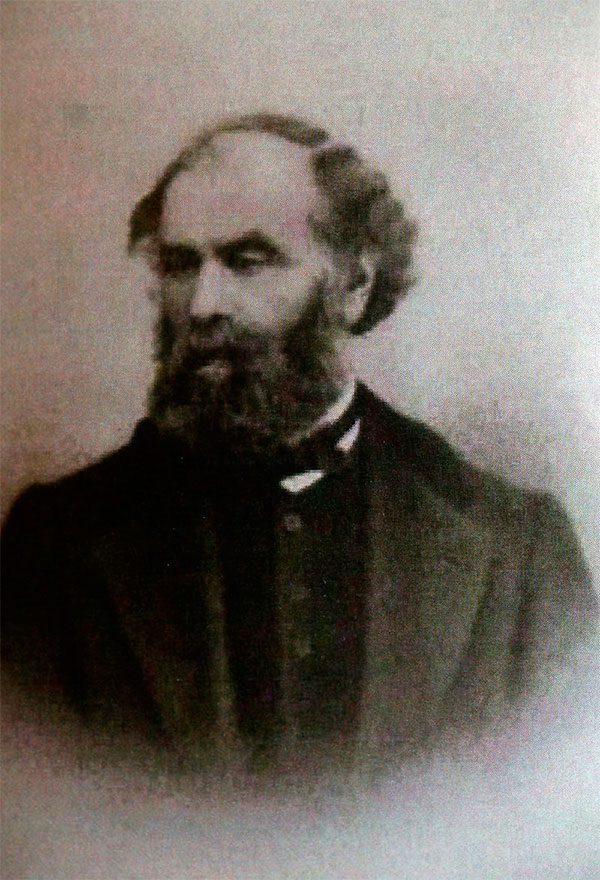
Marc Athanase Parfait Oeillet Des Murs

– Order: Psittaciformes
– Family: Psittacidae
– Genus: Hapalopsittaca
– Scientific name: Hapalopsittaca amazonina
– Citation: (Des Murs, 1845)
– Protonimo: Psittacus amazoninus


Images «Lorito Amazonino»:

Videos «Lrito Amazonino»:


«Amazonino Blondo» (Hapalopsittaca amazonina)


Sources:

Avibase
Parrots of the World – Forshaw Joseph M
Parrots A Guide to the Parrots of the World – Tony Juniper & Mike Parr
Birdlife

Photos:

(1) – Iconographie ornithologique By Marc Athanase Perfect Carnation Walls (1804-1878) (Iconographie ornithologique) [Public domain], via Wikimedia Commons

Sounds:

Restrepo, Daniel Uribe

* – Restrepo, Daniel Uribe

Daniel has been chasing birds since he was 9-years old, growing on a farm in the Central Andes of Colombia, with his bedroom walls covered with colorful prints of John James Audubon’s birds. Daniel graduated in Veterinary Medicine and Animal Science and has pursued bird and nature photography as his main passions in life.

He is co-founder of the Caldas Ornithological Society (SCO) based in Manizales. Dedicated mainly to conservation and sustainable development projects, Daniel has consulted for many of the most prominent environmental organizations in Colombia and currently assists private nature reserves in Colombia in the establishment of agritourism and ecotourism services.

▷ The world of Pets: Dogs, cats, birds, reptiles, amphibians

Saffron-headed Parrot
Pyrilia pyrilia

Saffron-headed Parrot

Content

Saffron-headed Parrot

Description:

22,8 to 25,4 cm.. height.

The Saffron-headed Parrot (Pyrilia pyrilia) is characterized by the lores naked; head, rear and both sides of the neck, bright yellow. Upperparts green. The spots of the upperwing-coverts are bright yellow with some red feathers at the base; Red at the front edge of the wing with the external medium upperwing-coverts blue, or green with blue tips. The primary coverts are black, with the coverts remaining of the party top, green, sometimes with blue tips.

Primary and secondary bluish black with narrow green margin to the outerweb; tertiary green. Under the wings and axillary bright red, flight feather of color bluish pale. Breast Yellow olive; belly Green but paler and more yellowish than the top; undertail-coverts green. above the tail with yellow in the innerwebs and blue tips; yellowish below. Bill color pale horn; cere blackish; dark grey skin nude of the lores extends around the eye ring; eye ring whitish; irises dark brown; legs grey.

Both sexes similar. The immature has the crown and shoulders Green with yellow yellowish brown in the face and throat.

Habitat:

Little known throughout its distribution. It inhabits in humid jungles, very wet, high secondary forest and cleared areas, between the 300 to 1700 m. In Venezuela can be seen in tropical and subtropical areas at altitudes of 150-1650 m (perhaps only seasonally to higher altitudes) and 1.000 metres in Colombia. Usually gregarious, seen in groups of up to 10 individuals.

Reproduction:

With reproduce during the first half of the year.
Birds in breeding conditions observed in the months of March-June in Antioquia (Colombia). Immature seen during the month of July in Sierra de Perija (Venezuela and Colombia).

Food:

Just have your feed data, Although it more likely is that your diet is composed of of fruit, berries and seeds.

Distribution:

Size of the area of distribution (reproduction / resident): 577.000 km2

The Saffron-headed Parrot is distributed in the this of the Province of Darien, Panama, to the North of Colombia and Northwest of Venezuela.

There are two records in the Northwest of Ecuador, a wandering pair alleged in the Book ecológica Cotacachi-Cayapas and a flock of about 20 birds in the Pedro Vicente Maldonado Canton, in the Northwest of Pichincha (Ridgely and Greenfield 2001), Although their status is uncertain (JF Freile in litt., 2000, Ridgely and Greenfield 2001).

Today it is rare to see to the Saffron-headed Parrot in accessible areas, Although it is still common Serrania de las Quinchas (Boyacá) and in the Hill of the peace (Santander) (Donegan et to the., 2003), Colombia and is soon likely to have decreased significantly in the Chocó, Colombia, or Darien (GR Angehr in litt., 1999, G. Stiles in litt., 1999).

There are few recent records, but they may still be numerous at the northern base of the Andes, Córdoba, North of Antioquia and Bolívar, and in the Valley of the Magdalena, to the East of Caldas and to the southeast of Antioquia, Colombia (Hilty and Brown 1986, A. Cuervo in litt., 1999).

Seems to have decreased in Venezuela, where recent records are from the area of Merida, the South-East slopes of the Cordillera de Mérida, Barinas (Kirwan and Sharpe 1999, C. Sharpe, J. and F. Rodriguez Rojas-Suarez in litt., 1999) and Sierra de Perija (CJ Sharpe in litt. 2011).

The population total may have fallen below 10.000 individuals (Juniper and Parr 1998, G. Stiles in litt., 1999). In fact, is estimated that the Western population (West of Sinu) is of 2.000 to 4.000 individuals (most habitat intact), the population Center (Serranía de San Lucas) is probably less than 1.000 individuals, the slopes West of the Eastern Cordillera It is estimated at approximately 1.000 individuals and the eastern slope of the Eastern Cordillera and Merida perhaps less than 1.000 individuals (C. Sharpe, J. and F. Rodriguez Rojas-Suarez in litt., 1999).

Conservation:


Near-threatened

• Current category of the Red List of the UICN: Near-threatened.

• Population trend: Decreasing.

Rationale for the Red List category

This species has a population moderately small suspected is declining, and therefore qualifies as near-threatened. It is considered nationally vulnerable in Colombia (Renjifo et to the., 2002) and Venezuela (Sharpe 2008).

Justification of the population

The population is estimated at at least 7.000 copies in total, more or less equivalent to 4.700 mature individuals (PGW Salaman in litt., 2006).

Justification of trend

A slow to moderate and continuous decrease in population is suspected on the basis of the rates of habitat loss: its preferred habitat is severely threatened (T. Donegan in litt 2006.).

"Saffron-headed Parrot" in captivity:

Very difficult acclimating to captivity, susceptible to diseases in captive State.

Alternative names:

– Saffron-headed Parrot, Bonaparte’s Parrot, Saffron headed Parrot (English).
– Caïque de Bonaparte (French).
– Goldkopfpapagei, Goldkopf-Papagei (German).
– Saffron-headed Parrot (Portuguese).
– Cotorra Cariamarilla, Lorito Cabecigualdo, Lorito de Cabeza Dorada (español).
– Cotorra Cariamarilla (Colombia).
– Perico Cabecidorado (Venezuela).


scientific classification:

Charles Lucien Bonaparte

– Order: Psittaciformes
– Family: Psittacidae
– Genus: Pyrilia
– Scientific name: Pyrilia pyrilia
– Citation: (Bonaparte, 1853)
– Protonimo: Psittacula pyrilia

Images "Saffron-headed Parrot"

Videos "Saffron-headed Parrot"


“Lorito he head”. (Pyrilia pyrilia)


Sources:

  • Avibase
  • Parrots of the World – Forshaw Joseph M
  • Parrots A Guide to the Parrots of the World – Tony Juniper & Mike Parr
  • Birdlife

  • Photos:

(1) – Saffron-headed Parrot (Pyrilia pyrilia) by Ron Knight – Flickr
(2) – Iconographie des perroquets: Paris :P. Bertrand,1857. by Biodiversity Heritage Library – Flickr

  • Sounds:

▷ The world of Pets: Dogs, cats, birds, reptiles, amphibians

Speckle-faced Parrot
Pionus tumultuosus

Speckle-faced Parrot

Content


Anatomy-parrots

Description:

28 to 31 cm.. tall and around 250 g. weight.

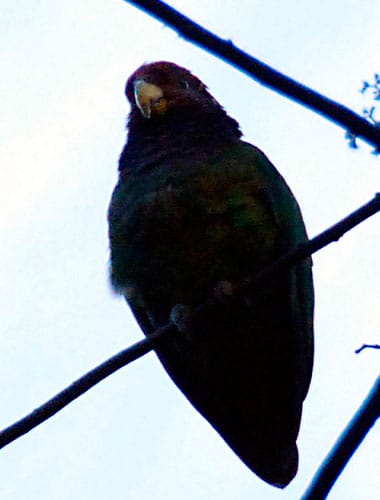
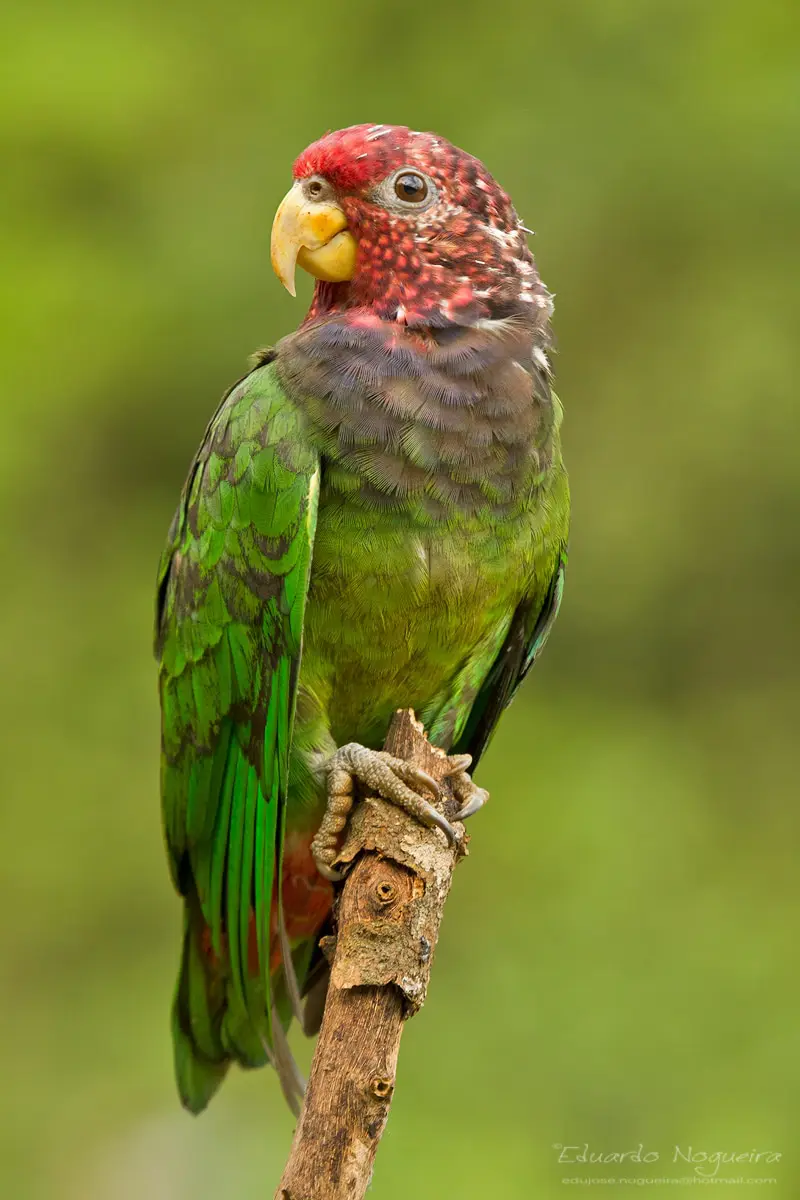
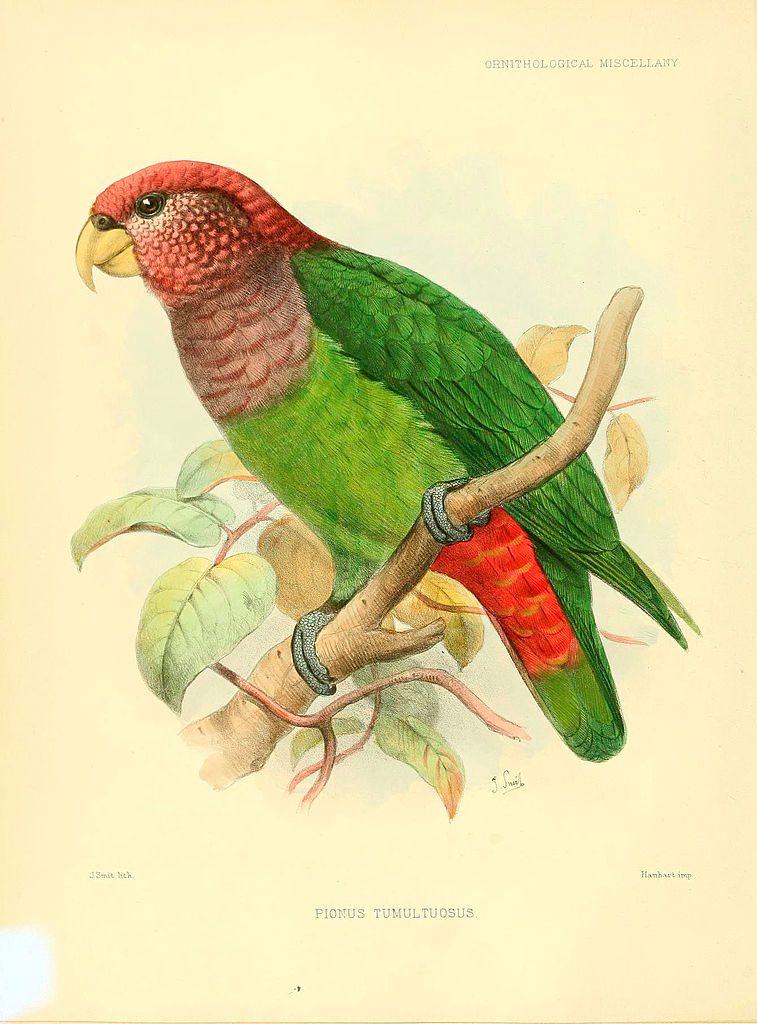
The Speckle-faced Parrot (Pionus tumultuosus) It is distinguishable by color from whitish crown up to the nape; base bill red rose, with forecrown redder. Cheeks whitish with a red and purple tinge towards the neck; purple chest.

Shoulder with thin strip yellow with reddish tint, inside base tail and crissum, red; the rest of the tail is green with blue on the outer feathers; under belly with red feathers with green edge.

ocula ringr greyish

The youth They have almost all head green and the wings, greenish yellow.

Taxonomic note:

The Speckle-faced Parrot It is probably the rarest and most controversial genre Pionus. It is sometimes divided into two species, in which case, the Pionus tumultuosus South is known as Speckle-faced Parrot, while the North, Pionus seniloides, They are known as White-capped Parrot (which leads to easy confusion with Pionus senilis).

Habitat:

Speckle-faced Parrot

It inhabits in Andean and sub-Andean cloud forests and forest edges, between 1600 and 3200 meters above sea level.
It is highly Nomad with temporal variations in terms of the number of individuals that can be registered in a locality.

Reproduction:

With reproduce In September. In captivity puts 4 eggs which incubated about 26 days. No other aspects of its reproductive biology are known..

Food:

It has been registered consuming fruits of Turpinia paniculata and are sometimes seen in large numbers feeding on maize crops in cultivated areas and banana plantations.

Distribution:

Its population is distributed in the southern Andes, from the center of Peru until Bolivia.

Size of the area of distribution (reproduction / resident): 329.000 km2

Conservation:


minor concern


• Current category of the Red List of the UICN: Least concern.

• Population trend: Decreasing.

Justification of the population

The size of the world population It has not been quantified, but this species is described as «quite common, but irregular distribution» (Stotz et to the., 1996).

Justification of trend

It is suspected that the population is in decline due to the continuous habitat destruction.

"Speckle-faced Parrot" in captivity:

This species is virtually nonexistent in poultry farming. There is only a small collection, private property in the United States. The Fundación Loro Parque in Tenerife, Spain, It has some copies.
Most of the Speckle-faced Parrot imported to United States they were the victim of aspergillosis – probably caused by the stress suffered during the import process.

In captivity They were observed as the to intelligent species, inquisitive and sometimes shy and nervous. Will get used to their caregiver over time. You can interact with a person and jealously attacking others. Prone to obesity.

Alternative names:

– Speckle-faced Parrot, Plum-crowned Parrot, Speckle-faced Parrot (Plum-crowned) (inglés).
– Pione pailletée, Pione pourprée (francés).
– Purpurstirnpapagei (alemán).
– Curica-de-cara-manchada (portugués).
– Cotorra Gorriblanca, Loro Rosado, Loro Tumultuoso (español).


Clasificación científica:

Tschudi Johann Jakob von

– Orden: Psittaciformes
– Familia: Psittacidae
– Genus: Pionus
– Nombre científico: Pionus tumultuosus
– Citation: (von Tschudi, 1844)
– Protónimo: Psittacus tumultuosus


Imágenes «Loro tumultuoso»:

Videos del "Loro tumultuoso"

«Loro tumultuoso» (Pionus tumultuosus)

    Fuentes:

    – Avibase
    – Parrots of the World – Forshaw Joseph M
    – Parrots A Guide to the Parrots of the World – Tony Juniper & Mike Par
    – Birdlife
    – Libro Loros, Pericos y Guacamayas Neotropicales

    – Fotos:

    (1) – Eduardo Nogueira
    (2) – Speckle-faced Parrot at La Merced Zoo By josecajacuri [CC BY-SA 2.0], via Wikimedia Commons
    (3) – Speckle-faced Parrot «Pionus tumultuosus» on the grounds of the Pueblo Hotel, Aguas Calientes by Carol Foil – Flickr
    (4) – Speckle-faced Parrot «Pionus tumultuosus» on the grounds of the Pueblo Hotel, Aguas Calientes by Carol Foil – Flickr
    (5) – Speckle-faced Parrot «Pionus tumultuosus» on the grounds of the Pueblo Hotel, Aguas Calientes by Carol Foil – Flickr
    (6) – PIONUS TUMULTUOSUS By Allen, Edgar W.; Erxleben, J.; Hanhart, Michael; Hanhart, N; Keulemans, J. G.; Mintern Bros.; Rowley, George Dawson; Smith, J.; Walther, T. [CC BY 2.0 or Public domain], via Wikimedia Commons

    – Sonidos: Sebastian K. Herzog

▷ The world of Pets: Dogs, cats, birds, reptiles, amphibians

Tepui Parrotlet
Nannopsittaca panychlora

Cotorrita de tepuy

Content

Description:

Tepui Parrotlet

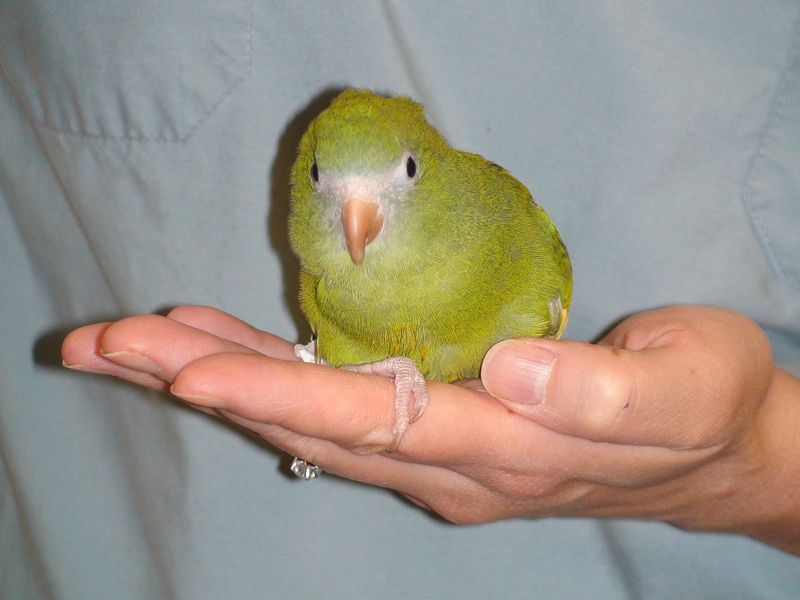
The Tepui Parrotlet (Nannopsittaca panychlora) measured between 14 and 15,7 cm.. height. Small size, with wings sharp and tail cut and wedge.

The head It is green with yellow tinge oliváceo; the eye area is yellow, color extending below and behind the eyes. The upperparts they are green (brighter and less than oliváceo head). Upperwing-coverts green. Flight feathers blackish green tipped primary, brownish opaque below; INFRACA-wing coverts green. The underparts yellowish green turn yellow-green in the undertail-coverts. Upper, the tail is green; undertail, yellower. Bill grey; cere grey; Bello to singr dark gray; irises brown; legs Rosaceae.

Both sexes are similar; the female has the forecrown Off-white to yellowish.

Habitat:

They inhabit moist montane forests. in tropical and subtropical highlands, sometimes in the rainforest of the lowlands around tepuyes, generally 750-1,850 m (Gran Sabana), although they observed at the top of Auyantepui to 2,200 meters and near the summit Monte Roraima A 2,200 m; to 750-950 metres in Sucre.

Can reproduce in subtropical and tropical zone descend to feed. Recent records in the view of birds in the lowlands suggest at least seasonal aparienciones at lower altitudes. Fly very high, fast and straight, in compact flocks of 6 to 150 individuals. It´s resident but it shows seasonal migrations.

Reproduction:

Sleeps and nests in Tepuis. Not much more information about the reproduction of this species in the wild.

Food:

In their natural habitats, the Tepui Parrotlet normally eat fruits, seeds and small insects.

Distribution:

Size of the area of distribution (reproduction / resident): 486.000 km2

Mainly montana, It is distributed in several scattered populations in eastern Venezuela and the adjacent area of ​​western Guyana; concentrated in Gran Sabana from the east of Bolívar in Venezuela (for example, Montes Roraima and Auyantepui); It is also present around the meseta del Duida and the lowlands of Ventauri River, amazon, and in the West of Guyana from the area Camaran River; a more distant population occupies the Paria Peninsula (for example, the Monte Papelón), Sucre, to the northeast of Venezuela. Probably you can be observed at the north end of Roraima, Brazil.

Apparently locally common and stable, but perhaps it diminished in Paria peninsula due to large-scale deforestation. Much of the range is included in Canaima National Park.

Conservation:

State of conservation ⓘ


minor concern Minor Concern ⓘ (UICN)ⓘ

• Current category of the Red List of the UICN: Least concern.
• Population trend: Stable.

Justification of the population

The size of the world population It has not been quantified, but this species is described as «quite common, but unevenly distributed» (Stotz et to the., 1996).

Justification of trend

It is suspected that this species has lost 6,9-11,6% of habitat within its distribution over three generations (15 years) starting from a model of deforestation Amazon (Soares-Filho et to the., 2006, Bird et to the., 2011). Given the susceptibility of the species to hunting and / or capture, It is suspected that its population decline by <25% during three generations.

"Tepui Parrotlet" in captivity:

Breeding in captivity outside of South America. It is intelligent, quiet and very sociable.
Can normally live about 20 years.

Alternative names:

– Tepui Parrotlet, Tepui Parakeet, Tepui parrolet (English).
– Toui des tépuis, Toui tépui (French).
– Tepuisittich, Grünsperlingspapagei, Tepui Sittich (German).
– Periquito-dos-tepuis, periquito-do-Tepui (Portuguese).
– Catita Chirica, Cotorrita de tepuy, Cotorrita Tepuí (español).
– Chirica (Venezuela).

scientific classification:

– Order: Psittaciformes
– Family: Psittacidae
– Genus: Nannopsittaca
– Scientific name: Nannopsittaca panychlora
– Citation: (Salvin & Godman, 1883)
– Protonimo: Brotogerys [sic] panychlorus

Images of the "Tepui Parrotlet"

Video of the "Tepui Parrotlet"


Species of the genus Nannopsittaca

Tepui Parrotlet (Nannopsittaca panychlora)


Sources:

  • Avibase
  • Parrots of the World – Forshaw Joseph M
  • Parrots A Guide to the Parrots of the World – Tony Juniper & Mike Parr
  • Birdlife
  • Parrot Book, Parrots and macaws Neotropical

  • Photos:

(1) – Credit: © Scott Echols, DVM
(2) – Brotogerys panychlorus = nannopsittaca panychlora (color green) & Microcerculus ustulatus (color brown) By J G Keulemans (Ibis 1883 (Web)) [Public domain], via Wikimedia Commons