▷ The world of Pets: Dogs, cats, birds, reptiles, amphibians

Jandaya parakeet
Aratinga jandaya

Cotorra Jandaya

Content

Description:


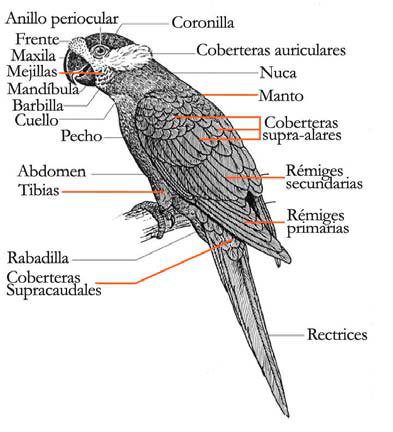
Anatomy-parrots

30 cm.. length.

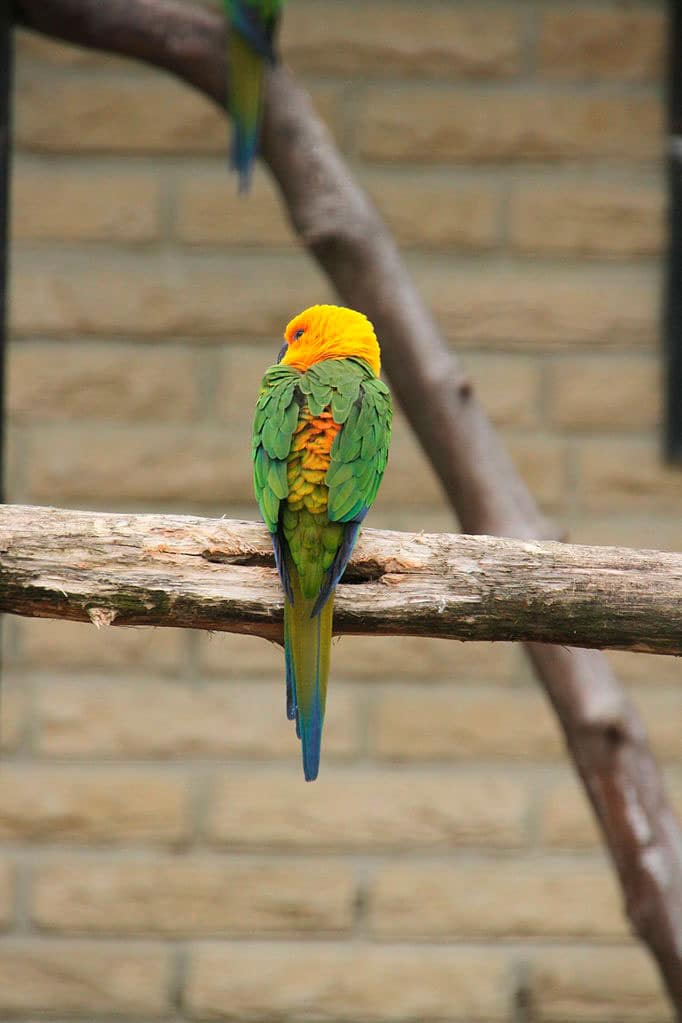
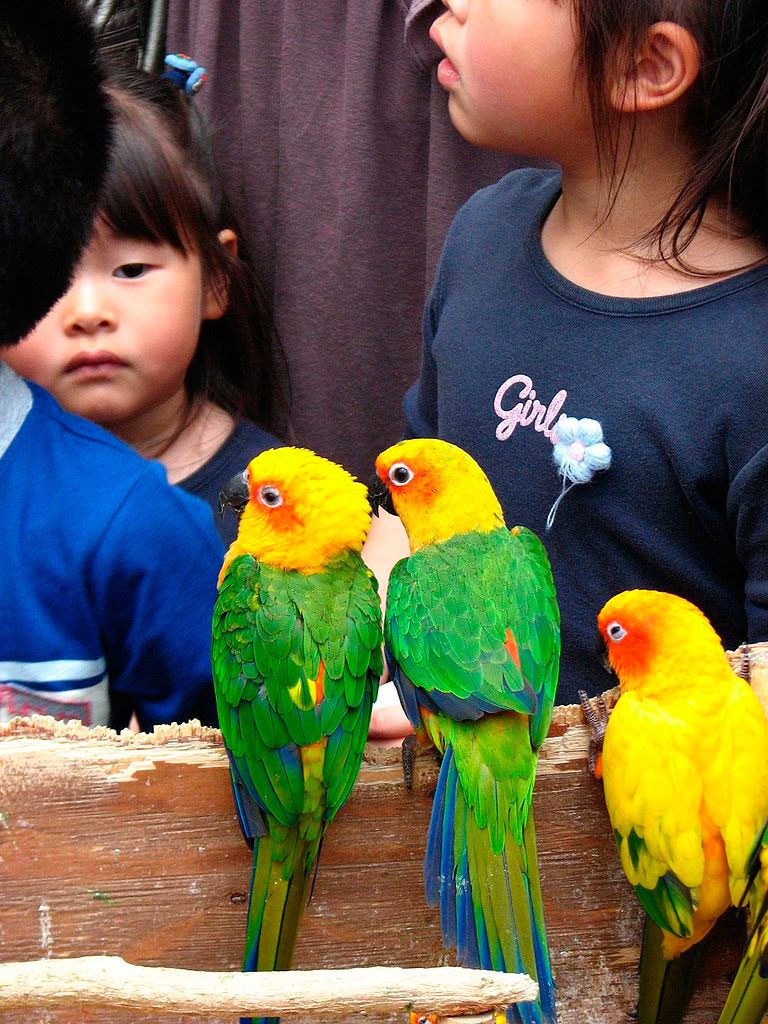
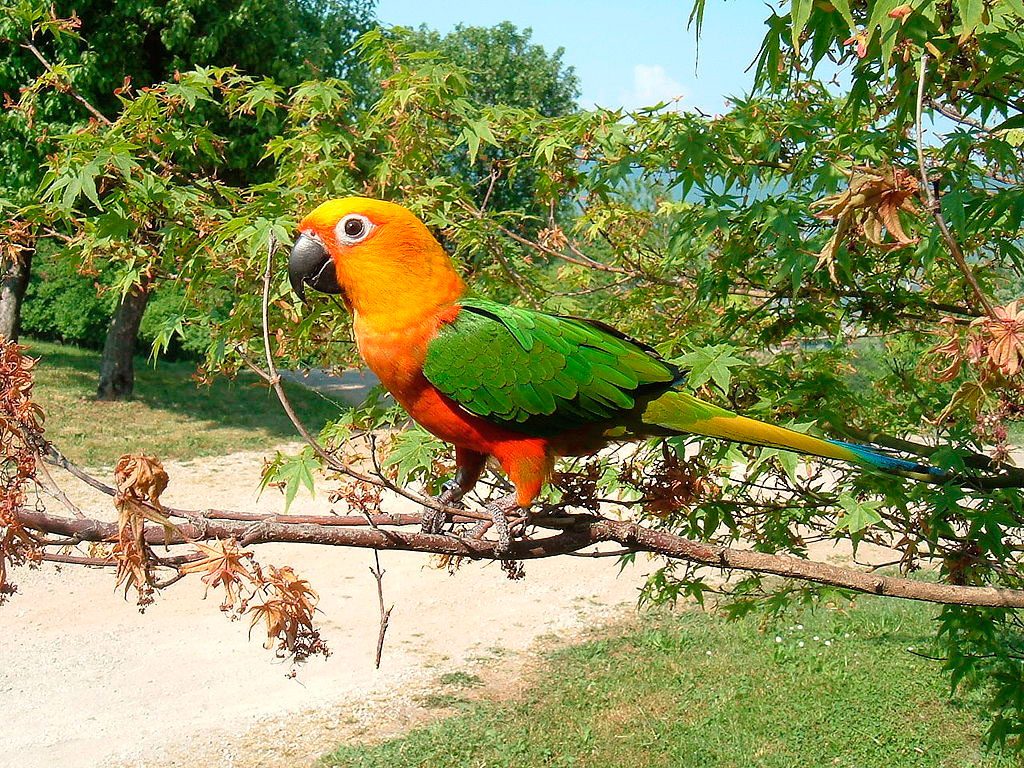
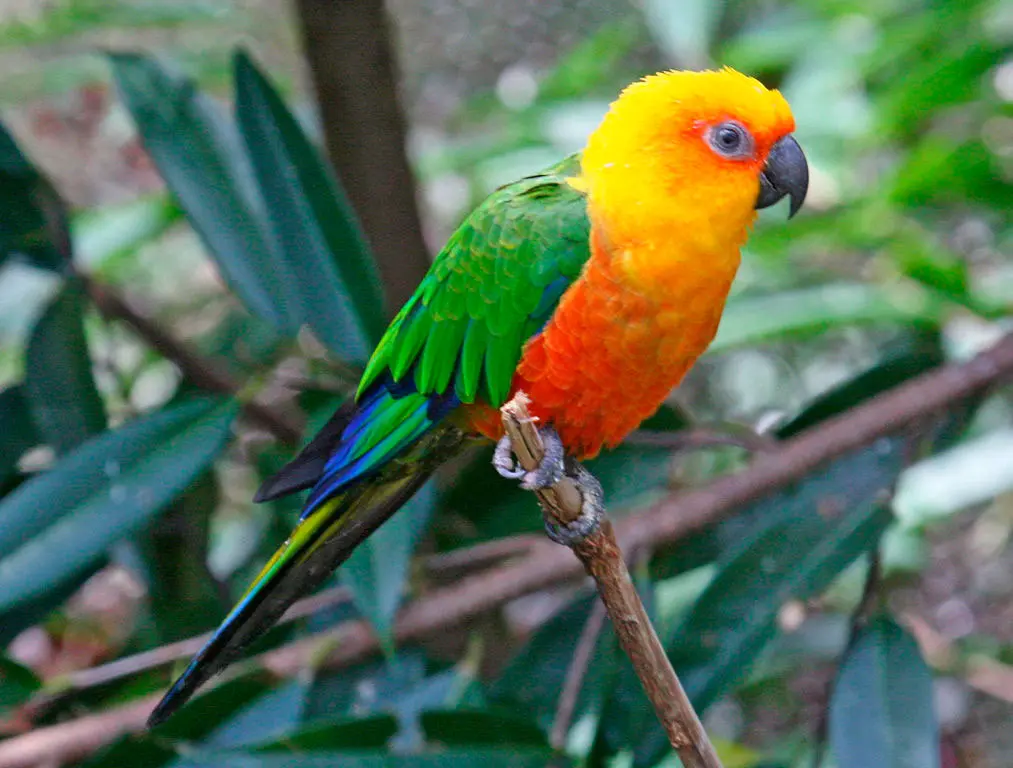
The Jandaya parakeet (Aratinga jandaya) they have both sides of the neck, cheeks, lores, ear-coverts and forecrown orange, deeper in the ear-coverts, around the eyes and in the lores; the crown and nape are yellowish-Orange (Some birds with paler yellow tones in the head).

Mantle and scapulars olive green; back and top of the rump, Green with orange-red horizontal bars; lower rump and uppertail-coverts olive green. Main feathers of the wings blue, the others feathers, green (brightest that in the the mantle). The flight feather blue color above, on the vane outer, Blackish towards the tip and grey below. Underwing-coverts orange-red. The underparts orange-red, slightly paler in the upper part of the chest and in the throat; undertail-coverts green.

Upper, the tail of olive with blue tips; undertail, charcoal grey.

Bill grey-black; bare periophthalmic pale grey; irises brown; legs grey.

Both sexes similar.

The immature has the head yellow and the neck with green markings; Dim Orange below.

Habitat:

The Jandaya parakeet move between deciduous woodlands, closed, thickets and clear areas of humid forest. Sporadically at the edge of the humid forest and in the caatinga. In palm groves of coconut on the coast of Pernambuco. Also frequent croplands and pastures. (Usually in flocks of approximately 12 birds, but sometimes in pairs or individually.

Reproduction:

Nests in tree cavities, at least a 15 metres in height. Observed young in the December nest in Maranhão; eggs hatch between August-December, in the area of Belem. Clutch, probably composed of three eggs.

Food:

Food reported include seeds, berries and fruits of certain Melastomataceae, Mangifera, Palms Mauritia and Cecropia. Sometimes they can damage corn crops.

Distribution:

Distributed by northeast of Brazil. The species extends from the vicinity of Belem, Northeast of For, and Sao Luis, maranhão, from South to North and East of Goiás and more eastward through Piauí, Ceará, Rio Grande do Norte, Paraíba, Pernambuco, Alagoas and probably the north end of Bay.

Locally common, While perhaps decreasing in some areas. It is possible that its range is usually expanding through the colonization of cleared areas of high humid forest., especially in For and Maranhão.

Their status in the East its area of distribution is unknown.

Maintained in captivity with consequences serious, Perhaps derived from the illegal trade internal in Brazil and, possibly, by smuggling towards Asia South-East.

Conservation:

State of conservation ⓘ


minor concern Minor Concern ⓘ (UICN)ⓘ

• Red List category of the UICN current: Least concern

• Population trend: Stable

This species has a range very large, and therefore not approaching the thresholds for vulnerable under the criterion of size range

The size of the world population of Jandaya Parakeet It has not been quantified, but this species has been described as «rare» (Stotz et to the., 1996).

Its population is suspected to be stable in the absence of evidence of any reduction or substantial threats.

"Jandaya parakeet" in captivity:

Pretty common in captivity and easy to raise.

Like all the Parakeets, This species is not characterized by their ability to speak, still, can get to say some words with crystal clarity.

Its feeding is made up of different fruits, vegetables, soaked legumes and specific feed for parrots. There are species Meek and intelligent to which are the trains very well and are playful, What makes them good pet to maintain in a House. Being aves gregarias, is convenient to provide them a companion, Since solo can be quite noisy.

Enjoy the bathrooms, and is advisable to keep them in an Aviary or in cage of good proportions; It is also convenient to let the small flights out of its enclosure.

Its longevity often haunt them 20 years in captivity, being able to get to the 30 years, Depending on your care.

Alternative names:

– Jandaya Parakeet, Flaming Conure, Flaming Parakeet, Jandaya Conure (English).
– Conure jandaya, Conure à tête jaune, Perriche jandaya, Perruche à tête jaune, Perruche jandaya (French).
– Jandayasittich, Jendajasittich, Jendayasittich (German).
– Jandaia, jandaia-verdadeira (Portuguese).
– Aratinga Jandaya, Periquito Rojo (español).


scientific classification:
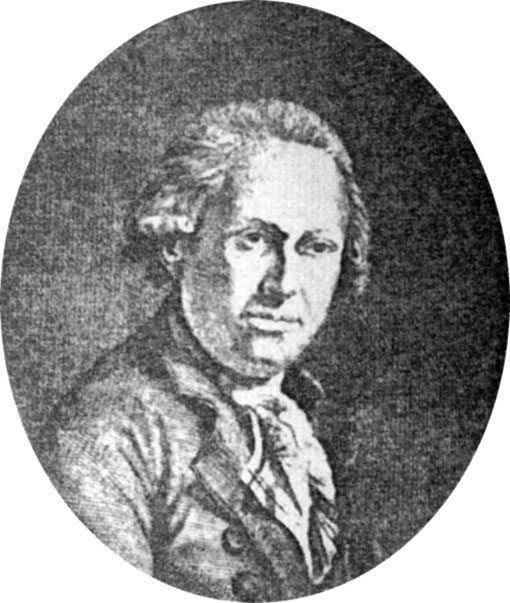
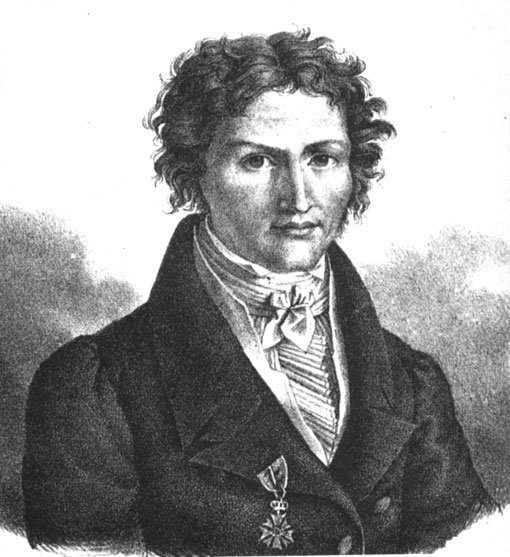
Gmelin Johann Friedrich

– Order: Psittaciformes
– Family: Psittacidae
– Genus: Aratinga
– Scientific name: Aratinga jandaya
– Citation: (Gmelin, JF, 1788)
– Protonimo: Psittacus Jandaya


Images Jandaya Parrot:

Videos "Jandaya parakeet"


Species of the genus Aratinga

Jandaya parakeet (Aratinga jandaya)


Sources:

– Avibase
– Parrots of the World – Forshaw Joseph M
– Parrots A Guide to the Parrots of the World – Tony Juniper & Mike Parr
– Birdlife

– Photos:

(1) – Jandaya Parakeet (Aratinga jandaya) aka Janday Conure. Photographed in Puerto Rico at the Mayaquez Zoo By Dick Daniels (http://carolinabirds.org /) (Own work) [CC BY-SA 3.0 or GFDL], via Wikimedia Commons

(2) – Jandaya Parakeet (also known as Jenday Conure) in Beale Park, Reading, Berkshire, England By David Long from London, United Kingdom (IMG_4798Uploaded by Snowmanradio) [CC BY 2.0], via Wikimedia Commons

(3) – Jenday Conure or Jandaya Parakeet in a tree. By GIANNIZZZERO at English Wikipedia [Public domain], via Wikimedia Commons

(4) – Jenday Conure or Jandaya Parakeet (Aratinga jandaya) at Iguaçu Bird Park, Foz do Iguaçu, Brazil. Photographed on 23 April 2003 By Arthur Chapman [CC BY 2.0], via Wikimedia Commons

(5) – Jenday Conure (Aratinga jandaya) at the Las Vegas Zoo By ZooFari (Own work) [CC BY-SA 3.0], via Wikimedia Commons

(6) – Aratinga jandaya and Aratinga solstitialis at Kobe Kachoen (Kobe Flowers and Birds Garden) in Kobe, Hyogo prefecture, Japan By Chris Gladis from Kyoto, Japan (Jandaya Parakeet) [CC BY 2.0], via Wikimedia Commons

(7) – Jendayasittiche (Aratinga jandaya) im Karl-Foerster-Garten des Tierparks Berlin-Friedrichsfelde By Lotse (Own work) [GFDL or CC BY-SA 3.0], via Wikimedia Commons

(8) – A Jandaya Parakeet (also known as Jenday Conure) at Beale Park, Lower Basildon, Reading, Berkshire, England By David Long (originally posted to Flickr as IMG_4800) [CC BY 2.0], via Wikimedia Commons

(9) – Jandaya Parakeet (also known as Jenday Conure) in Beale Park, Reading, Berkshire, England By David Long from London, United Kingdom (IMG_4802Uploaded by Snowmanradio) [CC BY 2.0], via Wikimedia Commons

– Sounds: GABRIEL MILK (Xeno-canto)
▷ The world of Pets: Dogs, cats, birds, reptiles, amphibians

Sun Parakeet
Aratinga solstitialis

Aratinga Sol

Content

Description:


Anatomy-parrots

Of 30 cm.. length and a weight between 120 and 130 g.
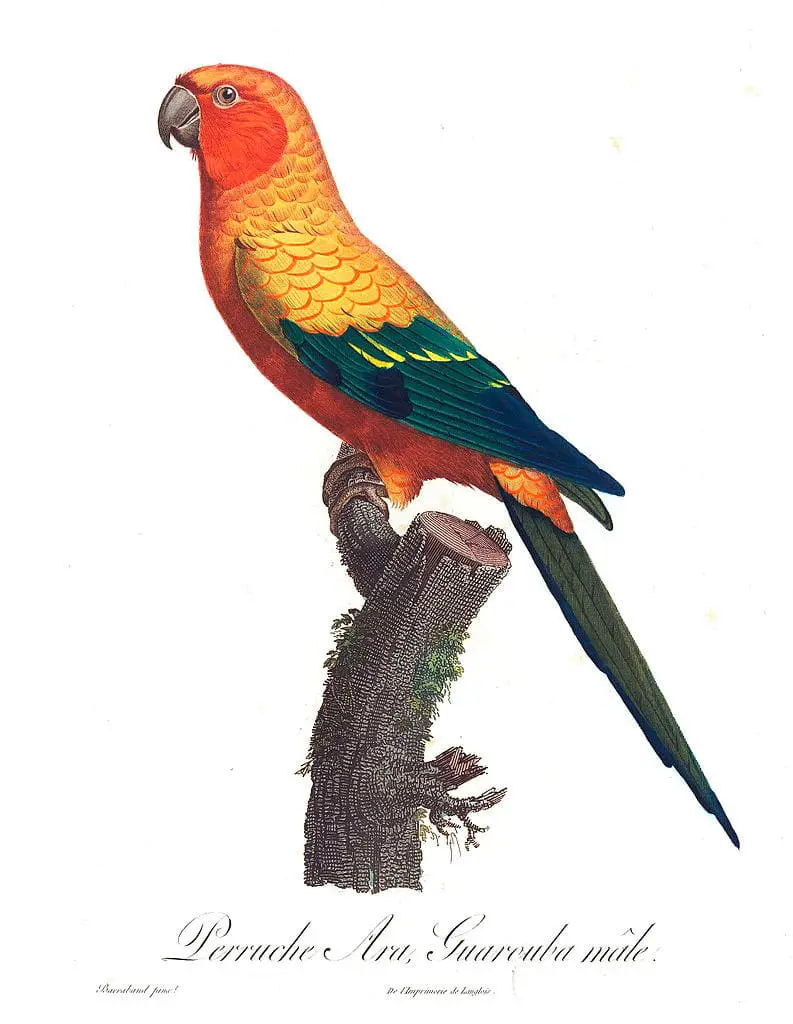
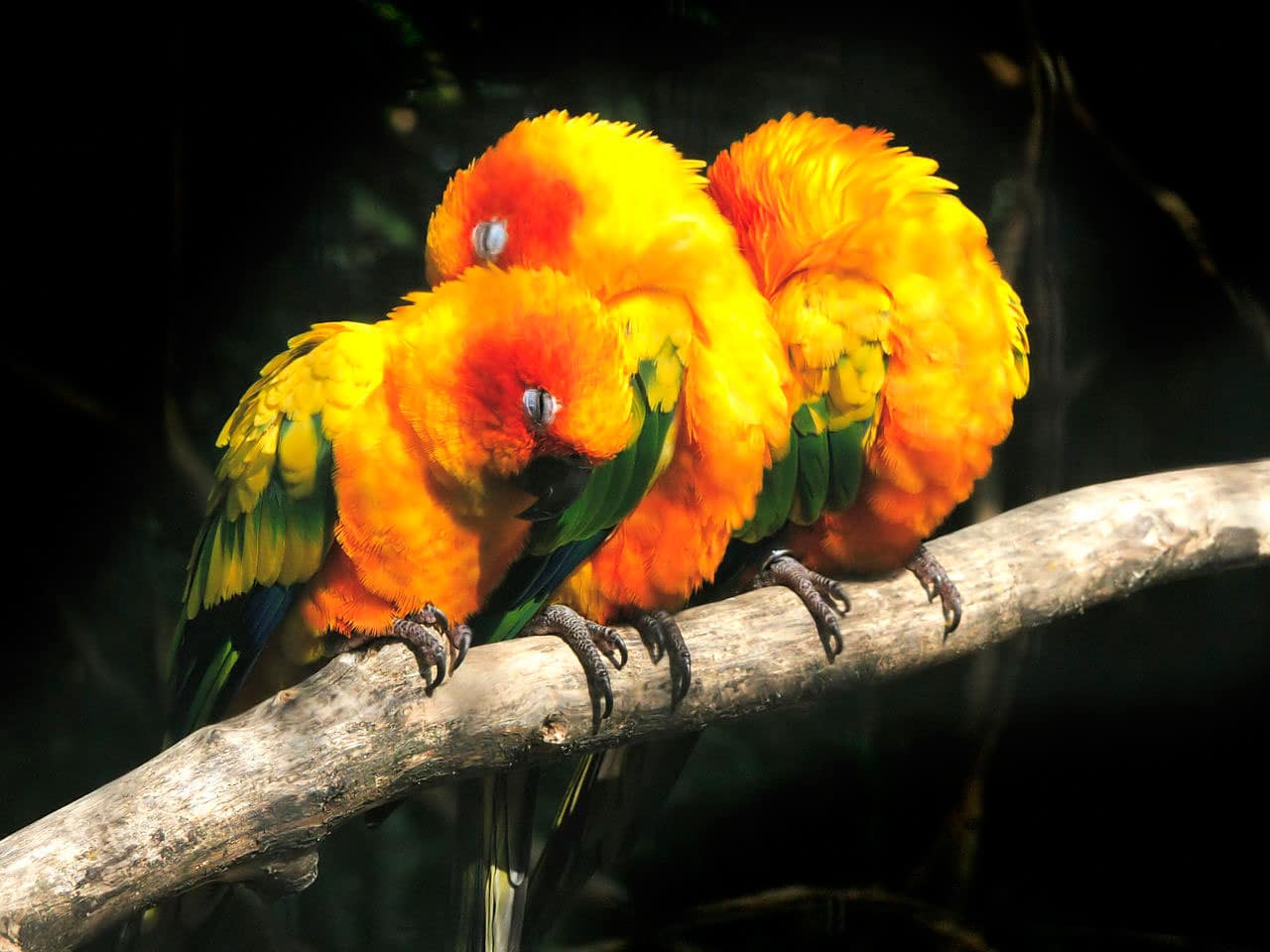
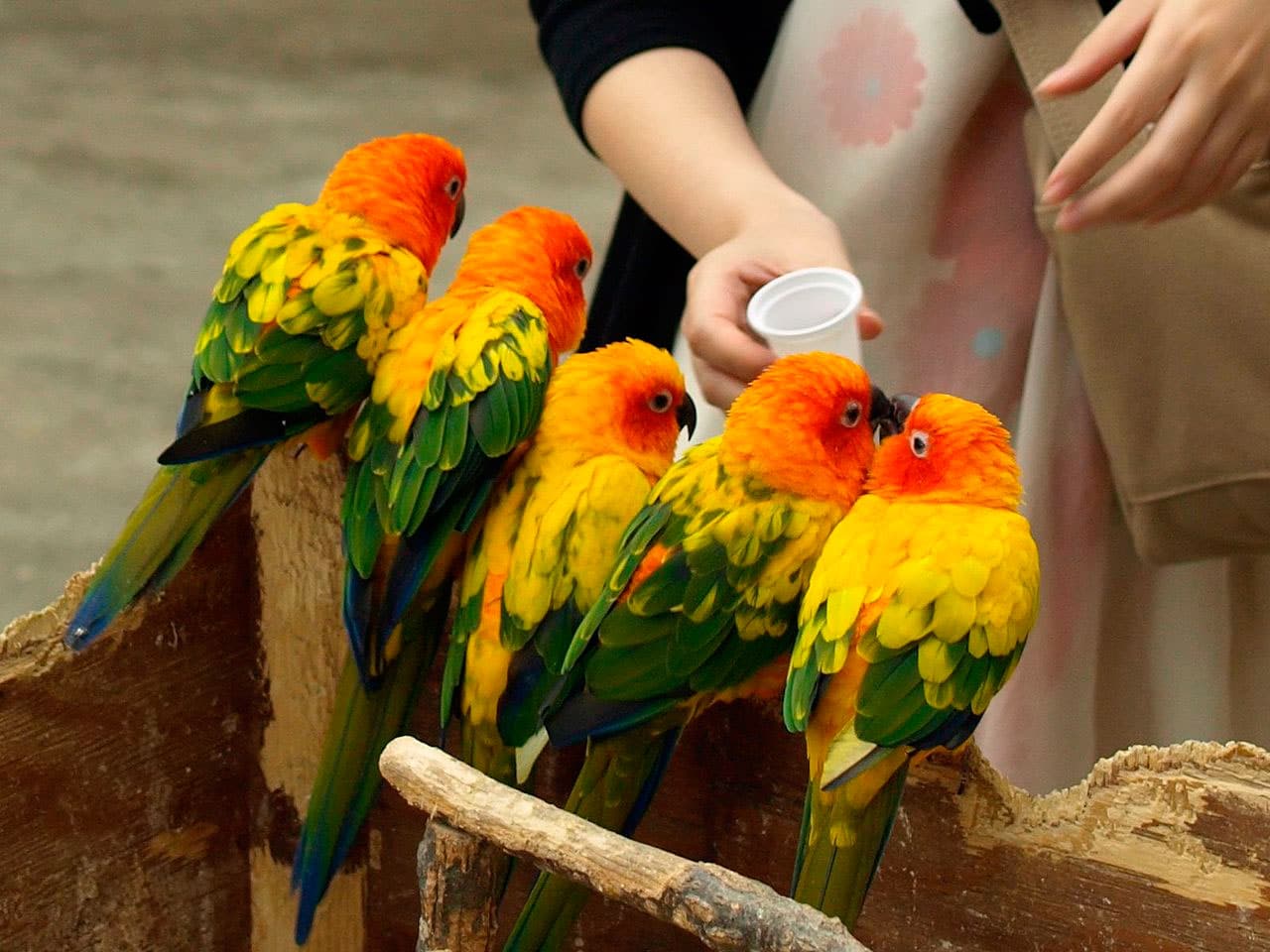
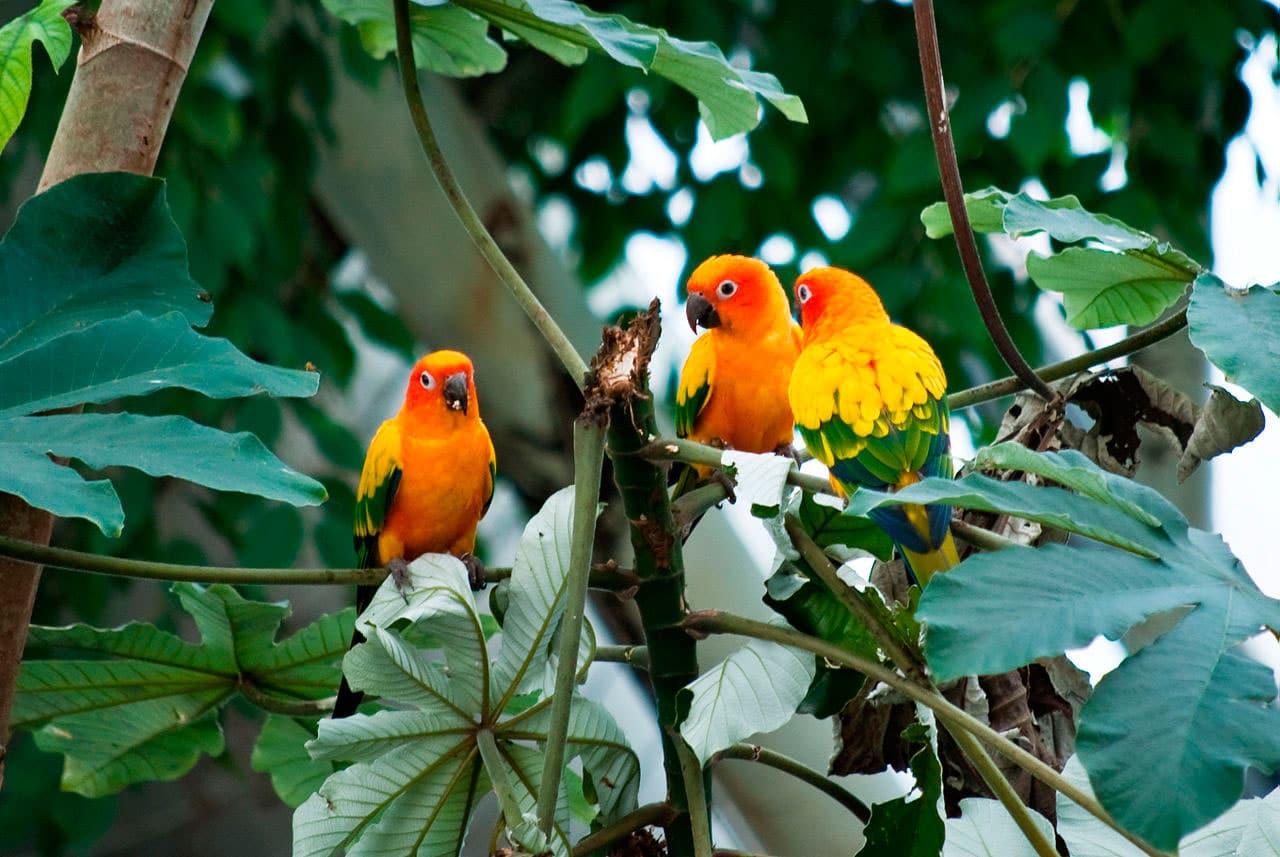
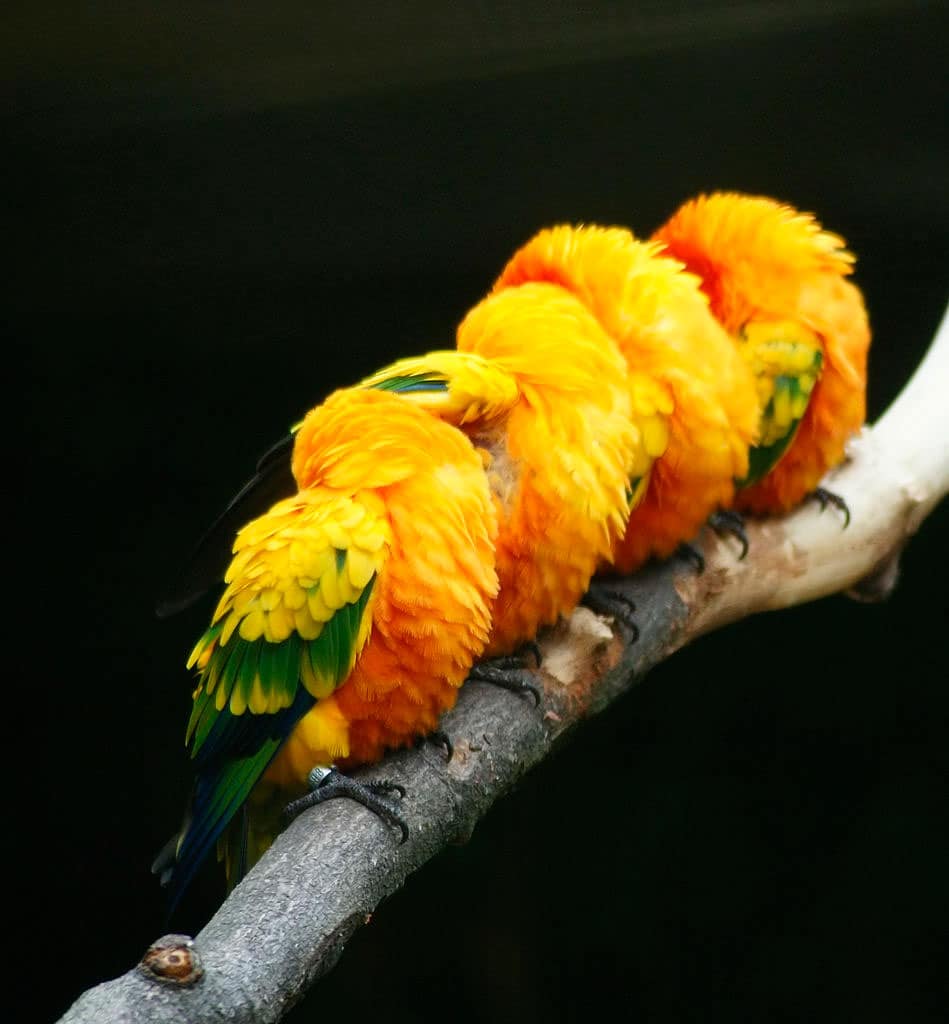
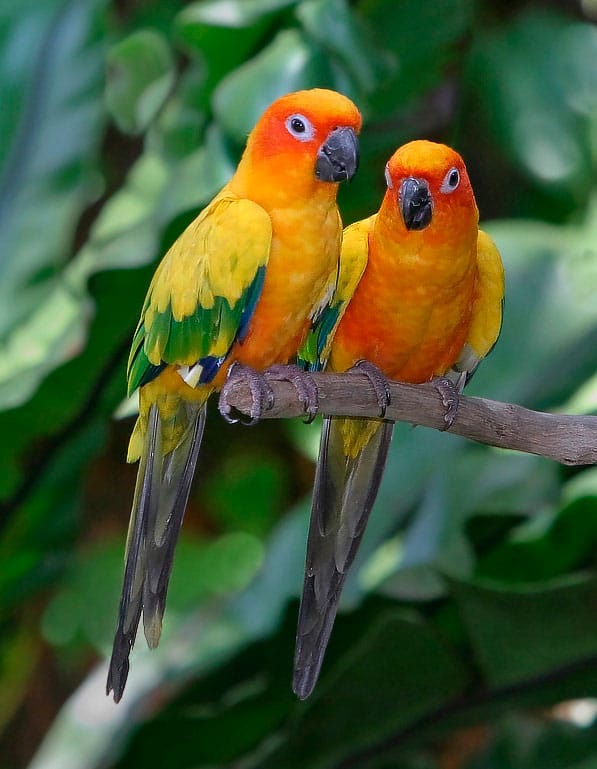
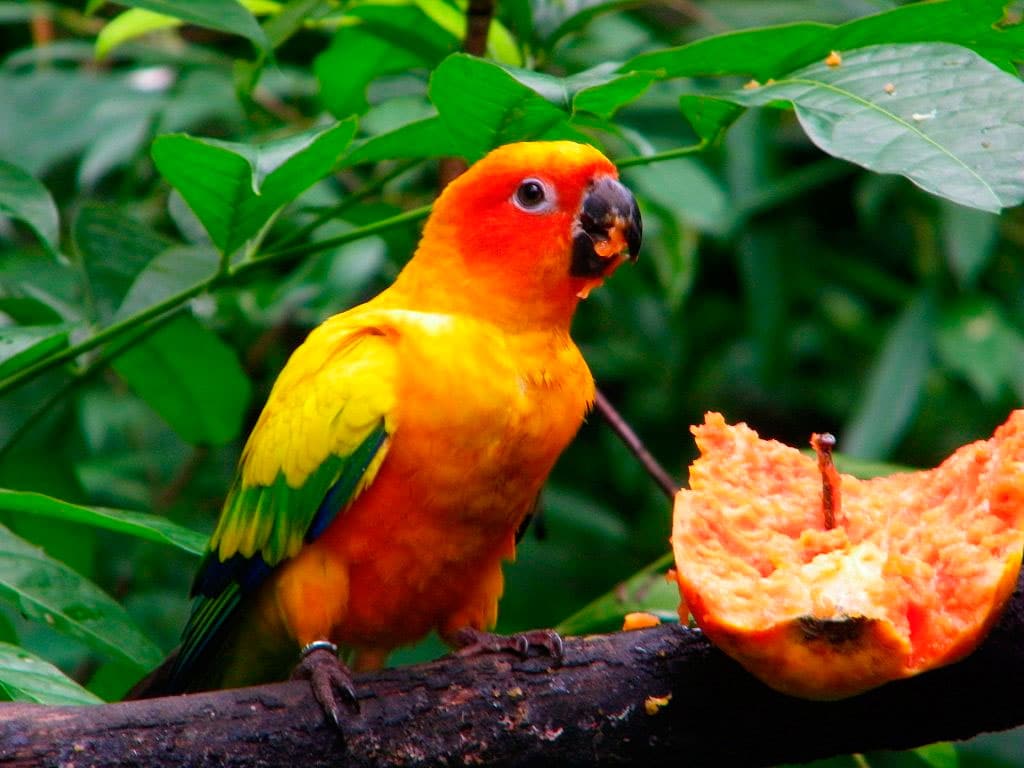
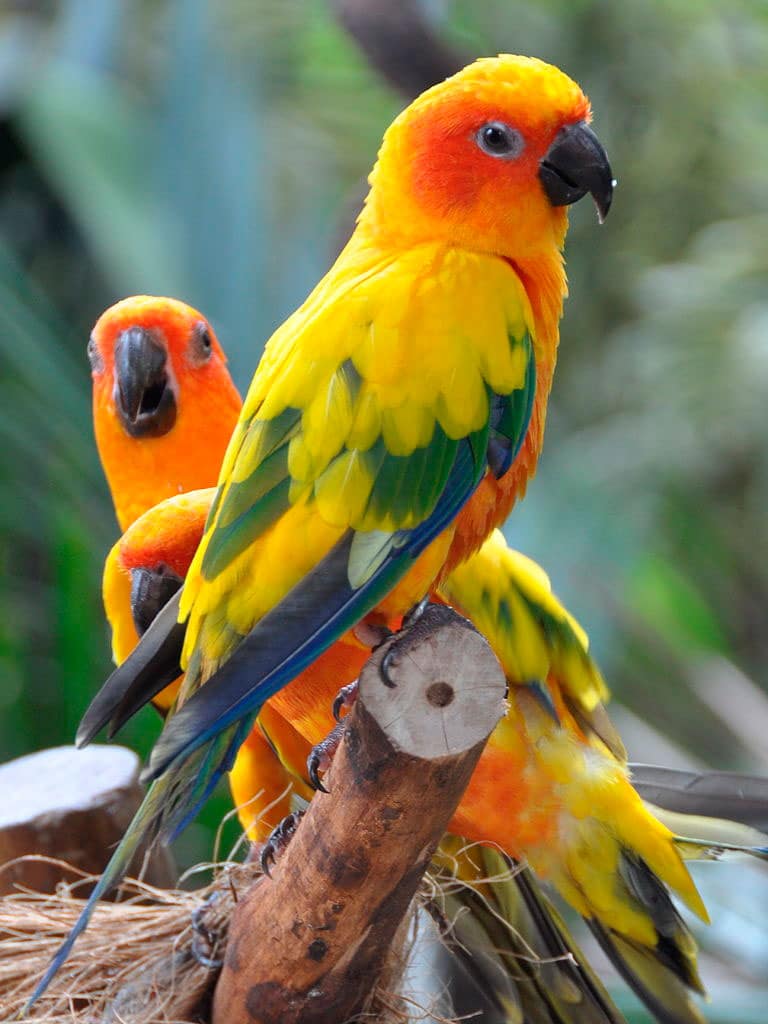
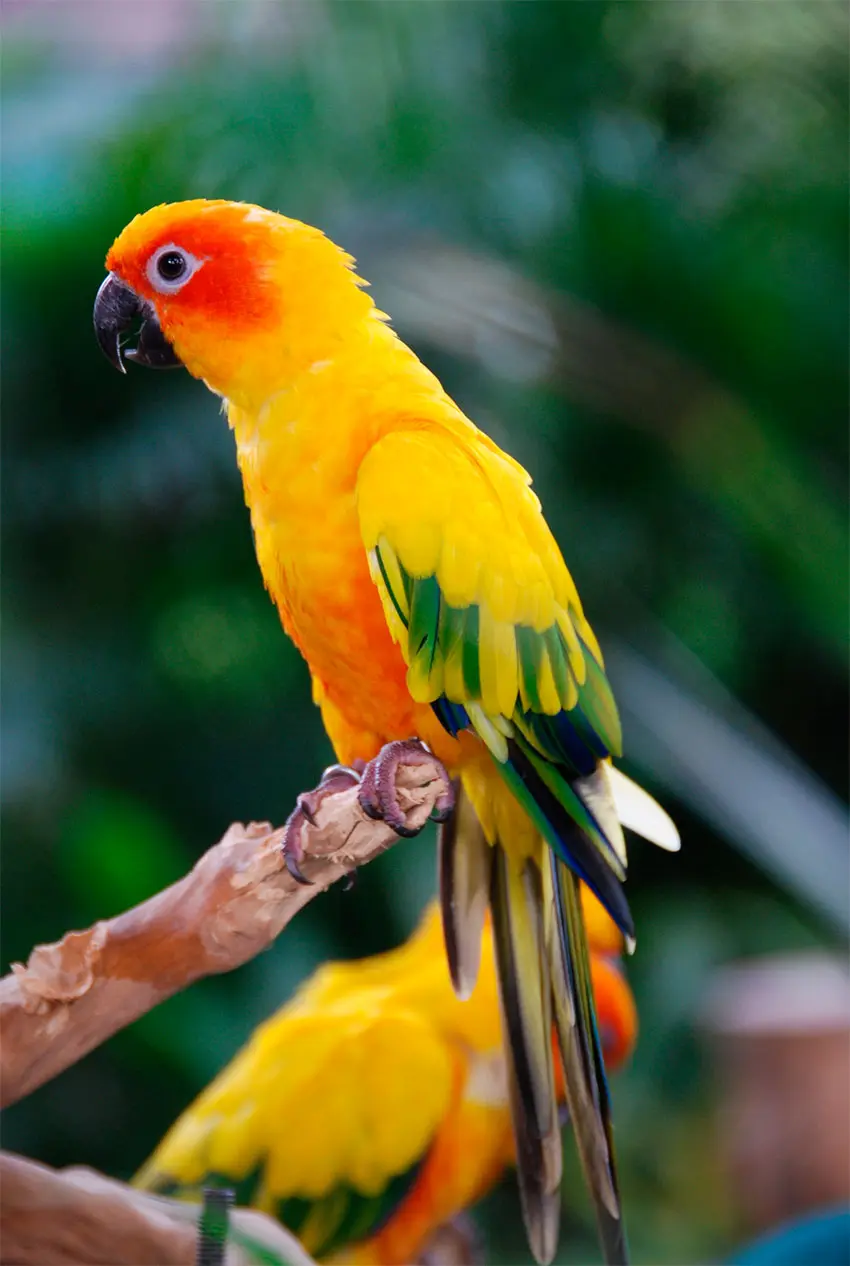
Of great beauty, the Sun Parakeet (Aratinga solstitialis) has the lores, ocular region and ear-coverts golden yellow, changing to shades red orange glossy; the forecrown, crown and nape are of a rich color yellow brilliant with color orange.

Bright yellow in the the mantle, the back and rump; uppertail-coverts of color yellow with exotic feathers of color blue. Scapulars Green Tips and the vane inner blue; the coverts smaller and medium, of color yellow with variable staining Green; greater coverts with tips of color green beige, primary coverts, blue. Flight feathers, green above, primaries with tips and vane inner blue; grayish brown then. Undertail-coverts yellow (or orange / yellow). The throat Orange with yellow shading at the top of the chest; lower chest and the belly orange; Flanks and area of the vent yellow.

Ilustración Aratinga-Sol

Upper, the tail mainly of color green yellowish with tips of color blue; undertail, of color grey with dye beige.

The bill of color Brown dark to black; the irises dark brown; legs distant.

Both sexes similar.

Immature usually with more muted than adults with the yellow colors of the head and the body replaced by an orange-Green. Lesser and medium uppertail-coverts green.

Habitat:

Video – "Sun Parakeet" (Aratinga solstitialis)

CAP 547. ARATINGA OF THE SUN. care and behavior.

In general, live in Savanna, in dry forests with Palm trees and some times in flooded areas, until 1200 m. Cross the habitats more open only when traveling between the patches of forest. Son Bird social, usually observed in flocks of 30 or more individuals, with aggregations over large in tree fruit.

Reproduction:

It nests in hollow of trees or palms (for example, Mauritia).
Nest with a chick only in the month of February in Suriname. The size medium of laying is of 3 to 4 eggs. These eggs are hatch during 23 to 27 days, that is almost the forty percent more that it from other birds, in comparison with the mass of egg.

Food:

Their diet is poorly documented, Although it probably consists of locally available food, such as different fruits, berries, nuts, sprouts and flowers. Some foods known including pods of legumes, small fruits of the family Melastomataceae, fruits Red's Cactus and possibly berries of the genus Malpighia.

Distribution:

Size of the area of distribution (reproduction / resident): 96.600 km2

The Sun Parakeet are distributed in the northeast of South America, from the Monte Roraima in the extreme north of Brazil (a single record in 1848 previously attributed to Venezuela), areas adjacent of it Pacaraima mountains in Venezuela and North of Guyana, to pomeroon river, eastward through Suriname (apparently unknown in the North) and French Guayana until Brazil in Amapá.

Observed also in For and Eastern Amazonas (bounded on the west about Rio Branco and locally to the South of the Amazon, from Santarém to the region of the Canuma River).

Although in general can be considered is usual, records sporadic suggest appearances local of the Sun Parakeet in an extended range of its distribution area.

Maintained locally as domestic fowl and trapped for the bird trade Vivas.

Conservation:

• Red List category of the UICN current: In danger of extinction

• Population trend: Decreasing

A well known in the South flock of Guyana has been registered with a maximum number of 200 individuals (Bergman 2009), with other recent records in Roraima (Laranjeiras et to the. 2011). The population is estimated therefore between 1,000-2,499 mature individuals, based on recent records. This is equivalent to 1,500-3,749 birds in total, rounded in 1.500-4.000 individuals.

The population of the Sun Parakeet It is thought that can be in continuous descent, because, probably, continuous pressure which is subjected due to hunting.

THREATS:

Due to the high demand for this species in the pet market, its population has declined dramatically over the last twenty years (J. Gilardi in litt., 2007).

Have been exported largely from Guyana during this time, which has led to its virtual extinction in that country. Trappers of Guyana and French Guiana have traveled to the border with Brazil to buy these birds for export (T. Arndt in litt. 2007, L. Silveira in litt., 2007).

A fit annual of export of 600 bird was established in Guyana in the years 1980 and it is believed that more than 2.200 they were imported into the United States between 1981 and 1985 (J. Gilardi in litt., 2007).

Its trade is in course, and because of the ease with which these birds can be attracted to the bait (for example corn) and the long distances that will be traveling, It is easy to catch all individuals in a given area(J. Gilardi in litt., 2007).

Conservation Actions Underway:

    • It is very common in captivity, but it is not known what percentage of this population are hybrids between the Aratinga solstitialis and the Aratinga maculata (Silveira et to the., 2005, LF Silveira in litt. 2012).

Conservation Actions Proposed:

    • Consider listing the species in Appendix I.

    • Stop cross-border trade immediately CITES.

    • Work with the indigenous inhabitants of the Raposa Serra do Sol Indian Land and the Amerindian Community in Karasabai to avoid entrapment and protect suitable habitat.

    • Survey to locate additional important subpopulations.

    • Establish captive breeding lines of purebred birds..

"Sun Parakeet" in captivity:

The Sun Parakeet is known for its quacking very strong in comparison with its size relatively small. It is capable of imitating human beings, but not as well as some larger parrots.
Son popular as pets, due to their bright coloration while they have a very limited ability to speak.

Due to its inquisitive temperament, demand much attention from their owners, and sometimes they can be very noisy.

Alternative names:

–
Sun Parakeet, Sun Conure, Yellow Conure (English).
– Conure soleil, Perriche soleil, Perruche soleil (French).
– Sonnensittich (German).
– Jandaia-sol, cacaoé, guaruba, Jandaia, jandaia-amarela, quijuba (Portuguese).
– Aratinga Sol, Periquito Dorado (español).
– Perico Dorado (Venezuela).

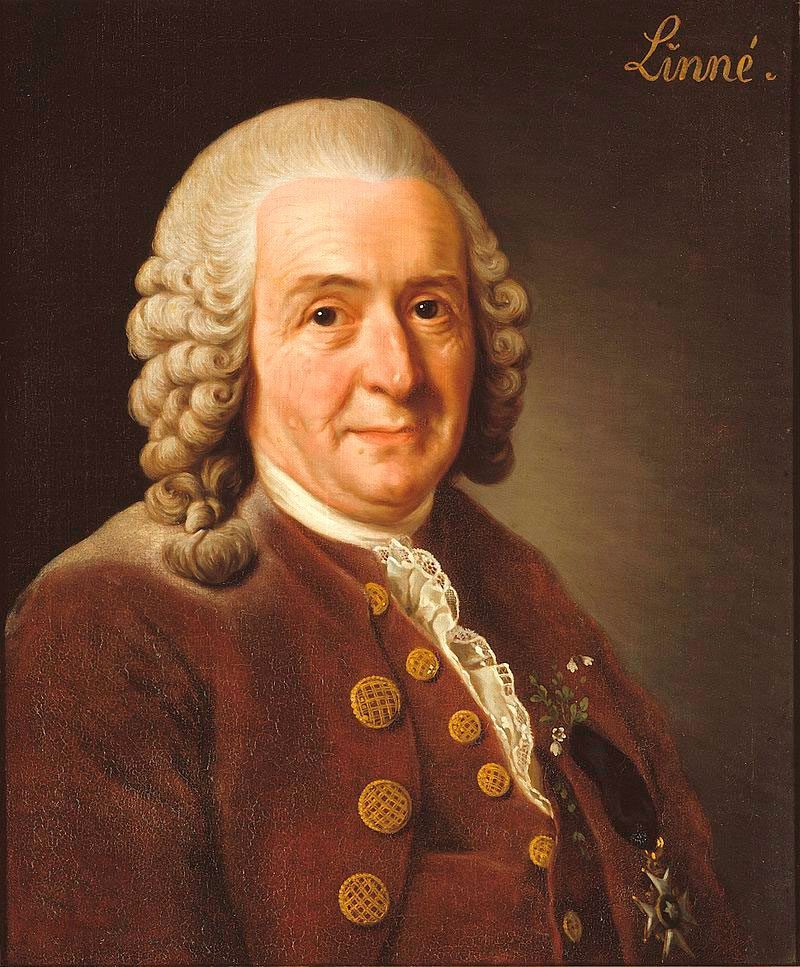
Carl Linnaeus
Carl Linnaeus

scientific classification:


– Order: Psittaciformes
– Family: Psittacidae
– Genus: Aratinga
– Scientific name: Aratinga solstitialis
– Citation: (Linnaeus, 1758)
– Protonimo: Psittacus solstitialis


Images Sun Parakeet:


Species of the genus Aratinga

Sources:

– Avibase
– Parrots of the World – Forshaw Joseph M
– Parrots A Guide to the Parrots of the World – Tony Juniper & Mike Parr
– Birdlife

– Cover photo:

(1) – Sun Conure or Sun Parakeet (Aratinga solstitialis) at a bird park in Singapore By Michael Gwyther-Jones (originally posted to Flickr as Singapore) [CC BY 2.0], via Wikimedia Commons

– Image gallery:

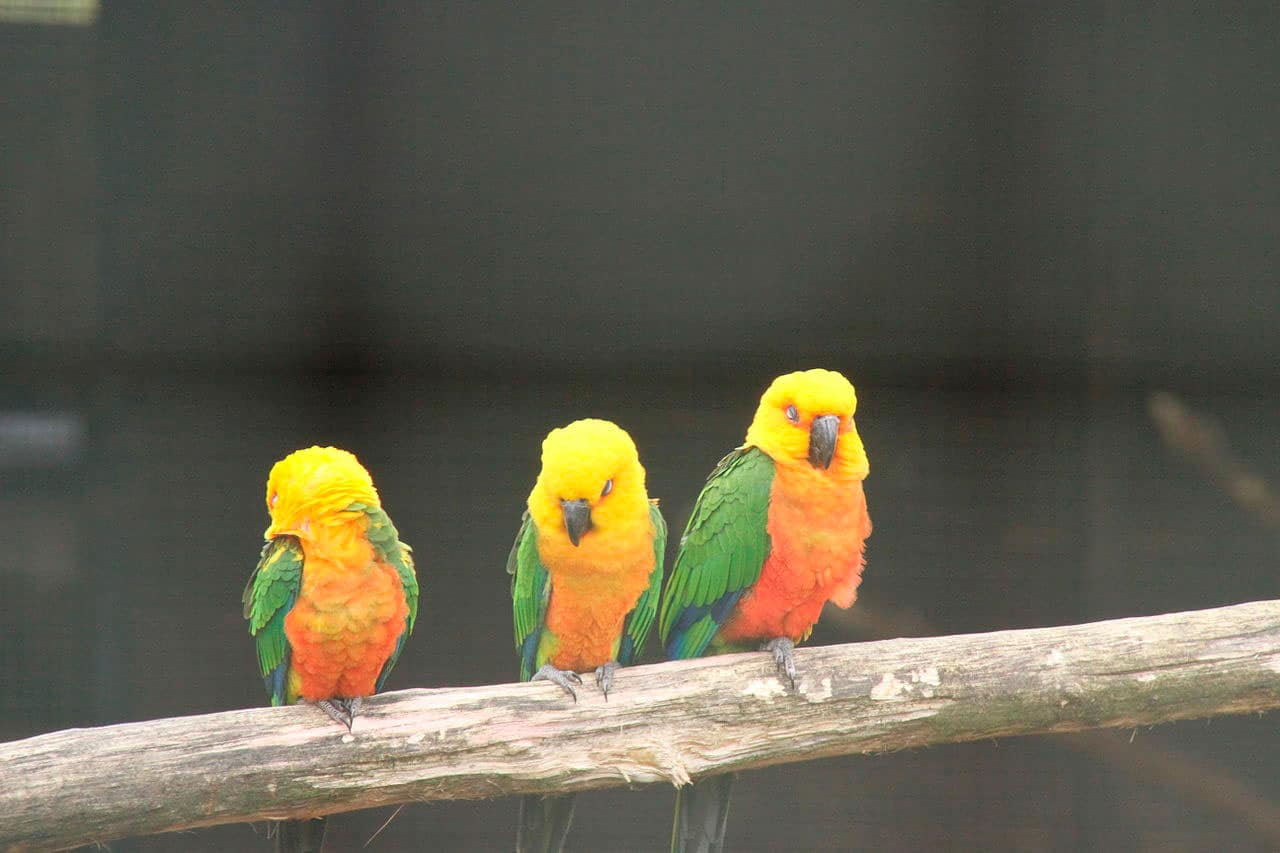
(2) – Three Sun Parakeets (also known as Sun Conure) at Jurong Bird Park, Singapore. The bird in the middle of the photograph has been wing clipped By Michael Gwyther-Jones from UK (FlickrUploaded by snowmanradio) [CC BY 2.0], via Wikimedia Commons
(3) – Sun Parakeets (also known as Sun Conures) at Jurong Bird Park, Singapore By Michael Spencer (originally posted to Flickr as Jurong Bird Park) [CC BY 2.0], via Wikimedia Commons
(4) – Sun Parakeet (also known as Sun Conure) at Jurong Bird Park, Singapore By Michael Spencer (originally posted to Flickr as Jurong Bird Park) [CC BY 2.0], via Wikimedia Commons
(5) – Sun Conures at Jurong Bird Park, Singapore. Wing clipped By Doug Janson (Own work) [CC BY-SA 3.0 or GFDL], via Wikimedia Commons

(6) – Sun Parakeet (also known as Sun Conure) perching on a branch and eating white flowers at Hamilton Zoo, New Zealand By Brian Gratwicke [CC BY 2.0], via Wikimedia Commons
(7) – Sun Conures, at Pairi Daiza, Brugelette, Belgium © Hans Hillewaert/, via Wikimedia Commons
(8) – A pet Sun Parakeet (also known as Sun Conure) perching on a shoulder. It has been wingclipped By turtlemom4bacon from Orlando, FL, USA [CC BY-SA 2.0], via Wikimedia Commons
(9) – A Aratinga solstitialis at Baltimore Aquarium, USA By Chris Williamson [CC BY 2.0], via Wikimedia Commons

(10) – Feeding a Sun Conure, also known as a Sun Parakeet at Discovery Cove, Orlando, Florida, USA By eric from USA (IMG_4596) [CC BY-SA 2.0], via Wikimedia Commons
(11) – He loves it when you blow on his face and it makes him puff! By Sarah G from Tulsa, USA (Sherbie Sherbie Puffs-Alot) [CC BY-SA 2.0], via Wikimedia Commons
(12) – Wing clipped Sun Parakeets (also known as Sun Conures) at Kobe Kachoen, a bird and flower park located on Port Island in Kobe, Japan By merec0 (originally posted to Flickr as niji) [CC BY 2.0], via Wikimedia Commons
(13) – Sun Conure, at Pairi Daiza, Brugelette, Belgium © Hans Hillewaert/, via Wikimedia Commons

– Photo illustration:

(14) – An adult Sun Parakeet or Sun Conure (Aratinga solstitialis) . Jacques Barraband [Public domain], via Wikimedia Commons

– Sounds: (Xeno-canto)

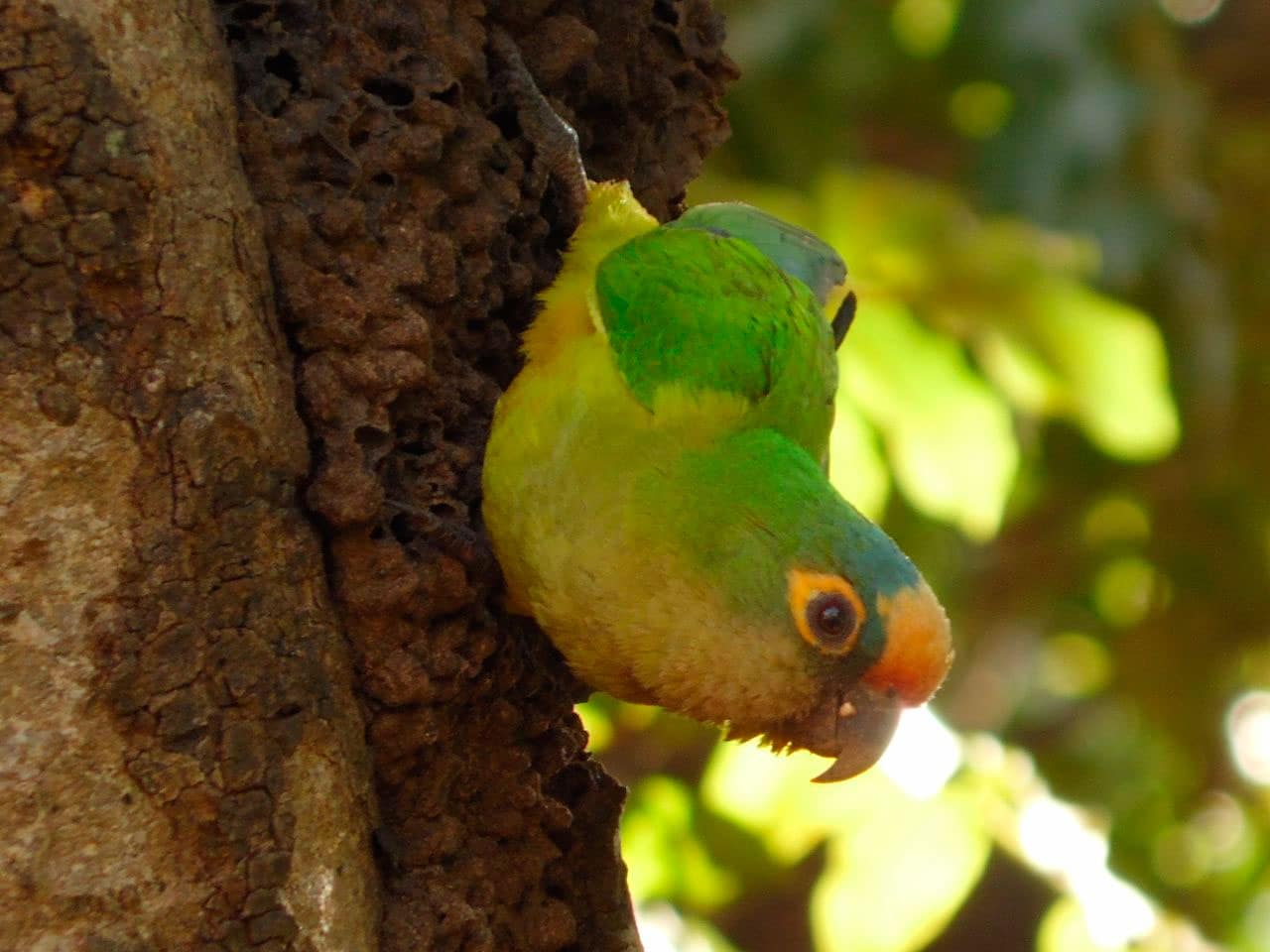
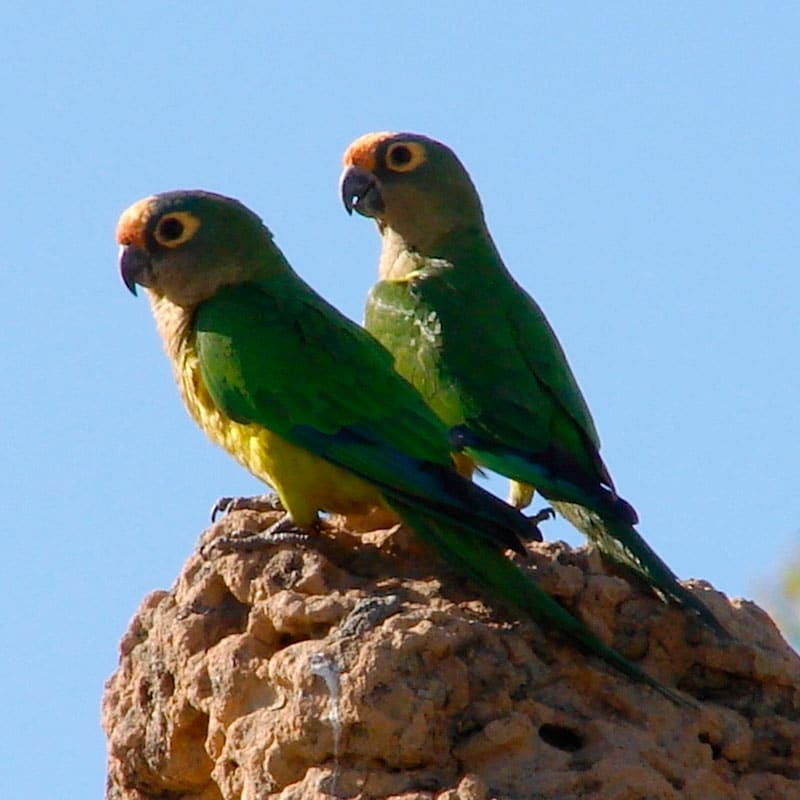
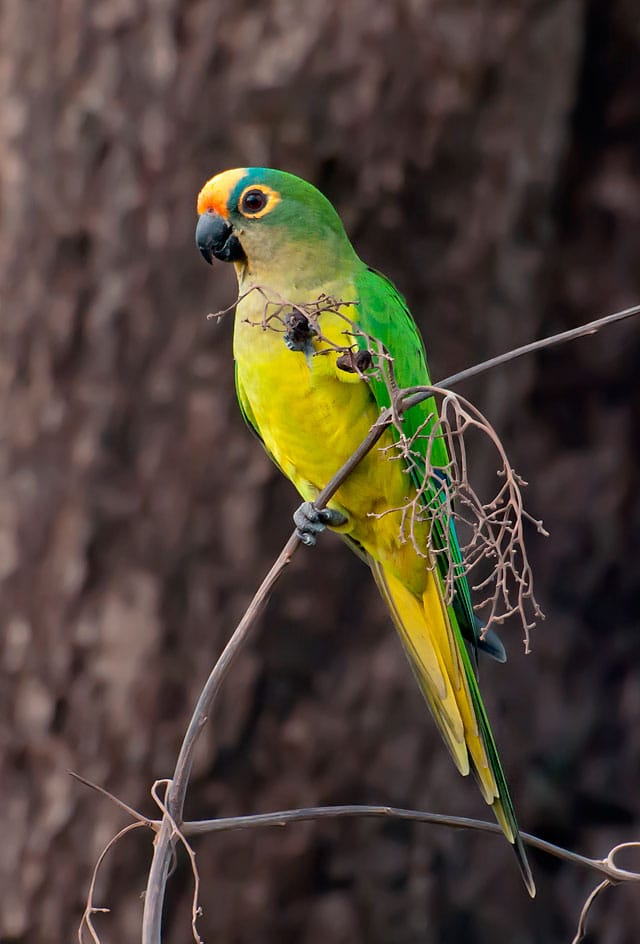
▷ The world of Pets: Dogs, cats, birds, reptiles, amphibians

Peach-fronted Parakeet
Eupsittula aurea

Aratinga Frentidorada

Content

Description:


Anatomy-parrots

A length between 23-28 cm. and a weight between 74-94 g.
The Peach-fronted Parakeet (Eupsittula aurea) has the forecrown bright orange; the crown a deep blue color.

Each eye is surrounded by a circle of small orange feathers, delimited in the anterior zone with blue; front part of the lores orange; cheeks Brown olive; ear-coverts green. Nape, the mantle and back dark green; rump and uppertail-coverts green. Scapulars greenish brown; lesser and median coverts dark green; greater primary coverts dark blue. The primaries blue in the vane inner and tips; the secondaries blue. The flight feather, below, grayish brown; upperwing-coverts colour pale yellowish olive. The throat and the top chest color marron-oliva; the upperparts color olive. Upper, the tail dark green with brown tint in the vane inner and with a bright bluish tinge to an end; by down greyish Brown.

Bill grey-black; close bare periophthalmic bare grey; irises yellowish brown; legs grey.

Both sexes similar.

Immature they have a broad nude patch orbital, frontal band closer, bill pale and the irises grey.

Habitat:

The Peach-fronted Parakeet It is present in a wide variety of habitats, specially cleared but a little forested areas, including all kinds of deciduous forest, gallery forest (especially in the South of its range), swamps with Palms mauritia and sheets, also in cultivated areas, below the 600 m.

In the Brazilian Amazon, they are distributed under conditions of low shrub vegetation in sandy soils, avoiding dense evergreen forests. On the inside of the Brazil can be seen in areas caatinga and formations closed with natural grassland.

In general, they can be views in flocks and in isolated pairs during the breeding season.

Has been able to observe them is feeding with the Blue-crowned Conure (Psittacara acuticaudatus) in fruit trees and resting on branches with the Blue fronted Parrot (Amazona aestiva) and the Scaly-headed Parrot (Pionus maximiliani) in Piauí, Brazil.

Reproduction:

Nest in arboreal termite, trunks hollow or in ravines. Birds observed in nests between June and July in Peru and flocks to divide into breeding pairs during the month of January in Mato Grosso. Clutch 2-3 eggs in (Argentina).

Food:

They feed on seeds (not of pulp) of Ilex, Banisteriopsis, Campomanesia, eucalyptus and Symplocos, fruits and flowers of Erythrina and Terminalia, flowers of Qualea and Garyocar and insects, including the termites and fly larvae, beetles and moths. They produce crop damage in some areas.

When feeding in soil (for example of the grain after harvest), its plumage tends to get dirty.

Distribution:

Video – "Peach-fronted Parakeet"

KING OF THE BUCKET, couple (EUPSITTULA AUREA), PEACH-FRONTED PARAKEET, star conure, Star Parakeet.

Size of the area of distribution (reproduction / resident): 5.730.000 km2

Distributed by the Centre and East of South America. To the North of the Amazonia The species is found in For and Amapá and the island Caviana island (mouth of the Amazon), Brazil, as well as possibly in the south of Suriname. To the South of the Amazonia the Peach-fronted Parakeet extends through of For, Eastern Amazonas, Rondà´nia and Mato Grosso, Brazil, to northeast Bolivia and East of Peru, in where were observed in the Santuario Nacional Pampas del Heath, and eastward through most of the inside of Brazil until Bay, Minas Gerais, Brazil, Mato Grosso from the South and the Northwest of the Alto Paraná Department in Paraguay (in the West and Northeast) and North of Argentina (North of Salta, east of Formosa, Currents and possibly Chaco). The reports of Rio Grande do Sul, Brazil, They seem to be confused.

common in the central area of its distribution area, still it most common aratinga in much of the interior of Brazil. Obviously more local and scarce toward the North and South ends of their range, with very few recent reports in Argentinto (Formosa in 1987 and Currents in 1983), where the abundance historical suggests a descent on a large scale during the century 20.

Conservation:

State of conservation ⓘ


minor concern Minor Concern ⓘ (UICN)ⓘ

• Red List category of the UICN current: Least concern.

• Population trend: Stable.

Place previously within the genus Aratinga.

Its global population size has not been quantified, but this species is described as «common» (Stotz et to the., 1996). Its population suspected to be stable in the absence of evidence of any reduction or substantial threats.

The species has undergone intense trade: from 1981, date on which was included in Appendix II, 61,311 individuals have been captured in the wild for resale in international trade (UNEP-WCMC trade database CITES, January 2005).

"Peach-fronted Parakeet" in captivity:

It´s common in captivity and widely marketed.
Robust, playful, friendly and not so noisy as other species of parrots.
Regularly provide fresh branches to satisfy their need to crack.

It is not a kind of complicated for reproduction in captivity.

Alternative names:

– Peach-fronted Parakeet, Brown-chested Parakeet, Golden-crowned Parakeet, Peach fronted Parakeet, Peach-fronted Conure (English).
– Conure couronnée, Conure à front d’or, Perriche couronnée, Perruche couronnée, Perruche ou (French).
– Goldstirnsittich (German).
– Aratinga-estrela, ararinha, jandaia, jandaia-estrela, maracanã-de-testa-amarela, Periquito-estrela, periquito-rei (Portuguese).
– Aratinga Frentidorada, Aratinga frente durazno, Calacante frente dorada, Calancate Frente Dorada, Cotorra de frente naranja, Maracaná frente naranja, Periquito de Frente Dorada (español).
– Calacante frente dorada, Calancate Frente Dorada (Argentina).
– Cotorra de Frente Dorada (Peru).
– Maracaná frente naranja (Paraguay).
– Tuíiapyteju, Ajuru-juvakang (Guarani).


scientific classification:

Gmelin Johann Friedrich

– Order: Psittaciformes
– Family: Psittacidae
– Genus: Eupsittula
– Scientific name: Eupsittula aurea
– Citation: (Gmelin, JF, 1788)
– Protonimo: Psittacus aureus

Peach-fronted Parakeet images:


Especies del género Eupsittula
  • Eupsittula nana
  • —- Eupsittula nana astec
  • —- Eupsittula nana nana
  • —- Eupsittula nana vicinalis
  • Eupsittula canicularis
  • —- Eupsittula canicularis canicularis
  • —- Eupsittula canicularis clarae
  • —- Eupsittula canicularis eburnirostrum
  • Eupsittula aurea
  • Eupsittula pertinax
  • —- Eupsittula pertinax aeruginosa
  • —- Eupsittula pertinax arubensis
  • —- Eupsittula pertinax chrysogenys
  • —- Eupsittula pertinax chrysophrys
  • —- Eupsittula pertinax griseipecta
  • —- Eupsittula pertinax lehmanni
  • —- Eupsittula pertinax margaritensis
  • —- Eupsittula pertinax ocularis
  • —- Eupsittula pertinax paraensis
  • —- Eupsittula pertinax pertinax
  • —- Eupsittula pertinax surinama
  • —- Eupsittula pertinax tortugensis
  • —- Eupsittula pertinax venezuelae
  • —- Eupsittula pertinax xanthogenia
  • Eupsittula cactorum
  • —- Eupsittula cactorum cactorum
  • —- Eupsittula cactorum caixana

  • Sources:

    – Avibase
    – Parrots of the World – Forshaw Joseph M
    – Parrots A Guide to the Parrots of the World – Tony Juniper & Mike Parr
    – Birdlife

    – Photos:

    (1) – Peach-fronted Parakeet (also known as the Peach-fronted Conure) in Chapada das Mesas National Park, Brazil By Otávio Nogueira [CC BY 2.0], via Wikimedia Commons
    (2) – A Peach-fronted Parakeet in Dourados, Mato Grosso do Sul, Brazil By Dario Sanches from Sao Paulo, Brazil [CC BY-SA 2.0], via Wikimedia Commons
    (3) – Peach-fronted Parakeet (Aratinga aurea) perching on a termite mound in Minas Gerais, Brazil By derivative work: Snowmanradio (talk)Aratinga_aurea_-Brazil-8.jpg: Glauco Umbelino [CC BY 2.0], via Wikimedia Commons
    (4) – Eupsittula aurea By Petyson Antonio (Own work) [CC BY-SA 4.0], via Wikimedia Commons
    (5) – Eupsittula aurea By Petyson Antonio (Own work) [CC BY-SA 4.0], via Wikimedia Commons

    – Sounds: (Xeno-canto)

    ▷ The world of Pets: Dogs, cats, birds, reptiles, amphibians

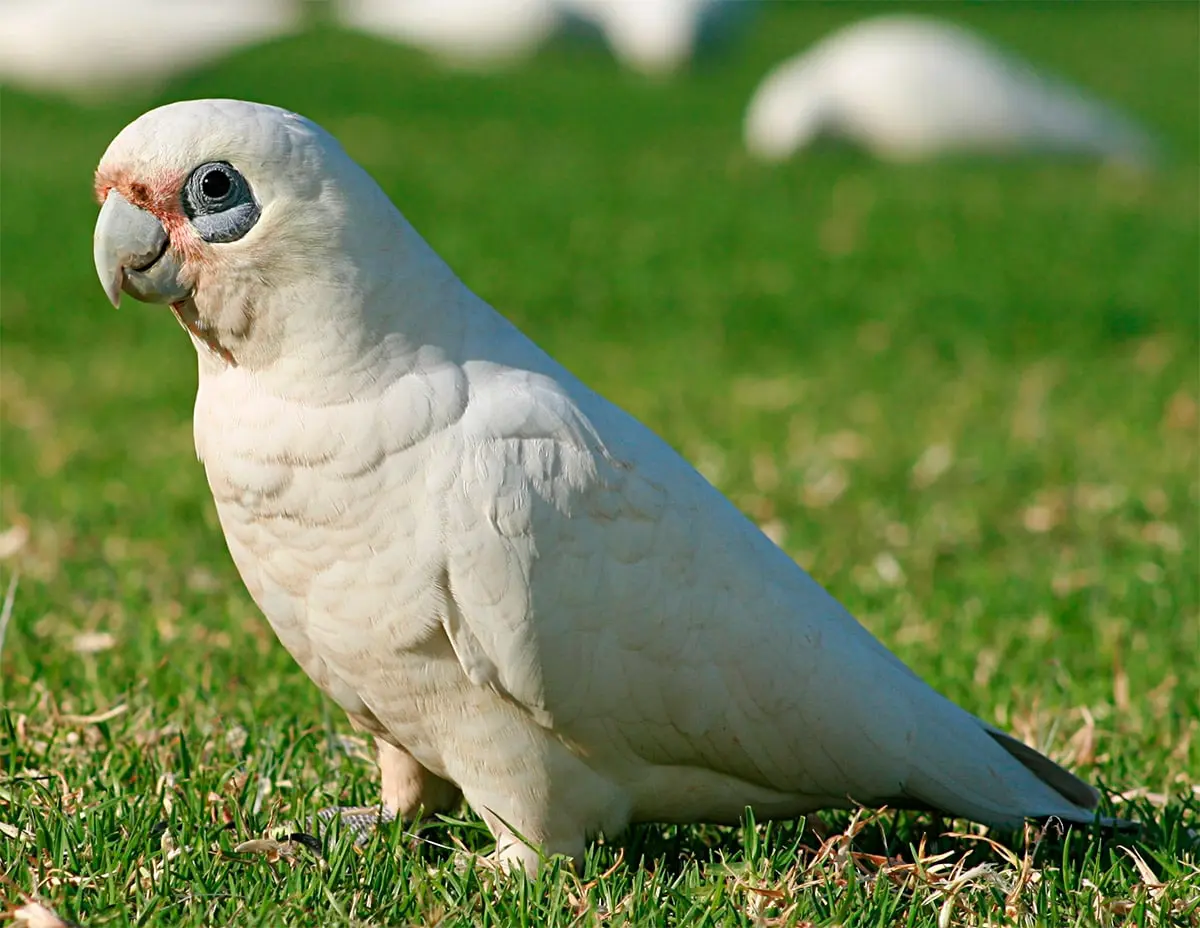
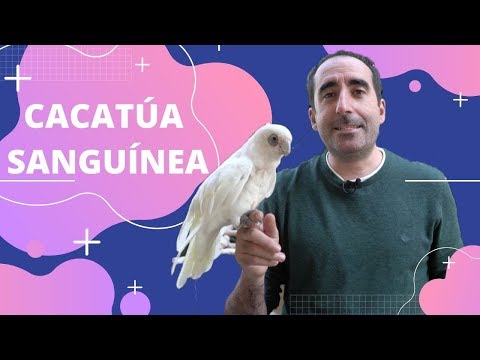
    Little corella
    Cacatua sanguinea


    Cacatua sanguinea

    Content

    Description

    It measures 35-40 cm.. and weighs approximately 500 g..
    In the Little corella (Cacatua sanguinea), the head and crest (that most of the time stays low) are white. The pink base of the feathers are almost completely hidden and yet barely visible small flakes in the cheeks.
    Dissemination of salmon-rosa color to the area around the eyes. The upperparts and coverts of the wing are white. There is a remarkable spread of yellow color on the bottom of the flight feather and of the tail.
    The bill is grayish white. The skin nude around the eyes is blue grey. The irises is dark brown, the legs grey.

    Both sexes are identical in all aspects, including the color of the irises.

    The immature have a look more white and the skin of the periphery eyepiece less prominent.

    Subspecies description
    • Cacatua sanguinea gymnopis

      (Sclater,PL, 1871) – Features with more naranja-rosa around them eyes and in the bases of the feathers of the head, neck and top of the chest. Its orbital skin is darker.

    • Cacatua sanguinea normantoni

      (Mathews, 1917) – Is smaller.

    • Cacatua sanguinea sanguinea

      (Gould, 1843) –

    • Nominal.

    • Cacatua sanguinea transfreta

      (Mees, 1982) – Displays below the wings and tail infiltrations slightly yellow pulling a Brown.

    • Cacatua sanguinea westralensis

      (Mathews, 1917) – It has bright orange-red colors around the eyes and the bases of feathers, also in the the mantle and in the part inferior of the abdomen.

    Habitat:

    Video – "Little corella" (Cacatua sanguinea)

    The spectacular BLOODED COCKATOO - BIRD VETERINARY

    It nests in riparian forests bordering permanent pasture and cropland. In the breeding season, they can be found in a wide variety of habitats, including areas of acacias and eucalyptus bushes of short grass or pasture with groups of scattered trees. During this time, they are also present in the rice fields, cane extensions, areas of shrubs, at the edges of mangrove areas, in the pastures for horses, on roads and gardens on the outskirts of cities.

    Behavior:

    The Bloody Cockatoos they often form large gatherings in crops and pastures.

    Out of it breeding season, It is not uncommon to see flocks of up to 70.000 birds.
    At night they fly to their bedrooms, located near the water.

    Early in the morning, they drink before heading to the feeding sites often many kilometres from the bedroom.
    During the hottest hours of the day, they seek shelter in the shade of the leaves..

    Reproduction:

    In Australia they can be played back in any month of the year, When are conditions good. But, the nesting seems to be further developed early in the North (from May to October) and in the Southeast (August-December).

    In Queensland, the implementation is carried out mainly from December to April and from July to October. Reproduction is strongly influenced by climate, usually begins 2 or 3 months after the end of the rainy season in northern districts.

    There may be two or three broods per season. Couple ties are very strong and seem to last for life. They are loyal to the same nesting sites year after year. The nest is usually placed in a eucalyptus (Eucalyptus camaldulensis) between 3 and 10 meters above the ground.

    The cavity is approximately one meter in depth. It is fairly easy to detect since crust is often removed around inlet. They also nest on cliffs or termite mounds..

    They put 2-4 eggs in a bed made from chips of wood that is replaced each year.

    In general, two chicks manage to break the shell after 25 days. They remain in the nest for nine weeks, After this take off.

    Food:

    It has a diet mainly vegetarian. They feed on seeds you are in the trees of the genus EMEX, green areas or fields of melon (cucumber myriocarpus). They also eat nuts, fruit, berries, flowers, estate, bulbs, shoots as well as insects and larvae.

    Distribution:

    Size of the area of distribution (reproduction / resident): 5.300.000 km2

    The Little corella lives in New Guinea and Australia. In Australia, We found in the Northwest, on the plateau of Kimberley and Arnhem in the this of the Cape York Peninsula. They are absent from the east coast and the entire southwestern part of the country..

    Subspecies distribution
    • Cacatua sanguinea gymnopis

      (Sclater,PL, 1871) – Within the Centre and it's Australia.

    • Cacatua sanguinea normantoni

      (Mathews, 1917) – To the West of the cape york peninsula

    • Cacatua sanguinea sanguinea

      (Gould, 1843) –

    • Nominal.

    • Cacatua sanguinea transfreta

      (Mees, 1982) – Plain to the South of New Guinea.

    • Cacatua sanguinea westralensis

      (Mathews, 1917) – Basin of the murchison river, Western Australia.

    Conservation:

    State of conservation ⓘ


    Near-threatened Minor Concern ⓘ (UICN)ⓘ

    • Current IUCN Red List category: Least concern.

    • Population trend: Growing.

    Its population is estimated at more than 1 million of birds and it believes that is in constant increase, especially in the South of Australia.

    Its growth and expansion depends on the development of agriculture and the availability of artificial reservoirs. It is a Bird protected, except in the the Australia South. In this last area, the landowners are allowed to kill birds to prevent the formation of large destructive meetings for crops.

    "Little corella" in captivity:

    The Australian poultry to the blood cockatoo is it considered common.
    They are very docile and Welcome to as pets, but you must pay them attention.

    Alternative names:

    – Little Corella, Bare-eyed Cockatoo, Bare-eyed Corella, Blood-stained Cockatoo, Blue-eyed Cockatoo, Corella, Dampier’s Corella, Little Cockatoo, Short-billed Cockatoo, Short-billed Corella (ingles).
    – Cacatoès corella, Cacatoès à oeil nu (French).
    – Nacktaugenkakadu (German).
    – Cacatua-corella-pequena (Portuguese).
    – Cacatúa Sanguínea (español).

    scientific classification:

    – Order: Psittaciformes
    – Family: Cacatuidae
    – Genus: Cockatoo
    – Scientific name: Cacatua sanguinea
    – Citation: Gould, 1843
    – Protonimo: Cacatua sanguinea

    Blood Cockatoo Images:


    Species of the genus Cacatua

    Sources:
    – Avibase
    – Photos: Wikipedia, John H. Boyd, murrundi.org
    – Sounds: Nigel Jackett (Xeno-canto)

    ▷ The world of Pets: Dogs, cats, birds, reptiles, amphibians

    Black-capped Parakeet
    Pyrrhura rupicola

    Should be noted that until the year 1981, The Blackcap Parakeet was considered a rarity in poultry farming.. From that date began to be imported in quantity although at a very high price.

    Black-capped Parakeet

    Content

    Description:

    25 cm. length and 70 g. weight.

    The Black-capped Parakeet (Pyrrhura rupicola) has the lores, the forecrown and the Crown, blackish brown; cheeks, ear-coverts and supercilii area, of color olive beige; back of the neck brown with narrow pale edges.

    Upperparts green. External primary coverts, alula and leading edge of the wings bright red; other coverts mainly green. The flight feather, mainly bluish green, by top with narrow black tips; grey dark below.

    Underwing-coverts green. The throat feathers, sides neck and top of the chest, Black base with wide white margins, becoming yellowish-white at the bottom of the chest and almost no formation of continuous pale band; belly and undertail-coverts green with brown stain in the center of the belly. Upper, the tail mainly green.

    Black-capped Parakeet

    The bill slaty-grey; Cere pale grey; bare periophthalmic off-white; irises brown; legs blackish.

    Both sexes similar.

    The immature has primary coverts almost completely green, as well as the leading edge of the wings.

    Subspecies description:

    • Pyrrhura rupicola rupicola

      (Tschudi, 1844) – The nominal


    • Pyrrhura rupicola sandiae

      (Bond & Meyer de Schauensee, 1944) – It differs from the species nominal much closer to the Gray margins to the feathers of the throat and the front of the neck. These pale fringes measure only 2-2,5 mm. wide (specimens with new plumage) in comparison with the 4-5 mm of the nominal species. Like this, the dark basal portion of these pens is more prominent. It also, the whitish edges to the feathers of the back of the neck they are practically obsolete and the sides of the neck much smaller.

    Habitat:

    Video – "Black-capped Parakeet" (Pyrrhura rupicola)

    PYRRHURA RUPICOLA TAUGHT

    It lives in the Amazon rainforest., including formations of várzea and the Mainland, below 300 m. Visits have been recorded in the East of the Andes. Fly in flocks of 30 individuals, or small groups in reproductive age.

    Reproduction:

    It is believed that it can nest in the months of February-March, although the copulation of observed during the month of September. Sunset until the seven eggs in captivity than hatch during 23 to 24 days.

    Food:

    Usually feed in the canopy but no specific information on diet or breeding.

    Distribution:

    Can be seen in the Western basin of the amazon. There has been in the East of Peru from the South of Loreto until Mother of God and Puno, and in the North of Bolivia in Pando.

    Also distributed in Peace and the Yungas and in the lowlands of the North of Beni, from the East to the border with Rondà´nia in Brazil, with a record until the date in the extreme west of Brazil (Rio Branco, Acre).

    In general common (Perhaps more scarce on the edges of the range), but it can be locally decreasing due to the alteration of its habitat.

    Subspecies distribution:

    • Pyrrhura rupicola rupicola

      (Tschudi, 1844) – The nominal


    • Pyrrhura rupicola sandiae

      (Bond & Meyer de Schauensee, 1944) – Southeast of Peru, West end of Brazil and North of Bolivia.

    Conservation:

    State of conservation ⓘ


    Near-threatened Near Threatened ⓘ (UICN)ⓘ

    • Red List category of the UICN current: Near-threatened

    • Population trend: Decreasing

    The Parrot Capirotada world population size has not been quantified, but this species is described as "quite common" (Stotz et to the. (1996).

    This species is suspected that may be losing from the 13,7 to the 15,5% of their habitat within its distribution over three generations (18 years) based on a model of deforestation of the Amazon (Soares-Filho et to the., 2006, Bird et to the. 2011). Given the susceptibility of this species to be hunted or trapped, leads to the suspicion of a probable decline in population close to the 30% in three generations.

    "Black-capped Parakeet" in captivity:

    Should be noted that until the year 1981, the Black-capped Parakeet It was considered a rarity in aviculture. From that date began to be imported in quantity although at a very high price.

    Their behavior Active, his sympathetic character, their robustness and ease of reproduction attached to the made of own a voice very little annoying, they make an excellent animal for those poultry producers who are initiated into this wonderful hobby. These qualities allow us to intuit that if raised by hand they could be lovely pets.. It is sad to observe that, too often, the main maxim that justifies poultry farming "play to preserve" becomes "play to sell”.

    Alternative names:

    – Black-capped Parakeet, Black capped Parakeet, Black-capped Conure, Rock Conure, Rock Parakeet (English).
    – Conure à cape noire, Perriche à cape noire, Perruche à cape noire (French).
    – Schwarzkappensittich, Schwarzkappen-Sittich (German).
    – tiriba-rupestre (Portuguese).
    – Cotorra Capirotada, Perico de Frente Negra (español).
    – Wewey, Aboro gushóus (Chimane).


    scientific classification:

    Tschudi-Johann Jakob of
    Tschudi-Johann Jakob of

    – Order: Psittaciformes
    – Family: Psittacidae
    – Genus: Pyrrhura
    – Scientific name: Pyrrhura rupicola
    – Citation: (Tschudi, 1844)
    – Protonimo: Conurus rupicola

    Images "Black-capped Parakeet"


    Especies del género Pyrrhura

    Sources:

    – Avibase
    – Parrots of the World – Forshaw Joseph M
    – Parrots A Guide to the Parrots of the World – Tony Juniper & Mike Parr
    – Birdlife

    – Photos:

    (1) – Pyrrhura rupicola sandiae by pedroduarte
    (2) – Maroon-tailed Parakeet ssp. (in front); and Pyrrhura rupicola, Black-capped Parakeet (behind) by John Gerrard Keulemans [Public domain], via Wikimedia Commons

    – Sounds: (Xeno-canto)
    ▷ The world of Pets: Dogs, cats, birds, reptiles, amphibians

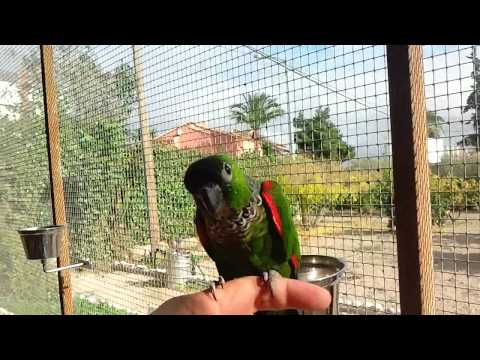
    Crimson-bellied Parakeet
    Pyrrhura perlata

    Crimson-bellied Parakeet

    Content

    Description:

    Crimson-bellied Parakeet

    24-25 cm. of length and weight 85-94 g

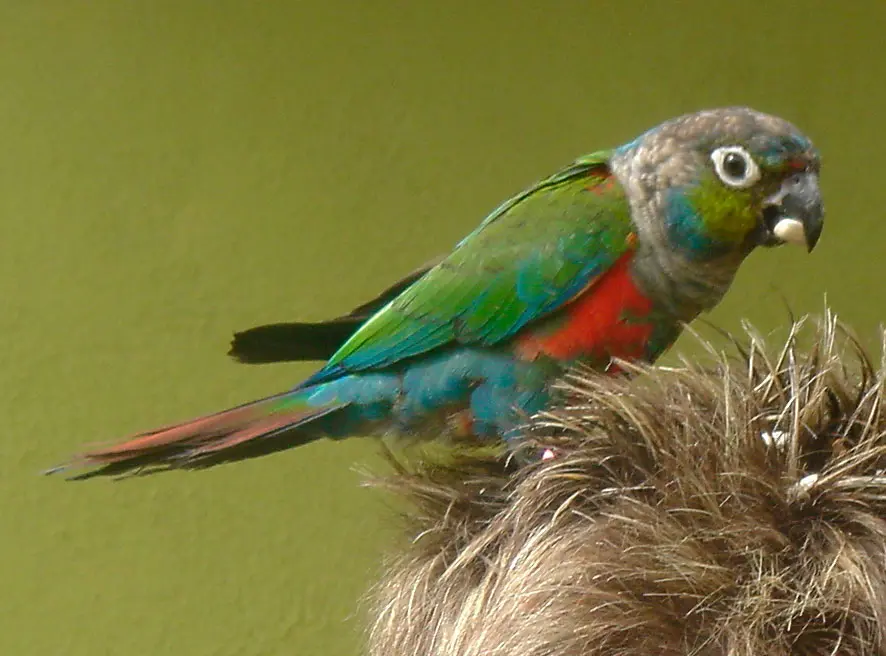
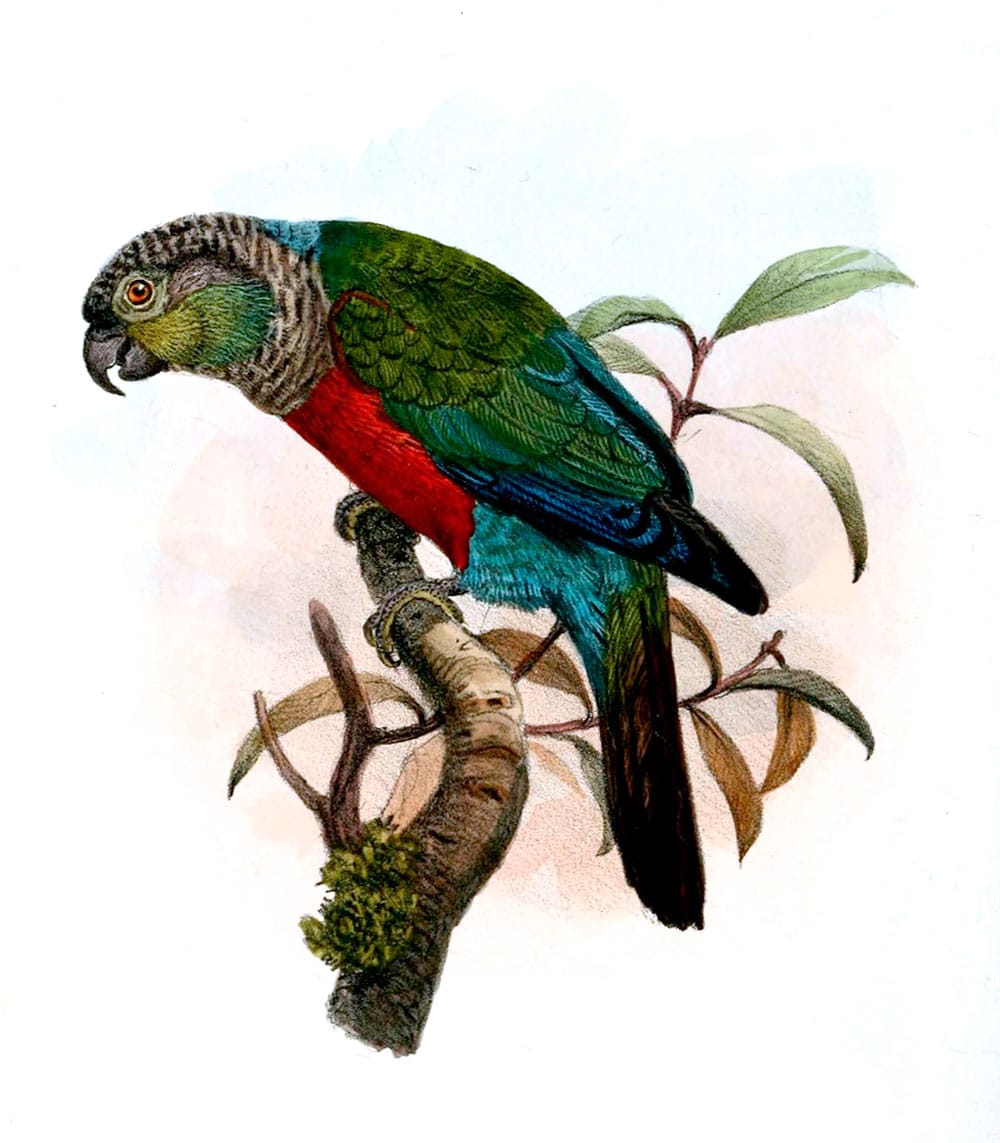
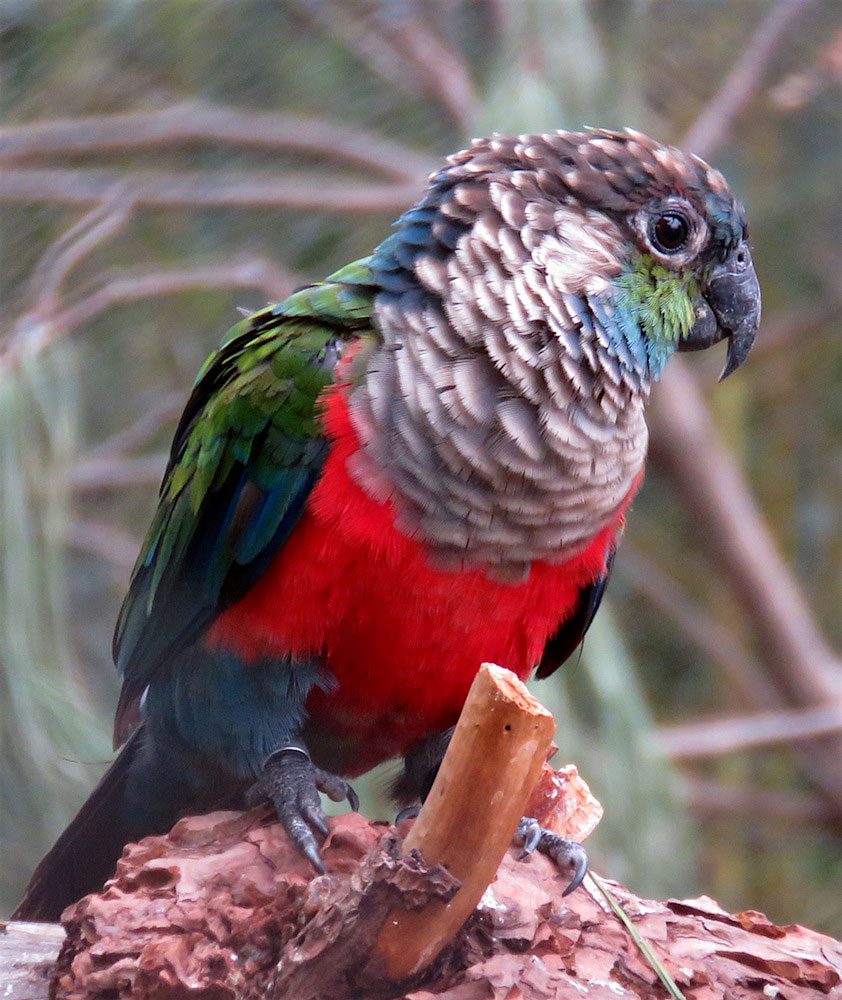
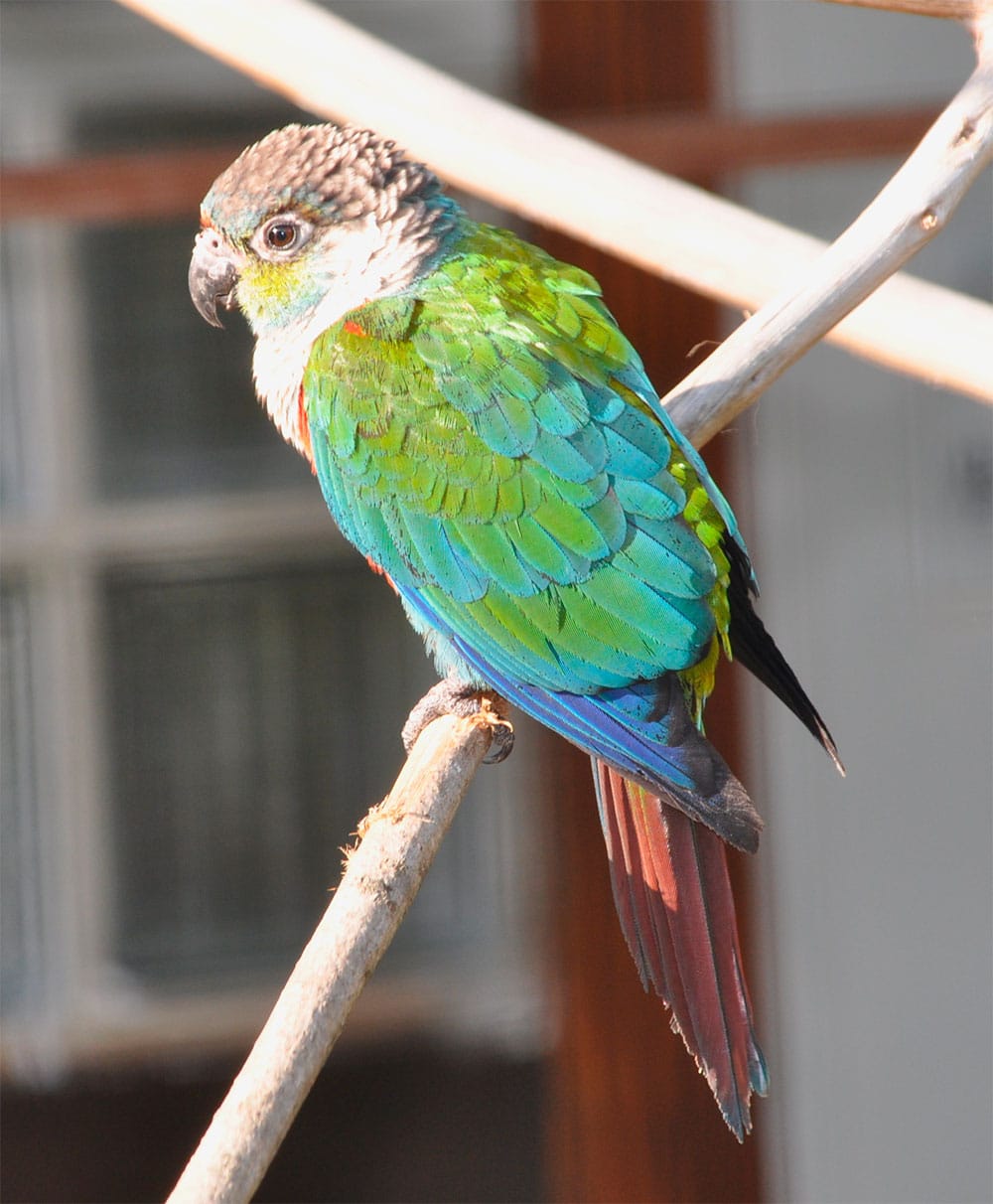
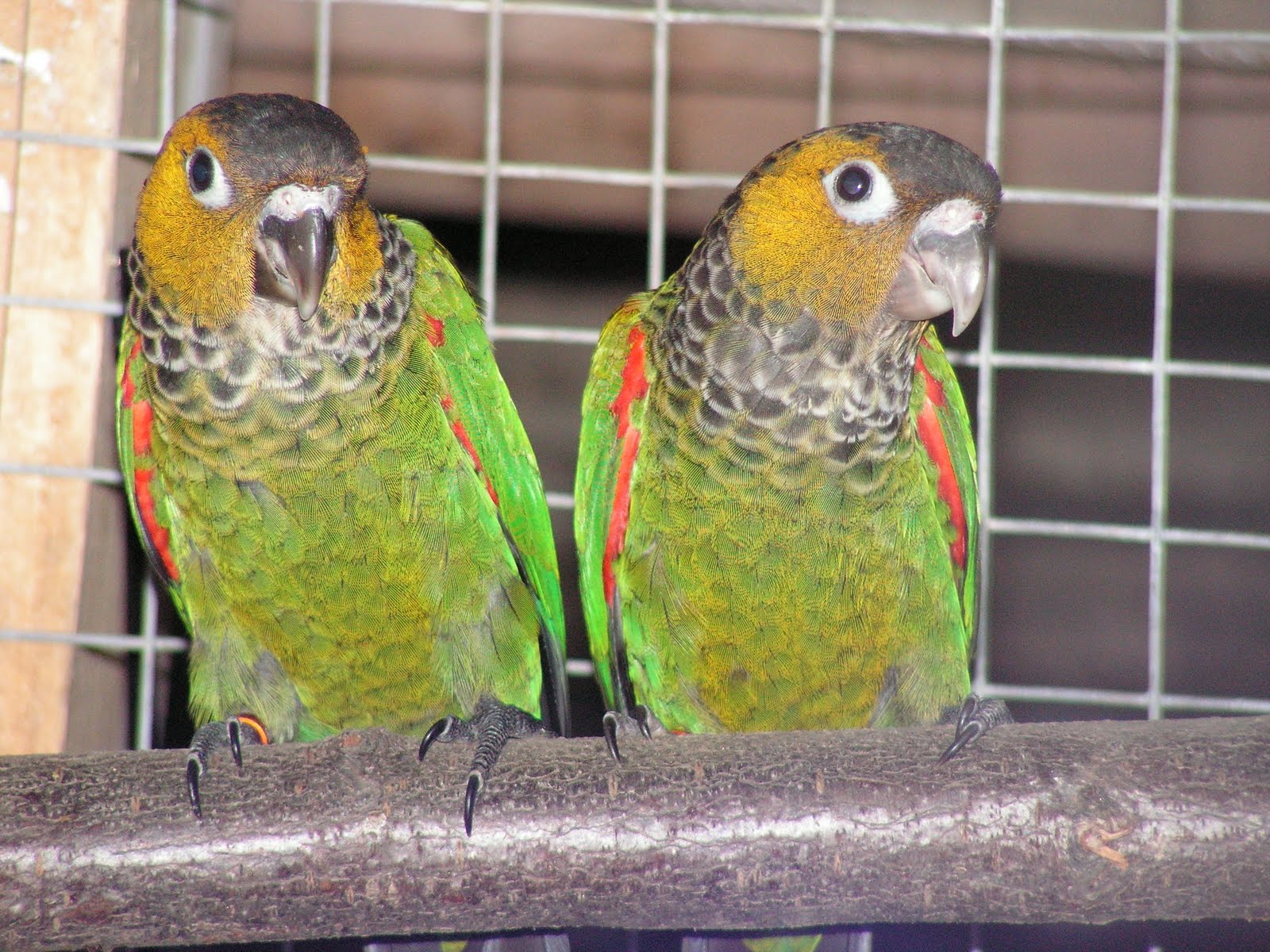
    The Crimson-bellied Parakeet (Pyrrhura perlata) has the lores and cheeks of color yellowish-olive with dye Brown; The forecrown, the crown and back neck Dark Slate with velvety probes, giving a mottled appearance, especially in parts where increases the blue at the bases of the feathers.

    The upper mantle is blue; robe bottom up to the uppertail-coverts green. Scapulars green at the base, blue down; the lesser wing coverts, olive green; the medium-sized and large coverts, with a predominance of the color blue. The flight feather, blue top, secondaries with green in the outerweb; slate grey dark below.

    Underwing-coverts bright red. Sides of the neck, the throat and the top of the chest, with a predominance of brown color, with some brands blue and tips velvety, giving a scaly appearance; The under chest and most of the belly bright crimson; Flanks, the thighs and undertail-coverts, Blue with greenish tint. Upper, the tail, with predominance of color Brown, shades of green and some blue feathers; below, the tail, dark gray.

    The bill brown-black color; eye ring whitish grey; Iris dark brown; legs black slate.

    Both sexes similar.

    Immature they lack the bright crimson color on the underparts; Sometimes with dark margins in the scapulars.

    The Pyrrhura perlata was formerly known as Pyrrhura rhodogaster.

    Habitat:

    They generally inhabit humid forests on dry land., clear forest, secondary and probably drier formations in the North of Mato Grosso and have been registered also dominated by fig trees in eastern forests of Bolivia.

    Usually views in small flocks and, sometimes in mixed groups with the Golden-winged Parakeet and Painted Parakeet. Larger family groups have been reported previously. They have often been seen descending into rivers and streams to bathe and drink..

    Reproduction:

    With reproduce between August and November, probably in April and June, They nest in tree cavities. Incubation period: 24-25 days.

    The put in captivity is of 3-9 eggs, being 5 the average.

    Food:

    Reported foods include catkins Cecropia, small fruits of Trema micrantha, fruits of the ficus, Eugenia and Zanthoxylum, and flowers of Bertholletia excelsa and Dioclea glabra.

    Distribution:

    They can be found in Brazil, in the area of the great South-Central amazon basin, in West For and in the western area of amazon, in the river basins Madeira and South of the Tapajós, to the extreme north of Mato Grosso, Rivers Roosevelt and Aripuanã.

    Observed in adjacent parts of Bolivia and probably widely distributed east of Rio Mamoré in hand me and Santa Cruz.

    In general common, but perhaps decreasing due to the loss of forests in some parts of its area of distribution (for example, along the river JI-Paraná in Rondà´nia, Brazil).

    Conservation:

    State of conservation ⓘ


    Vulnerable Vulnerable ⓘ (UICN)ⓘ

    • Current category of the Red List of the UICN: Vulnerable

    • Population trend: Stable

    Justification of the population:

    The size of the world's population has not been quantified, but this species is described as "quite common» (Stotz et to the., 1996).

    Justification of trend:

    It is suspected that this species has lost 23-30.3% of habitat within its distribution area for three generations (18 years), based on a model of Amazon deforestation (Soares-Filho et to the., 2006, Bird et to the., 2011). Given the susceptibility of species the hunting and capture, they suspected that the population of Crimson-bellied Parakeet will decrease by ≥ 30% during three generations.

    "Crimson-bellied Parakeet" in captivity:

    Not very common in captivity. Its diet ideal would be based on fruits such as: apples, Pears, oranges, bananas, grenades, cactus fruits , which form the 30 percent of their food, vegetables, such as: carrots, celery, green beans, pea in the pod, fresh corn, green leaves, such as: chard, lettuce, dandelion, chickweed, healer, millet; a mixture of seeds as such: Canary Islands, small amounts of wheat and millet, oats, safflower and hemp, Sunflower, cooked beans and legumes and cooked corn.

    Es una ave muy playful a la que le encanta bañarse, so toys and a shallow bowl of water should be provided.
    Moderate voice, but when are they excited can be somewhat noisy. It is not aggressive with other species.
    Price per couple: 500-600 EUR

    Alternative names:

    – Crimson-bellied Parakeet, Crimson bellied Parakeet, Crimson-bellied Conure, Pearly Conure, Pearly Parakeet, Rose-bellied Conure, Rose-breasted Conure, Rose-breasted Parakeet (English).
    – Conure à ventre rouge, Conure perlée, Perriche à ventre rouge, Perruche à poitrine cramoise, Perruche à ventre rouge (French).
    – Rotbauchsittich, Blausteißsittich, Blausteiss-Sittich, Rotbauch-Sittich (German).
    – Tiriba-de-barriga-vermelha (Portuguese).
    – Catita cola granate, Cotorra Ventirroja, Cotorra Ventrirroja, Perico de Pecho Rojo, Perico Perla (español).
    – Catita cola granate (Paraguay).


    scientific classification:

    Johann Baptist von Spix
    Johann Baptist von Spix

    – Order: Psittaciformes
    – Family: Psittacidae
    – Genus: Pyrrhura
    – Scientific name: Pyrrhura perlata
    – Citation: (von Spix, 1824)
    – Protonimo: Aratinga reported


    Crimson-bellied Parakeet images:

    Videos of the "Crimson-bellied Parakeet"


    Especies del género Pyrrhura

    Crimson-bellied Parakeet (Pyrrhura perlata)


    Sources:

    – Avibase
    – Parrots of the World – Forshaw Joseph M
    – Parrots A Guide to the Parrots of the World – Tony Juniper & Mike Parr
    – Birdlife

    – Photos:

    (1) – Crimson-bellied Parakeet (Pyrrhura perlata) also called the Crimson-Bellied Conure By derivative work: Snowmanradio (talk)Juan_Caparrós_cabeza. JPG: Juan Caparrós [CC BY-SA 3.0 or GFDL], via Wikimedia Commons
    (2) – A Crimson-bellied Parakeet (also known as the Crimson-bellied Conure) captive by Pyrrhura_perlata_-captive-8a.jpg: Nori Almeidaderivative work: Snowmanradio [CC BY 2.0], via Wikimedia Commons
    (3) – Crimson-bellied Conure in the Walsrode Bird Park, Germany By Quartl (Own work) [CC BY-SA 3.0], via Wikimedia Commons
    (4) – Parrot by pixabay Crimson
    (5) – Pyrrhura perlata by Florin Feneru – Flickr
    (6) – Conurus rhodogaster=Pyrrhura perlata by Joseph Wolf [Public domain], via Wikimedia Commons

    – Sounds: Xeno-canto

    ▷ The world of Pets: Dogs, cats, birds, reptiles, amphibians

    Deville's Parakeet
    Pyrrhura lucianii


    Deville's Parakeet

    Content

    Description:

    21-23 cm.. height.

    the showy plumage of the Deville's Parakeet (Pyrrhura lucianii) is generally Green, darker in the lower parts, the crown is dark brown, the forecrown and face is brownish red in colour; cheeks brick red, faded of blue, ear-coverts brownish yellow, neck and chest with the typical scales very visible due to the black and yellow contrast of the feathers. The ventral coat of arms, reddish, is well defined; in flight the dark red spot is notorious for the abdomen. Well defined are the reddish marks on the rump and in his long tail; the flight feather they are blue.

    It has periocular ring Of course, irises brown, bill blackish and legs grey pink.

    Note:

    Until recently this species was included along with the Pyrrhura subandina, Pyrrhura caeruliceps, Pyrrhura pantchenkoi within the species Pyrrhura picta.

    Habitat:

    Found in altitudes of 800 m, in forests Terra firm and várzea, including forest margins and near clearings with tall trees. In forests low semi humid, up close 100 m.

    Seen in pairs, groups of three or flocks of up to 20 individuals.

    Reproduction:

    Little is known about the reproductive cycle of this species, probably nesting in large trees, in cavities or in nest of woodpeckers abandoned, with one laying estimated in 5-7 eggs.

    Food:

    With feeds a wide variety of fruits, flowers, seeds and algae, possibly.

    Distribution:

    Size of the distribution (breeding/resident): 47,200 km2

    Restricted to the State of amazon in the Northwest Amazon of Brazil.

    This species is supposed fairly common within its range, However, This can not be confirmed since this time rare remote region is visited by researchers.

    Conservation:

    • Red List Category: Least concern

    • Population trend: Decrease

    State of conservation ⓘ


    minor concern Minor Concern ⓘ (UICN)ⓘ

    The status of their populations is unknown, but for the good condition of the habitat, it can be assumed that they are in good state of conservation.

    While the trend of the population seems to be decreasing, do not believe that the decline is fast enough for approaching the threshold of vulnerable under the criterion of population trend

    "Deville's Parakeet" in captivity:

    Although he is a parrot rare in captivity, its potential as a domestic fowl is excellent, provided there are hand raised and socialized from an early age. The newly imported birds are usually shy and nervous and often they remain reserved.

    It is usually inquisitive and active, enjoy flying and requires plenty of exercise and a spacious cage. Usually, It is not too noisy unless it is excited (as it is usually the case of all species Pyrrhura).

    Once acclimatized, These parrots are quite robust. Enjoy with the bath by what are them must provide a dish of water little deep to daily. Also the love chew branches fresh.

    Alternative names:

    – Deville’s Parakeet, Bonaparte’s Parakeet (English).
    – Conure de Bonaparte, Conure de Luciani (French).
    – Bonapartesittich, Prinz Luzians Rotschwanzsittich (German).
    – Tiriba-de-deville (Portuguese).
    – Cotorra de Bonaparte, Ñángaro de Deville, Perico de Deville, Cotorrita barriguiroja (español).
    – Perico de Bonaparte (Peru).

    scientific classification:

    – Order: Psittaciformes
    – Family: Psittacidae
    – Genus: Pyrrhura
    – Scientific name: Pyrrhura lucianii
    – Citation: (Deville, 1851)
    – Protonimo: Conurus Lucianii

    Images Deville's Parakeet:


    Especies del género Pyrrhura

    Deville's Parakeet (Pyrrhura lucianii)


    Sources:

    – Avibase
    – Parrots of the World – Forshaw Joseph M
    – Parrots A Guide to the Parrots of the World – Tony Juniper & Mike Parr
    – Birdlife

    – Photos:

    (1) – Maracana luciani Dev. & Cast. Pyrrhura lucianii = (Deville, 1851) by Francis de Laporte de Castelnau [Public domain], via Wikimedia Commons

    – Sounds: Daniel Lane (Xeno-canto)

    ▷ The world of Pets: Dogs, cats, birds, reptiles, amphibians

    Fiery shouldered Parakeet
    Pyrrhura egregia


    Fiery shouldered Parakeet

    Content

    Description:

    Fiery shouldered Parakeet

    25 cm.. height.

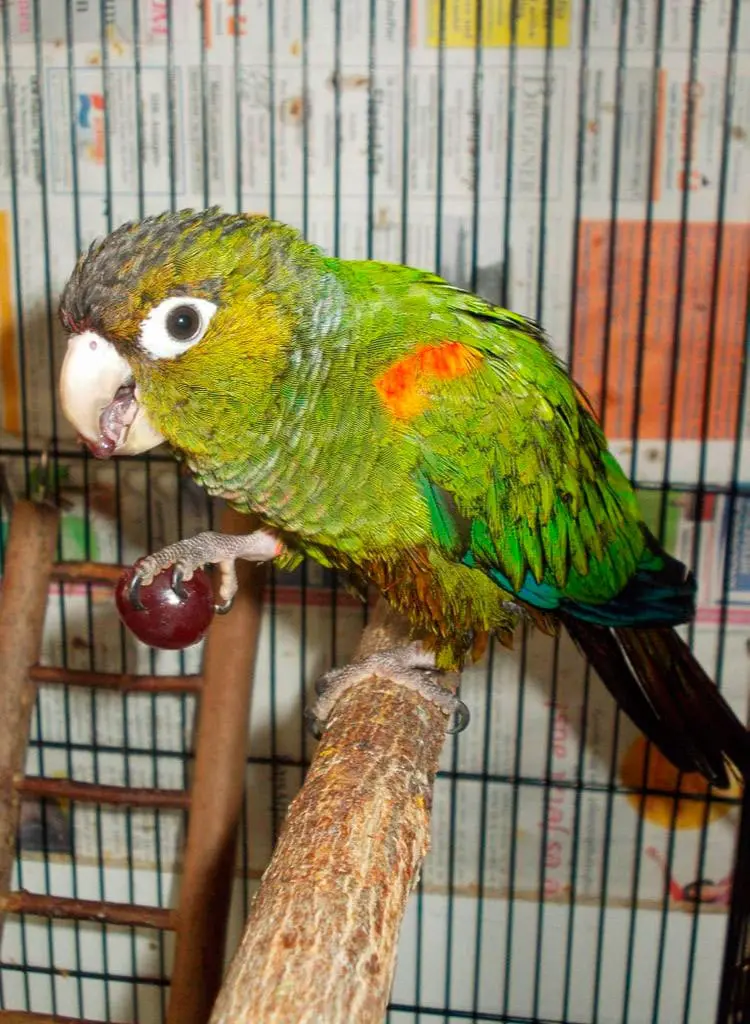
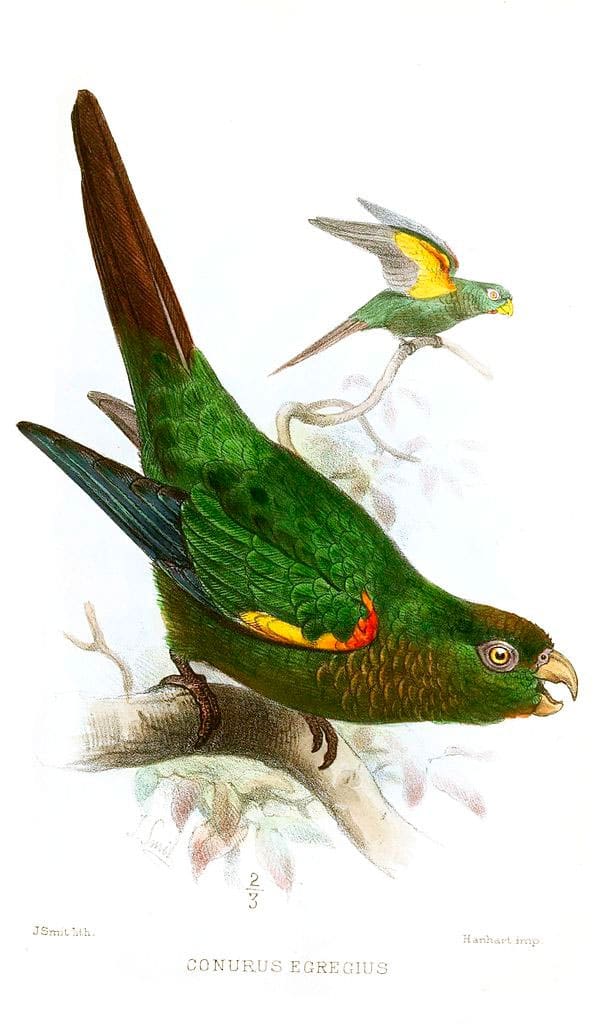
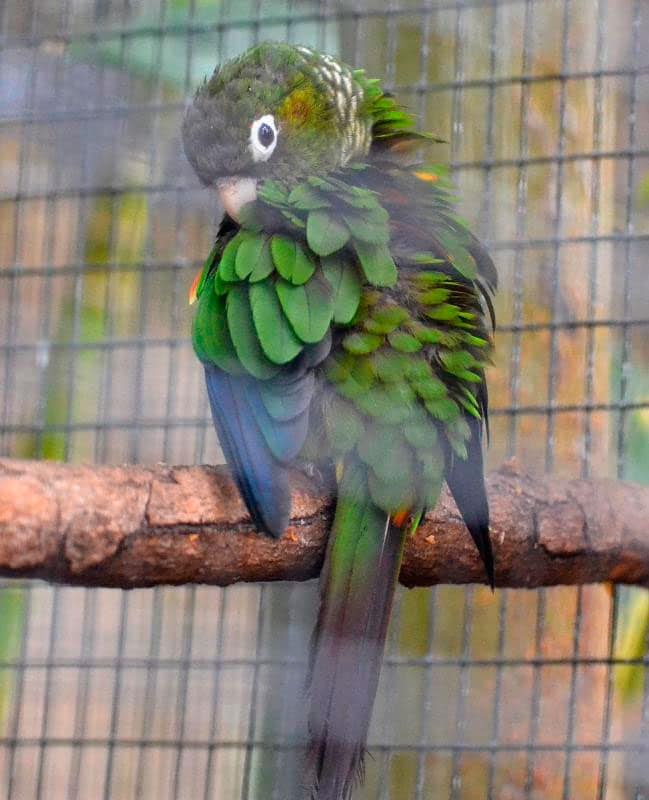
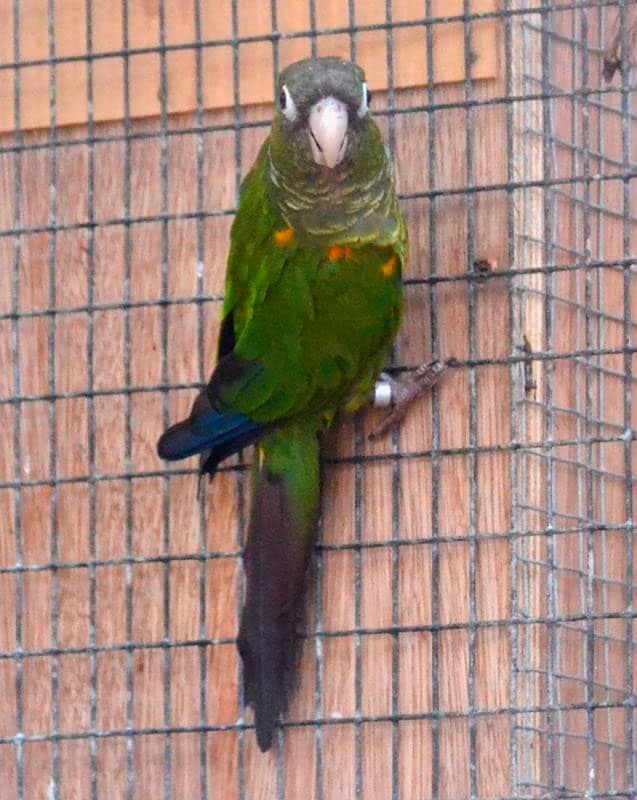
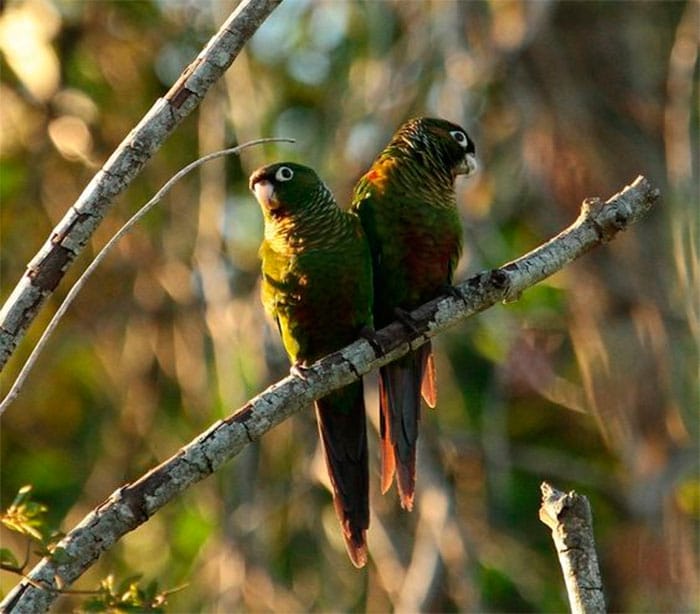
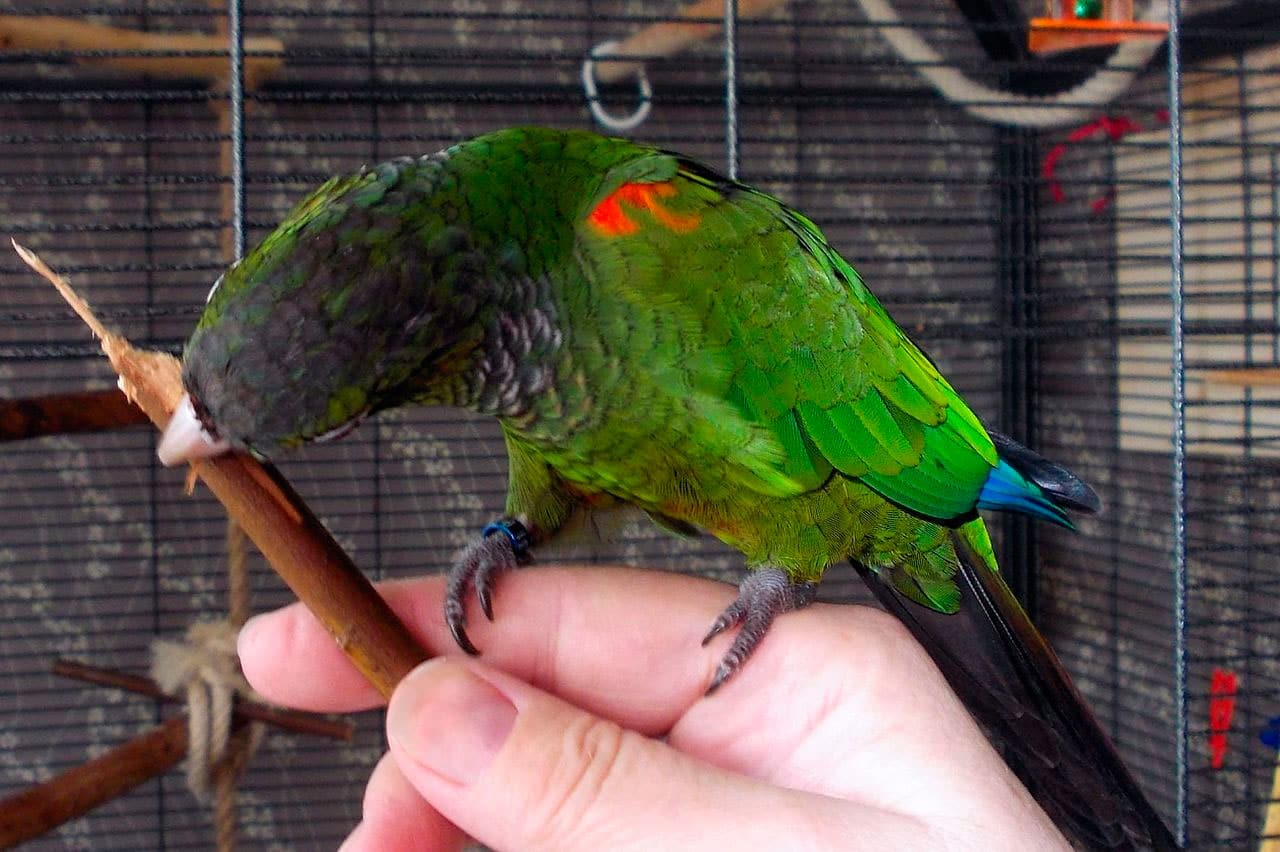
    The Fiery shouldered Parakeet (Pyrrhura egregia) has a close frontal band brown; crown, lores, rear area of the neck and upper cheeks, brownish; ear-coverts reddish brown; feathers on the sides of the neck basically green with subterminal band of color beige, narrow dark tips giving a scaly appearance to the whole.

    The upperparts Green with dark and narrow edges to some feathers. carpal area and front edge of the wing , Orange with yellow marks; primary coverts usually blue but sometimes colored yellow shiny; upperwing-coverts green. Outerwebs of flight feather, blue. Underwing-coverts marked with yellow orange; bottom of the flight feather gray. feathers in the throat and the chest basically green with the subterminal band Hazelnut color and dark tips, giving a scaly appearance; underparts green, with most of the feathers of the belly Brown at the base and green-tipped, sometimes forming a brown patch. Upper, the tail Brown very dark, green at the base; by down gray.

    The bill color horn; skin peri-oftalmica naked white; brown the irises; legs Brown-Black.

    Both sexes are similar.

    The immature It has much less yellow and orange in the upperwing-coverts and infra-alares; the crown Green and flakes in the chest and on the sides of the neck less pronounced.

    Subspecies description:

    • Pyrrhura egregia egregia

      (Sclater,PL, 1881) – The nominal.


    • Pyrrhura egregia obscura

      (Zimmer & Phelps,WH 1946) – Similar to the species nominal but with the upperparts darker green and the underparts also slightly more dark. Patch Brown in the belly less frequent and less prominent.

    Habitat:

    The species inhabits in humid premontane forests and dense secondary forest on the Tepuis, between 700 to 1800 m. usually in flocks of 7-25 birds.

    Reproduction:

    Little information on the breeding; is reproduce between March and April with fledged young people between May-June. Period of incubation: 23 Dias.

    Food:

    There is no information about the diet, except that birds visit Amerindian villages from July to August to feed of fruit of, for example, guavas mature.

    Distribution:

    Size distribution (reproduction / resident): 49.400 km2

    Distribution restricted to the Tepui region in the north-eastern interior of South America. The species is known from Venezuela on Gran Sabana to the southeast of Bolívar, in the Mount Roraima and Arabopo and from the Mount Auyan-tepui and the Mt. Ptari-tepui.

    Can be found in adjacent areas of the West of Guyana, for example, in the surroundings of the Camaran River and top of the Mazaruni River, the Merume mountains and Pacaraima mountains to the South of Annai.

    The reports of Suriname still no confirmed. Probably are distributed in the northeast of Roraima, Brazil.

    Inaccessible range and few details about his status, but apparently quite common. Large part of the range Venezuelan included in the Canaima National Park.

    Small quantities exported from Guyana to end of the years eighty and subsequently bred in captivity.

    Subspecies distribution:

    Conservation:

    State of conservation ⓘ


    minor concern Minor Concern ⓘ (UICN)ⓘ

    • Current category of the Red List of the UICN: Least concern.

    • Population trend: Decreasing.

    Justification of the population

    The population size World has not been quantified, but this species is described as «quite common» (Stotz et to the., 1996).

    Justification of trend

    It is suspected that this species has lost 3.3-10.5% of habitat suitable within their distribution during three generations (18 years), based on a model of Amazon deforestation (Soares-Filho et to the., 2006, Bird et to the., 2011). Given the susceptibility of the species to hunt or capture, It is suspected that will decrease in <25% durante tres generaciones.

    "Fiery shouldered Parakeet" in captivity:

    Intelligent, relatively calm and playful. Young birds are very shy.
    They are aggressive with other birds and it is very rare in captivity, with small quantities exported from Guyana at the end of the 1980s and subsequently raised in captivity.

    Price per couple: 300-400 EUR.

    Alternative names:

    – Fiery-shouldered Parakeet, Fiery shouldered Parakeet, Fiery-shoulderd Conure, Fiery-shouldered Conure (English).
    – Conure aile-de-feu, Perriche aile-de-feu, Perruche aile-de-feu (French).
    – Feuerbugsittich, Feuerbug-Sittich (German).
    – tiriba-de-cauda-roxa (Portuguese).
    – Cotorra Egregia, Perico de Cola Morada, Perico colimorado (español).
    – Perico de Pantepui (Venezuela).


    scientific classification:

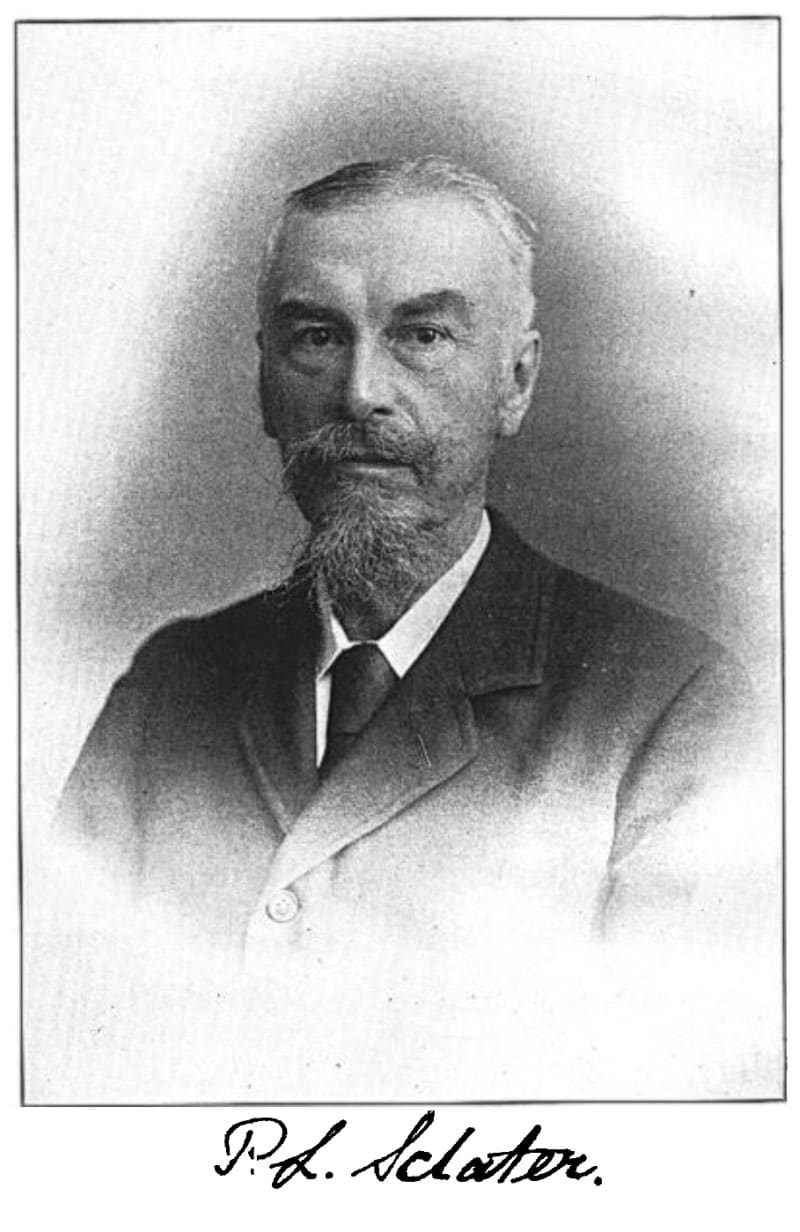
    Philip Sclater
    Philip Sclater

    Order: Psittaciformes
    Family: Psittacidae
    Genus: Pyrrhura
    Scientific name: Pyrrhura egregia
    Citation: (Sclater, PL, 1881)
    Protonimo: conurus outstanding


    Fiery shouldered Parakeet images:

    Videos "Fiery shouldered Parakeet"

    Fiery shouldered Parakeet (Pyrrhura egregia)


    Sources:

    – Avibase
    – Parrots of the World – Forshaw Joseph M
    – Parrots A Guide to the Parrots of the World – Tony Juniper & Mike Parr
    – Birdlife

    – Photos:

    (1) – Demerara Conure By Gazelle74 (Own work) [CC BY-SA 4.0], via Wikimedia Commons
    (2) – Demerara female «at work». These little parrots love to gnaw at wood, paper and many other things By Gazelle74 (Own work) [CC BY-SA 4.0], via Wikimedia Commons
    (3) – Fiery-shouldered Parakeet (Pyrrhura egregia) by Margareta Wieser. A pair perching on a branch – HBW
    (4) – Fiery-shouldered Parakeet (Pyrrhura egregia) by Andrew Emmerson. An adult bird – HBW
    (5) – Fiery-shouldered Parakeet (Pyrrhura egregia) by Andrew Emmerson. An adult preening – HBW
    (6) – Conurus egregius » = Pyrrhura egregius (Fiery-shouldered parakeet) by John Gerrard Keulemans [Public domain], via Wikimedia Commons

    – Sounds: (Xeno-canto)