โ–ท The world of Pets: Dogs, cats, birds, reptiles, amphibians

Red-tailed black cockatoo
Calyptorhynchus banksii

Red-tailed black cockatoo

Content

Description

55 to 60 cm.. length between 570 and 870 weight g.

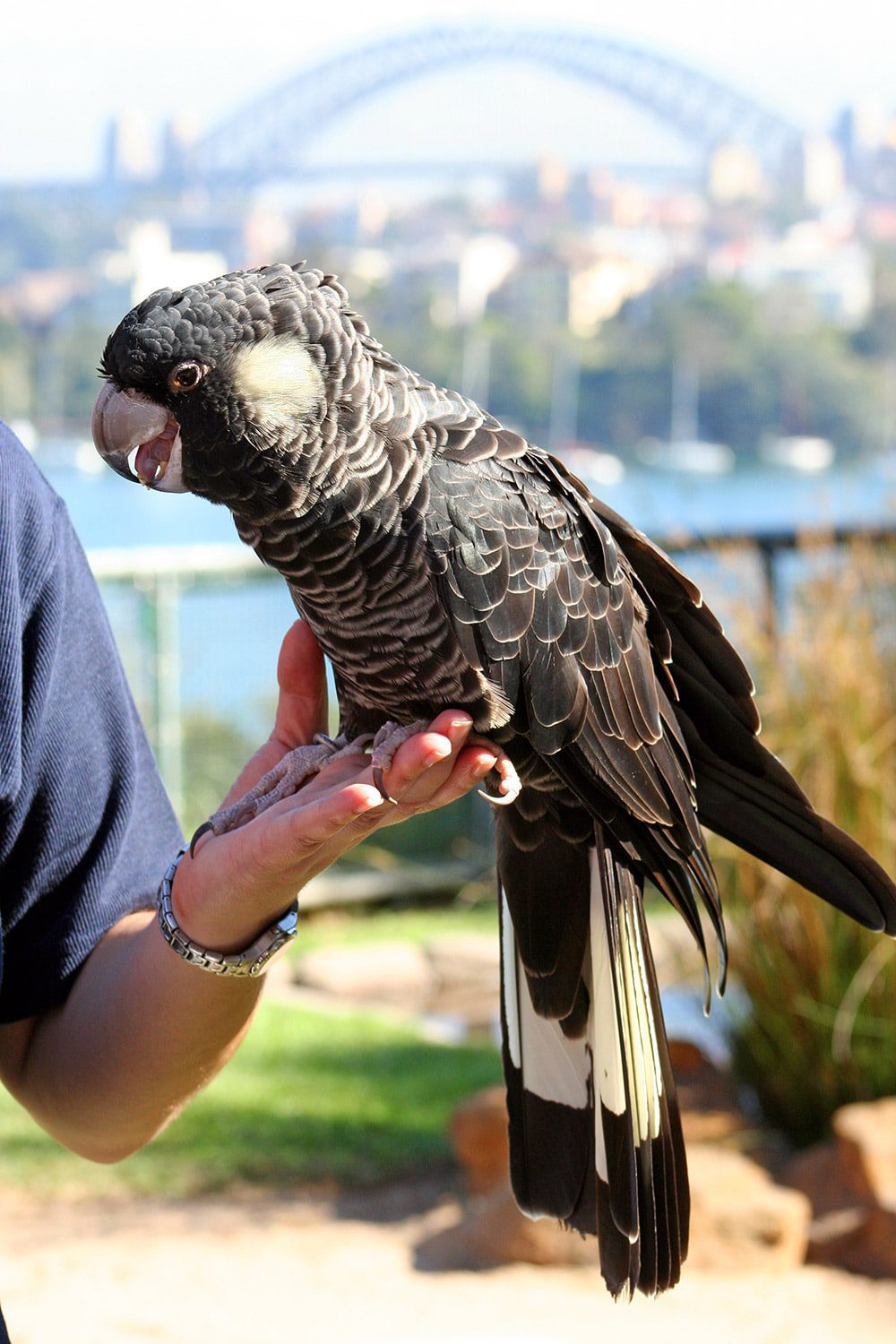
The adults of the Red-tailed black cockatoo (Calyptorhynchus banksii) present sexual dimorphism. The male is entirely black, with the exception of the sides of the tail that are of color red glossy. The upper part of the head It is a long Ridge which starts from the front and goes up to the nape. The bill is grey dark.

The females they are slightly smaller. Show a plumage blackish brown with yellow-orange stripes on the tail and the chest. The cheeks and wings they are covered with small yellow spots. The bill is of color bone pale. Lower parts to the tail coverts they are finely excluded in beige.

The youth are similar to the females until they reach the maturity sexual, around the 4 years. Gradually, as they approach this age, YM will acquire their feathers red which gradually replaced their initial feathers in yellow.

Description 5 subspecies

They differ from each other mainly by the size of their beak.

  • Calyptorhynchus banksii banksii

    (Latham, 1790) – Nominal. Grand. Bill dark grey.


  • Calyptorhynchus banksii graptogyne

    (Schodde, Saunders,DA & Homberger, 1989) – It is the smaller of the 5 Subspecies.


  • Calyptorhynchus banksii macrorhynchus

    (Gould, 1843) – Large as it nominal.


  • Calyptorhynchus banksii naso

    (Gould, 1837) – They have wings that seem to be more long and pointy.


  • Calyptorhynchus banksii samueli

    (Mathews, 1917) – Have a size and bill smaller.

Habitat:

Wide variety of habitats. Grasslands and scrub, from the dense rainforests to the forests of acacia and eucalyptus.
Nestbox, These birds are generally dependent on the old eucalyptus, although according to which regions regions, the variety of trees for nesting, could be different.

To feed, flocks of these cockatoos, they penetrate in agricultural lands and orchards, becoming a real plague.
In all parts of the Australian mainland, have been observed seasonal movements.
In the North, most cockatoos flee from high humidity areas during the rainy season.
In other parts of the continent, We are seeing movements directly related to food.
In South Australia, the movements are carried out in the South-North direction and are not necessarily linked to the stations.

Reproduction:

It nests in the hollow of the following trees: MARRI, Jarrah, Wandoo, Karri and Bullich. Eggs are laid on the bottom of a hollow log, up dry branches, between March and December. The cavity can have a depth of one to two meters. The diameter of the entry may vary from 25 to 50 centimeters.

The laying is of an only egg (In rare cases two). The incubation runs by features of the female and lasts between 29 and 31 days.
At birth the chicks are covered by a little and yellow plumage. Most of the time, the second calf is abandoned and eventually dies from lack of food. The surviving offspring is fed by both parents..

Food:

It feeds mainly from seeds, in particular those of Eucalyptus Marri (E. calophylla). Chew small branches, grabs clusters with its legs and โ€œchewsโ€ them to extract the seeds. Strip the remains to the soil, at the foot of the tree. It is a great vegetarian, also eats berries, fruit, some insects and larvae. Occasionally it feeds on plants or varieties introduced as the radish wild, turnips or melons.

Distribution:

Size of the area of distribution (reproduction / resident): 8.680.000 km2

endemic to Australia, where in drier areas.
They are especially prevalent in the northern part of the country. In the South, they are less abundant and more dispersed.

The WPT (World Parrot Trust) contributed funds to a project in the South of Australia for help to save to these birds.

Distribution 5 subspecies

They differ from each other mainly by the size of their beak.

Conservation:

State of conservation โ“˜


minor concern Minor Concern โ“˜ (UICN)โ“˜

โ€ข Current category of the Red List of the UICN: Least concern.

โ€ข Population trend: Decreasing.

In the past it was common, but now it has become rare, It is distributed unevenly in areas that have been significantly reduced.
The decrease is caused by the deforestation, the competition for the nesting with species native and exotic, as well as the fires.

It is believed that the world's population exceeds the 100.000 individuals.
the subspecies graptogyne was estimated to be in less of 1.000 individuals in 1989.
Only the subspecies of the Southwest, Calyptorhynchus banksii naso, is listed as "Vulnerable".

The subspecies Calyptorhynchus banksii banksii is not classified as threatened in all regions.

"Red-tailed black cockatoo" in captivity:

Excellent with a very devoted owner. It can be quite noisy. It has a moderate ability to imitate human sound.
There has been an increase in captive birds in Australia. It is very rare as bird cage.
They can live in 50 to 100 years in captivity. The variety Calyptorhynchus banksii naso, of 25 to 50 years.

Alternative names:

Red-tailed Black-Cockatoo, Banksian Cockatoo, Banks’s Black Cockatoo, Black Cockatoo (English).
Cacatoรจs banksien, Cacatoรจs de Banks (French).
Rabenkakadu (German).
Cacatua-negra-de-cauda-vermelha (Portuguese).
Cacatรบa Colirroja, Cacatรบa Fรบnebre de Cola Roja (espaรฑol).

John Latham
John Latham

scientific classification:


Order: Psittaciformes
Family: Cacatuidae
Genus: Calyptorhynchus
Scientific name: Calyptorhynchus banksii
Citation: (Latham, 1790)
Protonimo: Psittacus Banksii


Images Red-tailed Cockatoo:


Species of the genus Calyptorhynchus
  • Calyptorhynchus banksii
  • —- Calyptorhynchus banksii banksii
  • —- Calyptorhynchus banksii graptogyne
  • —- Calyptorhynchus banksii macrorhynchus
  • —- Calyptorhynchus banksii naso
  • —- Calyptorhynchus banksii samueli
  • Calyptorhynchus lathami
  • —- Calyptorhynchus lathami erebus
  • —- Calyptorhynchus lathami halmaturinus
  • —- Calyptorhynchus lathami lathami

  • Sources:

    Avibase
    – Parrots of the World โ€“ Forshaw Joseph M
    – Parrots A Guide to the Parrots of the World – Tony Juniper & Mike Parr
    Birdlife

    – Photos: Laslovarga (commons.wikimedia.org), Wikipedia, Scarlet23 (Wikipedia), Uploaded by Casliber (Wikipedia), Uploaded by Peter Campbell (Wikipedia)

    – Sounds: Nigel Jackett
    โ–ท The world of Pets: Dogs, cats, birds, reptiles, amphibians

    Black Lory
    Chalcopsitta atra

    Lori Negro

    Content

    Description

    32 cm.. height and a weight between 230 and 260 gr.

    The Black Lory (Chalcopsitta atra) It is the least colorful member of an otherwise very colorful genre. Itร‚ยดs, in poultry, therefore, the least popular. This is unfortunate because it is equally as interesting as the other members of the genus.

    Black in color with a purplish sheen to the plumage that is highly evident in sunlight, which gives it a superficial appearance of a crow. Even their bare parts, as the nose , the skin around the eyes and at the base of the jaws, eyes and claws, they are equally dark. Rump displays a violet blue.

    The underside of the tail feathers are color olivaceous with light infusions of red at the base.
    The iris is orange-red, the grey legs.

    The youth differ little from adults but have an eye-ring and a skin at the base of the peak which are whitish. It is grey.

    There is a 3 subspecies, that differ little between if:

    • Chalcopsitta atra atra: Both adults, usually black. The bluish violet rump. The feathers of the bottom of tail olive/yellow washed in red. Naked eye-ring black , black skin at the base of the peak. Orange-red eyes.

    • Chalcopsitta atra bernsteini: Red marks / purple on the forehead and thighs, less evident in females; Blue darker in the rump.

    • Chalcopsitta atra insignis: Head striped gray/blue. The front, the face, the thighs and the underside of the wings are red. The feathers of the throat and underparts with red trim. The rump is dull blue. The lower part of the tail is greyish blue. It is one of the most beautiful parrots that exist. It will be necessary to see any parrot in the light of the Sun to be able to appreciate its beauty.

    It is also said that there are other subspecies, the calcopsitta atra spectabilis, resident of the Mamberiok Peninsula, but the data given are running that it was only a hybridization of the Chalcopsitta Atra and the Chalcopsitta Sintillata.

    They are nomadic outside of the breeding season., and, they are sometimes found in large groups, associated with the Blackbirds, feeding together on trees in flower.

    Habitat:

    The Black Lory live in the Plains, rarely above the 200 m. They are very abundant in relatively open habitats, as the mangroves near the coast, swamp forest, coconut plantations, scattered eucalyptus in the Middle areas of meadows and scrub land. From time to time come to the edge of the Woods primary or forest growth. The Black Lory is endemic to New Guinea.

    Reproduction:

    Most of the information has been obtained from captive birds. In the wild, most of these birds breed between December and February. In captivity, the female lays two white eggs which are incubated for about 25 days. The entire reproductive period is particularly long, lasting approximately 75 days.

    The male incubates not, but sometimes it remains in the nest with the female. After birth the chicks remain in the nest approximately one 10 weeks.

    Food:

    The Black Lory is vegetarian. Primarily feeds on nectar and fruits. Constantly migrates in search of seasonal food. Green corn sprouts and seeds are also in their diet.. Enjoy the Schefflera shrubs.

    Distribution:

    Distribution Lori black
    This species is distributed in the westernmost part of West Papua, the Indonesian portion of New Guinea. In particular, they are in the Western Vogelkop, also on the islands of Misool (provinces of Maluku), Batanta (papua province), the Onin and Bomberai and Salawati peninsulas (West Papua), off the coast.

    Between the 3 [+] Subspecies:

    • Chalcopsitta atra atra: Distribution. West New Guinea

    • Chalcopsitta atra bernsteini: Distribution. Confined to the island of Misool (Indonesian) in the West of New Guinea.

    • Chalcopsitta atra insignis: Distribution. The Vogelkop, Island Amberpon, Onin, bomberai peninsulas, Northeast of New Guinea.

    • calcopsitta atra spectabilis: Distribution. mamberiok peninsula

    Conservation:


    minor concern


    This lory is evaluated as least concern on the red list of threatened species. Is included in Appendix II of CITES.


    The world population is estimated at 50.000 birds.

    This number is probably stable, but data are lacking to say it with certainty.

    The commercial import of this species in EC was banned in 1991.


    "Black Lory" in captivity:

    The Black Lory It is said is among the parrots with the sweetest character. They are easy to tame. Its obvious disadvantage is acute cries that often emit. Not everyone can tolerate them. It is however unusual in captivity.

    The subspecies insignis is rare, and the subspecies bernsteini practically non-existent.

    Alternative names:

    Black Lory, Rajah Lory, Red-quilled Lory (ingles).
    Lori noir (francรฉs).
    Schwarzlori (alemรกn).
    Lรณris-negro (portuguรฉs).
    Lori Negro (espaรฑol).

    scientific classification:

    Order: Psittaciformes
    Family: Psittaculidae
    Scientific name: Chalcopsitta atra
    Citation: (Scopoli, 1786)
    Protonimo: Psittacus ater

    Images ยซBlack Loryยป:


    ยซNegro truckยป (Chalcopsitta atra)


    Sources:
    Avibase
    – Photos: sciencio.com,
    Goura (zoochat.com), My Birds Region
    – Sounds: BAS van Balen (Xeno-canto)

    โ–ท The world of Pets: Dogs, cats, birds, reptiles, amphibians

    Pohnpei Lorikeet
    Trichoglossus rubiginosus

    Pohnpei Lorikeet

    Content


    Anatomy-parrots

    Description

    24 cm.. length and a weight between 70 and 85 gr.

    The Pohnpei Lorikeet (Trichoglossus rubiginosus) is unmistakable.

    The head and back, dark brown, darker in the head. Scapulars and blankets, are of color Bordeaux dark. The flight feather are blackish in those networks internal and infiltrated with color olivaceous in them vane outer.

    The primaries more external are clearly yellow. The bottom of the wings black. The underparts Deep Garnet color, with a black edge in the bottom sides of the edges that draw a bar at the bottom.

    The upper part of the tail color is olivaceous, brighter in the vicinity of the tip; lower tail is of color yellow pale. The bill is orange. The irises are yellow-orange, the legs and feet are dark gray.

    In the female, the bill seems more yellowish and the irises are greyish white.

    In the youth, the feathers seem sharper.

    Habitat:

    This species is present on the entire surface of the island, until 600 m. It is distributed by a variety of habitats, such as coconut trees, plane trees, dense tropical forests, plots regenerated, forests and mangroves.

    The Pohnpei Lorikeet is a bird especially loud, He throws her screams from the roosts after dark. It is fairly easy to detect, Since it wanders in small flocks of February to December in search of food in trees in flower.

    It tends to fly high and travel long distances over the ocean.

    When fed into the forests of tall trees, usually favors the average vegetation floor.

    As the Ponape island receives a large amount of precipitation (until 7600 mm. per year in some places), the Pohnpei Lorikeet seek refuge under the large leaves.

    Reproduction:

    The Pohnpei Lorikeet It builds its nest on top of a coconut tree or in any cavity of a tree from the forest.
    The spawning usually consists of an only egg.
    The nesting season generally goes from December to may.

    Food:

    Consumes nectar, pollen and fruit. While feeding, It tends to keep its head down to pick up their food in the flowers of coconut and banana.
    The nectar of Erythrina and the mango is very appreciated by the Pohnpei Lorikeet.

    Distribution:

    Size of the area of distribution (reproduction / resident): 350 km2

    As its name implies, lori this is endemic of the Ponape island, which is the most populated island of the States federate of Micronesia. Formerly, also lived on the atoll of Namoluk about the island of Truk.

    It is possible that range was more extensive than it is today.

    Conservation:


    Near-threatened

    – Current IUCN Red List category: Near threatened

    – The population trend: Decreasing

    This species is listed as near-threatened because it is suspected that their population, which is mostly a subpopulation, It is in decline due to changes in land use. It also has a very small range; But, is unlikely that it is declining, in terms of population, given the adaptability of the species. Neither population is severely fragmented or restricted to a few locations.

    Surveys in 1994 suggested that the species had declined a 74-75% Since the beginning of the eighties, probably indicating a decrease in real (Buden 2000). The current population exceeds the 10.000 specimens (Juniper and Parr 1998, M. O'Brien a little. 2011).

    In the news, It is the official bird of the State of Pohnpei and your hunting, capture and export is illegal.

    "Pohnpei Lorikeet" in captivity:

    Is usually not kept out of the Pohnpei island.

    Alternative names:

    Pohnpei Lorikeet, Pohnpei Lory, Ponape Lorikeet, Ponape Lory, Ponapรฉ lory, Red Lory (ingles).
    Loriquet de Panapรฉ, Loriquet de Ponapรฉ (French).
    Kirschlori (German).
    Loris rubiginosus (Portuguese).
    Lori de Ponapรฉ, Tricogloso de Ponapรฉ (espaรฑol).

    scientific classification:

    Order: Psittaciformes
    Family: Psittaculidae
    Genus: Trichoglossus
    Scientific name: Trichoglossus rubiginosus
    Citation: (Bonaparte, 1850)
    Protonimo: Chalcopsitta rubiginosa

    Images "Pohnpei Lorikeet"


    ยซLori de Ponapรฉยป (Trichoglossus rubiginosus)


      Sources:

      Avibase
      – BirdLife.org
      – Parrots of the World – Joseph Forshaw M
      – Parrots-A Guide to the Parrots of the World by Tony Juniper & Mike Parr

      Photos: By Peter – Flickr

      Sounds: Mark Oโ€™Brien (Xeno-canto)

    โ–ท The world of Pets: Dogs, cats, birds, reptiles, amphibians

    Collared Lory
    Phigys solitarius


    Collared Lory

    Content

    Description

    The Collared Lory (Phigys solitarius) has an approximate length of 20 cm.. and a weight ranging between 75 and 85 g..

    The upper zone of the crown it is dark purple, In contrast with the ear-coverts, cheeks and throat that have a bright color red Scarlet;

    The front of the crown, occasionally, with a mottled red light;
    The tail feathers of the neck are of a green living with completion in red and a colorful blanket.
    Under the the mantle, rump and top of the tail, bright green.

    Upper wing green colour with the inside of the flight feather and coverts, in black color.
    Underwing coverts Red and green. Underparts Scarlet Red, but with the bottom of the abdomen, lower side of the rump and the thighs, in dark purple.
    Orange-yellow spot in Central feathers of the tail. Undertail Matt Brown-Green, showing orange spots on the basis.

    Bill orange; Iris from yellow to red; Orange yellow the legs.

    The females has more green under the nape, less red in the the mantle, a pronounced green glow in the crown back and a bright purple on the crown front.

    The immature show freckles slightly purplish color and some greenish hidden spots in the chest; crown Green rear: they lack the elongated feathers red of the nape up to eight months of age. They lack orange spots in the tail. Bill more Brown than adults; irises brown: legs dark.

    Habitat:

    Visible and noisy. Found usually in pairs or in small groups of five to fifteen members, Although flocks have also been of up to 50 birds . They are mainly distributed in the lowlands of humid forest, edge of the forest, plantations and second growth up to 1,200 m, but they can be found anywhere with flowering gardens.

    It is usually more common in wet windward areas, being less common on agricultural leeward coasts.

    The Collared Lory are Mobile and something nomads, they are prepared to travel to almost any habitat with trees in bloom.

    Often seen flying over trees or feeding are loud in acrobatic groups.

    Reproduction:

    The nesting they occur in the second half of the year, especially after August. Two white eggs are placed in a hollow tree. Adults aggressively defend the nesting sites.

    In an instance of captive breeding, the incubation lasted 30 days and the young bird left the nest almost nine weeks later.

    Food:

    The diet of the Collared Lory consists of seeds, nectar and flowers. Trees of your choice include the drala (Erythrina variegata), the coconut tree (Cocoa nuts) and the African tulip introduced and invasive (Spathodea campanulata).
    Also eat fruits as the Mango (Mangifera indica).

    Distribution:

    The Collared Lory is endemic of the Fiji Islands, including the main islands of Vanua Levu and Viti Levu, In addition to Rabbi, Taveuni, Koro, Wakaya, Ovalau, Gau, Ono, Kadavu, Matuku, Moala and some islands in the Lau group (Naitaba, Vatu Vara, Lakeba). In the extreme south of the Fiji Islands group, the Collared Lory It is replaced by the Blue-crowned Lorikeet.

    The species is common and the world population is estimated between 10.000 and 100.000 specimens.

    Some are kept in captivity. Red feathers were previously used by the Samoan and Tongan to make edges of floor mats, but trade does not seem to have had an impact on the abundance of the species in Fiji. Some birds are reported, they have escaped in Tonga and Samoa.

    Conservation:


    minor concern


    – Current IUCN Red List category: Least concern.

    – The population trend: Stable.

    The world's population has not been quantified, but the species is described as common in Viti Levu, the island of Vanua Levu and Makogai and rare in the Ngau island, Fiji.

    The population It is suspected to be stable in the absence of evidence of any reduction or substantial threats.

    "Collared Lory" in captivity:

    Very rare to see them in captivity.

    Alternative names:

    Collared Lory, Solitary Lory, Ruffed Lory, Fiji Lory (ingles).
    Lori des Fidji, Lori phigy (francรฉs).
    Einsiedlerlori (alemรกn).
    Lรณris-solitรกrio (portuguรฉs).
    Lori Solitario (espaรฑol).

    scientific classification:

    Order: Psittaciformes
    Family: Psittaculidae
    Scientific name: Phigys solitarius
    Genus: Phigys
    Citation: (Suckow, 1800)
    Protonimo: lone parrot

    โ€œLonely Loryโ€ Images:

    Videos "Collared Lory"

    ————————————————————————————————

    ยซLonely Loriยป (Phigys solitarius)


    Sources:

    Avibase
    – Parrots of the World โ€“ Forshaw Joseph M
    – Parrots A Guide to the Parrots of the World – Tony Juniper & Mike Parr
    – Birdlife

    Photos:

    1 – ยซPhigys solitarius - San Diego Zoo, California, USA-8a (1)ยป by DerekL123 from Cypress, USA – San Diego Zoo-48.jpgUploaded by snowmanradio. Licensed under CC BY-SA 2.0 via Wikimedia Commons.
    2 – Collared lory (Vini [Phygis] solitarius) handjob by Chlidonias – ZooChat
    3 – Collared Lory Perroquets – computer wallpapers
    4 โ€“ Collared lory [Phigys solitarius] – Birds-pet-wallpapers
    5 – By DickDaniels (http://carolinabirds.org /) (Own work) [CC BY-SA 3.0 or GFDL], via Wikimedia Commons

    Sounds: Matthias Feuersenger (Xeno-canto)

    โ–ท The world of Pets: Dogs, cats, birds, reptiles, amphibians

    Fairy Lorikeet
    Charmosyna pulchella


    Fairy Lorikeet

    Content

    Description

    18 cm.. length and a weight between 24 and 34 g..

    The head of the Fairy Lorikeet (Charmosyna pulchella) is dark red with the back of the crown Black extending from above and behind the eyes up to the nape. Mantle Green with a black area below the nape and collar of color red dark at the height of the shoulders; under the back It shows a patch of dark violet interspersed with some green feathers on the ends; rump and tail coverts view from above of color green.

    Wings Green with extremes of color black in them flight feather and in the internal parts of the coats. below the wings Red with coverts marginal green; flight feather blackish.

    The underparts Red with stripes of pale yellow in the center of the chest, the thighs purple with yellow stripes. The tail view from the top of green at the top with a black shaft in the Center and the rest of red and yellow at the tip; view from below, the tail is yellow, bathed in red and green ends.

    The bill is orange with gray tip; irises yellow red; legs oranges.

    The female shows a color green beige, not red, on the sides and a yellow patch in the flanks that extends to the sides of the rump.

    The female of the subspecies Rothschildi also shows more green in the underparts males and a green mottling on the upper part of the chest.

    The Immature They show the yellow patch of the flanks more defined than the females. The lower part of the back, mainly green with some blue-violet. Top of the chest Green mottled without clearly defined yellow stripes adult. Crown Red with black patch restricted to the nape and mixed with the green of the upper mantle. Lack of the Red of the part back from neck clearly defined in adults. Yellow area at the bottom of the flight feather. Iris brown. Beak and feet grayish brown.

    Subspecies description

    There are two subspecies including the nominal. A third, Charmosyna pulchella beautiful, described by Devis (1900), is considered here as Charmosyna pulchella pulchella.

    • Charmosyna pulchella pulchella

      : (Gray,GR, 1859) – The nominal


    • Charmosyna pulchella rothschildi

      : (Hartert, 1930) – The patch of the crown descends to find is with them eye; Green fusion behind the yellow lines of the chest, and green fusion in the flanks and the thighs (that can also show some yellow stripes); without the Red of the neck and much less defined the violet patch in the lower part of the back.

    Habitat:

    Nomads. They are mainly distributed in montane forests, at the edges of forests and secondary growth forests. Its preferred habitat are the mountains between 500 and 1.800 m, but also found in lowlands up to the level of the sea and in the mountains up to 2.300 m.

    Found in pairs or flocks of 15 or more members, uniting in the tops of trees in flower with others Charmosyna lorikeets, including the Josephine's Lorikeet.

    Reproduction:

    In captivity it nests continuously, with incubation of 25 days shared by both parents. Usually, It lays two eggs in a hole in the base of one epiphyte. In nature it is intended that nests between January and April (Pratt picked up breeding males in March).

    Food:

    It feeds on pollen and nectar.

    Distribution:

    The Fairy Lorikeet is distributed between New Guinea in Irian Java (Indonesian) and Papua New Guinea, from the East of Vogelkop to the peninsula of Huon. Owen Stanley mountains and southeastern intervals.

    Subspecies distribution:

    • Charmosyna pulchella pulchella

      : The nominal


    • Charmosyna pulchella rothschildi

      : The mountains Cyclops and the slope North of the mountains on the idenburg river (Irian Java).

    Conservation:


    minor concern


    โ€ข Current IUCN Red List category: Least concern.

    โ€ข Population trend: Stable.

    The world's population has not been quantified, It is thought that it surpasses the 500.000 birds. the species, according to information, is abundant in some areas, but few in others due to the trade (pit et to the., 1997). Suspected that the population is stable in the absence of evidence of any reduction or substantial threats.

    "Fairy Lorikeet" in captivity:

    A small number of captivity.

    Alternative names:

    Fairy Lorikeet, Little Red Lorikeet, Little Red Lory (ingles).
    Lori fรฉรฉrique, Lori ร  croupion noir, Lori fรฉerique, Loriquet ร  croupion noir (French).
    Goldstrichellori (German).
    Lori Lindo (espaรฑol).

    scientific classification:

    Order: Psittaciformes
    Family: Psittaculidae
    Scientific name: Charmosyna pulchella
    Citation: Gray,GR, 1859
    Protonimo: Charmosyna pulchella

    ยซCute Loriยป Images:

    ————————————————————————————————

    ยซLori Lindoยป (Charmosyna pulchella)


    Sources:

    Avibase
    – Parrots of the World โ€“ Forshaw Joseph M
    – Parrots A Guide to the Parrots of the World – Tony Juniper & Mike Parr
    – Birdlife

    Photos:

    1 – animalphotos.me
    2 – by W. Voit – koppiekrauw
    3 – animalphotos.me
    4 – Author iggino in Vogelpark Walsrode, Walsrode, Lower Saxony, Germany – lynx
    5 – in Neues vom Loro-Parque – koelle-zoo

    โ–ท The world of Pets: Dogs, cats, birds, reptiles, amphibians

    Colasisi
    Loriculus philippensis


    Loriculo Filipino

    Content


    Anatomy-parrots

    Description

    14 cm.. length and a weight between 31 and 40 g..

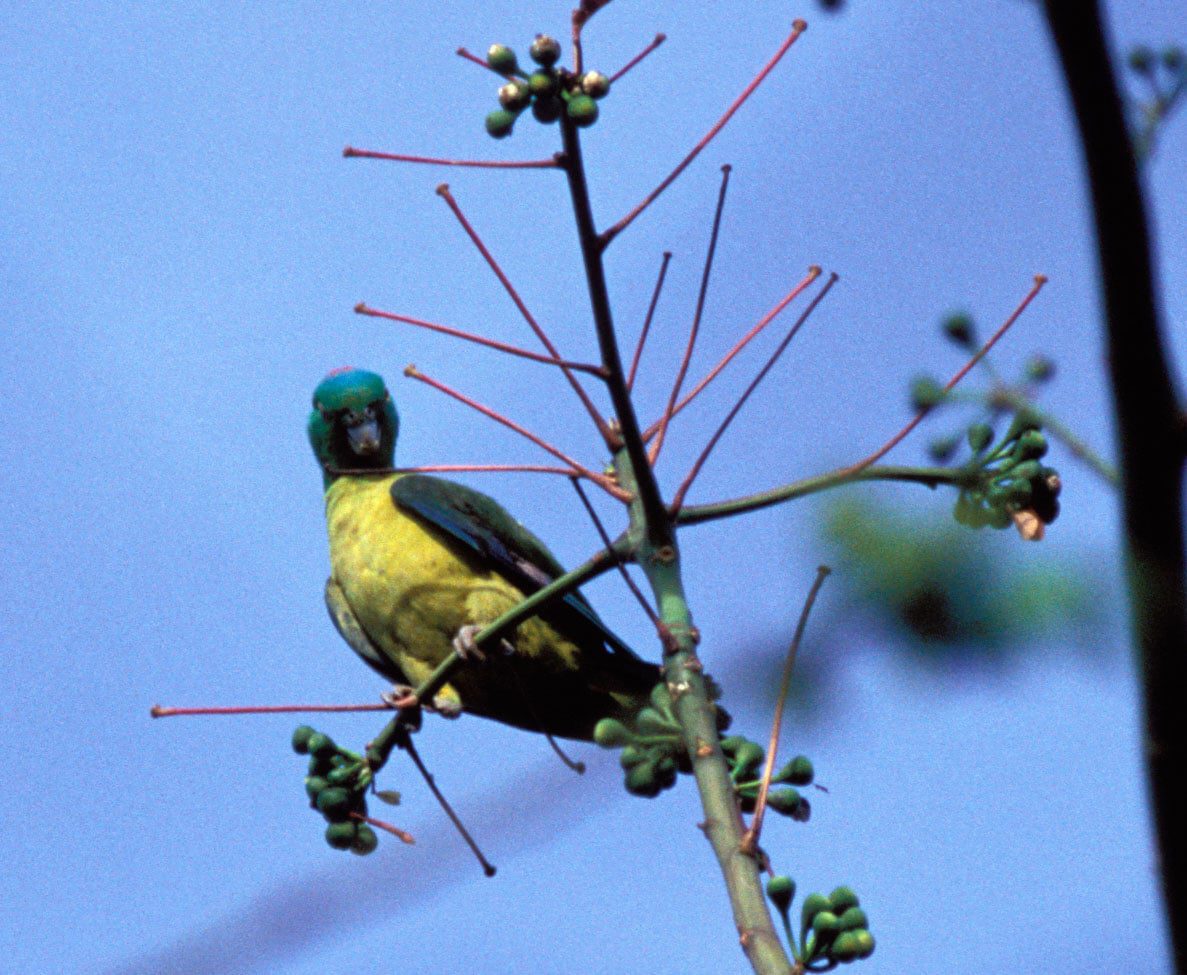
    The head of the Colasisi (Loriculus philippensis) is bright green with a patch of narrow Scarlet color on the front of the Crown, bordered orange-red color on the back edge; yellowish-green Chin: narrow collar on the back of the Orange and red neck, with a wash light yellowish in the neck.

    Bright green upperparts with dark crimson rump and uppertail coverts (lower sides of light blue). Bright green wings with vane internal to the darker flight feathers. Under, the wings of turquoise-blue with the exception of the outermost coverts which are green. Bright red throat Center, merging to red-orange in the center of the chest (yellow on the bases of feathers); rest of the lower region of bright green, lighter and more yellow than the upper region. Upper, the green tail; Blue below.

    Coral red beak; dark brown irises; dark orange legs.

    The female has a face marked in blue and does not have the Red bib, that is replaced by a greenish yellow colour wash. The female Crown is washed in yellow-orange (stronger than in the male).

    Young birds have a more off Crown and paler beak.

    Subspecies description
    Subspecies
    • Loriculus philippensis apicalis

      (Souance 1856): Two aberrant samples previously attributed to theLoriculus salvadorii. They are larger, with less red on the Crown, more blue on the tail, and darker green colour. All the Crown of this subspecies is Scarlet, merging in Orange on the back of the neck and orange on the mantle in both sexes (duller in females). Bright red in the hip and more orange on the top.

    • Loriculus (philippensis) bonapartei

      (Souance 18563): You have the back of the head with pronunciation orange hue, Pico black and grey legs.

    • Loriculus philippensis bournsi

      (McGregor 1905): The male with red only in the front and light yellow area in the center of the Crown (female much less yellow on the Crown), upper part of the Crown of the male less yellow shows that the L. p. Regulus. Orange line on the nape of the male is less clear in the female. Female with less blue in the face that the nominal species.

    • Loriculus philippensis chrysonotus

      (Sclater, PL 1872): Frontal area and rest of the crown bright red that extends in golden yellow color on the mantle, and showing a fine reddish collar on the back of the neck. Male with more orange in the lower part of the throat patch. The female Crown similar but less marked.

    • Loriculus philippensis dohertyi

      (Hartert 1906): Maybe more orange in the mantle, but hardly different to the L. p. apicalis.

    • Loriculus philippensis mindorensis

      (Steere 1890): Orange-yellow on the neck line. Crown Green. More extensive turquoise patch on both sides of the rump.

    • Loriculus philippensis philippensis

      (Statius Mรผller 1776): Nominal

    • Loriculus philippensis regulus

      (Souance 1856): Similar to the L. p. bournsi but male with much more yellow on the Crown (female shows a more subdued yellow broadcast, but more than in the previous race). Nape line weaker than in the bournsi. Male with more Scarlet patch.

    • Loriculus philippensis siquijorensis

      (Steere 1890): Male with less red bib and the red spot of the largest Crown than in the nominal species. Back of the Green Crown. Falata neck mark. Female with more blue in the face.

    • Loriculus philippensis worcesteri

      (Steere 1890): Male Scarlet throat patch smaller than that in the L. p. chrysonotus. Both sexes show a more extensive Crown of orange-red in the rear margin. There is a small patch on the back of the neck of orange color and a light reddish color in the mantle of diffusion.

    • Loriculus (philippensis) camiguinensis

      (Tello, JG 2006): has mainly green plumage, with throat, front side of the face and thighs of azure-blue; the front, the pileus, the obispillo and the top of the red tail, While the rest of the tail is blue. Males and females are identical in appearance, What is unusual in others Philippine parrots, Since only males of other species have red forehead.

    Habitat:

    The species is found along the edges of the forest, secondary growth, Bamboo forests, areas cultivated near villages, orchards and plantations of coconut. The birds are alone, in pairs or in family groups, sometimes in small flocks, sometimes with other birds.

    Reproduction:

    The breeding season has been recorded from April to August.. Three eggs are deposited and incubated by the female during 20 days, the young leave the nest in five weeks.

    Food:

    They feed in the upper levels of flowering plants or fruit trees, sometimes at lower levels, flower, nectar, fruit (including figs) and seeds, sometimes intoxicated by consumption of fermented coconut nectar (coconuts).

    Distribution:

    Limited to the Philippines (less the Sulu archipelago), where are widespread and resident except in Palawan. Its abundance varies according to the subspecies.. In general, the species is locally common up to 1000 meters above sea level, but have been recorded at altitudes of up to 2.500 m (Mount Apo, Mindanao).

    Subspecies distribution
    Subspecies

    Conservation:


    minor concern


    – Current IUCN Red List category: Least concern

    – The population trend: Decreasing

    The world population is considered to be above the 20,000 exemplary but decreasing due to loss of habitat. The subspecies Mindoro is considered as threatened, and both subspecies of Cebu as Siquijor, are nearly extinct the loss of habitat (as these birds are commonly caged and traded between islands, contemporary records of birds from Siquijor they require confirmation to determine whether they refer to the breeds).

    The combined population of Mindoro, Sibuyan, Blacks, Surigao del Sur, Tables, Romblon, Masbate, Ticao, Cuimaras and Basilan (subspecies L. p. mindorensis, L. p. bournsi, L. p. Regulus and L. p. dohertyi) probably add in total not more than 5.000 birds.

    "Colasisi" in captivity:

    Very rare.

    Alternative names:

    Colasisi, Philippine Hanging-parrot (ingles).
    Coryllis des Philippines (French).
    Philippinenpapageichen (German).
    Loriculus philippensis (Portuguese).
    Lorรญculo Filipino (espaรฑol).

    scientific classification:

    Order: Psittaciformes
    Family: Psittaculidae
    Scientific name: Loriculus philippensis
    Genus: Loriculus
    Citation: (Statius Mรผller, 1776)
    Protonimo: Psittacus philippensis

    Images ยซFilipino Loriculusยป:

    Videos "Colasisi"

    ————————————————————————————————

    ยซPhilippine Lorikeetยป (Loriculus philippensis)


    Sources:

    Avibase
    – Parrots of the World โ€“ Forshaw Joseph M
    – Parrots A Guide to the Parrots of the World – Tony Juniper & Mike Parr
    – Birdlife

    Photos:

    (1) – a female perched. by iggino – lynx
    (2) – Birds-pet-wallpapers – link
    (3) – Loriculus philippensis camiguinensis (Author AlexKant) – Crocolandia Foundation – ZooChat
    (4) – Loriculus p. apicalis, male, By iggino – lynx
    (5) – tapety-papousci

    Sounds: David Edwards (Xeno-canto)

    โ–ท The world of Pets: Dogs, cats, birds, reptiles, amphibians

    Guaiabero
    Bolbopsittacus lunulatus


    Guaiabero

    Content

    Guaiabero

    Description

    15 cm.. length between 62 and 77 g. of weight.

    The head of the Guaiabero (Bolbopsittacus lunulatus), is mainly green, strongly impregnated of color blue light around them eyes, in the lores, the chin and (vaguely) on throat. Mantle slightly of a green over dark that it crown, bordered above pale yellowish green.

    Primary coverts blue; the others wing-coverts, greenish. The flight feather with the vane bluish external, alula bluish. Uppertail bright green, great coverts Underwing bordered with yellow; rest of the underwings with pale yellow bar in all vane internal of flight feather (except the primaries outermost). Underparts uniform Green, slightly paler which the upperparts. Tail closed from color green bright by over, pale blue below.

    Bill greyish black; irises dark brown; legs gray.

    The female much less blue sign in the face, and has yellowish the part back from the neck and rump, both showing darker scalloped.

    Immature are like females, but with the bill lighter.

    Subspecies description

    • Bolbopsittacus lunulatus lunulatus

      : (Scopoli, 1786) – Nominal


    • Bolbopsittacus lunulatus callainipictus

      : (Parkes, 1971) – The male is like the intermedius, but with the plumage, in general, more yellow, above all in the underparts; face and neck nuchal darker and more bluish green; cheeks with less blue. The female as in the intermedius, but in general with more plumage yellow; rump and the nuchal collar more yellow and brighter. The youth adult females are.


    • Bolbopsittacus lunulatus intermedius

      : (Salvadori, 1891) – The face male is dark blue tinged with purple; neck brilliant blue. Female bordered blue in the throat; cheeks pale green; Green more pale around them eyes; neck yellow-orange. The youth are like the female adult.


    • Bolbopsittacus lunulatus mindanensis

      : (Steere, 1890) – The cheeks of the male are green, Blue around them eyes, Blue throat; neck darker and brighter blue than the lunulatus; yellow tint to green in the head. The female as of the lunulatus, but the head tinted yellowish-green. The youth adult females are.

    Habitat:

    It inhabits in open forests, forests and their surroundings, secondary vegetation, Savannah, farmland, gardens and mangroves, in the lowlands up to approximately 600 meters above sea level. Birds congregate in fruit trees sometimes in groups of up to 50 Member. Easier to detect in flight. While feeding they move silently and can be difficult to locate..

    Reproduction:

    The ecology of the species is poorly understood.. A female in breeding conditions It was observed during the month of March.

    Food:

    The diet includes fruit, especially the guavas (Psidium guajava)

    Distribution:

    Size of the area of distribution (reproduction / resident): 212.000 km2

    Limited to the lowlands of the Philippine Islands, including Luzon, Mindanao, Samar, Leyte and Panaon.

    Distribution of the subspecies:

    • Bolbopsittacus lunulatus lunulatus

      : Nominal

    • Bolbopsittacus lunulatus callainipictus

      : Samar (central Philippines)


    • Bolbopsittacus lunulatus intermedius

      : Northern Philippines (Leyte and Panaon)


    • Bolbopsittacus lunulatus mindanensis

      : Mindanao (Southern Philippines)

    Conservation:


    minor concern


    โ€ข Current IUCN Red List category: Least concern

    โ€ข Population trend: Stable

    The size of the world population It has not been quantified, Although estimated at more of 50.000 specimens. The species, according to sources, it is enough common in all its limited area of distribution (pit et to the. 1997).

    The population suspected to be stable in the absence of evidence of any reduction or substantial threats.

    "Guaiabero" in captivity:

    Almost unknown in captivity.

    Parrot quiet and gentle. Sensitive to stress and infections, primarily by protozoa. Strict hygiene is necessary to protect this species of infectious diseases. They must be kept in pairs.

    Alternative names:

    Guaiabero (ingles).
    Guaiabero lunulรฉ, Perruche lunulรฉe, Psittacule lunulรฉe (French).
    Stummelschwanzpapagei (German).
    Guaiabero (Portuguese).
    Lorito Guayabero, Lorito Guayabo (espaรฑol).

    scientific classification:

    Order: Psittaciformes
    Family: Psittaculidae
    Genus: Bolbopsittacus
    Scientific name: Bolbopsittacus lunulatus
    Citation: (Scopoli, 1786)
    Protonimo: Psittacus ephypium

    Images "Guaiabero"

    Videos "Guaiabero"

    "Lorito's Guayabero" (Bolbopsittacus lunulatus)

    Sources:

    • Avibase
    • Parrots of the World โ€“ Forshaw Joseph M
    • Parrots A Guide to the Parrots of the World – Tony Juniper & Mike Parr
    • Birdlife

    Photos:

    (1) – Guaiabero (Bolbopsittacus lunulatus) By Luis V. Limchiu [CC BY-SA 3.0, GFDL or Public domain], via Wikimedia Commons
    (2) – A painting of a green parrot by Edward Lear. It looks like a female Guaiabero (Bolbopsittacus lunulatus) Edward Lear [Public domain], via Wikimedia Commons

    Sounds: Paul Noakes (Xeno-canto)

    โ–ท The world of Pets: Dogs, cats, birds, reptiles, amphibians

    Mindanao Racquet-tail
    Prioniturus waterstradti

    Content

    Description

    Mindanao Racquet-tail

    27 cm.. length between 120 and 160 g. of weight.

    The Mindanao Racquet-tail (Prioniturus waterstradti) has the head bright green, with broadcasting slightly more blue-green in the cheeks, the lores and front of the crown. Duller green mantle; olive rump with different shades. The Green wings, with vane Dark internal to the flight feather, narrow marginalized yellow on the edges Interior; carpal edge yellow, wing feathers green; underside of primaries with blue dye.

    The underparts brighter yellowish green, more yellow in undertail-coverts. Upper, the tail green, with side feathers blackish tip; undertail, the tail bluish; Blackish spatulas

    Bill light grey; Brown irises; legs blackish gray.

    females with extensions of tail more short.

    Subspecies:

    • Prioniturus waterstradti malindangensis

      (Mearns, 1909) – Both adults, the color blue in the forecrown and the area under the eyes, paler; less Brown at the back.


    • Prioniturus waterstradti waterstradti

      (Rothschild, 1904) – The nominal

    Habitat:

    It is distributed in the humid montane forest, mainly between 850 and 2000 m, but have been recorded at altitudes of 450 m. Little is known about the habits of this species, that until recently was considered the same species as the Luzon Racquet-tail. Most of the observations refer to small flocks of between two and ten birds.. Apparently lower than other members of its genus is distributed in densities.

    Reproduction:

    There are no data on its reproductive ecology.

    Food:

    Without data

    Distribution:

    Size of the area of distribution (reproduction / resident): 11.300 km2

    Endemic to the Highlands of Mindanao, Philippines. The records come from the Mount Apo, the Mount Malindang, Mount Kitanglad, Mount Mayon, Mount Matutum, Mt. Lebo, Anakan, Civolig, the Mount McKinley, Lake Faggamb and Baracatan, But even though the total population is estimated at 5.000 specimens, currently only limited to five mountains.

    Subspecies distribution:

    • Prioniturus waterstradti malindangensis

      (Mearns, 1909) – Southeast of the mountains of Mindanao (Southeast of Philippines).


    • Prioniturus waterstradti waterstradti

      (Rothschild, 1904) – The nominal

    Conservation:


    Near-threatened


    โ€ข Current IUCN Red List category: Near threatened

    โ€ข Population trend: Decreasing

    In 1993, the population was estimated at 5,000 individuals (Lambert et to the. 1993)

    The population is suspected that it may be declining due to the continuous degradation of the forests and the capture for the cage bird trade.

    Conservation Actions Proposed:

    – Collect data on the impacts of the international and domestic trade.
    – Review the estimate of the population.
    – Calculate loss of forests within their geographic range and altitude using satellite and remote sensing images.
    – Protect effectively important tracts of forest right in key places, both in the areas of strict protection, such as multi-use areas.

    "Mindanao Racquet-tail" in captivity:

    Not found in captivity.

    Alternative names:

    Mindanao Racquet-tail, Crimson-spotted Racket-tailed Parrot, Crimson-spotted Racquet-tailed Parr, Minadnao racket-tailed parrot, Mindanao Montane Racquet-tail, Mindanao Racket-Tail, Mindanao Racket-tailed Parrot, Mindanao Racquet tail, Mindanao Racquet-tailed Parrot (ingles).
    Palette de Mindanao, Palette de Waterstradt, Perroquet ร  raquette de Mindanao (French).
    Mindanao-Spatelschwanzpapagei, Mindanao Spatelschwanz-Papagei, Mindanaopapagei, Mindano-Spatelschwanzpapagei (German).
    Prioniturus waterstradti (Portuguese).
    Lorito Momoto de Mindanao, Lorito-momoto de Mindanao (espaรฑol).

    scientific classification:

    Order: Psittaciformes
    Family: Psittaculidae
    Genus: Prioniturus
    Scientific name: Prioniturus waterstradti
    Citation: Rothschild, 1904
    Protonimo: Prioniturus waterstradti

    Images "Mindanao Racquet-tail"

    Video of the "Mindanao Racquet-tail"

    ————————————————————————————————

    ยซLorito momo de Mindanaoยป (Prioniturus waterstradti)


    Sources:

    Avibase
    – Parrots of the World โ€“ Forshaw Joseph M
    – Parrots A Guide to the Parrots of the World – Tony Juniper & Mike Parr
    – Birdlife

    Sounds: Desmond Allen (Xeno-canto)