โ–ท The world of Pets: Dogs, cats, birds, reptiles, amphibians

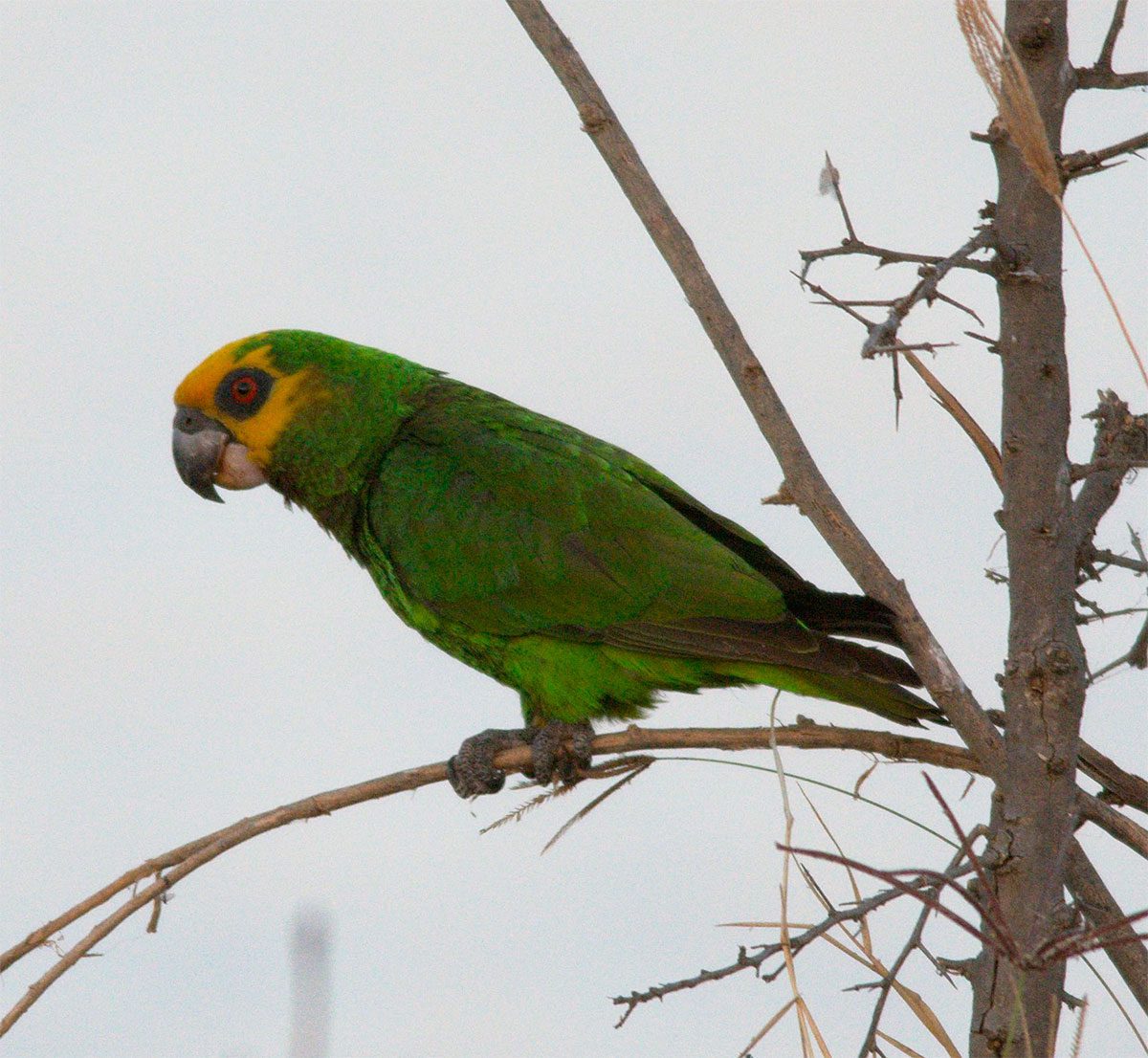
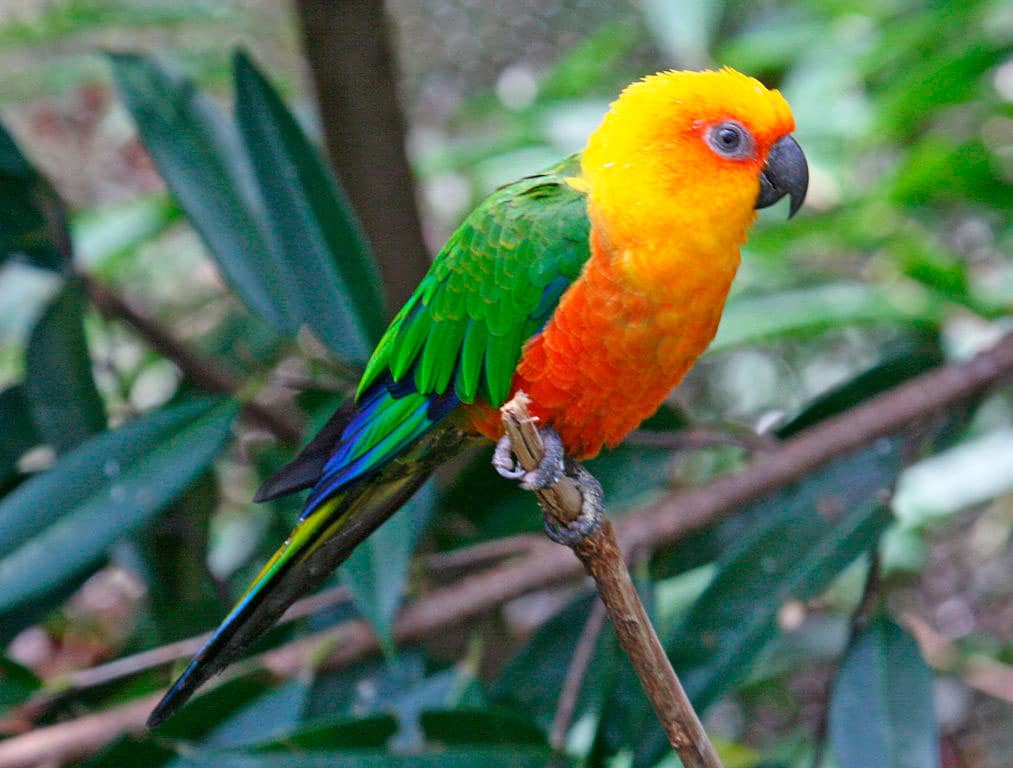
Golden-tailed Parrotlet
Touit surdus

Golden-tailed Parrotlet

Content

Description:

Golden-tailed Parrotlet

16 cm.. length.

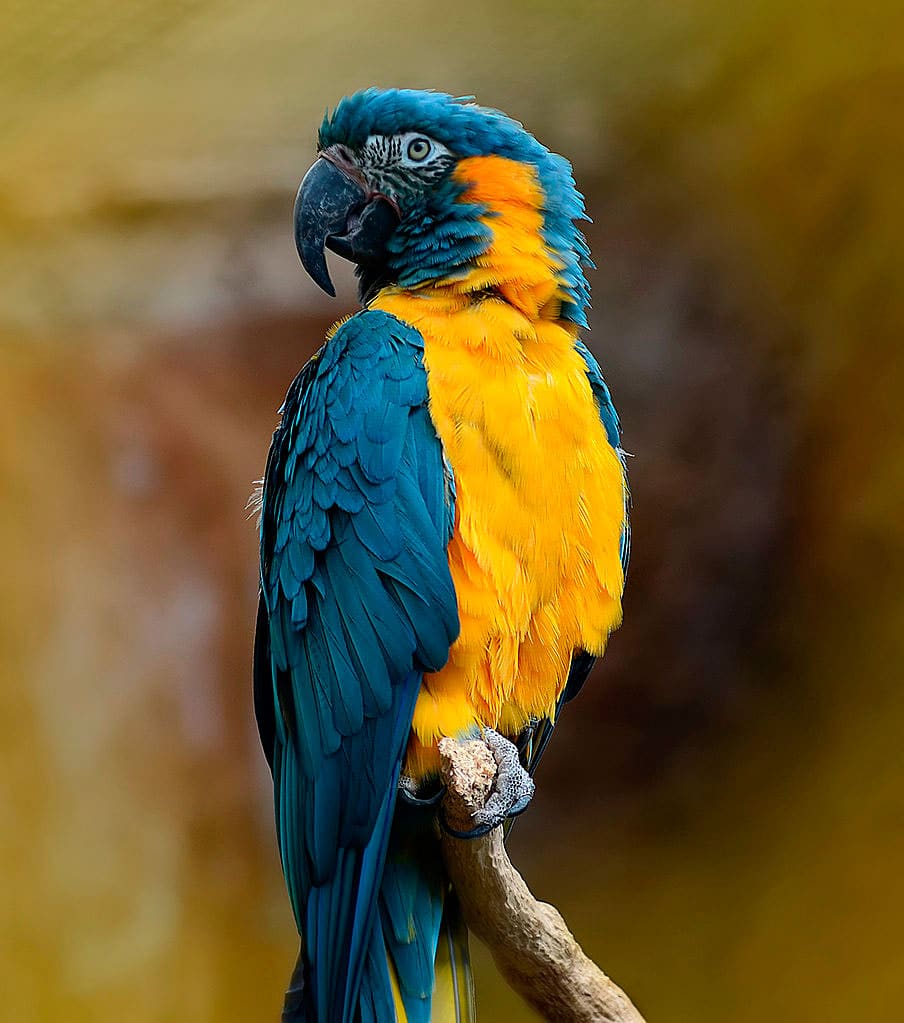
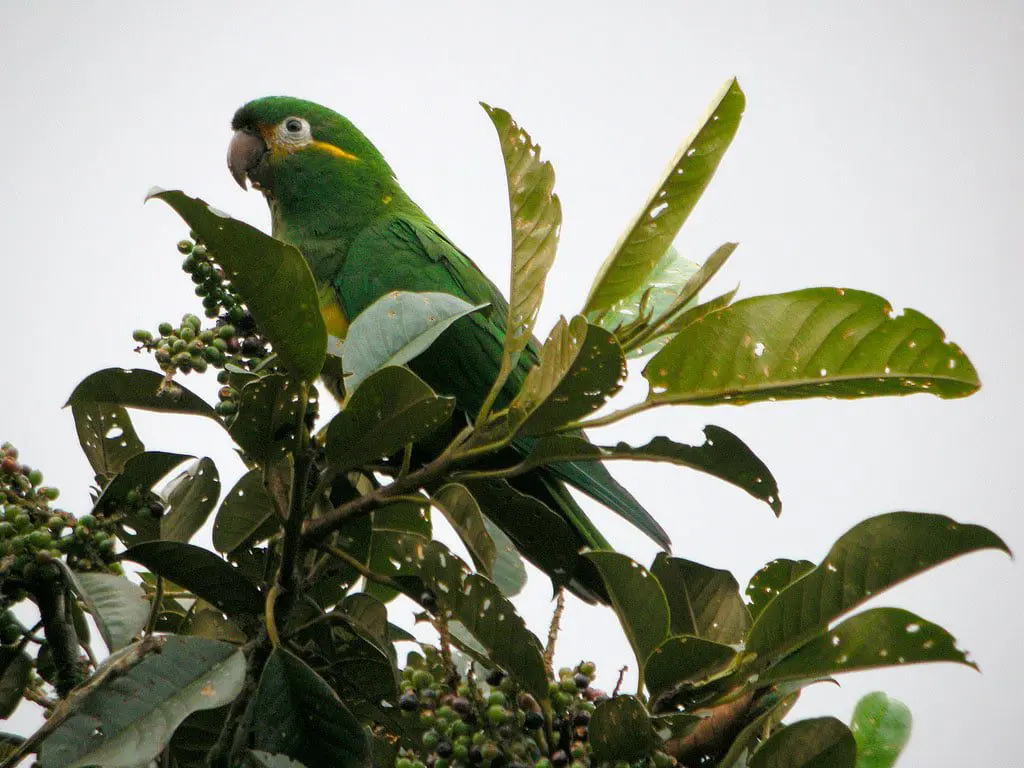
The Golden-tailed Parrotlet (Touit surdus) has a plumage mostly green; the forecrown, lores, supercilii area and cheeks, They are yellowed; crown, rear area of the neck, ear-coverts and sides neck, green with dark narrow margins, giving a scaly appearance.

Mantle and back, green with rump and uppertail-coverts slightly brighter, more emerald. Scapulars and inner tertials, warm brown: primary coverts, dark brown, rest of the coverts green. The the flight feathers They are brown above with narrow green margins to outerweb; brown opaque below. Blue feathers Carpal edge of the wing. Underwing-coverts green. Chin yellowish; chest brighter yellowish green, brighter in the belly and in the undertail-coverts. Tail, centrally green with faint black markings at tips, laterally golden-yellow with narrow black tips on upper surface.. The bill yellow horn; gray irises, legs grey.

The female perhaps duller below, with lateral feathers tail greener and green tips and margins. Immature not described.

Description 2 subspecies:

The subspecies Touit surdus chryseurus it has been proposed to birds of northeastern range on the basis of dubious lateral tail feathers more brownish and smaller.

  • Touit surdus chryseurus

    (Swainson, 1823) – Side tail feathers, brown / yellow; smaller.


  • Touit surdus surdus

    (Kuhl, 1820) – Nominal.

Habitat:

They live mainly in evergreen forests lowland, although occasionally they extend to the adjacent lower mountain slopes. Birds have been observed in the canopy of a secondary forest fragment surrounded by open fields; Other reports suggest that birds visit fruiting trees in deforested areas to feed.

You can visit, occasionally, cocoa plantations where trees shade the crop plants, but this has not been tested. They are to 700 m in Alagoas and to 800 m in Espirito Santo, Rio de Janeiro and Sรฃo Paulo. The Brown-backed Parrotlet They seem to live in flocks (mainly 6-12), perhaps you composed of family groups.

Recent observations suggest that this species is resistant habitat alteration.

Reproduction:

The reproduction of this species practically is not registered. A female observed in September Alagoas, He was not in breeding condition.

Food:

Foods reported in feed Brown-backed Parrotlet are fruits Spondias lutea and Rapanea schwackeana

Distribution:

Size of its range (breeding/resident ): 1.680.000 km2

The distribution of the Brown-backed Parrotlet It extends through Atlantic forests of eastern Brazil, including coastal areas of the northeastern states of Paraรญba, Pernambuco and Alagoas with a record Camocim in the North of Cearรก, where there are fragments of humid forest in coastal areas.

Exist sporadic records but widespread (mainly) on the shores of Bay and Espirito Santo, and in Rio de Janeiro, for example in Teresopolis, around the Itatiaia National Park, new Freiburg and Cabo Frio, with some reports Sรฃo Paulo southwest to Cardoso Island, near the border with Paranรก. The reports of For and Goiรกs They are not substantiated and they are probably wrong. The apparent seasonal distribution of the species in some areas suggests migration trends.

They seem to be distributed at low densities and (except a report in the lower basin tiete river in Sao Paulo) It was considered a rare species in the nineteenth century. Like other members of the genus is, without a doubt, ave a difficult to observe, and often overlooked. But, many ancient villages are no longer inhabited, with forests completely eliminated or severely degraded lowland, especially in the north of the mountain range, where you can be almost extinct. In the news They are distributed in several protected areas.

Distribution 2 subspecies:

Conservation:

State of conservation โ“˜


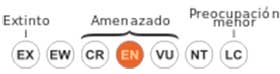
Vulnerable Vulnerable โ“˜ (UICN)โ“˜

โ€ข Current category of the Red List of the UICN: Vulnerable.
โ€ข Population trend: Decreasing.

Population size: 2500-9999 specimens.

Rationale for the Red List category

This species is classified as Vulnerable because its population is small and declining rapidly due to continuous deforestation. It has been found that it is more resistant to forest fragmentation of what was thought first, and may be sub-registered instead of actually little, especially in the southern part of its range.

Justification of the population

The species is generally rare; Its population is located in the band 2.500-9.999 mature individuals, equivalent to 3.750-14.999 individuals, rounded here to 3.500-15.000 individuals.

Justification of trend

rapid and continuous population decline is suspected on the basis of continuous destruction and fragmentation of habitat.

Conservation Actions Underway

CITES Appendix II. It is considered Vulnerable nationally in Brazil (MMA 2014). And protected by Brazilian law. There have been numerous protected areas: Hewn Stone Biological Reserve (Alagoas), Monte Pascoal National Park and Serra das Lontras, Biological Reserve and Private Reserve Serra Nice (Bahia), Great stream, Sooretama and Augusto Ruschi), Desengano State Park and Itatiaia National Park (Rio de Janeiro)

Conservation Actions Proposed

Examine the historical towns and proper habitat to clarify the distribution. Research ecology and seasonal movements. designate murici in Alagoas biological reserve and ensure their protection de facto. Consolidate protected areas distributed.

"Golden-tailed Parrotlet" in captivity:

Rare and unknown in captivity. Any captive individual (it can not be released) It should be part of a conservation program well managed to ensure continuity of this species.

Alternative names:

Golden-tailed Parrotlet, Golden tailed Parrotlet (English).
Toui ร  queue d’or (French).
Gelbschwanzpapagei, Gelbschwanz-Papagei (German).
Apuim-de-cauda-amarela, papagainho, periquitinho, periquitinho-surdo (Portuguese).
Cotorrita Sorda, Lorito de Cola Dorada (espaรฑol).


scientific classification:

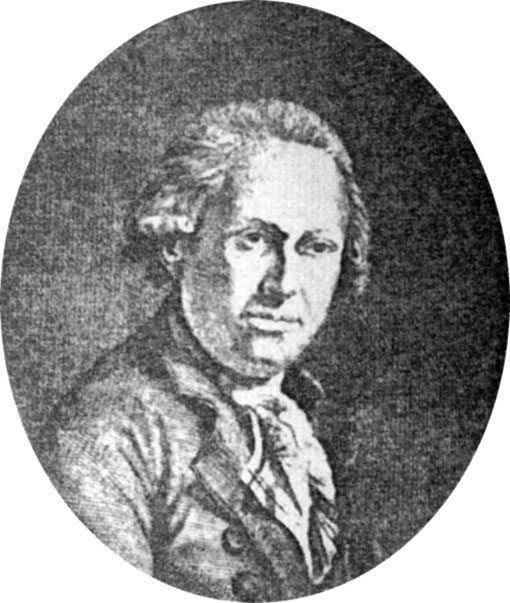
Kuhl, Heinrich
Heinrich Kuhl

Order: Psittaciformes
Family: Psittacidae
Genus: Touit
Scientific name: Touit surdus
Citation: (Kuhl, 1820)
Protonimo: parrot deaf


Images Golden-tailed Parrotlet:

Videos of the "Golden-tailed Parrotlet"

Golden-tailed Parrotlet (Touit surdus)


Species of the genus Touit


Sources:

  • Avibase
  • Parrots of the World โ€“ Forshaw Joseph M
  • Parrots A Guide to the Parrots of the World – Tony Juniper & Mike Parr
  • Birdlife
  • parrots.org

  • Photos:

(1) – Golden-tailed Parrotlet – Touit surdus – Golden-tailed parrotlet by Ciro Albano

youtube.com/watch?v = ZaWxtXYx6U

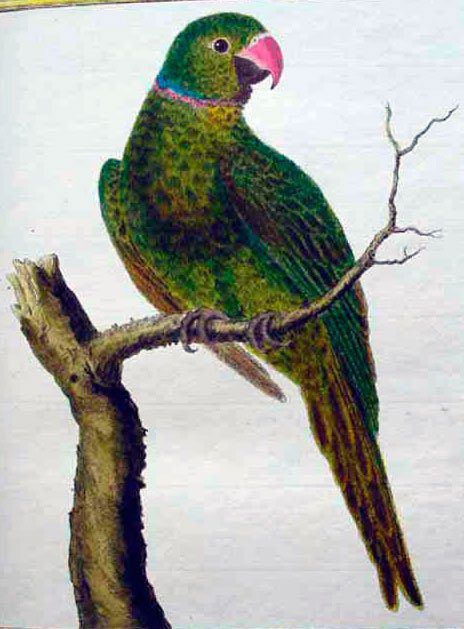
(2) – Urochroma deaf By Blanchard, Emile; Bonaparte, Charles Lucian; Bourjot Saint-Hilaire, Alexandre; Le Vaillant, Franรงois; Souancรฉ, Charles de. [CC BY 2.0 or Public domain], via Wikimedia Commons

โ–ท The world of Pets: Dogs, cats, birds, reptiles, amphibians

Hispaniolan Parrot
Amazona ventralis

Hispaniolan Parrot

Content

Description:

28-31 cm.. length and 250 g. of weight.

The Hispaniolan Parrot (Amazona ventralis) has the forecrown Lords color and white (variable extension); the crown and upper cheeks with blue feathers and black colored ends; ear-coverts and lower cheeks, charcoal colored (variable measure); feathers nape and the sides of the neck, emerald green with visible black tips.
Hispaniolan Parrot
Mantle and back green grass with black tips, which become progressively less visible to the bottom; rump green, slightly yellowish; uppertail-coverts brighter yellowish green. greater coverts blue; remaining coberteras grass-green. Primaries and secondaries, blue, darker towards the tips, on the innerwebs. Under the wings, green; flight feather bluish green.

The underparts usually green, slightly yellowish, with most feathers showing fairly conspicuous black margins (especially in the upper region) but sometimes with some red feathers chin; patch resizable brown in the center of belly; undertail-coverts pale yellow-green. Upper, the tail is green (perhaps a little darker than the rest of the upperparts) with visible yellowish tip and outerweb external feathers with blue margins; undertail, the tail It is yellowish with the bases of the outer feathers red. Bill Pink; cere brownish white; skin bare periophthalmic white; brown the irises; legs pale grey.


Anatomy-parrots

There is no sexual dimorphism. Immature as an adult but less blue in the crown and the patch abdominal is paler brown.

NOTE

Some authors consider that the Hispaniolan Parrot It conspecific (belonging to the same species) with the Cuban Parrot. Although closely related, It is believed to be quite different due to differences in hue pronounced plumage.

  • Sound of the Hispaniolan Parrot.

Habitat:

Video "Hispaniolan Parrot"

The Hispaniolan Parrot They are distributed in a variety of forested habitats, from lowland sandy palm savannahs to montane pine forests and moist montane forests. Currently most commonly observed in montane forests on the island Hispaniola, due to continued deforestation, although birds also feed at lower altitudes. Observed above 1,500 m (Hispaniola).

Views in pairs during breeding; outside the breeding season, observed in small flocks, usually up to a dozen birds; much larger meetings, until 500 reported in the nineteenth century birds. Couples and couples with young often identifiable in flocks.

Reproduction:

Nests generally constructed in tree cavities, but also in rock crevices, cactus voids and cavities in coconut. Territorial and very aggressive while playing. The breeding season It covers the months of February to May. Clutch 2-3 eggs.

Food:

They feed on, among others, of seeds or fruits of Caesalpinia, Psidium and Ficus, seeds of oranges wild Citrus, corn and bananas.

Distribution:

Size of its range (breeding/resident): 99.000 km2

The Hispaniolan Parrot are distributed by the islands of Hispaniola (Dominican Republic and Haiti), Gonave Island (Haiti), Isla Saona (Dominican Republic), Puerto Rico and probably Snake (Puerto Rico) in the West Indies. It is found in moderate numbers in parts of the Sierra de Bahoruco, Sierra Neiba and Cordillera Central in Dominican Republic. More restricted and less numerous in Haiti, with the remaining population apparently largely in the south of the country.

introduced in Puerto Rico, where the wild population derived from captive birds escaped and at least one consignment of illegally traded birds were released after discovering an attempt to import Puerto Rico. Also wild populations in US Virgin Islands.

Formerly very common in Hispaniola, although there have been during the twentieth century a strong decline in its population, mainly due to the habitat destruction (arising from agriculture and charcoal production). As well persecuted due to crop damage, hunted for food and trapped for sale as pets at local and international level.

In the Decade of 1930 It was limited to the interior mountain forests of the island of largely Hispaniola.

Although it remains locally common, it is enough rare and rare in the wild.

The population in Puerto Rico It is at least several hundred birds and apparently increasing.

Conservation:

State of conservation โ“˜


minor concern Minor Concern โ“˜ (UICN)โ“˜

โ€ข Current category of the Red List of the UICN: Vulnerable.

โ€ข Population trend: Decreasing.

โ€ข Population size : 6000-15000

Rationale for the Red List category

This species is considered Vulnerable because anecdotal evidence suggests there has been a rapid reduction of the population. The size of the population and the exact extent of the decline are unclear, clarification and may lead to the species be reclassified as near threatened.

Justification of the population

The population size It is preliminarily estimated to fall in the band between 10.000 and 19.999 individuals. This is equivalent to 6,667-13,333 mature individuals, rounded here to 6,000-15,000 mature individuals.

Justification of trend

No new data on population trends, but it is suspected that the species is declining quickly, as a result of the hunting, the loss of habitat and capture.

Threats

The agricultural conversion and charcoal production have destroyed the most suitable habitat. It is also persecuted as a crop pest, hunted as food and trapped for Local trade and above for international trade cage birds. (Juniper and Parr 1998).

Trapping adults and stealing hatchlings from nests to supply the Local pet trade It is a particular concern because in some areas most families own a parrot, and they only live a few years before they have to be replaced (G. Woolmer in some. T. White one bit., 2012). It also, activities theft nests often they cause destruction of the nest cavity or nest tree, further aggravating the loss of nesting habitat other causes (T. White in a little .

Conservation Actions Underway

โ€ข CITES Appendix II.

โ€ข You have started a education strategy with community participation to protect species (Vasquez et to the., 1995).

โ€ข In 1997-1998, 49 birds bred in captivity were released and you radiographed in East National Park, Dominican Republic (Vilella et al., 1999).

โ€ข The Biological Reserve Loma Charco Azul, created in 2009, It has populations of the species. in addition, They have carried out recent activities public education and outreach, including some actions of law enforcement, in several communities surrounding the Jaragua National Park, near the border with Haiti.

โ€ข In January of 2012 there was also a Liberation of 10 parrots raised in captivity they had been confiscated as young chicks from poachers nests. These chicks were raised and rehabilitated in National Zoological Park, and released successfully in the grounds of the zoo (T. White in a little ).

Conservation Actions Proposed

โ€ข Assess current population size.

โ€ข Establish a program of comprehensive monitoring.

โ€ข Determine at extension remaining habitat.

โ€ข Determine the impact of various threats.

โ€ข Apply laws and regulations that protect this species and its habitat (Snyder et to the., 2000).

โ€ข Promote better bird-keeping practices to reducing demand for wild birds and develop a captive breeding program.

โ€ข Educate the public about the negative impact of pet trade in native Dominican Republic (T. White in a bit., 2012).

The Hispaniolan Parrot in captivity:

It is easily reproduced in captivity and used as substitute mother to raise the young Puerto Rican Parrot as part of the recovery program for the species (highly threatened).

Each captive specimen of this species which is capable of reproducing, It is placed in a well-managed program captive breeding and not be sold as a pet, with the objective of ensure their survival long-term.

Alternative names:

Hispaniolan Amazon, Hispaniolan Parrot, Salle’s Amazon, Salle’s Parrot, San Domingo Amazon, San Domingo Parrot (English).
Amazone ร  ventre pourpre, Amazone de Sallรฉ, Amazone d’Hispaniola (French).
Blaukronenamazone, Haitiamazone (German).
Papagaio-de-hispaniola (Portuguese).
Amazona de la Espaรฑola, Amazona Dominicana, Cotorra, Cotorra de la Espaรฑola (espaรฑol).

scientific classification:

Order: Psittaciformes
Family: Psittacidae
Genus: Amazona
Scientific name: Amazona ventralis
Citation: (Statius Mรผller, 1776)
Protonimo: Psittacus ventralis

Images Hispaniolan Parrot:


Species of the genus Amazona


Sources:

  • Avibase
  • Parrots of the World โ€“ Forshaw Joseph M
  • Parrots A Guide to the Parrots of the World – Tony Juniper & Mike Parr
  • Birdlife

Photos:

(1) – The parrot Cuca – Cuca The Parrot by Jose Uribe AlneyFlickr
(2) – Hispaniolan Amazon. Two in a cage By TJ Lin (originally posted to Flickr as DSCN0712) [CC BY-SA 2.0], via Wikimedia Commons
(3) – Couple of parrots Amazona ventralis in the Jaragua National Park, Dominican Republic By Yolanda M. Leon (Own work) [Public domain], via Wikimedia Commons
(4) – A Hispaniolan Amazon in a cage By Patrick Hawks (originally posted to Flickr as Hispaniolan Parrot) [CC BY-SA 2.0], via Wikimedia Commons
(5) – Blaukronenamazone (Amazona ventralis) Bรกvaro, Punta Cana, Dominican Republic By Martingloor (Own work) [CC BY-SA 4.0], via Wikimedia Commons
(6) – BARRABAND, Jacques (1767/8-1809) [male red-faced parrot (Hispaniolan Amazon [Amazona ventralis])] From Natural History of Parrots (by Francois Levaillant, 1801-1805) – Wikimedia

Sounds: Ante Strand, XC15749. accessible www.xeno-canto.org/15749

โ–ท The world of Pets: Dogs, cats, birds, reptiles, amphibians

Mexican Parrotlet
Forpus cyanopygius

Mexican Parrotlet

Content

Description:

Mexican Parrotlet

13โ€“14 cm. in length and 30โ€“37 grams in weight.

The Mexican Parrotlet (Forpus cyanopygius) has lores, cheeks, forecrown and headphones coverts, brighter yellowish green.

The average area crown to the top of the back, green; lower back, rump and uppertail-coverts, turquoise. big blankets turquoise, other coverts, green. Primaries green, secondaries dark turquoise blue color with narrow edges outerweb. Under the wings turquoise blue and green, the flight feather dark blue-green. Underparts green tinged with yellow. Upper, the tail is green; undertail, duller. Bill and cere pale grayish; bare periophthalmic grey; irises dark brown; legs pink.

Female all green. Immature as female, with some blue feathers on the rump and in the wing-coverts, in the case of young male.

hybrids:

Forpus [conspicillatus x cyanopygius] (hybrid)
Forpus [heaven x cyanopygius] (hybrid)
Forpus [cyanopygius x passerinus] (hybrid)

  • Sound of the Mexican Parrotlet.

Description 2 subspecies:

Two subspecies. But, some authorities regarded the northern birds range as a third subspecies (Forpus cyanopygius pallidus), doubtfully distinct from the nominees. See also Note on Blue-winged Parrotlet (Forpus xanthopterygius).

Habitat:

The habitat of the Mexican Parrotlet They are gallery forests and deciduous forests, plantations, scrub, semiarid open field and trees cultivated areas; mainly observed in lowlands and foothills with the highest number of records in the south of Sonora to 360-455 m; at higher altitudes in western Durango and Zacatecas, with upper limit to 1.320 m.

Birds in breeding abilities have been observed above the 900 meters indicating possible breeding at higher altitudes. Gregaria, forming flocks 4-30 or more, sometimes in the company of Orange-fronted Parakeet (Eupsittula canicularis).

Reproduction:

breeding season may July. Clutch three eggs in captivity.

Food:

Little information about diet or creation: birds observed taking fruits the Ficus, berries and grass seed soil.

Distribution and status:

Size of its range (breeding/resident): 177.000 km2

Endemic West Mexico from Alamos in the South of Sonora to the South by Sinaloa, Nayarit (including the Islands Three Marias) and Jalisco until Colima, with the southernmost record in the Manzanillo Bay (19 ยฐ 03โ€™N).

Its range extends eastward Durango and Zacatecas. irregular population with widely fluctuating local abundance, perhaps in relation to the availability of local foods. There has been a large-scale modification of habitats within range but the species remain common (at least locally). The birds in the Tres Marias Island Perhaps they are in risk of extinction.

Distribution 2 subspecies:

Conservation:

State of conservation โ“˜


Near-threatened Near Threatened โ“˜ (UICN)โ“˜

โ€ข Current category of the Red List of the UICN: Near-threatened.
โ€ข Population trend: In decline.

Rationale for the Red List category

The species has risen to near threatened because its population has probably been reduced to a rate close to 30% during three generations (12 years), depending on the estimated operating levels and reducing the area of รขโ‚ฌโ€นรขโ‚ฌโ€นoccupancy and extent of occurrence; almost meet the listing requirements as threatened under the criteria A2cd + 3cd + 4cd. If the declinations are found to exceed the 30% then the species would qualify to lift to Vulnerable. If there is evidence suggesting that the global population of this species is <10.000 mature individuals, And it is suffering a continuous decrease of> 10% in three generations (until 100 years in the future), would also qualify to lift Vulnerable.

Justification of the population

Partners in Flight estimated that the population in number of less than 50.000 individuals (A. Punjabi in some. 2008), so it is placed in the band 20.000 to 49.999 copies here.

Justification of trend

It is suspected that the population is declining rapidly due to moderately heavy pressure from his capture by illegal trade (Cantu et al ., 2007, Marรญn-Togo et al ., 2012). According to reports, the population of the island Three Marias It has decreased (Collar y Bushman 2014).

Threats

The capture for trade in wild birds It poses a serious threat to a 8.000 individuals illegally caught per year (Cantu et al ., 2007). The range of the species is within one of the main routes for the illegal trade of parrots in Mexico and it is thought that the heavy exploitation of the species is an important factor in their apparent absence of suitable habitat areas.

Conservation actions and research in progress

CITES Appendix II.

Conservation and research actions proposed

Implement legislation to prevent illegal trade. Raise awareness of the species.

"Mexican Parrotlet" in captivity:

Quite frequently seen in aviculture.

Capture for trade in wild birds represents a serious threat to a 8.000 individuals illegally caught per year.

In captivity is not a very long-lived bird; according to sources a specimen lived 10,5 years in captivity.

Each captive specimen of this species which is capable of reproducing, should be placed in a well-managed captive breeding program and not be sold as a pet, in order to ensure its long-term survival.

Alternative names:

Blue-rumped Parrotlet, Mexican Parrotlet (English).
Perruche-moineau ร  croupion bleu, Perruche-moineau turquoise, Toui du Mexique (French).
Blaubรผrzel-Sperlingspapagei (German).
Tuim-mexicano (Portuguese).
Catita Enana Mejicana, Cotorrita Mexicana, Perico Catarina, Periquito Mexicano (espaรฑol).

scientific classification:

Order: Psittaciformes
Family: Psittacidae
Genus: Forpus
Scientific name: Forpus cyanopygius
Citation: (Souancรฉ, 1856)
Protonimo: Psittacula cyanopygia

Images Mexican Parrotlet:

Video of the "Mexican Parrotlet"

"Mexican Parrot" (Forpus cyanopygius)


Species of the genus Forpus

โ–ท The world of Pets: Dogs, cats, birds, reptiles, amphibians

Glaucous macaw โ€ 
Anodorhynchus glaucus

Glaucous Macaw

Content

Description:

72 cm.. length.

Glaucous Macaw

The plumage general of the Glaucous Macaw (Anodorhynchus glaucus) It is light blue, almost turquoise top, with strong grayish hue in head and underparts.

Uppertail greenish blue; undertail gray.

The bill It is dark blackish gray, the naked flames in the base lower jaw they are yellow, but paler than the periophthalmic skin; the irises is dark brown, the periophthalmic skin Nude yellow; the legs They are dark.

Habitat:

probably he occupied subtropical gallery forests with cliffs, but also used lightly wooded savannas and rich in palm trees. The few contemporary records suggest it was naturalists gregarious.

Reproduction:

It has been reported that anidaba on steep slopes or cliffs, or less generally in the cavities of trees and the average size of laying It was probably two eggs

Food:

Its diet It was probably basic nuts palm Butia horizontal (nearest equivalent in rank to size nuts Syagrus used by the Indigo Macaw, It is having the same dimensions peak).

Distribution:

Extending its range (breeding/resident): 1 km2

the Glaucous Macaw They were distributed at the time by the south-eastern South America, where apparently they were recorded in average growth of the main rivers, including Parana River, the Uruguay River and the Paraguay River, with most of the evidence of a prior distribution in the province of Currents, to the North of Argentina; cases were also recorded in western Uruguay and Southeast of Brazil (Rio Grande do Sul and Paranรก), and evidently in the south and east of Paraguay. The records of Bolivia They seem wrong. Almost certainly extinct after a precipitous decline in the early 19th century. Only two records in the twentieth century.

Conservation:

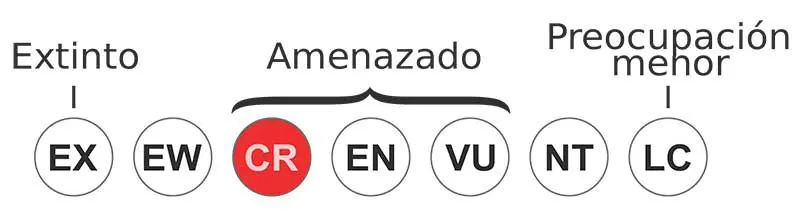
โ€ข Current category of the Red List of the UICN: Critically Endangered.

โ€ข Population trend: Unknown.

โ€ข Population size : 1-49 individuals.

Rationale for the Red List category

This species was last recorded in the 1990s. 1960 and it is likely that its population has declined dramatically as a result of hunt, Besides the degradation and habitat destruction. But, you may still exist, since not all its wide range of data, above wide, It has been adequately studied, and there have been persistent and convincing local reports. Any remaining population is likely to be small., and for these reasons it is treated as in Critically Endangered.

Justification of the population

It is assumed that any remaining population is small (counting less than 50 individuals) due to lack of confirmed records since the early 1960.

Threats

The settlement of the major river basins within its range was allegedly accompanied by the widespread loss of palms, whether by direct cleaning for agriculture or suppression of regeneration by livestock settlers. The palma de Horizontal, of the species probably fed, It was chosen to be cleared by early settlers because it was an indicator of good soil quality (Necklace et to the. 2014). The widespread loss of gallery forests could also have had an impact on the species. (Necklace et to the. 2014). The size and appearance of the bird probably made him a prime target for hunters, and even capture hatchlings as pets could have been important. There is some evidence that were sold, but few to support various claims that there has been recent trade in live specimens.

Any current trade in eggs, skins or live specimens would obviously be extremely damaging.

Conservation actions underway

    Appendix I of CITES and protected by Brazilian law.

    – There have been several attempts (so far unsuccessful) to rediscover the species.

    – There are proposals for funding under way to try to fund a work program to confirm the presence of this species in the wild.

Conservation Actions Proposed

    – Conducting interviews with the local population, especially with parrots and ancient hunters assets, to assess the likelihood of any population remains.

    – Getting ready to follow up any positive data from these interviews.

"Glaucous macaw โ€ " in captivity:

There is some evidence that were sold, but few to support various claims that there has been recent trade in live specimens.

Alternative names:

Glaucous Macaw (inglรฉs).
Ara glauque (francรฉs).
Tรผrkisara (alemรกn).
arara-azul-pequena, arara-celeste, guacamaio (portuguรฉs).
Guacamayo Azul, Guacamayo Glauco, Guacamayo Violรกceo, Papagayo violรกceo (espaรฑol).
Guacamayo azul (Argentina).
Papagayo violรกceo (Paraguay).
Guacamayo Azul (Uruguay).

scientific classification:

Order: Psittaciformes
Family: Psittacidae
Genus: Anodorhynchus
Scientific name: Anodorhynchus glaucus
Citation: (Vieillot, 1816)
Protonimo: Macrocercus glaucus

Images Glaucous Macaw:


Species of the genus Anodorhynchus

ยซGuacamayo Glaucoยป (Anodorhynchus glaucus)


Sources:

Avibase
– Parrots of the World โ€“ Forshaw Joseph M
– Parrots A Guide to the Parrots of the World – Tony Juniper & Mike Parr
Birdlife

Photos:

(1) – digital recreation of glaucous macaw. The background with Butia yatay is courtesy of http://floradeluruguay.blogspot.com/2010/05/butia-yatay.html , Andrรฉs Gonzรกlez. By Rod6807 (Martin Rodrรญguez Pontes) (Own work) [CC BY-SA 3.0], via Wikimedia Commons
(2) – Anodorhynchus glaucus by Huub Veldhuijzen van Zanten / Naturalis Biodiversity Center [CC BY-SA 3.0], via Wikimedia Commons
(3) – Anodorhynchus glaucus by Huub Veldhuijzen van Zanten / Naturalis Biodiversity Center [CC BY-SA 3.0], via Wikimedia Commons
(4) – Anodorhynchus glaucus By Vieillot, 1816 [CC BY-SA 3.0], via Wikimedia Commons
(5) – Anodorhynchus glaucus by Huub Veldhuijzen van Zanten / Naturalis Biodiversity Center [CC BY-SA 3.0], via Wikimedia Commons
(6) – Early illustration of the Glaucous Macaw illustration from Bourjot Saint-Hilaire, 1837-1838 By Bourjot Saint-Hilaire [Public domain], via Wikimedia Commons

โ–ท The world of Pets: Dogs, cats, birds, reptiles, amphibians

Raiatea parakeet โ€ 
Cyanoramphus ulietanus

Raiatea Parakeet

Content

Description:

25 cm.. length.

The Raiatea Parakeet (Cyanoramphus ulietanus) had the head blackish brown, paler on neck, Rump and wings. The lower part of the back and tail coverts were brownish-red; and under wing-coverts and outerweb the flight feathers were gray-blue. There was a gray border on the feathers primaries and secondaries. The chest, the abdomen and the under tail were yellow olive. The feathers of the middle tail were olive brown. The outer feathers tail were gray.

The irises were probably orange-red in the adult and juvenile brown. The legs were grayish brown. The bill was pale blue-gray or gray-brown to black tip. The males and females They looked similar.

Habitat:

It is believed that it was a kind forest, when the Society Islands They were all wooded.

Reproduction:

It knows nothing about the reproductive habits of this parrot or why died.

Food:

Nothing is known about the eating habits of this parrot.

Distribution:

Of the Raiatea Parakeet only known from two specimens in Raiatea, in the Society Islands of the french polynesia (Forshaw and Cooper 1989), collected on the trip Cook in 1773, and now Vienna and Tring (Knox y Walters 1994).

Conservation:

โ€ข Current category of the Red List of the UICN: EXTINCT.

Rationale for the Red List category

This species was known in the Isla de Raiatea, french polynesia, but now it is extinct, probably as a result of habitat or cleaning action of invasive species.

Justification of the population

There remains no existing population.

It is believed that the two bodies of this parrot that remain dissected in two museums, the Natural History Museum London and the Naturhistorisches Museum, They were collected by Georg Forster in 1773 or 1774 during the second voyage of Capitรกn Cook (Stresemann 1950). But, Medway (2009), based on the travel journal Joseph Banks, He thought they were collected in November 1777 during the third trip Cook. It seems likely that no collection will be made on Raiatea in 1768 during the first trip Cook, since the natives were hostile, which is why Forster probably obtained both specimens in the second. But, There is some confusion as to the locality, but Forster (1844) he refers to a "Psittacus pacificus" seen en Otaheite (tahiti) and Oriadea (Raiatea), from where Greenway (1967) presumed that found and collected Cyanoramphus zealandicus in Tahiti and C. ulietanus in Raiatea. unusually, Forster He did not consider the two species as different.

Alternative names:

Raiatea Parakeet, Society Parakeet, Society Parrot (English).
Kakariki de Raiatea, Perruche de Raiatea (French).
Braunkopf-Laufsittich, Raiateasittich (German).
Periquito-de-raiatea (Portuguese).
Perico de Raiatea (espaรฑol).

scientific classification:

Gmelin Johann Friedrich

Order: Psittaciformes
Family: Psittaculidae
Gender: Cyanoramphus
Scientific name: Cyanoramphus ulietanus
Subpoena: (Gmelin, JF, 1788)
Protonimo: Psittacus ulietanus

Sources:

โ€ข Avibase
โ€ข Parrots of the World โ€“ Forshaw Joseph M
โ€ข Parrots A Guide to the Parrots of the World – Tony Juniper & Mike Parr
โ€ข Birdlife

Photos:

(1) – Illustration of the society parakeet (Cyanoramphus ulietanus) by Mr thrice [CC BY-SA 4.0], from Wikimedia Commons

โ–ท The world of Pets: Dogs, cats, birds, reptiles, amphibians

Yellow-crested cockatoo
Cacatua sulphurea

Yellow-crested cockatoo

Content

Description

Medium-sized, 35 cm.. long.

Yellow-crested cockatoo

The Yellow-crested cockatoo (Cacatua sulphurea) It is distinguished by its long, thin yellow erectile crest, that curves forward, and extending upward, above the nape, when it folded. The front of his crown and main feathers crest, are white. The rest of your plumage It is also white, except in yellow suffusion ear-coverts, under the wings and in the innerwebs of the undertail-coverts. The bases of the hackles and underparts, They are yellowed; some birds show a slight yellow tone, particularly on chest and the belly. The bill It is black; eye ring pale bluish; irises dark brown; legs grey. The female is similar to the male but with the irises reddish and slightly smaller.

The young birds They show both sexes irises dark taupe, although females They begin to acquire the red coloration in the first year. The bill and legs immature are also lighter.

Description 4 subspecies
  • Cacatua sulphurea abbotti

    (Oberholser, 1917) – Similar to the parvula, but largest.

  • Cacatua sulphurea citrinocristata
  • Cacatua sulphurea citrinocristata

    (Fraser, 1844) – Slightly larger than the nominal, with one crest orange & ear-coverts orange yellow. Additional research may provide a basis for improving this subspecies to a specific status..

  • Cacatua sulphurea parvula

    (Bonaparte, 1850) – Similar to the nominal species, but with the ear-coverts paler and less yellow on yellow feathers underparts. the size of the bill in this subspecies it increases clinically towards the west.

  • Cacatua sulphurea sulphurea

    (Gmelin, 1788) – Nominal.

Habitat:

Video – "Yellow-crested cockatoo" (Cacatua sulphurea)

SULPHURE COCKATUA

They inhabit at the edges of the forest, wooded areas, farmland, cocoteros, semi-arid areas and forests until the 800 m (locally 1.200 m).

The Yellow-crested cockatoo usually they found in pairs or small groups of up to ten individuals, although they may meet in larger flocks to feed on fruit trees. They can form flocks with Eclectus Parrot (Eclectus roratus).

They tend to be noisy and visible, but can be difficult to spot when moving silently in the canopy, and they are more often in flight. The groups who leave their resting places in the montane forest areas frequently displace forage at lower altitudes including cultivated fields. Pairs may hover conspicuously above the forest canopy searching for fruitful trees, allowing a reasonably close approach when resting on a branch.

The crest It is generally stands when landing, or when an individual is making calls from a perch. Like most of the Cockatoos They enjoy a bath in the rain.

Reproduction:

Specimens of Yellow-crested cockatoo on the island of button in State reproductive during the months of September and October, although Nusa Tenggara the breeding It occurs in the months of April and May. The female It lays two or three white eggs in the hollow of a tree, and incubation lasts around 28 days with both parents participating. Chicks they leave the nest to 10 weeks and are dependent parent for about two months.

Food:

They feed in trees and soil. Its diet It includes seeds, corn (Zea mays) of cultivated fields, fruit, berries, egg yolks, flowers and nuts (including large coconuts (cocos nucifera)).

Distribution and status:

Size of its range (breeding/resident ): 1.360.000 km2

The Yellow-crested cockatoo They are confined Indonesian, where they can be seen in the lowlands Isla Celebes (virtually extinct in the north), islands in the Flores sea, in Nusa Tenggara and isolated islands Masalembu in the Java Sea.

introduced in Singapore and Hong Kong. The species is found in both wooded areas and cultivated and is scarce throughout its range. It is estimated that the world population total is less than 40.000 birds and is decreasing. Although populations of the nominal subspecies and of the subspecies parvula may still be close to 10.000 specimens, the citrinocristata subspecies It has an estimated population between 800 and 7.200 only individuals, having declined by 80% between the years 1986 and 1989, while the distinctive subspecies abbotti It is now represented by only nine individuals in nature.

Although habitat loss is clearly a factor in Sumba, where distribution appears to be linked to the extent of primary forest (is only about 15% the original forest), trade is the main threat to the species as a whole. Trade data show that exported almost 100.000 birds in years 1980-1992. The export citrinocristata subspecies It was banned in 1992 by local authorities, and 26 birds were confiscated in September of that year. There are probably at least 50 individuals of each subspecies in public collections and more than 2.000 in private aviculture, although the numbers for the subspecies abbotti They are unknown.

Distribution 4 subspecies

Conservation:

State of conservation โ“˜


critical hazard critically endangered โ“˜ (UICN)โ“˜

โ€ข Current category of the Red List of the UICN: critically endangered.

โ€ข Population trend: Decreasing.

Its crashing fall It is almost entirely attributable to the unsustainable exploitation for domestic and international trade. Logging to the conversion of forests for agriculture as well as the use of pesticides for land and large-scale.

Justification of the population

Based on recent surveys in various parts of the range of the species, C. Trainor in some (2007) It has been estimated the world population in less than 7.000 individuals: 3.200-5.000 en Sumba (though perhaps only 562 in 2012, Burung Indonesia en preparaciรณn), 500 en Komodo, 200-300 en Timor Leste, 200-300 en Sulawesi, 20-50 in West Timor, 40-70 Flores, 50-100 en Sumbawa, 100 in Rinca and other 700 birds in total. The best data is located in the band 2.500-9.999 individuals, equivalent to 1.667-6.666 mature individuals, rounded here to 1.500-7.000 mature individuals.

Conservation actions and research in progress

CITES Appendix I (2005). It has developed and adopted a recovery plan cooperative and has prepared an update 2012 (D. Mulyawati in some. 2012). The populations are found in various protected areas, It is the most important Rawa Aopa Watumohai (55 copies in 2011 [Waugh 2013]) and National Parks Caraente (en Sulawesi), supporting up 100 individuals (transgressed 2006) , Reserva Natural de Wildlife en Pulau Moyo, Komodo National Park and two national parks in Sumba: Manupeu-Tanadaru y Laiwangi-Wanggameti. Nini Konis Santana National Park declared in Timor has a 100 estimated birds (Trainor et al., Without date) . In Rawa Aopa Watumohai nests they have been protected from predators by removing vegetation pendant necklaces and installation of plastic around the tree trunks nesting (Waugh 2013). Moratoriums on international trade are in effect, although it is likely that a large proportion of trade is a national. Several subpopulations of Sulphur-crested Cockatoo have increased in Sumba between 1992 and 2002, due to conservation efforts (including local education, ecotourism and law enforcement), although densities remained below those typical for other cockatoo species (Cahill et al ., 2006) . Capture for trade has declined dramatically in Sumba through a variety of awareness and protection measures of the community (D. Mulyawati in some. 2012).

Following the surveys of 2008 and 2009, the Indonesia Parrot Project and Konservasi Kakatua Indonesia have started meetings with community leaders and villagers in Masakambing and Masalembu, as well as with the military and local police, to raise awareness and gain support for Sulphur-crested Cockatoo conservation (Metz et al. Al., 2009) . A conservation program-awareness-pride has also begun to involve adults and school Archipelago Masalembu (Metz et al. , 2009, Translating et al., 2009) And in Southeast Sulawesi (Anon., 2012). A "village regulation" was written to catch, possess or transport the species and initiate measures to reduce habitat destruction and employ a former village chief to guard and protect nests and study Sulphur-crested Cockatoos (Translating et al., 2009) . Moronone community in Rawa Aopa Watumohai NP, where four members of the village have been hired as Forest Wardens (Anon., 2012), have established similar community-based regulations. The guards protect the species against poachers and perform monitoring activities (Waugh 2013). The pest status of the species can be addressed by planting crops to compensate for losses and to act as a "sacrifice culture", for example, sunflower fields are used to attract the species out of other crops (Waugh 2013). Mangrove restoration is also being used to increase nesting habitat available (Waugh 2013). a repeat of the population census is planned abbotti , together with studies on its biological history and ecology (Metz et al., 2009) .

Proposed Research and Conservation Actions

Carry out further studies (including Roti, but also more studies on Alor and Pantar) to identify the most appropriate action for conservation areas and to periodically monitor key population surveys repeating ago 8-10 years. Provide relevant support for protected areas and conservation initiatives within its range and protect nests when possible. Strengthen the protection of forest Poronumbu, Sumba, declaring Nature Reserve (Translating y Agustina 2012). Strengthen control, the enforcement and monitoring of trade and establishing greater management of captive populations. Improve law enforcement in designated protected areas and other key areas for trade, including ports, markets, etc. Promote widespread community conservation initiatives. These may include, en la isla de Pasoso, Sulawesi Central, work to protect the Sulphur-crested Cockatoo should involve all five families living on the island and introduce community involvement programs for children and adults on several other islands where the species occurs (Translating y Agustina 2012). The recommendations formulated specifically for the protection of the species in the Komodo National Park consisted of carrying out an annual monitoring, maintain regular patrols, sensitize local communities and studying human activities and impacts within the park (Imansyah et al ., 2005, Benstead 2006) . Conduct ecological research to clarify options for management and conservation. Other objectives should be to study the abundance and distribution of nest holes and water sources.. The provision of artificial sources of water near the nesting sites, that is to say, water ponds, It is essential for the species on the island of Komodo and may also be necessary to protect the nests of young Komodo dragons in Komodo (Translating y Agustina, 2012).

"Yellow-crested cockatoo" in captivity:

The male Yellow-crested cockatoo It is especially aggressive with the female, sometimes to kill her. This phenomenon is known in many cockatoo species..

among the white cockatoos, this is somewhat difficult to breed in captivity. As a pet can be a formidable partner provided it has been raised for that purpose and to provide much attention.

It is very difficult for them to disconnect in the presence of their owners and entertain themselves without seeking continuous interaction.
Great ability to imitate human sound within the world of cockatoos.

Note: Because of its status, CRITICALLY ENDANGERED, only controlled captive breeding is recommended in an attempt to recover this species in the wild.

Alternative names:

Yellow-crested Cockatoo, Lesser sulphur-crested cackatoo, Sulphur-crested Cockatoo (ingles).
Cacatoรจs soufrรฉ, Petit Cacatoรจs ร  huppe jaune (French).
Gelbwangenkakadu, Orangehaubenkakadu (German).
Cacatua-de-crista-amarela (Portuguese).
Cacatรบa de Moรฑo Naranja, Cacatรบa Sulfรบrea (espaรฑol).

Gmelin Johann Friedrich

scientific classification:


Order: Psittaciformes
Family: Cacatuidae
Genus: Cockatoo
Scientific name: Cacatua sulphurea
Citation: (Gmelin, JF, 1788)
Protonimo: Psittacus sulphureus


Images Sulphur-crested Cockatoo:


Species of the genus Cacatua
  • Cacatua tenuirostris
  • Cacatua pastinator
  • —- Cacatua pastinator derbyi
  • —- Cacatua pastinator pastinator
  • Cacatua sanguinea
  • —- Cacatua sanguinea gymnopis
  • —- Cacatua sanguinea normantoni
  • —- Cacatua sanguinea sanguinea
  • —- Cacatua sanguinea transfreta
  • —- Cacatua sanguinea westralensis
  • Cacatua goffiniana
  • Cacatua ducorpsii
  • Cacatua haematuropygia
  • Cacatua galerita
  • —- Cacatua galerita eleonora
  • —- Cacatua galerita fitzroyi
  • —- Cacatua galerita galerita
  • —- Cacatua galerita triton
  • Cacatua ophthalmica
  • Cacatua sulphurea
  • —- Cacatua sulphurea abbotti
  • —- Cacatua sulphurea citrinocristata
  • —- Cacatua sulphurea parvula
  • —- Cacatua sulphurea sulphurea
  • Cacatua moluccensis
  • Cacatua alba

  • Sources:

    Avibase
    – Parrots of the World โ€“ Forshaw Joseph M
    – Parrots A Guide to the Parrots of the World – Tony Juniper & Mike Parr
    – Birdlife

    Photos:

    (1) – Cacatua sulphurea by Charles LamFlickr
    (2) – Citron-crested Cockatoo(Cacatua sulphurea citrinocristata) in the Walsrode Bird Park, Germany By Quartl (Own work) [CC BY-SA 3.0], via Wikimedia Commons
    (3) – A Yellow-crested Cockatoo at Auckland Zoo, New Zealand By Ashleigh Thompson (originally posted to Flickr as Captain) [CC BY 2.0], via Wikimedia Commons
    (4) – Cacatua sulphurea citrinocristata, Citron-crested Cockatoo. Photograph of upper body and crest By Ruth Rogers (originally posted to Flickr as Citron Cockatoo) [CC BY 2.0], via Wikimedia Commons
    (5) – Citron-crested Cockatoo (Cacatua sulphurea citrinocristata). The glass between the camera and this parrot makes the picture just a little bit blurry By Alexander Tundakov (originally posted to Flickr as White Parrot) [CC BY 2.0], via Wikimedia Commons
    (6) – Photo of Lesser Sulphur-crested Cockatoo (wings clipped) By Snowmanradio, with permission from Tropical Birdland, Leicestershire, England. (Own work) [GFDL or CC BY-SA 3.0], via Wikimedia Commons
    (7) – Yellow-crested Cockatoo (Cacatua sulphurea) at the KOBE Oji Zoo by opencage.info
    (8) – Lesser Sulphur-crested Cockatoo (wings clipped) By Snowmanradio, with permission from Tropical Birdland, Leicestershire, England. (Own work) [GFDL or CC BY-SA 3.0], via Wikimedia Commons
    (9) – Yellow-crested Cockatoo (Cacatua sulphurea) by Darren – Flickr
    (10) – Yellow-Crested Cockatoo, Cacatua sulphurea by Sek Keung LoFlickr
    (11) – Cacatua sulphurea by Charles LamFlickr
    (12) – Cacatua sulphurea by Charles LamFlickr
    (13) – Cacatua sulphurea by Pichon Charles LamFlickr
    (14) – A painting of a Yellow-crested Cockatoo, also known as the Lesser Sulphur-crested Cockatoo, (originally captioned ยซPlyctolophus sulphureus. Lesser Sulphur-crested Cockatooยป) by Edward Lear 1812-1888. [Public domain], via Wikimedia Commons

    Sounds: (Xeno-canto)
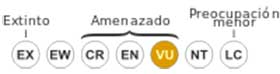
    โ–ท The world of Pets: Dogs, cats, birds, reptiles, amphibians

    Blue-fronted Parrotlet
    Touit dilectissima

    Blue-fronted Parrotlet

    Content

    Description

    The height of the Blue-fronted Parrotlet (Touit dilectissimus) varies between the 15 and 18 cm.. It is differentiated by the red line that goes from the bill towards the back of the eye and below the eye ring white, and blue bordering the red line from the forecrown up to the back side of. Wings with the part inside red and yellow, evident on the fly, shoulder and external margin of the wings red, crown and nape green.

    Tail with black border, Yellow ends and green central part.

    The female have the Red of the shoulder reduced or absent.

    Habitat:

    Uncommon and surly. It lives in humid forest that is often cloudy and has tall stubble., between 700 and 1700 meters above sea level (apparently with migration to the 3000 m). ANDA in pairs or groups of 15 or more, lie quietly in the canopy.

    In-flight calls are based on mild or sharp notes repeated several times between pauses. Calls are stronger during the flight.

    Reproduction:

    It nests in termite mounds on tree.

    Food:

    Cotorrita Cariazul
    It feeds on small seeds, fruits and flowers.

    Distribution:

    Can be seen in freedom from Panama, Colombian Pacific to the Northwest of Ecuador, and in the northeast of Colombia and Northwest of Venezuela.

    Conservation:

    State of conservation โ“˜


    minor concern Minor Concern โ“˜ (UICN)โ“˜

    Appreciated a decrease of the species due to deforestation at the local level (in particular in Colombia).
    The population size World has not been quantified, but this species is described as ยซrareยป (Stotz et to the. 1996).
    The population is suspected to be stable in the absence of evidence of any reduction or substantial threats.

    "Blue-fronted Parrotlet" in captivity:

    These birds are rare to see them in captivity. Any person possessing one has to know that it can not be put into freedom, It must be part of a well-managed maintenance program to ensure the continued existence of this species.

    Alternative names:

    Blue-fronted Parrotlet, Blue fronted Parrotlet, Red-winged Parrotlet (ingles).
    Toui ร  front bleu (French).
    Kronenpapagei, Kronen-Papagei (German).
    Touit dilectissimus (Portuguese).
    Cotorrita Cariazul, Lorito de Alas Amarillas (espaรฑol).
    Periquito Alirrojo (Colombia).
    Churiquita (Venezuela).
    Periquito frentiazul (Ecuador).

    scientific classification:

    Order: Psittaciformes
    Family: Psittacidae
    Genus: Touit
    Scientific name: Touit dilectissimus
    Citation: (Sclater,PL & Salvin, 1871)
    Protonimo: Urochroma favorite

    Images:

    Videos:


    Species of the genus Touit


    Blue-fronted Parrotlet (Touit dilectissimus)


    Sources:

    • Avibase
    • Parrots of the World โ€“ Forshaw Joseph M
    • Parrots A Guide to the Parrots of the World – Tony Juniper & Mike Parr
    • Parrots, Parrots and macaws Neotropical
    • Birdlife

    • Photos:

    (1) – One bird perched close to the nest by Manakin Nature Tours – lynx

    โ–ท The world of Pets: Dogs, cats, birds, reptiles, amphibians

    Blue cheeked Parrot
    Amazona dufresniana

    Blue cheeked Parrot

    Content

    Physical characteristics


    Anatomy-parrots

    34 to 37 cm.. height and between 480 and 600g. weight.

    The Blue cheeked Parrot (Amazona dufresniana) It is easily identifiable by the orange yellow wing patch, much more noticeable in flight.

    Head with orangeade narrow stripe on the forehead; Yellow Crown, cheeks, base of the beak, sides of the neck to almost light blue Crown.

    End of the wing dark, tail with yellow border, rest of green body.

    Young birds with orange-yellow feathers on the front of the head and a violet color in the bottom of the cheeks.

    The binomial name of this species is in honor to the French zoologist Louis Dufresne.

    Video "Blue cheeked Parrot"

    Blue cheeked Parrot habitat:

    It lives in humid forest, of gallery and sheets, up to 1700m.

    It can also be seen sporadically in coastal areas, possibly in response to food availability.

    Reproduction Blue cheeked Parrot:

    They walk in pairs or small groups of no more of 4 to 8 individuals.

    Reproduction and feeding, there is little information.

    In the wild, the breeding season occurs in March in Guyana. In captivity, the female lays 3 eggs that we do not know exactly the incubation period.

    Food Blue cheeked Parrot:

    We don't know the details of your menu, but it is assumed that they eat almost exclusively seeds, and berries.

    Distribution Blue cheeked Parrot:

    Amazon-fronted Parrotlet location

    The Amazona dufresniana It is located in southeast Venezuela (Bolรญvar, with a record isolated on Amazon), Northern Guyana (north of 5ยฐN), Northeast Suriname and French Guiana northeast (Y way Collar 1991).

    There are reports of Para and Amapa, Brazil, where its occurrence seems likely, but there is no conclusive records (Y way Collar 1991, Collar 1995). The scarcity of records from frequently surveyed areas suggests that it is a low-density and rare species., at the least in parts of its range (Y way Collar 1991).

    a Guyana, Healthy populations are known in the area in northwestern Aruka Guyana, between the Aruka and Amakuru rivers, the Kaieteur National Park and the Kuribong River, and the Iwokrama Forest Reserve (A. Narine a slightly. 2010)

    Conservation:

    State of conservation โ“˜


    Near-threatened Near Threatened โ“˜ (UICN)โ“˜

    It is in the category of near threatened. (NT), due to habitat loss and illegal trade.

    Classified as near-threatened (NT) on the IUCN Red list (1) listed in Appendix II of the CITES (4).

    Conservation in March CITES Appendix II actions. Banded from Canaima National Park (Venezuela), Iwokrama forest reserve (Guyana) and the Brownsberg nature park (Suriname).

    Blue cheeked Parrot in captivity:

    Rare in captivity.
    Placid temperament, seems less active than many Amazon.

    Alternative names:

    Blue cheeked Parrot, Blue-checked Parrot, Blue-cheeked Amazon, Blue-cheeked Parrot, Dufresne’s Amazon, Dufresne’s Parrot (English).
    Amazone de Dufresne (French).
    Goldmaskenamazone, Granada Amazone (German).
    Papagaio-de-bochecha-azul (Portuguese).
    Loro de cachetes azules, Amazona Cariazul, Amazona de Cara Azul, Loro cariazul (espaรฑol).

    scientific classification:

    Order: Psittaciformes
    Family: Psittacidae
    Scientific name: Amazona dufresniana
    Citation: (Shaw, 1812)
    Protonimo: Psittacus dufresnianus

    Blue cheeked Parrot images:


    Species of the genus Amazona


    Sources:

    – Parrot Book, Parrots and macaws Neotropical

    Photo:

    1 – papageien.org
    2- by Matthieu Sontag[GFDL or CC BY-SA 4.0-3.0-2.5-2.0-1.0], via Wikimedia Commons
    3 – By Bjoertvedt (Own work) [CC BY-SA 3.0 or GFDL], via Wikimedia Commons
    4 – papageien.org
    5 – by ยฉMichel Clement – gepog.org

    Sound: Olivier Claessens