โ–ท The world of Pets: Dogs, cats, birds, reptiles, amphibians

Himalayan cat
Federations: ACFA, TICA, WCF

The Himalayan cat it is an extremely sweet pet, playful and gentle that can be adapted to practically any type of home.

Himalaya

Content

Characteristics "Himalayan cat"

Coexistence is important that you have with your new friend. Before considering the acquisition of a cat of the breed "Himalayan cat" you know certain factors. You must take into account their character, their need for exercise, their interaction with other pets, their care and if you have small children, their level of tolerance towards them.

Joy

3,0 of 5 stars (based on 1 review)

Activity level

1,0 of 5 stars (based on 1 review)

Friendliness to other pets

4,0 of 5 stars (based on 1 review)

Friendliness to children

4,0 of 5 stars (based on 1 review)

Grooming requirements

5,0 of 5 stars (based on 1 review)

Vocality

1,0 of 5 stars (based on 1 review)

Need for attention

4,0 of 5 stars (based on 1 review)

Affection towards its owners

5,0 of 5 stars (based on 1 review)

Docility

5,0 of 5 stars (based on 1 review)

Intelligence

2,0 of 5 stars (based on 1 review)

Independence

2,0 of 5 stars (based on 1 review)

Hardiness

2,0 of 5 stars (based on 1 review)

History

Also know as Colourpoint Persian, the Himalayan cat It is a breed of cat that combines the colors of the Siamese cat with the Traditional Persian cat. It is a cross between semi-long-haired Siamese twins and blue and black persian cats.
Some feline associations, as the American Cat Fanciers’ Association (ACFA), they consider it a separate breed, while others, as the Cat Fanciers’ Association (CFA), they see it rather as a variety of Persian cat, from which it only differs in the color of the coat. Its name is due to the similarity of its coloration with that of a domestic rabbit also called Himalaya.

Its origins date back almost a century., when breeders dreamed of combining the colors of the Siamese Cat with the Traditional Persian cat. At the beginning of the year 30, in United States, the Dr. Clyde Keeler, researcher at Harvard University School of Medicine, undertook a hybridization program for this purpose, in collaboration with a breeder, the Mrs. Virginia Cobb. The results were not entirely satisfactory and the experiment was interrupted by the Second World War.. After the war, another passionate breeder, the Mrs. Marguerita Goforth, took the torch and managed to create a ยซColourpoint Persian catยป which was recognized in 1957 by the CFA and ACFA as a new breed called ยซHimalayanยซ. At that time, the breeder had to prove the existence of three generations of ยซColorpointยป pure so that this line was accredited as a new breed and could participate in competitions and championships.

In the meantime, in Britain, Brian Sterling-Webb, another enthusiastic breeder, worked for a decade on the development of a similar hybrid that, in 1955, was registered as a separate breed called ยซColorpoint longhair cat" for him Governing Council of the Cat Fancy (GCCF).

Over the next decade, the popularity of Himalayan cat grew significantly. But, breeders began to interbreed only with himalayan. As a result, the characteristics inherited from Persian cat they were lost in favor of individuals with a less flattened face. This led some breeders over the years 70 to use occasionally pure persian cats at the crosses, in order to increase again the characteristics of this breed in the Himalayan cat. This was so successful that the cats resulting from this selection ended up having all the characteristics to compete in competitions. Persian cat. Inevitably, the question arose: should he Himalayan cat still consider themselves a breed unto themselves?

In response to this question, the CFA decided on 1984 consider the Himalayan as a subdivision of the Persian cat, keeping your name. It was followed by World Cat Federation (WCF). But the ACFA, as well as the International Cat Association (TICA), they kept it as a separate race.

Today, the Himalayan cat still a very popular cat in North America, but less in Europe.

Physical characteristics
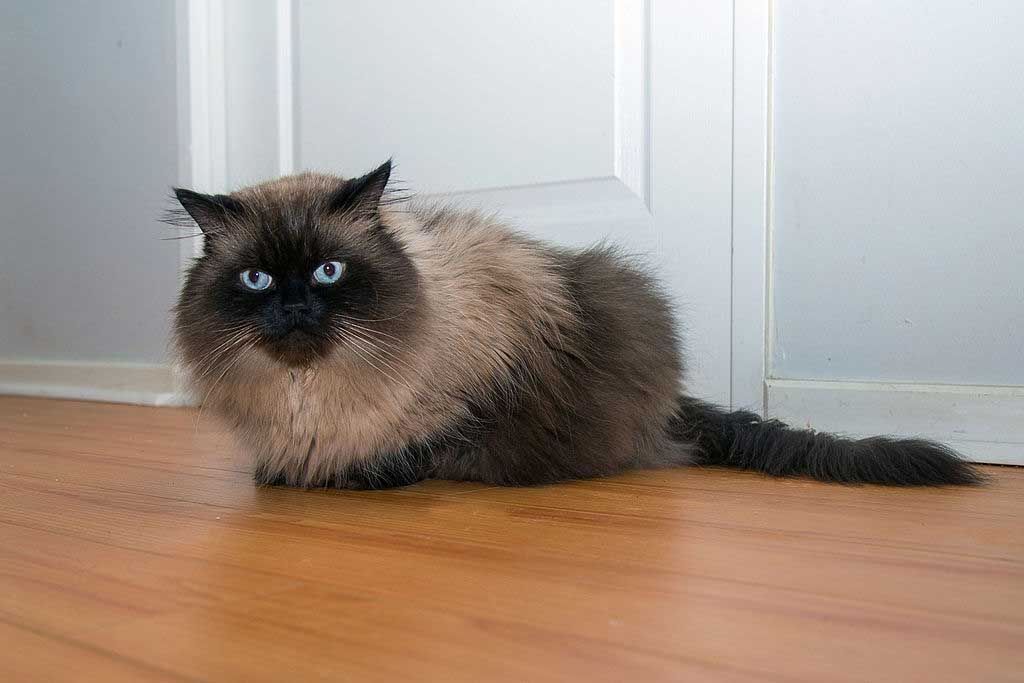
Himalayan cat
Himalayan cat – Joseph Morris, CC BY-SA 4.0, via Wikimedia Commons
The Himalayan cat, like the persian, it is a solid and round cat, with short legs, short tail and small, rounded ears. According to American Cat Fanciers Association (ACFA), must have five fingers in front and four behind.

As with the Persian, There are two types of himalayan: the classic โ€œbaby faceโ€ and the flatter โ€œPekingese faceโ€, which gets its name from its similarity to the dog Pekingese.

Most of the cat's coat is white or cream in color, but there are some varieties, according to the different shades of the tips of the coat and the extremities of the body.

Size and weight

  • Size: 30 cm.
  • Weight: Of 3 to 6 kg

Varieties of "Himalayan cat"

Distinguished by the color of the extremities of the body and the tips of the coat, the main Himalayan varieties are

Blue Point:
  • the tips of the fur are blue, like feet, the ears, tail and face. The rest of the body is slightly bluish white, and the eyes are bright blue.
Lilac Point:
  • In this variety, the extremities of the body and the tips of the coat are paler and lilac than blue. The rest of the body is whiter and brighter than in the Blue Point.
Seal Point:
  • The extremities of the body and the tips of much of the body are black or dark brown (similar to the color of the seal, that inspired his name). It is the variety whose color is most similar to that of the Siamese.
Chocolate Point:
  • The tips of the body and the tips of the coat of this variety are chocolate brown, a shade lighter than Seal Point. The rest of the fur is also whiter and brighter than that of the Seal Point. The color of the foot pads is a characteristic that strongly distinguishes the two varieties.: those of the Chocolate Point they are pink, while his Seal Point are dark brown.
Red Point o Flame Point:
  • The dominant color of the limbs and points of this cat is red, which can be orange. The rest of the body is white or cream.
Cream Point:
  • This variety of Himalayan is a diluted version of Flame Point. The coloring of the mask and the extremities is reddish or pale orange, while the rest of the body is white or slightly cream.

Character and skills
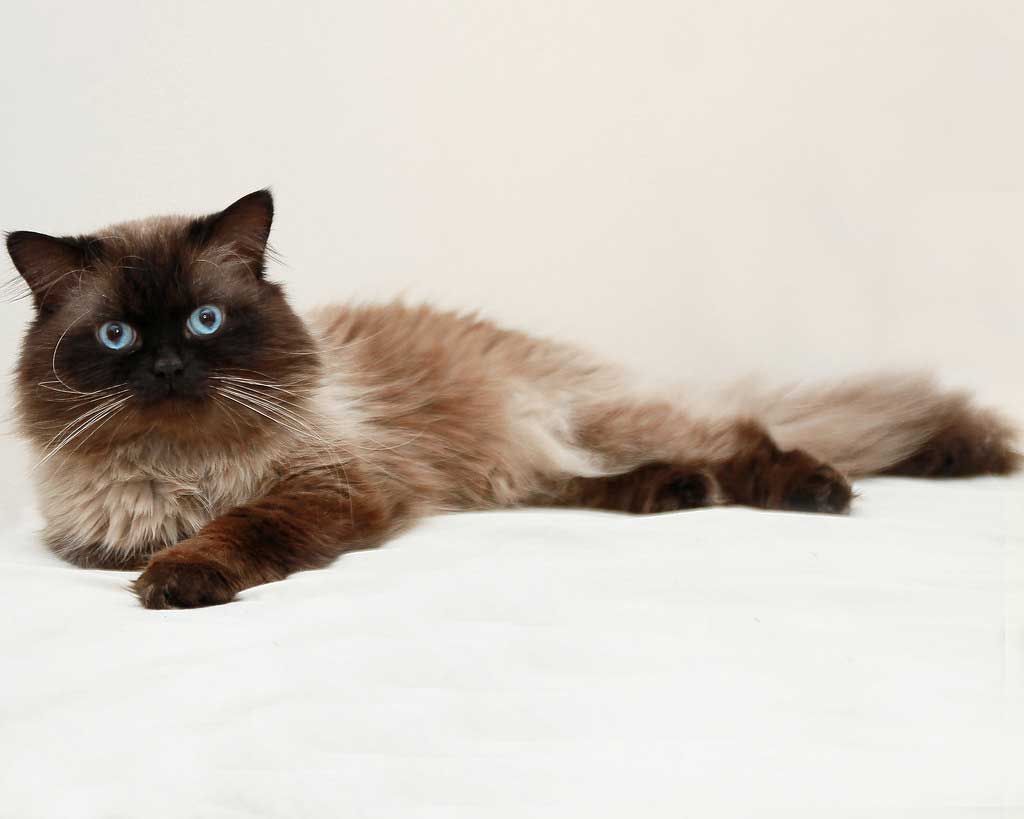
Himalayan cat
Himalayn cat named โ€˜Monte.’ Flickr
The Himalayan cat it is a wonderful indoor cat. They are gentle, calm and sweet temperament, and they also have a playful side. Like him Siamese cat, to the himalayan he loves to play fetch, and a crumpled piece of paper or a cat toy will entertain them for hours, or until your next nap.

The Himalayan cat They are devoted and depend on their humans to accompany and protect them. They crave affection and love to be petted and groomed., which is lucky, since all owners of this breed of cat spend part of the day doing just that.

Like his Persian brethren, they are docile and will not harass you for attention like some breeds do. They have the same level of activity as the Persian cat and they are not noisy like the Siamese cat.

Grooming and caring for the "Himalayan cat"

If you are not willing to spend some time on daily grooming, the Himalayan cat probably not the right cat for you. Since they have long, silky hair that tangles and weighs down easily, the fur of the himalayan should be brushed with a sturdy, wide-toothed comb daily. This will remove and prevent tangles and mats, and will help remove dirt, dust and debris. It is also recommended that the Himalayan cat visit a professional groomer every few months to make sure his coat is healthy and clean. The good news is that himalayan they love to receive the attention of their owners, which makes grooming easy and is an excellent bonding experience for the owner and his feline companion.

You can protect your legs and your furniture by trimming your nails Himalayan regularly. Examine your legs weekly and trim them if necessary to keep them healthy and injury free. Also spend time a week examining your cat's ears. The pointed ears of the Himalayan are susceptible to trapping dirt and debris, which can lead to infections and other ear problems in the future. If you find debris in your cat's ears, use a pet ear cleaner and a cotton pad to remove them carefully. Never use a cotton swab in your cat's ears, as it can severely damage the delicate structures of the inner ear. If the ears are very red or swollen, very dirty or smell funny, take him to the vet asap.

The himalayan have low exercise needs, but they are extremely playful and will do mischief if they get bored. You can keep them entertained and engaged by providing plenty of cat toys and a few minutes of play each day.. Like the Himalayan they have such a playful personality, something as simple as a ball of paper will keep you entertained for hours.

How much activity does he need? "Himalayan cat"?

The himalayan you need to exercise to stay in top shape. Likes to play with their owners and will play with interactive toys, chase balls and attack mice with catnip, but you may have to chase him to get him exercising on a daily basis.

Health and nutrition
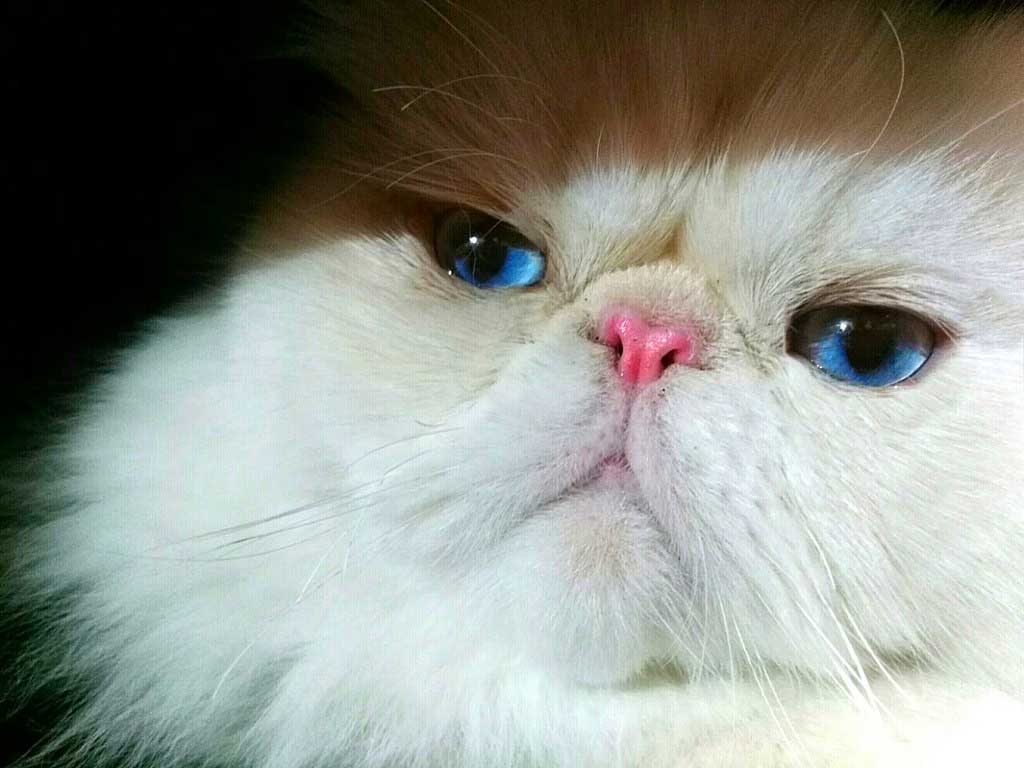
Himalayan
Himalayan – Aaa803287, CC BY-SA 4.0, via Wikimedia Commons
The Himalayan cat you are prone to certain skin diseases: seborrhea, cheyletiellosis and dermatophytosis (had).

It also, like the persian, may have a tendency to be overweight. So, you need to pay attention to your diet, to avoid any risk of obesity in the cat.

It also, due to his persian heritage, may be a carrier of the gene that causes renal polyquistosis. This inherited disease causes cysts to develop slowly and progressively in the kidneys.. But, the presence of the offending gene can be detected by genetic testing. So, before adopting a kitten of this breed, it is advisable to check with the breeder of himalayan that this genetic test has been performed and has given a negative result. If not done, it is a wise precaution to demand that it be done.

It also, the flattened shape of the face may predispose to himalayan certain health problems. These may include, you may be prone to breathing problems due to narrow nostrils. They can also suffer malocclusion (misaligned teeth) or abnormal watering.

The himalayan you can also suffer the feline hyperesthesia syndrome (a little-known disease that causes behavior problems).

Last, the length of their coat can cause hair ingestion problems, what ends up creating hairballs in the stomach of the cat (tricobezoares), causing pain and / or digestive problems.

Food

As the Himalayan cat have a tendency to be overweight, special attention should be paid to your diet.

Some companies have developed a range of foods specially adapted to the needs of the Persian cat (and therefore of himalayan). Available in the form of croquettes or cans, these foods offer a low-fat diet that contributes to the health of the cat, while helping to maintain a silky coat and limit hairball formation. Some of the kibbles available on the market are shaped to fit the brachycephalic jaw of the Persian and of the himalayan.

The quality of the products in the market varies, so make sure that the ones you offer your dog are reliable. The ingredient list on the packaging can help you, but you can also ask the breeder for advice himalayan or your vet.

For sale "Himalayan cat"

The kitties himalayan (pet quality) cost between 700 and 1400 EUR, depending on coat colors and bloodline. the kitten's quest himalayan perfect begins with the search for a reputable breeder. One Himalayan cat known breeding sites, with good color and perfect proportion can cost between 1500 and 3000 EUR,

Videos "Himalayan cat"

Cats 101: Himalayan
Cats 101: Himalayan
TOP 10 HIMALAYAN CATS BREEDS

Alternative names:

โ–ท The world of Pets: Dogs, cats, birds, reptiles, amphibians

Mekong Bobtail cat
Federations: WCF

The Mekong Bobtail cat still a rare breed of cat, since at the beginning of the decade of 2010 its population barely exceeded 600 registered copies.
Bobtail Mekong
Photos By Sinitsyn

Content

Characteristics "Mekong Bobtail cat"

Coexistence is important that you have with your new friend. Before considering the acquisition of a cat of the breed "Mekong Bobtail cat" you know certain factors. You must take into account their character, their need for exercise, their interaction with other pets, their care and if you have small children, their level of tolerance towards them.

Joy

5,0 of 5 stars (based on 1 review)

Activity level

5,0 of 5 stars (based on 1 review)

Friendliness to other pets

3,0 of 5 stars (based on 1 review)

Friendliness to children

5,0 of 5 stars (based on 1 review)

Grooming requirements

1,0 of 5 stars (based on 1 review)

Vocality

2,0 of 5 stars (based on 1 review)

Need for attention

4,0 of 5 stars (based on 1 review)

Affection towards its owners

5,0 of 5 stars (based on 1 review)

Docility

4,0 of 5 stars (based on 1 review)

Intelligence

4,0 of 5 stars (based on 1 review)

Independence

2,0 of 5 stars (based on 1 review)

Hardiness

5,0 of 5 stars (based on 1 review)

History

The Mekong Bobtail it is a natural breed originating from Thailand, for which it has long been known as Thai bobtail. It has been present in Southeast Asia for many centuries, and legend has it that his courage led the kings of Siam to use him as a guard to protect the treasure chamber from possible theft.

In the 19th century, these cats were considered symbols of loyalty. Royalty used to gift them to the nobility to reinforce their good relations. So it is not surprising that, at the end of the 19th century, el rey Somdetch Phra Paramindr Maha Chulalongkorn, better known as Rama V, give away 200 from them to Tsar Nicholas II of Russia.

Several of them were Mekong Bobtail, that sparked some interest in Russia, so more specimens were imported in the following years. These cats and their descendants are the origin of the breed we know today.. In other words, although it is basically a Thai cat breed, it was the Russians who allowed it to develop and flourish, without modifying it.

But, the breed could not develop under the communist regime, and it was not until the decade of 1980 when Olga Mironova, a renowned cat specialist, took an interest in her and decided that she should be recognized. With the help of Ludmila Esina, Russian breeder and cat specialist, drew up the first standard and adopted the name Mekong Bobtail, in tribute to the river that runs through Southeast Asia.

This cat was first presented at an international feline show in November 2003, during the ยซRoyal Canine Grand Prixยป held in Moscow. A few months later, in august 2004, received the recognition of the World Cat Federation (WCF). WCF has not been followed by other organizations since., so it remains the only major feline association that recognizes the breed.

In fact, the Mekong Bobtail cat still a rare breed of cat, since at the beginning of the decade of 2010 its population barely exceeded 600 registered copies. The vast majority are in the former Soviet countries, mainly in Russia and Ukraine. It is almost non-existent in Western Europe and North America.

Gato Bobtail Mekong
MEKONG BOBTAIL cat of rare lynx-point colour Dona Miya Ayutthaya. Cofein Pride cattery (WCF). – Alex opryatin, CC BY-SA 3.0, via Wikimedia Commons

Physical characteristics

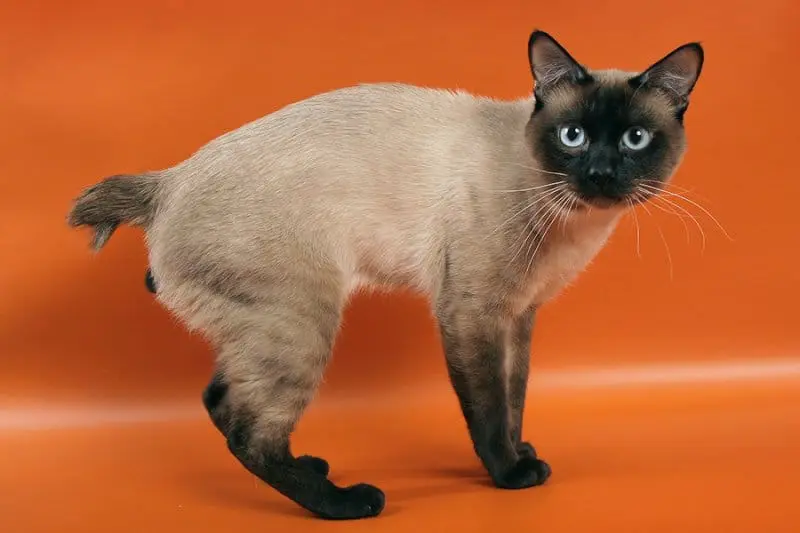
The body structure of the Mekong Bobtail is similar to that of Siamese cat. With its long, muscular body and its long, thin legs, has preserved the refined elegance of Thai cats. The strong stature in combination with the beautifully modeled head give the animal a noble appearance. The characteristic feature is the short tail. It is a quarter the length of the body and has different combinations of curves and folds. According to the international breed standard, its length is at least three vertebrae.

The coat color of the Mekong Bobtail reminds of the Siamese cat. Belonging to typical cats point, breed standard allows all colors point no target. Cats often appear with sandy to cinnamon colored fur. The coat is soft and silky to the touch. Hugs the body closely. The effect is produced because the purebred cat has hardly any undercoat.

If you look at the cat's face, you will notice the large ears with the rounded tips. They perch on top of the animal's head and give it an attentive impression. This is enhanced by the slightly outwardly curved ears.. Similar to the Siamese, the breed is characterized by its large, oval eyes. Its deep blue color contributes to the exotic beauty of this rare breed of cat..

Last, sexual dimorphism is well marked, being the males larger than the females.

Size and weight

  • Height: 30 cm.
  • Weight: Of 3 to 5 kg

  • Character and skills

    The Mekong Bobtail cat he is an affectionate cat who enjoys the company of humans. They are very faithful and devoted to their owner and constantly seek their company.. Demands a lot of attention, that returns multiplied by a hundred in affection.

    Sociable and curious by nature, this cat loves to hang out with new people, especially if they give you the attention you seek. Calm and balanced, it is an ideal cat breed for children, as long as, of course, have learned to behave with animals: his patience has limits and he runs the risk of biting, even more than scratching, to those who amuse themselves by pulling their tail or whiskers.

    The sociability of Mekong Bobtail spreads to other animals, and enjoy the company of other dogs, as well as other cats. The presence of other animals in the home is an option to be seriously considered by any owner who has to be away for long periods of time each day., since it is a breed of cat that does not tolerate loneliness. On the other hand, coexistence with small rodents or reptiles should be avoided, since his hunting instinct can overcome his good manners at any moment.

    On the other hand, the Mekong Bobtail easily adapts to a new environment, and traveling by car with your cat should not be a problem. So, they are an ideal option for those who move regularly or want to take their cat on vacation.

    Active and athletic, to the Mekong Bobtail he loves to run around the house, jump on the furniture and perch on the closet. With this energy level, ideally they should have access to the outdoors, where they can run and have fun before returning to their owner to rest quietly. But, can live in a flat, as long as his owner makes sure he gets enough exercise by playing with him often, or even taking him out on a leash.

    If you have free access to the outside, it is recommended to put a necklace with a locket in which your name and phone number appear, In addition, of course, of the essential identification of the cat by chip or tattoo. In effect, although he is very close to his master and wants nothing more than to return to his side, his curiosity and the fact that he likes the company of humans can take him away from home; the risk is that you realize too late that you don't know how to get home

    Last, it is a breed of cat that usually meows, either to let its owner know that it is time to eat or that it is time to open the door to go chase the birds.

    Gato Bobtail Mekong
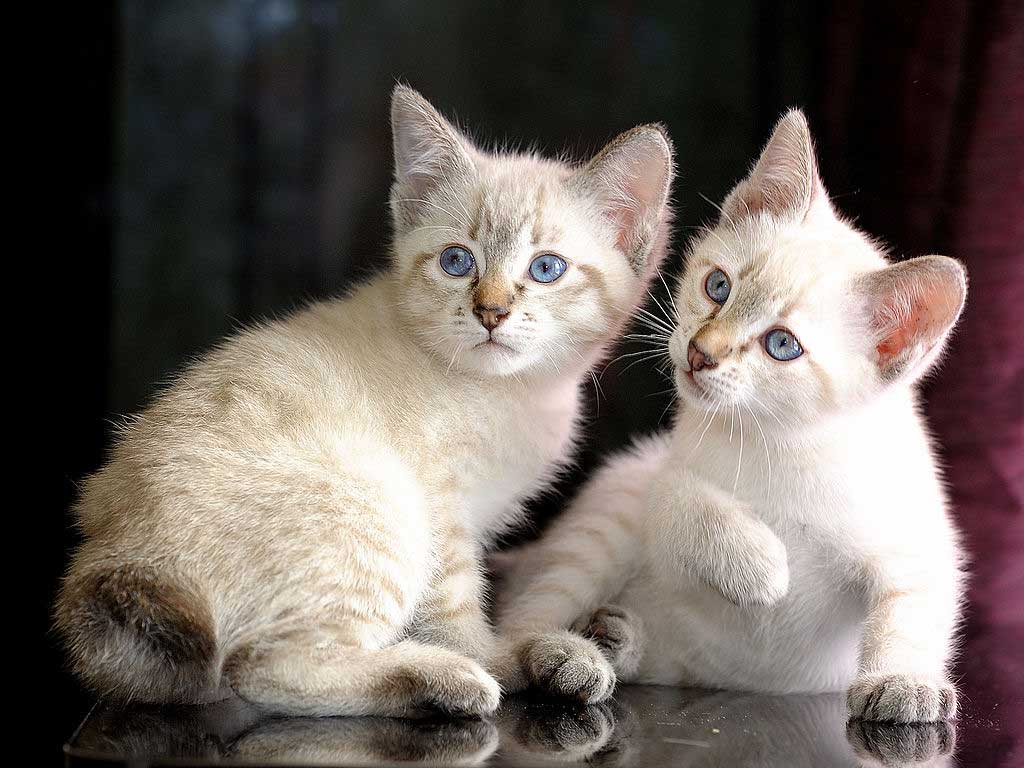
    Rare MEKONG BOBTAIL kittens, color tabby-point. Mekong bobtail hatchery Cofein Pride – Alex opryatin, CC BY-SA 3.0, via Wikimedia Commons

    Health

    The Mekong Bobtail it is a robust breed with no known genetic predisposition to disease.

    But, can be prone to several conditions common to all cats:

  • The feline idiopathic cystitis, a common bladder infection in cats that can have serious consequences if left untreated;
  • Various eye problems: secretion, redness or even a color change in the eyes;
  • Gastrointestinal disorders: vomiting, flatulence, diarrhea or constipation. These problems are usually due to diet and can pass within a few days or persist for several weeks..

  • It also, as with any breed, care must be taken to avoid being overweight or obese, that could cause serious health problems. Adequate nutrition and sufficient activity levels will normally avoid this problem..

    Grooming

    The Mekong Bobtail cat is a low maintenance cat breed. His short-haired coat only needs to be brushed once a week to remove dead hairs and keep it looking its best..

    It is advisable to prolong the grooming session a bit to take time to check the teeth, ears and, above all, the cat's eyes to make sure they are clean. They can be cleaned with a damp cloth.

    Last, depending on the activity level of the cat and the use of the scratching post, nails may need to be trimmed with nail clippers.

    Gato Bobtail Mekong
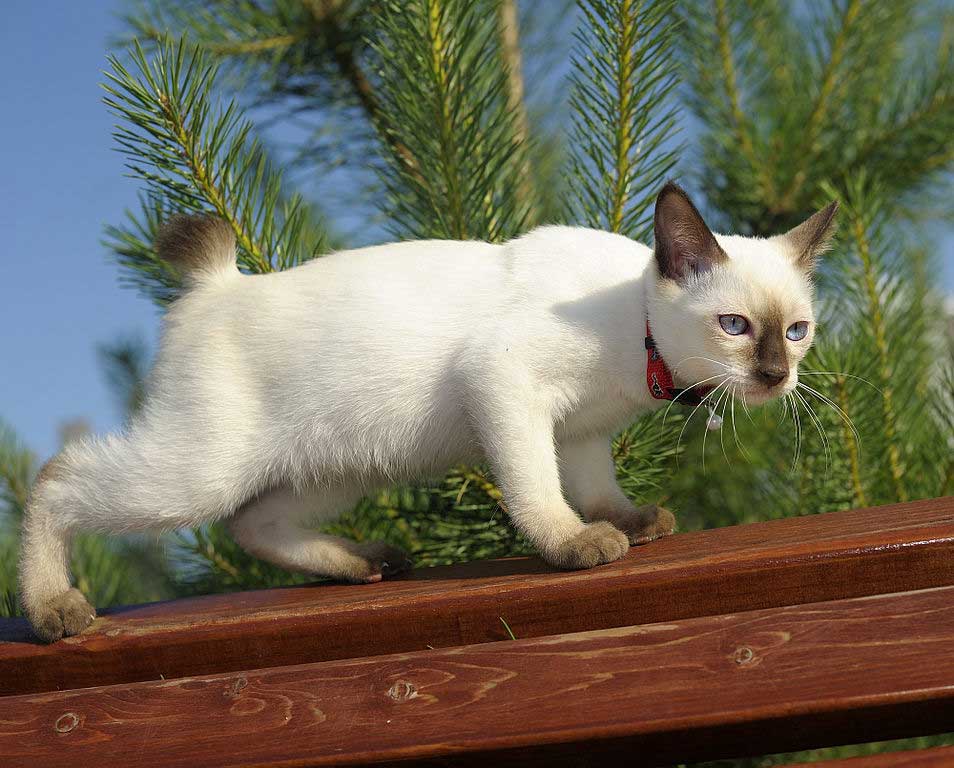
    Rare MEKONG BOBTAIL chocolate tip color – Talestra of Cofein Pride – Alex opryatin, CC BY-SA 3.0, via Wikimedia Commons

    For sale "Mekong Bobtail cat"

    The price of a Mekong Bobtail cat is of some 20.000 hryvnia in Ukraine or 50.000 rubles in Russia, what corresponds to some 700-800 EUR.

    As this breed is not yet common in Europe and America, it is usually necessary to import it. In this case, the cost of transport and possible customs duties must be added to the purchase price.

    Videos "Mekong Bobtail cat"

    Mekong Bobtail
    A litter of five little ones Mekong Bobtail discover a new game that seems to captivate them.
    Mekong bobtail play with circuit roller ball