โ–ท The world of Pets: Dogs, cats, birds, reptiles, amphibians

Tucuman Parrot
Amazona tucumana

Tucuman Parrot

Content

Description:


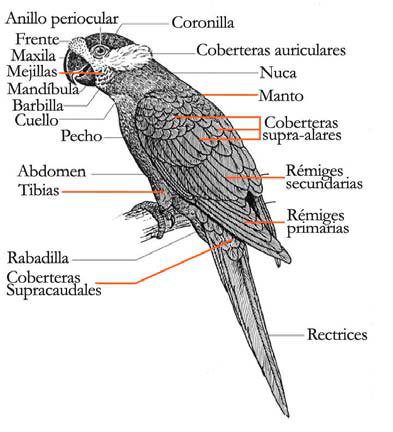
Anatomy-parrots

31 cm.. length.
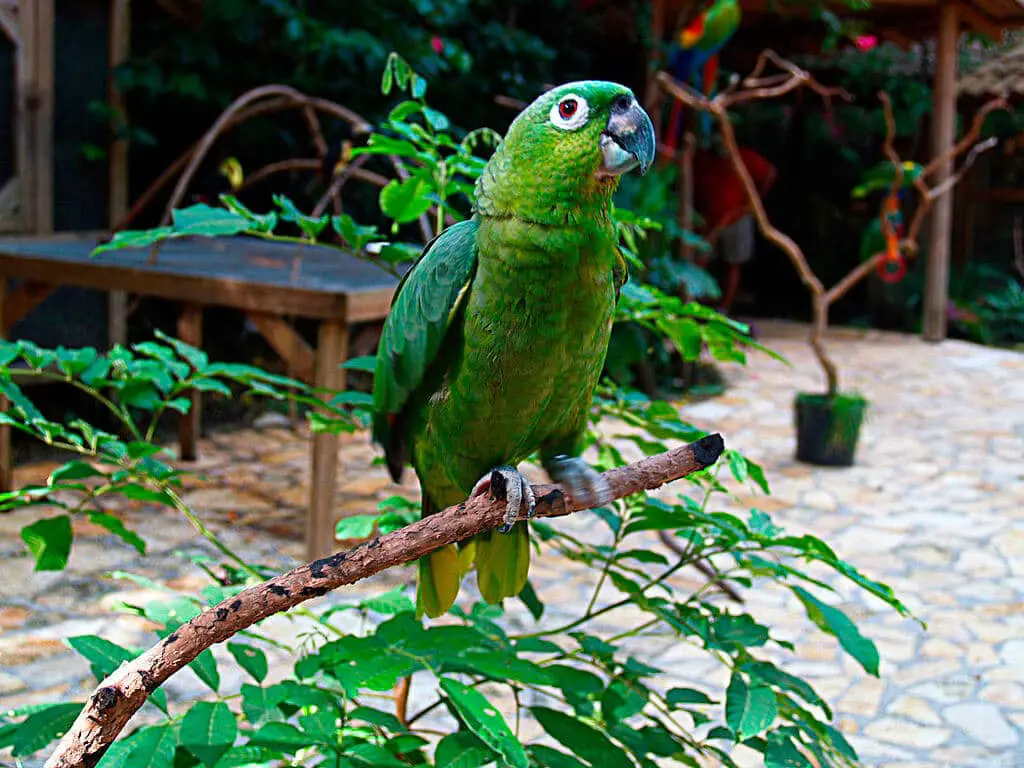
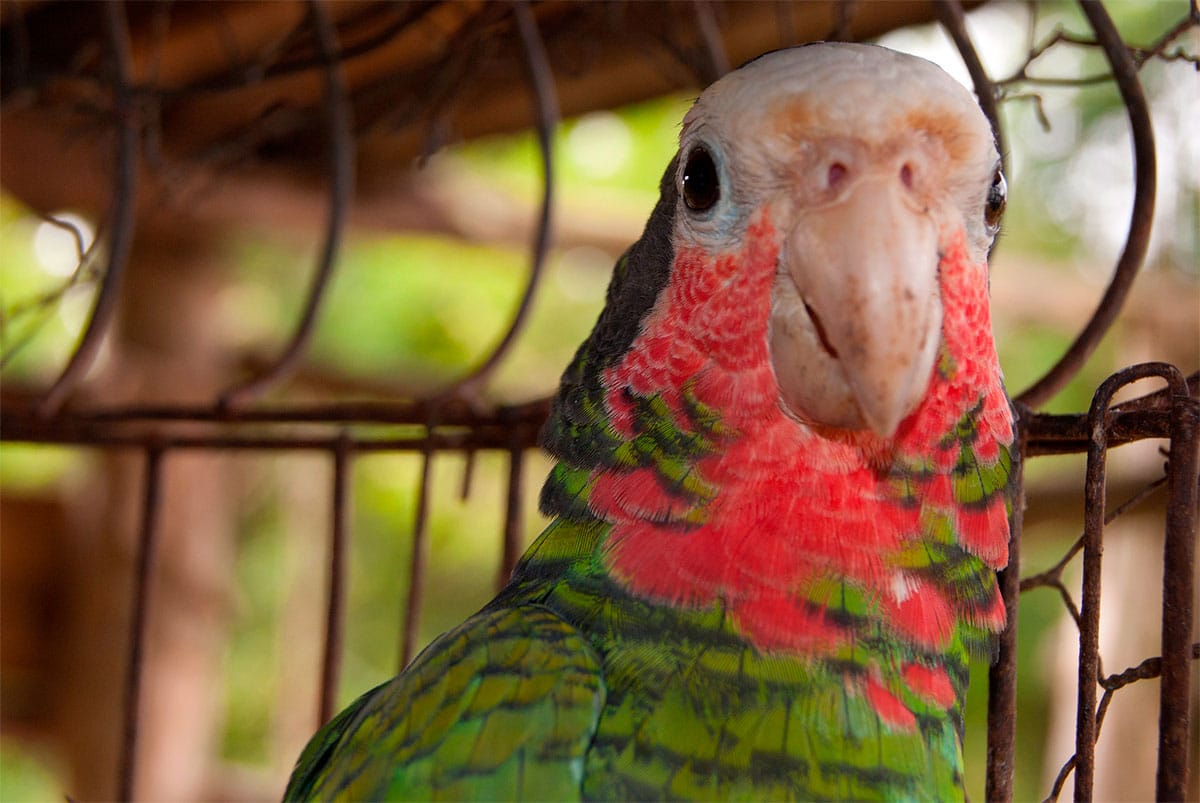
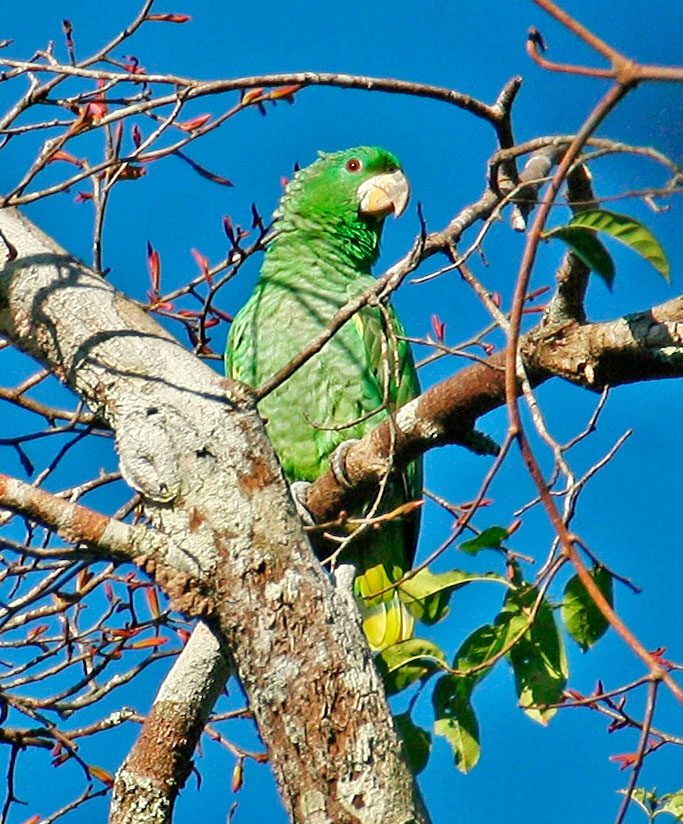
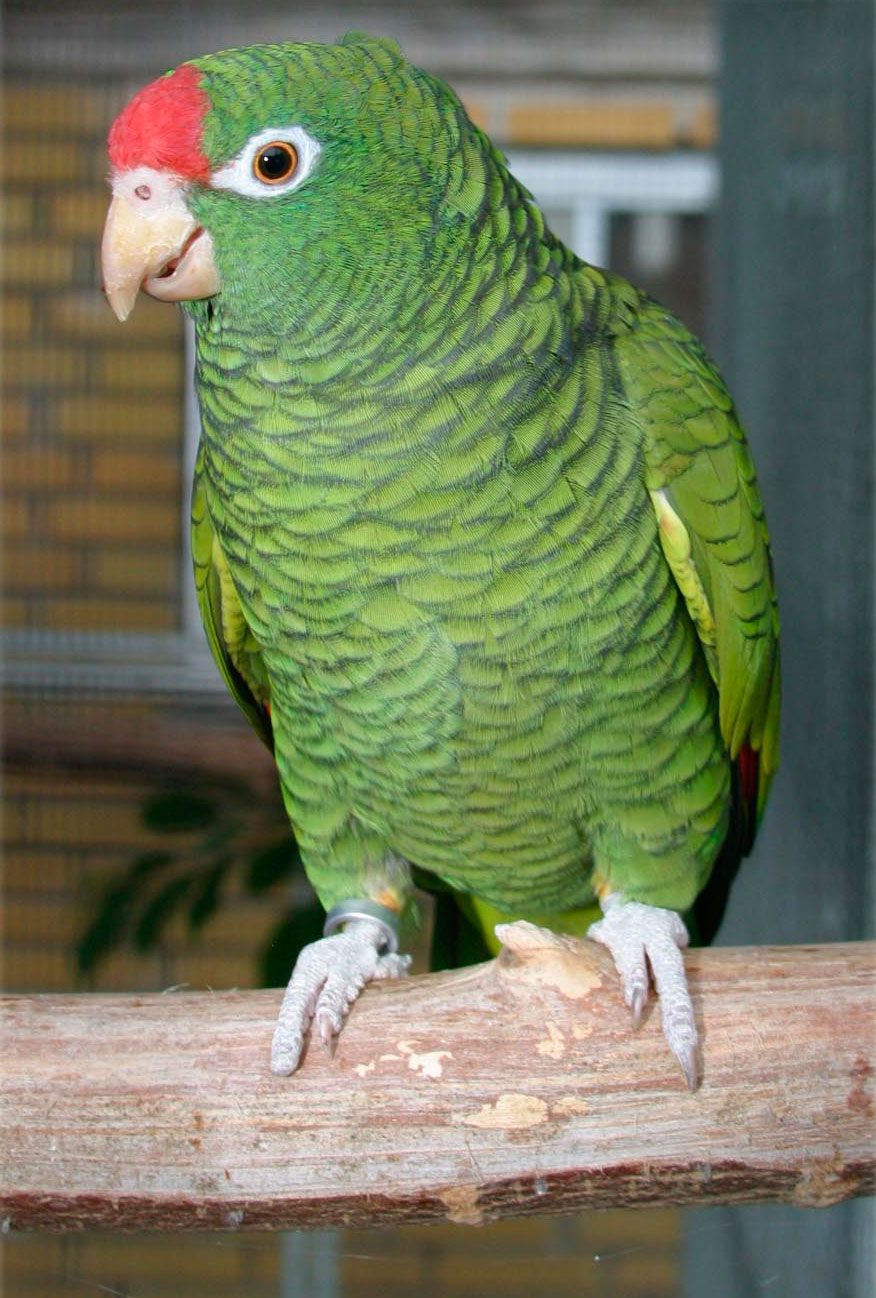
The Tucuman Parrot (Amazona tucumana) It is mostly green, with black borders on the feathers, giving the whole a scalloped appearance.

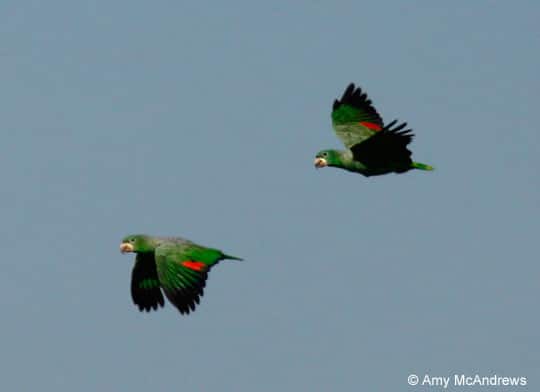
Relatively large and stocky have the forecrown red and eye rings white. Has also patch Red in the wing-coverts (most notoriously in flight); thin yellow line on shoulder almost half of wing ; the primary wing feathers They have the blue tips, and the thighs They are orange-yellow. The tail It is short and feathers yellow.

The bill It is yellowish to pinkish, and eyes adults are orange-yellow. The legs They are pale gray.

As he male as the female They are similar in appearance, but the immature They are generally green in full, with the thighs green than orange and less red on the forecrown. Another key difference between adult and immature is that eyes young people are gray.

Taxonomic note:

Until a few years ago it was considered a subspecies of the Red-spectacled Parrot (Amazona pretrei) (Fjeldsรฅ y Krabbe 1990), but now they are recognized as separate species, although closely related to each other and, In addition, with the Vinaceous Parrot (Amazona vinacea), who possibly form a basal group to all other parrots of the genus (Russello y Amato 2004).

  • Sound of the Amazona tucumana.

Habitat:

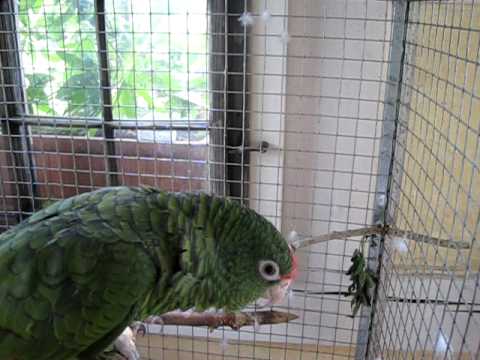
Video – "Tucuman Parrot"

Unser Tucuman Amazone Lacky 6 year old

It is found in open forests Andean mountain forests Yungas, particularly in areas with Alnus acuminata or Podocarpus parlatorei, as well as other species of Alnus, Podocarpus and Nothofagus. This species It is in elevations of between 1.600 and 2.600 metres in the breeding season, but during the non-breeding season they descend to lower elevations of about 350 m. Right now, sometimes you can enter inhabited areas.

Often gathers in large flocks, often numbering more than 200 individuals.

Reproduction:

The Tucuman Parrot They breed between November and January or February, building usually your nest in a hole in a tree Alnus or Podocarpus. The normal size clutch is three to four eggs, although they have been reported sunsets from one to five eggs. The incubation lasts around 26 to 29 days, usually it is the female that the male incubates and which feeds, and the main source of food for chicks come from seeds and flowers Podocarpus parlatorei. Young they leave the nest usually after seven to nine weeks.

Food:

The Tucuman Parrot They feed on trees Family Myrtaceae, as well as the seeds and flowers trees as Podocarpus parlatorei, Juglans australis and Alnus, of the immature fruits of the species Cedrela and flowers species Erythrina.

Distribution and status:

Size of its range (breeding/resident ): 86.200 km2

The Amazona tucumana It is located in northwest Argentina and in southern Bolivia, where it is known in 12 locations departments Tarija, Chuquisaca and Santa Cruz (A. Maccormick in some. 2005, R. Hoyer in some. Slightly., 2012).

A recent study of the situation and distribution of the species Argentina registered 6.015 individuals (Rivera et al., 2007) and estimated that the Argentine population amounted to about 10.000 birds, but around 20.000 They were exported from Argentina in the mid 80, suggesting that there may have been a substantial population decline.

After inclusion in the Appendix I of the CITES, international trade was cut, although the continuous local exploitation. But, It does not appear that the stocks have recovered, and loss of habitat is of concern, particularly in Argentina, where their habitat is highly degraded and there are only a few remains of small forests and isolated. Threats to habitat are less severe in Bolivia, but the species has declined there and is projected to continue to do so (A. Maccormick in a bit., 2005).

The main concentrations of this species in Bolivia are in clad hills, Villa Serrano and Tariquรญa National Reserve of Flora and Fauna, with 1.643 individuals recorded in several places during a recent study (Rivera et al., 2009).

Conservation:

State of conservation โ“˜


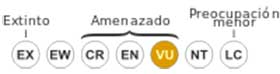
Vulnerable Vulnerable โ“˜ (UICN)โ“˜

โ€ข Current category of the Red List of the UICN: Vulnerable.

โ€ข Population trend: Decreasing.

โ€ข Population size : 6000-15000.

Rationale for the Red List category

This species is classified as Vulnerable, as it is experiencing rapid population decline due to the loss of habitat and capture for the bird trade.

Justification of the population

A recent study of the situation and distribution of the species Argentina registered 6,015 individuals and Argentina estimated that the population was approximately 10.000 birds (L. Rivera in a bit., 2004). It also, 1.643 individuals were recorded at several sites in Bolivia during another recent study (Rivera et al., 2007). The total population is thus situated in the band 10.000-19.999 individuals (L. Rivera in a bit., 2012). This is equivalent to 6,667-13,333 mature individuals, rounded here to 6,000-15,000 mature individuals.

Justification of trend

The results of the survey, observations on habitat loss and the local occurrence of the species, and catch and trade data suggest that the population is suffering rapid population decline (L. Rivera in some.)

Conservation Actions Underway

โ€ข CITES Appendix I, although the convention is not respected in Bolivia (AB Hennessey in litt., 2012).

โ€ข Present in several protected areas, including the El Rey National Park, Argentina, mainly in the non-breeding season (L. Rivera in some. 2012).

โ€ข In 2006, was appointed the Iรฑao National Park and Integrated Management Natural Area, which it was the basis for the conservation of one of the largest shelters species Bolivia (Rivera Et al . 2009).

โ€ข A species conservation action plan is currently being developed for each of its native countries. (L. Rivera in a bit., 2012).

Conservation Actions Proposed

โ€ข Apply the local trade ban (L. Rivera in a bit., 2012).

โ€ข Evaluate the current population size.

โ€ข Produce a species action plan.

โ€ข Conduct additional research to clarify the scope of the current threat of trade.

โ€ข Effectively protect core areas of remaining habitat; review their habitat requirements and complement nesting sites using boxes where appropriate (AB Hennessey in some. 2012).

โ€ข Address unsustainable use of resources and illegal activities in protected areas..

โ€ข Designate a clad hills a protected area.

The Tucuman Parrot in captivity:

Parrots Gender Amazona are among the most recognizable and sought-after pet birds. Their colorful plumage and ability to imitate the human voice have made them highly sought after for centuries, and one unfortunate consequence of this is the threatened status of most species. (Russello y Amato 2004). In the Red list of Threatened Species International Union for the conservation of nature, 16 parrot species of this genus are included either as Vulnerable, Endangered or Critically Endangered (IUCN 2010). In the same way, 16 species are listed in Appendix I of the Convention on International Trade in Endangered Species (CITES).

The Amazona tucumana It is a species that should only be kept in captive with the sole purpose of achieving their reproduction and subsequent insertion into the wild.

Alternative names:

Tucuman Parrot, Alder Amazon, Alder Parrot, Tucuman Amazon (English).
Tucumanaamazone, Tucumanamazone (German).
Amazone de Tucuman (French).
Papagaio-tucumฤƒ (Portuguese).
Amazona Alisera, Amazona Tucumana, Loro alisero (espaรฑol).
Loro alisero (Argentina).
Loro alisero (Bolivia).


scientific classification:
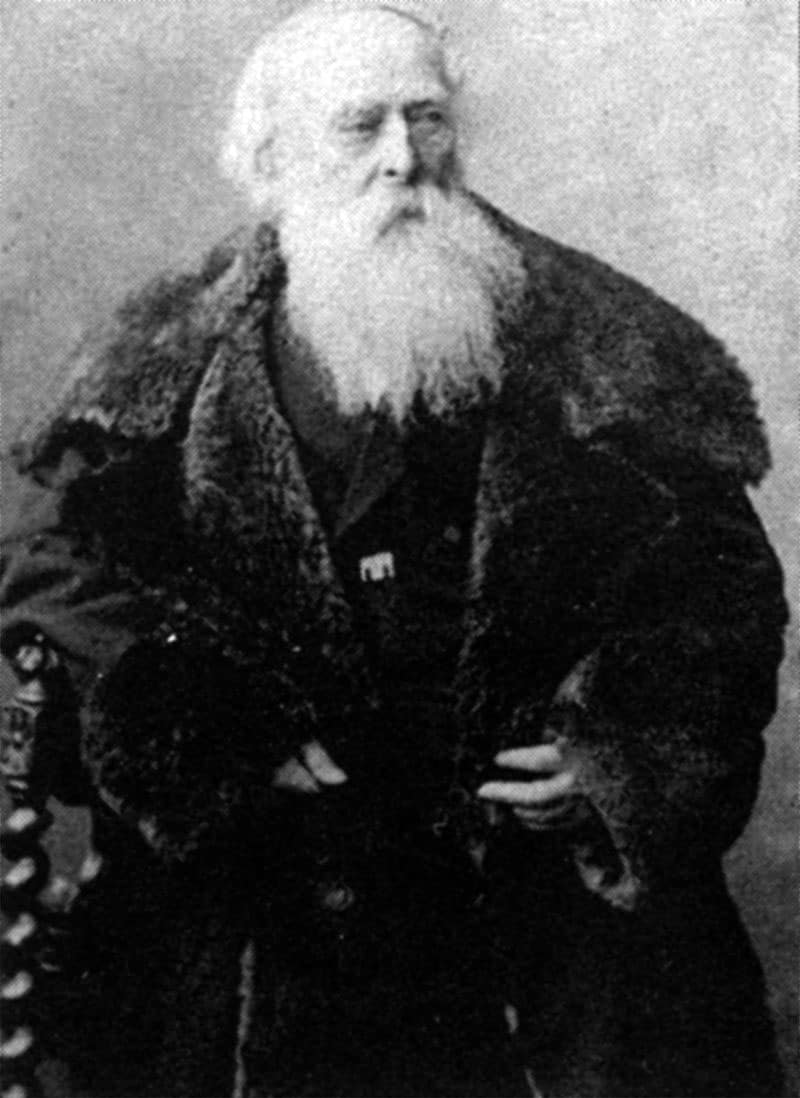
Jean Louis Cabanis
Jean Louis Cabanis

Order: Psittaciformes
Family: Psittacidae
Genus: Amazona
Scientific name: Amazona tucumana
Citation: (Cabanis, 1885)
Protonimo: Chysotis tucumana


Images Tucuman Parrot:

Videos "Tucuman Parrot"


Species of the genus Amazona


Sources:

Avibase
– Parrots of the World โ€“ Forshaw Joseph M
– Parrots A Guide to the Parrots of the World – Tony Juniper & Mike Parr
Birdlife
– RIVERA, Luis; POLICE, Natalia y BUCHER, Enrique H. Ecology and conservation of the Alder Parrot (Amazona tucumana). Hornero [online]. 2012, vol.27, n.1 [aforementioned 2017-01-29], pp. 51-61 . Available in: . ISSN 0073-3407.

Photos:

(1) – Tucuman Parrot (Amazona tucumana) by birdsandbirds

Sounds: Niels Krabbe, XC29107. accessible www.xeno-canto.org/29107
โ–ท The world of Pets: Dogs, cats, birds, reptiles, amphibians

Red-and-green Macaw
Ara chloropterus


Guacamayo Aliverde

Content

Description:

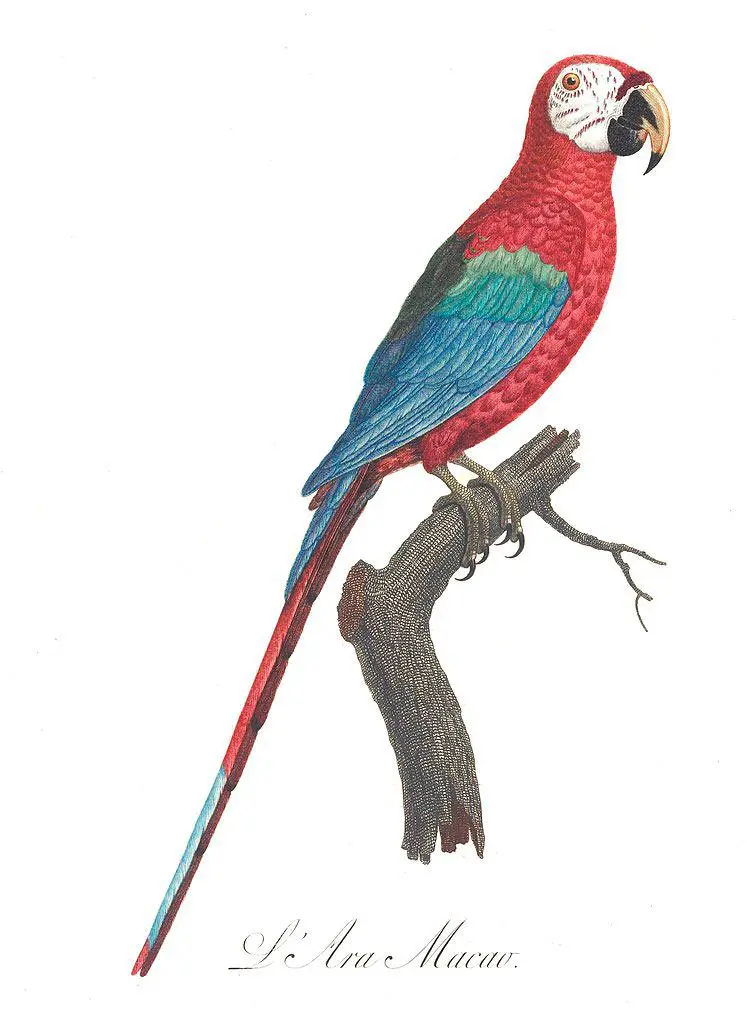
Winged Macaw, illustration
Among 90 and 95 cm.. length and a weight between 1050 and 1708 g..

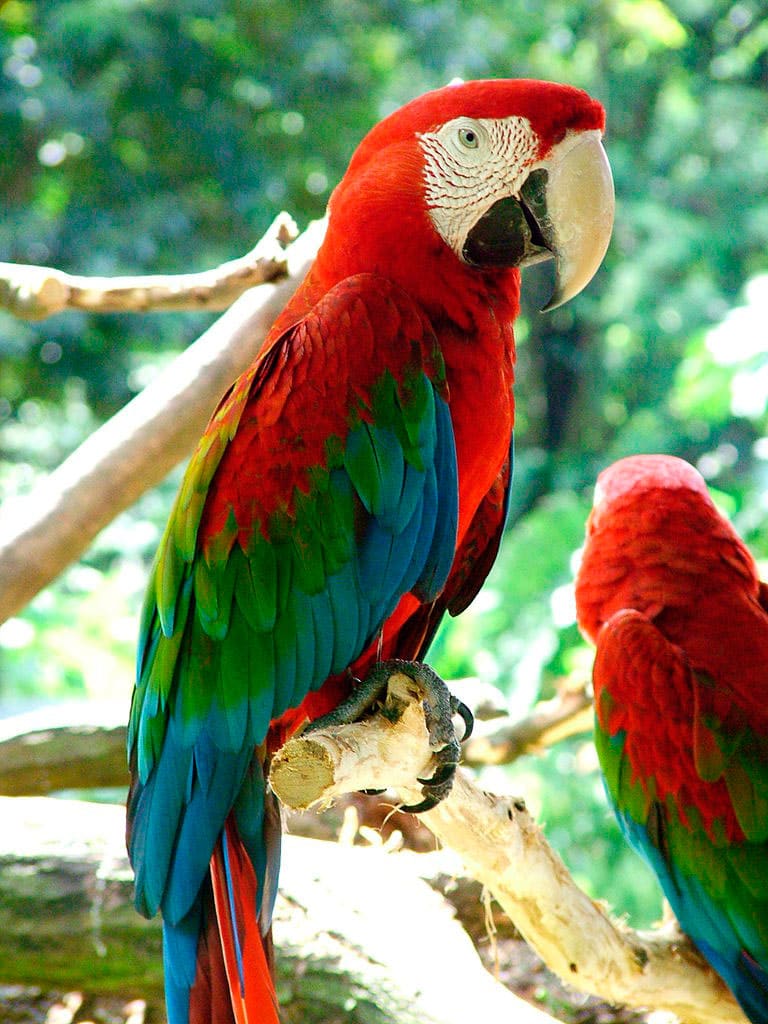
The winged Macaw (Ara chloropterus) they are the second largest family members of macaws behind the Hyacinth Macaw. They have forecrown, crown, both sides of the neck, the nape and the the mantle, a beautiful red; the back up to the uppertail-coverts, blue, scapulars green. Lesser coverts Red with green hidden bases; median green; primary coverts, secondaries outer and primaries, blue, the latter with a black margin at the vane inner; secondary internal and large coverts internal total or partially Green. Red the underwing-coverts.

Underparts Red with the exception of the undertail- coverts they are light blue. Uppertail Red in the central part with blue tips and with the outer feathers shorter, blue; undertail-coverts dark red.

The upper jaw is mostly ivory white, except the cutting edge that is black. The lower jaw is black. The cheeks they are covered with bare white skin ending with fine lines of red feathers. Iris yellowish brown; legs black.

Both sexes similar.

Immature with tail shorter and the irises brown, sometimes with yellow in the coverts supra-alares.

Habitat:

The Red-and-green Macaw they occupy rain forest land in northern area of distribution, apparently, avoiding wetlands; in the South and East of range often in formations dry more open including seasonally flooded forests, forest Highlands and dry forests (Bolivia), entering the Savannah in Paraguay.

Its presence depends on, to a large extent, the existence of large trees and rocky cliffs that are the major providers of sites of anidacion. On the other hand, they are far from the cities, peoples and all the inhabited places, as it is a victim of intensive hunting and is often captured for the aviary bird trade

Observed to 1.000 m in Panama, 500 in Colombia, 1.400m in Venezuela.

They live in pairs or in small flocks, are less likely than the Blue-and-yellow Macaw to regroup, that does not prevent them, sometimes, partnering with them and with the Scarlet Macaw.

Large and spectacular gatherings of different species gather to consume clay on the banks of rivers.

The Red-and-green Macaw they often perch on the tops of the tallest trees. In principle, they are very shy and difficult to deal with. Early in the morning and the night entrance, they engaged on voyages of back and forth between their places of rest and feeding areas, evolving high in the air.

Reproduction:

The season of nesting It takes place at different times depending on the region: in Suriname in December, from November to April in Peru, in January in the middle of Brazil.

The nests they built, generally, in tree cavities, Although it can also be common nests located in cracks or holes of rocky cliffs, as it is the case of Bolivia and in the Northeast and South of Brazil, above all in Minas Gerais, Brazil.

The spawning usually has two or three eggs. Breeding success rate is not very high. According to Birds of the world (HBW), in a study recently envelope 25 from FRY's 16 nests, resulted in: 10 young birds (40%) they were able to fly normally, 9 of them (36%) they died of malnutrition and 6 (24%) were victims of predators.

Food:

The Red-and-green Macaw they have a vegetarian diet. Consume a variety of fruits and seeds of many types of trees. Fruits of Acrocomia and Caryocar (South-West of Brazil) fruits and seeds of Copaifera langsdorffii and Hymenaea courbaril (Northeast of Brazil).

Distribution:

Size of the area of distribution (reproduction / resident): 8.100.000 km2

The Red-and-green Macaw being endemic to the East of Panama the North and centre of South America, until almost the North of Argentina.

In Panama formerly observed in the West to the Caribbean slope of the Canal area (Although these records may be due to leaks), now only observed in the most remote parts of Eastern (for example, at the top of the Bayano River).

Observed in the tropical zone of Colombia, in the Magdalena River Valley, coast of the Caribbean, the Amazon region to the West of the Andes South to the upper area of the Atrato River and Serrania del Baudo.

Also inhabit the lowlands of Venezuela but absent in the North, from Portuguese to Monagas. Partial shape on the inside of Guianas. Along the Amazon basin of Brazil, is of Ecuador, Peru and northeast of Bolivia in Beni, Cochabamba and Santa Cruz.

In Brazil, were formerly seen in Espirito Santo, Rio de Janeiro and the interior of Paranรก; now seemingly absent; It continues to produce in Mato Grosso and the relict population remains in the Parque Estadual Morro do Diabo, to the West of Sรฃo Paulo. They persist in the North and East of Paraguayan Chaco, but now gone from Missions, Chaco, Formosa and Salta, Argentina, where a last reliable record was at 1917.

Resident. Generally uncommon after the population decline caused by habitat loss and capture for trade.

Locally distributed in Panama, Venezuela, Bolivia.

In the Amazon basin widespread but generally less common than the Scarlet Macaw and the Blue-and-yellow Macaw (fairly rare in Ecuador Eastern), Although this situation was reversed in Venezuela and Guianas (and perhaps in other places).

Partially absent near population centres and in decline or have already disappeared in the peripheries of range due to habitat loss, trade and hunting.

Despite the large size of its distribution area, the species is considered monotype (without geographical variations).

Widespread in captivity.

Conservation:

State of conservation โ“˜


minor concern Minor Concern โ“˜ (UICN)โ“˜

โ€ข Current Red List of UICN: Least concern
โ€ข Population trend: Decreasing

The size of the world's population has not been quantified, but this species is described as ยซquite commonยป (Stotz et to the. (1996)).

The population has disappeared in places where it was previously common and it is suspected that it may be in decline due to ongoing habitat destruction elsewhere, the unsustainable levels of exploitation, hunting and capture for trade in live birds.

Rare in Panama, endangered in the West of Colombia, missing in the southeast of Brazil. They are exceptions, Peru and Paraguay, where the species is still fairly common.

Not long ago, Guyana held the record for catches of young pups. Fortunately, from 1993, the country prohibited the commercial traffic of this species.

Their territory is particularly large, It is not considered in danger of extinction at the global level.

"Red-and-green Macaw" in captivity:

widespread in captivity.

It is a bird Intelligent and inquisitive but is perhaps, of all the great macaws, which is worse loneliness, so it is advisable to live with another bird, that you don't have to be necessarily of its kind. Its large size and its huge activity do require large cages and room to move.

Their breeding in captivity is more complicated than that of other large macaws.

With regard to its longevity, according to sources, A male specimen of Red-and-green Macaw was still alive after 50,1 years in captivity just before it was sold. It has reported that these animals can live up to 63 years in captivity, but this has not been verified; the same study reported that these animals they can be played back from the 8 years age in captivity.

Are often crossed with other species of Macaws to develop a series of hybrids.

Alternative names:

Red-and-green Macaw, Green-winged Macaw, Red and green Macaw, Red-and- Green Macaw, Red-and-blue Macaw, Red-blue-and-green Macaw, Red-green Macaw (English).
Ara chloroptรจre, Ara de Cuba (French).
Grรผnflรผgelara (German).
Arara-vermelha, arara-canga, arara-piranga, arara-verde, arara-vermelha-grande (Portuguese).
Guacamaya Rojiverde, Guacamayo Aliverde, Guacamayo Rojo, Papagayo rojo (espaรฑol).
Gonzalo, Guacamaya roja aliverde (Colombia).
Guacamayo rojo (Ecuador).
Carapaico (Venezuela).
Paraba roja, Raraba colorada (Bolivia).
Uvaรญ (Chimane).
Arapiranga (Guarani).
Majรก (Guahibo).
Ja-wo (Piaroa).
Bagarapuru (Embera).
Tooma (Okaima).

scientific classification:

Order: Psittaciformes
Family: Psittacidae
Genus: ARA
Scientific name: Ara chloropterus
Citation: Gray, GR, 1859
Protonimo: Ara chloropterus

Images Red-and-green Macaw:

Videos "Red-and-green Macaw"

ยซGreen-winged Macawยป (Ara chloropterus)


Species of the genus Ara


Sources:

Avibase
– Parrots of the World โ€“ Forshaw Joseph M
– Parrots A Guide to the Parrots of the World – Tony Juniper & Mike Parr
– Birdlife

Photos:

(1) – Ejemplares de Guacamayo rojo (Ara chloropterus) en Singapur By Michael Gwyther-Jones (originally posted to Flickr as Singapore) [CC BY 2.0], via Wikimedia Commons
(2) – Two captive Red-and-green Macaws (also known as the Green-winged Macaw) in San Diego, California, USA By Steve Wilson from Mississippi, USA [CC BY 2.0], via Wikimedia Commons
(3) – Red-and-green Macaw (also known as Red-and-green Macaw) at Apenheul Primate Park, Apeldoorn, Netherlands By Arjan Haverkamp [CC BY 2.0], via Wikimedia Commons
(4) – Red-and-green Macaw (Ara chloropterus) in the Herborn Bird Park, Germany By Quartl (Own work) [CC BY-SA 3.0], via Wikimedia Commons
(5) – Green-winged Macaw or Red-and-green Macaw (Ara chloropterus) head and neck details By Tom Woodward (originally posted to Flickr as IMG_6422) [CC BY-SA 2.0], via Wikimedia Commons
(6) – Red-and-green Macaw flying at Pont-Scorff Zoo, Morbihan, Brittany, France By Tony Brierton from Still here…, Ireland (Pont Scorff Zoo, FranceUploaded by Snowmanradio) [CC BY-SA 2.0], via Wikimedia Commons
(7) – Ara chloropterus, Puerto Ayacucho, Venezuela By Luna04Luna04 at fr.wikipedia (Own work) [GFDL or CC-BY-SA-3.0], from Wikimedia Commons
(8) – Green-winged Macaw (also known as the Red-and-green Macaw) at Denver Zoo, USA. It is wing clipped By Drew Avery (originally posted to Flickr as Scarlet Macaw) [CC BY 2.0], via Wikimedia Commons
(9) – Red-and-green Macaws at Pont-Scorff Zoo, Morbihan, Brittany, France By Tony Brierton from Still here…, Ireland (Scarlet MacawsUploaded by Snowmanradio) [CC BY-SA 2.0], via Wikimedia Commons
(10) – Green-winged Macaw (Ara chloropterus), also known as the Red-and-green Macaw. Picture captioned ยซLโ€™Ara Macaoยป by Jacques Barraband [Public domain], via Wikimedia Commons

Sounds: (Xeno-canto)

โ–ท The world of Pets: Dogs, cats, birds, reptiles, amphibians

Yellow-billed Parrot
Amazona collaria

Yellow-billed Parrot

Content

Description:


Anatomy-parrots

28 cm.. length and 260 g. of weight.

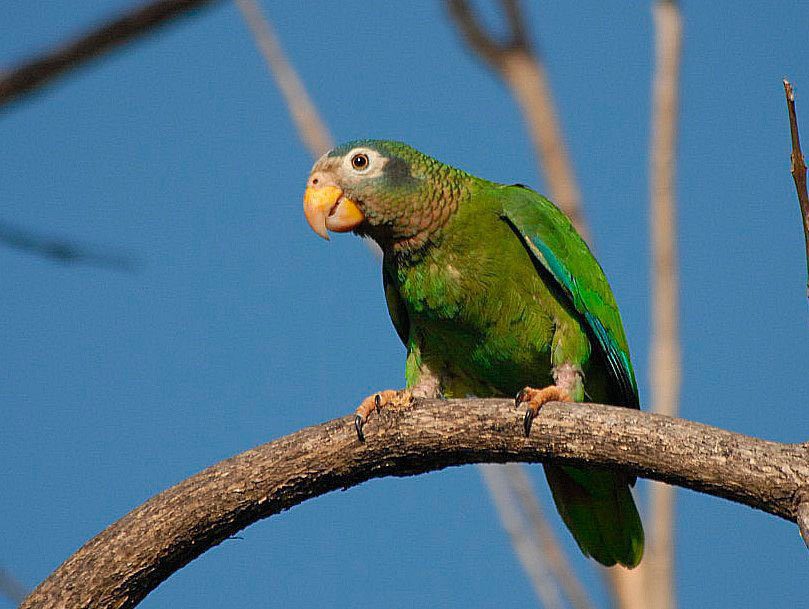
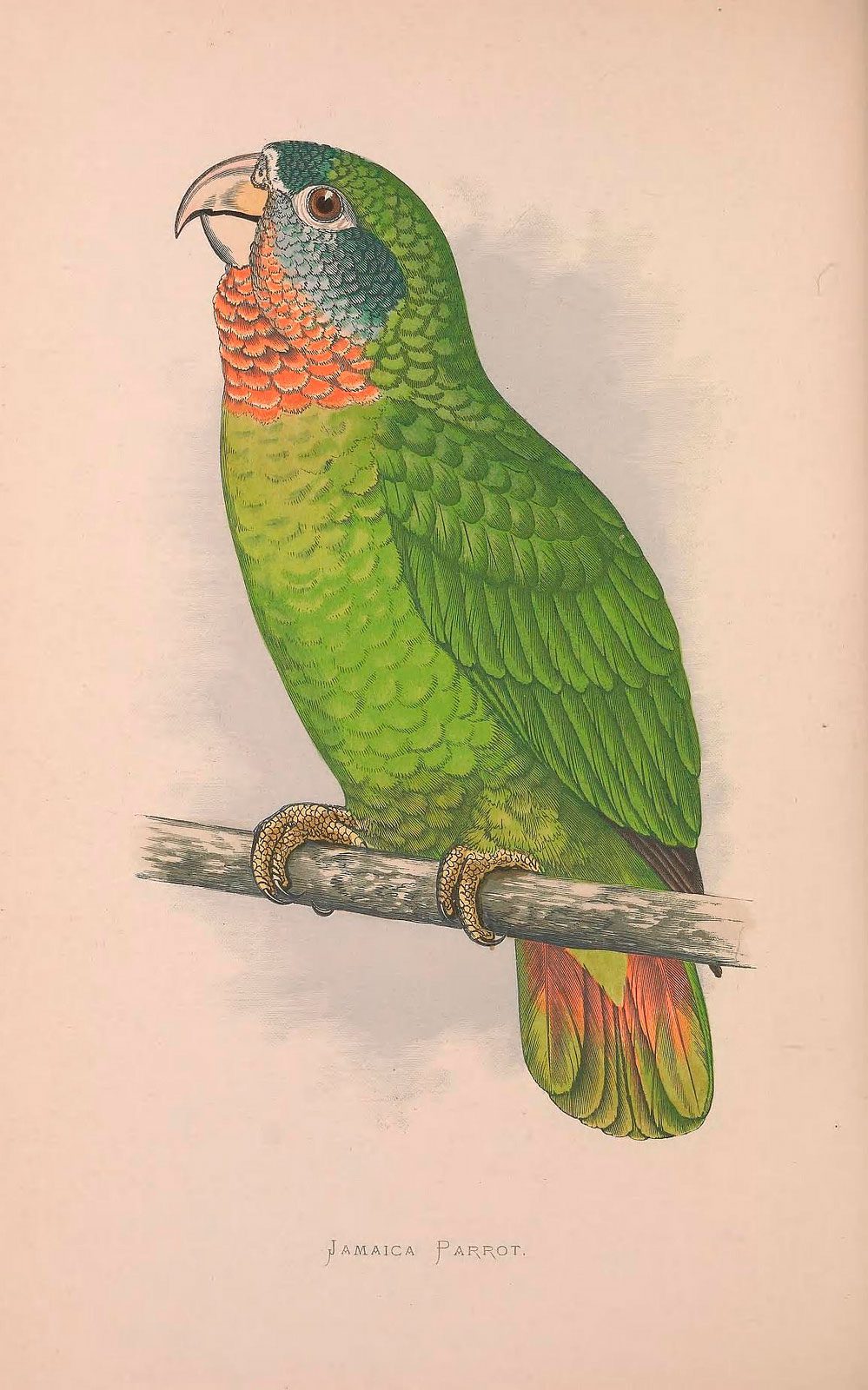
The Yellow-billed Parrot (Amazona collaria) It has a distinctive narrow band on forecrown white; lores and upper cheeks, with pale blue feathers; crown blue with black tips, merging on hindcrown; the sides of neck and nape into green feathers with black tips; feathers on the sides of neck sometimes basally pink; ear-coverts greyish-blue with black tips.

Mantle and back, green apple with black tips (the latter become less pronounced further down); lower back, the rump and uppertail-coverts, brighter yellowish green. big blankets, blue; the rest, green apple. Alula and outerweb of the flight feather, blue; innerwebs, dark gray. Under, the wings green, flight feather, bluish green.

Yellow-billed Parrot

Throat and lower cheeks, Rosaceae, sometimes with green tips; top of the chest to belly, yellowish green apple; undertail-coverts brighter yellowish green. Upper, the tail It is green with yellow and red points on the basis; undertail, paler and olive. Bill yellowish; irises brown; legs Rosaceae.

In the breeding season, the throat pink male it becomes brighter and plumage acquires green metallic tones. Both sexes are similar. Perhaps males average slightly larger. Immature similar to adult.

  • Sound of the Yellow-billed Parrot.

Habitat:

Video "Yellow-billed Parrot"

The Yellow-billed Parrot inhabit, mainly, in the middle level of humid limestone forests (annual rainfall between 1.900-4.500 mm) with (for example) Terminalia latifolia emerging and Cedrela odorata, most arid forests and upland areas planted with trees, especially the edge of the forest; from sea level up 1.200 metres in Cockpit Country.

Usually in pairs or flocks of up to about 40 individuals; larger gatherings where food is plentiful (for example, a report of 60 birds feeding on orange). They form large communal shelters out of breeding season and sometimes seen in association with the Black-billed Parrot (Amazona agilis) and Olive-throated Parakeet (Eupsittula nana). They forage closer to roosts as the day progresses.

Reproduction:

They nest in tree cavities, at higher altitudes the 15 m, frequently Brosimum, with enlarged holes in successive years. Often used initially cavity excavated by the Jamaican Crow (Corvus jamaicensis). Nesting also observed in rock cracks. Courtship registered in January laying of eggs, between 4-5, in March-May.

Food:

Foods reported include catkins of Cecropia, Anacardium occidentale dried fruits, fruits of Pimenta dioica and figs, and seeds of Melia azedarack; feeding birds took only orange seeds, squandering the fleshy part. They forage in middle and high levels.

Distribution and status:

Size of its range (breeding/resident): 7.200 km2

The Yellow-billed Parrot It is endemic to Jamaica, this species remains widespread, more than the other species of Jamaican Amazona, the Black-billed Parrot (Amazona agilis), although extensive surveys have not yet been carried out throughout the entire island. They are observed flocks of 50 to 60 individuals throughout the year, particularly in the non-breeding season, moving from inside the forest to the edge habitat to feed.

This species is particularly Cockpit Country, Mt. Diablo, and John Crow Mountains. A small population (presumably wild) also it sets to Hope Gardens in Kingston.

Recent studies indicate that Amazona collaria it is less abundant than Amazona agilis, possibly as a result of Amazona collaria It is a more colorful and preferred species in trade. while the Amazona agilis It is currently nested in all Cockpit Country, including plantation disturbed along the edges areas, the Amazona collaria now nests almost exclusively in relatively remote hinterlands.

Local reports suggest a significant overall decrease in collaria Amazona in Cockpit Country and a greater degree of threat to other species, the Amazona agilis.

The preliminary population counts suggest 5.000 individuals in Cockpit Country, Mt. Diablo, and John Crow Mountains (C. Levy in lilt, 1999).

Difficult to distinguish from Amazona agilis distance and possible misidentification, They may have affected the validity of some previous reports on their abundance and distribution.

Conservation:

State of conservation โ“˜


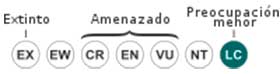
Vulnerable Vulnerable โ“˜ (UICN)โ“˜

โ€ข Current category of the Red List of the UICN: Vulnerable.

โ€ข Population trend: decreasing.

โ€ข Population size : 6000-15000

Rationale for the Red List category

This species is classified as Vulnerable because it has a small and fragmented range, with suitable habitat decline in extent, area and quality, mainly due to speak and forest clearing for bauxite mining. Numbers are also declining due to trampeo.

Justification of the population

The population size is preliminarily estimated to fall in the band between 10.000 and 19.999 individuals. This is equivalent to 6,667-13,333 mature individuals, rounded here to 6,000-15,000 mature individuals.

Justification of trend

No new data on population trends; However, It suspected that the species is declining at a slow pace, as a result of the loss and degradation of habitat and capture.

Conservation Actions Underway

โ€ข CITES Appendix II.

โ€ข protected under the Act Wildlife Protection Jamaica and Endangered Species Act of 2000, which together prohibit keeping the species as a domestic animal and local and international trade.

โ€ข It has been declared as threatened in Jamaica from 1986 (Juniper and Parr 1998).

โ€ข Since 1995 He has worked to delineate its distribution, estimate the size of the population, identify factors limiting reproductive performance and train local people in research methods and techniques for long-term monitoring (BirdLife Jamaica Parrot Project in little 1998, 2000).

โ€ข Habitat in the mountains Blue and John Crow It has been declared National Park, but the implementation and management are weak (BirdLife Jamaica Parrot Project in little 1998, 2000).

โ€ข There is a campaign public awareness high profile to prevent bauxite mining in Cockpit Country, by declaring the area closed to mining by the Minister's Discretion (S. Koenig in some. 2007).

โ€ข Discussions have started that, we wait, will lead to ban the importation of psittacine to Jamaica (S. Koenig in a bit., 2007).

โ€ข Exist captive breeding populations.

Conservation Actions Proposed

โ€ข Survey for delineate the range and evaluate the numbers (BirdLife Jamaica Parrot Project in little 1998, 2000).

โ€ข Declare a Cockpit Country closed to mining.

โ€ข Ensure the de facto protection of the Blue Mountains National Park and John Crow (BirdLife Jamaica Parrot Project in little 1998, 2000).

โ€ข Design and implement Educational programs in the occupied area of รขโ‚ฌโ€นรขโ‚ฌโ€นthe species (BirdLife Jamaica Parrot Project in little. , 1998, 2000) and develop captive breeding populations.

โ€ข Apply legal protection.

โ€ข Prohibit the importation of non-native parrots.

The Yellow-billed Parrot in captivity:

CITES Appendix II. protected under the Law on Protection of Wildlife Act Jamaica and Endangered Species 2000, which together prohibit keeping this species as a domestic animal, as well as local and international trade.
Exist captive breeding populations.

any trade should be avoided with this rare Amazona.
Each captive specimen of this species which is capable of reproducing, It is placed in a well managed captive breeding program and not be sold as a pet, in order to ensure its long-term survival.

Alternative names:

Yellow-billed Parrot, Jamaican Amazon, Jamaican Parrot, Red-throated Parrot, Yellow billed Parrot, Yellow-billed Amazon (English).
Amazone sasabรฉ (French).
Jamaicaamazone, Jamaikaamazone, Jamaikamazone (German).
Papagaio-da-jamaica (Portuguese).
Amazona de Pico Amarillo, Amazona Jamaicana Piquiclara (espaรฑol).


scientific classification:

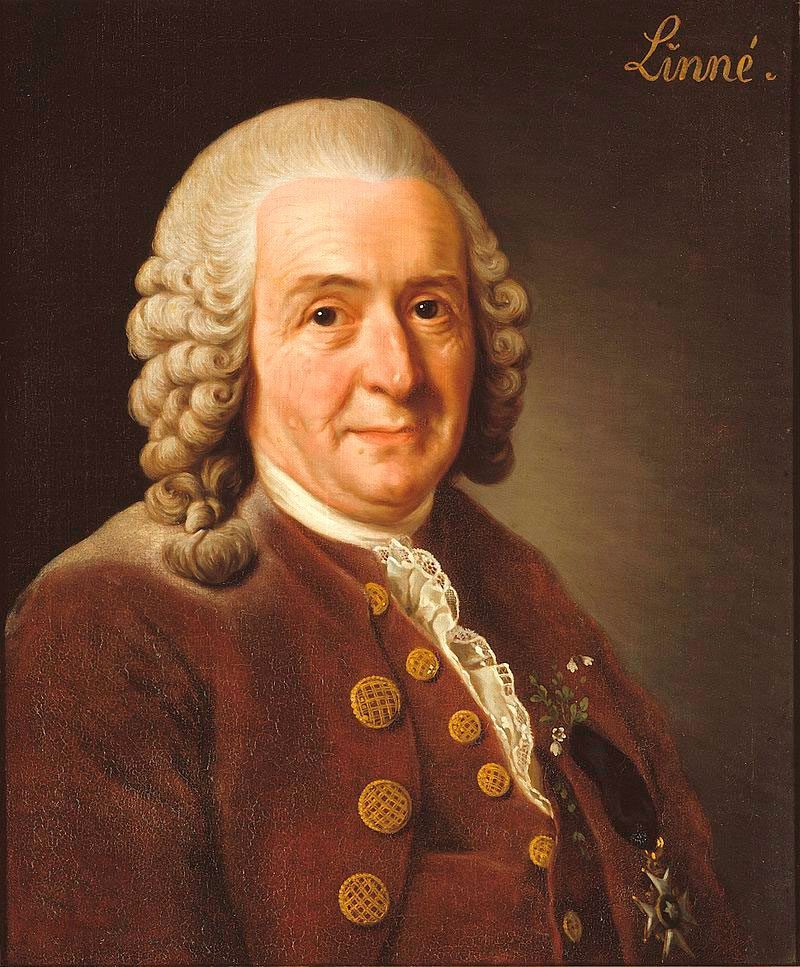
Carl Linnaeus

Order: Psittaciformes
Family: Psittacidae
Genus: Amazona
Scientific name: Amazona collaria
Citation: (Linnaeus, 1758)
Protonimo: Psittacus collarius


Images Yellow-billed Parrot:


Species of the genus Amazona


Sources:

Avibase
Parrots of the World โ€“ Forshaw Joseph M
Parrots A Guide to the Parrots of the World – Tony Juniper & Mike Parr
Birdlife

Photos:

(1) – Yellow-billed Amazon in the St. Andrew, Jamaica By Amazona_collaria_-St.Andrew-Jamaica-8a.jpg: Wayne Sutherland from Kingston, Jamaicaderivative work: Snowmanradio [CC BY-SA 2.0], via Wikimedia Commons
(2) – Amazona_collaria at Vienna Zoo, Schonbrunn Palace, Vienna, Austria By Alois Staudacher (Jamaica Amazone) [CC BY 2.0], via Wikimedia Commons
(3) – Yellow-billed Amazons in the Kingston, St. Andrew, Jamaica By Wayne Sutherland from Kingston, Jamaica (Pair of Yellow Billed Parrots) [CC BY-SA 2.0], via Wikimedia Commons
(4) – Yellow-billed Amazon (Amazona collaria) in Cockpit Country by Ron KnightFlickr
(5) – Yellow-billed amazon parrot (Amazona collaria), Jamaica By Charlesjsharp (Own work, from Sharp Photography) [CC BY-SA 4.0], via Wikimedia Commons
(6) – Parrots in captivity by Biodiversity Heritage LibraryFlickr

Sounds: Nick Komar, XC255118. accessible www.xeno-canto.org/255118.

โ–ท The world of Pets: Dogs, cats, birds, reptiles, amphibians

Northern Mealy Parrot
Amazona guatemalae

Northern Mealy Parrot

Content

Description:


Anatomy-parrots

38 cm.. length and 705-766 g. of weight.

The Northern Mealy Parrot (Amazona guatemalae) is a large parrot, mainly green, with a large bare periophthalmic white; head green, increasingly off toward the area nape.

The youth similar to adults but eyes brown.

taxonomy:

Treated for decades subspecifically within the species Amazona farinosa. Based on a genetic study of the year 2012 They came to be regarded as a full species.

Subspecies description:

  • Amazona guatemalae guatemalae

    (Sclater,PL, 1860) – Mostly green, with the crown, forecrown and lores, blue; carpal edge Green Wing / yellow; Feathers edges wing , blue; Red in the secondary feathers; feathers of the tail dark green to light green at the tip. Bill dark grey. Eye ring white, irises red.


  • Amazona guatemalae virenticeps

    (Salvadori, 1891) – Mostly green with less blue on the crown that the subspecies Amazona guatemalae guatemalae; yellower shades / green; carpal edge green / yellow, with varying shades of red; crown green; lores and forecrown, green tinted blue. Bill black / horn. Eye ring white, irises red.

Habitat:

Video "Northern Mealy Parrot"

They inhabit in dense humid lowland forests, especially near the gaps and edges; also they extend lower montane forest plantations and frequent, crops, gallery forests and deciduous forests.

They are in pairs or groups up 20 individuals, with larger congregations in feeding areas. Form noisy flocks in communal roosts high up in big trees out of breeding season, sometimes with several hundred birds. Well camouflaged while feeding quietly on the upper floors of the forest canopy.

Reproduction:

Season April-May Guatemala. Nests in tree holes, to 3-30 height m, once observed in the crack of a stone wall in a Mayan temple. The laying usually three eggs.

Food:

No known differences with Amazona farinosa.

Distribution:

Size of its range (Standard playback): 919.000 km2

It is present along the slope of Caribbean of Central America, from Veracruz and Oaxaca, Mexico, to the South by Belice, Guatemala, Honduras, Nicaragua and Costa Rica, to western Panama. They are also found in the shed peaceful of Costa Rica and West Panama. Its abundance varies locally, but it is common in many areas.

Subspecies distribution:

  • Amazona guatemalae guatemalae

    (Sclater,PL, 1860) – Caribbean coast from southeast Mexico to the Northwest of Honduras.


  • Amazona guatemalae virenticeps

    (Salvadori, 1891) – Since Honduras (Sula Valley) to western Panama.

Conservation:

State of conservation โ“˜


Near-threatened Near Threatened โ“˜ (UICN)โ“˜

โ€ข Current category of the Red List of the UICN: Near-threatened.

โ€ข Population trend: In decrease.

Rationale for the Red List category

He suspected this species is undergoing a rapid decrease in moderately population due to habitat loss and unsustainable levels of hunting and trapping.

Population size: Unknown

The population trend: In decline.

The Amazona mealy northern captive:

Little known in poultry.

Alternative names:

Mealy Parrot [guatemalae or virenticeps], Northern Mealy Amazon, Northern Mealy Parrot (English).
Amazone guatรฉmaltรจque, Amazone poudrรฉe [guatemalae or virenticeps], Amazone poudrรฉe [guatemalae ou virenticeps] (French).
Guatemalaamazone (German).
Northern Mealy Parrot (Portuguese).
Amazona harinosa norteรฑa (espaรฑol).


scientific classification:

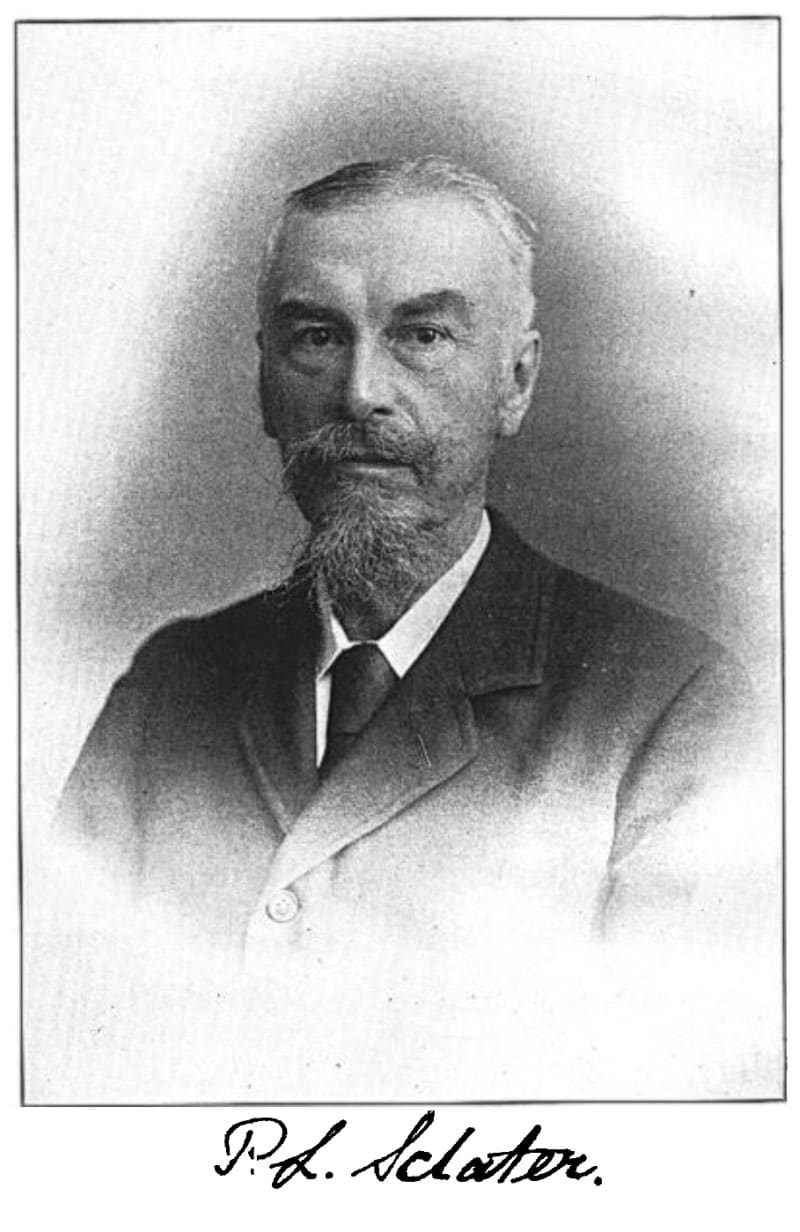
Philip Sclater
Philip Sclater

Order: Psittaciformes
Family: Psittacidae
Genus: Amazona
Scientific name: Amazona guatemalae
Citation: (Sclater, PL, 1860)
Protonimo: Chrysotis guatemalae

Images Northern Mealy Parrot:


Species of the genus Amazona


Sources:

Avibase
Parrots of the World โ€“ Forshaw Joseph M
Parrots A Guide to the Parrots of the World – Tony Juniper & Mike Parr
Birdlife

Photos:

(1) – Amazona farinosa guatemalae By Adalberto Hernandez Vega from Copan Ruinas, Honduras (Macaw Mountain Bird Park – Copan Ruinas, Honduras) [CC BY 2.0], via Wikimedia Commons
(2) – Guatemalaamazone Amazona farinosa guatemalae By Martingloor (Own work) [CC BY-SA 4.0], via Wikimedia Commons
(3) – Amazona farinosa guatemalae by Ulises MuรฑizFlickr
(4) – Amazona farinosa guatemalae By Katrin Lorenzen (IMG_4685) [CC BY-SA 2.0], via Wikimedia Commons
(5) –
Amazona farinosa guatemalae By Adalberto Hernandez Vega from Copan Ruinas, Honduras (Macaw Mountain Bird Park – Copan Ruinas, Honduras) [CC BY 2.0], via Wikimedia Commons

โ–ท The world of Pets: Dogs, cats, birds, reptiles, amphibians

Hyacinth Macaw
Anodorhynchus hyacinthinus


Hyacinth Macaw

Content

Description:

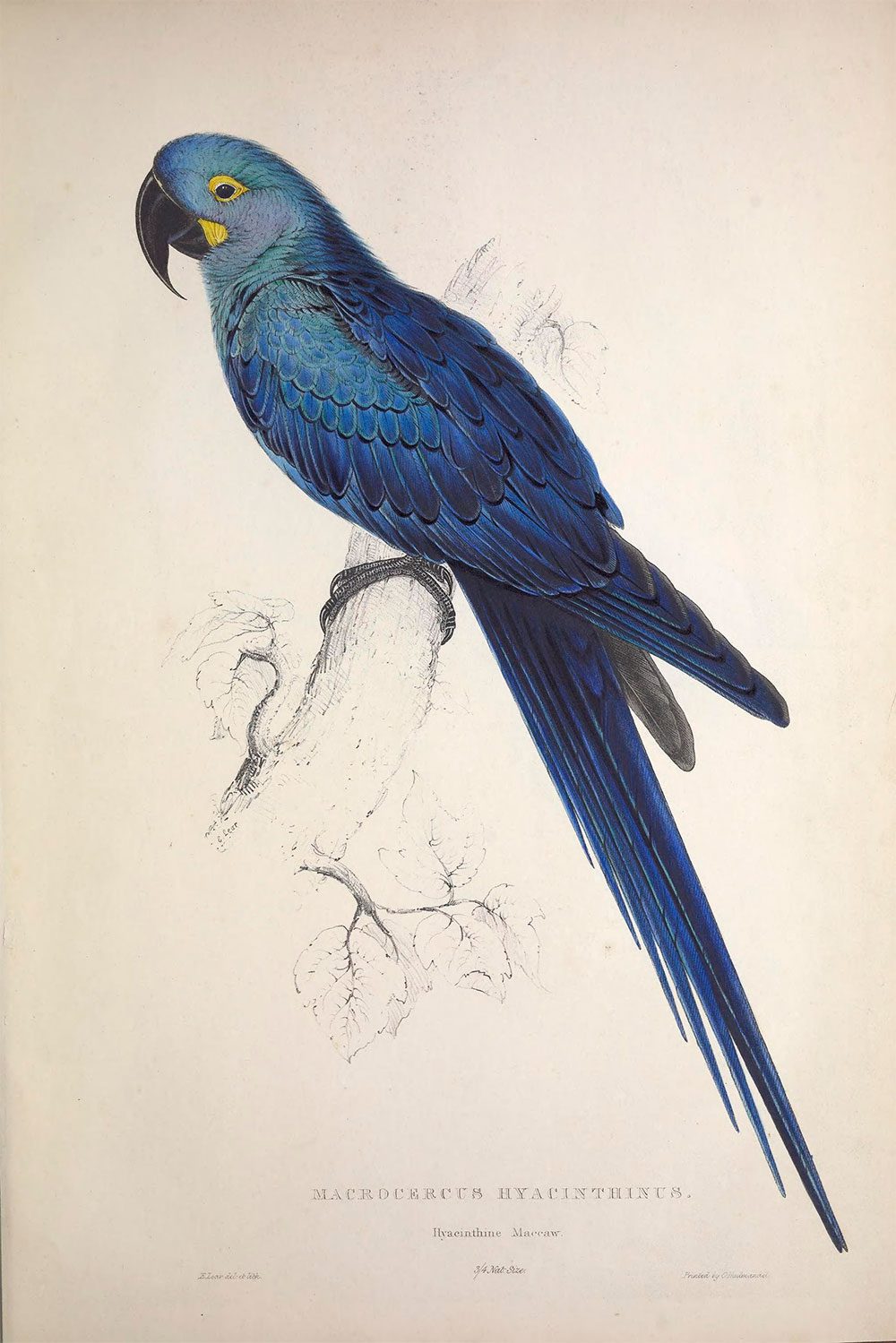
Hyacinth Macaw illustration

90 to 100 cm.. of length and a weight of 1,5 to 1,7 kg.

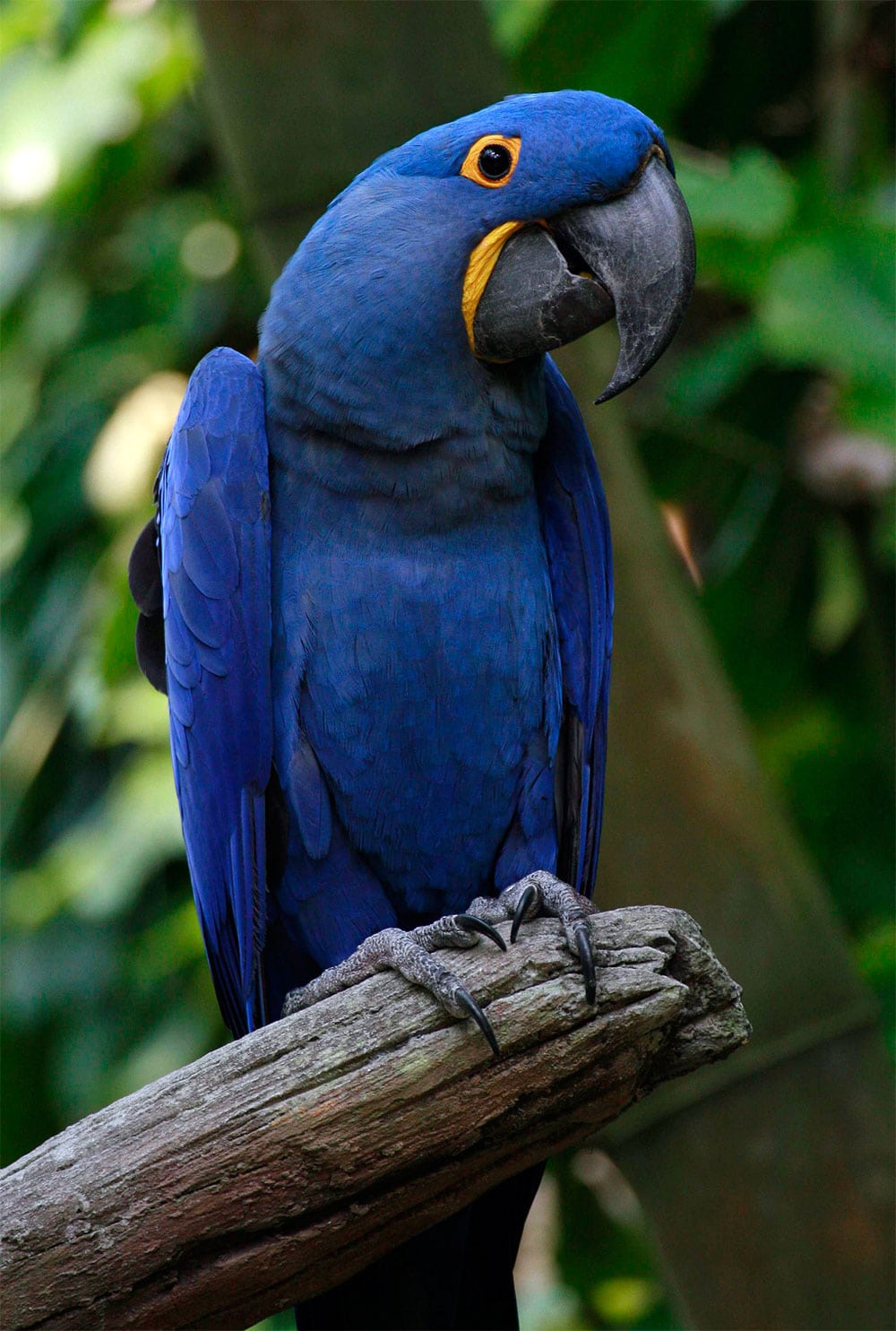
The Hyacinth Macaw (Anodorhynchus hyacinthinus) is the largest parrot; has a distinctive coloration, mostly blue intense, with different colors. Wings and tail below black. The basis of the bill and periocular ring, naked and yellow. The tail is very long, and its powerful bill Black is deeply curved and pointed.

The species Anodorhynchus glaucus, similar but smaller, extinct in the early 20th century, It may have been present in Bolivia.

Habitat:

The Hyacinth Macaw take advantage of a great diversity of habitats rich in various species of Palm trees with large seeds, of which feeds.

In the Brazilian Amazon avoid areas of more moisture, preferring lowland forests and seasonally wet formations with clear zones. In the drier parts of the northeast of Brazil inhabits areas of Plateau cut by Rocky valleys, steep with closed deciduous woodland, gallery forest and swamps with Mauritia flexuosa.

In the the Pantanal region birds frequent gallery forest with palm trees in areas covered with wet grass.

Apparently performs migratory movements.

Usually seen in pairs, family groups or small flocks (usually up to 10); much larger flocks reported before the decline.

Reproduction:

They nest in large tree hollows, in cracks in rocks from cliffs in the northeast of Brazil or in moriche or aguaje (Mauritia).

The favorite for nesting trees in the Mato Grosso, Brazil, include Enterolobium and Sterculia striata. In Northeast Brazil, the nest is located in Palms Mauritia dead or on cliffs.

They usually put one or two eggs, although only one young usually survives if the second egg hatches a few days after the first, since the smaller calf cannot compete with the larger for food.

The incubation period lasts about a month, and the male will assist his partner while she incubates the eggs.

Young people remain with their parents up to three months of age. They reach maturity and begin to play on the seven years.

The breeding season is from August to December, Maybe a little later in areas of pantanal.

Food:

The diet Hyacinth Macaw consists mainly of nuts, locally available of various Palms, including (on Amazonia) Maximiliana regia, Orbignya martiana and Astrocaryum, in the northeast of Brazil, of the Syagrus coronata and Orbignya eicherir, in areas of wetlands of Bone collectors and Acrocomia.

The palm nuts they take them from the own soil or plant (especially after a fire or when available as undigested remains in livestock droppings).

Other fruits that have information are the from the Ficus sp., as well as aquatic molluscs Pomacea.

Birds drink liquid from green palm fruits.

Distribution:

Its distribution includes the Centre of South America, Perhaps in several spacious separate areas.

In the Amazonia in For from the Tapajos River, to the East of the basin of the Tocantins River, extending to the South, possibly to the Northwestern area of Tocantins. At least before present North of the Amazon River (in Amapรก, amazon and Roraima, Brazil) and perhaps some specimens can still inhabit, Although there is no known recent records.

Distributed, as well, through the Northeast interior of Brazil, more or less centered on the Microregion of the Chapadas das Mangabeiras in the union between Maranhรฃo, Piauรญ, Goiรกs and Bay, Brazil (the region Gerais).

A third important population focuses on habitats wetlands of the upper basin of the Paraguay River in the southwest of Mato Grosso, Mato Grosso do Sul, Brazil, and extending into the adjacent area of the East of Bolivia and North end of Paraguay.

Reported as probable for the Mapori River to the South-East of Colombia (Vaupรฉs).

Movements General residents but perhaps seasonal in the Amazon in relation to the ecology of the plants on which they feed.

The territory between the three current major distributions, can still be busy even though recent trends given, They seem to indicate that this seems unlikely.

Formerly common in some areas (for example, Mato Grosso). Now they are rather unevenly distributed, with the recent and likely declines continuous in its population due mainly to the illegal trade internal and to the smaller, but significant, international market of live birds. Also hunted for its feathers (especially Pari) and as food. Declining in some areas (for example Eastern Amazonia), because of the alteration or loss of habitat.

Total estimated wild population in 3000 (1.992). CITES Appendix I.

VULNERABLE.

Conservation:


Vulnerable

โ€ข Current Red List of UICN: Vulnerable

โ€ข Population trend: Decreasing

The Hyacinth Macaw It has been subjected to a massive illegal trade. At least 10.000 birds were captured in the wild, in the decade of 1980, with a 50% destined to the Brazilian market (Mittermeier et to the. 1990).

Among 1983-1984, more than 2.500 birds were moved out of Black Bay, Paraguay, with others 600 extra at the end of 1980 (J. Pryor in litt., 1998). Although these numbers are now much smaller, illegal trade continues (for example 10 bird went through a pet market in Santa Cruz, Bolivia, in August 2004 until July 2005, where the birds were changing hands for 1.000 $ US and went to Peru [Herrera and Hennessey 2007]). More recently it has been noted that there appears to be almost no illegal trade in this species in Bolivia (B. Hennessey in litt. 2012).

Through its area of distribution, There is something of the local game for use as food and for its feathers.

In the Amazon, habitat loss has occurred for cattle ranching and hydroelectric power systems in the rivers Tocantins and Xingu.

In the Pantanal, only the 5% trees S. apetala have suitable cavities (Guedes 1993, Johnson 1996). Young trees are used as food for livestock and burned by frequent fires (Newton 1994).

The Gerais is it being quickly transformed by mechanized agriculture, ranching and plantations of exotic trees (Conservation International 1999).

In Paraguay, the preferred habitats of the Hyacinth Macaw are considered seriously threatened (N. Kochalka Lopez in litt. 2013) and the Paso Bravo National Park suffering from illegal logging.

Conservation Actions Underway:

    – CITES Appendix I and II, protected under Brazilian and Bolivian law and prohibition of exports from all countries of origin.

    – Many landowners in the Pantanal (more and more in the Gerais) they do not allow hunters on their property.

    – There are several studies long-term and conservation initiatives (for example. Anon 2004).

    – In the Refuge Caiman ecological in the Pantanal, the Hyacinth Macaw Project has used artificial nests and hatchling management techniques and raised awareness among farmers (Anonymous 2004).

Conservation Actions Proposed:

    – Study of the range, the current status of the population and the scope of the negotiation of the different parts of its area of distribution (Snyder et to the., 2000).

    – Assess the effectiveness of artificial nesting boxes (Snyder et to the., 2000).

    – To enforce the legal measures that hinder trade.

    – Experiment with ecotourism in one or two sites to encourage donors (Snyder et to the., 2000).

"Hyacinth Macaw" in captivity:

Rare up to 1970; then, starting at 1980, increased considerably in number of captive birds due to increased breeding.

Despite the prohibitions, many of these Macaws they are still trading at high prices (10.000 euros or more), due to its beauty and ease to mimic human language.

Rearing this species can be difficult and, Unfortunately, many chicks die each year in inexperienced hands.

From this page we strongly preserve these beautiful birds in their natural environment, sincerely not us seems reasonable to his tenure as a pet.

Alternative names:

Hyacinth Macaw, Blue Macaw, Black Macaw (English).
Ara hyacinthe (French).
Hyazinthara, Hyathinzara (German).
Arara-azul-grande, arara-azul, arara-hiacinta, arara-preta, arara-roxa, arara-una, canindรฉ (Portuguese).
arara-azul, Arara-azul-grande, arara-hiacinta, arara-preta, arara-roxa, Ararauna, arara-una, canindรฉ (Portuguese (Brazil)).
Guacamayo Azul, Guacamayo Jacinto, Papagayo azul (espaรฑol).
Jacinta azul, Paraba azul (Bolivia).
Vihina (Desana).
Kaheta (Carijona).
Guaรญa-hovy (Guarani).
Arara-รบna (Tupi Guaranรญ).

John Latham
John Latham

scientific classification:


Order: Psittaciformes
Family: Psittacidae
Genus: Anodorhynchus
Scientific name: Anodorhynchus hyacinthinus
Citation: (Latham, 1790)
Protonimo: Psittacus hyacinthinus


Images Hyacinth Macaw:

Videos "Hyacinth Macaw"


Species of the genus Anodorhynchus

ยซGuacamayo Jacintoยป (Anodorhynchus hyacinthinus)


Sources:

Avibase
– Parrots of the World โ€“ Forshaw Joseph M
– Parrots A Guide to the Parrots of the World – Tony Juniper & Mike Parr
– Birdlife
– Parrots, Parrots and macaws (Neotropical)

Photos:

(1) – Hyacinth Macaw also known as Hyacinthine Macaw at Disneyโ€™s Animal Kingdom Park by Hank Gillette [CC BY-SA 3.0 or GFDL], via Wikimedia Commons
(2) – A Hyacinth Macaw at Brevard Zoo, Florida, USA By Rusty Clark from merritt usland FLA (Brevard Zoo Hyacinth Macaw) [CC BY 2.0], via Wikimedia Commons
(3) – Hyacinthine Macaw at Melbourne Zoo, Australia By derivative work: Snowmanradio (talk)Anodorhynchus_hyacinthinus_-Australia_Zoo_-8.jpg: Erik (HASH) Hersman [CC BY 2.0], via Wikimedia Commons
(4) – Hyacinth Macaws at Stone Zoo, Stoneham, Massachusetts, USA By Eric Kilby (originally posted to Flickr as Squawking Heads) [CC BY-SA 2.0], via Wikimedia Commons
(5) – Hyacinthine Macaw (Anodorhynchus hyacinthinus) By Ana_Cotta (originally posted to Flickr as ARARA) [CC BY 2.0], via Wikimedia Commons
(6) – Hyacinth Macaws, Anodorhynchus hyacinthinus at the Aquarium of the Americas in New Orleans, Louisiana By Derek Jensen [CC BY 2.0], via Wikimedia Commons
(7) – A pair of Hyacinth Macaws and thier nest in Mato Grosso do Sul, Brazil By Geoff Gallice from Gainesville, FL, USA (Hyacinth macaws) [CC BY 2.0], via Wikimedia Commons
(8) – A Hyacinth Macaw preening at the Aquarium of the Americas, New Orleans, USA By Quinn Dombrowski (originally posted to Flickr as Dainty) [CC BY-SA 2.0], via Wikimedia Commons
(9) – Anodorhynchus hyacinthinus by Hans – Pixabay
(10) – Illustration Guacamayo Jacinto By Lear, Edward [CC BY 2.0 or Public domain], via Wikimedia Commons

Sounds: Niels Poul Dreyer (Xeno-canto)

โ–ท The world of Pets: Dogs, cats, birds, reptiles, amphibians

Military Macaw
Ara militaris

Guacamayo Militar

Content

Description:

70 to 85 cm.. length and a weight between 900 and 1100 g..
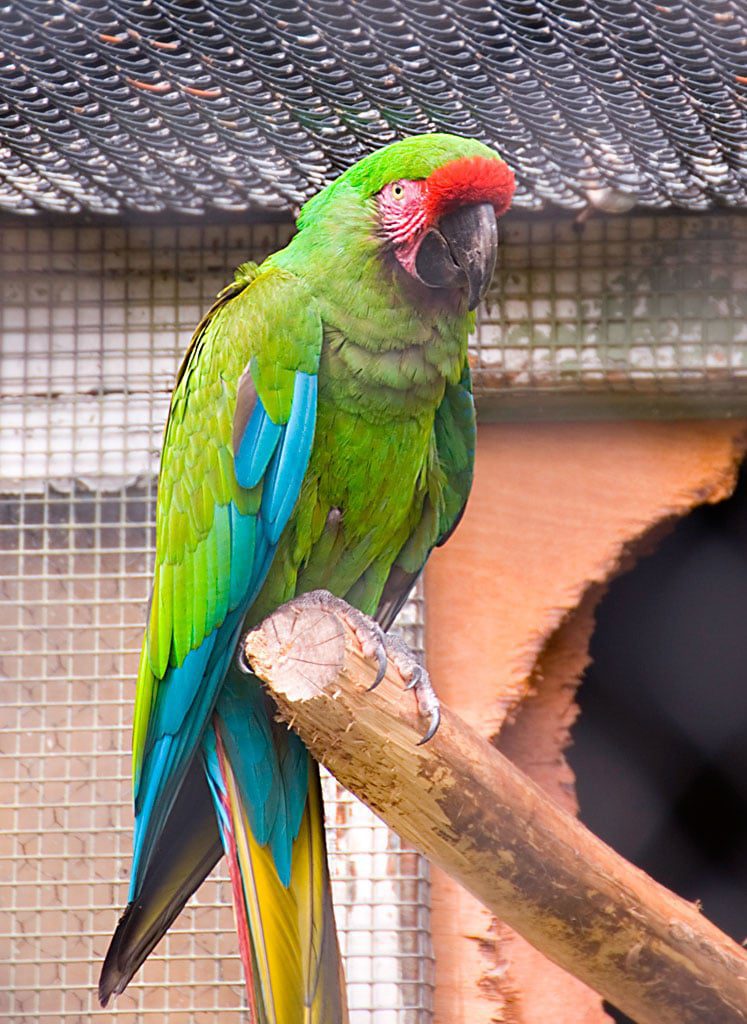
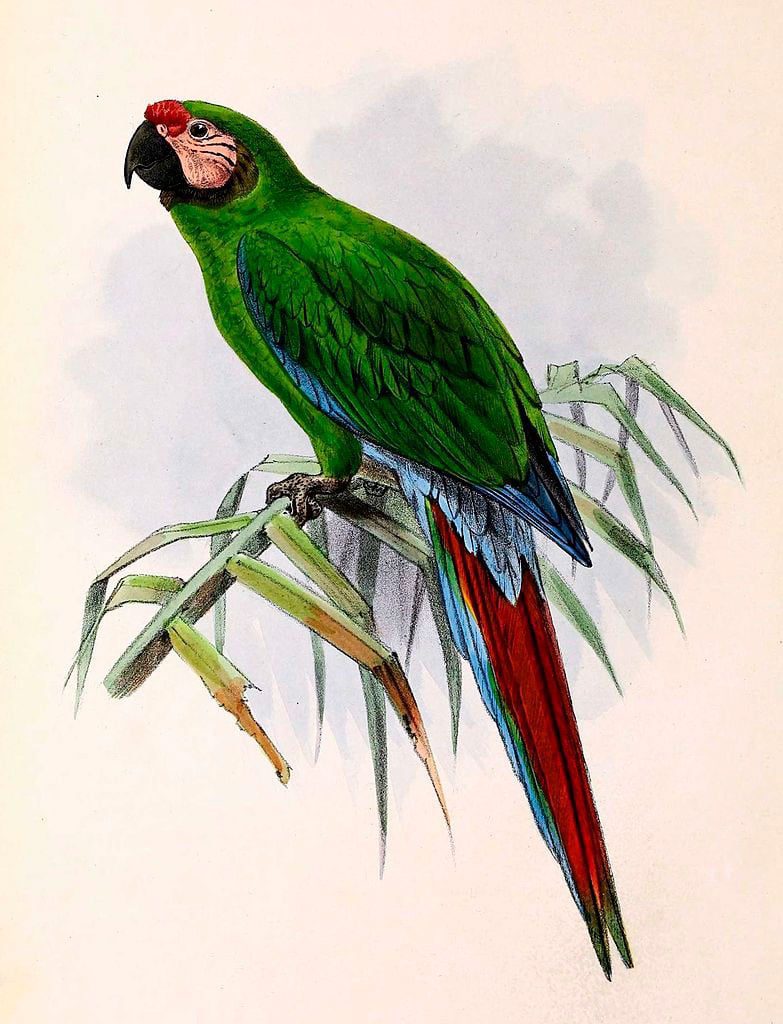
The Military Macaw (Ara militaris) has a dark green color. The head is a green slightly clearer and the crown blue. The back and the top of the wings they have a slightly greenish tone. The rounding of the wings, the edge of the wings and flight feather exterior are light blue.

Illustration military Macaw

The forecrown it is bright red in color and there are a series of purplish-brown lines of feathers on a background of bare skin, since the nose to behind eyes and in the cheeks.

The area of the throat and a narrow strip below the cheeks are olive brown in colour. Breast and belly green; undertail- coverts pale blue.

Upper, the tail orange-red with the ends of the feathers blue; undertail, the tail olive green yellowish.

The eyes has irises yellow. The bill is dark gray, legs dark grey.

Both sexes similar.

Immature not described but as other large macaws, irises probably Brown, tail shorter and the bare facial skin clearer.

Subspecies description:

  • Ara militaris bolivianus

    (Reichenow, 1908) – It differs from the species nominal by the throat reddish brown. The headphones feathers they have a base of reddish and blue present in the wings and at the end of the feathers is a more intense tone.


  • Ara militaris mexicanus

    (Ridgway, 1915) – Almost identical to the species nominal but larger.


  • Ara militaris militaris

    (Linnaeus, 1766) – The nominal species

Habitat:

The Military Macaw they can be mainly observed in foothills of mountainous terrain in woodlands with cannons fields, mostly between 500 and 1, 500 meters above sea level, at the local level to 2.000 m, (3,100 m reported in Peru, to 2,400 m in Bolivia), but also at sea level in the Pacific of Mexico and in the region of Santa Marta, Colombia.

In Mexico, most are distributed in isolated highlands in semi-arid and arid forests, as well as in forests Quercus and Pinus; sometimes in humid, riparian lowland formations, with altitudinal movements to lower altitude to dense scrub forests between November and January.

Observed in humid forests in the Colombian Andes.

In Venezuela, in the rainforest, in some mountainous areas 600 m, sometimes also in more open dry forests.

Usually in pairs or small flocks (until 10 birds), but much larger swarms reported in flights to the roosts. Communal roosts on cliffs or in trees.

Reproduction:

Nest, usually, in crevices of cliffs; sometimes in large trees (for example, Acer, Pinus or Enterolobium).

In Mexico It has been observed to the Military Macaw making use of old nests of the Imperial Woodpecker (Campephilus imperialis) in dead pine.

Breeding pairs are for life.

The egg laying takes place in the month of June in Mexico. They are of two to three eggs that it will take 24 days to hatch, and where the young will remain with the parents for about a year.

The first flights the chicks are produced between the 97 and 140 days old and reach sexual maturity to the 3 or 4 years of age.

Food:

The diet of the Military Macaw It consists of a wide variety of fruits and nuts, including fruit of the Melia azedarach, Ficus and seeds of the Hura crepitans.

Distribution:

Size of the area of distribution (reproduction / resident): 276.000 km2

distributed by Mexico, In addition to several separate populations of South America, heading south to northwest of Argentina.

Widely distributed in Mexico from Sonora (where they have been observed at 28ยฐ 45'N) and Chihuahua in the North, until Chiapas, in the South and the East, where the birds may be geographically isolated.

Absent from the lowlands of the Caribbean; ancient appearances in Guatemala not confirmed.

In Colombia to the West of the Andes to the South of Dagua, of the Magdalena River Valley, and on the West side of the Andes, to the East of the Sierra Nevada de Santa Marta, in the North, through the East of the Ecuadorian Andes until Huanuco in the Peruvian Andes.

Also distributed by the North of Venezuela on Serrania del Perija and from Northwest of Zulia until Federal District.

In Peru, mostly, observed in the East of the Andes, above all in the Maraรฑรณn region, where at least, formerly, It was a common migrant from the slope of the peaceful between September-October(reported on the west slope at 6ยฐ 50'S) to feed on the fruit available seasonally.

In the East of the slopes of the the Bolivian Andes, in Santa Cruz de la Sierra, Chuquisaca and Tarija and Northwest corner of Argentina in Salta and possibly Jujuy.

Seasonal movements in many areas, for example, visitors to the West of Caquetรก in Colombia, from the western slope of the Andes up to this.

Rare in the South of Mexico (in Chiapas possibly extinct), more numerous in the East and Northwest, where flocks of several hundred birds were reported at the end of 1970.

Very local in the Andes and at risk in Venezuela due to habitat loss and trade.

Fairly common in the North of the region of Santa Marta, but sporadic in other parts of Colombia.

Flocks of up to 60 birds observed in the Manu National Park in Peru and in the Amborรณ National Park of Bolivia.

Very rare in Argentina with only sporadic reports in recent years. Recent declines due to low habitat and bird trade, a large number of birds in captivity.

Subspecies distribution:

  • Ara militaris bolivianus

    (Reichenow, 1908) – South of Bolivia and Northwest of Argentina.


  • Ara militaris mexicanus

    (Ridgway, 1915) – Mexico


  • Ara militaris militaris

    (Linnaeus, 1766) – The species nominal

Conservation:


Vulnerable

โ€ข Current Red List of UICN: Vulnerable

โ€ข Population trend: Decreasing

The population size is estimated, provisionally, You can be in the band between 10.000 and 20.0000 individuals.

It is suspected that the population This species can be decreasing due to ongoing habitat loss and capture for national trade.

The loss of habitat and especially the national trade they are major threats to this species, even within the reserves (Snyder et to the. 2000).

In 1991-1995, 96 wild-caught specimens were found in the international trade, with Bolivia and Mexico, possibly, major exporters (Chebez 1994, D. Brightsmith in litt., 2007).

In Mexico, remains one of the most sought after species for the illegal trade of birds in cage; between 1995 and 2005, was the fifth country with the most parrots seized by the Environmental Control Agency from the country, becoming the fourth with more seizures between 2007 and 2010 (JC Cantรบ in litt. 2010).
In many areas it nests in hard-to-reach cavities in cliff faces., that provide some protection against the pressures of plundering of nests. But, the plundering of nests is a serious threat in Jalisco and Nayarit, where the species nests in tree cavities (C. Bonilla in litt. 2007, K. Renton in litt., 2007).

In Jalisco, Mexico, These macaws were not found in deforested areas, even when it was abundant the Hura polyandra (an important source of food), leaving, in the news, as trees to provide shade for cattle (Renton 2004).

An analysis of the GARP believes that the species has undergone a 23% loss of habitat within its distribution area in Mexico (Rios Munoz 2002).

A subpopulation in the Valle del Cauca, Colombia, account for less than 50 mature individuals, little is to be lost as a dam is expected to flood the only nesting cliff (ProAves Foundation 2011).

"Military Macaw" in captivity:

Very popular in poultry.

Although the Macaw Militar is present for more than one century in Europe, He has never enjoyed special interest among the fans, It's a shame, Since it is a being Intelligent. The main reason should be your little flamboyant plumage; especially compared to the one of other macaws. Other failures affect its presence in aviaries: is very loud and has a strong tendency to gnaw.

The power of their vocal organ is much higher than of any other species of Macaw. On the other hand it also good qualities: is very applied to learn, has a great talented imitator and presents an intelligence out of the ordinary.

With regard to its longevity, according to sources, a specimen lived 46 years in captivity. In captivity, these animals have been known that they can raise some 5 years of age.

Alternative names:

Military Macaw (English).
Ara militaire (French).
Soldatenara (German).
Arara-militar (Portuguese).
Guacamaya Verde, Guacamayo Militar, Guacamayo Verde, Papagayo verde (espaรฑol).
Guacamaya verde oscura (Colombia).
Guacamayo verde (Venezuela).
Guacamayo militar (Ecuador).
Maracan, Paraba militar (Bolivia).
Jarcia, Sarea (Chaka).
Panicco (Cofรกn.).

Carl Linnaeus
Carl Linnaeus

scientific classification:


Order: Psittaciformes
Family: Psittacidae
Genus: ARA
Scientific name: Ara militaris
Citation: (Linnaeus, 1766)
Protonimo: parrot military


Images Military Macaw:

Videos "Military Macaw"


Species of the genus Ara


Sources:

Avibase
– Parrots of the World โ€“ Forshaw Joseph M
– Parrots A Guide to the Parrots of the World – Tony Juniper & Mike Parr
– Birdlife

Photos:

(1) – Military Macaw (Ara militaris) at London Zoo, England By jon hanson (originally posted to Flickr as military macaw) [CC BY-SA 2.0], via Wikimedia Commons
(2) – Military Macaw Ara militaris in captivity at Occidental Grand Xcaret Resort, Yucatan, Mexico By Tony Hisgett (originally posted to Flickr as Green Parrot) [CC BY 2.0], via Wikimedia Commons
(3) – Military Macaw flying at Whipsnade Zoo, Bedfordshire, England By Ara_militaris_-Whipsnade_Zoo_-flying-8a.jpg: Alex Smithderivative work: Snowmanradio [CC BY 2.0], via Wikimedia Commons
(4) – Three Military Macaws at Zoolรณgico Los Coyotes, Mexico By Gary Denness (originally posted to Flickr as Squawk No Evil) [CC BY 2.0], via Wikimedia Commons
(5) – Two Military Macaws at Whipsnade Zoo, Bedfordshire, England. The macaw on the left has damaged feathers on its chest and abdomen probably because of a feather plucking habit By Mark Fosh (originally posted to Flickr as Macaw) [CC BY 2.0], via Wikimedia Commons
(6) – Two Military Macaws at Moody Gardens, Galveston, Texas, USA By joannapoe (originally posted to Flickr as 2005-06-18_11-52-47) [CC BY-SA 2.0], via Wikimedia Commons
(7) – A Military Macaw at Whipsnade Zoo, Bedfordshire, England. Some of its feathers are damaged probably due to feather plucking By William Warby from London, England (Military MacawUploaded by Snowmanradio) [CC BY 2.0], via Wikimedia Commons
(8) – Military Macaws in Mexico By Gregg (originally posted to Flickr as YOU WANT SOME?) [CC BY-SA 2.0], via Wikimedia Commons
(9) – Military Macaw (Ara militaris). Details of the head and face By Mary Mueller (Flickr) [CC BY 2.0], via Wikimedia Commons
(10) – Arara militaris by John Gerrard Keulemans [Public domain], via Wikimedia Commons

Sounds: (Xeno-canto)

โ–ท The world of Pets: Dogs, cats, birds, reptiles, amphibians

Cuban Parrot
Amazona leucocephala

Cuban Parrot

Content

Description:


Anatomy-parrots

28-33 cm.. length and 260-301 g. of weight.
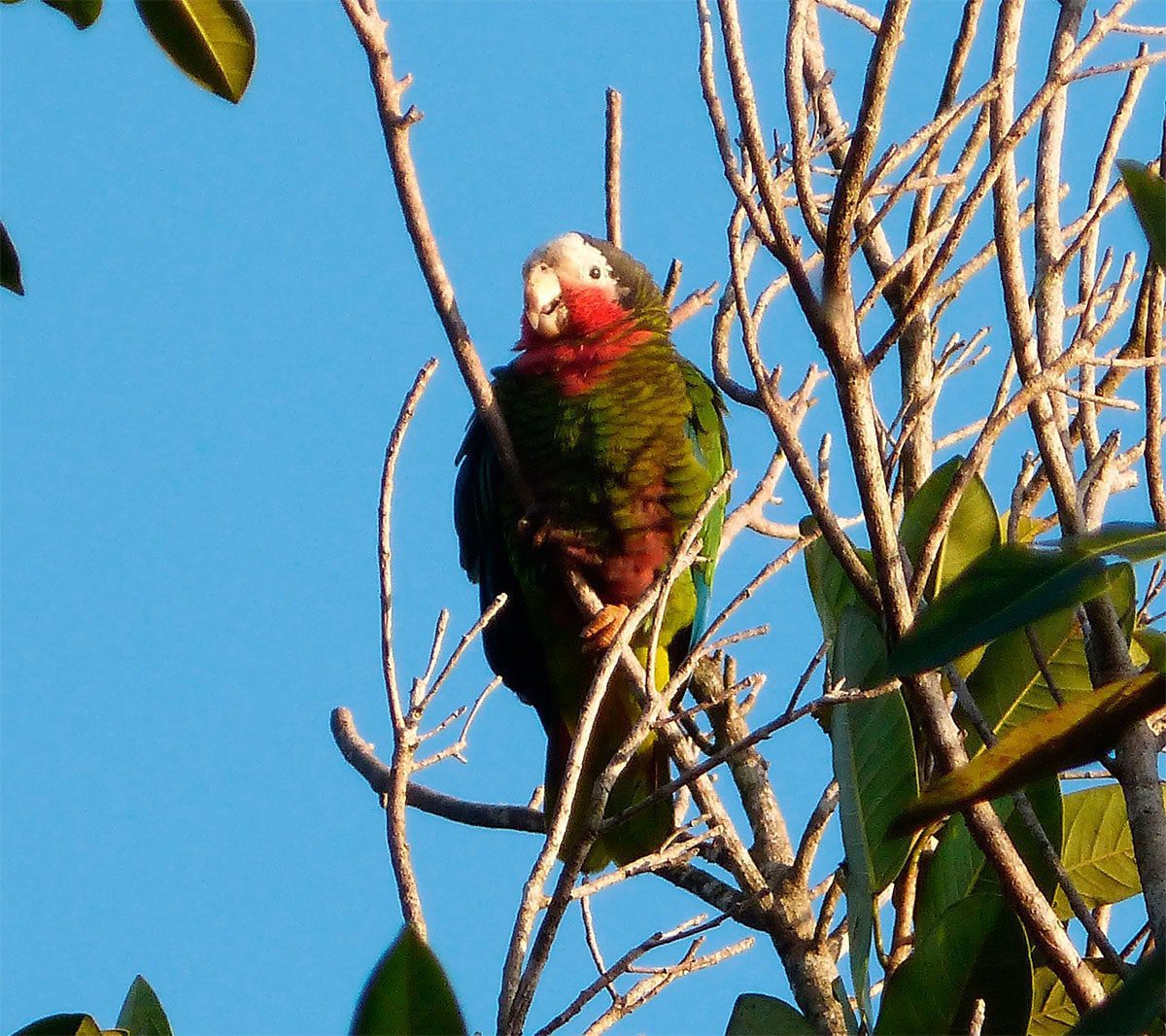
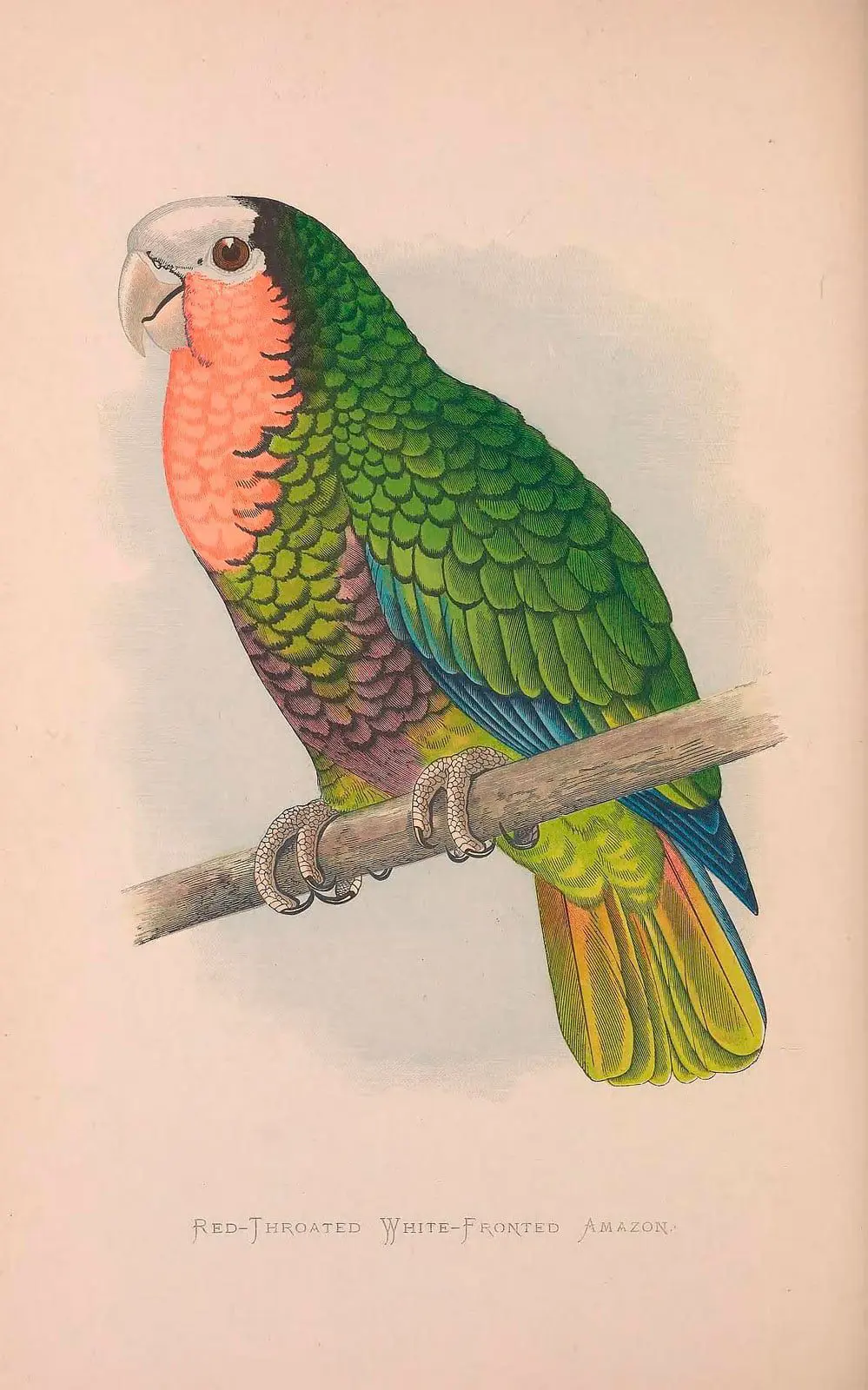
The Cuban Parrot (Amazona leucocephala) has a plumage rather variable, a main color ranging from bright green to olive color,, some birds feathers yellow dispersed in wings and in the back.

Forehead, fore crown, lores and area around eyes, white; lower cheeks and throat, red-pink; feathers the back of the crown and nape, bluish-green with black margins, giving the whole a heavy barred effect; similar pattern on the sides of neck but with the bluish tint absent; ear-coverts charcoal grey. Feathers of the back and the mantle, green with black distal margins but less intense than in the nape and head; rump and uppertail-coverts, dark green with weak margins to some feathers rump.

Cuban Parrot

Alula, greater coverts and flight feather, blue on the outerweb, gray on inner; remaining coberteras green with dark margins, showing most distinct barring on lesser coverts. Under the wings, green with dark margins, flight feather grey. Breast green with dark margins to most feathers; feathers on belly with vinaceous base showing green at margins forming a patch variable-sized, barely noticeable in some birds, striking in other; the thighs green or with some vinaceous feathers; undertail-coverts green. feathers tail green with red at base. Bill yellow-horn: irises reddish brown; legs yellowish brown.

Both sexes are alike, but males of the subspecies caymanenis reportedly larger and brighter than females. Usually, the immature show less black borders on the body feathers and less red wine in the belly.

  • Sound of the Cuban Parrot.

Description 4 subspecies:
  • Amazona leucocephala bahamensis

    (Bryant,H, 1867) – Larger that the nominal species, with slate blue on the back of the crown and more extensive white color head. Pens red wine in the belly, reduced or absent and red at the bottom of the tail less extensive.


  • Amazona leucocephala caymanensis

    (Cory, 1886) – It differs from other subspecies by the turquoise dye in the chest and in the rump and rosacea suffusion (sometimes yellowish) in white feathers head. Plumage Barred yellower and less thick than the nominal species (especially below and on upperwing-coverts), with less white in the head and much less pronounced the patch red wine belly.


  • Amazona leucocephala hesterna

    (Bangs, 1916) – Smaller and darker than the nominal species and that the subspecies caymanensis, most individuals with the red color confined to a point under the eye and patch smaller target in the crown, it lacks the rosy tint of the subspecies caymanensis. Patch red wine in the larger belly than the subspecies caymanensis.


  • Amazona leucocephala leucocephala

    (Linnaeus, 1758) – Nominal.

Habitat:

Cuban Amazon Video

The Cuban Parrot They inhabit in different habitats in different islands. In Cuba They inhabit dense forests; in the Bahamas, in native broadleaf forests and pine forests, and in the Cayman Islands, in dry forests in the plateau ridge and on nearby farmland (Bond 1979, King 1981, Sibley y Monroe 1990). Usually in small groups but forages while forming larger groups in places where food is plentiful; couples or family groups in flocks discernable. More usually in pairs during breeding. They sleep communally outside the breeding season.

Reproduction:

The Cuban Parrot make their nests in cavities or palm tree hollows created by termites or woodpeckers. The population of Abaco It is particularly interesting because nests in natural holes in substrate limestone in the soil (O'Brien et al., 2006); over there, chicks and adults are completely isolated from the frequent fires in the pine forests They are forming their habitat. Breeding March until mid-summer Cuba and Abaco. The laying usually it comprises between 2 and 4 eggs, the incubation period hard of 26 to 28 days and the chicks remain in the nest between 56 and 60 days.

Food:

The diet It includes yema Leaf Roystonea, the cones and new shoots tender the Pinus caribea, sea รขโ‚ฌโ€นรขโ‚ฌโ€นgrape uvifera and Conocarpus erretis, fruits and seeds of Smilax, Sabal, Durant, Exothea, Ernodea, Tabebuia, Acacia, Metopium, Tetrazygia, Swietenia, Cupania and Lisiloma. Sometimes they are persecuted for damage cultivated fruits like Mango (Mangifera) and grain.

Distribution and status:

Size of its range (breeding/resident): 590.000 km2

The Cuban Parrot live in Cuba, Island Pines, Bahamas and Cayman Islands. Formerly observed throughout the island Cuba but now it is difficult to see or is extinct in much of the island. They are still locally distributed throughout the provinces but they are still only common in a few redoubts, including the peninsulas of Zapata and Guanahacabibes and in Sierra de sewage.

You can see in the Isle of Pines (Isle of youth) which dropped dramatically in the twentieth century, especially during the sixties, with most of the population surviving on Lanier Swamp National Park.

Formerly distributed by all the major islands of the Bahamas, but currently extinct, Except in Gran Inagua (spread south, east and north) and Abaco (especially in the southern third). You can visit Little Inagua from Great Inagua.

Mainly in the central and eastern parts of Grand Cayman where habitat loss is less severe. A residual population persists Cayman Brac but it became extinct in little Cayman about 1932.

Mainly resident, but with some seasonal movements, for example in the Isle of youth, where birds possibly (at least once) moved to the coast from the dry interior in the non-breeding season.

The decline across the range is due to the habitat destruction and capture of birds Vivas (for use as pets locally and for export).

Poor breeding success in Grand Cayman in the seventies it was due to mosquito attacks against the pups. Birds that nest on the ground in Abaco attacked by wild cats. The hurricanes They can cause shortages of food and nesting sites. It is likely that Bahamas are stable, but generally decreasing. You can not be considered safe in most of its range.

Distribution 4 subspecies:

Conservation:

State of conservation โ“˜


Near-threatened Near Threatened โ“˜ (UICN)โ“˜

Rationale for the Red List category

The Cuban Parrot It is classified as near threatened because it is suspected to have suffered a reduction in population in Cuba, which has not ceased, mainly due to the capture and destruction of nesting sites.

โ€ข Current category of the Red List of the UICN: Near-threatened.

โ€ข Population trend: Decreasing.

โ€ข Population size : 13600-23000

Justification of the population

Population estimates for Bahamas and Cayman Islands they are as follows: 2.000 in Gran Cayman in 1995 (Bradley 2000), about 450 in Cayman Brac in 2013 (Marsden, 2013), 8.000-13.000 in Great Inagua, 3.000-5.000 in Abaco and around 10 individuals in new Providence (Bahamas National Trust 2016, S. Cant-Woodside in a bit., 2016). It is estimated that the population of Cuba amounts of 7.000 to 14.000 copies based on estimates recorded population density and the fact that it is likely that only a proportion of the estimated extent of occurrence deal. So, the total population It is estimated in 20.460-34.460 individuals, which is equivalent to 13.640-22.973 mature individuals, rounded here to 13.600-23.000 mature individuals.

Justification of trend

It is considered that the species is declining mainly due to the capture and destruction of nesting sites. It is considered that the population of the Bahamas It has remained stable or increased. The population of the Cayman Islands It has increased since the species was protected in 1989 (Bradley 20000). It is believed that the Cuban population has decreased in recent years, mainly due to the poaching (Canizares 2012, M. Canizares in a bit., 2016). Although there is no data on the extent of this decline, the species has been classified as Vulnerable in Cuba (Canizares 2012). So, It is suspected that the total population has decreased 10-20% over three generations.

Conservation Actions Underway

โ€ข CITES Appendix 1.

โ€ข Protected in the Bahamas under the Wild birds Protection Act (Protection).

โ€ข Rightfully protected in the Cayman Islands from 1989.

โ€ข Los artificial nests a variety of designs are in use in several locations Cuba and they have been used by more than 1.300 birds (Waugh 2006). The facts of artificial materials have proved more durable (Waugh 2006).

โ€ข Los volunteers counts in the center of Cuba They have been conducted twice a year since 2009 and more than 1.500 local people are involved in the activity.

โ€ข Important plant species are used for parrot feeding for reforestation and forest enrichment..

Conservation Actions Proposed

โ€ข Discourage the taking of birds from the wild through public education campaigns.

โ€ข Promote better bird-keeping practices to increase the longevity of captive birds and reduce the demand for wild populations.

โ€ข In Abaco, protect vital areas of broadleaf forests.

โ€ข In Cuba, make and erect more artificial nests.

โ€ข Monitor the population trends across its range.

Cuban Parrot in captivity:

Currently international trade Cuban Parrot It is legally prohibited; However, at regional level, the illegal traffic This species is one of the most worrying in Cuba.

Each captive specimen of this species which is capable of reproducing, must be placed in a well-managed captive breeding program and not sold as a pet, in order to ensure its long-term survival.

Alternative names:

bahaman parrot, Caribbean Amazon, Caribbean Parrot, Cuban Amazon, Cuban Parrot, Rose-throated Parrot, White-headed Amazon, White-headed Parrot (English).
Amazone ร  face rouge, Amazone ร  tรชte blanche, Amazone de Cuba (French).
Kubaamazone (German).
Papagaio-de-cuba (Portuguese).
Amazona Cubana, Cotorra (espaรฑol).

Carl Linnaeus

scientific classification:


Order: Psittaciformes
Family: Psittacidae
Genus: Amazona
Scientific name: Amazona leucocephala
Citation: (Linnaeus, 1758)
Protonimo: Psittacus leucocephalus


Images Cuban Parrot:


Species of the genus Amazona


Sources:

(1) Avibase
(2) Parrots of the World โ€“ Forshaw Joseph M
(3) Parrots A Guide to the Parrots of the World – Tony Juniper & Mike Parr
(4) Birdlife

Photos:

(1) – Rose-throated Parrot. Amazona leucocephala Long Beach, Zapata N.P. Cuba by gailhampshireFlickr
(2) – A Cuban parrot (amazona leucocephala) in Naturarte Center. santa Clara, Cuba 2011 by lezumbalaberenjenaFlickr
(3) – A Cuban parrot (Amazona leucocephala) Vega de Palma, Camajuanรญ, Cuba by lezumbalaberenjenaFlickr
(4) – Amazona leucocephala by Ekaterina Chernetsova (Papchinskaya)Flickr
(5) – Amazona leucocephala by Ekaterina Chernetsova (Papchinskaya)Flickr
(6) – Cuban Parrot (Amazona leucocephala) by HeathFlickr
(7) – Cuban Amazon by Eric SavageFlickr
(8) – Two Cuban Amazons in Matanzas, Matanzas Province, Cuba By Laura Gooch (BI110211-174 – Cuban Parrot) [CC BY-SA 2.0], via Wikimedia Commons
(9) – Cuban Amazon parrot on Grand Cayman Island By Lhb1239 (Own work) [CC BY-SA 3.0], via Wikimedia Commons
(10) – Cuban Amazon (also known as the Rose-throated Parrot) at Jungle Island, Miami, USA By Chris Acuna from Miami, USA (Jungle Island-20090823-086) [CC BY 2.0], via Wikimedia Commons
(11) – A Cuban Amazon in Isla de la Juventud, Cuba. It is in a small round cage on a balcony By Alex Graves (Parrot) [CC BY-SA 2.0], via Wikimedia Commons
(12) – A Cuban Amazon flying in Matanzas, Matanzas Province, Cuba By Laura Gooch (BI110211-159 – Cuban Parrot) [CC BY-SA 2.0], via Wikimedia Commons
(13) – Cayman parrot (Amazona leucocephala caymanensis), Grand Cayman By Charlesjsharp (Own work, from Sharp Photography, sharpphotography) [CC BY-SA 4.0], via Wikimedia Commons
(14) – Parrots in captivity /. London :George Bell and Sons,1884-1887 [i.e. 1883-1888] by Biodiversity Heritage LibraryFlickr

Sounds: Hans Matheve, XC256757. accessible www.xeno-canto.org/256757

โ–ท The world of Pets: Dogs, cats, birds, reptiles, amphibians

Kawall's Parrot
Amazona kawalli

Kawall's Parrot

Content

Description:

35-36 cm.. length.

The Kawall's Parrot (Amazona kawalli) after not having been recorded in the wild for a few 70 years, It was rediscovered in the early 1980.

Wrongly confused with Southern Mealy Parrot (Amazona farinosa) which differs from the remarkable white band at the base of bill.

They have forecrown, the lores, the cheeks and ear-coverts green, although in some birds appear blackish. The crown, sides and back of the neck, as well as the nape, They are green with broad blackish margins to feathers, giving the whole a intricate scaly appearance, with escalation most pronounced in the nape and the the mantle.

Kawall's Parrot

Upperwing-coverts green, with the coverts smaller and medium dark shades showing weak at tips; some feathers yellowish green in the leading edge of wing . Primaries green with black towards the tips and some blue in outerweb (a specimen with primary external bright yellow in a wing); red in the three secondaries External form a speculum bright. The underparts They are green with scaling effect derived from the blackish tips to the feathers on the sides of the low chest; some feathers with dark tips in the middle of the chest although little visible; undertail-coverts, more greenish yellow. Upper, the tail It is green with wide band terminal greenish yellow, lateral feathers variably marked dark red (sometimes lined with black-brown and blue) in basal half; undertail, the tail similar but slightly off.


Anatomy-parrots

Bill gray bare skin cream in the base and a cream patch on the upper jaw; irises reddish-orange; legs gray.

The male has the lores and perhaps gray bill largest. Immature not described.

  • Sound of the Kawall's Parrot.

Habitat:

The Kawall's Parrot They inhabit tropical rainforests, with apparent preference for river edges and permanently flooded forests (igapรณ).

Reproduction:

Nests observed in tree cavities flooded forest

Food:

Foods reported include seeds trees Hevea brasiliensis and H. spruceana, mesocarpio palm fruit Maximiliana maripa and seeds of Eichleria and Joannesia.

Distribution:

Size of its range (breeding/resident ): 1,160,000 km2

The few published records come from the Amazon basin of Brazil; on top of Juruรก (under Eirunepรฉ), in the amazon; the confluence of roosevelt river and Aripuanรฃ River, to the South of For; and southern Santarรฉm, For.

Possibly they overlooked in the field due to morphological similarities with some of the best known and there are almost certainly more individuals than congeners the few records suggest. Distribution map based on alleged occurrence among localities known. No details on the population or condition.

Conservation:

State of conservation โ“˜


Near-threatened Near Threatened โ“˜ (UICN)โ“˜

โ€ข Current category of the Red List of the UICN: Near-threatened.

โ€ข Population trend: Stable.

Rationale for the Red List category

Based on a model of future deforestation in the Amazon basin and the susceptibility of the species to habitat fragmentation and hunting , It suspected population decline by 25-30% in the next three generations and, therefore, It has risen to Near Threatened.

Justification of the population

The size of the world's population has not been quantified, but this species is described as ยซrareยป (Stotz et to the., 1996).

Justification of trend

It is suspected that this species has lost 19.1-33.6% of habitat suitable within their distribution during three generations (37 years), based on a model of Amazon deforestation (Soares-Filho et to the., 2006, Bird et to the., 2011). But, it is considered that the species has a wider distribution than indicated on the map used in this analysis (A. Lees in litt 2011), As it suspected to decline by 25-30% during three generations.

Conservation Actions Underway

The species in Appendix II CITES.

Conservation Actions Proposed

First of all, expand the network of protected areas to effectively protect the IBA. Second manage more effectively the resources and existing and new protected areas, using the emerging opportunities for funding the management of protected areas with the overall goal of reducing carbon emissions and maximize the conservation of biodiversity. Especially relevant conservation on private land, through the expansion of market pressures for proper land management and prevention of deforestation on land not suitable for agriculture (Soares-Filho et to the., 2006). Campaign against proposed changes to Brazilian Forest Code that would lead to a decrease in the width of protected riparian forest areas such as Permanent Preservation Areas (APPs), that function as vital corridors in fragmented landscapes.

"Kawall's Parrot" in captivity:

The Kawall's Parrot It is a half-noisy parrot, not very active and hard chewing. They can easily tame. They are not common in aviculture. They are hardy once acclimated. Its minimum temperature tolerance is 15 degrees. Any lower temperature than this requires supplemental heat until the Parrot has acclimatized.

Alternative names:

Kawall’s Amazon, Kawall’s Parrot, Kawall’sParrot, White-cheeked Amazon, White-faced Amazon (English).
Amazone de Kawall (French).
Kawallamazone, Stromamazone (German).
papagaio-dos-Garbes (Portuguese).
Amazona de Kawall, Loro de Kawall, Loro de Kawallรญ, Amazonas de mejillas blancas,
loro de garbes
(espaรฑol).


scientific classification:

Rolf Grantsau

Order: Psittaciformes
Family: Psittacidae
Genus: Amazona
Scientific name: Amazona kawalli
Citation: Grantsau & Camargo, 1989
Protonimo: Amazona kawalli

Kawall's Parrot images:

Amazona de Control


Videos Kawall's Amazon:


Species of the genus Amazona


Sources:

  • Avibase
  • Parrots of the World โ€“ Forshaw Joseph M
  • Parrots A Guide to the Parrots of the World – Tony Juniper & Mike Parr
  • Birdlife

Photos:

(1) – Kawallโ€™s Amazon at Rio Cristalino, Mato Grosso, Brazil by Jacek Kisielewski [CC BY-SA 3.0], via Wikimedia Commons
(2) – Kawallโ€™s Parrot (Amazona kawalli) Cristalino Jungle Lodge, Mato Grosso, Brazil by Amy McAndrewsFlickr
(3) – ROLF GRANTSAU* and Hร‰LIO F. DE ALMEIDA CAMARGO** Museum of Zoology of the University of Sรฃo Paulo CP 7172, Sao Paulo, Brazil – NEW BRAZILIAN AMAZON SPECIES

Sounds: Jeremy Recall, XC313948. accessible www.xeno-canto.org/313948

+ More