The head of the Brehm's Tiger-Parrot(Psittacella brehmii) is marron-oliva. The neck It is colored with black and green bars. The front and sides of the neck they are surrounded by a bright yellow stripe. The chest It is slightly striped in green and black colors.
The center of the back is very green and it integrates perfectly, with yellow and black striped, the area of the rump. Black fusion is absent from yellowish green to the extent lumbar and Hip. Wings they are a dark green color with dark edges in the covered medium-sized. The flight feather are blackish with vane a thin border beige and green external. The curvature of the wing is Bluestone. Wing feathers green.
The underparts are green, totally opaque, except the undertail-coverts that are of color red Scarlet. The bottom of the tail is green, greyish black down.
The bill It is brownish grey with lighter edges and a white tip. The irises is reddish orange. The legs are grey green.
The female lacks the yellow Crescent on the front of the neck. The chest listed in green and black.
Youth with the colors green and yellow absent from the chest area. Coverts of the tail of color orange tinged with tips yellow. The bill pale.
: Its underparts and back listing are more yellowish green tones, and larger.
Psittacella brehmii pallida
: As the nominal but with narrower peak.
Psittacella brehmii harterti
: It is clearer and less yellowish green head. Is smaller.
Habitat:
Are observed in the montane forest, including Podocarpus, beech forests of Nothofagus and edge of forests, mainly from 1.500 metres to the 2.600 m, ends in 1.100 and 3.800 m.
The Brehm's Tiger-Parrot is distributed primarily at altitudes below the habitat of the Painted Tiger-Parrot, but there is a zone in which they find sympathy latitudinally, and is between 2.500 and 3.000 m. Birds are often found individually or in small groups and allow an approximation.
You spend much time below the canopy or even close plants feeding on seeds and berries (including conifers and Podocarpus), Although also found in levels higher in the forest. Move slowly, often using his beak to balance and sometimes you can stay still. They only make short flights, never flying above the canopy.
Reproduction:
Little is known of nesting behavior, but two nestlings were observed in a nest during the month of June.
Food:
Diet includes seeds, coniferous berries and Podocarpus.
Distribution:
The Brehm's Tiger-Parrot they are endemic in New Guinea, where often live almost exclusively in mountain areas. Its range is divided into three isolated populations, an in Vogelkop, West Papua, the second in all the central and South-Eastern Highlands of New Guinea and the third in the mountains of the Huon Peninsula (the Painted Tiger-Parrot is absent and the Parrot Brehm Tiger is observed at altitudes higher than usual). The species is widespread, but generally uncommon; the world's population is believed to be superior to 100.000 specimens.
Distribution Subspecies
Psittacella brehmii brehmii
: The nominal.
Psittacella brehmii intermixta
: Is located in the central mountains of New Guinea.
Psittacella brehmii pallida
: Of the mountains of the southeast of New Guinea.
Psittacella brehmii harterti
: Occupies the Huon Peninsula (to the northeast of New Guinea).
Conservation:
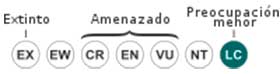
• Current category of the Red List of the UICN: Least concern
• Population trend: Stable
The size of the world's population has not been quantified, It is believed that it is superior to 100.000 specimens.
The species, according to sources, it is quite common and widespread (pit et to the. 1997).
The population is suspected to be stable in the absence of evidence of any reduction or substantial threats.
"Brehm's Tiger-Parrot" in captivity:
It is not a bird for the lovers of the aviaries since their mortality rate in captivity is very high.
Alternative names:
– Brehm’s Tiger-Parrot, Brehm’s Parrot, Brehm’s Tiger Parrot (ingles).
– Perruche de Brehm (French).
– Brehmpapagei, Brehm Papagei, Brehm-Papagei (German).
– Psittacella brehmii (Portuguese).
– Lorito de Brehm, Lorito tigre de Brehm, Lorito-tigre de Brehm (español).
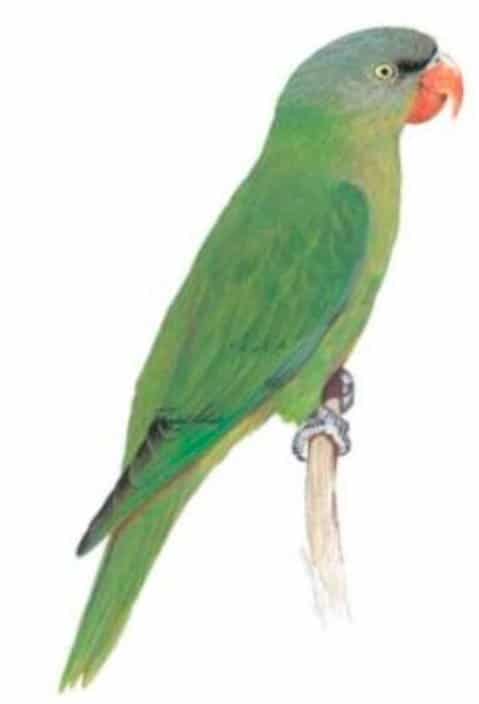
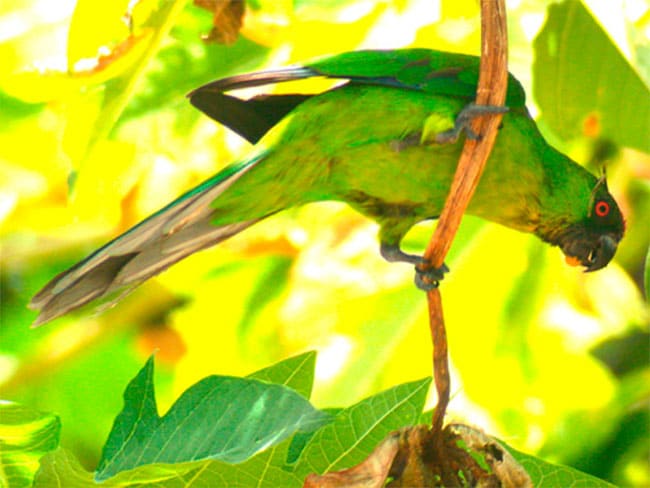
The Black-lored Parrot (Tanygnathus gramineus) It has a green head with a black line that goes from the top of the beak to the eyes.; steeped in turquoise blue Crown. The upper parts of green grass.
The medium-sized wing coverts, green; flight feather, green, a little darker, with blackish margins to the vane inner. Supracaudales coverts yellowish-green. The more underparts, more yellowish green, especially in the lower part of the cheeks and upper part of the chest. Upper, the Green tail with yellow tips; undertail, the Brown tail olive warm.
Information is received for the first time of the Black-lored Parrot Thanks to ornithologist side Hendrik Cornelis Sieber (1890-1949) in 1930.
Very little of this species is known. Is distributed in mountain forests above 600-700 meters and also, according to sources, in the lowlands, hills and coastal areas. It is partially nocturnal, although sightings of birds perched on treetops during the day, They show that, similar to the Azure-rumped parrot, they can also be active during the day.
Migration is relatively weak and there are only a few reports of parrots flying to high altitudes during the day and descending at night., Judging from their voices.
Bird predominantly occupies the central part, High Island, where according to sources, There are settlements in Gunung Tagalago,WA Temun and Kunturun, at elevations of 700-1100 m, also in the lowlands of the South in Fäkal, EHU and Leksula. There was a sighting of these parrots near Kayeli Bay on the eastern shores of Buru. Most recent observations made outside North (Waflia) and (Wamlana) Northwest Coast.
The voice of the Black-lored Parrot is heard frequently in Kunturun, mostly 1-7 hours after the sunset, where the locals call the bird «The ol' blue cockatoo«, which means Blue-headed Parrot. But, was caught during the day with slingshots in fruit trees, suggesting that his activity is not purely night.
Conservation:
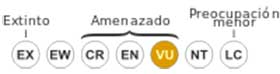
• Current category of the Red List of the UICN: Vulnerable
• Population trend: Decreasing
The population is estimated at 2,500-9,999 mature individuals based on an assessment of the known records, descriptions of the abundance and range size. This estimate is equivalent to 3,500-15,000 specimens.
There are no data on trends for this species and has not been seen in the wild since 1995. Their habitat continues to decline slowly and were recorded in domestic trade in the year 2001. So, the population of the species is suspected of have been declining.
Conservation Actions Proposed:
– Conduct surveys, mostly using their vocalizations at night, mainly in the mountain areas.
– Investigate their ecological requirements and movements in order to develop appropriate conservation strategy.
– Identify the most suitable area for the conservation of this and other endangered species in Buru, and promote its establishment as protected areas.
– Black-lored Parrot, Black lored Parrot, Blacklored Parrot, Buru Parrot (ingles).
– Perruche de Buru, Perruche à calotte bleue (French).
– Burupapagei, Buru Papagei (German).
– Tanygnathus gramineus (Portuguese).
– Loro de Buru (español).
30 cm.. length and a weight between 100 and 175 g..
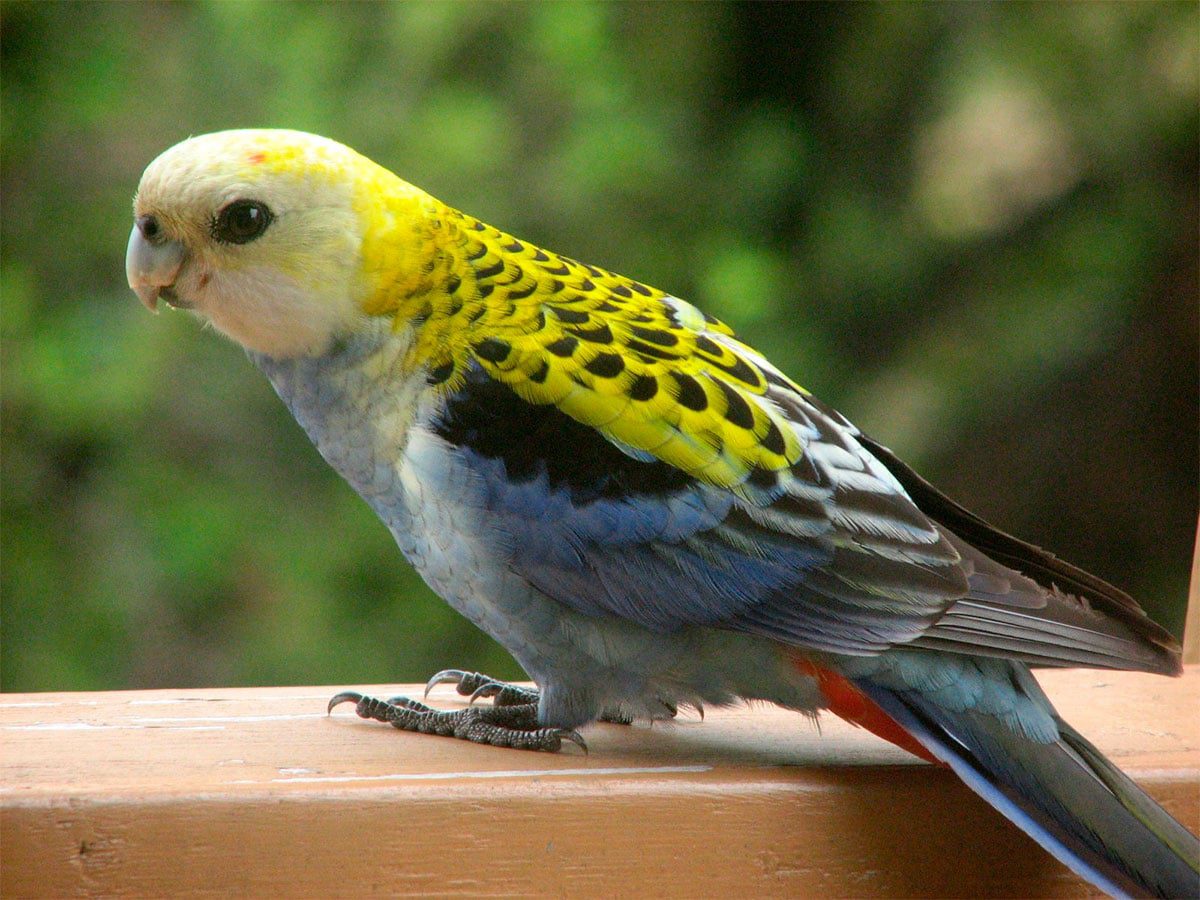
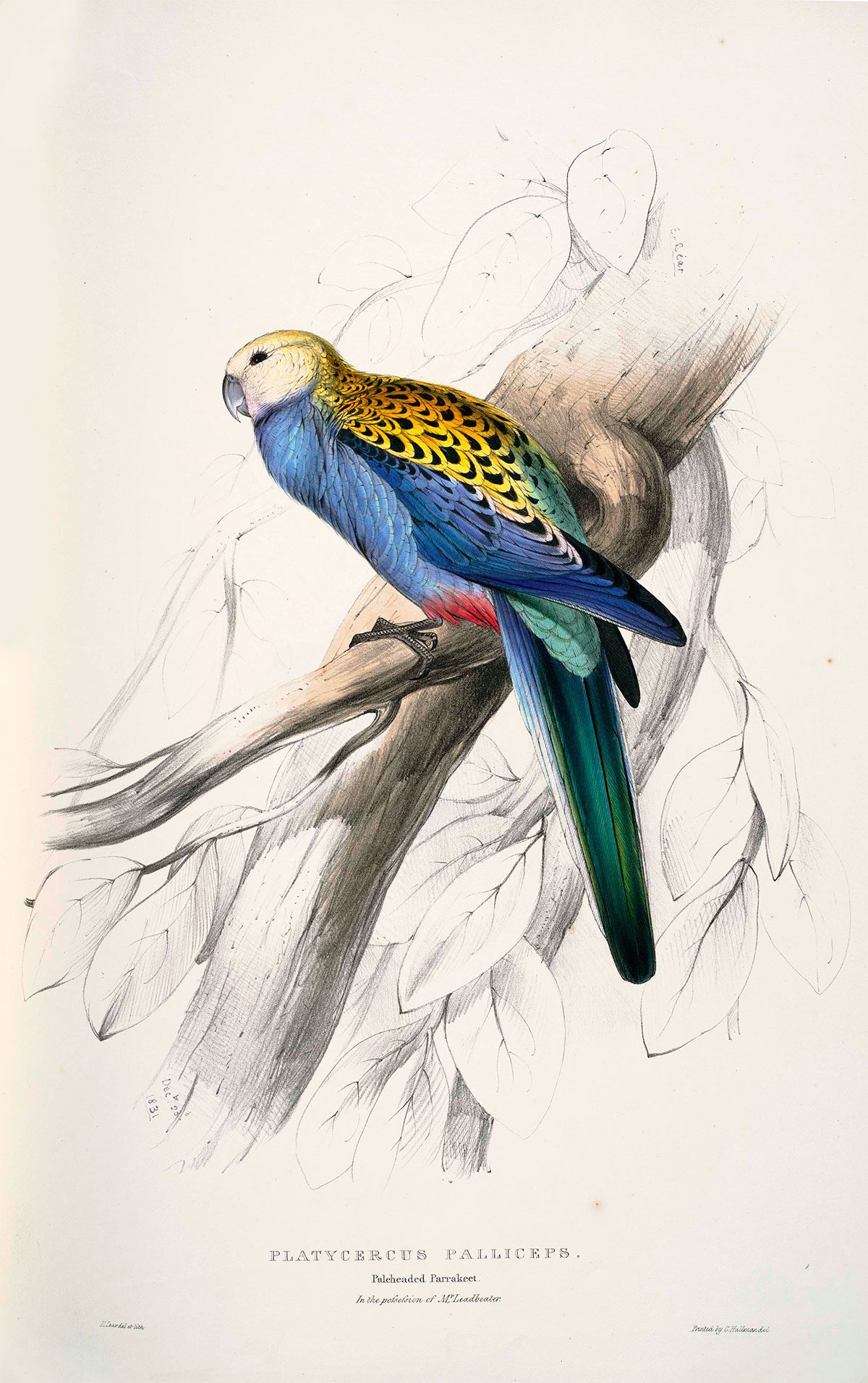
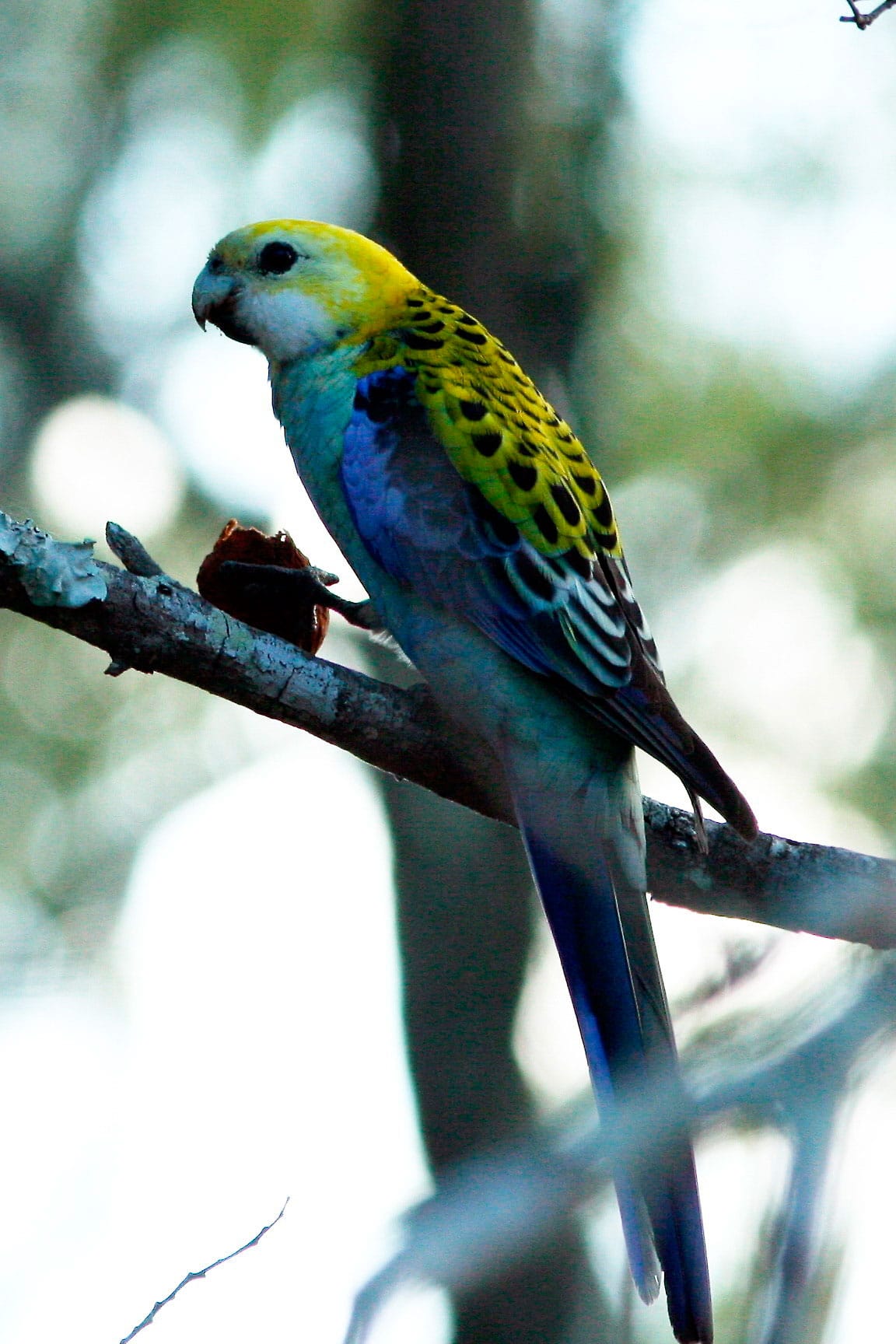
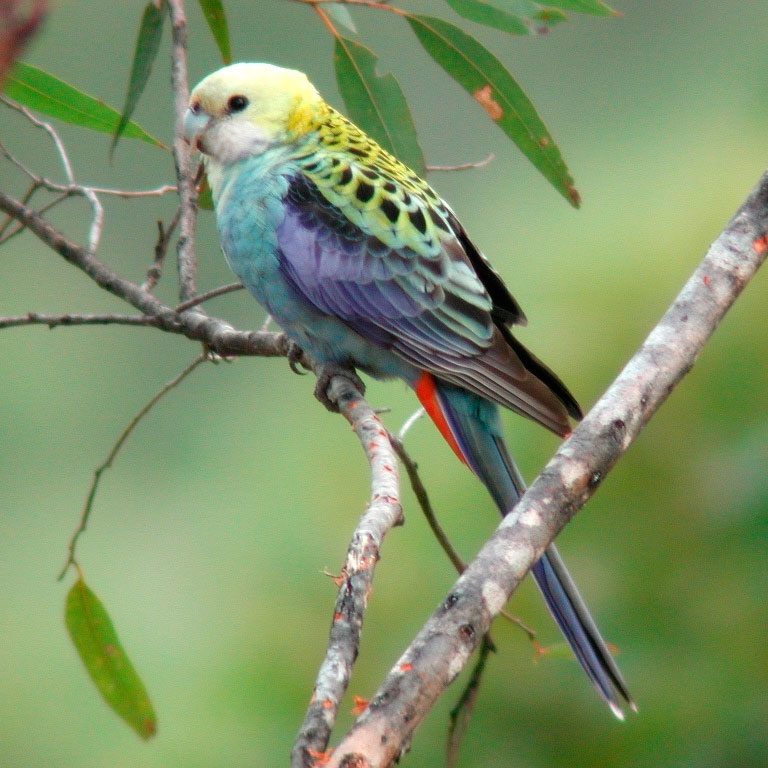
The adult male of the Pale-headed Rosella(Platycercus adscitus), It has a pale yellow "head". The part superior of the cheeks is whitish in contrast with the part below that is of color blue light. Upper chest is yellow, the lower part of the chest and the abdomen are blue. The coverts They show a beautiful red hue. The the mantle, the back and scapulars are black with broad yellow edges, these areas giving a scaly appearance.
The tail is of color yellow uniform. The external coverts are dark blue. The central feathers of the tail are dark blue, but the outer feathers are more pale with thin white edges. The bottom has no stripe.
The bill is white. The irises They are brown, legs grey.
The female is different from the male, its color is more off and has a strip at the bottom of the wings.
The immature they have grayish feathers ending in yellow or orange-red at the top of the crown and the neck. The red feathers lose them about three months. The bottom of the wings is scratched. They acquire adult plumage in about 16 months.
(Lear 1832) – 32 cm.. length. It is something most large that the nominal species. The white color of the face is more extensive, coming up to the neck. Crown, nape and ear-coverts are pale yellow. The blue of the chest presents tonalities yellowishwhite and the feathers of the chest they have a thin lined black. The shoulders with wide verdosa-amarilla blue staining. bottom of the flight feather white.
Habitat:
The Pale-headed Rosella they are common in all types of habitats of open forests, either scrub, scattered forests with logging, the rows of trees along rivers or swamps. They are also found in the wooded heaths which surround the coast and which are dominated by trees of the genus Banksia.
Avoid plunging into the thick forests, giving preference to the clear, meadows at the edges or directly border the plots. They also penetrate the surrounding farmland to feed.
They are birds of the lower regions, rarely rising above 700 meters and voluntarily leaving altitudes to the Crimson Rosella in dense forests and semi-montanosas areas.
Reproduction:
In the North, the Pale-headed Rosella They nest in the months of February to June, with some variations depending on the frequency of rains.
In the South, the breeding season are produced starting from September until the month of December.
These birds build their nests in deep a sick or healthy tree cavity, preferably a eucalyptus located near a river.
Other places that tend to choose are: a hole in a stump or a hole in a fence post.
The spawning generally includes between 3 and 5 eggs. The female incubates alone during 19 days, but as soon as the eggs are incubated, It receives assistance from the male that helps feed the young.
The chicks leave the nest after 5 weeks.
Food:
The Pale-headed Rosella they are mostly vegetarian. They consume a lot of plants, We have identified about 50 plant species. Similar to the Eastern Rosella, the Pale-headed Rosella It feeds mainly in the trees. The seeds of eucalyptus, acacias, Melaleuca, Black Cypress of Australia, acanthus and spiny Thistles, they are your favorite foods. The flowers and fruits some species also form part of their diet.
The Pale-headed Rosella they are often real pests for gardens and cornfields.
Distribution:
Size of the area of distribution (reproduction / resident): 1.470.000 km2
Confined to the East of Australia, where is dispersed through of the Cape York Peninsula, coming to the South up to the Gilbert River in the West, and extending to the South along the coast East of Queensland to the North of New South Wales.
Are also distributed by the Fraser Island and around Brisbane, as well as in other coastal districts.
In New South Wales, the population is limited to the Northeast, extending toward the interior of Bourke and to the South up to around Coffs Harbour, on the coast.
Escapes have been recorded in Sydney and Melbourne, and there was an introduction without success in Hawaii at the beginning of this century.
• Current category of the Red List of the UICN: Least concern
• Population Trend: Growing
The size of the world population It has not been quantified, It is estimated at around 100,000 specimens.
The species according to reports, It is abundant in much of their range (pit et to the. 1997).
They have benefited from the clearing of the forests and the development of fruit tree crops and agricultural fields.. But, an important limitation is that of its acquisition as a popular pet bird, marketed as Blue cheek parakeet. Each year, hundreds of birds are illegally captured in the wild.
"Pale-headed Rosella" in captivity:
common in Europe, not so much in the United States.
Active and moderately loud. Aggressive with other birds. A little susceptible to stress and disease.
Alternative names:
– Pale-headed Rosella, Blue Rosella, Blue-cheeked Parakeet, Blue-cheeked Rosella, Mealy Parakeet, Mealy Rosella, Moreton Bay Parakeet, Moreton Bay Rosella, Pale headed Rosella, White-cheeked Rosella, White-headed Rosella (ingles).
– Perruche à tête pâle, Perruche palliceps (French).
– Blasskopfrosella (German).
– Rosela-pálida (Portuguese).
– Perico Pálido, Rosela de Cabeza Pálida (español).
– Avibase
– Parrots of the World – Forshaw Joseph M
– Parrots A Guide to the Parrots of the World – Tony Juniper & Mike Parr
– Loromania
– Birdlife
– Photos:
(1) – A Pale-headed Rosella in Brisbane, Queensland, Australia By Paul Gear (Picasa Web Albums) [CC BY-SA 3.0], via Wikimedia Commons
(2) – Pale-headed Rosella (Platycercus adscitus) Kobble Creek, SE Queensland, Australia By Pale-headed_Rosella_kob02. JPG: Avicedaderivative work: Snowmanradio [CC BY-SA 3.0], via Wikimedia Commons
(3) – A Pale-headed Rosella in Herberton, Far North Queensland, Australia By Peter Shanks (originally posted to Flickr as pale headed rosella) [CC BY 2.0], via Wikimedia Commons
(4) – A Pale-headed Rosella in Brisbane, Queensland, Australia By Paul Gear (Picasa Web Albums) [CC BY-SA 3.0], via Wikimedia Commons
(5) – Pale-headed Rosella, Platycercus adscitus By Glen Fergus (Own work, Brisbane, Australia) [CC BY-SA 2.5], via Wikimedia Commons
(6) – A painting of a Pale-headed Rosella(originally captioned «Platycercus palliceps. Paleheaded Parakeet. In the pofsefsion of Mr. Leadbeater.») by Edward Lear 1812-1888 Edward Lear [Public domain], via Wikimedia Commons
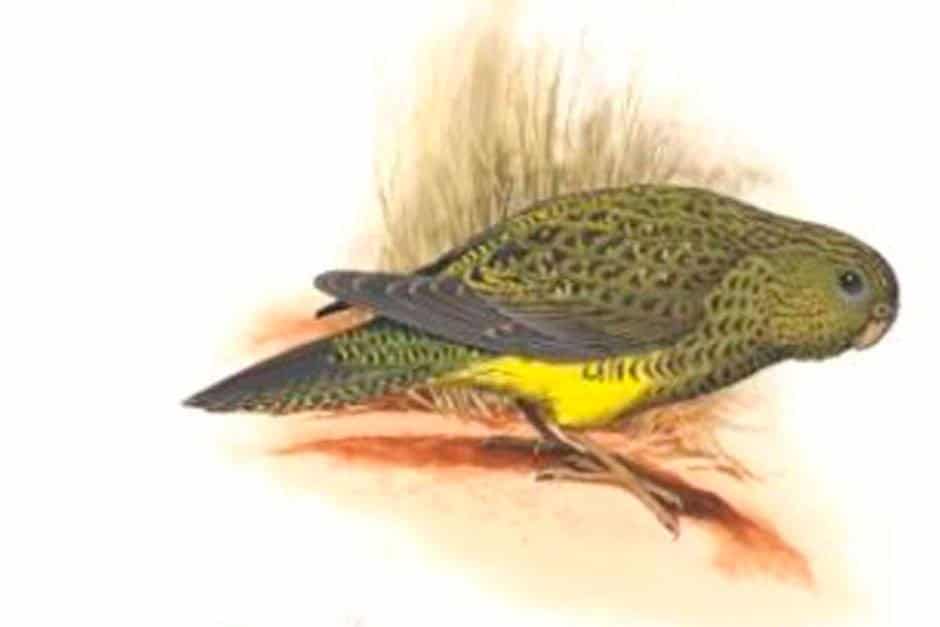
The Night Parrot(Pezoporus occidentalis) It is one of the most elusive and mysterious world of birds.
They have a bill plane, similar to the of the Kakapo (Strigops habroptila), without the apparent hook of the upper jaw. They have feathers around the cere. The tail is short. The legs are relatively elongated, indicating its good predispositions to walk.
The male and female they are similar.
In adults, the upperparts they are generally yellowish-green with dark brown cryptic spots, black and yellow. The front of the neck is greenish yellow. The chest and flanks they have discreet black and yellow stripes. Belly and coats are bright yellow. The flight feather are pale yellow, forming a thin stripe on the lower part of the wing. The central tail feathers are green with a strong yellowish brown shade. The bill is grey-brown, black eyes. Legs long claws dark grey.
In the wild, the Night Parrot It can be confused with the kakapo Parrot, If not we are looking too details which differentiates them.
Habitat:
The Night Parrot It attends a wide variety of habitats in arid or semi-arid land. They are mainly in places where the herbs grow in clumps on rocky peaks, also in the steppes composed of thickets of quenopodios. They also feel a great attraction for the Rock Samphire (A maritime rhythm), plants that are highly resistant to drought and salt.
They are known to flee to the interior areas of Muehlenbeckia, which have a dense foliage. The most recent reports do not come from the areas of Spinifex. It seems that new techniques of fire used to create firewall, They allow you to create favourable conditions for this parakeet.
The night Parrot almost never fly, except when looking for sources of water. To observe them, What has become extremely rare, We must look to the ground, in areas which consists almost exclusively of grasses of the genus Spinifex.
after dark, They fly a short distance until they find a fresh water pond. Once he has satisfied his thirst, they return to the infeed zone.
There is no certainty about the movements of this parakeet. It can be nomadic, Perhaps sedentary. No doubt depend on the climate and territory who attends them. Formerly, when the number of Night Parrot were still substantial, stocks were fluctuating seasonally.
At the end of the 19th century, in Southern Australia, groups of fifteen individuals were local irruptions, a signal that were sensitive to the favorable climatic conditions or were found in the alternative storage sites whose resources were relatively abundant.
All these considerations must be taken with great moderation for the following reason: the well-established notion that birds move through the Plains Spinifex in the direction of places full of thickets of quenopodios according to seasons and seed resources, not always been confirmed in recent reports.
Reproduction:
We know very little about the reproductive habits of this bird. The season of nesting is in July or August. The nest It is a kind of platform built with pieces of wood, on the ground or at low altitude. It is placed in a cavity that has been enlarged and which is accessed by a tunnel whose entrance is in a tuft of grass.. Its diameter is of some 8 centimeters. According to the previous data, the spawning usually contains 4 or 5 eggs. The time of incubation It is unknown.
Food:
The Night Parrot mainly consumed seeds of Spinifex (Triodia). Recent and circumstantial reports, indicate also the absorption of deciduous plants family leaves Poaceae as Enneapogon purpurascens.
Distribution:
Size of the area of distribution (reproduction / resident): 26.300 km2
There is a report of 1913 that places them around Murrayville and Cowangie, Victoria, and another around of Ross Springs between 1954 and 1959. There is also a register of 1.897 that placed them in District of Oxleand, New South Wales.
The species has never been common, but it was more frequently toward the end of the last century (for example, 16 sightings in the region of the Lake Eyre, Southern Australia, in the decade of 1870). Due to marauding habits, many sightings remain unconfirmed, and this makes it difficult to assess its true condition. Even so, It seems certain that the population is declining. The cause of this is unknown, but it may be related to the introduction of predators such as cats, Rats, dogs or foxes. Changes in fire regimes, as well as the introduction of camels, they have also influenced its decline.
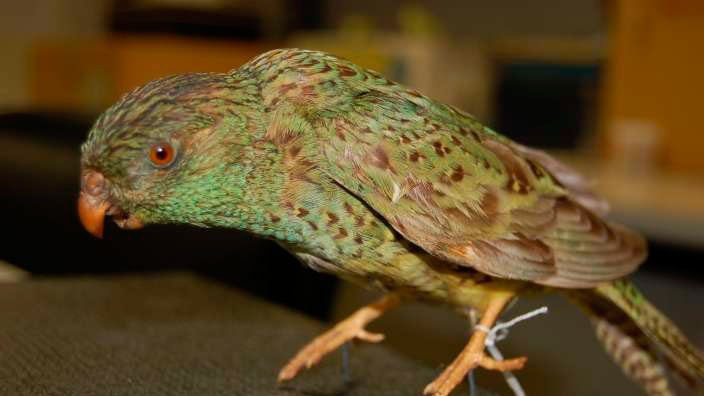
The Night Parrot seen only as museum specimens for 25 are not extinct. To cat-killed Night Parrot was recovered recently in western Queensland, Australia. (South Australian Museum)
There have been reports in every decade since its discovery, and all states in recent years, except Victoria (the last record was in 1950). The most notable recent sighting was of four birds in the eastern side of the cooper river, to 8 km to the East of the Lake Perigundi, Northeast of Southern Australia, in June of 1979. The birds were arrebolados in tangled shrubs, Sclerolaena intricata and flew away before perederse in the dense forests of Muehlenbeckia florulenta. In 1990 a long dead individual, It was the first specimen in a Museum from the Decade of 1880, was collected in the southwest of Queensland,to 36 km to the North of Boulia. A more recent record of these birds (between March of 1992 and June of 1993) He was picked up in the South of Cloncurry, about 150 km to the North of the area where the dead bird was found, which confirms the local persistence of this species.
The global population is unknown, but it can be very small and is likely to be declining. There are none in captivity.
The Night Parrot has been the subject of a legal protection in Australia since 1937.
Conservation:
• Current category of the Red List of the UICN: Danger
• Population trend: Decreasing
After no record is confirmed from 1990, despite several exhaustive searches and publicity campaigns, This species was rediscovered in 2005 in the region of Pilbara in Western Australia, and a dead juvenile was found in the Diamantina National Park, Queensland in 2006.
It is likely that they have decreased as a result of a series of threats, and the remaining population can be very small and possibly subject to extreme fluctuations.
Based on the records of 2005 and 2006, and because of the shortage of sightings, a Committee of experts concluded that the species was in danger of extinction.
The population of the Night Parrot is supposed to be very small, and is estimated at less of 50 mature individuals based on the scarcity of records. In 2010 a Committee of experts re-evaluó given records of Western Australia in 2005 and Queensland in 2006, and estimated that there could be 50 to 250 birds in total (Garnett et to the. 2011). Therefore, the number of mature individuals is placed in the band of 50-249, but it can become something bigger.
The population It is suspected that it may be in decline due to a combination of threats, including predation by invasive exotic predators.
If a population can be located, the following measures could be introduced:
• a research and monitoring program
• control of wild animals in and around the place where the population of the Night Parrot
• patch burning to limit the possibility, or to prevent the occurrence of fire in the place of the population until better understanding of the situation and the ecological needs of the population
• minimize disturbance to the population site, which could include leaking information to the public, and the establishment of agreements with landowners and land managers.
• establish a captive breeding program (Blyth 1996; Garnett and Crowley 2000).
Parrots A Guide to the Parrots of the World – Tony Juniper & Mike Parr
Birdlife
Night parakeet photos:
(1) – 1971 painting of a night parrot by William Cooper – Enlace
(2) – The Night Parrot seen only as museum specimens for 25 are not extinct. To cat-killed Night Parrot was recovered recently in western Queensland, Australia. (South Australian Museum) – Top Birding Tours
▷ The world of Pets: Dogs, cats, birds, reptiles, amphibians
Origin: Chad, Central African Republic, Sudan, Democratic Republic of the Congo, Congo
Character: Shy, suspicious
Life expectancy: ---
Height: 25 cm..
Content
Description:
25 cm.. length.
The Niam-Niam Parrot(Poicephalus crassus) has the head and nape Brown olive; the ear-coverts Silver. feathers of the the mantle and tertiary Brown with dark green margin; back, uppertail-coverts and bright green.
Upper, wing-coverts dark green; secondary more internal dark green; rest of the flight feather brown with vane dark green external. Throat and top of the chest Brown olive opaque; bottom of the chest, the belly, the the thighs and undertail- coverts green.
Feathers of the tail dark brown tipped with dark green margins.
Bill yellowish, upper jaw darker than black-tipped; irises yellow; legs blackish.
Both sexes similar.
Hood grayish brown of the immature It shows strong brands of color yellow olive; the the mantle is greener. Underparts paler and more yellowish in adults. Secondary internal lined with yellow. More pale the upper jaw the adults and with grey tip.
Frequents wooded areas of Savannah, forest-savanna mosaic, wet sheets and Syzygium-Adina forests in the savanna to the 1.000 m.
Common in areas near water. Observed in pairs or in small groups. Regular daily movements take place even in the mountainous areas where the Niam-Niam Parrot visit tall trees to feed.
Reproduction:
Few details about reproductive biology, but believes that nest between August-September during the rainy season.
Courtship and implementation not described.
Food:
Its diet It is little known but includes a wide variety of seeds; reported foods include millet, and beans.
Distribution:
Size of the area of distribution (reproduction / resident): 343.000 km2
North of Central Africa to the South of the Sahara. Believed to inhabit also in Cameroon Eastern (where is the status unclear) through the Center and South of the Central African Republic, South-West end of Chad and the north end of the upper area of the Democratic Republic of the Congoto the southwest of Sudan (Bahr-el-Ghazal).
Sedentary with local movements. Little-known state, but think it's generally common, Although most scarce in the southwest of Sudan.
The size of the world's population has not been quantified. This species is one of the lesser known African parrots, but it is assumed that it is common in its area of distribution.
The population is suspected to be stable in the absence of evidence of any reduction or substantial threats.
"Niam-Niam Parrot" in captivity:
Very rare in captivity.
It is a parrot of middle voice, shy and suspicious. Young birds are more accustomed to the caregiver.
New birds susceptible to the stress or illness.
Is necessary for their well-being a regular supply of fresh wood; susceptible during the acclimatization period; resistant once acclimated.
Origin: Bangladesh, Bhutan, Cambodia, China, India, Indonesian, Laos, Myanmar (Burma), Nepal, Thailand, Viet Nam
Character: Sociable
Life expectancy: 15 to 20 years.
Height: Of 33 to 38 cm..
Content
Description:
33 to 38 cm.. length between 133 and 168 g. of weight.
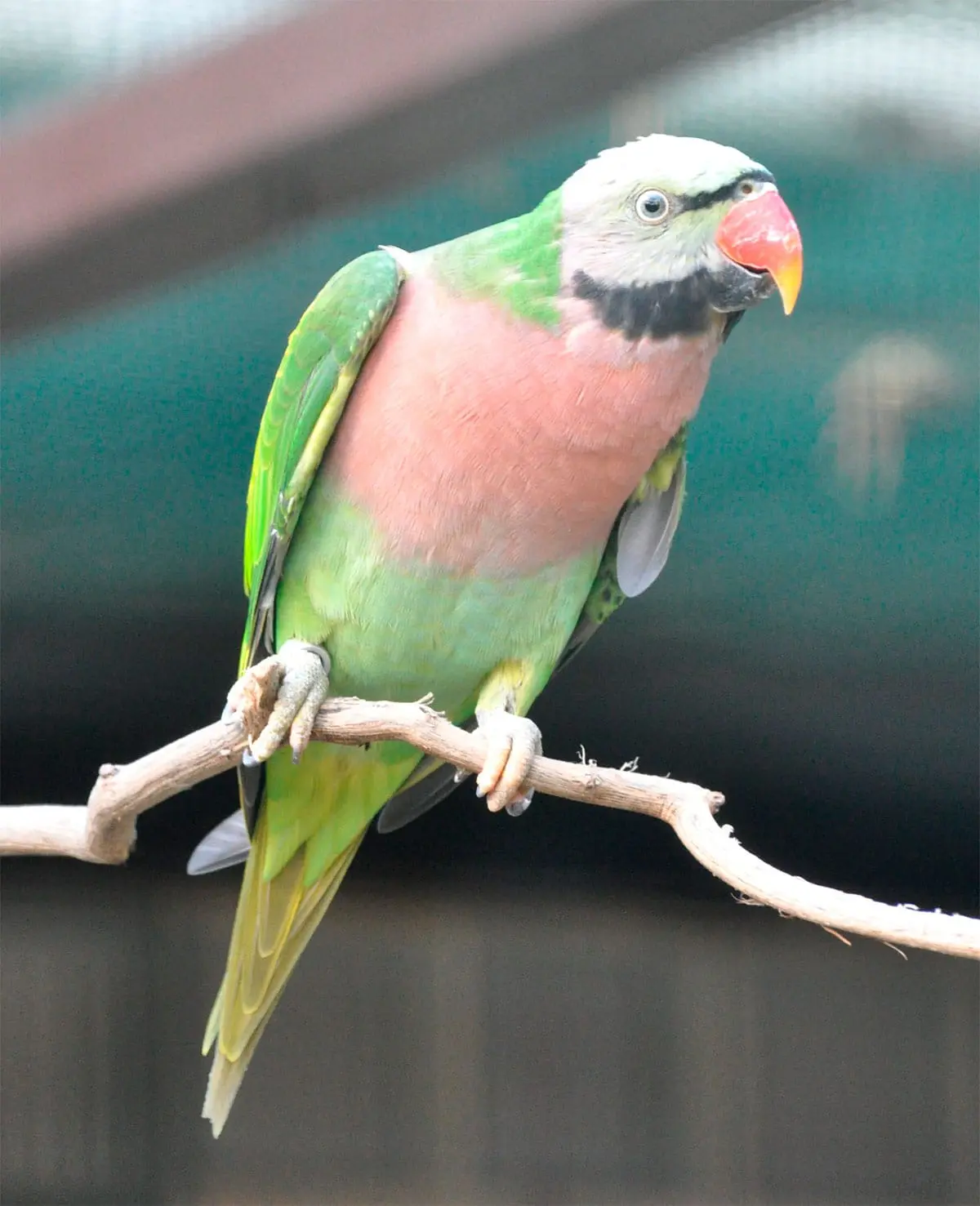
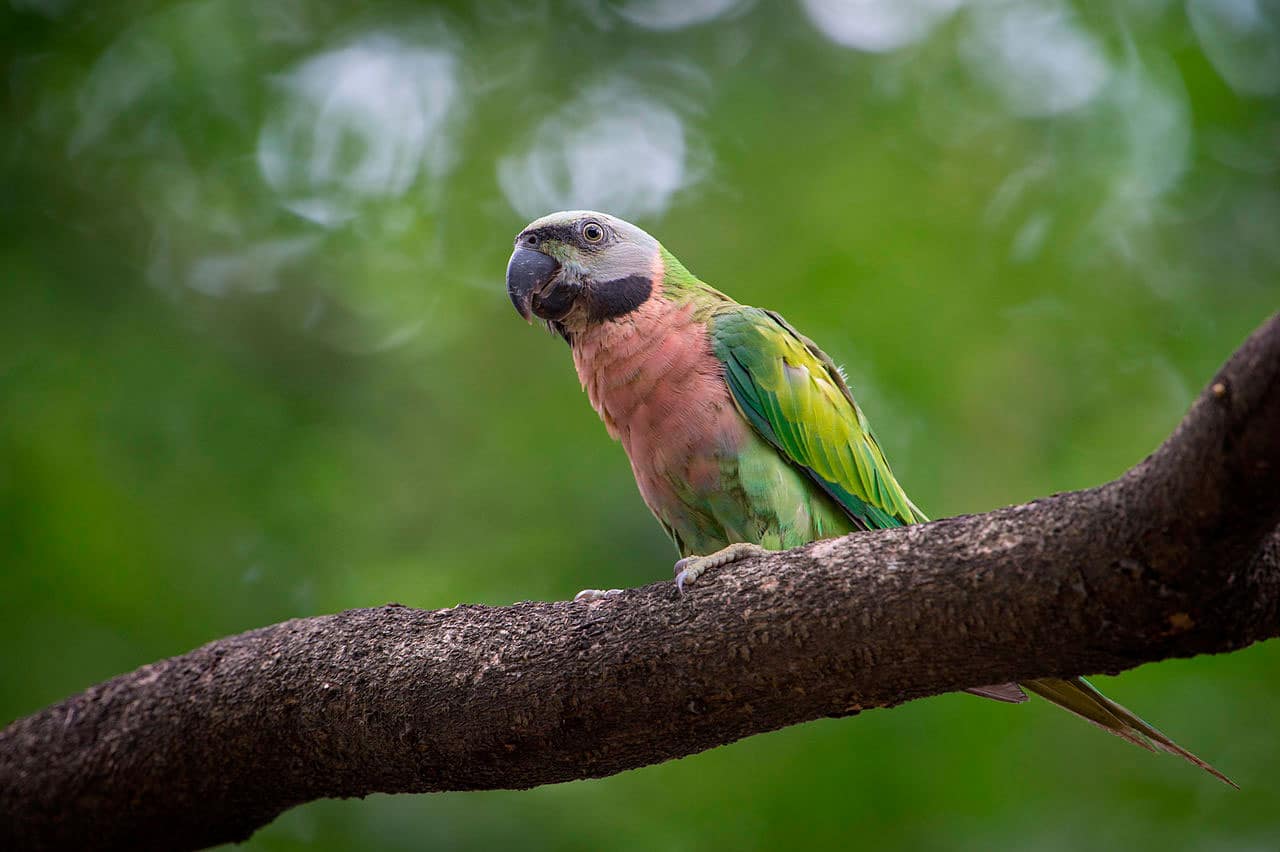
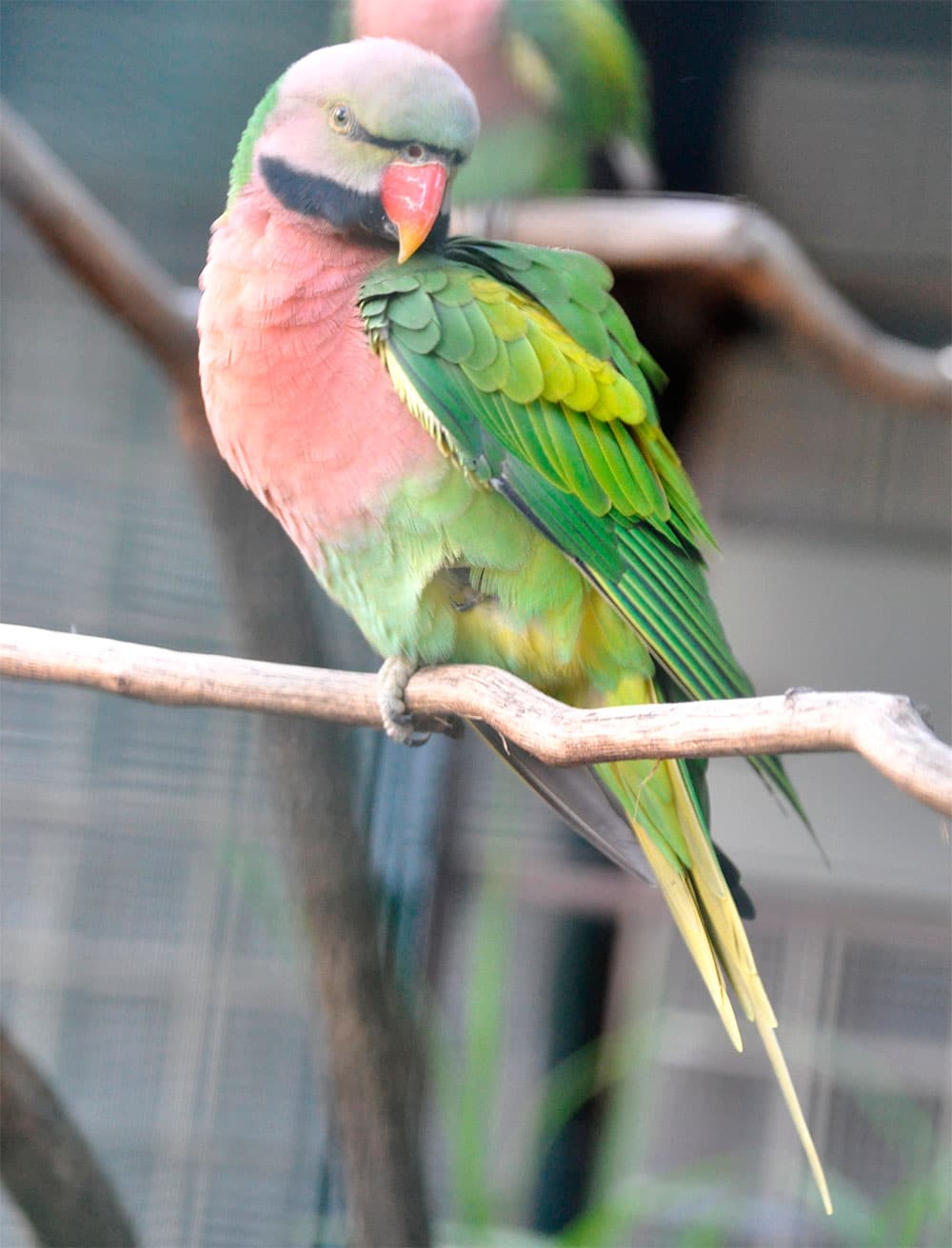
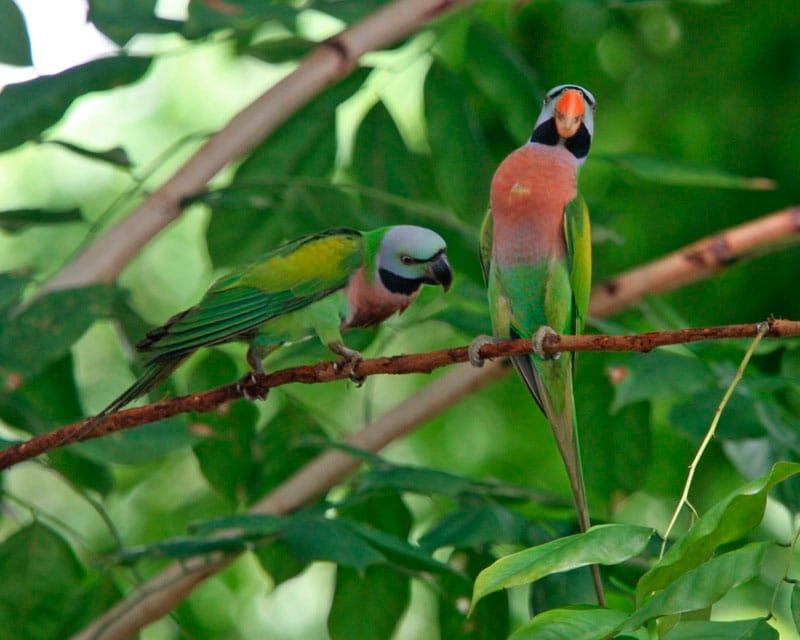
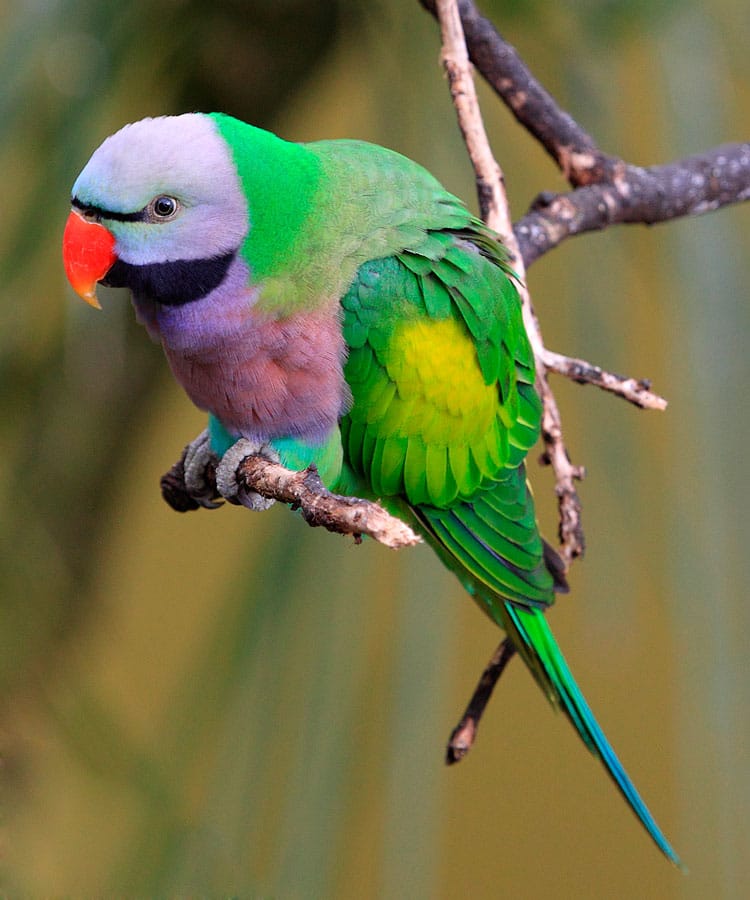
The Red-breasted Parakeet(Psittacula alexandri) is a bird with a form attractive, thin, and with a long and narrow tail. Its plumage is green, the overall tone of the head is grey, the bill red, and with brands distinctive in the head and face. The area around the eyes is greenish, with a pretty bluish tint. It has a fine line along its forecrown and wide stripes in their cheeks. Plumage in the chest, the throat and the top abdomen is salmon-pink color, extending halfway from the vent.
The female It has a shade bluish through the region of the face. In general, they have a pink color more off above the chest and the feather half of its tail they are shorter than the of the male.
The immature birds they have the tail shorter, the bill Pink, and incomplete rays of the cheek they are easily distinguished.
Between the young birds hard identification between males and females, However, breeders have managed to identify them correctly. The head of the female bows in a more uniform manner from the cere to the rear of the head. The young males they tend to be flatter in the forecrown. The females They seem to have a face darker than blue.
(Oberholser,1919) – Length: 36 cm.. Similar to the Psittacula alexandri fasciata (including sexual dimorphism in staining of the bill) but larger and paler.
(Oberholser, 1912) – Length: 36 cm.. As the Psittacula alexandri fasciata but with the belly blue (especially in males), the upper part of the abdomen darker and the lores, forecrown and bottom of the abdomen strongly impregnated with the pale blue.
Psittacula alexandri dammermani
(Chasen & Kloss, 1932) – Length: 36 cm.. Perhaps, on average, larger that the Psittacula alexandri fasciata. The pink color of the chest It is darker than the species nominal. In the female, the pink color extends from the throat at the sides of the neck. The bill larger than that of the species nominal. Both jaws Red in both sexes.
Psittacula alexandri fasciata
(Statius Müller, 1776) – Length: 33 cm.. Upper chest and abdomen is dark pink with violet tone, the head is bluish-grey way more uniform. The areas of the eyes and forehead with greenish hue. The females, part of the difference of the bill, nor have the violet tonality in the pink of the chest.
Psittacula alexandri kangeanensis
(Hoogerwerf, 1962) – Length: 33 cm.. More grey the head (less blue). Bill larger than that of the species nominal and both jaws Red in both sexes.
Psittacula alexandri major
(Richmond, 1902) – It is more large, of 38 cm.. length. Similar to the Psittacula Alexandri Fasciata but something more pale and the head is without bluish tone gray.
Psittacula alexandri perionca
(Oberholser, 1912) – Length: 37 cm.. As the Psittacula alexandri fasciata (including sexual dimorphism in the coloration of the bill) but paler and larger, without the Green tint around the eyes.
Habitat:
Usually, they live below 2.000 m (rarely above 345 metres in Nepal) all types or forest and wooded areas, including dry forest, secondary-humid deciduous forest, mangroves, coconut and mango groves , areas planted with trees (including hills of shifting cultivation), parks and urban areas. In the region of the Himalaya avoids the dense green forests.
Gregaria, usually in flocks of 6-10 birds, less frequently in groups of 50 and very exceptionally in thousands, larger flocks during garbage collection (for example, the mango or rice), sometimes mixed with the Slaty-headed Parakeet wave Gray-headed Parakeet. They form communal roosts in the tall trees, bamboo or sugarcane scrub areas.
Reproduction:
The Red-breasted Parakeet nests in natural cavities or old hole made by woodpeckers or barbets, usually at a height between 3 and 10 m, often in loose colonies. The hole is filled with wood shavings.
The laying is of 2 to 4 eggs.
The breeding season is between December and April, Depending on the location and the altitude; in Java, breeding has been recorded in every month, except for April.
Food:
Diet Red-breasted Parakeet includes wild figs and other fruits, fruit trees and wild, flowers and nectar (especially, for example, of the Parkia speciosa and Erythrina variegata), dried fruits (for example, chestnuts Castanea), fruit (for example, Mango), berries, seeds (for example Albizia), leaves and cereals such as rice and corn, by causing serious damage to crops, especially for rice.
Distribution:
Size of the area of distribution (reproduction / resident): 2.570.000 km2
The Red-breasted Parakeet are distributed from the central area of the Himalaya until Indochina, China and West of Indonesian. From the lowlands of the Himalaya in the North of India, approximately to the East of Dehradun, through Nepal, Sikkim and North of Bhutan in the southwest of Yunnan, China; to the South by Assam, Manipur and Nagaland, India, until Bangladesh and to the East by Burma (including Mergui archipelago), Indochina, Malacca Peninsula, around 9°N (a record of 1889 in the Kelantan River at approximately 5°N suggests a contraction in its distribution) of Guangxi and Provinces of Canton and Hainan Island, to the South of China.
They are also distributed in Islas Andaman and Indonesian in Java, Bali, Karimun Java, Kangean, Borneo South (where it was probably introduced from Java) and Simeulue, Nias and Banyak, West of Sumatra.
Getaways captive birds eggs were found in Singapore and a single record (presumably an escape) in Hong Kong.
Resident but with some local movements dependent on food supply.
It is the most common parrot in some parts of its range., but with a substantial decrease in Thailand and Laos in recent years and local extinctions (for example, Java and Bali), because of the live poultry trade; the nominal subspecies may be at risk as a result of his capture. A small number in captivity out of range (mainly the nominal species and fasciata).
(Statius Müller, 1776) – Continental Asia from the North of India through the Himalaya lower, Burma including the Mergui archipelago, Thailand and Indochina to the South of China, including Hainan
The population of the Red-breasted Parakeet It is suspected in a moderate to fast global decline, due to the unsustainable levels of exploitation and the destruction of their habitat. This suspicion is supported by widespread anecdotal evidence that in many parts of its range decreases.
Threats:
– The declines and local extinctions in recent decades in the population of the Red-breasted Parakeet have been attributed in large part to his capture to the trade in live birds (Juniper and Parr 1998).
– The hunt they are considered the main threats to the species in Nepal, where it is also threatened by the loss of forests (C. Inskipp and HS Baral in litt. 2011).
– His nasal voice makes the species a popular in Nepal cage bird, and their vocal habits during the breeding season, together with the tendency to form large flocks when not raising, they make susceptible to trappers. These factors lead to illegal hunting and his capture in protected areas; they are also persecuted by farmers due to their raids on crops (C. Inskipp and HS Baral in litt. 2013).
– Similarly, in Bangladesh, the species is captured for the cage bird trade It is also likely that they are affected by the removal of large trees (P. Thompson in litt. 2012).
– Almost the total disappearance of the species from the North of Laos, It is believed that it is mainly due to the loss of habitat through conversion to agriculture (JW Duckworth in litt. 2011).
– Loss and fragmentation of forests is likely to accelerate in Cambodia in the near future, given that many of the large agro-industrial concessions have been awarded recently (H. Rainey in some. 2011).
Conservation Actions:
– The species is listed in the Appendix II of CITES.
The Red-breasted Parakeet is a bird Smart and outgoing that is gaining increasing worldwide popularity. These parrots are sociable and playful, and if they are properly socialized, they can be a few excellent pets. They can be a bit aggressive and authoritarian, If it is not properly discipline. They need a good cage for a large size, with a lot of toys to avoid boredom.
Although this bird is linked with the Rose-ringed Parakeet, they are very different in personality. The Red-breasted Parakeet It is softer and not so noisy, although she has been described as "feisty". It is usually more quiet than other Psittacula. Also are great eaters and you accept easily new foods other birds may be thrown away.
You can get to imitate some sounds, even words, Although not as clear as the some of the larger parrots, example the Grey Parrot. But, according to some sources, they can speak more clearly than the Rose-ringed Parakeet.
Regular handling is important at an early age, since they can become aggressive, If not are well socialized and manipulated.
If you want a small Parrot with personality, the Red-breasted Parakeet It can be the ideal ave. But, It is still a "stubborn" and "stubborn" bird.. It is not surprising considering his intelligence. Obedience training is recommended. On the other hand it is one voracious chomping and should it be should provide plenty of toys to chew.
Like other parrots, need company, and if they will not be in an Aviary with other birds, We must be able and willing to spend large amounts of time with them.
In nature, this bird is often seen in flocks of 10 to 50 individuals. These flocks, often, they are heard before to be seen. This is a fact that must be taken into account before deciding to buy one Red-breasted Parakeet. Breeding females can be put in 3 to 4 eggs in each clutch, with an incubation approximately 22 days.
With regard to its longevity, according to sources, We need to know that a specimen lived 23,3 years in captivity.
Captive breeding:
The Red-breasted Parakeet commonly bred in captivity. They reach maturity between 2 and 3 years of age. The birds must be matched at a young age. The female can sometimes dominate males. The procession begins at the end of winter and the females can be seen calling males for food. In the wild they breed between the months of December and April, Although this is variable, Depending on the climate and altitude.
A thick-walled hollow trunk, It can be used as nest. If not available, any commercially available nesting box should suffice.
They require long aviaries, more than wide, due to its long tail and its type of flight (powerful, linear). Also like a protected breeding area. The entrance door to the Aviary must be on the opposite end. We must place leaves of Palm on the bird front and leafy branches on the back to protect the young fledged when they hit the walls of the Aviary and fall on your floor. If this is not done, many of the young people will die from injuries in the head or severely damage their hair. Young hatchlings do not have great control when they start to fly; they can be left with the parents during 9 months, but then you must be separated.
Diet during breeding It is very important. We can use sunflower seeds germinated, soaked chickpeas, Apple diced, celery, raw or boiled corn and green feed. Supplementation with multiple vitamins and liquid calcium is especially important prior to egg laying..
Alternative names:
– Red-breasted Parakeet, Banded Parakeet, Bearded Parakeet, Indian Red-breasted Parakeet, Moustached Parakeet, Pink-breasted Parakeet, Red breasted Parakeet, Rose-breasted Parakeet (English).
– Perruche à moustaches (French).
– Bartsittich, Rosenbrustsittich (German).
– Periquito-de-bigode (Portuguese).
– Cotorra de Pecho Rosado, Cotorra Pechirroja (español).
– Avibase
– Parrots of the World – Forshaw Joseph M
– Parrots A Guide to the Parrots of the World – Tony Juniper & Mike Parr
– Birdlife
– Photos:
(1) – Moustached Parakeet in the Walsrode Bird Park, Germany By Quartl (Own work) [CC BY-SA 3.0], via Wikimedia Commons
(2) – Red-breasted Parakeet at Brooklands Zoo, New Plymouth, New Zealand By Dave Young (originally posted to Flickr as bird) [CC BY 2.0], via Wikimedia Commons
(3) – Red-breasted Parakeet (Psittacula alexandri fasciata). Coutrtship – male on right. Changi Village, Singapore. 2 January 2006 By Lip Kee Yap [CC BY-SA 2.0], via Wikimedia Commons
(4) – Moustached Parakeet in the Walsrode Bird Park, Germany By Quartl (Own work) [CC BY-SA 3.0], via Wikimedia Commons
(5) – Female of Red-Breasted Parakeet (Psittacula alexandri) at Bangkok, Thailand By Jason Thompson (Flickr: Red-Breasted Parakeet (Female)) [CC BY 2.0], via Wikimedia Commons
(6) – Plate from Zoological illustrations, Volume 1, 2nd series By William Swainson [Public domain], via Wikimedia Commons
The Ouvea Parakeet(Eunymphicus uvaeensis) is similar to the Horned Parakeet(Eunymphicus cornutus) but with the face and nape green, no yellow, and crest upturned six pens greenish black: the Red of the crown It is limited to the center forecrown.
The Ouvea Parakeet generally bright mid-green. Head green, lighter on ear-coverts with some light shaft-streaks; centre of forecrown red with six wispy blackish-green uperwing feathers forming a small crest; rear-crown darker green; ears and cheeks dark green lower.
The upperparts light green, paler on rump. Wing coverts green; outerweb of primaries greenish-blue with innerwebs black. Underwing-coverts green. Underparts light yellowish-green. Uppertail green with a slight blue suffusion distally and blue edges to lateral feathers; undertail gray.
Bill blue-gray at base, blackish toward tip; irises orange; legs grey.
Both sexes similar.
Taxonomic status:
This taxon is considered a subspecies of Eunymphicus [cornutus or uvaeensis] (sensu lato) by some authors
Sound Uvea Parakeet.
Note:
some species, as in the case of Ouvea Parakeet, They are subject to extreme stress due to traps or harassment. The open availability of high-quality recordings of these species may make the problems even worse.. For this reason, transmission and download of these recordings is off. Recorders are free to share in xeno-edge, but they will have to approve access to these recordings.
We do not take this action lightly, and we wish it wasn't necessary, but we are convinced that the negative impacts of offering easy access to these recordings outweigh the benefits. To access these recordings, You can contact directly with the recorder.
Habitat:
It is restricted to areas of old growth forest with holes for nesting, but the highest numbers occur near papaya plantation areas.
The Ouvea Parakeet They are active in early morning and late afternoon, and usually rest in the trees during the heat of the day.
Reproduction:
An average of 2.9 Eggs are laid in one or two broods per year, of which 1.7 chicks hatch, but only 0.75 chicks survive to 30 days (Robinet et al. 1995, Robinet et al. 1996, Robinet and Salas 1999).
Food:
It feeds in the forests and crops of cultivated land adjacent. The Ouvea Parakeet It depends mainly on mature native forests with pines kauri Agathis australis.
Fruits of Ficus spp., there Canaria, scrub and passion fruit. Also forage for seeds. The cultivated papaya (Carica papaya) It is a favorite.
The species is found in isolated patches of forest now restricted to the coast, mainly in the district St Joseph between Cape Rossel and Cape Steep. Single 15-25 km2 of suitable habitat was considered to remain on the island in 1993, with about 70-90 birds present, although a more thorough study has suggested a total population of 617 individuals. More recent studies is estimated at 1.780 mature individuals in total (Theuerkauf s suffering. 2016)
In the past, the reduction of individuals to extensive conversion of forests for agriculture due, hunting and trade. The delicate political situation in Uvea, while Kanak Liberation Front struggle for independence France, It has hampered the work of conservation of the species.
It is relying on a captive breeding program based on Forest Park, about Noumea, in New Caledonia. Transfers from island to island also be considered feasible.
Conservation:
• Current category of the Red List of the UICN: Vulnerable.
• Population trend: Growing.
• Population size : 600-1800 individuals.
Rationale for the Red List category
This species is classified as Vulnerable because it is in one very small island and can be threatened by invasive species, in particular the Black rat, that could bring the species to the category of Critically Endangered or Extinct in no time.
Justification of the population
The population is estimated at 1.780 mature individuals in total (Theuerkauf s suffering. 2016), rounded here to 1.800 mature individuals.
Justification trend
Barré et al (2010) reported that the population has increased in a 29% (of 10 birds / km2 34 birds / km2) between 1993 and 2009, which equates to an increase in population 34% in three generations.
Conservation Actions Underway
1 – Appendix I and II of CITES.
2 – The Association for the Protection of Perico Ouvea (ASPO) It was created in 1993 with members mostly local.
3 – ASPO initiated a long-term study of the biology and ecology of the species as the basis for two recovery plans. (1997-2002 and 2003-2008).
4 – Forest loss is being addressed through awareness programs and community trials to mitigate habitat degradation and improve the quality of forests, particularly in regard to nesting sites.
5 – Ten guides are used, whom, among other tasks, nests located.
6 – Illegal trade is being addressed successfully through increased awareness and enforcement.
7 – A captive breeding program has been discussed, but it hasn't started yet, and the species is found only in small quantities in captivity for a very limited reproductive success (Tap 1996).
8 – In 1998 translocation program began to repopulate southern Ouvea, and the number of birds in the south was 395 individuals in 2011 (Theuerkauf s suffering. 2016).
9 – Black rats were trapped on the island (Theuerkauf s suffering. 2016) and predator control is important.
10 – In 2003 a recovery plan was drawn updated, in which it recommended, among other things, the translocation program was canceled, since the population is considered viable and grow naturally; this Recovery Plan has been accepted by the local indigenous authorities (N. Barré a slightly. 2003, Anon 2004).
11 – Ouvea has been classified as IBA, but a management plan and a protection program involving the communities have not yet been established (Spaggiari et al. 2007).
12 – SCO obtained funding from the British Bird Watching Fair to build and test artificial nests PCV after the failure of trails wooden nest.
13 – ASPO personnel destroyed or removed 187 bee colonies between 2002 and 2008 (L. Verfaille a slightly. 2007, Barré et al. 2010).
14 – The continued presence of local guides is believed to effectively prevent nest poaching. (Barré et al. 2010).
Conservation Actions Proposed
1 – Continue population monitoring (Primotel 2000).
4 – Review and strengthen measures to control predators.
5 – Assess progress and update plans for translocations.
6 – Review and update all aspects of the Action Plan.
7 – Maintaining the momentum of awareness and participation of the community and the island (Robinet and Salas 1997).
8 – Establish a project IBAs in Ouvea and fund a protection program (N. Barré a slightly. 2003).
9 – Start a captive breeding program to support future reintroductions.
10 – Carry out surveillance screening BFDV to guide future efforts biosecurity and conservation, and better understand the risk posed by BFDV (Jackson et al. 2014).
"Ouvea Parakeet" in captivity:
The Ouvea Parakeet they are still captured using a rope inside a fruit Upload papaya, and because the island is a plain, exports through an easily accessible atoll are difficult to control. Birds bought from trappers by 50 dollars can be sold by traders up 1.000 Australian dollars.
There is a captive breeding program, but it hasn't started yet, and the species is found only in small quantities in captivity for a very limited reproductive success (Tap 1996).
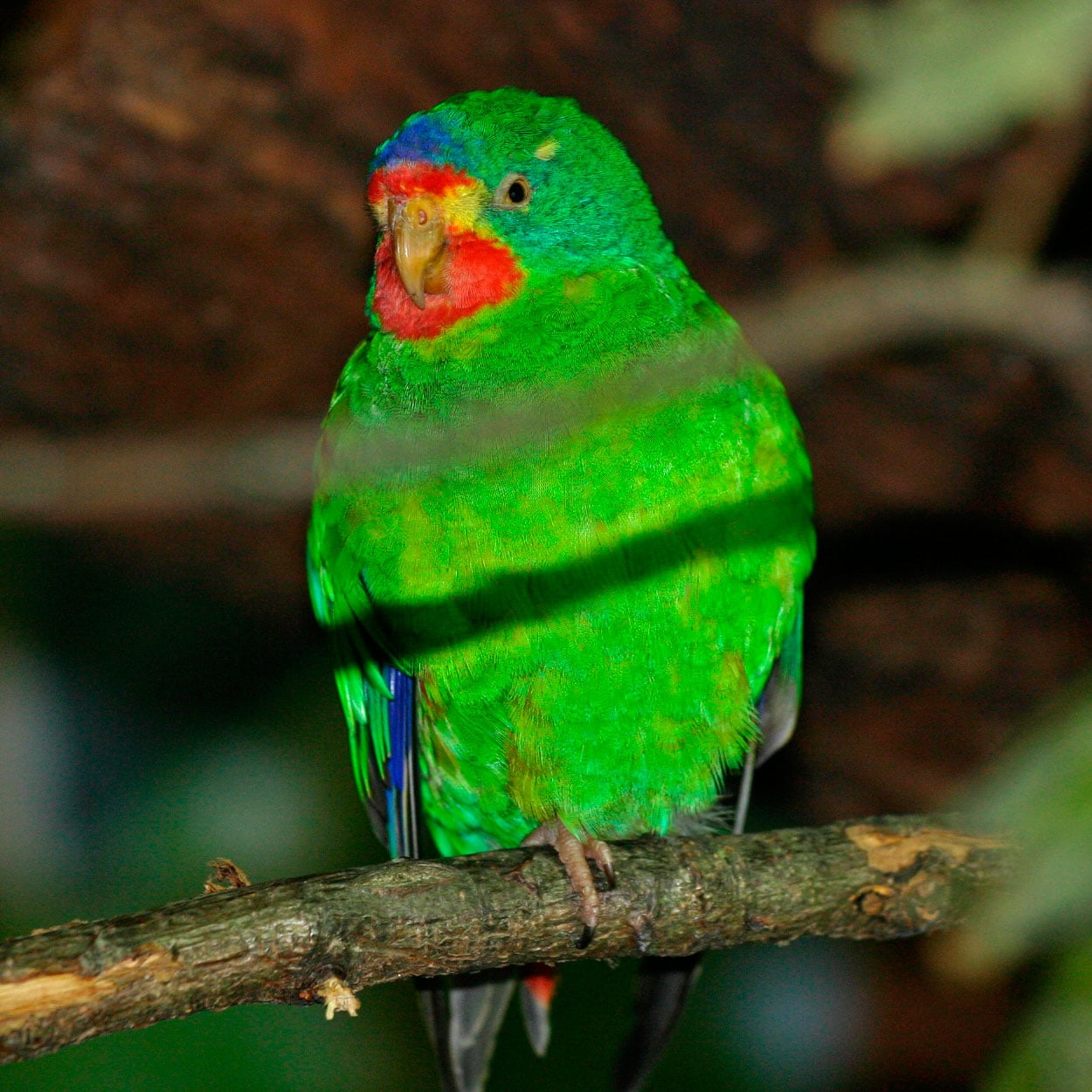
The Swift Parrot(Lathamus discolor) has a length of 23 to 28 cm.. and weighs approximately 65 g..
It is a slim Parrot, medium sized wings angular and pointed tail sharpened.
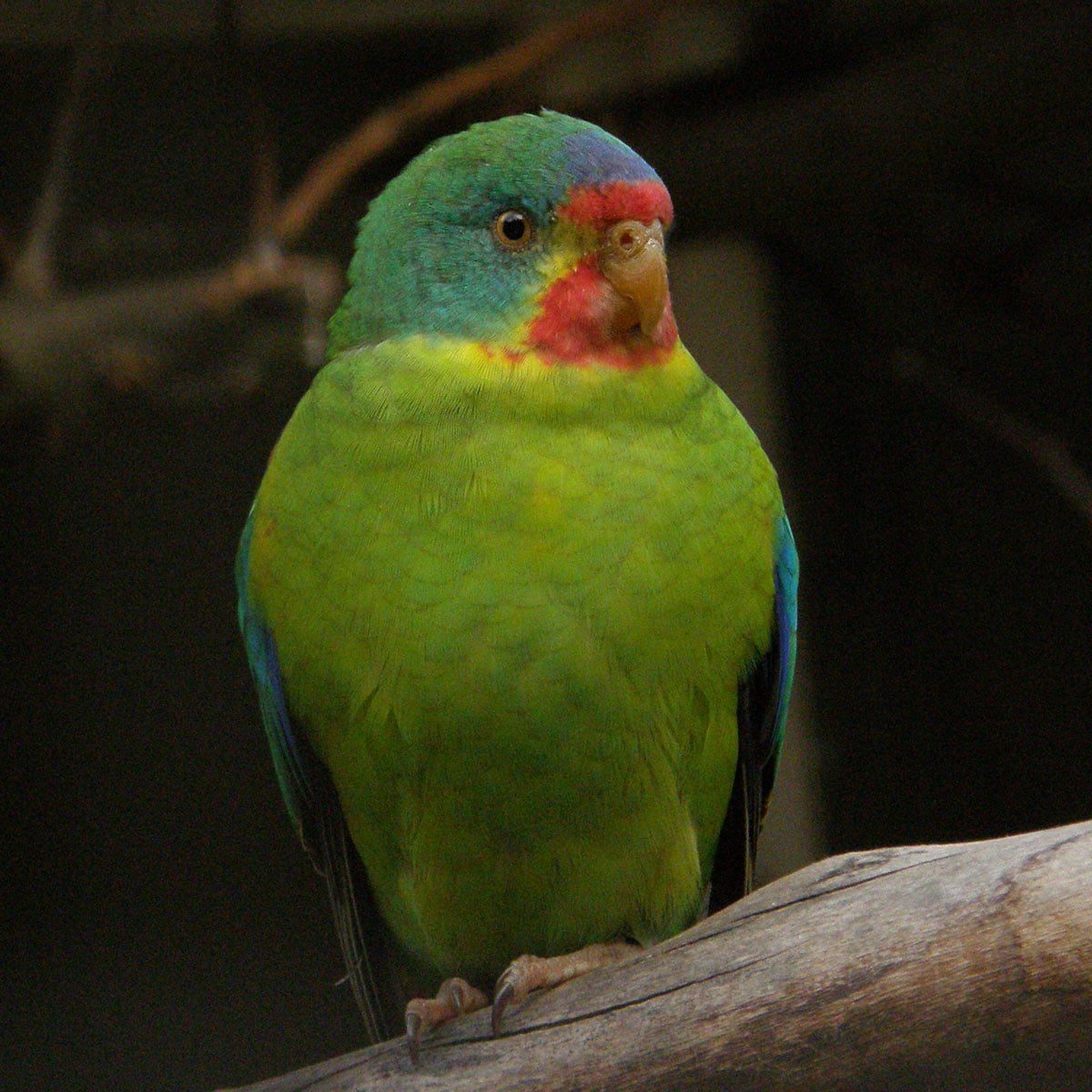
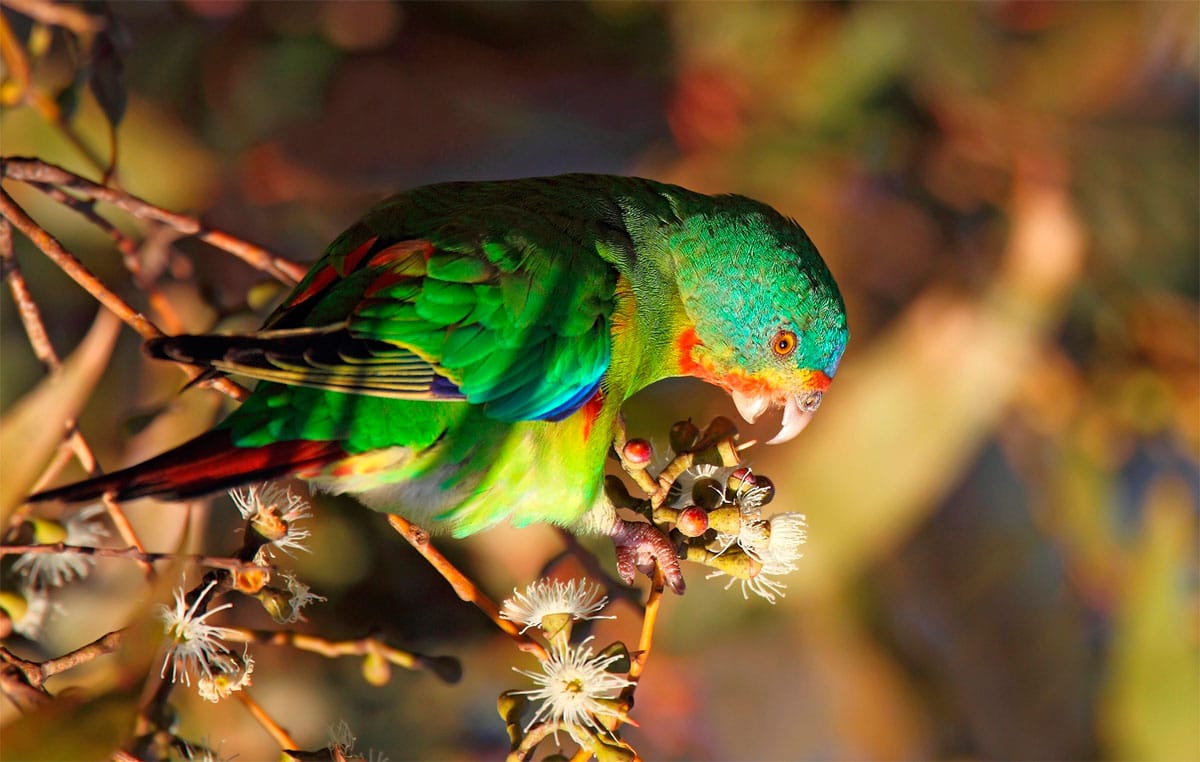
The head is bright emerald green. The forecrown, the chin and center of throat, red; lores bright yellow; centre of crown blue.
The upperparts (rump), bright green. The wing-coverts and feathers under wing
They are red. The feathers under the tail They are red with green scales effect. The chest and feathers belly are yellowish green.
The bill Horn is color and irises yellow.
The female is paler and extent of mask Red lower than that of males. The color of the bottom of the tail just have red.
To the Swift Parrot It is usually seen in small groups of up 30 birds, sometimes in larger flocks (hundreds of birds) around the abundant food sources. There has also been some extraordinary reports in the enumeration of the flocks of more of 1.000 birds.
Son migratory birds. Are reproduced in Tasmania and then move to Australia continental, in autumn, for the non-reproductive season. Most of the population spends the winter in Victoria and New South Wales, before returning to Tasmania in spring. Usually they are gregarious in raising.
The playback area It is always within the 8 km from the coast, largely restricted to an area of less of 500 km² along the eastern coastal strip between Santa Helena and the Lune River, including offshore islands, as Mary Island and Bruny island.
The higher densities They occur between the After Bernier and Orford and Wellington Ridge about Hobart. A smaller breeding population is located in the North of Tasmania between Launceston and Smithton.
Reproduction:
Reproductive success is strongly related to the intensity and scope of the flowering of the Eucalyptus globulus (Tasmanian Blue Gum). In years of bad bloom, it seems that there is little breeding.
The breeding season It is mid-September to late January. Birds begin to return to Tasmania from your area of wintering on the continent at the beginning of August. Most of the population comes in mid-September. Unpaired birds upon arrival to Tasmania they cannot start breeding until November after finding mates.
The De l'Tmño Nidada is three to five eggs. The female makes the incubation. in cautiverior incubation lasts about 25 days. Young people will fly in around 6 weeks. The presence of juveniles, recently fledged at the end of January and early February suggests double broods may occur. Second hatchlings depend on food availability.
A recent study has shown that the nests of the Swift Parrot often found in close proximity to each other. Nest trees may be to only 10-15 m from, and can support up to four active nests each.
Food:
The Swift Parrot It feeds mainly on nectar, mainly of eucalyptus, but also feeds on insects psyllids and lerps, seeds and fruits.
It is a tree Harvester, forages mainly in the eucalyptus, but from time to time low to the ground to feed on seeds, fallen flowers, fruit and Lerp. During the breeding season, the nectar from the flowers of the Eucalyptus globulus (Tasmanian Blue Gum) is the main source of food.
Sometimes they voraciously consume nectar in areas very accessible and this makes them reluctant to fly making them vulnerable to attack by cats, especially when forage among low foliage. His agility and alertness in flight can also be affected by the consumption of large quantities of nectar, possibly increasing the risk of collisions with artificial or hard-to-see objects.
Distribution:
Size of the area of distribution (reproduction / resident): 21.500 km2
The Swift Parrot, as its name suggests, migrates through the bass strait, between Tasmania and the Australian continent. Comes to Tasmania in September and returned to the southeast of Australia between March and April.
You can get to be as far north as the South-East of Queensland and get up to adelaide from the West, Although the most recent sightings are restricted to the southeastern part of the State.
Conservation:
They estimated that the current population probably contains about 2.000 mature individuals and is declining.
The population of this species is suspected to be declining in line with habitat loss and degradation..
The sugar gliders they are the main predators of the broods of the Swift Parrot on the island of Tasmania, being the cause of the 85% of deaths, but they are not present on the Islands Bruny and Maria
• Current IUCN Red List category: Danger
• Population trend: Decreasing
The logging of a particular species is also responsible for the decline of population, eucalyptus, which constitute the 90% your diet.
– The Swift Parrot is classified as a species in danger of extinction in the law of conservation of biodiversity and protection of the environment of 1999 of Australia.
– The Migratory Perico It is listed as a threatened species under the Victorian Wildlife Guarantee Act. (1988). According to this law, a state action must be carried out for the recovery and future management of this species.. In addition the Migrator parakeet is classified as endangered on the list of advisory on threatened vertebrate fauna of Victoria of 2007.
"Swift Parrot" in captivity:
There are no populations in captivity, they are being handled or propagated actively by reintroducing. But, the Swift Parrot is easily propagated in captivity, and many of them are housed in private collections.
Alternative names:
– Swift Parrot (ingles).
– Perruche de Latham (French).
– Schwalbensittich, Schwalbenlori (German).
– Periquito-andorinha (Portuguese).
– Periquito Migrado (español).
– Avibase
– Parrots of the World – Forshaw Joseph M
– Parrots A Guide to the Parrots of the World – Tony Juniper & Mike Parr
– BirdLife.org
– Wikipedia
– mundoexotics.com
– environment.gov.au














.jpg)


.jpg)


